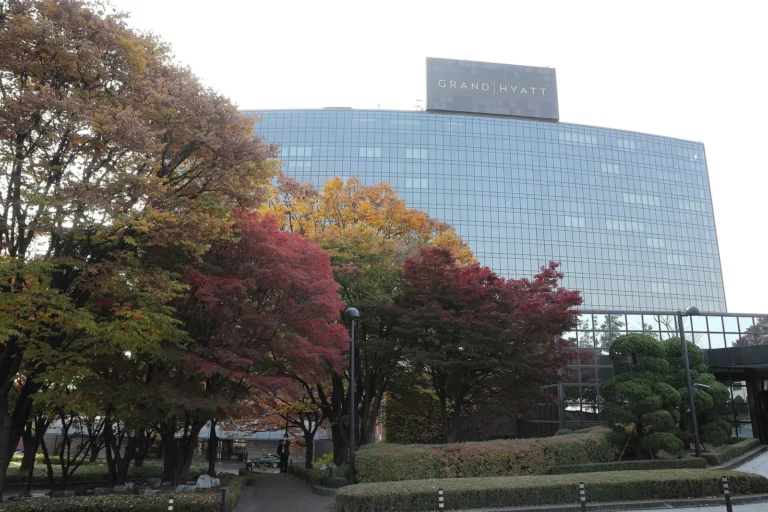
KOSPI Falls 1.46% on Oct 26, 2026: Why Korean Stocks Fell, from Samsung (005930.KS) to BNK Financial (138930.KS)
English edition of the author’s Korean note on why Korean stocks fell on October 26, 2026, stock by stock.
After the market closed on Monday, October 26, 2026, Lee Kyung-min, a strategist at Daishin Securities, summed up the day this way: foreign net selling continued, and there was “no clear buyer” to absorb it (Newspim market close). The KOSPI, the main board of the Korea Exchange, ended down 1.46% at 5,469.47, its lowest close since April 6, and most closing headlines read some version of “foreign selling sends KOSPI to a seven-month low.” The explanation that foreigners sold and nobody caught it is not wrong. But when the Korea Exchange (KRX) data is broken down stock by stock, the picture looks different.
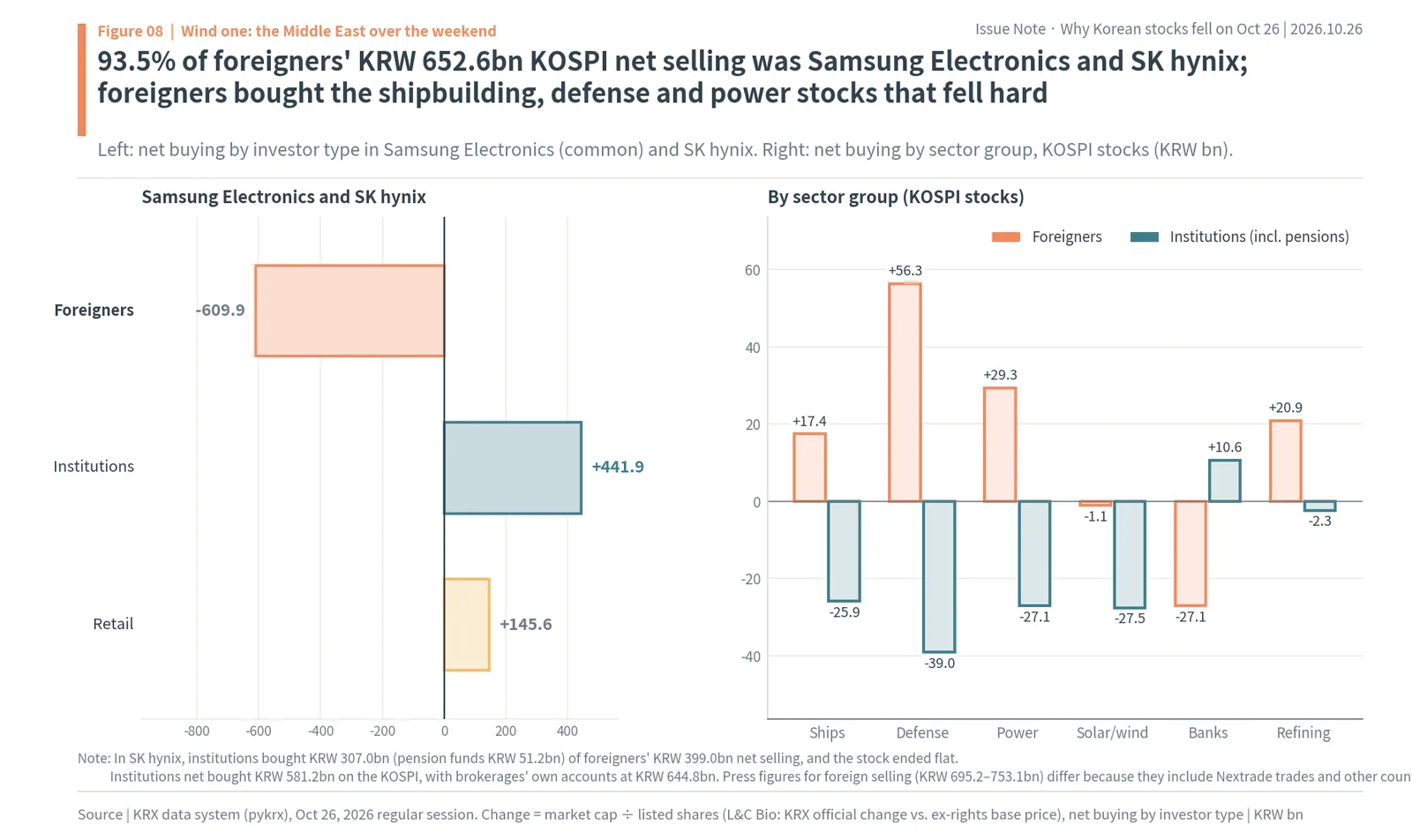
Of the KRW 652.6bn (about $492m) foreigners net sold on the KOSPI, 93.5% was just two stocks, Samsung Electronics and SK hynix. And SK hynix, where foreigners sold KRW 399.0bn, barely moved at -0.16% because institutions bought KRW 307.0bn of it. Meanwhile stocks that fell hard that day, such as LIG D&A, Doosan and GS Holdings, were ones foreigners actually net bought. So who sold the stocks that fell close to 10% or more in a day, and why? This report answers with KRX stock prices and investor trading data, filing times from DART (Korea’s electronic disclosure system), Naver Finance minute bars, and articles dated that day.
As of: October 26, 2026 (index, stock and investor data are KRX regular-session figures; overseas prices are U.S. closes on October 23; articles are dated October 23 to 26). Dollar figures in parentheses are converted at KRW 1,325.8 per dollar, the Oct 26, 2026 rate (Yahoo Finance KRW=X); the won closed the Seoul session at 1,323.1. Numbers the author calculated are marked as such.
Some Korea-specific background. The KOSPI is the Korea Exchange’s main board and benchmark index; the KOSDAQ is its smaller growth-company board, heavy in chip equipment, biotech and battery makers. Tickers ending in .KS trade on the KOSPI and .KQ on the KOSDAQ. The KRX publishes every stock’s trading by investor type (foreigners, institutions, retail) each day, which is what makes a “who sold what” analysis possible. Korea counts large sums in jo (one trillion won) and eok (100 million won); this report shows them as KRW tn and KRW bn.
Topics covered: key terms; the breadth of the fall; the two chip stocks that cushioned the index; the Middle East and oil over the weekend; what foreigners and domestic institutions sold; this year’s winners and today’s fall; chip equipment; Bloom Energy’s supply chain; shipbuilding, defense, banks and batteries; splitting each fall into market, sector and own parts; three intraday earnings filings and LIG D&A’s sanctions; stocks whose cause was not found; the gainers; signals and dates for the week; and the basis of calculation.
The conclusion first: three hands pulled the market down that day. The first was foreign selling after the weekend’s Middle East news; it dragged the index, but because it was concentrated in two chip stocks it did not cut deep into individual stocks. The second was domestic institutions trimming this year’s biggest winners ahead of a crowded week of big events (chip earnings, the FOMC, U.S. Big Tech earnings). The third was company-specific events, such as intraday earnings filings and a defense contractor’s sanctions. Most of the large stocks that fell close to 10% or more were the work of the third hand.
Key terms: net buying, cap weighting, beta and the three parts
A few terms recur in this report. Net buying is the amount bought minus the amount sold that day. Foreign net selling of KRW 652.6bn means foreigners sold KRW 652.6bn more than they bought, and that institutions, retail investors and companies bought that amount from them. One side’s net selling is always matched by another side’s net buying. Because Korea publishes trading by investor type every day, it is possible to see who sold and who bought on a single day.
A cap-weighted change is an average weighted by company size. The KOSPI itself is calculated this way, so a small move in a very large company leaves a bigger mark on the index than large moves in many small ones. The median, by contrast, is the change of the stock in the middle when all stocks are lined up by their change. The median shows how far an ordinary stock fell; the cap-weighted change shows why the index fell as much as it did.
Beta measures how much a stock has moved, on average, when the market moved 1%. Here it is calculated from one year of daily returns, October 24, 2025 to October 23, 2026. A stock with a beta of 1.5 tends to fall about 3% on a day the index falls 2%; a bank stock with a beta of 0.3 tends to fall only about 0.6%. KOSPI stocks are measured against the KOSPI and KOSDAQ stocks against the KOSDAQ.
The three parts are this report’s main tool. The market part is a stock’s beta times that day’s index change: what it would have lost by simply following the market. The sector part is the median amount by which other stocks in the same sector fell beyond their own market parts: the wind that blew across the whole sector. The own part is what remains of the day’s change after subtracting both: the size of the company’s own event. The larger the own part, the more we need to find something that happened to that company alone.
A note on prices. Since September 14, 2026, after-hours trades on Nextrade (NXT), Korea’s alternative exchange, have mixed into some price tables, so their closing prices can differ from the KRX regular-session close. All stock changes in this report are regular-session values, calculated as KRX market cap divided by listed shares. The one exception is L&C Bio, whose base price changed that day because of a 1-for-1 bonus issue going ex-rights; for it the KRX’s official change against the new base price is used.
A few more terms. Going ex-rights after a bonus or rights issue lowers the base price to account for the new shares; with a 1-for-1 bonus issue the share count doubles, so the base price roughly halves. Peak-out means profits or an industry cycle have passed their top; a stock can fall on the worry that growth is slowing even while profits are still rising. Preliminary results are quarterly numbers a company releases before the audit; when filed during trading hours, they hit the price from that minute. Profit-taking is selling a stock that has risen to lock in the gain.
What happened: individual stocks hurt more than the index
The KOSPI’s lowest close in seven months, the KOSDAQ’s lowest in three
On October 26 the KOSPI closed at 5,469.47 (-1.46%), down 80.83 points. It opened weak at 5,499.05, briefly rose above the previous close to 5,565.67, then slid again in the afternoon. The KOSDAQ fell 24.48 points to 727.21 (-3.26%); it never got above the previous close all day and ended essentially at its low. The chart below shows closes over the 12 trading days from October 8. After a one-day plunge of more than 7% on October 15, the KOSPI tried to rebound but kept making lower highs, and the KOSDAQ gave back all of its mid-October rebound.
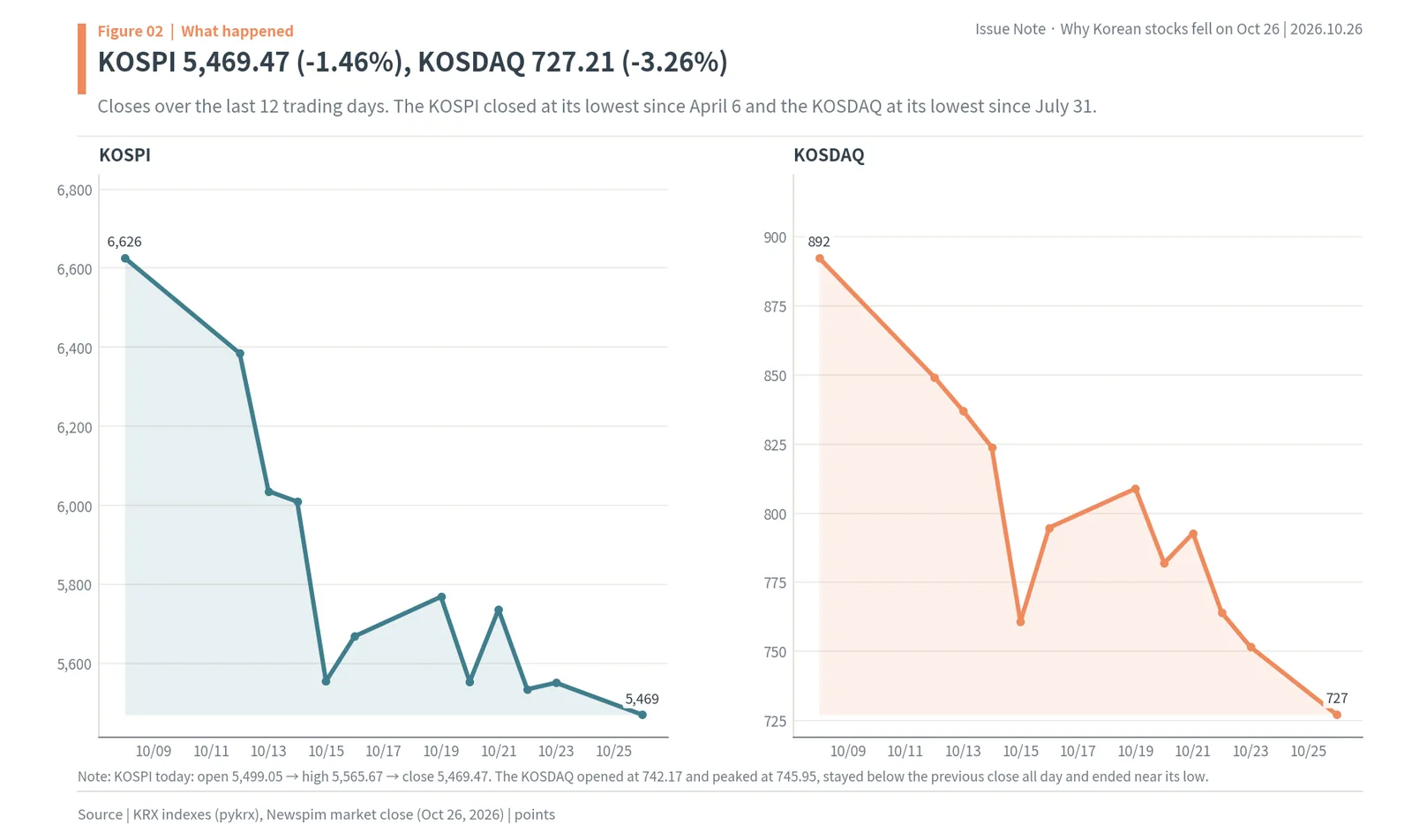
Seen in five-minute steps, the morning and afternoon looked different. The KOSPI opened 0.92% below the previous close at 5,499.05, recovered almost all of that by mid-morning, and at one point stood 0.28% higher at 5,565.67. The first reaction to the weekend news passed and bargain buying came in. But it slid again from around lunchtime and widened its loss late in the session to end near its low of 5,455.11. That afternoon slide overlaps in time with three earnings filings: BNK Financial Group at 12:44, HD Hyundai Marine Solution at 13:06 and HD Hyundai Construction Equipment at 14:23. The KOSDAQ opened 1.27% lower at 742.17, was still -0.76% at its intraday best, and its close of 727.21 was almost the day’s low. Sellers were more persistent than buyers all day.
Put in a longer frame, the day weighs differently. The KOSPI, at 6,625.93 on October 8, fell 17.45% in 12 trading days, with 7 down days out of 11. The KOSDAQ fell 18.5% from 892.27 to 727.21 over the same period, with 8 down days. Next to a day like October 15, a 1% fall is not large in itself. The reason to look at this day separately is the shape of the fall rather than its size: the index fell a little, but stocks fell broadly and deeply, and how deeply differed widely by sector and company. That is why this report looks for causes stock by stock rather than at the index.
84% of KOSPI stocks fell, and each sector fell to a different depth
The index number suggests a fall of just over 1%, but counted by stock, the decline was much broader. Of 940 KOSPI stocks, 792 (84%) fell and only 101 rose. By sector group the depth varied a lot. Cap-weighted, the chip giants (Samsung Electronics and SK hynix) fell only -0.7%, while solar & wind fell -7.0% and chip equipment -6.0%. The map below shows major stocks in sector groups the author put together, with box area for market cap and color for the size of the move. Thick borders mark stocks that fell far more than their sector; they are covered in the “own part” chapter.
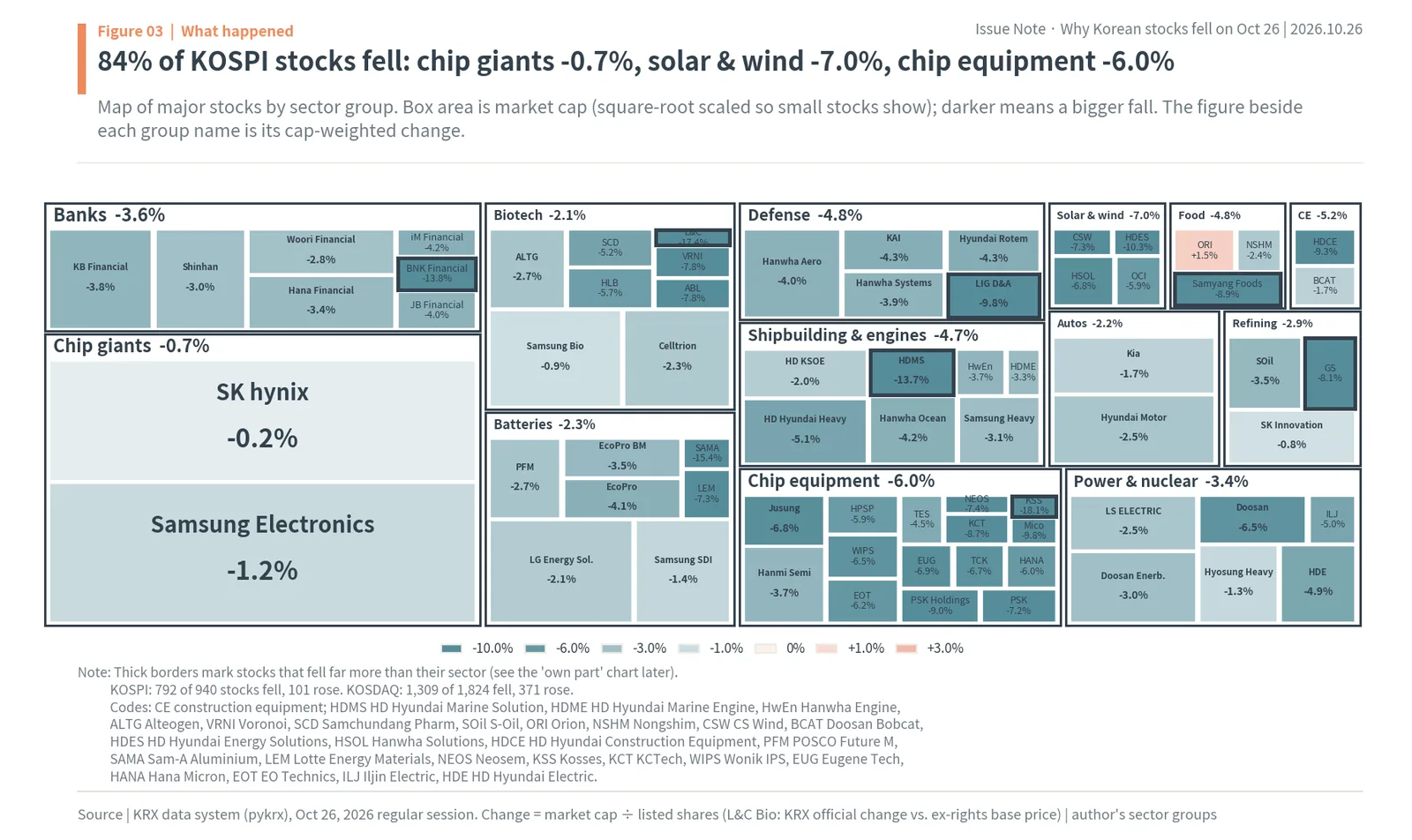
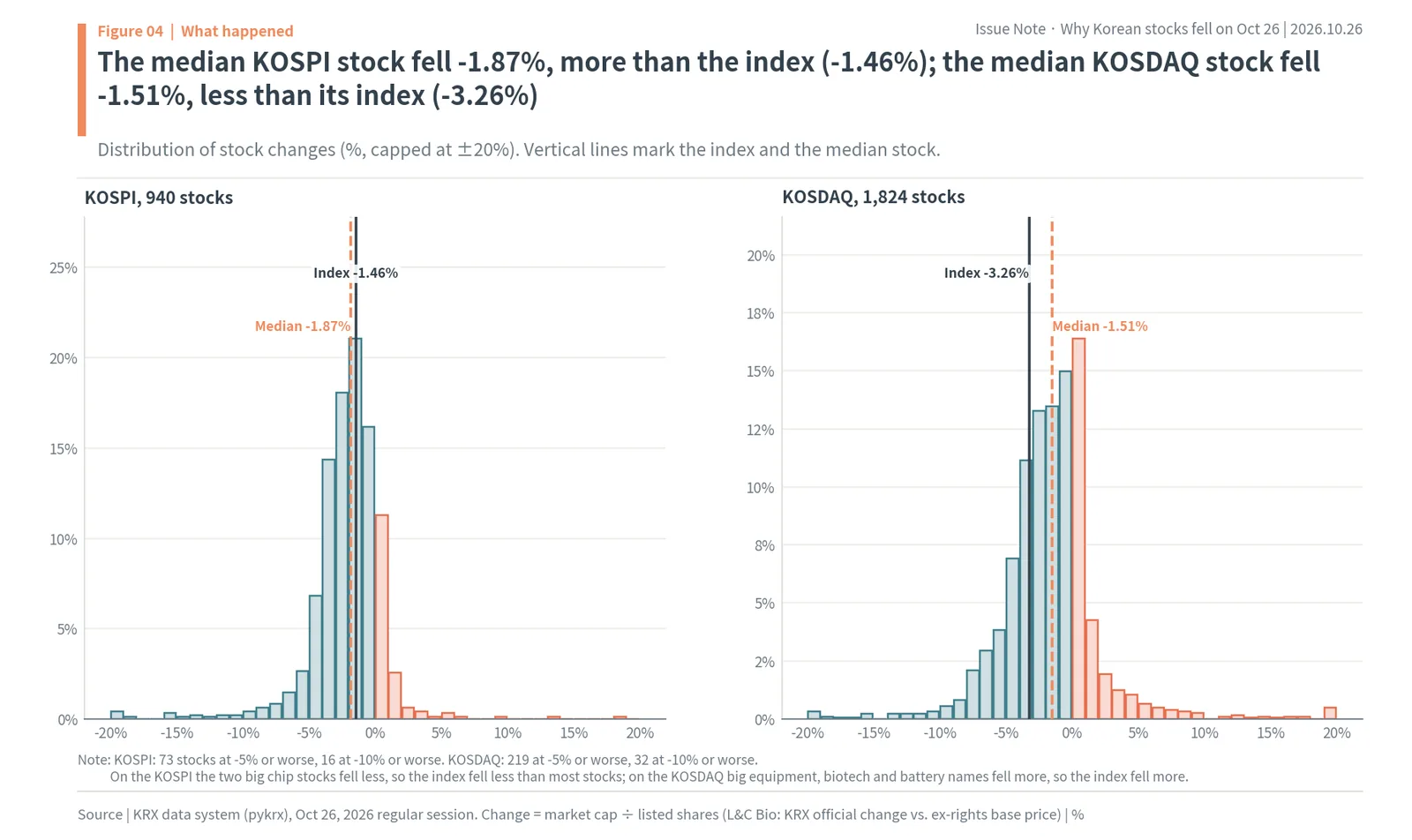
The distribution of stock moves looks opposite in the two markets. The median KOSPI stock fell -1.87%, more than the index (-1.46%), because the two large chip stocks fell less and held the index up. On the KOSDAQ, with 1,824 stocks, the median stock fell -1.51%, less than its index (-3.26%), because the big equipment, biotech and battery stocks that weigh heavily in the KOSDAQ index fell more than ordinary stocks. Size indexes tell the same story. The KOSPI large-cap index fell -1.34%, but mid caps fell -2.71% and small caps -2.29%; on the KOSDAQ, large caps fell -3.87% and small caps -1.54%.
Two chip stocks held up half the index
On the KOSPI, Samsung Electronics common and preferred shares plus SK hynix make up 50.8% of total market cap. These three lines fell -0.82% cap-weighted, while the rest of the KOSPI fell -2.17%, more than 2.6 times as much. KOSPI market cap shrank by KRW 68.0tn (about $51.3bn) in one day, and Samsung Electronics common shares alone accounted for KRW 14.6tn of it, or 21.5%. The percentage fall was small, but the company is so large that the won amount was the biggest. SK hynix lost KRW 1.5tn, just 2.1%.
A morning rumor also helped SK hynix. According to Chosun Biz and Herald Economy, SK hynix rose nearly 3% early on talk that it would pay a special dividend from gains on selling its stake in Kioxia, then gave the gain back after the company denied it and ended at -0.16%. The market was already watching for more shareholder returns at this week’s earnings. NH Investment & Securities analyst Na Jung-hwan estimated SK hynix’s room for additional shareholder returns at KRW 30tn or more (Financial News, October 25). Samsung Electronics ended at -1.16%, with commentary that no clear buyer was left after its share buyback ended (Businesskorea).
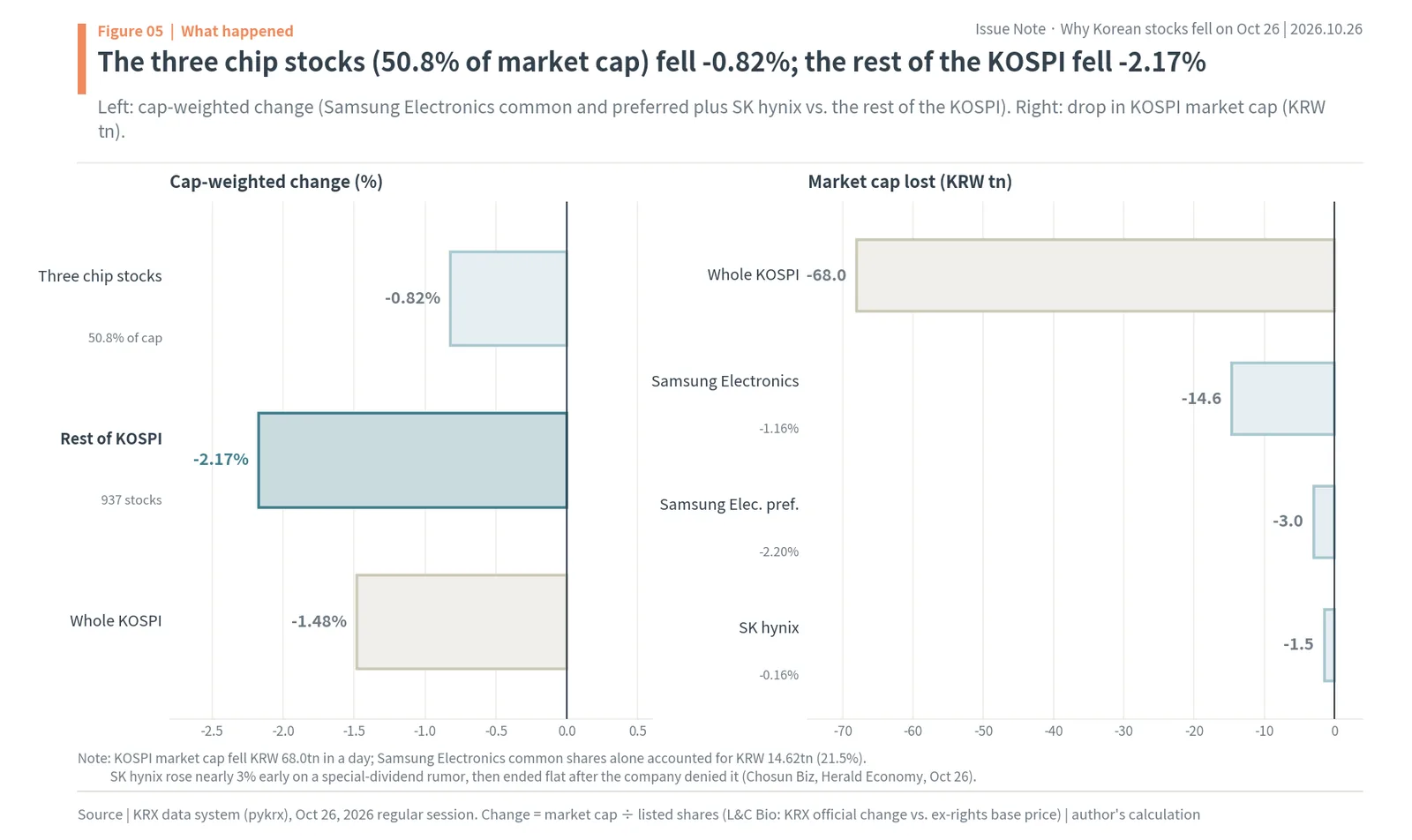
In short, the index stopped at a fall of just over 1% thanks to the two chip stocks; stocks outside chips fell more than 2% on average, and some sectors fell 6% to 7%. So what dragged down the stocks outside chips? Start with the news that arrived from overseas over the weekend.
Wind one: the Middle East over the weekend, but foreigners sold chips
A report of plans to resume strikes on Iran, and oil
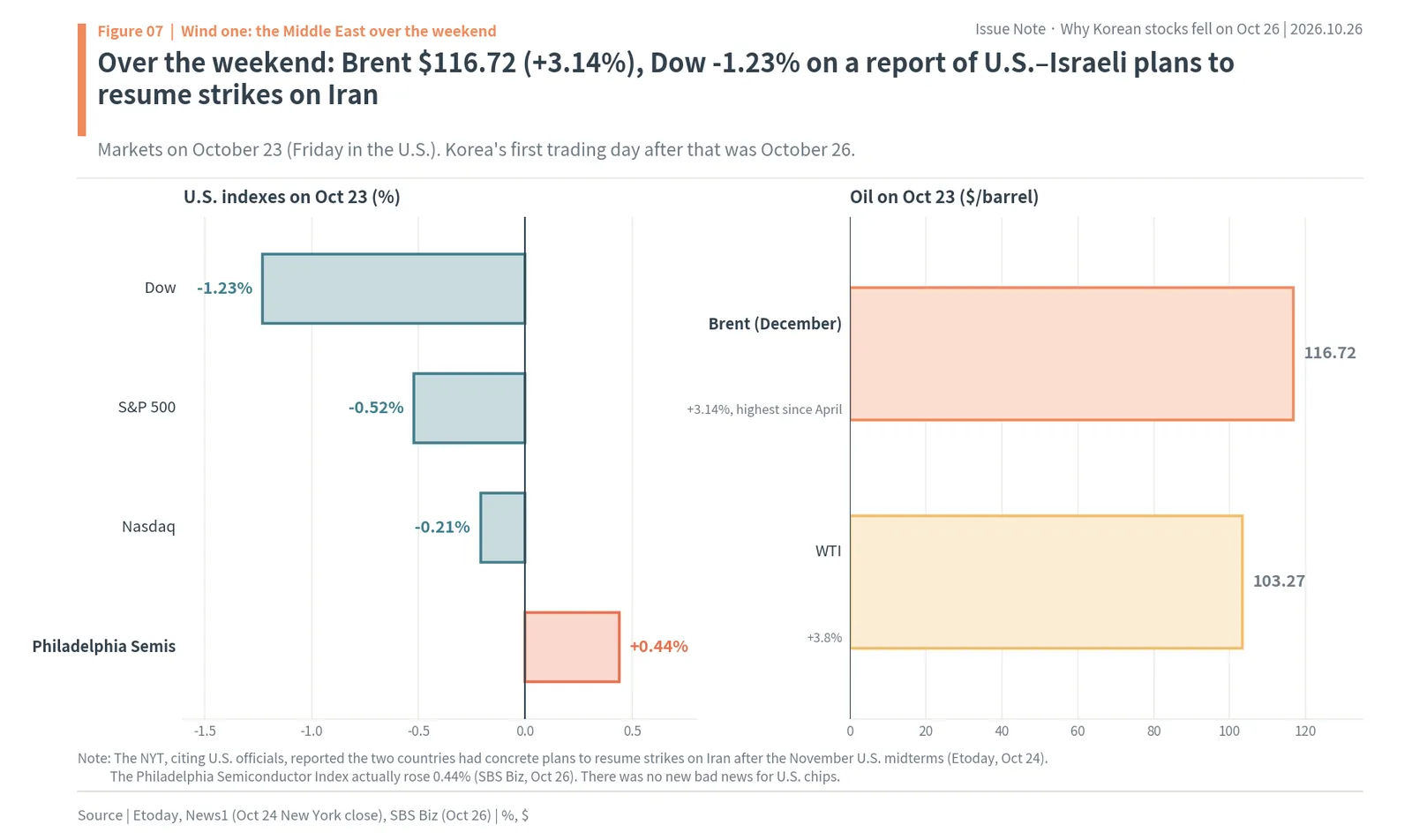
Two things happened abroad over the weekend while Korea was closed. The first was in the Middle East. The New York Times, citing U.S. officials, reported that the United States and Israel had concrete plans to resume strikes on Iran after the November U.S. midterm elections (as cited by Etoday on October 24). Oil jumped. On October 23 (U.S. time), December Brent crude in London rose 3.14% in a day to $116.72 a barrel, its highest since April, and West Texas Intermediate (WTI) ended above $100 at $103.27.
The second was in New York. On Oct 23 the Dow fell 652.82 points (-1.23%), the S&P 500 -0.52% and the Nasdaq -0.21%. The market worried that higher oil prices could push inflation up again and cut U.S. consumer spending, and a BofA strategist pointed to unease over AI investment and the midterms (Etoday, News1). Chips were different: the Philadelphia Semiconductor Index actually rose 0.44% that day (SBS Biz). In other words, there was no new bad news for U.S. chips over the weekend. In the chart below, the left panel shows U.S. indexes on Oct 23 and the right panel shows oil on Oct 23, with Brent at $116.72 (+3.14%).
One more piece of weekend news shook Korean sentiment. In an October 25 report Goldman Sachs cut its 12-month KOSPI target from 12,000 to 9,000 (Digital Daily). News1 reported that the report sees chip stocks as already pricing in a steep fall in 2027 profits. Even after the cut, 9,000 is far above the day’s close. But news that one of the largest foreign buyers of Korean stocks had lowered its sights was not a good start to Monday. The Korea Economic Daily and Mediawatch also listed doubts about the profitability of AI infrastructure investment among the day’s reasons.
Foreigners sold KRW 652.6bn, and 93.5% of it was two chip stocks
In the first Korean session after this news, foreigners net sold KRW 652.6bn (about $492m) of KOSPI stocks (KRX regular session). The KRW 695.2bn to 753.1bn figures in articles reflect different counting, such as including Nextrade trades. But 93.5% of foreign net selling was in Samsung Electronics and SK hynix. Foreigners net sold KRW 609.9bn of the two; institutions bought KRW 441.9bn and retail investors KRW 145.6bn. KOSPI institutions net bought KRW 581.2bn that day, KRW 644.8bn of it by brokerages trading for their own accounts; large net buying by brokerages typically comes from arbitrage between futures and stocks or from exchange-traded fund (ETF) creations.
Conversely, foreigners bought the sectors that fell hard. Among the author’s KOSPI sector groups, foreigners net bought KRW 17.4bn of shipbuilding & engines, KRW 56.3bn of defense and KRW 29.3bn of power & nuclear. The sellers of those stocks were institutions: KRW 25.9bn in shipbuilding & engines, KRW 39.0bn in defense and KRW 27.1bn in power & nuclear. Foreign selling did drag the index down, but the selling that cut deep into individual stocks came from elsewhere.
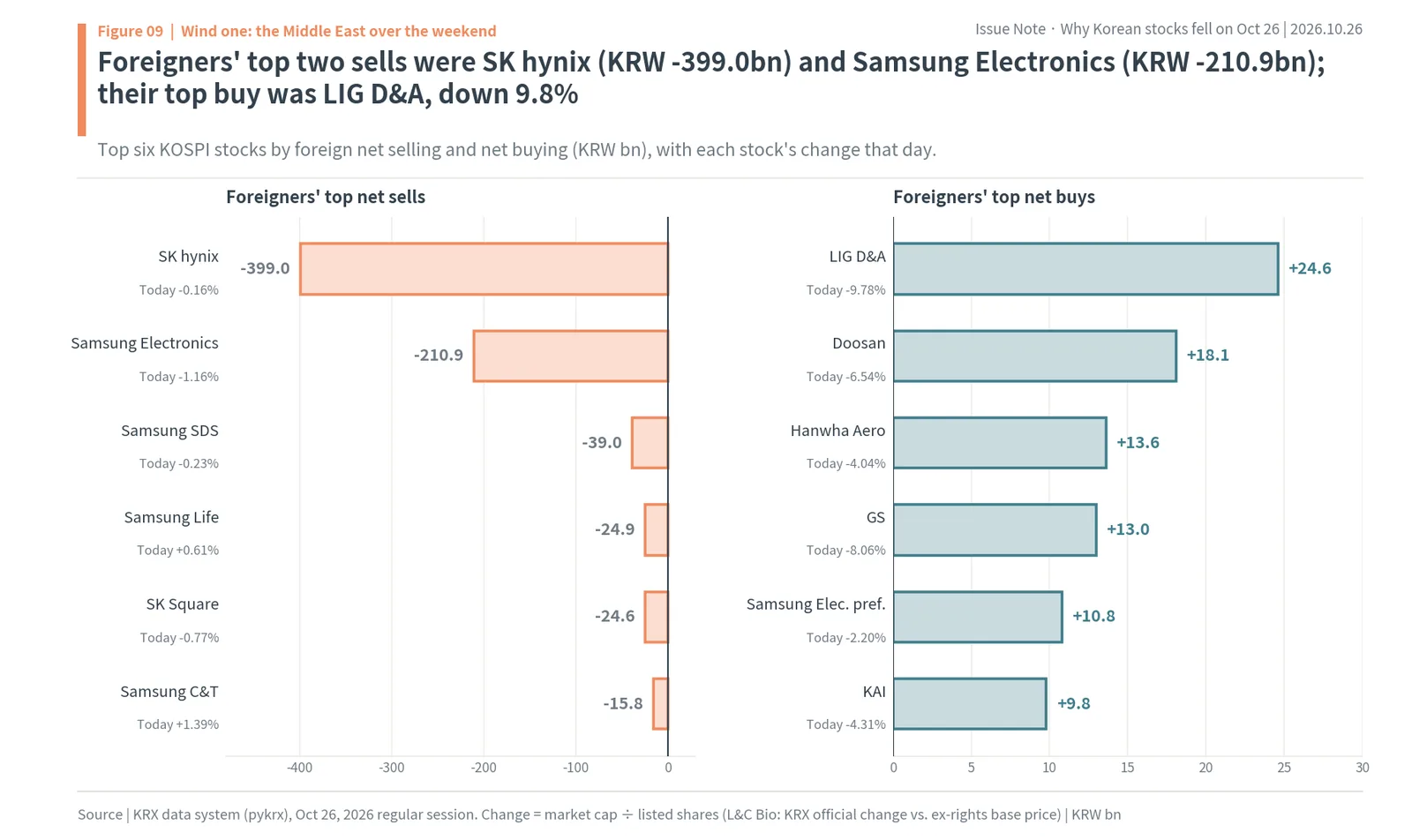
By stock it is even clearer. Foreigners’ biggest net sell was SK hynix (KRW -399.0bn), then Samsung Electronics (KRW -210.9bn); from third-placed Samsung SDS (KRW -39.0bn) the amounts are more than ten times smaller. Their top net buy was LIG D&A (KRW +24.6bn), which was down 9.8% that day, and stocks that fell hard, such as Doosan (KRW +18.1bn), Hanwha Aerospace (KRW +13.6bn) and GS Holdings (KRW +13.0bn), filled the top of the net-buy list. Foreigners were on the side of buying beaten-down defense and power stocks.
On the KOSDAQ, the flows were the reverse of the KOSPI. Foreigners net bought KRW 42.5bn of KOSDAQ stocks and retail investors KRW 76.9bn. The sellers were institutions: KRW 126.8bn net, including KRW 78.0bn by brokerages and KRW 49.1bn by asset managers. The KOSDAQ was pulled down by domestic institutions, not foreigners. Seoul Shinmun’s KOSDAQ close noted that worries about the durability and profitability of AI investment weighed on the growth-heavy KOSDAQ. Where that institutional selling was concentrated shows up again in chip equipment in the next chapter.
The won actually hit its strongest level of the year
When foreigners sell stocks, they usually convert the proceeds into dollars, which weakens the won. Yet the won closed at 1,323.1 per dollar, a new low for the dollar this year (Edaily); the won was at its strongest of 2026. A stronger won shrinks the won value of exporters’ dollar earnings. Newsis noted the strong won could weigh on exporters such as carmakers and chipmakers; the Seoul Economic Daily cited worries about exporters’ profitability from the strong won as a reason for Hanwha Ocean’s weakness; and Seoul Shinmun listed the strong won as a drag on defense companies’ earnings. Shipbuilding and defense, with large export shares, face this wind head-on.
To sum up this chapter: the weekend’s Middle East news brought foreign selling, and foreign selling dragged the index. But it was concentrated in two chip stocks, and institutions absorbed it, so those two fell less. The sectors that fell hard were bought by foreigners and sold by domestic institutions. So why did domestic institutions sell them? The answer lies in what they chose to sell.
Wind two: trimming this year’s winners before a big test
A week packed with big events
The week of October 26 was unusually crowded. SK hynix reports third-quarter results on the 28th and Samsung Electronics its final results on the 29th, and the U.S. Federal Open Market Committee (FOMC) decision arrives early on the 29th Korea time. Microsoft and Alphabet report on the 29th and Amazon on the 30th, Korea time (Bizwatch, Financial News). Daishin’s Lee Kyung-min said Big Tech’s AI spending plans, Samsung Electronics and SK hynix earnings and any additional shareholder returns would set the direction of Korean stocks (Mediawatch). Facing a big test whose result is unknown, investors tend to trim their biggest winners to protect gains. The day’s numbers show exactly that.
This year’s biggest gainers fell the most
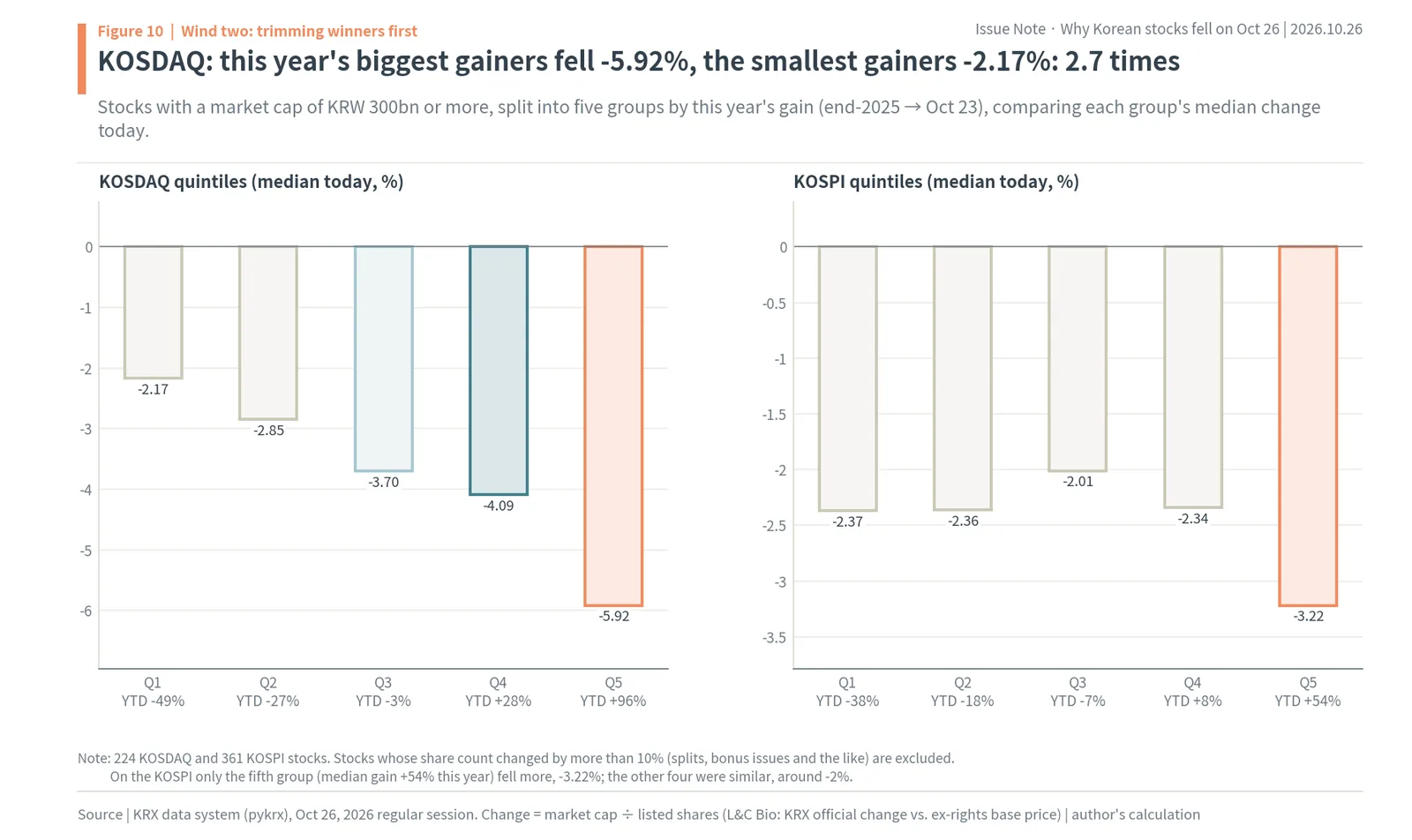
The author split stocks with a market cap of KRW 300bn or more into five groups by this year’s gain (from the last trading day of 2025 to October 23) and compared each group’s median change that day. Among 224 KOSDAQ stocks the result was a clean staircase. The group that rose least this year (median -49.2%) fell -2.17%, the second group -2.85%, the third -3.70%, the fourth -4.09%, and the group that rose most (+96.1%) fell -5.92%: 2.7 times as much as the first group. Among 361 KOSPI stocks the staircase was less clear. The first four groups fell a similar -2.01% to -2.37%, and only the top group (+53.7% this year) fell more, -3.22%. The difference comes from what is in each group. On the KOSDAQ, the top gainers are full of chip equipment and materials and AI data center power names, which were at the center of the day’s institutional selling. On the KOSPI, the top group mixes large stocks that fell less, such as the two chip stocks, with stocks that fell hard, such as shipbuilding, defense and power, which blurs the staircase. Still, in both markets the direction is the same: the biggest gainers fell most. Selling ahead of a test picks what to sell by how much it has made.
Pension funds sold shipbuilding, defense and power, and bought chips
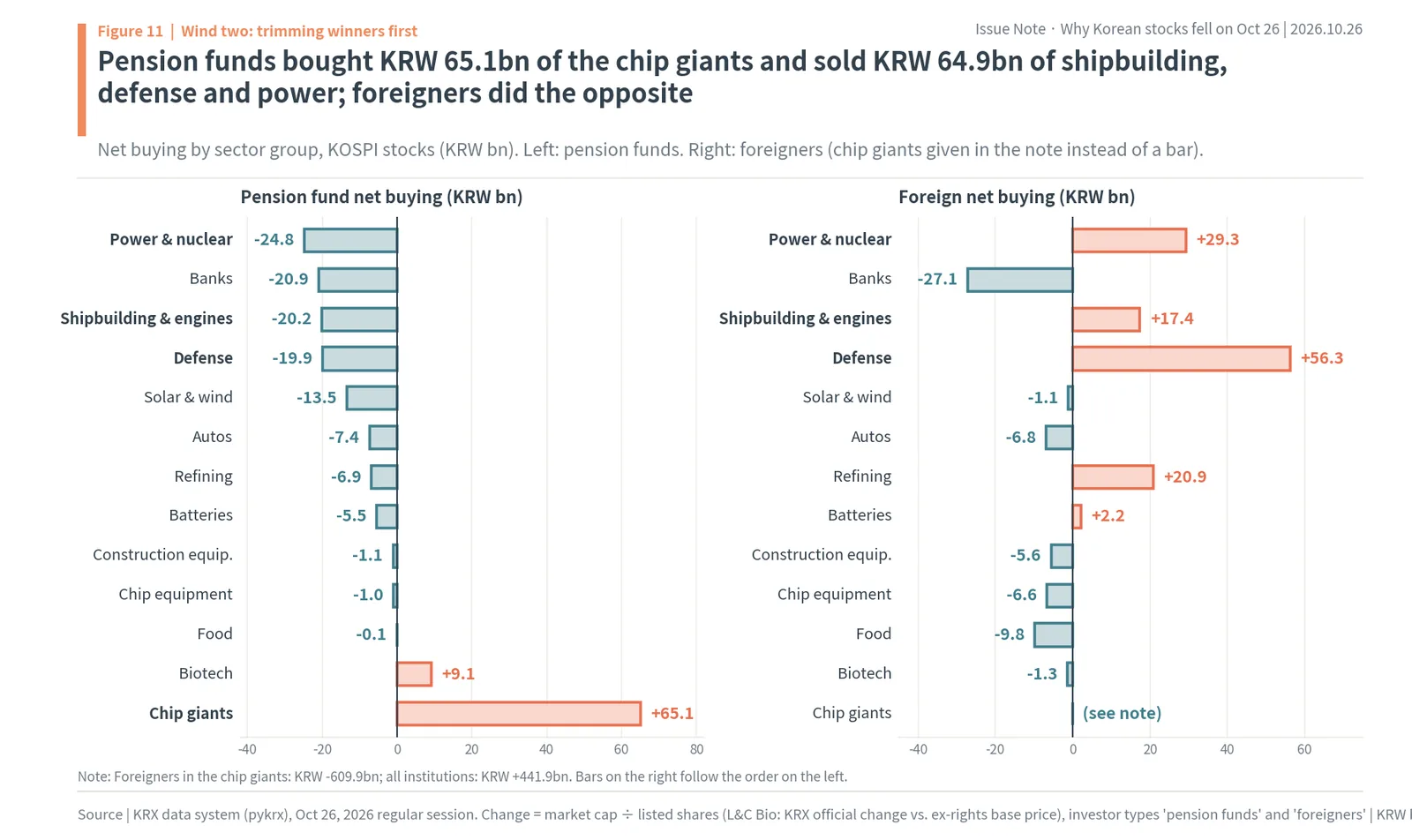
Who trimmed shows up in pension fund trading. Pension funds net bought KRW 65.1bn of the KOSPI chip giants (Samsung Electronics and SK hynix) and net sold KRW 64.9bn of shipbuilding & engines (KRW -20.2bn), defense (KRW -19.9bn) and power & nuclear (KRW -24.8bn) combined. They also sold banks (KRW -20.9bn) and solar & wind (KRW -13.5bn). Foreigners did the opposite, selling chips and buying shipbuilding, defense and power. The two big hands stood on opposite sides that day, and the sectors that fell hard were the ones domestic institutions sold.
Chip equipment: -6.84% on institutional selling, with no new bad news
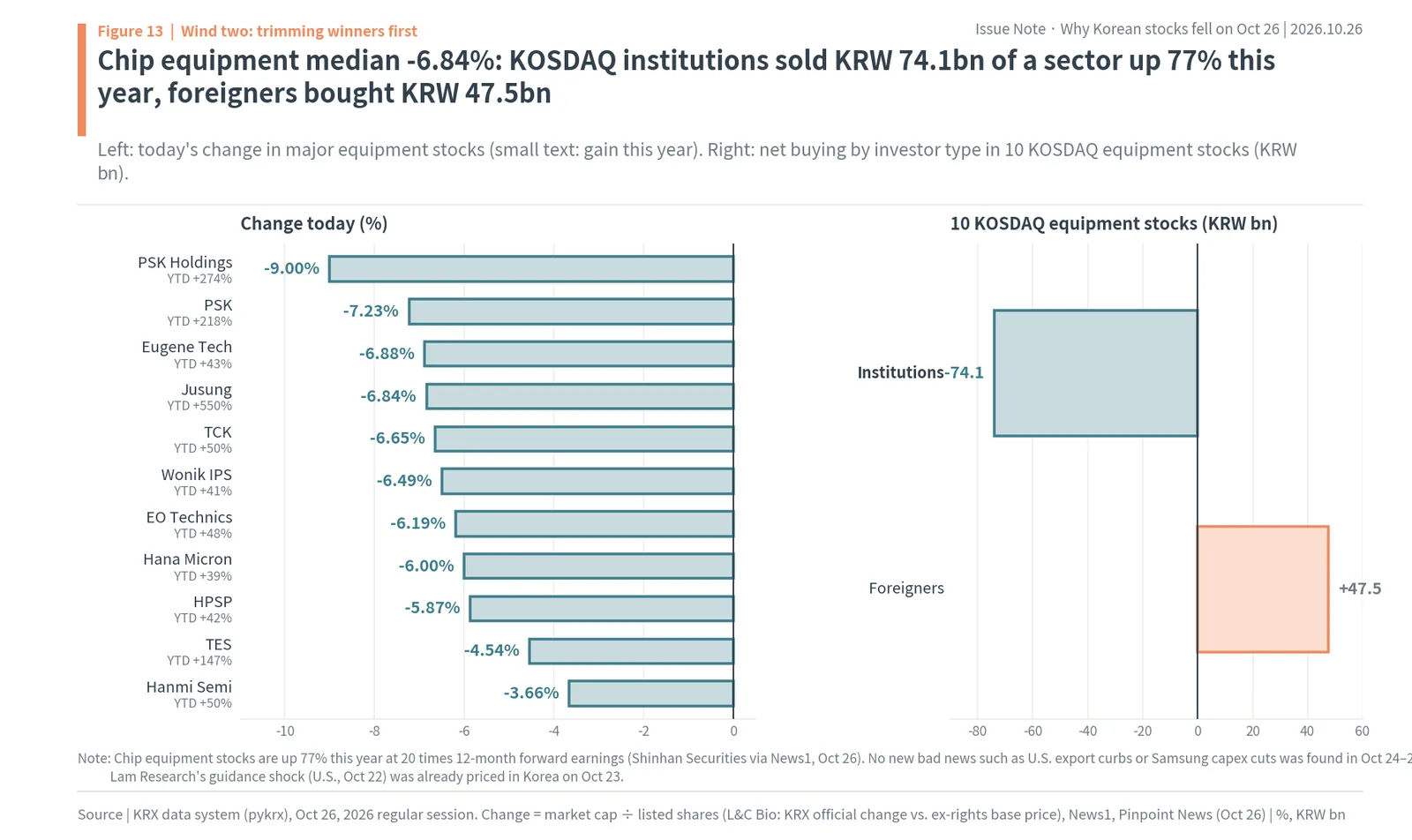
The pattern was clearest in KOSDAQ chip equipment. The median of the 15 equipment and materials stocks the author grouped was -6.84%. By Shinhan Securities’ count, chip equipment stocks are up 77% this year and trade at 20 times 12-month forward earnings, above the average of past upcycles (News1). News1 described the fall as profit-taking “centered on chip equipment stocks that had risen sharply.” By stock: PSK Holdings -9.00% (+274.3% this year), PSK -7.23% (+218.4%), Eugene Technology -6.88%, Jusung Engineering -6.84% (+549.5%) and Wonik IPS -6.49%.
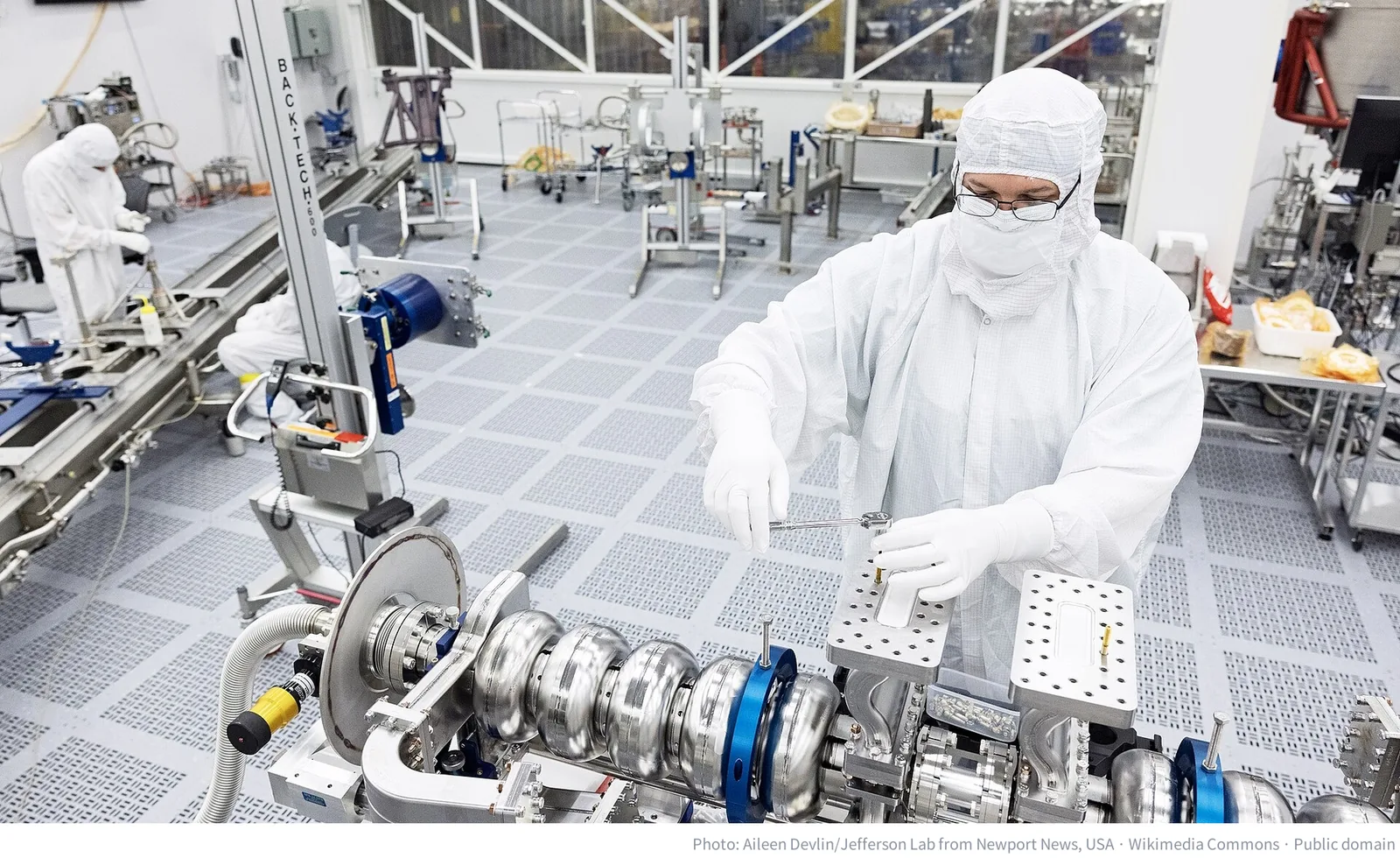
There was no new bad news for chip equipment over the weekend. In October 24 to 26 articles, no reports were found of new U.S. export curbs on equipment, capex cuts at Samsung Electronics or SK hynix, or new measures involving China. The same day, Chosun Biz instead reported that the two companies’ capex this year is a record of about KRW 110tn (about $83bn). Lam Research’s disappointing guidance (U.S., October 22; Lam -11.8%, Philadelphia Semiconductor Index -6.7%) was already priced into Korea on October 23, and the U.S. chip index rebounded 0.44% on October 23. The sellers of equipment stocks were KOSDAQ institutions. According to Pinpoint News, Wonik IPS topped institutions’ net-sell list, followed by Jusung Engineering, PSK, PSK Holdings and HPSP. Adding up 10 KOSDAQ equipment stocks from KRX data, the author finds institutions sold KRW 74.1bn while foreigners bought KRW 47.5bn of the same stocks. The chip equipment median of -6.84% was less a sign that the companies’ business had worsened than the result of trimming a sector up 77% this year ahead of a big test.
The same day, Hana Securities analyst Kim Rok-ho argued that chip stocks had fallen too far, saying demand is strong enough that even equipment makers worry about shortages of cleanroom space and parts (Etoday). He added that average daily memory exports through October 20 were up 219% from a year earlier. Selling that trimmed equipment stocks and a bullish view of the industry sat side by side that day.
Sector news: Bloom Energy, shipbuilding, defense, banks and batteries
Beyond the market-wide wind and the trimming of winners, separate winds blew through individual sectors that day. This chapter goes through them. Causes come only from articles dated that day; where no article was found, the report says so.
The first session after Bloom Energy fell 11% on Friday
Bloom Energy is a U.S. fuel cell maker that has drawn attention for supplying power to AI data centers. Its third-quarter revenue rose 138% from a year earlier to $1.236bn, but its free cash flow was negative because it builds equipment first and bills only after customer approval. On that cash flow worry the stock fell 11.24% in the U.S. regular session on October 23 (Hankyung TV, October 26). October 26 was Korea’s first trading day after that. On October 22 the Korea Economic Daily grouped Vinatech, Hansun Engineering and Kosses as Bloom Energy supply chain stocks and Mico as a fuel cell name. On October 26 Kosses fell -18.05%, Vinatech -13.64%, Hansun Engineering -15.74% and Mico -9.82%. Kosses signed a KRW 150.4bn (about $113m) automation equipment supply contract with Bloom Energy in July (Bloter), and Vinatech’s KRW 123.0bn contract disclosed on October 19 reportedly has Bloom Energy as its end customer (Chosun Biz).
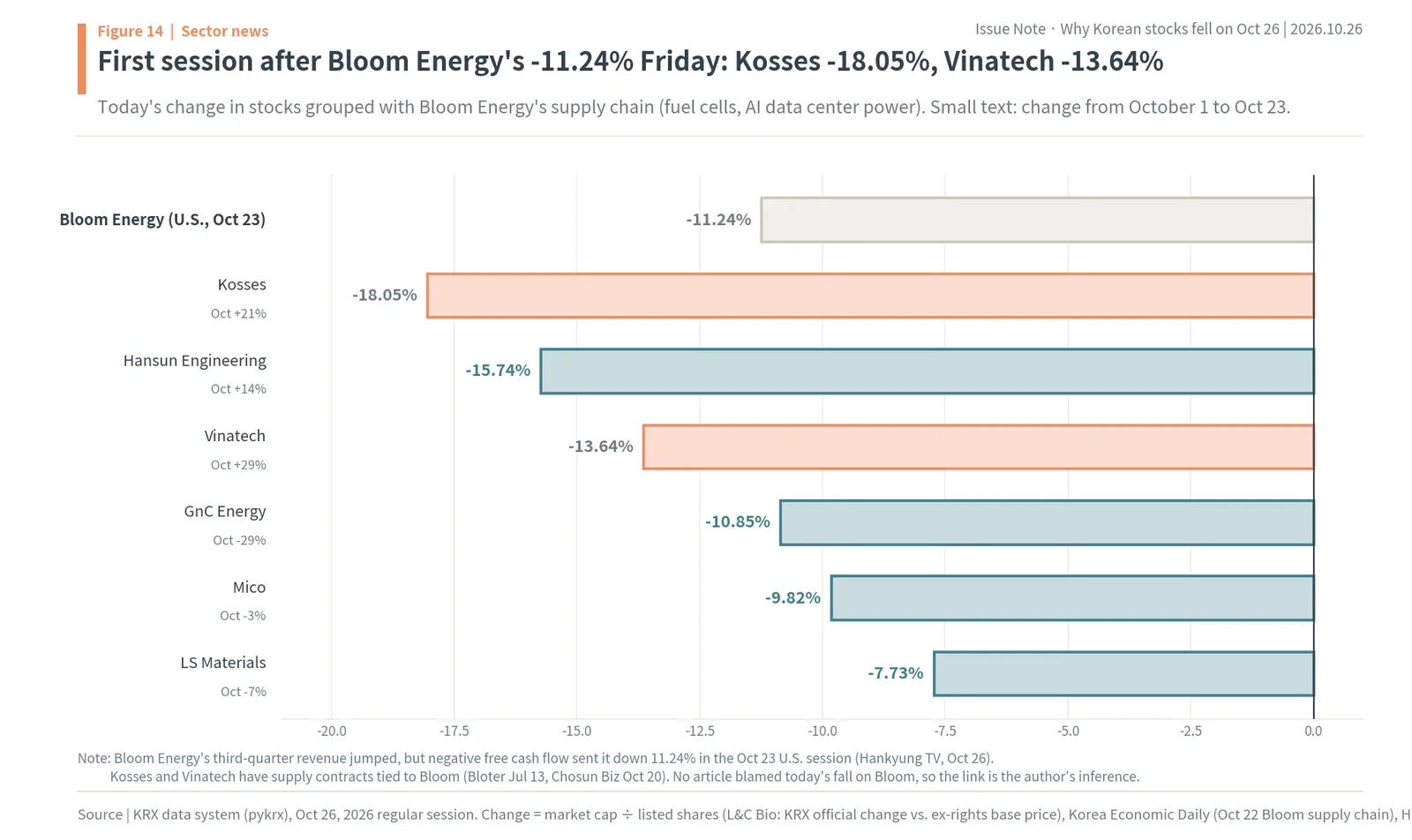
However, no article said directly that the October 26 falls were because of Bloom Energy, so this link is the author’s inference. The numbers do support it. Kosses and Vinatech were up 21.1% and 29.2% respectively from the start of October to the 23rd, and stocks that had jumped together on Bloom’s good news on October 22 fell together in the first session after Bloom’s drop. GnC Energy (-10.85%), which makes emergency generators for AI data centers, also fell sharply that day, but no article was found linking it to Bloom Energy.
KRX sector indexes: metals, machinery and pharma fell more
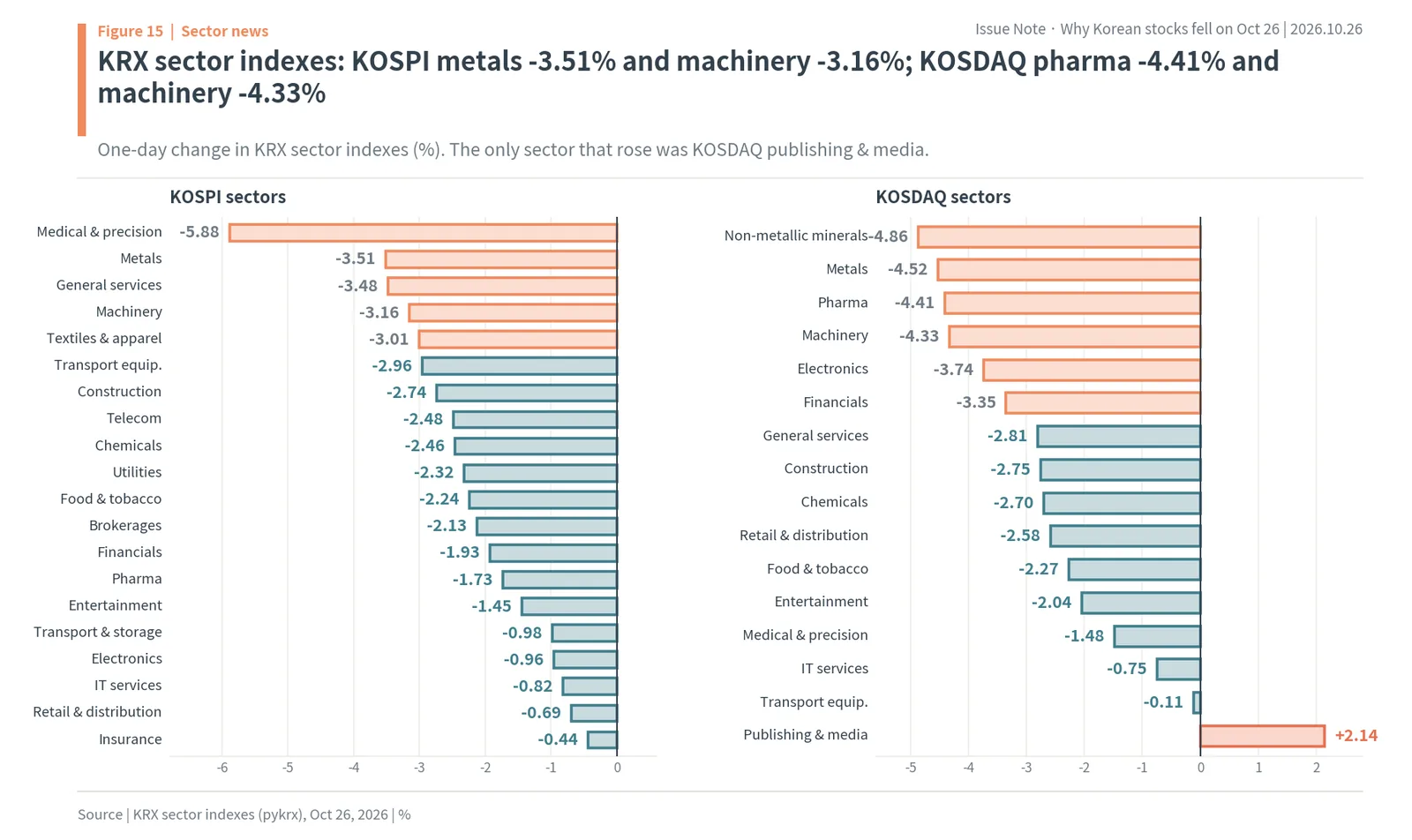
By KRX sector index, KOSPI medical & precision instruments fell most (-5.88%), followed by metals -3.51%, general services -3.48% and machinery -3.16%. Electronics (-0.96%) and insurance (-0.44%) fell less. On the KOSDAQ, non-metallic minerals fell -4.86%, metals -4.52%, pharma -4.41% and machinery -4.33%, and the only sector that rose was publishing & media (+2.14%). KRX sector indexes follow a broad standard industry classification, so the report’s other charts use the author’s own business-based groups.
Shipbuilding: peak-out worries, the strong won and an affiliate’s results
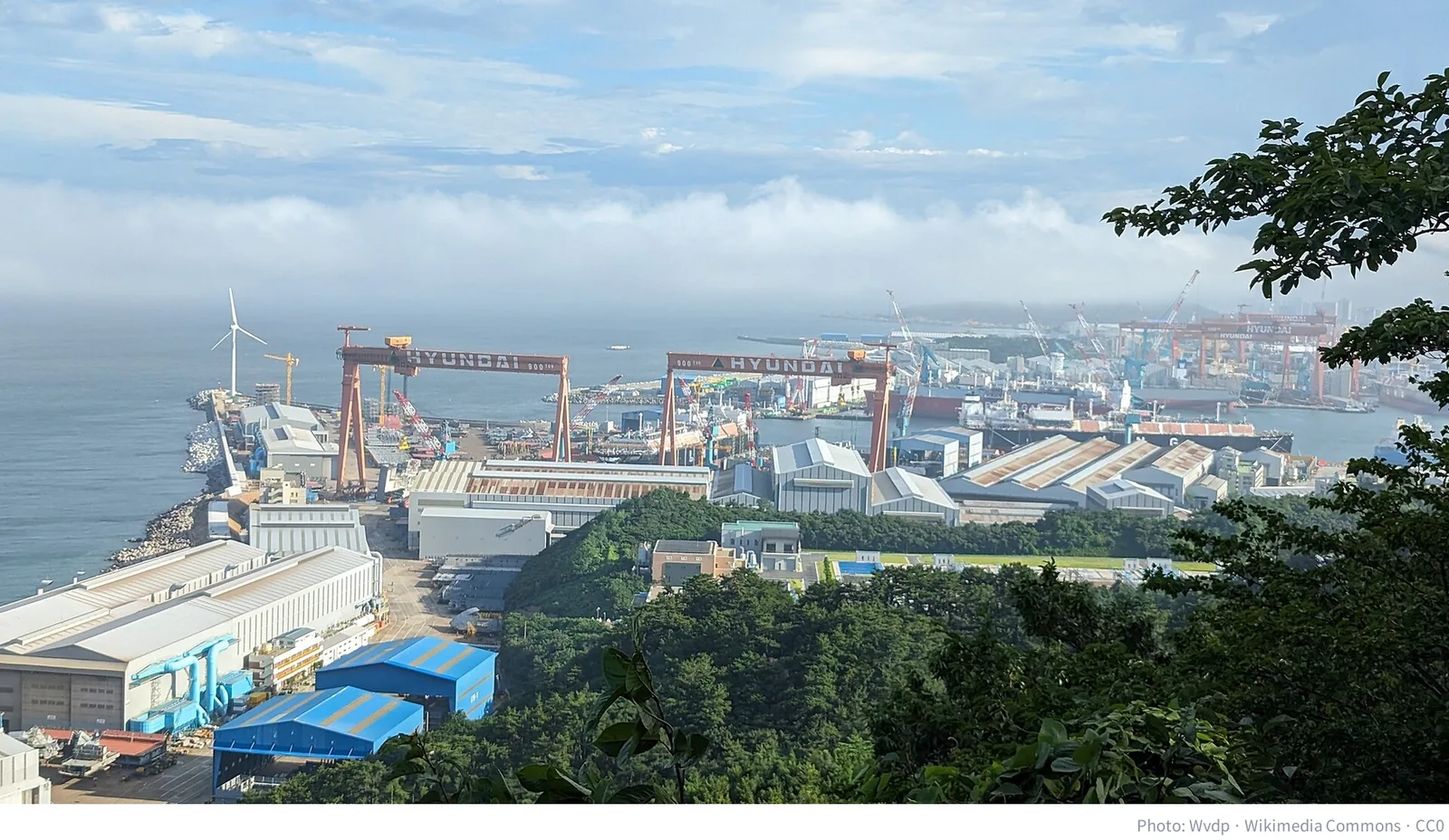
Shipbuilding stocks fell -3.56% by the KOSPI 200 heavy industries index; the median of the author’s seven shipbuilding & engine stocks was -3.72%. A News1 article that morning noted that while the three big shipbuilders’ third-quarter operating profit is expected to rise sharply from a year earlier, peak-out worries are growing as Chinese yards expand capacity aggressively and LNG carrier prices fall. As of October 23, shares were down from their highs of the year by 49.8% for HD Korea Shipbuilding & Offshore Engineering (HD KSOE), 52.5% for Samsung Heavy Industries and 64.5% for Hanwha Ocean. The Seoul Economic Daily reported that China took 76% of new global orders in January to September and Korea 15%. On top of that came the analysis, seen in the previous chapter, that the strong won cuts exporters’ won earnings.
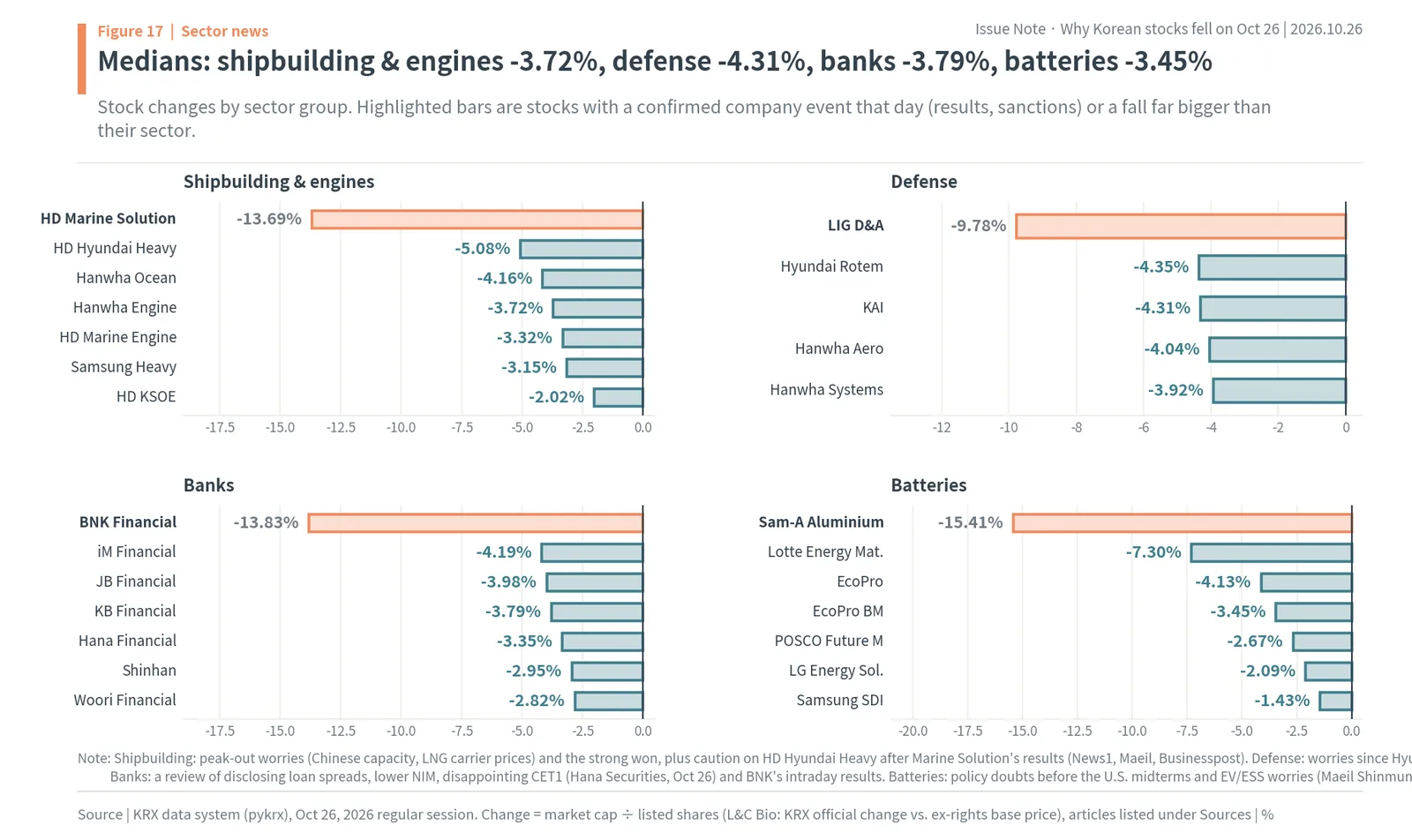
Within shipbuilding & engines, HD Hyundai Marine Solution fell the most (-13.69%). It filed third-quarter results at 1:06 p.m., covered in the “own events” chapter below. Businesspost read HD Hyundai Heavy Industries’ fall (-5.08%) as growing caution about its own results after its affiliate HD Hyundai Marine Solution’s numbers. HD Hyundai Heavy reports on the 28th, and its union votes on a second tentative wage deal on the 27th (Seoul Economic Daily). Hanwha Ocean (-4.16%) reports on the 27th.
Defense: worries since Hyundai Rotem’s disappointing results
The median of five defense stocks was -4.31%. Financial News reported that morning that defense stocks were weak together “as worries about the sector’s earnings and new orders continue.” The starting point was Hyundai Rotem’s third-quarter results on October 19: operating profit fell 11.0% from a year earlier, about 10% short of forecasts, and defense stocks plunged the next day. Hyundai Rotem hit a 52-week low of KRW 78,100 intraday on October 26 (Financial News). Seoul Shinmun noted that the strong won also cuts defense companies’ earnings. LIG D&A’s additional sanctions news came on top, but that is a company event and is covered separately below.
Banks: regulation, interest margins and BNK
The median of seven bank stocks was -3.79%. In a weekly report that morning, Hana Securities analyst Choi Jung-wook noted bank stocks fell 4.7% last week, worse than the KOSPI (-2.1%), and 15.3% over the past month (Joseilbo). He cited falling government bond yields weakening their appeal as defensive stocks, regulators considering making banks disclose how they set loan spreads, lower third-quarter net interest margins (NIM) and smaller-than-hoped improvement in capital ratios (CET1). Bizwatch wrote that “earnings releases have not become a driver for a rebound.” Within banks, BNK Financial Group fell the most, -13.83%, because of third-quarter results released around lunchtime. KB Financial Group (-3.79%) also widened its loss around BNK’s filing, but no article linking the two was found.
Batteries: policy worries before the midterms
The median of seven battery stocks was -3.45%. Maeil Shinmun said batteries fell harder in the sell-off because of worries about where U.S. policy will go after the November 3 midterms, weak U.S. electric vehicle demand, doubts about energy storage system (ESS) growth given data center power and noise problems, and foreign selling. The KRX K-AI battery index fell 15.86% from October 15 to 23. Within the group, Sam-A Aluminium (-15.41%) and Lotte Energy Materials (-7.30%) fell sharply. For Sam-A Aluminium, Pinpoint News wrote only “profit-taking”; no article giving a trigger was found. In the chart below, the sector medians are shipbuilding & engines -3.72%, defense -4.31%, banks -3.79% and batteries -3.45%.
Carmakers and large battery makers: demand and the won
Hyundai Motor fell -2.54% and Kia -1.68%, a little more than the KOSPI, and LG Energy Solution fell -2.09%. Businesskorea attributed the weakness of these large exporters to worries about slowing global demand and shifts in the exchange rate. On the day the won hit its strongest level of the year, the arithmetic that overseas earnings will convert into fewer won reached the stock price first. Still, both carmakers’ own parts were close to zero, so their falls read as the market and currency wind rather than company events. Kia reports on the 30th.
Biotech: mixed reactions during a medical conference
The KOSDAQ pharma index fell -4.41% and the KOSDAQ 150 healthcare index -3.75%. The median of the author’s eight biotech stocks was -5.41%. October 23 to 27 was the European Society for Medical Oncology (ESMO) congress in Spain, where several Korean biotechs presented clinical data. Some fell on the day they presented good results: ABL Bio fell -7.80% on the day it reported that tumors shrank in 23 of 29 patients in a phase 1b trial of its gastric cancer candidate. No article explaining in one line why KOSDAQ biotech as a whole fell was found; individual stocks are covered in the next chapter.
Power, nuclear and solar: no cause article found
The median of six power & nuclear stocks was -3.96% and of four solar & wind stocks -7.08%. For neither sector was an article found explaining that day’s fall; searches turned up only automated price stories with no cause. Goldman Sachs cut its KOSPI target on October 25, but the same report kept power and industrials as preferred sectors, so it is not used as a cause for power stocks. HD Hyundai Energy Solutions’ (-10.34%) third-quarter results came out at 3:46 p.m., after the close, so they have nothing to do with the regular-session fall. For these two sectors, the closest explanation for now is the trimming of winners described earlier and pension fund selling (power & nuclear KRW -24.8bn, solar & wind KRW -13.5bn).
Measuring sector parts
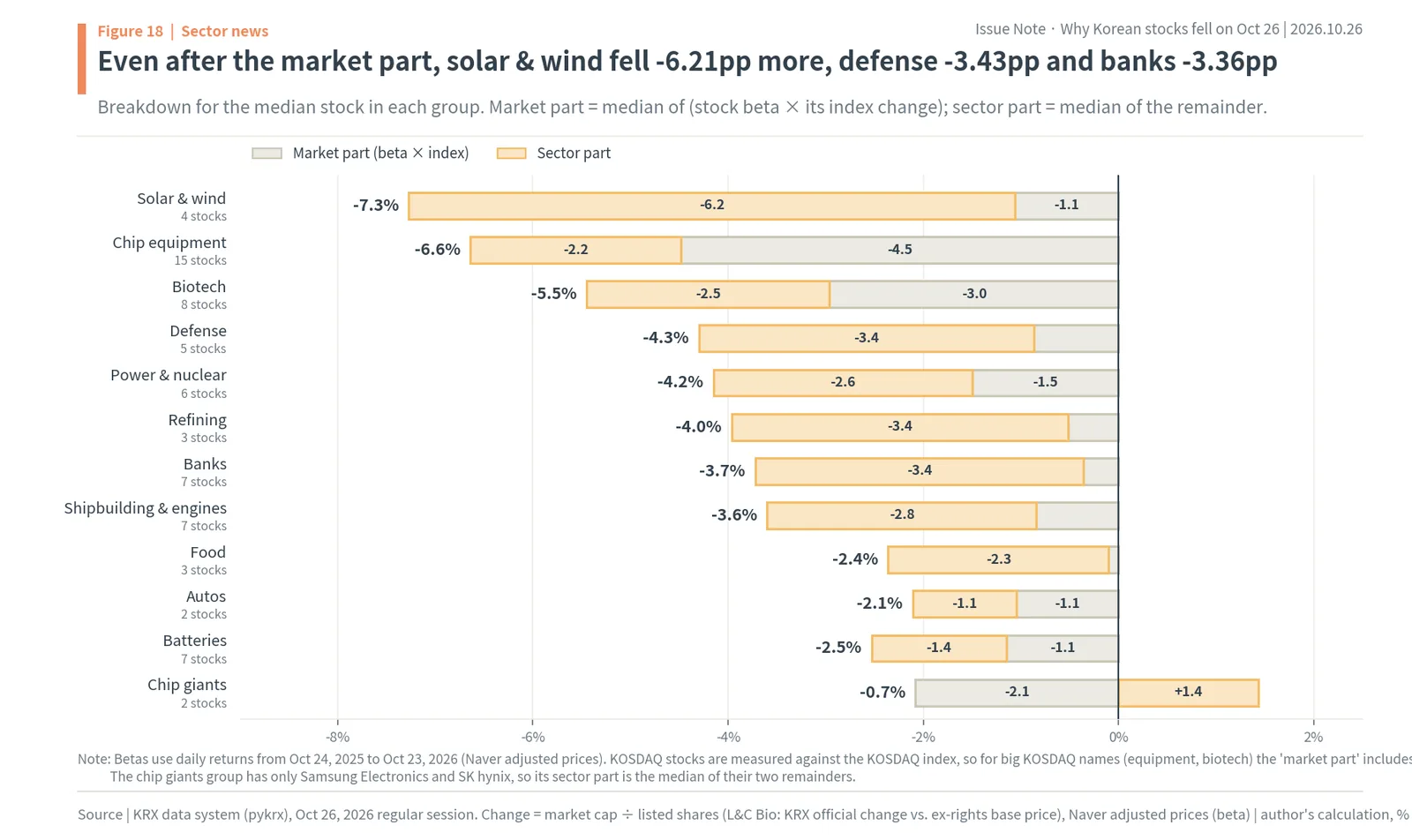
Whether each sector’s fall was really a sector wind can be checked by removing the market part. Taking the median stock in each group, subtracting its market part (beta × index) and calling the rest the sector part, solar & wind fell -6.21pp more than the market, defense -3.43pp and banks -3.36pp. Refining (-3.44pp), shipbuilding & engines (-2.76pp) and power & nuclear (-2.65pp) also fell 2 to 3 points more than their market parts. Chip equipment’s sector part is a smaller-than-expected -2.16pp because equipment stocks have betas around 1.5, so much of their fall is counted as the market part. Since big KOSDAQ stocks also pull the index down themselves, the “market part” of equipment stocks includes the share of the index fall they caused.
Company events: three intraday earnings filings and one sanction
What splitting each fall into three parts shows
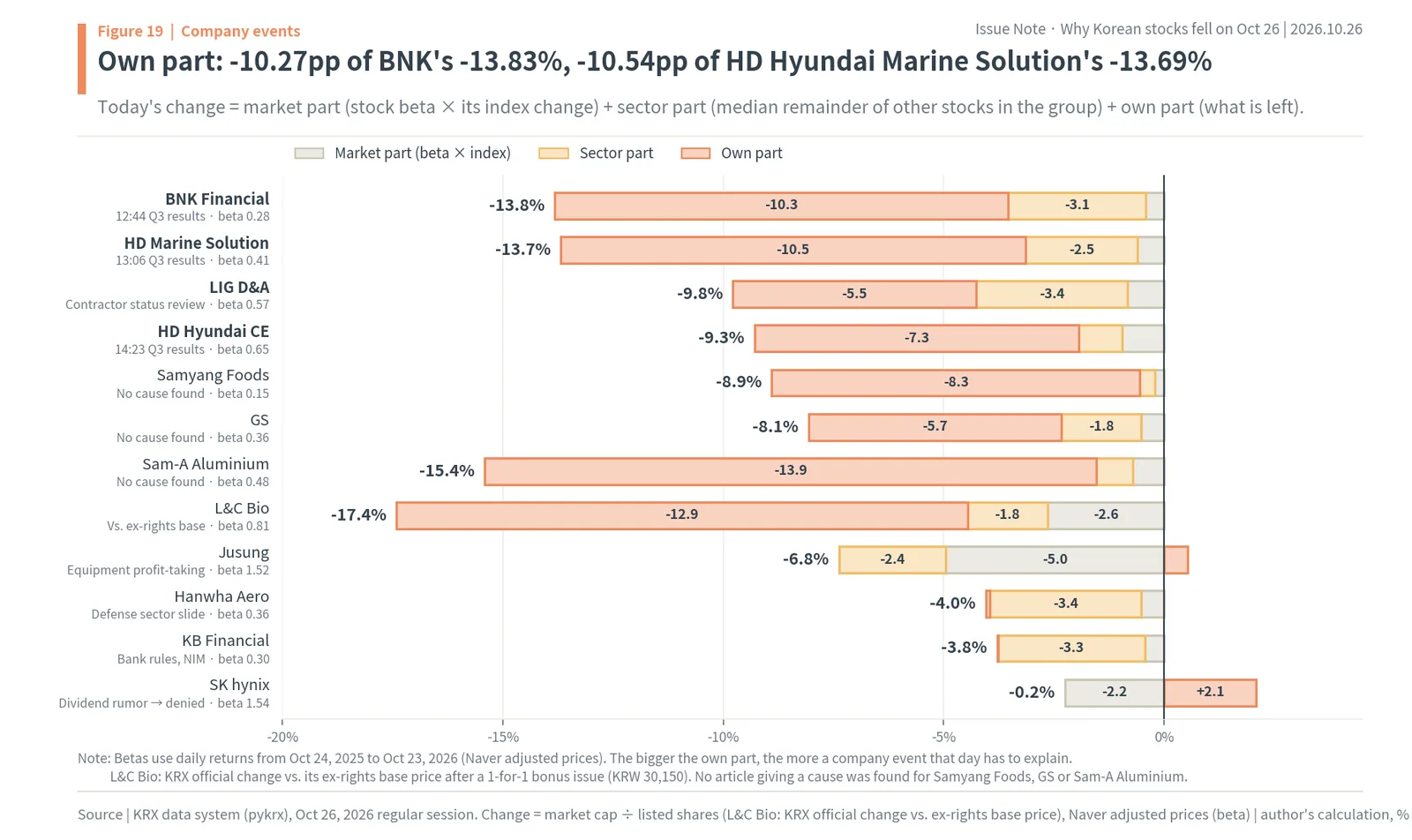
Splitting each stock’s change into market, sector and own parts reveals where the falls that market and sector cannot explain were. The two clearest are BNK Financial Group and HD Hyundai Marine Solution. Of BNK’s -13.83%, the market part was -0.41pp and the sector part -3.14pp, leaving an own part of -10.27pp. Of HD Hyundai Marine Solution’s -13.69%, the own part was -10.54pp. LIG D&A’s own part was -5.52pp of -9.78%, and HD Hyundai Construction Equipment’s -7.35pp of -9.29%. All four had a company event dated that day.
By contrast, Jusung Engineering (-6.84%), the chip equipment bellwether, had an own part of +0.53pp: its whole fall is explained by the market part (beta 1.52 × KOSDAQ -3.26%) and the sector part. Hanwha Aerospace (-4.04%) and KB Financial Group (-3.79%) also had own parts near zero; they fell with the wind across their sectors, not because of company events. SK hynix fell less than its market part (-2.25pp), giving an own part of +2.09pp: the special-dividend rumor and shareholder-return hopes described earlier.
BNK Financial Group: results at lunchtime, and the loss tripled within 20 minutes
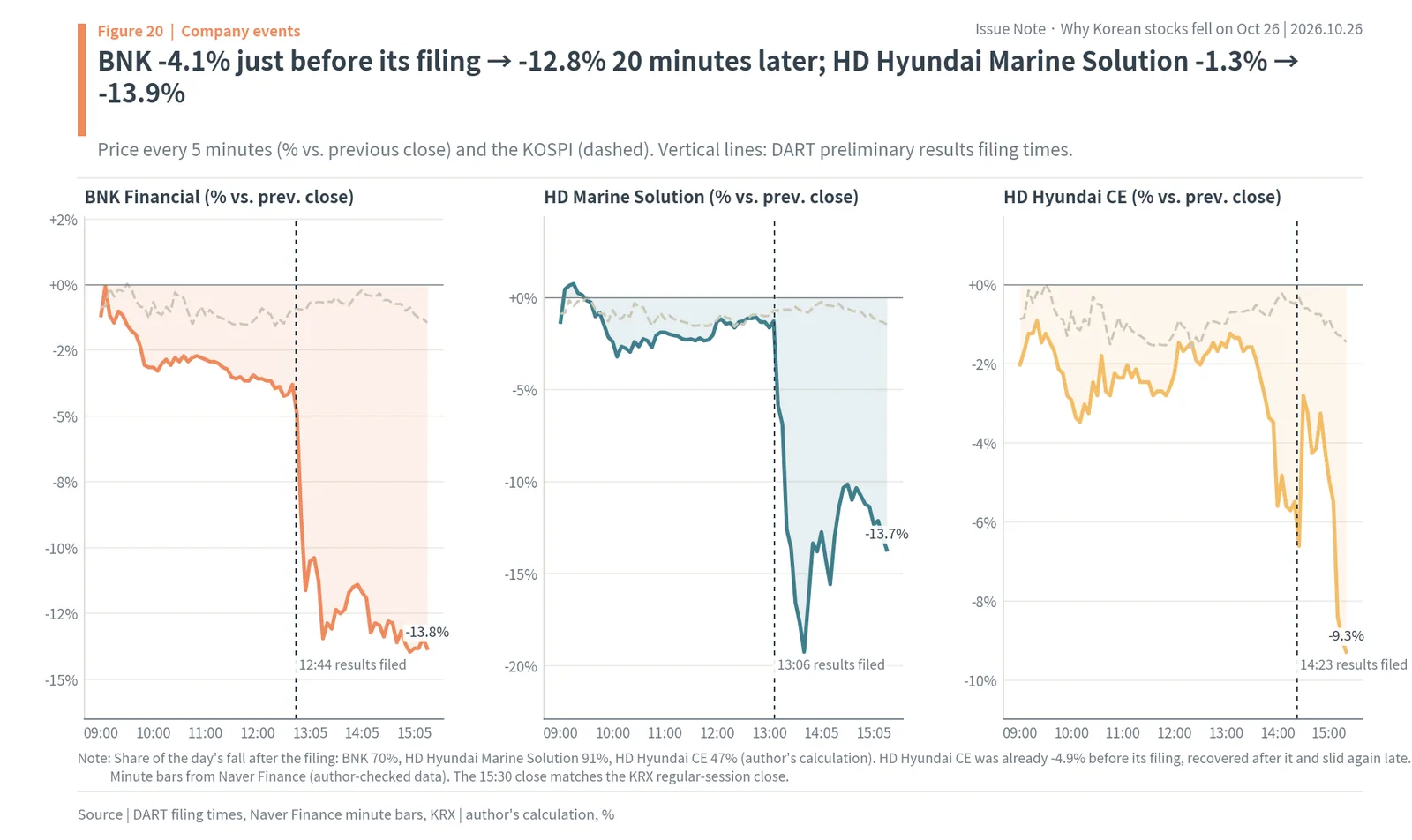
BNK Financial Group filed preliminary third-quarter results at 12:44 p.m. (DART). Net profit attributable to owners was KRW 210.5bn (about $159m), down 28.5% from a year earlier, and the Korea Stock News called the results “below market expectations.” Non-interest income hurt most: it fell 76.8% from the previous quarter to KRW 40.3bn, and the chief financial officer explained that securities gains were about KRW 120bn short of plan (Money Today). Third-quarter net profit at subsidiary Busan Bank fell 28.7% to KRW 120.6bn and at Kyongnam Bank 11.5% to KRW 80.5bn (Yonhap, Digital Times). The two banks’ combined NIM fell 0.04 percentage points from the previous quarter to 1.80%, and the CET1 ratio of 12.18% was still short of the 12.5% target (Bloter). The company raised its third-quarter dividend to KRW 150 and announced a KRW 60bn share buyback and cancellation for the second half, but that did not hold the shares up. The stock hit a 52-week low of KRW 11,730 intraday before closing at KRW 11,780 (about $8.89) (Tax Finance News).
Naver minute bars show the effect of the filing time clearly. BNK stood at -4.1% against the previous close at 12:43, just before the filing, and at -12.8% 20 minutes after it; 70% of the day’s fall came after the filing (author’s calculation). HD Hyundai Marine Solution was even more dramatic: from -1.3% just before its filing it was at -13.9% 20 minutes later, fell as far as -19.2% and closed at -13.69%. 91% of its fall came after the filing. The vertical lines in the chart below mark the DART filing times.
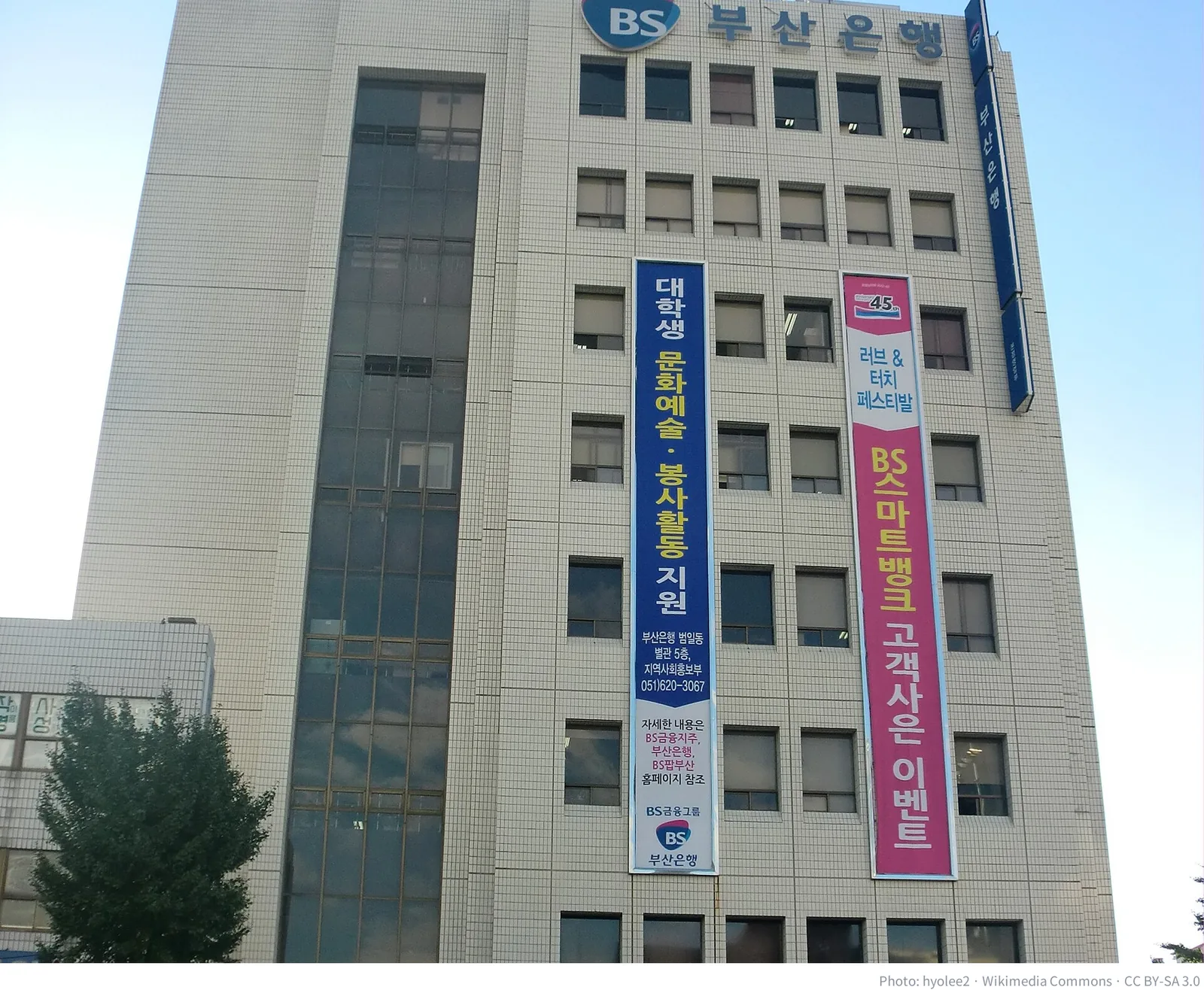
BNK is a regional financial group based in Busan and South Gyeongsang. On top of the bank-wide issues Hana Securities pointed to (loan-spread disclosure, falling margins), more than three-quarters of its non-interest income vanished in one quarter. On a conference call after the close the company said fourth-quarter results would stabilize (Money Today), but that explanation came after the regular session had ended.
HD Hyundai Marine Solution: operating profit about 10% short of forecasts
HD Hyundai Marine Solution filed preliminary third-quarter results at 1:06 p.m. (DART). Revenue rose 26.7% from a year earlier to KRW 650.1bn, but operating profit rose only 2.2% to KRW 95.7bn (about $72m), about 10% below the market forecast of KRW 106.2bn, and net profit fell 59.1% to KRW 32.6bn (News1, Seoul Economic Daily). Revenue growth came from low-margin bunkering (supplying ship fuel), which rose 38.5% to KRW 293.6bn, close to half of total revenue. The Seoul Economic Daily attributed the fall to “third-quarter results falling short of expectations.” Revenue grew, but what was left over grew less. The company’s core business is the aftermarket (AM), servicing ship engines and equipment and selling parts; AM revenue rose 15.7% to KRW 282.7bn in the third quarter. When low-margin bunkering grows faster than high-margin AM, margins fall even as revenue rises. What investors saw that day was this shift in mix more than the revenue number. That afternoon the caution spread to affiliate HD Hyundai Heavy Industries.
HD Hyundai Construction Equipment: operating profit 6.6% short
HD Hyundai Construction Equipment filed preliminary third-quarter results at 2:23 p.m. Operating profit rose 23.9% from a year earlier to KRW 157.7bn but fell 36.6% from the previous quarter, 6.6% below the market forecast of KRW 168.8bn (Hankyung TV). The stock, however, was already down 4.9% before the filing, narrowed its loss right after it, and slid again late to close at -9.29%. 47% of the day’s fall came after the filing. No article explaining the fall before the filing was found.
LIG D&A: review of its defense contractor status
LIG D&A (formerly LIG Nex1) fell on a sanction, not results. On the evening of October 25 the JoongAng Ilbo reported that the Defense Acquisition Program Administration (DAPA) had asked the industry ministry to review revoking LIG D&A’s defense contractor designation for its “small drone response system” (counter-drone) program. Revocation would block a no-bid production contract for the program. System development is worth about KRW 24.4bn, and the production contract it was pursuing KRW 122.3bn (about $92m). On October 20 it had already been barred from bidding for two years from October 29 on bribery charges against an executive. The company expressed regret that sanctions were being raised on the basis of an indictment while legal proceedings are ongoing (Alpha Economy). The stock opened -8.5%, fell as far as -12.4% intraday and closed at -9.78%. Notably, foreigners net bought KRW 24.6bn of LIG D&A that day, their largest net buy on the KOSPI.
Fine M-Tec and biotech: company events of another kind
On the KOSDAQ, Fine M-Tec fell -15.70%. Alpha Economy said a controversy over defects in the inner screen of Apple’s “iPhone Duo” had spread to hinge suppliers; the company denied any defect in the parts it supplies. In biotech, L&C Bio fell -17.41% on the day it went ex-rights for a 1-for-1 bonus issue. A simple comparison of the October 23 close of KRW 60,000 with the day’s close of KRW 24,900 gives -58.5%, but against the ex-rights base price of KRW 30,150 the actual fall was -17.41%. No article explaining why it fell sharply even after the ex-rights adjustment was found. Voronoi (-7.77%) was the subject of a report that morning that it plans an KRW 80bn convertible bond issue (Chosun Biz), and ABL Bio (-7.80%) fell on the day it presented data at ESMO showing a 79% objective response rate for its gastric cancer candidate. For neither stock did an article directly link the fall to the news.
Causes not found: Samyang Foods, GS Holdings, Sam-A Aluminium
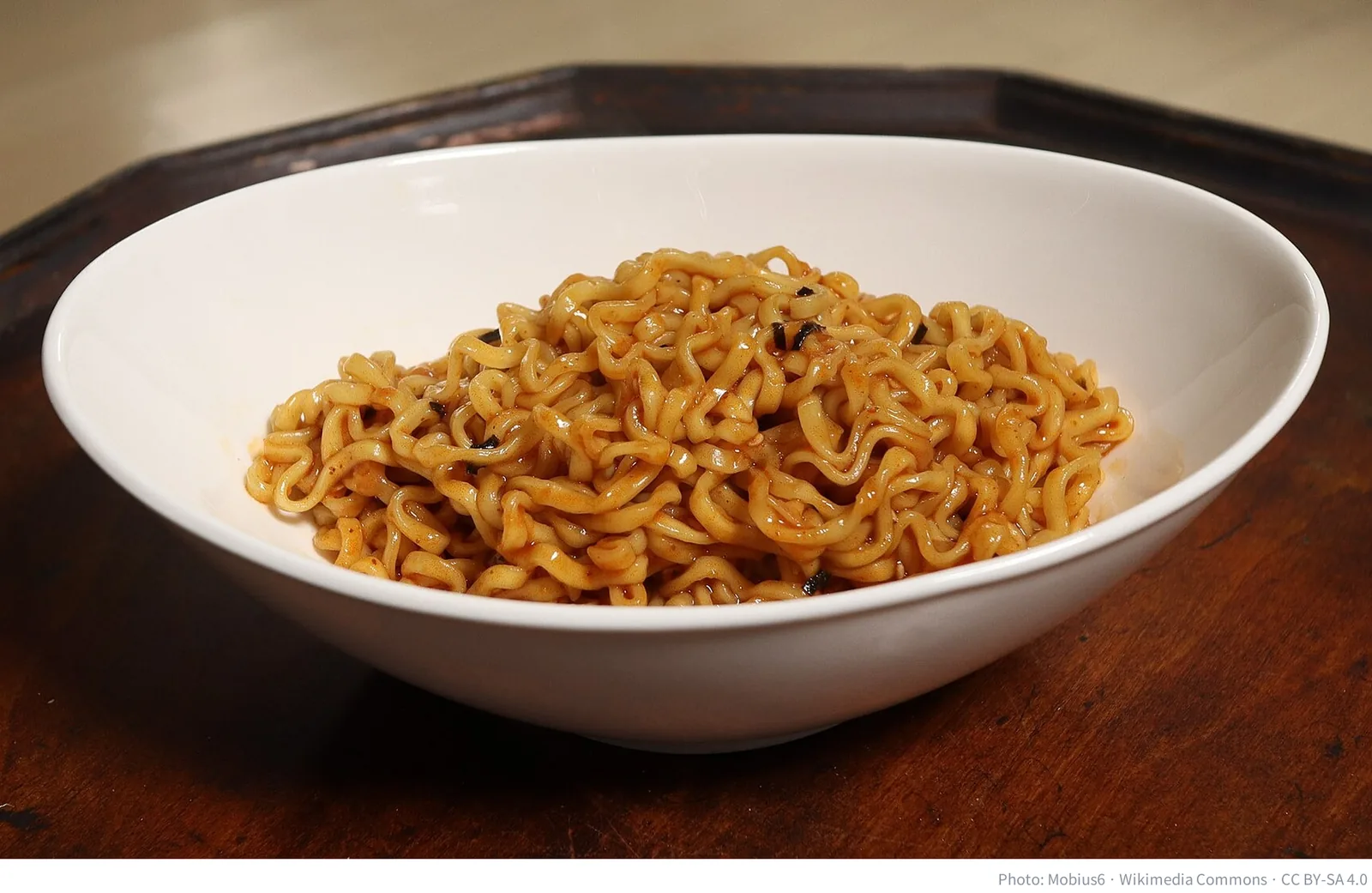
Some stocks had large own parts but no article explaining the cause that day. Samyang Foods, maker of Buldak instant noodles, fell -8.90%, of which -8.35pp was its own part, almost all of it, yet no article named a trigger; one outlet mentioned only “valuation burden.” The market forecast for its third-quarter operating profit was KRW 183.7bn, 40.3% above a year earlier (Yonhap). GS Holdings (-8.06%, own part -5.72pp) fell far more than refiners S-Oil (-3.55%) and SK Innovation (-0.80%) that day, but no article gave a cause. For Sam-A Aluminium (-15.41%, own part -13.87pp), no trigger was confirmed beyond a one-line “profit-taking.” These stocks are left as “not found” rather than given an invented cause. They are to be checked again when results or filings come out.
A few more belong in the same “not found” group. Doosan (-6.54%) had an own part of -3.02pp, and foreigners net bought KRW 18.1bn of it. The Maeil Business Newspaper wrote on October 25 that the New York listing of Hyaxiom, Doosan’s U.S. hydrogen and fuel cell subsidiary, could be delayed, but the article did not connect this to the share price. Elice, listed on the KOSDAQ on October 20, fell -18.58% and closed at its low. It listed at an offer price of KRW 90,500, fell 32% on its first day and hit the daily upper limit the next day, and has swung widely since. The shortest institutional lock-up, 15 days, does not expire until early November, so a lock-up expiry was not the cause (DART securities issuance report).
The gainers had company events too
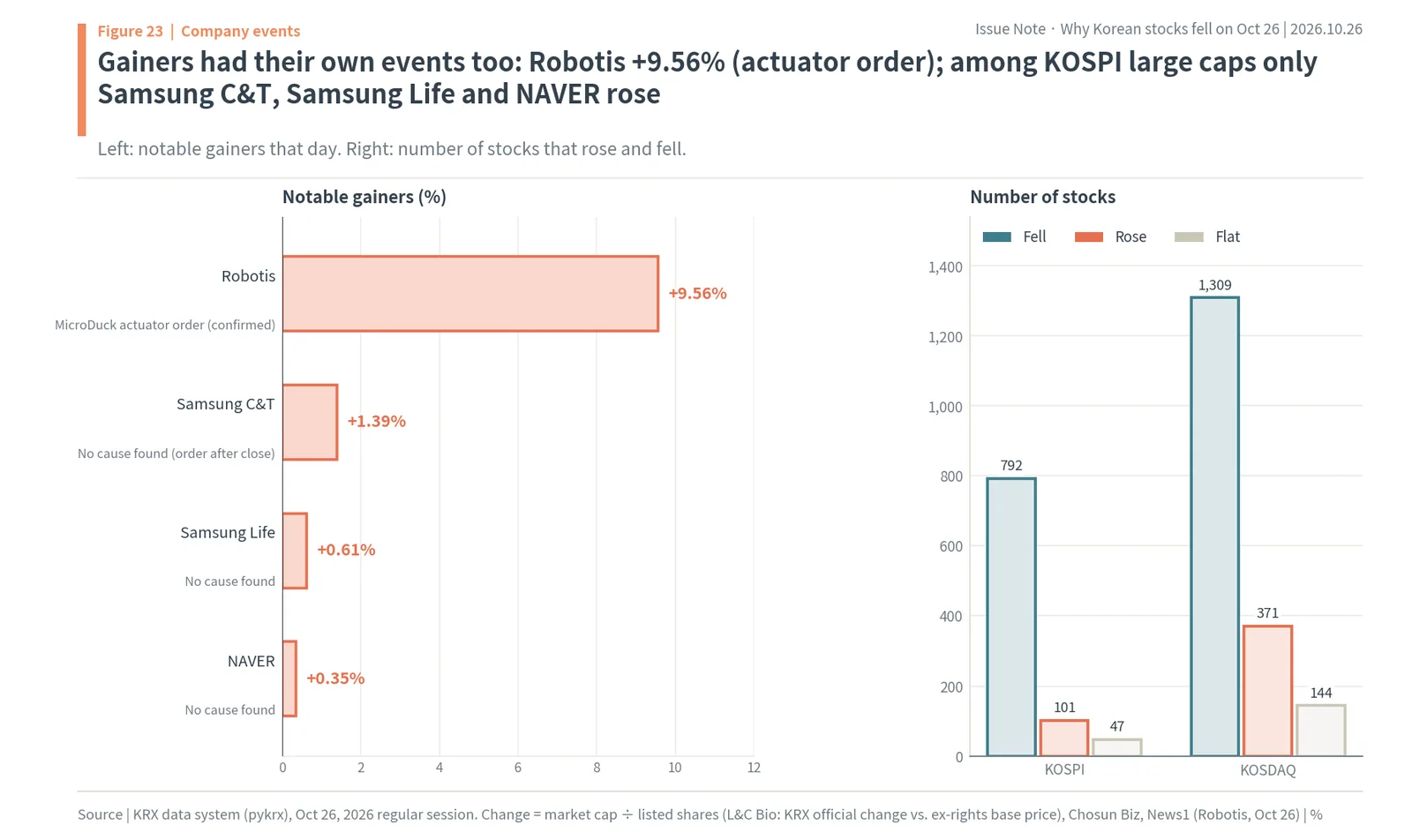
Even on a day when almost everything fell, the gainers had their own events. KOSDAQ-listed Robotis rose +9.56% on news that it will supply about 750,000 actuators for MicroDuck, a small robot from France’s Pollen Robotics (Chosun Biz, News1). Lunit and Vuno hit the daily upper limit the same day (Mediawatch). Among KOSPI large caps, only Samsung C&T (+1.39%), Samsung Life (+0.61%) and NAVER (+0.35%) rose, and for none of the three was an article found explaining the rise; Samsung C&T’s KRW 738.1bn redevelopment order was announced after the close. Overall, 101 of 940 KOSPI stocks and 371 of 1,824 KOSDAQ stocks rose.
Cause check by stock: what was confirmed and what was not
This chapter gathers the day’s big movers by sector and states how far each cause was confirmed. “Confirmed” means an article or filing that day directly gave the cause of that stock’s fall; “sector article” means only an article on the whole sector; “inference” means related facts exist but no article links them to the price; “not found” means no cause article was found.
In shipbuilding & engines, HD Hyundai Marine Solution (-13.69%) is confirmed by its intraday results filing; HD Hyundai Heavy Industries (-5.08%) is confirmed by one outlet’s reading of caution after its affiliate’s results; Hanwha Ocean (-4.16%) is confirmed as weak shipbuilders plus strong-won worries, with no company-specific bad news. Samsung Heavy Industries (-3.15%), HD KSOE (-2.02%), Hanwha Engine (-3.72%) and HD Hyundai Marine Engine (-3.32%) have only the sector article on peak-out worries. The three big shipbuilders report on the 27th to 29th.
In defense, LIG D&A (-9.78%) is confirmed by the report on its contractor status. Hanwha Aerospace (-4.04%), Hyundai Rotem (-4.35%), Korea Aerospace Industries (-4.31%) and Hanwha Systems (-3.92%) have only the sector article on earnings and order worries. Hyundai Rotem hit a 52-week low intraday, and there was a report of some K2 tanks in Poland awaiting defect repairs, but no article linked it to the share price. Hanwha Aerospace reports on the 29th.
In banks, BNK Financial Group (-13.83%) is confirmed by its intraday results filing. KB Financial Group (-3.79%), Hana Financial Group (-3.35%), Shinhan Financial Group (-2.95%), Woori Financial Group (-2.82%), iM Financial Group (-4.19%) and JB Financial Group (-3.98%) have the sector article from Hana Securities on loan-spread disclosure and falling margins. That the big banks widened their losses around BNK’s filing shows up in minute bars, but no article says so, so it is an inference.
In chip equipment, Jusung Engineering (-6.84%), Wonik IPS (-6.49%) and Eugene Technology (-6.88%) are named in the profit-taking article (sector article); PSK Holdings (-9.00%), PSK (-7.23%), HPSP (-5.87%), EO Technics (-6.19%), TCK (-6.65%) and KCTech (-8.67%) have the same sector article and the institutional net-sell list. Kosses (-18.05%) and Mico (-9.82%) are an inference via Bloom Energy’s supply chain. Neosem (-7.41%) and Hana Micron (-6.00%) are not found.
In power, nuclear and solar, Doosan (-6.54%), Doosan Enerbility (-3.03%), HD Hyundai Electric (-4.89%), Hanwha Solutions (-6.85%), OCI Holdings (-5.87%), HD Hyundai Energy Solutions (-10.34%) and CS Wind (-7.31%) are all not found. Their falls are not yet explained by any article beyond pension fund selling and the trimming of this year’s winners. In batteries, EcoPro (-4.13%), EcoPro BM (-3.45%) and Lotte Energy Materials (-7.30%) have the sector article on pre-midterm policy worries, and Sam-A Aluminium (-15.41%) is not found.
Elsewhere, HD Hyundai Construction Equipment (-9.29%) is confirmed by its intraday results filing, Fine M-Tec (-15.70%) by the iPhone screen controversy, Vinatech (-13.64%) is an inference via Bloom Energy, Voronoi (-7.77%) is an inference given the convertible bond report, L&C Bio (-17.41%) has only its ex-rights date confirmed with the further fall not found, and ABL Bio (-7.80%), Samyang Foods (-8.90%), GS Holdings (-8.06%) and Elice (-18.58%) are not found. Among gainers, Robotis (+9.56%) is confirmed by its actuator order; Samsung C&T, Samsung Life and NAVER are not found.
Gathered this way, the large stocks that fell close to 10% or more with a cause confirmed by articles are BNK Financial Group, HD Hyundai Marine Solution, LIG D&A (9.78%, close to 10%), HD Hyundai Construction Equipment and Fine M-Tec; the other big falls were sector winds or falls whose reason is still unknown. Not forcing an explanation onto an unexplained fall is this report’s rule. Those stocks stay on a list to check again when their next results or filings come out.
Author’s view: less an economic signal than selling before a test plus company events
Taken together, the day’s fall was three hands each pulling down different stocks. Foreigners sold KRW 609.9bn of the two chip stocks after the weekend’s Middle East news and dragged the index. But institutions absorbed KRW 441.9bn, so the two fell less, and the three chip lines fell only -0.82% cap-weighted. Domestic institutions trimmed this year’s big winners ahead of this week’s chip earnings, FOMC and Big Tech results. On the KOSDAQ, this year’s biggest gainers fell 2.7 times as much as the smallest gainers, and pension funds sold KRW 64.9bn of shipbuilding, defense and power. Then the intraday results of BNK Financial Group, HD Hyundai Marine Solution and HD Hyundai Construction Equipment and the sanctions news at LIG D&A added company-specific parts on top of the sector winds.
The author sees the day’s fall not as a sign that the Korean economy suddenly worsened, but as a day when selling to protect gains before a big test overlapped with company events at a few firms. There are three reasons. First, chip equipment had no new bad news, and a report that same day put capex at a record. Second, foreigners actually bought the sectors that fell hard. Third, most of the large stocks that fell close to 10% or more were companies with results or sanctions confirmed that day.
The three hands are likely to move differently from here. Foreign selling loses force once someone appears to absorb it: the two chip stocks’ earnings and shareholder returns. SK hynix rising nearly 3% on a single special-dividend rumor before giving it back after the denial shows how big that hope is. Domestic institutions’ trimming tends to stop once the events pass, because selling to protect gains before a test is recalculated once the results are in. Company events resolve only with the companies’ next filings and explanations. The next links are whether BNK’s non-interest income normalizes in the fourth quarter, whether HD Hyundai Marine Solution’s high-margin business regains share, and whether LIG D&A’s contractor status review turns into an actual penalty.
So what sets the next direction is clear: the two chip stocks foreigners sold, with their results and shareholder returns (SK hynix on the 28th, Samsung Electronics on the 29th), the U.S. rate decision (early on the 29th) and Big Tech’s AI spending plans (29th to 30th). If chip results are strong and shareholder returns large, foreign selling will drag the index less, and money may flow back into the trimmed sectors. Stocks that fell on company events are likely to move separately from their sectors, so their next filings and conference calls come first. This view rests on one day of trading data and that day’s articles; it will be checked against this week’s results and filings the same way.
Signals and dates to watch this week
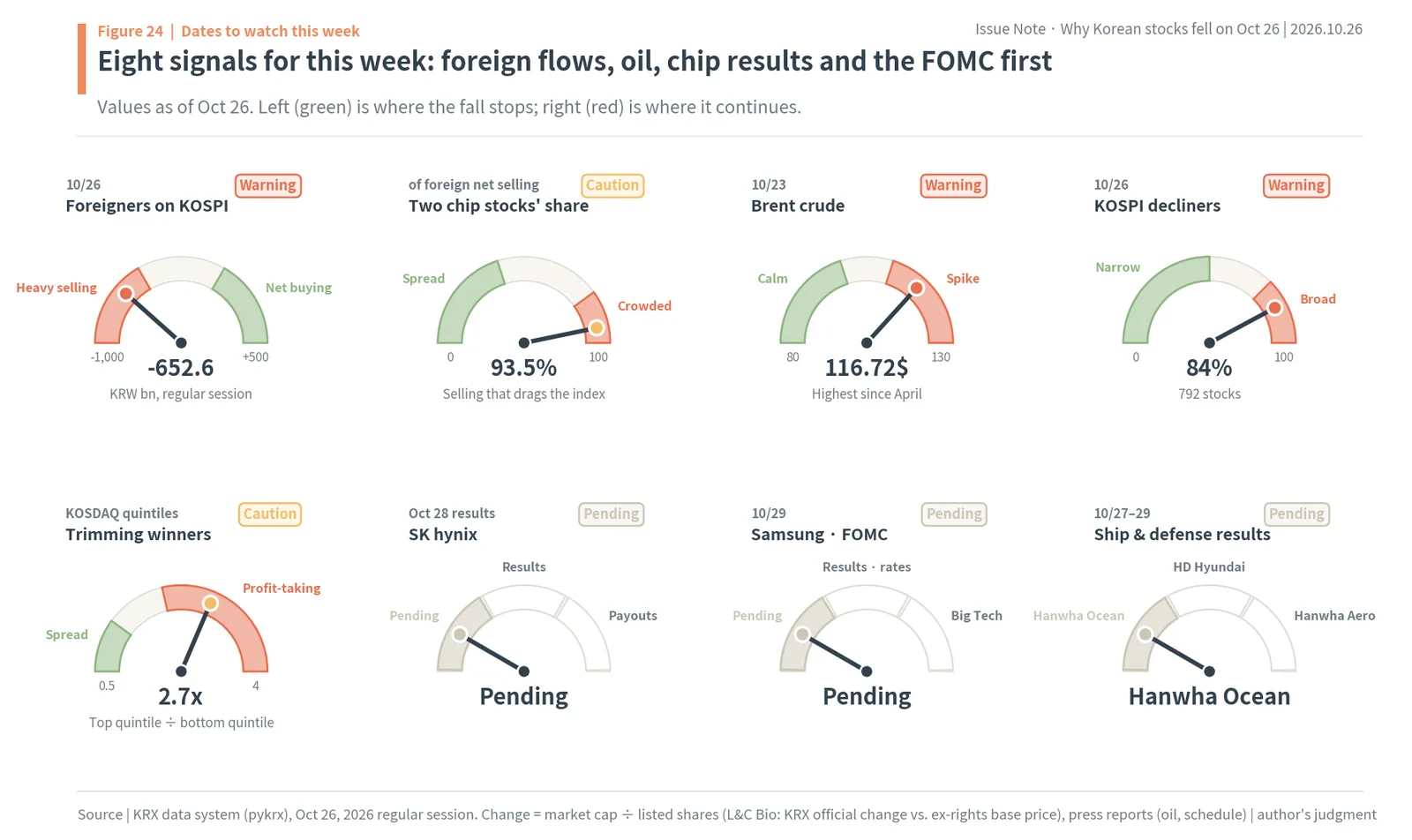
The signals to check this week are summarized as eight gauges. The top five are numeric. Foreign net buying on the KOSPI was KRW -652.6bn that day, on the “heavy selling” side, and the two chip stocks’ share of foreign net selling was 93.5%, on the “crowded” side. Brent was $116.72, the highest since April, and 84% of KOSPI stocks fell, a broad decline. The KOSDAQ quintile gap (top quintile ÷ bottom quintile) was 2.7 times, a sign of strong profit-taking. The bottom three are schedule signals, all still pending.
By date: Hanwha Ocean results and Korea’s preliminary third-quarter GDP on Oct 27; SK hynix, HD KSOE and HD Hyundai Heavy Industries results on Oct 28. On Oct 29: Samsung Electronics’ final results, the FOMC decision early in the Korean morning, Microsoft and Alphabet results, U.S. September personal consumption expenditures (PCE) inflation and third-quarter GDP, plus results from Samsung SDI, Hanwha Aerospace and Samsung Heavy Industries. On Oct 30: Amazon results, Kia and Hyundai Mobis results, and the Bank of Japan’s rate decision. The U.S. midterm elections are on November 3. In short: Oct 27 Hanwha Ocean, Oct 28 SK hynix and HD Hyundai Heavy, Oct 29 Samsung, the FOMC, Microsoft and Alphabet, and Oct 30 Amazon.
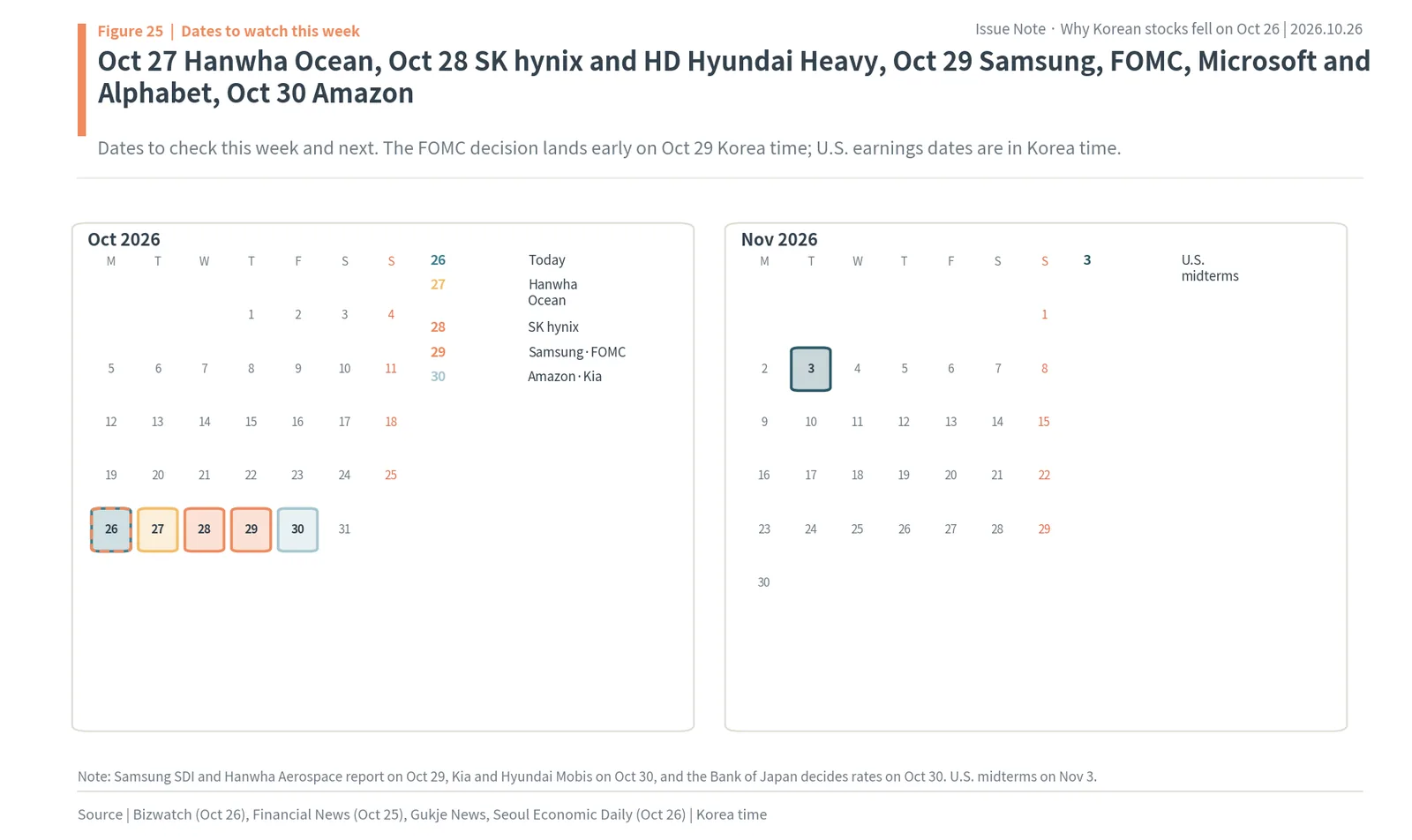
The first thing to watch in this schedule is not the two chipmakers’ earnings numbers on the 28th and 29th but their shareholder return announcements. That SK hynix rose nearly 3% early on one special-dividend rumor shows the market is more sensitive to “who will absorb what foreigners sell” than to earnings. If the companies step in as buyers through buybacks or dividends, the force dragging the index weakens a lot. For shipbuilding and defense, the next link is how far the strong won and peak-out worries show up in the 27th to 29th results.
How to read the gauges: for the fall to stop, three things need to appear together. First, foreign net selling must shrink, or, if it does not, the two chipmakers’ shareholder returns must absorb it. Second, the KOSDAQ quintile gap must narrow; when big and small gainers move alike, the trimming is over. Third, Brent must come down from its highest level since April, since oil feeds into inflation and the U.S. rate path and frames how to read the FOMC. Conversely, if foreign selling spreads beyond chips and foreigners start selling the beaten-down sectors too, the fall changes character from trimming to leaving. On this day it was still the former.
Common questions: why Korean stocks fell on October 26, 2026
Why did foreigners sell so much of just two chip stocks?
The two make up half of KOSPI market cap, so they produce the largest amounts when foreigners cut their Korea weighting. Of the KRW 652.6bn foreigners net sold that day, SK hynix accounted for KRW 399.0bn and Samsung Electronics for KRW 210.9bn. Yet the two fell only -0.16% and -1.16%, because institutions absorbed KRW 441.9bn of them.
Why did SK hynix barely fall?
Early in the session it rose nearly 3% on a rumor that it would return gains from selling its Kioxia stake as a special dividend, then gave the gain back after the company denied it and closed at -0.16%. The market was waiting to see whether this week’s results would bring additional shareholder returns, and institutions net bought KRW 307.0bn of SK hynix.
Why did the KOSPI fall on October 26?
Closing reports cited a jump in oil on weekend Middle East tension, caution ahead of this week’s FOMC, Big Tech earnings and Samsung Electronics and SK hynix results, and foreign selling. Foreigners net sold KRW 652.6bn of KOSPI stocks (KRX regular session). But 93.5% of that was Samsung Electronics and SK hynix, and the shipbuilding, defense and power stocks that fell hard were bought by foreigners and sold by domestic institutions.
Why did the KOSDAQ fall more than the KOSPI?
Because large chip equipment, biotech and battery stocks, which weigh heavily in the KOSDAQ index, fell hard. The KOSDAQ large-cap index fell -3.87% while the small-cap index fell -1.54%, and the median stock fell -1.51%, less than the index (-3.26%). Chip equipment stocks, up 77% this year, fell on institutional selling with no new bad news.
Was there new bad news for chip equipment?
No new bad news, such as U.S. export curbs or capex cuts at Samsung Electronics or SK hynix, was found in October 24 to 26 articles. The same day, a report put the two companies’ capex this year at a record. Articles cited profit-taking after this year’s big gains, doubts about AI investment and caution before big events.
Why did BNK Financial Group fall more than 13%?
Its third-quarter results, filed at 12:44 p.m., were worse than expected. Third-quarter net profit fell 28.5% from a year earlier to KRW 210.5bn, and non-interest income fell 76.8% from the previous quarter. The stock went from -4.1% just before the filing to -12.8% 20 minutes later and closed at -13.83%.
What happened to HD Hyundai Marine Solution and LIG D&A?
HD Hyundai Marine Solution fell -13.69% after its third-quarter operating profit (KRW 95.7bn), filed at 1:06 p.m., came in about 10% below the market forecast (KRW 106.2bn). LIG D&A fell -9.78% on a report that the Defense Acquisition Program Administration is reviewing revoking its defense contractor status for a counter-drone program.
How are Bloom Energy and Kosses or Vinatech connected?
Bloom Energy is a U.S. fuel cell maker that supplies power to AI data centers. Kosses signed a KRW 150.4bn automation equipment contract with Bloom Energy in July, and Vinatech’s KRW 123.0bn contract disclosed on October 19 reportedly has Bloom Energy as its end customer. Bloom Energy fell 11.24% in the U.S. on October 23 on cash flow worries; in Korea’s first session after that, Kosses fell -18.05% and Vinatech -13.64%. No article directly linked the falls, so the connection is the author’s inference.
How should stocks with no cause found be read?
Stocks such as Samyang Foods, GS Holdings and Sam-A Aluminium, which had large own parts but no cause article that day, are left as “not found” rather than given an invented reason. Such falls are sometimes explained later by filings, results or analyst reports, and sometimes are explained only by trading flows with no clear trigger. They are a list to check against the day’s fall when their next results or filings come out. The market forecast for Samyang Foods’ third-quarter operating profit was KRW 183.7bn.
What dates matter next?
SK hynix results on the 28th; Samsung Electronics results and the FOMC decision (early morning Korea time) plus Microsoft and Alphabet results on the 29th; Amazon results on the 30th. The first test is whether the two chipmakers’ shareholder returns can absorb foreign selling.
Basis of calculation
Stock changes are calculated from KRX data system market caps on October 23 and 26 divided by listed shares (the regular-session close), because some price tables after September 14, 2026 mix in Nextrade after-hours trades. L&C Bio’s base price changed to KRW 30,150 on October 26 because of a 1-for-1 bonus issue going ex-rights, so the KRX official change (-17.41%) is used. Indexes, sector indexes and investor trading are also KRX regular-session figures. The difference between foreign net selling in articles (KRW 695.2bn to 753.1bn) and the KRX regular-session figure (KRW 652.6bn) comes from counting differences such as whether Nextrade is included.
Sector groups are the author’s, by line of business: chip giants 2 stocks, chip equipment 15, shipbuilding & engines 7, defense 5, power & nuclear 6, banks 7, biotech 8, batteries 7, solar & wind 4, food 3, refining 3, autos 2 and construction equipment 2. Group changes are calculated both as medians and cap-weighted.
The five groups by this year’s gain split stocks with a market cap of KRW 300bn or more into fifths by their gain from the December 30, 2025 close to the October 23 close. Stocks whose listed shares changed by more than 10% because of splits, bonus issues or mergers are excluded because their gains are distorted. That leaves 224 KOSDAQ and 361 KOSPI stocks.
Beta uses Naver Finance adjusted prices to compute daily returns from October 24, 2025 to October 23, 2026, dividing the covariance of stock and index returns by the variance of index returns. Stocks with fewer than 60 trading days get a beta of 1. Market part = beta × that day’s index change; sector part = median of (change − market part) for the other stocks in the group; own part = change − market part − sector part. The chip giants group has only two stocks, so its sector part is set to zero. The sector breakdown chart adds the median market part and median sector part of each group.
Intraday moves are drawn from Naver Finance minute bars (9:00 a.m. to 3:30 p.m. on October 26), and filing times are DART receipt times. The post-filing share = (closing change − change in the minute before the filing) ÷ closing change. These minute-bar numbers are data checked by the author, not figures confirmed by articles. Causes come only from dated articles and filings; articles published after the close (conference calls, currency hedging analyses and the like) are not used as causes of that day’s fall. Stocks with no cause article found are marked “not found.”
Why Korean stocks fell on October 26, 2026: quick answers
Q. Why did the KOSPI fall on October 26, 2026?
Closing reports cited a jump in oil on weekend Middle East tension, caution ahead of the FOMC, Big Tech earnings and Samsung Electronics and SK hynix results, and foreign selling. The KOSPI fell 1.46% to 5,469.47, its lowest close since April 6, and foreigners net sold KRW 652.6bn on the KRX regular session. But 93.5% of that selling was Samsung Electronics and SK hynix, and the shipbuilding, defense and power stocks that fell hard were bought by foreigners and sold by domestic institutions.
Q. Why did SK hynix barely fall while foreigners sold it?
Institutions net bought KRW 307.0bn of the KRW 399.0bn foreigners sold. SK hynix also rose nearly 3% early on a special-dividend rumor, then closed at -0.16% after the company denied it. The market was waiting for shareholder-return news at its October 28 results.
Q. Why did the KOSDAQ fall 3.26%?
Large chip equipment, biotech and battery stocks that weigh heavily in the KOSDAQ index fell hard, while the median KOSDAQ stock fell only -1.51%. KOSDAQ institutions were net sellers of KRW 126.8bn and foreigners net buyers of KRW 42.5bn. Chip equipment stocks, up 77% this year, fell a median -6.84% with no new bad news found.
Q. Why did BNK Financial Group fall 13.83%?
Its third-quarter results, filed at 12:44 p.m., missed expectations: net profit fell 28.5% from a year earlier to KRW 210.5bn and non-interest income fell 76.8% from the previous quarter. The stock went from -4.1% just before the filing to -12.8% 20 minutes later.
Q. Why did HD Hyundai Marine Solution and LIG D&A fall?
HD Hyundai Marine Solution’s third-quarter operating profit of KRW 95.7bn, filed at 1:06 p.m., was about 10% below the KRW 106.2bn forecast, and the stock fell 13.69%. LIG D&A fell 9.78% on a report that the Defense Acquisition Program Administration is reviewing revoking its defense contractor status for a counter-drone program.
Q. What should investors watch next?
SK hynix results on October 28, Samsung Electronics results and the FOMC decision on October 29 (Korea time), Microsoft and Alphabet results on October 29 and Amazon on October 30. The first test is whether the two chipmakers’ shareholder returns can absorb foreign selling.
Sources
- Korea Exchange (KRX) data system: KOSPI and KOSDAQ indexes, sector indexes, market caps and listed shares by stock (regular-session changes), net buying by investor type and by stock (pykrx, Oct 23 and 26, 2026); Naver Finance adjusted prices (beta) and minute bars (intraday moves)
- Market close: Newspim (link), Korea Economic Daily (link), Mediawatch (link), Businesskorea (link), Alpha Economy via Investing.com (link), Busan Ilbo (link), News1 (link), Seoul Shinmun (link), Oct 26, 2026
- Oil and New York: Etoday (https://www.etoday.co.kr/news/view/2639633 , https://www.etoday.co.kr/news/view/2639634), Oct 24, 2026; Newsis (link), Oct 26, 2026; won: Edaily (link), Oct 26, 2026
- Chips: News1 on equipment stocks (link), Chosun Biz market view (link), Herald Economy (link), Pinpoint News (https://www.pinpointnews.co.kr/news/articleView.html?idxno=498536 , https://www.pinpointnews.co.kr/news/articleView.html?idxno=498534), SBS Biz (link), Chosun Biz on capex (link), Yonhap on Lam Research (https://n.news.naver.com/mnews/article/001/0016395687, Oct 23), Etoday on Hana Securities (link), Digital Daily on Goldman Sachs (link), Oct 26, 2026
- Bloom Energy: Hankyung TV (link), Oct 26, 2026; Korea Economic Daily (link), Oct 22, 2026
- Shipbuilding, defense and banks: News1 (link), Seoul Economic Daily (link), Financial News (link), Seoul Shinmun (link), Joseilbo (link), Bizwatch (link), Businesspost (link), Seoul Economic Daily on Hanwha Ocean (link), Oct 26, 2026
- Companies: DART preliminary results filings (BNK Financial Group 12:44, HD Hyundai Marine Solution 13:06, HD Hyundai Construction Equipment 14:23), Oct 26, 2026; Korea Stock News on BNK (link), Money Today (link), Digital Times (link), Seoul Economic Daily on HD Hyundai Marine Solution (link), Hankyung TV on HD Hyundai Construction Equipment (link), JoongAng Ilbo on LIG D&A (https://n.news.naver.com/mnews/article/025/0003560310, Oct 25), Chosun Biz on LIG D&A (link)
- Batteries, biotech and others: Maeil Shinmun (link), Chosun Biz on Voronoi (link), ABL Bio (link) and Robotis (link), CBC News on L&C Bio’s ex-rights date (link), Job-Post on Samyang Foods (link), Oct 23 to 26, 2026
- Schedule for the week: Bizwatch (link), Oct 26, 2026; Financial News (link), Oct 25, 2026
- Exchange rate: Yahoo Finance KRW=X (Oct 26, 2026 close, KRW 1,325.8 per dollar)
- Photos: Narubaru7 (CC BY 4.0), U.S. Department of Defense DVIC (public domain), Aileen Devlin/Jefferson Lab (public domain), Wvdp (CC0), hyolee2 (CC BY-SA 3.0), Mobius6 (CC BY-SA 4.0), via Wikimedia Commons
Was this note useful?
Thanks. Your answer helps decide what to cover next.
Korea market snapshot · Oct 27, 2026
New to Korean stocks? Start here for the basics.
Most read lately
3Balance Sheet Recession: Japan’s Lost Years and Korea’s KRW 2,000 Trillion Household Debt (2026)
4Commodity Cycle Order: Gold Peaks First, Grains Last, Rates Next (2026)
5Hanwha Succession: Who Gained Among the Three Kim Brothers, from One Basket to Three Paths
Get the Saturday note on Korean stocks
One email every Saturday with the week’s new research on Korean listed companies and links to the updated data pages. Built from DART filings and KRX data. Free; unsubscribe in one click. See past issues