KOSPI vs KOSDAQ: Korea’s Stock Markets Explained
Start here · Guide 5 of 10
KOSPI and KOSDAQ are the two main stock markets run by KRX (Korea Exchange). KOSPI is the main board for large, established companies such as Samsung Electronics, SK hynix and Hyundai Motor; KOSDAQ is the growth market for smaller technology, biotech and equipment companies. Each name also refers to that market’s headline index, and in October 2026 the KOSPI market was worth about ten times the KOSDAQ market.
In short
- KOSPI had 830 listed companies and a market value of KRW 4,957 trillion (about USD 3.7 trillion); KOSDAQ had 1,817 companies worth KRW 464 trillion (about USD 350 billion), as of October 14–15, 2026.
- Two chipmakers dominate KOSPI: Samsung Electronics and SK hynix were about 48% of its market value on October 14, 2026.
- KOSDAQ is a retail market: individuals generated 65.5% of its trading value in 2026 (to October 14), against 38.2% on KOSPI.
- Futures, options and most index ETFs track the KOSPI 200 and KOSDAQ 150, not the broad composite indices.
- KOSPI first closed above 4,000 in October 2025, hit a record close of 9,114.55 on June 22, 2026, then fell sharply; it closed at 6,008.81 on October 14, 2026.
What is the difference between KOSPI and KOSDAQ?
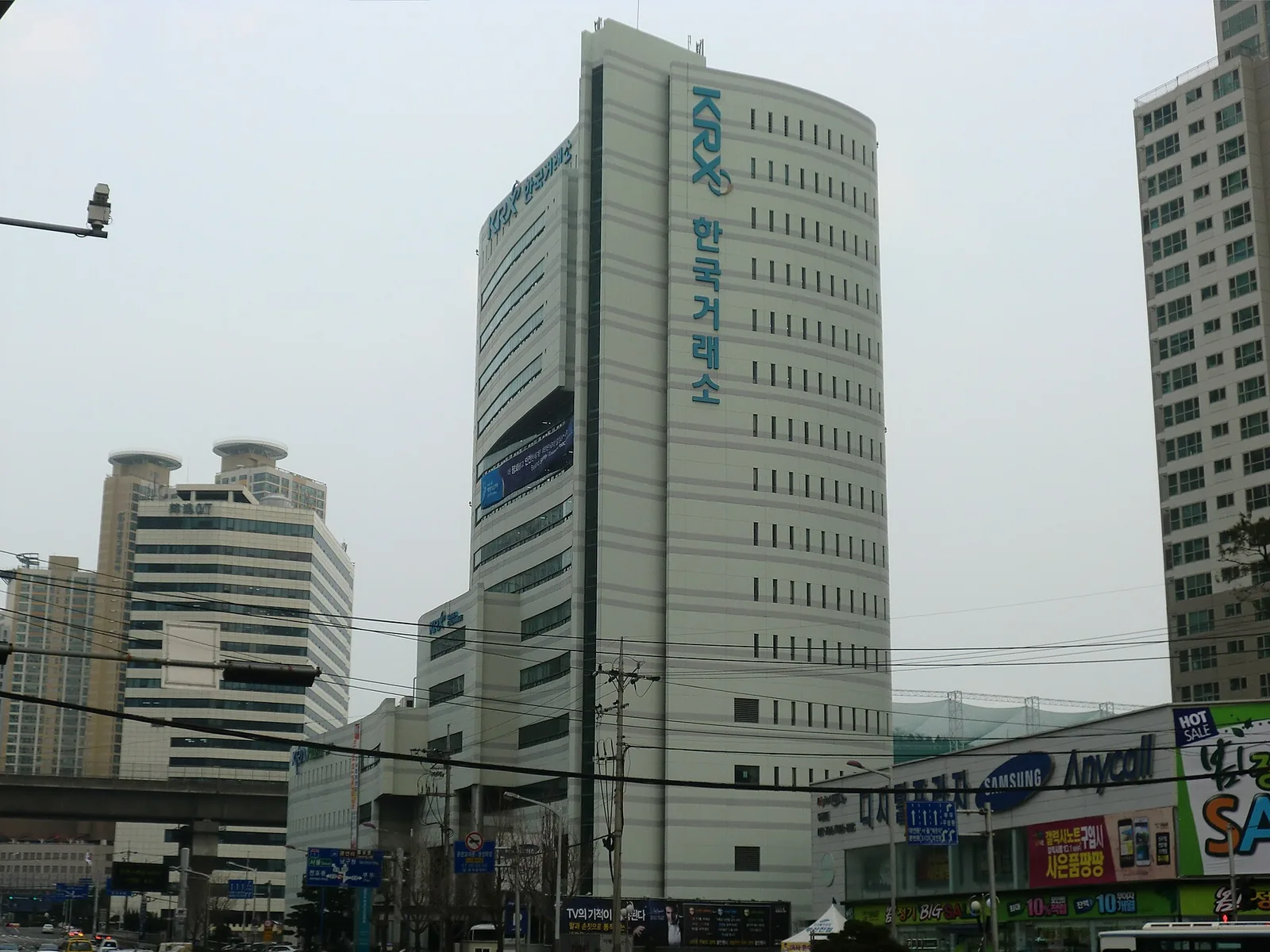
KRX (Korea Exchange) was created on January 27, 2005 by merging the Korea Stock Exchange, the KOSDAQ market and the Korea Futures Exchange (it took the name Korea Exchange in 2009). It now operates three equity markets plus a derivatives market. Its roots go back to the Daehan Stock Exchange, founded in March 1956.
The KOSPI market (KOSPI stands for Korea Composite Stock Price Index) is the main board. It is where Korea’s largest manufacturers, banks, insurers and holding companies list. The KOSDAQ market was established in May 1996 as a market for younger, smaller and more growth-oriented companies, with lower entry requirements and special routes for loss-making technology firms.
KONEX (Korea New Exchange) opened in July 2013 for start-ups and small firms that are not ready for KOSDAQ. It is tiny: 106 companies worth about KRW 3.6 trillion (about USD 2.7 billion) in October 2026, with thin trading. Under a September 2026 decision, it can also take in some companies that fail the market-value test for staying on KOSPI or KOSDAQ.
The same word is used for a market and its index. “KOSPI rose 1%” refers to the KOSPI index; “a KOSPI-listed company” refers to the market. On Yahoo Finance, KOSPI stocks carry a .KS suffix and KOSDAQ stocks .KQ — see our guide to Korean stock tickers.
Dollar figures in this guide use about KRW 1,335 per USD (mid-October 2026).
KOSPI vs KOSDAQ at a glance
| Item | KOSPI market | KOSDAQ market |
|---|---|---|
| Role | Main board: large caps, financials, holding companies | Growth board: tech, biotech, equipment, small caps |
| Listed companies (Oct 15, 2026) | 830 | 1,817 |
| Market value (Oct 14, 2026) | KRW 4,957 trillion | KRW 464 trillion |
| Largest stock (share of market value) | Samsung Electronics, 27.4% | Alteogen, 3.4% |
| Largest KRX industry group | Electrical & electronics, 61.0% | Electrical & electronics, 21.9%; machinery & equipment, 21.3% |
| Retail / foreign / institutional share of trading value (2026 to Oct 14) | 38.2% / 35.6% / 24.4% | 65.5% / 24.3% / 8.9% |
| Foreign ownership of market value (Oct 14, 2026) | 38.6% | 11.6% |
| Main tradable index | KOSPI 200 | KOSDAQ 150 |
| Index price change, 2016–2025 | +115% | +36% |
| Index price change, 2026 to Oct 14 | +42.6% | −11.0% |
| Yahoo Finance suffix | .KS | .KQ |
Shares, market values, investor shares and ownership are the author’s calculations from KRX data; company counts are from KRX’s KIND listed-company list.
How are the KOSPI, KOSPI 200, KOSDAQ and KOSDAQ 150 indices calculated?
The two composite indices compare today’s total market value of the market’s common shares with their value on a base date. They are weighted by full market capitalisation, so the largest companies move them most. Their base values differ, which is why the KOSPI is quoted in the thousands while the KOSDAQ has spent most of its life below 1,000. The levels are not comparable; only percentage changes are.
| Index | What it covers | Base date = value | Weighting |
|---|---|---|---|
| KOSPI | All common shares on the KOSPI market | Jan 4, 1980 = 100 | Full market cap |
| KOSPI 200 | 200 large, liquid KOSPI stocks across sectors; published since June 15, 1994 | Jan 3, 1990 = 100 | Free-float market cap |
| KOSDAQ | All common shares on the KOSDAQ market | Jul 1, 1996 = 1,000 | Full market cap |
| KOSDAQ 150 | 150 large, liquid KOSDAQ stocks; published since July 13, 2015 | Jan 4, 2010 = 1,000 | Free-float, modelled on the KOSPI 200 method |
The KOSPI 200 and KOSDAQ 150 are the benchmarks that matter for trading. KRX reviews KOSPI 200 membership twice a year, in June and December. On October 14, 2026 the KOSPI 200 members accounted for about 92% of KOSPI’s market value and the KOSDAQ 150 members for about 58% of KOSDAQ’s (author’s calculation from KRX data). The KOSPI 200 closed at 936.82 and the KOSDAQ 150 at 1,403.60 that day.
How big are Korea’s stock markets?
KRX’s KIND listed-company list showed 830 companies on KOSPI, 1,817 on KOSDAQ and 106 on KONEX on October 15, 2026. The number of tradable share lines is higher — 941 on KOSPI — mainly because many companies also list preferred shares.
Market value swings fast. KOSPI’s total value hit about KRW 7,450 trillion at the record close on June 22, 2026, then fell to KRW 4,957 trillion by October 14, a drop of about a third. KOSDAQ was worth KRW 464 trillion, about 8.6% of the combined value of all three markets. For valuation multiples over time, see our KOSPI P/E, P/B and dividend yield tracker.
What sectors dominate KOSPI and KOSDAQ?
KOSPI is now, above all, a memory-chip market. Samsung Electronics common shares were 27.4% of KOSPI’s market value on October 14, 2026, and SK hynix was 20.9% — 48.3% together, or 51.1% including Samsung’s preferred shares. The combined weight of the two common stocks was 22.6% at the end of 2024, 34.0% at the end of 2025 and 55.7% at the June 22, 2026 peak (author’s calculations from KRX data).
Using KRX’s own industry groups, electrical & electronics made up 61.0% of KOSPI’s value. “Other financials” (which includes holding companies such as SK Square) was 9.9%, and transport equipment, led by Hyundai Motor, was 6.1%. When a news report says “KOSPI fell on chip worries”, this concentration is why.
KOSDAQ is far less concentrated. Its largest stock, Alteogen, was 3.4% of the market, followed by EcoPro (2.6%) and EcoPro BM (2.5%). By KRX industry group, electrical & electronics was 21.9%, machinery & equipment — mostly chip-equipment and robotics makers — 21.3%, general services (which includes Alteogen) 11.4%, and pharmaceuticals 11.1%.
Who trades KOSPI and KOSDAQ stocks?
Individual investors dominate KOSDAQ. In 2026 up to October 14, they accounted for 65.5% of KOSDAQ trading value (buys plus sells), foreigners 24.3% and institutions 8.9%. In 2025 the retail share was even higher, at 73.8%. On KOSPI, individuals had 38.2% in 2026 and 45.5% in 2025; foreigners had 35.6% and institutions 24.4% in 2026 (author’s calculations from KRX investor data).
Ownership tells a similar story. Foreign investors held 38.6% of KOSPI’s market value on October 14, 2026, but only 11.6% of KOSDAQ’s. Foreign selling or buying therefore moves KOSPI heavyweights more than KOSDAQ small caps. In 2026 up to October 14, foreigners were net sellers of about KRW 205 trillion of KOSPI shares, while individuals were net buyers of about KRW 100 trillion. Our foreign investor flows tracker follows this daily.
Foreigners can buy stocks on either market through the same accounts; see how to buy Korean stocks.
How do companies list on KOSPI or KOSDAQ?
KOSPI’s entry bar is high. KRX requires at least three years of operation, equity capital of at least KRW 30 billion, at least 1 million shares, and broad ownership (normally at least 500 minority shareholders and a public float of around 25%, with alternatives for very large offerings). The company must also pass one of several financial tests — for example, revenue of at least KRW 100 billion plus profit or return-on-equity thresholds, or a market value of at least KRW 1 trillion on its own.
KOSDAQ has lower thresholds and several routes in, including a technology track for companies that may not yet be profitable. That route is why so many early-stage biotech and deep-tech companies list on KOSDAQ. All applicants also face a qualitative review by KRX covering governance, business sustainability and investor protection.
Moving from KOSDAQ to KOSPI
Large KOSDAQ companies can apply for a “transfer listing” to KOSPI. The main attraction is eligibility for the KOSPI 200 and the index-fund demand that comes with it. The move is not automatic or always worthwhile. Alteogen, KOSDAQ’s largest company, won shareholder approval for a move in December 2025, but on July 16, 2026 it postponed the transfer. It said its expected KOSPI 200 weight had shrunk to about 0.3% — roughly 69% below its 2025 estimate — and cited possible passive-fund outflows.
Is KOSDAQ riskier than KOSPI?
Usually, yes. From 2016 to 2025 the KOSDAQ index had annualised volatility of about 23%, against about 18% for KOSPI (author’s calculation from KRX daily closes). KOSDAQ also lagged badly: its price index rose about 36% over those ten years, against about 115% for KOSPI.
2026 broke the pattern. Because KOSPI became so concentrated in two chip stocks, its annualised volatility in 2026 (to October 14) was about 61%, above KOSDAQ’s 54%. Both markets triggered market-wide circuit breakers on July 28 and July 29, 2026. Trading limits, circuit breakers and sessions are explained in our Korean market hours guide.
Delisting rules are being tightened
Delisting risk is higher on KOSDAQ, where most small, loss-making companies sit. Under rules approved by the FSC (Financial Services Commission) in May 2026, the market-value floor — below which a company is put on watch and can eventually be delisted — rose on July 1, 2026 to KRW 30 billion for KOSPI and KRW 20 billion for KOSDAQ. A new rule from the same date puts stocks below KRW 1,000 for 30 trading days in a row on a watch list. They must then stay above KRW 1,000 for 45 consecutive trading days within the next 90, or face delisting.
The next step — KRW 50 billion for KOSPI and KRW 30 billion for KOSDAQ — was originally due in January 2027. In September 2026 the authorities delayed it by six months to July 2027. They also let some firms that fail the market-value test move to KONEX instead. Check KRX notices for the current schedule.
Futures, options and ETFs on the indices
KOSPI 200 futures started trading on May 3, 1996 and KOSPI 200 options on July 7, 1997; weekly options followed in September 2019. KOSDAQ 150 options were listed in March 2018, and KRX also lists KOSDAQ 150 futures and smaller “mini” KOSPI 200 contracts.
Since June 9, 2025, KRX has run its own night derivatives session from 6 p.m. to 6 a.m. the next day (KST). It covers ten products, including KOSPI 200 futures and options, mini KOSPI 200 contracts and KOSDAQ 150 futures and options. It replaced the earlier link that let KOSPI 200 contracts trade overnight on Eurex.
Many Korean-listed index ETFs, including leveraged and inverse products, track the KOSPI 200 or KOSDAQ 150. ETF pricing quirks are covered in our note on ETF premiums, discounts and tracking error.
KOSPI and KOSDAQ milestones in 2025–2026
| Date | Milestone (closing levels unless stated) |
|---|---|
| Oct 27, 2025 | KOSPI closes above 4,000 for the first time (4,042.83) |
| Dec 30, 2025 | KOSPI ends 2025 at 4,214.17, up 75.6% for the year; KOSDAQ ends at 925.47, up 36.5% |
| Jan 26, 2026 | KOSDAQ closes above 1,000 (1,064.41) |
| Jan 27, 2026 | KOSPI closes above 5,000 for the first time (5,084.85) |
| Feb 25, 2026 | KOSPI closes above 6,000 (6,083.86) |
| Apr 24, 2026 | KOSDAQ closes above 1,200 for the first time since August 2000 (1,203.84); its 2026 peak was 1,226.18 on April 27 |
| May 6, 2026 | KOSPI closes above 7,000 (7,384.56) |
| May 26, 2026 | KOSPI closes above 8,000 (8,047.51) |
| Jun 18, 2026 | KOSPI closes above 9,000 (9,063.84) |
| Jun 19, 2026 | KOSPI intraday record: 9,385.59 |
| Jun 22, 2026 | KOSPI record close: 9,114.55 |
| Jul 28–29, 2026 | Market-wide circuit breakers on KOSPI and KOSDAQ on two consecutive days |
| Jul 30, 2026 | KOSPI closes at 5,593.56, 38.6% below its record close |
| Jul 31, 2026 | KOSPI jumps 17.91% to 6,595.45, its largest one-day gain on record |
| Oct 14, 2026 | KOSPI 6,008.81 (34.1% below the record close); KOSDAQ 823.88 |
Index levels are KRX closing data. For a read on whether the market looks euphoric or fearful, see the K-Expectation Index.
Note: Market values, weights and investor shares change daily, and 2026 has been unusually volatile. Figures here use KRX data for October 14, 2026 (company counts: October 15, 2026). Delisting thresholds were rescheduled twice in 2026 and remain under political debate, so check KRX before relying on a specific date. Korea’s MSCI status is a separate question — see Korea and MSCI developed market status.
Frequently asked questions
Is Samsung Electronics listed on KOSPI or KOSDAQ?
Samsung Electronics (ticker 005930) is listed on the KOSPI market. On October 14, 2026 its common shares were 27.4% of KOSPI's total market value, the largest single weight, followed by SK hynix at 20.9% (author's calculation from KRX data).
Can foreign investors buy KOSDAQ stocks as well as KOSPI stocks?
Yes. The same brokerage account gives access to both markets, and the same foreign-investor rules apply. KOSDAQ trading is dominated by Korean individuals, who generated about 65% of its trading value in 2026, so prices can move more on local retail sentiment.
Why is the KOSPI index in the thousands while the KOSDAQ index is often below 1,000?
They use different base dates and base values: KOSPI started at 100 on January 4, 1980, and KOSDAQ at 1,000 on July 1, 1996. The index levels are therefore not comparable; compare percentage changes instead.
What is KONEX?
KONEX (Korea New Exchange) is a third KRX equity market, opened in July 2013 for start-ups and small companies not yet ready for KOSDAQ. In October 2026 it had 106 listed companies worth about KRW 3.6 trillion and trading was thin.
What was the KOSPI's all-time high?
According to KRX data, the KOSPI's record close was 9,114.55 on June 22, 2026, and its intraday record was 9,385.59 on June 19, 2026. It closed at 6,008.81 on October 14, 2026.
Which Korean index do futures and ETFs usually track?
Exchange-traded derivatives and many Korean-listed ETFs track the KOSPI 200 (200 large KOSPI stocks) or the KOSDAQ 150 rather than the broad composite indices. KOSPI 200 futures have traded since 1996 and options since 1997.
Last reviewed: October 15, 2026.
Sources
- KRX Data Marketplace — index levels, market capitalisation, trading value by investor type, industry classification and foreign holdings (author’s calculations; data to October 14, 2026), Korea Exchange, accessed October 15, 2026
- KIND listed company list (KOSPI, KOSDAQ, KONEX), Korea Exchange, accessed October 15, 2026
- KRX History 1956–2024, Korea Exchange, accessed October 2026
- Listing Requirements for KOSPI Market, Korea Exchange, accessed October 2026
- Cross-border Listings Guide: South Korea — principal listing and maintenance requirements, Baker McKenzie, updated February 1, 2026
- Stock price index — KOSDAQ composite index (definitions of KOSPI and KOSDAQ base dates), e-Nara Index (KRX data), accessed October 2026
- KOSPI 200, Wikipedia, accessed October 2026
- KOSDAQ 150 index to be published from July 13 (Korean), inews24, July 8, 2015
- FSC Approves Revisions to KRX Listing Rules to Facilitate Effective Delisting of Unviable Companies, Financial Services Commission, May 13, 2026
- Korea Delays Tighter Delisting Rules by Six Months, Seoul Economic Daily, September 4, 2026
- Alteogen to Remain on KOSDAQ… Delays KOSPI Move and Announces Bonus Issue, The Asia Business Daily, July 16, 2026
- KRX opens night futures and options market (Korean), Financial News, June 9, 2025
- KOSDAQ tops 1,200 for the first time since August 2000 (Korean), Newsis, April 24, 2026
- Kospi’s monthly plunge surpasses IMF-era crash as circuit breakers fire for second straight day, The Herald Business, July 29, 2026
- Kospi rockets 18% in record-breaking rally, The Korea Times, July 31, 2026
This guide explains how the Korean market works for general information. It is not investment, legal or tax advice; rules change, so check the official sources listed above or a qualified adviser before acting.