Hanwha Aerospace (012450.KS), KAI (047810.KS) and Korean Aerospace Stocks Fall: Where the KRW 4.15 Trillion Drop Came From
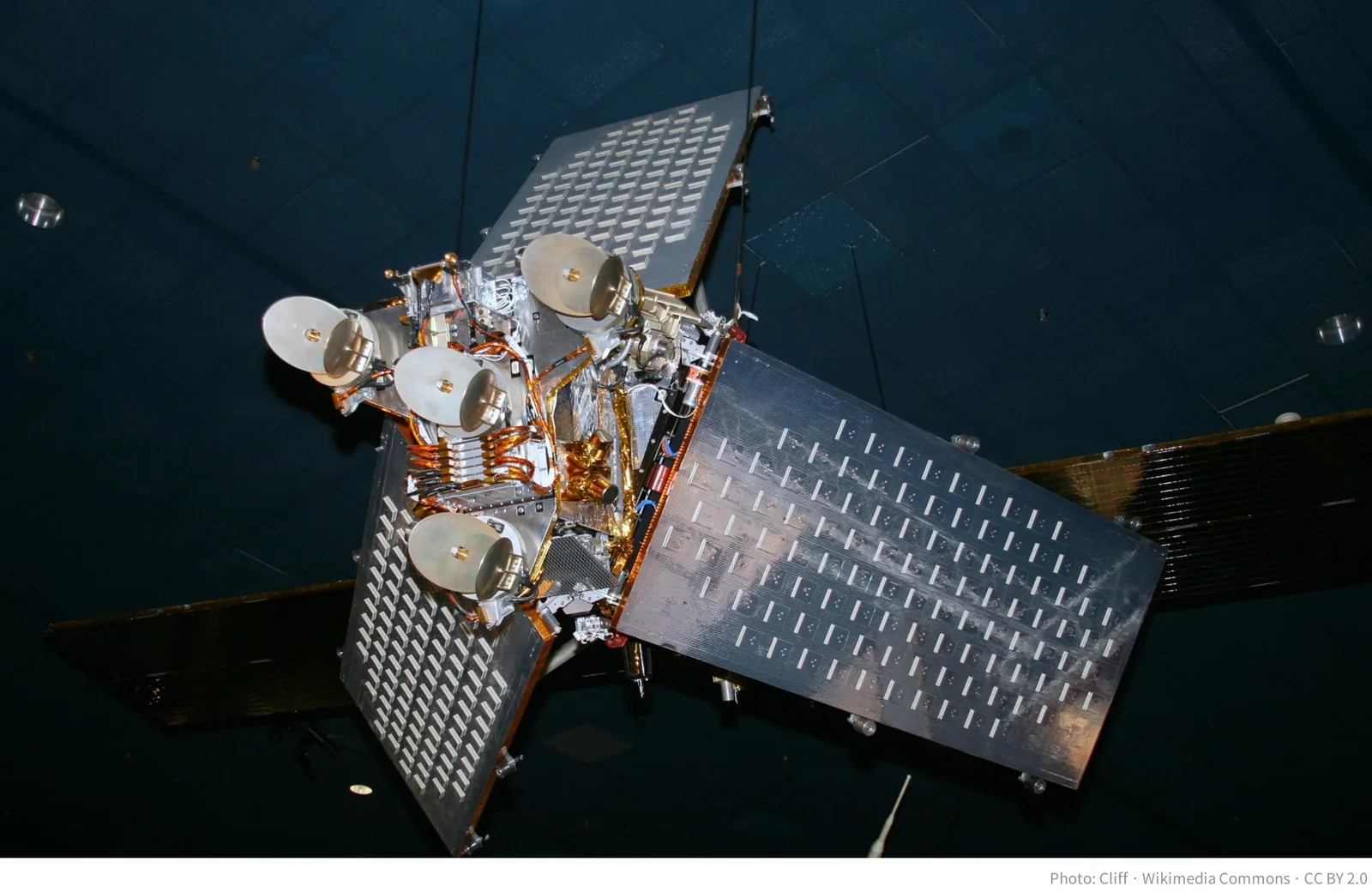
On November 1, 1998, Iridium of the United States launched a satellite phone service that worked anywhere on Earth. Motorola had conceived it in 1990, 19 companies put up money, and from May 1997 into the following year rockets lifted its 66 main satellites into low Earth orbit. It cost about $5bn. The technology worked. But at launch U.S. customers paid $70 a month plus $4 to $8 a minute, and a handset cost about $3,000 and weighed close to 450g. At the end of March 1999 Iridium had 10,294 subscribers, far short of the 27,000 satellite subscribers its banks required as a loan condition. Subscribers grew to about 55,000 by the summer, still not enough to cover the interest on its debt, and on August 13, 1999, a little over nine months after service began, Iridium filed for bankruptcy protection. In 2000 the network’s operating assets were sold for $25mn, 0.5% of what had been invested (author’s calculation).
The story has a 2026 epilogue. On June 29, 2026, Rocket Lab agreed to buy Iridium for about $8bn. The satellite network did make money in the end, but the money went not to the shareholders who first put the satellites up but to those who bought it for next to nothing and waited for customers to come. What sets the share price of a space business is not a successful launch itself but the date when money actually comes in, and how much.
On October 26, 2026, Korean aerospace stocks fell across the board. So what slipped this time? Did expectations for the space business break, did the date when money comes in slip, or were the stocks swept up in a falling market? This report answers with Korea Exchange closing prices and trading by investor type, average broker estimates, the government budget request, and company filings and press reports. The conclusion first: almost all the market value lost today came from five big defense companies, and the reason was not space but the dates of export deliveries, along with the exchange rate. Space small caps fell as much as the KOSDAQ did. From here, the six segments each get paid on different dates.
English edition of the author’s Korean note on the October 26, 2026 selloff in Korean aerospace and defense stocks.
As of: October 26, 2026 (Korean stocks are KRX regular-session closes on October 26; broker estimates are WISEreport consensus as of October 23; U.S. prices are October 23 closes). Dollar figures in parentheses use KRW 1,326.0 per dollar, the October 26, 2026 rate (Yahoo Finance KRW=X). Numbers the author calculated are marked as such.
Some Korea-specific background. The KOSPI is the main board of the Korea Exchange (KRX) and its benchmark index; the KOSDAQ is the exchange’s smaller growth-company board, where most of the space stocks in this report trade. Tickers ending in .KS trade on the KOSPI and those ending in .KQ on the KOSDAQ. The KRX publishes each stock’s net buying by investor type (foreigners, institutions including pension funds, and retail investors) every trading day, which is how this report can say who sold. DART is the Financial Supervisory Service’s electronic disclosure system, where companies file contracts, results and other material events. A Korean stock can rise at most 30% in a day; a stock that does is said to hit the upper limit. Korea counts large sums in jo (one trillion won) and eok (100 million won); this report shows them as KRW tn and KRW bn. KASA is the Korea AeroSpace Administration, the government space agency.
Topics covered: the Iridium story; key terms; October 26 at a glance; big defense’s own part; delayed deliveries and the exchange rate; comparison with U.S. defense; who sold; what happened after similar drops; space small caps and the KOSDAQ; Nuri and SpaceX; the stocks that rose; outlooks for six segments (defense systems, launch vehicles, satellite makers, satellite communications, space materials, civil aircraft parts); the size of expectations; signals and dates to watch; and the basis of calculation.
Key terms: six segments, the market part and the own part, market-cap weighting, broker estimates and forward PER
This report does not treat “aerospace stocks” as one group. It splits them into six segments by what they sell, because each segment gets paid by a different route on a different date. Before the numbers, here are the segments and the methods.
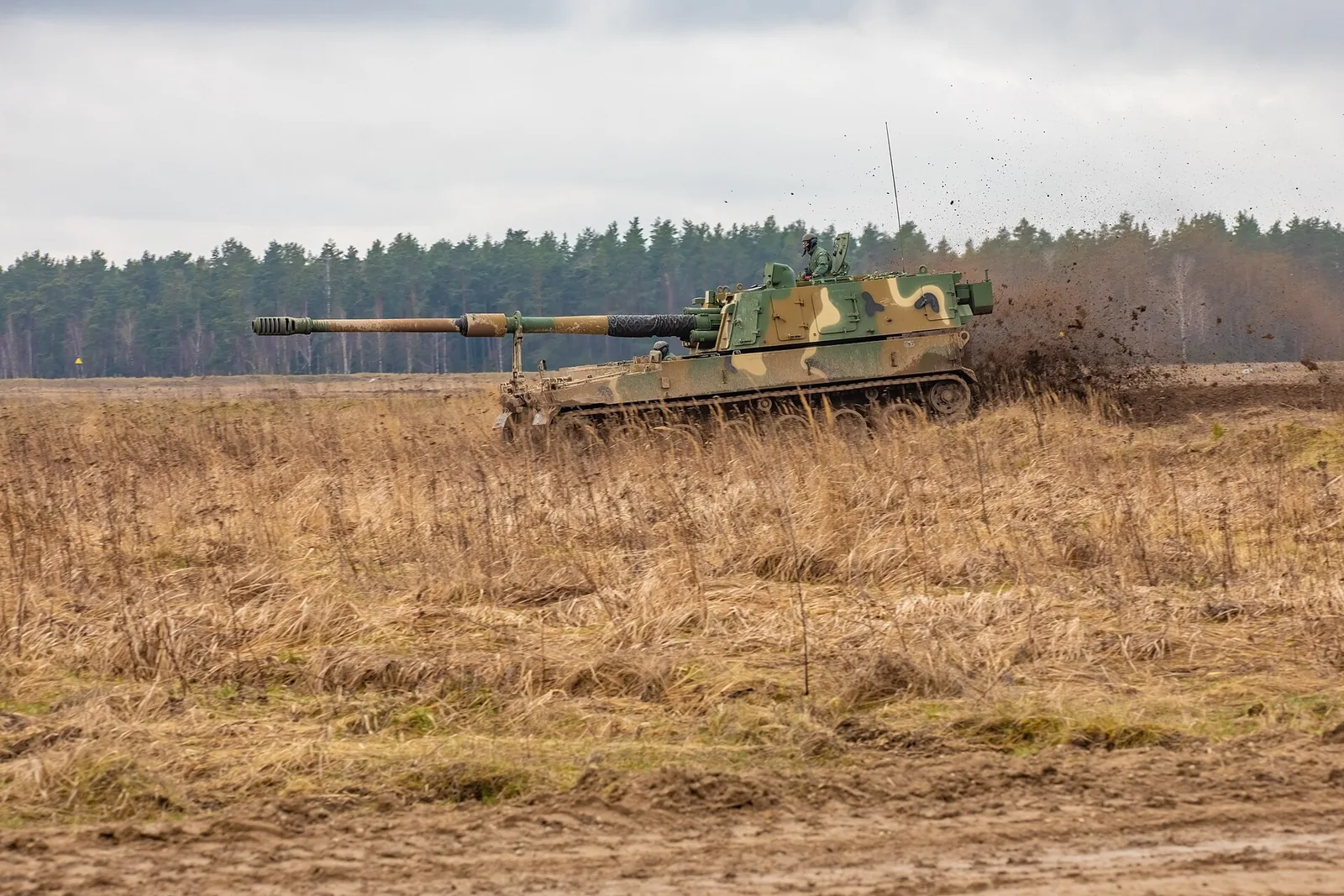
The first segment is defense and aircraft systems: the large companies that build complete weapon systems such as self-propelled howitzers, tanks, fighter jets, guided missiles and radars and sell them to Korea’s military and to foreign governments. There are five: Hanwha Aerospace (012450.KS), Korea Aerospace Industries (KAI, 047810.KS), Hanwha Systems (272210.KS), LIG D&A (079550.KS; LIG Defense & Aerospace, renamed from LIG Nex1 on March 31, 2026) and Hyundai Rotem (064350.KS). Brokers group them as “aerospace” because Hanwha Aerospace leads system integration of the Nuri rocket and development of the next-generation launcher, and KAI and Hanwha Systems both work on military reconnaissance satellites. The second segment is launch vehicles and engines: Innospace (462350.KQ) and Vitzro Nextech (488900.KQ). The third is satellite manufacturing and payloads, seven companies: Satrec Initiative (099320.KQ), Nara Space Technology (478340.KQ), Lumir (474170.KQ), Green Optics (0015G0.KQ), i3system (214430.KQ), Genohco (361390.KQ) and Sensorview (321370.KQ). The fourth is satellite communications and ground stations: Contec (451760.KQ), AP Satellite (211270.KQ) and Intellian Technologies (189300.KQ). The fifth is space materials and parts: SPEAR (347700.KQ), HVM (295310.KQ) and COTS Technology (448710.KQ). The sixth is civil aircraft parts: ASTK (067390.KQ), Hizeaero (221840.KQ), Orbitech (046120.KQ) and Kencoa Aerospace (274090.KQ). That makes 24 stocks. The segments are the author’s classification by each company’s main product.
The market part and the own part split one day’s move in two. Each stock tends to move by a different amount when its index moves 1%; this is called beta. This report measured each stock’s beta from daily changes over the year from October 24, 2025 to October 23, 2026, against the KOSPI for KOSPI stocks and the KOSDAQ for KOSDAQ stocks. Beta times that day’s index change is the market part, and the actual change minus the market part is the own part. A large negative own part means the stock fell further for reasons of its own company or industry, not because of the market.
Segment moves are market-cap weighted: the segment’s combined market cap today compared with the previous day. So the defense and aircraft systems segment mostly reflects its largest company, Hanwha Aerospace. Korean closing prices are regular-session values, KRX market cap divided by listed shares. One-day moves use these values; paths over several days use Naver Finance adjusted prices.
Broker estimates are the average of brokerage forecasts (the consensus) compiled by WISEreport. Eighteen to 20 brokers cover the big defense names; two to five cover the space small caps. Forward PER is today’s price divided by estimated earnings per share (EPS) one or two years ahead, and this report always states the EPS used. U.S. forward PER and EPS are Yahoo Finance values. Net buying by investor type is the amount bought minus the amount sold, and institutions include pension funds such as the National Pension Service.
96.1% of the KRW 4.15tn lost on October 26 came from five big defense companies
To start with the conclusion, the 24 aerospace stocks lost KRW 4.15tn (about $3.13bn) of market value today, and KRW 3.99tn (96.1%) of it came from the five defense and aircraft systems companies. The KOSPI closed down 1.46% at 5,469.47 and the KOSDAQ down 3.26% at 727.21 (KRX). The KOSPI was at its lowest in seven months and the KOSDAQ in three (Newspim). Of the 24 stocks, 20 fell and 4 rose. Their combined market cap is KRW 83.88tn (about $63.3bn), and 94.0% of it sits in the five defense and aircraft systems companies. Grouped under the name aerospace or not, almost all of the money’s weight is in big defense.
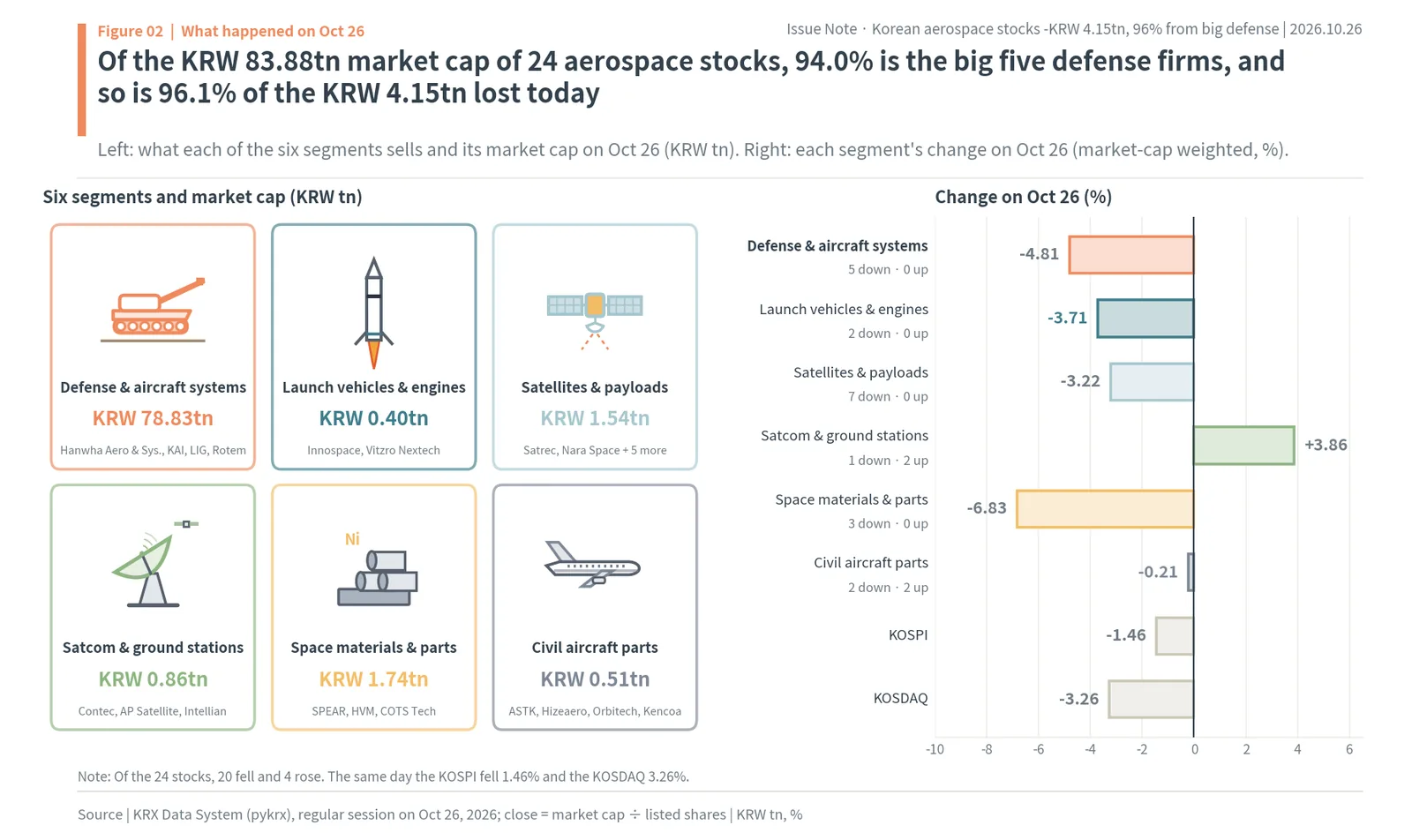
The left of the figure shows what each of the six segments sells and its market cap. Defense and aircraft systems is KRW 78.83tn (about $59.4bn), and the other five segments together come to less than KRW 5tn: space materials and parts KRW 1.74tn, satellite makers KRW 1.54tn, satellite communications and ground stations KRW 0.86tn, civil aircraft parts KRW 0.51tn and launch vehicles and engines KRW 0.40tn. The right shows each segment’s move today. Space materials and parts fell the most at -6.83%, followed by defense and aircraft systems at -4.81%, launch vehicles and engines at -3.71% and satellite makers at -3.22%. Civil aircraft parts barely moved at -0.21%, and satellite communications and ground stations rose 3.86% on Contec’s limit-up.
By stock, LIG D&A moved down the most and Contec up the most
By stock, LIG D&A fell the most at -9.78%, followed by HVM at -7.32%, SPEAR -6.55%, COTS Technology -5.17%, Hyundai Rotem -4.35%, KAI -4.31%, Nara Space Technology -4.20%, Hanwha Aerospace -4.04% and Hanwha Systems -3.92%. Four stocks rose: Contec (+29.89%), AP Satellite (+9.87%), ASTK (+2.24%) and Hizeaero (+0.91%).
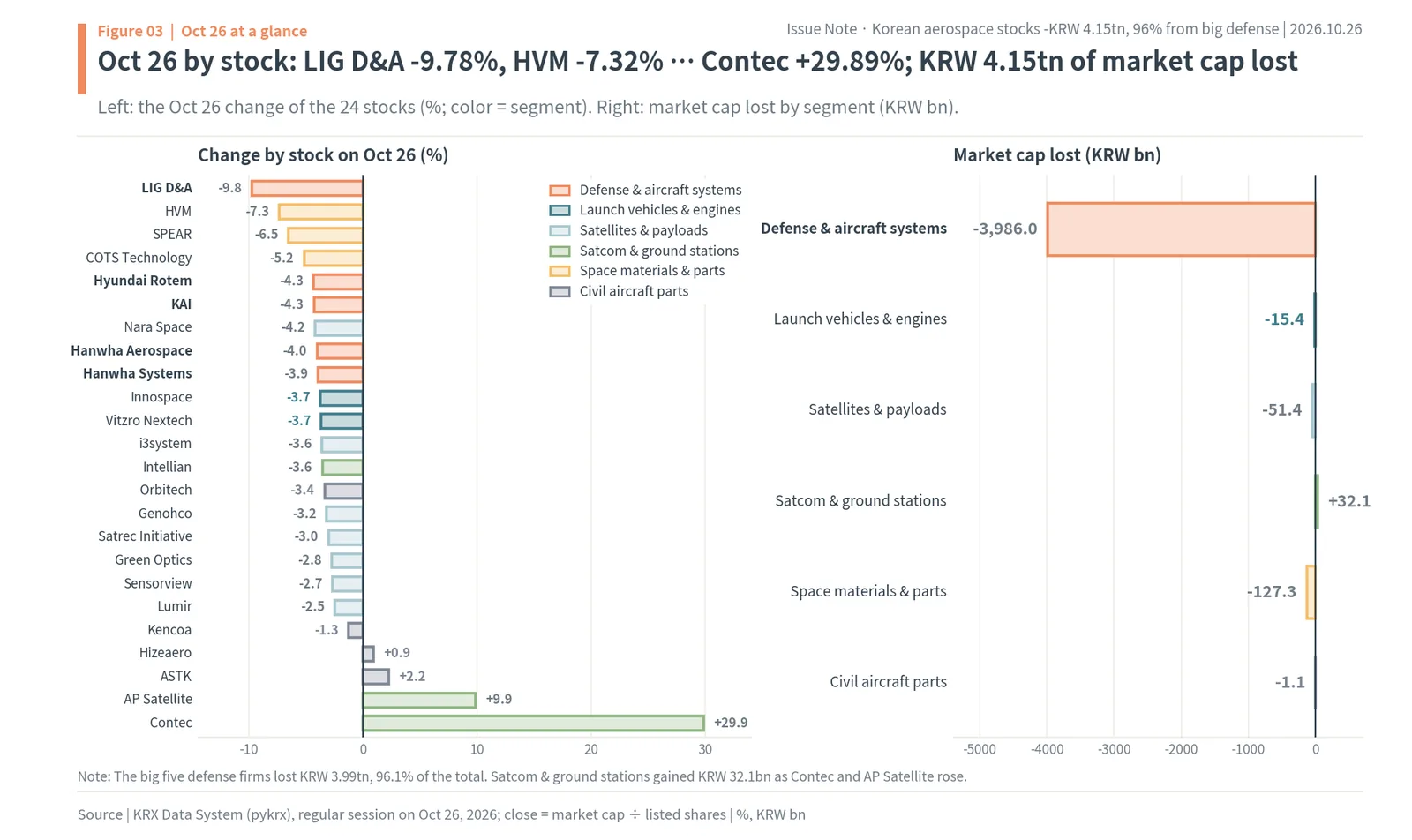
The right of the figure shows market cap lost by segment. Defense and aircraft systems lost by far the most, KRW 3,986.0bn, followed by space materials and parts at KRW 127.3bn, satellite makers KRW 51.4bn, launch vehicles and engines KRW 15.4bn and civil aircraft parts KRW 1.1bn. Satellite communications and ground stations actually gained KRW 32.1bn. The day the press called an “aerospace stock plunge” was, in money terms, a big defense plunge.
Not just today: every segment is more than half below this year’s peak
Today’s fall is one step on a long way down. Measured as market cap at today’s share counts, defense and aircraft systems peaked at KRW 168.03tn on March 6 and now stands at KRW 78.08tn, 53.5% lower. Space small caps fell earlier and further. Launch vehicles and engines is -72.9% from its January 30 peak, satellite makers -71.0% from February 3, satellite communications and ground stations -65.4% from May 11, and space materials and parts -58.5% from March 12. Civil aircraft parts is also -55.7% from its May 26 peak.
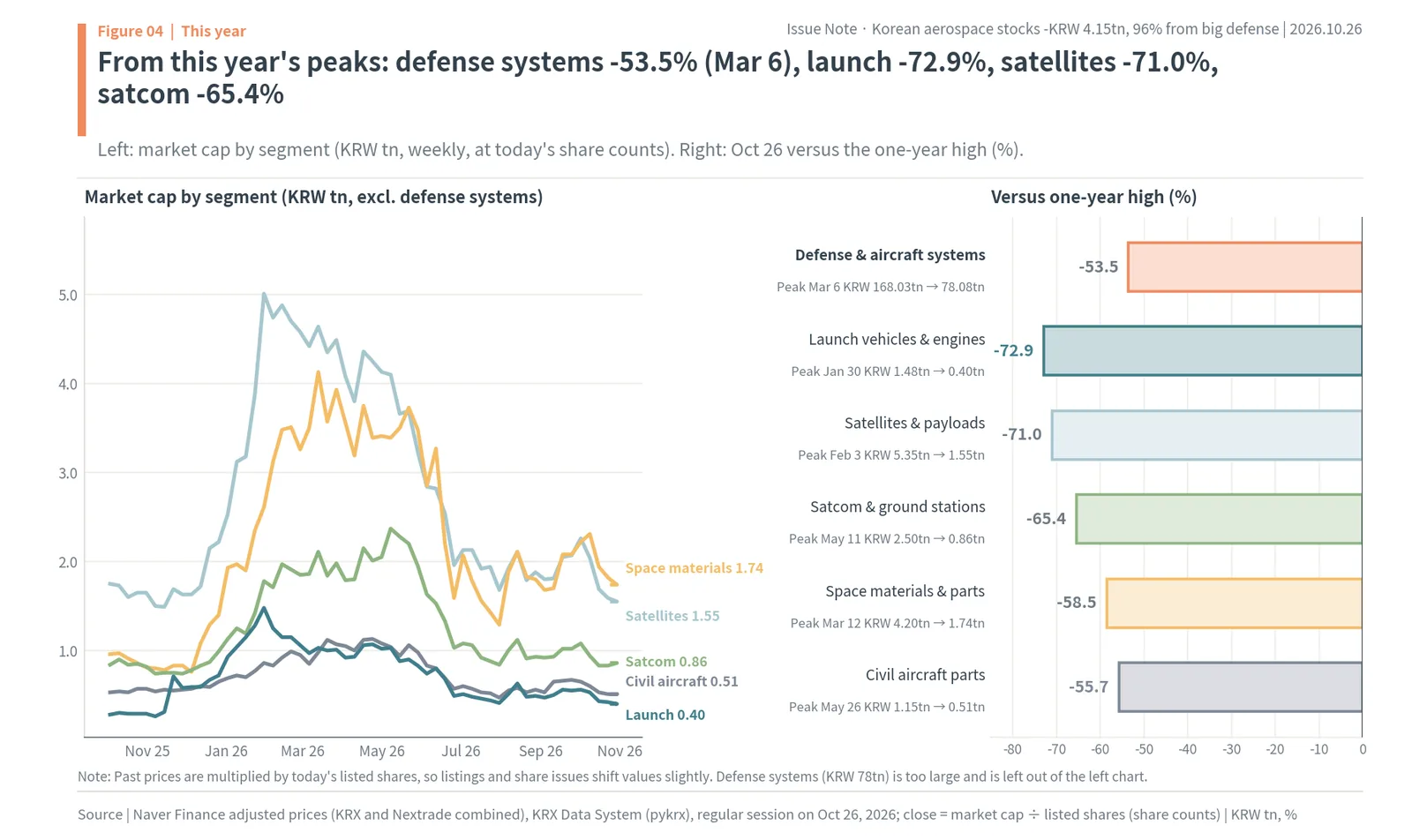
Taking October alone, the KOSPI fell 21.9% from 7,003.7 on October 2 to 5,469.5 on October 26, and the KOSDAQ fell 18.6%. Over the same period defense and aircraft systems fell 30.9%, and the 13 space small caps excluding Contec and AP Satellite fell 27.1%. In a month when the whole market fell hard, aerospace fell a little more than the market. The next step, then, is to split today’s fall into the market part and the companies’ own part.
The five big defense stocks fell 4.07% more than the KOSPI explains
To start with the conclusion, today’s fall in defense and aircraft systems was not the market’s doing. The five companies’ one-year betas, weighted by market cap, come to 0.51: when the KOSPI falls 1%, they usually fall about 0.51%. Today’s KOSPI move of -1.46% times this multiple gives a market part of -0.75%, but the actual fall was -4.81%, 6.4 times the market part. The remaining -4.07% is the own part, the fall for company-side reasons (author’s calculation). By company, the own part was -8.94% for LIG D&A, -3.51% for Hanwha Aerospace, -3.43% for KAI, -3.41% for Hyundai Rotem and -2.80% for Hanwha Systems. The same day the 13 space small caps excluding Contec and AP Satellite fell 4.82%, almost the same as their KOSDAQ part (-4.21%).
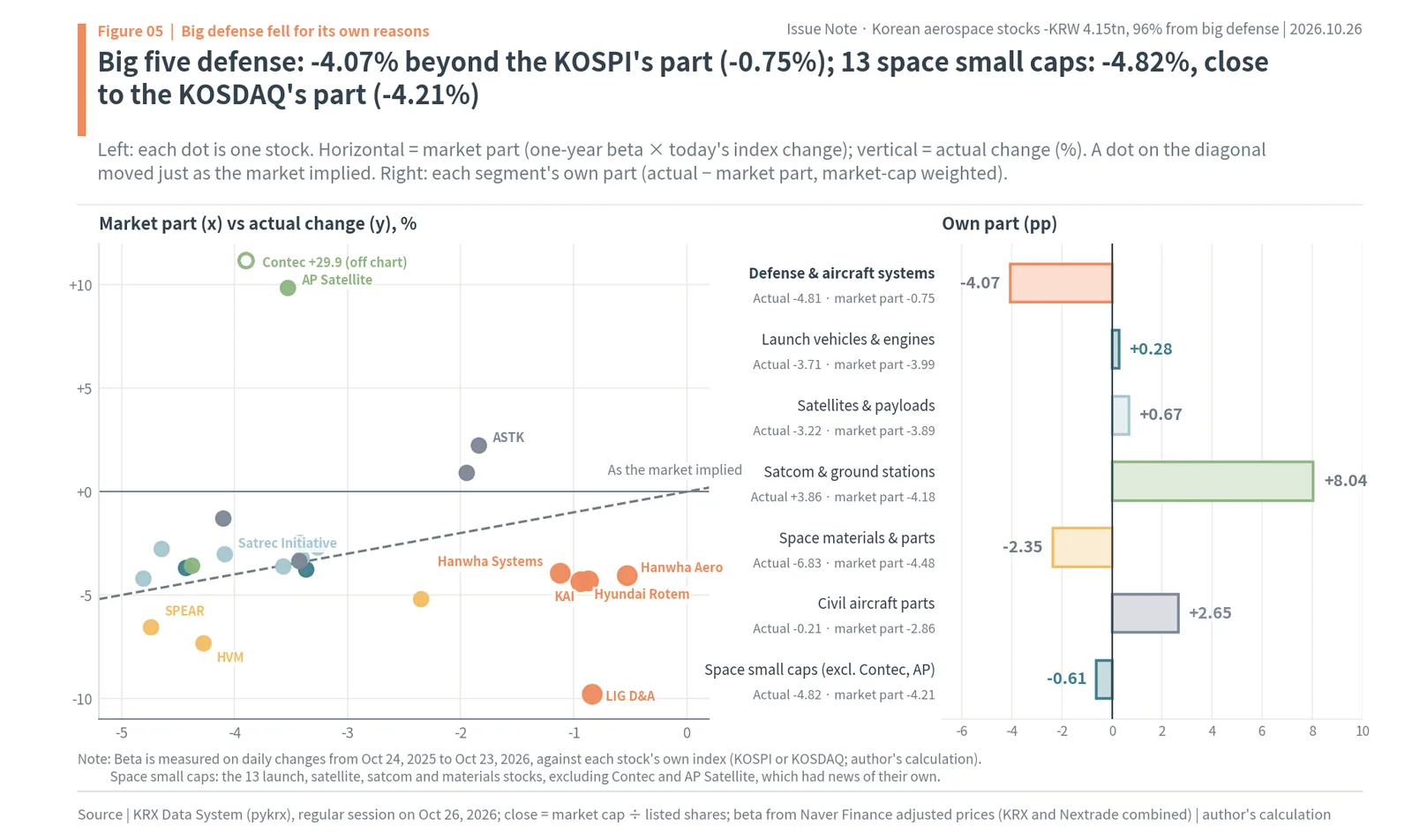
On the left of the figure each dot is one stock. The horizontal axis is the market part and the vertical axis the actual change; a dot on the dashed diagonal moved just as the market implied. The space small caps cluster near the diagonal, while the five defense companies (coral) sit well below it, apart from the rest. Contec and AP Satellite sit well above it. The right shows each segment’s own part. Defense and aircraft systems is the largest at -4.07pp, followed by space materials and parts at -2.35pp. The own part of the 13 space small caps excluding Contec and AP Satellite was only -0.61pp.
LIG D&A had bad news of its own
Of the five, LIG D&A’s fall is explained by bad news at one company. On October 20 the Defense Project Contract Review Committee of the Defense Acquisition Program Administration (DAPA), Korea’s arms procurement agency, voted to bar the company from bidding for two years over alleged bribery and cost fraud, and the next day the stock fell 9.03% (SBS Biz, Special Times). Then on October 25, in connection with the small drone defense system program (total cost KRW 122.3bn), DAPA asked the Ministry of Trade and Industry to consider revoking the company’s designation as a defense contractor (Seoul Economic Daily). If the designation is revoked, single-source contracts in that program could also be blocked, but a final decision requires a hearing and nothing has been decided. Today LIG D&A fell as much as 12.51% during the session before closing down 9.78%, its fifth straight daily fall. Since October 2 the stock has fallen 44.0%, the most among the five.
The other four extended the October 20 selloff
The falls at Hanwha Aerospace, KAI, Hanwha Systems and Hyundai Rotem extend the defense selloff of October 20. That day Hanwha Aerospace fell 11.7%, Hanwha Systems 13.9%, Hyundai Rotem 13.7% and LIG D&A 8.21% (Seoul Economic Daily). The equal-weighted average of the five was -10.9%, and its own part after removing the KOSPI part was -8.7%, the fourth largest in the three years since October 2023 (author’s calculation). Today the Seoul Shinmun listed as reasons third-quarter results and reports cutting target prices, worries that profits have passed their peak (“peak-out”), delays in new orders next year, the strong won and the U.S. midterm elections in November. Hyundai Motor Securities named as the burden “an export gap and lower profitability as new orders are delayed next year.” Of these, two strands can be checked in numbers, delivery dates and the exchange rate, and the next chapters take them in turn.
Hanwha Aerospace did not fail to sell: the date its sales reach the books slipped to Q4
To start with the conclusion, the third-quarter earnings worry at the five defense companies is mainly about when deliveries happen and when sales are recognized. In the third quarter Hanwha Aerospace shipped seven K9 self-propelled howitzers and two each of K10 and K12 ammunition vehicles to Romania, but as a first batch the delivery process took longer and revenue recognition came late. Two K9s bound for Poland were also delivered later than planned. So DS Investment & Securities put third-quarter deliveries at zero K9s and 14 Chunmoo rocket launchers and called it “a temporary slump due to the gap between export timing and revenue recognition” (Korea Economic Daily, Newsway, Oct 20). Hanwha Aerospace’s half-year report shows that not a single unit of its KRW 1,936.1bn (about $1.46bn) Romania K9 order had been delivered by the end of June.
DS Investment & Securities expects 30 K9s and 3 Chunmoo units for Poland and 16 K9s and 12 K10 and K12 vehicles for Romania to be delivered in the fourth quarter, 46 K9s in all. If these units reach the books in the fourth quarter, the third quarter’s profit gap is filled in the fourth. That is why the broker’s Hanwha Aerospace report was titled “Hopes to pin on Q4 instead of worries about Q3.”
Broker profit estimates are bunched in Q4 too
Lay out WISEreport’s average quarterly operating profit estimates and this shift in dates shows plainly. Hanwha Aerospace is estimated to fall 14.6% from KRW 1,365.5bn in the second quarter to KRW 1,166.7bn (about $880mn) in the third, then rise 25.0% to KRW 1,458.4bn in the fourth. KAI rises 70.0% from KRW 82.3bn in the third quarter to KRW 139.9bn in the fourth, Satrec Initiative 61.0% from KRW 5.9bn to KRW 9.5bn, and Intellian Technologies 182.3% from KRW 7.9bn to KRW 22.3bn. Many aerospace companies are expected to earn a large share of the year’s profit in the fourth quarter.
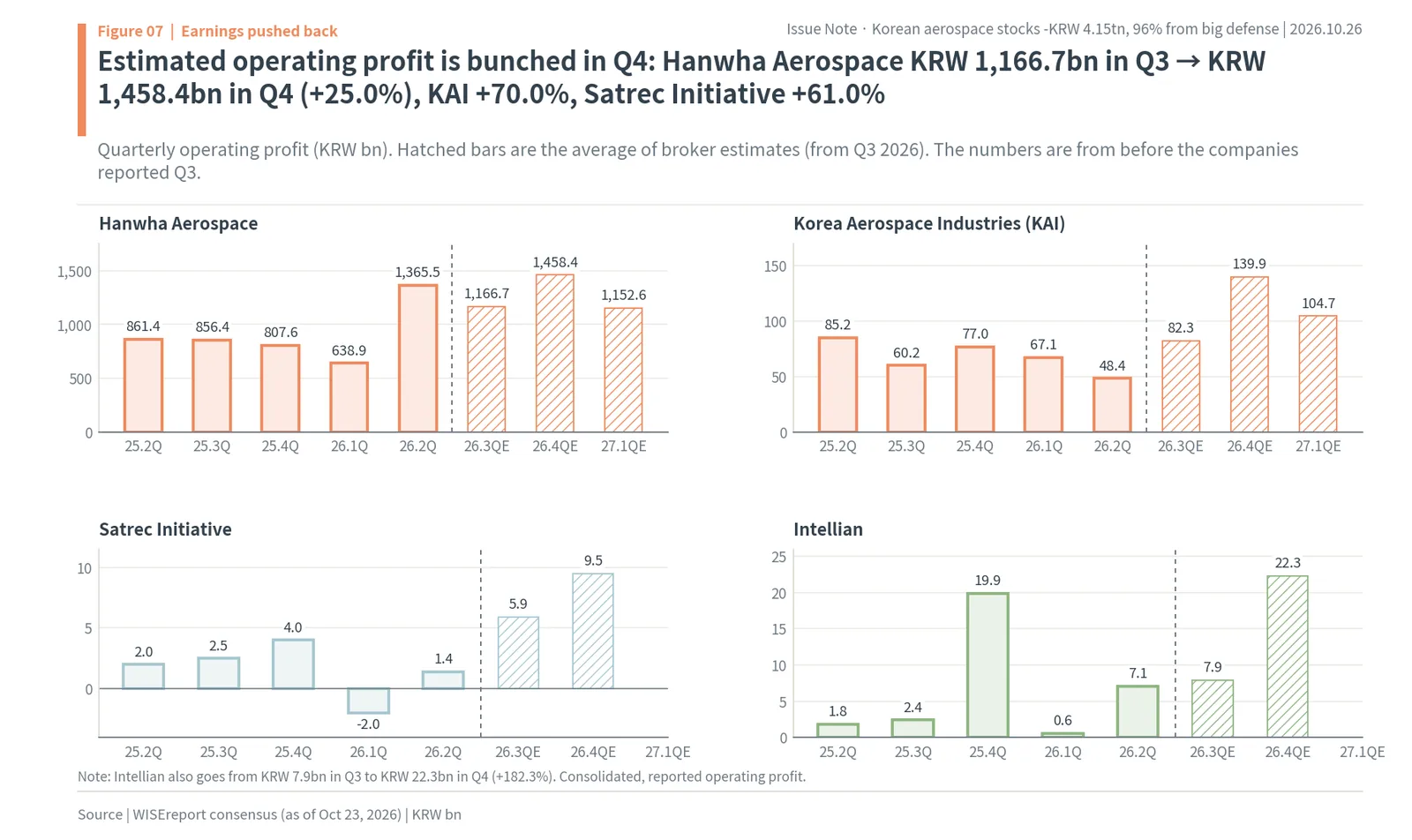
So far only Hyundai Rotem has reported third-quarter results. Its preliminary filing on October 19 showed sales of KRW 1,620.7bn and operating profit of KRW 247.1bn, down 11.0% from a year earlier. That was about 9.7% below the KRW 273.7bn consensus cited by Seoul Economic Daily (the shortfall ranges from 9.7% to 10.6% depending on the tally). The company cited the lower exchange rate and a larger share of the fourth production batch of K2 tanks for Korea’s army: more low-margin domestic units and fewer high-margin export units reached the books. By eToday’s tally, the five defense companies’ combined third-quarter operating profit estimate is KRW 1,458.7bn, 16.1% below the KRW 1,739.1bn consensus. These numbers will be checked one by one as the other four report: Hanwha Systems on October 27, Hanwha Aerospace on the 29th, KAI on November 3 and LIG D&A on November 6 (per press reports).
The won-dollar rate is 10.8% below its Q2 average, so the same dollars book fewer won
To start with the conclusion, while delivery dates slipped, the exchange rate cut into export profits. Most defense export payments are received in dollars or local currencies. The quarterly average won-dollar rate fell 5.4% from KRW 1,500.2 in the second quarter to KRW 1,419.9 in the third, and so far in the fourth quarter (October 1 to 26) it is KRW 1,338.1, 10.8% below the second quarter (average of Yahoo Finance closes, author’s calculation). The rate on October 26 is KRW 1,326.0. Press tallies also put the third-quarter average at KRW 1,418 to 1,423 (Global Economic, CNews).
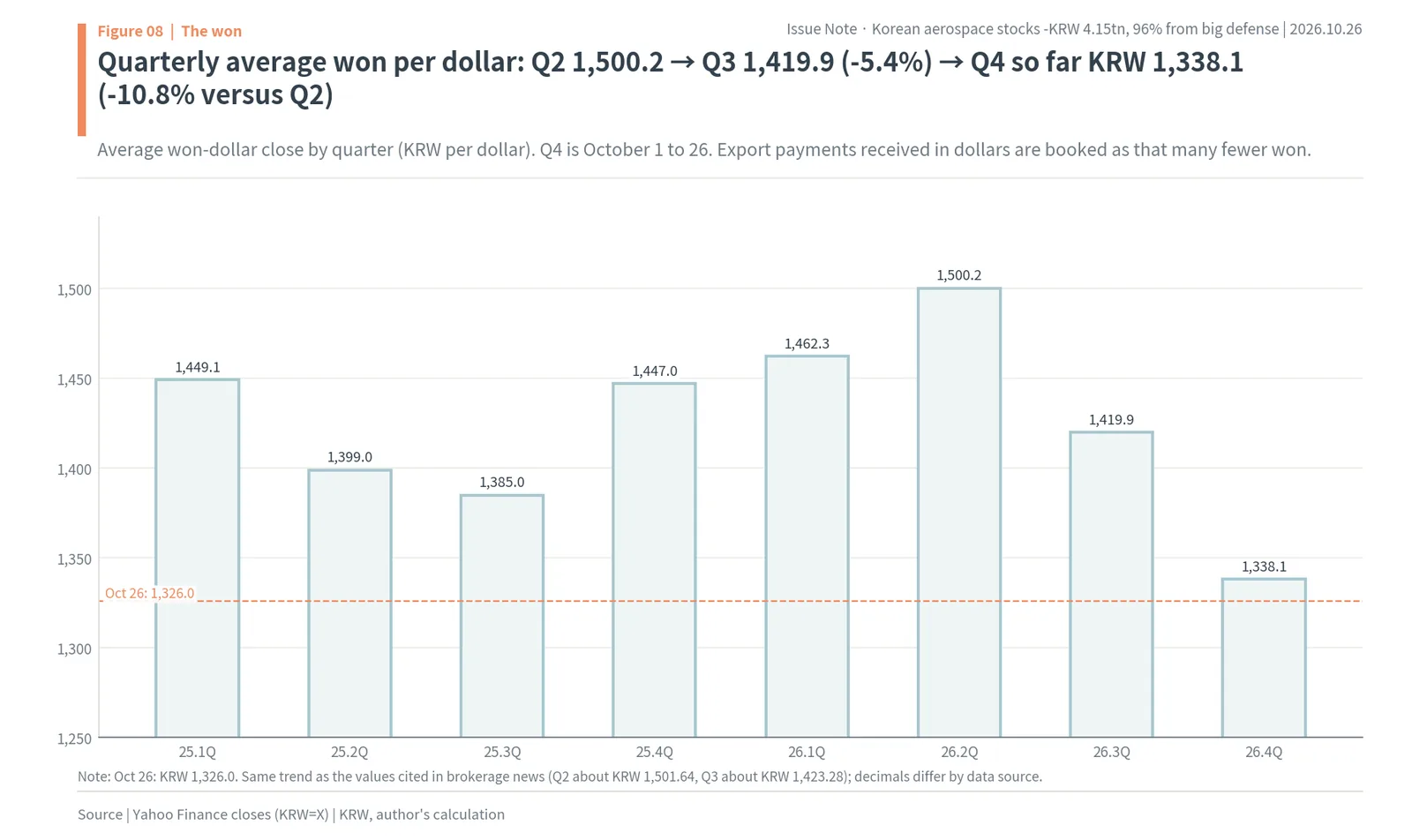
The meaning is simple. The same $1bn is booked as KRW 1,500.2bn at the second-quarter average rate but as KRW 1,338.1bn at the fourth-quarter-to-date average (author’s calculation). Korea Investment & Securities expects Hanwha Aerospace’s land systems margin to fall 1.4pp from the previous quarter, citing exchange rate moves, and Yuanta Securities pointed to the exchange rate cutting profit at KAI’s aerostructures business and LIG D&A’s exports. Even if the delayed units arrive in the fourth quarter, at today’s exchange rate the profit booked in won will be smaller than it would be at second-quarter rates. So even if the reading that the dates slipped is right, fourth-quarter profit has one more hurdle, the exchange rate, to clear before it matches today’s estimates.
Lockheed Martin rose the same week: a Korean defense problem, not a global one
To start with the conclusion, U.S. defense majors rose or held up over the same period, so this fall is hard to read as the top of the global defense cycle. In the week from October 16 to 23, the combined market cap of Korea’s five defense companies fell 14.1%, while Lockheed Martin (LMT) rose 9.4%, Northrop Grumman (NOC) 6.1% and General Dynamics (GD) 1.5%. RTX fell 1.5% and the U.S. aerospace and defense ETF (ITA) 3.3% (Yahoo Finance, author’s calculation).
Lockheed Martin reported third-quarter results on October 22. Sales were $20.7bn, up 11% from a year earlier, and the order backlog hit a record $292bn, including a $52.5bn multi-year PAC-3 MSE contract. It raised its 2026 guidance for the second quarter in a row (Lockheed Martin SEC filing). The stock rose 6.96% that day. Northrop Grumman and RTX also raised guidance with their October 20 results. U.S. defense stocks were not free of worry: as of October 19 the U.S. defense ETF was 17.86% below its August 14 level, on bets that a Democratic win in the November 3 midterms could slow defense budget increases (24/7 Wall St.). Carrying the same worry, the companies whose results and orders were confirmed saw their shares rebound.
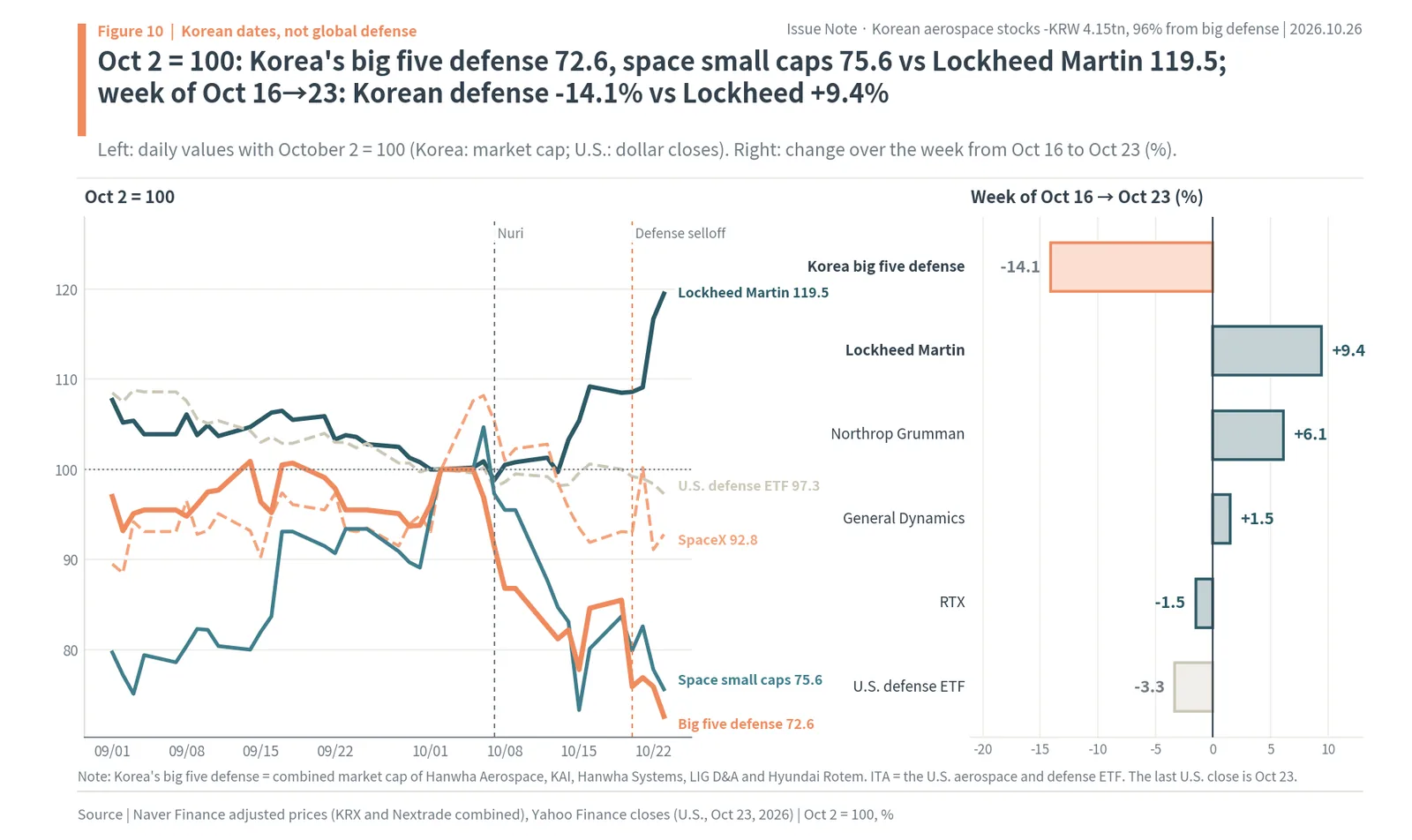
The left of the figure indexes each series to October 2 = 100. On October 23 Korea’s five defense companies stood at 72.6 and Korean space small caps at 75.6, against 119.5 for Lockheed Martin, 97.3 for the U.S. defense ETF and 92.8 for SpaceX. Korean defense began to part ways with U.S. defense around October 7, and the gap widened sharply after the October 20 selloff. Given that U.S. results came in a cluster from October 20 to 22, in the same week Korea fell on earnings worries while the U.S. rose on earnings confirmed.
On next year’s earnings, Korean defense is priced about like U.S. defense or cheaper
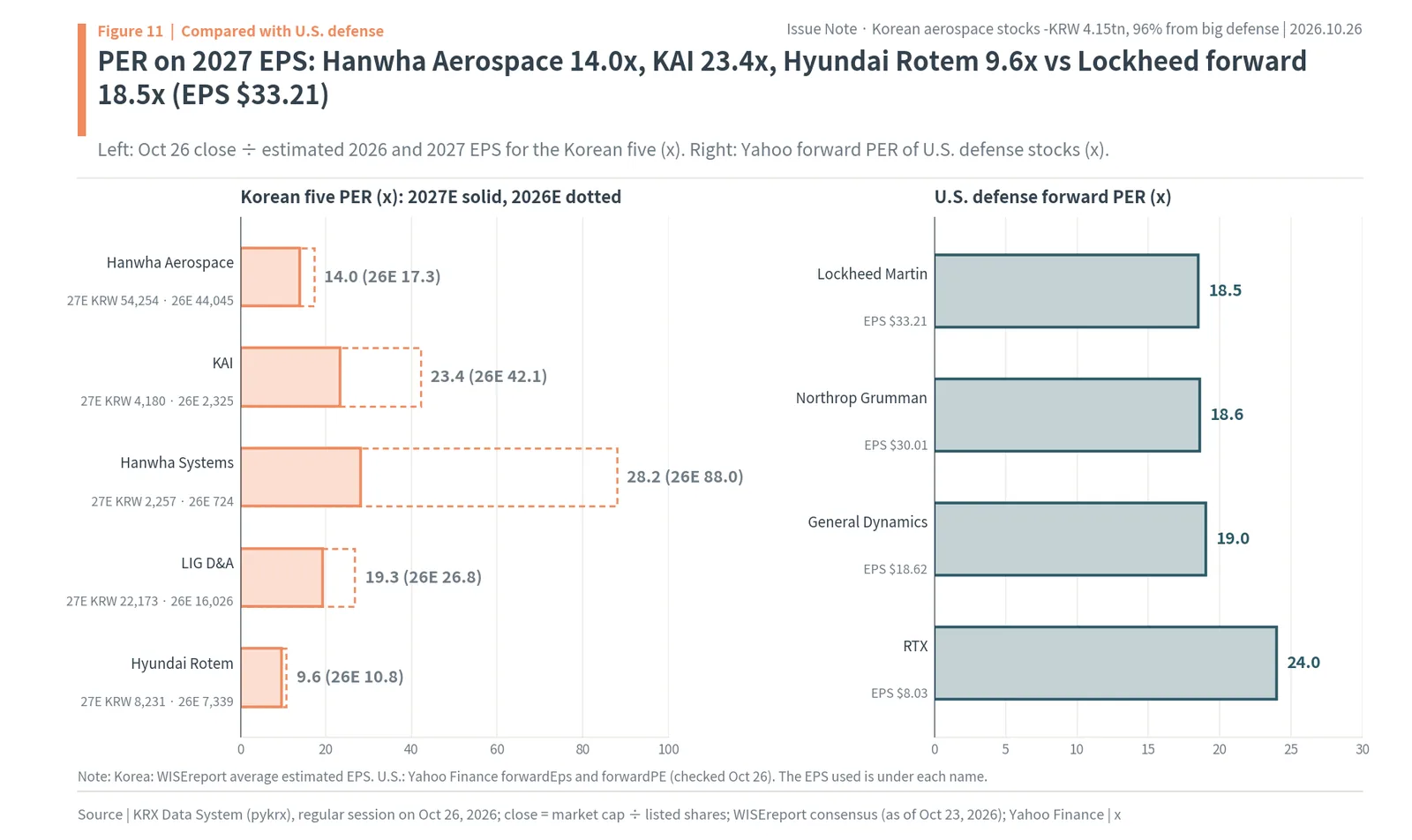
Dividing October 26 closes by WISEreport estimated EPS, Hanwha Aerospace trades at 17.3 times 2026 EPS of KRW 44,045 and 14.0 times 2027 EPS of KRW 54,254. KAI is at 42.1 times 2026 EPS of KRW 2,325 and 23.4 times 2027 EPS of KRW 4,180; Hanwha Systems 88.0 times 2026 EPS of KRW 724 and 28.2 times 2027 EPS of KRW 2,257; LIG D&A 26.8 times 2026 EPS of KRW 16,026 and 19.3 times 2027 EPS of KRW 22,173; and Hyundai Rotem 10.8 times 2026 EPS of KRW 7,339 and 9.6 times 2027 EPS of KRW 8,231. In the U.S., Lockheed Martin trades at 18.5 times forward EPS of $33.21, Northrop Grumman at 18.6 times $30.01, General Dynamics at 19.0 times $18.62 and RTX at 24.0 times $8.03 (Yahoo Finance, checked Oct 26).
Korean defense’s 2026 PER looks high because this year’s profit has been pushed back a year. Brokers expect 2027 operating profit at KAI and Hanwha Systems to rise 70.3% and 79.1% from 2026. On 2027 numbers, Hanwha Aerospace and Hyundai Rotem are below Lockheed Martin, and LIG D&A and KAI are about the same or a little higher. Whether the stocks look cheap or expensive depends on whether next year’s profit estimates hold, in other words on whether the delayed units are actually delivered.
On October 20 foreigners sold and retail bought; on October 26 institutions and pension funds sold and foreigners bought
To start with the conclusion, the two defense selloffs had different sellers. Adding up net buying by investor type at Hanwha Aerospace, KAI, Hanwha Systems, LIG D&A and Hyundai Rotem, on October 20 foreigners sold KRW 91.9bn and retail investors bought KRW 138.4bn. Institutions sold KRW 53.5bn, KRW 32.3bn of it by pension funds. Today it was the reverse: foreigners bought KRW 56.4bn, while institutions sold KRW 39.1bn (pension funds KRW 20.0bn) and retail investors KRW 16.7bn (KRX).
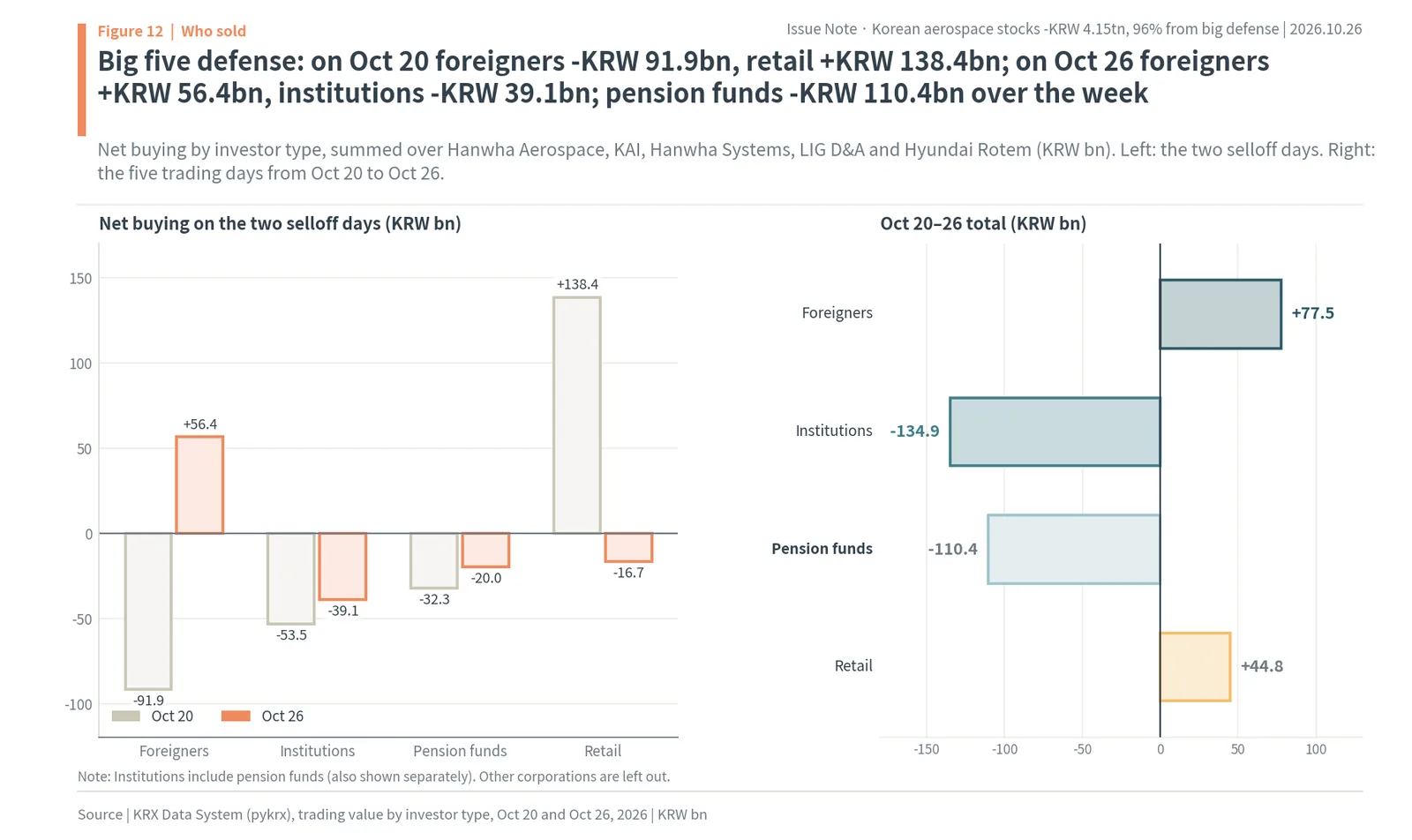
Over the five trading days from October 20 to 26, foreigners were net buyers of KRW 77.5bn, institutions net sellers of KRW 134.9bn and retail investors net buyers of KRW 44.8bn. Pension funds accounted for most of the institutional selling, KRW 110.4bn. By stock, today pension funds sold KRW 16.1bn of LIG D&A, KRW 3.3bn of Hyundai Rotem, KRW 2.4bn of KAI and KRW 1.4bn of Hanwha Aerospace, and bought KRW 3.2bn of Hanwha Systems. Foreigners bought KRW 24.8bn of LIG D&A, KRW 13.6bn of Hanwha Aerospace and KRW 9.8bn of KAI. For October as a whole (the 1st to the 26th), foreigners sold KRW 322.5bn while institutions bought KRW 156.3bn and retail investors KRW 157.6bn.
This pattern shows that the two days’ falls were different in kind. October 20 was the day the earnings worry first broke, so foreigners sold first and retail investors bought the dip. Today foreigners were buyers, yet selling by institutions, pension funds included, and LIG D&A’s own bad news pulled prices down. That foreigners did not sell two days running means the fear of October 20 did not spread into an exit of overseas money.
After past big own-part drops in defense stocks, fewer than half rebounded right away
The past offers a gauge of how the five defense stocks may move from here. From October 2023 to October 2026, there were 23 days when the equal-weighted average of the five, minus the KOSPI part (0.59 × KOSPI), fell more than 5%. Twenty trading days after those closes, the median change was -0.7%, and the stocks rose in 10 of the 23 cases. Sixty trading days later the median was +3.8%, and 11 of the 20 cases with 60 days of data rose (author’s calculation).
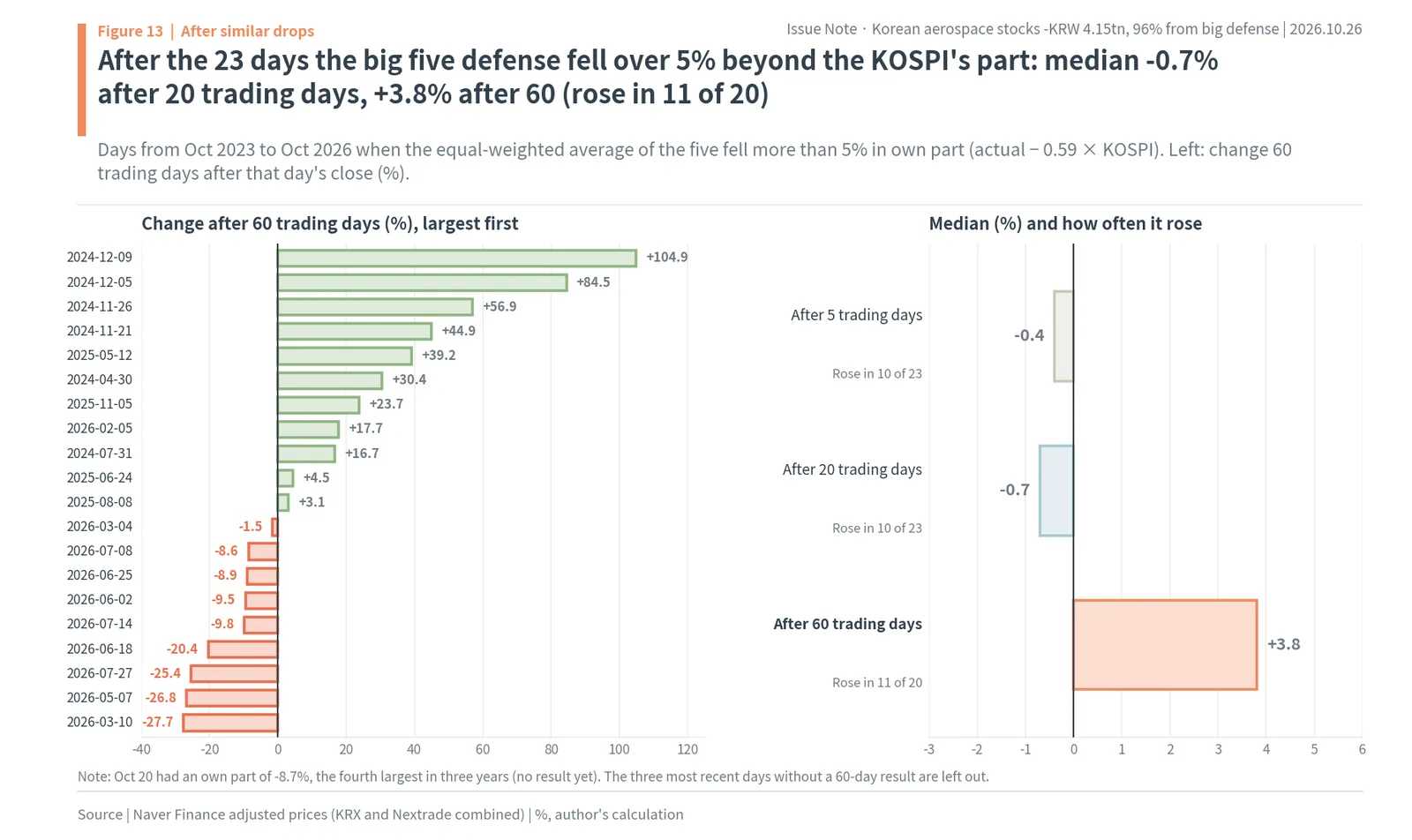
The left of the figure ranks the change 60 trading days later from largest to smallest. Big rebounds such as December 9, 2024 (+104.9%), December 5 (+84.5%) and November 26 (+56.9%) cluster in late 2024, while cases that fell further over the next 60 trading days, such as March 10, 2026 (-27.7%), May 7 (-26.8%) and July 27 (-25.4%), cluster in this year’s slide from the peak. A sharp fall by itself is weak grounds for expecting a rebound. What sets the direction is whether the cause of that day’s fall was later resolved (author’s view). The causes of this fall are delivery dates, the exchange rate and the order gap, so the keys to a rebound are fourth-quarter deliveries and 2027 orders.
Space small caps fell as much as the KOSDAQ implied: there was no bad news from space
To start with the conclusion, almost all of today’s fall in space small caps was the market part. The 13 launch, satellite, communications and materials stocks excluding Contec and AP Satellite fell 4.82% on a market-cap-weighted basis. Their one-year betas weighted by market cap come to 1.29, and multiplied by the KOSDAQ’s -3.26% today that gives a market part of -4.21%. The own part, the extra fall for company-side reasons, was only -0.61pp (author’s calculation). By segment, launch vehicles and engines had an own part of +0.28pp and satellite makers +0.67pp, actually falling less than the market, and only space materials and parts, at -2.35pp, fell more than the market.
The press attributed the KOSDAQ’s 3.26% fall that day to institutional selling (KRW 127.9bn), weaker sentiment toward chips and money leaving semiconductor ETFs, falls at Nvidia and Broadcom in the U.S., a jump in oil prices, and caution ahead of this week’s FOMC meeting and major company results (Seoul Shinmun, Senmoney, The Report). None of these has anything to do with space.
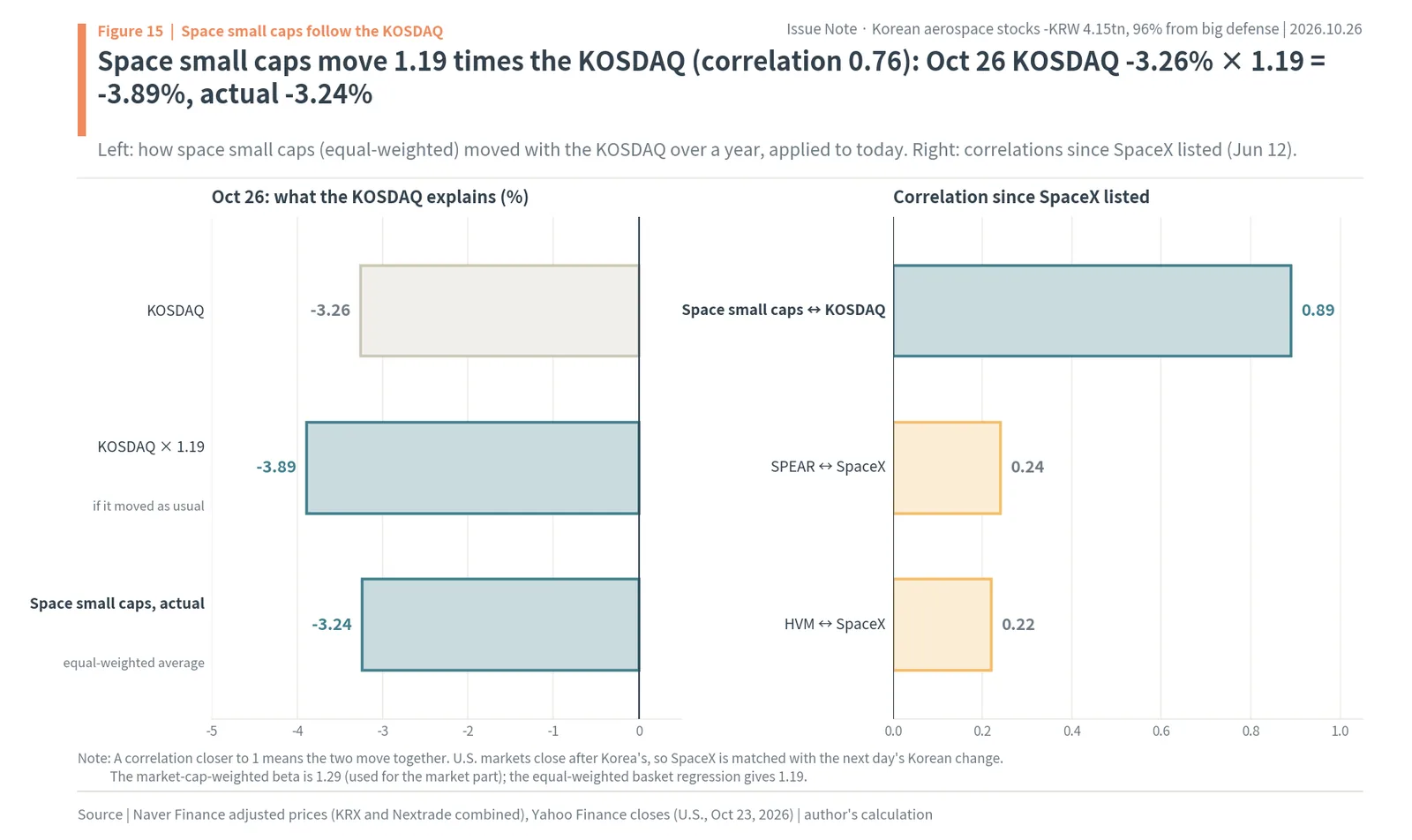
Grouping the stocks with equal weights gives the same result. Over the past year the equal-weighted average of the 13 moved 1.19% for every 1% move in the KOSDAQ, with a correlation of 0.76. Today’s KOSDAQ move of -3.26% times 1.19 is -3.89%, but the actual equal-weighted average was -3.24%. If anything, they fell less than their usual multiple. The right of the figure shows correlations since SpaceX listed on June 12. The correlation between space small caps and the KOSDAQ rose to 0.89, while SPEAR and HVM, named as SpaceX supply chain stocks, had correlations with SpaceX’s share price (the previous day’s U.S. move) of only 0.24 and 0.22. Korean space stocks move with Korea’s KOSDAQ more than with the share prices of U.S. space companies.
Selling the news began on the day Nuri succeeded
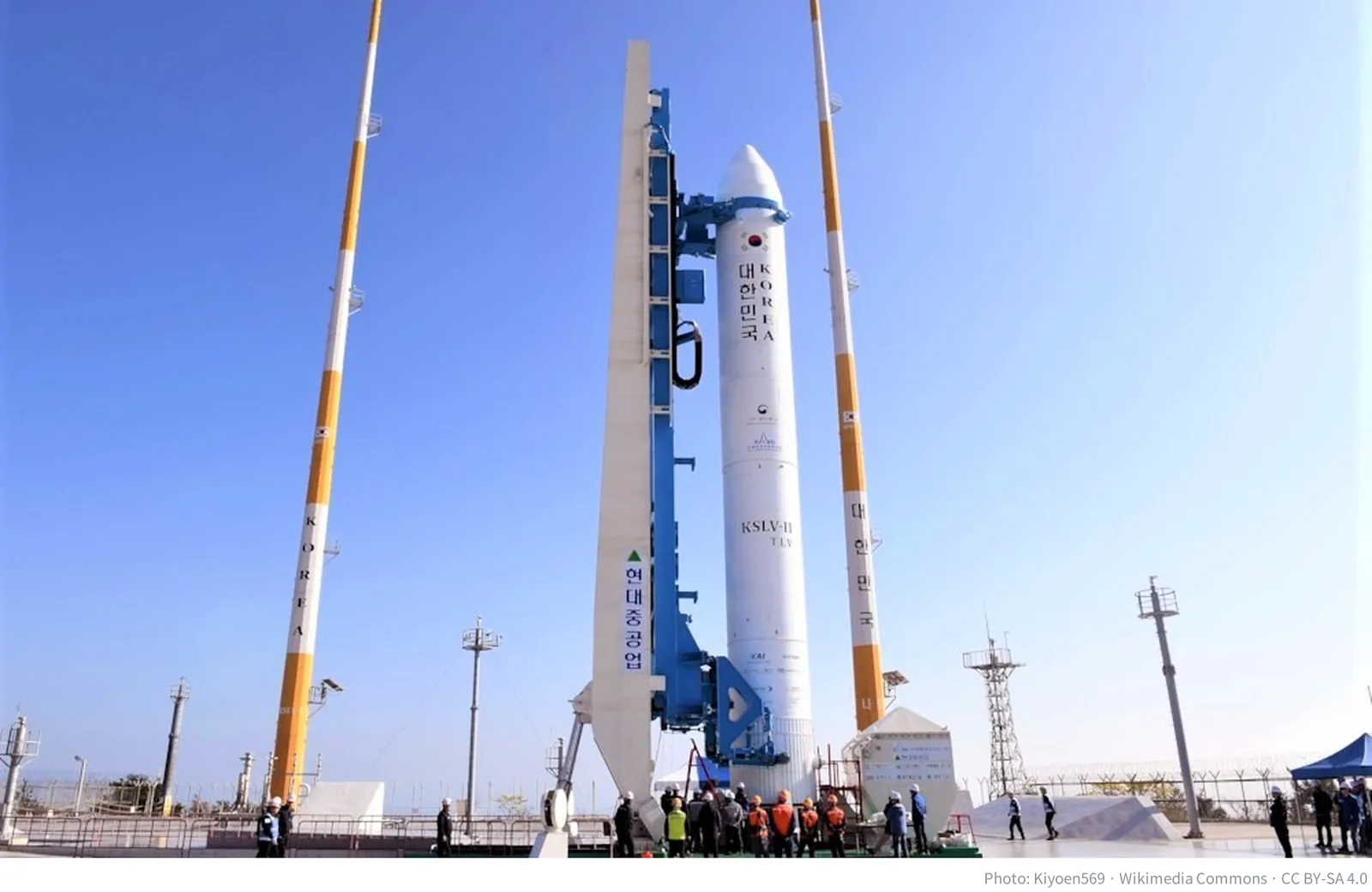
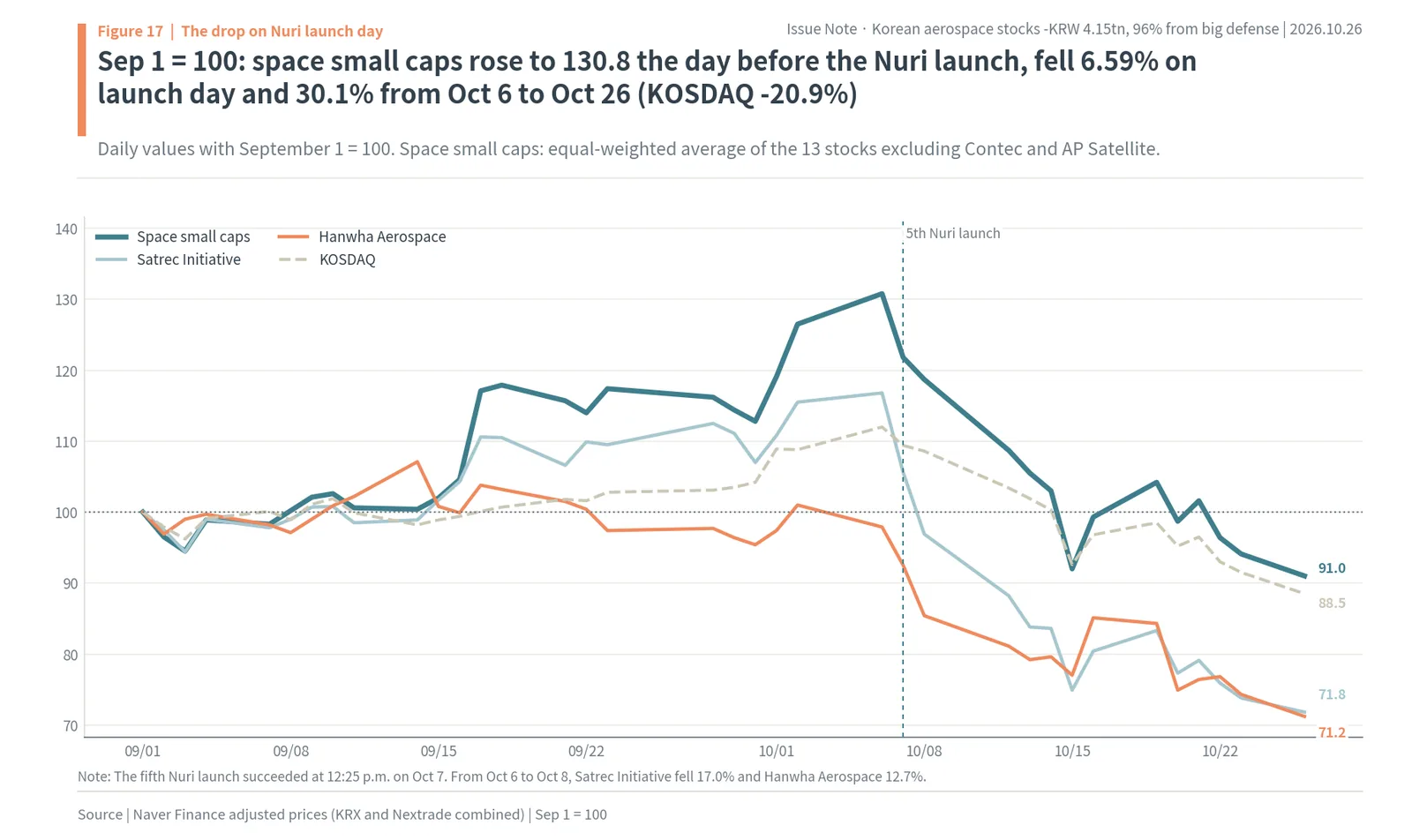
Space small caps fell more than the market this month because they had risen a lot before it. The equal-weighted average of the 13 rose 30.8% from September 1 to October 6, the day before the fifth launch of Nuri, Korea’s homegrown space rocket; with September 1 = 100, it reached 130.8. At 12:25 p.m. on October 7, Nuri put 14 of its 15 satellites into their target orbits, raising its cumulative launch success rate to 80% (MTN, KASA). Satrec Initiative built the bus and payload of NEONSAT, the main satellite on this launch, and Hanwha Aerospace led Nuri’s manufacturing and assembly. Yet that day space small caps fell 6.59%, and 2.69% more the next day. From October 6 to 8, Satrec Initiative fell 17.0% and Hanwha Aerospace 12.7%.
Once the launch succeeded, investors sold the shares they had bought on expectations. Then from October 12 to 15 came a market in which the KOSPI fell four days running. From October 6 to 26 space small caps fell 30.1% while the KOSDAQ fell 20.9%. With September 1 = 100, space small caps now stand at 91.0 and the KOSDAQ at 88.5; across the two months as a whole, space small caps are a little above the KOSDAQ.
After SpaceX listed, Korean space stocks fell on their own
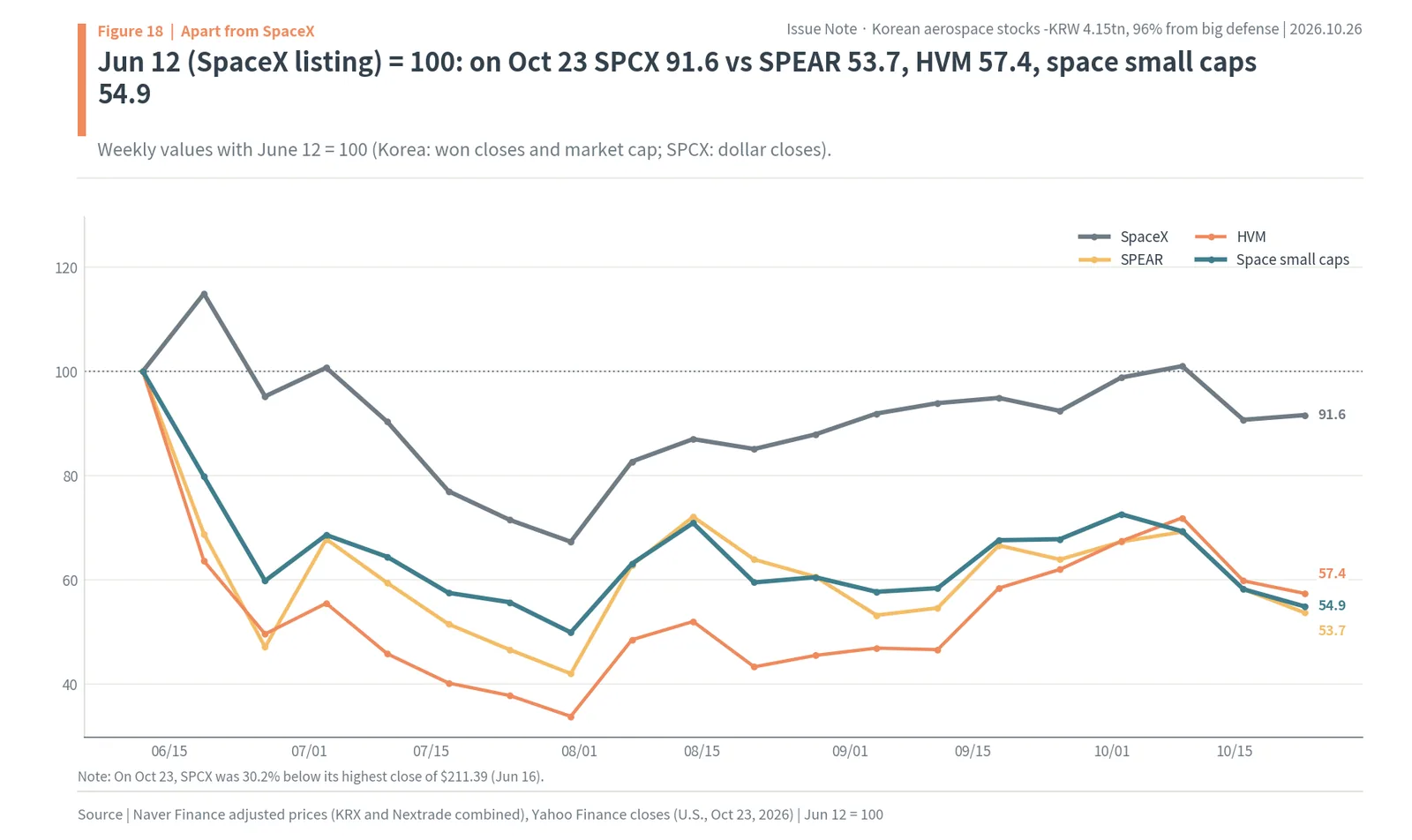
With SpaceX’s June 12 listing day = 100, on October 23 SpaceX (SPCX) stood at 91.6, against 53.7 for SPEAR, 57.4 for HVM and 54.9 for the 13 space small caps. SPCX listed at an IPO price of $135, rose as high as $225.64 during the session on June 16, and closed at $147.49 on October 23. In its third-quarter results on October 20, SpaceX reported revenue of $14.6bn and net income of $4.4bn. While SpaceX’s own stock stayed near its listing-day level, Korea’s “SpaceX beneficiary” stocks fell by almost half. Korean space stocks were tied not to the U.S. space industry’s numbers but to supply and demand in the Korean market, and today’s fall continues that pattern.
The stocks that rose had news of their own: Contec hit the upper limit twice, civil aircraft parts held up
To start with the conclusion, the four of the 24 stocks that rose were all far from defense or had news of their own. Contec, a satellite ground station company, rose 29.87% on October 23 and 29.89% on the 26th, hitting the daily upper limit two days in a row to close at KRW 10,560 (about $7.96) (KRX). On the 23rd the company said its optical (laser) ground station at the Asian Space Park in Jeju had received data sent by a U.S. low Earth orbit satellite (customer not disclosed). It received 33GB at about 2.5Gbps using the standard of the U.S. Space Development Agency (SDA), and the first mission was on October 7. CEO Lee Sung-hee called it “an important milestone as Jeju OGS begins real commercial service” (Korea Economic TV, Oct 23).
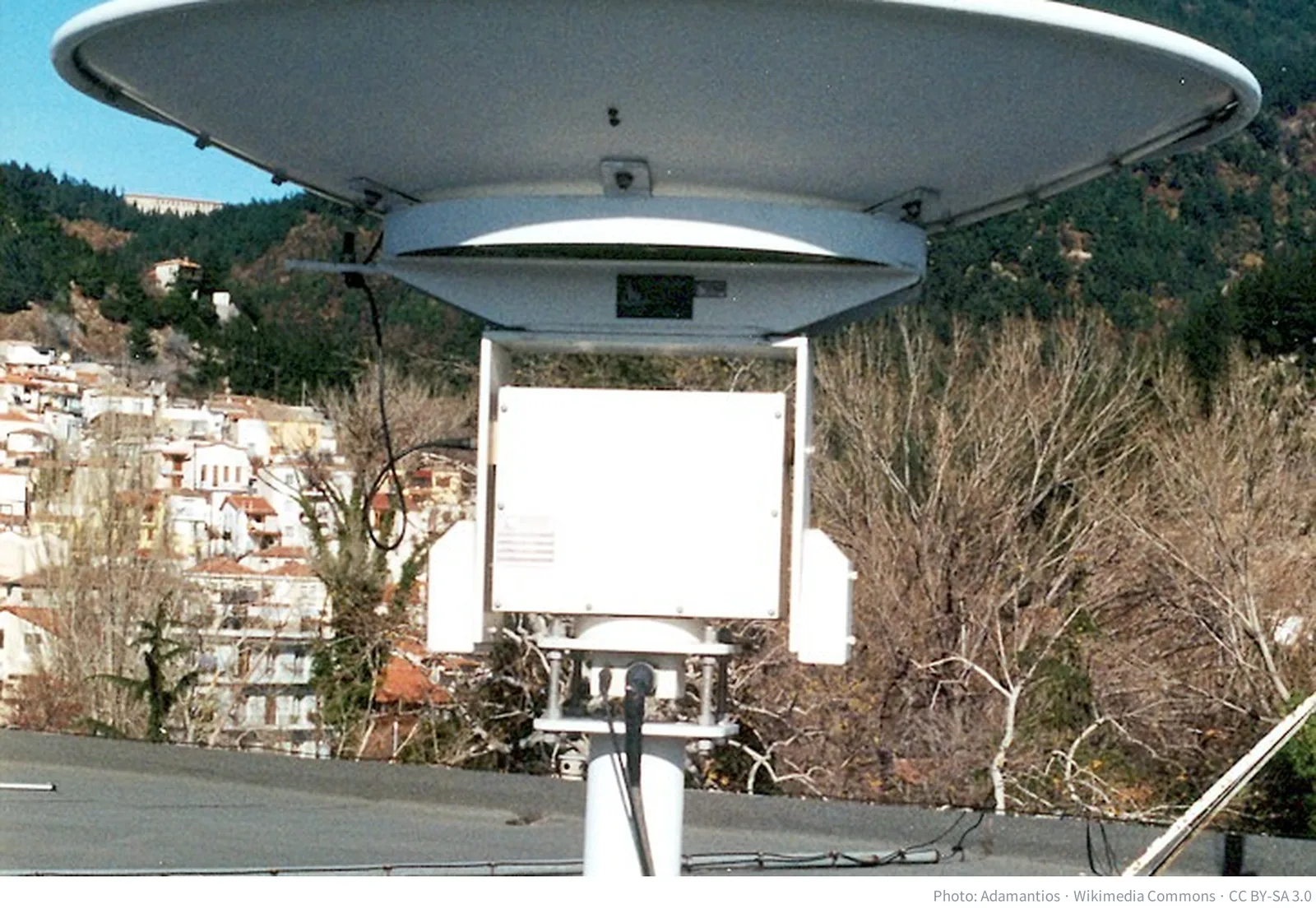
A ground station is the facility that receives data sent by satellites on the ground and passes it to customers. Contec runs 16 ground stations in 11 countries and supports more than 100 customer satellites (Korea IR Council). As satellites multiply, the same ground stations get used more often, so profit builds quickly as utilization rises. A 12-company public-private delegation organized by KASA, including Contec, Satrec Initiative, Nara Space Technology, KAI and LIG D&A, is attending an Asia-Pacific multilateral space meeting in Bangkok from the 26th to the 30th (Newsis, Oct 23). At a “Korea-Thailand Space Day” on the 30th, they will pitch for Thai demand for Earth observation satellite constellations and a launch site.
AP Satellite rose 18.71% on the 23rd and 9.87% on the 26th. There were no company filings on either day, and news stories wrote that no grounds to pinpoint the reason for the rise had been confirmed (Vegan News). Contec is AP Satellite’s largest shareholder (24.73%), having acquired control in June 2024. AP Satellite is not on the delegation list, so it is natural to read it as moving with its parent’s limit-up (author’s interpretation).
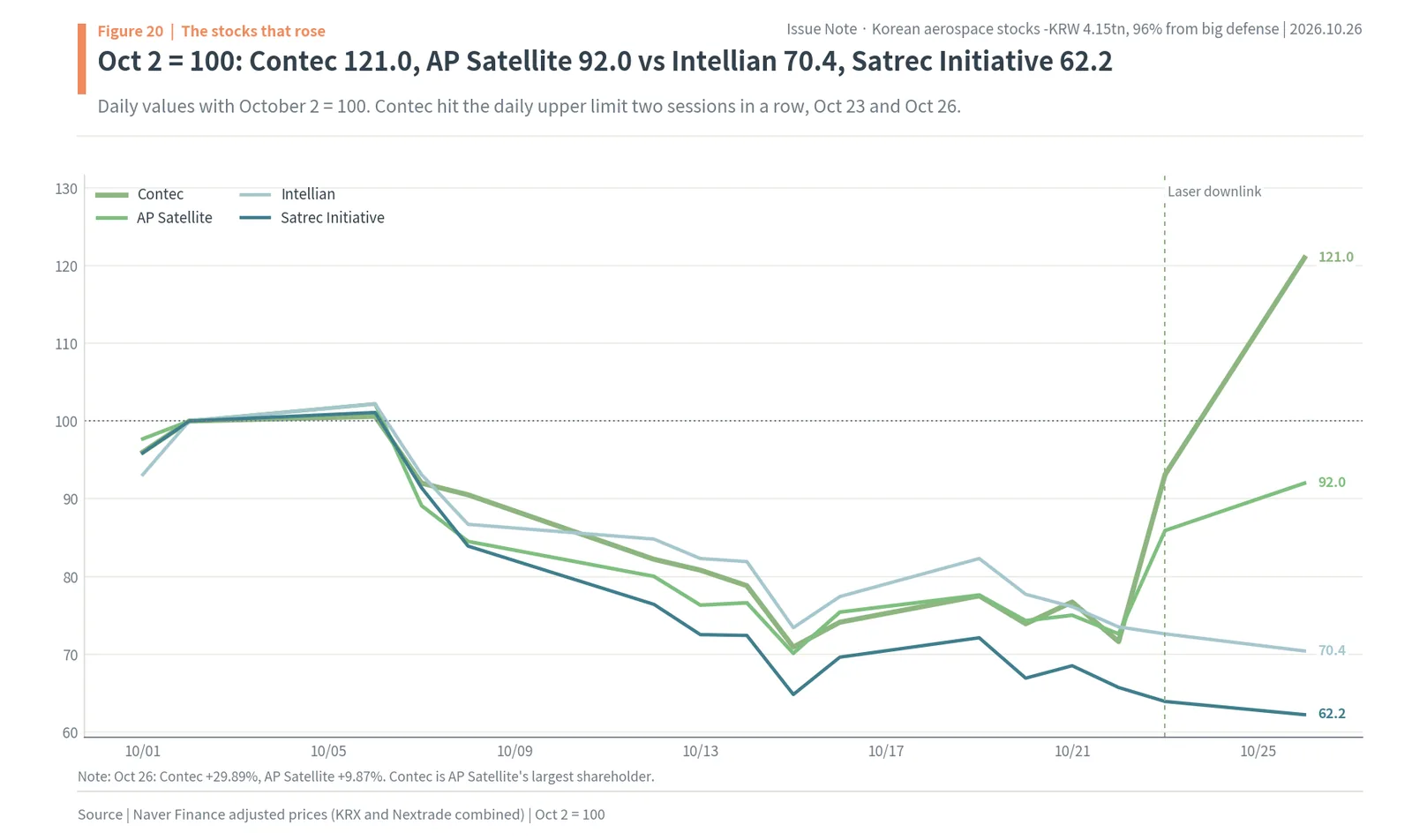
With October 2 = 100, Contec jumped to 121.0 and AP Satellite recovered to 92.0. In the same satellite communications segment Intellian Technologies stayed at 70.4, and satellite maker Satrec Initiative at 62.2. Even within “space,” only the companies with numbers of their own went against the market.
Civil aircraft parts makers were outside today’s story
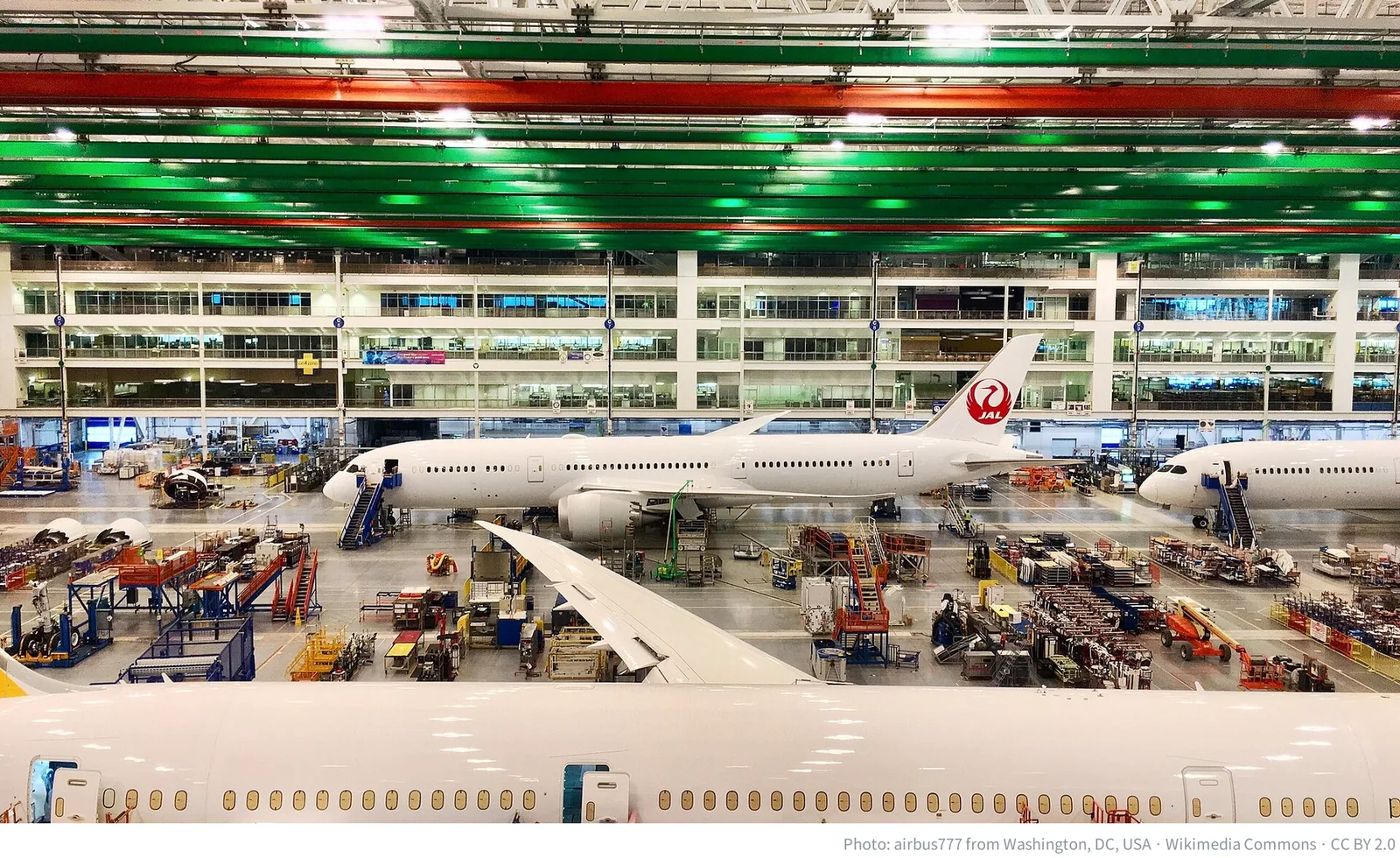
Civil aircraft parts was almost flat at -0.21%. ASTK rose 2.24% and Hizeaero 0.91%. ASTK makes the aft fuselage (Section 48) of the Boeing B737, which was 40.17% of its first-half sales, and it ended creditor-led joint management on September 30. Hizeaero mainly makes assembly parts for the B787 and B737, and on the 26th its subsidiary Hize Composites was reported to have signed a contract with Hanwha Aerospace to supply composite structures for Nuri FM7 to FM11 (Finance Scope, amount not disclosed). What sets this segment’s share prices is not defense budgets or export deliveries but how fast Boeing and Airbus build planes, so it was not swept up in the defense fall. Orbitech (-3.36%), whose main business is radiation management for nuclear power plants and whose aircraft parts were 39.5% of first-half sales, fell with the KOSDAQ.
Outlook 1, defense and aircraft systems: Q4 deliveries are the first test, 2027 orders the second
To start with the conclusion, where the five defense companies go next depends on whether “the volumes are unchanged and only the dates slipped” is confirmed in numbers. What this segment sells more of is units: howitzers, tanks, fighter jets and guided missiles. Prices are set when contracts are signed, so what moves the shares is how many units are delivered when, and when the next contract arrives. The first test is this week’s and next week’s results. Hanwha Systems reports third-quarter results at 3:30 p.m. on October 27, Hanwha Aerospace on the 29th, KAI on November 3 and LIG D&A on November 6 (per press reports). Third-quarter operating profit consensus is KRW 1,166.7bn for Hanwha Aerospace, KRW 82.3bn for KAI, KRW 61.5bn for Hanwha Systems and KRW 104.1bn for LIG D&A (Naver, FnGuide). Individual broker estimates are mostly lower: DS Investment & Securities puts Hanwha Aerospace at KRW 980.5bn, Yuanta Securities KAI at KRW 77.1bn and Daishin Securities LIG D&A at KRW 80.0bn. Only Hanwha Systems has brokers above consensus, Daishin at KRW 71.0bn and Korea Investment & Securities at KRW 66.9bn.
More important than the results themselves is what they say about the fourth quarter. At Hanwha Aerospace, the key is whether 30 K9s and 3 Chunmoo units for Poland and 16 K9s and 12 K10 and K12 vehicles for Romania, 46 K9s in all, are actually delivered in the fourth quarter (DS). KAI delivered zero LAH light armed helicopters in the third quarter because of a defect in engine parts supplied by Hanwha Aerospace, and Yuanta Securities expects production to normalize from October (Maeil Ilbo, Oct 22). Hyundai Rotem shipped K2 tanks to Poland, 28 in August, 18 in September and 12 in October, nearly reaching this year’s target of 58 (The Guru). Daishin Securities expects Hanwha Systems’ defense export share to rise from 22.9% in the second quarter to 36.6% in the third, thanks to Cheongung-II multifunction radars sold to the Middle East.
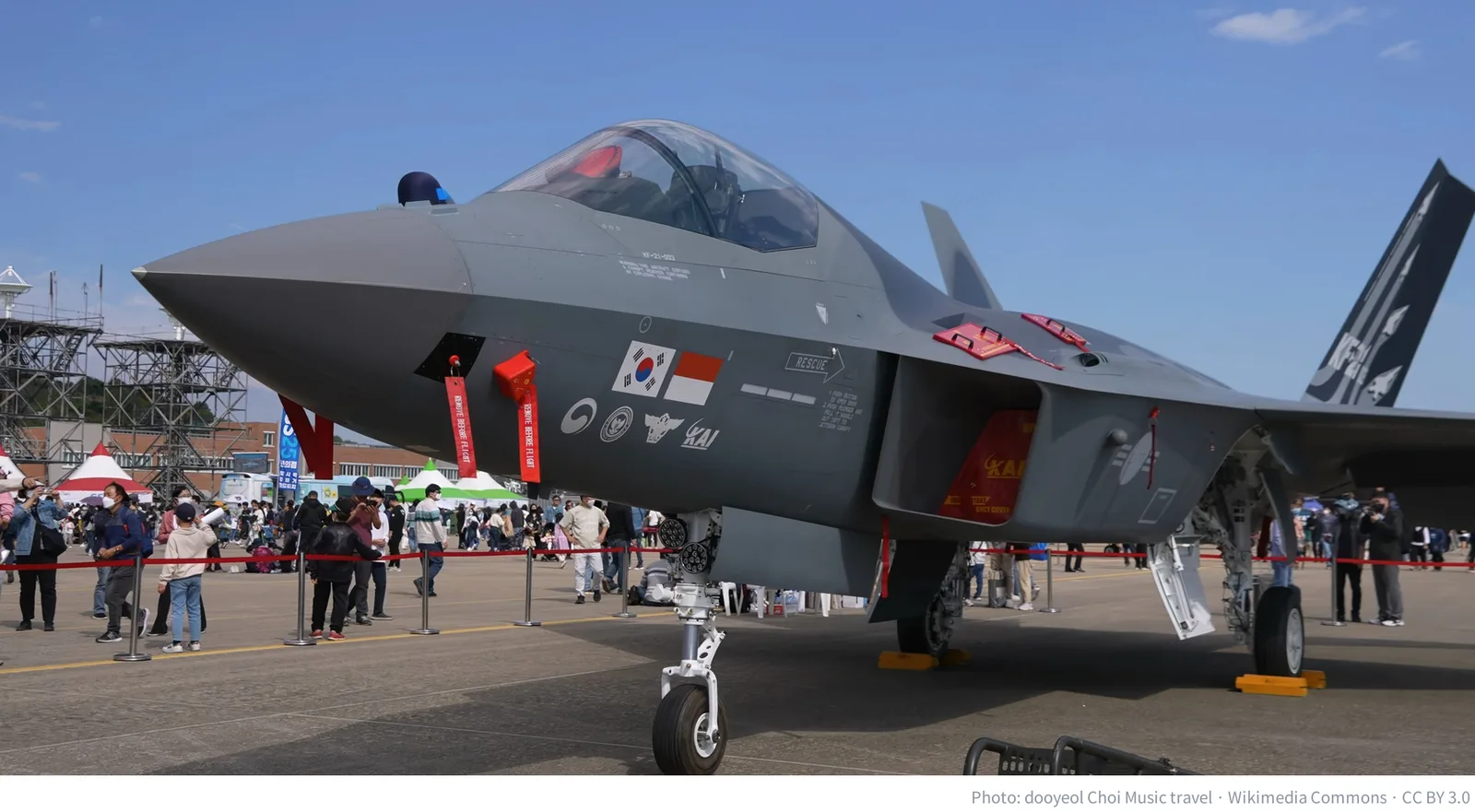
KAI handed the first production KF-21 to the Air Force on September 22, and the Air Force will take more than 100 by the early 2030s (Asia Economy). On October 22 Hanwha Aerospace raised its contract to supply 17 kinds of parts for the first KF-21 production lot from KRW 473.0bn to KRW 531.4bn (DART). The first delivery of Poland’s FA-50PL slipped to mid-2027 because of delays in export approval for U.S.-made equipment (Global Economic). Indonesia, the UAE and the Philippines are mentioned as candidates for the KF-21’s first export contract, but no signing had been confirmed as of October 26.
The second test is 2027 orders
The “order gap” brokers talk about shows in the numbers. From January to October this year, Hanwha Aerospace, Hyundai Rotem, LIG D&A and KAI signed 6 overseas contracts of KRW 100bn or more, about KRW 4.4tn in all, a quarter of last year’s roughly KRW 17tn (The Public, Oct 22). Hyundai Rotem and KAI signed none. Romania’s infantry fighting vehicle program went to Germany’s Rheinmetall on May 31, a loss for Hanwha. Kiwoom Securities said “a considerable number of the order pipelines expected within the year are likely to be pushed into next year.”
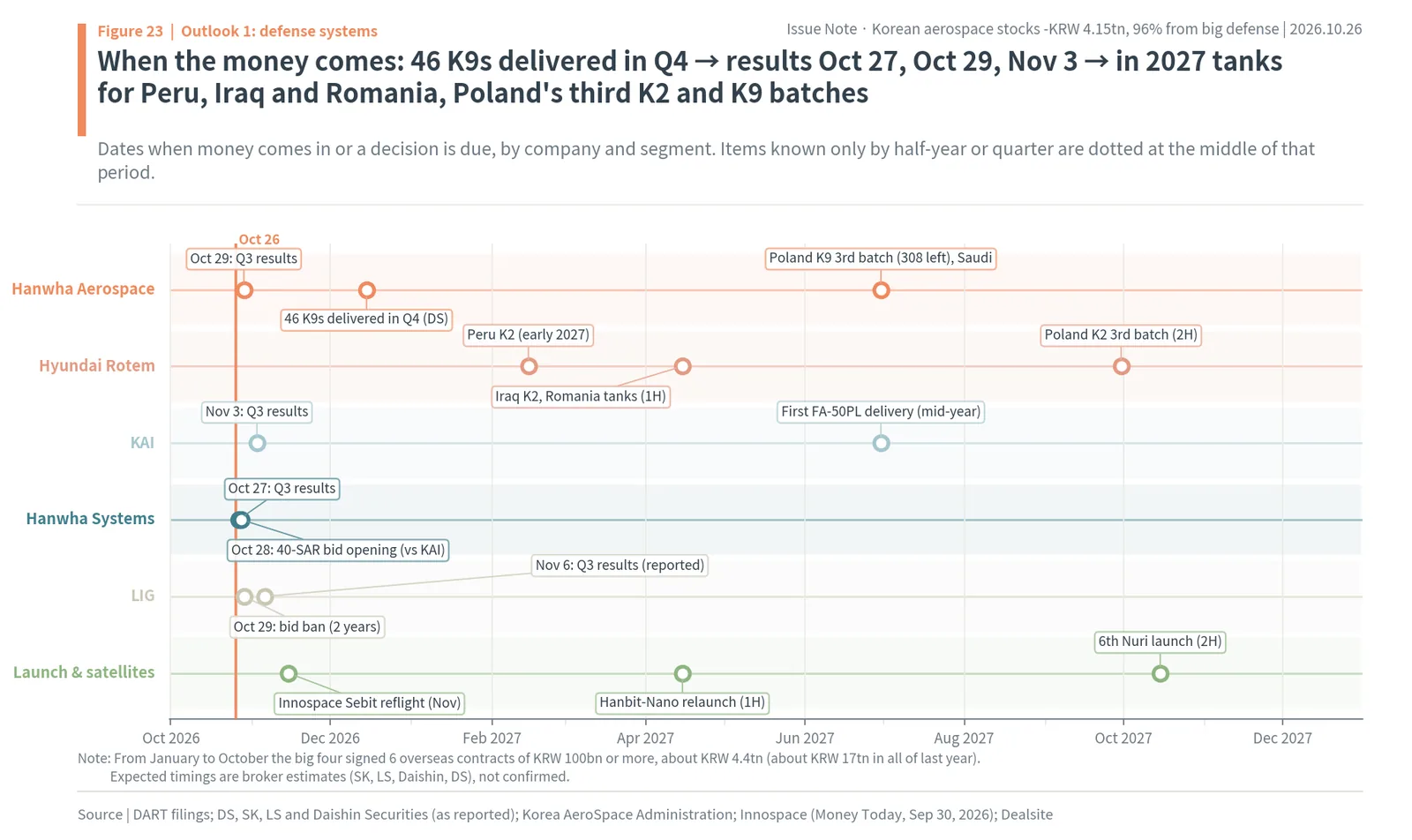
The 2027 candidates are as follows. Hyundai Rotem has Peru (54 K2 tanks and 141 K808 armored vehicles, about $2bn; SK Securities sees a contract possible in early 2027 after Peru’s congress approves it in November), Iraq (250 K2s, about $6.5bn; LS Securities expects the first half of 2027), Romania (216 tanks, first half of 2027) and Poland’s third K2 batch (second half of 2027). For Hanwha Aerospace, the remaining 308 howitzers of Poland’s third K9 batch, Saudi Arabia’s National Guard and U.S. Army self-propelled howitzer production (Daishin Securities) are named. As near-term occasions, the German chancellor’s visit to Korea on October 29 to 31 and the UAE president’s state visit in November are mentioned. Eugene Investment & Securities said “about 70% of overseas orders are concentrated in the second half.” Order backlogs are already large: Hanwha Aerospace land systems KRW 38.3tn (end of Q2, about 4.7 years of sales), Hyundai Rotem KRW 29,142.0bn (end of Q3), KAI KRW 25,750.2bn, LIG D&A KRW 24,578.1bn and Hanwha Systems KRW 11,318.6bn. Hyundai Rotem’s backlog is 3.38 times its market cap (author’s calculation). Large backlogs keep revenue coming for several years even without new contracts, but share prices look at the date of the next contract.
For LIG D&A, the court’s decision is the fork in the road
LIG D&A needs to be looked at separately from the other four. DAPA’s contract review committee voted on October 20 to bar the company from bidding for two years, from October 29 to October 28, 2028. According to the company’s filing, sales to the government, local governments and public institutions in 2025 were KRW 2,777.3bn, 64.5% of total sales. The company said it would respond by seeking a stay of execution and filing suit to cancel the measure, and wrote that if a stay is granted its bidding eligibility is unaffected until the ruling (DART, Oct 22). Under Article 48 of the Defense Acquisition Program Act, revoking a defense contractor designation is something the Minister of Trade and Industry “may” do after consulting the head of DAPA and holding a hearing, and no deadline is set. DS Investment & Securities judged the impact on earnings limited, since the bid ban does not cancel existing contracts and does not apply to overseas export contracts, and domestic development programs carry low margins. So LIG D&A’s shares will likely react first to the court’s decision on a stay and to the fate of the full-scale development contract for a long-range air-to-air missile scheduled for December, rather than to fourth-quarter deliveries (author’s view).
Outlook 2, launch vehicles and engines: the government budget pays, and 56.7% of the increase goes to launch vehicles
To start with the conclusion, the launch segment’s revenue comes from what the government spends on Nuri and the next-generation launcher, and that money more than doubles next year. What this segment sells more of is launches: if Nuri flies every year, orders for engines, structures and assembly come every year too. KASA’s 2027 budget request is KRW 1,649.1bn (about $1.24bn), KRW 529.0bn (47.2%) more than this year’s KRW 1,120.1bn. Within it, the launch vehicle (“space highway”) budget rises 113.8%, from KRW 263.2bn to KRW 562.9bn (about $425mn), taking 56.7% of the increase (iNews24, Money Today, Sep 1; author’s calculation). The launch budget includes KRW 291.6bn for the reusable next-generation launcher, KRW 75.0bn for follow-on Nuri launch support (new; the 7th and 8th launches after the 6th) and KRW 25.3bn to upgrade the Naro Space Center. The request is finalized at a plenary session by December 2 after review by the National Assembly’s standing and budget committees.
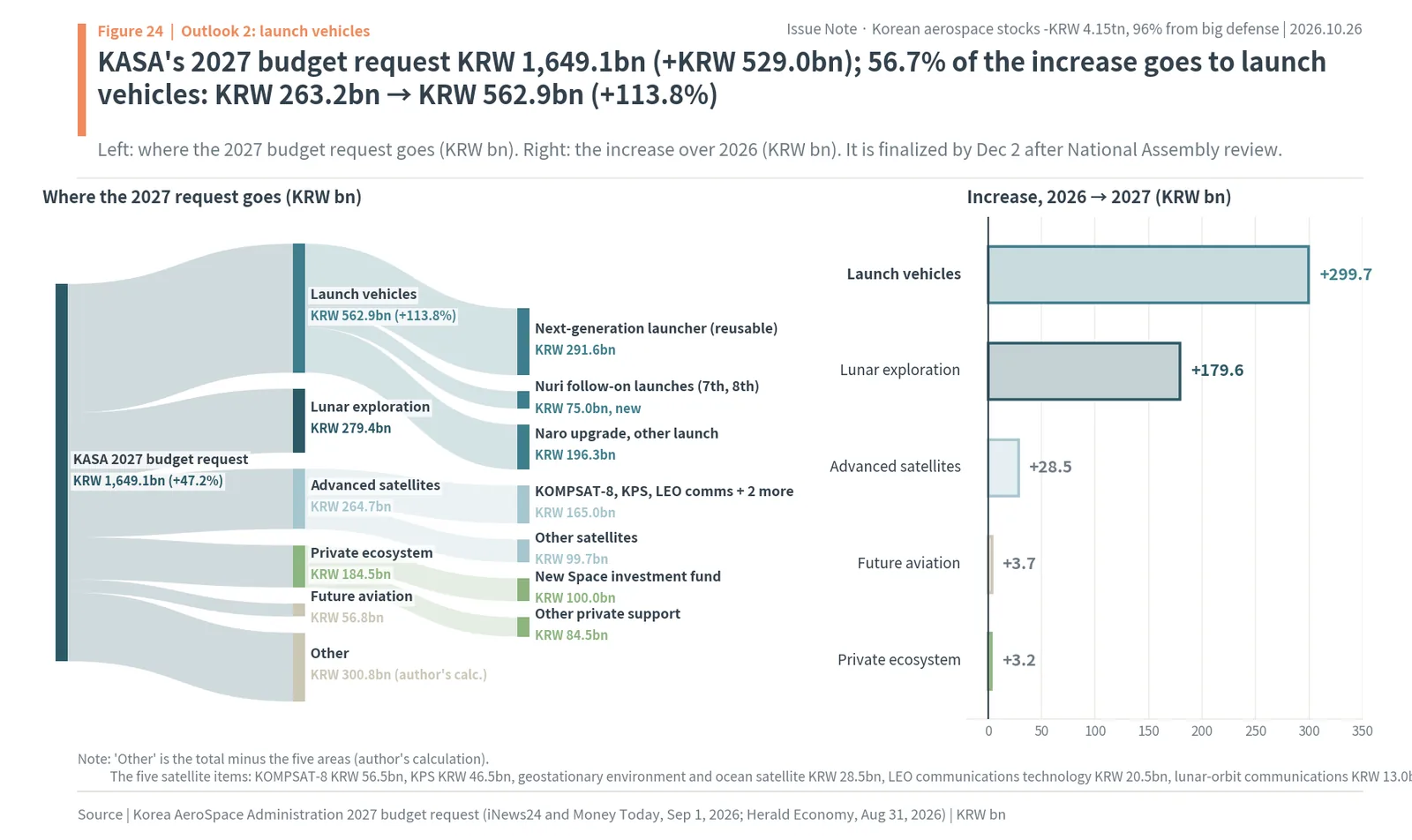
The launch schedule is also set. According to a report to the Cabinet meeting on October 20, Nuri will fly more than once a year: the 6th launch in the second half of 2027 (micro-satellite constellation units 7 to 11), the 7th in 2028, the 8th in 2029, the 9th and 10th in 2030, the 11th in 2031 (four electro-optical satellites for the military micro-satellite system) and the 12th in 2032 (Korean Center News). The total cost of the next-generation launcher rose from KRW 2,013.2bn to about KRW 2,292.1bn, and the reusable technology demonstrator entered final assembly on September 30, with a flight test (500m vertical takeoff and landing) planned for 2028 (originally a 2027 launch; Finance Scope). The private launch site at the Naro Space Center starts full operation in the second half of 2027 (Financial News).
Looking at the size of the whole industry shows how big a change the launch budget is. By KASA’s count, companies in Korea’s aerospace industry had sales of KRW 11,202.1bn in 2024: aircraft manufacturing KRW 7,661.3bn (68.4%), space applications KRW 2,384.2bn (21.3%) and space equipment manufacturing KRW 1,156.5bn (10.3%) (Newsway, Apr 20). The two space sectors, aviation excluded, add up to KRW 3,540.7bn (author’s calculation). The global space economy grew 12% to $686bn (Space Foundation, 2025 figure). Korea’s space industry is still small, which is why a change of a few hundred billion won in the government budget shows up directly in listed companies’ sales.
Who gets the money: Hanwha Aerospace integrates the system, and parts contracts are already signed
Hanwha Aerospace handles system integration for Nuri and the next-generation launcher. But space is a small part of Hanwha Aerospace. First-half sales of its aerospace division, including Satrec Initiative, were KRW 96.3bn, less than 1% of the total (half-year report). The KRW 299.7bn increase in the launch budget is 0.76% of Hanwha Aerospace’s market cap (author’s calculation). So Hanwha Aerospace’s share price follows defense results more than the space budget.
On the parts side, contracts are already out. On August 6 Vitzro Nextech signed a KRW 53.5bn contract with Hanwha Aerospace to supply engine components for five Nuri rockets, FM7 to FM11. That is 145.42% of its 2025 sales, and the contract runs to November 2029 (DART). Hizeaero’s subsidiary took the composite structures for the same five rockets. The two listed launch companies (Innospace and Vitzro Nextech) have a combined market cap of KRW 400.6bn, and the KRW 299.7bn increase in the launch budget equals 74.8% of that (author’s calculation). Not all of the budget becomes listed companies’ sales, but for a small company the government’s launch plan is several years of work.
For Innospace, the first half of next year is the one test
Private launcher Innospace is a different story. On December 22, 2025 (local time) it attempted its first commercial launch, HANBIT-Nano, from Alcântara in Brazil, but about 33 seconds after liftoff combustion gas leaked from the combustion chamber and the launch failed. The cause was a seal crushed when the combustion chamber was reassembled before launch (Kyunghyang Shinmun, Mar 17). On September 30 the company moved the HANBIT-Nano relaunch to the first half of 2027 and said it would fly the suborbital rocket Sebit again in November (Money Today). On October 25 KASA gave advance notice of a rule setting the liability insurance limit for the follow-on HANBIT-Nano launch at $18mn (Edaily). First-half sales were KRW 3.9bn and the operating loss KRW 28.2bn. On October 30, 1,322,289 additional shares from converted convertible preferred shares will be listed. Innospace’s share price will swing far more on a single launch success than on the budget.
Outlook 3, satellite makers: the contractor for 40 military reconnaissance satellites is picked on October 28
To start with the conclusion, the satellite makers’ next date is this Wednesday. Bids for the Agency for Defense Development’s micro-satellite system (40 SAR satellites) open on October 28, in a designated competition between Hanwha Systems and KAI. The estimated price in the tender notice is about KRW 515.6bn (about $389mn; reported program size KRW 567.2bn), and each company has built a production line for 100 satellites a year (Dealsite, Oct 13). Once these 40 satellites and four electro-optical satellites are in place, the revisit time over the Korean Peninsula shortens from two hours to 20 to 30 minutes (Metro Seoul). The KRW 515.6bn estimated price equals 11.4% of Hanwha Systems’ estimated 2026 sales and 9.7% of KAI’s (author’s calculation). It will be recognized over several years, but the winner gets several years of satellite work. Satrec Initiative cannot bid directly, but if Hanwha Systems wins, it may build the satellite buses and electronics (Kyobo Securities via Newspim, Oct 6).
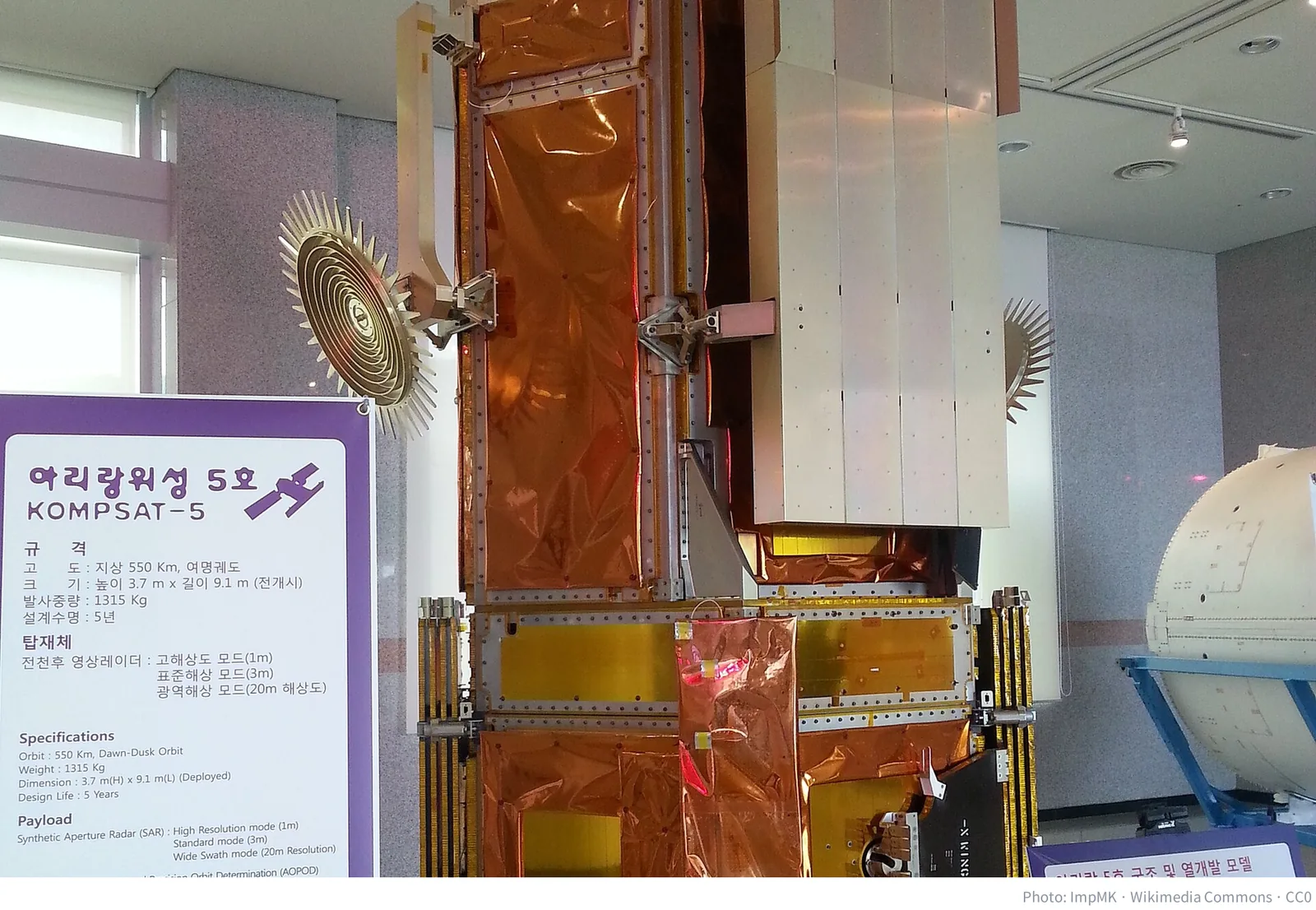
Satrec Initiative is an Earth observation satellite company 33.63% owned by Hanwha Aerospace. In February it won a KRW 283.06bn order for overseas satellite imagery acquisition equipment, lifting its backlog to KRW 557.4bn at the end of the second quarter. On October 7 the fifth Nuri launch carried five production NEONSAT satellites, and the remaining five will fly on the sixth Nuri launch in the second half of 2027 (Dealsite). Nara Space Technology was named preferred bidder on October 26 for the Korea Water Resources Corporation’s micro-satellite constellation (K-waterSAT). Its bid of KRW 10.11bn is 76.39% of its 2025 sales (DART). Lumir plans to launch its own SAR satellite, LumirX-1, on a Falcon 9 within the year. Grouped in the same segment, Green Optics gets only 0.23% of first-half sales from aerospace and 54.77% from defense. Being grouped under a space theme does not mean having space revenue.
Outlook 4, satellite communications and ground stations: the more LEO satellites outside Starlink, the more antennas and ground stations sell
Intellian Technologies makes satellite communication antennas and ground gateways. Daishin Securities said it has “supply relationships with most LEO operators except Starlink,” and Eugene Investment & Securities put its share of sales related to low Earth orbit (LEO) at 76%. Customers include OneWeb, Telesat, SES and Panasonic. What this segment sells more of is the antennas that satellite operators install on the ground. Brokers estimate operating profit rising from KRW 7.9bn in the third quarter to KRW 22.3bn in the fourth, and 2027 operating profit of KRW 56.7bn, 54.1% more than in 2026. PER on estimated 2027 EPS of KRW 4,648 is 11.0 times (author’s calculation). For Contec, as seen above, the next link is whether its laser ground station turns into real commercial service. The Korea IR Council wrote that Contec’s ground station construction backlog exceeded KRW 50bn as of August 2026.
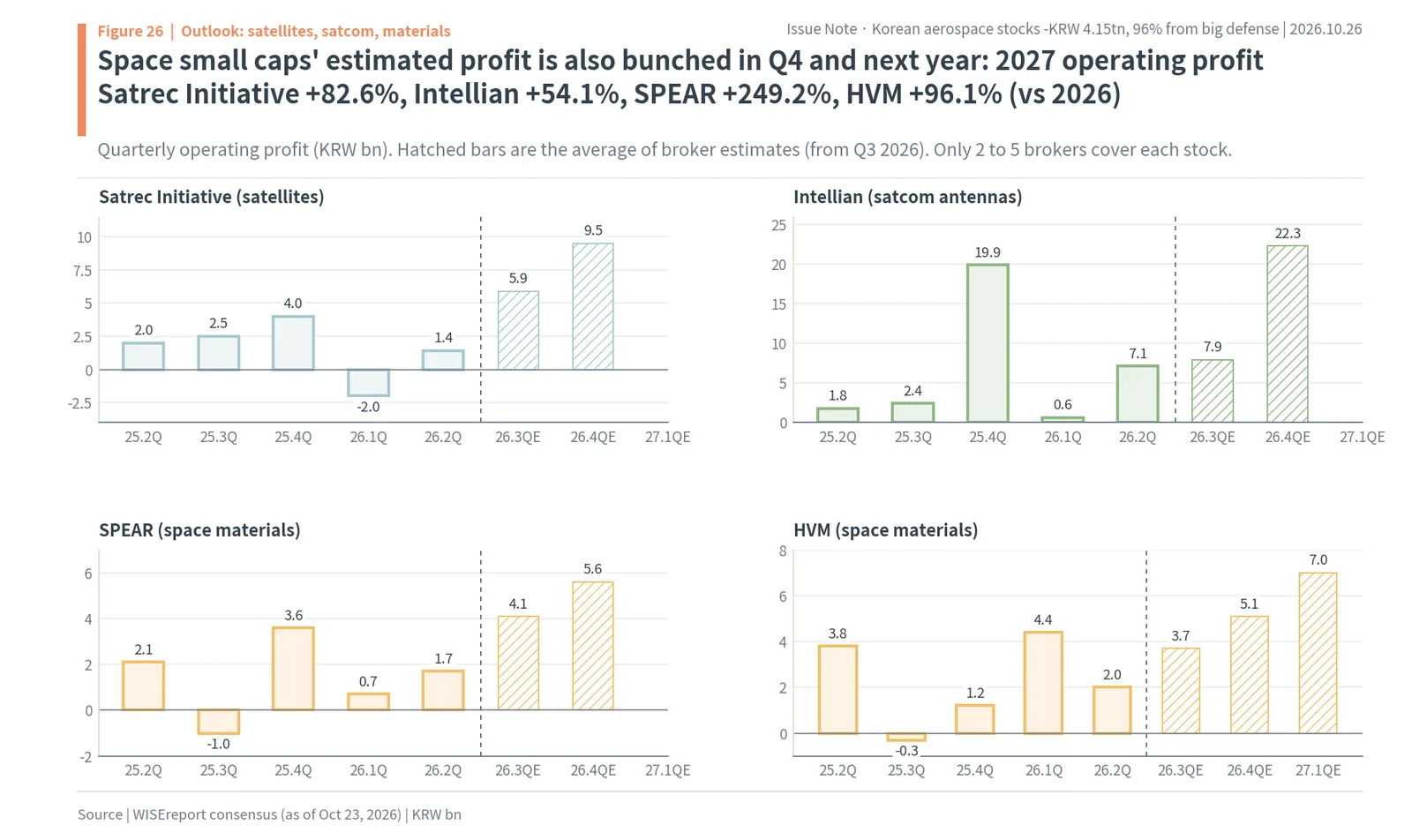
The figure shows quarterly operating profit estimates for four companies in the satellite, communications and materials segments. Estimated 2027 operating profit is 82.6% higher than 2026 at Satrec Initiative, 54.1% at Intellian Technologies, 249.2% at SPEAR and 96.1% at HVM. All four have profit concentrated in the fourth quarter and next year. Only 2 to 5 brokers cover these small caps, so a single change in estimates moves the numbers a lot.
Outlook 5, space materials and parts: SpaceX’s launch count is the order volume
SPEAR’s filings show a long-term contract with SpaceX (July 31, 2025 to December 31, 2035, with a three-year extension option and total forecast demand of $1,054.14mn). Of its first-half consolidated sales of KRW 122.1bn, one major customer accounted for KRW 104.7bn, about 85.7% (half-year report; author’s calculation). In October alone it disclosed four new special alloy supply contracts worth about KRW 89.3bn. HVM signed a 10-year mutual exclusive supply contract with SPEAR for space launch vehicles on May 28 (Newspim), and its space backlog was KRW 49.99bn at the end of June. Kencoa Aerospace lists NASA, SpaceX and Blue Origin as customers in its half-year report but does not disclose their shares because of U.S. export rules (ITAR) and nondisclosure agreements.
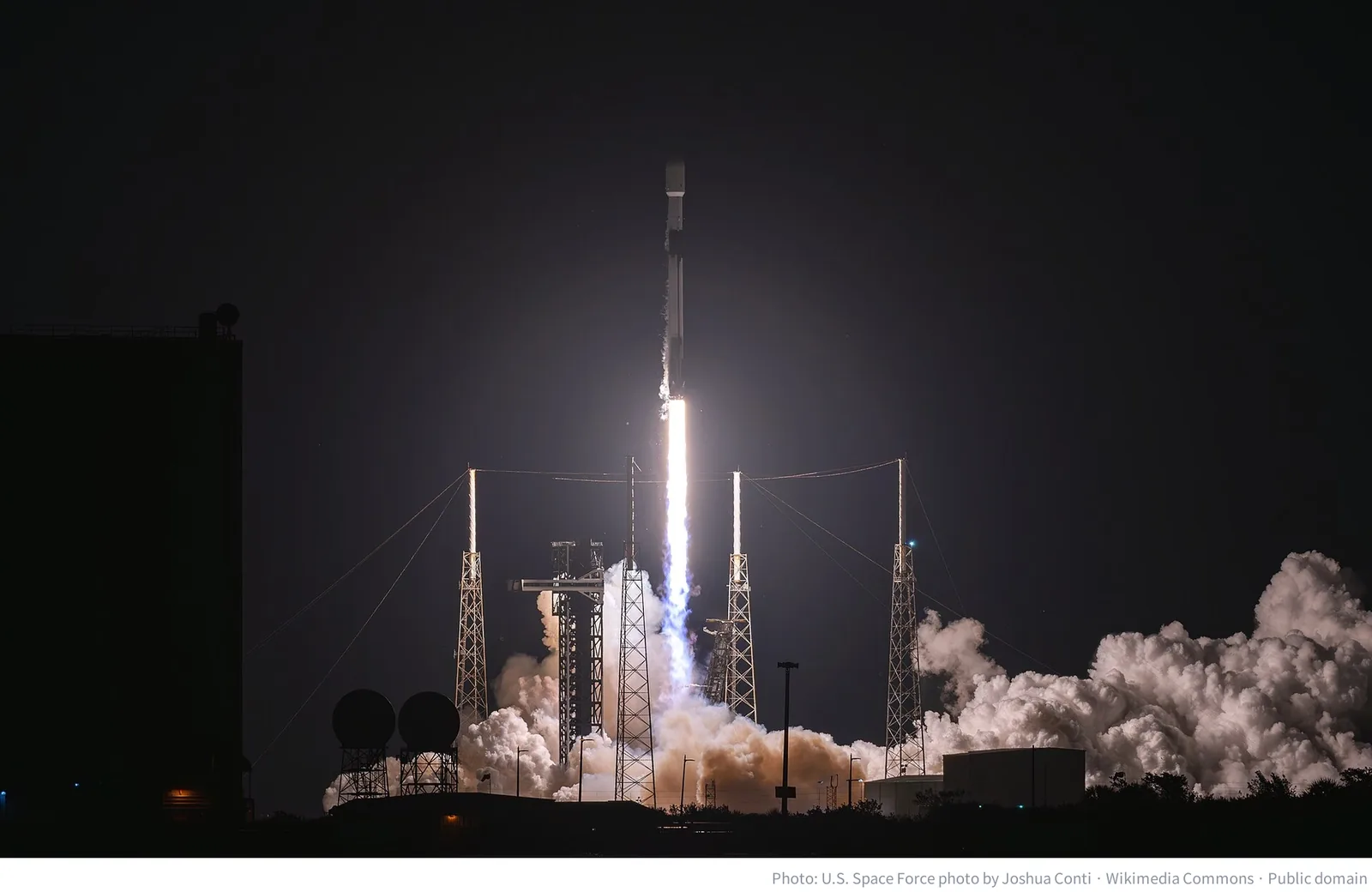
What this segment sells more of is the special alloy that goes into each rocket, so order volume follows SpaceX’s launch count. SpaceX launched 35 times in the third quarter (44 a year earlier) and 113 times from January to September (TeslaNorth, Oct 20 results). On October 14 the U.S. Federal Aviation Administration (FAA) published a notice in the Federal Register that it is starting an environmental review to raise the annual launch limit at Starbase in Texas from the current 25 to 100 in a first phase and 456 in a second. It is the start of a review, not an approval; public meetings run from November 17 to 19 and comments close on November 30. Starship’s 15th flight is targeted for November. As seen earlier, the correlation of SPEAR and HVM with SpaceX’s share price is only in the 0.2 range. Between launch counts becoming earnings and earnings becoming share prices, Korean materials stocks ride the KOSDAQ first.
Outlook 6, civil aircraft parts: Boeing and Airbus production rates
The civil aircraft parts segment is tied not to defense budgets but to civil aircraft production. ASTK mainly makes Boeing B737 aft fuselages and has an order backlog of $2,611.95mn. Hizeaero’s B787 and B737 assembly and parts backlog is KRW 1,183.46bn (half-year reports). This segment’s dates are Boeing’s and Airbus’s monthly production rate announcements, and it runs on a different clock from this defense and space fall.
Size of expectations: if next year’s estimates hold, Hanwha Aerospace, Hyundai Rotem and Intellian are cheaper than Lockheed
To start with the conclusion, putting each segment’s outlook on one chart sums it up as “how much will profit grow next year, and how expensive is the stock against that profit.” Instead of target prices, this report measures the size of expectations with these two numbers. The horizontal axis is the October 26 close divided by estimated 2027 EPS (PER), and the vertical axis is how much estimated 2027 operating profit grows over 2026.
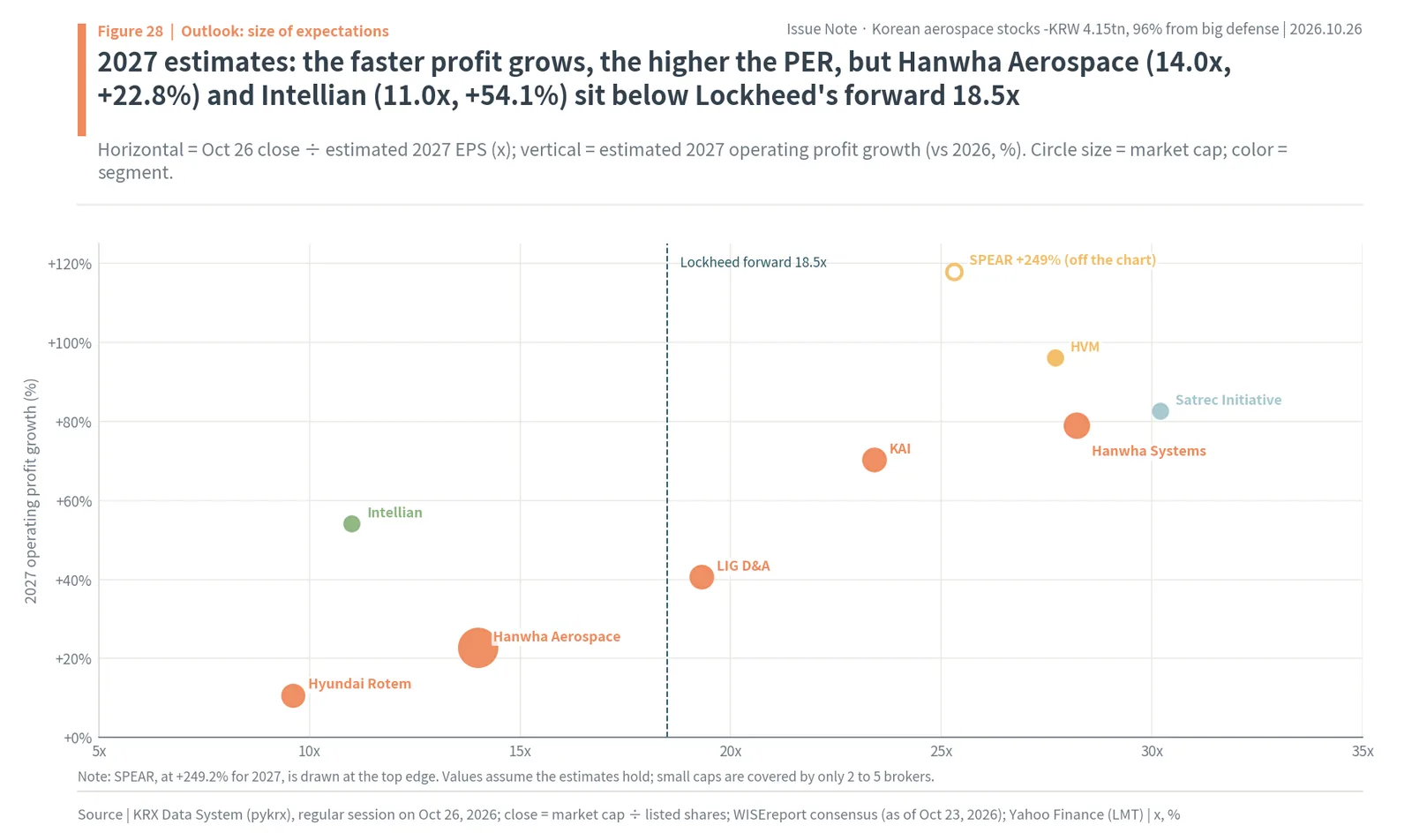
Hanwha Aerospace is at 14.0 times 2027 EPS of KRW 54,254 with operating profit growth of +22.8%, Hyundai Rotem at 9.6 times EPS of KRW 8,231 with +10.7%, and Intellian Technologies at 11.0 times EPS of KRW 4,648 with +54.1%. All three are below Lockheed Martin’s forward PER of 18.5 times (EPS $33.21). LIG D&A is at 19.3 times EPS of KRW 22,173 with +40.7%, KAI at 23.4 times EPS of KRW 4,180 with +70.3%, and Hanwha Systems at 28.2 times EPS of KRW 2,257 with +79.1%. Among space small caps, Satrec Initiative is at 30.2 times EPS of KRW 1,698 with +82.6%, SPEAR at 25.3 times EPS of KRW 739 with +249.2%, and HVM at 27.7 times EPS of KRW 2,058 with +96.1%.
Reading the chart is simple. The further up and to the right, the more next year’s profit must grow to justify today’s price; the further down and to the left, the cheaper the stock even if profit grows less. So the same news of a Q4 delivery delay shakes the upper-right companies more, because a one-quarter slip in estimates immediately raises next year’s PER. Daishin Securities’ October 21 calculation of 2027 expected PER (Hanwha Aerospace 16.0 times, LIG D&A 19.4 times, Hanwha Systems 19.5 times, KAI 30.2 times, Hyundai Rotem 17.6 times) was also mostly below the global land defense average of 26.2 times. On that basis Daishin judged peak-out worries “excessive.”
The author reads the chart this way. The big defense stocks are priced no higher than U.S. peers even on the assumption that next year’s profit grows, so their direction from here depends on whether that assumption holds, that is, on fourth-quarter deliveries and 2027 orders. Space small caps have small absolute profits and few covering brokers, so a single event such as a bid opening, a launch or a contract changes the estimates themselves. That is why for space small caps the date of the next event matters more than the PER (author’s view).
Signals and dates to watch: three warnings, three favorable
To start with the conclusion, the signals now are dark on the defense side and bright on the space side. Here are six signals as gauges. By eToday’s tally, the five defense companies’ combined third-quarter operating profit estimate is 16.1% below consensus; the average won-dollar rate so far in the fourth quarter is 10.8% below the second quarter; and the big four’s overseas orders of KRW 100bn or more from January to October are 74.1% below last year’s full-year total. These three signals are warnings. On the other side, KASA’s budget request rose 47.2%; today’s own part for space small caps was -0.61pp, so there was no bad news from space; and foreigners net bought KRW 77.5bn of the five defense stocks from October 20 to 26. These three signals are favorable.
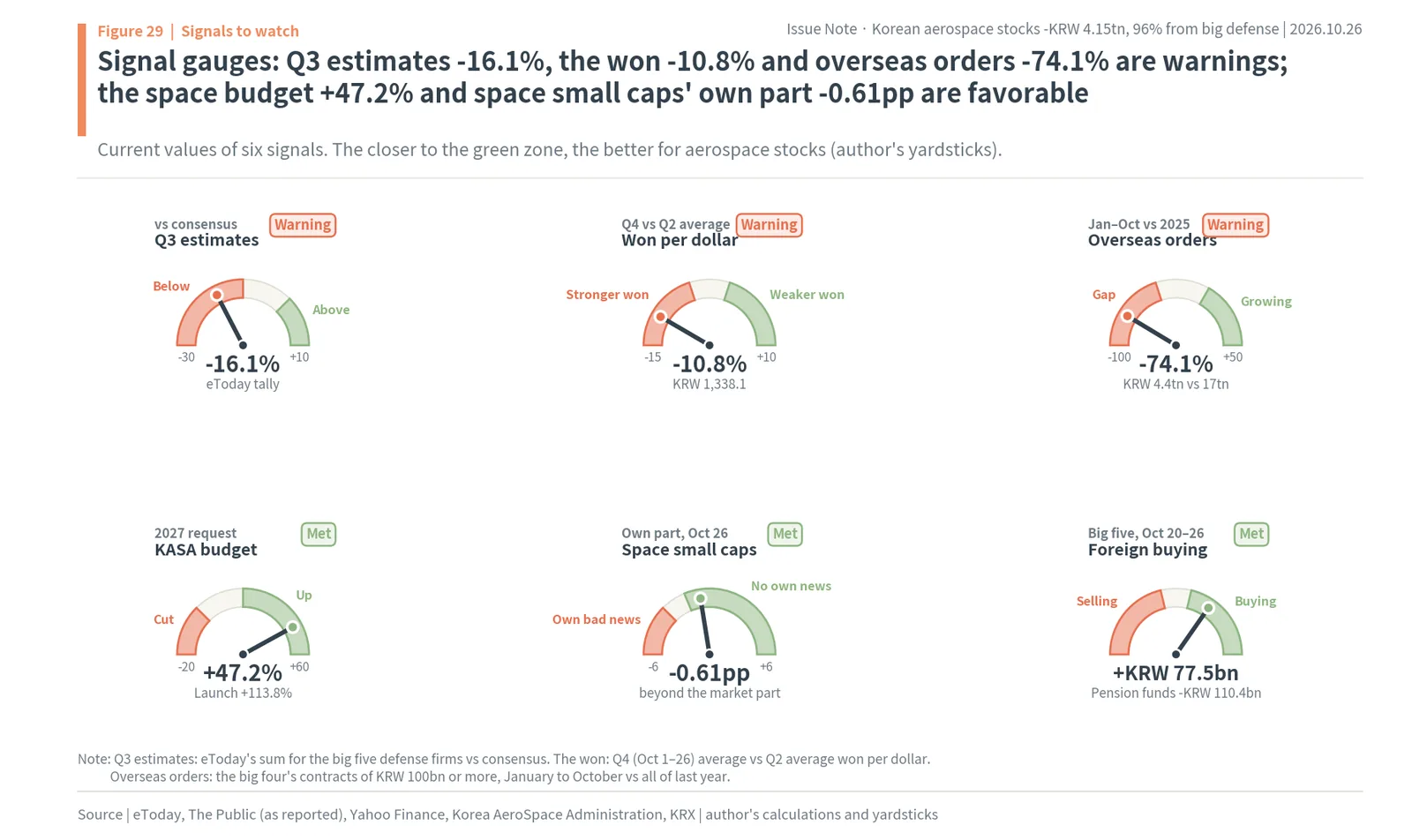
The dates when the gauges change are close. The first is third-quarter results from Hanwha Systems on October 27 and Hanwha Aerospace on the 29th. On the 28th, bids open to pick the contractor for 40 military micro reconnaissance satellites, and the U.S. Federal Reserve’s rate decision comes early on the 29th, Korean time. On November 3, KAI’s results coincide with the U.S. midterm elections (results on November 4, Korean time), and LIG D&A reports on November 6 (per press reports). Then come the FAA’s public meetings on Starbase from November 17 to 19, the Bank of Korea’s Monetary Policy Board meeting on the 26th, the FAA comment deadline on the 30th, the National Assembly’s budget deadline on December 2 and the expiry of the U.S. stopgap budget on December 11. The site of a second space center will be decided by the National Space Council in December.
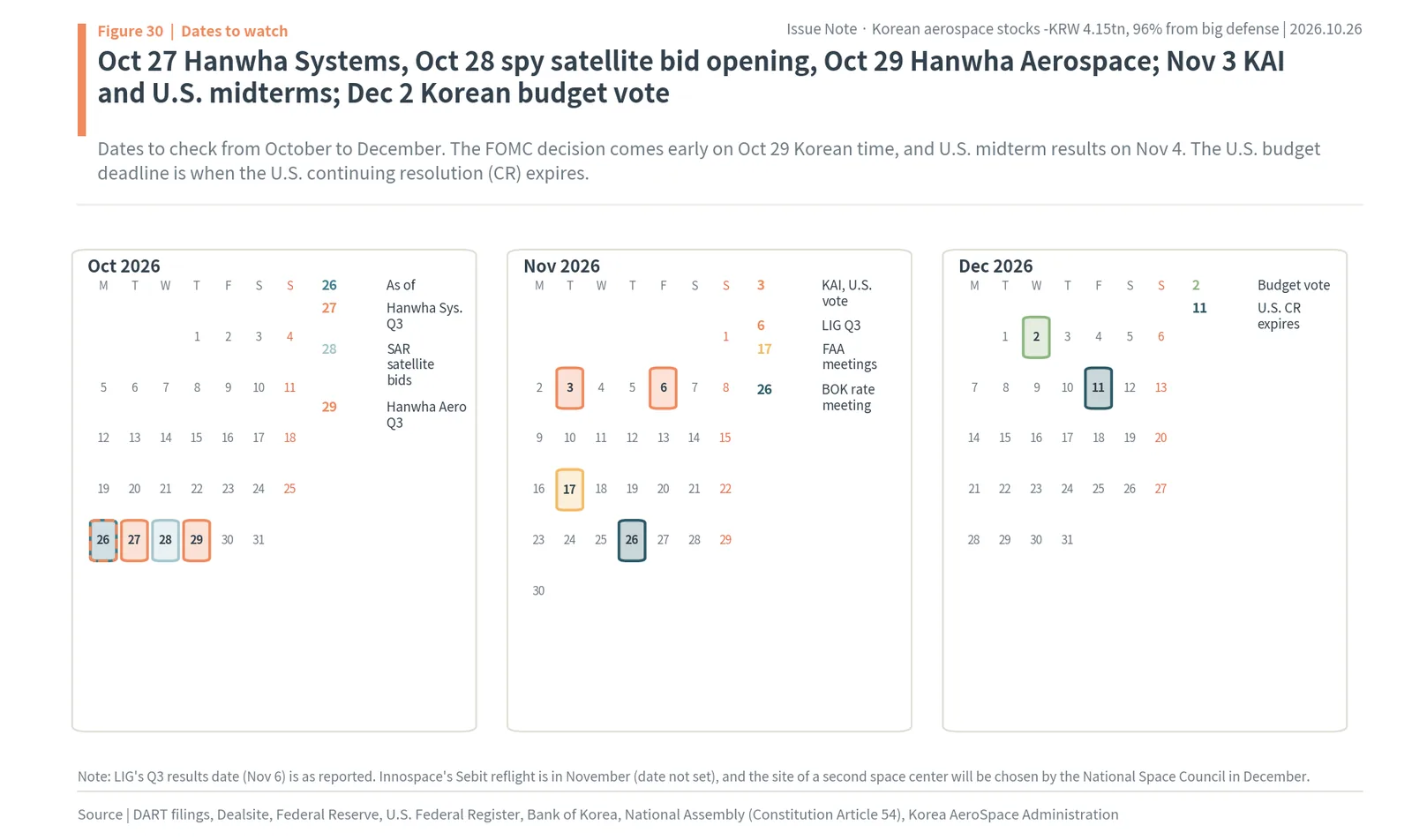
Of these, the author singles out Hanwha Aerospace’s explanation of fourth-quarter deliveries on October 29 and the bid results on October 28 as the first signals to watch. The first tests the reading that only the dates slipped, and the second would be the first case of the space budget turning into actual work for a listed company. In one line, what slipped today was not space but the dates, and so those dates will also set the direction from here.
Common questions: seven things that are easy to misread about the fall in Korean aerospace stocks
This chapter regroups the numbers from the earlier chapters as questions. It makes no new claims.
The first question is why aerospace stocks fell today. The 24 aerospace stocks lost KRW 4.15tn of market cap, and 96.1% of it was Hanwha Aerospace, KAI, Hanwha Systems, LIG D&A and Hyundai Rotem. The five fell 4.07% more even after removing the KOSPI part (-0.75%). The causes were the review of revoking LIG D&A’s defense contractor designation, third-quarter export deliveries pushed into the fourth quarter, the strong won and the target price cuts that followed.
The second question is whether something bad happened to the space industry. In the numbers, no. The 13 space small caps excluding Contec and AP Satellite fell 4.82%, against a KOSDAQ part of -4.21% calculated from one-year betas. In the same week the share prices of SpaceX and Rocket Lab in the U.S. were also nearly flat. On October 7 the fifth Nuri launch put 14 of 15 satellites into orbit.
The third question is whether the global defense cycle has turned. In the same week Lockheed Martin reported a record backlog of $292bn and rose 9.4% (Oct 16 → Oct 23). Northrop Grumman rose 6.1%. The U.S. defense ETF was 17.86% below mid-August on midterm worries, but the companies whose results were confirmed rebounded.
The fourth question is who sold. On October 20 foreigners sold KRW 91.9bn of the five defense stocks and retail investors bought KRW 138.4bn. Today foreigners bought KRW 56.4bn and institutions sold KRW 39.1bn (pension funds KRW 20.0bn). Pension funds’ net selling from October 20 to 26 was KRW 110.4bn.
The fifth question is whether the stocks rebound right after a sharp fall. In the past three years, after the 23 days when the five defense stocks fell more than 5% beyond the KOSPI part, the median change 20 trading days later was -0.7%, and they rose in 10 cases. Rebounds depended less on the fall itself than on whether its cause was resolved.
The sixth question is whether LIG D&A’s bad news spreads to other defense companies. The two-year bid ban (October 29 to October 28, 2028) and the review of revoking its defense contractor designation are measures against LIG D&A alone. Sisa Journal reported that the revocation review was understood to have no chance of extending to other programs. DS Investment & Securities judged that the bid ban does not apply to overseas export contracts. If anything, some in the industry expect that the KRW 1.9tn long-range air-to-air missile development program, for which LIG D&A was the preferred bidder, could pass to another company (Newstop).
The seventh question is what to watch from here. It differs by segment: for defense, what the October 27, October 29 and November 3 results say about fourth-quarter deliveries, plus 2027 orders (Peru, Iraq, Romania, Poland); for launch vehicles, the National Assembly’s budget decision on December 2 and the sixth Nuri launch in the second half of 2027; for satellites, the bid opening for 40 reconnaissance satellites on October 28; for communications and ground stations, antenna orders from LEO customers and the commercialization of laser ground stations; for materials, SpaceX’s launch count; and for civil aircraft parts, Boeing and Airbus production rates.
Basis of calculation: how closes, betas, market-cap paths and estimates were joined
This chapter states where the numbers in this report came from and how they were calculated.
One-day moves and market caps on October 26 use regular-session closes calculated as KRX Data System market cap divided by listed shares (pykrx), because from September 14 the closing prices in pykrx’s price table mix in Nextrade after-market trades and differ from regular-session closes. For the same reason Naver Finance closes can differ from KRX by around 1% (for example, Hanwha Aerospace’s KRX close is KRW 760,000, about $573). Net buying by investor type is KRX trading value by investor type, and the five defense companies’ totals add up the values by stock. Institutions include pension funds.
Paths over several days (versus October 2, versus September 1, versus this year’s peak, versus SpaceX’s listing day) and one-year betas use Naver Finance adjusted prices. Beta is the slope of a regression of daily percentage changes from October 24, 2025 to October 23, 2026 on the changes of the stock’s own market index (the KOSPI for KOSPI stocks, the KOSDAQ for KOSDAQ stocks). The market part is beta × the KRX index change on October 26 (KOSPI -1.46%, KOSDAQ -3.26%), and the own part is the actual change − the market part. Segment values are weighted by the previous day’s market cap. “The 13 space small caps” are the launch, satellite, communications and materials segments excluding Contec and AP Satellite. The equal-weighted basket regression (1.19) regresses the 13 stocks’ average change on the KOSDAQ and differs slightly from the market-cap-weighted beta (1.29).
Segment market-cap paths multiply today’s listed shares by past prices, so companies that issued shares or listed in the meantime have slightly different past market caps. That is why the current defense and aircraft systems value in the peak chart (KRW 78.08tn) differs from the KRX market cap (KRW 78.83tn). Past selloff events are days from October 2023 when the equal-weighted average change of the five minus 0.59 (one-year beta) × KOSPI was below -5%, and the changes 20 and 60 trading days later average the five stocks’ prices after setting each to 1 on that day.
Estimated results and EPS are WISEreport consensus (as of October 23; consolidated, reported operating profit). Hyundai Rotem’s actual third-quarter result (KRW 247.1bn) is out, but WISEreport’s quarterly table still shows the pre-release estimate, so Hyundai Rotem is not used in the quarterly chart. PER is the October 26 KRX close ÷ estimated EPS. U.S. forward PER and EPS are Yahoo Finance forwardPE and forwardEps (checked October 26), and U.S. price comparisons use October 23 closes. Quarterly average won-dollar rates average Yahoo Finance KRW=X closes, and the fourth quarter covers October 1 to 26. The $1bn conversion (KRW 1,500.2bn → KRW 1,338.1bn) multiplies by these average rates. “Other” in the budget flow (KRW 300.8bn) is the total minus launch vehicles, advanced satellites, lunar exploration, the private ecosystem and future aviation, and the reconnaissance satellite program’s ratio to sales divides the KRW 515.6bn estimated price by 2026 estimated sales. Dollar figures in parentheses convert at KRW 1,326.0 per dollar, the October 26, 2026 rate.
Korean aerospace stock selloff: quick answers
Q. Why did Korean aerospace stocks fall on October 26, 2026?
The 24 Korean aerospace stocks lost KRW 4.15tn of market cap, and 96.1% of it came from Hanwha Aerospace, KAI, Hanwha Systems, LIG D&A and Hyundai Rotem. The five fell 4.07% more than their KOSPI part of -0.75%. The causes were the review of revoking LIG D&A’s defense contractor designation, third-quarter export deliveries pushed into the fourth quarter, the strong won and the target price cuts that followed.
Q. Was there bad news for Korean space companies?
Not in the numbers. The 13 space small caps excluding Contec and AP Satellite fell 4.82%, close to their KOSDAQ part of -4.21% calculated from one-year betas, leaving an own part of only -0.61pp. On October 7 the fifth Nuri launch had put 14 of 15 satellites into orbit.
Q. Why were Hanwha Aerospace’s third-quarter profit estimates cut?
Mainly because of timing. The first K9 howitzers for Romania took longer to deliver and two K9s for Poland slipped, so DS Investment & Securities expects 46 K9s to be delivered in the fourth quarter. Consensus operating profit is KRW 1,166.7bn for the third quarter and KRW 1,458.4bn for the fourth (+25.0%). The won-dollar rate so far in the fourth quarter averages KRW 1,338.1, 10.8% below the second quarter, so the same dollars book fewer won.
Q. Is the global defense cycle turning down?
U.S. defense stocks did not show it. From October 16 to 23 Korea’s five defense stocks fell 14.1% while Lockheed Martin rose 9.4% after reporting a record $292bn backlog, and Northrop Grumman rose 6.1%. On 2027 estimated EPS, Hanwha Aerospace trades at 14.0 times and Hyundai Rotem at 9.6 times, against Lockheed Martin’s forward PER of 18.5 times.
Q. Who sold Korean defense stocks?
On October 20 foreigners sold KRW 91.9bn of the five defense stocks and retail investors bought KRW 138.4bn. On October 26 foreigners bought KRW 56.4bn while institutions sold KRW 39.1bn, including KRW 20.0bn by pension funds. From October 20 to 26 pension funds sold KRW 110.4bn.
Q. Which dates matter next for Korean aerospace stocks?
Hanwha Systems reports third-quarter results on October 27, bids open on October 28 for 40 military SAR satellites (Hanwha Systems against KAI, estimated price KRW 515.6bn), Hanwha Aerospace reports on October 29, KAI on November 3, and the National Assembly must pass the budget by December 2, including KASA’s KRW 1,649.1bn request with launch vehicles up 113.8%.
Sources
- Korea Exchange (KRX) Data System: market cap, listed shares and net buying by investor type for KOSPI and KOSDAQ stocks (pykrx, regular session on Oct 26, 2026); KOSPI 5,469.47 and KOSDAQ 727.21
- Naver Finance adjusted prices (Oct 2023 to Oct 26, 2026); WISEreport consensus (as of Oct 23, 2026); Naver Securities research
- Yahoo Finance: closes of Lockheed Martin, Northrop Grumman, General Dynamics, RTX, ITA, SPCX, Rocket Lab and the won-dollar rate (Oct 23, 2026); forward EPS (checked Oct 26)
- Newspim, KOSPI retreats to the 5,469 level, a seven-month low (link), Oct 26, 2026; LIG D&A plunges 8% (link), Oct 26, 2026
- Seoul Shinmun, Bought as a dip, then down 12% again (link), Oct 26, 2026; KOSDAQ falls 3.26% to the 727 level (link), Oct 26, 2026
- Senmoney, KOSDAQ closes down more than 3% (link), Oct 26, 2026; The Report (link), Oct 26, 2026
- Seoul Economic Daily, Defense stocks fell more than chips (link), Oct 21, 2026; DAPA requests revocation of LIG D&A’s defense contractor designation (link), Oct 25, 2026
- Korea Economic Daily, Hanwha Aerospace Q3 estimates cut across the board (link), Oct 20, 2026; Newsway (link), Oct 20, 2026; CNews (link), Oct 20, 2026
- DART filings: Hyundai Rotem preliminary operating results (Oct 19, 2026), Hanwha Aerospace earnings release notice (Oct 8, 2026), Korea Aerospace Industries earnings release notice (Oct 26, 2026), Hanwha Systems investor relations event (Oct 12, 2026), LIG D&A suspension of transactions with a counterparty (Oct 22, 2026), Vitzro Nextech single sales and supply contract (Aug 6, 2026), Nara Space Technology selection as preferred bidder (Oct 26, 2026), each company’s half-year report (Aug 2026)
- The Public, New orders fall as internal risks emerge (link), Oct 22, 2026; eToday (Daishin Securities), Weak grounds for the defense stock plunge (link), Oct 21, 2026; eToday (link), Oct 26, 2026
- Asia Economy, First production KF-21 delivered to the Air Force (link), Sep 22, 2026
- Lockheed Martin Q3 2026 results (SEC, https://www.sec.gov/Archives/edgar/data/0000936468/000162828026066780/ex991q32026.htm), Oct 22, 2026; 24/7 Wall St. (link), Oct 20, 2026
- KASA 2027 budget request: iNews24 (link) and Money Today (link), Sep 1, 2026; Nuri launch plan: Korean Center News (link), Oct 20, 2026; fifth Nuri launch: MTN (link), Oct 7, 2026
- Dealsite, Hanwha Systems and KAI in a KRW 567.2bn SAR satellite contest (link), Oct 13, 2026; Newspim (Kyobo Securities, https://www.newspim.com/news/view/20261006000577), Oct 6, 2026
- Wide Economy, Contec hits the upper limit (link), Oct 26, 2026; Korea Economic TV (link), Oct 23, 2026; Newsis, Public-private delegation to Bangkok (link), Oct 23, 2026
- Money Today, Innospace Sebit reflight and HANBIT-Nano schedule (link), Sep 30, 2026; Finance Scope, Hize Composites Nuri structures (link), Oct 26, 2026
- Daishin Securities on Intellian Technologies (Sep 21, 2026), Eugene Investment & Securities on Intellian Technologies (Aug 18, 2026), Naver Securities research
- U.S. Federal Register, FAA Notice of Intent (Starbase, 456 launches a year, https://public-inspection.federalregister.gov/2026-20963.pdf), Oct 14, 2026
- Iridium: NYU Stern Iridium Mini-Case (link), 2002; Via Satellite, Dollars and sense: Iridium’s woes (link), Aug 10, 1999; Wikipedia, “Iridium Communications”
- Jaekyung Ilbo, KAI market close analysis (link), Oct 20, 2026; Job Post, KAI falls 4.31% (link), Oct 26, 2026
- Maeil Ilbo, KAI LAH delivery delay (link), Oct 22, 2026; Global Economic, FA-50PL delivery postponed, Sep 21, 2026; The Guru, Hyundai Rotem K2 deliveries to Poland (link), Oct 21, 2026
- eToday (Eugene Investment & Securities), Excessive panic over U.S. elections and peak-out (link), Oct 24, 2026; Smart Today (DS Investment & Securities), Little short- to mid-term EPS impact on LIG D&A (link), Oct 21, 2026; BusinessPost, The Oct 20 defense stock plunge, Oct 20, 2026
- Finance Scope, Reusable technology demonstrator enters final assembly (link), Sep 30, 2026; Metro Seoul, Next-generation launcher total cost (link), Oct 21, 2026; Financial News, Naro private launch site (link), Feb 2, 2026; Metro Seoul, Micro-satellite system (link), Jun 7, 2026
- Kyunghyang Shinmun, Cause of the HANBIT-Nano failure (link), Mar 17, 2026; Edaily, Advance notice on HANBIT-Nano liability insurance (link), Oct 25, 2026; Dealsite, NEONSAT (link), Oct 19, 2026
- Edaily Market In, Contec acquires control of AP Satellite (link), Jun 12, 2024; Vegan News, AP Satellite (link), Oct 26, 2026; Newspim, HVM and SPEAR mutual exclusive supply (link), May 28, 2026
- TeslaNorth, SpaceX Q3 2026 results (link), Oct 20, 2026; TechCrunch, SpaceX prices its IPO at $135 (link), Jun 11, 2026; newspaceeconomy.ca, Starship Flight 15 (link), Oct 21, 2026
- Broadband Breakfast, Rocket Lab to buy Iridium (link), Jun 29, 2026; Spaceflight Now, Iridium reaches a dead end (link), Mar 18, 2000; The Globe and Mail, Iridium Satellite counts down to launch (link), Mar 11, 2001
- Photos: Cliff (CC BY 2.0), Staff Sgt. Matthew Foster (public domain), Cherie Cullen, MoD (public domain), Narubaru7 (CC BY 4.0), Kiyoen569 (CC BY-SA 4.0), Adamantios (CC BY-SA 3.0), airbus777 (CC BY 2.0), dooyeol Choi Music travel (CC BY 3.0), ImpMK (CC0), U.S. Space Force photo by Joshua Conti (public domain), via Wikimedia Commons
Was this note useful?
Thanks. Your answer helps decide what to cover next.
Korea market snapshot · Oct 27, 2026
New to Korean stocks? Start here for the basics.
Most read lately
3Balance Sheet Recession: Japan’s Lost Years and Korea’s KRW 2,000 Trillion Household Debt (2026)
4Commodity Cycle Order: Gold Peaks First, Grains Last, Rates Next (2026)
5Hanwha Succession: Who Gained Among the Three Kim Brothers, from One Basket to Three Paths
Get the Saturday note on Korean stocks
One email every Saturday with the week’s new research on Korean listed companies and links to the updated data pages. Built from DART filings and KRX data. Free; unsubscribe in one click. See past issues