Korea Pharma-Bio Forum 2026 Beneficiary Stocks: Hanmi Pharmaceutical (128940.KS), ST Pharm (237690.KQ), Inventage Lab (389470.KQ) and CuroCell (372320.KQ)
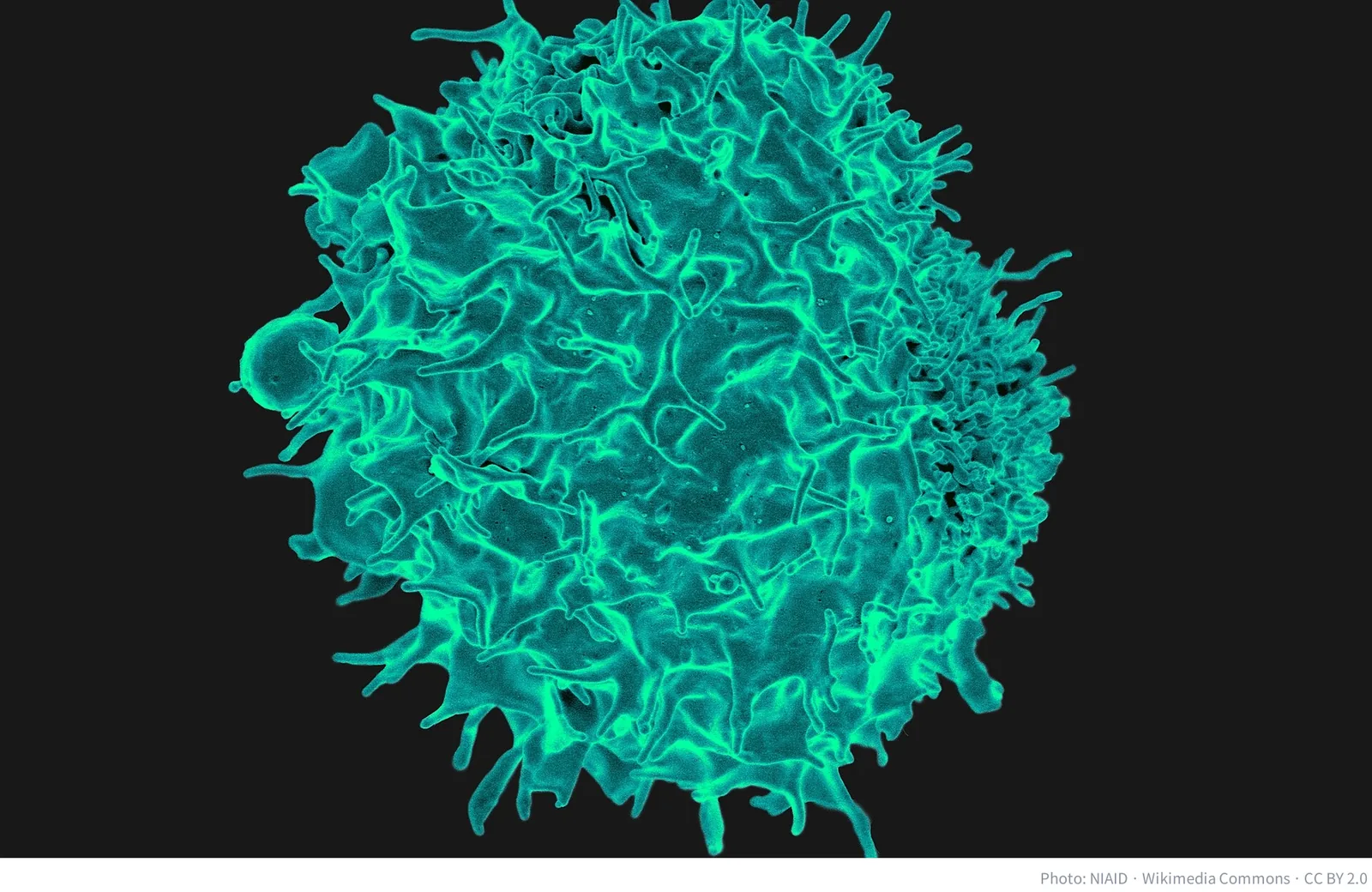
On April 29, 2026, CuroCell’s CAR-T therapy Rimcato (anbalcabtagene autoleucel) was approved by Korea’s Ministry of Food and Drug Safety (MFDS). The treatment takes a patient’s own immune cells (T cells) out of the body, re-engineers them to recognize the cancer and puts them back in. It was the first CAR-T developed in Korea to be approved, about ten years after the first CAR-T was approved in the United States. CuroCell closed at KRW 65,000 that day, its highest close of 2026.
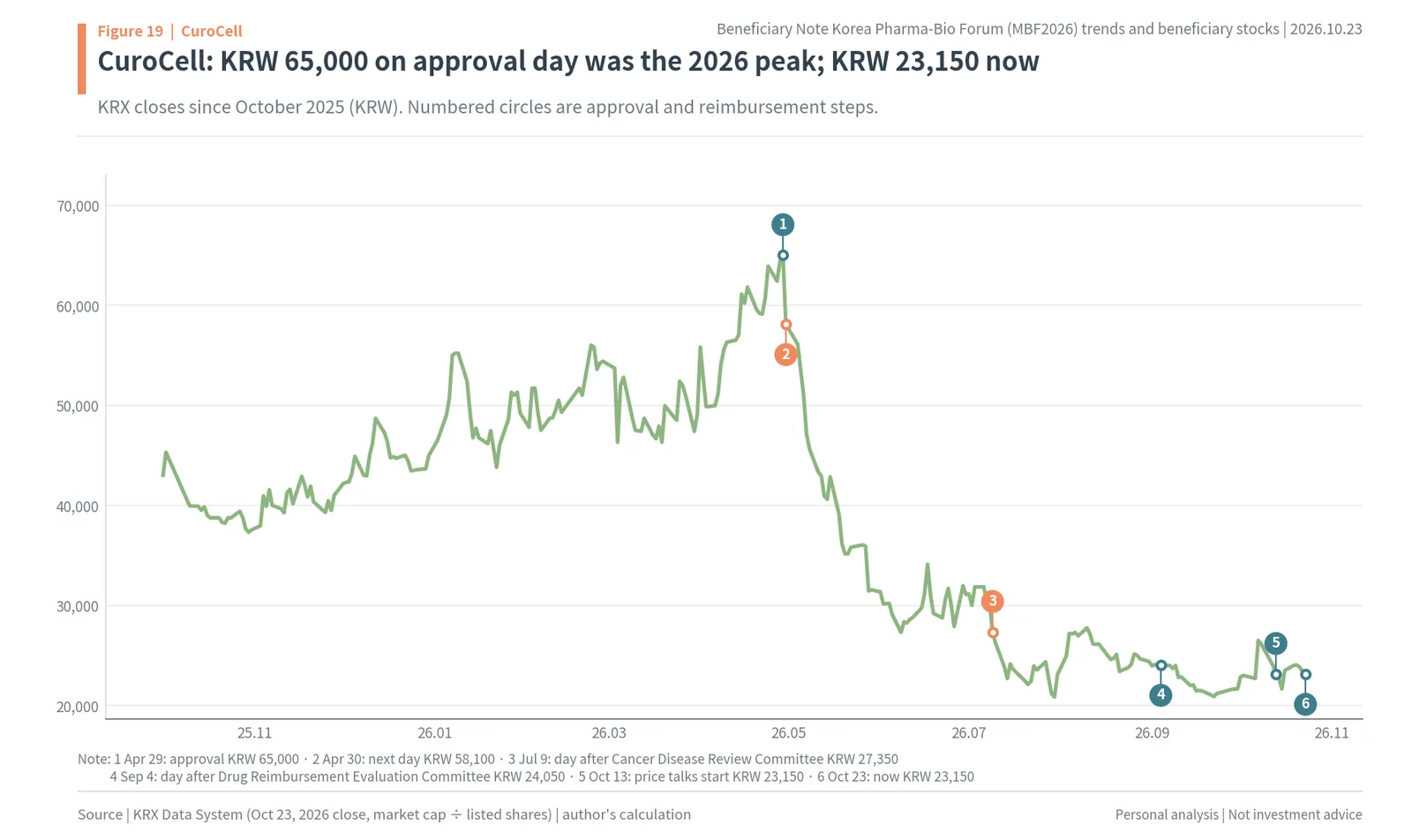
The next day, April 30, the stock fell -10.6% to KRW 58,100. When the Cancer Disease Review Committee set the national health insurance reimbursement criteria on July 8, it fell -10.0% the next day, and the day after Rimcato cleared the Drug Reimbursement Evaluation Committee on September 3 it did not move. The day each piece of good news was confirmed was the top, and the stock went down afterwards. On October 23 it closed at KRW 23,150 (about $17.46), a little over a third of the approval-day price.
That is where this report starts. On October 23, 2026, nine companies, CuroCell among them, presented their plans at the 6th Pharma-Bio International Forum (MBF2026) hosted by the business news outlet Sisa Journal-e. What trends did those presentations describe? Will the money from those trends go only to the companies that presented, or to other listed companies in the same stories? And when is each company’s “next date,” and how much of that date does the share price already assume?
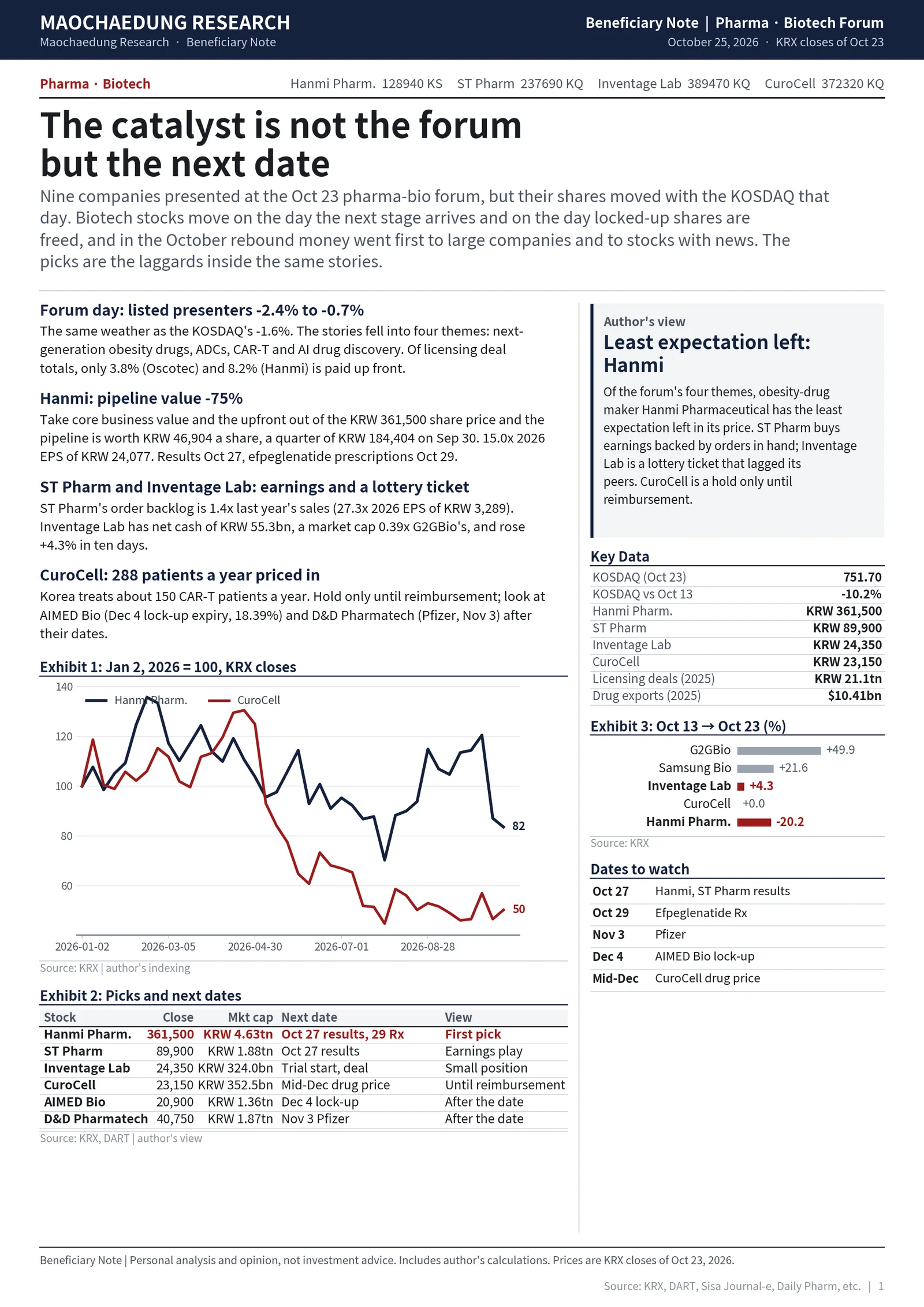
English edition of the author’s Korean note on the 6th Pharma-Bio International Forum (MBF2026) and its beneficiary stocks.
As of: October 25, 2026 (share prices, market caps and net buying by investor type are Korea Exchange regular-session data for October 23, with closes checked as market cap divided by listed shares; consensus is Naver Finance as of October 22; financials are DART half-year reports)
Stocks covered: Hanmi Pharmaceutical (128940.KS), ST Pharm (237690.KQ), Inventage Lab (389470.KQ) and CuroCell (372320.KQ) as the main candidates; the other listed presenters D&D Pharmatech (347850.KQ), Oscotec (039200.KQ), AIMED Bio (0009K0.KQ), Kanaph Therapeutics (0082N0.KQ) and Dongwha Pharm (000020.KS); and, in the same themes, G2GBio (456160.KQ), Peptron (087010.KQ), LigaChem Biosciences (141080.KQ), GC Cell (144510.KQ), Samsung Biologics (207940.KS), Yuhan (000100.KS) and GC Biopharma (006280.KS).
Some Korea-specific background. The KOSPI is the main board of the Korea Exchange (KRX) and its benchmark index; the KOSDAQ is the growth-company board where most Korean biotechs trade. Tickers ending in .KS trade on the KOSPI and .KQ on the KOSDAQ. The KRX publishes net buying by investor type (retail, foreigners and institutions, with institutions split further into pension funds and others) for every stock every day, which is what the flow numbers in this report are built from. DART is the Financial Supervisory Service’s electronic disclosure system for filings such as convertible bond issues and half-year reports. Korea counts large sums in units of 100 million won (eok); this report shows them as KRW bn. Dollar figures use KRW 1,325.99 per dollar, the October 23, 2026 rate (Yahoo Finance).
Topics: the forum and its nine presenters; the four themes the forum described (next-generation obesity drugs, ADCs, CAR-T and AI drug discovery) and the government’s numbers; how biotech companies make money (upfront payments, milestones and royalties in licensing deals); share prices and investor flows on forum day and in the October rebound; Hanmi Pharmaceutical (its pipeline value and next dates); ST Pharm (ingredient orders); Inventage Lab (long-acting injections and cash); CuroCell and GC Cell (CAR-T patient numbers and value); names to look at after their dates (AIMED Bio, D&D Pharmatech, LigaChem Biosciences, Oscotec and Kanaph Therapeutics); the author’s view and calendar; biotech terms; and how the numbers were counted.
1. What the forum said: nine companies each presented their own next step
The conclusion of this section is that the forum was not an event that produced news in one direction. Nine companies explained the drugs they are developing and their next steps, and each step has a different date. That is why each company’s next date, not the forum itself, sets the share price.
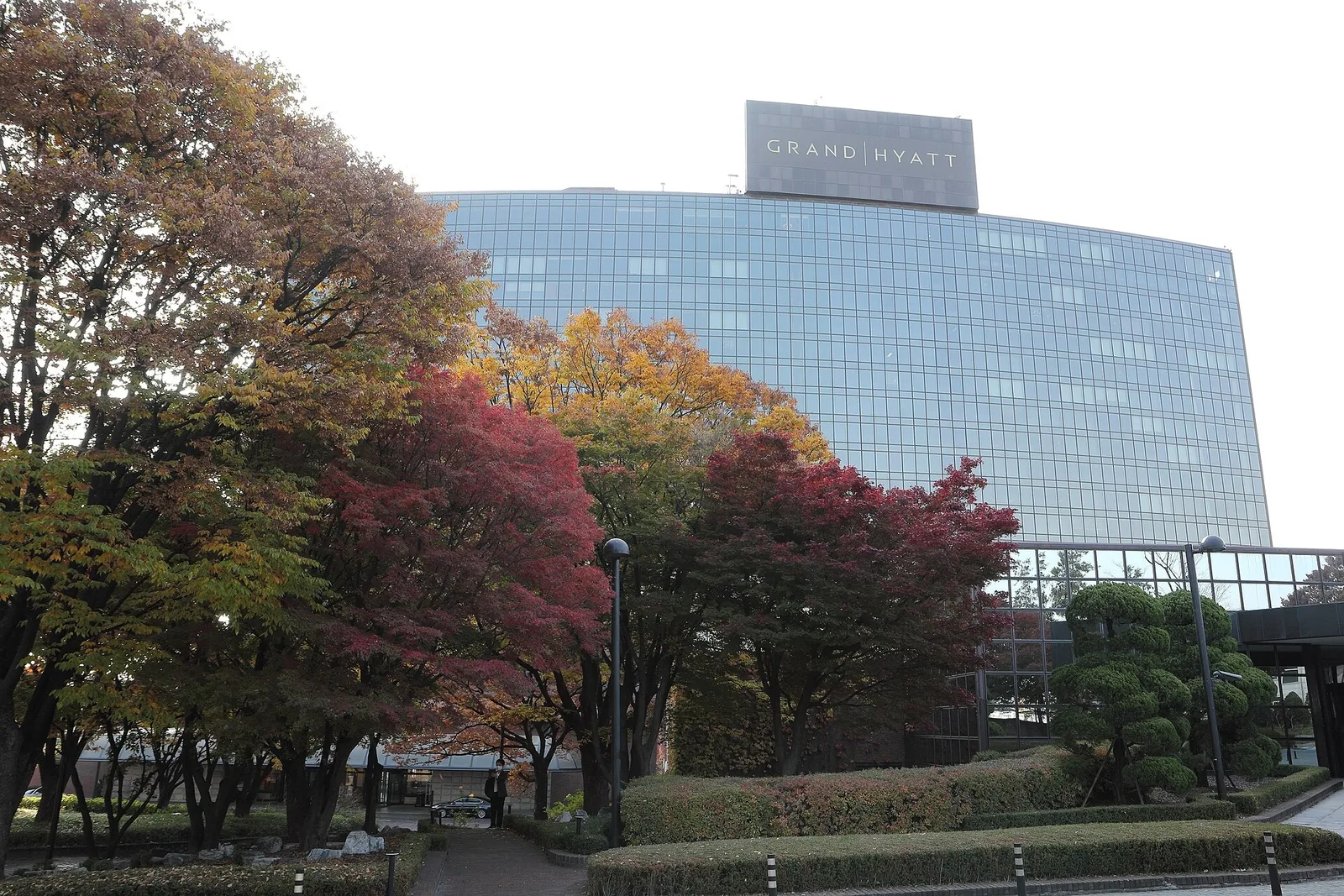
The 6th Pharma-Bio International Forum ran from 9:30 a.m. to 4 p.m. on October 23 at the Grand Hyatt Seoul in Yongsan-gu, Seoul, and was streamed live on Sisa Journal-e’s YouTube channel. Its theme was “K-Pharma Bio Next Innovation.” The Ministry of Health and Welfare, the MFDS, the Korea Pharmaceutical and Bio-Pharma Manufacturers Association, the Korea Biotechnology Industry Organization and the Korea Biomedicine Industry Association sponsored it.
In congratulatory remarks, Lee Man-hee, chair of the National Assembly’s Health and Welfare Committee, said Korea’s drug exports topped $10bn for the first time last year, and MFDS Minister Oh Yu-kyoung said new-drug reviews have been cut to about 240 days. A special session by Oh Seong-il, director of the health ministry’s pharmaceutical and bio industry division, a keynote by MIT Institute Professor Robert Langer and nine company presentations followed.
The morning session covered R&D results and next-generation drug strategies. CuroCell CEO Kim Gun-soo described how Korea’s first CAR-T was developed and the plant that makes it; D&D Pharmatech CEO Lee Seul-ki talked about the next round of competition in GLP-1 obesity drugs; and Jang Jae-won, head of R&D at Dongwha Pharm, discussed research organizations in the AI era. The afternoon session covered next-generation cancer drugs. Kanaph Therapeutics CEO Lee Byung-chul and AIMED Bio CEO Heo Nam-gu presented ADC (antibody-drug conjugate) strategies; Mothers Pharmaceutical vice president Lee Si-eun presented a new osteoarthritis pain drug; Oscotec research head Kwak Young-shin described the company’s experience licensing out an autoimmune drug; and DAI team leader Yoon Tae-woo explained the AI drug discovery platform built with Dong-A ST. Finally, Hanmi Pharmaceutical managing director Kim Hyun-jung described “Total Life Care,” which pairs the obesity drug efpeglenatide with digital health.
Seven of the nine are listed. Mothers Pharmaceutical passed the KOSDAQ preliminary listing review on October 7 and is preparing an IPO. It is a profitable generic and contract-manufacturing company with 2025 sales of KRW 228.8bn and operating profit of KRW 13.6bn, and first-half 2026 sales of KRW 125.8bn and operating profit of KRW 10.4bn; it plans to offer 2.4mn new shares with NH Investment & Securities and KB Securities as lead managers. DAI is the IT affiliate of the Dong-A Socio Group and is not listed. The table below lists, in order of presentation, each company, its theme, its key message, the next date to check and its market cap.
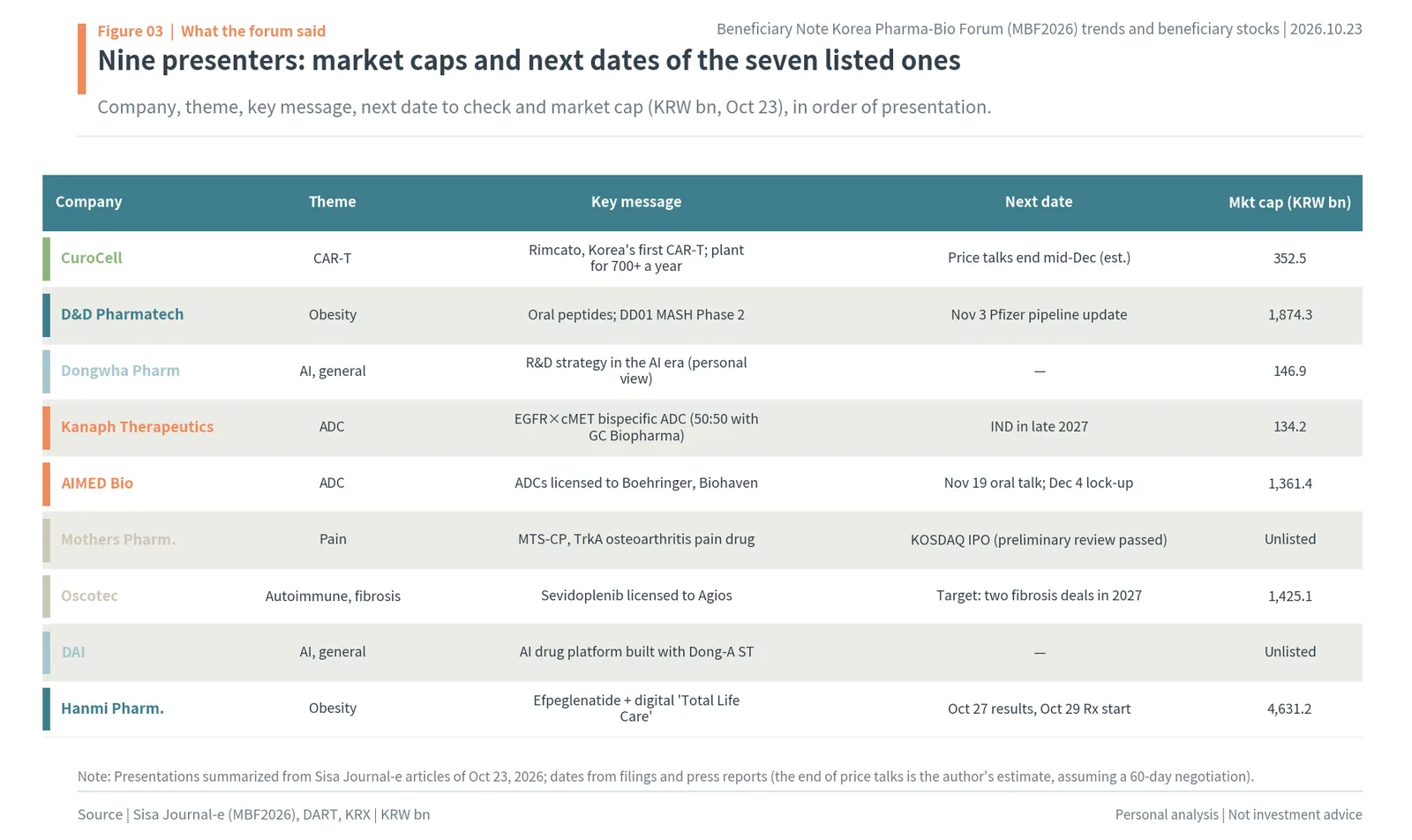
As the table shows, the next dates differ by company. Hanmi has third-quarter results on October 27 and the first efpeglenatide prescriptions on the 29th; D&D Pharmatech has Pfizer’s pipeline update on November 3; AIMED Bio has a partner drug’s conference presentation on November 19 and a lock-up expiry on December 4; and CuroCell has a national health insurance price negotiation expected to end around mid-December. Kanaph Therapeutics’ next big step (filing a US investigational new drug application) is late 2027, and Oscotec’s next licensing target is also 2027. They presented at the same forum on the same day, but the clock investors watch runs separately for each company.
2. Four themes from the forum: next-generation obesity drugs, ADCs, CAR-T and AI drug discovery
The conclusion of this section is that the nine presentations fall into four themes. In obesity drugs, the axis of competition is shifting to “easier to take and longer-lasting”; in ADCs, to “more of a milder payload”; in CAR-T, to “reimbursement after approval”; and in AI, to “accumulating data.” Listed companies that did not present also belong to these four themes.
The four themes and the size of the listed presenters
The seven listed presenters were worth KRW 9.93tn (about $7.49bn) together on October 23. Hanmi Pharmaceutical is the largest at KRW 4.63tn (about $3.49bn), followed by D&D Pharmatech at KRW 1.87tn, Oscotec at KRW 1.43tn and AIMED Bio at KRW 1.36tn. CuroCell is worth KRW 352.5bn, Dongwha Pharm KRW 146.9bn and Kanaph Therapeutics KRW 134.2bn. By theme, obesity (Hanmi and D&D Pharmatech) carries the most weight.
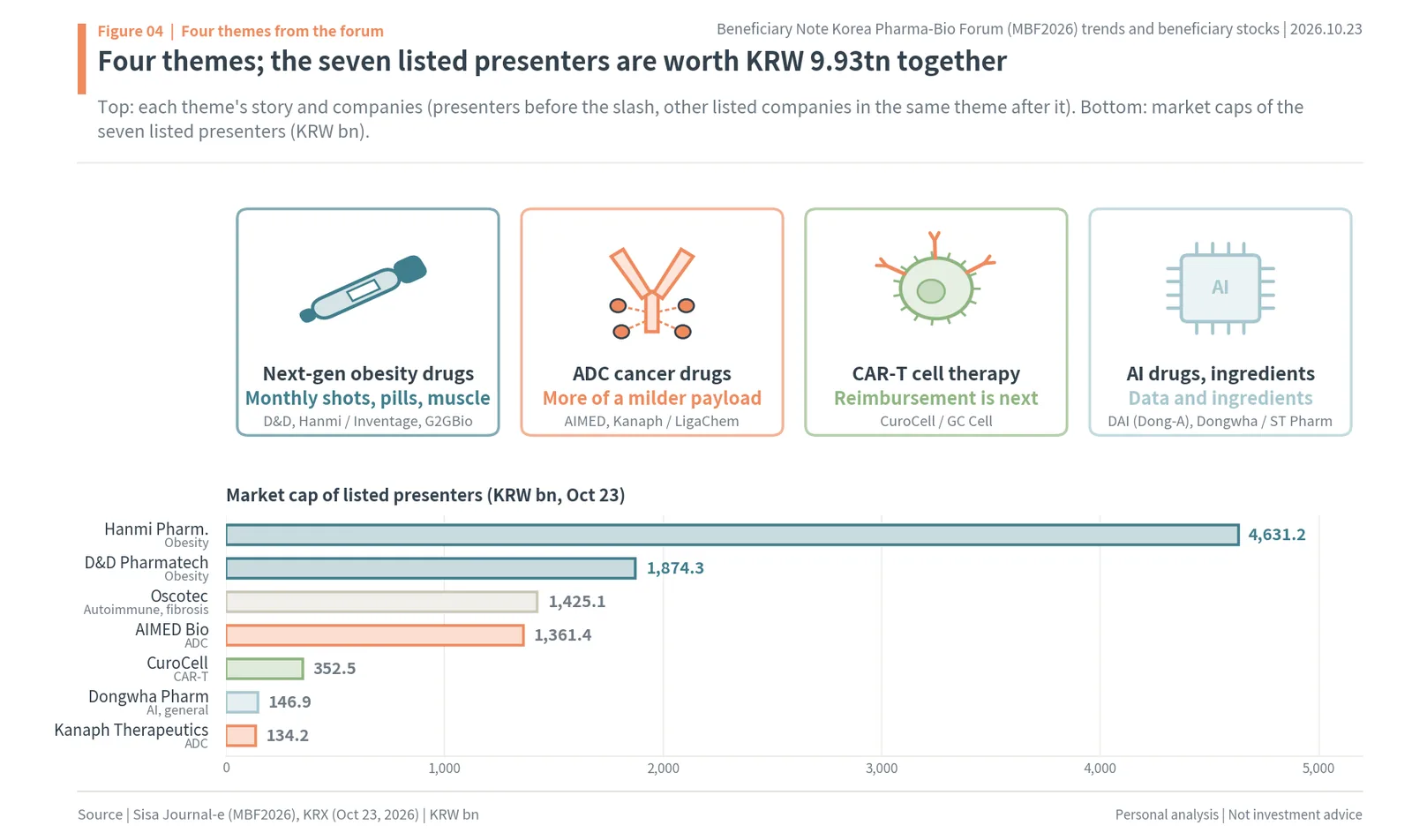
Under each of the four cards at the top of the figure are the presenting companies and, after the slash, other listed companies in the same theme. The obesity theme includes Inventage Lab and G2GBio, which have once-a-month injection technology; the ADC theme includes LigaChem Biosciences, Korea’s most experienced ADC licensor; the CAR-T theme includes GC Cell, which is preparing the next commercial CAR-T; and the AI and ingredients theme includes ST Pharm, which makes the ingredients for RNA-based drugs. That table is the universe in which this report looks for beneficiaries.
Obesity drugs: convenience, duration and muscle over weight-loss numbers
D&D Pharmatech CEO Lee Seul-ki summarized the innovation in next-generation GLP-1 obesity drugs as going in three directions: high efficacy, good tolerability, and better drug delivery with broader therapeutic effects. The clinical numbers he cited show that average weight loss is already high: 14.9% for semaglutide (Wegovy), 20.9% for tirzepatide (Mounjaro), 22.7% for CagriSema and 25.0% for retatrutide. The problems are that up to two thirds of the weight lost comes back within a year of stopping the drug, and that about 25% of the weight lost on tirzepatide is lean mass such as muscle. So the next contest moves from “how much weight” to “how easily, how long, and with how little muscle loss.”
D&D Pharmatech’s answers are OraLink, an oral peptide platform, and DD01, a treatment for fatty liver inflammation (MASH). In a 48-week Phase 2 biopsy analysis, DD01 resolved MASH in 62.5% of patients (5.3% on placebo) and improved liver fibrosis in 50.0% (15.8% on placebo). On muscle preservation, he said the company is researching a myostatin inhibitor and a CRFR2 agonist.
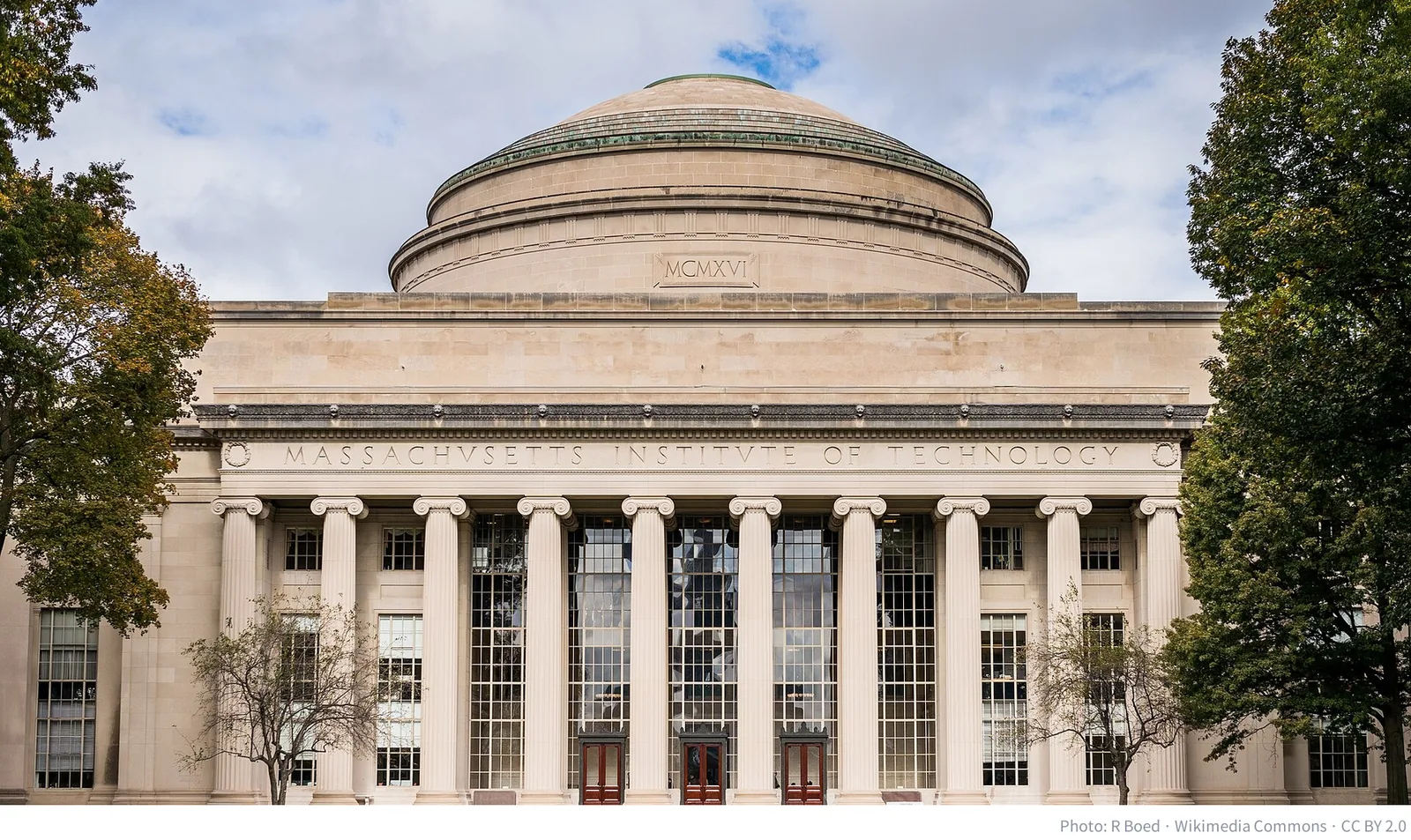
Robert Langer, the MIT Institute Professor who gave the keynote the same day, is a co-founder of Moderna and a leading figure in drug delivery. He presented a technology that released a drug 11 times from a single injection in animal studies, and the possibility of extending the effect of an oral drug from one week to more than a month.
The “one shot that lasts” Langer described is a long-acting injection. The drug is packed into tiny particles (microspheres) that dissolve slowly inside the body; in Korea, Inventage Lab, G2GBio and Peptron work with large drugmakers using this technology. Novo Nordisk signed a deal worth up to €1.165bn with Sweden’s Nanexa in September 2026, and Eli Lilly signed one worth up to $870mn with Sweden’s Camurus in June 2025. The world’s two largest obesity-drug makers are buying once-a-month injection technology.
ADCs: more of a milder payload, and bispecific antibodies
An ADC is a drug that attaches a powerful cancer drug (the bomb) by a linker to an antibody (the missile) that seeks out a target on the surface of cancer cells. According to Kanaph Therapeutics CEO Lee Byung-chul, 700 to 800 ADCs are in clinical trials worldwide. First- and second-generation ADCs carried drugs so toxic that adequate doses could not be given; the third generation, such as Enhertu, loads up to eight molecules of a milder TOP1 inhibitor onto each antibody.
Kanaph’s KNP-701 is a bispecific ADC that targets both EGFR and cMET, co-developed 50:50 with GC Biopharma. He said it uses SoluFlex Link, a water-soluble branched linker developed with Lotte Biologics over three years, which makes a liquid formulation possible. In a 14-day toxicity study in rats, AstraZeneca’s ADC against the same targets (AZD9592) showed toxicity from 80mg/kg, while Kanaph’s compound showed no problems even at 260mg/kg, he said. AstraZeneca stopped developing AZD9592 in July 2026. Kanaph plans GLP toxicity studies in early 2027 and a US IND filing in late 2027.
AIMED Bio CEO Heo Nam-gu stressed choosing targets “starting from the patient.” The company began in translational research at Samsung Medical Center and first checks how much of a target appears in patients’ tumor tissue. ODS025, licensed to Boehringer Ingelheim, received US IND clearance in June 2026 and is preparing a Phase 1 trial of about 90 patients at 13 sites in five countries; AMB302 (BHV-1530), licensed to Biohaven, showed partial responses in Phase 1. AMB303, a ROR1 ADC developed with SK Plasma, will file an IND within the year.
CAR-T: after approval comes reimbursement
CuroCell CEO Kim Gun-soo explained Rimcato’s plant and manufacturing. The KRW 68.0bn commercial plant has five production suites and can treat more than 700 patients a year; the manufacturing failure rate is below 10%, and rapid sterility and mycoplasma tests have cut quality testing from about a month to about a week. The company has also built a system linking ordering, cell collection, manufacturing, delivery and infusion with about 30 hospitals nationwide. On the technology side, he said CuroCell’s own OVIS platform lowers two signals that weaken immune cells (PD-1 and TIGIT) with a single genetic modification. PD-1 protein fell about 63% and TIGIT about 95%, and the technology is patented in the US, Europe, Korea and Japan. Next steps are a Phase 2 trial in adult acute lymphoblastic leukemia and CAR-T for solid tumors. One CAR-T treatment costs KRW 300mn-plus (over $226,000), so prescriptions only grow once national health insurance reimbursement is set. The next gate in this theme is the drug price, not the technology.
AI drug discovery and the government’s numbers
DAI team leader Yoon Tae-woo introduced AIDDP, the AI drug discovery platform DAI launched with Dong-A ST in July. It runs single-cell and spatial transcriptomics data visualization, AI-based compound design and binding prediction, and molecular dynamics simulation in one environment. Oh Seong-il of the health ministry summarized the policy direction as “a sweeping AX (AI transformation) and more public-private investment.”
His numbers were these. Drug exports grew from $4.06bn in 2017 to $7.56bn in 2023 and $10.41bn last year (2025), topping $10bn for the first time. Biohealth exports as a whole were $27.87bn, with a 2026 target of $30.4bn. Over the past ten years there were 180 licensing deals worth KRW 87.16tn, and last year alone was a record KRW 21.1tn (about $15.9bn). Of the 45 Korean new drugs approved from 1999 through this year, 15 came in the last five years. The 2026 open innovation budget is KRW 4.0bn inbound and KRW 10.4bn outbound.
The AI drug budgets are not large. The federated learning program K-MELLODDY has KRW 34.8bn for 2024 to 2028, about KRW 7.0bn a year, and the K-AI drug development preclinical and clinical model program has KRW 49.5bn for 2025 to 2029, about KRW 9.9bn a year (author’s calculation). That is less than one listed biotech spends on research in a year. Inventage Lab alone loses about KRW 37.3bn a year at the operating level.
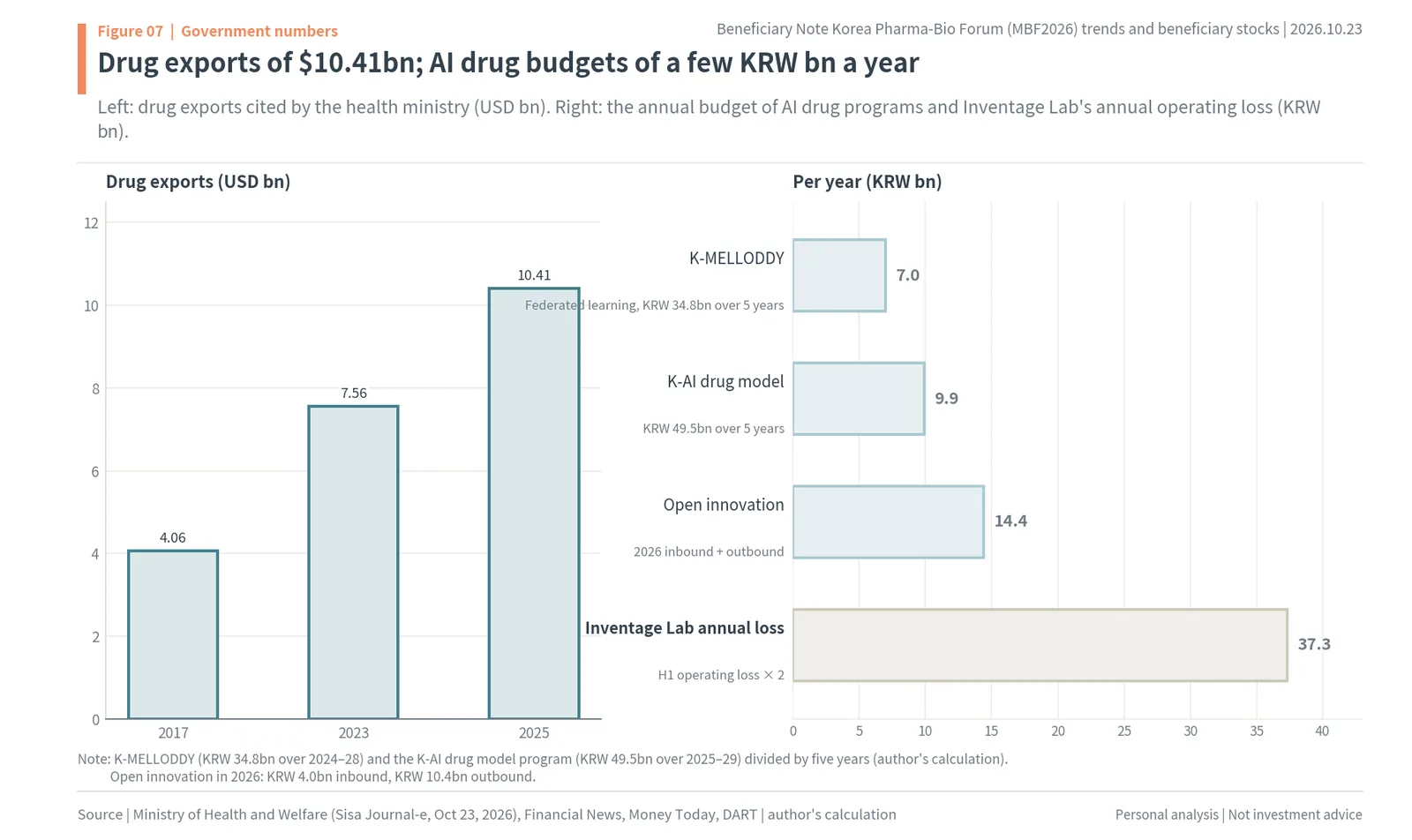
So policy sets the mood for the whole sector, but it does not change any particular listed company’s sales. Beneficiaries have to be found in each company’s clinical, regulatory and contract dates, not in policy budgets. The next section looks at how those dates turn into money.
3. How biotech companies make money: only the upfront is certain, the rest comes stage by stage
This section explains why biotech share prices move on the “next date.” A biotech earns money either by selling drugs itself or by selling the rights to a drug in development to a large drugmaker (licensing, or “technology transfer” as Korean filings call it). Licensing money is split into an upfront payment received at signing, milestones received each time a clinical or regulatory stage is passed, and royalties received after the drug is sold. The headline deal value adds all three, so the only certain money is the upfront.
Two paths: selling drugs and selling rights
A company that sells drugs itself books real revenue. Among the presenters, Hanmi Pharmaceutical is one. It sells its own drugs such as efpeglenatide to hospitals, and its Chinese subsidiary Beijing Hanmi sells drugs too. CuroCell will also become a company that sells its own drug once Rimcato is reimbursed. AIMED Bio, Kanaph Therapeutics and Oscotec, on the other hand, do not sell drugs yet; they make money by handing development-stage rights to larger companies. Their profits pile up in the quarter an upfront or milestone arrives and disappear the next quarter, over and over.
The share of the deal total paid first
The sevidoplenib deal that Oscotec research head Kwak Young-shin described at the forum is a good example. On June 1, 2026, Oscotec licensed this autoimmune drug candidate to Agios in the US. The deal is worth $665mn in total, but the non-refundable upfront payment is $25mn, 3.8% of the total. The rest is development milestones (up to $140mn), sales milestones and royalties from the high single digits to the mid-teens, paid as Agios passes Phase 3 (planned to start in the first half of 2028) and approval.
Hanmi’s deal of August 24, licensing the muscle-preserving obesity candidate HM17321 to Genentech, works the same way. Of the $2.305bn total, the upfront is $190mn, or 8.2%. By industry standards that is a high upfront share, but the other nine tenths still have to be earned stage by stage.
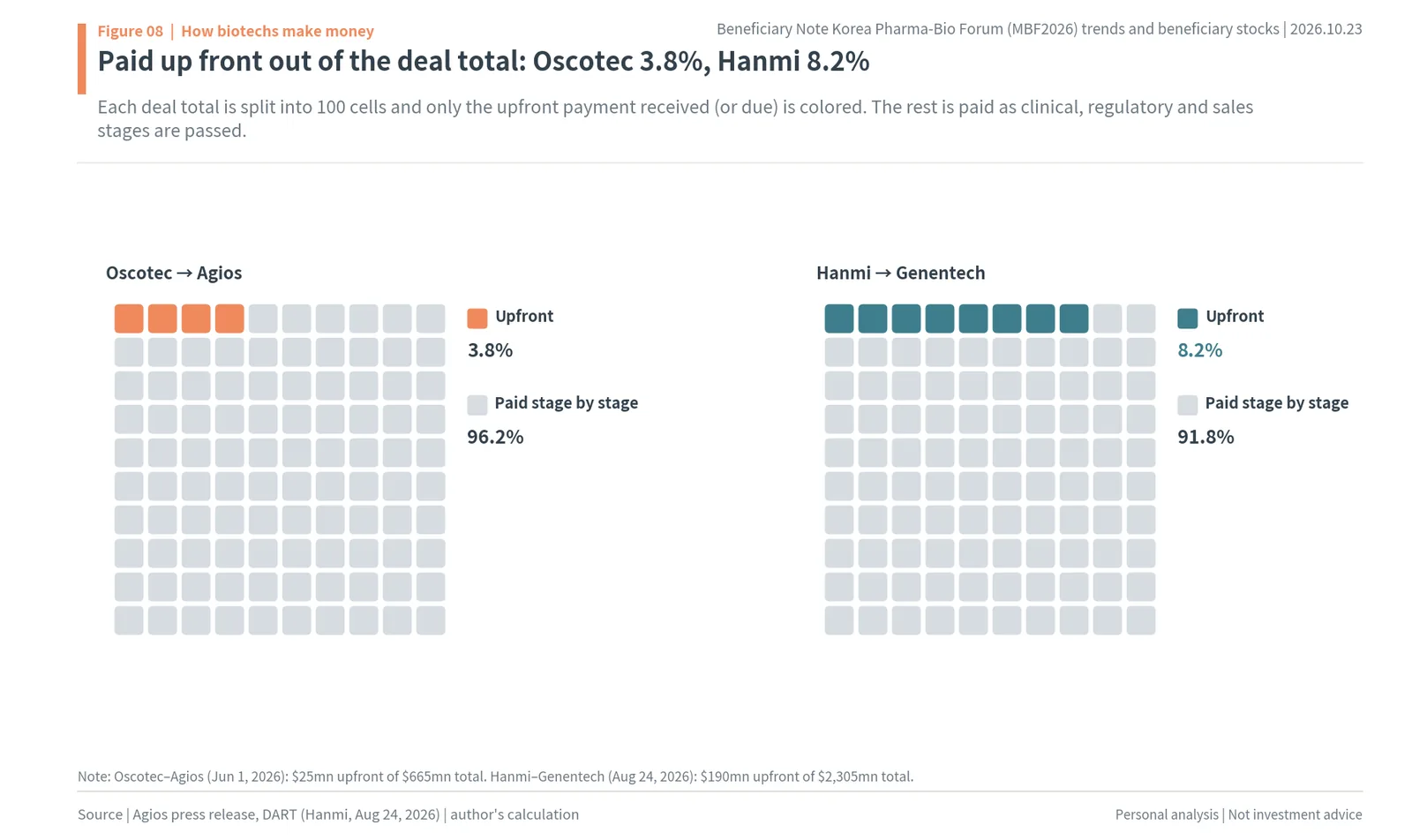
The odds of passing each stage are low. Industry statistics (BIO and Informa, trials from 2011 to 2020) show that 7.9% of drugs entering Phase 1 reach approval, fewer than one in ten. A “trillion-won deal” is the value if everything succeeds, and the market multiplies that value by a probability before putting it in the share price. That is why share prices move sharply on the days the probability changes: clinical results, approvals, reimbursement decisions and new deals.
The days share counts grow or shares are freed
There is one more kind of day that moves share prices. Biotechs have to fund research before they earn money, so they often issue convertible bonds (CBs) or convertible preferred shares. A convertible bond is debt that can later be swapped for shares. If the share price falls, the conversion price also falls, down to a set floor (usually 70% of the initial price), a feature called refixing, and the number of new shares that could be created rises accordingly. In addition, shares that large investors agreed not to sell for a set period at listing (lock-ups) are released all at once on a fixed date. When the share count grows, more shares divide the same company value; on release days, a large block of shares becomes free to sell.
To sum up, biotech share prices move on two kinds of days: the “next-stage day” when the odds change, and the “release day” when the share count changes. The forum was neither. So on forum day the stocks followed the market. The next section shows the numbers.
4. Forum day and the October rebound: money went first to large companies and to stocks with news
This section has two conclusions. On forum day the presenters’ shares slipped along with the KOSDAQ, showing that the forum was not a catalyst. And in the ten days from October 13 to 23, when the KOSDAQ fell hard, biotech held up, but even within the sector money went first to large companies and to companies with news. Companies with the same story that have not yet risen are the candidates for the next turn.
Forum day: the same weather as the market
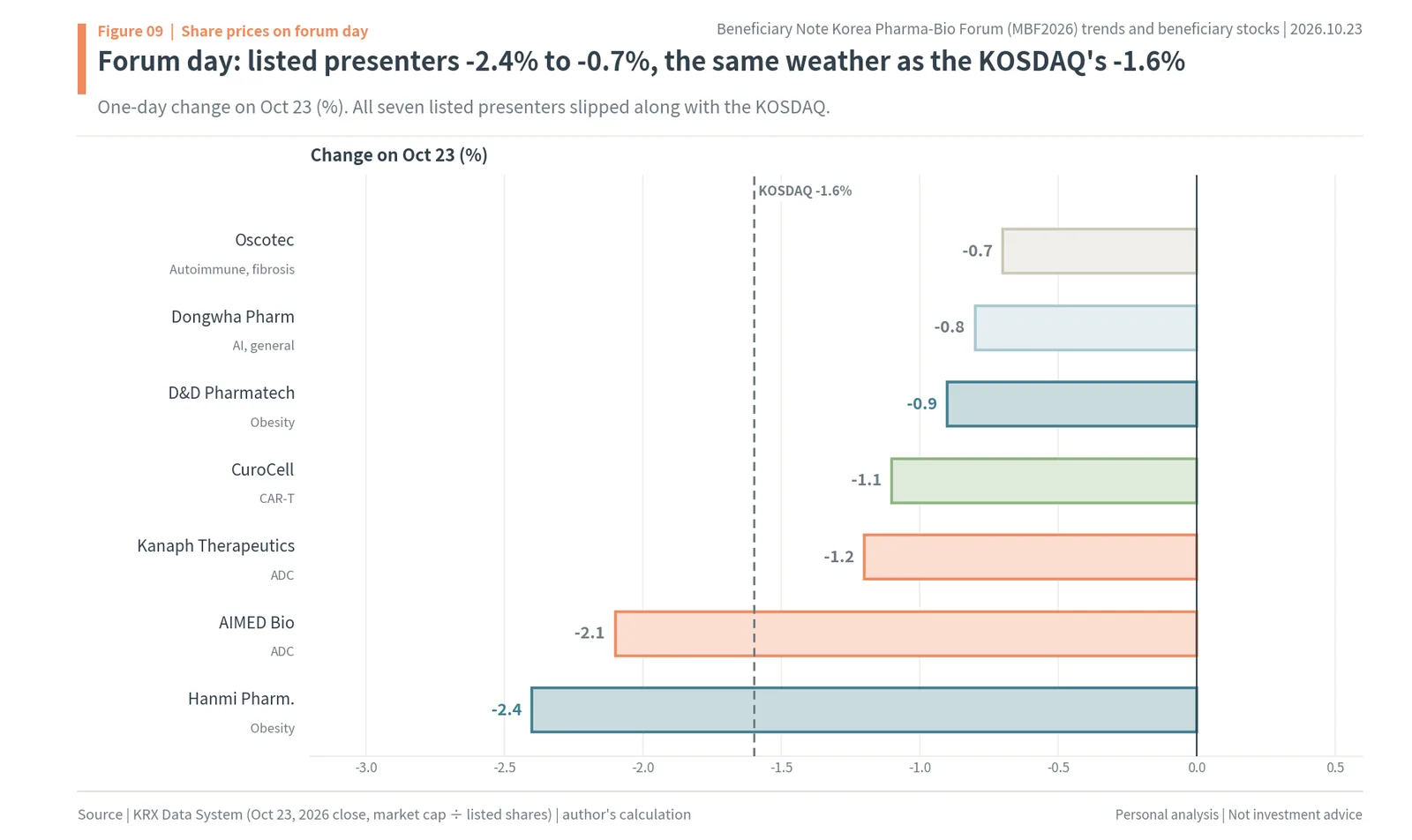
On October 23 the KOSDAQ fell -1.6%. All seven listed presenters fell, by between -2.4% (Hanmi Pharmaceutical) and -0.7% (Oscotec). Their average was -1.3%, almost the same as the KOSDAQ. None of the presentations was the kind of news that changes probabilities, such as a new deal or clinical results, so the shares followed that day’s market weather.
Market background: the KOSDAQ and KOSPI both 39% below their peaks
Korean stocks swung widely in 2026. The KOSDAQ peaked at 1,226.18 on April 27 and was at 751.69 on October 23, down -39%. The KOSPI peaked at 9,114.55 on June 22 and was at 5,550.30 on October 23, also -39%. Biotech turned down earlier. The KRX Health Care index hit 5,270.20 on January 9, its highest in three years, and fell to 3,408.09 by July 29, and the KOSDAQ pharmaceutical index was down -36.65% for the year through September. Money crowding into semiconductors, KOSDAQ trading value shrinking from KRW 15.6tn in May to KRW 7.2tn in July, and a run of clinical failures and contract terminations at individual biotechs all contributed.
October was different. From October 13 to 21, while the KOSPI fell -10.16% and the KOSDAQ -6.65%, the KRX Health Care index rose +5.22%, and institutions net bought KRW 596.4bn of healthcare stocks (Maeil Shinmun, Oct 22). Some of the money leaving semiconductors moved into defensive sectors.
October 13 to 23: who rose and who stood still
From the October 13 close to the October 23 close, the KOSDAQ fell -10.2% and the KOSPI -8.0%. Over the same period G2GBio rose the most, +49.9%, thanks to a platform evaluation agreement for its long-acting injection technology signed on October 19 with China’s UBT (the company that licensed an obesity drug to Novo Nordisk). On forum day, the 23rd, it rose +20.6% in a single day, in contrast with the presenters, which fell about 2% that day. The market priced the deal, an event, not the forum presentations. Peptron fell nearly -30% in one day on October 7, when Lilly’s technology evaluation ended without a deal, then came back +26.1%. Large companies rose too, such as Samsung Biologics (+21.6%) and Yuhan (+16.3%). Yuhan was helped by news that J&J’s third-quarter combined sales of Rybrevant and Lazcluze (lazertinib) rose 62% from a year earlier.
By contrast, Inventage Lab, which has the same once-a-month injection technology, rose only +4.3%; LigaChem Biosciences, the flagship ADC stock, +4.1%; CuroCell 0.0%; and Hanmi Pharmaceutical fell -20.2%. Hanmi’s top was the efpeglenatide approval day on October 7, and it fell -10.71% in a single day on the 14th, when the supply price became known.
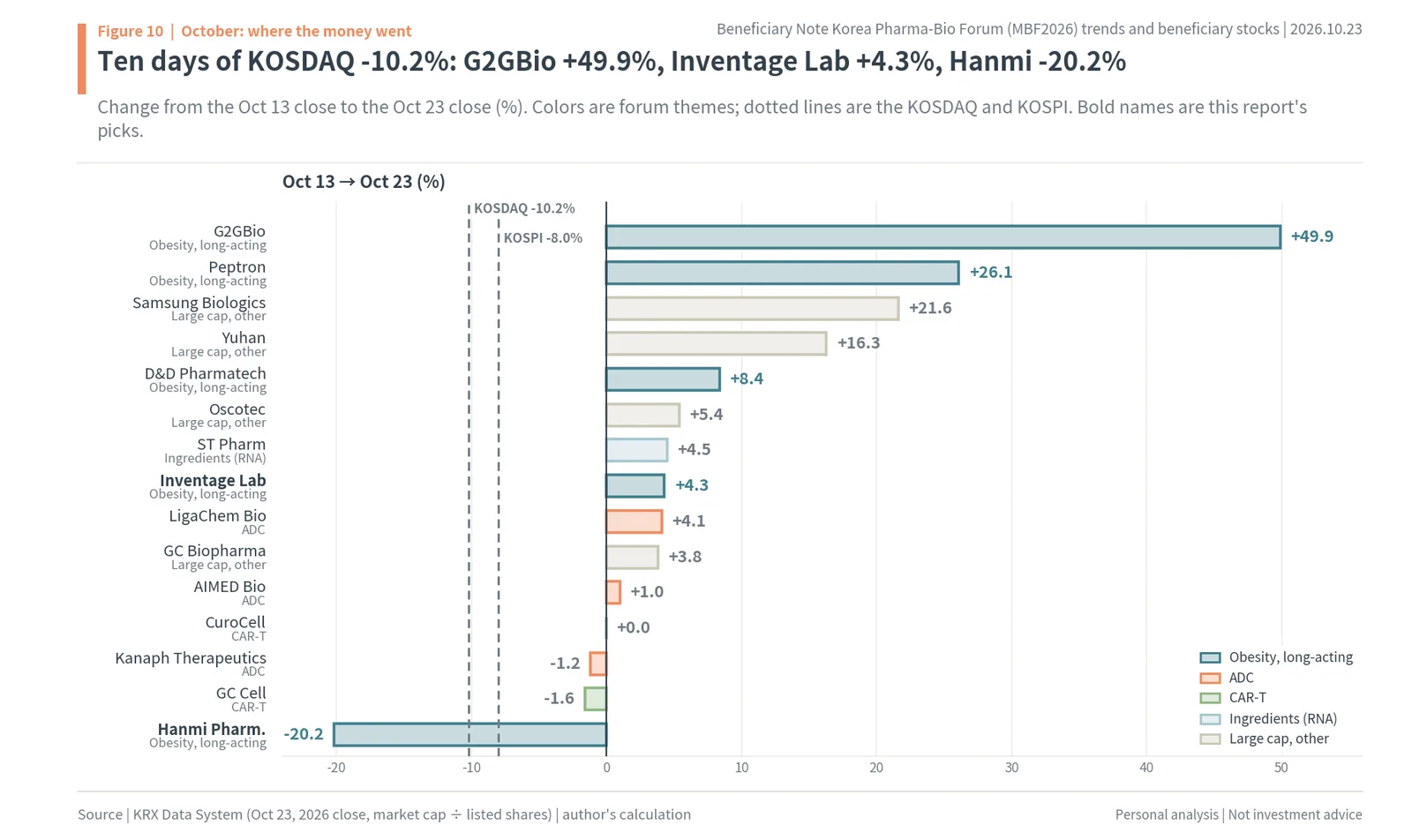
As the figure shows, money went first to “places where something already happened” and to “large companies.” Companies within the same theme that have risen less have room to follow when their next event comes. On that basis this report picks Hanmi Pharmaceutical (obesity), ST Pharm (ingredients) and Inventage Lab (long-acting injections).
Flows: the larger the stock, the more foreigners and institutions moved in opposite directions
Net buying by investor type over the same period shows foreigners net buying KRW 55.6bn of Hanmi Pharmaceutical while institutions net sold KRW 43.0bn and retail investors KRW 9.7bn. Within institutions, pension funds sold KRW 13.4bn. LigaChem Biosciences had the same shape, with foreigners net buying KRW 17.9bn and institutions net selling KRW 7.2bn. At ST Pharm, foreigners (KRW 4.8bn) and institutions (KRW 1.7bn) bought together while retail sold KRW 6.7bn. At Inventage Lab, CuroCell and AIMED Bio, ten-day net buying by each group was within KRW 1.5bn either way: the big money had not moved yet.
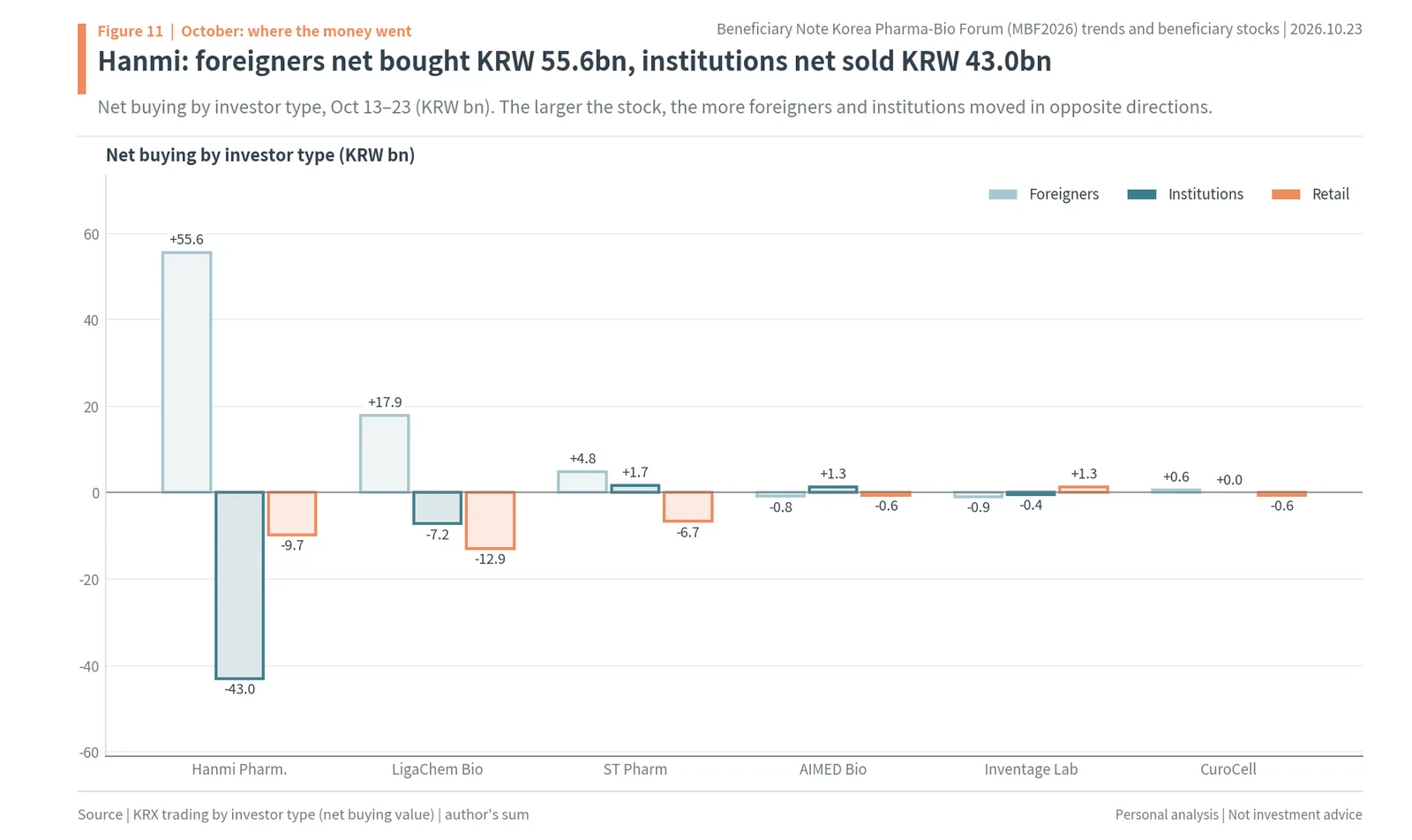
Foreigners taking the shares institutions sold in Hanmi reads as a sign that long-term investors are coming in at a price well below the end of September. How cheap that price is, is the next section’s question.
5. Hanmi Pharmaceutical: the core business is unchanged, but three quarters of the pipeline expectation is gone
The conclusion of this section is that Hanmi Pharmaceutical is the presenter with the least expectation left in its current price. Take the core business value and the upfront already agreed out of the share price, and the remaining “pipeline value” has shrunk to a quarter of what it was on September 30, and the share price has reached the “cheap below” line the author set in a September 30 note on the company. Yet over the next two months come the first efpeglenatide prescriptions, third-quarter results and fourth-quarter recognition of the upfront.
Efpeglenatide: Korea’s first homegrown obesity drug is prescribed from October 29
Hanmi’s obesity injection efpeglenatide (sold as “Efpe”) was approved by the MFDS on October 7, shipped for the first time on the 22nd and will be prescribed in hospitals from the 29th. In Phase 3 it produced an average weight loss of 9.75% over 40 weeks (0.95% on placebo). The supply price per injection ranges from KRW 24,200 for 2mg to KRW 74,800 for 10mg; the first four weeks cost KRW 129,800, and four weeks at 10mg cost KRW 299,200 (about $226). What patients pay at a clinic may differ.
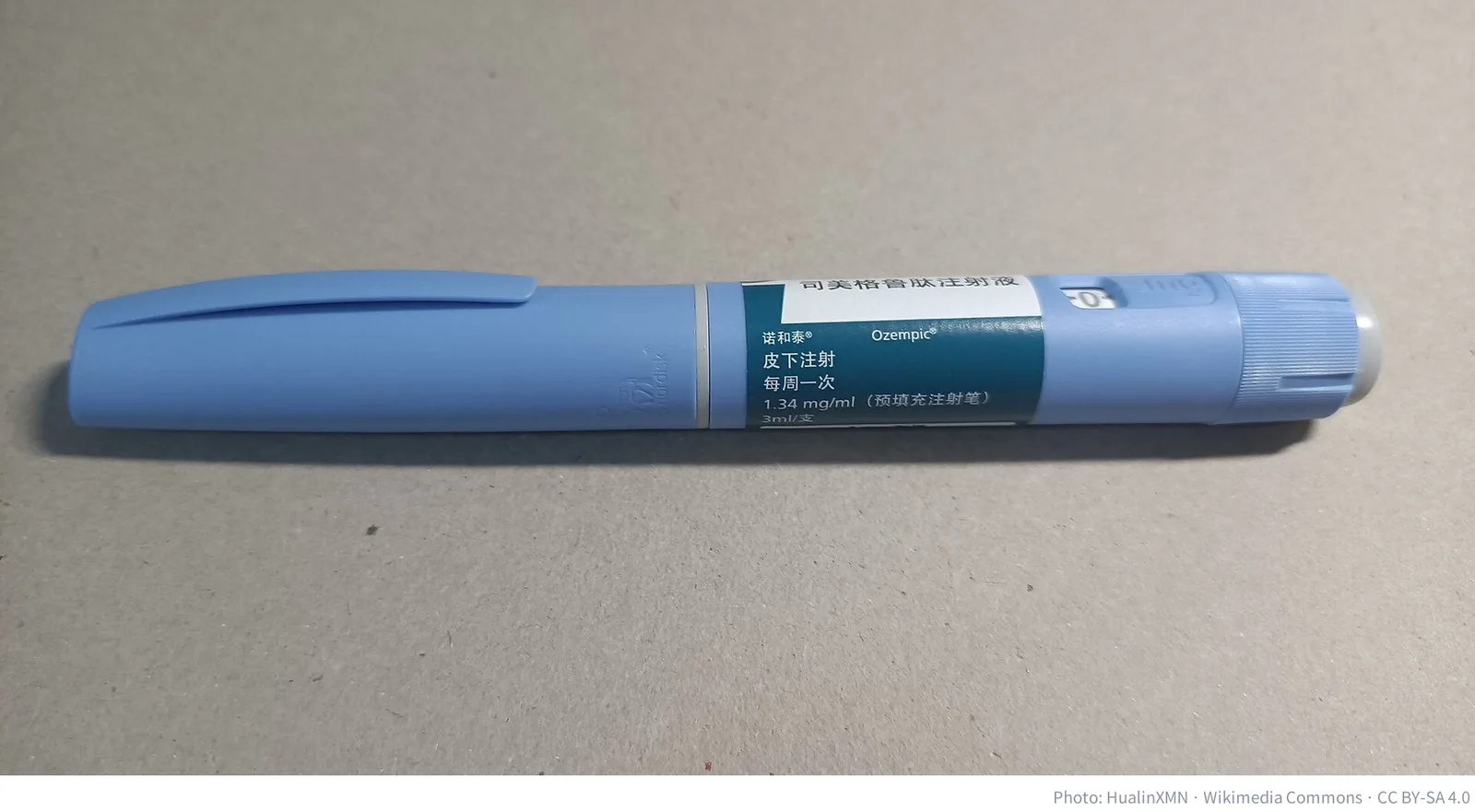
The “Total Life Care” strategy Kim Hyun-jung described at the forum is meant to carry this drug beyond weight loss into maintaining and managing weight with digital health. It is the company’s way of tackling the “weight comes back when you stop” problem that D&D Pharmatech’s Lee Seul-ki raised the same day. The company aims to make efpeglenatide a drug with annual sales of more than KRW 100bn, and Kyobo Securities sees a target of 5% of a first-year market of about KRW 2tn.
Share price: approval day was the top
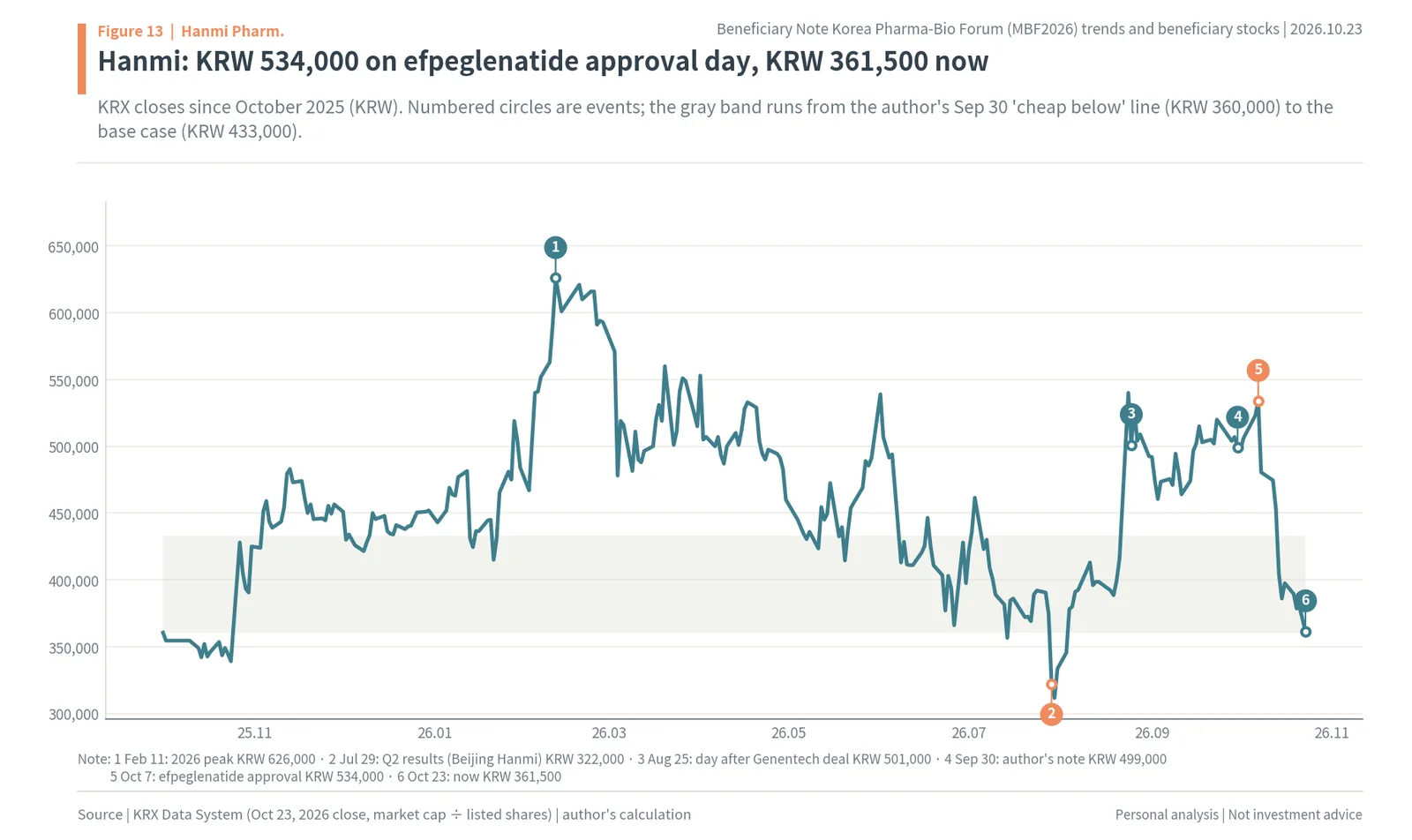
The share price followed the same path as CuroCell’s. KRW 626,000 on February 11 was the 2026 peak, and after second-quarter results on July 29 (Beijing Hanmi sales -29.9%, operating profit -96.6%) it fell to KRW 322,000. The day after the Genentech deal on August 24 it rose to KRW 501,000, and on the efpeglenatide approval day, October 7, it rose again to KRW 534,000. After that, including -10.02% the next day and -10.71% on the 14th, it fell -32% in twelve days to KRW 361,500 (about $273) on October 23. Views that a 9%-range weight loss over 40 weeks is smaller than Wegovy’s or Mounjaro’s overlapped with reactions that the supply price was higher than expected, and they were followed by a demand for a special audit of Beijing Hanmi (by Life Asset Management, which asked for the results to be disclosed by October 30) and reports of a management dispute.
Pipeline value: from KRW 184,404 to KRW 46,904
In a September 30 note on Hanmi, the author split the share price into three parts: core business value (2027 consensus EPS of KRW 18,087 × 16.5 = KRW 298,436 a share), the after-tax per-share value of the Genentech upfront (KRW 16,160), and the remaining pipeline value. Subtracting the first two from that day’s price of KRW 499,000 left a pipeline value of KRW 184,404 a share. The author’s own probability-weighted pipeline value was KRW 118,803, so at the time the market was paying far more for the pipeline than the author did.
Applying the same formula to the October 23 price of KRW 361,500 gives a pipeline value of KRW 46,904 a share. That is -75% from September 30, and only 39% of the author’s estimate remains. Core business value and the upfront have not changed in the meantime, so almost all the value lost in the past month came out of pipeline expectations. Of the author’s September 30 estimate of KRW 118,803, the triple-agonist obesity candidate HM15275 was the largest piece at KRW 75,515 a share, HM17321, the muscle-preserving obesity drug licensed to Genentech, was KRW 23,112, and the other candidates KRW 20,176. Results from HM15275’s 267-patient Phase 2 trial are due in the first half of 2027. The KRW 46,904 of pipeline value in today’s price is 62% of HM15275’s base value alone, which means HM17321, for which Genentech paid an upfront, and the other candidates get almost no value.
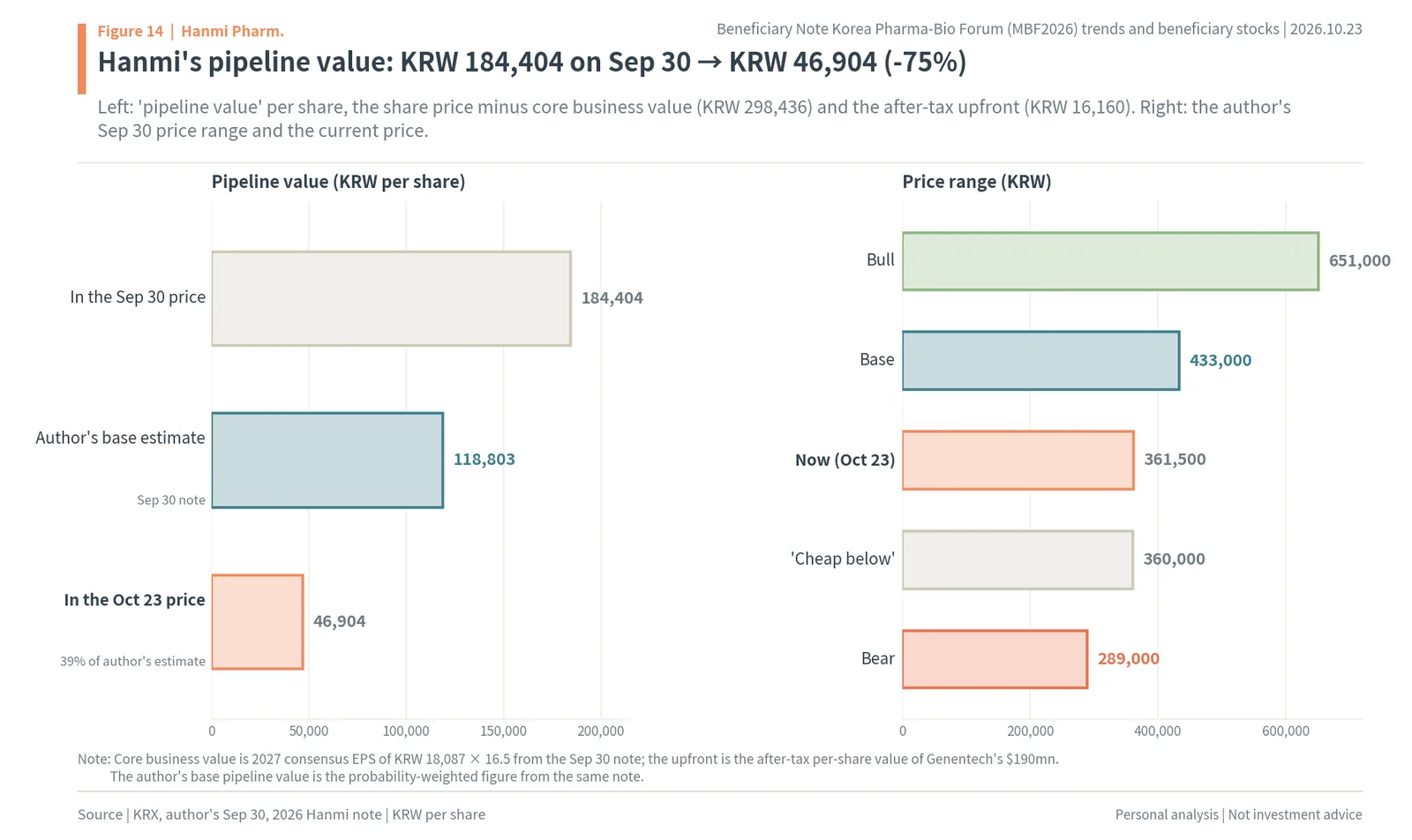
The right-hand chart shows the price range from the September 30 note: bear KRW 289,000, base KRW 433,000 and bull KRW 651,000, with KRW 360,000, roughly halfway between bear and base, set as the “cheap below” line. Today’s KRW 361,500 is 0.4% above that line. The base case is +20% away, the bear case -20% and the bull case +80%: equal distances up and down, with a longer tail on the upside.
Next dates: results on October 27, prescriptions on the 29th, the upfront in the fourth quarter
The first date is the preliminary third-quarter results on October 27. Consensus operating profit is KRW 65.8bn, but that figure mixes in estimates that put part of the upfront into the third quarter. Brokers’ estimates excluding the upfront are KRW 38.6bn (iM Securities), KRW 39.9bn (Kyobo Securities) and KRW 41.3bn (KB Securities). The Genentech upfront of $190mn (about KRW 262.9bn) is expected to be booked across the fourth quarter and the first quarter of next year, after the US antitrust review (HSR) is complete. So a third-quarter profit of about KRW 40bn is a number the market already knows, and the upfront arrives in one block in the fourth quarter.
Consensus 2026 EPS is KRW 24,077, a P/E of 15.0x. That EPS includes the Lilly upfront from the second quarter and part of the Genentech upfront, so it is larger than core earnings alone. The author therefore keeps core business value, as on September 30, at 2027 EPS of KRW 18,087 × 16.5.
After that come the first efpeglenatide prescriptions on October 29, October 30 as the deadline requested for disclosing the Beijing Hanmi audit, and Phase 2b results for MSD’s efinopegdutide (MASH), which may come around the American Association for the Study of Liver Diseases (AASLD) meeting in November. On October 23 Roche added HM17321 to its official pipeline, and the triple-agonist candidate received a WHO international nonproprietary name. A line of events could rebuild the pipeline value, while the share price has already erased three quarters of it.
6. ST Pharm: whichever new drug wins, the ingredient orders come in
The conclusion of this section is that ST Pharm is the lowest-risk beneficiary among the forum’s four themes. ST Pharm is not a company betting on probabilities by developing its own drugs; it makes and sells the ingredient (oligonucleotides) that goes into other companies’ RNA-based drugs. Whichever company’s drug is approved, the ingredient orders go to manufacturers like ST Pharm.
What it sells: short strands of genetic material
An oligonucleotide is a short strand of genetic material made of a few dozen bases. Drugs such as siRNA and antisense use these strands to stop a disease-causing protein from being made. The nose-to-brain siRNA delivery technology of GeneMedicine, a Korean startup Langer introduced at the forum, is also an attempt to carry this class of drug to the brain. The more such drugs there are, the more work there is for companies that can make the ingredient cleanly at scale. Oligonucleotide ingredients are built by chemically linking one unit at a time, which takes dozens of steps per drug and requires high purity, so few companies in the world can build such plants. ST Pharm brought its second oligonucleotide plant fully online in 2026 and exhibited at the CPHI trade show in Spain in early October to find new customers. Its goal is to raise capacity to 14 mol by 2029.
Orders: three big contracts this year, and a backlog larger than last year’s sales
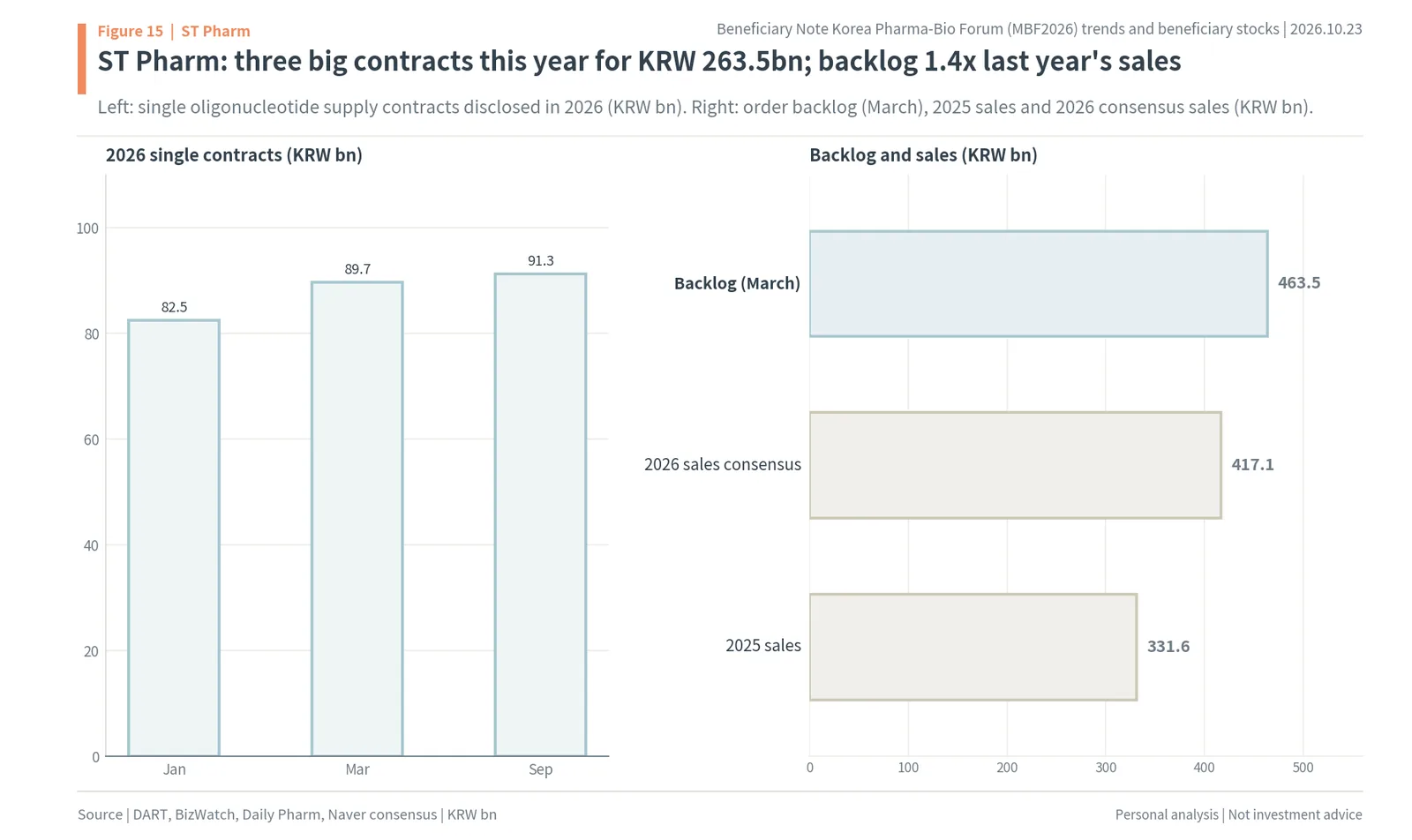
ST Pharm disclosed three single oligonucleotide supply contracts in 2026: KRW 82.5bn in January, KRW 89.7bn in March and KRW 91.3bn on September 18, for KRW 263.5bn in total. The September contract is the largest single contract in the company’s history, equal to 27.5% of 2025 sales, and runs until November 2027. The order backlog as of March was KRW 463.5bn, 1.4 times 2025 sales of KRW 331.6bn. Orders already in hand can keep the plants running for more than a year.
October brought two more pieces of news. GSK’s hepatitis B drug bepirovirsen was approved by the US FDA on October 20, and reports said ST Pharm supplies its ingredient (the company has not confirmed this). On the 23rd there was also a report that Roche had helped ST Pharm build its oligonucleotide production system. The more approved drugs there are, the more the volume becomes recurring commercial supply rather than one-off clinical batches.
Valuation: 27.3x 2026 EPS of KRW 3,289
Operating profit in 2025 was KRW 55.1bn (a 16.6% margin), and 2026 consensus is sales of KRW 417.1bn, operating profit of KRW 75.3bn and EPS of KRW 3,289. The share price of KRW 89,900 (about $67.80; market cap KRW 1.88tn, about $1.42bn) is 27.3x that EPS. That is not a cheap number, but unlike most biotechs, which lose money or book profits only in upfront quarters, ST Pharm’s profits come from running its plants. From October 13 to 23 foreigners (KRW 4.8bn) and institutions (KRW 1.7bn) were both net buyers, and the stock rose +4.5%, lagging the sector rebound.
The next date is third-quarter results on October 27, the same day as Hanmi’s (consensus sales KRW 99.0bn, operating profit KRW 17.6bn). It is the day to check whether results match the backlog.
7. Inventage Lab: among the once-a-month injection companies, the smallest valuation and the smallest gain
The conclusion of this section is that Inventage Lab is the laggard in the “duration” trend of next-generation obesity drugs. G2GBio, with the same technology, signed an evaluation agreement with a Chinese company and rose almost 50% in ten days, while Inventage Lab stood still. Its cash covers more than three years of losses, but it has not yet started trials in people, so its value changes only when a deal with a large drugmaker comes. That makes it a small lottery-ticket position.
What it sells: particles that dissolve slowly
Inventage Lab packs drugs into tiny particles (microspheres) that dissolve slowly inside the body. Its goal is to turn weekly obesity injections into monthly ones, and daily schizophrenia and dementia pills into monthly injections. IVL3021 (a monthly semaglutide) did better in rats than repeated doses of Wegovy and is now in non-clinical toxicity studies. The company has a co-development deal with Yuhan, two joint research projects with Boehringer Ingelheim and, from October 6, joint research with a European drugmaker. It handed Yuhan global exclusive rights in January 2024 (single-digit royalties), and signed co-development agreements with Boehringer Ingelheim twice, in September 2024 and November 2025, handing over the IVL5007 formulation for evaluation in April. First-half revenue is still small: KRW 395mn from licensing and KRW 162mn from services. Beyond obesity drugs, it is extending the long-acting technology to schizophrenia, dementia and addiction treatments and to an animal neutering injection (US patent allowance in October).
Valuation: 0.39 times G2GBio
Put the three companies with the same technology side by side and the gap is visible. On October 23, market caps were KRW 2.44tn for Peptron, KRW 826.5bn for G2GBio and KRW 324.0bn (about $244mn) for Inventage Lab, whose shares closed at KRW 24,350 (about $18.36). Inventage Lab is worth 0.39 times G2GBio. Over October 13 to 23, G2GBio rose +49.9%, Peptron +26.1% and Inventage Lab +4.3%. G2GBio rose on its October 19 platform evaluation agreement with China’s UBT (the company that licensed an obesity drug to Novo Nordisk), and Peptron fell nearly -30% in one day when Lilly’s 24-month evaluation ended without a deal on October 7, then recovered.
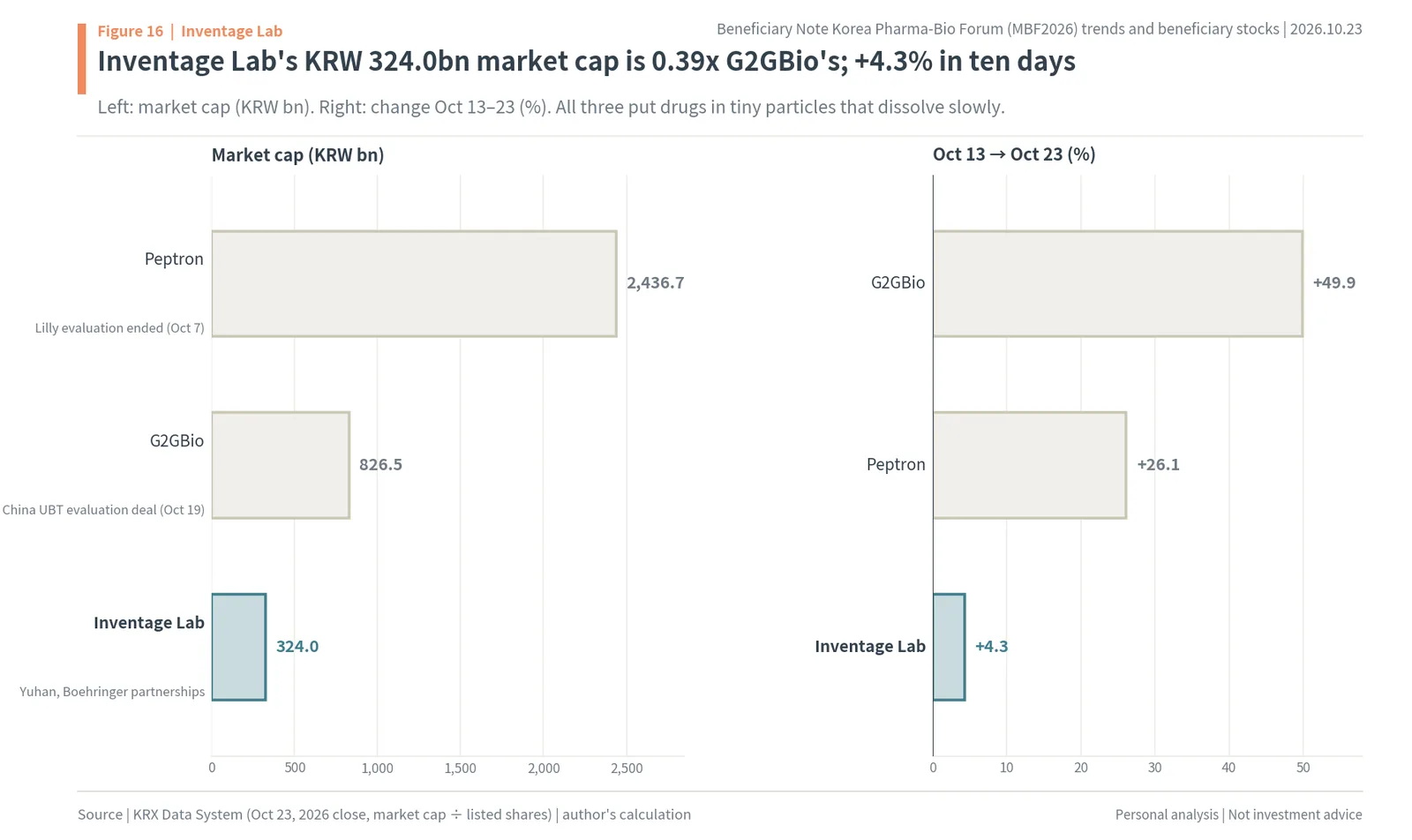
The two deals in section 2 show that large drugmakers are spending money on this technology: up to €1.165bn for Novo Nordisk and Nanexa, and up to $870mn for Lilly and Camurus. If Inventage Lab signs one such deal, its valuation could be reset to G2GBio’s level.
Staying power: cash covers 3.1 years of losses, and KRW 55.3bn is left after all debt
The half-year report as of the end of June shows cash of KRW 97.59bn, short-term deposits of KRW 14.0bn and financial assets at fair value through profit or loss of KRW 4.15bn, for cash and equivalents of about KRW 115.7bn. For debt, the author counted everything: loans of KRW 9.43bn, convertible bonds of KRW 16.0bn, bonds with warrants of KRW 3.45bn, leases of KRW 5.88bn and KRW 25.7bn of other financial liabilities whose details are not disclosed, for about KRW 60.5bn. Cash and equivalents of KRW 115.7bn cover 3.1 years of the roughly KRW 37.3bn annual loss (twice the first-half operating loss of KRW 18.67bn); even after subtracting all KRW 60.5bn of debt, KRW 55.3bn is left. The convertible bonds, a large part of the debt, do not have to be repaid before March 2028.
The KRW 37.25bn of convertible bonds issued in March (conversion price KRW 91,077) carry no downward reset of the conversion price, and the first date investors can demand repayment is in March 2028. The conversion price of the convertible preferred shares fell to its floor of KRW 63,800 on October 19, making them convertible into 826,759 shares (6.2% of the current share count). The floor is 2.6 times the current share price, so they will not convert soon. The March 12 close of KRW 99,500 was the peak, and today’s KRW 24,350 is -76% from it. The fall came with the market rather than from company events: on each day the KOSDAQ fell hard, Inventage Lab fell harder.
Value: bear KRW 7,448, base KRW 22,923, bull KRW 58,474
The author valued it three ways. The bear case is KRW 105.3bn: net cash of KRW 55.3bn plus just KRW 50bn for the platform. The base case is the current market cap, and the bull case is G2GBio’s market cap. Dividing by the share count including the convertible preferred gives KRW 7,448, KRW 22,923 and KRW 58,474 a share. Weighted 1:2:1, that is KRW 27,942, +15% from today.
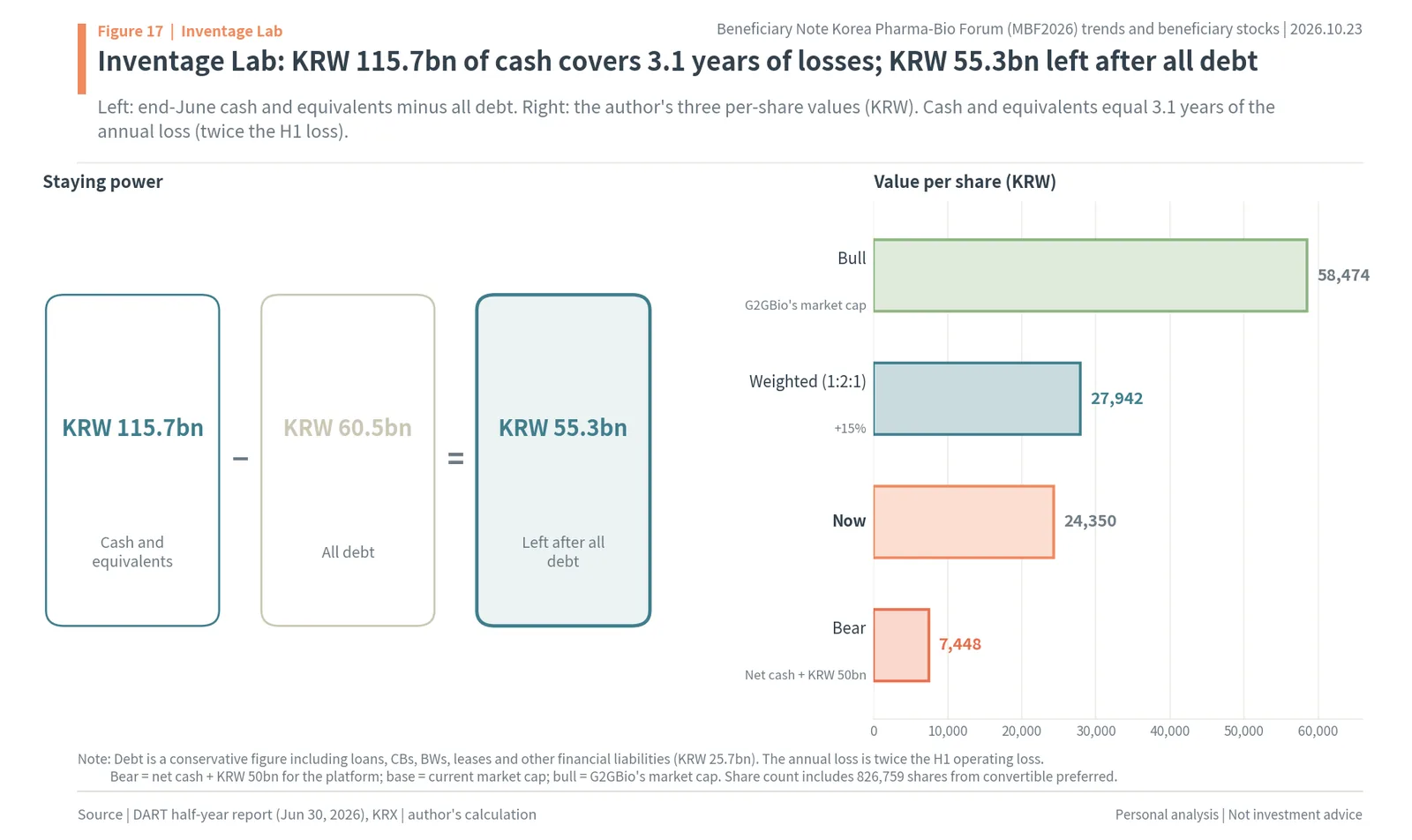
The reason to include it despite a modest expected value is the long upside tail. One deal could re-rate it to more than double, and the cash means little worry about a share issue while waiting for that news. But no event has a fixed date, so the position stays small.
8. CuroCell and GC Cell: the share price already assumes about twice today’s CAR-T patients
The conclusion of this section is that CuroCell is an event stock to hold only until reimbursement. The national health insurance price negotiation is expected to end around mid-December, and revenue begins once reimbursement starts. But convert today’s share price into patients and you get about 288 a year, 1.9 times the number of patients who currently receive CAR-T in Korea (about 150 a year). Just as approval day was the top, reimbursement day is likely to be one too. GC Cell, in the same theme, is preparing the next CAR-T, but it is short of cash, so the risk of a share issue comes first.
The road to reimbursement
After its April 29 approval, Rimcato has been going through Korea’s reimbursement steps: the Cancer Disease Review Committee, then the Drug Reimbursement Evaluation Committee of the Health Insurance Review and Assessment Service (HIRA), then a price negotiation with the National Health Insurance Service (NHIS), and finally the Health Insurance Policy Deliberation Committee. The Cancer Disease Review Committee sent it back once in May, then set reimbursement criteria on July 8, and it passed the Drug Reimbursement Evaluation Committee on September 3. The condition is accepting a price at or below HIRA’s evaluated price. Price negotiations with the NHIS began around October 13; negotiations usually take 60 days, which points to mid-December, after which the Health Insurance Policy Deliberation Committee reviews it and the listing is published (author’s estimate). Hospital preparations are under way too. The drug committees at Asan Medical Center (in July) and Seoul National University Hospital (in September) added Rimcato, and the company is aiming for 25 hospitals by year-end.
The share price rose ahead of these steps and fell once each step was confirmed. The approval-day price of KRW 65,000 was the 2026 peak; the next day it fell -10.6%, and the day after the Cancer Disease Review Committee decision it fell -10.0%. The day after the Drug Reimbursement Evaluation Committee (September 4) it was flat at KRW 24,050, and it closed at KRW 23,150 both on October 13, when price talks began, and on October 23.
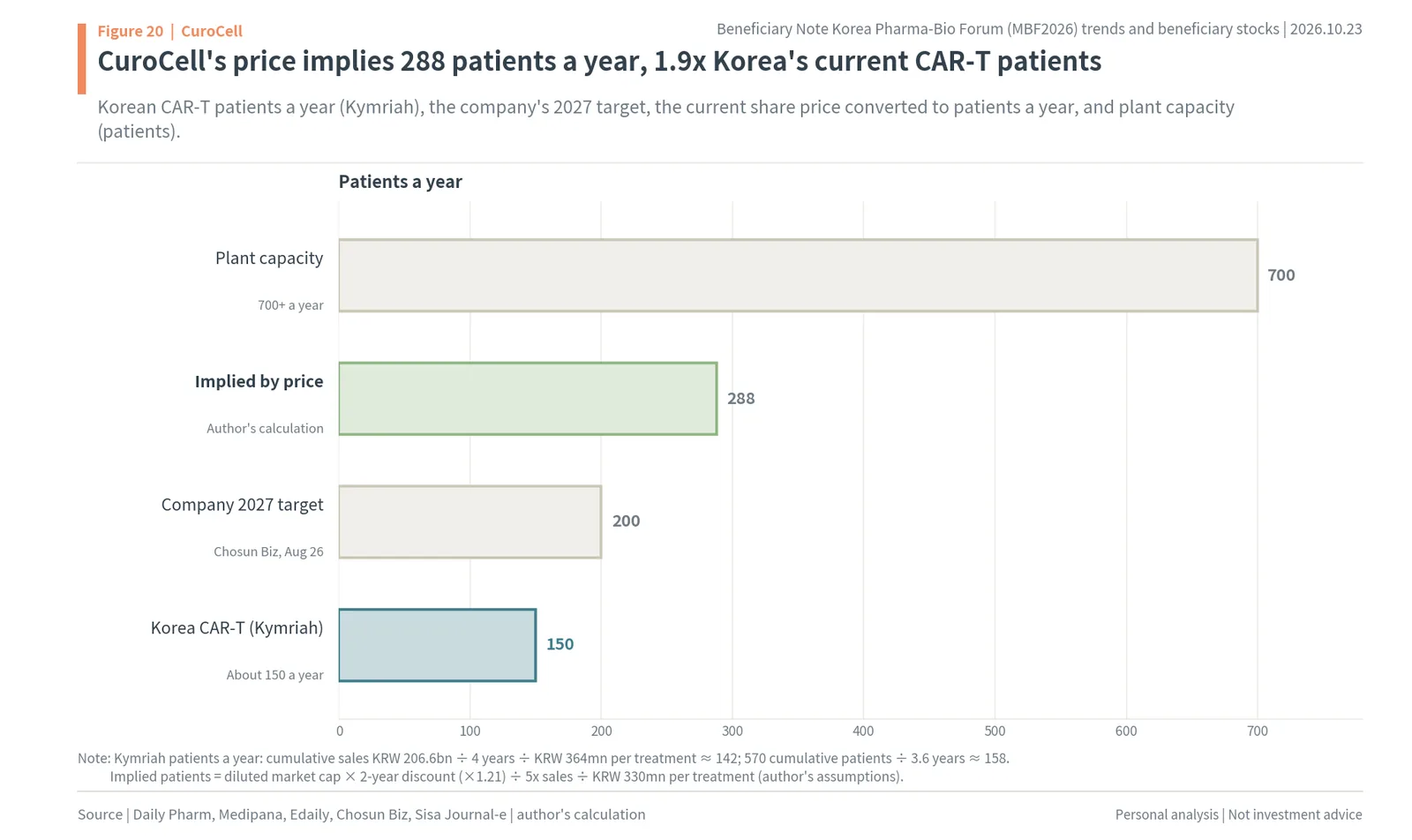
The share price in patients: 288 a year
The size of Korea’s CAR-T market can be measured with Novartis’s Kymriah. Kymriah has been reimbursed at KRW 363,930,000 (about $274,000) per treatment since April 2022, and more than 570 patients had received it by November 2025. Cumulative sales from March 2021 to March 2025 were KRW 206.6bn. Working back from sales gives about 142 patients a year; working back from cumulative patients gives about 158. So the author takes current CAR-T use in Korea as about 150 patients a year.
CuroCell targets about 200 patients in 2027, and the industry talks of sales of KRW 75.0bn in 2027 and KRW 90.0bn in 2028. The plant can make more than 700 a year. The author took the current market cap plus conversion shares, applied a two-year discount (×1.21), and divided by KRW 330mn per treatment and a sales multiple of 5 to find the annual patient count the share price assumes. The answer is about 288. That is 1.9 times Korea’s current CAR-T patients, and more than the company’s 2027 target.
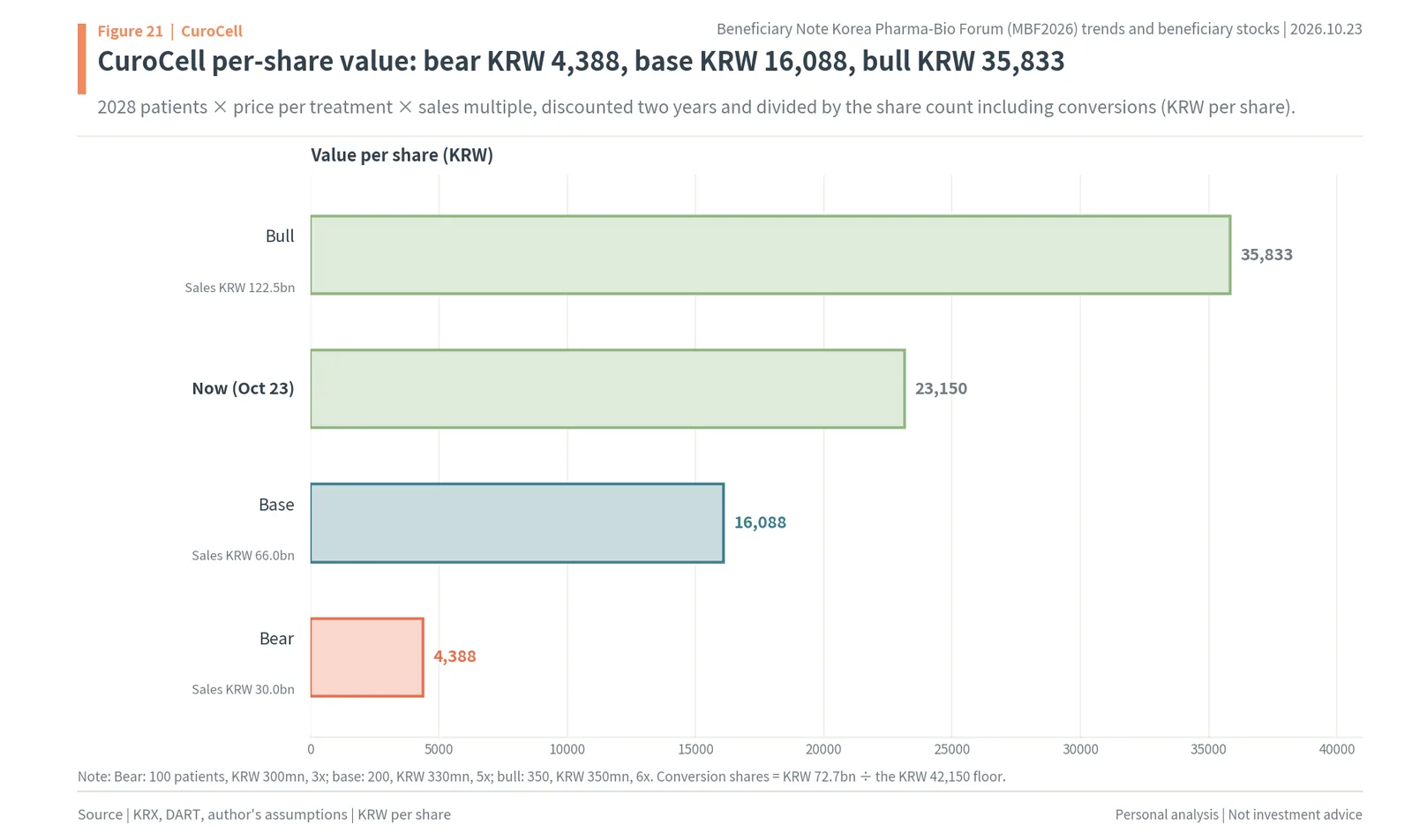
Value: bear KRW 4,388, base KRW 16,088, bull KRW 35,833
The author ran three cases the same way. The bear case is 100 patients in 2028 at KRW 300mn per treatment and 3x sales; the base case 200 patients, KRW 330mn and 5x; the bull case 350 patients, KRW 350mn and 6x. Sales come to KRW 30.0bn, KRW 66.0bn and KRW 122.5bn; after a two-year discount and division by the share count including conversions, that is KRW 4,388, KRW 16,088 and KRW 35,833 a share. Today’s KRW 23,150 (market cap KRW 352.5bn, about $266mn) sits between the base and bull cases. Even if the company hits its target of 200 patients, today’s price already assumes more than that.
The share count can also grow. The KRW 36.35bn of convertible bonds and KRW 36.35bn of convertible preferred shares issued in April start at a conversion price of KRW 60,200 that can be reset lower every seven months (the first reset around November 27), down to a floor of KRW 42,150. At the floor, 1,724,792 new shares, 11.3% of the current count, could be created. The floor is above today’s price, so they will not convert soon, but supply will appear as the price nears KRW 42,150. At the end of June, cash and equivalents were about KRW 83.1bn and total equity KRW 72.5bn, against a first-half pre-tax loss of KRW 26.3bn. The KOSDAQ’s loss rule (a company whose pre-tax loss exceeds 50% of its equity in repeated years is designated an administrative issue, a warning label that puts its listing at risk) applies to CuroCell from fiscal 2027.
So the author treats CuroCell as an event stock until the reimbursement listing is published. If the price is set close to Kymriah’s, expectations will build until listing day, and that day is likely to be the top, just as approval day was.
GC Cell: the next CAR-T, but cash comes first
GC Cell applied in February 2026 for approval to import Fucaso (equecabtagene autoleucel), a BCMA CAR-T from China’s IASO Bio. It is not yet approved, and the second-half 2027 launch and KRW 40.0bn of sales are a research firm’s estimates. Once Rimcato’s price is set, there will be a benchmark for the price of both domestic and imported CAR-T, which matters for GC Cell too. First-half revenue was KRW 78.98bn (51.0% from lab testing) with an operating loss of KRW 6.12bn, and the second-quarter loss narrowed to KRW 1.0bn.
The problem is money. Cash at the end of June was just KRW 1.39bn, and short-term borrowings rose to KRW 81.61bn from KRW 51.61bn at the start of the year. With a market cap of KRW 209.8bn and equity of KRW 189.35bn, the price-to-book ratio is just over 1x, but a share issue may come first, to repay debt or to launch Fucaso. So the author will look at GC Cell after its funding plan is settled.
9. Wait until after the date: AIMED Bio, D&D Pharmatech, LigaChem Biosciences, Oscotec and Kanaph
The conclusion of this section is that even good companies are held down before the day their shares are freed or their share count grows, so look at them after that day. At AIMED Bio, 18.39% of listed shares come out of lock-up on December 4; at D&D Pharmatech, the CB conversion price can be reset from October 30 and Pfizer’s November 3 update is the fork in the road. A third of LigaChem Biosciences’ value is cash, but it has no good news with a fixed date yet; Oscotec needs its subsidiary merger terms first, and Kanaph a licensing deal.
AIMED Bio: 18.39% on December 4
AIMED Bio listed on December 4, 2025 at an IPO price of KRW 11,000, rose to KRW 72,500 by December 18 and now trades at KRW 20,900 (about $15.76; market cap KRW 1.36tn, about $1.03bn). Its assets are good. ODS025, licensed to Boehringer Ingelheim, is a deal worth up to $991mn plus royalties, and after the June US IND clearance the company claimed a milestone. The company’s 2026 targets are sales of KRW 56.3bn and operating profit of KRW 18.1bn. Biohaven’s BHV-1530 followed a European Society for Medical Oncology (ESMO) poster on October 23 with an oral presentation at the EORTC-NCI-AACR symposium on November 19.
But the one-year post-listing lock-up ends on December 4. That is 11,799,426 shares, 18.39% of the 64,156,161 listed shares, worth KRW 246.6bn at today’s price. The free float rises from 42.03% to 60.42%. The shares belong to venture and financial investors such as the InterVest Deep Tech fund (3.83mn-plus shares), a Samsung Securities trust (2.87mn-plus) and the Samsung Life Public Welfare Foundation (1.69mn-plus). When the first lock-up after listing (16%) ended on February 4, investors kept selling too. Yuhan sold its entire stake right after the listing.
D&D Pharmatech: refixing from October 30, Pfizer on November 3
D&D Pharmatech issued KRW 226.5bn of zero-coupon convertible bonds on April 30 (conversion price KRW 77,736). From October 30 the conversion price can be reset every six months, with a floor of KRW 54,416. At the floor, 4,162,379 shares, 9.0% of the current count, could be created. The first date investors can demand repayment is October 30, 2028, and cash and equivalents at the end of June were about KRW 177.0bn, so there is no near-term money problem.
The bigger day is November 3, when Pfizer reports third-quarter results and updates its pipeline. D&D Pharmatech licensed oral obesity technology to Metsera (acquired by Pfizer), and when Pfizer dropped one of those programs, MET-224o, on August 4, the stock fell -18.06% the next day. November 3 will show whether the remaining MET-002o and MET-GGGi stay. The company is targeting a licensing deal for its MASH drug DD01 between year-end and the first quarter of 2027. The Metsera deal shows that D&D Pharmatech’s money also comes in stages. According to the US registration statement, the upfront was $10mn; for each oral drug Metsera develops there are development and regulatory milestones of up to $26mn, and for drugs D&D Pharmatech developed, up to $52mn for the first product plus sales milestones, with royalties from the mid-single digits to the low teens. DD01’s China rights went to Salubris in 2021. So D&D Pharmatech’s value depends on two things: whether Pfizer keeps developing the remaining programs, and whether a new buyer for DD01 appears. The 48-week Phase 2 biopsy results analyzed the 35 patients who followed the protocol (out of 67 in total), so a large buyer is likely to want to see the full-population analysis again before designing Phase 3.
LigaChem Biosciences: cash is 36% of the company’s value
LigaChem Biosciences is Korea’s flagship ADC company, with 12 ADC licensing deals worth more than $8.3bn. In July, investors including the KDB Advanced Strategic Industries Fund bought KRW 330bn of convertible preferred shares and KRW 170bn of convertible bonds at KRW 121,400, which, added to about KRW 388.5bn of cash at the end of June, brought cash to about KRW 900bn. That is 36% of the KRW 2.52tn market cap. Today’s price of KRW 68,200 is 56% of what the policy fund paid. These shares (11.1% of the current count) are locked up for a year, convertible from July 2028, with a floor of KRW 97,200.
This year’s slide involved no clinical failure or major return of rights. It was a series of events: the termination of an antibody in-licensing deal with NovaRock in April (-11.7%), a first-quarter operating loss of KRW 42.2bn in May (-28%), the share issue in June (-8.3%), NextCure’s withdrawal from co-development in August, and first-half revenue down -49%. The 2026 operating loss consensus is KRW 134.8bn, but KRW 900bn of cash lasts several years. Remaining contract milestones are estimated at about KRW 6.5tn. However, dates such as data at the San Antonio Breast Cancer Symposium (SABCS) in December were not confirmed. It has plenty of staying power, but no date yet that would change its value.
Oscotec and Kanaph
Oscotec’s royalties from J&J’s Lazcluze (sold in Korea as Leclaza) are growing. J&J’s combined third-quarter sales of Rybrevant and Lazcluze were $320mn, up 62% from a year earlier, and Oscotec’s royalty income rose from KRW 2.6bn in 2024 to KRW 7.5bn in 2025. However, shareholders are split over the valuation in the planned merger with its subsidiary Genosco (about KRW 0.7tn versus KRW 1tn to 1.4tn), and a special committee was formed on September 15. Until the merger terms are out, there is no way to know how much the share count will grow. Agios’ Phase 3 of sevidoplenib starts in the first half of 2028, and the next licensing target is 2027.
Kanaph Therapeutics listed in March at an IPO price of KRW 20,000 and now trades at KRW 10,090 (-50%). First-half equity was KRW 46.3bn, and of KRW 774.8bn in total deal value it has received KRW 15.9bn in upfront payments. KNP-301 is under a material transfer agreement with a global drugmaker, and an expected upfront of about KRW 18.7bn has been mentioned, 14% of its KRW 134.2bn market cap. Its other candidates are all preclinical, so its value rides on a single licensing deal.
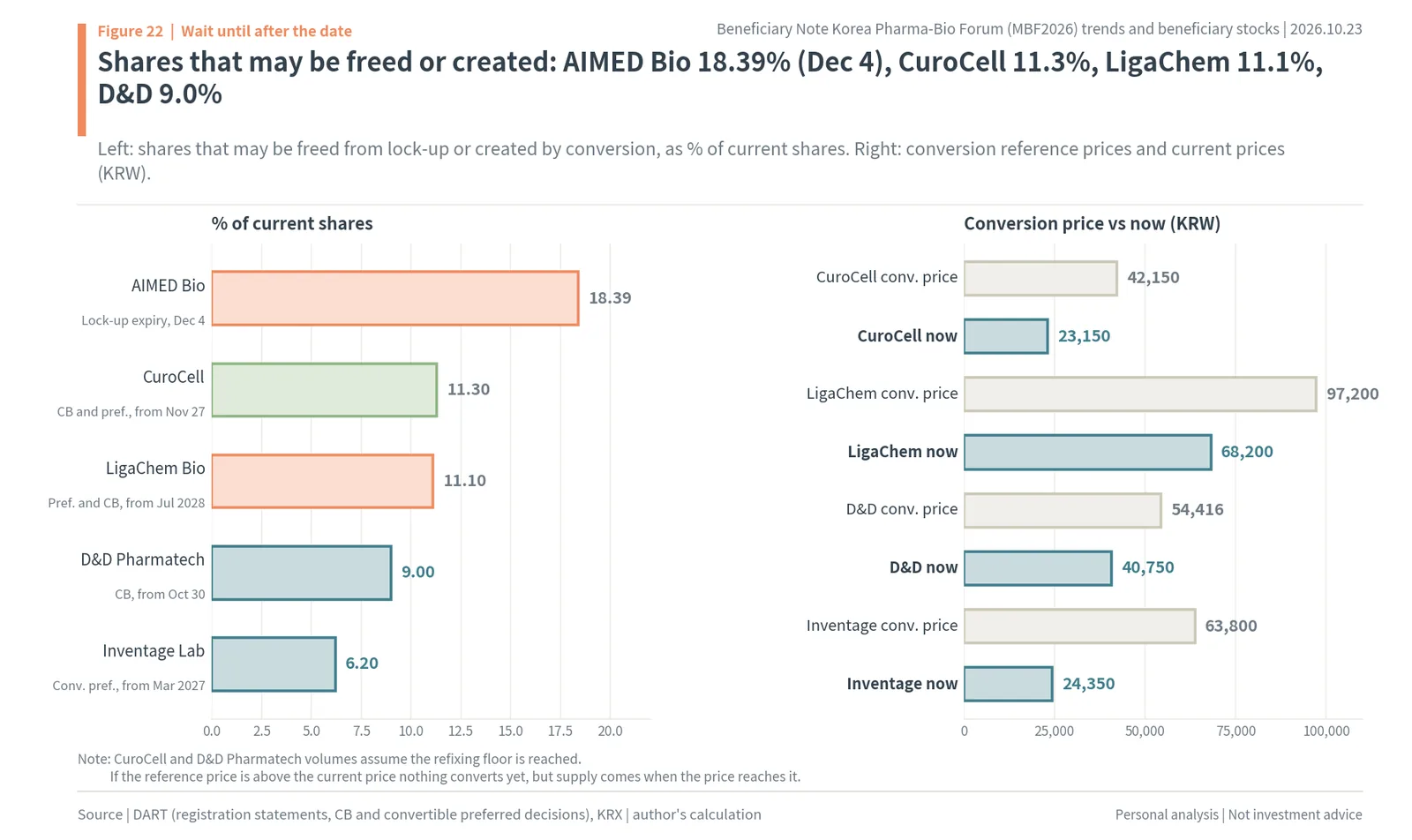
The left side of the figure compares shares that could be freed or newly created with the current share count: AIMED Bio 18.39%, CuroCell 11.3%, LigaChem Biosciences 11.1%, D&D Pharmatech 9.0% and Inventage Lab 6.2%. The right side shows the conversion reference price next to today’s price. At CuroCell, D&D Pharmatech, LigaChem Biosciences and Inventage Lab, the reference price is above today’s price, so nothing converts yet. Instead, as the share price approaches that level, supply comes out and caps the upside.
10. The author’s view and calendar: Hanmi has the least expectation left
The author sees obesity-drug maker Hanmi Pharmaceutical as the company with the least expectation left in its price among the forum’s four themes, for three reasons. First, take core business value and the upfront out of the KRW 361,500 share price and the pipeline is worth KRW 46,904 a share, a quarter of its September 30 value. Second, events that could rebuild that value line up within two months (results on October 27, efpeglenatide prescriptions on the 29th, the Beijing Hanmi audit deadline on the 30th, MSD’s MASH Phase 2b in November and the Genentech upfront in the fourth quarter). Third, from October 13 to 23 foreigners net bought KRW 55.6bn, taking the shares institutions sold. Even if third-quarter operating profit comes in low at about KRW 40bn because it excludes the upfront, that is already in brokers’ estimates. The catalyst is not the forum but the next date, and Hanmi’s dates are the closest.
The second candidate is ST Pharm. Whichever company’s RNA drug wins, the ingredient orders come in, and with a backlog 1.4 times last year’s sales, its earnings are visible. At 27.3x 2026 EPS of KRW 3,289 it is not cheap, so it is a position to take after checking on October 27 that results match the backlog.
The third is Inventage Lab. While G2GBio, with the same once-a-month injection technology, rose +49.9%, it rose +4.3%, and it is valued at 0.39 times G2GBio. Its cash covers 3.1 years of annual losses, and KRW 55.3bn is left even after subtracting all debt. It has not started trials in people and has no event with a fixed date, so it is a small lottery-ticket position.
CuroCell is an event stock until the reimbursement listing. Its share price already assumes about 288 patients a year (1.9 times Korea’s CAR-T market), so listing day is likely to be the top, as approval day was. Look at AIMED Bio after the December 4 lock-up expiry (18.39%) and at D&D Pharmatech after Pfizer’s November 3 update. LigaChem Biosciences has plenty of cash to hold out, but wait until a value-changing date appears; for GC Cell the funding plan comes first, and for Oscotec the Genosco merger terms. Kanaph, Dongwha Pharm and the unlisted companies (Mothers Pharmaceutical, DAI and the startups Langer introduced) are left out of this view. Mothers Pharmaceutical will be looked at separately as an IPO once its offer price is set.
The numbers to check on each date are set in advance too. In Hanmi’s results on October 27, check whether operating profit excluding the upfront is about KRW 40bn and how far Beijing Hanmi’s sales have recovered from the second quarter’s -29.9%. On the same day, check whether ST Pharm’s third-quarter sales match the KRW 99.0bn consensus and whether the backlog has grown beyond March’s KRW 463.5bn. From mid-November the first month of efpeglenatide prescriptions starts to show; the company’s annual target of KRW 100bn works out to KRW 8bn-plus a month. For CuroCell, the yardstick is how close the final price comes to Kymriah’s ceiling price (KRW 364mn), and for Inventage Lab the next news is an IND filing for IVL3021 and the results of Boehringer’s IVL5007 evaluation.
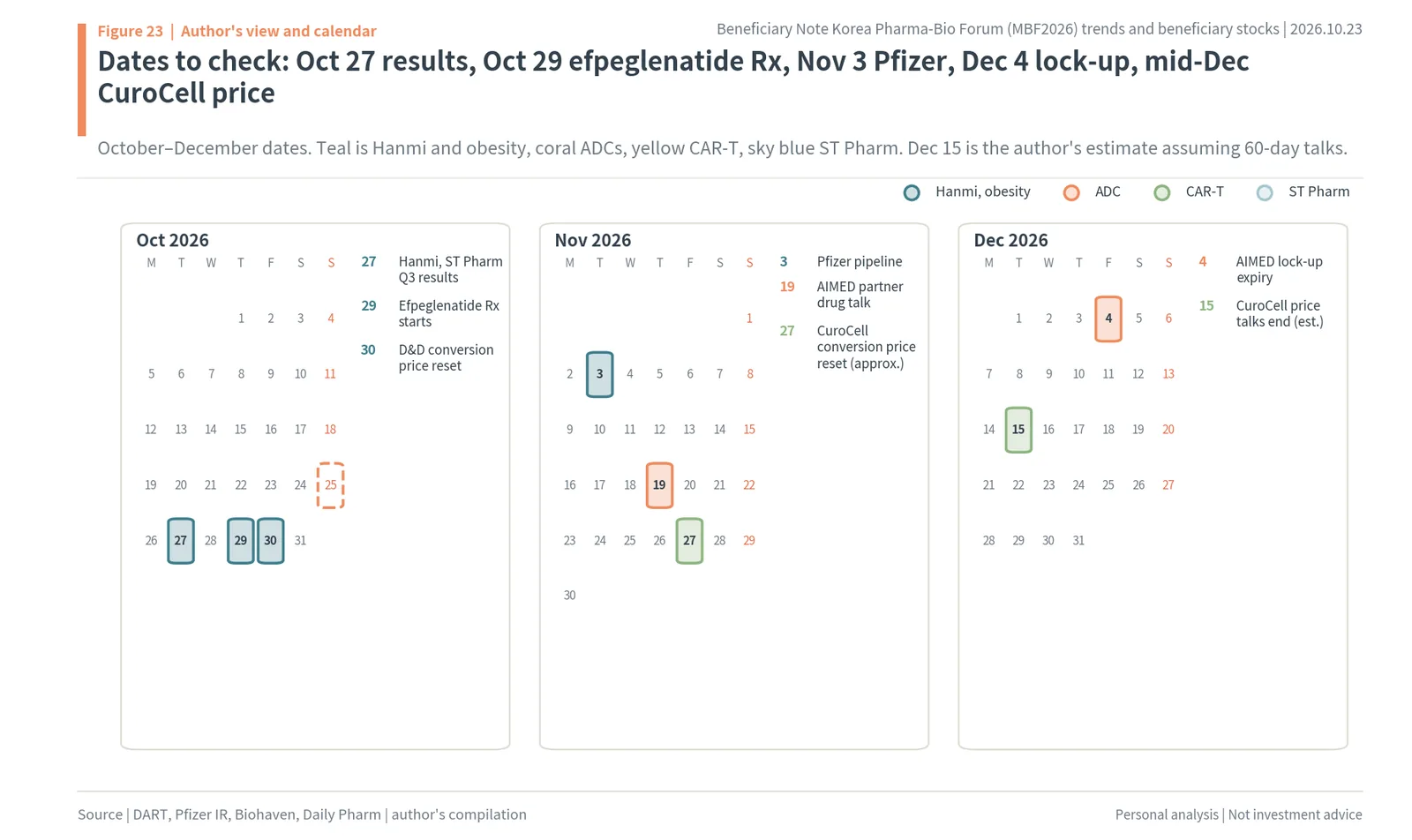
As a calendar: October 27, third-quarter results from Hanmi and ST Pharm; October 29, efpeglenatide prescriptions begin; October 30, D&D Pharmatech conversion price reset and the Beijing Hanmi audit deadline; November 3, Pfizer pipeline update; November 19, oral presentation of AIMED Bio’s partner drug; around November 27, CuroCell conversion price reset; December 4, AIMED Bio lock-up expiry; around December 15, CuroCell price negotiation ends (author’s estimate).
11. Biotech terms: the words you need to read this report
Biotech news is full of unfamiliar words, and readers often get stuck on the vocabulary before the numbers. This section explains the terms in this report with everyday comparisons.
Types of drugs
A GLP-1 obesity drug mimics a hormone the gut releases after eating that signals “I’m full.” Wegovy (semaglutide) and Mounjaro (tirzepatide) are the best-known, and Hanmi’s efpeglenatide belongs to the same class. A triple agonist acts on three hormone signals at once rather than one, aiming for more weight loss and a larger drop in liver fat.
A long-acting injection puts the drug into tiny particles placed under the skin; the particles dissolve slowly over several weeks and release the drug a little at a time. The point is to turn a daily pill or weekly shot into a monthly one so patients do not miss doses.
An ADC (antibody-drug conjugate) is “a guided missile carrying a bomb.” The antibody is the missile that recognizes and homes in on a specific marker on the surface of cancer cells, the payload is the powerful cancer drug at its tip, and the linker is the clasp joining them. If the linker comes apart too early in the blood, healthy cells are harmed; if it holds too tightly, the bomb does not go off inside the cancer cell. A bispecific ADC checks two markers at once to pick out cancer cells more precisely.
CAR-T therapy takes immune cells (T cells) from a patient’s blood, genetically fits them with an antenna (a CAR) that recognizes cancer cells and puts them back. Because each treatment is made separately for one patient, it is expensive, and the ability to make it without failures and quickly is the competitive edge. siRNA and oligonucleotide drugs erase the blueprint (RNA) for a disease-causing protein midway so the protein is never made; ST Pharm makes their ingredients.
Development stages and money
Preclinical studies are tests in animals and cells before use in people, and GLP toxicity studies are the regulated safety tests among them. An IND (investigational new drug application) is the request to regulators to start trials in people. Phase 1 checks whether the drug is safe in a small number of people, Phase 2 whether it works, and Phase 3 whether the effect holds in many people. After approval, a drug needs national health insurance reimbursement for patients to use it without a heavy burden; in Korea that means passing the Cancer Disease Review Committee (for cancer drugs), HIRA’s Drug Reimbursement Evaluation Committee, a price negotiation with the NHIS and the Health Insurance Policy Deliberation Committee in turn.
Licensing (technology transfer) is selling the rights to a drug in development to another company. The upfront is the money received first, milestones are success bonuses paid each time a stage is passed, and royalties are a cut of sales after the drug is on the market. The deal total adds all three: its value “if everything succeeds.”
Terms about share counts
A lock-up covers shares that large investors promised not to sell for a set period at listing. When the period ends, they can sell. A convertible bond (CB) is debt that can be swapped for shares at a set price, and convertible preferred shares (CPS) are preferred shares that can be swapped for common shares. Refixing is a term that lowers the conversion price, down to a set floor, when the share price falls, so the lower the share price goes, the more shares may be created later. On the KOSDAQ, a company whose pre-tax loss exceeds half of its equity in repeated years is designated an administrative issue, a warning label that puts its listing at risk.
12. How the numbers were counted
Share prices and market caps are KRX Data System regular-session figures for October 23, with closes checked by dividing market cap by listed shares. This method was used because since September 14 some quote tables have mixed in trades on Nextrade, Korea’s alternative exchange. Period returns (from October 13, year to date and from the peak) were counted on KRX adjusted prices. Net buying by investor type is the sum of KRX net buying value by investor type for October 13 to 23.
Hanmi Pharmaceutical’s core business value (KRW 298,436 a share), after-tax upfront value (KRW 16,160), price range (bear KRW 289,000, base KRW 433,000, bull KRW 651,000 and “cheap below” KRW 360,000) and the author’s pipeline value (KRW 118,803) were taken unchanged from the author’s September 30, 2026 note on Hanmi. Pipeline value is the share price minus core business value and the after-tax upfront value. 2026 EPS is Naver Finance consensus (October 22).
Inventage Lab’s cash and debt are from the consolidated financial statements in its June 30 half-year report. Debt includes loans, convertible bonds, bonds with warrants, leases and KRW 25.7bn of other financial liabilities. The annual loss is taken as twice the first-half operating loss, and the 3.1 years is cash and equivalents divided by that annual loss. The three values are bear (net cash plus KRW 50bn for the platform), base (current market cap) and bull (G2GBio’s market cap), and the share count adds 826,759 shares from the convertible preferred.
CuroCell’s estimate of Korean CAR-T patients, about 150 a year, sits between Kymriah’s cumulative sales of KRW 206.6bn (March 2021 to March 2025) divided by four years and the ceiling price of KRW 363.93mn per treatment (about 142), and 570 cumulative patients divided by about 3.6 years since reimbursement (about 158). The patients implied by the share price are the market cap (including 1,724,792 conversion shares) times a two-year discount (1.21x), divided by 5x sales and KRW 330mn per treatment. The three values are 2028 annual patients × price per treatment × sales multiple, divided by 1.21 and then by the same share count. That a 60-day price negotiation would end in mid-December is the author’s estimate.
Conversion and lock-up volumes divide the floor conversion prices and share numbers in each company’s DART filings (CB and convertible preferred issuance decisions, registration statements) by the current number of listed shares. The annual amounts of AI drug budgets divide each program’s total budget by its number of years. The 7.9% rate from Phase 1 to approval is from the BIO, Informa and QLS report on clinical development success rates for 2011 to 2020 (2021).
Things that could not be confirmed are also noted: the numbers in the ESMO poster for AIMED Bio’s partner drug, whether ST Pharm supplies the ingredient for GSK’s drug (not confirmed by the company), LigaChem Biosciences’ December conference presentation, and Rimcato’s final price.
Korea Pharma-Bio Forum 2026 beneficiary stocks: frequently asked questions
Q. Did presenting at the Pharma-Bio International Forum lift the companies’ shares?
Not this time. On October 23, 2026 all seven listed presenters fell, by between -2.4% and -0.7%, while the KOSDAQ fell -1.6%. No presentation changed the odds of success the way a new deal or clinical result would, so the shares followed the market.
Q. Does a trillion-won licensing deal mean a Korean biotech earns that much?
No. The headline value adds the upfront payment, milestones paid as each stage is passed and royalties after launch. The upfront was 3.8% of the Oscotec-Agios deal and 8.2% of the Hanmi-Genentech deal; the rest depends on clinical trials and approval. Industry data show 7.9% of drugs entering Phase 1 reach approval.
Q. How much pipeline value is left in Hanmi Pharmaceutical’s share price?
Taking core business value (KRW 298,436 a share) and the after-tax Genentech upfront (KRW 16,160) out of the October 23 price of KRW 361,500 leaves KRW 46,904 a share for the pipeline, down 75% from KRW 184,404 on September 30 and 39% of the author’s probability-weighted estimate. Results on October 27 and the first efpeglenatide prescriptions on October 29 come next.
Q. Why is ST Pharm a lower-risk beneficiary?
It makes oligonucleotide ingredients for other companies’ RNA drugs, so orders come in whichever drug wins. It signed three single contracts worth KRW 263.5bn in 2026, and its March backlog of KRW 463.5bn was 1.4 times 2025 sales of KRW 331.6bn. At KRW 89,900 it trades at 27.3x 2026 EPS of KRW 3,289.
Q. Is Inventage Lab cheap next to other long-acting injection companies?
Its KRW 324.0bn market cap is 0.39 times G2GBio’s, and it rose +4.3% from October 13 to 23 while G2GBio rose +49.9%. Cash and equivalents of KRW 115.7bn cover 3.1 years of the roughly KRW 37.3bn annual loss, and KRW 55.3bn is left after all debt. The author’s values are KRW 7,448, KRW 22,923 and KRW 58,474 a share, or KRW 27,942 weighted 1:2:1.
Q. Will CuroCell rise when Rimcato is reimbursed?
Reimbursement starts revenue, but the share price already assumes about 288 CAR-T patients a year, 1.9 times the roughly 150 patients treated in Korea each year. CuroCell fell -10.6% the day after approval and -10.0% the day after the reimbursement criteria were set, so the author treats reimbursement day as a likely top.
Q. Which dates matter for Korean biotech stocks into year-end 2026?
October 27 (Hanmi and ST Pharm third-quarter results), October 29 (efpeglenatide prescriptions begin), October 30 (D&D Pharmatech conversion price reset), November 3 (Pfizer pipeline update), November 19 (AIMED Bio partner drug presentation), around November 27 (CuroCell conversion price reset), December 4 (AIMED Bio lock-up expiry of 18.39%) and around December 15 (end of CuroCell’s price negotiation, the author’s estimate).
Sources
- Sisa Journal-e, previews, opening and presentation articles on the 6th Pharma-Bio International Forum (MBF2026) (https://www.sisajournal-e.com/news/articleView.html?idxno=424424, articles 424505, 424512, 424514, 424516, 424517, 424519, 424526, 424528, 424532, 424536, 424542 and 424544), Oct 23, 2026
- Bloter, CuroCell’s approval-day share price (link), May 14, 2026; BizWatch, Rimcato clears the Drug Reimbursement Evaluation Committee (link), Sep 4, 2026; Daily Pharm, Rimcato price negotiation (link), Oct 14, 2026; Daily Medi, Rimcato hospital drug committees (link), Oct 2, 2026; Bloter, CuroCell and the KOSDAQ loss rule (link), May 15, 2026; Chosun Biz, CuroCell’s 2027 patient target (link), Aug 26, 2026
- Daily Pharm, Kymriah ceiling price (link); Medipana, Kymriah cumulative patients (link); Edaily, Kymriah cumulative sales and Rimcato sales outlook (link), May 15, 2026
- DART: CuroCell half-year report (Aug 14, 2026) and CB and convertible preferred issuance decisions (Apr 17, 2026); Inventage Lab half-year report (Aug 26, 2026); GC Cell half-year report (Aug 14, 2026); D&D Pharmatech CB issuance decision (Apr 15, 2026); AIMED Bio registration statement (Nov 20, 2025); LigaChem Biosciences half-year report (Aug 14, 2026); Hanmi Pharmaceutical licensing agreement (Aug 24, 2026) and results notice (Oct 16, 2026); ST Pharm results notice (Oct 22, 2026)
- Agios press release, sevidoplenib license from Oscotec (link), Jun 1, 2026; Fierce Biotech, Boehringer Ingelheim and AIMED Bio’s ODS025 (link)
- Maeil Shinmun, healthcare strength and institutional buying (link), Oct 22, 2026; Etoday, KOSDAQ pharmaceutical index (link), Oct 5, 2026; Korea Economic Daily, Hanmi after second-quarter results (link), Jul 30, 2026; Daily Pharm, Hanmi’s share price after efpeglenatide approval (link), Oct 15, 2026; Dailian, efpeglenatide supply price (link); MTN, demand for a special audit of Beijing Hanmi (link), Sep 18, 2026
- Articles on iM Securities, Kyobo Securities and KB Securities third-quarter estimates for Hanmi (https://n.news.naver.com/mnews/article/008/0005429337, https://n.news.naver.com/mnews/article/011/0004671886, https://n.news.naver.com/mnews/article/123/0002391956), Oct 2026
- BizWatch, ST Pharm single oligonucleotide contract (link), Sep 18, 2026; Daily Pharm, ST Pharm order backlog (link), Mar 20, 2026
- Korea Economic Daily, Inventage Lab’s IVL3021 (link), Jun 8, 2026; Dealsite, end of Lilly’s evaluation of Peptron (link), Oct 7, 2026; BizWatch, Novo Nordisk and Nanexa, Lilly and Camurus deals (link), Oct 8, 2026; Maeil Business Newspaper and Yonhap, G2GBio’s UBT evaluation agreement, Oct 19 to 20, 2026
- Money Today, GC Cell’s Fucaso (link), Sep 1, 2026; Edaily, LigaChem Biosciences convertible preferred and CB (link), Jul 2026; Money Today, Kanaph’s KNP-301 (link), Jul 2, 2026; BioSpectator, AZD9592 discontinued (link), Sep 21, 2026
- Financial News, K-MELLODDY (link), Jul 24, 2026; Money Today, K-AI drug development model program (link), Sep 22, 2026
- BIO, Informa Pharma Intelligence and QLS, Clinical Development Success Rates 2011 to 2020, 2021
- Naver Finance consensus (Oct 22, 2026); calculations from the author’s Sep 30, 2026 note on Hanmi Pharmaceutical; KRX Data System adjusted prices, market caps and trading by investor type (Oct 23, 2026); Yahoo Finance USD/KRW; author’s calculations
- Photos: NIAID (CC BY 2.0), Don-tat (CC BY-SA 4.0), R Boed (CC BY 2.0), Linda Bartlett/NCI (public domain), HualinXMN (CC BY-SA 4.0), Edit4567 (CC BY-SA 4.0), via Wikimedia Commons
Disclaimer
Was this note useful?
Thanks. Your answer helps decide what to cover next.
Korea market snapshot · Oct 27, 2026
New to Korean stocks? Start here for the basics.
Most read lately
3Balance Sheet Recession: Japan’s Lost Years and Korea’s KRW 2,000 Trillion Household Debt (2026)
4Commodity Cycle Order: Gold Peaks First, Grains Last, Rates Next (2026)
5Hanwha Succession: Who Gained Among the Three Kim Brothers, from One Basket to Three Paths
Get the Saturday note on Korean stocks
One email every Saturday with the week’s new research on Korean listed companies and links to the updated data pages. Built from DART filings and KRX data. Free; unsubscribe in one click. See past issues