
Rights Offerings in Korea: Rights Issues Fell 12.57% on Announcement Day, Third-Party Placements Rose 0.40%
In his 1983 letter to Berkshire Hathaway shareholders, Warren Buffett set out a list of principles for how he would run the company. The tenth was about new shares. “We will issue common stock only when we receive as much in business value as we give,” he wrote. He added that the rule applied to every form of issuance: not only mergers and public stock offerings, but stock-for-debt swaps, stock options and convertible securities as well. Selling new shares is selling a small portion of the company, “and that is what the issuance of shares amounts to,” so the last sentence of that paragraph promised never to sell those portions on a basis inconsistent with the value of the entire enterprise (Berkshire Hathaway 1983 Chairman’s Letter).
Buffett’s sentence looks at new shares through the eyes of the existing owner. The company does receive money, but in return existing shareholders hand part of their claim on the company to new shareholders. If the money received is worth less than the share handed over, existing shareholders lose. In the Korean stock market this transaction is called yusang jeungja, a paid-in capital increase, and it is split by who buys the new shares into rights offerings to existing shareholders, general public offerings and third-party placements. So when a Korean listed company prints new shares, did the market price the news differently depending on who the buyer was? This report collects, one by one, every rights offering decision filed by KOSPI and KOSDAQ companies from October 2017 to October 22, 2026, and answers that question with numbers.
This report is the full English edition of Maochaedung’s Korean note on Korean share offerings and stock prices.
As of: October 22, 2026 (filings from KIND and DART, prices from Naver Finance adjusted prices, returns measured against the market index). Dollar amounts are converted at KRW 1,321.5 per dollar, the October 22, 2026 rate (Yahoo Finance, KRW=X).
Concepts covered: share offerings (paid-in capital increases); rights offerings (shareholder allotment followed by a public offering of unsubscribed shares); general public offerings; third-party placements; discount and reference price; dilution; ex-rights; rights certificates (subscription warrants); the Financial Supervisory Service’s focused review
Reference data: from the Korea Exchange’s KIND detailed search, 17,140 ‘rights offering decision’ (yusang jeungja gyeoljeong) filings from October 1, 2017 to October 22, 2026 were downloaded, and only original filings by KOSPI and KOSDAQ companies were kept. Removing amendments, withdrawals, offerings by subsidiaries and filings by bond-issuing companies leaves 4,057 filings. The offering type was read first from the brackets in the filing title and, when the title did not say, from the rights offering decision data (final amended version) in the Financial Supervisory Service’s DART Open API. 362 filings with two or more decisions in the same period, where the type could not be pinned down, are left out of the type statistics, and 41 shareholder-priority offerings are grouped with public offerings, leaving 3,695 events with a confirmed type. New share counts, shares outstanding before the offering and amounts by purpose also come from DART. Prices are Naver Finance adjusted prices, and the return against the index is (1 + stock return) ÷ (1 + KOSPI or KOSDAQ return over the same period) − 1. Values the author calculated are marked as the author’s calculations.
How it works in Korea
Korean stocks trade on two boards run by the Korea Exchange (KRX): KOSPI, the main board, and KOSDAQ, the growth board for smaller companies. Every listed company must file a “rights offering decision” the day its board approves new shares for cash, and the filing appears at once on KIND, the exchange’s disclosure site, and on DART, the Financial Supervisory Service’s electronic filing system. The form is fixed, so the number of new shares, shares outstanding, purpose of funds, offering type, issue price method and schedule always sit in the same boxes. English-language Korean media usually translate yusang jeungja as “rights offering” whatever the buyer; this report keeps “rights offering” for shares offered to existing holders, “public offering” for shares sold to anyone, and “third-party placement” for shares sold to a chosen buyer. The rules differ by type. Under the Regulation on Securities Issuance and Disclosure, a public offering may be priced at most 30% below the reference price, and a third-party placement at most 10%; a rights offering has no legal cap, and recent large ones used 15% to 30%. In a rights offering each shareholder receives rights certificates (sinju insugwon jeungseo) in proportion to their holdings, and these certificates are listed and traded for at least five trading days, so a holder who does not want to pay in can sell them. Because Korean stock trades settle two days later, you must buy two trading days before the record date to get the rights, and the next trading day the stock trades ex-rights at a reference price that the exchange lowers by the value of the cheap new shares. Third-party placement shares are usually locked up for a year. Since February 2025, the Financial Supervisory Service (FSS) also gives a “focused review” to offerings with heavy dilution.
Words to know first: a share offering sells new shares for cash, and the name depends on who buys them
Before the main part, here are the terms this report uses often. The point is one: the three types of share offering are split by who buys the new shares, and that difference changes the discount cap, the size of dilution and the announcement-day price reaction all at once.
A share offering (paid-in capital increase) is a company issuing new shares and selling them for money. The company’s capital and cash rise, and so does the number of shares outstanding. It differs from a bonus issue, which moves retained earnings into capital and hands out shares without payment. It is “paid-in” because the people receiving the new shares pay for them.
A rights offering gives existing shareholders the first right to buy new shares in proportion to the shares they hold. Article 418(1) of Korea’s Commercial Act says shareholders have the right to be allotted new shares according to the number of shares they own. In practice almost all are a “shareholder allotment followed by a public offering of unsubscribed shares,” in which the shares existing holders do not take (forfeited shares) are offered again to the general public. The company sets the discount, and the issue price is calculated twice, at a first and a second pricing, with the lower one used. Recent large offerings cut 15% to 30% from the reference price.
A public offering sells new shares to anyone, regardless of existing holdings. Article 5-18 of the Regulation on Securities Issuance and Disclosure limits its discount to 30% of the reference price. The reference price is the weighted average price from the fifth to the third trading day before the subscription date. A shareholder-priority offering gives existing shareholders the first chance to subscribe and sells the rest to the public; this report groups it with public offerings.
A third-party placement sells new shares to a specific buyer the company chooses. Article 418(2) of the Commercial Act allows allotting new shares to non-shareholders only when the articles of incorporation provide for it and there is a business purpose such as bringing in new technology or improving the financial structure. The discount cap is 10%, and the reference price is the lower of two numbers: the simple average of the one-month, one-week and latest-day weighted average prices counted from the day before the board resolution, and the latest-day weighted average price. The shares received are often locked up for a year from the deposit date (a resale restriction).
Dilution is the fall in existing shareholders’ ownership share caused by new shares. This report calls new shares ÷ shares outstanding before the offering the new-share ratio, or the size of dilution. With a new-share ratio of 30%, an existing holder’s stake shrinks to 1 ÷ 1.3, or 76.9% of what it was. In a rights offering, a holder who subscribes in full keeps the same ownership share, and the company is worth more by the money paid in.
Ex-rights is the day the right to buy new shares in a rights offering drops off after the record date for the allotment. To be on the register on the record date you must buy two trading days before it because of settlement, and from the next trading day the shares trade without the right. On that day the exchange starts trading from a reference price that reflects how cheaply the new shares will be sold.
A rights certificate separates the right to buy new shares in a rights offering into something that can be bought and sold. A holder who will not subscribe can sell the certificates and recover the value cut away on the ex-rights day. KOSDAQ listing rules require the certificates to be listed for at least five trading days. After the issue price is fixed, the offering moves through subscription by existing shareholders, a public offering of forfeited shares and payment, and the new shares are listed.
The focused review is a system the Financial Supervisory Service started in February 2025: it picks out offering registration statements with large dilution or a risk of harming minority shareholders, examines them intensively within a week of filing and holds at least one face-to-face meeting with the company. If it orders an amendment, the registration statement stops being effective, and the company has to fix and refile it.
The three types differ in discount cap and how many shares they print: rights offerings print a lot at once, third-party placements a little, often
The difference between the three types starts with who buys and carries on to how cheaply and how much is sold. This chapter’s conclusion is that rights offerings print the most shares at once, and third-party placements are the most frequent but print the fewest shares each time.
Start with the discount cap. A public offering may be sold at most 30% below the reference price, a third-party placement at most 10%. A rights offering has no set cap. Because every existing holder gets the same chance in proportion to their stake, a holder who subscribes loses nothing even if the shares are sold cheaply. In practice companies follow the method of the old rules: they compute a first issue price (based on the third trading day before the record date) and a second issue price (based on the third trading day before existing holders subscribe) and use the lower one. Among recent large deals, Hanwha Aerospace and Samsung SDI used a 15% discount, and Nextchip used 30% in December 2025.
How many new shares were printed is measured as new shares ÷ shares outstanding before the offering. Across 3,695 original filings with a confirmed type from October 2017 to October 22, 2026, the median of this ratio was 39.9% for rights offerings, 15.4% for public offerings and 7.3% for third-party placements (final amended DART figures, author’s calculation). Half of all rights offerings printed close to 40% of the existing shares in one go.
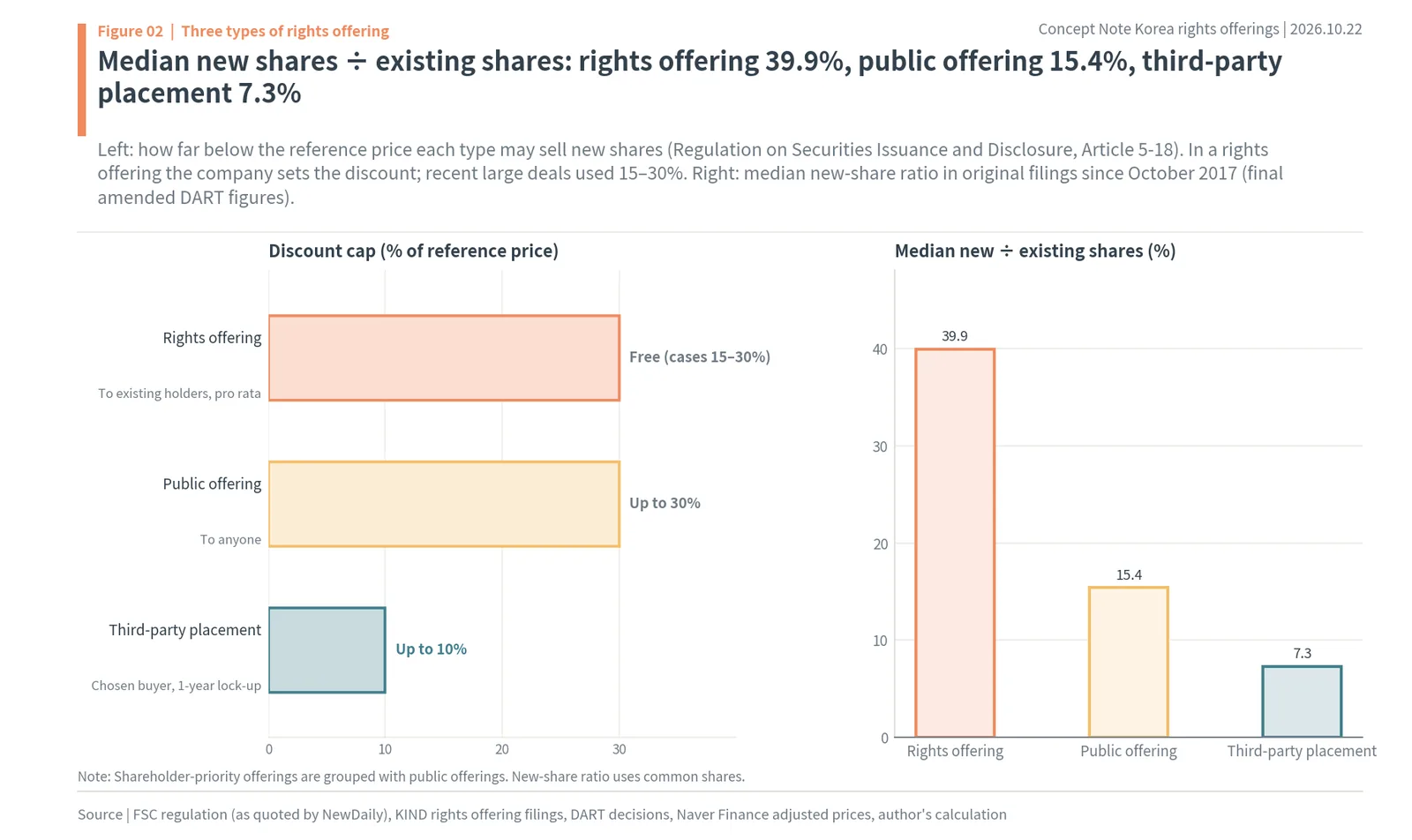
The left side of the figure is the discount cap and the right side the median new-share ratio. That rights offerings have no discount cap and the largest new-share ratio is the starting point that explains every number that follows. Because the shares are split among existing holders pro rata, the company can print a lot and sell cheaply. In exchange, holders who do not subscribe see their stake shrink sharply, and holders who do subscribe must put in a lot of new money.
Third-party placements run the other way. The buyer is fixed and cannot get more than a 10% discount, so the very fact that someone is willing to put money in at that price is information. But what it means depends on who the buyer is. A large company buying a stake for a strategic alliance, a major shareholder or affiliate putting money in, and an investment partnership coming in and taking control are all third-party placements.
Hypothetical example: a rights offering of 30% new shares at a 25% discount lowers the ex-rights reference price by 5.8%
Let us walk through the basic arithmetic of a rights offering with a hypothetical company. A company trading at KRW 10,000 (about $7.57) offers its holders new shares equal to 30% of existing shares at KRW 7,500, a 25% discount. A holder with 100 shares receives the right to buy 30 shares at KRW 7,500. On the ex-rights day the exchange’s reference price is (price + allotment ratio × issue price) ÷ (1 + allotment ratio), or (10,000 + 0.3 × 7,500) ÷ 1.3 = KRW 9,423. That is 5.8% below the price before ex-rights (author’s calculation).
This shareholder has three choices. First, subscribe. Pay KRW 225,000, receive 30 shares to hold 130, worth KRW 1,225,000 at the ex-rights reference price. Subtract the money paid and it is KRW 1,000,000, the same as before the offering. Second, do not subscribe and sell the rights certificates. If one certificate is simplified as worth the gap between the ex-rights reference price and the issue price, KRW 1,923, selling 30 brings in KRW 57,692, which together with the remaining 100 shares worth KRW 942,308 again makes KRW 1,000,000. Third, do nothing. Only the 100 shares worth KRW 942,308 remain, a loss of 5.8%.
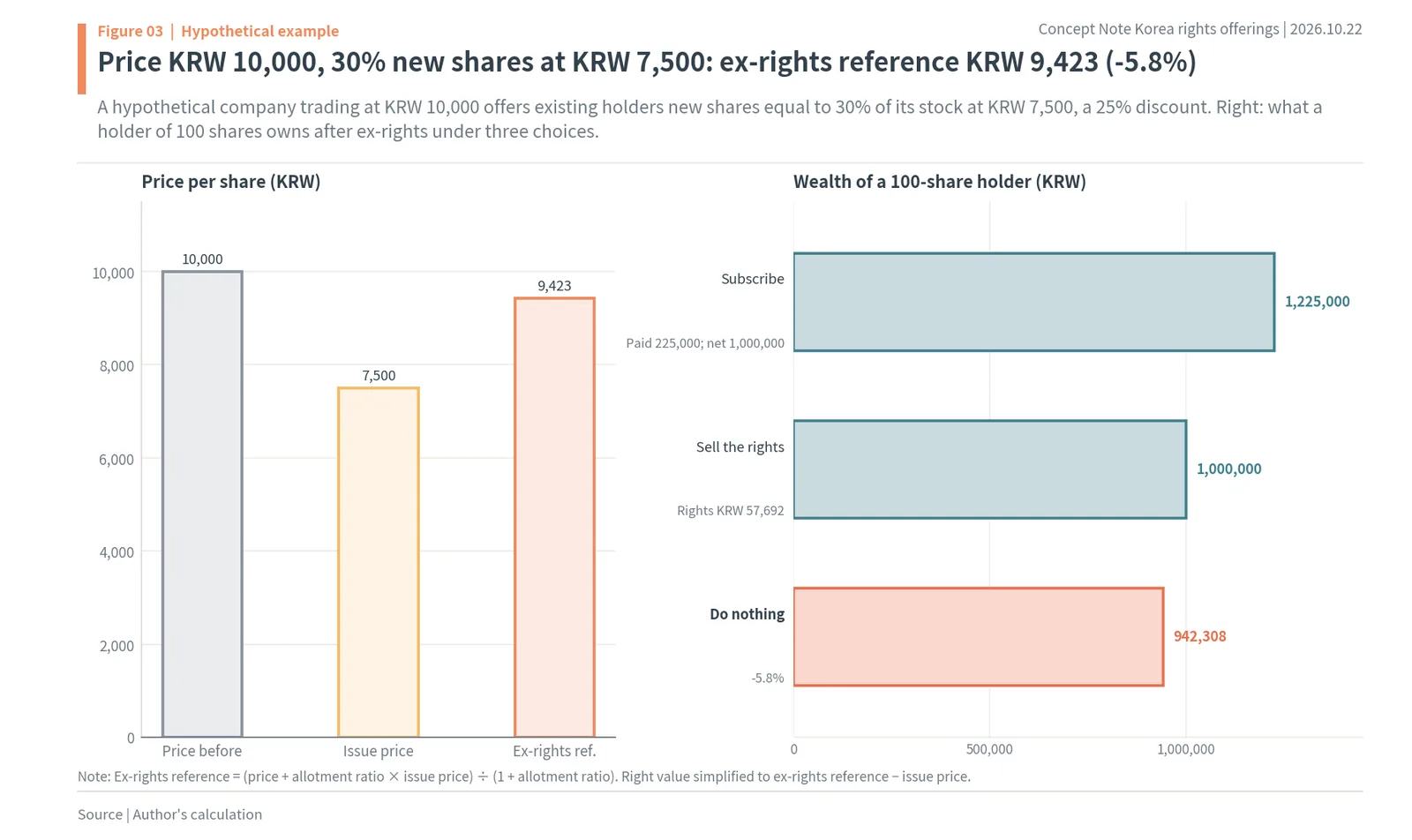
The figure’s conclusion is that the discount in a rights offering is not in itself a loss for existing holders. Subscribe or sell the certificates and wealth stays the same. The loss appears only when you do nothing. In reality rights certificates often trade thinly and below their theoretical value, so selling them may not recover the full 5.8%. The window for selling them is short, and if you miss it the rights simply vanish.
The ex-rights drop is set by two things, the new-share ratio and the discount. The formula is 1 − (1 + ratio × (1 − discount)) ÷ (1 + ratio). New shares of 30% at a 25% discount give -5.8%, and new shares of 50% at a 30% discount give -10.0% (author’s calculation). Printing as many new shares as already exist (a new-share ratio of 1x) at a 30% discount takes it down to -15.0%. The larger the new-share ratio and the deeper the discount, the further the ex-rights reference price falls.
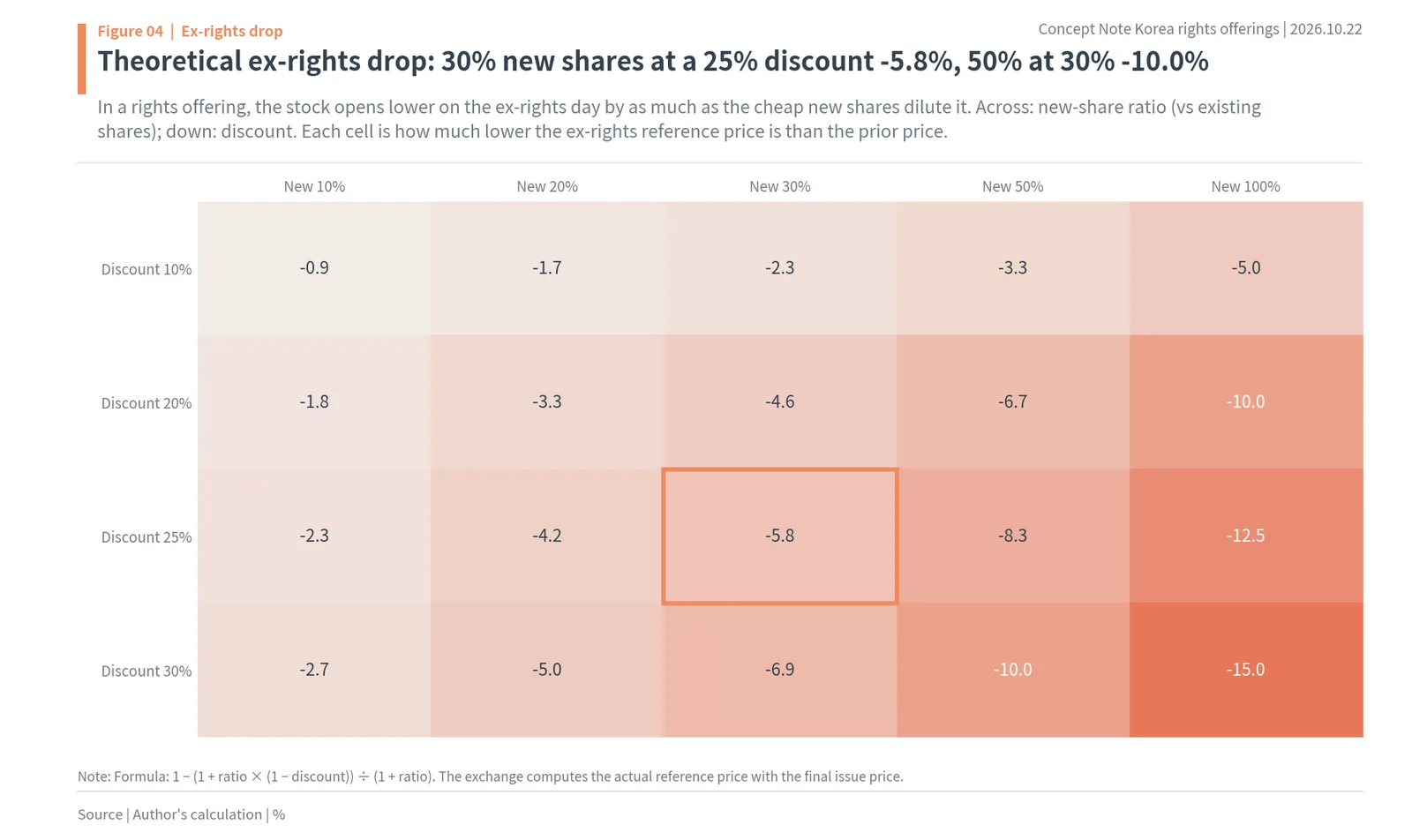
The numbers in the table are not a fall in the stock price but the amount by which the value per share is reset. The company as a whole is worth more by the cash received, but the share count rises even more, so the value per share is lower by that much. Adjusted prices such as Naver Finance’s correct pre-ex-rights prices by this ratio, so the announcement-day reactions in this report do not mix in the mechanical ex-rights fall. The announcement-day reaction happens weeks to months before the ex-rights day.
A rights offering takes about four months from announcement to new-share listing, and each date asks something different of you
A rights offering does not end with one filing. This chapter’s conclusion is that it is a long schedule running from announcement through the record date, ex-rights, issue-price setting, rights-certificate trading and subscription to the listing of the new shares, and existing holders have to act on several dates in between.
Look at a real schedule. Hanwha Aerospace announced on March 20, 2025, went through two amendments and set its first issue price at KRW 684,000 on May 21. The second issue price was calculated three trading days before existing holders subscribed; the employee stock ownership association subscribed on July 1, existing holders on July 1 and 2, the public offering of forfeited shares ran July 4 to 7, and the new shares were due to list on July 21 (press reports). Four months passed from announcement to listing. For Nextchip, the record date was October 22, 2025, the rights certificates traded for five trading days from November 11 to 17, and subscription by existing holders began on December 3 (Nextchip amended registration statement).
There are four dates existing holders need to watch in this schedule. The first is the record date. You receive the right to buy new shares only if you are on the shareholder register on that date, and since settlement takes two days, you must buy two trading days before it. The next trading day is the ex-rights day. The second is the rights-certificate trading period. Holders who will not subscribe must sell the certificates in this window; miss it and the rights simply disappear. The third is the subscription date for existing holders. To subscribe, you put the issue price times the allotted shares into your brokerage account and apply. Many offerings also accept oversubscription of up to 20% of the allotted shares, so you can get more if some shares are forfeited. The fourth is the listing date of the new shares, when they all reach the market at once.
Remember too that the issue price is calculated twice. The first issue price is based on prices before the record date and the second on prices just before subscription, and the lower of the two becomes the final issue price. If the stock falls sharply on the announcement day, the second issue price falls with it, and the company raises less money. Samsung SDI’s planned issue price of KRW 169,200 reportedly came down to KRW 146,200 at the first pricing and KRW 140,000 at the end. If the stock rises, the first issue price holds. Hanwha Aerospace’s first issue price of KRW 684,000 was above its planned issue price, so the amount raised went up.
The math for a holder who does not subscribe is the same as in the hypothetical example. Selling the rights certificates recovers most of the ex-rights value; doing nothing loses it. In practice certificates often trade below the stock price minus the issue price, and with such a short listing there are days with little trading. If you plan to sell, it is better to sell in the first few days of the window.
One filing has every number you need: reading the original rights offering and third-party placement filings
A rights offering decision filing has a fixed format, so reading a few boxes is enough to get the numbers above yourself. This chapter’s conclusion is that six boxes, new shares, shares outstanding before the offering, purpose of funds, offering type, issue price and discount, and schedule, are almost everything needed for a judgment. Two filings from 2018 serve as examples.
Contentree JoongAng filed a rights offering followed by a public offering of unsubscribed shares on June 29, 2018. Box 1, type and number of new shares, said 30,000,000 common shares, and box 3, total shares outstanding before the offering, said 114,068,982. The new-share ratio is 30,000,000 ÷ 114,068,982, or 26.3% (author’s calculation). Box 4, purpose of funds, had a single line: operating funds of KRW 156bn. Box 5, offering method, read “shareholder allotment followed by public offering of unsubscribed shares.” Box 9, new shares allotted per share, was 0.2665, meaning a holder of 100 shares got the right to buy a little over 26 shares. The record date was July 19, existing holders subscribed on September 6 and 7, the new shares were due to list on September 28, and box 18 confirmed that rights certificates would be listed. The issue price method said a 20% discount would apply to the first issue price, and the final issue price was KRW 5,200.
Newbotech filed a third-party placement the same day. New shares were 2,250,000 against 24,613,919 shares before the offering, a new-share ratio of 9.1% (author’s calculation). The issue price was KRW 2,000; because trading in the shares was suspended, it was a premium issue at 9.76% above the KRW 1,822 per-share value set by an outside appraiser. A registration statement was exempted on the grounds of a “private placement, all shares in protective custody for 3 years,” and the notes for investment decisions said the largest shareholder would change once payment was complete. The most important information in a third-party placement filing sat in the notes at the bottom.
Put the two filings side by side and you can see that where to read depends on the type. For a rights offering, the core is the new-share ratio, the discount, and the record-date, certificate and subscription schedule, because the dates on which investors must act are in the schedule boxes. For a third-party placement, the core is the allottee and its relationship to the company and the largest shareholder, the lock-up period, and whether the largest shareholder changes. Under the same “rights offering decision” title, a rights offering asks “what do I have to do?” and a third-party placement asks “who is coming in?”
The filing title also gives clues. Most recent filings put the method in brackets in the title, such as “(shareholder allotment followed by public offering of unsubscribed shares),” “(third-party allotment)” or “(third-party allotment, small offering).” But more than a thousand filings over nine years left the method out of the title, and sometimes the method itself changes as amendments pile up. An offering that started as a single rights offering, like Hanwha Aerospace’s, can split into two decisions, a rights offering and a third-party placement. It pays to check both the offering method box in the body and the last amendment.
3,695 deals in nine years: third-party placements lead in number, and large amounts went to rights offerings and a few big third-party placements
Let us see how Korean listed companies printed new shares over nine years. This chapter’s conclusion is that third-party placements dominate by number, while the money was split between rights offerings and a few large third-party placements.
Of the 3,695 original filings with a confirmed type, 3,024, or 81.8%, were third-party placements. Rights offerings numbered 429 (11.6%) and public offerings, including shareholder-priority offerings, 242 (6.5%). By decided amount (final amended DART figures), third-party placements came to KRW 88.4tn, rights offerings KRW 55.9tn and public offerings KRW 9.8tn (author’s calculation). Third-party placements were 81.8% of the count and 57.4% of the amount, while rights offerings were 11.6% of the count but 36.2% of the amount.

Third-party placements are common because small companies find them easy to use. Unlike public offerings, which need a registration statement, a third-party placement with a one-year resale restriction is often exempt from filing one. 88.9% of the 3,024 third-party placements were by KOSDAQ companies, and the median size per deal was KRW 5.0bn (about $3.8mn), against KRW 29.99bn for rights offerings. Rights offerings, by contrast, are often large deals that file a registration statement and have the lead managing brokerage underwrite the leftover shares.
By year, rights offerings jumped in 2020 and 2021. That was when companies short of cash in the COVID-19 pandemic, like Korean Air in 2020 (about KRW 3.3tn by the DART decision), turned to their shareholders. 2026, through October 22, has 395 deals worth KRW 53.5tn, the most in the nine years. But KRW 40.0tn of that is a single SK hynix deal. SK hynix placed 17,790,000 new shares with a third party to issue American depositary receipts (ADRs), recorded in the DART decision as facility funds of KRW 40.023tn (about $30.3bn). Without that one deal, 2026 comes to KRW 13.5tn, close to 2025 (KRW 14.5tn).
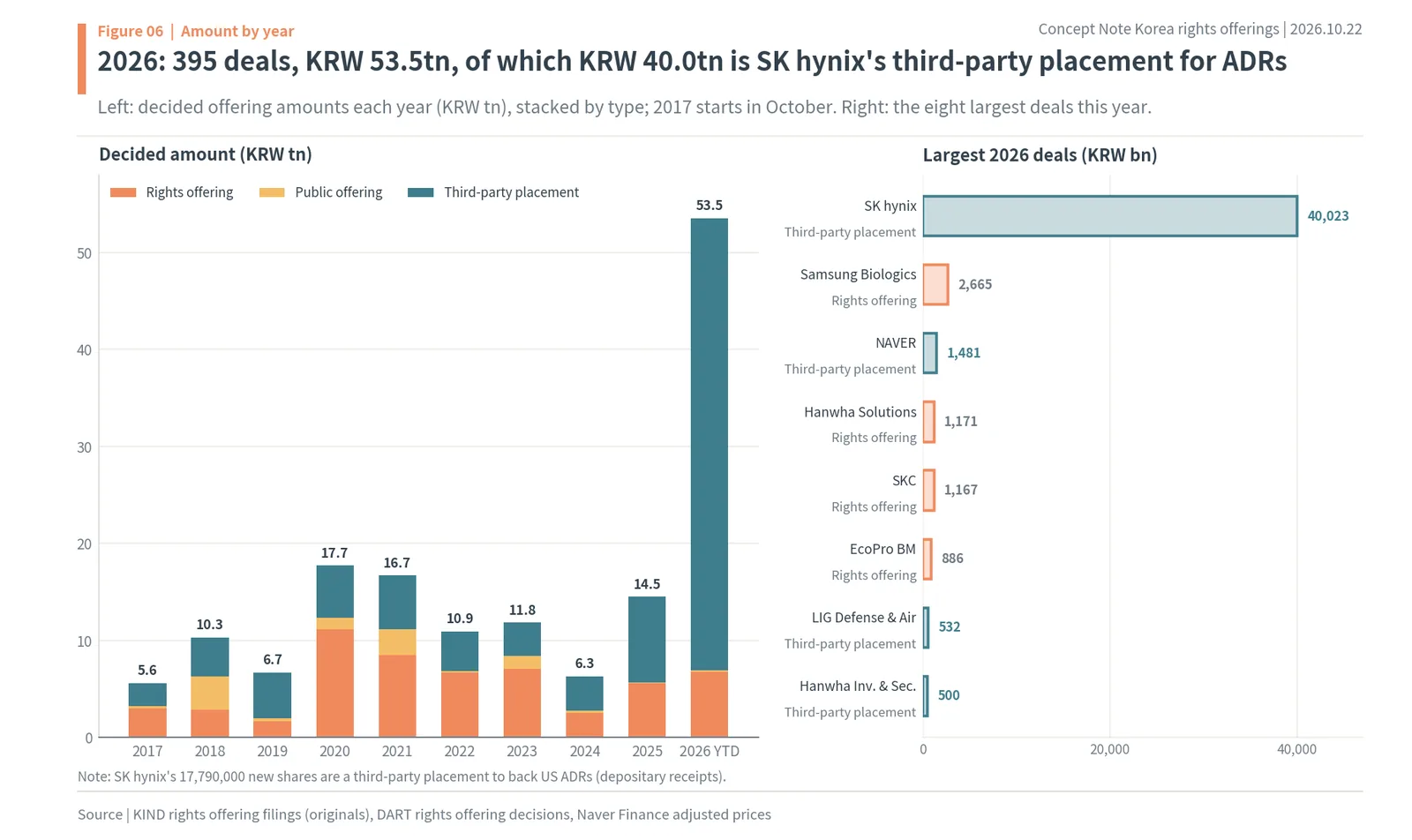
The right side of the figure shows the eight largest deals this year. After SK hynix come Samsung Biologics’ rights offering (KRW 2.665tn), NAVER’s third-party placement (KRW 1.4809tn), Hanwha Solutions’ rights offering (KRW 1.1713tn), SKC’s rights offering (KRW 1.1671tn) and EcoPro BM’s rights offering (KRW 886.1bn) (final amended DART figures). These are the amounts in the decision filings and can differ from the actual amount raised once the issue price is fixed. Hanwha Solutions was reported to have cut its offering from KRW 2.4tn at announcement to KRW 1.7tn after FSS amendment orders (Herald Economy, June 10, 2026).
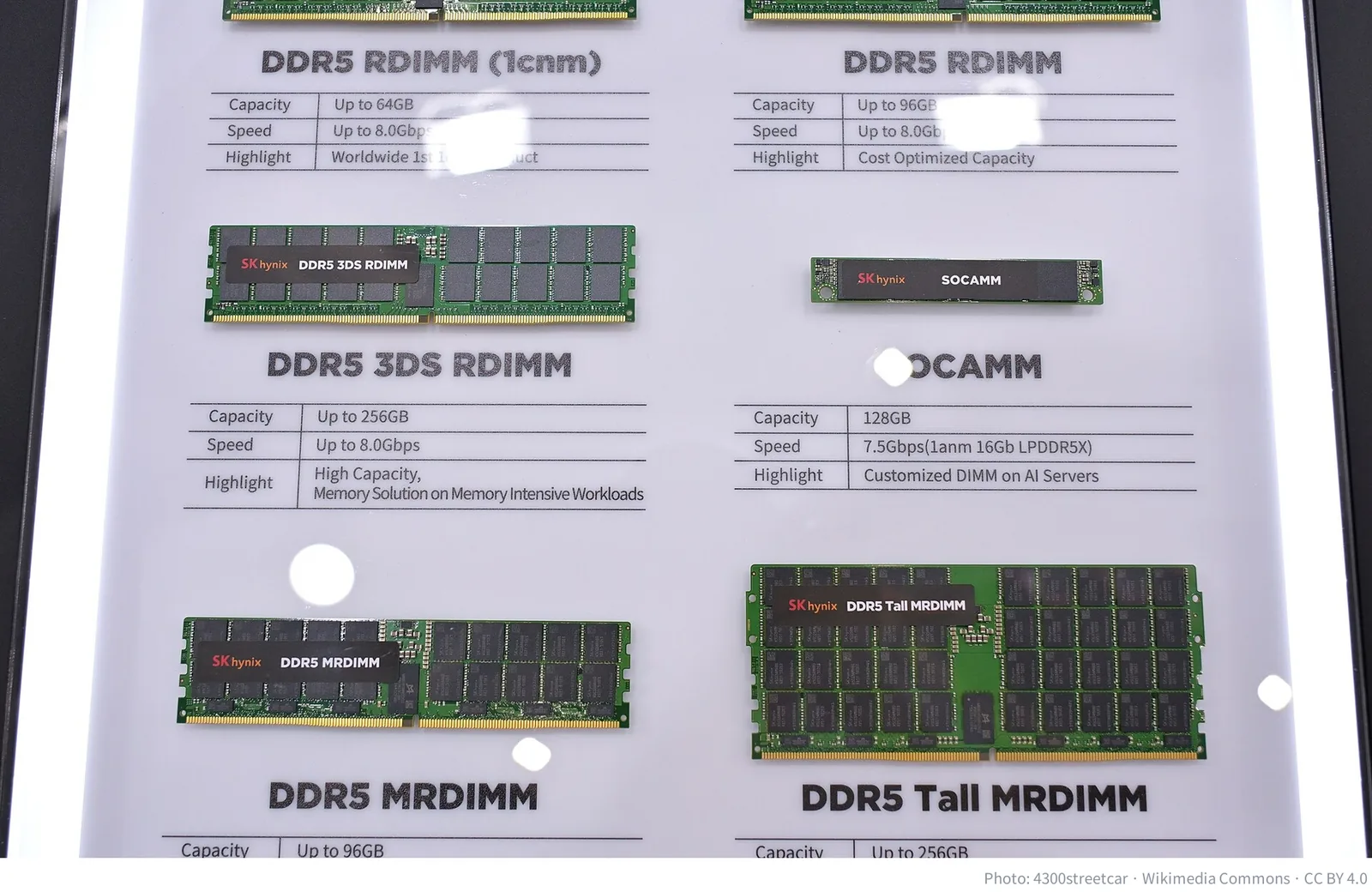
The SK hynix deal is a third-party placement of a different kind. The buyer is a US depositary, and the new shares back depositary receipts that US investors buy and sell. The new-share ratio was a small 2.5%, and the return against the index on the announcement day was +7.2% (author’s calculation). Its size and purpose are nothing like the usual third-party placement in which a small company sells new shares to an investment partnership, yet the filing format is exactly the same: “rights offering decision (third-party allotment).” That is why you should read the allottee and the purpose to the end rather than judge by the filing title.
Filings are posted on KIND, run by the Korea Exchange. Entering “rights offering decision” as the report name in KIND’s detailed search brings up amendments together with originals. Some offerings collect more than ten amendments, so this report kept only original filings to use the day the market first heard the news.

The announcement-day price splits by type: rights offerings -12.57%, public offerings -2.98%, third-party placements +0.40%
Now to the central question of this report. To answer in advance: even for the same kind of share offering, the announcement-day price split by who bought the new shares, and a year later all three lagged the index. Did the market react differently to the same share offering depending on the buyer? This chapter’s conclusion is yes. Rights offerings fell sharply on the announcement day, public offerings fell a little, and the median third-party placement barely moved or rose slightly.
The announcement-day reaction was measured this way. If the filing came during trading hours (before 3:30 p.m.), the price change that day was used; if after the close, the next trading day’s. The same day’s KOSPI change (KOSDAQ for KOSDAQ companies) was taken out as a ratio to remove the move of the market as a whole. Measured this way, the median announcement-day return against the index was -12.57% for rights offerings (420 deals), -2.98% for public offerings (230) and +0.40% for third-party placements (2,514) (author’s calculation). The share of events that did worse than the index was 90.7% for rights offerings, 71.3% for public offerings and 46.1% for third-party placements.

Nine out of ten rights offerings fell against the index on the announcement day. The range covering the middle 50%, from -18.9% to -5.34%, is entirely negative. 6.2% of rights offerings fell close to the daily limit (below -29%) on the announcement day. Third-party placements spread around zero, with the middle 50% between -2.78% and 4.46%, and 181 events, or 7.2%, rose close to the daily limit (above +29%) on the announcement day.
Korean research points the same way. Woo Min-cheol and Park Soo-cheol (2017) analyzed 2,046 offering announcements from 2012 to 2016 and reported that prices tended to fall after public offerings and rights offerings and rise after third-party placements. Lim Byung-kwon, Lee So-rim and Yoon Pyung-sik (2019) found a cumulative abnormal return of 7.14% over the three days around the announcement in 1,796 third-party placements from 2002 to 2014. In the US, many studies have found that prices fall about 3% on average when a public equity offering is announced (Masulis and Korwar 1986: -3.25% across 690 industrial companies).
Why the split? The market reads a rights offering as “existing shareholders, put in more money.” That the company chose shareholders’ money over bank loans or corporate bonds is taken as a sign that other options were not available, or that the company thinks its stock is expensive right now. On top of that, rights offerings have large new-share ratios and deep discounts, which bring a wave of selling, both to raise money for subscribing and to avoid the ex-rights drop. A third-party placement is read the other way, as “someone is putting money in.” A buyer putting in money that will be locked up for a year at a discount of 10% or less also means that buyer values the company at more than that.
KOSDAQ companies reacted more
Even within the same type, the market made a difference. The median announcement-day return for rights offerings was -15.05% on KOSDAQ (263 deals) and -6.27% on KOSPI (157 deals) (author’s calculation). Public offerings also fell more on KOSDAQ, -3.51% against -1.76% on KOSPI. Third-party placements were near zero on both, +0.43% on KOSDAQ and +0.17% on KOSPI.

KOSDAQ companies are small and many lose money, so rights offerings there often go to operating funds or paying down debt. The share of individual investors is high, so selling to raise subscription money also comes all at once. Large KOSPI companies are relatively more likely to raise money for growth investments such as plants or acquisitions, and institutional investors often check demand in advance. A later chapter checks this again by market capitalization.
Nine years in the same direction
This difference did not appear only in particular years. Taking the median announcement-day return against the index separately for each year, rights offerings were negative every single year from 2017 to 2026. The shallowest year was 2022 at -3.56% (31 deals) and the deepest 2017, which covers only October to December, at -17.5% (17 deals); recently it deepened again, to -16.01% in 2023, -14.96% in 2024, -14.76% in 2025 and -12.21% in 2026 (author’s calculation). Public offerings were negative every year too, between -0.9% and -6.8%. Third-party placements were positive every year at zero to a little over +1%, except 2025 (-0.41%).

The shallow 2022 reaction to rights offerings may reflect a year in which the whole market was falling, so prices were already well down even without offering news. The deeper reactions after 2023 coincide with more large offerings in sectors whose prices had soared, such as rechargeable batteries and biotech, and with the FSS raising dilution publicly, which made investors warier. Whatever the year, it stayed likely that a stock would fall against the index on the day a rights offering was announced.
A year later all three lagged the index: rights offerings -27.26%, public offerings -22.58%, third-party placements -24.44%
If the announcement-day reactions split, what came after? This chapter’s conclusion is that, unlike the announcement-day gap, all three types lagged the index heavily a year later. Companies that printed new shares mostly failed to keep up with the market over the following year.
Setting the price on the day before the filing at zero and tracing the median return against the index out to 250 trading days, the result after 250 trading days was -27.26% for rights offerings, -22.58% for public offerings and -24.44% for third-party placements (author’s calculation). Only events with prices 250 trading days out were used: 367 rights offerings, 178 public offerings and 1,918 third-party placements. The share that did worse than the index after a year was 77.7% for rights offerings, 71.3% for public offerings and 72.6% for third-party placements.
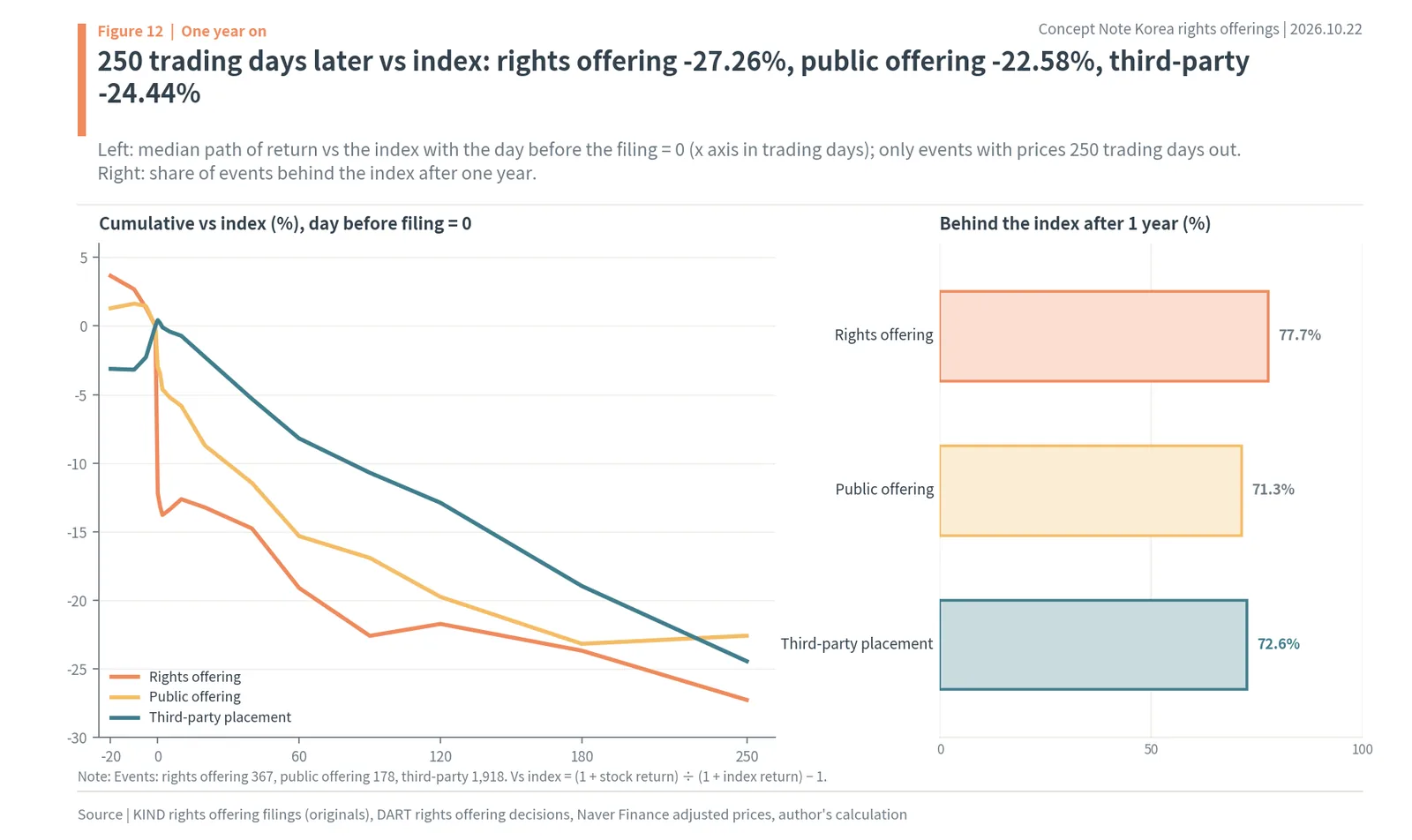
The shape of the path differs by type. Rights offerings dropped -12.17% at once on the announcement day, held there for about three months, then fell again to -19.1% at 60 trading days and -21.72% at 120 trading days. Around 60 trading days is usually when subscription and the listing of new shares are over. It coincides with the period when subscribers who received the newly listed shares and buyers in the forfeited-share offering take profits and supply comes onto the market.
Public offerings started at -2.98% on the announcement day and fell steadily to -8.71% at 20 trading days and -15.32% at 60 trading days. In a public offering the issue price is set from prices just before subscription, so the further the price falls before subscription, the lower the issue price. A force pressing on the price keeps working between announcement and subscription.
Third-party placements fell the most slowly. They went from +0.42% on the announcement day to -2.26% at 20 trading days, -8.2% at 60, -12.89% at 120 and -18.96% at 180. Also notable is that they rose 3.13% over the 20 trading days before the filing (the path’s value at -20 trading days is -3.13%). A price rising before the filing may mean information leaked early, or that companies choose to raise money after their price has risen. It is also worth noting that around 250 trading days, when the one-year resale restriction ends, the third-party placement path comes down to about where rights offerings are.
One-year returns look especially bad in years when the index rose strongly, though. In 2025 and 2026 the KOSPI rose sharply, led by large semiconductor stocks, and most companies issuing shares are not those large stocks. The returns against the index in this report include a “small companies failed to keep up with the giants” part. Even so, that more than 70% of events in every type lagged the index shows it is hard to be optimistic about the year after an offering.
One more thing to remember about one-year results is the gap between the mean and the median. The one-year mean for rights offerings is -12.86%, far above the median of -27.26%. A few big winners, such as Korean Air (+34.02%), pull the mean up. If an investor holds a single stock that announced an offering, that stock’s result is more likely to land near the median than the mean. That is why this report uses the median by default.
In one sentence, the three paths look like this. Rights offerings fall all at once on the announcement day, public offerings fall bit by bit until subscription, and third-party placements hold up on the announcement day and then fall slowly over a year. Only the timing of the fall differs; the year after printing new shares was mostly worse than the market. A shareholder who receives an offering filing should weigh the path over the following year, not just the announcement day.
The more shares printed, the more the price fell: rights offerings with 40% or more new shares fell 15.44% on the announcement day
The biggest variable splitting the size of the announcement-day reaction was how many shares were printed. This chapter’s conclusion is that in rights offerings, the larger the new-share ratio and the smaller the company, the more the price fell on the announcement day. Third-party placements went the other way: the larger the new-share ratio, the slightly more they rose on the announcement day.
Splitting rights offerings by new-share ratio, the median announcement-day return was -5.96% under 15% (39 deals), -6.05% at 15% to 25% (57), -11.85% at 25% to 40% (93) and -15.44% at 40% or more (187) (author’s calculation). The 60-trading-day median was also worst at 40% or more, -21.99%. The correlation between the new-share ratio and the announcement-day reaction is -0.23.
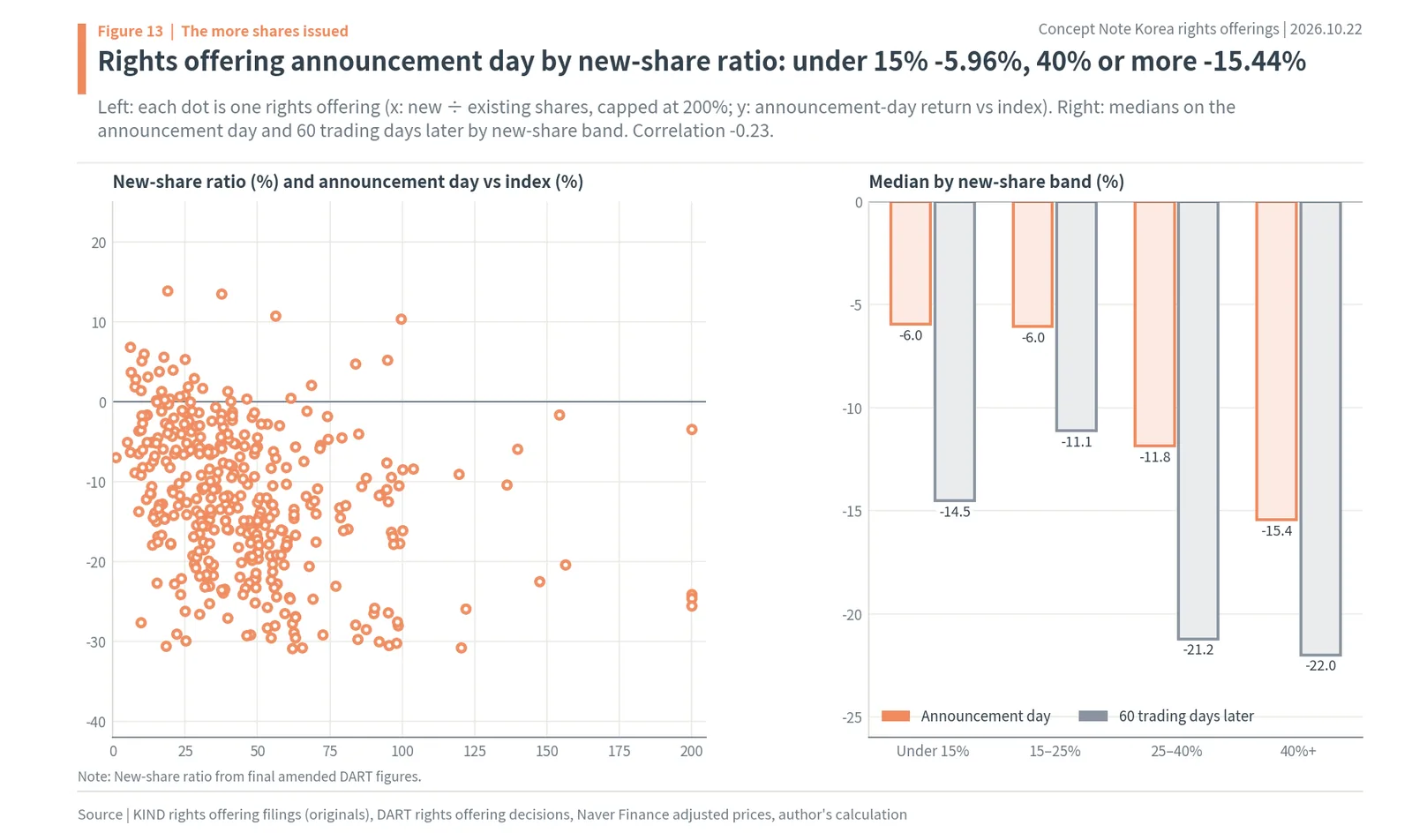
The dots on the left side of the figure are widely scattered. Even with similar new-share ratios, announcement-day reactions ranged from +10% to -30%, which means the new-share ratio is not the only variable deciding the reaction. Still, the band medians drop a step the moment the ratio passes 25%. That nearly half of the 429 rights offerings (187) printed 40% or more of existing shares pulled down the median for rights offerings as a whole.
Splitting by company size made a big difference too. Rights offerings by companies with a market capitalization of KRW 1tn or more the day before the filing had a median announcement-day return of -5.96% (65 deals), against -13.33% for those under KRW 1tn (311 deals) (author’s calculation). Close to eight in ten rights offerings by large companies also fell, but by about half as much as small companies.
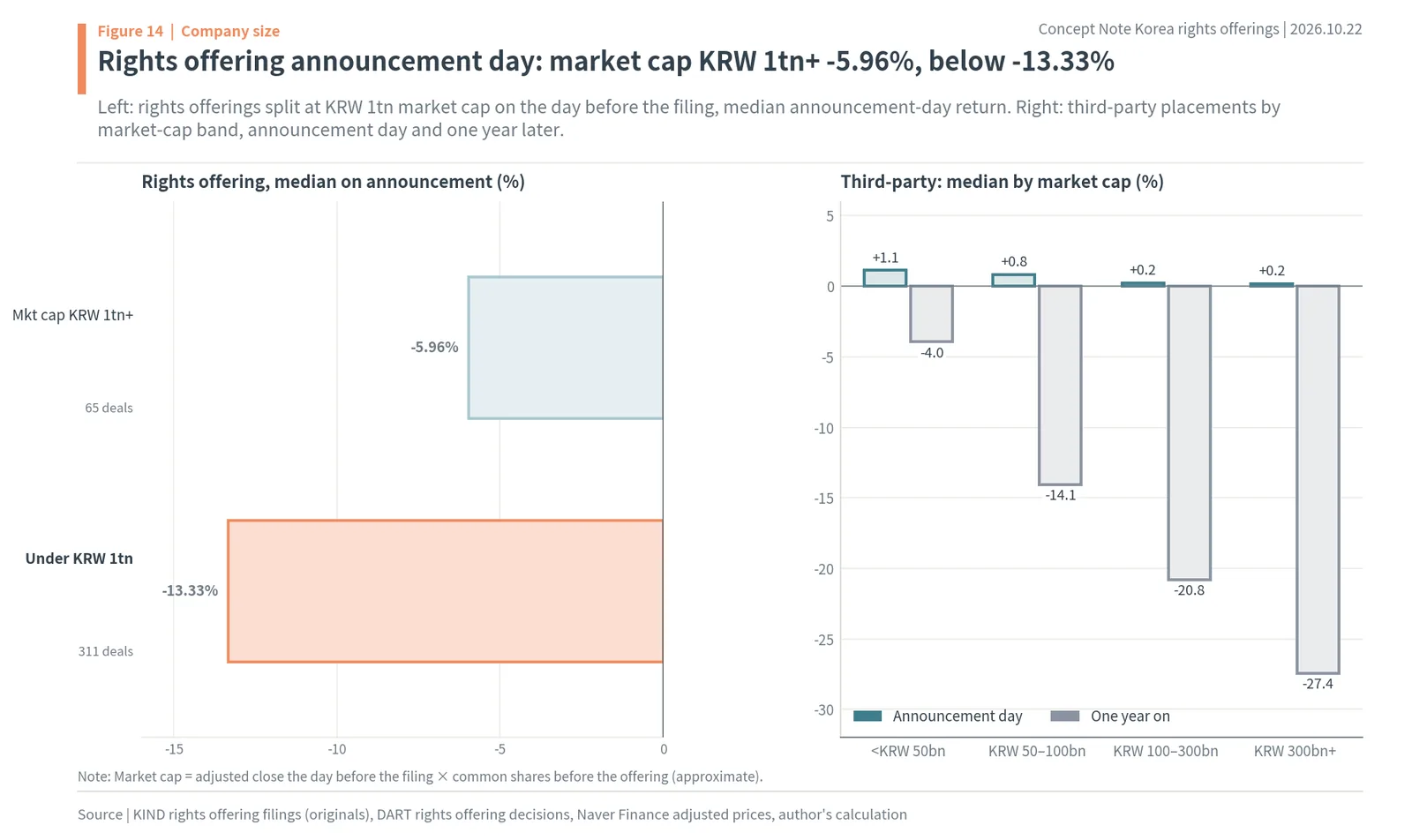
Splitting third-party placements by market capitalization, the median announcement-day return was +1.12% under KRW 50bn, +0.82% at KRW 50bn to 100bn, +0.22% at KRW 100bn to 300bn and +0.17% at KRW 300bn or more. The smaller the company, the slightly more it rose on the announcement day. The one-year median was -3.95% under KRW 50bn and -27.44% at KRW 300bn or more. Small companies often raise money when they are already at the bottom, while large companies often raise it after their price has risen, which may explain the bigger pullback that followed.
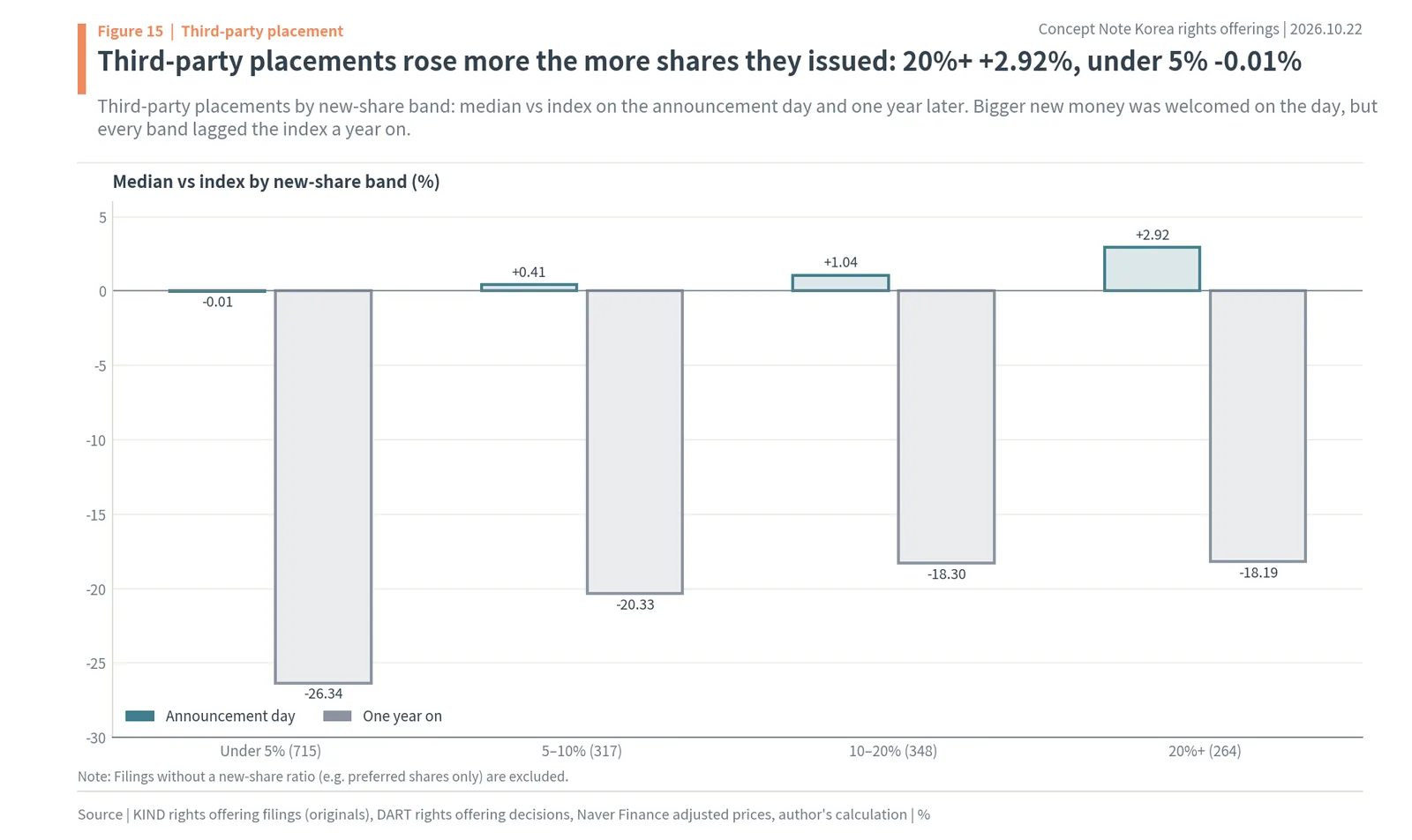
Third-party placements rose more on the announcement day the larger the new-share ratio. The median announcement-day return was -0.01% for a new-share ratio under 5%, +0.41% at 5% to 10%, +1.04% at 10% to 20% and +2.92% at 20% or more (author’s calculation). The 20%-plus band has many events in which big new money changes the largest shareholder or transforms the financial structure. The one-year medians were all between -18% and -26%, so the announcement-day gap did not last a year.
Third-party placement jumps did not last
346 third-party placements, 13.8% of the total, rose more than 10% against the index on the announcement day. Taking only these, the median was +27.48% on the announcement day, +16.36% after 20 trading days and +6.31% after 60, and -15.24% after 250 trading days (author’s calculation). 56.4% ended up lower after 60 trading days than on the announcement day.
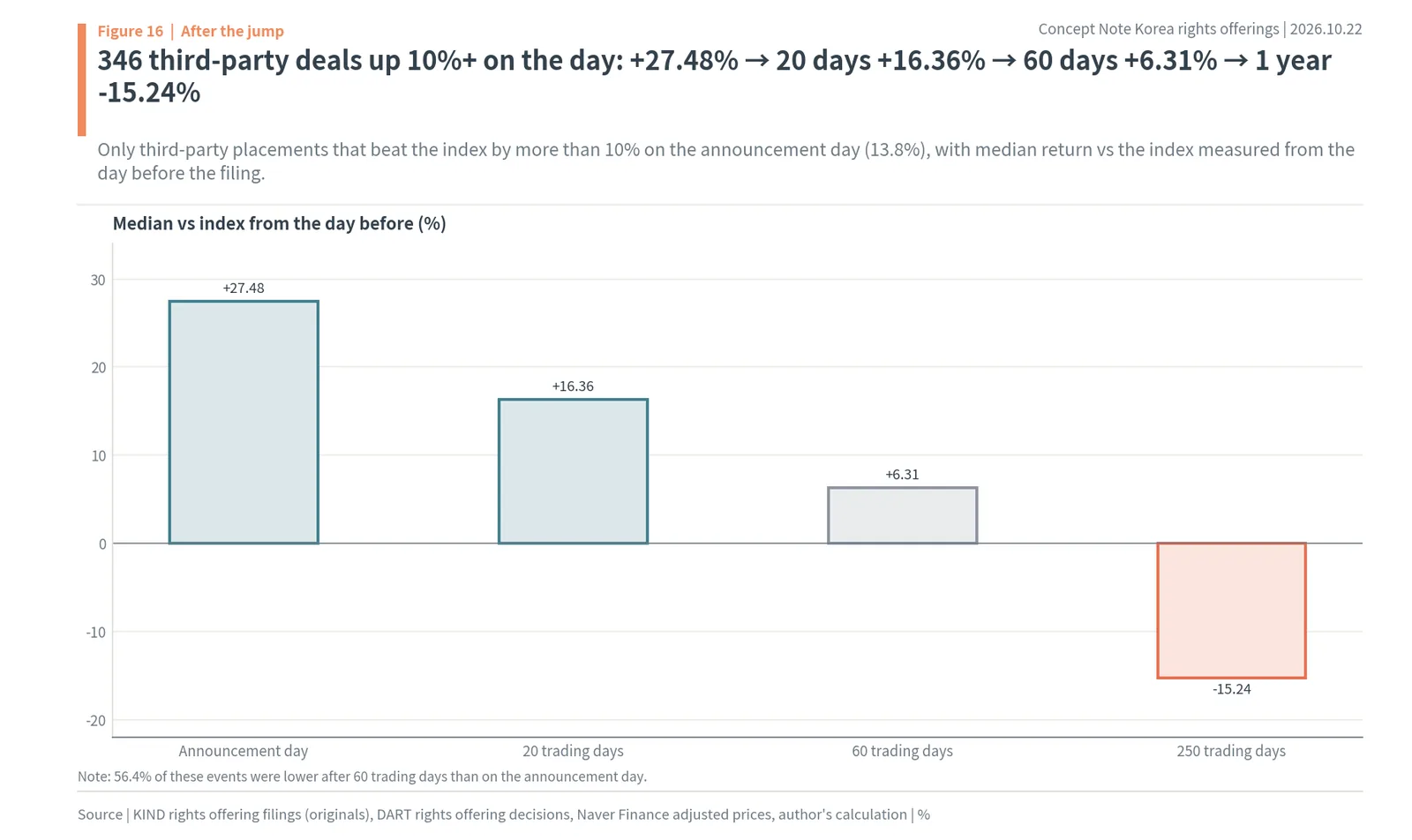
An announcement-day jump usually comes from hopes such as “a new major shareholder is coming in” or “a famous company is buying a stake.” The price rises before those hopes are confirmed in results, and when confirmation is slow, the gain drains away. Shares received in a third-party placement cannot be sold for a year, but the path falls further as that year nears its end. What the number means is that an investor who bought on the day of the jump faced -15.24% a year later. Conversely, for a holder who owned the stock before the filing, the announcement-day jump was a chance to sell part of it. On the way from +27.48% on the announcement day to +6.31% at 60 trading days, most of the gain drained away within three months. If you hold a third-party placement stock that jumped, check first whether the buyer actually paid in (the payment date) and how many times payment was postponed.
Large companies took the same road: Hanwha Aerospace, Korea Zinc, Samsung SDI, Hanwha Solutions
Let us check the statistical medians against real companies. This chapter’s conclusion is that large companies also gave up 5% to 30% in a day when they announced a rights offering or public offering, and that FSS amendment orders changed the path afterward.
Hanwha Aerospace: KRW 3.6tn announced, -13.02% the next day, two amendment orders
Hanwha Aerospace announced a KRW 3.6tn (about $2.7bn) share offering after the close on March 20, 2025. It was the largest share offering ever by a Korean company, with a planned issue price of KRW 605,000 (a 15% discount). The next day, March 21, the stock closed down 13.02% at KRW 628,000 (press reports; the same percentage confirmed with Naver adjusted prices). The maker of the K9 self-propelled howitzer and the Redback infantry fighting vehicle had seen its stock surge earlier that year on hopes for defense exports.

On March 27 the FSS ordered an amendment, saying the case for the offering, the shareholder communication process and the stated use of funds were not adequately described (Segye Ilbo). On April 8 the company changed the structure. It cut the rights offering to KRW 2.3tn, and three Hanwha companies, Hanwha Energy, Hanwha Impact Partners and Hanwha Energy Singapore, took the remaining KRW 1.3tn through a third-party placement. On April 17 the FSS ordered a second amendment, saying the internal decision-making on a Hanwha Ocean stake deal and the use of funds were not specific enough (SBS Biz). The first issue price was set at KRW 684,000, and the company raised about KRW 2.9188tn (Hankyung Business, July 11, 2025).
With the March 20, 2025 close at 100, Hanwha Aerospace fell below 87 on March 21, then climbed back through the amendment orders and restructuring to 124.3 at the end of August. The KOSPI over the same period was 120.8 (author’s calculation). It shows that even a large offering with a big announcement-day shock can recover within months when the offering shrinks and expectations for the company’s results continue. Even so, this company’s one-year return against the index was -9.75%.

Samsung SDI, Hanwha Solutions, EcoPro BM: rights offerings at battery and solar companies
Samsung SDI announced a rights offering followed by a public offering of unsubscribed shares on March 14, 2025. It applied a 15% discount to a reference price of KRW 204,000, and the new shares were 16.8% of shares outstanding (Bizwatch). The stock fell 6.18% on the announcement day at Naver adjusted prices, and the final issue price was reported at KRW 140,000. Subscriptions came in at 256.72% overall (CEO Score Daily). It was also the first case to go through the FSS’s focused review of share offerings.

Hanwha Solutions announced a KRW 2.4tn rights offering on March 26, 2026, including debt repayment among its purposes, and the stock fell 18.22% on the first trading day after the announcement (Naver adjusted prices). The FSS ordered amendments twice, on April 9 and April 30, and the offering shrank to KRW 1.7tn before taking effect on June 11 (Herald Economy). EcoPro BM announced a KRW 1.2tn rights offering (about 10.1% of existing shares) on June 30, 2026, and fell 6.88% the next trading day (Newsis).
POSCO Future M announced a KRW 1.1tn rights offering on May 13, 2025. The planned issue price was KRW 95,800, and its largest shareholder, POSCO Holdings (59.7% stake), agreed to take up KRW 525.6bn of its allotment (SBS Biz). The stock fell 4.00% on the first trading day after the announcement (Naver adjusted prices), the smallest fall among the cases. A rights offering in which the largest shareholder says it will take its whole share eases worries about forfeited shares and makes the shock smaller. But its one-year return against the index was -30.6%, so a small announcement-day shock did not mean a good year afterward.
EcoPro BM’s June 30, 2026 offering was reported as a “surprise offering” that angered shareholders (Newsis). After the filing near the close, EcoPro and EcoPro BM fell close to 20% in after-hours trading, and in regular trading the next day the parent EcoPro fell 12.76% and EcoPro BM 6.88%. That the parent reacted more to its subsidiary’s offering can be read as uncertainty over whether the parent would have to raise money to take part in the subsidiary’s offering.
Korea Zinc announced a KRW 2.5tn (about $1.9bn) public offering (3,732,650 shares at KRW 670,000 each) during trading hours on October 30, 2024. KRW 2.3tn of it was for paying down debt. The stock closed at the daily limit, -29.94% (KRW 1,081,000), that day (Metro Seoul). It was a large public offering right after a tender offer in a fight for control; the FSS ordered an amendment on November 6, and the company withdrew the offering on November 13.
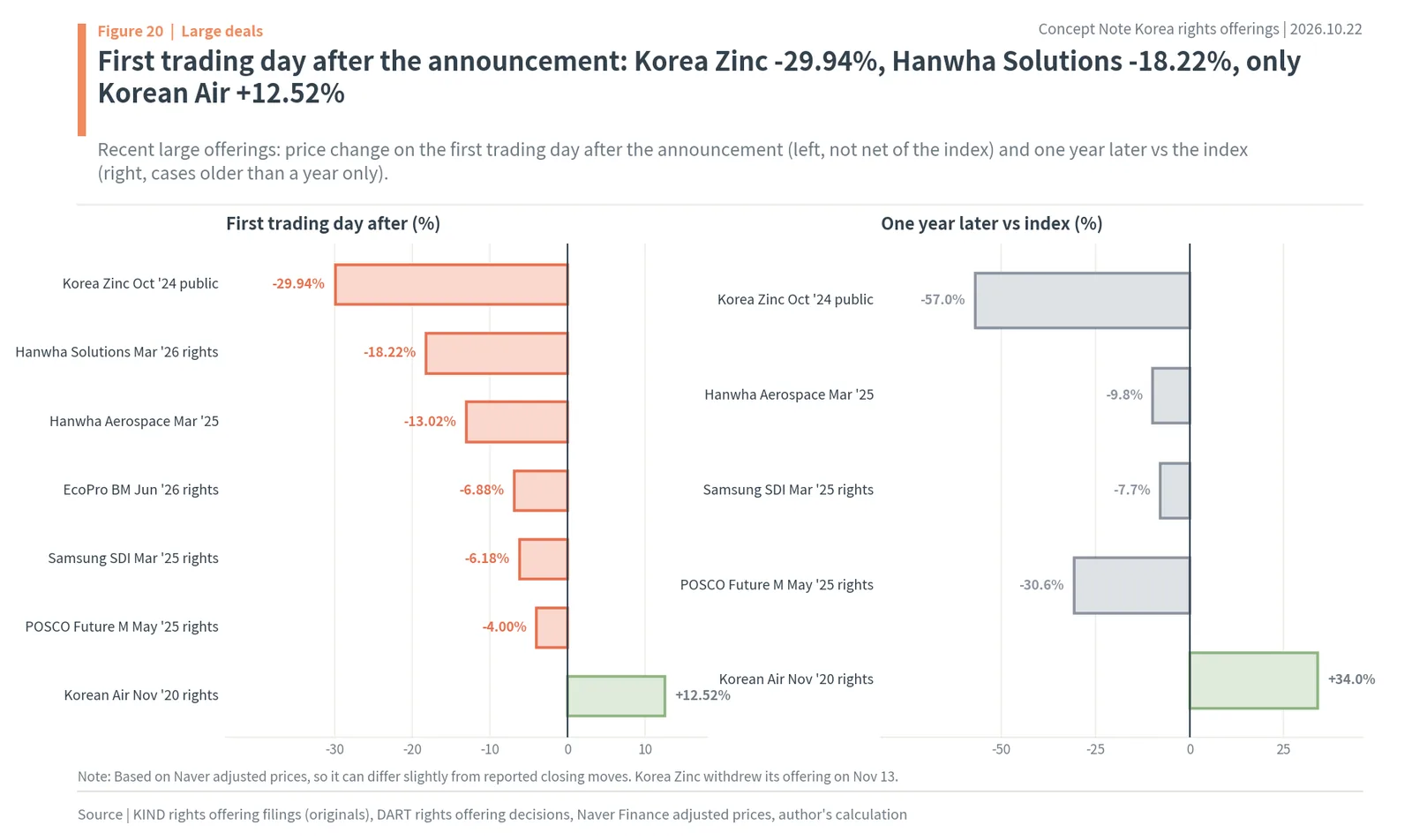
The left side of the figure is the price change on the first trading day after the announcement (not net of the index): Korea Zinc -29.94%, Hanwha Solutions -18.22%, Hanwha Aerospace -13.02%, EcoPro BM -6.88%, Samsung SDI -6.18% and POSCO Future M -4.00%. On the right, among cases at least a year old, Korea Zinc was -57.0%, POSCO Future M -30.6%, Hanwha Aerospace -9.8% and Samsung SDI -7.7%, all behind the index (author’s calculation).
There are exceptions. Korean Air announced a rights offering (KRW 3.3tn by the DART decision) on November 16, 2020 to fund its acquisition of Asiana Airlines; its stock rose +12.52% on the first trading day after the announcement and was +34.02% against the index a year later. It rose even though the new-share ratio was 99.7%, almost as many new shares as existing ones. The market valued the market position the acquisition would bring more than the offering itself. Rights offerings do not always fall, but such exceptions were about one in ten (90.7% fell against the index).
Put the cases together and common points appear. First, announcements often came after the close or in the evening (Hanwha Aerospace after the close on March 20, ISU Petasys at 6:44 p.m.), so the market reacts all at once the next morning. Second, FSS amendment orders were almost always there, and offerings often shrank after amendment. Third, how much the largest shareholder took part changed the size of the shock. Fourth, the size of the announcement-day shock and the one-year result moved separately.
The FSS looks hard at share offerings: 14 of 16 offerings got a focused review in 2025
The big change of the past two years is the Financial Supervisory Service’s review. This chapter’s conclusion is that from 2025, almost every share offering with heavy dilution gets a focused review, and when an amendment is ordered, dates, amounts and issue prices change, so you have to follow the amendment filings.
In February 2025 the Financial Supervisory Service met the heads of investment banking at securities firms and said it would give a focused review to any share offering that met even one of seven grounds, including dilution of share value, a risk of harm to minority shareholders and neglect of the lead manager’s duty of care (Bizwatch, February 27, 2025). A focused review means examining a registration statement intensively within a week of filing and holding at least one face-to-face meeting with the company.

The results came in numbers. From February 27 to April 30, 2025, 14 of 16 share offerings were given a focused review. These included two of KRW 1tn or more and 12 by marginal companies, and the items the FSS asked to be amended were the need for the offering (12 cases), investment risks of marginal companies (12), the shareholder communication process (10) and due diligence (9) (The Fact, May 28, 2025).

Amendment orders moved prices too. ISU Petasys filed a KRW 550bn rights offering, equal to 31.8% of existing shares, at 6:44 p.m. in November 2024 and fell sharply; when the FSS ordered an amendment on December 2, the stock rose 26.78% the next day (press reports). In January the following year the company dropped its acquisition plan and cut the offering to KRW 250bn. The market read the amendment order as a sign that “the offering may shrink or be delayed.”
2026 has followed the same pattern. Hanwha Solutions cut its offering after two amendment orders, and there were reports of companies revising their registration statements more than four times under the stricter review (Newsis, August 4, 2026). The first filing is not the only thing investors need to check. You have to follow the amendment filings to the end to see how the number of shares, the planned issue price, the schedule and the purpose of funds change.
For investors, the focused review means two things. One is that the offering schedule may slip. When an amendment is ordered, the registration statement stops being effective, and while the revised statement is reviewed again, the record date, subscription date and listing date are all pushed back. Hanwha Aerospace announced its offering in March and listed the new shares only in July. The other is that the terms may change. The size may shrink, part of a rights offering may become a third-party placement, or the purpose of funds may be spelled out in more detail. As with ISU Petasys, whose stock rebounded the day after an amendment order following a sharp fall on the announcement day, an amendment filing can itself be a price-moving event.
Where the money goes: 23.4% of rights offering money was for paying down debt
A share offering filing lists how much of the money will be used for each purpose. This chapter’s conclusion is that rights offerings had the largest share for debt repayment, public offerings for acquisitions and third-party placements for facility investment.
Summing the purpose boxes in DART’s rights offering decisions by type, debt repayment was 23.4% of the decided amount for rights offerings, 2.4% for public offerings and 4.5% for third-party placements (author’s calculation). Rights offerings were evenly spread across operating funds (26.7%), buying shares of other companies (25.6%) and facility funds (21.5%). For public offerings, buying shares of other companies was 76.9%, a share set by a few large acquisitions. For third-party placements, facility funds were 48.6%, which includes SK hynix’s KRW 40.0tn ADR deal booked as facility funds.
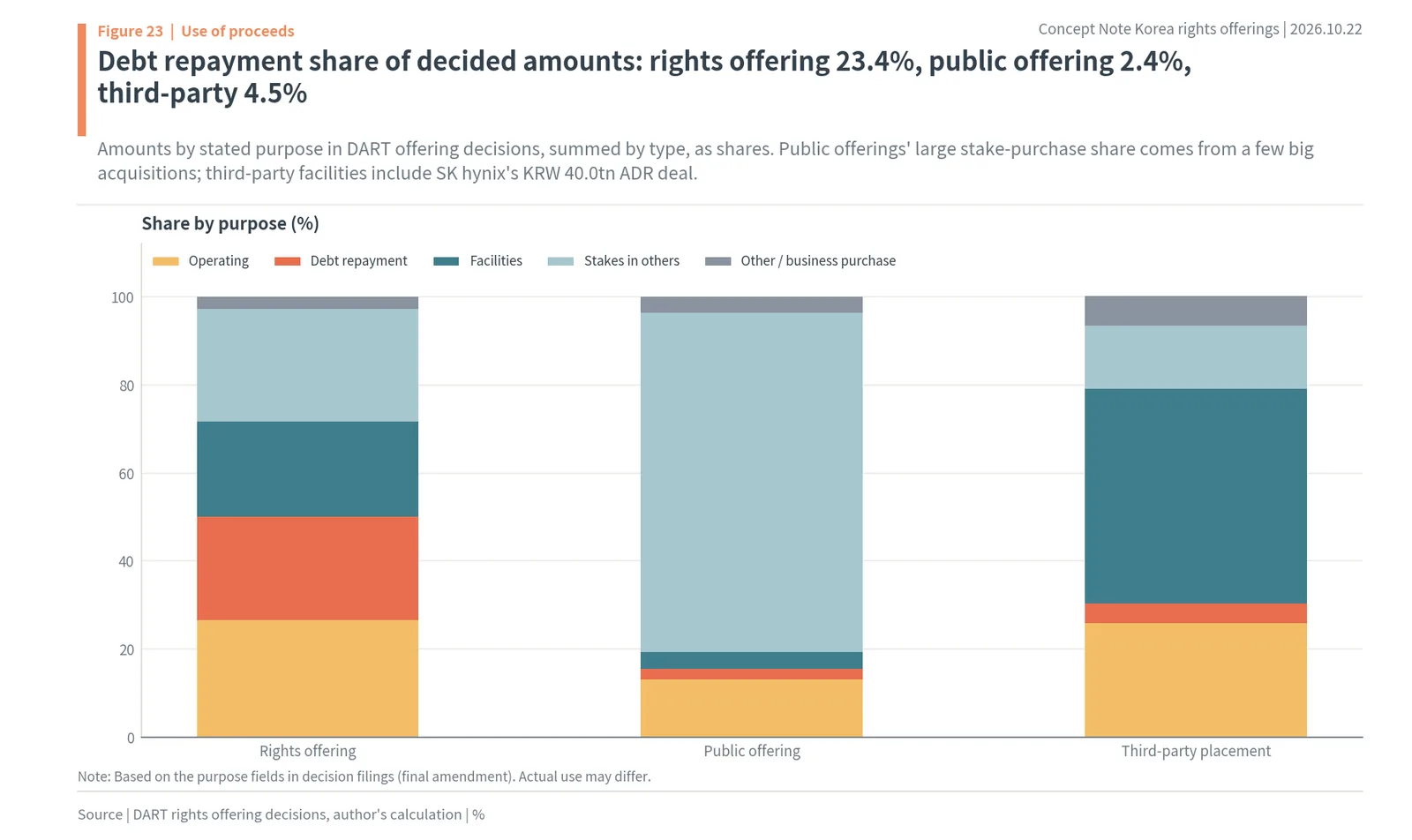
Paying down debt is the purpose the market likes least. It amounts to the company borrowing shareholders’ money because it could not repay its debts from what it earned. When the money is to go to plants or acquisitions that can raise future profits, the market weighs whether that investment will produce more value than the money received. In Buffett’s terms, the “business value received” comes from that investment.
The purpose boxes are, however, the plan in the decision filing. Actual use has to be checked in the “use of offering proceeds” section of the business report after the offering, and money is sometimes used differently from the plan. If only “operating funds” are listed in large amounts, consider that the company’s cash flow may be strained.
By purpose: rights offerings for operating funds fell the most
The link between the purpose of funds and the announcement-day reaction was also checked event by event. Grouping events by the purpose that makes up more than half of the decided amount, the median announcement-day return for rights offerings was -14.06% for mainly operating funds (172 deals), -12.04% for mainly debt repayment (77), -10.65% for mainly facility funds (71) and -5.79% for mainly buying shares of other companies (33) (author’s calculation). The one-year median was -30.98% for mainly operating funds, -27.56% for mainly debt repayment and -21.91% for mainly facility funds.
Operating funds are the money a company spends every month: wages, materials and research. Raising operating funds through a rights offering often means that cash earned from the business cannot keep up with cash spent. That is why the market reacted most strongly to rights offerings for operating funds. Facility funds go to plants or equipment, so the market also weighs the chance of higher future profits, and buying shares of other companies had a smaller shock because the value of the target is often disclosed along with the filing.
Public offerings should be read carefully because there are few events, but the 10 offerings mainly for debt repayment had the worst median announcement-day return, -18.27%. KRW 2.3tn of Korea Zinc’s KRW 2.5tn public offering was also for debt repayment. Third-party placements had similar announcement-day medians regardless of purpose, between +0.12% and +0.74%. In third-party placements, the market cared more about who was putting money in than about where it went.
In short, even within rights offerings, debt repayment and operating funds fell 2 to 3 percentage points more on the announcement day than facility investment, and the gap widened a year later. The purpose box in an offering filing is the first place you can check whether the company plans to create “business value received” with the money.
Steps for your own stock: check the type, dilution, discount, use and schedule in order
The calculation to run when you get an offering filing is not long. This chapter’s conclusion is to gauge the size of the announcement-day shock from the type and new-share ratio, calculate the ex-rights drop from the discount, and prepare for what follows from the purpose of funds and the schedule. It comes down to five steps.
Step 1 is checking the offering method. The brackets in the KIND or DART filing title, or the “offering method” box in the body, will show one of rights offering followed by public offering of unsubscribed shares, public offering or third-party placement. Over the past nine years, the median announcement-day return was -12.57% for rights offerings, -2.98% for public offerings and +0.40% for third-party placements.
Step 2 is measuring dilution by dividing new shares by shares outstanding before the offering. In rights offerings, a value of 40% or more had a median announcement-day return of -15.44%, and under 15%, -5.96%. The median for rights offerings is 39.9%. Companies with a market capitalization under KRW 1tn saw a bigger shock.
Step 3 is calculating the ex-rights drop from the discount and the planned issue price. The formula is 1 − (1 + ratio × (1 − discount)) ÷ (1 + ratio); selling 30% new shares at a 25% discount gives a theoretical ex-rights drop of -5.8% (author’s calculation). You can recover this by subscribing or selling the rights certificates; do nothing and you lose it.

Step 4 is looking at the purpose of funds. 23.4% of rights offering money went to paying down debt. If the purpose is mainly debt repayment or operating funds, financial strain may continue after the offering; if it is plants or acquisitions, weigh when that investment will come back as profit.
Step 5 is putting the schedule on your calendar. For a rights offering, the order is: the record date (buy two trading days before it to get the rights), the ex-rights day, the first issue price date, the rights-certificate listing period, the second issue price date, subscription by existing holders, the public offering of forfeited shares, the payment date and the listing date of the new shares. Over the past nine years, the rights offering path fell sharply on the announcement day and fell again around 60 trading days later, near the listing of the new shares. For a third-party placement, note the date the one-year resale restriction ends.
Three investors
Let us follow the steps for three hypothetical investors. All values are the past nine years’ medians shown above and the author’s calculations.
The first investor holds a KOSDAQ stock whose company announces a rights offering equal to 50% of existing shares at a 25% discount. By steps 1 and 2, similar events over the past nine years had a median announcement-day return of -15.44%, and KOSDAQ rights offerings -15.05%. By step 3, the theoretical ex-rights drop at 50% new shares and a 25% discount is -8.3%. What this investor needs to do is decide in advance whether to subscribe or sell the certificates. Doing neither means losing the ex-rights value as well.
The second investor watched a company with a market capitalization of KRW 300bn announce a third-party placement and jump 25% that day. The 346 third-party placements that rose more than 10% on the announcement day had medians of +27.48% on the day, +16.36% at 20 trading days and -15.24% a year later. By the past nine years’ numbers, buying on the day of the jump was a losing move. What to check is who the buyer is, whether the largest shareholder changes, where the money goes and when the one-year resale restriction ends.
The third investor sees a large company with a market capitalization above KRW 1tn file a rights offering of 15% new shares to fund a plant. Over the past nine years, rights offerings by large companies had a median announcement-day return of -5.96%, and the under-15% band also -5.96%. The shock is about half that of small companies, but eight in ten still fell. Watch both when the plant investment will turn into profit and whether the FSS orders an amendment.
Five common misconceptions, checked again with numbers
Let us check common claims about share offerings against this report’s numbers. The conclusion is that splitting by type, size, buyer and purpose fits the numbers better than one-line verdicts such as “an offering is bad news” or “a third-party placement is good news.”
First, “a share offering is always bad news.” Rights offerings and public offerings mostly fell on the announcement day, but the median third-party placement was +0.40%, and only 46.1% fell against the index. There are exceptions like Korean Air, whose price rose on a rights offering. But stretched to a year, more than 70% of events in all three types lagged the index, so it is more accurate to talk about the announcement-day reaction and the one-year result separately.
Second, “selling at a discount hurts existing holders.” In a rights offering the discount is not a loss if you subscribe or sell the rights certificates. In the hypothetical example, the holder who subscribed and the holder who sold the certificates both still had KRW 1,000,000. The loss fell only on the holder who did nothing. In public offerings and third-party placements, on the other hand, existing holders have no rights, so the discount transfers part of their claim to the new shareholders. That is why the rules cap the discount at 30% for public offerings and 10% for third-party placements.
Third, “a third-party placement is good news.” The median on the announcement day was positive, and 7.2% rose close to the daily limit. But the 346 events that rose more than 10% on the announcement day had a one-year median of -15.24%, and third-party placements by companies with a market capitalization of KRW 300bn or more were -27.44% a year later. Add the 3.13% rise in the 20 trading days before the filing, and investors who buy on the announcement day often bought at a price that had already risen.
Fourth, “offerings by large companies are fine.” Rights offerings by companies with a market capitalization of KRW 1tn or more had a median announcement-day return of -5.96%, about half that of small companies (-13.33%). Still, close to eight in ten fell, and large companies such as Hanwha Aerospace (-13.02%) and Hanwha Solutions (-18.22%) fell by double digits. The new-share ratio and purpose were bigger variables than company size.
Fifth, “a small offering means under KRW 1bn.” The small-offering threshold, which lets a company make a public offering with a simple filing instead of a registration statement, was under KRW 1bn for a long time, but the Financial Services Commission said a Cabinet meeting on July 21, 2026 approved an amendment to the Enforcement Decree of the Capital Markets Act raising it to under KRW 3bn (about $2.3mn) (FSC press release). Small-offering third-party placements had a median announcement-day return of -0.22%, below other third-party placements (+0.47%) (author’s calculation). A wider threshold may lead to more offerings in the small-offering format.
Compared with abroad: US public offerings fall about 3% on announcement, Korean rights offerings four times that
Let us set the Korean numbers against foreign ones. The conclusion is that the announcement-day shock of Korean rights offerings is much bigger than that of US public offerings, and much of the gap comes from how many shares are printed at once.
Most US listed companies raise equity through public offerings. The underwriter checks demand with institutional investors in advance and prices the deal within a day or two. Masulis and Korwar (1986) reported an average abnormal return of -3.25% around the announcement for 690 public equity offerings by US industrial companies from 1963 to 1980. In this report, the announcement-day mean for Korean public offerings is -4.50% and the median -2.98%, a similar size. The Korean rights offering median of -12.57% is close to four times that.
One reason for the gap is how much is printed. Korean rights offerings have a median new-share ratio of 39.9%, printing close to 40% of existing shares at once. As the previous chapter showed, Korean rights offerings with new shares under 15% had a median announcement-day return of -5.96%. Compared at the same size, much of the gap disappears.
Another is who raises the money. In Korea, KOSDAQ companies account for more rights offerings (263) than KOSPI companies (157), and most (311) have a market capitalization under KRW 1tn. That suggests many are companies that find it hard to borrow from banks or sell corporate bonds and lean on shareholders instead. So the market also reads a rights offering filing as a signal about the company’s finances.
Back to Buffett’s principle: the “business value received” he spoke of comes down to whether the money raised goes somewhere that earns more than that money. The Korean numbers show this test from the investor’s side. The market demanded a discount on the announcement day from companies that said they would print new shares, watched for a year whether the investment produced more value than the money received, and in most cases the answer was “not yet.”
How the numbers were built: original filing date, return against the index as a ratio, and medians
Here is how this report’s numbers were made. The conclusion is that it used the median of returns against the index, measured as a ratio, from the day the market first heard the news, and that filings whose type could not be confirmed and amounts that changed after amendment remain limitations.
The sample is the 4,057 original “rights offering decision” filings by KOSPI and KOSDAQ companies downloaded from KIND’s detailed search. Amendments attached to the same offering were not used, because the first filing date was taken as the day the market first heard the news. The offering method was read first from the brackets in the filing title; filings without the method in the title were matched to the DART Open API rights offering decision data by company and date. 362 filings with two or more decisions in the period that could not be assigned to one (for example, Hanwha Aerospace’s March 20, 2025 filing, later split into a rights offering and a third-party placement) were left out of the type statistics.
New share counts, shares before the offering and amounts are from the final amended version of the DART data, so they can differ from the amounts first announced. Hanwha Solutions announced KRW 2.4tn, but the DART decision holds the reduced amount. The case chapter uses reported announcement amounts; the statistics chapters use DART values.
The announcement-day reaction is the change in the closing price that day for filings before 3:30 p.m., and the next trading day for later filings. The return against the index is (1 + stock return) ÷ (1 + index return) − 1, using the KOSPI for KOSPI companies and the KOSDAQ for KOSDAQ companies. Prices are Naver Finance adjusted prices, which strip out the mechanical effects of ex-rights and stock splits. So a case’s one-day change can differ slightly from the reported closing change (Samsung SDI: reported -6.6%, this report -6.18%).
Medians were used instead of means because of the extreme moves of small companies. The mean announcement-day return for third-party placements is +2.45%, larger than the median of +0.40%; a few hundred limit-up events pull the mean up. One-year returns also have a mean (rights offerings -12.86%) higher than the median (-27.26%). A few big winners pull the mean up, while most events lagged the index near the median.
Finally, the one-year returns against the index include the index gains of 2025 and 2026 led by large semiconductor stocks. Most offering companies are not those stocks, so the numbers also contain a “large caps versus small and mid caps” gap that is not caused by the offering. The announcement-day reaction is a one-day measure and is barely affected.
Maochaedung’s take. A share offering is selling new shares for cash, and it splits by who buys them into rights offerings, public offerings and third-party placements. Across 3,695 original KOSPI and KOSDAQ filings since October 2017, the median announcement-day return against the index was -12.57% for rights offerings, -2.98% for public offerings and +0.40% for third-party placements, and rights offerings fell more the more shares they printed (-15.44% at 40% or more) and the smaller the company (-13.33% under KRW 1tn). A year later all three types were 22% to 27% behind the index, and even third-party placement jumps turned into -15.24% within a year. Since 2025, the FSS’s focused review has often changed the size and schedule of large offerings. So when you see an offering filing, first check the type, dilution, discount, purpose of funds and schedule, and in a rights offering, protect the ex-rights value by subscribing or selling the rights certificates.
Korea rights offerings FAQ
Q. How do Korean stocks react to a rights offering announcement?
Across 420 rights offerings by KOSPI and KOSDAQ companies from October 2017 to October 22, 2026, the median announcement-day return against the index was -12.57%, and 90.7% fell against the index. Public offerings had a median of -2.98% and third-party placements +0.40%.
Q. What are the discount limits for share offerings in Korea?
Under Article 5-18 of the Regulation on Securities Issuance and Disclosure, a general public offering can be priced at most 30% below the reference price and a third-party placement at most 10%. A rights offering to existing holders has no legal cap; recent large ones such as Hanwha Aerospace and Samsung SDI used 15%, and Nextchip used 30%.
Q. How much does the stock fall on the ex-rights day?
The theoretical drop is 1 − (1 + ratio × (1 − discount)) ÷ (1 + ratio). New shares equal to 30% of existing shares at a 25% discount lower the ex-rights reference price by 5.8%; 50% at a 30% discount, by 10.0%. A holder who subscribes or sells the rights certificates keeps the same wealth; one who does nothing loses that amount.
Q. Is a third-party placement good news for the stock?
Only on the day. The median announcement-day return was +0.40%, but 346 placements that beat the index by more than 10% on the day went from a median of +27.48% to -15.24% after 250 trading days, and 72.6% of third-party placements were behind the index a year later.
Q. What is the FSS focused review of share offerings?
Since February 2025 the Financial Supervisory Service picks out registration statements with large dilution or risk to minority shareholders, reviews them within a week and meets the company at least once. From February 27 to April 30, 2025, 14 of 16 share offerings were reviewed this way, and the most common amendment item was the need for the offering (12 cases).
Sources
- Warren Buffett, Berkshire Hathaway 1983 Chairman’s Letter (link), Feb 1984
- Korea Exchange KIND detailed search, “rights offering decision” filings (Oct 1, 2017 to Oct 22, 2026); Financial Supervisory Service DART Open API, rights offering decisions (final amended)
- Naver Finance, daily adjusted prices of stocks, KOSPI and KOSDAQ, Jan 2017 to Oct 22, 2026
- Yahoo Finance, KRW=X exchange rate, Oct 22, 2026
- NewDaily, Article 5-18 of the Regulation on Securities Issuance and Disclosure on discount rates (link), Apr 3, 2014
- Digital Today AI Disclosure, Neorigin third-party placement (link), Oct 2025
- Nextchip amended registration statement (KIND, https://kind.krx.co.kr/external/2025/12/01/000493/20251201001017/10601.htm), Dec 1, 2025
- Segye Ilbo, FSS orders Hanwha Aerospace to amend its offering (link), Mar 27, 2025
- SBS Biz, Hanwha Aerospace offering blocked again (link), Apr 17, 2025
- Hankyung Business, Hanwha Aerospace offering subscription results (link), Jul 11, 2025
- Metro Seoul, Korea Zinc hits the daily limit after an intraday offering announcement (link), Oct 30, 2024
- Aju Business Daily, FSS orders Korea Zinc to amend its registration statement (link), Nov 6, 2024
- Bizwatch, Samsung SDI offering and focused review (link), Mar 17, 2025
- CEO Score Daily, Samsung SDI offering subscription results (link), May 29, 2025
- Herald Economy, Hanwha Solutions offering takes effect (link), Jun 10, 2026
- Newsis, Shareholders push back on EcoPro BM’s KRW 1.2tn offering (link), Jul 2, 2026
- Newsis, The “Nth” registration statement under a stricter FSS review (link), Aug 4, 2026
- Daum (original outlet), ISU Petasys jumps 26% after the “offering lock” (link), Dec 3, 2024
- Bizwatch, Regulators to focus on IPOs and share offerings (link), Feb 27, 2025
- The Fact, FSS tightens focused review of share offerings (link), May 28, 2025
- Financial Services Commission press release on the small-offering threshold (link), Jul 21, 2026
- Woo Min-cheol and Park Soo-cheol, “Information effects by offering method and purpose of seasoned equity offerings,” Korean Business Education Review 32(3), 2017
- Lim Byung-kwon, Lee So-rim and Yoon Pyung-sik, “Announcement effects of third-party allotment equity offerings,” Korean Journal of Financial Management 36(1), 2019
- Masulis, R. and Korwar, A., “Seasoned Equity Offerings: An Empirical Investigation,” Journal of Financial Economics 15, 1986 (as cited in Vijh 2002)
- Photos: Good-investing, “Berkshire Hathaway Annual Meeting 2025”, CC0; 4300streetcar, “SK Hynix DDR5 form factors”, CC BY 4.0; Narubaru7, “Korea Exchange 2025”, CC BY 4.0; Staff Sgt. Matthew Foster, “A Polish K9 howitzer fires an artillery round”, public domain; Bjoertvedt, “Hungary Göd with Samsung”, CC BY-SA 4.0; 김한솔20232780, “Financial Supervisory Service building”, CC BY-SA 4.0 (all Wikimedia Commons)
Was this note useful?
Thanks. Your answer helps decide what to cover next.
Korea market snapshot · Oct 23, 2026
New to Korean stocks? Start here for the basics.
Most read
1France Protests 2026: Why Students Are Blocking Schools and Which Stocks Benefit (Munich Re, SCOR)
Get the Saturday note on Korean stocks
One email every Saturday with the week’s new research on Korean listed companies and links to the updated data pages. Built from DART filings and KRX data. Free; unsubscribe in one click. See past issues