
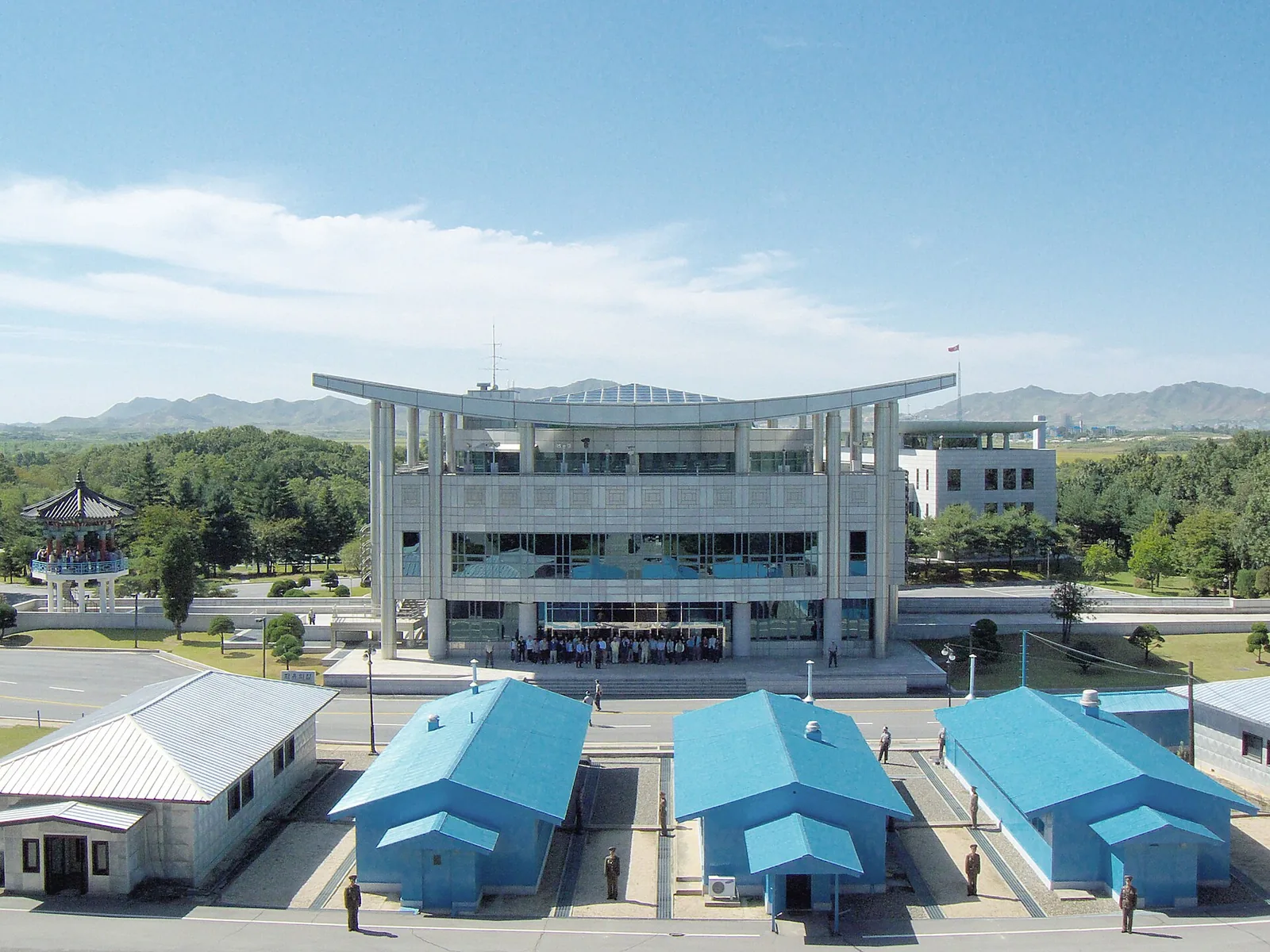
North Korea’s DMZ Mine and Kim Yo Jong’s “Self-Staged Farce”: Why Pyongyang Is Harsher on Lee Jae-myung, and What 14 Provocations Did to Korean Defense Stocks
North Korea’s DMZ mine, Kim Yo Jong’s statements and the October 3 hypersonic launch, and what they mean for Korean defense stocks. On September 21, 2026, North Korean mines injured three South Korean soldiers just south of the Military Demarcation Line. Seoul’s response emphasized dialogue; Pyongyang answered with mockery and a missile. This report lays out what happened and who said what, why North Korea treats a conciliatory South Korean government more harshly, and how 17 Korean security-related stocks actually moved in 14 past North Korean provocations. Data as of October 5, 2026 (stock prices as of October 2).
- Four North Korean plastic mines inside a 4 m circle about 10 m south of the MDL injured three South Korean soldiers on Sept 21, 2026; the JCS called it a clear armistice violation.
- President Lee called it an “unforeseen accident” without naming the North; the Democratic Party moved from blaming the Yoon government to condemning Pyongyang within a day.
- Since its December 2023 “two hostile states” line, North Korea treats South Korea itself as the enemy and called Seoul’s conciliatory stance a “clumsy deception”; provocations also happened under progressive governments.
- In 14 past provocations, 7 small Korean defense stocks beat the index on the event day 73.8% of the time, but only 6.5% of the day-two peak was left after 20 trading days.
- Real money is going to interception and surveillance: the 2027 weapons budget is up 13.8%, with KRW 300bn to bring L-SAM forward; 57.5% of signed L-SAM production went to Hanwha Aerospace.
Key takeaways
- On September 21, 2026, four North Korean mines inside a 4-meter circle just south of the DMZ’s Military Demarcation Line injured three South Korean soldiers. The JCS called it “a clear violation of the armistice”, President Lee Jae-myung called it an “unforeseen accident” without naming the North, and Pyongyang answered with two Kim Yo Jong statements (“self-staged farce”) and an October 3 hypersonic missile.
- Since its December 2023 “two hostile states” line, North Korea treats South Korea itself as the enemy regardless of which party governs, and it called the Lee government’s conciliatory stance a “clumsy deception”. Shelling, nuclear tests, demolitions and insults happened under progressive governments too.
- In 14 past provocations, 7 small Korean defense stocks beat the index on the event day 62 times out of 84, but the average peaked at +7.0%p on day 2 and only 6.5% of that peak was left after 20 trading days. Large defense names moved on exports, the Middle East and budgets instead (author’s calculation).
As of: October 5, 2026
Ticker: Victek (065450) and 16 other stocks
Reference close: KRX close on October 2, 2026
This is the author’s personal analysis and view.
The author’s calculations and estimates are not confirmed facts.
1. This is the detailed English edition of the author’s Korean report on the September 2026 DMZ mine incident and Korean defense stocks.
2. It asks three things: what happened and who said what, why North Korea is harsher on a government that reaches out, and how Korean security-related stocks actually moved on days like this.
3. The first two are traced through JCS and Defense Ministry announcements, Kim Yo Jong’s statements, remarks by the president, ministers and both parties, and North Korea’s declarations since 2023, in date order.
4. For stocks, the author counted how 17 Korean stocks moved against the market index in 14 North Korean provocations from the 2010 Cheonan sinking to the October 2024 artillery alert (author’s calculation).
5. Finally, the report checks where real money goes, not a one-day theme, through the 2027 defense budget and L-SAM production contracts.
6. The bottom line: North Korea’s enemy is “South Korea”, not a party; North Korea headlines move theme stocks for two days; the money goes to interception and surveillance budgets.
1. What happened
7. Around 10:50 a.m. on September 21, a mine exploded in front of a 25th Division reconnaissance battalion clearing a search route in the DMZ near Paju (Newspim).
8. One blast went off as the unit withdrew and a second during the rescue; three officers and NCOs were hurt, and the battalion commander lost a foot (RFA, Hankook Ilbo).
9. The first breaking report came at 1:07 p.m., during market hours, and Korean markets were closed September 24 and 25 for Chuseok (Herald Economy).
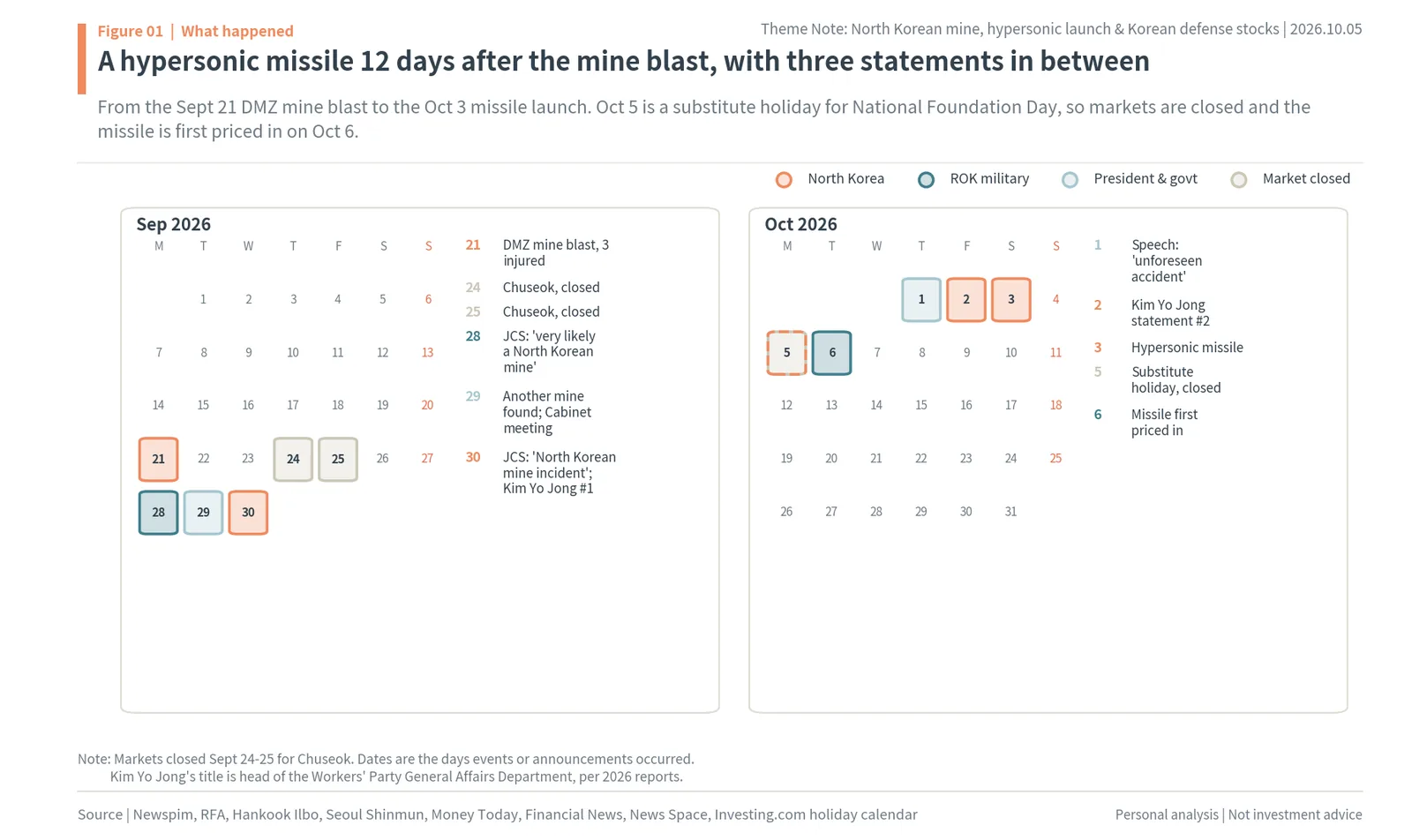
10. On the night of September 28, the JCS said the first forensic tests found TNT and no trace of the South Korean M14 mine compound, and that a North Korean mine was “very likely” (Seoul Shinmun, Financial News).
11. On September 29, a third site survey found one more, so four North Korean plastic anti-personnel mines sat inside a 4-meter circle about 10 meters south of the MDL (Hankook Ilbo, Seoul Economic Daily).
12. Plastic mines contain little metal and are hard to find with ordinary detectors, and North Korea has been fortifying a barren strip of about 90 km along the MDL since 2024 (Seoul Shinmun).
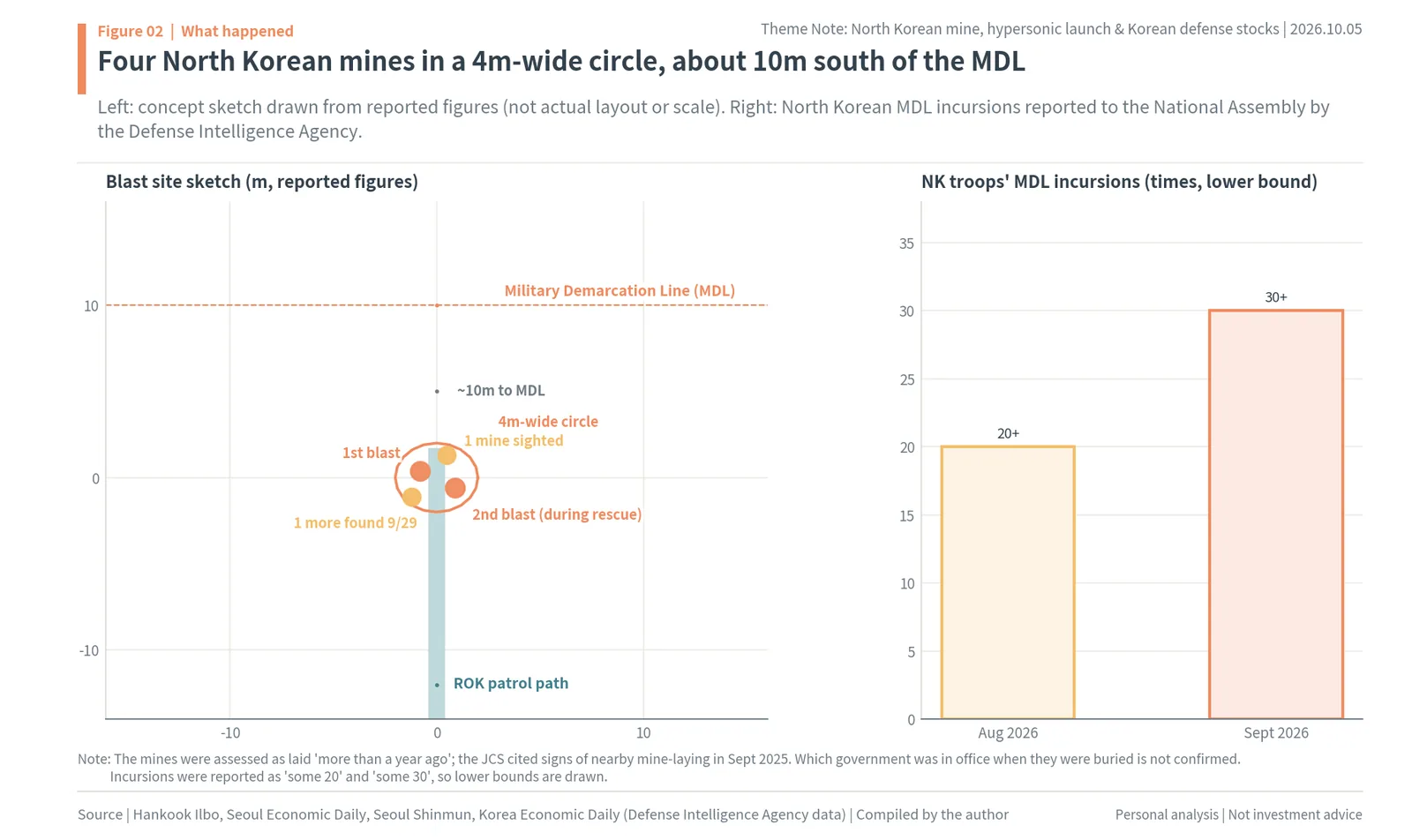
13. Defense Minister Kang Shin-chul said the mines were laid, not washed in, and appeared to be “laid to fortify the border” (Seoul Economic Daily).
14. They were judged to have been in the ground for more than a year, and a JCS report also cited signs of nearby North Korean mine-laying found in September 2025 (Hankook Ilbo, New Daily).
15. So it has not been established under which South Korean government the mines were laid.
16. At 11:26 a.m. on September 30, the JCS and the UN Command called it a “North Korean mine incident” and “a clear violation of the armistice”, and demanded an apology (Newspim).
17. A Defense Intelligence Agency document given to lawmakers showed North Korean troops crossed the MDL about 20 times in August and about 30 times in September, almost once a day (Korea Economic Daily).
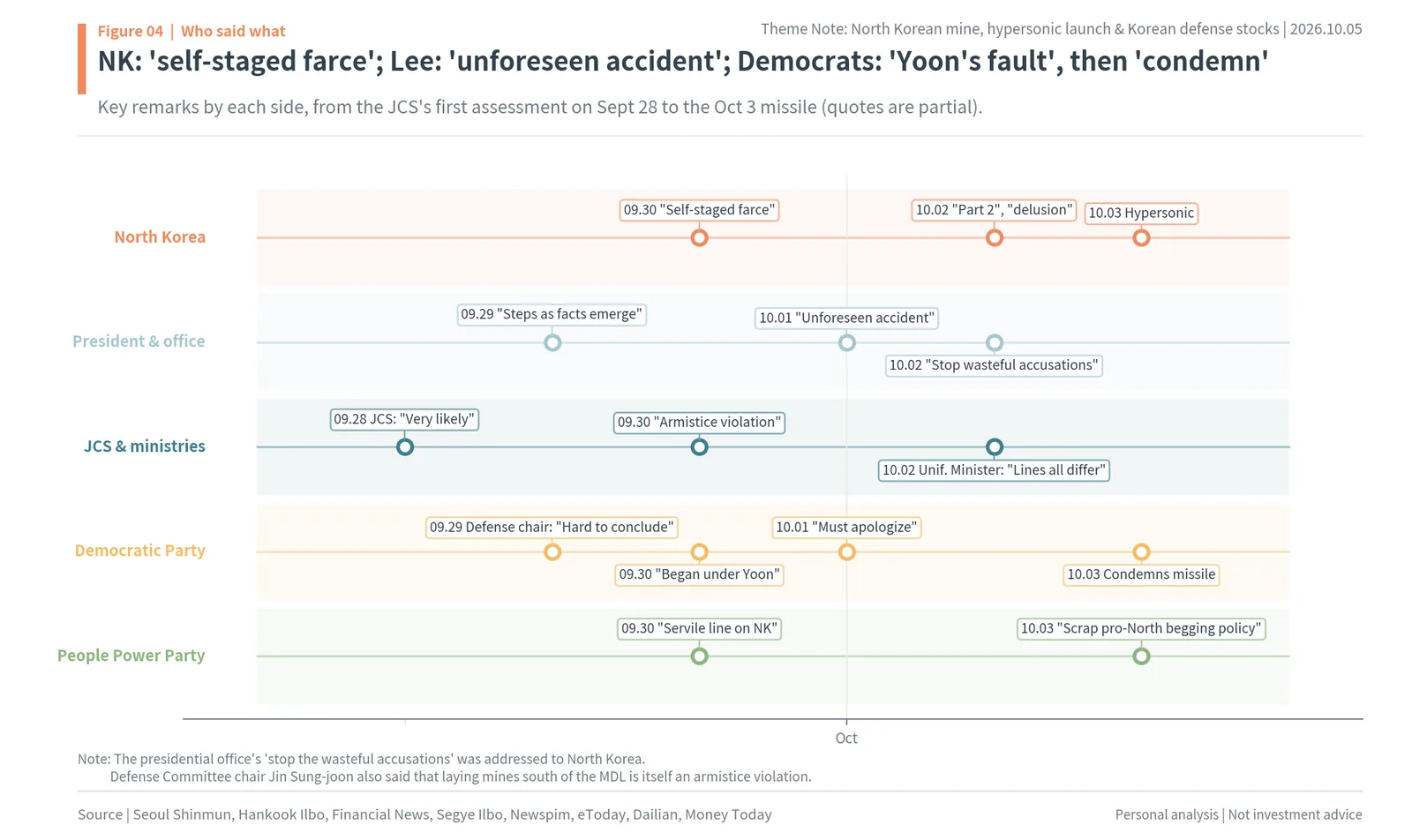
18. That morning Kim Yo Jong called it “Seoul’s self-staged farce”, claimed the 2015 wooden-box mine incident was also staged, and warned of merciless retaliation if live fire followed (Money Today, Seoul Shinmun).
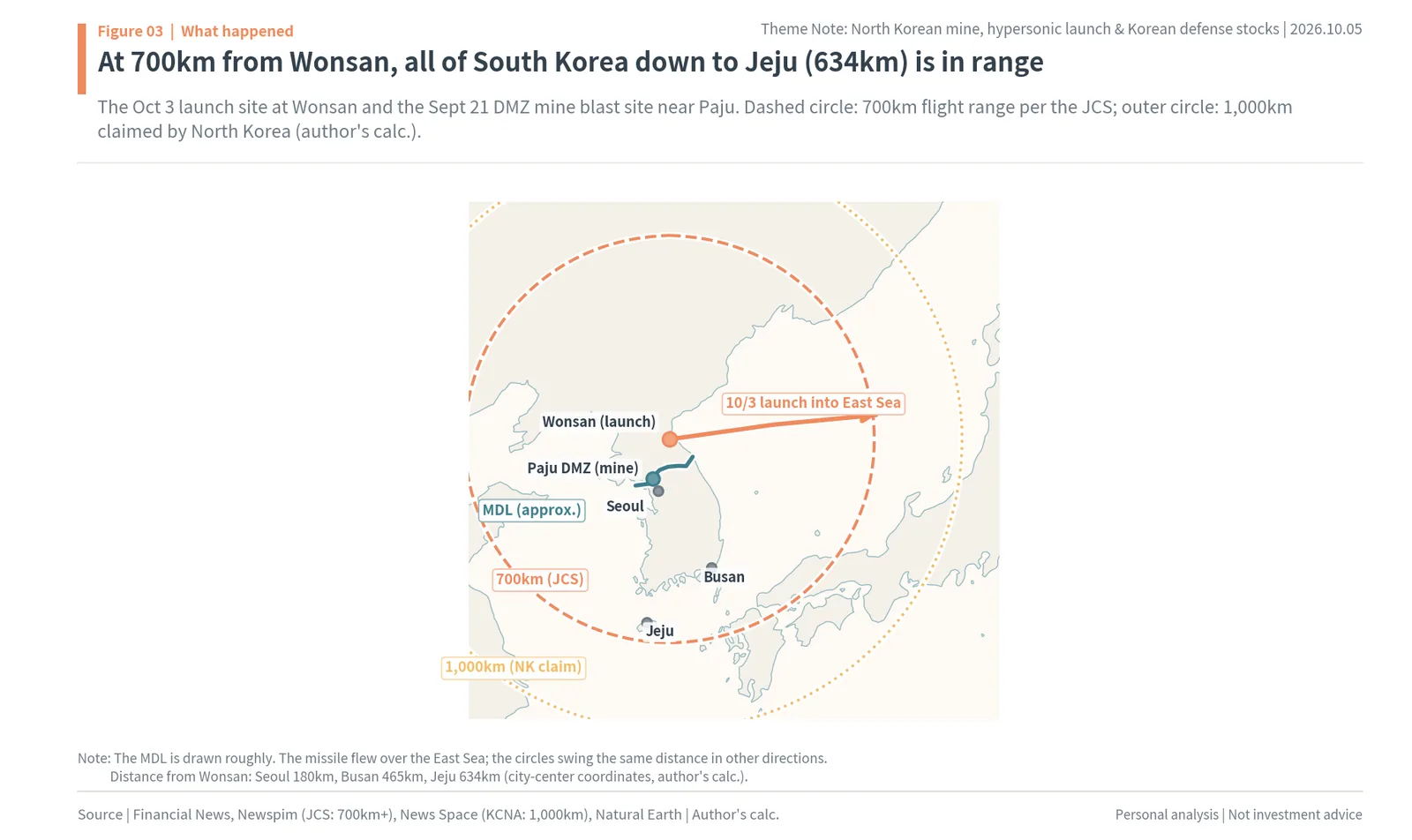
19. After the market closed on October 2 she issued two more statements, and on October 3, 12 days after the blast, North Korea fired a missile from Wonsan into the East Sea (Financial News, Newspim).
20. The JCS said it flew more than 700 km; North Korea claimed on October 4 that a “hypersonic intermediate-range strategic missile” hit a target 1,000 km away (Newspim, Newsspace).
21. This time it disclosed neither speed nor apogee, and it was North Korea’s 16th ballistic missile launch of 2026 (Newspim, Money Today).
22. From Wonsan, 700 km covers all of South Korea: Seoul is 180 km away, Busan 465 km and Jeju 634 km (author’s calculation).
23. October 5 was a substitute holiday, so the October 2 after-hours statement and the October 3 missile first reach stock prices on Tuesday, October 6.
2. What the government and the parties said
24. At the September 29 cabinet meeting, President Lee said the government would uncover the facts and take “necessary measures according to the facts”, and warned against baseless conspiracy theories (Seoul Shinmun).
25. In his October 1 Armed Forces Day speech he did not name North Korea, comforted soldiers hurt in an “unforeseen accident”, and spoke of steps to lower military tension and restore dialogue (Seoul Shinmun, Munhwa Ilbo).
26. The presidential office said the phrase was meant to comfort the injured soldiers and their families (SBS).
27. On October 2, Unification Minister Chung Dong-young said the South, the North and the UN Command each measure the MDL differently and proposed meeting to re-measure it; he called restarting loudspeakers “irresponsible and dangerous” (Hankook Ilbo).
28. He also said “we have no intention whatsoever of treating the North as an enemy”, while calling a North Korean apology “natural” (Dailian, Hankook Ilbo).
29. Democratic Party defense committee chair Jin Sung-joon said on September 29 that it was “hard to conclude” the mines were meant to injure South Korean troops, and was criticized for it (Newspim).
30. On September 30, Democratic Party leader Kim Min-seok said the response to the North’s border fortification that began under the Yoon government in early 2024 should be reviewed first (Segye Ilbo).
31. From October 1, the party leadership condemned North Korea directly, said it “must apologize and correct” its conduct, and filed a condemnation resolution as party policy (Newspim, Shina Ilbo).
32. People Power Party floor leader Chung Jeom-sik called “the Lee government’s servile line on North Korea” the root cause, and on October 3 the party demanded the government scrap its “pro-North begging policy” (Segye Ilbo, Financial News).
33. Kim Yo Jong called the October 1 speech “part two of the self-staged farce” and dismissed Chung’s proposal as “a delusion not worth answering” (Hankook Ilbo, Financial News).
34. In a poll by the Reform Party’s think tank, 70.5% said the government and military response was inappropriate and 26.2% said appropriate (Seoul Economic Daily).
35. As the first priority, 36.7% chose investigating the armistice violation and assigning responsibility, 32.3% military readiness and counter-measures, and 17.1% inter-Korean communication.
36. It is a party’s own poll, so the author treats it as reference only; in a Realmeter poll (Sept 28 to Oct 2), the president’s approval was 37.4%, with the DMZ mine incident cited among the reasons for a dip (Newspim).

37. The author’s view: when South Korean soldiers were maimed, the president and the unification minister were wrong to put dialogue ahead of North Korea’s responsibility.
38. The author reads it less as taking the North’s side than as blurring its responsibility to avoid escalation, which ended up putting dialogue ahead of the injured soldiers.
39. The Democratic Party, however, moved from “Yoon’s fault” to condemning the North within a day, so it is hard to say the whole party sided with Pyongyang.
3. Why is North Korea harsher on a government that reaches out?
40. It looks strange that Pyongyang is harsher on President Lee and his party than on the conservatives, but North Korea’s own words, in date order, point to four reasons.
41. First, North Korea’s enemy is “South Korea” as a country, not a party.
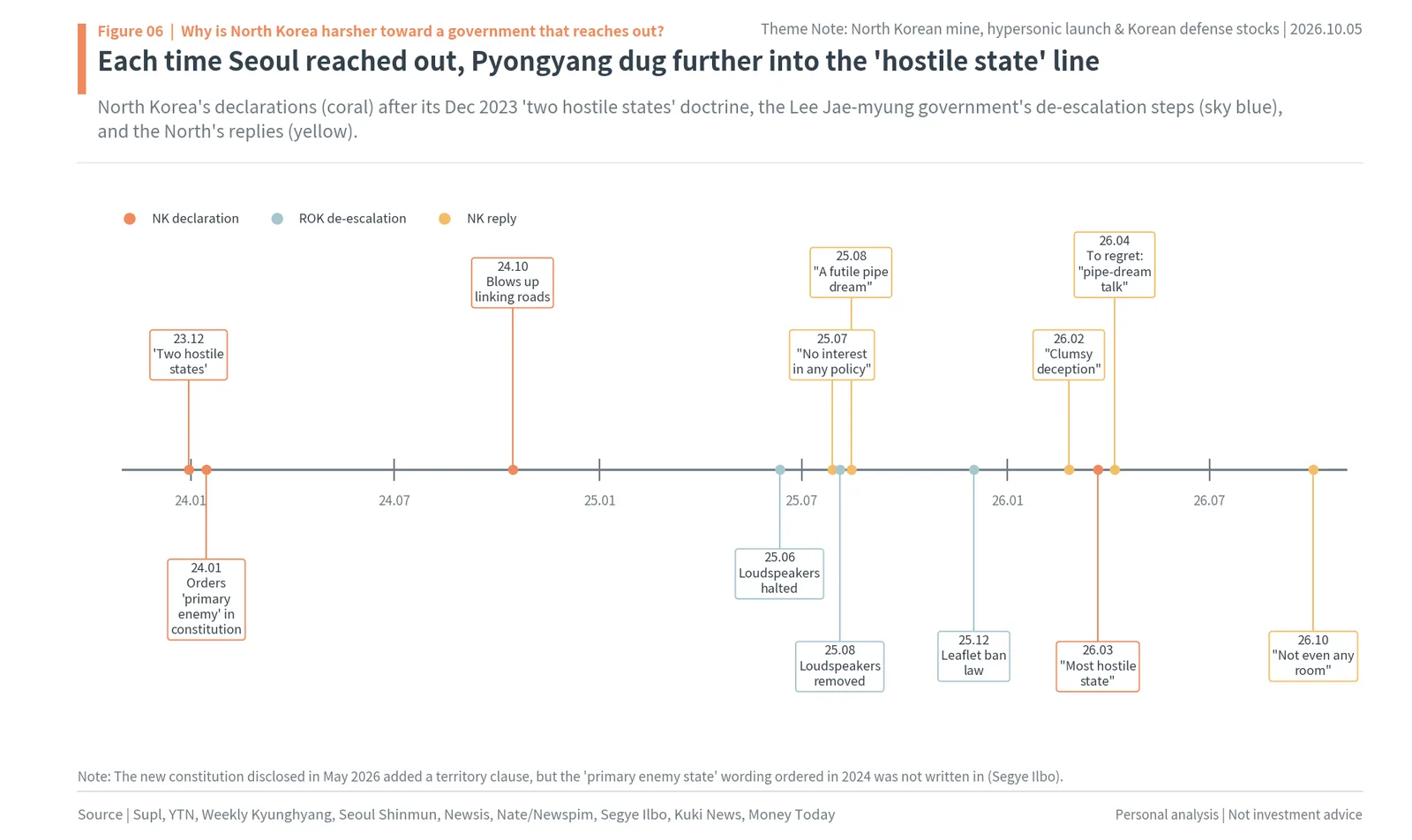
42. In December 2023, Kim Jong Un declared the two Koreas “two hostile states” at a party plenum (Supple).
43. In January 2024 he ordered South Korea written into the constitution as the “primary hostile state and invariable main enemy” and told officials to remove the very concepts of “unification”, “reconciliation” and “compatriots” (YTN).
44. In October 2024 the North blew up the inter-Korean road links, calling it a requirement of a constitution that defines the South as a hostile state (Weekly Kyunghyang, Seoul Shinmun).
45. In March 2026, Kim formally declared South Korea “the most hostile state” (YTN).
46. Second, none of the Lee government’s tension-easing steps were accepted.
47. Seoul stopped loudspeaker broadcasts in June 2025, removed about 20 fixed loudspeakers in August, and passed a law banning leaflet launches in December (Segye Ilbo, Seoul Shinmun, Kuki News).
48. Kim Yo Jong’s first answer, in July 2025, was that Pyongyang had “no interest in whatever policy Seoul makes” and that Lee was “no different from his predecessor” (Newsis).
49. On the loudspeaker removal she said the North had never removed its own and called Seoul’s hopes a “pipe dream” (Newsis).
50. At the February 2026 party congress, Kim Jong Un called the Lee government’s conciliatory stance “a clumsy deception and a botched piece of work” and said the South would be excluded from the category of compatriots forever (Newspim).
51. When the president expressed regret in April over a drone incursion, Kim Yo Jong relayed that Kim Jong Un saw it as “frank and broad-minded”, but the next day the Foreign Ministry dismissed Seoul’s hopes as “pipe dream talk” (Seoul Shinmun).
52. Why: the Korea Institute for National Unification saw the two-states line as an admission of losing the system competition with the South and a judgment that better relations would not pay (KDI Economic Information Center).
53. The Asan Institute found that North Korea now treats even the hope for its denuclearization or opening as hostile policy and does not want inter-Korean dialogue or exchanges to resume.
54. In the author’s words: the friendlier the South is, the less North Koreans resent it, so Pyongyang has to push back harder to keep its border wall standing (author’s interpretation).
55. On this mine incident, KINU senior fellow Hong Min said Pyongyang’s main concern is “preventing disruption of its fortification work” (Segye Ilbo).
56. Third, Pyongyang wants to deal with Washington directly and leave Seoul out.
57. It demands formal US recognition of its nuclear status as a condition for talks and rejects the Lee government’s phased denuclearization roadmap (AEI and ISW).
58. 38 North judged that Pyongyang’s incentive to engage Seoul without US participation is the lowest since the 1990s.
59. President Lee himself said on September 18 that in the early stages of US-North Korea talks “we may be somewhat far away” (Newspim).
60. Fourth, Russia backs the North: Leonid Petrov of the Australian National University noted that Moscow is offering cash, energy and military technology, so Seoul’s proposals carry little weight (ABC News).
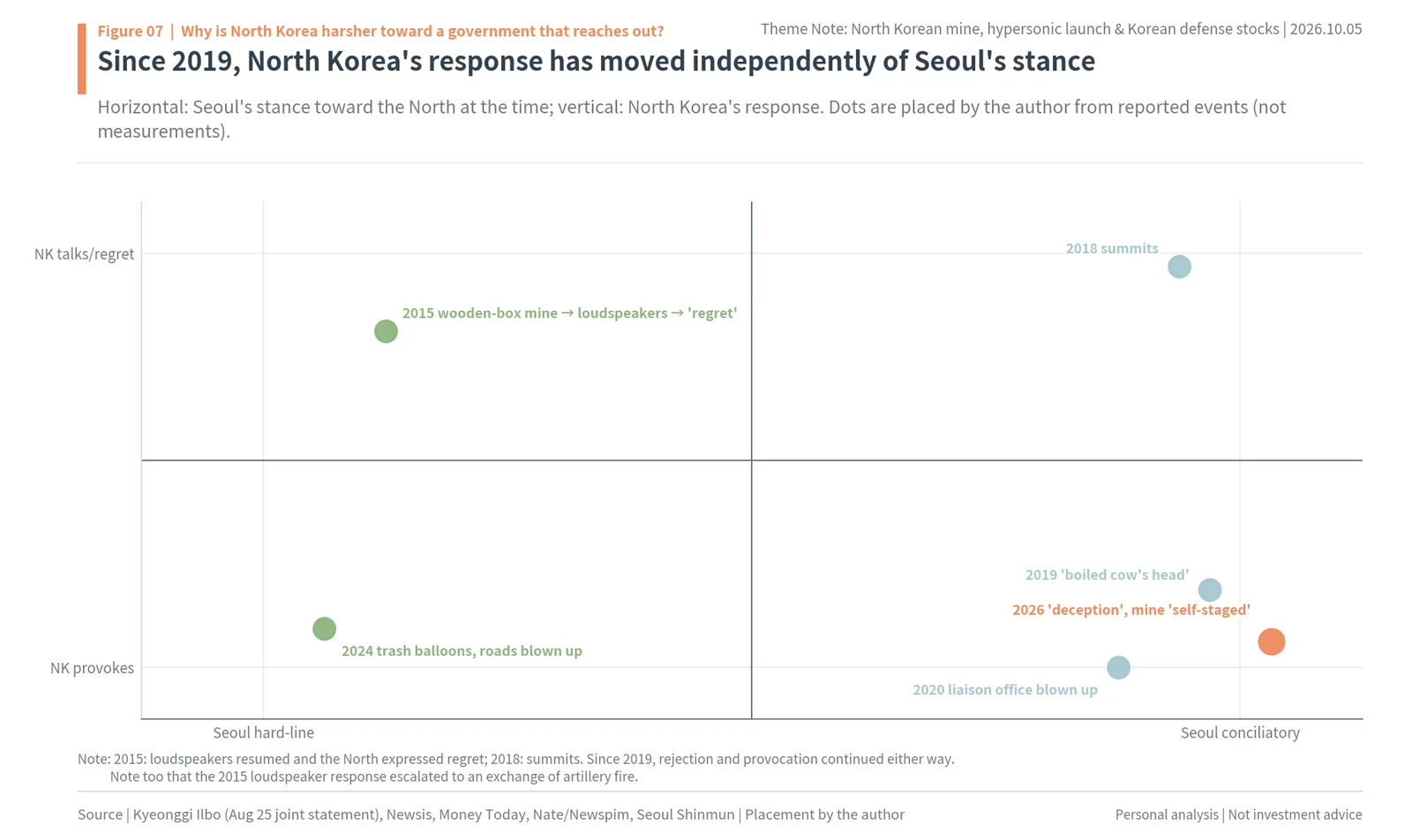
61. Placing reported events on a chart, in 2015 the North expressed regret after the South pushed back hard, and in 2018 the two sides held summits; since 2019, rejection and provocation have continued whether the South was conciliatory or hard-line.
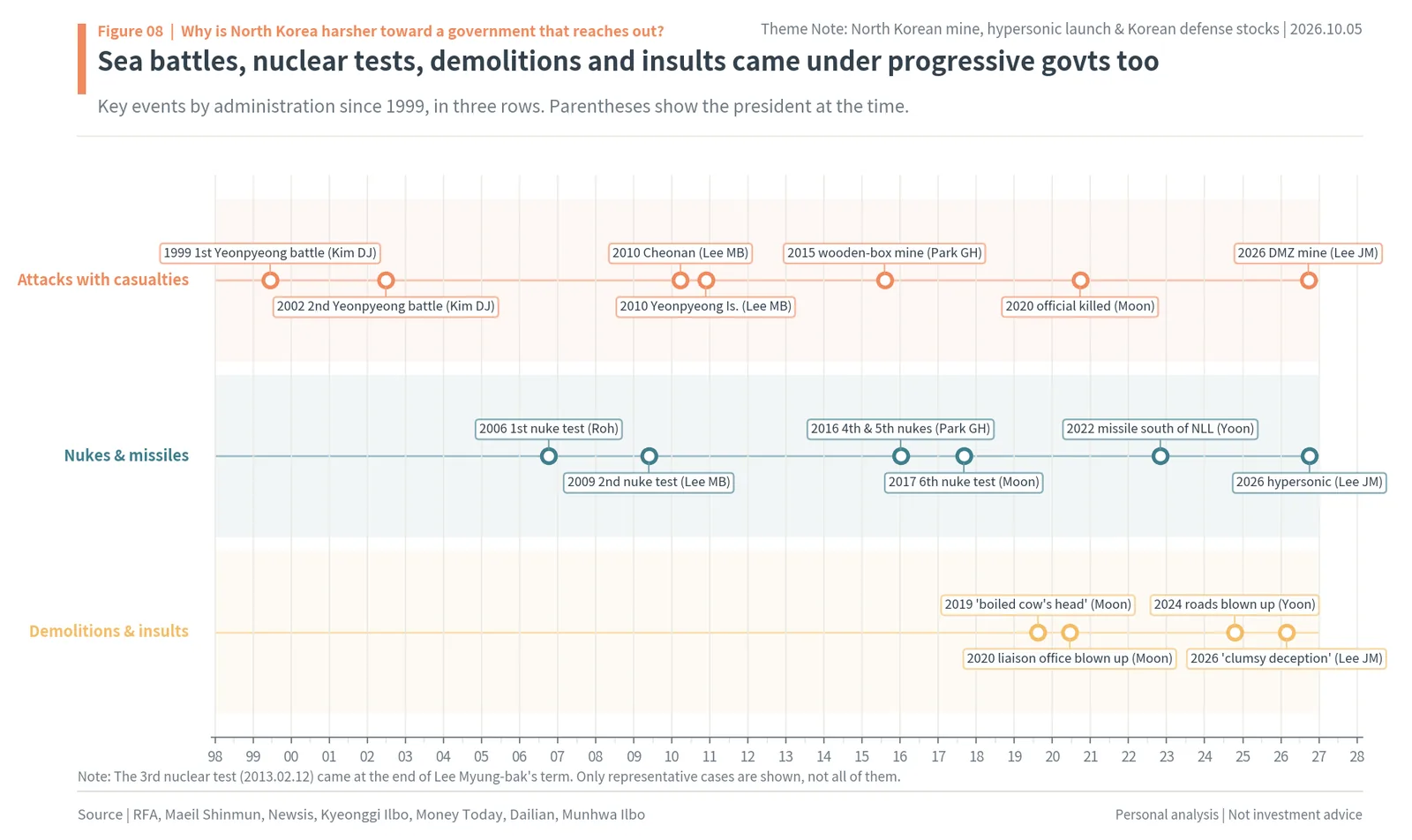
62. And it was the same under progressive governments.
63. Under Kim Dae-jung there were the 1999 and 2002 Yeonpyeong naval clashes (six South Korean sailors killed in the second), and under Roh Moo-hyun the first nuclear test in 2006 (RFA, Maeil Shinmun).
64. Under Moon Jae-in came the sixth nuclear test in 2017 and the 2019 insult that “even a boiled cow’s head would laugh” (Newsis).
65. In 2020 the North blew up the inter-Korean liaison office and killed a South Korean fisheries official (Money Today, New Daily).
66. Under conservative governments there were the Cheonan sinking (46 killed) and the Yeonpyeong shelling (Lee Myung-bak), the wooden-box mine and the 4th and 5th nuclear tests (Park Geun-hye), and the missile south of the NLL, drone incursions and road demolitions (Yoon Suk Yeol) (RFA, Newsis).
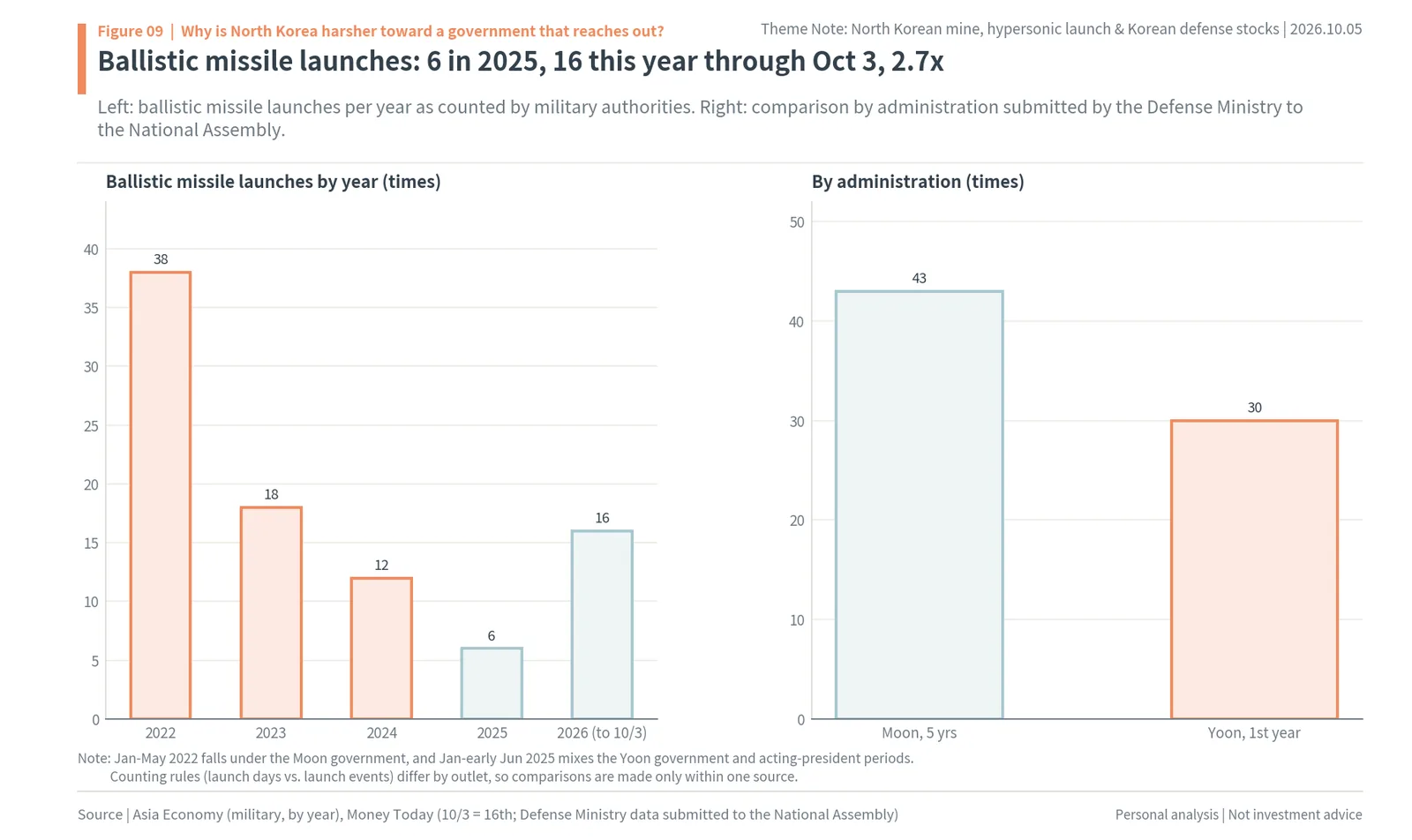
67. Ballistic missile launches fell from 38 in 2022 to 18 in 2023, 12 in 2024 and 6 in 2025, then rose to 16 by October 3, 2026, 2.7 times last year (Asia Economy, Money Today, author’s calculation).
68. Defense Ministry data showed 43 launches in Moon’s five years and 30 in Yoon’s first year, so launch counts do not split neatly by the government’s leaning either (Money Today).
69. In short, to Pyongyang the Lee government is not a “less hated” counterpart but one to be “more careful” with, because accepting its hand would shake the two-states wall.
4. The author’s view: blurring responsibility invites more testing
70. Compare the 2015 wooden-box mine incident with this one.
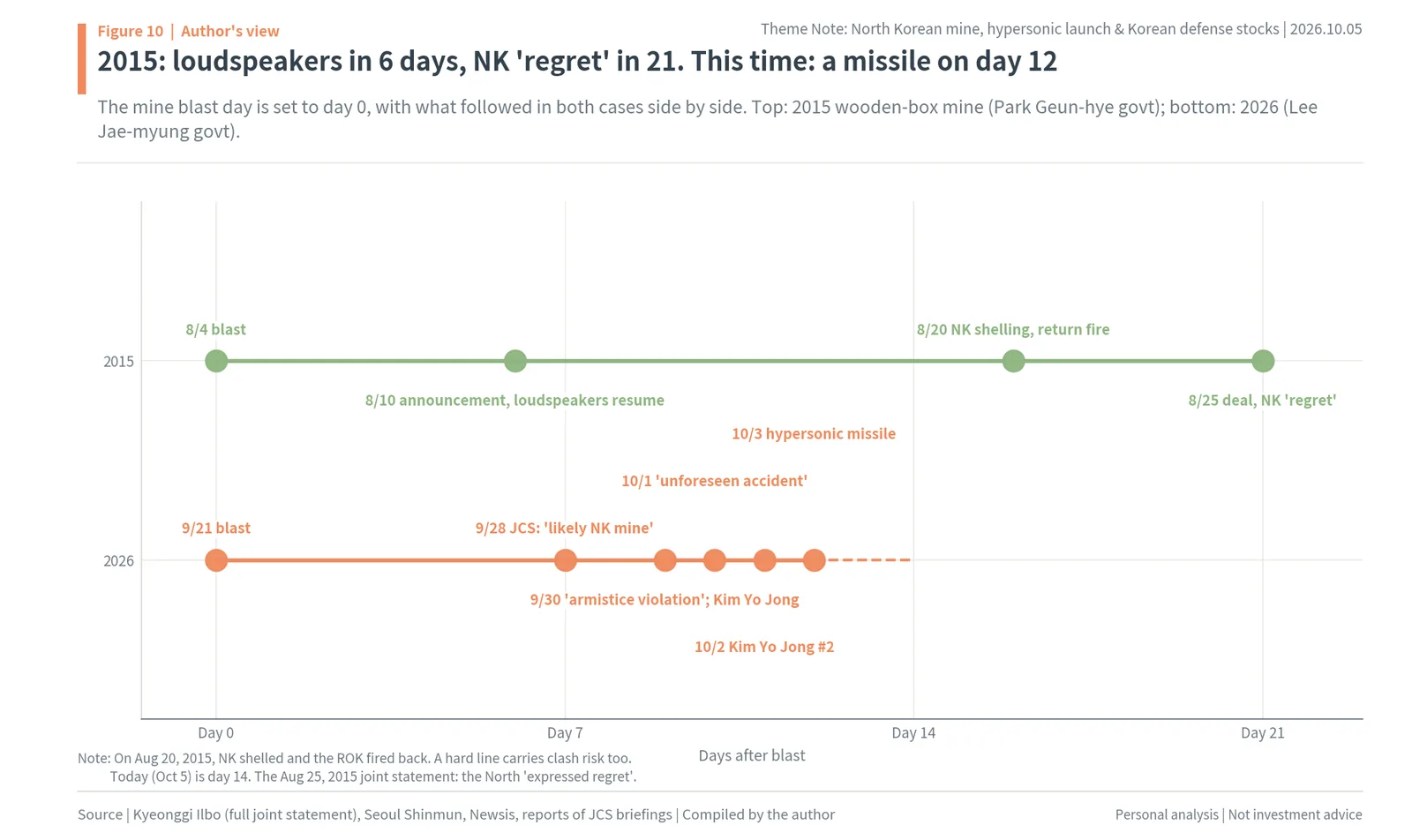
71. On August 4, 2015, a mine maimed Staff Sergeants Ha Jae-hun and Kim Jung-won; six days later, on August 10, the government announced the findings and restarted loudspeakers for the first time in 11 years (Newsis, Seoul Shinmun).
72. North Korea shelled on August 20 and the South returned fire, and 21 days after the blast, the August 25 joint statement recorded that the North “expressed regret” (Kyeonggi Ilbo).
73. This time, the JCS ruling came on day 9 and the “unforeseen accident” speech on day 10, and on day 12 a hypersonic missile came instead of an apology.
74. Professor Park Won-gon of Ewha Womans University read Kim Yo Jong’s mention of the 2015 mine as ruling out any regret like the one expressed then (Segye Ilbo).
75. Meanwhile North Korean MDL crossings rose from about 20 in August to about 30 in September (Korea Economic Daily).
76. The author’s view: if the injured side blurs responsibility first, North Korea can keep testing at no cost.
77. Dialogue and accountability can go together, and in front of maimed soldiers, accountability should come first.
78. Counter-evidence: the 2015 loudspeaker response escalated to an exchange of fire, which carried real risk.
79. The Cheonan sinking and the Yeonpyeong shelling happened under hard-line conservative governments, so standing firm does not guarantee the provocations stop.
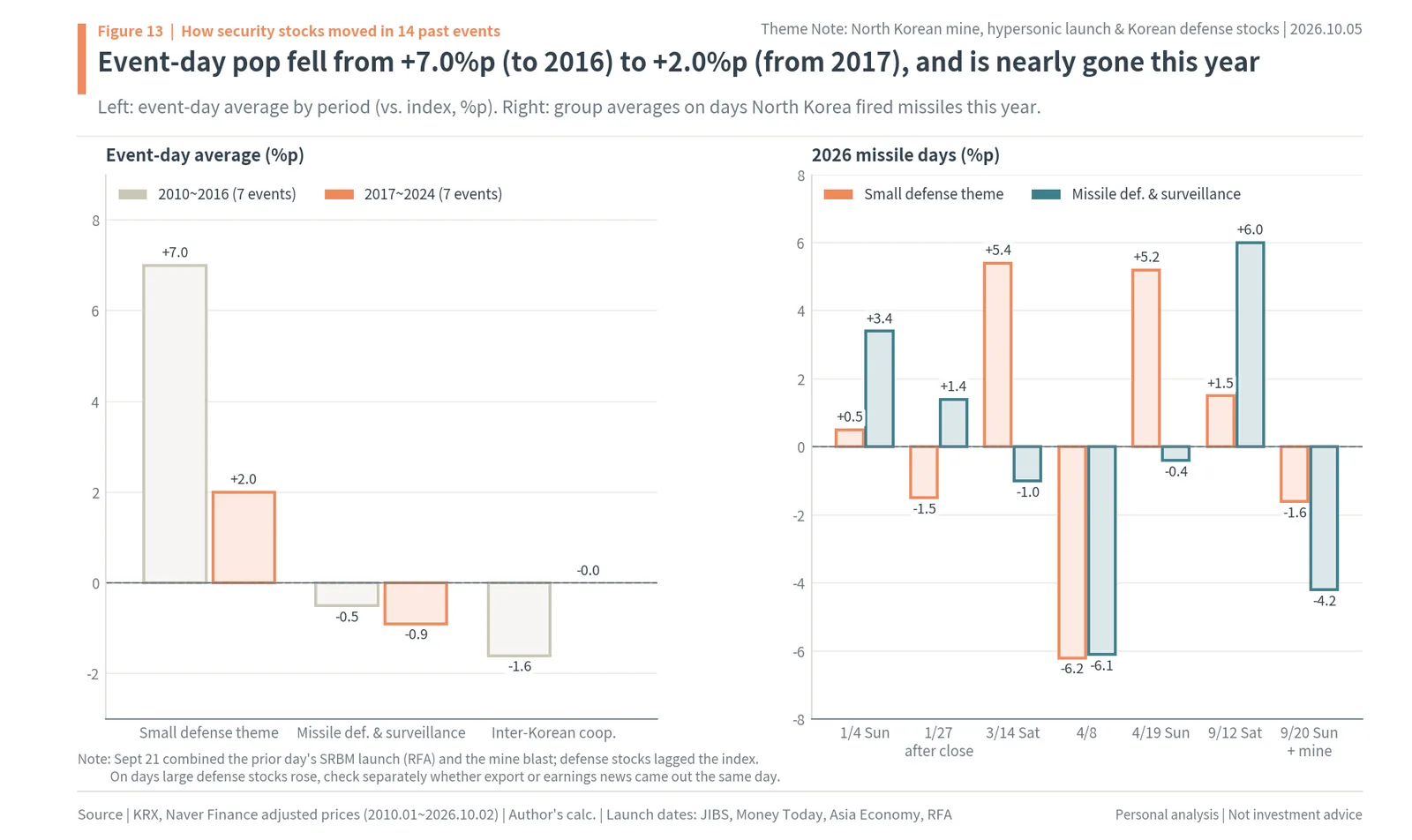
80. And because these mines were judged to have been buried for more than a year, they cannot be blamed solely on the current government’s response.
81. So the author’s conclusion is not “hard-line versus conciliatory”: because North Korea does not distinguish between parties, Seoul should state responsibility clearly first when its soldiers are hurt.
5. How security stocks moved in 14 past events
82. Now to stocks: did “North Korea beneficiary stocks” actually rise on days like this?
83. The 14 events run from the 2010 Cheonan sinking to the October 2024 artillery alert; using reported times, intraday events count from that day and after-hours or weekend events from the next trading day.
84. The small defense theme group is 7 stocks: Victek, Speco, Firstec, Huneed, Hanil Forging, Genoco and i3system.
85. The missile defense and surveillance group is 6: LIG D&A, Hanwha Aerospace, Hanwha Systems, Hyundai Rotem, KAI and Satrec Initiative.
86. The opposite side, inter-Korean cooperation stocks, is 4: Ananti, Hyundai Elevator, Good People and Shinwon.
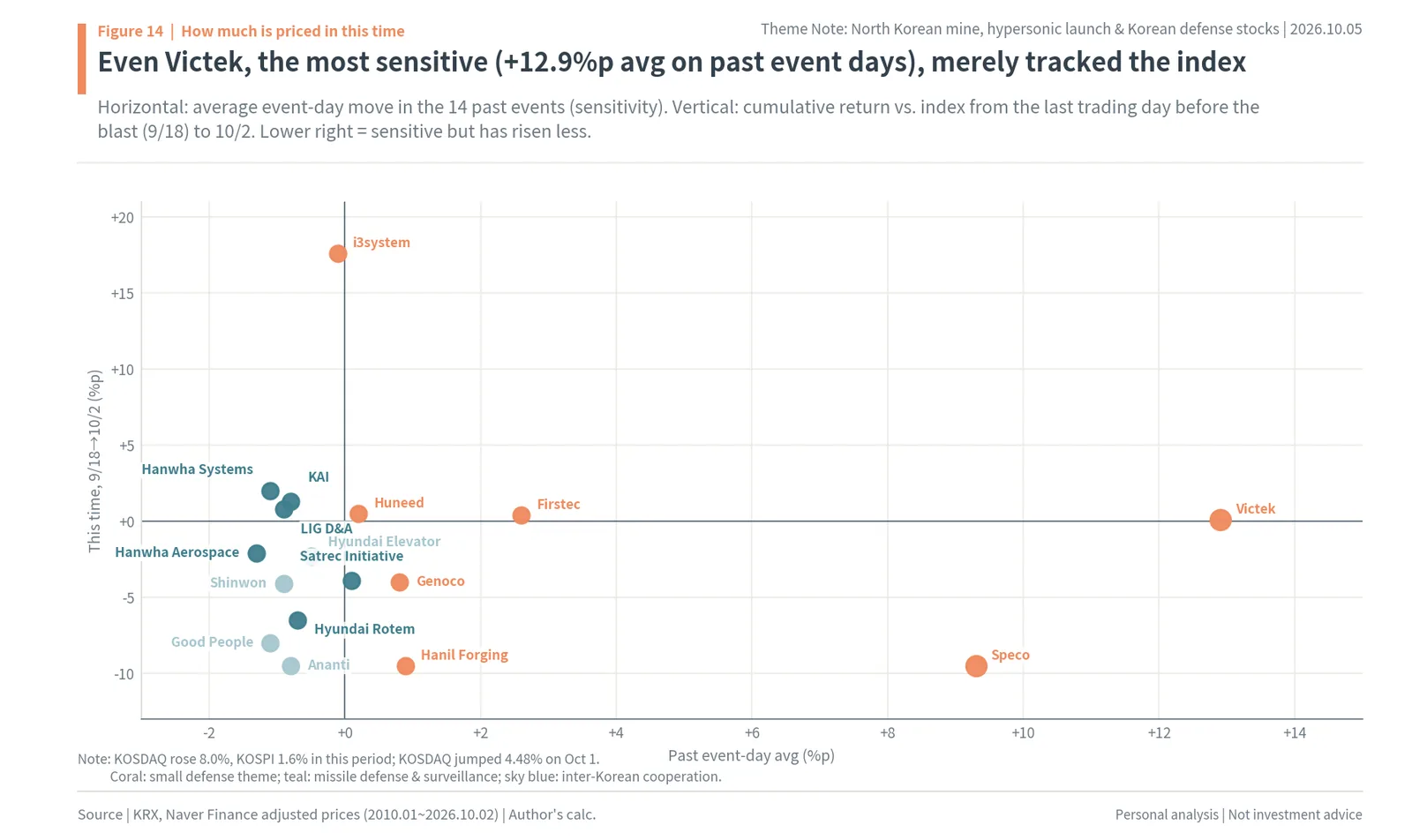
87. From the close before each event, the author subtracted the market index return (KOSPI or KOSDAQ) from the stock’s return over the same period; the unit is %p (author’s calculation).
88. Small defense stocks beat the index on the event day 62 times out of 84 (73.8%).
89. Victek beat it 13 times out of 14 with an event-day average of +12.9%p, and Speco 12 times with +9.3%p.
90. The day after the August 2015 shelling, Victek rose as much as 24.32%, Speco 20.27% and Firstec 15.37% intraday (iNews24).
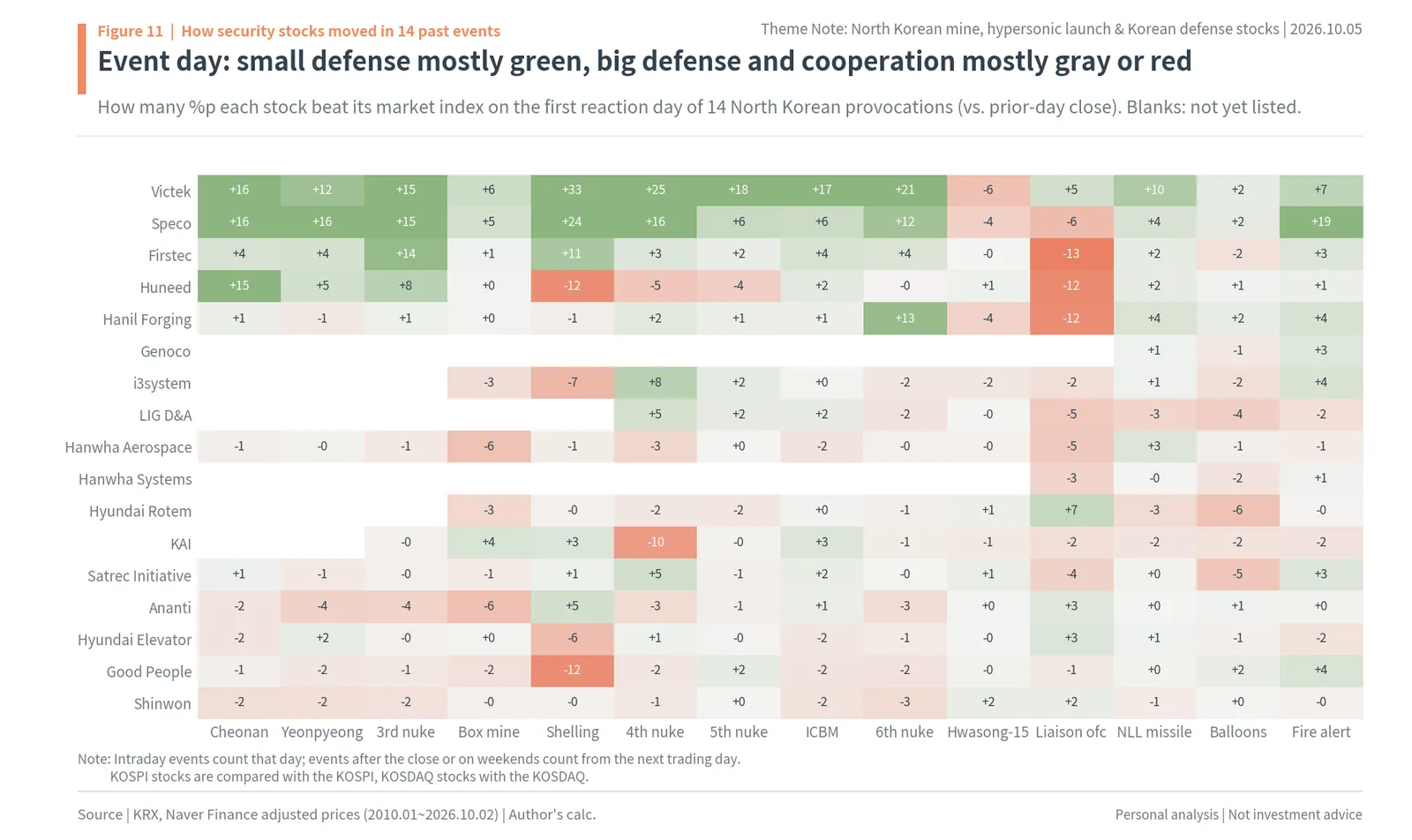
91. The 6 missile defense and surveillance stocks beat the index only 19 times out of 64 on the event day, averaging -0.7%p.
92. The 4 inter-Korean cooperation stocks beat it only 19 times out of 56 and averaged -2.9%p after 20 trading days.
93. The problem is that it does not last.
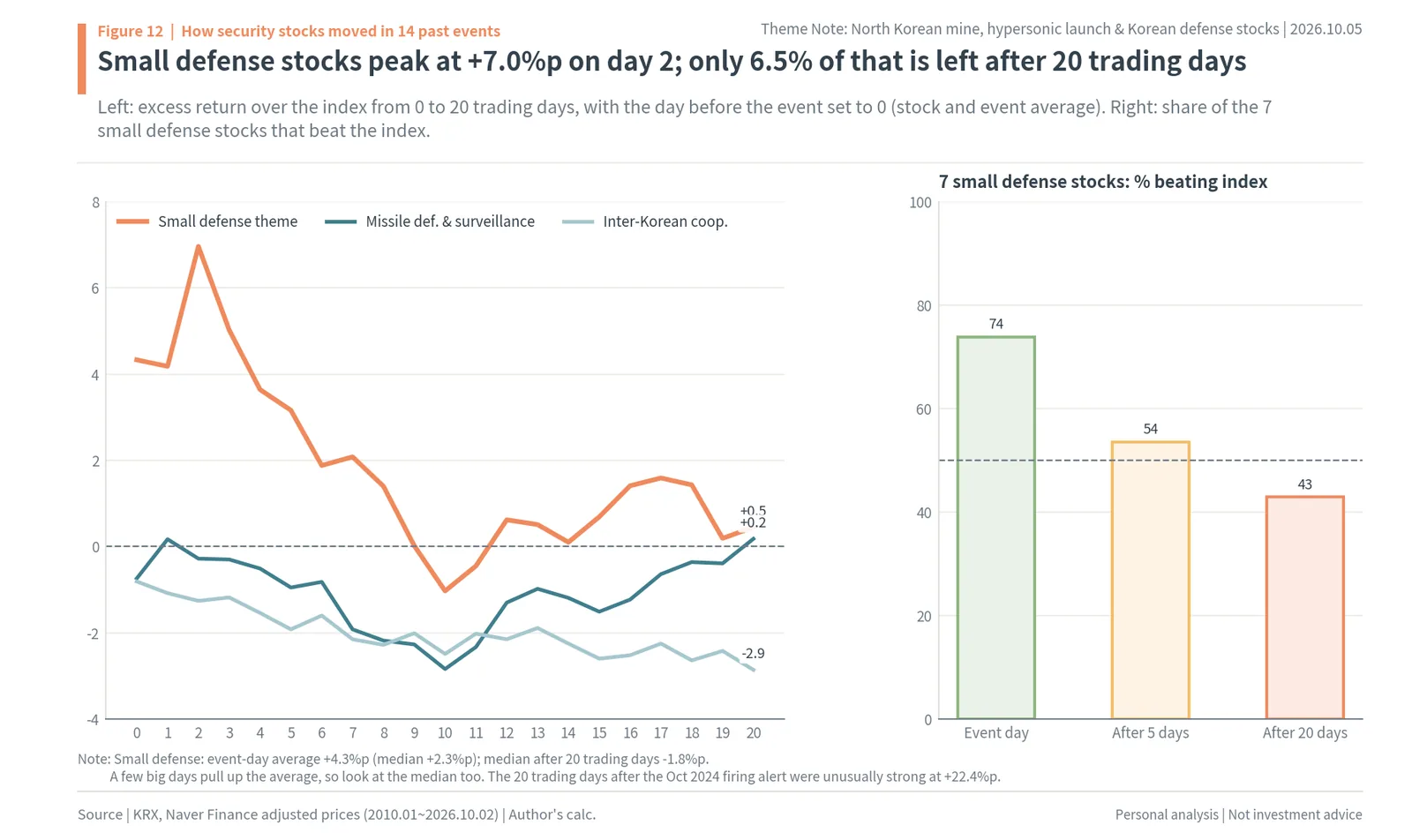
94. The small defense average path peaked at +7.0%p on day 2, fell to +3.2%p after 5 trading days and +0.5%p after 20, only 6.5% of the peak.
95. The share beating the index fell from 73.8% on the event day to 53.6% after 5 trading days and 42.9% after 20; the 20-day median was -1.8%p.
96. Firstec beat the index on 11 of 14 event days, but only 2 times out of 14 after 20 trading days.
97. A few big days pull up averages, so the median matters too; the 20 trading days after the October 2024 artillery alert were unusually strong at +22.4%p.
98. The reaction has also faded.
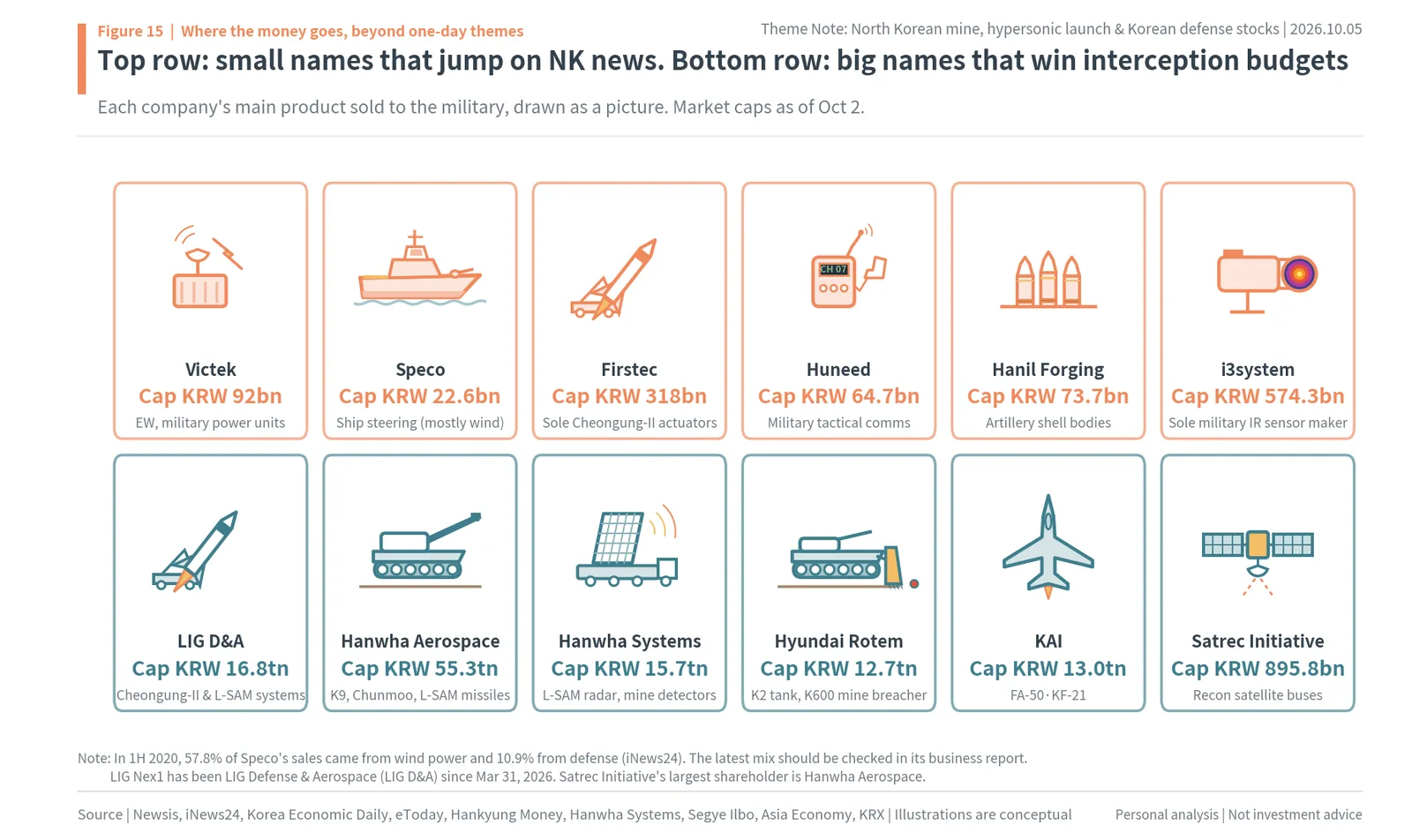
99. The small defense event-day average fell from +7.0%p over 7 events through 2016 to +2.0%p over 7 events from 2017.
100. On the Hwasong-15 ICBM day (-2.4%p) and the liaison office demolition day (-6.7%p) the group lagged the index.
101. Before the liaison office demolition the stocks had already been rising for days, and the next day Victek, Speco, Huneed and Hanil Forging hit the daily limit (eToday).
102. On the 7 North Korean missile days of 2026, small defense averaged +0.5%p and large defense -0.1%p.
103. For hypersonic launches alone, the first Hwasong-16B test (April 2024) saw +4.4%p, the second (January 2025) -1.7%p, and the trading day after the September 20 test -1.6%p.
104. Large defense names moved on other things.
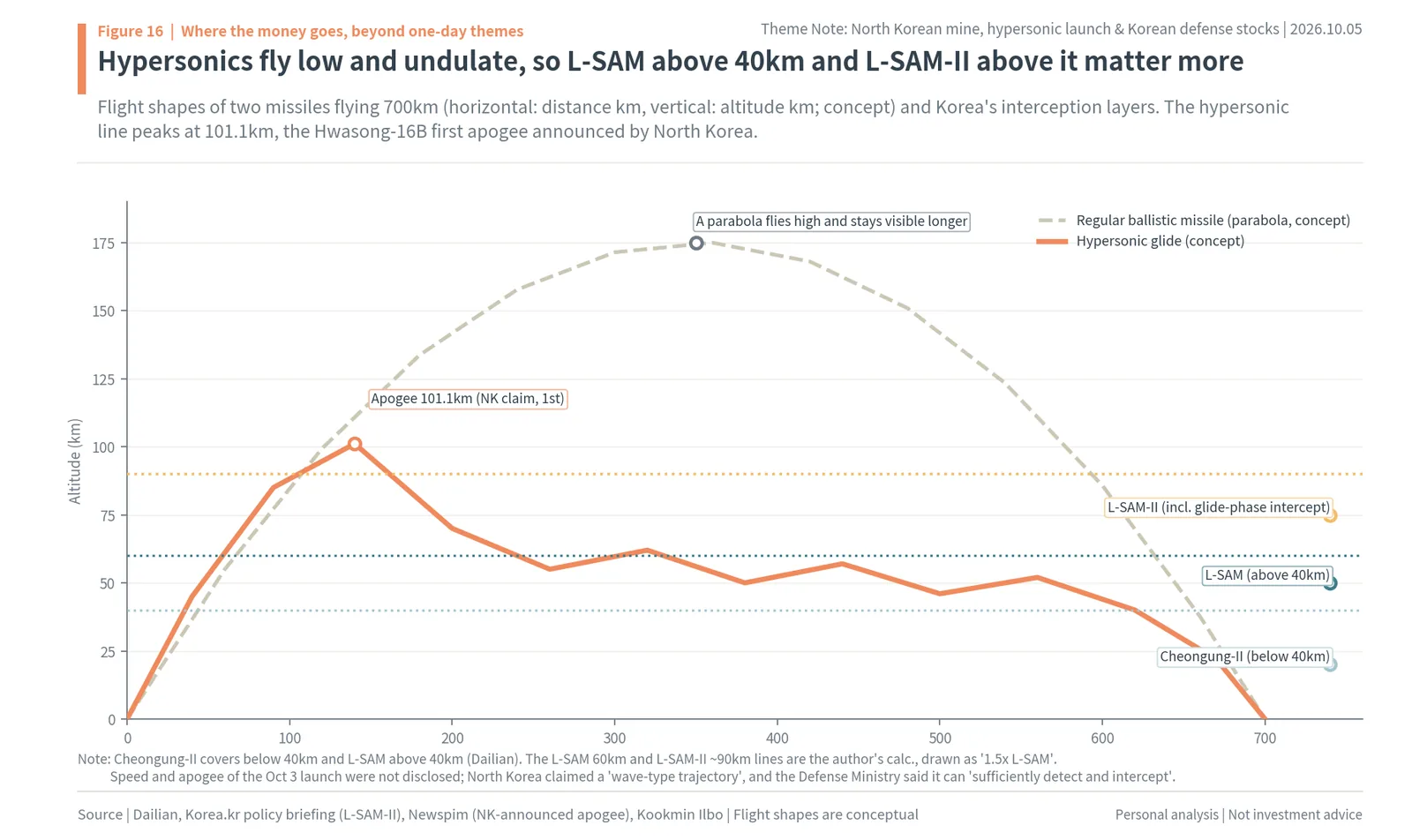
105. LIG D&A jumped 21.48% on June 16 even on news of a US-Iran ceasefire, and Hanwha Aerospace rose 8.52% after Iran’s July 30 strike on a US base in Jordan (Seoul Economic Daily, eToday).
106. Conclusion: “North Korea beneficiary stocks” are an event-day and day-two theme, not a story that lasts 20 trading days.
6. How much is priced in this time?
107. From the last trading day before the blast (September 18) to October 2, the 7 small defense stocks actually lagged the index by an average of -0.6%p.
108. Over the same period large defense was -1.4%p and inter-Korean cooperation -6.0%p.
109. KOSDAQ rose 8.0% and KOSPI 1.6% over those days, including a 4.48% KOSDAQ jump on October 1 alone.
110. On September 21, when the blast was first reported along with the North’s hypersonic test the day before, small defense stocks still lagged the index.
111. Even Victek, the most sensitive in the past (+12.9%p average on event days), moved only +0.1%p versus the index this time.
112. Speco was -9.5%p; note that most of its sales come from wind power, with defense at 10.9% in H1 2020 (iNews24).
113. Only i3system rose sharply, +17.6%p, but expectations of revenue from its new military infrared sensor plant from Q2 make it hard to credit the mine (Hankyung Money).
114. October 2, when large defense stocks rose, was the day reports of up to 10,000 more US troops in the Middle East sent Brent crude up 4.37% (News1, Jaekyung Ilbo).
115. Kim Yo Jong’s second statement came after that day’s close, so the day’s defense strength coincided with Middle East news rather than the statement.
116. If small defense names jump on October 6, the past average says day two is likely to be the peak (author’s view).
117. This mine incident is barely priced in, and if it is, it is likely to be a two-day move as before.
7. Where the money actually goes
118. So where does real money go, beyond a two-day theme?
119. Start with what each company sells to the military.
120. Victek makes electronic-warfare direction finders, military power supplies and IFF equipment; Firstec is the sole supplier of Cheongung-II actuators; Huneed makes tactical military radios; Hanil Forging makes artillery shell bodies (Newsis, Korea Economic Daily, eToday).
121. i3system is Korea’s only maker of military infrared image sensors, used in thermal sights for the K2 tank, the K9 and guided weapons (Hankyung Money).
122. On the large side, LIG D&A makes Cheongung-II and L-SAM, Hanwha Aerospace the K9, Chunmoo and L-SAM interceptors, and Hanwha Systems radars and mine detectors.
123. Hyundai Rotem (K2, K600), KAI (FA-50, KF-21) and Satrec Initiative (reconnaissance satellites) belong to the same group.
124. The most direct link to this episode is hypersonic defense.
125. South Korea’s air defense is layered: Cheongung-II covers below 40 km and L-SAM above 40 km (Dailian).
126. L-SAM-II, which began development in January 2025 at KRW 567.7 billion, raises the intercept altitude to 1.5 times L-SAM’s and widens coverage three- to fourfold (Korea Policy Briefing).
127. A hypersonic missile does not climb high and fall like a ballistic arc; it comes back down from around 100 km and flies low and undulating, which makes the upper layer and glide-phase interception important (author’s summary).
128. North Korea gave an apogee of 101.1 km for the first Hwasong-16B test, claimed a “wave-like trajectory” on October 3, and the Defense Ministry countered that it can “sufficiently detect and intercept” such missiles (Newspim, Kukmin Ilbo).
129. The budget is heading that way.
130. The 2027 defense budget proposal is KRW 73.28 trillion, up 8.2%, and the force-improvement (weapons procurement) budget is KRW 22.71 trillion, up 13.8% (Seoul Shinmun).
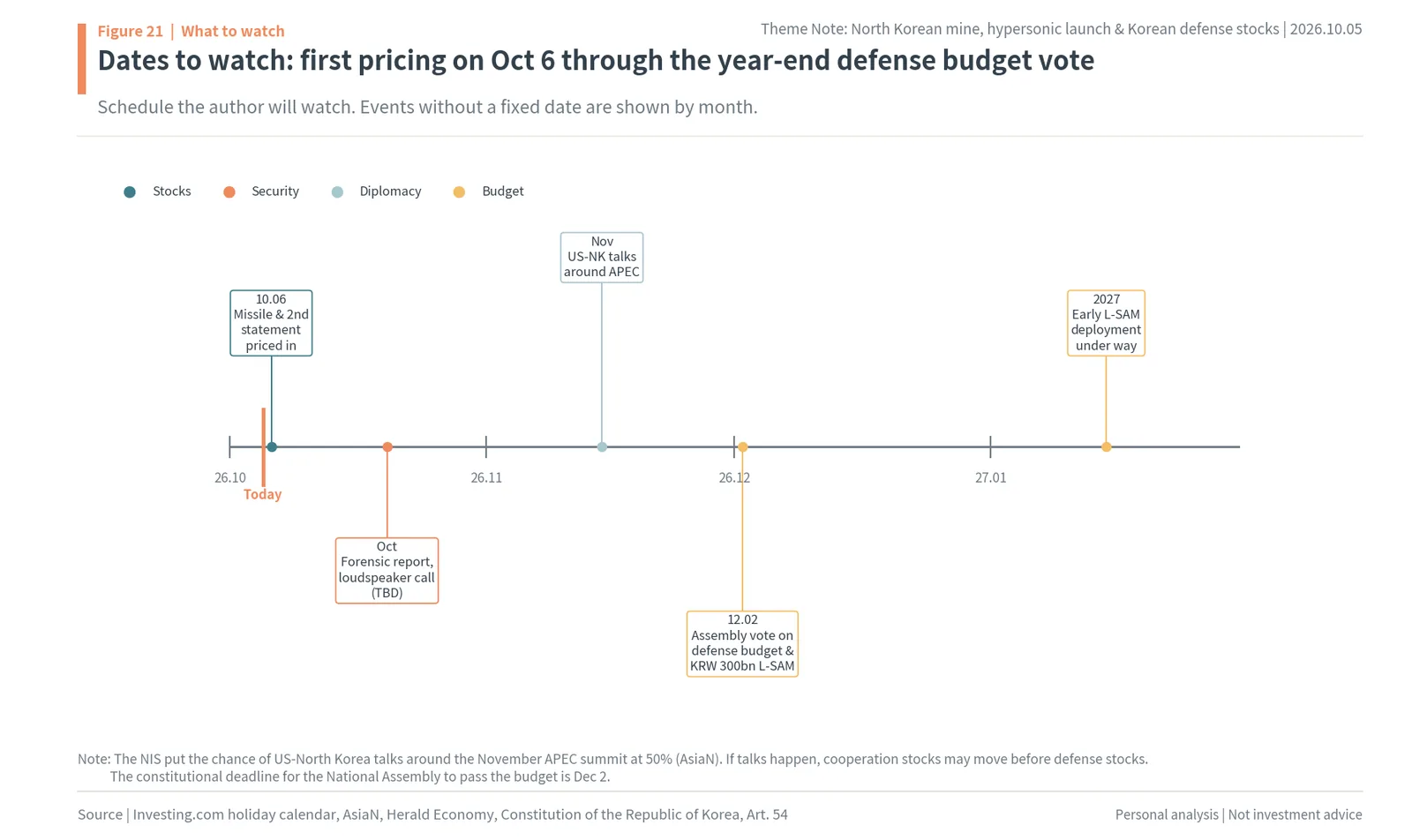
131. About KRW 300 billion goes to bringing L-SAM forward by roughly a year, and AI and manned-unmanned systems rise 55.5%, from KRW 496.8 billion to KRW 772.7 billion (Herald Economy, Daily Defense).
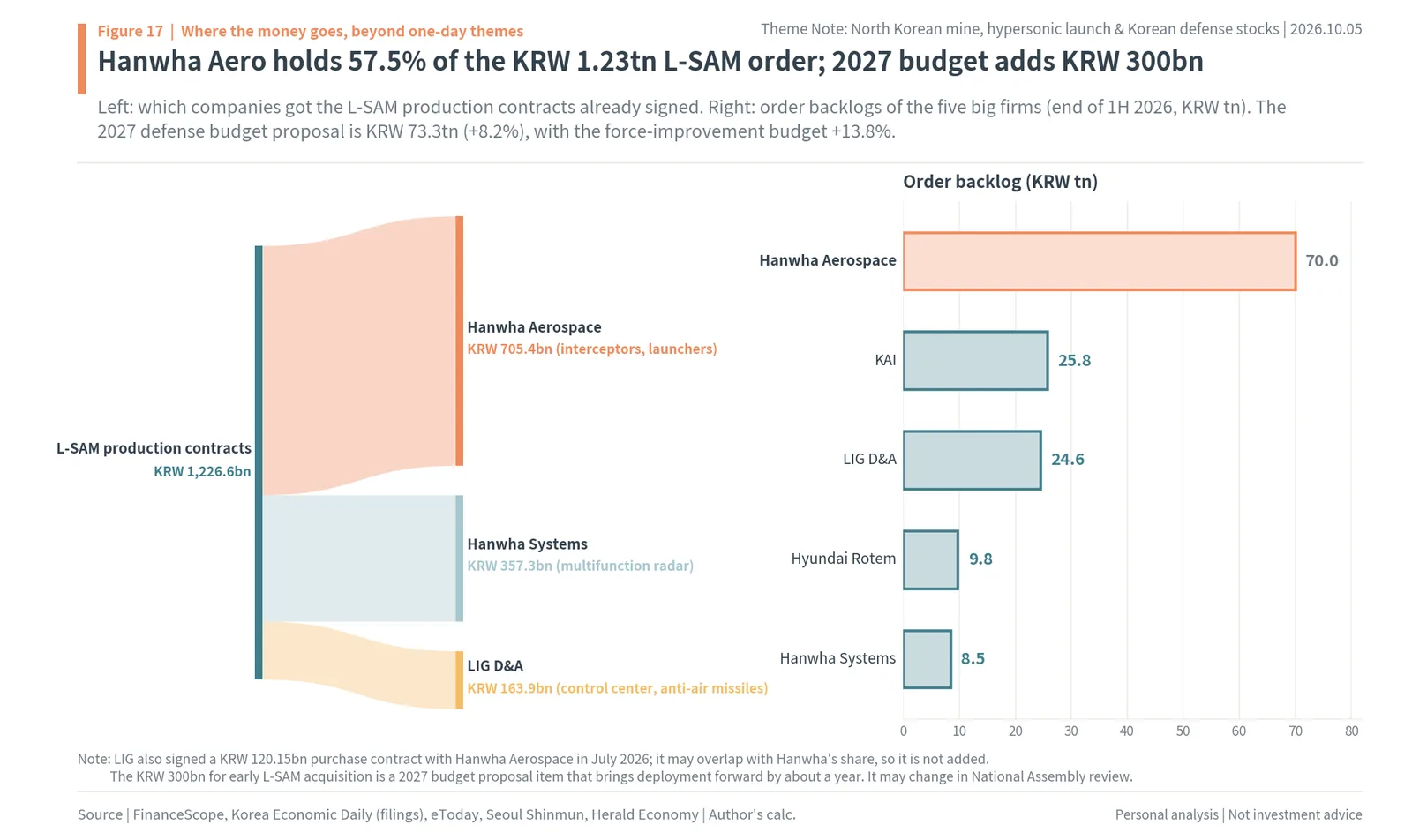
132. L-SAM production contracts signed so far are KRW 705.4 billion for Hanwha Aerospace, KRW 357.3 billion for Hanwha Systems and KRW 163.9 billion for LIG D&A (Finance Scope, Korea Economic Daily).
133. Of the KRW 1.2266 trillion total, Hanwha Aerospace’s share is 57.5% (author’s calculation).
134. LIG D&A also signed a KRW 120.15 billion purchase contract with Hanwha Aerospace in July, left out of the total because it may overlap with Hanwha’s share.
135. At the end of H1, order backlogs were KRW 70.0 trillion at Hanwha Aerospace, 25.8 trillion at KAI, 24.6 trillion at LIG D&A, 9.8 trillion at Hyundai Rotem and 8.5 trillion at Hanwha Systems (eToday).
136. For mines, Hanwha Systems’ PRS-20K detector adds ground-penetrating radar to metal detection to find non-metallic mines like wooden-box mines, with about 1,600 units being fielded (Hanwha Systems).
137. Hyundai Rotem’s K600 obstacle-breaching vehicle has a KRW 250 billion second production run and will be deployed to frontline infantry divisions for the first time (Segye Ilbo).
138. The KRW 465.1 billion GOP smart-surveillance upgrade is being re-tendered after SK Telecom, KT and S-1 all failed testing in March, so it has no winner yet (Edaily).
139. Valuations, however, already price in a lot.
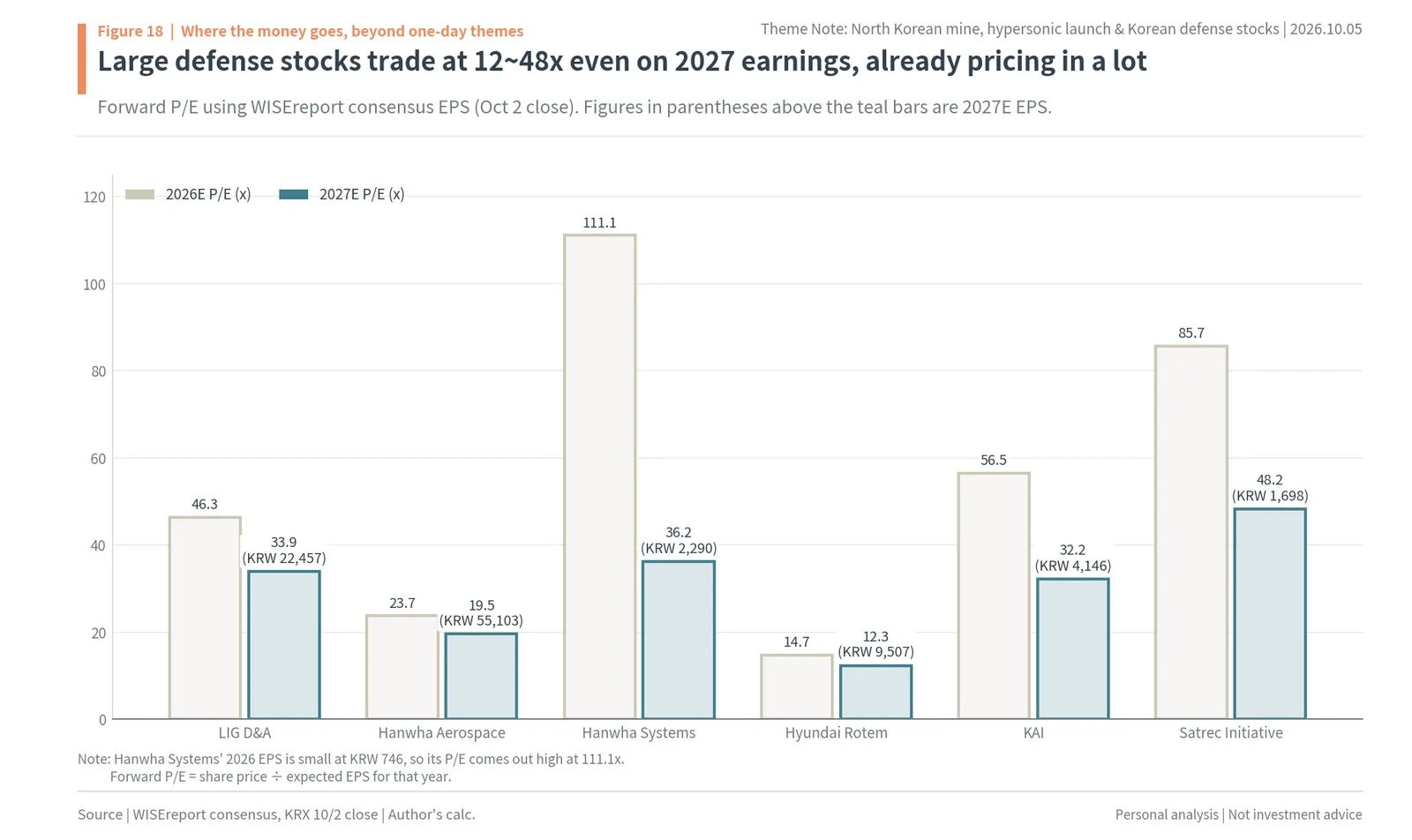
140. On 2027 EPS, LIG D&A trades at 33.9 times (EPS KRW 22,457) and Hanwha Aerospace at 19.5 times (EPS KRW 55,103) (WISEreport, author’s calculation).
141. Hanwha Systems is 36.2 times (EPS KRW 2,290) and Hyundai Rotem 12.3 times (EPS KRW 9,507).
142. KAI is 32.2 times (EPS KRW 4,146) and Satrec Initiative 48.2 times (EPS KRW 1,698), so large defense names trade at 12 to 48 times even on 2027 earnings.
143. Hanwha Systems’ 2026 EPS is small at KRW 746, giving 111.1 times this year.
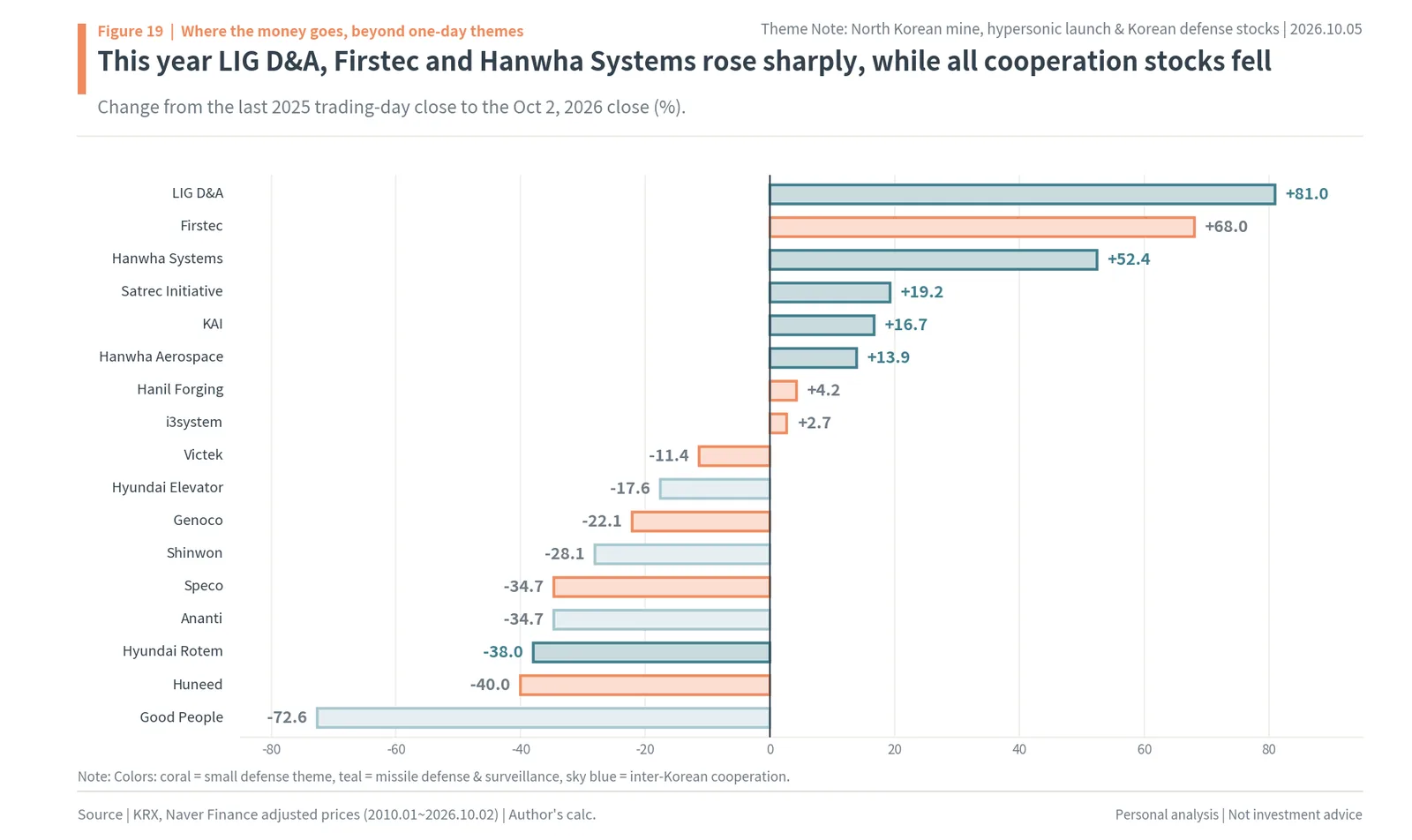
144. Year to date, LIG D&A is up 81.0%, Firstec 68.0% and Hanwha Systems 52.4%, while Hyundai Rotem is down 38.0%.
145. Inter-Korean cooperation stocks all fell, including Ananti -34.7% and Good People -72.6%.
146. They tend to jump on US-North Korea dialogue news; Good People rose 29.94% on September 2 on reports of signs of talks (Global Economic).
147. The author’s watch order: rather than the one-day theme name Victek, Hanwha Aerospace and Hanwha Systems, where interception and surveillance budgets show up in earnings, then the richly valued LIG D&A.
148. Victek and Speco are the most sensitive on event days but give back most of it within 20 trading days, so the author only watches them for news.
149. Inter-Korean cooperation stocks averaged -2.9%p 20 trading days after provocations, and they could move first if US-North Korea talks open.
8. What to watch
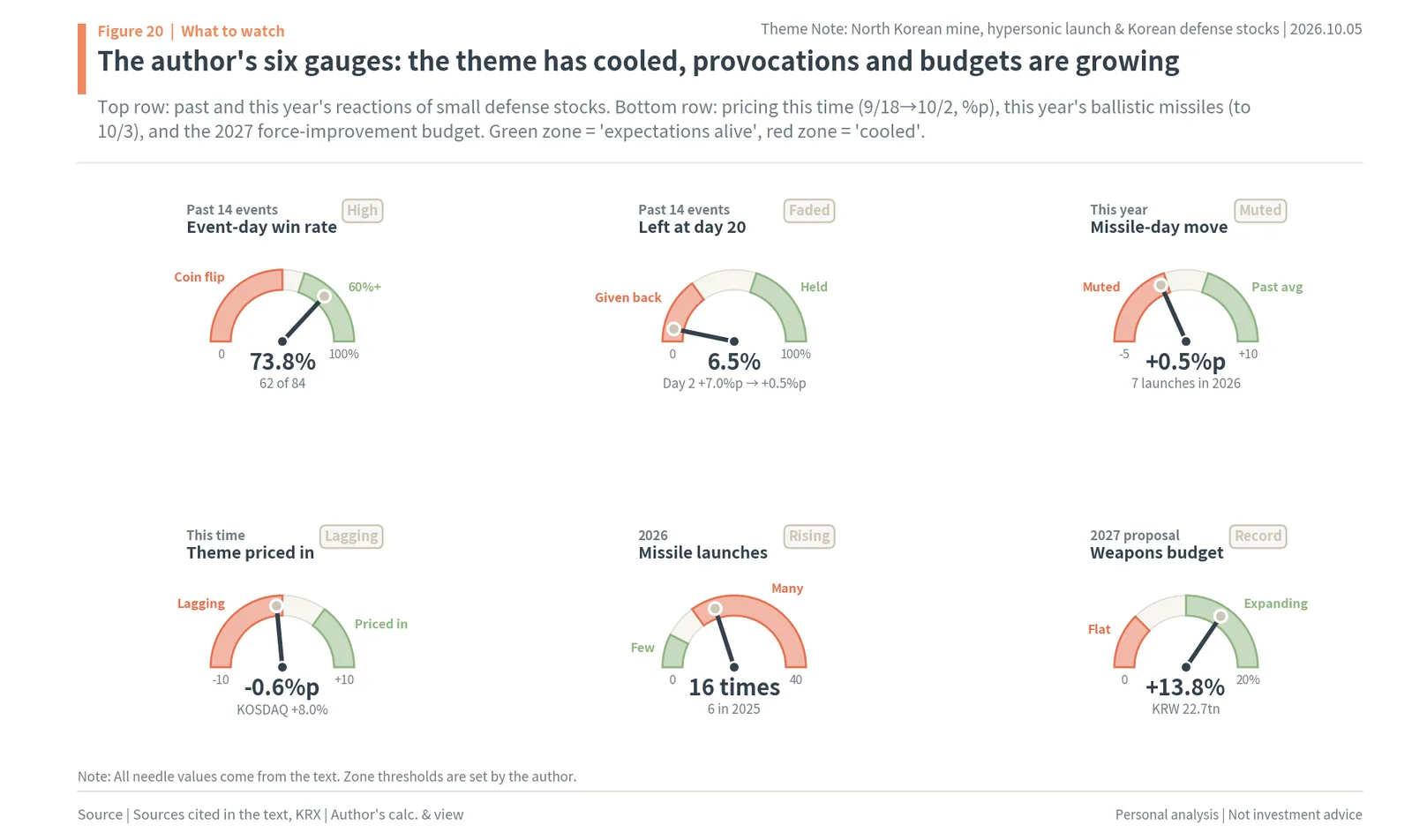
150. The author watches six needles.
151. A 73.8% event-day win rate, 6.5% of the peak left after 20 trading days, and +0.5%p on 2026 missile days say the theme has cooled.
152. This time’s -0.6%p means little is priced in, while 16 launches in 2026 and a 13.8% rise in the weapons budget say provocations and budgets are both growing.
153. By date: first, whether small defense stocks jump on October 6 and fade on day two.
154. Whether the final forensic results and a decision on restarting loudspeakers come in October.
155. The NIS put the chance of US-North Korea talks around the November APEC summit at 50%, with Pyongyang demanding recognition as a nuclear state (AsiaN).
156. Whether the National Assembly keeps the defense budget and the KRW 300 billion for L-SAM by December 2, the constitutional deadline for passing the budget.
157. North Korea headlines last two days, budgets last a year, and North Korea’s hostility outlasts any South Korean government.
Maochaedung’s summary. North Korea is harsher on a government that reaches out not by accident: since December 2023 it has defined South Korea as a “hostile state” regardless of party, and it has to kick away Seoul’s friendliness as a “clumsy deception” to keep its wall standing. Shelling, nuclear tests and the liaison office demolition happened under progressive governments too, and today Pyongyang deals with Washington directly while Russia backs it. So the author thinks that when South Korean soldiers were maimed, the president and the unification minister were wrong to put dialogue ahead of North Korea’s responsibility. That said, the Democratic Party leadership also condemned the North within a day, when the mines were laid is not established, and the hard-line 2015 response carried a real risk of clashes. For stocks, in 14 past events small defense names beat the index 73.8% of the time on the event day but kept only 6.5% of their day-two peak after 20 trading days, and even that reaction has faded this year; the author looks first at Hanwha Aerospace and Hanwha Systems, where hypersonic interception and surveillance budgets show up in earnings.
North Korea DMZ mine and Korean defense stocks FAQ
Q. What happened in the DMZ on September 21, 2026?
A South Korean 25th Division reconnaissance unit clearing a search route near Paju triggered two mine blasts about 10 m south of the Military Demarcation Line. Three officers and NCOs were injured, and the battalion commander lost a foot. Investigators found four North Korean plastic anti-personnel mines inside a 4 m circle, and on September 30 the JCS and UN Command called it a clear armistice violation.
Q. How did President Lee Jae-myung and Kim Yo Jong respond?
In his October 1 Armed Forces Day speech, Lee called it an “unforeseen accident” without naming North Korea and spoke of restoring dialogue. Kim Yo Jong called the incident “Seoul’s self-staged farce”, mocked the speech as “part two” of the farce, and rejected the unification minister’s offer to re-measure the MDL. On October 3 North Korea fired a hypersonic missile from Wonsan.
Q. Why is North Korea harsher on a conciliatory South Korean government?
Since December 2023 North Korea has defined the two Koreas as “two hostile states” and in March 2026 named South Korea “the most hostile state”, regardless of which party governs. Accepting Seoul’s outreach would undercut that line, so it called Lee’s stance a “clumsy deception”. It also wants to deal with Washington directly as a nuclear state, and Russia’s support reduces its need for Seoul. Provocations also happened under progressive governments, from the 1999 and 2002 naval clashes to the 2020 liaison office demolition.
Q. Do Korean defense stocks rise after North Korean provocations?
In the author’s event study of 14 provocations since 2010, 7 small defense stocks such as Victek and Speco beat the index on the event day 62 times out of 84, but the average peaked at +7.0%p on day two and only 6.5% of that was left after 20 trading days. The reaction has faded, to +0.5%p on 2026 missile days, and large names such as Hanwha Aerospace and LIG D&A moved more on exports and the Middle East.
Q. Which Korean defense names are tied to hypersonic missile defense?
The 2027 defense budget proposal raises weapons procurement by 13.8% and puts about KRW 300 billion into bringing L-SAM forward by a year. Of the KRW 1.2266 trillion in signed L-SAM production contracts, 57.5% went to Hanwha Aerospace, 29.1% to Hanwha Systems and 13.4% to LIG D&A. Valuations are already high, at 12 to 48 times 2027 earnings. This is not investment advice.
Sources
- Newspim, explosion during DMZ search operation injures three (link), 2026.09.21
- Hankook Ilbo, two blasts in western-front DMZ (link), 2026.09.23
- Hankook Ilbo, at least four mines at the same spot (link), 2026.09.29
- Seoul Shinmun, JCS: North Korean mine very likely (link), 2026.09.28
- Newspim, JCS: clear armistice violation (link), 2026.09.30
- Korea Economic Daily, North Korean troops crossed the MDL almost daily (link), 2026.09.30
- Money Today, Kim Yo Jong: “self-staged farce” (link), 2026.09.30
- Financial News, hypersonic launch on Oct 3 (link), 2026.10.04
- Newsspace, KCNA claims 1,000 km (link), 2026.10.04
- Seoul Shinmun, Lee calls blast an “unforeseen accident” (link), 2026.10.02
- Hankook Ilbo, Chung Dong-young proposes re-measuring the MDL (link), 2026.10.02
- Segye Ilbo, “poor response under Yoon” vs “Lee busy watching the North” (link), 2026.09.30
- Newspim, Democratic Party toughens message on the North (link), 2026.10.01
- Seoul Economic Daily, 70.5% say government response inappropriate (link), 2026.10.01
- YTN, Kim Jong Un: South Korea “the most hostile state” (link), 2026.03.24
- Newsis, Kim Yo Jong: “no reason to sit down with South Korea” (link), 2025.07.28
- Newspim, Kim Jong Un at the 9th Party Congress (link), 2026.02.26
- 38 North, Lee Jae Myung’s END Strategy (link), 2025.12.09
- AEI and ISW, Korean Peninsula Update, September 30, 2026 (link)
- ABC News, Why Seoul has called for peace talks (link), 2026.08.19
- Kyeonggi Ilbo, full text of the Aug 25, 2015 joint statement (link)
- Asia Economy, North Korea’s missile launches by year (link), 2026.09.15
- Money Today, missiles under Yoon’s first year vs Moon’s five years (link), 2023.05.06
- iNews24, defense and cooperation stocks after the 2015 shelling (link), 2015.08.21
- eToday, defense stocks surge on inter-Korean tension (link), 2020.06.17
- Dailian, L-SAM enters production (link), 2024.11.30
- Korea Policy Briefing, L-SAM-II development begins (link), 2025.01.14
- Seoul Shinmun, defense budget tops KRW 70 trillion (link), 2026.09.01
- Herald Economy, early L-SAM deployment in 2027 budget (link), 2026.09.03
- Finance Scope, Hanwha Aerospace KRW 705.4bn L-SAM contract (link), 2025.11.28
- eToday, KRW 139 trillion order backlog (link), 2026.09.19
- News1, oil price jump on Oct 2 (link), 2026.10.02
- WISEreport consensus; KRX and Naver Finance adjusted prices (2010.01 to 2026.10.02), author’s calculation
Disclaimer
This post records the author’s personal analysis and views based on publicly available information and does not recommend any particular product or company. It does not recommend buying or selling any financial investment product and is not an investment advisory service.
Figures are as published at the time of writing. Event-day and 20-day excess returns were calculated by the author by subtracting index returns from stock returns; event dates and times were checked against news reports, but other news on the same days may be mixed in. Conclusions about the political situation and evaluations of the government’s response are the author’s views. Accuracy and completeness are not guaranteed.
Conclusions and the watch order are views based on the assumptions stated in the text; if those assumptions fail, results will differ. “Author’s calculation” and “author’s view” mark the author’s own calculations and assumptions, not confirmed facts.
EPS and P/E figures are broker consensus, not the author’s estimates. This post does not recommend trading at any particular time or promise any return.
Author’s interests: not disclosed
Responsibility for decisions and their outcomes lies with the reader.
As of: October 5, 2026


.jpg)