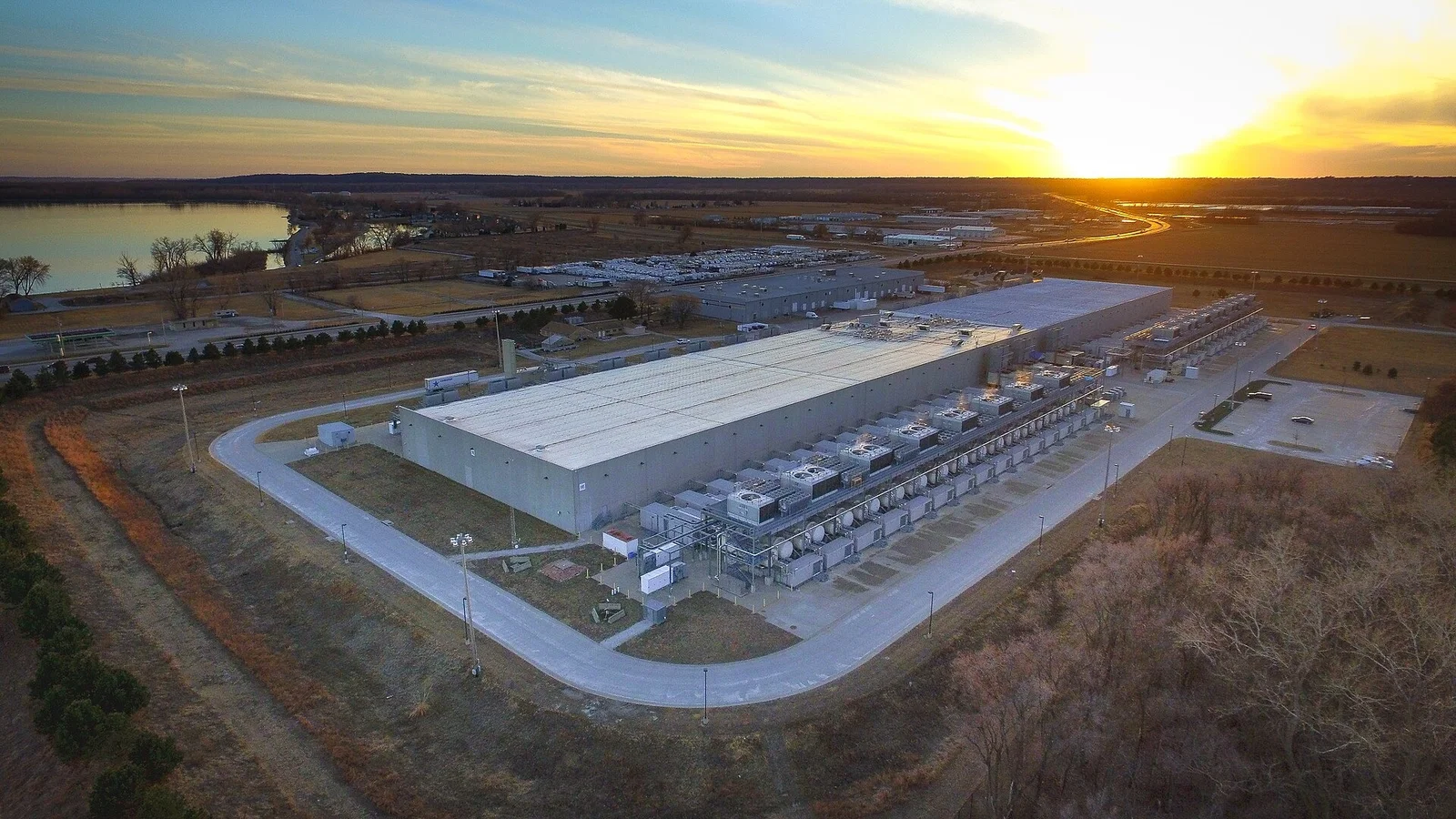
SK hynix (000660.KS) and Samsung Electronics (005930.KS) After Anthropic’s S-1: What a $637bn Compute Order Book Means for Korean Memory

On October 26, 2026 (U.S. time), Anthropic’s registration statement for an initial public offering, the Form S-1, appeared on the U.S. Securities and Exchange Commission’s EDGAR system. In the risk factors of the prospectus the company makes an admission about itself: “In the past, we have significantly underestimated our compute requirements, which left us capacity constrained and impacted both product development and deployment.” Compute here means the computing power used to train and run AI, in other words chips and data centers. A few paragraphs earlier in the same section is another sentence. High-bandwidth memory (HBM) and other high-performance memory used in compute infrastructure is “largely manufactured by SK hynix Inc., Samsung Electronics Co., and Micron Technology, Inc.” The company adds that although these makers are expanding capacity, there is “no guarantee” that enough supply will arrive quickly enough to keep up with demand.
An American AI company had written the names of two Korean companies into its own listing document. The next morning in Korea, October 27, the KOSPI opened more than 3% higher, and at 10:13 a.m. a buy sidecar was triggered. Samsung Electronics rose 4.23% and SK hynix 5.18%.
So what should be read this time? Why did a filing in which one AI company says it will buy more move Korean memory stocks, and how much is that expectation worth in numbers? This report answers with the S-1’s own figures, Korea Exchange closing prices and trading by investor type, average broker estimates and public memory-industry data. The conclusion first: what matters for Korean memory is not the size of the order but its length. The money Anthropic alone could send to Korean memory each year is 2% to 6% of SK hynix’s estimated 2027 revenue. But the order book runs as far out as 2036, and the company placing it made an operating profit for the first time this year. Today’s share prices cover only two and a half years of the two companies’ estimated 2027 operating profit.
English edition of the author’s Korean note on Anthropic’s S-1 and the Korean memory stocks on October 27, 2026.
As of: October 27, 2026 (Korean stocks are KRX regular-session closes on October 27; Anthropic figures are from the S-1 filed on October 26; broker estimates are WISEreport consensus as of October 27; U.S. prices are October 26 closes). Dollar figures in parentheses use KRW 1,323.7 per dollar, the October 27, 2026 Seoul close. Numbers the author calculated are marked as such.
Some Korea-specific background. The KOSPI is the main board of the Korea Exchange (KRX) and its benchmark index; the KOSDAQ is the exchange’s smaller growth-company board. Tickers ending in .KS trade on the KOSPI. The KRX publishes each stock’s net buying by investor type (foreigners, institutions including pension funds, and retail investors) every trading day, which is how this report can say who bought and who sold. DART is the Financial Supervisory Service’s electronic disclosure system. Korea counts large sums in jo (one trillion won) and eok (100 million won); this report shows them as KRW tn and KRW bn, and amounts the Korean edition gave in units of 100 million dollars appear here as $bn.
Topics covered: key terms; October 27 at a glance; who bought; the U.S. session; what the S-1 shows about ability to pay; what the loss is; seven order sheets; when the money goes out; ten times in six months; HBM on every chip; a hypothetical example; Korean memory’s share; the size of the order; what the share prices assume; brokers’ profit estimates; Stargate day a year ago; affected sectors and stocks; signals and dates to watch; common questions; basis of calculation.
Key terms: the S-1, compute commitments, HBM and the sidecar
This report rests on a few unfamiliar terms. Laying them out first makes the numbers that follow much easier to read.
The S-1 is the registration statement a company files with the SEC before it first offers shares to the U.S. public. It plays the same role as a Korean securities registration statement: alongside audited financial statements, it sets out how the company makes money, how much it has lost and what its risks are. In this S-1 the price range, the number of shares offered and the amount to be raised are still blank. Those blanks are filled in an amended filing (S-1/A) just before listing. So figures in the press such as a valuation of $1.5 trillion to $2 trillion or more than $100bn to be raised are reports, not numbers in the document. This report keeps the two apart.
A compute commitment is a contract an AI company signs with a cloud or chip company that says, in effect, “over the next several years we will buy this much computing power.” Anthropic’s contracts with Google, Amazon and Microsoft require a minimum payment whether or not the capacity is used (take-or-pay). If Anthropic uses less, it pays the difference. By contrast, some contracts for renting Nvidia GPUs start charging only when the equipment is delivered and accepted. A commitment is money not yet spent, but because most of it cannot be undone, it is close to an order book. A contract like the one with Broadcom, under which equipment is rented for several years with much the same effect as buying it, is called a finance lease. In the accounts, the rented equipment is booked as an asset and the future rent as a liability. Remaining performance obligations (RPO) are the number that runs the other way: money customers have contracted to pay that has not yet been recognized as revenue.
HBM (high-bandwidth memory) is DRAM stacked in many layers and attached right next to an AI accelerator. An AI accelerator is a chip built for AI, such as an Nvidia GPU, a Google TPU (tensor processing unit) or Amazon’s Trainium. Each chip carries tens to hundreds of gigabytes of HBM, and moving data in and out as fast as the chip computes depends on this memory. Worldwide, HBM is in practice made by three companies, SK hynix, Samsung Electronics and Micron. Anthropic’s S-1 says the same.
A sidecar is a mechanism that halts program trading orders for five minutes when futures prices move sharply. On the KOSPI it is triggered when KOSPI 200 futures stay more than 5% up or down for one minute. Unlike a circuit breaker, which halts all stock trading, it only briefly pauses orders placed in bulk by computers. On October 27 it was triggered on the upside (a buy sidecar).
Finally, this report uses the phrase “years priced in.” It is market cap divided by one year’s operating profit. If market cap is 2.4 times operating profit, the share price is paying for only 2.4 years’ worth of that profit. For an ordinary company the number is above 10 to 20. The smaller it is, the shorter the market expects that profit to last.
On October 27, three quarters of the KOSPI’s added market cap came from two companies
To start with the conclusion, almost all of the KOSPI’s gain that day came from Samsung Electronics and SK hynix, and small chip parts and equipment stocks rose even more. The KOSPI, which had fallen 1.46% the previous day to 5,469.47, opened more than 3% higher at 5,658.65 and touched 5,737.61 during the session. At 10:13:53 a.m., with KOSPI 200 futures up 5.05% at 893.02 for one minute, a buy sidecar was triggered (Money Today). It was the KOSPI’s 53rd sidecar this year and the 26th on the buy side. The previous one had come just four days earlier, on October 21. That a sidecar was triggered 53 times in a single year shows how violently the market has swung this year.
The gain narrowed late in the session, and the KOSPI closed up 168.87 points (3.09%) at 5,638.34. The KOSDAQ rose 2.29% to 743.83. By KRX market cap, the KOSPI added KRW 140.8tn (about $106.4bn) that day. Of that, Samsung Electronics (including preferred shares) accounted for KRW 58.2tn and SK hynix for KRW 48.2tn, 75.5% between the two (author’s calculation). All the other KOSPI stocks combined added KRW 34.4tn.

The left of the figure shows October 27 moves in chip and power stocks. The gains were larger around the two memory makers than in them. Simmtech, which makes chip substrates, rose 9.23%; Eugene Technology, a deposition equipment maker, 8.29%; SK Square, the holding company that owns SK hynix shares, 7.67%; ISC, which makes test sockets for chips, 7.61%; and substrate maker Samsung Electro-Mechanics 7.42%. SK hynix rose 5.18%, Samsung Electronics 4.23%, and Hanmi Semiconductor, which makes the thermo-compression bonders that stack HBM, 4.02%. Data center power equipment rose less: LS ELECTRIC 3.40%, Hyosung Heavy Industries 3.29% and HD Hyundai Electric 0.67%. That day the market put more weight on “AI memory and its parts” than on “AI power.”
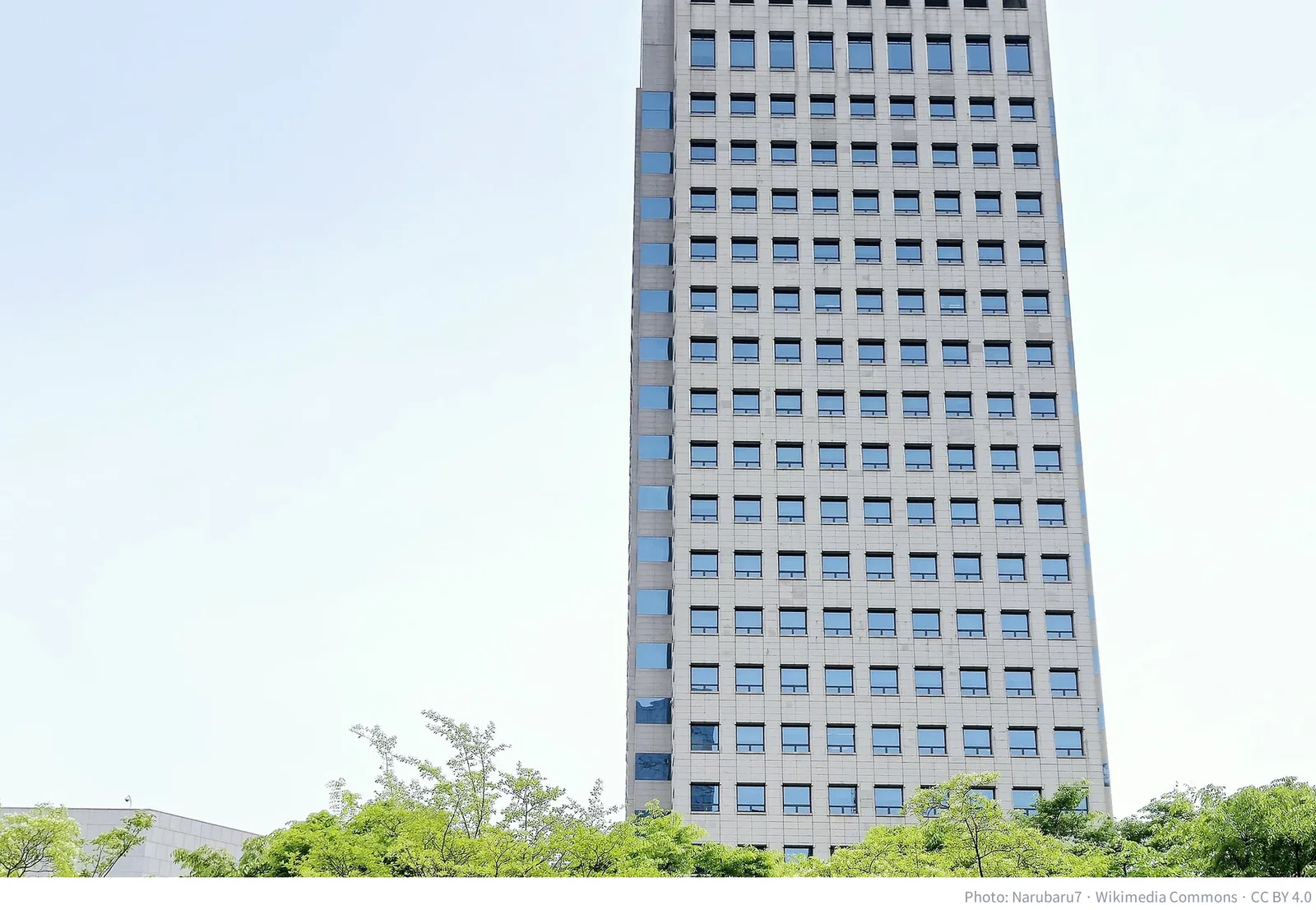
By the numbers at the Korea Exchange in Yeouido, it was a day when the sheer size of two companies with a combined market cap of more than KRW 2,400tn lifted the index. The next question is who bought. If foreigners came back, the day means more; if it was a rebound by retail investors and institutions alone, it is more likely to be a one-day bounce.
Foreigners bought Samsung Electronics and sold SK hynix
To start with the conclusion, foreigners turned to net buying on the KOSPI as a whole that day, but their stance on the two memory makers was the opposite. By Maeil Ilbo’s count, foreigners bought a net KRW 591.3bn (about $447mn) of KOSPI stocks and institutions a net KRW 280.4bn, while retail investors sold a net KRW 947.8bn. Foreigners returned to buying for the first time in four days (Kim Seok-hwan of Mirae Asset Securities, MTN). On a rising day retail investors sold and foreigners and institutions bought, a change of direction from the days before.
The final KRX figures for trading by investor type, stock by stock, tell a split story. Foreigners bought a net KRW 229.7bn (about $174mn) of Samsung Electronics but sold a net KRW 53.5bn (about $40mn) of SK hynix. They also sold a net KRW 36.2bn of SK Square, which owns SK hynix shares. Instead, institutions bought KRW 152.5bn of SK hynix and KRW 74.0bn of SK Square. In other words, SK hynix’s gain was driven not by foreigners but by domestic institutions.

The split makes sense only next to the past month. From September 28 to October 26 foreigners sold a net KRW 14.6tn (about $11.0bn) of SK hynix and KRW 7.0tn of Samsung Electronics (KRX, author’s sum). On this day the flow paused for Samsung Electronics but not for SK hynix. Some brokers worried about a “supply gap”: overseas technology funds may have to sell what they already hold in order to buy into Anthropic’s IPO (Kim Jae-seung of Hyundai Motor Securities, Hankook Ilbo). The larger the offering, the more money could leave existing AI-related stocks. That is why foreign trading in SK hynix until Anthropic lists in November is the first number this report will watch.
The U.S. moved a day earlier: chips rose, cloud was mixed
The S-1 became public on Monday, October 26, U.S. time. New York closing prices that day show the U.S. market’s first reading of it. The Philadelphia Semiconductor Index rose 2.82% and the Nasdaq 0.82%. Memory maker Micron rose 2.98%, AMD 2.80%, Nvidia 2.39%, and Broadcom, which leases TPU equipment to Anthropic, 2.33%. The companies selling cloud capacity to Anthropic were mixed: Microsoft rose 1.54% and Amazon 0.44%, while Alphabet fell 1.06% (Yahoo Finance).
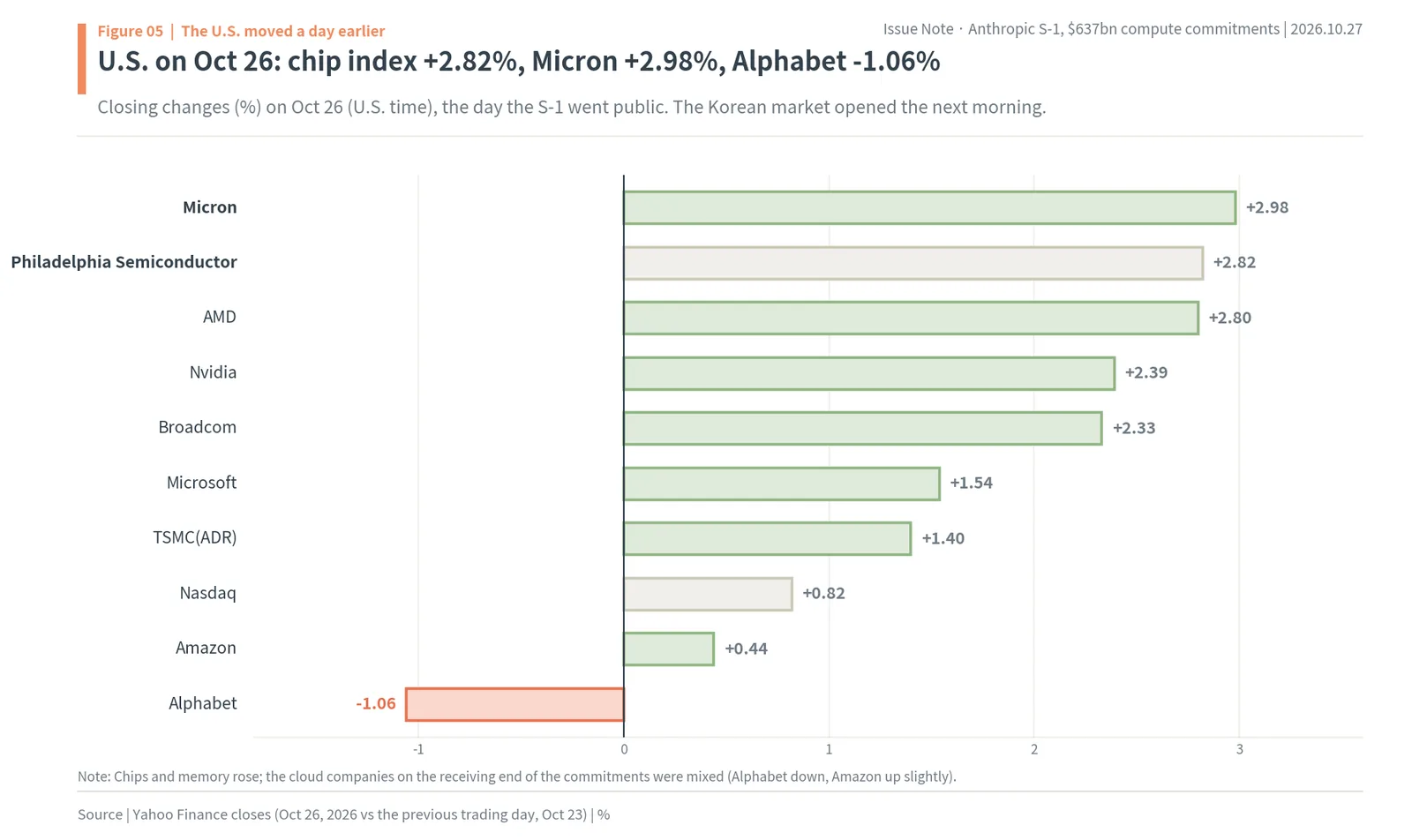
The makers of the parts that will fill the commitments (chips and memory) rose more than the recipients of the commitments (cloud). For a cloud company, Anthropic’s commitments are revenue, but they also mean spending money on chips first. For a chip company they are simply orders. The same order carried over into the Korean market the next day.

Anthropic says it intends to list on the Nasdaq Global Select Market under the ticker “ANT.” There are 22 underwriters, led by Goldman Sachs and Morgan Stanley. The listing date is not in the filing; The Wall Street Journal reported that trading could start in the week of November 16 (as cited by Yahoo Finance). Class F shares held by the founders carry a fixed 50.1% of the voting power. After listing, the founders and holders of more than 0.5% cannot sell for 365 days, and other holders for 180 days (some shares are released earlier after specified earnings releases).
One day within this year’s trend: a rebound from 38.1% below the peak
The 3.09% of October 27 is one day in a long decline. The KOSPI started the year at 4,214.17 at the end of 2025 and climbed to 9,114.55 on June 22. Four months later, on October 27, it stood at 5,638.34, 38.1% below that peak. It is still 33.8% above where the year began. In October alone it fell 17.5% from 6,838.04 at the end of September (KRX, author’s calculation). This blog covered the KOSPI’s plunge on October 12, the circuit breaker on October 15 and the stock-by-stock fall on October 26 in turn. The thread of the decline was the same: worry that memory profits are passing their peak, and doubt about whether the money going into AI actually earns anything.
So the question for October 27 is less “why did it rise today” than “which of the reasons for the decline was shaken today.” Lee Kyung-min of Daishin Securities said “Anthropic’s S-1 disclosure acted as a trigger that turned the mood” (iNews24), and Han Ji-young of Kiwoom Securities said early in the session that the S-1 had eased worries about AI monetization to some extent (eToday). Brokers’ readings converge on the second worry, doubt about whether AI makes money. That is why, of all the numbers in the S-1, this report looks first at the ratio of compute cost to revenue.
The count of 53 sidecars this year fits the same picture: 26 on the buy side, 27 on the sell side. More than fifty days in a year on which futures moved 5% means a year in which the market bought heavily one day and sold heavily the next on the same story. Because a single rebound says little about direction, this report puts more weight on what the numbers in the filing mean than on one day’s move.
What the S-1 shows, part 1: the buyer can now pay
To start with the conclusion, the number in the S-1 that matters most for Korean memory is not revenue itself but the ratio of revenue to compute cost. For a chip company, the worst customer is one that orders a lot and cannot pay. One of the worries that weighed on memory stocks this year was exactly that: “The money AI companies spend on chips is ultimately borrowed from investors, and if AI does not earn as much, the orders stop.” The S-1 put the first audited numbers against that worry.
Anthropic’s revenue was $386mn in 2024 and $4,585mn in 2025. First-half 2026 revenue was $16,286mn (about $16.3bn), 14.0 times the $1,163mn of the first half a year earlier. Quarter by quarter, revenue rose from $376mn in the first quarter of 2025 to $11,555mn in the second quarter of 2026 without a single decline in six quarters. Second-quarter 2026 revenue was 14.7 times the same quarter a year earlier and 2.44 times the previous quarter. The S-1 does not give a third-quarter revenue figure, but says it was 86 times the fourth quarter of 2024.
Compute and infrastructure costs rose over the same period, from $2,334mn to $8,945mn in the first half, 3.8 times. But with revenue up 14.0 times, compute cost as a share of revenue fell sharply. In the first half of 2025 compute cost was 201% of revenue: the company spent $2 on computing power for every $1 it earned. In the first half of 2026 that fell to 55%, and in the second quarter alone to 48%.

The line on the left of the figure is this ratio. It fell from 251% in the first quarter of 2025 to 177%, 148% and 144%, then dropped to 72% in the first quarter of 2026 and 48% in the second. Lee Jae-won of Yuanta Securities said of this number that “the pace of revenue generation is outrunning cost growth” (Hankook Ilbo, October 27). He judged it an indicator that rebuts the profitability worries. If the ratio of cost to revenue keeps falling as revenue grows, the compute this company has promised to buy can be paid for with money it earned, not money it borrowed.
The filing also speaks to the quality of revenue. Of first-half revenue, 80% ($13.1bn) was usage-based, paid as customers use it, and 20% ($3.2bn) came from subscriptions. 48% of revenue came through the cloud marketplaces of Amazon, Google and Microsoft. Customers spending more than $100,000 a year grew from about 950 to more than 11,900 in a year. The top five customers accounted for about 25% of revenue in January to September 2026, and no single customer exceeded 10%. Revenue does not lean on a few large customers. That most revenue is usage-based also means that the more customers use AI, the more revenue grows, and the more compute is needed.
What the loss is: the $80.7bn net loss is fair-value losses, and the second quarter brought the first operating profit
The S-1 number reported most widely was the net loss. The first-half 2026 net loss was $80,748mn ($80.7bn), close to five times revenue in the same period. But it is not a loss of cash. Fair-value losses on convertible notes and similar instruments, which rose in value along with the company’s valuation, were $72,388mn, and fair-value losses on other financial instruments were $8,720mn. Together they exceed the net loss. The accounting works so that the higher the company’s value goes, the larger the book value of what is owed to investors, which is booked as a loss.
Operations turned. The operating loss was $8,060mn for all of 2025 and $2,135mn in the first half of 2025, and shrank to $693mn in the first half of 2026. By quarter, a $1,667mn operating loss in the first quarter of 2026 turned into a $974mn operating profit in the second. Adjusted net income as the company defines it was a profit of $2,671mn in the first half, and operating cash flow was a positive $3,929mn.
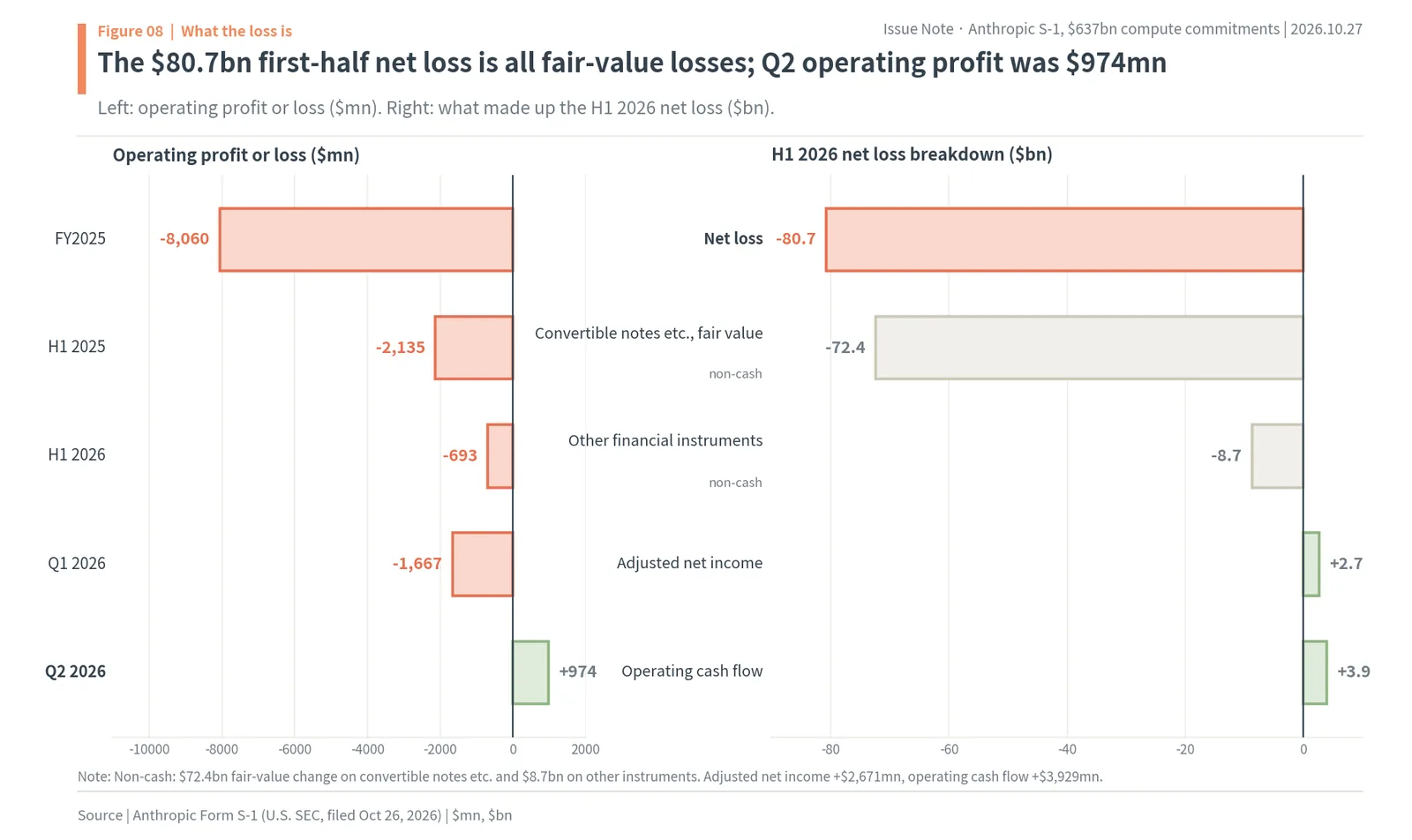
At the end of June, cash and equivalents were $112.4bn and short-term investments $19.3bn, thanks to $65.2bn raised in the Series H round in May and June. The company also raised its credit line from $3.3bn to $15.0bn. From the Korean memory makers’ point of view: this customer began earning money from its business in the second quarter, holds more than $130bn of cash it has not yet spent, and will take in more cash when it lists. The buyer’s ability to pay, confirmed in a filing, is the first meaning of the S-1.
What Anthropic sells to earn its revenue: customers pay for what they use
For a memory maker, a customer’s revenue model is a clue to how long its orders will last. Anthropic sells its AI model, Claude, to businesses and individuals. Businesses build Claude into their own services and pay for the amount they use; individuals and teams pay monthly subscriptions. According to the S-1, 80% of first-half 2026 revenue was usage-based. The more work customers give Claude, the more revenue grows, and the computing power to do that work, that is chips and memory, grows with it.
The S-1 also puts numbers on how Claude is used inside the company. In September 2026 Claude wrote more than 90% of the contributions to the company’s code, and the code an engineer adds per day was more than 45 times the 2024 average. From the end of 2024 to the end of September 2026 headcount grew more than fivefold, while quarterly revenue grew 86 times. The company describes this as operating leverage from using Claude across the organization.
What these numbers say to Korean memory is simple. The more work AI does in place of people, the more computing goes into inference (running models that have already been trained). Unlike training, inference is demand that does not stop as long as the service runs. The S-1 lists “customer demand for inference compute” as a variable in its compute planning and admits it once badly underestimated that demand and ran short of capacity. It can be read as evidence that memory demand is turning from a phase of the training boom into demand that keeps coming as long as AI is used.
Customers are broad, and contracted money is piling up
Ability to pay is hard to judge from one profitable quarter. If revenue sits with a few customers or is money spent once, the profit can vanish quickly. The S-1 gives numbers for this too.
First, the breadth of customers. Customers spending more than $100,000 a year grew from about 950 at the end of September 2025 to more than 11,900 at the end of September 2026. The top five customers took about 25% of revenue in January to September 2026, and no single customer exceeded 10% of revenue. With thousands of business customers paying for what they use, losing one does not shake revenue much.
Next, money already contracted. Remaining performance obligations, the amount under contract but not yet recognized as revenue, were $10.8bn at the end of June 2026. A company whose quarterly revenue was around $400mn a year and a half ago now has more than $10bn of receivable work on its books. It is also worth noting that 48% of revenue came through cloud marketplaces. Part of what customers pay Amazon, Google and Microsoft becomes Anthropic revenue, and Anthropic in turn pays those cloud companies under its compute commitments. The money goes round in a circle, but the money that starts the circle turning is the usage fees paid by end customers.
The S-1 also says that revenue from customers who appear to have violated its terms of use was 5% to 7% of January to September revenue. The company disclosed revenue it may have to give up. Even leaving that out, the pace of revenue growth and the direction of the cost ratio do not change.
What the S-1 shows, part 2: seven order sheets, the longest running to 2036
To start with the conclusion, the S-1 names seven compute commitments with amounts, totaling $637bn. The filing leaves the total commitment blank, so this report added up the seven contracts with stated amounts in the “infrastructure services agreements” and “equipment leases” sections. The $637bn in the press is the same calculation. It is larger than the $518bn Reuters reported in September from the confidential draft because, in the meantime, the Microsoft and SpaceXAI commitments grew and Nscale and Lambda were added.
The largest is the finance lease of TPU equipment with Broadcom: about $161.2bn of rent over five years, excluding interest. To fund the lease, Anthropic may issue up to $42bn of convertible notes to Broadcom. Next is compute on Nvidia GPUs from SpaceXAI, a subsidiary of Elon Musk’s SpaceX: up to $120.5bn through 2029, about $3.1bn a month once all the equipment is installed. Anthropic agreed to spend at least about $114.5bn with Google from April 2026 to July 2033, and at least $110.0bn with Amazon from May 2026 to April 2036. Both must be paid whether or not the capacity is used. With Microsoft it is at least $44.9bn from November 2026 to May 2033; with Nscale, which rents out Nvidia GPUs, up to about $44.6bn through 2033; and with Lambda about $41.3bn through 2034.
Grouped by chip family, the Google TPU side (Google Cloud plus the Broadcom lease) comes to $275.7bn, or 43.3%, and the Nvidia GPU side (SpaceXAI, Nscale and Lambda) to $206.4bn, or 32.4%. Amazon (Trainium and others) at $110.0bn is 17.3%, and Microsoft Azure at $44.9bn is 7.0%. The Amazon and Microsoft contracts do not name the chip type in the filing, so they are grouped by company. Beyond these seven, the filing mentions additional TPUs worth $125bn to $150bn for delivery in 2028 to 2031 and AMD chips worth more than $20bn. Adding those gives $782bn to $807bn (author’s calculation).
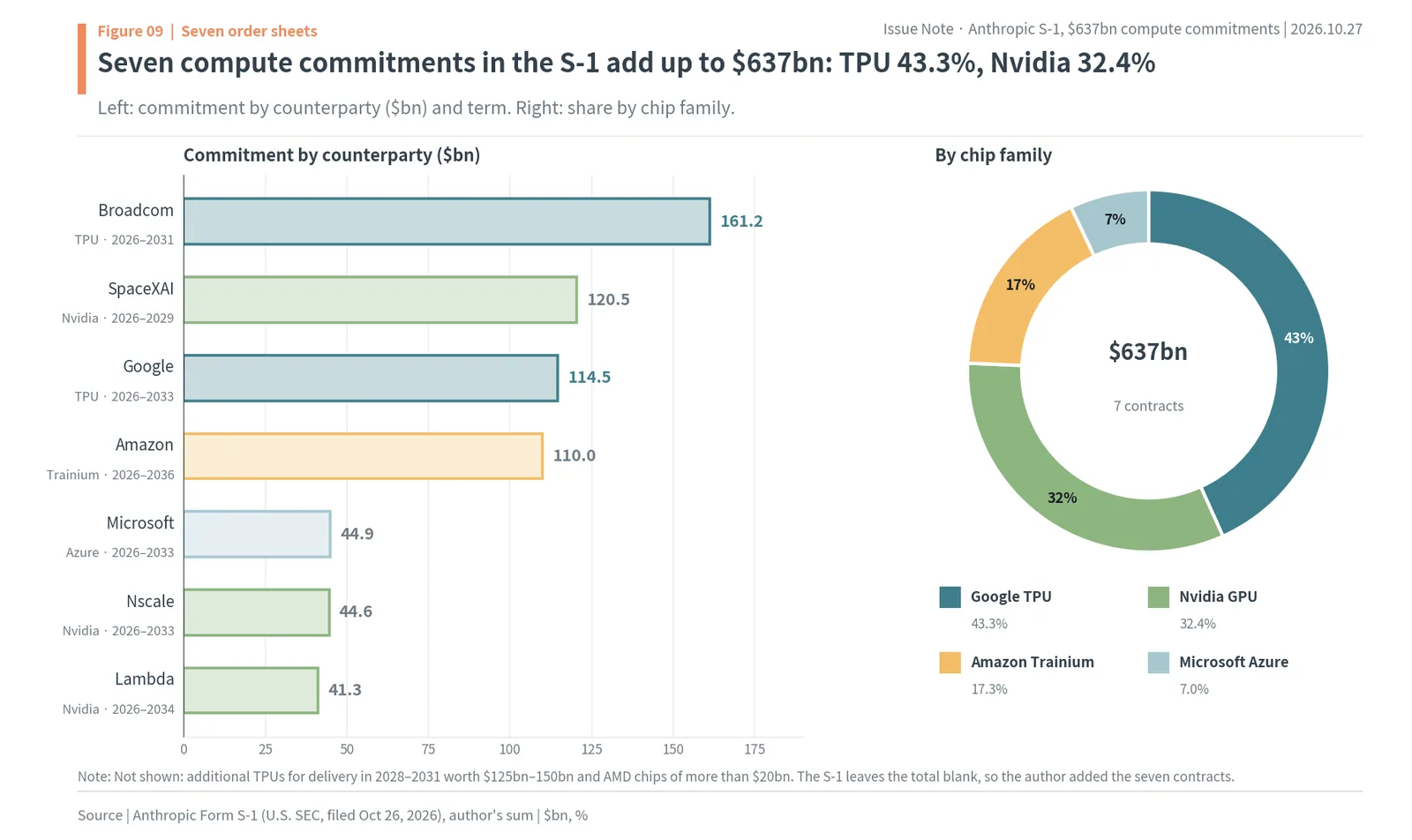
That Google is the largest pillar matters for Korea too. Broadcom helps design Google’s TPUs, and Samsung Electronics is reported to have supplied more than 60% of the HBM on TPUs in 2025 (TrendForce). On the Nvidia GPU side, SK hynix is the largest HBM supplier. An order book split almost evenly between TPUs and GPUs means each of the two Korean companies is closer to a different half of it.
When the money goes out: peak in 2027 to 2029, and $169.0bn still left after 2031
The S-1’s table of contractual obligations by year is blank. The filing says only that “most of the commitments will be used before the end of 2030 and nearly all the rest in 2031 to 2045” (amounts blank). So this report spread each of the seven amounts equally across the months of its contract term and added them up by year. Actual payments may bunch earlier or later depending on when equipment arrives, so this is a way to gauge size, not the company’s payment schedule.
Split this way, 2026 comes to $50.4bn, 2027 to 2029 are the largest at about $113.6bn a year, and the amount falls to $76.6bn in 2030 and $60.4bn in 2031. The money left from 2031 to 2036 alone is $169.0bn (author’s calculation). The shape shrinks as the SpaceXAI contract ends in 2029 and the Broadcom lease in 2031. Google runs to 2033 and Amazon to 2036.
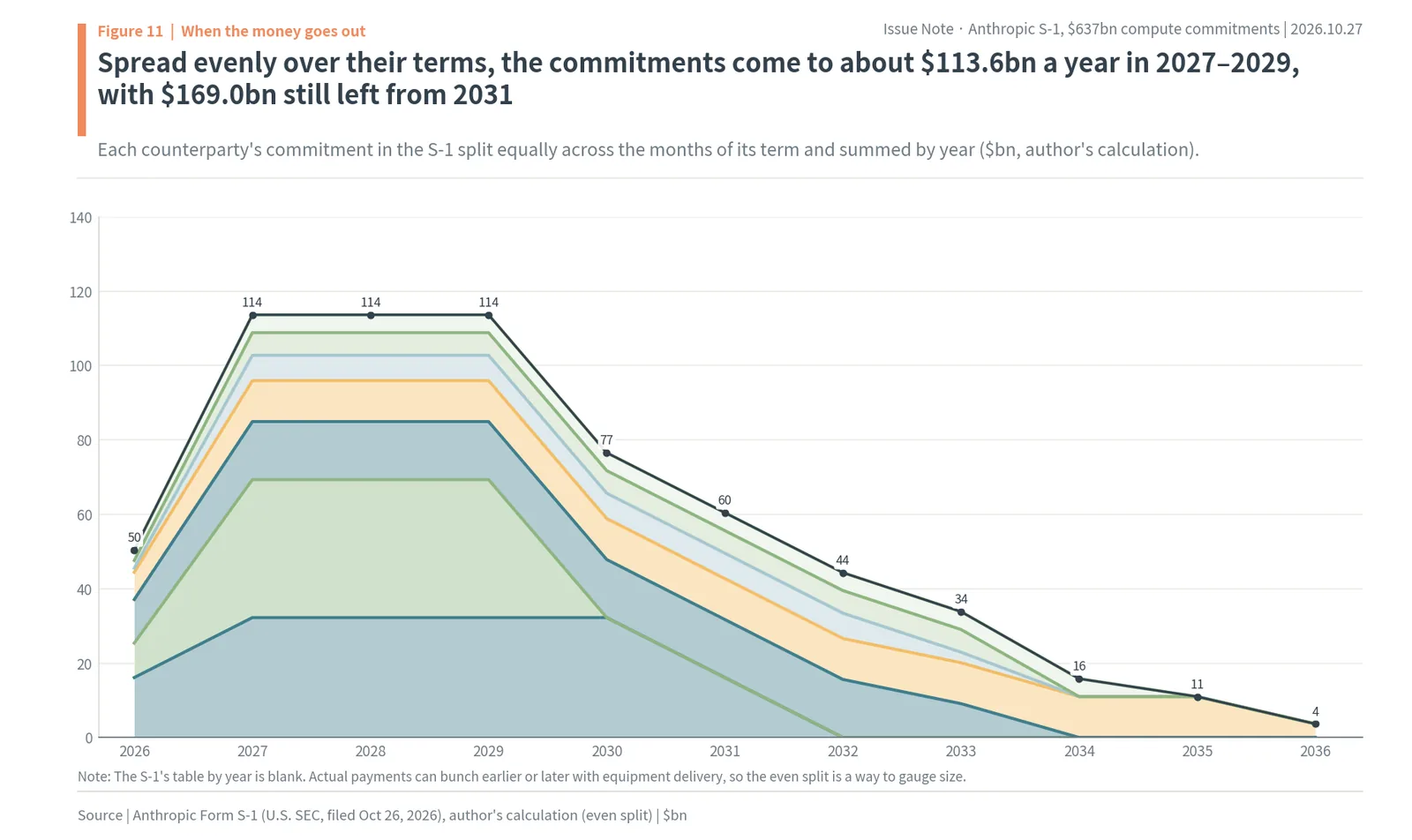
The figure says two things. First, in 2027 and 2028, the years memory makers care about most, this one customer’s compute spending is more than double this year’s. Second, that spending is contracted to continue into the mid-2030s. There is a gap between the market’s view that the memory cycle peaks in 2026 to 2027 and an order book that runs into the 2030s.
Ten times in six months: how fast the commitments pile up
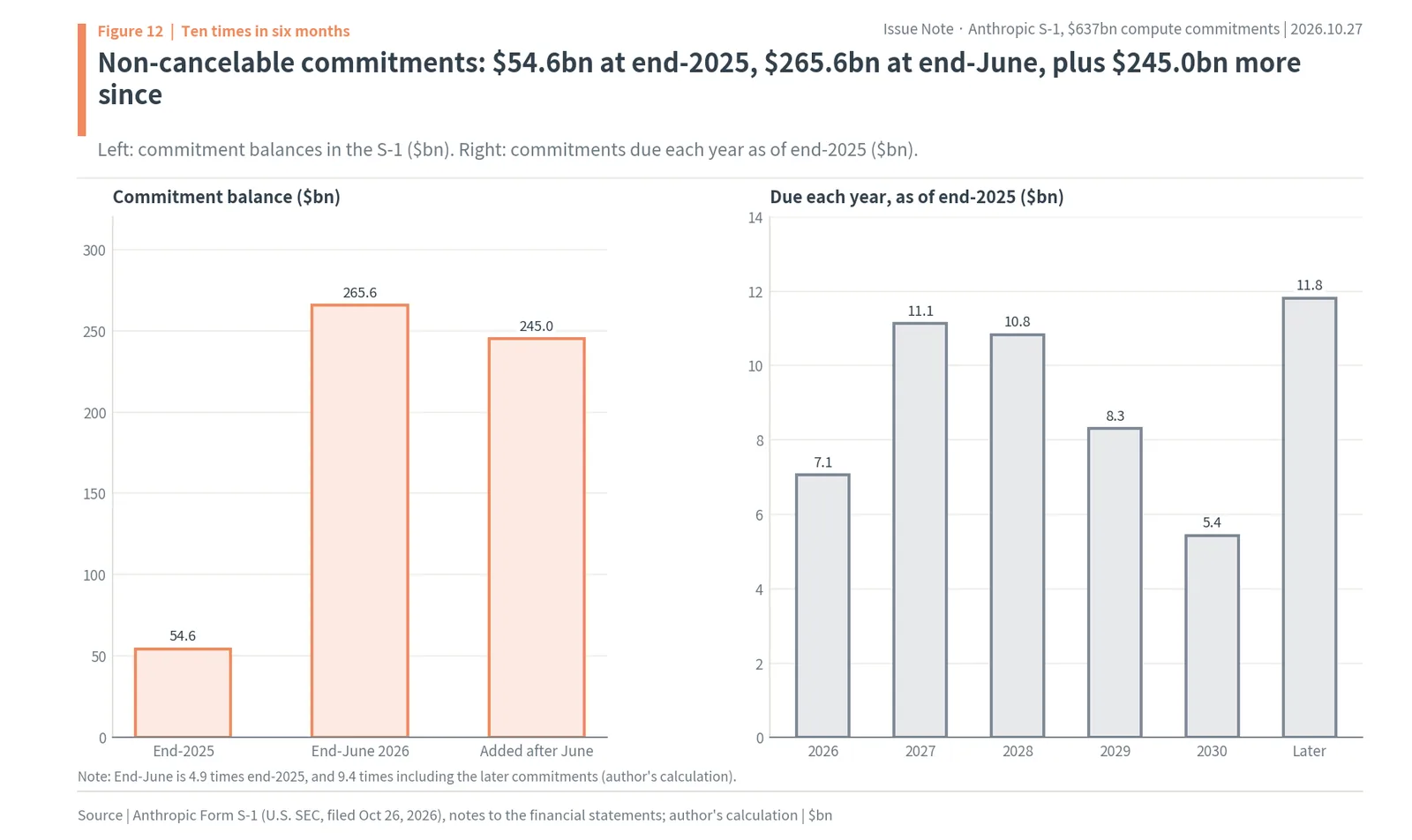
The S-1 also shows how fast this order book grew. In the notes to the audited financial statements for the end of 2025, non-cancelable purchase commitments were $54,559mn ($54.6bn). By year they were $7.06bn for 2026, $11.13bn for 2027, $10.83bn for 2028, $8.30bn for 2029, $5.43bn for 2030 and $11.81bn thereafter. Six months later, at the end of June 2026, fixed and minimum payment commitments were about $265.6bn, and minimum payments on commitments signed or amended after June add about $245.0bn more.
From $54.6bn at the end of 2025 to $265.6bn at the end of June is 4.9 times, and 9.4 times including the commitments after June (author’s calculation). The risk-factor sentence seen earlier, “we have significantly underestimated our compute requirements,” tells the same story as these numbers. Demand grew faster than expected, compute ran short, and the company is filling the gap at once with several years of commitments.
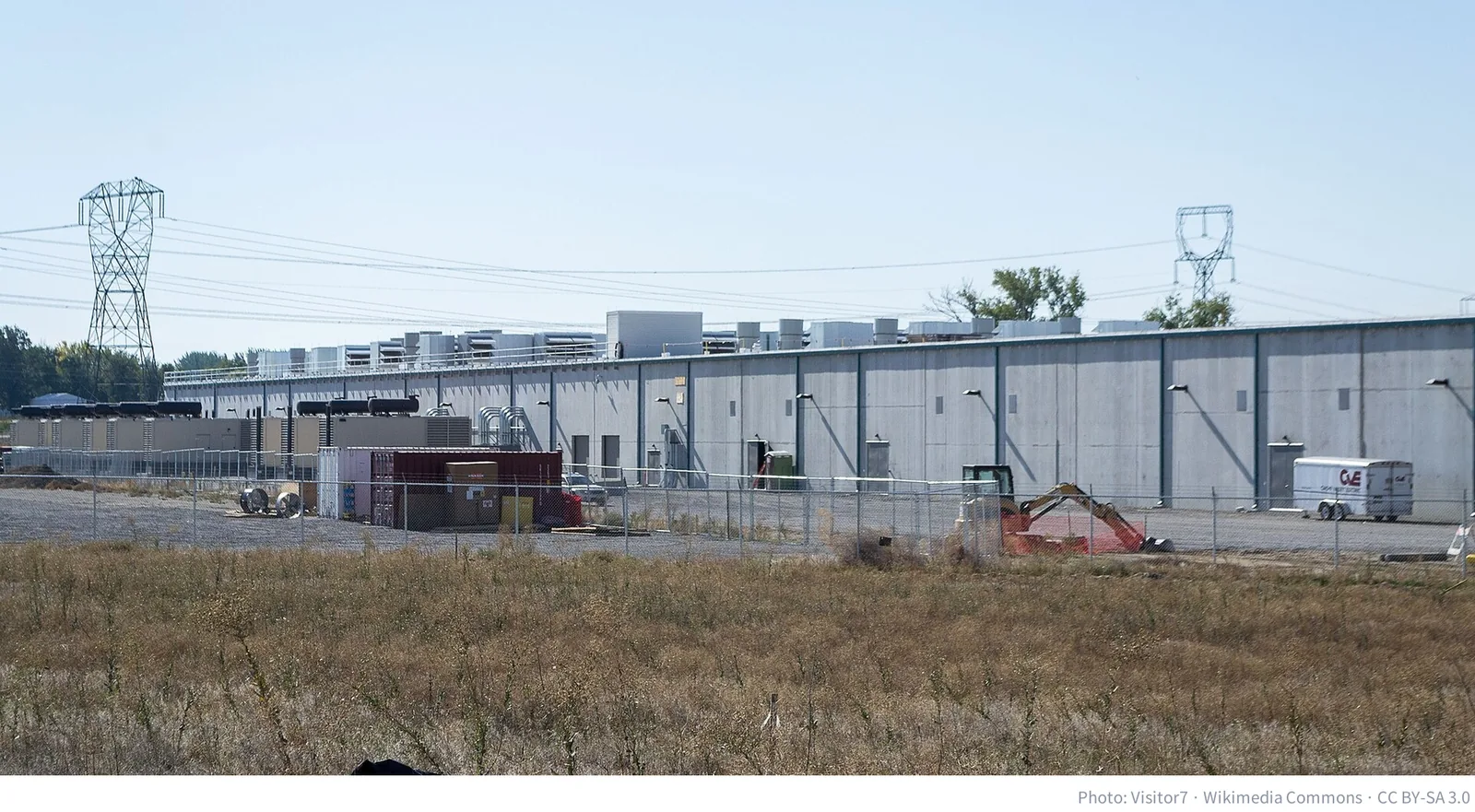
The $110.0bn commitment with Amazon runs to April 2036, the longest of the seven. Amazon has run Anthropic’s training and inference on its own Trainium chips, and in April Anthropic said it already uses more than one million Trainium2 chips. A ten-year commitment is longer than one memory cycle.
The seven order sheets differ in weight: minimum and maximum commitments
Treating $637bn as one lump invites misreading. The seven contracts differ in weight. The firmest are the minimum commitments to Google, Amazon and Microsoft. Google (at least about $114.5bn) and Amazon (at least $110.0bn) require a set amount to be spent whether or not it is used, with the shortfall paid if usage falls short (a true-up). Microsoft (at least $44.9bn) cannot be canceled regardless of usage either. The three add up to $269.4bn: 42% of the order book is money that cannot be undone (author’s calculation).
The Broadcom TPU equipment lease ($161.2bn) is a finance lease for accounting purposes. Anthropic pays quarterly rent for five years of use, and payments start when the equipment arrives. The leased assets include HBM alongside the AI accelerators. From memory’s point of view, it is the most direct order.
The three Nvidia GPU contracts are maximum commitments. SpaceXAI (up to $120.5bn) pays about $3.1bn a month once all the equipment is installed in December 2026, but after non-cancelable periods ending in January and March 2027, either side can terminate with 90 days’ notice. Nscale (up to about $44.6bn) and Lambda (about $41.3bn) accrue charges only when equipment is delivered and accepted. The $34.9bn Lambda contract from August can be terminated if Lambda fails to secure data center leases on time. Nscale must use its best efforts to raise funds for GPUs and data centers within a set period.
In sum, the weight of the order book falls into three: $269.4bn of cloud minimum commitments that cannot be undone, $161.2bn of leases that start when the equipment arrives, and $206.4bn of GPU maximum commitments that become firm only when facilities are actually built and delivered (author’s calculation). The first two alone add up to $430.6bn, more than two thirds of the seven contracts. The order book is not a wish list; most of it is money bound by contract.
What the S-1 risk factors tell Korea: what is short is memory and chips
The risk factors of the S-1 show what the company fears most. The subsection on compute supply is titled, in effect, supply and concentration of chips, memory and data center equipment. There Anthropic writes that most advanced chips are made by Taiwan’s TSMC and that it has in the past failed to receive enough chips on time. It goes on to say that HBM and other high-performance memory is largely made by SK hynix, Samsung Electronics and Micron, and that although the three are adding capacity, enough supply may not keep up with demand in time if large customers or competitors secure capacity exclusively.
The sentence reads two ways. For the customer it is supply risk; for the memory maker it is pricing power. When an AI company whose revenue grew 14 times in a year writes in its listing document that “it may not get memory on time,” it means its need to secure volume outweighs its power to push memory prices down. That is also the background to forecasts that HBM contract prices could rise 70% to 140% in 2027.
There is one more interesting sentence in the risk factors. Some financing arrangements may require exclusive or preferential supply commitments to particular chip suppliers, making it harder to move to other suppliers or new chip architectures. The company writes that it could be locked into older hardware or end up paying high prices for resources whose market value has fallen. For memory makers, this means long commitments have the effect of holding on to the customer. Whether that hold lasts will be shown by whether Anthropic’s compute cost ratio keeps falling.
In short, the S-1’s risk factors are testimony of shortage for Korean memory. The company badly underestimated its compute needs in the past and still worries that memory and chips will not arrive on time. This report’s judgment that the length of the order book matters more than its size is also a judgment about how many years this shortage will last.
HBM on every chip: 96 to 384GB per accelerator
To start with the conclusion, the chips Anthropic rents all consume a lot of HBM regardless of family, and more with each generation. The S-1 also says the equipment leases procure “AI accelerators and CPUs, together with high-bandwidth memory.” The memory comes in through the chip companies, but Anthropic’s order is ultimately an HBM order.
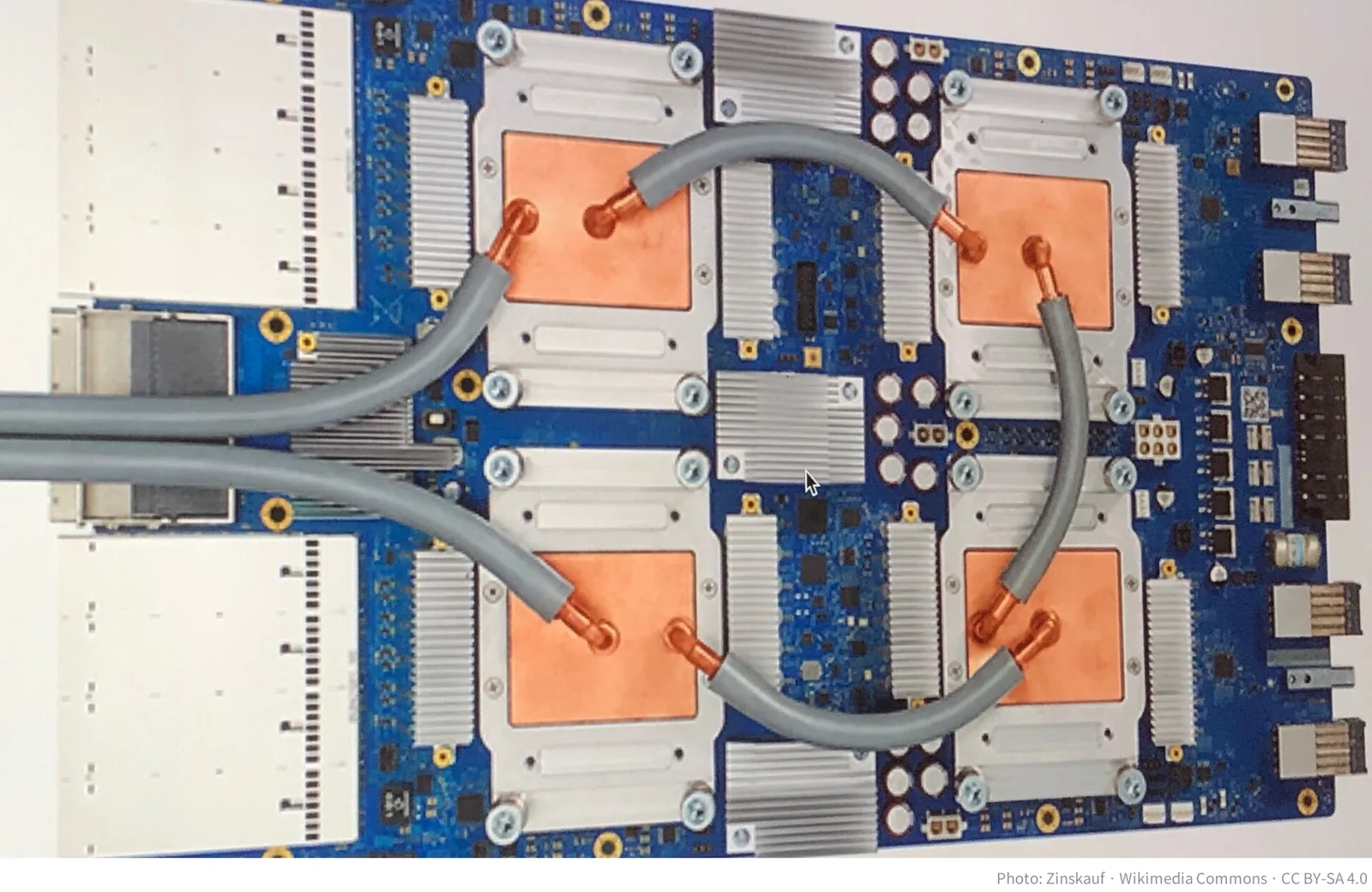
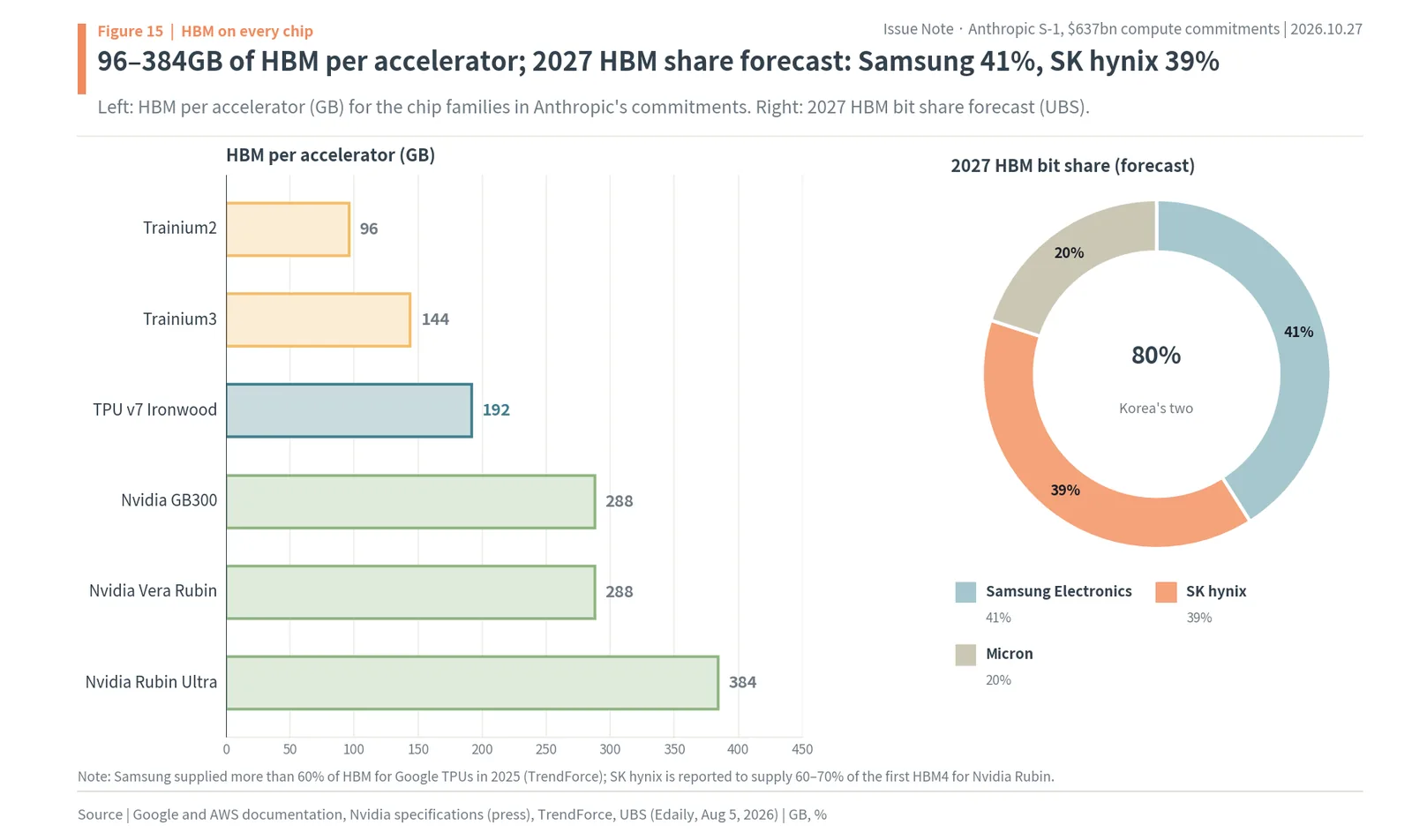
Google’s seventh-generation TPU, Ironwood, carries 192GB of HBM per chip (Google Cloud documentation). Amazon’s Trainium2 has 96GiB and Trainium3 144GB (AWS). Nvidia’s GB300 has 288GB, Vera Rubin, due in the second half of 2026, also 288GB (HBM4), and Rubin Ultra in 2027 384GB. Even with the same number of chips doing the same computing, HBM grows 1.5 to 2 times with each generation.
For 2027 HBM market share (by bits), UBS forecasts about 41% for Samsung Electronics, about 39% for SK hynix and about 20% for Micron (Edaily, August 5). The two Korean companies make 80%. By customer the picture differs. Samsung Electronics supplied more than 60% of HBM for Google TPUs in 2025, and SK hynix is reported to supply 60% to 70% of the first HBM4 for Nvidia’s Rubin. Public sources do not name the HBM suppliers for Amazon’s Trainium.
A hypothetical example: a 10-year $100bn commitment sends KRW 2.75tn a year to Korean memory
To get a feel for the numbers, imagine a hypothetical AI company. Say it signs a $100bn commitment to rent compute for ten years. That is $10bn a year. The money flows into chips, power, buildings, networks and cloud companies’ margins. Let us estimate memory’s share from the cost structure of Nvidia’s latest racks. Morgan Stanley estimated that memory (HBM and LPDDR) is 26% of the cost of a Vera Rubin rack (NVL72), against 9% for a Grace Blackwell rack (Wccftech, May 21). As memory prices rose and each chip carried more of it, the share nearly tripled.
$10bn times 26% sends $2.6bn to memory. Times the two Korean companies’ 80% share, that is $2.08bn, or about KRW 2.75tn at the October 27 rate of KRW 1,323.7 (author’s calculation). A single 10-year $100bn commitment creates a KRW 2.75tn-a-year customer for Korean memory.
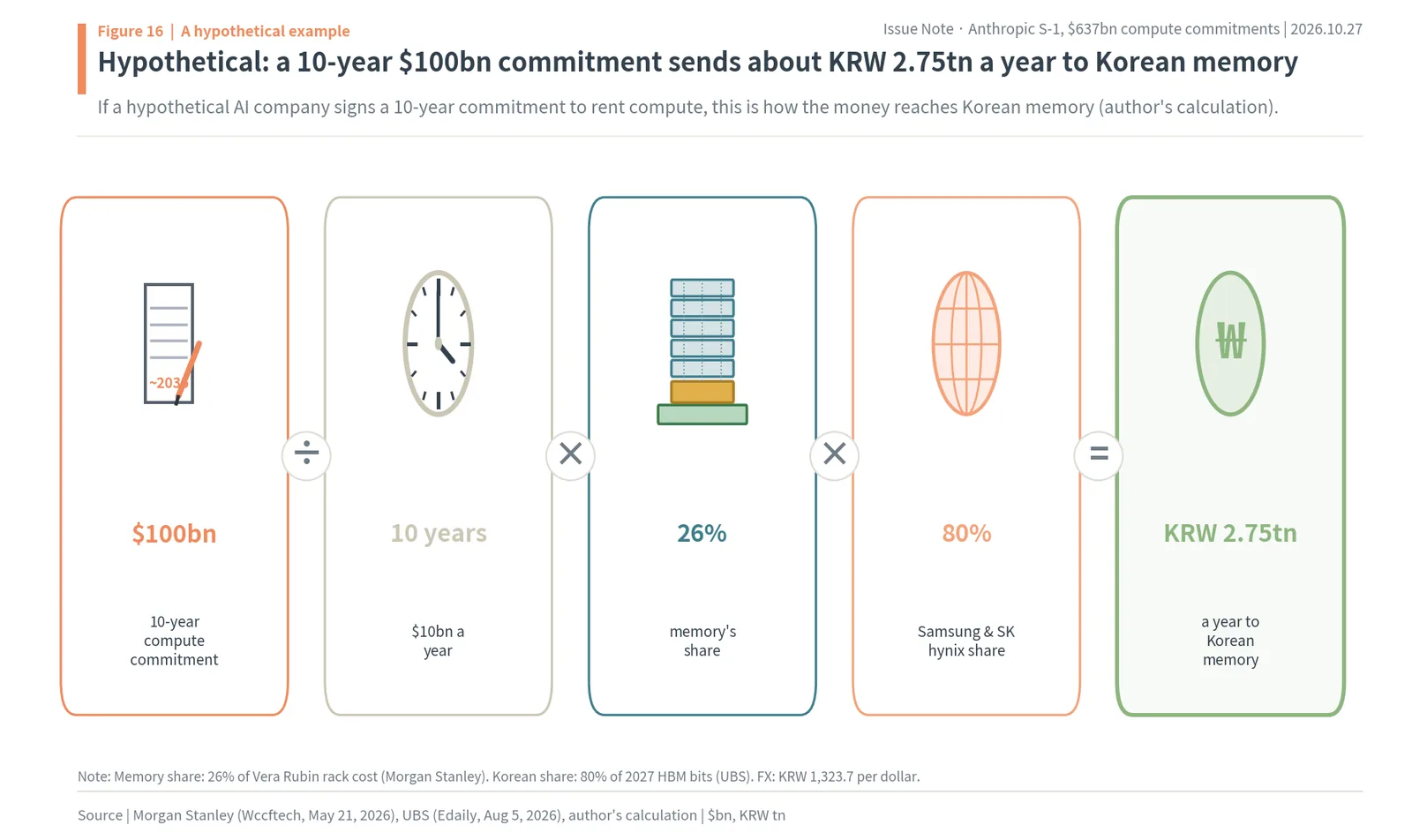
The calculation is simplified. The 26% is based on rack cost, so multiplying it straight into commitment amounts that include cloud margins and power and building costs can overstate memory’s share. That is why the next section also uses a low memory share of 9%.
Korean memory’s share: KRW 10.8tn to 31.3tn a year
Now apply the same calculation to Anthropic’s actual order book. As shown earlier, spreading the seven contracts evenly over their terms gives about $113.6bn a year in 2027 to 2029. With a 26% memory share, $29.5bn goes to memory and $23.6bn of that to the two Korean companies, about KRW 31.3tn. With memory’s share lowered to the Grace Blackwell level of 9%, $10.2bn goes to memory and $8.2bn to Korea, about KRW 10.8tn (author’s calculation).

KRW 10.8tn to 31.3tn a year (about $8.2bn to $23.6bn) is the size of the money that could flow to Korean memory from one customer, Anthropic. The range is threefold because memory’s share swings widely with memory prices and chip generations. If the forecast that 2027 HBM contract prices could rise 70% to 140% (TrendForce) proves right, the share will move toward 26%.

SK hynix has said its 2026 HBM is already sold out. So is this new money or orders already received? Anthropic does not buy chips directly but rents them through Google, Broadcom and Nvidia, so a good part of this money is probably already in those companies’ memory purchase plans. Kim Dong-won, head of research at KB Securities, said memory makers have locked in 70% to 80% of their planned 2027 volume under five-year long-term contracts and called 2027 profit growth “effectively confirmed” (Newspim, October 27). What the S-1 newly revealed is not that the orders exist but the end customer’s ability to pay and the length of its contracts.
Changing the assumptions: annual amounts by memory share and Korean share
Both assumptions behind Korean memory’s share, memory’s share of spending and Korea’s share of memory, are estimates. Reading carefully means checking whether the conclusion survives when they change. Based on about $113.6bn a year of commitments in 2027 to 2029, this report varied memory’s share across 9%, 15%, 20% and 26% and the two Korean companies’ share across 60%, 70%, 80% and 90%, for sixteen cases (author’s calculation).
With a 9% memory share, a Korean share of 60% gives KRW 8.1tn a year, 70% KRW 9.5tn, 80% KRW 10.8tn and 90% KRW 12.2tn. At 15% memory share: KRW 13.5tn, 15.8tn, 18.0tn and 20.3tn. At 20%: KRW 18.0tn, 21.1tn, 24.1tn and 27.1tn. At 26%: KRW 23.5tn, 27.4tn, 31.3tn and 35.2tn. The highest case is more than four times the lowest.
Holding the Korean share at 80% and varying only memory’s share, against SK hynix’s estimated 2027 revenue of KRW 513.0tn, gives 2.1% at 9%, 3.5% at 15%, 4.7% at 20% and 6.1% at 26%. Under every assumption, the Korean share from Anthropic alone is a single-digit percentage of SK hynix’s annual revenue. The conclusion does not depend on the assumptions: the size of the order cannot change earnings by itself, and the length of the order and the customer’s ability to pay are the more important information for the share price.
Some things are left out of this calculation. The additional TPUs ($125bn to $150bn) and AMD chips (more than $20bn) whose amounts are not fixed in the filing are not included. And Anthropic is only one customer. Other AI companies such as OpenAI, Google, Meta, Microsoft and xAI are buying the same memory. What makes Anthropic’s filing special is not the size of the amounts but that a large AI model company has disclosed its order book alongside audited financial statements. For the first time there is a basis for estimating that other AI companies’ orders have a similar structure.
The size of the order: 2.1% to 6.1% of SK hynix’s 2027 estimated revenue
To start with the conclusion, Korean memory’s share of Anthropic’s orders is not big enough to change the Korean memory makers’ earnings by itself. By WISEreport consensus, SK hynix’s estimated 2027 revenue is KRW 513.0tn (about $387.6bn) and Samsung Electronics’ KRW 957.5tn (about $723.4bn). The KRW 10.8tn to 31.3tn a year calculated above is 2.1% to 6.1% of SK hynix’s estimated 2027 revenue, and 0.7% to 2.1% of the two companies’ combined estimated revenue (author’s calculation).
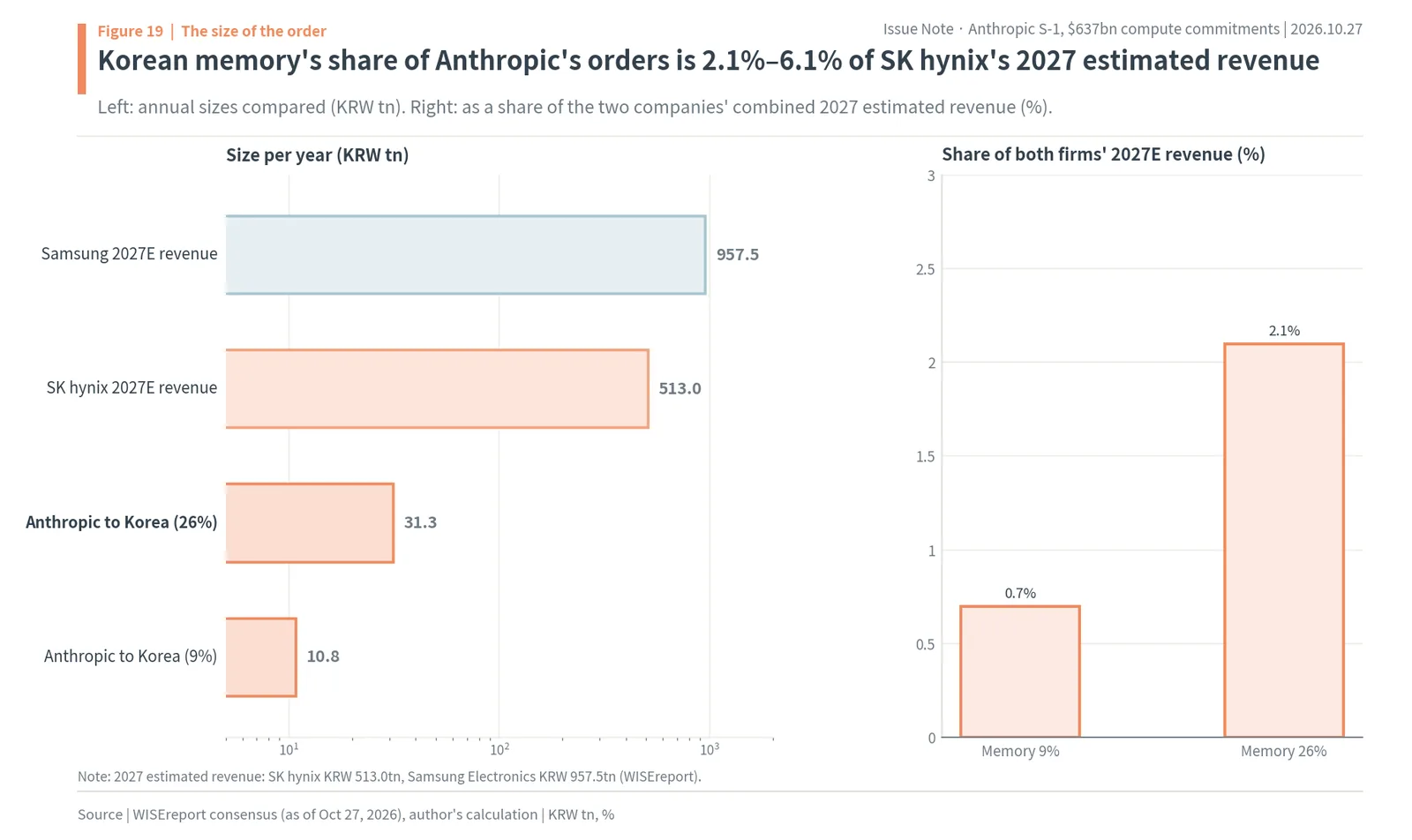
The left of the figure uses a log scale, where equal steps mean tenfold differences. Even with a high memory share, Korean memory’s share from Anthropic is around one twentieth of SK hynix’s revenue alone. The KRW 106tn-plus that the two companies added in market cap on October 27 is hard to explain by the size of this order alone. So what did the market read in this filing? The answer lies in what the share prices currently assume.
What the share prices assume: two and a half years of 2027 profit, against an order book of 3 to 10 years
To start with the conclusion, the two companies’ share prices currently pay for only 2.43 to 2.56 years of their estimated 2027 operating profit. SK hynix’s market cap on October 27 was KRW 979.6tn (about $740.0bn), and its estimated 2027 operating profit is KRW 403.8tn. Market cap divided by operating profit is 2.43. For Samsung Electronics, market cap including preferred shares of KRW 1,435.2tn (about $1.08tn) divided by estimated 2027 operating profit of KRW 560.8tn is 2.56 (author’s calculation). Anthropic’s commitments, by contrast, run 3.2 years for SpaceXAI, 5.0 for Broadcom, 6.6 for Microsoft, 7.3 for Google and Nscale, 8.6 for Lambda and 10.0 for Amazon (the author’s calculation from the start and end months in the S-1).
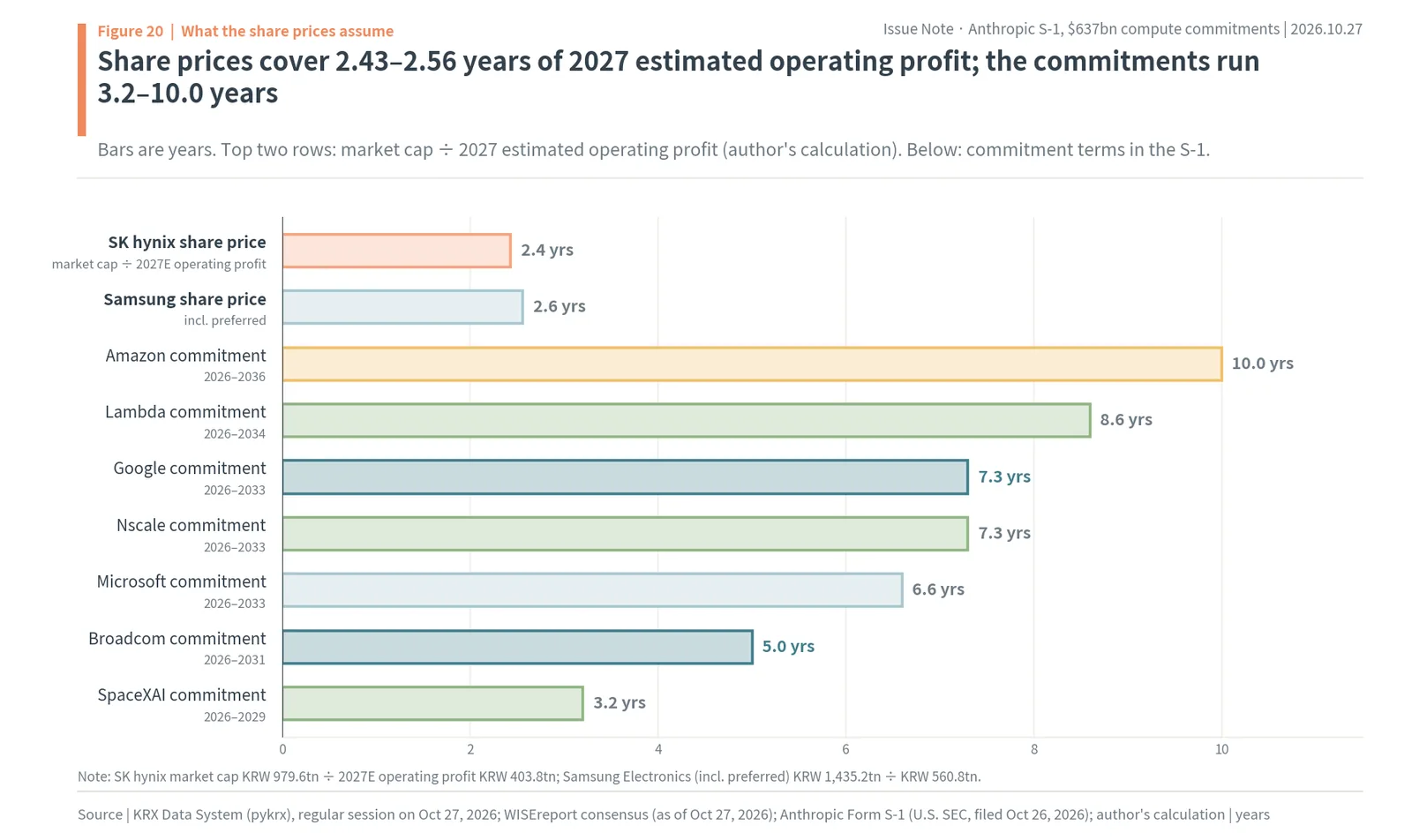
An ordinary company’s market cap is well over ten times its annual operating profit, because the profit is expected to continue. A market cap of 2.4 times operating profit means the market expects profit like 2027’s to disappear within two or three years. The view is that memory is an industry where prices break when supply grows, and today’s profit is thanks to sharply higher prices. The framework this blog used on October 12, “share prices buy the years left, not this year’s profit,” shows up here in numbers.
The writer reads the day’s meaning not as one customer’s big order but as: the buyer has started earning money and its order book is long. The judgment rests on three grounds. First, compute cost fell from 201% to 55% of revenue, so the end customer can now pay for chips with money it earned. Second, that customer’s order book spans 3 to 10 years, longer than the 2.4 to 2.6 years the share prices assume. Third, the order book grew nearly tenfold in half a year. The size of the order is only a few percent of SK hynix’s revenue, but as evidence for extending the years left, the length matters more than the size (author’s view).
Brokers’ profit path: a surge in 2026, another step in 2027, a gentler 2028
The profit paths brokers draw for the two companies line up with this judgment. By WISEreport consensus, SK hynix’s operating profit goes from KRW 47.2tn in 2025 to KRW 262.7tn in 2026, KRW 403.8tn (about $305.1bn) in 2027 and KRW 434.2tn in 2028. Samsung Electronics goes from KRW 43.6tn in 2025 to KRW 371.6tn in 2026, KRW 560.8tn (about $423.7bn) in 2027 and KRW 622.0tn in 2028. Profit does not fall even in 2028.

That share prices still sit at 2.4 to 2.6 years of profit means the market does not believe these estimates. The first number to test that disbelief comes this week. SK hynix holds its third-quarter earnings call at 9 a.m. on October 28 and Samsung Electronics at 10 a.m. on October 29, Korea time (DART investor relations notices). SK hynix’s third-quarter operating profit consensus is KRW 76.964tn (FnGuide), and Samsung Electronics already reported preliminary third-quarter operating profit of about KRW 107.4tn on October 8. More important than the numbers is what the two companies say about the share of long-term contracts for 2027 and about HBM4 prices.

Samsung Electronics, which makes memory at its Pyeongtaek campus, has been the largest supplier of HBM for Google TPUs. So the TPU family, 43.3% of Anthropic’s order book, is closer to Samsung Electronics. That foreigners sold SK hynix and bought Samsung Electronics on this day is worth reading alongside that mix.
Down from the peak: SK hynix -54.1%, Samsung Electronics -38.8%
The two stocks are still high against a year ago but well down from their summer peaks. With October 27 a year ago set to 100, SK hynix stands at 251, Samsung Electronics at 218 and the KOSPI at 140. Against their closing highs, though, SK hynix is 54.1% below KRW 2,919,000 (about $2,205) on June 22, and Samsung Electronics 38.8% below KRW 362,500 (about $274) on June 18.

Profit estimates rise through 2028, yet the share prices have fallen to around half their peaks: the years priced in have shrunk by that much. The October 27 rebound was the first day that evidence able to lengthen those shrunken years appeared in a filing.
Add up three years of profit and it exceeds market cap
Measuring the years priced in against other years’ profits makes the market’s view clearer still. SK hynix’s market cap of KRW 979.6tn is 3.73 years of estimated 2026 operating profit (KRW 262.7tn), 2.43 years of 2027 and 2.26 years of 2028 (KRW 434.2tn). Samsung Electronics (KRW 1,435.2tn including preferred shares) is 3.86 years of 2026, 2.56 years of 2027 and 2.31 years of 2028 (author’s calculation).
There is an even simpler way. Adding up estimated operating profit for 2026 to 2028 gives KRW 1,100.7tn for SK hynix, 112.4% of its current market cap, and KRW 1,554.4tn for Samsung Electronics, 108.3%. If broker estimates are right, three years of operating profit alone would more than pay the current value of each company. Operating profit is before tax, and capital spending must also come out, so less is left for shareholders. Still, the conclusion that the market sees these two companies’ profits lasting about three years at most does not change.
This is where the numbers meet the S-1. In the yearly allocation of Anthropic’s commitments, the money left after 2030 is $169.0bn counting from 2031 alone. There is a gap between a market that expects the memory cycle to turn after 2028 and a customer that has signed to buy computing power into the mid-2030s. One company’s filing cannot settle how much of that gap will close, but this filing is the first to show with audited numbers that the gap exists. That is also why the length of the order book deserves more attention than its size.
When the next AI company files: six steps readers can follow
More AI companies will file listing documents or disclose large contracts the way Anthropic did. When another AI company files something similar or announces a big compute contract, readers can estimate what the news is worth to Korean memory in the same order as this report.
First, find the contract amount and term. Check whether it is a minimum or a maximum and whether it can be canceled. The more it is a non-cancelable minimum, the more weight it gets. Second, divide the amount by the term to get an annual amount. Anthropic’s seven contracts came to about $113.6bn a year in 2027 to 2029. Third, multiply by memory’s share. This report used 9% and 26%, based on Nvidia rack costs; the newer the chip generation, the closer to the high end. Fourth, multiply by the two Korean companies’ share, 80% on the 2027 HBM bit share forecast. Fifth, convert to won at the exchange rate and compare with SK hynix’s or Samsung Electronics’ estimated revenue for the next year. For Anthropic it was 2.1% to 6.1% of SK hynix’s. Sixth, compare the contract term with the years priced into the company’s market cap (market cap ÷ next year’s estimated operating profit). Today that is 2.43 to 2.56 years.
In this sequence, step five measures the “size” of the news and step six its “length.” Even if the size is only a few percent of revenue, a contract term longer than the years priced in makes the news evidence that profits will last. Conversely, even a large amount should be counted as short if it is a letter of intent or a cancelable contract. Anthropic’s S-1 was a case of single-digit percent in size and 3 to 10 years in length, longer than the years priced in.
Compared with Stargate day a year ago: half the gain, a fifth of the foreign buying
To start with the conclusion, this rebound was smaller than on a day with similar news a year ago, and in particular less foreign money came in. On October 1, 2025, OpenAI CEO Sam Altman visited Korea and signed Stargate letters of intent with Samsung Electronics and SK, and news came out that OpenAI had asked for 900,000 wafers a month of memory. The next day, October 2, the KOSPI rose 2.70% to top 3,500 for the first time, and SK hynix rose 10.97%. Foreigners bought a net KRW 3,138.8bn (about $2.37bn) of KOSPI stocks that day (eToday, Money Today, Seoul Shinmun).
This time the index gain was similar at 3.09% for the KOSPI, but SK hynix rose 5.18%, about half, and foreign net buying of KRW 591.3bn was less than a fifth of that day’s. One way to read the difference: a year ago was the first day the expectation of “new demand” appeared, and this time was the day the “ability to pay and duration” of known demand were confirmed. SK hynix closed at KRW 399,500 a year ago and now trades at KRW 1,341,000 (about $1,013). That a lot of expectation has already gone into the price in the meantime can also be seen as one reason the gain was smaller.

Affected sectors and stocks: memory, the substrates that carry it, and the equipment that stacks HBM
The filing connects most directly to memory. First in line are SK hynix and Samsung Electronics, named in Anthropic’s S-1, and SK Square, which owns 20.5% of SK hynix (2026 half-year report). SK Square rose 7.67% that day, more than SK hynix.
Second are the substrates and parts that carry AI servers and memory: Samsung Electro-Mechanics (7.42%), Isu Petasys (6.59%), Simmtech (9.23%) and Daeduck Electronics (6.68%). Third is the equipment that makes HBM and DRAM: Hanmi Semiconductor (4.02%), which makes the thermo-compression (TC) bonders that stack HBM layer by layer; deposition equipment makers Eugene Technology (8.29%), Wonik IPS (4.92%) and Jusung Engineering (4.30%); and laser equipment maker EO Technics (4.22%). Fourth are test and consumables: test socket makers ISC (7.61%) and Leeno Industrial (4.07%), test handler maker Techwing (4.51%), back-end packager Hana Micron (5.34%) and chip process parts maker TCK (6.87%).
The simple averages by group for the 21 stocks in this report were substrates and parts +7.48%, test and consumables +5.68%, memory +5.32%, equipment +5.15% and power +2.45%. By market cap, the four memory stocks exceed KRW 2,500tn, far more than all the other groups combined. Data center power equipment (LS ELECTRIC, Hyosung Heavy Industries, HD Hyundai Electric) rose least. Anthropic’s commitments also spend money on data center construction through the cloud companies, but the parts the S-1 named while voicing supply worries were memory and TSMC chips.
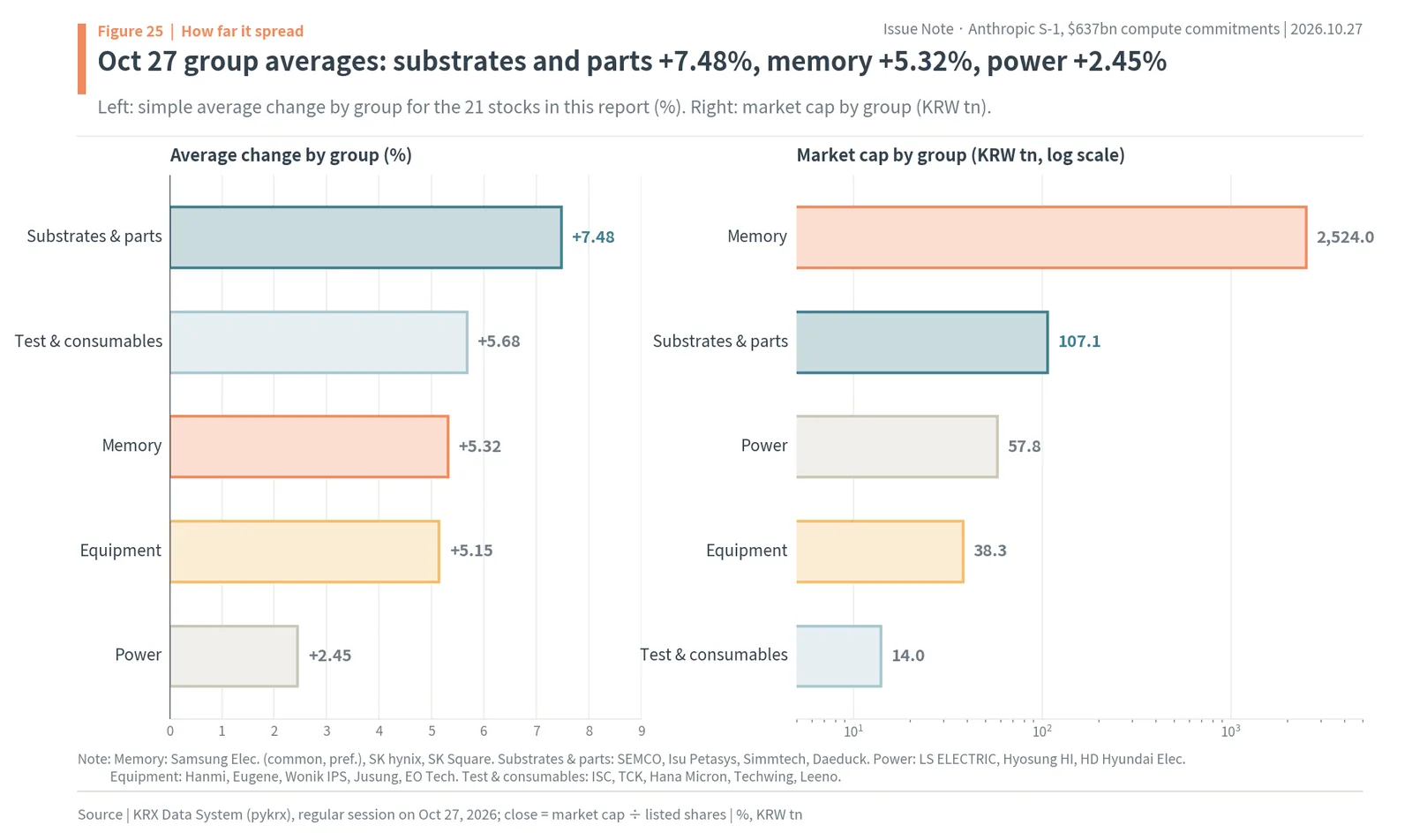
How directly each stock connects to Anthropic’s orders differs. The two memory makers are suppliers named in the filing. The equipment, substrate and test companies are second-order links that move when those memory and chip makers add capacity. So for second-order stocks this report records only the day’s move and does not calculate how much they earn from Anthropic’s orders.
The difference between a letter of intent and audited commitments
Stargate a year ago and this S-1 both say “an AI company will buy a lot of Korean memory,” but the documents carry different weight. The October 2025 document was a letter of intent. The 900,000 wafers a month was reported as the volume OpenAI asked for, but when, how much and who pays were not fixed. This S-1’s commitments are contracts with counterparties, amounts and terms, and their balances sit in the notes to the audited financial statements for the end of 2025 and the reviewed half-year financial statements for the end of June 2026. If the numbers in a listing document are wrong, the company, its directors and its underwriters bear legal liability.
The market’s response to the two documents differed too. On the letter-of-intent day SK hynix rose 10.97% and foreigners bought more than KRW 3tn. On the day the audited commitments came out, SK hynix rose 5.18% and foreigners sold it. Markets react strongly when an expectation first appears and less when it is confirmed in numbers. This report reads the difference not as the confirmed numbers being worth little but as the share price having already priced in the expectation by more than tripling over the past year. SK hynix, at KRW 399,500 a year ago, is now KRW 1,341,000.
Confirmed numbers do not vanish as easily as expectations. A letter of intent can change or come to nothing, but a non-cancelable minimum commitment is money the customer must pay even if it uses less. As shown earlier, 67.6% of Anthropic’s order book is non-cancelable cloud minimum commitments and equipment leases. When expectations break, the floor under the share price comes from numbers like these.
Signals and dates to watch: cost ratio, SK hynix results, foreign flows, years priced in, commitments, listing stage
To start with the conclusion, there are six signals that would firm up or shake this report’s judgment, and three of them arrive this week or next month. First is Anthropic’s compute cost ratio, 48% of revenue in the second quarter of 2026. If it keeps falling, the end customer’s ability to pay firms up. Second is SK hynix’s third-quarter results and commentary. The operating profit consensus is KRW 76.964tn (about $58.1bn), and the commentary on 2027 long-term contracts and HBM4 prices matters more than the number. Third is foreign trading in SK hynix, still a net sale of KRW 53.5bn on October 27. Fourth is the years priced into the share price: 2.43 for SK hynix. Fifth is the growth of Anthropic’s commitments, 9.4 times the end of 2025. Sixth is the listing stage. The S-1 has been filed; an amendment with a price range and the actual listing remain.
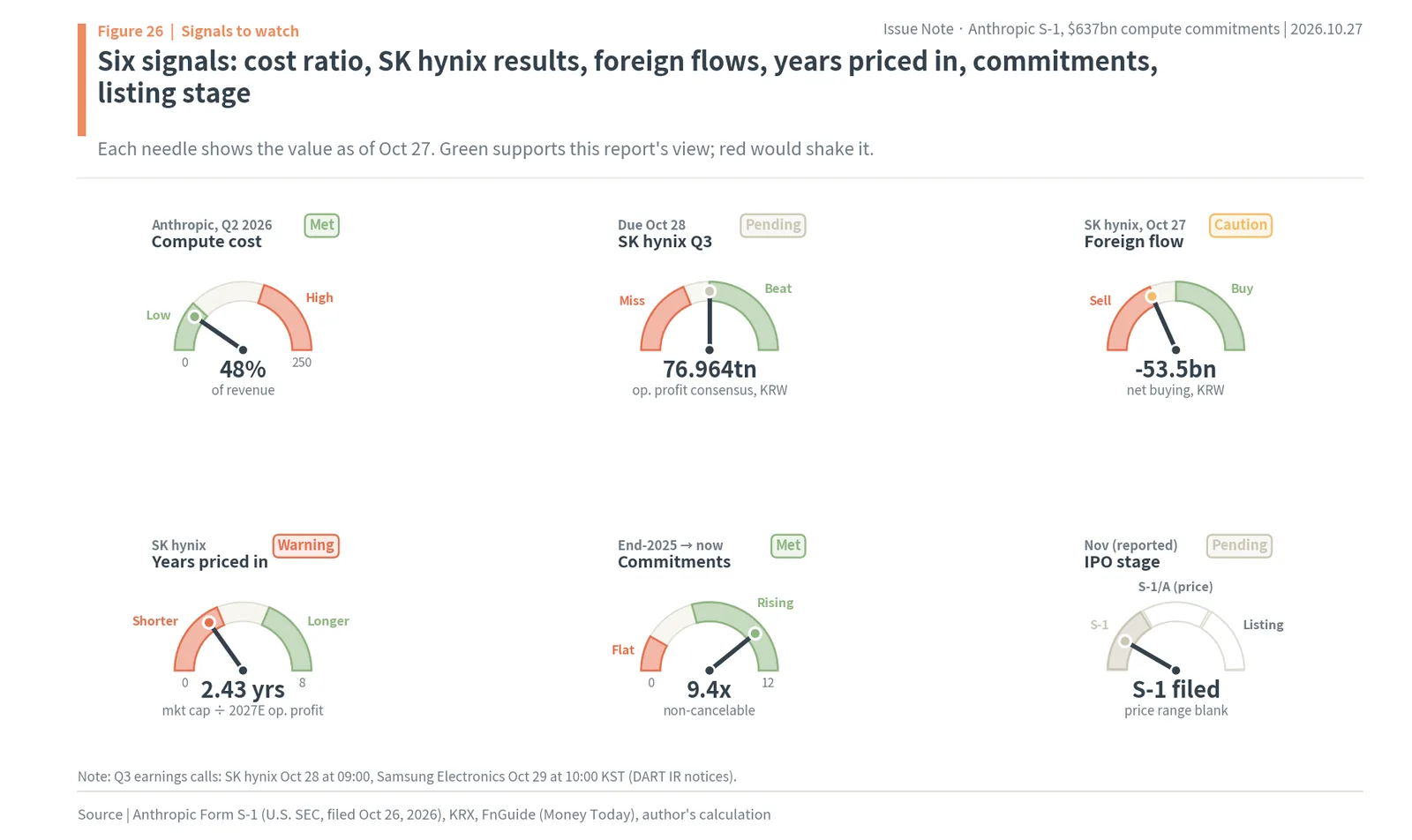
In dates: SK hynix holds its third-quarter earnings call at 9 a.m. on October 28 and Samsung Electronics at 10 a.m. on October 29 (DART investor relations notices). There are reports that Anthropic shares could start trading in the week of November 16 (The Wall Street Journal, cited by Yahoo Finance). The Bank of Korea’s Monetary Policy Board meets on November 26. After the listing come the lockup expiry dates: 180 days for most holders and 365 days for the founders and holders of more than 0.5%.
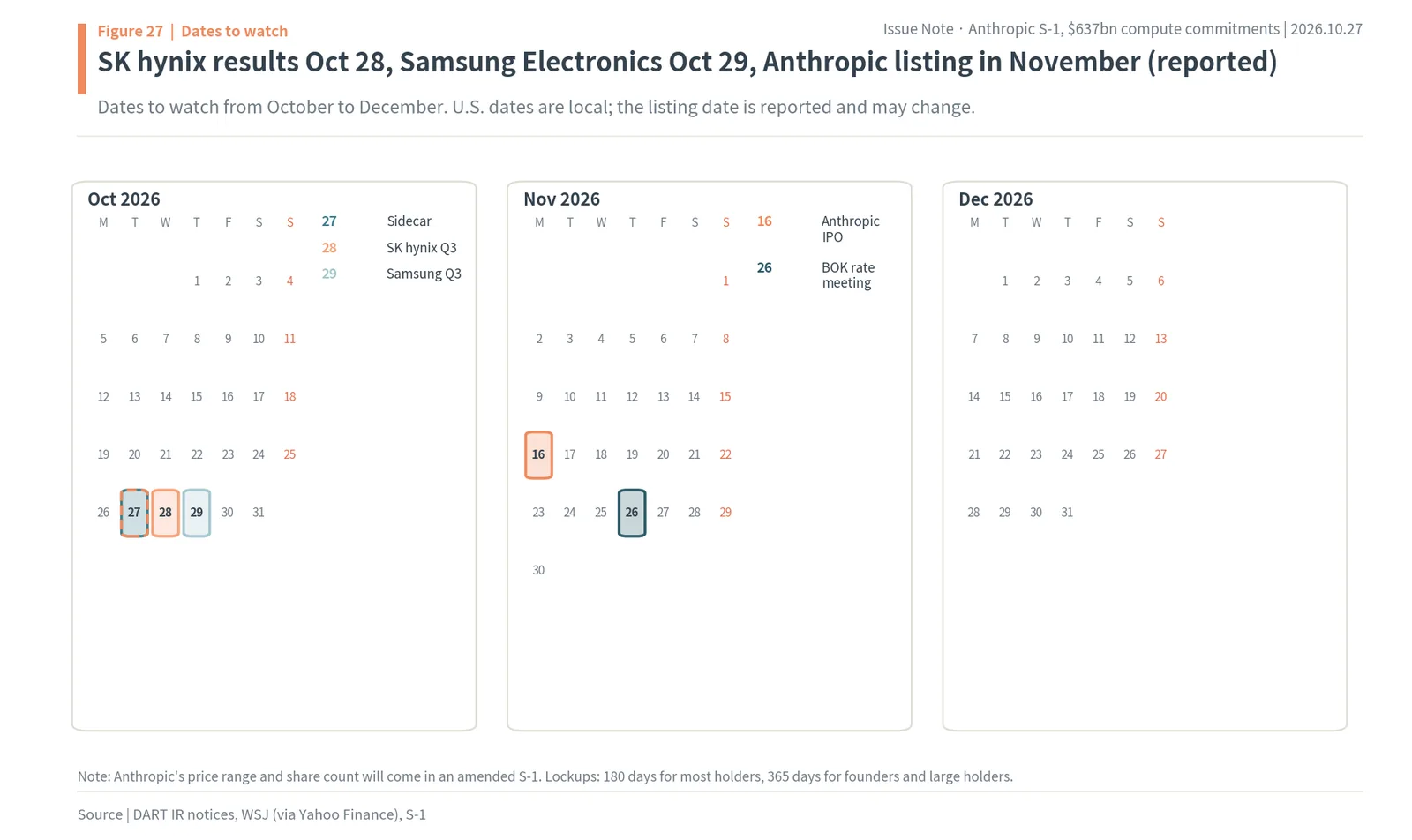
Of these, the author would watch SK hynix’s results commentary on October 28 first. It is the first chance to check whether the “long order book” shown in Anthropic’s filing is actually showing up in memory makers’ long-term contracts and prices. Whether foreigners’ selling of SK hynix that day was a matter of making room ahead of Anthropic’s IPO will also show in trading around the November listing.
What to listen for on the October 28 and 29 results days
The market roughly knows the two companies’ third-quarter numbers. SK hynix’s operating profit consensus is KRW 76.964tn, and Samsung Electronics has already reported preliminary operating profit of about KRW 107.4tn. What connects to this report’s judgment is the commentary, not the numbers. There are three things to listen for.
First, the length and share of long-term contracts. KB Securities thinks memory makers have locked in 70% to 80% of planned 2027 volume under five-year long-term contracts. If the companies themselves say how much of their 2027 and 2028 volume is bound by contract, it will confirm that the “long demand” shown in Anthropic’s order book is also on the memory makers’ books. It is the number to compare with the 2.4 to 2.6 years the share prices assume.
Second, HBM4 prices. As noted, Anthropic’s equipment leases include HBM, and the customer worried in its listing document that it might not get memory on time. If memory is what is short, how much higher 2027 HBM4 prices are set than HBM3E will decide where memory’s share lands between 9% and 26%. The closer memory’s share moves to 26%, the closer Korea’s share from Anthropic moves to KRW 31.3tn.
Third, the customer mix. 43.3% of Anthropic’s order book is the Google TPU family and 32.4% the Nvidia GPU family. How far Samsung Electronics keeps supplying HBM for TPUs, and whether SK hynix holds its share in Nvidia’s next generation, will decide which of the two is closer to this order book. Whether the day’s split, foreigners buying Samsung Electronics and selling SK hynix, continues after the results commentary is worth watching alongside.
Whether these three come out firming up or shaking this report’s judgment, that the length of the order book matters more than its size, is the biggest number of the week.
A variable before the listing: making room to buy the IPO
Apart from this report’s judgment, some brokers think Anthropic’s listing itself could weigh on Korean chip stocks in the short term. Kim Jae-seung of Hyundai Motor Securities said overseas technology funds will have to sell existing holdings to buy Anthropic, and that a rebound becomes possible only after the listing event is digested in November (Hankook Ilbo, October 27). If the reported offering size (more than $100bn, citing The Wall Street Journal) is right, it would be one of the largest offerings in U.S. history. To add a new stock, funds have to trim others, and AI-related stocks are likely candidates.
This logic also fits the split in foreign trading. Foreigners sold a net KRW 14.6tn of SK hynix over the past month and another KRW 53.5bn on the day the S-1 came out, while buying KRW 229.7bn of Samsung Electronics the same day. SK hynix, whose share price rose 2.5 times in a year, offers overseas funds the largest gains to take, so this selling could continue until Anthropic lists.
This variable runs on a different axis from the companies’ value. Shares sold by funds to make room are not sold because the profit outlook changed. So this report treats foreign trading around the listing as a signal of timing, not a signal that shakes the judgment. The length of the order book remains regardless of the listing schedule, and once Anthropic lists, its share price becomes a new daily indicator of AI companies’ ability to pay.
Common questions: six things that are easy to misread about the S-1 and Korean memory
This section regroups the numbers above as questions. It makes no new claims.
The first question is why Anthropic’s listing document connects to Korean chip stocks. The S-1 names the companies, saying HBM is largely made by SK hynix, Samsung Electronics and Micron, and says Anthropic procures AI accelerators together with HBM through equipment leases. Its seven compute commitments total $637bn and run as late as 2036. Part of that money flows through chips to memory.
The second is whether $637bn is a number in the S-1. It is not. The S-1 leaves the total blank and gives only the amounts for each of the seven counterparties. $637bn is the sum of those seven. Additional TPUs of $125bn to $150bn and AMD chips of more than $20bn are excluded because their amounts are not fixed.
The third is how much goes to Korean memory each year. Spreading the seven contracts evenly over their terms gives about $113.6bn a year in 2027 to 2029. Multiplying by a memory share of 9% to 26%, a Korean share of 80% and an exchange rate of KRW 1,323.7 gives KRW 10.8tn to 31.3tn a year (author’s calculation), or 2.1% to 6.1% of SK hynix’s estimated 2027 revenue of KRW 513.0tn.
The fourth is why the stocks rose so much if the amount is that small. The cause of a share price move cannot be pinned to one thing. This report focuses on two things the filing showed beyond the size of the order. One is that compute cost fell from 201% to 55% of revenue, confirming the end customer’s ability to pay; the other is that the order book runs 3 to 10 years, longer than the 2.4 to 2.6 years the share prices assume.
The fifth is whether Anthropic can honor its commitments with such a large net loss. The $80.7bn first-half 2026 net loss was made up of $72.4bn of fair-value losses on convertible notes and similar instruments and $8.7bn on other financial instruments, not cash going out. Operating cash flow for the same period was a positive $3,929mn, and the second quarter brought an operating profit of $974mn. Cash and short-term investments at the end of June were $131.7bn.
The sixth is which company is the closer beneficiary. 43.3% of the order book is the Google TPU family, and Samsung Electronics has supplied the most HBM for TPUs. 32.4% is the Nvidia GPU family, where SK hynix has the largest share of HBM. Each company is closer to a different half of the order book. On this day foreigners bought a net KRW 229.7bn of Samsung Electronics and sold a net KRW 53.5bn of SK hynix.
Basis of calculation: how the S-1, KRX closes, the even split and memory’s share were joined
This section sets out where the report’s numbers came from and how they were calculated.
Anthropic’s figures were checked directly in the S-1 filed with the SEC on October 26, 2026 (EDGAR). Revenue, the cost ratio, operating profit or loss, net loss and cash come from the audited annual and reviewed half-year financial statements. The compute cost ratio is “compute and infrastructure cost ÷ revenue” as stated in the S-1. The S-1 does not present a gross profit line, so figures in the press such as an “85% gross margin” were not used. Valuation, offering size and listing date are not in the S-1 and are marked as reports.
The $637bn of commitments is the sum of the seven contracts with stated amounts in the S-1’s infrastructure services and equipment lease sections (Broadcom $161.2bn, SpaceXAI $120.5bn, Google $114.5bn, Amazon $110.0bn, Microsoft $44.9bn, Nscale $44.6bn, Lambda $41.3bn). SpaceXAI, Nscale and Lambda are maximum amounts; Google, Amazon and Microsoft are minimum amounts. The annual amounts split each contract equally across the months of its term. Where the filing gives no start month, the author chose one: Broadcom five years from July 2026, SpaceXAI from October 2026 to the end of 2029, Nscale from September 2026 to the end of 2033 and Lambda from June 2026 to the end of 2034. The commitment terms (3.2 to 10.0 years) were counted from these start and end months.
Memory’s share uses Morgan Stanley’s estimate of memory’s share of Nvidia rack cost (Grace Blackwell 9%, Vera Rubin 26%, reported by Wccftech on May 21, 2026). Because the share is based on rack cost, multiplying it into commitment amounts that include cloud margins and power and building costs can overstate it, so the low value of 9% is shown alongside. The 80% Korean share is UBS’s 2027 HBM bit share forecast (Samsung Electronics about 41%, SK hynix about 39%). The exchange rate is KRW 1,323.7 per dollar, the Seoul foreign exchange market’s daytime close on October 27.
Korean share prices and market caps are October 27 regular-session closes calculated as KRX Data System market cap divided by listed shares (pykrx). The close in pykrx’s price table mixes in Nextrade after-market trading (for example SK hynix at KRW 1,363,000), which differs from the regular-session close of KRW 1,341,000. The increase in KOSPI market cap is the difference between the sums of KOSPI-listed market caps on October 26 and 27. Net buying by stock and investor type is the KRX final figure for trading value by investor type; for the KOSPI as a whole, Maeil Ilbo’s closing tally (foreigners KRW 591.3bn) was used. Another outlet (Newspim) reported foreigners at KRW 835.9bn and was not used.
Years priced in is October 27 market cap (SK hynix KRW 979.6tn; Samsung Electronics common and preferred combined KRW 1,435.2tn) divided by WISEreport’s 2027 operating profit consensus (SK hynix KRW 403.8tn, Samsung Electronics KRW 560.8tn). The one-year price chart converts adjusted KRX closes to weekly closes and sets October 27, 2025 = 100. U.S. prices compare Yahoo Finance October 26 closes with October 23 closes.
Anthropic’s S-1 and Korean memory stocks: quick answers
Q. Why did Anthropic’s S-1 move SK hynix and Samsung Electronics?
The S-1 says HBM is largely manufactured by SK hynix, Samsung Electronics and Micron, and that Anthropic leases AI accelerators together with HBM. Its seven compute commitments total $637bn and run as late as 2036. On October 27, 2026 the KOSPI rose 3.09% with a buy sidecar, SK hynix rose 5.18% and Samsung Electronics 4.23%, and the two accounted for 75.5% of the KRW 140.8tn added to KOSPI market cap.
Q. Is $637bn a number written in the S-1?
No. The S-1 leaves the total blank and gives the amount for each of seven counterparties: Broadcom $161.2bn, SpaceXAI $120.5bn, Google $114.5bn, Amazon $110.0bn, Microsoft $44.9bn, Nscale $44.6bn and Lambda $41.3bn. $637bn is their sum. Additional TPUs of $125bn to $150bn and AMD chips of more than $20bn are not included.
Q. How much of Anthropic’s spending could reach Korean memory each year?
Spread evenly over their terms, the commitments come to about $113.6bn a year in 2027 to 2029. With memory at 9% to 26% of spending, an 80% Korean share and KRW 1,323.7 per dollar, that is KRW 10.8tn to 31.3tn a year (author’s calculation), or 2.1% to 6.1% of SK hynix’s estimated 2027 revenue of KRW 513.0tn.
Q. Can Anthropic pay for its commitments despite an $80.7bn net loss?
The first-half 2026 net loss was made up of $72.4bn of fair-value losses on convertible notes and similar instruments and $8.7bn on other financial instruments, not cash outflows. Compute cost fell from 201% of revenue to 55%, the second quarter brought a $974mn operating profit, operating cash flow was a positive $3,929mn, and cash and short-term investments were $131.7bn at the end of June.
Q. What do SK hynix and Samsung share prices assume?
SK hynix’s market cap of KRW 979.6tn is 2.43 years of its estimated 2027 operating profit of KRW 403.8tn, and Samsung Electronics’ KRW 1,435.2tn including preferred shares is 2.56 years of KRW 560.8tn. Anthropic’s commitments run 3.2 to 10.0 years, longer than the years priced in.
Q. Who bought Korean memory stocks on October 27, 2026?
Foreigners bought a net KRW 229.7bn of Samsung Electronics but sold a net KRW 53.5bn of SK hynix, while institutions bought KRW 152.5bn of SK hynix. Across the KOSPI, foreigners bought KRW 591.3bn and retail investors sold KRW 947.8bn. In the month before, foreigners had sold KRW 14.6tn of SK hynix.
Sources
- Anthropic, Form S-1 registration statement (U.S. SEC EDGAR, https://www.sec.gov/Archives/edgar/data/0002130357/000162828026067168/anthropicpbc-sx1.htm), Oct 26, 2026; Anthropic announcement (link), Oct 26, 2026; Anthropic and Amazon compute expansion (link), Apr 20, 2026
- Korea Exchange (KRX) Data System: KOSPI and KOSDAQ market cap, listed shares and net buying by investor type (pykrx, regular sessions on Oct 26 and 27, 2026), index and stock prices (Oct 2025 to Oct 27, 2026)
- WISEreport consensus (SK hynix and Samsung Electronics, as of Oct 27, 2026); DART investor relations notices (SK hynix Oct 14, 2026; Samsung Electronics Oct 8, 2026); SK Square 2026 half-year report (Aug 14, 2026)
- Yahoo Finance, U.S. closes (Oct 26, 2026) and won-dollar; Yahoo Finance, Anthropic IPO filing lifts chips (link), Oct 27, 2026
- Newspim, market close (link), Oct 27, 2026; Newspim, KB Securities’ Kim Dong-won on memory long-term contracts (link), Oct 27, 2026
- Money Today, 53rd buy sidecar (link), Oct 27, 2026; Money Today English, SK hynix Q3 consensus (link), Oct 19, 2026
- Maeil Ilbo, KOSPI net buying by investor type (link), Oct 27, 2026; iNews24 (link), Oct 27, 2026; Digital Daily (link), Oct 27, 2026; Special Times (link), Oct 27, 2026
- Hankook Ilbo, Yuanta Securities’ Lee Jae-won and Hyundai Motor Securities’ Kim Jae-seung (link), Oct 27, 2026; MTN, Mirae Asset Securities’ Kim Seok-hwan (link), Oct 27, 2026
- The Next Web, citing Reuters on the confidential draft (link), Sep 29, 2026
- Wccftech, Morgan Stanley on Vera Rubin rack cost (link), May 21, 2026; Edaily English, UBS HBM share forecast (link), Aug 5, 2026; TrendForce (link), Aug 25, 2026, and Dec 1, 2025 (Google TPU HBM)
- Google Cloud TPU7x documentation (link), AWS Trainium3 (link), AWS Neuron Trainium2 documentation
- Stargate, Oct 2, 2025: eToday (link), Money Today (link), Seoul Shinmun (link)
- Photos: AgnosticPreachersKid, U.S. SEC headquarters (CC BY-SA 3.0); Narubaru7, Korea Exchange Seoul (CC BY 4.0); ajay_suresh, Nasdaq MarketSite (CC BY 2.0); Chad Davis, Google data center (CC BY 2.0); Visitor7, Amazon data center (CC BY-SA 3.0); Zinskauf, TPU 3.0 (CC BY-SA 4.0); 4300streetcar, SK hynix DDR5 MRDIMM (CC BY 4.0); The White House, Samsung Electronics Pyeongtaek campus (public domain); via Wikimedia Commons
Was this note useful?
Thanks. Your answer helps decide what to cover next.
Korea market snapshot · Oct 28, 2026
New to Korean stocks? Start here for the basics.
Most read lately
Get the Saturday note on Korean stocks
One email every Saturday with the week’s new research on Korean listed companies and links to the updated data pages. Built from DART filings and KRX data. Free; unsubscribe in one click. See past issues