Korea’s Sejong Relocation of 9,929 Officials: Why Moving Ministries Did Not Shrink Seoul, and What It Means for the FSC and Sejong Stocks
Korea moved 14,731 officials to Sejong, and the Seoul capital area still grew from 48.2% to 51.02% of the population. On October 13, 2026 the government announced a second relocation of 44 agencies and 9,929 officials for about KRW 3.22tn. This report checks the plan against 14 years of first-relocation numbers, the Financial Services Commission and Foreign Affairs and Defense moves, overseas cases, KDI’s productivity analysis, and Sejong property and stocks. Numbers as of October 13, 2026.
- The October 13, 2026 plan moves 44 agencies and 9,929 posts to Sejong: 27 agencies with 2,995 posts into leased offices in 2027 and 17 agencies with 6,934 posts into new buildings by 2031, for about KRW 3.22tn, or KRW 324mn per person (author’s calculation).
- After the first relocation of 43 agencies and 14,731 officials, the capital area’s population share rose from 48.2% (2005) to 51.02% (2025), and its GRDP share hit a record 52.8% in 2024; the government said the effect was “a little hard to confirm.”
- Of Sejong’s 232,352 net newcomers in 2012-2019, 63.4% came from Chungcheong and only 25.1% from the capital area; only about 36% of Sejong officials moved with their families, and business trips cost KRW 91.7bn in three years, 60% for the National Assembly.
- 9,929 people are 0.038% of the capital area’s population and 2.4 months of its 50,000 annual net inflow; even if every post moved, the share would fall only 0.019 points (author’s calculation).
- The author would put the money into the productivity of regional hub-city jobs (KDI: the share could have been 43.3%) and keep the FSC, Foreign Affairs and Defense in Seoul; Kyeryong Construction rose 3.17% on a -5.46% KOSPI day but is 32.4% below its April 2025 peak.
Key takeaways
- On October 13, 2026 the Korean government announced a second relocation plan that moves 44 central government agencies in the Seoul capital area, with 9,929 authorized official posts, to Sejong between 2027 and 2031. In 2027, 27 agencies with 2,995 posts (including the Financial Services Commission’s 340) move into leased offices, and by 2031, 17 agencies with 6,934 posts (including the Ministry of Foreign Affairs and the Ministry of National Defense) move into new buildings. The government puts the cost at about KRW 3.22tn (about $2.41bn).
- Yet after the first relocation (43 agencies, 14,731 officials), the capital area’s share of Korea’s population rose from 48.2% in 2005 to 51.02% in 2025. Of the people who filled Sejong, 63.4% came from the Chungcheong region and only 25.1% from the capital area. On the day of the announcement the government itself said the effect was “a little hard to confirm” and that it “could not find” data on the economic effect.
- The author believes that the premise of easing capital-area concentration by moving 9,929 officials was already disproven by the first relocation’s numbers. A sum in the KRW 3tn range would do more for the productivity of jobs in regional hub cities than for new government buildings, and the Financial Services Commission, Foreign Affairs and Defense, which need to sit next to markets and diplomatic counterparts, should stay in Seoul until the presidential office and the National Assembly move.
As of: October 13, 2026
Topics covered: the second relocation plan for central government agencies (agencies, posts, schedule and cost), the Sejong Multifunctional Administrative City Act and its excluded ministries, the capital area’s population and economic share after the first relocation, Sejong’s population and where its newcomers came from, family relocation and business trips, how big 9,929 people really are, the Financial Services Commission move and financial markets, the Foreign Affairs and Defense moves, overseas relocation cases, KDI’s productivity analysis, Sejong property and related stocks, and dates to watch
Reference data: the plan is pieced together from more than ten reports of the Ministry of the Interior and Safety’s October 13 announcement published the same day (Newsis, Electronic Times, Segye Ilbo, Seoul Shinmun, Hankook Ilbo, Asia Economy and others), because the ministry’s original press release did not show up in searches. Population figures are from Statistics Korea’s Population and Housing Census and the Ministry of the Interior and Safety’s resident registration statistics. Share prices are closes on KRX (the Korea Exchange) on October 13, 2026.
Summary: moving 14,731 officials to Sejong did not shrink the Seoul capital area
This report looks at Korea’s second relocation of central government agencies to Sejong, announced on October 13, 2026, based on public data and the author’s calculations. It asks one question. If close to 10,000 officials move to Sejong, does the “one-pole” concentration on the capital area that the government talks about ease? Looking at the numbers from the first relocation, the author’s answer is no. Moving people did not shrink the capital area. The ministries moved, but the National Assembly, the presidential office, financial firms and embassies they deal with stayed in Seoul, and the families of officials and the flow of young people into the capital area did not change.
Some background first. Sejong City is an administrative city 118km south of Seoul, launched in July 2012 to house central ministries. The Seoul capital area means Seoul, Gyeonggi Province and Incheon. Korea counts large sums in units of 100 million won (eok) and one trillion won (jo); this report shows them as KRW bn and KRW tn. Dollar figures use KRW 1,337.68 per dollar, the October 13, 2026 rate. The plan is pushed by the Lee Jae-myung government and the ruling Democratic Party of Korea.
The chain runs like this. First, the plan is not small. The ministry reviewed 142 administrative agencies in the capital area and picked 44, and 9,929 authorized posts move in two tracks between 2027 and 2031. Twenty-seven agencies with 2,995 posts that need no separate building lease private buildings in Sejong in 2027, and 17 agencies with 6,934 posts that need their own buildings, such as the Korean National Police Agency, the Board of Audit and Inspection, Foreign Affairs and Defense, move into new buildings by 2031. Construction is estimated at about KRW 3.1tn (about $2.32bn), and the 2027 budget includes KRW 89.7bn for leasing and relocation support and KRW 28.6bn for design of the new buildings. Together that is about KRW 3.22tn, or KRW 324mn (about $242k) per official (author’s calculation).
Second, the stated goal is easing capital-area concentration, but the first relocation’s record does not support it. From 2012 to 2021, 43 agencies with 14,731 officials moved to Sejong, yet the capital area’s share of the population rose from 48.2% in 2005 to 50.0% in 2019, passing half, and reached 51.02% at the end of 2025 on resident registration. The capital area’s share of gross regional domestic product (GRDP) was 52.8% in 2024, the highest since the statistic began. At the briefing on the announcement day, the government said that “14 years after Sejong City launched, a large effect on easing capital-area concentration is a little hard to confirm.”
Third, Sejong was filled not by capital-area residents but by people from Chungcheong, the central region around Sejong. Of the 232,352 net newcomers to Sejong from 2012 to 2019, 43.7% came from Daejeon, 63.4% from the Chungcheong region as a whole, and 25.1% from the capital area. Capital-area residents who moved to Sejong averaged about 7,312 a year, while the capital area gains about 50,000 net newcomers every year. Fourth, officials themselves did not all move. A 2014 Office for Government Policy Coordination survey found that about 36% of Sejong officials moved with their families, and after the first relocation Sejong officials spent KRW 91.7bn on out-of-town business trips over three years, 869,255 trips, 60% of them because of the National Assembly.
Fifth, 9,929 people are too few to reverse the pull of the capital area. They are 0.038% of the capital area’s 26.08 million people, and 2.4 months of its 50,000 net annual inflow. Applying the 36% family relocation rate, about 3,574 officials would move with their families (author’s calculation). Sixth, the list includes agencies that have to sit next to markets and diplomatic counterparts. The Financial Services Commission’s 340 posts move to Sejong in the second half of 2027, but the Financial Supervisory Service, the Bank of Korea and the Korea Deposit Insurance Corporation stay in Seoul, as do 91.6% of financial firms’ head offices. The KOSPI, Korea’s main stock index, fell 3.65% the day before the announcement and 5.46% on the day.
The author’s view is this. The author believes that the premise of easing capital-area concentration by moving 9,929 officials was already disproven by the first relocation’s numbers. KDI (the Korea Development Institute, a state think tank) calculated that if the productivity of non-capital manufacturing cities had merely risen at the national average, the capital area’s population share in 2019 would have been 43.3% instead of the actual 49.8%. People follow jobs, not government buildings. So money in the KRW 3tn range is better spent on the productivity of jobs in regional hub cities than on new buildings, and agencies whose counterparts are in Seoul, such as the Financial Services Commission, Foreign Affairs and Defense, are better kept in Seoul until they can move together with the presidential office and the National Assembly. The author’s conclusion comes from the evidence, and it ends up on the opposite side of the ruling party’s plan. The report goes through, in order, key terms and a hypothetical example, the plan, the first relocation’s record, who filled Sejong, why people did not follow, the size of 9,929, the Financial Services Commission, Foreign Affairs and Defense, overseas cases, the author’s view, sectors and stocks with dates to watch, and how the numbers were calculated.
1. Key terms: authorized posts, the Sejong Act, the capital area, Innovation Cities and a 1,000-official example
Terms used in this report
Central administrative agencies are the ministries, offices, agencies and equivalent commissions that run national administration under the Government Organization Act. This plan covers those agencies and their affiliated bodies located in the capital area. An authorized post (jeongwon) is a position fixed by law, not the number of people who actually move house. Authorized posts include vacancies, and even when a post moves to Sejong, whether the official moves with family, goes alone or commutes from Seoul is decided separately. This report therefore reads 9,929 as “posts that move,” and takes the number of people actually leaving the capital area’s population to be smaller.
The Multifunctional Administrative City (Haengbok City) is the planned city inside Sejong where central ministries are gathered, and its legal basis is the Special Act on the Construction of the Multifunctional Administrative City in Yeongi-Gongju, here called the Sejong Multifunctional Administrative City Act. Article 16(2) of the act excludes five ministries from relocation: Foreign Affairs, Unification, National Defense, Justice, and Gender Equality and Family. To move all five, this clause must first be deleted, and the government is seeking the amendment in the current regular session of the National Assembly.
The capital area’s population share is the portion of Korea’s population registered in Seoul, Gyeonggi and Incheon. There are two statistics: the Population and Housing Census (Statistics Korea), which counts where people actually live, and resident registration (Ministry of the Interior and Safety), which counts addresses. The two differ slightly, so the charts draw them as separate lines. Net inflow is people moving into a region minus people moving out. GRDP is the total value added produced in a region in a year.
Innovation Cities are ten cities built by moving public institutions such as Korea Electric Power Corporation and the National Pension Service, rather than ministries, out of the capital area. If the Sejong move relocates ministries, Innovation Cities relocate public institutions. On September 3 the government also announced a second relocation of about 350 public institutions in the capital area, to be finalized in the fourth quarter and started in 2027. Because the two policies share a goal, this report looks at Innovation Cities’ results alongside Sejong’s. The population effect that the Board of Audit and Inspection and the Korea Research Institute for Human Settlements examined is that of Innovation Cities.
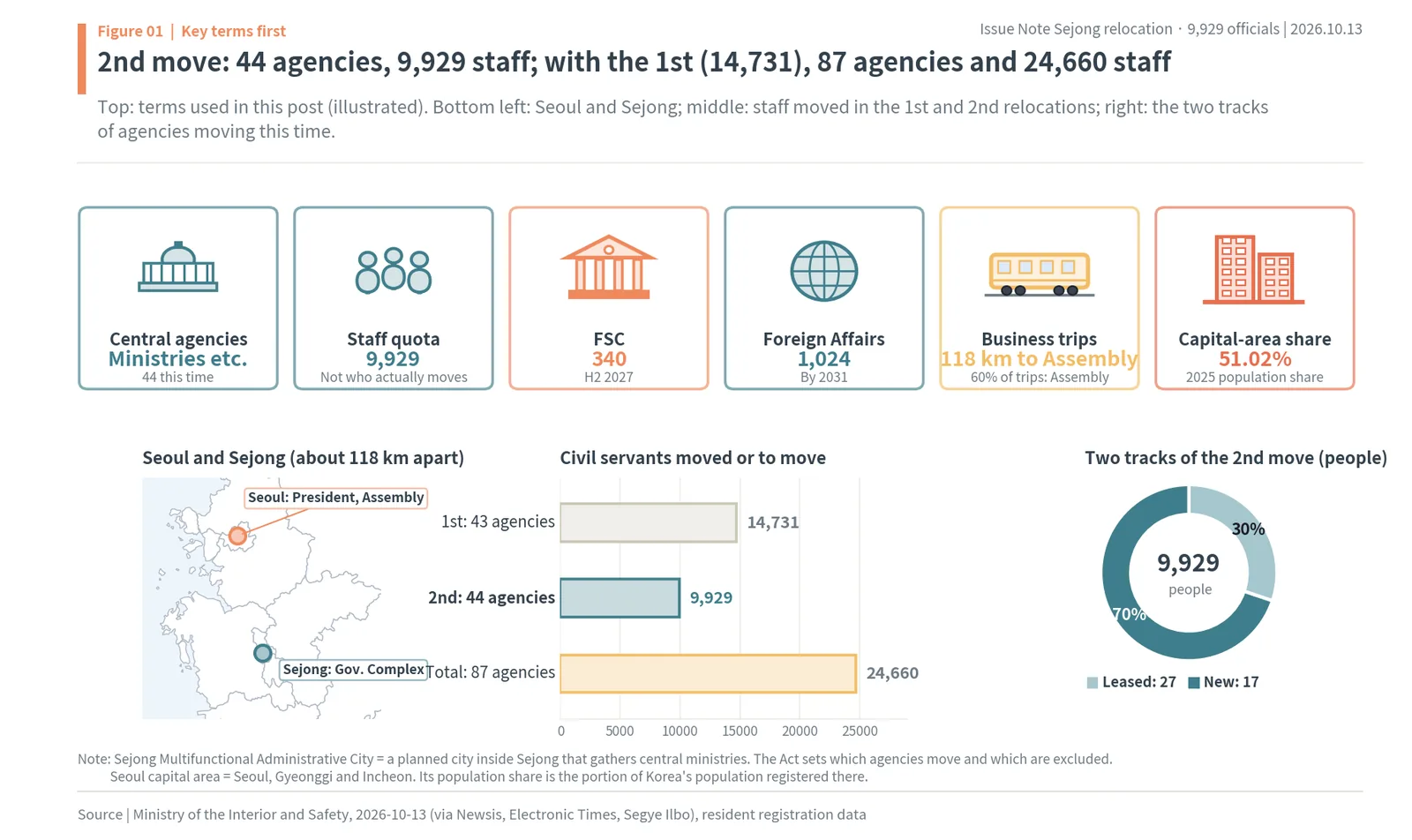
The family relocation rate is the share of transferred staff who moved house with their families. The “relocation rate” that agencies and the government publish sometimes adds unmarried and single staff, so this report keeps the two numbers apart. The top of Figure 1 gathers these terms. Bottom left shows Seoul and Sejong (about 118km in a straight line), the middle shows the first and second relocations, and the right shows the two tracks: 27 agencies in leased offices and 17 in new buildings. Adding the second relocation’s 44 agencies and 9,929 posts to the first’s 43 agencies and 14,731 officials gives 87 agencies and 24,660 people.
Hypothetical example: a ministry of 1,000 officials moves to Sejong
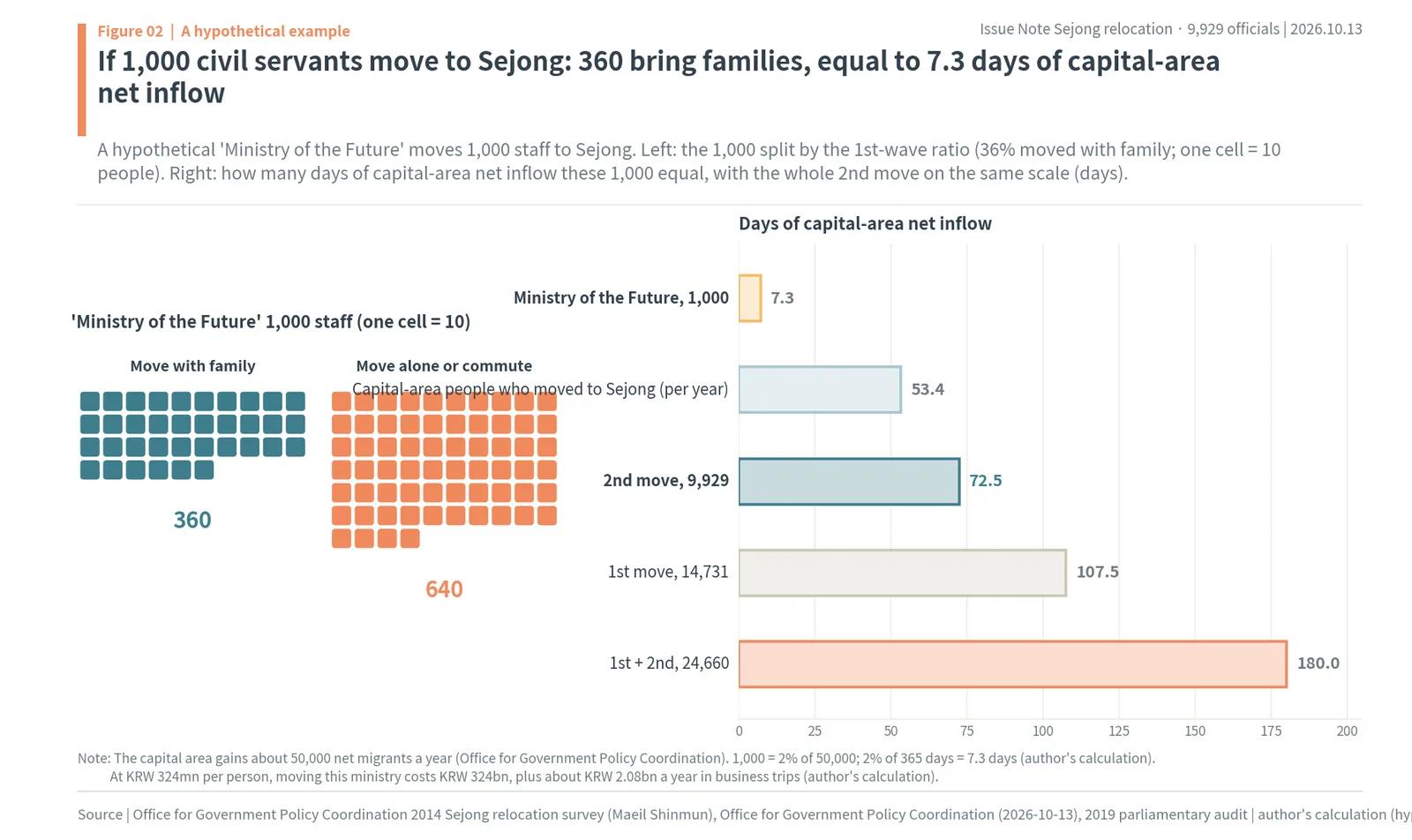
Because the story is full of numbers, a hypothetical ministry shows the principle first. A “Ministry of the Future” in Seoul with 1,000 authorized posts moves to Sejong. Using the first relocation’s 36% family relocation rate, 360 officials move to Sejong with their families. The other 640 rent a place alone in Sejong or commute from Seoul by shuttle bus and KTX high-speed train, and their families stay in the capital area. So even if the whole ministry moves, the capital area loses far fewer than 1,000 people.
Measure these 1,000 against the flow of people into the capital area. On the announcement day the Office for Government Policy Coordination said the capital area gains about 50,000 net newcomers a year. One thousand is 2% of 50,000, and 2% of 365 days is 7.3 days. Pulling the whole ministry out of the capital area at full strength equals about one week of what the capital area takes in each year. On the same yardstick, the second relocation’s 9,929 equal 72.5 days, the first relocation’s 14,731 equal 107.5 days, and the combined 24,660 equal 180.0 days. The roughly 7,312 capital-area residents a year who moved to Sejong equal 53.4 days (all author’s calculations).
Money too. Dividing the plan’s roughly KRW 3.22tn by 9,929 gives KRW 324mn per person, so the 1,000-person ministry costs KRW 324bn. Costs continue after the move. First-relocation officials’ out-of-town business trips cost about KRW 30.6bn a year, or about KRW 2.075mn per person a year over 14,731 people. For 1,000 people that is about KRW 2.08bn in new travel costs every year (author’s calculation). The left of Figure 2 splits the 1,000 into 360 who move with families and 640 who do not (one square = 10 people), and the right compares, on the same bars, how many days of capital-area net inflow the hypothetical ministry and the two relocations amount to.
The point of the example is simple. Moving an agency is not the same as moving people, and moving people is not the same as reducing concentration. The first gap is made by the family relocation rate, the second by the larger flow into the capital area. The rest of this report checks how these two gaps showed up in the first relocation’s actual numbers.
2. Sejong relocation plan: 44 agencies, 9,929 posts and KRW 3.22tn in two tracks
The 17 new-building agencies hold 69.8% of the posts
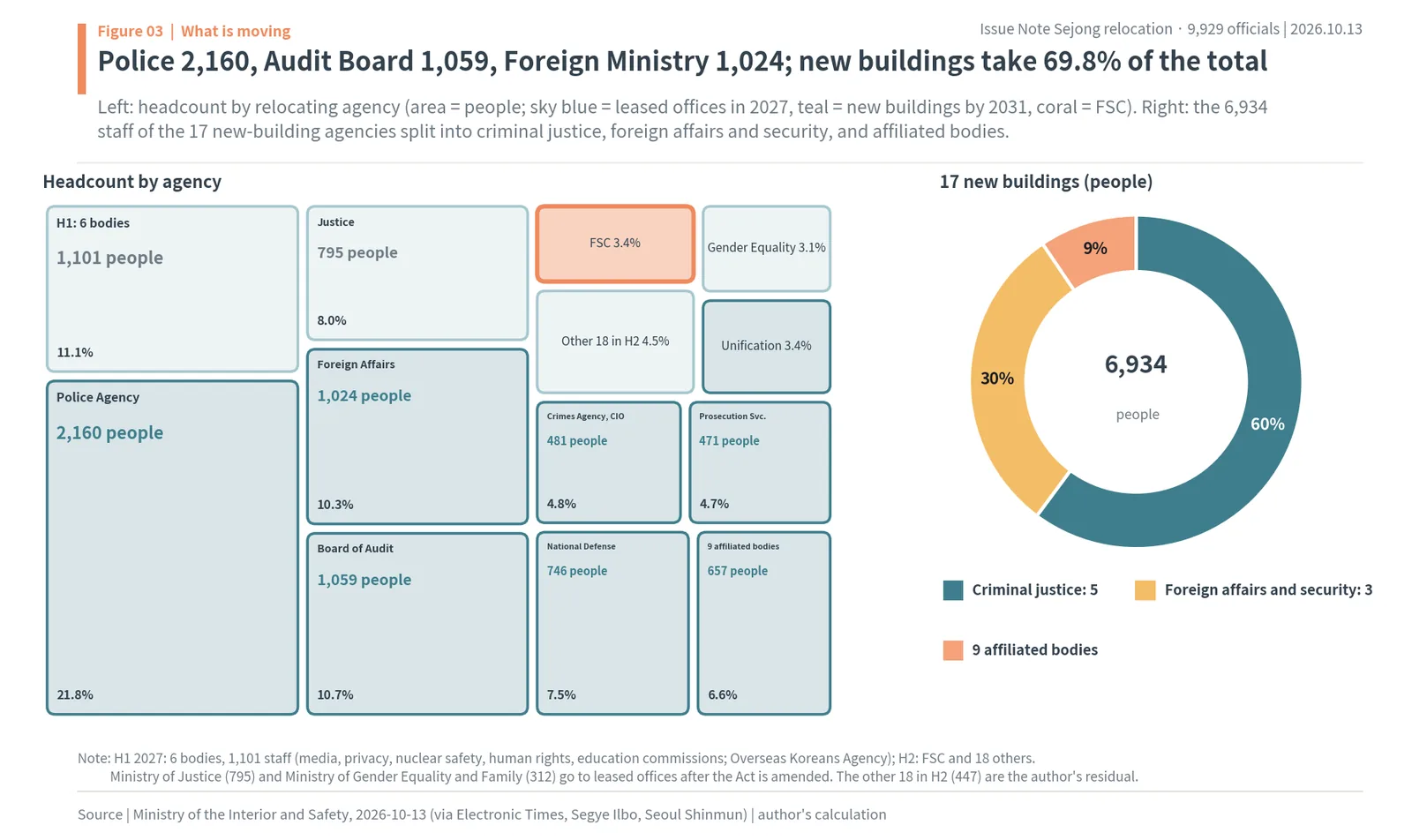
The weight of the plan is in the 17 agencies that move into new buildings by 2031. The ministry reviewed 142 administrative agencies in the capital area and selected 44. All central ministries move, while affiliated bodies that deal directly with residents, such as the National Library of Korea and the National Police Hospital, were left out. The 44 split into two tracks. Twenty-seven agencies with 2,995 posts that need no separate building lease private buildings in Sejong and move first in 2027. Seventeen agencies with 6,934 posts that need their own buildings or special facilities for investigation, security or monitoring start basic design in 2027 and move into new buildings by 2031. By posts, the first track is 30.2% and the second 69.8%.
In the first half of 2027 six agencies go first: the Korea Media and Communications Commission with 301 (from Gwacheon), the Personal Information Protection Commission with 224, the National Human Rights Commission with 231, the Overseas Koreans Agency with 157 (from Incheon), the Nuclear Safety and Security Commission with 134 and the National Education Commission with 54. That is 1,101 in total (author’s sum). In the second half, 19 agencies go, including the Financial Services Commission with 340, among them presidential advisory bodies such as the National Economic Advisory Council, the Economic, Social and Labor Council, the Population Strategy Committee, the National AI Strategy Committee and the National Unity Committee. The Ministry of Justice (795) and the Ministry of Gender Equality and Family (312) are also among the 27 but move when the act is amended. The full list of the 19 was not published in the reports, so the remaining 18 second-half agencies other than the Financial Services Commission were derived as 447 posts by subtracting the named agencies from 2,995.
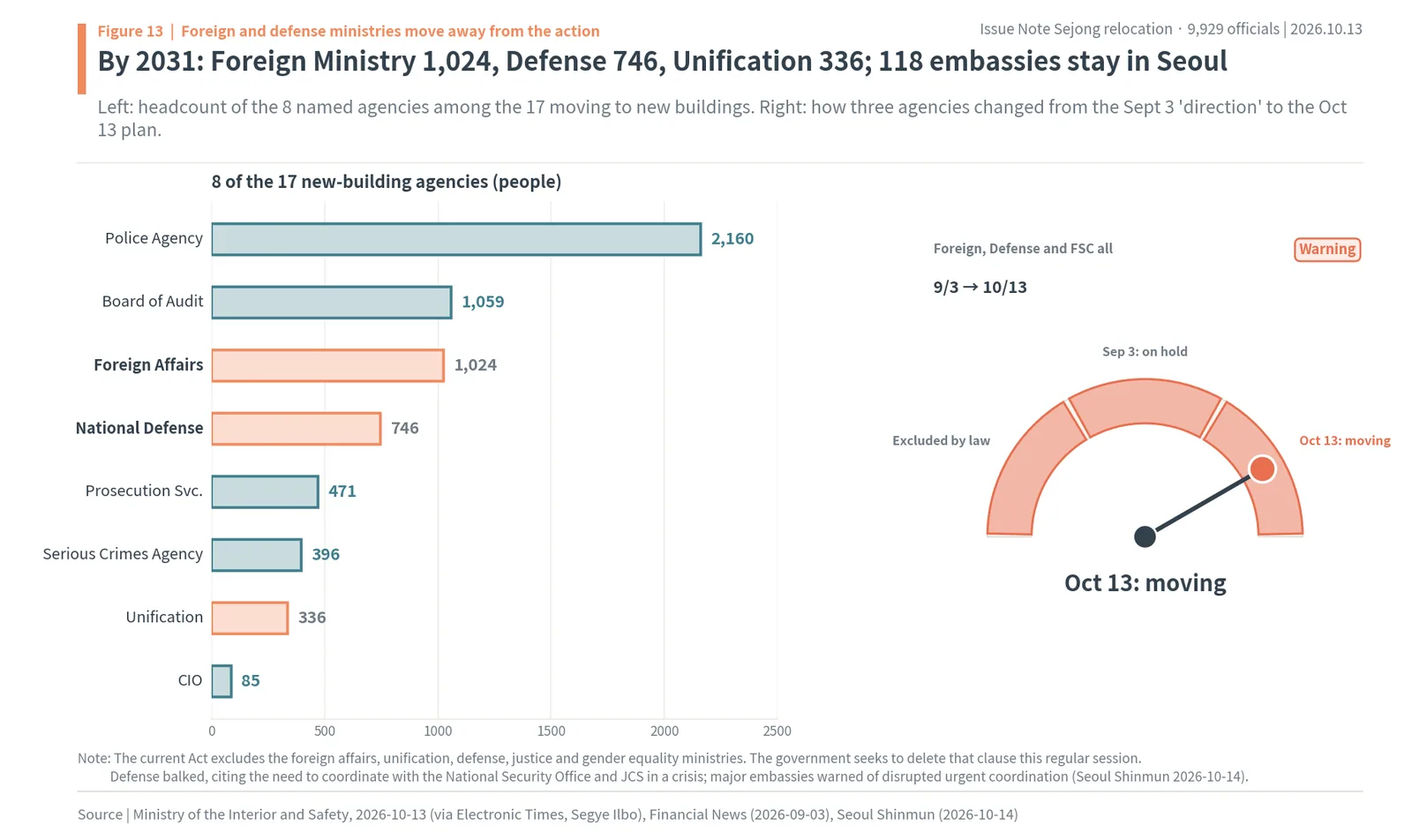
The 17 new-building agencies form three groups. Five criminal justice agencies are the largest at 4,171: the Korean National Police Agency 2,160, the Board of Audit and Inspection 1,059, the Public Prosecution Office 471, the Serious Crimes Investigation Agency 396 and the Corruption Investigation Office for High-ranking Officials 85. Three foreign affairs and security ministries total 2,106: Foreign Affairs 1,024, National Defense 746 and Unification 336. The rest are nine affiliated bodies with 657, such as the National Institute of Korean History (85) and the Korea National Diplomatic Academy (106). The left of Figure 3 draws the agencies with areas proportional to posts, and the right splits the 17 new-building agencies into the three groups. The National Police Agency (2,160), the Board of Audit and Inspection (1,059) and Foreign Affairs (1,024) are the three largest blocks.
This differs from the “direction” announced under the prime minister on September 3. Then, only the Ministry of Justice and the Ministry of Gender Equality and Family were named for priority moves in the first half of 2027, a decision on the Financial Services Commission was deferred, and Foreign Affairs and Unification were to be reviewed in line with the presidential office in Sejong (2030) and the National Assembly Sejong building (2033). Defense was effectively out. Forty days later, Foreign Affairs, Defense and the Financial Services Commission were all in. The Office of the President, the National Security Office, the Presidential Security Service and the National Intelligence Service will be decided with the presidential office move, and constitutional bodies such as the Supreme Court, the Constitutional Court and the National Election Commission were left to separate consultation. The Financial Supervisory Service and state-run banks will be decided in the fourth quarter.
Reactions: Sejong welcomes it, the agencies moving and the finance sector oppose it
Reactions split by position. Sejong Mayor Jo Sang-ho welcomed the plan as the start of an era of “Seoul as the economic capital, Sejong as the administrative capital” and urged the National Assembly to pass a special administrative capital act in this regular session. The Sejong City Council called it a turning point in moving the center of state affairs, naming the act amendment and building budgets as tasks. The Democratic Party’s Sejong chapter said moving about 10,000 officials would make policy coordination between ministries more efficient and called for a “one team” effort by the party, the region and the city. The People Power Party’s Sejong chapter questioned policy consistency, citing the move of the Ministry of Oceans and Fisheries to Busan and briefings held at the Seoul government complex, and demanded the promised special act within the year. The People Power Party’s Incheon chapter said it “firmly opposes” moving the Overseas Koreans Agency to Sejong.
Those who have to move see it differently. Staff at the agencies said the first-half 2027 schedule was faster than expected and worried about housing, children’s schooling and staff leaving. One division director feared more transfers and resignations, especially among young staff, and an official at the Personal Information Protection Commission cited the burden of running two households and the tight schedule. In finance, the Korea Finance and Service Workers’ Union demanded that the Financial Services Commission move be withdrawn. People Power Party lawmakers from Busan had already argued in September that the Financial Services Commission and the Financial Supervisory Service should go to Busan, not Sejong. Regions want to receive more, and the people moving want to move less. The pattern was the same in the first relocation, and its result is the numbers in sections 3 to 5.
A cost of about KRW 3.22tn, or KRW 324mn per person
The government named two lumps of money. Construction of independent buildings is estimated at about KRW 3.1tn, and the 2027 budget has about KRW 89.7bn for leasing, fitting out and running leased offices plus relocation support, and about KRW 28.6bn for basic design of the new buildings. The 2027 portion is KRW 118.3bn, and the total is about KRW 3.22tn (KRW 3,218.3bn). Divided by 9,929, that is KRW 324mn per person; construction alone divided by the 6,934 new-building posts is KRW 447mn per person (author’s calculation). The left of Figure 4 shows where the money goes by the width of the bands, and the right shows when and how many people move.
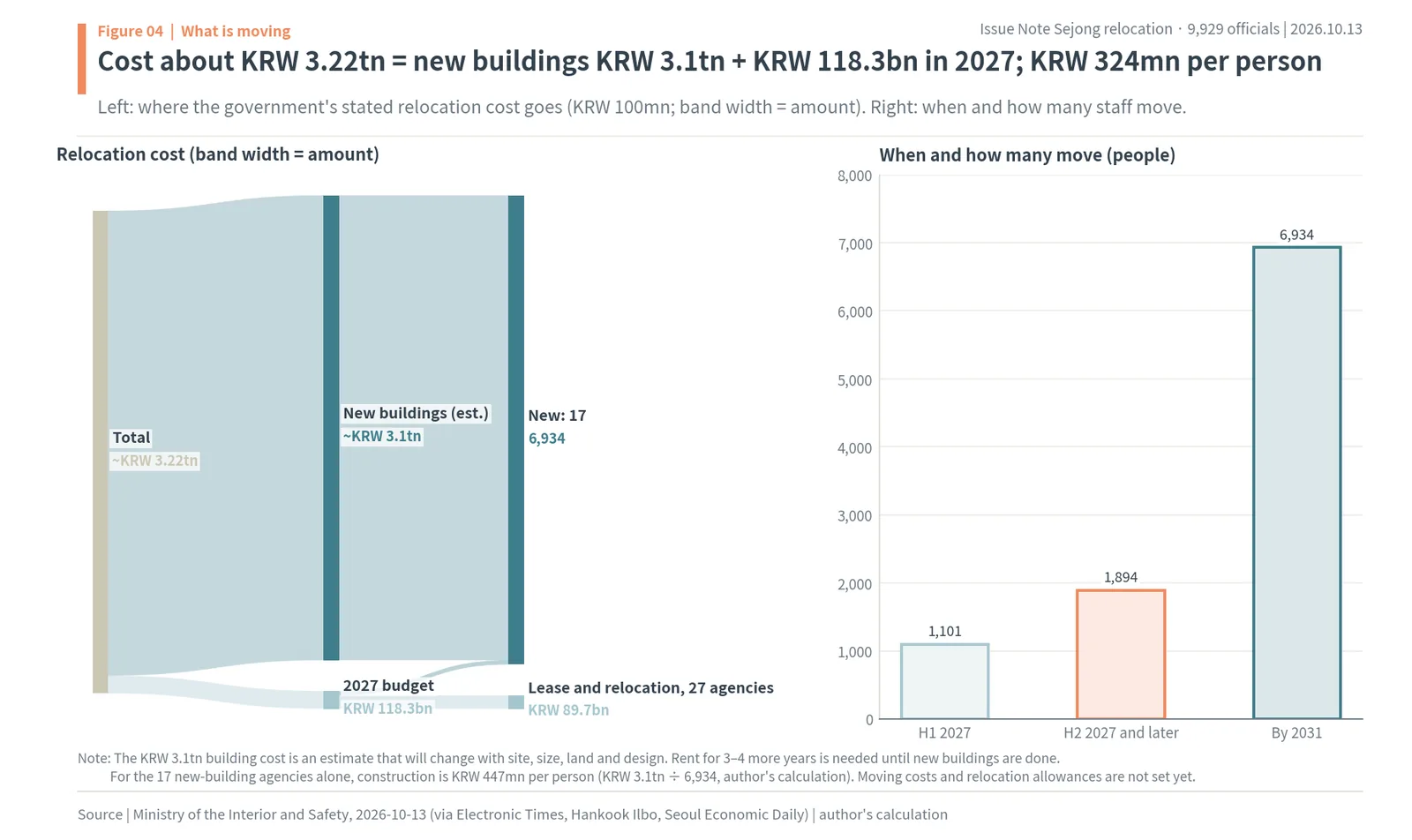
This number is a floor. The KRW 3.1tn is an estimate that will change with site, scale, land acquisition and design, and three to four more years of temporary office rent are needed until the new buildings are finished. Moving allowances, initial relocation support and temporary transport for those who cannot move at once have no amounts or periods yet. And, as section 1 showed, travel costs continue every year after the move. So KRW 3.22tn should be read as the starting point of the cost of moving. The government said it will review paying moving and initial relocation support and temporary transport for officials who cannot move right away, with amounts and periods set by reference to the first relocation. For the emptied Seoul and Gwacheon complexes, it is reviewing moving in the capital area’s special local administrative agencies first and has started a study of long-term use. What the money buys is the next section’s question.
3. First relocation results: capital-area population share rose from 48.2% to 51.02%
The capital area’s population share rose from 48.2% to 51.02%
During the years ministries moved to Sejong, the capital area’s population share never turned down. On the census, it was 46.3% in 2000, 48.2% in 2005 when the administrative city plan was settled, and 49.1% in 2010 before Sejong launched. After Sejong launched in July 2012 and ministries moved in turn, it rose to 49.5% in 2015, 49.6% in 2017 and 49.8% in 2018, and passed half at 50.0% in 2019. On resident registration it was 50.52% in 2022, 50.69% in 2023, 50.86% in 2024 and 51.02% at the end of 2025: 26,080,644 of 51,117,378 registered residents (author’s calculation).
The economy moved the same way. The capital area’s share of GRDP rose from 48.4% in 2000 to 52.2% in 2018 and hit 52.8% in 2024, the highest on record. Of Korea’s 2024 GRDP of KRW 2,561tn, KRW 1,352tn came from the capital area. The left of Figure 5 shows the capital area’s population share and the right its share of GRDP. Even after Sejong launched, the population share rose from 48.2% to 51.02%, and the economic share reached 52.8%.
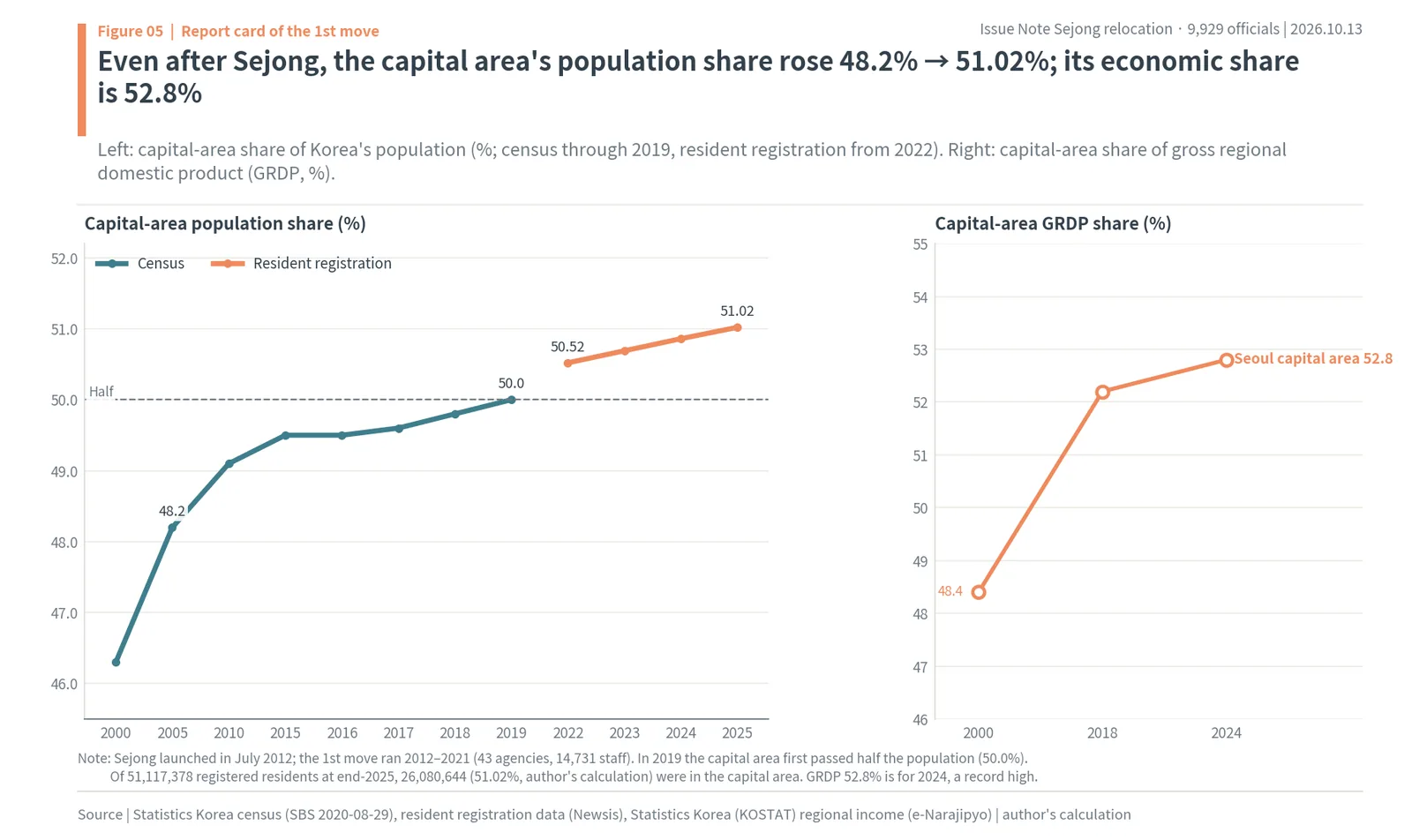
The government did not deny this picture. Asked about the first relocation’s results on the announcement day, Kim Ha-kyun, head of the ministry’s Government Complex Management headquarters, said that “14 years after Sejong City launched, a large effect on easing capital-area concentration is a little hard to confirm.” Asked whether there was any analysis of population dispersal from the capital area or economic spillover to Chungcheong since Sejong was built, he said “we could not clearly find that data” and promised to explain separately later. Choi Hyung-wook, deputy administrator of the National Agency for Administrative City Construction, said construction is only about 60% done, so the effect has not fully shown. The analysis that should justify the move is coming after the decision to move.
For scale: from 2012 to 2021, 22 central agencies and 21 affiliated bodies, 43 in all, moved to Sejong with 14,731 posts at the time. In 2016 the construction agency put total public spending on the city at KRW 22.5tn for 2006 to 2030 (KRW 8.5tn from the state, KRW 14tn from LH, the state land and housing corporation), with a target of 500,000 residents by 2030. By money and by people, it was a bigger project than this second relocation. The charts above are what came after that bigger project.
The gap widened by 1.04 million in six years
The gap between capital and non-capital populations makes the trend clearer. On resident registration, when the capital area overtook the rest of the country at the end of 2019 the difference was 1,737 people. It widened to 247,591 in 2020, 407,757 in 2021, 531,198 in 2022 and 703,201 in 2023, and reached 1,044,910 at the end of 2025. Over six years it widened by 1,043,173, about 173,862 a year on average (author’s calculation). Notably, the gap widened faster after the first relocation ended in 2021.
The Board of Audit and Inspection asked the same question about public institution relocation in its 2021 population report. In migration between the capital area and the provinces from 2000 to 2019, the capital area had net outflow in only three years, 2013 to 2015, when public institutions moved out in bulk. Net outflow over those three years was 58,445, while total public institution relocation over the same period was 51,700 people. From 2016, after the moves ended, net inflow to the capital area resumed. The board wrote that “in terms of population dispersal, the Innovation Cities are a failure.” The left of Figure 6 shows the widening gap between the capital area and the rest, and the right shows the size of the three outflow years. Figure 6 shows people in thousands. The gap of 1,737 people in 2019 became 1,044,910 in 2025.
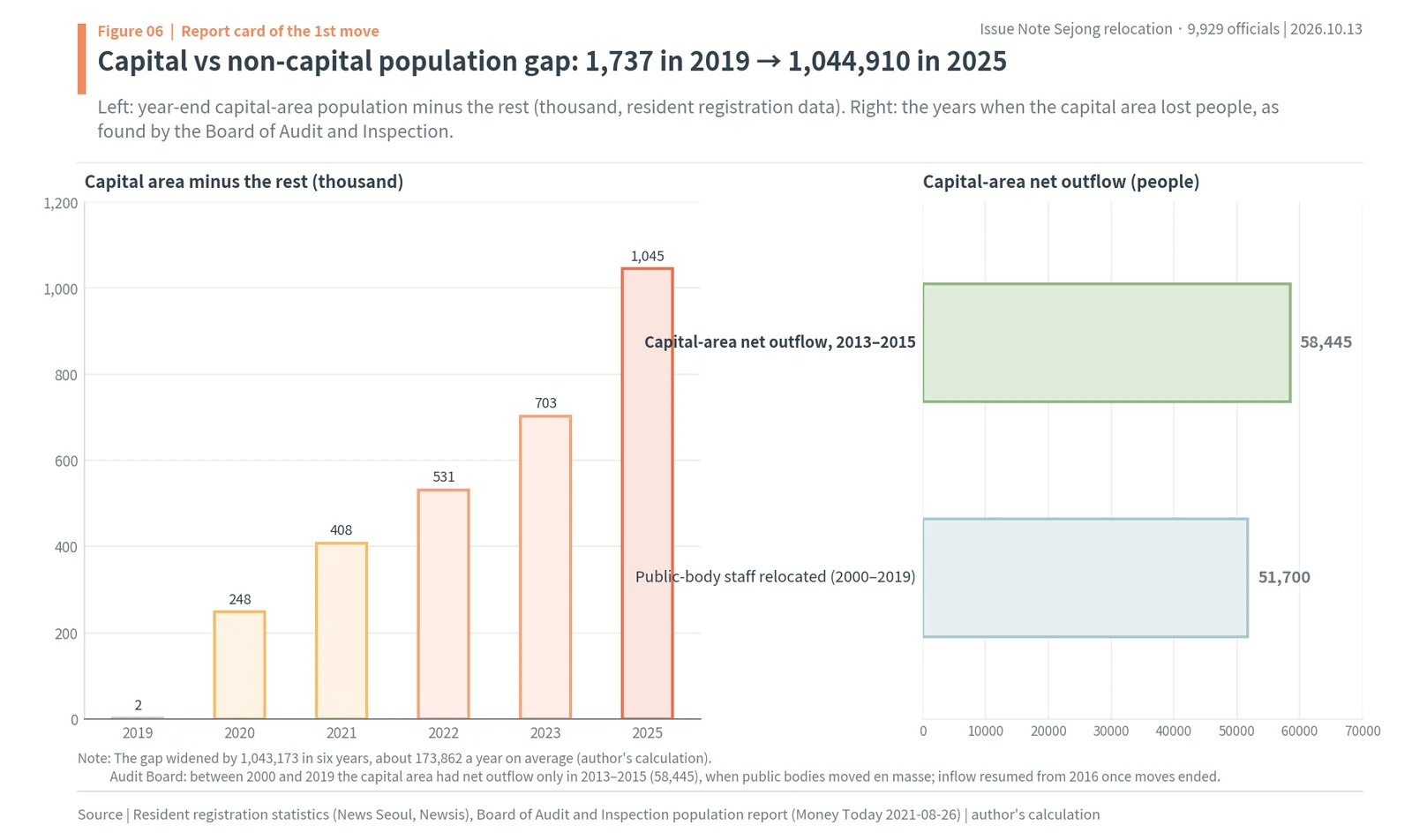
Read together, the two charts show that the effect of the first relocation and of public institution relocation was “brief, while moving.” In the years agencies moved, the capital area grew by that much less, but once the moves ended the larger flow into the capital area won again. The conclusion of this section is that using the same method again is likely to give the same result. Why becomes clear from who filled Sejong.
4. Who moved to Sejong: 63.4% from Chungcheong, 25.1% from the capital area
Sejong’s population stalled at 390,000
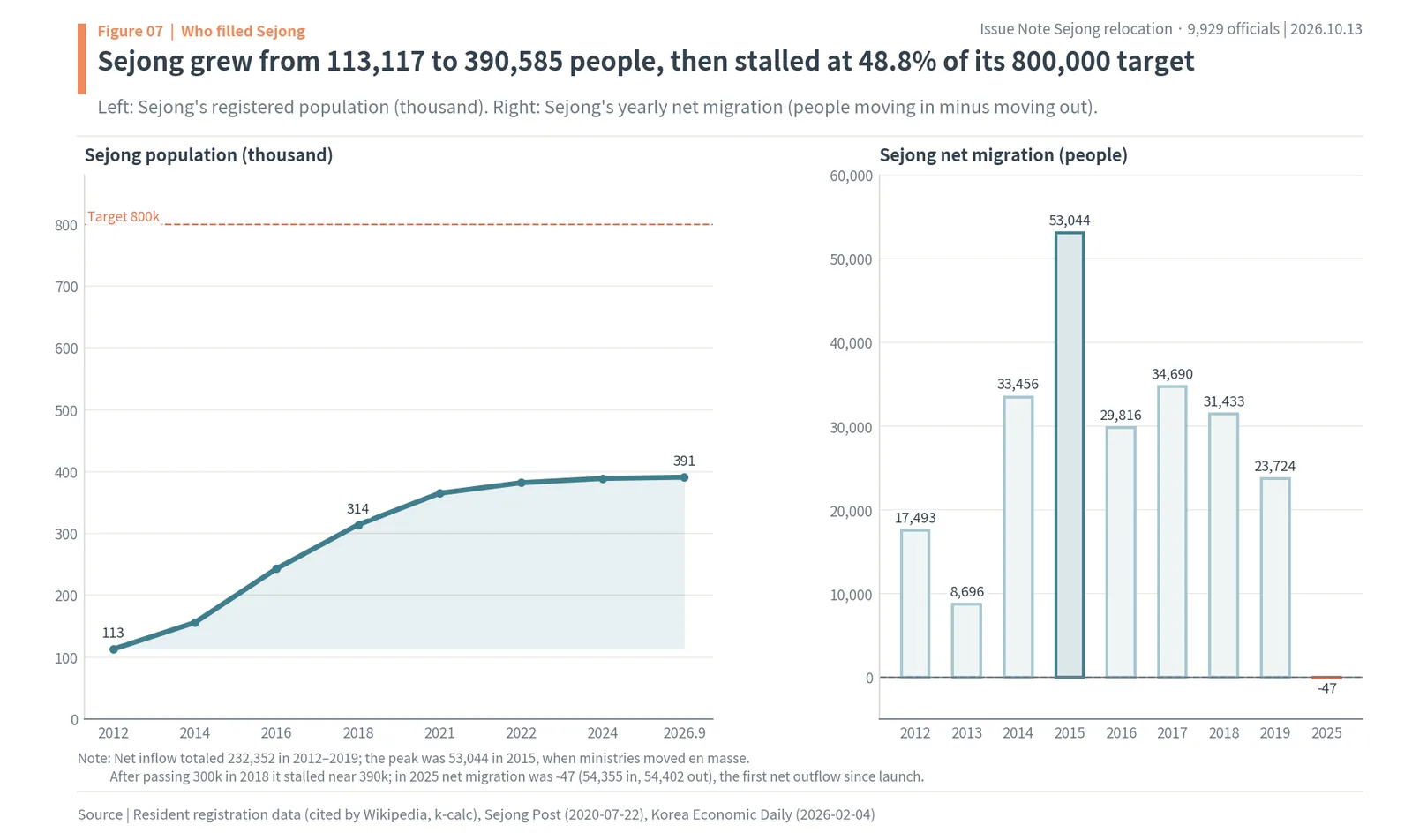
Sejong grew fast and then stopped. Its registered population rose from 113,117 at the end of 2012, the launch year, to 156,125 in 2014 when ministries moved in bulk, 243,048 in 2016 and 314,126 in 2018. Growth then slowed to 365,484 in 2021, 381,925 in 2022 and 389,443 in 2024, and it was 390,585 in September 2026, 48.8% of the 800,000 target (author’s calculation). Net migration peaked at 53,044 in 2015, and over the eight years 2012 to 2019 net inflow totaled 232,352. In 2025, 54,355 moved in and 54,402 moved out, a net of -47, the first year since launch in which more people left than arrived.
The left of Figure 7 shows Sejong’s population and the right the annual net migration; Figure 7 shows people in thousands. Sejong went from 113,117 to 390,585 people and stalled at 48.8% of the 800,000 target. What matters is that net migration jumped in the years ministries moved and fell as the moves tapered. The force that lifted Sejong’s population was the agencies the government moved, more than the city’s own jobs.
Of 230,000 net newcomers, 43.7% from Daejeon and 25.1% from the capital area
Where newcomers came from supports this report’s conclusion most directly. In a Sejong Post analysis of Statistics Korea’s domestic migration data, 101,557 (43.7%) of the 232,352 net newcomers to Sejong in 2012 to 2019 came from Daejeon, the large city next door. With North and South Chungcheong added, the Chungcheong region was 63.4%. The capital area was 58,497, or 25.1% (Seoul 23,362, Gyeonggi 30,676, Incheon 4,459). The southeastern Yeongnam region was 5.8% and the southwestern Honam region 4.6%. Sejong moved people from neighboring Daejeon and Chungcheong more than it drew them from the capital area. In January to May 2020, 657 more people actually left Sejong for the capital area than came the other way. In a social survey of 1,800 households in August 2025, the previous residence of households moving in was Daejeon 33.8%, North Chungcheong 10.8% and South Chungcheong 10.1%, so Chungcheong was 54.7% and the capital area 29.4%. Fourteen years after launch, more than half of Sejong’s newcomers still come from Chungcheong.
Other new cities were the same. The Korea Research Institute for Human Settlements found that of about 390,000 people who moved into the administrative city and Innovation Cities in 2012 to 2018, 83,645 (21.4%) came from the capital area. Of 196,538 net newcomers to the ten Innovation Cities examined by the Board of Audit and Inspection, 28,666 (14.6%) came from the capital area (author’s calculation; the board wrote 15%). Most came from the host city and surrounding towns. The left of Figure 8 shows the origin of Sejong’s net newcomers, the middle a map, and the right the capital-area share in the three kinds of new city. Of Sejong’s 232,352 net newcomers, 43.7% came from Daejeon and 25.1% from the capital area.
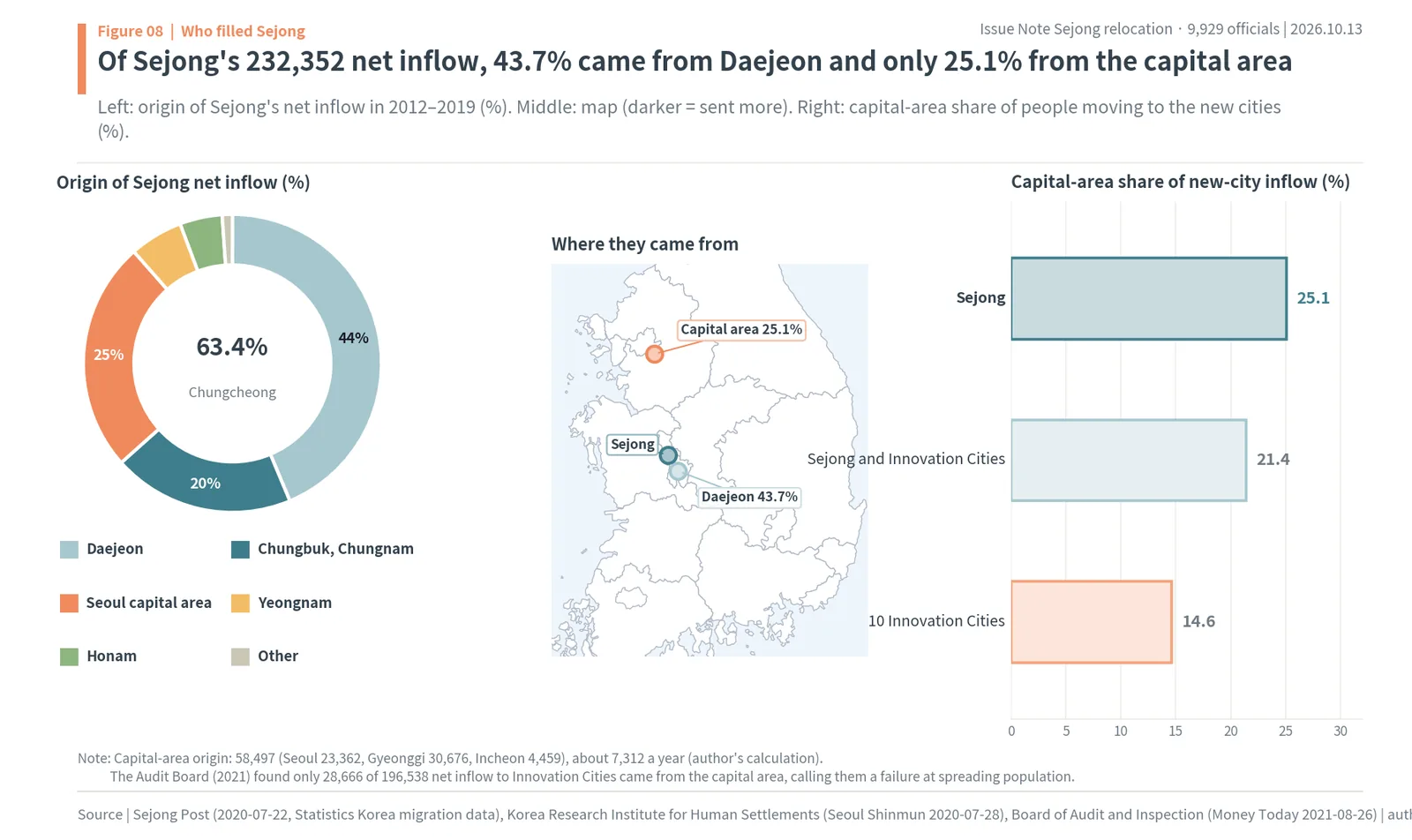
Seen from the capital area, the scale is clear. The 58,497 capital-area residents who moved to Sejong are an eight-year total, about 7,312 a year (author’s calculation). In the same period the capital area gained tens of thousands of net newcomers every year, and the Office for Government Policy Coordination now puts its net inflow at about 50,000 a year. What Sejong pulled out of the capital area was only about one seventh of what the capital area took in. KDI found that although the cost of finding a home and using city infrastructure in Sejong fell 57.5% between 2010 and 2019, its pull on migrants was weak. Laying down housing and roads does not bring people without strong jobs. Sejong’s growth was closer to people changing places within Chungcheong, and Daejeon and other Chungcheong cities lost people to it. As a policy to ease capital-area concentration, the first relocation missed the target.
5. Why officials did not follow: 36% family moves and KRW 91.7bn of business trips
Family relocation: 36% at the Sejong complex, 41.7% at Innovation Cities
The first reason people moved less than the agencies is family. When the Office for Government Policy Coordination surveyed all officials at the Sejong Government Complex in April 2014, 3,851, about 36%, had moved with their families to the Sejong area (Sejong, Daejeon, South and North Chungcheong), and 2,034 had come alone. Innovation Cities, where public institutions moved, were similar. According to a report analyzing Ministry of Land, Infrastructure and Transport data on relocation types for 2019 to 2025, 19,988 (41.7%) of 47,908 relocated staff moved with their families. Married staff who moved alone were 20.2%, unmarried or single staff 29.3%, and those commuting from where they already lived 8.7%.
The government’s published “relocation rate” is higher. The transport ministry put the Innovation City relocation rate at 71%, which adds unmarried and single staff to family moves. Depending on the definition, the number nearly doubles. The left of Figure 9 splits the 47,908 Innovation City staff into 100 squares by type of move, and the right shows family relocation rates by definition. Families moved in 36% of cases at the Sejong complex and 41.7% at Innovation Cities, while the published “relocation rate” was 71%.
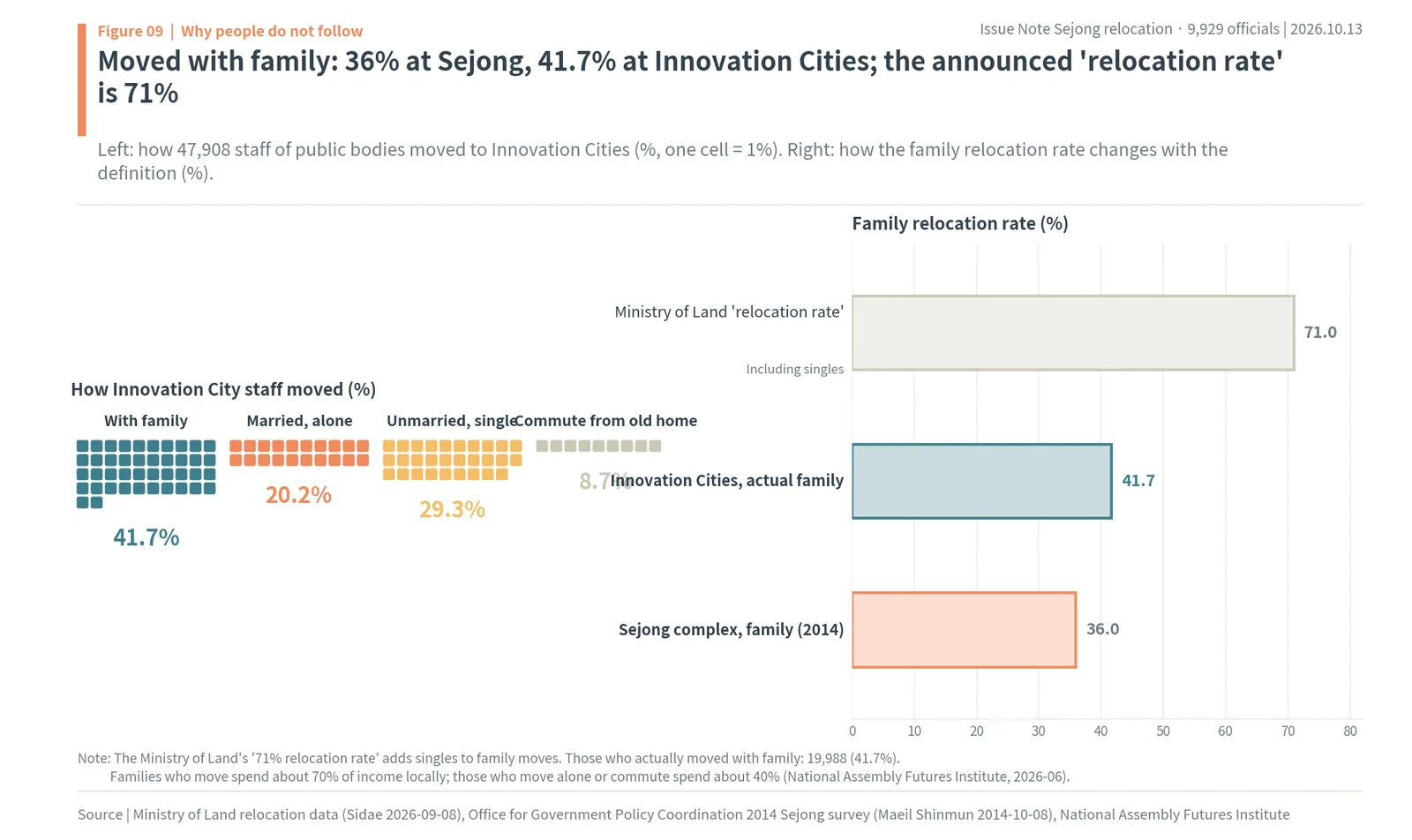
Whether families come also matters for the local economy. The National Assembly Futures Institute found that staff who move with families spend about 70% of their income locally, while those who move alone or commute spend only about 40%. Officials who come alone go back to the capital area every weekend and spend there. So when families do not follow, the capital area’s population does not shrink and Sejong’s shops do not grow. As section 11 shows, Sejong’s commercial vacancy rate being the highest in the country fits this pattern.
KRW 91.7bn of business trips in three years, 60% for the National Assembly
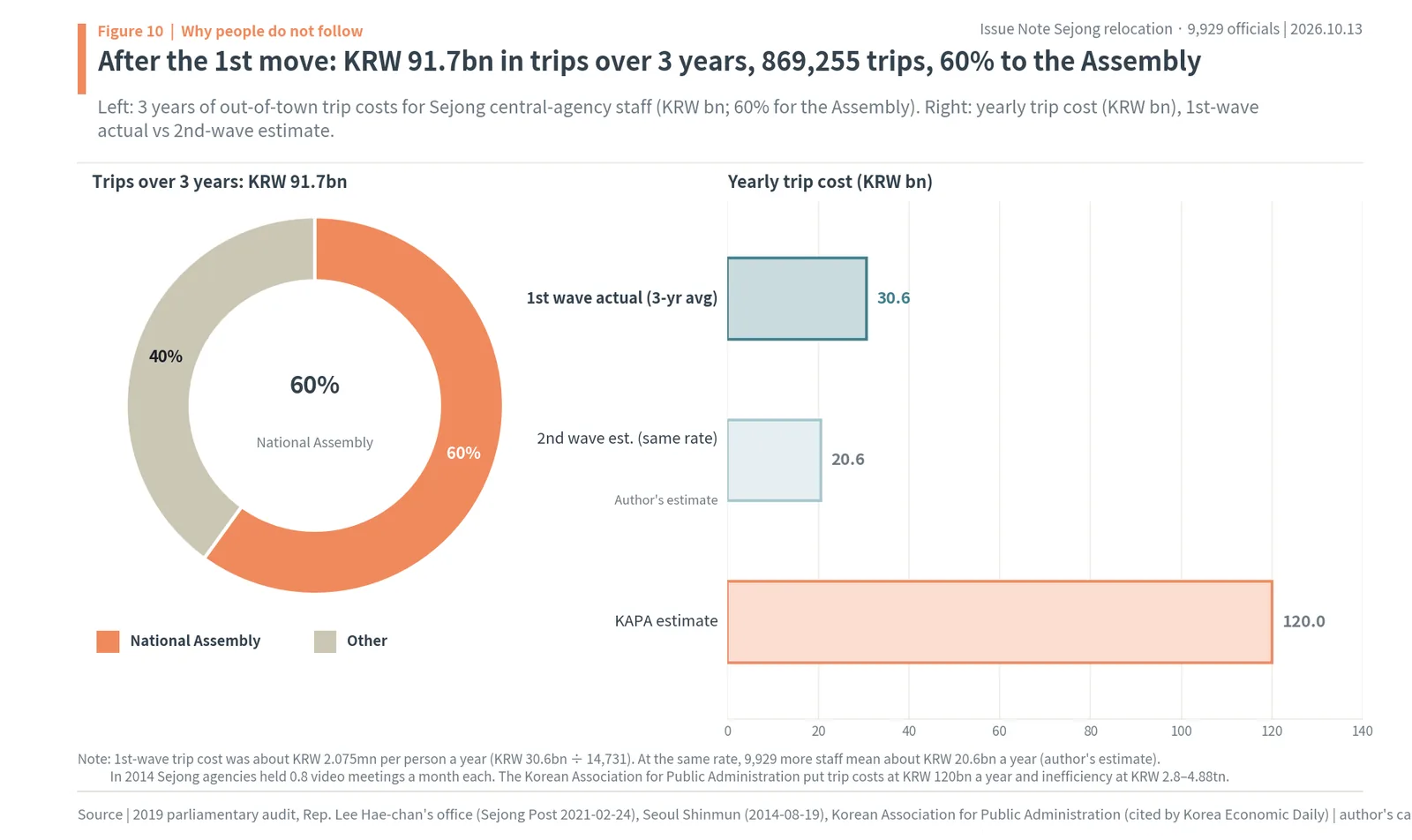
The second reason is that the people officials work with stayed in Seoul. Data released at the 2019 parliamentary audit showed that Sejong’s central agency officials spent KRW 91.7bn on out-of-town trips over three years, 869,255 trips. About 60% were for the National Assembly, which is 118km from the Sejong complex. Every budget review, bill briefing, parliamentary audit and standing committee appearance sent director-generals and division directors up to Seoul. Video conferences at the Sejong complex averaged only 0.8 a month per agency in the first half of 2014, because security rules and a face-to-face culture kept them from replacing meetings. In the first half of 2014 alone, travel costs to Seoul, Gwacheon and the National Assembly at 13 Sejong agencies were KRW 7.57bn, the largest being the transport ministry at KRW 971.26mn. Reports also say the complex, short of space, spends more than KRW 7.1bn a year renting nearby private buildings. Even after the move, costs are split between Seoul and Sejong.
Per year, travel costs were about KRW 30.6bn, or about KRW 2.075mn per first-relocation official. Applying the same rate to the second relocation’s 9,929 adds about KRW 20.6bn of new travel costs a year (author’s estimate). The Korean Association for Public Administration once estimated officials’ travel costs from the ministry moves at KRW 120bn a year and administrative and social inefficiency at KRW 2.8tn to 4.88tn. Its method was not published, so this report cites it only as an estimate. The left of Figure 10 shows what the three years of travel spending went to, and the right compares annual travel costs from the first relocation’s record, the second relocation estimate and the association’s estimate; Figure 10 is in KRW bn. Travel costs were KRW 91.7bn over three years, 869,255 trips, 60% for the National Assembly.
The worry that young officials will leave also shows in numbers. Government Employees Pension Service data show officials quitting within five years of service rose from 5,670 in 2018 to 13,568 in 2023, and in 2024 the 12,013 who did were 59.3% of 20,273 ordinary retirees. These figures cover all officials nationwide, and no data count only those who quit because of working in Sejong. Still, with division directors at the moving agencies worried about young staff transferring or quitting, and 80.4% of under-40 staff saying in a Financial Supervisory Service union survey that they would leave if it moved, the risk that relocation loses people rather than moves them is clear.
The two reasons are one. As long as the National Assembly, the presidential office, and the companies, financial firms and embassies that ministries deal with are in Seoul, officials’ work shuttles between Seoul and Sejong and their families stay in Seoul. This plan does not move the presidential office or the National Assembly either. The presidential office in Sejong is due for completion in 2029 and the National Assembly Sejong building in 2033. Professor Ha Hye-su of Kyungpook National University noted that “if only central ministries move to Sejong and the presidential office and others stay in Seoul, administrative inefficiency may actually grow.” The same structure with the same method gives the same result.
6. How big is 9,929? 0.038% of the capital area and 2.4 months of net inflow
Small when measured in the same units
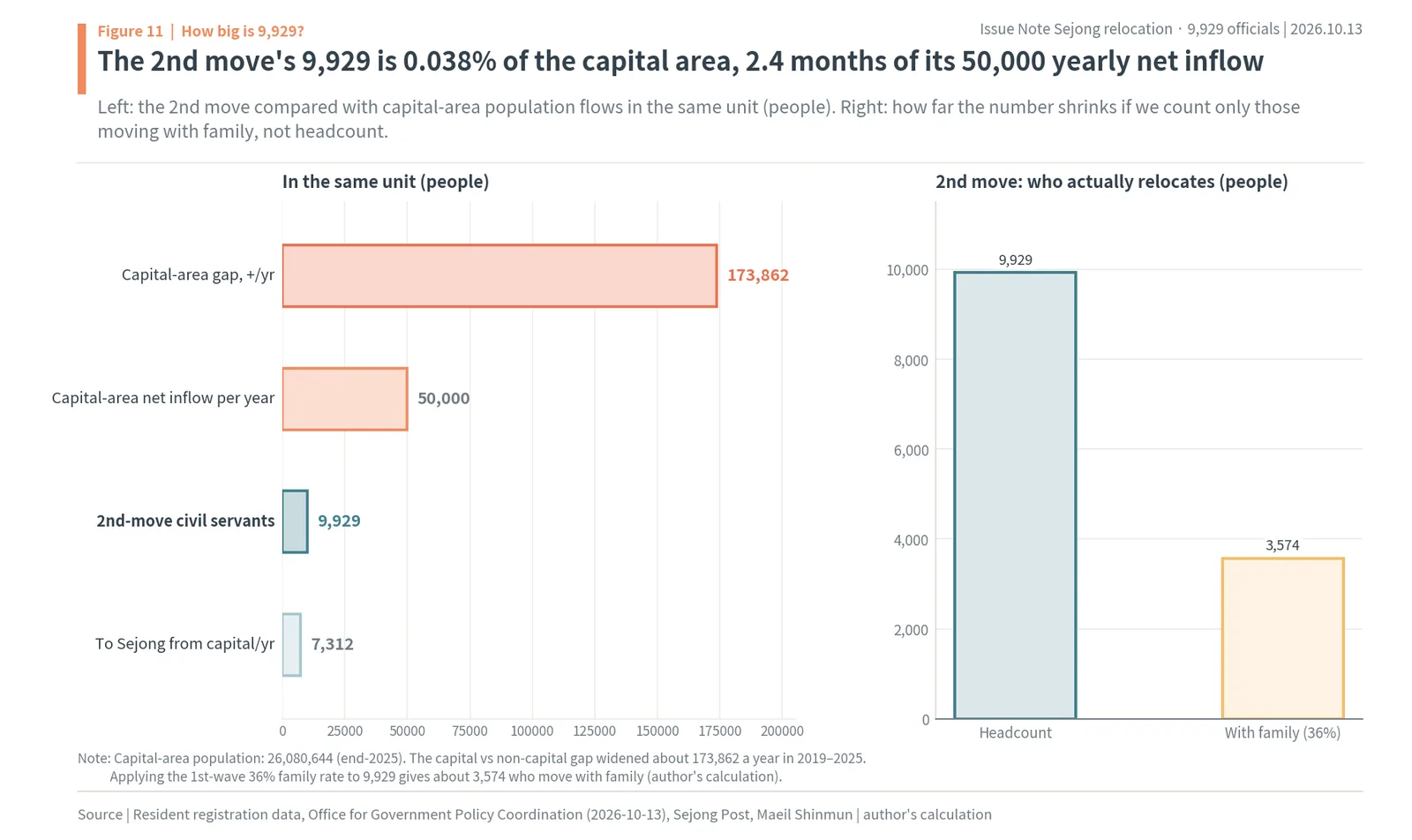
As a government workforce 9,929 is large, but against the capital area’s population flows it is small. It is 0.038% of the capital area’s 26,080,644 registered residents at the end of 2025, and 2.4 months of the roughly 50,000 annual net inflow cited by the Office for Government Policy Coordination. The gap between capital and non-capital populations widened by about 173,862 a year in 2019 to 2025, so 9,929 is 5.7% of one year’s widening (author’s calculation). It is the same order as the roughly 7,312 capital-area residents a year who moved to Sejong in the first relocation.
Then add section 1’s gap. The 9,929 are posts, and fewer will actually leave the capital area with their families. Applying the first Sejong complex’s 36% family rate to 9,929 gives about 3,574 officials moving with families (author’s calculation). The families of those who go alone stay in the capital area’s population, and those who commute from Seoul never leave it. The left of Figure 11 puts 9,929 in the same units as the capital area’s population flows, and the right shows the difference between posts and the estimated family moves. The second relocation’s 9,929 are 0.038% of the capital area’s population and 2.4 months of its 50,000 annual net inflow.
Even the largest case is 0.02 percentage points
Take the largest possible case. Suppose all 9,929 posts are filled with no vacancies and every one of those officials moves their address from the capital area to Sejong, with no family following. That is the most people this plan can directly remove from the capital area. Applied to end-2025 registration, the capital area’s share falls from 51.021% to 51.002%, a drop of 0.019 percentage points. Removing the first relocation’s 14,731 at the same time gives 50.973%, a drop of 0.048 points (author’s calculation). Against the pace at which the share rose from around 50.0% to 51.02% in 2019 to 2025, this is a fraction of one year’s movement.
Families moving along would make the number bigger. But with the first relocation’s family rate at 36% and the families of solo movers staying in the capital area, adding families does not change the direction. In numbers, moving 9,929 people shifts the capital area’s share in the second decimal place. Reversing the broad trend of concentration requires the direction of tens of thousands of people a year to change, and that direction is set by jobs and wages.
What this number says
This comparison does not mean relocation is useless. There may be other aims, such as administrative efficiency or Sejong’s own development. In the same answer Kim Ha-kyun said that “the development potential of Sejong and nearby areas has been confirmed.” But the first aim the government named for this plan is to “overcome the capital-area one-pole system,” and against that aim 9,929 people are too small an arrow for the target. As with the first relocation’s 14,731, the second relocation’s 9,929 will delay the capital area’s pull by a few months rather than change its direction.
So how should KRW 3.22tn be read? It is spending in the KRW 3tn range to delay 2.4 months of capital-area net inflow. A judgment needs comparison with other uses of the same money, which section 10 takes up with KDI’s analysis. Before that come two groups of agencies whose problem is bigger than the numbers: the Financial Services Commission, and Foreign Affairs and Defense.
7. Financial Services Commission to Sejong: 91.6% of financial head offices stay in Seoul
91.6% of financial firms’ head offices are in Seoul
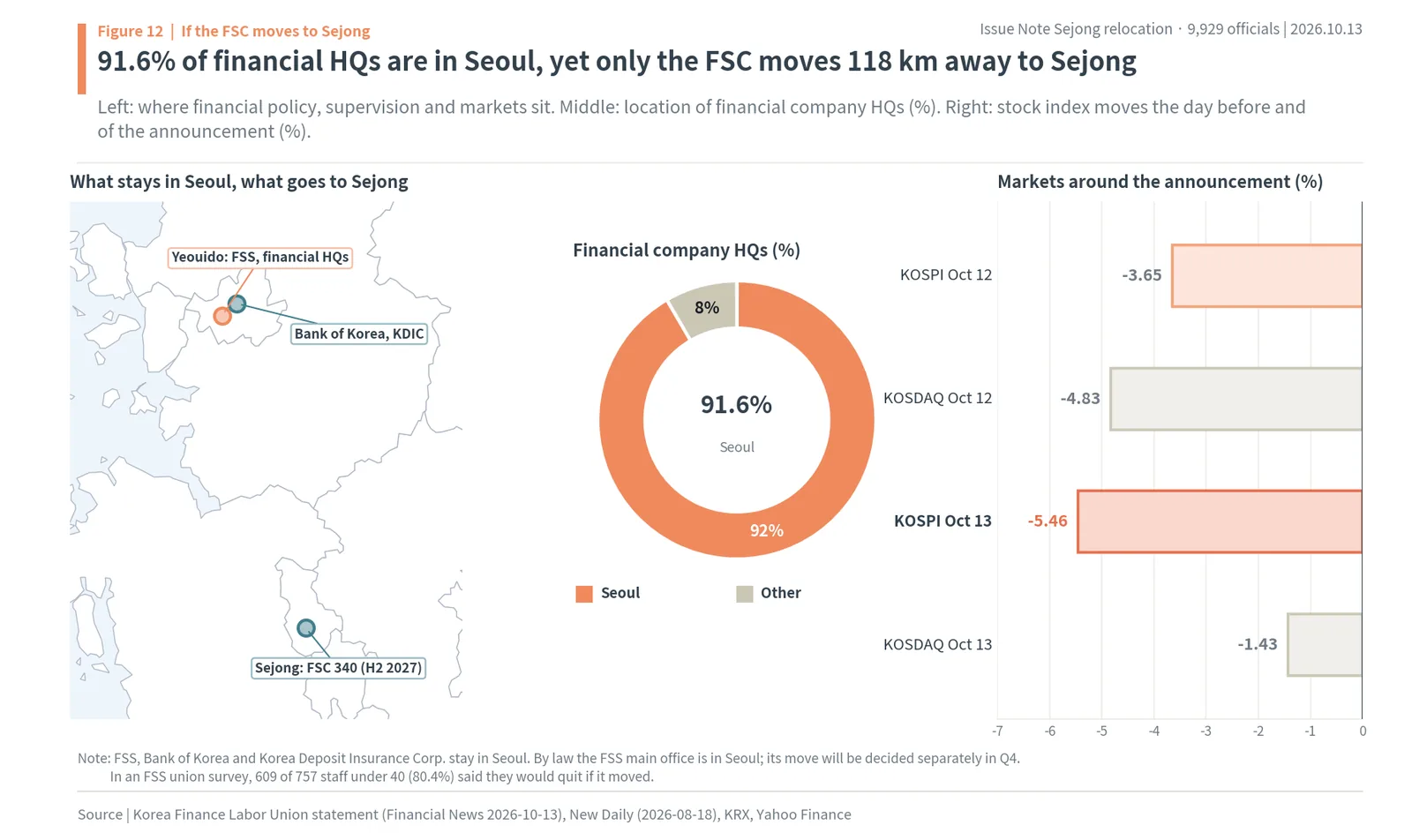
The Financial Services Commission’s 340 posts move to Sejong in the second half of 2027. The commission makes financial policy, decides licensing and sanctions for financial firms, and issues market stabilization measures in a crisis. Its counterparts all stay in Seoul: the Financial Supervisory Service, which conducts inspections; the Bank of Korea, which sets monetary policy; and the Korea Deposit Insurance Corporation, which protects depositors. The law on the commission requires the Financial Supervisory Service’s main office to be in Seoul. The Korea Finance and Service Workers’ Union demanded withdrawal of the move, noting that 91.6% of financial firms’ head offices are in Seoul. Its statement said that in Sejong the commission “cannot help but show inefficiency in normal times and incompetence in a crisis.”
The commission’s work is tied to the market. Measures such as a short-selling ban, a stock market stabilization fund or a bond market stabilization program are decided within hours, on days when the market shakes, sitting across from the Financial Supervisory Service, the Bank of Korea and financial firms. On the announcement day the KOSPI closed down 5.46% at 6,035.35, after a 3.65% fall the day before. The KOSDAQ, Korea’s growth-stock market, fell 4.83% on October 12 and 1.43% on October 13. Had the commission been in Sejong, its chairman and director-generals would have had to travel 118km each way to meet on days like these. Just as first-relocation ministries made 869,255 trips in three years to reach the National Assembly, the commission would have to keep traveling to the market.
The left of Figure 12 shows where the financial bodies that stay in Seoul sit relative to the commission moving to Sejong, the middle the location of financial firms’ head offices, and the right stock market moves around the announcement. With 91.6% of financial head offices in Seoul, only the commission goes to Sejong, 118km away.
The people may not stay either
In financial supervision, people are the asset. In an August survey by the Financial Supervisory Service union, 609 of 757 staff under 40, or 80.4%, said they would leave if relocation were confirmed. The service is not in this plan, but its relocation will be decided separately in the fourth quarter. Reports said Financial Services Commission staff had hoped to stay in Seoul under the president’s “Seoul as economic capital” idea and were disappointed. If young experts leave, supervision weakens, and the whole market pays when a financial accident happens. Voluntary resignations at the Financial Supervisory Service have already risen 3.5-fold in eight years, according to reports, and an official there said supervisors must be close to the field to inspect and respond quickly when accidents happen. If the commission goes to Sejong and the service stays in Seoul, the body that sets policy, the body that inspects and the firms being inspected split across two cities.
Political demands also diverge. People Power Party lawmakers from Busan argue that the commission and the service should go to Busan, the designated financial hub, not Sejong. Regions are fighting over where to put the commission. In the author’s view the question is asked in the wrong order. Where the commission belongs is decided by where its counterparts are. Moving it first while its counterparts are in Seoul gains neither efficiency nor regional balance and only loses speed in responding to markets. The commission should therefore be taken out of this relocation.
8. Foreign Affairs and Defense to Sejong: 118 foreign missions and the presidential office stay in Seoul
118 foreign missions are in Seoul
Foreign Affairs, Defense and Unification have been excluded since the act was written in 2005. External affairs such as diplomacy, security and defense must stay close to the president, and their counterparts are in Seoul. This plan puts the three among the 17 new-building agencies to move by 2031: Foreign Affairs 1,024, Defense 746 and Unification 336. The government is seeking an amendment in this session to delete the exclusion in Article 16(2). Without it, the three cannot move.
The 118 foreign missions in Korea that the Ministry of Foreign Affairs deals with are in Seoul. A senior official at a major embassy said that physical distance from the host foreign ministry would disrupt coordination on urgent diplomatic and security issues, and that embassies would have no choice but to follow if the ministry moved. The government has only said a diplomatic compound in Sejong is under review. The Ministry of National Defense has been reluctant, saying it must coordinate closely with the National Security Office and the Joint Chiefs of Staff in crises such as North Korean provocations. The National Security Office is outside this plan and will be decided with the presidential office move, and the announcement did not say whether the Joint Chiefs of Staff would move.
The left of Figure 13 shows the posts of the eight named agencies among the 17 new-building agencies, and the right how the status of the three ministries changed from the September 3 “direction” to the October 13 plan. By 2031 Foreign Affairs (1,024), Defense (746) and Unification (336) move, while the 118 foreign missions remain in Seoul.
While the presidential office and the National Assembly are in Seoul, only the cost grows
Moving Foreign Affairs and Defense only makes sense together with the presidential office and the National Assembly. Professor Park Won-gon of Ewha Womans University said, in effect, that Foreign Affairs and Defense should not be split between Seoul and Sejong. On the current schedule the presidential office in Sejong is to be completed in 2029 (move planned for 2030) and the National Assembly Sejong building in 2033. Yet moving the presidential office and the main National Assembly runs into the Constitutional Court’s 2004 ruling that struck down the Special Act on the New Administrative Capital on the ground of the customary constitutional rule that “the capital is Seoul.” Moving only ministries, as in this plan, stays within the logic of the court’s 2005 dismissal of the constitutional complaint against the administrative city act, so the constitutional risk is small, but critics say moving the presidential office and the National Assembly would need a constitutional amendment or a new ruling.
So the order is clear. When and on what legal basis the presidential office and the National Assembly move must be settled first, and Foreign Affairs and Defense should move together after that. If only Foreign Affairs and Defense go to Sejong while the presidential office and the National Assembly stay in Seoul, the travel costs and time that first-relocation ministries spent going to the National Assembly shift into diplomacy and security, where lost time is not just a cost. The author believes the moves of Foreign Affairs, Defense and Unification should wait until the schedule for the presidential office and the National Assembly is confirmed.
What has to change before they can move
The legal and political calendar supports this order. Moving the five ministries requires amending Article 16(2) first. Rep. Bok Gi-wang, the Democratic Party’s secretary on the Land, Infrastructure and Transport Committee, sponsored a bill deleting the exclusion, and three related amendments are pending. The government aims to pass it in this session, but a delay would affect the 2027 schedule. The special administrative capital act, which would set the city’s status in law, was shelved for a third time in April while a subcommittee reviewed five bills together, and stalled after a May public hearing because of the local elections. Democratic Party leader Kim Min-seok said in September that the party aims to pass it within the year. A constitutional referendum planned alongside the local elections failed when the People Power Party boycotted the vote and the quorum was not met. The constitutional and legal basis for moving the presidential office and the National Assembly is still empty. Moving foreign affairs and security ministries before that basis exists risks leaving only Foreign Affairs and Defense in Sejong if the presidential office and the National Assembly end up staying in Seoul.
9. Overseas cases: Britain, Japan, Indonesia, Malaysia, Egypt and Australia
Britain moved jobs, Japan moved one agency
Many countries have moved government bodies out of the capital, but it is hard to find one that has produced numbers showing capital concentration fell as a result. The cases share two lessons. The numbers worked when “jobs,” not people, were moved, and bodies whose counterparts are in the capital, such as markets, diplomacy and defense, stayed.
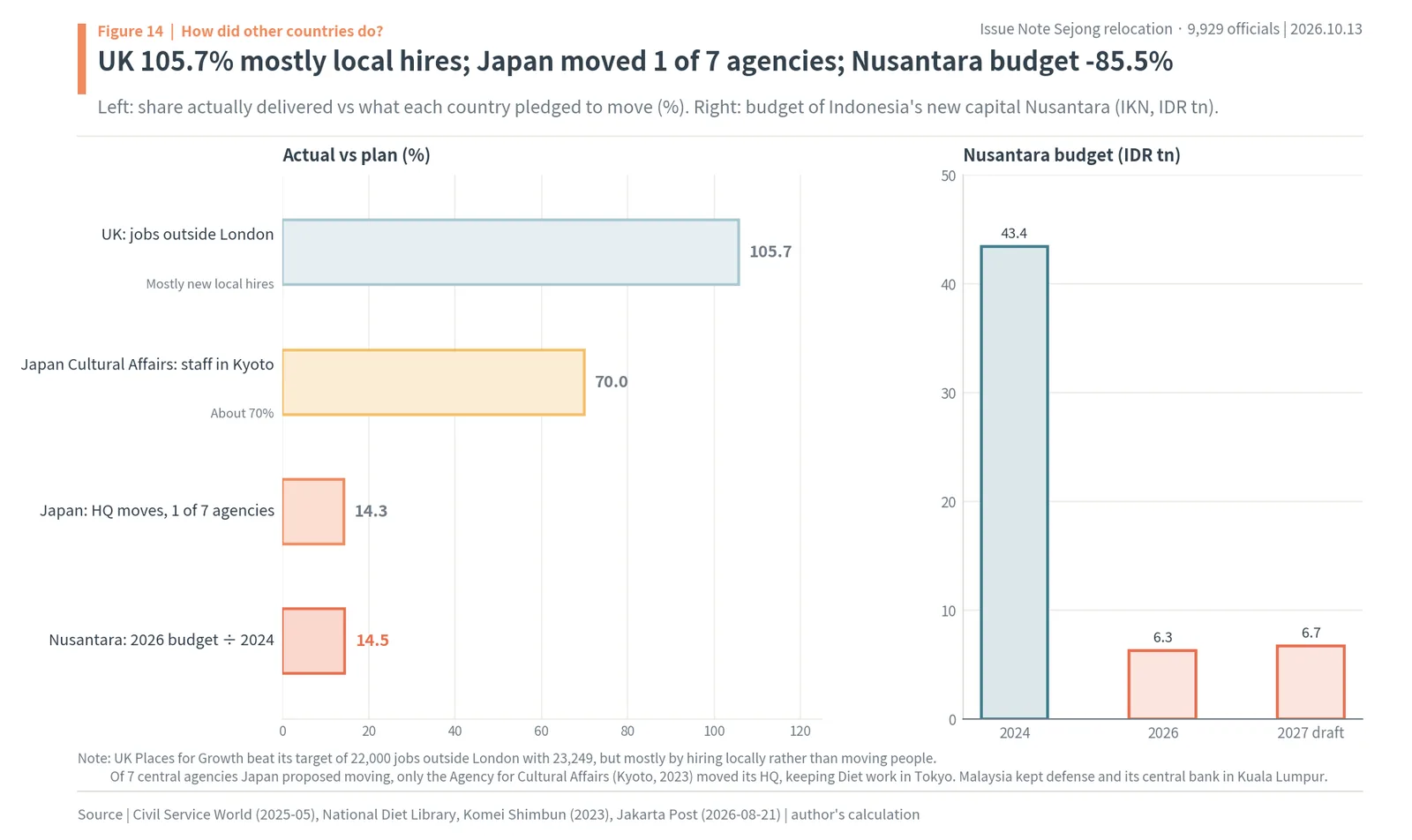
Under its 2020 “Places for Growth” program, Britain set a target of 22,000 civil service jobs outside London and had moved 23,249 by the end of June 2024, 105.7% of the target (author’s calculation). But most of those jobs were new local hires, not London civil servants moving house. The goal of having half of senior civil servants outside London by 2030 is slow; in the fourth quarter of 2023, 39 senior posts moved out of London. The Labour government that took office in 2024 kept the program and said it would move thousands more posts to 13 cities. Britain hit its number by creating posts in the regions and hiring local people rather than moving staff, so the new posts became jobs for local young people and kept those who would otherwise leave for the capital. Japan, under its 2014 regional revitalization policy, invited regions to bid for central agencies; seven were candidates, but only one actually moved its headquarters, the Agency for Cultural Affairs to Kyoto in 2023. One of seven is 14.3%. Even there, only close to 70% of about 590 staff work in Kyoto, and Diet relations, legislation and copyright work stayed in Tokyo. The Consumer Affairs Agency only set up a base office in Tokushima.
New capitals are delayed, and core institutions stay put
Indonesia, building the new capital Nusantara (IKN), planned to move civil servants from August 2024 but postponed repeatedly and then indefinitely in February 2025. The IKN budget fell 85.5% from IDR 43.4tn in 2024 to IDR 6.3tn in 2026, with IDR 6.7tn proposed for 2027. Malaysia spent about $8.1bn from 1999 moving the prime minister’s office and ministries to Putrajaya, but kept the defense ministry and the central bank in Kuala Lumpur. Egypt announced a new administrative capital east of Cairo in 2015 with a total budget of $45bn. In July 2023 the presidential spokesman said 100 bodies including 30 ministries and 40,000 staff would move. For the first civil servant moves the government offered shuttle buses and EGP 1.5bn in relocation incentives, but only about 5,000 of the first district’s 20,000 homes were sold. Offices moved, homes did not, much like Korea’s first relocation. In Australia, Parliament moved to Canberra in 1927, but ministries moved in earnest only in the 1950s. Even with Parliament and the head of government there first, ministries took more than 25 years to follow.
The left of Figure 14 shows, by country, how much of what was promised was actually done, and the right the Nusantara budget. Britain’s 105.7% is local hiring, Japan moved one of seven agencies, and the Nusantara budget was cut 85.5%.
Held up against this plan, two things stand out. Korea’s second relocation moves existing official posts rather than creating new local jobs as Britain did, and it moves Defense and the Financial Services Commission, the counterparts of the defense ministry and central bank that Malaysia kept in its old capital. That Japan kept Diet work in Tokyo even for the Agency for Cultural Affairs shows that while the legislature is in the capital, a ministry’s core work can hardly leave it. Overseas experience points the same way as Korea’s first relocation.
10. The author’s view: KDI says hub-city productivity, not buildings, moves people
The problem the supporters see is real
The concern behind the supporters’ case is right on the numbers. The Bank of Korea’s 2023 report found the capital area’s population share had reached 50.6% and estimated that women moving to the capital area in 2001 to 2020 alone cut 2021 births nationwide by about 6,000. Concentration is a large cost that runs through house prices, birth rates and the decline of the provinces. Minister Yun Ho-jung’s description of the move as “a core national strategy to overcome the capital-area one-pole system and use national space efficiently” comes from this concern. The same Bank of Korea report recommended concentrating public institution relocation in hub cities rather than small towns. It calculated that on current trends the capital area would have 23.63 million people and a 53.1% share in 2053, but if young people’s moves to the capital area fell to 10% and more moved to hub cities, the share would fall to 49.2%. The key the central bank saw was also where young people find jobs, not where officials sit.
The size of the money is worth comparing too. KDI counted Sejong’s budget at about KRW 8.5tn cumulative over 2006 to 2019, about KRW 600bn a year. The second relocation’s KRW 3.22tn spends more than a third of those 14 years’ budget within five years. The first relocation’s total public spending was set at KRW 22.5tn, KRW 8.5tn from the state and KRW 14tn from LH. If the capital area’s share rose after spending that much, adding more money to the same prescription should wait until its effect is measured.
Where the author differs is the prescription. The problem is concentration in the capital area, and the government’s prescription is moving official posts to Sejong. As sections 3 to 5 showed, the same prescription in the first relocation did not reduce the capital area’s share. Sejong was filled by people from Chungcheong, families stayed in Seoul, and work shuttled to the National Assembly. Agreeing with the concern is not the same as agreeing with this prescription.
KDI: the productivity of non-capital cities was the answer
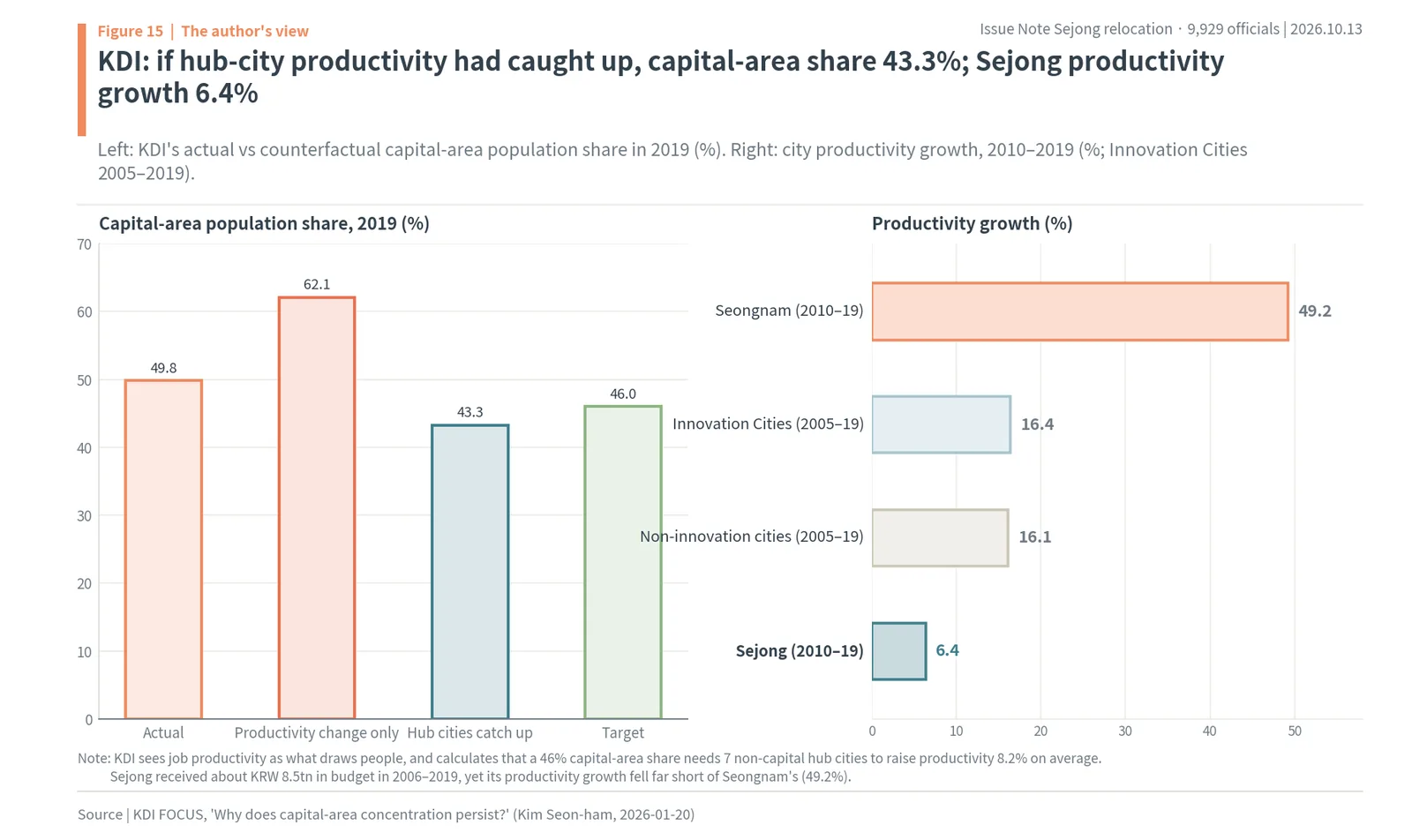
KDI’s January 2026 analysis explains continued concentration through productivity. People go to more productive jobs, which means higher wages. Sejong’s productivity growth in 2010 to 2019 was 6.4%, far below Seongnam’s 49.2% in the same period. Innovation Cities’ productivity growth in 2005 to 2019 was 16.4%, no different from 16.1% for other cities. Sejong received about KRW 8.5tn of budget in 2006 to 2019. Housing and roads were laid, but the jobs that pull people in were not strong.
KDI also ran counterfactuals. Reflecting only productivity changes in 2005 to 2019, the capital area’s 2019 share should have been 62.1%, above the actual 49.8%. Conversely, had productivity in non-capital manufacturing cities merely risen at the national average, the share would have been 43.3%, 6.5 points below actual, with about 2.6 million more people staying in the provinces. Lowering the share to 46% would require raising productivity in seven non-capital hub cities by an average of 8.2%. KDI recommended that any second relocation be concentrated in Sejong and a few large non-capital cities. The left of Figure 15 shows KDI’s actual and counterfactual capital-area shares, and the right productivity growth by city. Had hub-city productivity caught up, the share would have been 43.3%, and Sejong’s productivity growth was 6.4%.
The verdict: put the KRW 3tn into jobs rather than buildings, and keep market and diplomatic bodies in Seoul
So the author’s verdict is this. The author believes that the premise of easing capital-area concentration by moving 9,929 officials was already disproven by the first relocation’s numbers, and that money in the KRW 3tn range is better spent on the productivity of jobs in regional hub cities than on new buildings. Moving people did not shrink the capital area. People follow jobs, not government buildings. Three things follow.
First, state the aim correctly. If the aim of this move is to ease concentration, the government should first publish an analysis of the first relocation’s effect and set the scale and targets of the second from that analysis. The government said it would “organize later” the effect data. The data that should come before spending KRW 3.22tn is coming after the decision to spend it. Second, keep in Seoul the agencies that must sit next to markets and diplomatic counterparts. The Financial Services Commission should not move while the Financial Supervisory Service, the Bank of Korea and 91.6% of financial head offices are in Seoul, and Foreign Affairs, Defense and Unification should not move until the schedule for the presidential office and the National Assembly is confirmed. Third, use the same money to move jobs. Creating new local posts as Britain did, and raising productivity in non-capital hub cities as KDI recommends, gives the same KRW 3tn a chance to change the direction of the flow rather than delay capital-area inflow by a few months.
The plan is pushed by the Lee Jae-myung government and the ruling Democratic Party of Korea, and Sejong and the Chungcheong region welcomed it. The People Power Party at the national level also broadly favored completing the administrative capital, while its local chapters demanded the special act (Sejong) or opposed moving the Overseas Koreans Agency (Incheon). The author’s conclusion comes from weighing the evidence, and it ends up opposing this plan’s prescription.
11. Sejong property, Kyeryong Construction and theme stocks, and dates to watch
Sejong property: expectations ran up in 2020, then four years of declines
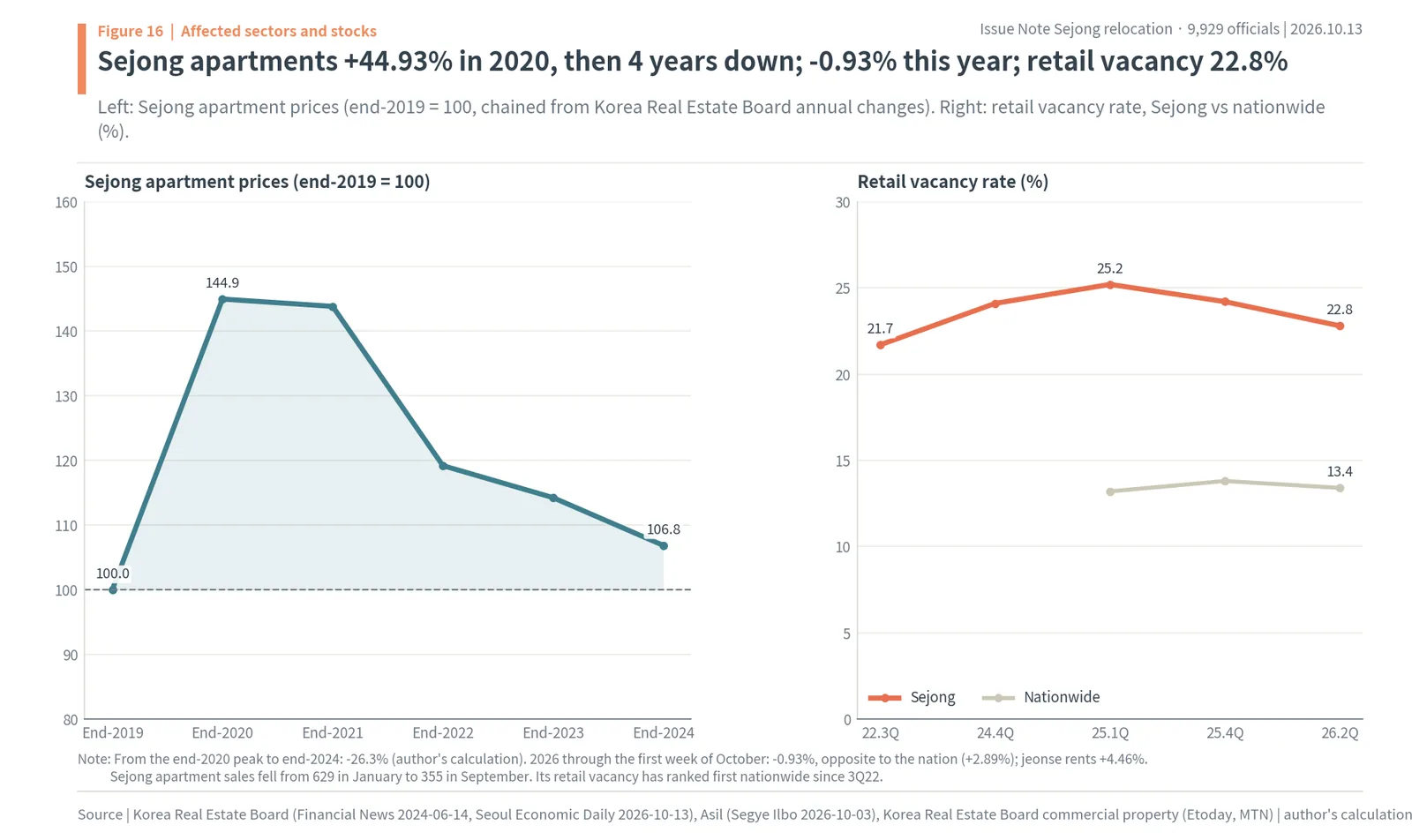
Sejong property has a history of moving first on relocation news and coming back down with the actual flow of people. On Korea Real Estate Board data, Sejong apartment prices rose 44.93% in 2020, the year “moving the administrative capital” was floated, the most in the country. They then fell four years running: -0.78% in 2021, -17.12% in 2022, -4.15% in 2023 and -6.46% in 2024. Chaining annual changes from end-2019 = 100 gives 144.93 at end-2020 and 106.85 at end-2024, 26.3% below the peak (author’s calculation). In 2026 to the first week of October, prices were down 0.93% cumulatively, the opposite of the national +2.89%, and down 0.05% in the first week of October alone. Jeonse (lump-sum deposit lease) prices rose 4.46% since the start of the year. Sales fell from 629 in January to 355 in September.
Shops are worse. Sejong’s vacancy rate for medium and large shops became the highest in the country at 21.7% in the third quarter of 2022, and was 24.1% in the fourth quarter of 2024, 25.2% in the first quarter of 2025 (national 13.2%) and 24.2% in the fourth quarter of 2025. The general retail vacancy rate in the second quarter of 2026 was 22.8%, 1.7 times the national 13.4%. Reports say waterfront shops in Sejong are nearly half empty. Shops fill when people spend in the city, but officials who came alone spend their weekday evenings and weekends in the capital area. As section 5 showed, when many officials come alone and go back every weekend, local commerce does not grow. The left of Figure 16 shows Sejong apartment prices and the right Sejong and national retail vacancy rates. After +44.93% in 2020, Sejong apartments fell for four years and are down 0.93% this year, and the retail vacancy rate is 22.8%.
The second relocation adds rental demand in Sejong. In 2027, 27 agencies with 2,995 posts lease private buildings, filling some empty offices and shops, and officials will need jeonse homes. But the first relocation’s numbers show much of that demand is small homes for solo officials, or commuting. So the author expects rentals (jeonse and offices) to move before Sejong sale prices. In Seoul, five agencies remained in the main building of the Government Complex Seoul as of August 2026 (Unification, Gender Equality, the Financial Services Commission, the Personal Information Protection Commission and Foreign Affairs), and the government is reviewing filling the empty space with capital-area special local agencies first. In the first relocation, too, other agencies filled the space left by the interior ministry. The Seoul and Sejong shuttle shows in rail numbers. KTX ridership between Osong and Daejeon stations and Seoul and Yongsan stations rose 85.9% between 2021 and 2025 to about 10.84 million. That matches the first relocation’s pattern of many people moving their workplace to Sejong while keeping homes in the capital area. If the second relocation grows this flow, rail and commuter bus demand rises, but the capital area’s population does not fall by as much.
Sectors: money reaches design and leasing first, construction later
The order in which the money reaches industries follows the budget. Of the KRW 118.3bn spent first in 2027, KRW 89.7bn is for leasing, fitting out and running private buildings in Sejong plus relocation support, and KRW 28.6bn is basic design of the new buildings. So the first demand is for office leasing and interiors in Sejong, and for design and construction management. The KRW 3.1tn construction budget proceeds through detailed design and then construction tenders, so contractors book orders in 2028 at the earliest. The presidential office in Sejong put its site preparation (KRW 9.8bn) out to tender in April 2026, with main construction targeted to start in 2027. More officials shuttling between Sejong and Seoul means transport demand for rail and commuter buses. Conversely, rental demand falls for private buildings in Seoul that agencies leave, but no statistics yet measure it.
Stocks: the Sejong theme rose on campaign pledges and fell with the flow of people
In the stock market, the Sejong move has appeared year after year as an “administrative capital theme.” KOSPI and KOSDAQ are Korea’s two exchange boards, both run by KRX, the Korea Exchange. After Kim Tae-nyeon, then Democratic Party floor leader, spoke of moving the National Assembly and the presidential office (then the Blue House) to Sejong on July 20, 2020, these stocks rose through August 3: Daejoo Industry +46.54%, Youngbo Chemical +41.53%, Fromfast (035200.KQ) +30.70%, Sinsin Pharmaceutical +30.68% and Yura Tech +27.95%. Most have core businesses unrelated to Sejong demand; the theme rested on owning land or plants near Sejong. Yura Tech makes automotive ignition coils and spark plugs, Youngbo Chemical makes PE and PP foam films and sheets, and Daejoo Industry is a feed company headquartered in Jincheon, North Chungcheong. Fromfast, Youngbo Chemical and Yura Tech were grouped together for owning property in North Chungcheong and Sejong, and Sinsin Pharmaceutical moved its head office from Ansan to Sejong in 2020. None of their sales link directly to how many officials move to Sejong. In February 2011, too, Youngbo Chemical, Fromfast, Daejoo Industry and Yura Tech hit the daily limit-up on remarks about a science belt, again because of plants and land near Sejong. When then-candidate Lee Jae-myung pledged a “Chungcheong administrative capital” and a Sejong National Assembly building and presidential office within his term on April 17, 2025, Daejeon-based Kyeryong Construction (013580.KS) rose 29.92% on April 18 and 29.88% on April 21, two straight limit-up days, to KRW 31,300; it rose 68.7% in three days and trading was halted on the 22nd.
Kyeryong Construction is the company in this theme whose core business is most directly tied to Sejong. It was reported as the top public works contractor in 2024, and in September 2025 it signed a KRW 397.6bn contract with LH for public housing in Dasom-dong, Sejong and in Dangjin. In 2025 its revenue was KRW 2.8874tn, operating profit KRW 166.9bn and EPS KRW 11,193 (WISEfn). At the October 13 close of KRW 21,150, its 2025 P/E is 1.89x and its market cap KRW 188.9bn (about $141.2mn). The second relocation’s 17 new buildings start basic design in 2027 and contractors are chosen after that, so the plan will show up in the company’s numbers only years from now. In the first relocation, the central building of the Government Complex Sejong was built by a Halla (now HL D&I, 014790.KS) consortium for KRW 148.7bn, with Heerim Architects (037440.KQ) handling design and construction management.
The market’s reaction on the day was small. On October 13, when the KOSPI fell 5.46%, Kyeryong Construction rose 3.17%. On Naver Finance quotes, Sungshin Cement (004980.KS) rose 2.17%, Fromfast 3.93%, Hanil Cement (300720.KS) 2.26% and Heerim 0.65%, while HL D&I fell 1.23%, Yura Tech 2.30%, Youngbo Chemical 1.28% and Daejoo Industry 0.43%. Kyeryong Construction is 32.4% below its April 2025 peak. Over the past year it rose 9.6% while the KOSPI rose 68.4%. On September 3, the day of the “direction” announcement, it rose to KRW 21,700 (+2.12%), reached KRW 23,500 on September 18 and then fell back. The left of Figure 17 shows Kyeryong Construction and the KOSPI indexed to October 2024 = 100, and the right the October 13 moves of stocks mentioned in connection with Sejong. Kyeryong Construction rose 3.17% on a day the KOSPI fell 5.46%, but it is 32.4% below its April 2025 peak.
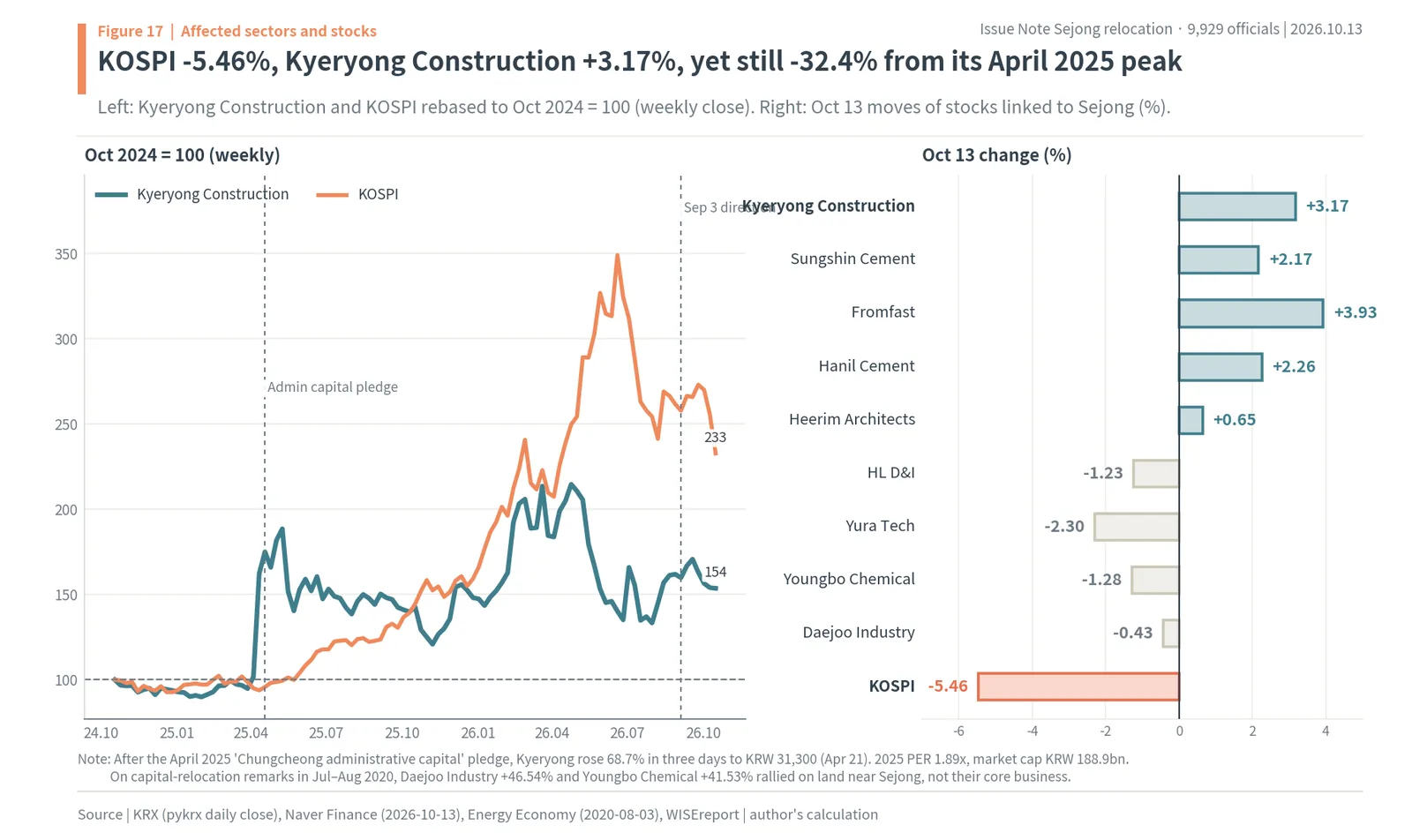
In the author’s view, what moves these stocks is not announcements but the schedule on which money actually flows. The Sejong theme jumped on days of pledges and remarks, then fell as it became clear that the actual flow of people and money was not that large. So what to check is less the wording of the plan than whether the budget passes the National Assembly, whether the act is amended, and when the new buildings go out to tender.
Eight signals the author watches
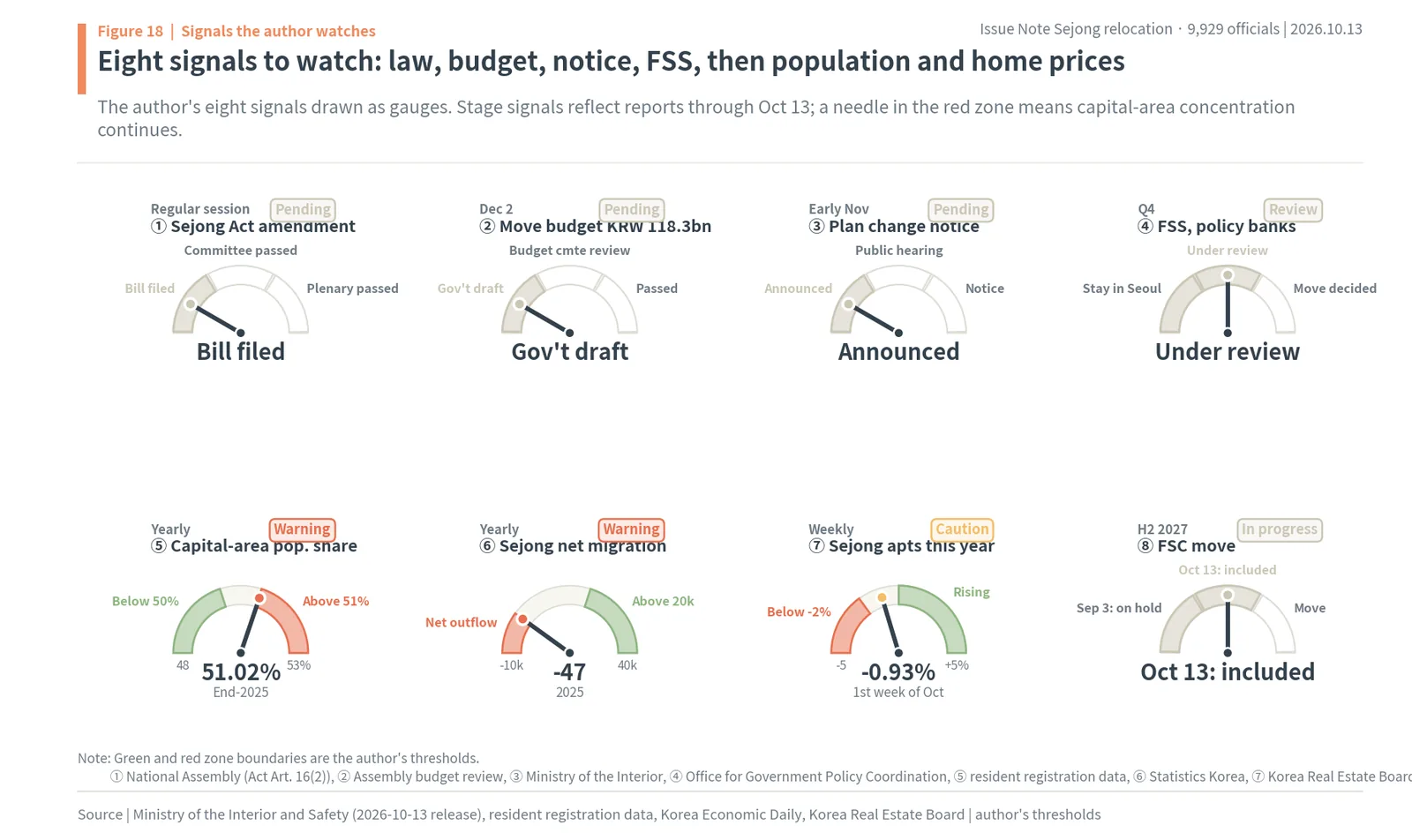
Figure 18 draws the eight signals the author watches as a dashboard: law, budget, the official notice, the Financial Supervisory Service, and population and house prices. (1) The act amendment is at the bill stage, and the moves of the five ministries (Foreign Affairs, Unification, Defense, Justice and Gender Equality) depend on it. (2) The KRW 118.3bn 2027 relocation budget is in the government’s proposal and awaits National Assembly review. (3) The amended official notice of the “relocation plan for central administrative agencies” is scheduled for early next month after a public hearing. (4) Whether the Financial Supervisory Service and state-run banks move will be decided in the fourth quarter. (5) The capital area’s population share was 51.02% at the end of 2025, in the red zone. (6) Sejong’s net migration was -47 in 2025. (7) Sejong apartments are down 0.93% this year to the first week of October. (8) The Financial Services Commission move changed from deferred on September 3 to included on October 13.
Dates to watch
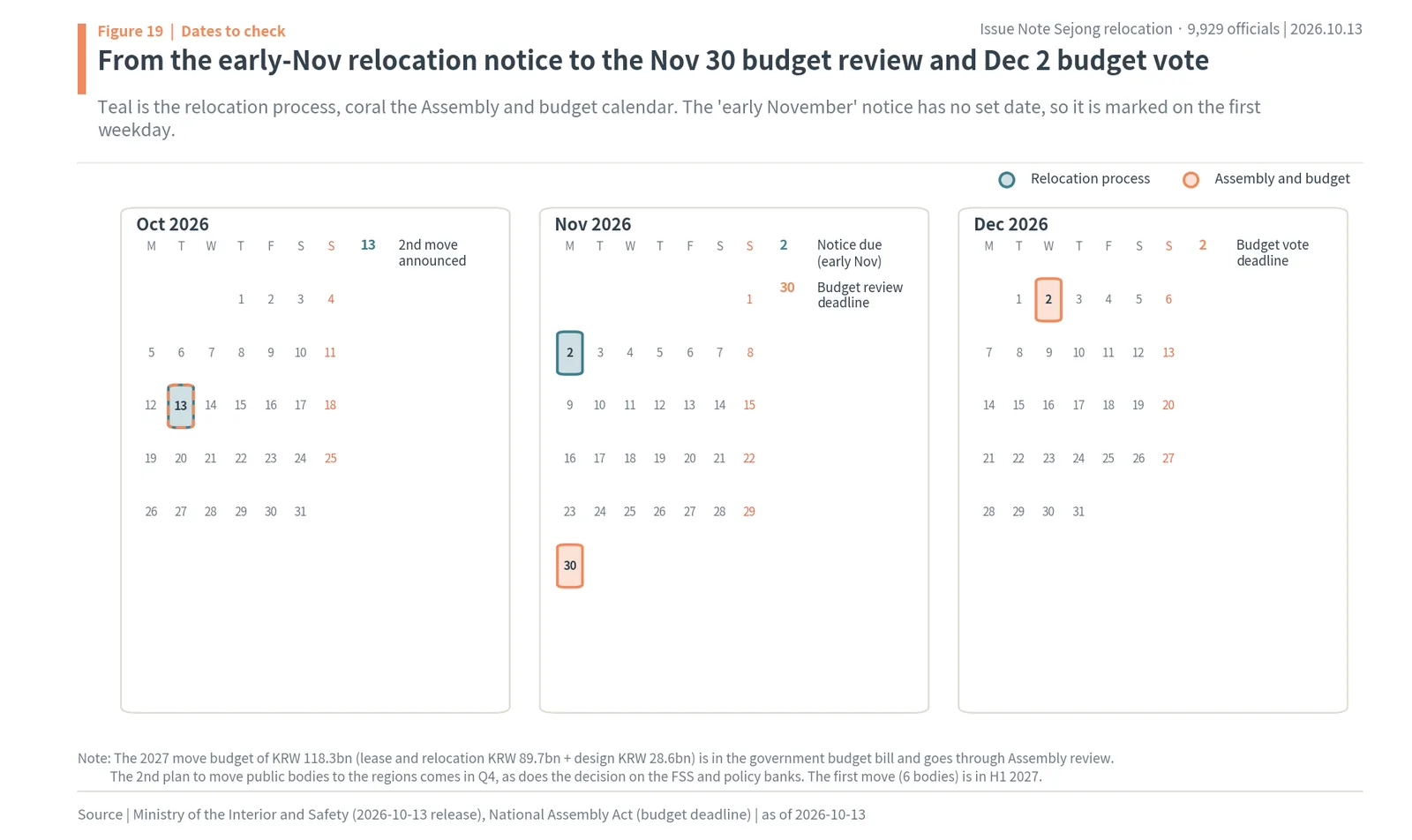
The near-term calendar is the National Assembly’s budget and legislative review. The government plans to publish the amended relocation plan notice early next month. The National Assembly Special Committee on Budget and Accounts’ deadline for reviewing the 2027 budget is November 30, and the legal deadline for passing the budget is December 2. The act amendment (sponsored by Rep. Bok Gi-wang) is handled in this regular session. The plan for the second relocation of capital-area public institutions and the decision on the Financial Supervisory Service and state-run banks come in the fourth quarter. After that come the first move of six agencies with 1,101 posts in the first half of 2027, 19 agencies including the Financial Services Commission in the second half of 2027, completion of the presidential office in Sejong in 2029, the 17 new buildings by 2031, and completion of the National Assembly Sejong building in 2033. Figure 19 places the October to December dates on a calendar, from the relocation plan notice in early November to the budget committee on November 30 and budget passage on December 2.
12. Data and methods: how the Sejong relocation numbers were calculated
This section records where the report’s numbers came from and how the author calculated them. Sourced figures are in research/quotes.md and the author’s calculations in research/calc.py and calc.json.
Because the ministry’s original press release could not be found, the plan’s figures were reconciled from more than ten October 13 articles. Posts by agency follow the tables in Electronic Times and Segye Ilbo. The 6,934 posts for the 17 new-building agencies match the sum of five criminal justice agencies (4,171), three foreign affairs and security ministries (2,106) and nine affiliated bodies (657). Some articles put Justice and Gender Equality in the 17-agency table, so their totals did not add up and they were not used. Of the 27 leased-office agencies with 2,995 posts, the six first-half agencies’ 1,101 is the author’s sum by agency, and the remaining 18 second-half agencies’ 447 is 2,995 minus the six first-half agencies, the Financial Services Commission’s 340, Justice’s 795 and Gender Equality’s 312. The full list of the 19 second-half agencies was not in published articles.
The cost of about KRW 3.22tn is the sum of construction KRW 3.1tn (estimate), 2027 leasing and relocation support KRW 89.7bn and basic design KRW 28.6bn, the same as the “KRW 3.2tn range” in some articles. KRW 324mn per person divides the total by 9,929, and KRW 447mn per new-building post divides construction alone by 6,934. Moving allowances, relocation allowances and three to four years of extra rent before the new buildings are finished were not set and are not included.
The capital area’s population share uses two statistics: the Population and Housing Census through 2019 (as compiled by SBS) and the interior ministry’s resident registration from 2022. The end-2025 figure of 51.02% is the author’s division of the capital area’s 26,080,644 by the total of 51,117,378. The 2025 capital and non-capital gap of 1,044,910 was also subtracted by the author from the same data, and 2024 was dropped because articles gave conflicting figures. The capital area’s GRDP share for 2000 and 2018 is from an article citing the Southeast Regional Statistics Office, and for 2024 from e-Narajipyo (national indicator system, regional income).
Sejong’s population is from sources citing resident registration statistics; 2023 and 2025 were dropped from the chart because sources disagreed. Sejong’s 2012 to 2019 net migration and origins are from Sejong Post (July 2020, Statistics Korea domestic migration). The 2025 net migration of -47 is from a Korea Economic Daily report. About 7,312 capital-area residents a year moving to Sejong is the 2012 to 2019 capital-area net inflow of 58,497 divided by 8. The 14.6% capital-area share for Innovation Cities is the author’s 28,666 ÷ 196,538 from Board of Audit and Inspection data; the board wrote 15%.
“Days of capital-area net inflow” uses the roughly 50,000 annual net inflow cited on the announcement day by Kwon Hye-rin, a director at the Office for Government Policy Coordination: people ÷ 50,000 × 365 days. The 2.4 months is 9,929 ÷ 50,000 × 12 months. About 3,574 officials moving with families is the 2014 survey’s 36% family rate times 9,929, an estimate that assumes second-relocation officials move the same way as the first.
Annual travel costs of about KRW 30.6bn are the 2019 audit’s three-year KRW 91.7bn divided by 3, and about KRW 2.075mn per person divides that by the first relocation’s 14,731. The second relocation’s roughly KRW 20.6bn a year is the author’s estimate applying the same per-person amount to 9,929. The Korean Association for Public Administration’s KRW 120bn a year and KRW 2.8tn to 4.88tn of inefficiency costs are cited only as estimates because their period and method were not published.
The Sejong apartment price index chains the Korea Real Estate Board’s annual changes (2020 to 2024) from end-2019 = 100, and may differ slightly from chaining the weekly index directly. Kyeryong Construction’s share price and the KOSPI use KRX daily closes (pykrx) converted to weekly Friday closes and indexed to the first week of October 2024 = 100. Other stocks’ October 13 moves are Naver Finance quotes and may differ slightly from final KRX values. Kyeryong Construction’s 2025 P/E of 1.89x is the October 13 close of KRW 21,150 divided by 2025 EPS of KRW 11,193. The overseas ratios (Britain 105.7%, Japan 14.3%, Nusantara budget -85.5%) were calculated by the author from each source’s numbers. The “largest case” share of 51.002% in section 6 subtracts 9,929 from the capital area’s end-2025 26,080,644 and divides by the total of 51,117,378; the denominator is unchanged because officials moving their address to Sejong do not change the national total. The combined first and second figure of 50.973% subtracts a further 14,731. The first relocation’s officials actually left in 2012 to 2021 and are already reflected in today’s population; the calculation is only meant to gauge scale. Sejong’s retail vacancy at 1.7 times the national rate is the second-quarter 2026 general retail vacancy of 22.8% divided by the national 13.4%.
Sejong relocation FAQ
Q. What is Korea’s second Sejong relocation plan?
Announced on October 13, 2026, it moves 44 central government agencies in the Seoul capital area, with 9,929 authorized posts, to Sejong. Twenty-seven agencies with 2,995 posts, including the Financial Services Commission’s 340, move into leased offices in 2027, and 17 agencies with 6,934 posts, including Foreign Affairs and Defense, move into new buildings by 2031.
Q. How much does the Sejong relocation cost?
About KRW 3.22tn (about $2.41bn): an estimated KRW 3.1tn for new buildings plus KRW 89.7bn for leasing and relocation support and KRW 28.6bn for design in the 2027 budget. That is KRW 324mn (about $242k) per official (author’s calculation), before moving allowances, extra rent and annual travel costs.
Q. Did the first Sejong relocation reduce concentration in the Seoul capital area?
No. After 43 agencies and 14,731 officials moved in 2012-2021, the capital area’s population share rose from 48.2% in 2005 to 51.02% at the end of 2025, and its GRDP share reached 52.8% in 2024. Of Sejong’s net newcomers in 2012-2019, 63.4% came from Chungcheong and 25.1% from the capital area.
Q. Why is the Financial Services Commission move controversial?
Its counterparts stay in Seoul: the Financial Supervisory Service, the Bank of Korea, the Korea Deposit Insurance Corporation and 91.6% of financial firms’ head offices. Market stabilization measures are decided within hours on volatile days, such as October 13, 2026, when the KOSPI fell 5.46%.
Q. Which stocks are linked to the Sejong relocation?
Kyeryong Construction (013580.KS) is the most directly linked; it rose 3.17% on October 13 while the KOSPI fell 5.46%, but is 32.4% below its April 2025 peak. Others mentioned include Sungshin Cement (004980.KS), Hanil Cement (300720.KS), Fromfast (035200.KQ), Heerim Architects (037440.KQ) and HL D&I (014790.KS). Construction orders for the new buildings come in 2028 at the earliest.
Sources
- Ministry of the Interior and Safety second relocation plan (2026.10.13): Newsis https://www.newsis.com/view/NISX20261013_0003823807 , Electronic Times https://www.etnews.com/20261013000295 , Segye Ilbo https://www.segye.com/newsView/20261013516707 , Seoul Shinmun https://www.seoul.co.kr/news/society/2026/10/13/20261013500277 , Hankook Ilbo https://www.hankookilbo.com/news/article/A2026101316160004390 , Asia Economy https://view.asiae.co.kr/article/2026101315145105677 , Seoul Economic Daily https://m.sedaily.com/article/20101181 , Gukje News https://www.gukjenews.com/news/articleView.html?idxno=3720067
- Government says it “could not find” economic effect data (2026.10.13): Nocut News (via Nate) https://news.nate.com/view/20261013n25255 , Financial News https://www.fnnews.com/news/202610131537059499
- September 3 direction for the second relocation: Financial News https://www.fnnews.com/news/202609031213109722
- Capital-area population share (census): SBS (2020.08.29) https://news.sbs.co.kr/news/endPage.do?news_id=N1005953344
- Resident registration population: News Seoul (interior ministry, 2023) https://newsseoul.co.kr/news/view/1065594615145779 , Newsis (2026.01.04) https://www.newsis.com/view/NISX20260104_0003464167
- Capital-area GRDP: e-Narajipyo (regional income) https://www.index.go.kr/unify/idx-info.do?idxCd=1008
- Board of Audit and Inspection population report: Money Today (2021.08.26) https://www.mt.co.kr/economy/2021/08/26/2021082516443054002
- Sejong net migration and origins: Sejong Post (2020.07.22) https://www.sjpost.co.kr/news/articleView.html?idxno=53303 , Korea Economic Daily (2026.02.04) https://www.hankyung.com/article/202602015789i
- Korea Research Institute for Human Settlements on new-city inflows: Seoul Shinmun (2020.07.28) https://m.seoul.co.kr/news/2020/07/28/20200728002006
- Innovation City family relocation: Sidae (2026.09.08) https://www.sidae.com/article/2026090812275485798
- Sejong complex family relocation (2014): Maeil Shinmun (2014.10.08) https://www.imaeil.com/page/view/2014100807391723693
- Sejong officials’ business trips: Sejong Post (2021.02.24) https://www.sjpost.co.kr/news/articleView.html?idxno=56730 , Seoul Shinmun (2014.08.19) https://m.go.seoul.co.kr/news/2014/08/19/20140819025012
- KDI FOCUS, “Why does capital-area concentration continue?” (2026.01.20) https://www.kdi.re.kr/research/focusView?pub_no=19046
- Bank of Korea, interregional migration and regional economies (2023.11): Financial News https://www.fnnews.com/news/202311021401578425
- Financial Services Commission move: Financial News (finance workers’ union, 2026.10.13) https://www.fnnews.com/news/202610131619283793 , New Daily (Financial Supervisory Service union survey, 2026.08.18) https://biz.newdaily.co.kr/site/data/html/2026/08/18/2026081800114.html
- Foreign Affairs and Defense: Seoul Shinmun (2026.10.14) https://www.seoul.co.kr/news/politics/2026/10/14/20261014003001
- Reactions: Joongdo Ilbo (2026.10.13) https://m.joongdo.co.kr/view.php?key=20261013010003325 , Incheon Ilbo https://www.incheonilbo.com/news/articleView.html?idxno=1334031 , SBS Biz (2026.09.02) https://biz.sbs.co.kr/amp/article/20000332334
- Constitutional Court decisions 2004Hun-Ma554 (2004.10.21) and 2005Hun-Ma579 (2005.11.24)
- Overseas: Civil Service World (2025.05) https://www.civilserviceworld.com/news/article/places-for-growth-more-than-23000-civil-service-jobs-relocated-now-data-shows , National Diet Library of Japan https://current.ndl.go.jp/car/31121 , Komei Shimbun https://www.komei.or.jp/komeinews/p293666/ , Jakarta Post (2026.08.21) https://www.thejakartapost.com/business/2026/08/21/presidents-muted-nusantara-support-chills-investment , Wikipedia, Putrajaya https://en.wikipedia.org/wiki/Putrajaya , National Capital Authority https://www.nca.gov.au/sites/default/files/8CanberraSeatofGovernment_0.pdf
- Sejong property: Financial News (2024.06.14) https://www.fnnews.com/news/202406141004567446 , Seoul Economic Daily (2026.10.13) https://www.sedaily.com/article/20101171 , Segye Ilbo (2026.10.03) https://www.segye.com/newsView/20261002515124 , Etoday https://www.etoday.co.kr/news/view/2473669 , MTN (2026.07.30) https://news.mtn.co.kr/news-detail/2026073016150554199
- Stocks: KRX (pykrx), Naver Finance (2026.10.13), WISEfn, Energy Economy (2020.08.03) https://m.ekn.kr/view.php?key=515117 , KBC (2025.04.22) https://news.ikbc.co.kr/article/view/kbc202504220025 , Edaily (2020.03) https://edaily.co.kr/News/Read?mediaCodeNo=257&newsId=02502646625704960