

Korea Capital Gains Tax Reform 2026: Long-Term Holding Deduction Shifts to Residence, a KRW 1bn Cap and a 24.4% Jump in Gangnam Listings
Korea is rewriting the capital gains tax deduction for one-home owners. From 2029 only the years an owner actually lived in the home will count, and the deduction is capped at KRW 1bn a year. In the two months after the plan, apartment listings in Seoul’s three priciest districts rose 24.4%. What changes, why sellers face a deadline at the end of 2027, why homes may lock up after it, and what a fairer transition would look like. Numbers as of October 10, 2026.
- From 2029, Korea’s one-home capital gains deduction counts only years lived in the home, at 8% a year (80% after 10 years), with a cap of KRW 1bn a year; the holding credit disappears and 2028 is a halfway step with a KRW 2bn cap.
- A hypothetical Jamsil 84 sq m owner who lived there 5 years pays KRW 216mn if he sells for KRW 3.3bn in 2027 and KRW 343mn in 2029, a KRW 127mn deadline (author’s calculation).
- In 2024 the deduction totalled KRW 5.03tn, 90% of it in Seoul, and homes held over 20 years were 17.3% of sales but took 52.3% of it.
- Gangnam, Seocho and Songpa apartment listings rose from 22,182 to 27,590 (+24.4%) between August 3 and October 1, while Gangnam prices fell 0.56% in the week of September 28, the most in 193 weeks.
- After the deadline, an inherited home’s cost basis resets to market value, so passing it on means zero capital gains tax; the author argues for a period split that applies the new rules only to years built up after 2027, cutting Mr. Kim’s step from KRW 127mn to KRW 7mn, and for shifting the burden on non-resident expensive homes to holding taxes.
Key takeaways
- In the two months after Korea’s August 3 tax plan, apartment listings for sale in Gangnam, Seocho and Songpa rose from 22,182 to 27,590, up 24.4% (Asil). Over the same period Gangnam apartment prices posted their biggest weekly fall in 193 weeks.
- From 2029 the one-home capital gains deduction will count only the years the owner actually lived in the home, with a cap of KRW 1bn a year. A hypothetical Mr. Kim’s tax on a Jamsil 84 sq m apartment is KRW 216mn if he sells in 2027 and KRW 343mn if he sells in 2029 (author’s calculation).
- The author’s view: the shift toward residence is right, but applying the new rules to holding years already built up makes listings rush out now and lock up after 2029. The first fix is a period split that applies the new rules only to the years built up after 2027.
As of: October 10, 2026
Topics covered: the overhaul of the one-home long-term holding special deduction in Korea’s August 3, 2026 tax plan (the long-term residence income deduction and the deduction cap), listings, prices and sellers in Gangnam, Seocho and Songpa, inherited cost basis and lock-in, the US, UK, Japan and the OECD, the ruling and opposition bills, and builder, bank and home furnishing stocks
Data: listings from Asil as of October 1, prices from the Korea Real Estate Board for the week of October 5, sellers from the Registry Data Plaza as of September 29, stock prices at the October 8, 2026 close (Korean markets were closed on October 9 for Hangul Day). All taxes are national capital gains tax; the 10% local income tax comes on top.
Summary: Korea’s capital gains deduction reform needs a timing fix, not a new direction
This report looks at Korea’s 2026 overhaul of the one-home capital gains tax deduction and the jump in Gangnam listings that followed, based on public data and the author’s calculations. It asks one question. The government wants to move the capital gains tax deduction for people who own a single home from “how long did you own it” to “how long did you live in it”, and the question is what that way of changing it does to the market. The conclusion is that the direction is right and the timing is wrong. Because the new rules apply all at once to holding years already built up, December 31, 2027 has become a “tax deadline” for homeowners. Korea counts large sums in units of 100 million won (eok); this report converts them to KRW mn, bn and tn, and dollar figures are converted at KRW 1,339 per dollar, the Oct 8, 2026 rate.
Korea’s Ministry of Finance and Economy announced its 2026 tax plan on August 3, passed it through the Cabinet on September 1 and sent 11 tax bills to the National Assembly on September 3. Among them is a plan to turn the long-term holding special deduction for one-home households into a “long-term residence income deduction.” Through 2027 the deduction stays as it is today, 4% for each year held plus 4% for each year lived in the home. In 2028 it passes through a halfway year of 2% for holding and 6% for residence, and from 2029 the holding credit disappears and only residence counts, at 8% a year. At the same time a cap appears on how much one person can deduct for one home in one year: KRW 2bn in 2028 and KRW 1bn (about $747,000) in 2029.
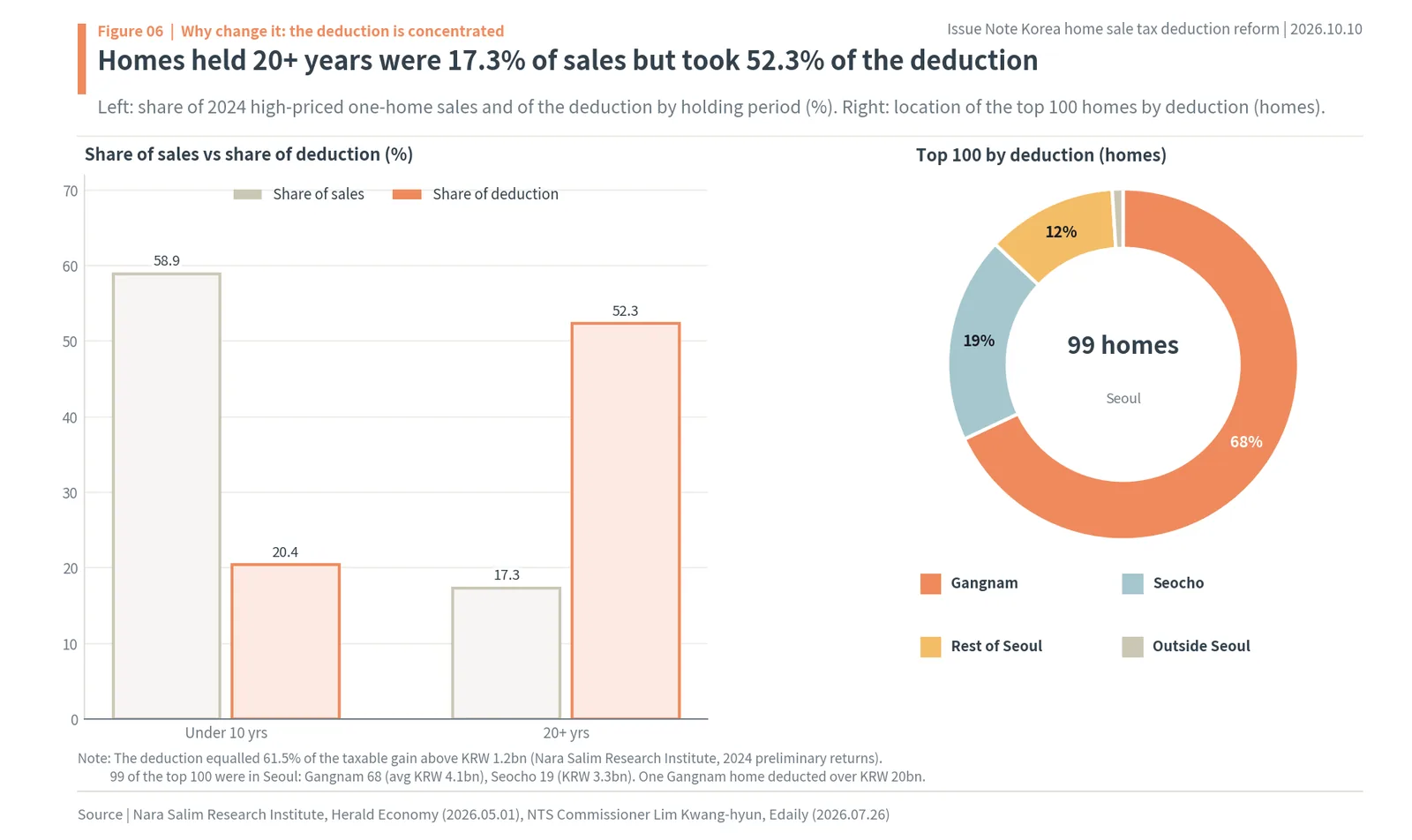
The government’s complaint is right on the numbers. In 2024, 24,816 one-home households that sold for more than KRW 1.2bn deducted KRW 5.032tn, 90% of it in Seoul, and 78.6% of Seoul’s share went to the Gangnam 3 (Gangnam, Seocho and Songpa, Seoul’s three priciest districts) plus Yongsan. By the Nara Salim Research Institute’s analysis, homes held over 20 years were only 17.3% of sales but took 52.3% of the deduction. The deduction piled up on expensive homes held long and risen far, and many of those homes were not lived in by their owners.
The problem is timing. The same home at the same price is taxed under today’s rules if sold in 2027 and under the new rules if sold in 2029. In the author’s hypothetical example, Mr. Kim, who bought a Jamsil 84 sq m apartment in 2010, lived there 5 years and then rented it out on jeonse, pays KRW 216mn (about $161,000) if he sells in 2027 and KRW 343mn (about $256,000) if he sells in 2029. That is a KRW 127mn (about $95,000) step over two years. Facing this step, long-term owners rushed to list, and Gangnam 3 listings rose by 5,408 (24.4%) in two months. The share of sellers who had owned for over 10 years also rose from 36% early in the year to 42%.
Past the step, the opposite happens. Korean tax law treats an inherited home’s cost basis as its market value on the date of inheritance, so if the owner holds on and passes the home on, the gain built up during the owner’s lifetime never faces capital gains tax. Once the gap between paying KRW 343mn to sell after 2029 and holding on to pass the home on grows wide, older long-term owners stop selling. The same structure was at work in 2018, when Gangnam-gu deals fell 75.1% in two weeks after the multi-home surcharge and gifts rose to the most on record.
So the author thinks the first step is a period split that applies the new rules only to holding and residence years built up after 2027. Applied to Mr. Kim, the 2029 tax is KRW 223mn, just KRW 7mn more than in 2027, and the KRW 127mn step disappears. The burden on expensive homes the owner does not live in is better collected while they are owned than when they are sold. Holding taxes are only 29.4% of Korea’s property taxes, about half the OECD average of 56.0%. This report follows the chain to that conclusion link by link: the rules, the math, the market, history, other countries, the National Assembly and stocks.
1. Key terms: Korea’s one-home capital gains tax, the long-term holding deduction, the cap and inherited cost basis
One-home capital gains tax applies only to the part above KRW 1.2bn
First, the terms that come up throughout this report. The capital gain is the sale price minus the purchase price, and capital gains tax is the tax on that gain. A one-home household pays no tax if the sale price is KRW 1.2bn (about $896,000) or less. Above that, only the share of the gain that corresponds to the part above KRW 1.2bn is taxed, calculated as “gain × (sale price minus KRW 1.2bn) ÷ sale price” (National Tax Service). For a KRW 3bn home, only 60% of the gain is taxed. The KRW 1.2bn line was raised from KRW 900mn for sales from December 8, 2021.
The long-term holding special deduction then takes a further percentage off that taxable gain because the home was held for a long time. Today a one-home household that has held for over 3 years and lived there for over 2 years gets 4% for each year held (40% at 10 years) and 4% for each year lived (40% at 10 years), up to 80% combined. If the owner lived there less than 2 years, the general deduction table applies instead, starting at 6% for 3 years and rising 2% a year to a maximum of 30% at 15 years or more. The one-home maximum of 80% has run without a cap since 2009.
Tax rates rise with the tax base from 6% to 45%: 6% up to KRW 14mn, 15% up to KRW 50mn, 24% up to KRW 88mn, 35% up to KRW 150mn, 38% up to KRW 300mn, 40% up to KRW 500mn, 42% up to KRW 1bn and 45% above KRW 1bn (National Tax Service rate table). When the deduction shrinks and the tax base grows, more of it falls into higher brackets, so the tax rises faster than the deduction falls. Every tax figure in this report is national tax computed directly from this rate table and the KRW 2.5mn basic deduction.
Other terms used in this report
The deduction cap is the most one person can deduct in one year for one home. Today there is no cap, so the bigger the gain, the bigger the deduction. The inherited cost basis is the amount treated as the “purchase price” when an heir later sells, and it is set at the market value on the date of inheritance (Income Tax Act Enforcement Decree Art. 163(9)). Holding taxes are the property tax and the comprehensive real estate tax paid every year while a home is owned; transaction taxes are the acquisition tax and capital gains tax paid on a purchase or sale. A period split is what this report calls applying the old deduction rates to the years built up before the reform and the new rates to the years after it, in proportion.
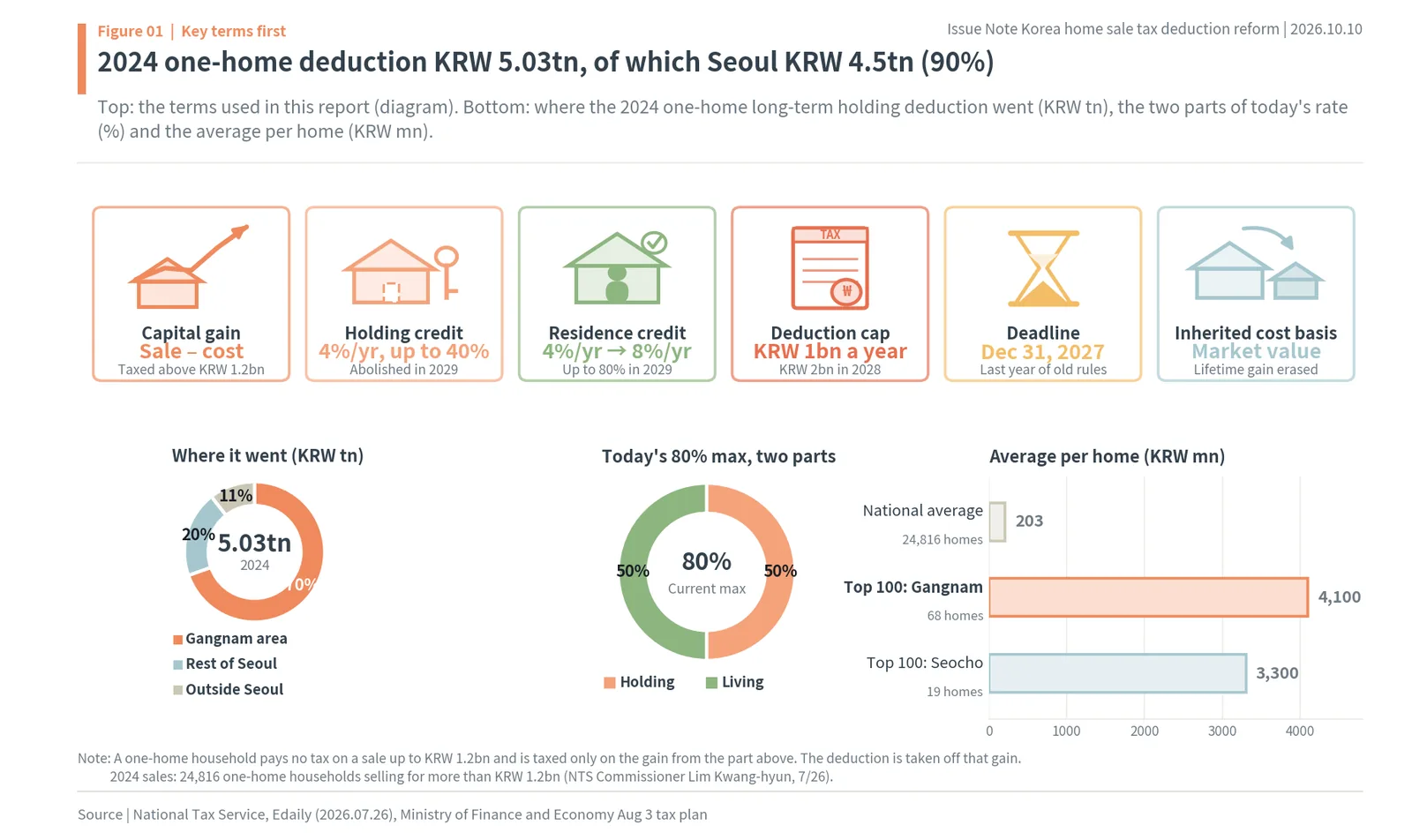
In 2024 this deduction took KRW 5.03tn (about $3.76bn) off gains, of which Seoul accounted for KRW 4.5tn, or 90% (NTS Commissioner Lim Kwang-hyun). The average per home was about KRW 203mn, but the 68 Gangnam-gu homes among the top 100 by deduction averaged KRW 4.1bn (about $3.06mn) each, and the 19 in Seocho-gu averaged KRW 3.3bn. Figure 1 puts this report’s terms into one picture and shows where the deduction went. The issue, in the end, is shifting a tax discount for long-held homes toward the years the owner actually lived there.
2. A Jamsil example: KRW 216mn in 2027 vs KRW 343mn in 2029
Hypothetical Mr. Kim’s Jamsil 84 sq m
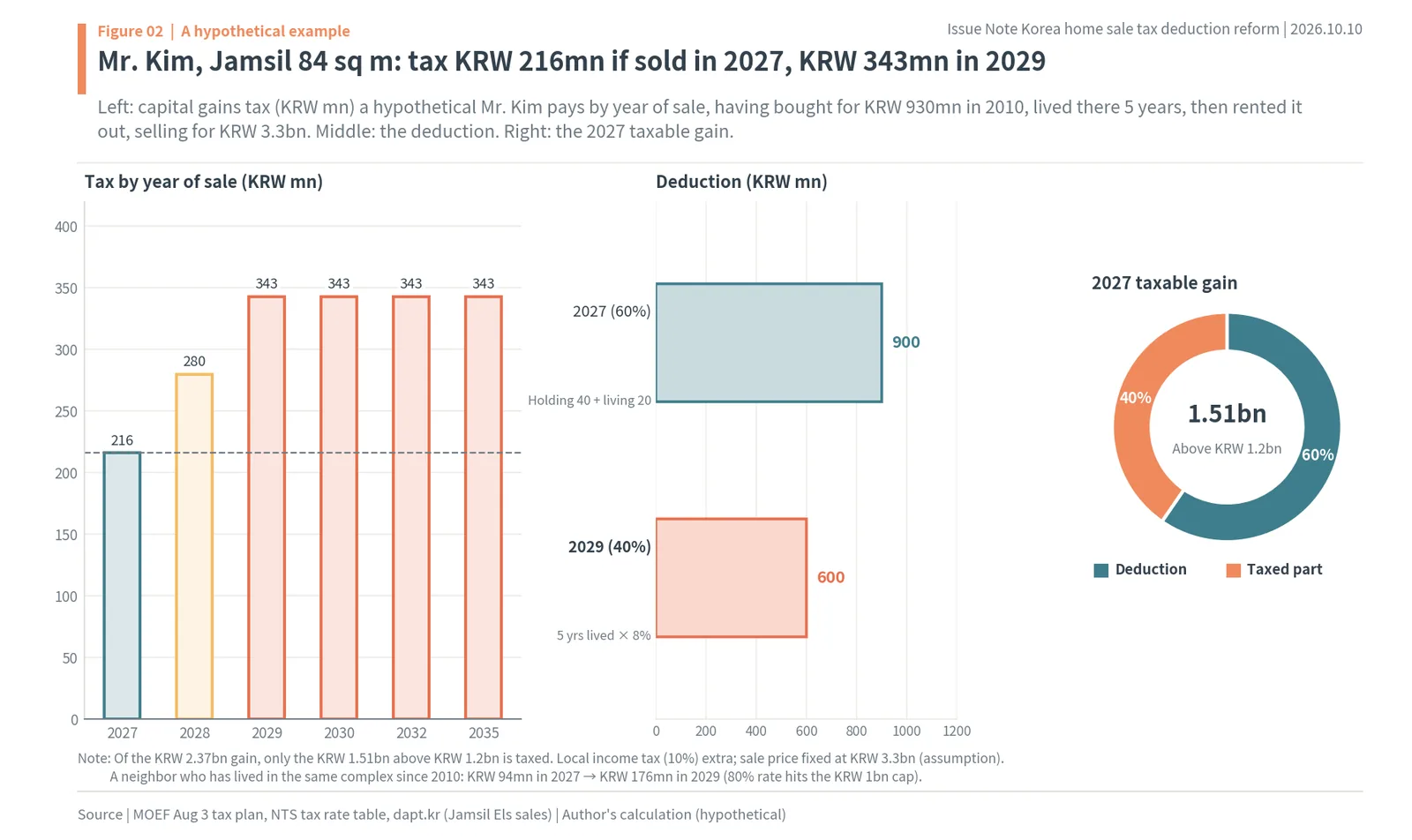
Shrink the rules down to a single home (hypothetical, author’s calculation). Mr. Kim bought an 84 sq m apartment in Jamsil, a Songpa neighborhood, for KRW 930mn in 2010 and lived there for 5 years until 2015. He then moved elsewhere for work and rented it out on jeonse, Korea’s lump-sum deposit lease. KRW 930mn matches the 2010 average sale price of KRW 927mn for an 84 sq m unit at Jamsil Els, and the 2026 average for the same size is KRW 3.332bn (dapt.kr). The home’s current value is set at KRW 3.3bn (about $2.46mn), and the example assumes it sells for KRW 3.3bn whenever he sells. The point is to see only how the tax changes with the year of sale while the price stays put.
The gain is KRW 3.3bn minus KRW 930mn, or KRW 2.37bn. Multiplying by the share above KRW 1.2bn leaves a taxable gain of KRW 1.51bn. Selling in 2027, he has held for 17 years, so the holding credit hits its 40% ceiling, and 5 years lived adds 20%, 60% in all, a deduction of KRW 900mn. Applying the rates to what is left gives capital gains tax of KRW 216mn. Selling in 2028, the holding credit shrinks to its 20% ceiling and residence becomes 5 years × 6% = 30%, a 50% rate and tax of KRW 280mn.
From 2029 there is no holding credit, and only 5 years lived × 8% = 40% is left. The deduction falls to KRW 600mn and the tax rises to KRW 343mn. Selling in 2030, 2032 or 2035 makes no difference, because the years lived do not grow, so the tax stays at KRW 343mn. Same home, same price, and crossing December 31, 2027 costs KRW 127mn more. For Mr. Kim, that day is a KRW 127mn deadline.
How the calculation works
Follow the tax steps with Mr. Kim’s numbers (author’s calculation). First, the taxable gain is KRW 2.37bn × (KRW 3.3bn minus KRW 1.2bn) ÷ KRW 3.3bn, or KRW 1.508bn. Second, the 2027 deduction is 60% of KRW 1.508bn, KRW 905mn, and the 2029 deduction is 40%, KRW 603mn. Third, subtracting the deduction and the KRW 2.5mn basic deduction from the gain gives a tax base of KRW 601mn in 2027 and KRW 902mn in 2029. Fourth, both tax bases fall in the bracket above KRW 500mn up to KRW 1bn, so the tax is 42% of the base minus a progressive deduction of KRW 35.94mn.
So the gap between the 2027 and 2029 taxes equals the KRW 301mn increase in the tax base times 42%. A KRW 300mn smaller deduction means KRW 127mn more tax. Adding the 10% local income tax, what Mr. Kim actually pays is KRW 238mn in 2027 and KRW 377mn in 2029. Measured against the KRW 2.37bn gain, his real burden rises from 9.1% in 2027 to 14.5% in 2029. The same calculation applied to the government’s own example gives the same figures the government announced, so every other tax in this report uses the same formula.
A neighbor who stayed also hits the cap
What about a neighbor in the same complex who has lived there continuously since 2010? The neighbor keeps the 80% rate in both 2027 and 2029. But 80% of the KRW 1.51bn taxable gain is more than KRW 1bn, so in 2029 it runs into the KRW 1bn cap. The neighbor’s tax therefore also rises, from KRW 94mn in 2027 to KRW 176mn in 2029. The government said it would protect owners who live in their only home, but for a Gangnam home in the KRW 3bn range, even an owner who has lived there for more than a decade is affected by the cap.
The left panel of Figure 2 shows Mr. Kim’s tax by year of sale, the middle panel his 2027 and 2029 deductions, and the right panel how the 2027 taxable gain of KRW 1.51bn splits into the deduction and the part that is taxed. The bars climb one step in 2028 and another in 2029, then go flat: that is the shape of this reform. This step explains both the listing rush and the lock-in in the later parts of this report.
3. What changes in 2028 and 2029: residence only, a KRW 1bn cap
Deduction rates: current rules in 2027, a halfway year in 2028, residence only from 2029
The government plan’s schedule has three stages. Through 2027 the current rules stay for one more year. In 2028 the rate is 2% a year for holding (up to 20%) plus 6% a year for residence (up to 60%), and from 2029 the holding credit is dropped, leaving only 8% a year for residence (Newspim, Tax & Finance News). Ten years lived still earns 80% in 2029, so the maximum is unchanged; what shrinks is the share for years owned but not lived in. The name also splits: for homes and union members’ move-in rights it becomes the “long-term residence income deduction,” and for land, shops and other property that is not a home it becomes the “long-term holding income deduction” (SBS).
Deputy Prime Minister Koo Yun-cheol said on the day of the announcement that “years not lived in will be excluded from the deduction” and that “one-home households who live in their home will be protected as much as possible, with up to 80% over 10 years as now.” In the September 11 interpellation session he said “housing policy should not reward holding” and “it is time to make people feel the burden on capital gains,” and added that an alternative was being prepared to count years away for reasonable causes such as work or schooling as residence (Edaily). The government plan already counts up to 3 years away, after living there for at least a year, for schooling, work, medical treatment or a posting abroad as residence.
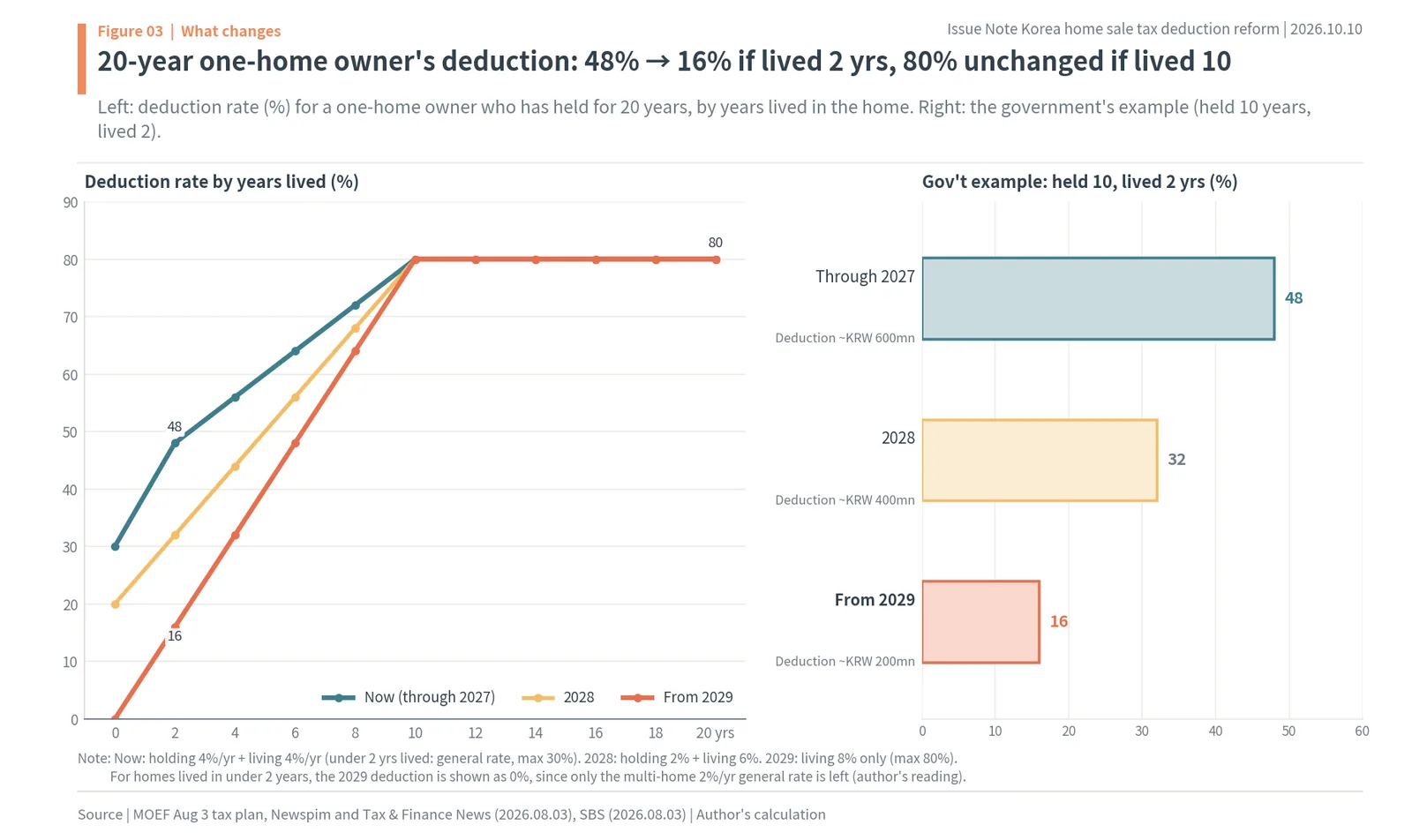
The left panel of Figure 3 plots the deduction rate for a one-home owner who has held for 20 years, by years lived. Under the current rules (teal), the 40% holding share is always there even if residence is short, so 2 years lived already gives 48%. Under the 2029 rules (red) there is no holding share, so 2 years gives 16% and 4 years 32%, rising in proportion to years lived. All three lines meet at 80% at 10 years. The right panel is the government’s example (10 years held, 2 years lived): the rate falls from 48% to 32% and then 16%, and the deduction from about KRW 600mn to KRW 400mn and KRW 200mn. A home held 15 years and lived in for 5 falls from 60% to 50% and 40% (Newspim).
For a one-home owner who lived there less than 2 years, the details of the government plan change the 2029 deduction to “2% a year for residence only,” like the general deduction for multi-home owners. With no residence there is effectively no deduction, so the 2029 line in the chart starts at 0% at 0 years (author’s reading). Multi-home owners today get 2% a year for holding, up to 30%; in 2028 they get the better of 1% a year for holding or 2% a year for residence, and from 2029 only 2% a year for residence. Multi-home owners in regulated areas still get no deduction, as now.
The government’s example: tax on a KRW 7.5bn home rises 4.3 times
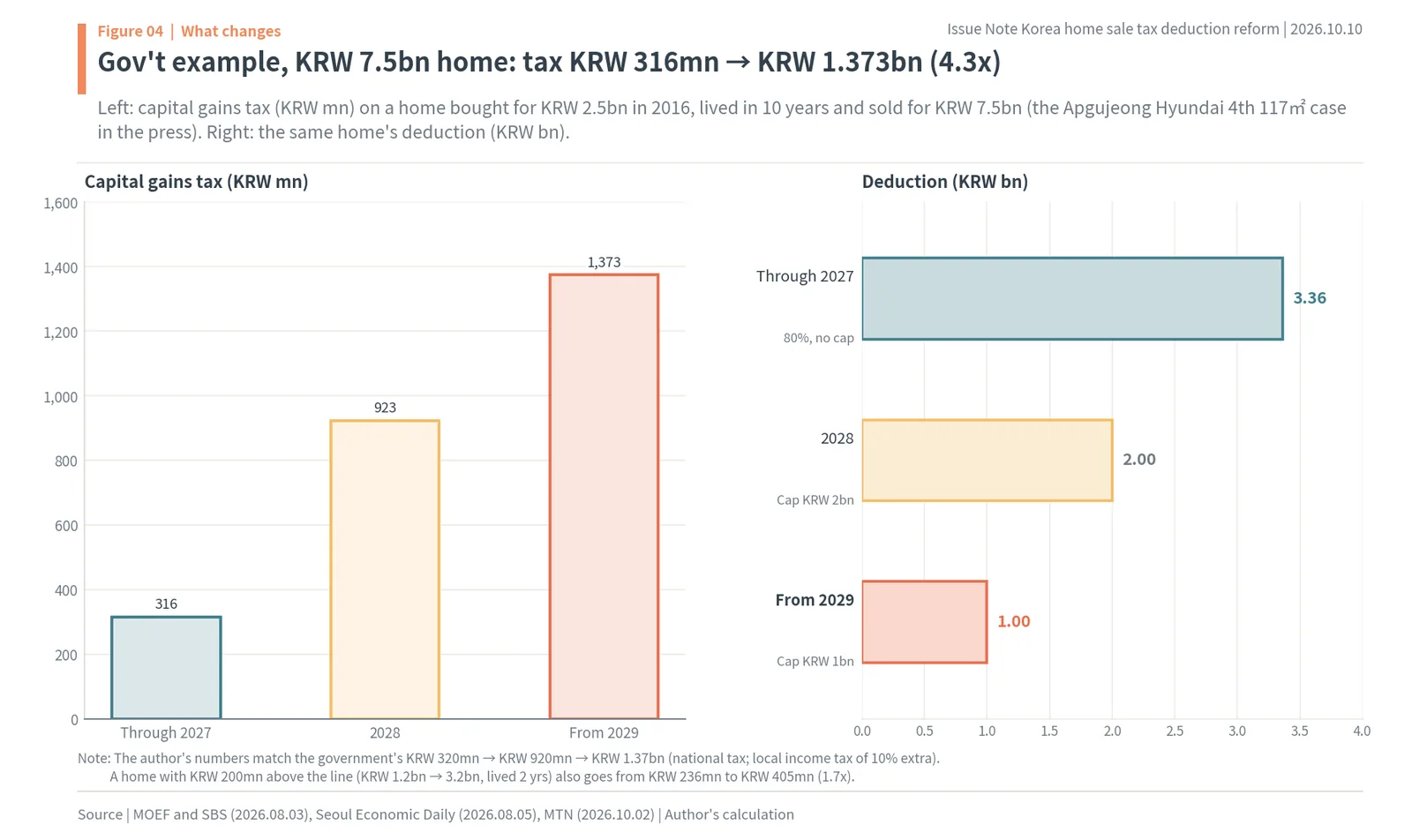
The government’s own example is a one-home owner who bought for KRW 2.5bn in 2016, lived there 10 years and sold for KRW 7.5bn (about $5.60mn). The press reported it as an Apgujeong Hyundai 4th complex 117 sq m unit (Seoul Economic Daily, MTN). Having lived there 10 years, the owner keeps the 80% rate. But 80% of the KRW 4.2bn taxable gain is KRW 3.36bn, so the deduction runs into the KRW 2bn cap in 2028 and the KRW 1bn cap in 2029. As a result, capital gains tax goes from KRW 316mn to KRW 923mn and then KRW 1.373bn (about $1.03mn), 4.3 times as much.
The author computed this report’s taxes directly from the National Tax Service rate table and the government plan’s rates and caps, and first checked that this example gives the same figures the government announced (KRW 320mn, then KRW 920mn, then KRW 1.37bn). The government’s figures exclude the local income tax, so this report uses the same basis. With the 10% local income tax added, the amount actually paid is 1.1 times each figure.
The government’s second example is a home bought for KRW 1.2bn and sold for KRW 3.2bn, held 10 years and lived in for 2. Of the KRW 2bn gain, KRW 1.25bn is taxable; as the rate falls from 48% to 32% and 16%, the tax goes from KRW 236mn to KRW 320mn and then KRW 405mn. This home’s tax rises 1.7 times, not because of the cap but because the residence was short. Figure 4 sets the first example’s tax and deduction side by side.
The cap starts to bind for Gangnam homes in the KRW 3bn range
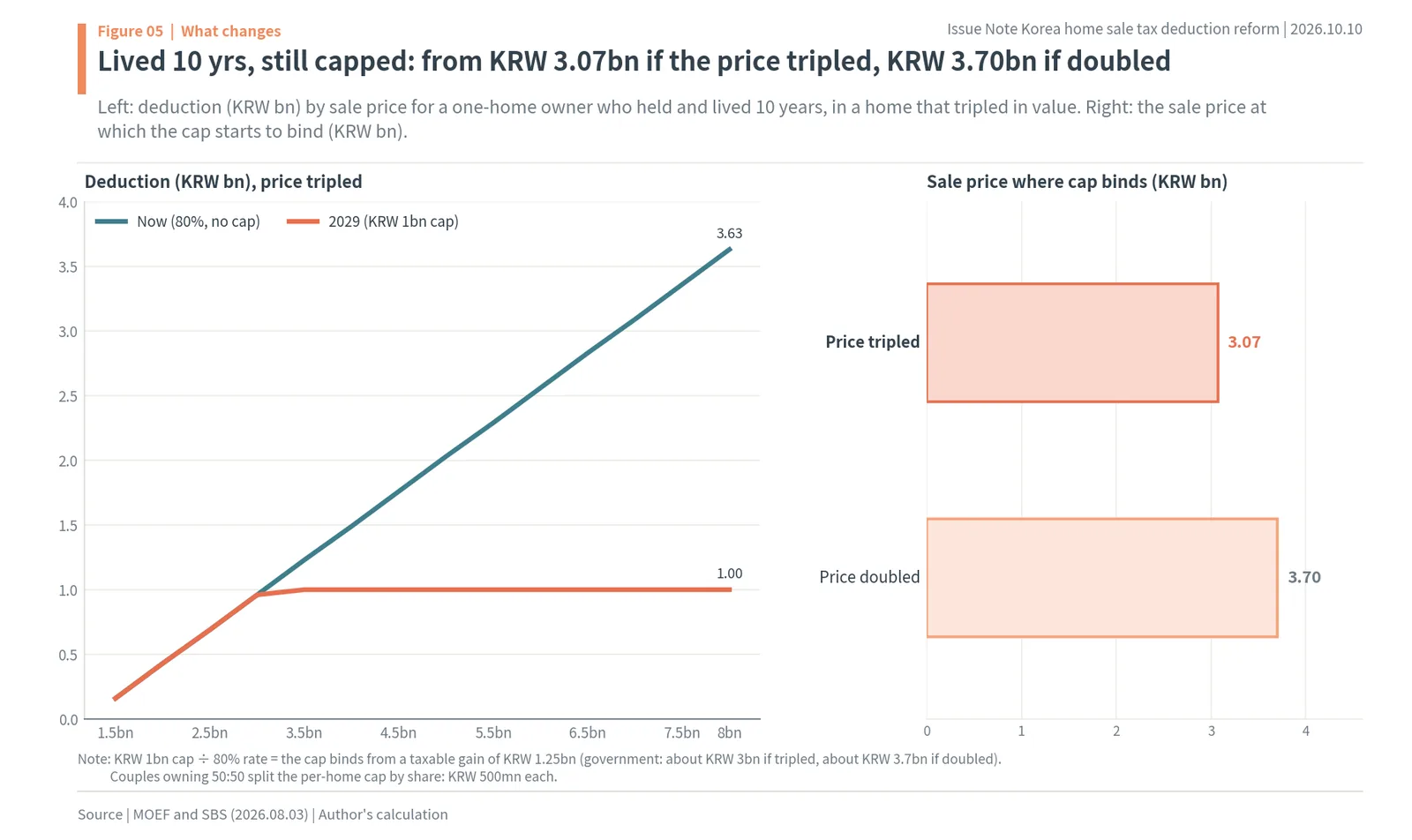
The line at which the cap binds is easy to compute. At an 80% rate, the deduction reaches KRW 1bn when the taxable gain is KRW 1.25bn. Since the taxable gain is “gain × (sale price minus KRW 1.2bn) ÷ sale price,” a home lived in for 10 years reaches that line at a sale price of KRW 3.07bn if its value tripled and KRW 3.70bn if it doubled (author’s calculation). That matches the government’s explanation (about KRW 3bn if tripled, about KRW 3.7bn if doubled). Cho Man-hee, the ministry’s head of tax policy, explained that people who sell for around KRW 3bn after a threefold rise or less will not hit the KRW 1bn cap, and that high-value sellers at KRW 4bn or KRW 5bn will.
The left panel of Figure 5 plots the deduction by sale price for a home lived in for 10 years whose value tripled. Under the current rules the deduction rises in a straight line with the sale price, reaching KRW 3.63bn at KRW 8bn, while under the 2029 rules it hits KRW 1bn in the KRW 3bn range and rises no further. If a couple owns the home 50:50, the per-home cap is split by share, KRW 500mn each. So even a home lived in for more than 10 years pays more tax from the KRW 3bn range in Gangnam. Many apartments of 84 sq m or more in Jamsil, Banpo and Apgujeong sit in this range.
The government plan also spells out how residence is counted. After living there continuously for at least a year, years away for schooling, work circumstances or medical treatment in another city or county, for study or work abroad, or to care for parents aged 60 or over count as residence for up to 3 years. For redevelopment and reconstruction homes, if the owner lived there for at least a year before the management and disposal approval, half the construction period counts as residence. These counts apply only when computing the long-term residence deduction rate, not to the 2-year residence requirement for the tax exemption (Newspim). The long-term holding deduction for non-business land, which is not housing, ends for sales from January 1, 2028 (Korea Tax Times).
The plan includes other measures too. For a one-home owner who has lived there over 10 years and sells for KRW 3bn or less, the basic capital gains deduction rises from KRW 2.5mn to KRW 25mn (about $18,700) from 2027. If someone aged 65 or over sells a home in the Seoul metropolitan area and moves outside it, the tax is cut by 50% (up to KRW 500mn) for 2027 sales and by 30% (up to KRW 300mn) for 2028 sales. The deadline for disposing of a temporary second home in a regulated area was shortened from 3 years to 2 (Korea Tax Times). The deduction overhaul was not among the seven items the government revised on September 1, so it went to the National Assembly as announced (Financial News).
4. Why change it: 52.3% of the deduction went to homes held 20+ years
24,816 homes deducted KRW 5.032tn
Start with the numbers behind the government’s reason for changing the rules. According to data released by NTS Commissioner Lim Kwang-hyun on July 26, the 24,816 one-home households that sold for more than KRW 1.2bn in 2024 received long-term holding deductions totalling KRW 5.032tn. Seoul accounted for about KRW 4.5tn, or 90%, and the four districts of the Gangnam 3 plus Yongsan for about KRW 3.5tn, 78.6% of Seoul’s share. Of the top 100 homes by deduction, 99 were in Seoul; the 68 in Gangnam-gu deducted an average of KRW 4.1bn each and the 19 in Seocho-gu an average of KRW 3.3bn. One Gangnam home deducted more than KRW 20bn (about $14.9mn). The commissioner called it “the ultimate in regressivity.”
The Nara Salim Research Institute’s breakdown of the same year’s preliminary returns by holding period shows the direction of the concentration even more clearly. Homes sold within 10 years were 58.9% of sales but received only 20.4% of the deduction. Homes held over 20 years were 17.3% of sales but took 52.3% of it. The gain per sale for homes held 20 years or more was KRW 1.703bn, 3.2 times the KRW 530mn for homes held under 10 years. The deduction came to 61.5% of the taxable gain (the part above KRW 1.2bn) (Herald Economy).
The deduction told owners to hold one home for a long time
This concentration comes from the design. The holding credit builds up at 4% a year just for owning, even without living there, and has no cap, so the longer one holds a home that has risen a lot, the bigger the deduction. The bigger the gain, the more of it sits in high brackets, so each won of deduction saves more tax. When the commissioner wrote that “the system is encouraging people to own one smart home,” this is the structure he meant. Cho Man-hee also explained that “with up to 80% deductible and no cap, even people with gains of KRW 5bn or KRW 10bn benefited, and there was a lot of criticism on tax fairness grounds that the benefit was excessive” (SBS).
The left panel of Figure 6 sets each holding period’s share of sales next to its share of the deduction. The gray bars (sales) and coral bars (deduction) cross: under 10 years the deduction is about a third of the sales share, and at 20 years or more it is more than three times. The right panel shows the districts of the top 100 deductions. The government’s point that the deduction piles up on expensive homes held long and risen far, above all in Gangnam and Seocho, is borne out by the numbers. So this report agrees with the direction itself, moving the deduction toward residence and adding a cap, and examines how that direction is applied.
Civic groups point the same way. The Citizens’ Coalition for Economic Justice called the switch to long-term residence a stronger “incentive for living in the home” but said the 80% residence deduction and KRW 1bn cap were still large, and the People’s Solidarity for Participatory Democracy has proposed limiting long-term holding and senior deductions to 40% at most (Joseilbo, PSPD). What the government and civic groups both see as the problem is the deduction for “years owned without living there.” This report’s question is when, and for which years, that share should be cut.
5. Gangnam listings up 24.4%: the end-2027 tax deadline
When new rules rewrite past years, a deadline appears
The government plan applies the new rates from 2028 and 2029, but those rates do not apply only to the years ahead. If Mr. Kim, who bought in 2010, sells in 2029, the whole 19 years of holding already built up from 2010 to 2028 is recalculated under the new rules. So the same person selling the same home gets credit for all 19 years of holding if he sells by December 31, 2027, and loses much of it if he sells a day later. That is the day this report calls the “tax deadline.”
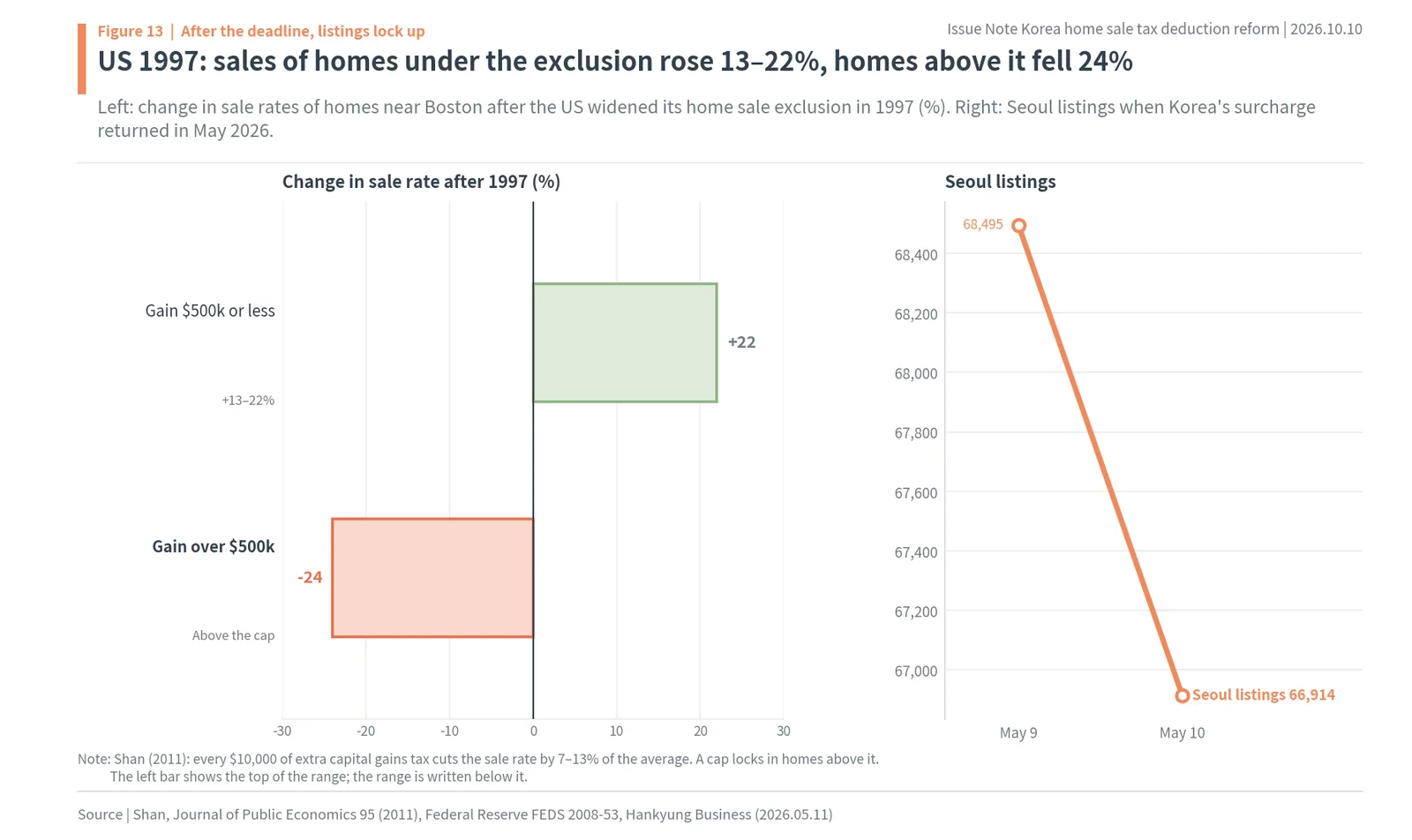
We have already seen several times what people do in front of a tax with a deadline. In April, ahead of May 9, 2026, when the grace period on the multi-home capital gains surcharge ended, applications for Seoul apartment land transaction permits (since October 2025 a buyer anywhere in Seoul needs city approval) reached 8,896, the most this year, and from May 1 to 8 they ran at 818 per weekday (Seoul City, Hankyung Business). Conversely, in the single day after the surcharge returned on May 10, Seoul listings fell by 1,581, from 68,495 to 66,914. Right before a tax rises, sellers crowd in; right after it rises, listings drain away.
Gangnam 3 listings rose every week for two months
What happened in the Gangnam 3 after the August 3 plan follows this pattern exactly. By Asil’s count, apartment listings for sale in Gangnam, Seocho and Songpa were 22,182 on August 3. They rose without a single drop: 23,771 on August 12, 24,504 around August 20, 25,549 on August 27 and 26,268 on September 3, reaching 27,590 on October 1. That is up 5,408 (24.4%) in two months and 57.4% above the 17,528 of a year earlier (Herald Economy, Maeil Business, The Guru, Economist).
By district, Gangnam rose from 9,453 to 11,682 (23.6%), Seocho from 7,630 to 9,555 (25.2%) and Songpa from 5,099 to 6,353 (24.6%), an even increase across all three. What matters is that listings rose first and most in the three districts where the deduction was most concentrated. Over the same period listings across Seoul rose 19.8%, from 60,409 on August 3 to 72,387 on September 23, and 51% of the increase in Seoul listings through August 27 came from the Gangnam 3 (Maeil Business). Figure 7 shows the path of Gangnam 3 listings and the increase by district.

Only Gangnam prices fell
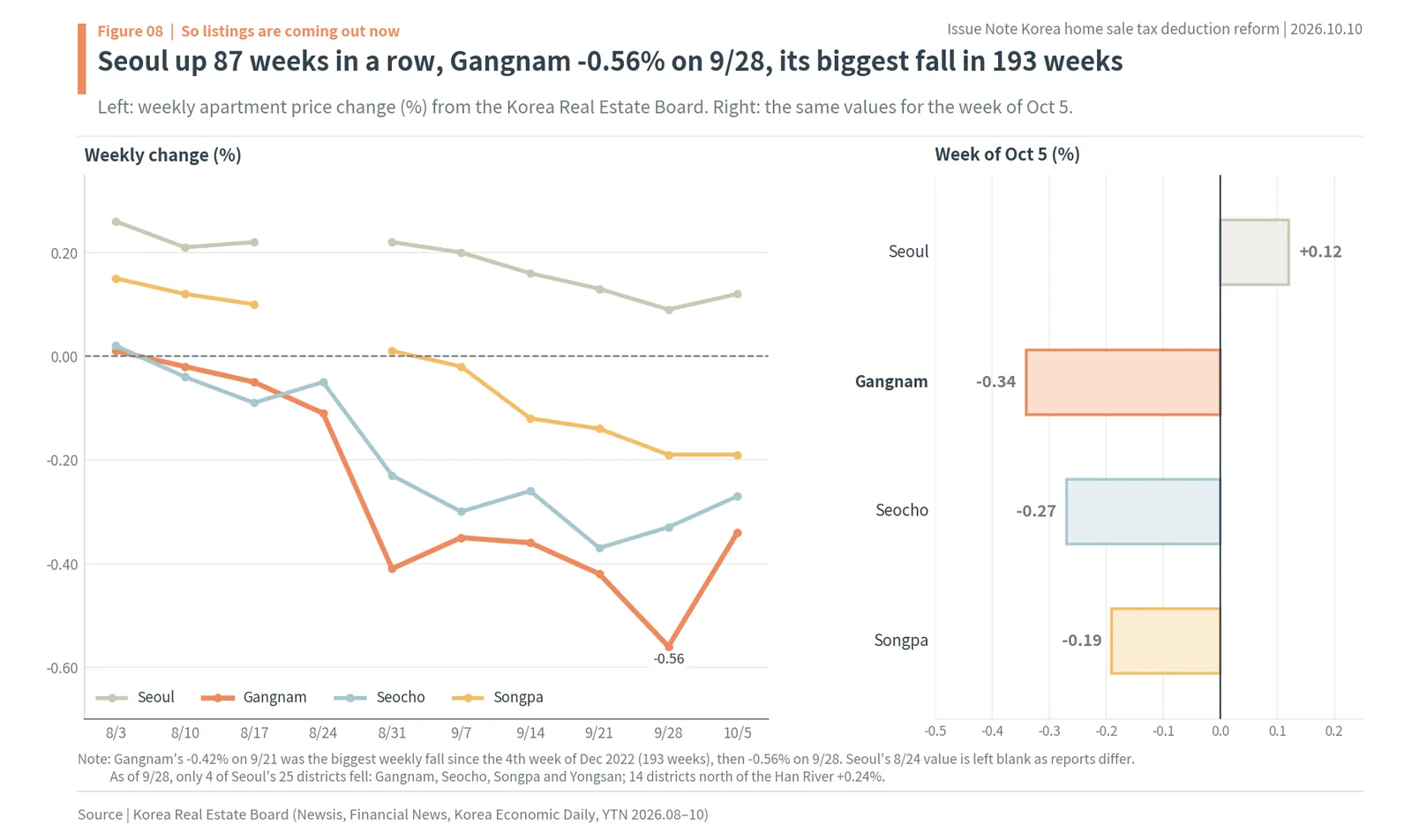
Prices moved the same way. In the Korea Real Estate Board’s weekly data, Gangnam-gu apartment prices were flat at +0.01% in the week of August 3, started falling from the week of August 10, and fell further to -0.41% in the week of August 31. The -0.42% in the week of September 21 was the biggest fall in 193 weeks, since the fourth week of December 2022, and the week of September 28 saw -0.56%. Seocho posted -0.37% in the week of September 21, its biggest fall in 192 weeks, and Songpa, after turning negative for the first time in the week of September 7, fell as far as -0.19% (Financial News, Korea Economic Daily).
Over the same period Seoul apartment prices as a whole kept rising, for an 87th straight week through the week of October 5. As of September 28, only four of Seoul’s 25 districts fell: Gangnam, Seocho, Songpa and Yongsan, while the 14 districts north of the Han River rose an average of +0.24%. That only the four districts where the deduction was concentrated fell while Seoul rose reads as a sign that this move tracked the tax schedule hanging over these areas rather than the general direction of Seoul home prices. In the week of October 5 the falls narrowed to -0.34% in Gangnam and -0.27% in Seocho, with Seoul at +0.12% (YTN). Figure 8 shows the four weekly series.
Long-term owners sell while buyers wait
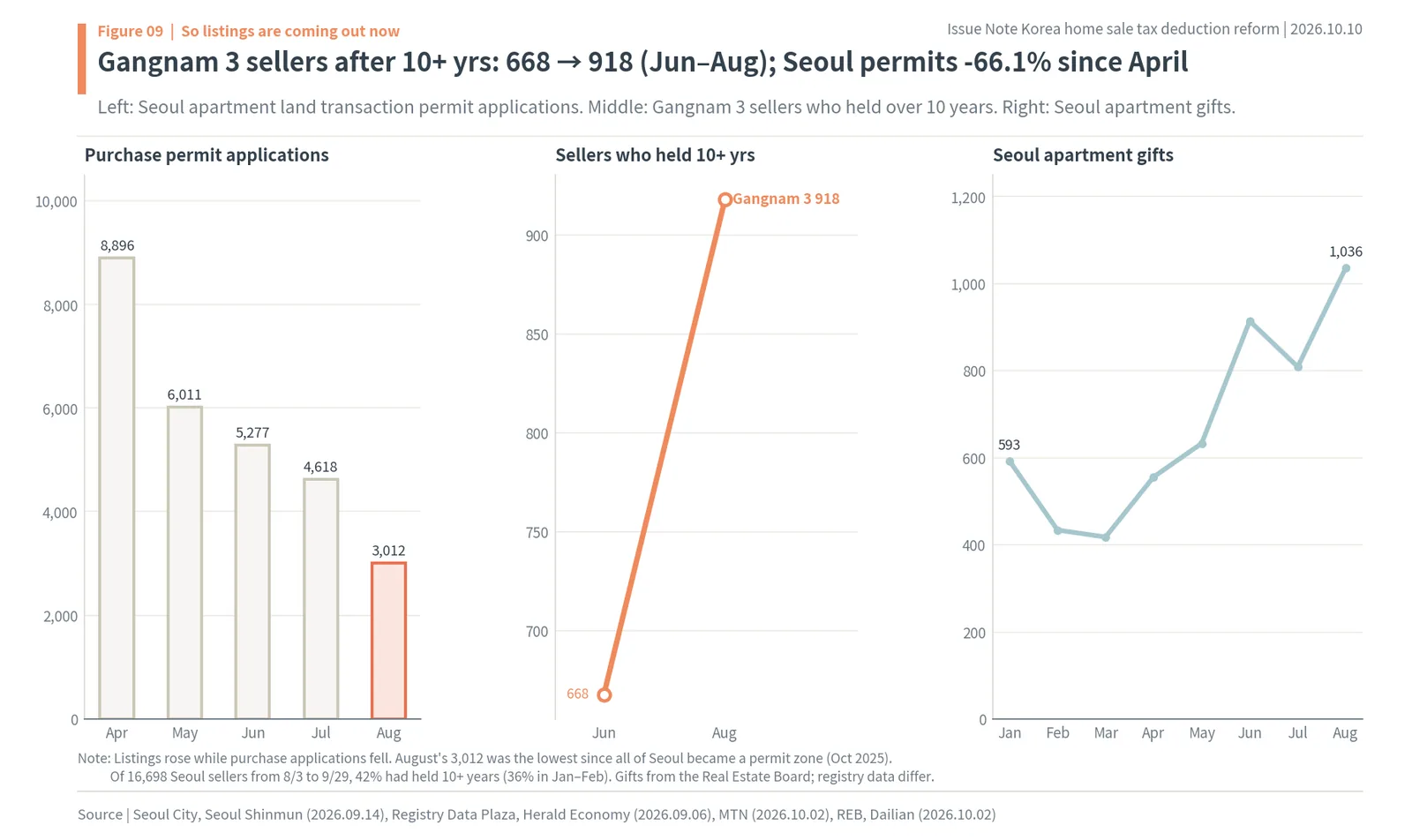
Who is selling has changed too. In Registry Data Plaza data (the court registry’s open data), of the 16,698 people who sold multi-unit buildings in Seoul from August 3 to September 29, 6,958, or 42%, had owned for over 10 years. That is 6 points above the 36% of January and February (MTN). Gangnam 3 sellers who had held for over 10 years rose from 668 in June to 799 in July and 918 in August, up 37.4% in three months (Herald Economy, author’s calculation). The share of Gangnam 3 sellers who had held for over 10 years had already risen from 31.23% in 2021 to 43.8% in the first quarter of 2026.
The buying side moved the other way. Seoul apartment land transaction permit applications fell from 8,896 in April to 6,011 in May, 5,277 in June and 4,618 in July, then 3,012 in August, down 66.1% from April (author’s calculation). That is the lowest since all of Seoul became a land transaction permit zone in October 2025. Applications in the Gangnam 3 halved from a weekly average of 143 before the announcement to 67 in the first week of August (Seoul City, Kukmin Ilbo). Gifts rose. By the Korea Real Estate Board’s count, Seoul apartment gifts in August were 1,036, up 126.7% from a year earlier and above 1,000 for the first time this year. Court registry gift applications in the same month fell to 766, so with the two series pointing in different directions, this report treats them as reference only.
In short, long-term owners are listing before the deadline while buyers step back and wait for the tax law to be settled. Listings pile up while deals shrink, and Gangnam prices fell first. Figure 9 puts land transaction permit applications, sellers who held over 10 years and gifts on one page.
The deadline is worth more the less one lived there and the pricier the home
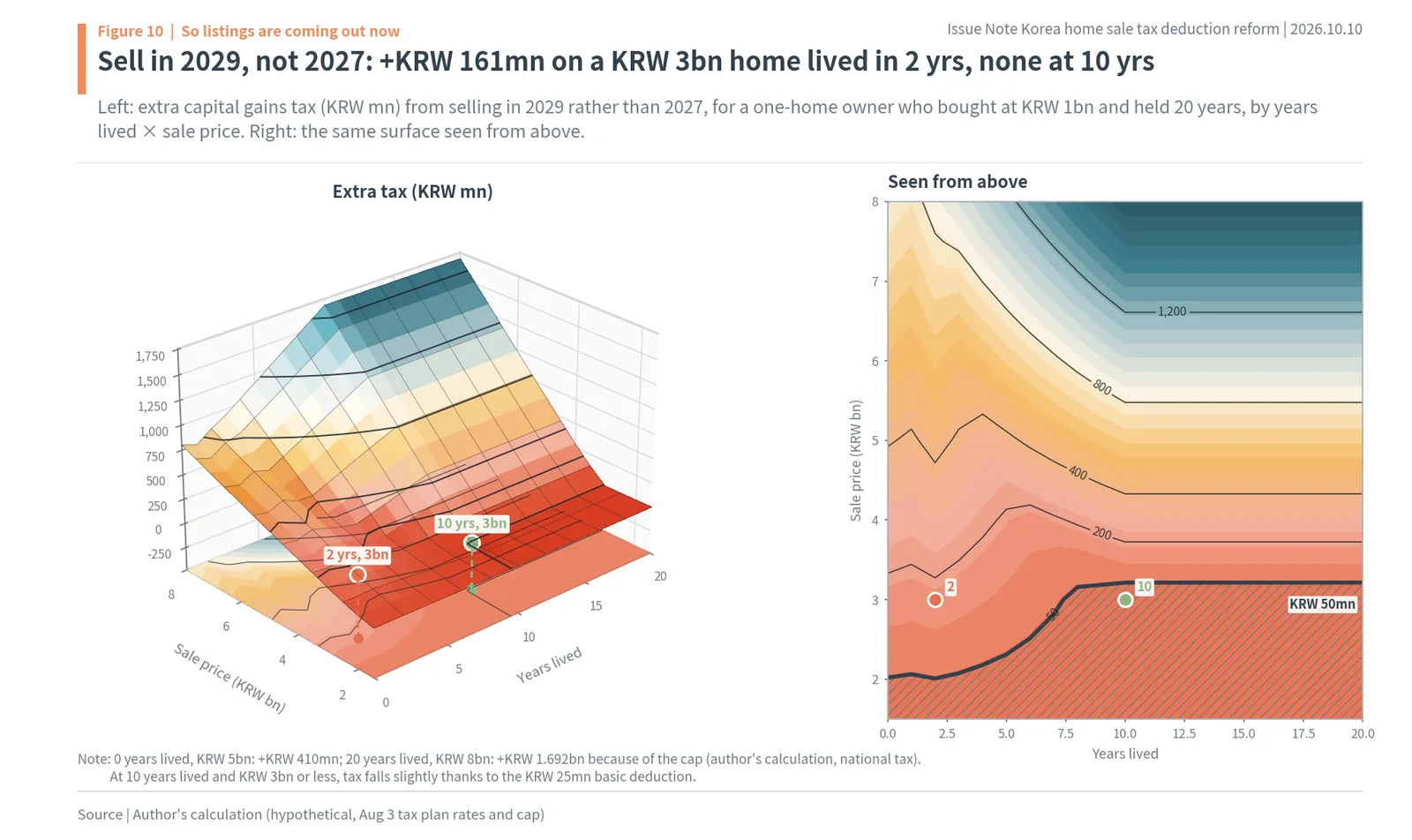
How much is the deadline worth for each home? The author drew a surface of the difference between the tax on selling in 2027 and in 2029 for a one-home owner who bought for KRW 1bn and has held for 20 years, by years lived (0 to 20) and sale price (KRW 1.5bn to KRW 8bn) (author’s calculation). Lived 2 years and selling for KRW 3bn, the owner pays KRW 161mn more in 2029. Never lived there and selling for KRW 5bn, KRW 410mn more. Even after living there all 20 years, a KRW 8bn sale pays KRW 1.692bn more because of the KRW 1bn cap. Lived 10 years and selling for KRW 3bn or less, the 2029 tax actually falls slightly thanks to the KRW 25mn basic deduction.
The surface rises toward short residence (left) and high prices (back). Gangnam’s long-term owners who do not live in their homes sit at its highest point. So the signal to sell by the end of 2027 is strongest for them, and the places where listings actually rose are the places where they are concentrated. The right panel of Figure 10 is the same surface seen from above as contours. The hatched area, where the tax difference is under KRW 50mn, is clustered at 10 years or more lived and sale prices of KRW 3bn or less.
Widening the view to three landmark complexes
Extend the hypothetical example to actual complexes using real transaction prices (dapt.kr annual averages of Ministry of Land transaction records, author’s calculation). The owner is assumed to buy at the purchase year’s average and sell at the 2026 average, and the capital gains tax is computed for sales in 2027 and 2029, separately for 2 years and 10 years lived. The sale price is fixed at the 2026 level in both years, again to see only how much the tax changes while the price stays the same.
Acro River Park 84 sq m in Banpo went from a 2016 average of KRW 1.907bn to KRW 5.564bn in 2026. Bought in 2016 and lived in for only 2 years, it pays KRW 604mn in 2027 and KRW 1.017bn in 2029. Even with 10 years lived, the tax rises by KRW 570mn, from KRW 204mn in 2027 to KRW 774mn in 2029. The 80% rate is unchanged, but the taxable gain is so large that it runs hard into the KRW 1bn cap. At this complex, “protecting owners who live in their only home” does not work in front of the cap.
Eunma 76 sq m in Daechi went from a 2006 average of KRW 972mn to KRW 3.297bn in 2026. With 2 years lived, the tax rises from KRW 286mn to KRW 492mn; with 10 years lived, from KRW 91mn to KRW 165mn. Jamsil Els 84 sq m went from a 2008 average of KRW 857mn to KRW 3.332bn in 2026; with 2 years lived, from KRW 309mn to KRW 532mn, and with 10 years lived, from KRW 100mn to KRW 208mn. At all three complexes the deadline is worth something in the KRW 200mn to 400mn range for an owner who lived there 2 years, and KRW 70mn to 570mn even for one who lived there 10 years.
Applying a period split to the same homes, the 2029 tax is KRW 636mn for Acro River Park with 2 years lived, KRW 295mn for Eunma and KRW 319mn for Jamsil Els, almost the same as in 2027. With 10 years lived, all three complexes match their 2027 figures. The landmark complexes confirm both points: the size of the deadline varies by hundreds of millions of won with price and years lived, and that gap almost disappears under a period split.
Owners building up residence years take back their jeonse homes
Selling is not the only option for owners facing the deadline. From 2029 the deduction builds up only at 8% a year of residence, so an owner who now rents a home out on jeonse can raise the future deduction by moving in. If Mr. Kim lives there 5 more years from 2029, he reaches 10 years lived and his rate returns to 80%. Hence warnings that if owners of homes they do not live in move in, rental listings will shrink and rents will rise (Financial News, Seoul Economic Daily). Listings rising in the sale market and falling in the jeonse market are two moves that come from the same tax schedule.
This move too is proportional to the size of the deadline. The more an owner loses credit for past holding years, the faster the owner moves, whether by selling or by moving in. If past years were calculated under today’s rules, owners would only have to fit their future plans to the new rules, and taking back jeonse homes would also spread out over several years.
6. After 2029: inherited cost basis and the lock-in effect
Inheritance makes the capital gains tax on a lifetime’s gain disappear
An owner past the deadline has two paths left: pay more tax and sell, or keep the home and pass it on. Korean tax law treats an inherited asset’s cost basis as its assessed value at the start of inheritance, that is, its market value on the date of inheritance (Income Tax Act Enforcement Decree Art. 163(9)). A child who inherits a home a father bought for KRW 900mn when it is worth KRW 3.3bn counts KRW 3.3bn as the purchase price when later selling it. The gain of close to KRW 2.4bn built up during the father’s lifetime never faces capital gains tax. Inheritance tax applies whether the estate passes on as a home or as the proceeds of a sale, but capital gains tax applies only if the home is sold during the owner’s lifetime. So not selling and passing the home on saves the capital gains tax.
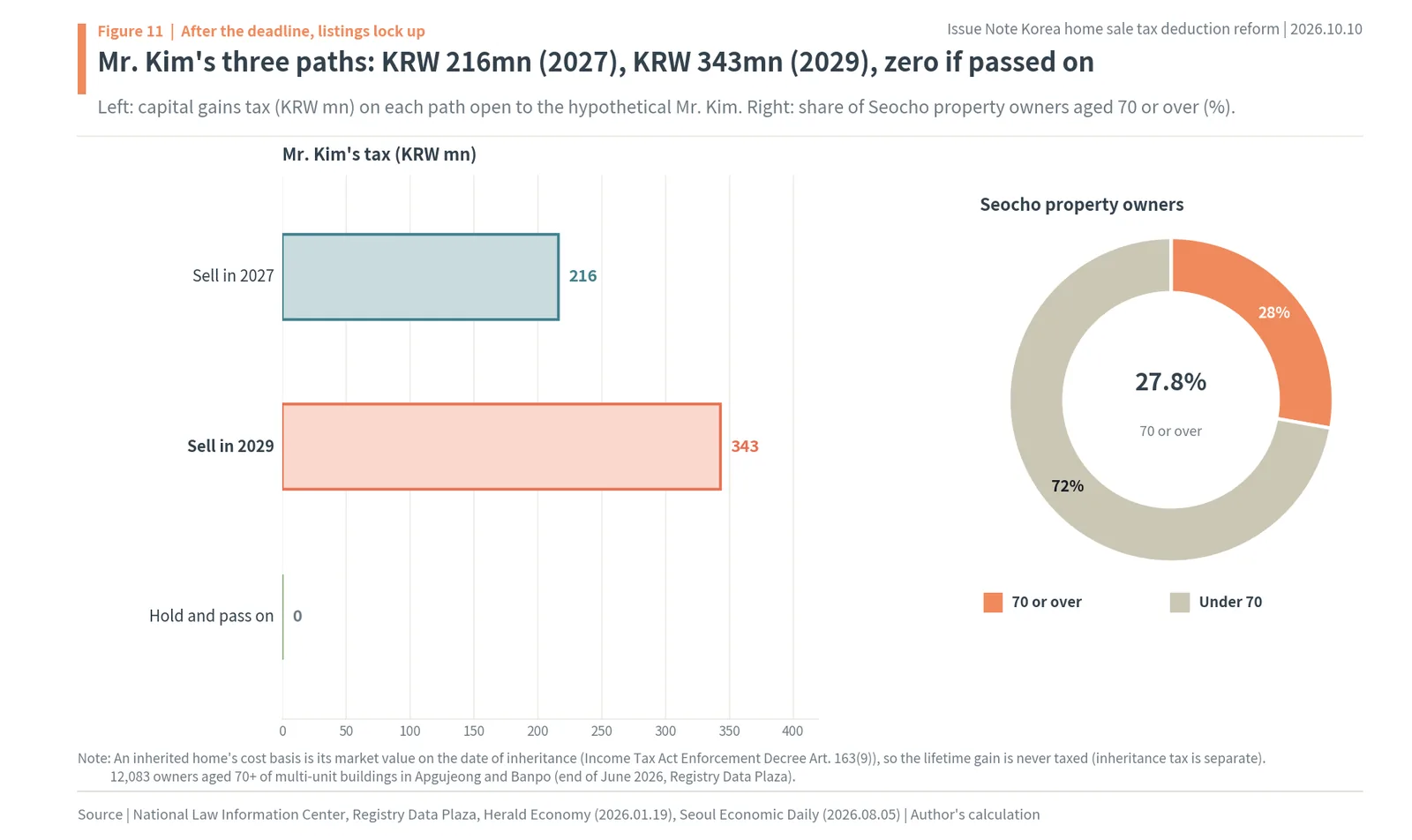
Lined up for Mr. Kim, the choice is clear. Selling in 2027 costs KRW 216mn, selling after 2029 costs KRW 343mn, and holding to the end and passing the home on costs zero capital gains tax. Before the deadline the gap between “selling now” and “holding on” is KRW 216mn; after it, KRW 343mn. As much as a seller after the deadline pays KRW 127mn more, the gain from not selling grows by the same amount. So after 2029, Gangnam’s older homes are more likely to pass to the next generation than to come onto the market.
Many people face this choice. In Seocho-gu, 27.8% of property owners are 70 or older, and in Gangnam-gu and Songpa-gu, 27.4% (Registry Data Plaza, December 2025). In just two neighborhoods, Apgujeong and Banpo, 12,083 owners of multi-unit buildings are in their 70s or older and 23,251 are 60 or older (end of June 2026). The more the deduction was concentrated in an area, the more older long-term owners it has, and for them inheritance is not far off. The left panel of Figure 11 shows Mr. Kim’s three paths and the right panel the age mix of Seocho owners.
The same thing happened in 2018 and 2022
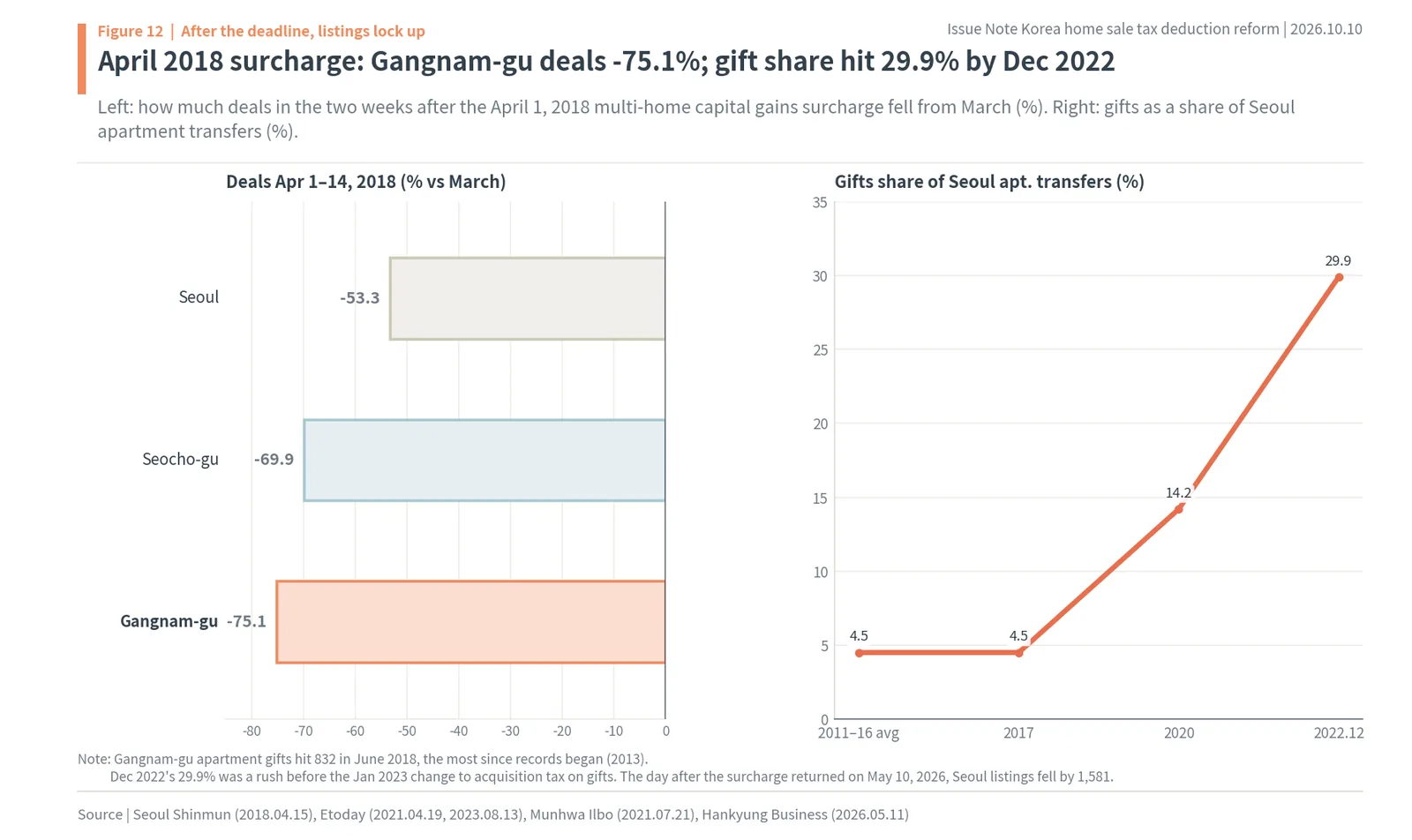
Korea has already lived through listings locking up and gifts rising when capital gains tax goes up. In March 2018, just before the multi-home capital gains surcharge began on April 1, Seoul apartment deal reports hit a record 13,935. After the surcharge began, deals from April 1 to 14 ran at 209.9 a day, 53.3% fewer than in March. Gangnam-gu ran at 6.3 a day, down 75.1% from March, and Seocho-gu fell 69.9% (Seoul Shinmun). The pattern of crowding in just before the deadline and stopping right after it appeared exactly.
In the week after the top capital gains tax rate for multi-home owners rose from 65% to 75% on June 1, 2021, Gangnam-area listings also fell 2.2%, from 4,170 to 4,081 (News Tomato, Asil). Homes that were not sold went out as gifts. Gangnam-gu apartment gifts reached 832 in June 2018, the most since records began in 2013, and set the second-highest mark at 812 in March 2021, ahead of the tougher surcharge that June (Etoday). Gifts as a share of Seoul apartment transfers averaged 4.5% from 2011 to 2016, tripled to 14.2% in 2020 and reached 26.8% in Seocho-gu (Munhwa Ilbo). In December 2022, just before the acquisition tax base on gifts switched to market value, the gift share shot up to 29.9% (Etoday). Every time the tax schedule changed, homes moved within the family before they moved onto the market.
The Korea Research Institute for Human Settlements has also pointed out that capital gains tax creates a “lock-in effect” that makes owners reluctant to trade (cited by YTN). Capital gains tax is paid only on a sale, so the heavier it gets, the more rational it becomes to hold on rather than sell. The left panel of Figure 12 shows the fall in deals in the two weeks after the 2018 surcharge, and the right panel the trend in the gift share of Seoul apartment transfers.
If homes are not sold, the tax is not collected either
Lock-in is not just a market problem. Capital gains tax is collected only when homes are sold, so when listings lock up, the revenue the government expected shrinks too. The revenue effect of the whole plan (net basis) is KRW 781.2bn in 2027, KRW 1.8893tn in 2028, KRW 488.2bn in 2029 and KRW 64.2bn in 2030, peaking in 2028 and shrinking quickly after that (Financial News). These figures include the comprehensive real estate tax and other taxes, so the deduction’s share cannot be separated out, but they point the same way as a structure in which revenue bunches around the deadline and then falls off.
In 2024 alone, 24,816 one-home homes sold for more than KRW 1.2bn, and those homes received KRW 5.032tn of deductions. If the same homes pass on through inheritance after 2029 rather than being sold, the very tax the government meant to raise by cutting the deduction never arises. On one side, fewer listings hold up home prices; on the other, revenue does not rise as much as expected.
A cap causes lock-in above the cap
There is research showing that a cap itself causes lock-in. In 1997 the US created its current rule through the Taxpayer Relief Act, exempting gains on the home you live in up to $250,000 single or $500,000 for a couple. Federal Reserve economist Hui Shan analyzed single-family home sales in 16 towns near Boston from 1982 to 2006 and found that after the change, the semiannual sale rate of homes with gains of $500,000 or less rose 13% to 22% above its earlier average, while that of homes with gains above $500,000 fell 24% (Journal of Public Economics, 2011). Every $10,000 of extra capital gains tax cut the sale rate by 7% to 13% of the average.
That within the same system homes below the cap traded more and homes above it traded less means the cap holds the homes above it in place. A KRW 1bn annual cap builds the same structure for expensive homes in Gangnam from the KRW 3bn range up. The further above the cap a home is, the bigger its tax after 2029, and since passing it on makes that tax disappear, it has the least reason to be sold. The left panel of Figure 13 shows Shan’s results, and the right panel the drop in Seoul listings the day after the surcharge returned in May 2026.
7. The US, UK, Japan and the OECD on home sale gains and holding taxes
The US, UK and Japan exempt much of the gain on the home you live in
How do other countries tax gains on the home you live in? Section 121 of the US tax code exempts gains up to $250,000 single or $500,000 for a couple if the owner owned the home and lived in it for at least 2 of the 5 years before the sale (IRS Publication 523). It looks at whether the owner actually lived there rather than how many years the home was owned, the same direction as the Korean plan. The cap has not been indexed to inflation since it was created in 1997, and one estimate puts it at about $475,000 single and about $950,000 for a couple in 2024 dollars (CBIZ).
The US also sets an inherited asset’s basis at its market value on the date of death (Section 1014). So in the US too, older long-term owners have a reason to pass a home on rather than sell it, and Shan’s finding that sales fell for homes above the cap came out of this structure. President Trump said on July 22, 2025 that he was “thinking about” eliminating capital gains tax on home sales, and that month a bill to remove the dollar cap in Section 121 (H.R.4327) was introduced in the House (CBS, bill summaries). The direction under discussion in the US is removing the cap.
In the UK, if a home was your main residence for the whole time you owned it, there is no capital gains tax on the gain at all (Private Residence Relief, GOV.UK). Japan deducts up to ¥30mn from the gain on the home you live in regardless of how long it was owned (Japan National Tax Agency No.3302). Japan’s tax rate differs depending on whether the home was held for more than 5 years, but the one-home deduction itself is based on residence. None of the three uses the Korean structure in which the deduction rate grows in proportion to years held.
From April 6, 2024 the UK taxes gains on homes that are not your residence at 18% and 24% (the higher rate was cut from 28% to 24%). The home you live in is fully exempt, and other homes are taxed at reduced rates (GOV.UK). Lundborg and Skedinger, analyzing Swedish household data from 1984 to 1990, reported that the lock-in effect of capital gains tax was pronounced among households whose income had fallen (Journal of Public Economics, 1998). In other words, older households whose income fell on retirement are the most sensitive to the tax on selling a home, and many of Gangnam’s long-term owners are such households.
The OECD recommends a cap but shifting tax toward holding
The OECD’s 2022 report, Housing Taxation in OECD Countries, found that of 38 member countries, 20 fully exempt gains on the home you live in and 9 exempt them with conditions. Thirty levy transaction taxes when a home is bought, and all 38 levy holding taxes while a home is owned. The report recommends capping the exemption for the home you live in so the largest gains are taxed while most households stay exempt, and notes that a partial exemption is justified because it reduces lock-in. At the same time it recommends raising the share of holding taxes based on regularly updated values and cutting transaction taxes, because transaction taxes hold back residential and labor mobility.
The left panel of Figure 14 shows how the US, UK, Japan and Korea (from 2029) handle the one-home deduction, the upper right panel how OECD countries tax gains on the home you live in, and the lower right panel property taxes as a share of GDP: Korea’s 3.0% is close to twice the OECD average of 1.6% (OECD Economic Survey of Korea 2026). Basing relief on residence and capping large gains matches the global trend, but Korea already collects a lot of property tax.
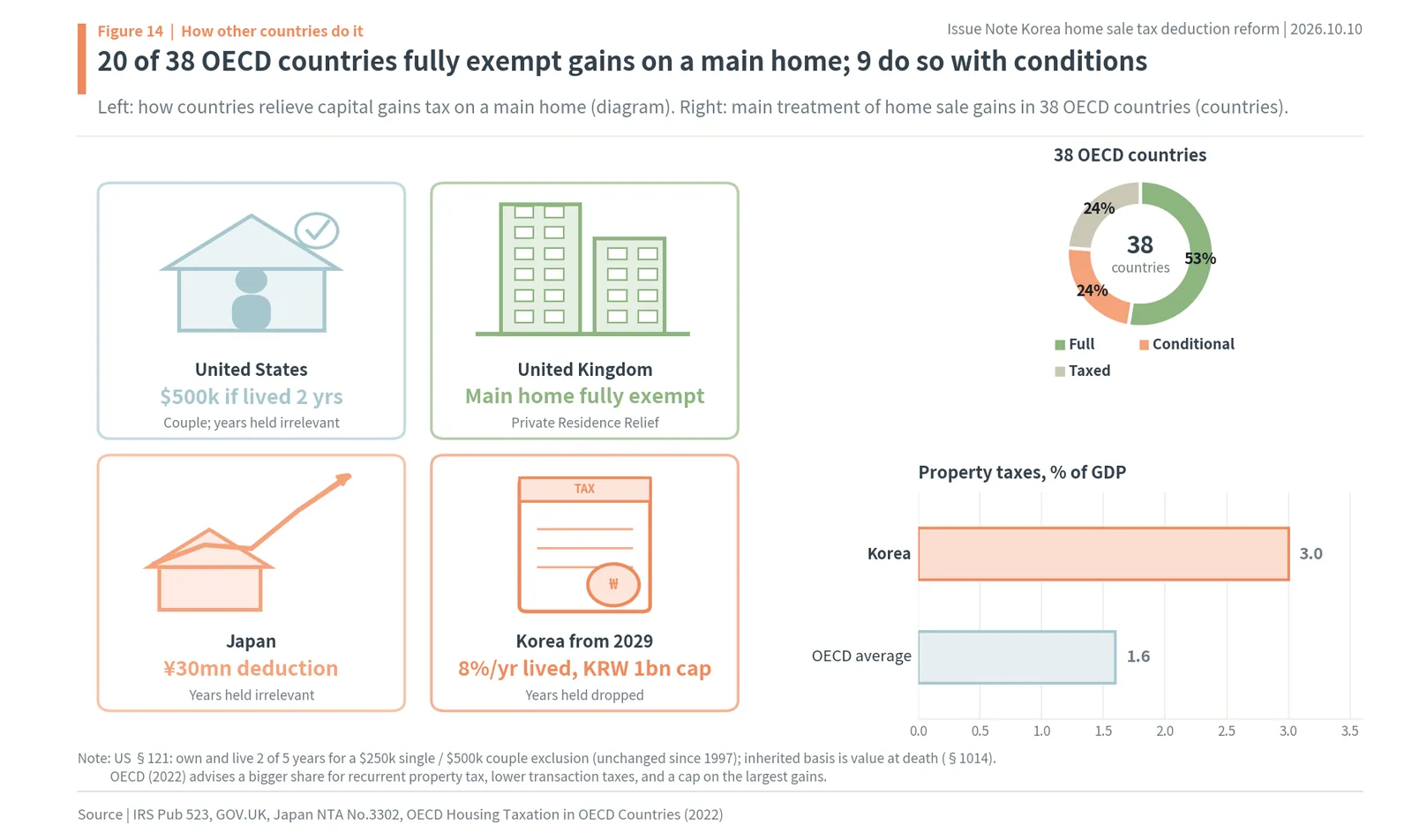
Korea’s property taxes are tilted toward transactions
Where Korea differs is when the tax is collected. According to the OECD Economic Survey of Korea 2026, Korea’s property-related taxes are 11.7% of total tax revenue, above the OECD average of 5.1%, but holding taxes (property tax and comprehensive real estate tax) are only 29.4% of them, about half the OECD average of 56.0%. The remaining 70.6% are taxes paid on a purchase or sale, such as the acquisition tax and capital gains tax. The OECD advised Korea to shift “from transaction taxes to holding taxes” and to impose higher rates on empty homes and second homes the owner does not live in (MTN).
Much of the extra revenue in this August 3 plan also comes from holding taxes. The whole plan raises KRW 3.443tn (about $2.57bn) over five years (net basis), of which KRW 2.1815tn comes from the comprehensive real estate tax (Financial News). On that side, the basic deduction for a one-home owner who lives in the home rises from KRW 1.2bn to KRW 1.4bn, it stays at KRW 1.2bn for one-home owners who do not, and the rates on the upper tax brackets are adjusted from 2027. By the government’s explanation, the burden starts rising in earnest from a market value of KRW 4bn (about $2.99mn; officially assessed value of about KRW 2.8bn), and homes worth more than KRW 4bn number about 65,000 nationwide, 0.9% of all households (Newsis).
In this structure, where to put the burden on expensive homes the owner does not live in becomes clear. Collect it through capital gains tax and no tax arises if the home is not sold, so listings lock up; collect it through holding taxes and tax arises every year the home is owned, so there is less lock-in. Figure 15 sets the makeup of property taxes in Korea and the OECD average side by side. Collecting the burden on expensive homes nobody lives in while they are owned, rather than when they are sold, locks up fewer listings.

8. Bills before the National Assembly: period split vs a wider deduction
The government plan goes before the tax subcommittee in November alongside lawmakers’ bills
The government’s tax bills are reviewed together with lawmakers’ bills in the tax subcommittee of the National Assembly’s Finance, Economy and Planning Committee. The subcommittee can amend the government’s provisions or combine the government and lawmakers’ bills into an alternative (Newspim). The seven items the government revised from its announcement on September 1 included dropping the general ISA overhaul, dropping the plan to set the comprehensive real estate tax basic deduction for one-home owners who do not live in the home at KRW 900mn, and dropping the 200% burden ceiling plan for the comprehensive real estate tax, but not the deduction overhaul. Financial News wrote that “the capital gains deduction rules the ruling party has steadily asked to change were not reflected in the government’s revision, so they are likely to be amended later.”
The ruling Democratic Party has settled the comprehensive real estate tax along the lines of the government plan and left room to amend the deduction. Seoul lawmakers argued that since the plan introduces new concepts of residence and non-residence, a soft landing is needed, and the party plans to take up capital gains tax in earnest in the November tax subcommittee after the parliamentary audit and decide on a fix for the residence and non-residence distinction (Seoul Economic Daily). The Democratic Party called the government plan “a realistic and reasonable adjustment toward taxation centered on actual residence” (Financial News). The need to amend the deduction overhaul was also reportedly discussed at the high-level party-government consultation on August 23.
Opposition bills widen the deduction or split the periods
Several proposals have come from the opposition People Power Party. Rep. Seo Myung-ok’s bill raises the one-home tax-free line from KRW 1.2bn to KRW 1.5bn and widens the residence credit from up to 40% to up to 50%, for a total of up to 90%. Rep. Kim Eun-hye proposed recognizing property tax and comprehensive real estate tax paid while owning the home as necessary expenses, and Rep. Park Su-min proposed a deferral that would let a one-home owner who has owned and lived in a home for over 3 years postpone part of the capital gains tax when moving to a cheaper home. Rep. Na Kyung-won’s side announced a period-split bill that would use the current rates for years held before the change and apply the cap only to gains after it (Financial News).
A National Assembly e-petition, “Request to withdraw the new KRW 1bn cap on the long-term holding special deduction for one-home households who live in their home,” passed 52,156 signatures on August 24 and was referred to committee. The petition asked for the cap to be removed or raised, for the purchase price to be indexed to inflation, for residents of 20 years or more to be exempted and for a transition rule that does not apply the change to years already built up. At a policy forum on August 13, Prof. Lee Jung-kyo of Yonsei University proposed adjusting the rates to around 20% for holding and 60% for residence and extending the period away that counts as residence from 3 years to 5. The demands split broadly into widening the deduction and keeping its direction while protecting years already built up.
Plugging them into Mr. Kim shows the difference
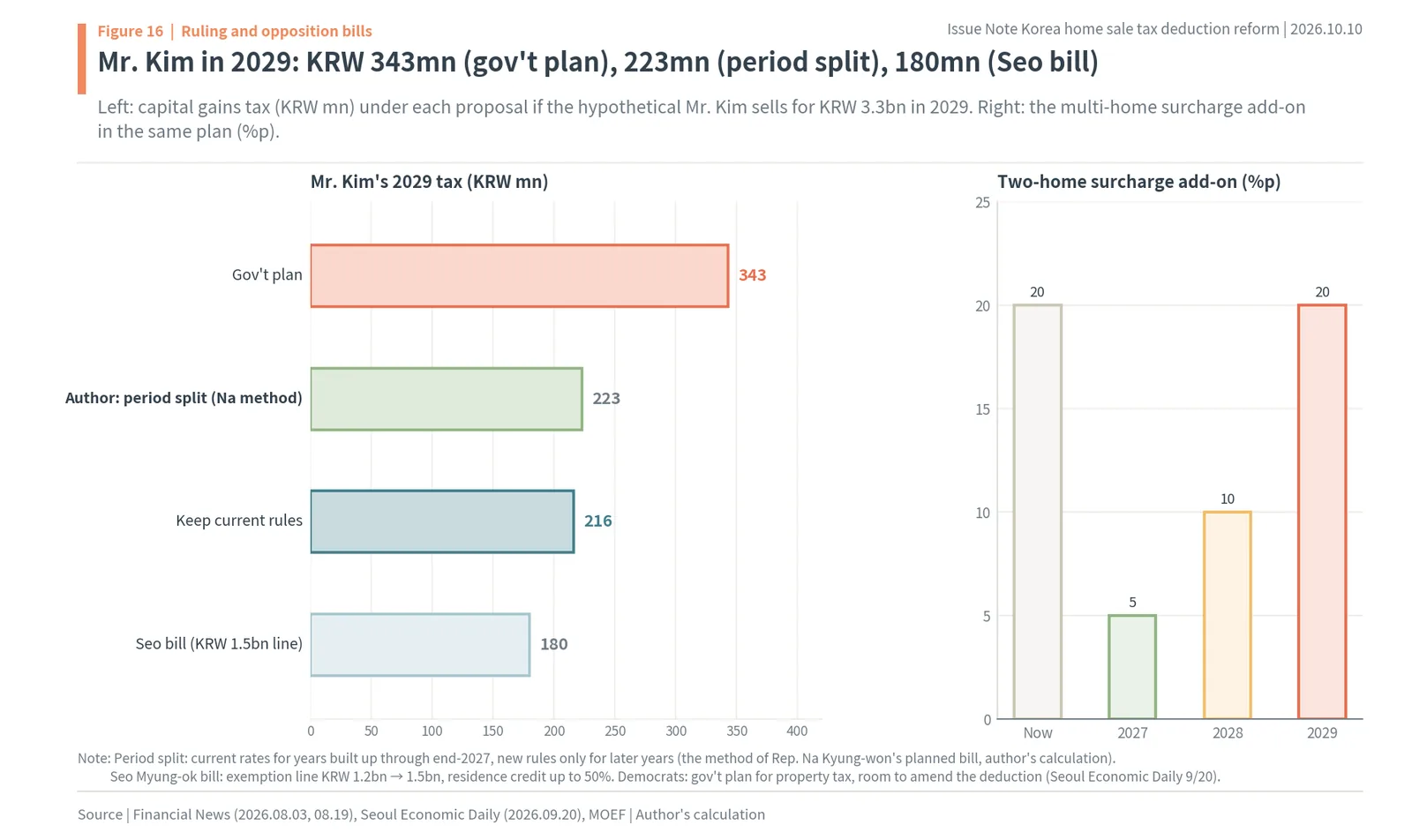
Plugging these proposals into the same case, Mr. Kim selling for KRW 3.3bn in 2029, makes the difference clear (author’s calculation). Under the government plan he pays KRW 343mn. Under a period split he pays KRW 223mn (about $167,000): today’s rates apply to the 17 years built up through the end of 2027 and the new rates only to the 2 years after. If the current rules stay, he pays KRW 216mn, and under Seo’s bill, with the tax-free line raised to KRW 1.5bn, KRW 180mn. Seo’s bill cuts Mr. Kim’s tax below today’s, but it also cuts the tax on the expensive homes where the deduction was concentrated. A period split protects Mr. Kim’s past years while still moving the future deduction toward residence as the government plans.
The same plan also includes a temporary cut to the multi-home capital gains surcharge. In regulated areas, the surcharge add-on for two-home owners drops from today’s 20 points to 5 points in 2027 and 10 points in 2028, then returns to 20 points in 2029; for three or more homes it goes from 30 points to 10 and 15, then back to 30 (Ministry of Finance and Economy). Since the one-home deduction deadline and the temporary multi-home window both open in 2027 to 2028, the pattern of listings bunching into those two years and draining away afterward overlaps for one-home and multi-home owners alike. Figure 16 shows Mr. Kim’s tax under each proposal and the schedule of the multi-home surcharge add-on.
9. The author’s view: new rules only for the years still to come
Tying the chain together
Tie the chain so far together. The deduction piled up on expensive homes held long and risen far, especially Gangnam homes their owners do not live in. The government wants to change that with a residence focus and a cap. But because the new rules apply all at once to holding years already built up, the tax jumps like a step around the end of 2027. In front of the step listings rushed out (Gangnam 3 +24.4%); behind it, passing a home on beats selling it. The bigger the step, the bigger both the rush of listings in front of it and the lock-in behind it.
So the author thinks the first step is a period split that applies the new rules only to holding and residence years built up after 2027. A period split applies the current rates to the years built up through the end of 2027 and the new rates to the years after, in proportion to the time in each, with the cap only on the later part. As a formula, deduction rate = current rate × (years through end-2027 ÷ total years held) + new rate × (years after ÷ total years held). Plans people made in past years are judged by the past rules, and plans for the years ahead by the new ones.
Applied to Mr. Kim, the step disappears
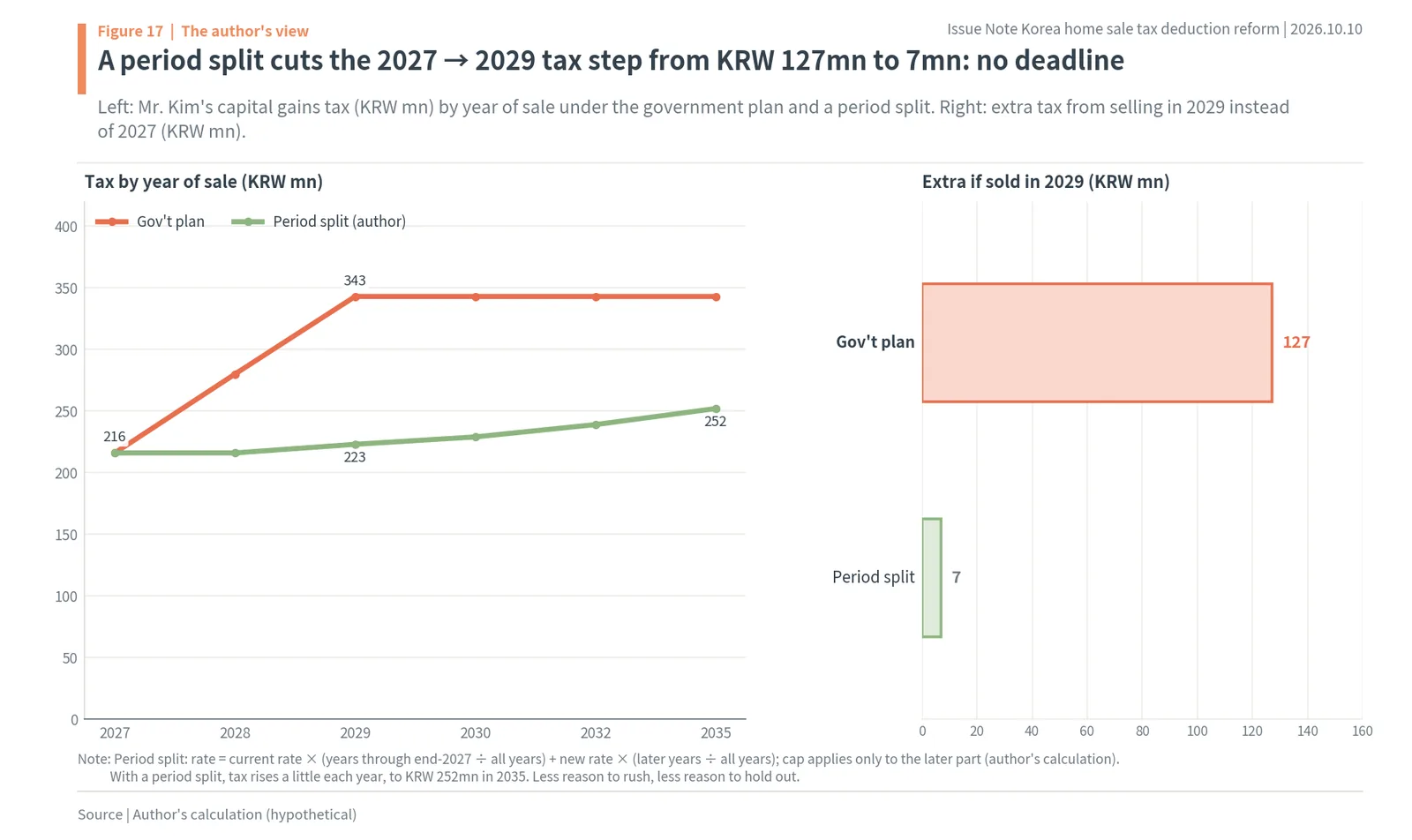
Applied to Mr. Kim, the 2029 tax is KRW 223mn, just KRW 7mn (about $5,200) more than the KRW 216mn for selling in 2027. With the government plan’s KRW 127mn step cut to KRW 7mn, there is little reason to rush to sell in 2027 or to hold out after 2029. The tax then rises a little each year, to KRW 229mn in 2030, KRW 239mn in 2032 and KRW 252mn in 2035 (author’s calculation). The longer the home is owned without living there, the smaller the deduction, so the government plan’s direction toward residence is kept. All that changes is the speed at which it gets there.
The left panel of Figure 17 compares Mr. Kim’s tax by year of sale under the government plan (red) and a period split (green). The government plan climbs steps in 2028 and 2029 and then goes flat, while the period split rises along a gentle slope. The right panel shows the extra tax from selling in 2029 instead of 2027. When the deadline’s value falls from KRW 127mn to KRW 7mn, the force that pushed listings out all at once and the force that held them back both weaken.
The same formula applied to the landmark complexes and the government’s example gives the same shape (author’s calculation). An owner who bought Acro River Park 84 sq m in 2016 and lived there 2 years pays KRW 1.017bn in 2029 under the government plan and KRW 636mn under a period split; Eunma 76 sq m, KRW 492mn and KRW 295mn; Jamsil Els 84 sq m, KRW 532mn and KRW 319mn. Under a period split, all three complexes differ by only KRW 10mn to 30mn from a 2027 sale. The government’s example, the KRW 7.5bn home (bought in 2016, lived in throughout), pays KRW 1.373bn in 2029 under the government plan, but under a period split the cap applies only to the share built up after 2027, so it pays KRW 316mn, the same as in 2027.
These numbers show what a period split changes. For years already past, it honors the plans people made trusting the rules of the time, and it lets the effect of the cap and the residence focus grow as the years built up after 2027 accumulate. Because the tax does not jump at a single date, neither the rush of listings before that date nor the lock-in after it appears. The new rules take full effect only once enough new years have built up, and in the meantime the burden on expensive homes the owner does not live in is shifted to holding taxes, as below.
Collect the burden on expensive non-resident homes through holding taxes
A period split fixes the “timing” of the deduction, while tax fairness for expensive homes the owner does not live in is a question of “which tax to collect it with.” Capital gains tax arises only on a sale, so the heavier it is, the more not selling pays. Holding taxes arise every year a home is owned, so making them heavier does not increase the payoff from not selling. Put together the facts that holding taxes are 29.4% of Korea’s property taxes, a little over half the OECD average of 56.0%, and that much of this plan’s extra revenue already comes from the comprehensive real estate tax, and the tax to raise is the holding tax.
In short, changing the rules is right, and applying them only to the years still to come is what stops listings from rushing out and then locking up. The problem of the deduction piling up on Gangnam’s non-resident long-term owners is solved by moving the deduction for the years ahead toward residence and by raising the burden on them through holding taxes while they own. That shrinks both today’s listing rush and the lock-in after 2029. This conclusion, reached from the evidence, points the same way as the period-split proposal from Rep. Na Kyung-won’s side of the People Power Party.
10. Builder, bank and furnishing stocks: Hyundai E&C, KB Financial, Hanssem
Each sector is exposed in a different place
If Seoul home sales bunch up through 2027 and lock up after 2029, the sectors that depend on those sales move with them. Builders are exposed to Seoul presales, redevelopment schedules and buyer sentiment. Banks are exposed to mortgage balances, and home interior and furniture companies to moving demand. While listings rise and deals continue, moving and interior demand rises first; once deals lock up, the sectors that depend on Seoul sales shrink first. After the August 3 plan, about 79% of Seoul apartment deals were at KRW 1.5bn or less, and the share above KRW 2.5bn fell from 8.3% to 5.8% (Financial News). Deals in expensive homes are the first to shrink.
Since September, builder and bank stocks fell and only Hanssem rose
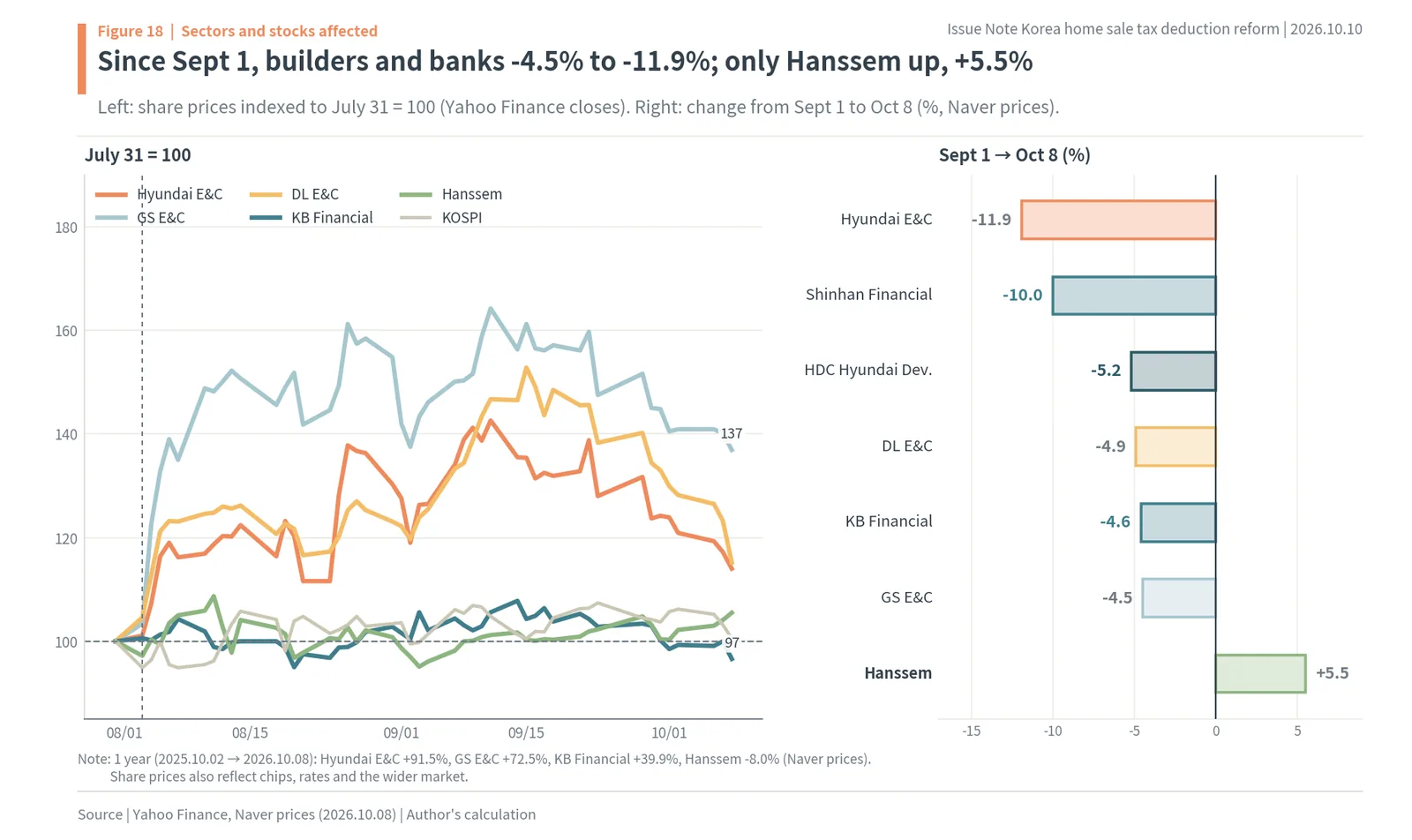
From September 1 to October 8, Hyundai E&C (000720.KS) fell 11.9%, Shinhan Financial (055550.KS) 10.0%, HDC Hyundai Development (294870.KS) 5.2%, DL E&C (375500.KS) 4.9%, KB Financial (105560.KS) 4.6% and GS E&C (006360.KS) 4.5%, while only Hanssem (009240.KS) rose, by 5.5% (Naver prices). October 8 closes were Hyundai E&C KRW 106,300 (about $79), GS E&C KRW 31,800 (about $24), DL E&C KRW 68,000 (about $51), KB Financial KRW 163,400 (about $122), Shinhan Financial KRW 100,000 (about $75) and Hanssem KRW 40,500 (about $30). Over one year (October 2, 2025 to October 8, 2026), Hyundai E&C is up 91.5%, GS E&C 72.5%, DL E&C 65.0%, KB Financial 39.9% and Shinhan Financial 40.1%, so this is a pullback after big gains. Hanssem was down 8.0% over the year, but its second-quarter operating profit rose 409% to KRW 11.3bn (Sidae).
The left panel of Figure 18 indexes prices to July 31 = 100 (Yahoo Finance closes), with a dotted line on August 3, the day the plan was announced; the right panel shows the change from September 1 to October 8. Many factors such as interest rates, semiconductors and the market trend overlap in stock prices, so this chart is for picking the sectors that may move with the tax schedule, not for reading the cause of the price moves. The author sees one link: if deals bunch up through 2027, moving and interior demand rises first, and if they lock up after 2029, the sectors that rely on Seoul home sales shrink first.
11. Eight signals to watch
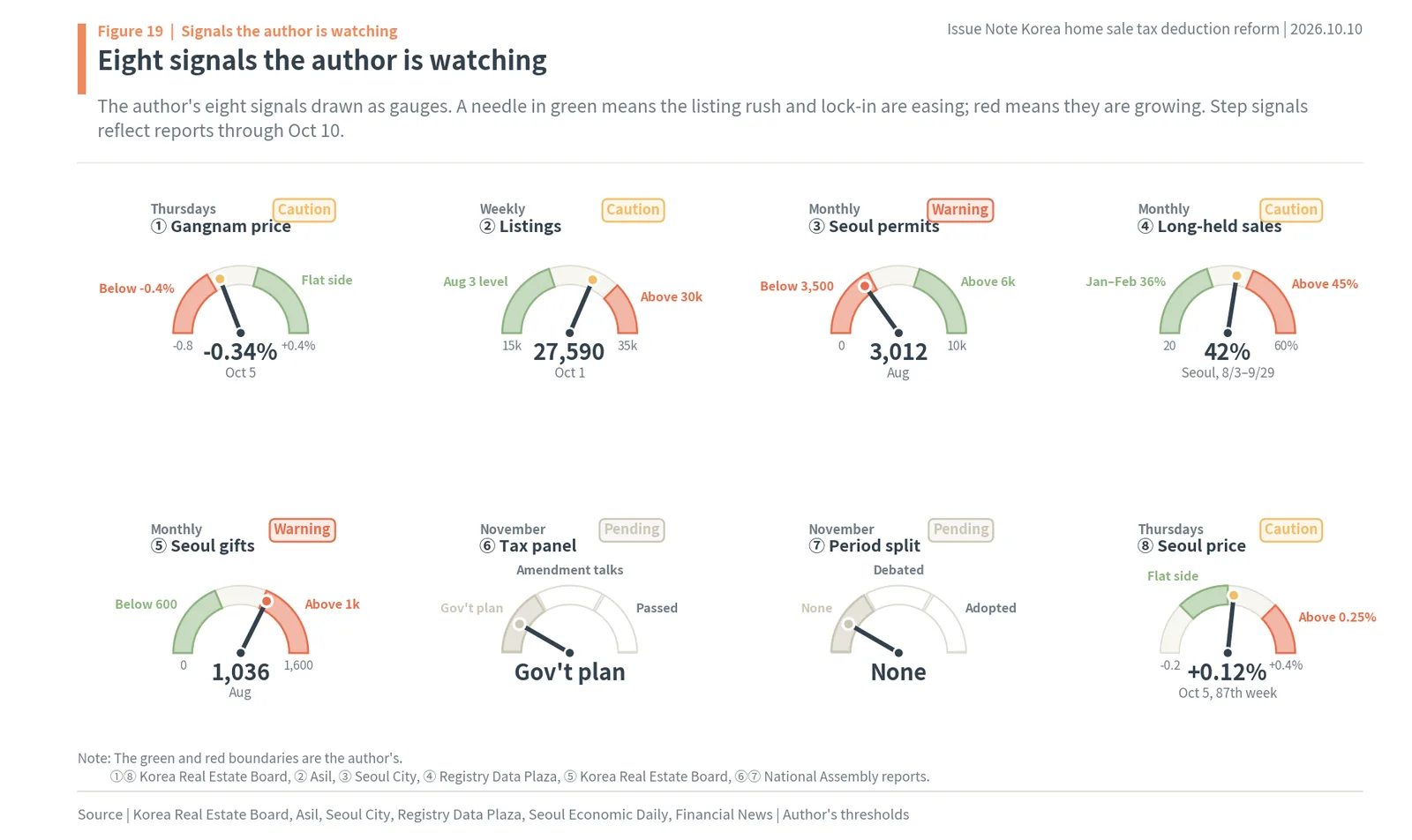
The author watches eight signals. First, Gangnam weekly prices, -0.34% in the week of October 5. Second, Gangnam 3 listings, 27,590 on October 1. Third, Seoul land transaction permit applications, 3,012 in August. Fourth, the share of sellers who held over 10 years, 42% in Seoul from August 3 to September 29. Fifth, Seoul apartment gifts, 1,036 in August. The sixth and seventh are signals from the National Assembly: how the tax subcommittee reviews the deduction and whether it adds a transition rule such as a period split. Eighth, Seoul weekly prices, +0.12% in the week of October 5.
Here is how to read them. If listings rise and permit applications rise with them, the listings put up before the deadline are being absorbed by actual deals. If gifts rise and permit applications fall, the lock-in is arriving first. If the tax subcommittee adopts a period split, the deadline disappears, and both the listing rush and the lock-in shrink. Figure 19 draws the eight signals as gauges, and the boundaries of the green and red zones are the author’s own.
The gauge zones are set as follows (author’s criteria). Gangnam weekly prices are green above -0.1% and red below -0.4%. Gangnam 3 listings are green below 23,000, around the level at the announcement, and red above 30,000. Seoul permit applications are green above 6,000 a month and red below 3,500, and August’s 3,012 is in the red zone. The share of sellers who held over 10 years is green below the 36% of early this year and red above 45%. Seoul apartment gifts are green below 600 a month and red above 1,000, and August’s 1,036 is in the red zone. Seoul weekly prices are green near flat and red above +0.25%. The two National Assembly signals are at the first of three stages: government plan, amendment talks and passage (adopted).
12. Dates to watch: Oct 15 to the Dec 2 budget deadline
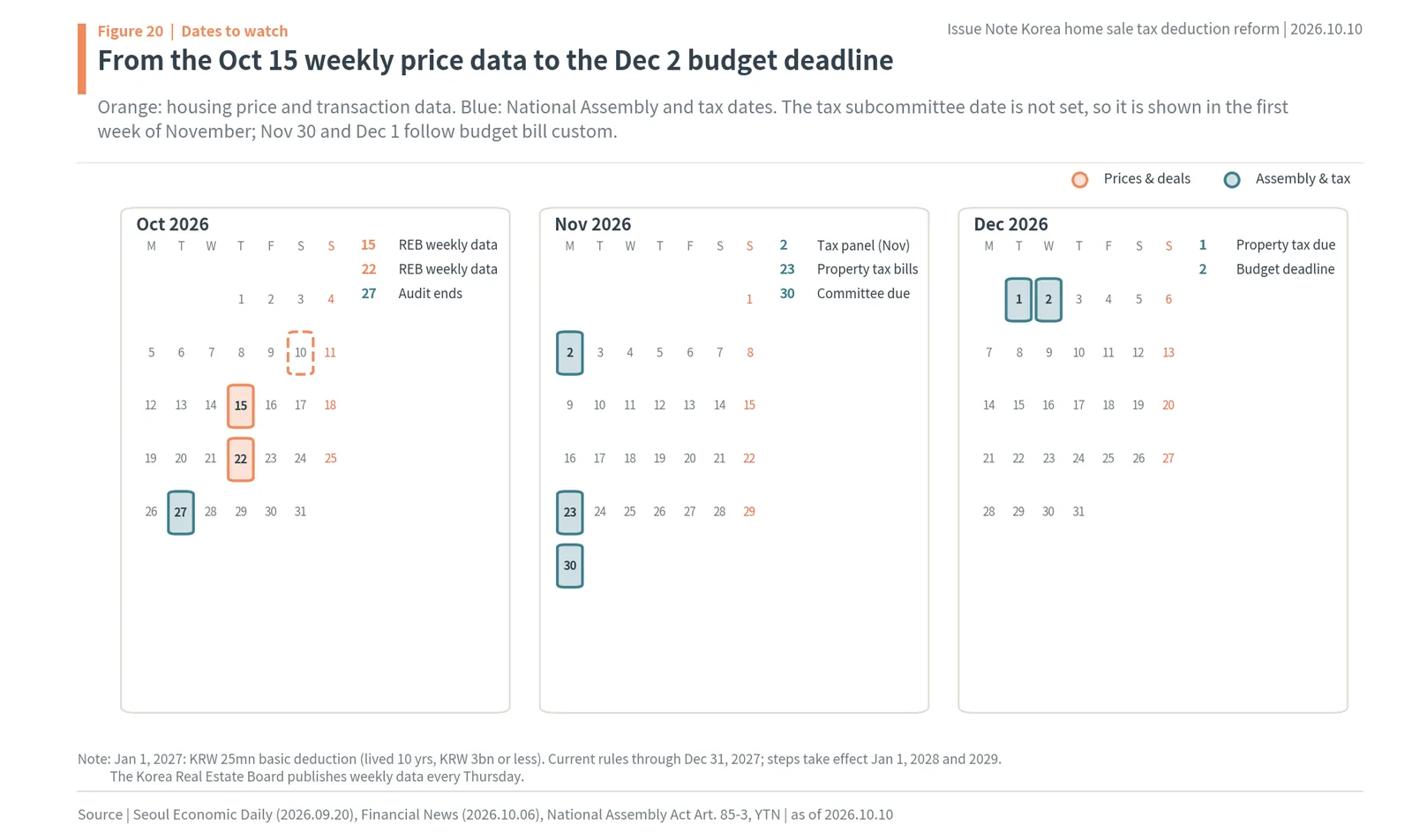
The Korea Real Estate Board’s weekly apartment prices come out every Thursday (October 15, 22 and so on). The parliamentary audit ends on October 27, and the deduction will then be debated in earnest in the November tax subcommittee (Seoul Economic Daily). If the tax bills are designated budget-related bills, November 30 is the committee’s review deadline; if the review is not finished by then, the bills go automatically to the plenary session on December 1, and December 2 is the deadline for passing the budget (National Assembly Act Art. 85-3, and custom). Comprehensive real estate tax bills go out in late November, with payment due December 1 to 15.
The implementation schedule: January 1, 2027, the KRW 25mn basic deduction for one-home owners who have lived there 10 years and sell for KRW 3bn or less; December 31, 2027, the last day of the current deduction; January 1, 2028, stage one (2% for holding, 6% for residence, a KRW 2bn cap); January 1, 2029, stage two (8% for residence, a KRW 1bn cap). Figure 20 puts the dates from October to December on a calendar.
13. Methodology: tax formula, period split and data sources
Here are the bases for the calculations. All taxes are national tax (capital gains tax), with the 10% local income tax separate. The rates are the National Tax Service’s basic rate table in force since 2023, and the basic deduction is KRW 2.5mn (KRW 25mn from 2027 for one-home owners who have lived there 10 years and sell for KRW 3bn or less). Deduction rates and caps follow the government plan (2% for holding, 6% for residence and a KRW 2bn cap in 2028; 8% for residence and a KRW 1bn cap in 2029), and the author confirmed that this formula, applied to the government’s example, gives the same figures the government announced. For a one-home owner who lived there less than 2 years, the 2029 deduction is assumed to follow the plan’s general deduction rule and leave only 2% a year for residence; this is the author’s reading, not checked against the original text of the government’s detailed provisions.
In the hypothetical example and the landmark complex calculations, the sale price is fixed at the same value regardless of the year of sale, so that the effect of price changes is not mixed with the effect of the tax schedule. The period split is the author’s calculation, applying the current rate in proportion to the years held through the end of 2027, the 2029 rate to the remaining share, and the KRW 1bn cap only to the later part. The figures may differ depending on the details of any proposal actually put to the Assembly (for example, how the gain before the change is divided).
For listings, only one Asil series is used throughout (the series starting at 22,182 for the Gangnam 3 and 60,409 for Seoul on August 3). Other reports from the same September that put Seoul listings in the 100,000 range use a different scope and are not mixed in. Weekly prices are the Korea Real Estate Board’s releases as collected from news reports, and Seoul’s figure for the week of August 24 is left blank in the chart because reports differ. Gifts use the Korea Real Estate Board’s apartment transaction data (1,036 in August), and the court registry series (766 in August), which points the other way, is noted for reference only. Stock price changes use Naver daily closes and the line chart uses Yahoo Finance closes, so the two sources may differ slightly.
Maochaedung’s take. Korea’s August 3 tax plan counts only the years an owner lived in the home for the one-home capital gains deduction from 2029 and caps it at KRW 1bn a year. The numbers confirm the deduction piled up on long-held Gangnam homes that rose far, but because the new rules also cover holding years already built up, the end of 2027 became a deadline and Gangnam 3 listings rose 24.4% in two months. After the deadline, selling means tax and passing the home on means zero capital gains tax, so listings lock up. The author thinks the first steps are a period split that applies the new rules only to the years built up after 2027, and shifting the burden on expensive homes nobody lives in to holding taxes.
Korea capital gains tax deduction reform FAQ
Q. What is changing in Korea’s capital gains tax deduction for one-home owners?
Under the August 3, 2026 tax plan, the current rules (4% a year for holding plus 4% for residence, up to 80%) stay through 2027. In 2028 they become 2% for holding plus 6% for residence with a KRW 2bn cap, and from 2029 only years lived in the home count, at 8% a year (80% after 10 years), with a cap of KRW 1bn a year.
Q. Why are Gangnam listings rising?
Selling the same home in 2027 costs less tax than selling it in 2029, so the end of 2027 works as a deadline. Apartment listings in Gangnam, Seocho and Songpa rose from 22,182 on August 3 to 27,590 on October 1, up 24.4% (Asil). In the author’s hypothetical example, the tax rises from KRW 216mn to KRW 343mn.
Q. Why might homes lock up after 2029?
An inherited home’s cost basis is its market value on the date of inheritance, so the lifetime gain never faces capital gains tax. Once selling costs more after the deadline, holding and passing the home on becomes more attractive, as happened when Gangnam-gu deals fell 75.1% after the April 2018 surcharge.
Sources
- Ministry of Finance and Economy, 2026 tax plan announcement (link), 2026.08.03
- Ministry of Finance and Economy, Policy at a glance: 2026 tax plan (link), 2026.08
- Newspim, Long-term residence income deduction overhaul (link), 2026.08.03
- Newspim, Tax plan sent to the National Assembly (link), 2026.09.03
- SBS, Deduction cap and the government’s example (link), 2026.08.03
- Tax & Finance News, Only years lived count from 2029 (link), 2026.08.03
- Korea Tax Times, KRW 25mn basic deduction and senior relief (link), 2026.08.19
- Financial News, Seven items the government revised and the deduction (link), 2026.09.06
- Financial News, KRW 3.443tn revenue effect (link), 2026.08.12
- Edaily, NTS Commissioner’s deduction statistics (link), 2026.07.26
- Herald Economy, Nara Salim Research Institute deduction analysis (link), 2026.05.01
- Financial News, Rep. Seo Myung-ok’s bill (link), 2026.08.03
- Financial News, Bills from Reps. Na Kyung-won, Park Su-min and Kim Eun-hye (link), 2026.08.19
- Financial News, National Assembly e-petition passes 50,000 (link), 2026.08.24
- Seoul Economic Daily, Democratic Party plans to amend the deduction (link), 2026.09.20
- Herald Economy, Gangnam 3 listings at 27,590 (link), 2026.10.05
- Maeil Business, Gangnam listings with no inquiries (link), 2026.10.10
- Maeil Business, Gangnam 3 listings on Aug 27 (link), 2026.08.27
- Kukmin Ilbo, Seoul listings at 72,387 (link), 2026.09.26
- Financial News, Gangnam’s biggest fall in 193 weeks (link), 2026.09.24
- Korea Economic Daily, Apartment prices in the fourth week of September (link), 2026.10.01
- YTN, Apartment prices in the first week of October (link), 2026.10.08
- Seoul Shinmun (Twig), Seoul land transaction permit applications (link), 2026.09.14
- MTN, 42% of Seoul sellers held long term (link), 2026.10.02
- Herald Economy, Gangnam 3 sellers who held over 10 years (link), 2026.09.06
- Dailian, Seoul apartment gifts (link), 2026.10.02
- Seoul Shinmun, Deals after the 2018 surcharge (link), 2018.04.15
- Etoday, Record gifts in Gangnam-gu (link), 2021.04.19
- Munhwa Ilbo, Seoul gift share (link), 2021.07.21
- Etoday, Gift share in December 2022 (link), 2023.08.13
- Hankyung Business, The May 10 surcharge return and listings (link), 2026.05.11
- Herald Economy, Owners aged 70+ in the Gangnam 3 (link), 2026.01.19
- Seoul Economic Daily (Radio Seoul), Older owners in Apgujeong and Banpo (link), 2026.08.05
- dapt.kr, Jamsil Els sale records (link), retrieved 2026.10.10
- National Tax Service, Capital gains tax rates and long-term holding deduction (link), retrieved 2026.10.10
- National Law Information Center, Income Tax Act Enforcement Decree Art. 163 (link), retrieved 2026.10.10
- IRS, Publication 523 (link), retrieved 2026.10.10
- GOV.UK, Tax when you sell your home (link), retrieved 2026.10.10
- Japan National Tax Agency, No.3302 (link), retrieved 2026.10.10
- OECD, Housing Taxation in OECD Countries (link), 2022
- MTN, Property taxes in the OECD Economic Survey of Korea 2026 (link), 2026.07.02
- Hui Shan, The effect of capital gains taxation on home sales (link), Journal of Public Economics 2011
- Naver Finance, daily prices (link), 2026.10.08 close
- Yahoo Finance, daily closes and KRW/USD rate (link), 2026.10.08 close
- Financial News, 79% of Seoul deals at KRW 1.5bn or less (link), 2026.10.05
- Newsis, Comprehensive real estate tax overhaul and 65,000 homes worth over KRW 4bn (link), 2026.08.03
- Edaily, Deputy Prime Minister Koo Yun-cheol’s answers in the interpellation session (link), 2026.09.11
- Joseilbo, Citizens’ Coalition for Economic Justice statement (link), 2026.08.04
- People’s Solidarity for Participatory Democracy, The 2026 tax plan only skims the surface (link), 2026.08
- Hankyung Business, Permit applications surge in May (link), 2026.05.11
- Kukmin Ilbo, Gangnam 3 permit applications fall from 143 to 67 a week (link), 2026.09.26
- YTN, Korea Research Institute for Human Settlements on the capital gains tax lock-in effect (link), 2023.11.04
- CBIZ, Why the $250,000/$500,000 home sale exclusion threatens your gains (link), 2025
- CBS Austin, Trump says he is thinking about eliminating capital gains tax on home sales (link), 2025.07.22
- Sidae, Hanssem second-quarter results (link), 2026.08.03