Korea National Pension Service Rebalancing: As the KOSPI Falls 7.57% to 5,554, the Mistake Was the May Target Raise to 20.8%, Not the January Deferral
Had Korea’s National Pension Service kept its 19.9% domestic-equity cap, its rebalancing deferral would have gained KRW 15.7tn in February to May and lost KRW 51.3tn after May (author’s calculation). On October 15, 2026 the KOSPI fell 7.57% to 5,554.22 with its 10th circuit breaker of the year, a day after a parliamentary audit fought over the January 26 deferral and the May 28 raise of the domestic equity target from 14.9% to 20.8%. This report explains how rebalancing works, measures what the two decisions cost, tests the KRW 800bn-a-day market-shock argument, looks at investor flows and margin debt, and lists the stocks and dates to watch. Numbers as of October 15, 2026.
- On October 15, 2026 the KOSPI fell 7.57% to 5,554.22 and tripped its 10th circuit breaker of 2026, 39.06% below its June 22 high; the Nikkei fell 4.90% and Taiwan 3.41% the same day.
- On January 26 the NPS deferred rebalancing until the end of June; on May 28 it raised its 2026 domestic equity target from 14.9% to 20.8% and widened the range (reported cap 28.8%), when its actual weight was already 29.4%.
- Had the 19.9% cap been kept, the deferral gained KRW 15.7tn (about $11.7bn) in February to May and lost KRW 51.3tn (about $38.2bn) after May, a net loss of KRW 35.6tn (author’s calculation).
- The chairman’s KRW 800bn-a-day market shock is 2.09% of the KOSPI’s KRW 38.31tn average daily turnover in February to June; selling KRW 400bn a day from February would have left the fund KRW 10.5tn larger on October 15 (author’s calculation).
- The author argues the May target raise, not the January deferral, was the mistake: change targets only at the annual meeting, sell above the cap within a daily limit, and release minutes within a year instead of in 2030.
Key takeaways
- On October 15, 2026 the KOSPI closed down 7.57% at 5,554.22 and tripped its 10th circuit breaker of the year. The day before, at the National Assembly’s annual audit of the National Pension Service (NPS), lawmakers fought over two decisions: deferring the NPS’s domestic-equity rebalancing in January, and raising its domestic equity target from 14.9% to 20.8% in May.
- Assume the NPS had kept its 19.9% cap and add up the gain or loss on the excess at each month-end: the deferral gained KRW 15.7tn (about $11.7bn) from February to May, and lost KRW 51.3tn (about $38.2bn) after the end of May (author’s calculation, assuming the money sold earned 0%). The deferral was right while the market rose; the target raise deepened the loss while it fell.
- The author’s view is that the May 28 target raise, not the January deferral, was the mistake. Selling KRW 800bn a day would have been only 2.09% of the KOSPI’s KRW 38.31tn average daily turnover in February to June, so the excess could have been sold in pieces. Targets should change only at the one regular meeting each year, holdings above the cap should be sold within a daily limit, and meeting minutes should be released within a year.
As of: October 15, 2026
Topics covered: what target weights, allowed ranges and rebalancing mean, with a hypothetical example; the October 15 circuit breaker and other Asian markets; the January 26 deferral and the May 28 target raise; NPS domestic holdings and the KOSPI since; the author’s calculation of what keeping the cap would have meant; the KRW 800bn-a-day argument; investor-type flows and margin debt; the case for and against; the author’s view and prescription; affected stocks and dates to watch; and how the numbers were calculated
Reference data: NPS figures are the NPS Investment Management disclosure (end-July, posted September 29) and month-end values reported by Money Today, Korea Financial Newspaper, SBS Biz and Kukmin Ilbo. Fund Management Committee decisions come from the government’s Korea.kr policy briefing (May 28) and Newsis and Chosun Biz (January 26–27). Audit remarks come from October 14 reports in Financial News, Etoday, Seoul Economic Daily, Kyunghyang Shinmun and Kukmin Ilbo. KOSPI closes, turnover, net buying by investor type and market caps come from the KRX Data System; margin loans and forced sales from the Korea Financial Investment Association’s freesis database (through October 14); and overseas indexes from Yonhap and Yahoo Finance.

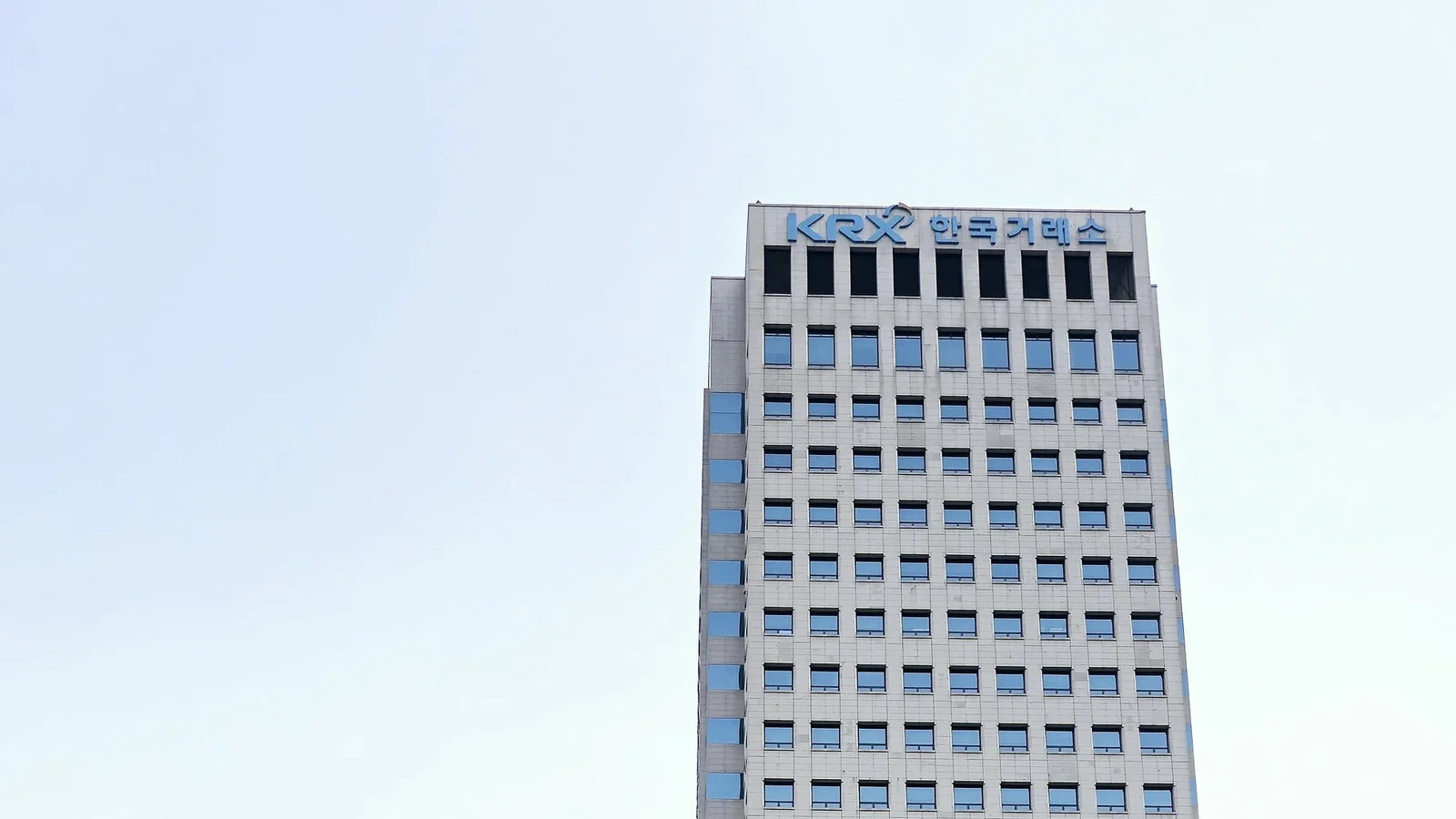
The photo shows the Korea Exchange’s Seoul office on Yeouinaru-ro in Yeouido, Seoul (taken in April 2025). At 12:23 p.m. on October 15, the KOSDAQ market it runs halted, and 15 minutes later the KOSPI market stopped for 20 minutes too.
Summary: Korea National Pension Service rebalancing exists to sell when prices are high
This report looks at the controversy over Korea’s National Pension Service rebalancing in October 2026, based on public data and the author’s calculations. It asks one question: was the National Pension Service right not to sell domestic stocks this year as its rules required? The author’s answer is this. The January deferral paid off while the market rose, so judged by results it was right. But the decision on May 28, when the KOSPI had doubled since the start of the year, to raise the target weight itself erased what the rule is supposed to do, which is to sell when prices are high, and it deepened the loss in the fall that followed.
Some background first. The National Pension Service (NPS) is Korea’s national public pension fund, with KRW 1,684.2tn (about $1.25tn) in assets at the end of July. Its Fund Management Committee (gigeum unyong wiwonhoe, “gigeumwi”) is the body that decides each year how much of the fund goes into each asset class and how far each weight may drift. The KOSPI is Korea’s main stock index and the KOSDAQ its smaller, tech-heavy market. A circuit breaker is a market-wide trading halt that kicks in after a very large one-day fall. Korea also publishes, every trading day, how much each investor type (foreigners, individuals, institutions, and pension funds within them) bought and sold, so the flows in this report are actual daily data, not estimates. Korea counts large sums in units of one trillion won (jo) and 100 million won (eok); this report shows them as KRW tn and KRW bn. Dollar figures use KRW 1,344 per dollar, the October 15, 2026 rate (Yahoo Finance).
The chain runs like this. First, the NPS’s 2026 target for domestic stocks was 14.9%, and with the allowed range added, it had to sell and bring the weight back once it passed 19.9%. That is rebalancing. It means selling an asset that has risen and buying one that has fallen to restore the weights, so following the rule automatically means selling high and buying low.
Second, on January 26 the Fund Management Committee decided not to sell until the end of June even if the weight left the allowed range. As the KOSPI rose in the meantime, the domestic-equity weight reached 24.5% at the end of February and 29.4% at the end of May. At the end of May the KOSPI stood at 8,476.15, up 101.13% from the end of 2025.
Third, on May 28 the committee raised the 2026 domestic-equity target to 20.8% and temporarily widened the allowed range. According to press reports, the cap became 28.8%. That decision made most of the selling due when the deferral ended at the end of June disappear.
Fourth, the KOSPI then fell 34.47% from the end of May to October 15. The value of NPS domestic stock holdings went from KRW 543.6tn (about $404bn) at the end of May to KRW 418.6tn (about $311bn) at the end of July, and the cumulative investment gain on domestic stocks that the NPS reported to the National Assembly fell from KRW 283.5tn at the end of June to KRW 158.7tn at the end of July.
Fifth, assume the NPS had kept the 19.9% cap, and add up, month by month, the excess times the KOSPI’s move in the following month. From the end of February to the end of May the deferral gained KRW 15.7tn, and from the end of May to October 15 it lost KRW 51.3tn, for a net loss of KRW 35.6tn (about $26.5bn) (author’s calculation, assuming the money sold was held somewhere earning 0%). The NPS said the deferral “actually helped fund returns,” and looking only at February to May, that statement matches the numbers. Once the period after May is included, it does not.
Sixth, NPS chairman Kim Sung-joo said that without the deferral it would have had to sell KRW 800bn (about $595mn) a day, giving the market a serious shock. KRW 800bn is 2.09% of the KOSPI’s KRW 38.31tn average daily turnover in February to June. In May the NPS itself also set up a mechanism to reduce its maximum daily rebalancing size. Between not selling and selling all at once, there was the option of selling in pieces.
The author’s view is this. The author believes the May 28 target raise, more than the January deferral, was the mistake. The government, the NPS and the ruling Democratic Party of Korea defend both decisions, and the opposition People Power Party has called for a parliamentary investigation. The author’s prescription has three parts. Change targets and allowed ranges only at the one regular meeting each year, and apply any raise made right after a big rally from the following year. Sell mechanically within a daily limit whenever the cap is exceeded. Release profit-and-loss simulations and meeting minutes within a year, not in 2030. This report works through terms and a hypothetical example, October 15, the two decisions, the numbers since, what keeping the rule would have meant, the KRW 800bn-a-day argument, flows, the case for and against, the author’s view, stocks and dates, and how the numbers were calculated, in that order.
1. Key terms: target weight, allowed range, rebalancing and a KRW 100mn example
Target weight, allowed range and rebalancing
Three terms come up often in this report. The first is the target weight. Each year the NPS Fund Management Committee decides what percentage of the fund goes into domestic stocks, foreign stocks, domestic bonds, foreign bonds and alternative investments. The 2026 domestic-equity target was changed from 14.4% in 2025 to 14.9% on January 26, and again to 20.8% on May 28.
The second is the allowed range. Share prices move every day, so the actual weight can never exactly equal the target. A band is therefore set in advance for how far the weight may drift. At the time of the January decision, domestic stocks could drift up to 5 percentage points above target: a strategic range of ±3 points plus a tactical range of ±2 points. The 14.9% target plus 5 points, 19.9%, was in effect the cap (Chosun Biz, January 27).
The third is rebalancing. When the actual weight leaves the allowed range, the fund sells the asset that has grown too large and buys the one that has become too small, moving back toward the target. If domestic stocks rise a lot, their weight goes above the cap, and the fund sells domestic stocks. If they fall a lot, the weight drops below the floor, and it buys. Simply following the rule means selling when prices rise and buying when they fall. Pension funds rebalance less to chase returns than to keep the whole fund from being shaken too much by the swings of one asset.
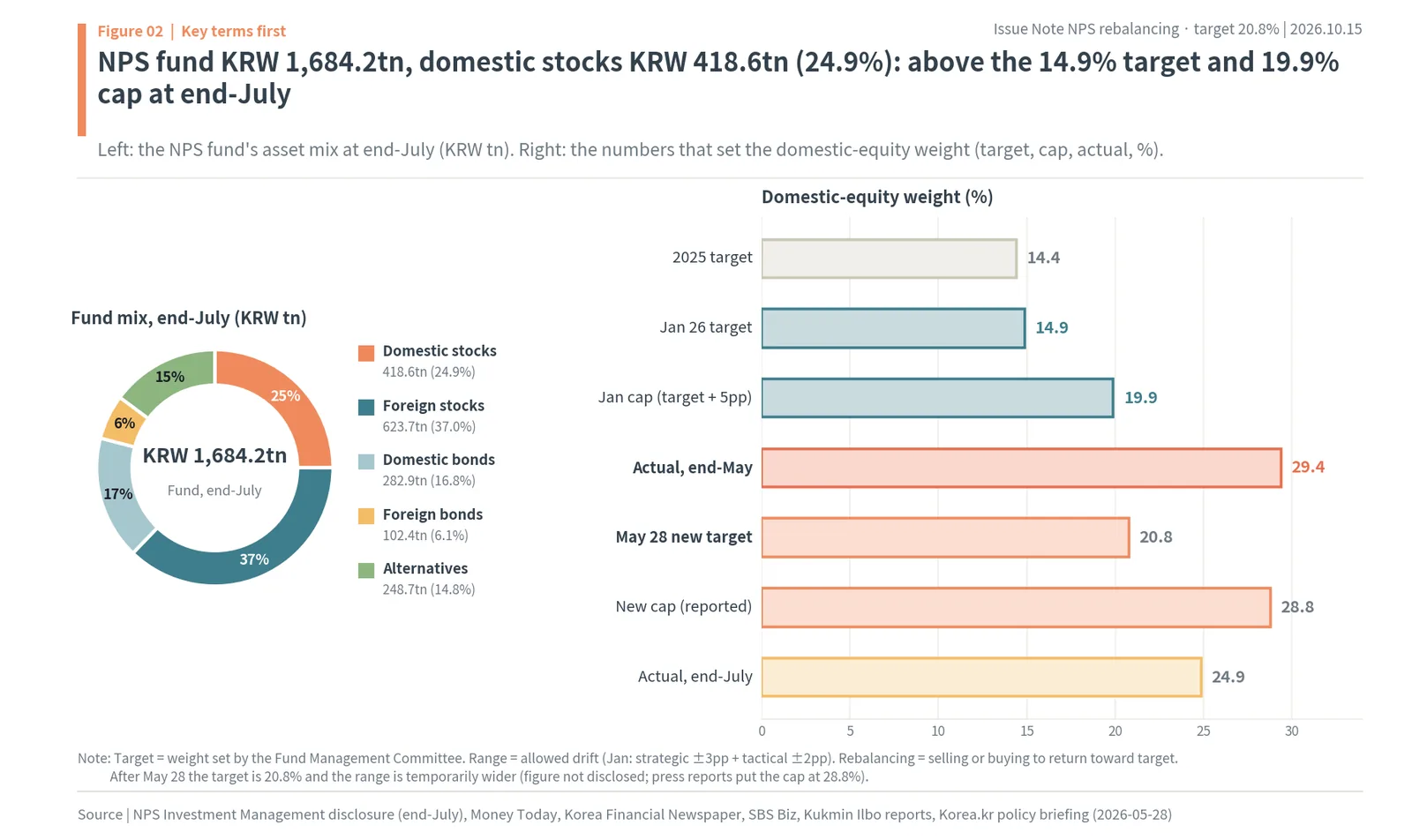
The left of Figure 2 is the fund’s makeup at the end of July as disclosed by NPS Investment Management. Of the KRW 1,684.2tn fund, domestic stocks are KRW 418.6tn, or 24.9%. Foreign stocks are the largest at KRW 623.7tn (37.0%), followed by domestic bonds at KRW 282.9tn (16.8%), alternatives at KRW 248.7tn (14.8%) and foreign bonds at KRW 102.4tn (6.1%). The right lines up the numbers that set the domestic-equity weight. The target set in January was 14.9% and the cap 19.9%. The actual weight at the end of May was 29.4%, 9.5 points above the cap. The new target from May 28 is 20.8%, and the new cap known from press reports is 28.8%. The actual weight of 24.9% at the end of July is within the new range. As the figure’s title says, the NPS reached July above both the 14.9% target and the 19.9% cap, and it brought that excess inside the range by changing the rule.
Why sell by rule
The NPS buys and sells by rule rather than by human judgment because of the fund’s size and purpose. When the rebalancing rule was written in 2019, the fund was about KRW 713tn; at the end of July it was KRW 1,684.2tn. If the NPS traded domestic stocks on judgment, the market would try to guess its next move whether that judgment was right or wrong. A rule reduces that guessing, and it also stops judgment from being pulled along by politics or public opinion. The same reasoning is why the NPS has been cutting its domestic-equity weight and raising its foreign weight. At the end of July, overseas investments were KRW 951.2tn, or 56.6% of the fund. Korea’s stock market makes up a share in the high 1% range of the world equity index (MSCI ACWI) (Newsis, May 28), so tying retirement savings heavily to the share prices of one country is itself a source of risk. Rebalancing is the mechanism that keeps this diversification in place day after day. When Korean share prices rise, the fund trims the domestic portion and spreads it into foreign assets and bonds; when they fall, it does the reverse.
Hypothetical example: a KRW 100mn pension account
What the rule does is easy to see in a small account. Imagine a hypothetical pension account of KRW 100mn (about $74,400). At the end of January it holds KRW 20mn (20%) in domestic stocks and the other KRW 80mn in a deposit earning 0%. The owner has set a domestic-equity target of 15% and a cap of 20%. Domestic stocks are assumed to move with the KOSPI.
From the end of January to the end of May, the KOSPI rose 62.24%. The KRW 20mn in domestic stocks became KRW 32.45mn, the whole account KRW 112.45mn, and the domestic weight 28.9%. Following the rule, the owner would now sell KRW 9.96mn of domestic stocks and put it in the deposit to return to the 20% cap. Deferring the rule and leaving it alone means selling nothing.
From the end of May to October 15, the KOSPI fell 34.47%. On October 15 the account that sold by the rule holds KRW 104.7mn and the one left alone KRW 101.26mn, a difference of KRW 3.43mn (author’s calculation). Same account, same market, and a single sale at the end of May separated them by KRW 3.43mn. In the account left alone, the domestic weight has come down to 21.0% on October 15, near the cap again. The fall brought the weight back by itself, but in the meantime the excess took the full force of the decline.

Figure 3 draws this calculation. The bars on the left show domestic stocks growing from KRW 20mn at the end of January to KRW 32.45mn at the end of May, then becoming KRW 22.49mn after selling by the rule. The right shows the whole account on October 15. In a KRW 100mn account, selling KRW 9.96mn by the rule at the end of May leaves KRW 3.43mn more. Moving the NPS’s decisions onto this account gives two steps. The January deferral was “don’t sell until the end of June, even above the cap,” and the May target raise was “move the cap itself from 20% to around 29%.” Because of the second decision, almost nothing was left to sell when the deferral ended at the end of June.
2. KOSPI circuit breaker on October 15: -7.57% to 5,554.22, 39.06% below its high
A circuit breaker after seven straight down days
On October 15 the KOSPI closed at 5,554.22, down 454.59 points (7.57%) from the day before. It opened 5.59% lower at 5,673.01, and at about 12:38 p.m., at 5,528.05, down 8.00%, a level-1 circuit breaker halted trading for 20 minutes. Fifteen minutes earlier, the KOSDAQ had halted first at 757.88, down 8.01%. The intraday low was 5,450.81 (-9.29%) (Herald Economy, MBN, October 15). The KOSDAQ closed down 7.65% at 760.82.
That made seven straight down days for the KOSPI since October 6 (the market was closed on October 9). From the October 2 close of 7,003.74, it lost 1,449.52 points, or 20.7%. Against the June 22 closing high of 9,114.55 it is 39.06% lower. The end-2025 close was 4,214.17, so it is still 31.8% above where the year began.
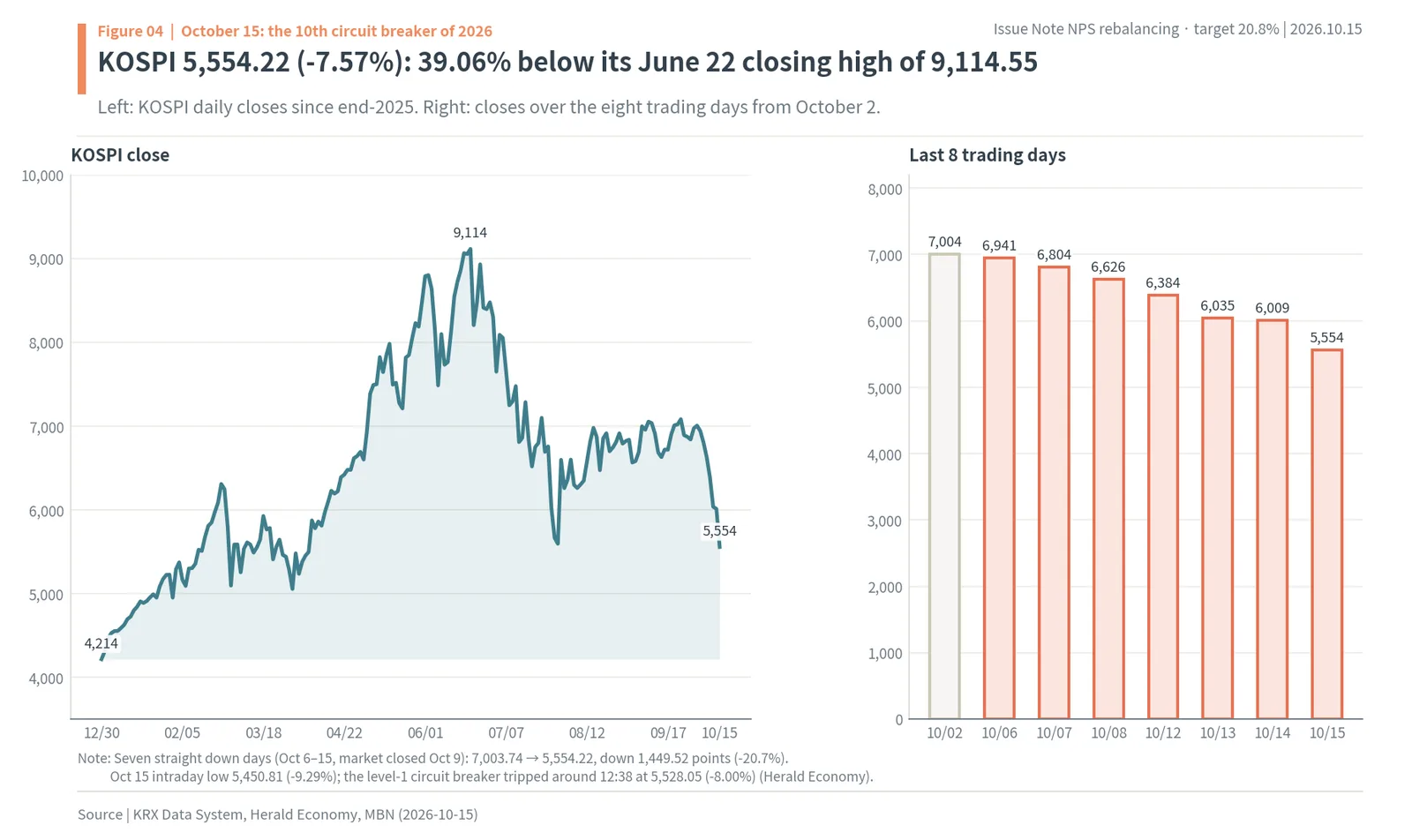
The left of Figure 4 is the KOSPI’s daily close since the end of 2025. It more than doubled from January to June, fell sharply in July, held around 7,000 in August and September, then turned down again in October. The right shows closes over the eight trading days from October 2: down every single day, like a staircase. As the title says, the KOSPI’s 5,554.22 (-7.57%) is 39.06% below the June 22 closing high of 9,114.55.
Ten of 16 ever came this year
A level-1 circuit breaker halts trading for 20 minutes once the index has been down more than 8% from the previous close for one minute. Trading then restarts with 10 minutes of single-price auction. This was the 16th circuit breaker in the KOSPI’s history, and 10 of them came in 2026. On the KOSDAQ, 5 of 15 ever came this year. The sidecar, which halts program trading for five minutes, was the KOSPI’s 51st this year and the KOSDAQ’s 33rd (Herald Economy, October 15).
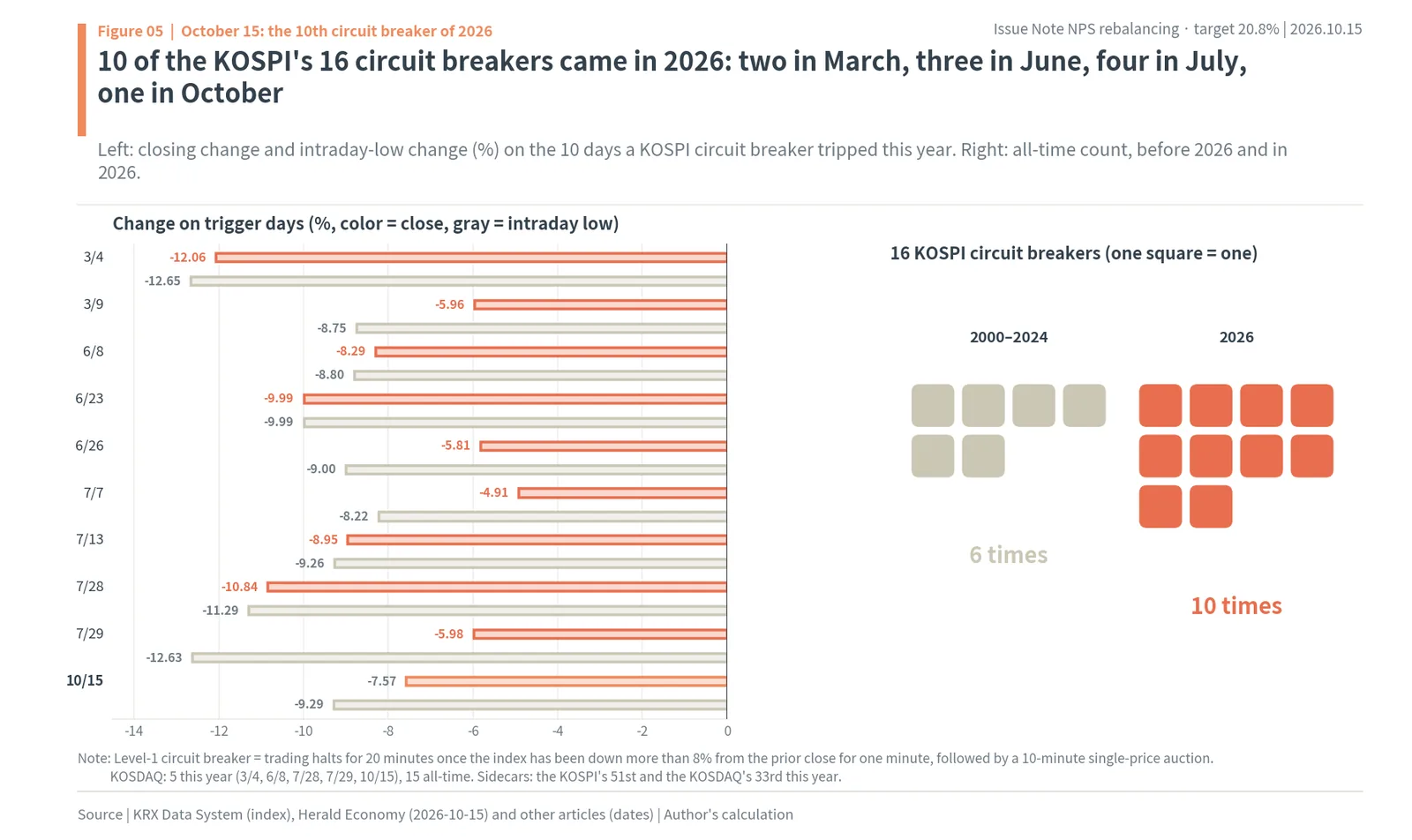
The left of Figure 5 shows the closing change and the intraday-low change on the ten days a KOSPI circuit breaker tripped this year. The March 4 close of -12.06% was the biggest, followed by July 28 at -10.84% and June 23 at -9.99%. On many days, such as March 9, June 26, July 7 and July 29, the index fell more than 8% intraday but narrowed its loss to 5–6% by the close. October 15 was -9.29% intraday and -7.57% at the close. The waffle on the right splits the 16 all-time circuit breakers into 6 in 2000–2024 and 10 in 2026. With two in March, three in June, four in July and one in October, this year’s market has swung hard one way and then snapped back, again and again. In a market like this, whether a big player like the NPS trades by its rules matters to individual investors too.
October 15’s drop was the biggest in points and percent since July 28 (732.09 points, -10.84%) (MBN, October 15). In July, circuit breakers tripped four times, on the 7th, 13th, 28th and 29th, and on the 28th and 29th they hit both the KOSPI and the KOSDAQ two days in a row. That means four circuit breakers in the month after the NPS restarted rebalancing on July 1. October 15 was the first day both markets halted together since July 29, about two and a half months earlier. This report does not deal with any link between when the fall began and the NPS decisions. What it looks at is how much the fall cost the NPS fund.
Asia on the same day, and two stocks
On the same day Japan’s Nikkei 225 closed down 4.90% at 64,425.95 and Taiwan’s TAIEX down 3.41% at 46,969.87. The day before in the US, the Nasdaq fell 1.88% and the Philadelphia Semiconductor Index 4.30%. Reports said US core consumer prices for September came in above forecasts, the research firm Gartner warned that revenue might fall short of investment in AI infrastructure, and Anthropic’s announcement on the morning of the 15th, Korean time, of third-quarter revenue of $16.8bn drew the market’s attention to slowing growth (Edaily, Yonhap, October 15). This report does not examine the causes of the fall. It only notes that on the same day, on the same news, Korea moved the most.
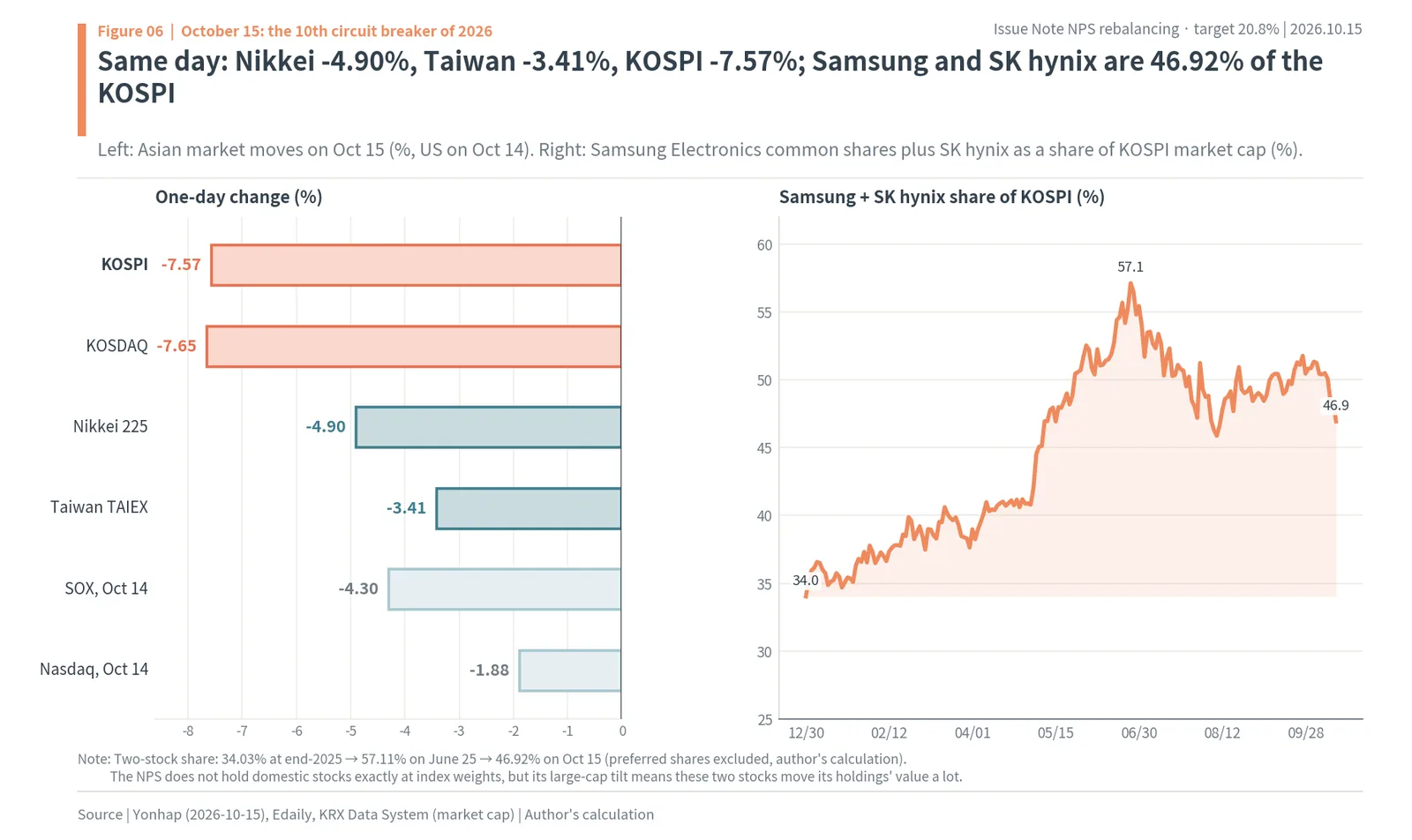
The left of Figure 6 is the one-day change: the Nikkei -4.90%, Taiwan -3.41% and the KOSPI -7.57% on the same day. The right is the combined share of Samsung Electronics (005930.KS) common shares and SK hynix (000660.KS) in KOSPI market cap. It rose from 34.03% at the end of 2025 to 57.11% on June 25 and was 46.92% on October 15 (author’s calculation, preferred shares excluded). That day Samsung Electronics fell 9.48% to KRW 210,000 (about $156) and SK hynix 11.06% to KRW 1,262,000 (about $939). When two stocks make up 46.92% of the KOSPI, their day is the market’s day. These two stocks also account for a large share of NPS domestic holdings, so their moves swing the value of those holdings a great deal. That links to the two decisions in the next chapter.
3. NPS decisions: the January 26 rebalancing deferral and the May 28 20.8% target
January 26: no selling, even outside the allowed range
To start with the conclusion: the January decision “paused the rule,” and the May decision “moved the rule’s baseline.” The two decisions are different in kind and must be judged separately.
On January 26, 2026, the first Fund Management Committee meeting of the year approved a “plan to improve the NPS fund portfolio.” It raised the domestic-equity target by 0.5 points from 14.4% to 14.9% and cut the foreign-equity target by 1.7 points from 38.9% to 37.2%. As the reason for cutting foreign stocks, it cited “the burden of sourcing foreign currency and a foreign exchange market where demand outweighs supply” (Newsis, January 26). At the same meeting it decided to defer rebalancing temporarily even if the domestic-equity weight left the allowed range. The deferral would last until the end of June, and the committee would review the allowed range while watching the market over the first half.
There were two official reasons. As the fund had grown, the market impact of rebalancing had grown with it; and the domestic stock and currency markets had moved so much in so short a time that setting an allowed range was difficult. The NPS explained that “the current rebalancing method was set in 2019, when the fund was about KRW 713tn, and the fund has since more than doubled.” It was the first January committee meeting in five years, since 2021 (Herald Economy, January 27). By then the domestic-equity weight was already near the cap. It had reached 17.9% in October 2025, the top of the strategic range, and pension funds and others had been net sellers of KRW 1.65tn on the KOSPI from January 2 to 26 (Chosun Biz, January 27).
Meanwhile the weight climbed to 29.4%
On January 26, when the deferral began, the KOSPI stood at 4,949.59. It then rose to 6,244.13 at the end of February, 5,052.46 at the end of March, 6,598.87 at the end of April and 8,476.15 at the end of May. The NPS domestic-equity weight was 24.5% at the end of February, 21.0% at the end of March, 25.13% at the end of April, 29.4% at the end of May and 29.13% at the end of June (reported month-end values). Except at the end of March, it was well above the 19.9% cap the whole time.

In Figure 7, the red line on the left is the actual weight, the teal step below it the target, and the dashed line the cap. The domestic-equity weight rose from 24.5% in February to 29.4% in May, while the cap stayed at 19.9%. From June, the target rose to 20.8% and the cap to 28.8% (reported), almost touching the actual weight. The right splits end-May holdings of KRW 543.6tn into KRW 367.9tn that the NPS should have held at a 19.9% cap and an excess of KRW 175.7tn (about $131bn). That excess is the end-May fund of KRW 1,848.7tn times the 9.5 points by which the weight exceeded the cap (author’s calculation). In effect, the target was raised to 20.8% while the weight, having climbed from 24.5% in February to 29.4% in May, was above the 19.9% cap.
May 28: target up to 20.8%, allowed range temporarily widened
On May 28 the fifth committee meeting of the year set the 2027–2031 medium-term asset allocation and also revised the 2026 targets. It raised the domestic-equity target by 5.9 points from 14.9% to 20.8%, to apply from the end of June when the deferral ended. Foreign stocks became 34.7%, domestic bonds 23.1%, foreign bonds 7.4% and alternatives 14.0%. The 2027 target for domestic stocks was also set at 20.8%. The strategic range for domestic stocks was temporarily widened, but the figure was withheld out of “concern that it could affect financial market stability”; the maximum daily rebalancing size was reduced; and the allowed range was to be reviewed again at the end of the year (Korea.kr, May 28). The press reported the widened range as ±6 points and the cap as 28.8%, but these are not figures the NPS has confirmed.
The official reason was that the decision “considered the possibility of structural change in the domestic stock market from the revision of the Commercial Act and other factors, and the rise in the actual domestic-equity weight.” Health and Welfare Minister Jeong Eun-kyeong spoke of “fund management that balances principle and flexibility.” Fifteen of the committee’s 19 members attended the fifth meeting, with some labor members staying away (The Scoop, July 3). At the audit, Chairman Kim said both the January and May decisions were unanimous, without a vote, because there were no objections.
The difference between the two decisions is clear. The January deferral had an end date: the end of June. When it ended, the excess would have to be sold. The May raise erased that end. With a target of 20.8% and a cap near 28.8%, the end-May weight of 29.4% and the end-June weight of 29.13% were almost within range. On July 1, the day rebalancing resumed, pension funds were net sellers of KRW 217.8bn (Kyunghyang Shinmun, July 1), and Chairman Kim said the chance of the selling becoming “a bomb is zero.” There really was not much to sell. Daishin Securities estimated the domestic-equity weight at 30% as of June 26 and put the amount above the target at about KRW 164tn, but most of that fell inside the new range.
A precedent: in April 2021 the range was also widened after a rally
Changing the rule to fit the market was not new. When share prices surged in early 2021, pension funds, whose domestic-equity weight had risen, were net sellers for 47 straight trading days from the start of the year to March 12 to meet their target weights. As the controversy grew, with some investor groups visiting NPS Investment Management to protest, the NPS widened its strategic range for domestic stocks from ±2 points to ±3 points that April. The next year, 2022, the KOSPI fell sharply amid US Federal Reserve tightening, and the NPS’s domestic-equity return was -22.75% (Digital Times, October 13). The minutes of that meeting were also kept sealed for four years (Financial News, October 14).
Both episodes followed the same sequence. Korean share prices rise; the weight hits the cap and pension funds sell; complaints about pension funds selling grow; the range is widened or the target raised; and the next year, or a few months later, share prices fall. Every time the rule makes the fund sell high, that selling draws the market’s anger, and the anger changes the rule. In 2026 the scale was far larger. In 2021 the range widened by 1 point; in 2026 the target rose 5.9 points and, according to reports, the cap 8.9 points.
It also stands out that the plan was reversed within the same year. At a press briefing in June, Chairman Kim said the NPS was “keeping the existing plan to cut the domestic-equity weight by 0.5 percentage points every year from next year,” while adding that the direction was “a matter to decide after looking at market conditions at the end of this year” (SBS Biz). The 2027 target had already been set at 20.8% in May. A course of trimming the domestic weight a little each year to diversify abroad does not fit with a decision that raised the target by 5.9 points in a single year.
What brokerages estimated would have to be sold
There are several estimates of how much would have had to be sold without the deferral and the raise. On May 28 Newsis calculated that, with a fund of KRW 1,800tn and a 14.9% target and 19.9% cap, KRW 162tn to 177tn would in principle have to be rebalanced. That brackets the author’s end-May excess of KRW 175.7tn. Daishin Securities, using the KOSPI’s 8,411.21 on June 26, estimated the domestic weight at 30% and the amount above the new 20.8% target at about KRW 164tn. Shinyoung Securities estimated that at end-June, with the KOSPI above 8,175, the weight would exceed target even using the whole widened range, and that the NPS would have to sell up to KRW 74.4tn at a KOSPI of 9,000 and KRW 120.9tn at 10,000 (Kyunghyang Shinmun, July 1). The KOSPI reached 9,114.55 on June 22 and fell after that, and the decline erased the selling by itself.
4. NPS domestic holdings since: KOSPI +71.25% during the deferral, -34.47% after the raise
Domestic holdings and the cumulative gain
The conclusion: the market turned right after the target was raised, and the excess took the full force of the fall. The numbers showed up most in July.
The value of NPS domestic stock holdings was KRW 395.1tn at the end of February, KRW 320.9tn at the end of March, KRW 419.5tn at the end of April, KRW 543.6tn at the end of May, KRW 543.2tn at the end of June and KRW 418.6tn at the end of July. In July alone it fell by KRW 124.6tn (about $92.7bn), and the whole fund shrank by KRW 181.4tn, from KRW 1,865.6tn to KRW 1,684.2tn. According to data the NPS submitted to the National Assembly, the cumulative investment gain on domestic stocks fell by KRW 124.8tn, from KRW 283.5tn at the end of June to KRW 158.7tn at the end of July (News Tomato, October 14, press conference by People Power Party lawmaker Baek Jong-heon). The fund’s year-to-date return fell from 27.22% at the end of June to 14.84% at the end of July, and the domestic-equity return from 107.37% to 60.11%. End-August data had not been published as of October 15.
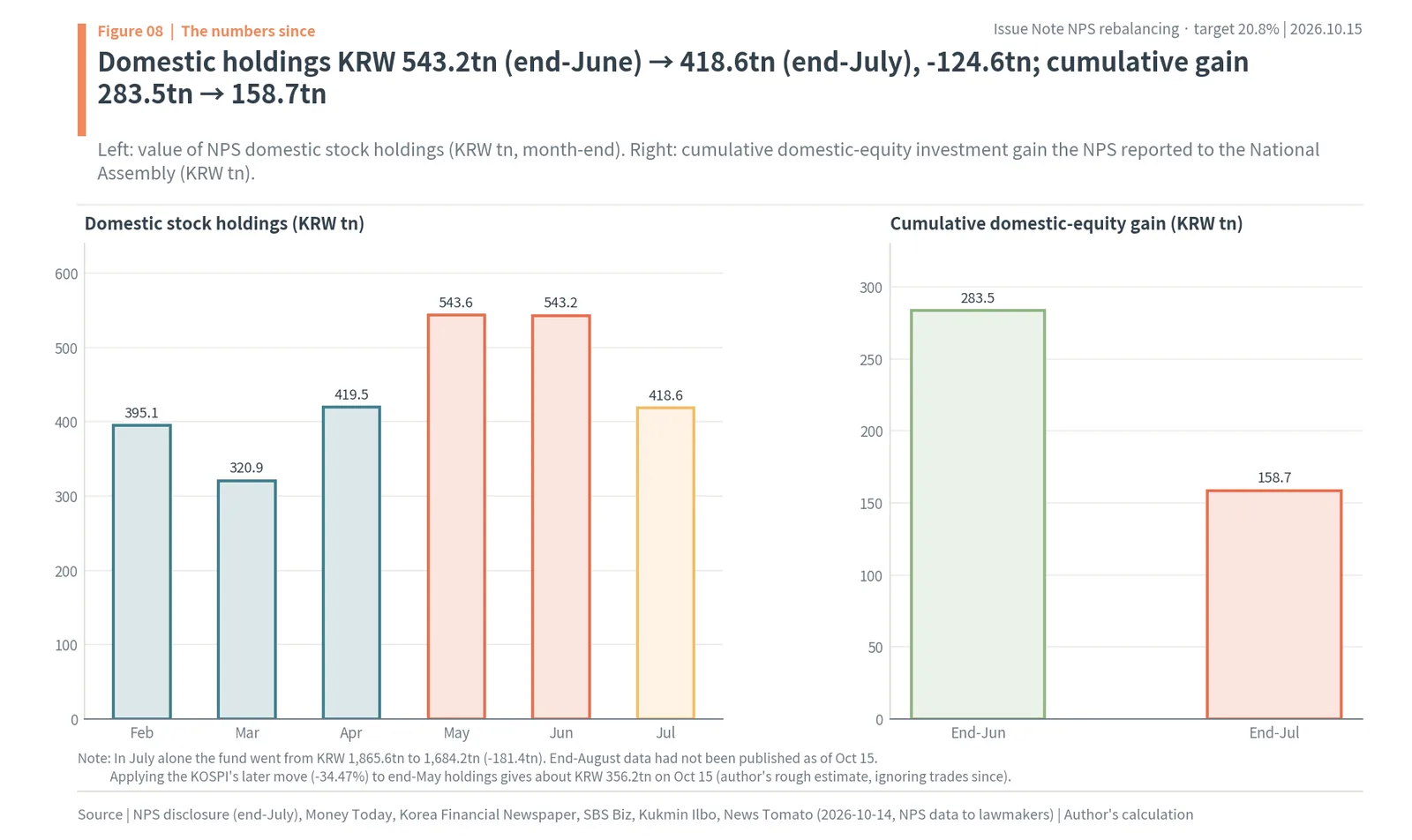
The left of Figure 8 is the value of domestic holdings. It dropped from about KRW 543tn in May and June to KRW 418.6tn in July. Domestic holdings went from KRW 543.2tn at the end of June to KRW 418.6tn at the end of July (-KRW 124.6tn), and the cumulative gain went from KRW 283.5tn to KRW 158.7tn. The right shows that cumulative gain. Applying the KOSPI’s subsequent move (-34.47%) to end-May holdings gives a rough figure of about KRW 356.2tn on October 15 (author’s rough estimate, excluding any trades in between). After the end of July the KOSPI fell another 15.79%.
Not all of the decline in value can be blamed on the deferral. Even if the NPS had held exactly 19.9% by the rule, that 19.9% would still have taken the fall. What has to be measured is the loss on the part above the cap, the part it would not have held under the rule. Chapter 5 calculates it.
The path of returns
The same pattern is clear in the fund’s returns. The NPS earned 18.82% in 2025 as a whole, with a domestic-equity return of 82.44% (NPS Investment Management). The 2026 year-to-date return rose to 10.26% at the end of February, 26.18% at the end of May and 27.22% at the end of June, then fell to 14.84% at the end of July. The domestic-equity return was in the 49% range at the end of February, 106.76% at the end of May and 107.37% at the end of June, and 60.11% at the end of July. In one month, the domestic-equity return fell by more than 47 points. At the end of July, the domestic-equity return of 60.11% was above its benchmark of 57.98%, so the stocks the NPS picked did not do worse than the market. What made the difference was not stock selection but the weight.
There is another calculation. On July 30, Money Today estimated that if the NPS had kept its holdings unchanged after the end of May and the KOSPI’s fall (8,476.15 on May 29 → 5,593.56 on July 30, -34.0%) were applied simply, the value of its domestic holdings would have dropped by more than KRW 180tn. The KOSPI’s 5,554.22 on October 15 is even lower than that July 30 low. It is the same order of size as the author’s rough estimate (-34.47% from the end of May, a fall in value of about KRW 187.4tn).
Decision dates and the KOSPI
Placing the two decisions on the KOSPI makes the picture clearer. From 4,949.59 on January 26 to 8,476.15 on May 29, the KOSPI rose 71.25%. It closed at 8,185.29 on May 28, the day of the target raise, and rose further to 8,476.15 the next day. It then reached 9,114.55 on June 22, stood at 8,303.41 on July 1 when rebalancing resumed, 6,595.45 at the end of July and 5,554.22 on October 15. From the end of May to October 15 it fell 34.47%.
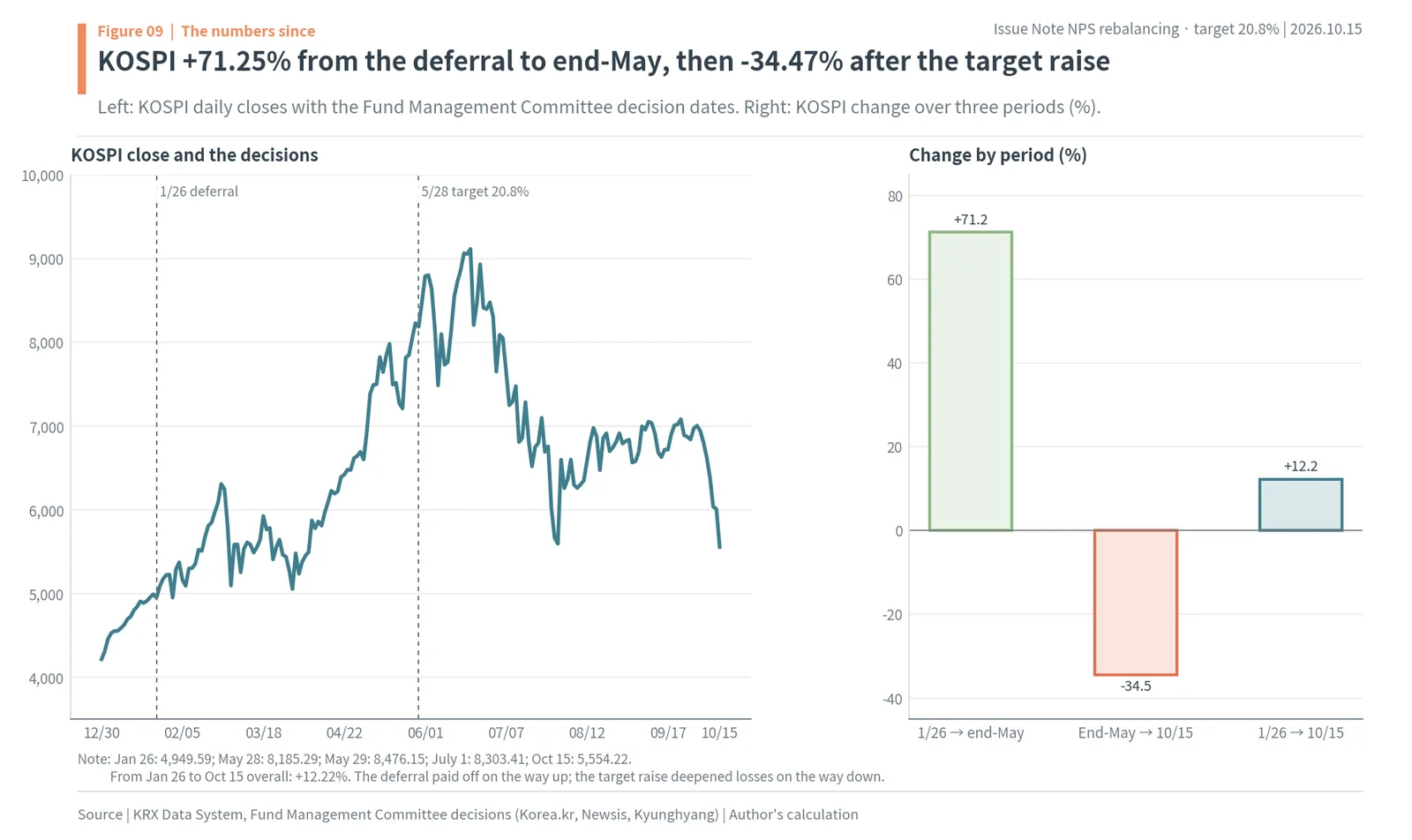
The left of Figure 9 marks the January 26 deferral and the May 28 target raise as dotted lines on the KOSPI close. The deferral sits at the start of the climb, and the target raise near the top. The right shows the change over three periods: +71.25% for the KOSPI from the deferral to the end of May, -34.47% after the target raise, and +12.22% for January 26 to October 15 as a whole.
These numbers split the audit fight in two. The NPS side can say the deferral was not a loss, since measured from January 26 the KOSPI is still 12.22% higher. The critics start from the KRW 124.8tn fall in the cumulative gain from the end of June to the end of July. Each side has one number right. The question is which period you look at. The author thinks the period should be split in two. January 26 to the end of May is the result of one decision, the deferral; from the end of May on is the result of a different decision, the target raise. Lumping the two decisions together lets the gain in the first period hide the loss in the second.
5. If the NPS had kept its 19.9% cap: +KRW 15.7tn to May, -KRW 51.3tn after
Method
The conclusion of this chapter is just what Figure 10’s title says. Had the 19.9% cap been kept, the deferral gained KRW 15.7tn in February to May and lost KRW 51.3tn after the end of May, for a net loss of KRW 35.6tn (author’s calculation). The NPS has not released a profit-and-loss simulation, so the author ran the simplest possible comparison using only published month-end numbers.
The method is this. At each month-end, the excess over the cap is domestic holdings minus “fund size × 19.9%.” Had the rule been kept, that excess would have been sold and held somewhere earning 0%; because of the deferral, it instead moved with the KOSPI until the next month-end. So “excess × KOSPI change to the next month-end” is the deferral’s gain or loss in that period. The last period runs from the end of July to October 15. Fund sizes at the end of March and April were estimated by dividing published holdings by the weight (KRW 1,528.1tn at the end of March and KRW 1,669.3tn at the end of April).
The excess was KRW 74.6tn at the end of February, KRW 16.8tn at the end of March, KRW 87.3tn at the end of April, KRW 175.7tn at the end of May, KRW 171.9tn at the end of June and KRW 83.4tn at the end of July. The KOSPI’s change over each following period was, in order, -19.08%, +30.61%, +28.45%, 0.00% (8,476.15 at the end of May and 8,476.48 at the end of June are almost identical), -22.19% and -15.79%. Multiplying gives period results of -KRW 14.2tn, +KRW 5.1tn, +KRW 24.8tn, KRW 0.0tn, -KRW 38.1tn and -KRW 13.2tn.

The left of Figure 10 is the result by period. Plus means a period in which the deferral gained, minus a period in which it lost. From February to March, the KOSPI fell 19.08% and the deferral lost KRW 14.2tn, but over the two months from March to May the KOSPI rose again and it made KRW 29.9tn. So the cumulative total at the end of May was +KRW 15.7tn. The one month from June to July produced -KRW 38.1tn, and the end of July to October 15 another -KRW 13.2tn. The cumulative line on the right peaks at +KRW 15.7tn in May and June and comes down to -KRW 35.6tn on October 15.
What this calculation says and does not say
This calculation is simple. Had the money sold been put into foreign stocks or bonds, their returns would add to or subtract from it. It also leaves out trading costs, the period from January 26 to the end of February, and the fact that NPS domestic holdings do not move exactly with the KOSPI. Under the rule the NPS would have sold a little each month, so the real excess would have been smaller than this. So no single number here should be read as an exact profit or loss. But the direction is clear. The loss after May is more than three times the gain in February to May.
This direction also matches reports about the NPS’s written answers to lawmakers. At the October 14 audit, Lee Man-hee, chair of the National Assembly’s Health and Welfare Committee, pointed out that the NPS’s written answer included language “to the effect that excess returns would likely have occurred had it not deferred from February to June,” which differed from the chairman’s answer that the deferral helped returns (Seoul Economic Daily, October 14). The NPS’s underlying data have not been released. By the author’s calculation, even cutting the period off at February to June gives -14.2 + 5.1 + 24.8 + 0.0 = +KRW 15.7tn, a gain for the deferral, and including July onward turns it into a loss. This gap will only be resolved when the NPS discloses the period and assumptions it used.
The end-May excess on its own
Taking the end of May on its own shows the weight of the decision more clearly. Of the KRW 543.6tn in domestic holdings at the end of May, KRW 367.9tn falls within the 19.9% cap and KRW 175.7tn lies outside it. That KRW 175.7tn is exactly the portion the May 28 target raise said “need not be sold.” Multiplying the KRW 175.7tn above the cap at the end of May by the KOSPI’s subsequent -34.47% gives -KRW 60.6tn (about $45.1bn).

The left of Figure 11 splits end-May domestic holdings of KRW 543.6tn into 67.7% within the cap and 32.3% above it. The part above the cap equals 9.5 points of the fund. The right shows that the KRW 175.7tn above the cap would have become KRW 115.1tn had it moved with the KOSPI to October 15. This amount could not have been sold in a single day at the end of May. At KRW 800bn a day it would take 220 trading days (author’s calculation). So the real difference is smaller than -KRW 60.6tn. The -KRW 51.3tn after May in Figure 10 reflects the excess changing at each month-end.
This is where the difference between the two decisions shows up in numbers. Had there been only the January deferral, the NPS would have had to start selling the excess after the deferral ended at the end of June. Selling just KRW 800bn a day would have cut about KRW 17.6tn in July alone (22 trading days). The May target raise all but erased that selling. The NPS restarted rebalancing on July 1, but within the new range there was little to sell, and in July pension funds and others were actually net buyers of KRW 995.5bn.
6. The KRW 800bn-a-day market shock: 2.09% of KOSPI turnover
What the chairman said
The NPS’s strongest argument for the deferral is market impact. At the October 14 audit, Chairman Kim Sung-joo answered that without the deferral, the NPS “would have sold KRW 800bn of stock a day and given the market a serious shock” (Kukmin Ilbo, October 15). Another report quoted him as saying it “would have had to dump over KRW 800bn every day, more than 10% of total KOSPI turnover” (Etoday, October 14). To start with the conclusion: KRW 800bn a day is 2.09% of the KOSPI’s KRW 38.31tn (about $28.5bn) average daily turnover in February to June. The claim of 10% of turnover does not match KRX numbers.
Compared with turnover
According to KRX data, the KOSPI’s average daily turnover was KRW 27.1tn in January, KRW 32.2tn in February, KRW 30.1tn in March, KRW 29.6tn in April, KRW 50.2tn in May and KRW 50.3tn in June. The average for February to June, the deferral period, is KRW 38.31tn, and KRW 800bn is 2.09% of it. Even against January’s average of KRW 27.1tn, the month with the least trading, it is under 3%. Against October 15’s turnover of KRW 26.87tn, it is 2.98%. The NPS has not said what base the chairman’s 10% refers to.

The left of Figure 12 shows average daily turnover by month, with the red dashed line along the bottom at KRW 800bn. KRW 800bn a day is 2.09% of the KOSPI’s KRW 38.31tn average daily turnover in February to June. The right compares the size of KRW 800bn on three bases: against the 10% in the chairman’s remarks, it is 2.09% of average February–June turnover and 2.98% of October 15 turnover.
A third way: selling in pieces
This does not mean KRW 800bn a day is small money for the market. Net buying and selling move far less than turnover, and on October 13, when foreigners sold KRW 4.54tn in one day, the KOSPI fell 5.46%. If pension funds sold KRW 800bn every day, the market might notice and move ahead of them. The NPS’s reason for not disclosing its trading rules, that “foreigners like hedge funds” could exploit them, reflects the same worry.
But the choice was never only between “sell KRW 800bn a day” and “don’t sell.” On May 28 the NPS itself set up a mechanism to reduce its maximum daily rebalancing size. Selling the end-February excess of KRW 74.6tn at KRW 800bn a day takes 93 trading days, and the end-May KRW 175.7tn takes 220 (author’s calculation). Cutting the pace to KRW 400bn a day (about 1% of turnover) doubles the time. Taking a long time is a drawback, but selling slowly into a rising market is exactly what rebalancing is meant to do. Other public pension funds did just that. Lawmaker Baek Jong-heon pointed out that the Teachers’ Pension and Korea Post have not deferred rebalancing because of market conditions in the past ten years, and that the Government Employees Pension Service adjusts within 20 business days of exceeding its cap (Etoday, October 14).
From the numbers in this chapter, the author sees it this way. If market impact was the worry, the answer was “slowly,” not “stop.” Even with the January deferral, had the NPS started selling within a daily limit after it ended in late June, it would have trimmed at least some holdings before the July crash. The May target raise closed off that path as well.
7. KOSPI investor flows: foreigners -KRW 207.92tn, individuals +KRW 101.63tn, pension funds -KRW 9.03tn
Net buying by investor type
This year’s money flow in the KOSPI comes down to one line: foreigners sold, individuals bought, and pension funds were small. According to KRX trading data by investor type, KOSPI net buying from January to October 15 was -KRW 207.92tn (about $154.7bn) for foreigners (including other foreigners), +KRW 101.63tn (about $75.6bn) for individuals, +KRW 40.73tn for all institutions and -KRW 9.03tn for pension funds and others (author’s totals). That is the same flow as the press reports of “foreigners selling more than KRW 205tn net.”
Month by month, foreigners sold heavily while the market rose, -KRW 35.7tn in March, -KRW 44.5tn in May and -KRW 48.4tn in June, and individuals took up the supply with +KRW 33.6tn in March, +KRW 35.1tn in May and +KRW 42.4tn in June. Pension funds and others were net sellers even during the deferral: -KRW 1.89tn in January, -KRW 2.16tn in May and -KRW 2.34tn in June. “Pension funds and others” also includes other pension funds besides the NPS, such as the Government Employees Pension and the Teachers’ Pension. In other words, the deferral stopped the NPS’s mechanical selling, not all selling. Net selling by pension funds and others in January to June was KRW 8.73tn.

The left of Figure 13 is monthly net buying and the right the total for the year. This year on the KOSPI, foreigners are -KRW 207.92tn, individuals +KRW 101.63tn and pension funds and others -KRW 9.03tn. July was the first month this year that pension funds and others turned net buyers (+KRW 1.00tn). During the July 28–31 slump, they bought KRW 338.1bn on July 29 and KRW 380.2bn on July 30 (Newspim, October 2). On October 15 alone, foreigners were -KRW 3.77tn, individuals +KRW 1.46tn, institutions +KRW 1.67tn and pension funds and others +KRW 35.1bn (tallied right after the close). For October 1–15, foreigners were -KRW 17.98tn, individuals +KRW 8.04tn and pension funds and others -KRW 45.4bn.
This flow bears directly on the rebalancing debate. While the market rose, individuals took the shares foreigners sold, and under the rule the NPS should also have been on the selling side. For the NPS to support the market in a fall, it needed to have cut its weight beforehand to leave room to buy. This year the NPS carried a larger weight through the rise, so in the July and October falls, net buying by pension funds and others was only tens to hundreds of billions of won a day. Compare that with net buying by pension funds of about KRW 18.03tn in the 2008 financial crisis and about KRW 12.84tn in 2011 (Kukmin Ilbo, October 13).
Pension funds in falling markets: July and October
Looking at how much pension funds and others bought per day in the two falls shows how thin the support was. From July 1 to midday on July 28, cumulative net buying of KOSPI stocks by pension funds and others was KRW 15bn, while foreigners sold KRW 17.90tn and individuals bought KRW 17.98tn (Money Today, July 28). Only as the slump continued at the end of July did pension funds and others net buy KRW 116.5bn on July 28, KRW 338.1bn on the 29th, KRW 380.2bn on the 30th (the largest single day this year) and KRW 164.7bn on the 31st (Newspim, October 2). Together, the four days come to about KRW 1tn. In the same month of July, foreigners net sold KRW 18.17tn (Money Today, July 30).
October was similar. On October 12, pension funds and others bought KRW 145bn while foreigners sold KRW 2.02tn. On the 13th, pension funds and others bought KRW 51.4bn and foreigners sold KRW 4.54tn, and the KOSPI fell 5.46% (Kukmin Ilbo, Digital Times, October 13). On the 14th they bought KRW 15.1bn (Kyeonggi Ilbo, October 15). From August 1 to October 14, pension funds and others were cumulative net sellers of about KRW 1.3tn. The NPS not buying heavily in a falling market is itself consistent with the rule: at the end of July the domestic-equity weight of 24.87% was above the new 20.8% target, so under the rule it was not yet time to buy. Because the target was raised, the NPS did not sell on the way up; because the weight stayed high, it does not buy on the way down. The same decision kept the pension fund out of the market both on the way up and on the way down.
Margin debt and forced sales
In the same fall, the first to get hurt are individuals who bought with borrowed money. According to Korea Financial Investment Association (KOFIA) data, the margin loan balance peaked for the year at KRW 38.63tn on June 24, and stood at KRW 34.29tn on October 12 and KRW 33.71tn (about $25.1bn) on October 14. Forced sales, in which a broker sells the shares in accounts that lack collateral, rose from KRW 6.4bn on October 8 to KRW 27.1bn on the 12th, KRW 59.4bn on the 13th and KRW 89.3bn on the 14th. Unpaid trade settlements in brokerage accounts were KRW 1.357tn on October 14. The biggest day for forced sales this year was June 9, at KRW 169.8bn. The figure for October 15 comes out a day later.
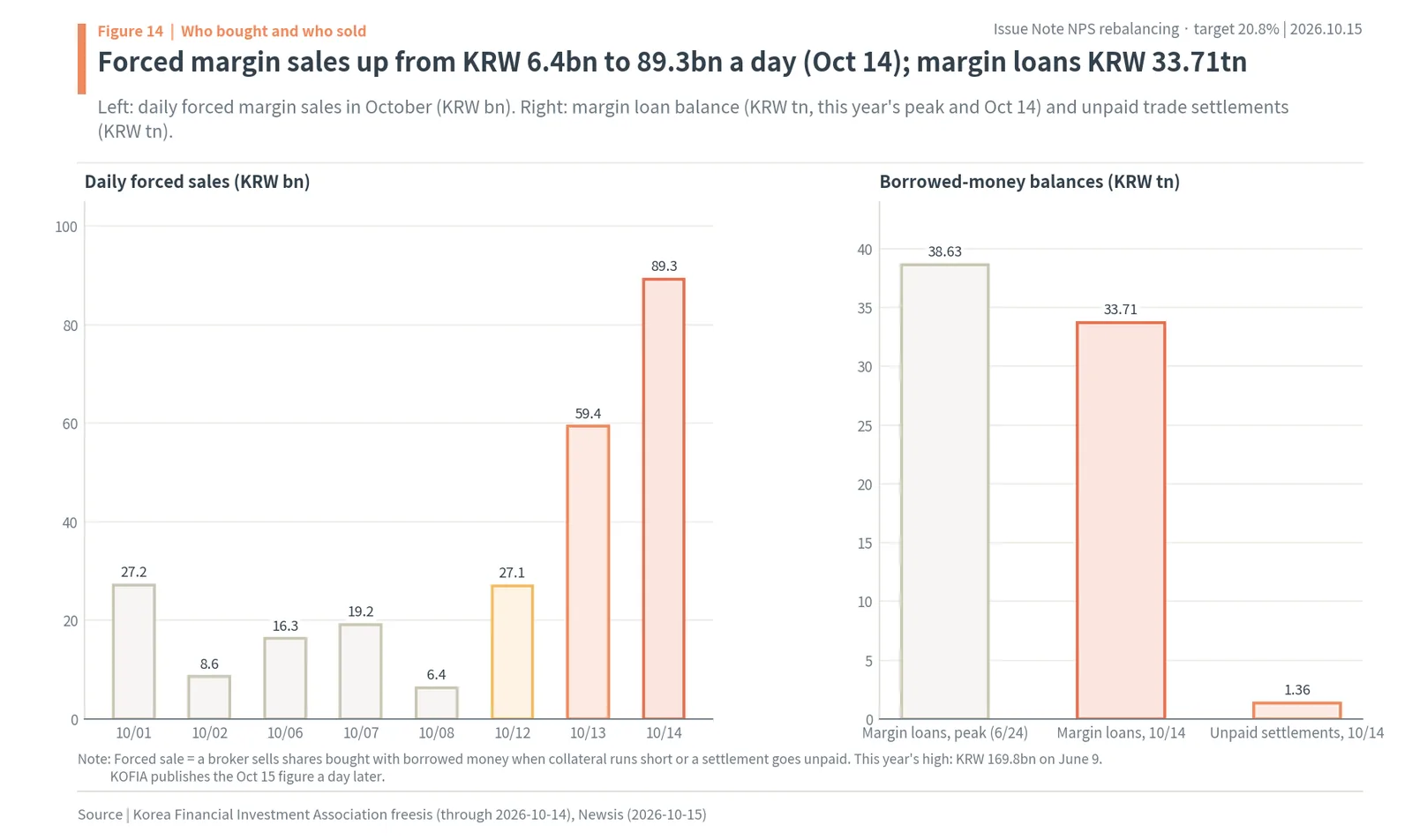
The left of Figure 14 shows daily forced sales in October. They rose from KRW 6.4bn to KRW 89.3bn a day (October 14), with margin loans at KRW 33.71tn. The right shows the margin loan balance at its peak this year and on October 14, along with unpaid settlements. Forced sales make people sell shares at low prices at a time they did not choose, and can deepen a fall. This is also why individual investors care about the NPS’s rules. If the biggest institutional investor in the market sells less on the way up and buys less on the way down, the cushion under a falling market gets thinner, and the cost falls first on individuals who have borrowed.
8. The case for and against the NPS decisions
Those who defend the deferral and the raise
The arguments of the government, the NPS and the ruling party come down to three. The first is market impact. Chairman Kim said that without the deferral the NPS would have had to sell KRW 800bn a day, and Minister Jeong explained that the rebalancing rule “was made in 2019, when the pension fund was KRW 700tn, about half (its current size)” (SBS Biz). The logic is that as the fund has grown, the amount it sells under the same rule has grown too.
The second is returns. Chairman Kim answered that “the deferral actually helped fund returns” (Etoday, October 14). Minister Jeong also told the National Assembly on September 29 that there had been an expert judgment that “not rebalancing also helps profitability,” and that she did not regret the decision (MBC). As the calculation in Chapter 5 shows, this statement matches the numbers if one looks only at February to May.
The third is structural change and due process. The official reason for the May decision was the possibility of structural change in the domestic stock market due to the revision of the Commercial Act and other factors. Chairman Kim said the January, May and June committee meetings decided unanimously with no objections, and that some experts nominated under the Yoon Suk Yeol government were among the members (Kyunghyang Shinmun, October 14). Ruling-party lawmaker Nam In-soon said eight expert meetings had been held, and lawmaker Seo Young-seok said that releasing minutes four years later is “a principle the National Assembly made in 2013,” calling the current demand for disclosure “spitting while lying on your back,” a Korean saying for an attack that lands on oneself (Financial News, Etoday, October 14). In July, Park Sun-won of the same party proposed an amendment to the National Pension Act that would create a legal basis for adjusting target weights and temporarily suspending trading when markets change abruptly (Herald Economy, July 6).
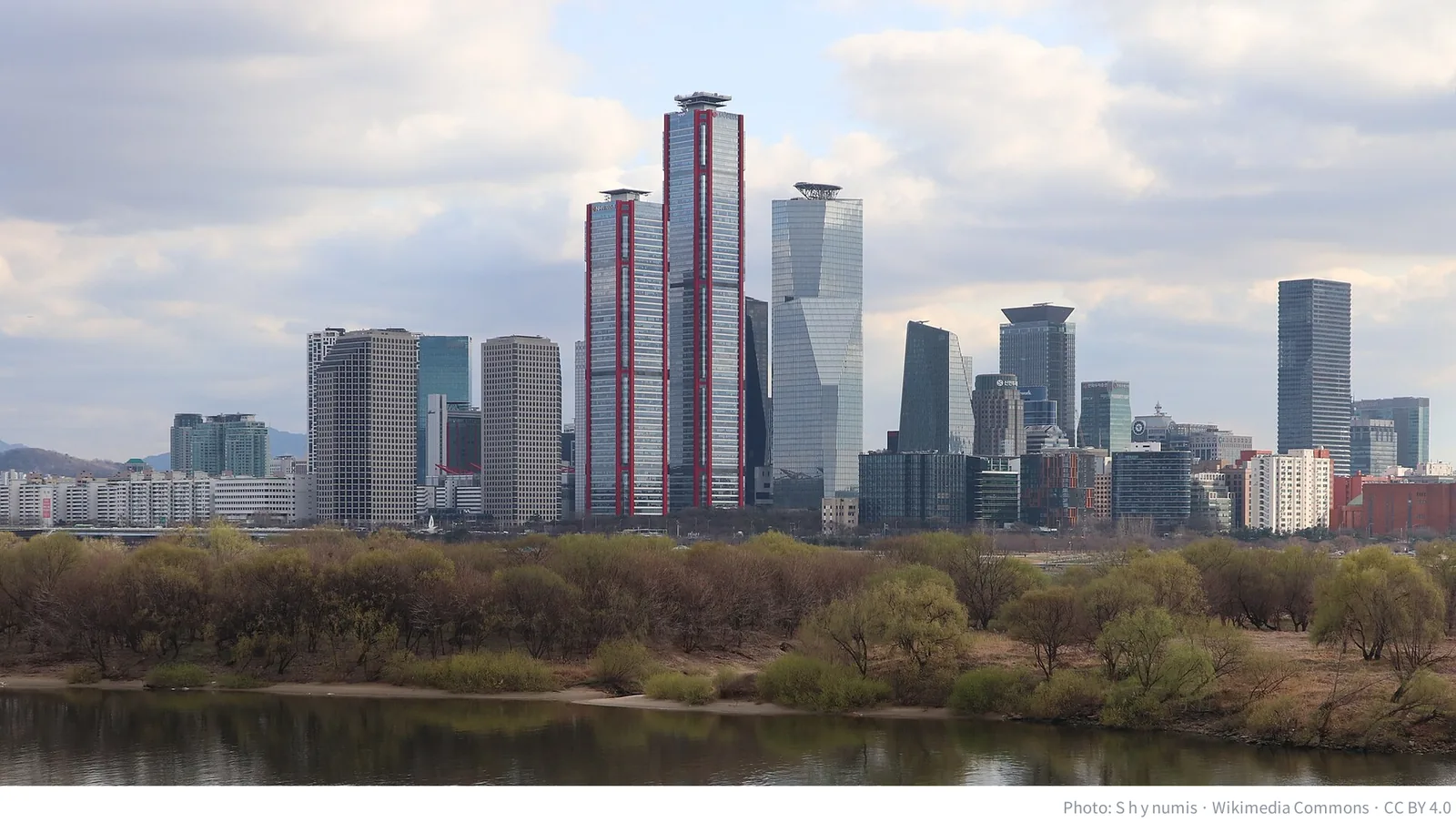
The photo shows the Yeouido financial district seen from across the Han River (taken in March 2024). NPS Investment Management is based in Jeonju, but the prices of the stocks the NPS buys and sells are set every day on the screens of the brokerages and asset managers on these streets.
The critics
The People Power Party, academics and civic groups also have three arguments. The first is principle. Lawmaker Baek Jong-heon said other public pension funds have never deferred rebalancing because of market conditions, and former lawmaker Yoo Seong-min wrote that “only our NPS failed to keep its rebalancing principle, and so it blew the people’s retirement savings” (Kukmin Ilbo, October 13). Hong Chun-uk, head of Prism Investment Advisory, called it “a decision that betrays market trust” (Kyeonggi Ilbo, October 15).
The second is political independence. Lawmaker Lee Dal-hee said “the NPS is not the government’s stock-market support fund,” and lawmaker Kim Tae-ho said the NPS looks like “the government’s all-purpose remote control.” Professor Jeon Jin-gyu of Dongguk University said the decision “will find it hard to escape criticism that it was pushed by a policy guideline to prop up the domestic stock market” (The Scoop, July 3). The Public Pension Reinforcement People’s Action, a coalition including the Korean Confederation of Trade Unions, the People’s Solidarity for Participatory Democracy and the Federation of Korean Trade Unions, also warned in a May 26 statement that “a hasty decision could lose the public’s trust.” It is worth recording that this criticism did not come from only one side of politics.
The third is disclosure. Article 103-2 of the National Pension Act requires committee minutes to be released after one year, but allows items that could unsettle financial markets to be released after four years by resolution. The minutes of the first and fifth meetings will be released in 2030. Lawmaker Baek said “the people will only learn how their retirement savings were managed four years later,” and that if nothing is disclosed, the only remaining tool is a parliamentary investigation; on October 14, the People Power Party members of the welfare committee called for one. Chairman Kim pushed back that if the simulations and minutes were released, “hedge funds and others could use them, and both the NPS and the public could lose money” (Seoul Economic Daily, October 14).
Remarks outside the audit
Remarks before and after the audit also split into the same two streams. At the welfare committee in August, Chairman Kim said that “the KOSPI almost doubled in just one year from below 3,000,” so even experts found it hard to judge (SBS Biz). The explanation is that the market moved so fast that time was needed to fix the rule. Asked whether the decision was made with local elections ahead, he answered that the late-May committee meeting is simply a regular meeting held every year (BizTribune, Seoul Economic Daily, October 14).
On the critics’ side, lawmaker Kweon Young-se wrote on July 29 that “in the end, the people’s precious retirement savings have been tied up to defend the market” (Money Today, July 30). Right after the deferral, on January 27, industry voices were already saying that “in the long run, the NPS could get into trouble by failing to sell when it should” (Chosun Biz). Lawmaker Lee Dal-hee pointed to NPS-related remarks at the president’s 100-day press conference on September 11, 2025 and at the Ministry of Health and Welfare’s policy briefing on December 16, as well as the chairman’s answer that “we intend to change the investment guideline criteria a little,” as signs of intervention (Financial News, October 14). Whether these signs were actual intervention can only be determined once the minutes are released. A bid to call former presidential policy chief Kim Yong-beom as an audit witness failed on October 7 (MTN).
In the fight over disclosure, the ruling party’s argument is the law. Four-year disclosure is an exception the National Assembly created in 2013 for market stability, and applying it to these items was within the law. The opposition’s argument is scale: the public can see only four years later a decision that changed the domestic-equity target of a fund of more than KRW 1,800tn by 5.9 points. The author gives a conclusion on this dispute in Chapter 9.
How the target weights changed
The fight between the two sides comes down to one number: the target weight.
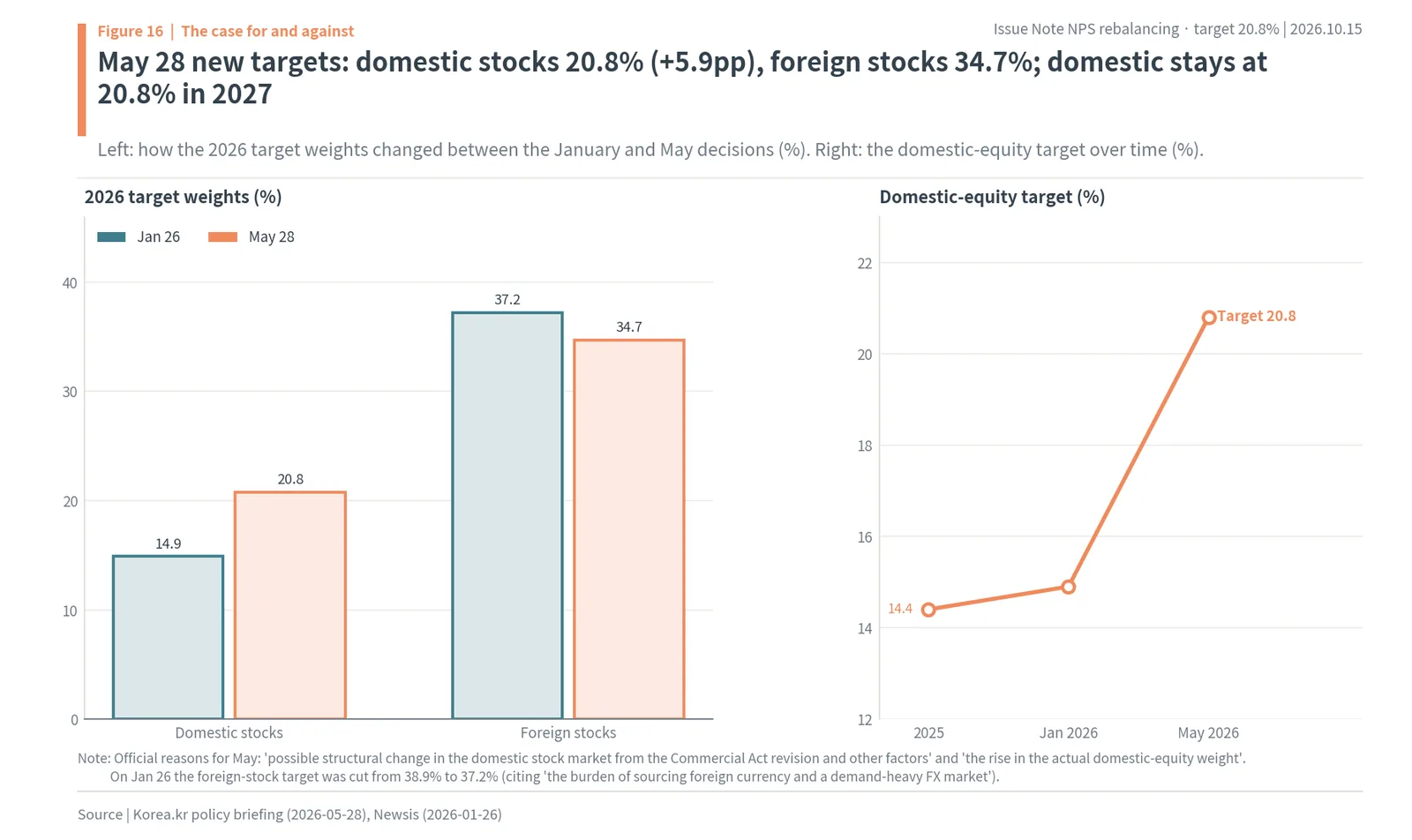
The left of Figure 16 shows how the 2026 target weights changed between the two decisions. Domestic stocks rose from 14.9% to 20.8% and foreign stocks fell from 37.2% to 34.7%. The right shows the domestic-equity target over time: 14.4% in 2025, 14.9% in January 2026 and 20.8% in May, a jump of 5.9 points in five months. The new targets from May 28 are 20.8% for domestic stocks (+5.9 points) and 34.7% for foreign stocks, and domestic stocks stay at 20.8% in 2027.
Laying both sides’ arguments over the numbers gives this. The market-impact argument is strong only if it assumes selling “all at once.” The returns argument holds only for February to May. The structural-change argument is a forecast that Korean stocks will do better, but even if that forecast is right, the fact remains that the target was changed right after the KOSPI had risen 101.13% from the start of the year. On the other hand, the critics’ claim that the NPS “blew retirement savings” is not accurate either. From January 26 to October 15 as a whole, the KOSPI is up 12.22%, and the NPS’s year-to-date return at the end of July was 14.84%. The loss came from “the part it should not have been holding,” and by the author’s calculation its size after the end of May is KRW 51.3tn.
9. The author’s view: the mistake was the May target raise, and three fixes
The verdict
The previous chapters can be tied together in one line: a rebalancing rule exists to sell when prices are high. The January deferral paused that rule for six months, and because the market rose during the pause, the result was a gain. The May target raise moved the rule’s baseline itself to near the market top, so that there was nothing to sell even when the pause ended. In the fall that followed, the excess produced the loss.
The author believes the May 28 target raise, more than the January deferral, was the mistake. Three numbers support this. First, had the 19.9% cap been kept, the deferral gained KRW 15.7tn in February to May and lost KRW 51.3tn after the end of May (author’s calculation). The loss is concentrated after the May decision. Second, at the time of the May 28 target raise, the KOSPI was more than 94% above its end-2025 level, and 101.13% above it at the next day’s close. Raising the target to 20.8% when the domestic-equity weight had already climbed to 29.4% was, in its own words, a decision that “considered the rise in the actual weight,” in other words one that approved the excess weight after the fact. Third, KRW 800bn a day was 2.09% of February–June turnover. Market impact could have been reduced by selling in pieces, and in May the NPS itself set up a mechanism to lower its daily limit.
Judged by the same yardstick, the January deferral weighs less. The point that the 2019 rule was written when the fund was KRW 713tn is valid, and leaving a short window to fix the rule is not strange in itself. Setting an end date of late June for the deferral was also right. The problem is that the target raise five months later effectively erased that end date. With the deferral and the raise coming in the same year, in a strongly rising market, and pointing the same way, what rebalancing normally does, trimming on the way up, never happened once.
Three prescriptions
The author’s prescription has three parts. First, change targets and allowed ranges only at the one regular meeting each year (the medium-term asset allocation at the end of May), and apply any raise made after an asset has risen sharply over the previous year from the following year. Even if the reason for changing the rule is sound, raising the target for an asset right after it has risen amounts, in effect, to buying expensive. Delaying the effect by a year means the fund is hurt less if the market turns back in the meantime.
Second, sell mechanically within a daily limit once the cap is exceeded. The limit can be set in proportion to turnover. For example, KRW 400bn a day is 1.04% of average daily turnover in February to June. The NPS’s move in May to reduce its maximum daily rebalancing size points the same way. What remains is to remove “deferral” as an option from the rule. If market impact is a worry, slow down, but do not stop.
Third, release profit-and-loss simulations and meeting minutes within a year, not in 2030. The proposal is to apply to these items the one-year disclosure that the National Pension Act already sets as the principle. The NPS worries about exploitation by hedge funds, but the January and May decisions are already done, and it has been trading under the new rule since July 1. Disclosing the grounds for past decisions is different from exposing future trading rules. Committee chair Lee Man-hee’s point that the written answer and the chairman’s answer differ would also be resolved once the numbers are released.
Applying the prescription to this year
Applying the second prescription to this year’s numbers gives a sense of scale. Start from KRW 395.1tn in domestic stocks and KRW 1,215.3tn in other assets at the end of February, and assume that on every trading day afterward domestic stocks move with the KOSPI and other assets earn 0%. On each day the domestic weight exceeds 19.9%, sell up to KRW 400bn. Done this way, the fund would have sold KRW 24.4tn by May 29, KRW 32.8tn by the end of June and KRW 60.8tn in all by October 15. On October 15 the whole fund would be KRW 10.5tn (about $7.8bn) larger than if not a single share had been sold, and the domestic weight would be 19.1%, inside the cap. With a daily limit of KRW 800bn, the fund would have sold KRW 106.6tn and come out KRW 19.4tn larger (author’s calculation).
Two things stand out in this calculation. First, even at a slow KRW 400bn a day, the NPS could have trimmed KRW 32.8tn in February to June. What it sold during those four rising months avoided the fall that followed. Second, the losses avoided on the way down were larger than the gains missed on the way up. Rebalancing is a rule used precisely because no one knows in advance which will be larger, and that is why the fund is shaken less by the swings of one asset.
Distance from the two parties
This conclusion stands on the opposite side of the decisions that the government, the NPS and the ruling Democratic Party defend. It points the same way as the opposition People Power Party’s demand to release the minutes and simulations. The author does, however, see voluntary disclosure by the NPS as coming before a parliamentary investigation. A parliamentary investigation needs a vote in a plenary session of the National Assembly, and with the ruling party in the majority, it is not settled whether one will be held. One-year disclosure, by contrast, is a principle already set in law, so a single committee resolution can make it happen. The author’s conclusion comes from weighing the evidence.
The road this prescription opens goes like this. Once the timing of rule changes is fixed, raises right after a rally disappear. If the fund sells, even slowly, whenever it exceeds the cap, the weight does not pile up on the way up. If it does not pile up, the NPS keeps room to buy in a fall. That room becomes a cushion under a falling market, and fewer indebted individuals are pushed out by forced sales. Once disclosure is set, all of these decisions are tested within a year. The author sees this as the path closest to the “balance of principle and flexibility” the NPS itself talks about.
10. Samsung Electronics, SK hynix, eight signals and dates to watch
Two stocks: Samsung Electronics -42.07% and SK hynix -56.77% from their highs
The direction of the NPS’s rules shows up in large-cap flows. To start with the conclusion: where the cap on the domestic-equity weight is set from here will shape pension-fund flows into large caps such as Samsung Electronics and SK hynix. The two stocks are 46.92% of KOSPI market cap, and they account for a large share of NPS domestic holdings too.
Samsung Electronics fell 42.07% from its June 18 closing high of KRW 362,500 to KRW 210,000 on October 15, and SK hynix fell 56.77% from KRW 2,919,000 on June 22 to KRW 1,262,000. From the end of May, Samsung Electronics is down 33.75%, SK hynix 45.91% and the KOSPI 34.47%. The KOSPI is 39.06% below its high. Pension funds and others net bought KRW 1.55tn of SK hynix in the third quarter and were net sellers of Samsung Electronics for a third straight quarter (Newspim, October 2).
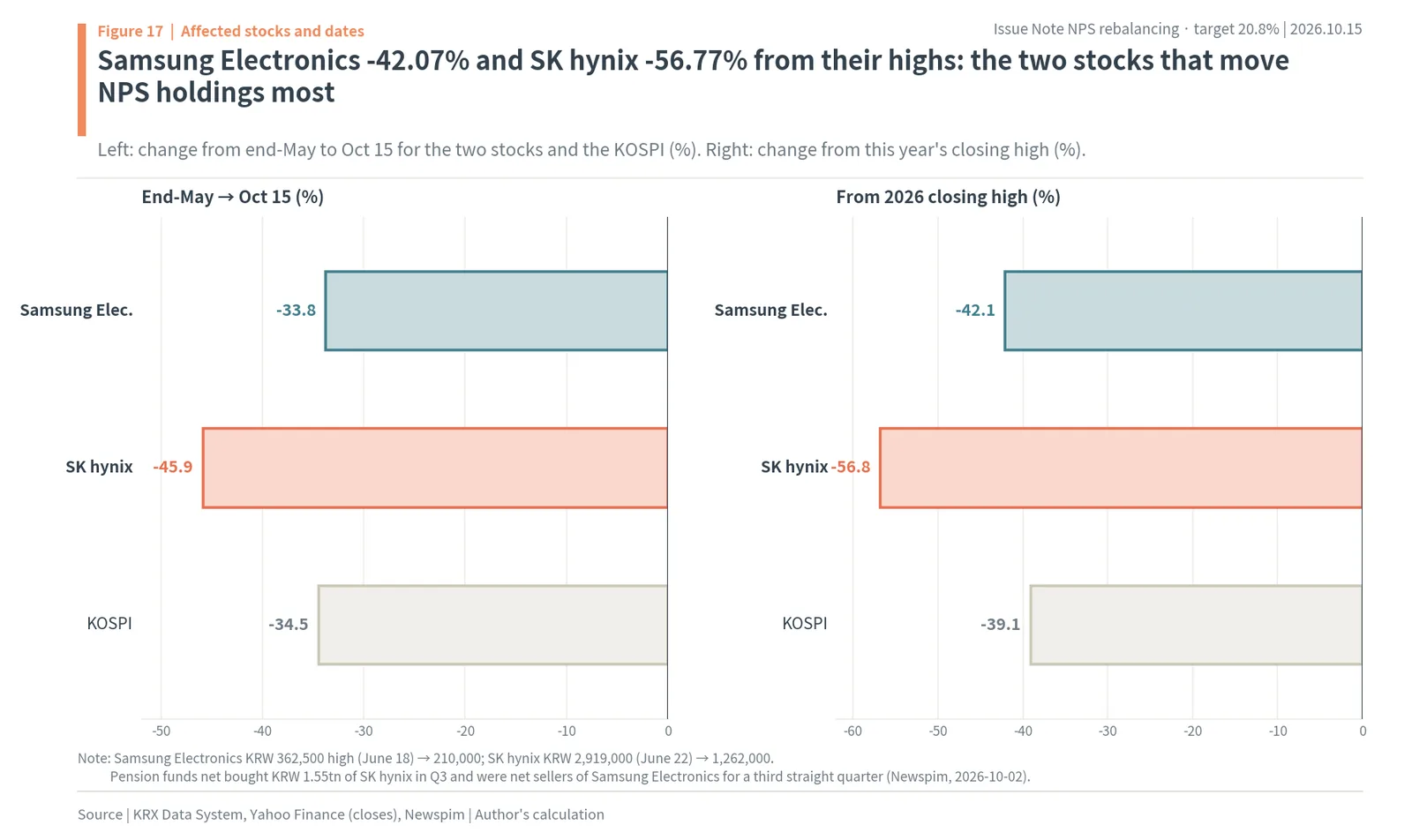
The left of Figure 17 shows the change from the end of May, and the right the change from this year’s closing high. Samsung Electronics is 42.07% below its high, and SK hynix 56.77%. Both stocks moved more than the KOSPI, and SK hynix moved more. If the NPS’s domestic-equity weight has come down further from 24.87% at the end of July with the fall since, its current weight is closing in on the new 20.8% target. Once the weight drops below target, rebalancing turns to buying. When that happens depends, however, on where the cap and floor are set in the year-end review of the allowed range.
By sector, the effects reach three places. First, large caps with big NPS holdings (chips, autos and financial holding companies) are directly touched by pension-fund rebalancing trades. Second, brokerage earnings depend on turnover and the margin loan balance. Forced sales rising to KRW 89.3bn a day also means the margin balance is shrinking. Third, the NPS’s decision to cut its foreign-equity target from 37.2% to 34.7% lowers demand for dollars for overseas investment, which links it to the won-dollar exchange rate. On October 15 the won traded at around KRW 1,344 per dollar (Yahoo Finance).
What to watch in the year-end review
Three things matter in the December review of the allowed range. First, the cap. Whether the range widened “temporarily” in May is narrowed back or left wide will decide how much has to be sold in the next rally. Re-applying January’s ±5 points to the 20.8% target gives a cap of 25.8%, and keeping the reported ±8 points gives 28.8%. Second, the daily limit. If the maximum daily rebalancing size reduced in May is disclosed, the market will know the fastest pace at which pension funds can sell. Third, the deferral clause. The fork in the road is whether to create a legal basis for halting trading when markets change abruptly, as in lawmaker Park Sun-won’s bill, or to go with a rule that only adjusts speed, with no deferral. The author leans toward a daily limit with no deferral clause, as in the Chapter 9 prescription.
Eight signals the author watches

Figure 18 draws the eight signals the author picked as gauges. A needle in the red zone means heavy market pressure; in the green zone, pressure is easing. ① The KOSPI at -39.06% from its high and ② foreign net selling of -KRW 17.98tn in October are in the red zone. ③ Daily forced sales of KRW 89.3bn and ④ October net buying by pension funds and others of -KRW 45.4bn are in the yellow zone. ⑤ The NPS domestic-equity weight was 24.87% at the end of July, within the new range, and ⑥ the Samsung Electronics plus SK hynix share of 46.92% has come down from its June peak of 57.11%. ⑦ The year-end review of the allowed range and ⑧ the release of the minutes are still pending. The author thinks ④ pension-fund flows and ⑦ the year-end range decision show where the rule is heading. If pension funds and others start buying in amounts of several hundred billion won a day in a falling market, that means the weight has dropped below target; and if the range is narrowed again at year-end, that means the rule of trimming in the next rally is back.
Dates to watch
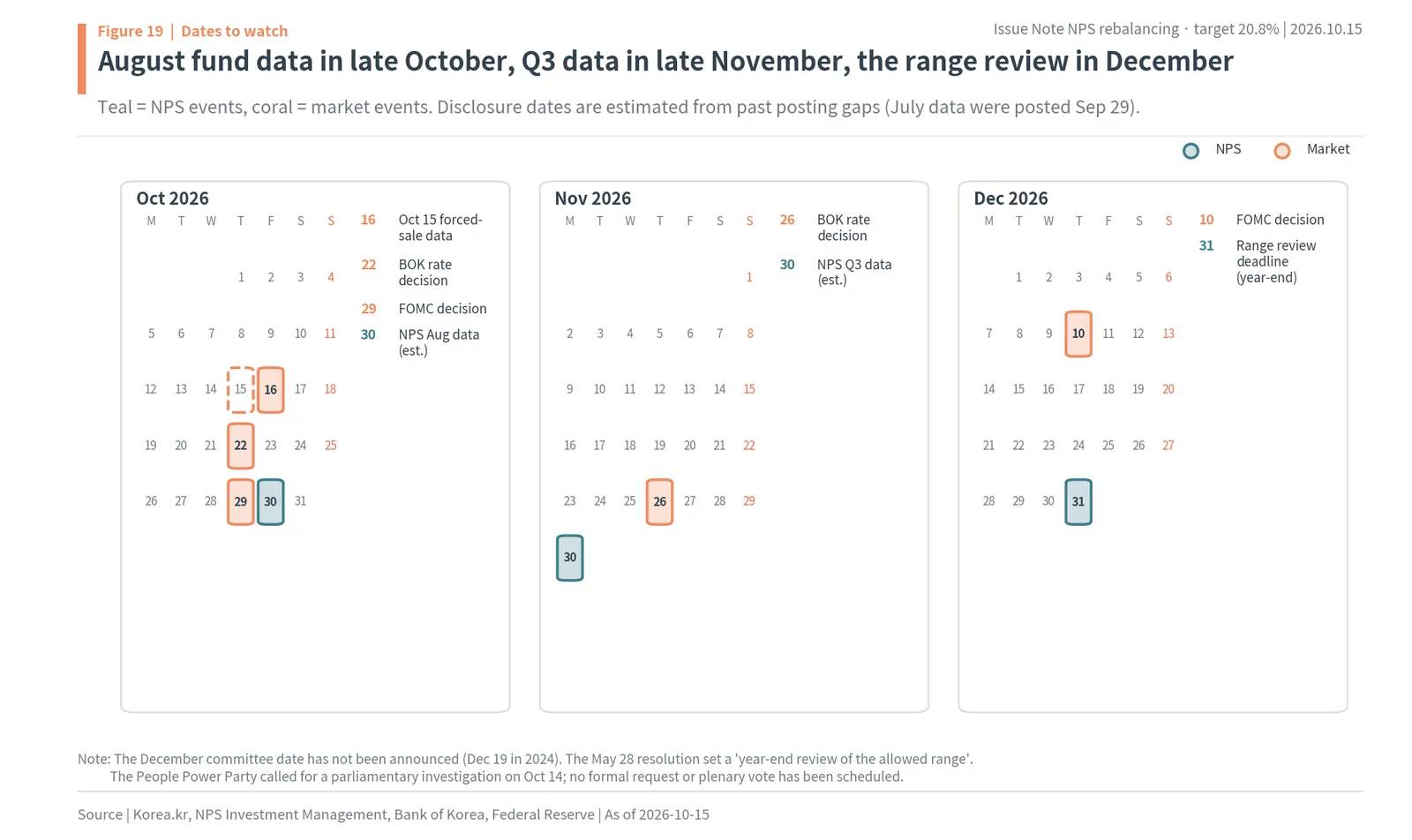
Figure 19 shows the dates to watch from October to December. On October 16, KOFIA publishes forced sales and margin loans for October 15. October 22 and November 26 are Bank of Korea Monetary Policy Board meetings, and October 29 (Korean time) and December 10 are US Federal Reserve decisions. The NPS posted its July figures on September 29, so the August figures are estimated for late October and the third-quarter (end-September) figures for late November. These releases will show how far the domestic-equity weight and the year-to-date return have come down. The May 28 resolution scheduled a “year-end review of the allowed range,” and the date of the December committee meeting has not been announced yet (it was December 19 in 2024). The People Power Party called for a parliamentary investigation on October 14, but no formal request or plenary schedule has been set. Numbers and rules will come in this order: August fund data in late October, third-quarter data in late November, and the committee’s review of the allowed range in December.
11. Data and methods: how the NPS rebalancing numbers were calculated
NPS figures
NPS month-end figures come from two sources. The end-July fund of KRW 1,684.2tn, domestic stocks of KRW 418.6tn (24.87%), the year-to-date return of 14.84% and the domestic-equity return of 60.11% (benchmark 57.98%) are official values from NPS Investment Management’s “Portfolio status and returns by asset class (July 2026),” posted on September 29. End-February (KRW 1,610.4tn, KRW 395.1tn, 24.5%), end-March (KRW 320.9tn, 21.0%), end-April (KRW 419.5tn, 25.13%), end-May (KRW 1,848.702tn, KRW 543.635tn, 29.4%) and end-June (KRW 1,865.576tn, KRW 543.204tn, 29.13%) are values reported by Korea Financial Newspaper, SBS Biz, Kukmin Ilbo and Money Today. Fund sizes at the end of March and April were not reported, so they were estimated by dividing holdings by the weight, at KRW 1,528.1tn and KRW 1,669.3tn. End-January values were left out of the calculation because the original source could not be found.
Target weights and allowed ranges follow Korea.kr (May 28), Newsis (January 26) and Chosun Biz (January 27). The 19.9% cap in the January decision is the 14.9% target plus a 3-point strategic range and a 2-point tactical range. The 28.8% cap after the May decision (the 20.8% target plus ±6 points and 2 points) is the value reported by Financial News, Etoday, Kukmin Ilbo and SBS Biz; the NPS said only that the range was “temporarily expanded.” The cumulative domestic-equity gains of KRW 283.5tn and KRW 158.7tn are figures from data the NPS submitted to the National Assembly, disclosed by People Power Party lawmakers at a press conference (News Tomato, October 14).
The counterfactual calculation
The calculation in Chapter 5 repeats the following formulas at each month-end. Excess over the cap = domestic holdings – fund size × 19.9%. Period result = excess × (next month-end KOSPI ÷ this month-end KOSPI – 1). Month-end KOSPI values are 6,244.13 on February 27, 5,052.46 on March 31, 6,598.87 on April 30, 8,476.15 on May 29, 8,476.48 on June 30 and 6,595.45 on July 31, and the last is 5,554.22 on October 15. The money sold is assumed to be held somewhere earning 0%. Had it been put in bonds, the result would differ by the interest; in foreign stocks, by their moves. Assuming that NPS domestic holdings move exactly with the KOSPI is also a simplification. The July domestic-equity return (published year-to-date figure from 107.37% to 60.11%) and the KOSPI’s move in the same month (-22.19%) are similar in direction and size.
The end-May excess of KRW 175.7tn is KRW 1,848.7tn × (29.4% – 19.9%). Had that portion moved with the KOSPI to October 15, it would be KRW 115.1tn, a difference of KRW 60.6tn. The KRW 100mn account in the hypothetical example starts with KRW 20mn in domestic stocks at the end of January, KRW 80mn in other assets (0% return) and a 20% cap, and applies the KOSPI’s moves from 5,224.36 on January 30 to 8,476.15 on May 29 and 5,554.22 on October 15.
The prescription test
The prescription test in Chapter 9 starts from KRW 395.1tn in domestic stocks and KRW 1,215.3tn in other assets on February 27 and calculates every trading day through October 15. Domestic stocks move by that day’s KOSPI change, and other assets are assumed not to move. If the domestic weight exceeds 19.9% that day, the smaller of the excess and the daily limit (KRW 400bn or KRW 800bn) is sold and moved into other assets. The comparison is with not selling a single share from February 27, in which case domestic stocks are KRW 351.4tn on October 15. In reality the NPS sold and bought some within the new range after July 1, so this comparison is a simplification set as close as possible to the “did not sell” case.
Market figures
KOSPI and KOSDAQ closes, highs and lows, turnover and market caps are KRX Data System index data, and matched Yahoo Finance closes on every date. Average daily turnover of KRW 38.31tn for February to June is the simple average of daily turnover from February 2 to June 30. Net buying by investor type is KRX trading data by investor type (value); foreigners are the sum of foreigners and other foreigners, and pension funds and others follow the KRX classification as is. October 15 values were tallied right after the close and may differ slightly from the confirmed figures the next day. The gap between Yonhap’s foreign net selling of KRW 3.6341tn and the KRX total of KRW 3.7718tn comes from whether other foreigners are included and when the tally was taken.
The KOSPI share of Samsung Electronics and SK hynix is the two stocks’ common-share market cap divided by KOSPI market cap (49.71% on October 15 including preferred shares). Circuit breaker dates come from articles in Herald Economy, Maeil Business TV, Asia Economy, Financial News, Kyunghyang Shinmun and others, and the percentage changes were calculated from KRX index data. The KOSDAQ circuit breaker on July 28 was confirmed from a July 29 article’s description of “two days in a row.” Margin loans, forced sales and unpaid settlements are KOFIA freesis data through October 14. The won-dollar rate of KRW 1,344 is Yahoo Finance’s October 15 value and may differ from the Seoul foreign exchange market’s closing rate. Dollar conversions use KRW 1,344 per dollar.
Definitions
In this report, “the deferral” means the January 26 decision (no rebalancing until the end of June, even outside the allowed range), and “the target raise” means the May 28 decision (2026 domestic-equity target 14.9% → 20.8%, allowed range temporarily widened). “Year to date” is against the end of 2025. “Author’s calculation” means a value the author recalculated from the public numbers above; it is not an official NPS simulation.
Maochaedung’s take. The NPS’s January rebalancing deferral paid off in a rising market. But the decision on May 28, when the KOSPI had doubled since the start of the year, to raise the domestic-equity target from 14.9% to 20.8% let the fund keep the KRW 175.7tn it should have trimmed while prices were high, and the KOSPI then fell 34.47%. By the author’s calculation, keeping the cap would have meant +KRW 15.7tn in February to May and -KRW 51.3tn after the end of May. The author believes targets should change only once a year, holdings above the cap should be sold within a daily limit, and meeting minutes should be released within a year.
Korea National Pension Service rebalancing FAQ
Q. What is NPS rebalancing?
The National Pension Service sets a target weight for each asset class and an allowed range around it. When domestic stocks rise above the cap, it sells them; when they fall below the floor, it buys. In January 2026 the domestic-equity target was 14.9% with an effective cap of 19.9% (target plus 3-point strategic and 2-point tactical ranges).
Q. What did the NPS decide in January and May 2026?
On January 26 the Fund Management Committee deferred rebalancing until the end of June even if domestic stocks left the allowed range. On May 28 it raised the 2026 domestic-equity target from 14.9% to 20.8% and temporarily widened the range; press reports put the new cap at 28.8%. The actual weight was 29.4% at the end of May.
Q. How much did the deferral gain or lose?
The NPS has not released its simulation. By the author’s calculation, assuming the excess above a 19.9% weight had been sold into an asset earning 0%, the deferral gained KRW 15.7tn (about $11.7bn) from February to May and lost KRW 51.3tn (about $38.2bn) after May, a net loss of KRW 35.6tn by October 15, 2026.
Q. Would selling have crashed the market?
The NPS chairman said it would have had to sell KRW 800bn a day. That is 2.09% of the KOSPI’s KRW 38.31tn average daily turnover in February to June and 2.98% of October 15 turnover. Selling in pieces within a daily limit was a third option between not selling and selling all at once.
Q. What should investors watch next?
NPS August fund data are expected in late October and third-quarter data in late November, followed by the Fund Management Committee’s year-end review of the allowed range in December. Pension-fund net buying on the KOSPI and where the new cap is set will show whether the rule of trimming in rallies comes back.
Sources
- Herald Economy, KOSPI’s 10th circuit breaker of the year ([Investment 360]) (2026.10.15) https://news.nate.com/view/20261015n19707
- Yonhap News, “US, Japan and Taiwan fell 1.9–4.9%… why the KOSPI fell twice as much” (2026.10.15) https://news.nate.com/view/20261015n27899
- MBN, “How far will it fall”… KOSPI and KOSDAQ close down 7% (2026.10.15) https://news.nate.com/view/20261015n26868
- Newsis, KRW 270bn of forced sales… indebted retail investors with KRW 34tn of margin debt in a plunging market (2026.10.15) https://news.nate.com/view/20261015n28958
- Edaily, Nasdaq down 1.88% on US CPI shock (2026.10.15) https://news.nate.com/view/20261015n04422
- Kukmin Ilbo, “Why didn’t the NPS sell Samsung and SK hynix?”… the chairman’s answer (2026.10.15) https://news.nate.com/view/20261015n02063
- Financial News, NPS parliamentary audit (2026.10.14) https://www.fnnews.com/news/202610141447034593
- Etoday, NPS parliamentary audit (2026.10.14) https://www.etoday.co.kr/news/view/2635784 , https://www.etoday.co.kr/news/view/2635819
- Seoul Economic Daily, NPS parliamentary audit (2026.10.14) https://m.sedaily.com/article/20101622 , https://m.sedaily.com/article/20101563
- Kyunghyang Shinmun, NPS parliamentary audit (2026.10.14) https://www.khan.co.kr/article/202610142146005/
- News Tomato, People Power Party calls for a parliamentary investigation (2026.10.14) https://www.newstomato.com/ReadNews.aspx?no=1316707
- Korea.kr policy briefing, NPS raises this year’s domestic equity target from 14.9% to 20.8% (2026.05.28) https://www.korea.kr/news/policyNewsView.do?newsId=148965365
- Newsis, Fund Management Committee raises domestic equity weight from 14.4% to 14.9%, defers mechanical selling (2026.01.26) https://mobile.newsis.com/view/NISX20260126_0003490799
- Chosun Biz, Will the NPS stop selling? Rebalancing deferral gives the market room to breathe (2026.01.27) https://v.daum.net/v/7ZhVSgx2kN
- Kyunghyang Shinmun, NPS starts adjusting its domestic equity weight (2026.07.01) https://v.daum.net/v/20260701204540250
- The Scoop, attendance at the fifth Fund Management Committee meeting (2026.07.03) https://v.daum.net/v/20260703145700530
- NPS Investment Management, Portfolio status and returns by asset class (July 2026) (posted 2026.09.29) https://fund.nps.or.kr
- Month-end NPS figures: Money Today https://www.mt.co.kr/article/2026073016194160615 , Korea Financial Newspaper https://www.fntimes.com/html/view.php?ud=202610141721125327179ad43907_18 , SBS Biz https://v.daum.net/v/20260624120312097 , Kukmin Ilbo https://www.kmib.co.kr/article/view.asp?arcid=9000022229
- Newspim, The chip large caps pension funds chose (2026.10.02) https://www.newspim.com/news/view/20261002000399
- KRX Data System, indexes, trading by investor type and market caps (2026.10.15 close) http://data.krx.co.kr
- Korea Financial Investment Association freesis, credit, investor deposits and forced sales (through 2026.10.14) https://freesis.kofia.or.kr
- Yahoo Finance, overseas indexes and USD/KRW (KRW=X, 2026.10.15) https://finance.yahoo.com
- Photos: Korea Exchange 2025 (Narubaru7, CC BY 4.0) https://commons.wikimedia.org/wiki/File:%ED%95%9C%EA%B5%AD%EA%B1%B0%EB%9E%98%EC%86%8C_2025.jpg ; Skyline of Yeouido (S h y numis, CC BY 4.0) https://commons.wikimedia.org/wiki/File:Skyline_of_Yeouido,_a_prominent_finance_district_in_Seoul.jpg , Wikimedia Commons
Was this note useful?
Thanks. Your answer helps decide what to cover next.
Korea market snapshot · Oct 23, 2026
New to Korean stocks? Start here for the basics.
Most read
1France Protests 2026: Why Students Are Blocking Schools and Which Stocks Benefit (Munich Re, SCOR)
Get the Saturday note on Korean stocks
One email every Saturday with the week’s new research on Korean listed companies and links to the updated data pages. Built from DART filings and KRX data. Free; unsubscribe in one click. See past issues