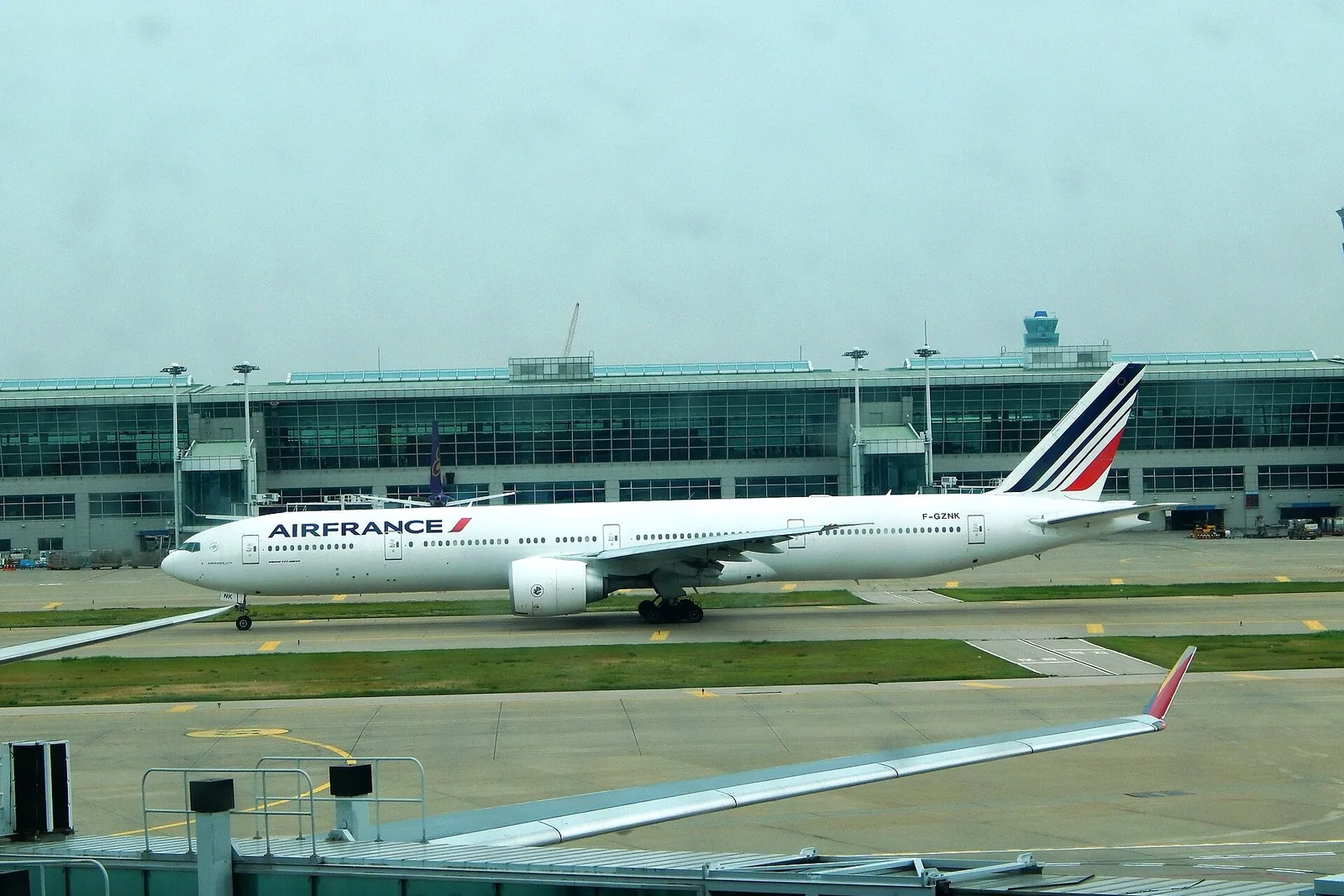
Europe Protests and Korean Travel Stocks: 92 Flights a Year Ago, 92 Now, and What Korean Air (003490.KS) and Hanatour (039130.KS) Could Lose
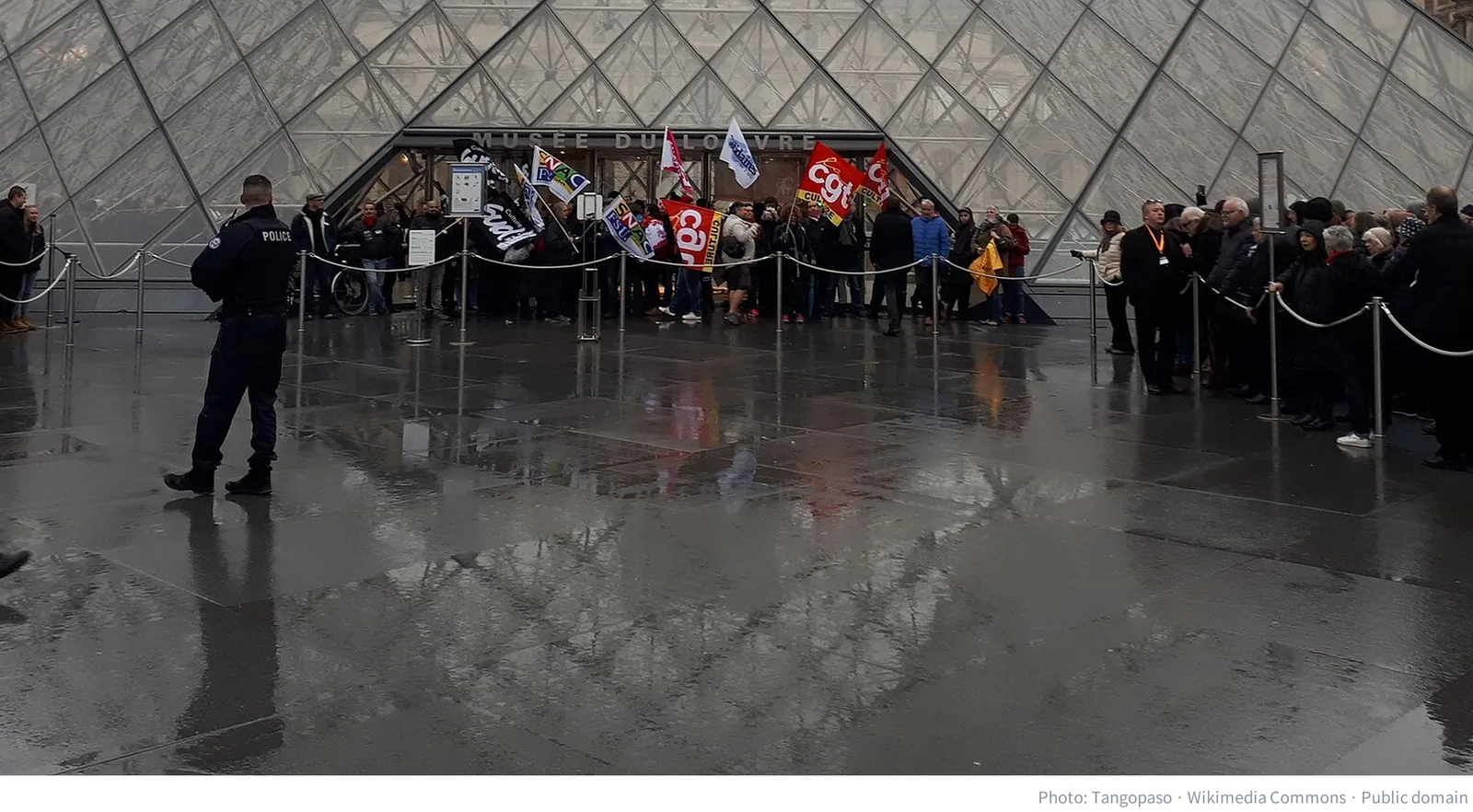
On October 19, 2026, students in Paris blocked the entrance to the Louvre, and the museum closed for the day. Two days later Didier Arino, head of the French tourism research firm Protourisme, told AFP that the further away the clients are, “the more sensitive they are to safety risks, and the stronger the impact” (France 24, October 21). He estimated that a day of rioting in the heart of Paris cancels around 1% of that month’s hotel bookings, with the same rate continuing for the following few weeks, but added that against the 42 million hotel nights forecast for France in 2026 this is not a large number. Koreans are among the guests who travel farthest to reach Europe. If Arino is right, the shock of these protests should show up most strongly among Korean travelers.
So did it this time? After October 17, when the protests spread to Italy, Belgium and Portugal, did Koreans fly to Europe less? If so, how much would airlines and tour operators lose, and how much further could their shares fall if the protests last? This report answers with Incheon Airport’s daily departure forecasts, the government Air Portal’s flight-by-flight records and seats by airline, Hanatour’s monthly package figures, bookings per departure on tour operator product pages, and Naver search volume.
The conclusion first: even after the protests spread, as many planes flew from Incheon to the protest countries as a year earlier, and none were cancelled; the planes kept flying. Departures to Europe also rose slightly from last year. It is true that Europe grew less than overseas travel as a whole, but that gap was larger from August to mid-September, before the protests, and the cause was the fuel surcharge, which rose fivefold after the Iran war. The protests’ share so far is close to zero, and share prices have barely priced in a prolonged protest either. But if the protests spread across several countries for more than four months, as the yellow vests did, the companies hurt most would be tour operators that earn three in ten won of their sales in Europe and Trinity Airways, whose European routes are all in protest countries. The fork comes with the French unions’ general strike on November 5 and the Christmas break.
English edition of the author’s Korean note on the 2026 European protest wave and Korean airline and travel stocks.
As of: October 28, 2026 (Incheon departure forecasts to October 30, flight-by-flight records to October 27, monthly statistics to September, share prices at October 28 closes). Dollar figures in parentheses use KRW 1,343.3 per dollar, the October 28, 2026 rate (Yahoo Finance KRW=X). Numbers the author calculated are marked as such.
Some Korea-specific background. The KOSPI is the main board of the Korea Exchange (KRX) and its benchmark index; the KOSDAQ is the exchange’s smaller growth-company board. Tickers ending in .KS trade on the KOSPI and those ending in .KQ on the KOSDAQ. Korea counts large sums in eok (100 million won) and man (10,000 won); this report shows them as KRW bn and KRW thousand. Korean airlines add a fuel surcharge to every international ticket, set each month at one of 33 stages linked to the Singapore jet fuel price. Chuseok is Korea’s autumn harvest holiday, when overseas trips surge. Air Portal (airportal.go.kr) is the Ministry of Land, Infrastructure and Transport’s aviation statistics site, and Naver, Korea’s largest search portal, publishes relative search volumes through Naver DataLab.
Topics covered: what the Protourisme chief said; key terms; how far the protests have spread; flights and seats; departures; the September baseline and France’s weakness this year; fuel surcharges, the real cause; search and booking signals; fares; European numbers and past protests; losses by company if the protests last; the market-cap shock; how long the protests may last; signals that would change the call; how to check it yourself; common questions; and the basis of calculation.
Key terms: departure forecasts, same-weekday comparisons, origin passengers, load factor, fuel surcharge stages and GMV
This report uses several daily data sets to measure October, which official monthly statistics have not yet reached. Each counts something different, so they are set out first. The most important thing when reading a number is to know whether it is an actual boarding, a forecast based on bookings, or a snapshot at one point in time.
The departure forecast is the figure Incheon International Airport Corporation posts on its website under expected congestion by route. Pick a date and it shows, hour by hour, how many passengers will leave for Japan, China, Southeast Asia, the Americas, Europe, Oceania and other regions. Because the airport issues it in advance from airline bookings, it can differ slightly from actual boardings. The on-screen list shows only a few days, but entering a date directly also returns past dates, and values back to January 1, 2025 could be downloaded. This report adds Terminal 1 and Terminal 2 for a daily total.
The same-weekday year-on-year change compares a day this year with the day 364 days earlier, the same weekday last year. Overseas trips leave mostly on Fridays and Saturdays, so a one-day weekday mismatch makes the change swing widely. The same-date comparison (365 days earlier) was also calculated and is given in the notes. Chuseok fell on October 3 to 12 in 2025 and on September 24 to 27 in 2026, so comparisons from late September to early October swing with the holiday dates.
Origin passengers are the passengers in Air Portal’s monthly statistics excluding transfers. After the Iran war, Asia to Europe transfer demand that used to pass through Middle Eastern airports moved to Incheon, so including transfers inflates the numbers on European routes. This report therefore uses Korea-departure origin passengers as the measure closest to Korean demand. Load factor is the share of seats supplied that were filled. Air Portal gives seats and passengers by airline but does not split them by route, so the load factors of foreign airlines that fly only European routes from Korea serve as a gauge of empty seats on the Europe side.
The fuel surcharge is the fuel component added separately to an air ticket. It is set in 33 stages according to the average price of Singapore jet fuel and changes every month by ticketing date, not travel date. GMV (gross merchandise value) is the total value of the products a tour operator sells, and most of its revenue is the commission within that. Forward PER is the share price divided by estimated future earnings per share (EPS), and this report always gives the EPS it is based on. The protest countries are the six where protests took place on the same day, October 17 (France, Italy, Belgium and Portugal), plus Spain and Greece.
The protests began at a French high school on September 21 and spread to four European countries on October 17
The conclusion first: the disruptions tourists actually run into came after October 17. The French student protests started on September 21 with the blockade of a high school in Créteil, a Paris suburb, following teacher strikes on September 17 and 18. The grievances were teacher cuts in the 2026 to 2027 budget, overcrowded classes of 32 to 36 pupils, and Parcoursup, the university admissions system. Turnout on national protest days, by the Interior Ministry’s count, went from 71,500 on October 8 and 161,500 on October 13 to a peak of 550,000 on October 17 (800,000 by the organizers’ count). The same day, cost-of-living protests broke out in Italy, Belgium and Portugal (Al Jazeera). On October 24, 410,000 still marched, leaving 74.5% of the peak.
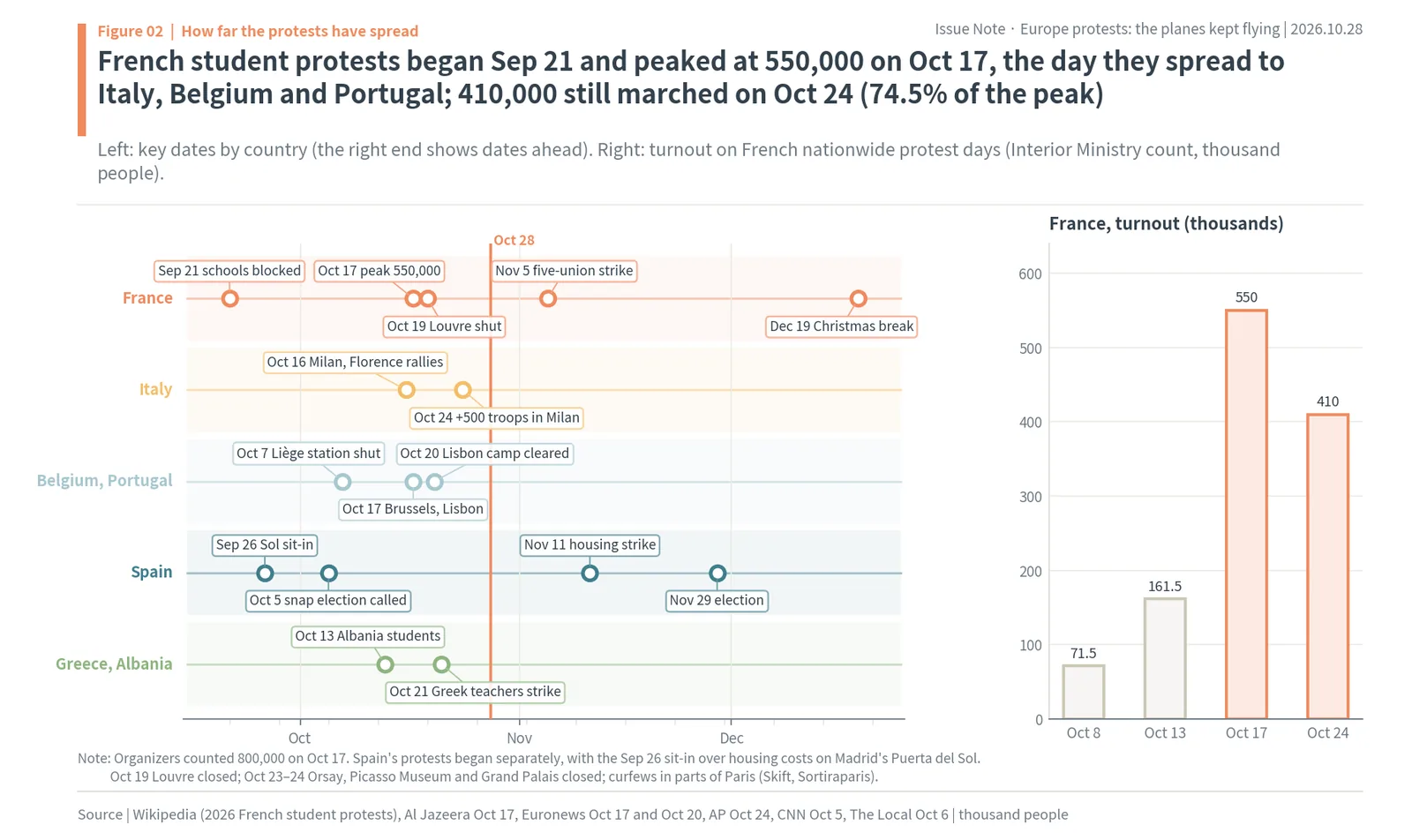
The left side of the figure shows key dates by country. In Italy, after protests in Milan, Florence and Genoa on October 16, clashes around Milan’s Duomo led the Korean embassy in Italy to issue a safety notice on October 21, and on October 24 the government sent 500 more troops to Milan (AP). In Belgium, Liège station was closed on October 7, and close to 200 people were arrested in Brussels and Liège on the 17th. In Portugal, after a union march in Lisbon on the 17th, police cleared tents from Rossio Square on the 20th and arrested 55 people. Spain is a little different. A sit-in over housing costs on Madrid’s Puerta del Sol came first, on September 26, and Prime Minister Sánchez called an early election on October 5. In Greece teachers held a 24-hour strike on October 21, and in Albania student protests have continued since October 13.
Tourist sites began closing on October 19
In Paris the Louvre closed on October 19, and on October 23 and 24 the Louvre, the Musée d’Orsay, the Picasso Museum and the Grand Palais closed together (Skift, Sortiraparis). A curfew was imposed in parts of Paris from October 19, and on October 24 more than 20 metro stations were closed. The Lyon tourist information office was set on fire on October 17. Most of the disruptions that force tourists to change their routes came after the peak.
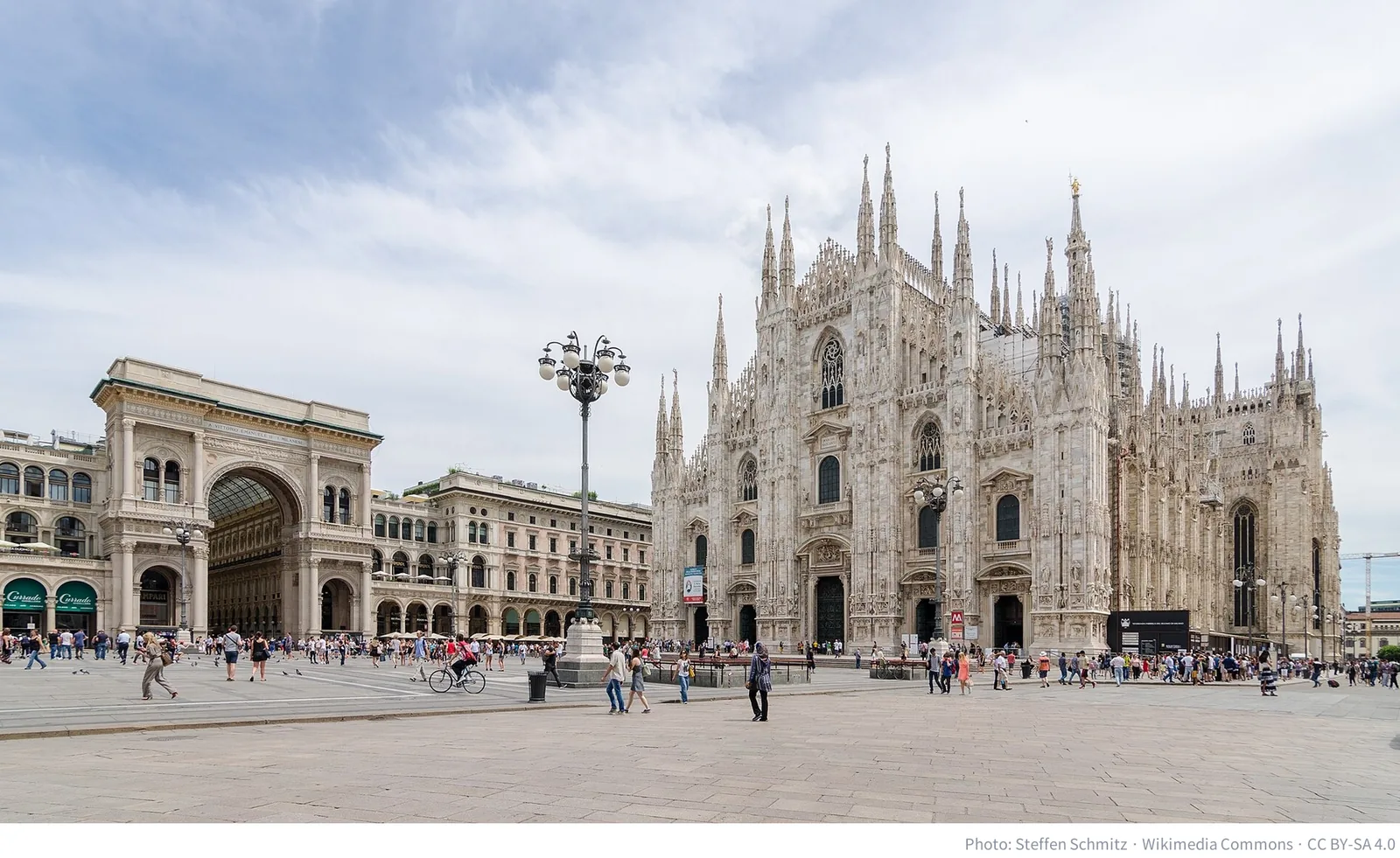
It was around this time that places that are regulars on Korean group tour itineraries, such as Milan’s Piazza del Duomo, became protest sites. Government responses differed by country. France deployed 3,000 substitute teachers from October 13, and on October 26 it announced class-size caps for some classes, EUR 4bn in school renovation loans, the abolition of Parcoursup in 2028 and EUR 1bn of support for universities (France 24). Student representatives said not all of their demands had been met. On October 27 the French Senate passed a bill on compensation for protest damage by 229 votes to 105. Italy, instead of making concessions, issued a security decree raising penalties for violent protest.
Korea’s Ministry of Foreign Affairs held a situation review meeting with eight diplomatic missions in Europe on October 20, and the embassy in France issued protest safety notices on October 21 and 23. However, the travel advisory levels for European countries did not change after October 17. This bears directly on tour operators’ cancellation rules. Unless the advisory level rises, package cancellations follow the standard terms, and customers have little room to cancel without a fee. That is why Korean Air (003490.KS) and Asiana Airlines (020560.KS) separately waived refund and change fees on Paris tickets bought before October 21 for departures from October 21 to November 30 (Kyunghyang Shinmun). So did fewer planes actually fly?
The planes kept flying: 92 flights to protest countries, 92 a year earlier, 0 cancellations
The conclusion first: on the supply side there is no trace of the protests. Air Portal records every passenger flight that leaves Incheon, one by one, as departed, delayed, cancelled or diverted. The author downloaded the records day by day from September 1, 2025 to October 27, 2026 and counted only flights to protest-country airports (Paris Charles de Gaulle, Nice, Rome, Milan, Venice, Barcelona, Madrid, Lisbon, Porto, Brussels and Athens). From October 17 to 27, 92 passenger flights left Incheon for six protest-country cities, exactly the 92 of the same period last year, and 0 were cancelled. In the same period flights to the rest of Europe, such as London, Frankfurt, Zurich, Prague and Istanbul, numbered 187, up 8.1% from last year, and all passenger departures from Incheon numbered 6,250, up 12.3%.
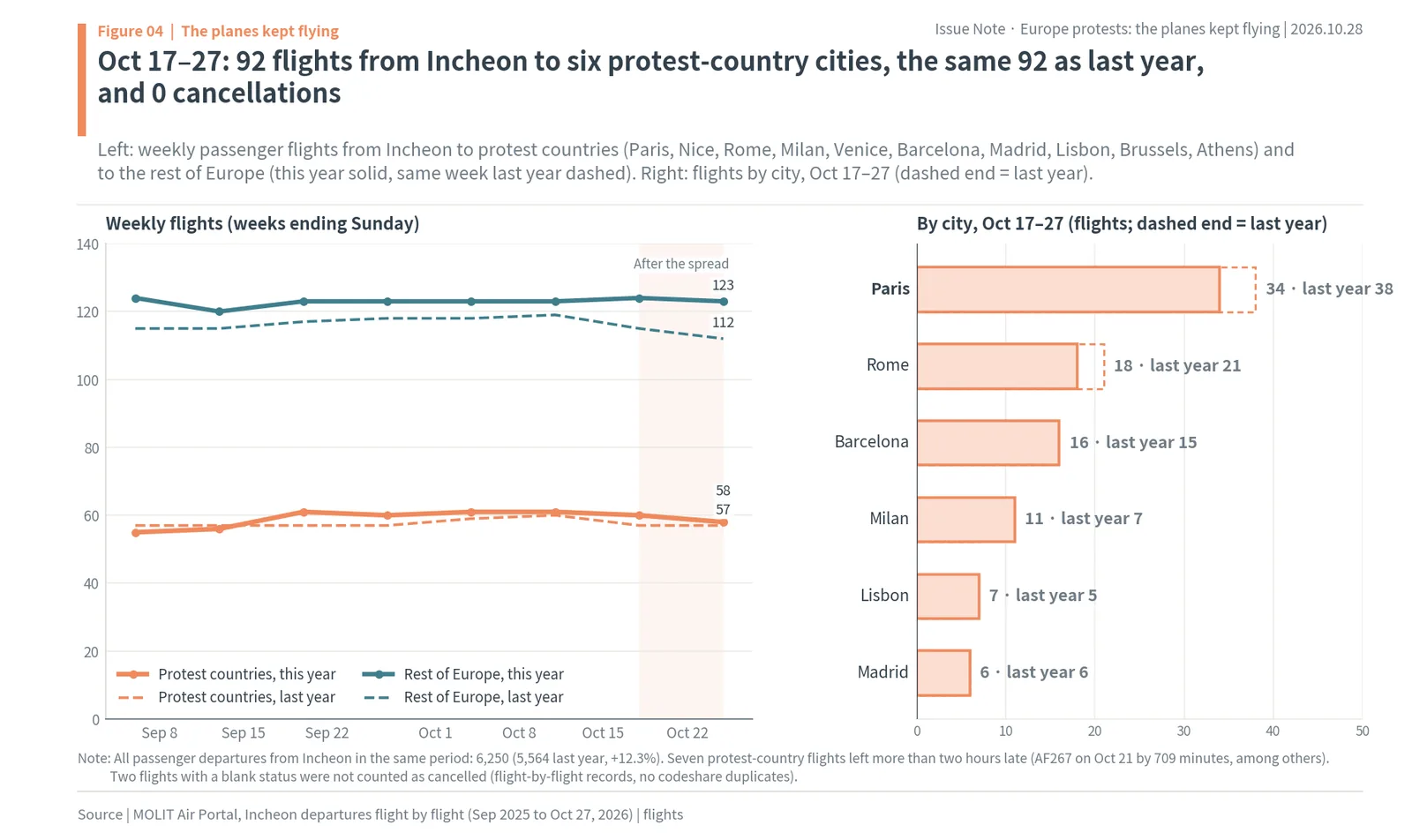
The left side of the figure shows weekly flights. From September, flights to protest countries ran at 55 to 61 a week, almost overlapping the same weeks last year. The right side shows flights by city from October 17 to 27. Paris had 34, four fewer than last year, and Rome 18, three fewer, while Milan had 11, four more, Lisbon 7, two more, and Barcelona 16, one more. The decline in Paris and Rome includes the switch to the winter schedule on October 25. Trinity Airways (091810.KS, formerly T’way Air) reached the end of its mandatory operating period and will cut Paris, Rome and Barcelona to four flights a week each this winter and suspend Frankfurt (Hankooki.com). That was decided before the protests.
No cancellations, and a few delays the day after the peak
After October 17, seven flights to protest countries left more than two hours late. On October 18, Milan-bound KE927 was 210 minutes late, Rome-bound OZ561 189 minutes, Rome-bound TW405 184 minutes and Lisbon-bound KE921 170 minutes. On October 21, Air France AF267 to Paris was 709 minutes late, almost half a day. Delays did cluster on the day after the peak, but because these are departure delays, the records alone cannot tell whether the cause was conditions at European airports or the aircraft at Incheon. Two flights with an empty status were not counted as cancelled. From October 18 to 24, between 17 and 54 passenger flights a day across the whole airport had an empty status, and of the two, Lisbon-bound KE921 was confirmed as operated on FlightAware.
Air France also changed aircraft. In FlightAware records, AF267 was flown by a Boeing 777-300ER from October 15 to 20, a Boeing 777-200 from October 21 to 24, and an Airbus A350-900 from October 26. These are changes to smaller aircraft, but they coincide with the start of the winter schedule, so there is no basis for attributing them to the protests. Judged by flights and cancellations, airlines did not withdraw seats because of the protests. So how full were those seats?
In September only Air France’s load factor fell noticeably
By seats and passengers by airline, Air France’s September load factor fell 5pp, from 96.2% to 91.2%. Lufthansa at 97.6% and Swiss at 98.0% were about the same as last year, while Finnair fell from 90.9% to 88.0% and LOT Polish Airlines from 92.8% to 89.1%. The six foreign airlines that fly only European routes from Korea (Air France, KLM, Lufthansa, Finnair, LOT and Swiss) went from 93.6% to 92.0% combined. Korean carriers cannot be split by route, but September Korea-departure passengers were -4.6% at Korean Air, -13.8% at Asiana and -0.8% at Air Premia, and +8.4% at Trinity Airways.
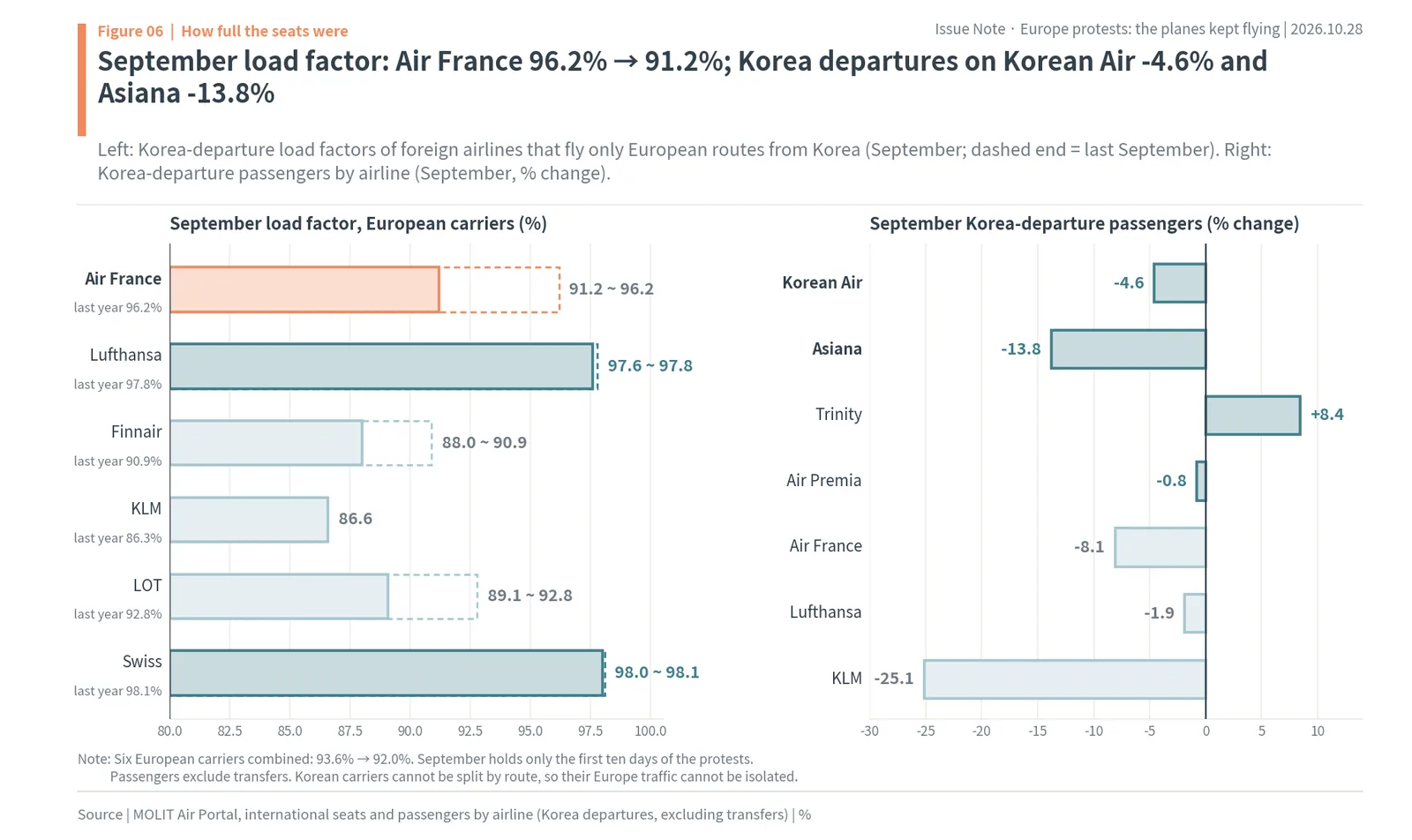
September is a month with only ten days of protests in it. Korean Air’s passenger decline matches what the company had already explained in its second-quarter results: that fuel surcharges had dampened Korea-originating demand. The fall in Air France’s load factor signals weak demand for France, but as shown below, Korean travel to France was already weaker than the European average from January to July, before the protests. The seats did fly, and the remaining question is how many people filled them after October 17.
The seats were cut on the non-protest side. KLM reduced its September Korea-departure seats from 11,020 to 8,234, so its passengers fell 25.1%, but its load factor stayed at 86.3% to 86.6%. It appears to have cut seats to match demand. Turkish Airlines, which flies via Istanbul to many European cities, saw its September load factor rise from 91.4% to 91.9%, and its Korea-departure passengers rose 0.6%. Across European routes as a whole, September seats were mostly filled, and the airline with the biggest increase in empty seats was Air France.
Departures to Europe rose from last year, and the gap with total departures narrowed after the protests
The conclusion first: daily departures show no trace yet of the protests cutting Korean travel to Europe. Comparing Incheon Airport’s departure forecasts with the same weekday last year, departures to Europe were +0.8% before the protests (August 3 to September 13), -0.1% in the French protest phase (September 21 to October 16) and +4.5% after the spread to Europe (October 17 to 27). Total departures in the same windows were +9.0%, +5.9% and +7.0%. Europe’s growth minus total growth went from -8.2pp to -5.9pp to -2.5pp, smallest after the protests spread.
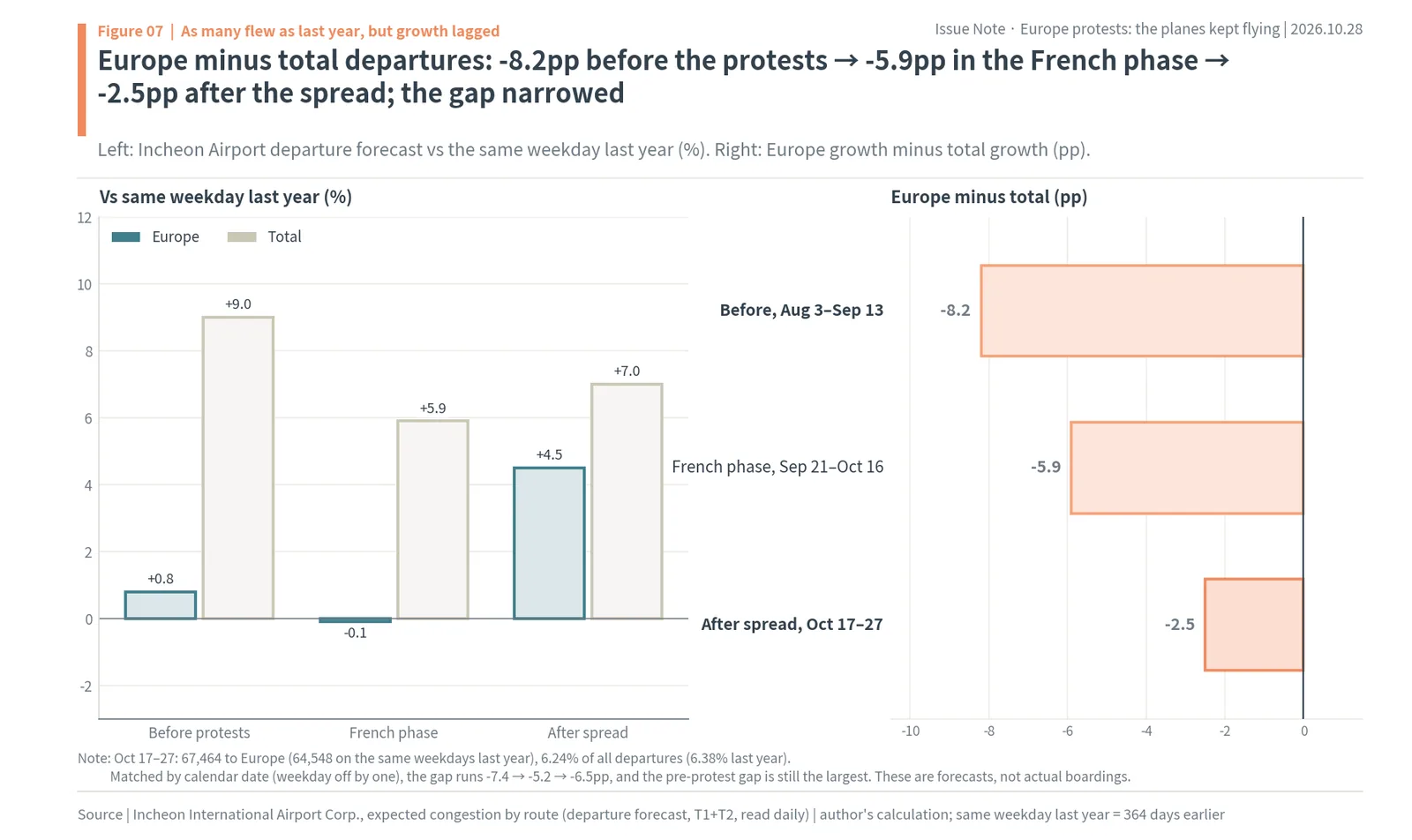
Forecast departures to Europe from October 17 to 27 were 67,464, more than the 64,548 on the same weekdays last year. Europe’s share of all departures was 6.24%, slightly below last year’s 6.38%. Matched by calendar date instead (with the weekday off by one), Europe was -0.1% and the total +6.4%, widening the gap to -6.5pp, but by that method the pre-protest gap was -7.4pp and the French-phase gap -5.2pp. Whichever way it is measured, the pre-protest gap is larger than the gap after the spread. Europe’s slower growth is not a trend the protests created but one that existed before them.
In the Incheon Airport forecasts for the same period, departures to Japan were +19.6%, to the Americas +14.5% and to Southeast Asia -6.5%. Japan is what lifted total departures; it was +23.4% before the protests too. When fuel prices rise, travelers crowd to nearby Japan, and destinations with large surcharges such as Europe and Southeast Asia grow less. Even so, Europe held at last year’s level.
In 7-day sums, Europe moved around last year’s level
Daily figures swing widely with weekdays and holidays, so they are redrawn as 7-day sums. In the 7 days to October 27, departures to Europe were +4.3% against the same weekdays last year and the total +5.5%, and Europe’s share of departures was 6.05% (6.12% last year). The swings in the figure from late September to early October come from the different Chuseok dates. During the 2026 Chuseok holiday (September 24 to 27) this year’s departures bunched up, while for October 2 to 11 this year, which is compared with the 2025 Chuseok holiday (October 3 to 12), last year’s side was larger.
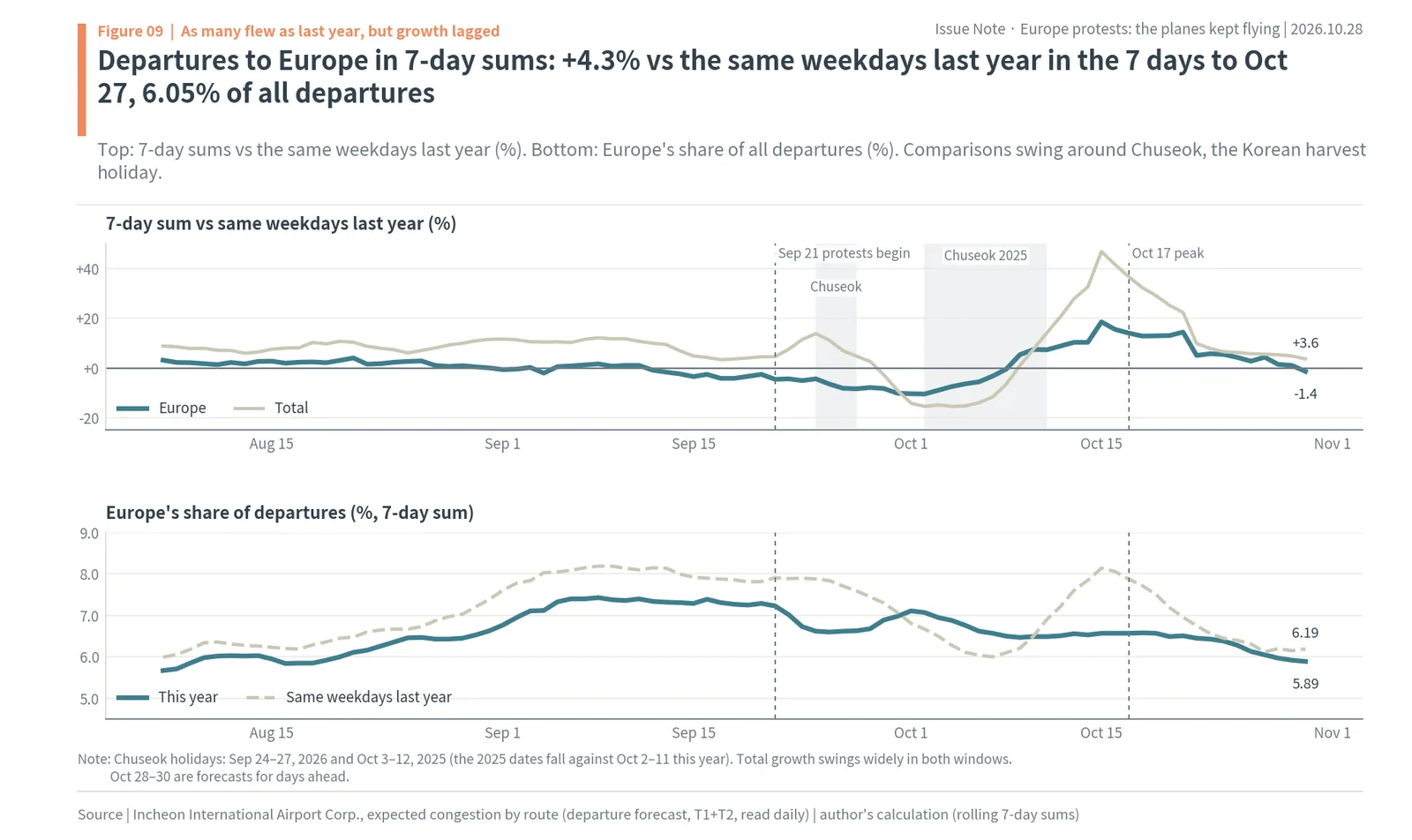
Europe’s share in the lower panel has been below last year’s since August. It came closest at 6.24% against 6.38% from October 17 to 27, then widens again in the forecasts for October 28 to 30, at 5.87% against 6.32%. Forecast departures to Europe for those three days are 16,381, 6.4% fewer than on the same weekdays last year, while the total is +0.7%, a gap of -7.1pp. Matched by calendar date, Europe is instead 10.1% higher. A three-day forecast swings so much that its sign flips with the weekday matching, so judgment waits until values for the first week of November accumulate. What is confirmed so far is that Europe did not shrink, and that it was growing less than the total before the protests.
One mixed-in variable: the October 16 advisory against travel to the Middle East
One variable is mixed into the reading. On October 16 the Ministry of Foreign Affairs advised cancelling or postponing departures and travel to the Middle East, and Korean Air and Asiana waived fees on Middle East routes (Edaily). If travelers who used to reach Europe via Middle Eastern airports such as Dubai and Doha switch to direct flights to Europe from Incheon, they move from the other column to the Europe column in the Incheon Airport forecasts. The other column, which includes the Middle East, did fall from +0.9% before the protests to -2.5% after the spread. So part of Europe’s narrower lag after October 17 may be rerouting. There is no data to count that part separately. But rerouting itself means that people who wanted to go to Europe did not give up the trip, so the conclusion that there is no trace of the protests cutting Korean travel to Europe does not change.
September is the pre-protest baseline, and Korean travel to France was weak before the protests
The conclusion first: reading September’s drop in travel to France as the protests’ share would be a mistake. Official monthly statistics run to September, and September contains only ten days of the protests. By Air Portal’s Korea-departure origin passengers, September travel to the Europe region was -4.7% and to France -12.1%. In contrast, Italy rose +3.4%, Spain +5.7% and Portugal +16.5%, and the UK +20.4%. All international routes were +6.3%. Germany fell most, by 26.3%, largely for supply reasons such as Trinity Airways’ Frankfurt cut.
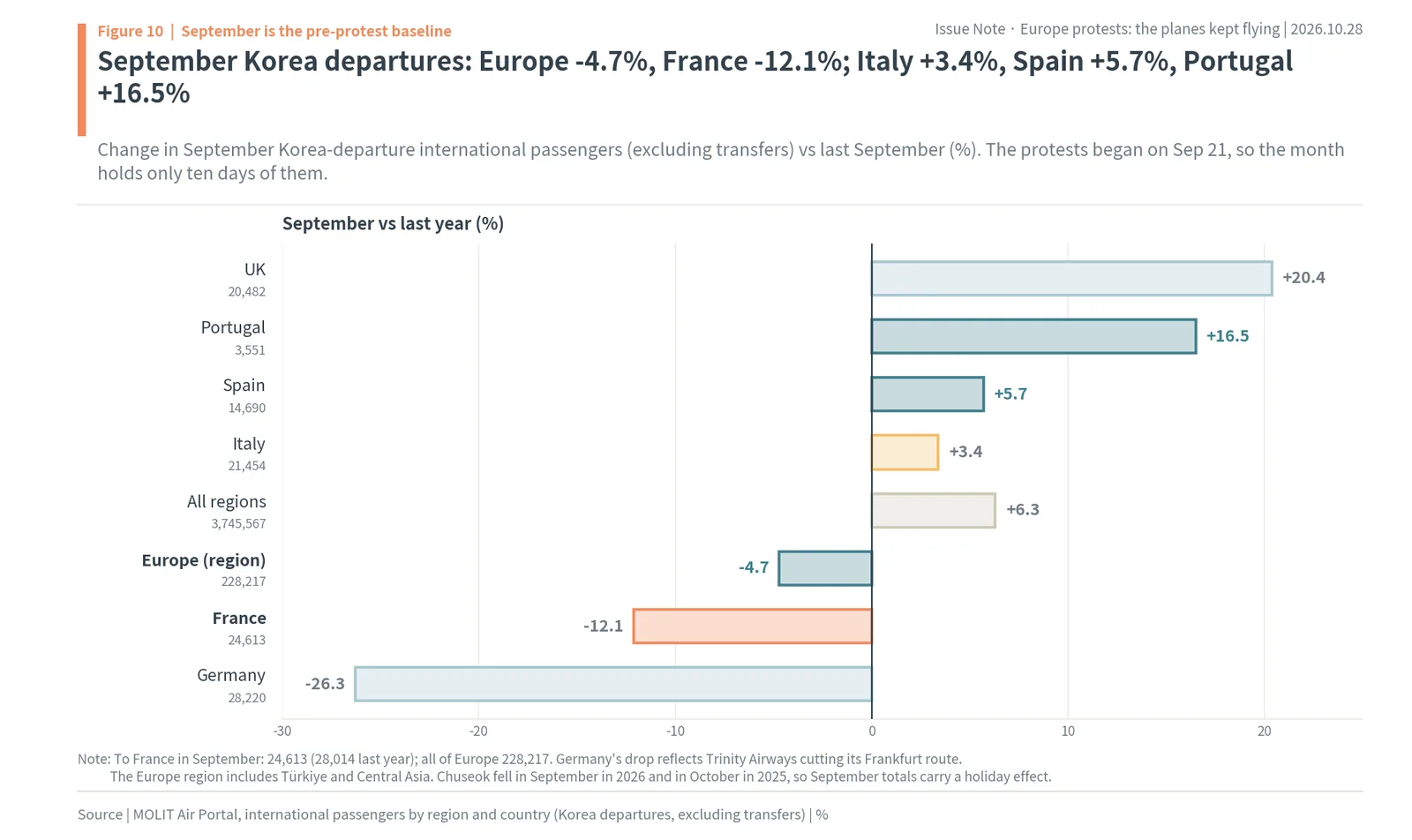
Departures to France in September were 24,613, fewer than last year’s 28,014. But September’s change includes Chuseok. In 2026 Chuseok came at the end of September, so the short holiday sent travelers to nearby countries, while in 2025 it was a ten-day holiday in early October. The Europe region also includes places such as Türkiye, Uzbekistan and Kazakhstan. So for France alone it is better to look at its excess decline, its change minus the Europe region’s change.
France grew 12.3pp less than Europe on average from January to July
France’s change minus the Europe region’s change month by month this year was -11.7pp in January, -17.9pp in February, -16.8pp in March, -10.1pp in April, -10.8pp in May, -9.7pp in June and -9.1pp in July. The pre-protest January to July average is -12.3pp. It narrowed to -1.9pp in August, then widened again to -7.5pp in September. September’s value is actually smaller than this year’s average. These data cannot identify the cause of France’s weakness, but they make clear that the trend predates the protests.
Applying the same calculation to the 2018 to 2019 yellow vest protests gives a sense of how large the effect could be if these protests last. The yellow vests peaked on their first Saturday, November 17, 2018, at 282,000, and fell to 10% of the peak four months later. During those four months the excess decline in Korean travel to France was -13.4pp in November 2018, -13.2pp in December, -17.0pp in January 2019 and -14.9pp in February, an average of 14.6pp. As the protests died down it came back to -4.9pp in March and -2.5pp in April.
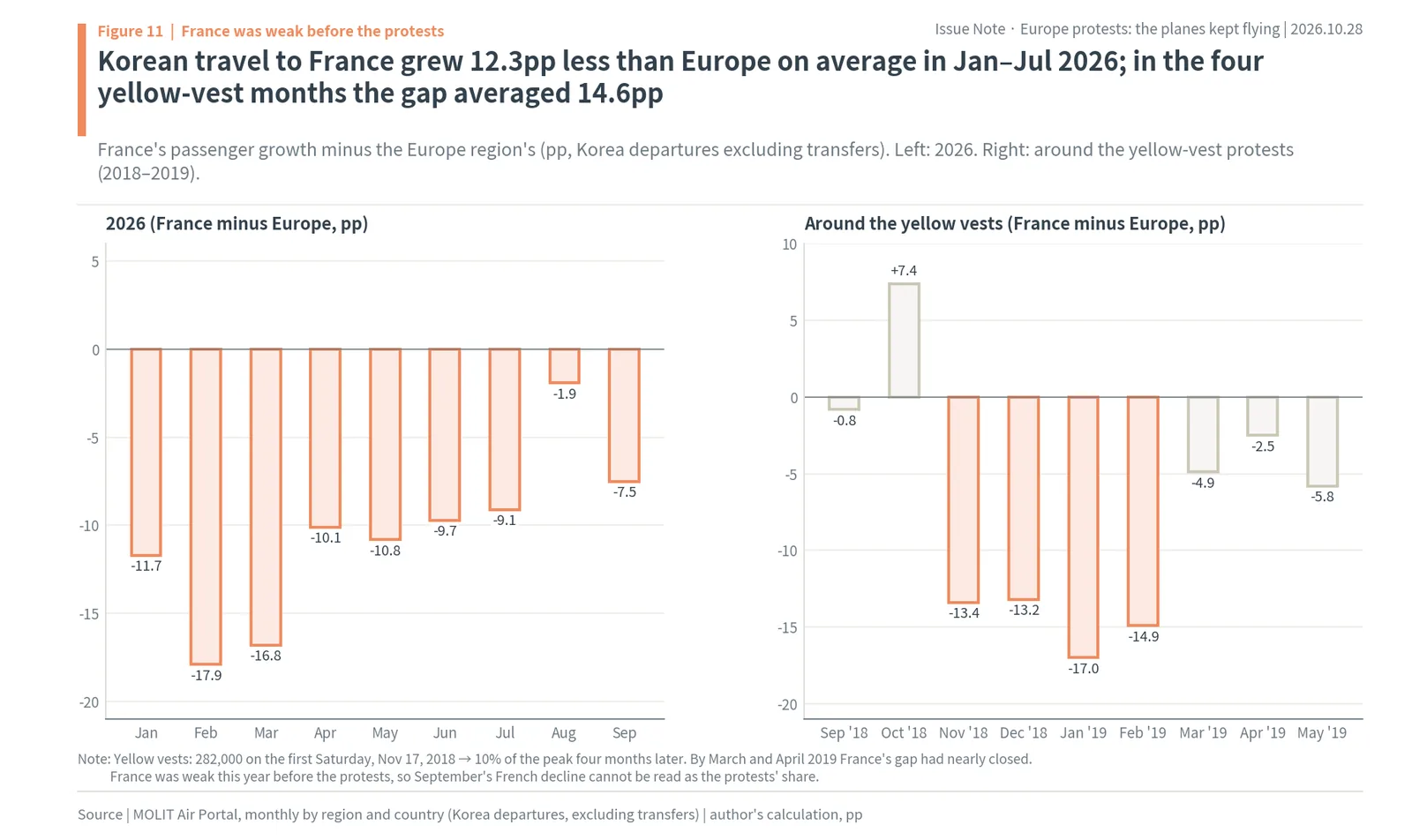
The left side of the figure is this year and the right side the period around the yellow vests. Back then, France grew 7.4pp more than Europe in October, just before the protests, and then grew 13 to 17pp less for four months from November, when the protests began. The timing of the protests and of the decline matches exactly. This year France was around -10pp before the protests and did not get worse in September. This report uses the four-month yellow vest average of 14.6pp as the size of the drop in Korea-departure demand if the protests last. So what made all of Europe grow less even before the protests?
The real cause came before the protests: Europe round-trip fuel surcharges up fivefold
The conclusion first: what cut European travel was the jump in fuel prices from the Iran war. Hanatour Service (039130.KS) publishes a quarterly fact sheet with monthly packaged-product customers (packages and bundled products) and regional shares. Multiplying the two gives package customers to Europe, including the Middle East. Hanatour’s Europe package customers fell -22.9% in July, -28.6% in August and -30.2% in September, a decline that began before the protests. September’s 12,738 is seven in ten of last September’s 18,260. The third-quarter total of 33,582 was 27.5% below last year’s 46,318, a loss of 12,736 customers in one quarter.
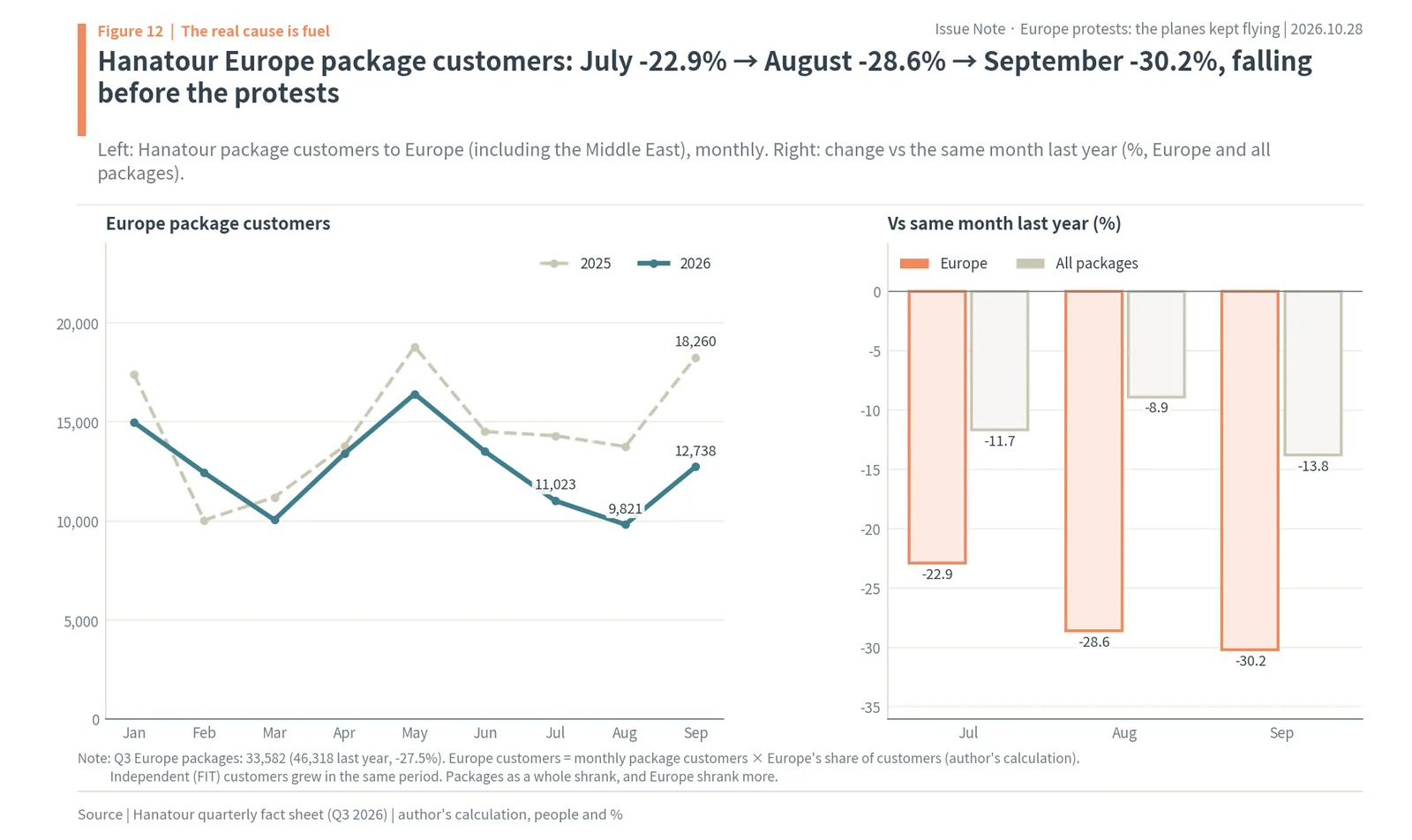
As the right side of the figure shows, packaged products as a whole also fell in the same period, by 11.7% in July, 8.9% in August and 13.8% in September, because more travelers buy flights and hotels separately as free independent travel (FIT) instead of packages. Hanatour’s third-quarter FIT customers were 1,260,605, up 14.7% from 1,098,924 last year. Europe shrank more than twice as fast as packages as a whole. Mode Tour Network (080160.KQ) also saw its Europe packages fall to 14,372 in the second quarter (-29.8%) and 8,930 in the third (-49.8%) (New Daily). Both companies cited fuel surcharges as the cause, and neither mentioned the protests.
The Europe round-trip fuel surcharge was KRW 152k in November 2025 and KRW 740k in November 2026
The reason is clear in the numbers. Asiana’s one-way fuel surcharge for routes of 5,000 miles or more (Paris, Rome, Frankfurt, London) on tickets issued in November 2025 was KRW 76,000 (Asiana notice). Korean Air’s one-way surcharge from Incheon to Paris or Rome on tickets issued in November 2026 is KRW 370,100 (SBS Biz, October 16). Round trip, that is KRW 152k (about $113) a year ago against KRW 740k (about $551) now, 4.9 times as much. Korean Air’s surcharge rose four stages, from stage 23 in October to stage 27 in November, because the prolonged Middle East war pushed Singapore jet fuel from $158.57 to $173.89 a barrel. Hanatour’s Europe packages were -30.2% in September.
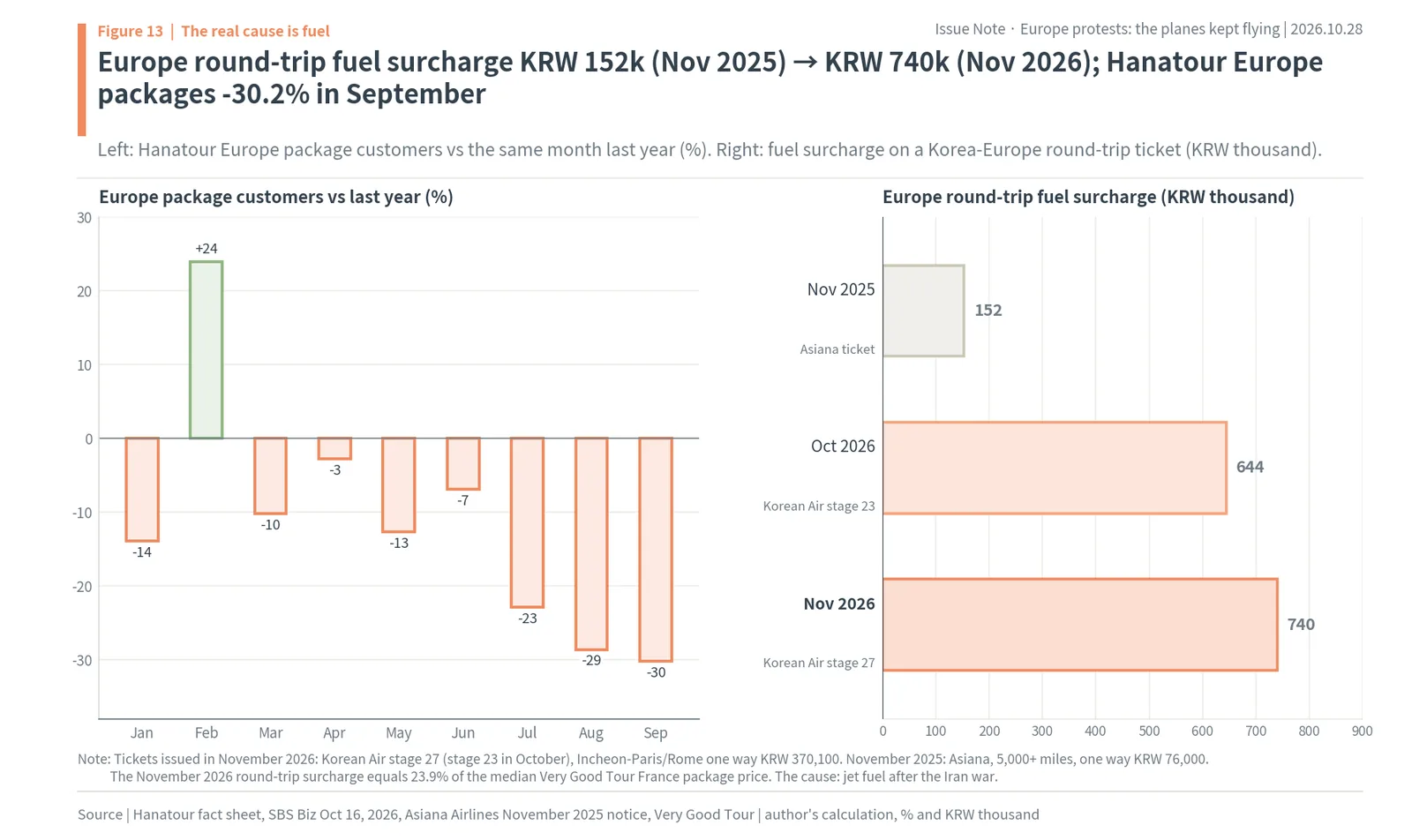
The November round-trip surcharge of KRW 740k is 23.9% of KRW 3.091mn (about $2,301), the median price of a France package at Very Good Tour (094850.KQ). The surcharge on a round trip to Japan is far smaller. Korean Air also wrote in its second-quarter results materials that fuel surcharges had dampened Korea-originating demand while higher inbound and transfer demand had lifted total revenue, and in its preliminary third-quarter results it said Korea-originating passenger demand had softened somewhat under the burden of fuel surcharges. European travelers were being squeezed out by fuel costs before the protests.
This trend continues separately from the protests. The surcharge on tickets issued in November rose further from October. Unless oil prices fall, Europe packages in November and December are likely to come in below last year even without protests. So the observation that European travel has fallen is right, but the explanation that it fell because of the protests does not fit the data so far. Then did the protests leave no signal at all?
The protests’ only signals so far: searches to check, and a pause in near-term departures to France
The conclusion first: the protests are at the stage of making people look things up, not of making them cut trips. In Naver DataLab’s search trends, searches for ‘Paris trip’ (as a ratio to ‘Japan trip’ on the same day, with the September 1 to 20 average = 100) jumped to 5.2 times normal on October 18, the day after the protest peak. Searches for ‘Paris protest’ rose sharply the same day. Ten days later, on October 27, they were back to 1.2 times, nearly normal. These are searches to check whether it is safe to go, more than a signal not to go.
Counting bookings on Very Good Tour’s public product pages for departures from November to January 2027, average bookings per departure were France 4.2 > Switzerland and Eastern Europe 1.8. Italy was 2.8, multi-country Western Europe 2.2, Spain and Portugal 6.8, Greece 9.7 and Japan 6.6. France, where the protests are strongest, has more bookings than the Switzerland and Eastern Europe products, where there are none.
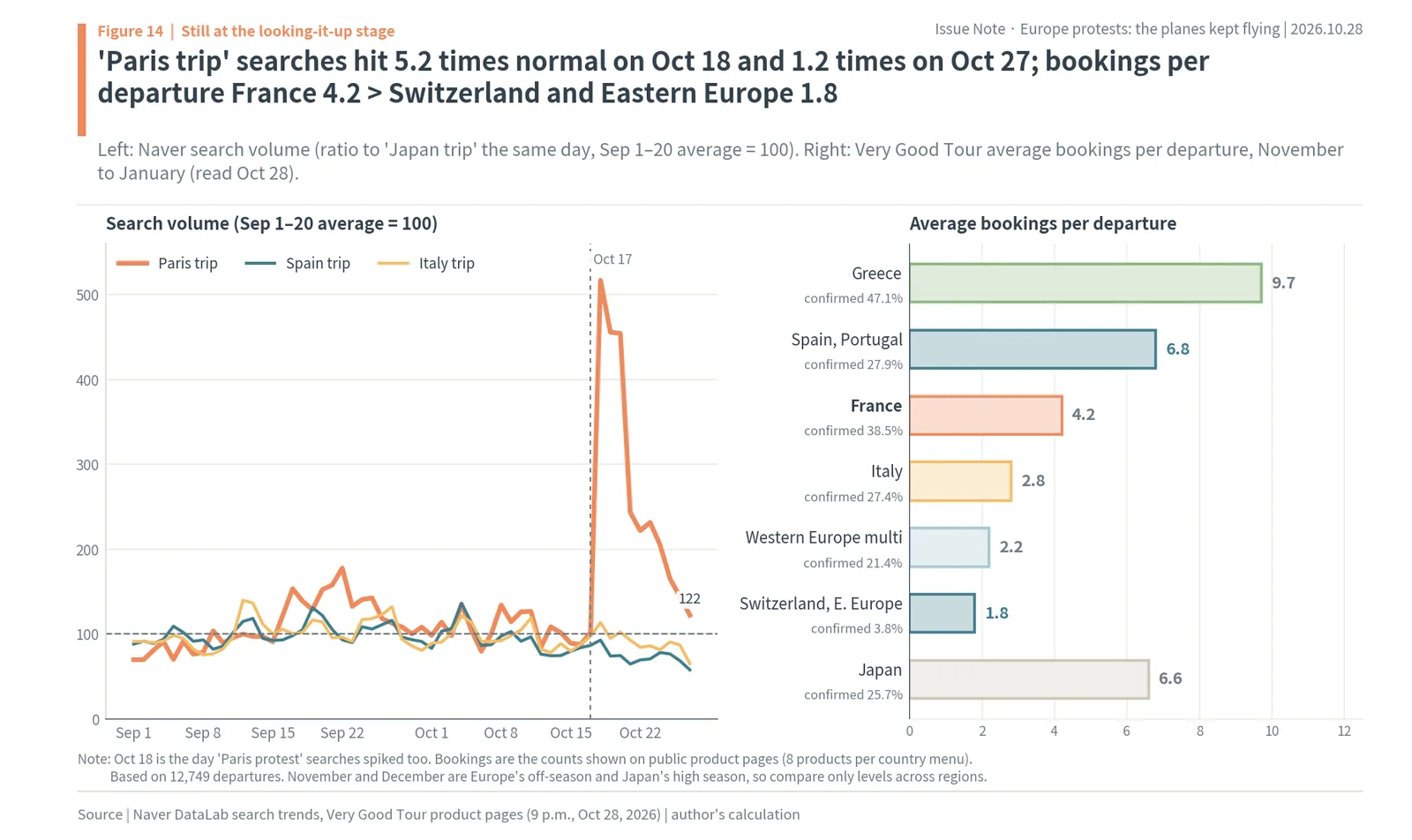
Bookings are a snapshot from the evening of October 28, 2026, counting 12,749 departures in the November, December and January calendars of eight products per menu. The share of departures confirmed to operate is 38.5% for France, 27.4% for Italy, 3.8% for Switzerland and Eastern Europe and 25.7% for Japan. November and December are Europe’s off-season and Japan’s peak season, so only levels across regions can be compared, and with no value from the same point last year it cannot be said that bookings fell. The pages also show other numbers that appear to be for display only, and they were not used.
Net of season, southern European searches weakened, while Italy and the UK fell less
Every autumn searches for Europe fall and searches for Japan rise. So the change from September 1 to 20 to the spread period (October 17 to 27) is taken net of the change at the same time last year. Net of season, southern European searches weakened, with Portugal -30.1pp, Spain -15.5pp and Greece -10.4pp, while Italy at +11.5pp and the UK at +17.0pp fell less than the season implies. Switzerland is +12.9pp, Eastern Europe +7.6pp and ‘Europe trip’ as a whole +26.2pp.
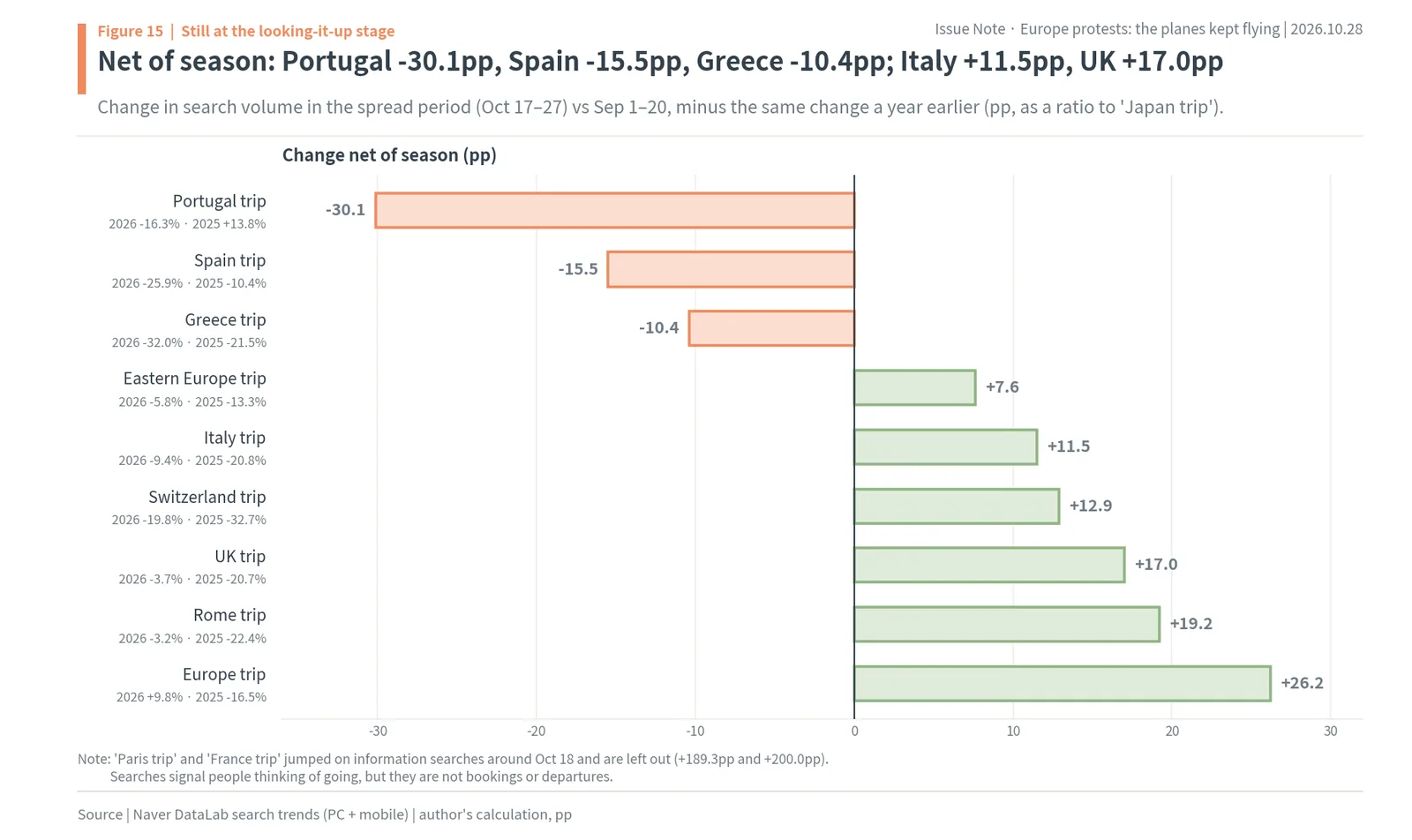
Spain, Portugal and Greece are countries where protests over housing and living costs drag on. Spain has a general housing strike on November 11 and a snap election on November 29. Where searches weakened first is where bookings may weaken next. Italy, by contrast, saw searches fall less than the season despite reports of clashes in Milan. Searches signal people who want to go, but they are not the same as bookings or departures, so this report uses them only as a leading signal.
By departure month, nearer months hold more bookings, and France comes after Japan
By departure month, November bookings per departure were France 5.7, Italy 4.2 and Switzerland and Eastern Europe 2.1. December was France 3.2, Italy 2.2 and Switzerland and Eastern Europe 2.2, and January 2027 France 3.3, Italy 2.6 and Switzerland and Eastern Europe 1.2. Japan goes from 11.0 in November to 3.3 in January. Nearer months being fuller is the normal pattern.
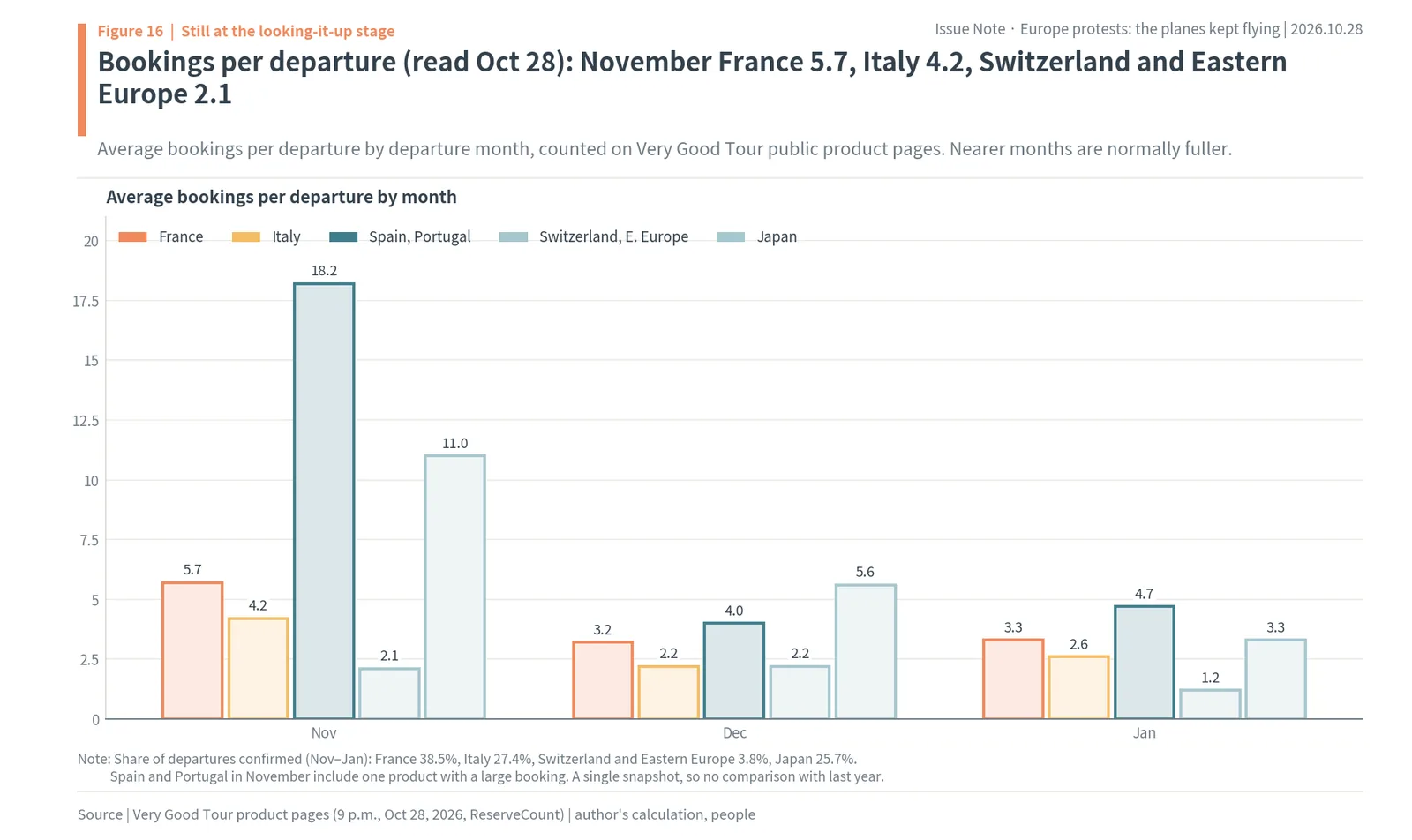
Industry reports point the same way. Travel Times reported on October 22 that at one tour operator, cancellations of France products from October 19 to 21 averaged about ten people a day, and that while bookings for near-term November departures fell, new bookings for departures next spring held steady. The industry’s assessment was that the impact was more limited than expected. Hanatour said on October 20 that it saw no particular cancellation trend related to France. Yellow Balloon Tour (104620.KQ) said its Europe bookings for November and December were up 16.8% as of October 13. What the protests have left so far is a small pause in near-term departures to France. So how much would be lost if the protests last?
Fares do not point to empty seats either: protest-country routes are typical, while London and Prague are low
The conclusion first: air fares show no sign of protest-country routes alone getting cheaper. When a plane has many empty seats, airlines cut prices as departure nears to fill them. So fares are a signal of empty seats that can be seen before load factors are published. On October 28, the lowest round-trip fares from Incheon on Google Flights for November 12 to 19 were KRW 952,100 to Paris, rated typical (usual range KRW 810k to 1.15mn), KRW 915,800 to Rome, rated typical, and KRW 1,073,800 to Lisbon, also typical. Direct to Paris, Air France was KRW 997,700 and Korean Air KRW 1,206,800.
The routes included for comparison were cheaper. On the same dates London was KRW 825,900, rated low (KRW 77,700 below usual), and for December 3 to 10 London at KRW 912,700 was KRW 157,772 below usual and Prague at KRW 888,900 was KRW 172,100 below, both rated low. The UK and Czech routes, without protests, are selling for less than the protest-country routes. Tokyo was KRW 337,242, rated typical (usual range KRW 295k to 570k). Google’s 60-day price history for the Paris route moved between about KRW 800k and 960k and did not fall noticeably after October 17.
Fares are search results at a single point in time and vary with cabin class, stopovers and exchange rates, so only their direction is read, not their size. Labels on booking sites such as fewer than 9 seats left refer to the seats left in the cheapest fare class, not to empty seats in the whole cabin, so this report did not use them. Departures, flights, package bookings and fares all point the same way. The protests have not yet kept Korean travelers at home.
European numbers and past protests: tourism fell hard only when protests ran long in the heart of tourist areas
The conclusion first: protests cut tourism heavily when they went on for months in the middle of tourist areas. Starting with European numbers on these protests, the hotel research firm MKG said that between October 19 and 20 the lead of Paris hotel bookings over last year shrank from 1.0pp to 0.2pp for stays from October 20 to 29, and from 3.5pp to 1.9pp for stays from October 20 to 25 (Euronews, France 24). Bookings are still above last year, but the lead has narrowed. MKG added that the slowdown was especially noticeable for near dates and upscale stays. This points the same way as Protourisme’s calculation (a day of rioting cancels 1% of that month’s bookings).
Past cases show the range of sizes. During the yellow vests, Paris hotel demand fell 6.5% in December 2018 and 4.2% in January 2019 (STR). Around the Catalan independence vote in October 2017, tourist activity in Barcelona fell 15% in the first half of October (Exceltur), bookings to year-end fell 20%, and revenue per available room fell 27.5% on October 4 alone (STR). The extreme case is Hong Kong in 2019. With protests blocking the airport and city center for months, visitors fell 43.7% in October and 14.2% for the year.
There are opposite cases too. In Greece in 2011, anti-austerity protests went on all year, yet foreign arrivals rose 9.5% to 16.4 million. The protests were concentrated in the square in front of the parliament in Athens. The following year, 2012, arrivals fell 5.5%. What decided the tourism numbers was not whether there were protests but how long they lasted and whether they sat on tourists’ routes.
Measured this way, these protests are still somewhere between the yellow vests and Catalonia. The Louvre and the Musée d’Orsay in Paris closed for a few days and curfews were imposed in parts of the city, but airports and planes were unaffected. So this report uses the yellow vests (Korean travel to France -14.6pp) rather than Hong Kong as the base intensity if the protests last, and Catalonia (-20%) as the worse case.
What it would cost if it lasts: at yellow vest intensity, tour operators hurt more than airlines
The conclusion first: the protests’ share so far is close to zero, but the picture changes if they spread across several countries for more than four months, as the yellow vests did. This report takes the average 14.6pp by which Korean travel to France grew less than Europe in the four yellow vest months as the size of the drop in Korea-departure demand to protest countries and calculates each company’s loss. The formula is Europe revenue × Korea-departure share × protest-country share × rate of decline × duration (weeks ÷ 52). There are four scenarios: France alone for 4 weeks (to mid-November) and for 9 weeks (to the Christmas break on December 19), and all protest countries for 27 weeks (to around France’s presidential election in April 2027) at yellow vest intensity and at the intensity of Catalonia in 2017 (year-end bookings -20%).
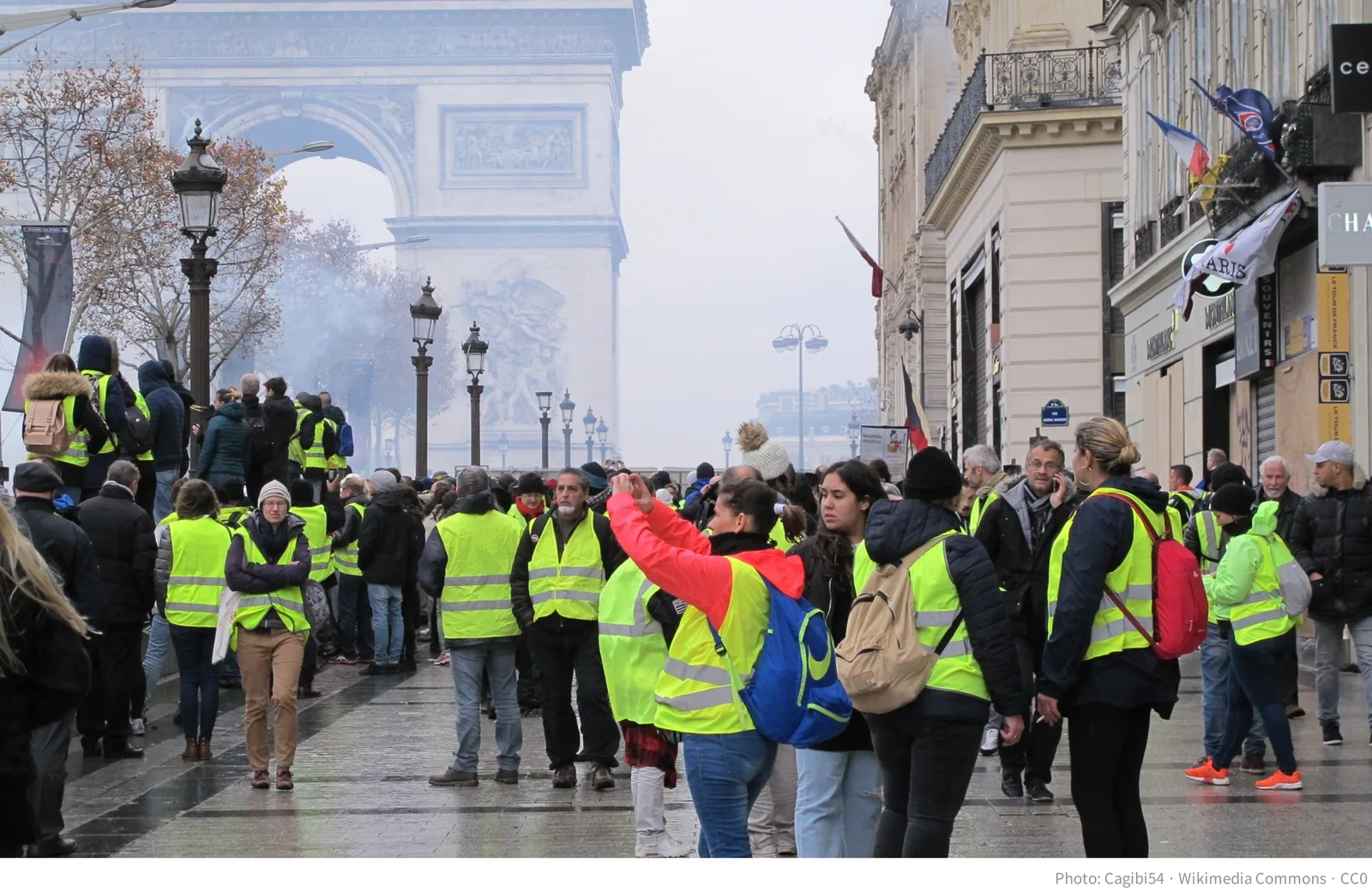
Looking again at Paris’s numbers during the yellow vests shows how big this assumption is. Around the weekend of December 8, 2018, revenue per available room at Paris hotels was -10.7% on Friday and -13.8% on Saturday, yet for 2018 as a whole Paris revenue per available room was +11% (MKG, Hospitality ON). What the protests cut was a few weekend days; the annual number was set by the economy and exchange rates more than by the protests. The -14.6pp for Korean travel to France is likewise a four-month value, not an annual one. That is why duration is multiplied in separately.
Protest-country share: 28.2% of Korea-departure Europe passengers for airlines, 64% for packages
The protest-country share is set differently for airlines and for packages. For airlines it is 28.2% (France 10.8%), the share of France, Italy, Spain and Portugal in September Korea-departure passengers to the Europe region. Greece and Belgium have almost no direct flights from Incheon, so their September values are 0. For packages it is 64%, Western Europe (41%) plus Spain and Portugal (23%). These are the shares within Europe that Mode Tour disclosed for 2025, and since Western Europe products usually include Paris, the share that includes France is set at 41%. Trinity Airways’ only European routes this winter are Paris, Rome and Barcelona, so all of its Europe revenue is treated as protest-country revenue. The flow-through to operating profit is assumed to be 60% for airlines and 75% for tour operators, which earn commissions.
Operating profit at risk: within KRW 1.3bn per company if only France runs to Christmas, and 10.2% of Hanatour’s estimate and 1.5% of Korean Air’s if all protest countries run to the election. With France alone for 9 weeks it is KRW 1.32bn for Korean Air, KRW 1.31bn for Trinity Airways, KRW 0.95bn for Hanatour, KRW 0.26bn for Mode Tour and KRW 0.24bn for Very Good Tour. With all protest countries for 27 weeks it is KRW 11.82bn (about $8.8mn) for Trinity Airways, KRW 10.32bn (about $7.7mn) for Korean Air, KRW 4.45bn (about $3.3mn) for Hanatour, KRW 1.22bn for Mode Tour and KRW 1.11bn for Very Good Tour.
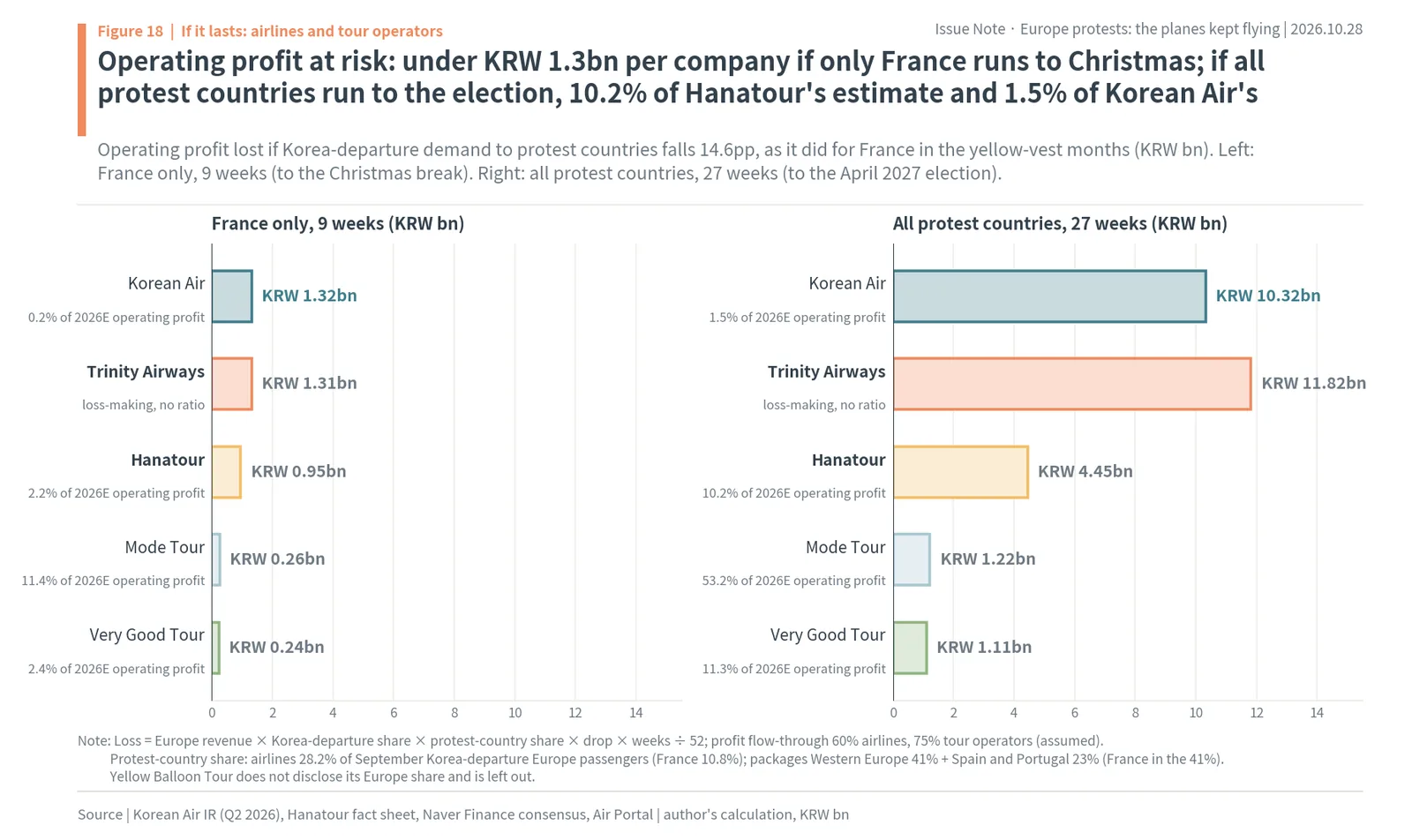
In amounts Korean Air and Trinity are the largest, but relative to company size the order changes. With all protest countries for 27 weeks, lost operating profit relative to this year’s estimated operating profit is 1.5% for Korean Air, 10.2% for Hanatour, 11.3% for Very Good Tour and 53.2% for Mode Tour. Mode Tour’s operating profit estimate for this year is small, at KRW 2.3bn, so its ratio comes out large. At Catalonia intensity the same ratios grow to 2.1% for Korean Air, 13.9% for Hanatour, 15.5% for Very Good Tour and 72.9% for Mode Tour. Yellow Balloon Tour does not disclose its Europe share and is left out of the calculation.
Korean Air: Europe is 15% of passenger revenue, and less than half of it is sold in Korea
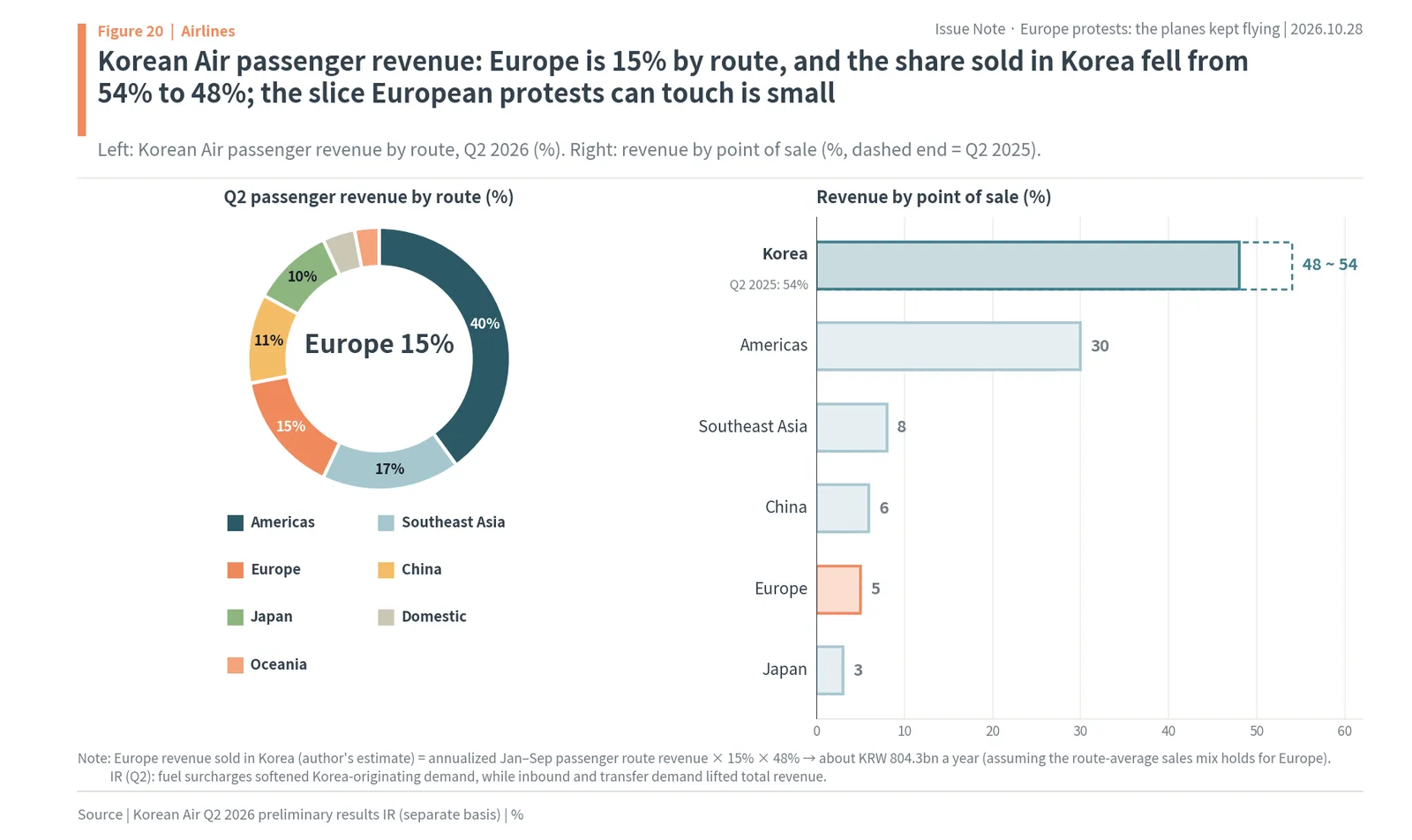
In Korean Air’s second-quarter IR materials, passenger revenue by route was 40% Americas, 17% Southeast Asia, 15% Europe, 11% China, 10% Japan, 4% domestic and 3% Oceania. By point of sale, the share sold in Korea fell from 54% a year earlier to 48%, and the share sold in the Americas rose from 27% to 30%. This report takes KRW 1,675.7bn (about $1.25bn), Europe’s 15% of KRW 11.2tn of annualized January to September passenger route revenue, as Europe passenger revenue, and 48% of that as Europe revenue sold in Korea. This assumes that the route-average sales mix also holds for Europe.
Korean Air’s figures, Europe at 15% of passenger route revenue and a Korea-sold share down from 54% to 48%, mean that the slice European protests can touch is small. The company wrote in the second quarter that fuel surcharges had dampened Korea-originating demand but that higher inbound and transfer demand had increased total revenue. As Middle Eastern airlines cut flights because of the Iran war, transfer passengers between Asia and Europe came to Incheon. Even if protests cut Korea-departure European travelers, overseas-originating and transfer passengers may fill the gap. What the company named as a fourth-quarter burden in its third-quarter results was not Europe but fuel costs raised by the Middle East war.
Trinity Airways is the opposite. Europe was 15% of its revenue in the first half of 2025 (Hana Securities), and in winter all three of its European routes are in protest countries. Most of its customers depart from Korea, so this report assumes a Korea-departure share of 80%. It is already loss-making (an operating loss of KRW 239.0bn is estimated for 2026), so a ratio to profit is meaningless; instead, against its market cap of KRW 220.5bn (about $164mn), the one-off loss alone for all protest countries over 27 weeks is 4.07%. Among Korean low-cost carriers, Jin Air (272450.KS), Jeju Air (089590.KS) and Air Busan (298690.KS) have no European routes and are outside this calculation.
Tour operators: under one in ten customers, but three in ten won of sales
Tour operators look small when measured in customers and large when measured in money. Europe was 8.4% of Hanatour’s third-quarter package customers but 26.7% of GMV. Second-quarter GMV per customer was KRW 3.66mn (about $2,725) for Europe and KRW 0.72mn for Japan, so one European customer spends 5.1 times as much as one Japan customer. Hanatour’s Europe-related revenue is therefore set at KRW 122.4bn: this year’s estimated revenue of KRW 565.9bn × the 81% package-related share × the 26.7% Europe GMV share.
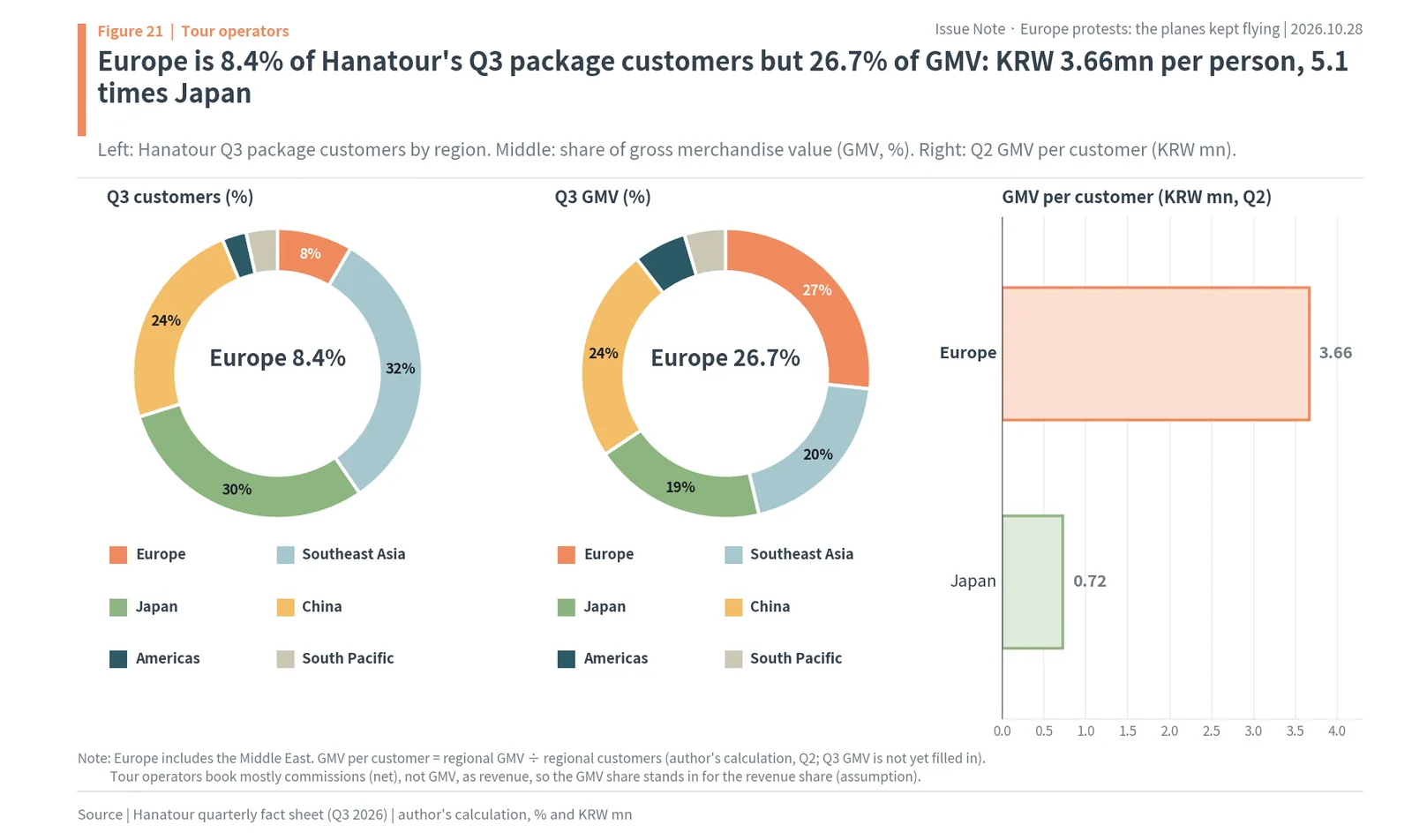
Mode Tour and Very Good Tour do not disclose Europe’s GMV share separately. So their customer shares (Mode Tour 6.4% in the third quarter, Very Good Tour a sales share of about 20%) were converted into GMV shares using Hanatour’s ratio of the European price per person to the non-European price per person, 3.96 times. Done this way, Europe comes to about half of Very Good Tour’s GMV. For comparison, the loss that has already happened can be put in the same units: Hanatour’s Europe packages lost 12,736 customers to fuel costs in the third quarter alone. That is 9.1 times the 1,392 customers lost if France alone fell at yellow vest intensity until Christmas, and more than the 6,517 if all protest countries ran for 27 weeks. For tour operators, the loss that came before the protests is the bigger one.
Smaller tour operators have small profits, so the same loss looks large
Smaller tour operators have small profits, so the same amount of loss is a large share of profit. Very Good Tour had 2025 revenue of KRW 92.1bn and operating profit of KRW 9.8bn, but this year its operating profit fell to KRW 1.1bn in the first quarter and KRW 0.3bn in the second. Yellow Balloon Tour had 2025 revenue of KRW 119.7bn and operating profit of KRW 2.2bn, and this year KRW 2.4bn in the first quarter and KRW 0.8bn in the second. Mode Tour’s operating profit falls from KRW 7.4bn in 2025 to an estimated KRW 2.3bn this year. All three had already seen profits fall before the protests, and the cause was fuel costs and weaker package demand.
In companies like these, losses from a prolonged protest become a large share of profit. The amounts themselves are not large, though. With all protest countries for 27 weeks, Very Good Tour loses KRW 1.11bn of operating profit and Mode Tour KRW 1.22bn. Yellow Balloon Tour could not be calculated because it does not disclose its Europe share, but it said its November and December Europe bookings were up 16.8% as of October 13, so it was expanding Europe products right up to the protests. It is a name to watch alongside the others, since those added bookings could turn into cancellations if the protests last.
The market-cap shock if it lasts is around one in ten, and share prices have barely priced it in
The conclusion first: if the loss lasts a year and ends there, the market-cap shock is small; it becomes large only when the level of earnings itself drops. The market-cap shock is counted two ways. A one-off loss is the lost operating profit minus 24% corporate tax, taken as net profit, on the view that the company loses just that much cash. When the level of earnings drops, one year’s lost net profit is multiplied by the current valuation multiple (forward PER), on the view that the market sees the lower earnings continuing and keeps applying the same multiple. Trinity Airways is loss-making and has no PER, so its book loss is multiplied by its price-to-book ratio (PBR) of 1.97 times.
With all protest countries for 27 weeks, the one-off market-cap shock is 0.08% for Korean Air, 0.78% for Hanatour, 0.54% for Mode Tour, 1.55% for Very Good Tour and 4.07% for Trinity Airways, within a normal day’s price swing. If a long spread lowers earnings, the market-cap shock is Mode Tour -27.8%, Trinity -15.5% and Hanatour -13.7%. Very Good Tour is -13.8% and Korean Air -3.2%. At Catalonia intensity it grows to 38.1% for Mode Tour, 21.2% for Trinity Airways, 18.9% for Very Good Tour, 18.8% for Hanatour and 4.3% for Korean Air. Since the Friday before the protests began (September 18), the stocks have moved -7.8 to +7.5pp against their index.
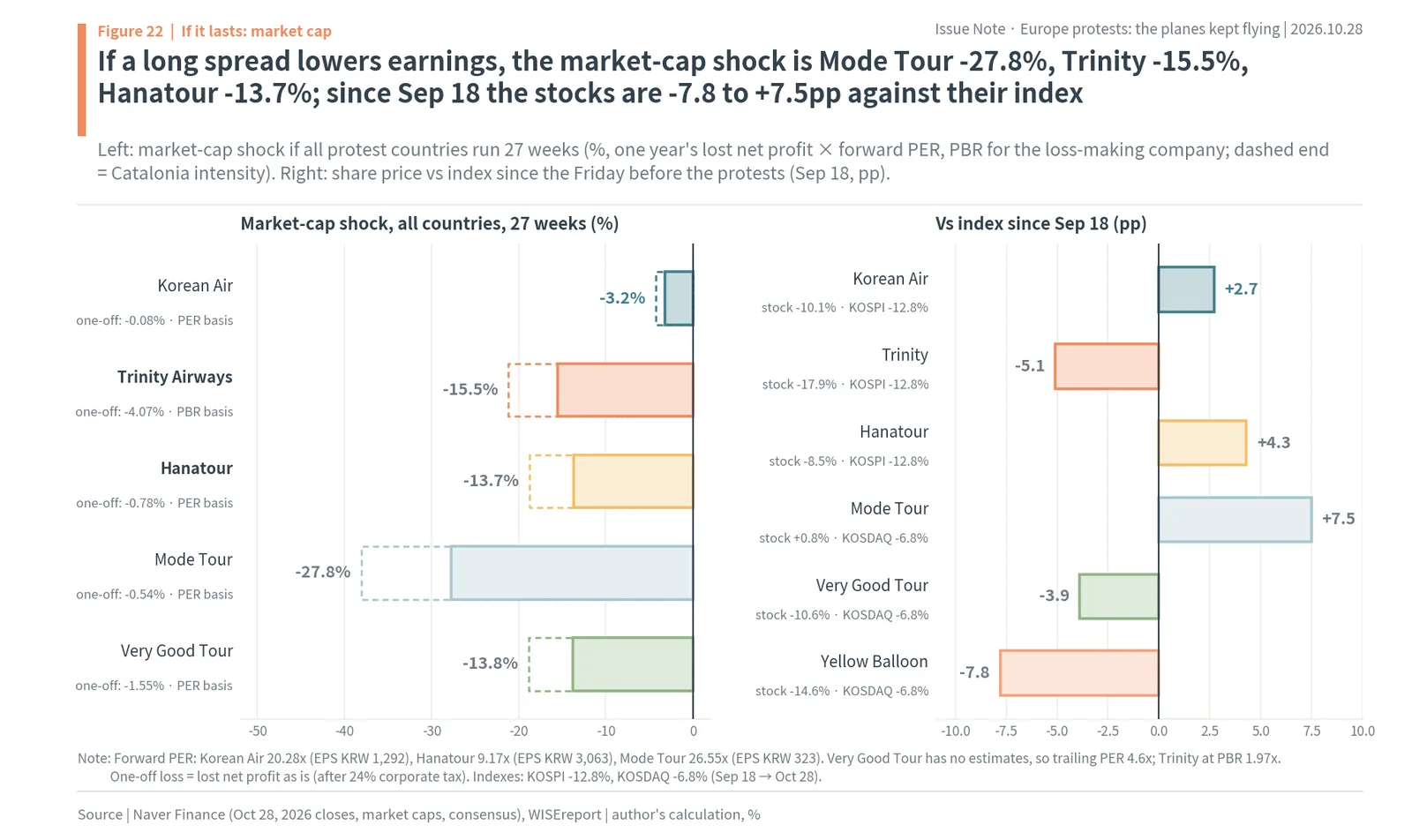
The multiples used are forward PERs of 20.28 times for Korean Air (2026 EPS KRW 1,292), 9.17 times for Hanatour (EPS KRW 3,063) and 26.55 times for Mode Tour (EPS KRW 323). Very Good Tour has no broker estimates, so its trailing four-quarter PER of 4.6 times (EPS KRW 842) is used. Mode Tour’s shock is large because its profit is small and its multiple high. Korean Air’s multiple is high too, but the profit the European protests touch is small, so its shock is small.
Against the Friday before the protests, Korean Air and Hanatour fell less than the index
To see how much is already in the price, the base date has to be chosen carefully. Setting the close on September 18, the last trading day before the protests began, to 100, on October 28 the KOSPI was 87.2, Korean Air 89.9 (KRW 26,200, about $19.5), Hanatour 91.5 and Trinity 82.1. Over the same period the KOSPI fell 12.8% and the KOSDAQ 6.8%. Korean Air (+2.7pp), Hanatour (+4.3pp) and Mode Tour (+7.5pp) fell less than their index, while Trinity Airways (-5.1pp), Yellow Balloon Tour (-7.8pp) and Very Good Tour (-3.9pp) fell more. In Europe, Air France-KLM was -10.1% and TUI +5.2%.
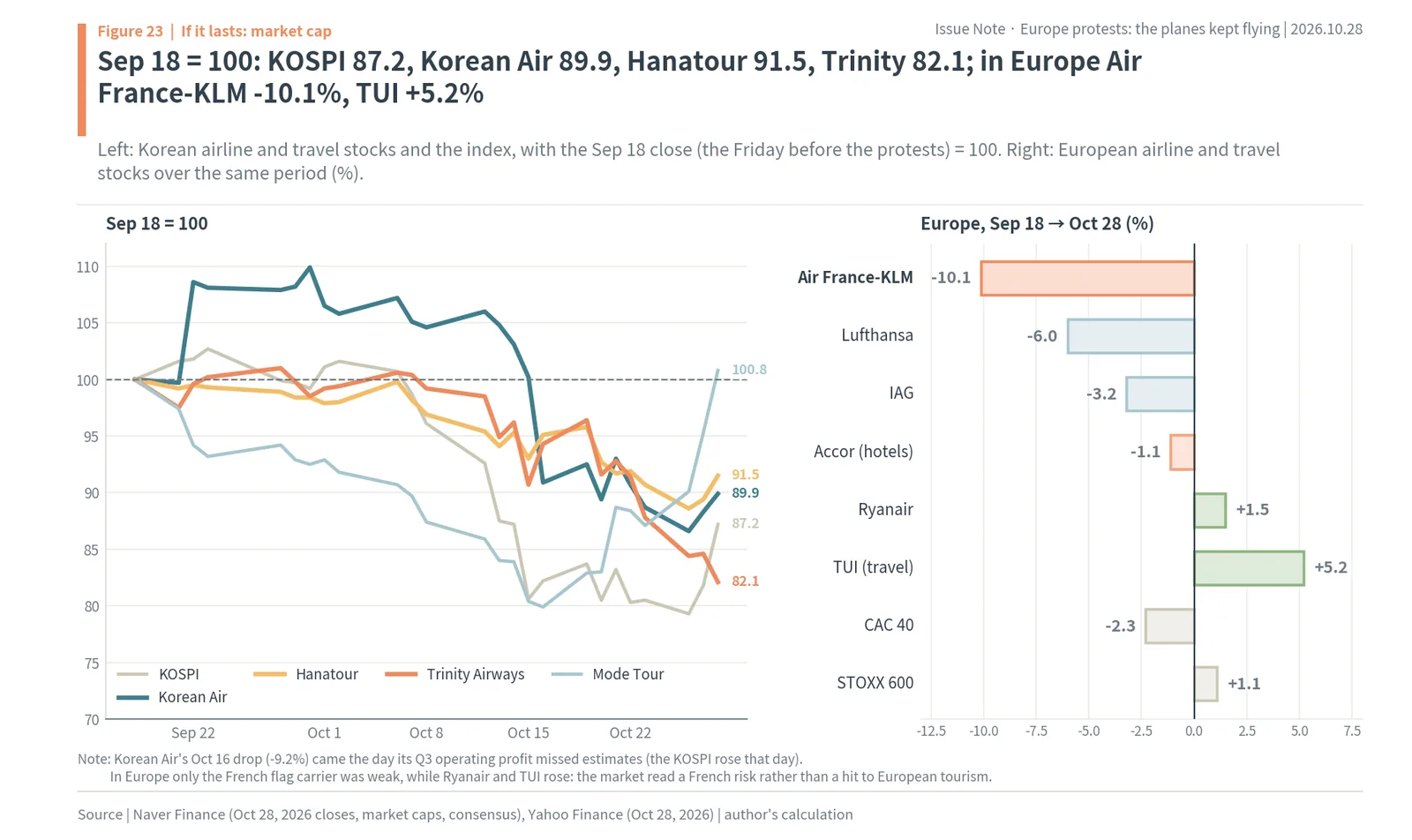
European moves point the same way. Over the same period Air France-KLM fell 10.1%, Lufthansa 6.0% and IAG 3.2%, while Ryanair rose 1.5%, TUI, Europe’s largest tour operator, rose 5.2%, and the hotel company Accor fell 1.1%. The CAC 40 was -2.3% and the STOXX 600 +1.1%. Only the French flag carrier was weak, and the European tour operator rose. The market is reading these protests as a French risk rather than as a shock to European tourism demand.
Travel-related stocks with little European exposure were similar over the same period. Lotte Tour Development (032350.KS), most of whose revenue comes from its casino, fell 10.1% after September 18, 2.6pp less than the KOSPI, and Red Cap Tour (038390.KQ), whose main business is car rental, fell 0.4%, 6.4pp less than the KOSDAQ. From the September 18 base, companies with large and small European exposure do not clearly separate. What moved the stocks in this window was the KOSPI’s big swings more than the protests.
Looking only at the period after the spread, airline and travel stocks lagged, but so did airlines with no European routes
Measured from the October 16 close, the picture changes. In this period the KOSPI rose 6.1%, led by semiconductors, and every airline and travel stock listed on the KOSPI rose less than the index. Hanatour was -9.8pp, Korean Air -7.2pp and Trinity Airways -19.0pp. But Jin Air (-14.0pp), Jeju Air (-6.3pp) and Air Busan (-7.1pp), which have no European routes, also lagged, by an average of 9.1pp. That is the part they could not keep up with an index pulled up by semiconductors. Against that average, Hanatour at -0.7pp and Korean Air at +1.9pp show almost no difference, and only Trinity Airways fell a further 9.9pp.
Whether Trinity Airways’ extra decline is due to the protests cannot be determined from these data. The company keeps posting losses, the average broker target price of KRW 1,800 (about $1.34) is below the current price of KRW 2,160 (about $1.61), and it has cut its winter European routes. Still, since all of its European routes are in protest countries, it is clearly the name that would move first if the protests last. In sum, Hanatour and Korean Air shares have barely priced in a prolonged protest, and Trinity Airways has priced in part of it. The remaining variable is how long the protests last.
How long the protests may last: three-quarters of the peak remains, and the base case runs to around the Christmas break
The conclusion first: the author’s base case is that the French protests continue until around the Christmas break (December 19). On October 24, French protest turnout was 410,000, 74.5% of the peak. Despite expectations that student protests would fade during the autumn break (October 17 to November 2), it did not fall much. Of France’s last five big protests, three ended within 4 to 6.5 weeks and two ran 16 to 20 weeks. The 1995 strikes lasted about 4 weeks, the 1990 high school protests about 6 weeks and the 2019 to 2020 transport strike about 6.5 weeks, while the yellow vests fell to 10% of the peak after 16 weeks and the 2023 pension protests ran about 20 weeks.
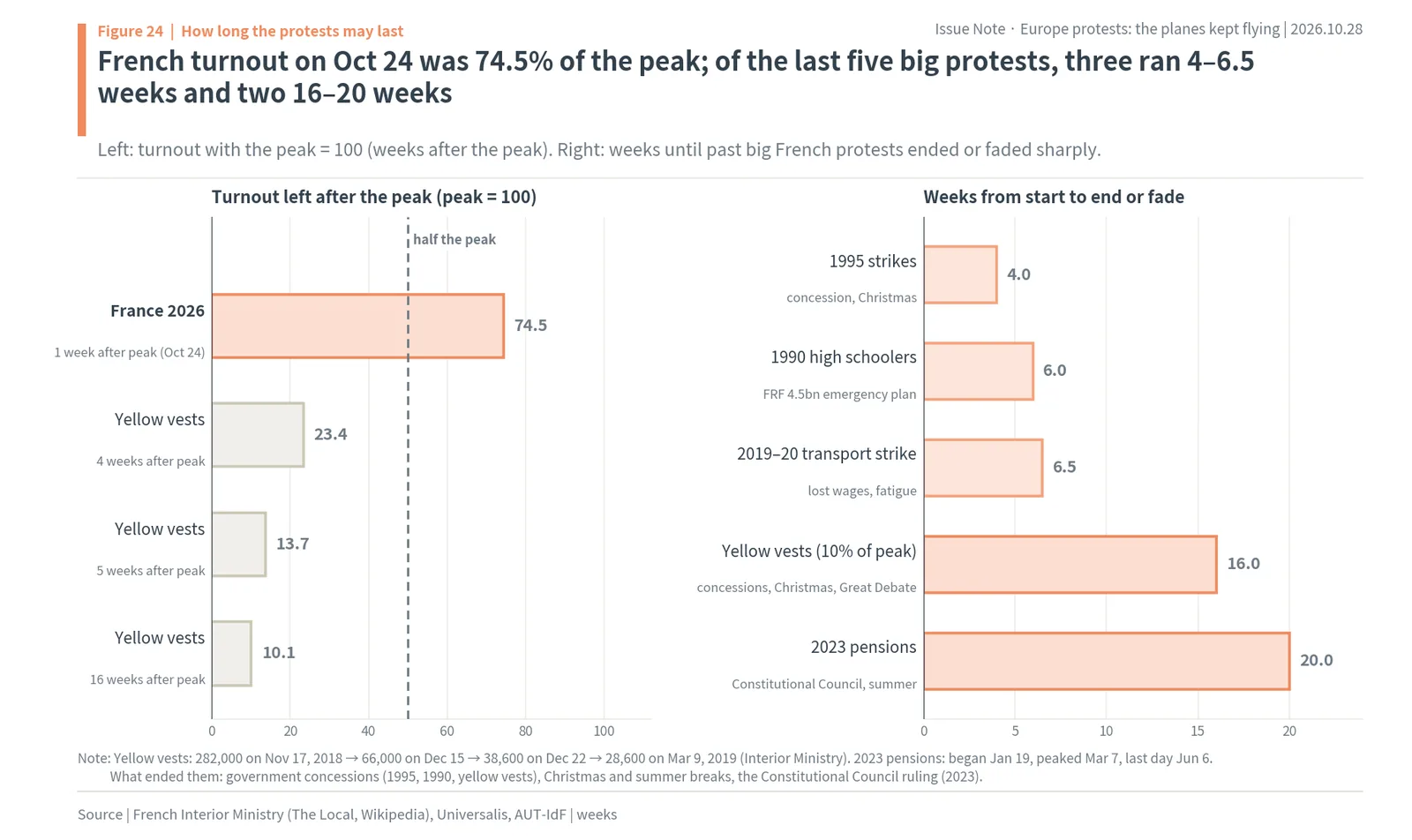
What ended them was one of three things: government concessions (the partial withdrawal of the pension plan in 1995, the FRF 4.5bn emergency plan in 1990, the yellow vest concessions of December 10), holidays (Christmas and summer), and the law becoming final (the Constitutional Council’s 2023 ruling that the pension reform was constitutional). This time the government offered concessions on October 26, but student representatives said they fell short, and the Senate went the other way by passing the protest-damage compensation bill. The yellow vests peaked on their first Saturday and declined slowly over four months. These French protests peaked in their fourth week (October 17), and a week later three-quarters of the peak remained.
The first fork is November 5, followed by the budget and Spain’s election
The first fork is November 5. That day five French unions (CFDT, CGT, FO, Unsa and FSU) hold a general strike across all sectors, and the CGT is calling for a general strike starting that day (The Local). When labor protests join student protests, they last longer, as in 1995 and 2023. Four rail unions are joining, but as of October 27 no strike notices had been filed by pilots or air traffic controllers. Next is France’s 2027 budget. It must be voted on by year-end, and Prime Minister Lecornu can force it through without a parliamentary vote under Article 49.3 of the constitution. That day could reignite the protests.
Spain is on a different path from France. The housing sit-in on Madrid’s Puerta del Sol began on September 26, and on November 11 the unions CCOO and UGT hold a joint general housing strike for the first time since 2012. The snap election on November 29 is where it leads. The first round of France’s presidential election is in April 2027, and this report’s longest scenario (27 weeks) runs until then.
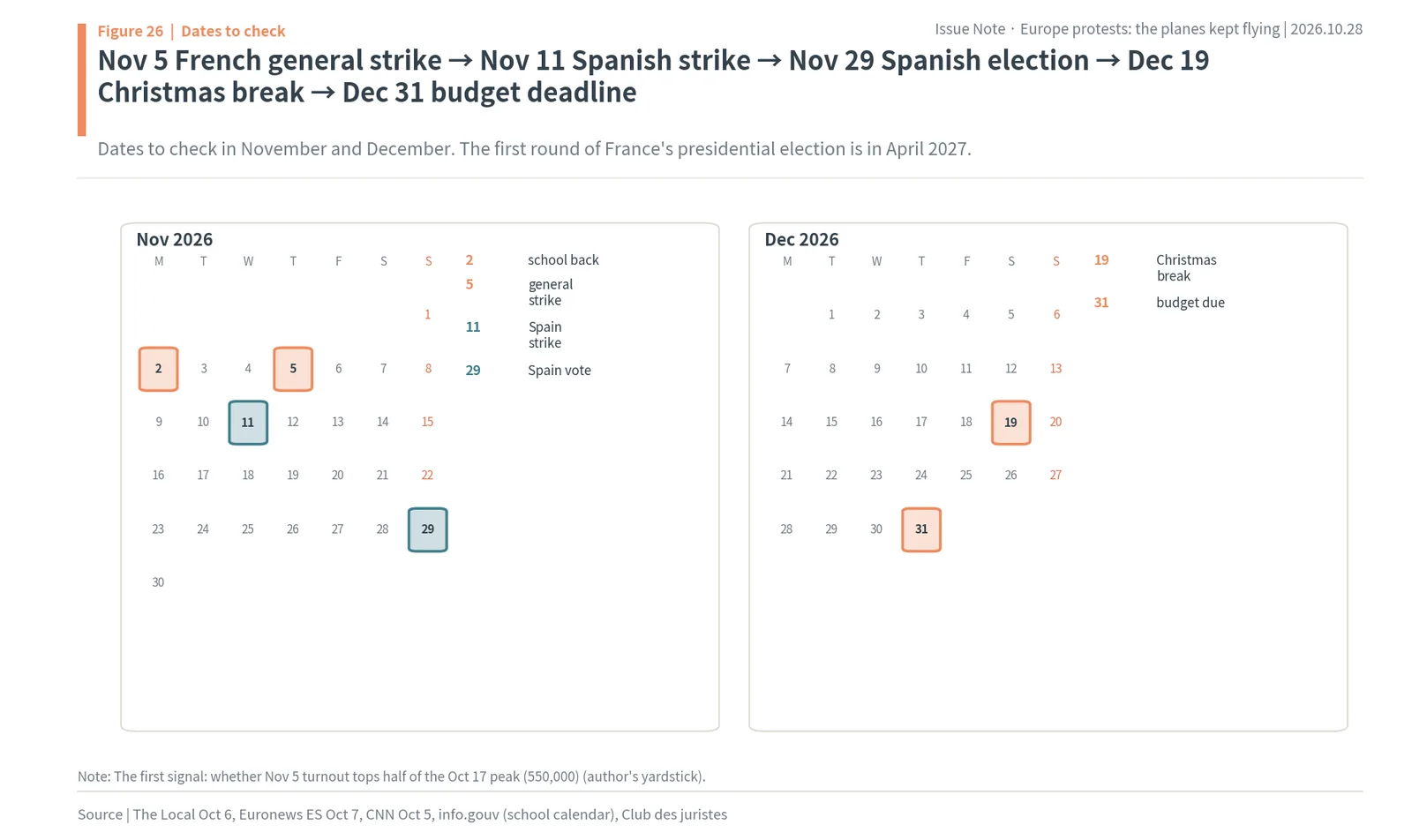
Dates to check: November 5 → November 11 → November 29 → December 19 → December 31
The French general strike on Nov 5, the Spanish general strike on Nov 11, the Spanish election on Nov 29, the Christmas break on Dec 19 and the budget deadline on Dec 31 come in that order. The author’s yardstick is simple. If turnout on November 5 tops half of the October 17 peak (550,000), the protests are taken to last until the Christmas break; if not, they are taken to fade by mid-November. Lasting until the Christmas break is the France-only 9-week scenario above, and if a forced budget reignites the protests and they continue alongside Spain and Italy, the outlook moves toward the all-protest-countries 27-week scenario.
This judgment can be revised every day, and the departure forecasts are the basis for that. If forecast departures to Europe in the first two weeks of November fall below the same weekdays last year and the gap with total departures grows larger than before the protests (-8.2pp), the protests have started actually cutting Korean travelers. Conversely, if the gap stays around -2.5pp, as now, through the second week of November, then even if the protests last, the losses on the Korean traveler side will stay in the lower scenarios of the calculation above.
Seven signals that would change the call: what would show the protests have started cutting Korean travelers
The conclusion first: the signals that would overturn this report’s judgment (that the protests’ share is still close to zero) split into those on fixed dates and those visible every day. If two or three of the seven below turn on in the same direction, the calculation for prolonged protests (France alone for 9 weeks or all protest countries for 27 weeks) becomes the base case.
The first is Incheon Airport’s forecast departures to Europe. If, in weekly sums, Europe’s growth minus total growth becomes larger than the pre-protest level (-8.2pp), the protests’ share has begun to add to the fuel share. It is now -2.5pp, smaller than that. The second is cancellations and reduced flights to protest countries. So far there have been 0 cancellations. If airlines cut flights for lack of demand, flights will fall below the same week last year. To separate this from cuts caused by the winter schedule switch (October 25), it should be read together with flights to the rest of Europe.
The third is fares. If Google Flights’ rating for the Paris, Rome and Barcelona routes moves from typical to low and they become cheaper than London and Prague, empty seats are piling up. The fourth is the Ministry of Foreign Affairs’ travel advisory. If the advisory level for a European country rises, tour operators’ terms open a wider path for customers to cancel without a fee, and cancellations come all at once. So far there have been only safety notices.
The fifth is turnout at the November 5 French general strike. If it tops half of the peak (550,000), the call shifts toward the protests lasting until the Christmas break. The sixth is the fuel surcharge for December tickets. If it rises beyond November’s stage 27, Europe packages will fall further regardless of the protests, and it will be even harder to separate the protests’ share from the fuel share. If it falls instead, the protests’ share can be read on its own while watching whether demand lost to fuel costs comes back.
The seventh is the tour operators’ October results. Hanatour and Mode Tour usually release their outbound results early the following month, and Hanatour’s fact sheet gives regional shares every quarter. If the decline in October Europe packages widens well beyond September’s (-30.2%), the protests have been added on top for packages; if it is similar, fuel is still the main actor. Air Portal’s monthly statistics for October (after mid-November) will be the last check that can reconcile all of this once more.
How to check it yourself: five sources that run three weeks ahead of official statistics
The conclusion first: without waiting for October’s official statistics, Korean travel to Europe can be followed every day. As of October 28 the latest month in Air Portal’s monthly statistics is September, and October’s figures will be posted after mid-November. Here are five faster sources. All can be viewed without logging in, and all were used in this report.
The first is the expected congestion by route page on the Incheon Airport website. Choose a terminal (1 or 2) and a date to see forecast departures by region and hour. Add up the Europe column for a daily total, then pick the same weekday last year on the same page to compare. The on-screen list shows only a few days, but changing the date in the address (pday) brings up past dates too. The key is the gap with the total column. Overseas travel as a whole is growing, so the protest signal is not whether Europe is below last year but how much less it is growing than the total.
The second is Air Portal’s departure status. Choose a date to see passenger flights leaving Incheon by flight number, destination and status (departed, delayed, cancelled, diverted). If flights to Paris, Rome, Barcelona or Lisbon show as cancelled, supply has started to fall. A flight with an empty status may not have been cancelled, so check the flight number once more on a flight tracking site such as FlightAware. The same portal’s airline statistics give monthly seats and passengers, from which load factors can be calculated.
The third is the price insights on Google Flights. Search a round trip from Incheon to Paris by date to see the current lowest fare, the usual price range and a low, typical or high rating. On October 28, round trips for November 12 to 19 were typical for Paris, Rome and Lisbon and low for London and Prague. If protest-country routes turn low, airlines are cutting prices to fill empty seats. The fewer than 9 seats left labels on booking sites refer to the seats left in the cheapest fare class and are not used as a signal of empty seats on board.
The fourth is the departure calendars of tour operator products. Very Good Tour and Kyowon Tour show, on their product pages, the bookings for each departure and whether it is confirmed to operate. Rechecking the same products a week apart shows how fast bookings grow for France and Italy compared with Switzerland, Eastern Europe and Japan. The fifth is Naver DataLab’s search trends. Entering the Korean search terms for ‘Paris trip’ and ‘Spain trip’ together with ‘Japan trip’ strips out the season and the overall fall in searches. Searches move ahead of bookings. Hanatour’s and Mode Tour’s October outbound results come out in early November and Air Portal’s October statistics after mid-November, and at that point they can be checked against this report’s tables. Looking at these five once a week is enough to see the direction a few weeks ahead of the official statistics.
Common questions: six things that are easy to misread about the European protests and Korean airline and travel stocks
This chapter regroups the numbers from the earlier chapters as questions. It makes no new claims.
The first question is whether Koreans are going to Europe less because of the protests. So far, no. From October 17 to 27, after the protests spread, 92 flights left Incheon for protest countries, the same as last year, with no cancellations. Forecast departures to Europe were 4.5% higher than on the same weekdays last year. That is less than total departures (+7.0%), but the gap (-2.5pp) was smaller than before the protests, from August to mid-September (-8.2pp).
The second question is whether it is wrong, then, to say European travel has fallen. For packages it is right. Hanatour’s Europe package customers were -22.9% in July and -30.2% in September. But the fall began before the protests, and the cause is the fuel surcharge that rose after the Iran war. The Europe round-trip surcharge went from KRW 152k in November 2025 to KRW 740k in November 2026.
The third question is how much the airline stocks would lose. For Korean Air, Europe is 15% of passenger revenue and less than half of that is sold in Korea, so even if the protests spread to all protest countries at yellow vest intensity until around the election, it would lose 1.5% of this year’s estimated operating profit. For Trinity Airways, all European routes are in protest countries, so in the same case it loses KRW 11.82bn, and the one-off loss alone is 4.07% of its market cap.
The fourth question is how much the tour operators would lose. For Hanatour, Europe is 8.4% of customers but 26.7% of GMV. In the same case it loses 10.2% of this year’s estimated operating profit. Mode Tour, with small profits, loses 53.2%, and Very Good Tour, with a large European share, 11.3%.
The fifth question is how far the shares could fall if the protests last. Assuming the level of earnings drops and multiplying by forward PER gives Mode Tour -27.8%, Trinity Airways -15.5%, Hanatour -13.7% and Korean Air -3.2%. Since the Friday before the protests, Korean Air and Hanatour have actually fallen less than the index, so share prices have barely priced in this case.
The sixth question is when the protests will end. Of France’s last five big protests, three ran 4 to 6.5 weeks and two 16 to 20 weeks. This time 74.5% remained a week after the peak. The fork is the November 5 union general strike, and the author’s yardstick is that if turnout that day tops half of the peak the protests last until the Christmas break, and if not they fade by mid-November.
Basis of calculation and limits
Departures come from Incheon International Airport Corporation’s expected congestion by route, downloaded every day from August 1, 2025 to October 30, 2026, separately for Terminals 1 and 2, and added together (the sum of 24 hourly slots). These are forecasts based on airline bookings and may differ from actual boardings. International departures from Gimpo and Gimhae are not included. The airport does not say whether the Europe column includes Türkiye and Central Asia. The comparison with last year is 364 days earlier (same weekday) by default, with 365 days earlier (same date) given alongside.
Flight records count only passenger flights in Air Portal’s flight-by-flight records of Incheon departures. The protest-country airports are Paris Charles de Gaulle, Nice, Rome, Milan, Venice, Barcelona, Madrid, Lisbon, Porto, Brussels and Athens. Flights with an empty status are not counted as cancelled. Delay is the actual departure time minus the scheduled departure time. Monthly statistics are Air Portal international data by region, country and airline (Korea departures, origin passengers), and a variant spelling of Portugal in the source was read as Portugal.
Hanatour’s Europe package customers are the fact sheet’s monthly packaged-product customers multiplied by Europe’s (including the Middle East) share of customers. GMV per customer is second-quarter regional GMV divided by regional customers (third-quarter GMV is not yet in the fact sheet). Last year’s fuel surcharge is Asiana’s and this year’s is Korean Air’s, so the airlines differ. Both use the same stage table, but the amounts are not identical.
Package bookings were read once from Very Good Tour’s public product pages at 9 p.m. on October 28. Only the first eight products of each menu were viewed, and there is no value from the same point last year. Search volume is a relative value from Naver DataLab, not an absolute number of searches, and groups were linked by dividing by the ‘Japan trip’ value on the same day.
The assumptions for company losses are as follows. Korean Air annualizes separate-basis January to September passenger route revenue (international KRW 5,237.3bn + domestic KRW 223.7bn + third quarter KRW 2,917.4bn), and its ratio to profit compares this with a consolidated 2026 operating profit estimate of KRW 673.4bn (about $501mn), so the bases are mixed. The 48% sold in Korea is the average across all routes. Trinity Airways’ 80% Korea-departure share, the tour operators’ 81% package-related revenue share (Hanatour’s Q3 2024 IR basis, also applied to Mode Tour), the operating-profit flow-through rates (airlines 60%, tour operators 75%) and the 64% protest-country share within packages (Mode Tour’s 2025 share, from secondary reports) are the author’s assumptions. The 14.6pp decline is the excess decline in Korean travel to France over the four yellow vest months, assumed to apply equally to the other countries. Losses count only Korea-departure demand, without subtracting the share filled by overseas-originating and transfer passengers or the share shifting to other regions, so actual losses may be smaller than this calculation.
Share prices are Naver Finance adjusted prices (the last trade across KRX and Nextrade, Korea’s alternative trading venue), which can differ slightly from KRX regular-session closes. Market caps, forward EPS and PER are Naver Finance values on October 28, and Mode Tour’s PER is from WISEreport. European stocks are Yahoo Finance closes. Protest turnout is the French Interior Ministry’s count; organizers’ counts are higher. This report consists of fact-checking and the author’s calculations, and it does not recommend buying or selling any stock.
Europe protests and Korean travel stocks: quick answers
Q. Did the 2026 European protests stop Koreans from flying to Europe?
Not so far. From October 17 to 27, 92 flights left Incheon for protest-country cities, the same as a year earlier, with no cancellations. Incheon Airport’s forecast departures to Europe were 4.5% above the same weekdays last year. That is less than all departures (+7.0%), but the gap (-2.5pp) was smaller than before the protests (-8.2pp from August 3 to September 13).
Q. Why has Korean package travel to Europe fallen?
Because of fuel surcharges, which rose before the protests. The round-trip fuel surcharge on a Korea to Europe ticket went from KRW 152k in November 2025 to KRW 740k in November 2026, 4.9 times as much. Hanatour’s Europe package customers fell 22.9% in July, 28.6% in August and 30.2% in September.
Q. How much could Korean Air and Trinity Airways lose if the protests last?
If demand to all protest countries falls at yellow vest intensity for 27 weeks, Korean Air would lose KRW 10.32bn of operating profit, about 1.5% of its 2026 estimate, because Europe is 15% of its passenger revenue and only 48% of its passenger revenue is sold in Korea. Trinity Airways, whose European routes are all in protest countries, would lose KRW 11.82bn, a one-off hit of 4.07% of its market cap.
Q. How exposed are Hanatour, Mode Tour and Very Good Tour?
Europe is 8.4% of Hanatour’s package customers but 26.7% of its GMV, because a European trip sold for KRW 3.66mn per person in the second quarter, 5.1 times a Japan trip. In the 27-week case Hanatour would lose 10.2% of its 2026 operating profit estimate, Very Good Tour 11.3% and Mode Tour 53.2%, the last because its profit is small.
Q. Have Korean airline and travel stocks priced in the protests?
Barely. Since September 18, the Friday before the protests, Korean Air fell 2.7pp less than the KOSPI and Hanatour 4.3pp less. If prolonged protests lowered earnings permanently, the market-cap shock at forward PER would be Mode Tour -27.8%, Trinity Airways -15.5% (on PBR), Hanatour -13.7% and Korean Air -3.2%.
Q. How long could the French protests last, and which dates matter?
On October 24 turnout was 410,000, 74.5% of the October 17 peak. Of France’s last five big protests, three ran 4 to 6.5 weeks and two ran 16 to 20 weeks. The dates to watch are the November 5 French general strike, the November 11 Spanish housing strike, Spain’s November 29 election, the December 19 Christmas break and the year-end budget deadline.
Sources
- Incheon International Airport Corporation, expected congestion by route (hourly departure forecasts, T1 and T2, read daily from Aug 1, 2025 to Oct 30, 2026, https://www.airport.kr)
- Ministry of Land, Infrastructure and Transport, Air Portal: Incheon departures flight by flight (Sep 1, 2025 to Oct 27, 2026), monthly international passengers by region and country (Jan 2017 to Sep 2026), seats and passengers by airline (Jan 2024 to Sep 2026) (link)
- FlightAware, AFR267 flight history (link), read Oct 28, 2026
- Hanatour, quarterly fact sheet (Q3 2026 edition) (link); Hanatour IR materials (Jan 2025)
- Korean Air, Q2 2026 preliminary results IR materials (Jul 2026); Q3 2026 preliminary results release (https://news.koreanair.com, Oct 15, 2026)
- Very Good Tour product pages (read 9 p.m., Oct 28, 2026); Naver DataLab search trends (Aug 1, 2024 to Oct 27, 2026); Google Flights (read Oct 28, 2026)
- France 24 (AFP), France’s tourism sector worried about impact of riots (link), Oct 21, 2026; Macron vows concrete measures (link), Oct 26, 2026
- Al Jazeera, Cost of living protests hit Belgium, Italy, Portugal and France (link), Oct 17, 2026; Euronews on the Belgian protests (Oct 17, 2026) and the Lisbon camp clearance (Oct 20, 2026); AP via Irish Examiner, more troops to Milan (link), Oct 24, 2026
- Skift (link), Oct 19, 2026; Sortiraparis on the Nov 5 strike (link), Oct 2026
- Wikipedia, 2026 French student protests, 2026 European unrest and Yellow vests protests; The Local, French unions call for more nationwide strike (link), Oct 6, 2026; The Local, numbers down for yellow vest protests (link), Mar 10, 2019
- CNN, Spain’s snap election (link), Oct 5, 2026; Euronews ES, Nov 11 general housing strike (link), Oct 7, 2026
- Universalis (1995 and 1990), AUT-IdF (2019 to 2020 transport strike), Hospitality ON and STR (yellow vest hotel data), The Local ES (Catalonia 2017)
- Korea Ministry of Foreign Affairs, Overseas Safe Travel (link); Overseas Koreans Agency WHIC (Korean embassy in Italy safety notice, Oct 21, 2026); Seoul Pyongyang News (ministry meeting with missions, Oct 20, 2026)
- SBS Biz, Fuel surcharges rise for a third straight month (link), Oct 16, 2026; Asiana Airlines, November 2025 fuel surcharge notice for international departures from Korea
- Travel Times (link), Oct 22, 2026; iNews24 (link), Oct 20, 2026; Hankyung on Yellow Balloon Tour (link), Oct 13, 2026; Kyunghyang Shinmun (link), Oct 23, 2026; New Daily on Mode Tour, Jul 10 and Oct 13, 2026; Hankooki.com on Trinity Airways’ winter schedule (link), Oct 7, 2026; MTN on Korean Air’s Q3 results, Oct 15, 2026; Hana Securities 2026 outlook (Nov 4, 2025)
- Naver Finance prices, market caps and consensus (Oct 28, 2026); WISEreport consensus; Yahoo Finance (European airline and travel stocks, indexes and KRW=X, Oct 28, 2026)
- Photos: Tangopaso (public domain), Steffen Schmitz (CC BY-SA 4.0), G B_NZ (CC BY-SA 2.0), ノボホショコロトソ (CC BY 4.0), Cagibi54 (CC0), S5A-0043 (CC BY 4.0), Carlos Delgado (CC BY-SA 3.0), via Wikimedia Commons
Was this note useful?
Thanks. Your answer helps decide what to cover next.
Korea market snapshot · Oct 28, 2026
New to Korean stocks? Start here for the basics.
Most read lately
Get the Saturday note on Korean stocks
One email every Saturday with the week’s new research on Korean listed companies and links to the updated data pages. Built from DART filings and KRX data. Free; unsubscribe in one click. See past issues