
Korean ETNs and Issuer Credit: The Index Sets the Price, the Brokerage Decides Whether You Get Paid
On September 15, 2008, Lehman Brothers filed for bankruptcy. That day three exchange-traded notes issued by Lehman were listed in New York, the “Opta” notes on an agriculture index, a commodity index and a private equity index, with $13.5 million between them. Up to the filing they traded as if nothing was wrong: their market prices sat on average only 0.28% above indicative value, and Lehman itself still carried good ratings from all three agencies. After the filing trading stopped. Barclays bought parts of Lehman’s business but did not take the notes, and the three were delisted on October 1. Looking back ten years later, ETF.com noted that they were the first ETNs ever to close. Holders lined up as senior unsecured creditors, and the payments that began in April 2012 came to 44.5% of their allowable claims. Whatever the indexes did, 55.5% of the money was gone (ETF.com, September 13, 2018).
That episode is the shortest explanation of what an ETN is. Its value moves with an index, but what pays you is not the index; it is the promise of the institution that issued it. The U.S. Securities and Exchange Commission’s investor bulletin defines ETNs as unsecured debt obligations of financial institutions and warns that a holder “would be a creditor if the issuer defaults” (SEC Investor Bulletin, December 1, 2015). So whose promise are the 359 ETNs listed in Korea, worth KRW 18.7 tn in indicative value, and where did Korean investors actually lose money?
This report is the English edition of the author’s Korean note on Korean ETNs and issuer credit.
As of: October 27, 2026 (ETN prices and indicative values from the Korea Exchange data system closing data; issuer equity from DART 2026 half-year reports, standalone balance sheets). Korean won amounts are given in KRW; KRW 1 tn is one trillion won.
Concepts covered: exchange-traded notes (ETNs), indicative value per unit, premium/discount (disparity rate), liquidity provider (LP), issuer credit rating and equity, listing and delisting rules, early liquidation, deposit insurance, ETN taxation
How it works in Korea
Korean ETNs (sangjang jisu jeunggwon, “listed index securities”) trade on the KOSPI board of the Korea Exchange (KRX) like stocks and ETFs. The market opened on November 17, 2014. Every ETN is issued by a securities firm (a brokerage), and in Korea the issuer almost always acts as its own liquidity provider (LP), posting bids and offers close to the note’s indicative value per unit (IIV), which the exchange publishes in real time. The gap between the trading price and the indicative value is called the disparity rate (goerijul); this report calls it the premium. ETNs carry a maturity of 1 to 20 years and pay out the indicative value on the last day. They are not covered by Korea’s deposit insurance, and most retirement (pension) accounts cannot hold them because of issuer credit risk. Gains on ETNs that track an index made only of Korean stock prices are tax-free; other ETNs are taxed at 15.4% as dividend income. Since 2020 individuals must post a basic deposit and complete online training before buying leveraged or inverse ETNs.
An ETN is a promise written by a brokerage
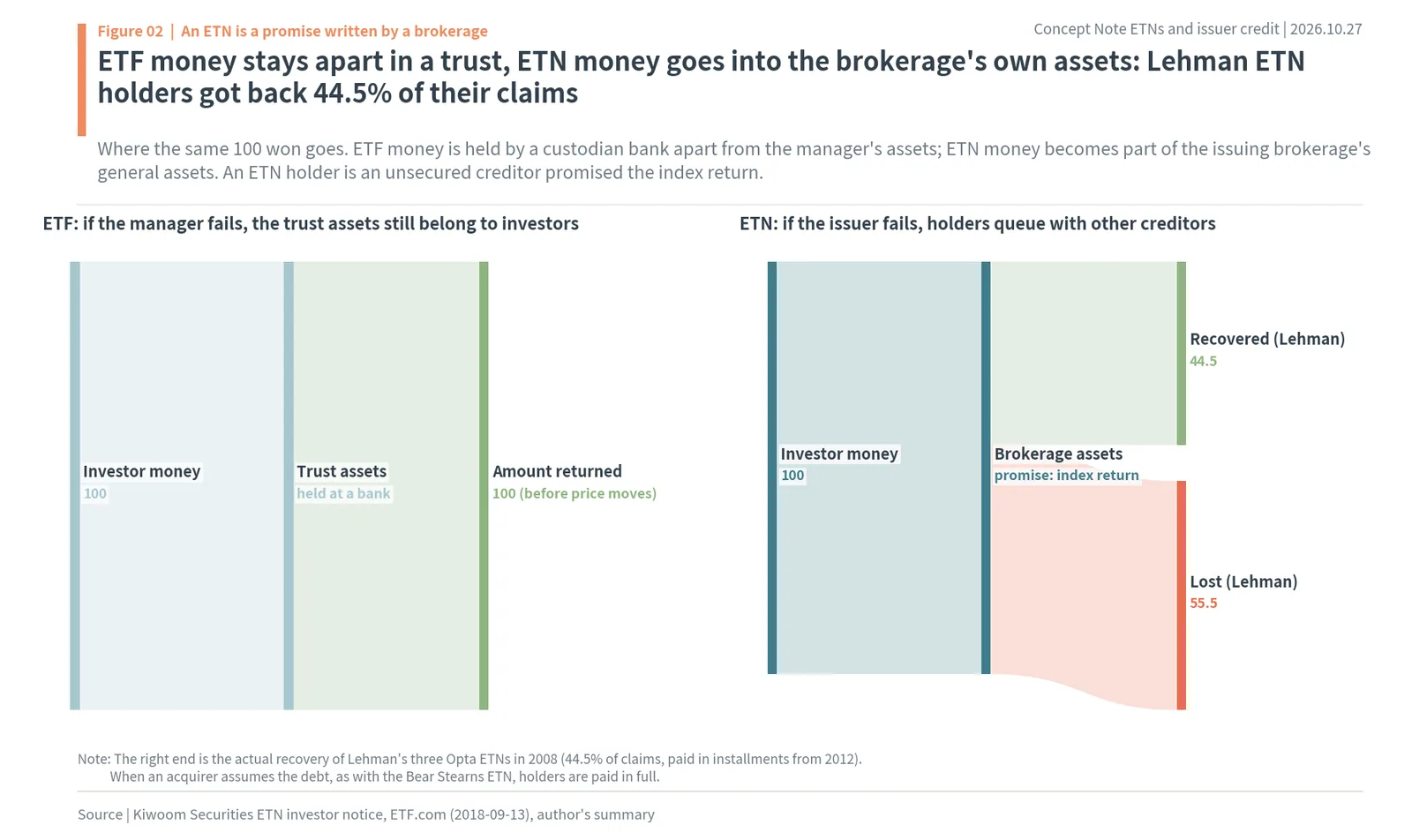
ETFs and ETNs differ by one letter, both trade on an exchange like a stock and both follow an index, so they look like two names for the same thing. The difference is where the money goes. An ETF is a fund: the manager buys stocks or bonds with investors’ money, and those assets are held by a custodian bank as trust property, separate from the manager. If the manager fails, the trust assets are not used to pay its debts. An ETN is closer to a bond issued by the brokerage. Investors’ money becomes part of the issuer’s general assets, and the issuer hedges by buying assets that move with the index or entering swaps. Those hedges are not ring-fenced for noteholders. What the investor holds is a promise to pay the index return: an unsecured claim.
Kiwoom Securities’ ETN investor notice puts the difference in a single row on credit risk: for stocks and ETFs the exchange guarantees settlement, while ETNs are exposed to the issuer’s credit. Daol Investment & Securities’ ETN guide says the product is not protected by deposit insurance and that if the issuer defaults or goes bankrupt before maturity, investors may lose part or all of their money.
Drawn with the same 100 won, the contrast is clear. 100 won in an ETF stays as trust property and, apart from price moves, belongs to the investor. 100 won in a Lehman ETN became Lehman’s property, and when Lehman failed the holder queued with other unsecured creditors and got back 44.5 won. The actual recovery for Lehman’s Opta noteholders was 44.5% of claims.
An issuer failure does not always end this way. When JPMorgan took over Bear Stearns in 2008 it assumed the Bear Stearns ETN, and holders received the full indicative value. When UBS took over Credit Suisse in 2023 it assumed Credit Suisse’s remaining notes. Noteholders lose money on issuer credit only when the issuer actually goes bankrupt and nobody takes over the debt. So far that has happened once, with Lehman.
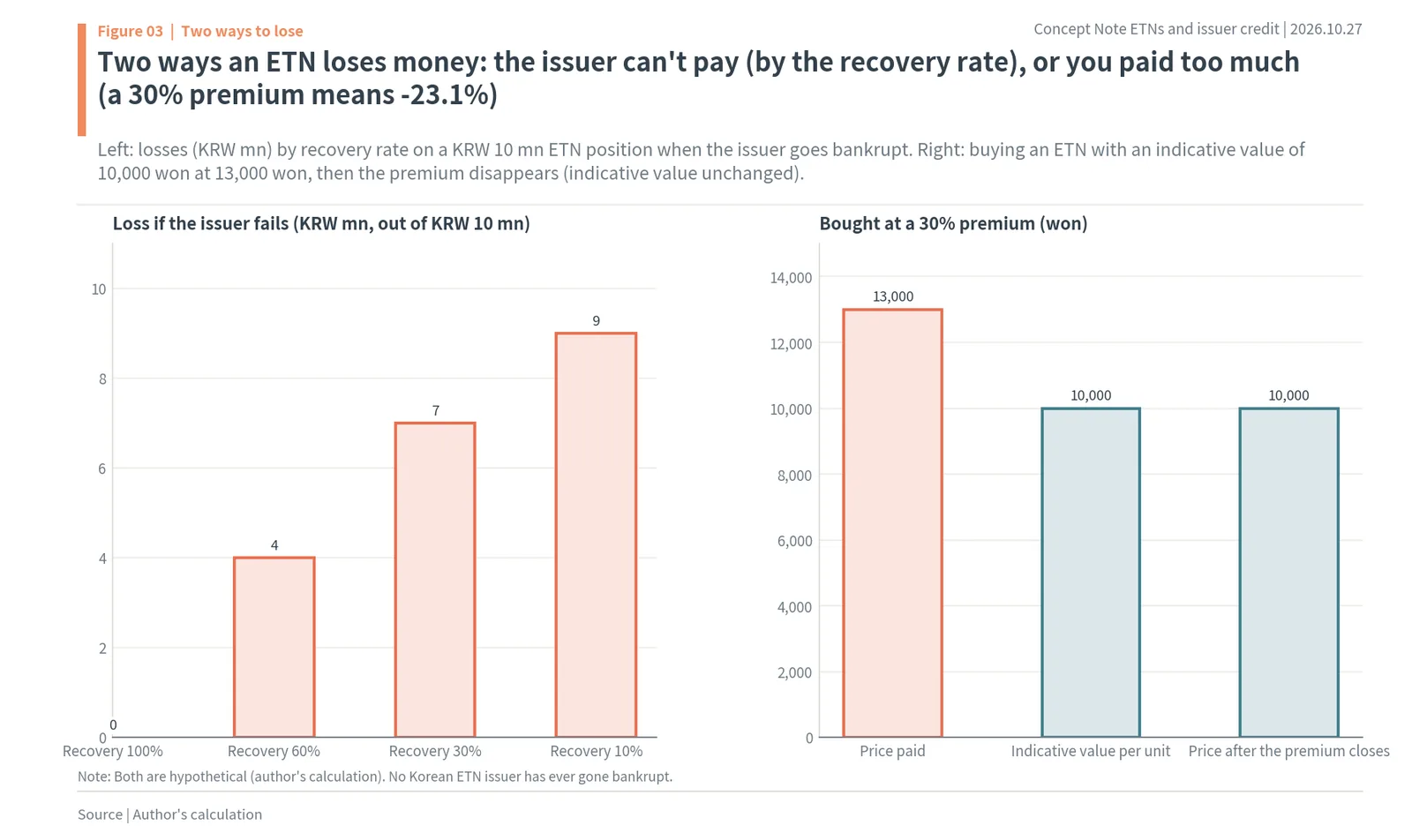
There are therefore two broad ways to lose money in an ETN. The first is issuer default. If you hold KRW 10 mn of an ETN and the issuer goes bankrupt with a 60% recovery, you lose KRW 4 mn; at 30%, KRW 7 mn; at 10%, KRW 9 mn. The second is paying too much. Buying at 13,000 won an ETN whose indicative value is 10,000 won means paying a 30% premium. If the premium then closes, the price returns to 10,000 won and you lose -23.1% even though the indicative value never moved. Neither loss has anything to do with whether you were right about the index. No Korean ETN issuer has ever gone bankrupt; almost all the losses Korean investors actually suffered came from the second route.
Korea’s ETN market: 359 notes from ten brokerages
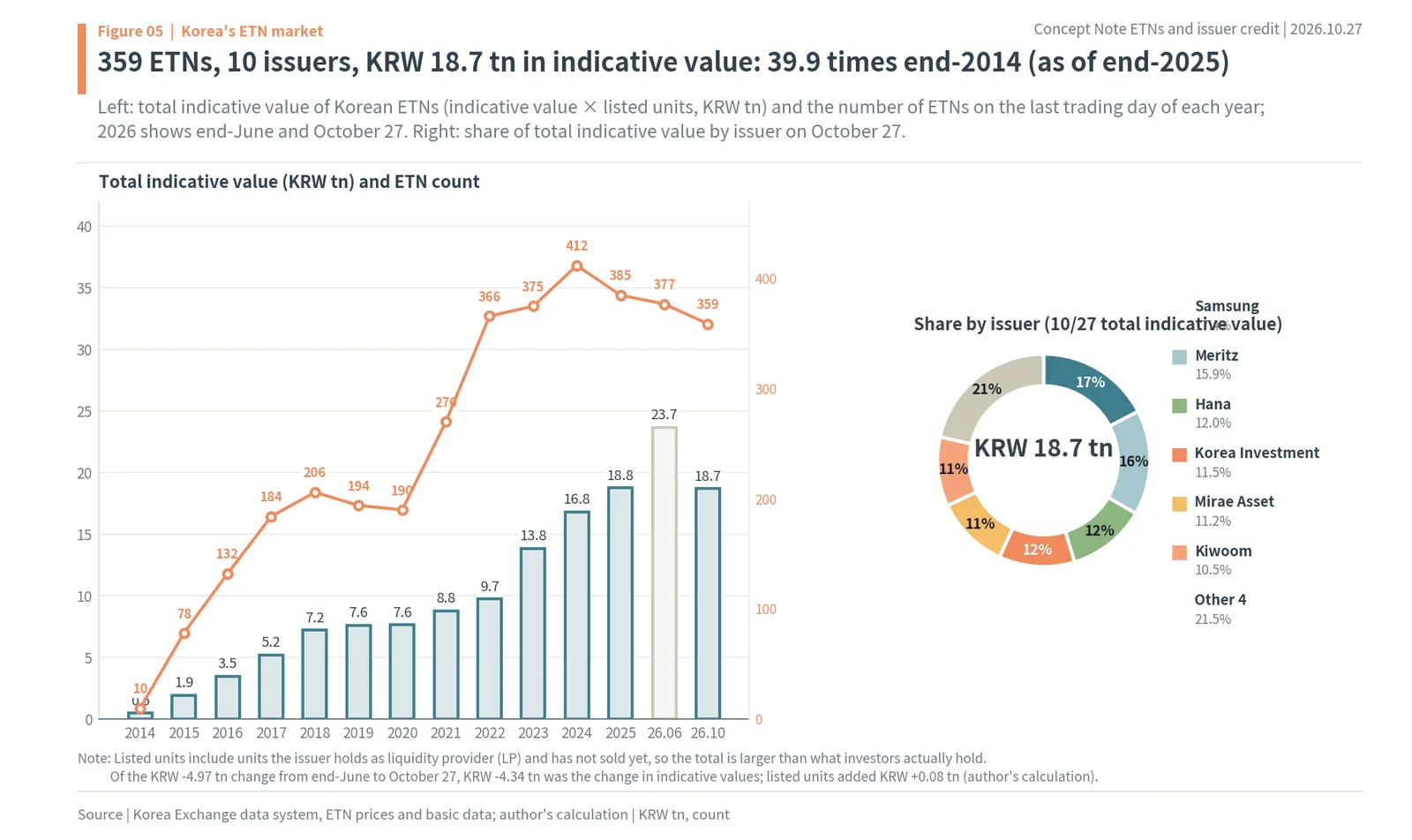
The Korean ETN market opened with 10 notes from six brokerages, and in its first weeks daily trading was below KRW 0.1 bn. Rebuilding year-end numbers from the Korea Exchange data system shows the market growing almost without pause since.
Size here is total indicative value: indicative value per unit times listed units. It was KRW 0.47 tn at the end of 2014, KRW 7.21 tn at end-2018, KRW 13.85 tn at end-2023 and KRW 18.76 tn at end-2025, 39.9 times the end-2014 level. The exchange’s official year-end figures show the same path. On October 27, 2026 there are 359 ETNs from 10 issuers with KRW 18.7 tn in total indicative value.
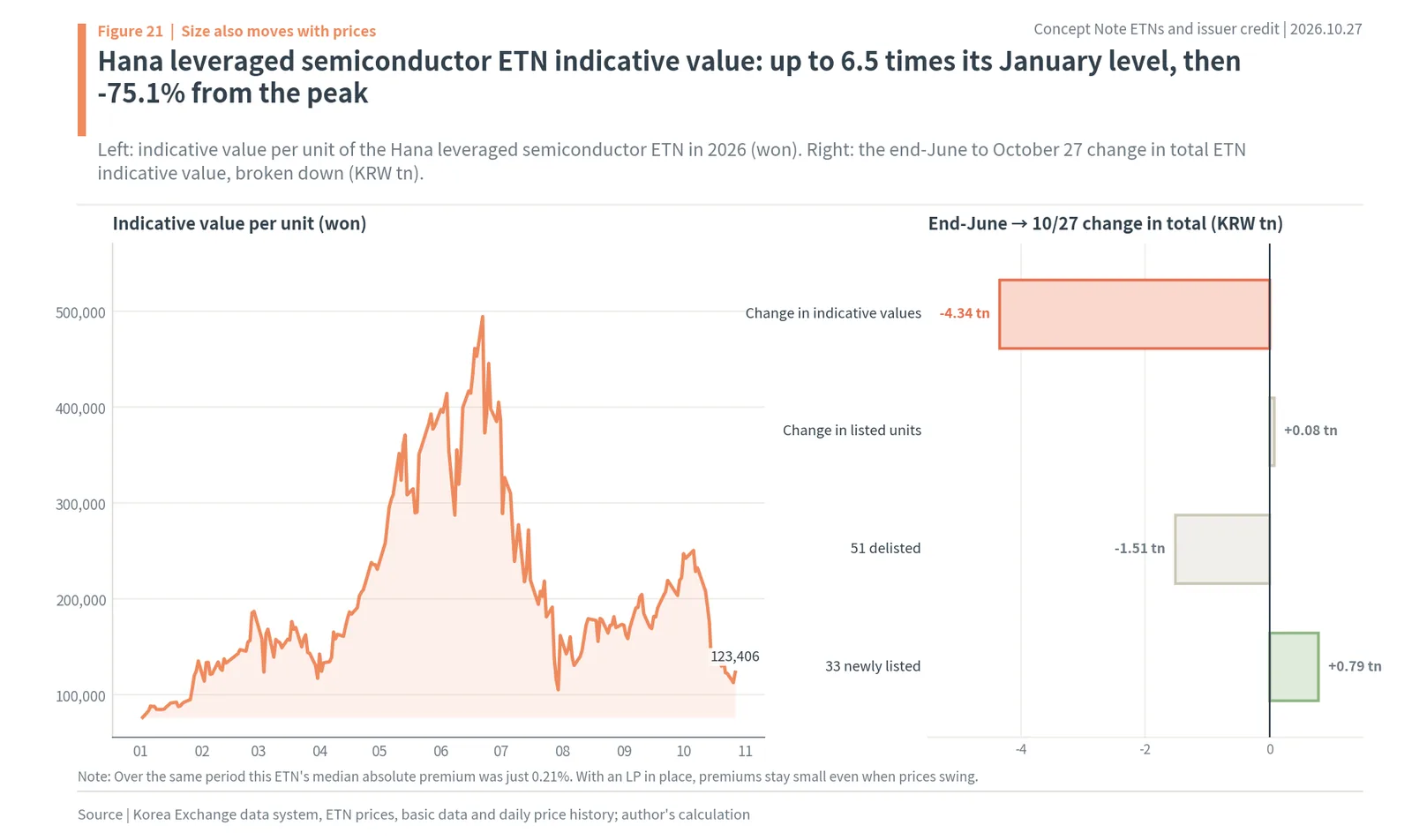
One caveat matters. Listed units include units the issuer, as LP, holds and has not yet sold, so total indicative value overstates what investors actually hold. The drop from KRW 23.67 tn at end-June 2026 to KRW 18.7 tn on October 27 was not investors leaving: of the KRW -4.97 tn change, KRW -4.34 tn came from lower indicative values, and changes in listed units added KRW +0.08 tn. By issuer, Samsung has 17.4%, Meritz 15.9%, Hana 12.0%, Korea Investment 11.5%, Mirae Asset 11.2% and Kiwoom 10.5%; the other four (KB, Shinhan, NH and Daishin) share 21.5%.
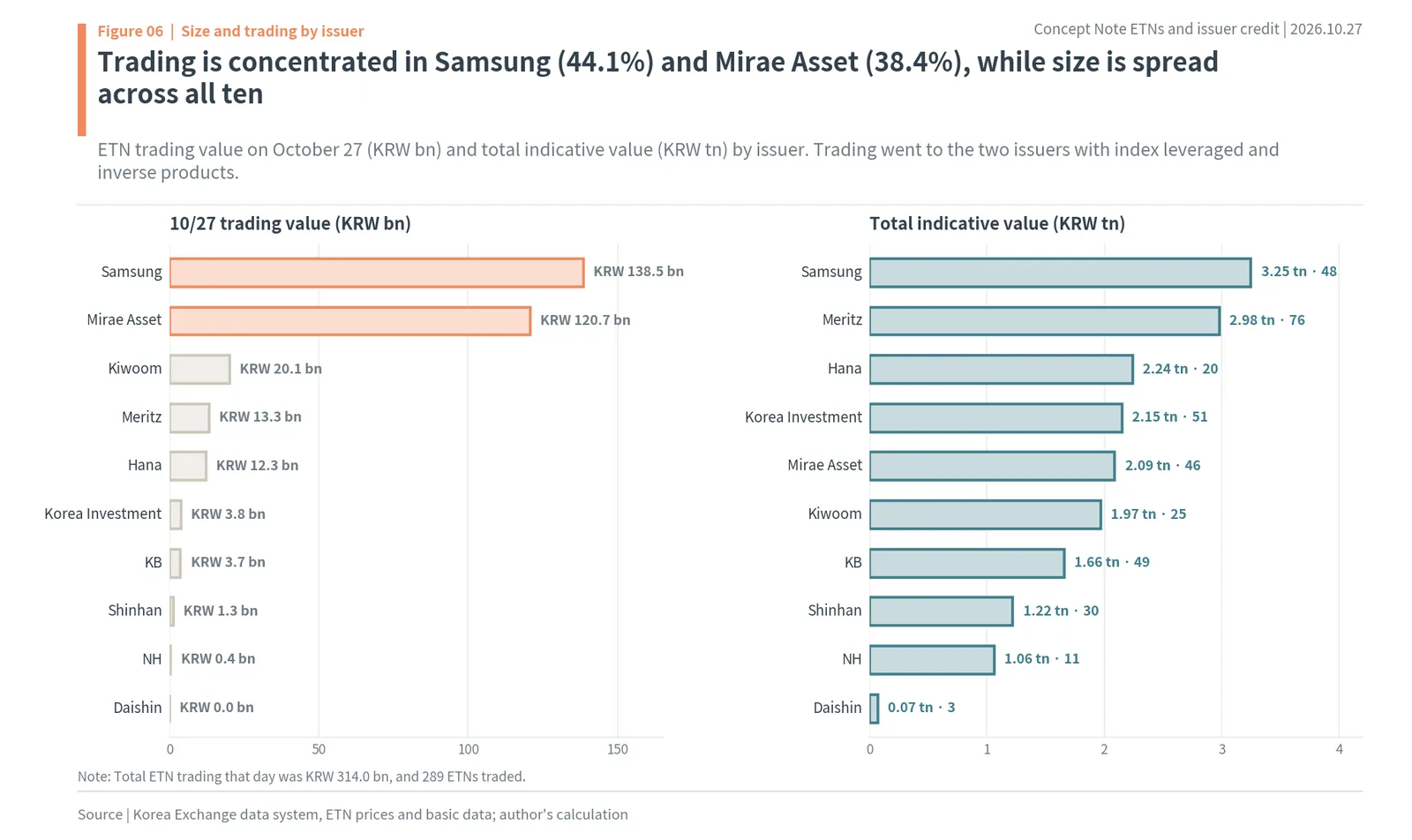
Trading, unlike size, is concentrated. ETN trading on October 27 was KRW 314.0 bn across 289 notes that traded. Samsung Securities’ notes took 44.1% and Mirae Asset Securities’ 38.4%, because they offer the 2x inverse notes on the KOSPI 200 and KOSDAQ 150 that retail traders buy and sell most. Meritz, Hana and Kiwoom trade little relative to their size because their biggest products are CD-rate notes that investors park money in. The most traded note was the Samsung inverse 2x KOSDAQ 150 futures ETN (KRW 71.95 bn).
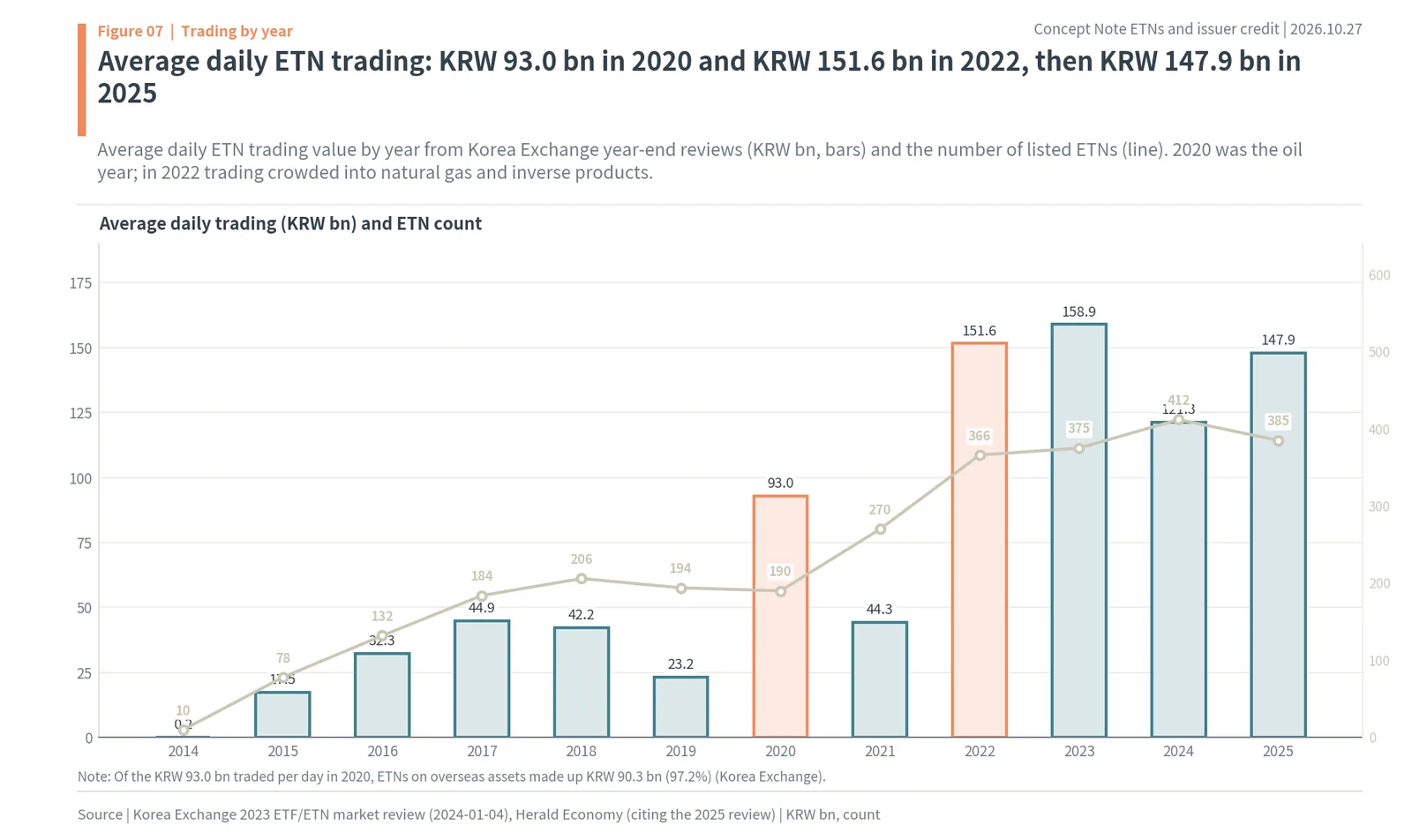
By year, average daily trading jumped to KRW 93.0 bn in 2020, almost four times the year before, and 97.2% of it was in notes on overseas assets, the year of the oil rush. It fell back in 2021, then jumped again to KRW 151.6 bn in 2022 as natural gas swung and inverse products drew money (author’s interpretation), and it has stayed above KRW 100 bn since, at KRW 147.9 bn in 2025. The two hot years, 2020 and 2022, were also the years of the worst premiums and early liquidations.
Compared with ETFs, ETNs remain a small market. Between late January and August 20, 2026, Korean ETF net assets rose from KRW 348 tn to KRW 452 tn, while ETN indicative value rose only about 5%. Money Today pointed to issuer credit risk, which keeps ETNs out of retirement accounts, as one reason.
What ETNs hold: trading in leverage, money in rates
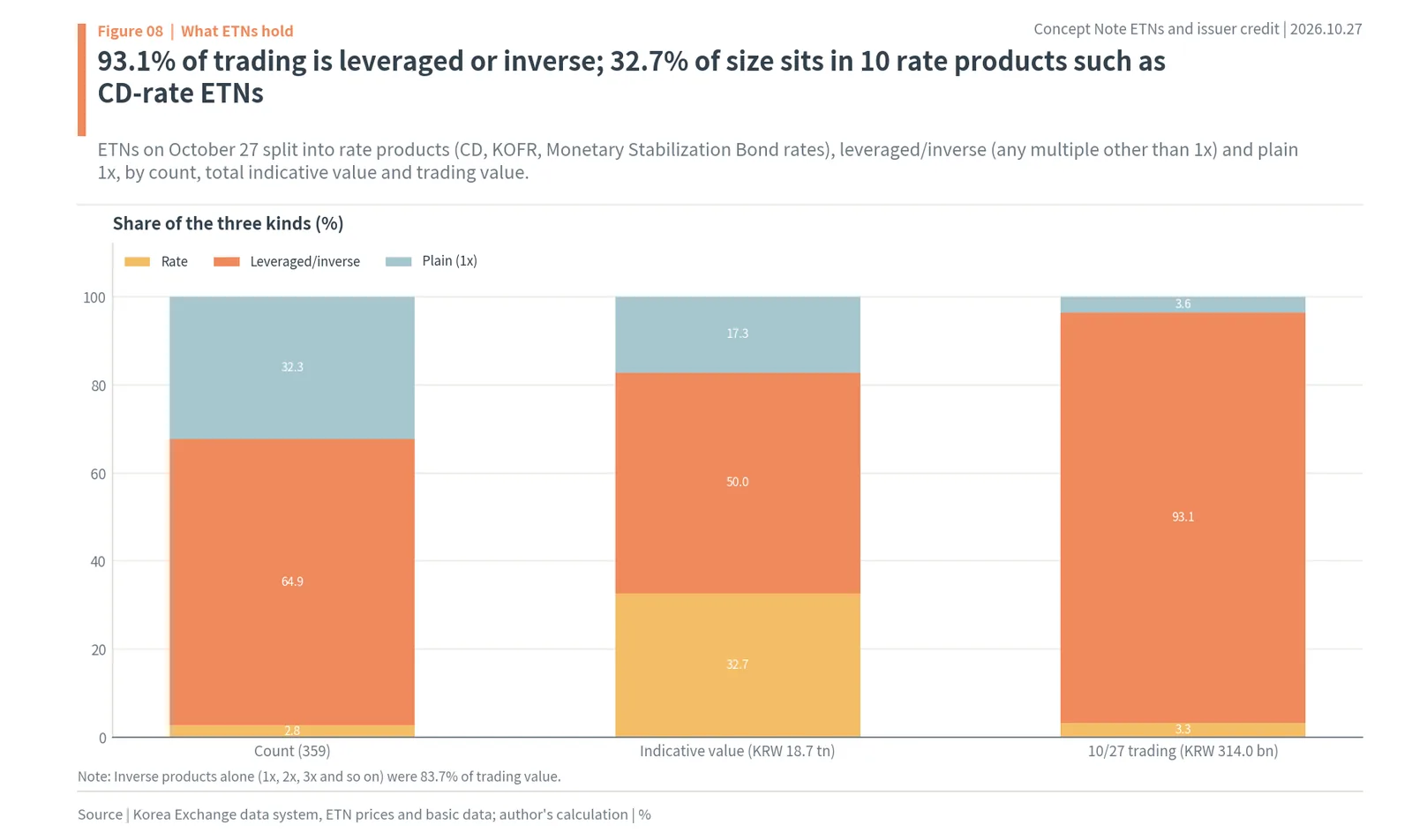
The 359 ETNs fall into three kinds: rate products that accrue an interest index such as the CD rate or KOFR; leveraged and inverse products with any multiple other than 1x; and plain 1x products. Their weight depends on the yardstick. Rate products are only 10 notes but hold 32.7% of total indicative value. Leveraged and inverse notes are 233 notes, half of the value and 93.1% of October 27 trading; inverse notes alone were 83.7% of trading. Long-term savers buy rate notes, day-to-day traders buy leverage, and two very different markets share the ETN name.
Split by multiple and asset, ETN-specific features appear. Of 359 ETNs, 106 are 2x leveraged and 82 are 2x inverse, and there are 3x products too: Korean ETFs are capped at 2x, but ETNs can offer 3x on overseas indexes. 235 track overseas indexes, almost double the 124 on domestic ones. Because an issuer only has to promise the return rather than buy the assets, oil, gas, metals futures and foreign sector indexes can be turned into products quickly.
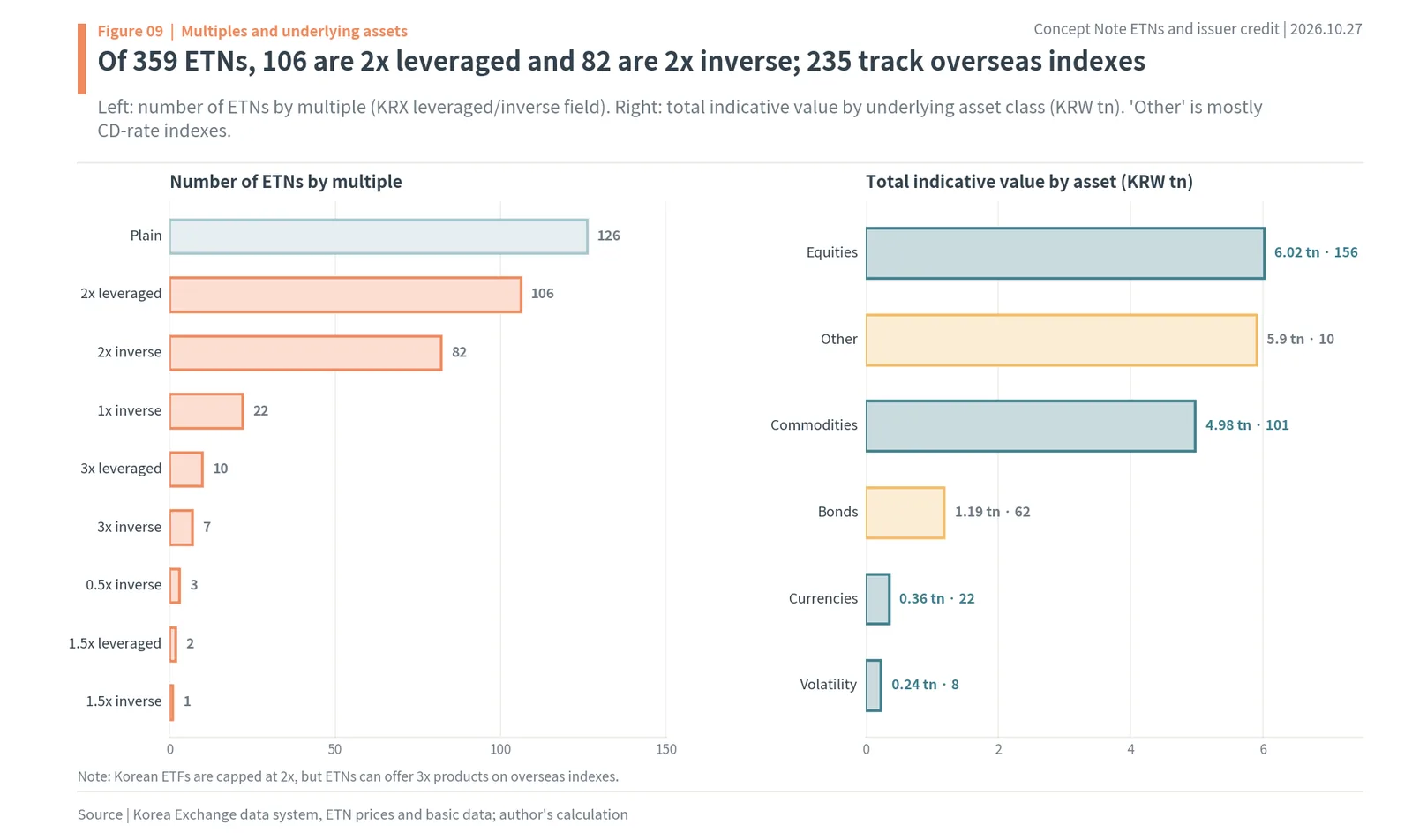
This mix ties straight back to issuer credit. Rate notes barely move in price but are large: the Meritz KIS CD-rate ETN alone is about KRW 1.5 tn. Putting money in one is economically close to lending to that brokerage, without deposit insurance. For rate notes, the risk is almost entirely the issuer.
The ten brokerages behind the promise
The issuers on October 27 are Samsung, Meritz, Hana, Korea Investment, Mirae Asset, Kiwoom, KB, Shinhan, NH and Daishin Securities.
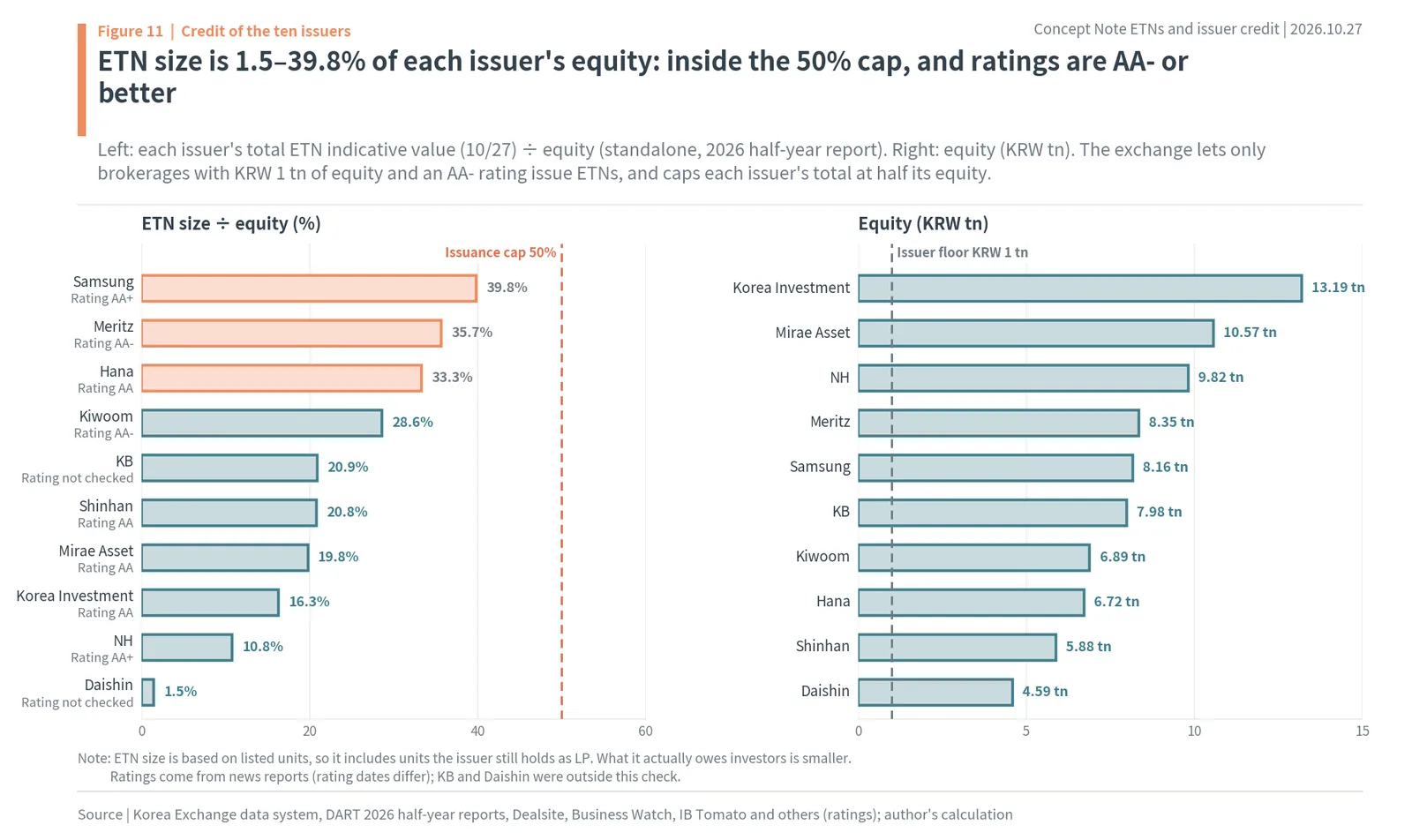
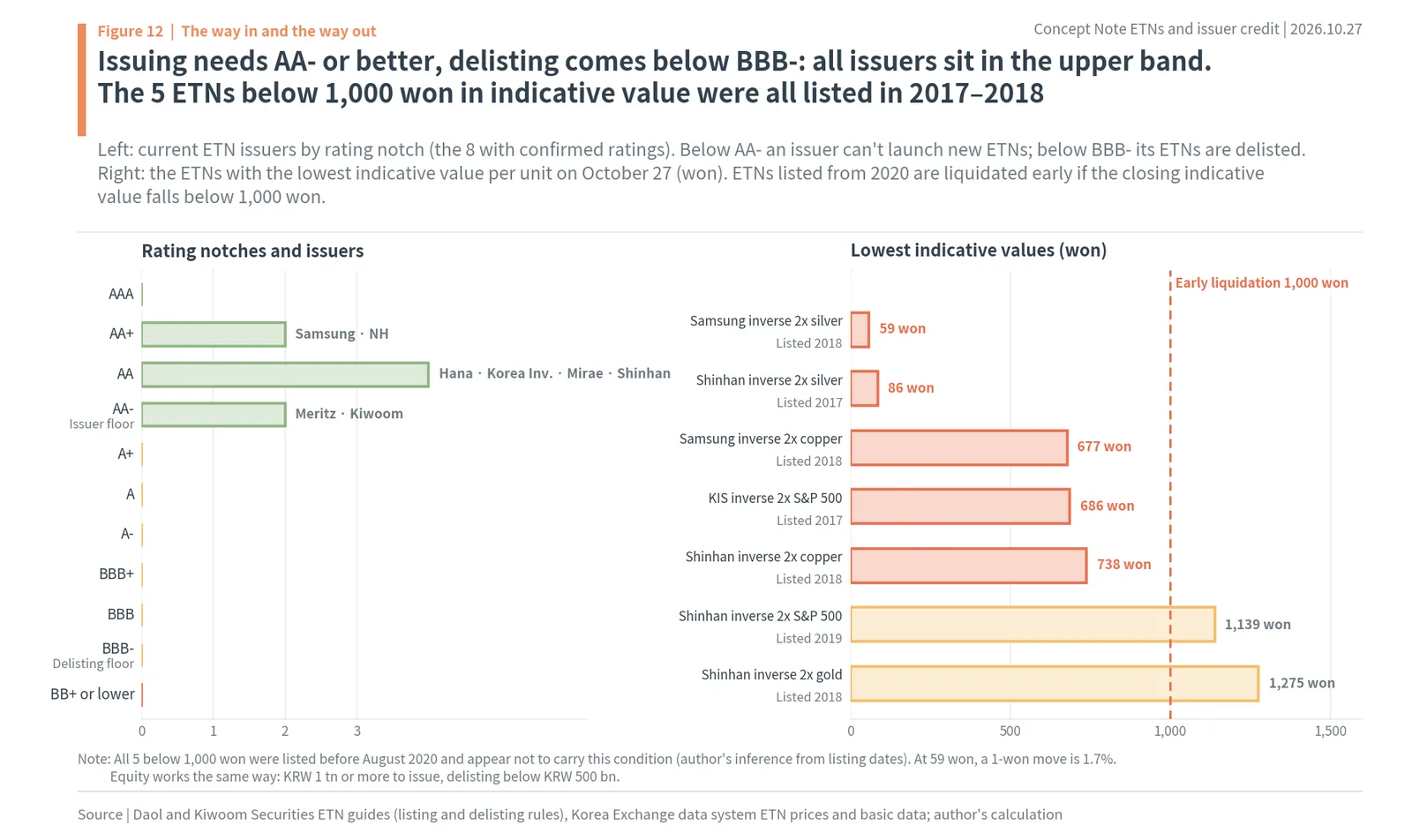
The exchange does not let just any brokerage issue ETNs. An issuer must have held a securities and OTC derivatives dealing licence for over three years, have equity of KRW 1 tn or more, a credit rating of AA- or better, a net capital ratio (NCR) of 200% or more, and clean audit opinions for three years. Each note needs at least KRW 20 bn at listing, and the total an issuer has outstanding must stay within 50% of its equity (Daol guide; the same thresholds applied at launch in 2014).
Measured against standalone equity in DART 2026 half-year reports, each issuer’s ETN total on October 27 is 1.5% to 39.8% of its equity. Samsung Securities is highest at 39.8% (KRW 3.25 tn against KRW 8.16 tn of equity), followed by Meritz (35.7%) and Hana (33.3%); Korea Investment, the largest by equity at KRW 13.19 tn, is at 16.3%. All are inside the 50% cap, and since the totals include LP inventory, the ratio against what is actually owed to investors is lower. Ratings confirmed in news reports put Samsung and NH at AA+, Mirae Asset, Shinhan, Korea Investment and Hana at AA, and Kiwoom and Meritz at AA-, all at or above the AA- requirement. Rating dates differ; NICE moved Hana’s outlook toward a possible downgrade in January 2025, and Korea Ratings moved Kiwoom’s and Meritz’s toward a possible upgrade in November 2025. KB’s and Daishin’s latest ratings were outside this check.
The rules keep a high door in and a low door out. Falling below AA- only stops an issuer from launching new notes; existing notes keep trading. Its notes are delisted if its rating drops below investment grade (BBB-), its equity falls below KRW 500 bn, its NCR stays under 150% for three months or falls under 120%, its licence is revoked or its audit opinion is adverse or disclaimed. Products also have an exit: early liquidation when the closing indicative value falls 80% or more in a day or ends below 1,000 won. On October 27, 5 ETNs were below 1,000 won, all listed in 2017 and 2018; the Samsung inverse 2x silver ETN(H) is at 59 won. The 1,000-won condition appears to apply to notes listed from 2020, and older notes without it are still trading (author’s inference from listing dates). At 59 won a one-won tick is 1.7% of the price.
A history of ETN accidents: one default, many premiums and crashes
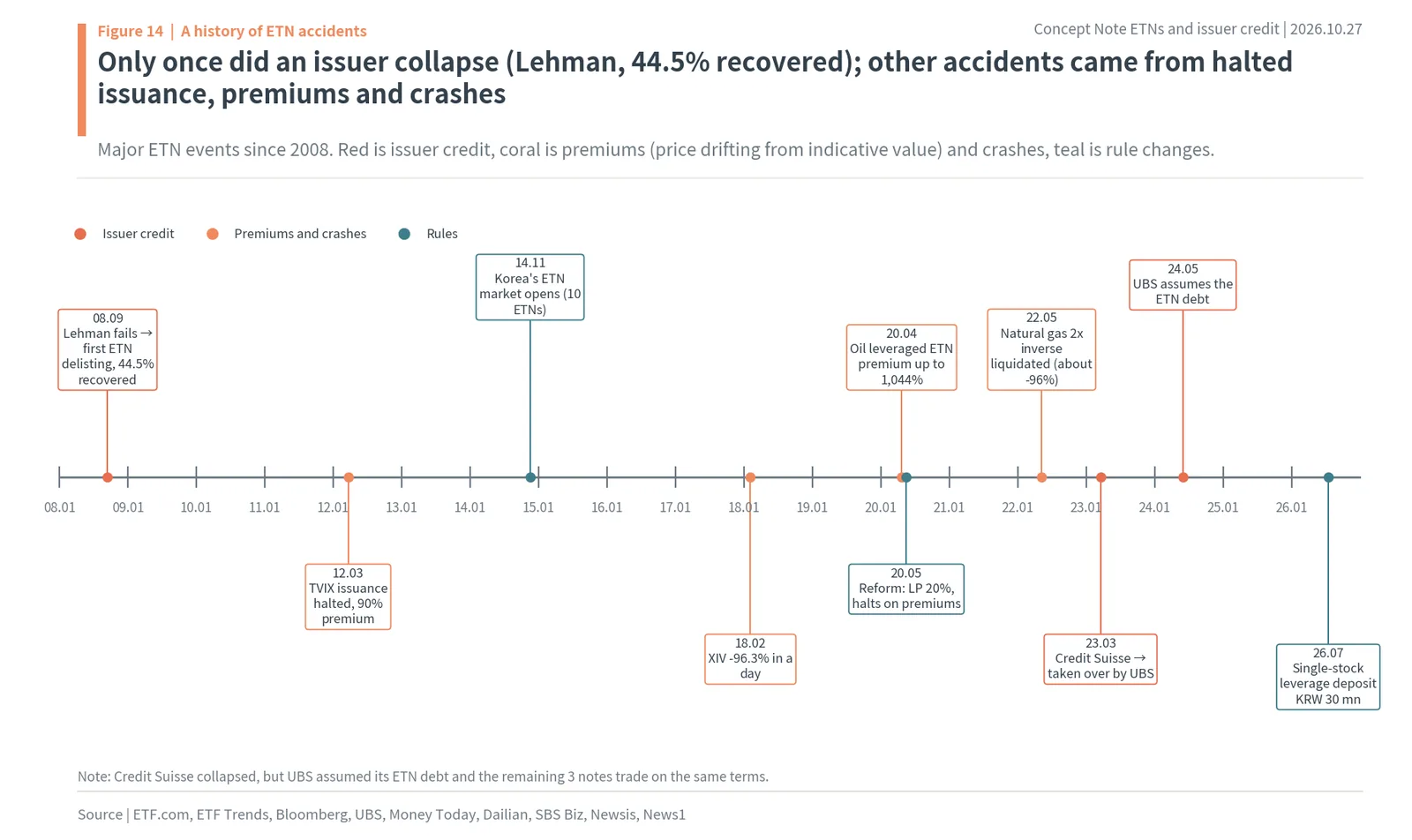
Gathered together, the big ETN accidents since 2008 show that issuer credit was rarely the direct cause. Halted issuance, premiums and crashes hurt investors far more often, and one name appears more than any other: Credit Suisse.

On February 21, 2012 Credit Suisse stopped issuing new units of TVIX, a volatility ETN, citing internal limits. With no new supply, the price climbed above indicative value until the premium hit an all-time high of 90% on March 21. The next day Credit Suisse said it would resume limited issuance, the premium collapsed and TVIX fell 29% in a day, closing at $10.20 against an indicative value of $7.83 (ETF Trends). On February 5, 2018 the inverse volatility note XIV lost 96.3% of its value in a day after the VIX jumped 115.6%, triggering an acceleration clause; again, not a credit event. When Credit Suisse itself collapsed in March 2023, 12 notes worth about $700 million remained. Nine were wound down for cash in October 2023, and on May 31, 2024 UBS assumed all rights and obligations of the last three, which still trade on the same terms.
On a timeline: an issuer collapse with losses happened once, Lehman in 2008 (44.5% recovered); the rest were TVIX (90% premium), XIV (-96.3% in a day), Korea’s 2020 oil leveraged ETNs (premium up to 1,044%) and Korea’s 2022 natural gas 2x inverse liquidation (about -96%).
Premiums on a normal day: what the LP holds together
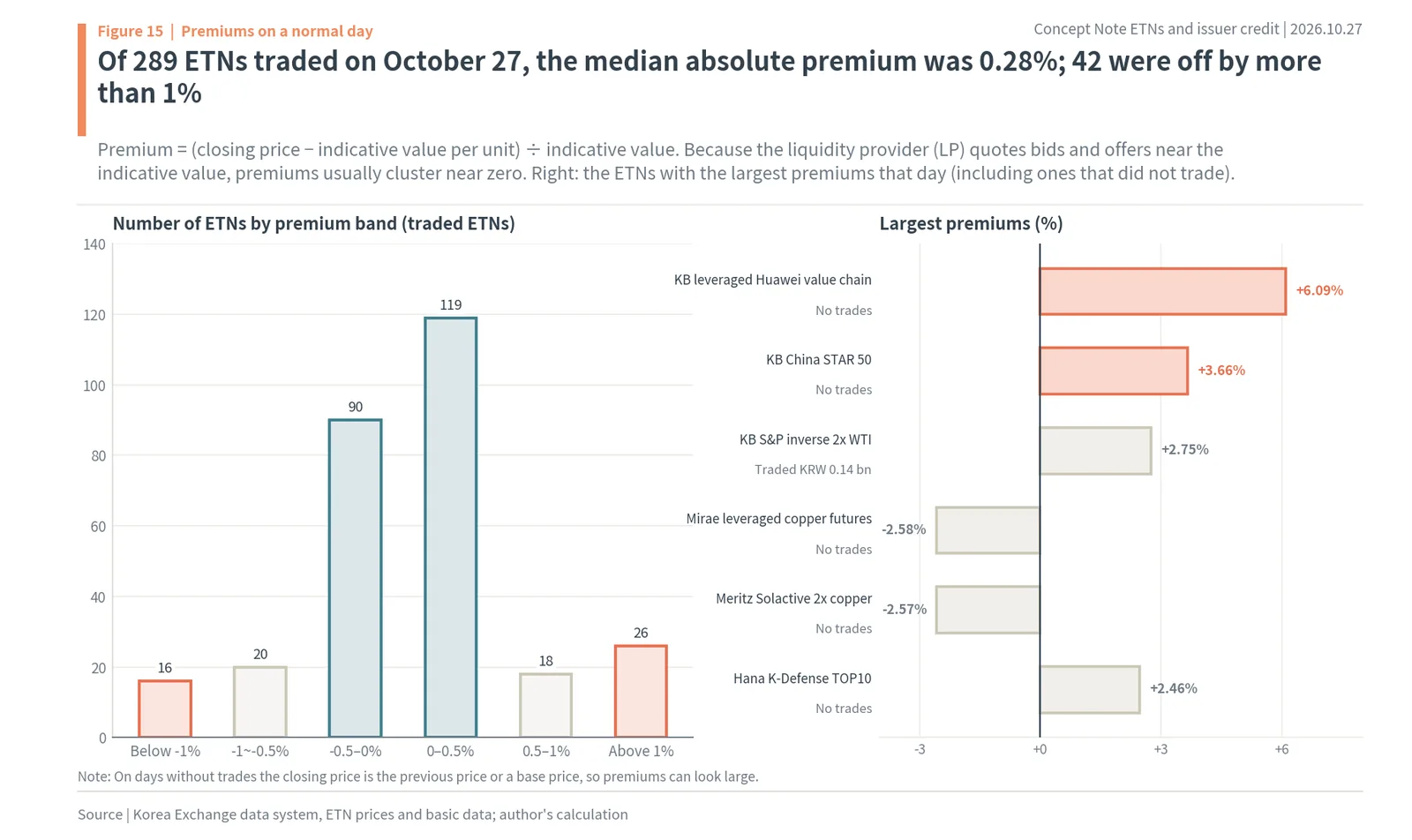
The LP keeps price and indicative value together by quoting slightly above and below the indicative value, selling new units when the price runs rich and buying when it runs cheap. Korea’s May 17, 2020 reform plan tightened this: issuers must secure at least 20% of listed units as LP supply, with new launches restricted for up to six months for violations, and notes whose premium exceeds twice the required band for three days are designated for investor caution, moved to 30-minute single-price auctions, then halted. Today the caution threshold is 6% for domestic and 12% for overseas underlying assets, and issuers must disclose premiums above 1% (domestic) or 2% (overseas).
The numbers on October 27 show the mechanism working. Of 289 ETNs that traded, the median absolute premium was 0.28%; 42 were off by more than 1%, two by more than 3% and one by more than 6%. The two largest premiums were on notes that did not trade that day, whose closing prices are stale.
Normal days are not every day. On May 21, 2026 the Samsung inverse 2x WTI crude futures ETN traded at a 14.44% premium, and on June 1 the newly listed Mirae Asset leveraged SK hynix single-stock ETN traded 2.48% rich. Large premiums appear when many buyers crowd one way and the LP cannot or does not quote. Both conditions were at their worst in April 2020.
April 2020: where Korean investors actually lost money
In March 2020 oil demand collapsed with COVID-19 and producer talks broke down. Korean retail investors poured into leveraged oil products, betting on a rebound.
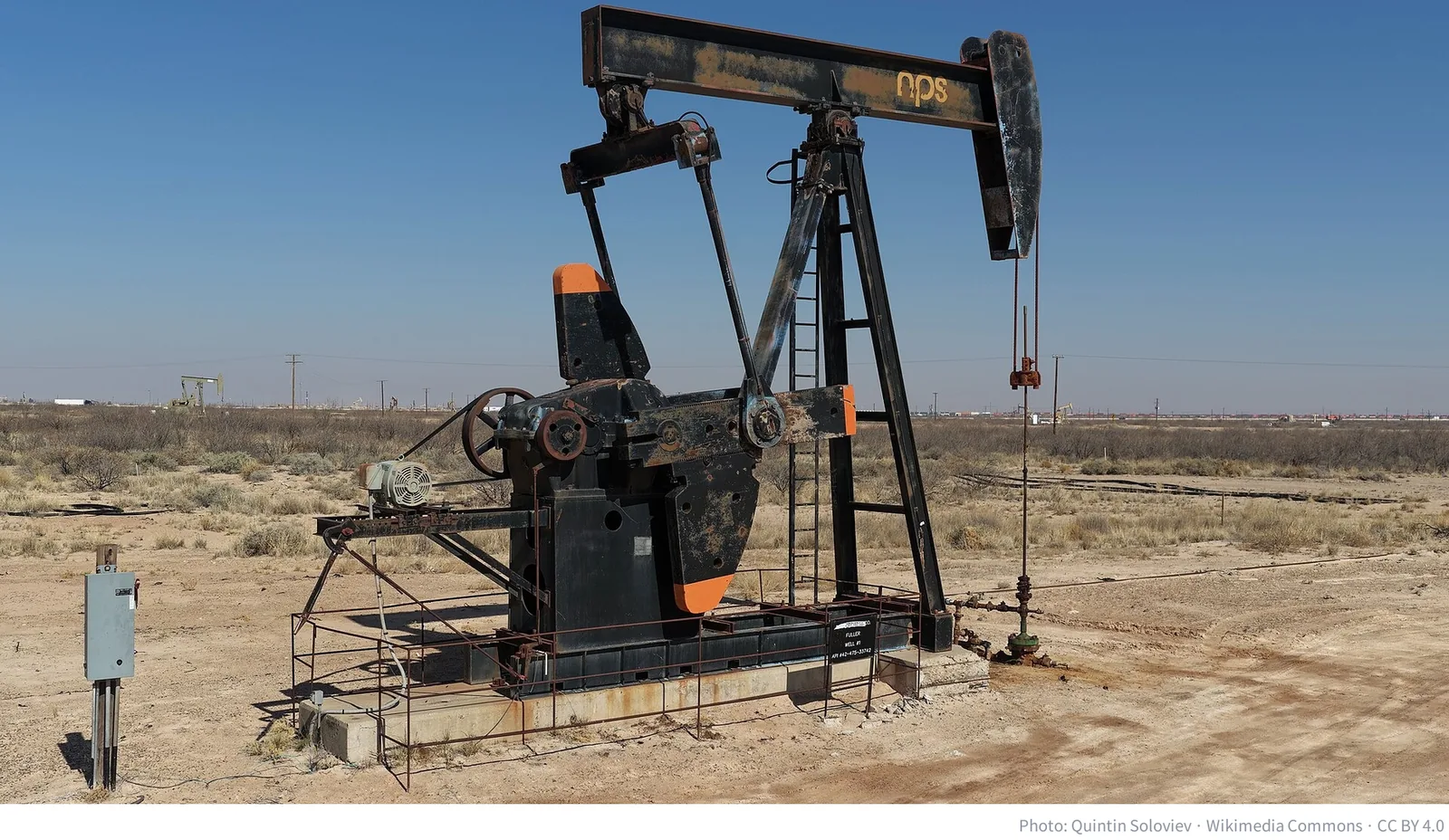
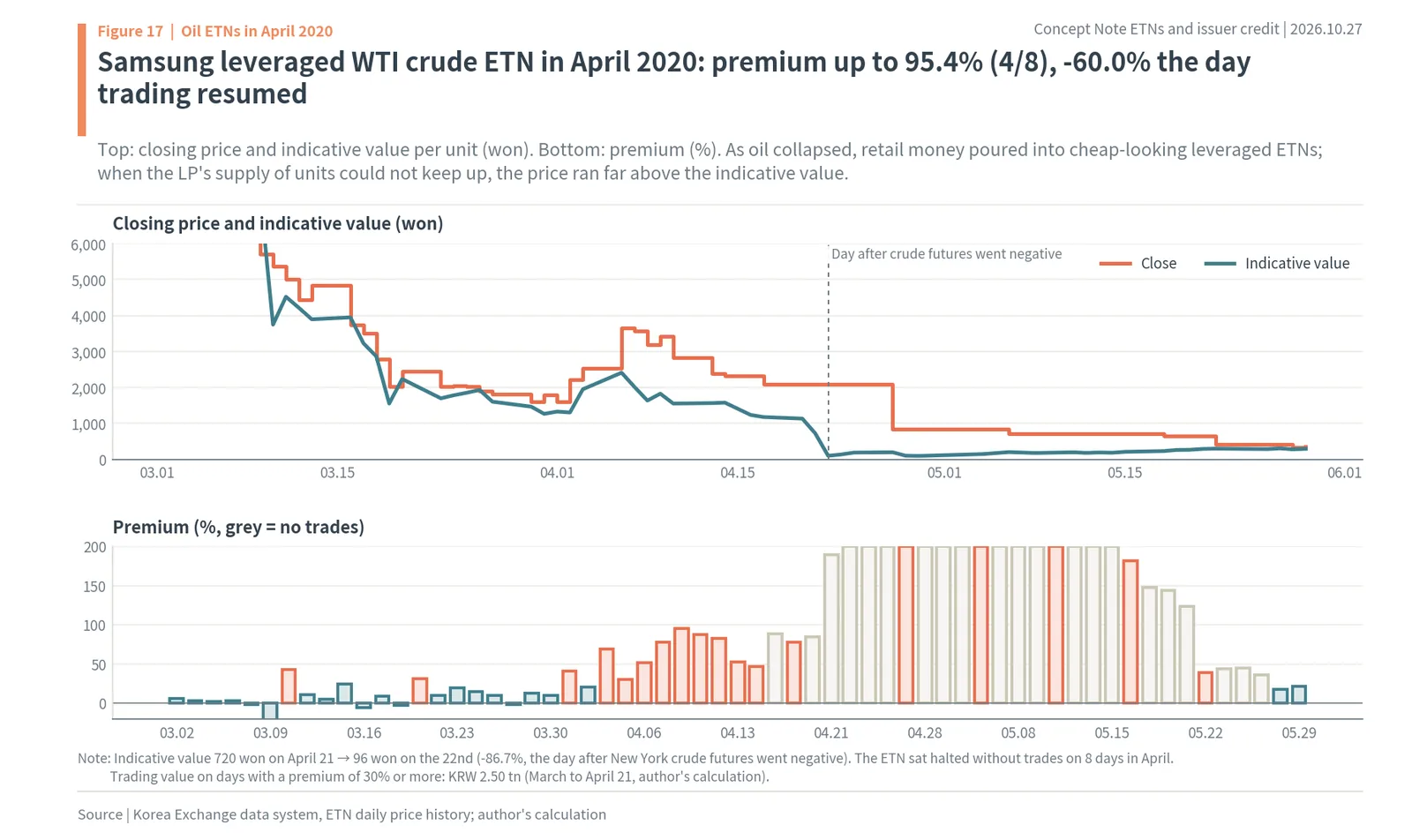
Korea Exchange daily data for the Samsung leveraged WTI crude futures ETN shows what followed. Through March it traded 10% to 20% above indicative value. In April buying exploded and the LP’s supply of units could not keep up (author’s interpretation): the premium was 69.5% on April 2, 77.8% on April 7 and 95.4% on April 8, when it closed at 3,190 won against an indicative value of 1,632 won. Then New York crude futures went negative. The indicative value fell from 720 won on April 21 to 96 won on April 22, and when trading resumed on April 27 the price fell -60.0% in a day yet was still more than four times the indicative value. Korea’s Financial Supervisory Service said leveraged WTI ETN premiums reached 1,044.0% on April 22, and one newspaper estimated investor losses at over KRW 400 bn.
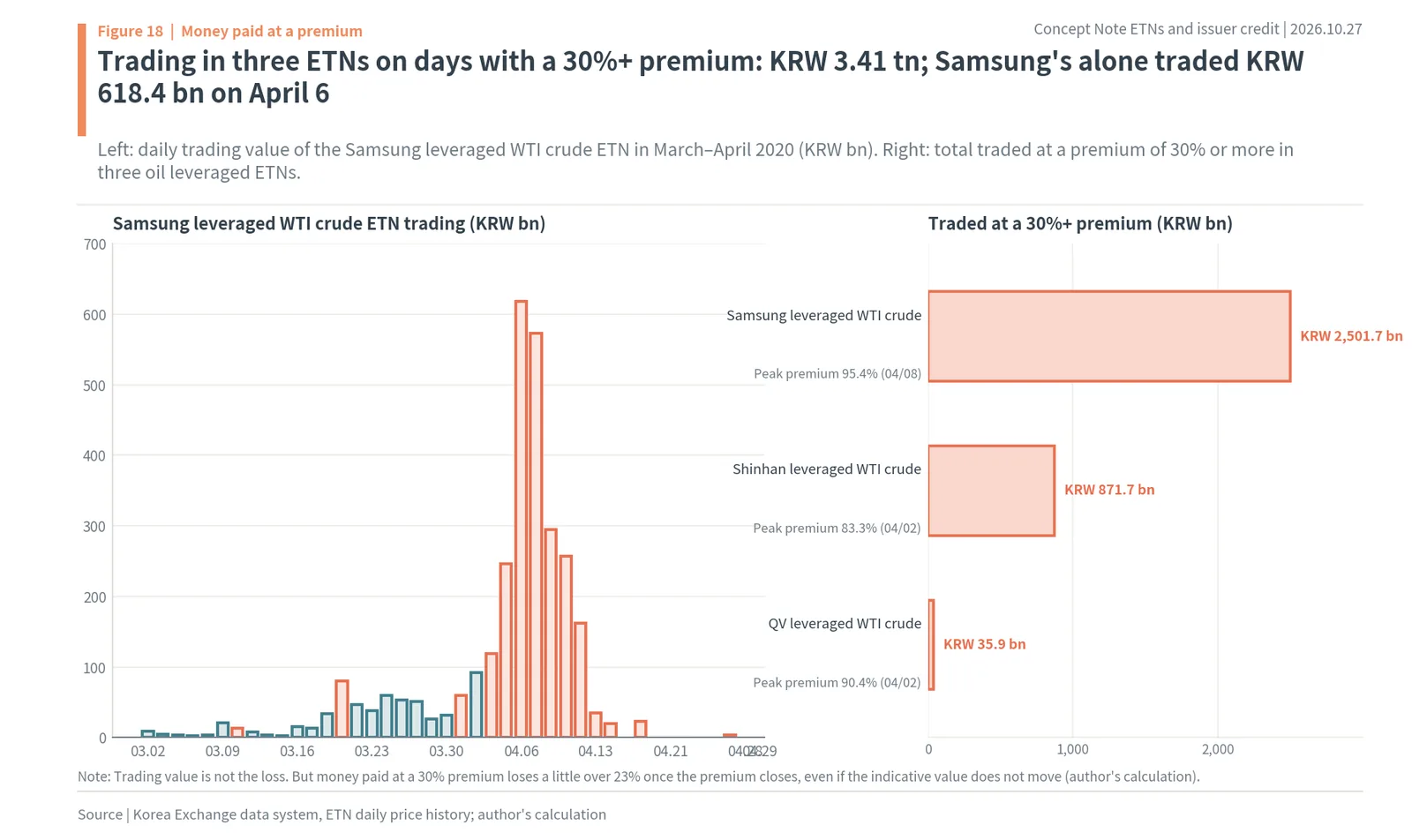
How much money went in at a premium? Adding up trading on days with a premium of 30% or more from March to April 21 gives KRW 2.50 tn for the Samsung note, KRW 0.87 tn for the Shinhan note and KRW 0.04 tn for the QV note: KRW 3.41 tn in all. Samsung’s alone traded KRW 618.4 bn on April 6. Trading value counts both buyers and sellers, so it is not a loss figure, but money paid at a 30% premium loses a little over 23% when the premium closes, before any move in the index.
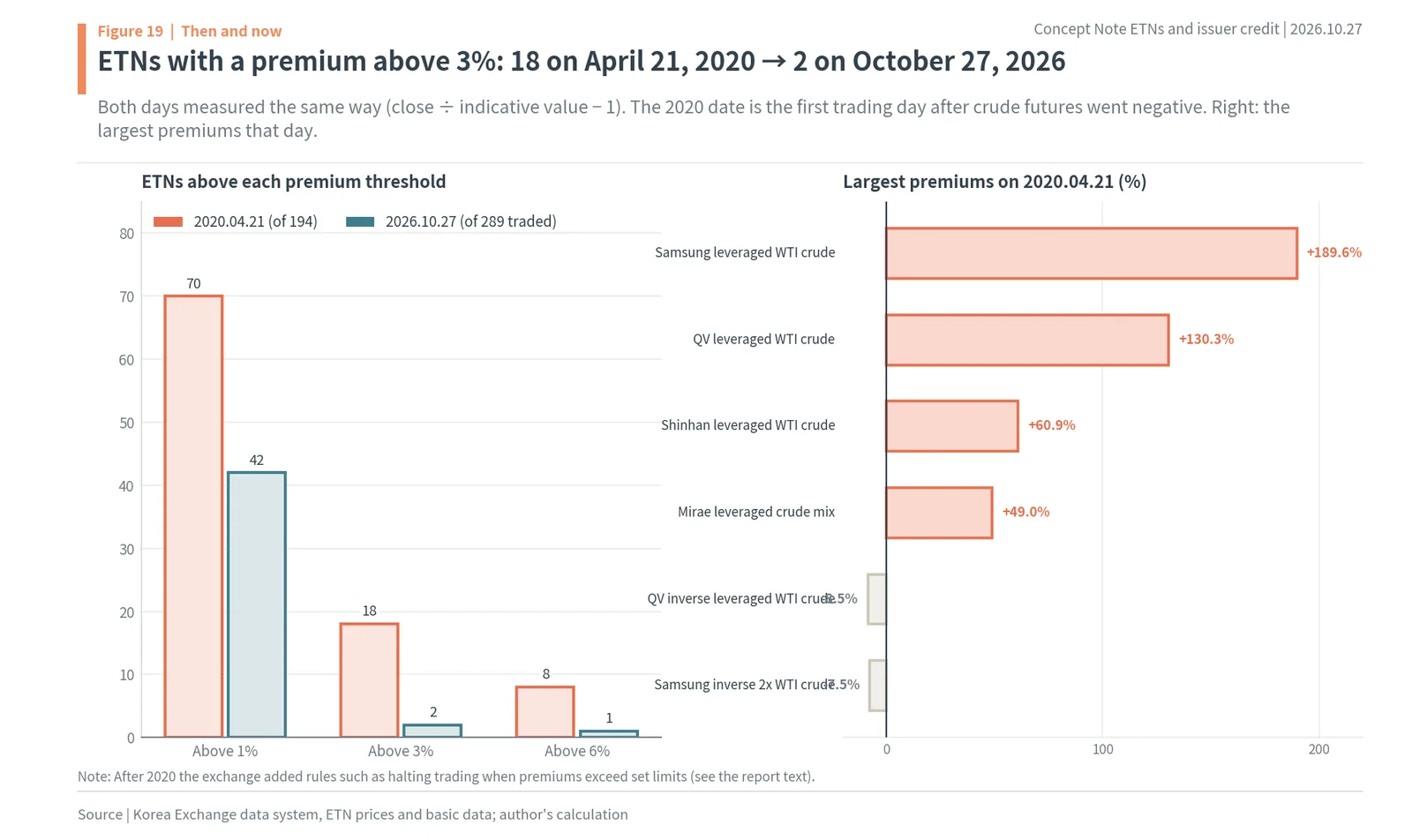
The issuer never broke its promise: indicative values were calculated as agreed and paid as agreed. The losses came from the premium. Measured the same way, 18 ETNs had a premium above 3% on April 21, 2020 (2020.04.21), against 2 on October 27, 2026; above 1%, 70 against 42 (of 194 and 289).
Size also moves with prices
The 2026 story in Korea was semiconductors.
The Hana leveraged semiconductor ETN rose to 6.5 times its January indicative value by June 22, then fell -75.1% from the peak by October 27. Yet its median absolute premium over the year was only 0.21%: with the LP quoting, the price tracked the indicative value through a six-fold rise and a three-quarter fall. Moves like this drove the market’s size: of the KRW -4.97 tn change since end-June, KRW -4.34 tn was price, and 51 delistings and 33 new listings roughly offset the rest.
Maturity, fees and tax
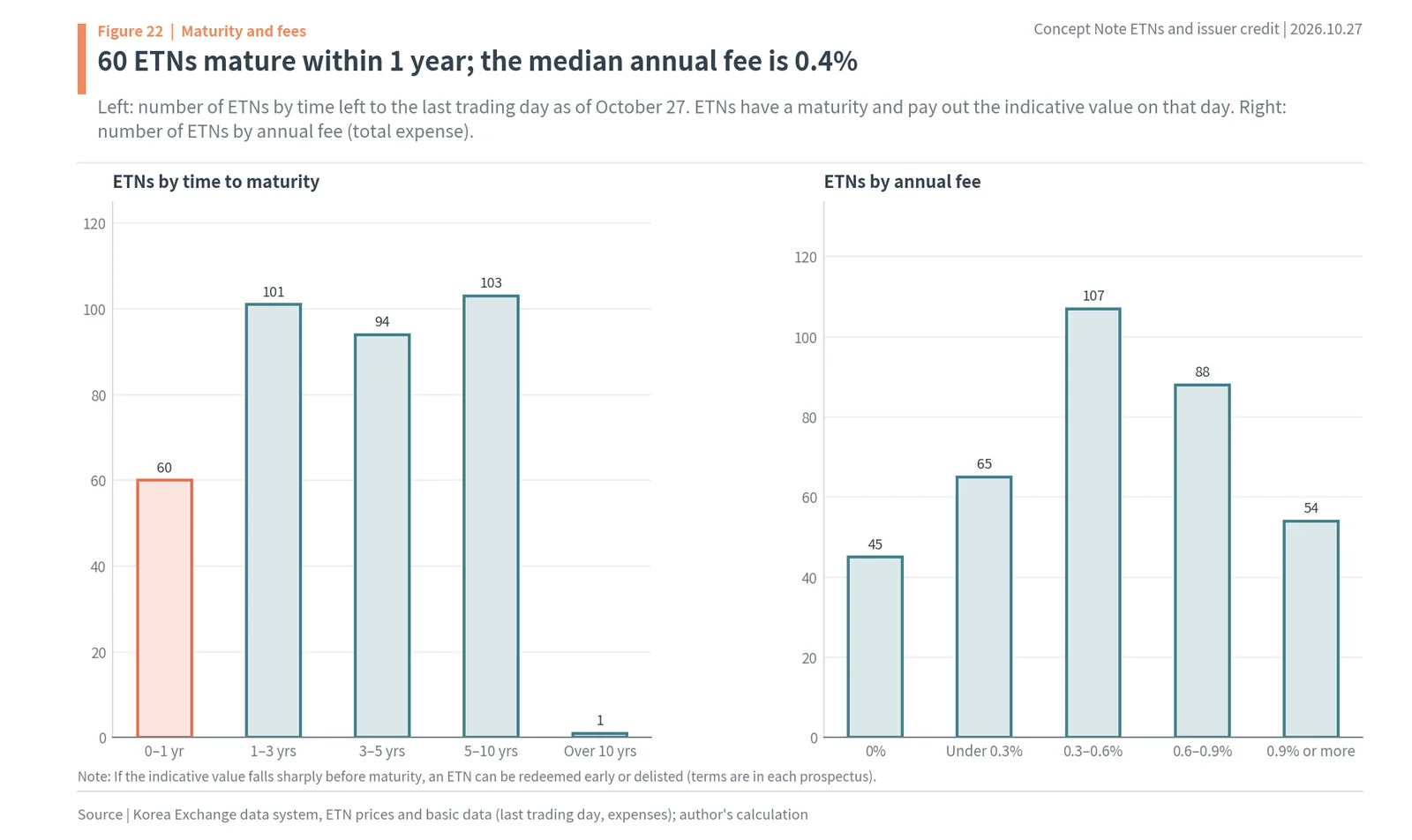
ETNs mature. On October 27, 60 ETNs mature within 1 year, and holders will be paid the final indicative value and must switch to another note to stay invested. Fees come out of the indicative value daily; the median annual fee is 0.4% and the highest 1.6%. On tax, gains on notes tracking an index of Korean stock prices only are exempt; other ETNs’ gains and distributions are taxed at 15.4% as dividend income, with gains in a year added together but losses not deducted.
Steps to check your own ETN
Everything above fits into six checks. The example is the Samsung inverse 2x KOSDAQ 150 futures ETN, the most traded note on October 27. Step 1, who wrote the promise: the first word of the name is the issuer; Samsung Securities is AA+. Step 2, how much it has written: Samsung’s ETNs are 39.8% of its equity, the highest of the ten but inside the 50% cap. Step 3, is it expensive today: the premium was 0.74%. Step 4, distance to early liquidation: the indicative value is 2,095 won, so a -52.3% fall would take it below 1,000 won and end the note. Step 5, maturity: 1.0 year left. Step 6, fees and tax: 0.4% a year, and for a futures index, check in the prospectus whether the tax exemption applies.
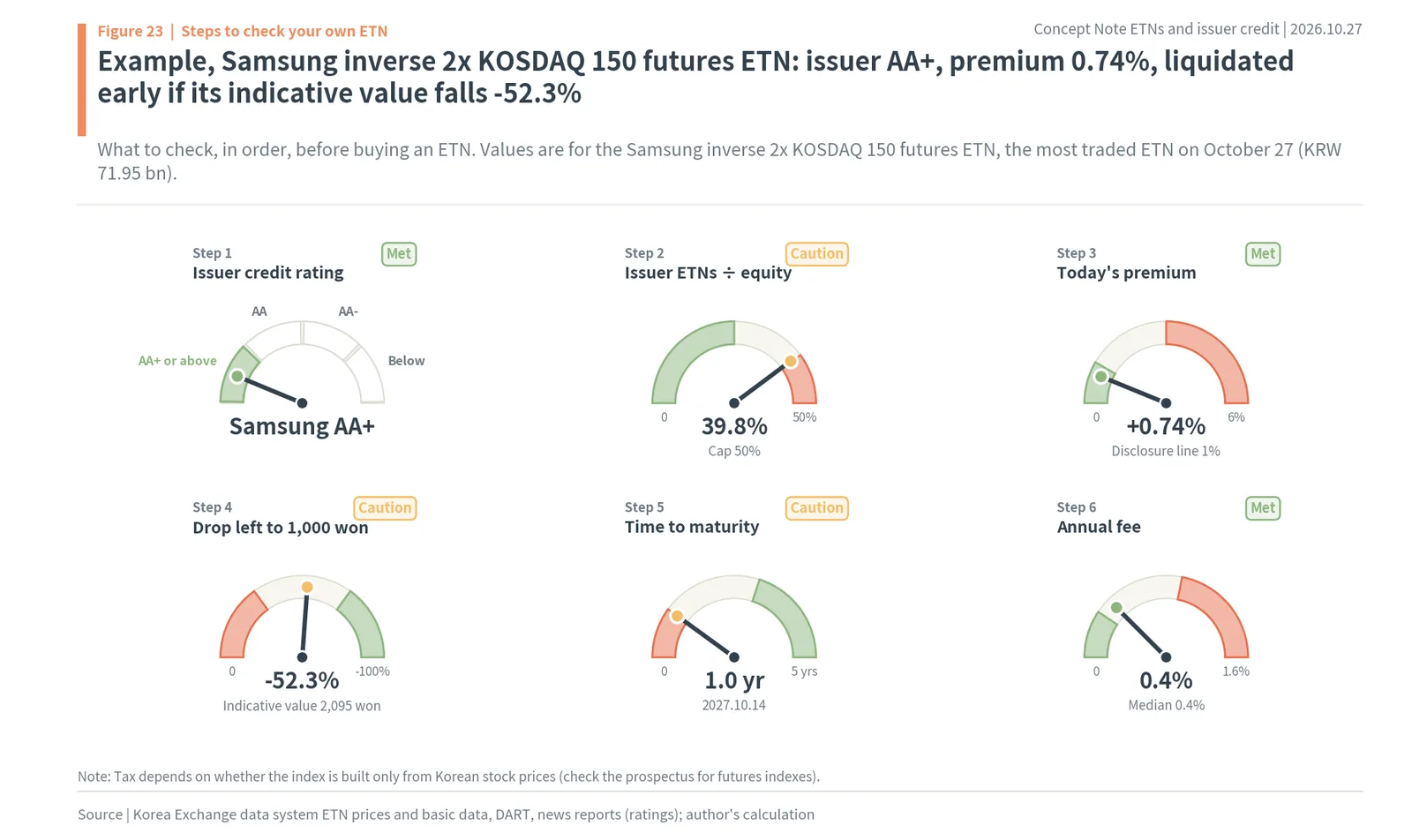
The same six steps read differently by product. For leveraged and inverse notes, premiums and the distance to 1,000 won come first. For rate notes, steps 3 and 4 hardly matter and the issuer is nearly everything. An ETN is a promise written by a brokerage: the index sets its value, the issuer’s strength decides whether it is paid. The index is visible every day; the weight of the promise shows only when the issuer wobbles.
Korean ETN FAQ
Q. What happens to an ETN if the issuer goes bankrupt?
The holder becomes an unsecured creditor and shares in what is left with other creditors. Lehman’s three Opta ETN holders recovered 44.5% of their claims, paid from April 2012. If another firm assumes the debt, as UBS did for Credit Suisse’s remaining notes in 2024, the ETN continues on the same terms.
Q. Who can issue ETNs in Korea?
Brokerages with a dealing licence held over three years, equity of KRW 1 tn or more, a credit rating of AA- or better and a net capital ratio of 200% or more. Each issuer’s ETNs must stay within 50% of its equity. On October 27, 2026 the ten issuers’ ETNs were 1.5–39.8% of their equity.
Q. Is an ETN covered by deposit insurance?
No. Korean ETNs are not protected by deposit insurance, and most retirement accounts cannot hold them because of issuer credit risk.
Q. What caused the big Korean ETN losses in 2020?
Premiums, not defaults. In April 2020 the Samsung leveraged WTI crude ETN traded up to 95.4% above its indicative value before the oil futures crash; the FSS said leveraged WTI ETN premiums reached 1,044% on April 22.
Q. When is a Korean ETN liquidated early?
For notes listed since 2020, when the closing indicative value falls 80% or more in a day or ends below 1,000 won. The note is then paid out at the indicative value and cannot recover.
Sources
- ETF.com, The Lehman Bros. ETN Fallout (link), 2018-09-13; Inverse VIX ETN Shuts Down (link), 2018-02-06
- SEC Investor.gov, Investor Bulletin: Exchange Traded Notes (link), 2015-12-01
- Daol Investment & Securities ETN guide; Kiwoom Securities ETN investor notice (link)
- Korea Exchange 2023 ETF/ETN market review, 2024-01-04; Herald Economy, 2025-12-30; Money Today, 2026-08-23 and 2020-04-22; Dailian, 2020-04-23 and 2020-05-17
- ETF Trends on TVIX, 2012-02-27 and 2012-03-23; Bloomberg via WealthManagement, 2023-03-28; AdvisorHub, 2023-10-19; UBS ETRACS press release, 2024-05-31
- SBS Biz, 2022-05-09 and 2026-05-22; Newsis, 2025-02-07; KIND disclosure, 2026-06-01; News1, 2026-07-16
- Ratings: Dealsite 2026-06-30, Business Watch 2025-12-02, IB Tomato 2025-01-17 and others; DART 2026 half-year reports of the ten issuers; Korea Exchange data system
- Photos: David Shankbone (CC BY-SA 3.0), hyolee2 (CC BY-SA 3.0), Riiniking (CC BY-SA 4.0), Thomas Wolf (CC BY-SA 3.0 de), Quintin Soloviev (CC BY 4.0), Sangitiana Fararano (CC BY-SA 2.0), Wikimedia Commons
Was this note useful?
Thanks. Your answer helps decide what to cover next.
Korea market snapshot · Oct 28, 2026
New to Korean stocks? Start here for the basics.
Most read lately
Get the Saturday note on Korean stocks
One email every Saturday with the week’s new research on Korean listed companies and links to the updated data pages. Built from DART filings and KRX data. Free; unsubscribe in one click. See past issues