How to Buy Unlisted Stocks in Korea: K-OTC, Platforms, Eligibility and Tax, and Why 50 of 66 IPOs Closed Below the OTC Price
On February 26, 2024, the day before APR listed on the KOSPI, its shares were quoted at KRW 635,000 (about $480) in Korea’s over-the-counter (OTC) market (38 Communication, via Etoday’s daily OTC column). A week earlier, on February 19, the quote had been KRW 690,000. APR listed the next day with an IPO offer price of KRW 250,000 (about $189), and its first-day close was KRW 317,500 (about $240). Investors who got shares in the IPO made 27.0% on day one. Anyone who bought the same shares at the OTC quote the day before lost 50.0% that same day (author’s calculation). It was one company and one day, yet the result was the exact opposite depending on where and when you bought.
This was not an exception. Among companies that listed from July 2020 to September 2026, 66 had an OTC quote just before listing that can be checked. At 65 of them the offer price was below the OTC quote, and at 50 even the first-day close was below it. So where should you buy an unlisted stock, who is allowed to buy it, and what should you check first? This report sets out the five routes for buying and selling unlisted stocks in Korea, with the eligibility rules, taxes and costs of each, based on the laws and official data, and then uses real numbers to check how far OTC prices have differed from listing prices.
This report is the full English edition of Maochaedung’s Korean note on how to buy unlisted stocks in Korea, with the K-OTC statistics, tax law and IPO data behind every number.
As of: October 22, 2026 (rules are the laws in force on the Korea Law Information Center; K-OTC statistics run through October 21; OTC values are Npay Unlisted reference prices and 38 Communication quotes; post-listing values are KRX closes). Dollar amounts use KRW 1,323.9 per dollar, the October 21, 2026 close (Yahoo Finance, KRW=X).
Concepts covered: unlisted stocks and the OTC market; K-OTC and its Registered, Designated and Delisted Company sections; unlisted stock trading platforms and their general and professional-only stocks; direct deals between individuals; crowdfunding and private funds; general, income-qualified and professional investors; the securities transaction tax and capital gains tax; the K-OTC capital gains tax exemption; standardized share certificates and electronic registration; the new OTC brokerage licence
Reference data: K-OTC market figures are the author’s yearly and per-stock sums of public statistics on the K-OTC website of the Korea Financial Investment Association (daily market statistics from August 25, 2014 to October 21, 2026, monthly trading value by stock, and market cap rankings). The OTC quote cases come from 38 Communication quotes printed with dates in 1,515 Etoday OTC market columns (May 2020 to October 2026); the 66 companies are those with a quote within 5 trading days before listing. Offer prices and first-day closes were taken from 38 Communication’s new listing table and checked against KRX closes. Tax rates and eligibility rules were checked against the laws in force on the Korea Law Information Center, Financial Services Commission and Financial Supervisory Service press releases, and the guidance of the Korea Financial Investment Association and each platform. Values the author calculated are marked as the author’s calculations.
How it works in Korea
Korea’s stock exchange, the Korea Exchange (KRX), runs three markets: KOSPI, the main board where companies such as Samsung Electronics are listed; KOSDAQ, the growth board for smaller companies; and KONEX, a small board for startups. Shares of any company that is not on one of these three are called unlisted stocks. They change hands outside KRX in four ways. The first is K-OTC, an over-the-counter market run since 2014 by the Korea Financial Investment Association (KOFIA), the industry body of Korean brokers and asset managers, where you trade through an ordinary brokerage account. The second and third are two app-based platforms, Npay Unlisted (formerly Securities Plus Unlisted, now owned by Naver Pay) and Seoul Exchange Unlisted (a private platform, not to be confused with the Korea Exchange), which route orders through linked brokerage accounts and have run since 2020 under a regulatory sandbox. The fourth is a direct deal between two people. A fifth route, equity crowdfunding and private funds, buys new shares from the company itself. Company filings, including audit reports, are on DART, the electronic disclosure system run by the Financial Supervisory Service (FSS). Two features of Korean law shape everything below. Small holders of listed stocks pay no capital gains tax when they sell on the exchange, but small holders of unlisted stocks do, at 11% for small and medium-sized enterprise (SME) shares and 22% for others, unless they sell SME or mid-sized company shares on K-OTC. And a securities transaction tax is charged on every sale, at 0.20% on K-OTC and 0.35% for other unlisted shares.
Words to know first: OTC market, share certificates, minority shareholders, professional investors
Unlisted stocks come with many unfamiliar terms, so this first chapter sets them out in one place. Its conclusion is simple. Unlisted stocks are traded outside the Korea Exchange, and the route you use decides who can buy, what tax you pay and what protection you get. The terms below come up again and again in later chapters.
Terms for the markets
An unlisted stock is a share in a company that is not listed on a Korea Exchange market such as the KOSPI (the main board), KOSDAQ or KONEX. The company may be too small, may be preparing to list, may have no plan to list, or may have been delisted. All the places where shares are traded outside the exchange are together called the over-the-counter (OTC) market.
K-OTC is the OTC market run by the Korea Financial Investment Association (KOFIA). It opened on August 25, 2014, and orders are placed through a brokerage account on a home trading system (HTS) or mobile app (MTS). It has a Registered Company Section, which companies apply to join themselves; a Designated Company Section, which KOFIA fills without any application from the company; and a Delisted Company Section, created in January 2026. Registered companies file disclosures on K-OTC, but designated companies “do not make disclosures on the K-OTC market,” and their business reports on DART, the electronic disclosure system, stand in for that information (KOFIA).
Unlisted stock trading platforms are services that let you buy and sell unlisted shares in an app linked to a brokerage account. The leading two are Securities Plus Unlisted, built by Dunamu (renamed Npay Unlisted in April 2026), and Seoul Exchange Unlisted. Both started trial operation in April 2020 after the Financial Services Commission (FSC) designated them innovative financial services, Korea’s regulatory sandbox. An amended Enforcement Decree of the Capital Markets Act, in force from September 23, 2025, created a formal licence called OTC brokerage, and both are waiting for licensing review.
Platform stocks are split into general stocks and professional-only stocks. General stocks belong to companies that meet disclosure requirements such as an audit report, and anyone can trade them. Professional-only stocks have looser disclosure requirements, but only professional investors and similar investors can buy them; general investors can only sell what they already hold. This split has applied since October 2024.
Terms for the shares themselves
A standardized share certificate is a certificate printed to the format set by the Korea Securities Depository (KSD). It can be deposited with the KSD, so it can move between brokerage accounts. Since the 2019 electronic securities system, shares registered electronically without paper do the same job. A non-standard certificate, by contrast, “cannot be transferred between accounts,” so the buyer has to register the transfer in the issuing company’s shareholder register, and without that registration “cannot claim shareholder rights (voting rights, dividends, etc.)” (Seoul Exchange FAQ). Electronic registration is not mandatory for unlisted companies, so the first thing to check is whether the shares you want are standardized certificates or electronically registered.
Terms for the people
Minority shareholders and major shareholders are treated differently for tax. For unlisted stocks, the major shareholder whose status sets the tax rate is anyone holding a stake of 4% or more, or shares worth KRW 1bn (about $755,000) or more, at the end of the previous business year (Income Tax Act Enforcement Decree, Article 167-8). That is far lower than the KRW 5bn threshold for listed stocks. Yet when judging the K-OTC capital gains tax exemption, the major shareholder test is a 4% stake or KRW 5bn (Enforcement Decree, Article 157(3)). The same word, “major shareholder,” has two tests depending on what it is used for.
General investors and professional investors are the two groups into which the Capital Markets Act divides investors. An individual can also become a professional investor by meeting the conditions: a monthly average balance of KRW 50mn (about $37,800) or more in financial investment products for at least one of the past five years, plus one of the following: income of KRW 100mn or more in the previous year (KRW 150mn for a couple), net assets of KRW 500mn or more for the couple excluding the home they live in, or a finance-related qualification such as accountant or lawyer. The investor submits documents to a broker, and they are valid for two years (Regulations on Financial Investment Business, Articles 1-7-2 and 1-8).
An income-qualified investor is a crowdfunding term for someone whose interest and dividend income exceeds the threshold for comprehensive financial income taxation, or whose business or employment income exceeds KRW 100mn, among others. They can invest twice as much as a general investor.
Terms for the taxes
The securities transaction tax is charged on the amount of a sale whenever you sell shares, whether you made money or lost it. Capital gains tax is charged on the profit: the sale price minus the purchase price and costs. For listed stocks only major shareholders pay capital gains tax, but for unlisted stocks minority shareholders pay it too, in principle. The exception is SME and mid-sized company shares sold on K-OTC. Local income tax equal to one-tenth of the capital gains tax is added on top.
There are five ways to buy and sell unlisted stocks in Korea, and each has its own buyers, taxes and protection
Ask how to buy unlisted stocks and the first answer is usually “in an app.” In fact there are five routes: K-OTC, run by KOFIA; the unlisted stock platforms linked to brokerage accounts (Npay Unlisted and Seoul Exchange Unlisted); direct deals between individuals who find each other on message boards and the like; and crowdfunding and private funds, which buy new shares the company issues. The conclusion of this chapter is that even for the same company’s shares, the route you use to buy and sell decides who can buy, what tax and costs you pay and what protection you get.
Route one: K-OTC
K-OTC is KOFIA’s OTC market, opened on August 25, 2014. It took over from the Third Market, which opened on March 29, 2000, and the Freeboard, which ran from July 2005. At launch, KOFIA newly placed 56 companies, including POSCO E&C, SK E&C, Samsung SDS, LS Cable & System and Mirae Asset Life, in the Designated Company Section, and moved 48 Freeboard companies to the Registered Company Section (News Tomato). At the end of September 2026 it had 124 companies: 34 in the Registered Company Section, 86 in the Designated Company Section and 4 in the Delisted Company Section created on January 2, 2026 (K-OTC statistics).
K-OTC’s strength is that it is part of the regulated system. You order through your existing brokerage account on HTS or MTS, trading hours are 9:00 a.m. to 3:30 p.m., and there is no opening or closing auction and no after-hours session. Only limit orders are accepted, and trades are matched one to one, only when an ask and a bid are at the same price. The daily price limit is ±30% from the base price, and the margin is the full purchase amount, so you cannot buy with borrowed money. Settlement goes through the KSD on the third day counting the trade date (T+2). Before your first order you must review an investor notice through your broker (KOFIA).
Routes two and three: unlisted stock platforms
Route two is Npay Unlisted. Securities Plus Unlisted, run by Dunamu, was split off into a separate company in July 2025, and on September 11, 2025 Naver Pay bought 70% of it for about KRW 68.6bn (about $51.8mn). On April 27, 2026 the company was renamed Naver Pay Unlisted and the service Npay Unlisted. By August 2025 it had 1.67mn cumulative members, about 830,000 cumulative trades and about KRW 1.9trn (about $1.44bn) in cumulative trading value (Naver press release). Accounts are opened with Samsung Securities or KB Securities, and on September 22, 2026 it signed agreements with Korea Investment & Securities and Kiwoom Securities.
Route three is Seoul Exchange Unlisted. It uses Shinhan Securities and NH Investment & Securities accounts, trades on weekdays from 8:00 a.m. to 6:00 p.m., and limits price moves to ±30% of the previous close. A general investor can sell only KRW 300mn of one stock a year, and one order is capped at KRW 200mn (Seoul Exchange operating rules and FAQ). The two platforms began trial operation on April 1, 2020 after the FSC designated them innovative financial services, and they are now waiting for the formal OTC brokerage licence created on September 23, 2025 (chapter 9).
Route four: direct deals between individuals
Route four is a direct deal: you find a seller on a message board or through acquaintances, send the money, and receive the shares into your brokerage account by transfer. No financial firm sits in the middle, so if you send the money first and never receive the shares, there is no mechanism to get it back. The seller must also file the securities transaction tax personally every half-year (chapter 5). These deals were bigger than one might think. In a November 2017 report, the FSC put average daily trading value in 2016 at KRW 0.65bn on K-OTC and an estimated KRW 15bn on private websites. Private-site trading was 23.1 times K-OTC (author’s calculation).

As the right side of the figure shows, cumulative trading value on Securities Plus Unlisted rose from about KRW 650bn at the end of November 2021 to more than KRW 1trn in December 2022 and KRW 1.9trn in August 2025. Much of the trading once done on private sites has moved to platforms linked to brokerage accounts.
Route five: crowdfunding and private funds
Route five does not buy existing shares; it buys new shares the company issues. Equity crowdfunding means buying shares or bonds that startups and SMEs offer through an online intermediary, and private funds are pools that managers invest in pre-IPO companies. Because this route has set investment limits and minimum amounts, it draws the clearest line on who can buy (chapter 4).
K-OTC is the regulated market, but its trading shrank, then grew, and is concentrated in one stock
K-OTC is the most institutionalized market for unlisted stocks. But trading there is not always plentiful. The conclusion of this chapter is that K-OTC trading value peaked in 2021, fell sharply for four years and rose again in 2026; that half of this year’s trading came from one stock; and that even companies worth more than KRW 1trn have days when not a single share trades.
From KRW 1,398.3bn in 2021 to KRW 513.1bn in 2025
Adding up daily trading value from KOFIA’s public K-OTC statistics by year, the launch year (August 25 to December 2014) saw KRW 205.4bn, and 2016 saw KRW 159.1bn, or KRW 0.65bn a day. Trading grew to KRW 675.5bn in 2018, KRW 990.4bn in 2019 and KRW 1,276.6bn in 2020, and peaked at KRW 1,398.3bn (about $1.06bn) in 2021, or KRW 5.64bn a day. It then fell to KRW 868.5bn in 2022, KRW 816.8bn in 2023, KRW 642.5bn in 2024 and KRW 513.1bn in 2025. That is a 63.3% drop from 2021 to 2025 (author’s calculation). The 2021 and 2022 figures match a Bizwatch report from October 2023.
2026, through October 21, came to KRW 818.1bn (about $618mn) over 195 trading days, or KRW 4.20bn a day. With just over two months left in the year, it is already close to the whole of 2022.
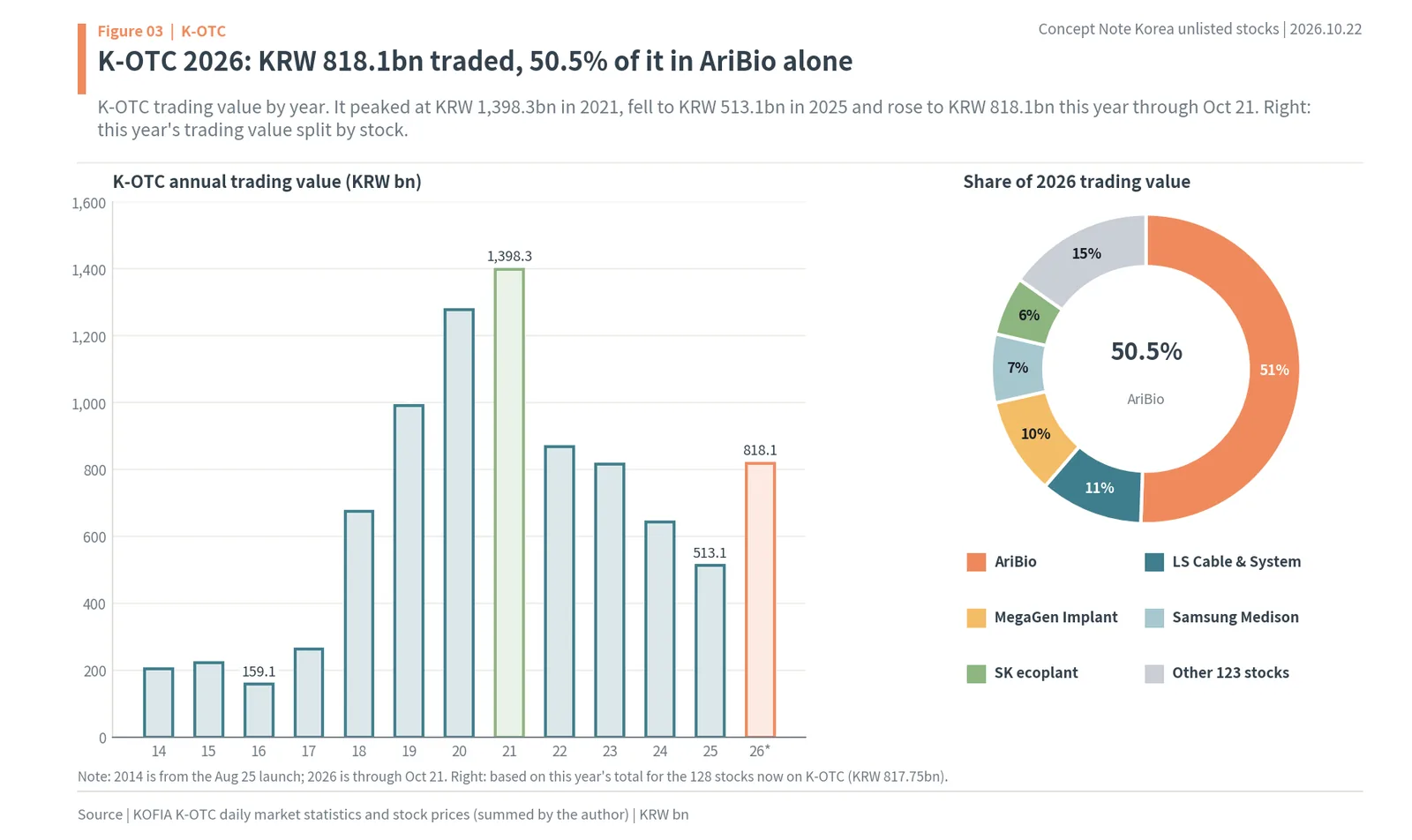
The right side of the figure shows where this year’s trading came from. Of the KRW 817.75bn traded this year in the 128 stocks now on K-OTC, AriBio alone accounted for KRW 413.4bn, or 50.5%. LS Cable & System (KRW 88.0bn, 10.8%), MegaGen Implant (KRW 83.0bn, 10.2%), Samsung Medison (KRW 58.8bn, 7.2%) and SK ecoplant (KRW 50.2bn, 6.1%) followed, and the top five took 84.8% (author’s calculation). Financial News also reported on October 7 that about half of first-half trading value was AriBio.
May, and KRW 38.4bn in a single day
This year’s K-OTC trading was concentrated in May. Monthly trading value of KRW 106.6bn in January, KRW 54.4bn in February, KRW 58.3bn in March and KRW 60.3bn in April jumped to KRW 264.9bn in May. The three biggest trading days since the market’s launch all fell in that month: KRW 38.4bn on May 20, KRW 32.1bn on May 18 and KRW 24.4bn on May 15. AriBio alone traded KRW 172.0bn in May. Trading then eased to KRW 100.3bn in June and KRW 63.9bn in July, and fell back to KRW 30.6bn in August and KRW 33.4bn in September.

Zero shares a day, even above KRW 1trn
By market cap, the picture changes again. On October 21, the 128 stocks on K-OTC had a combined market cap of KRW 19.61trn (about $14.8bn). The largest was SK ecoplant at KRW 3.445trn, followed by LS Cable & System at KRW 2.964trn, K Shipbuilding at KRW 1.556trn, SEMES at KRW 1.377trn and Samsung Medison at KRW 1.138trn. Yet on that day SK ecoplant traded 4,286 shares, LS Cable & System 99, K Shipbuilding 0 and SEMES 11. In money terms that is about KRW 233.2mn for SK ecoplant, about KRW 12.2mn for LS Cable & System and about KRW 6.4mn for SEMES (author’s calculation). The same day, AriBio traded 68,325 shares, worth about KRW 1.9bn.

As the figure shows, K Shipbuilding, with a market cap of KRW 1.56trn, traded zero shares on October 21, which means nobody wanting to sell and nobody wanting to buy at that price met that day. K-OTC matches trades one to one, only when an ask and a bid are at the same price, so if no one takes the other side at your price, your order simply sits there. This is why, when buying an unlisted stock, you should first ask whether you will be able to sell it when you want to.
Registered and designated companies disclose differently
Even within K-OTC, the amount of information differs by company. The Registered Company Section, which companies join by applying, files regular and ad hoc disclosures on K-OTC. New registration requires that capital is not fully impaired, sales in the latest business year of KRW 500mn or more (KRW 300mn for crowdfunded companies), a clean audit opinion, standardized share certificates or electronically registered shares, and no transfer restriction in the articles of incorporation, among other things. The Designated Company Section, which KOFIA fills without any application, covers companies required to file business reports; they “do not make disclosures on the K-OTC market,” and filings posted on DART stand in for that information. The Delisted Company Section, created on January 2, 2026, lets shares of companies delisted from the KOSPI or KOSDAQ trade for only six months, and it also carries no disclosure. This year six companies delisted from the KOSPI or KOSDAQ traded there: IntroMedic, PharmAbcine, Iljeong Industrial, NPX, ARK Solutions and The Technology (Financial News).
Limit orders only, valid for the day
The rules for placing orders on K-OTC also differ from the listed market. The quantity unit is one share, and the price tick has seven steps depending on price (from KRW 1 below KRW 2,000 to KRW 1,000 at KRW 500,000 and above). Only limit orders, where the investor sets the price, are accepted, and an order is valid for that day only. When the ask and the bid differ, no rule fills them at a matching price first, so to get a trade you have to look at the other side’s quote and change your price. A newly registered or designated stock takes quotes on its first trading day within 30% to 500% of its net asset value per share. For a stock in the Delisted Company Section, the first-day base price is the lower of the last close before delisting and the average close of the last three trading days, and the ±30% limit applies from the first day (KOFIA).
Tax on K-OTC is covered separately in chapter 5, but in short, K-OTC is the only route among unlisted stocks where minority shareholders pay no capital gains tax. That applies only to SME and mid-sized company shares.
Npay Unlisted and Seoul Exchange Unlisted: convenient, but same-broker matching and commissions dozens of times higher
Unlisted stock platforms let you see company information and quotes in an app and order right away, and they have become the entry point for unlisted investing. The conclusion of this chapter is that platform trading carries three constraints that listed stocks do not: trades match only between accounts at the same broker, general investors cannot buy professional-only stocks, and commissions are dozens of times higher than for listed stocks.
The platform Naver Pay bought
Securities Plus Unlisted started on April 1, 2020, when the FSC designated Dunamu’s “safe trading platform for unlisted stocks” an innovative financial service. PSX (now Seoul Exchange) was designated the same day. Cumulative members grew from about 700,000 at the end of November 2021 to 1.48mn in November 2023 and 1.67mn in August 2025 (Korea Capital Market Institute, Sidae, Naver).

On September 11, 2025 Naver Pay bought 70% of the platform for about KRW 68.6bn, and on June 16, 2026 Naver disclosed a deal to buy the remaining 179,999 Naver Pay Unlisted shares held by Dunamu for KRW 29.4bn (Digital Daily). When the service was renamed Npay Unlisted on April 27, 2026, the company said monthly users and trade counts in the first quarter of 2026 rose 27% and 22% from the previous quarter. Its app description says it supports safe trading in more than 1,200 unlisted stocks, about 20 of which are open to general investors.
Trades match only within the same broker
On a platform, a bid and an ask at the same price may still not be filled right away. Under the trial-operation setup, trades are matched only between buyers and sellers using accounts at the same linked broker (FSC legislative notice, May 2025). The Seoul Exchange FAQ also says that “you cannot trade directly between a Shinhan Securities account and an NH Investment & Securities account.” That is why the agreements Npay Unlisted signed with Korea Investment & Securities and Kiwoom Securities on September 22 include a review of a cross-broker trading system. No start date for cross-broker trading has been announced.
Instant fill and safe trading
Platform orders are matched one to one like K-OTC, but there are two ways to fill them. On Seoul Exchange, “instant fill” means buying on the exact terms the seller set in advance, with no negotiation, while “safe trading” lets you ask the other side to negotiate when the terms do not match. Orders stay valid for 90 days from the day they are placed (Seoul Exchange investor guide). Shares and money move between brokerage accounts, which is different from a direct deal where you send money first and then receive shares. In an April 2025 app update, Npay Unlisted said it also supports trading in professional-only stocks by “persons equivalent to professional investors,” such as individual investment associations, venture investment associations, startup accelerators and professional angel investors (app description).
Commissions are 53.4 times the online rate for listed stocks
The platforms charge no service fee, but trades go through the linked brokers, which charge commission. According to the Seoul Exchange FAQ, the commission is 0.75% at Shinhan Securities and 1% at NH Investment & Securities, charged on both purchase and sale. A sale also deducts the 0.35% securities transaction tax. For comparison, Korea Investment & Securities’ online commission is 0.0140527% for KOSPI and KOSDAQ stocks and 0.1498527% for K-OTC (fee table as of October 27, 2025). The Seoul Exchange commission is 53.4 times the online commission for listed stocks with a Shinhan account and 71.2 times with an NH account, and even the K-OTC commission is 10.7 times the listed rate (author’s calculation). Npay Unlisted’s commission is left out of the comparison because no official fee table could be found.
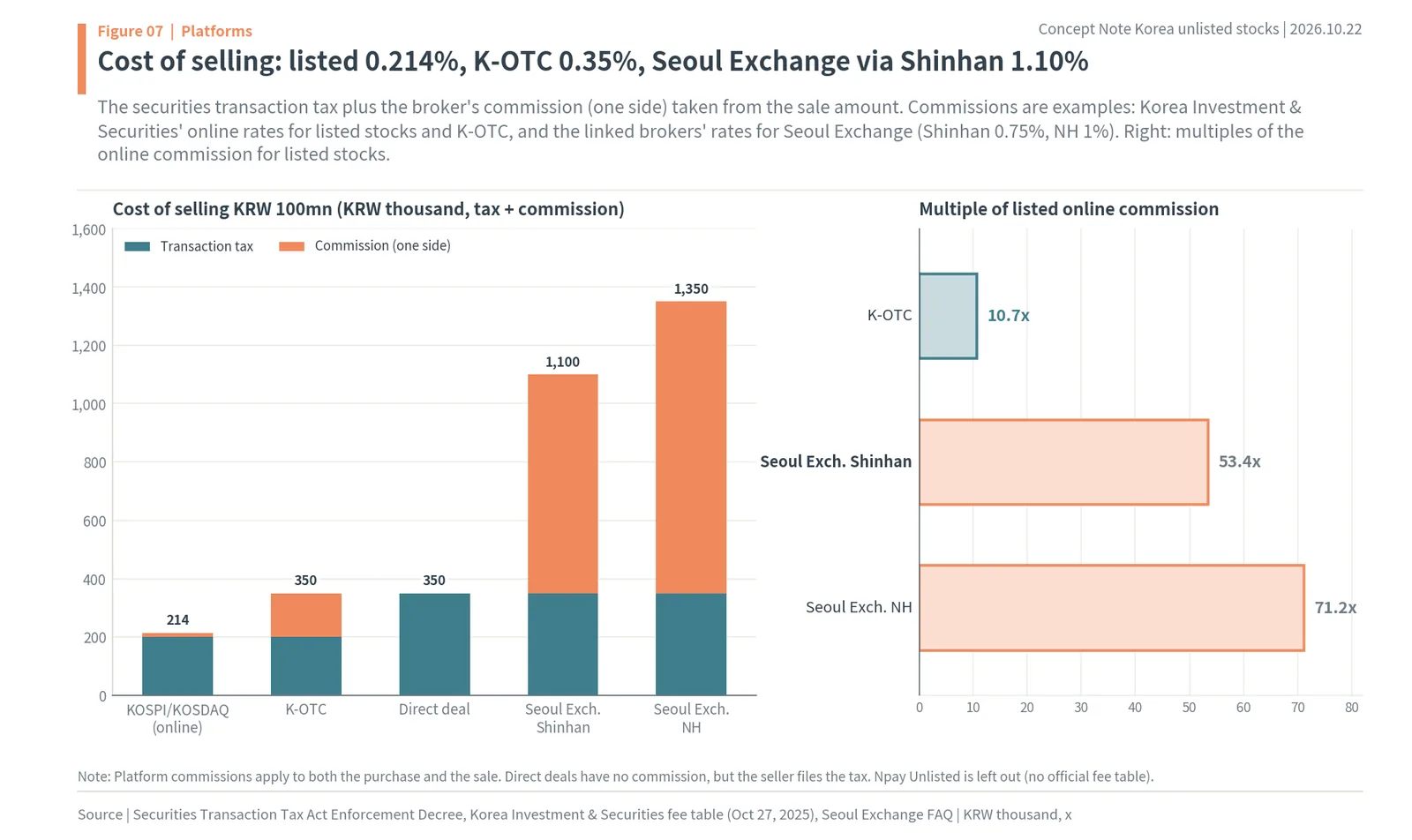
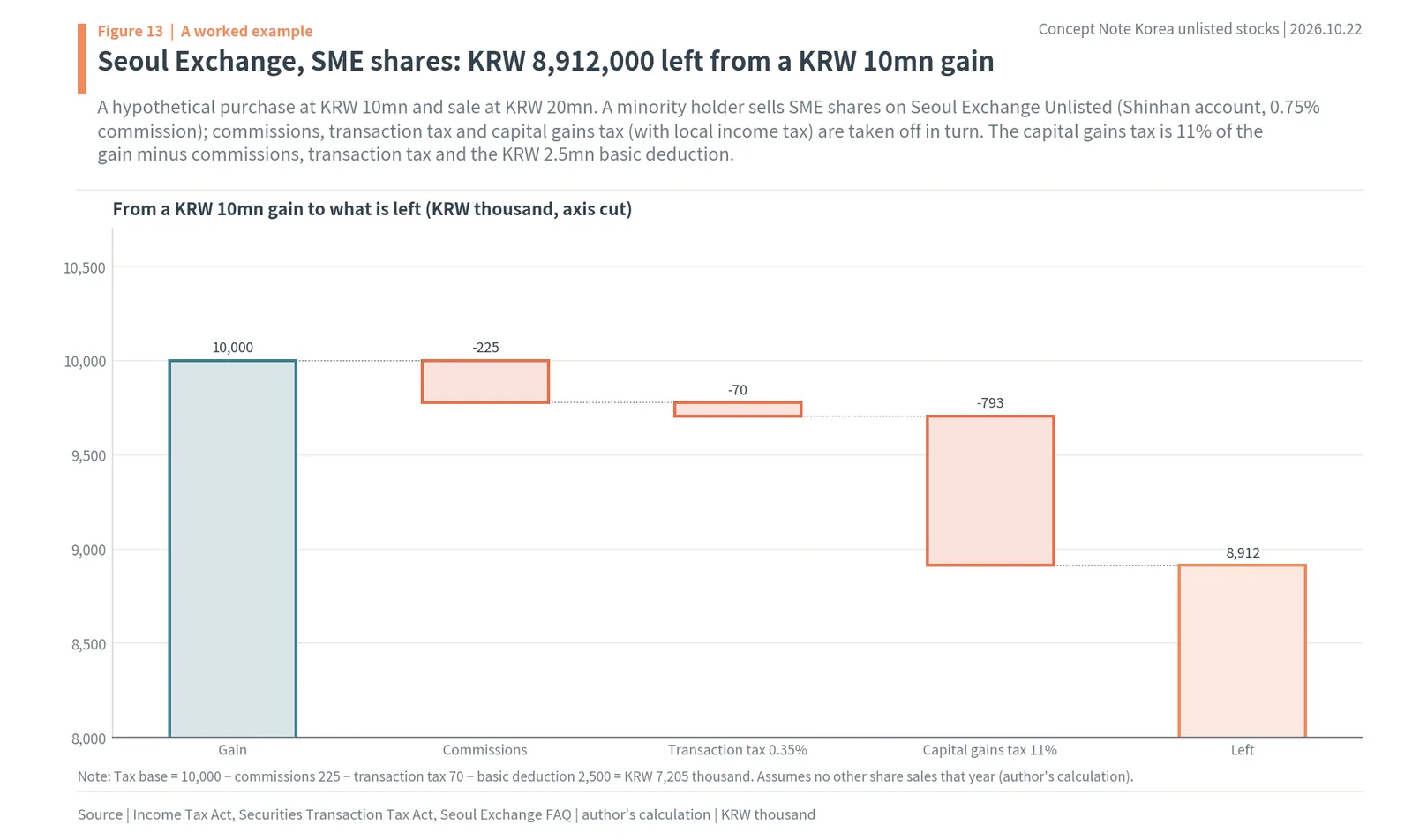
As the figure shows, the one-time cost of a sale (securities transaction tax plus commission) is 0.214% for listed stocks, 0.35% on K-OTC, 1.10% on Seoul Exchange with Shinhan and 1.35% with NH. Selling KRW 100mn (about $75,500) worth costs KRW 214,000 for listed stocks, KRW 350,000 on K-OTC, KRW 1,100,000 on Seoul Exchange with Shinhan and KRW 1,350,000 with NH (author’s calculation). For a full round trip with a Shinhan account on Seoul Exchange, adding the 0.75% purchase commission, buying KRW 10mn worth and selling it for KRW 20mn costs KRW 225,000 in commissions alone. This gap feeds straight into the tax comparison in chapter 5.
General stocks and professional-only stocks
Platform stocks are split into general stocks and professional-only stocks. General stocks belong to companies meeting disclosure requirements such as an audit report; on Seoul Exchange, a company enters the general section only if its capital is not fully impaired, its sales are KRW 500mn or more, its audit opinion is clean and its shares are standardized certificates or electronically registered (Seoul Exchange operating rules). Professional-only stocks have looser requirements, but only professional investors and those treated as equivalent can buy them. Since October 2024, general investors cannot make new purchases of professional-only stocks; they can only view and sell up to what they already hold. From December 27 of the same year, only companies with financial statements audited by an accounting firm can be listed as professional-only stocks. According to reports at the time, this meant general investors could no longer see prices for, or buy, some stocks such as Viva Republica (the operator of Toss) and Musinsa (Electronic Times).
Who can buy: the door for general investors has narrowed, and professional investor status opens most of it
Unlisted stocks are not a case of “anyone with money can buy.” Each route sets who can buy and how much. The conclusion of this chapter is that the unlisted stocks general investors can buy have shrunk through several rounds of tighter rules, and that meeting the individual professional investor test opens most doors: professional-only stocks, private funds and higher crowdfunding limits.
K-OTC and platform general stocks: anyone
Anyone with a brokerage account can trade on K-OTC. The only step is reviewing an investor notice at your broker before your first order. Anyone with an account at a linked broker can also trade platform general stocks. However, Seoul Exchange Unlisted caps a general investor’s annual sales of one stock at KRW 300mn (about $227,000) and a single order at KRW 200mn. Professional investors, individual investment associations, professional angel investors and similar investors have no such cap (Seoul Exchange operating rules, Article 16).
Stocks for general investors have kept shrinking
The stocks general investors can buy have been cut several times. On March 31, 2022 the FSC extended the two platforms’ sandbox designation to March 31, 2024, on condition that they strengthen investor protection within three months (MTN). As a result, from July 1, 2022, general investors could no longer trade companies whose capital was fully impaired or whose latest annual sales were below KRW 500mn, and the stocks open to general investors fell from 457 to 50 on Securities Plus Unlisted and from 174 to 24 on Seoul Exchange Unlisted (Economist Korea). In October 2024 general investors were barred from new purchases of professional-only stocks. Today the Npay Unlisted app says about 20 of its more than 1,200 stocks are for general investors.
The OTC brokerage rules in force from September 23, 2025 also put this split into law. Article 5-2-3 of the Regulations on Financial Investment Business defines professional-only stocks as stocks that general investors may trade only in cases such as “selling within the quantity held.” Shares not deposited with the KSD (non-standard certificates) must be handled as professional-only stocks.
The individual professional investor test
Becoming a professional investor opens these doors. Individual professional investors are defined by Article 10 of the Enforcement Decree of the Capital Markets Act and Article 1-7-2 of the Regulations on Financial Investment Business. First, you must have held financial investment products with a monthly average balance of KRW 50mn or more for at least one of the past five years. Shares, corporate bonds rated A or lower, derivative-linked securities, and private and public securities funds count toward the balance. Then you need one of the following: income of KRW 100mn or more in the previous year (KRW 150mn or more for a couple); total assets of you and your spouse, minus the home you live in and debts not secured on that home, of KRW 500mn (about $378,000) or more; or a finance-related qualification, such as passing the exam for accountant, lawyer, tax accountant or investment manager, plus at least one year of work in the field. You submit ID, a balance certificate and proof of income, assets or qualification to a broker, and the documents are valid for two years.
These requirements were lowered sharply in 2019. Before then a balance of KRW 500mn in financial investment products was required; the cabinet approved cutting it to KRW 50mn on August 13, 2019, effective that November. At the time the FSC put the number of individual professional investors at about 1,950 at the end of 2018. Figures later reported from the office of lawmaker Park Sung-hoon are 26,672 at the end of 2022, 20,820 at the end of 2024, 22,495 at the end of 2025 and 26,282 at the end of July 2026. In the seven months of this year, the number rose by 3,787 (16.8%). The FSS count uses a different basis: 30,247 in 2022 and 25,438 at the end of 2024.

As the figure shows, the stocks open to general investors fell from 457 to 50, while individual professional investors rose to 26,282. Becoming a professional investor also means the protections for general investors, such as the suitability rule and the duty to explain, no longer apply.
The money thresholds for crowdfunding and private funds
The routes that buy new shares in pre-IPO companies have clear money thresholds. In equity crowdfunding, a general investor can put in KRW 5mn per company and KRW 10mn (about $7,550) in total over the most recent year. Income-qualified investors, whose interest and dividend income exceeds the threshold for comprehensive financial income taxation or whose business or employment income exceeds KRW 100mn, can put in KRW 10mn per company and KRW 20mn in total. Professional investors have no limit (Capital Markets Act Article 117-10, Enforcement Decree Article 118-17). Securities bought through crowdfunding cannot be sold for six months from the day they are deposited.
For a general private fund, the minimum investment for a general investor is KRW 300mn (about $227,000). For a fund whose borrowing and other leverage exceeds 200% of net assets, it is KRW 500mn (Enforcement Decree Article 271). Individual professional investors qualify as eligible investors regardless of these minimums.

As the right side of the figure shows, crowdfunding issuance peaked at KRW 39.0bn in 2019 and was KRW 16.6bn in 2025. From 2016 to October 2026 the cumulative total was 1,484 deals and KRW 238.6bn, with 100,682 investors, counting a person each time they invest (KSD CrowdNet). Crowdfunding in SMEs within seven years of founding and direct investment in venture companies can be deducted from total income: in full up to KRW 30mn of investment, 70% for KRW 30mn to 50mn, and 30% above KRW 50mn (capped at 50% of total income, for investments through December 31, 2028, and clawed back if the money is recovered within three years). Buying shares someone else already holds, that is, buying existing shares over the counter, does not qualify for this deduction (Restriction of Special Taxation Act, Article 16).
Where you sell sets the tax: the cost of the same KRW 10mn gain ranges from KRW 85,000 to KRW 1,880,000
Tax is what investors most often miss with unlisted stocks. Investors used to listed stocks easily assume “minority shareholders pay no capital gains tax,” but unlisted stocks are different. The conclusion of this chapter is that minority shareholders of unlisted stocks pay capital gains tax in principle (11% for SMEs and 22% for others, including local income tax), that the only exception is SME and mid-sized company shares sold on K-OTC, and that the cost of the same gain therefore varies more than twentyfold depending on where you sell.
Minority shareholders of unlisted stocks pay capital gains tax
Article 94(1)3 of the Income Tax Act makes shares of unlisted companies subject to capital gains tax, regardless of whether the seller is a major shareholder. Article 104 sets the rates: for anyone who is not a major shareholder (a minority shareholder), 10% on SME shares and 20% on other shares. Major shareholders pay 20% on a tax base up to KRW 300mn and 25% on the part above it, and a major shareholder who sells non-SME shares within one year pays 30%. Under Article 103-3 of the Local Tax Act, local income tax of one-tenth of the national tax is added, so the actual rates are 11%, 22%, 27.5% and 33% (author’s calculation). For capital gains on shares there is a basic deduction of KRW 2.5mn a year, and losses on other shares in the same year can be offset.
Neither brokers nor platforms withhold capital gains tax. The seller must file and pay it to the National Tax Service (NTS) personally. The preliminary return is due within two months after the end of the half-year in which the sale took place, so sales from January to June are due by August 31 and sales from July to December by the end of February the next year. You must file even if you made a loss (Income Tax Act, Article 105). The final return is due the following May. Not filing brings a 20% penalty, and under-reporting a 10% penalty (Framework Act on National Taxes, Articles 47-2 and 47-3). Both the K-OTC and Seoul Exchange guides say the seller must file “directly with the tax office.”
The major shareholder test differs from listed stocks
The “major shareholder” test that sets the rate for unlisted stocks is far lower than for listed stocks. Article 167-8 of the Enforcement Decree of the Income Tax Act defines a major shareholder of an unlisted stock as someone holding 4% or more, or shares worth KRW 1bn or more, at the end of the previous business year (KRW 4bn for venture company shares traded on K-OTC). Compared with the KRW 5bn per stock threshold for listed shares, that is one-fifth. On the other hand, the major shareholder test for the K-OTC exemption uses 4% or KRW 5bn (Enforcement Decree, Article 157(3)). The same person can be a major shareholder for the tax rate yet a minority shareholder for the K-OTC exemption.
SME and mid-sized company shares sold on K-OTC are tax-exempt
There is one exception. The proviso to Article 94(1)3(b) of the Income Tax Act excludes from taxation SME and mid-sized company shares that a non-major shareholder sells through KOFIA’s OTC trading, that is, on K-OTC. The exemption for minority holders of venture company shares began in July 2005, and for minority holders of SME and mid-sized company shares in January 2018 (K-OTC history). The NTS also said in its August 2026 guidance on preliminary returns that minority holders of SME and mid-sized company shares traded on K-OTC do not need to file. Because the law limits this exemption to KOFIA’s OTC trading, it does not apply to shares sold on Npay Unlisted or Seoul Exchange Unlisted. A mid-sized company must qualify as one under the Enforcement Decree of the Restriction of Special Taxation Act on the date of sale.

As the table in the figure shows, when a minority holder sells SME shares, the rate is 0% on the exchange and on K-OTC but 11% on platforms and in direct deals. Mid-sized company shares are 0% on K-OTC and 22% on platforms and in direct deals. Large company shares are 22% even on K-OTC. In the end, if you can sell the same shares on K-OTC, the tax is lowest.
Securities transaction tax: K-OTC 0.20%, platforms and direct deals 0.35%
The securities transaction tax is charged on the sale amount, regardless of profit. For sales from January 1, 2026, the KOSPI rate is 0.20% (0.05% transaction tax plus 0.15% special tax for rural development), KOSDAQ 0.20%, KONEX 0.10% and K-OTC 0.20% (Enforcement Decree of the Securities Transaction Tax Act, Article 5). K-OTC was cut to 0.18% in 2024 and 0.15% in 2025, then rose back to 0.20% in 2026 (K-OTC history). The flexible rates apply only to shares traded on securities markets, so other unlisted shares, such as those sold on platforms or in direct deals, pay the statutory base rate of 0.35% (Securities Transaction Tax Act, Article 8). That base rate was 0.43% in 2021 and 2022 and has been 0.35% since 2023.

As the right side of the figure shows, on a KRW 20mn sale the tax is KRW 40,000 on K-OTC, KOSPI and KOSDAQ and KRW 70,000 on platforms and in direct deals. On K-OTC the KSD collects the tax, and on platform trades through brokers the broker collects it at settlement. In a direct deal, the seller files it personally, with a copy of the sale contract, within two months after the end of the half-year (Securities Transaction Tax Act, Articles 3 and 10).
A worked example: selling SME shares on Seoul Exchange
Let us follow the numbers. A minority holder buys SME shares for KRW 10mn on Seoul Exchange Unlisted (Shinhan account) and sells them for KRW 20mn, with no other share sales that year. The purchase commission of KRW 75,000 (0.75%) and the sale commission of KRW 150,000 add up to KRW 225,000. The securities transaction tax is 0.35% of KRW 20mn, or KRW 70,000. The capital gain is the KRW 10mn profit minus commissions and transaction tax, KRW 9,705,000, and after the KRW 2.5mn basic deduction the tax base is KRW 7,205,000. Capital gains tax at 10% is KRW 720,500, and local income tax of one-tenth adds KRW 72,050, for about KRW 793,000 in total. After all costs, KRW 8,912,000 (about $6,730) of the KRW 10mn gain is left (author’s calculation).
Costs compared by route
Running the same calculation for each route makes the gap clear. Buying at KRW 10mn and selling at KRW 20mn costs KRW 44,000 for listed stocks (for comparison, at Korea Investment & Securities’ online commission), KRW 85,000 (about $64) for SME and mid-sized company shares on K-OTC, KRW 1,716,000 for large company shares on K-OTC, KRW 887,000 for SME shares in a direct deal, KRW 1,088,000 for SME shares on Seoul Exchange and KRW 1,880,000 (about $1,420) for large company shares on Seoul Exchange (author’s calculation). For large company shares on Seoul Exchange, 18.8% of the gain goes to costs. That is 22.1 times the KRW 85,000 for SME and mid-sized company shares on K-OTC (author’s calculation).

The gap is widest for mid-sized company shares. A mid-sized company is not an SME, so on platforms and in direct deals its shares pay the same 22% as large companies, but on K-OTC minority holders pay no capital gains tax, as with SMEs. So a KRW 10mn gain on the same mid-sized company’s shares costs KRW 85,000 on K-OTC and KRW 1,880,000 on Seoul Exchange (author’s calculation). Even in a year with a loss, filing the half-yearly preliminary return lets you offset it against gains on other shares in the same year.
As the figure shows, the cost of a KRW 10mn gain is KRW 85,000 on K-OTC and KRW 1,880,000 for large company shares on Seoul Exchange. Most of the cost is capital gains tax. So simply checking whether the stock you want also trades on K-OTC, and whether the company is an SME or mid-sized company, changes the tax a great deal.
The OTC price is not the listing price: at 65 of 66 IPOs the offer price, and at 50 the first-day close, was below the OTC quote
The most common reason to buy an unlisted stock is the hope that “it will rise when it lists.” This chapter checks how that hope has played out in numbers. The conclusion is that among the 66 companies with a verifiable OTC quote just before listing, 65 had an offer price below the OTC quote, 50 had a first-day close below it as well, and three months later 53 were still below it.
What was collected
The OTC values are 38 Communication quotes printed with dates in Etoday’s daily OTC market column, published after the close. All 1,515 columns from May 2020 to October 2026 were collected, and companies that later listed on the KOSPI or KOSDAQ were identified. Of those, only companies with a quote and a price within 5 trading days before listing, and no later column reporting a change without a price, were kept, giving 66 companies (10 on the KOSPI and 56 on the KOSDAQ). Offer prices and first-day closes were taken from 38 Communication’s new listing table and checked against KRX closes, using only values that matched in at least two of the Naver and Daum price services. Two caveats up front: a quote is not a trade price, and companies that failed to list are not in the sample.
The offer price was a median 39.4% lower
At 65 of the 66 companies, the offer price was below the OTC quote just before listing. The only exception was Krafton. The median offer price was 39.4% below the OTC quote. Put the other way round, the OTC quote was a median 65.1% above the offer price (author’s calculation). The price newly set at listing being lower than the price traded over the counter happened almost every time.
The first-day close was below the OTC quote at 50
Comparing first-day closes, 50 of the 66 closed below the OTC quote, 15 closed above it and 1 (Rainbow Robotics, KRW 26,000) closed at the same price. The median of first-day close ÷ OTC quote − 1 was -18.2%, and the mean was -13.5%. Of the same 66, 53 closed their first day above the offer price. So at 37 of the 66 companies, IPO subscribers made money on day one while those who had bought over the counter lost money (author’s calculation).
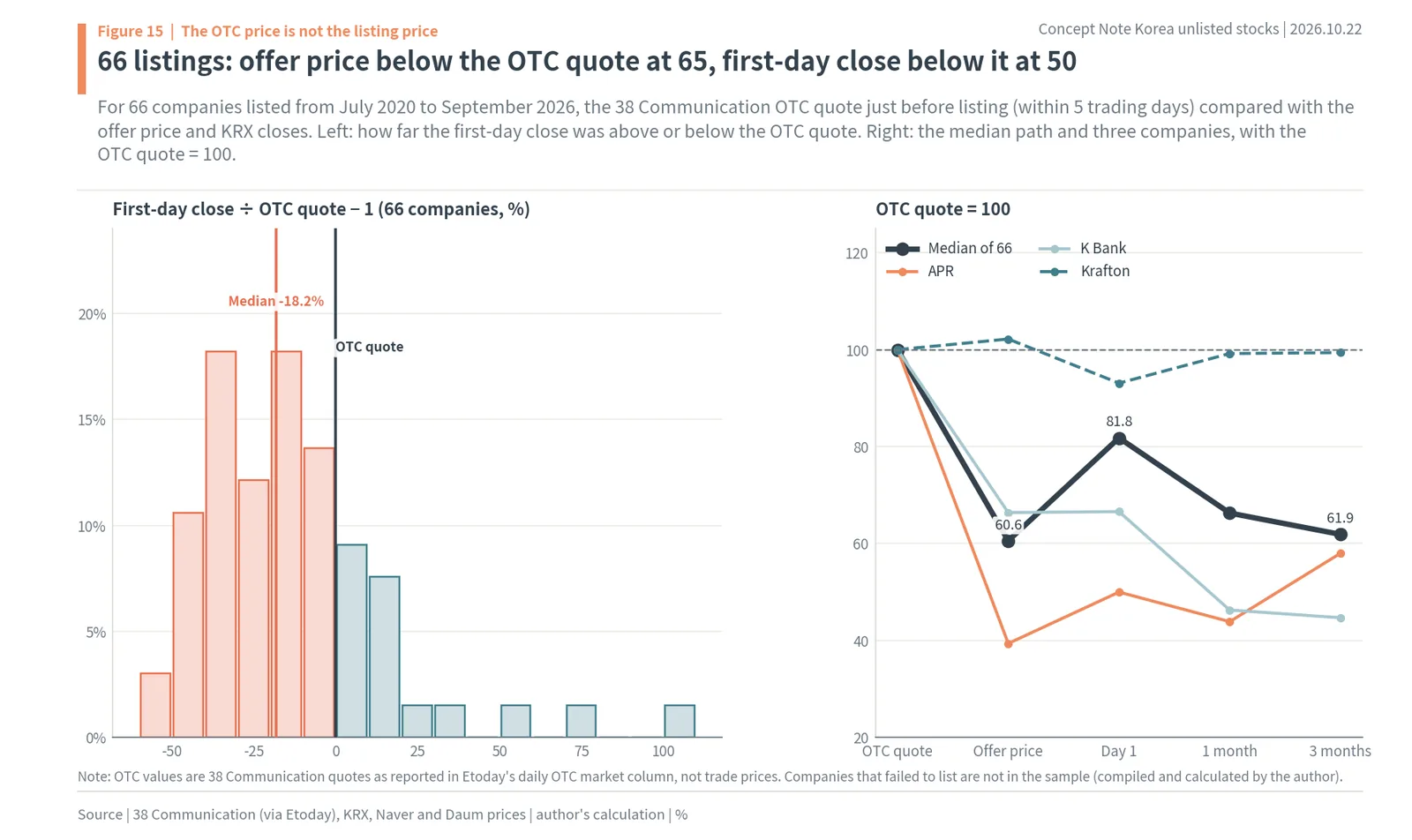
As the left side of the figure shows, the first-day closes of the 66 companies cluster below the OTC quote. The right side shows the median path with the OTC quote set at 100: the offer price was 60.6, day one 81.8, one month later 66.3 and three months later 61.9. Even when shares had the strength to rise above the offer price on day one, they did not get back to the OTC quote, and over one to three months they slid back toward the offer price. One month later, 45 of 65 companies (Duksan Navcours is left out because it had not traded 20 days) were below the OTC quote, with a median of -33.7%; three months later, 53 of 65 were below it, with a median of -38.1%.
Well-known companies were no different. Kakao Games had an OTC quote of KRW 78,500 the day before listing, an offer price of KRW 24,000 and a first-day close of KRW 62,400, 20.5% below the OTC quote. SK bioscience was KRW 170,500, KRW 65,000 and KRW 169,000, 0.9% below. SOCAR was KRW 32,000, KRW 28,000 and KRW 26,300, 17.8% below and even below its offer price. K Bank, which listed in March this year, was KRW 12,500, KRW 8,300 and KRW 8,330, 33.4% below, and three months later its close was 55.3% below the OTC quote (author’s calculation).
The same direction every year
Split by year of listing, the result pointed the same way. The companies whose first-day close was below the OTC quote were 3 of 5 in 2020, 14 of 18 in 2021, 4 of 7 in 2022, 8 of 10 in 2023, 10 of 11 in 2024, 5 of 8 in 2025 and 6 of 7 in 2026. The median was especially large in the last two years: -38.3% in 2024 and -38.9% in 2026. A Dealsite tally based on unlisted platform data also found that of 16 companies due to list that traded over the counter in 2023, 11 closed their listing day below their last OTC price.
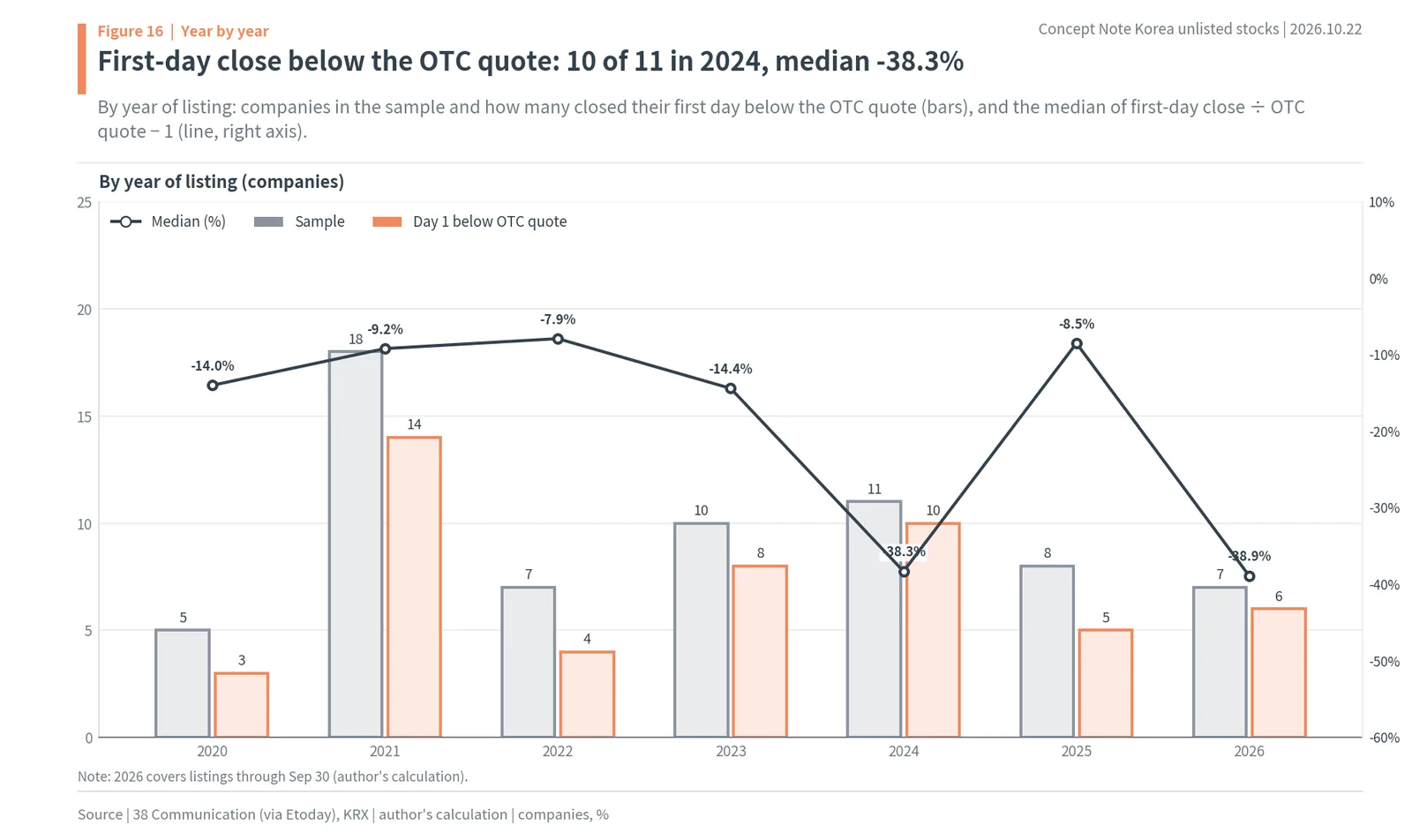
As the figure shows, in 2024, 10 of 11 companies closed day one below the OTC quote, with a median of -38.3%. Some fell to around half the OTC quote on day one, such as APR (-50.0%) and COXEM (-46.2%) that year, and StradVision (-48.6%) and Lemon Healthcare (-43.9%) in 2026.
It depended on when you bought
Even for the same company, the result depended on when the shares were bought over the counter. KakaoBank’s OTC quote was KRW 107,500 on April 23, 2021, but by August 5, the day before listing, it had come down 51.4% to KRW 52,250. The offer price was KRW 39,000 and the first-day close KRW 69,800. Someone who bought at the quote the day before listing made 33.6% on day one, but someone who bought at the April quote lost 35.1% (author’s calculation). Krafton’s quote on April 28, 2021 was KRW 2,890,000, or KRW 578,000 after converting for the later 5-for-1 stock split. Its quote just before listing was KRW 487,500, its offer price KRW 498,000 and its first-day close KRW 454,000. Measured from April, it lost 21.5% on day one. APR lost 54.0% on day one measured from the KRW 690,000 quote on February 19.
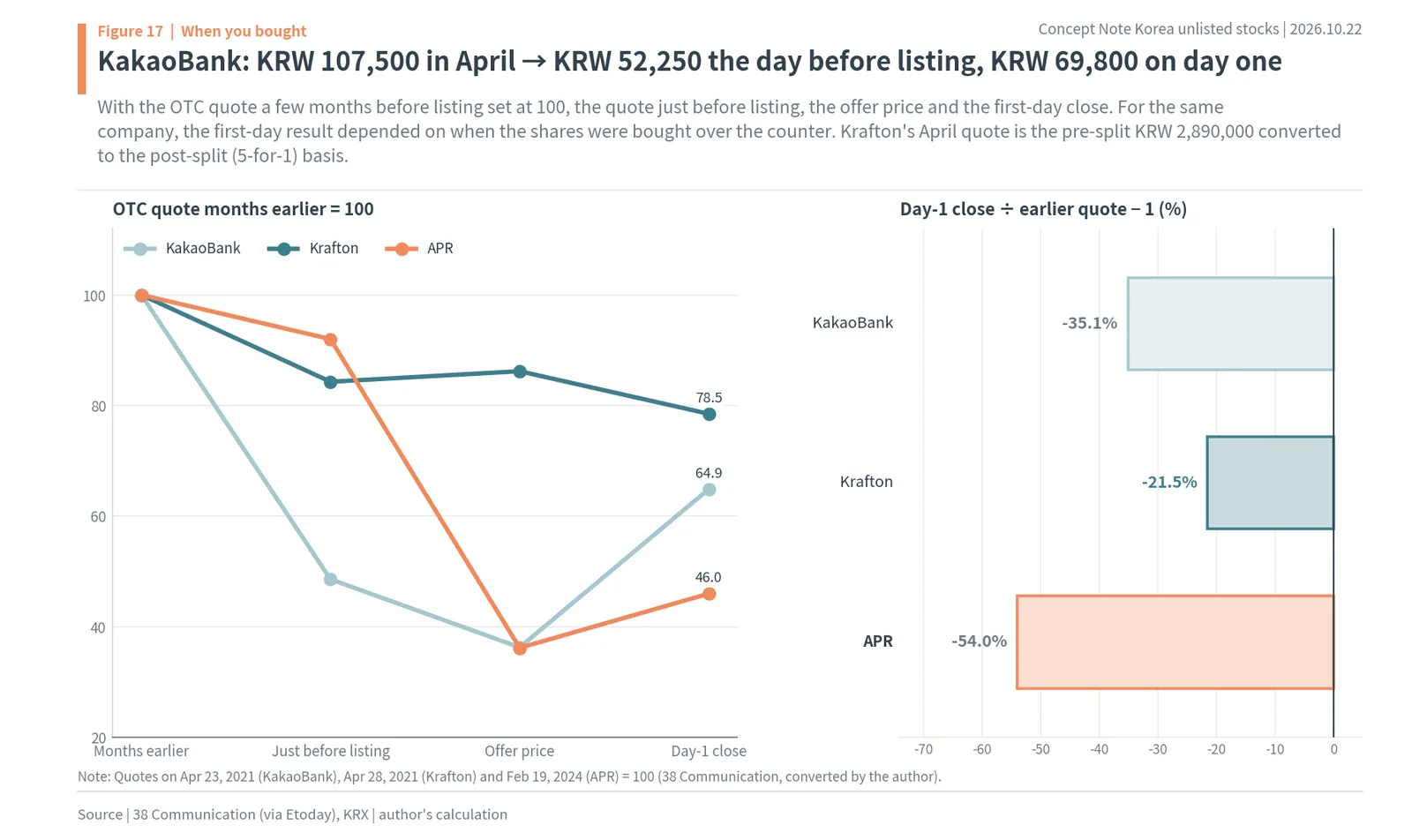
As the figure shows, KakaoBank fell from KRW 107,500 in April to KRW 52,250 the day before listing, then rose to KRW 69,800 on day one. The higher the OTC quote when someone bought, the bigger their loss on listing day.
Why the OTC price was higher
The author sees two reasons. First, listing hopes get priced into OTC values early. Once a listing is known, more people want to buy, but few shares are for sale, so quotes rise. Second, the offer price is reset at listing through institutional book building, and the underwriters and the company do not simply follow the OTC quote when setting it. So on listing day the OTC hopes are cut back toward the offer price. It is also worth checking whether shares bought over the counter can be sold from the first day of listing. Under the KOSDAQ listing rules, existing shares a minority holder bought over the counter from someone other than the largest shareholder are not subject to a lock-up, but shares bought from the largest shareholder and related parties, or received in a third-party allotment, within one year before the pre-listing review application are locked up for six months from listing (Korea Exchange guidebook).
Same share, three prices: Kurly’s OTC price is just over a third of the price the company set
Calling the OTC price “the market price” is only half right. When few people buy and sell, the price is set by a handful of trades. The conclusion of this chapter is that the OTC price at which Kurly now trades is as much as 2.97 times away from the prices the company itself set this year in a share issue and a share swap, and that the OTC price is set by an average of 900 shares a day, or 0.0021% of its market cap.
From KRW 116,000 to KRW 7,650, then back to KRW 24,900
The daily reference prices on Kurly’s Npay Unlisted page start at KRW 116,000 (about $88) on January 24, 2022. In December 2021 Kurly was valued at KRW 4trn (about $3.0bn) when it raised KRW 250bn in pre-IPO funding from Anchor Equity Partners (Digital Times). It applied for the KOSPI pre-listing review in March 2022 and passed on August 22 (Edaily), but on January 4, 2023 it said it would postpone the listing “in consideration of weakened investor sentiment due to the worsening global economy.” The OTC reference price fell throughout the second half of 2022 and hit its low of KRW 7,650 on January 16, 2025, then rose to KRW 24,900 (about $19) on October 21, 2026. That is 78.5% below January 2022, and 225.5% above the bottom (author’s calculation).
The company’s prices: KRW 66,148 and KRW 74,000
The prices the company disclosed over the same period were different. On May 6, 2026 Kurly disclosed a share issue to Naver of 498,882 common shares at KRW 66,148 (about $50) per share. On October 2, disclosing a share swap with Next Kitchen, it set Kurly’s swap price at KRW 74,000 (about $56) (DART). The OTC reference price of KRW 24,900 is 37.6% of the Naver issue price, and the swap price is 2.97 times the OTC reference price (author’s calculation).
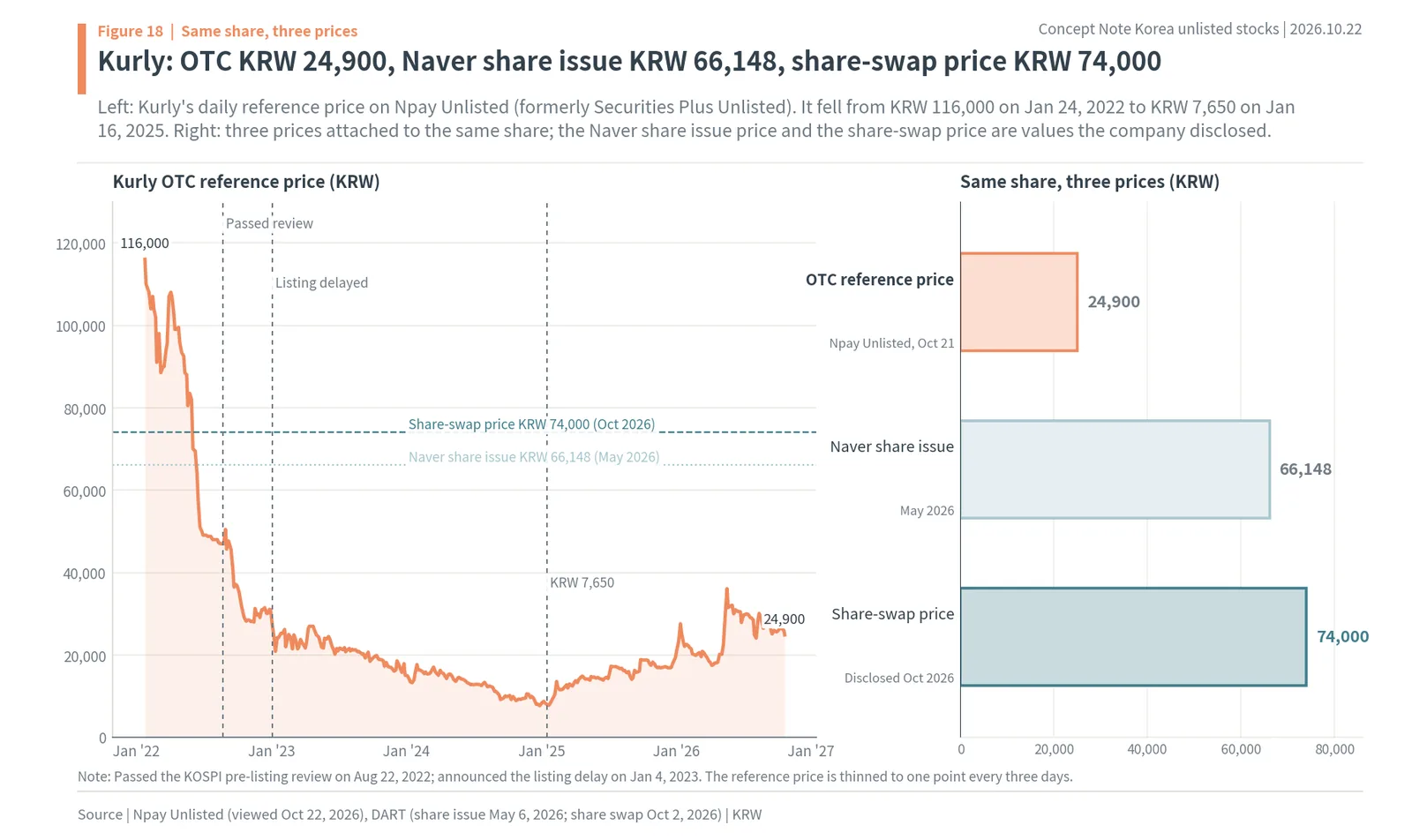
As the figure shows, Kurly’s OTC price of KRW 24,900, the Naver share issue price of KRW 66,148 and the share-swap price of KRW 74,000 are three prices attached to the same share. The issue price is a price the company and an investor negotiated, and the swap price was calculated to set the exchange ratio. The point is not which one is the right price. It is that judging a company’s value from the OTC price alone misses gaps like this.
900 shares a day
How much trading sets this OTC price? Over the past year (October 22, 2025 to October 21, 2026, 245 trading days), Kurly’s average daily volume was 900 shares, or about KRW 20.78mn (about $15,700). Npay Unlisted shows a market cap of KRW 1.08trn (about $816mn) and 43,381,992 shares outstanding. Daily volume is 0.0021% of the shares (author’s calculation). As of June 30, 2026, Kurly had 6,610 minority shareholders holding 11.34% of the shares (half-year report).

As the figure shows, Kurly traded an average of 900 shares a day over the past year (about KRW 20.78mn), 0.0021% of its market cap. At these levels, buying or selling a few tens of millions of won at once moves the price through several ticks. Nor does the OTC reference price mean your order will be filled at that price.
Fraud targets listing hopes: when someone pitches a stock as “listing soon,” look for the registration statement first
Fraud that exploits the way listing hopes get priced into OTC values keeps appearing. The conclusion of this chapter is that in January 2026 the Financial Supervisory Service raised its alert on “listing soon” unlisted stock fraud from caution to warning, and that the scheme repeats three moves: listing hopes, a promise to return your principal, and coaching victims to dodge bank checks.
From caution to warning
In June 2025 the Financial Supervisory Service (FSS) issued a consumer alert at the “caution” level on IPO investment fraud that used “listing soon” as bait. It referred cases for investigation on September 1 and December 11, 2025 and blocked the fraud accounts’ financial transactions in December, but when the same scheme continued through new accounts, it raised the alert one level to “warning” on January 12, 2026 (FSS consumer alert 2026-1).

A three-step scheme
The FSS, drawing on complaint files, sets out the scheme in three steps. First, victims are invited by text or social media to an illegal stock-tip chat room and given 1 to 5 free shares of a stock that really is due to list, so they experience a small profit and a withdrawal. Next, the operators tout “listing soon” and “multiple-fold returns on listing,” promise to buy the shares back and return the principal if the listing fails, and spread forged investor relations materials and fake articles. Each victim got a different stock but the same-looking “buyback agreement.” Finally, they coach victims in advance to say, if the bank calls to check an unusual transfer, that the money is a deposit on a contract or for living expenses.
The example illustrated in the press release goes like this. The operator buys 100,000 unlisted shares at KRW 1,000 each in advance. It sells them to victims at KRW 40,000 a share. Then, posing as a third party, it offers to buy at KRW 60,000 to get victims to buy more. The operator sold at 40 times its cost.

As the figure shows, the structure is to sell shares bought at KRW 1,000 for KRW 40,000 and then approach victims with a KRW 60,000 bid. The investigation referrals of unregistered stock-tip services on the right (199 in 2022, 183 in 2023, 52 in 2024, 88 in 2025 and 28 from January to July 2026) do not count unlisted stocks alone, but they show that pitches through illegal tip rooms lead to investigations every year (office of lawmaker Park Sung-hoon, FSS data).
KRW 500bn through a multi-level marketing group
On September 7, 2026 the FSS also presented cases adapted from its disclosure investigations. Multi-level marketing Group A sold “unlisted company shares worth about KRW 500bn,” obtained through third-party share issues or by buying shares held by executives of unlisted companies, to general investors over several years without ever filing a registration statement. In another case, the head of an unlisted biotech company sold about KRW 5bn worth of shares, claiming “FDA approval is expected” and the company “will soon list on the KOSDAQ.”
How to check
The FSS’s advice comes down to three steps. First, if you are pitched shares on social media or elsewhere, look for filings such as a registration statement on DART. When shareholders of an unlisted company solicit 50 or more people to buy, a registration statement or a small public offering filing is required. Second, if the company is going through the listing process, check the pre-listing review record in the IPO status page of KIND, the Korea Exchange’s disclosure site. Third, if you suspect illegal financial investment, report it to the FSS (1332) or the police (112). Also keep in mind that dealings with illegal firms are not covered by FSS dispute mediation. The FSC also advised in a July 2022 card news release that unlisted shares should be traded only through licensed investment brokers.
A licensed OTC market is coming: cross-broker trading will widen, but professional-only stocks stay closed
Unlisted stock platforms spent six years in “trial operation.” The conclusion of this chapter is that a formal licence called OTC brokerage was created by an Enforcement Decree on September 23, 2025; that the two platforms have applied for preliminary approval and are under review; and that once licensed, trades may be matched between accounts at different brokers, but professional-only stocks will still trade only among professional investors.
Six years of trial operation
The Financial Services Commission designated the two platforms innovative financial services on April 1, 2020. On March 31, 2022 it extended the designation, with conditions, to March 31, 2024, and on March 20, 2024 it accepted the two companies’ requests for regulatory change, treating the designation as not expired for up to 18 months until the law was amended (FSC). It gave legislative notice of the amended Enforcement Decree and regulations on May 8, 2025, and the decree passed the cabinet on September 16 and took effect on September 23.

What the OTC brokerage licence covers
The new system changes three things. First, running an OTC exchange for unlisted stocks requires an OTC brokerage licence. The minimum equity capital is KRW 6bn (about $4.5mn), or KRW 3bn for firms that deal only with professional investors. One trade-matching specialist and eight IT specialists are required (FSC, September 16, 2025). Second, quotes from many people are published, and when a bid and an ask are at the same price, they are matched at that price. Once an OTC exchange and brokers build a settlement system linked to the KSD, settlement between different brokers is also allowed. Third, stocks are split into general and professional-only stocks, and professional-only stocks are run “with trading among professional investors as the principle (although general investors may also ‘sell’ within their holdings).” Trading limits for general investors are not set in law but left to each broker’s business standards (Regulations on Financial Investment Business, Article 5-2-3). Brokering securities the firm itself issued or underwrote, running short selling, and providing research on specific stocks are prohibited.
No licence yet
Naver Pay Unlisted and Seoul Exchange applied for preliminary approval in September 2025, once the licence was created. The Seoul Economic Daily reported on August 30 that the FSS planned to convene an external evaluation committee in early September. Yet through October 22, FSC press releases include no decision on preliminary OTC brokerage approval for unlisted stocks. Under the same system, an OTC exchange for fractional investments received preliminary approval on February 13, 2026. In March 2026 Seoul Exchange raised KRW 6.5bn from Kyobo Securities and others, bringing its largest shareholder’s stake to 50% or below, and Npay Unlisted has said it aims to obtain the licence in 2026. The FSC made it possible, under the Financial Innovation Support Act, to give the sandbox operator licensed first an exclusive operating right for a period it sets, within two years.
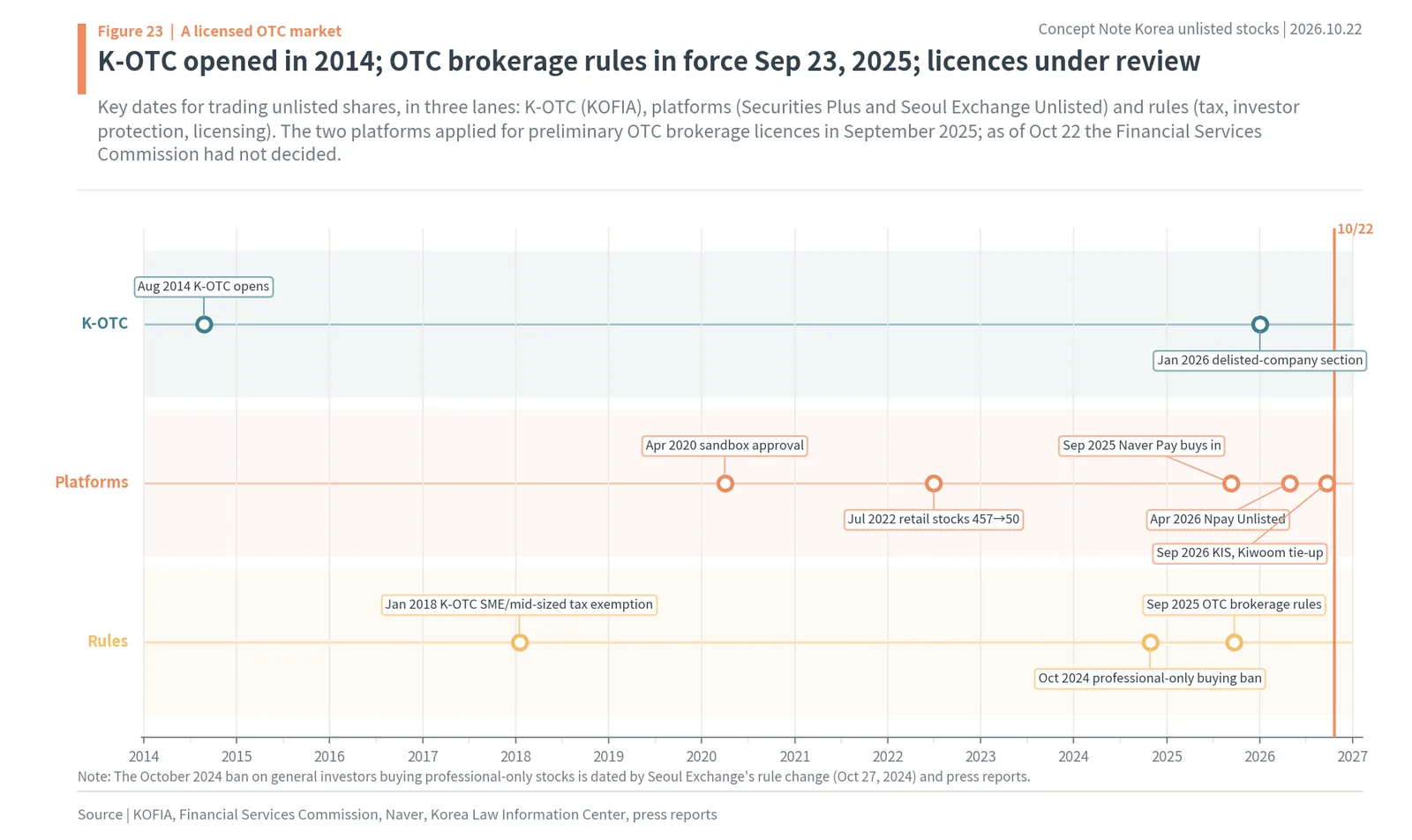
As the figure shows, from the launch of K-OTC in 2014 to the OTC brokerage rules taking effect on September 23, 2025, the process has reached licensing review. Even when licences are granted, what changes for general investors is a wider range of trade matching, not a much larger range of stocks they can buy. The principle that general investors can buy only general stocks, which carry disclosures, has been written into law.
How the numbers were built: OTC quotes are not trade prices, and the tax examples assume one sale a year
The numbers in this report have different bases depending on the source. This chapter gathers the bases to keep in mind when reading the conclusions.
OTC values
The OTC values for the 66 cases are 38 Communication quotes as reported in Etoday’s OTC market column. A quote is a price at which someone offered to buy or sell, and may differ from an actual trade price. Only companies with a quote and a price within 5 trading days before listing were kept, and companies with a later column reporting only a “change” without a price were dropped. Counting the 7 dropped companies too, for 73 in all, 55 still closed day one below the OTC quote, with a median of -19.2%. Companies that withdrew their listing are not in the sample. One month later means the close on the 21st trading day counting the listing day, and three months later the 61st; for companies with a bonus issue or stock split in between, prices were adjusted by the split ratio. Kurly’s OTC value is the daily reference price shown on Npay Unlisted (viewed October 22).
K-OTC figures
K-OTC annual trading value is the author’s sum of 2,996 days of daily trading value from KOFIA’s public statistics. 2014 starts from the August 25 launch. The sums match every reported annual and daily average figure (Bizwatch, Korea Capital Market Institute, FSC, Chosun Biz). Trading value by stock for 2026 adds up the monthly trading value of the 128 stocks now on K-OTC, so stocks that left K-OTC this year are excluded. The 128-stock total of KRW 817.75bn is almost the same as the market-wide total (KRW 818.12bn through October 21).
Tax examples
The tax examples assume a minority holder who buys for KRW 10mn and sells for KRW 20mn, with no other share sales that year. The purchase commission is added to the acquisition cost, and the sale commission and securities transaction tax are deducted as necessary expenses. After the KRW 2.5mn basic deduction, the rate is applied, and local income tax of one-tenth is added. The commission examples are Korea Investment & Securities’ online table (as of October 27, 2025) for listed stocks and K-OTC, and Shinhan Securities’ 0.75% for Seoul Exchange. Commissions differ by broker and account type, and losses on other shares in the same year are offset and reduce the tax. A mid-sized company means one under the Enforcement Decree of the Restriction of Special Taxation Act on the date of sale, and an SME one under the Framework Act on Small and Medium Enterprises at the end of the previous business year.
What could not be confirmed
Npay Unlisted’s official commission and any age limit for users could not be confirmed, so they are left out of the comparison. For the Seoul Exchange operating rules, the version published on its website for December 27, 2024 to June 22, 2026 was reviewed, and its figures (the KRW 300mn limit, ±30% and 8 a.m. to 6 p.m.) match the current guide and FAQ. The trading limits for general investors that each firm will set after OTC brokerage licensing have not been published yet. The FSS consumer alert does not give the number of victims or the amounts lost.
Six steps before you buy an unlisted stock in Korea: where to sell, share form, books, company price, volume, who pitched it
There are six checks to make before buying an unlisted stock. The conclusion of this chapter is that before asking whether the price is cheap or expensive, you should first check where you can sell the shares, whether they can move into a brokerage account, whether the company has proper books, how far the price is from the price the company recently set, how much trades in a day, and who pitched it to you. Below are the values for Kurly and this report’s calculations.
Step 1 is checking whether the stock trades on K-OTC. If it is on K-OTC and the company is an SME or mid-sized company, minority holders pay no capital gains tax. In terms of the cost of a KRW 10mn gain, SME and mid-sized company shares on K-OTC cost KRW 85,000, while large company shares on Seoul Exchange cost KRW 1,880,000. If the same stock trades on both K-OTC and a platform, K-OTC is the better place to sell. The list of K-OTC stocks is on KOFIA’s K-OTC website.
Step 2 is checking whether the shares are standardized share certificates or electronically registered. Search the company name on the KSD’s securities information portal, SEIBro, under Stock → Registration (deposit) eligibility → Registration (deposit) eligibility check, and it shows whether the shares can be deposited and in what form they were issued. Non-standard certificates cannot move between accounts, so the buyer has to register the transfer in the shareholder register, and without that registration cannot claim shareholder rights (Seoul Exchange FAQ). The OTC brokerage rules also require shares not deposited with the KSD to be handled as professional-only stocks.

Step 3 is finding the audit report on DART. The standards for K-OTC registration and for a platform’s general section are capital that is not fully impaired, sales of KRW 500mn or more and a clean audit opinion. Using the same yardsticks, look at sales, operating profit or loss, the state of capital and the audit opinion. Designated companies do not disclose on K-OTC, so the business report on DART is effectively the only information.
Step 4 is comparing the OTC price with prices the company has recently set. Prices such as the issue price in a share issue, the swap price in a share swap and the conversion price of convertible bonds appear in material event reports on DART. Kurly’s OTC reference price of KRW 24,900 was 37.6% of the KRW 66,148 Naver issue price. Conversely, if the OTC price is far above the latest investment price or the expected offer price, the gap may be cut at listing, as with the 66 companies in chapter 6.
Step 5 is comparing daily volume with market cap. Kurly traded an average of 900 shares a day over the past year, 0.0021% of its market cap. K Shipbuilding, the third-largest K-OTC stock by market cap, traded zero shares on October 21. Compare the amount you want to buy with daily trading value to estimate in advance how many days it would take to sell.
Step 6 is looking at who pitched the stock. If someone pitched it by social media or text with “listing soon,” first look for a registration statement on DART and a pre-listing review record on the Korea Exchange’s KIND. If more than 50 people are being solicited and there is no registration statement, be suspicious. If in doubt, ask the FSS (1332).
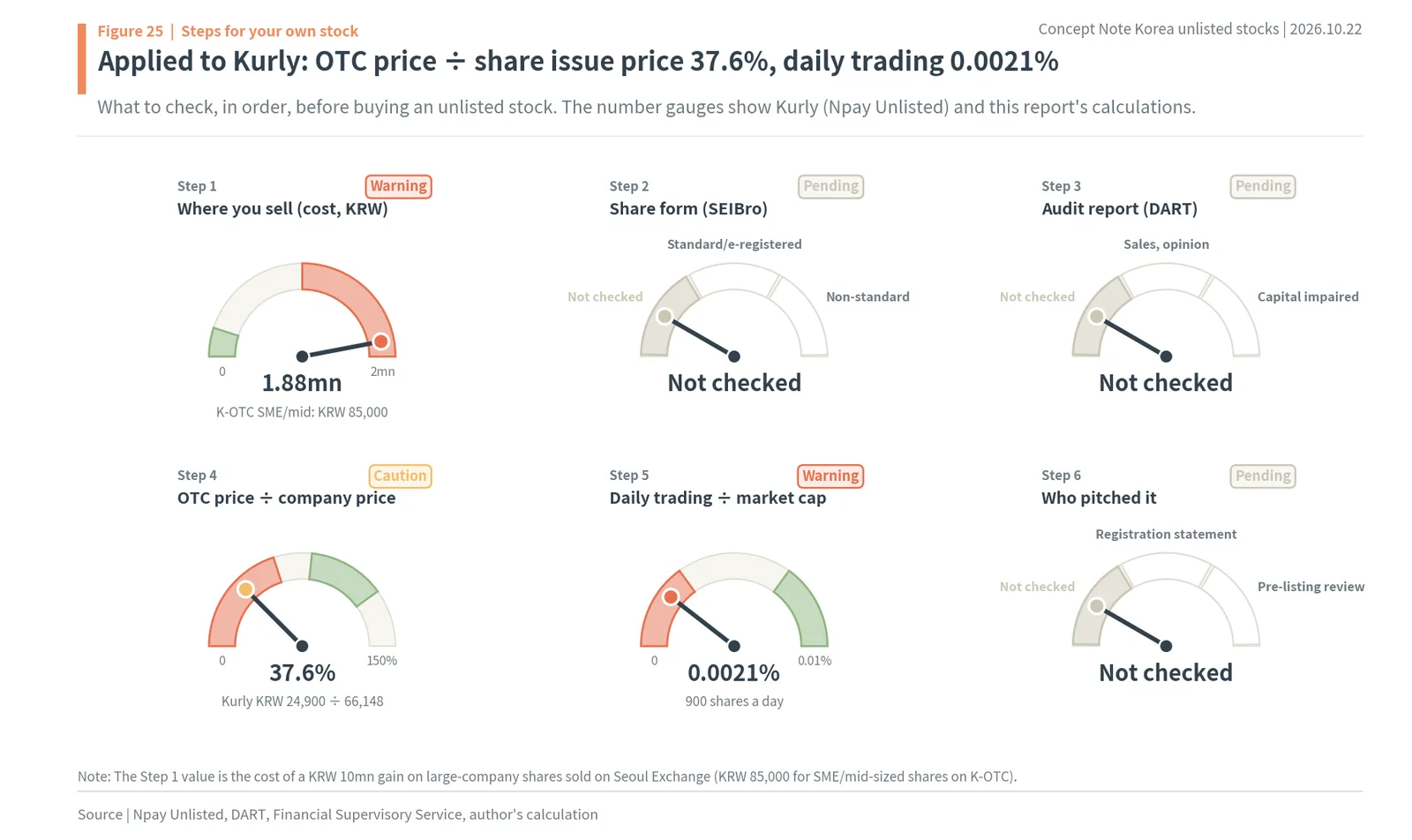
As the figure shows, for Kurly the OTC price is 37.6% of the share issue price, and daily trading is 0.0021% of the market cap. Only after these six steps is it time to ask whether the price is cheap or expensive.
Maochaedung’s take. In short, where you sell an unlisted stock sets the tax, and the OTC price is not the listing price. Minority holders pay 11% or 22% capital gains tax on unlisted shares unless they sell SME or mid-sized company shares on K-OTC, so the same KRW 10mn gain costs KRW 85,000 on K-OTC and KRW 1,880,000 for large company shares on Seoul Exchange. Of 66 companies that listed after trading over the counter, 65 set their offer price below the OTC quote and 50 closed day one below it. Unlisted stocks come with less information, are harder to sell and carry more tax than listed stocks, so the time spent checking those three things is the real cost of investing in unlisted stocks.
How to buy unlisted stocks in Korea FAQ
Q. Where can you buy unlisted stocks in Korea?
There are five routes: K-OTC, the over-the-counter market run by the Korea Financial Investment Association, which you use through an ordinary brokerage account; the Npay Unlisted and Seoul Exchange Unlisted apps, which route orders through linked brokers; direct deals between individuals; and crowdfunding or private funds, which buy new shares from the company. Each route has its own eligibility rules, taxes and protection.
Q. Do minority shareholders pay capital gains tax on unlisted stocks in Korea?
Yes, in principle. Including local income tax, the rate is 11% for SME shares and 22% for other shares, after a KRW 2.5mn annual basic deduction, and sellers must file the tax themselves. The exception is SME and mid-sized company shares that a minority shareholder sells on K-OTC, which are exempt. The exemption does not apply to Npay Unlisted or Seoul Exchange Unlisted.
Q. How much does it cost to realize a KRW 10mn gain on an unlisted stock?
Buying at KRW 10mn and selling at KRW 20mn, the commissions, transaction tax and capital gains tax add up to KRW 85,000 for SME or mid-sized company shares on K-OTC, KRW 887,000 for SME shares in a direct deal, KRW 1,088,000 for SME shares on Seoul Exchange and KRW 1,880,000 for large company shares on Seoul Exchange (author’s calculation).
Q. Who can buy professional-only unlisted stocks in Korea?
Only professional investors and those treated as equivalent. Since October 2024, general investors can only sell professional-only stocks they already hold. An individual becomes a professional investor with a KRW 50mn monthly average balance in financial investment products for at least one of the past five years plus KRW 100mn in income, KRW 500mn in net assets excluding the home, or a finance qualification. There were 26,282 at the end of July 2026.
Q. Do unlisted stocks rise when they list in Korea?
Not against the OTC price. Of 66 companies listed from July 2020 to September 2026 with an OTC quote just before listing, 65 set an offer price below that quote and 50 closed day one below it. The median first-day close was 18.2% below the OTC quote, and three months later 53 of 65 were still below it, with a median of -38.1%.
Sources
- Korea Law Information Center, Income Tax Act Article 94 (link) and Enforcement Decree Article 167-8 (link), current law as of Oct 22, 2026
- Korea Law Information Center, Securities Transaction Tax Act (link) and Enforcement Decree Article 5 (link)
- Korea Law Information Center, Restriction of Special Taxation Act Article 16 (link)
- KOFIA K-OTC, history (link), trading rules (link), trading costs (link) and registration and designation rules (link)
- KOFIA K-OTC, daily market statistics (link) and company count statistics (link), Aug 25, 2014 to Oct 21, 2026
- Korea Investment & Securities, commission table as of Oct 27, 2025 (link)
- Seoul Exchange, investor guide (link), FAQ 6 (link) and FAQ 17 (link)
- Naver, press releases on Naver Pay’s acquisition of Securities Plus Unlisted (link) and the Npay Unlisted rebrand (link)
- Npay Unlisted, App Store description (link) and Kurly page (link), viewed Oct 22, 2026
- Financial News, Npay Unlisted tie-up with Korea Investment & Securities and Kiwoom (link), Sep 22, 2026, and K-OTC trading concentrated in AriBio (link), Oct 7, 2026
- Sisa Economy, Npay Unlisted cross-broker trading (link)
- Digital Daily, Naver buys Dunamu’s remaining Naver Pay Unlisted shares (link), Jun 16, 2026
- Financial Services Commission, innovative financial service designation (link), Apr 1, 2020; regulatory change accepted (link), Mar 20, 2024; legislative notice (link), May 8, 2025; OTC brokerage decree (link), Sep 16, 2025; preliminary approvals (link)
- Financial Services Commission, plan for interim exits of unlisted SMEs and ventures (link), Nov 15, 2017; K-OTC launch plan (link), Jan 14, 2014; card news on unlisted stock trading (link), Jul 15, 2022
- Financial Supervisory Service, consumer alert 2026-1 on “listing soon” IPO fraud (link), Jan 12, 2026, and unlisted share sales cases (link), Sep 7, 2026
- Tax Times, NTS preliminary return guidance (link), Aug 5, 2026
- Korea Capital Market Institute, Capital Market Focus 2022-13 (link)
- Sidae, Securities Plus Unlisted cumulative trading (link), Dec 27, 2023
- Economist Korea, retail-eligible platform stocks cut (link), Jul 6, 2022
- MTN, sandbox extension with conditions (link), Mar 31, 2022
- Unicorn Factory (Money Today), professional-only stock rules (link), Oct 22, 2024
- Electronic Times, general investors lose access to some unlisted stocks (link), Nov 2024
- Money Today, individual professional investors (link), Sep 14, 2026, and SBS Biz (link), Sep 11, 2026
- KSD CrowdNet, crowdfunding issuance statistics (link), viewed Oct 22, 2026
- KSD SEIBro (link)
- Korea Exchange, KOSDAQ listing review guidebook 2025 (link)
- News Tomato, K-OTC launch (link), Aug 20, 2014
- Bizwatch, K-OTC trading value (link), Oct 2023
- Dealsite, OTC prices of 2023 IPOs (link), Feb 23, 2024
- Etoday, OTC market columns, May 2020 to Oct 2026, including APR (link) and K Bank (link)
- Seoul Economic Daily via Nate, OTC brokerage preliminary approval review (link), Aug 30, 2026
- Nate, Npay Unlisted rebrand (link), Apr 27, 2026
- DART, Kurly share issue (link), May 6, 2026; share swap (link), Oct 2, 2026; half-year report (link), Aug 12, 2026
- Digital Times, Kurly postpones its listing (link), Jan 4, 2023, and Edaily, Kurly passes pre-listing review (link), Aug 22, 2022
- Yahoo Finance, KRW=X exchange rate, Oct 21, 2026
- Photos: Narubaru7, “Korea Exchange 2025”, CC BY 4.0; Maskkwon, “NAVER Green Factory”, CC BY-SA 4.0; Minseong Kim, “South Korea National Tax Service (NTS)”, CC BY-SA 4.0; 김한솔20232780, Financial Supervisory Service building, CC BY-SA 4.0; Seoul Institute, “Government Complex Seoul Main Building”, CC BY 4.0; 註冊皇, “Share certificate”, CC BY-SA 4.0 (all Wikimedia Commons)
Was this note useful?
Thanks. Your answer helps decide what to cover next.
Korea market snapshot · Oct 23, 2026
New to Korean stocks? Start here for the basics.
Most read
1France Protests 2026: Why Students Are Blocking Schools and Which Stocks Benefit (Munich Re, SCOR)
Get the Saturday note on Korean stocks
One email every Saturday with the week’s new research on Korean listed companies and links to the updated data pages. Built from DART filings and KRX data. Free; unsubscribe in one click. See past issues