Kim Jong Un Death Rumor, Succession List and Korean Defense Stocks: Only Victek (065450.KQ) Moved on the Rumor, While the Real Day in 2011 Also Lifted YTN (040300.KQ)
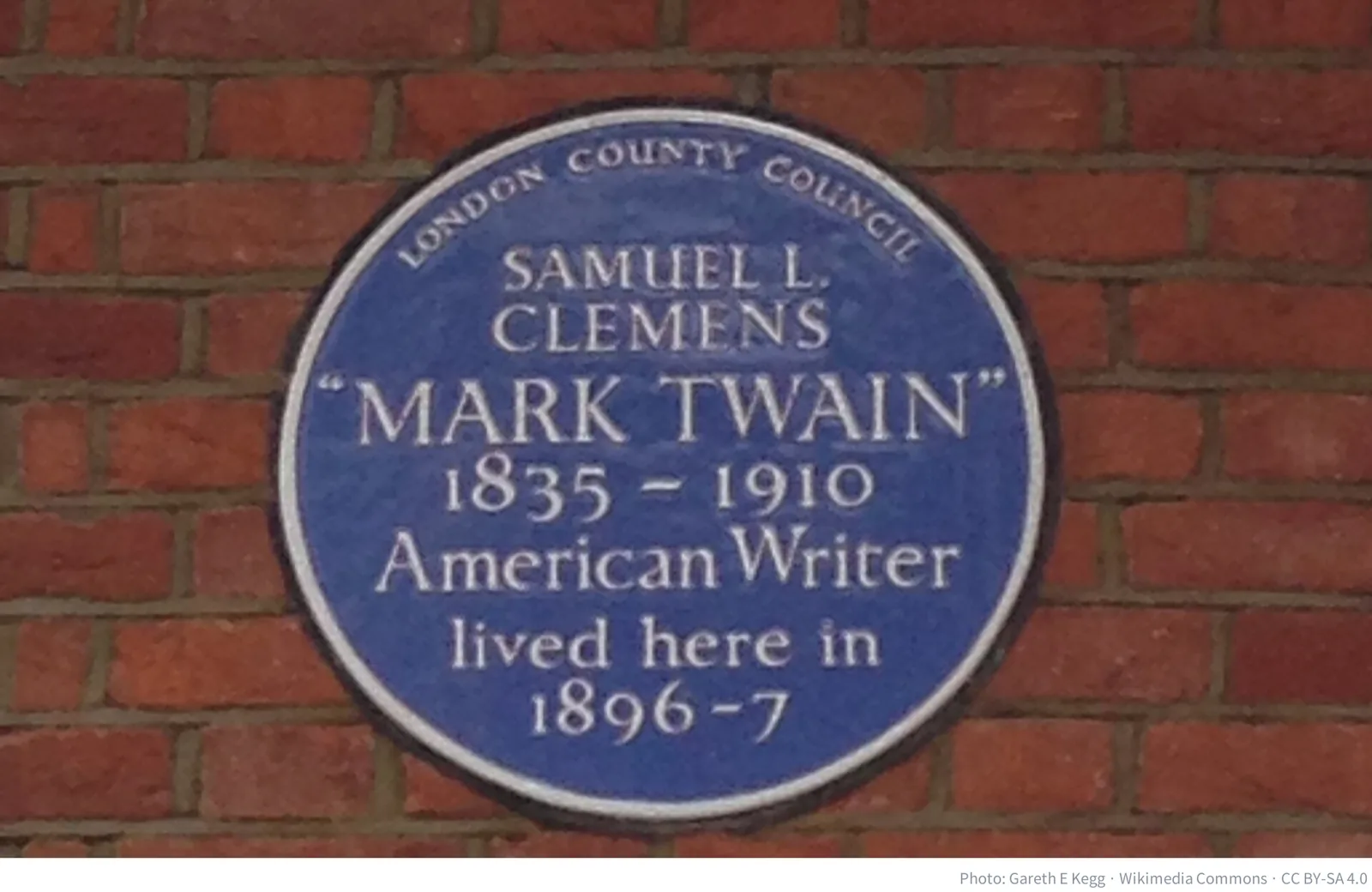
On May 28, 1897, the editors of the New York Journal cabled their London correspondent, Frank Marshall White. Reports said that Mark Twain, who was staying in London, was dying, and White was to check with the man himself. Twain was then living at 23 Tedworth Square in Chelsea. On May 31 he answered with a handwritten note. The person who had been seriously ill in London a few weeks earlier, he explained, was his cousin James Ross Clemens, who had since recovered, and at the end he added one sentence: “The report of my death was an exaggeration.” The note ran in the New York Journal on June 2. The version everyone repeats, “greatly exaggerated,” was added by other people later. What Twain actually wrote was plainer.
One hundred and twenty-nine years later, on October 19, 2026, a rumor that Kim Jong Un had died of a brain hemorrhage spread across social media outside Korea, and British and American tabloids repeated it. North Korea answered with photos instead of a note. On October 20 the Rodong Sinmun and the Korean Central News Agency (KCNA) ran pictures of Kim touring the “National Clothing and Footwear Exhibition 2026” in Pyongyang the day before, with his wife Ri Sol Ju and his daughter Ju Ae. They did not say a word about the rumor.
So what about this time? The rumor ended with a set of photos, but on the same day one Korean defense stock rose almost 11% while large defense stocks and the KOSPI fell hard. This report asks three questions. What was this death rumor, and what is the real state of Kim Jong Un’s health and succession? How did the market price past health rumors about North Korea’s leaders differently from real events? And if a real day does come, what rises, and which hidden winners do people tend to overlook?
As of: October 20, 2026
Stocks covered: small defense stocks Victek (065450.KQ), SPECO (013810.KQ), Firstec (010820.KS), Huneed Technologies (005870.KS) and Hanil Forging (024740.KQ); large defense stocks Hanwha Aerospace (012450.KS), Korea Aerospace Industries (KAI, 047810.KS), Hyundai Rotem (064350.KS), LIG Defense & Aerospace (LIG D&A, 079550.KS), Hanwha Systems (272210.KS) and Poongsan (103140.KS); inter-Korean cooperation stocks Hyundai Elevator (017800.KS), Ananti (025980.KQ), GOODPEOPLE (033340.KQ), Shinwon (009270.KS), In the F (014990.KS), DAEA TI (045390.KQ) and Busan Industrial (011390.KS); and the names outside defense that moved on the day Kim Jong Il’s death was announced in 2011: news channel YTN (040300.KQ), gas-pipe steel makers KBI Dongyang Steel Pipe (008970.KS) and Histeel (071090.KS), and ramen makers Samyang Foods (003230.KS), Nongshim (004370.KS) and Ottogi (007310.KS).
Topics covered: where this death rumor came from and how it spread, North Korea’s response, the history of health news about North Korea’s leaders since 2008, the National Intelligence Service’s assessment of Kim Jong Un’s health and his family history, his absences from public view, the succession list led by Kim Ju Ae and Kim Yo Jong, a comparison with Kim Jong Un’s own succession, an event study of six days (two real, two rumors, two reappearances), stock-by-stock moves on October 20, the hidden winners that moved only on the real day and their market caps today, the signals that separate a real day from a rumor, dates to watch, and how the numbers were counted.
Data: share prices and indexes are Korea Exchange (KRX) Data System adjusted closes from January 2, 2008 to October 20, 2026, and the 2011 market caps and market-wide daily prices also come from the KRX. The National Intelligence Service’s assessments follow press reports of its briefings to the National Assembly (Weekly Kyunghyang, Maeil Shinmun, YTN, Herald Economy, RFA, Segye Ilbo). North Korean reports follow KCNA as carried by Newsis and News Tomato, and the October 19 rumor follows Weekly Kyunghyang, the Seoul Economic Daily, New Daily, Newsway and Seoul Shinmun. Numbers the author calculated are marked “author’s calculation.”
Some Korea-specific background. The KOSPI is the main board of the Korea Exchange and its benchmark index; the KOSDAQ is its growth-company board. Tickers ending in .KS trade on the KOSPI and .KQ on the KOSDAQ. Korean stocks have a daily price limit: a stock can move at most 30% from the previous close in one day, and the limit was 15% until 2015. A stock that rises the full limit is said to hit its daily upper limit. Korean financial media run “featured stock” articles every day on shares with unusual moves. The NIS is South Korea’s National Intelligence Service, which briefs the National Assembly’s intelligence committee in closed sessions; lawmakers then relay what it said. Korea counts large sums in units of 100 million won (eok); this report shows them as KRW bn. Dollar figures use KRW 1,326.4 per dollar, the October 20, 2026 rate (Yahoo Finance).
1. The Kim Jong Un death rumor was a claim without evidence that spread through foreign media, and North Korea erased it with photos within a day
A few terms first
A few words come up again and again in this report. Excess return is a stock’s return over a period minus the return of the market index it belongs to (the KOSPI or the KOSDAQ) over the same period, measured in percentage points (pp). A stock that fell 1% on a day the whole market fell 3% has an excess return of +2pp. To see only what North Korean news did to a stock, the market’s own move has to be taken out, so most market numbers in this report are excess returns.
Events fall into three kinds. A real day is a day on which a leader’s illness or death was confirmed as fact: September 10, 2008 (the day the NIS told the National Assembly about Kim Jong Il’s stroke) and December 19, 2011 (the day North Korea announced Kim Jong Il’s death). A rumor day is a day on which talk of a health problem first reached the market and later ended unconfirmed: April 21, 2020 (CNN’s report that Kim Jong Un was gravely ill) and October 20, 2026 (this death rumor). A reappearance day is the first trading day after the leader reappeared in public at the end of a rumor: October 14, 2014 (his return with a cane after 40 days) and May 4, 2020 (the first trading day after he appeared at the Sunchon phosphatic fertilizer plant). The stocks fall into five small defense stocks, six large defense stocks, seven inter-Korean cooperation stocks, and the news, gas-pipe and ramen stocks that moved outside defense in 2011.
Ten days in order: eight days unseen, two days of rumor, photos within a day
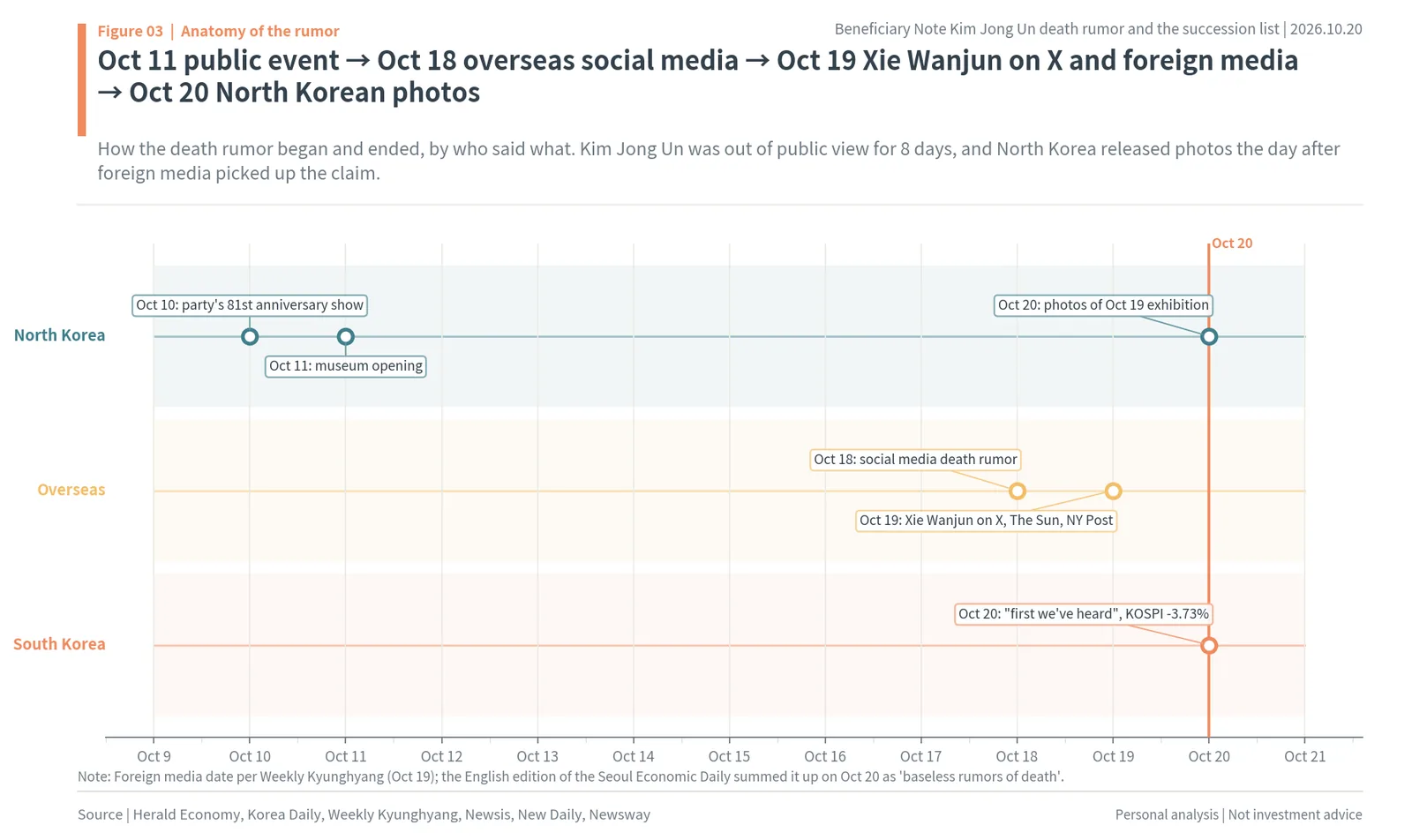
This episode began with a gap in Kim Jong Un’s public appearances. On October 10 he watched a celebration performance at the Pyongyang Gymnasium for the 81st anniversary of the Workers’ Party, with Ri Sol Ju and Ju Ae. There was no military parade and no speech that day. On October 11 he attended the opening of the Second Economic Committee’s National Defense Revolution Museum. After that, North Korean media stopped reporting his public activities.
From October 18, social media outside Korea started to carry talk that he had collapsed. On October 19 Xie Wanjun, a Chinese dissident living in the United States, posted a detailed claim on X. Kim Jong Un had fallen into a coma after a severe brain hemorrhage, he wrote; North Korea had asked China for help, and doctors from Peking Union Medical College Hospital had flown to Pyongyang on the 17th; Kim had been moved to Beijing for treatment and died there; his body had been secretly returned to North Korea; his sister Kim Yo Jong had taken power; and 9,000 Chinese troops had entered Pyongyang in case of civil war over the succession. No evidence came with any of it, no medical records and no witnesses.
The same day Britain’s The Sun and the New York Post reported the claim, and India’s Economic Times carried it too. Once it had the names of foreign outlets attached, it spread to Indian, Ukrainian and Turkish media. On October 20 the English edition of the Seoul Economic Daily summed the episode up under the headline “Baseless Rumors of Kim Jong-un’s Death Spread Again Abroad.”
North Korea answered with photos. On October 20 the Rodong Sinmun, KCNA and Korean Central TV released pictures of Kim Jong Un touring the National Clothing and Footwear Exhibition 2026 in Pyongyang on the 19th. He was shown looking at children’s shoes, examining women’s clothes and talking with officials, with Ri Sol Ju and his daughter Ju Ae beside him. It was his first public activity in eight days, since the museum opening on October 11. There is no way to check from outside when the photos were taken, but North Korean media did not mention the death rumor alongside them.
The South Korean government’s reaction was brief. Officials at the foreign affairs and security ministries, quoted by Yonhap, called the report “the first we’ve heard of it” and “absurd.” Neither the NIS nor the Ministry of Unification issued a statement. Former lawmaker Chang Sung-min judged a death unlikely because flags had not been lowered to half-mast in Pyongyang or at the North’s guard posts along the border. In Washington, President Trump, asked at a White House press conference on the 19th whether he might meet Kim Jong Un around the APEC summit in Shenzhen next month, said only that he did not know.
The ten days in one picture
Figure 3 lays the ten days from the October 10 performance to the October 20 photos in three lanes: North Korean media, overseas social media and foreign press, and South Korea. As the title shows, the order was a public event on October 11, overseas social media on October 18, Xie Wanjun’s post on X and foreign media on October 19, and North Korean photos on October 20. The blank stretch in the North Korean lane is the eight-day absence; the rumor came in at the end of that blank and was closed by photos two days later. The South Korean lane shows the officials’ “first we’ve heard of it” and the KOSPI’s fall on the same October 20, but as Chapter 5 shows, the KOSPI fell for reasons other than the rumor.
Who said it: Xie Wanjun’s record
A rumor weighs what its source’s record weighs. Xie Wanjun calls himself the chairman of the China Democracy Party, and Weekly Kyunghyang noted that the title can hardly be taken to represent the Chinese dissident movement as a whole. In recent years he has put out unverified claims several times. In 2024 he spread an image of Xi Jinping being helped out of a meeting hall, which RFA identified as a satirical composite. In September 2026 he claimed Xi had fainted at the BRICS summit in India, which did not match China’s official accounts. On October 15, four days before this rumor, he claimed pneumonic plague was spreading in China. This time too he kept repeating “it is said” (据传) without naming any original source, and when the North Korean photos came out he said the same day that they were “recycled old photos,” again without evidence. Weekly Kyunghyang concluded that it was “reasonable to treat” the claim as “unverified information that is hard to trust.”
Not the first time: since 2008, two real events and four rumors
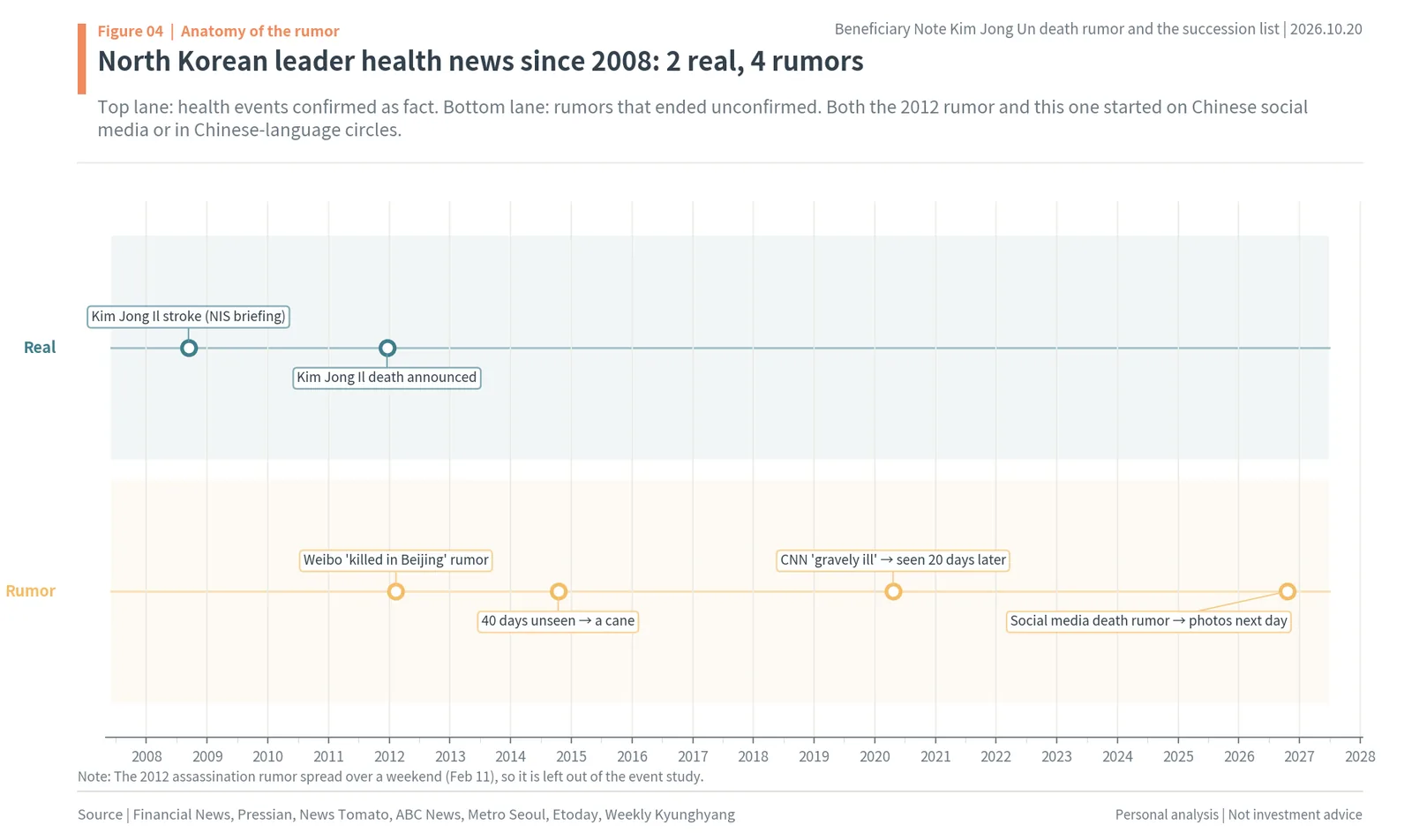
This is not the first health rumor about a North Korean leader. Since 2008 alone there have been two health events confirmed as fact and four rumors that ended unconfirmed. The real ones were Kim Jong Il’s stroke in 2008 and his death in 2011. The rumors were the February 2012 claim, started on China’s Weibo, that Kim Jong Un had been killed in Beijing; talk of a serious illness during his 40-day disappearance in September and October 2014; the “gravely ill” rumor that grew out of CNN’s April 2020 report; and this death rumor.
The 2012 assassination rumor looked a lot like this one. On February 11, 2012, ABC News reported that US officials said there was no basis for reports, which started on Chinese social media and spread on Twitter, that Kim Jong Un had been assassinated. It began on Chinese-language social media and spread under the names of foreign outlets without confirmation from major media or governments, just as this one did. Because it circulated over a weekend, the market’s first reaction on a trading day cannot be isolated, so it is left out of the event study.
Figure 4 places these six episodes on two lanes. As its title says, health news about North Korea’s leaders since 2008 has been real twice and rumor four times. Both real events happened under Kim Jong Il; all four health stories since Kim Jong Un took power have ended as rumors. And all four ended the same way: North Korean media reported a new public activity, and the rumor closed.
Only two facts about this rumor are confirmed: Kim Jong Un did not appear in North Korean media for the eight days from October 11 to 19, and North Korea released photos of the exhibition on the 19th. Nothing supports a death or a brain hemorrhage. But a false rumor does not mean his body is healthy. The next chapter looks at his health through official assessments, not rumors.
2. The rumor was wrong, but official assessments still rate Kim Jong Un’s health as high-risk, and the family history is heart disease
What the NIS said on September 30
The most recent official assessment of Kim Jong Un’s health is the NIS briefing three weeks before this rumor. At a closed session of the National Assembly’s intelligence committee on September 30, 2026, the NIS described Kim as “severely obese in the 140kg range” and in a high-risk group for disease. The committee’s ranking members, Yoon Kun-young of the Democratic Party and Yoo Young-ha of the People Power Party, relayed this in a briefing. The same report said he moved without difficulty, running up stairs while inspecting a destroyer, that a dedicated medical team was managing him closely, and that there were “no particular” signs of a health problem. High risk and no current warning signs were assessed side by side.
In the same briefing the NIS said Kim’s public activities this year numbered 121, up 30% from the same period last year. It also judged that, with North Korea feeling out talks with the United States, he had cut back on provocative activities such as weapons tests and observing drills. His public schedule as a whole has been busy, and the eight-day gap from October 11 to 19 is a short pause within that pattern.
His weight has risen by more than 50kg since he took power
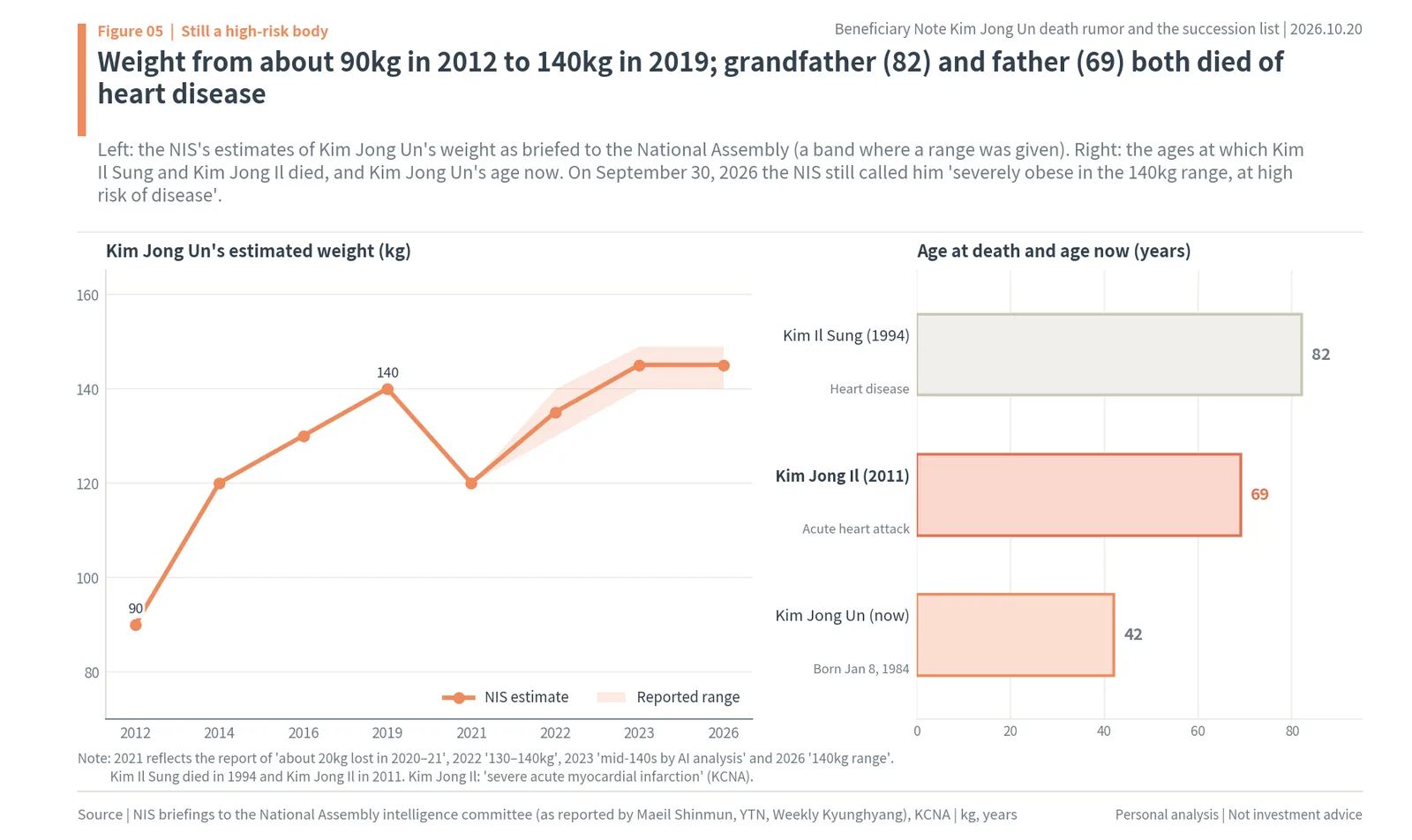
String together the weight estimates the NIS has given the National Assembly year after year and you get the left-hand line in Figure 5. About 90kg in 2012, his first full year in power, became 120kg in 2014, 130kg in 2016 and 140kg in 2019. In 2020 and 2021 he lost about 20kg, falling to around 120kg, then went back up to 130 to 140kg in 2022. On May 31, 2023 the NIS used AI analysis to put his weight in the mid-140s, and in the same briefing it pointed to a sleep disorder, citing signs that North Korea had been gathering information abroad on insomnia treatments such as zolpidem. In September 2026 it again put him in the 140kg range.
The right side of Figure 5 is family history. His grandfather Kim Il Sung died in 1994 at 82, and his father Kim Jong Il in 2011 at 69, both of heart-related illness. North Korea gave Kim Jong Il’s cause of death as “severe acute myocardial infarction.” Kim Jong Un, born on January 8, 1984, is now 42. As the figure’s title puts it, his weight went from about 90kg in 2012 to 140kg in 2019, and his grandfather (82) and father (69) both died of heart disease.
His father lived three years and four months after his stroke
Kim Jong Il’s last years show how a real health event unfolds. After a report of an army unit inspection on August 14, 2008, he vanished from public view. He did not attend the September 9 parade for the 60th anniversary of the founding of the state, although he had attended all ten parades held since 1991. In September 2008 the NIS told the intelligence committee that he had undergone surgery for a cerebrovascular disease and that afterward he could speak without impairment and move around. North Korea did not release a photo of him, watching a football match, until November 2, without giving the date or place it was taken. From his last reported public appearance to the new photo was 80 days.
He lived three years and four months after that. At 8:30 a.m. on December 17, 2011, North Korea later said, he suffered a severe acute myocardial infarction, complicated by cardiogenic shock, on his field train while traveling to give on-site guidance. The announcement came in a special broadcast at noon on December 19, 51 hours and 30 minutes after his death. When Kim Il Sung died in 1994, the announcement took 34 hours.
Days unseen: 80, 41, 20, and now 8
Health rumors usually grow out of a gap in public appearances. Figure 6 shows each gap, from the last reported public activity to the day the leader was seen again. In 2008 Kim Jong Il was gone 80 days (August 14 to November 2), and he really had had a stroke. In 2014 Kim Jong Un disappeared after watching a Moranbong Band concert on September 3 and reappeared on October 14, walking with a cane in his left hand as he inspected a housing complex for satellite scientists: 41 days, during which talk ranged from gout and ankle surgery to a grave illness and a coup. In 2020 he chaired a Politburo meeting on April 11, then on April 15, for the first time since taking power, missed the visit to the Kumsusan Palace of the Sun on his grandfather Kim Il Sung’s birthday (the Day of the Sun). Rumors followed of a cardiovascular procedure, heart surgery, brain death and finally death. He appeared at the completion ceremony of the Sunchon phosphatic fertilizer plant on May 1: 20 days. As the title says, the gaps were 80 days in 2008, 41 in 2014, 20 in 2020 and 8 this time.
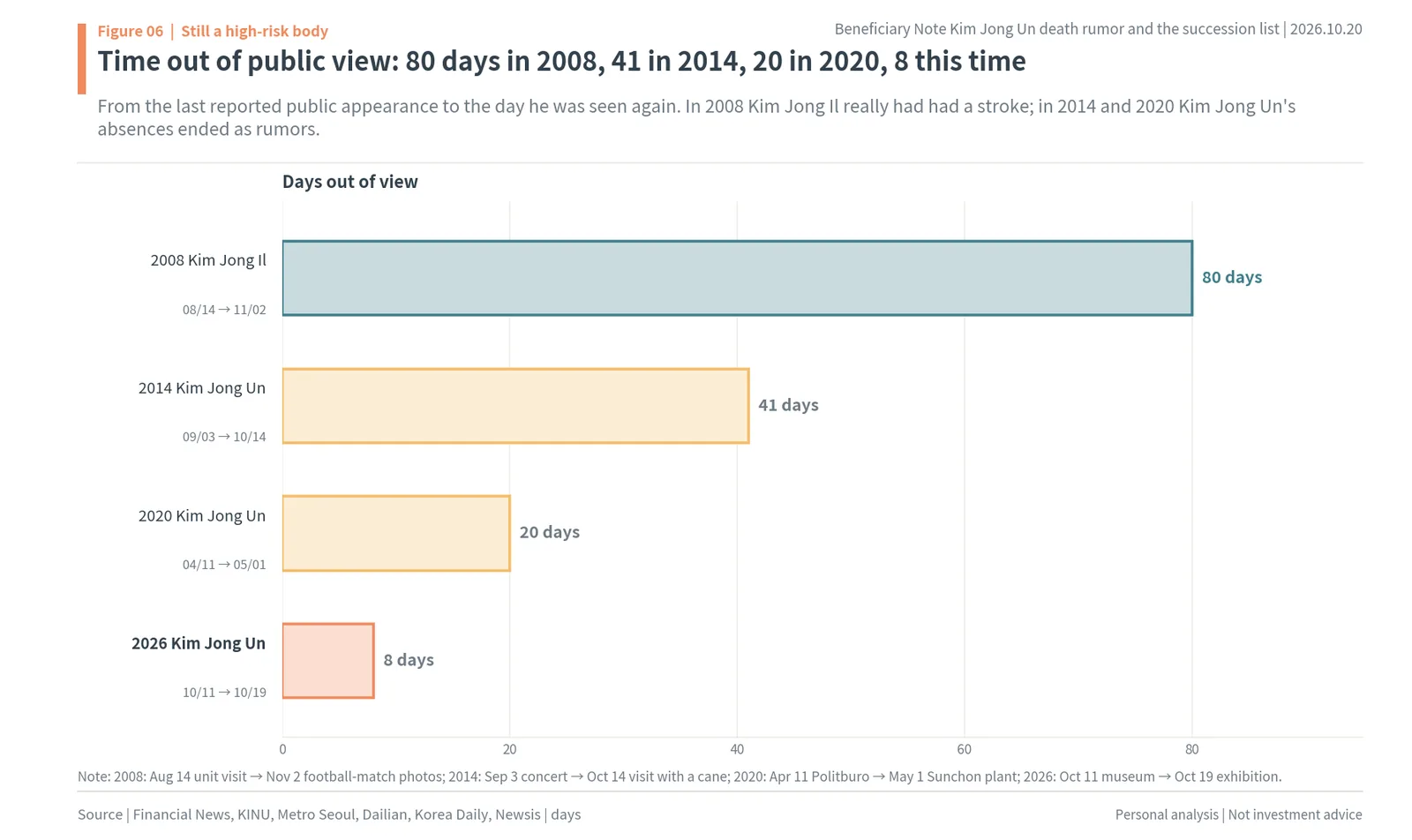
This eight-day gap is less than half the shortest of the earlier three, the 20 days of 2020, and a tenth of the 80 days of 2008, when there was a real illness. The shorter the gap, the less time a rumor has to grow. This rumor appeared on the seventh day of the gap and closed when his activity on the eighth day appeared in photos on the ninth.
Two men lie in the Kumsusan Palace of the Sun, and what comes after them
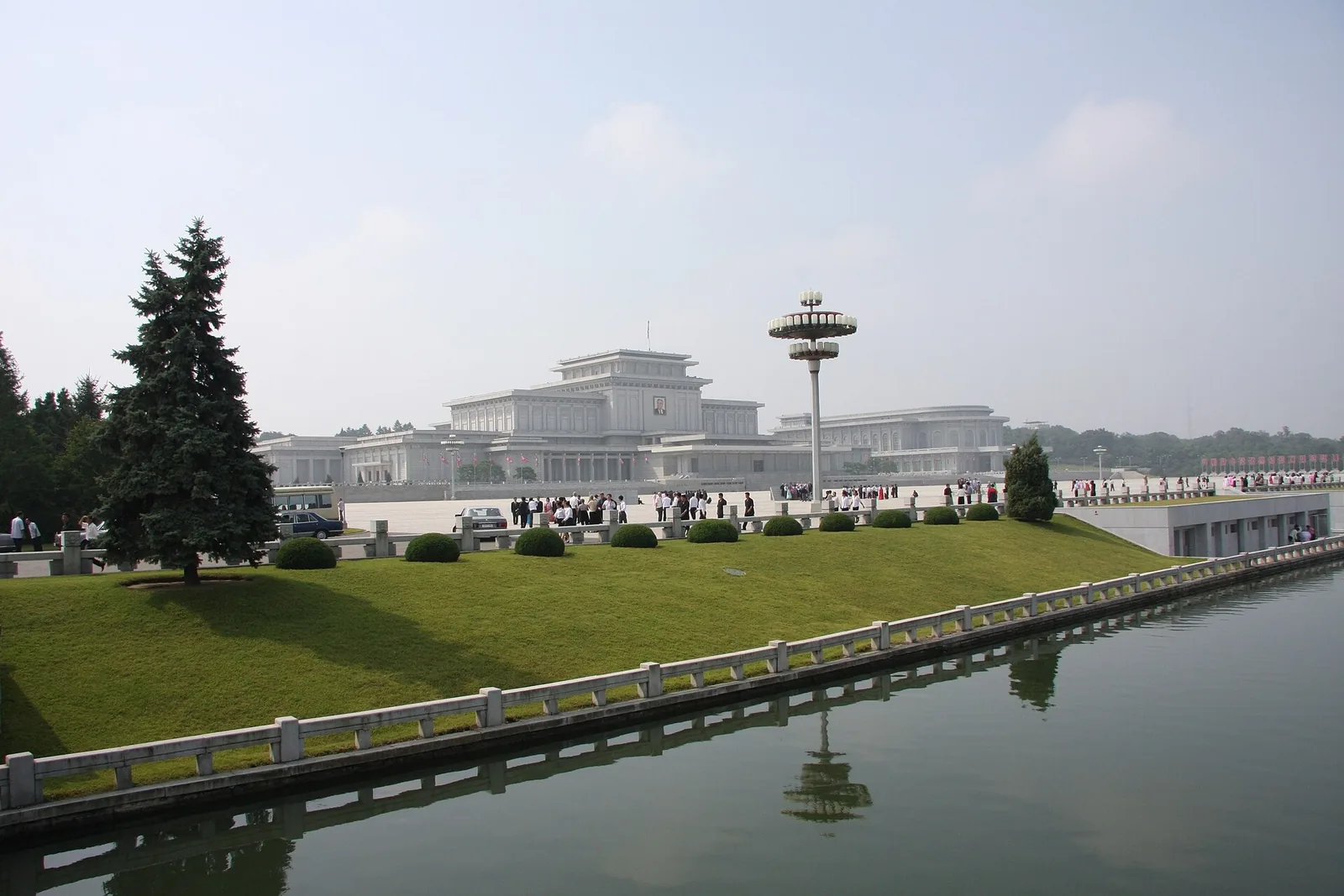
The bodies of Kim Il Sung and Kim Jong Il lie in state at the Kumsusan Palace of the Sun in Pyongyang. Kim Jong Un’s family visited it on January 1 this year, and the 2020 rumor started when he skipped his visit there on the Day of the Sun. As Chapter 3 shows, it is also where Kim Ju Ae’s place at the very center of the January 1 visit was read as a succession signal.
In short, the rumor was wrong, but the official assessment of his health is high-risk. There is a weight in the 140kg range, a grandfather and a father who both died of heart disease, and a record of the father living three years and four months from his stroke to his death. The NIS also said there are no current warning signs, so none of this says anything about the near future. But why North Korea is hurrying the succession, and why the market reacts to this kind of rumor year after year, both come out of this medical record. So the next question is succession.
3. No. 1 on the succession list is Kim Ju Ae and No. 2 is Kim Yo Jong, and this time the face is shown before the title
No. 1: Kim Ju Ae, first seen at a missile launch at about age 9
Kim Ju Ae first appeared in public in November 2022. Kim Jong Un brought his young daughter to the test launch of the Hwasong-17 intercontinental ballistic missile at Pyongyang’s Sunan airport. North Korean media did not give her name, calling her only his “beloved child,” and the NIS later identified her as his second daughter, Kim Ju Ae. The NIS estimates that she was born in 2013. Her name first came from Dennis Rodman: the former basketball player, who visited Pyongyang in 2013, told Britain’s The Guardian that he had held their daughter Ju Ae. That makes her about 9 at her first appearance and about 13 now.
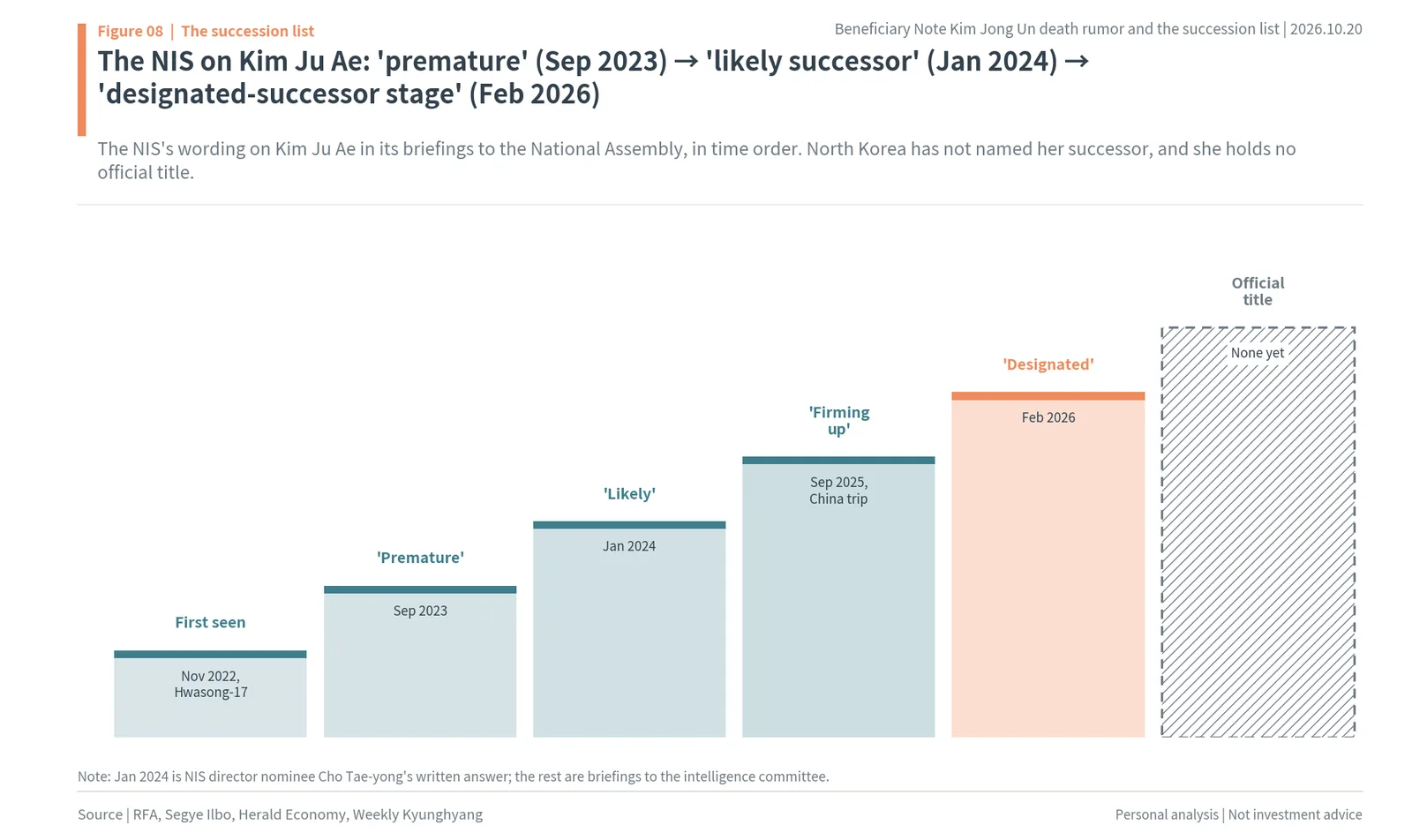
The NIS’s assessment has moved up one step at a time over several years. In September 2023 it said it was “premature” to judge her the successor. In January 2024 Cho Tae-yong, then nominee for NIS director, wrote in answers to the National Assembly that Kim Ju Ae was “the likely successor for now,” adding that Kim had another child whose sex was unknown. In September 2025 the NIS said she had “firmed up her position as likely successor” by accompanying Kim on his trip to China. Then on February 12, 2026, it told a closed session of the intelligence committee that Kim Ju Ae had entered the “designated-successor stage,” one step beyond the “successor training” it had used until then. As grounds it cited her growing presence at events such as the army founding anniversary and the visit to the Kumsusan Palace of the Sun, and signs that she was giving her views on some policies. As the title of Figure 8 says, the NIS’s assessment of Kim Ju Ae rose from “premature” (Sep 2023) to “likely” (Jan 2024) to the “designated-successor stage” (Feb 2026).
The September 30 briefing went a step further. For the first time the NIS gave personal figures for Kim Ju Ae: 160cm tall and over 50kg. It said she had stood at the very center during the January 1 visit to the Kumsusan Palace, that her protocol rank had risen, and that “her position as designated successor is strengthening.” She has made 30 public appearances this year, the most ever, and she was there at the October 10 party anniversary performance and in the October 19 exhibition photos.
No. 2: Kim Yo Jong, a minister-level party department director since the Ninth Party Congress
No. 2 is Kim Jong Un’s sister, Kim Yo Jong. On February 23, 2026, during the Workers’ Party’s Ninth Congress, she was made director of a party department, a minister-level post. On February 28 KCNA reported that she had received a sniper rifle from Kim Jong Un and called her “director of the General Affairs Department of the Party Central Committee.” The General Affairs Department handles party directives and internal documents. Kim Ju Ae had been at the event the day before, February 27, when Kim Jong Un handed sniper rifles to officials and fired at a shooting range, and on the 28th North Korean media ran an unusual solo photo of her in a leather coat, aiming a rifle.
One of the claims in this death rumor was that Kim Yo Jong had seized power. The October 20 photos showed Kim Jong Un, Ri Sol Ju and Ju Ae, and nothing has emerged to support a takeover by Kim Yo Jong. She continues to deliver the regime’s messages to the outside world; on October 2, for example, she issued a statement attacking South Korean President Lee Jae-myung’s Armed Forces Day speech.
Who stayed and who left
The outer ring of the list is the party leadership. The Ninth Congress elected members and alternate members of the Central Committee on February 22 and published the list on the 23rd. Choe Ryong Hae, long No. 2 in official protocol rankings, was missing from both lists. Premier Pak Thae Song and party secretaries Jo Yong Won and Ri Il Hwan stayed. The faces of the leadership beneath Kim Jong Un are changing. This report does not guess who would take on what if he were incapacitated; it records only the positions that have been confirmed.
How it differs from Kim Jong Un’s own succession: decision before announcement, face before title
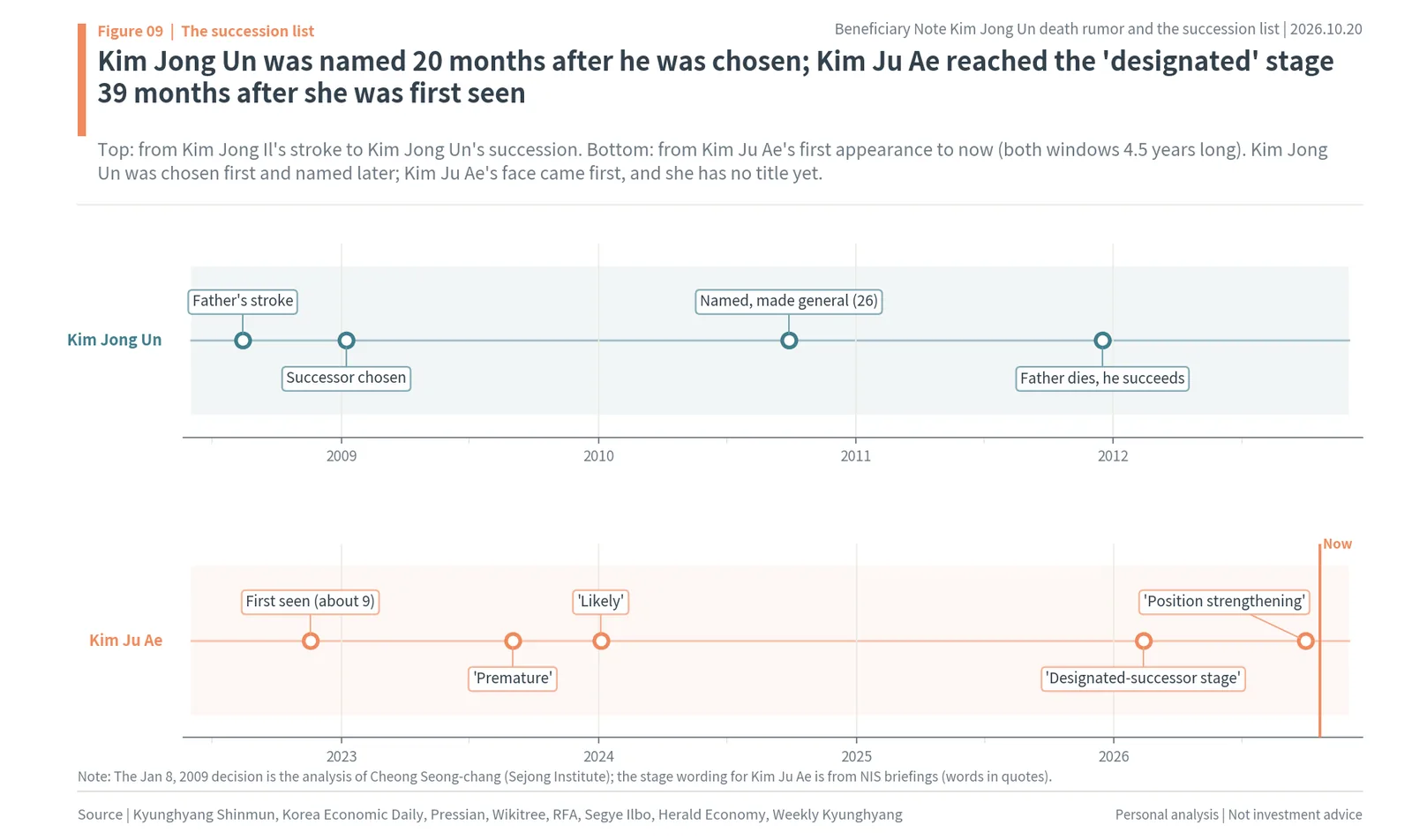
The pace of this succession can be compared with Kim Jong Un’s own. Kim Jong Il collapsed with a stroke in August 2008. Five months later, on January 8, 2009, the North Korean leadership chose Kim Jong Un as successor, according to the analysis of Cheong Seong-chang of the Sejong Institute. But his name did not come out until 20 months after that. On September 27, 2010, Kim Jong Il gave him the rank of general, and KCNA announced it on the 28th. At the Third Party Conference held the same day he became vice chairman of the party’s Central Military Commission, a post reportedly created for him. He was 26. Observers said Kim Jong Il’s failing health had hurried the formal unveiling of the succession. Fifteen months later his father died and he took over.
Kim Ju Ae’s path runs the other way. Her face came first, and she still has no title. From her first appearance (November 2022) to the NIS’s “designated-successor stage” (February 2026) took 39 months, and North Korean media have called her only “daughter Ju Ae” throughout. As the title of Figure 9 says, Kim Jong Un’s name came out 20 months after he was chosen, and Kim Ju Ae reached the “designated” stage 39 months after she was first seen. The top and bottom lanes are drawn over windows of the same length.
The difference matters for the market too. When Kim Jong Il died in 2011, the market already knew a successor who had been public for more than a year. Today No. 1 on the list is a daughter of about 13 with no official title. If a real day comes, the question of who takes over will hang larger than it did in 2011, and the size of that question mark will set the size of the market’s reaction. What that reaction looked like in the past is the subject of the next chapter.
4. North Korea stocks priced rumors until the leader reappeared, and real events for 20 trading days
Six days, one yardstick
Featured-stock articles show which stocks react to health news about North Korea’s leaders, but they quote intraday prices and pick different stocks each day. So this report measures six days again on KRX closing prices: two real days (September 10, 2008 and December 19, 2011), two rumor days (April 21, 2020 and October 20, 2026) and two reappearance days (October 14, 2014 and May 4, 2020). News that came out after the close or over a weekend is dated to the next trading day. In 2008, Kim Jong Il’s absence from the parade and talk of a health problem were reported on the night of September 9 and the NIS briefing came on the 10th, so the event day is the 10th. In 2011 the noon special broadcast came during trading, so the event day is the 19th itself. In 2020, CNN’s report of April 20 US time reached Korea during trading on the 21st, and the reappearance was reported on Saturday, May 2, so its event day is Monday, May 4.
The stocks are 24 names in six groups. The small defense stocks are Victek, SPECO, Firstec, Huneed Technologies and Hanil Forging, whose names show up in featured-stock articles whenever there is North Korean news. The large defense stocks are Hanwha Aerospace, Korea Aerospace Industries, Hyundai Rotem, LIG D&A, Hanwha Systems and Poongsan; a company is left out of events that happened before it listed. The inter-Korean cooperation stocks are Hyundai Elevator, Ananti, GOODPEOPLE, Shinwon, In the F, DAEA TI and Busan Industrial. The remaining three groups are the names outside defense that appeared in featured-stock articles on the day Kim Jong Il’s death was announced in 2011: news channel YTN, gas-pipe steel makers KBI Dongyang Steel Pipe and Histeel, and ramen makers Samyang Foods, Nongshim and Ottogi.
How did the KOSPI do on those days? On September 10, 2008 the KOSPI rose 0.72% and the KOSDAQ fell 0.84%. On December 19, 2011 the KOSPI fell 3.43% and the KOSDAQ 5.35%, and the next day they bounced 0.91% and 2.51%. The KOSPI rose 0.11% on the 2014 reappearance day, fell 1.00% on the 2020 rumor day and fell 2.68% on the 2020 reappearance day. This October 20 the KOSPI fell 3.73% and the KOSDAQ 3.33%. The first thing to notice is that even the shock to the index from an actual death announcement lasted one day.
Event day: the same small defense stocks, for different reasons
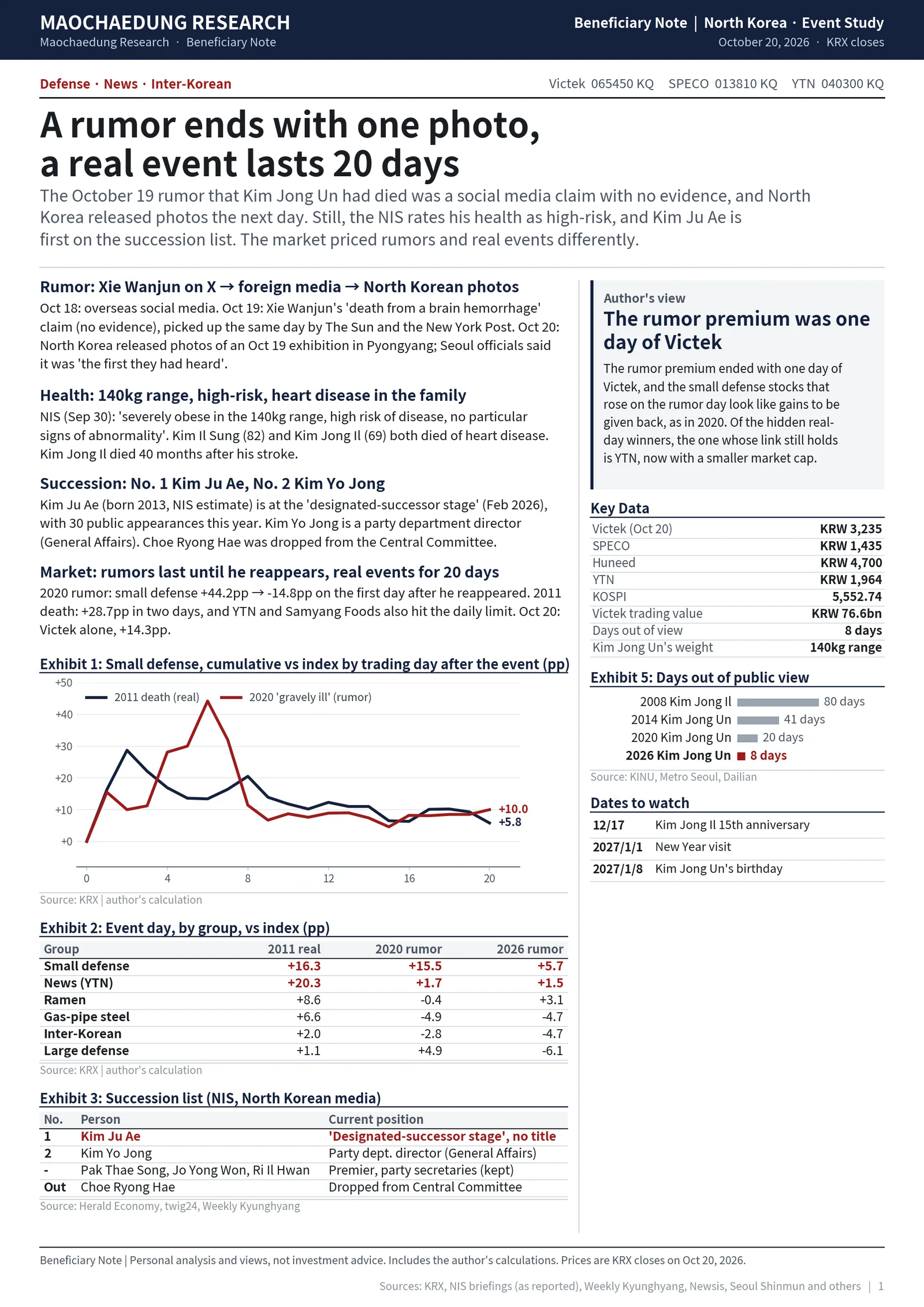
Figure 11 puts each group’s excess return on each of the six event days in one grid. The greener a cell, the more the group beat the index; the redder, the more it lagged. In the small defense row, the real day of 2011 (+16.3pp) and the rumor day of 2020 (+15.5pp) are almost the same size. As the title says, on the event day alone small defense stocks were +16.3pp on the real day in 2011 and +15.5pp on the 2020 rumor, and -14.8pp on the reappearance day (May 4, 2020). All five rose on four of the days (2008, 2011, the 2020 rumor and 2026) and all five fell on two (2014 and the 2020 reappearance).
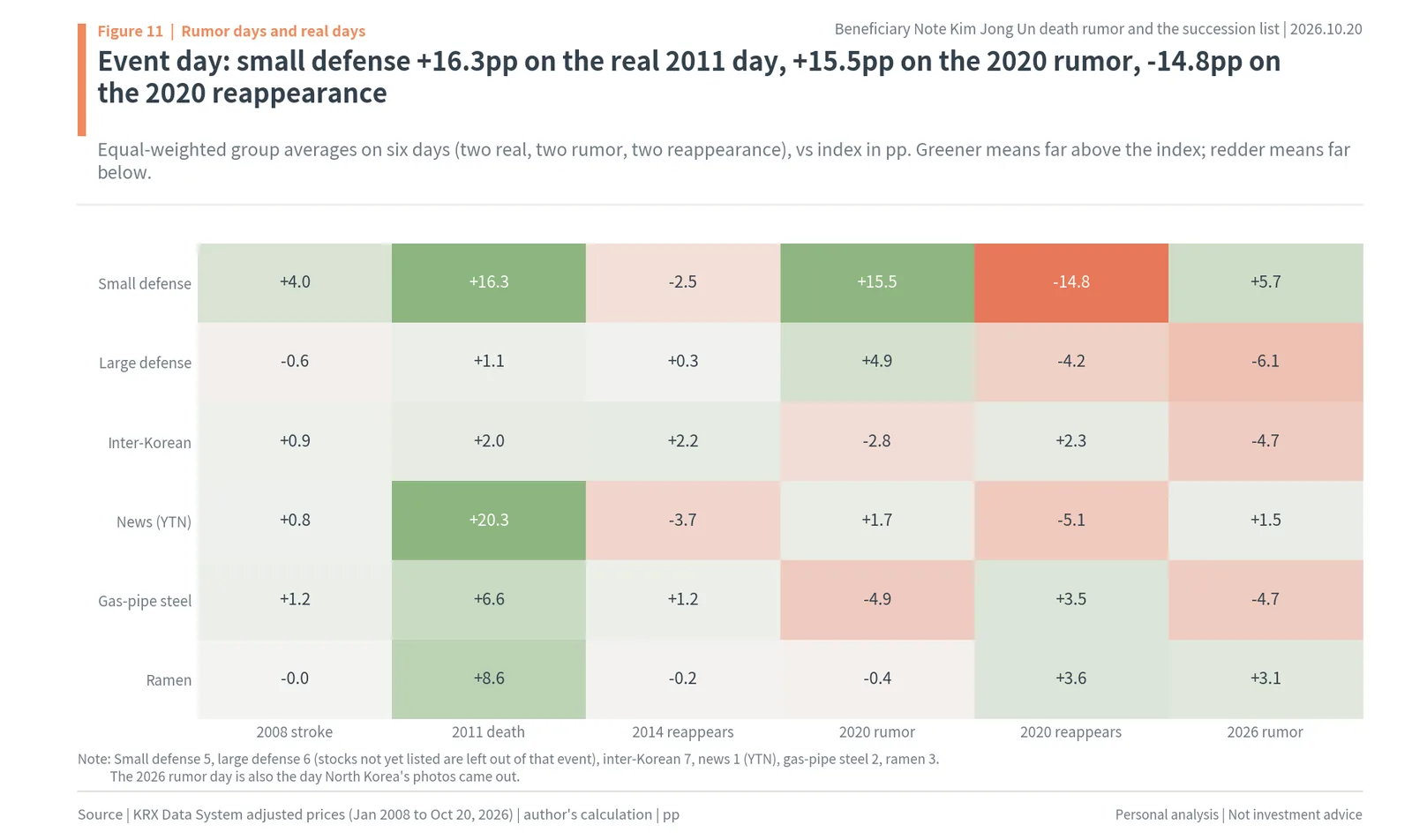
The other rows separate real days from rumor days more sharply. News (YTN) was +20.3pp in 2011 but +1.7pp and +1.5pp on the two rumor days. Gas-pipe steel was +6.6pp in 2011 and -4.9pp and -4.7pp on the rumor days. Ramen was +8.6pp in 2011 and -0.4pp and +3.1pp on the rumor days. Inter-Korean stocks fell on the rumor days (-2.8pp and -4.7pp) and rose on the reappearance days (+2.2pp in 2014, six of the seven up; +2.3pp in 2020, all seven up). Their +2.0pp in 2011 is hard to read from one day’s number: that morning they hit the upper limit on news of progress in US-North Korea relations, then fell back after the afternoon announcement of Kim Jong Il’s death.
The real day of 2008 was quiet. Small defense was +4.0pp (all five up), news +0.8pp, gas pipes +1.2pp and ramen 0.0pp. The thrust of that day’s NIS briefing was that Kim Jong Il had had surgery but could speak and move. The market priced the words “recovering” more than the stroke itself. The size of a real day depended on the size of the event, that is, on whether the leader left his post.
From the next day the paths split: rumor premiums vanish at once, real ones fade slowly
Even when event days look alike, what follows does not. Figure 12 combines the five small defense stocks in equal weights and plots their cumulative excess return for each trading day after the event. After Kim Jong Il’s death was announced in 2011, small defense beat the index by +28.7pp over two days. After five days that was down to +13.6pp, more than half gone, and after 20 trading days +5.8pp remained. There was no single day of collapse along the way: after the day-two peak, the biggest one-day drop was -6.6pp. In 2008 the numbers were small but pointed the same way: +4.6pp over two days and +2.2pp after 20 days.
The 2020 rumor had a different shape. It started with +15.5pp on April 21 and kept climbing while Kim Jong Un stayed out of sight, reaching +44.2pp on April 28, higher than the day-two peak of the real day. But it turned down to +32.0pp on April 29, and on May 4, the first trading day after reports that he had appeared at the Sunchon fertilizer plant, it lost -14.8pp in one day, falling to +11.4pp. In two trading days from the peak, 74% of the premium was gone. After that it moved sideways between +5pp and +10pp and ended day 20 at +10.0pp. As the title says, small defense stocks went from +28.7pp in two days after the real 2011 event to +5.8pp after 20 days, while the 2020 rumor peak of +44.2pp lost 74% in two trading days.
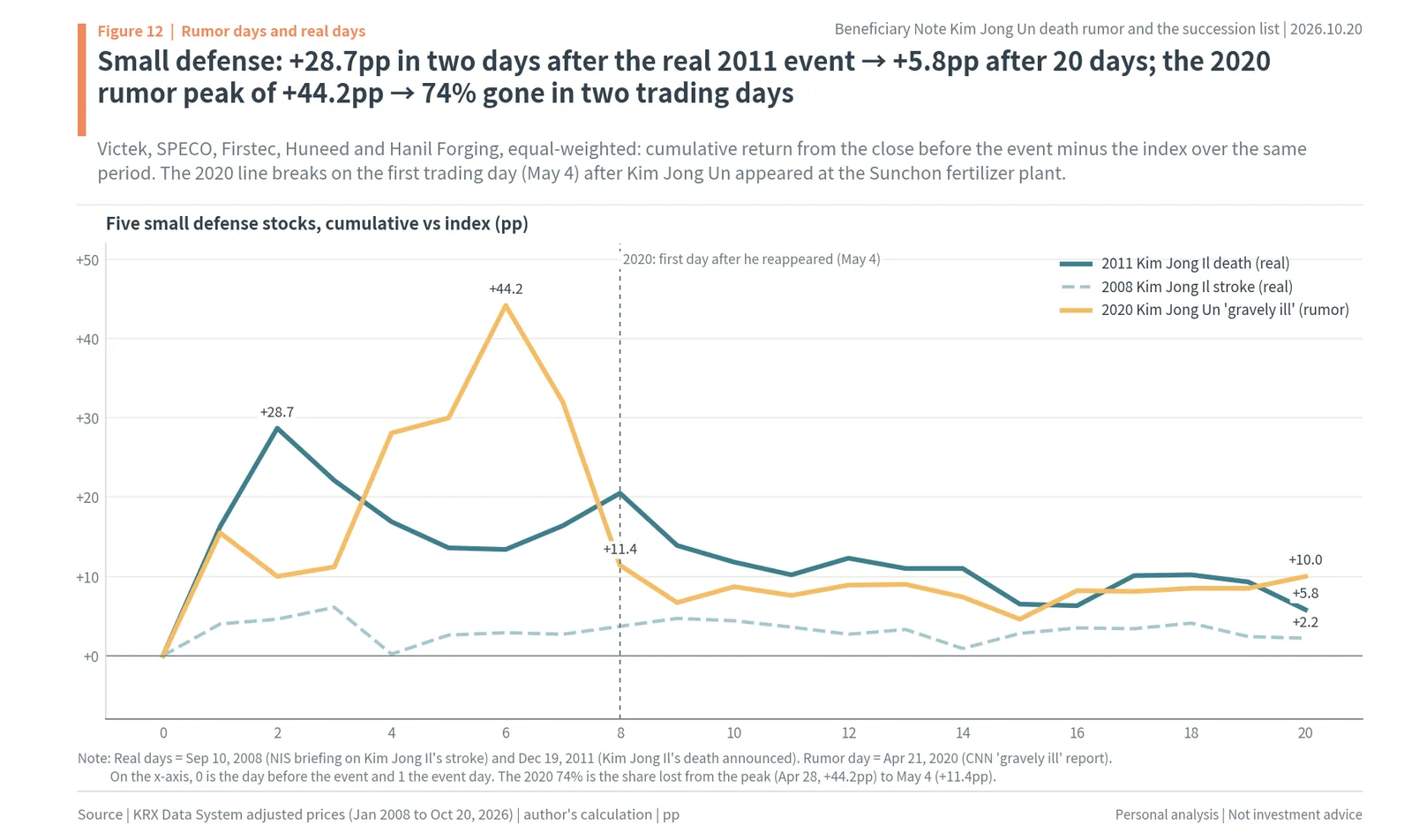
What the two lines say is that the market was pricing different things. On the real day the price was set on the fact that the leader had changed, and a fact does not disappear with one photo, so the premium did not collapse at once but cooled slowly over 20 trading days. The rumor premium was set on a question mark, “he hasn’t been seen,” and that question mark shrank sharply with one photo. The longer a rumor lasted, the more premium piled up, and the more of it fell away on the reappearance day. The +10.0pp left on day 20 in 2020 is what drifted sideways for more than ten days after the reappearance; it is less than a quarter of the +44.2pp that built up in the week the rumor was growing.
The 2020 “gravely ill” rumor, day by day
Spread the 2020 rumor out by date and you get Figure 13. Cumulative from the April 20 close, small defense stocks were +15.5pp on April 21 and +10.0pp on the 22nd, a pause, then climbed to +28.1pp on the 24th, +30.0pp on the 27th and +44.2pp on the 28th. On the 29th they had already turned down to +32.0pp. After two market holidays, April 30 (Buddha’s Birthday) and May 1 (Labor Day), they were +11.4pp on May 4, +4.6pp on May 14 and +10.0pp on May 21. As the title says, during the 2020 rumor small defense stocks went from +15.5pp on April 21 to +44.2pp on April 28 and +11.4pp on the first trading day after Kim reappeared.
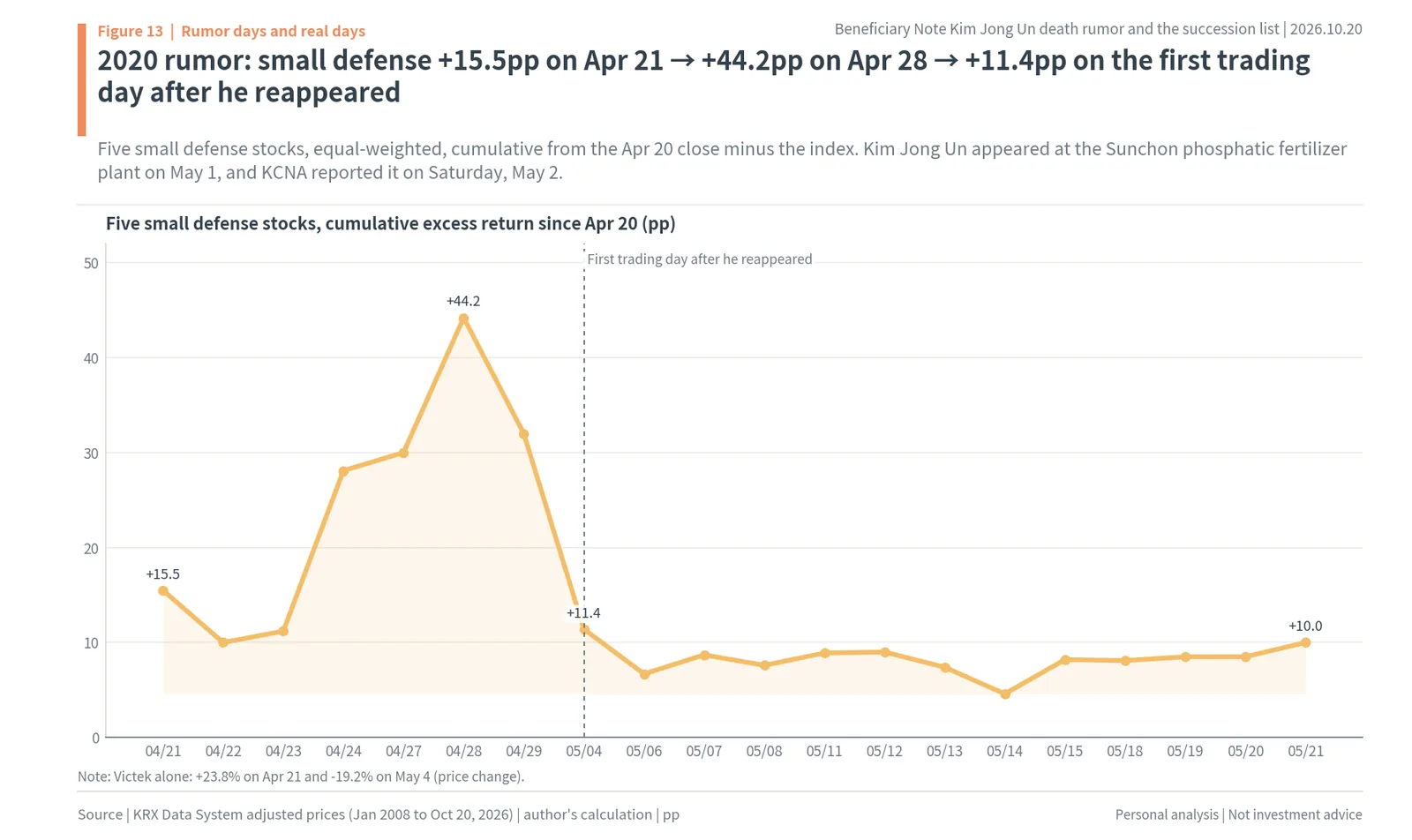
What was reported during the week the rumor grew lines up with that path. After he skipped the April 15 Day of the Sun visit, the talk moved from a cardiovascular procedure to heart surgery, brain death and finally death. Each day he failed to appear, the rumor turned into bigger words, and small defense stocks rose with it. The turn, by contrast, came on April 29, before the reappearance was reported on May 2. Some money sold before the photos came out.
Stock by stock: two days at the upper limit, and a day of -20%
Stock by stock, the difference is even sharper. In the two days after Kim Jong Il’s death was announced in 2011, SPECO was +35.0pp, Victek and Huneed +34.8pp and Firstec +31.7pp. The daily price limit was 15% then, and all four hit it two days in a row. Only Hanil Forging was small at +7.0pp. On the first trading day after the 2020 reappearance, the same five all fell far below the index: SPECO -20.5pp, Victek -18.7pp, Hanil Forging -14.2pp, Huneed -10.4pp and Firstec -10.2pp. As the title of Figure 14 says, over the two real days in 2011 SPECO was +35.0pp and Victek +34.8pp, and on the first day after the 2020 reappearance SPECO was -20.5pp and Victek -18.7pp.
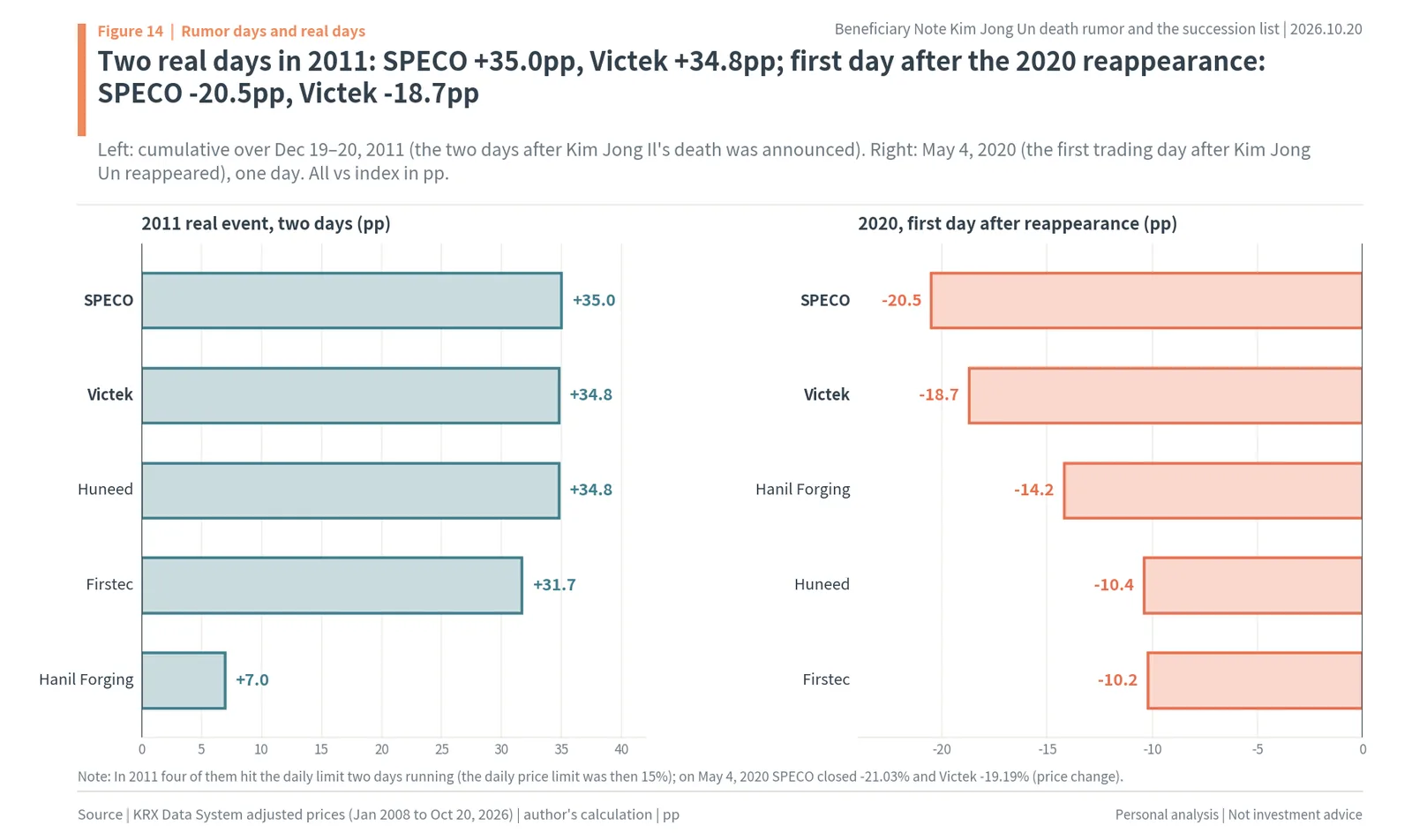
Victek on its own makes the 2020 shape even plainer. It rose 23.8% on April 21, +25.2pp against the index, and on May 4, the first trading day after the reappearance, it fell 19.2%. Etoday’s market-close headline that day read, in translation, “Kim Jong Un appears: inter-Korean stocks rise, defense stocks fall.” The same day SPECO closed -21.03%, Firstec -12.90%, Hanwha Aerospace -9.48% and Korea Aerospace Industries -7.02%. The stocks that rose most on the rumor day fell most on the reappearance day.
The 2014 reappearance pointed the same way. On October 14, when KCNA reported his inspection with a cane, all five small defense stocks lagged the index, by -2.5pp on average. Victek fell 1.69%. In 2014 the rumor did not land on one day but grew slowly over 40 days, so the reversal on the reappearance day was small too.
Inter-Korean stocks moved like a mirror
The mirror image of small defense is the inter-Korean cooperation stocks. On rumor days the seven fell: -2.8pp in 2020 (only one of the seven up) and -4.7pp on this October 20 (two up). On reappearance days they rose: +2.2pp in 2014 (six up) and +2.3pp in 2020 (all seven up). Talk that North Korea’s leader had vanished was read as inter-Korean business moving further away, and news that he had reappeared as the end of that worry. The inter-Korean moves were far smaller than the small defense moves: on the 2020 reappearance day small defense was -14.8pp and inter-Korean stocks +2.3pp.
In short, the market wiped out the rumor premium all at once on the day the leader reappeared, and cooled the real-event premium slowly over 20 trading days. A rumor ends with one photo; a real event is still in the price 20 days later. So which was October 20? The next chapter has the stock-by-stock numbers for that day.
5. On October 20 the rumor premium was one day of Victek, and large defense stocks such as Hanwha Aerospace fell for other reasons
The KOSPI’s 3.73% drop was not about the death rumor
On October 20 the KOSPI fell as far as 5,493.24 during the day, down 4.76% from the previous close and below the 5,500 line, recovered to around 5,590 at about 11 a.m., and closed down 3.73% at 5,552.74. The KOSDAQ fell 3.33% to 781.97. With the death rumor circulating in foreign media the same day, some articles linked the two, but Newsway ran a headline that translates as “KOSPI plunges on Kim Jong Un death rumor? The real cause is elsewhere,” and laid out the reasons. Foreigners and institutions sold large chip stocks together. French government bond yields, pushed up by protests over prices and austerity, spread higher through Italy, Spain and Germany to US Treasuries, and the US 10-year yield had risen 6.69bp the previous day to 5.1397%. Worries about the profitability of AI investment and caution ahead of big US tech earnings added to it. Newsway found no evidence that the rumor itself caused the drop.
Small defense: Victek alone, at +14.3pp
In that market, the stocks that reacted to the rumor were few. Among the five small defense stocks, Victek rose 10.98% to close at KRW 3,235 (about $2.44). On a day the KOSDAQ fell 3.33%, that is +14.3pp against the index. Hanil Forging rose 4.02% (+7.3pp) and SPECO 1.70% (+5.0pp). Firstec (-2.82%) and Huneed (-2.79%) fell, but less than the KOSPI, for +0.9pp each. Without Victek, the other four averaged +3.5pp. As the title of Figure 15 says, on October 20 small defense stocks against the index were Victek +14.3pp and the other four +3.5pp on average.
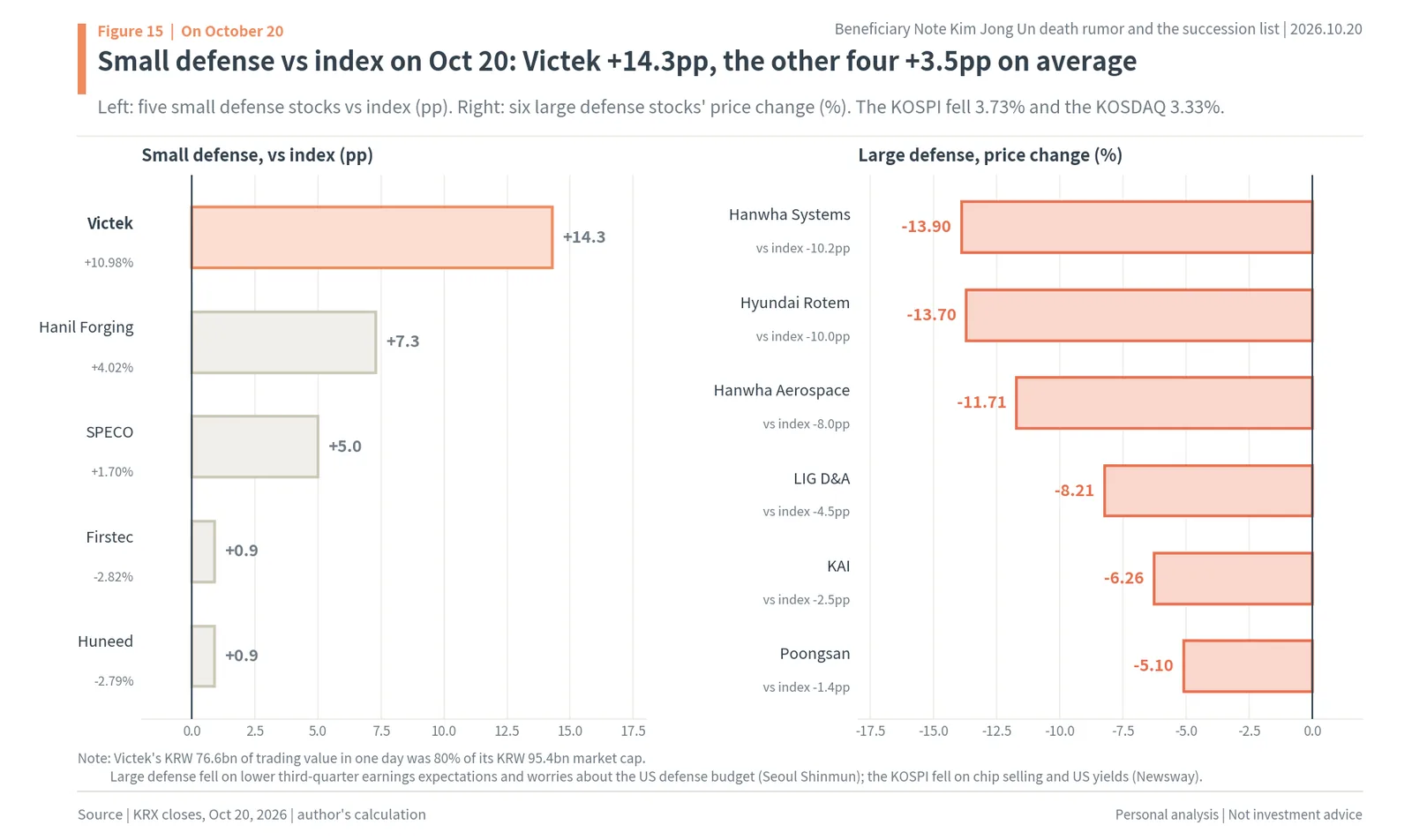
On the 2011 death announcement, four of the five hit the daily upper limit two days running, and on the 2020 rumor day Victek, SPECO, Firstec and Huneed rose 27% to 30% during the session. Against that, this reaction was concentrated in one stock. The large defense stocks on the right of Figure 15 moved the opposite way altogether.
Large defense: earnings expectations and the US defense budget
All six large defense stocks fell more than the index: Hanwha Systems -13.90%, Hyundai Rotem -13.70%, Hanwha Aerospace -11.71%, LIG D&A -8.21%, Korea Aerospace Industries -6.26% and Poongsan -5.10%. Against the index, Hanwha Systems was -10.2pp, Hyundai Rotem -10.0pp and Hanwha Aerospace -8.0pp, and the six averaged -6.1pp, with every one of them below the index.
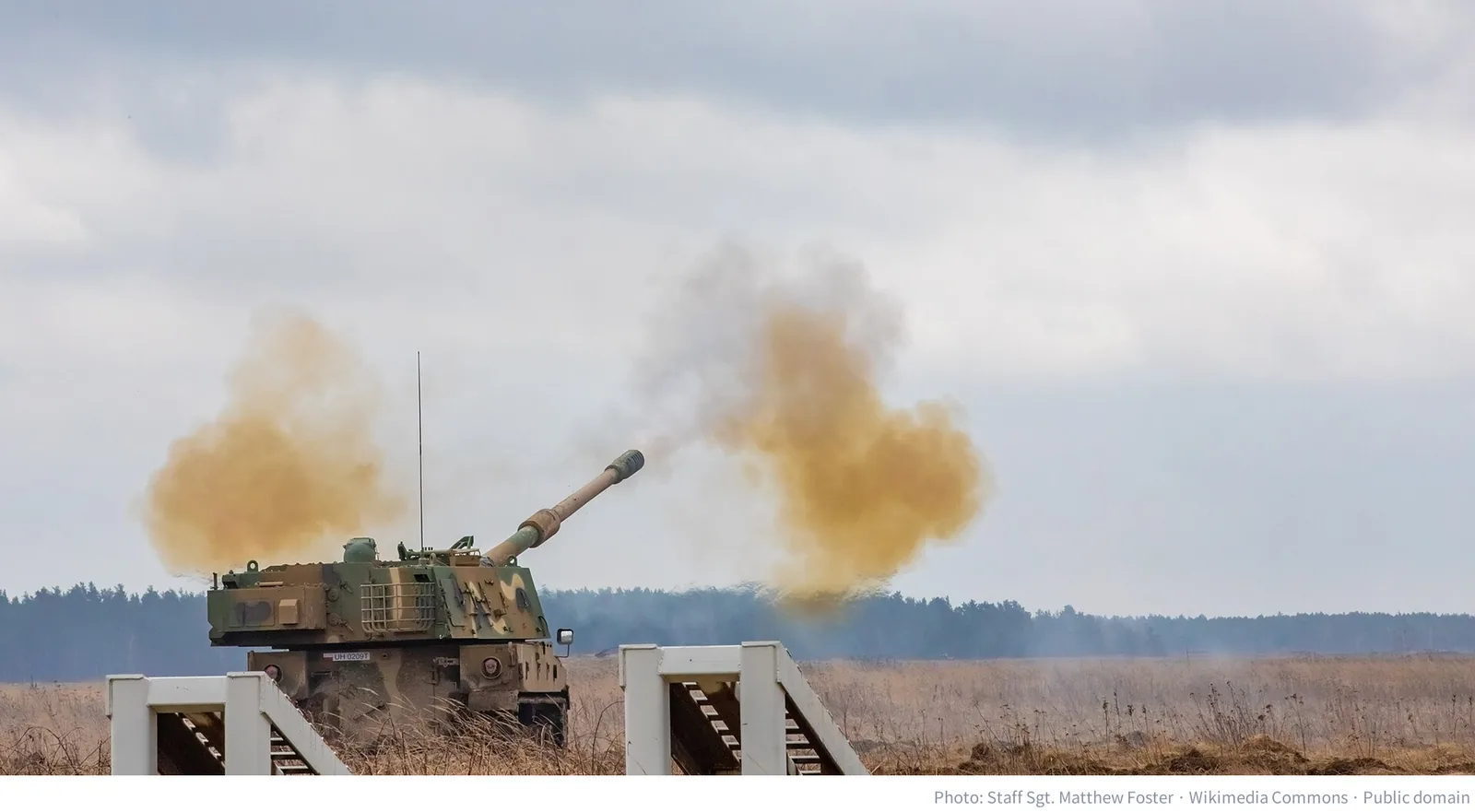
Seoul Shinmun gave two reasons that day. One was lower expectations for third-quarter earnings, with a forecast that Hyundai Rotem’s third-quarter operating profit would come in about 10% below consensus. The other was worry that the US defense budget could shrink ahead of the midterm elections; US defense stocks such as Lockheed Martin fell the same day. The paper wrote that “the tendency for defense stocks to rise when talk of regime instability spreads did not work at all” that day. Hanwha Aerospace sells K9 self-propelled howitzers abroad, and Hyundai Rotem sells K2 tanks. What sets their share prices now is overseas orders, from Poland to the Middle East, and the US defense budget, more than rumors from across the border. On the 2020 rumor day all six large defense stocks beat the index (+4.9pp). Over the six years since, they have turned from North Korea theme stocks into export stocks.
Victek traded 80% of its market cap in one day
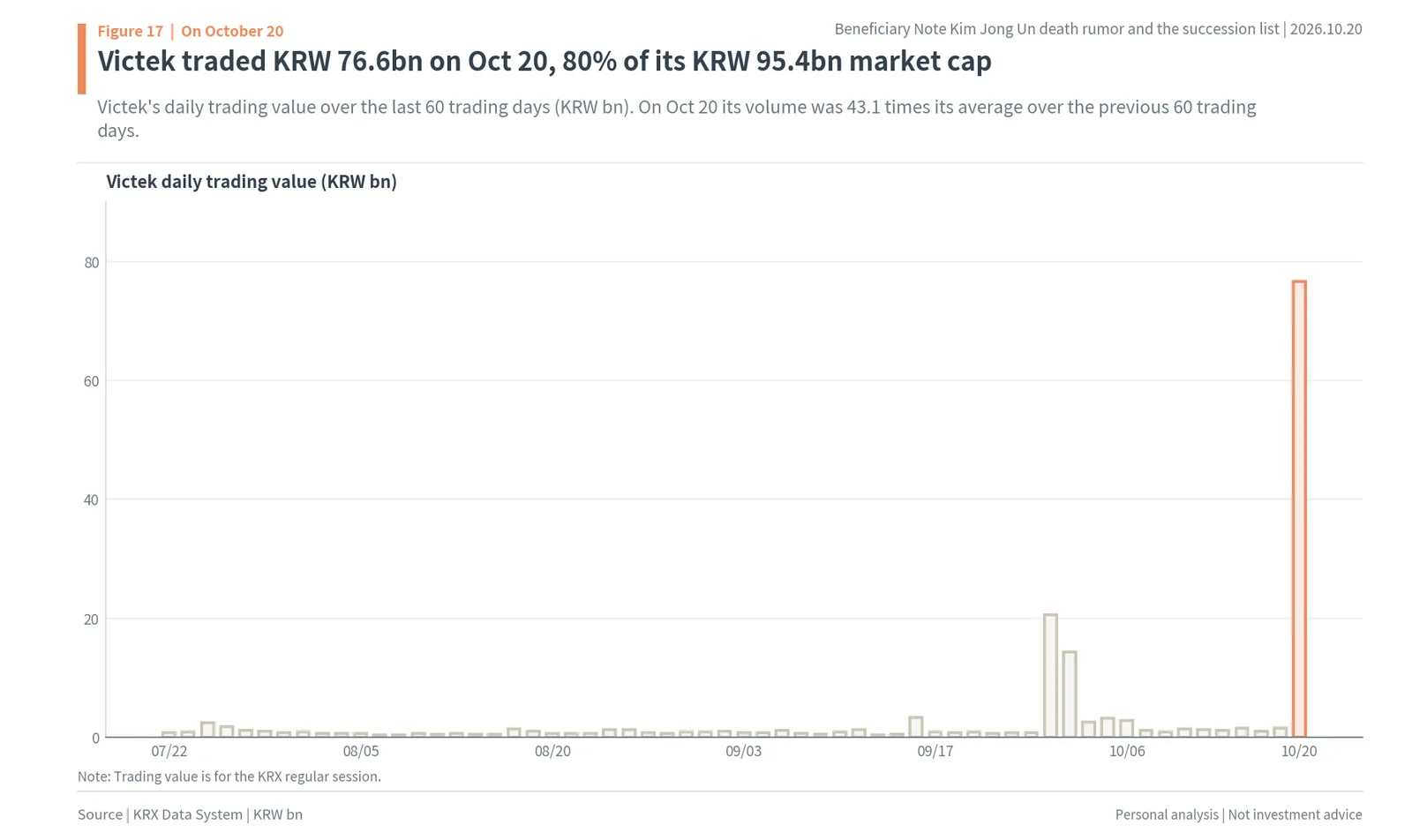
The amount of money that went into Victek shows what this reaction was. Victek’s trading value on October 20 was KRW 76.6bn (about $58mn), against a market cap of KRW 95.4bn (about $72mn): the equivalent of 80% of the company changed hands in one day. Its volume was 43.1 times its average daily volume over the previous 60 trading days. As the title of Figure 17 says, Victek traded KRW 76.6bn on October 20, 80% of its KRW 95.4bn market cap. In the figure the bars hug the floor for the previous 59 trading days and shoot up only on the last.
Inter-Korean stocks fell in the usual rumor-day shape. The seven averaged -4.7pp, and only two beat the index (Hyundai Elevator +2.0pp, Shinwon +1.1pp). GOODPEOPLE (-15.78%) and In the F (-16.84%) fell the most. News (YTN) fell 1.80%, +1.5pp against the index. Among ramen makers Nongshim was 0.00%, Ottogi +0.61% and Samyang Foods -2.32%, a group average of +3.1pp, and among gas-pipe steel makers KBI Dongyang Steel Pipe fell 10.01% and Histeel 6.88%, for -4.7pp. The groups outside defense that moved on the real day in 2011 did not move this time.
Same kind of day, six years apart
April 21, 2020 and October 20, 2026 were both rumor days. Put the two side by side, group by group, and you can see what changed in six years. Small defense shrank from +15.5pp to +5.7pp. Large defense flipped from +4.9pp to -6.1pp: in 2020 all six beat the index, and this time all six lagged. Inter-Korean stocks fell both times (-2.8pp and -4.7pp), news (YTN) barely moved both times (+1.7pp and +1.5pp), and gas-pipe steel fell both times (-4.9pp and -4.7pp).
What did not change is the shape of a rumor day. The small defense stocks that carry the North Korea theme label rise, the inter-Korean stocks that depend on cross-border business fall, and the news and gas-pipe names that moved only on the real day sit still. What changed is the size and the large defense stocks. The small defense reaction narrowed to one stock, Victek, and large defense stocks now move with earnings and the US budget rather than with North Korean rumors.
This time the rumor and the photos were a day apart
The 2020 rumor ran 11 days, from CNN’s report (April 21) to the report of his reappearance (May 2), and in that time the small defense premium built up to +44.2pp. This time North Korea’s photos came out the day after foreign media picked up the claim, so the rumor had only one day to grow in the market. Even so, trading equal to 80% of Victek’s market cap poured into that one stock. What this money bought was the same question mark as on April 21, 2020, “he hasn’t been seen,” and that question mark had already shrunk with the photos released the same day. In short, the rumor premium priced into shares on October 20 was one day of Victek, and large defense stocks fell for other reasons. So what would move if a real day came? The next chapter looks for the names that moved only on the real day in 2011.
6. Hidden winners move only on real days, and the one whose link still holds is YTN
On December 19, 2011, the stocks at the upper limit were not only defense names
At 1:28 p.m. on December 19, 2011, the day Kim Jong Il’s death was announced, News Tomato’s market report counted 43 KOSPI gainers (four at the daily upper limit) against 841 decliners. Alongside four defense stocks, Huneed, SPECO, Firstec and Victek, the limit-up list included news channel YTN. An Edaily article after the close added ramen. Samyang Foods closed at the upper limit of KRW 48,600 on “expectations that demand for ramen and the like would rise,” amid worries that inter-Korean relations would be shaken, and Nongshim rose 2.69%. The same article said that among gas-pipeline stocks, Dongyang Steel Pipe (today’s KBI Dongyang Steel Pipe) and Histeel closed higher.
Measured again on KRX closes, YTN rose 14.97% that day, +20.3pp against its index (the KOSDAQ, -5.35%). Samyang Foods rose 14.89%, +18.3pp against the KOSPI (-3.43%); Nongshim was +6.1pp, KBI Dongyang Steel Pipe +8.2pp and Histeel +5.1pp. Two stocks outside defense had a day as big as four of the five defense stocks.
The same stocks did not move on rumor days
What makes these hidden winners is that they did not move on rumor days. Figure 19 plots all 24 stocks as dots. The vertical axis is the one day of the 2011 real event, and the horizontal axis is the average of the two rumor days (April 21, 2020 and October 20, 2026), one day each. Stocks above the diagonal, especially toward the upper left, ignored rumors and moved only on the real day. Victek sits on the diagonal: +20.1pp in 2011 and +19.8pp on the rumor-day average, reacting equally to rumors and to the real thing. SPECO (+20.3pp, +13.3pp) and Firstec (+18.3pp, +7.0pp) sit to its left. And near zero on the horizontal axis and around +20 on the vertical are YTN and Samyang Foods. YTN was +1.7pp and +1.5pp on the rumor days, and Samyang Foods +0.5pp and +1.4pp. The two gas-pipe makers actually lagged the index on rumor days (KBI Dongyang Steel Pipe -4.8pp and -6.3pp, Histeel -5.0pp and -3.1pp). As the title says, on the real day in 2011 YTN was +20.3pp and Samyang Foods +18.3pp, while on the rumor days news was +1.7pp and +1.5pp.
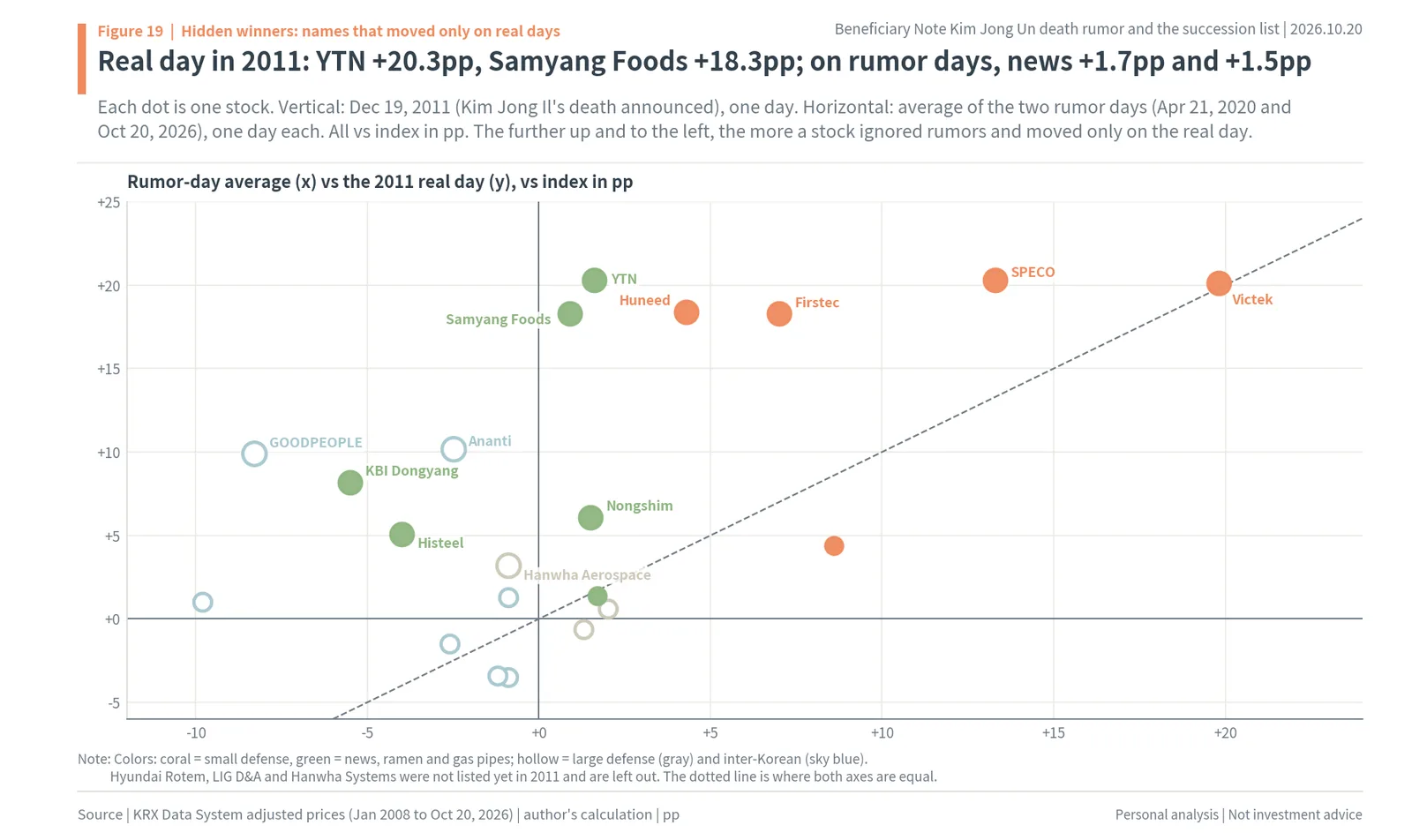
Why did they move only on the real day? On rumor days, money goes to stocks that already carry a label of rising when people are anxious, and the small defense stocks are those. On a real day, money that asks what will actually change is added on top. The expectation that people would watch more news when the leader changes went to YTN; the expectation that people would stock up on emergency food went to ramen; and the question of whether a new leadership would carry on the South-North-Russia gas pipeline went to steel pipe makers. Those expectations arise only once the fact is confirmed, so they were absent on rumor days.
Why the real day of 2008 was quiet
A real day did not always spill over beyond defense. On September 10, 2008, the day of the NIS briefing, the groups outside defense barely moved: news +0.8pp, gas-pipe steel +1.2pp, ramen 0.0pp. Small defense was only +4.0pp. What reached the market that day was that Kim Jong Il had had surgery for a cerebrovascular disease but could speak and move. The leader had not left his post, so neither the question of who would take over nor the question of what a new leadership would change came up. The hidden reactions outside defense appeared only on the day the leader actually changed, in 2011. What moves the hidden winners is not a health problem as such but an empty seat.
Size in volume: YTN at 74.4 times
The volume shows the size of the money. Divide the volume of December 19, 2011 by that of the previous trading day (December 16) and YTN comes to 74.4 times, Histeel 16.8 times and KBI Dongyang Steel Pipe 11.6 times. Samyang Foods was 4.5 times. As the title of Figure 20 says, volume on December 19, 2011 was 74.4 times the day before for YTN, 16.8 times for Histeel and 11.6 times for KBI Dongyang Steel Pipe. Stocks that normally traded little took in dozens of times their usual money in a single day.
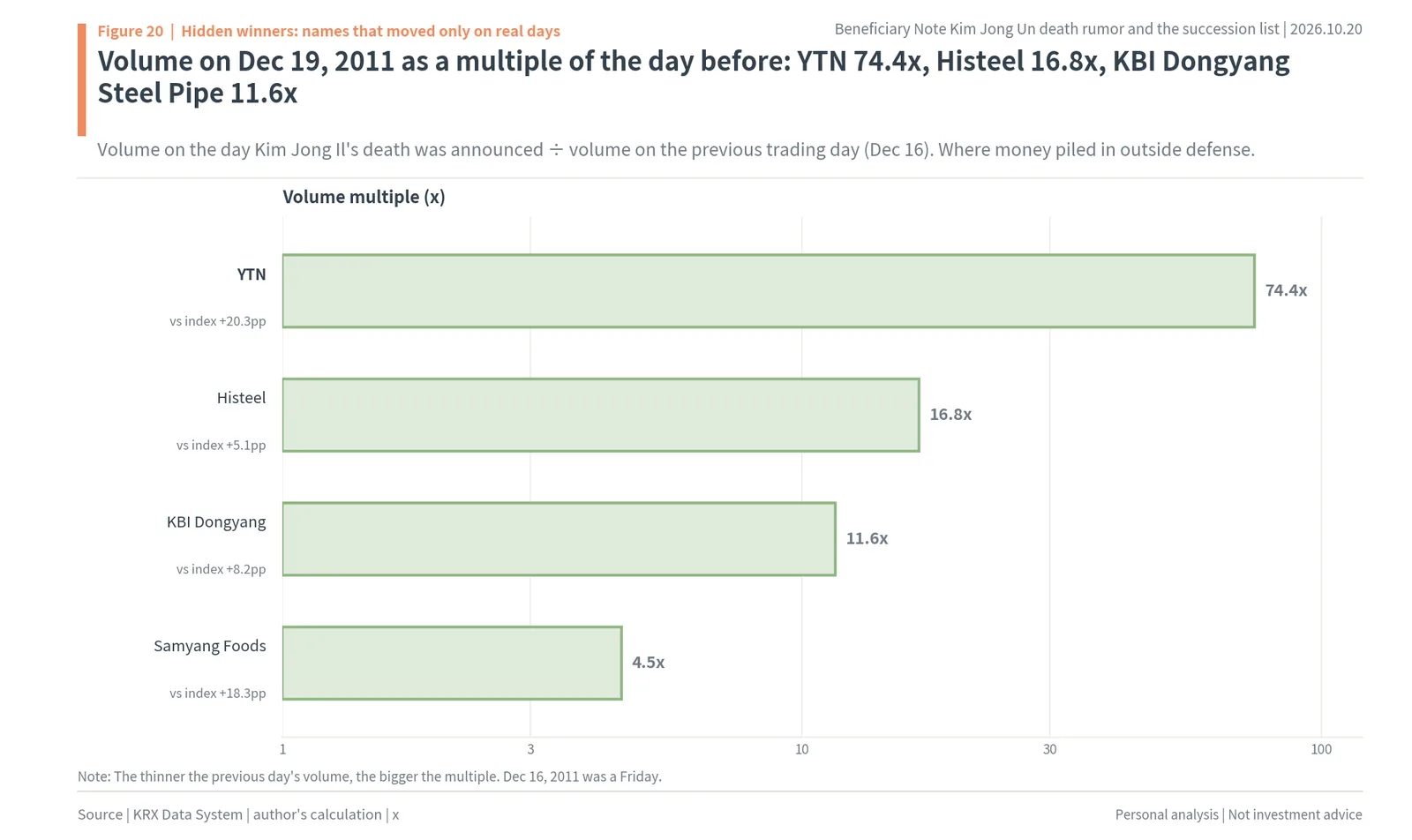
The reaction did not last. YTN fell 8.08% the next day, and its cumulative excess return after five days was down to +1.6pp. Samyang Foods fell 6.07% the next day and was at -9.6pp after 20 trading days. The hidden reaction on the real day lasted one day, even shorter than the two-day move in defense.
Measured against today’s market caps, the three groups split
Would that one-day reaction come out the same size on the next real day? Even if the same amount of event money comes in, a company whose market cap has grown moves less. Figure 21 shows market caps on December 16, 2011 (the last trading day before the announcement) and October 20, 2026. Samyang Foods went from KRW 313.3bn to KRW 9,197.8bn (about $6.9bn), 29.4 times; exports of its Buldak spicy noodles changed the size of the company itself. Over the same period YTN actually shrank, from KRW 122.0bn to KRW 93.6bn (about $71mn). As the title puts it, market cap went from KRW 313.3bn to KRW 9,197.8bn (29.4x) for Samyang Foods and from KRW 122.0bn to KRW 93.6bn for YTN. Victek went from KRW 35.8bn to KRW 95.4bn (2.7 times) and SPECO from KRW 25.5bn to KRW 21.0bn; both remain small companies, much as in 2011.
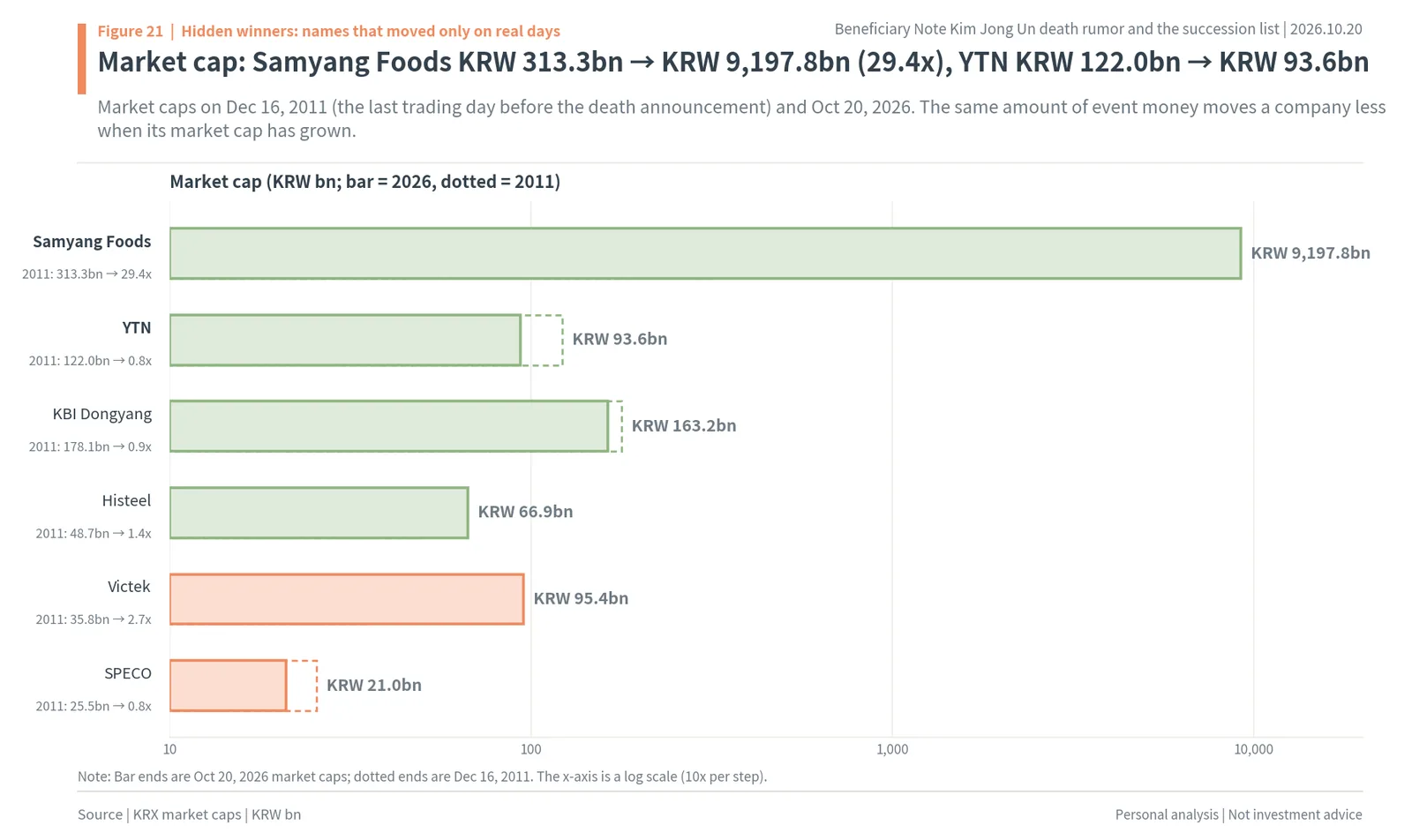
So the three hidden groups split. For ramen, the link was cut by size. Moving an exporter worth more than KRW 9tn on hopes for emergency-food demand would take dozens of times the money of 2011. Even the three ramen makers’ +3.1pp against the index today (October 20) was not a rise in their share prices (Nongshim 0.00%, Ottogi +0.61%, Samyang Foods -2.32%) but a smaller fall on a day the KOSPI dropped 3.73%.
For gas-pipe steel, the link was cut by the business. The 2011 reaction came after Kim Jong Il and Russian President Dmitry Medvedev, meeting in Ulan-Ude on August 24 that year, agreed to set up a three-way special committee of South Korea, North Korea and Russia to discuss a gas pipeline running through North Korea to South Korea. Around that summit, on August 22 and September 2, steel pipe makers such as Dongyang Steel Pipe and Histeel hit the upper limit on pipeline hopes. Whether a new leadership would carry the project on was what drove pipe stocks on the day Kim Jong Il died. Today there are no such talks. North Korea defined the two Koreas as “two hostile states” at the end of 2023, and the channels for inter-Korean economic cooperation are cut. With no project to carry on, there is no link that would lift pipe makers even on a real day.
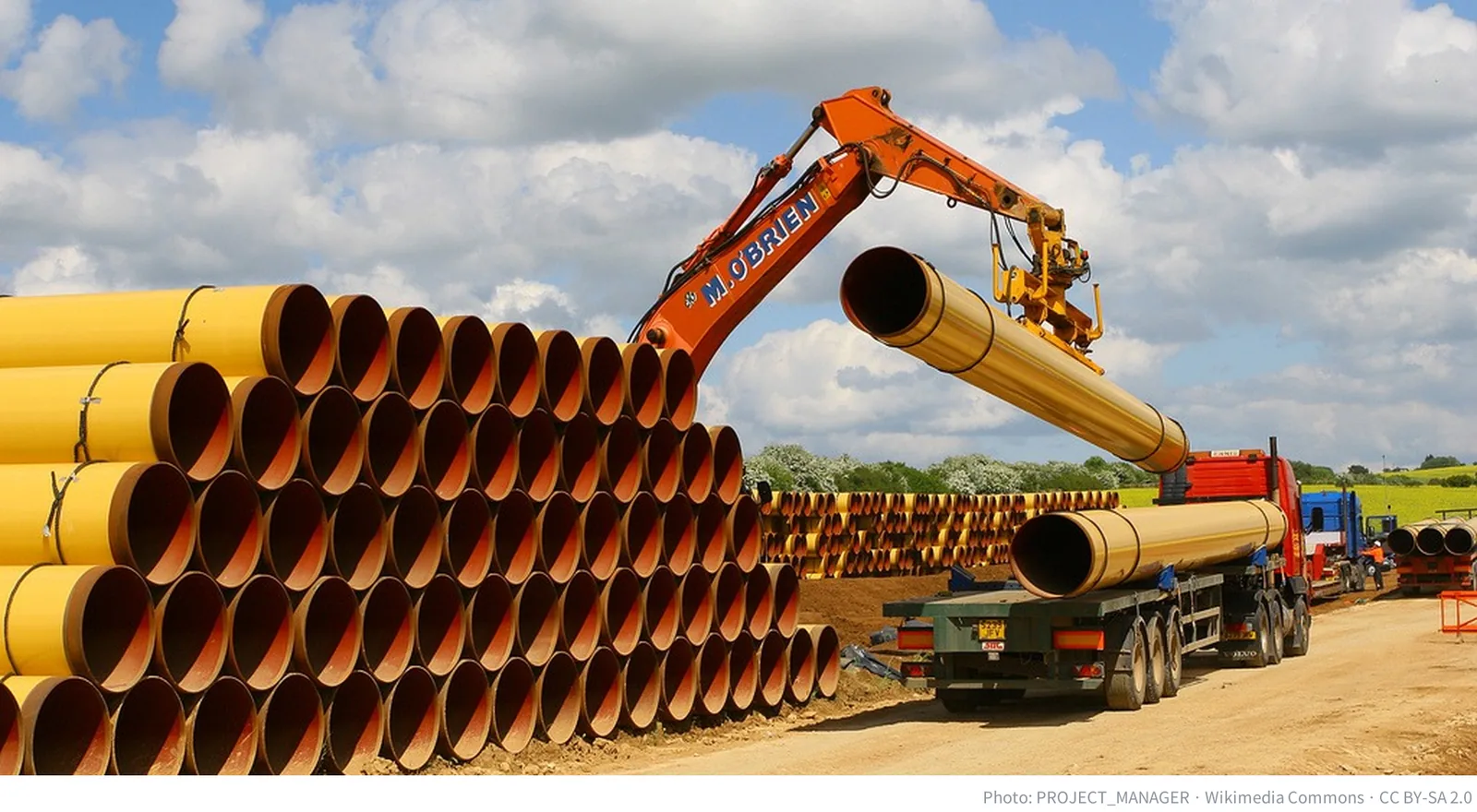
For YTN, the link holds. It is still a 24-hour news channel, and the 2011 expectation, that news demand piles up there when a leader dies or is incapacitated, still applies. Its market cap is smaller than in 2011, so the same amount of money would move it further. It closed at KRW 1,964 (about $1.48) on October 20, with a market cap of KRW 93.6bn (about $71mn), about the same size as Victek (KRW 95.4bn). It did not react on either rumor day (+1.7pp, +1.5pp), so it carries no premium from the rumor theme either. In short, among the hidden winners that move only on real days, the one whose link still holds is YTN; ramen lost its link to size and gas pipes to the business.
So the real-day list has two entries: the two-day move in small defense (+28.7pp over two days in 2011, with Victek, SPECO and Huneed at +34.8pp to +35.0pp) and the one-day move in YTN. Both reactions largely faded within 20 trading days. Which side is the market on now, the real day or the rumor? The last chapter looks at the signals.
7. The author’s view: all four signals that mark a real day point to a rumor now, and the rumor premium ended with one day of Victek
Four signals that mark a real day
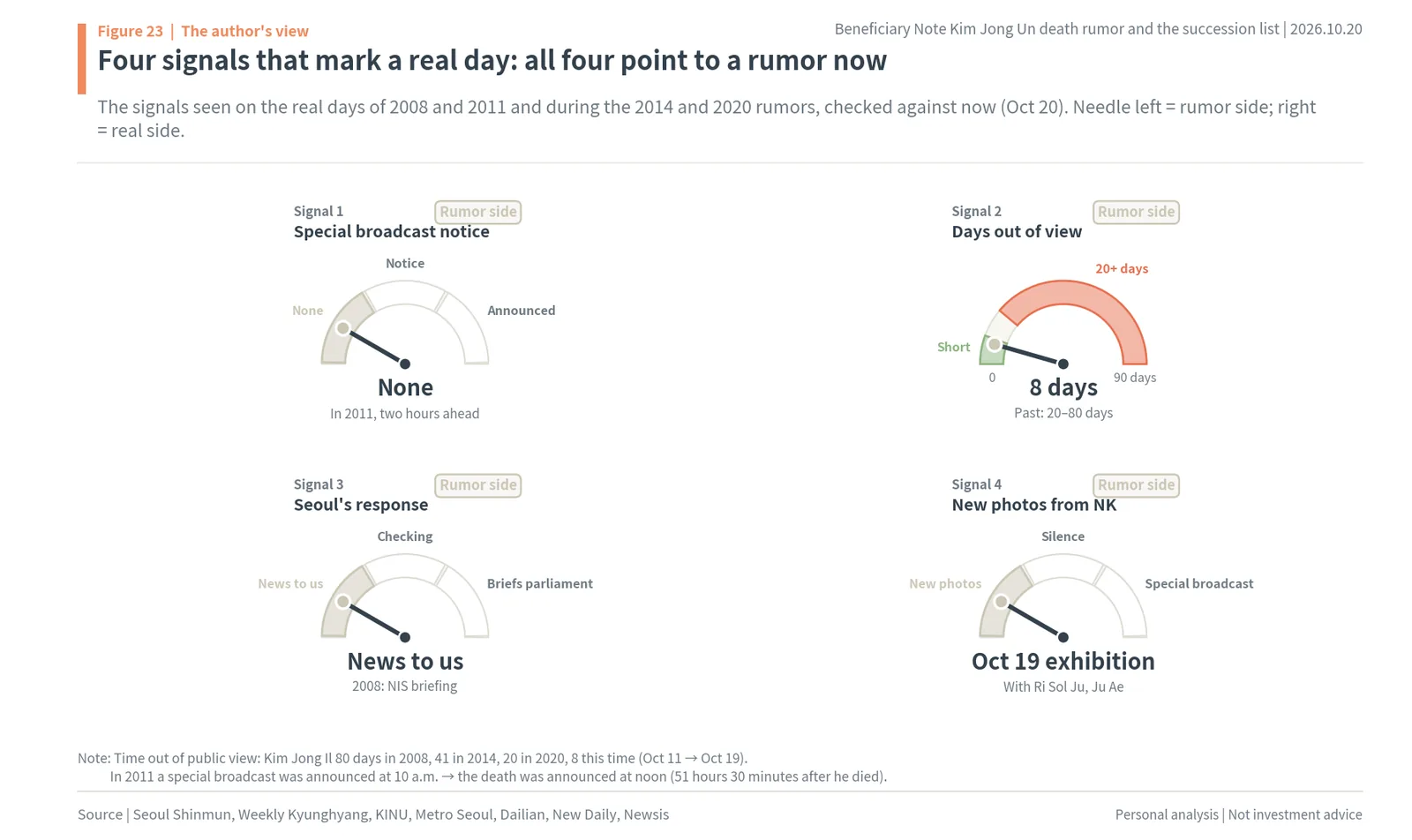
Looking back over the six days, real days and rumor days differed not only in the market’s reaction but in the signals that came before it. The first is a North Korean special broadcast notice. On December 19, 2011, Korean Central TV, Korean Central Broadcasting Station and Pyongyang Broadcasting Station first announced at 10 a.m. that “there will be a special broadcast on television and radio at 12 o’clock today,” repeated it at 10:23 and 10:30, and announced the death at noon. There was notice two hours before the announcement. The second is the length of the absence. In 2008, when there was a real illness, Kim Jong Il was gone 80 days; in 2014 and 2020, when the rumors came to nothing, Kim Jong Un was gone 41 and 20 days. The third is what the South Korean government does. In September 2008 the NIS briefed the intelligence committee on Kim Jong Il’s surgery. The fourth is new photos from North Korea. The 2014 and 2020 rumors both closed when North Korean media reported a new public activity.
Check those four against now and you get Figure 23. There has been no special broadcast notice. The absence ran from October 11 to 19, eight days, shorter than in past rumors (20 to 41 days) or the real case (80 days). The South Korean government’s response was “the first we’ve heard of it.” And on October 20 North Korea released new photos of him touring the Pyongyang exhibition on the 19th. As the figure’s title says, of the four signals that mark a real day, all four point to a rumor now.
View one: the rumor premium ended with one day of Victek
The author’s view is that the rumor premium in this death rumor ended with one day of Victek on October 20. There are three reasons. First, the photos that end the rumor came out on the very day the rumor reached the market. In 2020 there were no photos for 11 days after the rumor reached the market, and meanwhile the small defense premium built up to +44.2pp. This time there was no time for anything to build up. Second, the reaction was concentrated in one stock. Of the five small defense stocks, only Victek was at +14.3pp; the other four averaged +3.5pp. That is unlike 2011 and 2020, when the five moved together. Third, Victek’s KRW 76.6bn of trading value in one day, equal to 80% of its KRW 95.4bn market cap, means this was money bought and sold within the day, not money that will stay.
So the author sees the small defense gains of the rumor day as gains to be given back, as in 2020. On the first trading day after the 2020 reappearance, small defense lost -14.8pp in one day and Victek -18.7pp, and on the 2014 reappearance day all five also lagged the index. This time the reappearance photos are already out, so there is less need than in 2020 to wait for the day the reversal starts.
View two: if a real day comes, two lists will move
That does not mean North Korea’s leader’s health has nothing to do with the market. As Chapter 2 shows, even by the NIS’s assessment Kim Jong Un is in a high-risk group at 140kg-plus, and his grandfather and father both died of heart disease. As Chapter 3 shows, No. 1 on the succession list is a daughter of about 13 with no title. If a real day comes, the question of who takes over will loom larger than in 2011.
Two lists would move that day. One is the two-day move in small defense. In 2011 Victek (+34.8pp), SPECO (+35.0pp), Huneed (+34.8pp) and Firstec (+31.7pp) beat the index by wide margins over two days, and the five-stock average still held +5.8pp after 20 trading days. The other is the one-day move in YTN. In 2011 it hit the upper limit that day, +20.3pp against the index, on 74.4 times the previous day’s volume; it did not move on either rumor day; and its market cap has shrunk from KRW 122.0bn in 2011 to KRW 93.6bn, so the same money would move it further. In 2011 YTN also fell 8.08% the next day, and small defense cooled by more than half within five days. The real-day list is not one to hold for long; it is a list for that day and the next.
This list is different from the rumor-day list. On rumor days, money went to the best-known name among the small defense stocks: Victek +25.2pp on the 2020 rumor day and +14.3pp on this October 20. On the real day the five moved together (all five up in 2011, four at the upper limit two days running), and the move spread outside defense to YTN. Victek alone rising on a rumor day, versus several groups rising together on a real day: the shape of the day is itself a signal of which kind of day it is.
Ramen and gas-pipe steel are off the list. Samyang Foods’ market cap has grown 29.4 times, too big to move on emergency-food hopes, and the South-North-Russia pipeline talks that drove pipe stocks in 2011 no longer exist.
Dates to watch
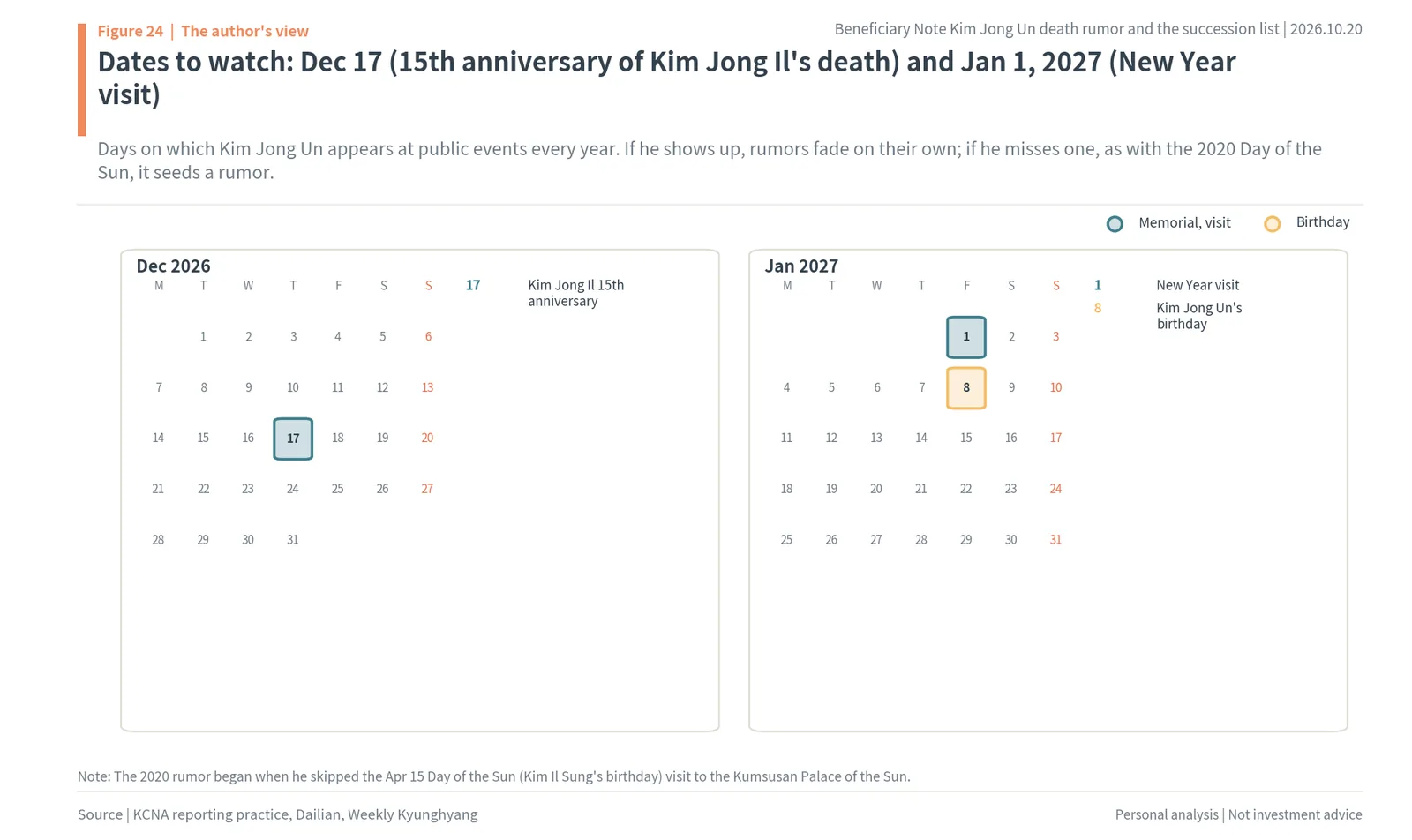
The easiest signal for sorting rumors is whether Kim Jong Un turns up at the public events he attends every year. The nearest are December 17, the 15th anniversary of Kim Jong Il’s death, and the New Year visit on January 1, 2027. December 17 is the day Kim Jong Il died, and January 1 is the day this year when Kim Ju Ae stood at the very center during the visit to the Kumsusan Palace of the Sun. Just as the 2020 rumor began when he skipped the Day of the Sun visit, missing one of these days would seed a rumor. January 8 is Kim Jong Un’s birthday. As the title of Figure 24 says, the dates to watch are December 17 (the 15th anniversary of Kim Jong Il’s death) and January 1, 2027 (the New Year visit). Earlier still, on November 17 to 19, comes APEC in Shenzhen, the meeting President Trump was asked about on October 19 in connection with a possible meeting with Kim Jong Un.
Back, finally, to Mark Twain’s note. What he corrected was the report that he was dying, and he lived another 13 years. The market has been doing the same thing. When a photo came out, the rumor premium switched off, and only on days when a fact was confirmed did the premium stay in prices 20 trading days later. What the market bought in this death rumor was one day’s question mark, and it priced that at one day of Victek.
8. How the numbers were counted
The numbers in this report come from only two places. Numbers taken from articles, briefings and filings carry their sources, and numbers the author calculated are marked “author’s calculation.” The calculations follow the rules below.
Share prices and indexes are KRX Data System prices. For stocks, the author used adjusted closes that back out the base price from KRX daily change rates, so that base-price adjustments such as ex-rights dates and share consolidations are reflected (stockkit). GOODPEOPLE’s shares were relisted on October 14, 2026 after a 5-to-1 consolidation, and because the KRX’s base price (KRW 2,400) was 5.2175 times the last close before the consolidation (KRW 460), the earlier prices were readjusted at the consolidation ratio of 5, the same treatment as in the October 14, 2026 note on North Korea summit stocks. The current price in the Naver Finance app includes evening trading on Nextrade, Korea’s alternative trading venue, after the regular session, so it can differ from the KRX close (on October 20 the app showed KRW 3,225 for Victek; the KRX close was KRW 3,235). This report uses KRX closes only.
Excess return is the cumulative return from the close before the event to the close on the event day (or the h-th trading day after it), minus the cumulative return over the same period of the market index the stock belongs to (the KOSPI for KOSPI listings, the KOSDAQ for KOSDAQ listings). “One day” is the event day alone, “two days” the event day and the next, “five days” through the fifth trading day from the event day, and “20 days” through the 20th. Group numbers are equal-weighted averages of the excess returns of the stocks in the group. A stock with zero volume on the event day (a trading halt) or not yet listed is left out of that event. So the large defense group has two stocks in 2008 (Hanwha Aerospace and Poongsan), three in 2011, four in 2014 and six from 2020.
The event day is the first trading day on which the news reached the market during trading hours: September 10, 2008 (the report of his absence from the parade on the night of September 9, and the NIS briefing on the 10th), December 19, 2011 (the noon special broadcast), October 14, 2014 (KCNA’s report of his reappearance), April 21, 2020 (CNN’s report of April 20 US time), May 4, 2020 (the first trading day after the Saturday, May 2 report of his reappearance) and October 20, 2026 (Xie Wanjun’s post on X and foreign reports on the 19th, North Korea’s photo report on the 20th). The February 2012 Weibo assassination rumor spread over a weekend, so the day it reached the market cannot be pinned down, and it is left out.
The small defense paths (Figures 12 and 13) are equal-weighted averages of the five stocks’ cumulative excess returns, on a buy-and-hold basis with no daily rebalancing. The 2020 path in Figure 13 runs through May 21, the 20th trading day counting the event day.
In the hidden-reaction map (Figure 19), the horizontal axis is the average of the one-day excess returns on April 21, 2020 and October 20, 2026, and the vertical axis is the one-day excess return on December 19, 2011. Hyundai Rotem, LIG D&A and Hanwha Systems were not yet listed in 2011 and are not plotted.
YTN’s cumulative 20-day figure for 2011 (+17.5pp) includes another upper-limit day on January 9, 2012 (cause not confirmed), so it is not used in the text; only the one-, two- and five-day figures are.
The volume multiple (Figure 20) is volume on December 19, 2011 ÷ volume on December 16 (the previous trading day). Victek’s October 20 volume multiple uses its average daily volume over the previous 60 trading days. Victek’s trading value ratio = KRX trading value on October 20 ÷ KRX market cap on October 20.
Market caps (Figure 21) are KRX values for December 16, 2011 and October 20, 2026. Multiple = 2026 market cap ÷ 2011 market cap.
The absence from public view is the number of days between the last reported public activity and the day of the next public activity: August 14 to November 2, 2008 (the day the photo was released), September 3 to October 14, 2014, April 11 to May 1, 2020, and October 11 to October 19, 2026. Some media give 2014 as 40 days; this report uses 41, the difference between the dates.
Weights are the NIS figures given to the National Assembly’s intelligence committee, as reported by the press. For years given as a range (130 to 140kg in 2022, the mid-140s in 2023, the 140kg range in 2026), the figure plots the middle of the range as a dot with a band for the range. The 120kg for 2021 reflects the report of “about 20kg lost in 2020 and 2021, to about 120kg.” Ages are international ages (full years). Kim Ju Ae’s age is counted from the NIS’s estimated birth year of 2013.
Months on the succession paths are counted as month differences: from Kim Jong Un’s selection as successor (January 8, 2009, per Cheong Seong-chang’s analysis) to the announcement of his name (September 28, 2010), 20 months; from Kim Ju Ae’s first appearance (November 2022) to the NIS’s “designated-successor stage” briefing (February 12, 2026), 39 months; from Kim Jong Il’s stroke (August 2008) to his death (December 17, 2011), 40 months (three years and four months).
Dollar figures are the author’s conversions of October 20, 2026 values at KRW 1,326.4 per dollar, the October 20, 2026 rate (Yahoo Finance). 2011 values are not converted.
Kim Jong Un death rumor and North Korea stocks: frequently asked questions
Q. Was the October 2026 Kim Jong Un death rumor true?
Nothing supports it. On October 19, 2026 Xie Wanjun, a Chinese dissident living in the US, claimed on X that Kim Jong Un had died after a brain hemorrhage, with no evidence, and The Sun and the New York Post repeated it. On October 20 North Korean media released photos of Kim touring a clothing and footwear exhibition in Pyongyang on the 19th with Ri Sol Ju and Ju Ae, his first public activity in eight days. South Korean officials called the report “the first we’ve heard of it.”
Q. How healthy is Kim Jong Un according to South Korea’s NIS?
On September 30, 2026 the NIS told the National Assembly that he is severely obese in the 140kg range and at high risk of disease, but showed no particular signs of a health problem and had 121 public activities this year, up 30%. His weight has risen from about 90kg in 2012 to 140kg in 2019 and the 140kg range now. His grandfather Kim Il Sung died at 82 and his father Kim Jong Il at 69, both of heart disease.
Q. Who is on North Korea’s succession list?
No. 1 is his daughter Kim Ju Ae, born in 2013 by the NIS estimate, whom the NIS placed at the “designated-successor stage” on February 12, 2026; she has made 30 public appearances this year and has no official title. No. 2 is his sister Kim Yo Jong, made a minister-level party department director (General Affairs) on February 23, 2026. Choe Ryong Hae was dropped from the Central Committee at the Ninth Party Congress.
Q. How did Korean defense stocks react on October 20, 2026?
Victek rose 10.98% to KRW 3,235, +14.3pp against the KOSDAQ, on trading value of KRW 76.6bn, 80% of its KRW 95.4bn market cap; the other four small defense stocks averaged +3.5pp. All six large defense stocks lagged the index by 6.1pp on average, led by Hanwha Systems (-13.90%), Hyundai Rotem (-13.70%) and Hanwha Aerospace (-11.71%), on lower third-quarter expectations and US defense budget worries. The KOSPI fell 3.73% for reasons unrelated to the rumor.
Q. How do North Korea stocks react to rumors compared with real events?
After Kim Jong Il’s death was announced in 2011, five small defense stocks beat the index by 28.7pp over two days and still held +5.8pp after 20 trading days. During the 2020 rumor they climbed to +44.2pp by April 28, then lost 14.8pp on May 4, the first trading day after Kim Jong Un reappeared, so 74% of the premium was gone in two trading days.
Q. Which hidden stocks moved when Kim Jong Il died, and which still matter?
On December 19, 2011 YTN rose 14.97% (+20.3pp) on 74.4 times the previous day’s volume, and Samyang Foods rose 14.89% (+18.3pp); KBI Dongyang Steel Pipe and Histeel also rose. Neither YTN nor Samyang Foods moved on rumor days. Only YTN still has the link: its market cap fell from KRW 122.0bn to KRW 93.6bn, while Samyang Foods grew 29.4 times to KRW 9,197.8bn and the gas pipeline talks behind the pipe stocks no longer exist.
Q. What dates should investors watch next?
December 17, 2026 (the 15th anniversary of Kim Jong Il’s death), the New Year visit to the Kumsusan Palace of the Sun on January 1, 2027 and Kim Jong Un’s birthday on January 8. Before that, APEC in Shenzhen runs November 17 to 19. None of the four signals of a real event is present now: no special broadcast notice, an absence of only 8 days, a “first we’ve heard” response from Seoul and new photos from North Korea.
Sources
- Quote Investigator, Reports of My Death Are Greatly Exaggerated (link), Jun 7, 2024 (Mark Twain, New York Journal, Jun 2, 1897)
- Weekly Kyunghyang, Kim Jong Un death rumor spreads again: how far can it be trusted? (link), Oct 20, 2026
- Seoul Economic Daily (English), Baseless Rumors of Kim Jong-un’s Death Spread Again Abroad (link), Oct 20, 2026
- Newsis, Kim Jong Un tours the national clothing and footwear exhibition (link), Oct 20, 2026
- New Daily, Kim Jong Un death rumor spreads abroad (link), Oct 20, 2026
- Korea Daily, First public activity in eight days (link), Oct 19, 2026
- Newsway, KOSPI plunges on Kim Jong Un death rumor? The real cause is elsewhere (link), Oct 20, 2026
- Seoul Shinmun, The Kim Jong Un death rumor broke, so why did defense stocks drop 14%? (link), Oct 20, 2026
- Weekly Kyunghyang, NIS briefing to the National Assembly intelligence committee (link), Sep 30, 2026
- Maeil Shinmun, Kim Jong Un’s weight and family history (link), Oct 20, 2026
- YTN, NIS puts Kim Jong Un’s weight in the mid-140kg range (link), May 31, 2023
- News Tomato, Full text of KCNA’s report of Kim Jong Il’s death (link), Dec 19, 2011
- Financial News, Kim Jong Il misses the Sep 9 anniversary, health rumors grow (link), Sep 9, 2008
- Pressian, The 2008 NIS report on Kim Jong Il’s cerebrovascular disease (link)
- Korea Institute for National Unification (KINU), Weekly Unification Review: Kim Jong Il photos released Nov 2, 2008 (link)
- Wikitree, Kim Ju Ae’s first appearance and estimated 2013 birth (link)
- RFA, NIS director nominee: “the likely successor for now” (link), Jan 4, 2024
- Herald Economy, NIS: Kim Ju Ae at the “designated-successor stage” (link), Feb 12, 2026
- Herald Economy, Kim Yo Jong as party department director and General Affairs Department director (link), Feb 27, 2026
- twig24, Ninth Party Congress Central Committee list and Choe Ryong Hae’s exit (link), Feb 23, 2026
- Kyunghyang Shinmun, Kim Jong Un made a general and vice chairman of the party Central Military Commission (link), Sep 28, 2010
- News Tomato, Market in seven lines: the plunge eases, back above 1,780 (link), Dec 19, 2011
- Edaily, North Korea-related stocks: defense stocks smile, inter-Korean stocks cry (link), Dec 19, 2011
- New Daily, Ministry of Knowledge Economy emergency meeting on Kim Jong Il’s death (link), Dec 19, 2011
- Seoul Shinmun, North Korea announces a noon “special broadcast” (link), Dec 19, 2011
- Metro Seoul, Kim Jong Un appears in public with a cane after 40 days (link), Oct 14, 2014
- Etoday, Defense stocks jump together on talk about Kim Jong Un’s health (link), Apr 21, 2020
- Etoday, Kim Jong Un appears: inter-Korean stocks rise, defense stocks fall (link), May 4, 2020
- Dailian, Kim Jong Un reappears after 20 days (link), May 2, 2020
- New Daily, Gas pipeline through North Korea under full discussion (link), Aug 24, 2011
- Kyungbuk Maeil, Kim Yo Jong calls it a “farce” and says she will shut the door on South Korea for good (link), Oct 2, 2026
- Weekly Kyunghyang, Kim Jong Il’s death: what happened in those 51 hours (link), Dec 27, 2011
- Etoday, Gas pipeline stocks: will the dream come true? (link), Sep 2011
- Segye Ilbo, NIS: Kim Ju Ae accompanied Kim on his China trip (link), Sep 11, 2025
- ABC News, US Officials Say Kim Jong Un Assassination Rumors Untrue (link), Feb 11, 2012
- Digital Times, Chang Sung-min: “no flags at half-mast” (link), Oct 20, 2026
- KRX Data System adjusted prices, market-wide daily prices and market caps (Jan 2008 to Oct 20, 2026), author’s calculations; Yahoo Finance (USD/KRW, Oct 20, 2026)
- Photos: Gareth E Kegg (CC BY-SA 4.0), calflier001 (CC BY-SA 2.0), Mark Scott Johnson (CC BY 2.0), 95016maphack (CC0), Staff Sgt. Matthew Foster/US Army (public domain), Narubaru7 (CC BY 4.0), PROJECT_MANAGER (CC BY-SA 2.0), via Wikimedia Commons
Disclaimer
This report records the author’s personal analysis and views based on public information and does not recommend any particular product or company. It does not recommend buying or selling any financial investment product and is not an investment advisory or quasi-investment advisory service.
Author’s interests: not disclosed
Responsibility for decisions and their outcomes lies with the reader.
As of: October 20, 2026
Was this note useful?
Thanks. Your answer helps decide what to cover next.
Korea market snapshot · Oct 23, 2026
New to Korean stocks? Start here for the basics.
Most read
1France Protests 2026: Why Students Are Blocking Schools and Which Stocks Benefit (Munich Re, SCOR)
Get the Saturday note on Korean stocks
One email every Saturday with the week’s new research on Korean listed companies and links to the updated data pages. Built from DART filings and KRX data. Free; unsubscribe in one click. See past issues