Rhee Chang-yong on Shuka World: The Won Is a Price, the Chip Boom May Be Brief, and Structural Reform Takes Ten Years
Former Bank of Korea governor Rhee Chang-yong spent 98 minutes on Shuka World arguing one principle: do not mix problems that prices solve with problems only structural reform solves. He says the won is a price that should float like a stock price, explains why his remark about retail investors in US stocks was about the ‘last drop’ rather than blame, and warns that the chip boom may be brief. This review checks his claims against Bank of Korea, finance ministry, Fed and KRX data as of October 14, 2026.
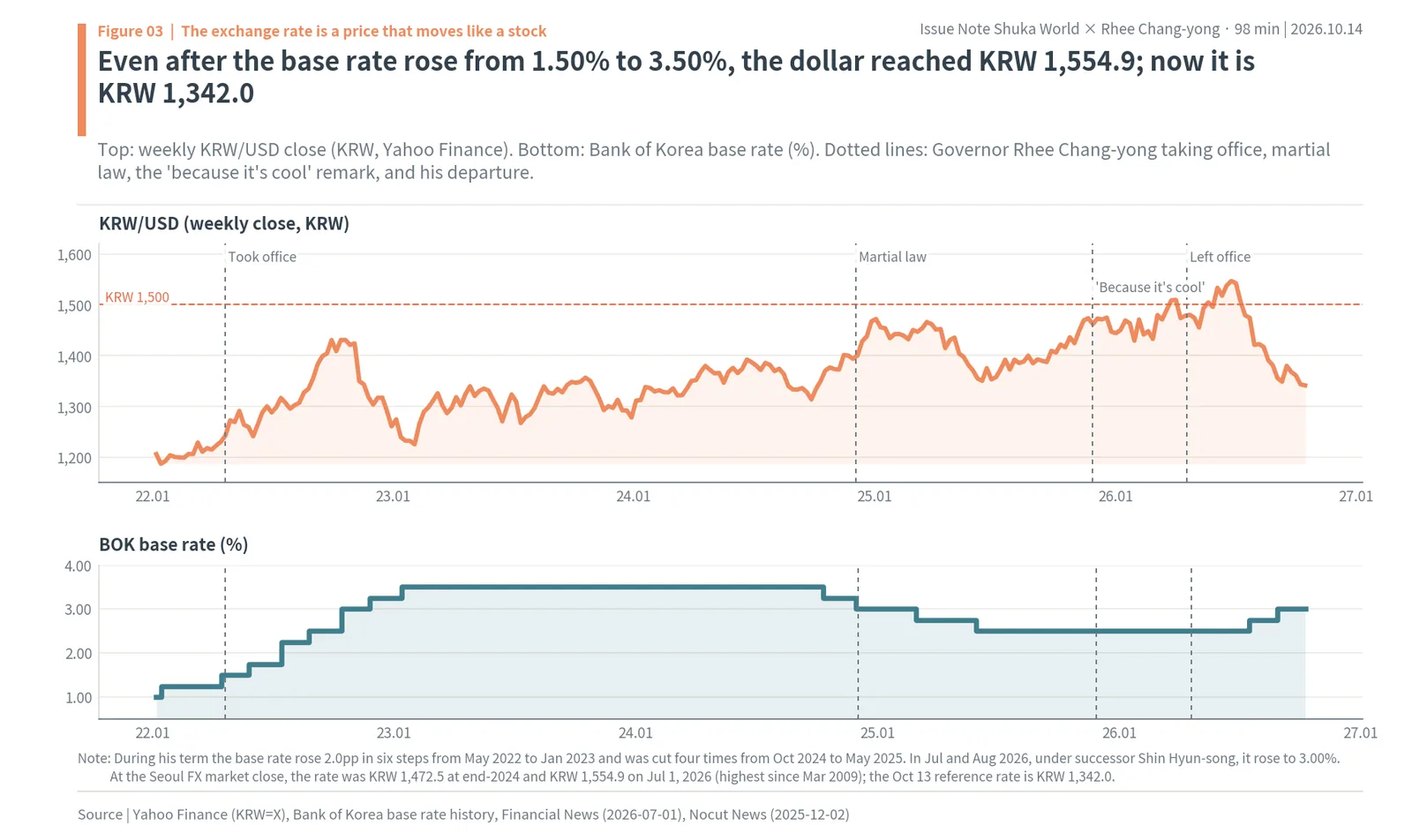
- Rhee raised the base rate from 1.50% to 3.50% in about eight months, yet the won still hit KRW 1,554.9 per dollar on July 1, 2026 before falling to KRW 1,342.0 on October 13: rates did not set its direction.
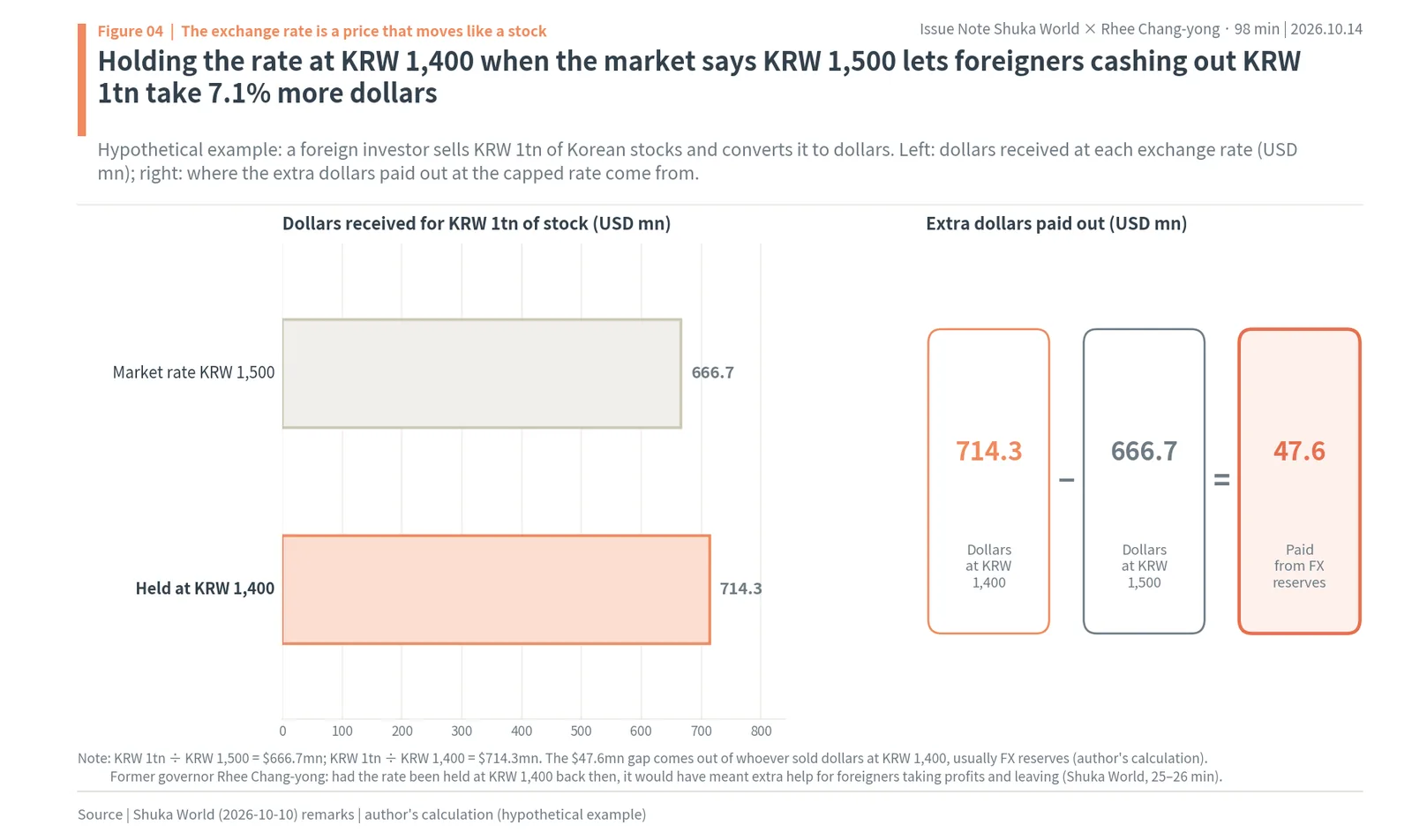
- Capping the won at KRW 1,400 when the market says KRW 1,500 lets a foreigner selling KRW 1tn of stocks take 7.1% more dollars ($714.3mn vs $666.7mn), paid out of FX reserves (author’s hypothetical).
- In 2025, individuals and the NPS bought foreign stocks worth 69.6% of the $123.05bn current account surplus: the ‘last drop’ Rhee says policymakers must respond to, not blame.
- None of about 20 chip experts Rhee met a year ago predicted a supercycle; SK hynix’s operating margin is now 76.3%, helped partly by China’s lack of ASML tools.
- The 2027 budget proposal is KRW 820.9tn (+12.8%) while growth forecasts of 3.3% and 2.9% already exceed potential growth of around 2%, so Rhee would use windfall revenue to smooth growth.
Key takeaways
- On October 10, 2026, Shuka World, Korea’s biggest economics YouTube channel, launched a podcast with former Bank of Korea governor Rhee Chang-yong as its first guest. Over 98 minutes and 22 chapters he covered the exchange rate, the chip boom, fiscal expansion, housing, university admissions, labor and regulation, and one principle ran through all of it: do not mix problems that prices solve with problems that only structural change solves.
- The exchange rate is a price that moves like a stock price, and capping it hands a gain to someone. His late-2025 remark that was read as blaming retail investors in US stocks was, he says, about responding to the “last drop” that sets the price. In 2025, individuals and the National Pension Service bought foreign stocks worth 69.6% of Korea’s $123.05bn current account surplus.
- No one knows how long today’s chip boom (SK hynix’s operating margin hit 76.3%) will last, so the state should prepare for its end and use windfall revenue to smooth growth rather than expand spending, as the KRW 820.9tn (about $612bn) 2027 budget does. The author thinks the single line “treat the exchange rate like a stock price” makes the episode worth watching.
As of: October 14, 2026
Topics covered: the format of the episode, the exchange rate and the base rate, what happens when a currency is capped, the conditions for central bank swap lines, the “last drop” and retail investors in US stocks, the National Pension Service, why the won has strengthened, how long the chip boom can last, the 2027 budget and fiscal smoothing, global yields and the K-dot plot, structural reform, martial law and life after office
Reference data: remarks are the author’s summary of the episode’s Korean auto-captions, with name errors in the captions corrected. Figures mentioned on the show were kept only when confirmed by the Bank of Korea, the finance ministry, the Federal Reserve or news reports. KRW/USD is from Yahoo Finance daily closes and reported Seoul FX market closes; KOSPI and investor flows are KRX data. Korea counts large sums in units of 100 million won (eok) and one trillion won (jo); this report shows them as KRW bn and KRW tn. Dollar equivalents use KRW 1,340.99 per dollar, the October 13, 2026 close.
Summary: Rhee Chang-yong’s one principle on Shuka World, prices vs structural reform
This report reviews the October 10, 2026 Shuka World interview with former Bank of Korea governor Rhee Chang-yong, checking what he said against public data and the author’s calculations. It asks one question: what stays with you after a 98-minute conversation? The author’s answer is a single principle. Do not mix problems that market prices such as interest rates and exchange rates solve with problems such as housing, education and labor that only structural change solves. Rhee applied that rule to the exchange rate, the chip boom, the budget and university admissions alike, which is why more than twenty topics never feel scattered.
The chain runs like this. First, the exchange rate is now a price. Korea has been a net external creditor since 2014, so a jump in the exchange rate no longer spirals into a national default. Rhee raised the base rate from 1.50% to 3.50% within about eight months of taking office, and once inflation fell back to around 2%, he says, there was no reason to keep raising rates for the exchange rate alone. Second, capping a price hands a gain to someone. Holding the rate at KRW 1,400 when the market says KRW 1,500 lets foreigners who sell Korean stocks take more dollars home. Swap lines, likewise, are a crisis tool, not a way to hold down the exchange rate in normal times.
Third, his remark about seohak gaemi, the Korean retail investors who buy US stocks, was about response, not blame. In economics, prices are set at the margin, not by the average. Of the $123.05bn current account surplus that came in during 2025, an amount equal to 69.6% went back out the same year as foreign stock purchases by individuals and the National Pension Service (NPS). Interest-rate gaps and growth gaps filled the cup, but the last drop made it overflow, and policymakers respond to that drop. Fourth, the won’s recent rise follows the same price logic. The Bank of Korea expects a $450bn current account surplus this year, and once foreign rebalancing after the KOSPI passed 9,000 had peaked, the surplus belatedly showed up in the exchange rate.
Fifth, nobody knows how long the chip boom behind that surplus will last. Of about 20 chip experts Rhee met a little over a year ago, none spoke of a supercycle. SK hynix’s operating margin of 76.3% owes something to China being unable to import ASML equipment. Sixth, the national budget should therefore stay smooth. The 2027 budget proposal of KRW 820.9tn is 12.8% larger than this year’s; if tax revenue flows for two years and then stops, long-term spending is left as deficits, and growth forecasts of 3.3% and 2.9% already exceed potential growth of around 2%. Seventh, a boom does not fix structure. Housing is a capital-area problem and the capital area is an admissions problem, and such structures change only when one policy runs for about ten years, yet each government reverses the last.
The author’s take is this. The author thinks the single line “treat the exchange rate like a stock price” makes the episode worth watching. The habit of calling every rise in the exchange rate a national crisis, and every fall a reason for the government to act, has bent policy for years. The report goes through the episode’s format, the exchange rate as a price, swap lines, the last drop, why the won rose, the chip boom, the budget, global yields and the K-dot plot, structural reform, the other segments, the author’s take, and how the numbers were calculated.
1. Shuka World’s first podcast: 98 minutes and 22 chapters with former BOK governor Rhee Chang-yong
A conversation that began with one lecture
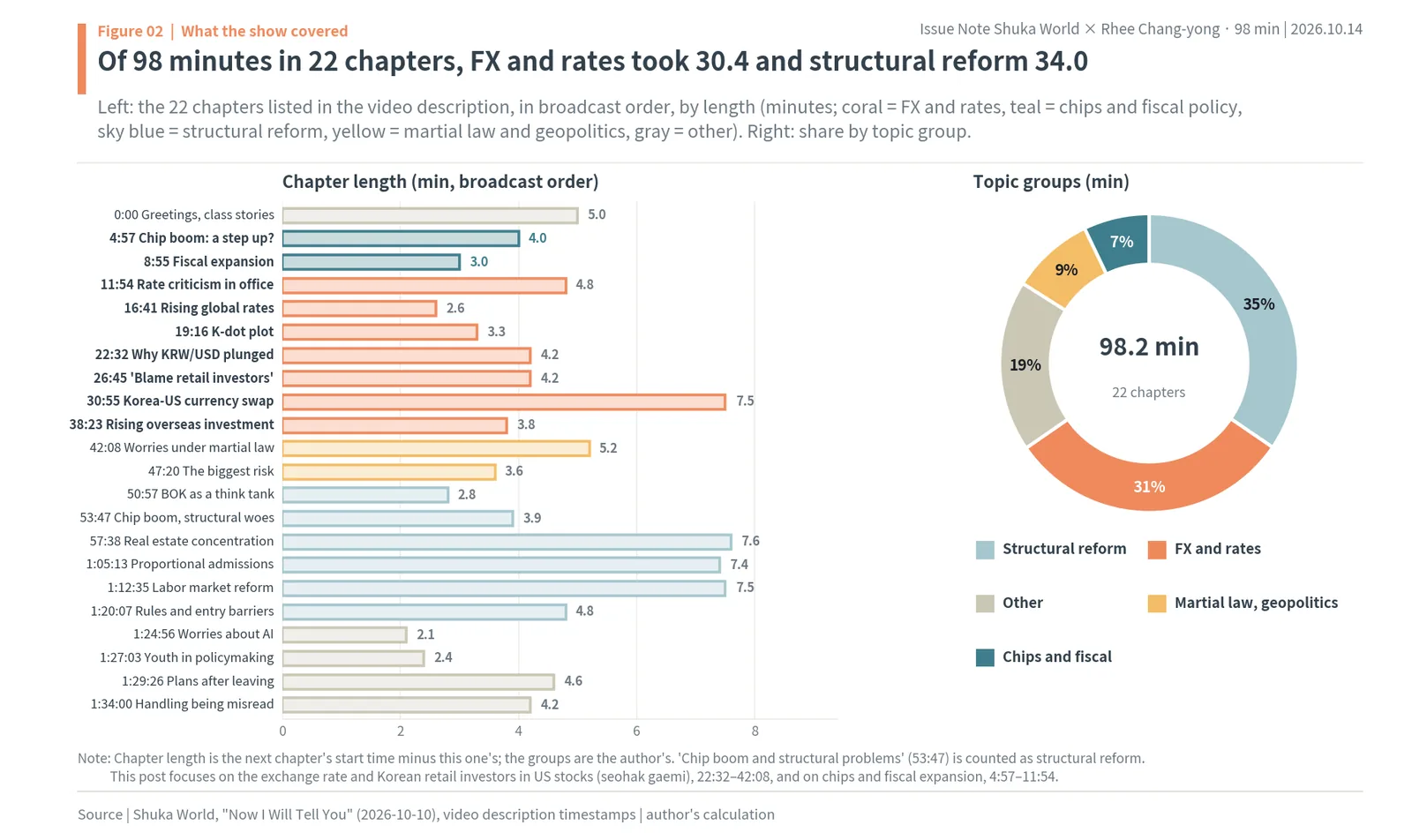
Shuka World, run by the economics commentator known as Shuka, has about 3.73 million subscribers. On October 10, 2026 it launched a new podcast program, and the first guest was Rhee Chang-yong, the 27th governor of the Bank of Korea (BOK). The video, titled “Now I Will Tell You,” runs 1 hour 38 minutes and is split into 22 chapters in its description. As of October 14 it had more than 2.43 million views and over 4,500 comments. Rhee took office on April 21, 2022 and completed his four-year term on April 20, 2026; his successor is Shin Hyun-song. Barred from private-sector jobs for three years after public office, he now works as a distinguished professor at Seoul National University, an adviser at Yonsei University and a nonresident fellow at the Peterson Institute for International Economics.
The conversation starts with an old connection. Twenty years ago Shuka attended exactly one session of Professor Rhee’s class on stocks, bonds and derivatives. In that first session Rhee told students who did not plan to study hard to leave, and Shuka never came back. Rhee laughed that he should have told students who wanted to make money to stay. He also explained why he agreed to appear: when the BOK was building its YouTube channel, Shuka’s team filmed with the bank, and subscribers rose from the 80,000s to over 100,000, so he came to return the favor.
Advising versus deciding
Rhee was director of the IMF’s Asia and Pacific Department, chief economist of the Asian Development Bank and vice chairman of Korea’s Financial Services Commission. Asked how those jobs differed from being governor, he pointed to the weight of decisions. In earlier roles he gave advice to the people who decided; as governor he decided monetary policy himself and bore the responsibility. And because it was his own country’s people whose lives were at stake, emotions came into it, which made it harder. That distinction underpins every answer that follows. Throughout, he separates what is correct as an academic from what a decision maker has to say.
The two longest topics
Figure 2 shows the 22 chapters in broadcast order by length (left) and the author’s five topic groups (right). Structural reform is the longest at 34.0 minutes, followed by the exchange rate and interest rates at 30.4 minutes; together they fill close to two-thirds of the 98 minutes. The longest single chapters are housing concentration (7.6 minutes), the Korea-US currency swap (7.5), labor market reform (7.5) and regional proportional admissions (7.4). Chips and fiscal policy take only 7.0 minutes, but as the opening question they set up everything else. This report gives the most space to the exchange rate and retail investors, and to the chip boom and fiscal expansion, the parts the author liked best.
2. The won as a price: base rate 1.50% to 3.50%, yet KRW 1,554.9 per dollar
Answering “you did not raise rates enough” with numbers
The criticism Rhee heard most in office was that he did not raise rates enough, so liquidity spilled over and pushed up prices, the exchange rate and house prices. He started with numbers. When he took office in April 2022 the base rate was 1.50%. From his first meeting in May 2022 to January 2023 the Monetary Policy Board, which the governor chairs, raised it six times to 3.50%, 2.0 percentage points in a little over eight months. He is probably the governor who raised rates the most in BOK history, he said, yet everyone has forgotten. Inflation was high and the won was falling at the time.
He also described what came next. The early hikes brought inflation back to the 2% range. Martial law was declared at the end of 2024, chip exports were weak, and growth sat at 0% to 1%. Financial stress followed the Legoland bond default. So the government actually asked him why he was not cutting rates. With inflation around 2% and growth below potential, calls to raise rates further were hard to accept even in theory. The lower panel of Figure 3 traces the base rate in his term: four cuts from October 2024 to May 2025 took it to 2.50%, and after he left, it rose to 3.00% in July and August 2026 under his successor.
Why rates are not set for the exchange rate
That left the exchange rate as the only reason. Saying he could finally speak freely, Rhee laid it out. The won’s weakness in 2024 and 2025 came from a dollar that strengthened worldwide after the US began raising rates quickly in 2022; the won was not alone. Raising rates to defend the currency rarely works and is not needed. In theory, monetary policy watches the exchange rate only because a weaker currency raises inflation, and inflation was already at 2%.
What has changed is Korea’s position. When Korea was a debtor nation, a sharp rise in the exchange rate raised fears of default. Since the end of the third quarter of 2014, Korea’s external financial assets have exceeded its liabilities, making it a net creditor. Letting the rate float is now the better solution, he said. He could not say this while in office: the moment a governor says “a floating rate should be left alone,” markets read it as a sign the BOK will not intervene, and the won falls further.
Accept it the way you accept stock prices
His analogy was the stock market. In the 1960s to 1980s, many Koreans thought the government had to step in when stock prices swung. Almost nobody thinks that now; people may wish prices would rise, but they do not ask policy to prop them up. The exchange rate is also the price of a financial asset, so it should be managed only when there is a risk such as national default and otherwise left to float. If the public blames this government or the next every time the won weakens, policy cannot be done properly. So he asked viewers to get used to the floating exchange rate, which he called extremely important.
The upper panel of Figure 3 shows the weekly KRW/USD close since 2022. On Seoul FX market closes, the rate ended 2024 at KRW 1,472.5 and peaked in 2025 at KRW 1,484.1 on April 9. On March 16, 2026 it passed KRW 1,500 intraday for the first time in 17 years. The high was KRW 1,554.9 at the July 1, 2026 close, the highest since March 2009, and the October 13 reference rate was KRW 1,342.0. Over the same four and a half years the base rate went from 1.50% to 3.50% and back to 2.50%. The chart makes plain that the base rate did not set the direction of the exchange rate.
Who gains when the rate is capped
He also gave an extreme example. When the won hit KRW 1,500 to the dollar, there were loud calls to hold it at KRW 1,400. But that was when foreign investors were selling Korean stocks and leaving. Had the government held the rate at KRW 1,400, it would have priced the won generously for foreigners cashing out. When the exchange rate moves, some gain and some lose; capping it does not remove the gains and losses, it only changes who gets them.
In numbers, the author’s hypothetical runs like this. A foreign investor sells KRW 1tn of Korean stocks and converts the proceeds to dollars. At the market rate of KRW 1,500 the investor receives $666.7mn. With the rate held at KRW 1,400 the investor receives $714.3mn. The gap is $47.6mn, or 7.1% more dollars. That money comes from whoever sold dollars at KRW 1,400, usually the FX reserves (author’s hypothetical example). Figure 4 shows the dollars received (left) and where the difference comes from (right).
He said the same about the won’s recent rise: people who demanded a swap line when the rate soared should not now demand that the government do something because it is falling. He laughed that not even Shuka should think that way, but it was the clearest claim of the whole episode. Demands to cap the rate or bring in a swap line every time it rises try to turn a price backwards.
3. Korea-US currency swap: the Fed’s three conditions and the $30bn and $60bn lines
Put yourself in the other side’s shoes
Every time the won weakens, the same prescription appears: a Korea-US currency swap. Rhee turned the question around. If a struggling developing country asked the Bank of Korea for a swap line, should the BOK give it one? The BOK’s mandate is the Korean economy, and it cannot take responsibility for another country’s crisis. The Federal Reserve is no different. A swap looks essential from Korea’s side, he said, but that is only Korea’s view.
The two times the Fed gave Korea a swap line
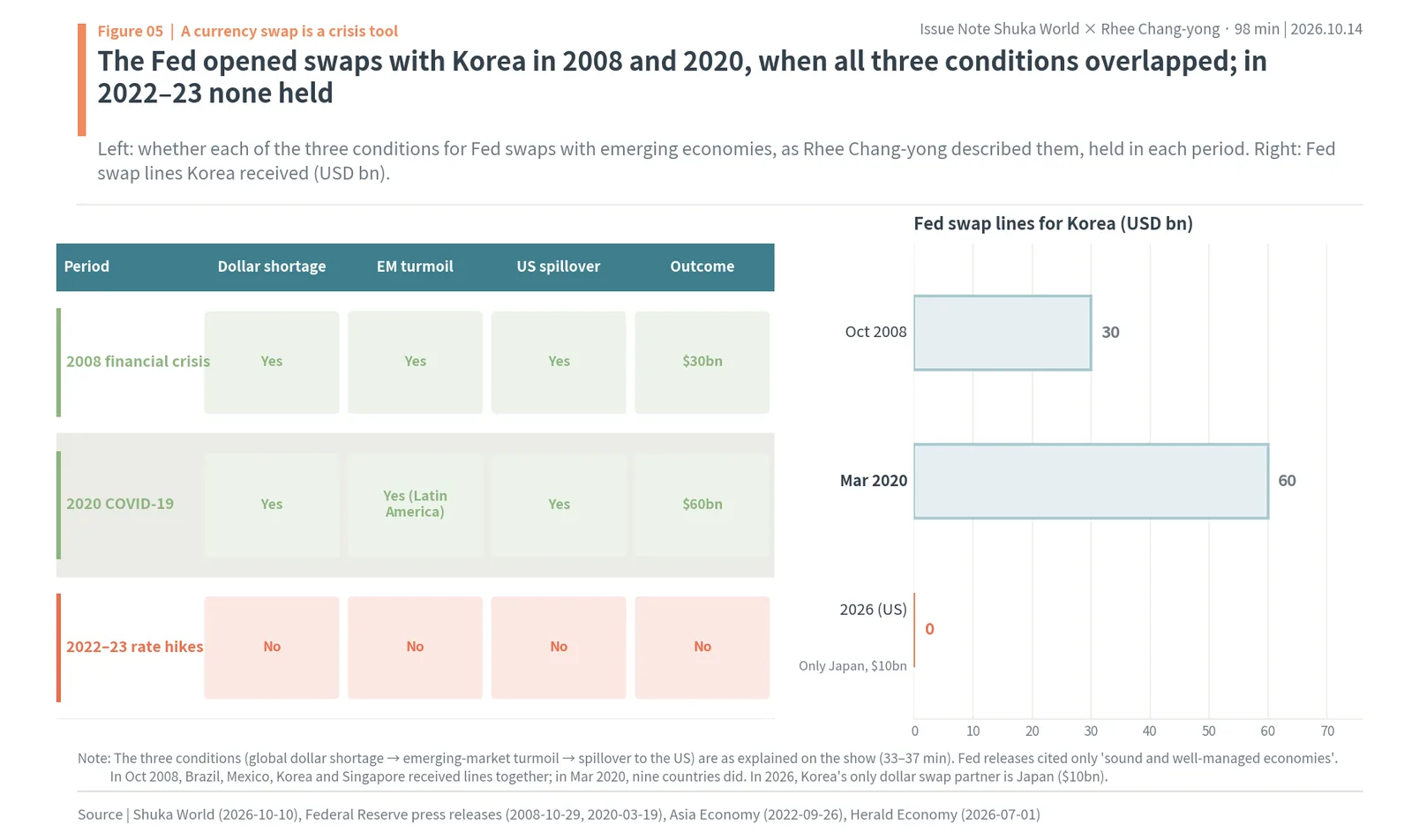
The history he described goes like this. The Fed widened its swap lines in the global financial crisis, when dollar funding markets in Europe and elsewhere broke down and failing major banks threatened US markets. It first gave lines to financial hubs such as the euro area, Japan, Canada and Switzerland, and when Latin America and other emerging economies kept wobbling, it gave lines to emerging economies for the first time. Fed press releases show that on October 29, 2008, Brazil, Mexico, Korea and Singapore each received up to $30bn, bringing the total to 14 central banks. The Korea-US line was extended twice and ended on February 1, 2010.
After the crisis, Congress called the Fed in and accused it of overreach: its job was American households and firms, so why lend to emerging economies with credit risk? The principle the Fed then settled on, as Rhee described it, is this. Financial hubs get standing lines. Emerging economies get one only when three conditions hold together: a global dollar shortage, turmoil in major emerging markets because of it, and spillover from that turmoil to US consumers and firms. COVID was the next test. On March 19, 2020, the Fed opened lines to nine central banks, and Korea received $60bn alongside Australia, Brazil, Mexico, Singapore and Sweden. That line ended on December 31, 2021.
In 2022-23, none of the conditions held
When the US raised rates quickly in 2022 and 2023 and the won passed KRW 1,400, calls to secure a swap were loud. Rhee was told that someone who had lived in America for years, knew the IMF and had many US contacts should be able to bring one home. He said even Jerome Powell’s answer was the same: was there a global dollar shortage? No. Was Korea in danger from the weaker won? No. Would Korea’s troubles spill over to the US? No. In the National Assembly in September 2022 he had also said the Fed discusses swap lines when global dollar markets face a liquidity shortage.
A swap would not have helped anyway, he noted, because the euro, the yen and the Swiss franc, all backed by standing Fed lines, were also weakening against the dollar. Figure 5 shows whether his three conditions held in each period (left) and the Fed swap lines Korea received (right). All three held in 2008 and 2020, and Korea got a line each time. None held in 2022-23. In 2026, Korea’s only dollar swap partner is Japan, for $10bn.
A swap came up again in 2025
Calls for a swap kept returning. In September 2025, President Lee Jae-myung said that paying the $350bn of investment promised to the US in cash without a swap line could bring on a situation like 1997. In October, national security adviser Wi Sung-lac said Korea had proposed an unlimited currency swap to the US Treasury but that it had not moved forward. This time the reason was funding a huge investment in the US, not stabilizing the won. By Rhee’s principle, the Fed still opens swap lines for the stability of the US dollar market, with the partner country’s needs coming second.
What swap demands distort
What worried him was less the swap itself than the thinking behind the demand. Because many people assume the exchange rate should be fixed, “bring a swap line home” becomes the reflex, and that bends political decisions. He summed up a swap as a tool for crises such as a national default while the exchange rate floats, not a tool for steadying the rate in normal times. It brings the argument back to section 2: the exchange rate is a price, and fixing it with policy just moves the cost somewhere else.
4. Seohak gaemi and the ‘last drop’: 69.6% of the 2025 surplus went into foreign stocks
The most unfair criticism of his term
Shuka carefully raised the seohak gaemi controversy. At a press conference after the Monetary Policy Board meeting on November 27, 2025, Rhee, talking about overseas stock investing, said that when he asked young people why they did it, they answered “because it’s cool.” That was read as blaming retail investors for the weak won, and he called it the most unfair criticism of his term. He apologized to anyone who was hurt but said he had not blamed them. “Because it’s cool” was something university students told him, which he passed on with concern, yet it was reported as his own view. He had made the same point at his last board press conference on April 10, 2026. When he left office on April 20 he said he still did not think the remark itself was wrong, though he would now say “domestic investors’ overseas investment” instead of seohak gaemi. He meant to point at a flow of money, not at people.
The full cup and the last drop
This is where the episode is most fun. Rhee quoted the analogy Shuka had used back then: if a cup is almost full and the last person adds a drop that makes it overflow, is it that person’s fault, or the fact that the cup was already full? Rhee replied that Shuka clearly had not listened in class. In economics, prices are set at the margin, not by the average. The FX market is a price too, so the last drop sets the exchange rate. Interest-rate gaps and growth gaps filled the cup, but the last drop made it overflow, and when that drop causes social shock, responding to it is the policymaker’s job.
So what he meant, he said, was response, not blame: at the time, the biggest force on the exchange rate was the surge in overseas investment by individuals and the NPS, and that flow needed attention. The numbers give the explanation weight. According to the BOK’s balance of payments, Korea’s 2025 current account surplus was a record $123.05bn. In the same year individuals invested $45bn in foreign stocks, $31.4bn directly and about $13.6bn through ETFs, about $4.3bn more than the NPS. Derived from that gap, the NPS invested about $40.7bn (author’s calculation). Korea Securities Depository data show individuals’ 2025 net purchases of US stocks were a record $32.6bn, and their US stock holdings hit a record $206.3bn on June 2, 2026. Retail overseas investment has become a hand nearly as large as the NPS.
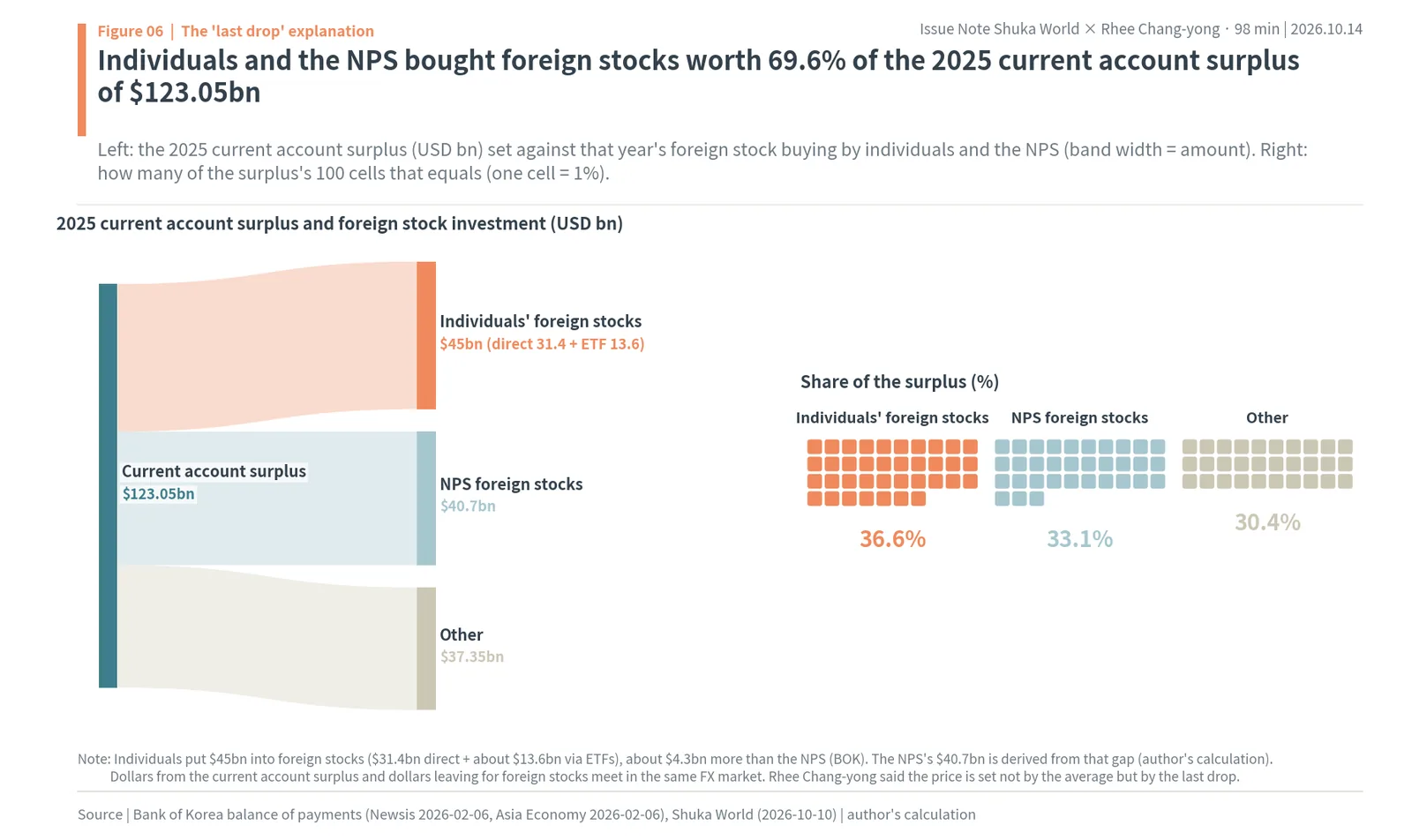
Figure 6 sets the 2025 current account surplus against that year’s foreign stock investment. An amount equal to 69.6% of the dollars that came in through the surplus went back out into foreign stocks, 36.6% from individuals and 33.1% from the NPS. Dollars earned from the surplus and dollars leaving for foreign stocks meet in the same FX market. There is no simpler way to explain why the won rose as high as the KRW 1,480 range at the end of 2025 despite a record surplus.
You cannot tell a dying patient to exercise more
Rhee also recalled the 1997 Asian financial crisis. A Seoul National University professor at the time, he felt the limits of being an economist, an experience that pulled him into real-world policy. The country came in like a bleeding patient; IMF and investment bank people acted like surgeons, deciding how to restructure banks and repay debt, while many economists talked about structural problems and policy finance. That was correct but of little help, he said.
The exchange rate works the same way. It is true that growth and interest-rate gaps between Korea and the US drive it, but those gaps cannot be closed in a month or two. So policymakers look for ways to manage the last drop. He compared it to telling a patient who is about to die that they should have exercised more. Structural talk is not useless; what you say in the emergency room is just different from what you say at a checkup. Section 9 turns this distinction around.
The NPS as the counterweight for the nation’s portfolio
His remedy was the NPS. In the mid-2000s, when the fund hardly invested abroad, he was the one who argued it had to go overseas as it grew. Twenty years later two things have changed. The NPS has become the biggest player in Korea’s small FX market, to the point that foreign investors forecast the won from its moves. And whereas individuals barely invested abroad back then, they now do so heavily. Seen as one national portfolio, someone has to offset individuals going abroad, and the NPS, which manages individuals’ savings, should play that role.
So he urged the NPS to build its own capacity, free of government influence, to watch the macro picture, with a dedicated unit and FX experts. In the long run he thought it might need to move toward a 50-50 split between domestic and overseas assets, as in Japan. Figure 7 shows the NPS asset mix at the end of May 2026 and the growth of the BOK-NPS FX swap line. Foreign stocks are 35.2% and foreign bonds 5.8%, together 41.0%. The swap line, which lets the NPS borrow the dollars it needs for overseas investment from the BOK instead of the market, grew from $10bn in 2022 to $65bn in December 2024 and has been extended to the end of 2026.
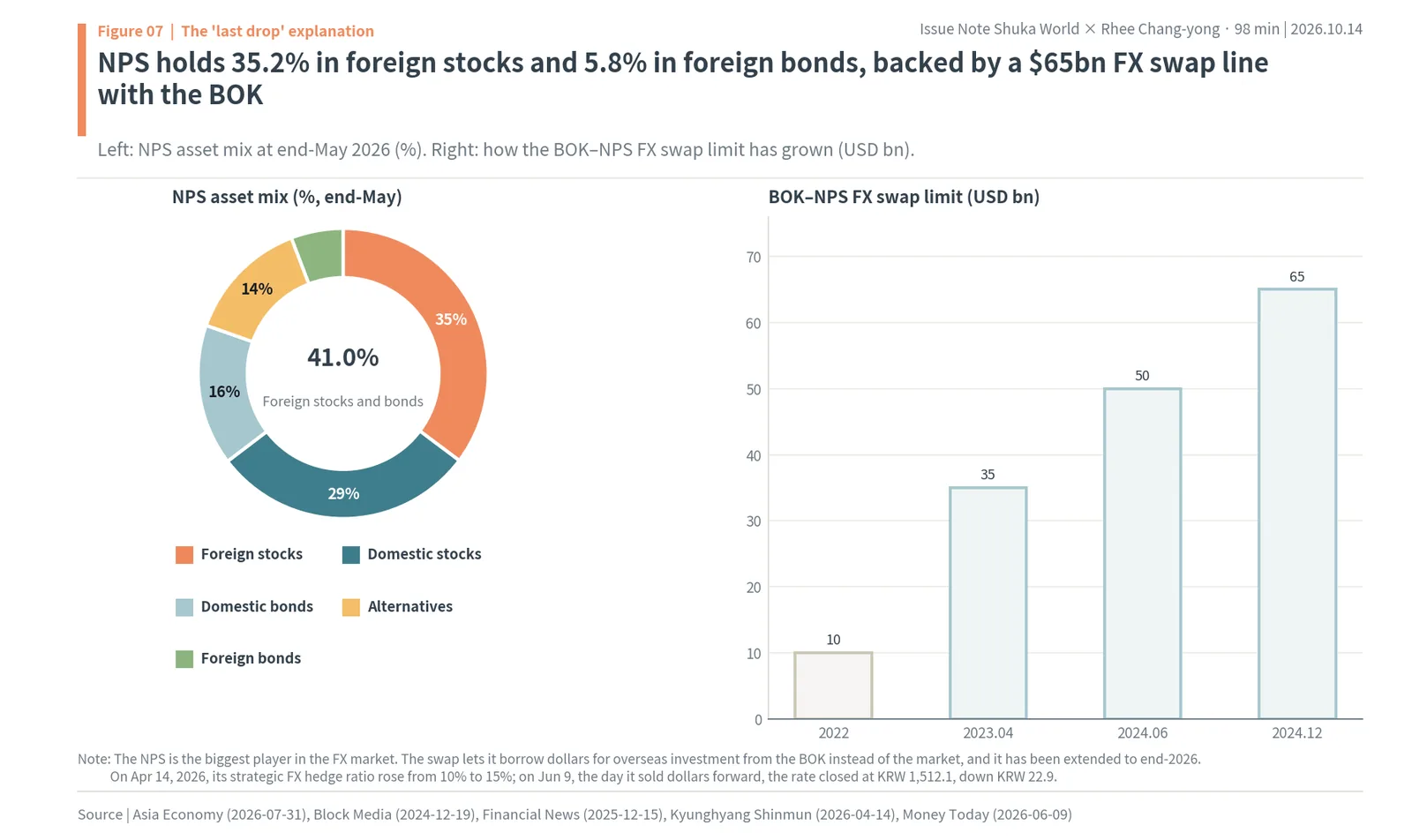
The role grew in 2026. On April 14, the NPS raised its strategic FX hedge ratio from 10% to 15%, and on June 9, the day it sold dollars forward, the won closed at KRW 1,512.1 per dollar, KRW 22.9 stronger. His line that the last drop is something to respond to rather than blame leads to a concrete lever: the NPS.
5. Why the won rose: a $450bn surplus and the end of foreign rebalancing
The biggest cause is the current account surplus
Around the time of the episode, the won had strengthened quickly over little more than a month. On Seoul FX market closes, the rate went from KRW 1,554.9 per dollar on July 1 (KRW 1,559.2 intraday) to KRW 1,336.1 on September 9, a drop of more than KRW 220 from the intraday high in two months. Since then it has stayed in the KRW 1,330s to 1,340s, at KRW 1,338.5 on October 8, for example. Shuka noted that some now predict a rate below KRW 1,300 and asked why. Rhee named the current account first: this year’s and next year’s surpluses are of a size Korea has never seen.
The Bank of Korea’s August 2026 Economic Outlook projects a record $450bn current account surplus this year. From January to August alone, $279.2bn piled up, with June ($49.73bn) and August ($46.11bn) the two largest months on record. That would be 3.7 times the whole of 2025’s $123.05bn surplus earned in a single year (author’s calculation). Most of it is chips. September semiconductor exports were $60.3bn, up 263% from a year earlier; chips made up 49.9% of that month’s total exports of $120.94bn (author’s calculation), and the trade surplus was $49.85bn. Market participants pointed to exporters converting chip revenue into won as the main source of the won’s strength.
The strange months when a surplus came with a weaker won
After the chip supercycle began in March, the won should have strengthened, but it weakened instead, something Rhee called an interesting event the world had never seen. As the KOSPI went from 3,000 past 5,000 to 9,000, foreign institutions holding Korean stocks hit their Korea weight limits. With their holdings worth more than three times as much, they exceeded their target allocation to Korea and sold to lock in gains. With a large surplus, strong growth and soaring stocks, rebalancing meant selling won for dollars, so the won fell. He added that he thought 9,000 was overheated.
KRX data show the pattern clearly. The KOSPI rose past 3,000 at 3,021.84 on June 20, 2025, then hit 5,084.85 on January 27, 2026 and 9,063.84 on June 18 before its record close of 9,114.55 on June 22. From January to October 13, 2026, foreigners net sold KRW 203.0tn (about $151bn) of KOSPI stocks (sum of KRX daily data, author’s calculation). Of that, KRW 92.9tn came in May and June alone, the heaviest selling around the 9,000 mark. On June 2, Daishin Securities analyst Lee Kyung-min said the selling was rebalancing, not foreigners leaving Korean stocks. By that date foreigners had net sold KRW 103.25tn this year, yet their share of the KOSPI had risen from 36.26% at the end of last year to 40.26%, because prices rose faster than they could sell. By the end of September, Samsung Electronics (005930.KS) and SK hynix (000660.KS) together made up more than half of the KOSPI’s market value (48.81% to 50.85%), so index-weight selling at every quarter-end became built in. That is the weight limit Rhee was describing.
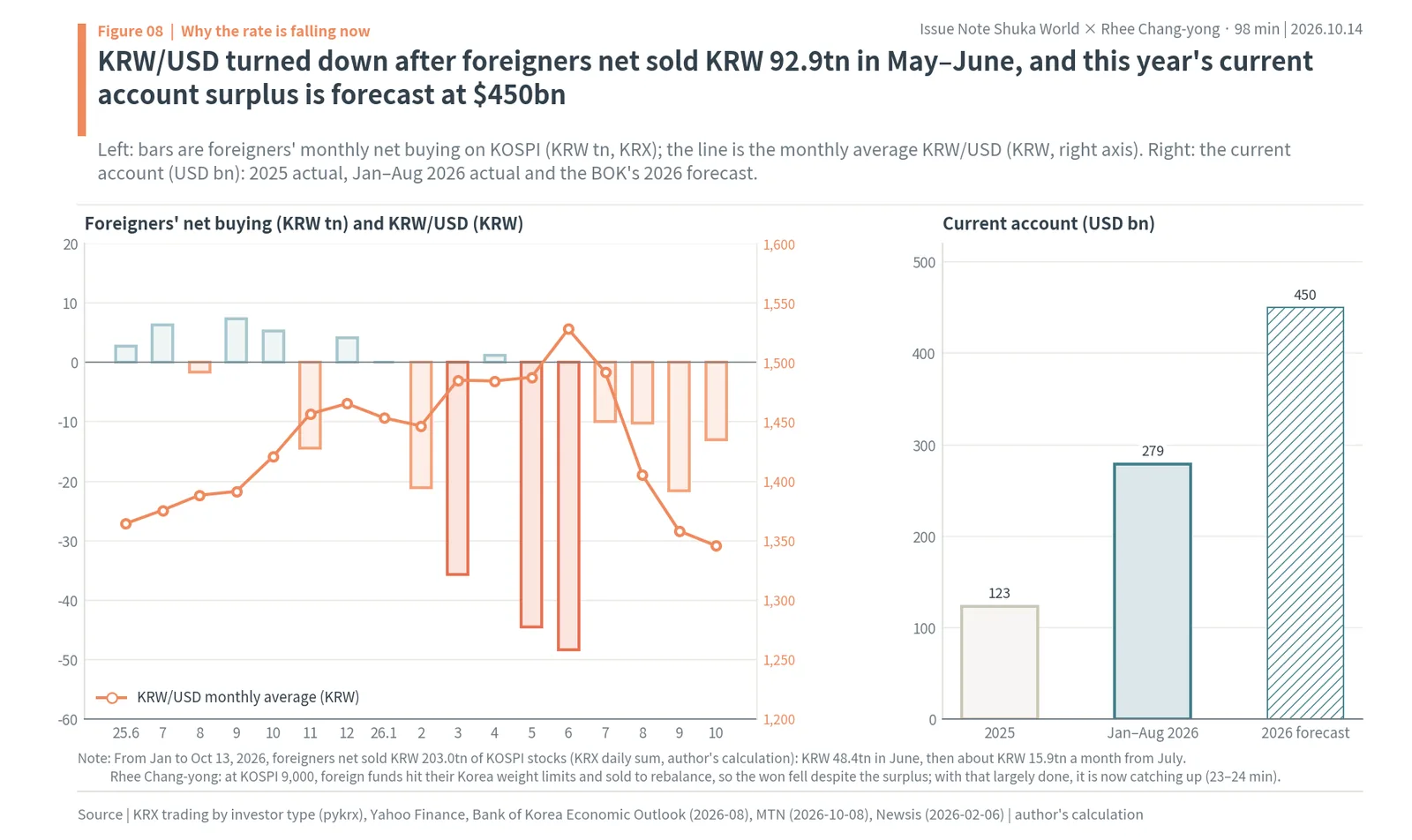
Figure 8 shows foreigners’ monthly net buying (bars) and the monthly average KRW/USD rate (line) on the left. The month of heaviest foreign selling, June, was also the month with the weakest won. From July to October 13, foreign selling eased to about KRW 15.9tn a month on average, and the rate fell below KRW 1,400. The right panel shows the size of the surplus. As the rebalancing ran its course, the surplus that had piled up belatedly showed up in the exchange rate, Rhee explained. So today’s strong won, too, is a price set by the surplus and by flows, not something the government made.
What will move the won from here
He listed the variables ahead. The main one is how long the current account surplus stays this large, which depends on the chip supercycle. Next is US rates: even under Fed Chair Kevin Warsh, markets have priced one or two more US hikes by year-end because of inflation, and a worse Middle East war could push them higher. The US fiscal deficit, Trump policy after the US midterm elections in November, Korea-US investment and tariffs could also move the won. The conclusion repeats: drop the habit of calling a rising rate a national default and a falling rate a reason to act, and leave the exchange rate to the market.
Investing abroad is a bet on the exchange rate
A question Shuka asked off-script around the 38-minute mark ties in here: is the rapid growth of overseas assets financial maturity or a hollowing-out of the home market? Rhee expects the trend to continue; until the so-called Korea discount on Korean stocks disappears or the home market improves, there is no way to stop it. Information and language barriers are gone, and many people hold dollar accounts. “If people say I blamed seohak gaemi, I could die of frustration,” he laughed.
His concern lay elsewhere. Investing abroad is almost the same as betting on the exchange rate, yet Korean individuals still trade directly, and many lack the knowledge to manage currency risk. Hence his emphasis on indirect investment and financial education; the era when studying hard was enough to make money is over, so money management should be taught early. He also said it pained him that the KOSPI’s run from 3,000 to 9,000 and back could have been a chance to end the Korea discount but instead, with such large swings, made it worse.
6. Chip supercycle doubts: zero of 20 experts, SK hynix’s 76.3% margin
Twenty experts a year ago, zero calls for a supercycle
The episode opened with chips. Nominal GDP in the second quarter grew 26.4% from a year earlier, the fastest in 47 years, and the BOK said per-capita gross national income would very likely pass $40,000 this year. Asked whether Korea had moved up a level, Rhee asked viewers to look back a year first. Almost no one predicted a chip boom of this size a year ago, he said.
He told a story. A little over a year ago, when Samsung Electronics was struggling to supply HBM to Nvidia, many people came to his office to warn that the Korean economy depended heavily on Samsung and that he should prepare. So over a month he met about 20 Korean chip experts and asked what would happen. None of them said a supercycle was coming. Now many of the same people tell the media it will last ten years, so, he said frankly, he is not sure whether to trust experts in this field.
The quality of the numbers is worth a look too. While nominal GDP grew 26.4% in the second quarter, real GDP grew 3.7% from a year earlier and the GDP deflator, a measure of prices, rose 21.9%, the highest since the fourth quarter of 1980. Most of the nominal growth came from prices, mainly memory chip prices, rather than volume. Prices rise and fall faster than volume, which is why he doubted the boom’s length.
He was clear that he was not being pessimistic. He believes current demand alone will sustain the boom for the next one to two years, and ten years would be a blessing for Korea. But as someone responsible for the national economy he had two worries: even if it lasts ten years, how to handle the K-shaped polarization that comes from concentrating on chips, and, more importantly, whether it will last at all or end within a few years.
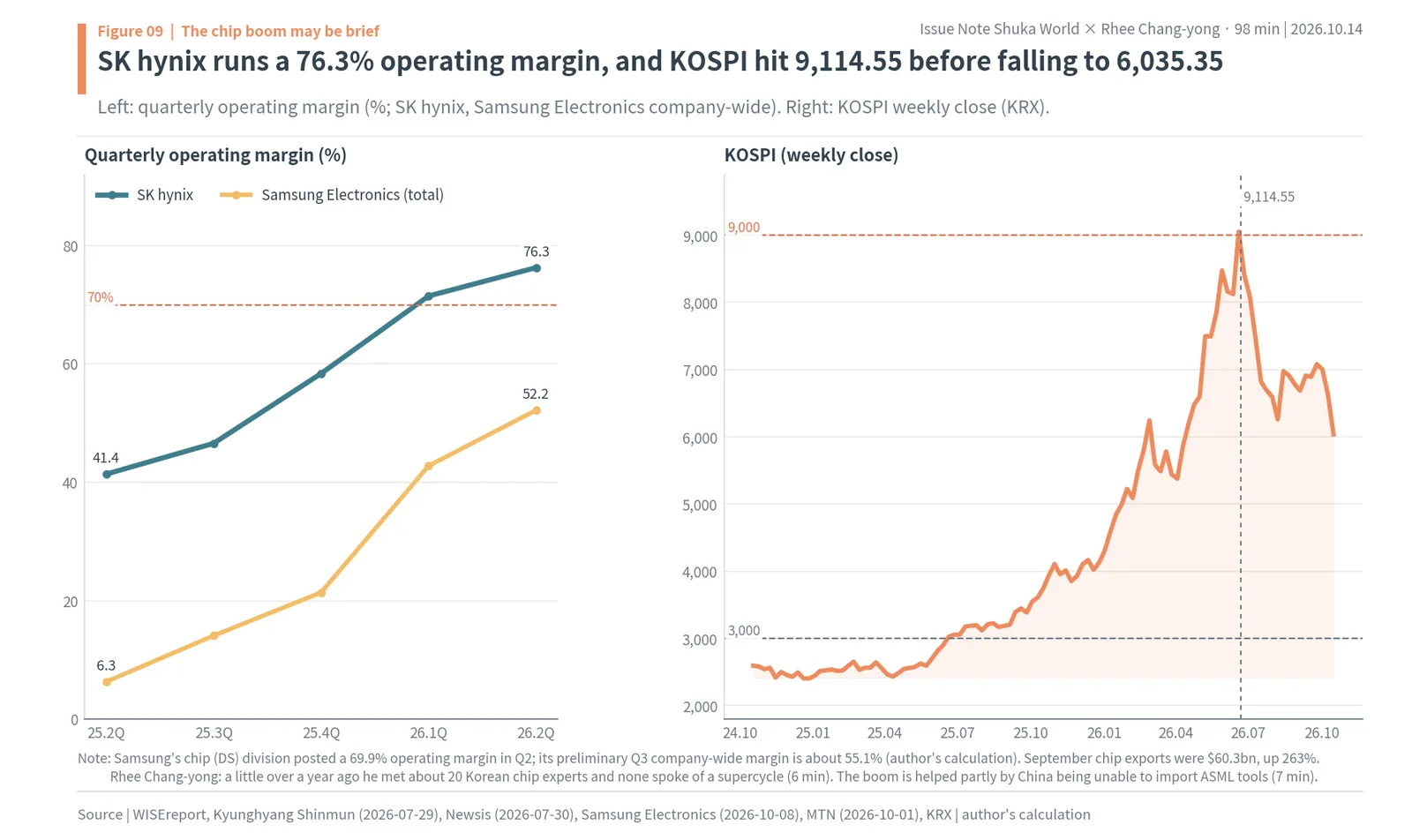
What props up a 76.3% margin
He did not credit today’s boom only to the competitiveness of Samsung Electronics and SK hynix. Chinese chipmakers had been catching up amid US-China tensions, and their progress stalled once they were blocked from importing Dutch ASML equipment. If US-China relations improve and China can import ASML tools, or develops its own, the industry’s balance and supply would change, and it would be worth asking whether operating margins above 70% can last.
The left panel of Figure 9 shows those margins. On WISEreport data, SK hynix’s quarterly operating margin rose from 41.4% in the second quarter of 2025 to 76.3% in the second quarter of 2026. Samsung Electronics’ company-wide margin rose from 6.3% to 52.2%, and its semiconductor (DS) division alone posted 69.9% in the second quarter. Samsung’s preliminary third-quarter results show sales of KRW 195tn and operating profit of KRW 107.4tn, a company-wide margin of about 55.1% (author’s calculation). The right panel shows the KOSPI over the same period: after peaking at 9,114.55 on June 22 it fell to 6,035.35 by October 13. Profits are still rising, but stocks turned first.
The state should prepare for the end
His conclusion is a division of roles. Individual investors and companies can invest and decide on optimistic views. But a government managing the economy should hope the cycle lasts while preparing for the possibility that it does not. So he does not believe the chip supercycle will lift Korea a level and solve every economic problem. To take the extreme case, a chip boom will not solve the low birth rate and aging that have been dragging down Korea’s growth.
That division leads straight to the next question, fiscal policy. If no one knows when the boom ends, how should a budget built on boom-time revenue look? Here he took direct aim at the government’s 2027 budget.
7. Korea’s KRW 820.9tn 2027 budget (+12.8%) and fiscal smoothing
KRW 820.9tn, the fastest growth since 2005
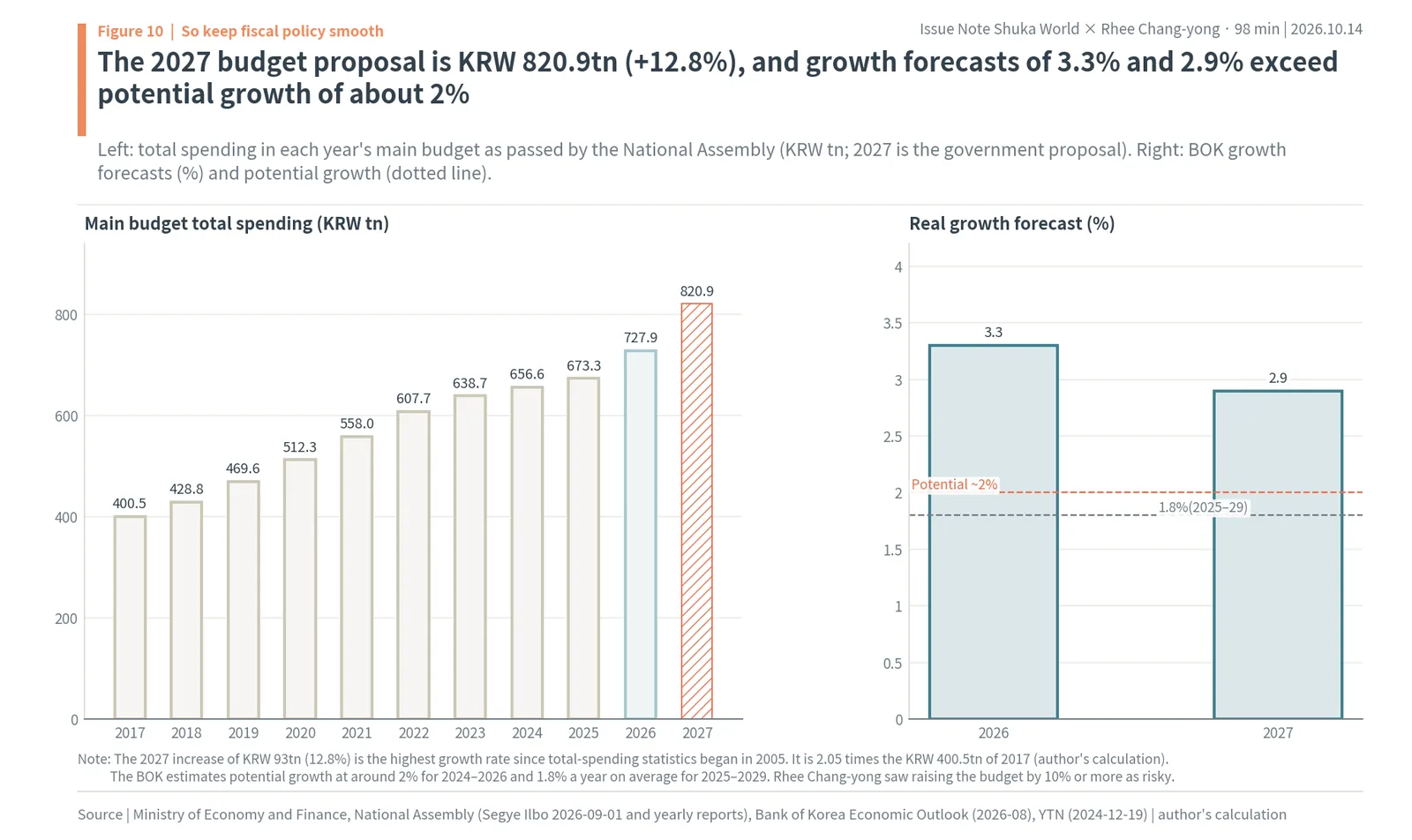
At the cabinet meeting on September 1, the government set total spending in the 2027 budget proposal at KRW 820.9tn (about $612bn). That is KRW 93tn, or 12.8%, more than the 2026 main budget of KRW 727.9tn, the highest growth rate since total-spending statistics began in 2005, and 2.05 times the KRW 400.5tn of 2017 (author’s calculation). The future response fund will receive KRW 162.3tn: KRW 45.4tn for youth, growth engines, regions and education, KRW 12.5tn to reduce bond issuance, and KRW 104.4tn held back for a downturn. Roughly two-thirds of the fund is, in effect, set aside for the case Rhee warned about, the boom ending. The remaining question is the KRW 820.9tn of main-budget spending. Shuka recalled budgets of KRW 400tn to 500tn from his fund manager days and summed up the government’s view as planting seeds while the tide is in.
Figure 10 shows main-budget total spending since 2017 on the left (2027 is the government proposal) and the BOK’s real growth forecasts against potential growth on the right. In its August Economic Outlook the BOK forecast growth of 3.3% for 2026 and 2.9% for 2027. Its estimate of potential growth is around 2% for 2024-2026 and 1.8% a year on average for 2025-2029. In both years, forecast growth is above potential growth of around 2%.
Worry one: ten years of spending on two years of revenue
Rhee separated micro from macro. “Row while the tide is in” is right for companies and at the micro level. At the macro level, though, you have to ask what it leaves for the economy as a whole. Unless one is sure chips will stay strong for ten years and tax revenue will keep flowing, he had two worries about raising next year’s spending by more than 10%. Etoday reported the remark as saying a budget increase of 10% or more is risky.
The first worry is what the money is used for. If good revenue this year leads to big new investment, that investment does not end in a year; it has to continue for at least five or six years and up to ten. If revenue flows for about two years and then stops, the long-term commitments already under way must be covered with deficits. Turning temporary revenue into permanent spending needs risk management.
Worry two: what fiscal policy adds, it later subtracts
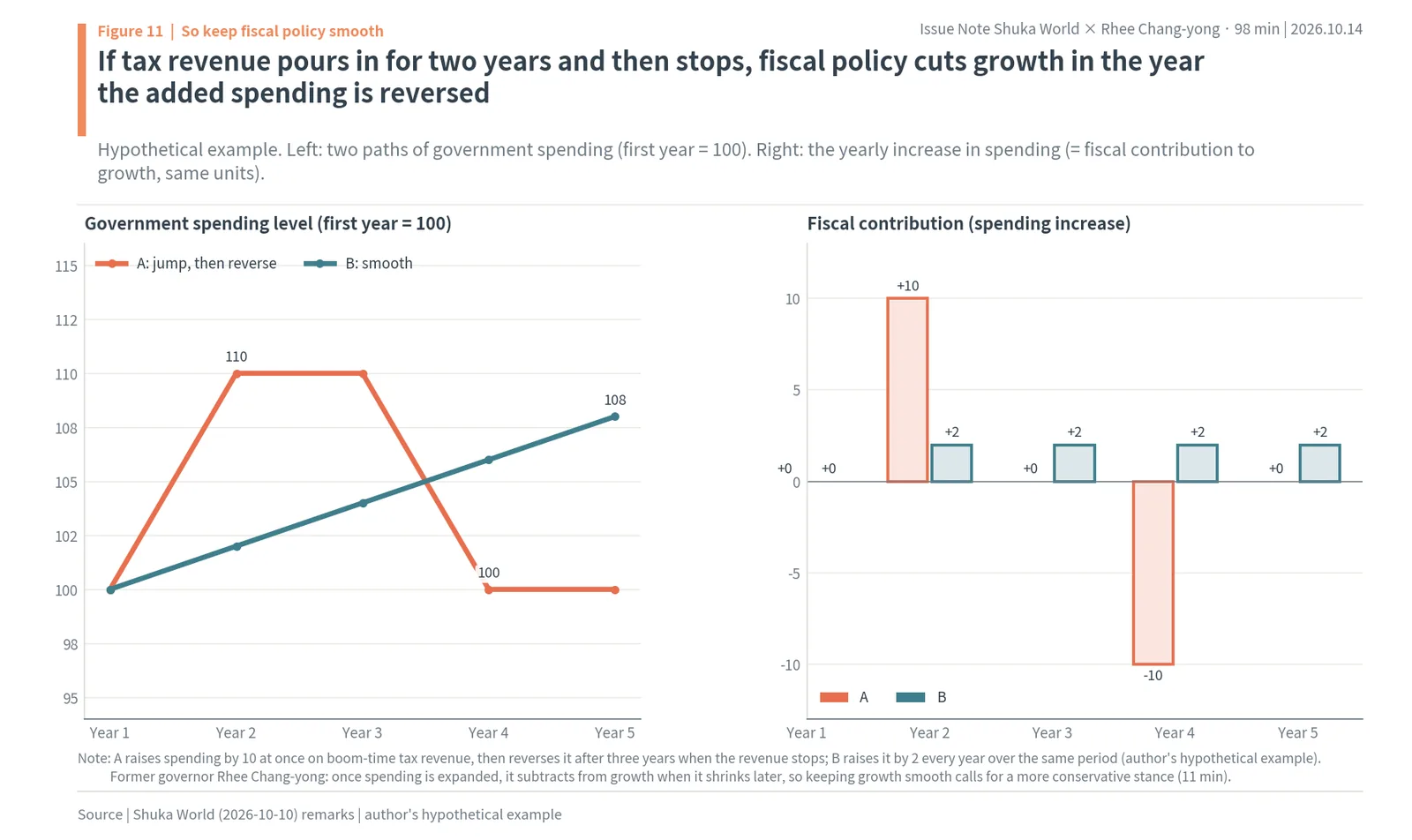
The second worry is the business cycle. On the BOK’s forecasts, growth this year and next is already well above potential, and exports suggest it could be higher. Why spend more to push growth up further? His principle is that fiscal policy’s contribution to growth comes from changes in spending, not its level. Once spending is raised, any later year in which it falls subtracts from growth.
The author’s hypothetical in Figure 11 makes the point. Set first-year spending at 100. Path A uses boom revenue to jump spending to 110 in the second year and returns it to 100 in the fourth year, when revenue stops. Path B raises spending by 2 every year, reaching 108 in the fifth year. The right panel shows each year’s fiscal contribution to growth, that is, the increase in spending. A adds +10 in the second year and subtracts 10 in the fourth; B adds a steady +2 every year. Over five years A sometimes spends more, but it leaves only a big swing in growth (author’s hypothetical example).
So, he said, keeping growth smooth calls for a more conservative stance now. Do not build on the assumption that revenue will keep rising for ten years so spending can keep rising too. He closed with “companies and countries are different.” It mirrors section 6: enjoying the boom is for companies and individuals; preparing for its end is the state’s job. Boom-time revenue should go to smoothing growth rather than to a big expansion of spending.
8. US 10-year at 5.347%, Japan at 3.000%, and the Bank of Korea’s K-dot plot
US 10-year at 5%, Japan 10-year at 3%
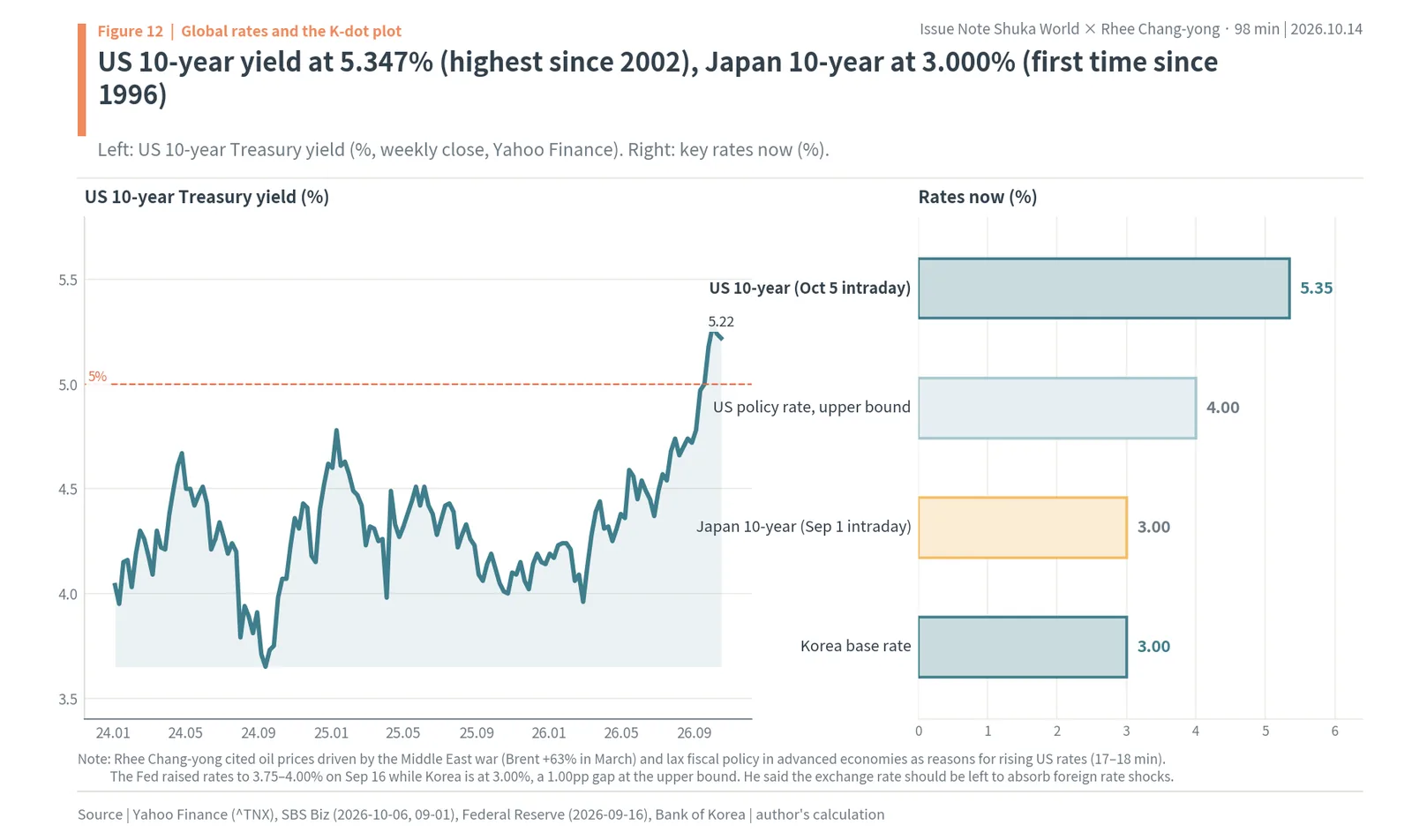
With the exchange rate calming, interest rates are the new worry. The US 10-year Treasury yield passed 5% intraday on September 15 and hit 5.347% intraday on October 5, the highest since April 2002. Japan’s 10-year yield reached 3.000% intraday on September 1, the first time at 3% since 1996. The Fed raised its policy rate to 3.75-4.00% on September 16. Korea, after two hikes in July and August following Rhee’s departure, is at 3.00%, a gap of 1.00 percentage point at the upper bound (author’s calculation).
He restated the principle first. When foreign rates move a lot, the exchange rate moves; if every other currency moves and Korea alone tries to hold still, the problem grows. The exchange rate should be allowed to adjust and act as a shock absorber. He then gave two reasons for rising US rates. One is oil prices driven by the continuing Middle East war. Brent rose 63% in March, its biggest monthly gain since 1988, and hit $126.41 intraday in late April. Even if the president tells the Fed to cut rates below 1%, rising inflation leaves it no choice but to raise them.
The other is a decade of lax fiscal spending in advanced economies. The US still runs a fiscal deficit above 6% of GDP and gets away with it only because the dollar is the reserve currency, he said. When AI investment needs huge amounts of money and fiscal deficits pile on top, funding gets scarce and rates rise. He also worried about Japan. In the past, with Japan’s economy stagnant and global rates low, even a large public debt cost almost nothing to carry. Now Japanese rates are rising because of inflation, and the interest burden and credibility of public debt above 250% of GDP have become a risk for all of Asia.
The K-dot plot is not the US dot plot
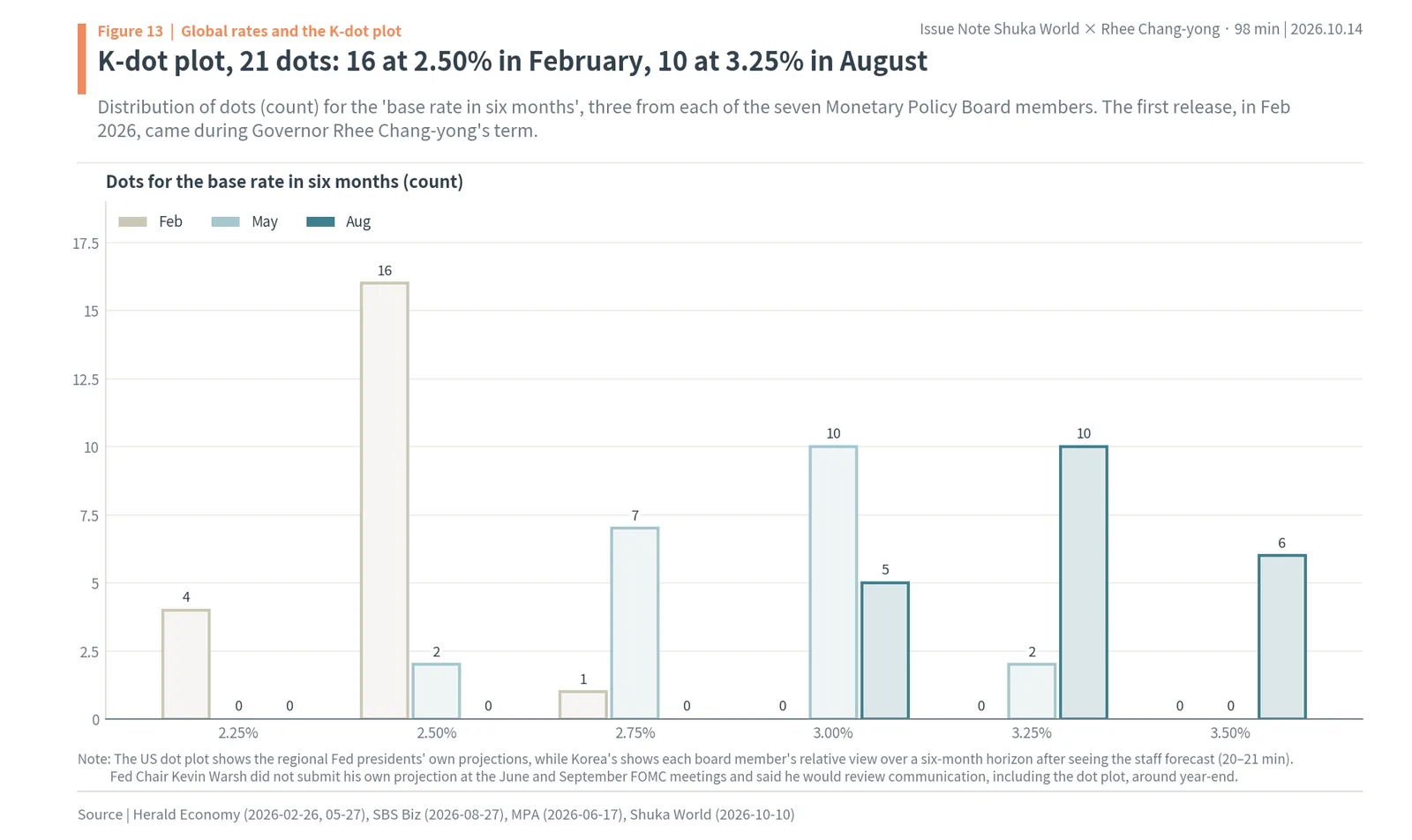
Shuka asked about the K-dot plot introduced during Rhee’s term. Since Fed Chair Kevin Warsh seems to be moving away from the dot plot, some say Korea adopted it for nothing. On the facts, Warsh did not submit his own rate projection at the June and September FOMC meetings and said he would review the Fed’s whole communication approach, including the dot plot, around year-end. Korea began publishing a three-month conditional rate outlook in October 2022 and on February 26, 2026 first published dots for the rate six months ahead. The seven board members place three dots each, 21 in total.
He said that because it started only months before he left, the verdict has to wait, but he made two points. First, Warsh has since faced a lot of criticism, so his view does not decide everything. Second, the two dot plots are different. The US chart shows regional Fed presidents’ own projections reflecting their districts. Korea’s shows each board member’s relative view, over a six-month horizon, of the staff’s growth forecast and the rate path embedded in it, whether they find the staff too optimistic or too pessimistic. The aim was to dispel the impression that the governor alone sets rates.
Finally he pointed to the direction of travel. The US is pulling back after doing too much forward guidance; Korea is moving a little away from a tradition in which saying nothing was a virtue. There is no reason to stop because someone else is turning back, he said. Figure 13 shows the three distributions published in 2026. In February, 16 of the 21 dots sat at a 2.50% hold; in May, 10 dots were at 3.00%; in August, 10 were at 3.25%. Markets could watch board members’ thinking shift toward hikes every quarter, and the hikes followed in July and August. The BOK raised the rate from 2.50% to 2.75% on July 16 and to 3.00% on August 27. Back-to-back hikes were called a break with convention, but for a market reading the dots they were no surprise. The next meeting is on October 22. It shows how the predictable monetary policy he set up is being used under his successor.
9. Structural reform: housing, regional proportional admissions, retirement age and regulation
What monetary policy can and cannot do
Around the 51-minute mark, Shuka praised the BOK’s issue notes and asked whether the bank’s growing focus on social and structural issues meant it wanted to act as a think tank. Rhee said he was accused of overreach or political ambition, but it actually matters for running monetary policy properly. If growth falls because of structural problems such as low birth rates and aging, calls to cut rates to lift growth bring big side effects. Expensive farm produce cannot be fixed with rates either; it is an import question. Making clear what monetary policy can and cannot do is a condition for sound monetary policy. He added that state-funded research institutes have lost much of their neutrality as their heads change with each government, while BOK research is trusted as politically neutral.
He was firm that the chip boom will not solve structural problems. More tax revenue can help ease the pain of restructuring, but structural problems in housing, education and industry need structural answers. And because the structures are linked, touching one does not fix it. Housing is tied to concentration in the capital area, and concentration is tied to education, in his diagnosis.
Housing is a capital-area problem, and the capital area is an admissions problem
He sees Korea’s housing problem as a problem of the Seoul capital area, indeed of a few districts in it. Prices in the provinces are already falling, and they need support to keep local economies going. People talk as if more supply would fix things quickly, but finding land and building takes two to three years, and if people keep moving to Seoul in the meantime, it will not work. So concentration in the capital area must be tackled, and the reason people gather there is the education premium. As long as students who attend high school in Seoul are three to four times more likely to get into top universities than those elsewhere, everyone will move to Seoul.
The numbers are in a BOK issue note from August 2024. In 2018, students from Seoul were 16% of general high school graduates but 32% of Seoul National University (SNU) entrants. Gangnam’s three districts were 4% of graduates and 12% of SNU entrants. Actual SNU admission rates were 0.85% in Seoul and 0.33% elsewhere, 2.6 times apart. Based on student potential alone, they would be 0.44% and 0.40%, only 1.1 times apart (author’s calculation). The BOK calculated that 92% of the gap reflects where students live, not their potential.
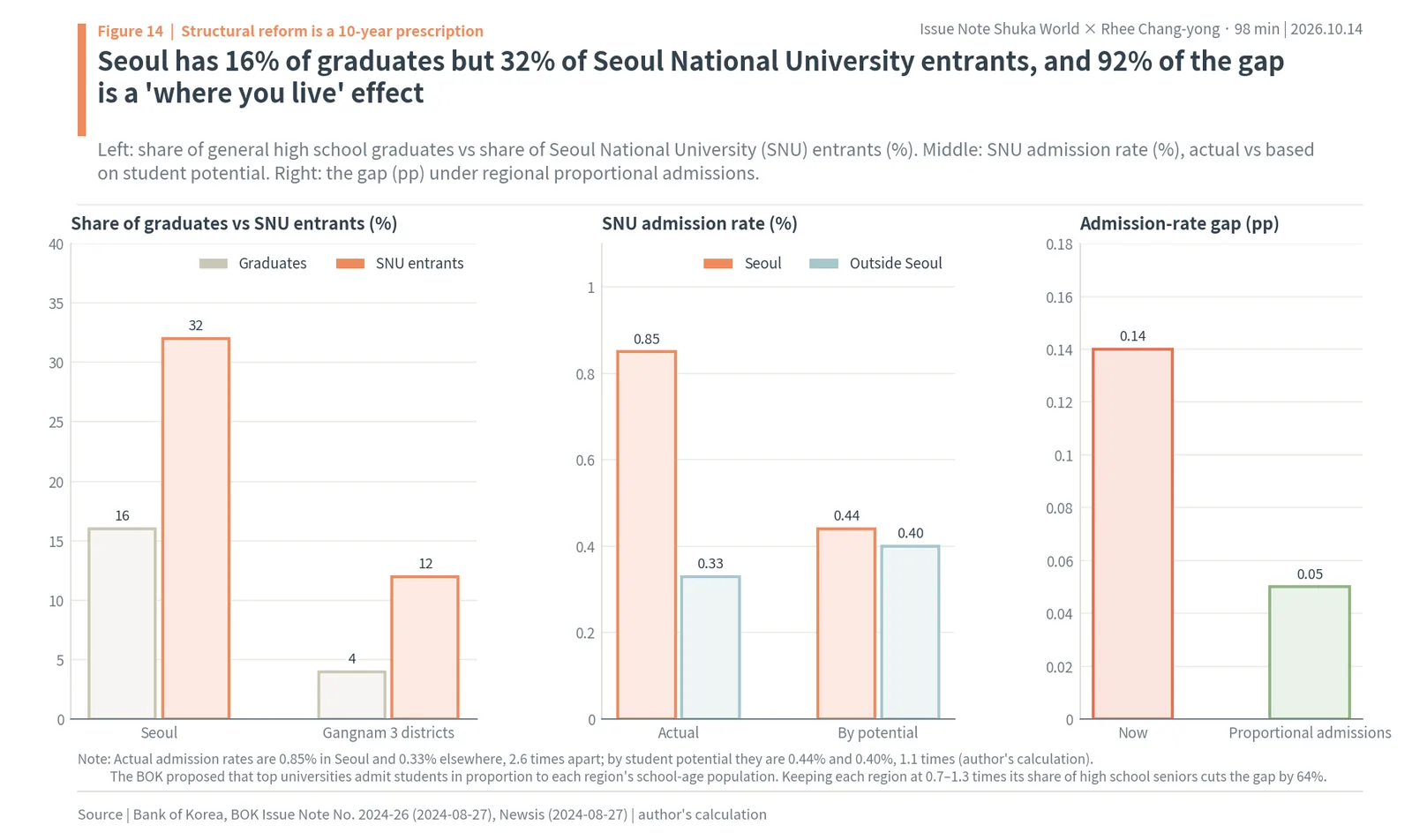
So he brought back regional proportional admissions: top universities admitting students in proportion to each region’s school-age population. On the BOK’s numbers, keeping each region’s admissions at 0.7 to 1.3 times its share of high school seniors would cut the gap by 64%. He said this is not only about housing. No children are as unhappy as Korean children, he said, and no country picks students by entrance exam scores alone. Test scores are the measure most easily moved by parents’ wealth: talent cannot be bought, but ten points on the exam can be, with years of tutoring. This is where he said he was proud that Shuka left after one class and built this business; had Shuka only studied, he joked, he would have gone to law school.
On the government’s plan to build “ten SNUs” in the regions, he said it would help regional universities and regions, but as long as students still move to Seoul in score order, admissions pressure will not ease. The education ministry picked Pusan, Chonnam and Chungnam national universities as the first in 2026. He said no law is needed: SNU, Yonsei and Korea University could simply decide to do it. If abuses arise, punish them hard; retreating to pure score-based admissions for fear of abuse only entrenches the problem.
Splitting across 15 places will not work
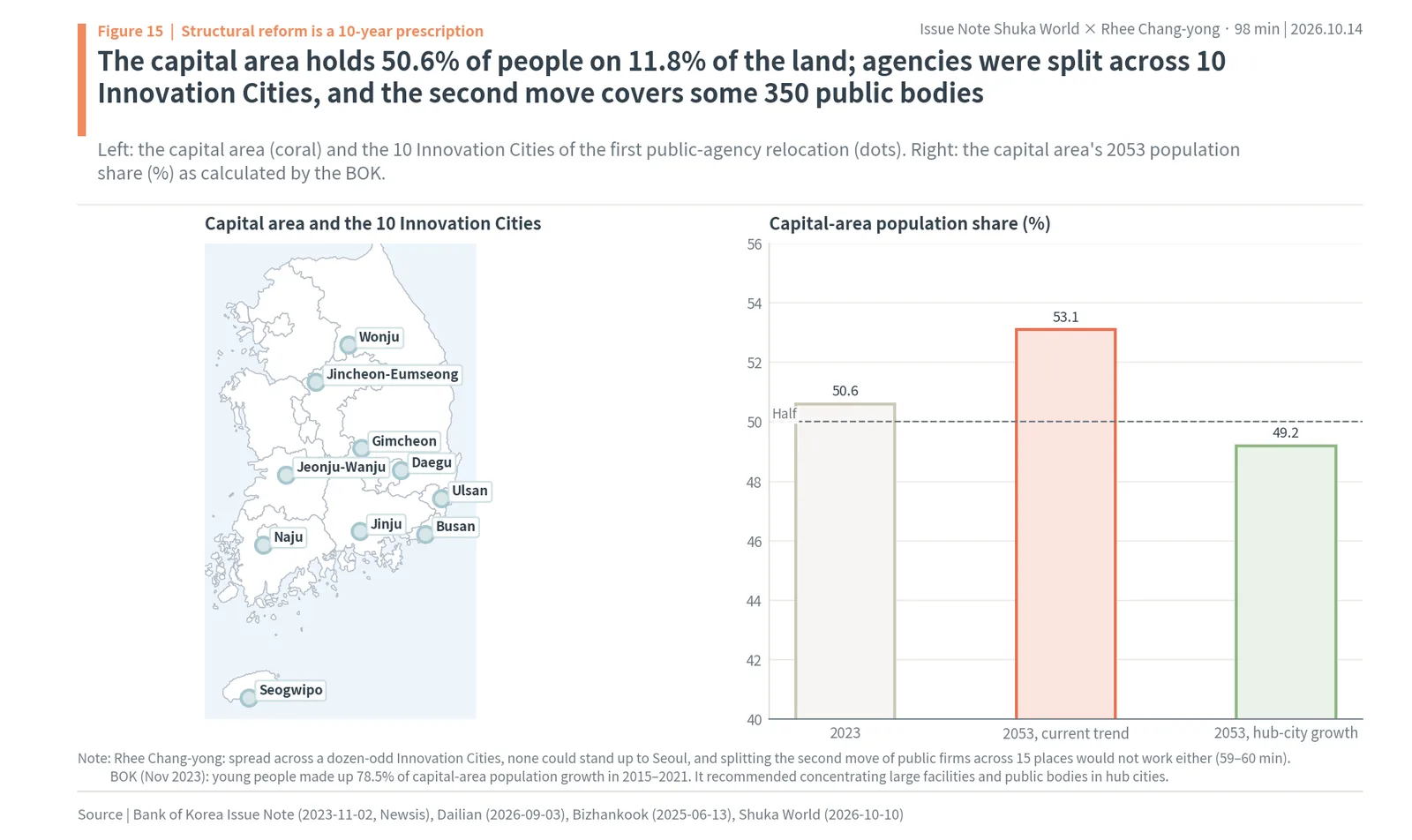
He was just as sharp on relocating public institutions out of Seoul. Spreading them across a dozen-odd Innovation Cities, the new towns built to host public agencies moved from the capital, left none big enough to stand up to Seoul, and employees commuted from Seoul. Building even one or two cities to rival Seoul would have been better. The second relocation of public firms will not work either if it is split across 15 places, he said. It has to be concentrated in a few, with hospitals, K-pop venues and cultural facilities as well as factories, before young people will move. Every lawmaker would then ask why their district was left out, which makes it politically the hardest thing to do.
The left panel of Figure 15 shows the capital area and the 10 Innovation Cities that received public agencies in the first relocation. According to the BOK (November 2023), the capital area holds 50.6% of the population on 11.8% of the land, and young people accounted for 78.5% of its population growth in 2015-2021. On current trends its share would reach 53.1% in 2053; with much more movement to hub cities, 49.2%. The second relocation will move some 350 public bodies from 2027, with the list due in the fourth quarter. This matches the conclusion of the author’s October 13 report on Korea’s second Sejong relocation: the capital area’s population share kept rising after the first relocation, so moving people did not shrink the capital area, and the money belongs in jobs in regional hub cities.
Policy loans and the price cap: good intentions, vicious circles
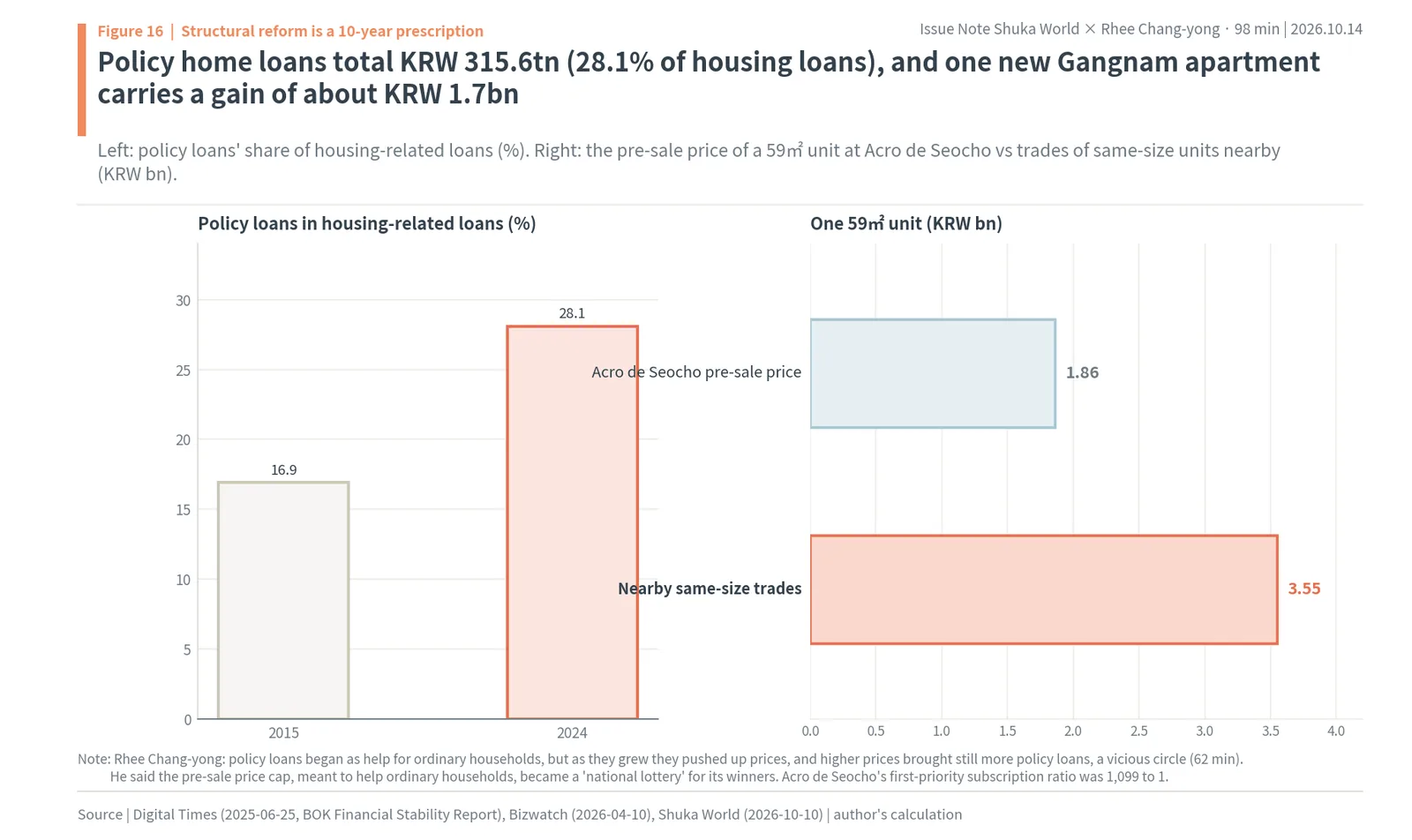
No country makes Gangnam-style house prices a policy target, he said, and some programs made the problem worse. One is the cap on new-apartment pre-sale prices. It began with the good aim of helping ordinary households but turned into a “national lottery” whose winners make hundreds of millions of won. So people who have no plan to live in Gangnam apply, and the majority who lose feel left behind. In April 2026, a 59㎡ unit at Acro de Seocho had a top pre-sale price of KRW 1.86bn, while a same-size unit nearby traded at KRW 3.55bn, a gain of about KRW 1.7bn for the winner; the first-priority subscription ratio was 1,099 to 1.
The other is policy lending. It began as help for newlyweds and ordinary households, but as it grew, buying homes with policy loans pushed up prices, and higher prices led to still more policy loans, a vicious circle. He said nearly half of bank lending is linked to policy finance; on the BOK’s Financial Stability Report figures for outstanding balances, policy home loans were KRW 315.6tn at the end of 2024, 28.1% of housing-related loans, up from 16.9% in 2015. He would confine policy finance narrowly to the poorest and shift the rest to supplying homes for ordinary households.
On taxes, he said views differ with emphasis, but personally he thinks raising holding taxes and cutting transaction taxes is broadly right. That lets older owners who have held homes for a long time sell and move out, so supply turns over and younger people move in. If the question of who made money and whether that is fair is piled on top, nothing gets solved. So the ruling and opposition parties need to agree to keep the same direction for five to ten years for it to work.
Raising the retirement age with seniority pay: young workers pay the price
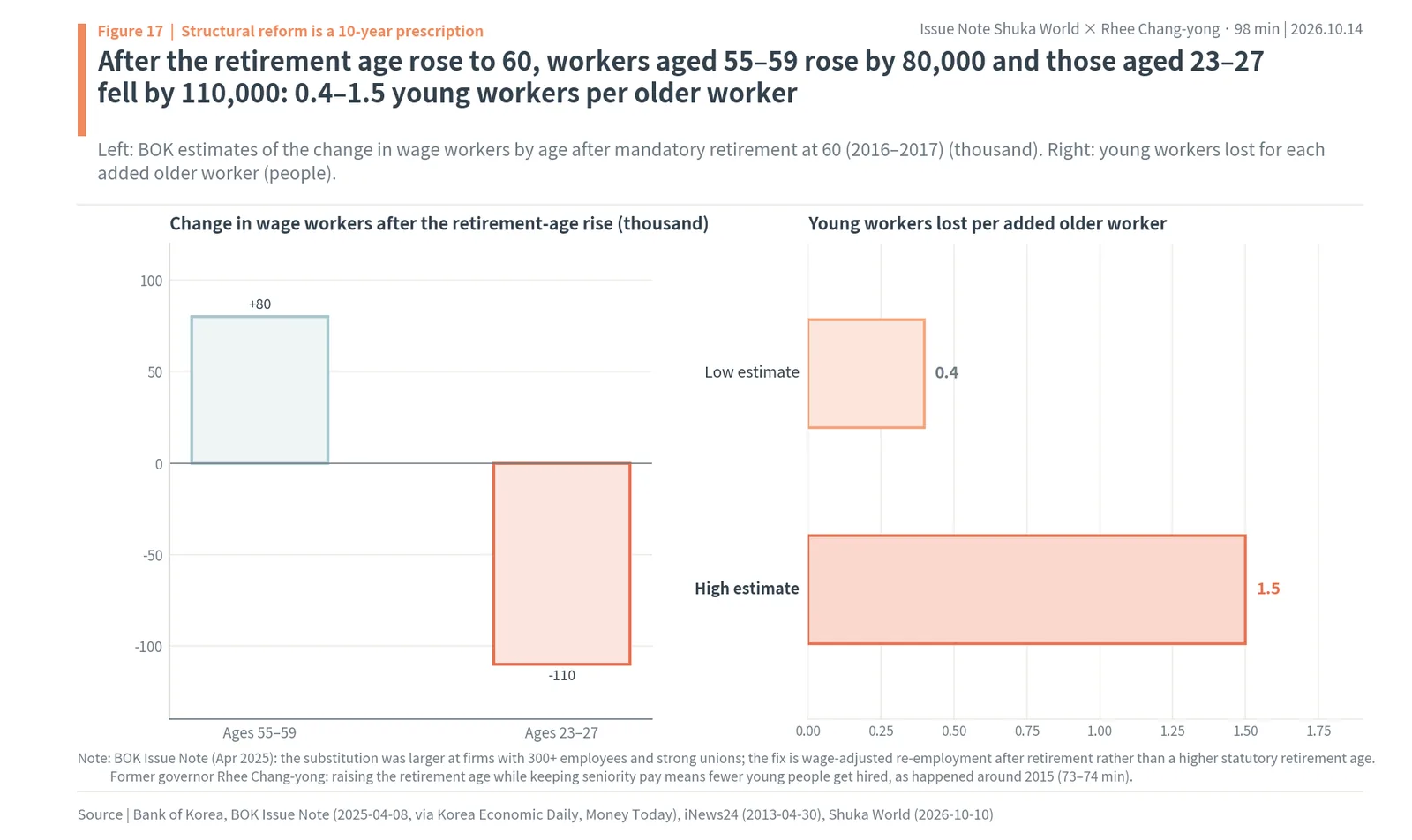
On labor, his word was flexibility. Rules from the era of manufacturing and blue-collar work have survived into the age of knowledge workers, protecting insiders with good jobs and shutting out outsiders trying to get in. Raising the retirement age is the prime example. If the retirement age goes up while seniority-based pay stays, firms hire fewer of the people they need. He said youth unemployment rose and youth employment, marriage and births fell when the retirement age was raised around 2015.
The BOK’s April 2025 issue note has the numbers. Mandatory retirement at 60 passed the National Assembly in April 2013 and took effect in 2016-2017. After that, wage workers aged 55-59 rose by about 80,000, while those aged 23-27 fell by 110,000. For each additional older worker, the number of young workers fell by 0.4 to 1.5. The substitution was larger at firms with 300 or more employees and strong unions, and the BOK’s prescription was wage-adjusted re-employment after retirement rather than a higher statutory retirement age.
On the claim that AI will wipe out young people’s jobs, he said it is half right and half wrong. The people who use AI best are recent graduates. If he could organize freely, he would cut middle managers and hire more young people who are good with AI to raise productivity, but in Korea pay is set by age and layoffs are hard, so that cannot happen. Firms hire fewer young people, and those who are hired end up teaching their bosses AI. On the bonus disputes at Samsung Electronics and SK hynix, he asked what kind of performance pay splits rewards roughly equally rather than by contribution. SK hynix agreed in September 2025 to use 10% of operating profit as its bonus pool with no cap, and its payout for 2025 results was 2,964% of base pay. In May 2026, Samsung’s chip division set its pool at 10.5% of business results, split 40% by division and 60% by business unit and paid entirely in shares. The size of the pool follows results, but how it is shared among individuals still runs mainly on base-pay ratios and organizational units. Giving young people more money will not fix things; structural efforts such as labor flexibility and second chances after a failed startup are needed.
Songdo’s empty lot and robotaxis that cannot even be tested
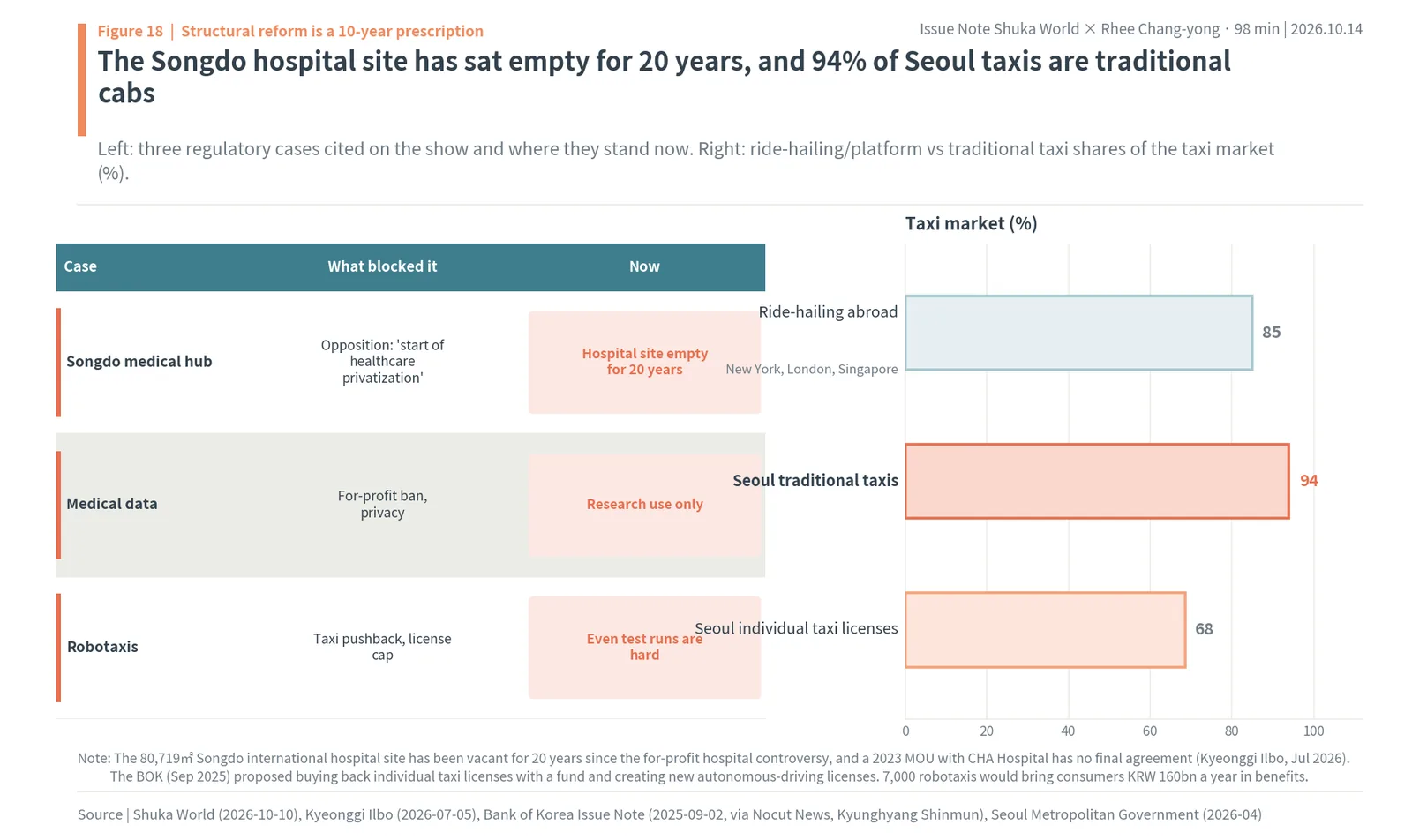
On regulation and entry barriers, he gave three cases. First, the Songdo medical hub. An attempt to let for-profit hospitals treat foreign patients, so that medicine could grow as an industry, was blocked by opposition calling it the start of healthcare privatization. He said that whenever he passes the site, he feels industries disappearing because of political controversy. The 80,719㎡ Songdo international hospital site has been empty for 20 years, and a 2023 memorandum with CHA Hospital has not led to a final agreement. Second, medical data. Korea links all treatment records through resident registration numbers, and large hospitals hold records from birth to the funeral hall, yet with for-profit business barred, hospitals have no reason to build datasets, and privacy rules limit them to research use.
Third, robotaxis. Driverless taxis run in Las Vegas and China, but in Korea even testing is hard. According to a BOK issue note from September 2025, ride-hailing makes up more than 85% of the market in New York, London and Singapore, while traditional taxis make up 94% in Seoul. The BOK proposed a fund to buy back individual taxi licenses and new licenses for autonomous driving, and estimated that 7,000 robotaxis would bring consumers KRW 160bn a year in benefits. He thinks Hyundai Motor, once ahead in autonomous driving, is now a step behind.
What is most urgent is consistency
The conclusion of this section is less about the content of the prescriptions than their lifespan. Structural problems were created unintentionally by decades of policy, so one policy has to run consistently for about ten years to fix them. Yet lately, whichever party is in power, each new government declares the previous government’s policies bad and reverses them. Change the tax rules and people wait, assuming they will change again with the next government, so nothing works. The climate in which civil servants can use their expertise is fading too. So he said the most urgent thing in structural reform is not what to do but creating conditions in which one policy can be carried out for years until it works. Korean presidents serve a single five-year term, which makes that agreement all the more necessary. The emergency-room analogy of section 4 flips here: respond to the last drop when the fire is urgent, but for the body’s constitution, keep up the same exercise for ten years.
10. Martial law, geopolitics, AI and Rhee Chang-yong’s plans after office
The interview the day after martial law
From the 42-minute mark the talk turns to the December 2024 martial law. He said he was probably the only central bank governor of an advanced economy to have lived through martial law, and that when he first saw the news he thought it was a deepfake. His first worry was the sovereign credit rating, which reflects political stability as well as economics and takes a long time to recover once cut. Fortunately the declaration was lifted within hours. The next worry was impeachment. In a Bloomberg interview the next day he explained that during Korea’s two previous presidential impeachments, economic policy had been kept separate from the political process, and the economy ran steadily during the roughly six months the Constitutional Court took to decide. Within two days his team compiled the two past cases and sent them to investors around the world.
The real crisis came about a month later, he said. As the parties fought over appointing Constitutional Court justices and protests outside the presidential residence were broadcast worldwide around Christmas, his line that the court decides within six months backfired, and he was asked where the Korean economy would go if the court could not even be staffed. He considered it very important that acting president Choi Sang-mok appointed at least two justices so the court could start working. When he told politicians to think of the economy before speaking, he was criticized for acting politically, but he said he was not doing politics; he was asking politicians to think about the economy. The cost was large: growth fell to 0%, the exchange rate moved a level higher, and while the credit rating held, the impression that Korea is a country where martial law can happen will linger.
Security is like air
Asked about the biggest risks, he named, in the short run, US external policy after the November US elections: trade and tariffs, Korea-US investment, US rates and chip demand. He added that the impact of geopolitics goes beyond economics. The Trump administration takes a very different approach from past US governments, and shifts in Northeast Asia’s military and political balance should not be taken lightly. Treating North Korea as a separate issue is misleading, he said; it has to be seen in the wider frame of the US and China, and Russia and Japan. He likened security and that balance to air: always there, so we forget it, but today’s US and China are not the US and China we have known.
Teaching an old dog new tricks
His earlier quip that, with AI advancing so fast, he was glad he did not have many years left also came up. He explained, laughing, that he meant that in his late 60s it is hard to learn new things, adding that his son teases him with the saying about old dogs and new tricks. He tries each new AI tool as it comes out, but you cannot make policy on things you do not understand, so policymakers should now be younger, with experienced people moving into advisory roles and decisions made by a generation with the energy, knowledge and drive to learn. In the 1970s ministers were in their 40s; as seniority became entrenched, ages rose, and Korea is following Japan, where the average age of policymakers is highest.
Lectures instead of a YouTube channel
His pre-retirement lunch joke about starting a YouTube channel spread widely in the press; the Seoul Shinmun even reported a working title meaning “close your ears.” He said he joked out of hurt and disbelief after some well-known YouTubers kept claiming he had not raised rates and so prices and house prices had risen. He will keep commenting on the economy, but a personal channel is another matter: Shuka’s business, which pays more than 30 staff, impresses him, and he does not want that stress at his age. This year he will give special lectures, and next year he may prepare a course on the Korean economy. His personal ambition, he said, is to be known worldwide as the person who understands the Korean economy best.
The episode ended with viewer questions. Being misunderstood is the fate of public officials, he said, and he handles stress through his wife’s encouragement and by reading economics books alone. To young people he said: do what you love, and if you do not know what that is, cut out the things you dislike one by one. On the bond-market rumor that traders read his rate decisions from the color of his tie, he laughed that since his wife chooses his ties, that would mean his wife runs monetary policy, which would be an insult to the BOK. Finally he told Shuka he wanted to see young entrepreneurs succeed and wished him great success in business.
11. The author’s take: treat the exchange rate like a stock price
One principle applied to twenty topics
What made the episode good was not how much was said but that it was all cut from the same cloth. On the exchange rate, he said do not cap a price: someone gains, and the cost comes out of somewhere else, such as the FX reserves. On retail investors, he said prices are set by the last drop, so respond to that drop, not blame it, and the lever is the NPS. On chips, he said do not assume a high price, here a high profit margin, will last forever. On the budget, he said do not turn a temporary price, boom-time revenue, into permanent spending. On structure, he said price variables such as rates, the exchange rate and a boom cannot fix the body’s constitution, so write a ten-year prescription.
Join those five points and you get one line, which is why a 98-minute conversation leaves a single principle behind. The author thinks the line “treat the exchange rate like a stock price” is the one that will last longest. The habit of demanding a cap whenever the won weakens and demanding government action whenever it strengthens has bent policy for years. It is rare for a former central bank governor to argue against that habit with such plain analogies.
The format helped. Shuka mixed prepared questions with spontaneous ones, and the more awkward the question, the more politely he asked permission before asking it head-on. That pushed the answers beyond self-defense into principles. The episode ended with two viewer questions. There was a lot of laughter in the 98 minutes, and most of it came from the analogies used to explain principles.
Three things for investors
For investors there are three. First, the exchange rate is now a price set by the surplus and by flows. The $450bn current account surplus forecast for this year supports the won, while foreign rebalancing and Koreans’ overseas investment pull the other way, and buying foreign stocks means joining that tug of war. Second, start from the premise that no one knows how long the chip boom will last; there is little ground for certainty that a supercycle none of 20 experts called a year ago will run for ten years. Third, a year of big fiscal expansion brings a later year of contraction; growth is only as smooth as the budget.
Maochaedung’s take. Shuka World’s first podcast was a 98-minute conversation in which Rhee Chang-yong held to one principle: do not mix problems that prices solve with problems that only structural change solves. The exchange rate is a price, so capping it hands someone a gain; prices are set by the last drop, so respond to that drop. Nobody knows how long the chip boom behind the surplus will last, so keep the budget smooth, and solve structural problems with a prescription held for ten years. In one line: the won is a price, the boom may be brief, and structure takes ten years.
12. Data and methods: how the numbers in this review were calculated
- Chapter lengths: the next chapter’s start time minus each chapter’s start time, from the 22 timestamps in the video description (the last chapter runs to the end of the video at 5,893 seconds). The five topic groups are the author’s. Remarks are the author’s summary of the Korean auto-captions, with direct quotes kept short.
- KRW/USD: chart lines use Yahoo Finance KRW=X daily closes grouped into weekly (Friday) closes and monthly averages. Peak and recent values in the text (KRW 1,554.9, 1,336.1, 1,342.0 and so on) are reported Seoul FX market closes and the reference rate.
- Base rate: the Bank of Korea’s decision-date values, carried forward weekly.
- Capping the rate (Figure 4): KRW 1tn ÷ KRW 1,500 = $666.7mn, KRW 1tn ÷ KRW 1,400 = $714.3mn, a gap of $47.6mn (7.1%). A hypothetical example.
- The last drop (Figure 6): 2025 current account surplus $123.05bn; individuals’ foreign stock investment $45bn ($31.4bn direct + about $13.6bn via ETFs); the NPS’s $40.7bn is derived from the report that individuals invested about $4.3bn more. Together $85.7bn ÷ $123.05bn = 69.6%.
- Foreign net buying: sum of KRX daily net purchases by investor type on the KOSPI. January 2 to October 13, 2026: -KRW 203.0tn; May-June: -KRW 92.9tn; July 1 to October 13: about -KRW 15.9tn a month (divided by 3.43 months).
- Operating margins: WISEreport quarterly results. Samsung’s preliminary Q3 margin = KRW 107.4tn ÷ KRW 195tn = 55.1%. September chip share of exports = $60.3bn ÷ $120.94bn = 49.9%.
- Budget: main-budget total spending as passed by the National Assembly (2027 is the government proposal). 2027 growth = 820.9 ÷ 727.9 – 1 = 12.8%; 2.05 times 2017.
- Smoothing (Figure 11): two hypothetical spending paths starting at 100 (A 100, 110, 110, 100, 100; B 100, 102, 104, 106, 108) and each year’s increase. A hypothetical example.
- Admissions (Figure 14): from the admission rates in the BOK issue note, Seoul ÷ elsewhere = 0.85 ÷ 0.33 = 2.6 times; by potential 0.44 ÷ 0.40 = 1.1 times.
- Taxis: of Seoul’s 71,615 taxi licenses, 49,048 are individual licenses = 68.5% (Seoul Metropolitan Government, end of January 2026).
- Rate gap: US policy rate upper bound 4.00% – Korea 3.00% = 1.00 percentage point.
- Dollar conversions: KRW 1,340.99 per dollar (Yahoo Finance close, October 13, 2026).
Rhee Chang-yong on Shuka World FAQ
Q. Who is Rhee Chang-yong and what is Shuka World?
Rhee Chang-yong was the 27th governor of the Bank of Korea from April 2022 to April 2026, after serving as IMF Asia and Pacific director. Shuka World is Korea’s biggest economics YouTube channel, with about 3.73 million subscribers; he was the first guest on its new podcast on October 10, 2026.
Q. Why does Rhee say the exchange rate should not be defended with interest rates?
Korea has been a net external creditor since 2014, so a weaker won no longer threatens default. He raised the base rate from 1.50% to 3.50%, and once inflation was back near 2%, he says, raising rates for the exchange rate alone had no basis; the won should float like a stock price.
Q. What did Rhee mean by the ‘last drop’?
Prices are set at the margin. Interest-rate and growth gaps filled the cup, but the surge in overseas stock buying by individuals and the NPS, equal to 69.6% of the 2025 current account surplus, was the last drop that moved the won, so policy should respond to it rather than blame anyone.
Q. Why did the won strengthen in the second half of 2026?
The Bank of Korea expects a record $450bn current account surplus in 2026. After the KOSPI passed 9,000, foreign funds sold to rebalance, which weakened the won to KRW 1,554.9 on July 1; as that selling eased, the surplus belatedly pushed the rate down to KRW 1,342.0 by October 13.
Q. Does Rhee think the chip supercycle will last?
He expects current demand to sustain it for one to two years but warns that none of about 20 experts he met a year earlier predicted it. SK hynix’s 76.3% margin is helped partly by China’s inability to import ASML tools, so the state should prepare for the boom ending.
Q. What is his view of Korea’s 2027 budget?
The KRW 820.9tn proposal is 12.8% larger than 2026, while growth forecasts of 3.3% and 2.9% already exceed potential growth of about 2%. He warns that two years of windfall revenue should not fund ten years of spending and that fiscal policy should smooth growth.
Sources
- Shuka World, “Now I Will Tell You” (guest: former Bank of Korea governor Rhee Chang-yong) https://www.youtube.com/watch?v=2hUkTmwYm3A , 2026.10.10 (remarks summarized by the author)
- Coverage of the episode: Etoday https://www.etoday.co.kr/news/view/2634235 (2026.10.10), EBN https://www.ebn.co.kr/news/articleView.html?idxno=1727566 (2026.10.13)
- Bank of Korea base rate history https://www.bok.or.kr/portal/singl/baseRate/list.do?dataSeCd=01&menuNo=200643 (accessed 2026.10.14); term and successor: SBS Biz https://biz.sbs.co.kr/amp/article/20000305518 (2026.04.20)
- KRW/USD: Newsis https://www.newsis.com/view/NISX20241230_0003015254 (2024.12.30), Twig24 (2025.12.23), Newsis https://www.newsis.com/view/NISX20260316_0003550624 (2026.03.17), Financial News https://www.fnnews.com/news/202607011544118918 (2026.07.01), Financial News English (2026.09.07), SBS Biz https://biz.sbs.co.kr/amp/article/20000333717 (2026.09.09), https://biz.sbs.co.kr/amp/article/20000339057 (2026.10.08)
- The “because it’s cool” remark and his explanation: Nocut News https://www.nocutnews.co.kr/news/6436879 (2025.12.02), Kyunghyang Shinmun https://www.khan.co.kr/article/202604101414001/ (2026.04.10)
- Net international investment position: Asia Economy https://view.asiae.co.kr/article/2026082010402019027 (2026.08.20)
- Swap lines: Federal Reserve https://www.federalreserve.gov/newsevents/pressreleases/monetary20081029b.htm (2008.10.29), https://www.federalreserve.gov/newsevents/pressreleases/monetary20200319b.htm (2020.03.19), Asia Economy https://view.asiae.co.kr/article/2022092613482182474 (2022.09.26), Herald Economy https://www.heraldk.com/article/2026070116531083202 (2026.07.01), Economist Korea (2021.12.31)
- Balance of payments and current account: Asia Economy https://view.asiae.co.kr/article/2026020610372299109 (2026.02.06), Newsis https://mobile.newsis.com/view/NISX20260205_0003504681 (2026.02.06), Bank of Korea Economic Outlook (August 2026) https://eiec.kdi.re.kr/policy/materialView.do?num=285904 , MTN https://news.mtn.co.kr/news-detail/2026100810154999740 (2026.10.08)
- National Pension Service: Asia Economy https://view.asiae.co.kr/article/2026073114000555142 (2026.07.31), Block Media (2024.12.19), Financial News https://www.fnnews.com/news/202512151831035437 (2025.12.15), Kyunghyang Shinmun https://www.khan.co.kr/article/202604142034001/ (2026.04.14), Money Today https://www.mt.co.kr/stock/2026/06/09/2026060914564433782 (2026.06.09)
- KOSPI and foreign investors: Seoul Shinmun (2026.06.18), Twig24 (2026.06.22), Kyungbuk Maeil (2026.09.01), Money Today https://www.mt.co.kr/stock/2026/06/02/2026060211015791899 (2026.06.02), KRX (pykrx)
- Chips: Kyunghyang Shinmun https://www.khan.co.kr/article/202607292125015 (2026.07.29), Newsis (2026.07.30), Samsung Semiconductor Newsroom (2026.10.08), MTN https://news.mtn.co.kr/news-detail/2026100109075980661 (2026.10.01), WISEreport
- GDP and national income: Kyunghyang Shinmun https://khan.co.kr/article/202609080800001 (2026.09.08), Korea Economic Daily https://www.hankyung.com/article/2026090820651 (2026.09.08), YTN https://www.ytn.co.kr/_ln/0102_202412191424182397 (2024.12.19)
- Budget: Segye Ilbo https://www.segye.com/newsView/20260901506705 (2026.09.01), KB Think (2026.09.10), yearly main-budget reports (Money Today, Etoday, Newsis, Dailian, YTN, Herald Economy)
- Foreign yields and oil: SBS Biz (2026.10.06, 2026.09.01), Federal Reserve FOMC statement (2026.09.16), Yonhap (2026.04.01), Digital Daily (2026.05.01), MPA (2026.06.17), Herald Economy (2026.06.18)
- K-dot plot: Herald Economy https://www.heraldk.com/article/2026022517431625116 (2026.02.25), https://www.heraldk.com/article/2026052717563167901 (2026.05.27), SBS Biz https://biz.sbs.co.kr/amp/article/20000331082 (2026.08.27)
- Admissions: Bank of Korea BOK Issue Note No. 2024-26, Newsis https://www.newsis.com/view/NISX20240826_0002863161 (2024.08.27), Digital Daily (2026.09.03)
- Capital area and relocation: Newsis https://www.newsis.com/view/NISX20231101_0002504494 (2023.11.02), Dailian https://www.dailian.co.kr/news/view/1686000 (2026.09.03), Bizhankook (2025.06.13)
- Housing: Digital Times https://www.dt.co.kr/article/11674295 (2025.06.25), Bizwatch (2026.04.10)
- Retirement age: Korea Economic Daily https://www.hankyung.com/article/202504086659i (2025.04.08), Money Today (2025.11.23), iNews24 https://www.inews24.com/view/741951 (2013.04.30)
- Bonuses: Newsis (2025.09.03), Korea Economic Daily (2026.02.05), Asia Economy (2026.05.21)
- Regulation: Kyeonggi Ilbo https://www.kyeonggi.com/article/20260701580649 (2026.07.05), Nocut News https://www.nocutnews.co.kr/news/6393928 (2025.09.02), Kyunghyang Shinmun https://www.khan.co.kr/article/202509021625001 (2025.09.02), Seoul Metropolitan Government taxi license statistics (2026.04)
- The YouTube joke: Seoul Shinmun https://www.seoul.co.kr/news/economy/finance/2026/03/31/20260331500284 (2026.03.31)
- Constitution of the Republic of Korea, Article 70 (single five-year presidential term)
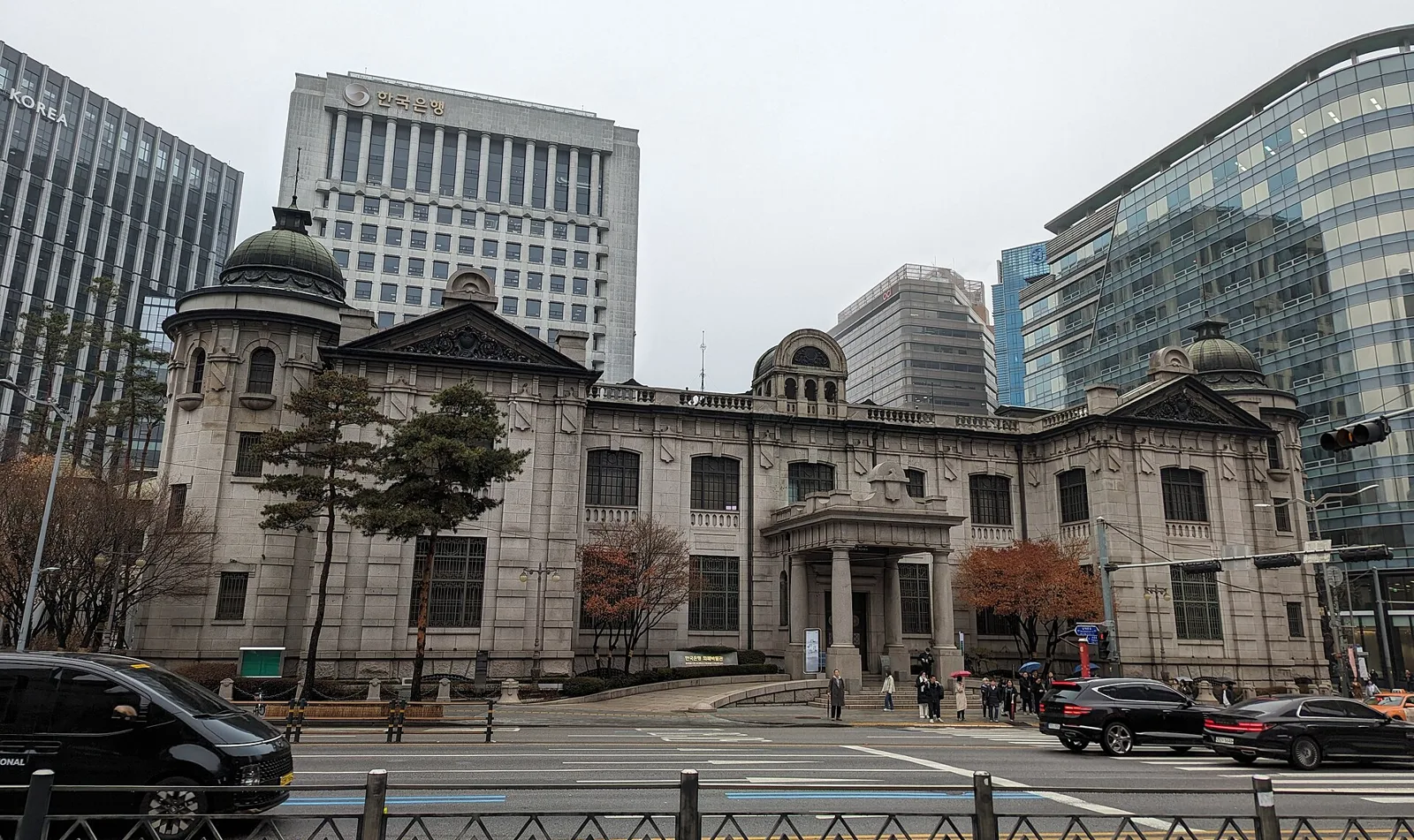
- Photo: Sean Young, Bank of Korea Museum 20240219.jpg, Wikimedia Commons https://commons.wikimedia.org/wiki/File:Bank_of_Korea_Museum_20240219.jpg , CC BY 4.0
Was this note useful?
Thanks. Your answer helps decide what to cover next.