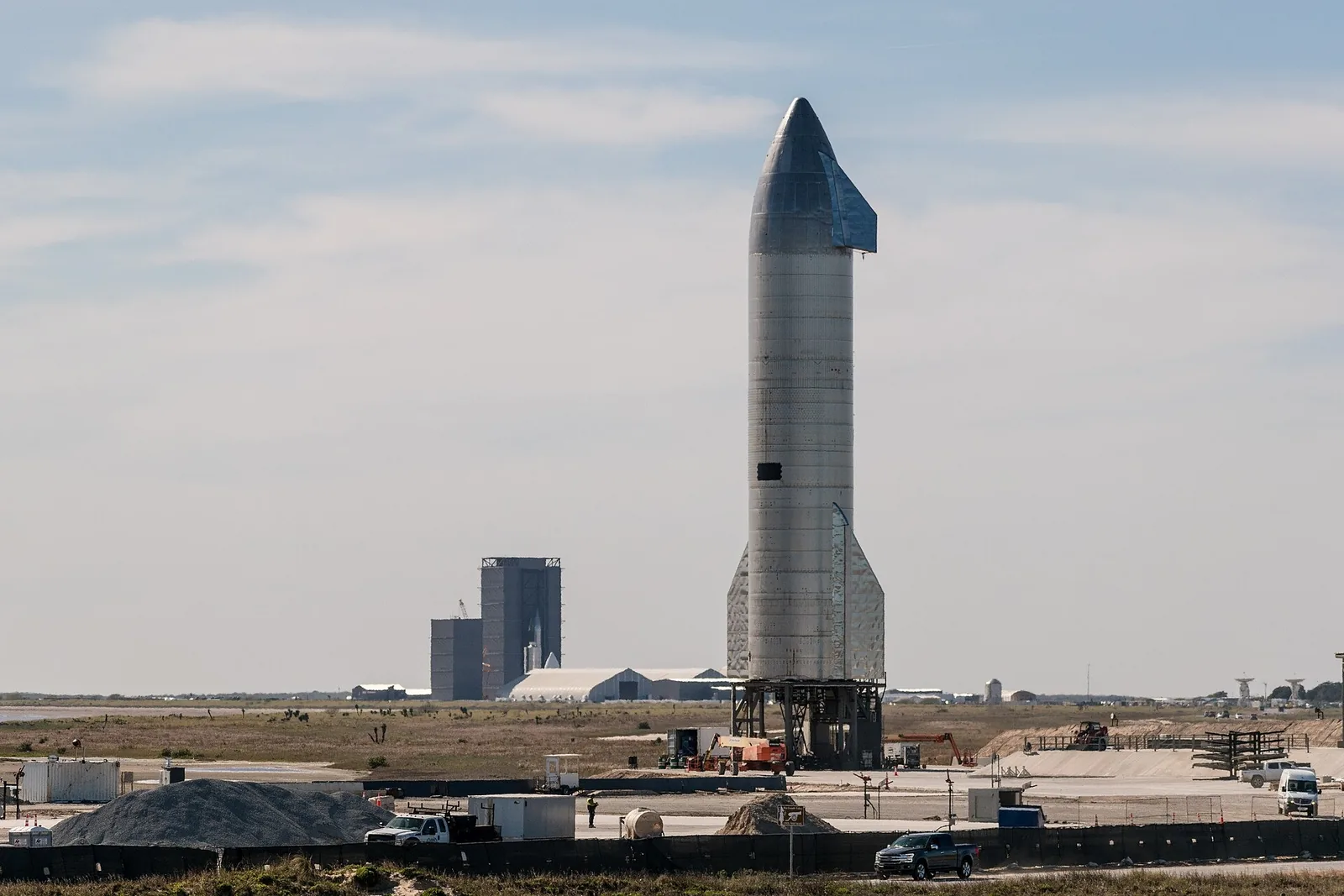
Almac (354320.KQ) Stock: The SpaceX Audit Report, Unit Value per Part, Starship Volume and the Humanoid Robot Opportunity

On October 20, 2026 SpaceX reported its second set of quarterly results as a listed company. On the call Elon Musk said that, probably within three years, Starlink would have about 100 times today’s bandwidth, with “something on the order of 100,000 satellites.” He also laid out a schedule for Starship: flying weekly at some point in the first half of 2027 and twice a week or more by the end of that year. As of October 25 there were 11,167 Starlink satellites in orbit (Jonathan McDowell’s satellite log). The scale Musk described is about nine times today’s fleet.
What are those satellites made of? Meritz Securities wrote that about 36.7% of the total mass of a low-Earth-orbit satellite is aluminium and aluminium alloy, and that Starlink accounts for 66.5% of all satellites in the world. As the number of satellites grows, so does the number of parts machined from aluminium.
Almac is a Korean company that wants to supply that aluminium to SpaceX. After the market closed on October 27, the Korean outlet Prime Economy reported that a SpaceX audit team had visited Almac’s plants, that the scope of supply was widening from material to finished parts that are machined, painted and assembled, and that price terms would be set in early November. The same article said Boston Dynamics had sent Almac a formal request for quotation. This report asks four questions. What steps does a supplier go through before it sells to SpaceX, and where is Almac now? How much of each rocket launch is Almac’s? As SpaceX grows, how much could Almac earn and how far could its market value go? And do the reasons Almac won in electric vehicles carry over to robots, and how likely is it to get in?
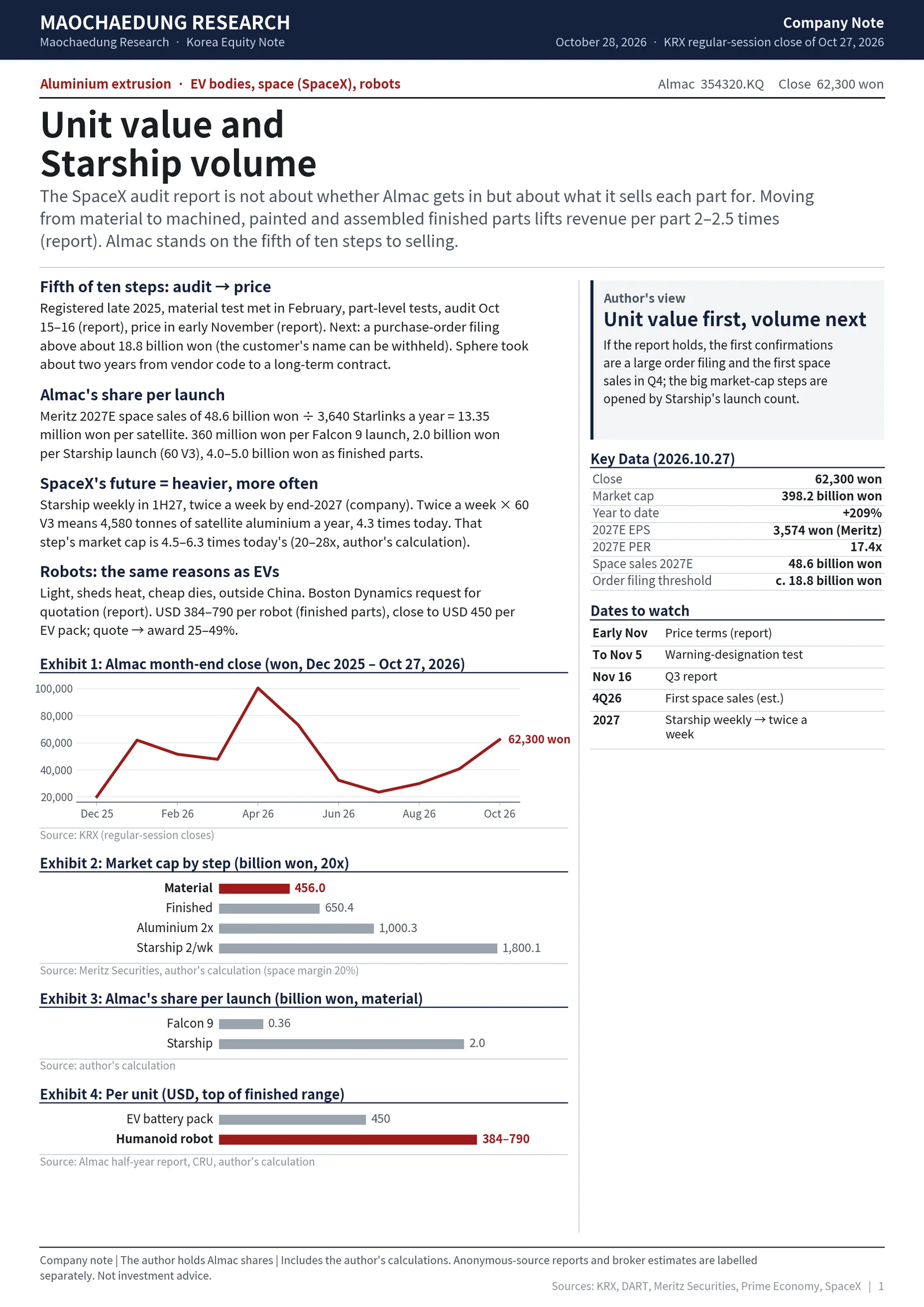
This report is the English edition of the author’s Korean note on Almac (354320.KQ), SpaceX and humanoid robots.
As of: October 28, 2026 (prices are October 27, 2026 regular-session closes)
Disclosure: the author holds Almac shares at the time of writing.
Stocks covered: Almac (354320.KQ, KOSDAQ). Compared with Sphere Corp. (347700.KQ), HVM (295310.KQ) and Kencoa Aerospace (274090.KQ), SpaceX (Nasdaq: SPCX), and Hyundai Motor Group’s Boston Dynamics Atlas robot.
Topics: what Almac sells (sales mix, value per kilogram, utilization), the October 27 report and how far each claim is confirmed, the one-year share price and the days space news came out, the ten steps to becoming a SpaceX supplier and the timelines of the companies that went first, the disclosure rule, Almac’s share per satellite and per launch, SpaceX’s future volumes (launch counts, satellites, Starship, the new V3 satellite and space data centers), volume × unit value → sales → profit → market value, the yardstick companies’ multiples, plant capacity, why Almac won in EVs and how that carries to robots, Atlas volumes, policy and probability, two days of trading and investor flows, and the dates to watch.
Data: share prices, indexes, trading by investor type and short selling come from the KRX Data System (October 27, 2026 regular-session closes); intraday moves from Naver one-minute prices; company figures from Almac’s half-year report filed on DART (August 14, 2026); broker estimates from Meritz Securities’ October 6, 2026 report and the WISEreport consensus (October 27); SpaceX figures from the company’s filings and earnings call; and satellite counts from Jonathan McDowell’s log. Numbers the author calculated are marked “author’s calculation.”
Some Korea-specific background. The KOSDAQ is the Korea Exchange’s growth-company market, and tickers ending in .KQ trade there. DART is the Financial Supervisory Service’s electronic disclosure system. The KRX publishes each day’s net buying by investor type (foreigners, institutions with sub-groups such as investment trusts, pension funds, private equity funds and financial investment firms, and individuals), and it runs a market-alert system that designates fast-rising stocks for “investment caution” and then “investment warning.” Nextrade is an alternative exchange where Korean shares also trade before and after the regular session (9:00 to 15:30). Korea counts large sums in units of 100 million won; this report converts them to billion won.
The conclusions first. First, what the October 27 report changed is not whether Almac gets into SpaceX’s supply chain but what it sells each part for. According to the report (anonymous IB sources), supplying finished parts that are machined, painted and assembled, instead of material only, lifts revenue per part 2 to 2.5 times. Second, if the road to becoming a SpaceX supplier is split into ten steps, Almac has passed registration, the material test, the part-level test and the audit, and is on the fifth step, price. The next signal is an order filing: a single order above 10% of last year’s sales (about 18.8 billion won) must be disclosed the next day. Third, dividing Meritz Securities’ 2027 space sales estimate of 48.6 billion won by Starlink production gives about 13.35 million won per satellite and about 360 million won per Falcon 9 launch, and about 2 billion won per Starship launch carrying 60 of the new satellites (author’s calculation). Fourth, if Starship flies twice a week, the aluminium going into Starlink satellites becomes 4.3 times today’s. Measuring four steps in which volume and unit value grow together with the same multiples puts the market value at 1.1 to 6.3 times today’s (author’s calculation). Fifth, robots are a market where the reasons Almac won in EVs (light weight, heat, cheap dies and a supply chain outside China) apply as they are, and the industry’s quote-to-award rate runs from one in four to one in two. Robots are smaller than space, but they are the first step of a third business.
Key terms
- Extrusion: pushing a heated aluminium log (billet) through a shaped opening (die) to draw out long bars with the same cross-section. Dies are cheap, and hollow sections come out in one pass.
- Qualification (qual) test: the customer’s check that a new supplier’s material and parts meet its specifications. It splits into material property tests and part-level tests.
- Audit: the customer’s visit to the supplier’s plants to inspect its processes and quality control.
- PO (purchase order): an order with items, quantities and prices set. LTA (long-term agreement): a contract that sets a volume and price framework over several years.
- FAIR (first article inspection report): a document that measures the first production part against every dimension on the drawing.
- Disclosure deferral: hiding the customer’s name or other details of a supply contract for a set period when trade secrets are involved.
- V2 mini and V3: Starlink satellite generations. V2 mini satellites fly on Falcon 9; the larger, heavier V3 flies on Starship.
- Nextrade (NXT): an alternative exchange that trades shares in morning and evening sessions outside the regular session (9:00 to 15:30). Its prices after 15:30 differ from the regular-session close.
1. Almac pushes aluminium through a die and raises the value of each piece
Almac melts aluminium into billets (casting), pushes those billets through a die to draw out long profiles (extrusion), and then cuts, bends, machines and surface-treats them into parts. The half-year report says the company does the whole manufacturing chain itself, from alloy making and extrusion to finishing and surface treatment. Every step up this chain raises the value of the same kilogram of aluminium. Almac’s sales are the product of how much it draws out (volume) and what it sells each piece for (unit price), and the space business is where the unit price rises the most.
Half of sales are EV bodies
Consolidated sales in the first half of 2026 were 105.87 billion won. EV parts (battery module cases, battery pack frames and EV platforms) were 51.1 billion won, or 48.3%; billets 42.0 billion won, or 39.7%; and general auto parts such as bumpers and body structures 7.5 billion won, or 7.1% (half-year report). The customer list began in 2017 with LG Energy Solution module cases and widened to Daimler battery pack material in 2021 (delivered to Linamar’s US plant), Rivian in 2022, Lucid in 2023 and Stellantis in 2025. The company says it is the only Korean firm to have registered a 280MPa-yield-strength heat-resistant aluminium alloy with carmakers.
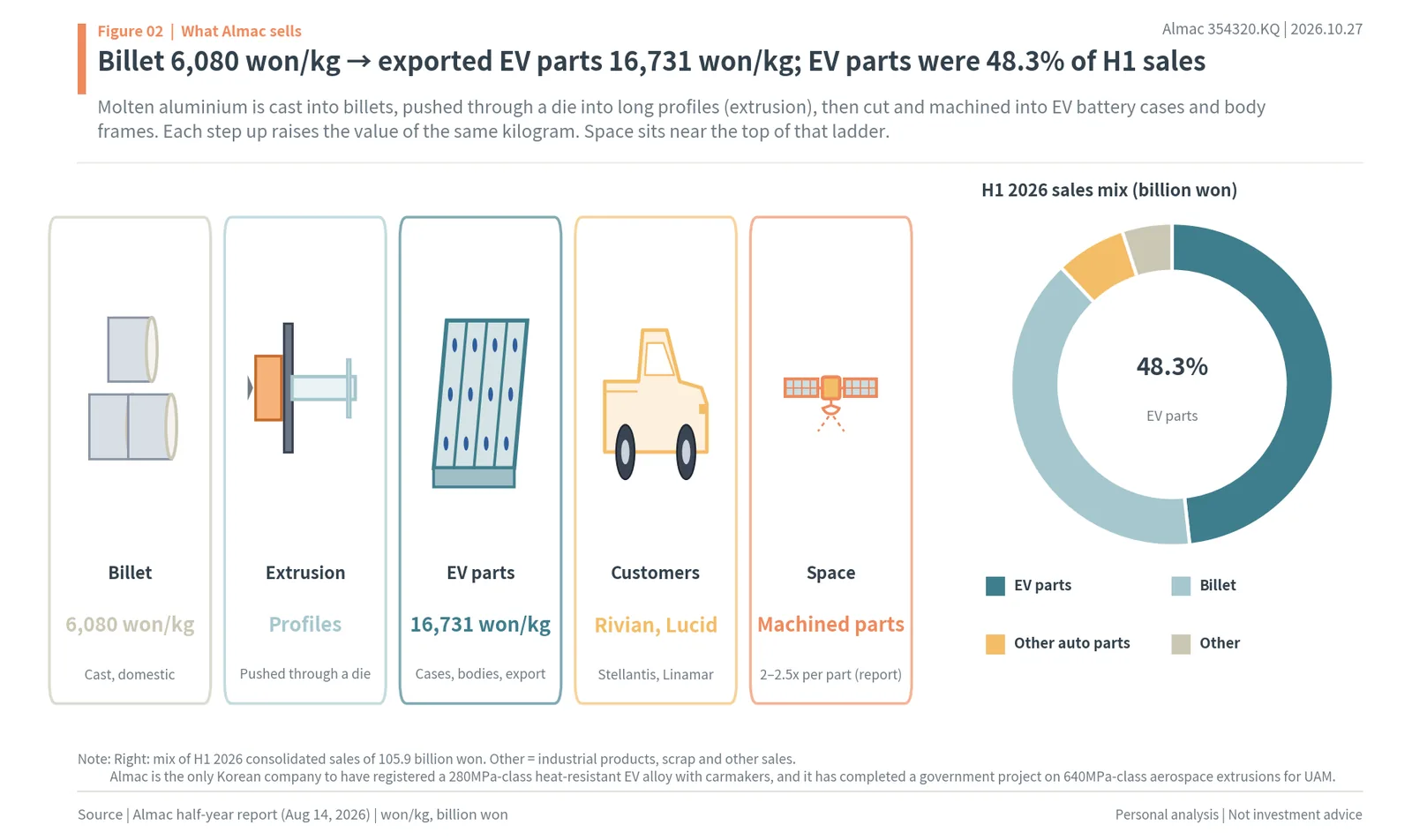
EV parts are mostly exported. Of 30.4 billion won of EV parts sold as products in the first half, 28.3 billion won was exported, and all 20.7 billion won of EV parts booked as merchandise was exported too. Almac extrudes the bodies and platforms of US electric vehicles in Korea and ships them.
The same kilogram becomes more valuable at every step
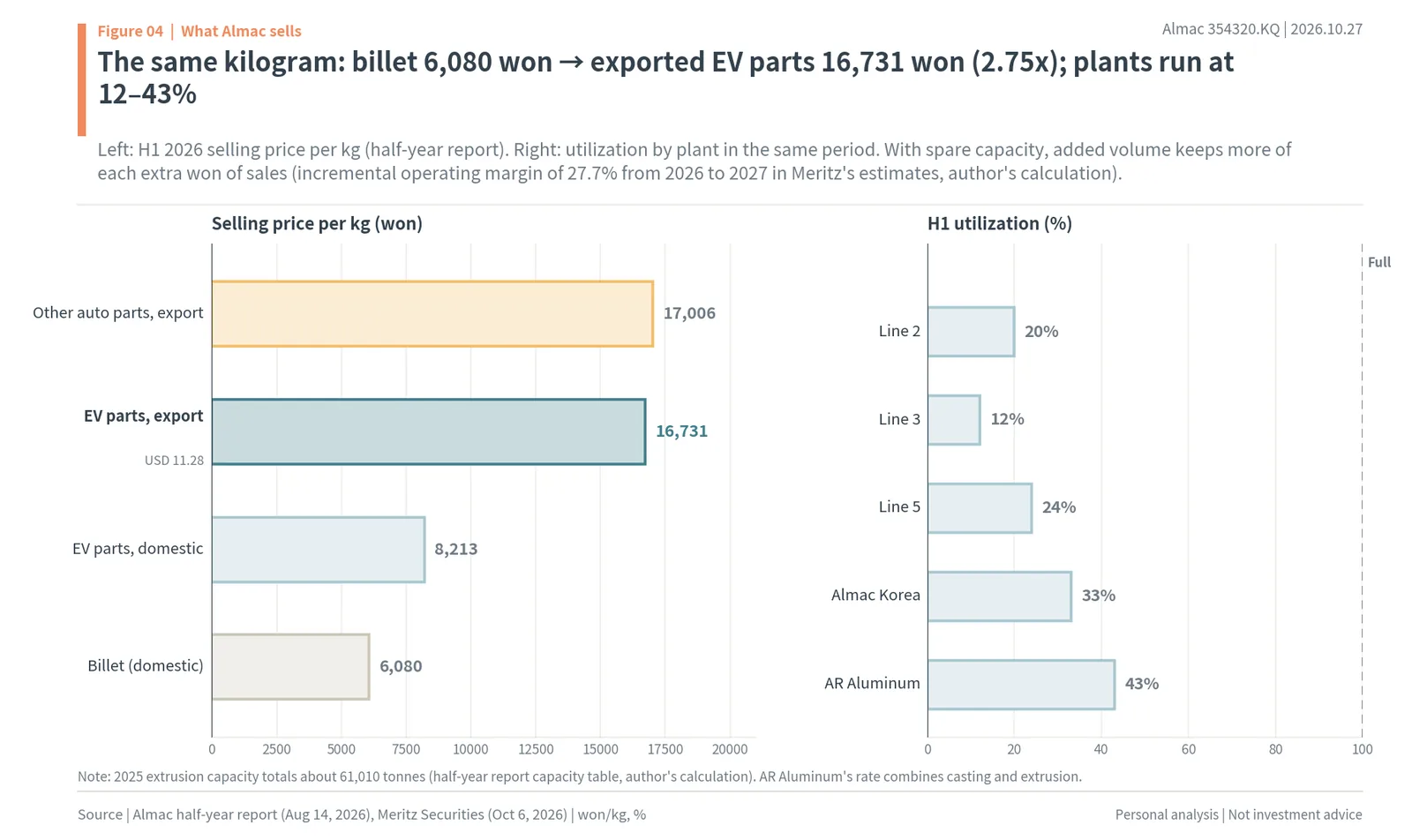
The selling prices per kilogram in the half-year report show this in numbers. In the first half of 2026 billets (domestic) sold for 6,080 won per kg, domestic EV parts 8,213 won, exported EV parts 16,731 won (USD 11.28) and exported general auto parts 17,006 won. Sold as exported parts, a kilogram is worth 2.75 times what it is worth as a billet (author’s calculation). The same weight brings in several times the sales depending on its shape and how far it is processed.

Space parts sit near the top of this ladder. Satellite structures must be light and strong, so they use high-strength alloys and precisely machined extruded profiles. From September 2021 to December 2024 Almac completed a Korea Evaluation Institute of Industrial Technology project on “640MPa-class ultra-high-strength aluminium aerospace extrusions and parts for UAM” (government contribution of 1.87 billion won, half-year report). That is technology for turning aerospace extrusions more than twice as strong as its 280MPa EV alloy into parts. Meritz Securities’ 48.6 billion won of space sales is set “on an alloy basis,” and the broker noted that sales could rise further if Almac supplies processed extrusions. That too sits on this ladder.
There is spare capacity
The plants to raise volume already exist. Utilization in the first half of 2026 was 20% at Line 2, 12% at Line 3, 24% at Line 5, 33% at Almac Korea and 43% at AR Aluminum (half-year report). Total 2025 extrusion capacity is about 61,010 tonnes (author’s calculation). Meritz Securities judged that Almac does not need separate capacity for space volumes, and it put 2027 capital spending at 25 billion won, below 2026’s 30 billion won. When volume comes into idle plants, more of each extra won of sales is kept. In Meritz’s estimates, as sales rise 68.9 billion won from 2026 to 2027, operating profit rises 19.1 billion won, so 27.7 won of every extra 100 won of sales is kept as operating profit (author’s calculation).
This structure is the key to reading the report in the next chapter. What the report talks about is unit value more than volume, and unit value is the number this company can change the most.
2. The October 27 report was about what each part sells for, not whether Almac gets in
Prime Economy published its article at 16:47 on October 27, more than an hour after the regular session ended. Its headline, roughly translated, said Almac had scored top marks in a SpaceX audit and was being joined by Boston Dynamics. The article made six claims. Most of them came from IB industry sources who asked not to be named, and the company declined to give details, citing a non-disclosure agreement (NDA). This chapter sets what the article newly said beside what brokers had said before, and notes how far each claim is confirmed.
The six things the article newly said
First, the audit. The article said a SpaceX technology and quality audit team visited Almac’s main domestic production sites on October 15 and 16, inspected its manufacturing processes, quality control and extrusion technology, and rated it well. Second, the scope. Until now only material-stage testing had been done, but after the audit talks had progressed to supplying finished parts, including machining, painting and assembly. The article used the word for injection moulding to describe the testing stage, but Almac’s core process is extrusion and Meritz separates material (alloy) from processed extrusions, so this report reads it as the material stage. Third, the unit value. As the processes widen, revenue per part would be 2 to as much as 2.5 times what it was. Fourth, the items. Prototype items had grown from 21 to around 30, including Starlink V2 and V3 and the generation after V3. Fifth, the schedule. Once price terms are set in early November the order would be finalized, and sales would show up from next year. Sixth, robots. Almac executives met Boston Dynamics staff in the US in mid-October and afterwards received a formal request for quotation (RFQ).
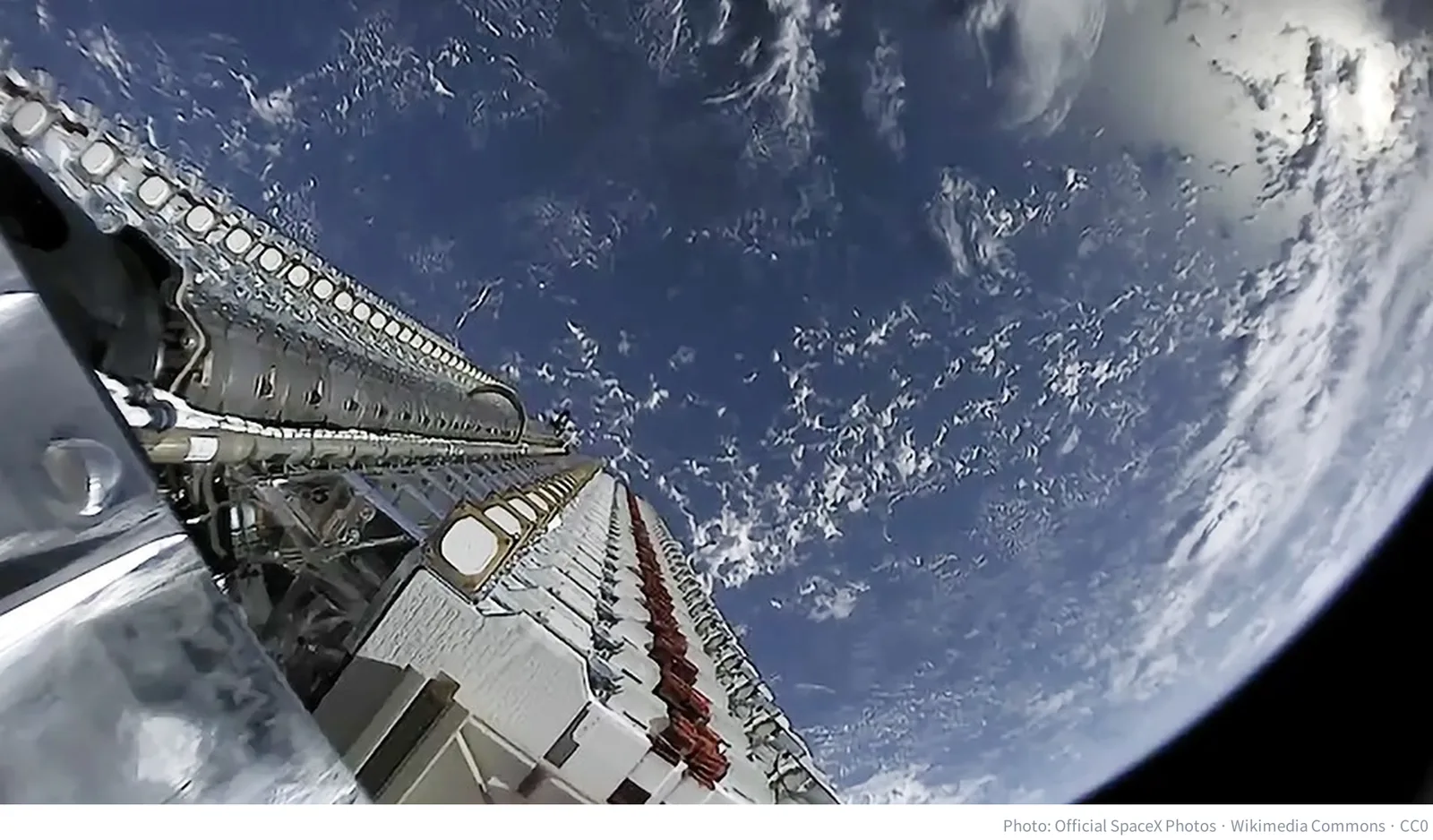
Checked against what brokers said first
Several of these points connect to what broker reports had already written. In its October 6 report Meritz Securities wrote that Almac’s collaboration on projects with the world’s largest private space company had grown to 21 items, that the samples supplied in the first half met the material properties, and that it expected 2027 sales to this customer of 48.6 billion won on an alloy basis. It added that “further sales growth is possible” if Almac supplies processed extrusions at the customer’s request. The article’s starting point of 21 items, and its direction from material to processed parts, match this report. What the article added is the audit dates, the revenue-per-part multiple, the count of around 30 items and the early-November price schedule.
The brokers did not name the customer. NH Investment & Securities wrote “a North American aerospace company,” Meritz Securities “the world’s largest private space company,” and Hana Securities on May 13 “launch vehicle and satellite parts for global space top-tier company S.” It was this article that used the name SpaceX. So this report labels the article’s claims “report (anonymous),” broker figures “broker estimates,” and the half-year report and filings “confirmed.”
How the schedule moved before
The space business moved one step at a time across the year. On January 7 NH Investment & Securities said sample tests for a key aerospace customer were under way and that it expected meaningful results within the first half, and on February 10 it put the initial supply for the items under discussion at about 40 billion won. Meritz Securities started coverage on April 13, expecting the qualification test to be passed in the first half and first volumes in the second half. On May 6, when an intraday rumor that Almac had failed qualification sent the shares sharply lower, Meritz called “rumors of passing or failing an April qualification test” baseless. On May 13 Hana Securities also called the rumor groundless and put official vendor approval in the second or third quarter. In Meritz’s October 6 quarterly estimates, space sales begin at 1.4 billion won in the fourth quarter of 2026. Then came the report of the October 15–16 audit and early-November pricing.
This timeline points to one thing. Almac’s space business has moved past asking whether it will happen and into deciding when, at what price and in what form. So the rest of this report takes those three in order: when, through the ten steps to becoming a supplier; how much, through the share per launch and SpaceX’s volumes; and in what form, through the difference between material and finished parts.
3. The one-year share price followed news about the space steps
Almac closed 2025’s last trading day at 20,150 won and closed at 62,300 won on October 27, 2026. It is up 209% this year, but not in a straight line. After reaching 101,400 won on April 29 it fell 79% to 21,100 won on July 30, then rose 2.95 times from there (KRX closes, author’s calculation). Most of the days with big moves were days when news about the next space step came out.
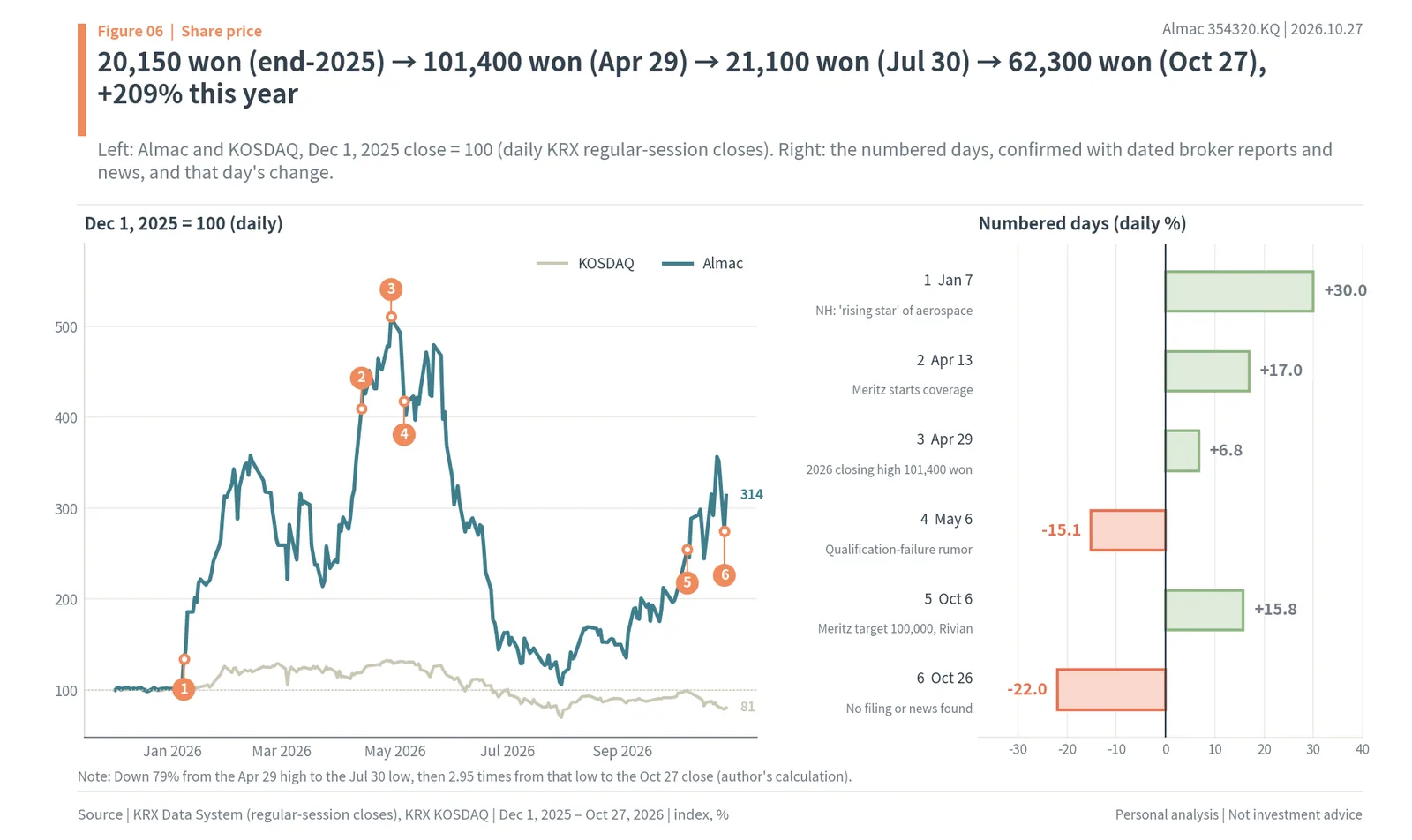
The days with space news
On January 7, the day NH Investment & Securities introduced Almac as a “rising star of the aerospace sector,” the shares rose 30.0% (KOSDAQ -0.9%), and 20 trading days later they were 220.0% above the previous day’s close. On April 13, when Meritz started coverage with a buy rating and a 120,000 won target price, they rose 17.0%. On May 6, the day of the qualification-failure rumor, they fell 15.1%. Meritz and Hana denied the rumor, but as the schedule for passing within the first half slipped into the second half the share price came down with it: 20 trading days later it was 37.9% below the previous close, and on July 30 it reached 21,100 won. The share price fell as the schedule slipped and turned when the schedule moved forward again. On October 6, when Meritz cut its target to 100,000 won but wrote that space collaboration had grown to 21 items, the shares rose 15.8% on a day that also brought strong Rivian deliveries (KRX closes, author’s calculation).
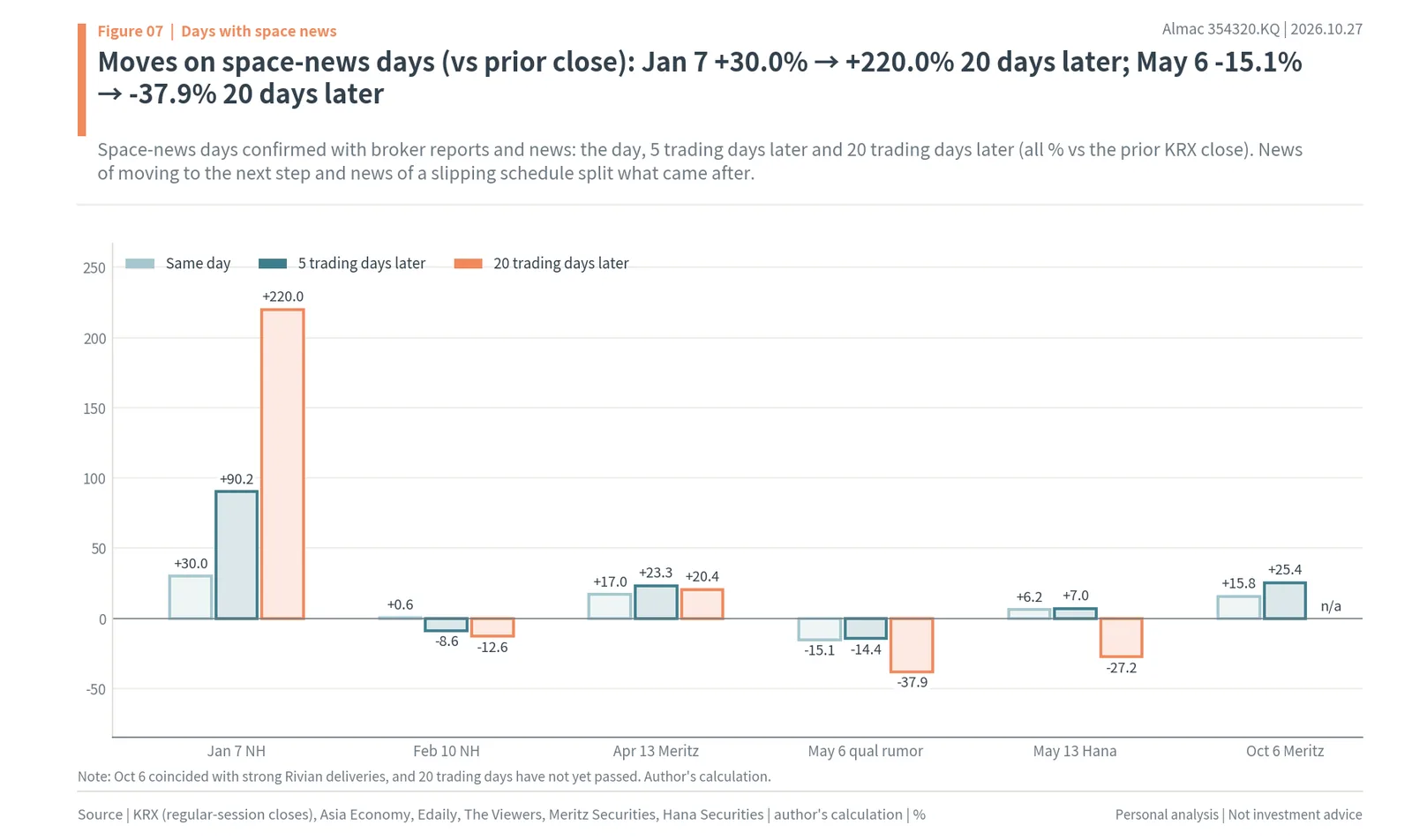
The same company with the same customer moved 15% to 30% in a day depending on the news, and what came afterwards diverged even more than the day itself. News of moving to the next step, as on January 7 and April 13, still held the price higher 20 trading days later, while news of a slipping schedule, as on May 6, pulled the price down for 20 trading days even after the denials. When a number came out but the schedule stayed the same, as with the roughly 40 billion won on February 10, the price barely moved. This stock has been priced by how the market reads where SpaceX supply stands among the ten steps. That makes the audit and pricing schedule in the October 27 report the most direct kind of news for it, and the steps after that, an order and first sales, more direct still.
Who bought from September to October
While the share price rose 2.63 times in seven weeks, from 26,900 won on September 3 to 70,800 won on October 22, institutions were the buyers. Over that period institutions bought a net 29.1 billion won (investment trusts 16.4 billion, private equity funds 6.9 billion and financial investment firms 4.5 billion), while foreigners sold a net 24.5 billion won and individuals 6.8 billion won (KRX, author’s calculation). On October 22 the exchange designated the stock for investment caution as one where a few accounts were heavily involved in buying after a 15-day rise. It had risen 79.70% over 15 days, the top 20 accounts made up 53.71% of that day’s buying, and one institutional account alone made up 20.03% (KRX market-alert filing). A notice that the stock could be designated for investment warning came the same day. Chapter 9 picks this up together with the last two days of trading.
4. Ten steps to selling to SpaceX: Almac is on the fifth
Joining public sources together, the road from new supplier to delivering to SpaceX runs to roughly ten steps. SpaceX’s supplier quality manual (SPX-00007672, an unofficial copy of version 6.0) says it is preferable for suppliers to hold quality management certification (ISO 9001 or AS9100), requires first article inspections on the aerospace AS9102 form, and requires source inspection before shipment when the purchase order says so. Metal raw material must come from SpaceX’s list of approved mills. Almac casts its own billets and extrudes them, so if its material passes testing, the company that makes the material and the company that machines it are one and the same. Matching the dates brokers have written for Almac with the steps in this manual shows where it stands among the ten.
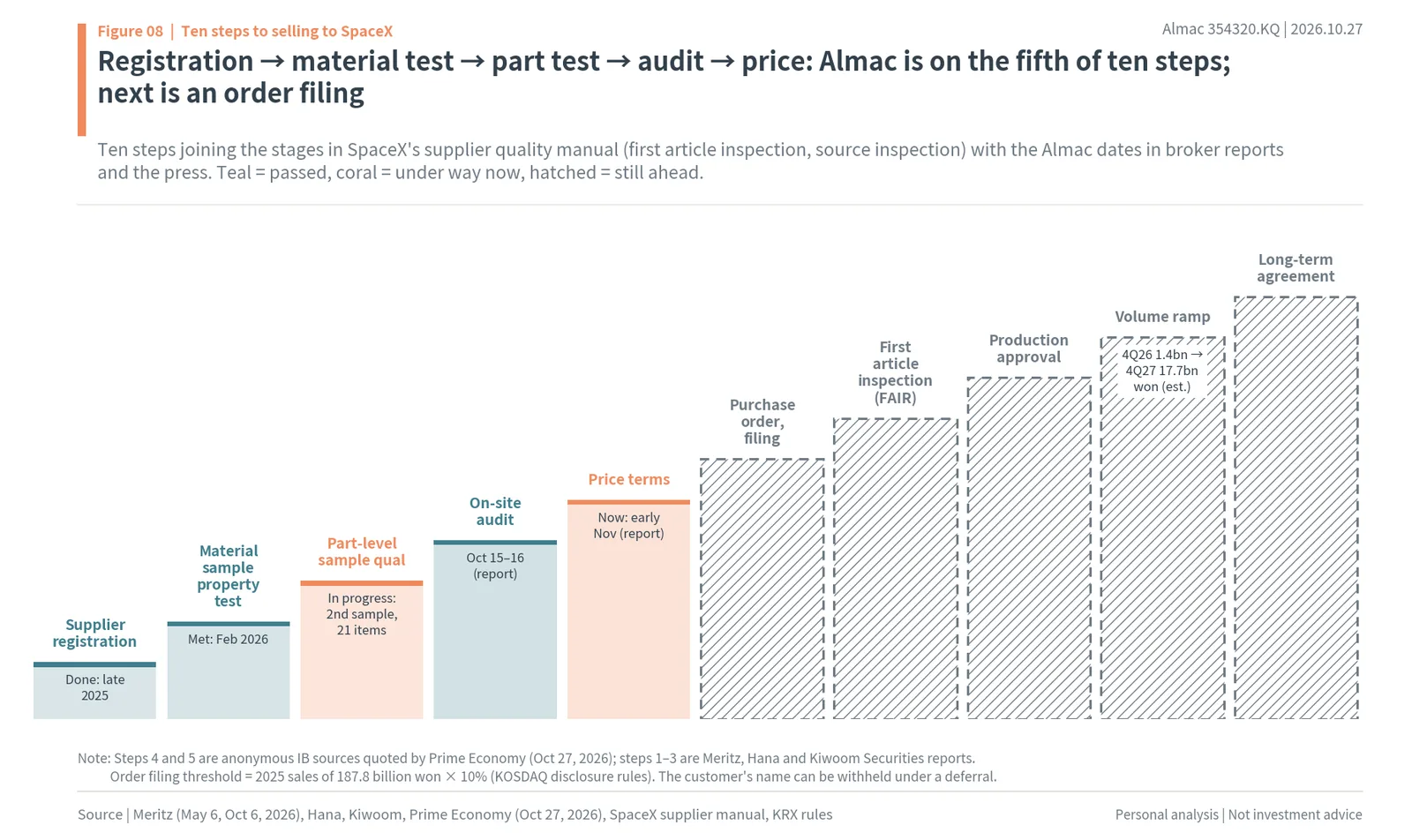
The ten steps and Almac’s dates
The first step is supplier registration. Almac registered as a supplier to the North American aerospace company at the end of 2025 (Meritz, Hana and Kiwoom Securities). The second is the material test. The first samples supplied in February 2026 met the material properties (Meritz, May 6). The third is the part-level test. A second set of samples went through part-level qualification testing, and as of October 6 the collaboration had grown to 21 items (Meritz). The fourth is the on-site audit. The audit team visited the domestic production sites on October 15–16 (Prime Economy, anonymous). The fifth is price terms, due to be set in early November (same report). After that come the purchase order (PO), the first article inspection, production approval, the volume ramp and the long-term agreement (LTA). Meritz’s quarterly estimates have space sales starting at 1.4 billion won in the fourth quarter of 2026 and rising to 7.2 billion won in the first quarter of 2027, 10.2 billion won in the second, 13.5 billion won in the third and 17.7 billion won in the fourth (4Q26 → 4Q27). That is a sketch of the ninth step, the volume ramp, drawn in advance. Quarterly sales grow more than twelve times in four quarters, and the 17.7 billion won of the fourth quarter of 2027 is about a third of Almac’s total sales in the second quarter of 2026 (55.2 billion won) (author’s calculation).
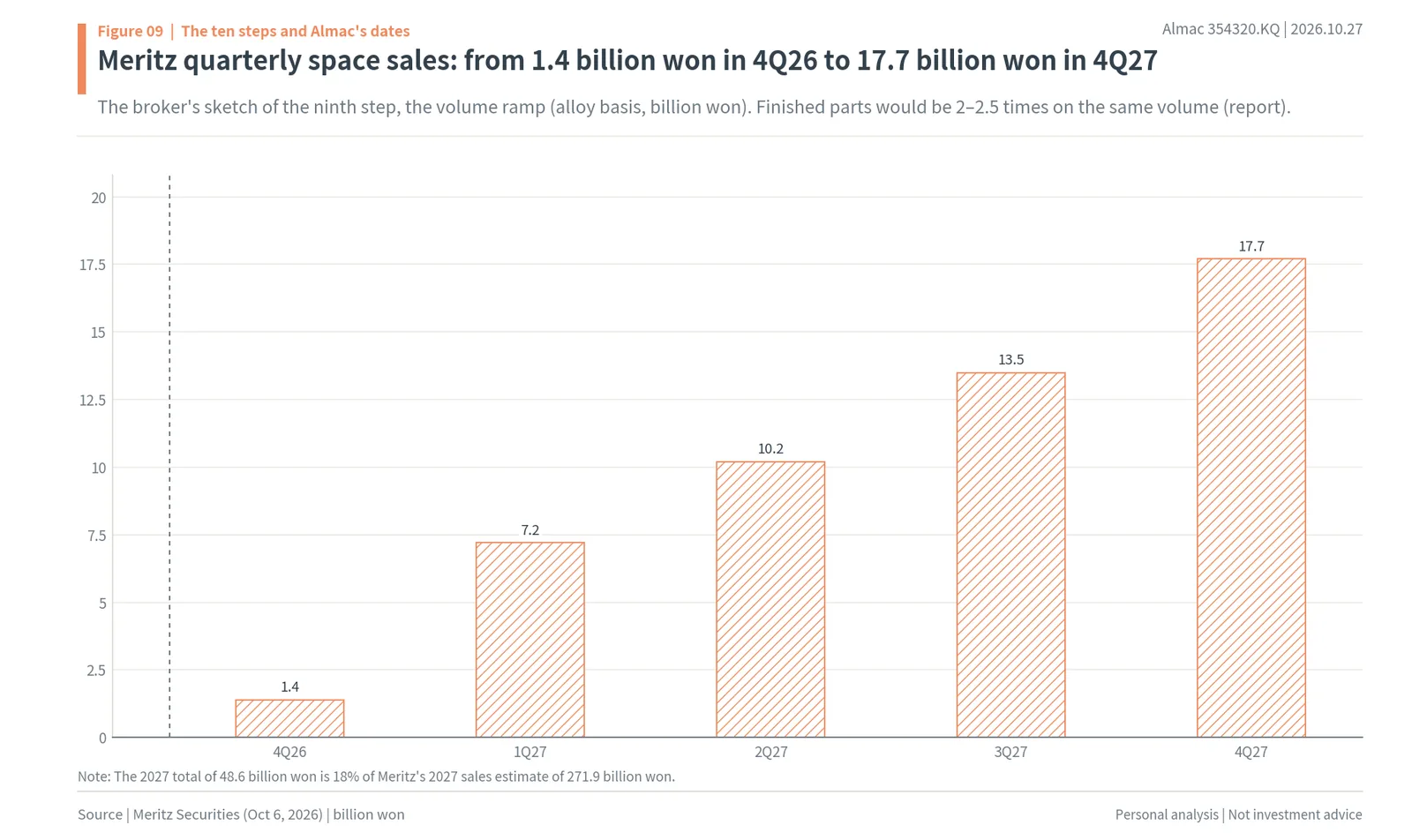
Almac took about eleven months to get from registration to the price step. Setting that pace beside two companies that reached the same customer earlier sketches what the next steps could look like.
Timelines of the companies that went first
Sphere obtained a SpaceX tier-1 vendor code in 2023 and disclosed a long-term supply contract on July 31, 2025. That filing named SpaceX as the counterparty (see the author’s note on Sphere Corp.). Its later order-by-order filings hid the customer’s name as “a US global aerospace launch company,” such as the 41.6 billion won filing on February 19, 2026 and the 28.5 billion won filing on October 14. Its space sales went from 80 billion won in 2025 to 106.4 billion won in the first half of 2026 alone (Meritz). It took about two years from vendor code to long-term contract.
HVM supplies special alloys made by vacuum melting. In Meritz’s figures its space sales grew from 7.6 billion won in 2024 to 39.5 billion won in 2025 and 77.2 billion won in 2026 (estimate), and its sales to SpaceX itself were 14.9 billion won in the first quarter of 2026 and 19.7 billion won in the second. Until March 2025 it supplied order by order, without a long-term contract. Meritz wrote that after the customer listed on Nasdaq it reorganized its staff and moved to a mass-production system, asking for additional approvals, so that part of HVM’s third-quarter volume slipped into the fourth quarter. In other words, the eighth step, production approval, decides when the actual volume arrives.
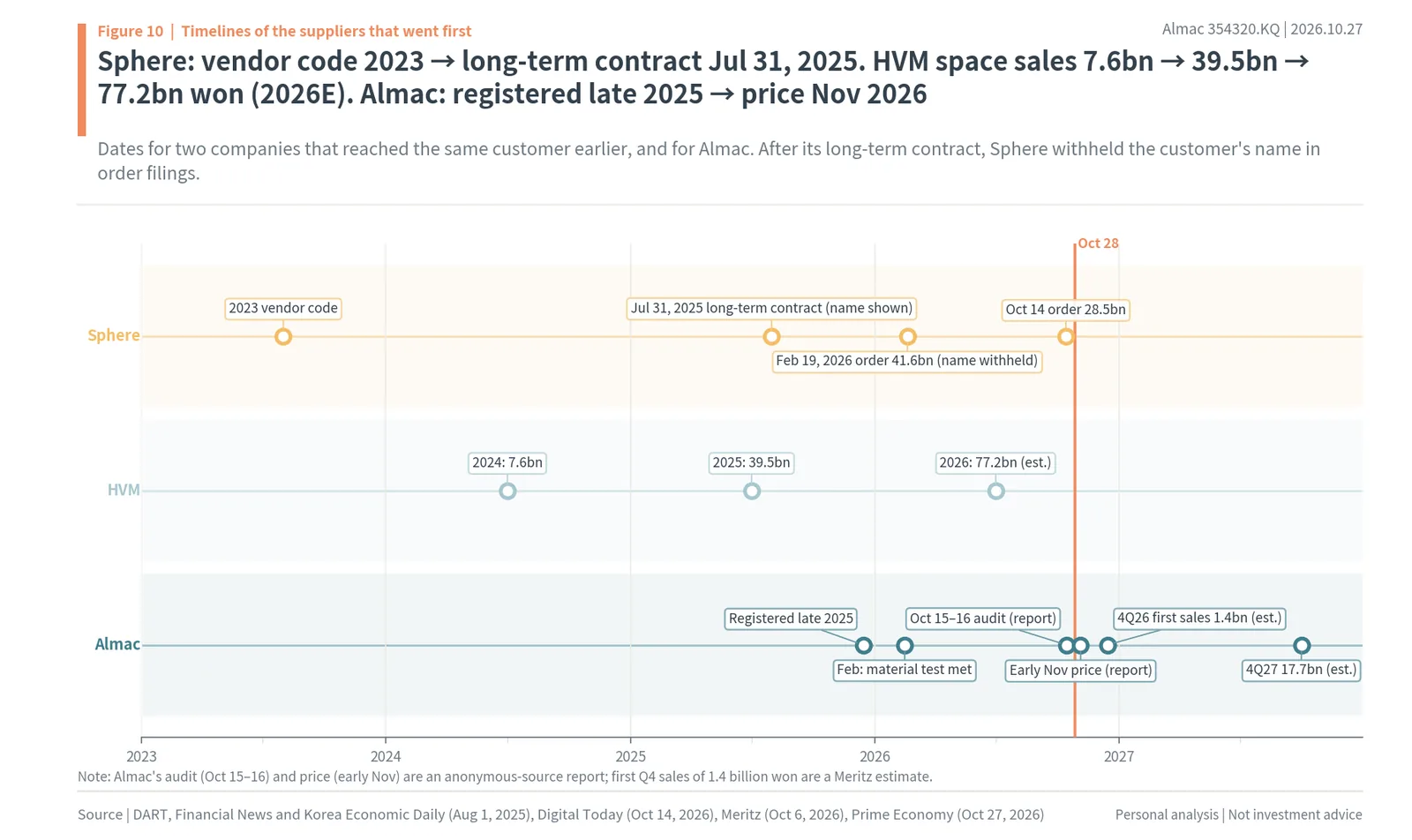
The two companies’ paths show one thing. Supply to SpaceX starts order by order and is tied into a long-term contract as volume builds, and sales grew several times over from the first year. HVM’s space sales grew almost tenfold in two years from 7.6 billion won in the first year (2026 is an estimate). If Almac moves from the fifth step to the sixth, the shape of its sales after that is likely to resemble these two companies’ staircases.
The sixth step shows up in a filing
KOSDAQ disclosure rules require a single sales or supply contract worth 10% or more of the latest fiscal year’s sales to be disclosed by the next day. On Almac’s 2025 consolidated sales of 187.8 billion won, that is about 18.8 billion won (author’s calculation). A framework contract without prices and volumes is not disclosed; contracts are disclosed purchase order by purchase order, and where trade secrets are involved the details can be withheld for a period. In principle, though, only one of the counterparty and the amount can be withheld (KRX 2025 guide to KOSDAQ disclosure and listing management). If the customer’s name is hidden, the amount is visible. Sphere’s October 14, 2026 filing, which hid the customer’s name until July 26, 2027, is an example.
So Almac’s sixth step is likely to appear as “a large order filing with the customer’s name withheld.” Given Meritz’s 2027 quarterly sales (7.2 billion to 17.7 billion won), an order for a single quarter’s volume could fall short of 18.8 billion won, while an order covering several quarters, or one carrying finished-part prices, would cross the threshold. Even without a filing, space sales in the fourth-quarter results (1.4 billion won in Meritz’s estimate) would be the first confirmation.
5. Almac’s share per launch: hundreds of millions of won on a Falcon 9, more than five times that on a Starship
If we know what Almac’s space sales are proportional to at SpaceX, we can also count how much Almac grows as SpaceX grows. Brokers wrote that Almac works on “payload structures for a new launch vehicle and communications (satellite)” projects (Meritz, April 13), and the article named Starlink V2, V3 and next-generation items. So this chapter divides Almac’s space sales by Starlink satellite production to calculate Almac’s share per satellite and per launch. Because the launch-vehicle part is also divided by the number of satellites, the result is best read as “Almac space sales per satellite.”
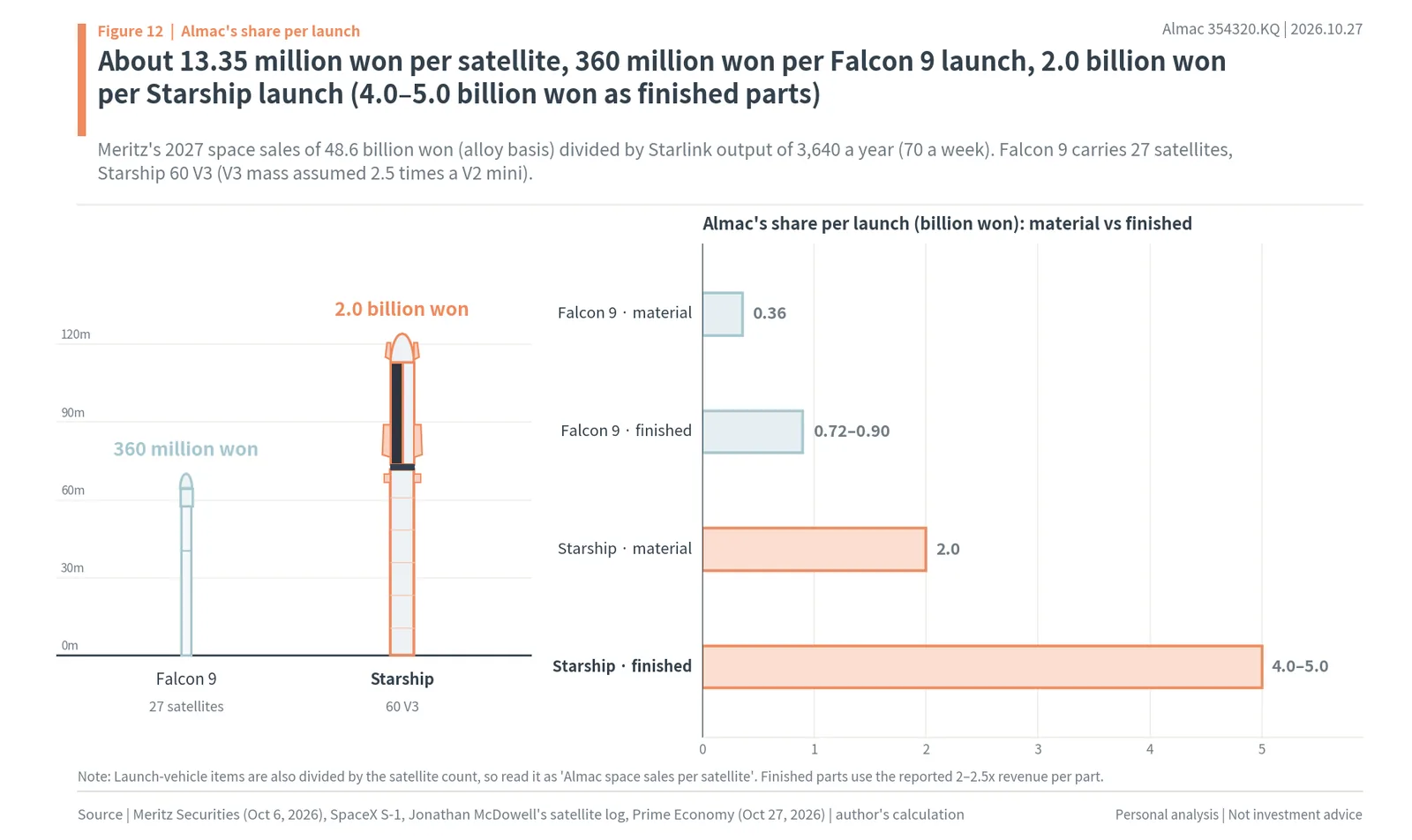
About 13.35 million won per satellite
In its S-1 registration statement SpaceX said its Redmond factory produced an average of about 70 Starlink satellites a week from December 2025 to April 2026, or 3,640 a year. Dividing Meritz’s 2027 space sales of 48.6 billion won (alloy basis) by this number gives about 13.35 million won per satellite (author’s calculation). If, as reported, Almac supplies finished parts instead of material and revenue per part rises 2 to 2.5 times, that becomes 26.70 to 33.38 million won per satellite.
About 360 million won per Falcon 9, about 2 billion won per Starship
On recent Starlink launches Falcon 9 has carried 27 V2 mini satellites each time (Jonathan McDowell’s log, September to October 2026). Multiplying by the 13.35 million won per satellite gives about 360 million won per Falcon 9 launch, or 720 to 900 million won as finished parts (author’s calculation).
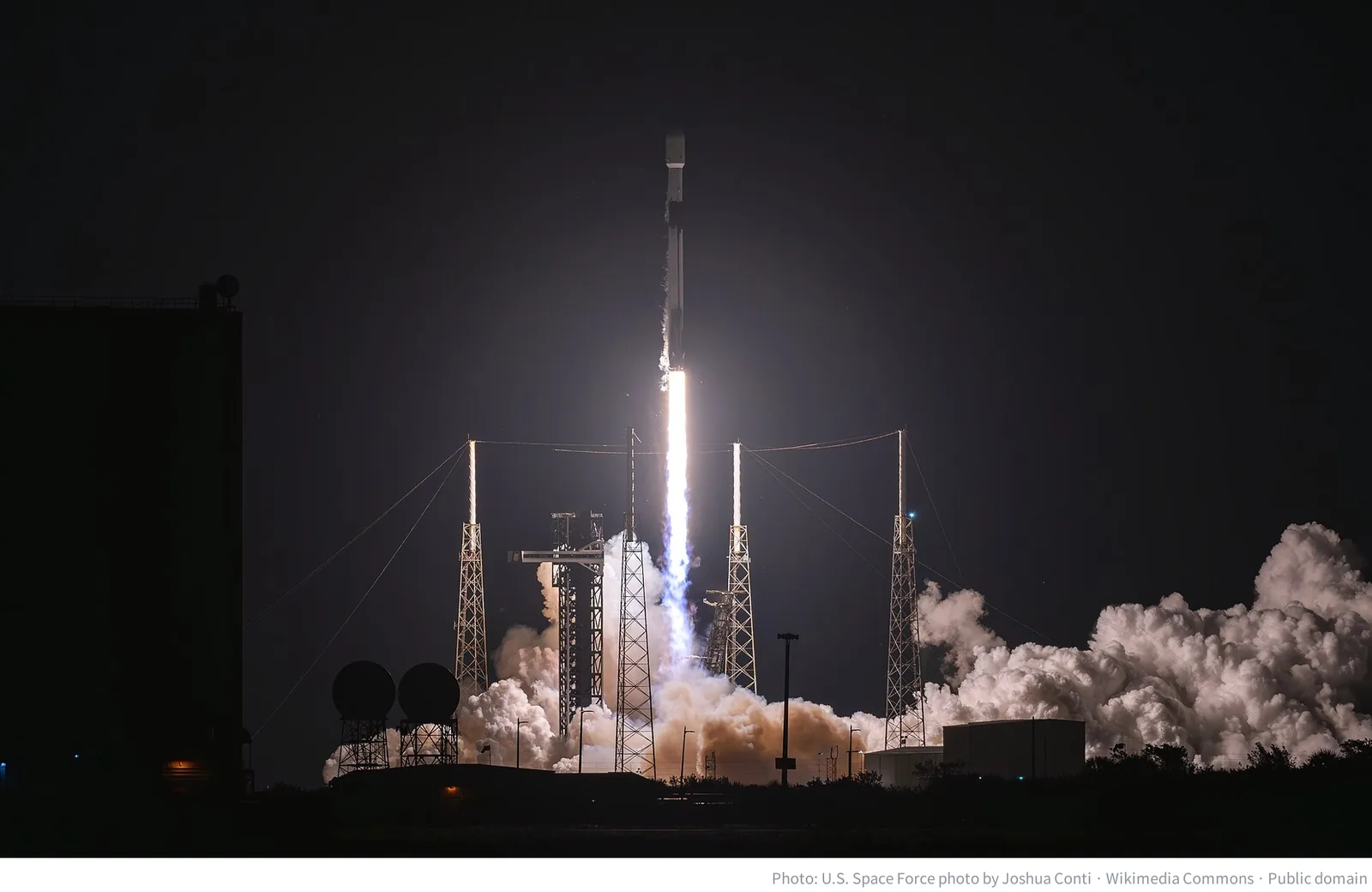
Starship is different. SpaceX says one Starship launch can carry up to 60 of the new V3 satellites. A V3 is much larger and heavier than a V2 mini (about 800kg). The company has not published an official V3 mass, and reports vary from 1,200kg to 2,000kg. This report uses the most widely cited figure, about 2,000kg (Space.com), or 2.5 times a V2 mini. Assuming the aluminium in each satellite is proportional to its mass, Almac’s share of one Starship launch is about 2 billion won, or 4 to 5 billion won as finished parts (author’s calculation). That is 5.6 times a Falcon 9 launch.
Checking the 48.6 billion won against weight
To see whether these numbers make sense, check them against weight. The aluminium on each satellite is about 294kg for a V2 mini (800kg × 36.7%) and about 734kg for a V3. At 3,640 satellites a year, the aluminium actually on the satellites is about 1,069 tonnes (author’s calculation). Converting 48.6 billion won at Almac’s exported EV-part price (16,731 won per kg), on the other hand, gives about 2,905 tonnes, 2.7 times the weight on the satellites.
The gap comes from two places. One is the material machined away. Aerospace parts are cut from extruded or thick-plate stock, leaving only the shape needed, so the material bought weighs several times the finished part. The industry calls this the buy-to-fly ratio: for parts machined directly from plate 20:1 is not unusual, and it falls when the shape is first formed by extrusion or forging (ASM International, March 2024; Cutting Tool Engineering, February 2026, puts it at 10:1 to 20:1). The other is launch-vehicle structures. Meritz wrote that Almac’s projects include payload structures for a new launch vehicle. So the 48.6 billion won reads as a figure that includes not only the aluminium on the satellite bodies but also the material machined away and the launch-vehicle structures. And if Almac takes on the machining itself, the machining is added to Almac’s sales on top of the material that is cut away. This is where the reported “2 to 2.5 times revenue per part” comes from. Forming the shape first by extrusion and cutting away less is also where Almac can get ahead of suppliers that machine from plate.
In short, Almac’s share of each launch depends less on how many satellites there are than on which rocket flies and how often. On the same single launch, Starship carries more than five times Almac’s share on a Falcon 9. So the next chapter looks at how often Starship will fly.
6. SpaceX’s future is bigger, heavier satellites launched more often
SpaceX’s launch count has risen every year: 96 in 2023, 134 in 2024 and 165 in 2025 (Falcon launches in the S-1). In 2026 it launched 40 times in the first quarter, 38 in the second and 35 in the third, 113 in nine months (company filings and earnings releases, reports; the 2026 quarters are total launches and the third quarter includes two Starship flights). Starlink satellites launched were 1,722 in 2022, 1,984 in 2023, 1,982 in 2024 and 3,207 in 2025, and 2,263 so far in 2026 to October 25 (Jonathan McDowell’s log, author’s calculation). As of October 25 there were 11,167 Starlinks in orbit. (For more on the company, see the author’s note on SpaceX’s Q3 results.)
Why launches slowed this year
Quarterly launches fell from 40 to 35 in 2026, and satellite launches are running slower than last year, because this is a transition. On September 28 SpaceX’s Starship Flight 14 reached orbit and delivered 26 V3 satellites for the first time (Space.com). On the earnings call Musk said that flight carried 26 terabits per second of Starlink bandwidth and was only about half loaded. The larger, heavier new satellite (V3) can fly only on Starship. Satellites are moving from V2 mini to V3 and rockets from Falcon 9 to Starship.
The 2027 schedule and beyond
At the October 20 third-quarter earnings call Musk said Starship would fly weekly at some point in the first half of 2027 and twice a week or more by the end of the year, and President Gwynne Shotwell said SpaceX could have a few hundred V3 satellites up by the middle of 2027. Musk said that probably within three years Starlink would have about 100 times today’s bandwidth, with something on the order of 100,000 satellites. Starlink consumer subscribers rose from 10.3 million in the first quarter of 2026 to 12.0 million in the second and 13.6 million in the third (the second-quarter figure is labelled “Starlink subscribers,” so definitions may differ slightly). On January 30, 2026 the company applied to the US Federal Communications Commission (FCC) for up to 1 million satellites for space data centers, and its S-1 describes a plan to launch AI computing satellites as early as 2028.
Turning this schedule into aluminium weight gives the following. At today’s production rate (3,640 V2 mini a year), the aluminium on satellites is about 1,069 tonnes. If Starship flies twice a week, 104 times a year, with 60 V3 satellites each time, that is 6,240 satellites a year and about 4,580 tonnes of aluminium, 4.3 times today. If the order of 100,000 satellites Musk mentioned were filled with V3 over three years, it would be about 24,467 tonnes a year, 23 times today (author’s calculation).
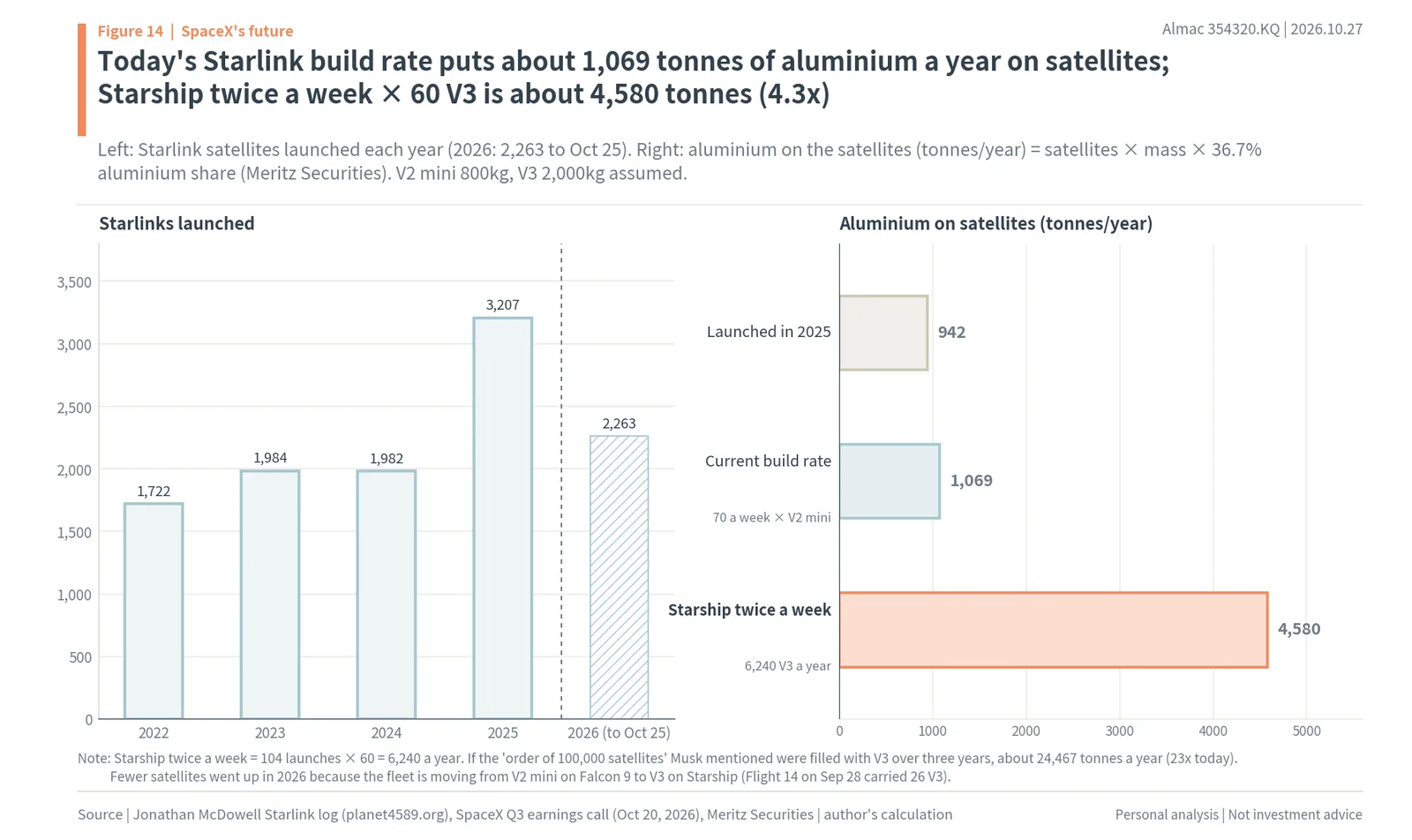
What these numbers mean for Almac
Almac’s 2027 space sales of 48.6 billion won (Meritz) read as a figure set at today’s production rate. The rise in 2027 quarterly sales from 7.2 billion to 17.7 billion won also points the same way as Starship going from weekly to twice a week. As satellites get heavier, more aluminium goes into each one, and as Starship flies more often, more satellites go up each year. The two multiply, so aluminium demand grows faster than the satellite count. Because SpaceX’s future is “bigger, heavier satellites, more often,” the sales of a supplier that provides those satellites’ bodies are built to grow faster than the satellite count too.
SpaceX spent USD 19.59 billion on capital expenditure in the third quarter and plans USD 35 billion to 40 billion in the fourth. Most of that is AI computing capacity, but it also spent USD 1.3 billion to 1.5 billion a quarter on its connectivity business (Starlink). The money going into building and launching satellites is not shrinking. The next chapter carries these volumes over to Almac’s sales, profit and market value.
7. As SpaceX grows: volume × unit value → sales → profit → market value
This chapter multiplies the two axes from the previous chapters, unit value (material or finished parts) and volume (how often SpaceX launches and how heavy its satellites are), to build Almac’s space sales, then carries them over to profit and market value. It does not set a price target. It measures, with the same yardsticks, how large Almac becomes at each step SpaceX reaches.
Four steps
There are four steps. The first is current rate · material: Meritz’s 2027 space sales of 48.6 billion won as they are. The second is current rate · finished, the same volume supplied as finished parts. Using 2.25 times, the middle of the 2 to 2.5 times revenue per part, space sales become 109.4 billion won. The third is satellite aluminium doubled · finished, the shape around the first half of 2027 when Starship flies weekly and V3 satellites enter the mix, with space sales of 218.7 billion won. The fourth is Starship twice a week with V3 · finished, the second-half 2027 schedule, in which satellite aluminium becomes 4.3 times today’s, continuing for a whole year, with space sales of 468.6 billion won (author’s calculation).
How profit and market value are measured
Space net profit is space sales × operating margin × 0.8, where 0.8 is the share assumed to remain after interest and taxes. The space operating margin is set at three values: 15%, 20% and 25%. There are two yardsticks. HVM’s 2026 operating margin is expected to be 13.5% (consensus), and in Meritz’s estimates Almac keeps 27.7 won of every extra 100 won of sales as operating profit from 2026 to 2027. Because volume lands on plants running at 12% to 43%, the margin on added sales is high. Net profit from the non-space businesses is fixed at about 15.0 billion won: Meritz’s 2027 net profit of 22.8 billion won minus the space part (48.6 billion won × 20% × 0.8). That makes the 20% case of the first step equal to Meritz’s net profit. Market value is net profit times 20 and 28. The 28 times is the multiple Meritz used as the “2027 global space-industry average,” and 20 times is a lower value.
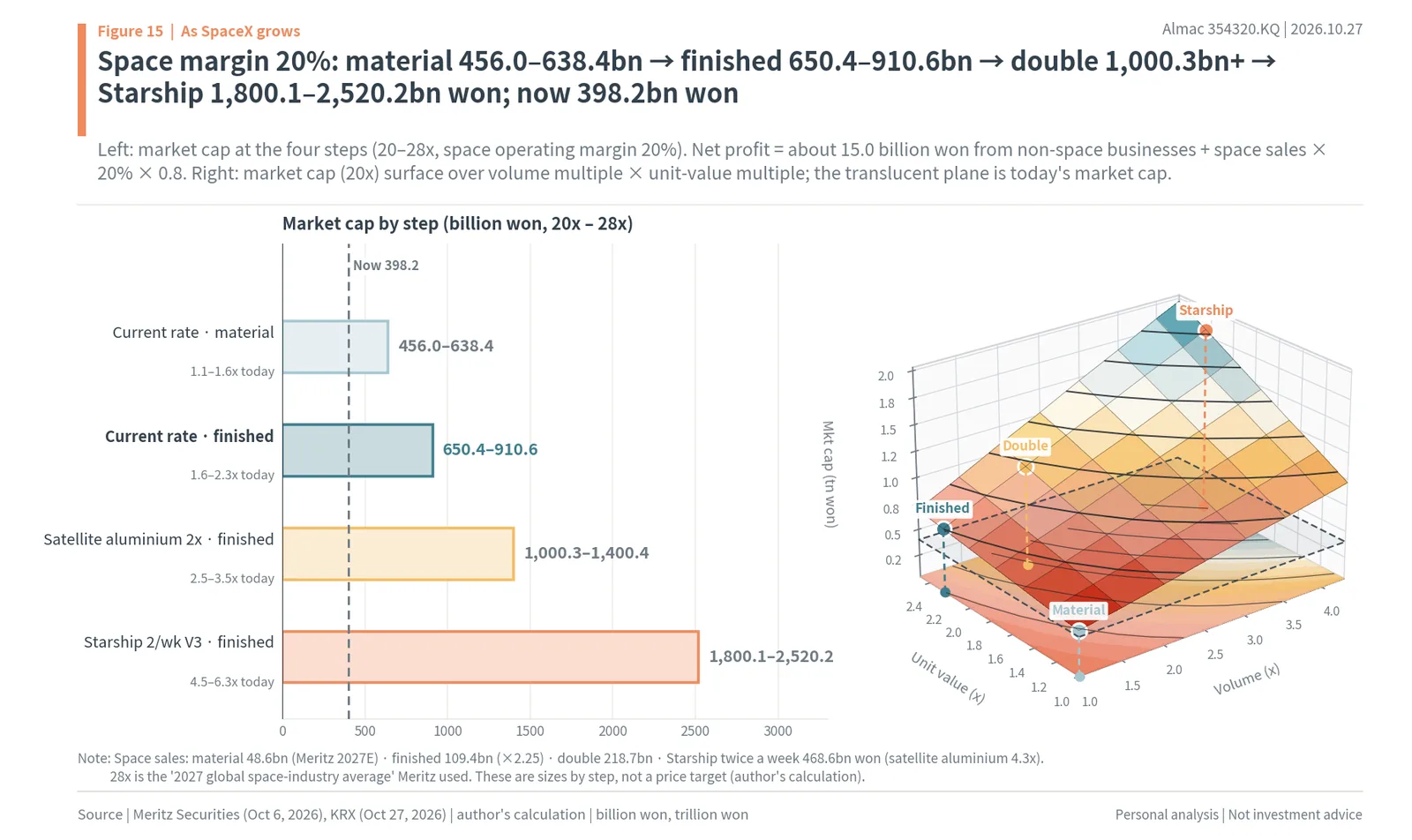
Results by step
At a 20% space operating margin, the first step’s net profit is 22.8 billion won and its market value 456.0 billion won (20 times) to 638.4 billion won (28 times). That is 1.1 to 1.6 times today’s market value of 398.2 billion won (the October 27 KRX close of 62,300 won × 6.39 million shares). The second step (finished parts) gives net profit of 32.5 billion won and a market value of 650.4 to 910.6 billion won, 1.6 to 2.3 times today’s. The third step (satellite aluminium doubled) gives net profit of 50.0 billion won and a market value of 1,000.3 to 1,400.4 billion won, 2.5 to 3.5 times. The fourth step (Starship twice a week) gives net profit of 90.0 billion won and a market value of 1,800.1 to 2,520.2 billion won, 4.5 to 6.3 times (author’s calculation).
Changing the margin widens the range. At 15%, the second step’s market value is 562.9 to 788.1 billion won, and at 25% it is 737.9 to 1,033.0 billion won. The fourth step is 1,425.2 to 1,995.3 billion won at 15% and 2,175.1 to 3,045.1 billion won at 25%. The order this table tells is clear: moving up one step from material to finished parts, and then another step in volume, changes market value far more than a five-point difference in margin. These steps are not a price target; they are sizes measured with the same multiples, and each step needs a different confirmation at a different time.
What today’s price already assumes
Today’s price of 62,300 won is 17.4 times Meritz’s 2027 EPS of 3,574 won, 16.9 times the WISEreport consensus 2027 EPS of 3,692 won, and 12.0 times the 2028 EPS of 5,210 won. Applying Meritz’s 28 times in reverse, today’s price assumes 2027 EPS of 2,225 won, 62% of Meritz’s estimate (author’s calculation). In other words, the market has not yet fully priced even the first step (48.6 billion won on a material basis). The second step opens when the “finished parts” in the report are confirmed, and the third and fourth open when the Starship schedule is kept.
The yardstick companies’ multiples
Dividing the market values of companies that reached the same customer first by their space sales gives another yardstick. HVM’s October 27 market value of 720.5 billion won divided by its expected 2026 space sales of 77.2 billion won (Meritz) is 9.3 times, and Sphere’s market value of 1,001.1 billion won divided by twice its first-half 2026 space sales of 106.4 billion won is 4.7 times (author’s calculation). Almac’s market value today is 8.2 times Meritz’s 2027 space sales and 3.6 times the finished-parts step’s sales. Applying the two companies’ multiples to the finished-parts step’s space sales (109.4 billion won) gives 514.2 to 1,017.4 billion won for the space business alone (author’s calculation).
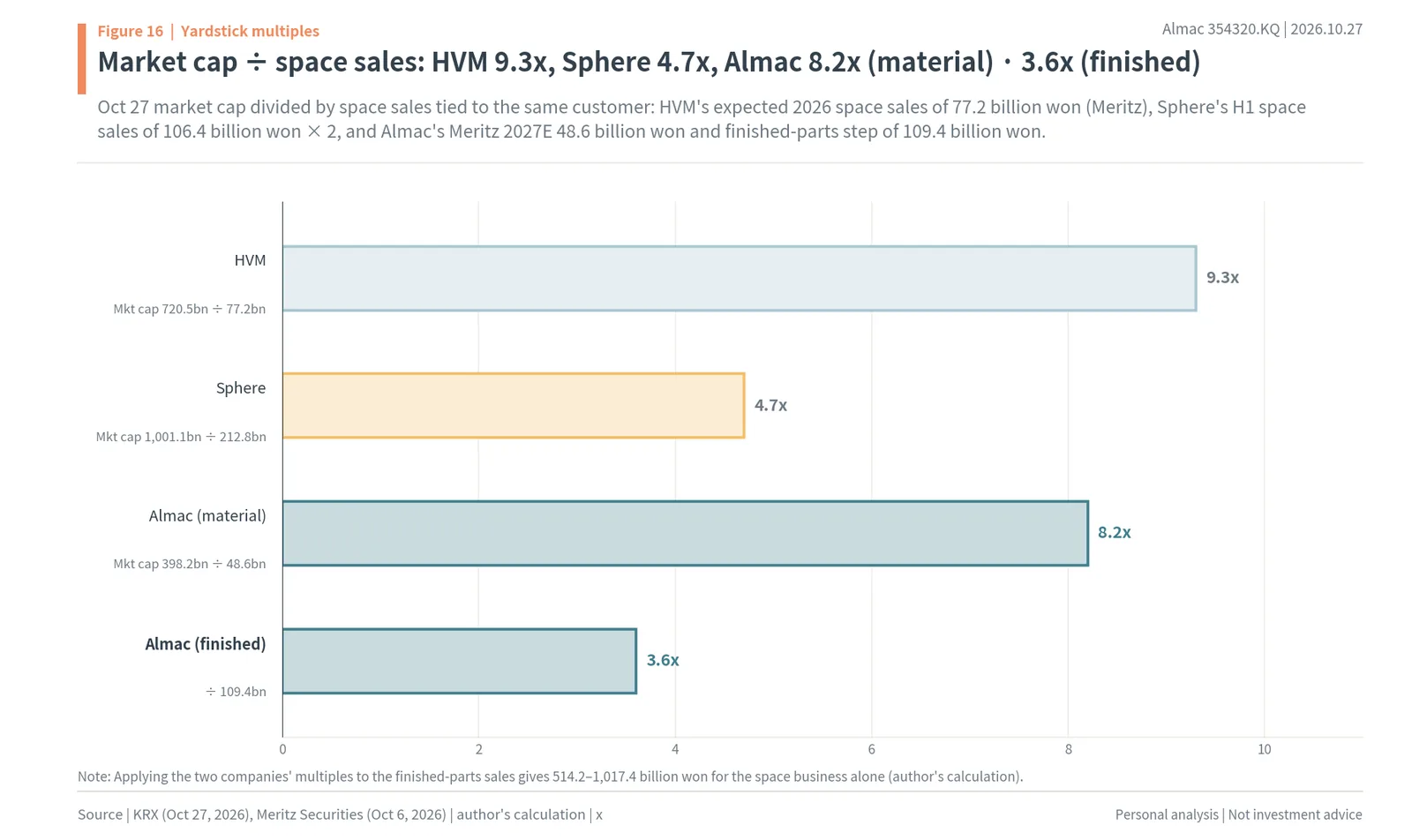
Can the plants handle it?
Converting the fourth step’s space sales to weight at Almac’s exported EV-part price per kilogram gives about 12,450 tonnes a year. That is about a fifth of the 2025 extrusion capacity of about 61,010 tonnes, and given current utilization there is extrusion capacity to spare (author’s calculation). Supplying finished parts needs more people and machines for machining, painting and assembly. The half-year report says Almac already does finishing and surface treatment in-house, and Meritz put 2027 capital spending at 25 billion won. The investment needed as volume climbs the steps comes on the machining side, not in extrusion. In the US, Almac bought a former plant in Eufaula, Alabama in May 2026. The company said it will install extrusion and machining equipment in stages and begin supplying North American automotive, defense and energy customers from the fourth quarter of 2027 (Newspim). It is not described as a space facility, but it means a place to machine and assemble on US soil.
8. Robots: a third market where the reasons Almac won in EVs apply as they are
The report said Almac met Boston Dynamics staff in the US in mid-October and then received a formal request for quotation (RFQ). Boston Dynamics is the robotics company owned by Hyundai Motor Group, and it makes the humanoid robot Atlas. What robots mean for Almac becomes clear by looking again at how it got into electric vehicles.
Why Almac won in EVs
Electric vehicles are heavy because of their batteries. In a study by the Aluminum Association and Ducker, a North American EV in 2022 contained about 885 pounds (about 401kg) of aluminium, 85% more than a combustion-engine car. In Europe the figures for 2022 were 283kg for EVs and 169kg for combustion-engine cars (European Aluminium). A large part of the added aluminium is the battery case. There are three reasons. Aluminium weighs about a third as much as steel (Aluminum Extruders Council); it conducts heat about five times better than steel, so the case doubles as the battery cooling plate (Constellium); and hollow multi-cell sections can be drawn in one pass and absorb energy in a crash (Hydro). On top of that, the dies are cheap. An extrusion die costs USD 500 to 5,000, a stamping die USD 5,000 and up, and a die-casting mould USD 25,000 and up (Aluminum Extruders Council). When models change often and volumes are still modest, cheap dies are a big advantage.
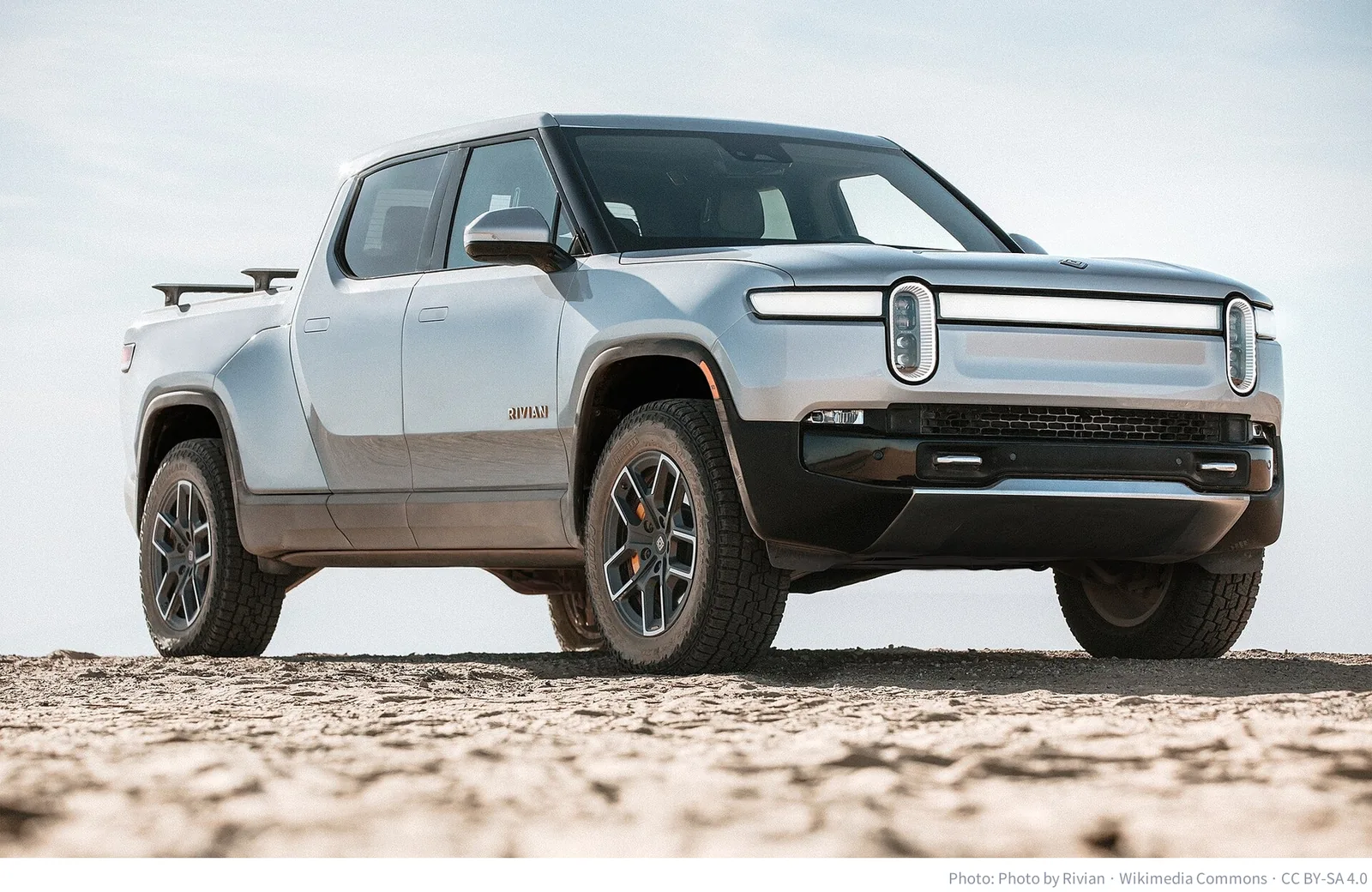
Almac used these advantages to widen its customer list. It won LG Energy Solution module cases in 2017 and began mass production in 2018, and in 2021 it won Daimler battery pack material, shipped to Linamar’s US plant. In 2022, the year it was selected as a Rivian supplier, it booked 24.0 billion won of Rivian sales (TheElec). Linamar’s follow-on platform frame was a first order of 47.0 billion won within a program of 207.8 billion won for 2024 to 2029 (Asia Economy). In May 2025 Almac signed a contract worth 190 billion won with an unnamed US carmaker, to supply from early 2026 to 2030 (Financial News). The half-year report says that in the first half of 2025 the aluminium extrusions used in one EV battery pack sold for USD 450 on average. From selection to sales took a year at most.
The same reasons apply to robots
A humanoid robot resembles a scaled-down electric vehicle. Atlas weighs 90kg, works for about four hours on its battery and swaps its own battery (Boston Dynamics). Weight is run time on the battery. Samsung Securities expects aluminium to be used heavily to keep robots under 100kg. Each joint has a motor whose heat must be drawn off, just like an EV battery. And at a stage where makers build a few thousand to a few tens of thousands a year, a process with cheap dies has the advantage. The industry sees most humanoid robots today as low-volume parts machined from solid blocks, with a switch to processes such as casting when volumes grow (Hankyung Business). Extrusion fits in between, wherever the same cross-section runs long: battery boxes, the tubes that join limbs, and the stock for actuator housings.
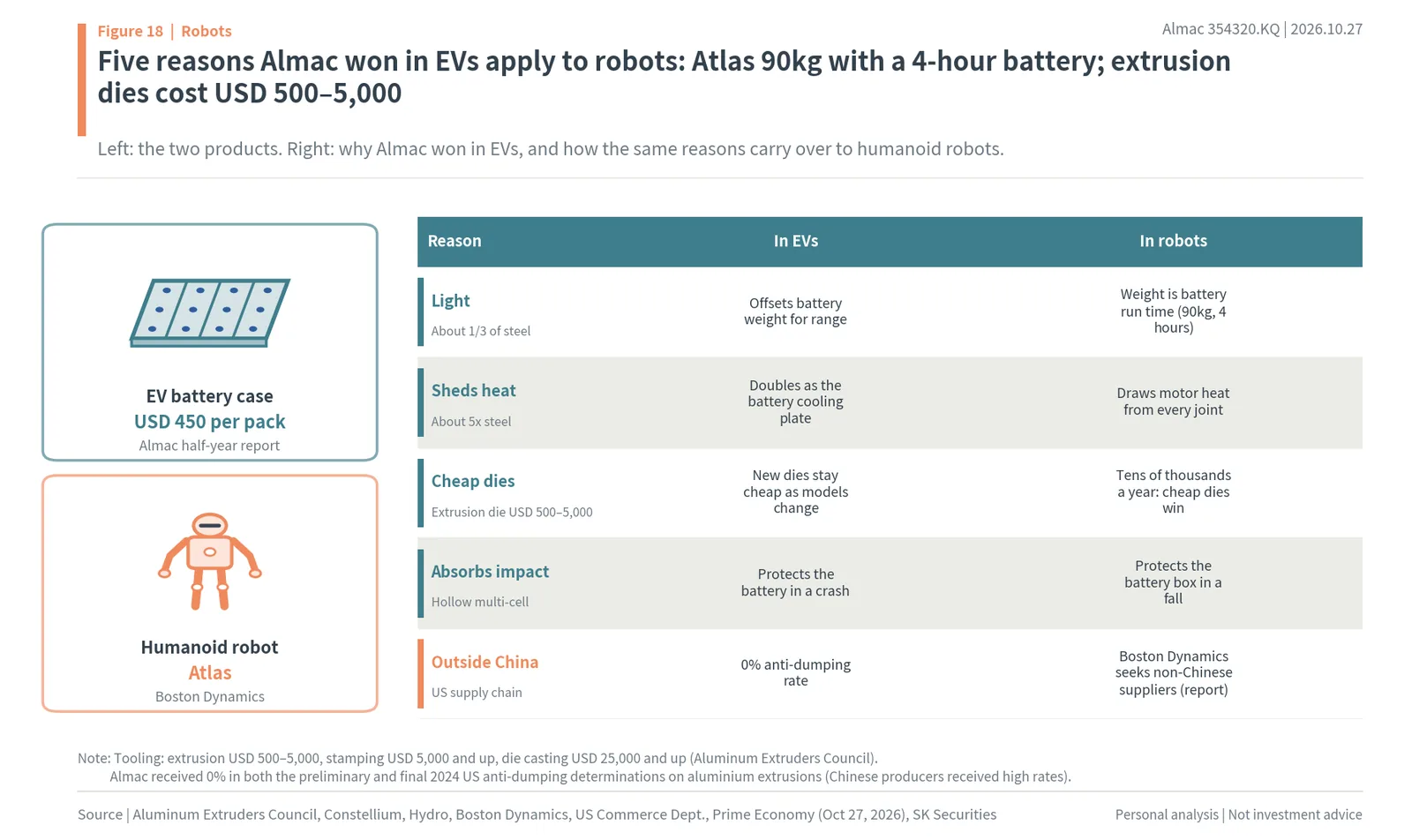
The supply chain adds to this. In September 2025 the US Commerce Department opened an investigation into whether imports of robotics, industrial machinery and their parts affect national security (Section 232 of the Trade Expansion Act), and bills to block Chinese humanoid robots have been introduced in Congress. The report said Boston Dynamics is looking for suppliers to replace Chinese-made parts and frames. Almac received 0% in both the preliminary and final determinations of the 2024 US anti-dumping investigation on aluminium extrusions, while Chinese producers received high rates in the same investigation (SK Securities, US Commerce Department). That investigation did not lead to duties, because the US International Trade Commission found on October 30, 2024 that the industry was not injured, but a Korean extruder had in effect been tested as a supplier the US market can use instead of China.
How many Atlas robots, and how much is Almac’s?
Hyundai Motor Group said it would build a robot factory in the US with capacity of 30,000 units a year by 2028 (Hyundai, August 26, 2025), and at CES in January 2026 it said it would put Atlas into the Georgia Metaplant from 2028 and widen its work to parts assembly by 2030. At an investor event in Boston in May it said it would deploy more than 25,000 Atlas robots in Hyundai and Kia plants and that Hyundai Mobis would build an actuator plant in the US (Korea Herald). On October 27 came a report that Korean parts makers had been told to prepare for orders covering 10,000 robots, with the first orders expected in late 2027 or early 2028 (Humanoids Daily, citing a Korea Economic Daily report). That figure is a preparation request, not a confirmed order.
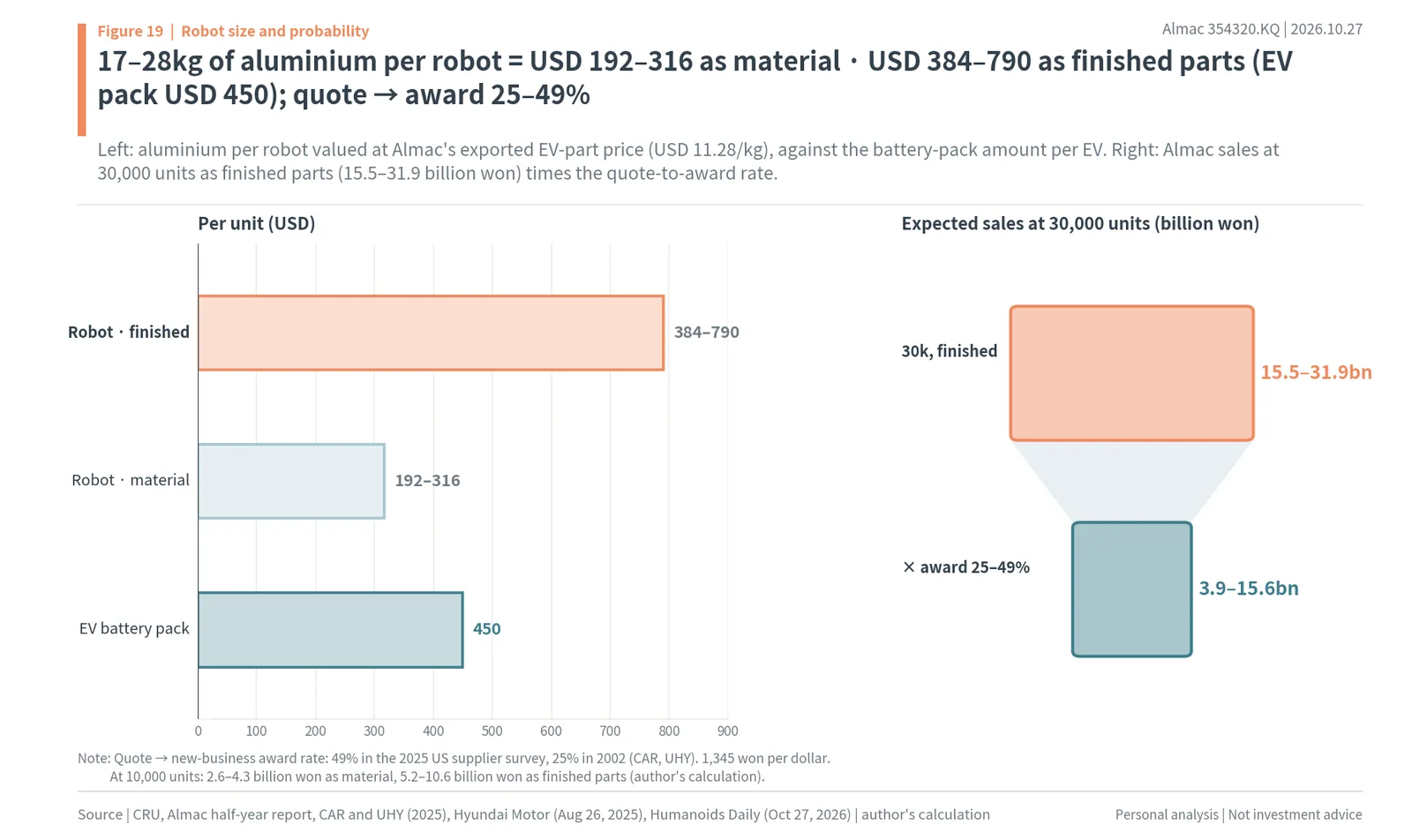
The aluminium in one robot is estimated at about 17 to 28kg (CRU and others). Multiplied by Almac’s exported EV-part price (USD 11.28 per kg), that is USD 192 to 316 as material, or USD 384 to 790 with the reported finished-part multiple (2 to 2.5 times). That is about the same size as the battery pack share of one EV (USD 450) (author’s calculation). At 10,000 units it is 2.6 to 4.3 billion won as material and 5.2 to 10.6 billion won as finished parts; at 30,000 units, 7.7 to 12.8 billion won as material and 15.5 to 31.9 billion won as finished parts. The largest value is 17% of 2025 sales (author’s calculation, at 1,345 won per dollar).
The probability of getting in
Robots are now at the quotation step. One yardstick for how often quotes turn into awards is the 2025 supplier survey by the Center for Automotive Research (CAR) and UHY. Suppliers won new business on 49% of the quotes they received, against 25% in the same survey in 2002. Those answering were large suppliers already doing business, so for a company entering a new market the lower value may be the closer yardstick. This report therefore puts quote-to-award at one in four (25%) to one in two (49%). Almac’s own record sits near the top of that range: LG Energy Solution, Linamar, Rivian, Lucid and Stellantis all went from registration or selection to sales.
Multiplying probability and size, expected sales at 30,000 units of finished parts are between 3.9 billion won (25% × 15.5 billion won) and 15.6 billion won (49% × 31.9 billion won) (author’s calculation). That is smaller than the second space step (109.4 billion won). So robots are less a size that changes today’s market value than the door to a third market that buys the same extrusion technology after EVs and space. SpaceX gives a yardstick for timing. Almac took about eleven months from registration to the price step. If the first Atlas orders come in late 2027 or early 2028, there is enough time for today’s quote to go through testing and approval on that schedule.
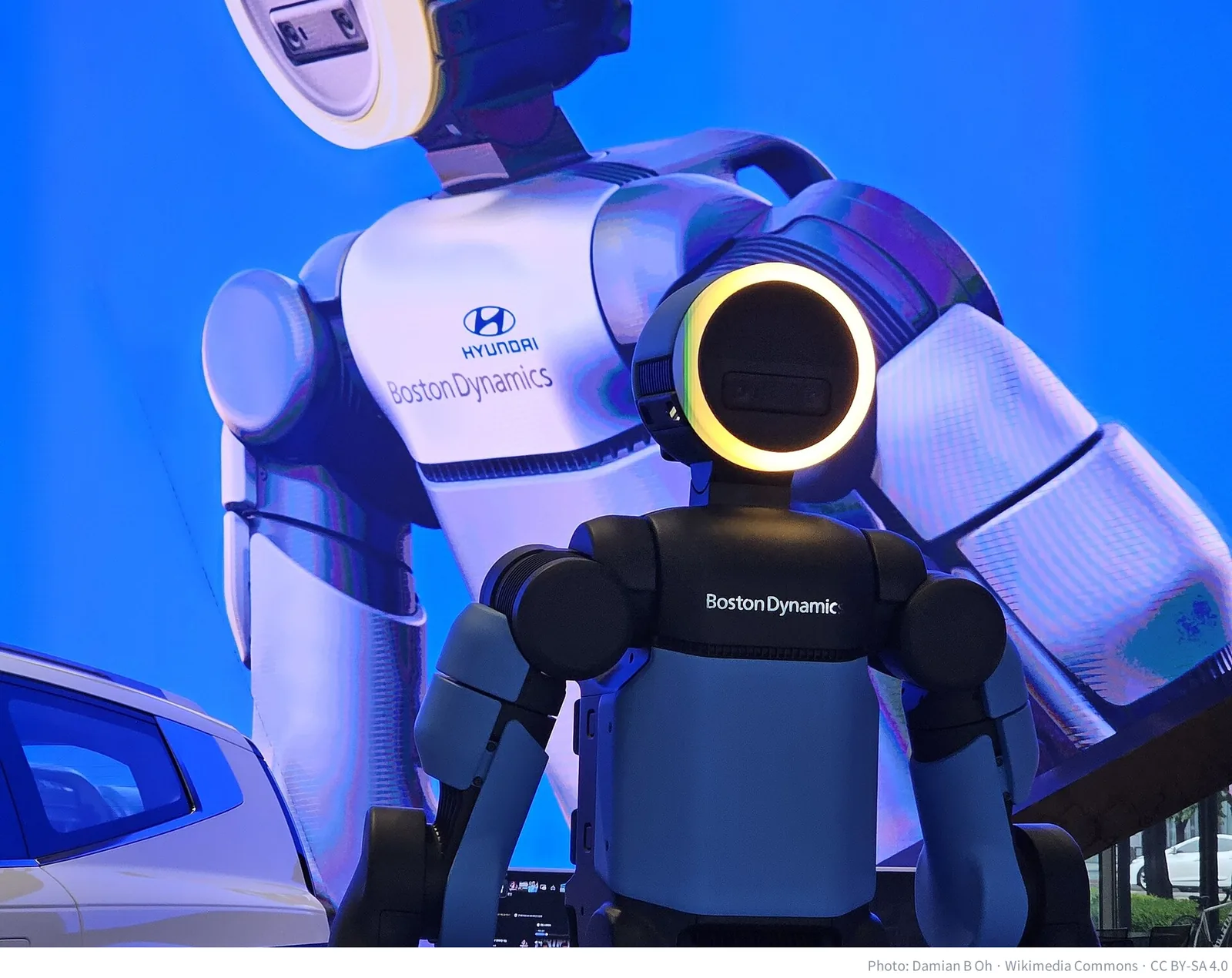
The list of Atlas suppliers in the Korea Economic Daily’s October 27 report includes Hyundai Mobis, Samsung SDI, LG Energy Solution, CTR, Namuga, ILE, BH EVS and MCNEX, and no frame or structure supplier is named. The humanoid body frames confirmed so far are cast (Samkee, Figure) or forged (Hwashin). Which place on that list Almac’s quote would fill becomes clear when the quoted items are made public.
9. Two days of trading: the shares recovered before the article, then waited for confirmation after it
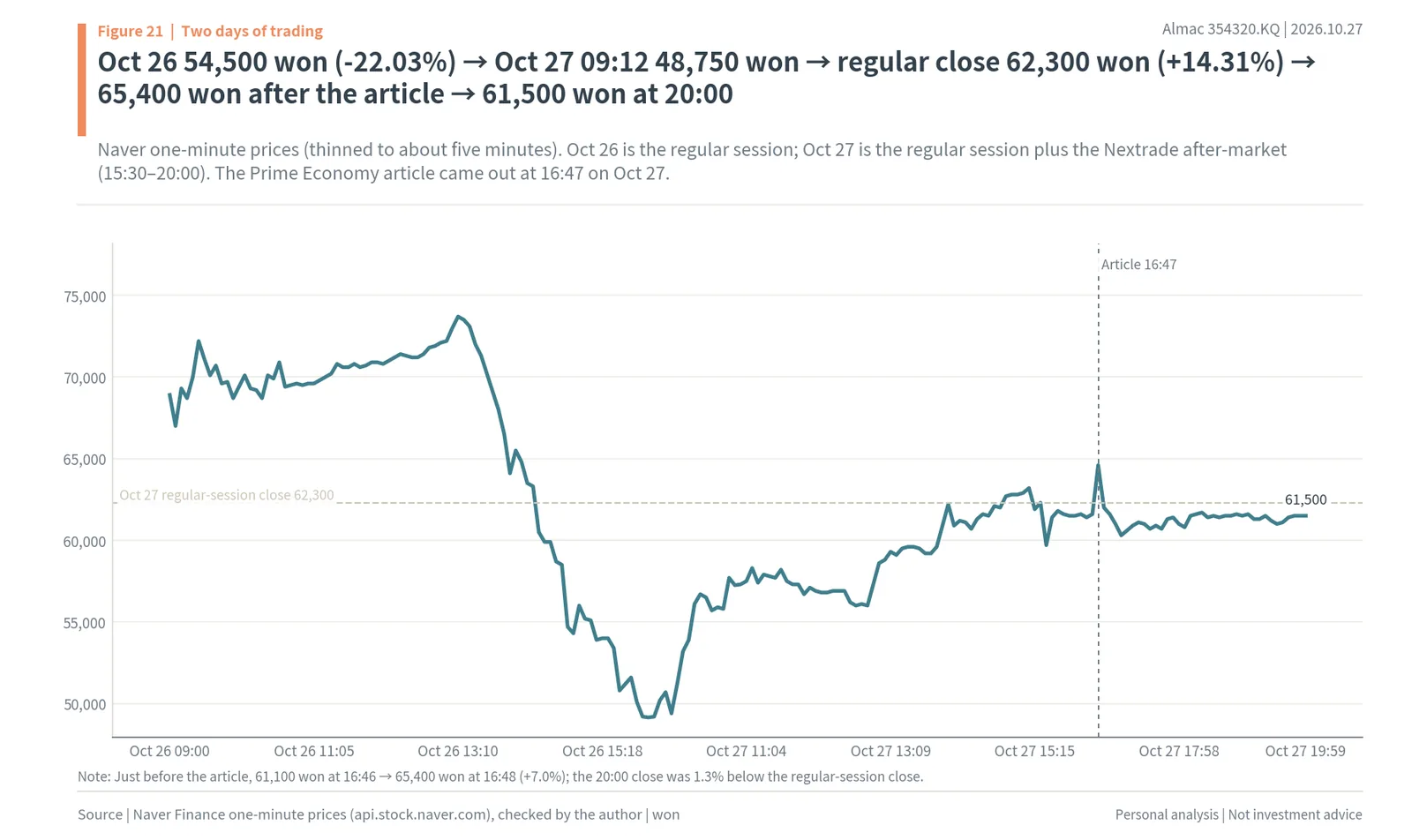
On October 26 Almac closed the KRX regular session down 22.03% at 54,500 won. It touched 73,700 won shortly after 1 p.m. and then fell through the afternoon. KOSDAQ fell 3.26%, and fellow space-material stocks Sphere and HVM fell 6.6% and 7.3% (KRX market value basis, author’s calculation; Korean aerospace stocks fell broadly that day, see the author’s note on the aerospace sell-off). In its closing report that day, the Jaekyung Ilbo wrote that there had been no filing or news in the past seven days that would directly affect the share price. Almac’s fall was several times the market’s and the sector’s, but no dated filing or report explaining the cause was confirmed.
October 27: recovered before the article
The next day Almac fell further, to 48,750 won (-10.6% from the previous close) at 9:12, then started rising around 10 a.m., reaching 56,400 won at 10:30 and closing the regular session at 62,300 won (+14.31%). It recovered 27.8% from the intraday low to the close and made up more than half of the previous day’s drop (7,800 won of 15,400 won). KOSDAQ rose 2.29% and Sphere 3.9% the same day. The Prime Economy article came out at 16:47, after the regular session, so this rebound came before the article.
After the article, in the Nextrade after-market Almac rose 7.0% in about a minute, from 61,100 won at 16:46 to 65,400 won at 16:48. But the 20:00 close was 61,500 won, 1.3% below the regular-session close (Naver one-minute prices, author’s calculation). The first reaction to the article was brief; the market looked as if it was waiting for confirmation of the next step rather than for the article.
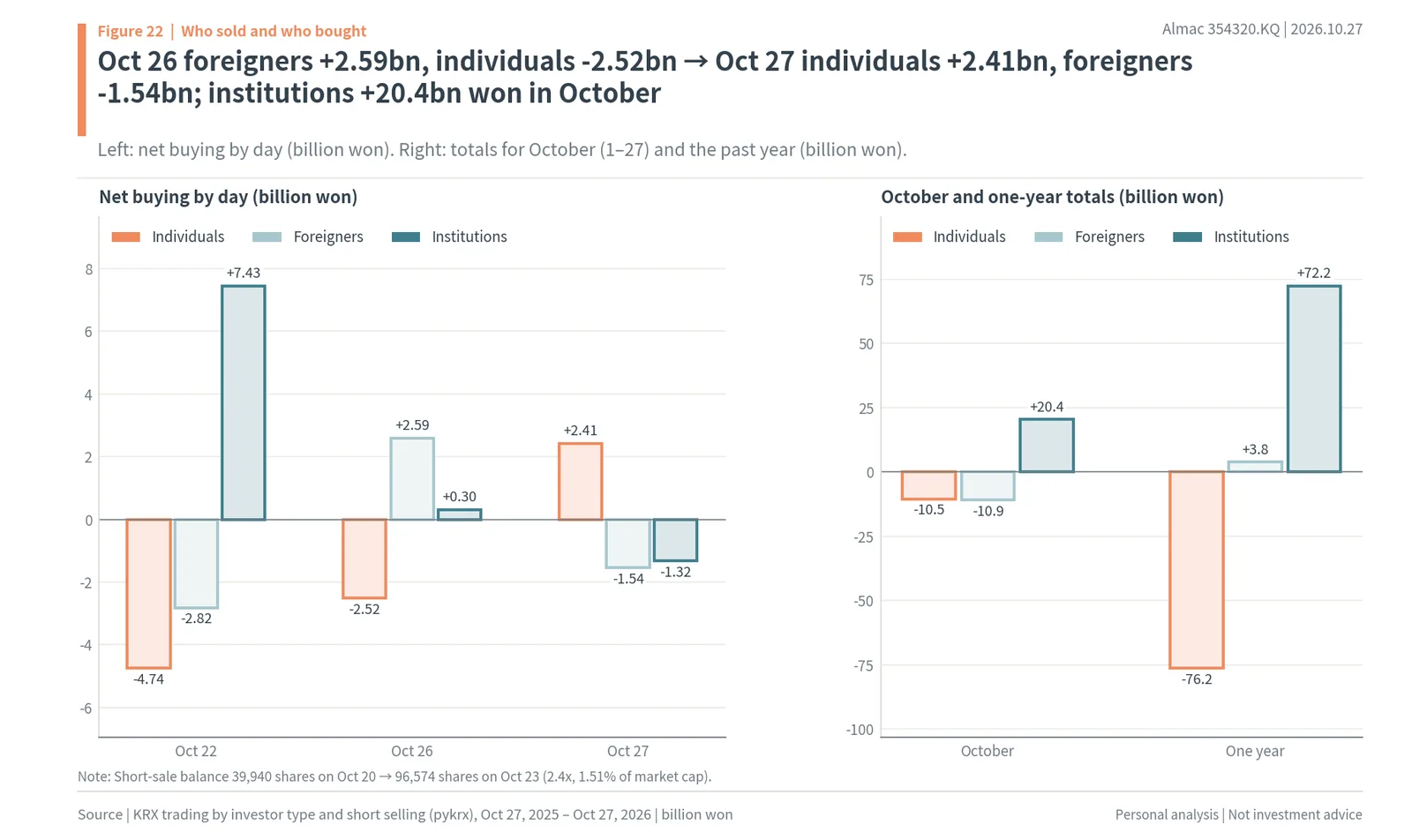
Who sold and who bought
By KRX net buying by investor type, institutions bought on the October 22 surge (investment trusts 8.9 billion won) while foreigners and individuals sold. On the October 26 plunge, foreigners bought 2.59 billion won, individuals sold 2.52 billion won and institutions bought 0.30 billion won. On the October 27 rebound, individuals bought 2.41 billion won, and foreigners sold 1.54 billion won and institutions 1.32 billion won (investment trusts 1.36 billion won). For October (1st to 27th), institutions were net buyers of 20.4 billion won and foreigners and individuals net sellers of 10.9 billion won and 10.5 billion won. Over the past year, institutions bought a net 72.2 billion won (investment trusts 30.0 billion won, pension funds 20.6 billion won and financial investment firms 15.2 billion won) and individuals sold a net 76.2 billion won (KRX, author’s calculation).
The short-sale balance rose 2.4 times, from 39,940 shares on October 20 to 96,574 shares on October 23, equal to 1.51% of market value (KRX). The October 26 plunge came after more shares had been positioned for a fall following the surge.
The market-alert price line
On October 22 the exchange designated Almac for investment caution along with a notice that it could be designated for investment warning. Whether to designate it for investment warning is judged each day from October 23 to November 5. All four conditions must be met on a judgment day for the stock to be designated the next day: (1) the judgment-day close is 200% or more above the close a year earlier; (2) the judgment-day close is the highest of the last 15 days’ closes; (3) on four or more days in the last 15, the top 10 accounts’ share of buying exceeded the threshold; and (4) the stock ranks outside the top 100 by market value (KRX market-alert filing). Today the line for condition (2) is the October 22 close of 70,800 won, 13.6% above the October 27 close (author’s calculation). A close above that line during the judgment period would meet one condition. Designation for investment warning changes trading terms such as margin trading and deposit requirements.
What these two days say is simple. Almac’s share price moves strongly on news about the space steps, and it has reacted more to confirmation of the next step (price, order, first sales) than to a single article. The next chapter puts dates on when that confirmation comes.
10. Dates and signals: price → order → first sales → Starship count
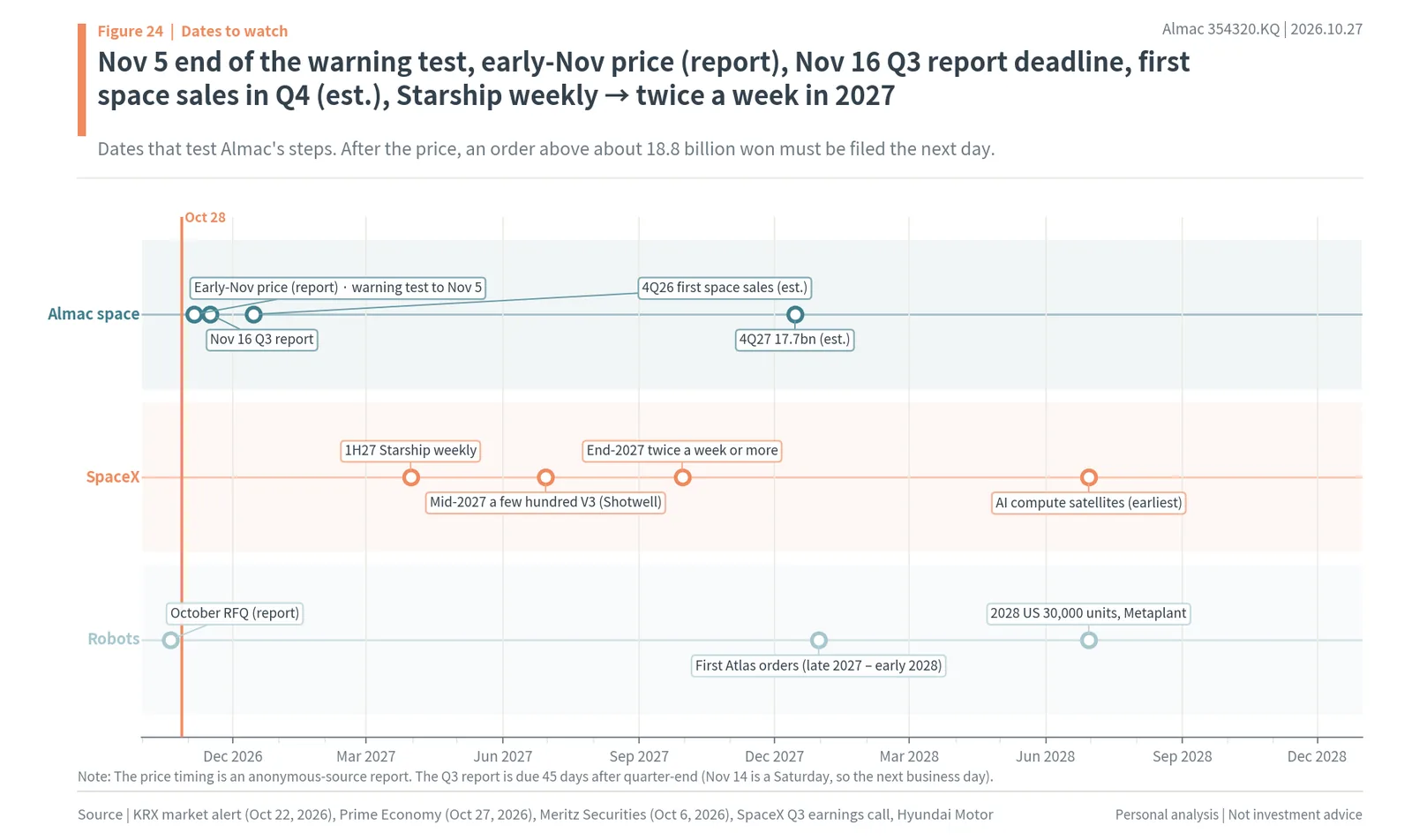
Putting the earlier chapters on a calendar, Almac’s space and robot steps are confirmed in the order below. Each date comes with the step it opens.
November
Early November is when the report says price terms will be set (Prime Economy, anonymous). Prices are not a disclosure item, so they may not be visible right away. What will be visible is the order that follows. If a single order exceeds about 18.8 billion won, a single sales and supply contract filing will come the next day, and the customer’s name may be withheld. If that filing comes, Almac has moved from the fifth step to the sixth, and if the filing’s “sales and supply method” and item description include machining or assembly, the finished-parts step (the second step) is confirmed.
Until November 5 the exchange’s investment-warning judgment period runs. A judgment-day close above the highest close of the last 15 days (70,800 won now) meets one condition.
Third-quarter results come out in mid-November (the quarterly report deadline is around November 16). Meritz expects third-quarter sales of 46.0 billion won and an operating loss of 2.4 billion won. Its explanation is that EV parts fall about 5.0 billion won from the previous quarter as a top carmaker customer changes models, billets fill that gap at 22.8 billion won, and development costs for the space project and new North American items raise the cost and SG&A ratios. The WISEreport consensus also has a third-quarter operating loss of 1.4 billion won. What to look for in these numbers is less the profit than the size of the space development costs in SG&A and the space schedule the company gives.
Q4 2026 and 2027
Meritz expects space sales to start at 1.4 billion won in the fourth quarter. If space sales appear for the first time in the fourth-quarter results, due early in 2027, the starting point of the ninth step (volume ramp) is confirmed. Meritz’s 2027 quarterly estimates run 7.2 → 10.2 → 13.5 → 17.7 billion won.
On SpaceX’s side, the Starship count is the biggest signal. Whether the schedule of weekly flights in the first half of 2027 and twice a week or more by the end of the year is kept decides the third and fourth steps. SpaceX discloses its launch count and mass to orbit every quarter, so its quarterly earnings releases are the days to check. On Almac’s side, the tenth step is the day orders build up into a long-term agreement. Sphere took about two years from vendor code to that step.
For robots, the big dates are the first Atlas orders in late 2027 or early 2028 and deployment at Georgia’s Metaplant in 2028. Before that come quote → sample → test → award, and judging by Almac’s SpaceX experience (about eleven months from registration to price), these steps could pass within 2027.
Signal gauges
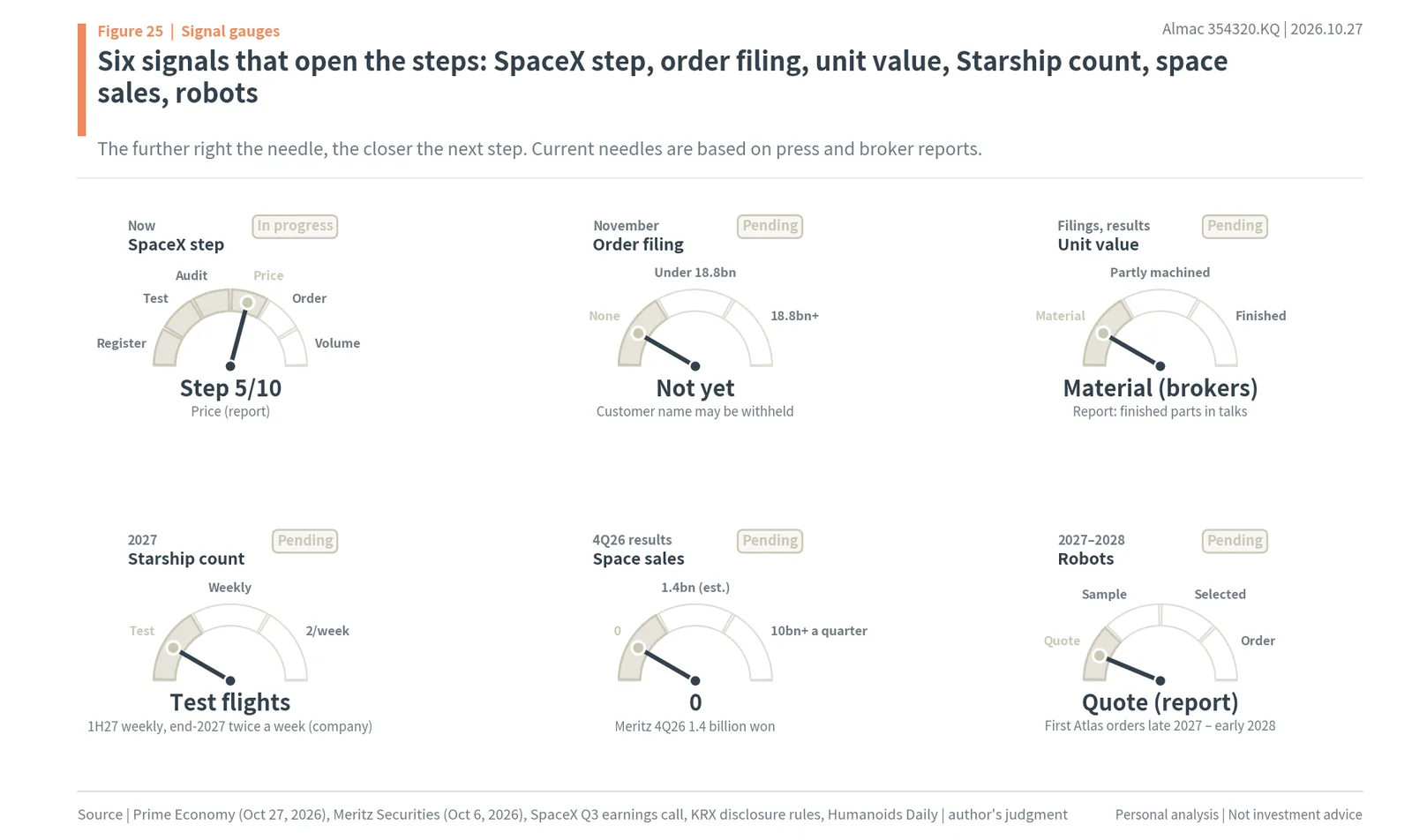
Ranking the signals that open the steps by strength: the weakest is a press report (where we are now), above that the space schedule given in company IR or results, above that an order filing, and strongest of all space sales booked in quarterly results. The finished-parts step is confirmed by the item description in an order filing or by the value per kilogram in quarterly sales, and the volume steps by the Starship count and how fast Almac’s quarterly space sales grow. For robots the order is quote → sample shipment → report of supplier selection → order.
Summary: unit value and Starship volume
Put in one line, this report means that the two numbers that set Almac’s size are unit value and Starship volume. Unit value is a number Almac can change itself. Supplied as material it is the 48.6 billion won Meritz sees; supplied as finished parts that are machined, painted and assembled, it more than doubles on the same volume. That step is confirmed by the November price, the order filing that follows and the space sales in fourth-quarter results. Starship volume is a number SpaceX sets. If Starship goes from weekly to twice a week and satellites get heavier from V2 mini to V3, the aluminium in satellites becomes 4.3 times today’s. That step is confirmed by SpaceX’s quarterly launch count and by how fast Almac’s quarterly space sales grow. The two numbers multiply, so measured with the same multiples the market value at the last step is about four times that at the first. Robots are a third market outside that multiplication, and Almac stands at their quotation step for the same reasons it won in EVs. The next confirmation comes in November.
11. Calculation basis
The numbers in this report come from only two places. Numbers taken from filings, articles and reports carry their source, and numbers the author calculated are marked “author’s calculation.” The calculations follow the basis below.
Share prices are KRX regular-session closes, derived as market value ÷ listed shares (6,391,381 shares). The reference close is 62,300 won (+14.31%) on October 27, 2026, and 54,500 won (-22.03%) the day before. The pykrx price table close and Naver’s displayed price (61,500 won on October 27) mix in Nextrade after-market trading and were not used for regular-session calculations. Intraday moves are Naver one-minute prices; for October 27 the chart includes the Nextrade session (15:30 to 20:00) to show the moves around the article time (16:47). Moves on space-news days are that day’s close ÷ the previous close, and values 5 and 20 days later are against the same previous close. Peer moves are changes in market value.
Investor flows are KRX trading by investor type, net buying by value. Institutions include financial investment, insurance, investment trusts, private equity funds, banks, other financial institutions and pension funds, and foreigners include other foreigners. October is the 1st to the 27th, and the one-year period is October 27, 2025 to October 27, 2026. The short-sale balance is the KRX published value (to October 23). The market-alert conditions are taken from the exchange filing, and the 15-day highest close is the highest KRX close of the last 15 trading days including October 27.
Almac space sales per satellite are Meritz’s 2027 space sales of 48.6 billion won ÷ annual Starlink production of 3,640 (about 70 a week in the S-1 × 52 weeks). A Falcon 9 launch carries 27 satellites (McDowell log, September to October 2026) and a Starship launch 60 V3 (S-1), and a V3’s share is scaled by mass (2,000kg ÷ 800kg = 2.5 times). Finished parts multiply by the reported 2 to 2.5 times revenue per part, and the market-value steps use the midpoint of 2.25 times. Aluminium on satellites is satellites × mass × 36.7% (Meritz, the aluminium and alloy share of a low-Earth-orbit satellite’s total mass). Starship twice a week is counted as 104 launches a year × 60 = 6,240 satellites. The weight conversion of 48.6 billion won uses Almac’s exported EV-part price of 16,731 won per kg (half-year report). If a V3 weighs 1,200kg instead, a Starship launch is worth about 1.2 billion won to Almac (author’s calculation).
The market-value steps count net profit = non-space net profit + space sales × space operating margin × 0.8, where 0.8 is the share assumed to remain after interest and taxes. Non-space net profit is fixed at Meritz’s 2027 net profit of 22.8 billion won − 48.6 billion won × 20% × 0.8 = about 15.0 billion won. Space operating margins are 15%, 20% and 25%, and the multiples 20 times and 28 times (Meritz’s “2027 global space-industry average”). Volume multiples are current rate = 1, satellite aluminium doubled = 2 and Starship twice a week = 4.3 (4,580 tonnes ÷ 1,069 tonnes). The 3D surface is the market value (20% margin, 20 times) over volume of 1 to 4.3 times × unit value of 1 to 2.5 times. These steps are not a price target, and each step needs a different confirmation at a different time.
The yardstick multiples are KRX market value on October 27 ÷ space sales tied to the same customer. For HVM the report uses Meritz’s expected 2026 space sales of 77.2 billion won, and for Sphere first-half 2026 space sales of 106.4 billion won × 2. The extrusion capacity in the plant comparison is the sum of the extrusion lines in the half-year report’s 2025 capacity table (Line 2 6,886 tonnes, Line 3 10,329 tonnes, Line 5 7,575 tonnes, Almac Korea 15,562 tonnes and AR Aluminum extrusion 20,658 tonnes).
The per-robot share is 17 to 28kg of aluminium (a range combining CRU’s 17 to 25kg with another source’s 20 to 28kg) × USD 11.28 per kg (Almac’s exported EV parts), and finished parts multiply by the same 2 to 2.5 times. Won values use 1,345 won per dollar. The quote-to-award range uses the 49% new-business success rate in the 2025 CAR and UHY survey and the 25% of 2002. Expected sales are 30,000 units of finished-part sales × that rate.
Broker figures are Meritz Securities’ October 6, 2026 report (summary) and the WISEreport consensus (as of October 27: 2027 EPS 3,692 won, 2028 EPS 5,210 won). Company figures are from Almac’s half-year report on DART (August 14, 2026). Of the article’s claims, the audit dates, the widening to finished parts, the revenue-per-part multiple, the item count, the price schedule and the Boston Dynamics request for quotation come from Prime Economy’s October 27 article (anonymous IB sources and its own reporting), and the company did not confirm them.
Almac, SpaceX and robots: frequently asked questions
Q. Is it confirmed that Almac supplies SpaceX?
Broker reports confirm supplier registration at the end of 2025, first samples that met the material properties in February 2026, part-level tests under way and 21 collaboration items as of October. The October 15–16 audit, early-November pricing, the widening to finished parts and the count of around 30 items come from Prime Economy’s October 27 report citing anonymous IB sources, and the company declined to comment, citing a non-disclosure agreement. Confirmation would come from an order filing or space sales in quarterly results.
Q. Where does the name SpaceX come from?
Brokers wrote ‘a North American aerospace company’ (NH), ‘the world’s largest private space company’ (Meritz) and ‘global space top-tier company S’ (Hana). The name SpaceX was used by the October 27 press report. Sphere Corp., a Korean supplier to the same customer, named SpaceX as the counterparty in its July 31, 2025 filing.
Q. How much of each SpaceX launch is Almac’s?
Dividing Meritz’s 2027 space sales of 48.6 billion won by Starlink output of 3,640 satellites a year gives about 13.35 million won per satellite. That is about 360 million won per Falcon 9 launch (27 satellites) and about 2 billion won per Starship launch (60 V3 satellites, assumed 2.5 times as heavy), or 4 to 5 billion won as finished parts (author’s calculation). Because launch-vehicle items are also divided by the satellite count, read it as Almac space sales per satellite.
Q. Why use 2,000kg for the V3 satellite?
SpaceX has not published an official V3 mass, and reports range from 1,200kg to 2,000kg. The report uses the most widely cited figure, about 2,000kg (Space.com). At 1,200kg Almac’s share of a Starship launch would be about 1.2 billion won (author’s calculation).
Q. Are the market-value steps a price target?
No. They measure, with the same multiples (20 and 28 times), how large Almac’s profit becomes if SpaceX volume and unit value reach each step: 456.0 to 638.4 billion won at today’s rate with material, 650.4 to 910.6 billion won with finished parts, 1,000.3 to 1,400.4 billion won with satellite aluminium doubled and 1,800.1 to 2,520.2 billion won with Starship twice a week, against 398.2 billion won today. Each step needs a different confirmation (an order filing, finished-part items, the Starship count) at a different time.
Q. How does the third-quarter loss relate to the steps?
Meritz explains the expected third-quarter operating loss of 2.4 billion won by an EV customer’s model change and development costs for space and new North American items. Development costs come before space sales. Meritz’s 2027 operating profit estimate of 22.7 billion won is the figure after those costs.
Q. Why are robots smaller than space for Almac?
A humanoid robot contains about 17 to 28kg of aluminium, and the planned Atlas volume is 10,000 to 30,000 units a year. At 30,000 units of finished parts Almac’s sales would be 15.5 to 31.9 billion won, and after a quote-to-award rate of 25% to 49% the expected sales are 3.9 to 15.6 billion won (author’s calculation). As unit numbers grow the same calculation scales up, and it uses the same extrusion technology as EVs and space.
Q. Why did the shares not react strongly to the article?
The article came out at 16:47, after the regular session. In the Nextrade after-market the shares rose 7.0% in about a minute and then closed at 61,500 won at 20:00, 1.3% below the regular-session close. By then the stock had already recovered more than half of the previous day’s drop in the regular session. Over the year the stock moved more on broker reports and results, the confirmation of the next step, than on press reports.
Sources
- Prime Economy, Almac SpaceX audit and Boston Dynamics quotation report (link), Oct 27, 2026 16:47
- Meritz Securities, Time To Space / Almac: No doubt (link), Oct 6, 2026; The Call of Space (The Viewers, https://theviewers.co.kr/View.aspx?No=4039031), Apr 13, 2026; Meritz Telegram (link), May 6, 2026; Edaily (link), May 18, 2026
- Hana Securities, Rumors are just rumors (link), May 13, 2026; Asia Economy, Click e-stock (link), Mar 4, 2026
- NH Investment & Securities: Asia Economy CORE (link), Jan 7, 2026; Edaily (link), Feb 10, 2026
- Kiwoom Securities, Almac report, Feb 12, 2026; SK Securities, Almac report, May 7, 2024; Samsung Securities (Korea Economic Daily, https://www.hankyung.com/article/2026062824081), Jun 29, 2026
- DART, Almac half-year report (link), Aug 14, 2026
- KRX market alerts: notice of investment-warning designation and excessive buying by a few accounts, Oct 22, 2026; 2025 guide to KOSDAQ disclosure and listing management (link), Sep 2025
- Jaekyung Ilbo, Closing analysis: Almac (link), Oct 26, 2026; Korea Economic Daily, Atlas parts suppliers report, Oct 27, 2026
- Financial News, Sphere vendor code (link), Aug 1, 2025; Korea Economic Daily, Sphere supply contract (link), Aug 1, 2025; Digital Today, Sphere supply contract (link), Oct 14, 2026; Sidae Ilbo, HVM (link), Mar 7, 2025
- SpaceX, Q3 2026 earnings call transcript (Motley Fool, https://www.fool.com/earnings/call-transcripts/2026/10/20/spacex-spcx-q3-2026-earnings-call-transcript/), Oct 20, 2026; S-1 registration statement (link), May 20, 2026; Q2 2026 8-K (link), Aug 4, 2026; Supplier Manual SPX-00007672 v6.0 (unofficial copy)
- Jonathan McDowell, Starlink statistics (link), to Oct 25, 2026; Space.com, Starship Flight 14 (link), Sep 28, 2026; Spaceflight Now, V2 mini (link), Apr 19, 2023; FCC DA-26-113 (link), Feb 4, 2026
- ASM International, Aluminum Continues to Shine in Commercial Aircraft Applications (link), Mar 2024; Cutting Tool Engineering, High-Flying Grades (link), Feb 15, 2026
- Aluminum Extruders Council, Material Comparisons (link); Constellium, Automotive battery solutions (link); Hydro, Automotive battery trays (link); Ducker and the Aluminum Association (Repairer Driven News, https://www.repairerdrivennews.com/2023/04/28/ducker-study-sheds-light-on-newest-shift-to-aluminum-vehicle-components/), Apr 28, 2023; European Aluminium, May 2, 2023
- TheElec, Almac Rivian sales (link), Jun 13, 2023; Asia Economy, Linamar order (link), Oct 23, 2023; Newspim, Alabama plant, May 19, 2026
- Boston Dynamics, Atlas (link); Hyundai Motor Group, US investment announcement (link), Aug 26, 2025; Axios (link), Jan 5, 2026; Korea Herald (link), May 18, 2026; Humanoids Daily (link), Oct 27, 2026; Hankyung Business, Robot materials (link), Aug 5, 2026
- CRU, The metals behind the machines (link), Aug 17, 2026; CAR and UHY, Automotive suppliers and the revenue acquisition process (link), 2025; Federal Register, Section 232 investigation of robotics (link), Sep 26, 2025
- KRX Data System prices, indexes, trading by investor type and short selling (Oct 2025 to Oct 27, 2026), Naver one-minute prices (Oct 26–27, 2026), WISEreport consensus (Oct 27, 2026), author’s calculations
- Photos: UK Government (CC BY 2.0), Ulfbastel (public domain), Official SpaceX Photos (CC0), U.S. Space Force photo by Joshua Conti (public domain), Jared Krahn (CC BY-SA 4.0), Rivian (CC BY-SA 4.0), Damian B Oh (CC BY-SA 4.0), Narubaru7 (CC BY 4.0), via Wikimedia Commons
Disclaimer
This report records the author’s personal analysis and views based on public information and does not recommend any particular product or company. It does not recommend buying or selling any financial investment product and is not an investment advisory or quasi-investment advisory service.
The figures in this report are those public at the time of writing. The SpaceX audit, the widening to finished parts, the price schedule and the Boston Dynamics request for quotation come from a press report citing anonymous sources, and the company has not confirmed them. Broker figures are estimates at the time cited, and the SpaceX schedule is what the company said. Accuracy and completeness are not guaranteed.
Almac’s share per satellite and per launch, the aluminium weight on satellites, the market-value steps, and the robot sizes and expected sales are estimates based on the assumptions stated in the text; if the assumptions do not hold, the results differ. Items marked “author’s calculation,” “author’s assumption” or “author’s judgment” are the author’s calculations and assumptions, not confirmed facts. The market-value steps are not a price target.
Author’s interests: The author holds Almac shares at the time of writing.
Responsibility for decisions and their outcomes lies with the reader.
As of: October 28, 2026
Was this note useful?
Thanks. Your answer helps decide what to cover next.
Korea market snapshot · Oct 28, 2026
New to Korean stocks? Start here for the basics.
Most read lately
Get the Saturday note on Korean stocks
One email every Saturday with the week’s new research on Korean listed companies and links to the updated data pages. Built from DART filings and KRX data. Free; unsubscribe in one click. See past issues