Hyundai Motor (005380.KS) Stock Forecast: Hyundai Chose America, Tesla Fills Korea, and the Georgia Suppliers That Gain Most
Hyundai Motor (005380.KS) stock forecast, told as one chain. America changed the rules, with a 15% tariff and no more EV subsidies, and Hyundai chose America: it is filling its half-idle Georgia EV plant with hybrids, moving 74,000 Palisade hybrids a year from Ulsan. Korea was left with an empty mid-size electric SUV slot and higher prices, so young buyers bought Teslas the way they buy iPhones, domestic sales fell, the China-built Ioniq V stayed out and profit fell. Robot hopes that lifted the stock have faded, and the author’s 1-year target is KRW 316,200 (about $235). The money goes to the small Georgia suppliers that receive the volume Hyundai moves, ranked by event-linked revenue ÷ market cap. Data as of October 11, 2026 (KRX close of October 8).
- A 15% US tariff (KRW 4.1tn in 2025, 35.8% of operating profit) and the end of US EV subsidies cut Hyundai’s Georgia EV plant (HMGMA) output by 48.8% in 1H 2026 (37,314 → 19,100), while Alabama held steady.
- Hyundai’s fix is America first: about 74,000 Palisade hybrids move from Ulsan to Georgia from Q2 2027 (saving about KRW 8.14mn a car in tariffs), US-built share goes from 40% to 80%+, and the mid-size electric SUV was shelved.
- In Korea that left an empty slot and higher prices: Hyundai’s share of under-40 buyers fell from 38.2% to 30.3%, Tesla’s rose from 4.7% to 14.3%, and domestic sales fell 16.3% (−6.0% even with strikes added back).
- The Ioniq V is a sedan that can’t fill the slot, and with Ulsan volume leaving for the US, importing a China-built car would cut Korean plant work twice; revenue per car stayed flat and Q2 operating profit fell 20.8%.
- Robot hopes took the stock 3.49x and then faded; the author’s 1-year target is KRW 316,200 (2027E EPS KRW 35,933 × 8.2x plus the Boston Dynamics stake).
- Event-linked revenue ÷ market cap: Ecoplastic 3.11x, Ajin Industrial 1.81x, Hwashin 0.82x vs Myoung Shin 0.19x and Hyundai Mobis 0.03x; Ajin’s Georgia loss alone equals 71.0% of its market cap.
Key takeaways
- With a 15% US tariff and the end of US EV subsidies, output at Hyundai’s Georgia EV plant (HMGMA) fell 48.8% in the first half, from 37,314 to 19,100 units, so Hyundai chose to fill America first. It is moving about 74,000 Palisade hybrids from Ulsan to Georgia from Q2 2027 and stopped developing a Sorento/Santa Fe-size electric SUV.
- The price of that choice was left in Korea: an empty slot and higher prices. Hyundai’s share of new cars bought by people in their 20s and 30s fell from 38.2% to 30.3% while Tesla’s rose from 4.7% to 14.3%, and domestic sales were down 6.0% even with the strikes added back. With work at Korean plants shrinking from both sides, the China-built Ioniq V cannot come in, and with revenue per car flat and only units falling, Q2 operating profit fell 20.8%.
- As robot hopes faded, the share price came back to around the author’s 1-year target of KRW 316,200. The money goes to the small parts makers in Georgia that receive the volume Hyundai is moving: event-linked revenue is 3.11x market cap at Ecoplastic, 1.81x at Ajin Industrial and 0.82x at Hwashin, against 0.19x at Myoung Shin Industrial and 0.03x at Hyundai Mobis, the names usually mentioned (author’s calculation).
As of: October 11, 2026
Ticker: Hyundai Motor Company (005380.KS, KOSPI)
Reference close: KRW 324,500, about $242 (KRX close on October 8, 2026; the market was closed on October 9 for Hangeul Day). Market cap KRW 66.02tn (about $49.2bn)
Units: Korean figures counted in units of 10,000 won (man) and 100 million won (eok) are converted to KRW mn, bn and tn. Dollar figures are converted at KRW 1,343 per dollar, the October 9, 2026 rate (Yahoo Finance).
This is the author’s personal analysis and opinion. The author’s calculations and estimates in the text are not confirmed facts.
Hyundai Motor Stock in Brief: Hyundai Chose America, Tesla Fills Korea, and the Money Goes to Georgia
Six questions come up about Hyundai Motor. Are its sales in Korea really falling? Are exports and volumes weakening too? Did the price increases pay off? Did the push into robots weaken the car business? Why doesn’t Hyundai bring the China-only Ioniq V to Korea? And which stocks benefit? This report does not answer them one by one. The six are links in one chain that starts from a single cause, and the first link is America.
The first link is the rules America changed. The US tariff on Korean-built cars became 15%. Hyundai paid about KRW 4.1tn in tariffs in 2025, 35.8% of that year’s operating profit, and is paying about KRW 0.9tn every quarter this year. US EV subsidies also ended, and US sales of the Ioniq 5 fell 24% in January–September. As a result, Hyundai’s output at the Georgia plant (HMGMA), built to make EVs, fell 48.8% from 37,314 to 19,100 units in the first half, and utilization fell from 72.6% to 37.2%. Over the same period the Alabama plant held steady, from 179,900 to 181,900.
The second link is Hyundai’s choice. When the rules changed in its largest market, Hyundai chose to fill America first. In June it put the Kia Sportage Hybrid into the Georgia plant, and from Q2 2027 it will move about 74,000 Palisade hybrids a year from Ulsan plants 2, 4 and 5 to Georgia (NewDaily, 2026.09.04). Building just that volume in the US cuts tariffs by about KRW 8.14mn a car, about KRW 600bn a year. The US-built share of US sales goes from about 40% in 2024 to more than 80% by 2029, and local parts sourcing from 60% to 80%. For the same reason Hyundai stopped developing a Sorento/Santa Fe-size electric SUV (Apkwon, journalist Ryu Jong-eun, 2026.10.07).
The third link is the price left in Korea. The Model Y took the empty mid-size electric SUV slot and sold 11,421 in September alone. Meanwhile Hyundai raised the Palisade’s starting price by KRW 4.87mn and the Avante’s by KRW 3.36mn, while Tesla cut the Model Y base model by KRW 3mn. Hyundai’s share of new cars bought by people in their 20s and 30s fell from 38.2% to 30.3%, and Tesla’s tripled from 4.7% to 14.3%. That is why experts compare buying a Tesla with buying an iPhone. So Hyundai’s January–September domestic sales fell 16.3% to 448,181, and even with all of the roughly 55,200 units lost to strikes added back they were down 6.0%.
The fourth link is the Ioniq V. It is not an SUV but a 4,900mm-long mid-size electric sedan, so it cannot fill the slot. Bringing it in means getting past Article 42 of the collective agreement, which blocks cars from overseas plants, an R&D organization worried that a hit would invite cuts to Namyang’s research budget, and Ioniq 6 sales at Asan. On top of that, Ulsan volume is leaving for America, so importing a China-built car as well would take work away from Korean plants twice. What stands in the way is not Namyang’s capability but the structure of jobs and budgets, so the slot stays empty.
The fifth link is the Korean plants and profit. Korean plant output fell 4.7% in the first half, from 942,020 to 897,929. List prices rose, but the money actually received per car in Korea in the first half fell from KRW 41.37mn to KRW 41.22mn, and KRW 1.58tn of the KRW 1.63tn fall in domestic revenue came from fewer units (author’s calculation). Company-wide Q2 operating profit fell 20.8% to KRW 2,850.9bn.
The sixth link is the share price. As robot hopes filled the space left by shrinking car profits, the stock rose 3.49 times from KRW 215,000 to KRW 750,000 and then came back to KRW 324,500. What Hyundai put into the Boston Dynamics side in Q2 was 0.88% of this year’s investment plan, so robots did not take money meant for cars. The author takes 2027 EPS of KRW 35,933, puts a PER of 8.2x on the car business and adds a discounted value for the Boston Dynamics stake, for a 1-year target of KRW 316,200, almost where the stock is now.
The last link is where the money goes. When Hyundai chooses America, money goes to the side of its US plants. Of the listed parts makers that followed Hyundai to Georgia, Ajin Industrial, Ecoplastic and Hwashin disclose their Georgia units separately. Those units’ revenue was cut in half along with HMGMA output, and their combined first-half net loss was KRW 64.6bn. When the same plant fills up with hybrids, this reverses. Multiplying today’s Georgia-unit revenue per HMGMA car by 74,000 Palisade hybrids gives added revenue of 3.11x market cap at Ecoplastic, 1.81x at Ajin Industrial and 0.82x at Hwashin (author’s assumption and calculation). Just bringing the Georgia loss to zero would return KRW 62.8bn a year to Ajin Industrial, 71.0% of its market cap. The two companies trade at 0.24x and 0.22x book. The author sees Ecoplastic and Ajin Industrial as the companies that gain the most, for their size, from Hyundai choosing America.
1. What Hyundai Motor Sells, and Why Imports Are Now 25.3% of Korea’s Car Market
Five lines of cars and one robot stake
Hyundai Motor makes and sells five lines of vehicles: sedans, SUVs, EVs, Genesis and commercial vehicles. Its best-selling car in Korea in January–September was the Grandeur, at 61,751 units, up 27.0% from a year earlier after a facelift in May. The Santa Fe, the core of its SUV range, fell 31.7% to 31,146, and a new 5th-generation Tucson arrives in October. Its 3-row SUVs are the Palisade and the large electric SUV Ioniq 9, and its electric sedan is the Ioniq 6. Genesis fell 28.9% to 62,741 in January–September, and the Porter commercial truck sold 38,774.
There is one more thing besides cars. Hyundai Motor Group is a chaebol, a family-run business group whose affiliates include Kia, Hyundai Mobis (parts) and Hyundai Glovis (logistics). Hyundai owns about 27% of the robot maker Boston Dynamics indirectly, through HMG Global, which it set up with Kia and Hyundai Mobis (Hana Securities, 2026.01.30). Boston Dynamics plans to put its humanoid robot Atlas into Hyundai’s plant in Georgia, US, from 2028. It is this stake that moved Hyundai’s share price most, and Chapter 7 looks at it separately.

The donut on the right of Figure 01 is Q1 2026 wholesale sales by region. Of 976,000 wholesale units in Q1, Korea accounted for 159,100, or 16.3%, and North America was the largest at 295,000. Europe was 140,000, China 27,000 and India and other regions 355,000. Korea is less than one car in five, but because cars built at Korean plants also supply exports, domestic sales and the utilization of Korean plants hold up the floor of profit. Utilization at Korean plants in the first half of this year was 99.0% (DART half-year report; DART is the Financial Supervisory Service’s electronic disclosure system).
What Korean plants run for also shows in the numbers. Domestic plant production in 2025, as stated in the DART annual report, was 1,846,837 units, and domestic sales in the same year were 712,954. Fewer than four in ten cars built at Korean plants were sold in Korea; the rest were exported. So the workload of Korean plants is set by domestic sales together with exports to the US and Europe. As Chapter 2 shows, moving US sales to US plants pushes toward less of this work, and the collective agreement issue in Chapter 5 starts here too.
The Sonata taxi card in Figure 01 links directly to this report’s question. It is a car built at the Beijing plant and brought in after Korean production ended, and 16,465 came in during 2025. It is the only case of a car from an overseas plant being brought into Korea. When Chapter 5 looks at why the Ioniq V is not brought in, this number is the benchmark.
One in four passenger cars is now an import
Korea’s passenger car market changed a lot in a year. In January–September new passenger car registrations, compiled by CarIsYou from Transport Ministry registrations, Korean brands fell 9.5% to 828,576 while imports rose 24.3% to 280,282. The import share of passenger car registrations rose from 19.8% to 25.3%, so one passenger car in four is now an import. Among Korean brands, Kia rose 1.4% to 393,639, while Hyundai fell 13.4% to 308,260 and Genesis fell 28.2% to 64,210.

The treemap on the left of Figure 02 splits January–September passenger car registrations by brand. Tesla, at 89,160, is ahead of Genesis, and BYD, which had fewer than 3,000 in the same period last year, reached 20,137. In first-half registrations Tesla’s 56,147 passed Genesis’s 47,824 for the first time (Money Today, 2026.07.07). The slope chart on the right shows the change in the Korean and import shares. The share Korean brands lost went entirely to imports, and the names that grew most among imports were Tesla and BYD. What this flow means for Hyundai’s domestic sales is the subject of Chapters 3 and 4.
So the chain starts in America
North America took 295,000 of Hyundai’s wholesale units, 30.2%, close to twice Korea’s 16.3%. When the rules change in the largest market, a company protects that market first. Chapter 2 looks at how America’s rules changed and what Hyundai chose. That choice then runs, in order, to the empty slot in the Korean market (Chapter 3), domestic sales (Chapter 4), the Ioniq V (Chapter 5), Korean plants and profit (Chapter 6), the share price and target price (Chapters 7–8) and where the money goes (Chapter 9).
2. US Tariffs and EV Subsidies: Georgia Output −48.8%, and 74,000 Palisade Hybrids Move to the US
A 15% tariff and the end of EV subsidies
America changed two rules. One is the tariff. The US tariff on Korean-built cars was set at 15%, retroactive to November 1, 2025, and Hyundai paid about KRW 4.1tn in tariffs in 2025 and about KRW 0.9tn in each of the first and second quarters of this year (Money Today, 2026.07.24). The 2025 tariff bill of KRW 4.1tn equals 35.8% of that year’s operating profit of KRW 11,468bn (author’s calculation). The other is the end of EV subsidies. When the US tax credit for buying an EV disappeared, Hyundai’s US EV sales broke. US sales of the Ioniq 5 fell 24% to 31,112 in January–September and 65% in September alone, and the Ioniq 6 fell 85% to 1,348 (Hyundai Motor America, 2026.10.01).
Only the Georgia plant was cut in half
The two rules met at the Georgia plant (HMGMA). Hyundai’s output at this plant, built to make EVs such as the Ioniq 5 and Ioniq 9, fell 48.8% from 37,314 units in the first half of 2025 to 19,100 in the first half of 2026, and utilization fell from 72.6% to 37.2% (DART half-year reports). Quarter by quarter it fell without a pause: 15,090 in Q3 2025, 12,916 in Q4, 9,900 in Q1 2026 and 9,200 in Q2. In the same country, the Alabama plant (HMMA), which mainly builds combustion and hybrid cars, rose 1.1% from 179,900 to 181,900. The tariff favors both plants equally, but when the subsidies went, only the EV plant emptied.
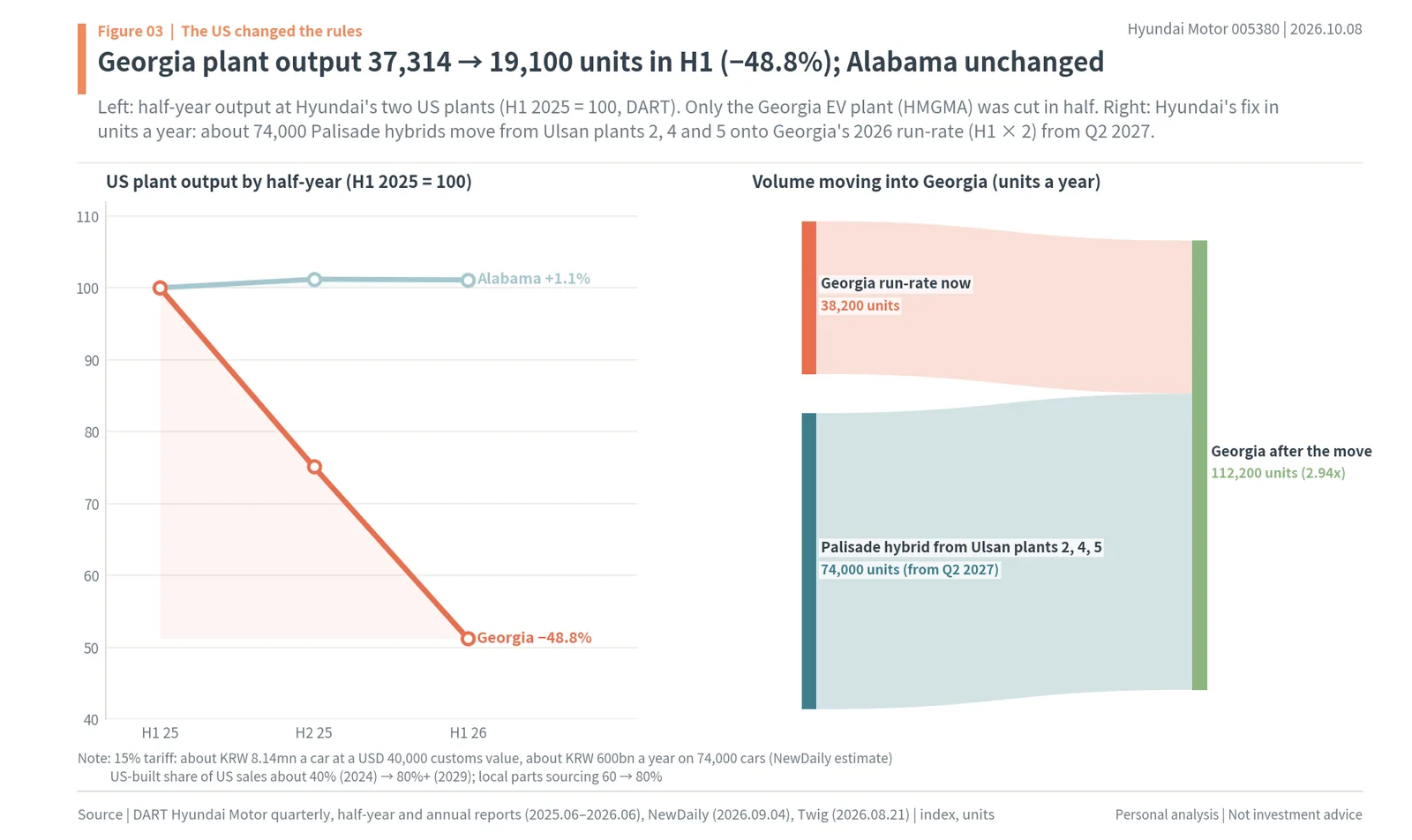
The left of Figure 03 sets the half-year output of the two plants to 100 in the first half of 2025. Alabama stays near 100 while Georgia drops to 51. The right draws Hyundai’s fix in units. Adding Ulsan’s 74,000 Palisade hybrids to Georgia’s 2026 run-rate of 38,200 (first half × 2) takes Georgia to 112,200, 2.94 times today (author’s calculation, excluding Kia volume).
Hyundai’s fix: fill Georgia with hybrids
The fix is America first. On June 2, mass production of the Kia Sportage Hybrid began at the Georgia plant, the third model after the Ioniq 5 and Ioniq 9 and the plant’s first hybrid (eNewsToday, 2026.06.03). The bigger volume comes from Ulsan. Hyundai plans to build about 74,000 Palisade hybrids a year, previously made at Ulsan plants 2, 4 and 5, in Georgia from Q2 2027, around April, and has already set up the parts supply chain for local production (NewDaily, 2026.09.04). The decision came out of reallocating volume among plants ahead of the demolition of Ulsan plant 1 in September 2027.
The arithmetic is simple. At a customs value of $40,000, a 15% tariff is about $6,000, or about KRW 8.14mn, per car, and on 74,000 cars about $440mn, or KRW 600bn, a year (NewDaily’s estimate). Even if US labor and parts cost more than in Korea, Hyundai saves tariffs and logistics and spreads the fixed costs of the half-empty Georgia plant over more cars. At its CEO Investor Day in August, Hyundai said it would add 500,000 units of North American capacity by 2030, including a 200,000-unit expansion at Georgia, and raise local parts sourcing from 60% to 80%. The US-built share of its US sales goes from about 40% in 2024 to more than 80% by 2029 (Twig, 2026.08.21). Kia has also been building the Telluride Hybrid, on the same platform as the Palisade, at its West Point, Georgia plant since February, so US hybrid parts volume grows across the group.
For the same reason, the mid-size electric SUV stopped
America first also shows in the product plan. Hyundai was developing a Sorento/Santa Fe-size (D-segment) electric SUV and stopped, and the reason given is that EV subsidies ended in the US, its main market, and EV sales fell (Apkwon, journalist Ryu Jong-eun, 2026.10.07). The cost of developing a new segment has to be recovered in the largest market, and once EV demand broke there, the case for building that car for Korea alone weakened. Korean buyers who wanted an electric SUV of that size were left with no Korean car to buy; that is the result of this decision.
US sales grow, but Korean plants don’t get busier
Looking at Hyundai alone, signs of decline are clear overseas too. The year-on-year change in Hyundai’s overseas sales (sales from overseas plants plus exports from Korean plants) widened almost every month, from −2.2% in January–March to −5.1% in April, −5.8% in June, −8.5% in August and −13.9% in September. In the same September Kia’s overseas sales rose 7.5%. In European new registrations (ACEA, EU+EFTA+UK), the Hyundai brand fell 12.6% in January–August and its share fell from 4.1% to 3.4%, while Kia rose 9.0% over the same period. Under the same group and the same tariffs, only Hyundai is selling less.
The gap with Kia, in the same group, is large overseas too. Kia’s Q3 overseas sales rose 8.9% to 703,494 from 646,118 a year earlier, and its total Q3 sales of 846,764 were the most for any third quarter (Kia September sales). With Kia growing overseas under the same tariffs and the same strong won, the cause of Hyundai’s overseas decline should be sought in its model mix and new-model timing rather than the external environment.
The US is different. Hyundai’s US sales were 697,464 in January–September, a record for the period; September rose 9.1%, with hybrids up 39% (Hyundai Motor America). India also hit a monthly record of 77,916 in September. But selling a lot in the US does not keep Korean plants busy. While US retail sales rose 2.6% in the first half, car exports from Korea to the US fell 2.2% to $15.52bn from $15.87bn a year earlier.
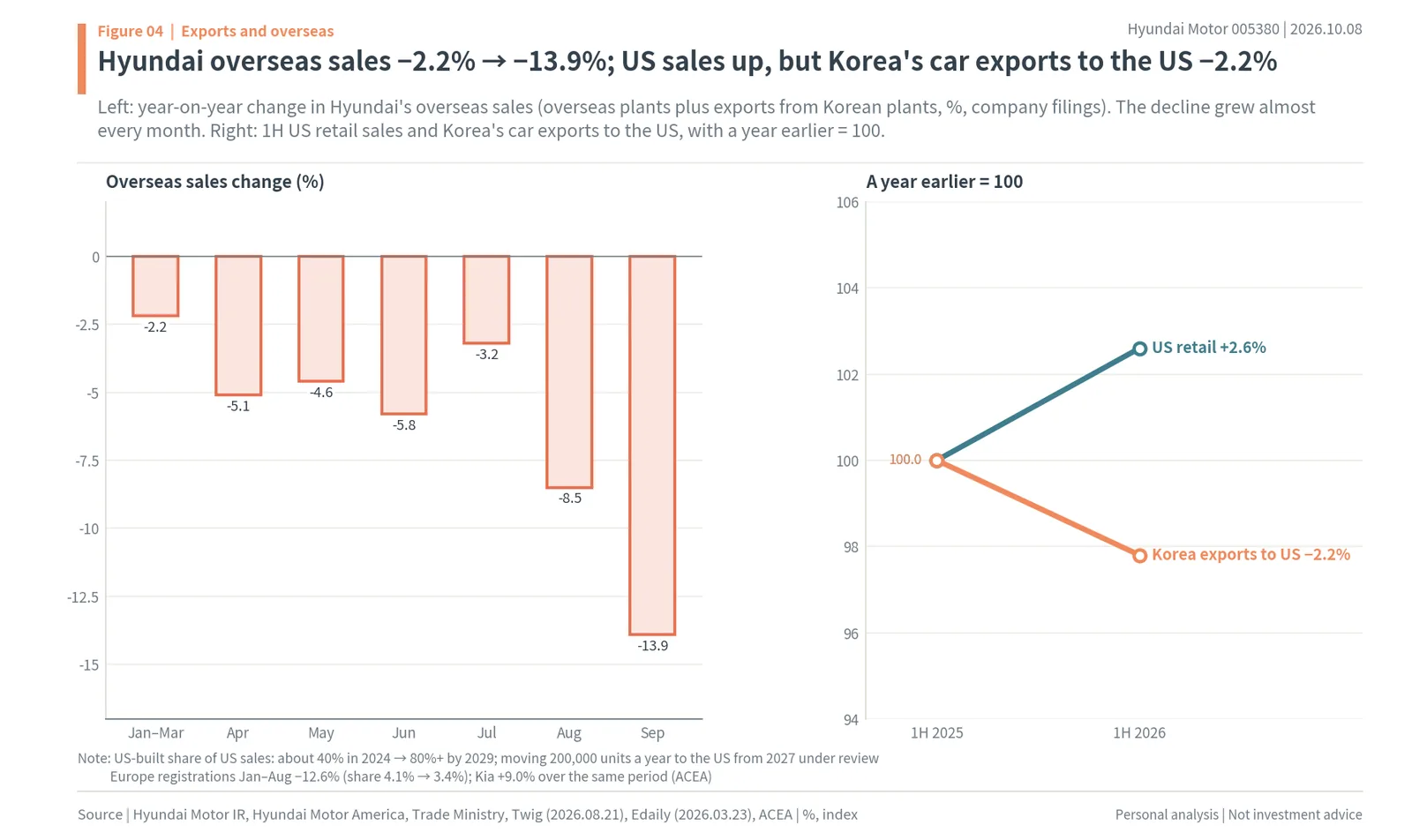
The right of Figure 04 compares those two numbers with a year earlier set to 100. US sales split upward and exports from Korea to the US downward. With the US tariff settled at 15%, Hyundai decided to raise the share of the cars it sells in the US that are made in the US from about 40% in 2024 to more than 80% by 2029 (Twig, 2026.08.21), and is reviewing a plan to move 200,000 units a year, including the Tucson Hybrid and the Palisade, to US production from 2027 (Edaily, 2026.03.23). The first part of that plan to come with a model, a volume and a date is the 74,000 Palisade hybrids seen above. This year’s production plan for Korean plants is 1.839 million units, the same as last year, but the more US sales grow, the smaller the share of Korean plants becomes. This is also why the union agreement is sensitive to shifting volume overseas, and it shares a root with the Ioniq V issue in Chapter 5.
Protecting US profit this way is the right sum for the company. The price is left in the Korean market. Chapter 3 looks at who felt it first.
3. Young Korean Buyers Choose Tesla Like iPhones: Hyundai 38.2% → 30.3%, Tesla 4.7% → 14.3%
Chapter 2’s choice left two things in the Korean market. One is an empty slot with no Sorento/Santa Fe-size electric SUV; the other is higher prices on every new model. The first buyers both reached were people in their 20s and 30s, buying or replacing a car for the first time.
Hyundai’s share among buyers in their 20s and 30s: 38.2% → 30.3%
Age separates the buyers who left. CarIsYou Data Research Institute’s analysis of Transport Ministry registrations shows that Hyundai’s share of new cars bought by people in their 20s and 30s in January–May this year was 30.3%, down 7.9 percentage points from 38.2% a year earlier. Over the same period Tesla’s share tripled from 4.7% to 14.3%. Among buyers aged 50 and over, Hyundai’s share held at 38.8%. The SUV that people in their 20s and 30s bought most was Tesla’s Model Y (9,451), followed by Kia’s Sorento (8,426) and Sportage (6,031).
The same trend was visible last year. The Korean business weekly Economist reported that people in their 20s and 30s bought 21,757 Teslas in January–November 2025, more than BMWs (13,666), and, citing experts, wrote that this generation buys the brand rather than the car, in a pattern similar to buying iPhones. Invest Chosun compared Tesla’s Full Self-Driving (FSD) to the 2007 iPhone and summed up Hyundai’s position as having to build a ‘Galaxy’ (2026.03.18). Just as people who buy iPhones look at the ecosystem and the brand rather than the spec sheet, people in their 20s and 30s buy a Tesla as a device rather than a car.
The shift did not happen suddenly in a single year. By CarIsYou’s count, imports were 21.5% of new cars bought by people in their 20s and 30s in 2025, and among those imports Tesla ranked first with 38.2% (Star News, 2026.02.26). In the same year Tesla’s share of the import market rose from 11.3% to 19.5% (The Fact, 2026.01.07). People in their 20s registered 61,962 new passenger cars in 2025, only 5.6% of the total and the fewest in ten years (Kukmin Ilbo, 2026.02.24): a generation that buys fewer cars is choosing Tesla for the cars it does buy. The industry’s experience is that a buyer who has bought an import once often picks an import for the next car too, so this shift carries through to the next replacement.
There is evidence in Korea that the analogy fits. The Model Y sold in Korea has been made in Shanghai since 2023, and supervised FSD is open only to US-built cars, so the Model Y and Model 3 sold in Korea are not eligible (MTN, 2026.07.10). Chinese-made Model Ys without that self-driving function sold 11,421 in September alone. What buyers bought was not the feature but the brand and the expectation.

Tesla’s sales are not a one-off either. Tesla was the top import brand for eight months in a row from February to September, and in March it became the first import brand to pass 10,000 in a month, at 11,130 (Herald Economy, 2026.04.02). After that, about 10,000 a month became the norm: 13,190 in April, 11,119 in June and 12,372 in September. The Model Y was the best-selling car overall, Korean brands included, in May and August (CarIsYou).
In the same period Hyundai raised prices and Tesla cut them
The right side of Figure 05 shows starting price changes over the same period. Hyundai raised prices with each new model. The fully redesigned Palisade’s gasoline starting price rose KRW 4.87mn, from KRW 38.96mn to KRW 43.83mn; the facelifted Grandeur rose KRW 4.66mn for the LPG version and KRW 3.87mn for the 2.5 gasoline; and the 8th-generation Avante rose KRW 3.36mn (BizWatch). On December 31, 2025, Tesla cut the Model Y base model (Premium RWD) by KRW 3mn, from KRW 52.99mn to KRW 49.99mn (about $37,200), and kept it unchanged when it raised other models on July 1. Only the 6-seat Model Y L went up, by KRW 8mn, from KRW 64.99mn to KRW 72.99mn.
When prices moved in opposite directions, buyers moved. For people in their 20s and 30s who used to buy Hyundai, the Avante, Tucson and Santa Fe became several million won more expensive while the Model Y base model became KRW 3mn cheaper. Tesla entered the list of cars they could choose with the same money, and buyers who buy the brand chose it. By raising prices, Hyundai gave up its place with buyers in their 20s and 30s on its own.
76% of Tesla’s September sales were the 6-seat Model Y L, and used prices fall less
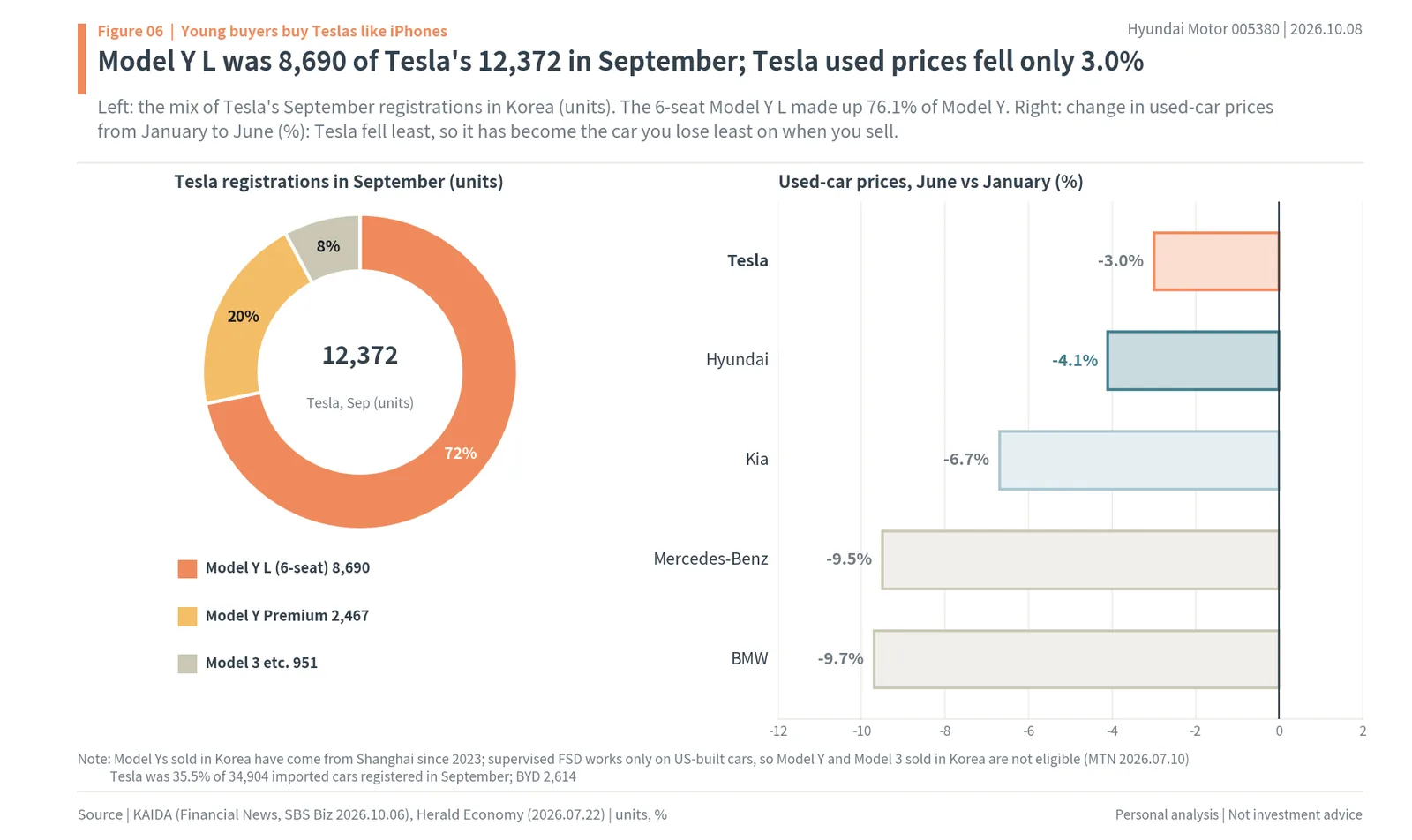
The left of Figure 06 is the mix of Tesla’s 12,372 registrations in Korea in September. The Model Y was 11,421, and of those the 6-seat Model Y L was 8,690, or 76.1%. The Model Y Premium was 2,467. Tesla was 35.5% of the 34,904 imported passenger cars registered in September. That the center of the demand that went to Tesla is a family 3-row SUV matters when Chapter 5 looks at the Ioniq V.
The right side shows the change in used-car prices from January to June. Tesla fell 3.0%, less than Hyundai (4.1%), Kia (6.7%), Mercedes-Benz (9.5%) and BMW (9.7%) (Herald Economy, 2026.07.22). Just as the iPhone holds its resale value and makes the next iPhone easier to buy, Tesla has become the car you lose less on when you sell. Both the price paid at purchase and the price received on resale tilted toward Tesla, and the result is the sales numbers in Chapter 4.
4. Hyundai Domestic Sales: −16.3% in Jan–Sep, −6.0% Even Without the Strikes
If the empty slot and higher prices sent people in their 20s and 30s to Tesla, it should show in the sales numbers. It does.
January–September −16.3%, and −6.0% even with the strikes added back
Hyundai’s domestic sales were 448,181 in January–September, 16.3% below 535,458 a year earlier. The only month above the year before was January (+9.0%); April fell 19.9% and May 23.1%. July fell 14.4%, August 41.1% and September 25.7%. The company said parts shortages at suppliers cut Palisade and G80 production in April, and cited strikes in July–August, and in September the Chuseok holiday (Korea’s autumn harvest holiday) and buyers waiting for new models. Through September it has reached 64.0% of its annual target of 700,000.
The strikes are a large part, but not all of it. The company counted 42,510 units of lost production over nine days of partial strikes in July, and adding the full strike on August 21 the industry estimates about 55,200. That is 63.2% of the 87,277-unit decline in January–September. The strike losses include export volume, so adding all 55,200 back to domestic sales is the assumption most favorable to domestic sales. Even then, January–September is down 6.0% (author’s calculation). Domestic sales were falling even without the strikes.
Looking at other carmakers over the same period makes the cause clearer. Kia’s domestic sales rose 5.4% to 436,301, and in April, July and August Kia outsold Hyundai (including Genesis and commercial vehicles). Korean-brand passenger car registrations fell 9.5% while imported passenger car registrations rose 24.1%, and Tesla registrations rose 104.4% to 89,148. With Kia, in the same group, up and imports up, and only Hyundai down, the market did not shrink; buyers who used to buy Hyundai chose other cars.
The whole domestic market cooled too, but by less than Hyundai. September domestic sales at the five Korean carmakers fell 19.8% to 99,843, and Renault Korea, GM Korea and KGM each fell more than 40% (Dailian, 2026.10.01). August Korean-brand passenger car registrations fell 21.8% to 66,791, the lowest in ten years; within that, Kia’s share rose to 54.3% and Hyundai’s fell 5.4 percentage points to 32.0% (CarIsYou). Given that Hyundai’s domestic sales rose 1.1% to 712,954 in 2025, this year’s decline is a change that happened within a single year. As the Korean-brand market shrank, Kia widened its share and Hyundai shrank faster than the market.

The lines on the left of Figure 07 are monthly domestic sales. The gap between Hyundai (teal) and Kia (sky blue) has nearly disappeared this year, and Tesla (coral) has held around 10,000 a month since March. In September Hyundai sold 49,022, Kia 45,705 and Tesla 12,372. The bars on the right are cumulative January–September changes. Hyundai’s domestic sales fell most and Tesla rose most.
Models with new versions grew; models awaiting replacement fell
By model, the declines are concentrated in SUVs and in models about to be replaced. In January–September the Grandeur rose 27.0% to 61,751 and the Sonata rose 12.6%. The Grandeur got a facelift in May. By contrast, the Avante fell 34.4%, the Santa Fe 31.7% and Genesis 28.9%. The company did not give July–September figures for the Tucson, so for January–June it fell 23.2%; the Palisade is missing May, so for June–September it fell 45.1%.
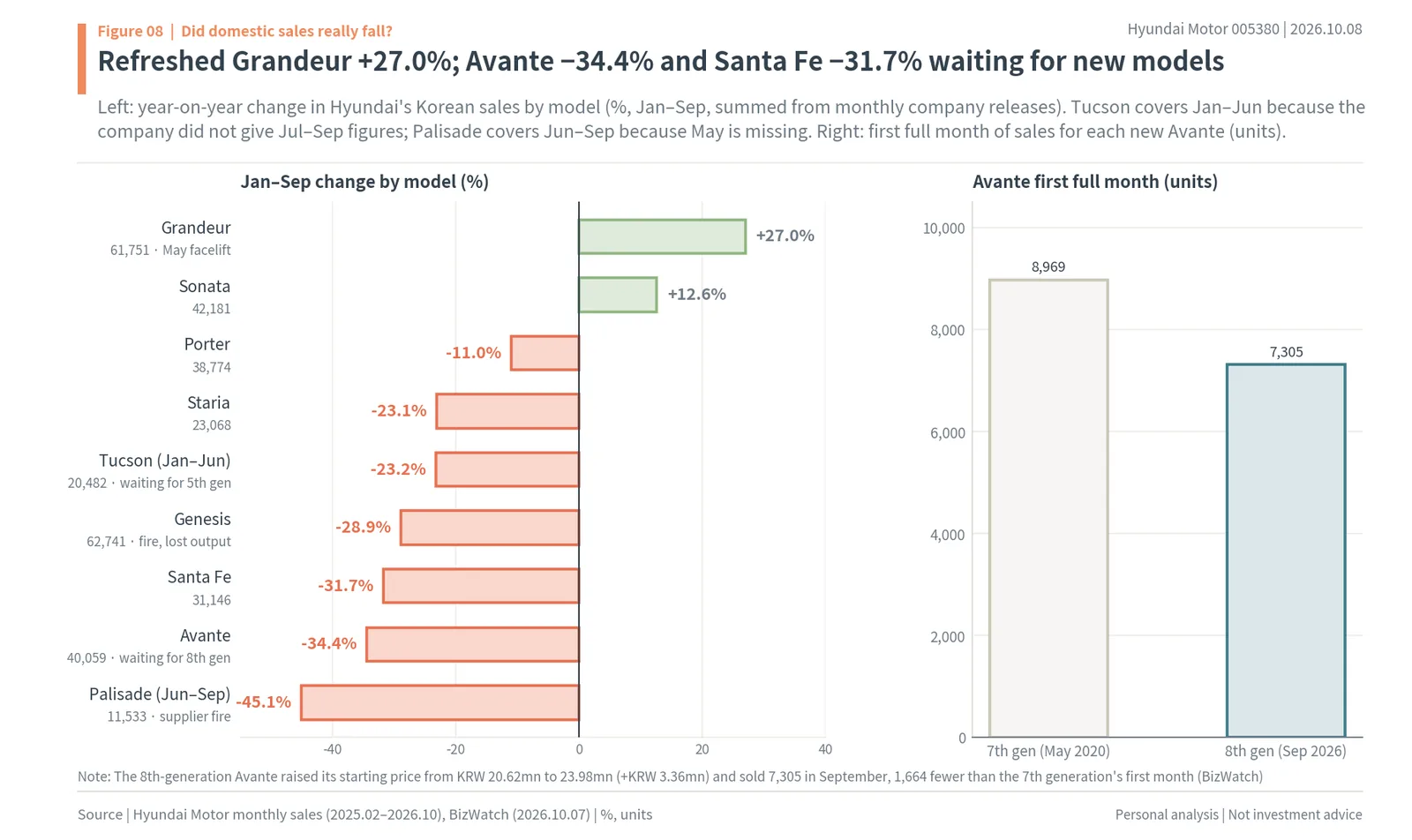
The left of Figure 08 is the change by model. The Avante and Tucson were models waiting for new versions, and Genesis and the Palisade were models whose production was blocked by a fire at a supplier in March. Up to here the causes are temporary. But the first month of the new Avante, shown in the bars on the right, is different. The 8th-generation Avante sold 7,305 in September, 1,664 fewer than the 8,969 the 7th generation sold in May 2020, its first full month on sale (BizWatch, 2026.10.07). The 8th-generation Avante’s starting price rose KRW 3.36mn, from KRW 20.62mn to KRW 23.98mn. It is the first sign that the reason new cars no longer sell as they used to is price.
The domestic decline is not about strikes or the calendar; Tesla took the gap left by a product plan built around America and higher prices. Then why not bring in a car to fill that gap? That is the question of Chapter 5.
5. Why Hyundai Won’t Bring the Ioniq V to Korea: Plant Work, Namyang’s Budget and Article 42
The Ioniq V is a mid-size electric sedan, not an SUV
The Ioniq V is an electric car that Beijing Hyundai launched in China on September 29. It is a 4,900mm-long mid-size fastback sedan, with CATL LFP (lithium iron phosphate) batteries of 53.48kWh and 66.85kWh and driver assistance from the Chinese company Momenta. Its starting price in China is CNY 109,900 (about KRW 22.17mn, or about $16,500). It is the first model whose planning, R&D, parts sourcing and production all took place in China, and Beijing Hyundai’s research staff led development (SBS Biz, 2026.08.28). It is a car built for Chinese consumers on China’s parts network.
The reason it is cheap also lies in that parts network. The Ioniq V’s Chinese price is more than CNY 40,000 below comparable cars such as BYD’s Seal (CNY 179,800), the Zeekr 007 (CNY 193,900) and the Xpeng P7+ (CNY 186,800) (SBS Biz, 2026.08.28). It is a price made with Chinese batteries, Chinese driver assistance and a Chinese plant; build the same car with Korean parts at a Korean plant and the same price does not come out. It is not that the Namyang R&D Center cannot build such a car; this price is the price of China’s parts network.
In Korea, calls to bring this car in have grown louder. The argument is that a cheap EV is needed to stop demand going to Tesla. But first look at the slot that the demand going to Tesla fits into. The Model Y sold 11,421 in September, and the 6-seat Model Y L was 8,690 of those. The Model Y is a mid-size SUV and the Model Y L an upper mid-size SUV. In a video on Apkwon, journalist Ryu Jong-eun pointed out that Hyundai and Kia have no electric SUV in this class, that is, the size of a Sorento or Santa Fe (2026.10.07). The Ioniq 5 and the EV5 are a size below (the EV5 is a compact), and the Ioniq 9 is a large SUV a size above, starting at KRW 67.59mn. In first-half domestic sales the Ioniq 5 averaged 1,982 a month and the Ioniq 9 1,206, far below a single month of Model Y sales.
The empty slot is on hold because of the US
Hyundai did not simply leave this slot empty. According to the same video, Hyundai was developing a D-segment (mid-size) electric SUV and stopped. EV sales fell by tens of percent after EV subsidies ended in the US, its main market, and as long as US policy does not change it is hard to launch an electric SUV in this class. The numbers point the same way. In the US, Ioniq 5 sales fell 65% in September and 24% in January–September, to 31,112. The Ioniq 6 fell 85% in January–September, to 1,348 (Hyundai Motor America, 2026.10.01). When a company that picks its cars by US sales stopped a segment that does not sell in the US, the slot where Korea’s largest EV demand gathers was left empty, and the Model Y took it.
The Ioniq V is not the car to fill this slot. It is a mid-size sedan, and the car it overlaps with is the Ioniq 6, of the same size.
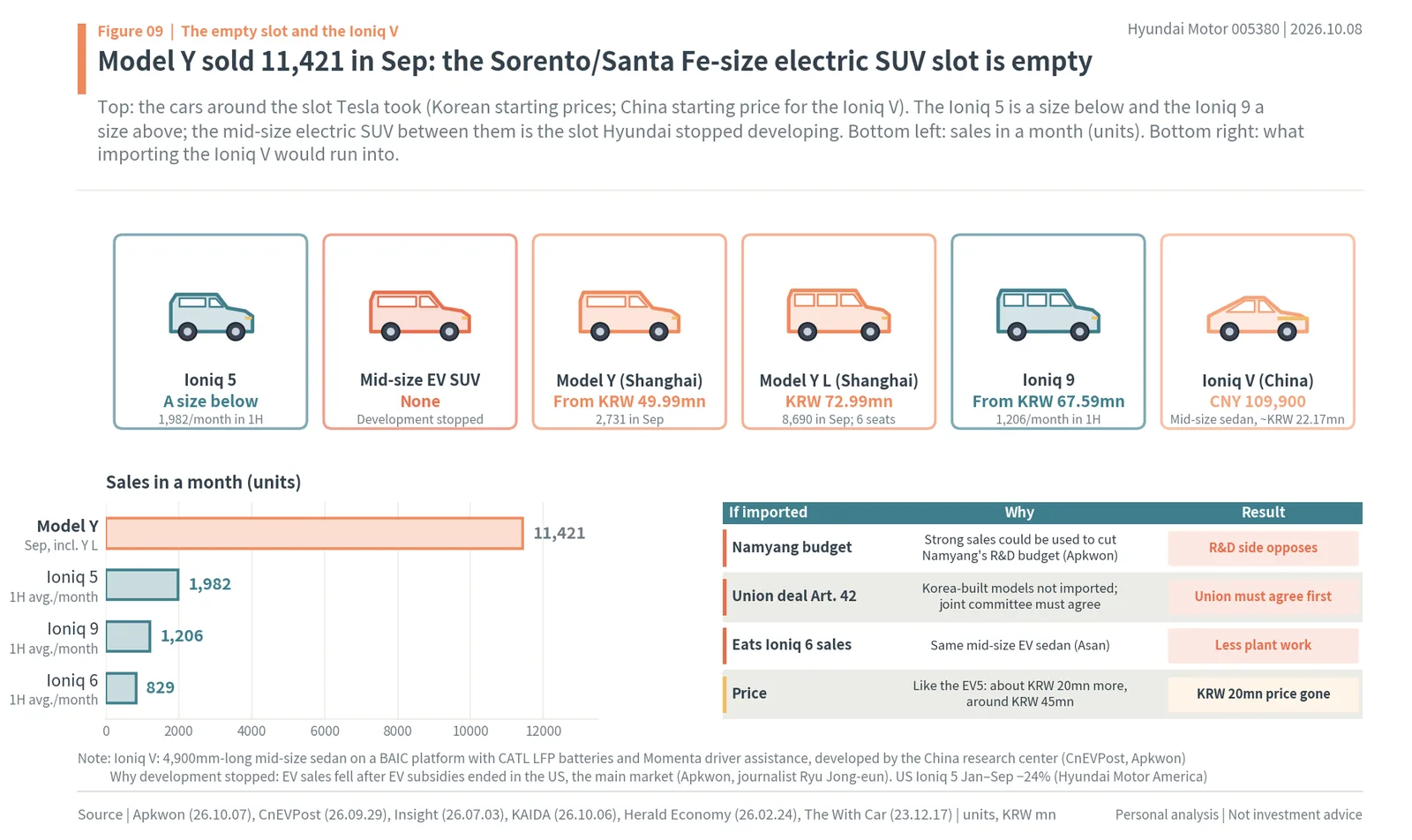
The top of Figure 09 shows the cars around the slot Tesla took. The Ioniq 5 is a size below and the Ioniq 9 a size above, and the mid-size electric SUV slot between them is empty. The Ioniq V is a mid-size sedan that does not belong in this row. The bars at bottom left are monthly sales: against 11,421 for the Model Y in September, the Ioniq 5 averaged 1,982 a month in the first half, the Ioniq 9 1,206 and the Ioniq 6 829. The bottom right shows the four things that importing the Ioniq V would run into.
Article 42 of the collective agreement and the joint labor-management committee
The first reason it is not brought in is the collective agreement, the contract Hyundai signs with its labor union. Article 42 of Hyundai’s collective agreement sets as a principle that finished cars built at Korean plants are not imported from overseas plants (The With Car, 2023.12.17). Selling cars from overseas plants in Korea needs the agreement of a joint labor-management committee, and in 2017–2018 plans to bring in the Europe-focused i30 N and Ceed fell through on union opposition (Herald Economy, 2026.02.24). The Ioniq V is in the same segment as the Ioniq 6 built in Asan, so the moment it came in, a dispute over importing an overseas-built version of a model made in Korea would begin.
The union has moved to widen this principle. The Sonata taxi, the only car brought in from an overseas plant, was a model whose Korean production had ended, yet the union opposed it as a breach of the agreement, and the company brought it in on the argument that the model had already been discontinued. In 2024 the union added “no imports from overseas plants of discontinued models” to its separate demands (Seoul Economic Daily, 2024.05.10). In a January 2026 newsletter it said one-way moves without labor-management agreement on shifting volume overseas and bringing in robots would not be tolerated (SBS Biz, 2026.01.22).
Work for Korean plants, and a price edge that disappears even if it comes in
The second reason is work for Korean plants. Ioniq 6 domestic sales fell from 11,218 in 2022 to 4,956 in 2024, and were 4,975 in the first half of this year. The Ioniq 5 and Kona Electric line at Ulsan Plant 1 stopped ten times in 2025 and cut its hourly output from 27.5 to 17.5 units (CEO Score Daily, 2025.12.01). Bringing in a Chinese-made sedan in the KRW 20mn range next to domestic EV lines that are already running below capacity would cut Ioniq 6 sales further and shake work and jobs at the Asan plant by as much. It is not a profitable trade for the company or for the union.

The third reason is price. Finished cars are excluded from the Korea–China FTA, so Chinese-made passenger cars carry an 8% tariff (SBS Biz, 2026.09.18). The 2026 EV subsidy raised its energy density threshold to above 525Wh/L, which works against LFP batteries. The national subsidy is up to KRW 5.7mn for the Ioniq 6 and KRW 2.1mn for the Model Y, and BYD passenger cars have received no subsidy since July (Korea Economic Daily). The group already has a guide. Kia did not import the EV5 it first built in China, but built it at its Gwangju plant with NCM batteries instead (Korea Economic Daily, 2025.07.02). Doing that takes away the KRW 20mn-range advantage.
Figure 10 puts the obstacles in numbers. On the left, Sonata taxi re-imports of 18,044 in 2024 and 16,465 in 2025 are all the cars ever brought in from overseas plants. The middle shows that Ioniq 6 domestic sales are already down to about 4,975 per half-year, and the right shows the subsidy gap.
With Ulsan volume leaving for America, a China-built car cannot come in too
The fix in Chapter 2 makes the Ioniq V problem harder. From Q2 2027, 74,000 Palisade hybrids from Ulsan plants 2, 4 and 5 go to Georgia, and in September of the same year volume by model is reallocated ahead of the demolition of Ulsan plant 1 (NewDaily, 2026.09.04). 74,000 units is 4.0% of Korean plant output of 1,846,837 in 2025 (author’s calculation). In a year when export volume leaves for America because of tariffs, bringing in a car for Korean buyers from a Chinese plant would take work away from Korean plants twice, once from outside and once from inside. As long as Article 42 of the collective agreement requires the joint labor-management committee to agree, the author sees little chance of a plan to bring in an overseas-built car winning agreement now. So the slot stays empty, and the buyers for it keep going to Tesla.
The Ioniq V is headed for emerging markets, not Korea
Beijing Hyundai’s situation also shows where this car is headed. Beijing Hyundai sold 210,015 cars in 2025, and 86,347 in the first half of 2026, down 8.3%. Sales within China fell 22.3% and exports rose 15.5%, taking the export share to 46.7%, and it was reported that only two of its former five plants remain, running at about 30% of capacity (Money Today, 2026.07.21). President José Muñoz said the Ioniq V is made in China, for China, and sent to the world, and named Australia, Southeast Asia, the Middle East and Latin America as markets under review for its launch (The Beep, 2026.04.27). Korea is not on that list. The path the group chose is to fill spare capacity at the Beijing plant with exports to emerging markets, not with Korea.
Not a question of Namyang’s capability, but of its budget
Ryu Jong-eun, a journalist appearing on the YouTube channel Apkwon, reported that there is a lot of debate inside Hyundai over this car (2026.10.07). The Ioniq V puts CATL batteries and Momenta driver assistance on a BAIC platform, and R&D authority went to the China research center rather than Namyang, so it is a car built mostly with Chinese technology and people. The sales side wants to bring it in, saying it would sell well. The R&D side worries that if a car made in China sells well in Korea, then in today’s climate of steady budget cuts for cost savings, management could question Namyang’s research capability and call for even lower R&D spending.
This does not need to be read as Namyang hiding a lack of skill. The Ioniq V is cheap because its price was made on China’s parts network, and the same car built with Korean parts at a Korean plant would not come out at that price. What is at stake is not skill but Namyang’s budget and standing. R&D spending has risen every year, as Chapter 7 shows, but the moment a KRW 20mn-range car made by the China research center sells in Korea, that budget becomes harder to justify. On top of this come Article 42 of the collective agreement, which blocks imports from overseas plants of models built in Korea, and the Ioniq 6 in Asan and the work at Korean plants.
Even if it came in, the price edge would shrink a lot. The same video cited the precedent of Kia’s EV5, sold in China for under KRW 30mn and in Korea for over KRW 50mn, and expected the Ioniq V, if brought in with a different charging standard and battery, to rise by about KRW 20mn to around KRW 45mn. A company official said the Ioniq V is for the Chinese market only and there are no plans to sell it in Korea (Hankyoreh, 2026.08.24). The reason the Ioniq V is not brought in is not capability but a structure: Namyang’s budget, the work at Korean plants that the collective agreement protects, Ioniq 6 sales, and a price edge that would not survive the trip. It would be done if it made money, but under the current structure several pockets inside the company would lose at the same time.
If the slot stays empty, the cost shows up in Korean plant utilization and profit. That is Chapter 6.
6. Korean Plants and Profit: Output −4.7%, Revenue per Car KRW 41.37mn → 41.22mn
When domestic sales fall and export volume moves to America, work at Korean plants shrinks, and the end of that is profit. In order:
Korean plant output fell first
Production at Korean plants points the same way. Production at Korean plants (HMC) in the DART half-year report was 897,929 in the first half of this year, 4.7% below 942,020 a year earlier, with utilization at 99.0%. Korean production fell even in the first half, before the strikes, which means domestic sales and exports fell together. By contrast, the Georgia plant is running at only 37.2% of capacity, so, following Chapter 2’s fix, hybrid volume goes there. When the 74,000 Palisade hybrids leave in 2027, Korean output falls by another 4.0% on a 2025 basis.
Korea’s car exports are holding up once the calendar and strikes are set aside
Start with Korea’s total car exports, which have not collapsed. According to the Ministry of Trade, Industry and Resources, export units in the first half of this year rose 2.1% to 1.441 million, and value fell 1.1% to $35.95bn. The ministry attributed the fall in value to lower used-car exports. January–September export value fell 3.7%, from $54.11bn to $52.10bn, the result of the Lunar New Year in February, a shifted summer holiday and strikes in August, and Chuseok in September. September exports fell 5.5% to $6.05bn but rose 5.5% per working day.
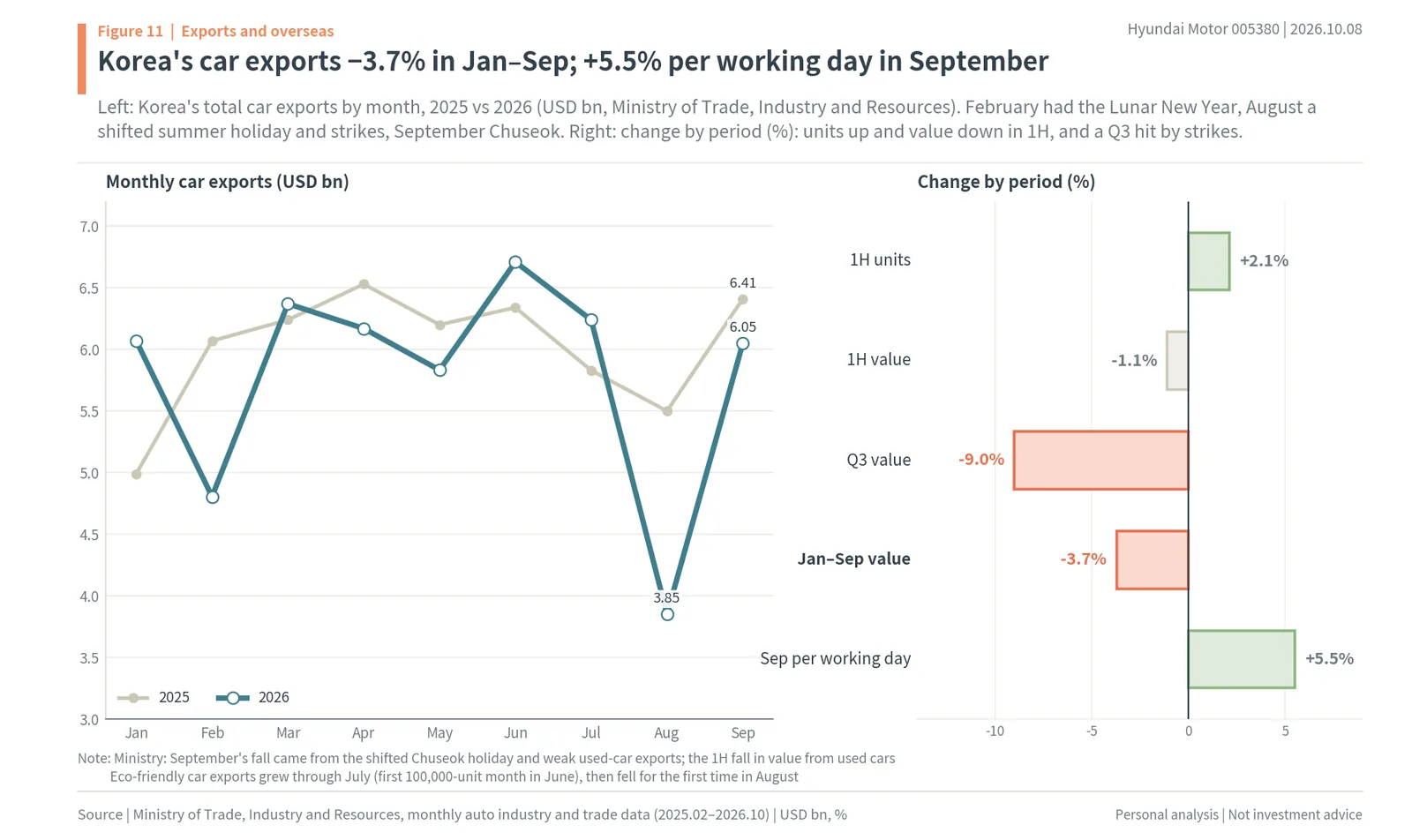
The lines on the left of Figure 11 compare monthly export values in 2025 and 2026. Apart from August’s sharp dip to $3.85bn, the 2026 line moves around the 2025 line. The right shows changes by period. Value fell 9.0% in Q3, when the strikes hit, and in units the first half actually rose. For Korean-built cars as a whole, exports have not turned down structurally; what shrank is the share of Hyundai’s Korean plants.
List prices rose, but the money actually received stayed flat
Hyundai has steadily raised domestic prices over the past two years. The average domestic passenger car selling price in DART half-year reports (simple average across models) rose from KRW 53.98mn in 2024 to KRW 56.17mn in 2025 and KRW 57.03mn in the first half of this year, up 5.6% in two years. The RV (SUV) average rose 6.0% over the same period. In the 2026 model-year changeover, Hyundai and Kia raised prices by 2.56% on average, more than the 0.44% a year earlier (Ucar Post, 2025.08.13). On top of that came the starting price increases on the new models seen in Chapter 3.
Yet the money actually in hand did not follow. Dividing the vehicle portion of domestic revenue in DART separate financial statements (passenger cars, RVs, light and heavy commercial vehicles) by the domestic unit sales the company announced gives the money actually received per car (author’s calculation). It rose 3.8% from KRW 40.0mn in 2024 to KRW 41.5mn in 2025, then in the first half of this year was KRW 41.22mn, 0.4% below the KRW 41.37mn of the first half of last year. While list prices rose, revenue per car stalled.
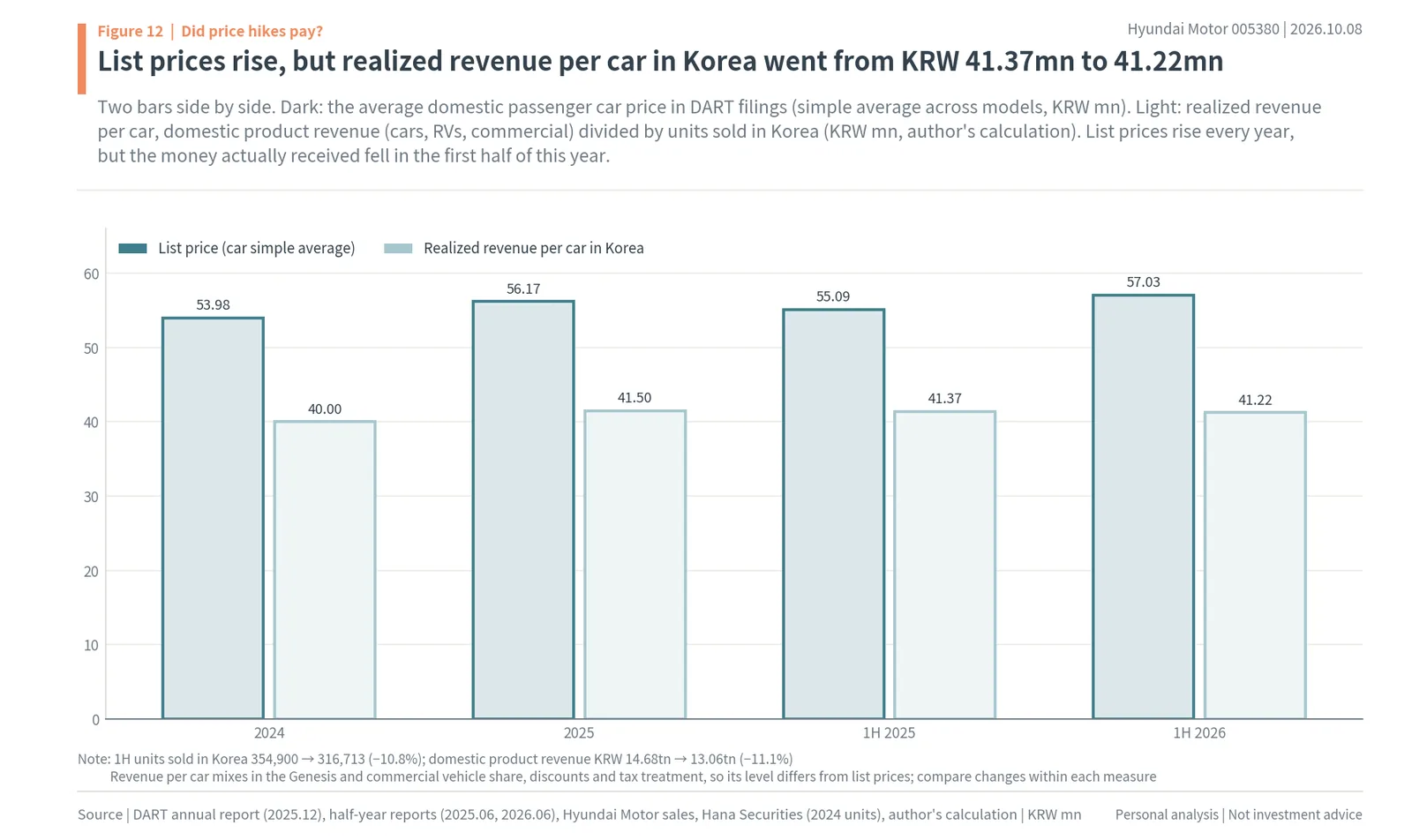
Figure 12 sets list prices and actual revenue per car side by side. List prices rise every year, but revenue per car turned down in the first half of this year. The two are at different levels because revenue per car also reflects the share of commercial vehicles and Genesis, discounts and tax treatment, so the comparison looks at changes within each measure. If revenue per car fell after prices went up, then either the cars sold at higher prices sold less or more discounts were added. In the first half of this year both happened. Genesis, which fetches full price, sold 28.9% less, and the company said net incentives rose after the price increases in Q2.
In the US too, prices rose little by little. 2026 model-year US MSRPs went up $400 for the Sonata, $795 for the Santa Cruz, $495 for the Tucson and $500 for the Santa Fe (Korea JoongAng Daily, 2025.08.25). In the US, Hyundai held on while spending less on incentives than the industry. In September, Hyundai brand incentives per car were $2,915, below the industry average of $3,360 (Money Today, 2026.10.06). Taken together with the company putting the effect of US and European incentives in Q2 at about KRW 600bn (DS Investment & Securities, 2026.07.30), Korea and overseas walked the same path: higher prices and more spending on sales incentives.
KRW 1.58tn of the KRW 1.63tn fall in domestic revenue came from units
First-half domestic product revenue fell KRW 1.63tn, from KRW 14.68tn to KRW 13.06tn. Splitting it into the part from fewer units and the part from changes in revenue per car, units fell 10.8% from 354,900 to 316,713, taking out KRW 1.58tn, and the change in revenue per car took out KRW 50bn (author’s calculation). The price increases protected essentially none of the revenue, and fewer units explain almost all of the decline.

The left of Figure 13 is that split. The right shows what moved company-wide Q2 operating profit from a year earlier. Q2 operating profit was KRW 2,850.9bn (about $2.1bn), 20.8% below KRW 3,601.6bn a year earlier. Volume cut KRW 542bn and mix, including incentives, cut KRW 569.9bn, while FX added KRW 238bn and finance KRW 106bn. The company explained that of the roughly KRW 0.6tn mix deterioration, higher net incentives after the price increases accounted for about KRW 0.4tn and a worse powertrain mix from lost Genesis and Palisade production for about KRW 0.2tn, while hybrid sales won back about KRW 0.4tn (Q2 conference call).
Price increases being handed back as incentives is not just this year’s story. A Hana Securities table built from company data shows that in 2025 the model mix added KRW 4.975tn to revenue, but on the operating profit side the mix, including incentives, cut KRW 2.189tn. Selling more expensive cars raised revenue, but the sales incentives spent to sell them were larger. The price increases were a poison that grew revenue but failed to protect profit.
The way to raise profit instead of prices is already visible. Q2 hybrid sales were a quarterly record of 187,661, 18.9% of the total. The company said higher hybrid sales added about KRW 0.4tn to Q2 operating profit, and at the CEO Investor Day it said hybrids’ contribution margin is about 5 percentage points above average (Eugene Investment & Securities, 2026.08.27). Hybrids were 26.2% of US sales in Q2. Selling more of the cars that earn more, instead of raising list prices, is the way to raise profit per car, and it is also the basis for the recovery in 2027 operating profit per car in the author’s estimates in Chapter 8.
Even with tariffs added back, operating profit is in the KRW 3tn range

Figure 14 shows quarterly operating profit with US tariff costs stacked on top. Quarterly operating profit came down from KRW 4.28tn in Q2 2024 to KRW 2.85tn in Q2 2026. From Q2 2025, tariffs took out KRW 0.83tn, 1.82tn, 1.46tn, 0.86tn and about 0.9tn a quarter. Operating profit with tariffs added back was KRW 4.43tn in Q2 2025 and 4.36tn in Q3, then KRW 3.16tn in Q4, 3.38tn in Q1 2026 and 3.75tn in Q2: in the KRW 3tn range since Q4. Profit did not fall on tariffs alone; lower volumes and incentives came on top of them. Tariff costs for all of 2025 were about KRW 4.1tn.
In the second half, the exchange rate is a new variable. The average won/dollar rate came down from KRW 1,502 in Q2 to 1,419 in Q3, and on October 9 it was 1,343. For a company that exports a lot, a stronger won means less money in won for selling the same car. When brokers cut their Q3 operating profit estimates to KRW 2.23–2.5tn in October, the reasons they gave were also lost strike volume and the exchange rate (Korea Investment & Securities, Hana, Daishin, 2026.10.06–07).
While profit fell like this, the share price more than tripled. What filled that gap was robot hopes, covered in Chapter 7.
7. Hyundai Share Price and Boston Dynamics: 3.49x on Robot Hopes, Then Back
The fall in profit in Chapter 6 did not show up in the share price right away. While the money from cars shrank, the stock rose on robot stories, and as those hopes cooled it is coming back toward earnings.
Robots carried the stock from KRW 215,000 to KRW 750,000
Hyundai’s share price rose 3.49 times, from KRW 215,000 (about $160) at the end of September 2025 to a close of KRW 750,000 (about $558) on June 1, 2026. Its intraday high that day was KRW 783,000. The path up was filled with robot and AI news. On October 30, 2025, a meeting between Chairman Chung Eui-sun and Nvidia’s Jensen Huang raised hopes of cooperation, and on the day the production version of Atlas was unveiled at CES in January 2026, the stock rose 13.8%. It first passed KRW 400,000 on January 13, and on February 26, when a KRW 9tn investment in Saemangeum and the KOSPI’s break above 6,000 came together, it first passed KRW 600,000 intraday. (The KOSPI is the main board index of the Korea Exchange.)

Figure 15 compares the two-year share price with the KOSPI. Since October 2025 there have been 27 days on which the stock moved more than 7%, and on 14 of the 19 up days the KOSPI moved less than 3%. On many days the stock rose on its own, regardless of the market, and the force behind it was robot hopes. Conversely, all 8 days on which it fell more than 7% were days when the KOSPI fell more than 3%. On June 23, when the KOSPI fell 9.99%, Hyundai fell 12.1%, and on July 28, when the KOSPI plunged 10.84%, it fell 9.7%.
Against the market, Hyundai lagged even in the year it rose. Over the past year Hyundai’s share price rose 49.5%, while the KOSPI, carried by chip stocks, rose 83.5%. Over three months Hyundai fell 27.2% while the KOSPI fell 9.1%, and over six months the KOSPI rose 14.7% while Hyundai fell 33.7%. The robot hopes drained away faster than the market swung.
After the peak came the market crash, results, the strike and the listing delay
After the June 1 peak, bad news came in turn. Of 20 broker reports in the month after Q2 results on July 23, 19 lowered their target prices (Newsis, 2026.07.26). On August 21 came the first full strike in 10 years, and brokers judged the CEO Investor Day on August 26 to have had no surprise announcements. On September 14 Reuters reported a group executive as saying a 2027 listing of Boston Dynamics would not be easy. The October 8 close was KRW 324,500, 56.7% below the peak.
Retail investors bought, foreigners sold
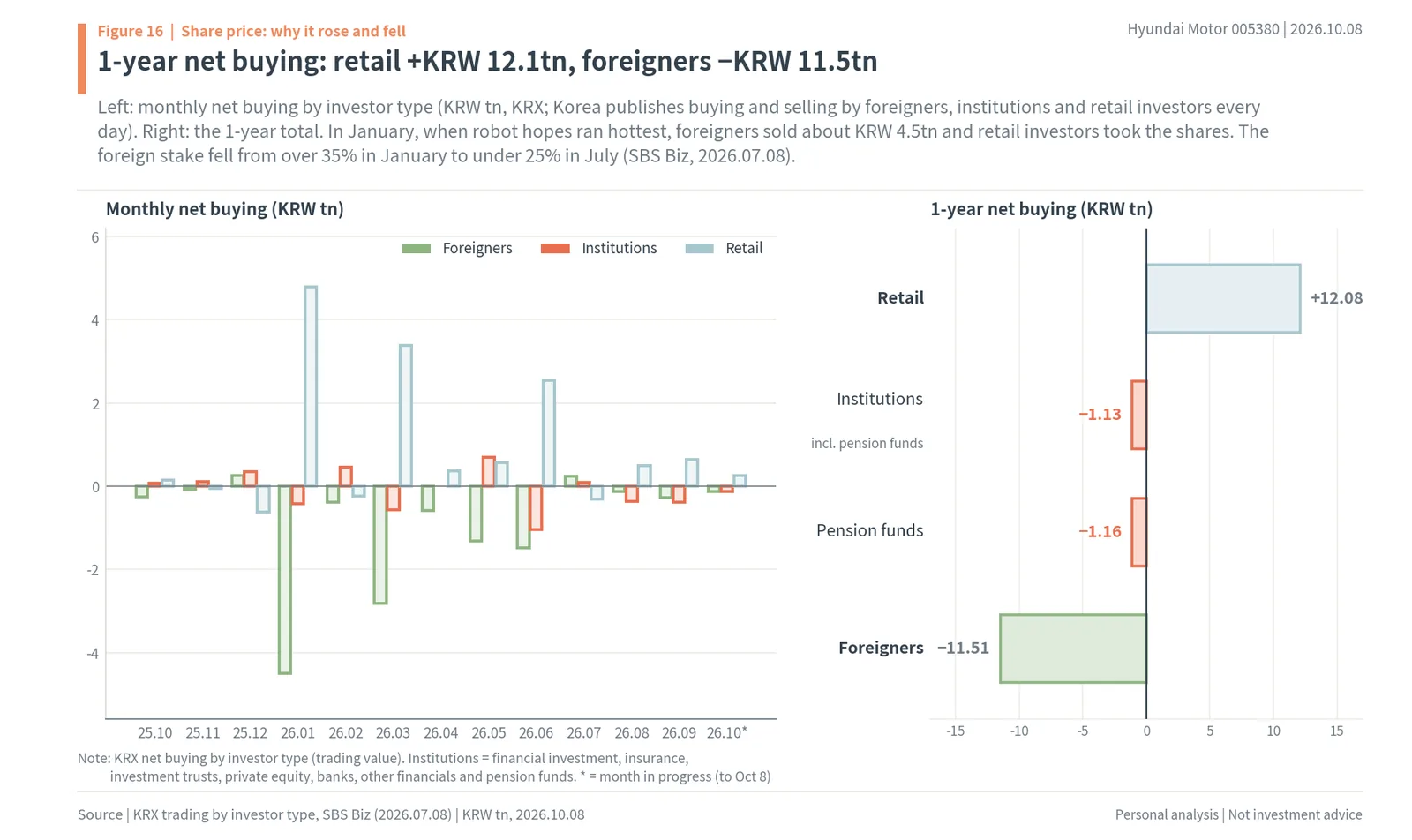
Figure 16 shows net buying by investor type over one year; the Korea Exchange publishes every day how much foreigners, institutions and retail investors buy and sell. Retail investors bought a net KRW 12.1tn and foreigners sold KRW 11.5tn. In January, when robot hopes were hottest, foreigners sold about KRW 4.5tn and retail investors took the shares. The foreign stake fell from over 35% in January to under 25% in July (SBS Biz, 2026.07.08). Much of the money that lifted the stock 3.49 times was retail money responding to the robot story, and as those hopes cool, the share price is returning toward profits.
Did Hyundai go all in on robots? More money went to cars
Whether Hyundai neglected cars while putting its effort into robots can be checked in the money flows. Hyundai’s consolidated R&D spending in DART rose from KRW 3.10tn in 2021 to KRW 3.97tn in 2023, KRW 4.59tn in 2024 and KRW 5.54tn (about $4.1bn) in 2025. 2025 was up 20.6% from a year earlier, and the ratio to revenue rose to 3.0%. The first half of this year was also KRW 2,388.9bn, 6.0% more than a year earlier. The money, which grew 1.79 times in four years, goes mostly into building cars.
The investment plan points the same way. Within vehicle-segment investment in the DART half-year report, R&D investment was KRW 4.92tn in 2024 and KRW 6.14tn in 2025, with KRW 7.45tn planned for 2026. Capital expenditure (CAPEX) is planned at KRW 8.99tn for 2026, while strategic investment, which covers things like the robot stake, actually falls from KRW 2.47tn in 2024 to a planned KRW 1.41tn in 2026. The new money Hyundai put into HMG Global, Boston Dynamics’ holding company, in Q2 was about KRW 156.3bn (MTN, 2026.08.26), 0.88% of this year’s KRW 17.85tn investment plan. Of the KRW 125.2tn five-year domestic investment the group announced, the money spent directly on robots is KRW 0.4tn (DS Investment & Securities, 2026.07.30).
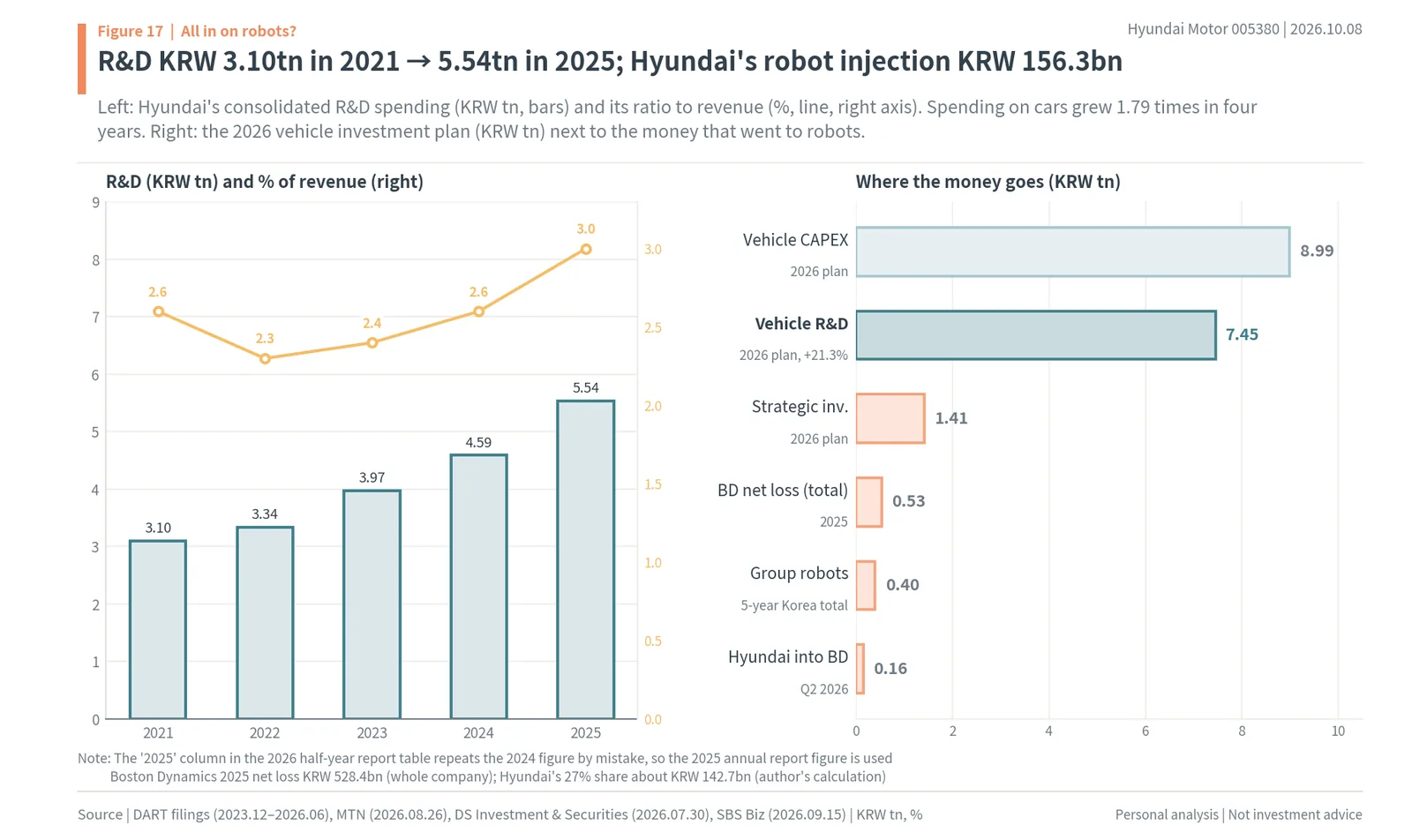
The left of Figure 17 is the R&D trend; the right compares 2026 vehicle investment with the size of the money that went to robots. Boston Dynamics’ net loss in 2025 was KRW 528.4bn (SBS Biz, 2026.09.15), about KRW 142.7bn for Hyundai’s 27% share (author’s calculation). Next to KRW 7.45tn of vehicle R&D, it is small money. At the CEO Investor Day the company itself said Hyundai is not the direct operator of the robot business but an investor in Boston Dynamics that supports production, and Samsung Securities summed this up as Hyundai choosing a supporting role in the robot business (2026.09.23).
The history of the money put into Boston Dynamics is also worth summarizing. In 2021 Hyundai Motor, Kia, Mobis, Glovis and Chairman Chung Eui-sun bought 80% for about KRW 950bn (MTN, 2026.01.21), and after capital increases cumulative investment passed KRW 3tn (BizWatch, 2026.01.20). Net losses grew from KRW 197bn in 2021 to KRW 440.5bn in 2024 and KRW 528.4bn in 2025, a cumulative KRW 1,755.8bn for 2021–2025. In July SoftBank said it would sell its remaining stake, and the group moved to buy all of it. A listing in 2027 is hard, and 2029–2030 is being mentioned as possible (News Tomato, 2026.10.08). It is big money, but it was split among several group companies and the chairman personally, and the part Hyundai paid alone is small next to its vehicle investment.
Where the car business looks weaker is the software schedule, not the money
Where the car business looks weaker even though the money did not shrink is software. In January Hana Securities wrote that a software-defined vehicle (SDV) demo car would be unveiled in the second half of 2026, but by July this had slipped to an unveiling in Q1 2027 and mass production in Q4 2028 (DS Investment & Securities, 2026.07.30). At the August Investor Day an investor asked directly why the SDV schedule keeps slipping. If the reason Tesla sells like an iPhone in Chapter 3 is the brand and the expectations for its software, that schedule is what Hyundai has to catch up on. Among its car segments, the weak spot is the mid-size electric SUV seen in Chapter 5, and the reason that car is missing is not robots either, but the end of US EV subsidies.
The point at which robots become profit for Hyundai is also far off. The plan the company gave at the Investor Day starts in 2028 with putting Atlas into the Georgia plant (HMGMA) to sequence parts and widens to assembly in 2030, and a US robot plant with capacity of 30,000 units a year is to be built by 2028 (Hyundai Motor newsroom, 2026.08.26). Those 30,000 units also include the four-legged robot Spot and the logistics robot Stretch (Eugene Investment & Securities, 2026.08.27). Robots are a story for several years out, and until then Hyundai’s profit still comes from cars.
What robots took was the share price
What robots took was not money but the share price. Divided by the same 2026 EPS consensus of KRW 36,678, the share price of KRW 215,000 at the end of September 2025 was 5.9x PER, KRW 750,000 on June 1 was 20.4x, and today’s KRW 324,500 is 8.8x. The profit outlook barely changed, but the multiple rose nearly fourfold and came back down. Robot hopes were attached to a company whose average PER in 2022–2024 was 5.0x, and they are now draining away.
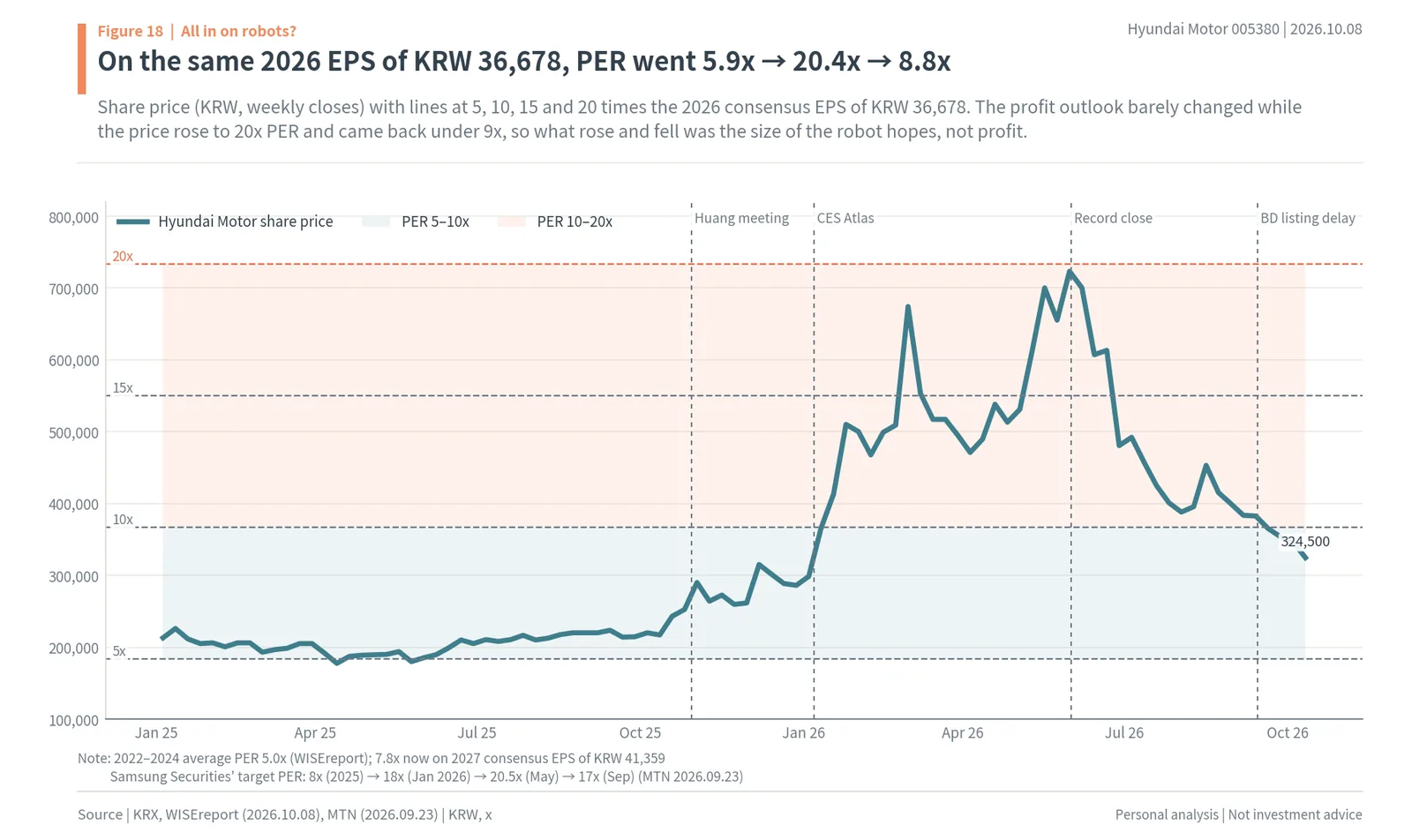
Figure 18 overlays lines at 5, 10, 15 and 20 times that EPS on the share price. The stock passed the 10x line in January 2026, went near the 20x line in June, and is now back below the 10x line. Broker target PERs followed the same path. Samsung Securities raised its multiple from 8x in 2025 to 18x in January 2026 and 20.5x in May, then cut it to 17x in September, and Daishin Securities dropped its method of including KRW 40tn of new-business value and switched to a PER of 12.6x. On 2027 EPS consensus of KRW 41,359, the current price is 7.8x. With the robot hopes gone, the share price has begun to be valued on car profits again.
8. Hyundai Motor Earnings Forecast and Target Price: KRW 316,200 (Author’s Estimate)
2026 operating profit of KRW 10.12tn
The author’s estimates use a simple frame: wholesale units times operating profit per car gives operating profit. Operating profit per car came down from KRW 3.44mn in 2024 (operating profit of KRW 14.24tn ÷ 4.142 million wholesale units) to KRW 2.77mn in 2025, with tariffs and incentives making the difference. First-half 2026 operating profit was KRW 5.37tn. The author’s base case is KRW 2.35tn for Q3 and KRW 2.40tn for Q4, for KRW 10.12tn for the year. Q3 is a quarter in which lost strike volume and a stronger won overlap, so it sits in the middle of the brokers’ KRW 2.23–2.5tn estimates; for Q4 the author assumes normalized production and new Tucson deliveries offset the stronger won. Full-year wholesale is 2,886,763 for January–September plus 1.05 million in Q4, or 3.937 million units, for operating profit per car of KRW 2.57mn.
This estimate is below consensus. WISEreport consensus for 2026 is operating profit of KRW 11.012tn and EPS of KRW 36,678; the author’s base case is operating profit of KRW 10.12tn and EPS of KRW 33,079, about 10% lower on EPS. The gap is in the second half. Consensus Q4 operating profit of KRW 2,834.2bn is closer to figures from when the won was around 1,500 per dollar; the author put in today’s stronger won at 1,343 and lower domestic sales and set Q4 at KRW 2.40tn. The bear case sets both Q3 and Q4 at KRW 2.20tn, for KRW 9.77tn, and the bull case sets them at KRW 2.50tn and 2.70tn, for KRW 10.57tn.
2027 operating profit of KRW 10.99tn and EPS of KRW 35,933
The 2027 base case is 3% wholesale growth and operating profit per car of KRW 2.71mn. Wholesale growth reflects the low base left by the strikes and the first-year effect of the plan for 100 new models; the recovery in profit per car reflects a larger hybrid share and cost cuts. Profit per car is set below 2025’s KRW 2.77mn because the stronger won and the loss of domestic share are both included. On this basis 2027 operating profit is KRW 10.99tn (about $8.2bn), 12.3% below consensus of KRW 12.534tn, and with net profit attributable to owners at 0.86 times operating profit, EPS is KRW 35,933.
The bear case is wholesale down 1% and operating profit per car of KRW 2.26mn, for 2027 operating profit of KRW 8.7tn; the bull case is wholesale up 5% and KRW 3.09mn per car, for KRW 12.87tn. The bear case is one in which the strong won and the exit of buyers in their 20s and 30s continue; the bull case is one in which the new Tucson and hybrids win back domestic share and US local production eases the tariff burden.
1-year target price of KRW 316,200
The target price adds the car business and the Boston Dynamics stake. The car business is 2027 EPS of KRW 35,933 times a PER of 8.2x, or KRW 294,600. The 8.2x matches the global carmaker average in the low 8x range given by Hana Securities (2026.10.07), a multiple for a car company with the robot hopes taken out. The Boston Dynamics part takes KRW 30tn, at the low end of brokers’ enterprise value estimates (KRW 12tn–128tn), multiplies it by Hyundai’s 27% stake and applies a 30% holding-company discount, for KRW 21,600 a share. Adding the two gives the author’s 1-year target price of KRW 316,200 (about $235), 2.6% below today.
The bear case is 6.5x for cars and KRW 12tn for Boston Dynamics, for KRW 193,500 (−40.4%, about $144); the bull case is 10x and KRW 62tn, for KRW 465,400 (+43.4%, about $347). Weighting bear 25%, base 50% and bull 25% gives KRW 322,800. The broker average target price is KRW 655,600 (25 brokers, about $488), but targets issued in October have come down to KRW 510,000–600,000, and most of the gap comes from the 11.8–12.6x PER they use against the author’s 8.2x.
Why 8.2x
A little more on why this multiple was chosen. Hyundai’s average PER in 2022–2024 was 5.0x (WISEreport). The reason it should be higher now than then is shareholder returns. At the August Investor Day the company set out a total shareholder return of 35% or more, a minimum dividend of KRW 10,000 and the cancellation of all the treasury shares it holds, and on August 26 it decided to cancel about KRW 789.1bn of treasury shares. On the other hand, the Boston Dynamics listing has moved further away and the company itself has taken a supporting role in the robot business, so there is little reason to put large robot hopes back into the multiple. So the car business gets 8.2x, matched to the global carmaker average, and the robot part is added separately as stake value. The 11.8–12.6x that brokers use puts robots and shareholder returns into a single multiple.
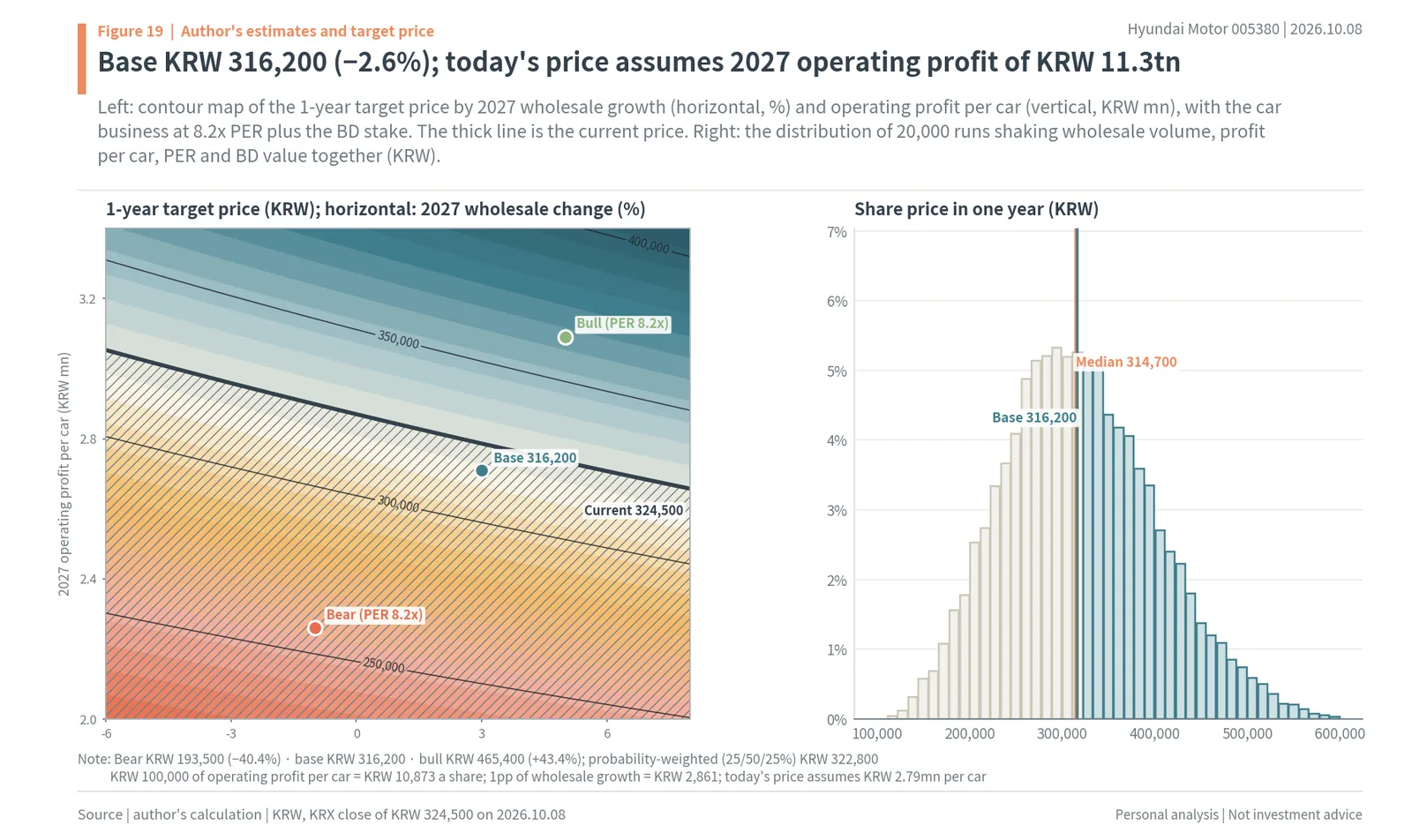
The left of Figure 19 is a contour map of the target price by 2027 wholesale growth and operating profit per car, and the thick line is the current price. Working backward from today’s share price, it assumes operating profit per car of KRW 2.79mn at 3% wholesale growth, or 2027 operating profit of KRW 11.3tn (about $8.4bn). That is almost the same height as the author’s base case of KRW 10.99tn, so today’s price already reflects most of the profit decline. KRW 100,000 of operating profit per car is worth KRW 10,873 a share, and 1 percentage point of wholesale growth KRW 2,861. The right is the distribution of 20,000 simulation runs that shake wholesale volume, profit per car, PER and Boston Dynamics value together. The median is KRW 314,700 (−3.0%), and 8 runs in 10 fall between KRW 216,400 and KRW 429,700. Hyundai is not so much a stock to buy now and wait on as one to buy after confirming signs that profit per car is rising again.
If Hyundai itself stays where it is, where in this chain does money grow? On the side that receives the volume Hyundai moves. Chapter 9 looks for it against market caps.
9. Beneficiary Stocks: Ecoplastic, Ajin Industrial and Hwashin, the Georgia Suppliers With the Biggest Impact for Their Size
The yardstick: event-linked revenue ÷ market cap
The direction of money in this chain is clear. To save tariffs, Hyundai is filling its US plants, above all the half-empty Georgia plant, with hybrids. The companies that receive that volume are the beneficiaries. But the same volume moves share prices very differently depending on the size of the company. KRW 100bn of revenue added to a company worth KRW 30tn is a very different thing from KRW 100bn added to a company worth KRW 100bn. So this chapter ranks companies by event-linked annual revenue divided by market cap. The bigger the multiple, the harder the same event hits that company’s share price.
For comparison, the same yardstick is applied to the beneficiaries usually mentioned: Myoung Shin Industrial and L&F, tied to Tesla’s sales in Korea, and Hyundai Mobis, which drew hopes as a parts maker for the Atlas robot. The events differ, but the question is the same: how many times market cap is the one-year revenue tied to this story?
The listed suppliers that went to Georgia
Hyundai’s suppliers followed it to Georgia. According to a list compiled by the Savannah Morning News, Joon Georgia of the Ajin Industrial group invested $317mn, Ecoplastic $205mn, Hwashin $176mn, Seoyon E-Hwa $76mn and PHA $67mn in plants there, and Hyundai Mobis and Hanon Systems went too (NewsandPost, 2024.11.26). The investments alone are heavy for small companies. Ajin Industrial’s market cap is KRW 88.5bn and Ecoplastic’s KRW 84.2bn, and what each put into Georgia is several times that.
Of these, Ajin Industrial, Ecoplastic and Hwashin report their Georgia units’ revenue and net profit separately in DART filings. Ajin Industrial set up Joon Georgia in October 2022. Ecoplastic wrote in its annual report that its US unit went to the US together with the Georgia plant and won orders for bumpers, consoles and garnishes on that plant’s models, and lists Kia’s Georgia plant (KaGA) and HMGMA as customers. Hwashin set up its Georgia unit in July 2023. Seoyon E-Hwa and PHA report their US units together, so the Georgia part cannot be separated and they are left out of the calculation.
The Georgia units’ revenue tracks HMGMA output
The three Georgia units are taking the full force of the halving seen in Chapter 2. From the first half of 2025 to the first half of 2026, while Hyundai’s HMGMA output fell 48.8%, revenue at Ajin Industrial’s Georgia unit fell 52.5% from KRW 87.1bn to KRW 41.4bn, and revenue at Ecoplastic’s US unit fell 45.2% from KRW 123.4bn to KRW 67.6bn. Hwashin’s Georgia unit began deliveries in the second half of 2025 and booked KRW 55.2bn of revenue in the first half of this year. Revenue moves with plant output like this because these units were built, in effect, for that one plant.
With the plants built and volume cut in half, losses followed. First-half net losses at the Georgia units were KRW 31.4bn at Ajin Industrial (KRW 16.6bn a year earlier), KRW 14.6bn at Ecoplastic (KRW 12.1bn) and KRW 18.6bn at Hwashin (KRW 2.4bn), KRW 64.6bn for the three. For the whole of 2025, Ajin Industrial’s Georgia unit had revenue of KRW 143.6bn and a net loss of KRW 42.9bn, and Ecoplastic’s US unit revenue of KRW 191.7bn and a net loss of KRW 28.2bn. Ajin Industrial wrote in its 2025 annual report that it ran an impairment test on Joon Georgia because of its worsening business environment. This is why the market turned away from these companies.

The right of Figure 20 sets HMGMA output and the two Georgia units’ revenue to 100 in the first half of 2025. The three lines fall almost on top of each other. When plant output halves, the units’ revenue halves, and in reverse, when the plant fills up, revenue fills up with it.
When HMGMA fills up with hybrids, it reverses
So the calculation starts from plant output. Dividing each Georgia unit’s first-half 2026 revenue by HMGMA’s 19,100 units in the same period gives revenue per HMGMA car of KRW 2.17mn at Ajin Industrial, KRW 3.54mn at Ecoplastic and KRW 2.89mn at Hwashin (author’s calculation). Ecoplastic’s figure includes supply to Kia’s Georgia plant, so it is the most generous of the three. Assuming the same revenue per car for the Palisade hybrid and multiplying by 74,000 cars gives added annual revenue of KRW 262.0bn at Ecoplastic, KRW 160.6bn at Ajin Industrial and KRW 213.9bn at Hwashin (author’s assumption).
Divided by market cap, that is 3.11x at Ecoplastic, 1.81x at Ajin Industrial and 0.82x at Hwashin. The same yardstick applied to the usual names shows a clear gap. Myoung Shin Industrial is the sole supplier of hot-stamped body parts to Tesla’s Shanghai plant; multiplying Daishin Securities’ 2025 estimate for its China Tesla unit, KRW 699bn, by Korea’s 12.0% share of Shanghai wholesale gives KRW 83.9bn of revenue tied to Tesla’s Korean sales, 0.19x its market cap of KRW 443.4bn. For L&F, annualized Q2 revenue of KRW 3.54tn times a Tesla share of about 80% and Korea’s 6.73% of Tesla’s sales gives KRW 190.6bn, 0.04x market cap. For Hyundai Mobis, Samsung Securities’ estimate of KRW 963bn a year from Atlas actuators is 0.03x a market cap of KRW 32.25tn.
The left of Figure 20 is this comparison. The horizontal axis is market cap and the vertical axis event revenue ÷ market cap, both on log scales. The three Georgia suppliers in teal sit at the upper left, and the usual beneficiaries in grey at the lower right. The smaller the company, the harder the same Hyundai decision hits its share price.
There is a model inside the same company for what a full plant earns. Ajin Industrial’s Alabama unit, JOON INC, had revenue of KRW 637.2bn and net profit of KRW 27.3bn in 2025, while Hyundai’s Alabama plant built 362,000 cars. That is a 4.3% net margin and KRW 1.76mn of revenue per Alabama car. When the plant is full, the same company with the same parts makes money.
In profit terms, the effect is bigger
Losses are more direct than revenue. Annualizing the Georgia units’ first-half net losses gives KRW 62.8bn at Ajin Industrial, KRW 29.2bn at Ecoplastic and KRW 37.2bn at Hwashin, which is 71.0%, 34.7% and 14.3% of market cap. If hybrids fill HMGMA and these losses simply go to zero, Ajin Industrial gets back more than 70% of its market cap as annual profit.
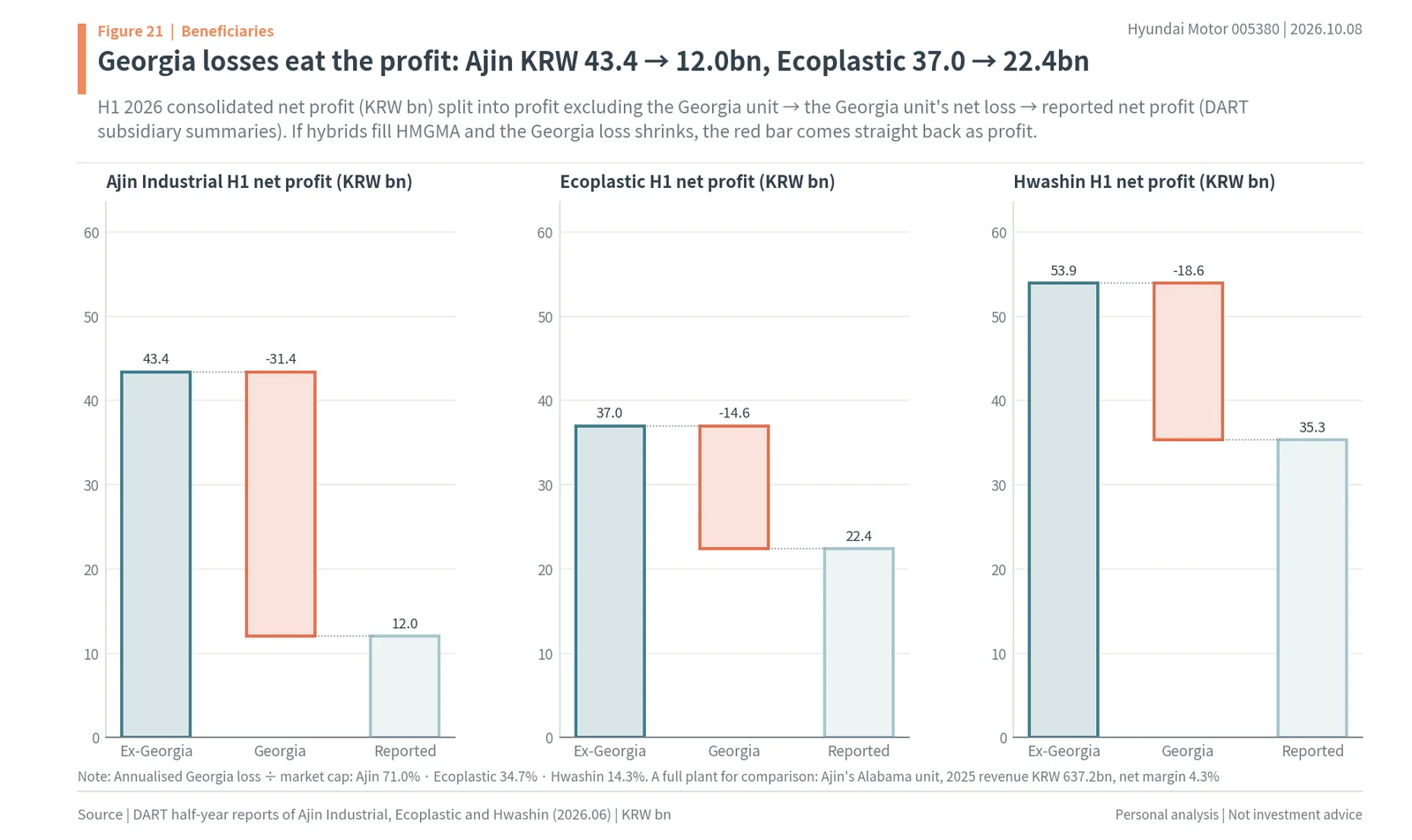
Figure 21 splits first-half consolidated net profit into profit excluding the Georgia unit, the Georgia unit’s net loss and reported net profit. First-half net profit went from 43.4 to 12.0bn at Ajin Industrial, from 37.0 to 22.4bn at Ecoplastic and from 53.9 to 35.3bn at Hwashin, in KRW, as the Georgia units took away KRW 31.4bn, 14.6bn and 18.6bn. Without Georgia, Ajin Industrial would have earned more than three times what it actually did in the first half. Given 2025 consolidated net profit of KRW 23.2bn at Ajin Industrial and KRW 2.0bn at Ecoplastic, the Georgia losses are deciding almost all of these companies’ profit.
Not priced in yet
The share prices do not yet reflect this recovery. At the October 8 close, the price-to-book ratio was 0.24x at Ajin Industrial, 0.22x at Ecoplastic and 0.42x at Hwashin, and the shares were 53.4%, 60.5% and 55.4% below their 52-week highs. The market sold these companies on the Georgia losses, and the fact that the volume to fill them is coming through the fix in Chapter 2 is not yet in the price.
The companies are already moving that way. On July 28 Ajin Industrial decided to put another $25mn, KRW 36.6bn, into Joon Georgia, and the purpose stated in the filing was more facility investment to develop and supply additional parts as a body-parts supplier to the Georgia plant. That is 10.55% of its equity of KRW 347.4bn. The Sportage Hybrid has been running at the Georgia plant since June, and the Palisade hybrid joins from Q2 2027.
The author’s order
The author sees Ecoplastic and Ajin Industrial as the companies that gain the most, for their size, from Hyundai choosing America over Korea. Ecoplastic has the largest event-revenue multiple at 3.11x, and Ajin Industrial the biggest profit leverage, with a Georgia loss equal to 71.0% of market cap. Next comes Hwashin. With a market cap of KRW 260.2bn its multiple is lower, but its Georgia unit has only just started booking revenue. On the Tesla side, Myoung Shin Industrial remains. Korea has grown to 6.73% of Tesla’s total sales, but for its size the effect falls far short of the three Georgia suppliers. Whether this order is right will first be checked by HMGMA output and the Georgia units’ results in the Q3 reports in mid-November.
10. Numbers and Dates to Watch: HMGMA Output, Georgia Losses, Monthly Sales and Q3 Results
A few numbers will show whether this report’s chain holds. The first is output at the Georgia plant. Hyundai’s HMGMA output was 9,200 units in Q2 2026, and the Sportage Hybrid joined in June. Watch whether quarterly output rises again in the Q3 report in mid-November. On the same day, watch whether the Georgia units’ net losses (KRW 64.6bn for the three in the first half) shrink in the quarterly reports of Ajin Industrial, Ecoplastic and Hwashin. That is the first check on the order in Chapter 9.
The second is Hyundai’s domestic sales on the 1st of each month and the import car association’s registrations early each month. Watch whether Hyundai’s domestic sales top 50,000 in October, when new Tucson deliveries begin, from 49,022 in September, and whether Tesla registrations come down from 12,372 in September. The third is Q3 results at the end of October; last year they came out on October 30. The author’s base case for operating profit is KRW 2.35tn, and the things to watch are tariff costs, incentives and the schedule the company gives for moving production to the US. The fourth is domestic revenue per car: watch whether the next half-year report shows it above KRW 41.22mn. Whether price increases carry through to revenue per car decides the conclusion of Chapter 6.
The fifth is two dates in 2027: the decision on mass production of the Palisade hybrid in Georgia, under review for around April, and the reallocation of volume ahead of the demolition of Ulsan plant 1 in September. The first decides when the Georgia suppliers’ revenue fills up; the second, where work at Korean plants and the Ioniq V debate go.
If these numbers move in one direction, the view changes too. If HMGMA quarterly output tops 15,000 and the Georgia suppliers’ losses shrink, the order in Chapter 9 holds; if Hyundai’s monthly domestic sales top 60,000 and Tesla registrations fall below 8,000, buyers in their 20s and 30s are coming back.
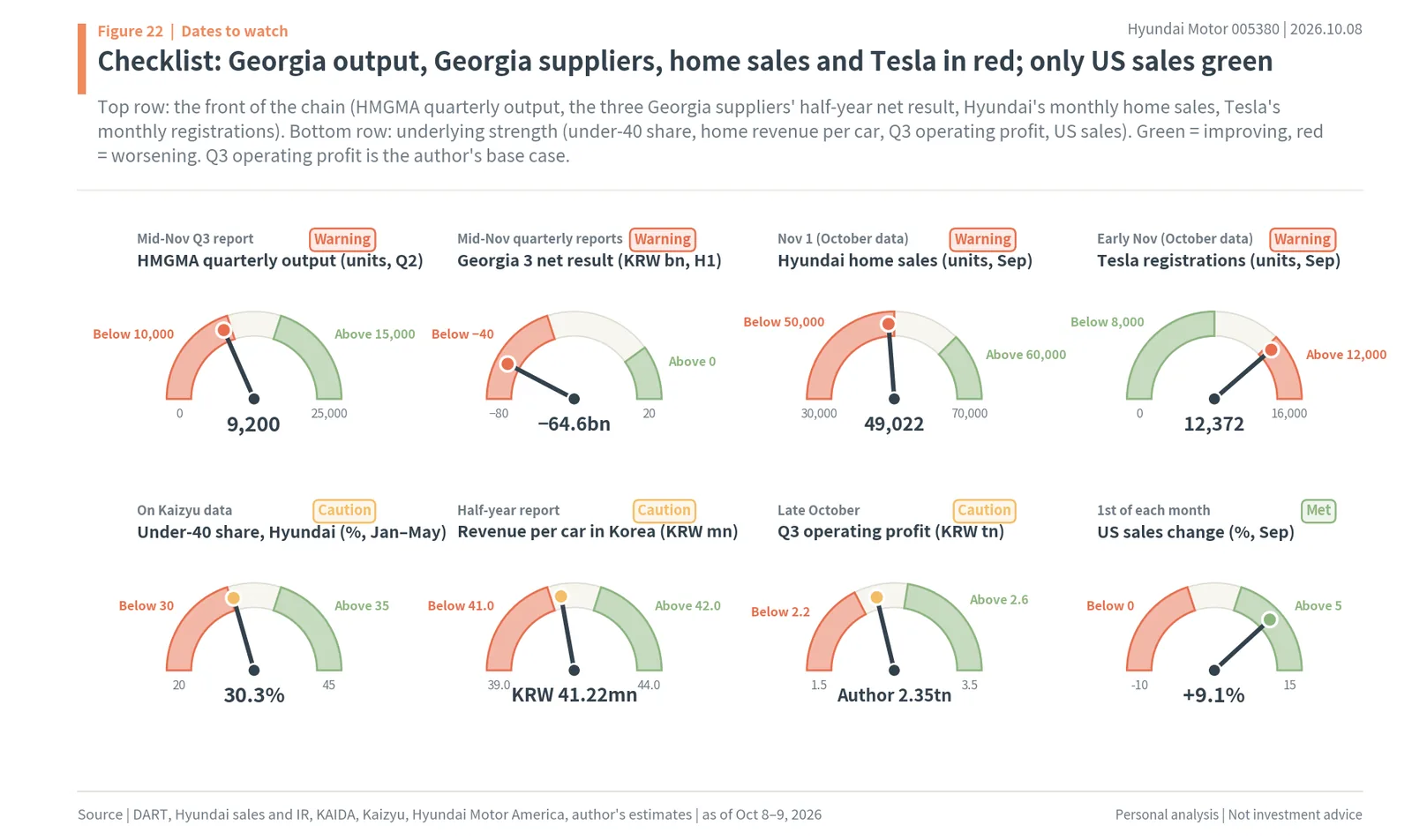
Figure 22 gathers these numbers on gauges. The top row is the front of the chain: HMGMA quarterly output, the three Georgia suppliers’ half-year net result, Hyundai’s monthly domestic sales and Tesla’s monthly registrations. The bottom row is underlying strength: Hyundai’s share among buyers in their 20s and 30s, domestic revenue per car, Q3 operating profit and US sales. Right now Georgia output, the Georgia suppliers, domestic sales and Tesla are red, and only US sales are green.
Conclusion
The six questions about Hyundai are one chain from one cause. When America imposed a 15% tariff and ended EV subsidies, output at the Georgia EV plant was cut in half, and Hyundai chose to fill America first. It is moving 74,000 Palisade hybrids from Ulsan to Georgia, and it stopped developing the mid-size electric SUV that would no longer sell in the US.
The price of that choice was left in the Korean market. With no Sorento/Santa Fe-size electric SUV and higher prices on every new model, people in their 20s and 30s bought Teslas at a similar price the way they buy iPhones, and Hyundai’s domestic sales fell even without the strikes. The Ioniq V is not a car that fits the slot, and with Ulsan volume leaving for America, bringing in a China-built car as well would take work away from Korean plants twice, so it does not come in. Korean plant output fell, and with revenue per car flat and only units falling, profit fell. Meanwhile the robot hopes that lifted the share price faded, and Hyundai is back near the author’s target of KRW 316,200.
The money goes to whoever receives the volume Hyundai is moving. The small suppliers that went with Hyundai to Georgia are losing money now because that plant was cut in half, but when the same plant fills up with hybrids, those losses come back as profit. For their size, the effect is in a different league from the beneficiaries usually named.
Maochaedung’s take. Hyundai chose America; Tesla fills Korea, and the money goes to Georgia. When US tariffs and the end of EV subsidies left the Georgia EV plant half idle, Hyundai chose to fill America first, and the price was an empty mid-size electric SUV slot and higher prices in Korea, so people in their 20s and 30s bought Teslas like iPhones. Domestic sales fell even without the strikes, and with Ulsan volume leaving for America too, the China-built Ioniq V cannot come in, not because of Namyang’s capability but because of work at Korean plants. With revenue per car flat and only units falling, profit fell, and as the robot hopes that filled that gap faded, the share price came back to where it started. The money goes to the small Georgia suppliers that receive the volume Hyundai is moving, and for their size, the author sees Ecoplastic and Ajin Industrial gaining the most.
Hyundai Motor Stock FAQ
Q. Why did Hyundai Motor move Palisade hybrid production from Korea to Georgia?
A 15% US tariff (about KRW 4.1tn in 2025) and the end of US EV subsidies cut output at the Georgia EV plant (HMGMA) by 48.8% in 1H 2026, to 37.2% utilization. Hyundai is filling it with hybrids: the Kia Sportage Hybrid from June 2026 and about 74,000 Palisade hybrids a year from Ulsan from Q2 2027, saving about KRW 8.14mn a car, or KRW 600bn a year, in tariffs (NewDaily estimate).
Q. Why are Hyundai Motor’s domestic sales falling in 2026?
Hyundai sold 448,181 cars in Korea in January–September, down 16.3% and the lowest since 2008. Strikes cost about 55,200 units, but even adding them all back the decline is 6.0%. Over the same period Kia rose 5.4% and Tesla registrations rose 104.4% to 89,148, so buyers chose other cars.
Q. Why are young Korean buyers choosing Tesla over Hyundai?
Hyundai’s share of new cars bought by people in their 20s and 30s fell from 38.2% to 30.3% in January–May, while Tesla’s rose from 4.7% to 14.3%. Hyundai raised starting prices (Palisade +KRW 4.87mn, Avante +KRW 3.36mn) while Tesla cut the Model Y base model by KRW 3mn to KRW 49.99mn, and Tesla used prices fell only 3.0% from January to June.
Q. Why doesn’t Hyundai have a mid-size electric SUV to compete with the Model Y?
According to journalist Ryu Jong-eun on the YouTube channel Apkwon, Hyundai was developing a D-segment (Sorento/Santa Fe-size) electric SUV and stopped after EV subsidies ended in the US, its main market. In the US, Ioniq 5 sales fell 65% in September and 24% in January–September, and Ioniq 6 sales fell 85%. Meanwhile the Model Y sold 11,421 in Korea in September.
Q. Why doesn’t Hyundai sell the Ioniq V in Korea?
The Ioniq V is a 4,900mm mid-size electric sedan, so it cannot fill the electric SUV slot the Model Y took, and it overlaps with the Asan-built Ioniq 6. Importing it would run into worries on the R&D side that strong sales could be used to cut Namyang’s budget (Apkwon), Article 42 of the union agreement, which bars imports of models built in Korea, Ioniq 6 sales, and price: on the Kia EV5 precedent it could rise about KRW 20mn to around KRW 45mn.
Q. Did Hyundai’s price increases raise profit?
No. The average list price rose from KRW 53.98mn in 2024 to KRW 57.03mn in the first half of 2026, but realized domestic revenue per car fell from KRW 41.37mn to KRW 41.22mn (author’s calculation). Of the KRW 1.63tn fall in first-half domestic revenue, KRW 1.58tn came from fewer units, and Q2 operating profit fell 20.8% to KRW 2,850.9bn as net incentives rose about KRW 0.4tn.
Q. What is the target price for Hyundai Motor stock?
The author’s 1-year target price is KRW 316,200 (about $235), 2.6% below KRW 324,500: 2027 EPS of KRW 35,933 × 8.2x PER (KRW 294,600) plus KRW 21,600 a share for the Boston Dynamics stake. The bear case is KRW 193,500 and the bull case KRW 465,400, and the broker average target is KRW 655,600. Today’s price assumes 2027 operating profit of KRW 11.3tn.
Q. Which stocks benefit most, for their size, from Hyundai’s shift to US production?
The Georgia suppliers that followed Hyundai to HMGMA. Their Georgia units’ revenue fell with plant output (Ajin −52.5%, Ecoplastic −45.2% vs HMGMA −48.8%) and lost KRW 64.6bn in 1H 2026. Applying today’s revenue per HMGMA car to 74,000 Palisade hybrids gives added revenue of 3.11x market cap at Ecoplastic, 1.81x at Ajin Industrial and 0.82x at Hwashin, versus 0.19x at Myoung Shin Industrial and 0.03x at Hyundai Mobis (author’s calculation). Ajin’s Georgia loss alone equals 71.0% of its market cap.
Sources
- Financial Supervisory Service DART, Hyundai Motor half-year report 2026.06 (link), 2026.08.14
- Financial Supervisory Service DART, Hyundai Motor annual report 2025.12 (link), 2026.03.18
- Financial Supervisory Service DART, Hyundai Motor half-year report 2025.06 (link), 2025.08.14
- Financial Supervisory Service DART, Hyundai Motor annual report 2023.12 (link), 2024.03.13
- Hyundai Motor, September 2026 sales (link), 2026.10.01
- Hyundai Motor, monthly sales releases, January 2025 – August 2026 (link), 2025.02–2026.09
- Hyundai Motor, Q2 2026 business results (link), 2026.07.23
- Kia, September 2026 sales (link), 2026.10.01
- With News Car, Hyundai’s January–September domestic sales lowest since 2008 (link), 2026.10.08
- Dailian, September sales at the five Korean carmakers (link), 2026.10.01
- Dealsite, Carmakers’ first-half sales (link), 2026.07.01
- SBS Biz, Tesla tops September imports (link), 2026.10.06
- Financial News, September imported car registrations (link), 2026.10.06
- Newspim, January–September new car registrations (CarIsYou) (link), 2026.10.09
- Techpress, New-car shares among buyers in their 20s and 30s (CarIsYou Data Research Institute) (link), 2026.06.18
- Economist (Korea), 20s and 30s hooked on Tesla: “they buy it like an iPhone” (link), 2025.12
- Invest Chosun, Tesla FSD compared with the 2007 iPhone (link), 2026.03.18
- MTN, Tesla FSD expansion in Korea (link), 2026.07.10
- Herald Economy, Tesla price cut (link), 2026.01.01
- SBS Biz, Tesla raises Model 3 and Model Y prices (link), 2026.07.01
- BizWatch, ‘A weak new-car effect’: Hyundai caught in a price-increase dilemma (link), 2026.10.07
- CnEVPost, Hyundai launches China-tailored Ioniq V (link), 2026.09.29
- Danawa Auto, Ioniq V launch price (link), 2026.09
- Insight, First-half Ioniq sales (link), 2026.07.03
- The With Car, Hyundai’s imports of the Sonata taxi from China and collective agreement Article 42 (link), 2023.12.17
- Herald Economy, Hyundai and Kia re-imports reach 35,000 in two years (link), 2026.02.24
- Hankyoreh, Could the Ioniq V be re-imported into Korea? (link), 2026.08.24
- Apkwon (YouTube channel, with Lee Ju-ho and Ryu Jong-eun), Why the rising share of Chinese cars puts even Hyundai’s domestic sales at risk [Ryubility] (link), 2026.10.07
- Ministry of Trade, Industry and Resources, September 2026 export and import trends (link), 2026.10.01
- Hyundai Motor IR, Monthly sales filings (link), 2026.10.01
- Hyundai Motor America, September 2026 sales (link), 2026.10.01
- Twig, Hyundai’s US local production share (link), 2026.08.21
- Edaily, Review of moving 200,000 units a year to the US (link), 2026.03.23
- MTN, Boston Dynamics ownership structure and capital injection (link), 2026.08.26
- Hana Securities, Hyundai Motor Q4 results below expectations (link), 2026.01.30
- Hana Securities, Hyundai Motor target price cut (Asia Economy, https://core.asiae.co.kr/article/2026100621393679384), 2026.10.07
- Investing.com, Hyundai Motor Q2 conference call transcript, 2026.07.23
- Korea Economic Daily, L&F’s Tesla share (link), 2025.09.18
- Asia Economy, Myoung Shin Industrial as Tesla’s sole supplier (link), 2022.01.29
- Asia Economy, Hanyang Securities on Myoung Shin Industrial (link), 2026.03.12
- Daishin Securities, Myoung Shin Industrial revenue by subsidiary (link), 2024.04.01
- NewDaily, Hyundai to move Palisade HEV production to the US from Q2 next year (link), 2026.09.04
- eNewsToday, Kia starts Sportage Hybrid production at HMGMA (link), 2026.06.03
- NewsandPost, The Hyundai suppliers that followed it to Georgia (link), 2024.11.26
- Financial Supervisory Service DART, Hyundai Motor half-year report 2025.06 and quarterly reports 2025.09 and 2026.03, production by plant (HMGMA, HMMA, Korea), 2025.08–2026.05
- Financial Supervisory Service DART, Ajin Industrial annual report 2025.12 (link) and half-year report 2026.06 (link)
- Digital Today, Ajin Industrial adds KRW 36.6bn to Joon Georgia (link), 2026.07.28
- Financial Supervisory Service DART, Ecoplastic annual report 2025.12 (link) and half-year report 2026.06 (link)
- Financial Supervisory Service DART, Hwashin annual report 2025.12 (link) and half-year report 2026.06 (link)
- Digital Daily, L&F Q2 results (link), 2026.08.06
- Naver Finance, market caps, price-to-book ratios and 52-week ranges of Ajin Industrial, Ecoplastic, Hwashin and Myoung Shin Industrial, accessed 2026.10.11
- Tesla, Quarterly delivery reports for 2025 and 2026, 2026.01–10
- Korea Exchange (KRX), Hyundai Motor and comparison stock prices, KOSPI index, trading by investor type, 2026.10.08
- WISEreport and Naver Finance, Hyundai Motor consensus and broker target prices, accessed 2026.10.08
- Yahoo Finance, KRW/USD exchange rate, 2026.10.09
Disclaimer
This post records the author’s personal analysis and views based on publicly available information and does not recommend choosing any particular product or company. It does not recommend buying or selling any financial investment product and is not a service provided as investment advisory or quasi-investment advisory business.
Figures in this post are values published as of the time of writing. Domestic revenue per car (DART separate domestic product revenue ÷ domestic unit sales announced by the company), the decline rate with strike volume added back, the Georgia units’ revenue per HMGMA car and the revenue tied to the Palisade hybrid (assuming today’s revenue per car carries over to the new model), the multiples of market cap, the Korean sensitivity of Tesla suppliers, 2026–2027 operating profit and EPS, and the target price are estimates from calculations and models the author built, not company guidance or broker consensus. The wording of the collective agreement article and the shares among buyers in their 20s and 30s are cited from press reports, and the interpretation of why the Ioniq V is not brought into Korea is the author’s view. Accuracy and completeness are not guaranteed.
The target price, scenarios and simulation are estimates based on the assumptions stated in the text (wholesale growth, operating profit per car, PER, Boston Dynamics enterprise value), and results will differ if those assumptions do not hold. Items marked ‘author’s calculation’ or ‘author’s estimate’ are the author’s calculations and assumptions, not confirmed facts.
Hyundai Motor is listed in Korea and trades in Korean won, so for overseas investors, gains and losses in your home currency change with exchange rates. Dollar figures in the text are converted at KRW 1,343 per dollar (Yahoo Finance, October 9, 2026).
Author’s interest: not disclosed
Responsibility for decisions and their outcomes lies with the reader.
As of: October 11, 2026