
Lotte Rental (089860.KS) Tender Offer Outlook: What TPG’s 2 Board Seats Mean for Dividends, Debt and a KRW 59,000 Tender Offer

On January 22, 2016, the private equity firm Hahn & Company (Hahn & Co) signed a share purchase agreement to buy 46.14% of Ssangyong Cement Industrial for KRW 918.1bn. A little over two months later, on March 30, Ssangyong Cement’s annual general meeting at the Citi Center Tower in Jung-gu, Seoul, elected Hahn & Co chairman Yoon Yeo-eul and managing director Lee Dong-choon as inside directors. The appointments were set to take effect on the day the deal closed, and the deal closed 16 days later, on April 15. Hahn & Co launched a tender offer to buy all the remaining shares and delist the company 7.9 years after that, on February 5, 2024.
When the same Hahn & Co signed with the founder of medical device maker Lutronic on June 8, 2023, the order was reversed. Hahn & Co filed its tender-offer statement the next day, June 9, and chairman Yoon Yeo-eul, vice president Lee Dong-choon and vice president Bae Min-kyu became directors 39 days later, at an extraordinary general meeting (EGM) on July 18. Lutronic was delisted on October 27, 141 days after the agreement. Both deals, run by the same manager with the same people joining the board, ended in delisting, but one took four and a half months and the other nearly eight years.
So what about this time? On August 11 the US private equity firm TPG signed an agreement to buy 61.17% of Lotte Rental at KRW 59,000 a share (about $44.5), and at an EGM on October 30 it places two people on Lotte Rental’s board. This report asks three questions. What does it mean that two directors join? What effects can those seats have on Lotte Rental’s dividends, debt and business? And how do they bear on a tender offer for the remaining shares? To answer them, the report measures in turn the agenda of this EGM and the board’s records, the arithmetic of dividends and bonds, the order in which director elections and tender offers came in 14 private-equity buyouts of Korean listed companies, and how the market has priced this event.

This report is the detailed edition of the author’s Korean note on TPG’s two board seats at Lotte Rental, and it follows the author’s October 1, 2026 note on whether TPG would borrow to buy the remaining 39%.
As of: October 21, 2026 (prices are October 20, 2026 closes)
Stocks covered: Lotte Rental (089860.KS). Precedents compared: Douzone Bizon, Echo Marketing, Lutronic, Jeisys Medical, Osstem Implant, BusinessOn Communication, Ssangyong Cement Industrial (now Ssangyong C&E), Lock&Lock, Danawa (now Connectwave), Hanssem, Koentec, Classys and Namyang Dairy Products.
Topics covered: the agenda and board composition at the October 30 EGM, the board seats allowed by the articles of incorporation and the Commercial Act, where the deal stands and TPG’s filings, what the two directors mean and what the board decides, the effects on dividends, debt and the business, the dividend leakage and the cost of a tender offer, bonds with a change-of-control clause, the seven steps from tender offer to delisting and the board’s part in them, the order and prices of director elections and tender offers in 14 private-equity buyouts, the two paths to a tender offer seen through this election, October share prices and trading, the tender probability implied by the share price, scenarios and a simulation, taxes on tendering, and the dates to check.
Data: share prices, indexes and trading by investor type come from the KRX Data System (October 20, 2026 closes) and the consensus from WISEreport (October 20). Company facts follow DART filings (the amended resolution calling the EGM, the EGM notice, the report on changes in shares held by the largest shareholder, the bond registration statement and the half-year report), and the precedents follow each company’s DART filings of meeting results, tender-offer statements and changes of largest shareholder. Numbers the author calculated are marked “author’s calculation.”
Some Korea-specific background. The KOSPI is the main board of the Korea Exchange (KRX) and its benchmark index; tickers ending in .KS trade on the KOSPI. DART is the Financial Supervisory Service’s electronic disclosure system, where every filing cited here is public, and the KRX publishes each day’s net buying and selling by investor type (foreigners, institutions with sub-groups such as private funds, and individuals). Korea counts large sums in units of 100 million won (eok); this report shows them as KRW bn. A buyer that wants to take a Korean listed company private usually makes a voluntary tender offer for the remaining shares: the KOSPI’s standard for voluntary delisting is generally 95% of the shares excluding treasury shares, and whatever is left is then cashed out through a comprehensive share exchange. A bill that would introduce a mandatory tender offer has not passed the National Assembly, and it would not apply to this deal. Large Korean business groups (chaebol) such as Lotte are designated by the Fair Trade Commission as business groups subject to cross-shareholding restrictions; Lotte Rental’s public bonds treat leaving the Lotte group as a change of control, so the sale to TPG gives bondholders the right to demand early repayment. Dollar figures use KRW 1,326.1 per dollar, the October 20, 2026 rate (Yahoo Finance).
The author holds Lotte Rental shares as of writing.
1. The October 30 EGM fills every board seat TPG can hold without changing the articles
The filings came in four steps
This news did not arrive all at once. On September 7, Lotte Rental’s board resolved to call an EGM, set the date as October 27 and left the agenda blank as “to be disclosed again when confirmed.” An amended filing on October 7 moved the date to 10 a.m. on October 30 and the venue to the 9th floor of L7 Gangnam by Lotte Hotel on Teheran-ro, Gangnam-gu, Seoul, and filled in the agenda for the first time. There is a single item, “election of directors,” with two sub-items: Yoon Shin-won as a non-executive director (item 1-1) and Zubin Jamshed Irani as a non-executive director (item 1-2). The EGM notice and the proxy solicitation documents followed on October 15, and on the morning of October 20 Dealsite pulled it all together in an article headlined “Lotte Rental: two from TPG join the board.”
The record date for voting was September 22. Shareholders on the register that day vote, so the 61.17% of the votes at this meeting are held by Hotel Lotte and Busan Lotte Hotel, which have not yet handed over their shares. The October 13 report on changes in shares held by the largest shareholder still lists Hotel Lotte with 13,846,833 shares (38.14%) and Busan Lotte Hotel with 8,365,230 shares. The two candidates were nominated by Lotte Rental’s board, and the box for their relationship with the largest shareholder is blank. The seller, still holding the votes, seats the buyer’s people on the board. Electronic voting runs from 9 a.m. on October 20 to 5 p.m. on October 29.
Two people join: one who structures deals and one who fixes companies
Yoon Shin-won, born in 1980, has been a TPG Global Partner (head of Korea investments) since 2017. Before that he led Korean buyout investments at Morgan Stanley Private Equity from 2009 to 2017 and worked as an equity analyst at Goldman Sachs from 2006 to 2009. His job is deciding what TPG buys in Korea, at what price and how the money is raised.
Zubin Jamshed Irani, born in 1972, has been a TPG Global Partner (head of Asia portfolio operations) since 2015. He was head of India for UTC from 2010 to 2015 and for Carrier from 2006 to 2010, and a McKinsey consultant from 1999 to 2005. His job is improving the operations of the companies TPG buys. Both are non-executive directors, who do not work at the company full time, and both have three-year terms. A deal maker and a company fixer join together.
From 6 to 7: CEO 1, TPG 2, independent directors 4
Lotte Rental’s board now has six members: inside director and CEO Lee Jang-seop; non-executive director Choi Young-jun, head of financial innovation at Lotte Corp.; and four independent directors, Choi Jung-wook, Park Soo-kyung, Baek Bok-in and Jeon Gyu-an. Choi Young-jun’s term originally ran to March 2027, but he steps down effective October 30 (Dealsite). After the meeting the board will have seven members: one CEO, two TPG non-executive directors and four independent directors. TPG holds 2 of the 7 seats (28.6%), and the independent directors hold 4 (57.1%), a majority.
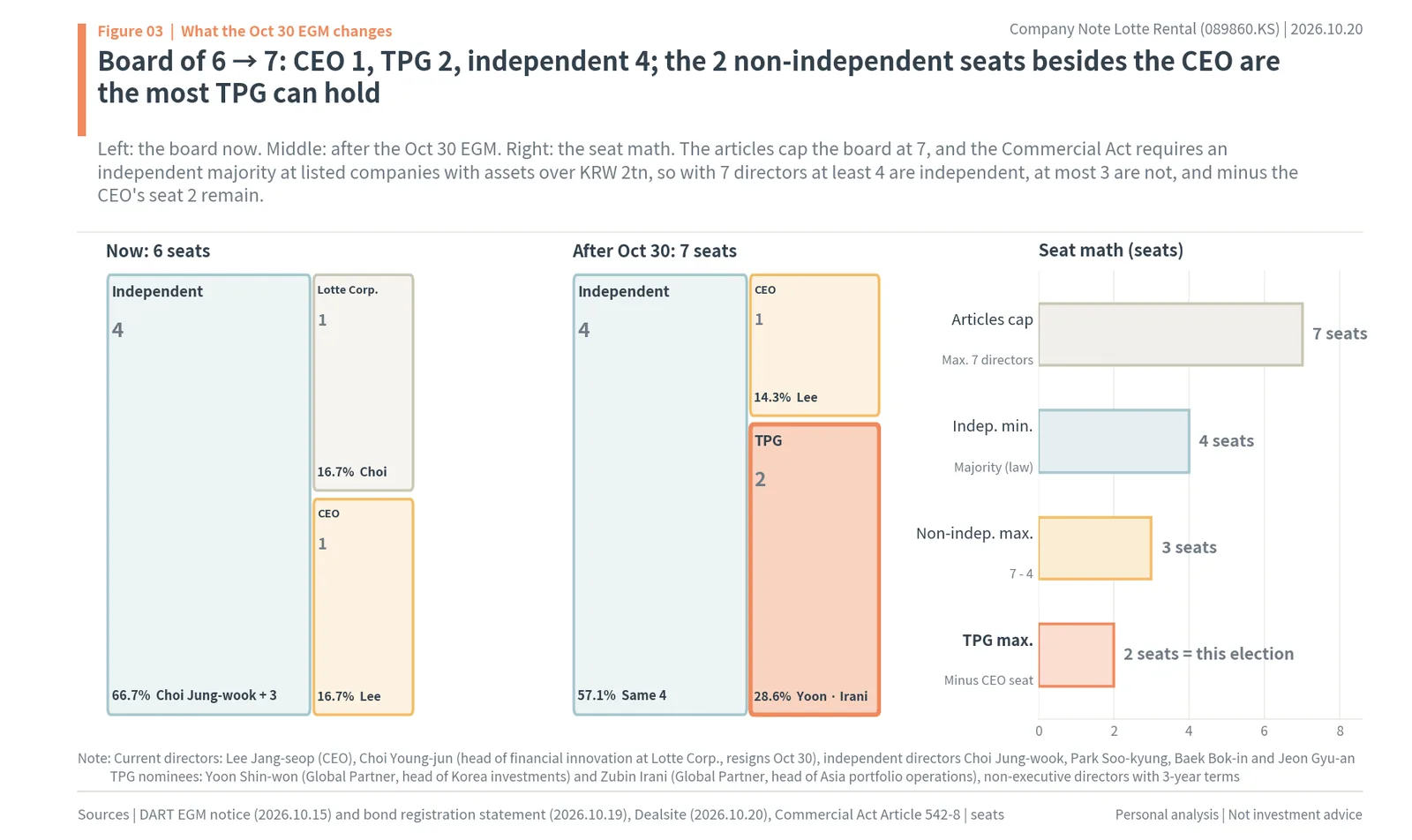
The number two is a ceiling set by law and the articles before it is TPG’s choice. Lotte Rental’s articles of incorporation cap the board at seven directors. Article 542-8 of the Commercial Act requires listed companies with total assets of KRW 2tn or more to have at least three independent directors, making up a majority of the board. With seven directors, at least four must be independent, so at most three seats can be non-independent. The CEO holds one, which leaves two. At this meeting TPG fills both of the non-independent seats it can hold without amending the articles.
Lotte leaves the board
With Choi Young-jun’s resignation, everyone from Lotte Corp. leaves the board. CEO Lee Jang-seop is an insider who headed Lotte Rental’s finance and planning divisions before becoming CEO on September 1, and his term as inside director runs to March 2027. The bond registration statement says that once the deal closes, Lotte Rental and its wholly owned subsidiary Lotte Auto Lease will leave the Lotte business group, and that the Lotte brand license agreement “may be maintained for a certain period, changed or terminated.” On October 30 the first board of a Lotte-named company with no Lotte Corp. director is formed.
Some items are missing from this meeting. There is nothing on replacing the CEO, adding inside directors, replacing independent directors, amending the articles or dividends. All TPG changes at this meeting is swapping the one Lotte seat on the board for two TPG seats.
The direction the company has set: corporate long-term rental and short-term rental
In the business overview of the EGM notice, the company wrote down where it is heading: grow sales by raising its penetration of corporate long-term rental and strengthening short-term rental, and “continue efforts to cut major operating costs such as accident costs and reconditioning costs.” It added plans to grow T Car, its used-car retail platform, and to strengthen its overseas business. The bond registration statement attributed this year’s first-half operating profit of KRW 168.3bn (+16.69% year on year) to a higher share of used-car rentals, lower accident costs per vehicle and more foreign visitors to Korea.
At the center of short-term rental is Jeju. The facilities table in Lotte Rental’s half-year report lists the “Jeju Auto House” on 13,443 square meters of land in Yongdam-2-dong, Jeju City, where Jeju International Airport is, plus separate garages in Namwon-eup, Seogwipo, and Yongdam-3-dong, Jeju City. The daily short-term rental rate has fallen from KRW 33,963 in 2024 to KRW 33,555 in 2025 and KRW 31,619 in the second quarter of this year. These are the kinds of numbers the new board’s operations head will look at first.

This chapter comes to one conclusion. This director election fills the two non-independent seats TPG can hold without amending the articles with a deal maker and a company fixer. The next chapter looks at where this sits in the deal as a whole.
2. The director election comes just before closing, and TPG’s own filings have been silent since August 18
From the August 11 agreement to a November closing
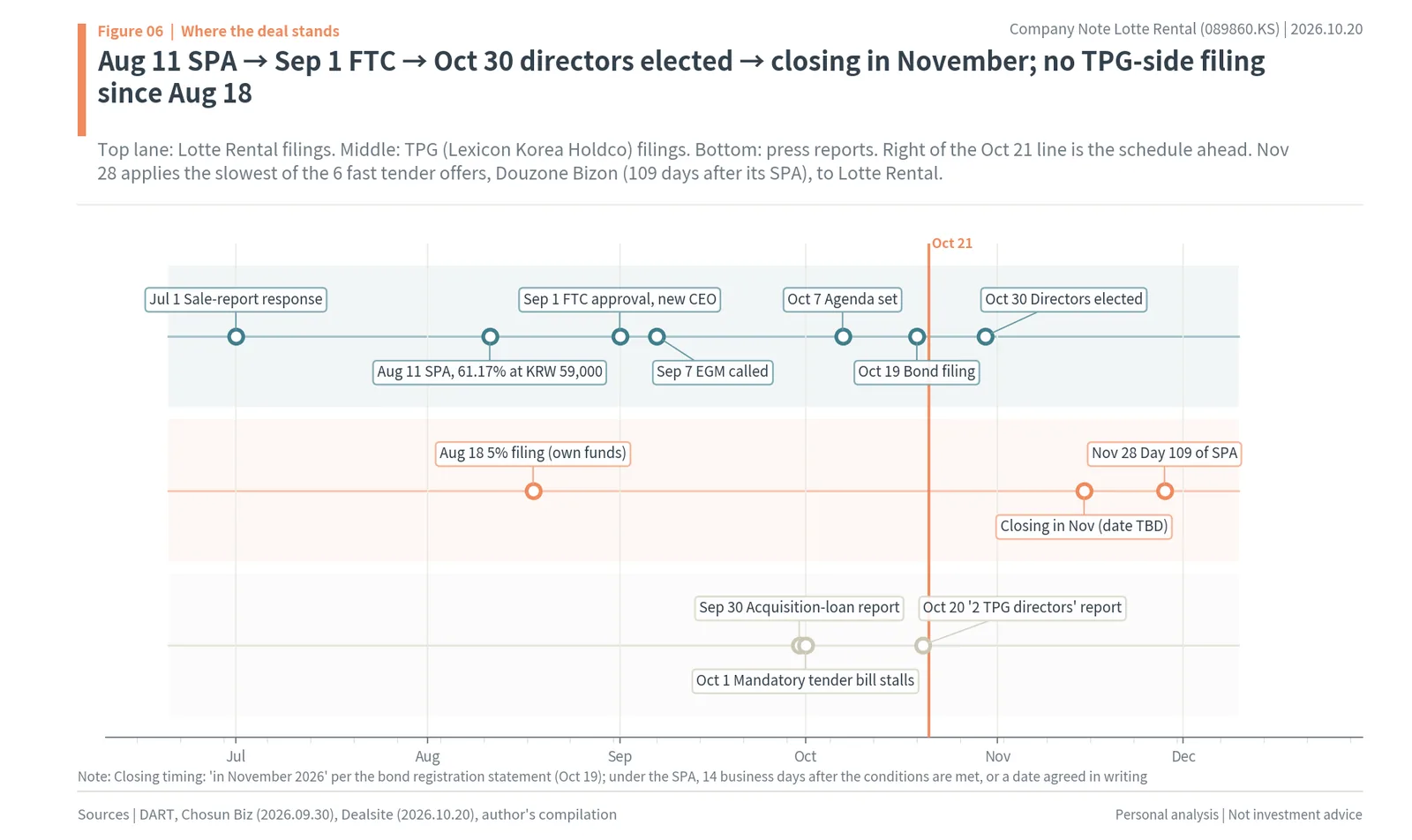
TPG’s acquisition of Lotte Rental is now at its fifth step. The first was the share purchase agreement (SPA) of August 11: Hotel Lotte’s 13,846,833 shares (38.14%) and Busan Lotte Hotel’s 8,365,230 shares (23.03%), 22,212,063 shares (61.17%) in total, go to Lexicon Korea Holdco, the acquisition vehicle TPG set up, at KRW 59,000 a share, KRW 1,310.5bn in all (about $988mn). The second was Lexicon’s large-holding report on August 18, and the third the Fair Trade Commission’s merger approval on September 1. The fourth was the board resolution of September 7 calling the EGM, and the fifth is the October 30 EGM that elects the directors. One step remains: the closing.
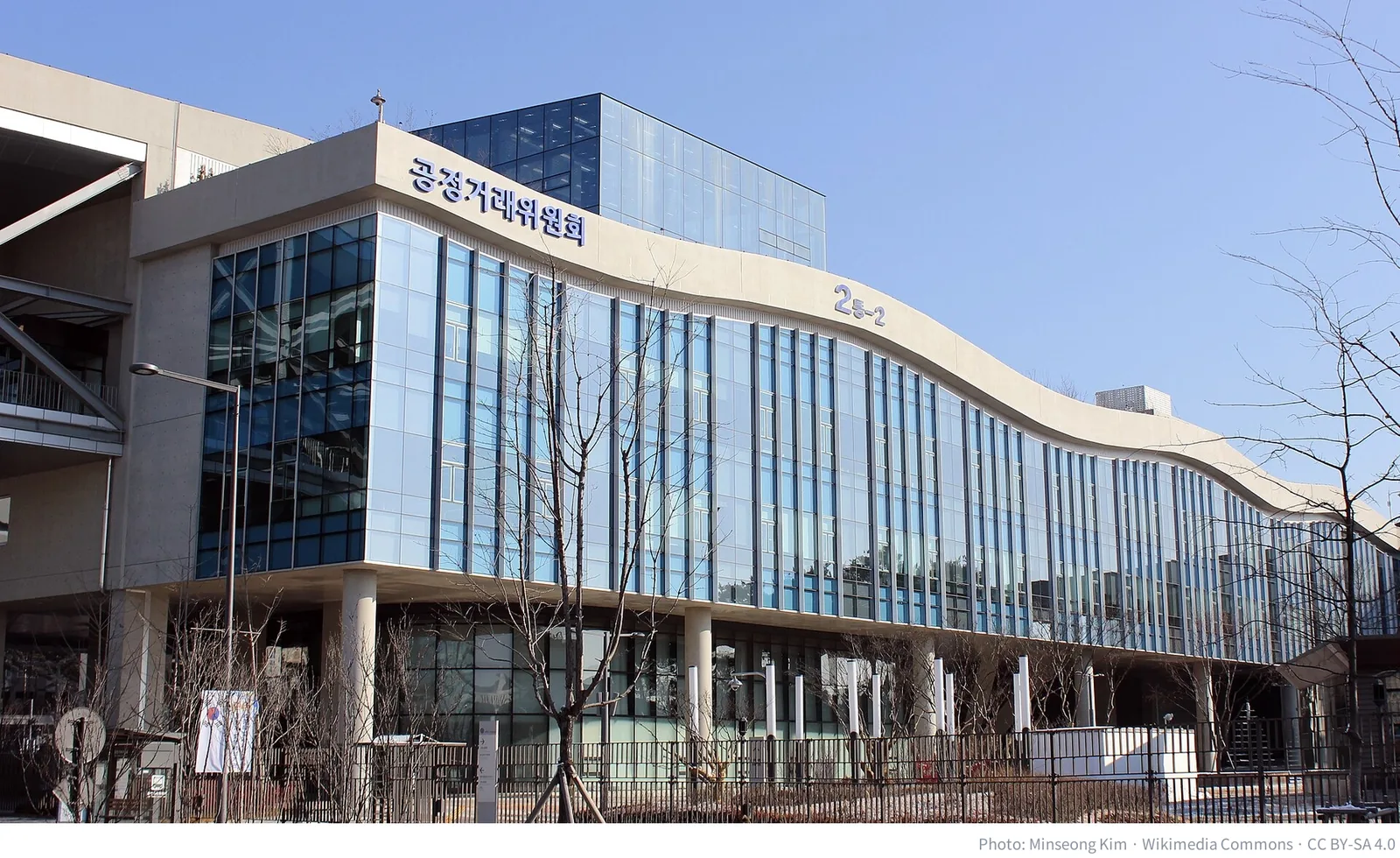
For Lotte Rental, TPG is its fourth owner. Founded in 1989 as Kumho Rent-a-car, the company was sold to KT in 2010 for about KRW 300bn and to Lotte in 2015 for KRW 1,020bn (Asia Economy), and it listed in August 2021 at an IPO price of KRW 59,000. The third step is the threshold the first buyer, Affinity, could not cross. Affinity owned SK Rent-a-car, so combining it with Lotte Rental would have produced a rental car market share of 33.8% (Lotte 19.2% and SK 14.6% in the second quarter of 2026), and after the Fair Trade Commission blocked the merger, the agreement was terminated on May 18, 2026. TPG owns no rental car company in Korea. The Fair Trade Commission approved this deal on September 1, ruling it a conglomerate merger in which TPG’s Korean private equity business and its affiliate HB F&B’s infant food business are neither complements nor substitutes for car rental (bond registration statement). Lotte Rental closed at KRW 51,400 that day, up 8.55%.
The bond registration statement gives the latest word on the closing date. The October 19 filing says that Hotel Lotte and Busan Lotte Hotel “plan to close the transaction selling their 61.17% stake for a total of KRW 1,310.5bn in November 2026, after the remaining procedures such as the general meeting.” Under the agreement, the closing date is the day 14 business days after all conditions precedent, including the FTC approval, are met, or a date the seller and the buyer agree in writing. On October 16, the business day before the filing, the largest shareholder was still Hotel Lotte.

Hotel Lotte’s consolidated borrowings and bonds exceeded KRW 7tn at the end of June (Chosun Biz), and the KRW 1,310.5bn is money to reduce that debt. The seller has reasons to hurry, and 50 days have passed since the buyer received the FTC’s approval. The director election is the last preparation both sides make ahead of closing. In its August 11 filing, Lotte Rental said it would file a “change of largest shareholder” disclosure when the largest shareholder changes under the agreement. The closing will reach the market through that filing.
TPG’s last filing is from August 18
Searching DART for filings under the name Lexicon Korea Holdco turns up a single large-holding report, dated August 18 (checked October 21). It gave the purpose of the holding as “influencing management” and listed the acquisition funds as KRW 1,310,511,717,000 of its own funds, with borrowings shown as “-“. It added that the funds “will be raised through shareholder contributions, etc., and may change in part until the closing date.” The ten boxes for detailed plans under the holding purpose carried the words “although there is no detailed plan at present.” There is no tender-offer statement yet.
The hint that the funding box could change came from the press. On September 30, Chosun Biz reported that TPG had begun talks with commercial banks and other major Korean financial institutions on acquisition financing for Lotte Rental, with Woori Bank likely to act as sole arranger. The size of the loan and the timing of the drawdown had not been set, but the report said the borrowed money looked likely to be used to acquire more shares and that TPG was said to be reviewing an immediate tender offer. The author found no articles in October following up on that report (searched October 21). Debt by itself is not evidence of a tender offer. Bain Capital borrowed KRW 315bn when it bought Classys in 2022 (change of largest shareholder filing) and has not made a tender offer to date. The direct signal of a tender offer is a tender-offer statement with its proof of funds attached (a loan commitment or an equity commitment letter), and that document does not exist yet.
The law does not require a tender offer in this deal
The Capital Markets Act amendment introducing a mandatory tender offer passed the National Assembly’s Political Affairs Committee on September 17 but was not put to the plenary session on October 1, and no schedule has been set (MTN). Even if it passes, it takes effect a year after promulgation and does not apply to deals that close before then (Yulchon). And because TPG’s agreement is for 61.17%, it would not be obliged to buy ordinary shareholders’ shares even if the law were already in force. A Lotte Rental tender offer will be decided by TPG’s own math, not by the law.
This chapter also comes to one conclusion. The October 30 director election is the last preparation right before the November closing, and none of the documents that would decide a tender offer (a tender-offer statement and proof of funds) has appeared yet. The next chapter looks at what these two directors mean and what effects they can have on the company.
3. Two directors mean TPG sits at the table that sets dividends, debt and the business, and the pair combines a deal head with an operations head
Three meanings
The first is timing. The October 30 meeting falls on day 80 after the agreement, and the closing comes after it, in November. Hotel Lotte and Busan Lotte Hotel, which were on the register on the record date (September 22), vote the 61.17%, and the candidates were nominated by Lotte Rental’s board. Neither the resolution calling the meeting nor the notice contains a condition tying the appointments to the closing. Read literally, TPG’s people become Lotte Rental directors before the shares are transferred. The seller and the buyer are completing their preparations for the handover together.
The second is the combination of people. Partner Yoon Shin-won is the deal head who leads TPG’s investments in Korea, and partner Zubin Irani is the head of operations for its Asian portfolio companies. In most of the 14 precedents in chapter 7, the fund’s directors were deal heads such as the manager’s chairman, CEO or partners, and not one fund-side director carried “operations (Ops)” in the title. There were directors with industry or operating experience (an EQT senior adviser at Douzone Bizon, Hahn & Co managing director Lee Dong-choon at Ssangyong Cement, an industry veteran at Jeisys Medical), but Lotte Rental is the first case where the head of a fund’s in-house operations team goes onto the board. TPG is not stopping at buying Lotte Rental; it is seating someone who will work on the company directly.
The third is the separation from Lotte. With the resignation of Choi Young-jun, head of financial innovation at Lotte Corp., no Lotte Corp. director remains on the board. Once the deal closes, Lotte Rental and its wholly owned subsidiary Lotte Auto Lease leave the Lotte business group, and the Lotte brand license agreement “may be maintained for a certain period, changed or terminated” (bond registration statement). The director election is the first scene in the change from a Lotte group rental car company to an independent company run by a private equity fund.
What this board decides
What the seats taken by TPG’s two directors decide is set out plainly in Lotte Rental’s board records for this year. On January 15 the board approved the “2026 borrowing plan” and the “2026 corporate bond issuance.” On February 10 it approved the financial statements for the 21st fiscal year, and the same day a year-end dividend of KRW 1,200 a share was announced. On March 9 it approved amendments to the articles, the cap on directors’ pay and the “2026 business plan.” In May it approved setting up a Japanese subsidiary and withdrawing the new share issue to Affinity’s side; on June 22, guarantees for Lotte Auto Lease’s foreign-currency borrowing and public bonds; on July 28, the renewal of vehicle management outsourcing and transactions with the major shareholder; on September 1, the appointment of the CEO; and on October 7, the nomination of director candidates. The board has an audit committee, an independent director nomination committee, a transparent management committee, a compensation committee and an ESG committee.
How much to borrow and how, how much to pay in dividends, what businesses to spend on and who serves as CEO are all decided at this table. After October 30, two of TPG’s people sit at it.
Effects on dividends
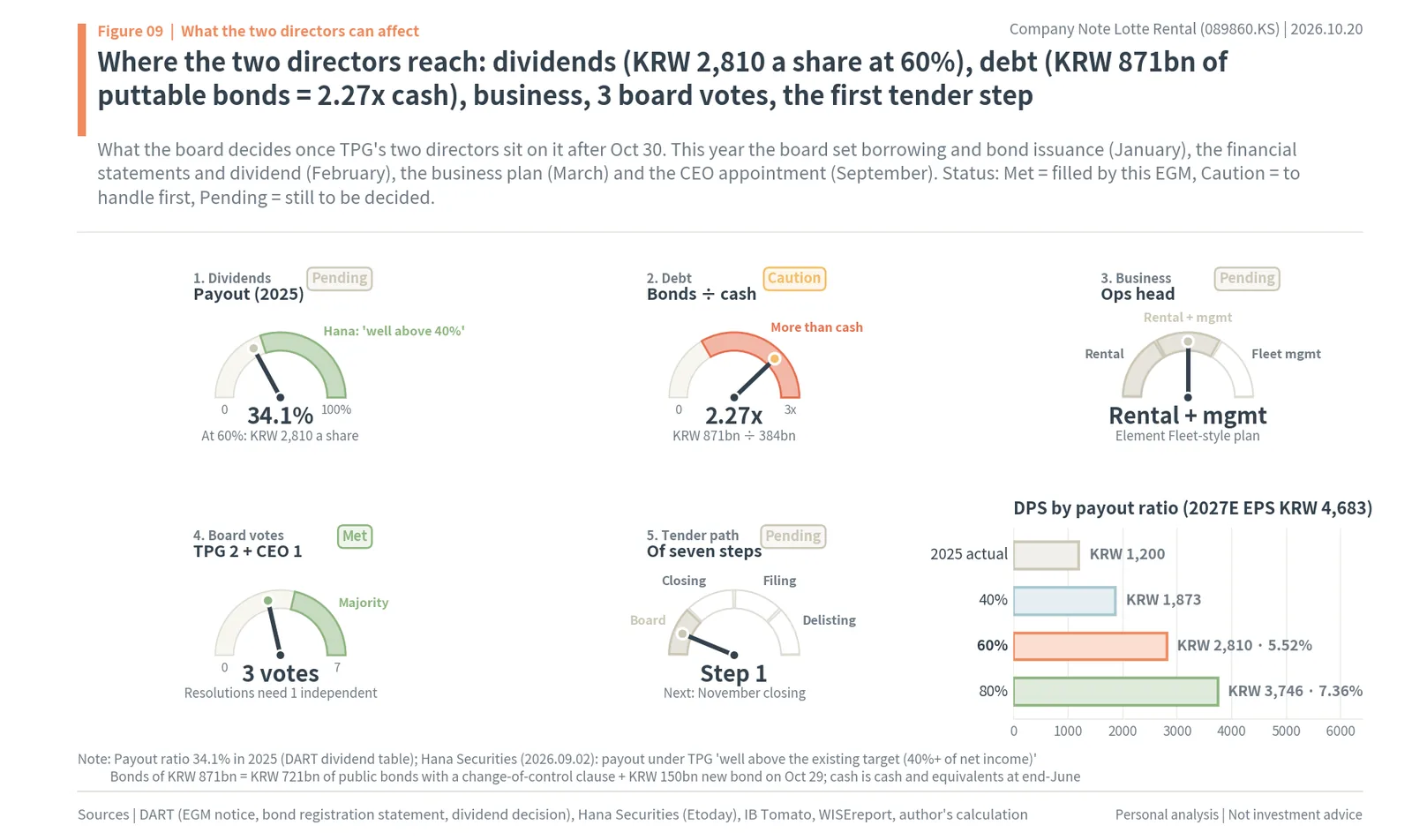
The first number that comes back to shareholders is the dividend. Lotte Rental’s consolidated payout ratio was 34.1% in 2025, and on September 2 Hana Securities expected the payout under TPG to be well above the existing target (40% or more of net income). With 2027 forward EPS of KRW 4,683 and a 60% payout, the dividend would be KRW 2,810 a share (about $2.12), 5.52% of the current price of KRW 50,900 (about $38.4); at 80%, it would be KRW 3,746 (7.36%). The actual 2025 dividend was KRW 1,200 a share. In March 2024 Lotte Rental amended its articles so that it can set the dividend amount first and the record date afterwards. In a structure where the board is the first step in the dividend decision, TPG’s two directors sit where dividends are decided.
Effects on debt
The second is debt. Once the deal closes and Lotte Rental leaves the Lotte business group, holders of KRW 871bn (about $657mn) of public bonds with a change-of-control clause (KRW 721bn outstanding on October 16 plus KRW 150bn of new bonds on October 29) gain the right to demand repayment of principal. That is 2.27 times the KRW 384bn (about $290mn) of cash and equivalents at the end of June. Just as the January board set the year’s borrowing plan and bond issuance, the new board will decide how to repay these bonds and what to replace them with after closing. Chapter 5 works through the details.
Effects on the business
The third is the business. In the EGM notice the company wrote that it would raise its penetration of corporate long-term rental, strengthen short-term rental and “continue efforts to cut major operating costs such as accident costs and reconditioning costs.” The bond registration statement attributed this year’s first-half operating profit of KRW 168.3bn (+16.69%) to a higher share of used-car rentals, lower accident costs per vehicle and more foreign visitors. IB Tomato reported that during the acquisition TPG put forward a strategy of expanding Lotte Rental “into fleet management services for client companies’ vehicles, like Element Fleet Management in the US.” Growing from a company that buys cars and rents them out into one that also manages customers’ cars is operations work, and the person who will take it on is joining the board.
The vote structure
After October 30, TPG’s two votes and the CEO’s vote add up to 3 of the board’s 7. A majority resolution needs at least one of the four independent directors as well. CEO Lee Jang-seop’s term as inside director runs to March 2027, so that year’s annual general meeting is the next chance to reshape the board. As long as the articles keep the cap of seven, the requirement of at least four independent seats holds for as long as the company is listed.
This chapter’s conclusion is this. The two directors mean TPG sits at the table that sets Lotte Rental’s dividends, debt, business plan and choice of CEO, and bringing in the operations head as well means TPG intends to work on the company directly. The first number those decisions return to shareholders is the dividend, and the first number the company has to deal with is the KRW 871bn of bonds. Chapters 4 to 8 look in turn at how these seats bear on a tender offer.
4. TPG’s reason for a tender offer: KRW 38.83 of every KRW 100 in dividends leaks out, and plugging the hole costs KRW 831.7bn
The owner of 61.17% receives only 61.17% of the dividend
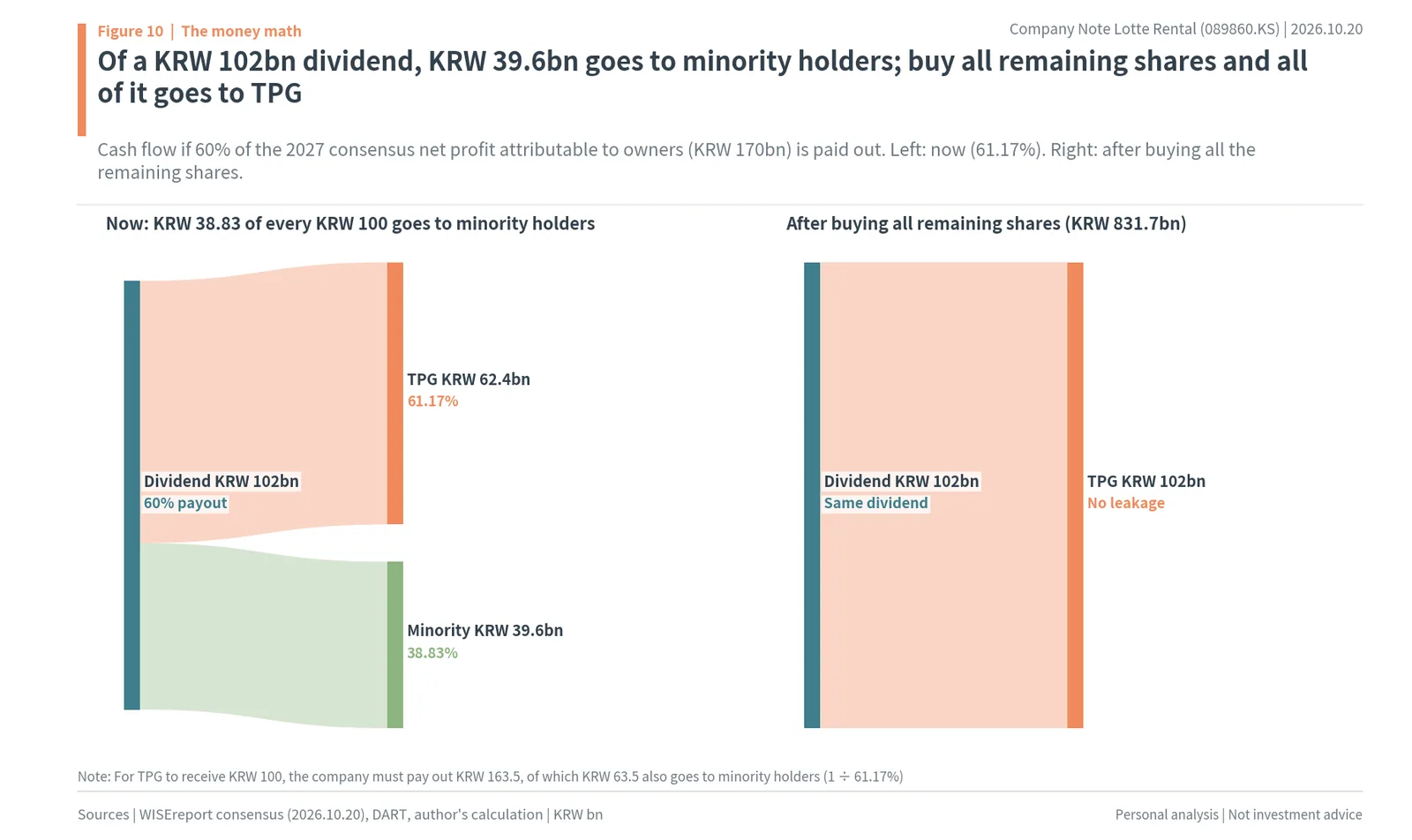
TPG’s way of taking money out of Lotte Rental is the dividend. Lexicon Korea Holdco is an acquisition vehicle with no income of its own apart from its Lotte Rental shares. Dividends are paid in proportion to shareholdings, so of every KRW 100 the company pays out, KRW 61.17 goes to TPG and KRW 38.83 to the other shareholders. Put the other way, for TPG to receive KRW 100, the company has to pay out KRW 163.5, of which KRW 63.5 also goes to minority shareholders. Split by shareholding, the 2025 year-end dividend (KRW 1,200 a share, KRW 43.57bn in total) gives the TPG stake KRW 26.65bn and minority shareholders KRW 16.92bn.
The more the dividend rises, the more leaks out with it. If 60% of the 2027 consensus net profit attributable to owners, KRW 170bn, is paid out, the dividend is KRW 102bn, of which KRW 39.6bn belongs to minority shareholders. At 80%, it is KRW 52.8bn of KRW 136bn. Per share, that is KRW 2,810 at 60% and KRW 3,746 at 80% (on 2027 forward EPS of KRW 4,683). Hana Securities’ view on September 2 that the payout under TPG would be well above the existing target (40% or more of net income) comes from the same arithmetic.
Buying the remaining shares brings that share back to TPG
A tender offer is the way to plug this hole. Buying all 14,097,325 remaining shares at the controlling shareholders’ price of KRW 59,000 costs KRW 831.7bn (about $627mn). Then the whole KRW 102bn dividend goes to TPG. If the KRW 831.7bn is borrowed, a year’s interest is KRW 33.3bn at 4%, KRW 41.6bn at 5% and KRW 49.9bn at 6%. At a 60% payout, the KRW 39.6bn that used to go to minority shareholders comes back to TPG, so at an interest rate of around 5%, the dividends on the shares bought roughly equal the interest on the money borrowed to buy them. Raise the payout to 80% and the KRW 52.8bn exceeds even the KRW 49.9bn of interest at 6%.
The dividend yield on shares bought at KRW 59,000 leads to the same conclusion. With 2027 forward EPS of KRW 4,683 and a 60% payout, the dividend is KRW 2,810 a share, a yield of 4.76% at KRW 59,000. At 80%, it is 6.35%. Lotte Rental’s own short-term borrowing costs 3.70% to 3.90% (the CP and short-term bonds the new bonds will repay), and the market yields on its own new bonds are 4.521% to 4.849%. As long as the payout rises, KRW 59,000 is a price at which the interest on borrowed money can be paid out of dividends.

Where KRW 59,000 sits
KRW 59,000 is a high rung on Lotte Rental’s price ladder. It was the IPO price at listing in August 2021. The 52-week high is KRW 53,100, reached intraday on the day of the FTC approval (September 1). The average target price of 10 brokers is KRW 50,200; the highest, Daishin Securities, is KRW 60,000 and the lowest, Kiwoom Securities, is KRW 45,000. KRW 59,000 is 17.5% above the average target. Divided by 2027 forward EPS of KRW 4,683, the current price of KRW 50,900 is a PER of 10.9 times and KRW 59,000 is 12.6 times. Year-end PERs from 2021 to 2025 were 8.47 to 10.73 times. KRW 59,000 sits above the past PER band, a price ordinary shareholders would not easily get without a tender offer.

The price converges on KRW 59,000
There are three reasons a tender price would converge on the controlling shareholders’ price of KRW 59,000. First, the 6 precedents in chapter 7 that launched a tender offer first (Douzone Bizon at KRW 120,000, Echo Marketing at KRW 16,000, Lutronic at KRW 36,700 and others) all bought ordinary shareholders’ shares at the same price paid to the controlling shareholders. Second, reaching 95% requires 87.1% of the remaining shares to be tendered, and that many are hard to gather at a price below the controlling shareholders’. Tender offers with a low premium, such as Ssangyong C&E in 2024 (9.2% over the previous close) and Lock&Lock (7.0%), drew first-round tenders of only 65.3% and 52% of their targets. Third, as chapter 6 shows, a majority of the board that states an opinion on the offer is independent, and the independent directors’ duty of loyalty now extends to shareholders.
This chapter’s conclusion is this. TPG’s reason for a tender offer (the dividend leakage) and the math it can afford (a dividend yield of 4.76% or more) have stayed the same since the agreement was signed in August. The director election does not change this math. What changes is the seat from which it is carried out: TPG’s people now sit on the board that handles dividends and capital policy.
5. Closing gives holders of KRW 871bn of bonds a right to demand repayment, so the first money TPG must line up after closing sits at the company
The clause triggered the moment the company leaves the Lotte group
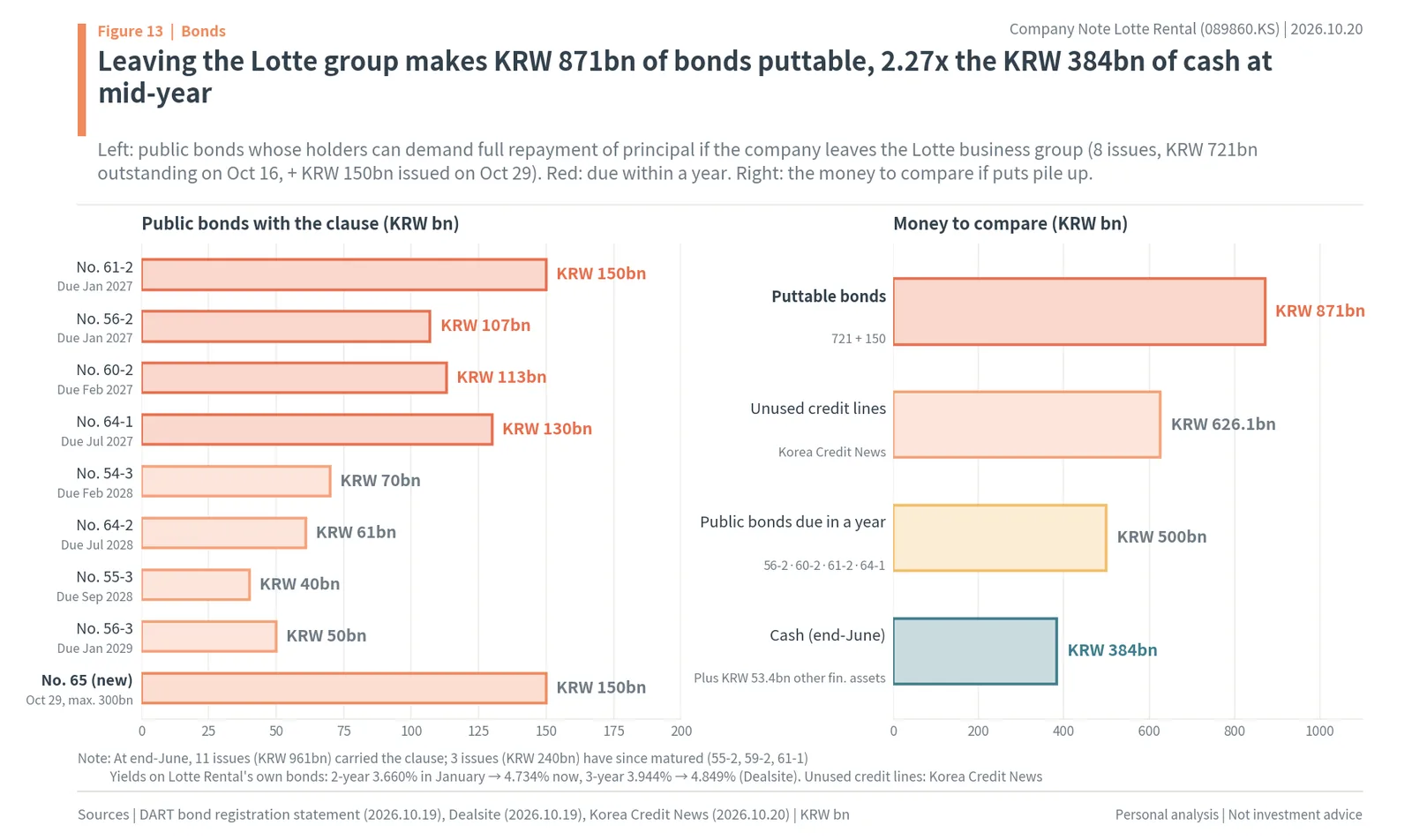
Lotte Rental’s public bonds carry a covenant called a “restriction on change of control.” Article 2-5-2 of the bond management agreement in the October 19 bond registration statement defines a change of control as being “excluded from a business group subject to cross-shareholding restrictions under Article 14 of the Monopoly Regulation and Fair Trade Act,” and records the business group the company belonged to at signing as “Lotte.” Once the deal closes and Lotte Rental leaves the Lotte business group, the company must notify the bond manager without delay, and bondholders can demand that all or part of their bonds be repaid at full principal (plus accrued interest). The demand period is at least two weeks within 30 days of the notice, and payment is due within one month after the demand period ends.
The statement’s table on compliance with bond management agreements listed 11 public bond issues carrying this clause at the end of June, KRW 961bn in total. This is the “KRW 961bn early-repayment fuse” the press refers to (Korea Credit News). Since then, issues 55-2 (KRW 150bn), 59-2 (KRW 40bn) and 61-1 (KRW 50bn) have matured and been repaid, leaving 8 issues and KRW 721bn of public bonds outstanding as of October 16. The statement’s table of outstanding bonds also shows KRW 721bn of public bonds. The new bonds paid in on October 29 (issue 65, KRW 150bn, up to KRW 300bn depending on demand) carry the same clause. After closing, the bonds whose holders can demand repayment add up to KRW 721bn plus KRW 150bn, or KRW 871bn.
Higher rates make the right more worth using
Bondholders use the right when it is worth something to them. According to Dealsite (October 19), the market yields on Lotte Rental’s own bonds rose from 3.660% for 2-year and 3.944% for 3-year bonds in January to 4.734% and 4.849% now. The Bank of Korea raised its base rate by 25bp at each of its July and August meetings, to 3.00% (bond registration statement). When market rates rise, the market value of fixed-rate bonds already issued falls below principal. The right to get full principal back is worth that difference.
Compared with the money the company holds
KRW 871bn is 2.27 times the KRW 384bn of cash and equivalents at mid-year. The bond registration statement also cited other financial assets of KRW 53.4bn and first-half EBITDA of KRW 713.2bn (KRW 1,394.1bn in 2025) as sources of liquidity. Korea Credit News put unused credit lines at KRW 626.1bn. Public bonds maturing within a year (issues 56-2, 60-2, 61-2 and 64-1) alone come to KRW 500bn, and the same article counted KRW 1,130bn of market borrowings maturing by next July (KRW 500bn of corporate bonds and KRW 630bn of short-term bonds).
All KRW 150bn of the new bonds will go to repaying debt. They replace KRW 150bn of electronic short-term bonds and commercial paper (3.70% to 3.90%) maturing between November 16 and November 30 with bonds of one and a half to three years. That turns short-term debt bunched in November into longer-term debt ahead of the closing. Under Affinity, the company tried to solve the same problem with a new share issue. The plan, in February 2025, was to allot 7,261,877 new shares at KRW 29,180 each to an Affinity-side company (Careena) to fund KRW 90bn of debt repayment and about KRW 121.9bn of capital spending; when it was withdrawn in May 2026, the reason given was that “the need to raise funds to respond to an event of default (EOD) and early bond repayment demands following the change of largest shareholder has also disappeared.” There is no such share issue plan in the TPG deal yet.
How this relates to a tender offer
The money TPG has to arrange right after a November closing runs on two tracks. One is at the company: preparing for the KRW 871bn of bonds whose holders may demand repayment. The other is at the acquisition vehicle: the KRW 831.7bn the remaining shares would cost if it makes a tender offer. Lotte Rental’s credit rating is A+ (stable), and if the acquisition vehicle borrows to fund a tender offer, the interest has to be paid out of Lotte Rental’s dividends. Borrowing at the vehicle gets easier once refinancing at the company is settled. The final rate and amount to appear in the amended filing on October 23 will be the first number showing how the bond market values Lotte Rental under TPG.
This chapter’s conclusion is this. On the day the deal closes, holders of KRW 871bn of Lotte Rental public bonds gain the right to demand repayment of principal, and with yields 90 to 107bp higher than in January, that right is worth something to them. TPG’s first money question is the company’s debt, not the remaining shares.
6. Of the seven steps from tender offer to delisting, the director election is the first, and the two steps the board decides need independent votes
Seven steps left for Lotte Rental
For Lotte Rental to reach delisting through a tender offer, it has to pass seven steps. The first is the director election, putting TPG’s people on the board (October 30). The second is the closing, making Lexicon the owner of 61.17% (November). The third is money. A tender-offer statement must come with a certificate of tender-offer funds, and besides deposit balances, a loan commitment (LOC) from a Korean financial institution or an equity commitment from a Korean institutional investor such as a pension fund counts as proof (Kim & Chang). The fourth is filing the tender-offer statement, which sets the price, the number of shares and the offer period (20 to 60 days). The fifth is Lotte Rental’s statement of opinion, the sixth is tenders taking TPG past 95%, and the seventh is the comprehensive share exchange that turns the remaining shares into cash, followed by delisting.
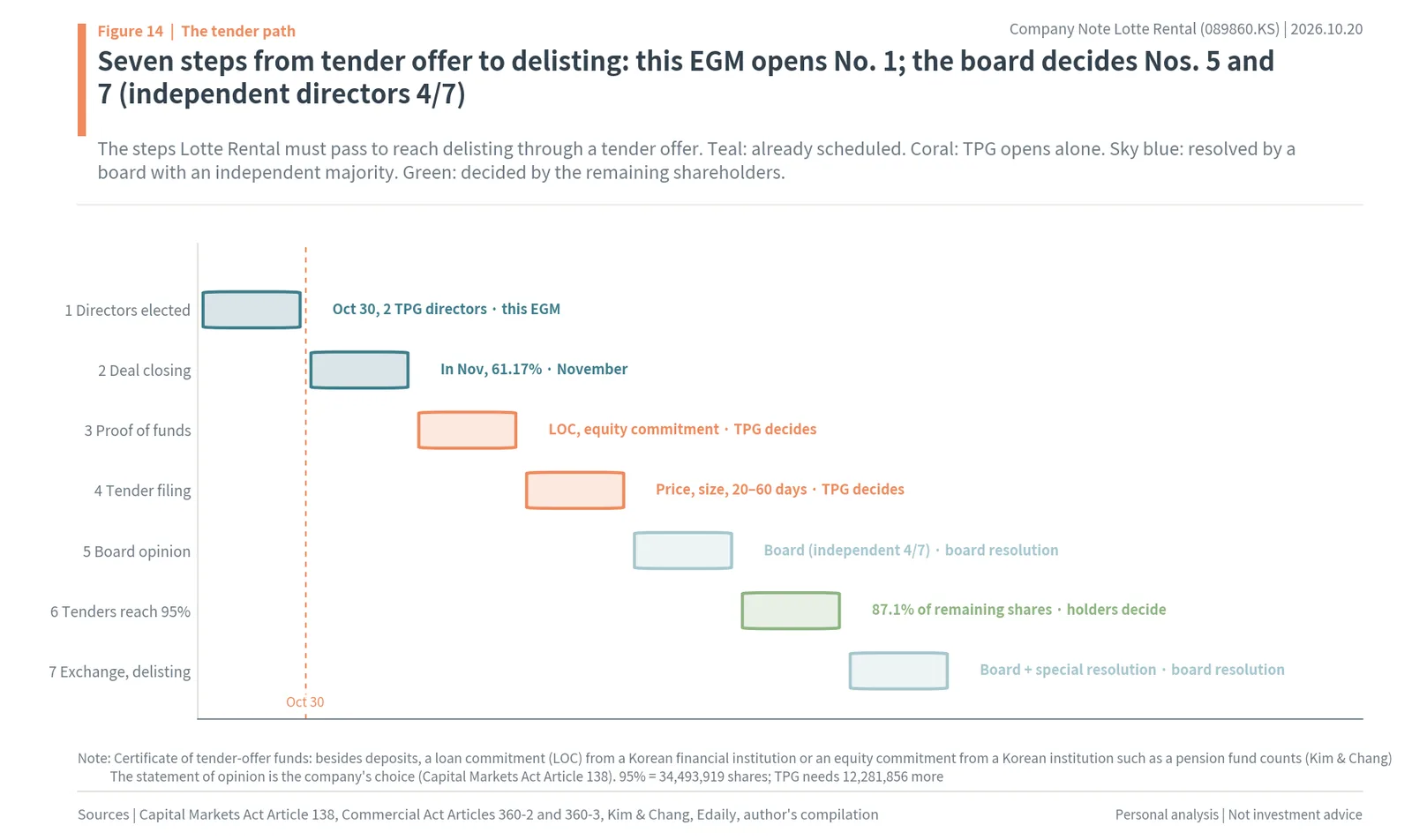
This meeting opens the first step. The second opens in November, and TPG decides the third and fourth alone. The board has a hand in two steps, the fifth and the seventh.
Step five: the statement of opinion
Article 138 of the Capital Markets Act provides that the issuer of shares subject to a tender-offer statement may state its opinion on the tender offer. It is the company’s choice, not an obligation, and if it does state one, it must promptly submit a document setting out whether it supports, opposes or is neutral, and why, to the Financial Services Commission and the exchange (Article 149 of the Enforcement Decree). The board decides whether to state an opinion and, if so, what it says. After October 30 the board has seven members, four of them independent. TPG’s two directors and the CEO add up to only three votes, so a board resolution requires at least one independent director as well.
The independent directors’ calculus has also changed. An amendment to the Commercial Act widened directors’ duty of loyalty from the company to the company and its shareholders (Bloter). For a KRW 59,000 tender offer at the same price the controlling shareholders received, independent directors have clear grounds to state support; at a lower price, the board would have to examine why ordinary shareholders receive less than the controlling shareholders. This gives one more reason for the tender price to equal the controlling shareholders’ price.
Step seven: comprehensive share exchange and delisting
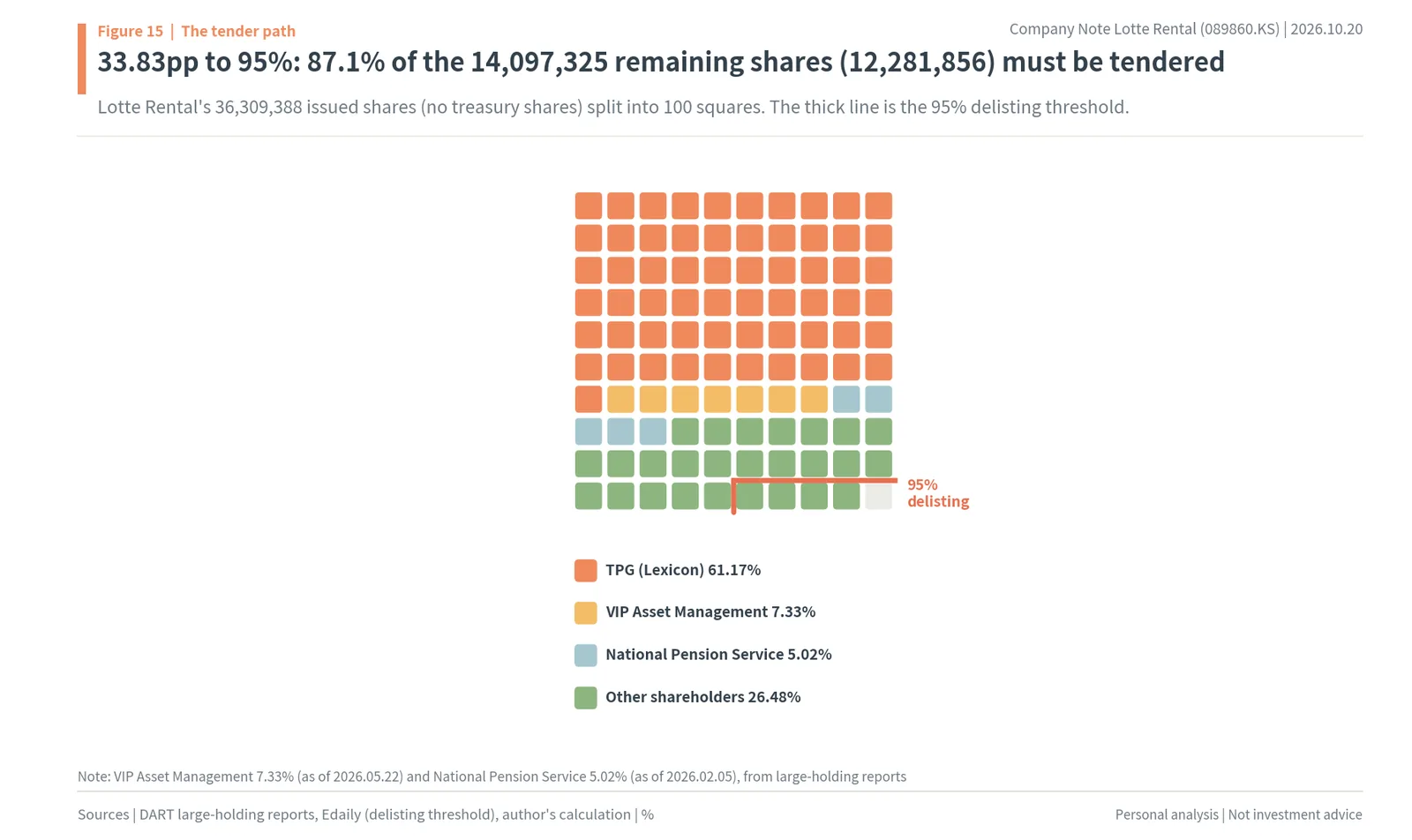
Voluntary delisting from the KOSPI market usually requires 95% of the shares excluding treasury shares (Edaily). Lotte Rental has no treasury shares, so 95% is 34,493,919 of its 36,309,388 issued shares. To go from 61.17% to 95%, TPG has to buy another 33.83 percentage points, or 12,281,856 shares, which is 87.1% of the 14,097,325 remaining shares. Close to nine of every ten remaining shares would have to be tendered. The remaining shares include 7.33% held by VIP Asset Management and 5.02% held by the National Pension Service.
Above 95%, the remaining shares are cleared through a cash-consideration comprehensive share exchange. Douzone Bizon exchanged its remaining shares for KRW 120,000 in cash per share, and Echo Marketing for KRW 16,000. In a share exchange, the board resolves on the exchange agreement and a special resolution of the general meeting approves it (Articles 360-2 and 360-3 of the Commercial Act). For TPG with 95%, the special resolution poses no difficulty, but here too the board resolution is decided together with the independent majority.
Board seats open again in March 2027
CEO Lee Jang-seop’s term as inside director runs to March 2027. At that year’s annual general meeting, the board can be reshaped along with the CEO seat. The framework of an independent majority stays in place as long as the company is listed, so what TPG can change on the board is the people, not the ratio. As long as the articles keep the cap of seven, the board has no more than three non-independent seats including the CEO and at least four independent seats.
This chapter’s conclusion is this. With this director election, TPG has opened the first of the seven steps on the path to a tender offer. The third and fourth steps (money and the filing) are ones TPG can open alone, while the fifth and seventh (the statement of opinion and the share exchange resolution) are opened together with the independent majority. The two directors give TPG a seat at the table where those two steps are discussed.
7. 12 of 14 precedents made a tender offer, and the order of director election and tender offer set the timing and the price
How the 14 were chosen
To know whether a director election is a signal of a tender offer, one has to look at the order in which director elections and tender offers came after private equity bought control of listed companies. The author collected the 14 deals from 2016 to 2026 in which a private equity fund (or a company whose largest shareholder is a private equity fund) bought a controlling stake in a Korean listed company and whose dates can be confirmed in DART filings. Koentec appears twice, because Macquarie PE bought it in 2017 and E&F PE in 2020. For each deal, the SPA date, the date of the shareholder meeting that elected fund directors, the closing date, the announcement date of a tender offer aimed at delisting, and the tender and controlling-stake prices were taken from the original filings. Days are counted in calendar days.
The 14 split into two groups by the order of the tender offer. Group A is the 6 that announced a tender offer first and elected fund directors later (Douzone Bizon, Echo Marketing, Lutronic, Jeisys Medical, Osstem Implant and BusinessOn Communication). Group B is the 8 that elected fund directors first or made no tender offer (Ssangyong Cement, Lock&Lock, Danawa, Hanssem, Koentec twice, Classys and Namyang Dairy).
Group A: tender offer 1 to 109 days after the agreement, directors 23 to 66 days later
The six Group A deals launched a tender offer right after signing. The days from agreement to tender announcement were 1 for Lutronic, 2 for Echo Marketing, 3 for Jeisys Medical, 4 for Osstem Implant, 20 for BusinessOn and 109 for Douzone Bizon. Fund directors joined 23 to 66 days after the tender announcement. Douzone Bizon elected fund-side directors at its annual meeting on March 26, 2026, 31 days after the tender offer; Echo Marketing at an EGM on March 9, 66 days after; and Lutronic at an EGM on July 18, 2023, 39 days after. The election day was mostly the same day as the closing or the tender settlement. The funds changed the board on the day they had bought all the shares.
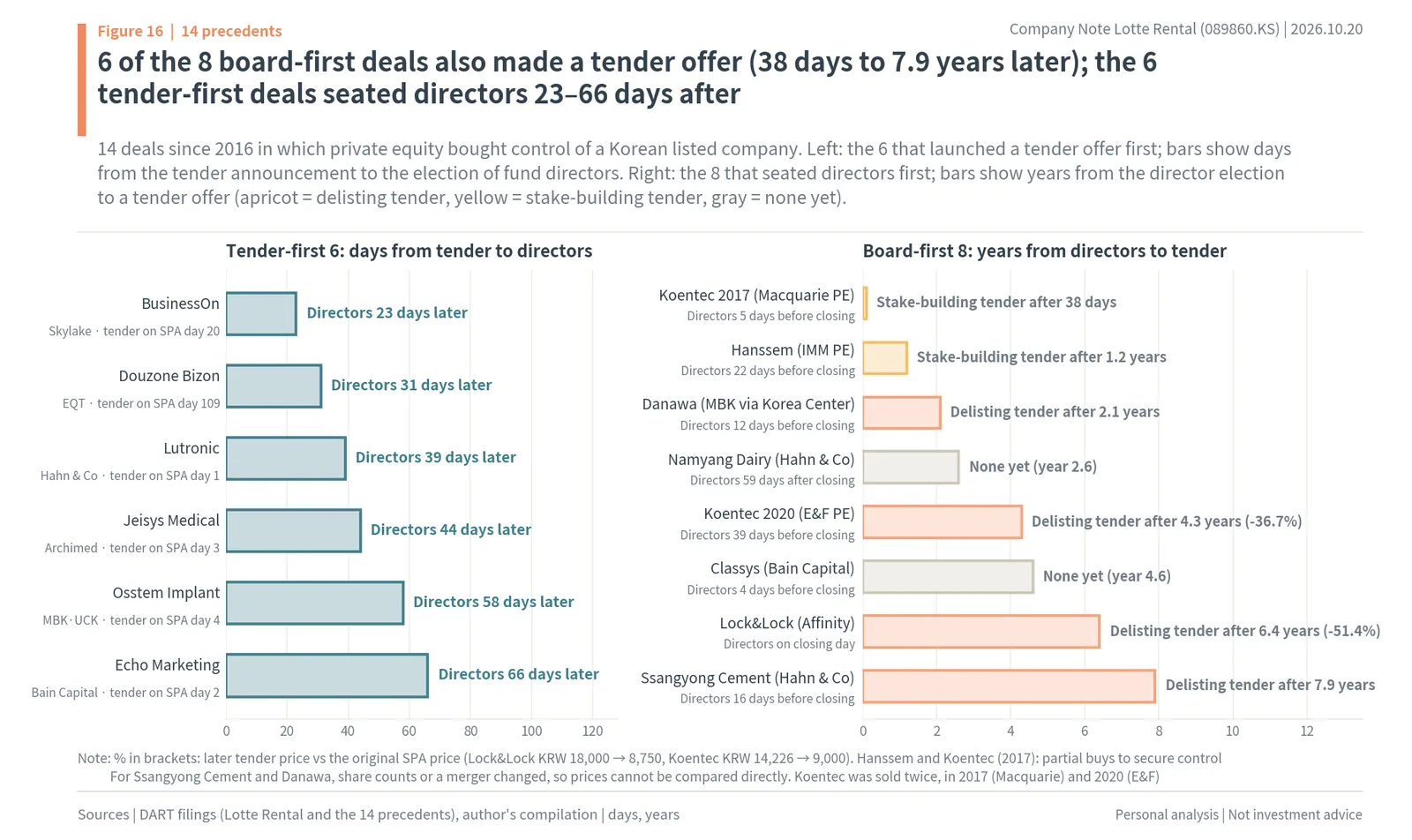
In all six, the tender price equaled the price paid to the controlling shareholders: KRW 120,000 for Douzone Bizon, KRW 16,000 for Echo Marketing, KRW 36,700 for Lutronic, KRW 13,000 for Jeisys Medical, KRW 190,000 for Osstem Implant and KRW 15,849 for BusinessOn. Premiums over the previous close ranged from 8.0% at BusinessOn to 49.5% at Echo Marketing. From agreement to delisting took 141 days at Lutronic, 122 at BusinessOn, 153 at Jeisys Medical, 181 at Echo Marketing, 205 at Osstem Implant and 251 at Douzone Bizon. The tender-first group had planned everything through delisting as one package when it signed, and moved in the order tender offer → closing and settlement → director election → delisting.
Group B: directors first, and 6 of 8 made a tender offer 38 days to 7.9 years later
The eight Group B deals ran in the opposite order. They elected fund directors first, 45 to 110 days after the agreement (1,037 days at Namyang Dairy because of litigation), and six of them did so before closing: Ssangyong Cement 16 days before, Danawa 12 days, Hanssem 22 days, Koentec (2017) 5 days, Koentec (2020) 39 days and Classys 4 days. Ssangyong Cement, Danawa, Hanssem and Koentec (2020) stated in their filings that the appointments would take effect at closing. Lock&Lock elected them on the closing day and Namyang Dairy 59 days after closing.
Six of the eight made a tender offer after the director election. The four delisting tender offers came 2.1 years after the director election at Danawa (after it had merged into Connectwave), 4.3 years at Koentec (2020), 6.4 years at Lock&Lock and 7.9 years at Ssangyong Cement. Hanssem and Koentec (2017) made tender offers to buy more shares and secure control. Hanssem bid for 7.7% of its issued shares at KRW 55,000 a share (a 22.6% premium over the previous close) 444 days after the director election, and Koentec (2017) bid for a target of 42.45% 38 days after, at KRW 4,730, almost the same as the agreement price. Classys (4.6 years after the director election) and Namyang Dairy (2.6 years) have made no tender offer yet. Counted from the agreement date, the four delisting tender offers came 885 days (Danawa) to 2,936 days (Ssangyong Cement) later.
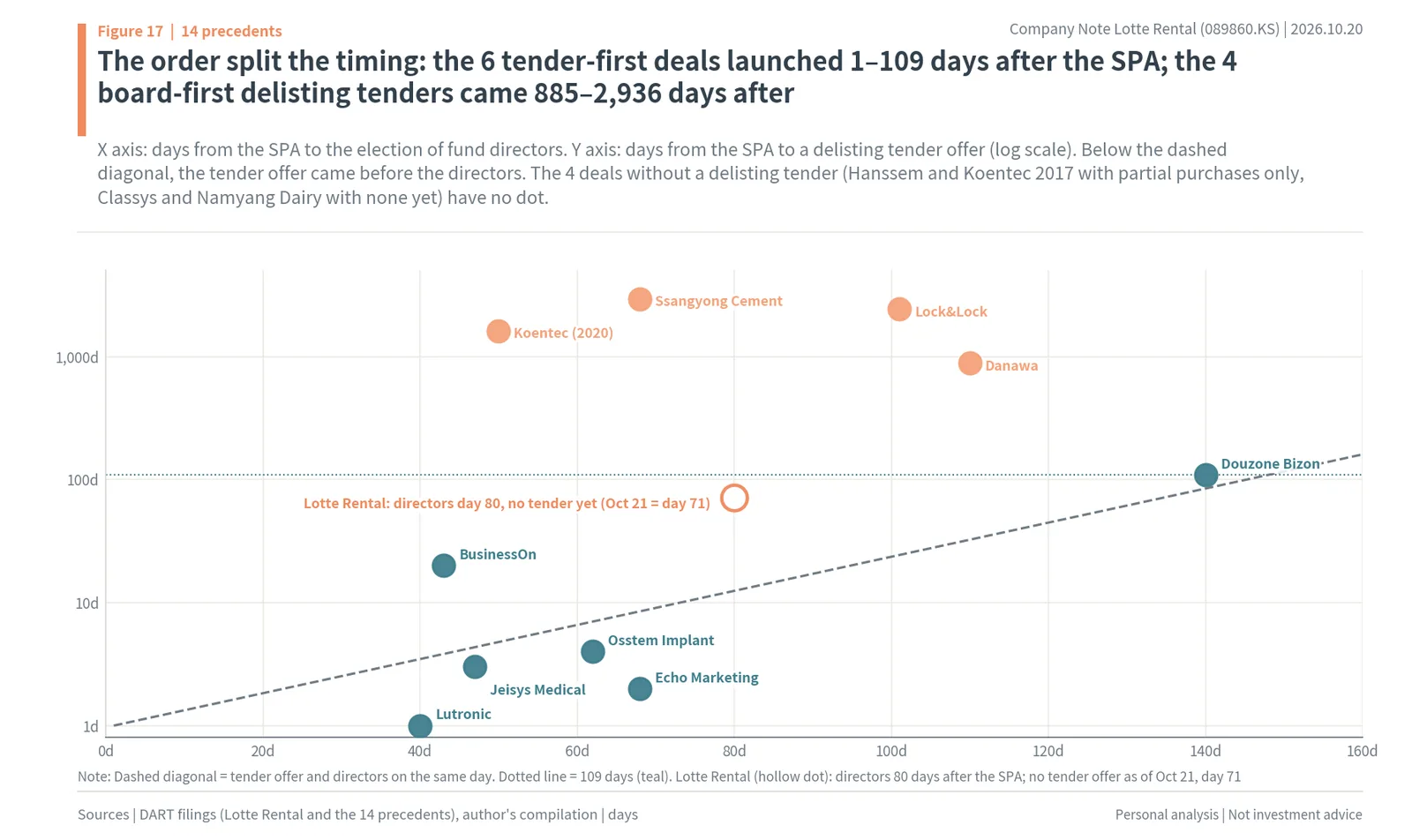
The prices of the delisting tender offers that came years later followed the market at the time. Lock&Lock’s controlling shareholders received KRW 18,000 a share in 2017, but the April 2024 tender price was KRW 8,750, 51.4% lower. Koentec’s agreement price in 2020 was KRW 14,226, and the November 2024 tender price was KRW 9,000, 36.7% lower. Ssangyong Cement (KRW 24,779 in 2016, KRW 7,000 in 2024) and Danawa (KRW 59,331 in 2021, KRW 18,000 in 2024) cannot be compared directly, because the share count changed or the company merged in between. When a fund that had seated directors first made a tender offer years later, the benchmark was not the controlling-stake price but the market price at the time plus a premium (7.0% at Lock&Lock, 16.58% at Koentec).
The same Hahn & Co, two orders
How the order shaped the outcome can be seen inside a single fund. Hahn & Co signed in January 2016 to buy 46.14% of Ssangyong Cement and elected chairman Yoon Yeo-eul and managing director Lee Dong-choon as inside directors at the annual meeting on March 30, 16 days before closing. The delisting tender offer came only 7.9 years later, on February 5, 2024. When the same Hahn & Co signed with Lutronic’s founder on June 8, 2023, it launched the tender offer the next day, and Yoon Yeo-eul, Lee Dong-choon and Bae Min-kyu joined the board 39 days later. Lutronic was delisted on October 27, 141 days after the agreement. The same manager and the same people became directors and both deals ended with a delisting tender offer, but the tender-first deal took four and a half months and the board-first deal nearly eight years.
What the two groups had in common
Apart from the order, no other feature separates the two groups. Fund directors numbered 1 to 4 in Group A (17% to 57% of the board) and 2 to 4 in Group B (18% to 75%). Deals that added only two directors appear on both sides: Osstem Implant (2 of 7) and BusinessOn (2 of 5) in Group A, and Ssangyong Cement (2 of 11), Danawa (2 of 6) and Koentec 2020 (2 of 4) in Group B. The people were similar too. Both groups brought in deal heads at the level of the manager’s chairman, CEO or partner, and across the 14 deals not one fund-side director carried “operations (Ops)” in the title. CEO changes also appear in both groups.
This chapter’s conclusion is this. 12 of the 14 deals made a tender offer, and what set the timing and price was not the number or titles of the directors but the order. The 6 tender-first deals bought the remaining shares at the controlling-stake price within four months of signing, while 6 of the 8 board-first deals made a tender offer between 38 days and 7.9 years after taking over management, at prices that years later reflected the market price then plus a premium. The two directors are the first step on the road to a tender offer, and the order that follows sets the timing and the price.
8. Placed among the precedents, this election leaves two paths to a tender offer: KRW 59,000 around the November closing, or a later one after TPG has run the company
Order: the directors come first
Lotte Rental’s directors are elected at a meeting 80 days after the agreement, before closing. As of October 21 it is day 71 of the agreement, and no tender offer has been announced. In terms of the two groups of chapter 7, this is the shape of Group B, which seats directors first. In the six Group B deals that elected directors before closing, the time from agreement to director election was 45 to 110 days, and Lotte Rental’s 80 days falls within that range. Six of the eight Group B deals made a tender offer after the director election: delisting tender offers 2.1 to 7.9 years later, and stake-building tender offers 38 days and 1.2 years later.
The same order does not mean a single path. Douzone Bizon in Group A launched its tender offer on February 23, 2026, 109 days after signing and before closing, and its closing and the election of fund directors came together on March 26, the first settlement date of the tender offer. If Lotte Rental’s buyer files a tender-offer statement around the November closing, it will be the first case of electing directors first and following straight on with a tender offer.
Seat count and people
TPG’s directors hold 2 of the 7 seats (28.6%). In the precedents, fund directors numbered 1 to 4 in Group A and 2 to 4 in Group B, so the ranges overlap. The deals with two directors include both Osstem Implant (2 of 7), where the tender offer came 4 days after the agreement, and Koentec 2020 (2 of 4), where it came 4.3 years later. The number of seats does not set the timing of a tender offer.
The people point to operations. As chapter 3 showed, bringing the operations head onto the board means TPG intends to work on Lotte Rental directly. Operations can be fixed whether the company is listed or private. If TPG owns all the shares through a tender offer, the results (dividends) all go to TPG; if the listing stays, it shares them with minority shareholders 61.17 to 38.83. That is why the dividend leakage math of chapter 4 tilts further toward a tender offer the bigger the operating improvement.
Missing agenda items
This meeting has no items on replacing the CEO, amending the articles or dividends. Of the six Group A deals, Douzone Bizon, Echo Marketing and BusinessOn changed their CEO or board structure around closing. Echo Marketing abolished its representative director system and switched to a representative executive officer, and at Douzone Bizon the founder stepped down and co-CEOs took over. Lotte Rental already changed its CEO to Lee Jang-seop on September 1, and this meeting swaps the Lotte Corp. seat on the board for TPG seats. The venue for the next structural change is the March 2027 annual general meeting.
Time: the window to November 28
The days from agreement to tender offer in Group A were 1, 2, 3, 4, 20 and 109. Lotte Rental’s 71 days since the agreement are already longer than five of the six (1 to 20 days) and shorter than Douzone Bizon’s 109 days. Applying the same 109 days to Lotte Rental’s agreement date (August 11) gives November 28, which overlaps with the “closing in November” in the bond registration statement. Around the November closing is the best time for a tender offer at the same KRW 59,000 as the agreement price. In the precedents, all six tender offers made around the agreement were at the controlling-stake price.
This chapter’s conclusion is this. Lotte Rental has two paths to a tender offer. One is buying the remaining shares at KRW 59,000 around the November closing, the path Group A took. The other is TPG running the company and receiving dividends, then buying years later at the market price then plus a premium, the path six Group B deals took. On both paths the two directors are the first step on the road to a tender offer, and TPG chooses which path to take at the November closing.
9. The market prices the tender offer at close to even odds: KOSPI -20.3%, the stock -0.2%, and the implied tender probability up from 38.0% to 46.7%
The KOSPI and Lotte Rental in October
From October 1 to 20, the KOSPI fell 20.3%, from 6,971.35 to 5,552.74. Over the same period Lotte Rental slipped 0.2%, from KRW 51,000 to KRW 50,900. Its daily closes in October stayed between KRW 50,000 and KRW 51,600. While the whole market lost more than a fifth of its value, Lotte Rental’s share price stayed within a KRW 1,600 range. The gap between the October 20 close and the controlling-stake price of KRW 59,000 is KRW 8,100 (15.9%).

Lotte Rental is not normally a stock that moves much with the market. Its beta to the KOSPI, measured on daily returns from July 2025 to June 2026, was 0.20, with a correlation of 0.33 (author’s calculation, 244 trading days). At that beta, a 20.3% KOSPI fall would normally mean -4.1% for Lotte Rental. The actual -0.2% was a fall 3.9 percentage points smaller. Since the agreement (August 12 to October 20) the beta has been -0.06; the stock has effectively moved apart from the market. Counting from the day before the agreement (August 10), the KOSPI is down 11.9% and Lotte Rental is up 18.9%.

The filing and news days
News related to the director election came on six days: the October 7 amended filing that fixed the agenda, the October 15 EGM notice, the October 19 bond registration statement (“closing in November”), the October 20 Dealsite report on “two from TPG joining,” and the day after each of the first two filings. Subtracting KOSPI return × 0.20 from Lotte Rental’s return each day gives +0.98pp on October 7, +0.72pp on the 8th, +1.51pp on the 15th, -0.61pp on the 16th, +2.45pp on the 19th and -0.23pp on the 20th. The six days add up to +4.82pp. No single day exceeded 3pp. The market did not mark the stock up much on the director election news.

The volume and the buyers were a different story. Average daily volume in September was 95,345 shares, against 319,552 shares (3.4 times) on October 15 and 401,686 shares (4.2 times) on October 20. Adding up net buying by investor type (KRX) on those two days, private funds bought a net KRW 5.63bn and foreigners KRW 4.91bn, while individuals sold a net KRW 11.45bn. On October 20 alone, foreigners bought a net KRW 6.19bn and institutions KRW 4.37bn (KRW 3.74bn of it by private funds), while individuals sold KRW 10.65bn. For October as a whole, private funds bought a net KRW 5.84bn, most of it on these two days. Accounts the KRX classifies as “private funds” (privately managed accounts such as hedge funds) bought on the days the director news came out, and individuals sold them the shares.
The tender probability hidden in today’s price
How much the share price believes in a tender offer can be worked out. Setting price = tender probability × KRW 59,000 + (1 – probability) × the value without a tender offer gives probability = (price – no-tender value) ÷ (KRW 59,000 – no-tender value). The no-tender value is set at 2027 forward EPS × 9.75 times, the past average PER (the average of year-end PERs from 2021 to 2025). On the basis of the October 1 note (2027 forward EPS of KRW 4,728), the no-tender value is KRW 46,100 and the implied probability is 38.0%.
By October 20, 2027 forward EPS had slipped to KRW 4,683 and the KOSPI had fallen 20.3%. A Lotte Rental with no tender offer would have followed the market down by its beta of 0.20, so lowering the no-tender value by that much (×0.9593) gives KRW 43,800. The implied probability is then 46.7%. With the no-tender value set at the KRW 42,800 close the day before the agreement, it is 54.7%, and with 2027 forward EPS × 10, it is 42.6% (both with the same adjustment). On October 1 the same range was 31.7% to 50.6%. Without the market adjustment, the central value is 39.1%, almost the same as on October 1. So the implied probability rose not because the director news lifted the share price, but because the share price held while the KOSPI fell.
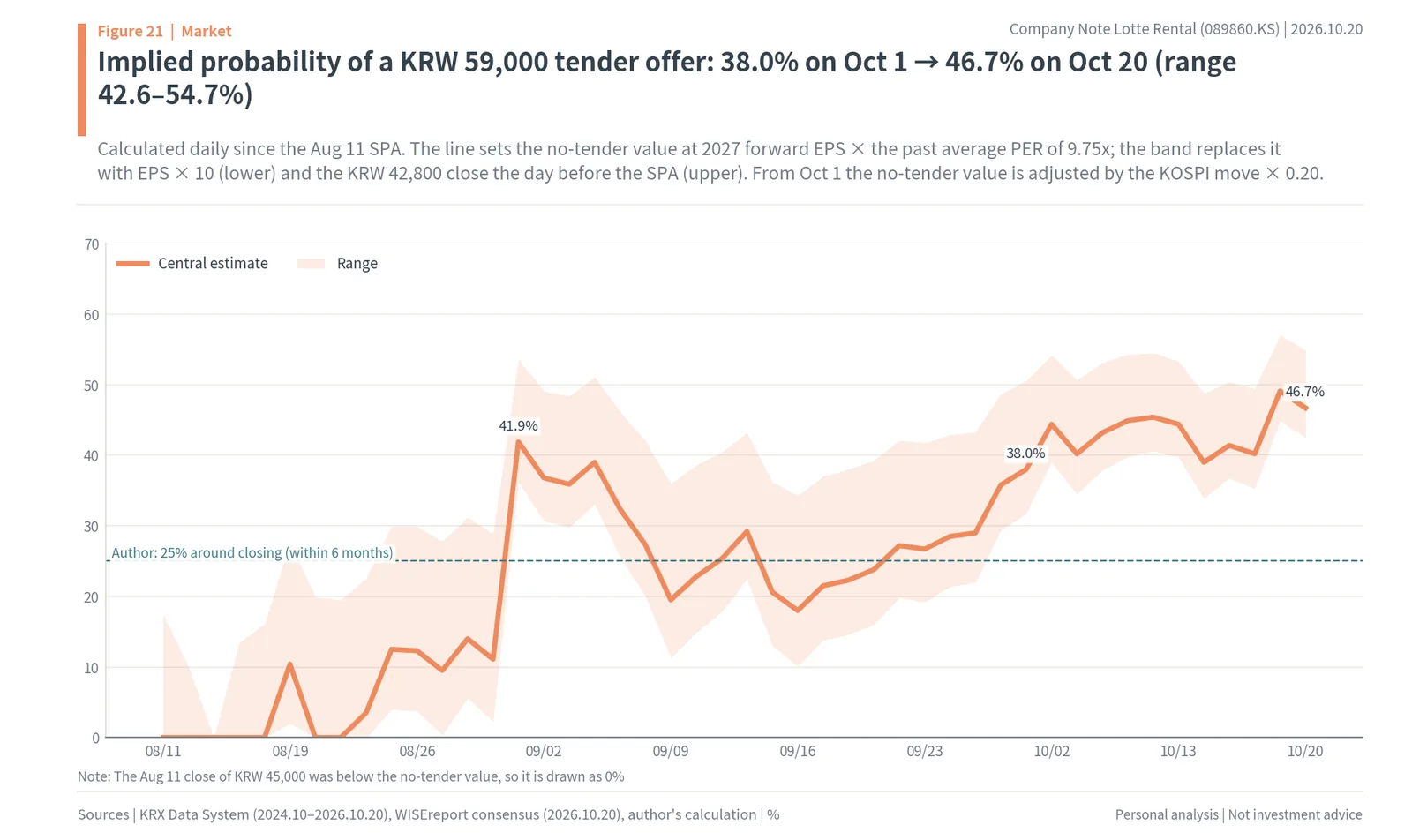
Solving the same way for each day since the agreement, the implied probability rose to 41.9% on the day of the FTC approval (September 1), fell back to 35.8% on September 30, climbed into the 40s again in October and reached 46.7% on October 20. It moved with the KOSPI’s slide rather than with the director election filings.
This chapter’s conclusion is this. With the KOSPI down 20.3%, the market held Lotte Rental at -0.2%, pricing in a tender probability of close to half (46.7%), and on the days the director news came out, private funds and foreigners bought while individuals sold. The market sees the odds of a tender offer as close to even.
10. Author’s calculation: a KRW 59,000 tender offer around the November closing is 25% likely, 75% over several years, and the probability-weighted value is KRW 50,600
Splitting the probability by timing
The probability of a tender offer has to be measured by timing. As chapter 8 showed, Lotte Rental has two paths to a tender offer, one around the November closing and one after it, and the two come with different prices. The author puts the probability of a KRW 59,000 tender offer around the November closing (within the next six months) at 25%. There are four grounds. Among the six precedents that launched a tender offer first, the Douzone Bizon path, a tender offer 109 days after signing, is open to Lotte Rental until November 28. On September 30, Chosun Biz reported that TPG had begun talks on acquisition financing and was said to be reviewing a tender offer. KRW 38.83 of every KRW 100 in dividends leaks to minority shareholders, and the minority share at a 60% payout (KRW 39.6bn) nearly covers the interest (KRW 41.6bn a year at 5%) on the KRW 831.7bn it costs to buy the remaining shares at KRW 59,000 (chapter 4). And in the eight precedents that seated directors first, tender offers came 38 days to 7.9 years after the director election.
Widening the horizon to several years raises the probability. Six of the eight precedents that seated directors first (75%) made a tender offer. The four delisting tender offers came 2.1 to 7.9 years after the director election, and the two stake-building tender offers 38 days and 1.2 years after. Across all 14 deals, 12 made a tender offer. The author sets the probability of a tender offer over several years at the precedent rate, 75%. Because prices years later in the precedents were the market price then plus a premium, the price on that path depends on how far TPG has lifted the share price by then through dividends and operations.
Three branches and the probability-weighted value
The next 6 to 12 months split into three branches. First, a KRW 59,000 tender offer comes around the November closing (25%). The value is KRW 59,000 (+15.9% from now). Second, TPG raises the dividend before any tender offer (45%). At 11 times 2027 forward EPS of KRW 4,683, the value is KRW 51,500 (+1.2%), and at a 60% payout the dividend is KRW 2,810 a share. Third, the dividend stays where it is and a tender offer is pushed back (30%). At 9 times 2027 forward EPS of KRW 4,683, the value is KRW 42,100 (-17.3%), and at a 34% payout the dividend is KRW 1,590 a share. Weighting the three by probability gives KRW 50,600 (about $38.2), almost the same as the October 20 close of KRW 50,900.
Averaging the two pre-tender branches by probability gives KRW 47,700. Taking this as the value without a tender offer and solving backward from today’s price, the tender probability the market prices in is 28.1%, close to the author’s 25%. The implied probability of 46.7% in chapter 9 takes the past average PER as the no-tender value, so depending on whether expectations of a higher dividend are included, the market’s probability lies between 28% and 47%. By no-tender PER, it is 51.9% at 9 times, 33.4% at 10 times, 17.6% at 10.5 times and 0% at 11 times. Today’s KRW 50,900 prices in something between “a higher dividend plus a low near-term tender probability” and “an unchanged dividend plus a high near-term tender probability.”
The path before a tender offer: dividends
If the tender offer slips past closing, TPG’s way of taking money out is the dividend. Dealsite (August 19) wrote that buyout funds usually hold for 5 to 10 years and that “the longer the holding period, the lower the IRR, and to defend it, recovering part of the principal early through dividends is the method mainly used.” The same article said TPG’s investment in Kakao Mobility, where it is the second-largest shareholder (14%), was entering its ninth year. TPG is a manager used to holding companies for a long time, and while it holds them, dividends carry the returns.
When the dividend rises, minority shareholders receive it at the same rate. Raising the payout from 34.1% in 2025 to 60% gives a dividend of KRW 2,810 a share on 2027 forward EPS of KRW 4,683, a yield of 5.52% on the current price of KRW 50,900. At 80%, it is KRW 3,746, or 7.36%. In that case holders’ returns come from dividends, and the dividend yield supports the downside of the share price. That is why the author gives 45% to “a higher dividend before a tender offer.” The shape of this meeting, with the operations head joining the board and TPG taking a seat where dividends are decided, fits this path.
Simulation
The simulation was run 20,000 times. The near-term tender probability was varied with a triangular distribution from 10% to 40% (mode 25%); when a tender offer comes, its price was set at KRW 59,000 85% of the time and between KRW 54,000 and KRW 58,500 15% of the time. Without a tender offer, 2027 forward EPS was varied from 0.88 to 1.08 times and the PER from 8.5 to 12 times (mode 10 times). The resulting distribution has a mean of KRW 49,800, a median of KRW 48,600, a 10th percentile of KRW 42,600 and a 90th percentile of KRW 59,000, and 62.9% of outcomes end below the current price. The mean of the no-tender cases is KRW 47,000.
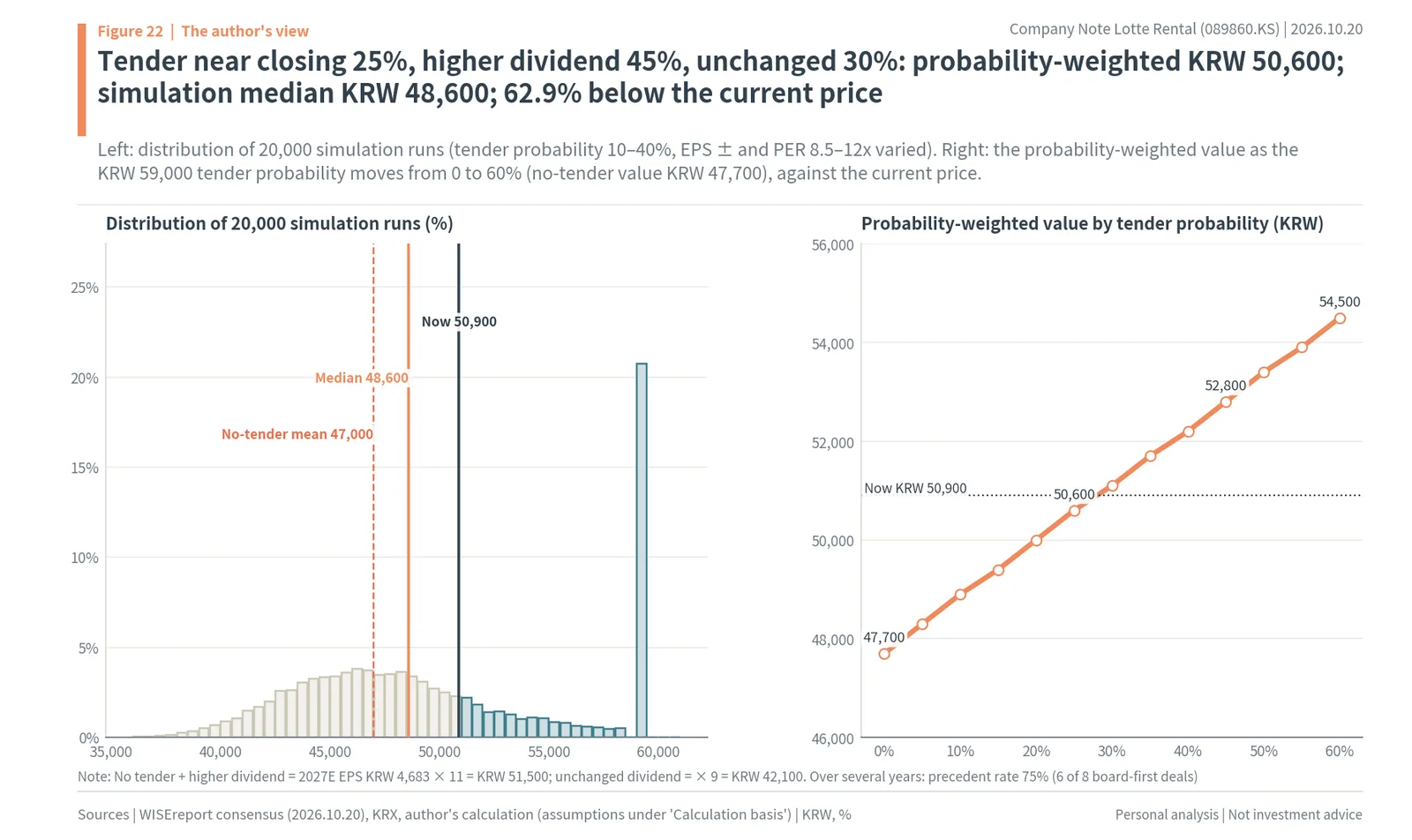
This chapter’s conclusion is this. The probability of a tender offer has to be read by timing: by the author’s calculation, a KRW 59,000 tender offer around the November closing (within six months) is 25%, and over several years the precedent rate is 75%. The probability-weighted value of the three branches over 6 to 12 months is KRW 50,600, almost the same as today’s price. The board where the two directors sit decides both a near-term tender offer and the dividends paid before it.
11. The holder’s math: tendering at KRW 59,000 equals selling on the market at KRW 51,950 to 58,910 after tax, and the test date is November 28
Tendering versus selling on the market
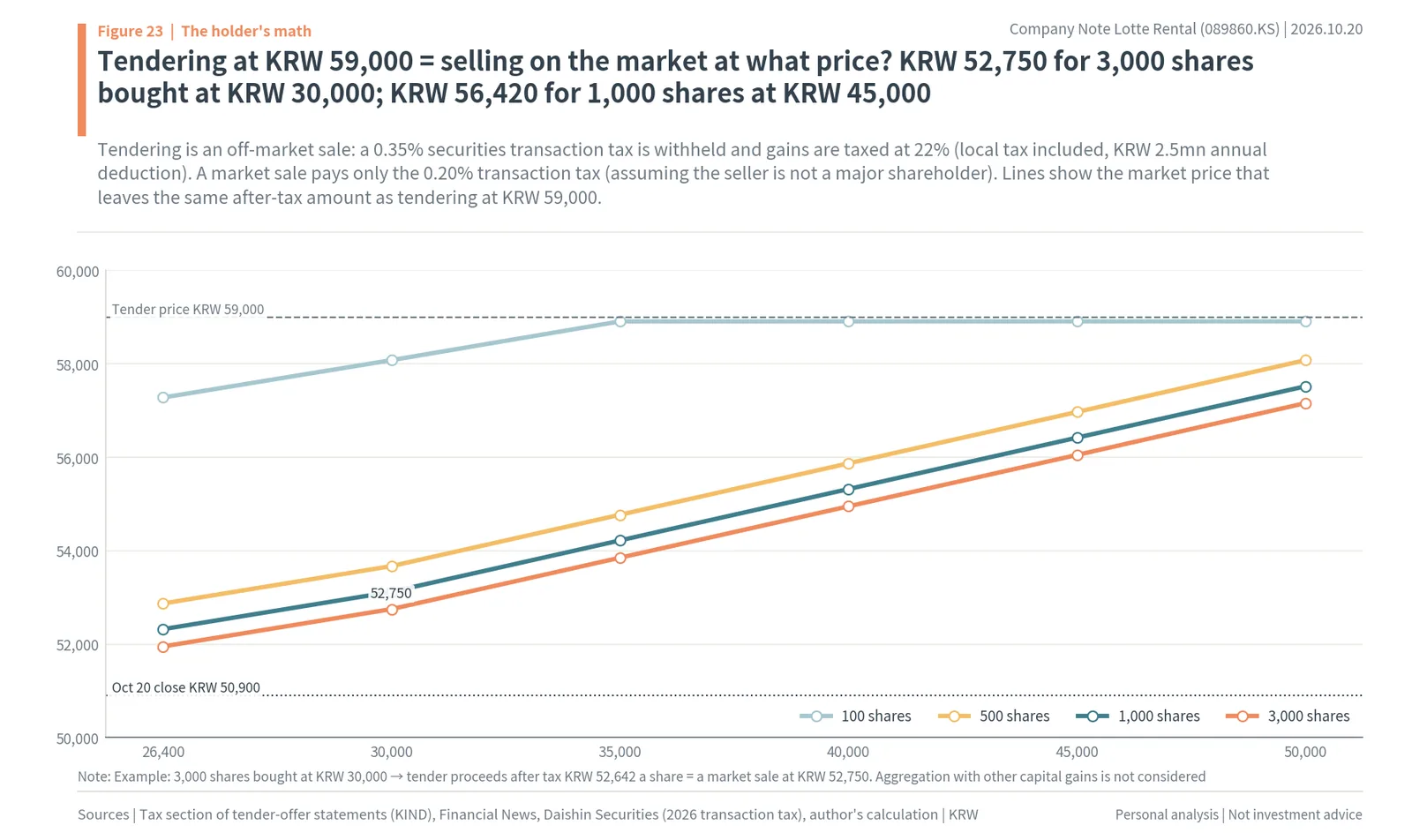
When a tender offer comes, holders can either tender or sell on the market. The two are taxed differently. Tendering counts as an off-market trade, so a 0.35% securities transaction tax is withheld and capital gains are taxed at 22% (including local tax) (tax section of tender-offer statements, Financial News). Capital gains are deductible up to KRW 2.5mn a year. On a market sale, a holder who is not a major shareholder pays only the 2026 KOSPI securities transaction tax of 0.20% (Daishin Securities notice). The after-tax proceeds of tendering at KRW 59,000 can therefore be converted into an equivalent market price, depending on the purchase price and the number of shares.
Someone who bought 3,000 shares at KRW 30,000 and tenders at KRW 59,000 keeps KRW 52,642 a share after tax. Selling on the market at KRW 52,750 leaves the same amount (market break-even, author’s calculation). That is 3.6% above the October 20 close of KRW 50,900. For 1,000 shares bought at KRW 45,000, the break-even is KRW 56,420. The higher the purchase price and the fewer the shares, the more of the gain the KRW 2.5mn deduction covers, and the closer the break-even gets to KRW 59,000. At a purchase price of KRW 45,000, up to 181 shares pay no tax. Anyone who bought 100 shares at KRW 35,000 or more has a gain within the KRW 2.5mn deduction and pays no capital gains tax, so only the difference in transaction tax remains and the break-even is KRW 58,910. For 3,000 shares bought at KRW 26,400 (the April 9, 2025 close), the break-even is KRW 51,950, KRW 1,050 from today’s price.
The calendar for selling
This math applies only after a tender offer comes. Until then, what holders watch is dates. On October 23 the amended bond filing shows the final rate and amount. On October 29 electronic voting closes at 5 p.m. and the new bonds are paid in. On October 30 the EGM elects TPG’s two directors. In early November (November 5 last year) preliminary third-quarter results come out; the consensus for third-quarter operating profit is KRW 91.7bn. If the deal closes in November, the change of largest shareholder filing, removal from the Lotte business group and the notice of bond put rights follow. And November 28 is day 109 of the agreement.
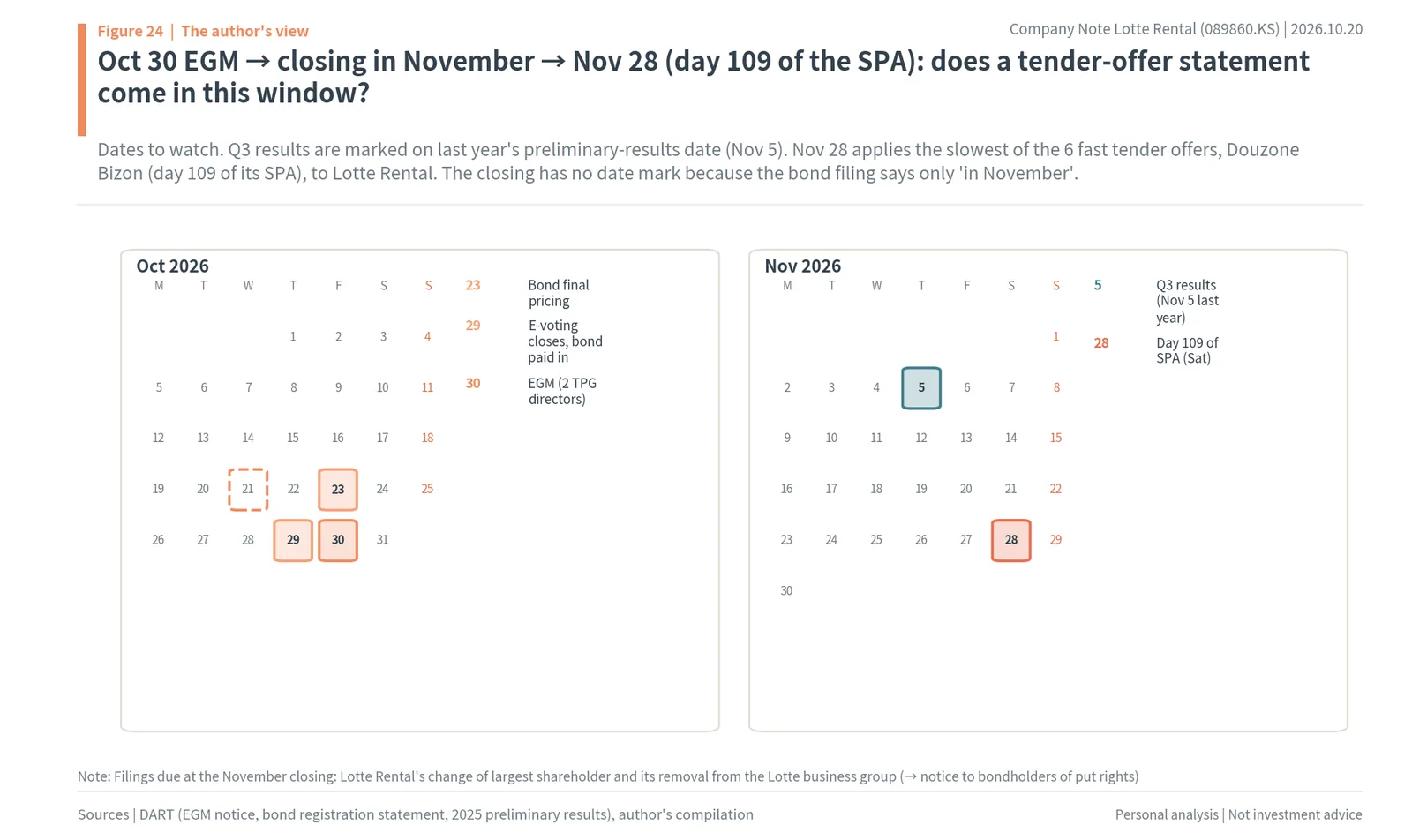
If a tender-offer statement comes by November 28, Lotte Rental enters the path of tender offers made around the agreement. All six on that path paid the controlling-stake price, so the price would be KRW 59,000, and agreement to delisting took 122 to 251 days. If the tender offer slips past closing, the precedent path continues while TPG runs the company and receives dividends, with tender offers coming 38 days to 7.9 years later. The prices of delisting tender offers years later were the market price then plus a premium (7.0% at Lock&Lock, 16.58% at Koentec). In the meantime, holders’ returns ride on the dividends TPG’s board will set.
This chapter’s conclusion is this. Because of tax, tendering is equivalent to selling on the market at KRW 51,950 to 58,910 (100 to 3,000 shares, purchase prices of KRW 26,400 to 50,000), and whether that math gets used depends on whether a tender-offer statement comes by November 28. For holders, the most important dates are the November closing and November 28, not the October 30 meeting.
12. Calculation basis
The numbers in this report come from only two places. Numbers taken from filings and articles carry their sources, and numbers the author calculated are marked “author’s calculation.” The calculations follow the bases below.
Share prices and indexes are KRX Data System closes. The reference close is KRW 50,900 on October 20, 2026. Naver Finance’s consolidated quote (KRW 50,300 on October 20) includes Nextrade trading after the regular session and was not used. Net buying by investor type is net purchase value from the KRX’s trading by investor type, and “private funds” is the private fund account in the KRX’s institutional breakdown.
Dates for the 14 precedents were taken from original DART filings. The agreement date is the signing date of the share purchase (or share transfer) agreement, the director election date is the date of the shareholder meeting that elected fund-side directors, and the tender date is the filing date of a tender-offer statement aimed at delisting. Days are calendar days. Group A is the 6 deals whose tender-offer statement came before the election of fund directors, and Group B is the other 8. The tender offers by Hanssem (March 2023) and Koentec (July 2017) had the stated purpose of securing management control rather than delisting, so they are counted separately as partial tender offers. Macquarie PE sold Koentec (2017) to E&F PE on June 4, 2020, so the Macquarie period runs to that date. The gap between the tender price and the agreement price was calculated only for Lock&Lock and Koentec (2020), whose share counts did not change. Ssangyong Cement’s issued shares changed from about 80.3 million to about 498.8 million, and Danawa merged with Korea Center into a different company, so they were not compared. The delisting dates for Douzone Bizon and Echo Marketing are the scheduled dates in their merger completion reports.
The seat calculation follows the articles’ cap of “seven directors or fewer” (Dealsite) and Article 542-8 of the Commercial Act (at least three independent directors, making up a majority of the board, at listed companies with total assets of KRW 2tn or more). With seven directors, a majority is four.
Beta is the slope against the KOSPI (0.20) measured on daily returns from July 1, 2025 to June 30, 2026 (244 trading days). Excess return is Lotte Rental’s return minus “KOSPI return × 0.20.” Volume multiples divide each day’s volume by September’s average daily volume (95,345 shares).
The implied tender probability is (price – no-tender value) ÷ (KRW 59,000 – no-tender value). For the central value, the no-tender value is 2027 forward EPS × the past average PER of 9.75 times (the average of the WISEreport year-end PERs of 10.34, 10.73, 8.47, 10.27 and 8.96 times for 2021 to 2025). 2027 forward EPS is KRW 4,728 up to October 1 (the earlier note) and KRW 4,683 from October 2 (the October 20 consensus). After October 1, the no-tender value is adjusted by “1 + 0.20 × the KOSPI change since October 1” (0.9593 times on October 20). The bottom of the range uses 2027 forward EPS × 10 as the no-tender value and the top uses KRW 42,800, the close the day before the agreement. Days on which the probability comes out below zero (August 11) are drawn as 0%.
The dividend calculation takes the 2027 consensus net profit attributable to owners of KRW 170bn × the payout ratio and splits it 61.17% to TPG and 38.83% to minority shareholders. The 14,097,325 remaining shares × KRW 59,000 = KRW 831.7bn. Interest rates of 4% to 6% are assumptions for comparison.
For the bonds, the 3 issues that matured by October 16 (KRW 240bn) were subtracted from the table of compliance with bond management agreements in the bond registration statement (June 30, 11 issues, KRW 961bn), and the result was checked against the same statement’s table of outstanding bonds (KRW 721bn of public bonds). The KRW 150bn of new bonds is the planned amount before book building.
The probability of a tender offer is split by timing. “25% around the November closing (within six months)” is the author’s assumption, and “75% over several years” is the share of the eight board-first precedents that made a tender offer in some form (4 delisting tender offers + 2 partial purchases aimed at securing control). The scenarios cover the next 6 to 12 months: a tender offer around closing at 25% (KRW 59,000), a higher dividend before any tender offer at 45% (2027 forward EPS of KRW 4,683 × 11, 60% payout) and an unchanged dividend at 30% (× 9, 34% payout); the probabilities are the author’s assumptions. The simulation has 20,000 runs, drawing the tender probability from a 10/25/40% triangular distribution, the tender price as KRW 59,000 85% of the time and from a uniform KRW 54,000 to 58,500 15% of the time, and, without a tender offer, 2027 forward EPS at 0.88/1.0/1.08 times and the PER at 8.5/10/12 times from triangular distributions (random seed 21).
Taxes assume a 0.35% securities transaction tax on tendering (withheld), 22% on capital gains (including local tax), an annual basic deduction of KRW 2.5mn and a 0.20% securities transaction tax on market sales. Aggregation with other capital gains and major-shareholder taxation are not considered. Break-even = after-tax tender proceeds ÷ (shares × 0.998).
Lotte Rental, TPG and a tender offer: frequently asked questions
Q. Who are TPG’s two new Lotte Rental directors?
At the October 30, 2026 EGM, Lotte Rental elects two TPG Global Partners as non-executive directors with three-year terms: Yoon Shin-won, head of Korea investments, and Zubin Irani, head of Asia portfolio operations. Lotte Corp.’s director Choi Young-jun steps down, so the board goes from 6 to 7 members: CEO Lee Jang-seop, two TPG directors and four independent directors. Two seats is the most TPG can hold without amending the articles, because the Commercial Act requires an independent majority.
Q. What can the two TPG directors affect at Lotte Rental?
They sit on the board that sets borrowing, bond issuance, dividends, the business plan and the CEO appointment. The payout ratio was 34.1% in 2025; at 60% of 2027 forward EPS of KRW 4,683, the dividend would be KRW 2,810 a share, a 5.52% yield on KRW 50,900. TPG’s two votes and the CEO’s make 3 of 7, so board resolutions also need at least one of the four independent directors.
Q. Will TPG make a tender offer for the remaining Lotte Rental shares?
No tender-offer statement had been filed as of October 21, 2026, and the law does not require one in this deal. In 14 private-equity buyouts of Korean listed companies since 2016, 12 made a tender offer. The 6 that bid first did so 1 to 109 days after signing at the controlling-shareholder price, and 6 of the 8 that seated directors first, as Lotte Rental’s buyer is doing, bid 38 days to 7.9 years after the director election. The author puts a KRW 59,000 tender offer around the November closing at 25% and over several years at 75%.
Q. Why would TPG want to buy the remaining 38.83% of Lotte Rental?
Because dividends leak: of every KRW 100 Lotte Rental pays, KRW 38.83 goes to minority shareholders. At a 60% payout of the KRW 170bn 2027 consensus net profit, that is KRW 39.6bn a year, close to the KRW 41.6bn of annual interest on the KRW 831.7bn it would cost to buy the 14,097,325 remaining shares at KRW 59,000 with money borrowed at 5%. The dividend yield at KRW 59,000 would be 4.76%.
Q. What happens to Lotte Rental’s bonds when the TPG deal closes?
Leaving the Lotte business group counts as a change of control, so holders of KRW 871bn of public bonds (KRW 721bn outstanding plus KRW 150bn issued on October 29) can demand repayment of full principal. That is 2.27 times the KRW 384bn of cash at the end of June. Yields on Lotte Rental’s own bonds are 90 to 107bp higher than in January, which makes the right worth using.
Q. What tender probability does the Lotte Rental share price imply?
From October 1 to 20, 2026 the KOSPI fell 20.3% while Lotte Rental slipped only 0.2% to KRW 50,900. With the no-tender value set at 2027 forward EPS × the past average PER of 9.75 times and adjusted for the market, the implied probability of a KRW 59,000 tender offer rose from 38.0% to 46.7% (range 42.6% to 54.7%). With the author’s no-tender value of KRW 47,700, which includes a higher-dividend branch, it is 28.1%.
Q. How does tendering at KRW 59,000 compare with selling on the market after tax?
Tendering is taxed as an off-market sale: a 0.35% transaction tax plus 22% on gains above a KRW 2.5mn annual deduction, against 0.20% for a market sale by a holder who is not a major shareholder. For 3,000 shares bought at KRW 30,000, tendering equals a market sale at KRW 52,750; for 1,000 shares bought at KRW 45,000, KRW 56,420; for 100 shares bought at KRW 35,000 or more, KRW 58,910. The date to watch is November 28, day 109 of the agreement.
Sources
- DART, Lotte Rental, [Amendment] Resolution calling a general meeting (link), Oct 7, 2026
- DART, Lotte Rental, Notice of general meeting (link), Oct 15, 2026
- DART, Lotte Rental, Report on changes in shares held by the largest shareholder and related parties (link), Oct 13, 2026
- DART, Lotte Rental, Registration statement for debt securities (link), Oct 19, 2026
- DART, Lotte Rental, Share purchase agreement involving a change of largest shareholder (link), Aug 11, 2026
- DART, Lexicon Korea Holdco, Report on large holdings of shares (link), Aug 18, 2026
- Dealsite, Lotte Rental: two from TPG join the board, debt management put to the test (link), Oct 20, 2026
- Chosun Biz, TPG, which bought Lotte Rental with cash alone, moves straight to borrowing, with possible use for a tender offer (link), Oct 1, 2026
- Dealsite, New largest shareholder and a higher base rate: Lotte Rental swallows 100bp (link), Oct 19, 2026
- Korea Credit News, Lotte Rental’s KRW 961bn early-repayment fuse and the limits of rolling over short-term debt (link), Oct 20, 2026
- Hana Securities (via Etoday), Lotte Rental expected to expand shareholder returns under TPG (link), Sep 2, 2026
- korea.legal, Commercial Act Article 542-8 (election of independent directors) (link)
- DART, Ssangyong Cement Industrial, Amended resolution calling a general meeting (link), Mar 10, 2016 / Results of the annual general meeting (link), Mar 30, 2016
- DART, Ssangyong C&E, Tender-offer statement (link), Feb 5, 2024
- DART, Lutronic, Tender-offer statement (link), Jun 9, 2023 / Resolution calling a general meeting (link), Jul 3, 2023
- DART, Douzone Bizon, Tender-offer statement (link), Feb 23, 2026 / Results of the annual general meeting (link), Mar 26, 2026
- DART, Echo Marketing, Tender-offer statement (link), Jan 2, 2026 / Results of the extraordinary general meeting (link), Mar 9, 2026
- DART, Jeisys Medical, Tender-offer statement (link), Jun 10, 2024 / Results of the extraordinary general meeting (link), Jul 24, 2024
- DART, Osstem Implant, Tender-offer statement (link), Jan 25, 2023 / Resolution calling a general meeting (link), Mar 9, 2023
- DART, BusinessOn Communication, Tender-offer statement (link), Aug 12, 2024 / Results of the extraordinary general meeting (link), Sep 4, 2024
- DART, Lock&Lock, Results of the extraordinary general meeting (link), Dec 4, 2017 / Tender-offer statement (link), Apr 18, 2024
- DART, Danawa, Results of the extraordinary general meeting (link), Mar 16, 2022 / Connectwave, Tender-offer statement (link), Apr 29, 2024
- DART, Hanssem, Results of the extraordinary general meeting (link), Dec 13, 2021 / Tender-offer statement (link), Mar 2, 2023
- DART, Koentec, Results of the extraordinary general meeting (link), Jun 2, 2017 / Tender-offer statement (link), Jul 10, 2017 / Results of the extraordinary general meeting (link), Jul 24, 2020 / Tender-offer statement (link), Nov 8, 2024
- DART, Classys, Results of the annual general meeting (link), Mar 31, 2022 / Change of largest shareholder (link), Apr 4, 2022
- DART, Namyang Dairy Products, Change of largest shareholder (link), Jan 30, 2024 / Results of the annual general meeting (link), Mar 29, 2024
- WISEreport consensus (Oct 20, 2026), KRX Data System prices, indexes and trading by investor type (Oct 2024 to Oct 20, 2026), author’s calculations; Yahoo Finance (USD/KRW, Oct 20, 2026)
- Bloter, [Lotte Rental M&A] KRW 1tn or 2tn: the tender-offer math facing TPG (link), Jul 8, 2026
- Bloter, Lotte Rental issues public bonds before joining TPG, early repayment in focus (link), Oct 18, 2026
- IB Tomato, Lotte Rental reshapes its business under TPG: will its finances improve? (link), Sep 3, 2026
- MTN, Mandatory tender offer bill fails to reach the plenary session, passage uncertain (link), Oct 1, 2026
- Law Times (Yulchon Legal Update), The Capital Markets Act amendment to introduce a mandatory tender offer (link), Sep 2026
- Kim & Chang, Wider recognition of the certificate of tender-offer funds (link), Apr 2023
- Edaily (via Nate), Douzone Bizon’s first tender offer ends with EQT holding 83.10% (link), Mar 26, 2026
- korea.legal, Capital Markets Act Article 138 (statement of opinion on a tender offer) (link)
- DART, Lotte Rental, Half-year report (June 2026) (link), Aug 14, 2026
- DART, Lotte Rental, [Amendment] Major matters report (decision on a new share issue) (link), May 21, 2026
- Jeju Regional Office of Aviation, Ministry of Land, Infrastructure and Transport, Jeju International Airport (Yongdam-2-dong) (link)
- Tax section of tender-offer statements (KIND, https://kind.krx.co.kr/external/2024/03/27/000759/20240327002662/00650.htm), Financial News (link), Daishin Securities 2026 securities transaction tax notice (link)
- Photos: Mer du Japon (public domain), kallerna (CC BY-SA 4.0), Kimhs5400 (CC BY 4.0), Minseong Kim (CC BY-SA 4.0), Christophe95 (CC BY-SA 4.0), Narubaru7 (CC BY 4.0), via Wikimedia Commons
- Logos: Lotte Rental (company CI, CC BY 4.0), TPG Capital (public domain), via Wikimedia Commons
Disclaimer
This report records the author’s personal analysis and views based on public information and does not recommend any particular product or company. It does not recommend buying or selling any financial investment product and is not an investment advisory or quasi-investment advisory service.
The figures in this report are those public at the time of writing. Filings and reports may change later, and consensus figures are the average of the estimating institutions at the time cited. TPG’s tender offer has been reported only as under review at the time of writing and is not a confirmed fact. The classification and date calculations of the 14 precedents were compiled by the author from DART filings. Accuracy and completeness are not guaranteed.
The tender probabilities, scenario values, probability-weighted value and implied probability are estimates based on the assumptions stated in the text; if the assumptions do not hold, the results differ. Items marked “author’s calculation” or “author’s estimate” are the author’s calculations and assumptions, not confirmed facts.
Statements about laws, regulations and taxes are interpretations based on public material, not legal or tax advice. Actual taxes depend on each person’s purchase price, number of shares and other income.
Author’s interests: Holds (the author holds Lotte Rental shares as of the writing date)
Responsibility for decisions and their outcomes lies with the reader.
As of: October 21, 2026
Was this note useful?
Thanks. Your answer helps decide what to cover next.
Korea market snapshot · Oct 23, 2026
New to Korean stocks? Start here for the basics.
Most read
1France Protests 2026: Why Students Are Blocking Schools and Which Stocks Benefit (Munich Re, SCOR)
Get the Saturday note on Korean stocks
One email every Saturday with the week’s new research on Korean listed companies and links to the updated data pages. Built from DART filings and KRX data. Free; unsubscribe in one click. See past issues