Korea’s Major Shareholder Capital Gains Tax and Year-End Selling: Why Dec 28, 2026 Decides Next Year’s Tax
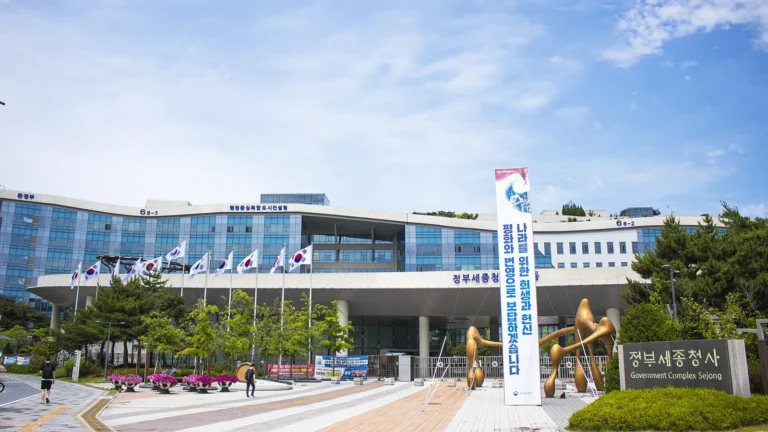
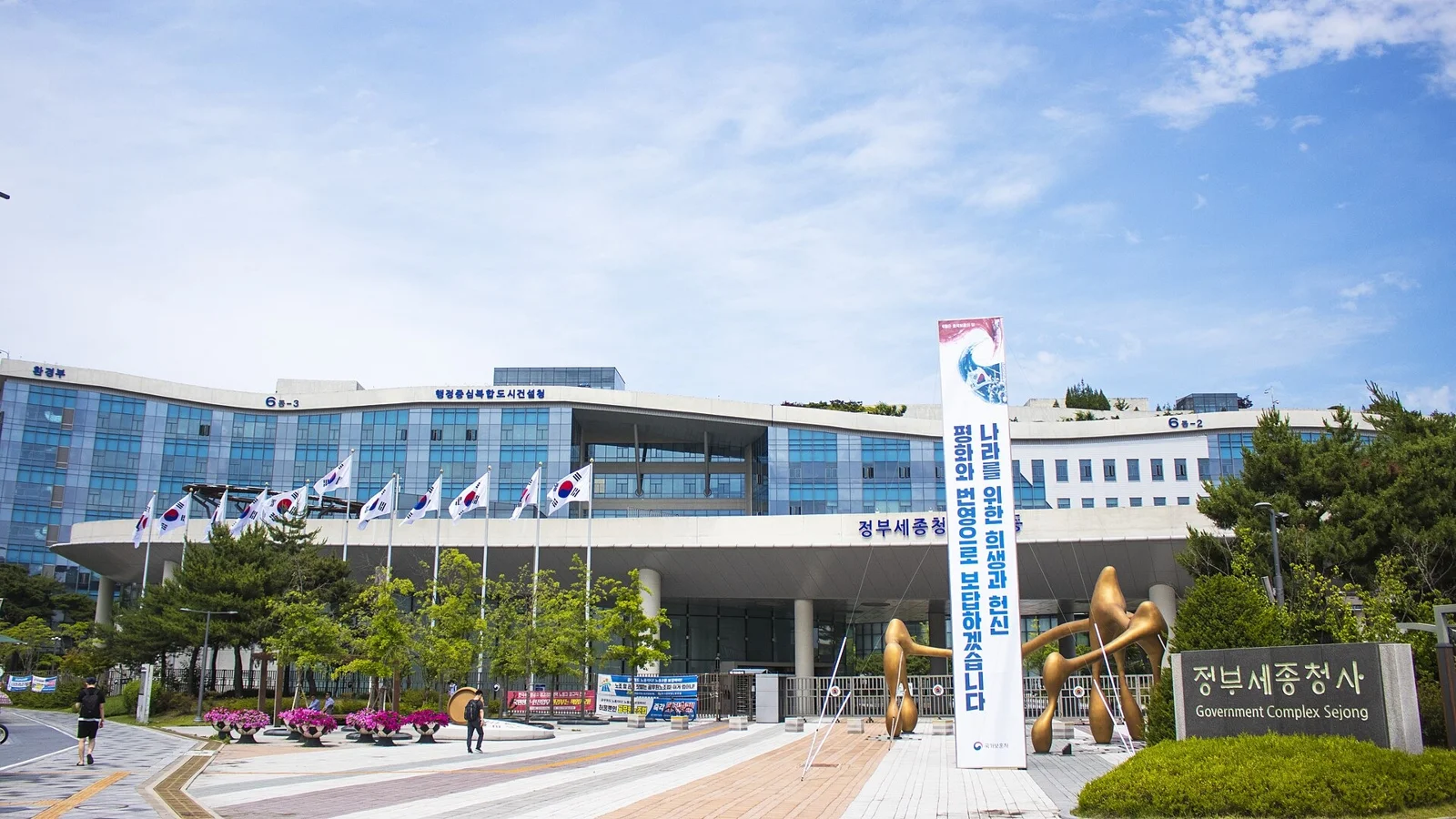
On July 31, 2025, after the market closed, the Ministry of Economy and Finance released its 2025 tax reform plan from the Government Complex in Sejong. Of all the items in it, the stock market reacted at once to one line: the threshold for “major shareholders,” the only individuals who pay capital gains tax on listed Korean shares, would be cut from KRW 5bn (about $3.7mn) of holdings in a single stock to KRW 1bn (about $750,000). The next day, August 1, the KOSPI closed at 3,119.41, down 126.03 points or 3.88%. It was the biggest one-day fall since April 7 that year, and the KOSDAQ fell 4.03% to 772.79 (Segye Ilbo, KRX).
The backlash moved to the National Assembly’s public petition system. A petition titled “Against lowering the major shareholder capital gains tax threshold” passed 110,000 signatures in three days, on August 3 (Herald Economy). On September 11, President Lee Jae-myung said at a press conference marking his first 100 days in office, “If investors want it, we will keep it at KRW 5bn” (Money Today). On September 15, the Ministry of Economy and Finance announced that the threshold would stay at “KRW 5bn or more of holdings per stock” (Korea Policy Briefing). The same day, Deputy Prime Minister Koo Yun-cheol explained, “We thought hard about the balance between normalizing taxation and the need to revitalize the capital market” (SBS Biz).
At the end of that year the threshold was still KRW 5bn. Yet on December 26, 2025, the last day to sell for the major shareholder test, individual investors were net sellers of KRW 2.79tn (about $2.09bn) on the KOSPI and KOSDAQ combined. It was their biggest net selling day of that December (KRX, author’s calculation). With the KRW 5bn threshold unchanged, who will sell at the end of this year, and when? This report starts with who pays the major shareholder tax and how, then checks with numbers why a one-day test at year-end triggers selling, what actually happened in the market on that day over the past 16 years, and what is different this year.
This report is the full English edition of Maochaedung’s Korean note on Korea’s major shareholder capital gains tax and year-end selling, with the KRX data behind every number.
As of: October 20, 2026 (KOSPI and KOSDAQ index levels, net buying by investor type and market caps at the KRX close on October 20). Dollar amounts use KRW 1,333.4 per dollar, the October 19, 2026 close (Yahoo Finance, KRW=X).
Concepts covered: the major shareholder test for listed shares (KRW 5bn of holdings per stock, or a stake of 1% on KOSPI, 2% on KOSDAQ and 4% on KONEX); capital gains tax rates and the basic deduction; preliminary and final returns; the year-end cutoff day and T+2 settlement; selling on the cutoff day and buying back the next day; the securities transaction tax
Reference data: net buying by investor type is from the KRX Data System’s KOSPI and KOSDAQ trading by investor type (November 2010 to October 20, 2026); individual net buying by stock is from KRX net buying by investor type per stock (cutoff days and the following trading days, 2020 to 2025); index levels, closing prices and market caps are from KRX daily data. The rules were checked against news reports quoting National Tax Service guidance (SBS Biz and Money Today, August 5, 2026), articles in the Korea Economic Daily and Kyunghyang Shinmun, and Ministry of Economy and Finance announcements. Numbers the author calculated are marked as the author’s calculations.
How it works in Korea
Korean stocks trade on two boards run by the Korea Exchange (KRX): KOSPI, the main board where Samsung Electronics and SK hynix are listed, and KOSDAQ, the growth board for smaller companies. Most individual investors pay no capital gains tax when they sell listed Korean shares on the market; only “major shareholders” do, meaning those who held KRW 5bn or more of one stock, or a stake of 1% (KOSPI), 2% (KOSDAQ) or 4% (KONEX), at the end of the previous year. Major shareholders pay 22%, and 27.5% on the part of the taxable gain above KRW 300mn (about $225,000), including local income tax. The test looks at one day only, the settled holdings at year-end, and because Korean trades settle two trading days later (T+2), the last day to sell for 2026 is Monday, December 28. Overseas stocks work differently: every investor pays 22% on gains above KRW 2.5mn (about $1,900) a year. KRX publishes net buying by investor type every day, which is why this report can say who sold and who bought on each of those days.
Small investors pay no tax on Korean share gains; major shareholders, judged on one day at year-end, pay 22% to 27.5%, and this year that day is the Dec 28 close.
Capital gains tax on listed Korean shares applies only to major shareholders: KRW 5bn in one stock, or a 1% or 2% stake, at the end of the previous year
Most individuals pay no capital gains tax even when they sell listed Korean shares on the market at a profit. Only “major shareholders” pay. The conclusion of this chapter is simple. A major shareholder is decided not by that year’s trading but by holdings on the last day of the previous year, and the test is KRW 5bn of holdings in one stock or a stake threshold. In stocks with a small market cap, the stake line is hit before KRW 5bn.
There was once a plan to tax every investor’s stock gains. The Financial Investment Income Tax (geumtuse) would have taxed the gains of investors who are not major shareholders as well, but just before it took effect, a bill scrapping it passed the National Assembly’s plenary session on December 10, 2024 (SBS Biz). So in 2026, the old structure, under which only major shareholders pay tax on gains from listed Korean shares, is still in place.
According to news reports quoting the National Tax Service, Korea’s tax agency, there are two tests for a major shareholder. One is holdings per stock: anyone who held KRW 5bn or more of one stock, valued at market price, at the end of the previous fiscal year is a major shareholder. The other is the stake: anyone who held 1% or more of a KOSPI stock, 2% of a KOSDAQ stock or 4% of a KONEX stock at the end of the previous fiscal year is a major shareholder (SBS Biz and Money Today, August 5, 2026). Meeting either test is enough. The test date is “the end of the fiscal year before the year of sale.” In other words, whether someone selling shares in 2027 is a major shareholder depends on what they held as of December 31, 2026.
Whose shares are added together also matters. For ordinary shareholders who are not in the largest shareholder’s family, sales from January 1, 2023 count only the investor’s own shares, without adding those of a spouse, parents or children (Kyunghyang Shinmun, February 6, 2023). Before that, family holdings were added in under a rule called “aggregation for other shareholders.” The largest shareholder group is still tested on the combined holdings of the person, relatives and companies under their management control (Money Today, August 5, 2026). The main characters of the year-end selling in this report are individuals who are not largest shareholders: investors holding a large amount of one stock in their own name.
In small-cap stocks, the stake line is hit first
Because there are two tests, the line that bites first differs from stock to stock. For 1% of a KOSPI stock to equal KRW 5bn, the market cap must be KRW 500bn. In a stock with a market cap below KRW 500bn, 1% is worth less than KRW 5bn, so an investor becomes a major shareholder at the 1% stake line before holdings reach KRW 5bn. On KOSDAQ the stake test is 2%, so the dividing line is a market cap of KRW 250bn. Counting with KRX market caps on October 20, 634 of the 940 KOSPI listings (including preferred shares), or 67.4%, had a market cap below KRW 500bn. On KOSDAQ, 1,499 of 1,822 listings, or 82.3%, were below KRW 250bn (author’s calculation).
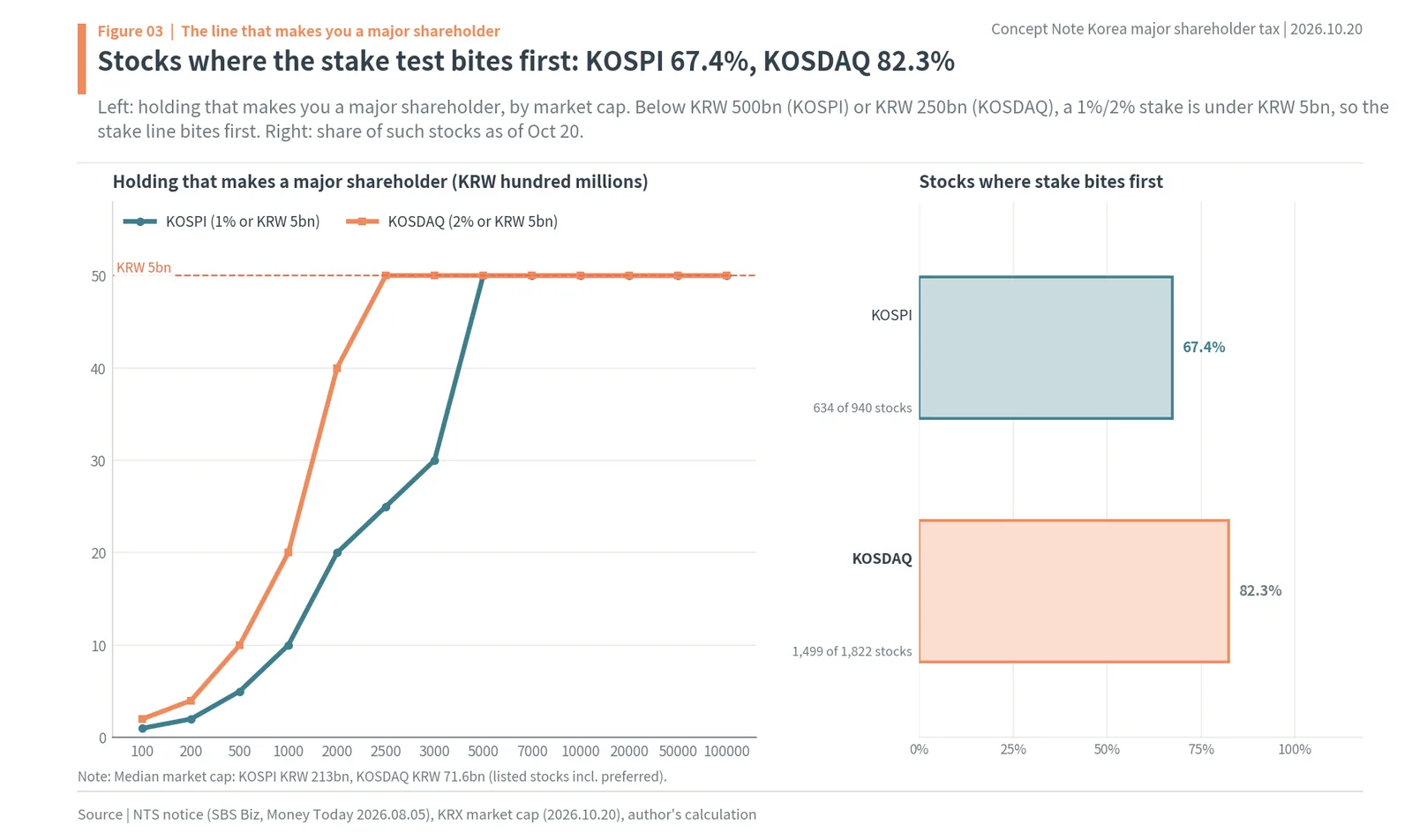
The left side of the figure plots, against a stock’s market cap, the holdings in that stock that make an investor a major shareholder. As market cap grows, the stake line rises with it, then flattens when it reaches the KRW 5bn line at KRW 250bn for KOSDAQ and KRW 500bn for KOSPI. The right side shows the share of stocks where the stake line is hit first. The median market cap was KRW 213bn on KOSPI and KRW 71.6bn on KOSDAQ. In a KOSDAQ stock worth KRW 70bn, holding just KRW 1.4bn is a 2% stake, which makes the investor a major shareholder.
This structure says two things. For investors holding a lot of big stocks such as Samsung Electronics and SK hynix, the KRW 5bn line is the issue; for investors concentrated in small stocks, the stake line is the issue. People often think only of KRW 5bn when they talk about year-end selling, but 82.3% of KOSDAQ stocks are ones where the stake line is hit first.
Capital gains tax on listed Korean shares applies only to major shareholders who held KRW 5bn or more of one stock, or a stake of 1% on KOSPI or 2% on KOSDAQ, on the last day of the previous year. For 67.4% of KOSPI stocks and 82.3% of KOSDAQ stocks, the stake line is hit before KRW 5bn.
Terms to know first: taxable gain, basic deduction, settlement date, largest shareholder
Articles and guides on the major shareholder tax use several unfamiliar terms. This chapter explains once the words used throughout the rest of the report. The conclusion is simple. The tax depends on “how much you made (the taxable gain),” and who pays depends on “how much you held, and when (settled holdings at the end of the previous year).”
Capital gains tax is a tax on the profit from selling shares or real estate. The capital gain is the sale amount minus the purchase amount and necessary expenses such as commissions. The taxable gain is the capital gain minus the basic deduction, and the tax rate is applied to this taxable gain. The basic deduction for shares is KRW 2.5mn a year. If you sold several times in a year, all of that year’s gains are added up and the deduction is taken only once.
“Major shareholder” is the legal term for people who owe this tax. It is different from the everyday sense of a large shareholder who controls a company. Anyone holding KRW 5bn or more of one stock at the end of the previous fiscal year is a major shareholder for tax purposes, even if that is a 0.01% stake. Conversely, in a stock with a small market cap, a stake of 1% (KOSPI) or 2% (KOSDAQ) alone makes someone a major shareholder, even if the amount is not large.
The largest shareholder is the company’s biggest shareholder together with related parties (relatives, companies under their management control and so on). The largest shareholder group adds all of their holdings together for the major shareholder test. Ordinary shareholders who are not largest shareholders have counted only shares in their own name since 2023. If the same stock is held across several brokers, all accounts in the investor’s own name are added together.
The settlement date is the day ownership of the shares actually changes. In the Korean market, cash and shares are exchanged two trading days after the trade (T+2). Because “holdings” for the major shareholder test are based on settlement, only trades that settle on the last trading day of the year, meaning trades made two trading days before the last trading day, are reflected in that year’s holdings. This report calls that day the cutoff day.
Preliminary and final returns differ in timing. A major shareholder’s sales of Korean shares are reported every half year in a preliminary return (by August 31 for the first half, and by the end of February of the next year for the second half). If gains and losses are combined with overseas stocks or there is more to report, a final return is filed in May of the next year. Local income tax, 10% of the capital gains tax, is filed and paid separately.
The securities transaction tax is charged on the sale amount every time shares are sold, whether or not there is a profit. From January 1, 2026, it is 0.20% on KOSPI (0.05% transaction tax plus 0.15% special tax for rural development), 0.20% on KOSDAQ and 0.10% on KONEX (Segye Ilbo, January 5, 2026). Investors who are not major shareholders pay it on every sale too.
The tax applies to the taxable gain (capital gain minus the KRW 2.5mn basic deduction), and who pays is decided by settled holdings at the end of the previous year. Unless you are a largest shareholder, only shares in your own name count.
Once you are a major shareholder, next year’s gains are taxed at 22%, and 27.5% on the part above KRW 300mn, with returns every half year
When an investor who has become a major shareholder sells that stock at a profit the next year, they pay capital gains tax. The conclusion of this chapter is simple. Including local income tax, the rate is 22% on taxable gains up to KRW 300mn and 27.5% on the part above, returns must be filed every half year, and the number of people the National Tax Service sends notices to rose sharply this year.
Under the Income Tax Act, the rate on listed shares for major shareholders is 20% on taxable gains up to KRW 300mn and 25% on the part above. A major shareholder who sells shares of a non-small-and-medium company held for less than a year pays 30% (Korea Economic Daily, February 7, 2026; Taxnet). Local income tax of 10% of the capital gains tax is added on top, so the actual burden is 22%, 27.5% and 33% (author’s calculation). The taxable gain is the capital gain minus the annual basic deduction of KRW 2.5mn. Overseas stocks work differently. Every investor pays 22% on overseas stock gains after the KRW 2.5mn annual deduction, regardless of major shareholder status or amount (Samsung Securities guide; Money Today, August 5, 2026).

The left side of the figure shows the rate staircase as the taxable gain grows: 22% up to KRW 300mn, and 27.5% on the part above. With a taxable gain of KRW 1bn, the first KRW 300mn and the remaining KRW 700mn are taxed at different rates. The right side shows rates by type of investor and type of share: no tax for small shareholders in listed Korean shares, 22% and 27.5% for Korean major shareholders, 33% for major shareholders who held for less than a year, and 22% for everyone on overseas stocks. For the same KRW 100mn gain, a small shareholder in Korean stocks pays nothing, while an overseas stock investor and a Korean major shareholder both pay tax.
Returns every half year, and notices up 39.4%
A major shareholder’s sales of Korean shares are reported every half year in a preliminary return. The return and payment are due within two months of the last day of the half year in which the sale took place, so sales in the first half are due by August 31 and sales in the second half by the end of February of the next year. If gains and losses are combined with overseas stocks or there were several sales, a final return is filed in May of the next year (Money Today, August 5, 2026; Korea Economic Daily, February 7, 2026). The National Tax Service sends notices to those concerned before the preliminary return deadline.
The National Tax Service sent preliminary return notices for first-half 2026 sales to 21,822 people. That is 6,171 more, or 39.4% more, than the 15,651 who received notices for second-half 2025 sales (SBS Biz, August 5, 2026). This number is not the number of actual filers but the number of notices sent to sellers who may meet the major shareholder test. Still, a 39.4% jump in notices within half a year under the same KRW 5bn threshold is a sign that more people are meeting the test.
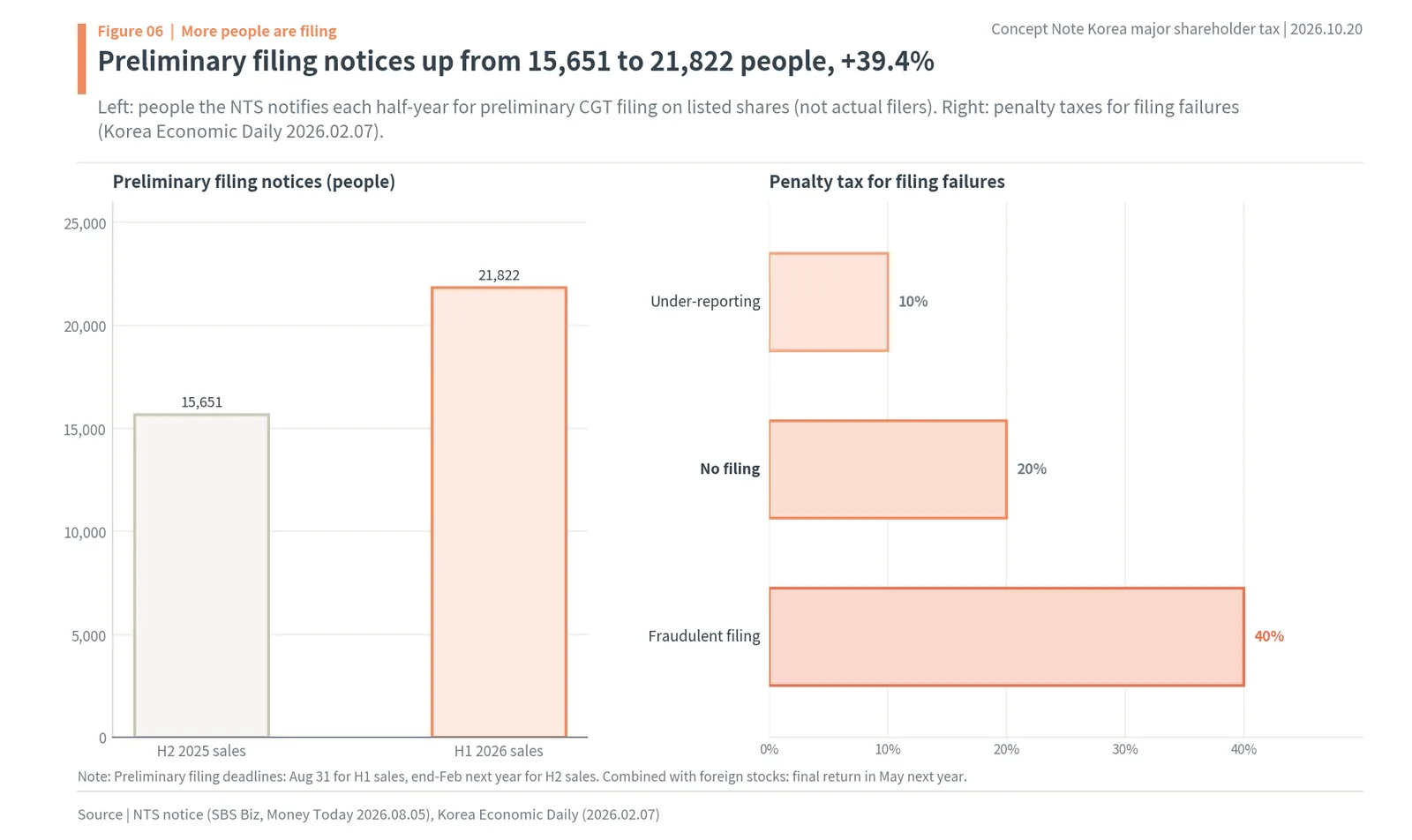
The left side of the figure shows the number of people who received preliminary return notices by half year. The right side shows the penalty for missing a return. Not filing carries a 20% penalty, underreporting 10% and fraudulent reporting 40% (Korea Economic Daily, February 7, 2026). This is why some investors who sold without realizing they had become major shareholders end up paying a penalty on top of the tax the next year.
Major shareholders pay 22% including local tax on that stock’s gains the next year, 27.5% on the part above KRW 300mn, and file preliminary returns every half year. Preliminary return notices from the National Tax Service rose 39.4%, from 15,651 to 21,822 people.
The amount threshold fell from KRW 10bn to KRW 1bn, returned to KRW 5bn in 2024, and shook politics each time it moved
The amount threshold for major shareholders has never been a fixed number. The conclusion of this chapter is simple. It started at KRW 10bn in 2000, came down five times to KRW 1bn by 2020, went back to KRW 5bn in 2024, and two more attempts to lower it, in 2020 and 2025, were withdrawn after a backlash. Each time the threshold moved, the number of major shareholders changed sharply.
Tax on major shareholders of listed shares was first introduced in 2000 for those holding 3% of a KOSPI stock or KRW 10bn or more of one stock (Korea Economic Daily, December 21, 2023). In July 2013 it widened to 2% or KRW 5bn on KOSPI and 4% or KRW 4bn on KOSDAQ, and in April 2016 it became 1% or KRW 2.5bn on KOSPI and 2% or KRW 2bn on KOSDAQ (MTN, November 12, 2015). The amount threshold fell further to KRW 1.5bn in April 2018 and KRW 1bn in April 2020 (Korea Economic Daily, September 15, 2025). The stake thresholds of 1% on KOSPI and 2% on KOSDAQ have stayed the same since 2016.
In 2020, a schedule to cut the threshold to KRW 300mn from April 2021, with family holdings added in, was already written into the enforcement decree (Newsis, January 7, 2021). A petition on the presidential office’s (Cheong Wa Dae) petition site titled “The major shareholder capital gains tax is a bad law that should now be scrapped” drew 216,844 signatures (Energy Economic News, October 27, 2020). The controversy ran for more than two months, and on November 3, 2020, at the National Assembly’s Strategy and Finance Committee, Deputy Prime Minister Hong Nam-ki said, “We have decided to keep … the current KRW 1bn,” and then added, “I felt a responsible attitude was needed, … so I submitted my resignation” (Nocut News). The KRW 300mn plan was withdrawn.
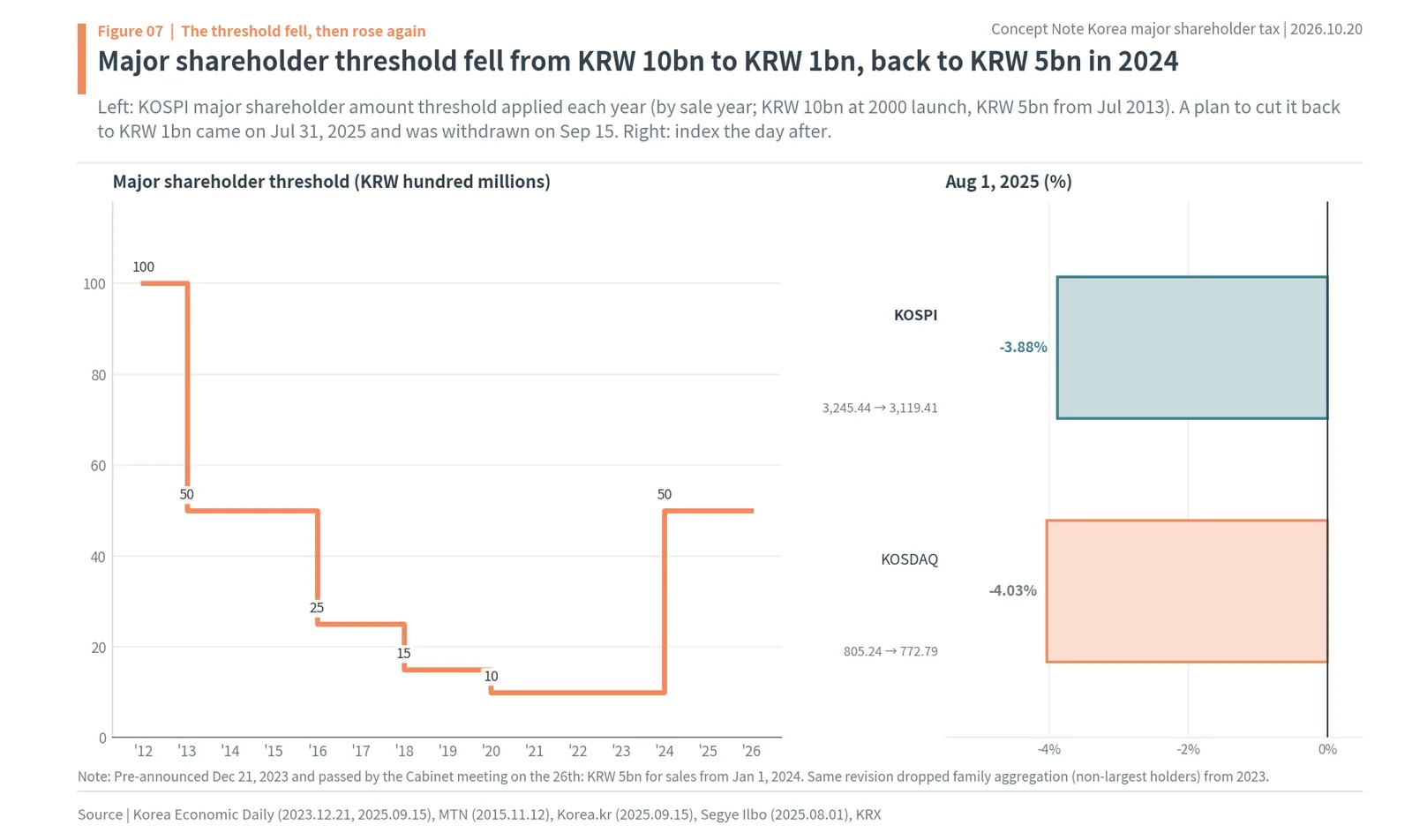
The left side of the figure shows the KOSPI amount threshold applied each year. It stepped down from KRW 10bn to KRW 5bn, KRW 2.5bn, KRW 1.5bn and KRW 1bn, then went back up to KRW 5bn in 2024. The right side shows the index on the day after the July 31, 2025 plan to cut it to KRW 1bn again. The KOSPI fell 3.88%, from 3,245.44 to 3,119.41, and the KOSDAQ fell 4.03%, from 805.24 to 772.79 (KRX).
Raising it to KRW 5bn cut the number of people to less than a third
How much raising the threshold to KRW 5bn shrinks the number of major shareholders can be seen in data submitted to the National Assembly at the end of 2023. According to Korea Securities Depository data, at the end of 2022 there were 13,368 individuals holding KRW 1bn or more of one stock (7,485 on KOSPI and 5,883 on KOSDAQ), and 4,161 holding KRW 5bn or more (2,088 on KOSPI and 2,073 on KOSDAQ) (Yonhap, December 24, 2023). These figures are counted by stock, so someone who is a major shareholder in two stocks is counted twice. Even so, they imply that raising the threshold from KRW 1bn to KRW 5bn cuts the number of people by 68.9% (author’s calculation).
National Tax Service data in the same article show that 5,504 major shareholders filed capital gains tax on listed shares for 2022, with capital gains of KRW 7.26tn (about $5.44bn) and tax of KRW 1.73tn (about $1.29bn). The tax was 23.8% of the gains (author’s calculation). On average, each major shareholder paid more than KRW 300mn in tax.
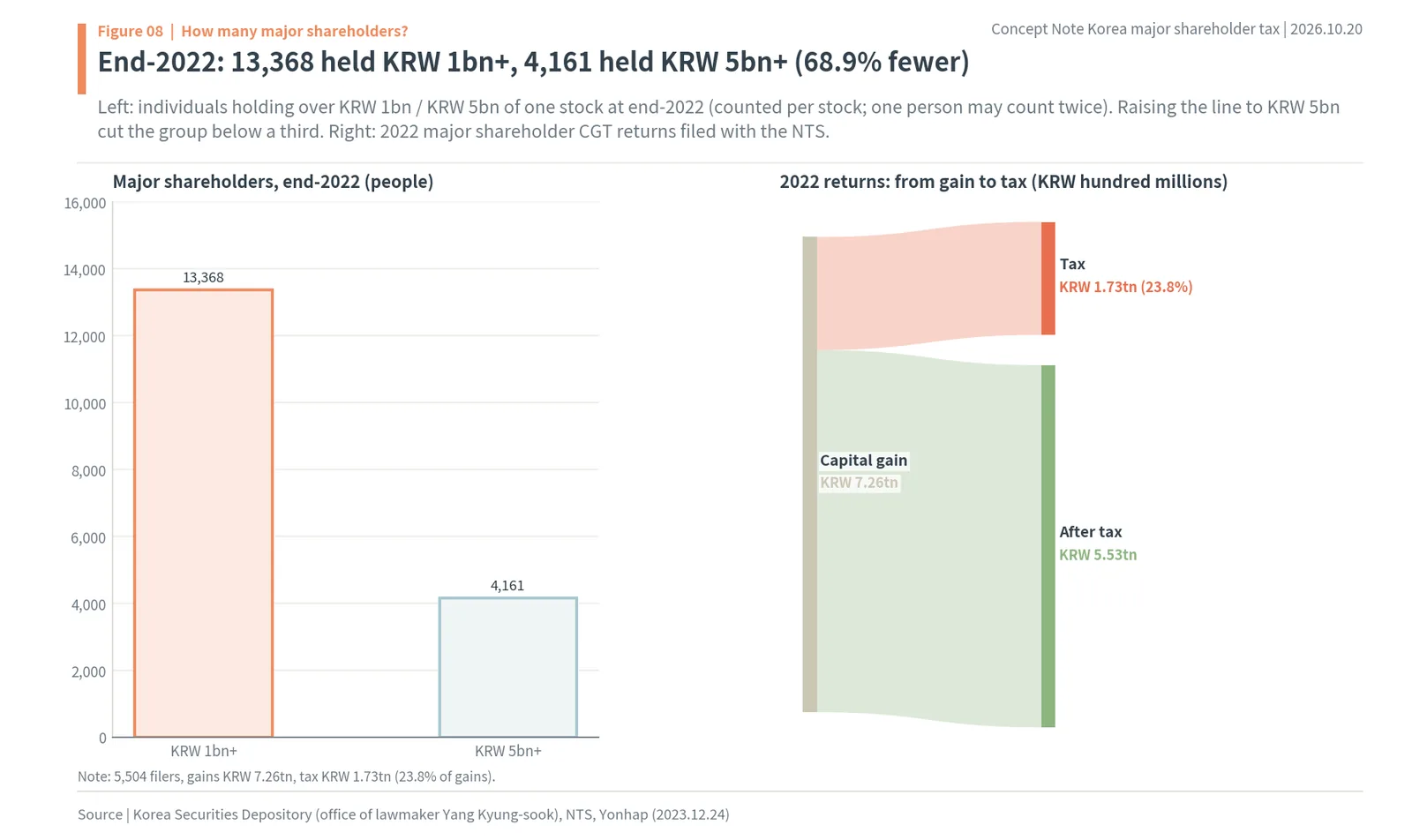
The left side of the figure shows the number of holders with KRW 1bn or more and with KRW 5bn or more at the end of 2022. The right side shows how the KRW 7.26tn of capital gains reported for 2022 splits into KRW 1.73tn of tax and the after-tax remainder. The major shareholder tax is a tax that a few thousand people pay to the tune of more than KRW 1tn.
The December 2023 Cabinet meeting and the KRW 1bn plan of summer 2025
The increase from KRW 1bn to KRW 5bn was made through a legislative notice on December 21, 2023 and approval at the Cabinet meeting on December 26, and applied to sales from January 1, 2024 (Bizwatch, December 21, 2023). The last day to sell for that year’s major shareholder test was December 26, so the threshold changed at the Cabinet meeting on that very day. Around the same time, an amendment to the Income Tax Act had already removed family aggregation for shareholders who are not largest shareholders, from 2023.

In summer 2025 there was an attempt in the opposite direction. When the July 31 tax reform plan proposed cutting KRW 5bn to KRW 1bn, the KOSPI fell 3.88% the next day, and the National Assembly petition passed 110,000 signatures on August 3. On September 11 the president said he would keep KRW 5bn, and on September 15 the Ministry of Economy and Finance announced that it would stay. The government estimated that not lowering the threshold would mean KRW 200bn to 300bn (about $150mn to $225mn) less tax revenue a year (Money Today, September 11, 2025).
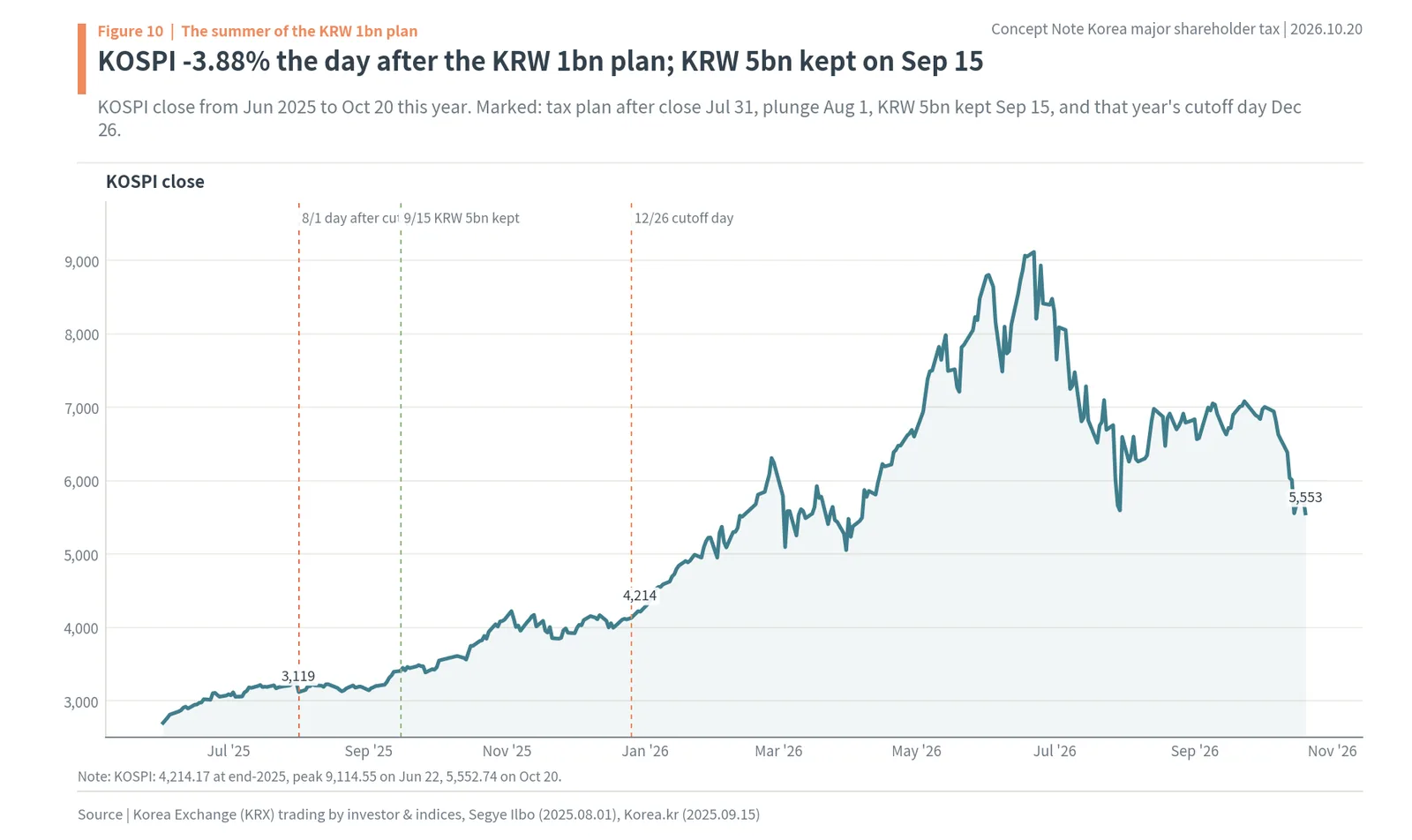
The figure marks August 1, September 15 and that year’s cutoff day, December 26, on the KOSPI close from June 2025 to October 20, 2026. After the KRW 1bn plan was withdrawn, the KOSPI rose through year-end to finish 2025 at 4,214.17, climbed to 9,114.55 on June 22, 2026, and stood at 5,552.74 on October 20.
The major shareholder amount threshold fell from KRW 10bn to KRW 1bn and went back to KRW 5bn in 2024. Raising it to KRW 5bn cut the number of people by 68.9%, from 13,368 to 4,161, and the 2025 KRW 1bn plan was withdrawn after a -3.88% day for the KOSPI.
This year’s last day to sell for the major shareholder test is Monday, December 28
Because a major shareholder is decided by holdings on one day at year-end, what matters is the last day you can sell and still drop out of that day’s holdings. The conclusion of this chapter is simple. In 2026 the market is closed on December 25 and 31, so the last trading day is Wednesday, December 30, and because shares settle two trading days after the trade, only shares sold by the close on Monday, December 28 drop out of year-end holdings.
The major shareholder test is based on “holdings” as of the end of the previous fiscal year. Ownership of shares changes not on the trade date but when settlement is complete. The Korean market settles two trading days after the trade (T+2), so only trades that settle on the last trading day of the year, meaning trades made two trading days before it, are reflected in year-end holdings. This report calls that day the “cutoff day.”
KRX holidays in 2026 include Christmas on Friday, December 25 and the year-end closing on Thursday, December 31. So the last trading day is Wednesday, December 30, and the cutoff day is two trading days earlier, Monday, December 28. Shares sold on December 28 settle on December 30 and drop out of year-end holdings. Shares sold on Tuesday, December 29 settle on January 4, 2027, because the 31st and January 1, 2027 are holidays, so they still count as year-end holdings (author’s calculation). Maeil Shinmun pointed to the same date on October 14.
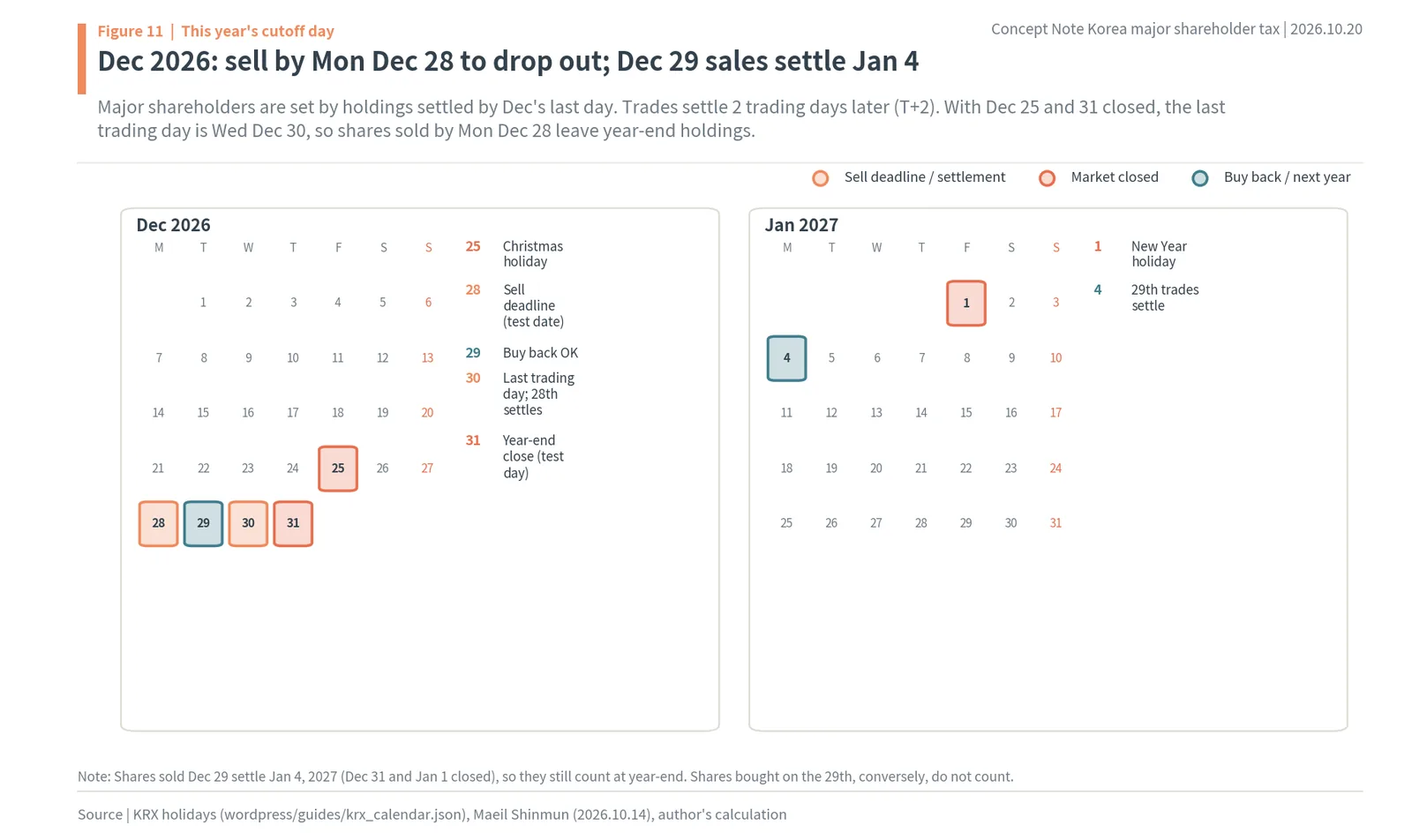
The figure shows the calendars for December 2026 and January 2027. It marks the selling deadline on the 28th, buying back on the 29th, the last trading day and settlement of the 28th’s trades on the 30th, the year-end closing on the 31st, and settlement of the 29th’s trades on January 4. Looked at the other way, shares bought on December 29 also settle on January 4, so they are not in end-2026 holdings. Selling on the cutoff day and buying back the next day lets an investor lower holdings for that one year-end day while keeping the shares.
This structure is where year-end selling starts. Once you are a major shareholder, you pay tax every time you sell that stock over the following year. Conversely, if you are below the threshold for that one day at year-end, the next year is tax-free. Because a year’s tax is set by one day’s holdings, investors near the threshold have a reason to avoid that day.
The last day to sell for the 2026 major shareholder test is the close on Monday, December 28. Shares sold on the 29th settle on January 4, 2027, so they count as year-end holdings, and shares bought on the 29th are not in year-end holdings.
On all 16 cutoff days from 2010 to 2025, individuals were net sellers
If one day at year-end decides the next year’s tax, individual selling should pile up on the cutoff day. The conclusion of this chapter is simple. On all 16 cutoff days from 2010 to 2025, individuals on the KOSPI and KOSDAQ were net sellers without exception, and in 8 of those years it was individuals’ biggest net selling day of that December. Most of that stock was taken up by institutions, and in 2025 foreigners took more.
Using KRX trading by investor type, the author added up individual net buying on the KOSPI and KOSDAQ on each year’s cutoff day (two trading days before the last trading day). All 16 were net sales (author’s calculation). The biggest was in 2021, when the threshold was KRW 1bn: net selling of KRW 3.16tn (about $2.37bn) on December 28 alone (KRW 2.00tn on KOSPI and KRW 1.16tn on KOSDAQ). Second was KRW 2.79tn on December 26, 2025, and third KRW 1.85tn on December 28, 2020. In 8 of the 16 years, the cutoff day was the biggest net selling day of that December. In the other years the cutoff day was usually near the top of December too: 6th in 2011, 5th in 2023 and 7th in 2024.
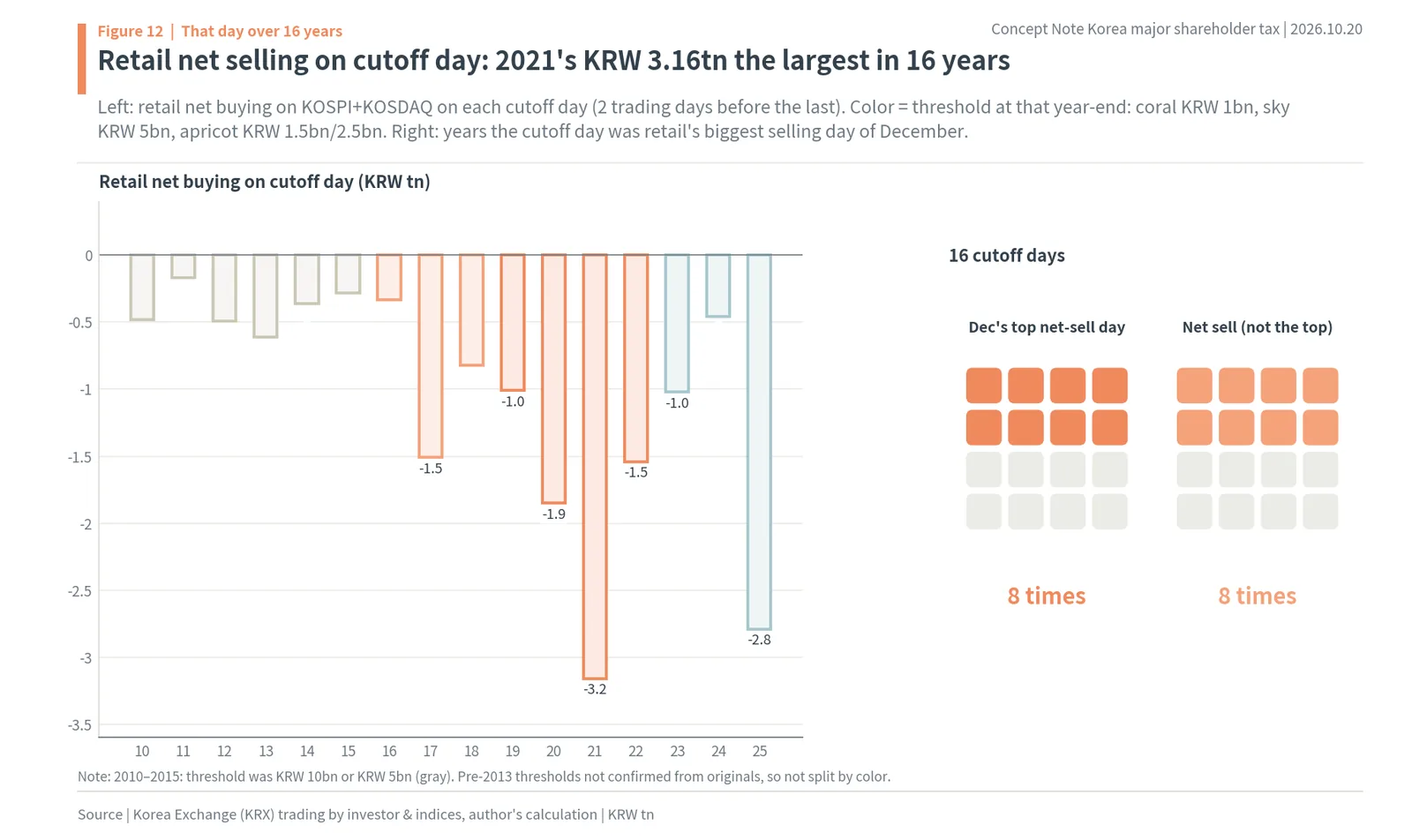
The left side of the figure shows individual net buying (KRW tn) on each year’s cutoff day, colored by the amount threshold applied at that year-end: coral for KRW 1bn, sky blue for KRW 5bn, and apricot for KRW 1.5bn and KRW 2.5bn. From 2010 to 2015 the threshold was KRW 10bn or KRW 5bn. Cutoff-day net selling grew in the years when the threshold was being lowered: KRW 1.51tn in 2017, KRW 1.01tn in 2019, KRW 1.85tn in 2020 and KRW 3.16tn in 2021. The right side draws, one box per year, the years when the cutoff day was December’s biggest net selling day (8) and the years when it was not (8).
It is not only the cutoff day itself. Adding up individual net buying from December 1 to the cutoff day, 15 of the 16 years were net sales. Net selling over that period was KRW 11.71tn (about $8.78bn) in 2021 and KRW 9.30tn (about $6.97bn) in 2025 (author’s calculation). The only net buying year was 2020 (KRW 1.85tn). This means some investors spread their sales over several days ahead of the cutoff.
Who took the shares?
Someone bought the shares individuals sold. On all 10 cutoff days from 2016 to 2025, institutions were net buyers. Institutional net buying on the cutoff day was KRW 2.35tn in 2021, KRW 1.48tn in 2020 and KRW 1.44tn in 2017 (author’s calculation). Foreigners were also mostly net buyers, but on a smaller scale than institutions. 2025 was different. On that year’s cutoff day, foreigners net bought KRW 1.88tn and institutions KRW 801.8bn, so foreigners took two thirds of what individuals sold.
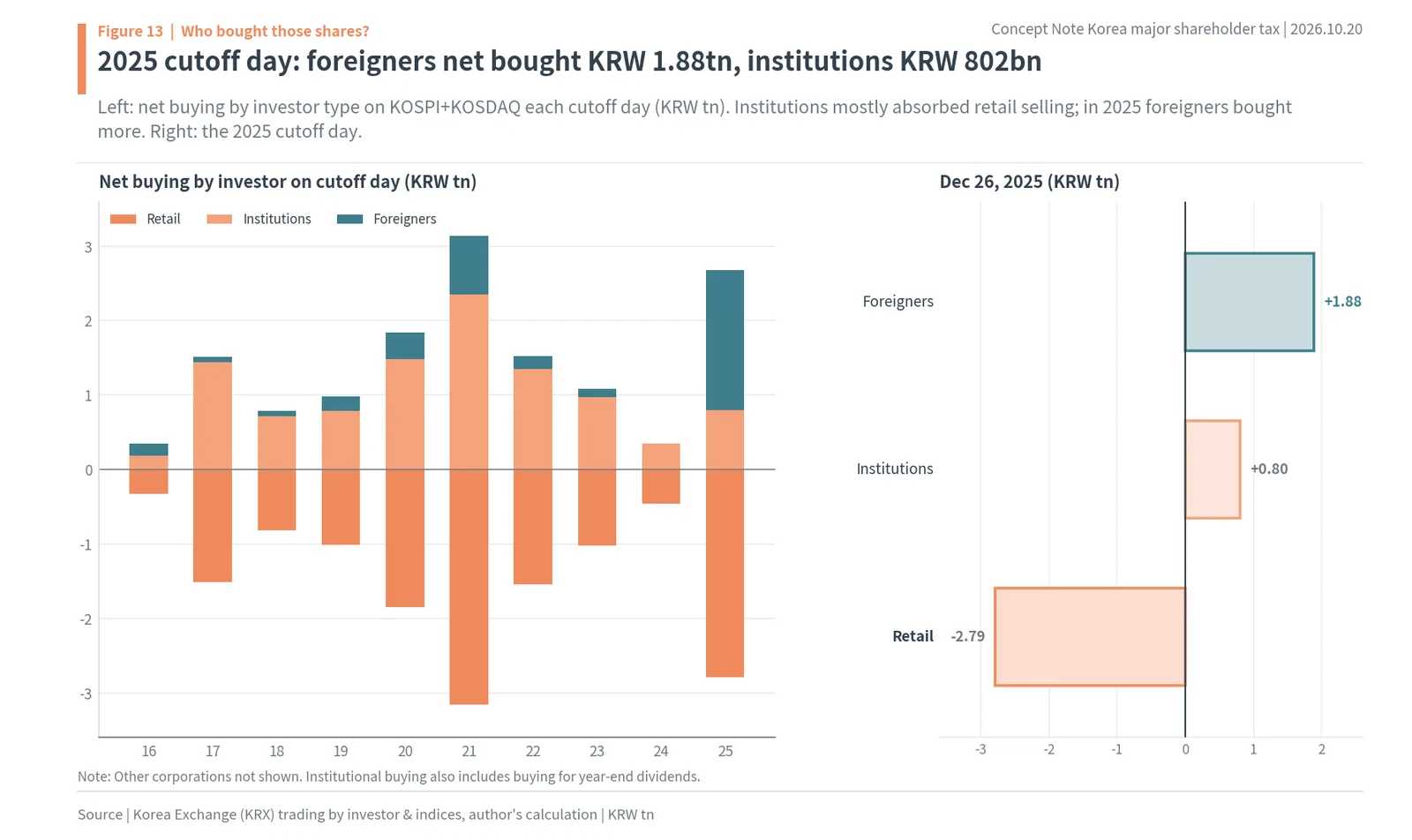
The left side of the figure shows net buying by investor type on each year’s cutoff day, and the right side shows December 26, 2025 alone. Institutional buying includes buying to collect year-end dividends, so not all of it is meant to take up what individuals sell. Still, the pattern of individuals selling while institutions and foreigners buy was the same in all 16 years.
Individuals were net sellers on the cutoff day in 16 out of 16 years, and the biggest was KRW 3.16tn in 2021. The shares were mostly taken up by institutions, and in 2025 foreigners took more, at KRW 1.88tn.
Not just the cutoff day: from December 1 to the cutoff day, individuals were net sellers in 15 of 16 years
Selling on the cutoff day is the tail end of year-end selling. The conclusion of this chapter is simple. Adding up individual net buying from December 1 to the cutoff day, 15 of the 16 years were net sales, and in 2021, when the threshold was KRW 1bn, net selling over that period was KRW 11.71tn. In the 10 trading days after the cutoff day, individuals turned net buyers again in 14 of the 16 years.
Looking at combined individual net buying on the KOSPI and KOSDAQ from December 1 to the cutoff day each year, net selling was KRW 5.49tn in 2017, KRW 5.07tn in 2019, KRW 11.71tn in 2021, KRW 6.38tn in 2023 and KRW 9.30tn in 2025 (author’s calculation). The only net buying year was 2020 (KRW 1.85tn). 2020 was the year individual buying surged after the March crash, and even in December individuals net bought an average of KRW 301.3bn a day over the 20 trading days before the cutoff day. Even in that year, the cutoff day itself saw net selling of KRW 1.85tn.
Comparing the average daily individual net buying over the 20 trading days before the cutoff day with the cutoff day itself shows how heavy that day is. In 2021, the 20-day daily average was net selling of KRW 391.9bn, but the cutoff day was KRW 3.16tn, more than eight times the average. In 2025, the 20-day daily average was net selling of KRW 322.2bn, and the cutoff day KRW 2.79tn. In 2018, the daily average was net selling of KRW 82.5bn and the cutoff day KRW 816.1bn (author’s calculation). Shares that had been sold bit by bit toward year-end come out all at once on the last day.
The 10 trading days after the cutoff day went the other way. In 14 of the 16 years individuals were net buyers, and the large ones were KRW 12.96tn in 2020, KRW 7.59tn in 2021, KRW 2.47tn in 2023 and KRW 2.02tn in 2019. The two net selling years were 2010 and 2011 (author’s calculation). Every year, the space emptied at year-end was filled again at the start of the new year.
The December index sits inside the same pattern. From the end of November to the cutoff day, the KOSDAQ fell in 10 of the 16 years, and the biggest falls were -5.5% in 2013, -5.3% in 2015 and -4.3% in 2018 (author’s calculation). On the other hand, some years, such as 2021 (+6.4%) and 2020 (+4.6%), rose even before the cutoff day, so cutoff-day selling alone does not decide the December index. Still, on the KOSDAQ, where individuals make up a large share, the reversal of flows around the cutoff day looked the same in all 16 years.
From December 1 to the cutoff day, individuals were net sellers in 15 of 16 years, KRW 11.71tn in 2021. In the 10 trading days after the cutoff day, they turned net buyers in 14 of 16 years.
When the threshold was KRW 1bn, investors bought back the same amount the day after they sold
If cutoff-day selling is only meant to dodge the major shareholder test, investors should buy back the next day. The conclusion of this chapter is simple. In 2020 to 2022, when the threshold was KRW 1bn, individual net buying on the trading day after the cutoff day equaled 109% of cutoff-day net selling; after the threshold was raised to KRW 5bn, in 2023 to 2025, it fell to 18%. The lower the threshold, the bigger the sell-and-buy-back trading.
In all three years of the KRW 1bn threshold, the cutoff day was December’s biggest net selling day. Individuals who sold KRW 1.85tn on December 28, 2020 bought KRW 2.47tn the next day. The day after selling KRW 3.16tn on December 28, 2021, they bought KRW 3.01tn, and the day after selling KRW 1.54tn on December 27, 2022, they bought KRW 1.67tn. On average over the three years, net selling of KRW 2.18tn on the cutoff day was followed by net buying of KRW 2.38tn the next day, a buy-back of 109% (author’s calculation).
After the threshold was raised to KRW 5bn, the pattern changed. The day after selling KRW 1.02tn on December 26, 2023, individual net buying was KRW 129.3bn; the day after selling KRW 462.7bn on December 26, 2024, it was KRW 386.1bn; and the day after selling KRW 2.79tn on December 26, 2025, it was KRW 253.8bn. On average over the three years, net selling of KRW 1.42tn on the cutoff day was followed by net buying of KRW 256.4bn the next day, or 18% (author’s calculation).
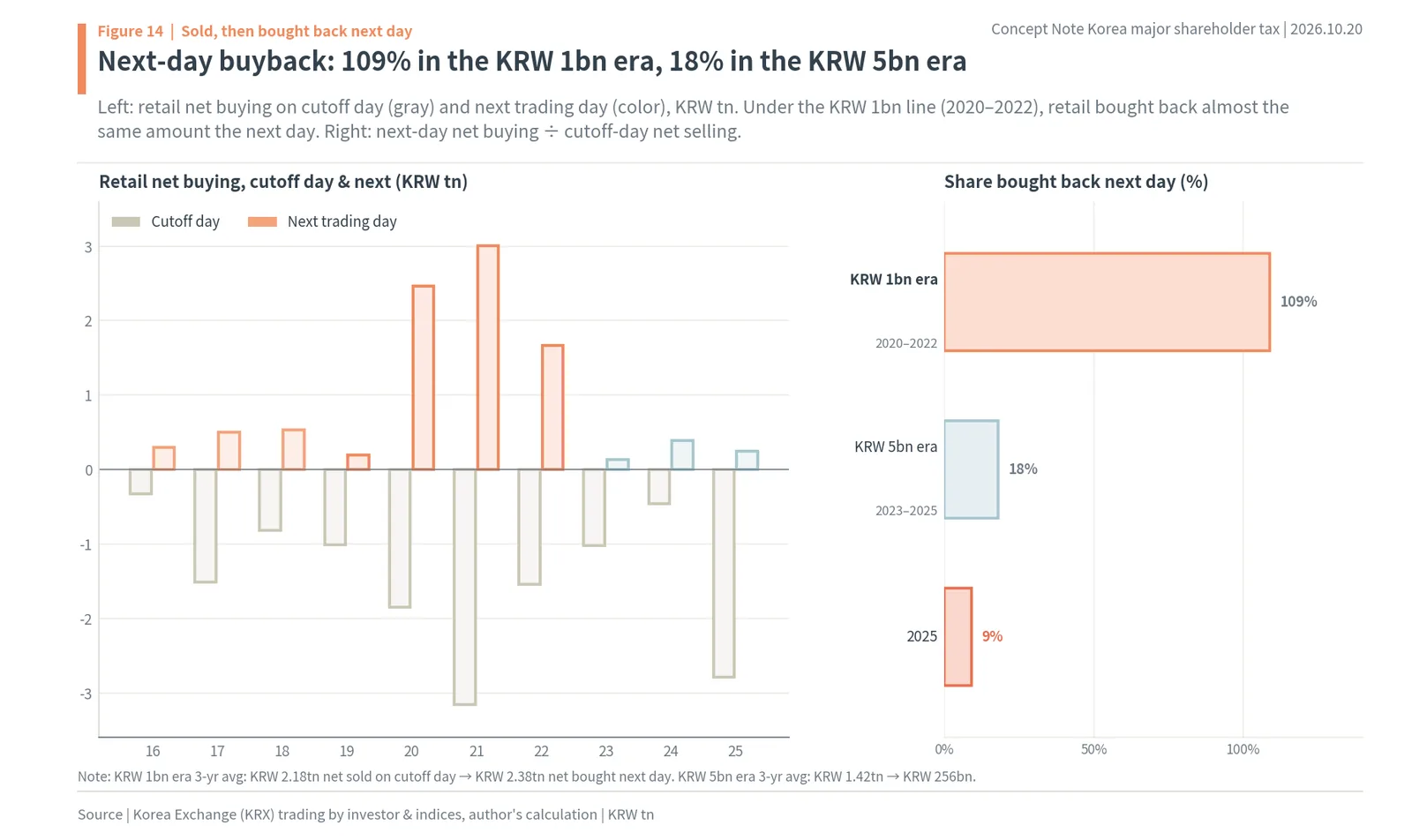
The left side of the figure shows individual net buying on the cutoff day (gray) and the next trading day (color) from 2016 to 2025. In the three years of the KRW 1bn threshold, the colored bar the next day rises about as far as the gray bar fell, almost a mirror image. The right side shows the share bought back the next day: 109% in the KRW 1bn years, 18% after KRW 5bn, and 9% for 2025 alone.
December 2021 and December 2025, day by day
Looking at the two Decembers day by day makes the difference clearer. In 2021, individuals net sold KRW 11.71tn from December 1 to the cutoff day; the biggest single day was the cutoff day, the 28th, at KRW 3.16tn, and on the 29th they bought back KRW 3.01tn. Net buying continued into the new year, and individual net buying over the 10 trading days after the cutoff day was KRW 7.59tn (author’s calculation).
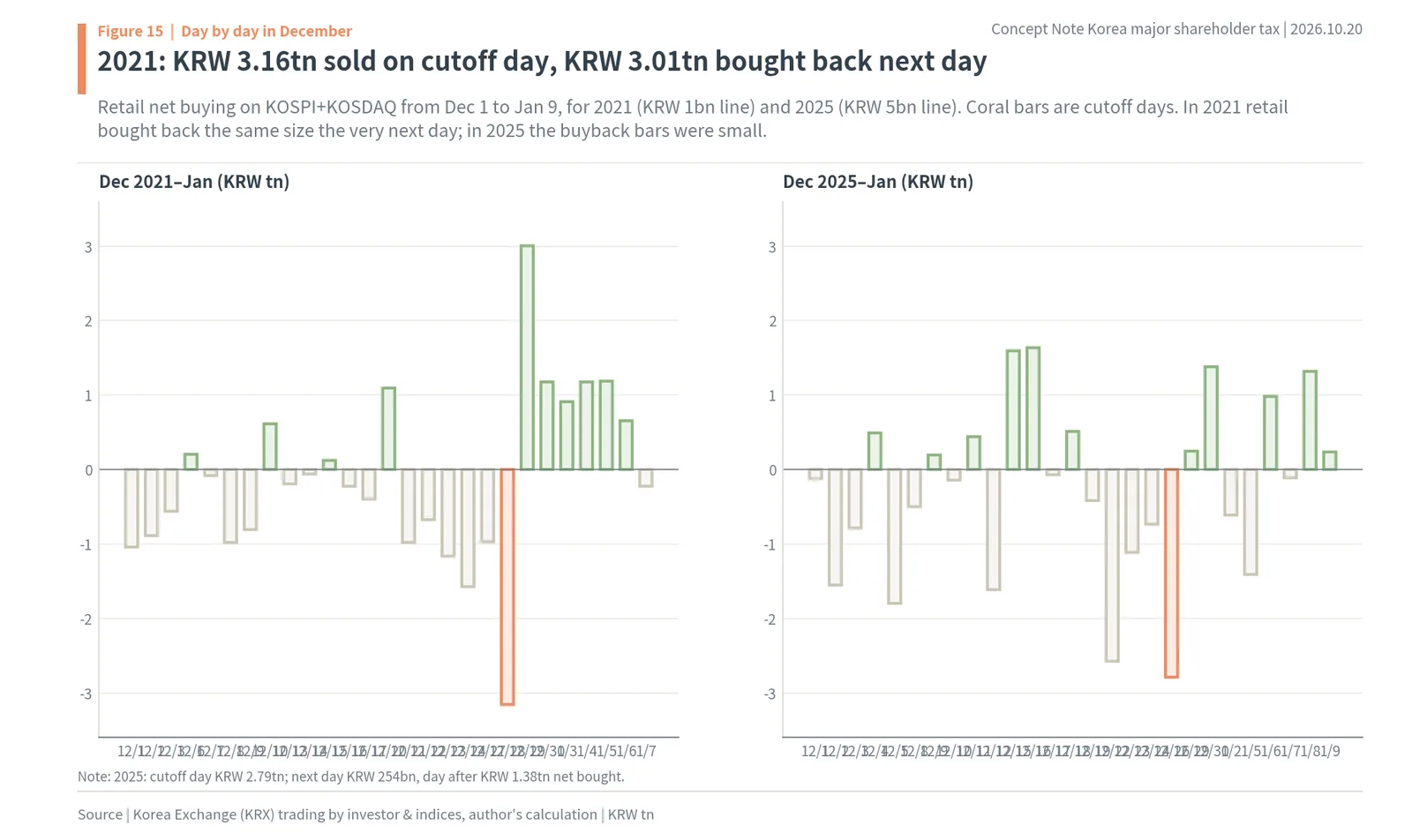
The figure shows individual net buying from December 1 to January 9 of the next year for 2021 and 2025. The coral bar is the cutoff day. In 2025, net selling of KRW 2.79tn on the cutoff day was followed by net buying of KRW 253.8bn the next day and KRW 1.38tn the day after that, so the buy-back bars were small and late. Net buying over the 10 trading days after the cutoff day was KRW 1.67tn, less than a quarter of 2021’s. From January 2 to 19, 2026, individuals actually net sold KRW 5.01tn on the KOSPI (Herald Economy, January 19, 2026).
This difference says something about the nature of the 2025 cutoff-day selling. In the KRW 1bn years, cutoff-day selling was a “one-day exit”: dodge the test and buy the same shares back the next day. The author’s view is that the 2025 cutoff-day selling mixed test-dodging sales with profit-taking sales, so less was bought back.
In 2020 to 2022, when the threshold was KRW 1bn, investors bought back 109% of what they sold on the day after the cutoff; after it was raised to KRW 5bn, in 2023 to 2025, they bought back 18%. In 2021 they sold KRW 3.16tn and bought back KRW 3.01tn the next day.
Cutoff-day selling grew in 2016 to 2019 as the threshold came down, and KOSDAQ’s share was large
Before comparing the KRW 1bn years with the KRW 5bn years, the period when the threshold was coming down to KRW 2.5bn and KRW 1.5bn shows the trend continuing. The conclusion of this chapter is simple. The lower the threshold, the bigger the cutoff-day selling, and KOSDAQ’s share of it was large. In contrast, 2025 cutoff-day selling was concentrated in KOSPI large caps, and KOSDAQ’s share was only 16%.
At the end of 2016 (threshold KRW 2.5bn that year), cutoff-day individual net selling was KRW 328.4bn, 3rd in December, and KRW 301.5bn (92%) was bought back the next day. At the end of 2017 (KRW 1.5bn), cutoff-day net selling was KRW 1.51tn, the first time above KRW 1tn, and 2nd in December. The next day KRW 501.3bn (33%) was bought back. At the end of 2018 (KRW 1.5bn) it was KRW 816.1bn, 1st in December, and KRW 525.8bn (64%) was bought back the next day. The end of 2019 was the year-end to which the KRW 1bn threshold from April 2020 applied; cutoff-day net selling was KRW 1.01tn, 3rd in December, and KRW 200.2bn (20%) was bought back the next day (author’s calculation).
KOSDAQ’s share of cutoff-day selling also grew in this period. KOSDAQ’s share of individual cutoff-day net selling from 2015 to 2022 was 41% in 2017, 42% in 2018, 54% in 2019, 49% in 2020, 37% in 2021 and 26% in 2022 (author’s calculation). The KOSDAQ has more stocks with small market caps than the KOSPI, and as shown earlier, for 82.3% of KOSDAQ stocks the 2% stake line is hit before KRW 5bn. When the amount threshold was KRW 1.5bn or KRW 1bn, individuals concentrated in small and mid-sized KOSDAQ stocks could easily cross both the amount line and the stake line.
From 2010 to 2014, individual net buying on KOSDAQ on the cutoff day was close to zero or positive. In 2012, KOSDAQ individuals were actually net buyers. This can be read to mean that when the threshold was KRW 10bn or KRW 5bn, KOSDAQ individuals had little reason to care about the cutoff day (author’s judgment).
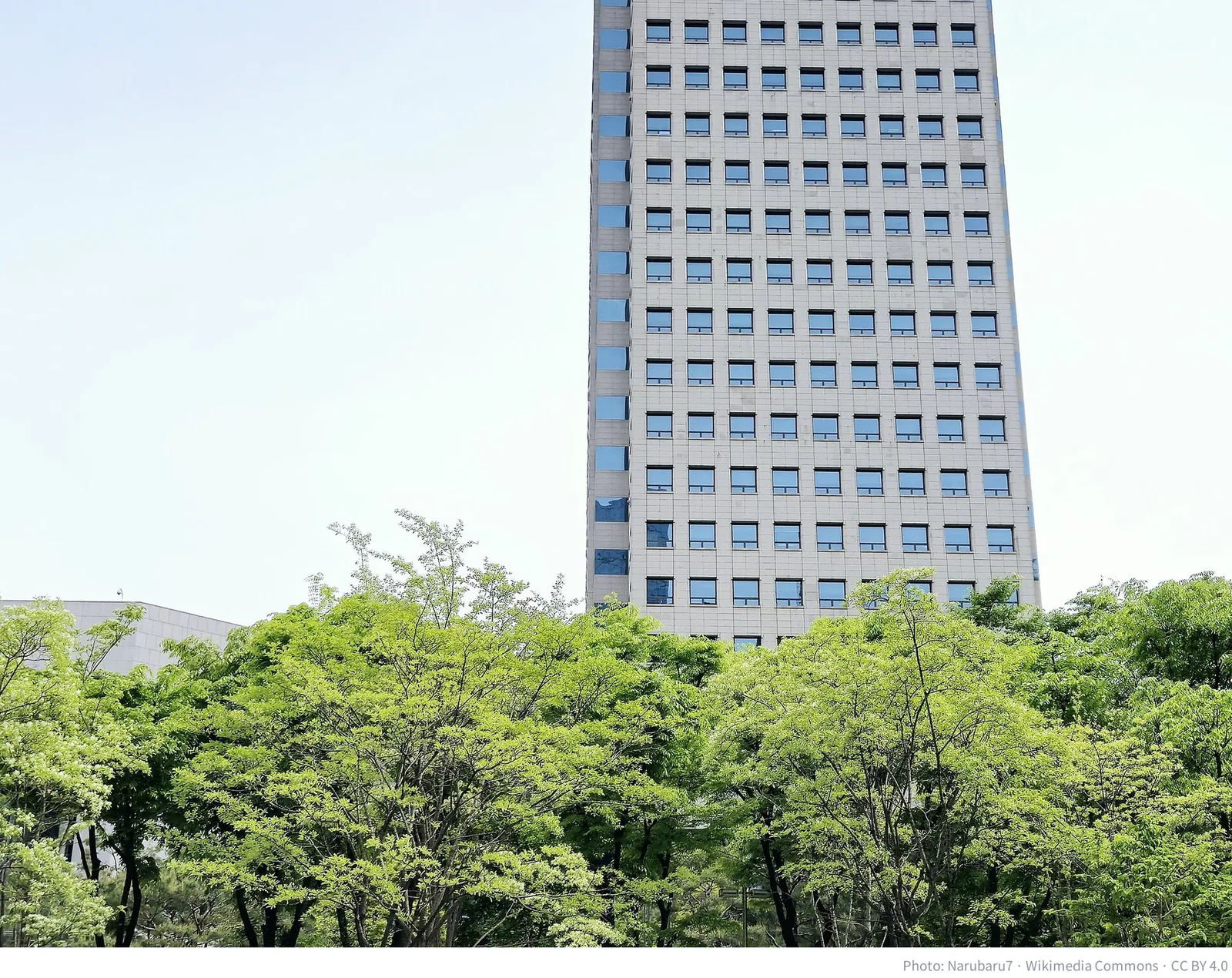
The three years after KRW 5bn look different. On the 2023 cutoff day, KOSDAQ individuals net bought KRW 36.1bn, making KOSDAQ’s share -4%. It was 30% in 2024 and 16% in 2025. Of the KRW 2.79tn of cutoff-day net selling in 2025, KRW 2.33tn was on the KOSPI, and by stock, Samsung Electronics and SK hynix alone made up most of it at KRW 2.57tn (author’s calculation). Once the threshold rose to KRW 5bn, cutoff-day selling became selling by investors holding a lot of large caps that had risen sharply with the index.
This trend says two things. First, the size of cutoff-day selling depends on two things: the threshold amount and the price level. A low threshold catches many people, and high prices catch many people with the same number of shares. Second, which stocks the selling comes from also depends on the threshold. When the threshold is low, it is small and mid-sized KOSDAQ stocks; when it is high, it is KOSPI large caps that have risen a lot.
In 2016 to 2022, when the threshold came down to KRW 2.5bn, KRW 1.5bn and KRW 1bn, KOSDAQ’s share of cutoff-day selling reached up to 54%. In 2025, after KRW 5bn, KOSDAQ’s share fell to 16%, and Samsung Electronics and SK hynix accounted for KRW 2.57tn.
On the 2025 cutoff day, individuals net sold KRW 1.60tn of Samsung Electronics and KRW 965.1bn of SK hynix
After the threshold rose to KRW 5bn, cutoff-day selling shrank to KRW 1.02tn in 2023 and KRW 462.7bn in 2024. But in 2025 it grew again to KRW 2.79tn. The conclusion of this chapter is simple. 2025 was a year in which the KOSPI rose 75.6%, and that year’s cutoff-day selling was concentrated in two stocks, Samsung Electronics and SK hynix.
The KOSPI rose 75.6% in 2025, from 2,399.49 at the end of 2024 to 4,214.17 at the end of 2025 (KRX). Of the KRW 2.79tn of individual net selling on that year’s cutoff day, KRW 2.33tn was on the KOSPI and KRW 459.6bn on the KOSDAQ (author’s calculation). In a year when the index surged, cutoff-day selling was concentrated on the KOSPI, where the large caps are.
By stock, the concentration is even clearer. According to KRX net buying by investor type per stock, on December 26, 2025 individuals net sold KRW 1.60tn (about $1.20bn) of Samsung Electronics and KRW 965.1bn (about $724mn) of SK hynix. Next came Alteogen at KRW 149.3bn, Samsung Electronics preferred shares at KRW 122.4bn and ABL Bio at KRW 77.9bn. On the next trading day, December 29, individuals bought back KRW 627.5bn of Samsung Electronics but sold another KRW 55.7bn of SK hynix (KRX, author’s tally).
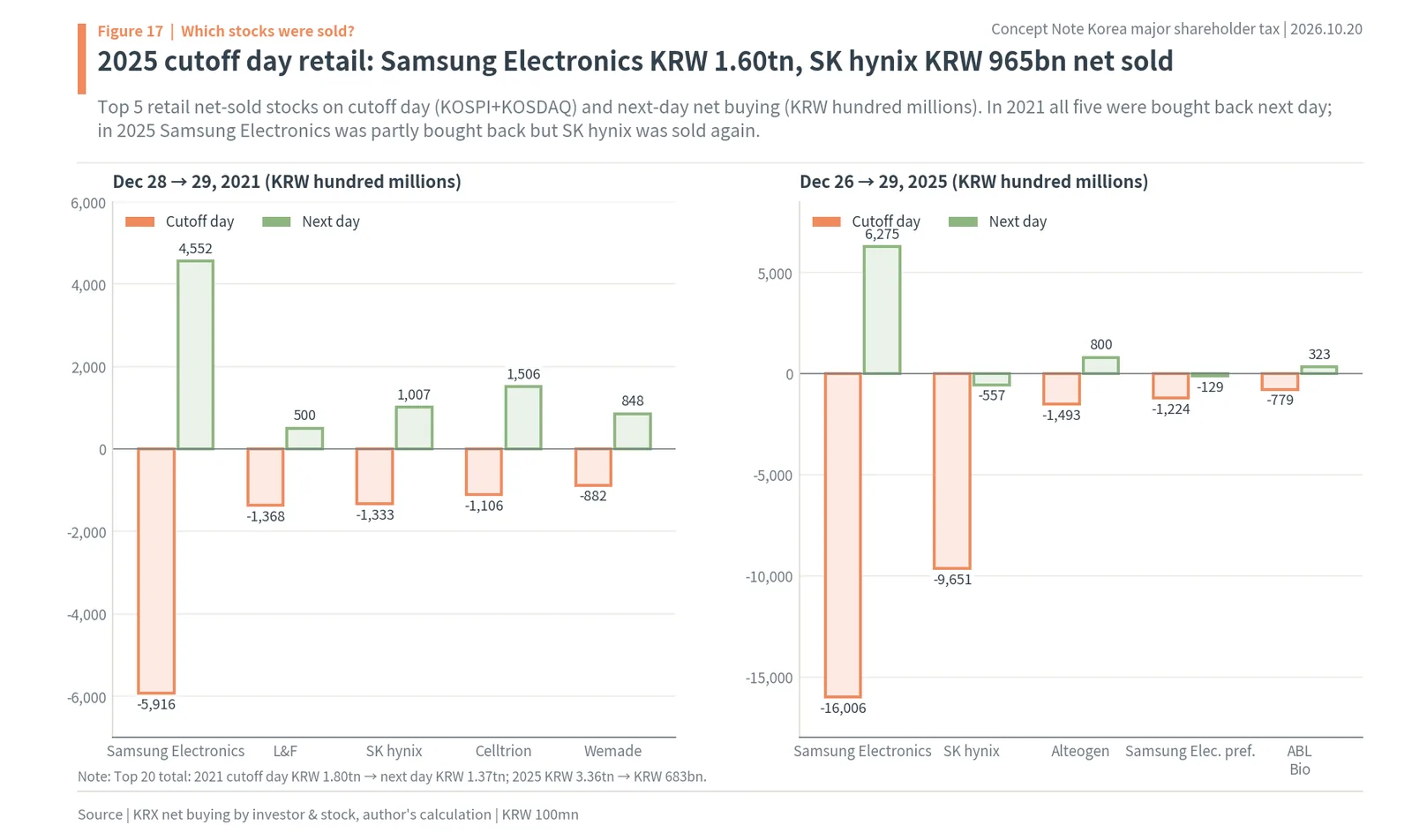
The right side of the figure shows the five stocks individuals sold most on the 2025 cutoff day and their net buying on the next trading day. The left side is the 2021 version of the same chart. On the 2021 cutoff day, individuals net sold KRW 591.6bn of Samsung Electronics, KRW 136.8bn of L&F, KRW 133.3bn of SK hynix, KRW 110.6bn of Celltrion and KRW 88.2bn of Wemade, and bought all five back the next day. Across the top 20 net-sold stocks, in 2021 individuals sold KRW 1.80tn on the cutoff day and bought back KRW 1.37tn the next day; in 2025 they sold KRW 3.36tn and bought back KRW 682.6bn (author’s calculation).
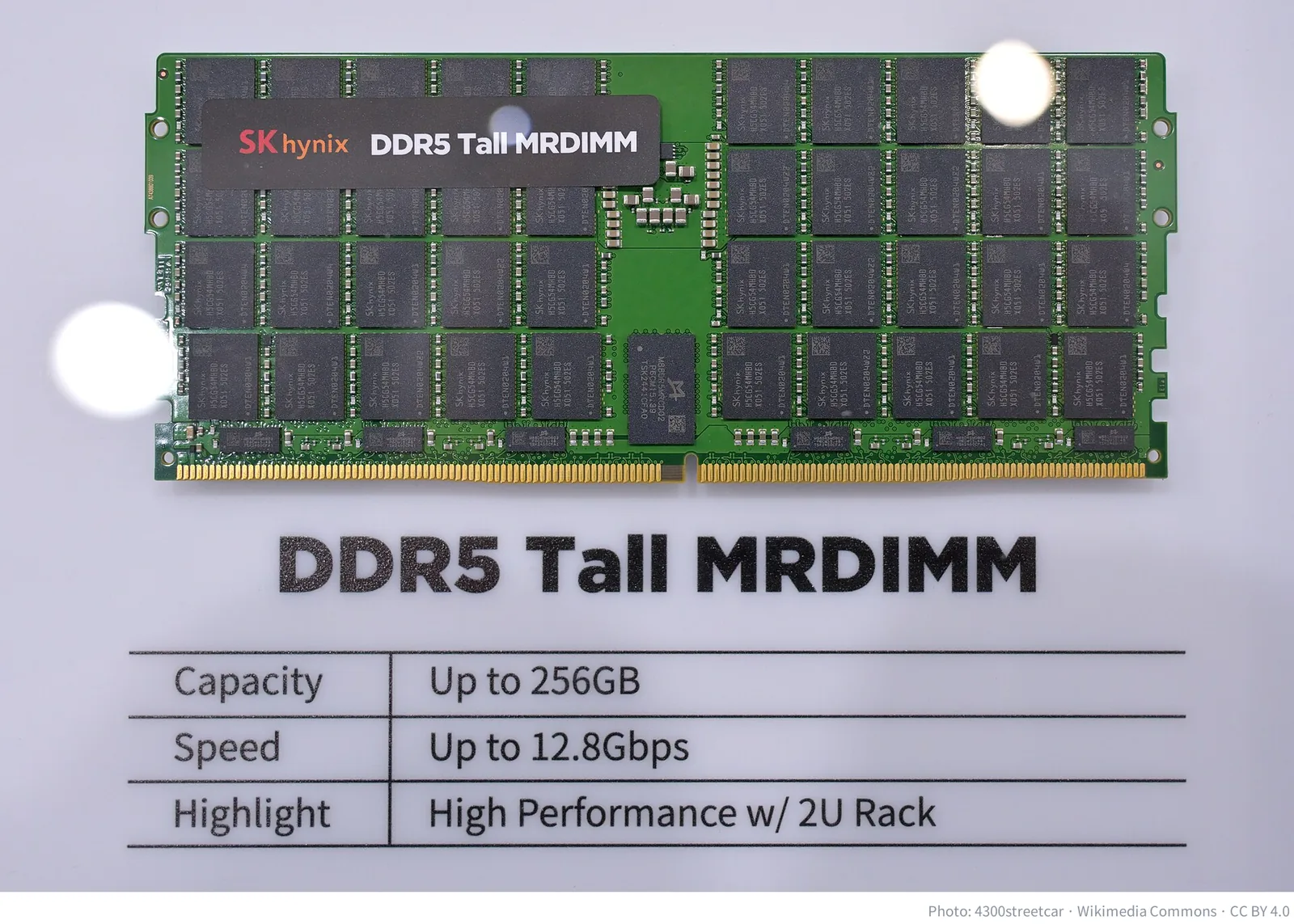
SK hynix was the second most net-sold stock by individuals on the 2025 cutoff day, and was net sold the next day as well. The author’s view is that in the semiconductor large caps that rose sharply over 2025, individuals both dodged the test and took profits. If investors do not buy back the day after selling, that selling is less a tax-dodging “one-day exit” than profit-taking prompted by year-end.
Of the KRW 2.79tn of individual net selling on the 2025 cutoff day, KRW 2.33tn was on the KOSPI, and by stock it was KRW 1.60tn of Samsung Electronics and KRW 965.1bn of SK hynix. The top 20 stocks saw only part of the amount sold bought back the next day.
In the 10 trading days after the cutoff day, the KOSDAQ rose 15 times out of 16, and cutoff-day selling was bigger in years when prices rose sharply
If cutoff-day selling is “calendar selling” that comes on the same day every year, the market after that selling should carry similar traces every year. The conclusion of this chapter has two parts. From the cutoff-day close to 10 trading days later, the KOSDAQ rose 15 times out of 16, with a median of 4.8%. And in years when the KOSPI rose more than 20%, cutoff-day selling was almost twice that of the other years.
The author calculated the KOSDAQ’s change each year from the cutoff-day close to the close 10 trading days later. It rose 15 times out of 16, and the only fall was in 2021 (-3.5%). The biggest gains were 11.8% in 2017, 8.2% in 2010 and 6.8% in 2012. The 16-year median was 4.8%. Over the same 16 years, the median KOSDAQ change from the end-November close to the cutoff day was -0.6% (author’s calculation). Individual net buying (KOSPI plus KOSDAQ) over the 10 trading days after the cutoff day was positive in 14 of 16 years.
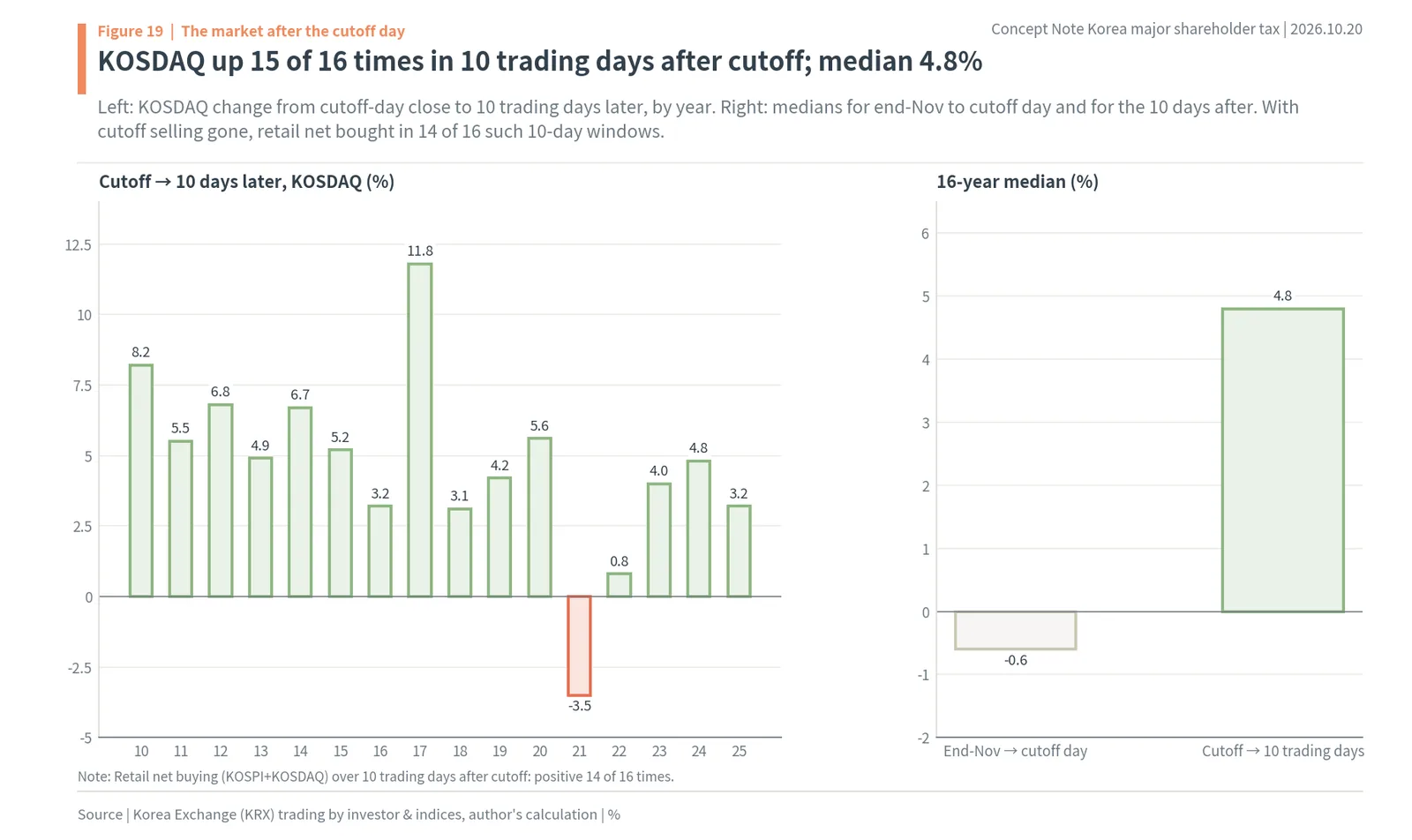
The left side of the figure shows the KOSDAQ’s change from the cutoff day to 10 trading days later each year, and the right side splits the 16-year medians into before the cutoff day (end of November to cutoff day) and after (cutoff day to 10 trading days later). Before is -0.6%, after is 4.8%. The 10 trading days after the cutoff day include the start of the new year, so the numbers are mixed with the January effect, and they should be read with that in mind. What the figure shows as fact is that the period when individual buying returns after cutoff-day selling has passed overlaps with the period when the KOSDAQ rose.
In years when prices rose, more people crossed the threshold with the same number of shares
The major shareholder threshold is an amount, not a number of shares. When prices rise, holdings grow without buying a single extra share, and more people cross the threshold. To see whether this shows up in cutoff-day selling, the author set each year’s KOSPI change alongside individual net buying on the cutoff day. The correlation over 16 years was -0.51: the more the KOSPI rose in a year, the more was sold on the cutoff day (author’s calculation).
The KOSPI rose more than 20% in four years: 2010 (21.9%), 2017 (21.8%), 2020 (30.8%) and 2025 (75.6%). Average individual net selling on the cutoff day in these four years was KRW 1.66tn, 1.94 times the KRW 853.5bn average of the other 12 years (author’s calculation). Even within 2023 to 2025, when the same threshold applied, cutoff-day selling was bigger in years when the index rose: KRW 1.02tn in 2023, when the KOSPI rose 18.7%; KRW 462.7bn in 2024, when it fell 9.6%; and KRW 2.79tn in 2025, when it rose 75.6%.

Each dot on the left of the figure is one year. The horizontal axis is that year’s KOSPI change and the vertical axis is individual net buying on the cutoff day. 2025 is at the far lower right, while 2021 sits low even though the index rose only 3.6%, because the threshold was KRW 1bn. Cutoff-day selling grows when the threshold is low, or when prices rise sharply and more people cross the threshold. The right side shows average cutoff-day net buying in the four years with gains above 20% and in the other 12 years.
In the 10 trading days after the cutoff day, the KOSDAQ rose 15 times out of 16, with a median of 4.8%. Average cutoff-day selling of KRW 1.66tn in the four years when the KOSPI rose more than 20% was 1.94 times the KRW 853.5bn of the other 12 years.
This year the KOSPI is up 31.8%, so Samsung Electronics shares worth KRW 2.83bn at the end of 2025 are now worth KRW 5bn
What has changed ahead of the end of 2026 is not the threshold but prices. The conclusion of this chapter is simple. The KOSPI is up 31.8% this year, and individuals have net bought KRW 100.66tn (about $75.5bn) on the KOSPI. Samsung Electronics is up 76.4% and SK hynix 87.9%, so shares worth KRW 2.83bn (about $2.12mn) and KRW 2.66bn at the end of 2025 are worth KRW 5bn at the October 20 close. Even with the same KRW 5bn threshold, more people than last year will need to check the line on December 28 this year.
The KOSPI rose from 4,214.17 at the end of 2025 to 9,114.55 on June 22, 2026, then stood at 5,552.74 on October 20. That is 31.8% above the end of 2025 (KRX). Over the same period, the KOSDAQ fell 15.5%, from 925.47 to 781.97. From January 2 to October 20 this year, individuals net bought KRW 100.66tn on the KOSPI and foreigners net sold KRW 208.01tn (about $156bn) (KRX, author’s tally). Individuals are holding more KOSPI shares they bought, and those shares are worth more than at the end of last year.
The KOSDAQ is a different story. The KOSDAQ index fell 15.5%, from 925.47 at the end of 2025 to 781.97 on October 20. By amount, many individuals holding KOSDAQ stocks have smaller holdings than at the end of last year and are further from the KRW 5bn line. But for 82.3% of KOSDAQ stocks, the 2% stake line is hit first, and the stake is set by the number of shares, not the price. Even if the price falls, holding a 2% stake makes you a major shareholder. An investor who bought more small and mid-sized KOSDAQ stocks cheaply in a falling year can reach the stake line even with a small amount. This year’s year-end check should be split: by amount for KOSPI large caps and by number of shares for small and mid-sized KOSDAQ stocks.
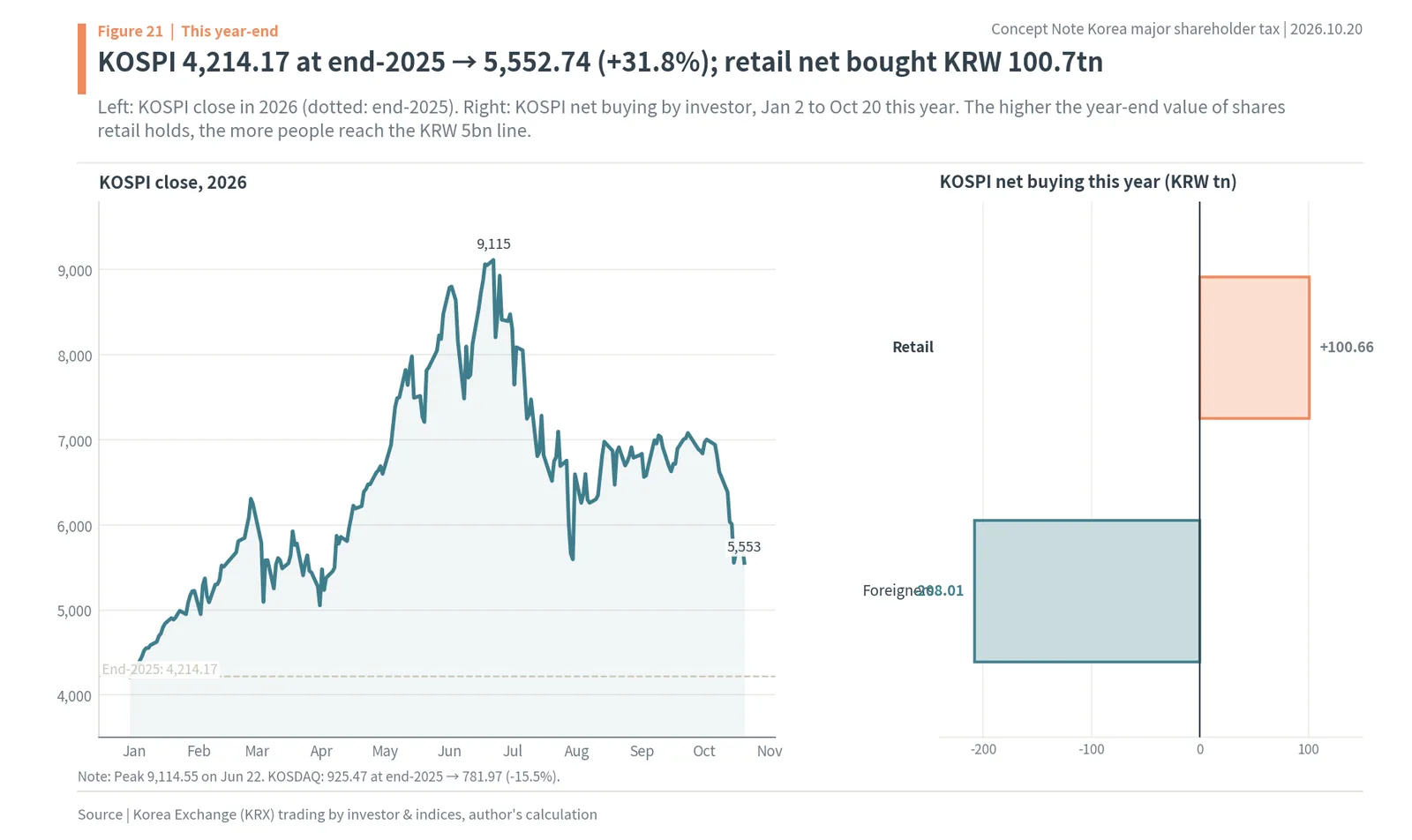
The left side of the figure shows the KOSPI close in 2026 against its end-2025 level (dotted line). The right side shows net buying by investor type on the KOSPI this year. Individuals’ KRW 100.66tn is close to half of what foreigners sold. The 39.4% rise in National Tax Service preliminary return notices, from 15,651 for second-half 2025 sales to 21,822 for first-half 2026 sales, is part of the same trend.
Same number of shares, different value
At the October 20 close, KRW 5bn buys 23,641 shares of Samsung Electronics (KRW 211,500), 4,088 shares of SK hynix (KRW 1,223,000), 16,129 shares of Hyundai Motor (KRW 310,000) and 12,077 shares of LG Energy Solution (KRW 414,000). Valued at end-2025 closing prices, the same numbers of shares were worth KRW 2.83bn for Samsung Electronics, KRW 2.66bn for SK hynix, KRW 4.78bn for Hyundai Motor and KRW 4.45bn for LG Energy Solution (author’s calculation). An investor who held KRW 2.83bn of Samsung Electronics at the end of 2025 is now at the KRW 5bn line without buying a single extra share.
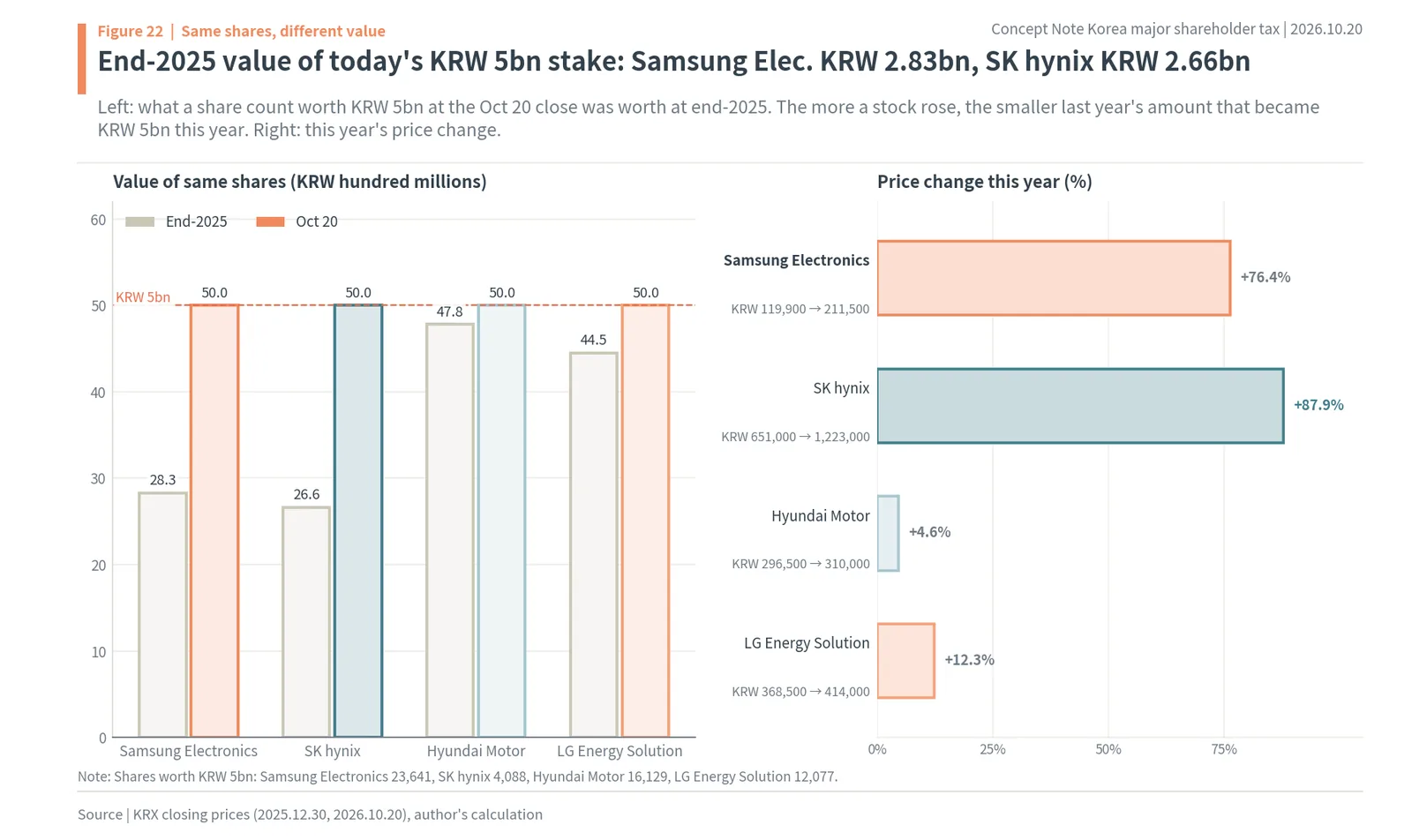
The left side of the figure shows, for the four stocks, the end-2025 value and the October 20 value of the number of shares now worth KRW 5bn; the right side shows this year’s price changes. The more a stock has risen, like Samsung Electronics at +76.4% and SK hynix at +87.9%, the smaller the end-of-last-year amount that has become KRW 5bn this year. For Hyundai Motor (+4.6%) and LG Energy Solution (+12.3%), only those who were already close to KRW 5bn at the end of last year cross the line.
The December 28 close may differ from October 20. Still, the threshold is an amount and the test is one day, so prices over the remaining two months of the year will decide the number of major shareholders. Set against the 16-year record, in which cutoff-day selling was large in years like 2025 when the index rose sharply, this year’s cutoff day looks closer to 2025 than to 2023 or 2024 (author’s judgment).
The KOSPI is up 31.8% this year, and individuals have net bought KRW 100.66tn on the KOSPI. 23,641 Samsung Electronics shares went from KRW 2.83bn at the end of 2025 to KRW 5bn now. This December 28, more people than last year will need to check the KRW 5bn line.
Three hypothetical investors: even holding the same shares, you can cross the line this year
To tie the rules and the numbers together, here are calculations for three hypothetical investors. The conclusion of this chapter is simple. An investor who was not a major shareholder at the end of last year can become one this year through price gains alone; in small stocks you become a major shareholder at far less than KRW 5bn; and overseas stocks are taxed on gains regardless of the amount held.
The first investor, A, held KRW 3bn of Samsung Electronics at the end of 2025. At the end-2025 close of KRW 119,900, that is 25,020 shares. A was not a major shareholder at the end of 2025, so selling in 2026 is tax-free. But at the October 20 close of KRW 211,500, the same 25,020 shares are worth KRW 5.29bn (author’s calculation). If the price stays here until December 28, A becomes a major shareholder at the end of 2026 and pays 22% to 27.5% on gains from selling Samsung Electronics in 2027. To get below KRW 5bn, A must sell more than KRW 290mn, or more than 1,380 shares at the current price.
A has three choices: become a major shareholder and not sell in 2027, or sell and pay the tax; sell more than 1,380 shares by December 28 and leave it there; or sell on December 28 and buy back on the 29th. The cost of the third choice is the 0.20% transaction tax on the amount sold (about KRW 580,000 on about KRW 290mn) and the price risk over one day. If A plans to realize a large gain in 2027, the transaction tax is far smaller than the capital gains tax.
The second investor, B, holds a 2% stake in a KOSDAQ stock with a market cap of KRW 60bn. B’s holding is KRW 1.2bn. That is far from KRW 5bn, but it reaches the 2% stake line, so B is a major shareholder. Given that 82.3% of KOSDAQ stocks have a market cap below KRW 250bn and the median market cap is KRW 71.6bn, the stake line, not KRW 5bn, is the realistic line for individuals concentrated in small and mid-sized KOSDAQ stocks. To check the stake, B can divide their own number of shares by the company’s shares outstanding (checking whether preferred shares are excluded).
The third investor, C, made a KRW 100mn gain on US stocks this year. Overseas stocks have no major shareholder concept; C pays 22% on the year’s realized gains minus KRW 2.5mn. C’s tax is about KRW 21.45mn (author’s calculation). For C, year-end is not a test date but the last day to match the year’s gains against losses. Selling losing positions before year-end to offset gains reduces the taxable gain. The $281.4mn (about KRW 406.9bn) of US stocks that individuals net sold from December 22 to 25, 2025 included sales like this (Herald Economy, December 26, 2025).
Putting the three side by side shows what is distinctive about Korea’s major shareholder tax. On overseas stocks you pay tax each year on what you earn, but on Korean stocks only those whose holdings on one year-end day cross the line pay tax the following year. So at year-end in Korean stocks, the selling is not “selling to match the year’s gains and losses” but “selling to avoid being taxed next year.” That selling piles up on the cutoff day.
25,020 Samsung Electronics shares worth KRW 3bn at the end of last year are now worth KRW 5.29bn, crossing the major shareholder line through price gains alone. In a KOSDAQ stock with a KRW 60bn market cap, KRW 1.2bn (a 2% stake) makes you a major shareholder, and a KRW 100mn overseas stock gain owes about KRW 21.45mn.
The dates from this year-end to next year: December 28, 29, 30, January 4, August 31
The major shareholder tax is a tax of dates. The conclusion of this chapter is simple. Holdings at the close on Monday, December 28, 2026 decide who is taxed for all of 2027, and those people file preliminary returns every half year for what they sell in 2027. Writing the dates down in order makes them harder to miss.
Friday, December 25, 2026 is a Christmas holiday. Monday, December 28 is the last day to sell for the major shareholder test; shares sold that day settle on the 30th and drop out of year-end holdings. Shares sold on Tuesday, December 29 count as year-end holdings, and shares bought that day are not in year-end holdings. Wednesday, December 30 is the last trading day of 2026. Thursday, December 31 is the year-end market holiday, and holdings as of that day are the basis of the major shareholder test. Friday, January 1, 2027 is a New Year’s holiday, and trades made on the 29th settle on Monday, January 4. The first trading day of the new year usually opens an hour late (KRX holiday data).
If you sell shares as a major shareholder in 2027, you file preliminary returns every half year. Sales in the first half (January to June) are due by August 31, 2027, and sales in the second half (July to December) by the end of February 2028. If you combine gains and losses with overseas stocks or need a final return, you file in May 2028. If you have already sold as a major shareholder in 2026, the preliminary return for the second half is due by the end of February 2027.
There are also dates left for 2026 major shareholders. Investors who were major shareholders at the end of 2025 must file preliminary returns by the end of February 2027 for what they sold in the second half of 2026; the deadline for first-half 2026 sales already passed on August 31. The National Tax Service sent that notice to 21,822 people.
Holdings at the close on Monday, December 28, 2026 decide who is taxed in 2027. Shares sold on the 29th settle on January 4 and count as holdings, and preliminary returns for first-half 2027 sales are due by August 31.
Of the top 10 KOSPI stocks by market cap, 6 have holdings now worth KRW 5bn that were worth less than KRW 4bn at the end of 2025
This is not only about Samsung Electronics. The conclusion of this chapter is simple. Taking the top 10 KOSPI stocks by market cap on October 20 (common shares), and valuing the number of shares now worth KRW 5bn at end-2025 closing prices, 6 of them were below KRW 4bn. Samsung Electro-Mechanics is up 352.9% this year, so shares worth KRW 1.10bn at the end of 2025 are now worth KRW 5bn.
For each of the top 10 stocks by market cap on October 20, the author found the number of shares worth KRW 5bn and calculated their value at the end of 2025 (KRX closing prices, author’s calculation). 23,641 Samsung Electronics shares were worth KRW 2.83bn; 4,088 SK hynix shares KRW 2.66bn; 6,748 SK Square shares KRW 2.48bn; 12,077 LG Energy Solution shares KRW 4.45bn; 4,329 Samsung Electro-Mechanics shares KRW 1.10bn; 3,595 Samsung Biologics shares KRW 6.09bn; 16,129 Hyundai Motor shares KRW 4.78bn; 31,075 KB Financial shares KRW 3.88bn; 21,097 Samsung Life shares KRW 3.32bn; and 25,329 Celltrion shares KRW 4.58bn.
By this year’s price change, the big gainers were Samsung Electro-Mechanics +352.9%, SK Square +101.4%, SK hynix +87.9%, Samsung Electronics +76.4%, Samsung Life +50.4% and KB Financial +29.0%. In these six stocks, holdings worth less than KRW 4bn at the end of 2025 are now worth KRW 5bn. In contrast, Samsung Biologics is down 17.9%, so an investor who held KRW 6.09bn at the end of 2025 now holds KRW 5bn. In stocks that have fallen, someone who was a major shareholder at the end of last year may drop below the threshold at the end of this year.
What this calculation says is that this year’s candidates for year-end selling go beyond the two semiconductor stocks. In 2025, individual cutoff-day net selling was concentrated in Samsung Electronics and SK hynix, but this year there may be investors reaching the KRW 5bn line for the first time in stocks such as Samsung Electro-Mechanics and SK Square that have doubled or more than quadrupled within a year. For the same reason, among small and mid-sized stocks where the stake test usually bites first, stocks that have risen sharply may reach the KRW 5bn line before the stake line, because their market cap crosses the dividing line (KRW 500bn on KOSPI).
Of the top 10 KOSPI stocks by market cap, 6 have holdings now worth KRW 5bn that were worth less than KRW 4bn at the end of 2025. Samsung Electro-Mechanics rose 352.9%, so shares worth KRW 1.10bn at the end of 2025 are now worth KRW 5bn.
The tax on a KRW 1bn gain is about KRW 258mn; the transaction tax on selling and buying back KRW 1bn is KRW 2mn
What an investor selling on the cutoff day is weighing comes down to two numbers: the tax they would pay next year as a major shareholder, and the cost of selling and buying back at year-end to avoid it. The conclusion of this chapter is simple. On a KRW 1bn gain in one stock next year, the tax is about KRW 258mn (about $193,000), or 25.8% of the gain, while the transaction tax on selling and buying back KRW 1bn at year-end is KRW 2mn (about $1,500), 1/129 of the tax.
Here is the calculation. A KRW 1bn gain minus the KRW 2.5mn basic deduction gives a taxable gain of KRW 997.5mn. The first KRW 300mn is taxed at 22% including local income tax, or KRW 66mn, and the remaining KRW 697.5mn at 27.5%, or about KRW 191.8mn. Together that is about KRW 258mn, 25.8% of the gain (author’s calculation). For shares of a non-small-and-medium company held for less than a year, 33% applies and the tax is larger.
The gap between the tax and the transaction tax also depends on the size of the gain. Calculated the same way, the tax is KRW 21.45mn (21.4%) on a KRW 100mn gain, KRW 65.45mn (21.8%) on KRW 300mn, KRW 120.31mn (24.1%) on KRW 500mn, KRW 257.81mn (25.8%) on KRW 1bn and KRW 532.81mn (26.6%) on KRW 2bn. The transaction tax on selling and buying back the same amount is KRW 200,000 for KRW 100mn, KRW 600,000 for KRW 300mn, KRW 1mn for KRW 500mn, KRW 2mn for KRW 1bn and KRW 4mn for KRW 2bn (author’s calculation). Because 27.5% applies from the part of the taxable gain above KRW 300mn, the effective rate approaches 27.5% as the gain grows. The bigger the gain, the wider the gap between the tax and the transaction tax.
Here is the cost side of avoiding it. An investor holding KRW 6bn must sell more than KRW 1bn to get below the threshold. In 2026 the securities transaction tax is 0.20% on KOSPI (0.05% transaction tax plus 0.15% special tax for rural development) and 0.20% on KOSDAQ (Segye Ilbo, January 5, 2026). Selling KRW 1bn costs KRW 2mn in transaction tax. There is no transaction tax on buying back, but there are broker commissions and the price difference between selling and buying.

The left side of the figure shows a KRW 1bn gain passing through the deduction, the 22% portion and the 27.5% portion to leave KRW 742mn after tax. The right side compares the major shareholder tax of about KRW 258mn with the KRW 2mn transaction tax on a buy-back. The transaction tax is 1/129 of the tax (author’s calculation).
This comparison explains why cutoff-day selling appears every year. For an investor planning a large gain next year, the cost of dropping below the threshold for one day at year-end is far smaller than the tax. The risk that remains is price. If the price rises between selling on the cutoff day and buying back the next day, the investor has to buy back that much higher. That some years, like 2021, saw the same amount bought back the day after selling means many investors judged that one day’s price risk to be smaller than the tax.
Overseas stocks have no such structure. Investors pay 22% each year on realized gains minus KRW 2.5mn, regardless of major shareholder status, so year-end brings not test-dodging sales but sales that match the year’s gains against losses. Over the four trading days from December 22 to 25, 2025, individuals net sold $281.4mn (about KRW 406.9bn) of US stocks (Korea Securities Depository data; Herald Economy, December 26, 2025).
On a KRW 1bn gain in one stock next year, the major shareholder tax is about KRW 258mn (25.8%), while the transaction tax on selling and buying back KRW 1bn at year-end is KRW 2mn. Cutoff-day selling comes from this gap.
How the numbers were built: the cutoff day is two trading days before the last trading day, and individuals are KOSPI plus KOSDAQ
For readers who want to recalculate the numbers in this report or compare other years, the calculation rules are gathered here. The conclusion of this chapter is simple. All flow numbers use KRX trading by investor type as published, and the author decided only two things: the definition of the cutoff day and the grouping of periods.
The cutoff day each year is the trading day two trading days before that year’s last trading day: December 28, 2010; December 27, 2011; December 26, 2012; December 26, 2013; December 26, 2014; December 28, 2015; December 27, 2016; December 26, 2017; December 26, 2018; December 26, 2019; December 28, 2020; December 28, 2021; December 27, 2022; December 26, 2023; December 26, 2024; and December 26, 2025. The settlement cycle (T+2) was the same throughout this period. The 2026 cutoff day, December 28, was set the same way using KRX holiday data.
Individual net buying is the sum of “individual” net buying on the KOSPI and KOSDAQ markets. KONEX and the ETF and ETN markets were not separated; the values KRX aggregates by market were used as is. When news reports give different numbers for the same day, it is because they counted only the KOSPI, used intraday preliminary figures, or used a different scope. For example, December 28, 2021 was first reported at KRW 3.09tn, while the KRX final total in this report is KRW 3.16tn.
“December’s biggest net selling day” is the trading day in December of that year with the lowest individual net buying (the biggest net selling). “Share bought back the next day” is individual net buying on the trading day after the cutoff day divided by cutoff-day net selling; for the KRW 1bn years (end of 2020 to 2022) and the years after KRW 5bn (end of 2023 to 2025), the three-year totals were divided. Net buying by stock is based on trading value in KRX net buying by investor type per stock (individuals).
The amount threshold applied at each year-end is the threshold that year-end holdings are used for in the next year’s sales: KRW 2.5bn at the end of 2016, KRW 1.5bn at the end of 2017 and 2018, KRW 1bn from the end of 2019 to the end of 2022, and KRW 5bn from the end of 2023. Holdings at the end of 2019 were classed as KRW 1bn, because the KRW 1bn threshold applied to sales from April 2020. Thresholds before 2013 could not be fully confirmed from original sources, so they are not separated by color in the figures.
The number of stocks where the stake line is hit first was counted using KRX market caps on October 20, across all listings including preferred shares. The tax calculations reflect only the 22% and 27.5% rates including local income tax and the KRW 2.5mn basic deduction; offsetting against other sales and necessary expenses (such as commissions) are not included.
The cutoff day is two trading days before the last trading day, and individuals means KOSPI plus KOSDAQ individual net buying. The KRW 1bn years are the end of 2020 to 2022, and the years after KRW 5bn are the end of 2023 to 2025.
Six steps to apply this to your own stocks: check each stock’s holdings on December 28, then weigh the tax against the cost of avoiding it
The job at year-end is not to call the index but to check, stock by stock, whether your holdings are above the line. The conclusion of this chapter is simple. Calculate holdings and stake for each stock, find which line bites first, if you cross it weigh next year’s tax against the cost of avoiding it, and note the price risk of buying back and the filing dates. For an individual holding 23,641 Samsung Electronics shares, that means KRW 5bn of holdings on December 28, about KRW 258mn of tax on a KRW 1bn gain, and KRW 2mn of transaction tax on a buy-back.
Step 1 is to calculate holdings and stake in your own name for each stock. The major shareholder test is per stock, so look at the amount in one stock, not the total of your account. Add together the same stock held across accounts at several brokers. If you are not in the largest shareholder’s family, do not add family holdings. Recalculate prices at the December 28 close. 23,641 Samsung Electronics shares are worth KRW 5bn at the October 20 close.
Step 2 is to see whether the KRW 5bn line or the stake line bites first. The dividing line is a market cap of KRW 500bn on KOSPI and KRW 250bn on KOSDAQ. For smaller stocks, the 1% or 2% stake bites first. As of October 20, that is true of 67.4% of KOSPI stocks and 82.3% of KOSDAQ stocks. For Samsung Electronics, the KRW 5bn line comes first.
Step 3 is, if you cross the line, to apply the rate to the gain you plan to realize next year: 22% on taxable gains up to KRW 300mn and 27.5% on the part above (including local tax), or 33% for shares of a non-small-and-medium company held for less than a year. On a KRW 1bn gain the tax is about KRW 258mn, 25.8% of the gain. If you have no plan to sell next year, becoming a major shareholder means no tax to pay right away.
Step 4 is the cost of avoiding it. To get below the threshold, you must sell a little more than the amount above it. In 2026 the securities transaction tax is 0.20% on both KOSPI and KOSDAQ, so selling KRW 1bn costs KRW 2mn. Broker commissions come on top.
Step 5 is the price risk of buying back. If you sell on December 28 and buy back on the 29th, the shares are not in year-end holdings, but if the price rises in between, you buy back higher. In some years, like 2021, the same amount came back the day after selling, but in others, like 2025, the buy-back was small and late. The buy-back price is not fixed.
Step 6 is the filing dates. If you sell in the first half of next year as a major shareholder, the preliminary return is due by August 31; if you sell in the second half, by the end of February 2028. If you combine gains and losses with overseas stocks, you file a final return in May of the following year. Missing a return brings a penalty.
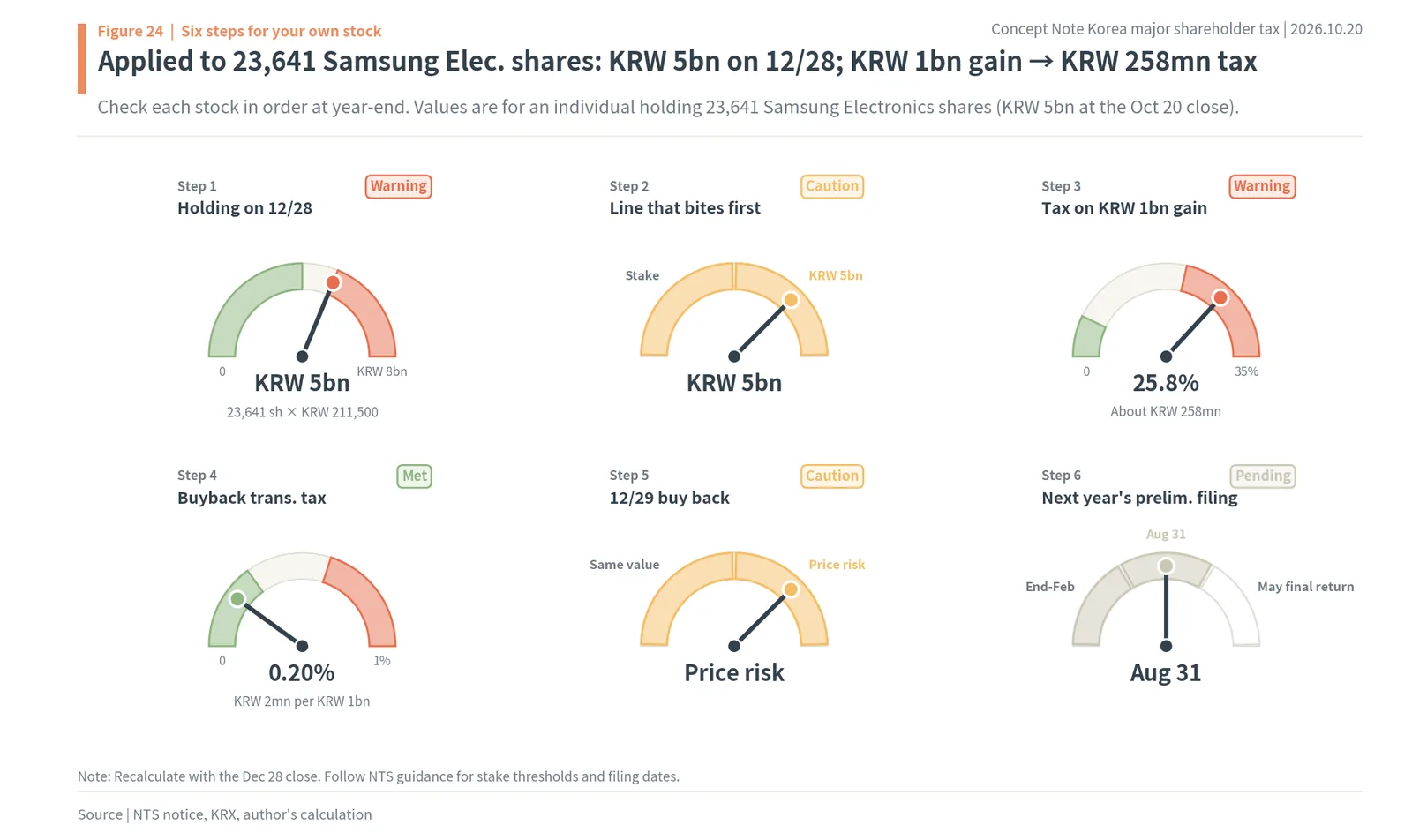
The figure applies the six steps to an individual holding 23,641 Samsung Electronics shares: step 1, KRW 5bn of holdings on December 28; step 2, the KRW 5bn line bites first; step 3, a 25.8% tax on a KRW 1bn gain (about KRW 258mn); step 4, a 0.20% transaction tax on a buy-back (KRW 2mn on KRW 1bn); step 5, the price risk of buying back on December 29; and step 6, a preliminary return by August 31 for sales in the first half of next year.
What to look at at year-end is not the index but the December 28 holdings of each of your stocks. If you cross the line, weigh next year’s tax against the transaction tax and price risk, and if you will sell as a major shareholder, note the filing dates.
Maochaedung’s take. Capital gains tax on listed Korean shares applies only to major shareholders who held KRW 5bn or more of one stock, or a stake of 1% on KOSPI or 2% on KOSDAQ, on the last day of the previous year, at 22% including local tax and 27.5% on the part above KRW 300mn. Because the test is one day at year-end, individuals were net sellers on the cutoff day every year for 16 years from 2010, and in 2020 to 2022, when the threshold was KRW 1bn, they bought back 109% the day after selling. After the threshold rose to KRW 5bn, the buy-back share fell to 18%, but in 2025, when the KOSPI rose 75.6%, cutoff-day selling grew again to KRW 2.79tn. The threshold is an amount, so when prices rise, the same number of shares can make you a major shareholder. The KOSPI is up 31.8% this year, and 23,641 Samsung Electronics shares went from KRW 2.83bn at the end of 2025 to KRW 5bn now. So at the end of this year, the first thing to check, stock by stock, is this: a major shareholder is decided by one day a year, by what you hold at the close on December 28.
Korea major shareholder capital gains tax FAQ
Q. Who pays capital gains tax on listed Korean shares?
Only major shareholders: anyone who held KRW 5bn or more of one stock, or a stake of 1% (KOSPI), 2% (KOSDAQ) or 4% (KONEX), at the end of the previous year. Other individual investors pay no capital gains tax on listed Korean shares traded on the exchange.
Q. What are the tax rates for major shareholders in Korea?
Including local income tax, 22% on the taxable gain up to KRW 300mn and 27.5% on the part above it, after a KRW 2.5mn annual basic deduction. A major shareholder who sells non-SME shares held under one year pays 33%.
Q. What is the last day to sell in 2026 to avoid major shareholder status?
Monday, December 28, 2026. Trades settle two trading days later (T+2), and with December 31 a market holiday the last trading day is December 30, so a December 29 sale settles on January 4, 2027 and still counts as year-end holdings.
Q. Do Korean retail investors really sell before the cutoff day?
On all 16 cutoff days from 2010 to 2025, individuals were net sellers on the KOSPI and KOSDAQ combined; the largest was KRW 3.16tn on December 28, 2021, when the threshold was KRW 1bn. In 2020 to 2022 they bought back 109% of that amount the next trading day; in 2023 to 2025 only 18%.
Q. Why could year-end selling be larger in 2026?
The threshold is a won amount, so rising prices push more holders over it. The KOSPI is up 31.8% this year to Oct 20, and 23,641 Samsung Electronics shares worth KRW 2.83bn at end-2025 are now worth KRW 5bn.
Sources
- National Tax Service preliminary return notices as quoted by SBS Biz, 22,000 major shareholders and others notified to file preliminary capital gains tax returns (link), Aug 5, 2026
- Money Today, National Tax Service: file preliminary capital gains tax returns on first-half stock sales by the 31st (link), Aug 5, 2026
- Maeil Shinmun, Investors will sell by December 28 to avoid the KRW 5bn major shareholder tax (link), Oct 14, 2026
- Korea Economic Daily, Capital gains tax rates and penalties on shares (link), Feb 7, 2026
- Taxnet, There are more major shareholders now (link)
- Kyunghyang Shinmun, Capital gains tax filing for major shareholders of listed companies (link), Feb 6, 2023
- Shin & Kim (law firm), 2026 tax reform plan II: asset taxation (link), Aug 7, 2026
- Ilgan NTN, Key points of the 2026 tax reform plan by tax item (link), Aug 4, 2026
- Segye Ilbo, KOSPI falls 3.88% (link), Aug 1, 2025
- Herald Economy, Petition against the “KRW 1bn major shareholder” plan passes 110,000 (link), Aug 3, 2025
- Money Today, Major shareholder threshold for stock capital gains tax stays at KRW 5bn (link), Sep 11, 2025
- Korea Policy Briefing, Major shareholder threshold kept at “KRW 5bn or more per stock” (link), Sep 15, 2025
- SBS Biz, Koo Yun-cheol: “Major shareholder threshold stays at KRW 5bn” (link), Sep 15, 2025
- Korea Economic Daily, Major shareholder threshold kept at KRW 5bn (link), Sep 15, 2025
- Korea Economic Daily (via Daum), Major shareholder test changed to tax only KRW 5bn and above (link), Dec 21, 2023
- MTN, Ahead of the wider capital gains tax on major shareholders (link), Nov 12, 2015
- Newsis, KRW 300mn major shareholder threshold with family aggregation (link), Jan 7, 2021
- Energy Economic News, Petition on the major shareholder capital gains tax (link), Oct 27, 2020
- Nocut News, Hong Nam-ki resignation episode (link), Nov 4, 2020
- Yonhap (published by Financial News), 13,000 major shareholders this year (link), Dec 24, 2023
- SBS Biz, Financial Investment Income Tax repeal passes National Assembly plenary session (link), Dec 10, 2024
- Segye Ilbo, Tax law changes in 2026 (link), Jan 5, 2026
- Samsung Securities, Guide to capital gains tax on overseas stocks (link)
- Herald Economy, Individuals sold KRW 400bn of US stocks in four days (link), Dec 26, 2025
- Herald Economy, Individuals sold KRW 5tn in the new year (link), Jan 19, 2026
- KRX Data System, KOSPI and KOSDAQ trading by investor type, net buying by investor type per stock, indexes and market caps (via pykrx), Nov 2010 to Oct 20, 2026
- Photos: Youngjin, “Government Complex Sejong Main Entrance”, CC BY-SA 3.0; Cjb8293, “Republic of Korea capitol”, CC BY-SA 4.0; Minseong Kim, “South Korea National Tax Service”, CC BY-SA 4.0; Seoul Institute, “Government Complex Seoul Main Building”, CC BY 4.0; Narubaru7, “Korea Exchange 2025”, CC BY 4.0; 4300streetcar, “SK Hynix DDR5 Tall MRDIMM”, CC BY 4.0 (all Wikimedia Commons)
Was this note useful?
Thanks. Your answer helps decide what to cover next.
Korea market snapshot · Oct 23, 2026
New to Korean stocks? Start here for the basics.
Most read
1France Protests 2026: Why Students Are Blocking Schools and Which Stocks Benefit (Munich Re, SCOR)
Get the Saturday note on Korean stocks
One email every Saturday with the week’s new research on Korean listed companies and links to the updated data pages. Built from DART filings and KRX data. Free; unsubscribe in one click. See past issues