K-pop Rookies and Korean Entertainment Stocks: How Big Must A2O LITE Get to Move HYBE (352820.KS), SM (041510.KQ), JYP (035900.KQ) and YG (122870.KQ)?
Debut day is a free ticket: Korean entertainment stocks have priced confirmed hits and group exits, not debuts.
- 28 debuts at listed agencies: debut-day excess return averaged +0.7pp; 19 of 28 within ±3pp
- Breakout days (first million-seller or signature hit): +41.5pp over 120 trading days; institutions bought in 7 of 9, retail sold in 7 of 9
- Exit, renewal and enlistment news: first-day moves 2.1 times larger than debuts; leaving news -7.0pp after 20 trading days
- Boy groups left more with their labels: 23.3% margin vs 17.2%; KRW 80.4bn vs KRW 58.8bn a year excluding BTS
- A2O’s KRW 300bn-400bn valuation assumes NewJeans’ years 2-3; at a listed SM-sized agency, a 10% rise would need SEVENTEEN’s year-7 earnings
- The Big 4 are 0.23% of the Korean market; institutions sold KRW 1.07tn of them as chips rallied in January-May 2026
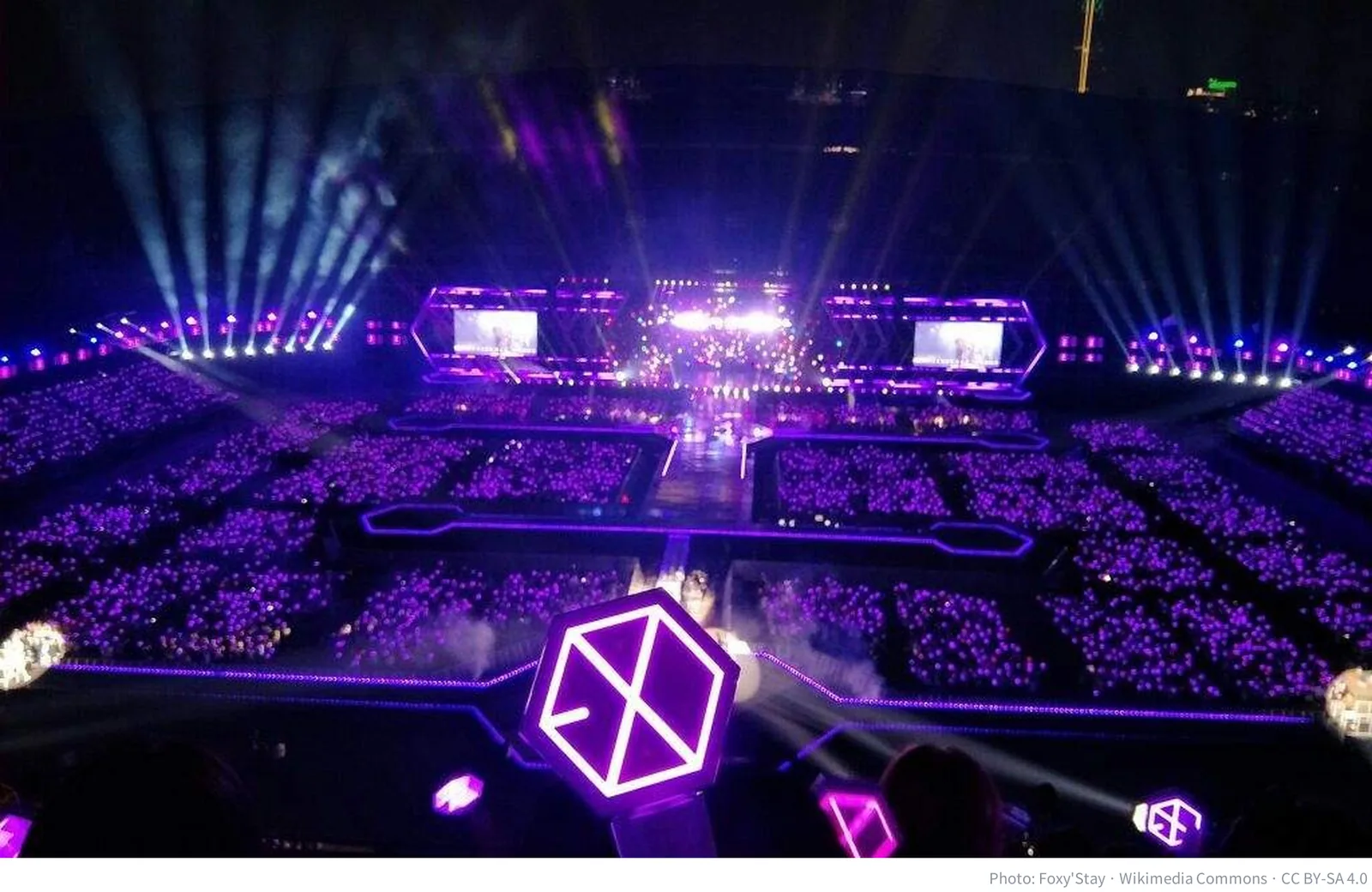
Lee Soo-man, who founded SM Entertainment and built groups such as EXO and aespa, said in December 2020, when he received the Dasan Management Award, that “from the company’s earliest days” his catchphrase had been “Culture first, Economy Next” (Hankyung Business, Dec 16, 2020). If Korean culture is loved around the world, he meant, the economy follows. Culture comes first and money comes after.
The nine-member girl group A2O LITE, from the new company he founded, A2O Entertainment, released its debut single “NEON” at 6 p.m. on October 13, 2026, and reached No. 1 on the Melon Top 100, Korea’s main streaming chart, 29 hours later, at 11 p.m. on the 14th. That is the fastest a rookie group’s debut song has reached No. 1 since Melon revamped the chart in 2021. The culture half of the slogan already has its report card.
This report is about the second half. If a rookie such as A2O LITE takes off, does the economy, meaning the share price, follow? If so, how big does the group have to get? How did listed agencies and their rivals trade when big groups debuted in the past, and who was buying? How do Korean entertainment companies make money, and how much do boy groups and girl groups actually leave with their companies? And how large is this industry next to other Korean industries, and what happens to it when money moves to another sector?
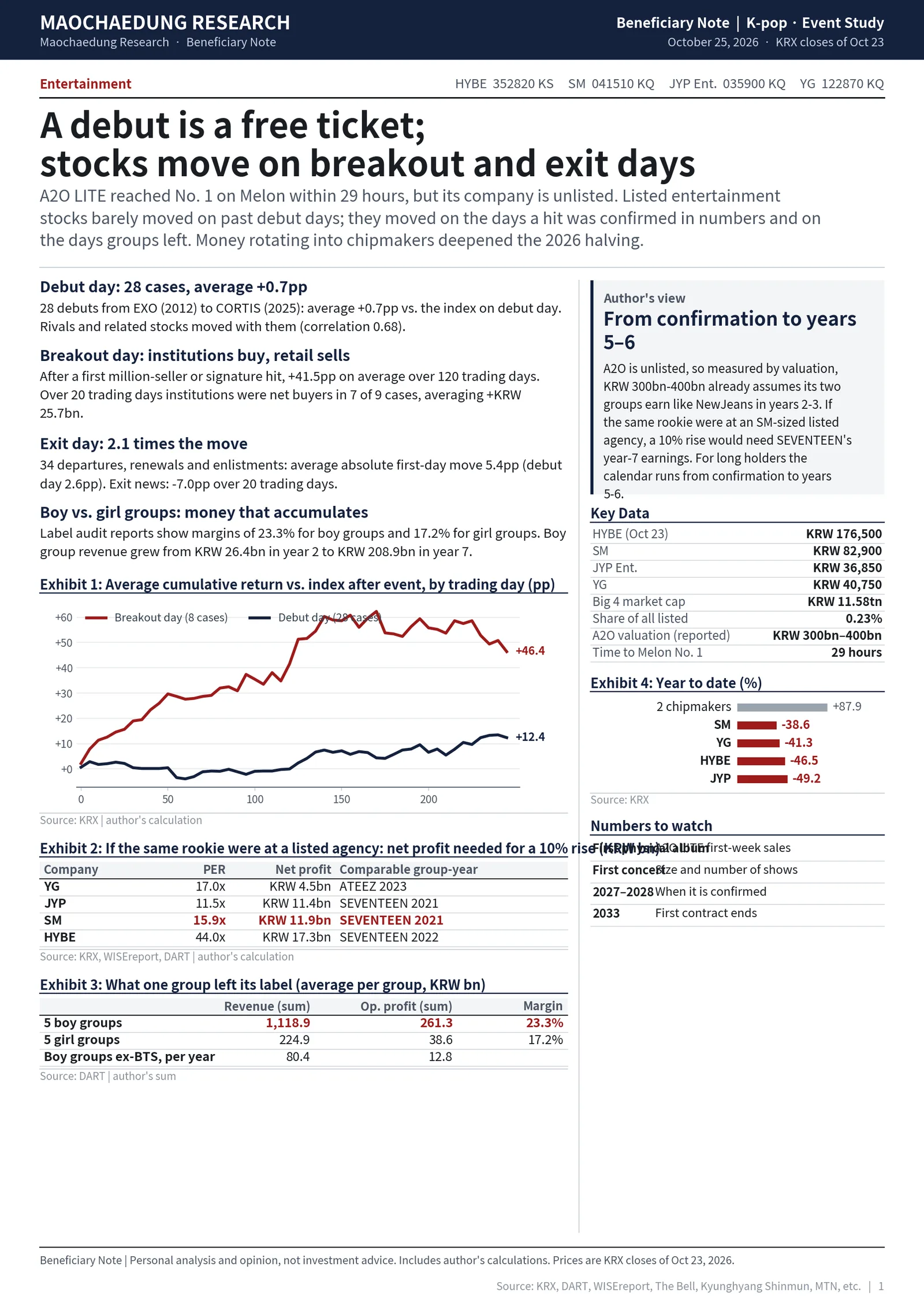
English edition of the author’s Korean note on K-pop rookies and entertainment stocks.
As of: October 25, 2026 (prices, market caps and investor flows are Korea Exchange regular-session data for October 23; consensus is WISEreport as of October 22; label financials are DART audit reports and annual reports)
Stocks covered: HYBE (352820.KS), SM Entertainment (041510.KQ), JYP Entertainment (035900.KQ) and YG Entertainment (122870.KQ), the four large listed K-pop agencies (the “Big 4”); Cube Entertainment (182360.KQ) and RBW (361570.KQ); related stocks YG PLUS (037270.KS), DearU (376300.KQ), Genie Music (043610.KQ), Dreamus (060570.KQ) and CJ ENM (035760.KQ); and, for comparison, Samsung Electronics (005930.KS) and SK hynix (000660.KS).
Some Korea-specific background. The KOSPI is the main board of the Korea Exchange (KRX) and its benchmark index; the KOSDAQ is its growth-company board. Tickers ending in .KS trade on the KOSPI and .KQ on the KOSDAQ. The KRX publishes net buying by investor type for every stock every day (retail, foreigners, institutions split into brokerages, asset managers, private equity funds, pension funds and others, and “other corporations,” meaning non-financial companies), which is what makes the “who bought” section possible. DART is the Financial Supervisory Service’s disclosure system, where even unlisted companies above a size threshold file audited financial statements. Korea counts large sums in units of 100 million won (eok); this report shows them as KRW bn. Dollar figures use KRW 1,325.99 per dollar, the October 23, 2026 rate (Yahoo Finance).
1. A2O LITE and A2O: the culture numbers are in, the company is unlisted, and a valuation of KRW 300bn to 400bn was floated
The short version: A2O LITE’s debut numbers are about as good as a rookie’s get, but the company that owns the group, A2O, is not listed. Individual investors have no direct way to bet on the group, which is why this report uses the four listed agencies as the yardstick. A valuation was floated when A2O sought outside investors, though, and what that valuation demands can be calculated.
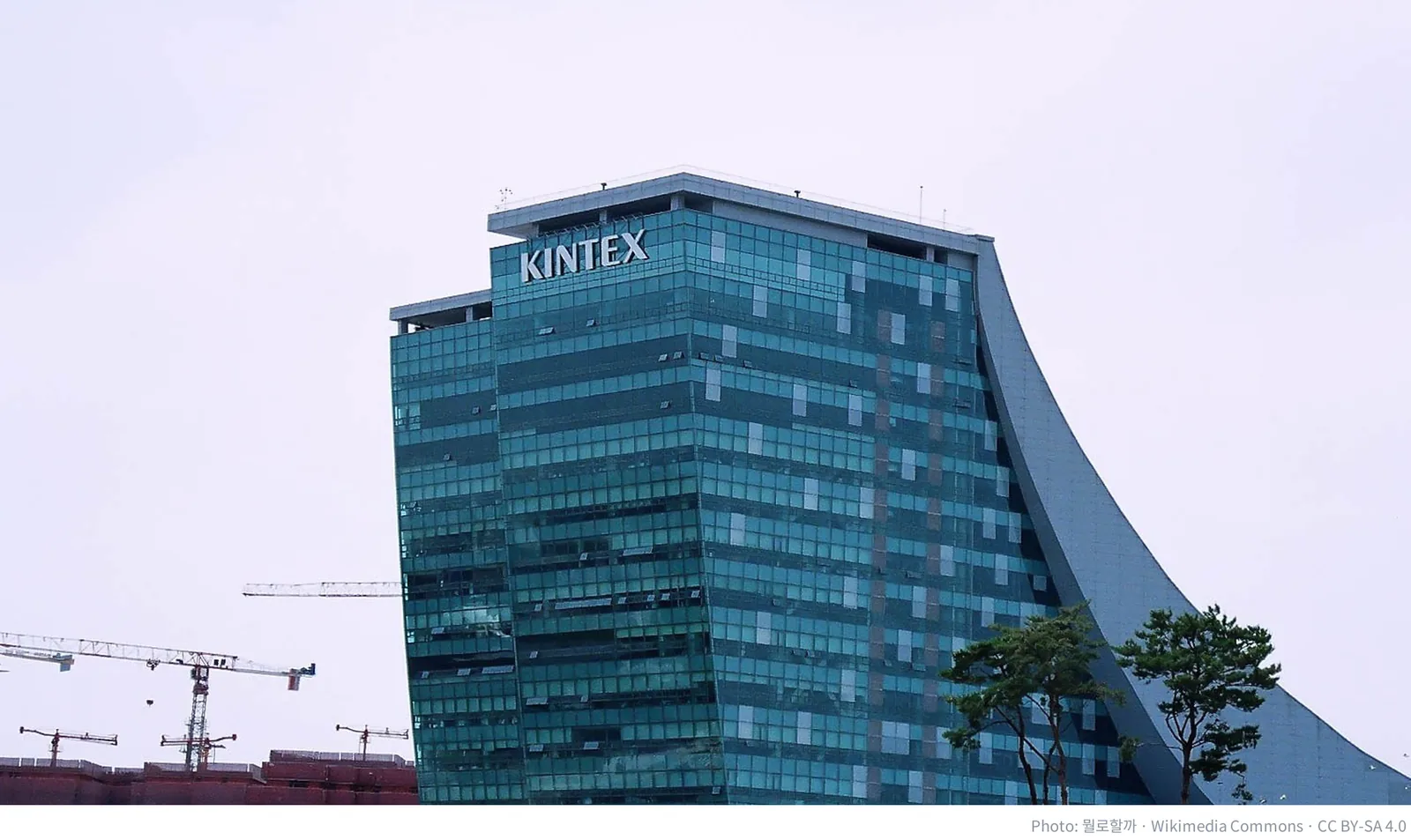
A2O LITE and the 15-member boy group A2O SOUL held a joint debut showcase on October 12, 2026 at KINTEX, the exhibition center in Goyang, west of Seoul, and released “NEON” and “SUPERSTAR” the next day. One company launched a girl group and a 15-member boy group on the same day.
A2O LITE has nine members. According to Sports Kyunghyang (Oct 11), they are Yeon (Korea, 17), Himeki (Japan, 16), Bora (Korea, 16), Siri (China, 15), Rada (Thailand, 15), Merci (China, 15), Ayun (Korea, 13), Oa (US/Japan, 13) and Aiqing (China, 13). Their average age is 14.8. Three members are Korean and three are Chinese. “NEON” was produced by Yoo Young-jin, who wrote TVXQ!’s “Mirotic” and aespa’s “Black Mamba” at SM (Korea JoongAng Daily, Oct 16).
The chart run was fast. The song came out at 6 p.m. on October 13 and topped the Melon Top 100 at 11 p.m. on the 14th; a week after the debut it won the music shows “The Show” on October 20 (7,331 points) and “Show Champion” on the 21st. There is no physical album yet, so the numbers that show fans’ spending power, such as first-week album sales, do not exist. Korean agencies earn more from albums, concerts and merchandise than from streaming, so the numbers that matter for the company are still to come.
On the company side, A2O is headquartered in Singapore and belongs to Bluming Grace, Lee Soo-man’s private company. It launched A2O MAY, a group aimed at China, in 2024 and opened a Korean office in Cheongdam-dong, Seoul in October 2025. When Lee left SM in 2023 he signed a three-year non-compete with HYBE that barred him from producing in Korea; it expired at the end of February 2026 (MTN, Feb 7, 2026). The two October groups are his first Korean debuts since then.
The valuation comes from a fundraising report. The Bell (June 2, 2026) wrote that A2O was sounding out investors at home and abroad, that “the raise is about KRW 30bn to 40bn, with a structure under discussion of selling about 10% through new shares,” and that “an enterprise value of about KRW 300bn to 400bn is being discussed.” It had first sought money mainly in China and had recently widened the search to Korean financial investors. No report of a completed round was found, and no revenue or profit figures have been published. No filing or report shows a listed company investing in A2O or distributing its music.
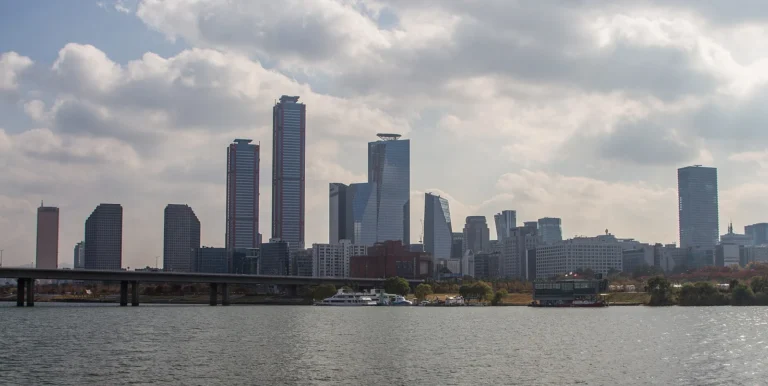
Next to listed companies the size becomes clear. YG Entertainment’s market cap on October 23 was KRW 762bn (about $575mn). A2O’s floated KRW 300bn to 400bn (about $226mn to $302mn) is 39 to 52% of YG’s. An unlisted company whose groups had not even debuted asked for about half the value of the listed company behind BLACKPINK, BABYMONSTER and TREASURE.

The Black Label, on the right of the chart, is another comparison. It is producer Teddy’s company, behind ROSÉ’s “APT.” and the soundtrack of Netflix’s “KPop Demon Hunters.” The Bell (Jul 27, 2026) put its current enterprise value at KRW 1.02tn (about $769mn), up from KRW 150bn at its first outside investment in 2021, with Tencent Music and Krafton as strategic investors. An unlisted company is already valued above listed YG, which shows how much the market pays for a company it believes can make the next hit. Section 7 calculates what these valuations require.
2. 28 debut days: listed agencies’ share prices did not price debuts
The conclusion first: across 28 debuts by groups at listed agencies, the agency’s stock beat its index by only +0.7pp on average on debut day. In practice it did not move. A debut is a scheduled event, and on that day no one yet knows whether the group will make money.
How the debuts were counted
The sample is 28 flagship debuts at five listed companies (SM, JYP, YG, HYBE and Cube), from EXO in 2012 to CORTIS in 2025. Prices are KRX adjusted closes. Returns are excess returns: the stock’s cumulative return from the close before the debut minus the return of its index (KOSPI or KOSDAQ) over the same days, in percentage points (pp). EXO (Apr 8, 2012) and Stray Kids (Mar 25, 2018) debuted on Sundays, so the next trading day counts as debut day. HYBE listed in October 2020, so only its later debuts (from ENHYPEN) are included. Windows are debut day, 5, 20, 60, 120 and 250 trading days (about a year).
Quiet debut days, scattered results a year later
In 19 of the 28 debuts the agency’s stock moved within ±3pp of its index on debut day. The biggest gain was HYBE’s +7.0pp on NewJeans’ debut (Jul 22, 2022), followed by YG’s +6.7pp on WINNER (Aug 12, 2014) and HYBE’s +6.1pp on ILLIT (Mar 25, 2024). The biggest fall was JYP’s -5.3pp on TWICE’s debut (Oct 20, 2015). The average size of the debut-day move (absolute value) was 2.6pp, not much more than an ordinary day for these stocks.
A year later, though, results were scattered to the extremes. In the year after CORTIS debuted (Aug 18, 2025), HYBE trailed its index by -147.9pp; in the year after (G)I-DLE debuted (May 2, 2018), Cube beat it by +129.6pp. Sixteen of the 28 were above the index a year later and 12 below. Put a quiet debut day together with such a wide spread a year later, and it is clear that the outcome was decided by what happened after the debut, not by the debut itself.

The one-year numbers mix in much that has nothing to do with the group. CORTIS’s -147.9pp overlaps with 2026, when money poured into chipmakers, the KOSPI surged and entertainment stocks halved. aespa’s +115.3pp for SM in the year after November 2020 includes the 2021 rumors that SM was for sale. The one-year column cannot be read as each group’s own score; what the table shows is that debut day itself was not priced.
The average path
The average path of the 28 debuts is flat for a year. It starts at +0.7pp, stays near zero until about 120 trading days, and ends around +12.4pp a year later. Laid over the average path of the eight “breakout days” in the next section, the difference is obvious: the breakout path pulls away within 60 trading days and ends a year later at +46.4pp.
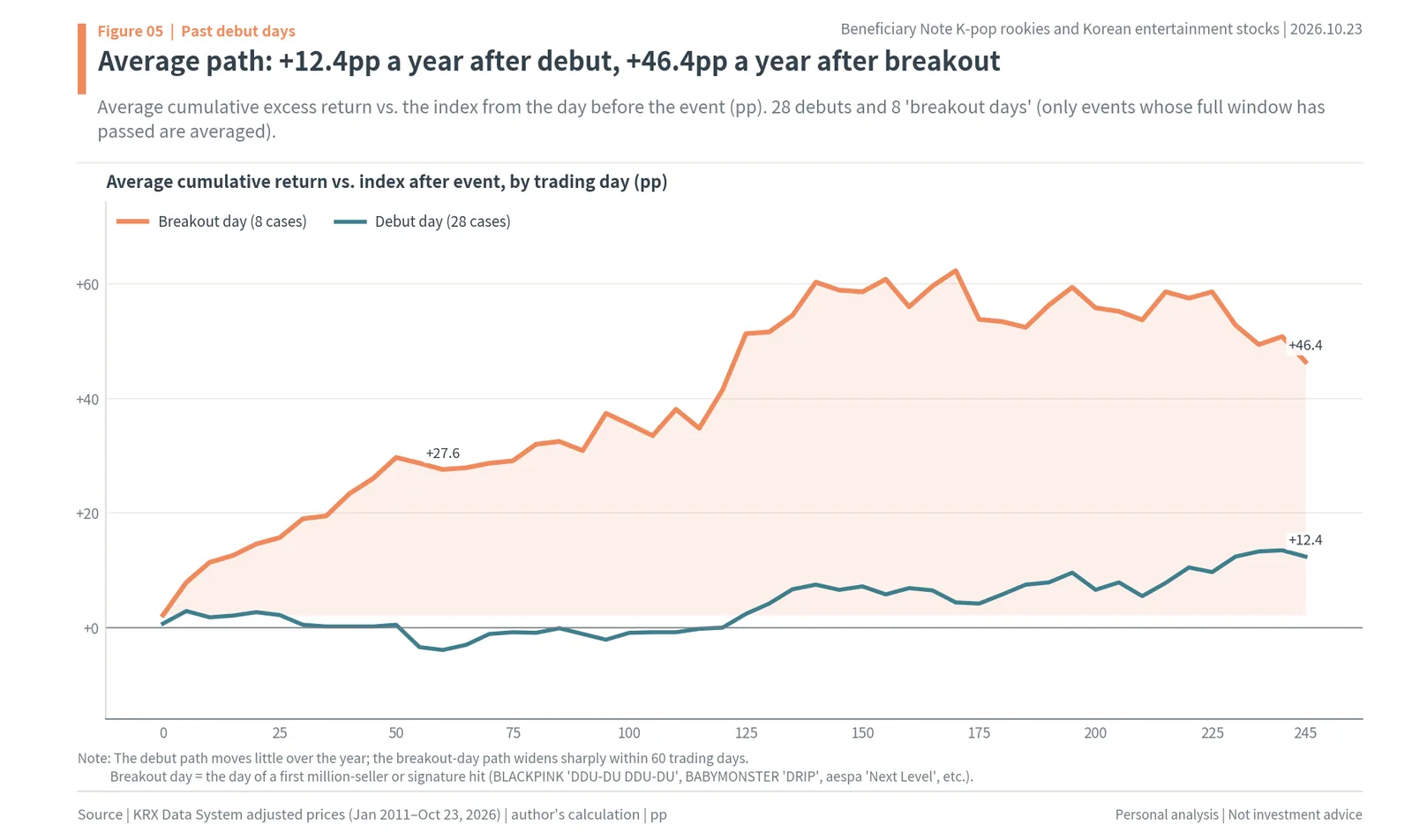
That gap is the first link in this report. The market does not price a scheduled event like a debut; it prices the moment it is confirmed, in numbers, that the group sells. For A2O LITE, the 29-hour Melon No. 1 is a cultural signal, and the stock-market signal has not arrived yet.
3. Nine breakout days: stocks moved when success was confirmed in numbers, and moved most at smaller companies
Swap debut day for the day a group’s success was confirmed in numbers and the picture changes. Nine such days, a first million-selling album or a signature hit, were measured the same way. The eight that are at least 120 trading days old averaged +41.5pp of excess return over 120 trading days, against +1.8pp in the 20 trading days after debut days.
The breakout days
The days are BLACKPINK’s “DDU-DU DDU-DU” (Jun 15, 2018), BABYMONSTER’s “DRIP” (Nov 1, 2024, first million-seller), aespa’s “Next Level” (May 17, 2021), LE SSERAFIM’s “ANTIFRAGILE” (Oct 17, 2022, first million-seller), Stray Kids’ “NOEASY” (Aug 23, 2021, JYP’s first million-seller), TWICE’s “Cheer Up” (Apr 25, 2016), EXO’s XOXO passing a million copies (Dec 27, 2013, Korea’s first million-seller in 12 years), (G)I-DLE’s “TOMBOY” (Mar 14, 2022) and CORTIS’s “GREENGREEN” (May 4, 2026, 2.31 million copies in its first week). Each date is the release or the day the sales record became known, the first point at which the group’s earning power showed up in numbers.
Results: when a small company’s flagship takes off
The four big gains all came where the group was large relative to its company. In the 120 trading days after “DDU-DU DDU-DU,” YG beat its index by +62.3pp, and after “DRIP” by +77.6pp. After “Next Level,” SM was +136.3pp, though takeover talk involving Kakao and CJ overlapped that year, so the group’s share is hard to separate. After “ANTIFRAGILE,” HYBE was +62.6pp.
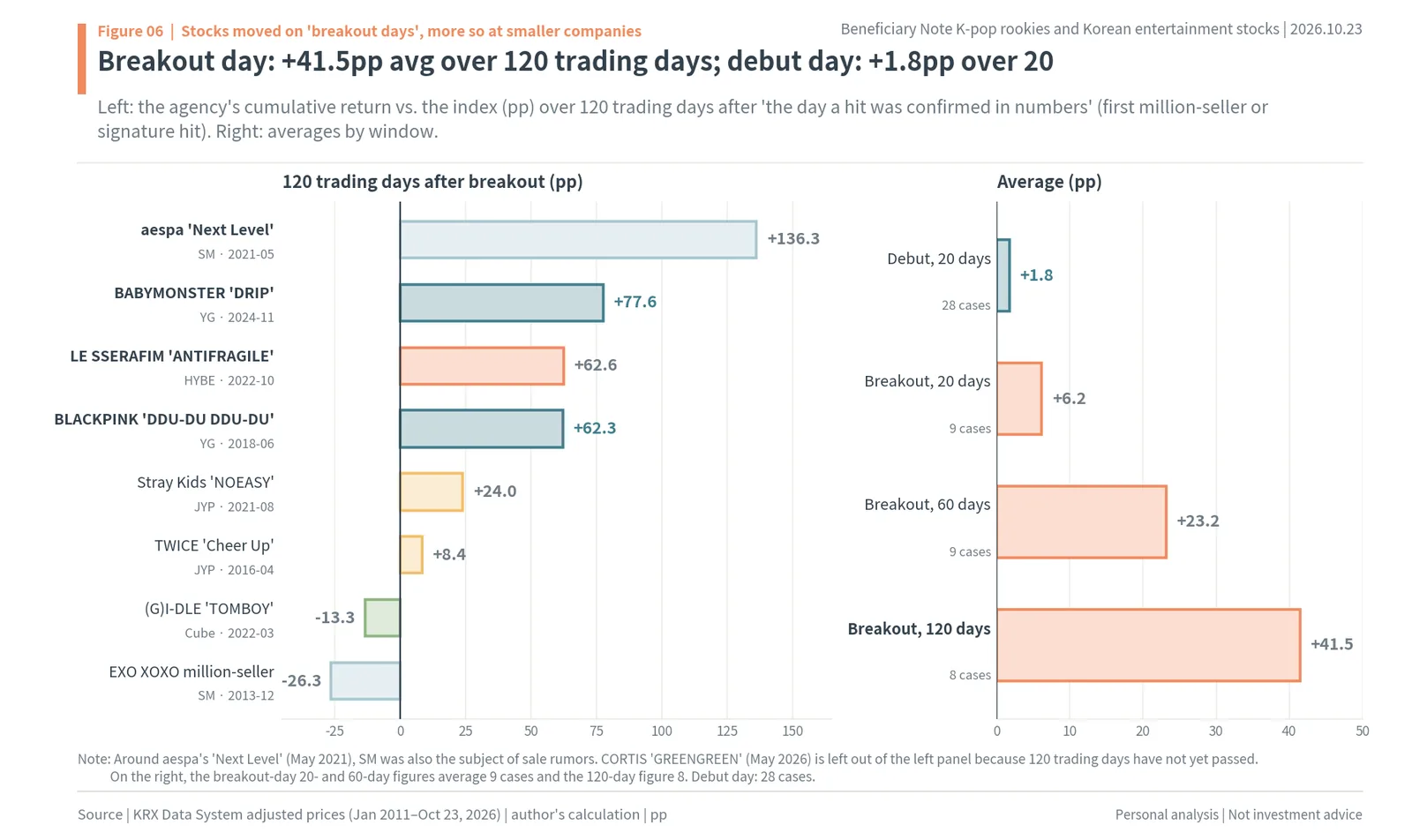
At companies that already had a big group, a new hit changed less. After “NOEASY,” JYP was +24.0pp, positive but smaller, because TWICE was already carrying the company. In the year after XOXO’s million copies, SM was -26.3pp: the lawsuits by EXO’s Chinese members Kris and Luhan in 2014 (section 6) wiped out the effect. CORTIS’s “GREENGREEN” sold 2.31 million copies in its first week, but May 2026 was the month money rushed into chipmakers, and HYBE trailed its index by -52.2pp over the next 20 trading days.
Why small companies move more
Share prices attach to the whole company’s profit. YG had 2025 revenue of KRW 545.4bn, and BLACKPINK has long been reckoned to account for most of it (New Daily, Jan 2024, citing a market estimate of “over 80%”). When one group takes off at such a company, the whole profit outlook changes. At a multi-label company like HYBE, one new group is a small share of total profit. Section 7 puts numbers on this.
4. Other companies on debut days: rivals and related stocks moved together, and the sector’s tide was bigger than any rookie
When one agency’s rookie debuts, what happens to its rivals? If the rival lost fans and fell, it would be zero-sum; if the whole sector moved together, the sector’s tide matters more than the rookie. The data says the latter.
The three rivals
For each of the 28 debuts, the 20-trading-day excess returns of the debuting agency and of the other three agencies (two before HYBE listed) were measured. The debuting agency averaged +0.0pp (27 values) and its rivals -0.3pp (70 values), no difference. Pairing each event’s debuting-agency return with its rivals’ average gives a correlation of 0.68; they mostly moved in the same direction. Debut-day moves were similar in size too: 2.5pp for the debuting agency and 2.0pp for rivals.
Five related stocks
The report also looked at where the agencies’ revenue flows: YG PLUS (album distribution, including HYBE’s), DearU (the fan-messaging app “bubble”), Genie Music and Dreamus (music streaming platforms) and CJ ENM (the Mnet music channel and production). Their debut-day moves averaged 2.1pp in absolute value, about the same as the debuting agency. DearU listed in November 2021, so only later debuts include it.

Reading the chart row by row, several cells often take the same color on the same day. In the 20 trading days after KickFlip’s debut in January 2025, SM, YG, YG PLUS and DearU all beat their indexes by wide margins; that was when hopes that China would lift its unofficial ban on Korean entertainment lifted the whole sector. After NCT 127’s debut in 2016, SM, JYP and YG fell together; South Korea’s July 2016 decision to deploy the US THAAD missile-defense system had put China risk on the whole sector. The effect of one rookie taking fans from rivals was far smaller than sector-wide winds such as policy and money flows.
A2O LITE’s debut fortnight
The bottom row of the chart covers the nine trading days from A2O LITE’s debut (Oct 13) to the as-of date. SM rose +9.1%, HYBE +12.8% and YG +5.2%, while JYP fell -2.1%. Against their indexes, SM was +20.6pp and HYBE +25.8pp. Over the same days the KOSPI fell -13.1% and the KOSDAQ -11.5%; the KOSPI fell -5.5% on the 13th alone and -7.6% on the 15th.
These numbers do not mean A2O LITE lifted entertainment stocks. An unlisted company’s rookie debut lifting four listed rivals more than 20pp above their indexes at once never happened in any of the 28 cases above. What those days had in common is that chipmakers fell hard, and entertainment stocks fell less or even rose: the movement of money between sectors described in section 6.
5. Who bought: no direction on debut days; on breakout days institutions bought and retail sold
For the same events, KRX data on net buying by investor type was summed over the 20 trading days from the event. Investors are split into retail, foreigners (including other foreigners), institutions (brokerages, insurers, asset managers, private equity funds, banks, other financial firms and pension funds) and other corporations (non-financial companies).
Debut days: an even split
In the 20 trading days after the 28 debuts, retail investors were net buyers in 12 cases and institutions in 14. Counting the largest net buyer, institutions led 13 times, retail 12 times and foreigners 3 times. Average amounts were small: retail +KRW 2.9bn, institutions +KRW 5.7bn. There was no rush from one side into debut hype.
In a few big debuts, though, retail and institutions moved in opposite directions. In the 20 trading days after LE SSERAFIM’s debut (May 2022), retail bought KRW 89.6bn of HYBE and institutions sold KRW 117.9bn. For TWS (Jan 2024) it was retail +KRW 87.6bn and institutions -KRW 110.5bn. For NCT 127 (Jul 2016) SM saw retail +KRW 39.3bn and institutions -KRW 44.6bn, and for BLACKPINK (Aug 2016) YG saw retail +KRW 35bn and institutions -KRW 26.5bn. In hyped debuts, retail sometimes went in first and institutions sold into it.
Breakout days: institutions buy
On the nine breakout days the direction was clear. Institutions were net buyers in 7 of 9 over the next 20 trading days, and retail was a net seller in 7 of 9. On average institutions bought KRW 25.7bn and retail sold KRW 21.6bn. Once success was confirmed in numbers, institutions bought and retail handed over its shares.

The four big gains all looked the same. With “DDU-DU DDU-DU,” institutions bought KRW 80.6bn of YG and retail sold KRW 69.9bn; with “DRIP,” institutions +KRW 49bn and retail -KRW 55.2bn. With “Next Level,” SM saw institutions +KRW 100.3bn and retail -KRW 105.7bn; with “ANTIFRAGILE,” HYBE saw institutions +KRW 48.9bn and retail -KRW 54.4bn. Within institutions, the biggest buyers across these four were private equity funds (KRW 81.8bn) and pension funds (KRW 79.7bn), followed by brokerages and asset managers at KRW 52.1bn each.

There is an exception. With CORTIS’s “GREENGREEN” (May 4, 2026), retail bought KRW 112.2bn and institutions sold KRW 65.5bn. The 2.31 million first-week copies were a big number, but that month institutions were selling the whole sector and moving into chips. Institutional buying does respond to confirmation, but when money is leaving the sector the response gets buried.
When did other corporations show up?
Other corporations barely appeared on debut or breakout days. They appeared in stake deals. In 2023, when Kakao and HYBE fought over SM, other corporations net bought KRW 273.2bn of SM in a year. In 2025, when HYBE’s SM stake passed to China’s Tencent Music, the data showed other corporations at -KRW 317.6bn and foreigners at +KRW 379bn. At HYBE, other corporations sold KRW 62.1bn in the 20 trading days after ENHYPEN’s debut in November 2020, right after HYBE listed, when pre-IPO investors’ shares were coming loose; in the 60 trading days after CORTIS’s debut they sold KRW 201bn.
In short, the money that moved stocks around rookies was institutional, and it reacted to confirmation, not to debuts. Retail often went in on hype and sold after confirmation. Corporate money moved when a company’s owner changed, not when a group debuted.
6. How agencies make money: albums, concerts and merchandise split revenue roughly three ways, and the settlement ratio decides what stays
If share prices move on confirmed profit, one needs to know where profit comes from to value a rookie. Three conclusions. Revenue is split roughly evenly between albums, concerts and merchandise. For the same revenue, merchandise keeps the most and concerts the least. And what the company keeps depends on the settlement ratio it shares with artists, which shifts toward the artists with seniority and each renewal.
The Big 4’s results and revenue mix
In 2025 (consolidated, as compiled by MTN on Mar 16, 2026), HYBE had revenue of KRW 2.65tn and operating profit of KRW 49.3bn, SM KRW 1.17tn and KRW 183bn, JYP KRW 821.9bn and KRW 155.2bn, and YG KRW 545.4bn and KRW 71.3bn. Operating margins were JYP 18.9%, SM 15.6%, YG 13.1% and HYBE 1.9%. Brokers attribute HYBE’s low margin to costs such as restructuring at HYBE America and share-based compensation. Together the four had revenue of KRW 5.19tn (about $3.92bn) and operating profit of KRW 458.8bn.
Split by segment (iM Securities table, Apr 30, 2026), HYBE’s 2025 revenue was albums and music KRW 773bn, concerts KRW 764bn, merchandise and licensing KRW 571bn, content KRW 259bn, ads and appearances KRW 147bn and fan clubs KRW 136bn. That is 29% albums, 29% concerts and 22% merchandise, roughly a three-way split. HYBE’s 12 acts played 279 shows that year, and concert revenue rose 69.4%.

What keeps the most
Companies do not disclose margins by segment, so two clues are used. One is analysts’ view: a CGS International analyst told CNBC that margins on merchandise such as light sticks and photocards can reach “as high as 50%.” Fans buy several copies of the same album and collect photocards; the more copies of one design are printed, the more each one earns.
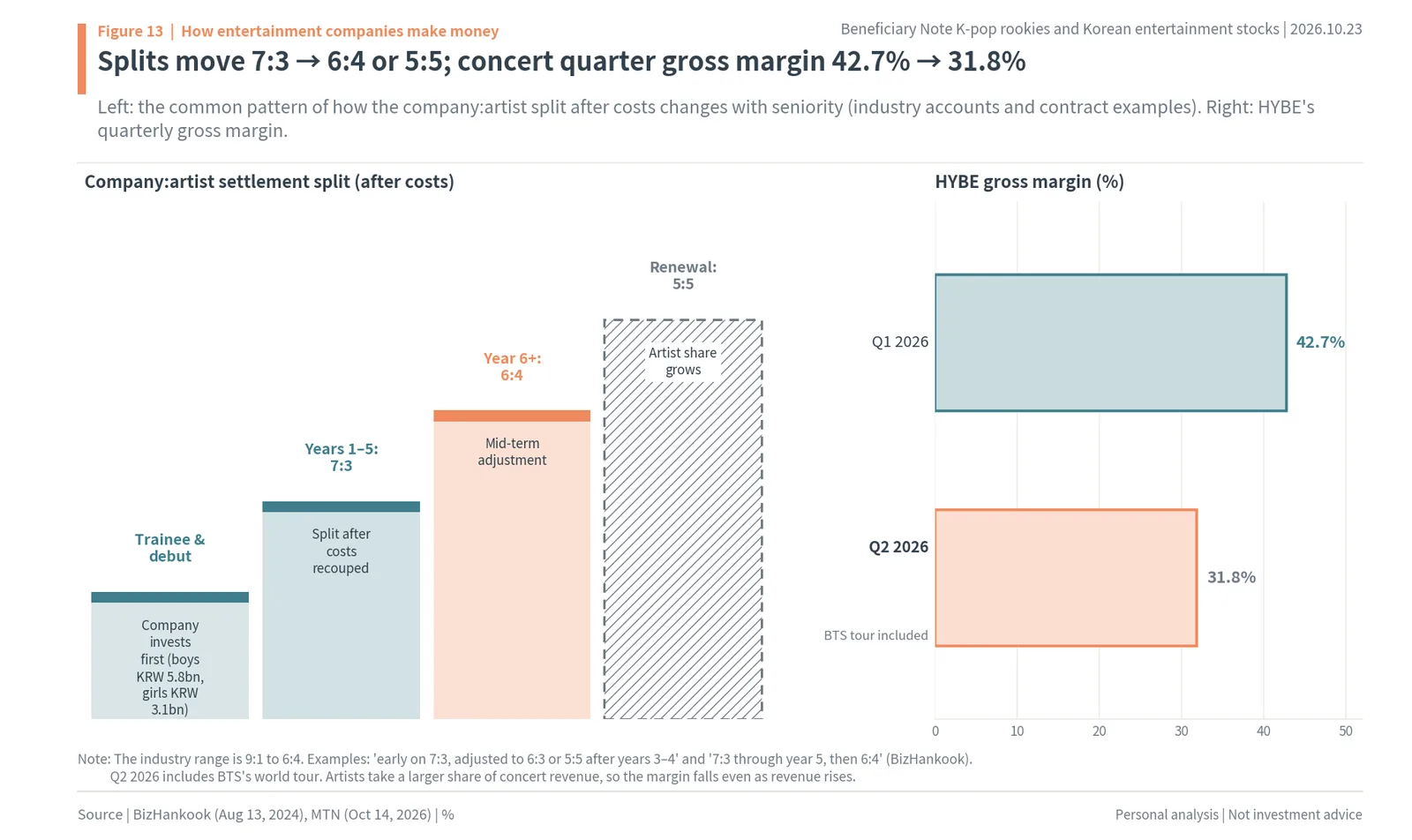
The other is hard numbers. HYBE’s gross margin fell from 42.7% in the first quarter of 2026 to 31.8% in the second, when BTS’s world tour was booked (MTN, Oct 14, 2026). Concerts are large in revenue but carry heavy costs for stages, venues and staff, plus large artist payouts, so margins fall as revenue rises. On July 28, 2026 HYBE reported its biggest quarter ever and still fell 16% in a day, because its 11.8% operating margin missed the 12.7% the market expected (SBS Biz). The market watches what is left over, not revenue.
Settlement: starting at 70:30 and shifting toward the artists
How companies and artists split money varies by company within the frame of the standard contract. BizHankook (Aug 13, 2024) reported the industry’s account: trainee costs and other costs the company put in are deducted from revenue first, and the rest is split “between 9:1 and 6:4.” More recently “many contracts start at 7:3 and adjust to 6:3 or 5:5 from the third or fourth year.” One member’s contract was “7:3 through the fifth year, 6:4 after that.”
Two things follow. Early on, the company recovers its costs first, so its share is large. And each year of seniority and each renewal raises the artists’ share. For the company, a renewal means giving up margin to keep the group. JYP’s artist payouts rose 209% year on year in the second quarter of 2025 after Stray Kids renewed, and YG paid exclusive-contract fees of KRW 41.2bn in 2023 to keep BLACKPINK.
Debut costs and break-even
Debuts cost money up front. Fantagio’s 2021 disclosure put the cost of debuting a boy group at KRW 5.8bn and a girl group at KRW 3.1bn (News Tomato), and the industry says each trainee costs more than KRW 100mn a year. A study by Professor Kim Jeong-seop of Sungshin Women’s University (reported by Kyunghyang Shinmun, Aug 4, 2026) noted that only 42 of the 1,182 groups that debuted from 1996, 3.55%, ever sold more than 300,000 copies of a single album, the level the industry treats as break-even. Most debuts end as costs; a few groups that recover them make the company’s profit.
7. What boy groups and girl groups leave with their companies: boy groups earn more, for longer, and the gap opens with seniority
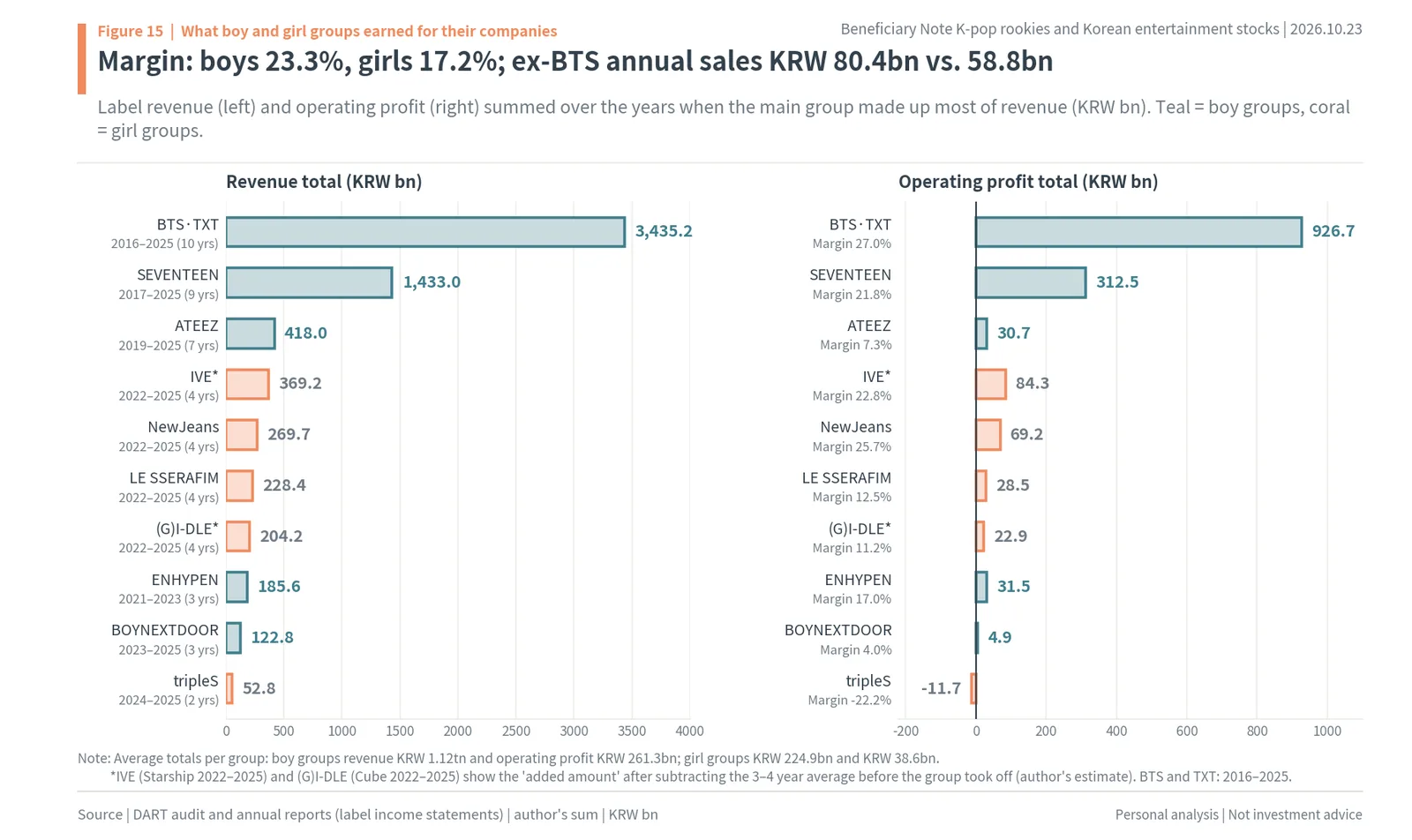
No company discloses revenue by group. So this report used the income statements of labels whose revenue is mostly one group: HYBE’s labels (Big Hit Music, Pledis, Source Music, ADOR, BELIFT LAB, KOZ), plus Starship, KQ, Cube, MODHAUS and The Black Label, taking revenue and operating profit by year from audit reports and annual reports (filing numbers in “How the numbers were counted”). Conclusion: boy groups left more money per group, at higher margins, for longer. Girl groups rose fast early but did not grow much afterwards.
The label table
Laid out by year, the size gap is plain. Big Hit (BTS and TXT) peaked at KRW 573bn in 2022, Pledis (SEVENTEEN) at KRW 340.4bn in 2024, and ADOR (NewJeans) at KRW 111.2bn in 2024. Starship jumped to KRW 114.8bn in 2022 when IVE took off, and KQ (ATEEZ) grew every year from KRW 7.5bn in 2019 to KRW 145.5bn in 2025.

Totals by group
To turn label numbers into group numbers, only the years when one group made up most of the label’s revenue were added: BTS and TXT, Big Hit 2016 to 2025; SEVENTEEN, Pledis 2017 to 2025; ATEEZ, KQ 2019 to 2025; ENHYPEN, BELIFT LAB 2021 to 2023 (before ILLIT debuted); BOYNEXTDOOR, KOZ 2023 to 2025; NewJeans, ADOR 2022 to 2025; LE SSERAFIM, Source Music 2022 to 2025; tripleS, MODHAUS 2024 to 2025. For IVE (Starship) and (G)I-DLE (Cube), whose companies have many other groups, only the increase over the three to four years before the group took off was counted (author’s estimate).
Added up this way, the five boy groups left an average of KRW 1.12tn in revenue and KRW 261.3bn in operating profit per group. The five girl groups left an average of KRW 224.9bn in revenue and KRW 38.6bn in operating profit. BTS lifts the boy-group average, so on a per-year basis without BTS, boy groups averaged KRW 80.4bn of revenue a year against KRW 58.8bn for girl groups. Margins were 23.3% for boy groups and 17.2% for girl groups.
By year since debut
To see when the gap opens, label revenue was lined up by year since debut. The boy-group average grew every year, from KRW 26.4bn in year 2 to KRW 208.9bn in year 7. The girl-group average jumped to KRW 77.4bn in year 2 but then stayed between about KRW 50bn and KRW 76bn. Individually, SEVENTEEN grew 12.6 times from KRW 27bn in year 3 to KRW 340.4bn in year 10, and ATEEZ grew 19.4 times from KRW 7.5bn in year 2 to KRW 145.5bn in year 8. NewJeans jumped to KRW 110.3bn in year 2 (2023), and IVE’s increase reached KRW 106.3bn in year 3 (2023).
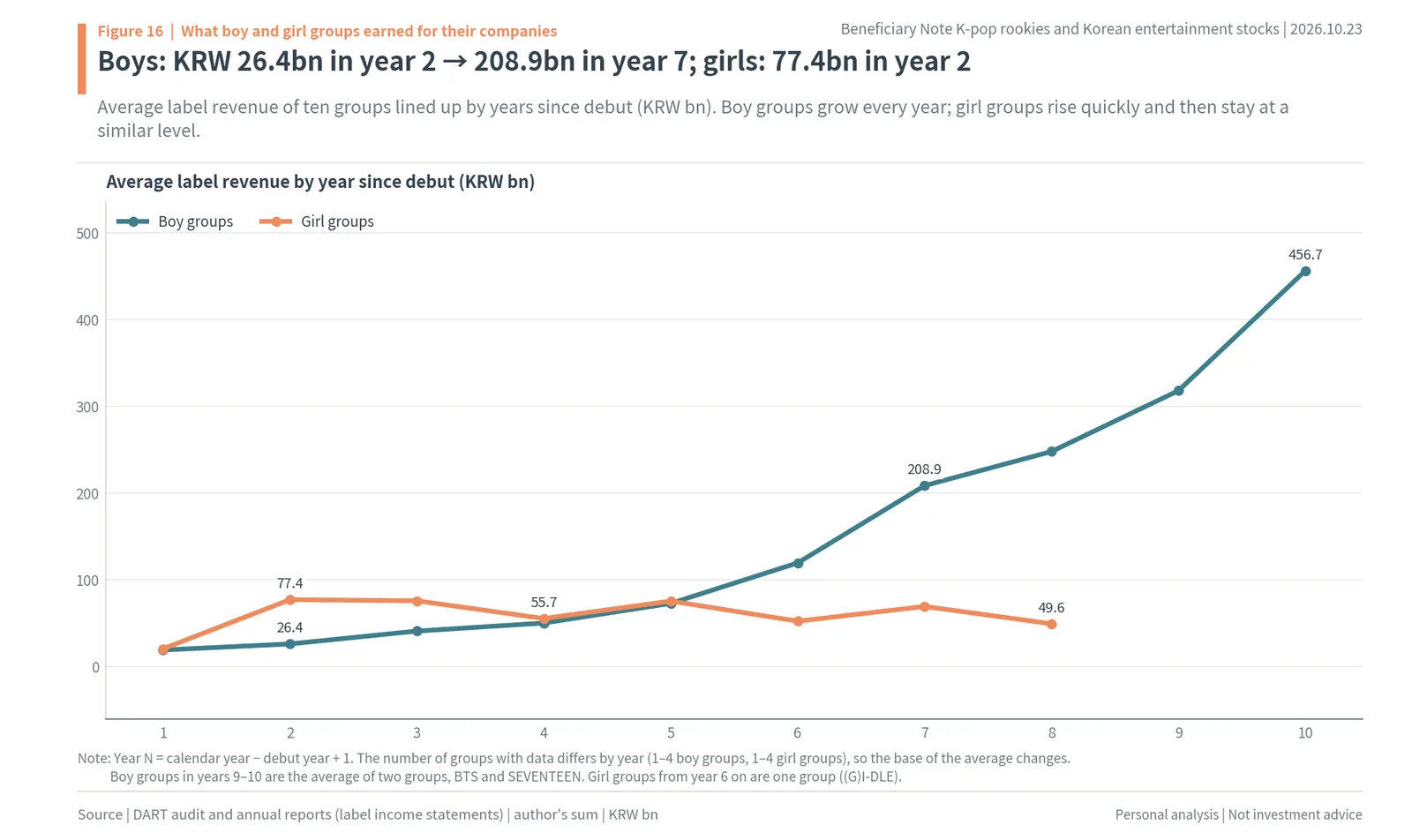
The sample is small. The number of groups with data changes from one to four by year; boy groups in years 9 to 10 are only BTS and SEVENTEEN, and girl groups from year 6 on are only (G)I-DLE. The direction is still clear: for boy groups seniority is revenue, and girl groups start fast.
Why the gap
First, longevity. Professor Kim’s study counted 1,182 groups (594 boy, 588 girl) that debuted from 1996 to 2025 and found average careers of 5.11 years for boy groups and 3.13 for girl groups; 55.03% survived three years. The more groups last, the more chances seniority has to turn into revenue.
Second, album buying. The eight groups with more than 10 million cumulative album sales are BTS, SEVENTEEN, Stray Kids, EXO, TWICE, NCT, TOMORROW X TOGETHER and ENHYPEN; TWICE is the only girl group. Professor Kim explained it as the difference between boy groups with “a highly loyal consumption structure centered on female fandoms” and girl groups that rely on mass appeal, events and streaming. The same fan buying several copies of an album, collecting merchandise and going to several concerts is stronger on the boy-group side. Merchandise ranges differ too: on Weverse Shop BTS had 796 items and LE SSERAFIM 175, NCT 801 and aespa 337 (News Tomato).
Third, concerts. In Billboard Boxscore data from October 2024 to September 2025, Stray Kids grossed USD 185.7mn from 31 shows and SEVENTEEN USD 142.4mn from 34, while LE SSERAFIM grossed USD 34.1mn and aespa USD 18mn. Among girl groups, BLACKPINK’s 2023 reported total of USD 148.3mn from 29 shows gives a higher gross per show (USD 5.11mn) than SEVENTEEN’s (USD 4.19mn). Girl groups at the very top earn big from concerts too; few get there.
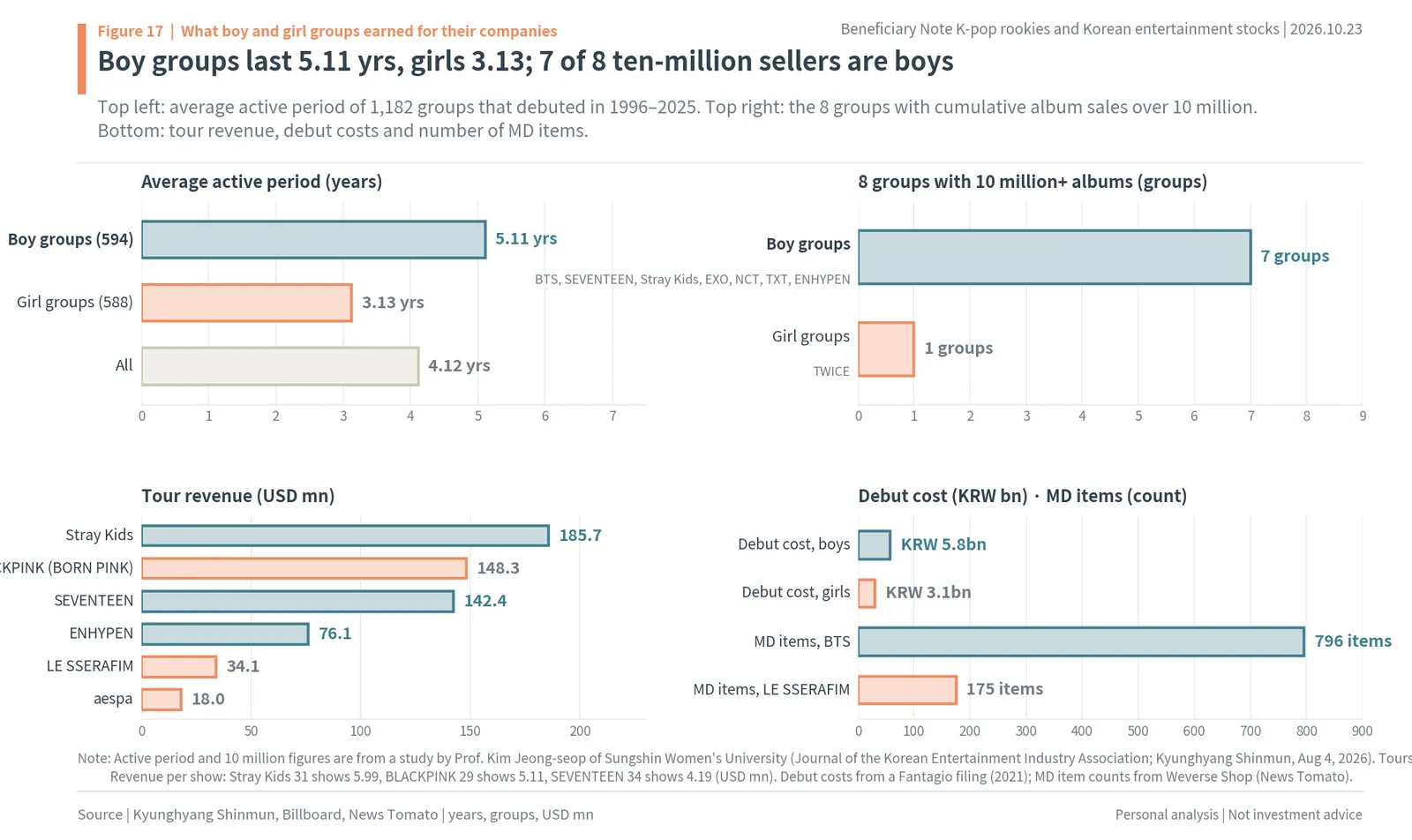
Girl groups’ strengths lie elsewhere. In 2024 aespa topped Circle Chart’s digital and streaming charts while SEVENTEEN topped albums. Girl groups earn fast where the public responds immediately: streaming, ads and events. Their debut costs are also lower: KRW 3.1bn against KRW 5.8bn for a boy group in Fantagio’s disclosure. They rise faster and cost less, but accumulate more slowly.
That matters for A2O LITE. If a girl group takes off, early revenue can come quickly. But the accumulating money that multiplies a company’s value should be assumed smaller than for a boy group, on the numbers so far. A2O launching the 15-member boy group A2O SOUL on the same day reads as a company going after both kinds of earnings.
8. 34 exit and renewal days: stocks reacted twice as much to “who stays” as to debuts
If debut day is unpriced, what about the days a group leaves or stays? Thirty-four pieces of news that changed a group’s future (lawsuits, departures, renewals, military enlistment) were measured the same way. The answer: much bigger moves than on debuts, and longer-lasting ones when a group was leaving.
How they were counted
Each event is dated by the day the news first broke. News after the close or on a holiday counts from the next trading day. BTS’s hiatus video came out on the evening of June 14, 2022, so June 15 is its first day; three Girls’ Generation members’ departure was reported during a holiday (Oct 9, 2017), so October 10 is used. There are 24 leaving or risk events (lawsuits, departures, renewal uncertainty, enlistment notices) and 10 staying events (renewals, returns, a court injunction). RBW listed in November 2021, so an earlier departure was left out.
Results
The 24 leaving events averaged -3.6pp on the first day, -5.4pp over five trading days and -7.0pp over 20, falling further with time; 16 of the 24 were below their index after 20 trading days. The 10 staying events averaged +4.0pp on day one but reversed to -2.5pp after 20 trading days. The average first-day move (absolute value) across all 34 was 5.4pp, 2.1 times the 2.6pp of debut days.
The biggest days were all days when an agency’s flagship wobbled. The day after BTS’s hiatus announcement HYBE fell -24.87% (-23.0pp against its index); on the day of Seungri’s retirement YG trailed its index by -14.5pp; on the day Luhan sued SM, SM was -13.0pp; and on the day TWICE’s Chaeyoung was reported to be moving, JYP was -11.5pp. Jeongyeon’s move was -5.8pp on day one but grew to -20.5pp over five trading days, as Chaeyoung’s news and a weak second quarter piled on.
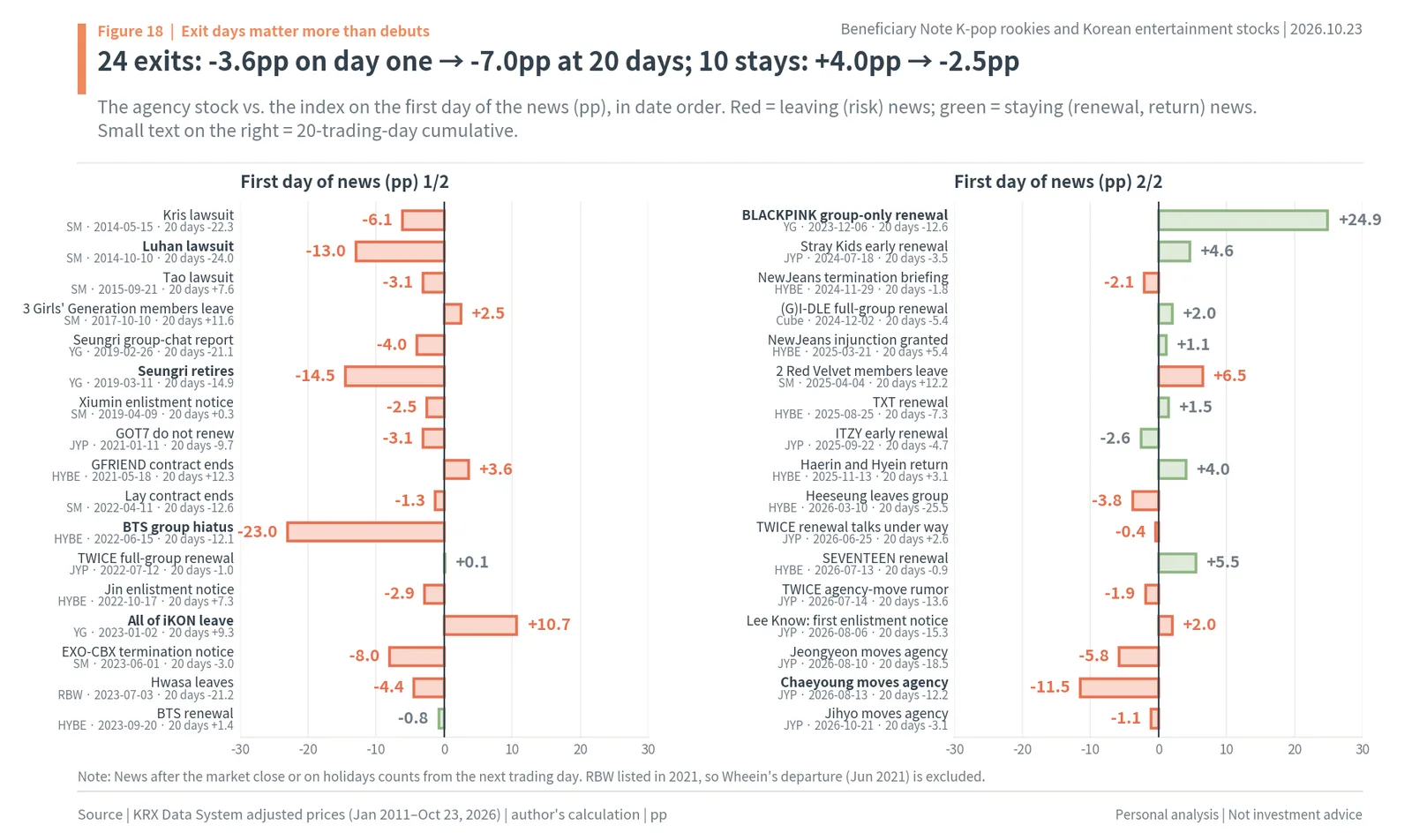
BLACKPINK is the clearest case of good news fading. On December 6, 2023 YG announced a renewal for BLACKPINK’s group activities and the stock jumped +25.63% in a day. But as it became clear that the members’ solo work would be with other companies, YG was -12.6pp against its index 20 trading days later. A renewal keeps a group but, as section 6 showed, also raises the artists’ share. Within weeks the market priced both the relief of “they stay” and the arithmetic of “less stays with the company.”
So is it exits, not debuts, that matter?
Half right. Debut day is indeed unpriced. But the day success is confirmed in numbers is also heavily priced (+41.5pp over 120 trading days in section 3). More precisely, the two events for these stocks are confirmation and exit, and exit moves stocks more and for longer. Anyone holding entertainment stocks should put the flagship groups’ contract expiries and enlistment dates in the calendar before any rookie’s debut.
By that standard the Big 4’s calendars are full. At JYP, Jeongyeon, Chaeyoung and Jihyo moved to other companies at TWICE’s second renewal, and Stray Kids’ members will enlist in turn starting with Lee Know (Yuanta Securities assumes a gap from the second half of 2027). At HYBE, BTS returned as a full group in 2026 and is on a world tour, and SEVENTEEN renewed for a second time in July 2026. Days like these have moved the stocks more than rookie debuts.
9. When money moves to another sector: entertainment stocks were a funding source in rallies and a shelter in sell-offs
Entertainment stocks fell hard in 2026. From the 2025 close (Dec 30) to October 23, SM fell -38.6%, YG -41.3%, HYBE -46.5% and JYP -49.2%. From their highs, HYBE is down -56.4% from KRW 404,500 on February 19 and JYP -52.5% from KRW 77,500 on January 2. Over the same period the average of Samsung Electronics and SK hynix rose +87.9% and the KOSPI +31.7%. The question here is the one investors ask: when money moves to another industry, do entertainment stocks get sold down, and when another industry falls, do investors sell entertainment to buy it?
The conclusion: when another sector (chips, in 2026) was hot, institutions sold entertainment stocks to move into it. When that sector fell, entertainment stocks fell less and institutions bought them. Entertainment stocks were both a funding source and a shelter, and no sign was found of investors selling them to buy a falling sector.

In months when chips rallied, institutions sold entertainment
The two chipmakers (equal-weighted) rose +37.0% in January 2026, +25.6% in February, +45.2% in April and +62.0% in May. In the same months the Big 4 (equal-weighted) returned +1.9%, -0.7%, +0.1% and -14.8%. KRX investor data shows institutions selling the Big 4 every month from January to May, KRW 1.07tn in total (about $807mn). In the same five months retail bought KRW 981.1bn (about $740mn). Retail took almost all of what institutions sold.

July and October were the opposite. In the months the chipmakers fell -28.4% (July) and -24.0% (October, through the 23rd), institutions net bought KRW 145.6bn and KRW 149.6bn of the Big 4. The monthly returns of the Big 4 and the chipmakers since January 2025 have a correlation of 0.09: they do not move together.
Big down days and big up days
Daily data makes it plainer. Since January 2025 the KOSPI has fallen more than 3% in a day 43 times. On those days the KOSPI averaged -5.43% and the chipmakers -7.37%, while the Big 4 fell only -2.26%; on 35 of the 43 days they fell less than the KOSPI. On those days institutions net bought KRW 62.3bn of the Big 4 and retail net sold KRW 86.7bn.
On the 35 days the KOSPI rose more than 3%, it averaged +5.43% and the chipmakers +8.06%, but the Big 4 barely moved, +0.11%. When the market surges, entertainment stocks do not follow; when it plunges, they fall less. They react more to money moving between sectors than to the market’s overall direction.
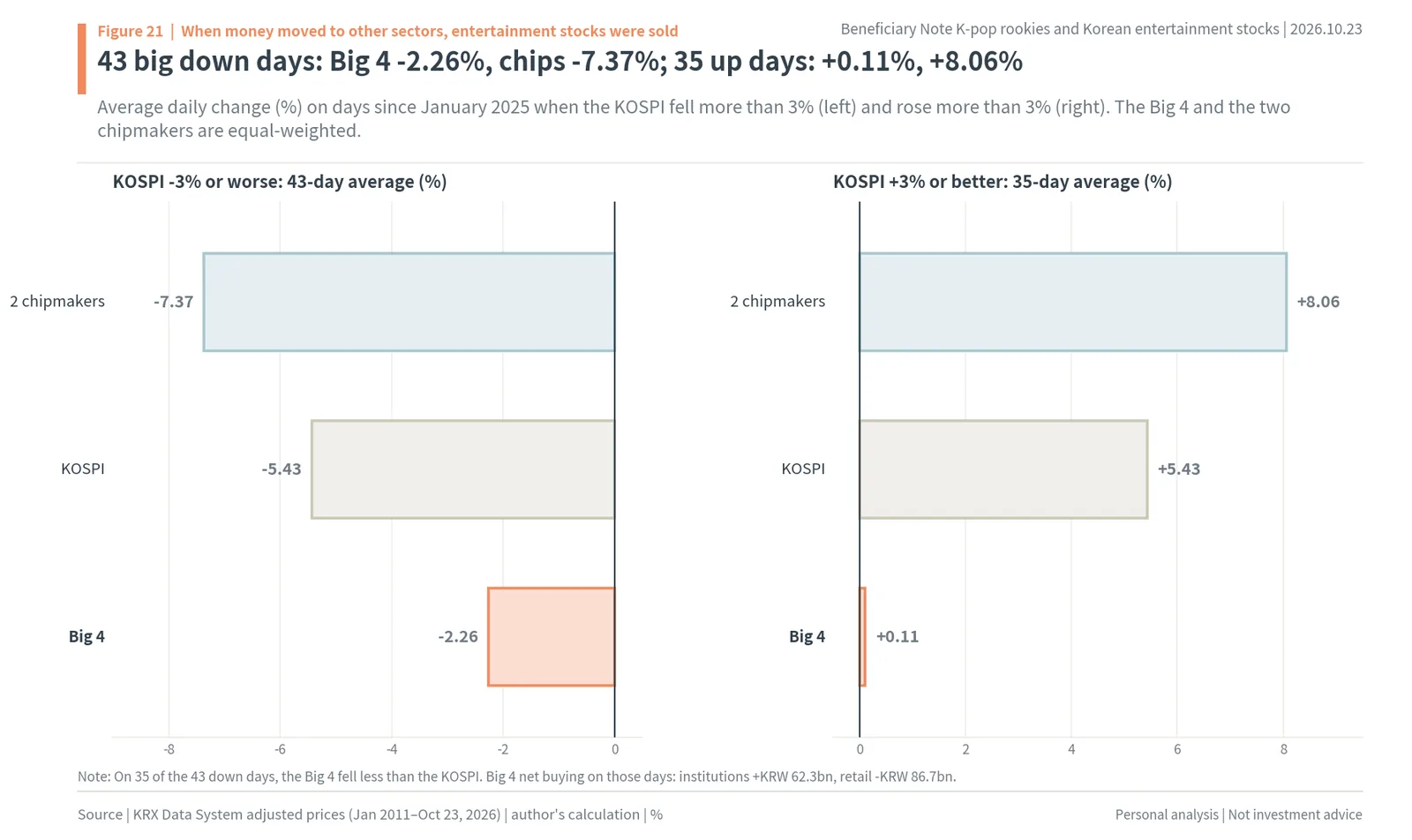

The same pattern explains why entertainment stocks did not collapse while the KOSPI fell from 9,115 on June 22 to 5,550 on October 23, and why they were more than 20pp stronger than their indexes in A2O LITE’s debut fortnight.
Why the swings are so large: the sector is tiny
Size explains it. Grouped by KRX industry classification, the whole market was worth about KRW 5,008tn on October 23, and the Big 4 together KRW 11.58tn (about $8.73bn), 0.23% of it. The electrical and electronics sector on the KOSPI and KOSDAQ is KRW 2,836tn, 245 times the Big 4. Moving just 1% of the money in Samsung Electronics (KRW 1,260tn) and SK hynix (KRW 933tn) would be KRW 21.9tn, enough to buy all four entertainment companies twice over.
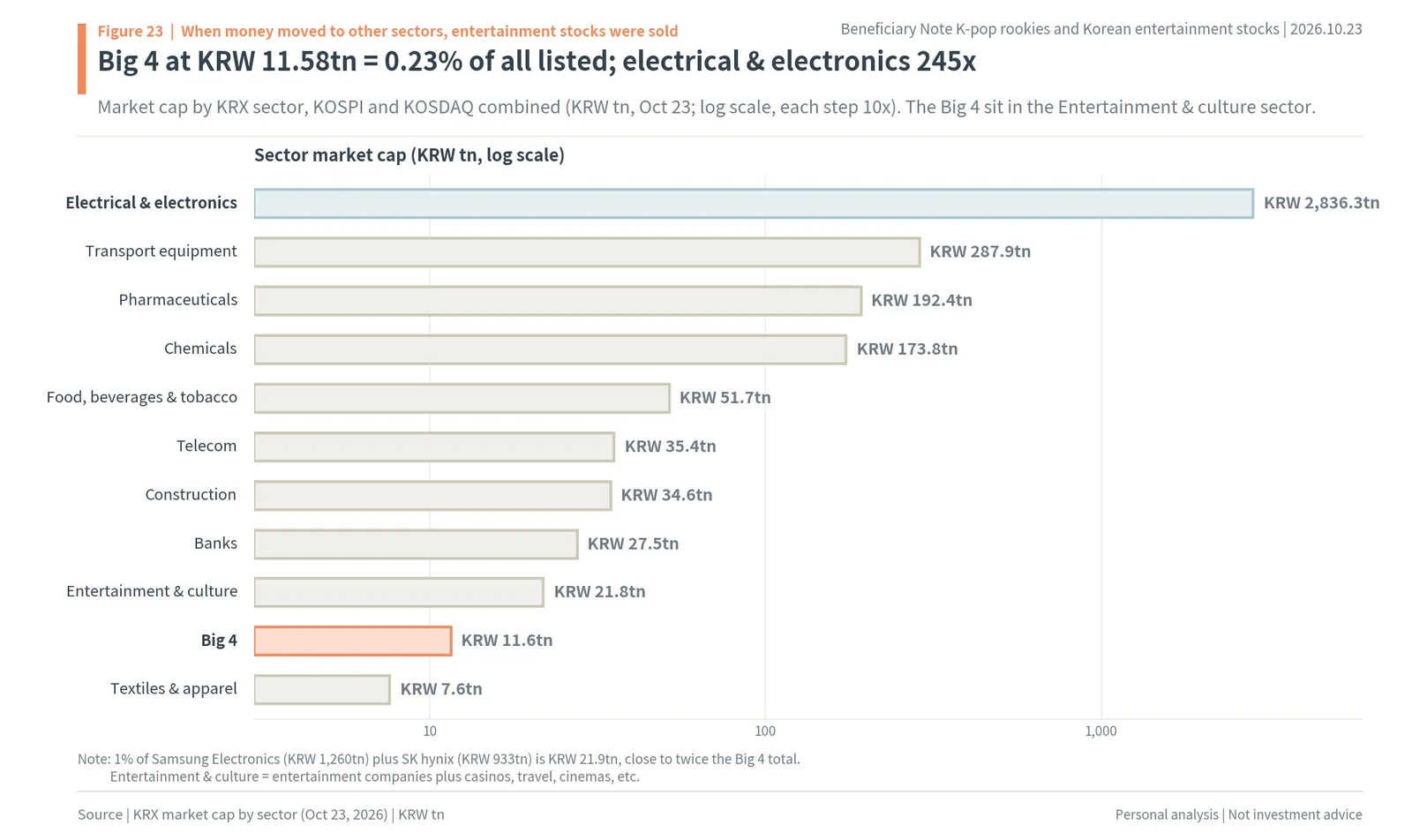
Trading volumes tell the same story. Since January 2025 foreigners’ net trading in the two chipmakers has averaged about KRW 10tn a month in absolute value, against KRW 109.2bn for the Big 4. In May 2026 alone foreigners net sold KRW 36.6tn of the two chipmakers. When money of that size moves between sectors, the entertainment sector is a small boat on the wave. That is why much of the 2026 halving was this movement of money rather than earnings. Disappointments (HYBE’s margin miss, JYP’s second-quarter operating profit down 41.4% and doubts over TWICE’s renewal) came on top.
The relationship is likely to keep working in the same direction. If a big sector like chips heats up again, entertainment becomes a funding source again; if a big sector wobbles, entertainment becomes a shelter. The timing of an entertainment-stock purchase can be chosen by the temperature of the big sectors as well as by the sector’s own news.
10. How big must it get (1): if the same rookie were at a listed agency, an SM-sized company needs SEVENTEEN in year 7, a YG-sized one ATEEZ in year 6
Now the core question, in numbers. One thing first: A2O is unlisted and has no share or contract ties to SM, so A2O LITE’s success does not lift any listed stock directly. This report therefore uses two yardsticks. This section asks what a rookie of the same calibre would need to earn to lift a listed agency’s share price by 10%; the next asks what A2O’s own valuation requires. The numbers here are a guide for listed rookies such as SM’s Hearts2Hearts or YG’s BABYMONSTER.
Both yardsticks use the same formula. A share price is net profit times the P/E ratio. If the multiple stays the same, lifting the price 10% needs net profit 10% higher, which in won is market cap × 10% ÷ P/E.
Current values
Using October 23 closes and WISEreport’s 2026 consensus earnings per share (EPS): SM closed at KRW 82,900 (about $62.5), 15.9x 2026 EPS of KRW 5,215. YG closed at KRW 40,750 (about $30.7), 17.0x EPS of KRW 2,404; JYP at KRW 36,850 (about $27.8), 11.5x EPS of KRW 3,197; and HYBE at KRW 176,500 (about $133.1), 44.0x EPS of KRW 4,014. HYBE’s multiple is high because one-off costs such as first-quarter share-based compensation depress its 2026 EPS. Average broker target prices are KRW 292,250 for HYBE, KRW 114,250 for SM, KRW 59,059 for JYP and KRW 60,647 for YG.
The profit needed
Plugging in, the extra annual net profit needed for a 10% higher share price is KRW 4.5bn for YG (about $3.4mn), KRW 11.4bn for JYP, KRW 11.9bn for SM (about $9.0mn) and KRW 17.3bn for HYBE. YG, the smallest, moves on the least money, which is why it moved so much on BLACKPINK and BABYMONSTER in section 3.

In group terms
Two steps turn net profit into a group’s money. First, operating profit: assuming about a quarter is lost to corporate tax and other items, divide by 0.75. SM then needs KRW 15.9bn of operating profit, JYP KRW 15.1bn, YG KRW 6bn and HYBE KRW 23.1bn. Second, revenue, using label margins: the median operating margin across the 39 label-years with revenue of KRW 50bn or more in section 7 is 19.6% (interquartile range 13.2 to 27.0%). That gives revenue of KRW 81.1bn for SM, KRW 77bn for JYP, KRW 30.6bn for YG and KRW 117.9bn for HYBE.
Set against real groups, the sizes make sense. The operating profit SM and JYP need (KRW 15.9bn and KRW 15.1bn) is almost exactly what SEVENTEEN left with Pledis in 2021, its seventh year: KRW 15.2bn on revenue of KRW 94.1bn. The KRW 6bn YG needs equals ATEEZ’s KRW 5.9bn at KQ in 2023, its sixth year (revenue KRW 65bn). The KRW 23.1bn HYBE needs is about SEVENTEEN’s KRW 21.7bn in its eighth year (2022).
In short, if the same rookie were at a listed agency, lifting that agency 10% would take earnings like a popular group in year 6 or 7, every year, not merely a splash at debut. As section 6 showed, very few of 1,182 groups in 30 years have reached that. This is the profit-side reason debuts do not move stocks.
Limits of the yardstick
The calculation assumes the multiple stays put. In practice, when a rookie takes off the market often raises the multiple itself in anticipation of the next leg of growth; the +41.5pp over 120 trading days after breakout days is too big to come from profit growth alone. Label margins also vary widely with seniority and settlement: high early, when costs are recovered before settlement, and lower after renewals. The revenue needed is a scale for sizing, not a precise target.
11. How big must it get (2): A2O’s own valuation of KRW 300bn to 400bn already assumes NewJeans’ second and third years
Now the second yardstick, A2O itself. A2O has no share price, so the valuation floated in its fundraising is worked backwards to see what it demands. Dividing the floated KRW 300bn to 400bn by the P/E of SM (15.9x) and YG (17.0x) gives net profit of KRW 17.6bn to 25.2bn; divided by 0.75, operating profit of KRW 23.5bn to 33.6bn (about $17.7mn to $25.3mn).
That is almost exactly what NewJeans left with ADOR. In 2023, NewJeans’ second year, ADOR had revenue of KRW 110.3bn and operating profit of KRW 33.5bn; in 2024, the third year, revenue of KRW 111.2bn and operating profit of KRW 30.9bn. A2O’s groups are two weeks old, yet the valuation already assumes they will earn like NewJeans in years 2 and 3. Against other groups, it is more than twice ENHYPEN’s year 4 (2023, KRW 13.1bn) or LE SSERAFIM’s year 4 (2025, KRW 13.1bn).

An unlisted company’s value is not set by P/E alone. A2O has two new groups plus A2O MAY in China, and part of the expectation attaches to Lee Soo-man’s name as a producer. Investors eyeing a future listing price earnings several years out. Still, the calculation shows in numbers what investors expect: the two groups together need to reach NewJeans’ year-2 and year-3 profit within a few years for the floated valuation to hold.
Other unlisted companies
Valuation and profit do not always go together. The Black Label is valued at KRW 1.02tn, 1.34 times YG’s market cap, yet its audited operating results were losses for three years running: -KRW 2.2bn in 2023, -KRW 17.3bn in 2024 and -KRW 21.5bn in 2025. Revenue grew to KRW 73.8bn in 2025, but investment in new groups (MEOVV and ALLDAY PROJECT) outweighed profit. The market priced its proven ability to make hits, with ROSÉ and “KPop Demon Hunters,” not current profit.
IVE’s Starship is the opposite case. After IVE took off, revenue rose from KRW 114.8bn in 2022 to KRW 173.2bn in 2025, but operating profit fell from KRW 42.6bn in 2023 to KRW 10.6bn in 2025, and the operating margin from 26.6% to 6.1% (MTN, Sep 23, 2026). The new group KiiiKiii debuted in the same period. Growing popularity and growing profit for the company are different things.
HYBE’s own labels are a comparison too. BELIFT LAB (ENHYPEN and ILLIT) had 2025 revenue of KRW 154.7bn and operating profit of KRW 49.9bn, a 32.3% margin. Big Hit Music had KRW 437.5bn of revenue and KRW 47.9bn of operating profit the same year, a 10.9% margin, in a year spent preparing BTS’s full-group return. Even within one company, what stays depends heavily on a group’s seniority and activity cycle.
12. If A2O LITE takes off, how long will it last? Seven years by default, even odds of staying together, risk concentrated two to three years after debut
How long a group earns, if it takes off, can be estimated from contract terms and past renewals. The answer: seven years by default (to 2033), even odds of the group staying together after that, and departure risk on the Chinese-member side concentrated two to three years after debut.
Contract length
The standard exclusive contract published by the Fair Trade Commission in 2009 caps contracts at seven years. A2O LITE’s members average 14.8 years old, so when the first contract ends they will average 21.8. As a girl group they face no military service gap and can use almost the whole contract for activities, unlike boy groups whose activities are cut around year 6 or 7 by enlistment.
First renewals of successful girl groups
The 30-year average career of girl groups is 3.13 years, but that includes groups that never took off. Successful ones look different. Of 11 leading girl groups from the second to the fourth generation, at the end of their first seven-year contracts five renewed as a full group (Girls’ Generation, Apink, TWICE, (G)I-DLE, ITZY), one renewed for group activities only (BLACKPINK), two kept only some members (MAMAMOO, WJSN) and three disbanded (2NE1, SISTAR, GFRIEND). Six of 11 stayed together.
At the second renewal, around year 10, usually only some members stayed. Three Girls’ Generation members left in 2017, some members of Apink and Red Velvet moved on, and TWICE’s Jeongyeon, Chaeyoung and Jihyo moved to other companies in 2026.

Chinese members
A2O LITE has three Chinese members. EXO’s three Chinese members left within two to three years of debut: Kris sued SM to void his contract about 2.1 years after debut (May 2014), Luhan about 2.5 years after (October 2014), and Tao stopped activities about three years after. WJSN’s three Chinese members were inactive from 2018 until their contracts ended in 2023. On the other hand, (G)I-DLE’s Yuqi renewed in 2024. The day after A2O LITE’s debut, a report also alleged wage arrears at the company of one member’s parents (Ilgan Sports, Oct 14).
A2O, with a Singapore headquarters and the China-facing A2O MAY already launched, has China built into its strategy, which sets it apart from SM in 2014. But the careers of Chinese members can still be shaken by things outside the company: opportunities in the Chinese market, family business and Korea-China relations. The risk window, as with EXO, is two to three years after debut, around 2028 to 2029.
In sum, if A2O LITE takes off, the company’s earning window is seven years by default. Within it, the period of rising profit overlaps with the period of rising risk; the next section turns that into a calendar for the share price.
13. If holding for the long term, until when? From confirmed success to year 5 or 6, before renewal talks
To find a holding rule, the report followed three cases in which a listed agency depended heavily on one group, from debut to the first renewal announcement: BLACKPINK and YG (Aug 8, 2016 to Dec 6, 2023), TWICE and JYP (Oct 20, 2015 to Jul 12, 2022) and (G)I-DLE and Cube (May 2, 2018 to Dec 2, 2024). The agencies’ share prices peaked 5 to 7 years after debut and fell 20 to 40% from the peak to the renewal announcement.
Peaks in years 5 to 7
YG peaked 6.8 years after BLACKPINK’s debut (May 30, 2023), JYP 6.5 years after TWICE’s (Apr 8, 2022) and Cube 5.1 years after (G)I-DLE’s (Jun 20, 2023). In all three cases this was between the group’s biggest years of touring and album sales and the start of renewal talks. From debut to renewal, excess returns were +66.7pp for YG, +1,055.8pp for JYP and +232.8pp for Cube; JYP’s number is huge because Stray Kids and ITZY took off in the same period.
From peak to renewal
From the peak to the renewal announcement, YG fell -36.7%, JYP -19.0% and Cube -39.5%. As renewal approaches, uncertainty over who stays cuts the price, and even if everyone stays, the arithmetic of a bigger artist share is priced in. BLACKPINK’s renewal day was +25.63%, but the stock had already fallen sharply in the half year before.
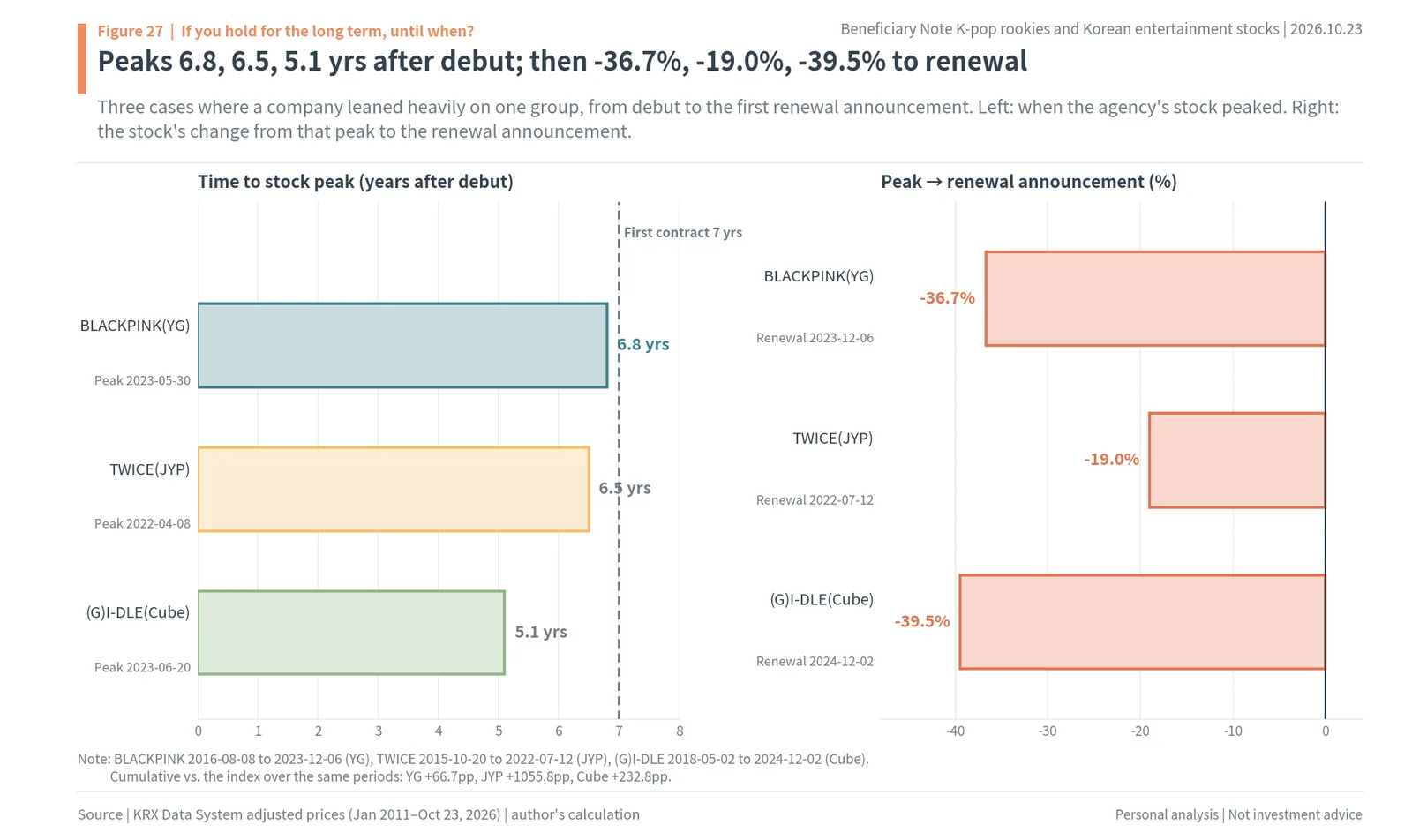
Year by year, excess returns were mostly concentrated in years 2 to 6 rather than year 1. With BLACKPINK, YG was -5.8pp in year 1 but +52.9pp over years 2 to 6; with TWICE, JYP was +25.1pp in year 1 and +367.5pp over years 2 to 6. With (G)I-DLE, Cube was fast, +107.6pp in the first year, because Cube was small enough that the debut song “LATATA” changed its profit outlook right away.
There are exceptions. With EXO, SM peaked only 0.6 years after debut (November 2012) and then sank on the Chinese members’ lawsuits in 2014. When the company is bigger than the group or departures come early, the calendar does not apply.
Applied to A2O LITE
On this calendar, success would be confirmed (first million-seller, first world tour) in 2027 to 2028; years 5 to 6, when the peak comes and before renewal talks start, would be 2031 to 2032; and the first contract ends in 2033. A2O is unlisted, so individuals cannot trade on this calendar. It is a guide for listed rookies of the same period, such as SM’s Hearts2Hearts (debut 2025) or YG’s BABYMONSTER (debut 2024). BABYMONSTER passed its confirmation point with its first million-seller (“DRIP”) in November 2024 and is now scaling up to Japan’s Kyocera Dome (SK Securities, Oct 21).
14. Can SM benefit? There is no link left, and it is a competitor in the same arena
Since Lee Soo-man founded SM, it is natural to ask whether SM can gain from A2O’s success. The answer: there is no link. No connection through shares, contracts or price reaction was found. If anything, SM competes for the same fans with the same style of production.
Shares and contracts
In February 2023 Lee sold 14.8% of SM to HYBE at KRW 120,000 a share, KRW 422.8bn. He sold his remaining 868,948 shares to HYBE for KRW 104.3bn in March 2024 by exercising a put option (SBS Biz, Feb 29, 2024). No later purchase of SM shares by Lee was found. HYBE in turn sold its SM stake to Tencent Music in 2025. SM said in 2023 that it had no remaining contractual relationship with Lee; the producing fees his private company Like Planning received from SM had already ended when SM terminated that contract at the end of 2022. The non-compete expired at the end of February 2026.
Price reaction
In the nine trading days after A2O LITE’s debut (Oct 12 close to Oct 23 close), SM rose +9.1%. HYBE rose +12.8%, YG +5.2% and JYP fell -2.1%, while the KOSPI fell -13.1% and the KOSDAQ -11.5%. There is no sign of SM moving on its own; the move matches the sector-wide pattern in section 9 (entertainment acting as a shelter as chips fell). On debut day itself, the 13th, SM rose +2.8% and HYBE +4.4%; HYBE rose more then too.

Competition instead
A2O’s production team is full of SM alumni. Yoo Young-jin, who produced “NEON,” is a former SM director who wrote songs for TVXQ! and aespa, and Girls’ Generation’s Sunny is also at A2O. Critics have called A2O’s music “more SM than SM” (Nocut News), which means the two compete for fans of the classic SM sound. A2O LITE’s age range overlaps with Hearts2Hearts, which SM debuted in February 2025.
The listed way to play the same story
To play the “fifth-generation girl group” story through a listed stock, SM’s own rookies are the more direct route. Hearts2Hearts sold 408,880 copies in its debut week, and “Lemon Tang” (June 2026) sold 592,312 in its first week. SM plans to debut two or three teams from its trainee team SMTR25, with the first boy group due in 2026. On the calendar above, Hearts2Hearts’ first million-seller and first world tour will be SM’s breakout day, and whether institutions buy then is the confirmation signal by this report’s standard.
SM trades at 15.9x 2026 EPS of KRW 5,215, with an average broker target of KRW 114,250. SK Securities titled its October 22 note “Focus on 2027,” and its September note “Discount factors resolved: SMTR25, North America and China.” Brokers, too, are looking for SM’s next profit in its rookies.
15. Against other industries: the listed K-pop Big 4 are the size of one ramen maker
K-pop’s global growth is widely discussed, but next to other industries the numbers look different. The conclusion: its cultural presence is much larger than its size as an industry.
Market caps
On October 23 the Big 4 together were worth KRW 11.58tn (about $8.73bn). Samyang Foods, the ramen maker, is worth KRW 9.23tn (about $6.96bn) on its own. SM, JYP and YG combined, KRW 3.97tn, are smaller than Orion alone (KRW 4.40tn) and bigger than Nongshim (KRW 2.45tn). By sector, the entertainment and culture sector that includes the agencies (along with casinos, travel and cinemas) is KRW 21.8tn, smaller than food, beverages and tobacco (KRW 51.7tn), telecom (KRW 35.4tn), construction (KRW 34.6tn) and banks (KRW 27.5tn), and bigger than textiles and apparel (KRW 7.6tn). Electrical and electronics (KRW 2,836.3tn), transport equipment (KRW 287.9tn) and pharmaceuticals (KRW 192.4tn) are on a different scale.
Exports and industry revenue
K-pop album exports hit a record USD 301.7mn in 2025 (Korea Customs Service): Japan USD 80.6mn, China USD 69.7mn and the US USD 64mn. Ramen exports the same year were USD 1.52bn, 5.0 times albums. In the 2025 content industry survey by the Ministry of Culture and KOCCA (covering 2024), the music industry had revenue of KRW 13.27tn and the game industry KRW 23.85tn, 1.8 times music. Music exports were USD 1.80bn and games USD 8.5bn. Music industry revenue includes karaoke, venues and record distribution, so it is far broader than the Big 4’s KRW 5.19tn.

Change inside the album market
Album sales themselves are falling. Total sales of the Circle Chart’s top 400 albums fell from 115,778,266 in 2023 to 93,281,819 in 2024 and 86,383,220 in 2025, down 25.4% in two years. The Big 4’s revenue still grew because money moved from albums to concerts and merchandise. HYBE’s 2025 concert revenue was KRW 763.9bn, up 69.4%, and in the fourth quarter of 2025 SM’s new-album sales fell from 3.67 million to 2.72 million copies while concerts (+53.6%) and merchandise (+50.6%) lifted revenue. According to IFPI, the global recorded music market was USD 31.7bn in 2025, and South Korea was the seventh largest market.
What small means
Being small means two things. As section 9 showed, a small shift of money toward big sectors moves these stocks a lot. And one group’s success or failure can change a whole company: as Samyang Foods’ Buldak noodles changed that company’s value, a single group plays that role at an entertainment company. That is why confirmed hits move these stocks so much and exits hit them so hard.
16. The author’s view and the numbers to watch
The author sees A2O LITE’s debut as a free ticket for entertainment stocks. In one line: a debut is a free ticket; stocks move on breakout and exit days. So far listed entertainment stocks have not priced debut days (+0.7pp on average across 28), and have priced the days success was confirmed in numbers (+41.5pp over 120 trading days, with institutions buying and retail selling) and the days groups left (first-day moves 2.1 times larger, -7.0pp over 20 trading days). The 29-hour Melon No. 1 is the culture report card; the stock-market report card will come from the first physical album and the first concerts.
How big must it get? The answer comes on two yardsticks. For A2O itself, which has no share price, the floated valuation of KRW 300bn to 400bn already assumes its two groups will earn like NewJeans in its second and third years (operating profit around KRW 30bn). That is a high bar for groups two weeks old. If a rookie of the same calibre were at a listed agency, then at today’s multiples an SM-sized company would need added earnings like SEVENTEEN in its seventh year (operating profit of about KRW 15bn) every year to rise 10%, and a YG-sized one like ATEEZ in its sixth year (about KRW 6bn). The second yardstick does not mean A2O moves SM’s shares; it is a guide for listed rookies such as Hearts2Hearts.
How long to hold? A calendar: buy when success is confirmed (first million-seller, first world tour) and hold to years 5 to 6, before renewal talks. In the three cases where a listed agency leaned on one group, the share price peaked 5.1 to 6.8 years after debut and fell 19 to 40% from the peak to renewal. For A2O LITE that means confirmation in 2027 to 2028, exit in 2031 to 2032 and the first contract ending in 2033.
SM is not an A2O beneficiary. The share and contract links are gone, SM moved with the sector in A2O LITE’s debut fortnight, and it competes with A2O for the same producers and fans. The listed way to play the fifth-generation girl group story is SM’s Hearts2Hearts.
Finally, one variable outside the groups. The Big 4 are 0.23% of the whole market, so when big sectors like chips heat up they become a funding source, and when those sectors crack they become a shelter. The 2026 halving was the result. The timing of an entertainment purchase can be picked by the temperature of the big sectors as much as by group news.
Numbers to watch
- First-week sales of A2O LITE’s first physical album: whether it passes 300,000 (industry break-even) and 1 million copies
- The size and number of dates of its first concerts or tour
- Whether A2O’s fundraising actually closes, with whom and at what valuation
- First-week sales of Hearts2Hearts’ next album (above 592,312?) and the debut of SM’s SMTR25 boy group
- The two chipmakers’ monthly direction and institutions’ net buying in the Big 4
- Renewal and enlistment dates for the Big 4’s flagship groups (Stray Kids’ enlistments, TWICE’s remaining members)
17. How the numbers were counted
All returns, investor flows and ratios in this report are the author’s calculations from the data below. The code and results are in research/calc.py and research/calc.json in the post folder.
Prices and indexes: KRX Data System adjusted closes (reflecting rights-issue and other base-price adjustments, Jan 2011 to Oct 23, 2026) and the KOSPI and KOSDAQ. Excess return is the cumulative return from the close before the event minus the cumulative return of the agency’s index over the same days (pp). Windows are in trading days; events whose window had not fully passed by the as-of date were left out of that window’s average (for example, CORTIS’s “GREENGREEN” at 120 trading days). A2O LITE’s debut fortnight is the October 12 close to the October 23 close (nine trading days).
Event dates: debuts are the first release of music or an album; breakout days are the release date or the day the sales record became known; exits, renewals and enlistments are the day the news was first reported. News after the 3:30 p.m. close, on weekends or on holidays counts from the next trading day.
Investor flows: KRX trading by investor type (net buying value, detailed). Institutions are the sum of brokerages, insurers, asset managers, private equity funds, banks, other financial firms and pension funds; foreigners include other foreigners; other corporations are non-financial companies. Because KRX price tables after September 14, 2026 can mix in Nextrade (the alternative exchange) trades, the as-of closes and market caps were checked against KRX market cap by industry data (market cap ÷ shares outstanding matches).
Money rotation: the Big 4 (HYBE, SM, JYP, YG) and the two chipmakers (Samsung Electronics, SK hynix) are equal-weighted. Monthly returns compound daily returns; big down and up days are days the KOSPI fell or rose more than 3% from the previous close (Jan 2, 2025 to Oct 23, 2026).
P/E and yardstick: P/E is the October 23 close divided by WISEreport’s 2026 consensus EPS (Oct 22). Net profit needed for +10% = market cap × 10% ÷ P/E; operating profit = net profit ÷ 0.75 (about a quarter lost to tax and other items, author’s assumption); revenue = operating profit ÷ 19.6% (median operating margin of 39 label-years). The net profit implied by A2O’s valuation spans KRW 300bn ÷ YG’s 17.0x to KRW 400bn ÷ SM’s 15.9x.
Label financials: DART audit reports and annual reports (separate income statements). Filing numbers: Big Hit 20180322000053, 20190319000209, 20210322000890; Big Hit Music 20220407002766, 20240408003365, 20260403003510; Pledis 20190409001458, 20200410002234, 20220411000146, 20240408003189, 20260403003600; Source Music 20240408003813, 20260403003511; ADOR 20240408003874, 20260403003376; BELIFT LAB 20230403003691, 20240409001379, 20260403000133; KOZ 20240408003783, 20260403000170; Starship 20180326000115, 20200327000771, 20220404003009, 20240401004492, 20260331004591; KQ 20210409001288, 20220331001897, 20240401001859, 20260331003464; The Black Label 20230404000919, 20240404001961, 20260403003554; MODHAUS 20260402000436; Cube 20210323000884, 20240320002027, 20260319001122.
Group shares: only years in which one group made up most of a label’s revenue were counted. IVE (Starship 2022 to 2025) and (G)I-DLE (Cube 2022 to 2025) are the increase over the average of the years before they took off (Starship 2019 to 2021, Cube 2018 to 2021), an author’s estimate. BTS and TXT join Big Hit 2016 to 2020 (Big Hit Entertainment, separate) with Big Hit Music 2021 to 2025. SEVENTEEN’s share includes NU’EST (to 2022), fromis_9 (to 2024) and TWS (from 2024) at the same label, and Big Hit Music’s 2025 includes CORTIS. Year since debut = year − debut year + 1.
Limits: label revenue is not group revenue, and labels may book album distribution or concert revenue differently. Five boy groups and five girl groups is a small sample, so one or two groups can sway the averages. The breakout days were chosen by the author. Career-length and 10-million-album figures come from Professor Kim’s study as reported by Kyunghyang Shinmun; renewal outcomes are the author’s compilation of press reports.
K-pop rookies and Korean entertainment stocks: frequently asked questions
Q. Can I invest in A2O LITE?
Not directly. A2O Entertainment is an unlisted company headquartered in Singapore, and no filing or report shows a listed company investing in it or distributing its music. The Bell reported in June 2026 that it was seeking KRW 30bn-40bn for about 10%, implying KRW 300bn-400bn, but no completed round was reported.
Q. Do K-pop agency stocks rise when a new group debuts?
Barely. Across 28 debuts at listed agencies, the agency’s excess return on debut day averaged +0.7pp, and 19 of 28 were within ±3pp. Stocks moved on breakout days, when a first million-seller or signature hit confirmed success: the eight such days at least 120 trading days old averaged +41.5pp over 120 trading days.
Q. Who buys K-pop stocks around debuts?
After debuts, retail and institutions were net buyers about equally often (12 and 14 of 28). After breakout days, institutions were net buyers in 7 of 9 and retail net sellers in 7 of 9, averaging +KRW 25.7bn and -KRW 21.6bn over 20 trading days. Non-financial companies showed up in stake deals, not debuts.
Q. Do boy groups or girl groups earn more for their companies?
Boy groups, based on label audit reports. Five boy groups left an average of KRW 1.12tn of revenue and KRW 261.3bn of operating profit per group, against KRW 224.9bn and KRW 38.6bn for five girl groups. Excluding BTS, boy groups averaged KRW 80.4bn a year against KRW 58.8bn, with margins of 23.3% and 17.2%. Boy-group revenue grew with seniority; girl groups rose fast in year 2 and then plateaued.
Q. What moves K-pop stocks the most?
News that a group is leaving or staying. Across 34 departure, renewal and enlistment events, the first-day move averaged 5.4pp, 2.1 times the 2.6pp of debut days, and leaving news averaged -7.0pp after 20 trading days. HYBE fell 24.87% the day after BTS announced its hiatus.
Q. Why did Korean entertainment stocks halve in 2026?
Mostly money moving into chips. In January-May 2026, when Samsung Electronics and SK hynix rose 25-62% in each of four months, institutions sold KRW 1.07tn of the Big 4 and retail bought KRW 981.1bn. HYBE’s margin miss, JYP’s weak second quarter and TWICE renewal doubts came on top.
Q. How large is the K-pop industry?
The four listed agencies are worth KRW 11.58tn together, about the same as ramen maker Samyang Foods (KRW 9.23tn) and 0.23% of the Korean market. K-pop album exports were USD 301.7mn in 2025, a fifth of ramen exports, and music industry revenue of KRW 13.27tn in 2024 was a little over half the game industry’s KRW 23.85tn.
Q. Is SM Entertainment a beneficiary of A2O’s success?
No. Lee Soo-man sold all his SM shares to HYBE by March 2024 and SM says it has no remaining contract with him. SM rose +9.1% in the nine trading days after A2O LITE’s debut, in line with HYBE’s +12.8% as the sector rallied while chips fell. A2O competes with SM for the same producers and fans; SM’s own Hearts2Hearts is the listed way to play the story.
Sources
- Hankyung Business, Lee Soo-man’s Dasan Management Award remarks, “Culture first, Economy Next” (link), Dec 16, 2020
- Korea JoongAng Daily, 29 hours to No. 1: A2O Lite makes a record-breaking debut (link), Oct 16, 2026
- Sports Kyunghyang, A2O LITE members’ nationalities and ages (link), Oct 11, 2026; music show wins (link), Oct 21, 2026
- The Bell, A2O Entertainment seeks KRW 40bn after non-compete ends (link), Jun 2, 2026
- MTN, Lee Soo-man’s non-compete ends (link), Feb 7, 2026; SBS Biz, HYBE buys KRW 104.3bn of SM shares on Lee’s put option (link), Feb 29, 2024
- The Bell (Money Today), The Black Label becomes a KRW 1tn unicorn (link), Jul 27, 2026; MTN, Starship results (link), Sep 23, 2026
- MTN, Big 4 2025 results and Circle Chart album sales (link), Mar 16, 2026; iM Securities HYBE report (link), Apr 30, 2026; MTN, halved entertainment stocks (link), Oct 14, 2026
- BizHankook, settlement practices (link), Aug 13, 2024; News Tomato, Fantagio debut costs and merchandise ranges (link), Feb 2024
- Kyunghyang Shinmun, 30 years of K-pop idols and the eight 10-million-album groups (link), Aug 4, 2026
- Billboard Boxscore K-pop tour grosses (link), 2025
- Korea JoongAng Daily (Yonhap), K-pop album exports top $300 million in 2025 (link), Jan 16, 2026; Samil PwC, K-food trends (ramen exports) (link); Herald Economy, 2025 content industry survey (link), Feb 26, 2026; IFPI Global Music Report 2026 (link)
- SBS Biz, HYBE falls 16% after second-quarter results (link), Jul 28, 2026; Herald Economy, JYP second-quarter results (link), Aug 14, 2026; New Daily, BLACKPINK’s share of YG (link), Jan 11, 2024
- DART audit reports and annual reports of Big Hit Music, Pledis, Source Music, ADOR, BELIFT LAB, KOZ, Starship, KQ, Cube, MODHAUS and The Black Label (filing numbers in section 17)
- KRX Data System adjusted prices, trading by investor type and market cap by industry (Jan 2011 to Oct 23, 2026); WISEreport consensus (Oct 22, 2026); Yahoo Finance USD/KRW; author’s calculations
- Photos: Foxy’Stay (CC BY-SA 4.0), 뭘로할까 (CC BY-SA 4.0), Michael Ocampo (CC BY 2.0), Manudesu (CC BY-SA 4.0), 4300streetcar (CC BY 4.0), Narubaru7 (CC BY 4.0), via Wikimedia Commons
Disclaimer
Was this note useful?
Thanks. Your answer helps decide what to cover next.
Korea market snapshot · Oct 23, 2026
New to Korean stocks? Start here for the basics.
Most read
1France Protests 2026: Why Students Are Blocking Schools and Which Stocks Benefit (Munich Re, SCOR)
Get the Saturday note on Korean stocks
One email every Saturday with the week’s new research on Korean listed companies and links to the updated data pages. Built from DART filings and KRX data. Free; unsubscribe in one click. See past issues