Korea Delisting Rules and Administrative Issues: 181 Stocks on Watch, and Delisted Ones Lost 98% of Their Value
A Korean administrative issue is a deadline, not a bargain. This report follows 323 KIND designations from 2018 to 2023 to see how many ended in delisting and what shareholders kept, and explains the 2026 rules that put 181 stocks on the list, from the KRW 30bn market cap floor to the new KRW 1,000 penny stock test.
- On Oct 15, 2026 KIND listed 181 administrative issues; 95 of 169 common stocks carried a market cap or price cause.
- Of 323 first designations in 2018–2023, 40.9% ended in delisting; event-type causes 45.3%, financial causes 30.3%.
- Delisted stocks lost a median 98.06% from the pre-designation close; the full sample trailed the market by 11.15% over 250 trading days.
- Forced delistings reached 40 in 2026, 2.94 times the 2016–2024 average of 13.6.
- Nine penny stocks need a median 35.3% gain to reach KRW 1,000 before the first ruling on Oct 22.
Key takeaways
- On October 15, 2026, KIND, the Korea Exchange disclosure site, listed 181 administrative issues (46 on KOSPI, 135 on KOSDAQ). Of the 169 common stocks among them, 132 were designated this year and 102 after July 1, when tougher market cap and penny stock rules took effect.
- The author followed all 323 first designations from 2018 to 2023 up to today: 40.9% ended in delisting. The last traded price of the 132 delisted stocks was a median 98.06% below the close just before designation.
- Forced delistings reached 40 by October 15, 2.94 times the 2016–2024 average of 13.6 a year. On October 22, nine stocks face the first delisting ruling under the new KRW 1,000 penny stock rule.
As of: October 15, 2026 (administrative issue list, prices and market caps at the October 15 close; filings from October 15, 2017 to October 15, 2026). USD conversions use KRW 1,344.28 per dollar, the October 15, 2026 rate.
Concepts covered: administrative issue (관리종목), delisting, formal delisting, substantive listing eligibility review, improvement period, liquidation trading, capital impairment ratio, non-clean audit opinion, pre-tax continuing loss, market cap floor, penny stock rule, reverse split, investment caution flag
Summary: a Korean administrative issue is a waiting room for delisting
This report is the full English edition of Maochaedung’s Korean note on administrative issues and delisting requirements, with the data behind every number. It asks one question: when a Korean stock is designated an administrative issue, what path does it take, and what is left for shareholders at the end? The answer is simple. The designation is a warning with a deadline. If the company fixes the cause in time, the flag comes off; if not, the case moves to delisting. A stock headed for delisting gets seven days of liquidation trading with no daily price limit, and almost nothing of its value survives. So the first thing to check is whether the cause can be fixed with numbers or is tied to an event.
2026 is the year the waiting room’s door was widened. The market cap delisting floor was KRW 5bn on KOSPI and KRW 4bn on KOSDAQ through 2025; it rose to KRW 20bn and KRW 15bn in January and to KRW 30bn (about $22mn) and KRW 20bn (about $15mn) in July (Bizwatch). On July 1, a new penny stock rule took effect: a close below KRW 1,000 for 30 trading days in a row brings designation (Sejung Ilbo). By October 15 the list had grown to 181 stocks, and 95 of the 169 common stocks carried a market cap or price cause.
The conclusion rests on data the author collected directly: the 181-stock KIND list, 729 entries on the KIND delisting list since 2015, and 3,210 designation filings since October 2017. Re-designations of the same stock within two years were merged into one event, giving 571 first designations, and the 323 from 2018 to 2023, old enough to have an outcome, were followed with Naver Finance adjusted prices. Delistings count only forced exits; mergers, transfers between markets, voluntary delistings and SPACs were removed.
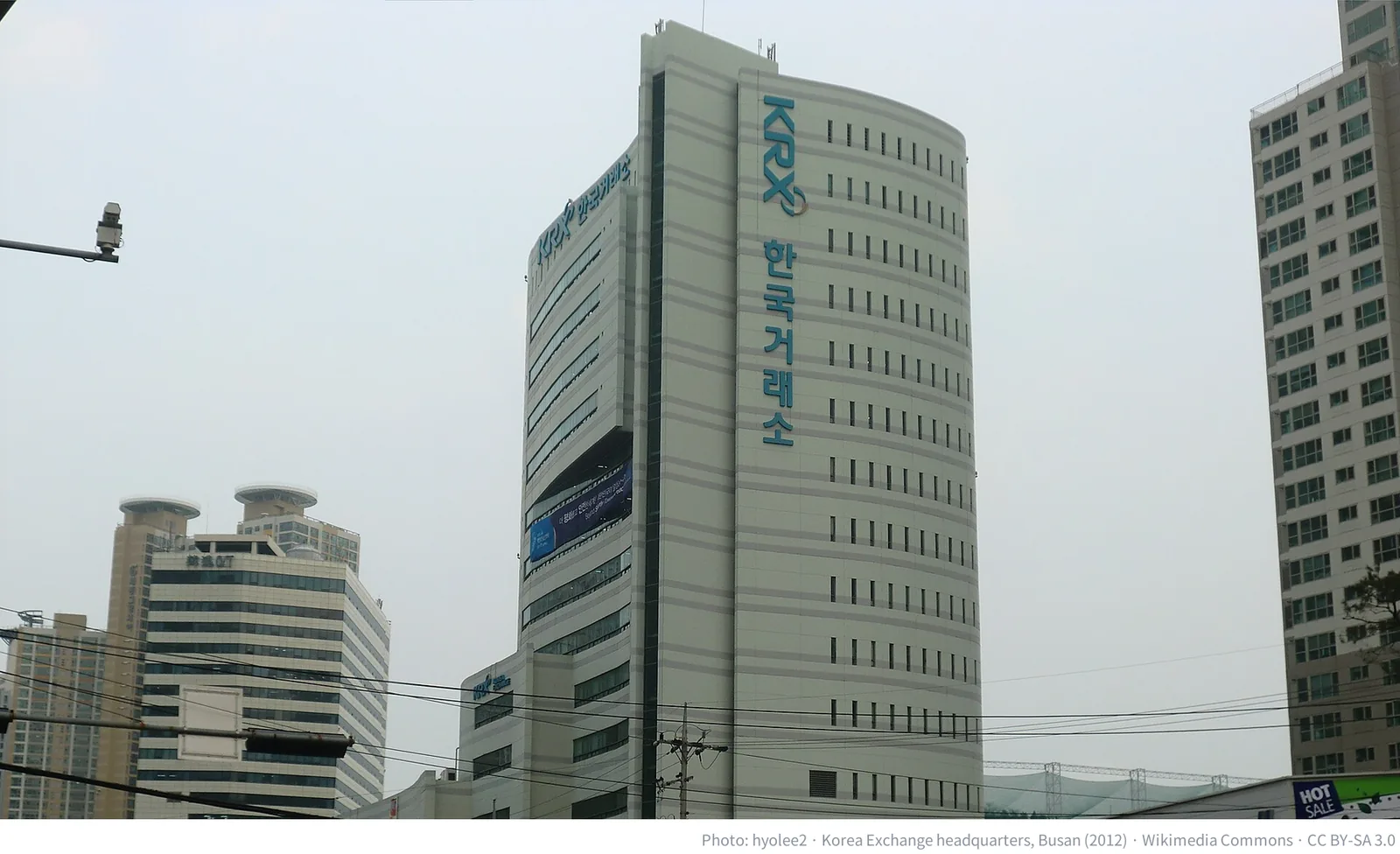
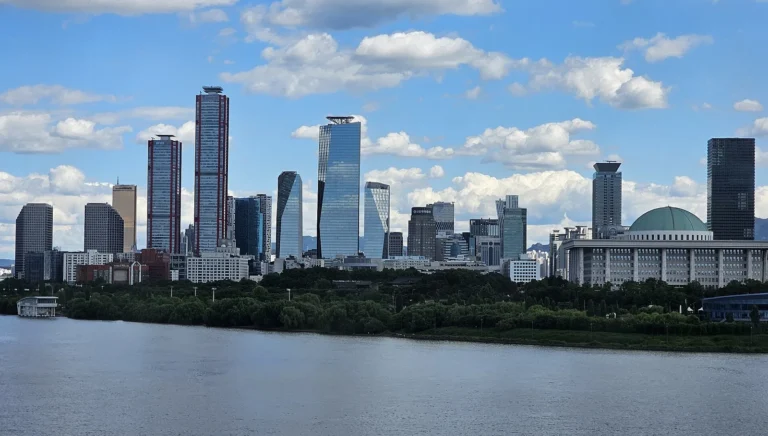
The photo shows the Korea Exchange headquarters in Busan. The exchange designates administrative issues and decides delistings under its listing rules (one set for KOSPI, one for KOSDAQ), and the Financial Services Commission approves rule changes. The amendment approved on May 13, 2026 and effective July 1 created the new floors covered here (Sejung Ilbo).
How it works in Korea
Korea has two main boards. KOSPI is the main market for larger companies and KOSDAQ is the growth board with many small tech and biotech names. Both are run by the Korea Exchange, and all company filings and exchange notices appear on KIND and DART, so every designation, every added cause and every delisting decision is public with a date and time.
An administrative issue (관리종목, sometimes translated “management issue”) is not a market alert for overheated trading. It is a formal flag meaning the company is close to a delisting standard. Once flagged, margin trading is blocked and the stock name carries the label. Two routes lead to delisting. Formal delisting applies numerical standards mechanically: sales, market cap, capital impairment, audit opinion and price. A substantive listing eligibility review (상장적격성 실질심사) is a judgment by the exchange’s corporate review committee for things numbers cannot capture, such as embezzlement, disclosure breaches or accounting fraud. Trading is usually halted during a review, and the company gets an improvement period if it submits a credible plan.
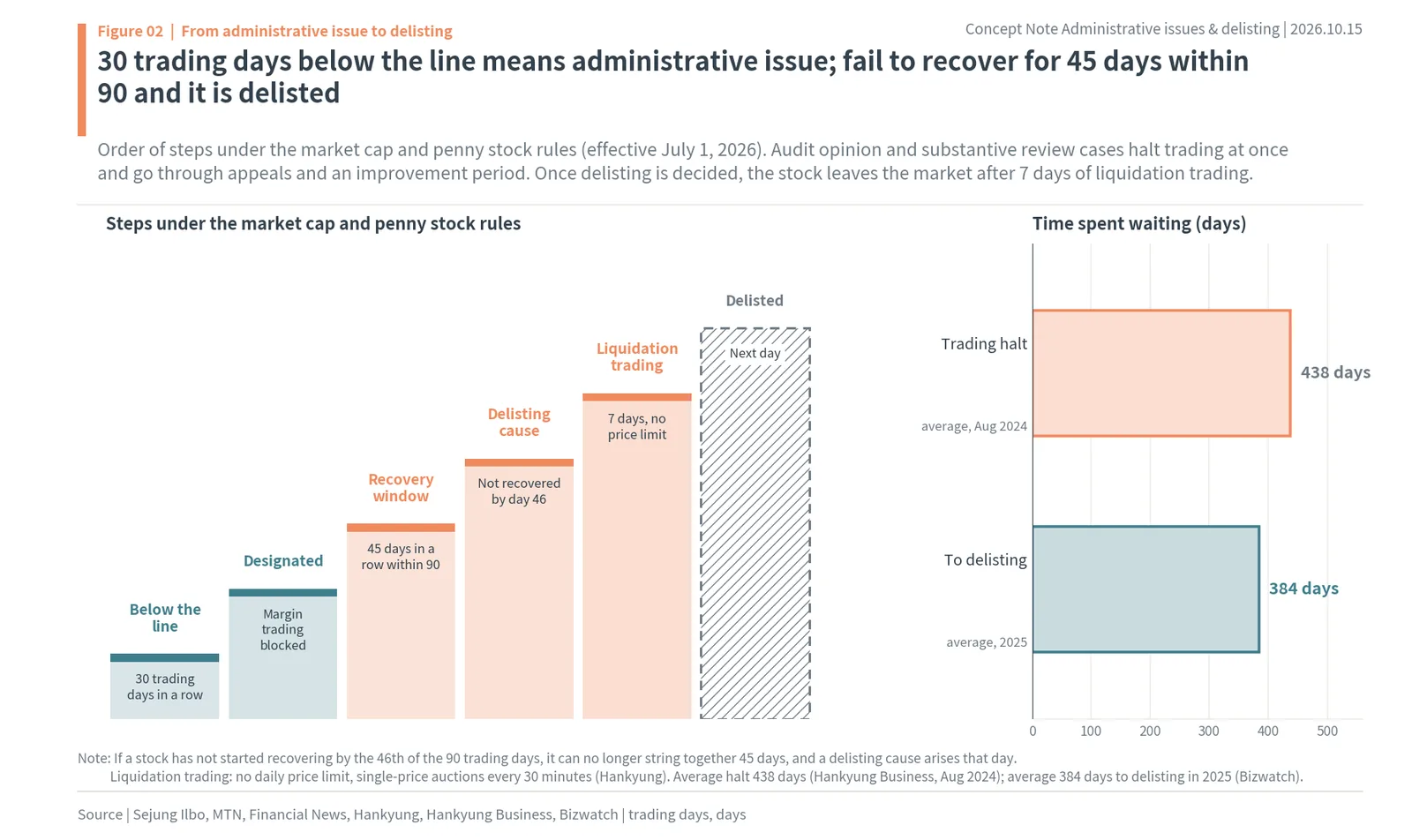
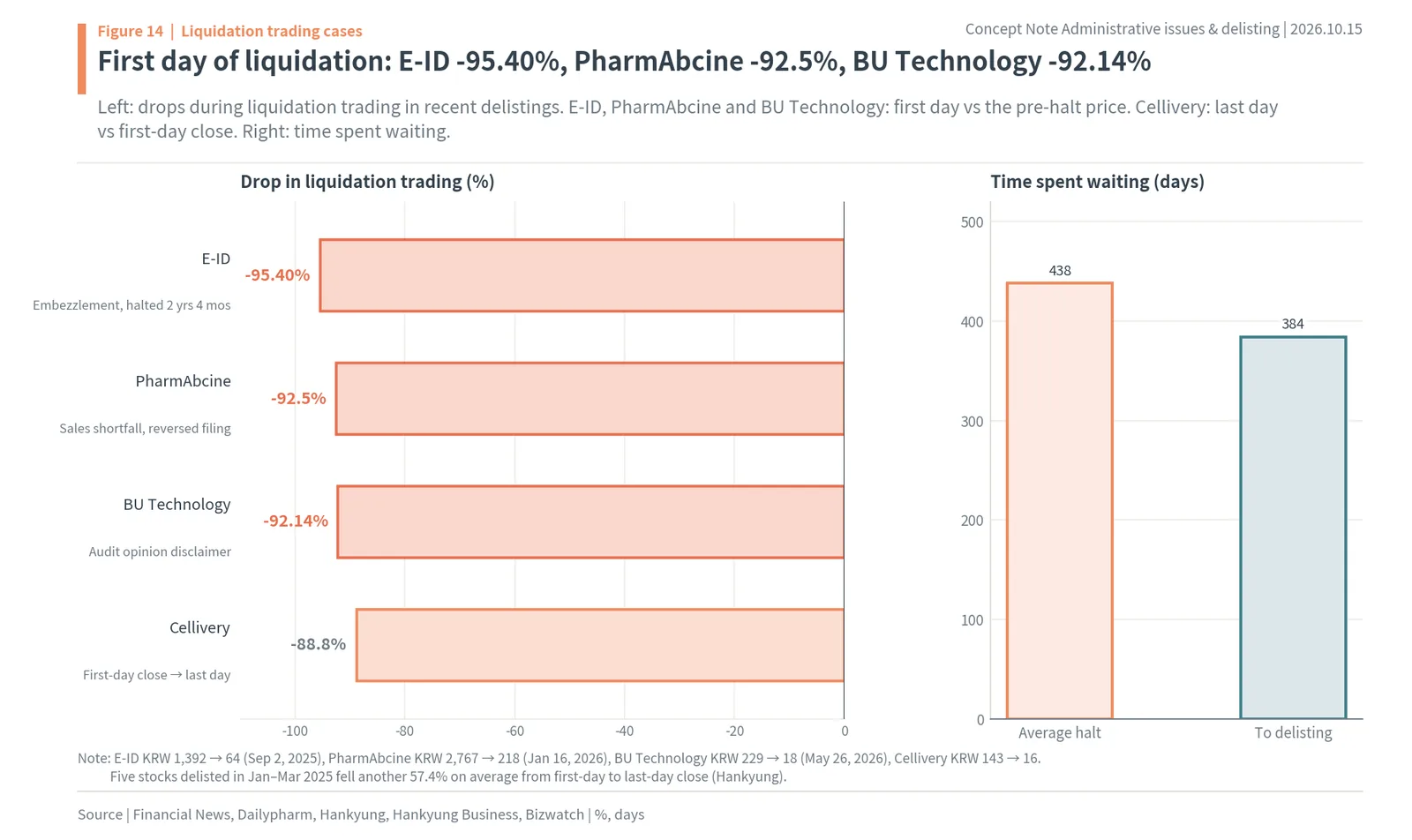
That improvement period has been cut twice. For KOSDAQ substantive reviews it was up to two years, then 18 months in 2025, then one year under the February 12, 2026 reform plan (Bizwatch, Newsis). In August 2024, the average trading halt among 100 suspended companies was 438 days, and 50 had been halted for over a year (Hankyung Business). The 23 companies delisted through substantive review in 2025 took an average of 384 days to reach delisting (Bizwatch).
Liquidation trading (정리매매) is the last chance to sell: seven trading days, no daily price limit (normally ±30%), and single-price auctions every 30 minutes (Hankyung). Since January 2026, delisted shares can trade for six months on K-OTC, an over-the-counter market (FSC).
The stages: 30 days below the line, then 45 straight days within 90 to get out
The new market cap and penny stock rules share one structure. A market cap or close below the floor for 30 trading days in a row brings designation. The flag comes off if the stock stays above the floor for 45 trading days in a row within the next 90. If recovery has not started by the 46th of those 90 days, 45 consecutive days are no longer possible and a delisting cause arises that day (Financial News).
Requirements differ by market. On KOSPI, sales under KRW 5bn in the latest fiscal year bring designation; on KOSDAQ the line is KRW 3bn, rising to KRW 5bn from fiscal 2026 (exchange year-end notice). The sales floor then climbs every year from 2027 to KRW 30bn on KOSPI and KRW 10bn on KOSDAQ in 2029, but is waived for market caps of KRW 100bn+ on KOSPI and KRW 60bn+ on KOSDAQ (FSC). A capital impairment ratio of 50% or more means designation, and full impairment at fiscal year end is a delisting cause; from 2026 full impairment at a half-year end also triggers a review (Sejung Ilbo).
The audit opinion is the heaviest cause. A disclaimer or adverse opinion is a delisting cause, and for misses arising after July 10, 2025, two in a row mean delisting with no appeal (exchange). KOSDAQ also designates companies whose pre-tax continuing loss exceeds 50% of equity in two of the last three years. The old KOSDAQ rule that four straight years of operating losses meant designation is gone; five straight years now bring only an investment caution flag. The disclosure penalty threshold fell from 15 points to 10 on July 1 (Sejung Ilbo).
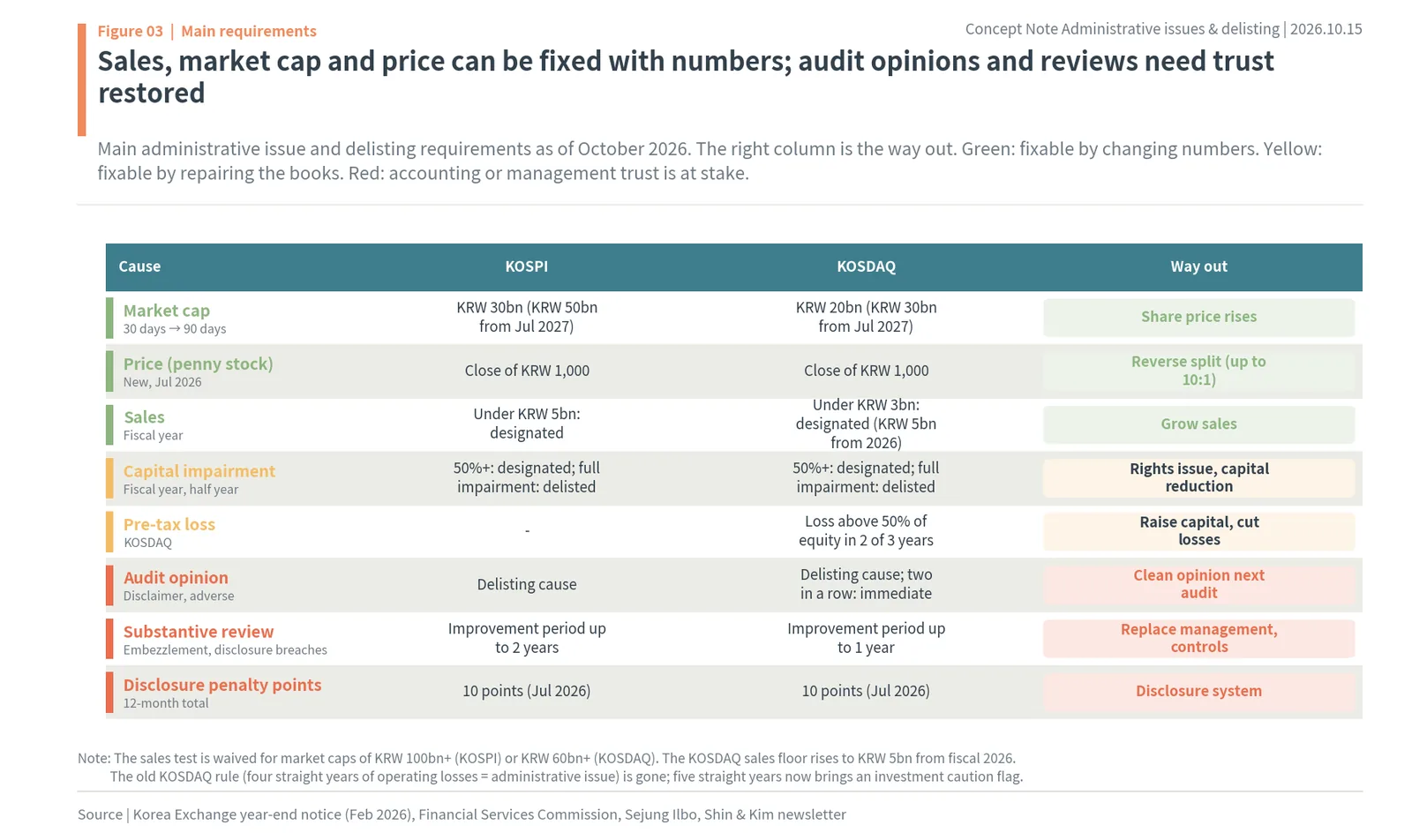
The right column of the table matters most: each cause has a different way out. Market cap, price and sales can be fixed with numbers. Capital impairment can be fixed by repairing the books with a rights issue or capital reduction. Audit opinions and substantive reviews are findings that accounting or management cannot be trusted, and no single number fixes them.
2026: the market cap floor rose twice and a penny stock rule arrived
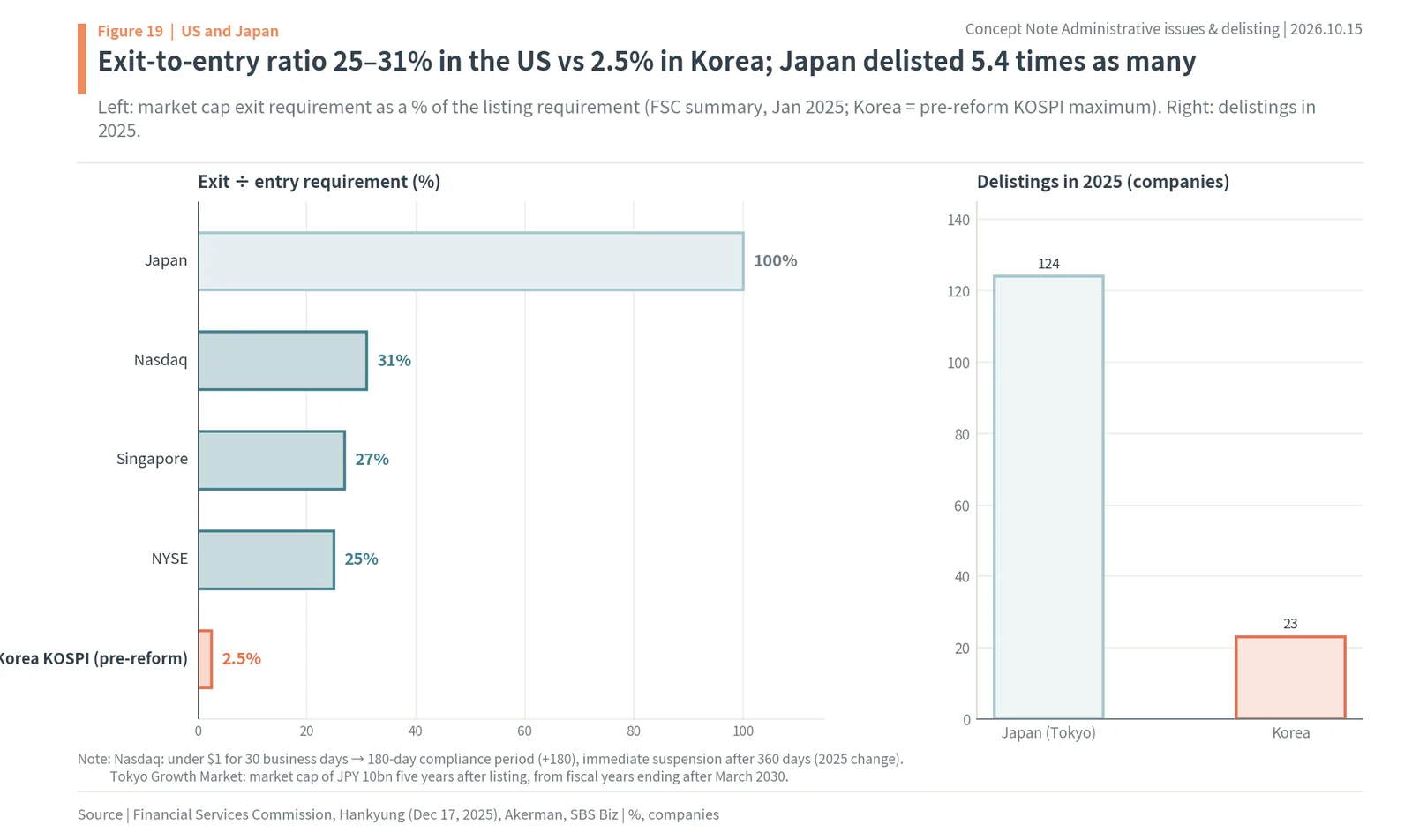
The starting point was the January 21, 2025 “delisting system improvement plan,” which set a yearly climb: KRW 20bn/15bn in 2026, 30bn/20bn in 2027 and 50bn/30bn in 2028 (KOSPI/KOSDAQ). The FSC’s argument was that the exit requirement as a share of the entry requirement was 25% at the NYSE and 31% at Nasdaq, but at most 2.5% on pre-reform KOSPI. Its simulation on end-2024 prices found that the final step would catch 62 of 788 KOSPI companies and 137 of 1,530 on KOSDAQ.
The February 12, 2026 reform plan pulled the schedule forward: the 30bn/20bn step moved from January 2027 to July 1, 2026, and the 50bn/30bn step to January 2027. On September 4 only that last step was pushed back six months to July 2027 (Bizwatch). The exchange’s simple simulation suggested around 150 KOSDAQ delistings this year (range 100–220) (Newsis).
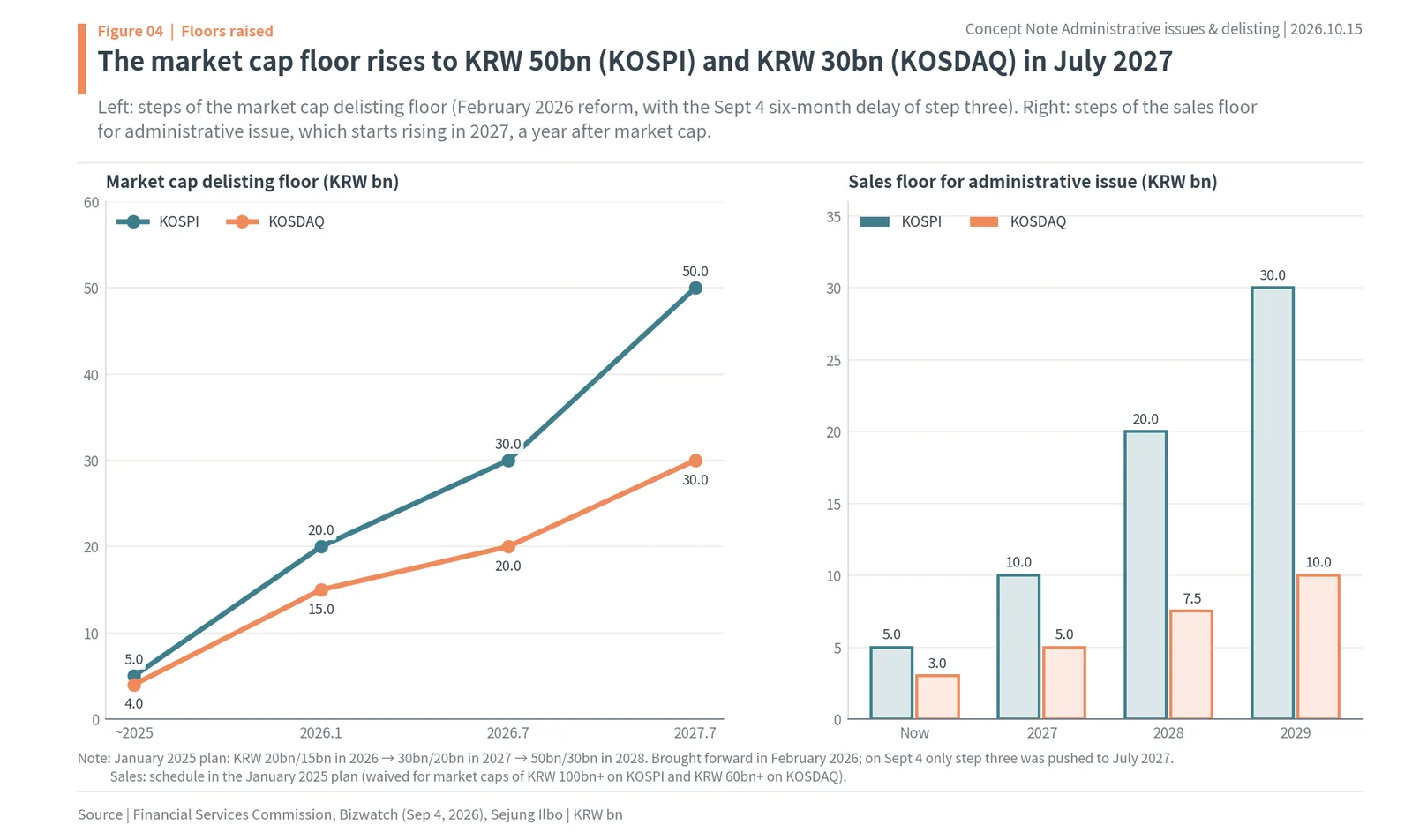
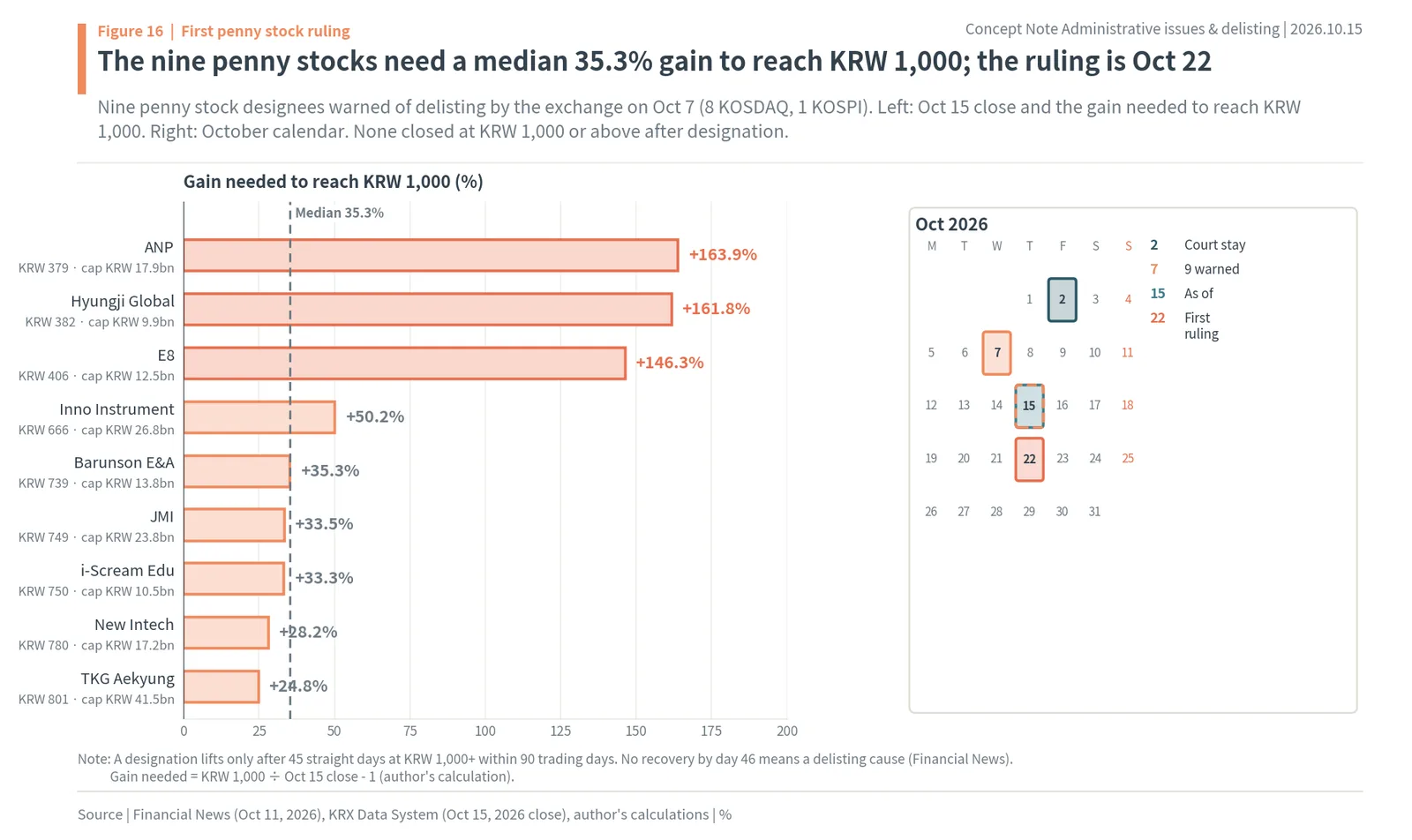
The first results came in August: 36 stocks were designated on August 12 after the close under the penny stock and market cap rules, effective August 13 (MTN, Digital Daily). Then on October 2, the Seoul Southern District Court suspended the delisting decisions for KM Pharm and Jooyon Tech, finding that the clause that brought the start date forward breached the principle of proportionality; it did not object to higher floors as such (MTN). On October 7 the exchange said designations would stay, further delisting steps would be put on hold, and it would appeal (MTN).

Korea’s administrative issues today: 181 stocks, more than half on market cap or price
KIND listed 181 administrative issues on October 15: 46 on KOSPI and 135 on KOSDAQ. Excluding SPACs, preferreds and other share classes leaves 169 common stocks, of which 132 were designated this year and 102 after July 1 (author’s calculation). Ranking each company’s causes by weight and keeping the heaviest, 64 already have a delisting cause (mostly failed audits or review outcomes now in appeals or injunctions), 57 are market cap shortfalls and 25 are price under KRW 1,000. Counting overlaps, 69 carry a market cap cause and 40 a price cause; 95 carry at least one.
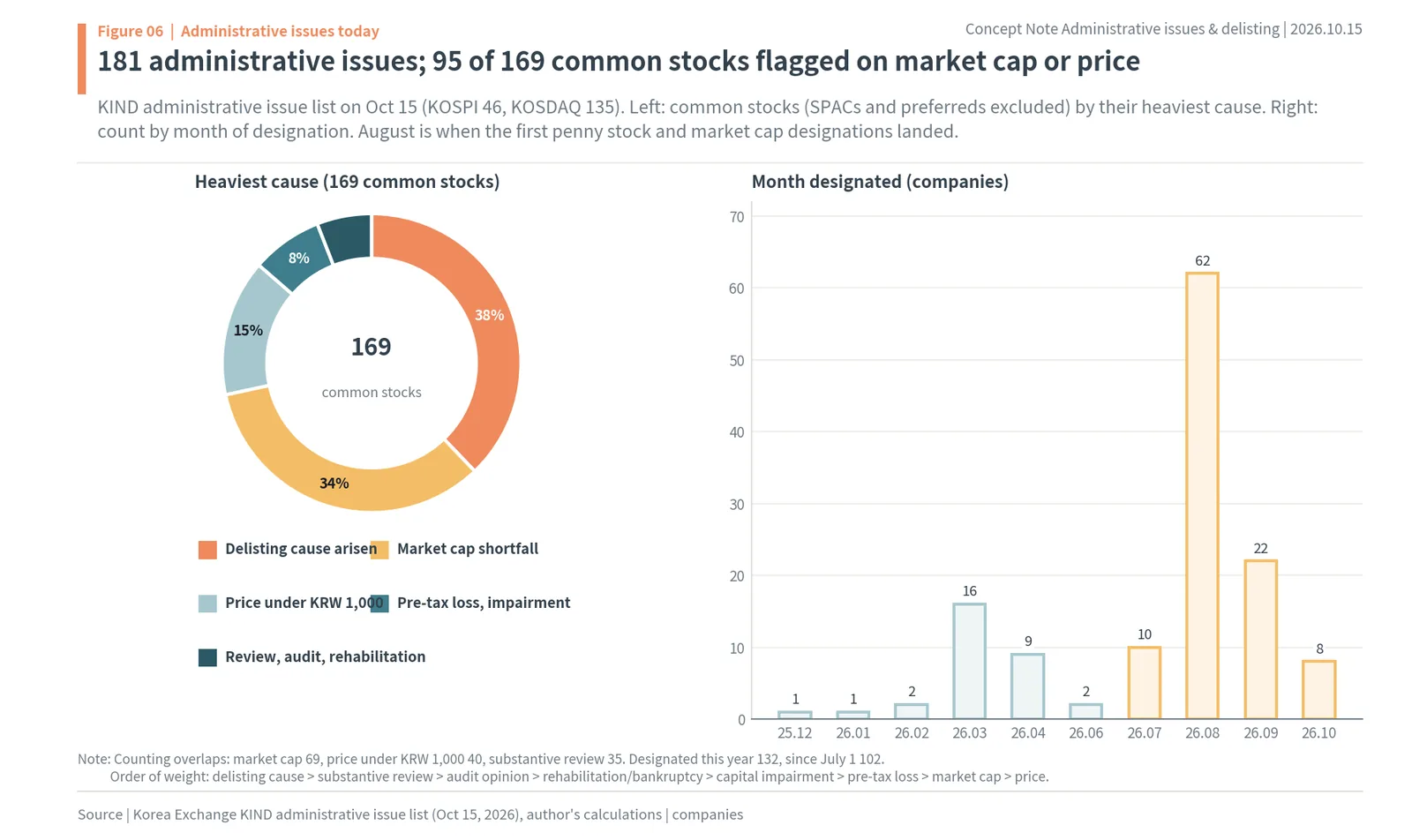
New first designations tell the same story. Merging re-designations within two years, first designations were 50, 77, 58, 48, 44, 46, 51 and 55 from 2018 to 2025, an average of 53.6 a year. In 2026 there have been 140 so far, 2.61 times that average, and 73 of them were for market cap or price. Event and financial causes were about as common as in other years; the number-type causes landed on top.
At the October 15 close, 64 of the 169 common stocks on the list were below KRW 1,000. Their median market cap was KRW 21.9bn and the total for all 169 was KRW 7.79tn. October 15 was also a day the KOSDAQ index fell 7.65% and KOSPI 7.57%, which pushed more stocks under the lines.
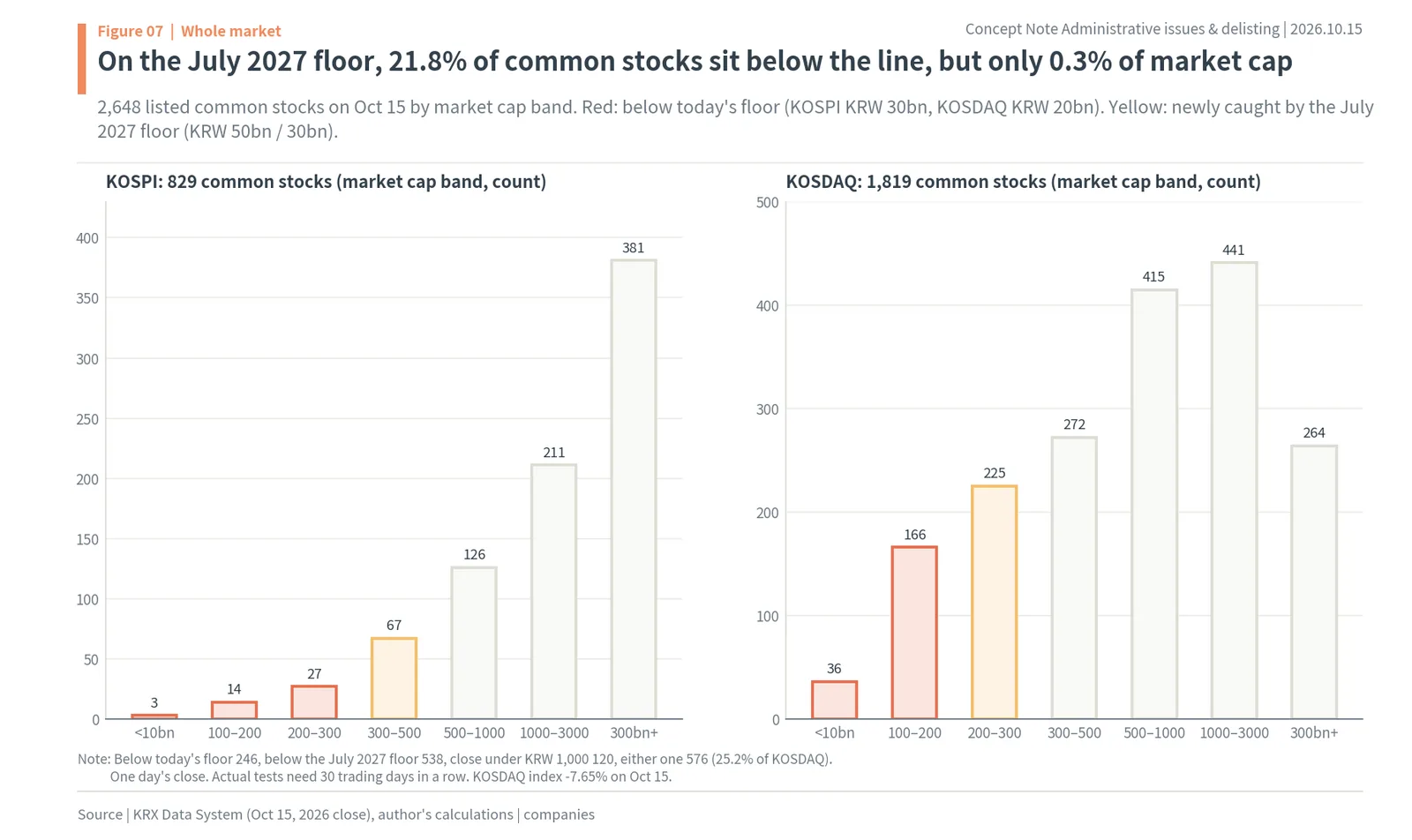
Across the whole market, of 2,648 listed common stocks (829 KOSPI, 1,819 KOSDAQ), 246 are below today’s market cap floor and 538 would be below the July 2027 floor at today’s prices. 120 closed under KRW 1,000. 576, or 21.8%, fail at least one of the July 2027 market cap floor or the KRW 1,000 line; on KOSDAQ alone it is 25.2%, one in four. Yet those 576 add up to only 0.3% of total market cap.
Forced delistings hit 40 this year, 2.94 times normal, and half of all exits come from audit opinions
Counting only forced exits from the KIND delisting list, there were 11 in 2016, 15 in 2017, 15 in 2018, 4 in 2019, 16 in 2020, 20 in 2021, 17 in 2022, 9 in 2023 and 15 in 2024. Then 24 in 2025 and 40 through October 15, 2026 (11 KOSPI, 29 KOSDAQ), 2.94 times the 2016–2024 average of 13.6. In 2026, audit opinions and substantive reviews accounted for 18 each and market cap for 4, the first market cap cases. Other tallies, such as the FSC’s 38 KOSDAQ delisting decisions in 2025, differ in how they treat SPACs and decision vs delisting dates, but they point the same way.

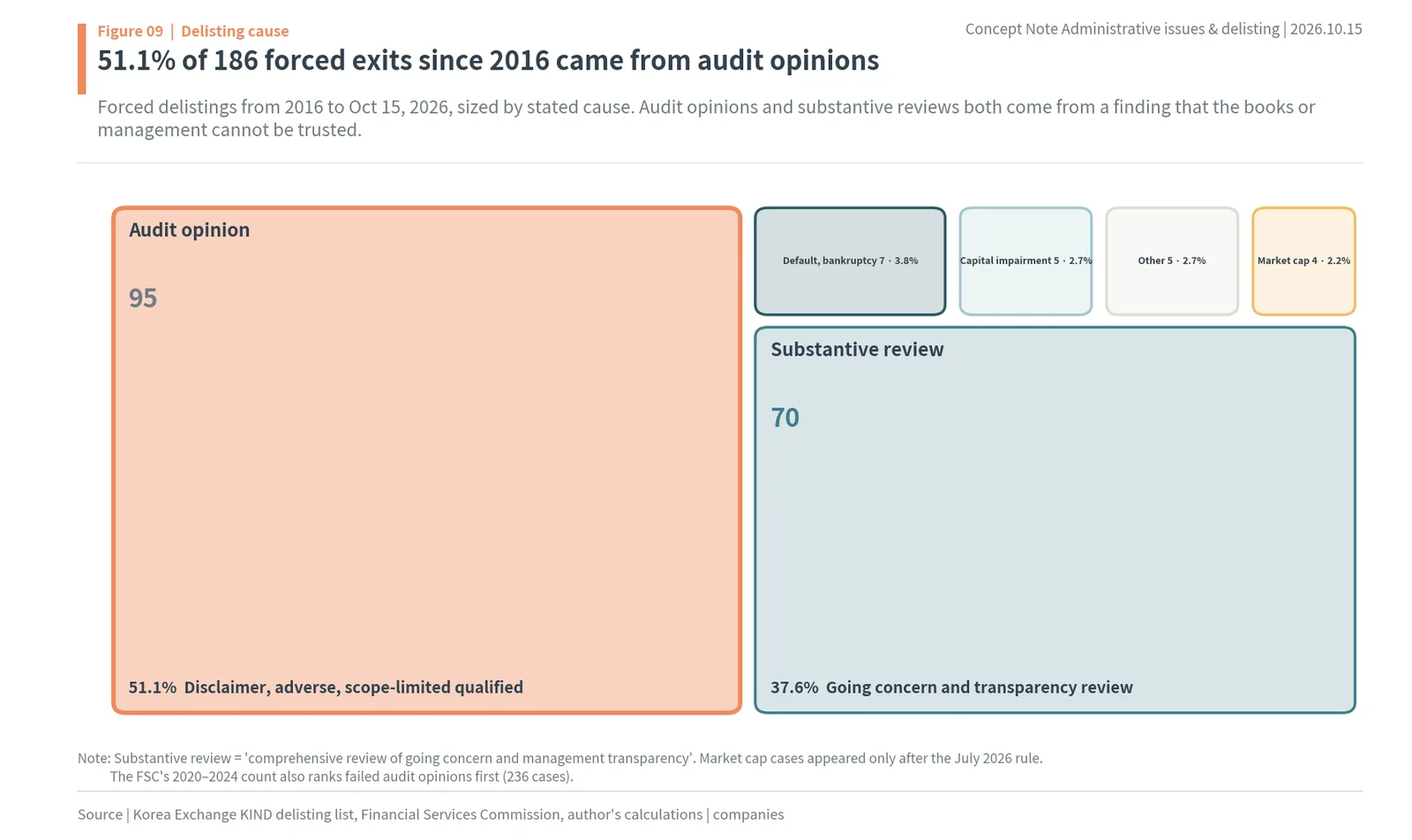
Over 2016–2026, 186 companies were forced out: 95 (51.1%) for audit opinions, 70 through substantive review, 7 for default or bankruptcy, 5 for capital impairment, 4 for market cap and 5 others. The FSC’s 2020–2024 count also ranks failed audit opinions first, with 236 cases.
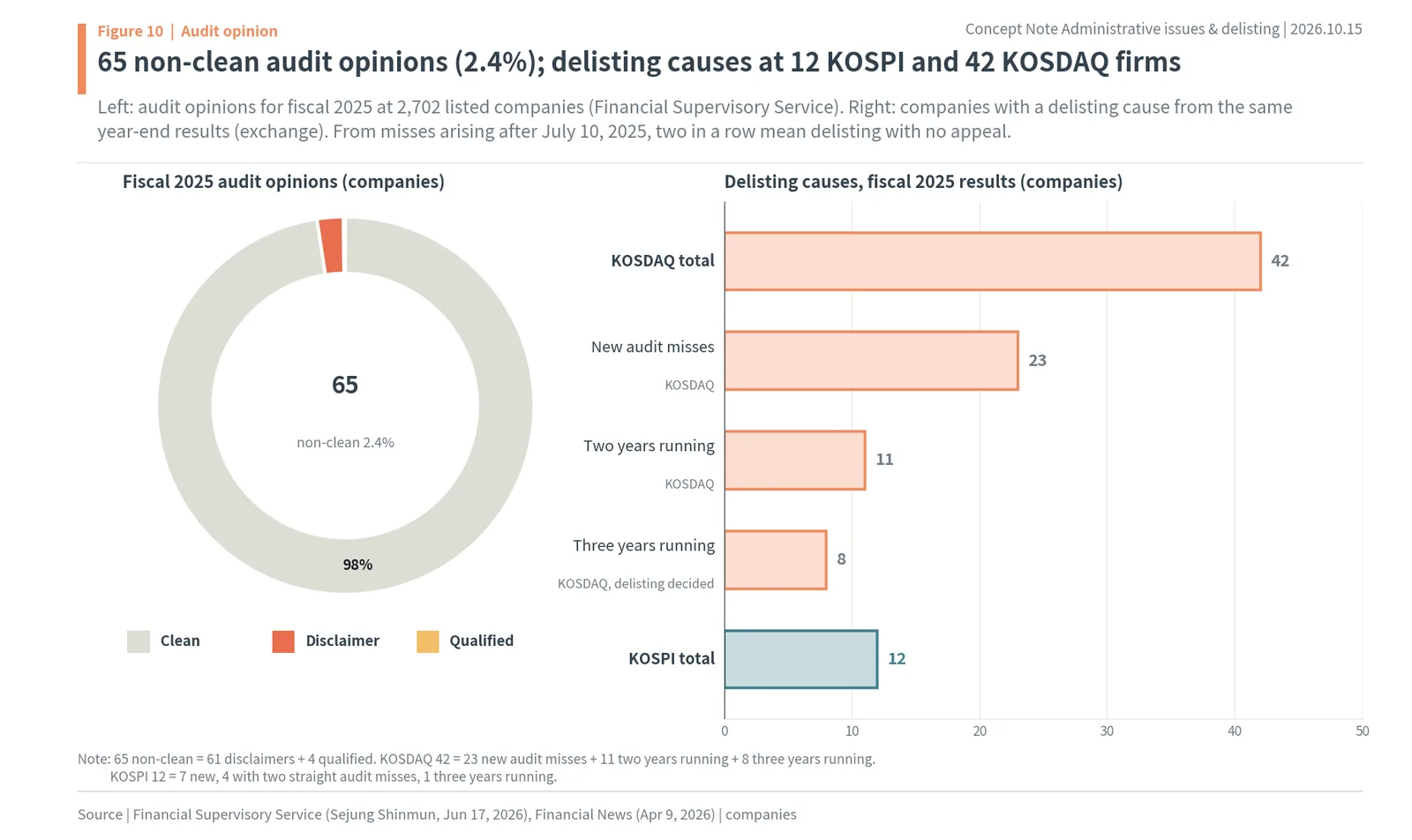
Non-clean opinions are rare. For fiscal 2025, 65 of 2,702 listed companies (2.4%) received one: 61 disclaimers and 4 qualified opinions (Financial Supervisory Service). But those 2.4% lead straight to delisting causes: the fiscal 2025 results produced delisting causes at 12 KOSPI and 42 KOSDAQ companies (Financial News). Of the KOSDAQ 42, 23 were new audit misses, 11 two years running and 8 three years running.
After designation, 40.9% were delisted, and they lost 98.06% of their value
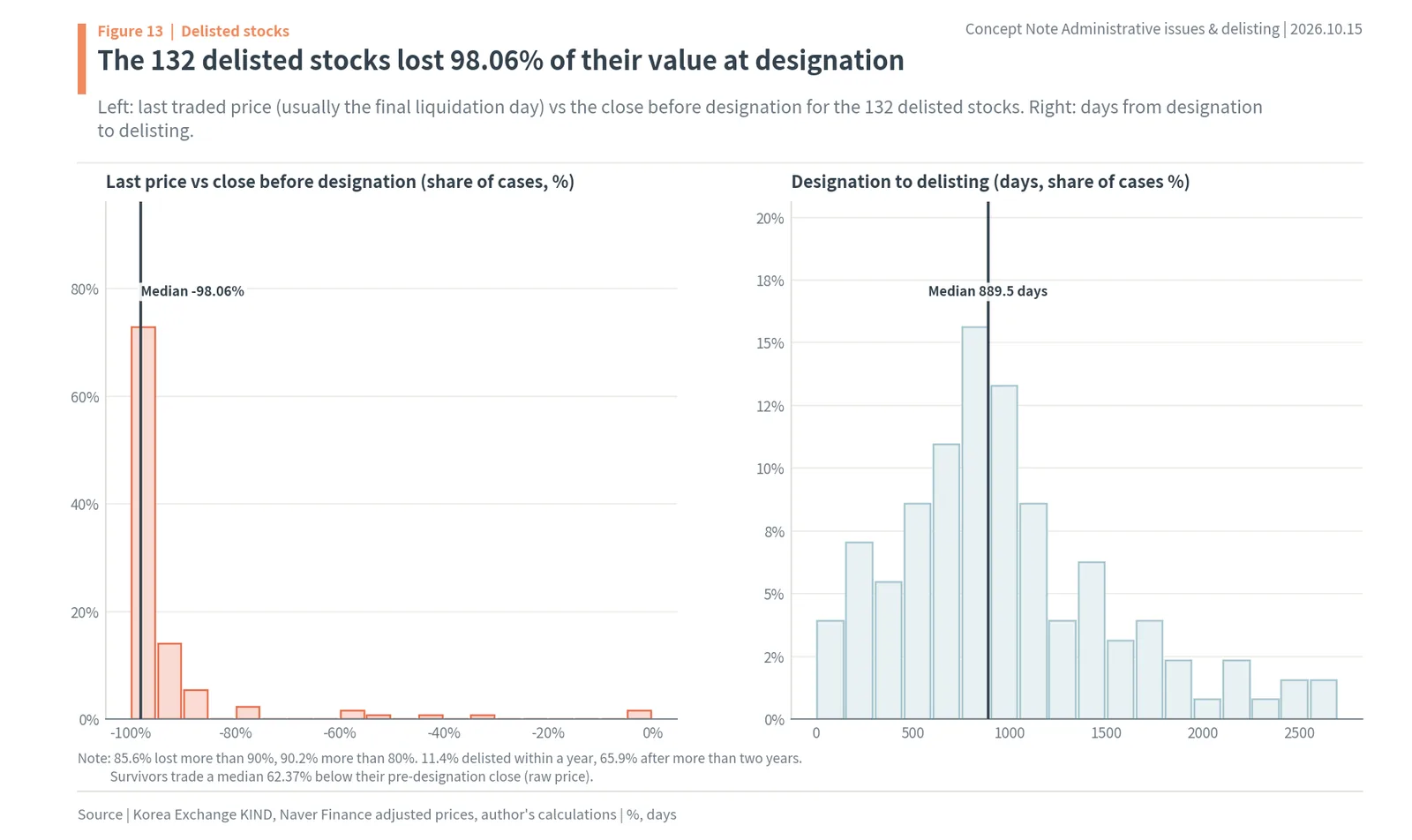
The 323 first designations from 2018 to 2023 split three ways. 132 (40.9%) were forcibly delisted. 158 (48.9%) were not delisted and are no longer on the list, meaning they fixed the cause. 33 are still designated nearly three years or more later. The median time from designation to delisting was 889.5 days; only 11.4% were delisted within a year and 65.9% took more than two years.
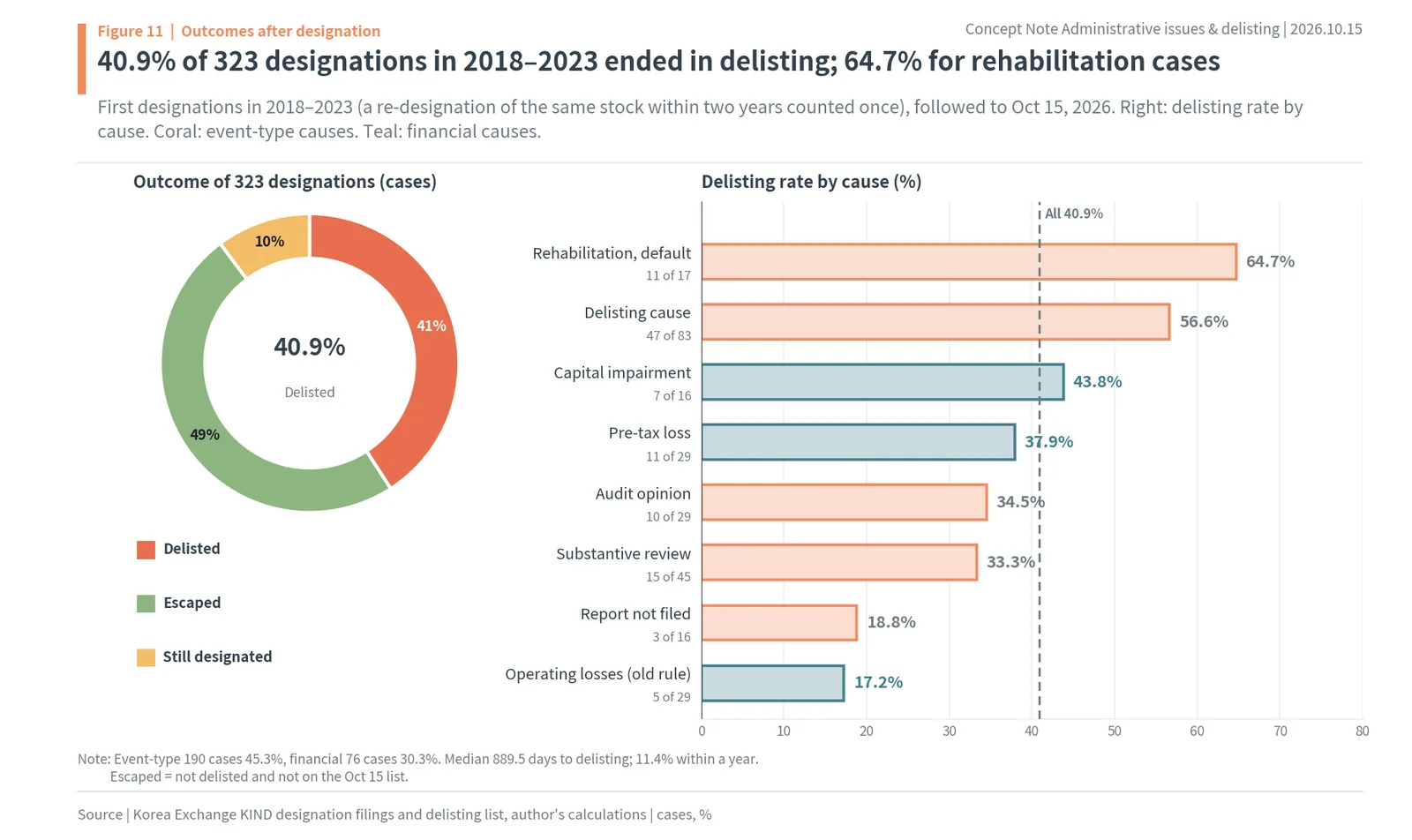
The cause matters. Of 17 designations for rehabilitation filings or default, 64.7% ended in delisting; of 83 tagged “delisting cause arisen” (mostly failed audits), 56.6%. Capital impairment came in at 43.8%, pre-tax loss 37.9% and substantive review 33.3%, while designations under the old operating loss rule (17.2%) and for unfiled reports (18.8%) rarely ended in delisting. Grouping causes, event-type causes (delisting cause, review, audit, rehabilitation, unfiled reports; 190 cases) ended in delisting 45.3% of the time and financial causes (impairment, pre-tax loss, operating loss, sales; 76 cases) 30.3%.
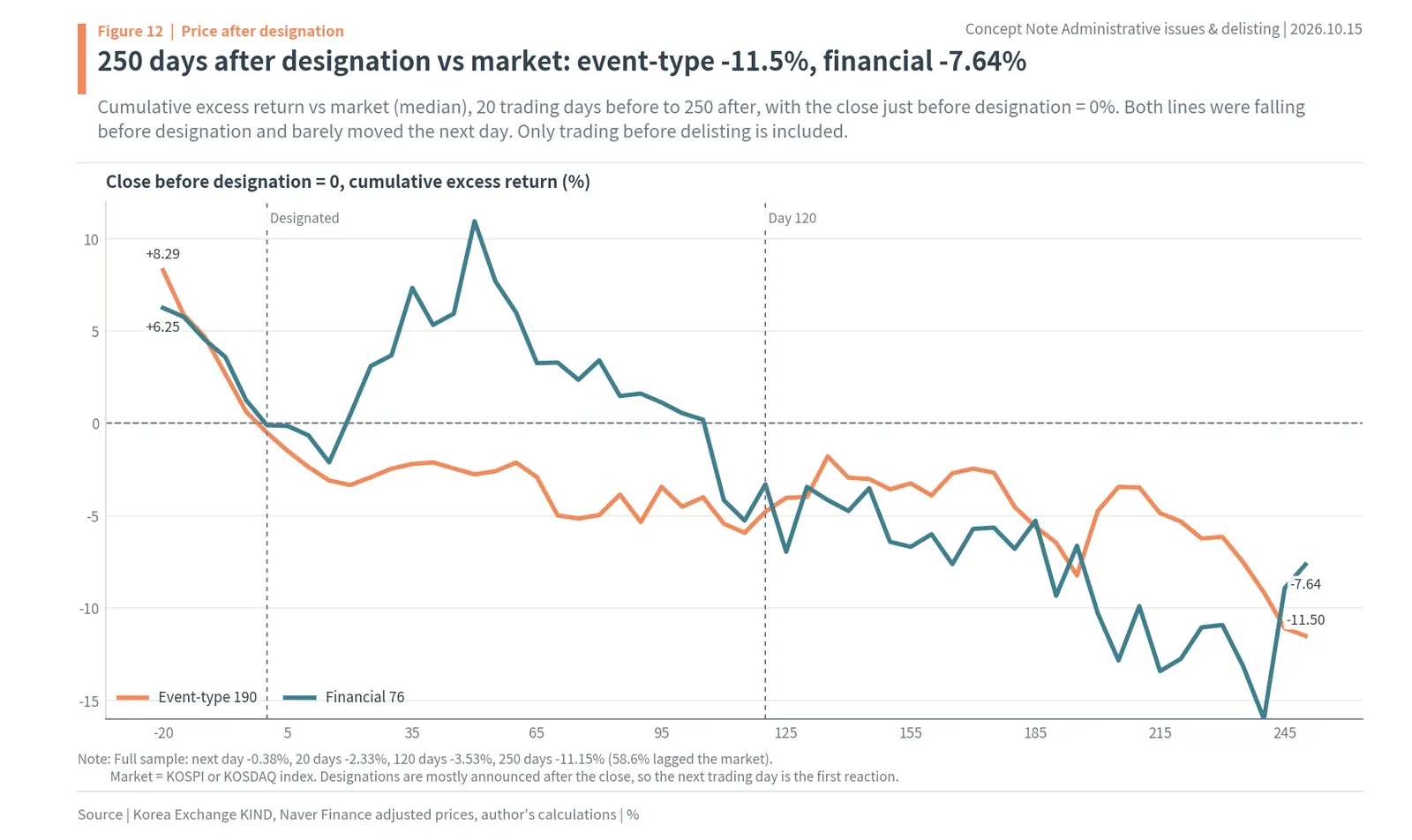
The market did not react much on the day. The next-day excess return vs the market was a median -0.38%. After 20 trading days it was -2.33%, after 120 days -3.53% and after 250 days -11.15%, with 58.6% of the 295 stocks with a full year trailing the market. Designations are usually announced after the close and their causes are often known from earlier results or audit reports, so the one-day shock is small and the losses build while investors wait.
For the 132 delisted stocks, the last traded price was a median 98.06% below the pre-designation close; 85.6% lost more than 90% and 90.2% more than 80%. Survivors were not much comfort: those that avoided delisting now trade a median 62.37% below their pre-designation close, and 75.8% are lower (raw prices, not market-adjusted).
Liquidation trading: first-day drops above 90%, and the losses land on retail investors
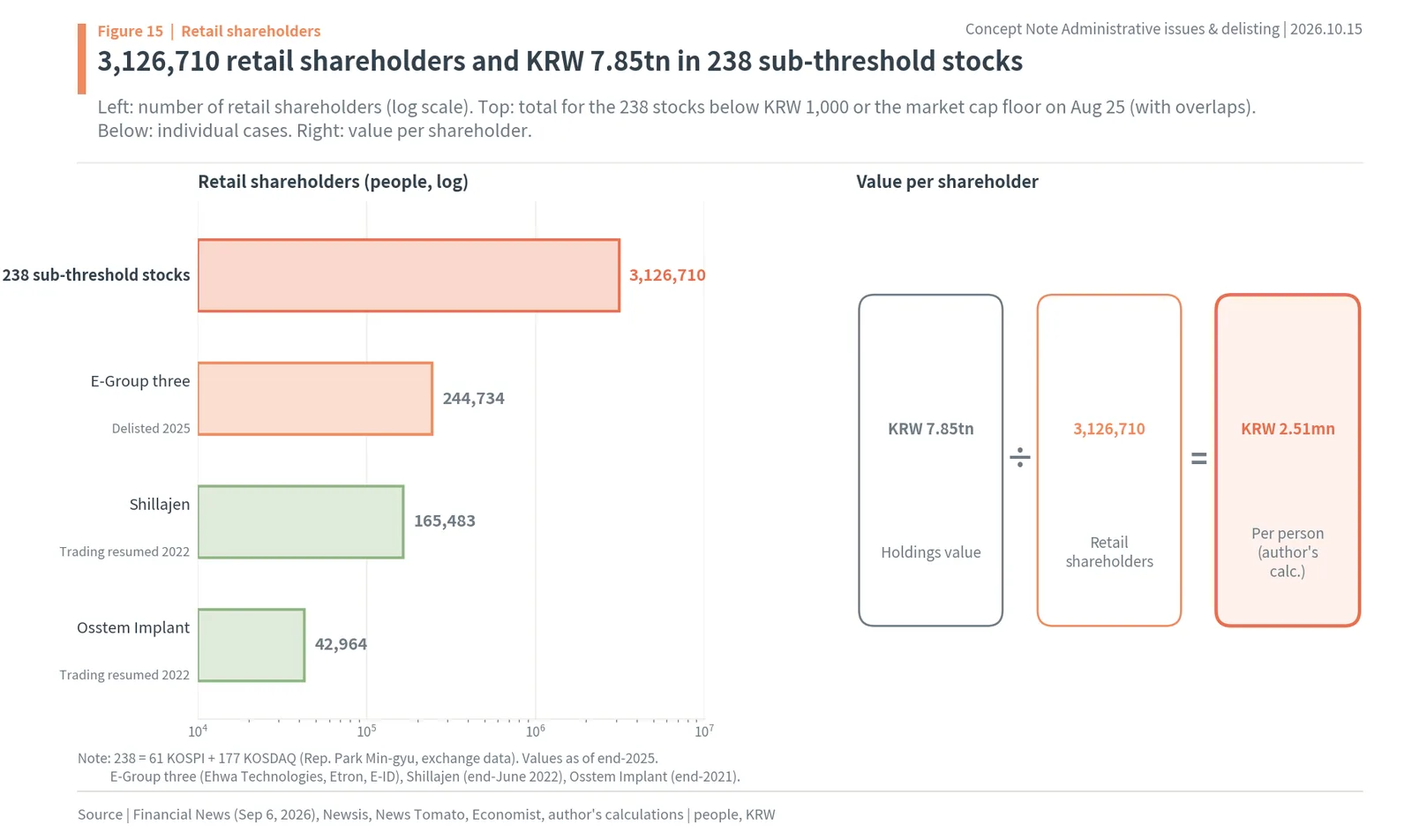
E-ID, part of the E-Group (formerly Ehwa Group), was halted on May 11, 2023 over its former chairman’s alleged embezzlement. The exchange decided on delisting on February 14, 2025, and after a court rejected the company’s injunction, liquidation trading began in September: the first morning it traded at KRW 64, down 95.40% from KRW 1,392 before the halt (Financial News). The three E-Group companies had 244,734 shareholders (Newsis). Cellivery, delisted after two straight audit disclaimers, went from a first-day close of KRW 143 to KRW 16 on the last day (Hankyung). PharmAbcine fell from KRW 2,767 to 218 (-92.5%) on its first day in January 2026 (Dailypharm), and BU Technology from KRW 229 to 18 (-92.14%) in May 2026 (Hankyung). Five stocks delisted in January–March 2025 fell another 57.4% on average from their first-day close to the last day.
Long halts do not always end badly. Shillajen was halted in May 2020, got a delisting decision in January 2022, won another improvement period on appeal and resumed trading on October 13, 2022, with 165,483 small shareholders (News Tomato). Osstem Implant resumed after a 115-day halt following a large embezzlement (Economist). Both replaced management and strengthened controls while the business kept running; for event-type causes, the way out was rebuilding trust, not fixing a number.
As of August 25, 238 companies were below KRW 1,000 or the market cap floor. Their retail shareholders numbered 3,126,710, holding shares worth KRW 7.85tn (about $5.8bn) (Financial News, citing exchange data via Rep. Park Min-gyu), or about KRW 2.51mn per person (author’s calculation).
Ways out: numbers can be fixed, but the company’s value has to follow
Capital impairment is fixed with rights issues and capital reductions. A share capital reduction without payout moves capital into reserves, shrinking the denominator of the impairment ratio while equity stays the same. Sales floors are met by growing sales; biotech companies have added health food or home shopping lines, and in one case an auditor’s call to book revenue net rather than gross cut provisional sales of KRW 3bn to KRW 2.3bn (Bizwatch). Market cap floors need a higher share price; companies have used buybacks, third-party placements and asset sales. Since September, profitable companies designated for market cap after July 2026 can move to KONEX without liquidation trading (Bizwatch). Event-type causes need a clean audit next year or an improvement plan carried out; of 16 companies that filed improvement plans in the second half of 2025, only 2 kept their listing (IB Tomato).
Korea’s penny stock rule: first ruling on October 22, nine stocks need a median 35.3% gain
On October 7 the exchange warned nine penny stock designees of possible delisting: eight on KOSDAQ (E8, Barunson E&A, i-Scream Edu, JMI, New Intech, Inno Instrument, Hyungji Global, TKG Aekyung) and one on KOSPI (ANP). None had closed at KRW 1,000 or above since designation. A delisting cause can arise after the close on October 22 (Financial News). At October 15 prices, the gain needed to reach KRW 1,000 ranges from 24.8% for TKG Aekyung (KRW 801) to 163.9% for ANP (KRW 379), with a median of 35.3% (author’s calculation).
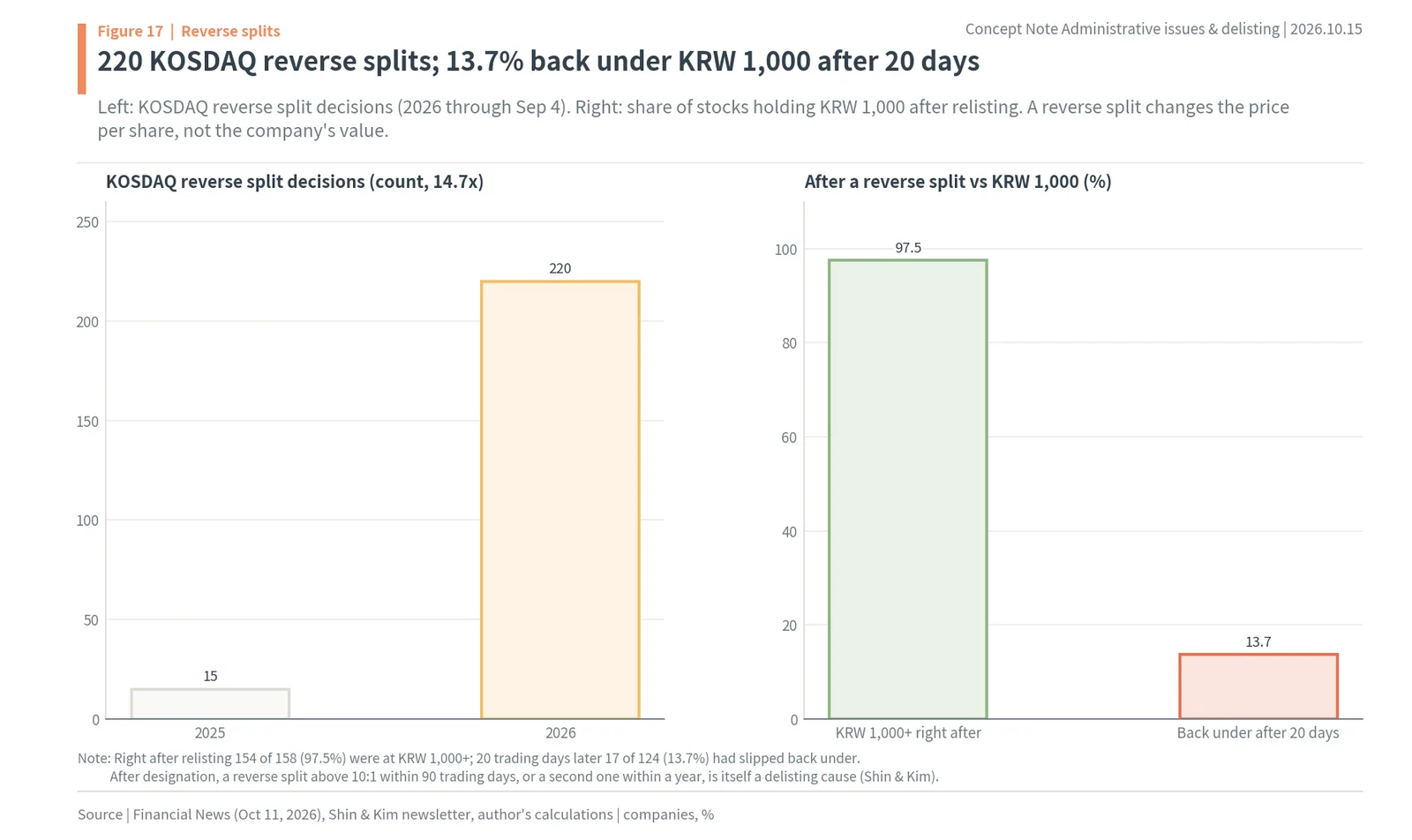
The quick fix is a reverse split. KOSDAQ reverse split decisions reached 220 this year, 14.7 times last year’s 15. Right after relisting, 154 of 158 (97.5%) traded above KRW 1,000, but 20 trading days later 17 of 124 (13.7%) were back under (Financial News). After designation, a reverse split above 10:1 within 90 trading days, or a second one within a year, is itself a delisting cause (Shin & Kim). Even ANP at KRW 379 clears KRW 1,000 with a 10:1 split, but then has to hold for 45 days.
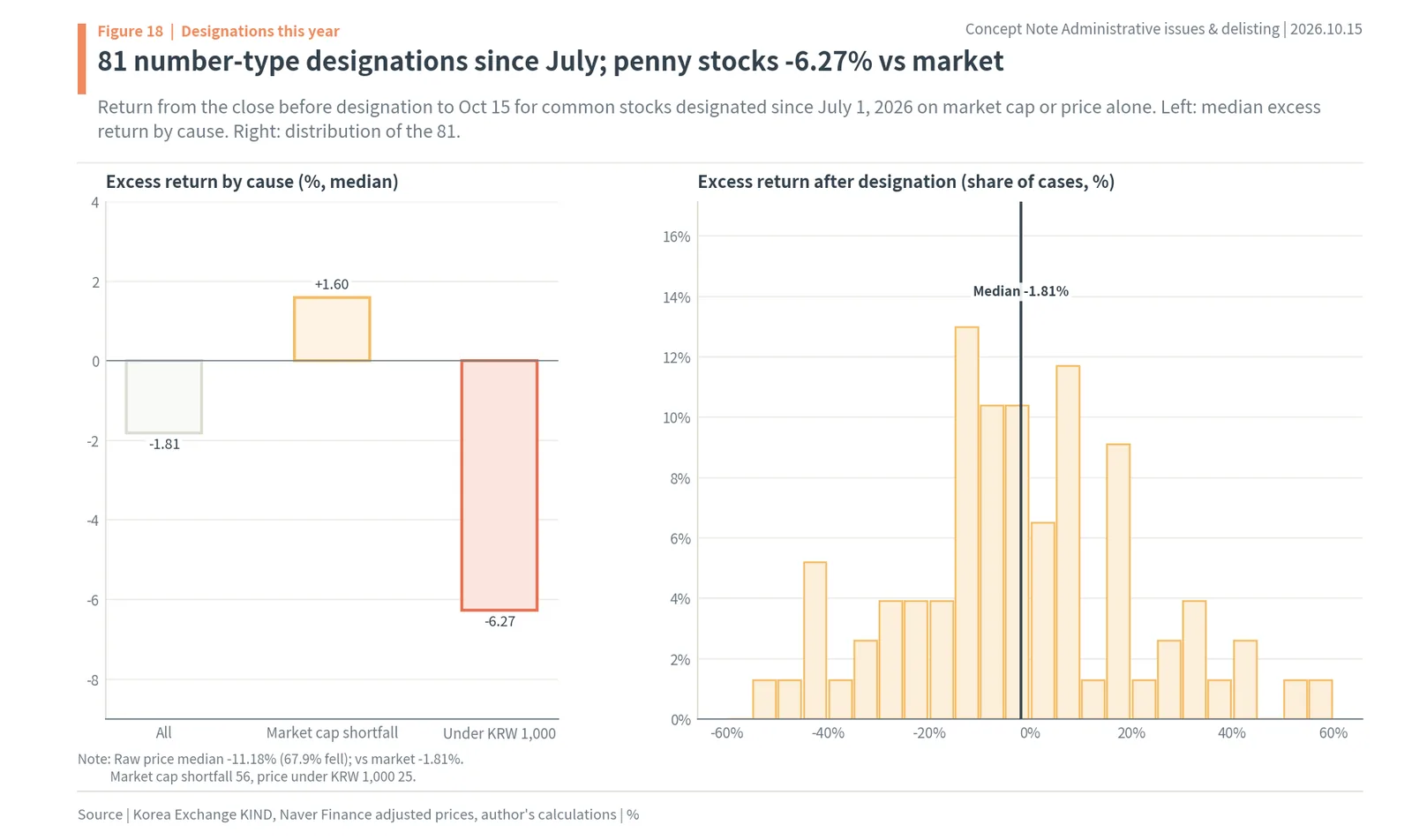
The 81 common stocks designated since July 1 on market cap or price alone fell a median 11.18% from the pre-designation close to October 15 (67.9% fell), -1.81% vs the market. Market cap designees (56) were +1.6% vs the market while their delisting step was on hold; penny stocks (25) were -6.27% as their deadline approached.
The US and Japan: similar rules, applied more slowly in the US, and Japan delisted 5.4 times as many
Nasdaq gives a 180-day compliance period, plus another 180 days, after 30 business days under $1; a 2025 change suspends trading immediately after 360 days and removes the cure period for companies that fall back under $1 within a year of a reverse split. The NYSE requires a 30-day average close of $1 and gives six months, but not to companies that did a reverse split in the past year (Akerman). Korea’s penny stock rule gives 90 trading days after 30 days below the line.
Japan delists more: 124 companies left the Tokyo Stock Exchange in 2025 against 23 in Korea (Hankyung), 5.4 times as many. Tokyo’s Growth Market will require a JPY 10bn market cap five years after listing for fiscal years ending after March 2030 (JPX, SBS Biz).
The basis for the numbers
Forced delistings use the stated cause on the KIND delisting list, removing mergers, SPAC mergers, transfers between markets, voluntary delistings, wholly owned subsidiary conversions, expiry and SPAC filing failures; KONEX is excluded. The event study uses exchange filings titled “관리종목지정” (designation), excluding added or changed causes, releases, SPACs, preferreds and ETFs, and merges re-designations within two years. Returns start from the close on or before the designation filing date; excess returns subtract the KOSPI or KOSDAQ index return and use medians. Market-wide counts use the October 15 close for 2,648 common stocks; actual tests need 30 trading days in a row.
Apply it to your stock: sort the cause, then count days and the gain needed
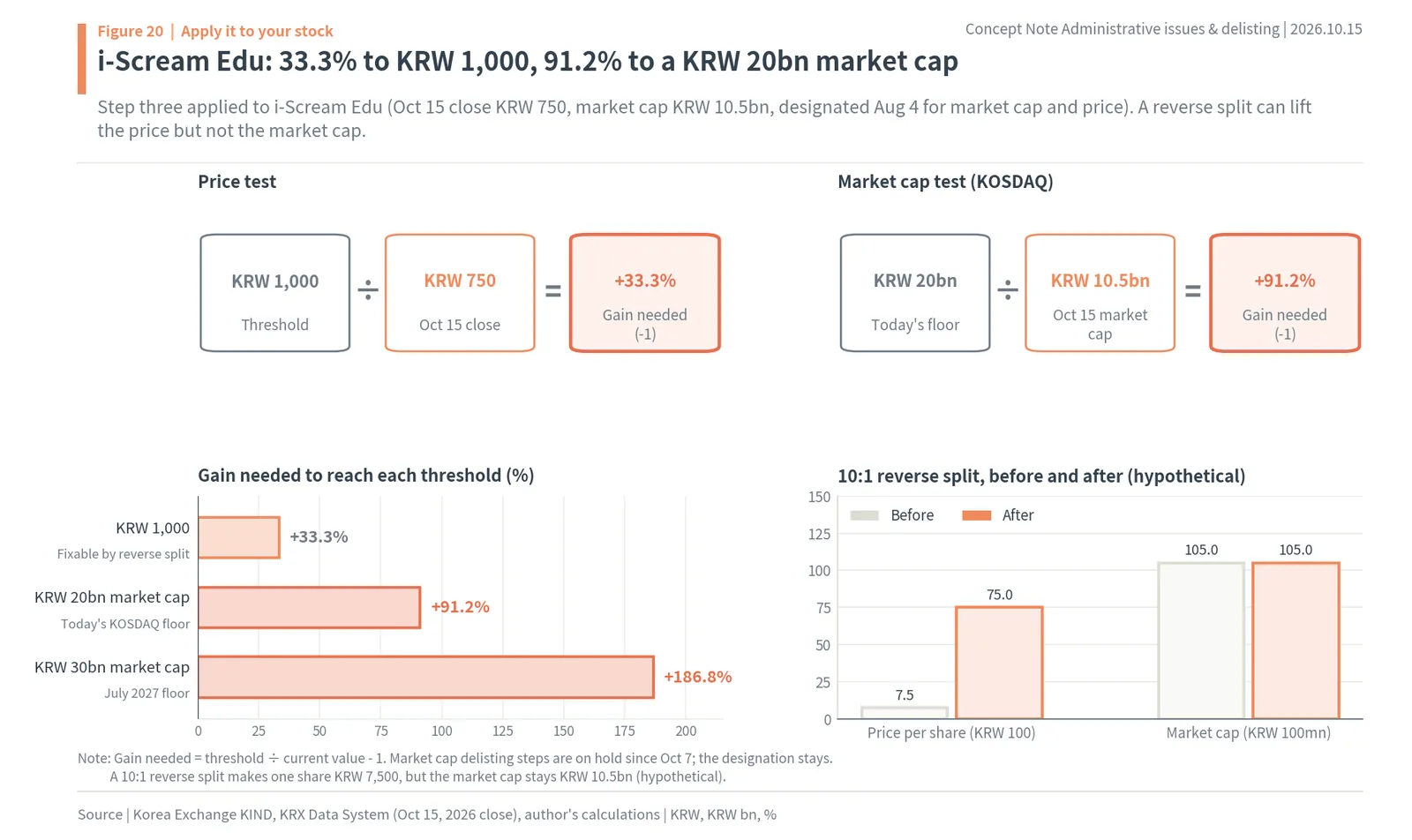
Step 1 is to check the designation date and causes on KIND’s administrative issue list. Step 2 is to sort the cause: event-type (audit, review, delisting cause, rehabilitation), financial (impairment, pre-tax loss, sales) or number-type (market cap, price). In the sample, event-type causes ended in delisting 45.3% of the time and financial causes 30.3%. Step 3, for number-type causes, is the gain needed: KRW 1,000 ÷ today’s close – 1, or the floor ÷ today’s market cap – 1, with day 46 of the 90-day window as the real deadline. i-Scream Edu, at KRW 750 and a KRW 10.5bn market cap, needs 33.3% to reach KRW 1,000, 91.2% to reach the KRW 20bn KOSDAQ floor and 186.8% to reach the July 2027 floor of KRW 30bn (author’s calculation). A reverse split can fix the price, but not the market cap.
Step 4 is the audit calendar: December year-end companies file audit reports in March and half-year reviews in August, and after a first non-clean opinion the next audit is the only remaining chance. Step 5 is to write down the worst case: in the sample, delisted stocks lost a median 98.06% after a median 889.5 days, and the full sample trailed the market by 11.15% over 250 trading days. Exchange warnings such as the “administrative issue concern” notice and the October 7 delisting concern notice for the nine penny stocks are the last signals before trading stops.
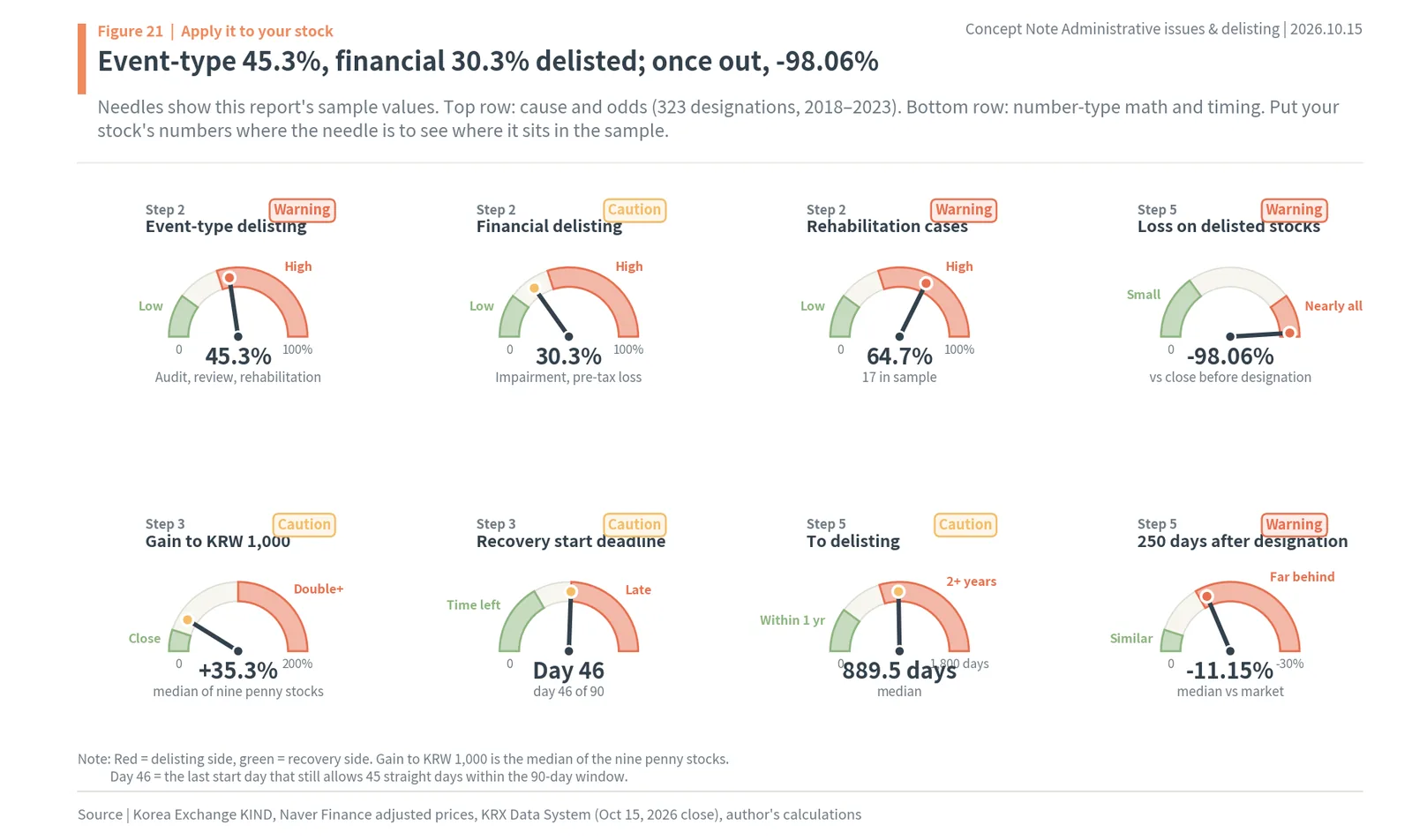
Maochaedung’s take. An administrative issue is a waiting room: fix the cause in time or move on to delisting. Higher market cap and penny stock floors put 181 stocks in that room in 2026. Of 323 designations from 2018 to 2023, 40.9% ended in delisting, and those stocks lost 98.06% of their value at designation. Event-type causes ended in delisting 45.3% of the time, more than financial ones at 30.3%. So read an administrative issue by its cause, the trading days left and the gain needed, not by its low share price.
Korea administrative issues and delisting FAQ
Q. What is an administrative issue (관리종목) in Korea?
It is a flag the Korea Exchange puts on a listed company that is close to a delisting standard, such as low sales, a low market cap, capital impairment or a failed audit. Margin trading is blocked, and if the cause is not fixed within the set period the case moves to delisting.
Q. What are the market cap and penny stock delisting rules in 2026?
Since July 1, 2026 the market cap floor is KRW 30bn on KOSPI and KRW 20bn on KOSDAQ, rising to KRW 50bn and KRW 30bn in July 2027. A stock below the floor, or below a KRW 1,000 close, for 30 trading days in a row is designated, and it is delisted if it cannot stay above the line for 45 straight days within the next 90 trading days.
Q. How often do administrative issues end in delisting?
Of 323 first designations from 2018 to 2023, 40.9% ended in delisting by October 15, 2026. Event-type causes such as audit failures and substantive reviews ended in delisting 45.3% of the time, financial causes 30.3%.
Q. How much do shareholders lose when a Korean stock is delisted?
The 132 delisted stocks in the sample lost a median 98.06% from the close before designation to the last traded price, usually on the final day of liquidation trading. First-day liquidation drops above 90% were common, such as E-ID at -95.40%.
Q. What happened to the market cap delisting rule in October 2026?
On October 2, 2026 the Seoul Southern District Court suspended two market cap delisting decisions, finding the early start date disproportionate. The exchange kept the designations but put further delisting steps on hold and appealed. The penny stock rule was not affected, and its first ruling can come on October 22.
Sources
- Korea Exchange KIND, administrative issue list (link), retrieved Oct 15, 2026
- Korea Exchange KIND, delisting list (link), Jan 1, 2015 to Oct 15, 2026, retrieved Oct 15, 2026
- Korea Exchange KIND, designation filings (Oct 15, 2017 to Oct 15, 2026, 3,210 filings), collected Oct 15, 2026
- Naver Finance, daily adjusted prices (513 stocks, KOSPI and KOSDAQ indices), retrieved Oct 15, 2026
- Korea Exchange (KRX) Data System, close and market cap for all stocks (via pykrx), Oct 15, 2026 close
- Yahoo Finance, KRW per USD (KRW=X), Oct 15, 2026
- Korea Exchange, KOSDAQ year-end notice for investors (link), Feb 2, 2026
- Financial Services Commission, delisting system improvement plan, Jan 21, 2025
- Financial Services Commission, card news on penny stock delisting (link), Feb 13, 2026
- Shin & Kim, newsletter on the delisting reform (link), May 26, 2026
- Sejung Ilbo, Penny stock delisting from July (link), May 14, 2026
- Newsis, Penny stocks to be delisted (link), Feb 12, 2026
- Bizwatch, KOSDAQ zombie company cleanup (link), Feb 19, 2026
- Bizwatch, Delisting floor step delayed (link), Sep 4, 2026
- MTN, 36 penny and sub-threshold stocks designated (link), Aug 12, 2026
- Digital Daily, Penny stocks designated en masse (link), Aug 13, 2026
- MTN, Court rules market cap delisting clause invalid (link), Oct 2, 2026
- MTN, Exchange holds delistings but keeps the rule (link), Oct 7, 2026
- Financial News, Penny stock delisting faces first test (link), Oct 11, 2026
- Financial News, 3 million retail investors in sub-threshold stocks (link), Sep 6, 2026
- Financial News, Delisting causes at 12 KOSPI and 42 KOSDAQ firms (link), Apr 9, 2026
- Sejung Shinmun, 65 listed companies with non-clean audit opinions (link), Jun 17, 2026
- Hankyung Business, KRW 10tn tied up in halted stocks (link), Aug 25, 2024
- Newsis, E-Group three delisted (link), Feb 17, 2025
- Financial News (News1), E-ID down 95% in liquidation trading (link), Sep 2, 2025
- Hankyung, Retail investors in liquidation trading (link), Mar 26, 2025
- Dailypharm, PharmAbcine’s delisting (link), Jan 17, 2026
- Hankyung, BU Technology falls on first liquidation day (link), May 26, 2026
- News Tomato, Shillajen resumes trading (link), Oct 12, 2022
- Economist Korea, Osstem Implant back after 115 days (link), Apr 29, 2022
- Hankyung, Japan delisted 124, Korea 23 (link), Dec 17, 2025
- SBS Biz, Tokyo delistings double in three years (link), Sep 7, 2026
- Akerman LLP, SEC Approves Changes to NYSE and Nasdaq Minimum Price Rules (link), Mar 12, 2025
- Photo: hyolee2, “Korea exchange” (link), CC BY-SA 3.0, Wikimedia Commons, taken Mar 7, 2012
Was this note useful?
Thanks. Your answer helps decide what to cover next.
Korea market snapshot · Oct 23, 2026
New to Korean stocks? Start here for the basics.
Most read
1France Protests 2026: Why Students Are Blocking Schools and Which Stocks Benefit (Munich Re, SCOR)
Get the Saturday note on Korean stocks
One email every Saturday with the week’s new research on Korean listed companies and links to the updated data pages. Built from DART filings and KRX data. Free; unsubscribe in one click. See past issues