Korea Stock Market Weekly Recap (Nov 9–13, 2026): KOSPI Rebounds 4.6% as Jensen Huang Resigns and US Yields Top 5%
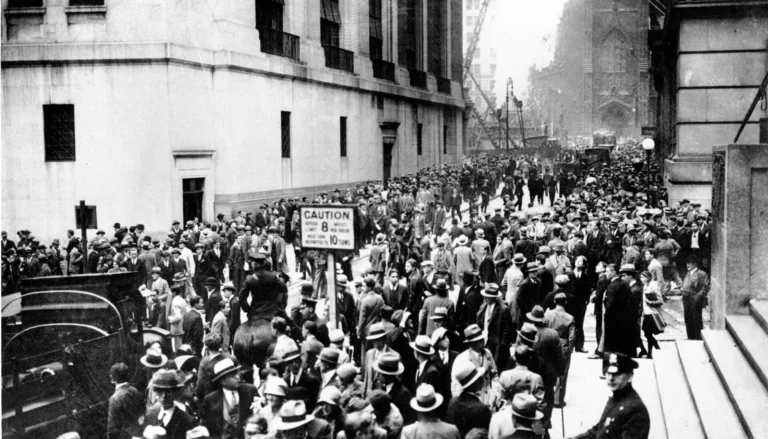
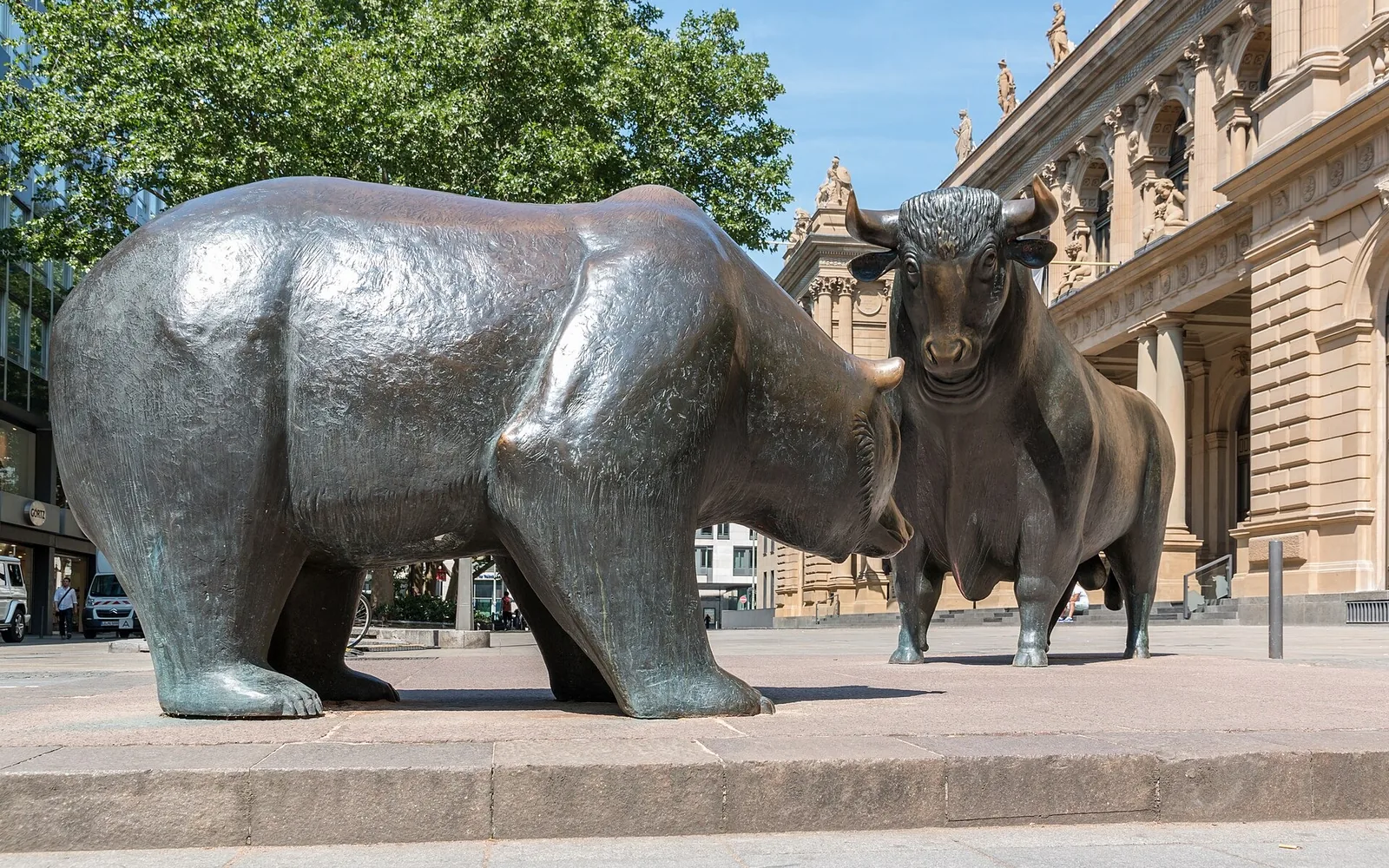
On May 9, 1994, the Atlanta Journal-Constitution ran a short piece of investment advice under the name of John Templeton: “Bull markets are born on pessimism, grow on skepticism, mature on optimism and die on euphoria.” A 2008 book by his grandniece Lauren Templeton dates the line to February 1994 and adds the sentence that usually follows it: “The time of maximum pessimism is the best time to buy, and the time of maximum optimism is the best time to sell.” A 1991 personal-finance textbook already described the same four stages, so whether Templeton coined the phrase is not established. It is still the line investors reach for whenever a sell-off gets deep.
Korea’s stock market had just shown what that pessimism looks like. In the first week of November the KOSPI fell 11.7%, and on November 6 a circuit breaker halted trading three minutes and 33 seconds after the open. Since 1990 the KOSPI has lost more than 10% in a single week only 24 times, and three of those weeks came in 2026. So the question for the week of November 9–13 was simple: was this still pessimism, or the start of skepticism, and what else happened at home and abroad that a Korea investor needs to know?
This report is the English edition of the author’s Korean note on the Korean stock market week of November 9–13, 2026.
As of: November 14, 2026. Korean prices are KRX regular-session closes on November 13; US and other overseas prices are local closes on November 13. Won amounts are converted at KRW 1,336.7 per dollar, the November 13 Seoul close. Calculations are the author’s; news facts come from the dated reports listed under Sources.
The short answer is the anchor of this report: the fear took a week off, and the homework moved to rates and Nvidia. The KOSPI rose 4.6% and won back about half of the previous week’s loss, but 89% of the market value it regained came from two companies, Samsung Electronics and SK hynix. The buying was narrow too. Foreign investors bought for three days and sold again on Friday, retail investors sold KRW 3.0tn (about $2.3bn), and SK hynix’s own share buyback absorbed more than KRW 2tn. In the same week a hotter-than-expected US inflation print pushed the 10-year Treasury yield to 5.15%, Korea’s 10-year government bond yield went back above 4%, Nvidia’s chief executive Jensen Huang resigned, and President Trump’s words on the Iran war moved oil prices in both directions within four days.
1. The week in one picture: half of the crash undone
The conclusion of this chapter is that this was less a rally than a pause in the crash. Stocks rose on only two of five days, Friday’s gains vanished by the close, and for the year the KOSPI still sits far below its June peak.
The KOSPI went from 5,060 on November 6 to 5,291 on November 13, a gain of 4.6%, after an 11.7% fall the week before. The KOSDAQ, Korea’s smaller tech-heavy market, closed at 639 on Monday, its lowest close of the year, and then rose 8.6% to just under 700 for the week.
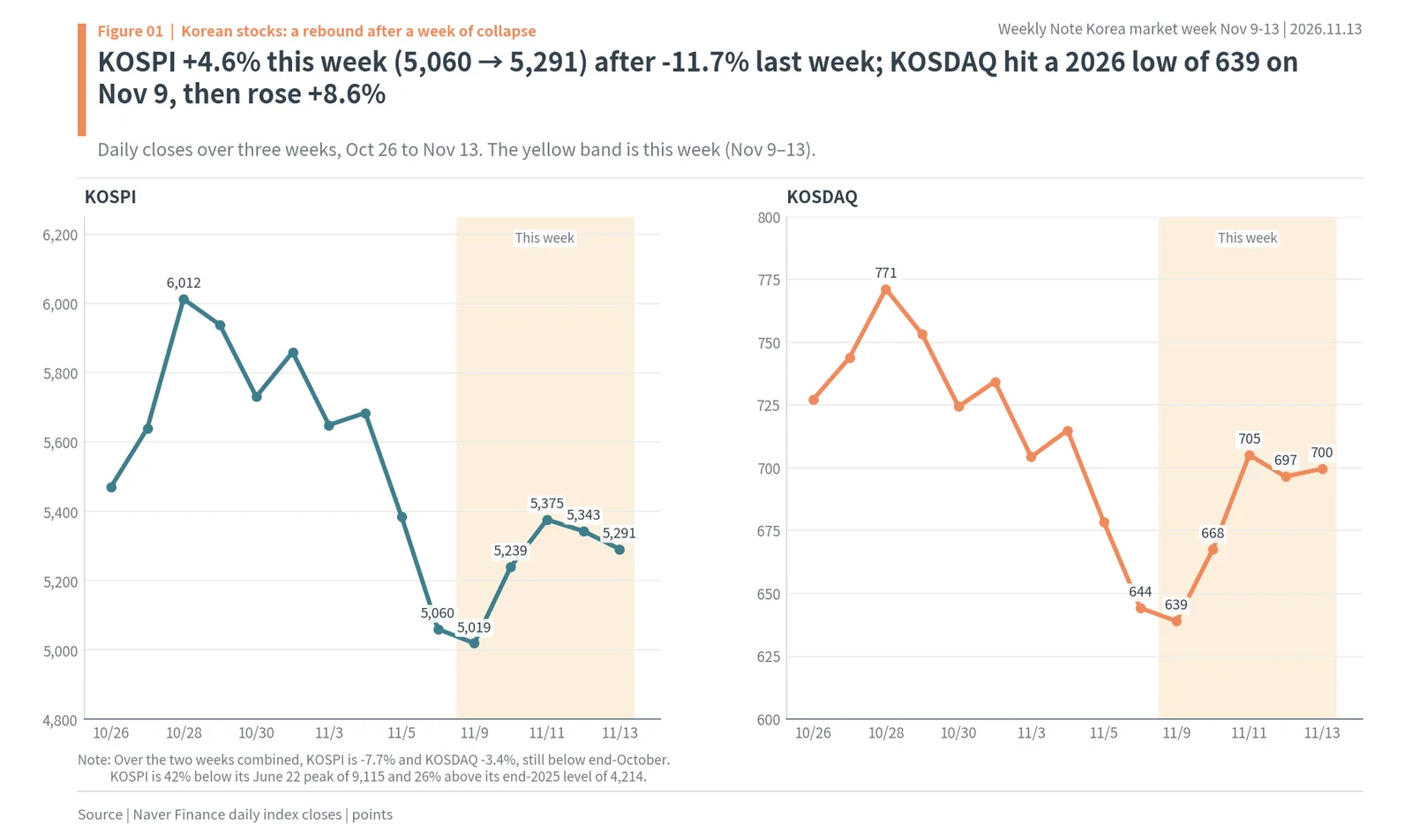
Day by day: on Monday the KOSPI rose more than 2% intraday and then slipped 0.81% to 5,018.85, while Japan and Taiwan rebounded. On Tuesday it jumped 4.39% to 5,239.13 after the Philadelphia Semiconductor Index rose 6.86% overnight and President Trump spoke of “positive momentum” toward ending the Iran conflict, which pushed oil down. Program buying was briefly halted in both markets by a “buy sidecar,” a circuit breaker for fast rises. On Wednesday the KOSPI added 2.60% to 5,375.36 and the KOSDAQ 5.62%, helped by CoreWeave’s results and the coming Anthropic listing. Thursday was KOSPI 200 options expiry, and a Wall Street Journal report that Nvidia’s board was preparing to oust Jensen Huang pulled the index down 0.61%. On Friday the KOSPI opened 2% higher, touched 5,504.44 and closed down 0.98% at 5,290.53 as Nvidia announced Huang’s resignation, oil rebounded on Trump’s comments, and a presidential capital-markets meeting offered no immediate measures.
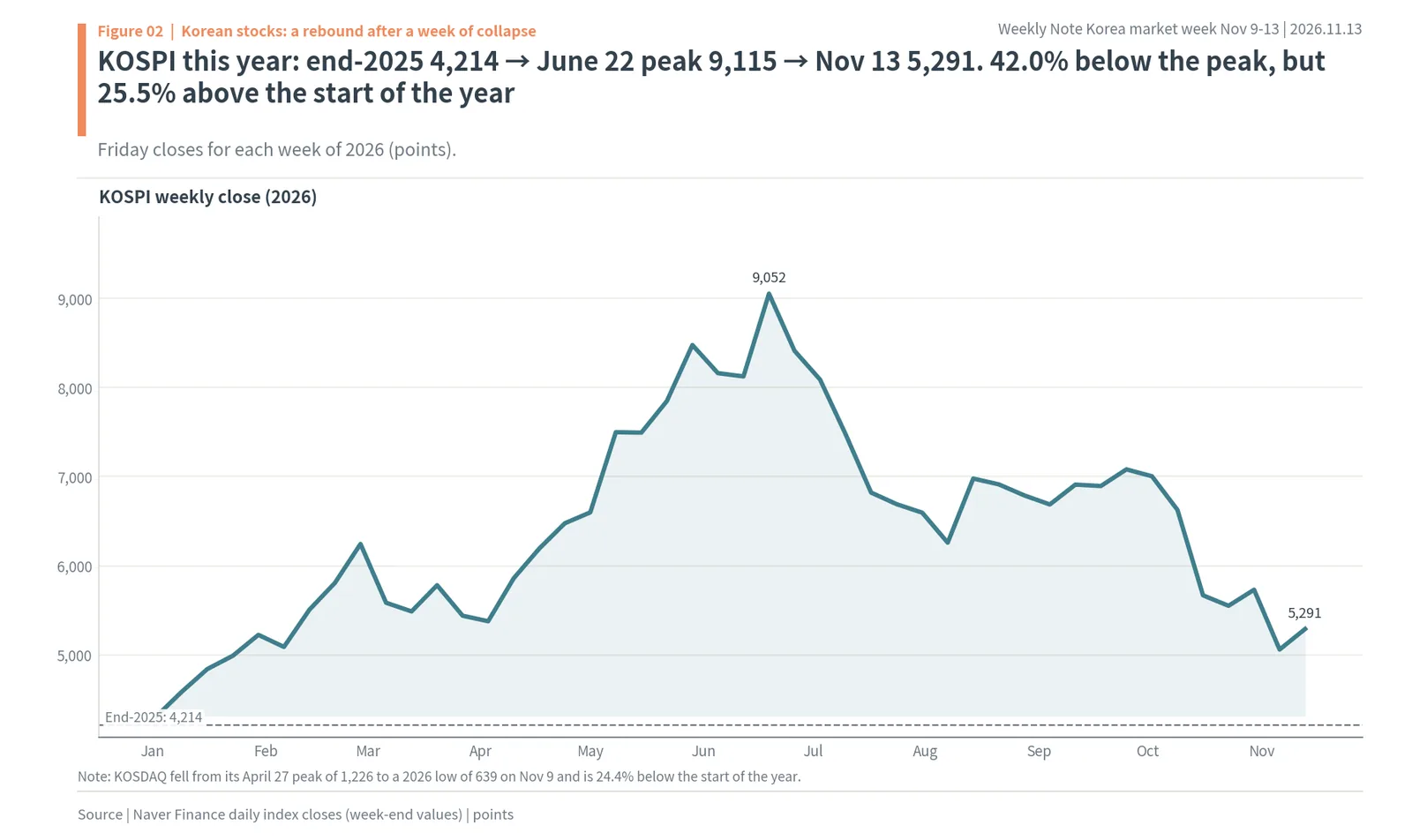
For the year the picture is different. The KOSPI began 2026 at 4,214, peaked at 9,115 on June 22 and now stands at 5,291, which is 42.0% below the peak but still 25.5% above the start of the year. The KOSDAQ peaked at 1,226 on April 27 and is 24.4% below where it started the year.
Weeks like the first week of November are rare. Using Naver Finance daily closes since January 1990, the KOSPI has lost more than 10% from one Friday to the next 24 times, three of them in 2026 (the first week of March, the third week of October and the first week of November). Only 1997–2000, the years of the Asian financial crisis and the dot-com bust, saw that many in a single year. In the 23 earlier cases the following week was positive 16 times, with a median gain of 4.1%; three months later the index was higher in 16 of 22 cases, with a median gain of 17.1%. This week’s 4.6% was an ordinary “next week.” It is history, not a forecast: in 1997–2000 the crashes came in clusters.

2. What drove it: nine-tenths of the gain came from two chipmakers
The conclusion is that this was a chip rebound, not a market rebound. Comparing KRX market capitalizations at regular-session closes on November 6 and 13, the KOSPI gained about KRW 200tn (about $150bn) in value, and Samsung Electronics (common and preferred) and SK hynix supplied 89% of it. Samsung Electronics rose 9.2% to KRW 206,000 (about $154), its preferred shares 13.4%, and SK hynix 7.4% to KRW 1,216,000 (about $910). Grouping the 70 largest stocks by industry, the chip group rose 8.3% by market-cap weight while insurance, biotech and internet fell.
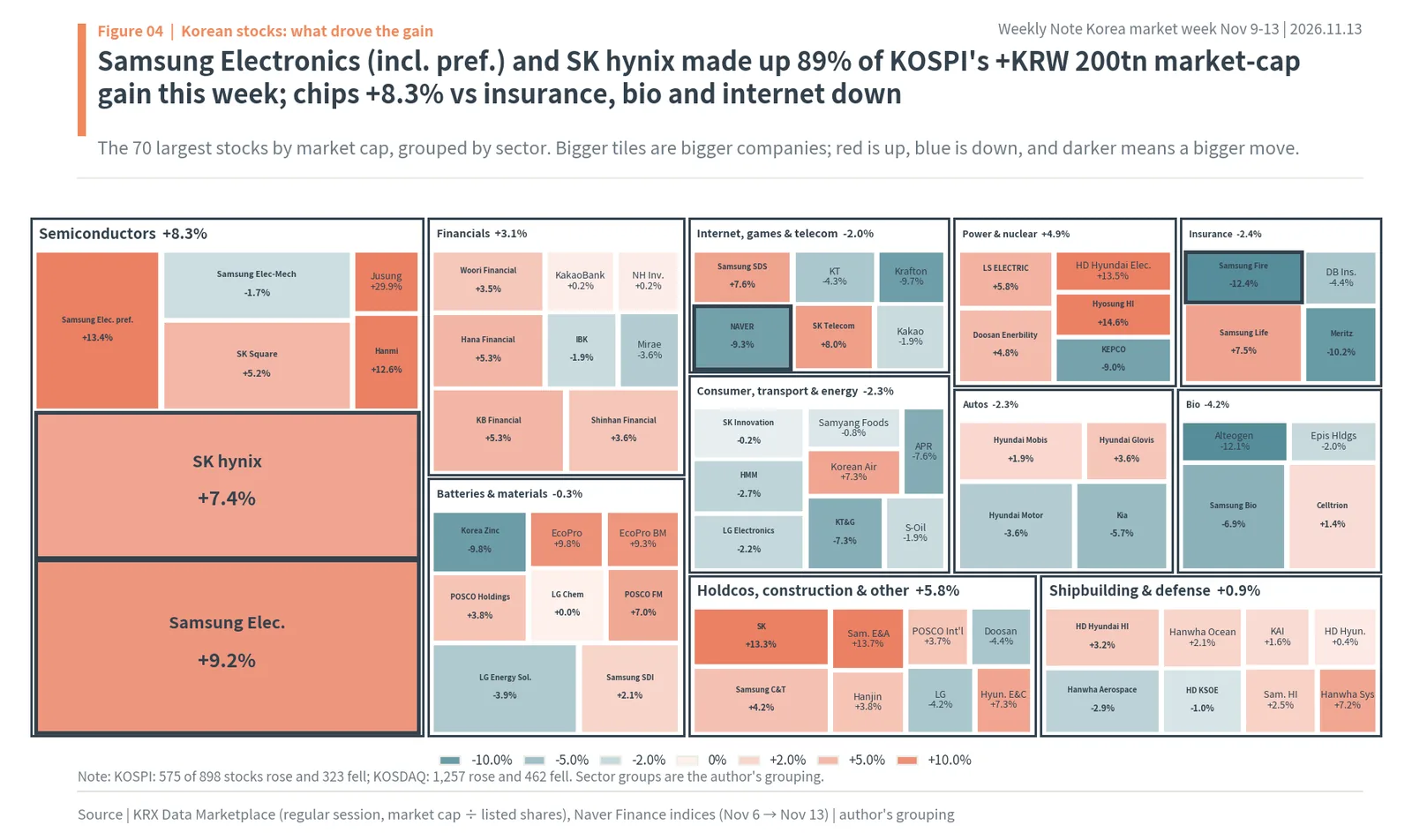
By count the bounce was broader: 575 KOSPI stocks rose and 323 fell, and on the KOSDAQ 1,257 rose and 462 fell. But among the largest non-chip names, LG Energy Solution (-3.9%), Samsung Biologics (-6.9%), Hyundai Motor (-3.6%) and NAVER (-9.3%) all fell.
Three things supported the chip stocks. First, after US chips jumped 6.86% on Monday, analysts in Seoul described Tuesday’s rally as a re-assessment of the previous week’s fear of US data-center regulation. Second, on the same day Morgan Stanley cut its SK hynix target from KRW 2.6mn to KRW 1.6mn and Samsung’s from KRW 381,000 to KRW 309,000 over a possible “2028 earnings cliff” in memory, yet both stocks rose 4.7% and 6.7%; the bank actually raised its 2027 operating profit estimates, and the share prices already implied a worse outcome than its new targets. Third, customs data showed chip exports in the first ten days of November up 331% from a year earlier.
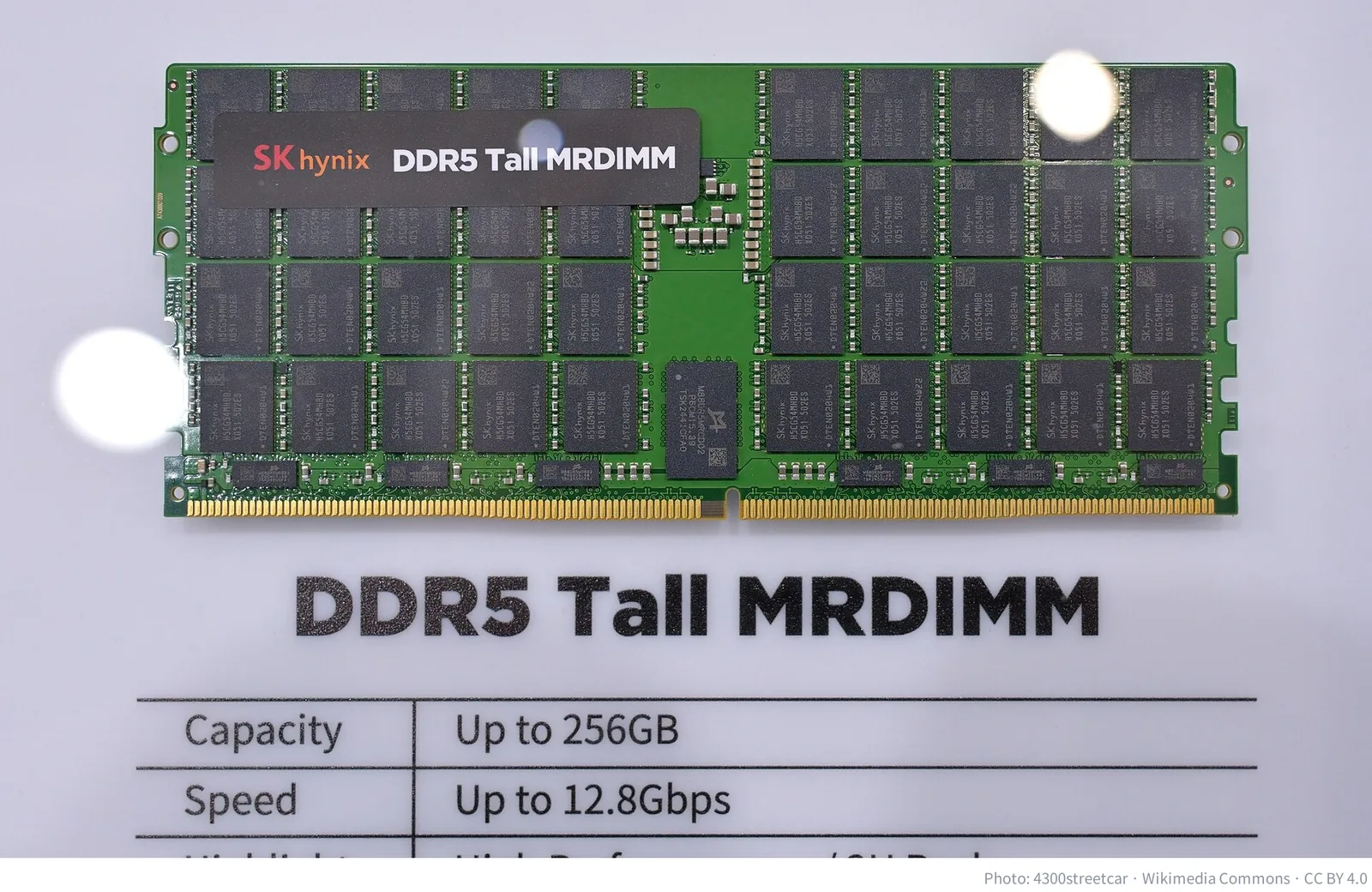
Smaller chip suppliers moved much more. Among stocks worth over KRW 3tn, Isu Petasys rose 42.5%, Simmtech 33.5%, Jusung Engineering 29.9% and Daeduck Electronics 28.2%, all makers of chip substrates, circuit boards or equipment. The biggest losers were in games (NCSoft -14.1%, Krafton -9.7%), insurance (Hyundai Marine & Fire -13.4%, Samsung Fire & Marine -12.4%, Meritz Financial -10.2%) and biotech (Alteogen -12.1%). Alteogen fell 16% on Monday on US drug-pricing worries; E-mart’s quarterly operating profit came in at KRW 46.1bn against an expected KRW 159.5bn; and KEPCO, the state power utility, fell 9.79% on Friday after a third-quarter miss.

KRX sector indexes tell the same story. On the KOSPI, electrical and electronics rose 7.6% and machinery 6.8%, while utilities fell 6.4% and food and beverages 4.8%. On the KOSDAQ the KOSDAQ 150 IT index rose 21.5%, more than twice the KOSDAQ itself. Money went to what had fallen most, not to defensive sectors. Since Samsung and SK hynix make up more than 40% of the KOSPI’s value, weeks like this one can lift the index while most portfolios lag.

3. Who bought: foreigners for three days, retail sold, SK hynix bought itself
The conclusion is that the buying behind the rebound was narrow. Korea publishes net buying by investor type every day, and on the KOSPI foreign investors moved from net selling of KRW 10.4tn in the previous week to net buying of KRW 0.5tn this week. Retail investors went from buying KRW 4.0tn to selling KRW 3.0tn. Institutions were roughly flat. “Other corporations,” the category for non-financial company accounts, bought KRW 2.5tn, and KRW 2.1tn of that was SK hynix.
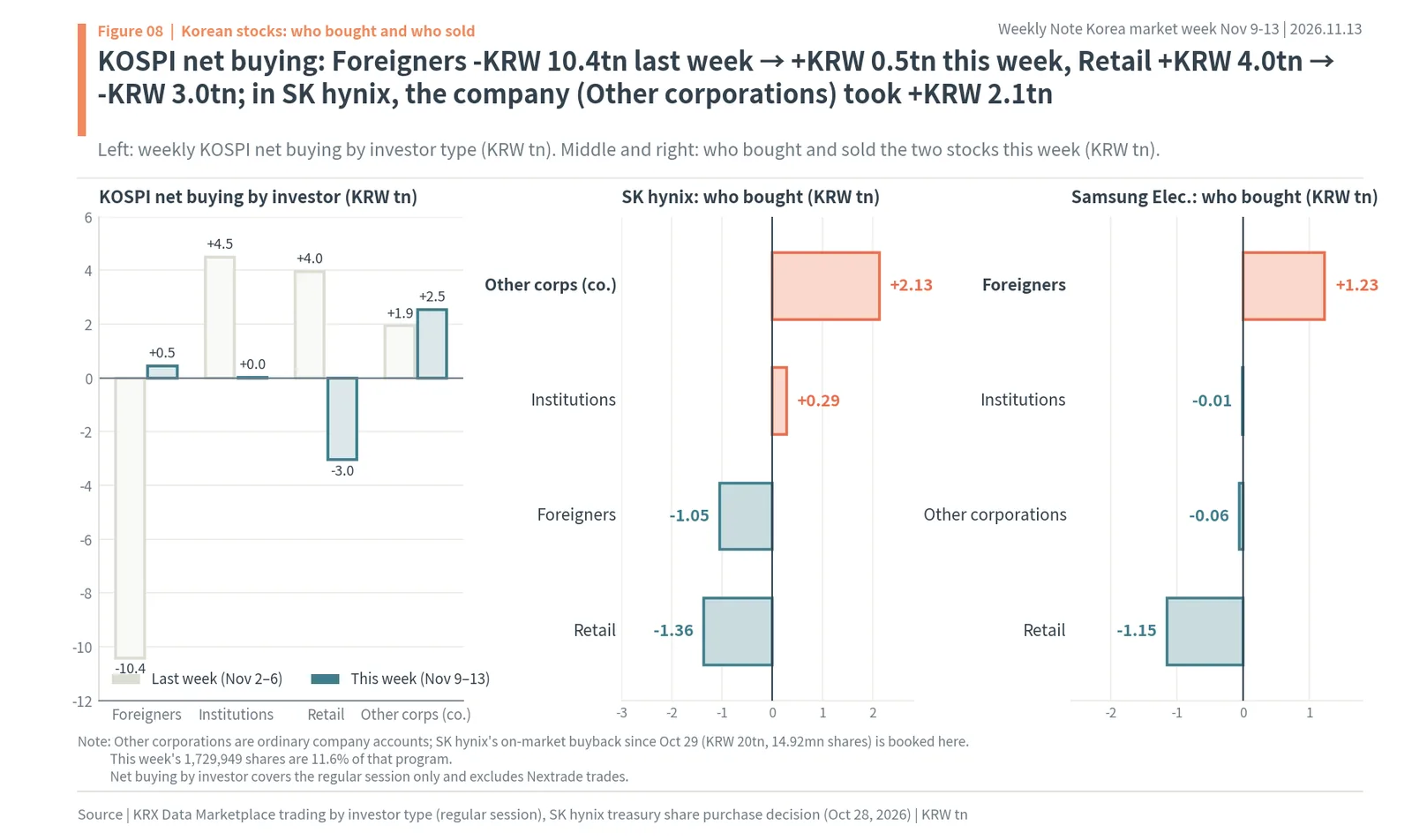
Foreigners sold on Monday, bought from Tuesday to Thursday (Tuesday’s purchase was the first in eight sessions) and sold KRW 0.54tn again on Friday. Retail investors sold for four straight days, including KRW 1.39tn on Tuesday when the index jumped 4.39%, after buying about KRW 2.7tn in the crash on November 5–6.
In SK hynix, foreigners sold KRW 1.05tn and retail KRW 1.36tn, while other corporations bought 1,729,949 shares worth KRW 2.13tn. SK hynix announced on October 28 that it would buy KRW 20tn (about $15bn), or 14.92 million shares, in the open market between October 29 and January 28, 2027, half to be cancelled and half for employee compensation. This week’s buying equals 11.6% of that program (author’s calculation, treating all “other corporations” buying as the company), or about KRW 426bn a day. MSCI will also raise SK hynix’s weight in its Emerging Markets index from 4.41% to 4.52% at the November 30 close. Samsung Electronics was the opposite case: foreigners bought KRW 1.23tn, the most of any KOSPI stock, retail sold KRW 1.15tn, and foreign ownership had just hit 45.93%, the lowest since July 2009.
Margin debt kept shrinking. KOFIA data show margin loans fell from KRW 28.4tn on November 6 to KRW 25.8tn on November 12, down KRW 2.6tn in a week and 33% below the June peak. On November 10 alone the balance fell KRW 1.52tn, the second-largest one-day drop on record, and forced selling reached KRW 63bn, or 5.7% of unpaid trade balances, as accounts that broke their collateral line on November 6 were liquidated two days later.

The Financial Services Commission had suspended the rule requiring brokers to keep margin collateral at 140% for three months from November 9, but brokers applied it differently: some lowered the line to 130%, others offered a one-day grace period. The suspension delays forced selling; it does not reduce the debt.
4. Earnings season: ex-chipmakers, results missed
The conclusion is that the third-quarter season looked good in aggregate and disappointing stock by stock. According to IBK Securities, operating profit for Korean companies with estimates beat consensus by 3.9%, but excluding Samsung Electronics and SK hynix it missed by 1.1%, and 51.5% of companies missed. Kiwoom Securities found that only 47.8% of KOSPI reporters beat (65.2% in the second quarter) and that net profit missed by 19.6%, largely because the won’s 6% rise against the dollar cut export revenue and created currency losses.
Earnings forecasts are rising only in chips. Kiwoom counts the KOSPI’s 2027 operating profit forecast up from KRW 1,347tn to KRW 1,439tn since early October, but chips account for about KRW 118tn of the increase, while the other 25 sectors combined were cut by KRW 7.9tn; 19 of 26 sectors saw downgrades.
This week’s reporters traded almost exactly on their surprise. E-mart missed by 71% and fell 8.05%; KEPCO missed by 37.9% and fell 9.79%; Meritz Financial (-25.8%) fell 13.05%, DB HiTek (-18.7%) 16.36% and Krafton (-17.1%) 9.56%. On the other side, JYP Entertainment beat by 19.2% and rose 16.54%, NHN beat by 9.4% and hit the daily limit-up, and shipping line HMM beat by 59.2% on war-driven freight rates.

There were exceptions. NCSoft beat by 12% but fell 9.19% on worries about its next game; NAVER posted record revenue but missed by 8.5% on a 29.1% jump in AI infrastructure costs and fell 6.43% and then 5.12%. Brokers and insurers lost on investments: the ten largest brokers’ combined net profit fell 83% from the second quarter, and Mirae Asset Securities lost KRW 405.6bn on a SpaceX valuation loss. Quarterly reports are due on Monday, November 16.
5. Chips: exports still booming, targets three times apart
The conclusion is that chip stocks are caught between booming current numbers and fear of 2028. Korea’s October chip exports were up 259.4% from a year earlier, and chip exports for November 1–10 were up 331.2%, nearly half of all exports. TSMC’s October revenue rose 59.7%. Yet for the same SK hynix, Morgan Stanley’s target is KRW 1.6mn while Nomura kept KRW 4.7mn, and the stock trades at KRW 1.216mn, below even the lowest target.

The disagreement is about 2028. Morgan Stanley expects about 4.9GW of data-center capacity planned for 2028 to slip into 2029 and cut its 2028 capacity-growth assumption from 21% to 9%; Nomura argues demand will outgrow supply at least through 2028 and that US permitting will delay rather than cancel projects. Memory prices are splitting the same way: TrendForce reported that makers told distributors they plan further increases for enterprise memory, while consumer DDR5 module spot prices in China fell below contract prices. The next clues are Nvidia’s results on November 18 (Korea time), the November DRAM contract price around November 30 and November exports on December 1.
6. Korean policy and politics: slow rules, impatient market
The conclusion is that this week’s policy was about rules, not money, and the market wanted money. On Friday morning President Lee Jae-myung held a capital-markets meeting at the Korea Exchange in Seoul’s Yeouido district and said that “the biggest device for normalizing the market is hostile M&A.”

He ordered a full review of devices that block hostile takeovers, including what he suggested was implicit protection by regulators, asked officials to consider delisting “private-company-style” listed firms whose free float is under 10%, and leaned toward the 50%-plus-one-share version of a mandatory tender offer bill, saying he would choose “growing the pie even if we get criticized.” KRX chairman Jeong Eun-bo said listed companies would be required to hold at least one investor-relations meeting a year. On a proposed market-stabilization fund, the president said only that “the direction seems right.” With no immediate measures, the KOSDAQ gave back a 4% intraday gain and the KOSPI closed down 0.98%.
The rest of the week was busy. On November 9 the margin-collateral suspension took effect. On November 11 Korea’s Fair Trade Commission fined ten brokers and five banks a combined KRW 1.6tn (about $1.2bn) for rigging government bond auctions, the largest share falling on KB Securities, NH Investment & Securities and Mirae Asset. On November 12 the president attended a groundbreaking for Samsung Electronics’ KRW 6tn HBM packaging plant in Asan, and regulators denied rumors of an extra KOSDAQ support package.
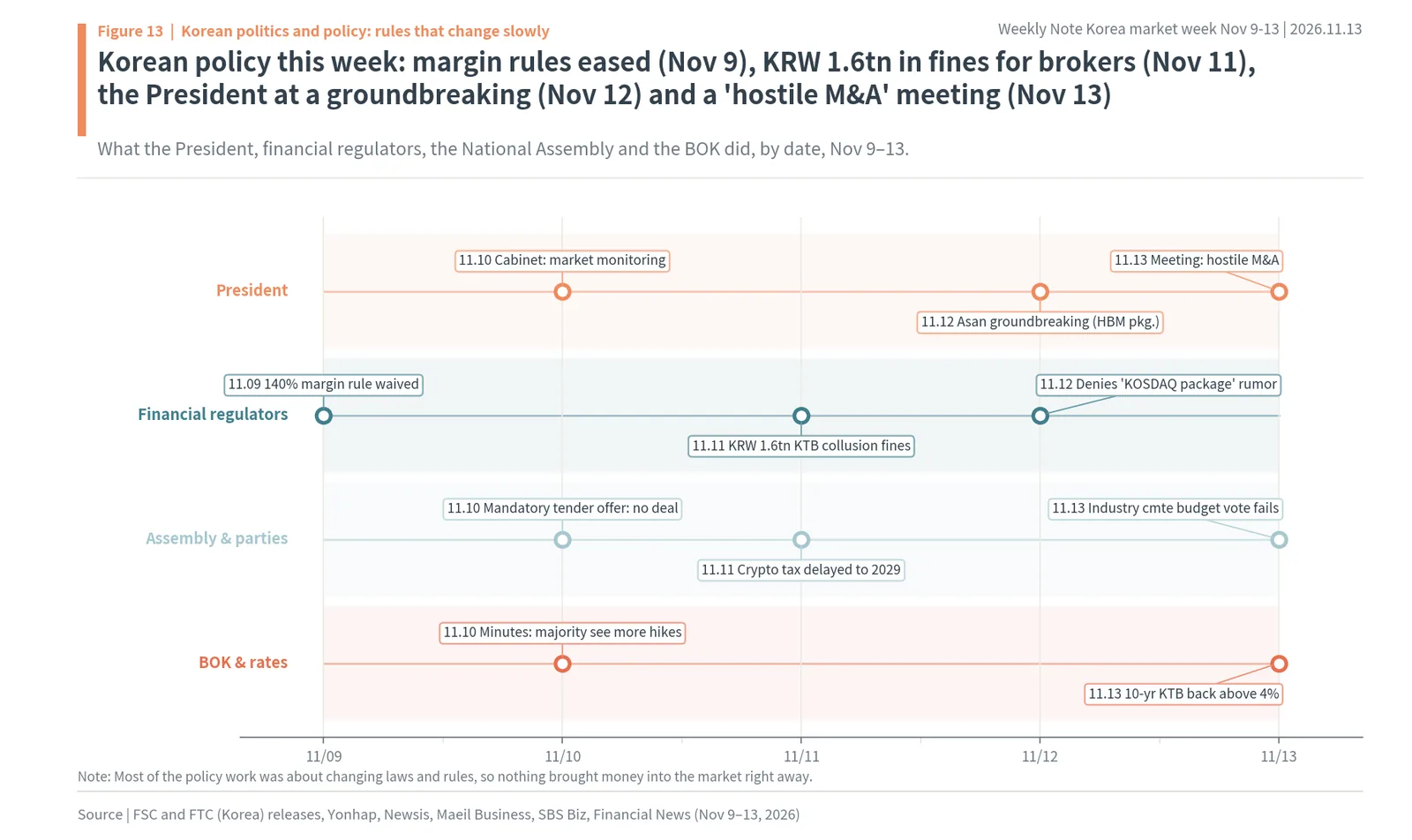
The Bank of Korea’s policy rate is 3.00%; minutes of its October meeting showed a majority favoring further hikes, October household lending jumped KRW 6.4tn, and the 10-year government bond yield rose back above 4% (3.853% to 4.001%). The next decision is November 26. In parliament, the KRW 820.9tn 2027 budget is stuck on a KRW 162tn “future response fund” and a southwest chip-cluster project, with a December 2 legal deadline, while a special-prosecutor bill passed by the ruling Democratic Party awaits promulgation and the opposition People Power Party protests outside the presidential office. Lawmakers agreed to delay taxing crypto gains to 2029.
7. Retail rules, IPOs and housing: debt delayed, new listings and Gangnam cooling
The conclusion is that every place where retail investors touch the market sent a cautious signal. Single-stock leveraged ETFs (products that double the daily move of Samsung or SK hynix) now require KRW 30mn in cash, training and mock trading, and their trading value fell 94.4% after the rules took effect; retail losses topped KRW 6.3tn. A change to a 20-share trading unit was expected in November but no start date had been announced by November 14. A “cornerstone investor” system that gives long-term institutional holders priority in IPOs began on November 13, and a bill to stop controlling shareholders from depressing share prices to cut inheritance tax still has three competing versions.
IPOs have been brutal. Of three KOSDAQ debuts this week, only Dongwon Parts (institutional demand 841-to-1, priced at the top of its range) was above its offer price on November 13 (+1.7%). Barofarm, priced at the bottom of its range with almost no lock-up commitments, ended 47.4% below its offer, and Nexi fell 39.9% on its first day. Of 48 companies listed this year, 44 trade below their IPO price, an average of -41.5%. Next week’s three listings drew demand of about 1,000-to-1, but lock-up commitments are under 10%.
Housing is cooling from the top. Seoul apartment prices rose 0.07% for a 92nd straight week, but Songpa, Seocho, Gangnam and two other districts fell, while outer districts rose. Housing minister Hong Ji-sun said piling listings and falling transactions “can be seen as a signal that prices may be entering a downturn.” Bank household loans passed KRW 1,200tn for the first time, and variable mortgage rates now exceed fixed rates.
8. Global markets: chip countries led, Nvidia alone fell
The conclusion is that the rest of the world also had a chip rebound, but Nvidia went the other way. Taiwan’s TAIEX rose 10.0%, the KOSDAQ 8.6%, the Philadelphia Semiconductor Index 8.1% and Japan’s Nikkei 6.5%; only Hong Kong’s Hang Seng (-3.5%) and Shanghai (-0.4%) fell. The S&P 500 (+2.5%), Nasdaq (+2.3%) and Dow (+2.1%) all had their best week since early August. Measured from 2026 highs, though, Korea is deepest: the KOSDAQ is 43% and the KOSPI 42% below their peaks.
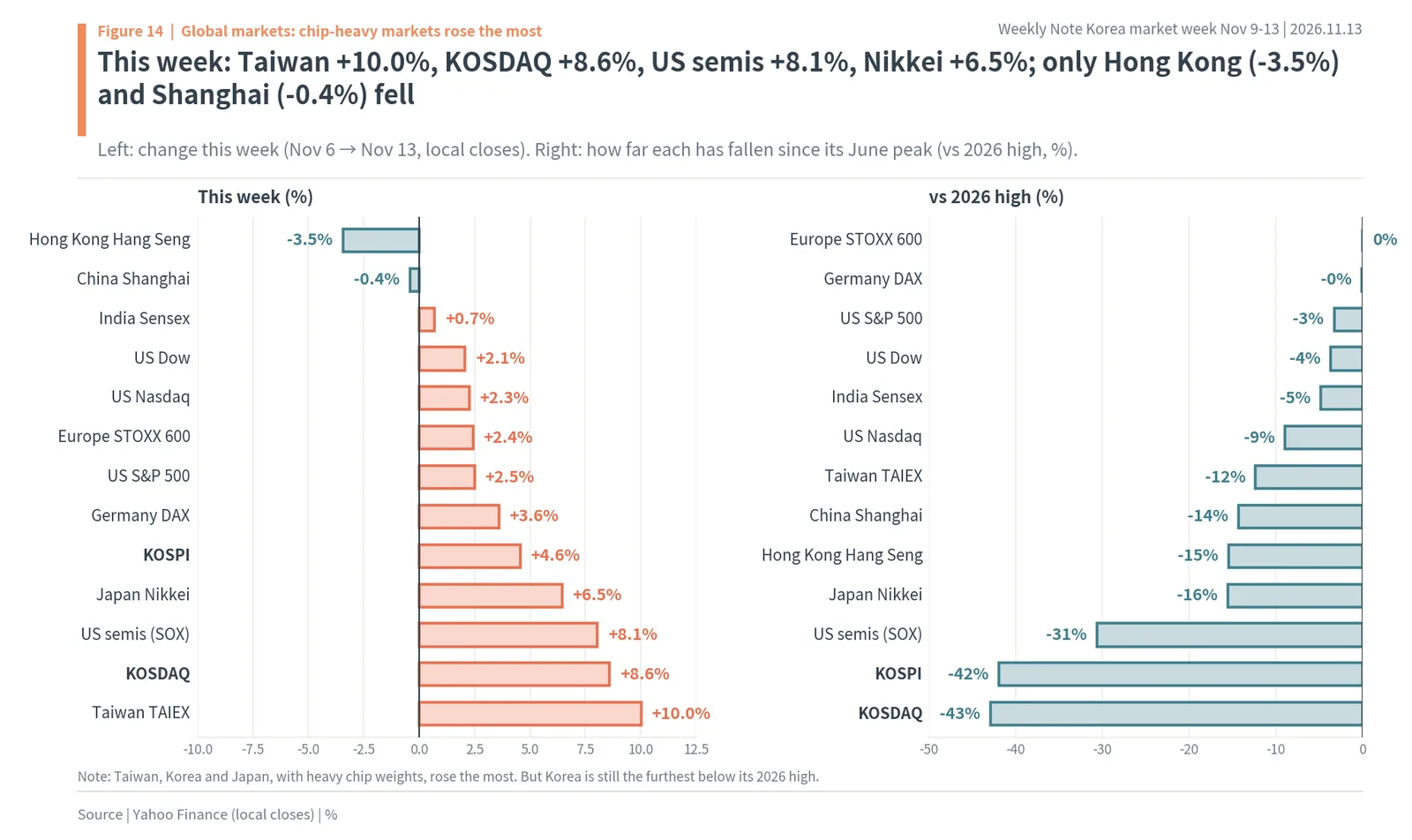
Within chips, AMD rose 18.9%, Broadcom 18.2% and Micron 12.8%, while Nvidia fell 12.8%. On November 12 Nvidia said in an SEC filing that Jensen Huang had resigned as president, CEO and director, ending a 33-year tenure, with CFO Colette Kress as interim CEO. On November 8 Huang had admitted an affair in an email to staff, and the board opened an independent review of whether he was the target of a foreign intelligence effort, after reports that US intelligence believed a woman close to him passed information to Beijing. There is no public evidence that he knowingly helped China; Singapore found insufficient evidence of a crime and China denied the claims.
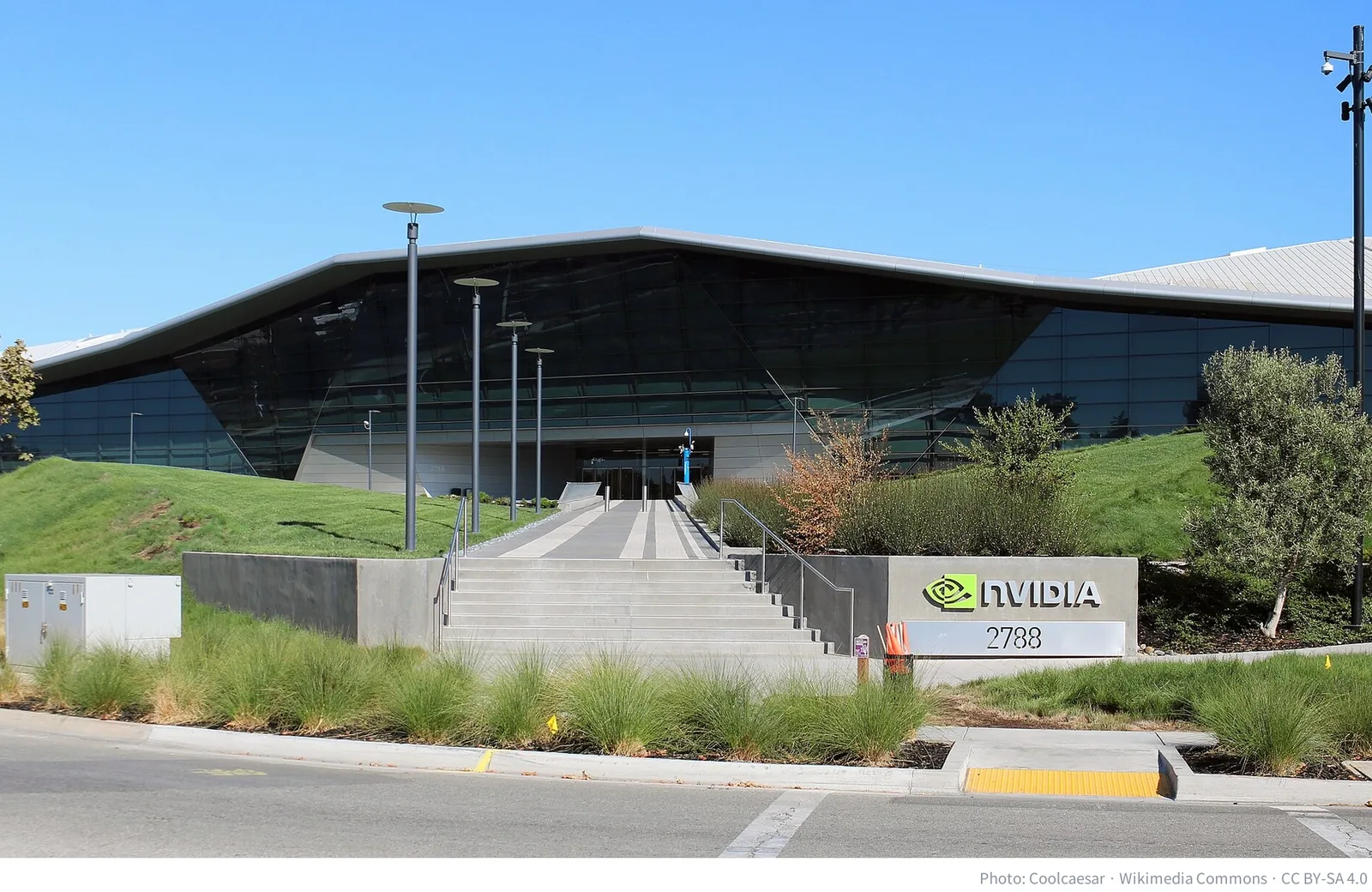
Money moved inside the chip sector rather than out of it. CoreWeave’s revenue rose 168% with a USD 132.5bn backlog and its stock jumped 24.7%; TrendForce expects AMD’s AI server share to approach 10%. But the scandal is spreading into rules: Treasury Secretary Scott Bessent said other agencies had wanted Megaspeed on the export blacklist for months, senators asked Commerce Secretary Howard Lutnick for Nvidia export-license records, and a draft rule would require licenses for Blackwell-class chips in seven Southeast Asian countries. Nvidia reports on November 17 (US time), 7 a.m. on November 18 in Korea.

9. Rates and currencies: stocks up, yields up
The conclusion is that rates rose against the stock rally. US October CPI rose 0.4% on the month (0.3% expected) and core CPI 0.3% (0.2% expected), and futures moved to price a December Fed hike with certainty. The Fed, chaired by Kevin Warsh, already raised rates in September to 3.75–4.00%, and Governor Christopher Waller said a 50bp move could be considered if inflation worsens.
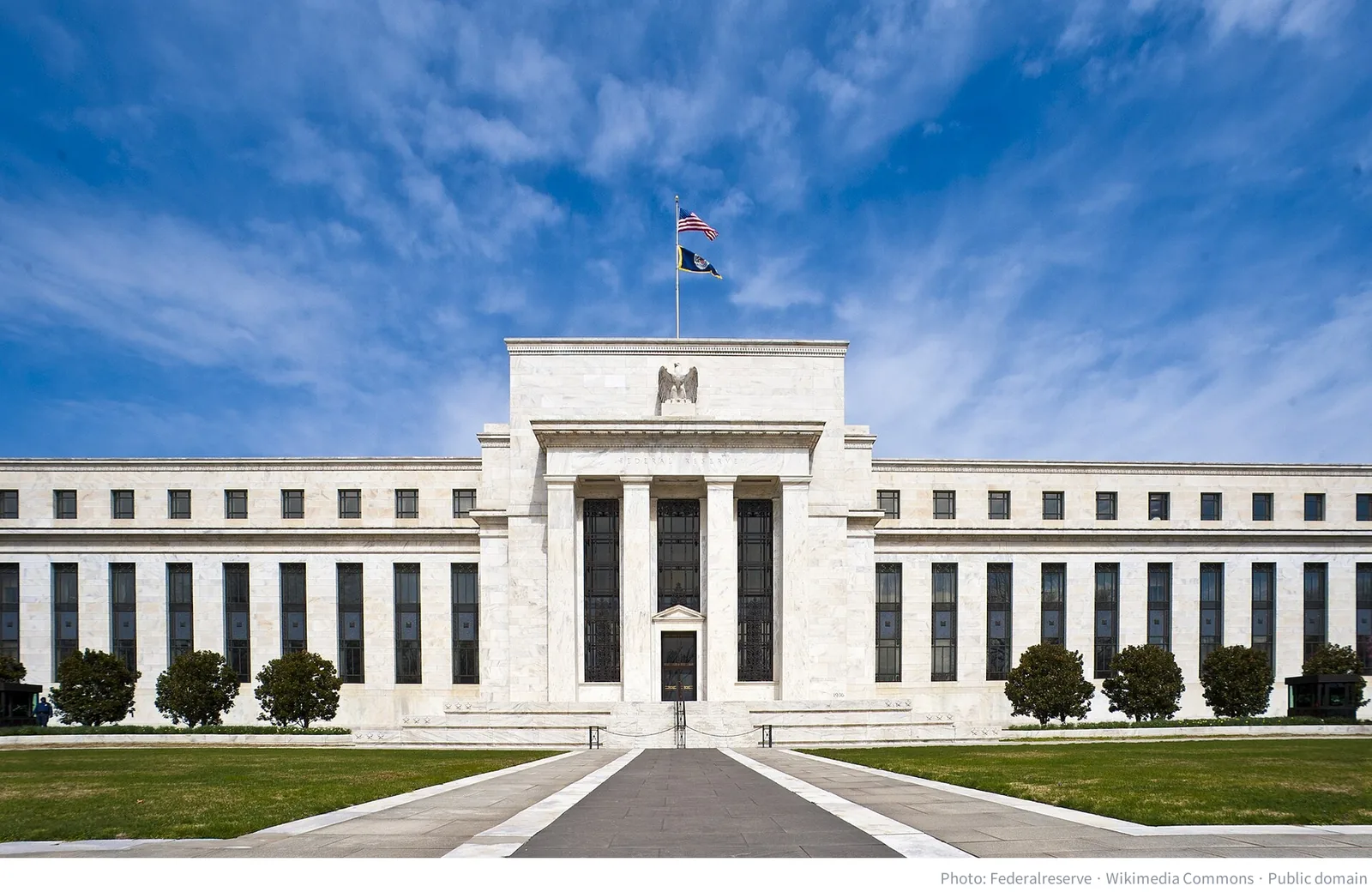
The 10-year Treasury yield rose from 4.86% to 5.15% (+29bp) and the 2-year from 4.51% to 4.88%, so expectations of Fed hikes, not growth, drove yields; Treasuries had their worst week since April 2025. The won strengthened, with the dollar falling from KRW 1,356.6 to KRW 1,336.7 at the 15:30 Seoul close, as chip-export dollars flowed in. The yen weakened to ¥159.9 per dollar and gold fell 4.6%.

The yen briefly passed ¥160 on November 12–13, and Finance Minister Satsuki Katayama warned against “one-sided and rapid moves.” Japan spent a record ¥15.4tn on intervention in July–August. The Bank of Japan’s 1.25% rate is the highest since 1995, and a survey shows 83% of economists expect a hike to 1.5% in December.

10. Commodities, crypto and the data
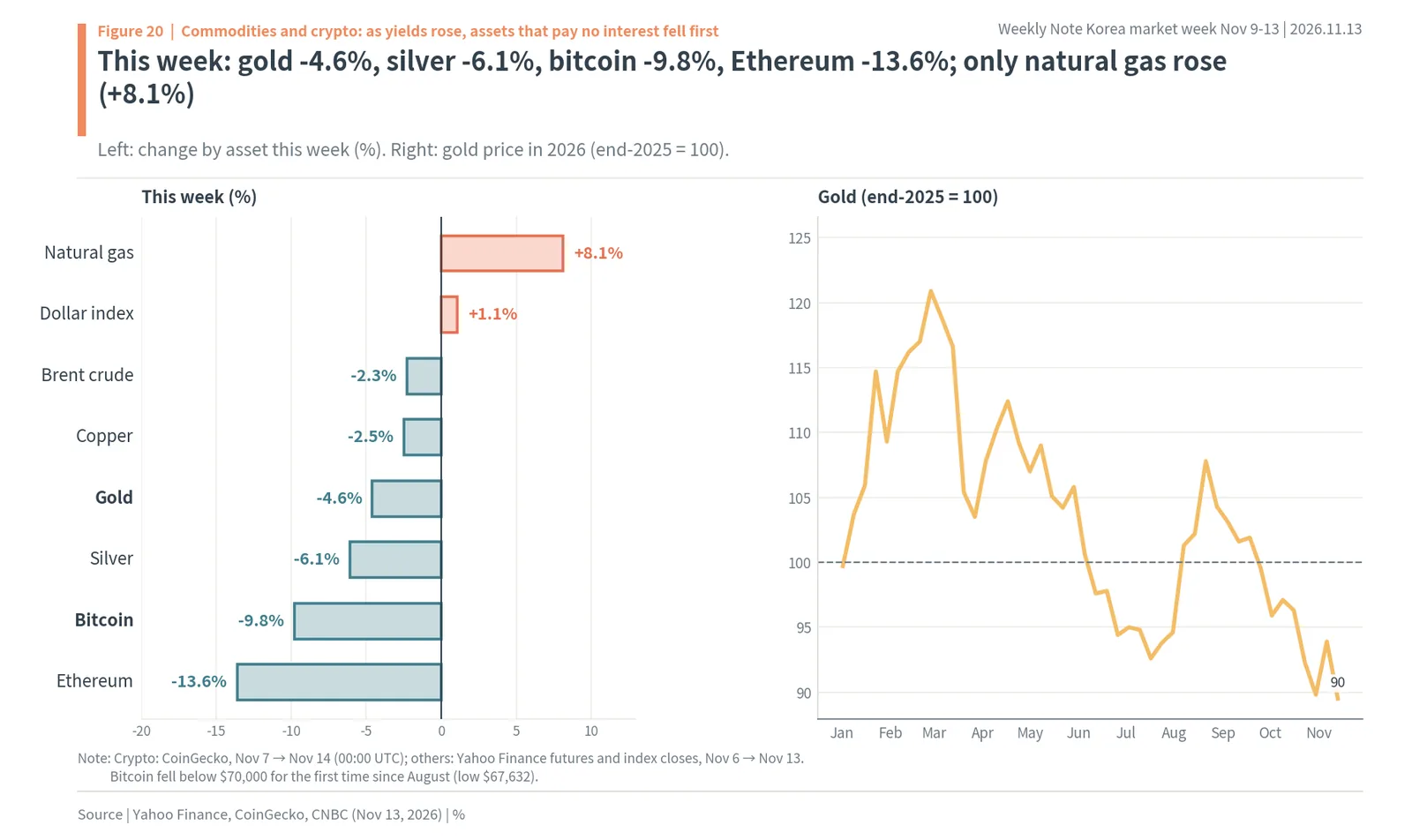
The conclusion is that rising rates hit assets that pay no interest first. Gold fell 4.6% and silver 6.1%; Bitcoin fell 9.8% and dropped below $70,000 for the first time since August, and Ether fell 13.6%. Only natural gas rose (+8.1%).
In the US, October producer prices rose 0.3% (0.4% expected) but 6.5% from a year earlier, and existing-home sales fell to the lowest since 2010. China’s October producer prices rose 5.7% while consumer prices rose only 0.7%. In Korea, early-November exports were the highest on record for the period, and still up about 41% excluding chips, but October youth employment fell for a 48th straight month and construction jobs for a 30th, and the government upgraded its view to “solid growth” mainly on exports.
11. US politics: two lame-duck months
The conclusion is that the midterms block laws but leave tariffs and executive orders in place. Democrats won both chambers on November 3, but the new Congress sits in January; until then a Republican-majority lame-duck Congress must pass funding before a stopgap expires on December 11, or parts of the government shut down from December 12.

States whose governors have promised or imposed pauses on data-center approvals hold 41% of planned US capacity, though analysts expect conditional approvals in 2027. No new tariff actions came this week, but a Section 301 investigation into manufacturing overcapacity is due by year-end. For Korea, Seoul’s nuclear-submarine plans may also face a harder Congress, since military nuclear fuel would need a separate agreement and 60 days of congressional review.
12. Geopolitics: the war is “over,” the blockade is not
The conclusion is that oil moved more on Trump’s words than on events. The US-Israel war with Iran began on February 28 with no formal ceasefire since, and a US naval blockade around the Strait of Hormuz continues.

On November 9 Trump said “Iran militarily is effectively over,” and Brent fell 5.85% to $92.57, its lowest since late August. On November 12 he wrote, “We’ve got their money, Hundreds of Billions of Dollars, and we’ve got their Strait!”, and Brent rose 3.3% to $95.82 as Houthi rebels claimed attacks on Saudi oil facilities. Brent was $72 before the war and nearly $118 on October 30. Korean airlines and builders rallied on Tuesday’s oil drop and airlines fell back on Friday.

The US and China extended their trade truce to January 10, 2027, and China delayed enforcement of sanctions on five US units of Hanwha Ocean to the same date. APEC leaders meet in Shenzhen on November 18–19, where Trump will hold talks with Xi Jinping and then a first-ever US-China-Russia meeting with Xi and Putin on nuclear arms reduction. Russia and Ukraine agreed only on a prisoner exchange in Abu Dhabi, and North Korea threatened a “show of force” over Seoul’s nuclear-submarine plan while a US official said Trump has no plan to meet Kim Jong Un.
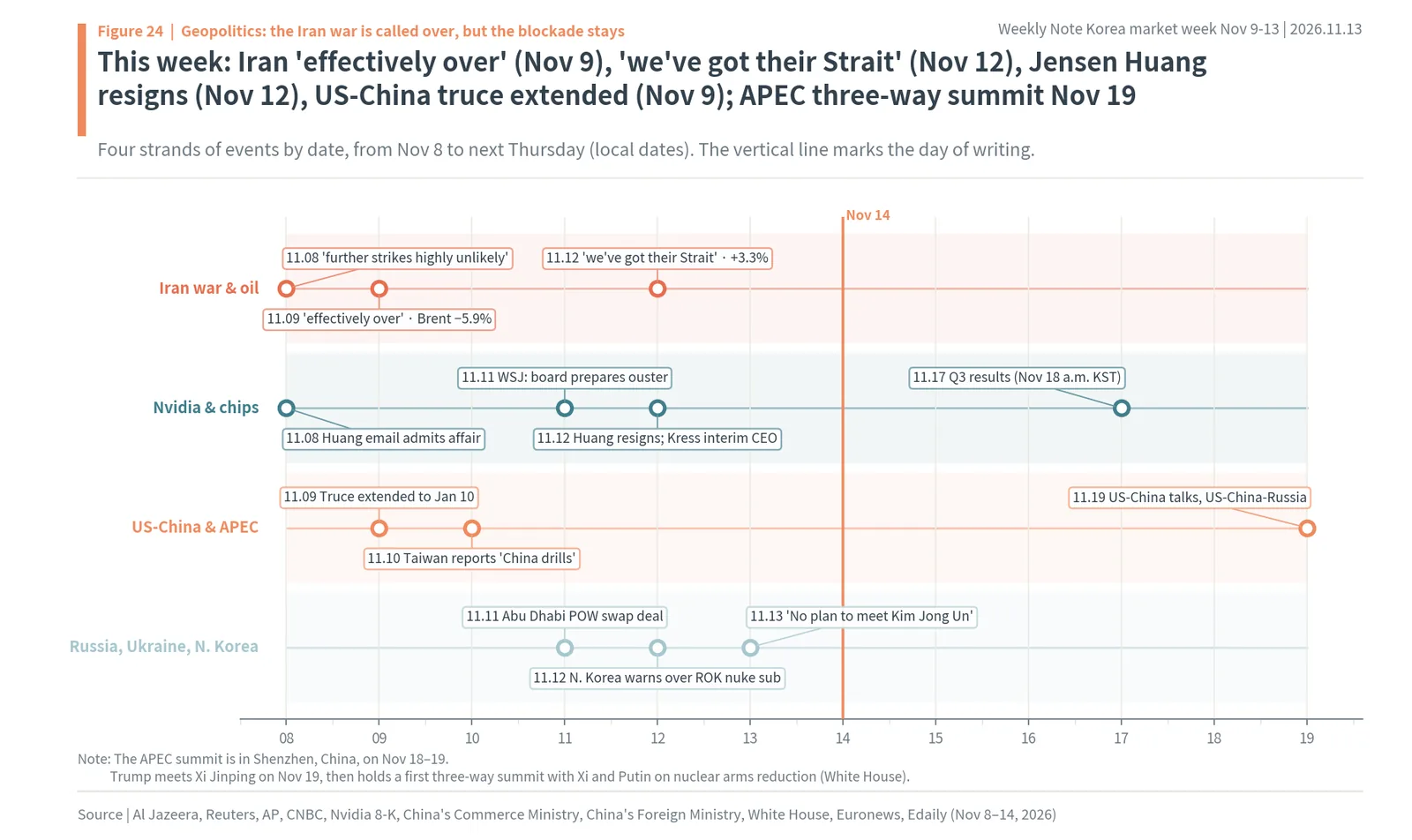


13. Sectors at a glance
Weighted by market cap among the 70 largest stocks, chips rose 8.3%, holding companies and builders 5.8% and power equipment 4.9%, while biotech fell 4.2% and insurance 2.4%. Power-equipment makers Hyosung Heavy Industries (+14.6%) and HD Hyundai Electric (+13.5%) rebounded but remain far below their May highs; batteries were flat after swinging on Monday; airlines, builders and refiners traded on oil; defense stocks have fallen about 24% in a month on hopes of a Ukraine settlement.

14. Next week: Nvidia, the exam-day open, APEC and November 26
The conclusion is that this week’s homework gets graded over the next two weeks. The signals to watch are whether foreigners keep buying beyond chips, whether margin debt stabilizes around KRW 25tn, the US 10-year (5.15%) and Korean 10-year (4.00%) yields, Brent ($96), the won (KRW 1,336.7), Nvidia’s interim leadership and how fast Korea’s policy orders turn into rules.

Nvidia reports early on November 18 Korea time. On November 19 Korea’s college entrance exam delays the market open to 10 a.m. (close 4:30 p.m.), the FOMC minutes come out, Trump meets Xi in Shenzhen and Anthropic is expected to list on the Nasdaq. On November 26 the Bank of Korea decides rates, the same day as the last date to buy SK hynix for its KRW 20,000 third-quarter dividend, and MSCI changes take effect on November 30.
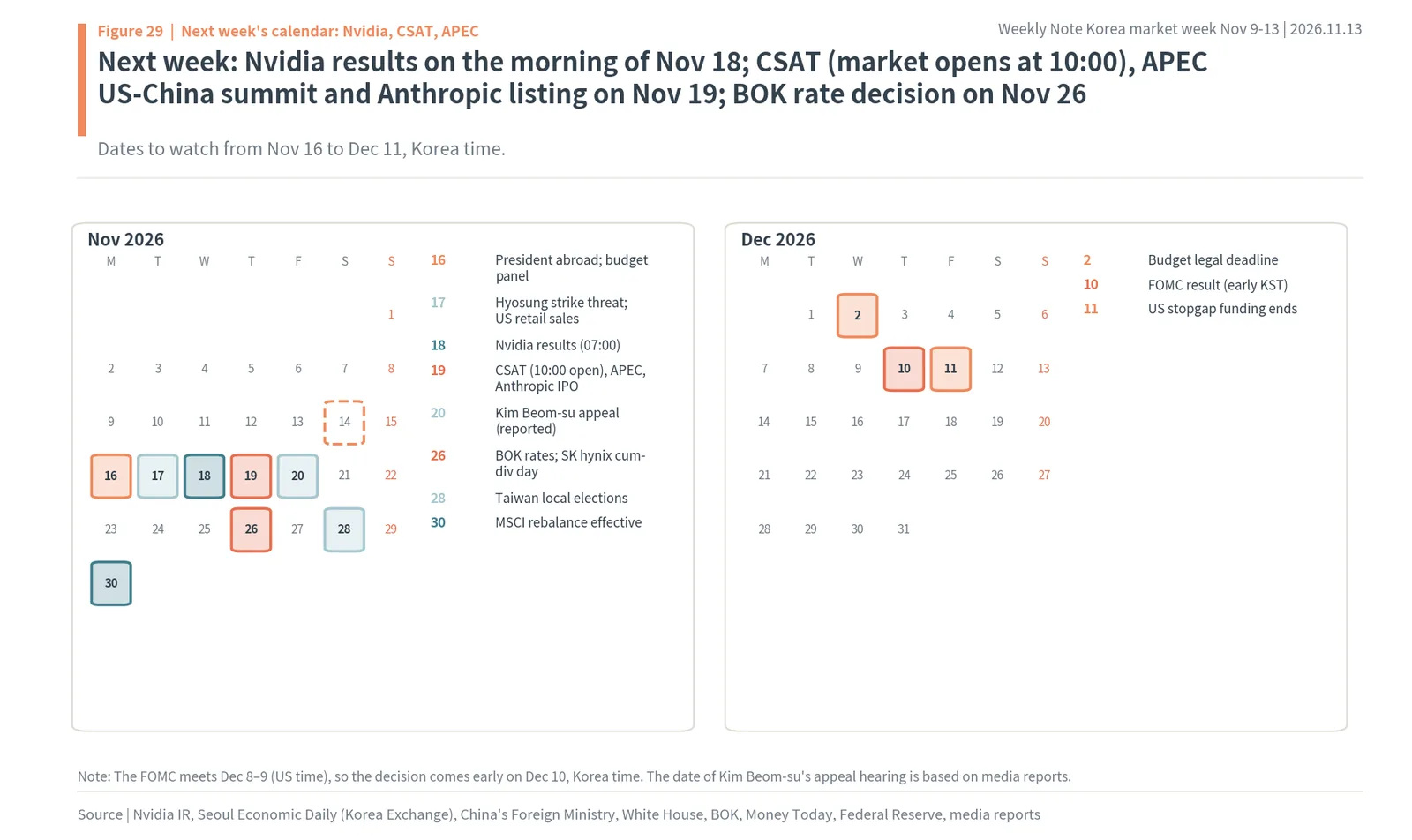
15. What it means for your portfolio
This is a checklist, not a recommendation. Holders of the big chipmakers should watch Nvidia, the November DRAM contract price and exports; SK hynix has buyback and index demand through month-end. Margin borrowers should check their own broker’s collateral rule, since it differs by firm. Growth and crypto holders face two rate decisions, on November 26 in Seoul and December 9 in Washington. Refiners and airlines should be judged on Hormuz traffic and ship attacks rather than presidential posts. IPO buyers should look at lock-up commitments, not oversubscription. Holders of foreign stocks should remember that a stronger won shrinks their value in won, and that one Japanese intervention can swing Asian currencies.
Calculation notes
Korean weekly returns use KRX market capitalization divided by listed shares at regular-session closes, because some quote feeds mix in after-hours Nextrade trades. Investor flows are KRX regular-session data; foreign flows add “foreigners” and “other foreigners.” Treating all “other corporations” buying of SK hynix as the company’s buyback is an interpretation supported by the October 28 filing and a November 9 press report. Overseas prices are Yahoo Finance local closes; the won rate in the text is the Seoul 15:30 close. Unverified claims about Jensen Huang, chip diversion and tanker explosions are not treated as facts.
Korea stock market week of Nov 9–13, 2026: quick answers
Q. How did the KOSPI do in the week of November 9–13, 2026?
The KOSPI rose 4.6% from 5,060 to 5,291 after falling 11.7% the previous week, and the KOSDAQ rose 8.6% after hitting its 2026 low of 639 on Monday. The KOSPI is still 42% below its June 22 peak of 9,115 but 25.5% above the end of 2025.
Q. Who bought Korean stocks this week?
Foreign investors bought a net KRW 0.5tn after selling KRW 10.4tn the week before, buying from Tuesday to Thursday and selling again on Friday. Retail investors sold KRW 3.0tn. In SK hynix, foreigners and retail sold more than KRW 2tn, which was absorbed by the company’s KRW 20tn open-market buyback.
Q. Why did Nvidia fall while other chip stocks rose?
Jensen Huang resigned as Nvidia’s president, CEO and director on November 12 after admitting an affair and amid an internal review of whether he was targeted by a foreign intelligence effort. Nvidia fell 12.8% for the week while AMD rose 18.9% and Broadcom 18.2%. There is no public evidence that he knowingly helped China.
Q. Why did US Treasury yields rise?
US October CPI rose 0.4% on the month against 0.3% expected, and futures moved to price a December Fed hike with certainty. The 10-year yield rose from 4.86% to 5.15% and the 2-year from 4.51% to 4.88%.
Q. What did President Lee Jae-myung say about hostile M&A?
At a capital-markets meeting at the Korea Exchange on November 13 he said hostile M&A is the biggest device for normalizing the market, ordered a review of anti-takeover devices, asked officials to consider delisting firms with less than 10% free float, and leaned toward a 50%-plus-one-share mandatory tender offer.
Q. What are the key dates next week?
Nvidia reports early on November 18 Korea time; on November 19 the college entrance exam delays the Korean market open to 10 a.m., the FOMC minutes are released and Trump meets Xi Jinping at APEC in Shenzhen; the Bank of Korea decides rates on November 26.
Sources
- Templeton quote: Barry Popik, The Big Apple (link)
- Market data: KRX Data System, Naver Finance, Bank of Korea ECOS, KOFIA, Yahoo Finance, US Treasury yield curve, CoinGecko; author’s calculations
- Korean market news: Yonhap market close reports, Nov 10–13, 2026 (https://n.news.naver.com/mnews/article/001/0016433983, https://n.news.naver.com/mnews/article/001/0016441075); Money Today weekly wrap, Nov 14 (link)
- SK hynix buyback filing (Oct 28, 2026); Money Today on corporate buying (link)
- Earnings season: IBK Securities via Financial News, Nov 13 (link); Kiwoom Securities via Edaily, Nov 12 (link)
- Chips: Korea Herald on Morgan Stanley and Nomura, Nov 11 (link); TSMC October revenue (link); TrendForce (link)
- Policy: Newsis and Maeil Business on the Nov 13 meeting (https://n.news.naver.com/mnews/article/003/0014320382, https://n.news.naver.com/mnews/article/009/0005763489); FSC release (link); Financial News on the bond-auction fine (link)
- IPOs and housing: Bizwatch (link); Yonhap (link); Newspim on Korea Real Estate Board data (link)
- Nvidia: SEC 8-K (link); AP via PBS (link); CBS (link)
- US macro: Reuters via Star-Advertiser (link); CNBC (link); Federal Reserve (link)
- Japan: Reuters via The Standard (link)
- US politics: Atlanta News First (link); Cleanview (link)
- Iran war and oil: Al Jazeera (link); Reuters via AsiaOne (link)
- US-China and APEC: The National (link); Anadolu (link)
- Photos: Dietmar Rabich (CC BY-SA 4.0), hyolee2 (CC BY-SA 3.0), 4300streetcar (CC BY 4.0), Coolcaesar (CC BY-SA 4.0), Federal Reserve (public domain), Wiiii (CC BY-SA 3.0), Architect of the Capitol (public domain), Ank Kumar (CC BY-SA 4.0), Ermell (CC BY-SA 4.0), Clay Gilliland (CC BY-SA 2.0), Wikimedia Commons
Was this note useful?
Thanks. Your answer helps decide what to cover next.
Korea market snapshot · Nov 27, 2026
New to Korean stocks? Start here for the basics.
Most read this week
5Bank of Korea Holds Rate at 3.00%: Why a 0.12pp Real Rate Points to a November Hike (2026)
Get the Saturday note on Korean stocks
One email every Saturday with the week’s new research on Korean listed companies and links to the updated data pages. Built from DART filings and KRX data. Free; unsubscribe in one click. See past issues