Korea Investment Holdings (071050.KS) Stock: Chairman Kim Nam-goo’s 5 Habits and What They Say About Dividends, KakaoBank and Succession
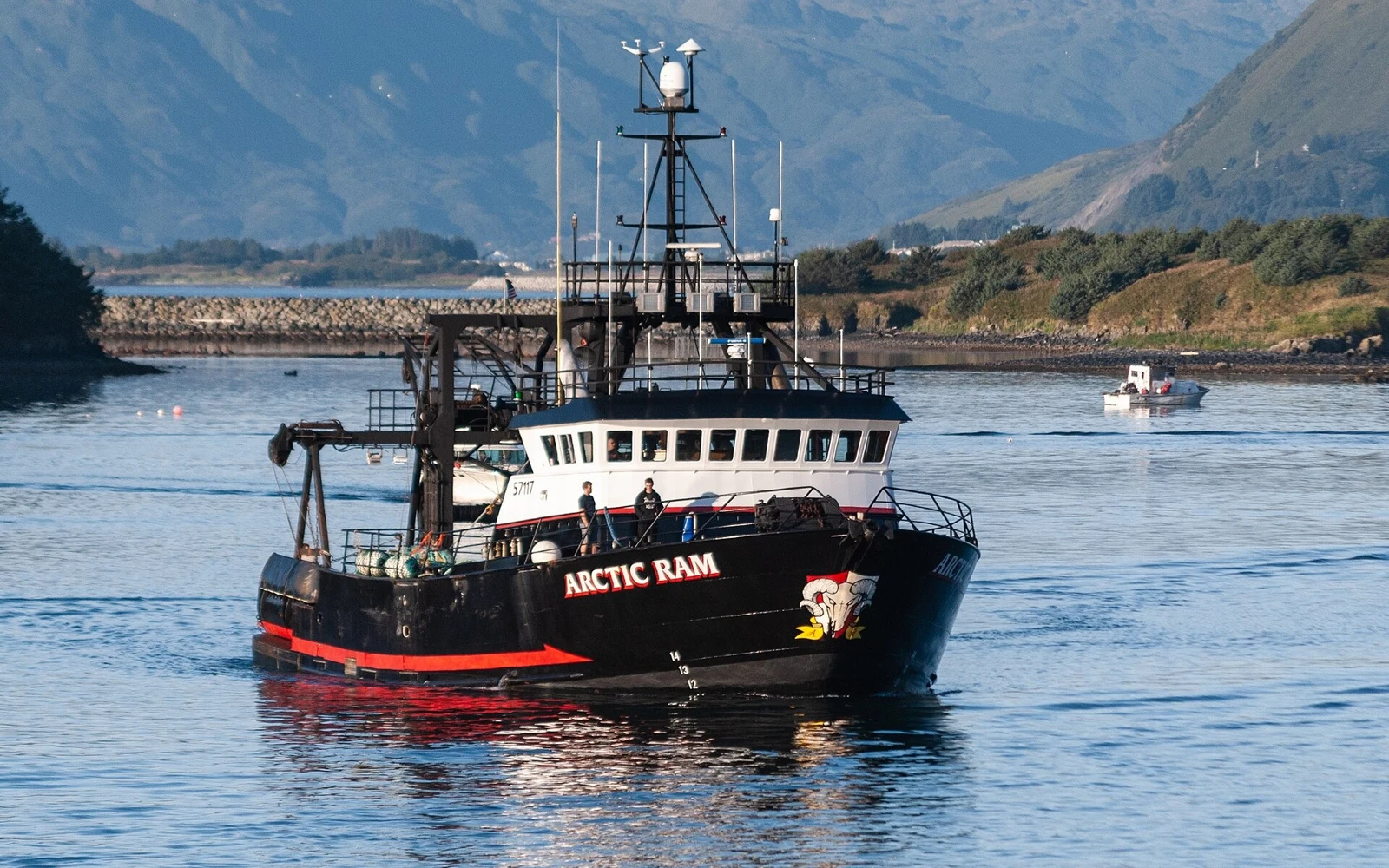
In 1987 a young man who had just finished business school at Korea University boarded a pollock trawler heading into the seas off Alaska. For four months he hauled nets for about sixteen hours a day, according to interviews he gave years later (one account says eighteen hours, and dates the trip to the winter of 1986). His father, Kim Jae-chul, had started out as an unpaid trainee navigator on Korea’s first deep-sea fishing boat and went on to found the Dongwon Group, best known in Korea for canned tuna. The father liked to say that “hardship is the one thing you do not want to give your children but must.” Whether the son’s voyage was the father’s idea or his own is told both ways. What is clear is that after the boat he worked two years as an ordinary employee at Dongwon Industries and in 1991 joined a mid-sized brokerage, Hanshin Securities, as an assistant manager at its Myeongdong branch.
That young man is Kim Nam-goo, today chairman and largest shareholder of Korea Investment Holdings (KRX: 071050), the financial group behind Korea Investment & Securities. The group earned KRW 2.02tn (about $1.51bn) of net profit attributable to owners in 2025, had KRW 152.9tn of assets at the end of September 2026 and manages KRW 576.6tn for clients. This report asks three questions. How was the company built, and by whom? What do the words and decisions of the people who run and influence it say about their values? And if those habits hold, what will the company most likely do about dividends, its KakaoBank stake, an insurance acquisition and the handover to the next generation?
This report is the English edition of the author’s Korean note on the people behind Korea Investment Holdings.
As of: November 11, 2026 (share price: KRX regular-session close of KRW 121,500, about $91). Company figures come from Korea Investment Holdings’ earnings reports (FY2025 and the preliminary FY2026 Q3 report of November 5), DART annual and half-year reports, KIND filings and the company’s April 29, 2026 value-up progress report. People’s words are quoted only from dated press reports; anything seen only in a search summary is marked as such. A person’s “habits” here are the author’s grouping of their public words and recorded decisions, not a reading of their mind, and every statement about the future is the author’s estimate. Dollar figures use KRW 1,334 per dollar, the November 11, 2026 rate (Yahoo Finance). The author holds Korea Investment Holdings shares.
Some Korea-specific background. The KOSPI is the main board of the Korea Exchange (KRX); tickers ending in .KS trade there. DART is the Financial Supervisory Service’s electronic disclosure system and KIND is the exchange’s. Korea’s large business groups are often controlled by founding families through a holding company; Korea Investment Holdings is one such holding company, and almost all of its profit comes from its brokerage. Korea counts large sums in jo (one trillion won) and eok (100 million won); this report shows them as KRW tn and KRW bn. In 2026 Korea introduced separate taxation of dividends for “high-dividend” companies: if a company pays out at least 25% of profit and raises total dividends at least 10% from two years earlier (or pays out 40% or more), its individual shareholders can be taxed on those dividends at 14–30% instead of the progressive income-tax rates of up to 45%.
The conclusion first. One, the company’s roots are a state-founded fund company that collapsed in 1999; Korea’s deposit insurer put in KRW 5.7tn of public money and has recovered only KRW 1.1tn, and in 2005 Kim Nam-goo bought the company for KRW 546.2bn, more than half of his own firm’s equity. Two, across 23 years his words and decisions repeat five habits: growth before payouts, meeting rules exactly, betting big but walking away on price, delegating to managers for the long run, and adding in a crisis. Three, money moves the same way: for fiscal 2025 the brokerage paid the holding company KRW 1.82tn in dividends, and the holding company sent KRW 2.4tn back down as new capital. Four, read through those habits, the 2026 dividend is most likely set at a payout ratio a little above 25% (KRW 10,240–12,440 a share, author’s calculation), big deals such as the KDB Life purchase happen only if the price fits, and the son, who reached executive rank at the same speed as his father, is likely to inherit in a way that pays the gift tax head-on, funded by dividends. Five, the first tests come on November 20 (an appeal ruling on KakaoBank’s other big shareholder), around February 10 (the dividend) and whenever the owner next buys shares.
1. Who owns it and who earns the money
Korea Investment Holdings is a non-bank financial holding company. It owns all of Korea Investment & Securities, Korea Investment Savings Bank, Korea Investment Capital, the venture investor Korea Investment Partners, a private equity arm, a real-asset manager and a startup accelerator, and 90.1% of a real-estate trust company. Under the brokerage sit two asset managers, Korea Investment Management and Korea Investment Value Asset Management, and units in Hong Kong, Singapore, Europe, the United States, Vietnam and Indonesia (DART half-year report, 66 affiliates). The brokerage also holds 27.17% of KakaoBank.
The people in this story fall into four groups: the family that holds the stake, the professional managers it has kept for years, the government that licenses and sanctions the business, and business partners such as Kakao and SK. The map below shows how they connect; each person is introduced again where they appear.

The owner is clear. At the end of June 2026 Kim Nam-goo held 11,534,636 common shares (20.70%) and his son Kim Dong-yoon, born 1993 and now an executive at the brokerage, 336,739 (0.60%), 21.30% in all, with no reported pledge of the shares as loan collateral. The next largest holders are the National Pension Service (12.1% of common shares in its October 6 report) and BlackRock Fund Advisors (5.11%, passive, June 8). The company itself has held 5.36% of its common shares as treasury stock since 2005. The other 56.11% is spread among foreign, domestic institutional and retail investors (author’s calculation).
So is the source of profit. Of the holding company’s 2025 consolidated profit of KRW 2,024.4bn, the brokerage’s consolidated profit was KRW 2,013.5bn, or 99.5%. By affiliate, on a separate basis, the brokerage earned KRW 1,483.9bn (excluding KRW 251.3bn of dividends from its own subsidiaries), Korea Investment Value Asset Management KRW 204.7bn, the KakaoBank stake KRW 127bn of equity-method income, the capital company and Korea Investment Management a combined KRW 151bn, and the overseas units, venture and other arms the rest. The savings bank earned only KRW 1.2bn as its delinquency rate rose to 8.59%.

The rest of this report reads the company’s history in the order of the people who shaped it, starting with the two roots that came together under the Korea Investment & Securities name.

Korea Investment & Securities, the brand on the logo, was formed on June 1, 2005 by merging Dongwon Securities with the old Korea Investment & Securities. Legally the old Korea Investment company survived and absorbed Dongwon, but the people and the control came from Dongwon.
2. A state-made company that collapsed, and public money that mostly never came back
The first root is Korea Investment Trust. The government created investment trusts as a way to channel household savings into stocks and bonds with a 1968 capital-market law and a 1969 trust law; Korea Investment Trust was licensed on July 16, 1974, registered on August 8 with KRW 500mn of capital and began selling bond funds on September 16 (company history). It was Korea’s first company dedicated to investment trusts. By 1982 it managed over KRW 1tn, and with Daehan and Kookmin it became one of the “big three” trust companies.
It fell in 1999. When the Daewoo Group collapsed, trust companies holding Daewoo bonds were hit at once. Regulators restricted redemptions of funds holding Daewoo bonds in August 1999, and on November 4, 1999 the Kim Dae-jung government put KRW 3tn into Korea Investment Trust and its rival Daehan. Lee Hun-jai, then head of the financial regulator, said the money was “not compensation for Daewoo bonds” (Seoul Shinmun, Nov 5, 1999). Korea Investment Trust lost about KRW 3.6tn in 1999, and in May 2000 the government said it would put in another KRW 5tn or so across the two firms. The company became a brokerage in June 2000 and spun off its fund business as Korea Investment Management.
The hole never closed. At the end of March 2004 Korea Investment & Securities (renamed in 2003) had equity of minus KRW 610.7bn, fully wiped out (DART), and accumulated losses of KRW 5.62tn by June (Hankook Ilbo). Its owner was the Korea Deposit Insurance Corporation (KDIC), which held 86.8%.

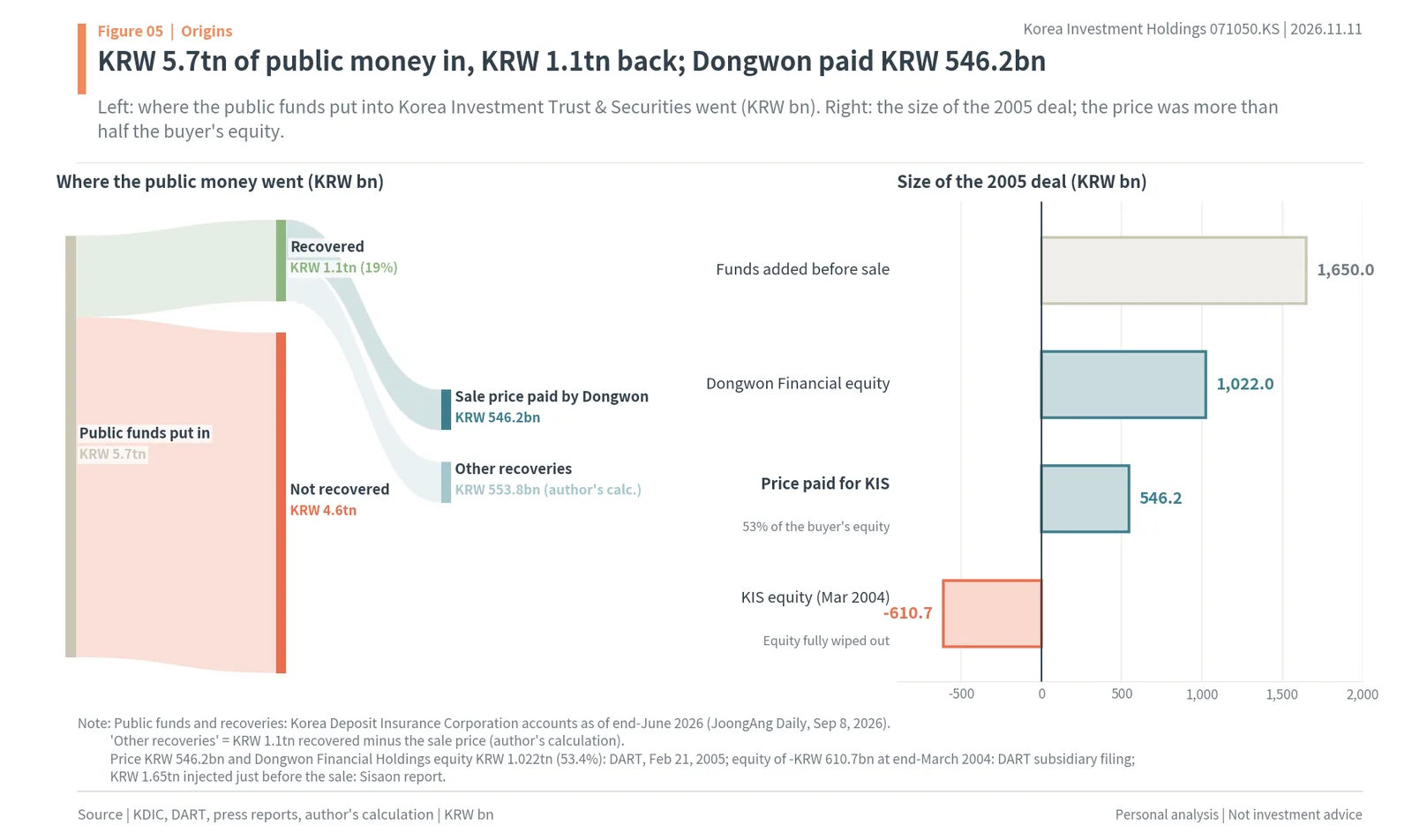
By KDIC’s own accounts, of the KRW 5.7tn of public funds put into Korea Investment Trust & Securities, KRW 1.1tn had been recovered by the end of June 2026 (JoongAng Daily, Sep 8, 2026): a 19% recovery rate, so four of every five won never came back. The KRW 1.1tn includes the KRW 546.2bn Dongwon paid in 2005; the other KRW 553.8bn or so came from other recoveries (author’s calculation). Just before the sale the state put in another KRW 1.65tn to clean the company up. That origin, a company rescued with taxpayers’ money and then sold to a private owner, is the background to how this group deals with the state.
3. Dongwon, Kim Jae-chul and the bet of 2005
The second root is Dongwon. Kim Jae-chul founded Dongwon Industries in 1969. The press says he became convinced brokerage would grow while attending Harvard Business School’s executive program in 1981 (a reporter’s description, not his own words), and on May 6, 1982 Dongwon Industries bought Hanshin Securities for KRW 7.12bn (company history; Prime Economy). Hanshin was renamed Dongwon Securities in 1996, the same year it bought the savings bank that is now Korea Investment Savings Bank.
Kim Nam-goo joined Hanshin in 1991, worked in bonds, IT, planning and the New York office, and from 1998 was an executive in asset management and head of strategic planning. In 2003 Dongwon Industries split off its financial holdings and Dongwon Financial Holdings was launched on May 30, which the press called Korea’s first brokerage-centered financial holding company (Seoul Finance). Through a share swap with Dongwon Securities it was relisted on the Korea Exchange on July 21, 2003.

In December 2004 the Fair Trade Commission approved separating the family group in two, finance to the elder son, Kim Nam-goo, and food and manufacturing to the younger, Kim Nam-jung, who runs today’s Dongwon Group. In February 2006 Kim Nam-goo held 17.98% of Dongwon Financial and his brother 67.23% of Dongwon Enterprise (Weekly Kyunghyang). Kim Nam-goo’s stake was built from gifts his father made early and in stages, Dongwon Industries shares in 1991 and 2000 and 7.04% of Dongwon Financial in 2004, plus the split itself. No record shows the brothers swapping stakes.
The 2005 purchase was Kim Nam-goo’s first big decision as an owner. In April 2004 the government’s public-fund committee shortlisted seven bidders, including Kookmin Bank, Hana Bank, Woori Financial and Dongwon at home and Carlyle, AIG and Prudential from abroad, and on July 14 picked Dongwon as preferred bidder (DART). After final approval on February 18, 2005, Dongwon signed with KDIC on February 22: KRW 546.2bn for 100% of the company, equal to 53.44% of Dongwon Financial’s own equity of KRW 1.022tn (DART). One article says his father argued against it (Seoul Shinmun, single source). That year, as a small brokerage swallowed a big one, Dongwon Financial’s share price went from KRW 9,550 on the first trading day to KRW 43,000 at year-end, 4.5 times. In May 2005 the company took the name Korea Investment Holdings.
Measured from the first close after relisting, KRW 6,380, the November 11, 2026 close of KRW 121,500 is 19.0 times higher (adjusted prices, dividends excluded). The numbered events in the chart are the big turns and the people behind them: the 2008 crisis low, KakaoBank’s launch and the first short-term note licence in 2017, the 2019 sanction over a deal with SK’s chairman, the chairman’s own share purchase in March 2020, KakaoBank’s 2021 listing, the Lee Jae-myung government and the first IMA licence in 2025, and the third-quarter earnings shock of November 2026. Against the February 20, 2026 peak of KRW 292,500 the stock is now 58.5% lower.

The chart’s point is simple: the big steps in this stock came with someone’s decision, and more than half of those decisions were Kim Nam-goo’s.
4. What the father passed on: hardship, the front line and paying tax head-on
To read the son’s habits, start with the father’s rules. Kim Jae-chul said that “a manager must feel the hardships of the people working on the front line in his own body” (Seoul Shinmun, May 18, 2015) and that “people who grew up in comfort have no resistance and no endurance” (Seoul Shinmun, Jul 20, 2026). He had his two sons read a book a week and write four or five pages about it. In handing shares to his elder son he followed a rule too: in 1991, giving him 550,000 Dongwon Industries shares, he voluntarily reported KRW 6.24bn of gift tax, explaining that “I did not want to commit tax evasion disguised as tax saving” (Seoul Shinmun, Jul 20, 2026). He then made further gifts in 2000 and 2004. Front line first; early and in stages; tax paid in full. That is the family’s baseline for succession.
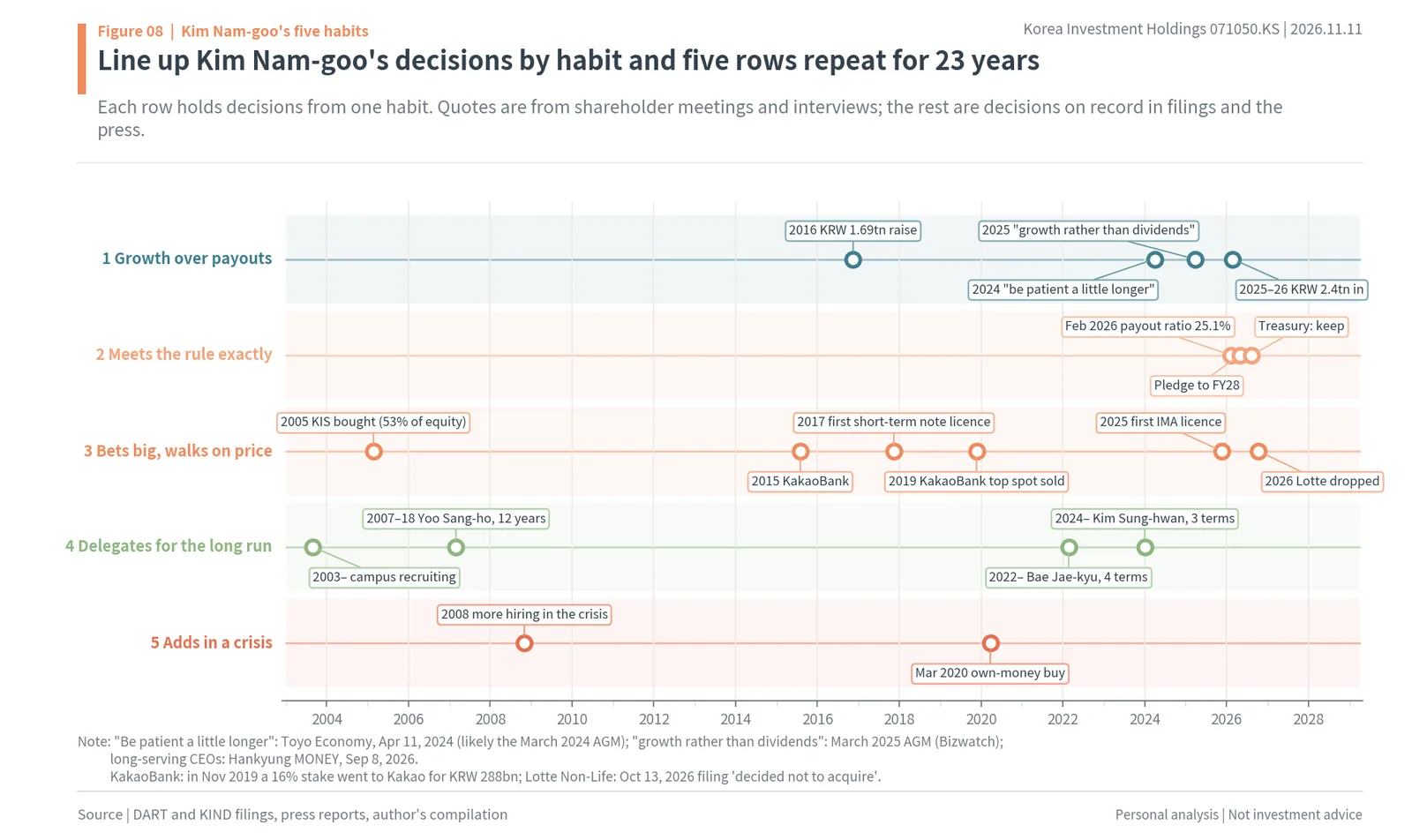
5. Kim Nam-goo’s five habits, repeated for 23 years
Habit 1: growth before payouts. Asked about shareholder returns, he has almost always answered with growth. In 2024 he said, in effect, that “buying back and cancelling shares lifts the price in the short run, but our shareholders should take a longer view and be patient a little longer” (Toyo Economy, Apr 11, 2024, probably at that March’s shareholder meeting). At the March 2025 shareholder meeting he said that “value-up should come through growth rather than dividends” (Bizwatch, May 27, 2025). “Value-up” is the government’s campaign since 2024 urging listed companies to lift their valuations; his answer meant that he would raise the share price by growing the company rather than by paying out more. The company’s value-up plan of May 26, 2025 set targets for a return on equity of 15% or more and equity of KRW 15tn or more by 2030, with no number for payouts or buybacks; around then he said that “to grow, you need capital” (The Fact, May 27, 2025). His decisions point the same way: a KRW 1.69tn capital increase in 2016 to qualify as a “mega investment bank,” and KRW 2.4tn of new capital from the holding company into the brokerage in September 2025 and February 2026.
Habit 2: meet the rule exactly. When the separate dividend tax took effect in 2026, the company’s 2025 dividend was KRW 8,690 a share, KRW 507.8bn in all, a payout ratio of 25.1%. The payout ratio rose from 22.4% to just over the 25% bar, and total dividends rose 118.2% from KRW 232.8bn two years earlier (company filing, Mar 12, 2026). Treasury shares show the same pattern. Korea’s third Commercial Act revision requires existing treasury shares to be cancelled by September 5, 2027, or kept with shareholder approval for set purposes such as employee pay; the half-year report says “keep holding” and states that “there is no plan to buy back or cancel shares.” The habit is to clear the bar a rule sets, but not to go further ahead of it.
Habit 3: bet big against his capital, but walk away when the price is wrong. The 2005 deal put 53% of his firm’s equity on the table. In 2015 the group took 50% of the KakaoBank consortium with Kakao; in 2017 it was the only brokerage licensed to issue short-term notes; in November 2025 it became, with Mirae Asset, the first brokerage allowed to run IMAs. When the price did not fit, he walked: in November 2019 the group handed KakaoBank’s top shareholder spot to Kakao in return for KRW 288bn for a 16% stake, and on October 13, 2026 it disclosed that after “reviewing from many angles” it had “finally decided not to acquire” Lotte Non-Life Insurance. Asked in 2018 whether he would bid for Samsung Securities, he said he does “not think about whether to buy before an asset is up for sale.” His words on buying an insurer moved back three times: “we have never done insurance, so there is a lot to review” and “sooner is better” in March 2025 (Kuki News), a company official’s “aiming to buy within the year” in March 2026 (Digital Daily), and “there is no internal goal that it must be done this year” in November 2026 (Insight).
Habit 4: delegate to managers and keep them a long time. He has said that “in financial investment one person’s productivity matters enormously” and that “we have had painful experiences of talent leaving” (Newspim, Sep 11, 2018); that “a company is not a social club but an organization with a purpose” (Toyo Economy, 2024); and, at a 2024 campus recruiting session, that “we handle customers’ money, so we must be armed with high ethics” and “lying is a fatal disqualification” (Dealsite, Sep 12, 2024). He has gone to university recruiting sessions himself every year since 2003. The press says the group has unusually many long-serving chief executives, and the record bears it out: Yoo Sang-ho, brokerage chief executive for 12 years from 2007; Oh Woo-taek of Korea Investment Capital, in his 12th year; Bae Jae-kyu, chief executive of the fund arm Korea Investment Management, in his fourth term; and Kim Sung-hwan, the brokerage’s chief executive since 2024, in his third. Bonuses are 40% in the year and 60% spread over three years (search summary).
Habit 5: add when others pull back. In the 2008 crisis, when other brokerages cut staff, this one hired more (Seoul Shinmun, 2019). On March 23–24, 2020, when the Covid shock crushed the stock, he bought 263,000 shares on the market with his own money, lifting his stake from 20.23% to 20.70% (DART). Five days later the stock was 50.2% above that day’s close (author’s calculation).
The record against him belongs here too. At the March 27, 2026 shareholder meeting his re-election as a director won 88.6% of votes cast and the directors’ pay ceiling only 59.8% (meeting results filing). Shinhan Asset Management voted against his re-election, citing an institutional warning and fines over wrap and trust accounts and private funds (iNews24). He has been both chief executive and board chairman of the holding company since 2005, a combination the FSS in 2025 urged financial groups to end. The National Pension Service voted for all 11 agenda items.
The dividend record turns habits 1 and 2 into numbers. From 2014 to 2025, 12 years, the consolidated payout ratio stayed in a band between 16.8% and 25.1%, rising a little in 10 of 11 year-on-year steps. No year has gone near a third of profit. Dividends per share rose from KRW 700 in 2014 to KRW 8,690 in 2025, but mostly because profit grew, not because the payout ratio did. The KRW 6,150 of 2021 came in the year KakaoBank’s listing inflated profit; when profit fell the next year the dividend dropped to KRW 2,300. Dividends follow profit by rule.

In one line: he puts money into growing the company, meets the lines that rules draw, bets big but drops a deal that does not fit, keeps people for a long time and moves when others freeze.
6. The son, Kim Dong-yoon: the same seven years, and shares bought rather than given
Kim Dong-yoon graduated from the University of Warwick in the U.K. He did a stint on the floor of a Dongwon F&B tuna-canning plant, joined Korea Investment & Securities in 2019 through its overseas-university recruitment, and worked at a Seoul branch, in the corporate finance department (on the IPOs of SK Bioscience and SKIET), in management strategy and at the U.S. unit. In February 2026 the press still described him as a sixth-year assistant manager in the U.S. office; in the August 3, 2026 promotions he became managing director for planning in the management planning division (Money Today), the youngest managing director in the firm’s history (iNews24). The company says his job is reviewing new businesses and global projects and that he does not run the company or make its key decisions.
Set next to his father’s career, the pace is identical. Kim Nam-goo joined Hanshin as an assistant manager in 1991 and became an executive in 1998: seven years. Kim Dong-yoon joined in 2019 and became an executive in 2026: seven years. The father became chief executive of the holding company in his 12th year, 2003, and bought Korea Investment & Securities in his 14th. If the son keeps the same pace, his 12th year is 2031, when he will be 38; his father was 40 at the same point. That dashed line is the author’s assumption, not a company plan.

How he got his shares is different. His father received his stake largely as gifts; the son so far has received none. He bought 52,739 shares on the market in July 2023 with KRW 2.64bn of his own funds (DART large-holding report) and another 241,000 in January and 43,000 in April 2024, reaching 336,739 shares, or 0.60% (eight exchange filings). At the average closing prices of those periods he paid about KRW 19.1bn; the stake is now worth about KRW 40.9bn (author’s calculation). The 2024 filings give the source of funds only as “own funds, etc.” Nothing has changed since April 2024. He has made no public statements the author could find, so his inclinations can be read only from the order of his career, which, from factory floor and branch through corporate finance, strategy and overseas to planning, mirrors his father’s. The company’s line is that “nothing has been decided about governance or succession” (CEO Score Daily, Aug 7, 2026) and that “it is too early to talk about group succession” (iNews24, Sep 15, 2026).
7. The managers: outsiders kept long, insiders trusted deep
Yoo Sang-ho came from outside, via Hanil Bank, Daewoo Securities and Meritz Securities, and ran Korea Investment & Securities from 2007 to 2018, the longest tenure among Korean brokerage chiefs; in that time it won the only short-term note licence. Stepping up to vice chairman in 2018, he called it “the best moment to hand the seat to juniors and come down from the top with a smile,” and named helping take “138 companies” public as his proudest work (NewDaily, Nov 28, 2018).
Jung Il-moon, an investment banker who joined Dongwon Securities in 1988, led the firm from 2019 to 2023. His biggest decision came in June 2021, when the firm said it would repay 100% of the principal on 10 private funds it had sold that went bad, including Lime, Optimus and Discovery (806 accounts, KRW 158.4bn, search summary): a seller taking on more than its legal liability to protect its reputation.
Kim Sung-hwan, born 1969, came from Kyobo Life and LG Investment & Securities in 2004, became chief executive in January 2024 and was reappointed for a third one-year term in March 2026. Each new-year address puts risk management first, yet he keeps raising the bar: in January 2026 he said that “what matters most in the IMA business is thorough risk management so we never break the trust of the market and customers,” and also that “the overwhelming No. 1 we achieved is only a win in the domestic league” (CEO Score Daily). Launching the first IMA product in December 2025 he called 4% a year “only a hurdle” and said trust must come first early on (Herald Economy).
Bae Jae-kyu, who listed Korea’s first ETF at Samsung Asset Management in 2002, was hired to run Korea Investment Management in February 2022. He renamed its ETF brand from KINDEX to ACE that October, and ACE assets grew from KRW 3.07tn (4.05% market share) in September 2022 to KRW 25.4tn (8.53%) in December 2025 (company IR). He speaks his mind even about his own products: on July 20, 2026 he posted on Facebook that he was “sorry to say this as the head of a firm that runs single-stock leveraged ETFs,” in effect telling people not to invest in them, deleted the post a day later and ten days on said such products should be left to “die a natural death rather than be delisted” (The Fact; Dailian). The company called it his personal view.
The holding company’s president, Oh Tae-kyun, has managed the affiliates since 2009 and has made no public statements the author found. The pattern across these four is plain: outsiders are kept long, insiders are trusted deep, and every chief executive is reappointed one year at a time.
8. The state opened doors and also hit the brakes
Most of the company’s turning points involved a government decision. The Park Chung-hee government’s capital-market policy created Korea Investment Trust in 1974; the Kim Dae-jung government rescued it with public money in 1999; the Roh Moo-hyun government’s public-fund committee sold it to Dongwon in 2005. Under the Moon Jae-in government the FSC on November 13, 2017 named five brokerages “mega investment banks” but licensed only Korea Investment & Securities to issue short-term notes, over banks’ objections (Newsis). Short-term notes are notes of up to a year that a brokerage issues to retail investors directly, up to twice its equity. In August 2018 President Moon also eased the rule that keeps industrial companies from owning banks, for internet banks only, and the law that followed changed who controlled KakaoBank. Under the Lee Jae-myung government the FSC on November 19, 2025 named Korea Investment & Securities and Mirae Asset the first operators of IMAs (integrated investment accounts, in which the brokerage owes investors their principal), on condition that 25% of the money goes to “venture capital” such as growth companies and that funding including notes stays within three times equity (Segye Ilbo).
The brakes came from the state too. In March 2017 the brokerage’s KRW 50mn fine for rigging bond yields became final, which under the internet-bank law barred it for five years from holding more than the normal limit in KakaoBank (Etoday). In August 2017, KRW 169.8bn raised through short-term notes went into a special-purpose company that bought 19.4% of SK Siltron and signed a total return swap (TRS) with SK chairman Chey Tae-won, under which he took the gains and losses on those shares. After an inspection in 2018, regulators ruled that although the deal was in form a loan to a company, in substance it was credit to an individual. The FSS imposed an institutional warning in April 2019, and in May–June 2019 the Securities and Futures Commission and the FSC imposed a KRW 50mn fine on the TRS and a KRW 3.2bn penalty on a separate loan to the Vietnam unit (FSC; NewDaily). Under FSS governor Lee Bok-hyun, a three-to-six-month business suspension proposed in December 2024 over wrap and trust accounts was reduced to an institutional warning by the FSC on February 19, 2025 (Hankyung).

Three officials matter most now. President Lee Jae-myung, in office since June 2025, speaks in two directions. At a cabinet meeting on May 20, 2026 he said that “it is the investors, the shareholders, who receive a share of operating profit,” backing dividends (Newsis). At a December 19, 2025 policy briefing he asked whether it was right that for financial institutions “lending against land and houses and living off interest is the main business” (Newsis), and on May 6, 2026 he asked whether there was a way to “evaluate how far they have delivered inclusive finance and reward or penalize them, or make it mandatory” (Digital Daily). One wind pushes for higher dividends; the other pushes finance toward public goals.
Lee Chan-jin, governor of the Financial Supervisory Service since August 2025, is a lawyer who was vice chairman of the progressive lawyers’ group Minbyun and head of the civic group People’s Solidarity for Participatory Democracy (search summary), said of single-stock leveraged ETFs that he was “reflecting on whether we should have blocked them even if it meant lying down in front of them” (MTN). In October 2025 the FSS inspected the sellers of a Belgian office-property fund that was wiped out; Korea Investment & Securities sold KRW 58.3bn of it, more than anyone. In December it began on-site checks of overseas-stock sales at Korea Investment & Securities and NH, and on December 23 the governor visited the brokerage, bought into the first IMA himself and asked for better internal controls (search summary).
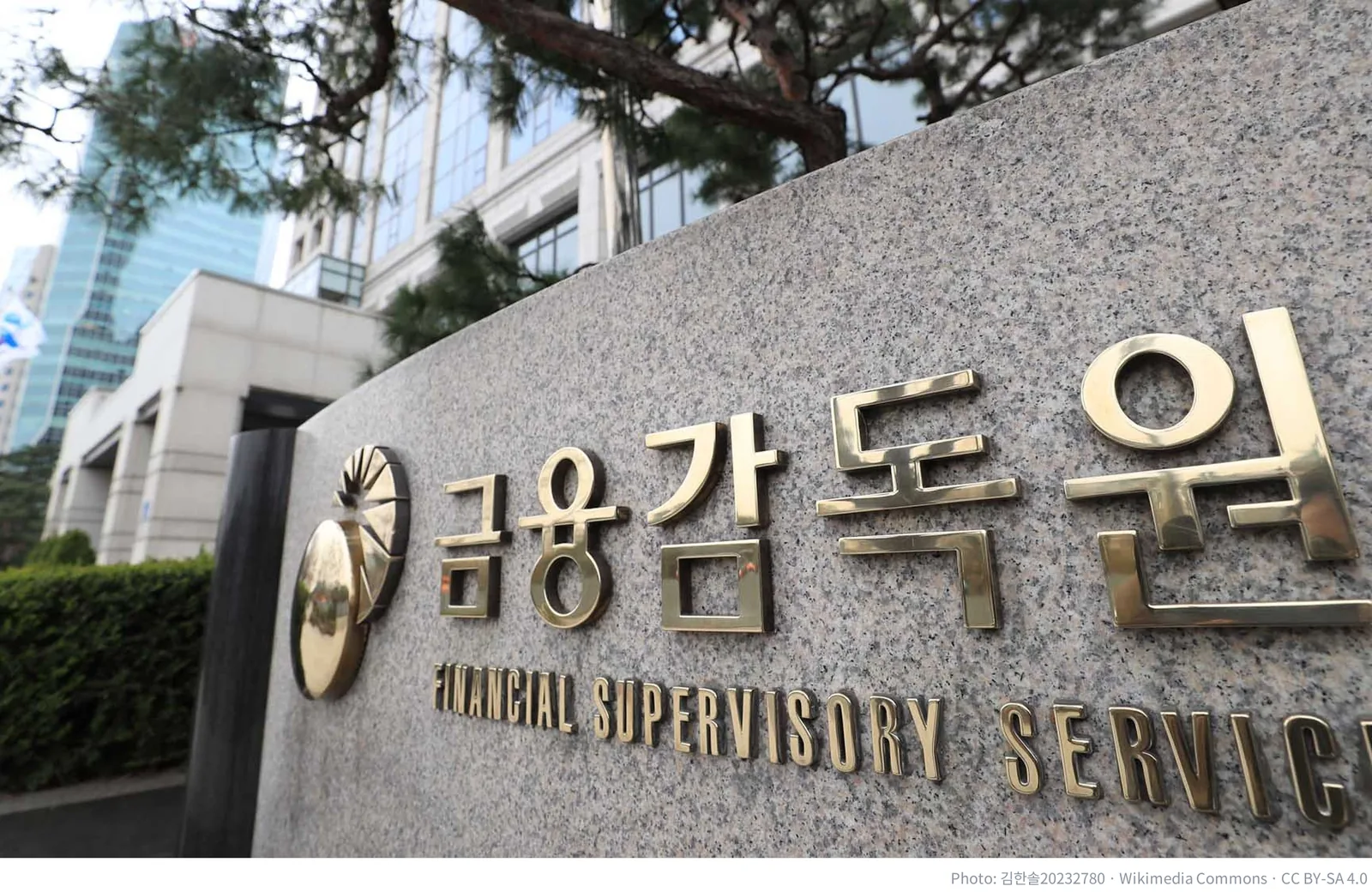
FSC chairman Lee Eog-weon, in office since September 2025, has said that “supplying venture capital is an important pillar of productive finance” (Herald Economy, Nov 11, 2025) and plans to raise the venture-capital share required of note and IMA money to 25% by 2028 (search summary). The presidential office also meets brokerages directly: at a closed-door meeting on January 13, 2026 with Kim Yong-beom, the policy chief at Cheong Wa Dae, the presidential office, Kim Sung-hwan and Bae Jae-kyu attended and the brokerage proposed ways to draw KRW 273tn of new money into Korean stocks (Dealsite, Sep 22, 2026). One outlet reported Kim Nam-goo at President Lee’s investment summit at the New York Stock Exchange on September 25, 2025 (Financial News, single source).
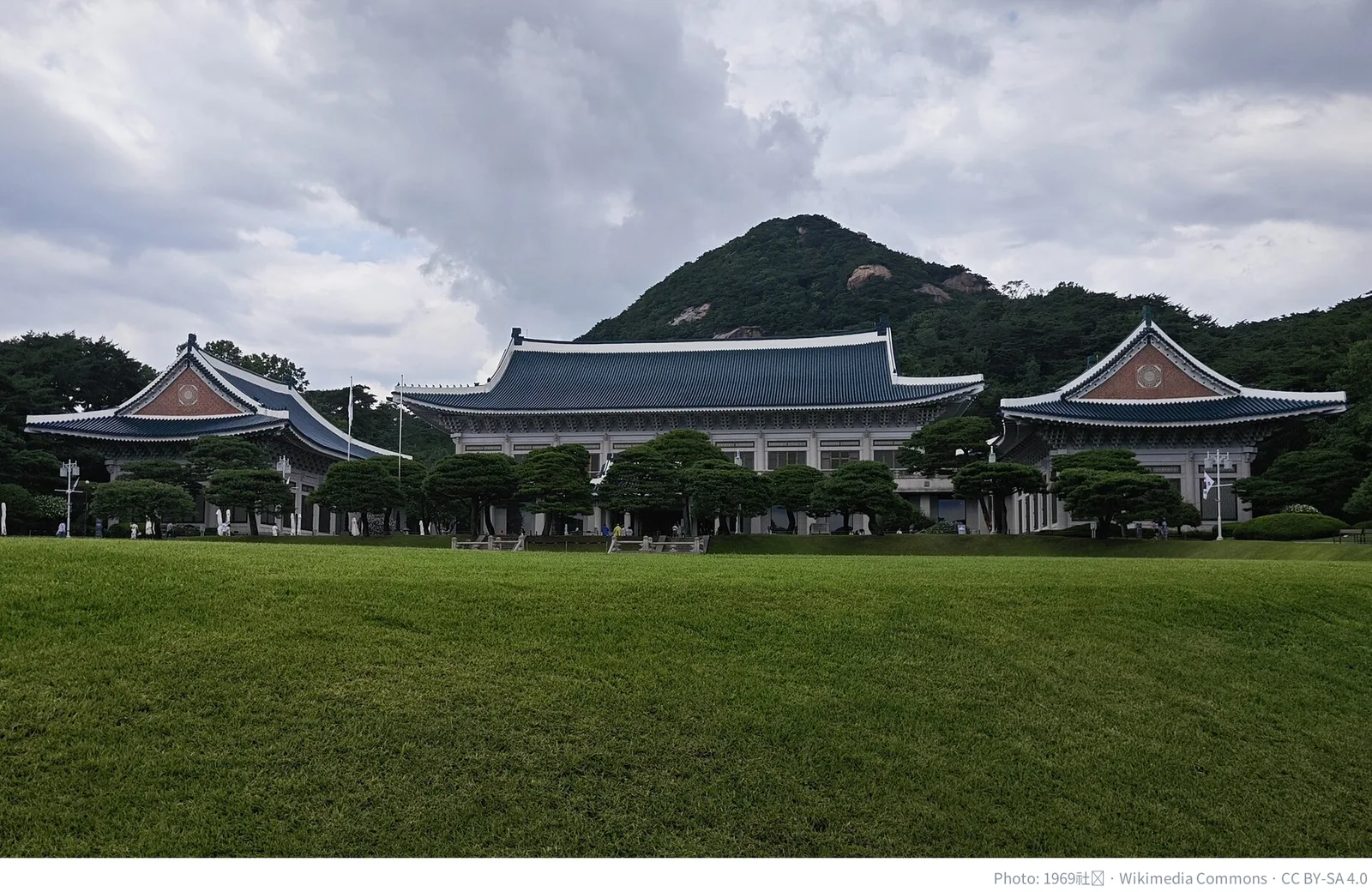
Personal ties are on the record as well. Koh Seung-beom, FSC chairman in 2021–22, is the elder brother of Kim Nam-goo’s wife. As a nominee in August 2021 he said he would recuse himself from matters involving the group and KakaoBank, and at his hearing said only 23 of 2,200 FSC agenda items in five years (1%) had involved the group, adding that “I may cost them, but they will gain nothing from me” (Newspim, Aug 27, 2021). Lee Yong-woo, a former head of strategy at Dongwon Securities and the holding company and later co-chief executive of KakaoBank, joined the Democratic Party in January 2020 and served as a lawmaker. Parliament also pushes back: in October 2026 a Democratic Party lawmaker said 28.7% of the first IMA’s money had gone to overseas private loans (single source), and in September 2026 the opposition People Power Party sought to call Kim Nam-goo, Kim Sung-hwan and Bae Jae-kyu as witnesses over leveraged ETFs, which was not adopted.
SK appears twice. The 2017 TRS ended in a sanction, but on October 2, 2026 Korea Investment & Securities disclosed that it had bought 681,431 shares of SK Inc., SK’s holding company, for KRW 400bn in an after-hours block trade under a three-year price return swap (PRS), later restated as 722,930 shares or 0.99%. The counterparty is not disclosed.
9. How it earns: less a stock broker, more a lender of retail money to companies
Profit first. Net profit attributable to owners rose from KRW 239.2bn in 2014 to KRW 2,020.4bn in 2025, 8.4 times in 11 years (DART). The KRW 1,764.4bn of 2021 included KRW 554.6bn of pre-tax gain from KakaoBank’s listing (company IR); in 2022–23, as markets cooled, profit fell back to KRW 600–700bn. In the first nine months of 2026 profit was already KRW 2,193.1bn, more than all of 2025, but the third quarter alone brought only KRW 282.3bn, about half of what analysts expected, because rising rates and a falling dollar cut the value of bonds and foreign-currency assets.

Where the money comes from shows what kind of company this is. The brokerage’s net operating revenue rose from KRW 2.2tn in FY21 to KRW 3.1tn in FY25. Split five ways in FY25: investment KRW 1,276.2bn (42%), investment banking KRW 705.2bn (23%), brokerage KRW 489.6bn (16%), brokerage interest KRW 376.9bn (12%) and wealth management KRW 208.9bn (7%) (author’s calculation from company IR). Stock-trading commissions, the thing people associate with a brokerage, are about a sixth. The biggest piece, “investment,” is the income from putting money raised through short-term notes and IMAs, plus the firm’s own capital, into bonds, corporate loans and other investments. Its share rose from 24% in FY21 to 42% in FY25. Korea Investment & Securities now looks less like a stock broker and more like a firm that gathers retail money and lends it to companies.

Two products drive that shift. Short-term notes outstanding grew from KRW 8.37tn in 2021 to KRW 21.48tn in 2025 and KRW 24.47tn in September 2026 (company IR). The first IMA product sold out KRW 1tn in four business days in December 2025, and IMAs S1 to S7 held KRW 3.34tn, 76% from individuals. On the fund side, ACE ETFs grew from KRW 3.07tn to KRW 25.4tn under Bae Jae-kyu. The note licence opened under Yoo Sang-ho and the ETF line grown by Bae are the two big doors through which client money enters the group.

Risk sits in the same structure. Group equity is KRW 13.68tn against liabilities of KRW 139.26tn, about 10.2 times (September 2026, author’s calculation); most of it is customer deposits, notes and repos, much like a bank. Profit swings with trading volumes, rates and the currency: when daily market turnover fell from KRW 118.1tn in Q2 to KRW 75.3tn in Q3 2026, brokerage commissions fell 40.6%, and as bond and foreign-asset values fell, investment income dropped 51.6% (Seoul Shinmun, Nov 8, 2026). The savings bank’s non-performing loan ratio reached 11.53% at the end of 2025. Abroad, the equity of about KRW 270bn in 195 Broadway, a New York office building bought with Samsung SRA for about KRW 600bn in 2019, was reported at risk (Dealsite, Nov 18, 2025), and the Belgian fund wiped out in December 2024 was one the brokerage had sold.
10. The money loop: the holding company sends back more than it receives
A holding company lives on its subsidiaries’ dividends. For fiscal 2025 the brokerage paid twice: an interim dividend of KRW 1.2tn decided on December 30, 2025, and a year-end dividend of KRW 620bn in March 2026, KRW 1.82tn in all, 90.54% of its consolidated profit (NewDaily, Mar 25, 2026). The holding company sent even more back down: KRW 900bn on September 29, 2025 and KRW 1.5tn on February 26, 2026 as rights issues to the brokerage, KRW 2.4tn in total, or 132% of what it received. In between it paid shareholders the 2025 dividend of KRW 507.8bn, about KRW 100.2bn of it to Kim Nam-goo and KRW 2.9bn to his son (author’s calculation). The KRW 1,087.8bn gap between money out (KRW 2.4tn plus KRW 507.8bn) and brokerage dividends in was covered by other affiliates’ dividends and commercial-paper borrowing (author’s calculation); the holding company raised its CP limit by KRW 530bn in September 2025 and KRW 700bn in February 2026.
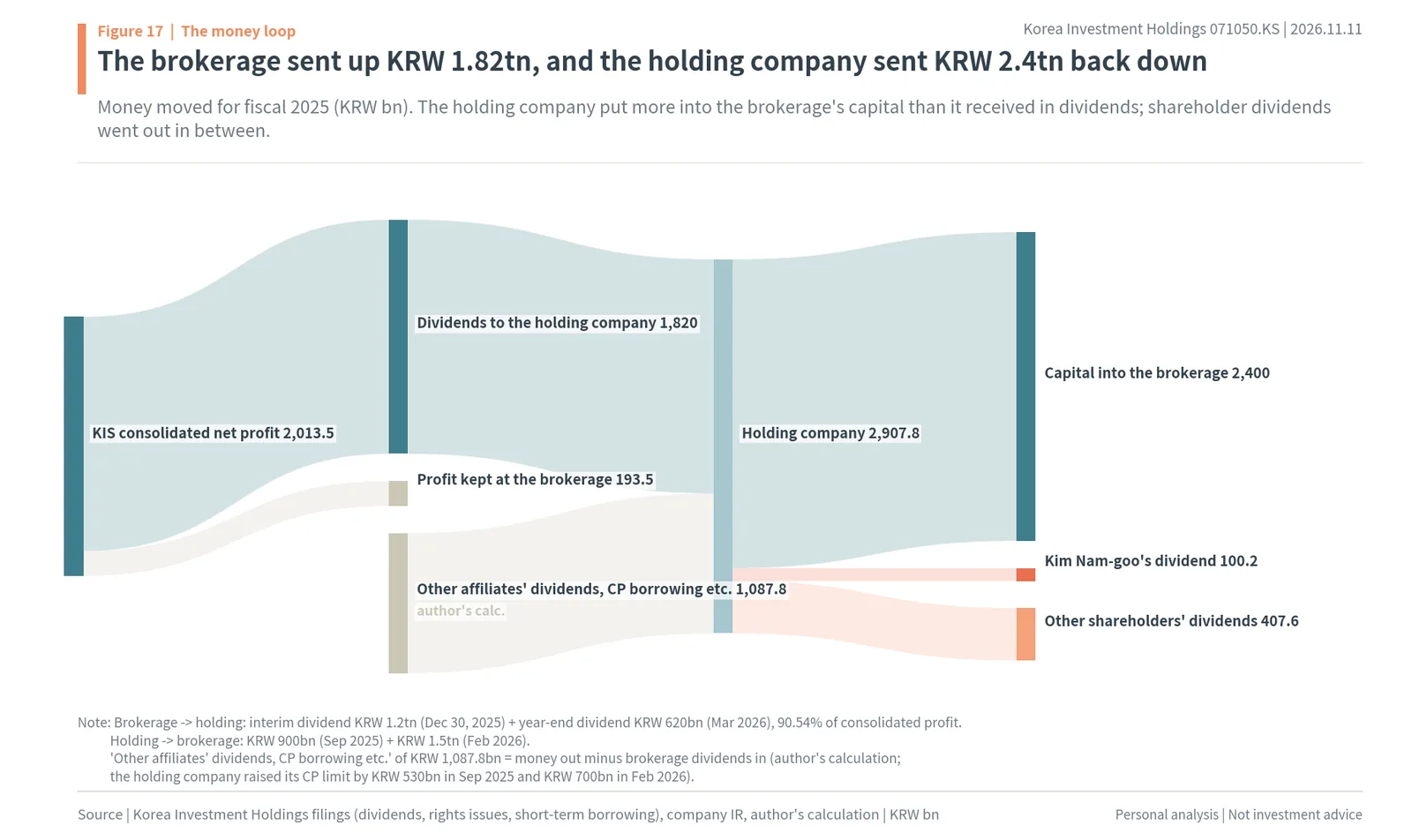
The reason is regulatory arithmetic. Short-term notes can reach twice equity and IMAs, including notes, three times. Each extra KRW 1tn of brokerage equity can let it raise up to KRW 3tn more from the public. When Kim Nam-goo says growth needs capital, in this group it means enlarging the brokerage’s equity to raise its funding limit and earn on the money. For shareholders the loop has two faces. Profits compound inside the company (return on equity was 18.5% in 2025 by the company’s measure), but the share returned to shareholders directly is smaller than at peers. “Growth is value-up” is not just a slogan here; it is how the money already moves.
11. The KakaoBank stake: 39% of the market cap, and a ruling on November 20
KakaoBank shows habits 3 and 1 together. In August 2015 Korea Investment Holdings formed an internet-bank consortium with Kakao and took 50%. When KakaoBank opened on July 27, 2017, Kim Joo-won, then the holding company’s vice chairman, chaired its board and Lee Yong-woo, a former Dongwon strategist, was co-chief executive.
Control changed in 2019. Once the internet-bank law allowed it, the FSC in July 2019 approved Kakao holding up to 34%. On the Korea Investment side, the 2017 bond-rigging fine barred the brokerage for five years, and holding-company law limits a holding company’s stake in a non-subsidiary to 5%. So in November 2019, with FSC approval, the holding company moved 29% to its fund arm, Korea Investment Value Asset Management, for KRW 489.5bn and sold 16% to Kakao for KRW 288bn (Dealsite; Asia Economy). After the five years ran out, the FSC approved on December 21, 2022 the brokerage buying 27.18% from the holding company and the fund arm for KRW 3.41tn (SBS Biz). Today the brokerage’s 27.17% matches Kakao’s, one share fewer, making it KakaoBank (Kakao Bank) No. 2 shareholder by a single share.
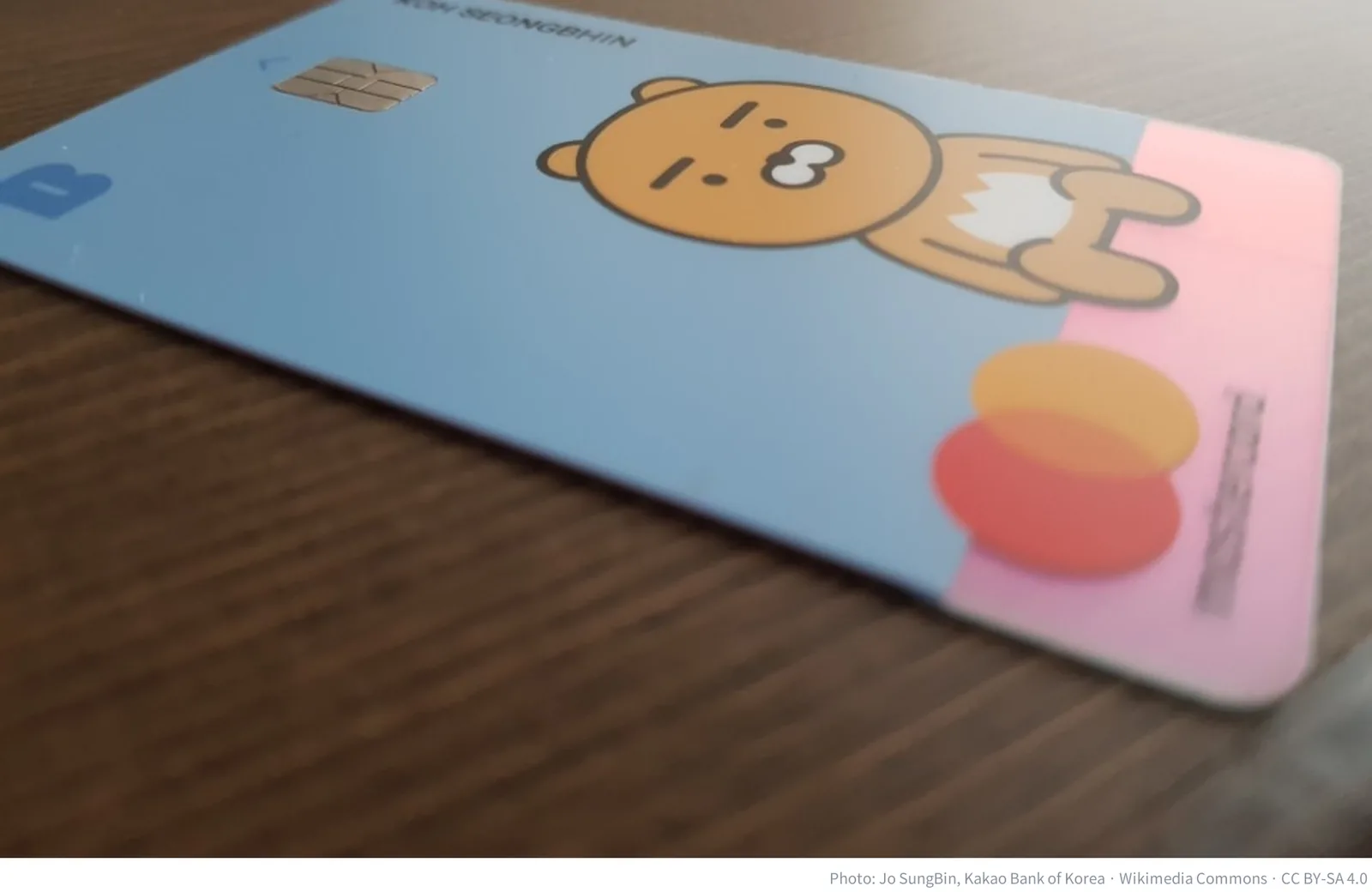
On the books the stake was worth KRW 1,855.9bn at the end of 2025, against a cost of KRW 779.6bn (2025 annual report). At market prices, KakaoBank’s November 11 close of KRW 20,550 and market cap of KRW 9.73tn put the 27.17% at about KRW 2,644.5bn (about $1.98bn), 39% of Korea Investment Holdings’ common-share market cap of KRW 6,771bn (author’s calculation). In August 2021, just after the listing, the stake was briefly worth more than KRW 11tn; since then KakaoBank shares have fallen until the stake is now only a little above book value. The gap between book and market value is simply equity-method accounting, which does not mark the stake to market, and has nothing to do with the online claim that the group “hid” its value.

November 20 could decide what the stake is for. Kakao founder Kim Beom-su and Kakao Corp were charged with manipulating SM Entertainment’s share price; he was acquitted at first instance on October 21, 2025, and prosecutors again sought 15 years at the appeal, with the ruling set for 10:20 a.m. on November 20, 2026 (search summary). One analysis says that if a fine or heavier sentence against Kakao Corp becomes final, Kakao must sell its KakaoBank stake above 10% within six months, which would leave Korea Investment & Securities as the de facto top shareholder (The Fact), though holding-company law does not let a brokerage own a bank as a subsidiary, so the structure would have to be redrawn. If the acquittal stands, today’s arrangement continues; an appeal to the Supreme Court would delay the answer. Kakao also holds an extraordinary meeting on a demerger on December 17 (search summary).
12. Reading the future through the habits: nine decisions and who holds them
The method is simple: name who holds each decision, count how that person’s habit played out in similar situations, and attach the likeliest choice, its timing, what it means for holders and the signal that would confirm it. All of it is the author’s estimate, not a company plan.
F1. The 2026 dividend: payout of 25–27.5%, a little over KRW 10,000 a share. Kim Nam-goo and the board decide. Three things point the same way: habit 1 has kept the payout ratio inside 16.8–25.1% for 12 years; habit 2 put last year’s ratio just over the 25% tax bar; and the company’s April 29, 2026 progress report lists “1) aiming to raise the payout ratio gradually, 2) maximizing profitability and increasing the absolute size of returns, 3) striving to meet the separate-taxation test through the FY28 year-end dividend” (KIND attachment). With nine-month profit of KRW 2,193.1bn and fourth-quarter profit of KRW 200–450bn, a payout of 25–27.5% gives a 2026 dividend of KRW 10,240–12,440 a share, assuming treasury shares get nothing and preferred shares get KRW 61.5 more than common (author’s calculation). With fourth-quarter profit at KRW 300bn, 25% gives KRW 10,670, 27.5% KRW 11,730 and 30% KRW 12,800. At today’s KRW 121,500 that is a yield of 8.4–10.2% (about $7.7–9.3 a share). The floor that keeps the tax benefit is total dividends of KRW 558.6bn (2025 plus 10%), or KRW 9,560 a share. Jumping to 40% would give KRW 17,070, but it runs against “growth rather than dividends,” so the record makes it unlikely. Like last year, the announcement should come with fourth-quarter results around February 10, with a record date at the end of February; another quarter of valuation losses would push the result toward the bottom of the range.

F2. Treasury shares: handled near the legal deadline. The board and shareholders decide. Under the third Commercial Act revision (in force March 6, 2026) existing treasury shares must be cancelled by September 5, 2027, or kept for legal purposes such as employee pay with a board plan and shareholder approval renewed every year (Law Times). Habit 2 and the filings so far (“keep holding,” no cancellation plan) suggest the shares will be dealt with at the March 2027 meeting or near the deadline rather than cancelled early. For holders the effect is on supply, not per-share figures: treasury shares already get no dividend and are already excluded from earnings per share, but 5.36% of common shares that could one day return to the market would disappear.
F3. KDB Life: a deal only if price and terms fit. Kim Nam-goo and the seller, state-run Korea Development Bank (KDB), decide. On August 13, 2026 the group was named preferred bidder for KDB Life. As of November 9 no price had been disclosed and no contract signed, and the company said “there is no internal goal that it must be done this year” (Insight). One report says the group asked KDB to put KRW 1tn into the insurer before the sale (Dealsite). Habit 3 says that, as with Lotte Non-Life and the KakaoBank top spot, it will sign only if the price and capital terms work. If it does buy, an insurer’s long-term money would come into the group, more capital would be needed, and the dividend would likely stay near the tax floor.

F4. More capital into the brokerage, and an overseas deal under review. Habit 1 and the 2030 target of KRW 15tn of equity (now KRW 13.68tn) suggest one or two more capital injections before 2030. In October 2026 the Korea Economic Daily reported a plan for a 50:50 joint venture with a U.S. alternative-asset manager, with about KRW 300bn from the group (single source); the company said on October 12 and November 11 that it is “reviewing various M&A, but nothing has been decided,” with the next update due February 10, 2027. On January 1, 2027 Korea Investment Management’s securities and money-market fund business moves to Korea Investment Value Asset Management.
F5. Succession: the father’s pace, tax paid head-on, funded by dividends. This decision belongs to Kim Nam-goo alone. The family record says early, in stages and with the tax paid: Kim Jae-chul gave his son shares in 1991, 2000 and 2004 and reported the tax himself. Kim Nam-goo became an executive after seven years, chief executive after 12 and received most of his stake at 37 to 41. His son became an executive after seven years. At the same pace the son would reach the top around 2031 and the stake would pass when Kim Nam-goo is in his late sixties (2028–2034), which matches the family’s record. One difference: so far the son has bought, not received, his shares.
The tax is large. Handing over all 11,534,636 shares at today’s price, with the 20% surcharge on a largest shareholder’s shares and the 50% top rate, means a gift tax of about KRW 840.4bn (about $630m; an approximation that subtracts only the KRW 0.46bn progressive deduction). A December 2024 bill to cut the rate and scrap the surcharge was voted down, and the August 2026 tax proposals did not change them (search summary). At KRW 200,000 a share the tax would be about KRW 1,383.7bn, and at the February peak of KRW 292,500 about KRW 2,023.9bn.
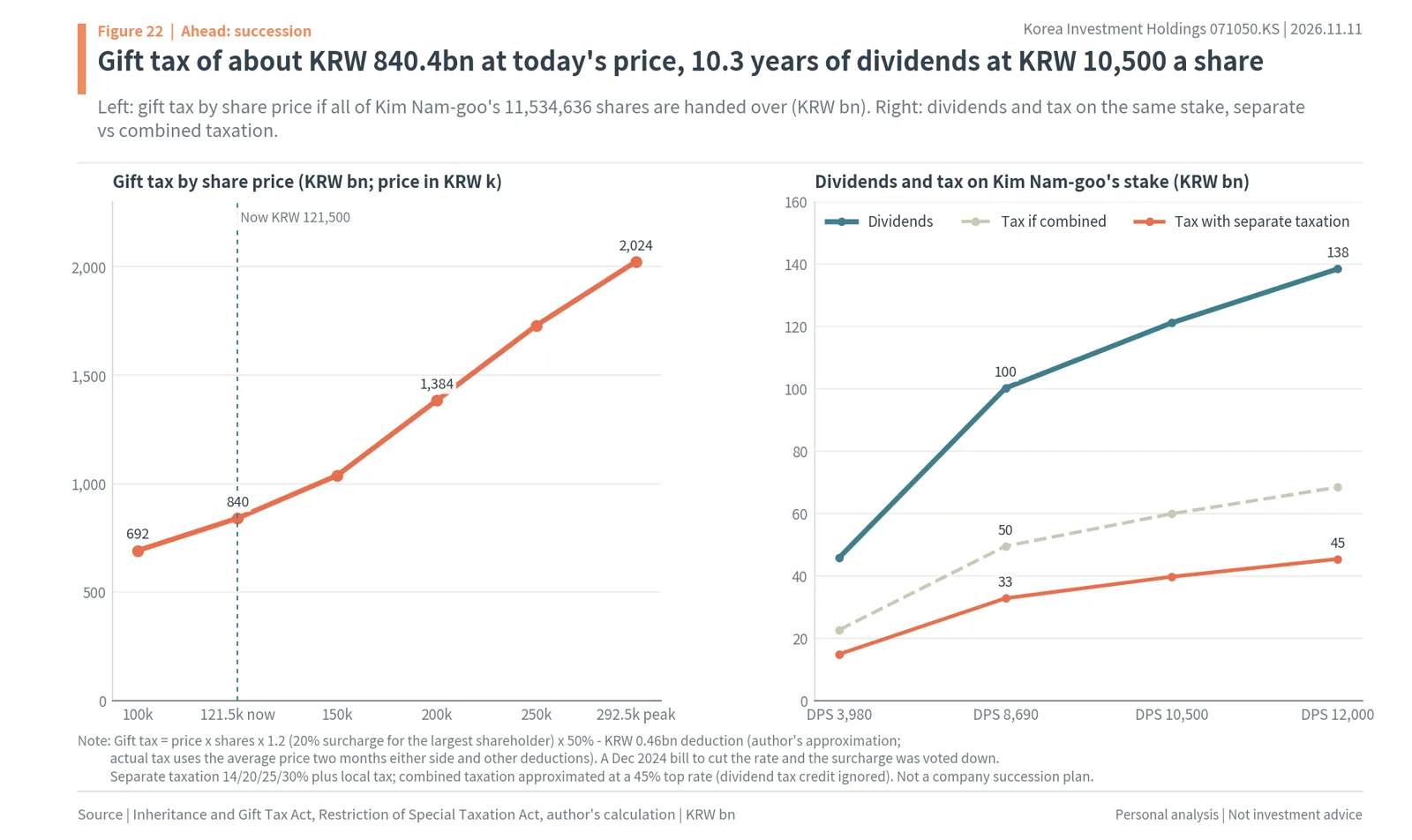
The money for that tax would come from dividends. At KRW 10,500 a share the same stake would receive KRW 121.1bn a year; with separate taxation (30% above KRW 5bn, 33% with local tax) about KRW 81.4bn would be left after tax. Today’s gift-tax bill equals 10.3 years of that. Under combined taxation the same dividend would have been taxed about KRW 59.9bn, so separate taxation saves about KRW 20.2bn a year (author’s approximation). Since the new tax, higher dividends also give the owner money to pay a gift tax. There is a counterforce: gift tax falls when the share price is low. But the August 2026 tax proposals include a rule against “holding the price down,” under which shares of companies whose price-to-book ratio was in the bottom 25% of their sector in 12 of the last 13 half-years would be revalued for inheritance and gift tax from April 2027 (Shin & Kim newsletter; passage not confirmed). For the record, the 2004 gift of 7.04% of Dongwon Financial came in February 2004, when the stock was KRW 5,130–7,200, just before the 2005 deal multiplied it 4.5 times (the February date is from a search summary).
F6. Management stays. Habit 4 suggests Kim Sung-hwan gets another one-year term in March 2027 and Bae Jae-kyu and Oh Woo-taek stay. Chief executives here have changed when results turned or they stepped back, not, on the record, because of political winds.
F7. After the fall, the clearest signal is the owner buying. Habit 5 has a precedent in March 2020. If, after the 17.3% drop on November 6 and the intraday low of KRW 114,000 on November 9, the owner or executives file market purchases, the habit is repeating. No such filing had appeared by November 11.
F8. KakaoBank: two branches on November 20. If the acquittal stands, Kakao and the brokerage keep their tied stakes. If a fine against Kakao Corp becomes final, Kakao must cut its stake and the brokerage becomes the de facto top shareholder. Habit 3 and the 2019 precedent suggest that even then the group would weigh price and the cost of restructuring before buying more. Either way, a stake worth about KRW 2.6tn gets a defined purpose.
F9. The state’s two winds: dividends and venture capital. President Lee’s “shareholders receive a share of profit” and the separate dividend tax push dividends up, likely through the FY28 dividend the company has promised. At the same time the FSC’s 25% venture-capital requirement, the FSS’s consumer-protection inspections and parliament’s questions about overseas IMA lending put conditions on the growth engine of notes and IMAs. On August 6, 2026 the Fair Trade Commission sent an examination report alleging bid rigging to 15 primary dealers in government bonds, including Korea Investment & Securities; as of November 3 no penalty had been set (Etoday; Bizwatch). For holders, the dividend floor gets firmer while returns on invested money may get a ceiling.
13. Checking 18 rumors from the stock forum
From 3,000 posts about the company on Naver’s stock discussion board between June 13, 2025 and November 11, 2026, the author picked 411 about the chairman, succession, politics, deals or ownership and grouped them into 18 recurring claims. Verdicts are confirmed, half true, reported only, false, or unverified. Posters’ names are left out, and unsupported rumors about private lives are not covered.
The most common claim is that “the chairman is holding the share price down to hand the company to his son and refuses to return money to shareholders.” The verdict is half true. Returns are lower than at peers: in 2025 Samsung Securities paid out 35.5% of profit, NH Investment & Securities 47.3%, Kiwoom returned 30.6% and Mirae Asset 40% in 2024 including cancellations (each company’s KIND filing), against 25.1% here, and while Mirae, Kiwoom and NH cancelled treasury shares, this company did not. But “holding the price down” does not fit the data. Indexed to the last trading day of 2024 = 100, the stock was at 172.1 (+72.1%) on November 11, in the same pack as Kiwoom at 164.8 (+64.8%), Samsung at 166.2 (+66.2%) and NH at 157.7 (+57.7%); only Mirae Asset ran far ahead at 278.3 (+178.3%) (Naver closes, author’s calculation). And with separate taxation, higher dividends also help fund the owner’s gift tax, so the incentive does not run one way. The motive itself cannot be checked.

“It was the only major brokerage not to announce a value-up plan” (November 2025) is false: the plan was filed on May 26, 2025, though it lacked payout numbers, and at that time the big brokerage without a plan was Samsung Securities (first filing March 20, 2026). “It moved the KakaoBank stake to a sub-subsidiary to hide its value” is false: the move came from the five-year bar after the bond-rigging fine, approved by the FSC in November 2019, and the brokerage bought the stake back when the bar ended in 2022; the accounting is equity-method whoever holds it. “The son is already receiving gifts of shares” is false: all 336,739 of his shares were bought on the market. “A private equity fund is quietly buying a stake to take control” is false: the only 5% filings since June 2025 are Orbis (selling from 5.11% to 4.80%), the National Pension Service and BlackRock (5.11%, passive).
Three claims are confirmed. “The son went from assistant manager to managing director in a jump” matches press reports: he was a sixth-year assistant manager in February 2026 and a managing director on August 3, with no report of the ranks in between. “The pension fund voted against other brokerages’ proposals but not against Kim Nam-goo’s” is true: the National Pension Service backed all 11 items at the March 27, 2026 meeting while voting against some items at Mirae Asset, Daishin, Kiwoom and NH. “Children of the FSS governor and the presidential policy chief work at an asset manager” is true but concerns Mirae Asset Global Investments, not this group.
Five more are half true besides the succession claim. The Belgian fund (Korea Investment Belgium Core Office Real Estate Fund 2) was sold by the brokerage to the tune of KRW 58.3bn and written off in December 2024; in November 2025 it found 458 of 883 complaints to be mis-selling and paid KRW 6.07bn voluntarily (Nocut News), and in January 2026 extended compensation to all buyers at 40–80% of losses (search summary), so “over KRW 60bn lost, only 40% repaid” mixes the sales figure with the bottom of the range. “It took Taekwang’s KRW 320bn exchangeable bonds as an accomplice in breach of trust” overstates it: the brokerage was named as the buyer on July 1, 2025 before its own review, Taekwang halted the process on July 2 and withdrew the bonds on November 24, and no deal or investigation followed. “An employee gambled away client money” was reported (a Gangnam branch employee and several hundred million won, under police investigation, Nov 7, 2025), but the amount and any sanction could not be found. “A fine for rigging government bond auctions” is at the examination-report stage with no penalty set. On insurers, KDB Life is a fact, Lotte Non-Life was dropped and BNP Paribas Cardif Life has no filing; no source could be found for a company denial that larger subsidiary dividends were meant to fund an insurer.
The rest are reported only or unverified. A bid by Korea Investment Partners for the defense firm M&C Solution (preferred bidder in March 2026) collapsed in August when the fund could not be raised. Korea Investment Partners’ purchase of $10mn of SpaceX shares from employees in 2025 was reported (News1); the size of an Anthropic investment could not be found; and Korea Investment Capital owns 4% of Toss Bank (KRW 65.8bn), not “7–9% of Toss.” The U.S. asset-manager joint venture has only a press report and the company’s “under review” filing. “A Manhattan building bought from Morgan Stanley and Busan port land are hidden assets” is unverified; the Manhattan deal on record is 195 Broadway, bought from JP Morgan in 2019, and reports point to losses, not hidden gains. “Political lobbying” is unverified: the documented ties are the chairman’s brother-in-law, Koh Seung-beom, a former executive who became a Democratic lawmaker, Lee Yong-woo, and the New York summit attendance (single source).
14. Dates and signals to watch
The habits are tested on dated decisions. First comes the November 20 appeal ruling on Kim Beom-su and Kakao, then Kakao’s December 17 demerger meeting and the January 1, 2027 fund-unit merger. Around February 10 come fourth-quarter results and the 2026 dividend, on the same day as the update on the U.S. asset-manager report. Last year’s pattern puts the record date around February 26 and the shareholder meeting around March 26, where Kim Sung-hwan’s reappointment and a treasury-share plan could be on the agenda. September 5, 2027 is the Commercial Act deadline for cancelling existing treasury shares (September 6 in some readings).

Eight signals summarize it. Near-term: the 2026 dividend (above the KRW 9,560 floor, above KRW 10,000), the Kim Beom-su ruling, a signed KDB Life deal and any owner share purchase. Longer-term: what happens to treasury shares, equity (KRW 13.68tn now against a 2030 target of KRW 15tn or more), the expected dividend yield (8.8% at a 25% payout and KRW 300bn of fourth-quarter profit) and filings on capital injections or M&A. The February dividend tests habits 1 and 2 first; KDB Life and KakaoBank test habit 3; an owner purchase would test habit 5.

The author’s view in one line: where an owner who bets on growth but meets the rules exactly, a son coming up at his father’s pace and a government that pushes dividends while asking finance to serve public goals all meet, this company’s dividend will most likely rise slowly from a little above a quarter of profit, big deals such as an insurer will happen only when the price fits, and succession will likely pay its tax head-on with dividends as the source. As a holder, the author will watch the February dividend and the November 20 ruling first.
15. Basis of calculations
Share prices are KRX regular-session closes (KRW 121,500 on November 11, 2026). Long price histories use Naver adjusted prices, replaced by KRX closes for Korea Investment Holdings after September 14, 2026; the peer comparison uses Naver daily closes (including Nextrade after-hours trades) for all five firms. Market cap uses 55,725,992 common shares. The KakaoBank stake’s market value backs out the share count from the KRX close of KRW 20,550 and the KRW 9.73tn market cap and applies 27.17%.
The 2026 dividend adds fourth-quarter profit of KRW 200bn, 300bn or 450bn to nine-month profit of KRW 2,193.1bn, multiplies by payout ratios of 25%, 27.5%, 30% and 40%, and divides by the shares that receive dividends (52,738,513 common plus 5,658,251 preferred, excluding treasury shares), with preferred shares receiving KRW 61.5 more than common (the 2025 gap). The separate-taxation floor is 110% of 2025 total dividends of KRW 507.8bn.
Gift tax is approximated as share price x 11,534,636 x 1.2 (largest-shareholder surcharge) x 50% minus a KRW 0.46bn deduction; the actual valuation uses the average close two months either side of the gift, and deductions, installment payment and any business-succession relief would change it. Dividend tax uses separate rates of 14/20/25/30% plus 10% local tax; combined taxation is approximated with progressive rates up to 45% plus local tax, ignoring the dividend tax credit. The career clock counts from Kim Nam-goo joining Hanshin Securities in 1991 and Kim Dong-yoon joining Korea Investment & Securities in 2019. In the money loop, “other affiliates’ dividends, CP borrowing etc.” is money out (KRW 2.4tn of capital plus KRW 507.8bn of dividends) minus the KRW 1.82tn of brokerage dividends in. Kim Dong-yoon’s purchase cost is shares bought times average closes over each purchase period.
Korea Investment Holdings and its people: quick answers
Q. Who controls Korea Investment Holdings?
Chairman Kim Nam-goo, eldest son of Dongwon Group founder Kim Jae-chul, holds 20.70% of common shares and his son Kim Dong-yoon 0.60%, 21.30% in all, with no reported pledge. The National Pension Service holds about 12.1% and BlackRock 5.11%; the company holds 5.36% in treasury shares.
Q. How did Korea Investment & Securities come about?
It combines Korea Investment Trust, founded in 1974 under state policy and rescued with public money after the 1999 Daewoo collapse, with Dongwon Securities. Kim Nam-goo bought the state-owned company from the Korea Deposit Insurance Corporation in 2005 for KRW 546.2bn, 53% of his firm’s equity, and merged the two that June.
Q. How large could Korea Investment Holdings’ 2026 dividend be?
The company pledged a gradually rising payout ratio and to meet the separate-dividend-tax test through the FY28 dividend. At a payout of 25–27.5% and fourth-quarter profit of KRW 200–450bn, the author estimates KRW 10,240–12,440 a share, an 8.4–10.2% yield at KRW 121,500 (author’s calculation, not a company figure).
Q. What is the KakaoBank stake worth?
Korea Investment & Securities owns 27.17% of KakaoBank, tied with Kakao. At KakaoBank’s November 11, 2026 close it was worth about KRW 2,644.5bn, 39% of Korea Investment Holdings’ market cap, against a book value of KRW 1,855.9bn. The November 20 appeal ruling on Kakao founder Kim Beom-su could change who is the top shareholder.
Q. Is Kim Dong-yoon being lined up as successor?
He joined in 2019 and became a managing director in August 2026, seven years after joining, the same pace as his father. His 0.60% stake was bought on the market with no gifts so far, and the company says it is too early to talk about succession. Handing over the father’s whole stake at today’s price would mean a gift tax of about KRW 840.4bn (author’s approximation).
Q. Is the chairman holding the share price down for succession?
Half true on the evidence. The company returns less than peers (a 25.1% payout in 2025 against 30.6–47.3% at others) and has cancelled no treasury shares, but since end-2024 its shares rose 72.1%, in line with Kiwoom, Samsung Securities and NH, and separate dividend taxation now gives the owner a reason to raise dividends.
Sources
- Korea Investment Holdings: FY2025 earnings report (Mar 2026); FY2026 Q3 earnings report (preliminary, Nov 5, 2026); value-up plan (May 26, 2025) and progress report with PDF attachment (Apr 29, 2026, KIND); filings on dividends (Feb 11, 2026), brokerage interim and year-end dividends (Dec 30, 2025; Mar 12, 2026), capital injections into the brokerage (Aug 26, 2025; Jan 22, 2026), short-term borrowing (Sep 11, 2025; Feb 11, 2026), KDB Life preferred bidder (Aug 13, 2026), Lotte Non-Life (Oct 13, 2026), SK Inc. PRS (Oct 2 and 15, 2026), asset-manager merger (Aug 27, 2026), rumor clarifications (Oct 12 and Nov 11, 2026), AGM results (Mar 27, 2026)
- DART: 2005 acquisition (link), 2004 preferred bidder (link), Kim Nam-goo share changes (link), Kim Dong-yoon large holding (link), half-year report (link), annual report (link)
- Korea Investment & Securities company history (link); Encyclopedia of Korean Culture, Korea Investment Trust (link); Weekly Kyunghyang on the Dongwon split (link), Feb 7, 2006
- Seoul Shinmun: Kim Nam-goo’s early career (link), Jun 12, 2019; Kim Jae-chul on hardship (link), May 18, 2015; Kim Jae-chul on tax (link), Jul 20, 2026; the 2005 deal (link), Feb 25, 2025; public funds (link), May 10, 2000
- JoongAng Daily, unrecovered bailout funds (link), Sep 8, 2026
- Newsis: Kim Nam-goo interview (link), Oct 25, 2021; President Lee on shareholders (link), May 20, 2026; on lending against property (link), Dec 19, 2025; sole note licence (link), Nov 13, 2017
- Bizwatch, “growth rather than dividends” (link), May 27, 2025; Toyo Economy (link), Apr 11, 2024; The Fact, “growth needs capital” (link), May 27, 2025; Newspim, 2018 recruiting session (link); Dealsite, 2024 recruiting session (link); Kuki News on insurers (link), Mar 28, 2025; Digital Daily (link), Mar 27, 2026; Insight on KDB Life (link), Nov 9, 2026; Dealsite on KDB Life capital (link)
- Money Today, Kim Dong-yoon promotion (link), Aug 4, 2026; iNews24 (link), Sep 15, 2026; iNews24 on the AGM vote (link); CEO Score Daily, Kim Sung-hwan’s new-year address (link), Jan 2, 2026; Herald Economy, Kim Sung-hwan interview (link), Dec 18, 2025; The Fact, Bae Jae-kyu (link), Jul 22, 2026; Dailian (link), Jul 30, 2026; NewDaily, Yoo Sang-ho (link), Nov 28, 2018; Hankyung MONEY on long-serving CEOs (link), Sep 8, 2026
- FSC briefing on the 2019 sanction (link), May 23, 2019; NewDaily (link), Jun 26, 2019; Hankyung on wrap/trust sanctions (link), Feb 19, 2025; Segye Ilbo on the IMA licence (link), Nov 19, 2025; Herald Economy on venture capital (link), Nov 11, 2025; MTN on leveraged ETFs (link); The Fact on the Belgian fund inspection (link); Dealsite on the presidential-office meeting (link), Sep 22, 2026; Financial News, New York summit (link)
- Newspim, Koh Seung-beom hearing (link), Aug 27, 2021; Etoday on the KakaoBank bar (link), Jul 24, 2019; Asia Economy (link), Nov 21, 2019; SBS Biz on the 2022 approval (link), Dec 22, 2022; The Fact on KakaoBank scenarios (link); iNews24 on the ruling date (link)
- Shin & Kim newsletter on 2026 tax proposals (link); Law Times on the third Commercial Act revision (link) and separate dividend taxation (link)
- Rumor checks: KIND filings by Samsung Securities, NH Investment & Securities, Kiwoom and Mirae Asset; National Pension Service voting records (link); Nocut News on the Belgian fund (link); Dealsite on Taekwang (link), the defense bid (link), Toss Bank (link) and 195 Broadway (link); The Fact on the employee case (link); Etoday on bond-auction rigging (link); News1 on SpaceX (link); Naver stock discussion board posts, Jun 13, 2025 – Nov 11, 2026
- Prices: KRX Data System (Nov 11, 2026), Naver Finance daily prices, Yahoo Finance KRW=X; author’s calculations
- Photos: Gordon Leggett, Alaska trawler (CC BY-SA 4.0); Kianpark, KDIC building (CC BY-SA 3.0); Narubaru7, Korea Exchange (CC BY 4.0); 김한솔20232780, Financial Supervisory Service sign (CC BY-SA 4.0); 1969社论, Cheong Wa Dae (CC BY-SA 4.0); Jo SungBin, KakaoBank card (CC BY-SA 4.0); Swp307, Korea Development Bank headquarters (CC BY-SA 4.0); logo: Korea Investment & Securities (public domain); via Wikimedia Commons
Disclaimer
This report records the author’s personal analysis and views based on public information and does not recommend any particular product or company. It does not recommend buying or selling any financial investment product and is not an investment advisory or quasi-investment advisory service.
A person’s “habits” in this report are the author’s grouping of that person’s public statements and recorded decisions; they do not claim to know anyone’s intentions or predict their actions with certainty. Statements about the future (dividends, treasury shares, an insurer acquisition, succession, KakaoBank) are the author’s estimates based on that record, not company plans. Third-quarter results are preliminary and unaudited. Rumor verdicts reflect the sources the author could check; what could not be checked is marked as such. Accuracy and completeness are not guaranteed.
The dividend range, gift tax, dividend tax on the owner’s stake and the KakaoBank stake’s market value are the author’s calculations based on the assumptions stated in the text. Items marked “author’s calculation” or “author’s estimate” are assumptions, not confirmed facts.
Author’s interests: holds shares (the author holds Korea Investment Holdings shares at the time of writing)
Responsibility for decisions and their outcomes lies with the reader.
As of: November 11, 2026
Was this note useful?
Thanks. Your answer helps decide what to cover next.
Korea market snapshot · Nov 27, 2026
New to Korean stocks? Start here for the basics.
Most read this week
5Bank of Korea Holds Rate at 3.00%: Why a 0.12pp Real Rate Points to a November Hike (2026)
Get the Saturday note on Korean stocks
One email every Saturday with the week’s new research on Korean listed companies and links to the updated data pages. Built from DART filings and KRX data. Free; unsubscribe in one click. See past issues