LG Chem (051910.KS) LG Energy Solution Stake PRS: KRW 2.5tn Deal, First Buyback, and Why the Credit Rating Comes First
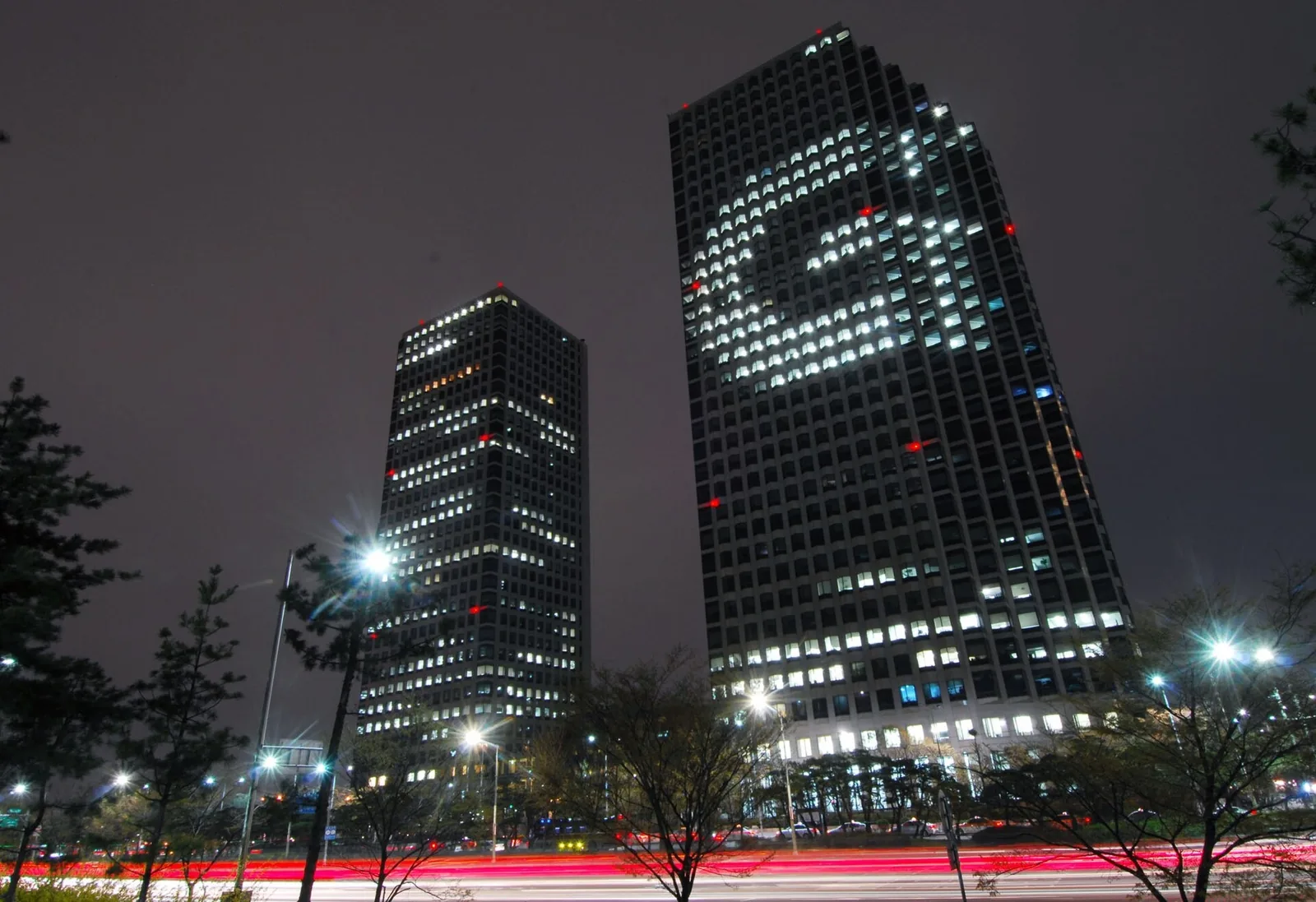
On October 1, 2025, LG Chem, headquartered in the LG Twin Towers in Yeouido, Seoul, disclosed that it would dispose of 5.75mn common shares of its subsidiary LG Energy Solution (LGES) at KRW 347,500 a share. The amount was KRW 1,998.1bn. Four weeks later, on October 29, LGES closed at KRW 514,000, 47.9% above the price it was sold at. In an ordinary sale that would be the seller’s regret, but not in this deal, because the contract was a price return swap (PRS). If the brokerage that took the shares later sells them above the base price, the difference goes to LG Chem; if it sells below, LG Chem pays the difference. It was called a disposal, but the risk and the upside of the price moving stayed with LG Chem.
A year later, on October 28, 2026, LG Chem decided to sign the same kind of contract again. This time it covers 6,535,939 LGES common shares, worth KRW 2.5tn (about $1.87bn). Together with it, LG Chem filed, for the first time, a plan to buy back its own shares and cancel them. The market started calling it “a PRS for shareholder returns.” This report asks one question. Is this deal a pure shareholder return, or does it have another purpose? And how much does it change LG Chem’s fair market value?
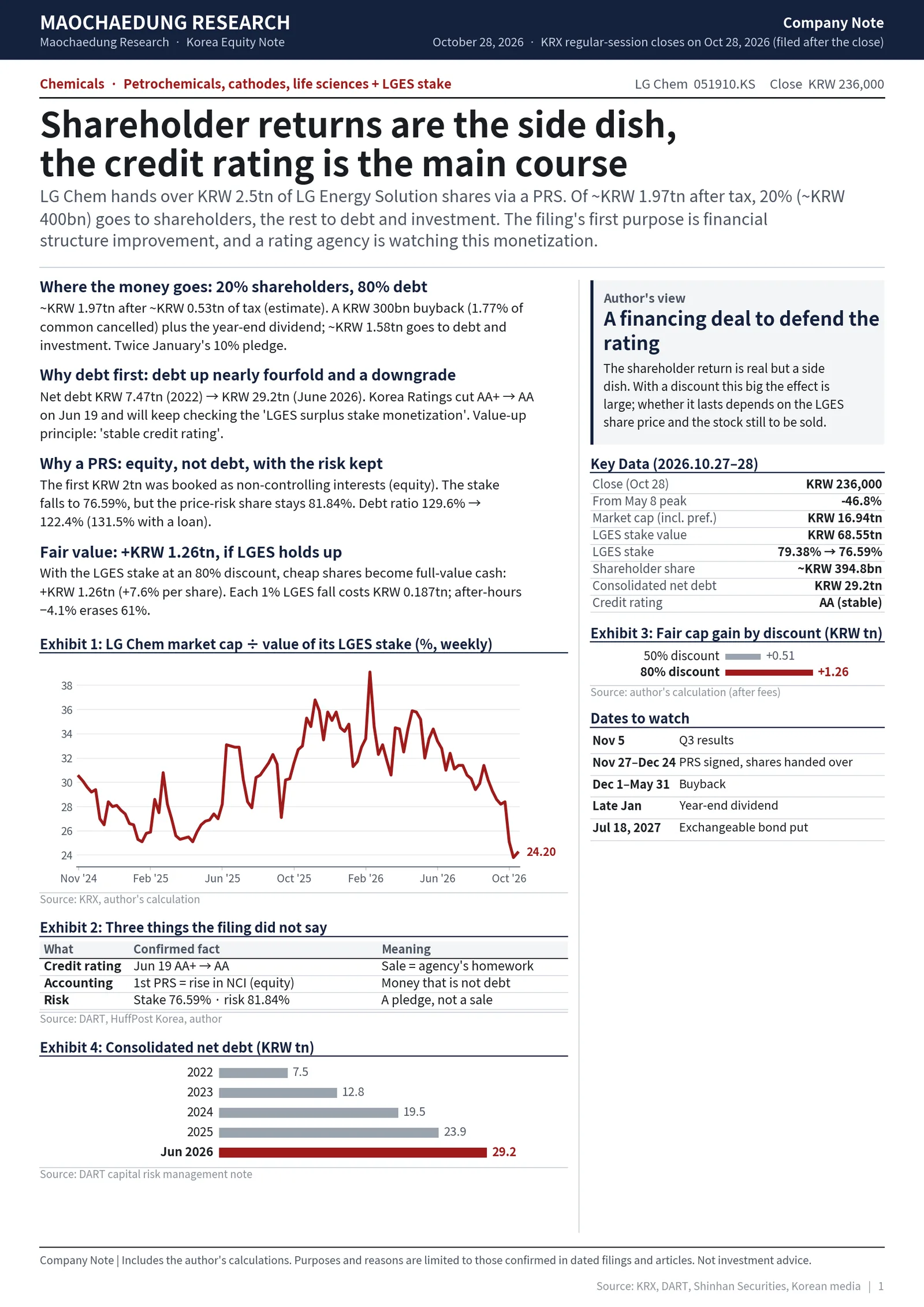
This report is the English edition of the author’s Korean note on LG Chem’s LG Energy Solution stake PRS and shareholder returns.
As of: October 28, 2026
Stocks covered: LG Chem (051910.KS, KOSPI) and LG Chem preferred shares (051915.KS), compared with LG Energy Solution (373220.KS).
Topics: the numbers and the money path in today’s four filings; what a PRS is and how the first one behaved; the accounting (equity, not debt); consolidated and parent-only debt and the credit rating; the core businesses (petrochemicals and advanced materials) and parent finances; exchangeable bonds and PRS maturities; the size of the shareholder return and the largest shareholder’s stake; the discount on the LGES stake and fair market value (a brokerage sum-of-the-parts framework, by discount rate, and sensitivity to the LGES share price); the first market reaction and the LGES overhang; and the dates to watch.
Data: share prices and market values come from the KRX Data System (regular-session closes on October 27 and 28, 2026; the deal was filed after the October 28 close); after-hours prices from Naver Finance minute data (Nextrade); company figures from DART filings (today’s filings, the 2026 half-year report, the 2025 and 2023 annual reports and the January 29 fair disclosures); credit ratings from the agencies’ announcements as reported in the press; and the brokerage valuation from Shinhan Securities’ August 3, 2026 report. Numbers the author calculated are marked “author’s calculation.”
Some Korea-specific background. The KOSPI is the Korea Exchange’s (KRX) main board, and tickers ending in .KS trade there. DART is the Financial Supervisory Service’s electronic disclosure system, where Korean companies file their reports. Nextrade (NXT) is Korea’s alternative trading venue, launched in 2025, whose after-market runs until 20:00, after the KRX regular session closes at 15:30, so a filing made after the close is first priced there. Korea Ratings and Korea Investors Service are two of Korea’s three domestic credit rating agencies (NICE Investors Service is the third); on their scale AA is two notches below the top AAA. LG Chem belongs to the LG Group, one of Korea’s large family-run conglomerates (chaebol); its largest shareholder is the holding company LG Corp, and LG Chem in turn controls LGES. The “Value-up” plan is the corporate value enhancement plan that Korea’s Corporate Value-up Program asks listed companies to publish. A PRS (price return swap) is a contract in which the seller of shares keeps the price risk: when the buyer later sells, the difference from an agreed base price is settled with the seller. Korea counts large sums in units of 100 million won (eok) and trillion won (jo); this report converts them to KRW bn and KRW tn. Dollar figures in parentheses are converted at KRW 1,337.3 per dollar, the October 28, 2026 rate (Yahoo Finance KRW=X). At that rate the KRW 2.5tn deal is about $1.87bn, the KRW 382,500 base price about $286 a share, and the KRW 300bn buyback about $224mn.
The conclusions first. First, this is not a pure shareholder return. The words the company wrote in the “purpose of disposal” box of the filing are “financial structure improvement and shareholder value enhancement,” and the shareholders’ part of the after-tax cash is 20%, about KRW 400bn. The other 80% goes to debt repayment and future investment. Second, the other purpose is confirmed by the filings and the rating agencies’ own words. LG Chem’s consolidated net debt rose from KRW 7.47tn at the end of 2022 to KRW 29.2tn at the end of June 2026, and when Korea Ratings cut the credit rating from AA+ to AA on June 19, it said it would keep checking the financial structure improvement from the “LG Energy Solution surplus stake monetization.” The company itself wrote “maintaining a stable credit rating” into its Value-up plan as a capital allocation principle. Third, the reason for choosing a PRS shows in the accounts. The first KRW 2tn was booked in the consolidated accounts not as borrowings but as equity (an increase in non-controlling interests). The disclosed stake falls, but the share of LGES price risk LG Chem bears stays at 81.84%, the same as at the start. Fourth, even so, the deal can work in LG Chem shareholders’ favor. Brokerages that value LG Chem apply a large discount to the LGES stake, so when shares counted cheaply turn into full-value cash, fair market value rises. At an 80% discount, the gain is KRW 1.26tn after fees, and 7.6% in per-share value including the share cancellation. But each 1% fall in the LGES share price cuts that gain by KRW 0.187tn, and LGES is left with an overhang of shares that can come to market at any time. Shareholder returns are the side dish; the main course is the credit rating.
Today’s four filings: the first purpose is financial structure improvement
On October 28 LG Chem made four filings at once: a decision to dispose of shares in another company, a fair disclosure announcing a shareholder return plan, a decision to cancel shares, and a major-event report on signing a treasury share trust contract. Read together, they show where the deal’s center of gravity lies. The disposal came first, and part of that money funds the shareholder return.
The disposal: KRW 2.5tn, stake 79.38% → 76.59%
According to the disposal decision, LG Chem will dispose of 6,535,939 LGES common shares for KRW 2,499,996,667,500. That is 5.31% of LG Chem’s consolidated total equity of KRW 47,105.5bn at the end of 2025. After the disposal LG Chem will hold 179,211,586 LGES shares, a 76.59% stake. The price per share is KRW 382,500 (about $286), the LGES close on October 27, the day before the board meeting, and the company wrote that “the actual number of shares and price may change with the share price before the contract date.” The scheduled disposal date is November 27, but that is the earliest day of a disposal window running from November 27 to December 24.
The purpose box reads “financial structure improvement and shareholder value enhancement.” The order matters: financial structure improvement comes first. Item 9 of the filing says LG Chem plans to sign a PRS contract with the buyer and gives the terms. The underlying asset is 6,535,939 LGES common shares; the base price equals the sale price; when the buyer sells the shares, the difference between the sale proceeds and the settlement base amount (shares sold × base price) is settled; and the contract runs for two years. The buyer is not named in the filing. For the first PRS it was “Korea Investment & Securities and others” (2026 half-year report).
Shareholder returns: 20% of after-tax cash, KRW 300bn of it for the first buyback-and-cancellation
The fair disclosure reads: “considering the maintenance of financial soundness and securing funds for future growth investment, out of the after-tax cash inflow from this sale of LG Energy Solution shares, the funds available for shareholder returns are set at about KRW 400bn, about 20% of the after-tax cash inflow.” It adds that “KRW 300bn of this will be used for this treasury share purchase, and the rest will be used for the FY2026 year-end dividend.” In other words, the shareholders’ part was set as what is left after financial soundness and investment funds are taken out first.
The company did not state the after-tax cash. The author derived the after-tax ratio from the first PRS’s accounting numbers. In the statement of changes in equity in the 2025 annual report, the first disposal raised equity by KRW 1,577.7bn (capital surplus KRW 1,068.1bn + non-controlling interests KRW 509.6bn), against disposal proceeds of KRW 1,998.1bn. The ratio is 0.7896. Applied to this KRW 2.5tn, it gives about KRW 1.97tn after tax (about $1.47bn) and about KRW 0.53tn of tax (author’s calculation). Twenty percent of that is about KRW 394.8bn (about $295mn), which matches the company’s “about KRW 400bn.” Taking out the KRW 300bn buyback leaves about KRW 94.8bn for the year-end dividend and about KRW 1.58tn for debt repayment and investment. In short, KRW 2.5tn → tax ~KRW 0.53tn → after tax ~KRW 1.97tn, of which 20% to shareholders (~KRW 394.8bn) and ~KRW 1.58tn to debt and investment.
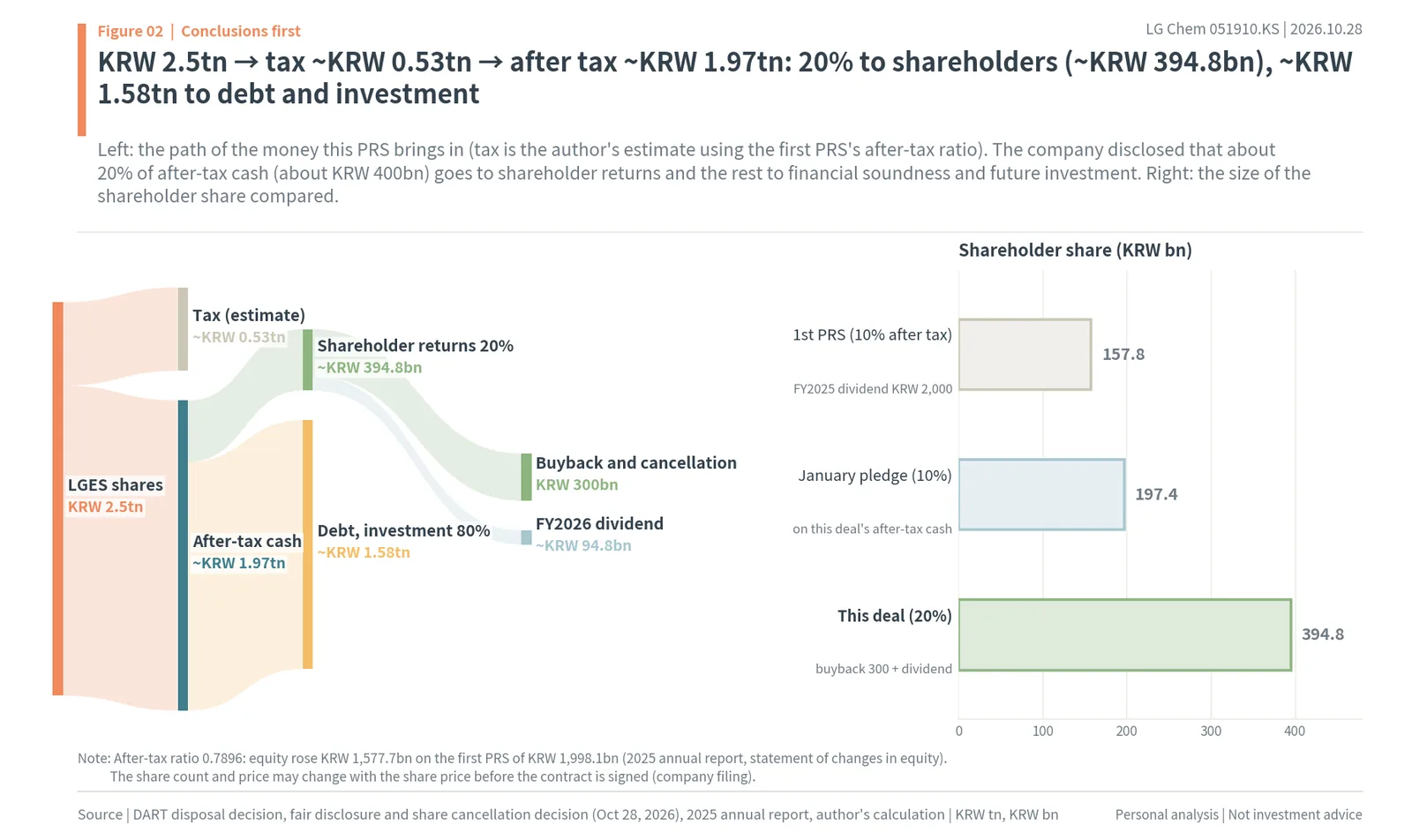
It is true that the shareholders’ part got bigger. In the January 29 fair disclosure, the company said it would use about 10% of the after-tax cash inflow from selling LGES shares for shareholder returns, and it used the first PRS’s share (about KRW 157.8bn) to pay a FY2025 dividend of KRW 2,000 a share. This time it raised that ratio to 20%. A share that would have been about KRW 197.4bn under the January pledge became about KRW 394.8bn. And this is the first time LG Chem returns money to shareholders through a buyback-and-cancellation rather than a dividend. The company said that when it judges its share price to be below intrinsic value, it will use treasury share purchases and cancellation first, within the range that keeps the dividend stable.
The rest of the January policy is worth recording too. LG Chem’s dividend policy is to pay out at least 20% of consolidated net profit attributable to owners (excluding one-off non-recurring gains). In 2025 there was a net loss, so this rule produced no funds, but the company used 10% of the money from selling LGES shares to pay KRW 2,000 a share. Over the medium to long term it said it would raise the payout ratio to 30% once ROE recovers to 10% or more and LGES dividends begin in earnest. So LG Chem’s shareholder returns rest not on what the core business earns today but on the money from selling LGES shares. This 20% sits inside the same structure.
That is why, in this deal, the shareholder return is not the main body but a piece cut from it. The main body is turning LGES shares into cash, and most of that cash goes to debt and investment. Before going further, it helps to explain simply why a PRS was used in the first place.
A PRS made simple: a sale in name, in substance a loan against shares
A PRS (price return swap) in one line is “hand over shares and get the money now, but keep bearing the rise and fall of their price.” Legally the shares are sold, so tax is paid and the disclosed stake falls. Economically, it is close to pledging the shares and borrowing money. This chapter explains the structure with an analogy and numbers, then looks at how the first PRS actually behaved.
An analogy: sell the house, but settle the difference when it is resold
LG Energy Solution (LGES) is the company LG Chem spun off from the battery business it built, in December 2020. It listed on the Korea Exchange in January 2022 and is still a subsidiary mostly owned by LG Chem (Wikipedia, LG Energy Solution).
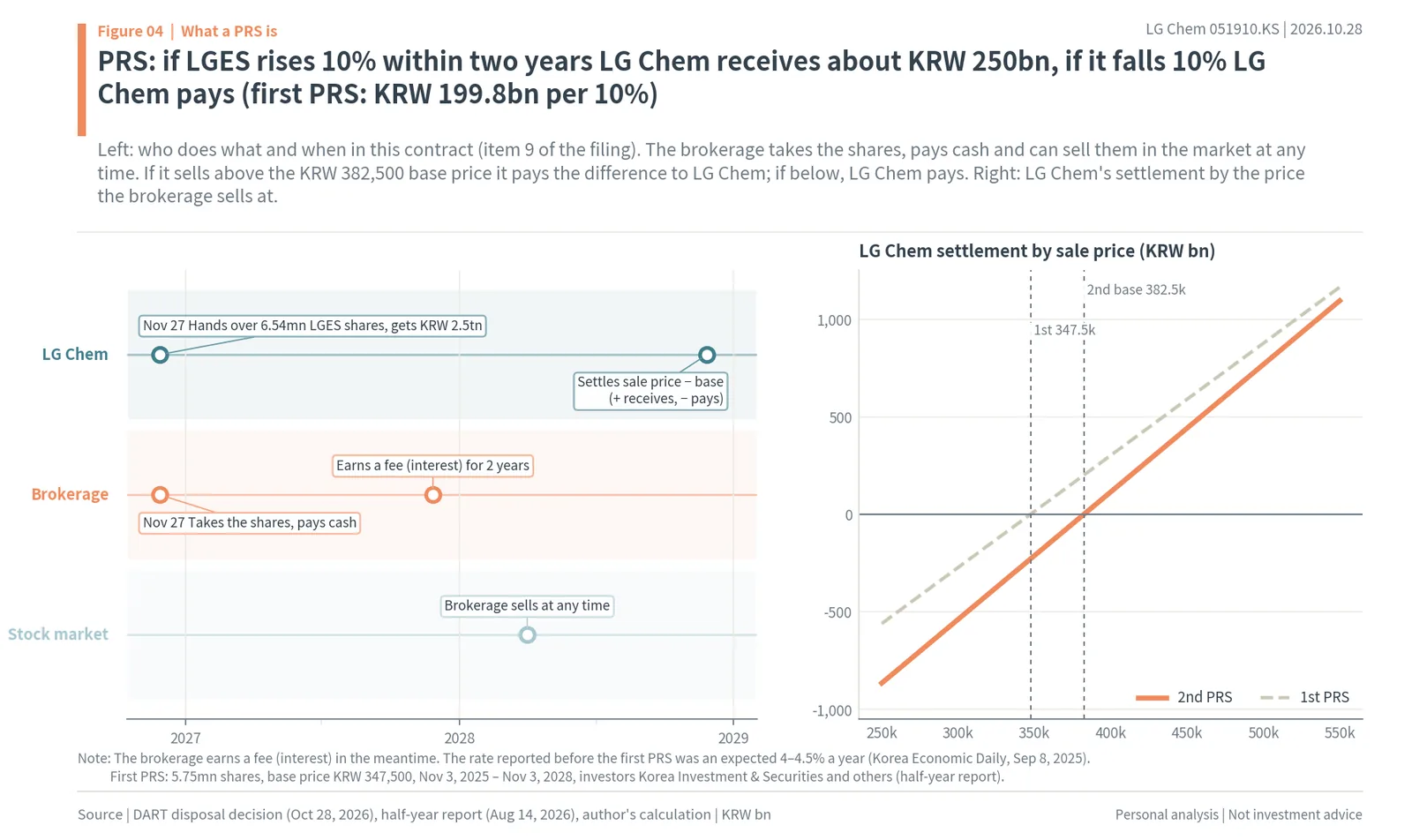
As an analogy: you sell a house and get the money now. But you make a separate promise with the new owner. When the new owner later resells the house, if it sells above the price you sold at, you receive the difference; if below, you pay the difference. In return you pay the new owner a fee, like interest, in the meantime. The new owner gains or loses nothing whether house prices rise or fall, and earns only the fee. The risk and the upside of the house price stay with the seller. So it is called a sale, but in substance it is closer to pledging the house and borrowing money.
In this contract the house is 6,535,939 LGES shares, the new owner is a brokerage (the buyer), and the sale price is the KRW 382,500 base price. The brokerage takes the shares, pays the money, and can sell them in the market at any time within two years. If the price when it sells is above the base price it pays the difference to LG Chem; if below, LG Chem pays the difference. In numbers, if LGES rises 10% within two years LG Chem receives about KRW 250bn, and if it falls 10% LG Chem pays the same. For the first PRS of 5.75mn shares (base price KRW 347,500), KRW 199.8bn changes hands per 10% move.
The fee is not in the filing. Ahead of the first PRS, the Korea Economic Daily reported that “the PRS annual interest rate is expected to be set at around 4 to 4.5%, 1 to 1.5 percentage points above the 3% yield on LG Chem’s three-year corporate bonds” (September 8, 2025). Applying the same level to this KRW 2.5tn gives KRW 100bn to 112.5bn a year (author’s calculation). Edaily also pointed out that “PRS fees are higher than general funding tools such as corporate bonds” (October 6, 2025). Judged only as a cost of raising money, a PRS is not cheap.
The first PRS: the 47.9% rise above the sale price belonged to LG Chem
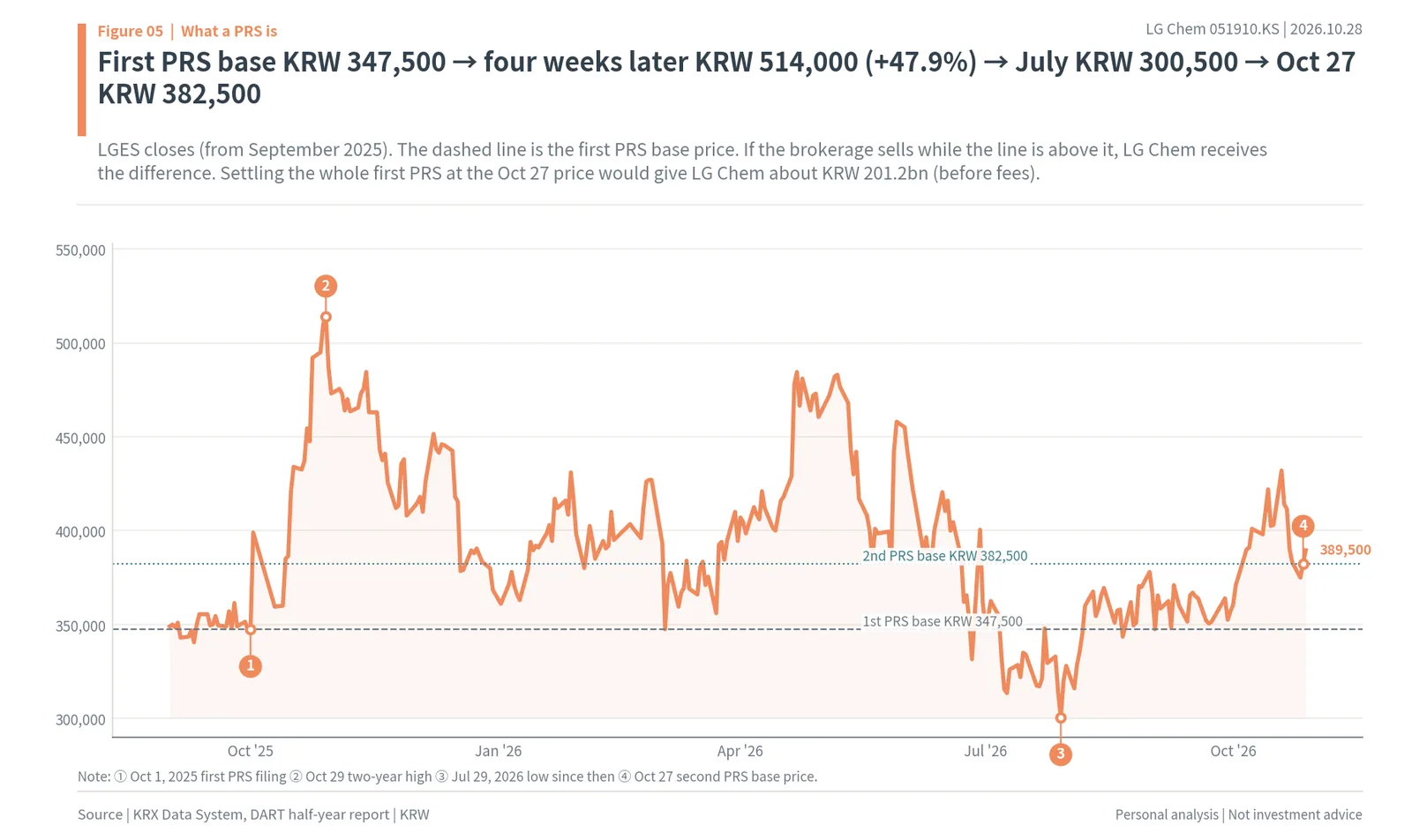
The first PRS shows how the structure actually works. The base price was the September 30, 2025 close of KRW 347,500. After the filing LGES rose quickly, reaching KRW 514,000 (+47.9%) on October 29. It then came down to KRW 300,500 on July 29, 2026, and on October 27, the base date of this second PRS, it was KRW 382,500. When the brokerage sold its shares has not been disclosed. But under the contract, shares sold while the line was above the base price earn LG Chem the difference, and shares sold below it are differences LG Chem must pay. If the whole first PRS were settled at the October 27 price, LG Chem would receive about KRW 201.2bn (before fees, author’s calculation).
The note in the 2026 half-year report describes the contract this way: “the investor may dispose of the underlying asset at maturity or at any time before maturity, and the company cannot be involved in or influence the sale of the underlying asset in any form.” LG Chem does not decide when the brokerage sells, and this condition ties into both the accounting treatment and the LGES overhang discussed below.
Others use the same route: Hanwha Systems’ PRS in Hanwha Ocean shares
This year the PRS has become a common way for affiliates of Korea’s large groups to raise money from stakes in subsidiaries and associates. In the same month Hanwha Systems handed 22,169,660 Hanwha Ocean shares (KRW 1,383.4bn) to Kiwoom Securities and six special purpose companies under a PRS. The base price was KRW 62,400, the contract one year, and the stated purpose “securing liquidity and strategic investment funds” (DART, Hanwha Systems major-event report, October 16, 2026). Hanwha Systems had handed over 13,281,250 shares (base price KRW 128,000) the same way in April. In both deals the shares moved but the seller kept the price risk, and on the transfer days KRX trading by investor type showed financial investment net buying and heavy trading value. LG Chem’s second PRS is likely to leave the same trace during the disposal window (November 27 to December 24).
In short, for LG Chem a PRS is a way to “turn LGES shares into cash while still bearing the rise and fall of the LGES share price.” Then why use a PRS when a loan would do the same thing? The answer is in the books.
Equity, not debt: a PRS cuts the debt on the books
The clearest reason for choosing a PRS is accounting. Borrowing the same KRW 2.5tn from banks or through corporate bonds adds the same amount of debt to the books. A PRS is, for accounting purposes, a sale of subsidiary shares, so in the consolidated accounts the money comes in as equity, not debt. The risk LG Chem keeps remains only as a small derivative. The first PRS’s numbers show this directly.
The first KRW 2tn was booked as an “increase in non-controlling interests”
The financing activities in the 2025 consolidated cash flow statement include an “increase in non-controlling interests” of 1,998,125 (KRW mn). That is the money from the first PRS. In the statement of changes in equity, under “changes in ownership interests in subsidiaries without loss of control,” capital surplus rose by KRW 1,068.1bn and non-controlling interests by KRW 509.6bn, KRW 1,577.7bn in total. The first PRS’s KRW 1,998.1bn came in not as borrowings but as KRW 1,577.7bn of equity, made up of capital surplus KRW 1,068.1bn + non-controlling interests KRW 509.6bn. The gap of about KRW 420.4bn between the proceeds and the rise in equity is what went out as tax and similar items (author’s calculation).
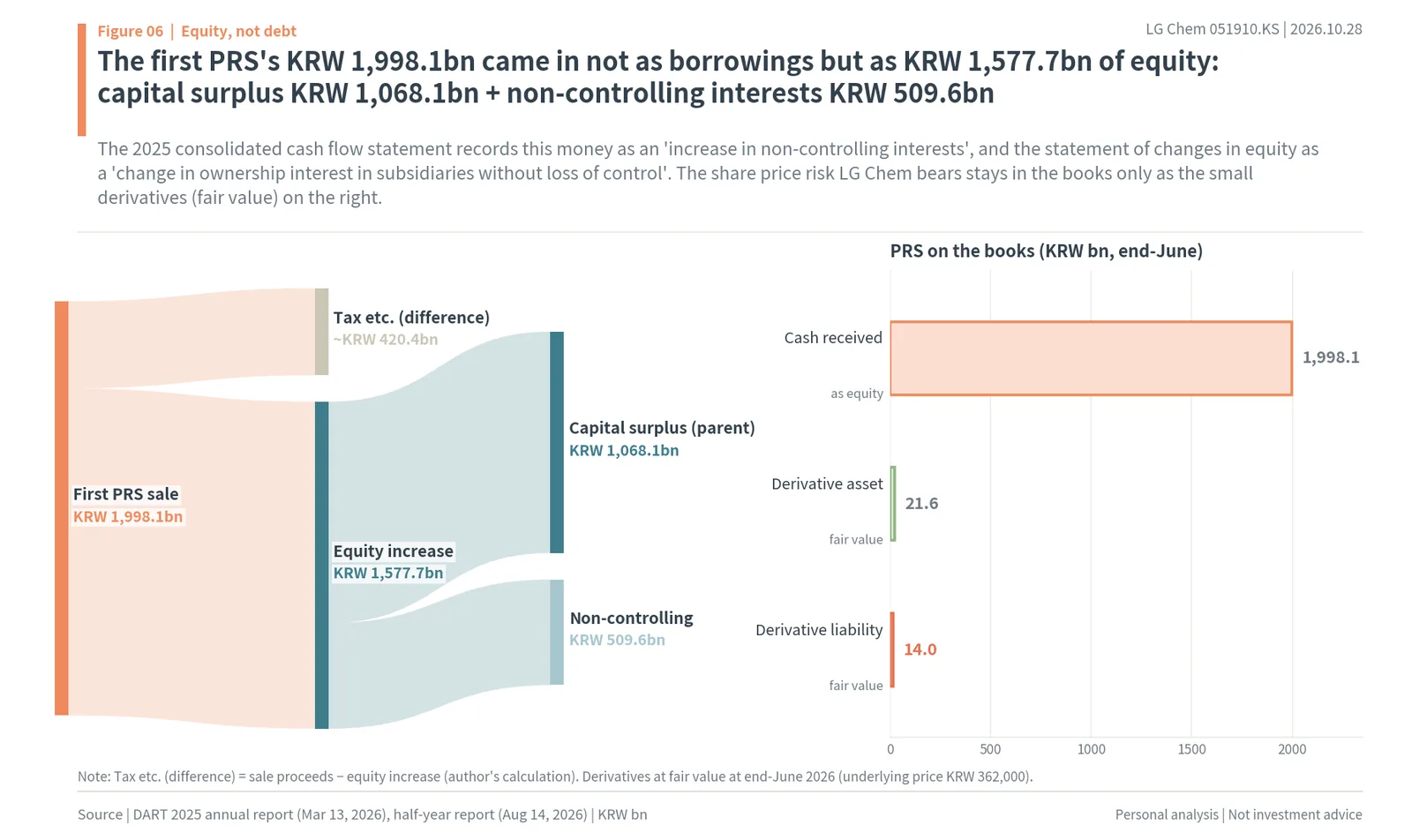
Where did the LGES price risk LG Chem bears go? The fair value note in the half-year report lists a “non-current derivative financial asset (price return swap) of 21,557” and a “current derivative financial liability (price return swap) of 14,049” (KRW mn, end-June 2026, underlying share price KRW 362,000). A KRW 2tn deal remains on the books only as derivatives in the tens of billions of won. Edaily wrote that because it is booked as equity, it can help companies with weak finances lower their borrowing-related ratios, and Korea Ratings commented that “if there is a real repayment burden, classifying it as a borrowing transaction is appropriate” (October 6, 2025).
The disclosed stake falls, but the share bearing the risk does not
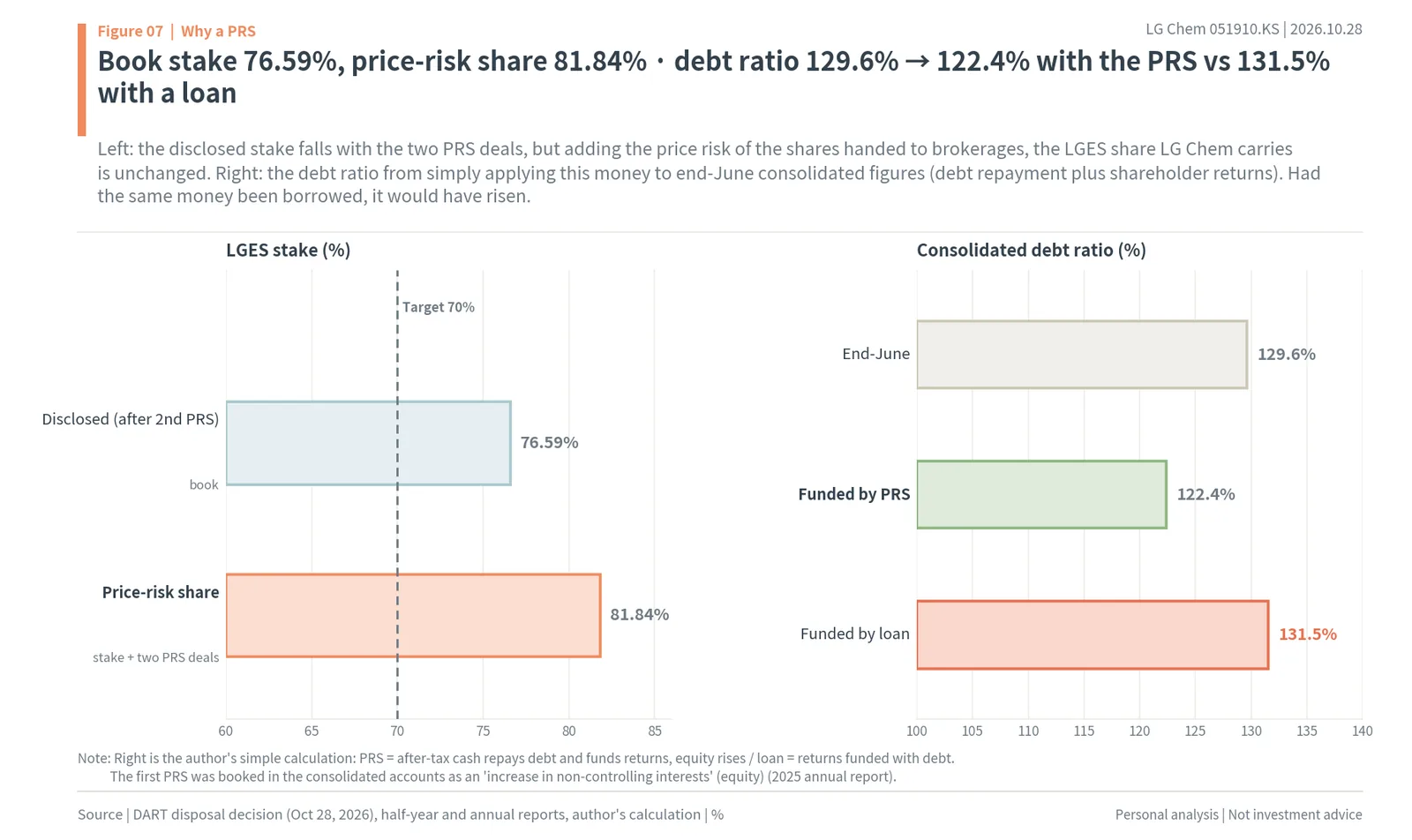
Separating the disclosed stake from the economic share makes the nature of a PRS clearer. After the second PRS, LG Chem’s disclosed LGES stake is 76.59%. But LG Chem also bears the price risk of the 5.75mn shares from the first PRS and the 6,535,939 shares from the second, both handed to brokerages. Together that is 191,497,525 shares, 81.84% of LGES’s issued shares, the same size as the stake LG Chem held after LGES listed in January 2022. Book stake 76.59%, price-risk share 81.84%.
The debt side is the opposite: it really does shrink on the books. Simply applying this money to the end-June 2026 consolidated figures (total liabilities KRW 63.34tn, total equity KRW 48.87tn), using the after-tax cash to repay debt and fund the shareholder return lowers the debt ratio from 129.6% to 122.4%. Had the shareholder return been funded with borrowed money, the ratio would instead rise to 131.5% (author’s calculation). To sum up: book stake 76.59%, price-risk share 81.84% · debt ratio 129.6% → 122.4% with the PRS vs 131.5% with a loan.
Compared with the alternatives: only a PRS keeps the upside without adding debt
LG Chem has four ways to raise money from its LGES stake. The first is a block deal, an after-hours bulk sale in which the shares really are sold. On the books it comes in as equity like a PRS, but handing over a large block at once usually means accepting a price below the close, and the upside if LGES rises goes with the shares. The second is an exchangeable bond. LG Chem has already issued bonds exchangeable into LGES shares in 2023 and 2025. Exchangeable bonds are booked as debt, and if the share price stays below the exchange price, the principal must be repaid. The July 2027 put date discussed in the next chapter is an example. The third is a bank loan or corporate bond, the simplest route, but it adds debt one for one and increases the pressure on the rating.
The fourth is a PRS. Legally a sale, it does not add debt to the books, and thanks to the settlement promise it does not give up the upside if LGES rises. The price is tax and fees. Tax falls on the gap between the sale price and LG Chem’s book value; in the first PRS, a little over 21% of the proceeds did not reach equity. The fee for the first PRS was reported to be 1 to 1.5 percentage points above corporate bonds. Placed side by side, the only one of the four that keeps the LGES upside without adding debt is the PRS. The choice shows a company that cares about both its credit rating and LGES’s future.
So a PRS is a deal in which “the stake shrinks only on paper, while the debt really shrinks on paper.” LG Chem chose this route despite paying tax (about KRW 0.53tn) and fees above corporate bond rates in order to reduce the debt that rating agencies and investors see on the books without giving up the LGES upside. The next question is how urgent that debt was.
Why debt first: debt up nearly fourfold and a one-notch downgrade
That debt is the main subject of this deal is confirmed by sources outside the company too. LG Chem’s consolidated net debt rose nearly fourfold in less than four years, and this year the rating agencies, one after another, lowered their outlooks or cut the rating. The agency that cut the rating said it would watch precisely the effect of monetizing the LGES stake. This PRS is the second answer to that homework.
The share price is near half its peak, and the second PRS came from that bottom
First, where the share price stands. LG Chem common shares hit their one-year high of KRW 429,500 on May 8, 2026, then fell to KRW 228,500 (-46.8%, about $170.9) on October 27, the day before the second PRS was filed. On October 26 they posted the lowest close of the past year (KRW 224,500). LG Chem went from KRW 429,500 on May 8 to KRW 228,500 on October 27 (-46.8%), and the second PRS came from that bottom. The numbers in the chart mark the first PRS filing (October 1, 2025), the January 29 shareholder return policy, the March 31 shareholders’ meeting, Korea Investors Service’s outlook cut on April 24, Korea Ratings’ downgrade on June 19, and today.
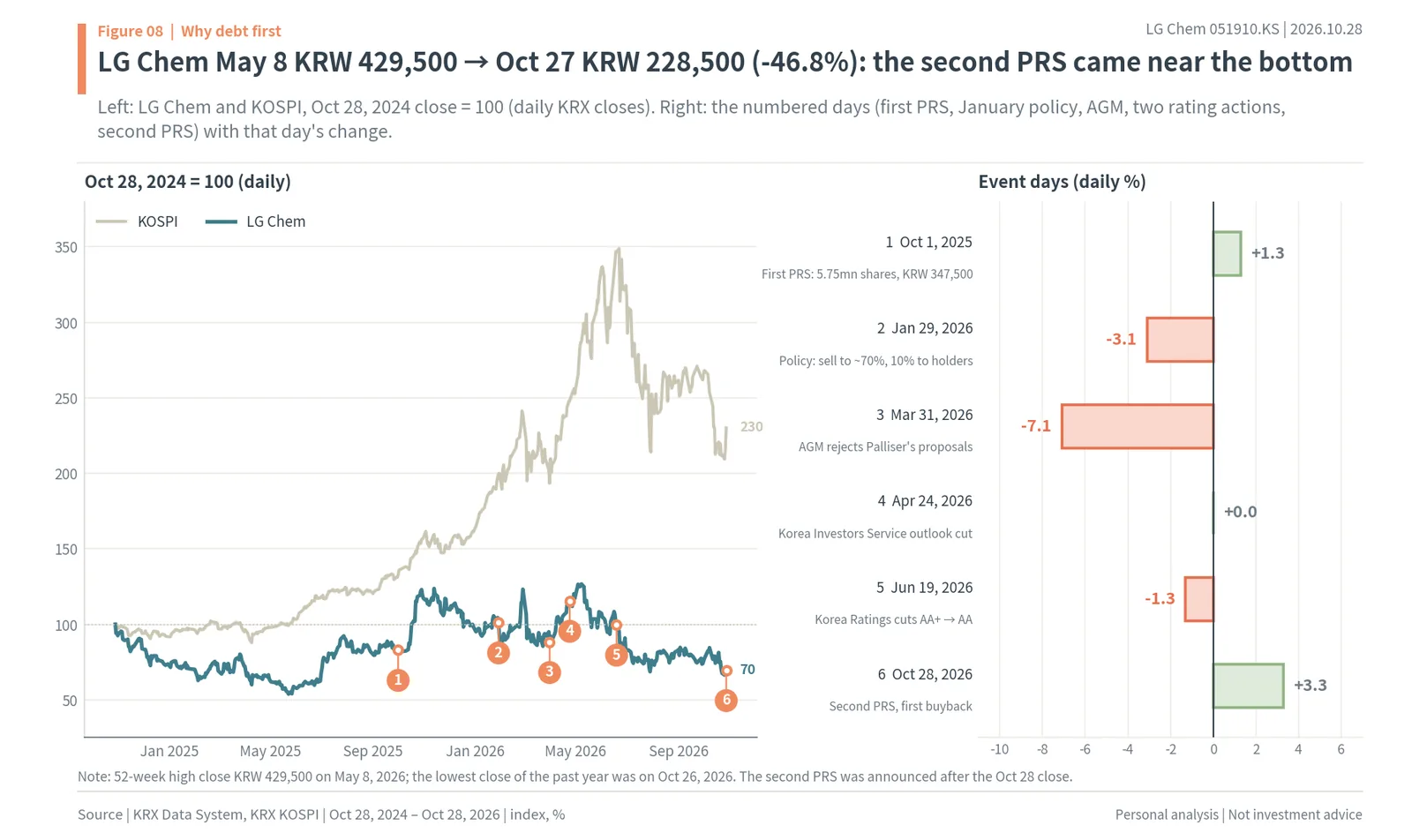
At the March 31 annual general meeting, the shareholder proposals of activist fund Palliser Capital (introducing advisory shareholder proposals and appointing a senior independent director) were all voted down (CEO Score Daily, March 31, 2026). Palliser has argued that LG Chem’s share price is far below the value of the LGES stake it owns. There was a demand for shareholder returns, but it should also be recorded that the company won that vote.
How the debt grew: battery and cathode plants
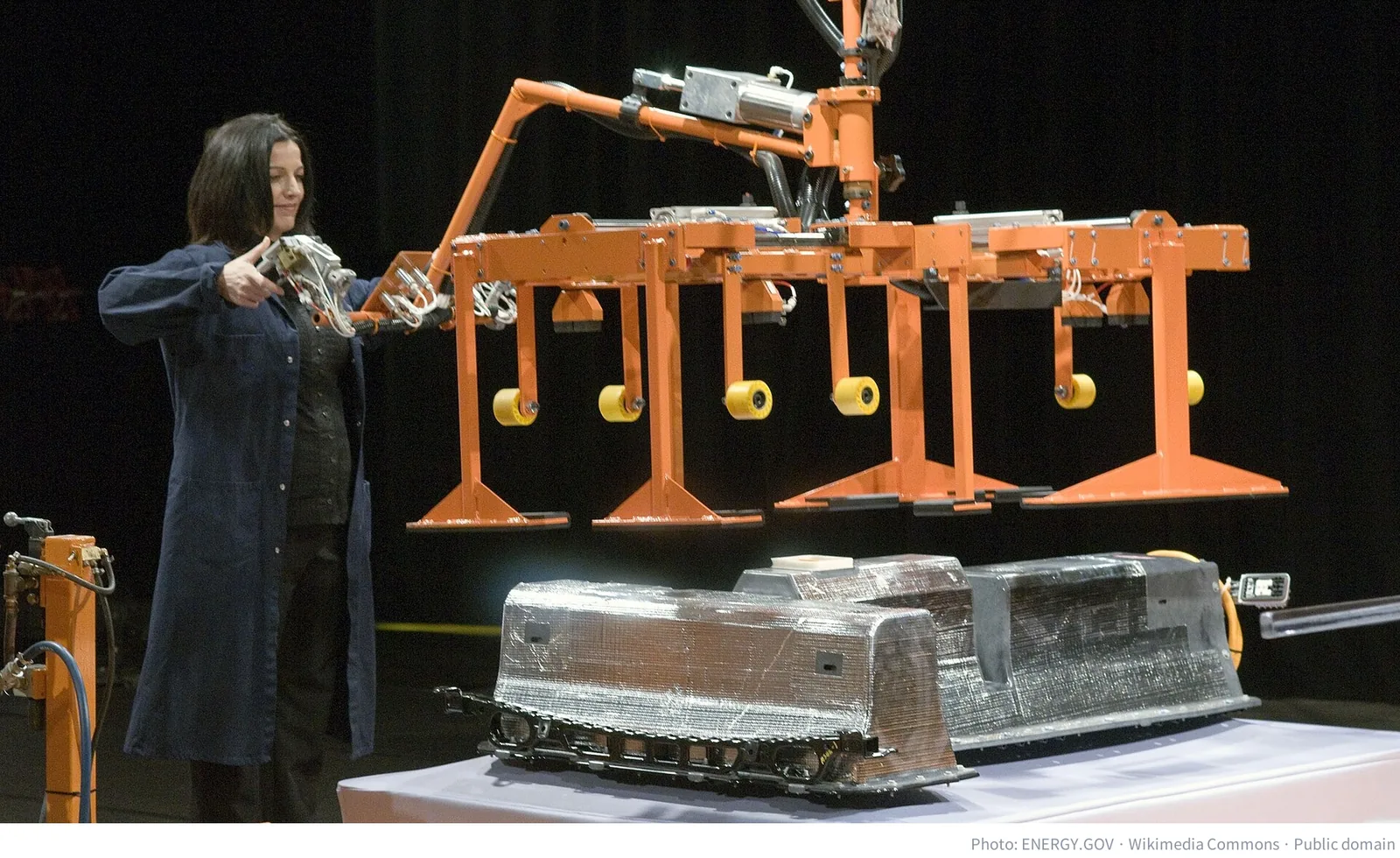
The debt grew because of plants. LG Chem was the company that made the battery cells in the 2010 Chevrolet Volt (Wikipedia, Chevrolet Volt), and that battery business became today’s LGES. LGES’s North American battery plants and LG Chem’s cathode plant investments swelled the consolidated debt. According to WISEreport, consolidated capital expenditure was KRW 12.96tn in 2023, KRW 14.61tn in 2024 and KRW 13.66tn in 2025.
On the company’s note basis, consolidated net debt (total borrowings − cash) was KRW 7.47tn at the end of 2022, KRW 12.84tn at the end of 2023, KRW 19.52tn at the end of 2024, KRW 23.91tn at the end of 2025 and KRW 29.2tn (about $21.8bn) at the end of June 2026. That is 3.9 times the end-2022 level, and it rose by KRW 5.29tn in the first half of this year alone. Over the same period the debt ratio went from 81.4% to 129.6%. In short, consolidated net debt KRW 7.47tn → KRW 29.2tn (3.9x), debt ratio 81.4% → 129.6%, and in the meantime Korea Ratings cut the rating from AA+ to AA.
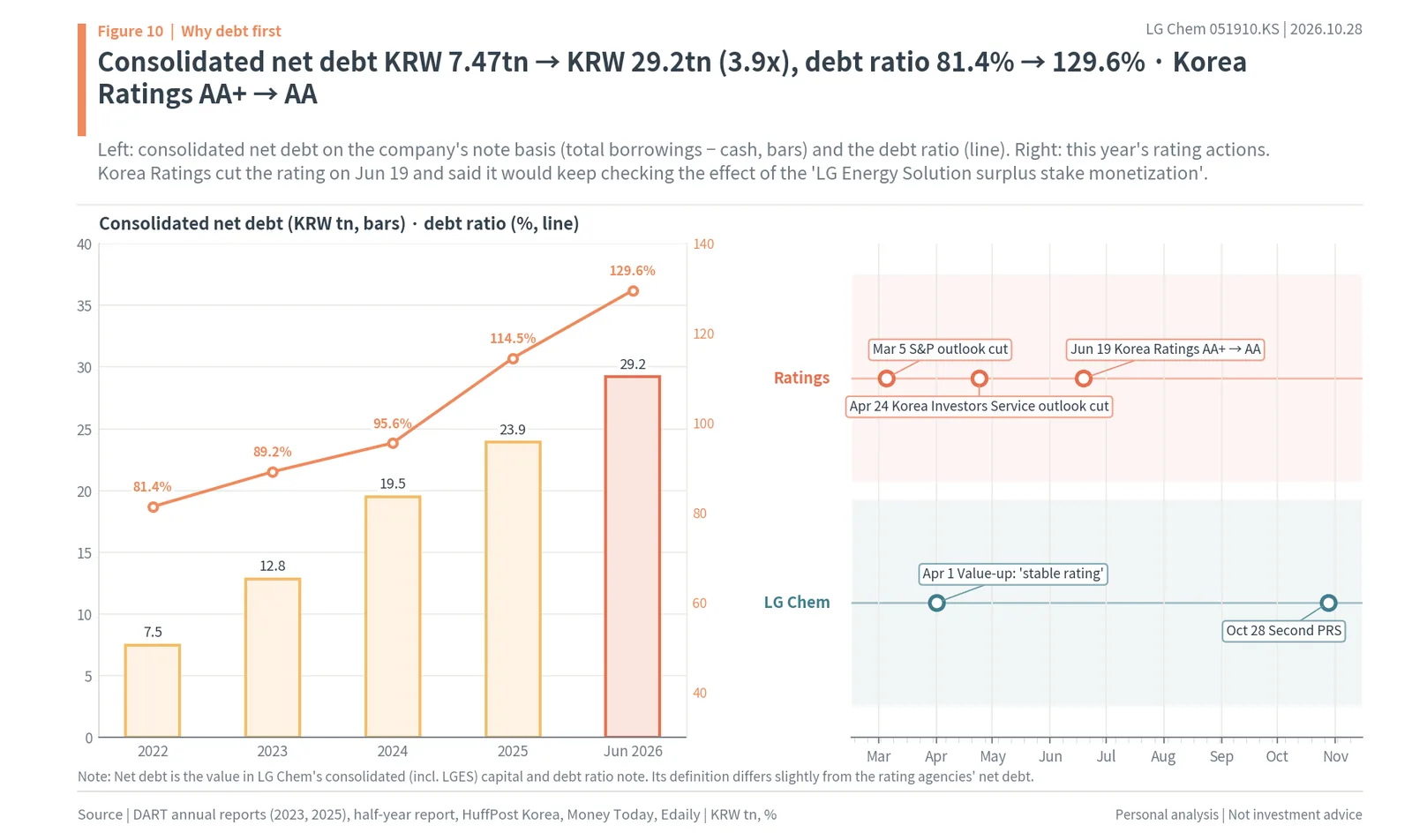
The rating actions went like this. In March S&P lowered LG Chem’s outlook by one step from “stable” (Money Today, March 5, 2026). On April 24 Korea Investors Service kept the rating (AA+) but lowered the outlook, saying that “even if investment is scaled back, annual capital expenditure (CAPEX) is expected to exceed operating cash flow, so a financial burden high for the rating level will persist for some time” (Edaily, April 24, 2026). The same article reported that excluding LGES, LG Chem posted its first-ever operating loss in 2025. Then on June 19 Korea Ratings cut the rating from AA+ (negative outlook) to AA (stable). Senior analyst Han Min-su said it “will continue to check the effect of financial structure improvement through asset efficiency, as the company has announced a plan to monetize its surplus stake in LG Energy Solution” (HuffPost Korea).
The outlook is not much different. The WISEreport consensus sees LG Chem’s consolidated capital expenditure falling to KRW 7.99tn in 2026 and KRW 6.89tn in 2027, about half of 2025 (KRW 13.66tn), yet expects the consolidated debt ratio to stay at 126.19% in 2026 and 126.97% in 2027. Even with much lower investment, the debt ratio does not come down. In a structure where profits alone can hardly reduce the debt, the biggest card the company can play is its stake in a company with a KRW 89.5tn market value: LGES shares.
The company’s own documents point the same way. In the corporate value enhancement plan it refiled on April 1, LG Chem wrote as a medium- to long-term capital allocation principle “improve financial soundness by keeping net debt flat or lower, to maintain a stable credit rating,” and in the same paragraph added “gradual use of the LG Energy Solution shares held (down to a stake of about 70%).” Selling LGES shares was designed from the start as a package with the credit rating. So before it is a shareholder return, this sale is exactly the homework the rating agency said it would watch.
Core business and parent finances: the parent is repaying, but the headwinds are strong
The consolidated numbers include LGES’s debt. The PRS money goes to LG Chem itself (parent-only, or “separate,” in Korean accounting), so the parent’s position needs a separate look. The parent reduced its debt after the first PRS money came in and turned profitable in the first half of this year. But much of that profit came from temporary market conditions created by war, and one petrochemical plant is still idle.
The parent: borrowings down, and cash down too
On OpenDART’s separate financial statements, the parent’s borrowings were KRW 10.48tn at the end of 2024, KRW 8.85tn at the end of 2025 and KRW 8.1tn at the end of June 2026. Cash was KRW 1.89tn at the end of 2024, KRW 3.99tn at the end of 2025 and KRW 2.42tn at the end of June 2026. In 2025 KRW 1,991.1bn came in from disposing of subsidiary shares (the first PRS), and the parent repaid KRW 4.10tn of borrowings while borrowing KRW 2.27tn anew, a net repayment of KRW 1.83tn. In the first half of 2026 it borrowed nothing new and repaid KRW 1.19tn. Operating profit turned from KRW -210.5bn in 2025 to +KRW 431.8bn in the first half of 2026. To sum up: parent borrowings KRW 10.48tn → KRW 8.1tn, cash KRW 3.99tn → KRW 2.42tn, H1 operating profit +KRW 431.8bn.
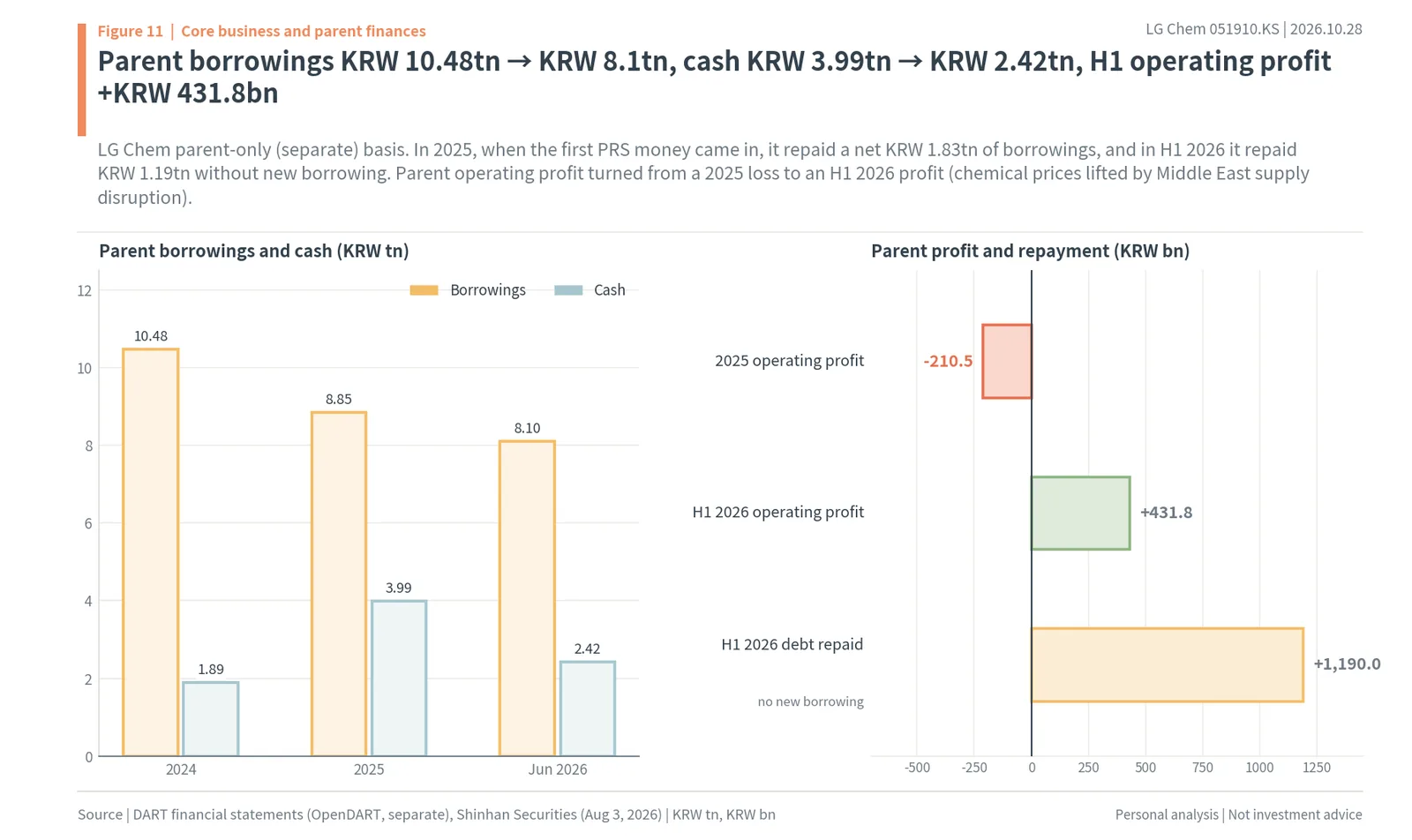
These numbers also show where the first PRS money went. The after-tax money from the first PRS was about KRW 1.58tn (on the consolidated equity increase), and in the same year the parent’s borrowings fell from KRW 10.48tn to KRW 8.85tn, by KRW 1.63tn. As pledged in January, 10% of the after-tax money (about KRW 157.8bn) funded the FY2025 dividend of KRW 2,000. Looking only at the parent, most of the first PRS money went to repaying debt. Yet consolidated net debt kept rising over the same period, from KRW 19.52tn to KRW 23.91tn, and to KRW 29.2tn in the first half of this year, because investment at LGES and other subsidiaries outpaced the parent’s repayments. Rating agencies look at consolidated numbers, so even with the parent repaying, the pressure on the rating did not ease, and a second PRS became necessary.
The reason for the first-half profit lay outside the company. Shinhan Securities attributed the chemicals division’s second-quarter operating profit of KRW 427.0bn to strong product prices from Middle East supply disruption and a favorable inventory lag effect (August 3, 2026). Samsung Securities expects third-quarter basic materials operating profit of KRW -154.1bn, saying the favorable inventory lag from the feedstock price spike is turning unfavorable (October 12, 2026). It is hard to see the parent’s profit as durable.
Petrochemicals: Chinese oversupply, then a feedstock disruption
Petrochemicals is the business of cracking naphtha into basic feedstocks such as ethylene and propylene. Among its reasons for the June downgrade, Korea Ratings said that “the burden of oversupply from China is unlikely to ease meaningfully, so room for improvement in the petrochemical division’s results in the short to medium term will be limited.”
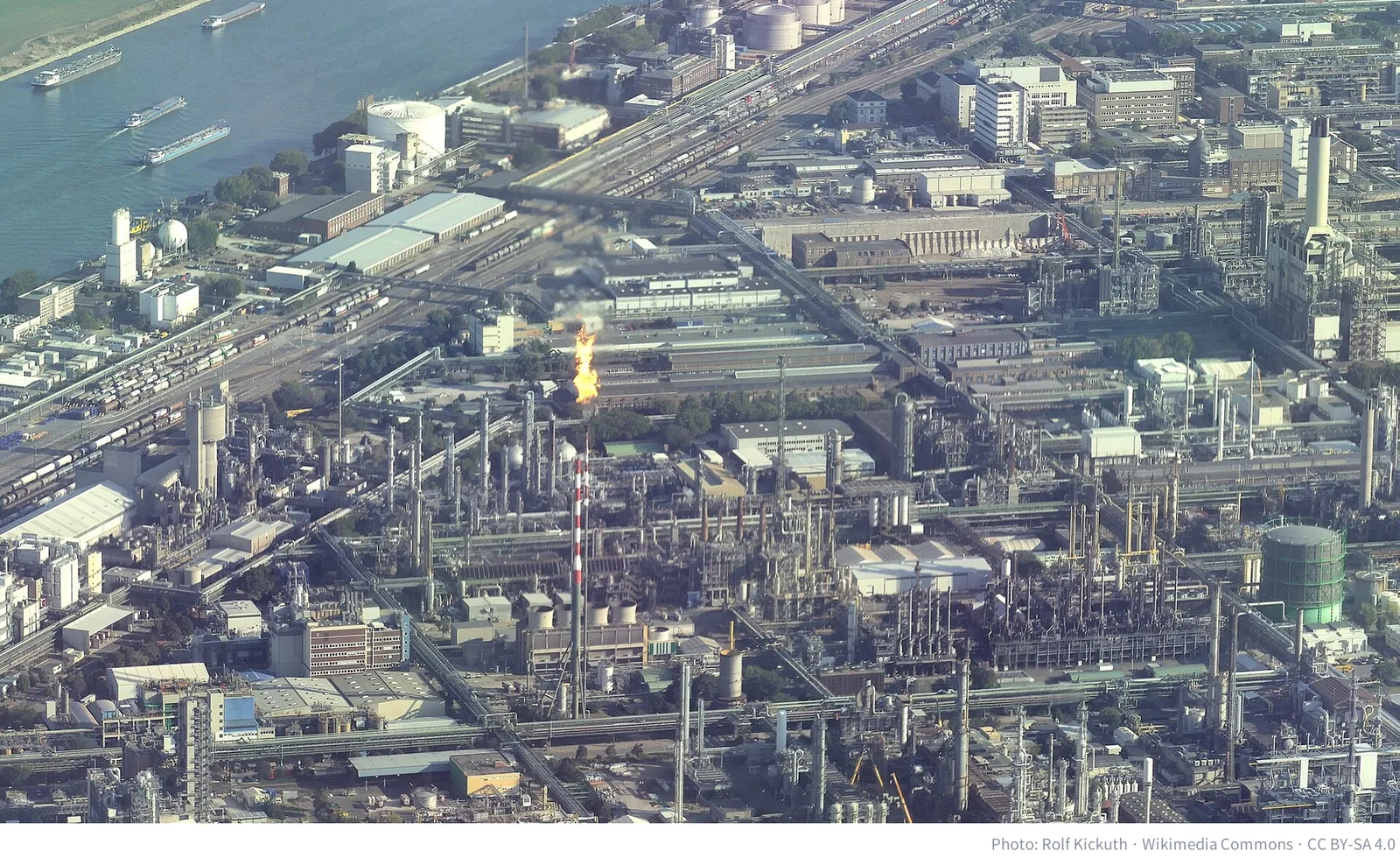
A feedstock problem was layered on top. On March 23 LG Chem disclosed that it was temporarily halting production at Yeosu NCC plant 2 (a naphtha cracking center) due to “supply disruption of NCC feedstock (naphtha) from the Iran war and other factors,” and on August 24 it said “the restart plan is currently undecided.” According to the second-quarter call as reported by Eugene Investment & Securities, cracker utilization was in the mid-70% range in the first quarter and the mid-50% range in the second. Since 2024 the company has, every six months, reissued its response to reports that it is considering spinning off its NCC business: “we are reviewing various options, but nothing specific has been decided” (refiled August 24).
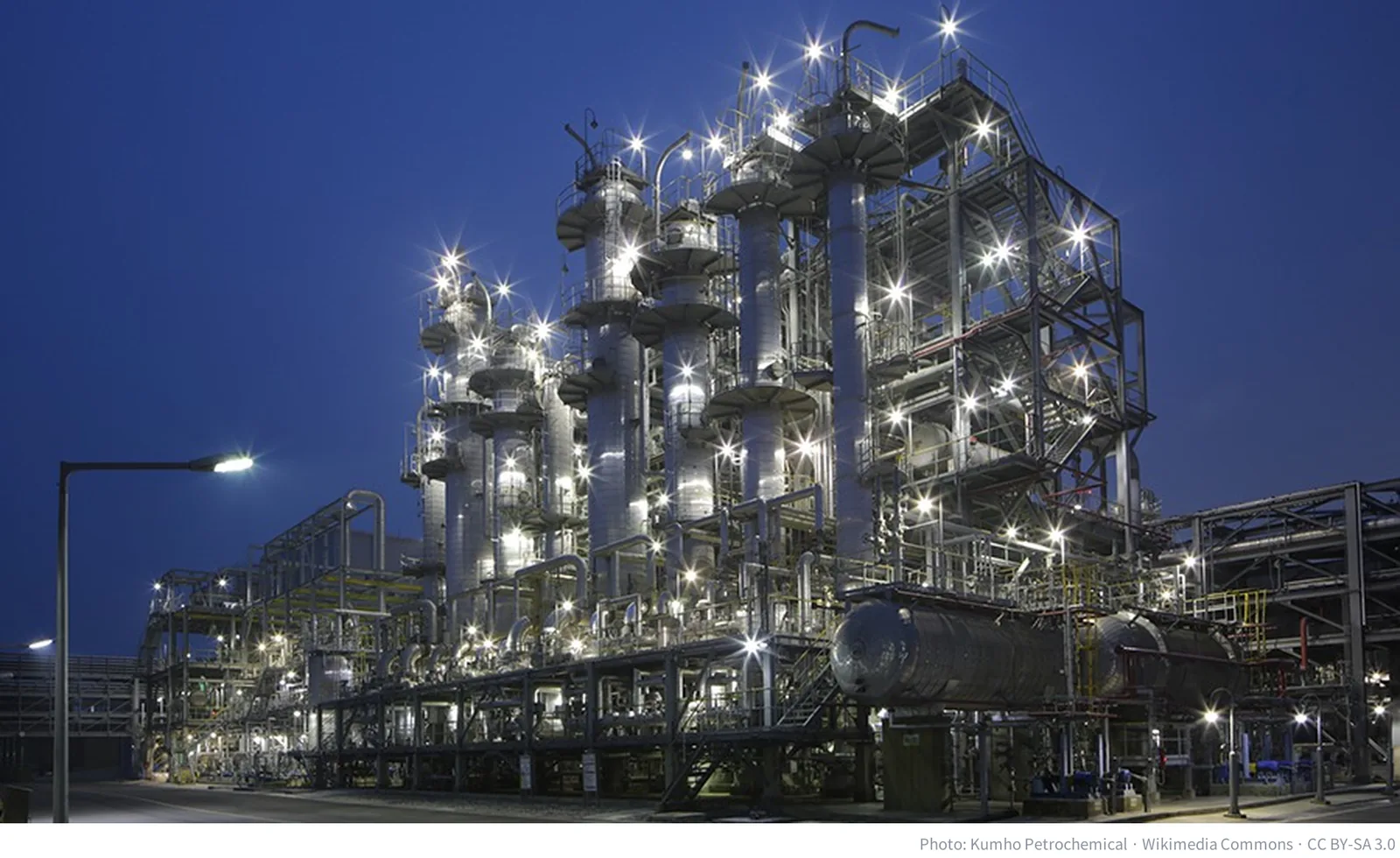
Because of these conditions in the Yeosu industrial complex, there is a limit to how fast the parent can earn its way out of debt. The company put its 2026 investment plan at KRW 1.7tn (January 29 fair disclosure, excluding LGES), and according to a call answer reported by Eugene Investment & Securities, “sale proceeds from the stake can be used for growth investment such as M&A.” Because the core business cannot cover both investment and debt with what it earns, the company keeps turning its largest asset, the LGES stake, into cash.
The repayment calendar: promises tied to LGES shares
LG Chem has more money promises tied to LGES shares than the PRS deals: the exchangeable bonds it issued in 2023 and 2025. An exchangeable bond is a corporate bond the investor can, if it wishes, exchange for LGES shares. If the exchange price is above today’s share price, investors prefer to get their principal back instead of shares. That date is July next year.
EB2: exchange price 1.87 times the share price, put date July 18, 2027
According to the bond note in the half-year report, exchangeable bond 2 (EB2), issued on July 18, 2023, can be exchanged for 1,811,188 LGES common shares at an exchange price of KRW 715,000. The won issue amount is KRW 1,541.5bn (at the end-June 2026 exchange rate), and investors can exercise their early redemption right (put option) on July 18, 2027. The KRW 715,000 exchange price is 1.87 times LGES’s October 27 close. At that price investors have no reason to take shares, so on that date they may ask for their principal back. Adding up what the company must repay or settle: EB2 KRW 1,541.5bn (put on Jul 18, 2027, exchange price KRW 715,000 = 1.87x the share price), and two PRS deals worth KRW 4.5tn.
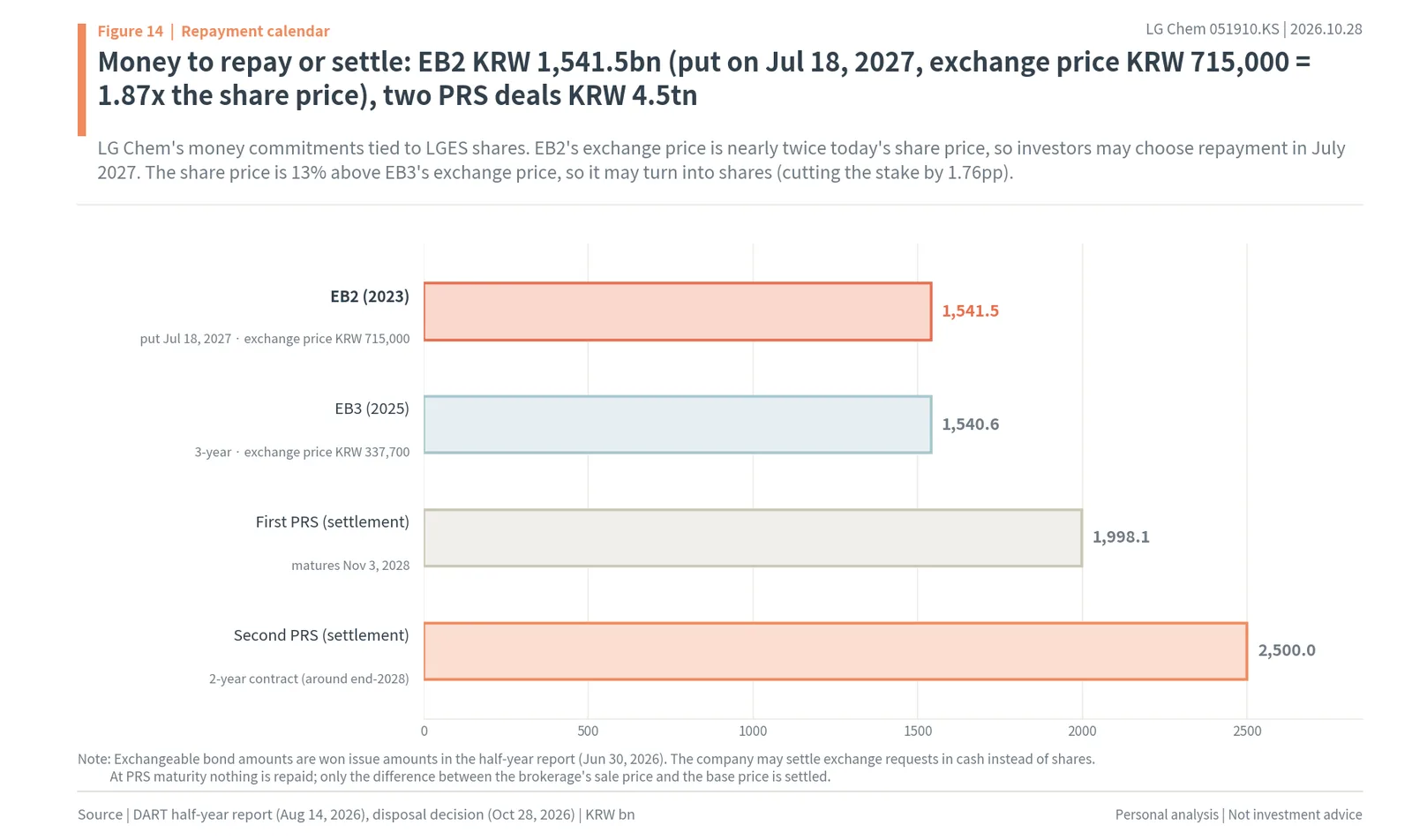
Exchangeable bond 3 (EB3), issued on June 16, 2025, can be exchanged for 4,129,404 LGES shares at an exchange price of KRW 337,700, with a won issue amount of KRW 1,540.6bn. The share price is now 13% above the exchange price, so investors can take shares. If they do, LG Chem hands over LGES shares instead of repaying money, and its stake falls by another 1.76 percentage points to 74.82%. The company also has the option to settle exchange requests in cash instead of shares. Exchangeable bond 1, issued in 2023, was mostly bought back in 2025 (KRW 838.0bn), leaving only about KRW 8.8bn.
The two PRS deals are not contracts that repay principal at maturity. Only the difference between the brokerage’s sale price and the base price is settled. Still, the settlement can swing by hundreds of billions of won with the LGES share price, and fees keep running in the meantime. Of the after-tax cash this PRS brings in (about KRW 1.97tn), the part for debt repayment and investment (about KRW 1.58tn) is similar in size to EB2. The company has not said which debt it will repay first, so this report does not link the two, but the possibility of a repayment demand of over KRW 1.5tn next July is a fact confirmed in the half-year report.
Shareholder returns: twice the share, a first-ever method, about 2% of market value
This shareholder return is a side dish, but not a small one. The ratio set in January was doubled, and for the first time the company will buy back and cancel shares. Given that LG Chem’s share price is about a quarter of the value of the LGES stake it holds, the same money goes further in a buyback-and-cancellation. The next chapter’s fair value calculation puts a number on that.
KRW 300bn cancels 1.77% of common and 1.86% of preferred shares
According to the share cancellation decision, LG Chem will buy its own shares in the market through a KB Securities trust from December 1, 2026 to May 31, 2027, and cancel all of them. The planned amount is KRW 300bn (about $224mn), which at October 27 closes (common KRW 228,500, preferred KRW 105,200) is 1,247,265 common shares and 142,586 preferred shares. Common and preferred shares are bought in proportion to their market values. Relative to issued shares, that is 1.77% of common and 1.86% of preferred shares. After the cancellation, the largest shareholder LG Corp’s stake in common shares rises from 34.95% to 35.58% (author’s calculation, based on LG Corp’s 24,670,331 shares). In short: a KRW 300bn buyback = 1.77% of common and 1.86% of preferred shares cancelled, LG Corp stake 34.95% → 35.58%.
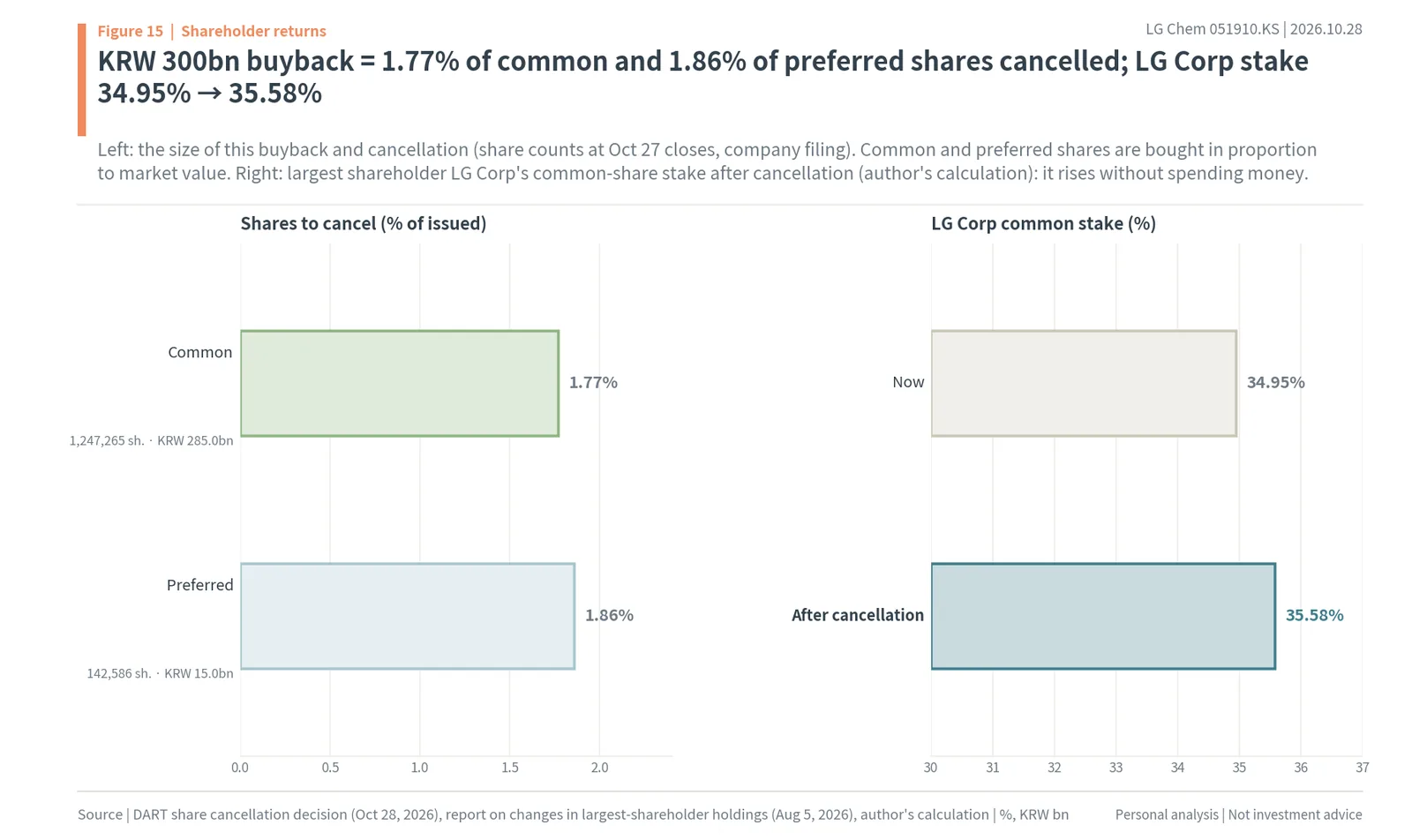
Preferred shareholders get the same treatment. The company decided to split the KRW 300bn between common and preferred shares by market value, and as a result 1.86% of the preferred shares (KRW 105,200 on October 27, less than half the common share price) will be cancelled, a slightly larger ratio than for common shares (1.77%). Preferred shares carry no voting rights and always trade below common shares, and matching the ratio cancelled with the same money is a design that also looks after fairness between the two groups of shareholders.
The remaining about KRW 94.8bn (author’s estimate) funds the FY2026 year-end dividend. The final dividend will be set in a dividend decision filing after the year-end financial statements are finalized; last year the cash dividend decision came on January 28. The company’s medium- to long-term dividend policy is a “consolidated payout ratio of 30% once ROE recovers to 10% or more and LGES dividends begin in earnest” (January 29 fair disclosure).
Compared with market value, the shareholder return looks like this. On October 27, LG Chem’s common and preferred shares had a combined market value of KRW 16.94tn (about $12.67bn). The shareholders’ part of about KRW 394.8bn is 2.3% of that, and the KRW 300bn buyback is 1.8%. If the remaining stake is sold down to 70% the same way (20% of after-tax cash), shareholder returns will follow several more times. The company said that “when selling LG Energy Solution shares in the future, it will set the size of shareholder return funds by comprehensively considering financial soundness and investment capacity to prepare for the future.” That is not a promise that the ratio will be 20% again.
Against the fees: two years of fees are a little over 70% of the buyback
It is also worth weighing the shareholder return against the costs. Applying the midpoint of the reported expected rate (4 to 4.5% a year) to this KRW 2.5tn for two years gives fees of about KRW 0.21tn (author’s assumption). That is 70.8% of the KRW 300bn buyback. Tax of about KRW 0.53tn is larger than the buyback itself. That the company chose a PRS despite these costs shows again that the aim was not raising money to return to shareholders but reducing debt and defending the rating. What shareholders receive is a piece cut off along the way.
How this deal changes fair market value: shares valued at a discount become full-value cash
The conclusion of this chapter is this. The market and brokerages value the LGES shares LG Chem holds far below their market price. This deal turns KRW 2.5tn of those discounted shares into cash at full value. So even after tax and fees, LG Chem’s fair market value can rise. How much depends on the discount rate, and the gain survives only if the LGES share price holds.
The discount: LG Chem as a whole trades at a quarter of its LGES stake
First, the size of the discount. On October 27, LG Chem’s common and preferred shares together had a market value of KRW 16.94tn. On the same day the 179,211,586 LGES shares LG Chem will hold after the second PRS were worth KRW 68.55tn (about $51.26bn) in the market. LG Chem as a whole is valued at 24.7% of that, even though its petrochemical, advanced materials and life sciences businesses have value of their own. On a weekly basis, LG Chem’s market value (including preferred) ÷ the value of its LGES stake went from 30.5% in October 2024 to 24.2% now, with a low of 23.8% (close × shares, author’s calculation).
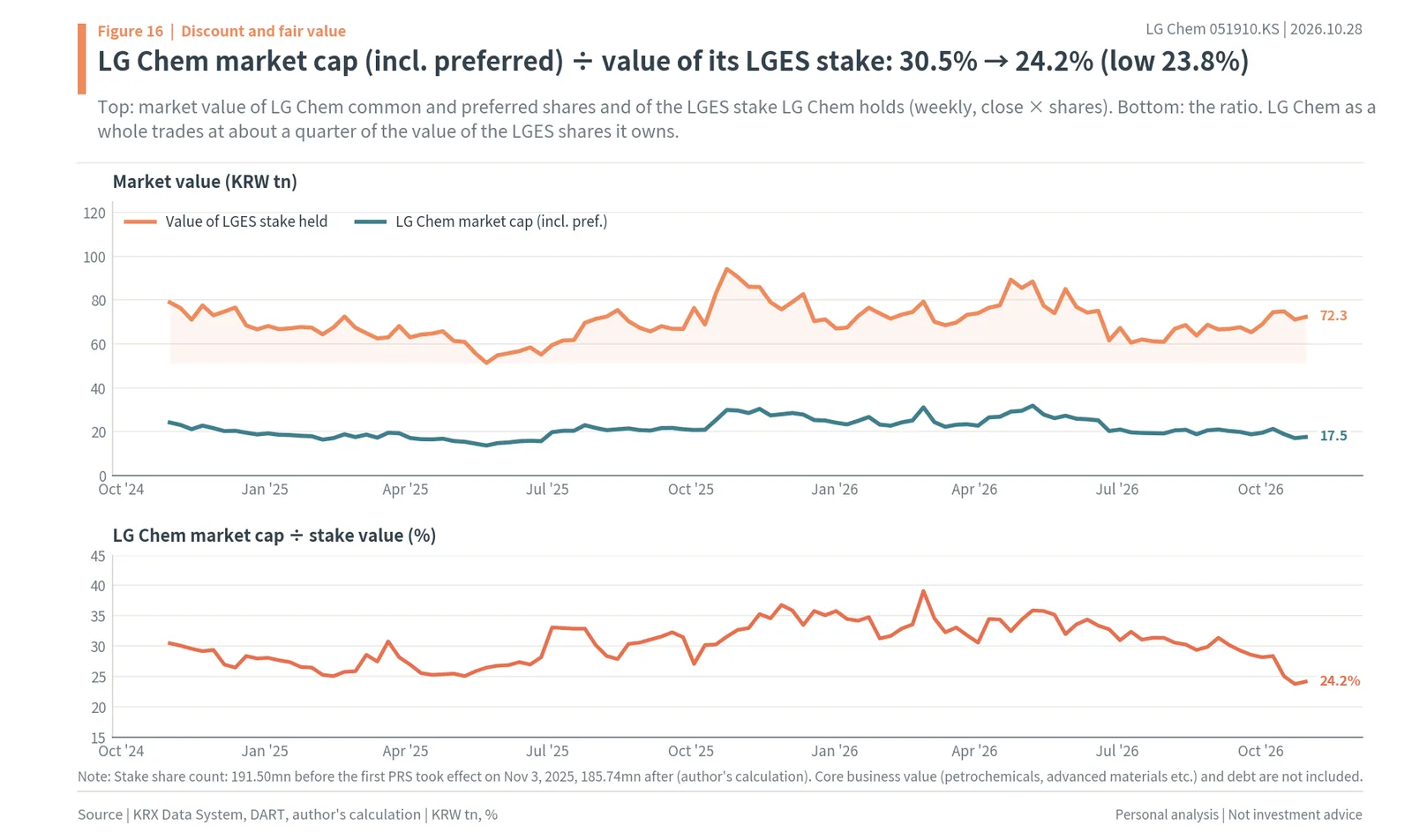
This discount is built into brokerage valuations as well. In the sum-of-the-parts (SOTP) table in its August 3 report, Shinhan Securities valued the LGES stake at KRW 12.17tn by “applying an 80% discount to the stake (79.3%),” counting only 20% of its value. The other businesses were chemicals at KRW 6.95tn (12-month forward EBITDA of KRW 1.39tn × 5.0), advanced materials at KRW 16.68tn (KRW 1.24tn × 13.4), life sciences at KRW 1.63tn and Farm Hannong at KRW 0.43tn; after subtracting 2026 net debt (excluding LGES) of KRW 4.79tn and preferred share market value of KRW 1.44tn, the target market value was KRW 31.63tn and the target price KRW 450,000.
At an 80% discount: +KRW 1.47tn, +KRW 1.26tn after fees
Now put this deal into that method. What goes out is KRW 2.5tn of LGES shares, which at an 80% discount count as KRW 0.5tn. What comes in is about KRW 1.97tn of after-tax cash, and cash is counted at full value. The difference is +KRW 1.47tn. Subtracting two years of PRS fees at the midpoint of the reported expected rate (4 to 4.5% a year), about KRW 0.21tn, leaves +KRW 1.26tn (about $942mn). The KRW 300bn buyback leaves market value but also reduces the share count, so calculating per-share value on the October 27 market value gives +7.6% after fees (author’s calculation). That is, counting the LGES stake at an 80% discount, fair market value rises by KRW 1.47tn (KRW 1.26tn after fees), or 7.6% per share (including the cancellation).
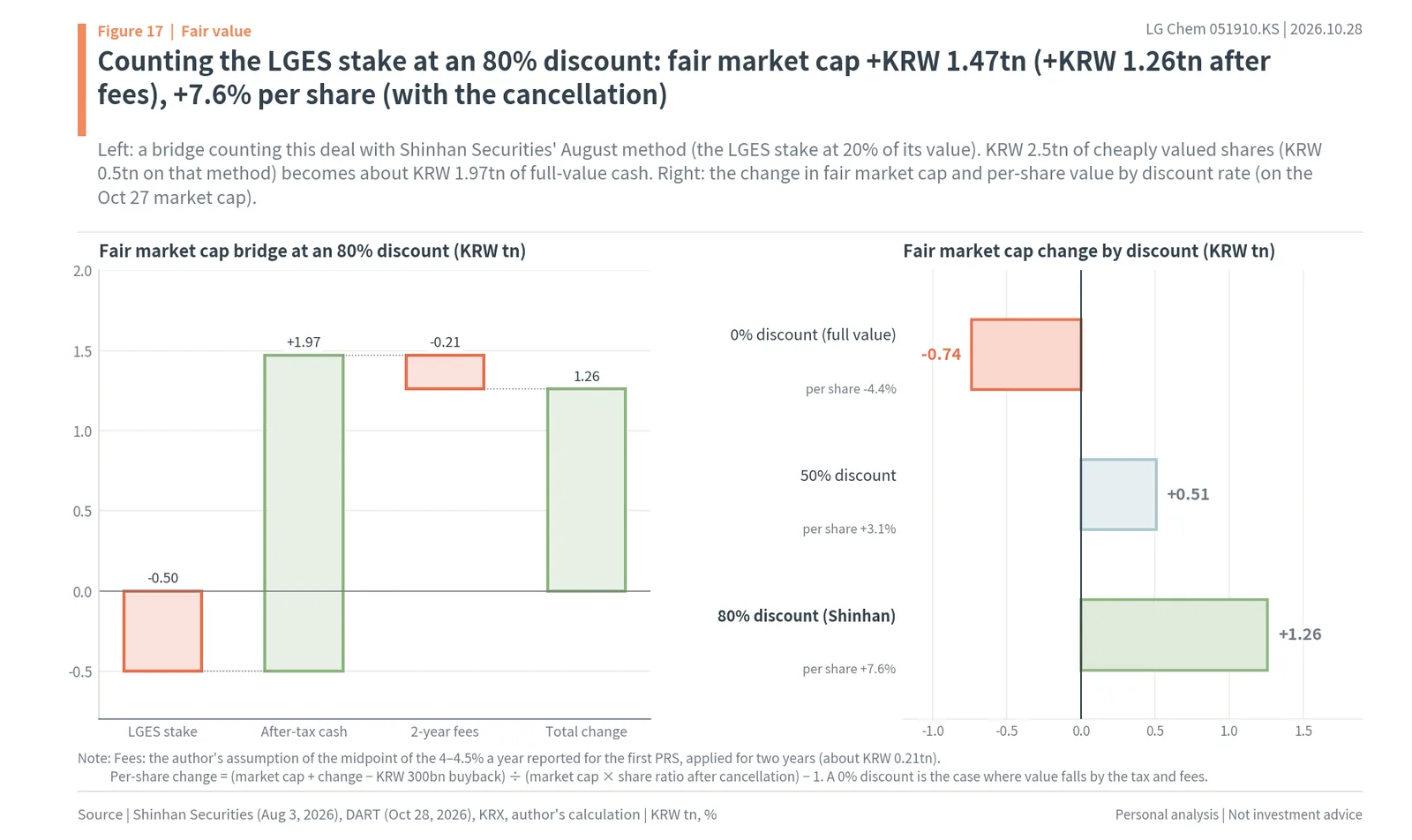
A smaller discount means a smaller gain. At a 50% discount, the change in fair market value is +KRW 0.51tn after fees, +3.1% per share. With no discount at all (counting the LGES stake at full value), value falls by the tax and fees: -KRW 0.74tn, -4.4% per share. Economically, a PRS is borrowing against pledged shares while paying tax and fees, so true value falls. But because the market has put a large discount on the LGES stake, turning it into cash actually enlarges LG Chem shareholders’ share. That is also why this deal can be described as “shareholder value enhancement.”
Recounted in Shinhan’s SOTP: KRW 476,900 → KRW 499,700 per share
Running the same exercise through Shinhan Securities’ whole SOTP table gives this. Keep the business values (chemicals, advanced materials, life sciences and Farm Hannong, KRW 25.68tn) and the preferred shares as they are, and change only the LGES stake to the October 27 close and the share counts before and after the deal. Before the deal, the LGES stake counts for KRW 14.21tn (185,747,525 shares × KRW 382,500 × 20%) and net debt is KRW 4.79tn. After the deal, the stake falls to KRW 13.71tn, net debt drops by the after-tax cash and rises again by the KRW 300bn buyback to KRW 3.12tn, and the KRW 0.21tn of fees is also subtracted. The result: putting the October 27 LGES close into Shinhan’s August 3 SOTP framework, fair market value goes from KRW 33.67tn to KRW 34.65tn, and per-share value from KRW 476,900 to KRW 499,700 (+4.8%) (author’s calculation, common shares).
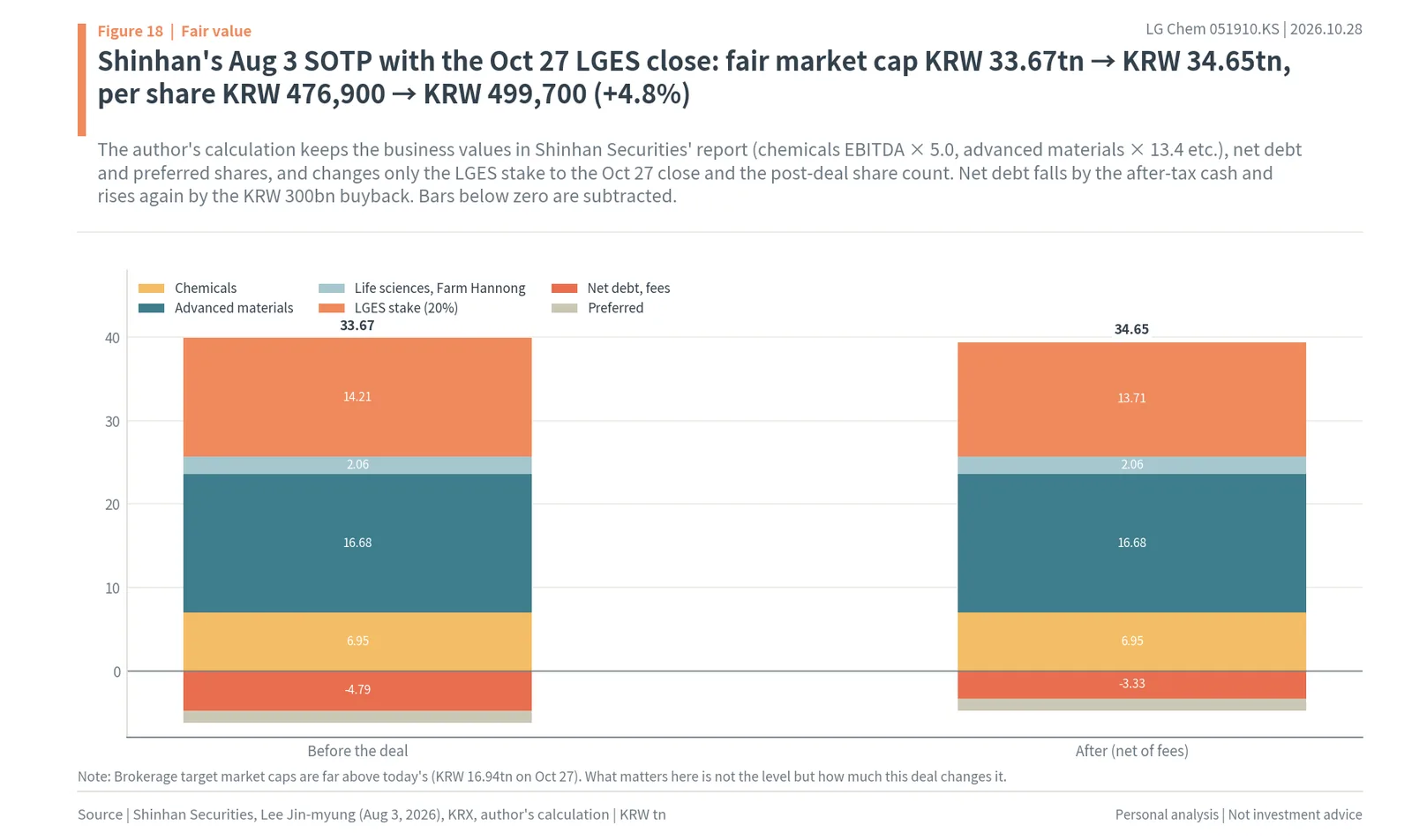
What matters here is not the level but the change. Brokerage target market values are far above today’s (the average target price is KRW 372,250, WISEreport, 12 brokerages). Measured against the value the market assigns today, the same deal has a larger effect, like the +7.6% above; measured against the brokerage target, a smaller one, like +4.8%. Either way the direction is the same: when discounted shares become full-value cash, LG Chem shareholders’ share grows.
Each 1% fall in LGES costs KRW 0.187tn
This calculation assumes the LGES share price stays where it is. When the LGES price moves, two things move with it. One is the LGES stake LG Chem keeps (counted at a discount); the other is the PRS settlement. The PRS settlement is a promise to exchange cash, so it is counted without a discount. On the October 28 LGES close (KRW 389,500), each 1% fall in LGES cuts fair market value by KRW 0.187tn (about $140mn; stake 0.14 + PRS 0.048), and the after-hours -4.1% means -KRW 0.77tn, 61% of the gain (at an 80% discount, against the +KRW 1.26tn after fees, author’s calculation).
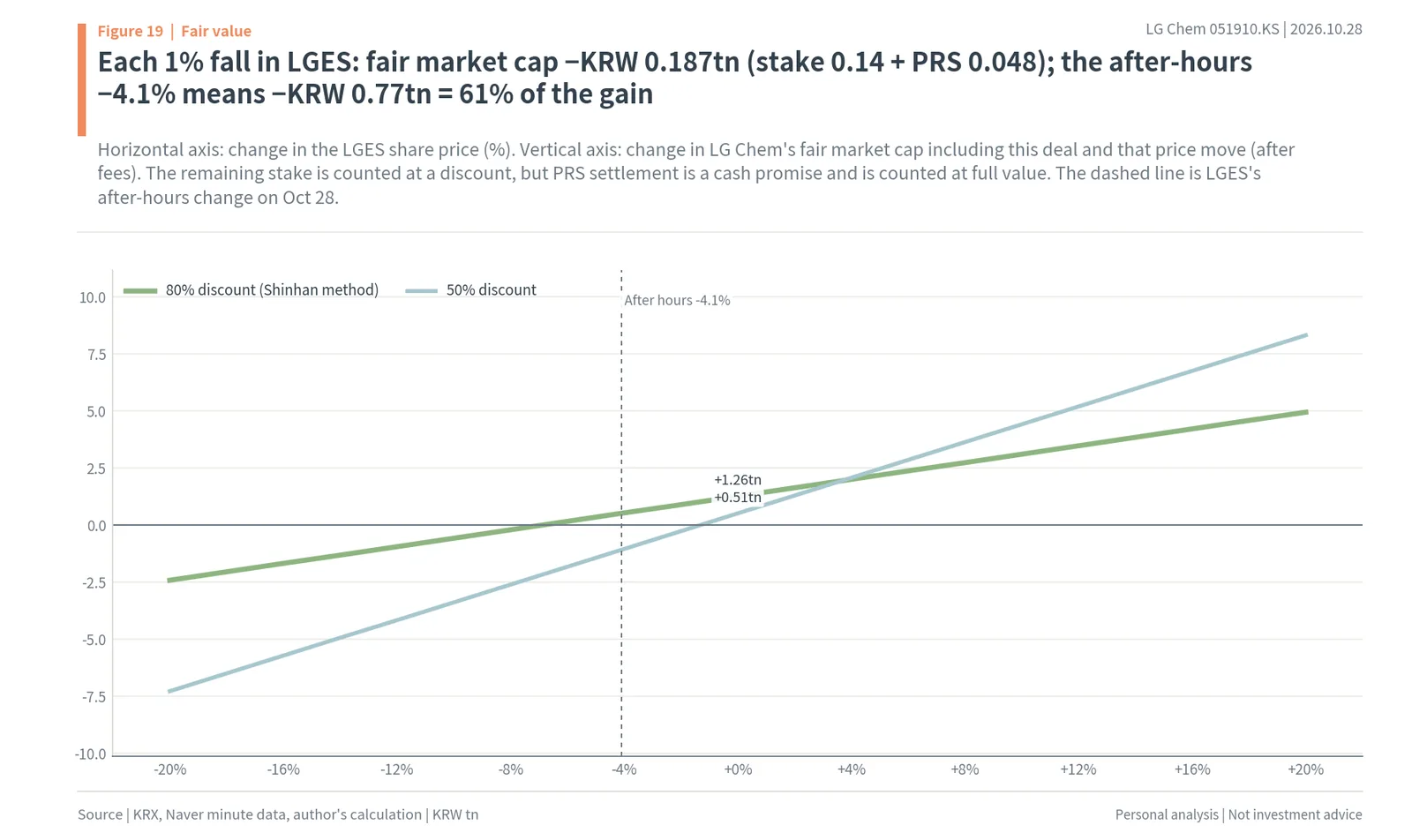
If LGES falls by about 7%, almost all of the fair value gain from this deal disappears. If LGES rises, the gain grows. In the end, what this deal leaves LG Chem shareholders is tied to the LGES share price, and the LGES share price carries the overhang this deal created. The next chapters look at the first reaction and the size of that overhang.
Three paths for LGES: LGES decides what LG Chem shareholders keep
Reading the previous chapter’s sensitivity as three paths for the LGES share price shows the range of what this deal can leave LG Chem shareholders. The base is the October 27 LGES close of KRW 382,500, and the change in fair market value is after PRS fees (author’s calculation).
If LGES rises 10%: +KRW 3.1tn at an 80% discount
If LGES rises 10% above the base price, the change in LG Chem’s fair market value is +KRW 3.1tn at an 80% discount and +KRW 4.41tn at a 50% discount, because the rise in the stake LG Chem keeps and the money it receives from the PRS settlements are added to the deal’s own gain (+KRW 1.26tn). A 20% rise gives +KRW 4.94tn at an 80% discount. If the 47.9% rise LGES saw in the month after the first PRS happened again, LG Chem’s settlement receipts from the two PRS deals alone would grow to trillions of won.
If LGES stays put: +KRW 1.26tn, +7.6% per share
If LGES stays near the base price, the previous chapter’s numbers apply: +KRW 1.26tn at an 80% discount, +7.6% in per-share value including the cancellation, and +KRW 0.51tn, +3.1% per share at a 50% discount. In this case the deal is clearly good for LG Chem shareholders: a discounted asset has become cash, and part of that cash buys and cancels the company’s own cheaply valued shares.
If LGES falls 10%: -KRW 0.58tn at an 80% discount
If LGES falls 10% below the base price, the change at an 80% discount turns to -KRW 0.58tn, and at a 50% discount -KRW 3.39tn. A 20% fall gives -KRW 2.42tn at an 80% discount. The losses come from two places: the stake LG Chem keeps loses value, and LG Chem owes the brokerages money under the two PRS deals. A 10% fall in LGES means KRW 449.8bn in PRS settlements alone (against the first PRS’s base price the amount receivable shrinks, and for the second LG Chem owes money).
Side by side, the three paths reveal the nature of this deal once more. LG Chem disclosed that it sold LGES shares, but its shareholders’ share is still tied to the LGES share price. To judge this deal, look not at LG Chem but at LGES’s future, where its North American battery plants and ESS sales are heading. Samsung Securities raised its third-quarter LG Chem operating profit forecast well above the consensus because of the battery subsidiary. LG Chem shareholders will remain, to a large extent, LGES shareholders.
Who gains and who pays: the KRW 2.5tn split by participant
The same deal looks different from different seats. Splitting the participants in this PRS into six groups, this chapter writes down what each gains and pays, using the numbers confirmed above. Split this way, it becomes clear from whose point of view the phrase “a PRS for shareholder returns” comes.
LG Chem’s balance sheet and the rating agencies: less debt, less pressure on the rating
The biggest winner is LG Chem’s balance sheet. Of about KRW 1.97tn after tax, about KRW 1.58tn goes to debt repayment and investment, and in the consolidated accounts it comes in as equity, not debt. Simply applied to the end-June figures, consolidated net debt falls from KRW 29.2tn to KRW 27.62tn; had the same money been borrowed, it would have been KRW 29.6tn (author’s calculation). The “financial structure improvement from monetizing the surplus stake” that Korea Ratings said it would check shows up in numbers.
Largest shareholder LG Corp: a higher stake without spending money
The largest shareholder, LG Corp, holds 24,670,331 LG Chem common shares. When the buyback cancels 1,247,265 common shares, LG Corp’s stake rises from 34.95% to 35.58%. LG Corp spends nothing in the process, and if the year-end dividend grows, it receives dividends in proportion to its stake. Given that the company chose its first buyback-and-cancellation even after the activist fund’s proposals were voted down at the March AGM, this decision is also one of the few tools from which the largest shareholder and other shareholders gain in the same direction.
Other shareholders: higher per-share value, but tied to the LGES price
LG Chem’s other shareholders receive a direct share through the cancellation (1.77% of common shares) and the year-end dividend, and an indirect share as a discounted asset becomes cash. On the brokerage method (80% discount), per-share value rises 7.6% after fees. But as the three paths show, that share can grow or vanish with the LGES share price.
LGES shareholders: more supply, and the largest shareholder’s share unchanged
For LGES’s other shareholders, this deal means more shares that could come to market. The PRS shares held by brokerages are 5.25% of LGES, worth KRW 4.79tn, and LG Chem plans to sell more than KRW 4tn more. At the same time, the share whose price risk LG Chem bears stays at 81.84%, so the center of gravity in LGES’s management and interests does not change. That only LGES fell in after-hours trading on October 28 can be read as the market pricing in this supply burden first.
Brokerages and the state: fees and tax
The brokerages earn fees for two years. At the rate reported for the first PRS, that is KRW 100bn to 112.5bn a year on this KRW 2.5tn. The state collects tax; estimated with the first PRS’s ratio, tax and similar items come to about KRW 0.53tn. Together they are more than twice the KRW 300bn buyback (on two years of fees). If shareholder returns were the purpose of this deal, it would be an overly expensive route; if defending the credit rating was the purpose, it is a cost the company judged worth bearing. The conclusion of this chapter is the same as the others: this PRS is a financing deal, not a shareholder return deal, and the shareholder return is a side dish served on top.
The first reaction and the overhang: cash for LG Chem, supply for LGES
The filing came after the regular session on October 28. The first regular-session reaction has to wait until the next day, but the direction was already visible in the Nextrade after-market: LG Chem rose and LGES fell, the same direction as the calculations above. For LG Chem shareholders, a discounted asset becomes cash; for LGES shareholders, more shares may come to market.
After hours: LG Chem +3.2%, LGES -4.1%
In the Korea Exchange regular session on October 28, LG Chem closed at KRW 236,000 (+3.28%, about $176.5) and LGES at KRW 389,500 (+1.83%, about $291.3). Those moves came before the filing.
After the filing, in the Nextrade after-market at 19:59, LG Chem was at KRW 243,500, 3.2% above its regular-session close, and LGES at KRW 373,500, 4.1% below. LG Chem preferred shares were also 3.2% higher at KRW 110,700 (Naver Finance minute data, author’s records). The October 28 regular session saw LG Chem +3.28% and LGES +1.83% (before the filing); after hours, LG Chem +3.2% and LGES -4.1%, the two stocks moving in opposite directions.
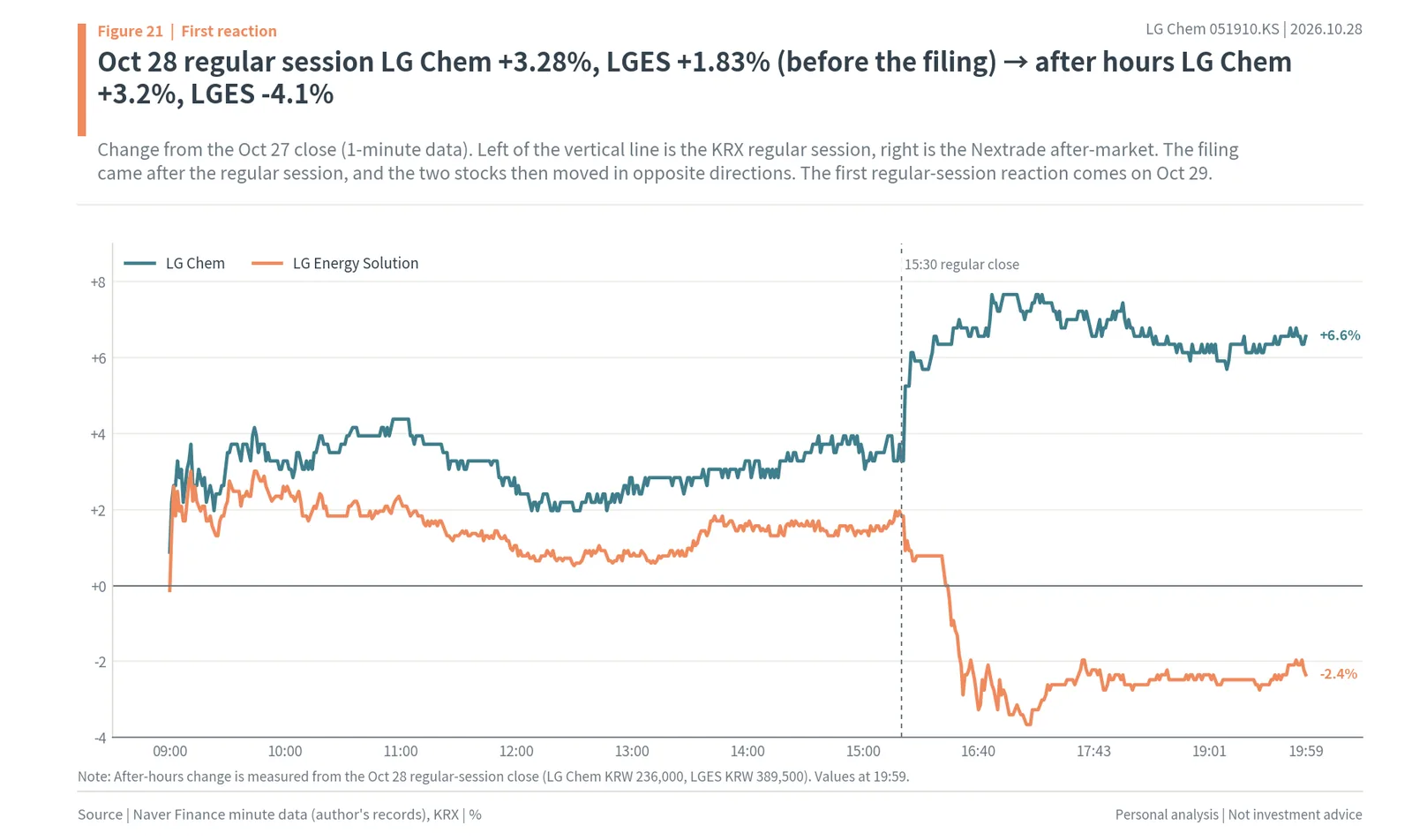
Converted to market value, LGES’s after-hours fall is about KRW 3.74tn (234,000,000 shares × KRW 16,000). On LG Chem’s side, as the previous chapter showed, the fall offsets 61% of the fair value gain. After-hours volume is thin and can differ from the regular session, so these numbers will be rechecked against the October 29 regular-session close.
Why now: a week before results, near the share price low
The timing is worth noting too. The second PRS came a week before the November 5 third-quarter results. LG Chem had just posted its lowest close of the past year (KRW 224,500) on October 26, and LGES was at KRW 382,500, 10% above the first PRS’s base price. Buying back shares when LG Chem’s price is low cancels more shares for the same money, and handing over LGES shares when they are above the first PRS level brings in more money for the same shares. No document explains why the company picked this time, so this report records only the two share prices at that moment as fact.
The overhang: KRW 4.79tn with brokerages, KRW 4.32tn to 5.89tn left to sell down to 70%
The overhang on LGES comes in two parts. The first is the 12,285,939 LGES shares the brokerages will hold after the two PRS deals. That is 5.25% of LGES’s issued shares, KRW 4.79tn at the October 28 close (about $3.58bn), and 37 days of LGES’s average trading value over the last 60 days (KRW 130.2bn). The brokerages can sell these shares at any time before maturity, while LG Chem bears the price risk. The second is the stake LG Chem will sell in the future. The company said it would cut its stake to about 70% over about five years. From 76.59% to 70% is 15,411,586 shares (6.59 percentage points), KRW 5.89tn at the base price. If EB3 is exchanged into shares, that part (1.76 percentage points) disappears without a sale, leaving KRW 4.32tn. On the road from 81.84% → 79.38% → 76.59% → (if EB3 is exchanged) 74.82% → 70%, KRW 4.32tn to 5.89tn left to sell and KRW 4.79tn of brokerage PRS shares hang over LGES.
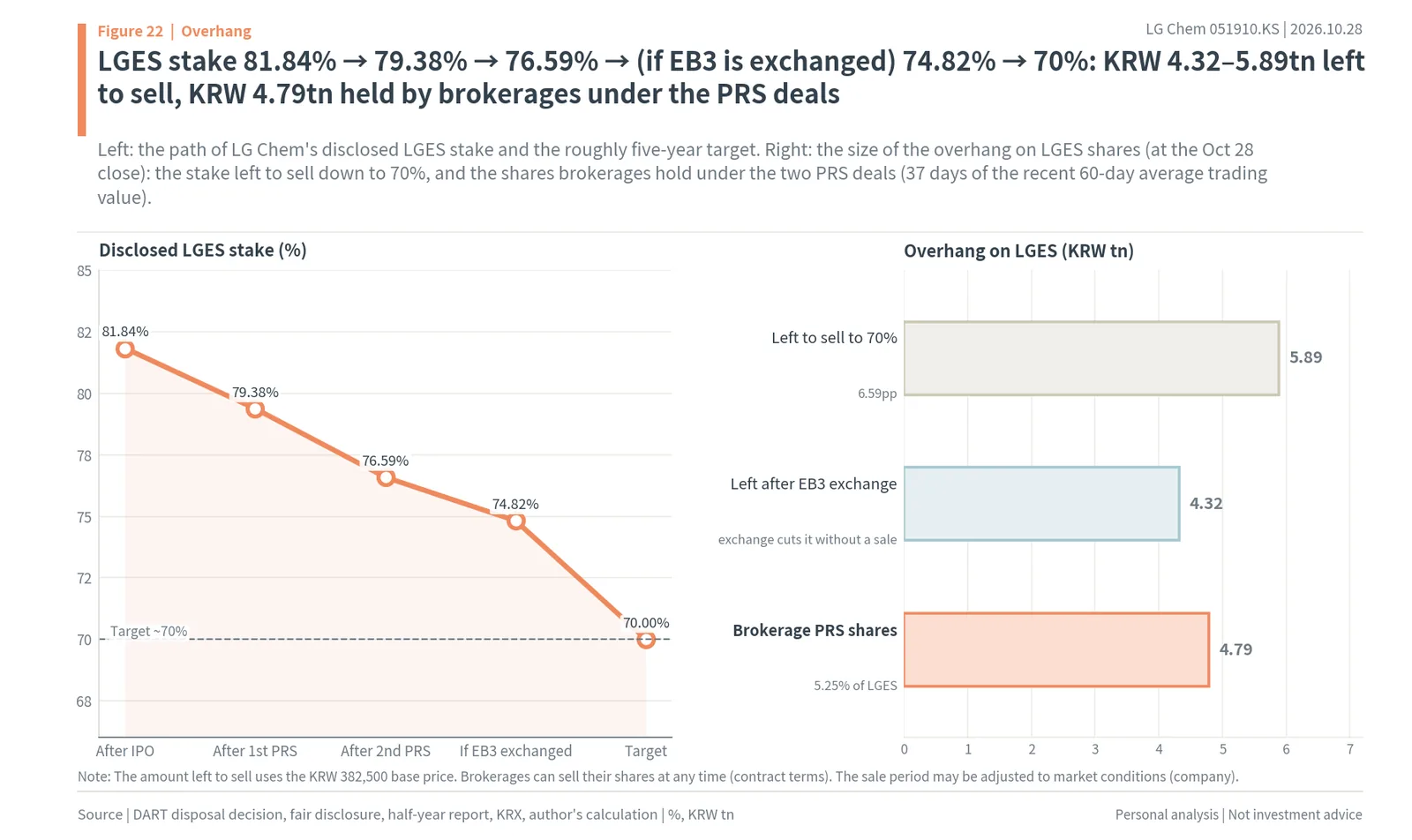
Measured in KRW 2.5tn sales like this one, two or so more are left. During November 27 to December 24, when the block trades are executed, KRX trading by investor type is likely to show financial investment net buying and heavy trading value (as with Hanwha Systems’ PRS in Hanwha Ocean). It is worth noting in advance that those numbers are contract executions, not buying by market participants. For LG Chem shareholders this deal monetizes a discounted asset; for LGES shareholders, it means supply keeps coming.
Dates and gauges to watch
The next steps of this deal have fixed dates: results, contract signing, the buyback, the year-end dividend and next year’s exchangeable bond put. In order: Nov 5 Q3 results, Nov 27 to Dec 24 PRS signing, Dec 1 buyback trust starts, late January year-end dividend, and the Jul 18, 2027 exchangeable bond put.
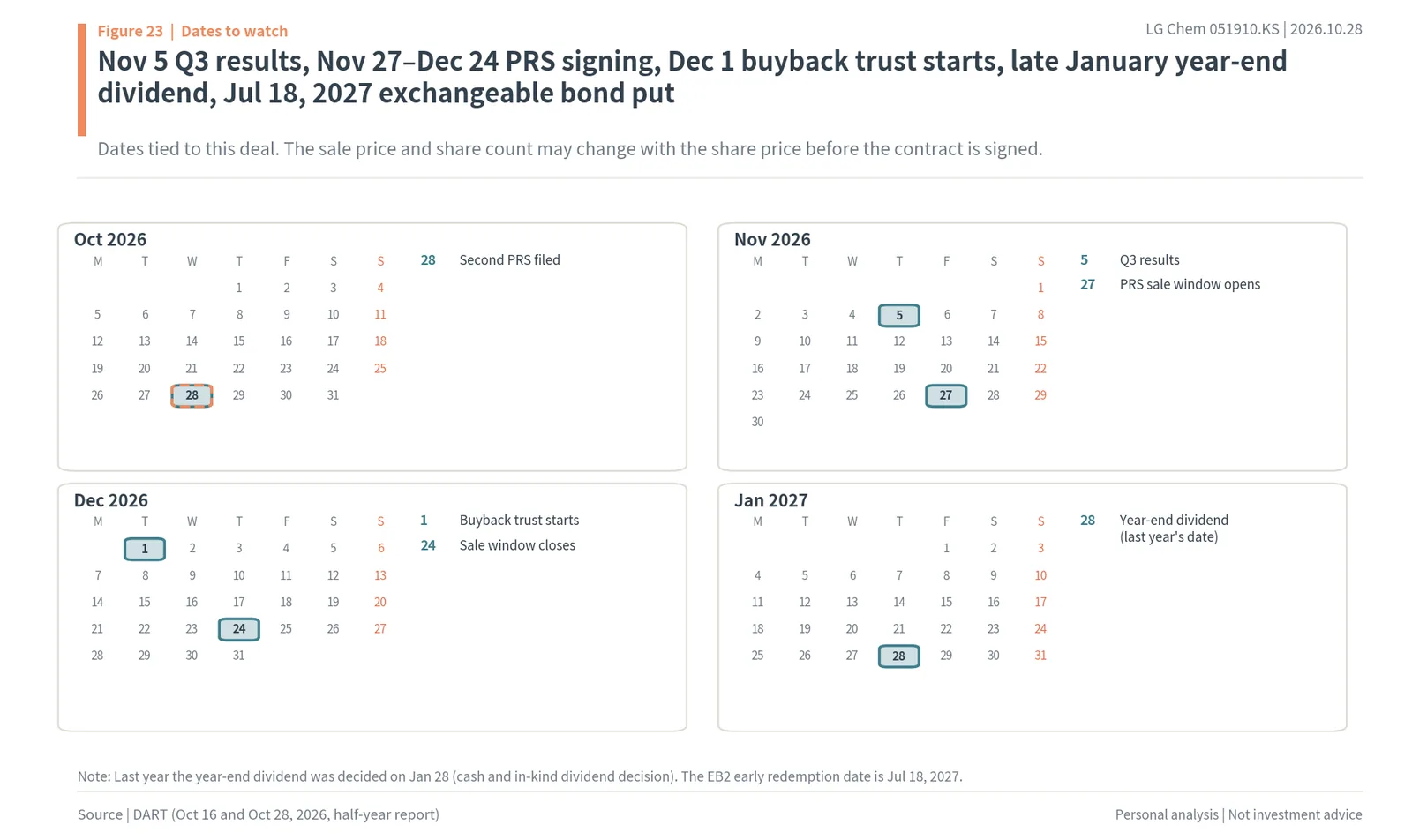
In the November 5 third-quarter results, LGES’s part is large. Samsung Securities forecasts LG Chem’s third-quarter operating profit at KRW 613.6bn (consensus KRW 187.0bn), citing an earnings surprise at the battery subsidiary (compensation from automakers and ESS sales). The same report expects basic materials to lose KRW 154.1bn. Even if consolidated results are good, if the parent’s chemicals business slips back into losses, the parent will reduce its debt on its own more slowly.
If the PRS is signed between November 27 and December 24, the sale price and share count will be fixed. The company said they may change with the share price before signing, so if LGES moves a lot in the meantime, the money received changes too. From December 1 the buyback starts through the KB Securities trust and runs until May 31 next year. The FY2026 year-end dividend will be set in late January. July 18, 2027 is the day EB2 investors can demand repayment of principal.
There are four things to check on the November 5 conference call. First, which debt the debt repayment part of the PRS money (about KRW 1.58tn) goes to. Whether it prepares for EB2 in July 2027 (KRW 1,541.5bn) or cuts short-term borrowing changes how much interest expense falls. Second, the second PRS’s sale price and buyer. The first was “Korea Investment & Securities and others”; this time there is no name yet. Third, the timing and size of a third sale. The company said about five years; the answer reported by Eugene Investment & Securities was by 2030. Fourth, whether petrochemicals have bottomed and whether Yeosu NCC plant 2 restarts. If the parent earns its way out of debt faster, there is less reason to sell LGES shares; if not, sales speed up. These four together decide the shares of LG Chem and LGES shareholders.
The gauges are four signals with current values and four gates with fixed dates. In the top row, the LGES share price is above the second PRS base price (KRW 382,500) at its regular-session close of KRW 389,500, but fell 4.1% after hours. The credit rating is AA (stable), the consolidated debt ratio is high at 129.6%, and the shareholders’ part is 20% of after-tax cash, twice the January pledge. The four gates in the bottom row have not opened yet.
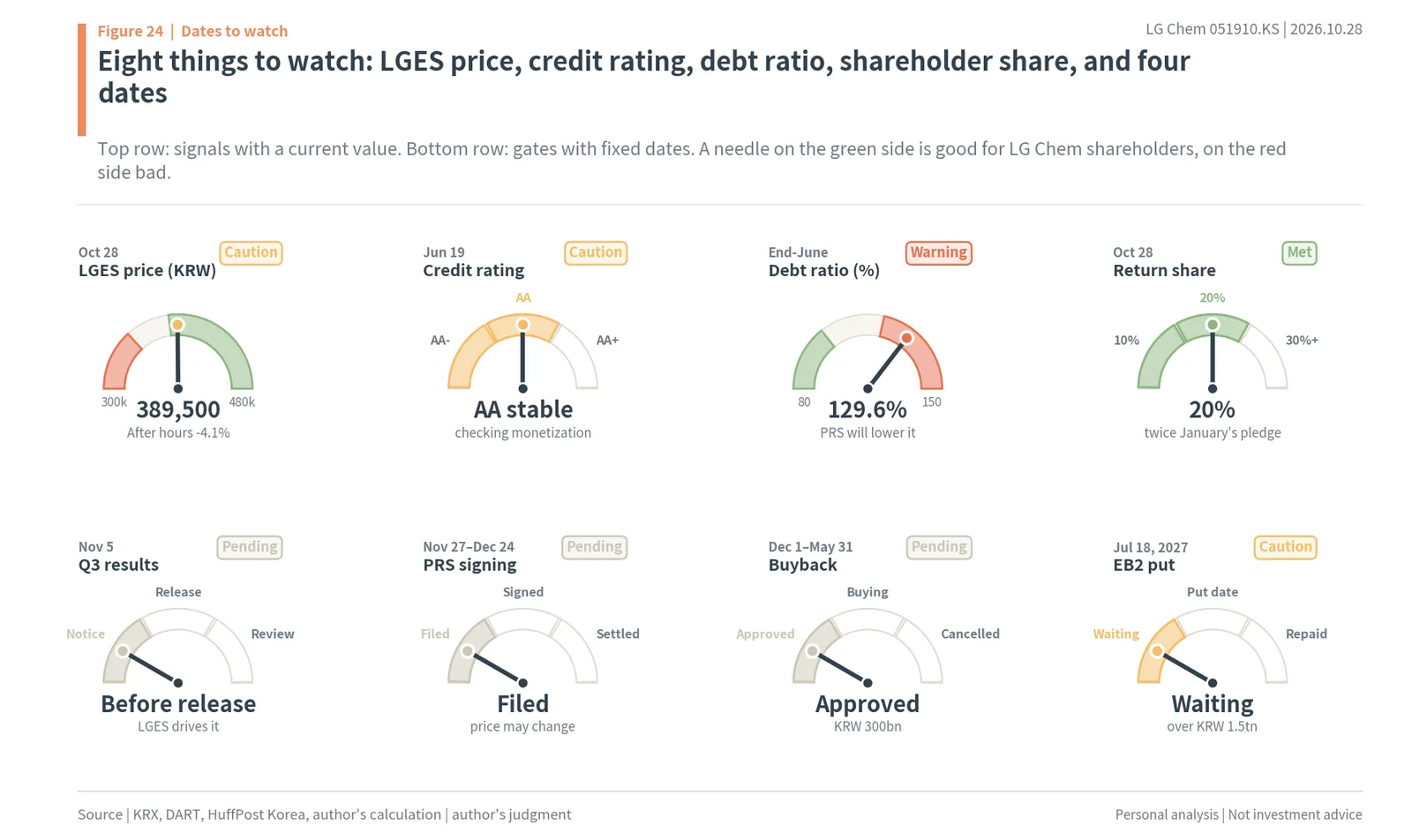
The author’s judgment is this. This PRS is a financing deal to defend the credit rating. The first purpose the company wrote, where 80% of the money goes, and the homework the rating agency said it would watch all point to the same place. The shareholder return is a side dish served on top, but because the discount on the LGES stake is so large, it is a side dish with a big effect for LG Chem shareholders. Whether that effect lasts depends on the LGES share price and the overhang still to come.
Five questions likely to come up, answered with numbers
This chapter groups the questions this deal is likely to raise into five and answers them only with the numbers confirmed above.
Isn’t selling LGES bad for LG Chem’s share price?
Closer to the opposite. The market values LG Chem as a whole at 24.7% of its LGES stake, and the brokerage method counts the LGES stake at only 20% of its value. Turning KRW 2.5tn of such an asset into about KRW 1.97tn of cash raises fair market value at an 80% discount by KRW 1.26tn after fees. LG Chem’s 3.2% after-hours rise on October 28 points the same way. But this calculation rests on the LGES share price holding. Each 1% fall in LGES cuts that gain by KRW 0.187tn.
Why do brokerages sign these contracts?
The brokerage takes LGES shares and pays cash, and in return earns fees for two years. Whether the share price rises or falls, the difference is settled with LG Chem, so the brokerage’s profit comes from the fee. The expected rate reported for the first PRS was 4 to 4.5% a year, 1 to 1.5 percentage points above LG Chem’s corporate bonds. For the brokerage it resembles a share-backed loan guaranteed by a high-grade company. And the brokerage can sell the shares at any time before maturity.
What happens to LG Chem if LGES falls sharply?
It loses twice. Once from the falling value of the LGES stake it keeps, and once from the PRS settlement. Combining the first and second PRS, every 10% move in LGES against the base prices means KRW 449.8bn that LG Chem receives or pays (KRW 199.8bn + KRW 250.0bn, author’s calculation). The first PRS’s base price is KRW 347,500, so at today’s price LG Chem is on the receiving side; the second’s base price is KRW 382,500, so if LGES stays at its after-hours price (KRW 373,500) LG Chem is on the paying side. Settlement is a promise to exchange cash, so it also affects the company’s debt plans.
Why not return all KRW 1.97tn after tax to shareholders?
Arithmetically it is possible. About KRW 1.97tn after tax is 11.7% of LG Chem’s combined common and preferred market value on October 27. But the company disclosed that in setting shareholder return funds it first considers maintaining financial soundness and securing funds for future growth investment, and the rating agency said it would check exactly that financial structure improvement. With consolidated net debt at KRW 29.2tn and a possible exchangeable bond repayment demand of over KRW 1.5tn in July 2027, the ratio the company chose was 20%. That shows most briefly why this deal is not a pure shareholder return.
When is the next sale?
The company said it would gradually reduce its LGES stake “to about 70%” “over roughly the next five years,” adding that the period may change with market conditions (January 29 fair disclosure). The call answer reported by Eugene Investment & Securities was “by 2030.” The stake left to sell from 76.59% to 70% is KRW 5.89tn at the base price, or KRW 4.32tn if EB3 is exchanged into shares. The gap between the first and second PRS was about a year. In sales of this size, two or so remain, and each time LG Chem shareholders get the monetization of a discounted asset while LGES shareholders get an overhang.
Basis of calculations
The author’s calculations in this report follow the rules below. The calculation code is in research/calc.py in the post folder.
The company did not disclose the after-tax cash. It was estimated at about KRW 1.97tn by multiplying this disposal amount of KRW 2,499,996,667,500 by 0.7896, the ratio of the consolidated equity increase (KRW 1,577.7bn) to the first PRS’s disposal amount (KRW 1,998.1bn). Tax and similar items are the difference from the disposal amount (about KRW 0.53tn). The 20% shareholders’ part (about KRW 394.8bn) matches the company’s “about KRW 400bn.” The sale price and share count may change before the contract is signed.
The debt ratio comparison simply adds to and subtracts from end-June 2026 consolidated total liabilities of KRW 63.34tn and total equity of KRW 48.87tn. In the PRS case, after-tax cash enters equity (equity +KRW 1.97tn), the debt repayment and investment part (KRW 1.58tn) reduces liabilities, and equity falls by the shareholder return part (KRW 0.39tn). In the loan case, the shareholder return is funded with debt. The actual accounting treatment and repayment order are up to the company.
The change in fair market value counts only the items this deal changes within an SOTP framework of “LGES stake value × (1 − discount) + other business value − parent net debt.” The KRW 2.5tn of LGES shares going out is multiplied by (1 − discount), and the after-tax cash coming in is counted at full value. Fees are about KRW 0.21tn, the midpoint (4.25%) of the 4 to 4.5% annual rate reported for the first PRS, applied for two years. The per-share change is (October 27 market value + change − KRW 300bn buyback) ÷ (market value × common share ratio after cancellation) − 1. The Shinhan SOTP recalculation keeps the business values, net debt and preferred share values in Shinhan Securities’ August 3 table and changes only the LGES stake to the October 27 close.
The LGES share price sensitivity is based on the October 28 close of KRW 389,500. The 179,211,586 shares LG Chem keeps are counted at an 80% discount, and the 12,285,939 shares under the two PRS deals are counted without a discount because they are cash settlements. The after-hours fall uses the Nextrade price of KRW 373,500 at 19:59.
Share prices and market values are KRX Data System values (market value ÷ listed shares = regular-session close). For the weekly ratio chart, LG Chem’s LGES holding is set at 191.50mn shares before the first PRS took effect on November 3, 2025, and 185.74mn after. Dollar figures in parentheses are the author’s conversions at KRW 1,337.3 per dollar (Yahoo Finance KRW=X, October 28, 2026). This report gives no target price or expected return.
LG Chem’s LG Energy Solution PRS and buyback: frequently asked questions
Q. What did LG Chem announce on October 28, 2026?
LG Chem said it would hand over 6,535,939 LG Energy Solution shares, KRW 2.5tn at KRW 382,500 a share, under a two-year price return swap (PRS), cutting its disclosed LGES stake from 79.38% to 76.59%. It also filed its first-ever buyback-and-cancellation: KRW 300bn bought through a KB Securities trust from December 1, 2026 to May 31, 2027, cancelling 1.77% of common and 1.86% of preferred shares.
Q. Is LG Chem’s PRS a shareholder return?
Only in part. The purpose box in the filing reads “financial structure improvement and shareholder value enhancement,” in that order. The company set the shareholder return at about 20% of after-tax cash, about KRW 400bn; the author estimates after-tax cash at about KRW 1.97tn and the shareholders’ part at about KRW 394.8bn. The other 80%, about KRW 1.58tn, goes to debt repayment and investment.
Q. What is a price return swap (PRS)?
LG Chem sells LGES shares to a brokerage and gets the money now, but when the brokerage later sells them, the difference from the KRW 382,500 base price is settled with LG Chem. If LGES rises 10% LG Chem receives about KRW 250bn; if it falls 10% LG Chem pays the same. The brokerage earns a fee, reported at an expected 4 to 4.5% a year for the first PRS.
Q. Why did LG Chem use a PRS instead of borrowing?
A PRS is booked as equity, not debt. The first PRS’s KRW 1,998.1bn came in as KRW 1,577.7bn of equity. Applied to end-June figures, this deal lowers the consolidated debt ratio from 129.6% to 122.4%, while borrowing the money would raise it to 131.5%. LG Chem still bears the price risk on 81.84% of LGES, so it keeps the upside.
Q. Why is the credit rating the main reason?
LG Chem’s consolidated net debt rose from KRW 7.47tn at the end of 2022 to KRW 29.2tn at the end of June 2026. Korea Investors Service cut its outlook on April 24, and Korea Ratings cut the rating from AA+ to AA on June 19, saying it would keep checking the effect of the LG Energy Solution surplus stake monetization. LG Chem’s Value-up plan lists maintaining a stable credit rating as a capital allocation principle.
Q. How does the deal change LG Chem’s fair value?
Brokerages discount the LGES stake heavily; Shinhan Securities counts it at 20% of its value. Swapping KRW 2.5tn of discounted shares for about KRW 1.97tn of cash raises fair market value by KRW 1.47tn at an 80% discount, KRW 1.26tn after fees, or 7.6% per share including the cancellation. At a 50% discount the gain is KRW 0.51tn; with no discount, value falls KRW 0.74tn. In Shinhan’s SOTP framework, per-share value goes from KRW 476,900 to KRW 499,700 (+4.8%).
Q. What are the risks for LG Chem and LG Energy Solution shareholders?
Each 1% fall in LGES cuts LG Chem’s fair value gain by KRW 0.187tn; the after-hours -4.1% on October 28 would erase KRW 0.77tn, 61% of the gain. Brokerages hold LGES shares worth KRW 4.79tn (5.25% of LGES) that they can sell at any time, and KRW 4.32tn to 5.89tn is left to sell before LG Chem reaches its roughly 70% target. Exchangeable bond 2, KRW 1,541.5bn, has a put date of July 18, 2027.
Sources
- DART, LG Chem decision to dispose of shares in another company (link), Oct 28, 2026; fair disclosure on the shareholder return plan (link), Oct 28, 2026; share cancellation decision (link), Oct 28, 2026; decision to sign a treasury share trust contract (rcpNo 20261028000304), Oct 28, 2026; notice of investor relations meeting (rcpNo 20261016800726), Oct 16, 2026
- DART, LG Chem fair disclosures “Shareholder return policy to enhance shareholder value” (rcpNo 20260129800644), earnings outlook (20260129800636) and Q4 preliminary results (20260129800610), Jan 29, 2026; corporate value enhancement plan (20260401800638), Apr 1, 2026; other information (Yeosu NCC plant 2, 20260824800207), Aug 24, 2026
- DART, LG Chem half-year report (https://dart.fss.or.kr/dsaf001/main.do?rcpNo=20260814002655, notes on the price return swap, exchangeable bonds and capital risk management), Aug 14, 2026; 2025 annual report (https://dart.fss.or.kr/dsaf001/main.do?rcpNo=20260313001195, consolidated cash flow statement and statement of changes in equity), Mar 13, 2026; 2023 annual report (rcpNo 20240315000957), Mar 15, 2024
- HuffPost Korea, Korea Ratings cuts LG Chem AA+ → AA (link), Jun 2026; Money Today, June regular ratings review (link), Jun 23, 2026; Edaily Market in, Korea Investors Service outlook cut (link), Apr 24, 2026; Money Today, S&P outlook cut (link), Mar 5, 2026
- Edaily Market in, PRS fees, accounting treatment and Korea Ratings’ view (link), Oct 6, 2025; Korea Economic Daily Market Insight, expected PRS rate (link), Sep 8, 2025; Digital Today, first disposal decision (link), Oct 1, 2025
- CEO Score Daily, Palliser Capital’s shareholder proposals voted down (link), Mar 31, 2026
- Shinhan Securities, Lee Jin-myung, LG Chem “Chemicals in the first half, advanced materials in the second” (SOTP table), Aug 3, 2026; Eugene Investment & Securities, Q2 call Q&A, Aug 3, 2026; Samsung Securities, Cho Hyun-ryul, 3Q26 preview, Oct 12, 2026; WISEreport consensus (Oct 27, 2026)
- KRX Data System prices and market values (LG Chem, LG Chem preferred, LG Energy Solution, Oct 28, 2024 to Oct 28, 2026), Naver Finance minute data (Oct 28, 2026; after 15:30 is Nextrade), Wikipedia (Chevrolet Volt, LG Energy Solution), Yahoo Finance (KRW per USD), author’s calculations (money path, debt ratio, fair market value, sensitivity)
- Photos: LG Electronics (CC BY 2.0), ENERGY.GOV (Public domain), Rolf Kickuth (CC BY-SA 4.0), Kumho Petrochemical (CC BY-SA 3.0), Narubaru7 (CC BY 4.0), LG Chem and LG Energy Solution logos (Public domain), via Wikimedia Commons
Disclaimer
This report records the author’s personal analysis and views based on public information and does not recommend any particular product or company. It does not recommend buying or selling any financial investment product and is not an investment advisory or quasi-investment advisory service.
The figures in this report are those public at the time of writing. The company said the number of shares and the price in this PRS may change with the share price before the contract is signed. The after-tax cash inflow is the author’s estimate applying the first PRS’s after-tax ratio, and the PRS fee is the author’s assumption applying the rate reported for the first PRS. After-hours (Nextrade) prices are not regular-session closes. Accuracy and completeness are not guaranteed.
The change in fair market value is the author’s calculation putting this deal into a brokerage report’s method (the discount on the LGES stake and so on) and does not indicate a future share price. Items marked “author’s calculation” or “author’s judgment” are the author’s calculations and assumptions, not confirmed facts. This report gives no target price or expected return.
The judgments in the text are the author’s personal views and do not recommend trading at any particular time or promise any return.
Author’s interests: not disclosed
Responsibility for decisions and their outcomes lies with the reader.
As of: October 28, 2026
Was this note useful?
Thanks. Your answer helps decide what to cover next.
Korea market snapshot · Oct 28, 2026
New to Korean stocks? Start here for the basics.
Most read lately
Get the Saturday note on Korean stocks
One email every Saturday with the week’s new research on Korean listed companies and links to the updated data pages. Built from DART filings and KRX data. Free; unsubscribe in one click. See past issues