Hanwha Succession: Who Gained Among the Three Kim Brothers, from One Basket to Three Paths
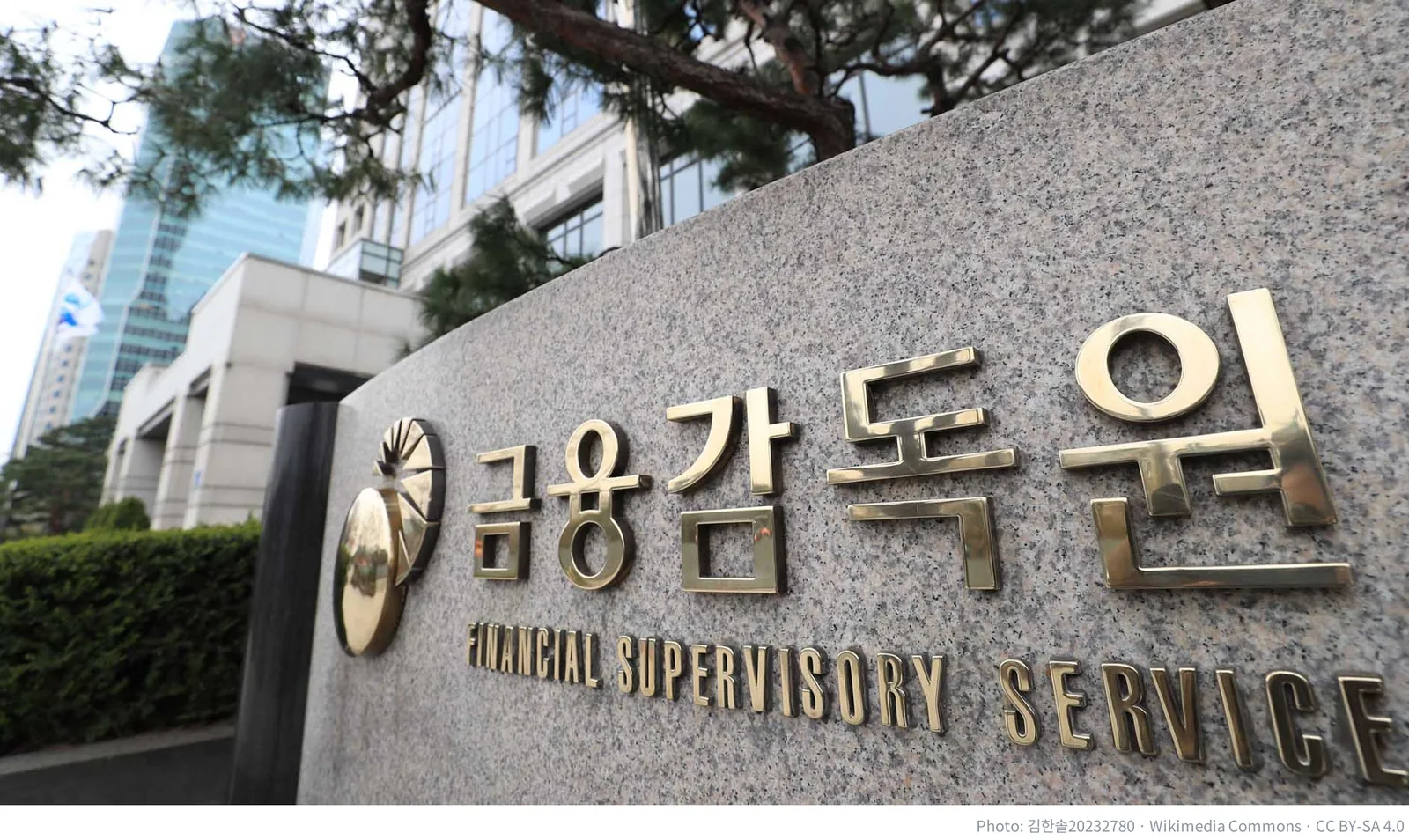
In an interview with the Korean finance channel Sampro TV aired on April 27, 2025, Lee Bok-hyun, then governor of the Financial Supervisory Service (FSS), Korea’s financial regulator, reached for an old saying about Hanwha Aerospace‘s rights offering. “You are supposed to deliberately not tie your hat strings under a plum tree, and they tied them under the biggest tree.” If you reach up to retie your hat strings under a plum tree, it looks as if you are picking plums, so where you could be suspected, do not even raise your hands. He went on to say that just when the company had to persuade shareholders to back a KRW 3.6tn offering, the largest “since Dangun” (the legendary founder of Korea, so in effect the largest ever), “it had just sent KRW 1.3tn somewhere else,” and that whether this had to do with succession, he did “not know.”
It is rare for the head of the FSS to speak this openly about one company’s share offering. That year the FSS twice ordered the company to correct its registration statement, on March 27 and April 17, and the company changed the structure of the offering. On March 31, announcing that Chairman Kim Seung-youn would give part of his Hanwha Corp stake to his three sons, Hanwha Group said that “as succession is now complete with this gift of shares,” the “speculation and distortion” linking the offering to succession would be dispelled. On intent, the two sides said opposite things.
Instead of guessing at intent, this report asks three questions. First, which of the three brothers, Kim Dong-kwan, Kim Dong-won and Kim Dong-seon, did the money flows that began with the offerings, and the gift, stake sale, company split and tender offer that followed, favor? Second, what does that mean for succession? Third, who now holds which stakes, and what can each brother do with them? Prices are used only as material for answering these questions.

This report is the English edition of the author’s Korean note on Hanwha’s rights offerings and succession.
As of: October 23, 2026 (share prices are KRX regular-session closes on that day; stakes and transactions are from DART filings as filed). Dollar figures use KRW 1,325.68 per dollar, the October 23, 2026 rate (Yahoo Finance KRW=X). Numbers the author calculated are marked as such.
Some Korea-specific background. DART is the FSS’s electronic disclosure system, where companies file deals, offerings and stake changes. Korea counts large sums in jo (one trillion won) and eok (100 million won); this report shows them as KRW tn and KRW bn. A chaebol is a family-controlled business group. Korea’s Fair Trade Act regulates these groups, including when a relative may take companies out of the group (a “relative separation”) and how much a holding company must own of its subsidiaries. This report calls the brothers’ holding company (Hanwha Energy) “the brothers’ basket,” and Hanwha Machinery & Services Holdings, the holding company split off from Hanwha Corp in August 2026, “the new holdco.”
Topics covered: the three brothers and the brothers’ basket (Hanwha Energy); from Hanwha S&C to Hanwha Energy; Event 1, the offerings that grew the basket; each brother’s share of the gain; Event 2, the father’s stake and the balance of power inside the basket; Event 3, the company split and Kim Dong-seon’s tender offer; who gained; what each brother can do with his stakes (Kim Dong-kwan, Kim Dong-seon, Kim Dong-won); the relative-separation and holding company rules; numbers to watch; common questions; and the basis of calculation.
The map first: the three brothers held one basket together, and that basket sits at the top of the group’s chain
To put the conclusion first: Hanwha’s offerings did not create new money. They raised the value of a basket the three brothers held together, and that value became the cost of the brothers parting ways. To follow that conclusion, the map has to come first. The company that Chairman Kim Seung-youn’s three sons, Kim Dong-kwan, Kim Dong-won and Kim Dong-seon, own together is Hanwha Energy, which is unlisted. This report calls the brothers’ holding company (Hanwha Energy) “the brothers’ basket.” Until December 2025 it was owned 50% by Kim Dong-kwan, 25% by Kim Dong-won and 25% by Kim Dong-seon, with no other shareholders.
The basket matters because of where it sits. Hanwha Energy is the largest shareholder of Hanwha Corp (000880.KS), the group holding company. Per a filing dated August 3, 2026, Hanwha Corp is owned 23.55% by Hanwha Energy, 12.04% by Kim Seung-youn, 10.38% by Kim Dong-kwan and 5.71% each by Kim Dong-won and Kim Dong-seon. Hanwha Corp owns 32.18% of Hanwha Aerospace (012450.KS), 35.73% of Hanwha Solutions and 43.24% of Hanwha Life, and Hanwha Aerospace in turn owns 30.44% of Hanwha Ocean and 46.73% of Hanwha Systems. Whoever holds the basket holds the top of the chain.
What each brother runs
In a reshuffle announced on July 30, 2026 (effective August 1), Kim Dong-kwan went from vice chairman to senior vice chairman, in charge of defense, shipbuilding, aerospace and energy. He also heads the strategy divisions of Hanwha Corp, Hanwha Aerospace, Hanwha Solutions and Hanwha Impact, and is a non-executive director of Hanwha Ocean. Kim Dong-won went from president of Hanwha Life to vice chairman, in charge of finance. Kim Dong-seon went from executive vice president of Hanwha Vision to president, and as head of future strategy at the new holdco, Hanwha Machinery & Services Holdings, he is in charge of retail, leisure, food and beverage, and semiconductor equipment (Newsis).
The listed companies they run differ greatly in size. Grouped by October 23 KRX market caps, Kim Dong-kwan runs Hanwha Aerospace (KRW 40.84tn), Hanwha Ocean (KRW 16.94tn), Hanwha Systems (KRW 12.53tn), Hanwha Solutions (KRW 6.40tn) and Hanwha Engine (KRW 2.69tn), KRW 79.4tn (about $59.9bn) in all. Kim Dong-won’s Hanwha Life (KRW 3.50tn), Hanwha Investment & Securities (KRW 1.04tn) and Hanwha General Insurance (KRW 0.72tn) add up to KRW 5.3tn, and Kim Dong-seon’s Hanwha Vision (KRW 1.95tn) and Hanwha Galleria (KRW 0.48tn) come to KRW 2.4tn (author’s sums). Market cap of the listed companies each brother runs: Kim Dong-kwan KRW 79.4tn, Kim Dong-won KRW 5.3tn, Kim Dong-seon KRW 2.4tn.

The figure groups companies by who runs them, which is not the same as who controls them. Kim Dong-seon’s side has many unlisted companies, such as Hanwha Hotels & Resorts, Ourhome and Hanwha Robotics, so its listed market cap looks small. Hanwha Engine is 32.77% owned not by Hanwha Corp but by Hanwha Impact, which sits under the basket. In other words, the basket already holds part of the core business Kim Dong-kwan runs directly.
By control, there are two main trunks
The finance business Kim Dong-won runs sits under Hanwha Corp. Hanwha Corp owns 43.24% of Hanwha Life, while Kim Dong-won personally owns 0.03% of Hanwha Life (News Tomato). Because Hanwha Corp has a financial company, Hanwha Life, as a subsidiary, it is not a holding company under the Fair Trade Act. The businesses Kim Dong-seon runs, by contrast, were split off from Hanwha Corp in August 2026 and gathered under the new holdco. Seen by control, there are two main trunks, Kim Dong-kwan’s Hanwha Corp and Kim Dong-seon’s new holdco, and Kim Dong-won’s finance business sits inside Kim Dong-kwan’s trunk.

The 63 Building in Yeouido, home to Hanwha Life’s headquarters, is the symbol of the group’s finance arm. Kim Dong-won runs this finance business, but the company that controls Hanwha Life through its shares is Hanwha Corp. That gap is what separates the three brothers’ paths in the later chapter on what each can do now.
Their father is still on the map
Even after giving away half his stake in 2025, Kim Seung-youn holds 12.04% of Hanwha Corp and 12.24% of the new holdco. Under the Fair Trade Act each business group has a designated “same person” (the individual who controls the group), and who that is sets the scope of the “same person’s side” in the relative-separation rules. The author found no filing or report showing that the designated person changed in the 2026 designation, so this report calculates with Kim Seung-youn as the same person. Depending on which brother receives them, the father’s two remaining stakes are large enough to move either Kim Dong-kwan’s side’s voting power in Hanwha Corp (now 33.93%) or Kim Dong-seon’s voting power in the new holdco (36.81% if the tender cap is filled) by more than 12 percentage points.
The basket started with KRW 3.04bn in 2005, and the eldest held the largest share from the start
The starting point of the brothers’ basket was a small deal in 2005. According to Seoul Shinmun (February 2, 2015), that year Hanwha Corp sold 400,000 shares (66.7%) of the IT company Hanwha S&C to the eldest son, Kim Dong-kwan, at KRW 5,100 a share, and Kim Seung-youn sold 100,000 shares each to the second son, Kim Dong-won, and the third son, Kim Dong-seon, at KRW 5,000 a share. Kim Dong-kwan paid KRW 2.04bn and his two brothers KRW 500mn each, KRW 3.04bn (about $2.3mn) in all (author’s multiplication). From the start the eldest’s share (66.7%) was larger than his two brothers’ combined, and the stakes later settled at Kim Dong-kwan 50%, Kim Dong-won 25% and Kim Dong-seon 25%. Inside the basket, Kim Dong-kwan’s vote alone equaled his two brothers’ votes combined.
Hanwha S&C grew by running IT work for group affiliates, and after a 2017 split became the holding company H Solution. H Solution merged with Hanwha Energy in 2021, and that company is today’s Hanwha Energy. The name and the size changed, but the owners stayed the same three brothers. Along the way, Hanwha Energy steadily bought shares of Hanwha Corp.
Buying up Hanwha Corp
Hanwha Energy spent its money on building its stake in Hanwha Corp, the top of the chain. On July 5, 2024 it filed a tender offer for 6 million common shares (8.0%) of Hanwha Corp at KRW 30,000 a share. That was 7.72% above the previous close of KRW 27,850, and the KRW 180bn needed was all its own money. The stated purpose was to “strengthen responsible management.” The result was 65.0% of the target. It bought all 3,898,993 shares (5.20%) that were tendered, and its stake in Hanwha Corp rose from 9.70% to 14.90%.
Late that year it also bought the 5,436,380 Hanwha Corp shares held by Korea Zinc at KRW 27,950 a share, for KRW 151.95bn. That brought Hanwha Energy’s stake in Hanwha Corp to 22.16% of common shares, and after Kim Seung-youn’s 2025 gift and Hanwha Corp’s 2026 cancellation of treasury shares, it is the largest shareholder with 23.55% after the split. In 2024 it spent a little over KRW 268.9bn on Hanwha Corp shares, combining the tender offer and the Korea Zinc stake (author’s sum). With less than a quarter of the Hanwha Ocean gain discussed later (Hanwha Energy’s share, about KRW 1,198.9bn), the brothers’ basket locked in its place as the largest shareholder of the group holding company. This buying put more Hanwha Corp votes behind Kim Dong-kwan, the basket’s largest shareholder.
KRW 3.04bn became 1,819 times as much in 20 years
On December 29, 2025 Kim Dong-won and Kim Dong-seon sold 20% of Hanwha Energy at KRW 40,815 a share. Hanwha Energy has 135,426,680 shares in all, so that price values the whole company at KRW 5.53tn (about $4.17bn) (author’s calculation). Against the KRW 3.04bn of 2005, that is 1,819 times. Over the same period Hanwha Energy’s consolidated equity attributable to owners of the parent (the shareholders’ book value) was KRW 2.58tn at the end of 2023, KRW 4.58tn at the end of 2024 and KRW 6.23tn at the end of 2025.
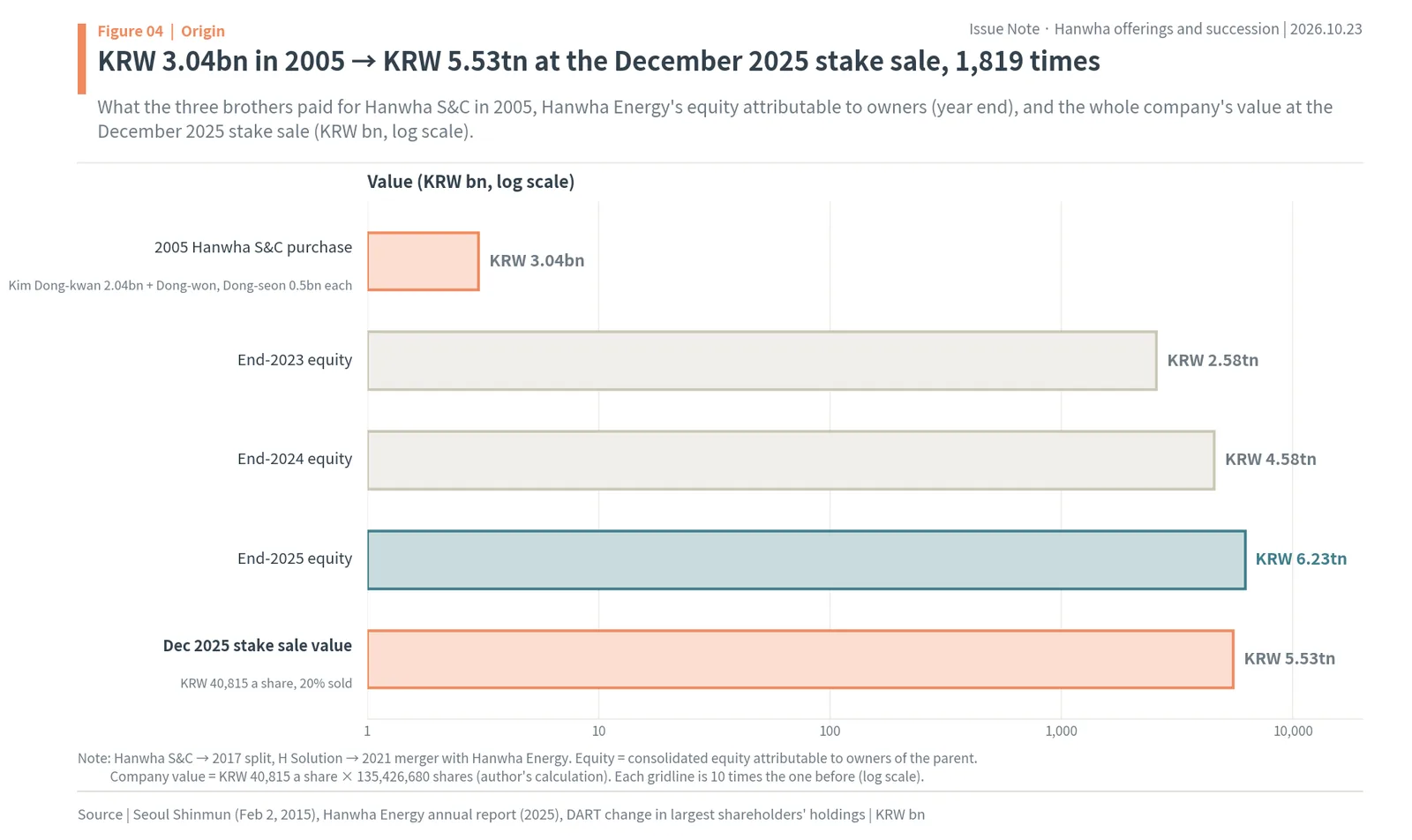
The figure uses a log scale, where each step is ten times the one before. Going from KRW 3.04bn to KRW 2.58tn took close to 20 years, but going from KRW 2.58tn to KRW 6.23tn took two. The KRW 3.65tn rise in equity over those two years includes gains on affiliate shares as well as business profit. The Hanwha Ocean share deals this report follows fall within exactly those two years.
What the basket earns its money from
Today’s Hanwha Energy is a completely different company from the IT firm Hanwha S&C. In the segment information of its 2025 annual report, external revenue was PTA KRW 1,561.6bn, engines KRW 1,371.1bn, gas turbines and compressors KRW 1,142.6bn, solar KRW 1,121.0bn, power generation KRW 724.5bn, automation equipment KRW 211.3bn, holding KRW 121.3bn and other KRW 459.6bn. Engines is Hanwha Engine, which makes ship engines, and PTA (a raw material for synthetic fibers) and gas turbines and compressors are Hanwha Impact’s businesses. Power generation sells electricity and steam to factories in industrial parks, and solar builds and sells power plants in the U.S., Japan and elsewhere.
Profit came from different places than revenue. By segment, operating profit was KRW 235.6bn in solar, KRW 186.4bn in power generation, KRW 130.1bn in engines and KRW 53.2bn in gas turbines and compressors, while PTA lost KRW 35.1bn and the holding segment lost KRW 203.2bn. Hanwha Energy’s 2025 revenue was KRW 6.71tn and its operating profit KRW 376.9bn: solar KRW 235.6bn, power generation KRW 186.4bn and engines KRW 130.1bn.

The biggest slice of the donut on the left is PTA, but in the bars on the right PTA sits on the loss side. The money was made in solar, power generation and engines. Compared with a year’s operating profit of KRW 376.9bn, the gain left to Hanwha Energy from the Hanwha Ocean share deals described later (about KRW 1,198.9bn) is more than three times as large. It is twice the KRW 587.6bn of operating profit for 2024 and 2025 combined.
Event 1: the offerings grew the basket, and the money from the sale went back into shares of a company Kim Dong-kwan runs
The first event’s conclusion is this. The gain from the offerings piled up in the basket and was shared by the three brothers in line with their stakes, but along the way the stake the basket held moved toward Hanwha Aerospace, which Kim Dong-kwan runs. The deal numbers are kept short here, only as material for that conclusion.
In: three basket-side companies put KRW 500bn into the DSME offering
When Hanwha bought Daewoo Shipbuilding & Marine Engineering (DSME) in 2022, it did not buy existing shares. Instead it used a third-party placement, in which DSME printed new shares and Hanwha affiliates bought them. The size was KRW 2tn and the price KRW 19,150 a share. Bizwatch reported that Hanwha Aerospace’s interest coverage ratio was then below 1 and that there was no one to lend it money. So next to Hanwha Aerospace’s KRW 1tn and Hanwha Systems’ KRW 500bn, three companies on the basket’s side put in KRW 500bn (about $377mn): Hanwha Impact Partners KRW 400bn, Hanwha Energy Singapore KRW 70bn and Hanwha Convergence (merged into Hanwha Energy in 2024) KRW 30bn. Hanwha Energy Singapore is wholly owned by Hanwha Energy; Hanwha Impact Partners belongs to Hanwha Impact, which is 52.07% owned by Hanwha Energy and 47.93% by the listed Hanwha Solutions. On May 23, 2023, the day the money was paid, the stock closed at KRW 28,800, 50.4% above the issue price. Of the KRW 2tn, the brothers’ side put in KRW 500bn, and the payment-day close was KRW 28,800 (+50.4%).

Hanwha Aerospace and Hanwha Systems went in at the same price on the same day. On price alone, the basket-side companies got no special discount. The difference came from who sold the shares, when, and to whom. The three basket-side companies also took part in Hanwha Ocean’s rights offering that November (KRW 16,730 a share), ending up with 35.45mn Hanwha Ocean shares at an average KRW 18,512, KRW 656.3bn in all.
DSME renamed itself Hanwha Ocean in May 2023. The shares of this company, which owns the Okpo shipyard on Geoje Island, sat on the basket-side companies’ books for more than a year after that.
The first exit: Hanwha Aerospace bought at that day’s close
On February 10, 2025 Hanwha Aerospace’s board decided to buy 22,375,216 Hanwha Ocean shares from the three basket-side companies for KRW 1.3tn (about $981mn). At KRW 58,100 a share, the price equaled that day’s close. Hanwha Aerospace’s stake in Hanwha Ocean became 30.44%. Three days later Hanwha Ocean was at KRW 77,500. Hanwha Ocean, bought by Hanwha Aerospace at KRW 58,100, was at KRW 77,500 three days later (+33.4%).

For the brothers, what this deal means is less about price than about position. Hanwha Ocean shares moved from the basket side (companies the brothers own directly) to Hanwha Aerospace (a company where the brothers’ share shrinks as it passes down the chain). In exchange the basket side received KRW 1.3tn in cash. Where that cash went next is the core of this event.
The same money went into new Hanwha Aerospace shares
A month later, on March 20, Hanwha Aerospace announced a KRW 3.6tn rights offering, and the next day the stock fell 13.02%. For such a large offering by the company that makes the K9 self-propelled howitzer, the FSS ordered corrections twice, on March 27 and April 17.
The company changed the structure. The KRW 1.3tn the three basket-side companies had received went straight back in through a third-party placement at KRW 758,000 a share. Hanwha Impact Partners bought 1,171,584 shares for KRW 888.1bn, Hanwha Energy Singapore 380,419 shares for KRW 288.4bn and Hanwha Energy 163,037 shares for KRW 123.6bn. The rest came from a rights offering at KRW 684,000 a share that raised KRW 2,918.8bn; excluding Hanwha Corp’s KRW 765.9bn, other shareholders paid KRW 2,152.9bn. The KRW 1.3tn from the sale went straight into the placement, while other shareholders paid KRW 2.15tn.
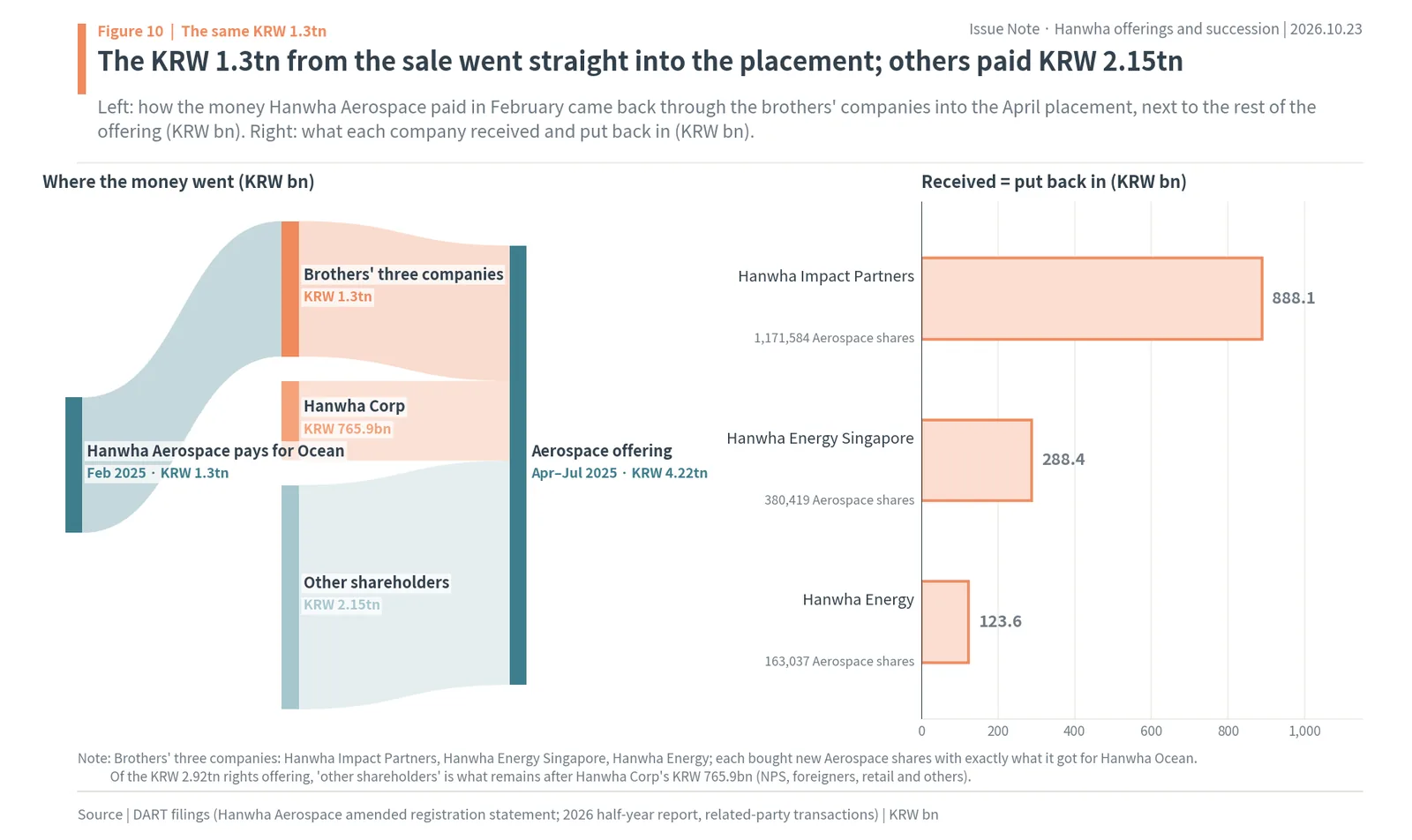
Put this circle on the brothers’ map and its meaning becomes clear. The basket side gave up Hanwha Ocean shares and received the same amount in Hanwha Aerospace shares, 1,715,040 shares (3.33%). Hanwha Aerospace is the company Kim Dong-kwan heads, and it sits under Hanwha Corp. The basket side now holds Hanwha Aerospace directly, without going through Hanwha Corp. Since Kim Dong-kwan is the basket’s largest shareholder, he now holds Hanwha Aerospace by two lines: a long line of basket → Hanwha Corp → Hanwha Aerospace, and a short line of basket → Hanwha Aerospace.
The second exit: the rest went to the market
On September 5, 2025 Hanwha Impact Partners sold its remaining 13,075,691 Hanwha Ocean shares in an after-hours block sale at KRW 107,100 a share, KRW 1,400.4bn in all. That was 4.8% below that day’s close.

Across the three companies, the KRW 656.3bn put in became KRW 2,700.4bn received. The gain was KRW 2,044.1bn, 4.11 times the money put in. Hanwha Impact Partners alone earned 110.2% a year (author’s calculation). Three companies: KRW 656.3bn → KRW 2.70tn, a gain of KRW 2.04tn (about $1.54bn), with Hanwha Impact Partners at 110.2% a year.

Participants on the other side fared differently. At the October 23 close, those who took Hanwha Ocean shares in the block sale are down 48.4%, and subscribers to Hanwha Aerospace’s rights offering are up 15.8% (against a KOSPI rise of 77.1% over the same period). Only the basket-side companies locked in a gain and left. How much of that gain belongs to each brother is the question of the next chapter.
Same numbers, different readings
On March 24, 2025, four days after the offering was announced, Invest Chosun called Hanwha’s frequent trillion-won offerings a “staggered offering strategy”: raise money from the stock market first, then use it some time later for acquisitions and succession funding. A brokerage analyst quoted in the article said that “the profits left with Hanwha Energy and Impact will flow to the three brothers of the family, the largest shareholders.” Hanwha’s explanation was different. Hanwha Aerospace said the offering money would go to overseas defense production bases and more capacity, and that the Hanwha Ocean purchase was a step toward selling defense and shipbuilding together abroad. On March 31, announcing the father’s gift of shares, Hanwha said “succession is complete.”
This report does not pick between the two readings. Laid on the brothers’ ownership table, the facts are these. The KRW 1.3tn the basket-side companies put in during April was at a price 10.8% higher than other shareholders paid (KRW 758,000 versus KRW 684,000), and that money was the Hanwha Ocean proceeds received from Hanwha Aerospace two months earlier. As a result, the basket side locked in its gain by selling Hanwha Ocean and used the proceeds to become a direct shareholder of Hanwha Aerospace. How much of that gain was each brother’s is the question of the next chapter.
Each brother’s share of the gain: split the basket’s KRW 1,198.9bn by ownership, and half is Kim Dong-kwan’s
This chapter’s conclusion is simple. The gain from the offerings was shared by the three brothers in proportion to their stakes, and Kim Dong-kwan, with the largest stake, had the largest share. But this share is value held in the basket company, not the brothers’ personal cash.
First, take out Hanwha Solutions’ share
Not all of the three companies’ KRW 2,044.1bn gain belongs to the basket. Hanwha Impact Partners, which made most of the gain, is a subsidiary of Hanwha Impact, and Hanwha Impact is owned 52.07% by Hanwha Energy and 47.93% by the listed Hanwha Solutions. So of Hanwha Impact Partners’ KRW 1,763.4bn gain, 47.93%, about KRW 845.2bn, belongs to Hanwha Solutions. The gains of Hanwha Energy Singapore and of Hanwha Energy itself, about KRW 280.7bn, go straight into the basket. Split this way, the basket’s share is about KRW 1,198.9bn (about $904mn) (author’s calculation).
Split the basket’s share by the brothers’ stakes
From 2023 to 2025, when these deals took place, the brothers owned the basket 50%, 25% and 25%. Split that way, Kim Dong-kwan’s share is about KRW 599.5bn (about $452mn), and Kim Dong-won’s and Kim Dong-seon’s about KRW 299.7bn each. The basket’s share, KRW 1,198.9bn: Kim Dong-kwan KRW 599.5bn, Kim Dong-won and Kim Dong-seon KRW 299.7bn each.

These numbers are not money the brothers personally received. They are “shares”: profit kept in the company, divided by ownership. The brothers turned these shares into actual cash only through the December 2025 stake sale and the dividend described later. Still, the shares matter, because the bigger the basket’s value, the more cash the brothers get when they sell or pledge basket shares.
The basket’s books more than doubled in two years
Hanwha Energy’s consolidated equity attributable to owners rose from KRW 2.58tn at the end of 2023 to KRW 4.58tn at the end of 2024 and KRW 6.23tn (about $4.70bn) at the end of 2025, KRW 3.65tn in two years. The basket’s share from the Hanwha Ocean deals equals 32.8% of that rise (author’s calculation; this is a comparison of sizes and differs from when the gains were booked). Hanwha Energy’s share of the gain is KRW 1.20tn, and Hanwha Energy’s equity went from KRW 2.58tn to KRW 6.23tn.

When Kim Dong-won and Kim Dong-seon sold 20% of the basket in December 2025, the whole company was valued at KRW 5.53tn. Behind that value lie the books that grew over those two years. The deals that began with the offerings raised the basket’s value, and in the next event that value becomes the younger brothers’ cash.
Hanwha Solutions, which received almost half the gain, took a different road
Hanwha Solutions, which received 47.93% of the gain, was itself short of money in 2026. On March 26 it announced a rights offering of KRW 2.4tn; after two FSS correction orders it cut the offering to KRW 1,171.3bn at KRW 22,100 a share and completed it on July 30. Hanwha Corp took 17,937,394 new shares (about KRW 396.4bn) in the offering; Hanwha Energy did not take part.
That same year Hanwha Solutions also proposed selling its 47.93% of Hanwha Impact to Hanwha Energy, but in June Hanwha Energy’s board decided not to buy it (Bizwatch, September 9, 2026). For the basket to own all of Hanwha Impact it would have had to buy that stake, and it did not spend the money. Where the basket’s money went shows up in the next two chapters.
Event 2: more of the father’s stake went to the eldest, and the younger brothers took cash out of the basket
Two deals in 2025 changed the balance of power among the brothers. The eldest received one and a half times as much of the father’s Hanwha Corp stake as each younger brother, and at year-end, as the two younger brothers sold basket shares, Kim Dong-kwan’s vote inside the basket became larger than his two brothers’ combined.
March: the father’s 11.32% of Hanwha Corp went out as 4.86%, 3.23% and 3.23%
On March 31, 2025 Kim Seung-youn announced that he would give half of his 22.65% of Hanwha Corp, 11.32% (8,488,970 shares), to his three sons, and the shares were transferred on April 30. Kim Dong-kwan received 4.86% (3,638,130 shares), and Kim Dong-won and Kim Dong-seon 3.23% (2,425,420 shares) each. Before the gift Kim Dong-kwan held 4.91% of Hanwha Corp and his brothers 2.14% each; after it, Kim Dong-kwan held 9.77% and his brothers 5.37% each. Hanwha Group said the gift meant “succession is complete.” The gift tax for the three was estimated at about KRW 221.8bn in total (New Daily).
After the gift, Kim Dong-kwan’s side’s voting power in Hanwha Corp, meaning the basket’s stake plus his own, is 33.93% as of August 2026. The two younger brothers hold 11.42% between them, and their father still has 12.04%. How, and to whom, the father passes on his remaining stake is the last piece of Kim Dong-kwan’s side’s voting power. Splitting the estimated gift tax of about KRW 221.8bn by shares received gives about KRW 95.1bn for Kim Dong-kwan and about KRW 63.4bn each for Kim Dong-won and Kim Dong-seon (author’s rough estimate). Hanwha said the tax would be paid “transparently and faithfully.” The brothers who received the gift needed cash for the tax; that November the basket paid its first dividend in three years, and in December the younger brothers sold basket shares. The filings do not state any link between the tax and this cash.
December: the younger brothers sold basket shares
On December 29, 2025 Kim Dong-won sold 5% of the basket (Hanwha Energy), 6,771,333 shares, and Kim Dong-seon 15%, 20,314,002 shares, at KRW 40,815 a share to financial investors including a Korea Investment PE consortium. Kim Dong-won received KRW 276.37bn and Kim Dong-seon KRW 829.12bn. Kim Dong-kwan did not sell. The basket is now owned 50% by Kim Dong-kwan, 20% by Kim Dong-won, 10% by Kim Dong-seon and 20% by financial investors.
What this deal means for succession is a change in power inside the basket. Before the sale it was Kim Dong-kwan’s 50% against the two younger brothers’ 50%, so if the younger two agreed, their votes equaled their elder brother’s. After the sale it is 50% against 30%. There is now a 20% financial-investor stake, but Kim Dong-kwan’s vote alone is larger than his two brothers’ combined. Power inside the basket: Kim Dong-kwan 50% vs his two younger brothers 50% → 30%.

The right of the figure shows voting power in Hanwha Corp now. Kim Dong-kwan’s side’s 33.93% is larger than his father’s 12.04% and his two brothers’ 11.42% put together. Holding the basket means holding Hanwha Corp, and as the younger brothers took stakes out of the basket, the basket became, in effect, Kim Dong-kwan’s.
The basket stake sale also meant something else for Kim Dong-seon
Kim Dong-seon’s stake in the basket fell from 25% to 10%. The relative-separation rules discussed later require a relative leaving the group to hold less than 15% of each unlisted company in the remaining group (Fair Trade Act Enforcement Decree, Article 5(1)2, item (b)). After the sale, Kim Dong-seon’s 10% of the basket is below that line. The filing does not state the purpose of the sale, but as a result Kim Dong-seon cut his ownership link with his elder brother’s basket to below that threshold.
The brothers’ personal cash
The big money that came to the three brothers personally is KRW 1,205.6bn: KRW 1,105.5bn from the basket stake sale plus a KRW 100.08bn interim dividend from the basket in November 2025 (KRW 739 a share; no dividends in 2022–2024). Money going out is KRW 431.4bn: the estimated gift tax of about KRW 221.8bn and up to KRW 209.62bn for Kim Dong-seon’s tender offer. The brothers’ personal cash: KRW 1.21tn in, KRW 431.4bn out (estimated and planned).

Most of the money that came in is Kim Dong-seon’s. He received KRW 829.12bn from the stake sale and KRW 25.02bn in dividends, while Kim Dong-kwan’s only receipt was a KRW 50.04bn dividend. The person who turned the basket’s grown value into cash was mainly Kim Dong-seon, and that cash is used in the next event.
Event 3: the company was split in two, and Kim Dong-seon is buying up his elder brothers’ stakes
Two events in 2026 split the brothers’ paths, which began in the basket, at the company level. Hanwha Corp was split in two so that the businesses Kim Dong-seon runs were grouped together, and Kim Dong-seon is buying that company with the money from selling basket shares.
The spin-off: Kim Dong-seon’s businesses gathered in one company
On January 14, 2026 Hanwha Corp’s board approved a spin-off (a split in which existing shareholders receive shares of both companies). Defense, shipbuilding, energy and finance stayed in the surviving Hanwha Corp, while tech affiliates such as Hanwha Vision, Hanwha Robotics and Hanwha Semitech and lifestyle affiliates such as Hanwha Galleria, Hanwha Hotels & Resorts and Ourhome moved to the new holdco, Hanwha Machinery & Services Holdings. An extraordinary shareholders’ meeting on July 15 approved it with 99.95% in favor; the split took effect on August 1 and both companies relisted on August 25. The company described the purpose as removing the conglomerate discount.

The split ratio, based on net book value, was 0.7563533 for the surviving Hanwha Corp and 0.2436467 for the new holdco, and a shareholder holding one old Hanwha Corp share received 1.2182335 new holdco shares along with surviving Hanwha Corp shares (Digital Daily). After the split the surviving Hanwha Corp has 53,328,897 common shares and the new holdco 84,515,535. The new holdco has more shares at a lower price (KRW 7,570 on October 23), so the same money buys a larger percentage. Because a spin-off gives existing shareholders shares of both companies in the same proportion, the new holdco’s register right after the split looked like Hanwha Corp’s: Hanwha Energy 23.94%, Kim Seung-youn 12.24%, Kim Dong-kwan 10.55%, Kim Dong-won and Kim Dong-seon 5.81% each, and the Bukil Academy school foundation 1.98%. A company for Kim Dong-seon to run had been created, but its largest shareholder was still his elder brother’s basket. The Fair Trade Commission (FTC) confirmed the new holdco as a holding company on October 8, which created homework (covered later).
The tender offer: the youngest buys his elder brothers’ stakes
On October 12 Kim Dong-seon filed a tender offer for the new holdco’s common shares at KRW 8,000 a share. It was first for 16.06mn shares (19%), but a correction on October 22 raised it to 26,203,000 shares (31%), because his elder brothers Kim Dong-kwan and Kim Dong-won said they would tender 6,762,000 and 3,381,000 shares. The stated purpose was to “strengthen responsible management,” and the statement said that a governance reorganization to resolve holding-company restrictions could be considered within two years of the holding company’s formation. If the cap is filled, Kim Dong-seon’s stake rises from 5.81% to 36.81%, Kim Dong-kwan’s falls from 10.55% to 2.55% and Kim Dong-won’s from 5.81% to 1.81%. If the cap is filled: Kim Dong-seon 5.81% → 36.81%, his elder brothers 2.55% and 1.81%.

What this figure means for succession is a change of places. In the new holdco, the brother with the largest stake changes from Kim Dong-kwan to Kim Dong-seon, and Kim Dong-seon’s stake becomes larger than the basket’s (23.94%) and his father’s (12.24%). The elder brothers receive KRW 54.10bn and KRW 27.05bn for tendering. The structure is the youngest buying his elder brothers’ stakes with money from selling basket shares.
What is left for shareholders outside the family
Of the 26,203,000-share cap, subtracting the elder brothers’ 10,143,000 tendered shares leaves 16.06mn shares for shareholders outside the family. They hold 33,533,842 shares, so if up to 47.9% of those are tendered, every tendered share is bought at KRW 8,000. If they all tender, the share bought falls to 60.0%. KRW 8,000 is 31.58% above the KRW 6,080 close on the day before the filing (October 8), and the October 23 close is KRW 7,570. Tender offer at KRW 8,000: every tendered share is bought until outside holders tender 47.9%.
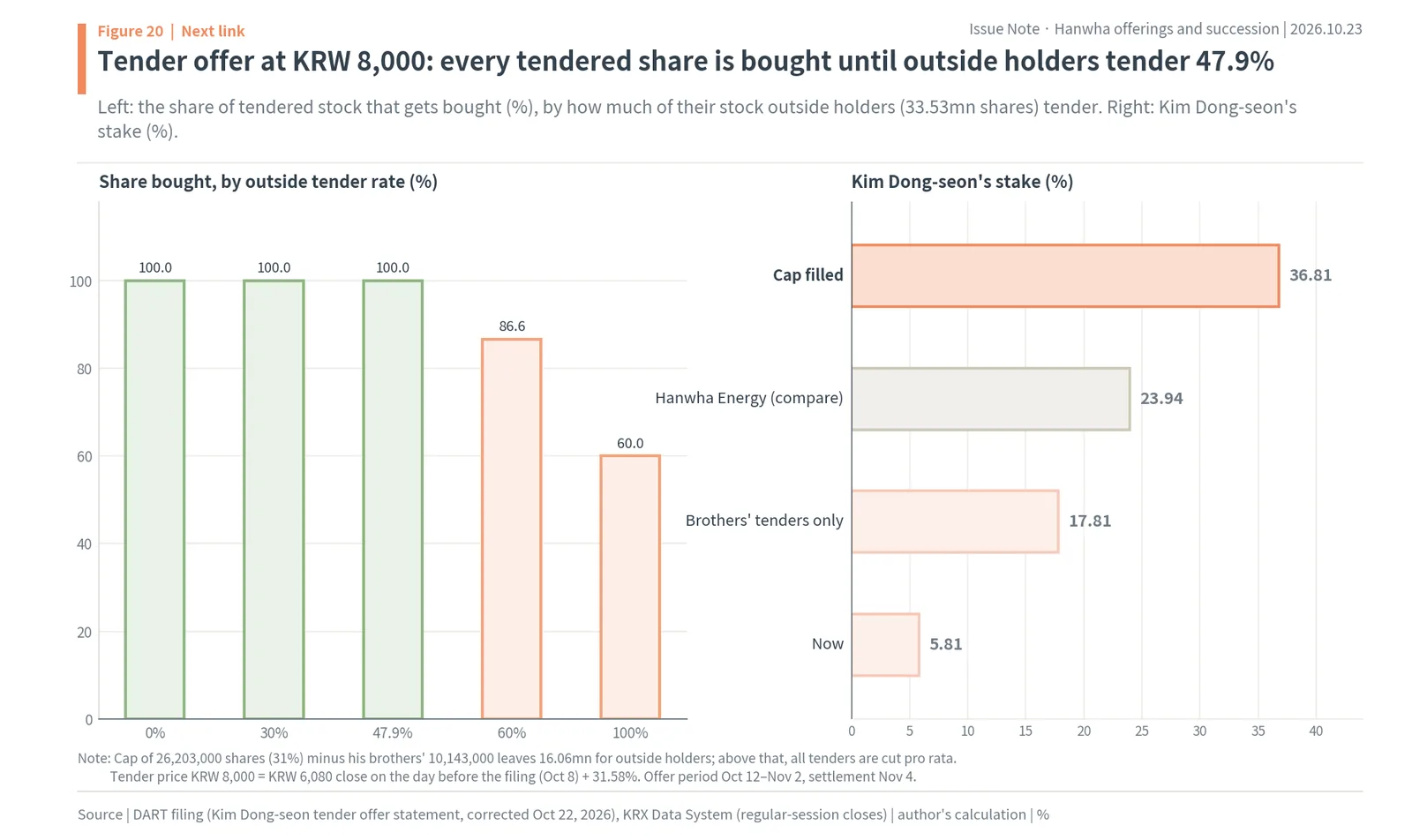
The money is KRW 193.624bn of his own and a KRW 16bn loan from Meritz Securities (6.8% a year, secured by Samsung Electronics and SK Hynix shares). The statement lists the source of funds only as his own money. By size, though, the KRW 829.12bn he received from selling basket shares ten months earlier is about four times this amount. This is the path by which the basket’s value, grown through the offerings, becomes the youngest brother’s cash, and that cash becomes the money to buy the company he runs.
Compared with the tender offer two years earlier
Set against Hanwha Energy’s tender offer for Hanwha Corp two years earlier, the differences show. In 2024 the offer was KRW 30,000, 7.72% above the previous close, and only 3,898,993 of the targeted 6 million shares (65.0%) were tendered. This time the premium over the pre-filing close is 31.58%, and 39% of the cap is already filled by the two elder brothers’ tenders. The 2024 tender offer was a deal for the basket to hold more of Hanwha Corp; the 2026 tender offer is a deal for the youngest brother to hold the new holdco. The same method was used twice, once for the basket’s control (that is, Kim Dong-kwan’s side) and once for Kim Dong-seon’s.
The succession map in one line: from one basket in 2005 to two holding companies in 2026
Laid on the brothers’ ownership table in date order, the events show how the brothers’ paths, which began in one basket, divide into two. Next to each event is whose share or vote it enlarged.
In 2005 the three brothers bought Hanwha S&C for KRW 3.04bn. The eldest, Kim Dong-kwan, bought 66.7%, and the stakes soon settled at 50%, 25% and 25%. This company became Hanwha Energy in 2021. From the start, the eldest’s vote inside the basket equaled his two brothers’ combined.
In July 2024 the basket bought Hanwha Corp shares in a tender offer at KRW 30,000 a share, raising its stake from 9.70% to 14.90%, and by also buying Korea Zinc’s shares at year-end it became Hanwha Corp’s largest shareholder with 22.16%. The money that grew the basket belonged to all three brothers, but the votes that move Hanwha Corp were added to the side of Kim Dong-kwan, the basket’s largest shareholder.
From May 2023 to September 2025 the basket-side companies entered the DSME offering and sold the Hanwha Ocean shares to Hanwha Aerospace and to the market. The basket’s share of the gain was about KRW 1,198.9bn; by stake, KRW 599.5bn for Kim Dong-kwan and KRW 299.7bn for each younger brother. The KRW 1.3tn from the sale became new Hanwha Aerospace shares, and the basket side became a direct shareholder (3.33%) of Hanwha Aerospace, which Kim Dong-kwan runs.
In March 2025 the father gave 11.32% of Hanwha Corp, split 4.86%, 3.23% and 3.23%. The eldest’s share was one and a half times each younger brother’s. In November the basket paid a KRW 100.08bn dividend, its first in three years. In December the two younger brothers sold 20% of the basket for KRW 1,105.5bn, and the balance of power inside the basket went from 50 vs 50 to 50 vs 30. Kim Dong-seon’s 10% of the basket fell below the unlisted threshold (under 15%) for a relative separation.
In the July 30, 2026 reshuffle, Kim Dong-kwan became senior vice chairman, Kim Dong-won vice chairman and Kim Dong-seon president. On August 1 Hanwha Corp was split in two, and the retail, hotel, robot and semiconductor-equipment businesses Kim Dong-seon runs were gathered in the new holdco. On October 12 Kim Dong-seon launched a tender offer for the new holdco, and on October 22 he raised the cap to 31% to include his two elder brothers’ tenders. If the cap is filled his stake will be 36.81%. The offer closes on November 2 and settles on November 4.
On this line the events fall into two kinds. One kind grew the basket or added to its hold on Hanwha Corp (the 2024 tender offer, the Hanwha Ocean deals, the father’s gift), and their effect gathered on the side of Kim Dong-kwan, the basket’s largest shareholder. The other kind turned the basket’s value into cash and split companies (the stake sale, the spin-off, the 2026 tender offer), and their effect gathered toward making room for Kim Dong-seon to stand on his own. Kim Dong-won received his share by stake in both kinds of events, but there has not yet been an event that gives him separate control of the finance business he runs.
Who gained: control went to Kim Dong-kwan, cash to Kim Dong-seon, and Kim Dong-won runs finance while its control sits on his elder brother’s side
Gather the three events by brother and the answer splits. By control, Kim Dong-kwan gained the most; by cash, Kim Dong-seon took the most. Kim Dong-won holds basket shares and cash, but control of the finance business he runs sits on his elder brother’s side.
Kim Dong-kwan: control
Kim Dong-kwan gained control in all three events. In Event 1 the basket side turned its Hanwha Ocean shares into shares of Hanwha Aerospace, which he runs, and became a direct shareholder of Hanwha Aerospace (3.33%). In Event 2 he received one and a half times as much of his father’s stake as each younger brother, and as his brothers sold basket shares his vote inside the basket (50%) became larger than theirs (30%). In Event 3 he hands his new holdco shares to his brother and receives KRW 54.10bn for tendering. His largest voting block is 33.93% of Hanwha Corp (basket 23.55% + his own 10.38%). Below it run Hanwha Aerospace, Hanwha Ocean, Hanwha Systems, Hanwha Solutions and Hanwha Life.
Kim Dong-seon: cash and a new holding company
Kim Dong-seon received the most cash: KRW 829.12bn from the basket stake sale plus KRW 25.02bn in dividends, KRW 854.1bn (about $644mn). With that money he is buying up to 36.81% of the new holdco and gaining control of the company he runs. Just as Kim Dong-kwan holds Hanwha Corp with 33.93%, Kim Dong-seon will hold the new holdco with 36.81%. Cash: Kim Dong-seon, KRW 854.1bn. Control: Kim Dong-kwan, 33.93% of Hanwha Corp.

Kim Dong-won: runs finance, but control sits on his elder brother’s side
Kim Dong-won receives KRW 328.4bn in all: KRW 276.37bn from the basket stake sale, KRW 25.02bn in dividends and KRW 27.05bn for tendering. He holds 20% of the basket (KRW 1,105.5bn at the December 2025 deal price) and 5.71% of Hanwha Corp (KRW 284.6bn on October 23). But Hanwha Life, the top of the finance business he runs, is 43.24% owned by Hanwha Corp, and his personal stake in it is 0.03%. That is why Kim Dong-won’s bar is barely visible on the right of the figure. Of the three, Kim Dong-won is the one whose business and stakes are furthest apart.
The three brothers’ stake wealth
Turning stakes into values makes the gaps between the brothers clearer. Basket shares are valued at the December 2025 deal price (KRW 40,815 a share), and listed shares at the October 23 close (author’s calculation). Kim Dong-kwan holds 50% of the basket (KRW 2,763.7bn), 10.38% of Hanwha Corp (KRW 517.3bn) and new holdco shares after tendering (KRW 16.3bn), about KRW 3,297.3bn (about $2.49bn) in all. Kim Dong-won holds 20% of the basket (KRW 1,105.5bn), 5.71% of Hanwha Corp (KRW 284.6bn) and new holdco shares (KRW 11.6bn), about KRW 1,401.7bn. Kim Dong-seon holds 10% of the basket (KRW 552.7bn), 5.71% of Hanwha Corp (KRW 284.6bn), 36.81% of the new holdco if the cap is filled (KRW 235.5bn) and 16.85% of Hanwha Galleria (KRW 80.7bn), about KRW 1,153.6bn.
What stands out is the makeup of Kim Dong-seon’s wealth. Of his stake wealth, 72.6% is still in companies on his elder brother’s side (the basket and Hanwha Corp). His stakes in the new holdco and Hanwha Galleria, the companies he runs, are a little over 27%. For Kim Dong-seon to stand on his own, he would have to move the wealth tied up on his elder brother’s side into stakes in his own companies, and the “3% tests” in the next chapter are the threshold for that move.
Why it stuck to Kim Dong-kwan, seen through the ownership chain
Going down the ownership chain, the brothers’ actual share shrinks quickly, but the voting power the group holds does not. The brothers’ economic share (reflecting their 80% of the basket) is 40.6% in Hanwha Corp, 14.9% in Hanwha Aerospace, 17.2% in Hanwha Systems and 5.8% in Hanwha Ocean. The group’s voting control, by contrast, is 57.4% in Hanwha Corp, 35.5% in Hanwha Aerospace, 59.5% in Hanwha Systems and 37.7% in Hanwha Ocean (author’s calculation). Hanwha Ocean: the brothers’ economic share 5.8% vs voting control 37.7% (6.5x).
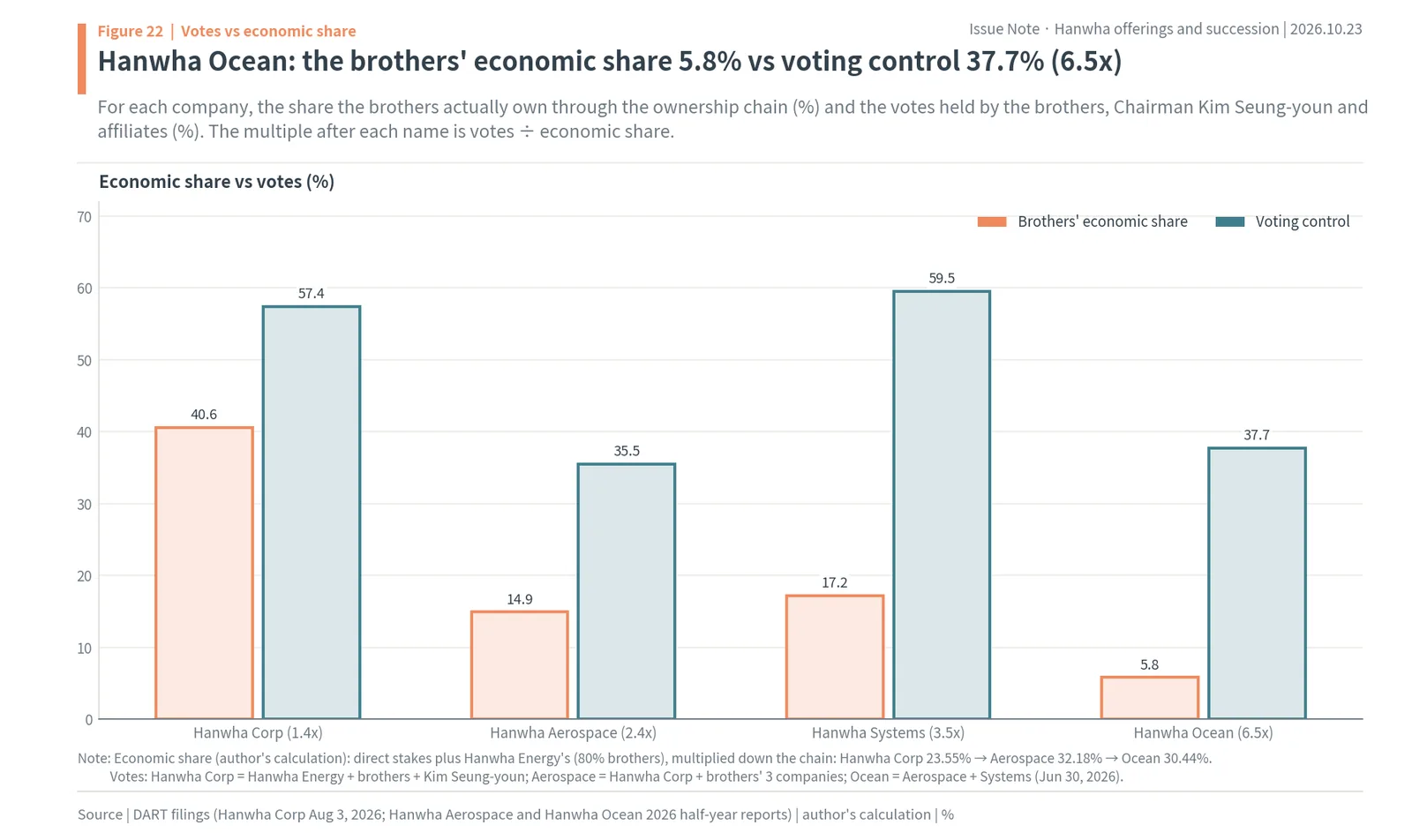
This gap explains what Event 1 meant. When the basket side holds Hanwha Ocean shares directly, almost all the gain goes to the three brothers by stake. When Hanwha Aerospace holds the same shares, the brothers’ share gets smaller, but the votes still stay with the group, that is, with Kim Dong-kwan’s side, which holds Hanwha Corp. The basket side sold Hanwha Ocean to turn its gain into cash, and with that cash took a direct hold on Hanwha Aerospace. The gain was split three ways; control stuck to Kim Dong-kwan’s side.
The author’s view
The author sees what Hanwha’s offerings did for succession not as “creating money” but as creating the cost of the brothers parting ways with one basket. The deals that began with the offerings raised the basket’s value (equity from KRW 2.58tn to KRW 6.23tn), and the younger brothers sold basket shares at that value, raising KRW 1,105.5bn in cash. Kim Dong-kwan held on to the basket and Hanwha Corp, and Kim Dong-seon is buying the new holdco with that cash. This reading is not a judgment about intent; it is what results from laying the disclosed deals, one after another, on the brothers’ ownership table. Hanwha said in March 2025 that the gift of shares meant “succession is complete,” and called linking the offering to succession “speculation and distortion.”
What each can do now with which stakes: Kim Dong-kwan the father’s stake, Kim Dong-seon the 3% tests, Kim Dong-won Hanwha Life
This chapter lays out the stakes each brother now holds, what he can do with them, and the thresholds the law sets. The conclusion: the big piece left for Kim Dong-kwan is his father’s 12.04% of Hanwha Corp. For Kim Dong-seon to take the new holdco fully out of the group, the group side’s stake in it and his own stake in Hanwha Corp both have to fall below 3%, and at current prices those two blocks are almost the same size. For Kim Dong-won to take the finance business out, he would have to buy Hanwha Life shares worth far more than the cash he holds.
Kim Dong-kwan: the basket’s 50% and his own 10.38% decide Hanwha Corp’s board
Kim Dong-kwan’s stakes are 50% of the basket, 10.38% of Hanwha Corp (5,538,035 shares) and 2.55% of the new holdco after tendering. His 50% of the basket is still the largest block even after the financial investors’ 20% came in. With 33.93%, the basket’s 23.55% of Hanwha Corp plus his own 10.38%, he can decide the election of directors at Hanwha Corp’s shareholder meetings, and Hanwha Corp’s board votes as the shareholder of Hanwha Aerospace, Hanwha Solutions and Hanwha Life.
The basket also holds listed stakes directly, without going through Hanwha Corp: 12.80% of Hanwha Systems (KRW 1,603.3bn on October 23), the three basket-side companies’ 3.33% of Hanwha Aerospace (KRW 1,358.3bn) and Hanwha Impact’s 32.77% of Hanwha Engine (KRW 881.9bn), about KRW 3,843.5bn (about $2.90bn) in all (author’s calculation; the Hanwha Impact and Hanwha Impact Partners stakes include Hanwha Solutions’ 47.93%). These are assets the basket can sell or pledge when it needs cash, and a second line, separate from Hanwha Corp, by which Kim Dong-kwan holds the companies he runs.
Three big tasks remain for Kim Dong-kwan. First, his father Kim Seung-youn’s 12.04% of Hanwha Corp. If he received it, Kim Dong-kwan’s side’s voting power would be 45.97% (author’s calculation). Whether by inheritance or gift, tax follows; for the 11.32% gift in 2025, the gift tax was estimated at about KRW 221.8bn. Second, a listing of the basket. Hanwha Energy picked IPO lead managers in March 2025, but the process has stalled amid criticism of duplicate listings. If it listed, the brothers’ basket shares would be priced every day, making them easier to sell or pledge. Third, a merger of the basket and Hanwha Corp. A merger would let Kim Dong-kwan hold Hanwha Corp directly, without going through the basket, but in February 2026 Hanwha Corp said it is “not considering at all” a merger.
Kim Dong-seon: two 3% tests to take the new holdco out of the group
Kim Dong-seon’s stakes are up to 36.81% of the new holdco (if the tender cap is filled), a personal 16.85% of Hanwha Galleria, 10% of the basket and 5.71% of Hanwha Corp (3,047,583 shares). Holding the new holdco alone lets him decide the management of Hanwha Galleria, Hanwha Hotels & Resorts, Hanwha Robotics, Hanwha Vision and others. But taking it fully out of the group, a relative separation, is a separate threshold.
Article 5(1)2 of the Fair Trade Act Enforcement Decree sets the requirements for removing companies a relative runs independently from the business group. Item (a): the same person’s side (the side staying in the group, excluding the departing relative: Kim Seung-youn, Kim Dong-kwan, Kim Dong-won, Hanwha Energy, the Bukil Academy foundation and others) must hold less than 3% of each listed company and less than 10% of each unlisted company on the departing relative’s side. Item (b): the departing relative’s side must hold less than 3% of each listed company and less than 15% of each unlisted company in the remaining group. On top of that there must be no shared executives, no debt guarantees or lending between the two sides, and no sanctions for unfair support in the three years before and after the separation. If the requirements are broken within three years after a separation, it can be revoked. This report calls the side staying in the group “the group side.”
Against these tests, today’s numbers look like this. Even after the tender cap is filled, the group side (Hanwha Energy 23.94%, Kim Seung-youn 12.24%, Kim Dong-kwan 2.55%, Kim Dong-won 1.81%, Bukil Academy 1.98%) holds 42.51% of the new holdco. To get below 3% it must sell down another 39.51pp. Conversely, Kim Dong-seon’s 5.71% of Hanwha Corp must be cut below 3% (at least 1,447,716 shares, about KRW 135.2bn at October 23 prices), while his 10% of the basket is already below the 15% unlisted line. Separation tests: group side 42.51% → below 3%, Kim Dong-seon’s Hanwha Corp 5.71% → below 3%.
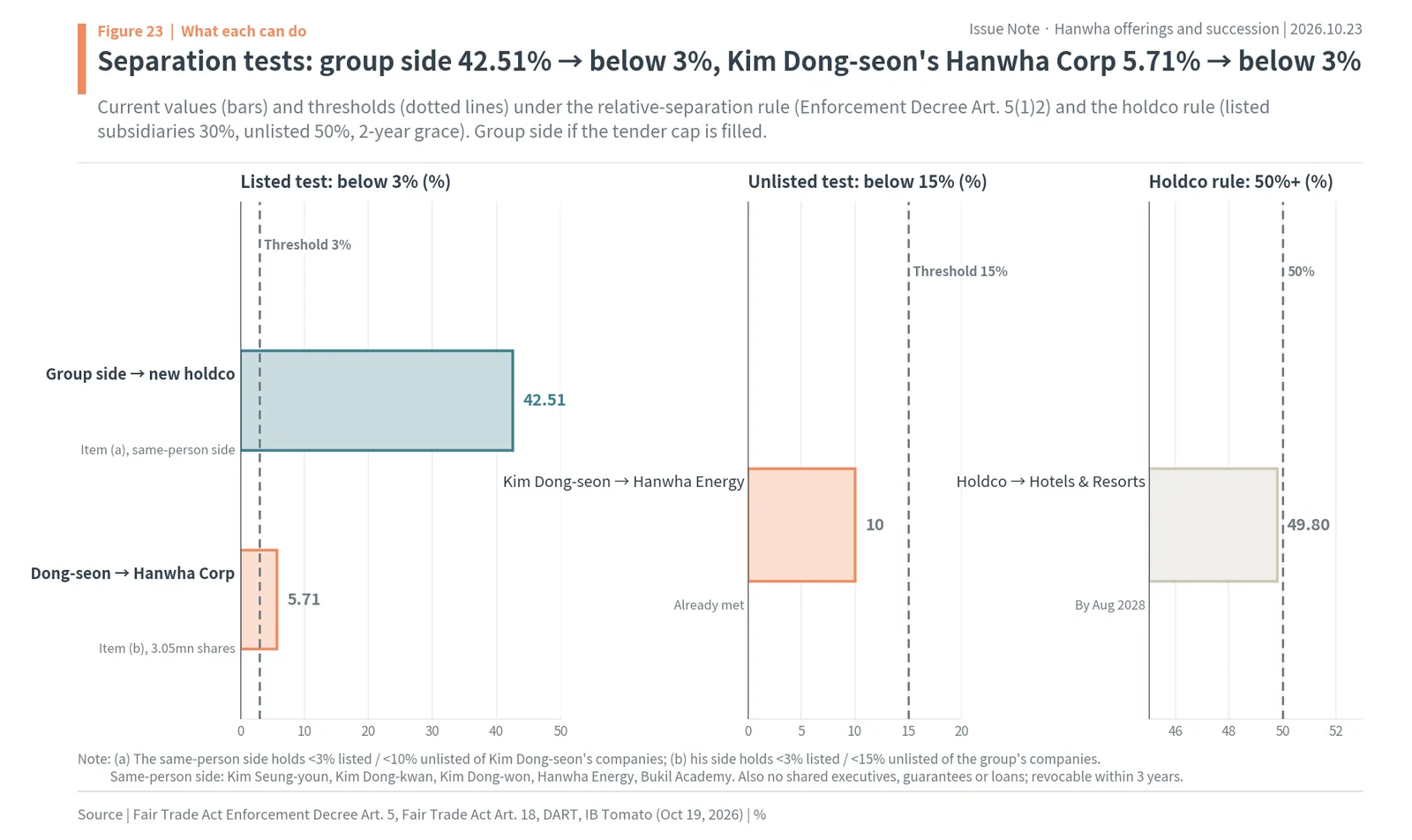
The right of the figure is the holding company rule. The new holdco is a holding company under the Fair Trade Act, so it must own 50% or more of each unlisted subsidiary, but its stake in Hanwha Hotels & Resorts is 49.80%, 0.20pp short. It has two years from becoming a holding company in August 2026, that is, until August 2028. The tender offer statement’s note that “additional acquisition or disposal of shares, a merger, etc.” could be considered within two years refers to this homework. The other subsidiaries clear the bar: the new holdco owns 67.97% of Hanwha Robotics (unlisted, 50% or more needed) and 36.15% of Hanwha Galleria and 33.95% of Hanwha Vision (listed, 30% or more needed) (IB Tomato, Smart Today). Fill the 0.20pp at Hotels & Resorts and the holding company rule is met. Kim Dong-seon’s personal 16.85% of Hanwha Galleria (Dealsite) is another stake he holds directly, outside the holding company.
Kim Dong-seon: the two blocks are almost the same size
One piece of arithmetic stands out here. At October 23 closes, Kim Dong-seon’s 5.71% of Hanwha Corp is worth KRW 284.6bn (KRW 93,400 a share), and the group side’s 42.51% of the new holdco is worth KRW 272.0bn (KRW 7,570 a share). The group side’s block breaks down into Hanwha Energy KRW 153.2bn, Kim Seung-youn KRW 78.3bn, Kim Dong-kwan KRW 16.3bn, Bukil Academy KRW 12.6bn and Kim Dong-won KRW 11.6bn. Size of the two stakes that could be swapped: KRW 284.6bn (about $215mn) vs KRW 272.0bn (about $205mn).
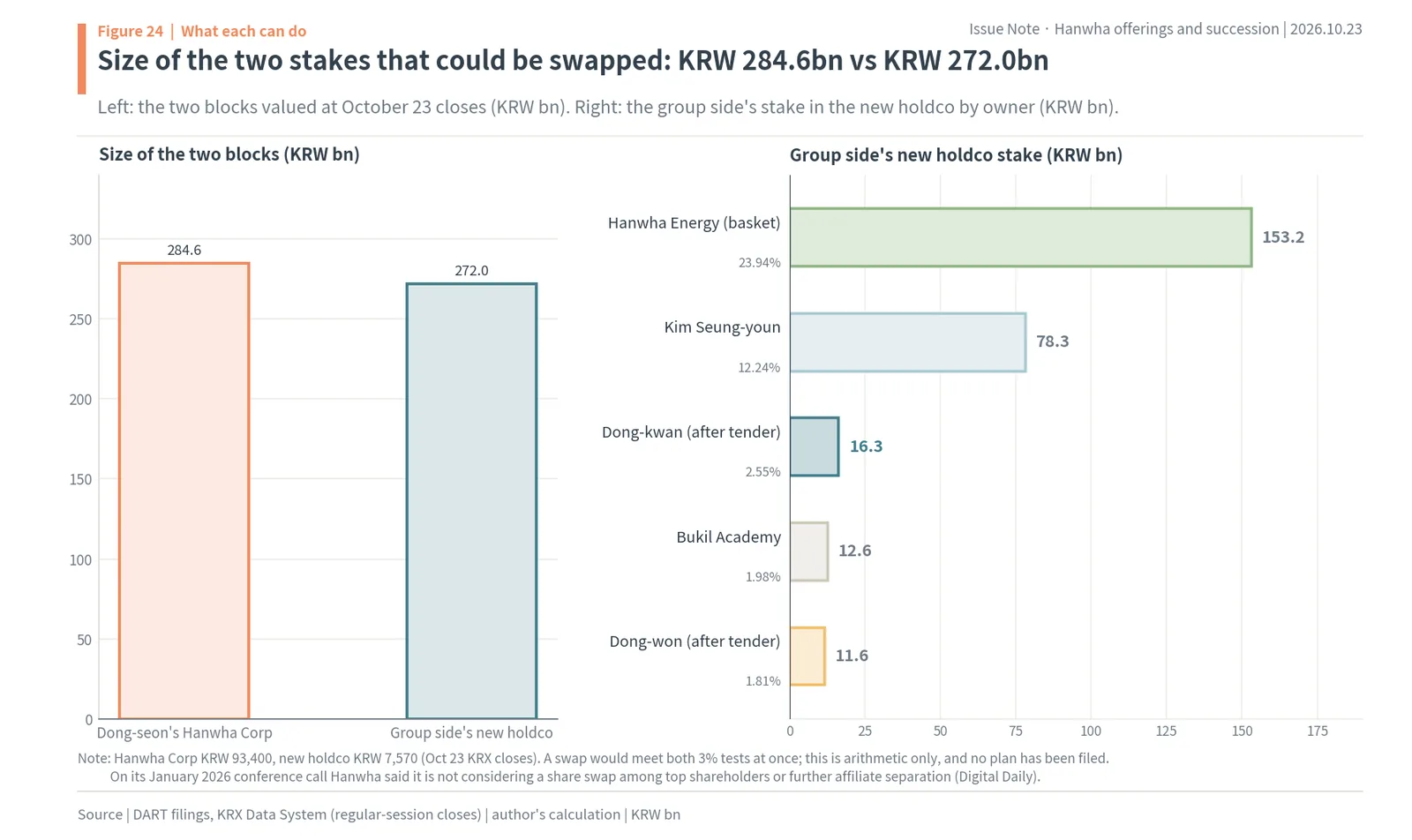
Swapping the two blocks would meet the 3% tests of items (a) and (b) at once. When LX split from LG, it also took about 14 months from the spin-off (May 2021), through clearing up stakes, to FTC recognition (June 2022). But this is only arithmetic at today’s prices. On its January 2026 conference call, Hanwha said it is not considering a share swap among its top shareholders or further affiliate separation, and no such plan has been filed. If share prices move, the sizes of the two blocks change too. Kim Dong-seon still has cash left from the basket stake sale after the tender offer and the tax, so buying the group side’s stake instead of swapping is also an open path.
Other ties left between the brothers
Beyond the 3% tests, there are other ties to clear. The basket does not only hold a stake in Kim Dong-seon’s company (23.94% of the new holdco); Kim Dong-seon is also a shareholder of the basket (10%). His 10% is below the unlisted line (under 15%), so it poses no problem under the rules, but if the basket listed or merged with Hanwha Corp, the nature of that stake would change, because the 3% listed threshold could then apply. And since there can be no shared executives, any positions Kim Dong-seon holds at companies on his elder brother’s side (Hanwha Corp or basket-side companies) would have to be cleared. There can be no debt guarantees or lending between the two sides either.
Kim Dong-kwan’s side has homework too. If the basket sells its 23.94% of the new holdco, cash comes into the basket, but if the buyer is the market rather than Kim Dong-seon, it weighs on the new holdco’s share price. In a swap, the basket would get Hanwha Corp shares instead of new holdco shares, and Kim Dong-kwan’s side’s voting power in Hanwha Corp would grow. Either way, the direction is for Kim Dong-kwan’s side to hold Hanwha Corp, and Kim Dong-seon’s side the new holdco, more cleanly.
Kim Dong-won: to separate finance, Hanwha Life’s 43.24%
Kim Dong-won’s stakes are 20% of the basket, 5.71% of Hanwha Corp (3,047,583 shares), 1.81% of the new holdco after tendering and 0.03% of Hanwha Life. To take the finance business he runs out of the group, he would need Hanwha Corp’s 43.24% of Hanwha Life, worth KRW 1,513.4bn (about $1.14bn) at the October 23 market cap. That is 4.6 times the KRW 328.4bn in cash Kim Dong-won received. Financial affiliates also face the financial regulator’s review of major shareholders of financial companies, on top of the Fair Trade Act’s separation rules. A domestic credit rating agency understands there are no further plans to change the governance structure, and the press sees a financial separation as a “long game” (News Tomato).
What Kim Dong-won can do now is decide where to use the stakes he holds. His 5.71% of Hanwha Corp is a vote he can add to his elder brother’s side, and his 20% of the basket is wealth that can become cash if the basket lists or more shares are sold. Kim Dong-won’s path is to run finance inside Kim Dong-kwan’s trunk, and his stakes are cards he can play in negotiations among the brothers.
Numbers to watch: the tender result and the two 3% thresholds
The next link can be checked with eight numbers. The nearest is the tender offer closing on November 2. The new holdco’s October 23 close of KRW 7,570 is 5.68% below the offer price of KRW 8,000. The result will be filed with settlement on November 4, and that is when Kim Dong-seon’s actual stake will be set.
Next come the two 3% thresholds. Whether the group side’s stake in the new holdco (42.51% after the tender) and Kim Dong-seon’s stake in Hanwha Corp (5.71%) fall below 3% is the first threshold for a relative separation. If either number moves, a filing will follow. Eight numbers to watch: ③ the group side’s 42.51% of the new holdco, ④ Kim Dong-seon’s 5.71% of Hanwha Corp.
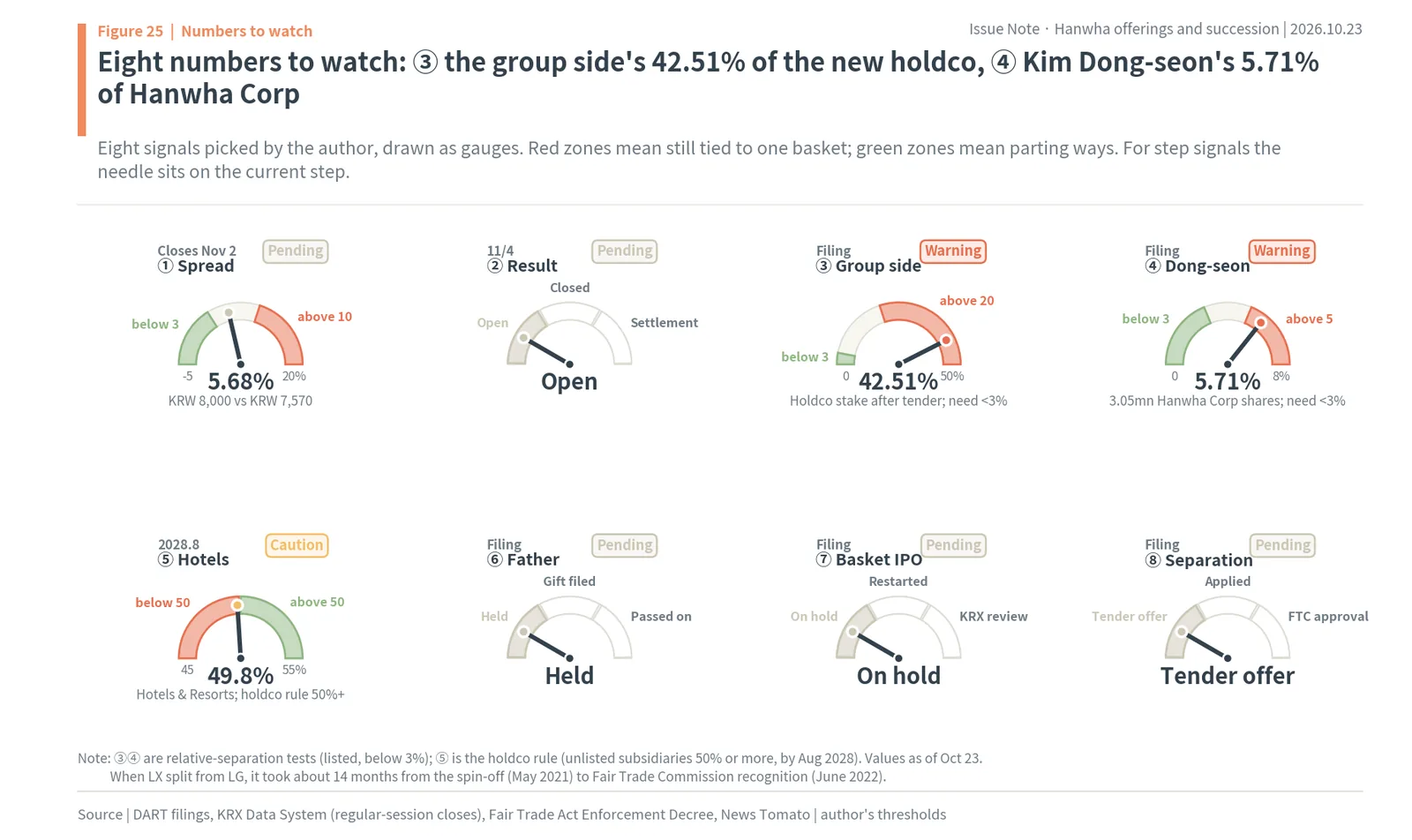
The rest are on the gauges too: whether the new holdco raises its 49.80% of Hanwha Hotels & Resorts to 50% or more by August 2028 (⑤, the holding company rule), when and to whom the father’s 12.04% of Hanwha Corp goes (⑥), whether the basket’s (Hanwha Energy’s) IPO is revived (⑦), and whether a relative separation is applied for (⑧). Red zones on the gauges mean still tied to one basket; green zones mean parting ways.
Dates to check
The nearest dates are November 2 (the tender offer closes) and November 4 (settlement and the result filing). After that come filings with no set date: changes in the group side’s stake in the new holdco (filed as changes in shares held by the largest shareholder and related parties), changes in Kim Dong-seon’s stake in Hanwha Corp, changes in the three basket-side companies’ stake in Hanwha Aerospace, a gift or inheritance of Kim Seung-youn’s shares, a Hanwha Energy filing for a preliminary listing review, and an application for a relative separation. The deadline for the holding company rule is August 2028. In mid-November, when third-quarter reports come out, each company’s largest shareholders will be filed again.
Where shareholders of each listed company should look
The same numbers matter differently depending on which company you hold. Shareholders of the new holdco watch whether to tender, and after that how the group side’s 42.51% (20.23mn shares held by Hanwha Energy, 10.34mn by Kim Seung-youn, and others) moves. Whether those shares come to the market, are bought by Kim Dong-seon or are swapped for other stakes makes a difference to the share price.
Hanwha Corp shareholders watch Kim Dong-seon’s 3,047,583 shares (5.71%). Getting below 3% would take at least 1,447,716 shares. How the father’s 12.04% of Hanwha Corp is passed on (gift, inheritance or sale) is also a large block for Hanwha Corp shareholders. Hanwha Aerospace shareholders watch the 1,715,040 shares (3.33%) held by the three basket-side companies. Since the basket side has sold remaining Hanwha Ocean shares in a block sale before, when and how this stake moves bears directly on supply and demand for the stock. Hanwha Life shareholders watch whether Kim Dong-won’s plans for the finance group take shape.
Common questions
So who is Hanwha’s successor?
By stakes and titles, Kim Dong-kwan holds the group’s core (defense, shipbuilding, energy) and the holding company Hanwha Corp. The evidence is his 50% of the brothers’ basket, 33.93% of Hanwha Corp’s votes (basket plus his own) and his promotion to senior vice chairman in August 2026. Hanwha Group said in March 2025 that the father’s gift of shares meant “succession is complete.” Kim Dong-seon runs the new holdco, which groups retail, hotels, robots and semiconductor equipment, and is buying up its shares, while Kim Dong-won runs finance.
Were these deals illegal?
This report makes no judgment on legality. The DSME placement, Hanwha Aerospace’s purchase of Hanwha Ocean shares, the Hanwha Aerospace offering, the block sale, the gift, the Hanwha Energy stake sale, the spin-off and the tender offer are all deals disclosed on DART. During the Hanwha Aerospace offering the FSS ordered the registration statement corrected twice, and the company changed the structure and completed the review. What this report did was lay those deals, one after another, on the brothers’ ownership table.
Did the brothers make KRW 2tn?
No. The KRW 2,044.1bn gain belongs to companies: Hanwha Impact Partners, Hanwha Energy Singapore and Hanwha Energy. Of it, 47.93% of Hanwha Impact Partners’ gain belongs to the listed Hanwha Solutions, so the basket’s share is about KRW 1,198.9bn. Split by the brothers’ stakes at the time, that is about KRW 599.5bn for Kim Dong-kwan and about KRW 299.7bn each for Kim Dong-won and Kim Dong-seon, but this too is value held in the company. What became the brothers’ personal cash was the basket’s KRW 100.08bn dividend and the younger brothers’ KRW 1,105.5bn sale of basket shares.
Why did Kim Dong-seon sell his basket shares?
The filing does not state the purpose. Looking at the results, two things happened. One is KRW 829.12bn in cash, part of which is being used for the new holdco tender offer (up to KRW 209.62bn). The other is that his basket stake fell from 25% to 10%, below the unlisted threshold (under 15%) of item (b) of the relative-separation rule.
When will Kim Dong-seon leave the group?
There is no set schedule. A relative separation would require cutting the group side’s stake in the new holdco and Kim Dong-seon’s stake in Hanwha Corp below 3%, and clearing shared executives, debt guarantees and lending. In January 2026 Hanwha said it is not considering further affiliate separation. In the LX precedent, it took about 14 months from LX’s split from LG to FTC recognition.
What would change if the brothers’ basket listed?
Hanwha Energy picked NH Investment & Securities, Korea Investment & Securities and Daishin Securities as IPO lead managers in March 2025, but the process stalled amid criticism of duplicate listings (listing a company alongside its listed group affiliates). Hanwha’s position is that Hanwha Energy is not a duplicate listing because it was not created by a split and its shareholders are individuals. If it listed, the market would price the brothers’ basket shares every day, and the brothers would find it easier to sell or pledge them. It would also widen the ways to fund the tax due on receiving the father’s stake. For Kim Dong-seon, on the other hand, the listed threshold (under 3%) could then apply to his 10% of the basket, so he would have to cut that stake further to separate.
What does it mean for minority shareholders in Hanwha’s listed companies?
The brothers’ stake reshuffling shows up as blocks of listed shares on the move. In the new holdco, the group side’s 42.51%; in Hanwha Corp, Kim Dong-seon’s 5.71% and the father’s 12.04%; in Hanwha Aerospace, the three basket-side companies’ 3.33% are blocks that could move some day. As with the September 2025 Hanwha Ocean block sale, done 4.8% below that day’s close, large blocks often change hands at a discount. If instead they are bought through a tender offer with a premium, minority shareholders get the chance to sell at the same price.
How much do I get if I tender?
If outside shareholders tender 47.9% or less of their shares, every tendered share is sold at KRW 8,000. If every outside shareholder tenders, only 60% is sold at KRW 8,000 and the rest is returned. Settlement is on November 4. This report neither recommends nor discourages tendering.
What did Kim Dong-won get?
Kim Dong-won runs finance and became vice chairman, and holds 20% of the basket, 5.71% of Hanwha Corp and about KRW 328.4bn in cash (including his tender proceeds). But the top of the finance business, Hanwha Life, is 43.24% owned by Hanwha Corp. Taking the finance business out through shares would require Hanwha Life shares worth about KRW 1,513.4bn, so for now he runs finance inside his elder brother’s trunk.
Basis of calculation
Stakes were taken from DART filings as filed: the shareholders of Hanwha Corp and the new holdco right after the split from the August 3, 2026 securities issuance results report; Hanwha Energy’s shareholders from the December 30, 2025 filing on changes in the largest shareholder’s holdings; the gift from the April 30, 2025 filing; and the tender offer from the corrected statement of October 22, 2026. The brothers’ titles and businesses follow the July 30, 2026 reshuffle report (Newsis).
“Market cap of listed companies each brother runs” adds October 23 KRX market caps by the businesses assigned in the reshuffle: Hanwha Aerospace, Hanwha Ocean, Hanwha Systems, Hanwha Solutions and Hanwha Engine for Kim Dong-kwan; Hanwha Life, Hanwha Investment & Securities and Hanwha General Insurance for Kim Dong-won; and Hanwha Vision and Hanwha Galleria for Kim Dong-seon. The holding companies Hanwha Corp and the new holdco, and Hanwha REIT, are left out. This is the scope each brother runs and is not the same as the control structure.
“Each brother’s share of the gain” splits the gain on the Hanwha Ocean deals (KRW 2,044.1bn for the three companies) by the ownership of Hanwha Impact (Hanwha Energy 52.07%, Hanwha Solutions 47.93%), then splits the basket’s share by the brothers’ stakes at the time (50%, 25%, 25%). It is value held in the company, not cash received by individuals. For the cost of Hanwha Energy Singapore and Hanwha Energy (the former Hanwha Convergence stake), the author assumed the November 2023 offering shares were bought at KRW 16,730.
“Kim Dong-kwan’s side’s voting power in Hanwha Corp” is the sum of Hanwha Energy’s stake and Kim Dong-kwan’s own stake. The basket has shares held by the younger brothers and financial investors, but the basket’s votes are cast by the basket’s board, so they were added. “Adding the father’s stake” is the simple sum with Kim Seung-youn’s 12.04%. “Economic share” puts the brothers’ stake in the basket at 80% (after the December 2025 sale) and multiplies down the chain.
“The group side’s stake in the new holdco” is the sum of the stakes of Hanwha Energy, Kim Seung-youn, Kim Dong-kwan, Kim Dong-won and Bukil Academy after the tender cap is filled (35,929,780 shares, 42.51%). The FTC decides who belongs to the same person’s side in a relative separation; this report takes Kim Seung-youn as the same person and Kim Dong-seon as the departing relative. “The size of the two blocks” is measured at October 23 KRX closes (Hanwha Corp KRW 93,400, new holdco KRW 7,570) and is not an actual deal plan or ratio.
The gift tax of KRW 221.8bn is New Daily’s estimate, not the amount actually filed or paid. The tender proceeds in the brothers’ personal cash are the maximum, assuming all of the elder brothers’ tendered shares are bought. The value of Hanwha Life’s 43.24% is the October 23 market cap times the stake. The values of the listed stakes the basket holds directly are October 23 market caps times the stakes (Hanwha Systems 12.80% as of the 2026 half-year report, Hanwha Engine 32.77% as of the 2025 annual report). In the stake-wealth table, basket shares are valued at the December 2025 deal price (KRW 40,815 a share). Hanwha Energy is unlisted and has no daily market price; this is the price financial investors paid for 20%.
Maochaedung’s take. One basket, three paths. Hanwha Energy, the brothers’ holding company, started as KRW 3.04bn of Hanwha S&C shares in 2005 and now sits at the top of the group as Hanwha Corp’s largest shareholder. The Hanwha Ocean deals around Hanwha Aerospace’s 2025 offering left about KRW 1,198.9bn in that basket, shared by stake as KRW 599.5bn for Kim Dong-kwan and KRW 299.7bn each for his brothers, while the KRW 1.3tn of proceeds became a direct 3.33% stake in Hanwha Aerospace. Then the father’s gift went 4.86%, 3.23% and 3.23%, the younger brothers sold basket shares for KRW 1,105.5bn, and the balance inside the basket moved from 50 vs 50 to 50 vs 30. On the numbers, Kim Dong-kwan gained control (33.93% of Hanwha Corp, 45.97% with his father’s stake), Kim Dong-seon gained cash (KRW 854.1bn) and a new holding company (up to 36.81%), and Kim Dong-won runs finance whose control sits with Hanwha Corp. Hanwha says succession is complete, calls the link to the offering speculation and distortion, and said in January 2026 that it is not considering a share swap among top shareholders or further affiliate separation; this report does not judge intent. The next numbers are the tender result on November 4 and the two 3% thresholds, 42.51% and 5.71%.
Hanwha succession and the three Kim brothers: quick answers
Q. Which of the three Kim brothers gained from Hanwha’s offerings?
By control, Kim Dong-kwan: with Hanwha Energy’s 23.55% and his own 10.38%, his side holds 33.93% of Hanwha Corp’s votes, and he owns 50% of Hanwha Energy. By cash, Kim Dong-seon: he received KRW 854.1bn from the Hanwha Energy stake sale and dividend and is buying up to 36.81% of the new holding company. Kim Dong-won received KRW 328.4bn and runs finance, but Hanwha Life is 43.24% owned by Hanwha Corp and only 0.03% by him.
Q. What is Hanwha Energy and why does it matter for succession?
Hanwha Energy is the unlisted company Kim Seung-youn’s three sons own together. It began in 2005 when they bought Hanwha S&C shares for KRW 3.04bn, and it is now Hanwha Corp’s largest shareholder with 23.55%. It was owned 50%, 25% and 25% by Kim Dong-kwan, Kim Dong-won and Kim Dong-seon; after the December 2025 sale it is 50%, 20%, 10%, with 20% held by financial investors.
Q. How much of the Hanwha Ocean gain went to each brother?
The three companies’ gain was KRW 2,044.1bn. After taking out Hanwha Solutions’ share, Hanwha Energy’s share was about KRW 1,198.9bn. Split by the brothers’ stakes at the time, that is about KRW 599.5bn for Kim Dong-kwan and about KRW 299.7bn each for Kim Dong-won and Kim Dong-seon (author’s calculation). This is value held in the company, not cash the brothers received.
Q. Was Hanwha Aerospace’s offering about succession?
This report does not judge intent. Then FSS governor Lee Bok-hyun said he did not know whether it was related to succession, and the FSS ordered the filing corrected twice. Hanwha said succession was complete with Kim Seung-youn’s gift of 11.32% of Hanwha Corp and called linking the offering to succession speculation and distortion.
Q. Can Kim Dong-seon take the new holding company out of the Hanwha group?
Under the Fair Trade Act’s relative-separation rules, the group side’s 42.51% of the new holding company and Kim Dong-seon’s 5.71% of Hanwha Corp would both have to fall below 3%; his 10% of Hanwha Energy is already below the 15% unlisted line. At October 23 prices the two blocks are KRW 284.6bn and KRW 272.0bn. In January 2026 Hanwha said it is not considering a share swap among top shareholders or further affiliate separation, and no plan has been filed.
Q. What happens next?
Kim Dong-seon’s KRW 8,000 tender offer closes on November 2 and settles on November 4; if outside shareholders tender 47.9% or less, every tendered share is bought. The new holding company must raise its 49.80% of Hanwha Hotels & Resorts to 50% by August 2028. And if Kim Dong-kwan received Kim Seung-youn’s remaining 12.04% of Hanwha Corp, his side’s voting power would reach 45.97%.
Sources
- Invest Chosun, “Hanwha’s defense expansion: Korean stock market money became a cash machine for succession… a ‘staggered offering strategy'” (link), Mar 24, 2025; Korea Economic Daily, Hanwha Energy stake sale (link), Dec 16, 2025; News Tomato, LX relative separation recognized (link), Jun 23, 2022
- Bizwatch, Hanwha Solutions self-help plan and the Hanwha Impact stake (link), Sep 9, 2026; Smart Today, Hanwha Machinery & Services Holdings confirmed as a holding company (link), Oct 12, 2026; Dealsite, Kim Dong-seon’s Hanwha Galleria stake (link), Feb 10, 2026
- SBS Biz, Lee Bok-hyun: “Hanwha Aerospace offering was retying hat strings under a plum tree” (link), Apr 27, 2025; New Daily, Kim Seung-youn’s gift of Hanwha Corp shares and Hanwha’s response (link), Mar 31, 2025
- DART, DSME material event report (rights offering decision, corrected) (link), Jan 12, 2023; Hanwha Aerospace decision to acquire shares of another company (link), Feb 10, 2025
- DART, Hanwha Aerospace offering, corrected (link), Apr 18, 2025; offering result (link), Jul 9, 2025; 2026 half-year report (link), Aug 14, 2026
- Bizwatch, “Thanks to Hanwha Aerospace, which struggled to pay its interest… the place that made a KRW 1.7tn windfall” (link), Sep 8, 2025
- DART, Hanwha Energy annual report 2025 (link), Mar 31, 2026; change in largest shareholders’ holdings (link), Dec 30, 2025; Seoul Shinmun, Hanwha S&C share transfer (link), Feb 2, 2015
- DART, Hanwha Corp change in shares held by the largest shareholder and related parties (link), Aug 3, 2026; Kim Dong-seon tender offer statement, corrected (link), Oct 22, 2026; eToday, Hanwha Corp earnings call (link)
- Newsis, Hanwha Group reshuffle (Kim Dong-kwan senior vice chairman, Kim Dong-won vice chairman, Kim Dong-seon president) (link), Jul 30, 2026; Fair Trade Act Enforcement Decree Article 5 (independent management by relatives) and Fair Trade Act Article 18 (holding companies); Digital Daily, Hanwha Corp spin-off and conference call (link), Jan 14, 2026
- News Tomato, Hanwha Life stake and the finance group (link), Jan 26, 2026; IB Tomato, Hanwha Machinery & Services Holdings holding company requirements (link), Oct 19, 2026; DART, Hanwha Corp securities issuance results report (spin-off) (link), Aug 3, 2026
- KRX Data System (regular-session closes and market caps), Oct 23, 2026; Yahoo Finance (KRW=X exchange rate), Oct 23, 2026
- Photos: 김한솔20232780 (CC BY-SA 4.0), IikaJzuchiN (CC BY-SA 4.0), Fetx2002 (CC BY-SA 3.0), Craig Rohn (CC BY-SA 2.0), Staff Sgt. Matthew Foster (public domain), hyolee2 (CC BY-SA 3.0), Q CELLS (CC BY-SA 4.0), via Wikimedia Commons
Was this note useful?
Thanks. Your answer helps decide what to cover next.
Korea market snapshot · Oct 23, 2026
New to Korean stocks? Start here for the basics.
Most read
1France Protests 2026: Why Students Are Blocking Schools and Which Stocks Benefit (Munich Re, SCOR)
Get the Saturday note on Korean stocks
One email every Saturday with the week’s new research on Korean listed companies and links to the updated data pages. Built from DART filings and KRX data. Free; unsubscribe in one click. See past issues