AriBio (K-OTC: 192230) Stock: What Would an IPO Be Worth? The Nov 16 Alzheimer’s Phase 3 and a Fair Value of KRW 13,964
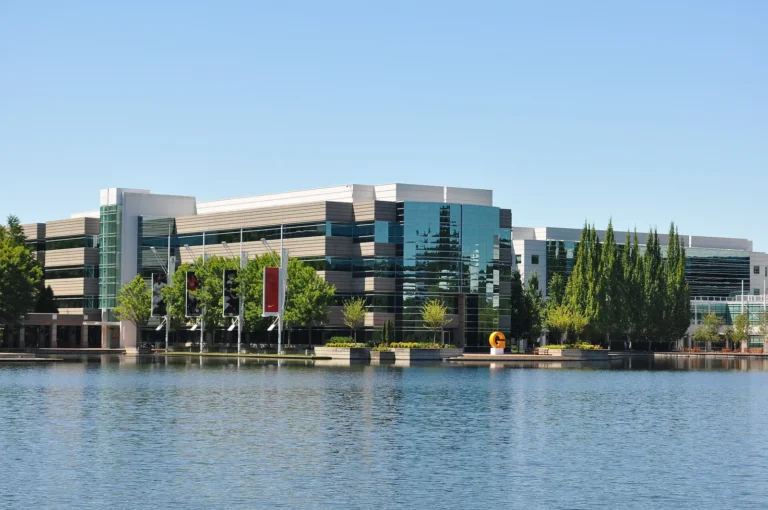
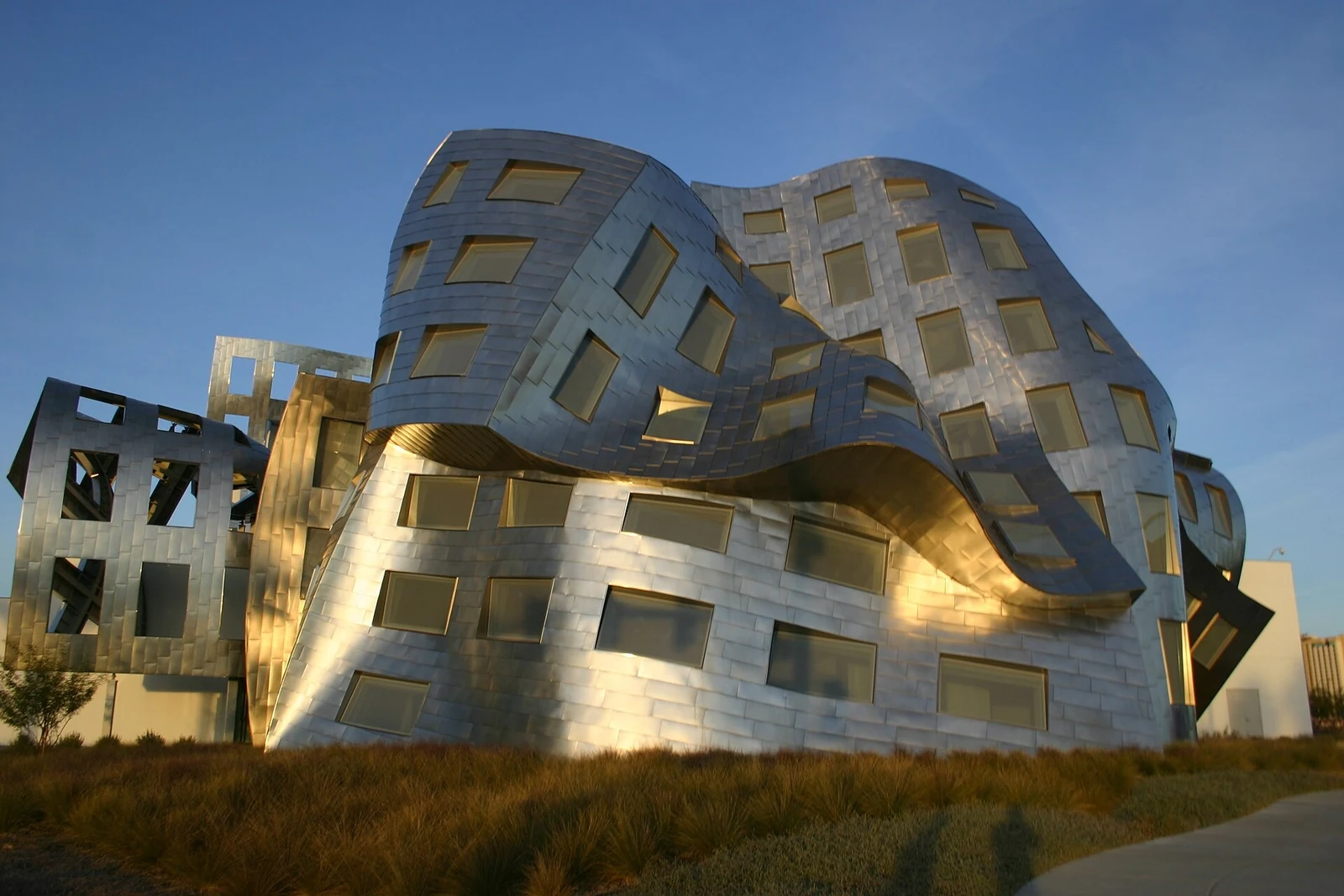
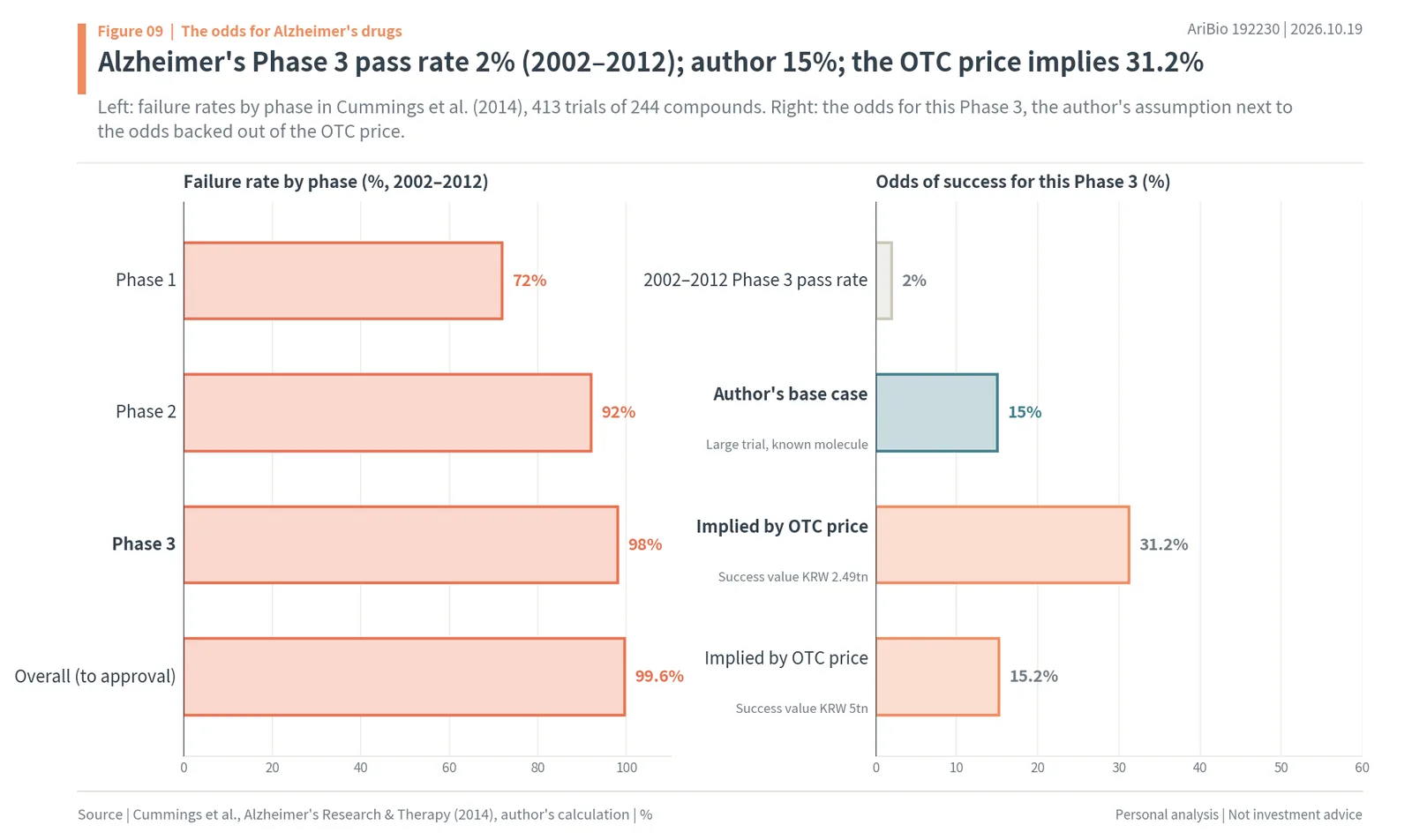
In July 2014, a team led by Jeffrey Cummings at the Cleveland Clinic Lou Ruvo Center for Brain Health in Las Vegas went through every Alzheimer’s drug trial registered from 2002 to 2012 and counted them. There were 413 trials (124 in Phase 1, 206 in Phase 2, 83 in Phase 3) testing 244 compounds. Their conclusion fit in one line: “an overall success rate during the 2002 to 2012 period of 0.4% (99.6% failure).” By phase, 72% of agents failed in Phase 1, 92% in Phase 2, and 98% even in Phase 3, the last gate. The center’s crumpled stainless-steel building is also the place that first put a number on how hard it is to make a drug for the brain.
Twelve years later, an unlisted Korean biotech company called AriBio is standing at that last gate. It has finished a global Phase 3 trial of AR1001, an oral Alzheimer’s drug built on mirodenafil, a molecule first approved in Korea for erectile dysfunction. The trial enrolled 1,535 patients and dosed them for 52 weeks. Results come out on November 16 at the CTAD Alzheimer’s conference in Boston. Its route to a stock-market listing, a merger, fell apart on September 29, yet its over-the-counter price went up, ending October 19 20.2% above where it was on September 28. And its license deals, widely described as “about KRW 10tn,” have so far brought in 1.1% of that in cash.
So what sets AriBio’s value? What would it be worth if it listed? And what is a fair price and a fair market value today? This report answers those questions in order.
As of: October 19, 2026. AriBio’s reference price is KRW 25,250 (about $18.98), its K-OTC closing price on October 19, 2026. Dollar figures are converted at KRW 1,330.27 per dollar, the October 19, 2026 rate (Yahoo Finance).
Topics covered: what AriBio sells and its results, AR1001’s history and Phase 3 design, how to read the result, the odds for Alzheimer’s drugs, approved dementia drugs and patient numbers, license deals versus cash received, finances and dilution, two years of merger and the day it broke, the many prices on one share, the value if Phase 3 fails or works, a probability-weighted fair value, the odds the OTC price implies, and dates to watch.
How it works in Korea: AriBio is not listed on the Korea Exchange. It trades on K-OTC, an over-the-counter market run by the Korea Financial Investment Association, where volumes are small. Korean companies file reports on DART, the Financial Supervisory Service’s disclosure system. KOSDAQ is Korea’s growth-stock exchange. Korean filings count money in units of 100 million won (eok); this report converts them to KRW billions.
Reference data: company numbers are from AriBio’s DART filings (annual, half-year and major-event reports) and the merger filings of AriBio Holdings; the OTC price is 38 Communication’s K-OTC quote table; listed affiliates’ prices are official KRX closes; foreign companies’ market values are from Yahoo Finance; trial details are from ClinicalTrials.gov, NeurologyLive and dated company news. Numbers the author calculated are marked as the author’s calculations, and assumptions as the author’s assumptions. This is the author’s personal analysis, not investment advice.
1. What AriBio sells: two-thirds of sales are Alzheimer’s license fees
The short version: AriBio sells some cosmetics, supplements and dermal filler, but the company is really one product, the oral Alzheimer’s drug AR1001. Of KRW 6.48bn (about $4.9mn) in first-half 2026 sales, 66.6% came from AR1001 license fees. Cosmetics were 9.34%.
Five things on the shelf, one that matters

AriBio was founded in 2010 by Jai Jun Choung and is based in Pangyo, Seongnam, south of Seoul. The “main products” table in its half-year report lists five lines. The first is license fees from AR1001 deals. The second is cosmetics, led by the anti-wrinkle brand Epora, plus OEM and ODM manufacturing for other brands; The third is supplements such as turmeric extract, the fourth is a dermal filler (a medical device), and the fifth is small items like a wellness device and functional water.
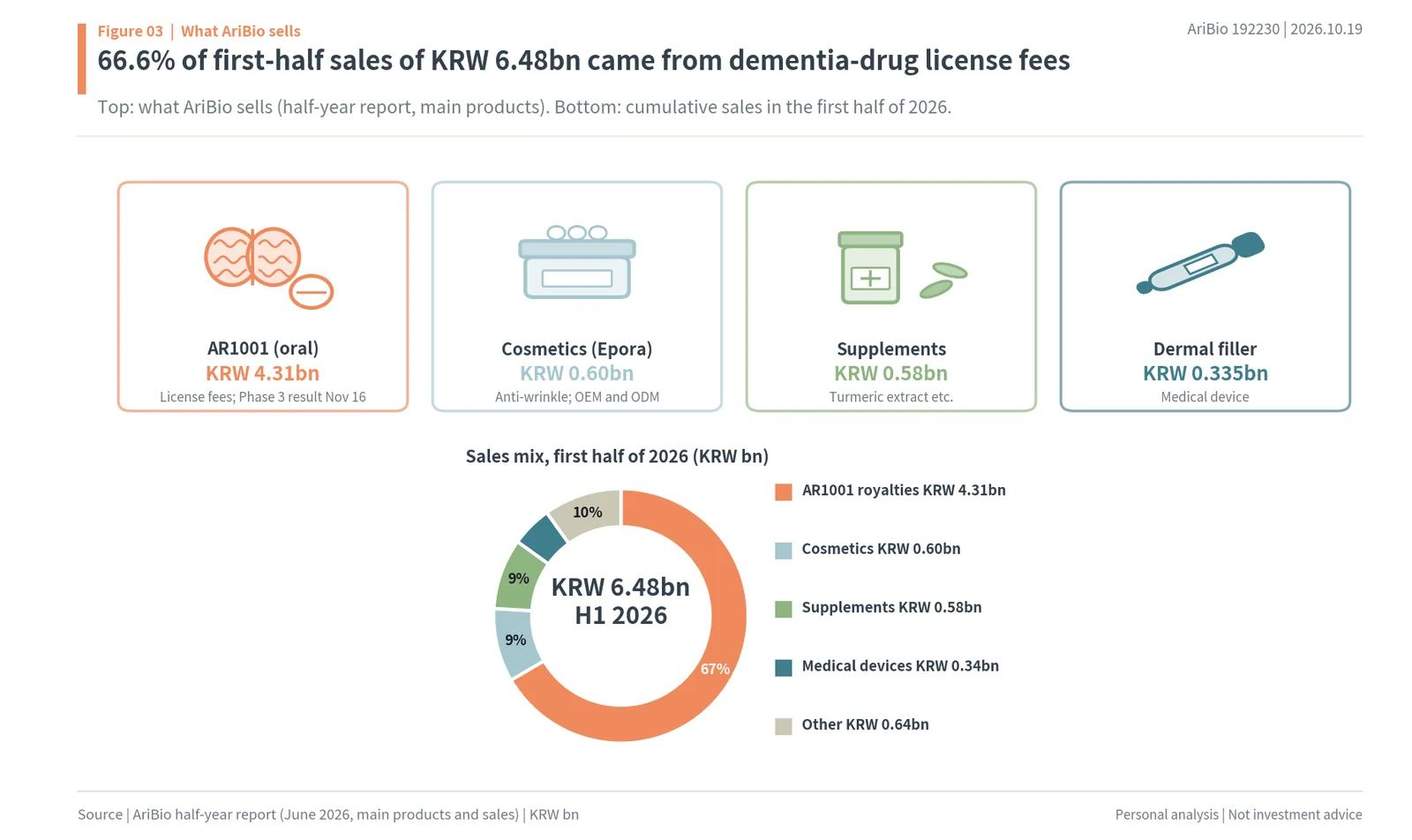
Cumulative sales in the first half of 2026 were KRW 6.48bn. AR1001 fees were KRW 4.31bn, cosmetics KRW 0.61bn, supplements KRW 0.58bn, medical devices KRW 0.34bn and other items KRW 0.64bn. Exports made up 81.8% of sales because the license fees come from overseas partners. By sales channel, only KRW 0.17bn was sold under AriBio’s own channel; KRW 1.52bn came from OEM and ODM work. All the non-drug businesses together come to about KRW 1.5bn for the half, background noise for anyone valuing the company.
Candidates it licensed in, with the weight on one
The company history in the half-year report shows AriBio licensed in several candidates from the start: a sepsis drug (AR1003) from Hallym University, a cancer drug (AR1002) from Jeil Pharmaceutical and an obesity drug (AR1008) from a Korean medicine institute, while mirodenafil from SK Chemicals in 2011 became AR1001. After the FDA cleared AR1001’s Phase 2 in 2018, the company’s money and people gathered around that one drug. The next disclosed candidates, AR1005 for Lewy body dementia and AR1004 for mild cognitive impairment, are also brain drugs.
Sales are big in the years upfront fees arrive
Annual results swing with license payments. In 2024, sales were KRW 35.23bn and operating income KRW 13.31bn, because upfront fees from Samjin Pharm (Korea) and Neuco (China) were booked that year. In 2025, with smaller new fees, sales fell to KRW 10.98bn, with an operating loss of KRW 9.0bn and a net loss of KRW 31.23bn. In the first half of 2026, sales were KRW 6.48bn, the operating loss KRW 4.71bn (sales minus cost of sales and SG&A) and the net loss KRW 20.04bn.
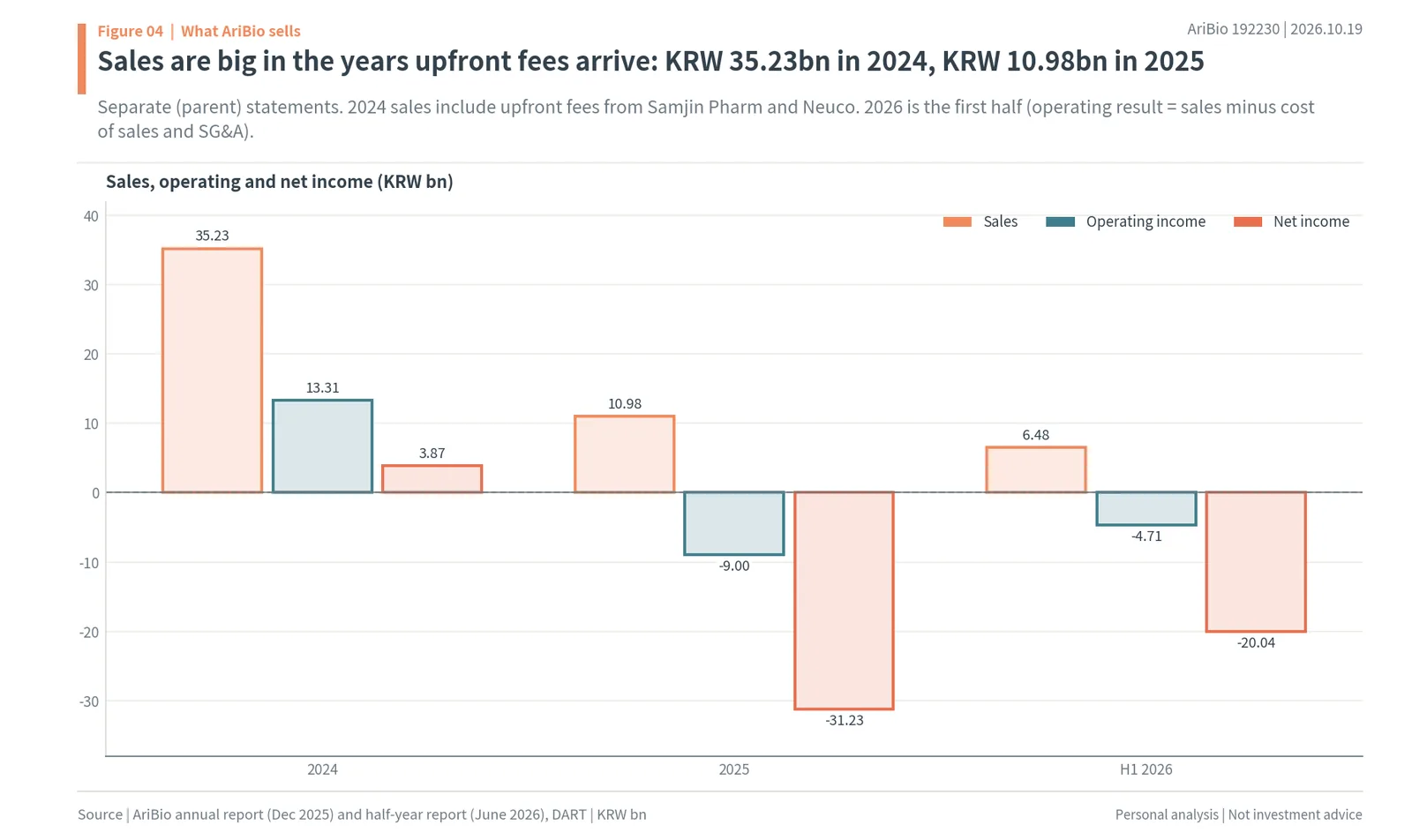
The operating loss looks small for a company running a 1,535-patient global Phase 3. That is because AriBio has capitalized much of the trial cost as “development costs,” an intangible asset, rather than expensing it (Chapter 7). The much larger net loss comes from financial costs such as valuation losses on derivatives attached to its convertible bonds. So the income statement cannot value this company; the value depends on whether AR1001 passes Phase 3.
2. What AR1001 is: from an erectile-dysfunction pill to an oral Alzheimer’s drug
The short version: AR1001 repurposes a molecule people have taken for years. The ingredient was approved in Korea in 2007, licensed in by AriBio in 2011, and has now been through Phase 2 and a global Phase 3, with results due on November 16.
1998 start, 2007 Mvix, 2011 AriBio
Mirodenafil was developed from 1998 by SK Chemicals and the biotech Intogen, through preclinical work in 2003, Phase 1 in 2004, Phase 2 in 2005 and Phase 3 in 2006. On July 18, 2007, it was approved as the erectile-dysfunction drug Mvix, Korea’s 13th domestically developed new drug and the second Korean ED drug after Dong-A’s Zydena; it launched that November 1. SK Chemicals still sells Mvix as a tablet and as a film that dissolves in the mouth. AriBio licensed the technology from SK Chemicals in 2011 to develop it for dementia, and in October 2025 the two companies agreed to work together again on a next-generation formulation and global manufacturing. The starting point of this drug is that its ingredient has more than 15 years of human use and safety data behind it.

Blocking PDE5 to raise blood flow in the brain
Mirodenafil blocks an enzyme called PDE5. With PDE5 blocked, the signal that relaxes blood vessels lasts longer and blood flow rises; that is how its cousin sildenafil (Viagra) works for erectile dysfunction. AriBio says that in the brain the drug raises blood flow, protects neurons and reduces inflammation, hitting several pathways at once, which it calls a “multi-mechanism” approach. The link between this drug class and dementia became widely known through a 2021 Cleveland Clinic study: Feixiong Cheng’s team analyzed insurance claims for 7.23 million Americans and found sildenafil users were 69% less likely to develop Alzheimer’s six years later. The study, published in Nature Aging, was observational, and the team said a randomized trial would be needed. AR1001’s Phase 3 is exactly that kind of randomized test. The mechanism AriBio describes in its half-year report runs as a chain: blocking PDE5 raises blood flow in the brain, the extra flow helps clear beta-amyloid inside and outside cells, and a memory-related signal in neurons (CREB) recovers, improving cognition. The company argues that dementia mixes oxidative stress, amyloid, inflammation, genes and blood-flow problems, which is why single-target drugs have kept failing and why a drug that touches several pathways is the right approach.
AriBio says it picks such multi-target candidates with its own development system, ARIDD, which evaluates several targets together, examines tissue from 27 organs in animal studies from an early stage, and builds the clinical strategy into the same process. It has since extended this with an AI system, ARIS, that screens candidates from disease-pathway data.

Phase 2 missed its primary endpoints; Phase 3 was built on what it found
The US Phase 2 trial (NCT03625622) gave 10mg, 30mg or placebo to 210 patients with mild to moderate Alzheimer’s for 26 weeks. Its co-primary endpoints, the ADAS-Cog13 cognitive score and the clinician’s global change rating ADCS-CGIC, did not separate from placebo in the overall population. But in a prespecified subgroup, patients not taking other Alzheimer’s drugs (the “monotherapy” group), ADAS-Cog13 improved significantly, more so in amyloid-positive patients. That signal shaped Phase 3, which counts both the overall population and the monotherapy population as primary. The FDA cleared Phase 2 in 2018, and AriBio held its end-of-Phase-2 meeting with the agency in April 2022. On that basis it won Phase 3 clearances in the US, UK and Europe, and dosed the first US patient in December 2022.
More indications with the same molecule, and the next candidates
If AR1001 succeeds, AriBio plans to widen its use. At its October 1 vision event it named stroke, Parkinson’s disease, vascular dementia and traumatic brain injury as candidates. Vascular dementia was selected in November 2025 as a UK Medical Research Council project, run with Imperial College London and St George’s, University of London. In April 2025 the company signed a letter of intent with Restari in the US to co-develop the molecule for polycystic kidney disease. Next in line are AR1005 for Lewy body dementia (Phase 2, topline targeted for 2027) and AR1004 for mild cognitive impairment (Phase 2 approved in Korea). Their value, too, rests on whether AR1001’s Phase 3 shows that this class of drug works.
3. How Phase 3 was designed: 1,348 of 1,535 patients finished 52 weeks
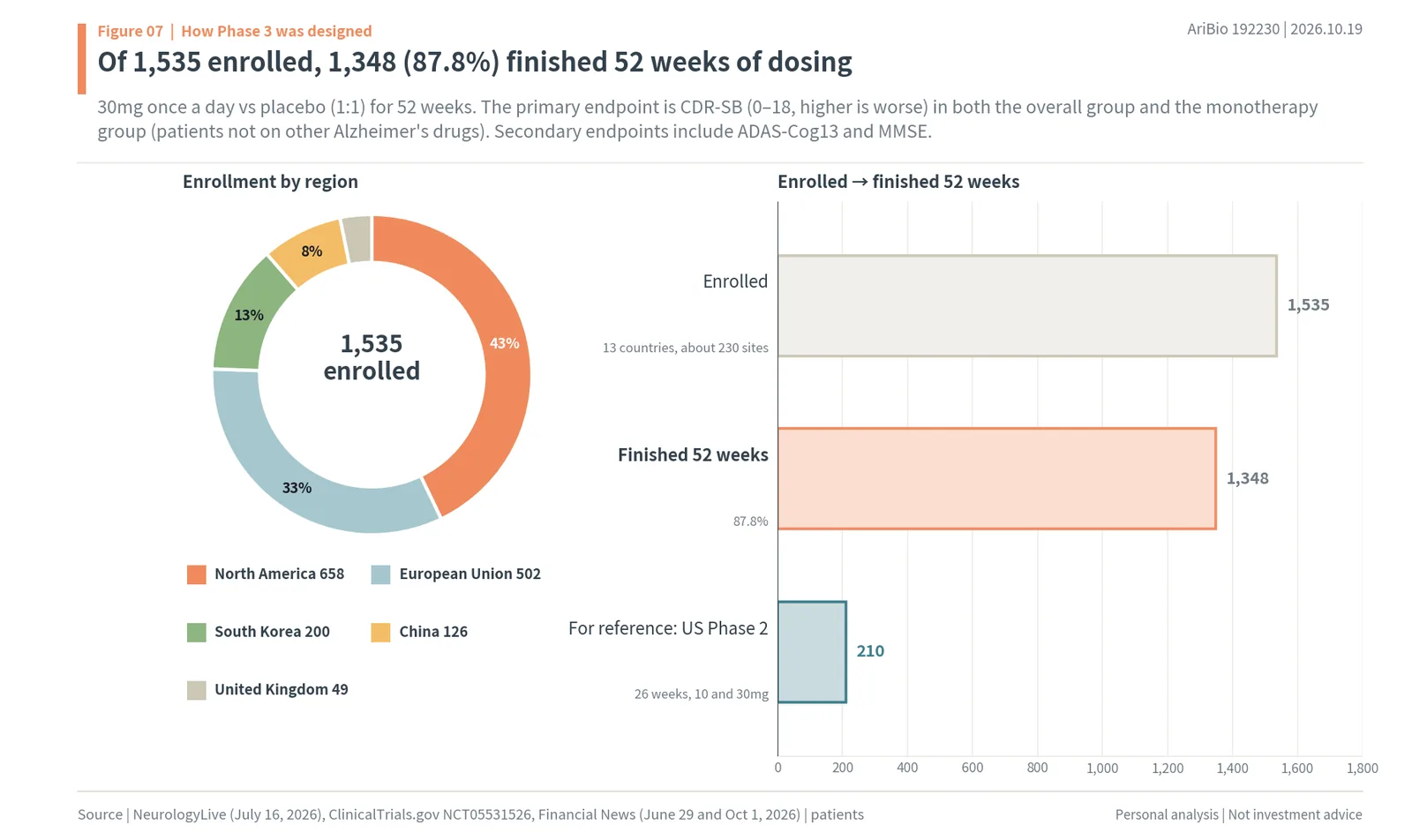
The short version: AR1001’s Phase 3, POLARIS-AD, is the largest dementia trial a Korean biotech has run. It enrolled 1,535 patients at about 230 sites in 13 countries, and 1,348 (87.8%) completed 52 weeks of dosing. On November 16 we learn whether their 52-week records beat placebo.
30mg once a day, 52 weeks, primary endpoint CDR-SB
The design is simple. Patients with early Alzheimer’s (amyloid confirmed, MMSE 20 to 30, and an RBANS delayed-memory index of 85 or below) take 30mg of AR1001 or placebo once a day, randomized 1:1, for 52 weeks. The primary endpoint is CDR-SB, a clinician’s rating summed across six domains such as memory, judgment, community affairs, home life and personal care, scored from 0 to 18 where higher is worse. The question is whether CDR-SB worsened less than with placebo at 52 weeks, in both the overall and the monotherapy populations. Secondary endpoints are ADAS-Cog13, daily-living ability (A-IADL-Q-SV), MMSE and the depression scale GDS-15, along with blood and spinal-fluid biomarkers such as p-tau, the amyloid ratio, GFAP and NfL.
Why two primary endpoints
Making both the overall population and the monotherapy population primary reflects Phase 2 directly. The overall group includes patients also taking existing dementia drugs such as donepezil; the monotherapy group took only AR1001 or placebo. Because the Phase 2 signal came from the monotherapy group, Phase 3 is built to test the difference from placebo in both. That is why the two groups’ numbers should be read separately.
658 in North America, 502 in the EU, 200 in Korea
By region, 658 patients enrolled in North America, 502 in the European Union, 200 in South Korea, 126 in China and 49 in the United Kingdom, with North America largest because the goal is FDA approval. The dropout rate was 12.2%, which the company contrasts with the 30% to 50% common in dementia trials, and about 95.5% of those who finished 52 weeks agreed to a one-year extension, so more than 1,250 patients are generating long-term data. Adverse events during treatment were mostly mild to moderate: falls 3.1%, diarrhea 3.1%, urinary tract infections 3.1%, headache 2.4% and dizziness 2.3%. Investigators reported no unexpected safety signals, while 24 eye-related events, a known concern for PDE5 drugs, are being monitored.
Results on November 16 in Boston
The last patient was dosed at the end of June and the last safety visit was completed at the end of July, followed by data cleaning, database lock and statistical analysis. Topline results will be presented at CTAD 2026 in Boston on November 16 (local time). The company then plans to prepare and submit a new drug application to the FDA and seek approval in 2027 and 2028. That date is the fork in the road for this company’s value.

3-1. How to read the result: what counts as success
The short version: the first thing to check on November 16 is whether 52-week CDR-SB worsened statistically less than placebo, and whether that held in both the overall and monotherapy populations. Next come the size of the effect, whether secondary endpoints point the same way, and safety. If all four line up, the value moves toward the success case (Chapter 13); if the first one misses, toward the failure case (Chapter 12).
The stage: CTAD
CTAD is an international conference devoted to Alzheimer’s clinical trials, where big Phase 3 results are often first shown. Eisai presented Leqembi’s full Phase 3 results at CTAD in November 2022. AriBio will present its topline there in 2026: the primary and key secondary endpoints and the main safety picture, with detailed analyses to follow in papers and later meetings.
The benchmark: Leqembi slowed decline 27% over 18 months
The comparison is the Phase 3 trial (CLARITY-AD) of Leqembi, an infused antibody. In 1,795 patients with early Alzheimer’s over 18 months, CDR-SB worsened by 1.21 points on Leqembi and 1.66 points on placebo, a difference of -0.45, or a 27% slowing of decline, the basis for its approval. Brain swelling (ARIA-E) appeared in 12.6% of Leqembi patients and 1.7% on placebo. AR1001’s trial runs 52 weeks (12 months), shorter than Leqembi’s, so the same percentage slowing would show up as a smaller point difference. That is why both the statistical significance (the P value) and the percentage slowing matter.
Secondary endpoints, biomarkers and safety
If the primary endpoint hits, ADAS-Cog13, daily-living ability and MMSE moving the same way would show consistency. If blood biomarkers such as p-tau217 move too, that is evidence the drug touched the course of the disease rather than briefly masking symptoms. On safety, two things remain: eye-related events, a long-standing question for PDE5 drugs, and ARIA in the few patients who also took antibodies. Since the company’s pitch is an ARIA-free pill, the safety result is also a pillar of the success value.
3-2. Time and money spent on Phase 3: four years and KRW 123.2bn of development costs
The short version: AR1001’s Phase 3 has taken nearly four years from the first dose in December 2022 to results in November 2026, and since the end of 2024 alone the development costs capitalized on AriBio’s books have grown by KRW 123.2bn. All that time and money will be judged on one day.
Approvals country by country
A global Phase 3 needs separate approval in each country. AriBio dosed its first US patient in December 2022 under FDA clearance and expanded to Europe after clearances from the UK’s MHRA and the European Medicines Agency (April 2024). In Korea it signed an agreement with Samjin Pharm to run the local Phase 3 jointly and won MFDS approval, and in China it filed a Phase 3 plan with the National Medical Products Administration. That is why patients are spread across North America, Europe, Korea, China and the UK. A single design across all these countries also means each regional partner can use the same data when filing for approval.
Paid with bonds, booked as development costs
While Phase 3 ran, AriBio paid with license fees and convertible bonds. License fees have brought in KRW 108.7bn of actual cash, and in the first half of 2026 alone it borrowed KRW 65.06bn through convertible bonds. Much of what it spent went onto the balance sheet as development costs: intangible assets rose from KRW 60.15bn at the end of 2024 to KRW 183.31bn at the end of June 2026, an increase of KRW 123.2bn (author’s calculation). If the result is positive, those books and bonds turn into shares and the cost of a product to sell; if negative, into impairments and repayment demands. Four years of Phase 3 have tied every number in this company to one date.
4. The odds for Alzheimer’s drugs: a 2% Phase 3 pass rate, the author’s 15%, and the 31.2% the OTC price implies
The short version: Alzheimer’s Phase 3 trials have historically almost all failed; the 2002 to 2012 pass rate was 2%. The author puts this trial’s chance of success at 15%, and the OTC price of KRW 25,250 implies more than twice that, 31.2%.
0.4% of 413 trials
Of the 413 Alzheimer’s drug trials Cummings’s team counted for 2002 to 2012, 0.4% led to approval. Of agents entering Phase 1, 72% failed; Phase 2, 92%; Phase 3, 98%. Later, the infused antibodies Leqembi (2023) and Kisunla (July 2024) won FDA approval, the first drugs shown to slow the disease. Both remove amyloid from the brain and require regular MRI scans to watch for brain swelling and microbleeds (ARIA).
The company explains these failures this way: drugs aimed only at toxic proteins such as amyloid and tau kept failing because removing the proteins did not improve cognition, and dementia, with many causes tangled together, does not yield to a single target. AR1001’s “multi-mechanism” pitch rests on that explanation.
Why the author chose 15%
The starting point is the 2% Phase 3 pass rate for 2002 to 2012 that Cummings’s team at the Lou Ruvo Center counted. Four things raise it. First, the molecule has more than 15 years of human use, so failure on safety is unlikely. Second, with 1,535 patients over 52 weeks the trial is large enough that even a modest effect could show up statistically. Third, Phase 2 missed its primary endpoints but showed a signal in the monotherapy group that Phase 3 now counts as primary. Fourth, a 12.2% dropout rate and 95.5% of completers staying for the extension show patients can tolerate the drug for a year. Together these justify a base case of 15%, seven times the historical rate. The reason not to go higher sits in the same place: the signal Phase 3 relies on came from a subgroup of the 210-patient Phase 2, and signals from small subgroups rarely repeat cleanly in large trials. As the right-hand bars show, the odds backed out of the OTC price are 31.2% (using a KRW 2.49tn success value), more than double the author’s assumption. With a bigger success value of KRW 5tn, the implied odds fall to 15.2%, close to the author’s. The OTC price, in other words, is more optimistic than the author about at least one of two things: how likely success is, or how big it would be (Chapter 15).

5. If it works, how much could it sell? Peak sales of $3.5bn, the Aricept level
The short version: this report assumes AR1001’s global peak sales at $3.5bn if it succeeds. That is close to the best year of the oral dementia drug Aricept and 3.9 times Eisai’s forecast for Leqembi in fiscal 2026 ($0.905bn).
Aricept $3.64bn, Leqembi $0.905bn
The benchmark for an oral dementia drug is Eisai’s Aricept (donepezil). It only delays symptoms for a while, but as a once-a-day pill it became the world’s most prescribed dementia drug: sales in April to December 2009 alone were ¥237.56bn, and Fierce Biotech put its sales in the prior fiscal year at $3.64bn. Leqembi, the first drug to slow the disease, is growing more slowly because it needs infusions and regular MRIs. By Eisai’s fiscal year (April to March), Leqembi sold ¥44.3bn ($0.279bn) in fiscal 2024 and ¥88.0bn ($0.555bn) in fiscal 2025, and the company forecasts ¥143.5bn ($0.905bn) for fiscal 2026.

Three cases: $2bn, $3.5bn, $6bn
If AR1001 works, it sells on three advantages: it is a pill, it needs no infusions or MRI monitoring, and it can be combined with antibodies. AriBio’s US country head has said a once-daily pill would cut patients’ clinic visits for infusions. So the base case is peak sales of $3.5bn, the Aricept level; the low case is $2bn and the high case $6bn. These lead to success values of KRW 1.59tn, 2.49tn and 3.99tn in Chapter 13.
5-1. The limits of infused antibodies make room for a pill
The short version: every approved drug that slows Alzheimer’s today is an infused antibody, and high prices, regular MRIs and the need to manage brain swelling and bleeding limit who can use them. If AR1001 works in Phase 3, it steps into that gap: a pill taken at home, and a drug that can be added to antibodies.
Two antibodies at $26,500 and $32,000 a year
According to the industry section of AriBio’s half-year report, Aduhelm (2021), Leqembi (2023) and Kisunla (July 2024) won US approval in turn. Aduhelm was withdrawn from the market in 2024 for weak efficacy and frequent side effects. In the figures the half-year report takes from the trial papers, brain swelling (ARIA-E) occurred in 12.6% of lecanemab and 13.7% of donanemab patients, and microbleeds (ARIA-H) in 17.3% and 19.7%. So Leqembi and Kisunla require regular MRIs to watch for ARIA-E and ARIA-H, and cost about $26,500 and $32,000 a year in the US. In 2025, Europe approved both only conditionally, excluding patients with two copies of the APOE ε4 gene. Leqembi won approval for an at-home subcutaneous injection in August 2025, but patients still start with 18 months of IV infusions in a clinic.
Where AR1001 fits: a pill, and an add-on
AR1001 is a once-a-day pill that does not strip amyloid directly, and the company says no ARIA was seen in Phase 2. That makes it a candidate for patients who cannot take antibodies, or as an add-on to them. Phase 3 included a few patients also on antibodies (six on donanemab, five on lecanemab), and investigators reported no unexpected signals in them either. Leqembi grew sales 98.7% in fiscal 2025 despite its barriers, which shows how much demand there is; a pill that works could serve that demand more broadly. That is where the $3.5bn peak-sales assumption in Chapter 5 comes from.
5-2. Thirty years of approved dementia drugs, and a growing patient count
The short version: in 30 years, the approved dementia drugs have been five lines of pills that briefly delay symptoms and three infused antibodies that slow the disease. Meanwhile the number of people with dementia is rising fast, leaving wide room for a drug that combines efficacy with convenience.
Five symptom drugs, three antibodies
The competitor table in AriBio’s half-year report lays out the approvals in order. Oral symptom drugs: donepezil in 1996 (Eisai and Pfizer), rivastigmine in 2000 (Novartis), galantamine in 2001 (Janssen), memantine in 2003 (Allergan), a donepezil-memantine combination in 2014 (Actavis) and Zunveyl in 2024 (Alpha Cognition). The company describes these as offering only modest symptom relief with side effects. Antibodies aimed at the disease itself: Aduhelm in 2021, Leqembi in 2023 and Kisunla in 2024. Aduhelm was withdrawn; Leqembi added IV and subcutaneous maintenance dosing in 2025, and Kisunla a new titration schedule that year to reduce side effects. Tau-targeting candidates exist too, but the oral tau-aggregation inhibitor TRx0237 did not show efficacy in Phase 3, and the tau antibody E2814 is being tested together with lecanemab.
Korea still runs on Aricept; globally, antibodies are growing
Korea’s dementia-drug market is still dominated by old pills. In 2021, Aricept sold KRW 70.35bn, Aricept Evess KRW 6.5bn, Ebixa KRW 6.29bn, Exelon KRW 6.28bn and Reminyl PR KRW 6.2bn. Globally, the antibodies are growing: of Leqembi’s ¥88.0bn in fiscal 2025 sales, the Americas contributed ¥44.6bn, Japan ¥24.4bn and China ¥12.4bn, and Kisunla sold $249mn in 2025 ($188mn in the US). The company notes that both are growing fast but that side effects, high prices, infusions and the exclusion of certain gene carriers still keep their share of all patients small.
Patients heading for 130 million by 2050
Demand keeps rising. Citing Alzheimer’s Disease International, the half-year report estimates that people with dementia worldwide will rise from about 50 million in 2015 to more than 130 million by 2050. Global dementia care costs grew 35.4% in five years, from $604bn in 2010 to $818bn in 2015, and are expected to exceed about $2tn by 2030. In Korea, about 10.3% of people aged 65 and over and 37.6% of those 85 and over have Alzheimer’s disease. A rising patient count and a narrow set of usable drugs: that gap is what the $3.5bn peak-sales assumption in Chapter 5 leans on.
6. Licensing: KRW 9.7tn in headline deals, KRW 108.7bn of cash received (1.1%)
The short version: the “about KRW 10tn” of AR1001 deals the company talks about is almost entirely money that arrives only with approvals and sales. Five license deals total KRW 9.7tn (about $7.3bn at today’s rate), but only KRW 108.7bn (about $82mn), or 1.1%, has actually come in. The headline value turns into cash only after Phase 3 succeeds; the trial result is the key.
Five license deals
The major-contracts table in the half-year report lists five. In March 2023, Samjin Pharm took the Korean rights (KRW 100bn in total, KRW 10bn upfront received; joint local Phase 3 and exclusive production and sales rights; no penalty for AriBio if terminated on trial failure). In March 2024, Neuco took China (KRW 1.02tn). In June 2025, Arcera, a drugmaker owned by Abu Dhabi’s sovereign fund ADQ, took Latin America, the Middle East, North Africa and the CIS ($626.95mn, about KRW 856.1bn, plus a separate $350.18mn supply contract). In December 2025, Neuco took ten ASEAN countries (about KRW 640bn). And in May 2026, Shanghai Fosun Pharmaceutical took the rest of the world ($4.74bn, about KRW 7.11tn), everywhere except China, Korea, parts of Southeast Asia, Latin America, the Middle East, parts of Africa and the CIS. That includes the US, Europe and Japan, so Fosun’s territory is effectively AR1001’s main market. The Arcera supply contract ($350.18mn) only produces revenue once the partner starts importing the drug after approval. The license terms run for 10 years after launch (Samjin, Arcera) or 15 years (Neuco, Fosun), or until the protecting patent expires, whichever is later, so royalties can flow for a long time.

Fosun is an option: $60mn paid, $80mn if exercised
Fosun’s $4.74bn is made up of a $60mn option fee, an $80mn upfront payment if it exercises the option, and milestones tied to approvals and sales. Royalties of up to 20% of sales come on top. Fosun paid the $60mn option fee in full, $10mn in May and $50mn in July (about KRW 90bn). When it will decide on the option is not disclosed, but the contract is built so that it decides after seeing the Phase 3 result. Of the KRW 1.02tn China deal, 11.76%, or KRW 120bn, is to be paid on a schedule the two companies agreed from 2024; the deal can be ended on 120 days’ written notice if the drug is not launched within two years of approval or payment terms are missed for more than six months. The China deal with Neuco is booked at KRW 36.96bn received, but after offsetting Chinese trial-approval costs and tax, about KRW 8.74bn actually arrived. Adding Samjin’s KRW 10bn upfront gives KRW 108.7bn of real cash (author’s calculation).

What this structure means is clear. If Phase 3 works, Fosun’s upfront, approval milestones and then royalties arrive in turn, and the headline value starts turning into cash. If it fails, most deals can end under their termination clauses; the China deal, for example, can be terminated on 120 days’ written notice if commercialization becomes impossible. So this report does not count the headline deal value as company value; it recalculates the royalties and approval-stage payments AriBio would get on success (Chapter 13).
7. Finances: Phase 3 costs piled up as assets
The short version: AriBio’s balance sheet is tied to one trial. At the end of June 2026, intangible assets were KRW 183.31bn, 71.7% of total assets, and most of that is AR1001 development spending capitalized as an asset. So the Phase 3 result will change the balance sheet before it changes the income statement.
Intangibles from KRW 60.15bn to KRW 146.87bn to KRW 183.31bn
Once development passes a certain stage, a drug company can book development costs as an intangible asset instead of expensing them. AriBio’s intangibles grew from KRW 60.15bn at the end of 2024 to KRW 146.87bn at the end of 2025 and KRW 183.31bn at the end of June 2026; intangibles grew KRW 86.72bn in 2025 alone (author’s calculation), and AriBio spent another KRW 47.8bn on them in the first half of 2026. With Phase 3 costs going into that account, the first-half operating loss looks small at KRW 4.71bn. The net loss is larger because of financial costs: in the second quarter alone financial costs were KRW 15.56bn, and the first-half cash-flow statement shows a non-cash valuation loss of KRW 17.32bn on derivatives attached to convertible bonds. As the OTC price rises, the conversion rights are worth more and the book loss grows. Most of the development spending was funded with convertible bonds, which raised KRW 65.06bn in the first half while some borrowings and bonds were repaid.
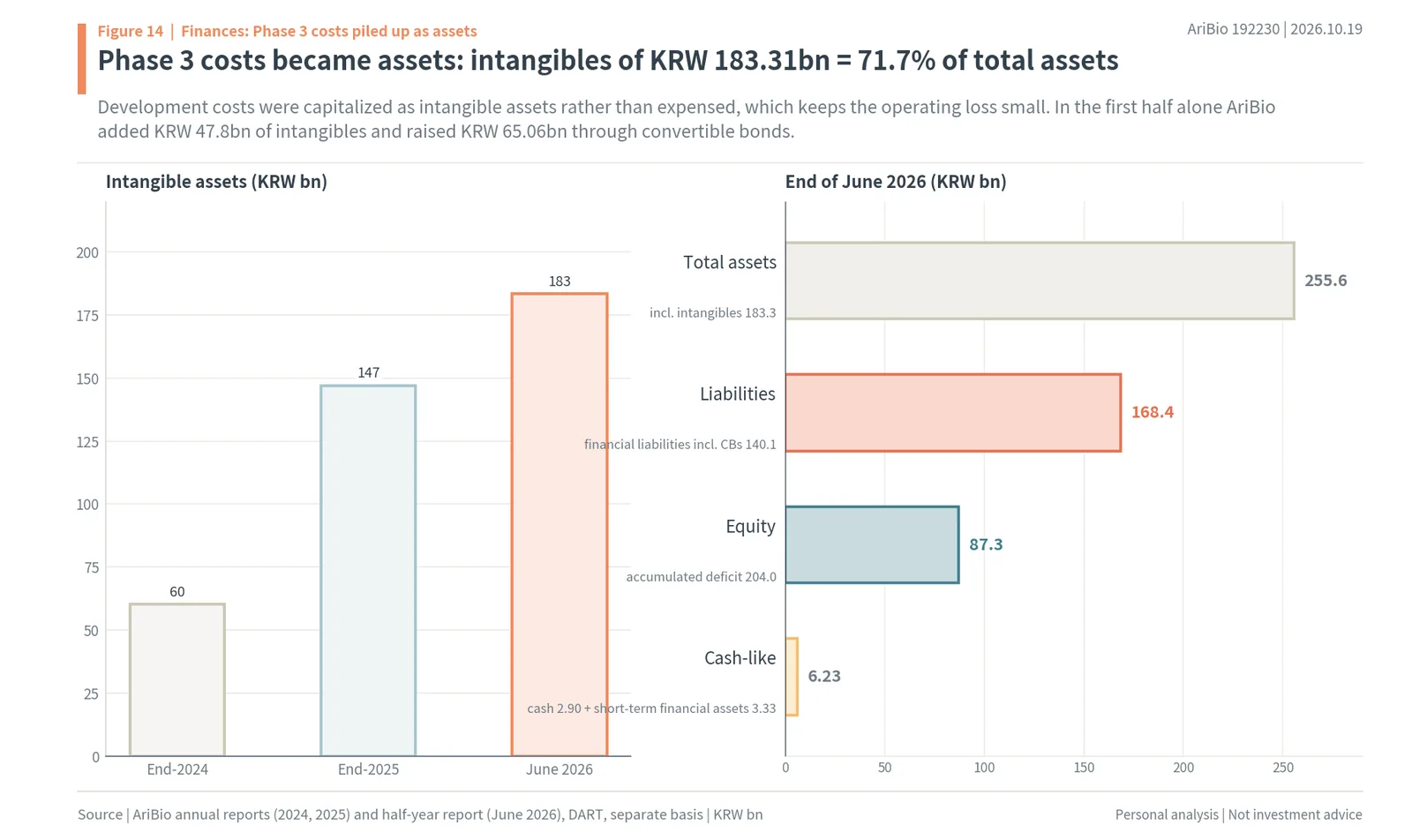
End of June 2026: assets KRW 255.6bn, liabilities KRW 168.4bn, equity KRW 87.3bn
Equity grew from KRW 61.05bn at the end of 2025 to KRW 87.26bn at the end of June 2026 despite a KRW 20.04bn net loss, because bonds converted into shares and enlarged paid-in capital. On a separate basis, total assets were KRW 255.62bn, liabilities KRW 168.36bn and equity KRW 87.26bn. Of the liabilities, KRW 140.06bn were financial liabilities such as convertible bonds, mostly classified as current. The accumulated deficit was KRW 203.98bn, with KRW 2.90bn of cash and KRW 3.33bn of short-term financial assets at the end of June. Fosun’s $50mn option payment arrived in July, and KRW 11.48bn of redeemable convertible preferred shares are due to be paid in at the end of October. If Phase 3 works, the intangibles become the cost of a product; if it fails, they face impairment. At KRW 183.31bn they are more than twice equity of KRW 87.26bn, so the Phase 3 result decides the size of the company’s equity itself.
8. Share count and dilution: 5.78 million shares convertible at KRW 8,000 to 10,000
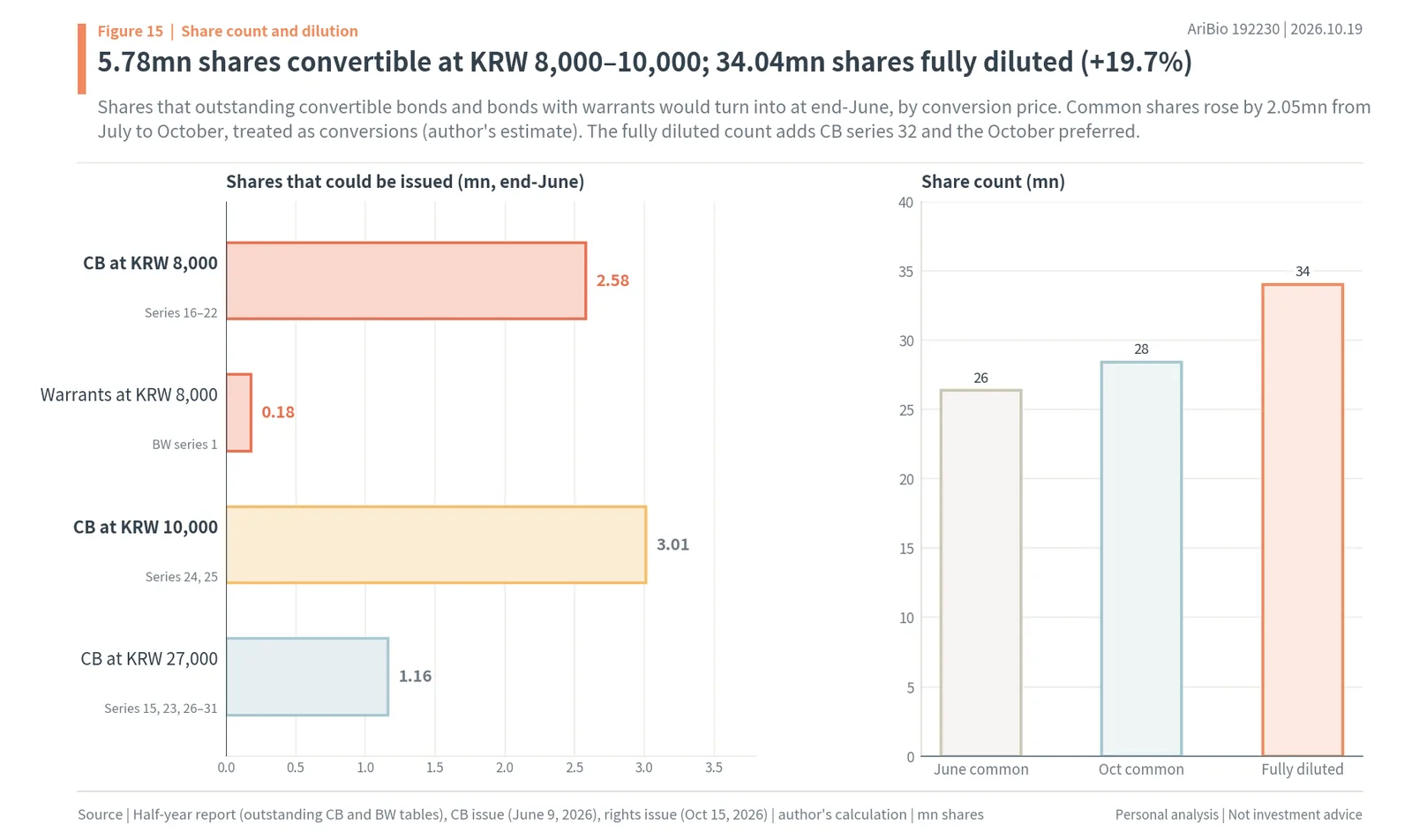
The short version: AriBio’s share count could rise a lot. At the end of June, bonds and warrants convertible at KRW 8,000 to 10,000 would create 5.78 million shares. Adding the 2026 bonds and preferred gives a fully diluted count of 34.04 million shares, 19.7% more than today’s common shares. That is why this report divides the success value by the diluted count.
26.37 million shares in June, 28.43 million in October
The half-year report shows 26,374,637 shares at the end of June 2026. The October 15 rights-issue filing lists 28,429,512 common shares before the issue, 2.05 million more in just over three months, mostly from conversions as many bonds entered their conversion periods (author’s estimate). The largest shareholder is KOSDAQ-listed AriBio Holdings, with 3.54 million shares, or 13.42%, at the end of June.
By conversion price: 2.76 million at KRW 8,000, 3.01 million at KRW 10,000
Series 12 to 14, issued in March and April 2025 (KRW 6.8bn face value), have already been repaid. Outstanding convertible bonds (series 15 to 31) had a face value of KRW 82.11bn at the end of June and would convert into 6.75 million shares. By price: 2.58 million shares at KRW 8,000 (series 16 to 22), 3.01 million at KRW 10,000 (series 24 and 25) and 1.16 million at KRW 27,000 (series 15, 23 and 26 to 31). Bonds with warrants (series 1) add 0.18 million shares at KRW 8,000. Series 32 bonds of KRW 8.1bn bought by AriBio Holdings in June (conversion price KRW 27,000) add 0.30 million shares and the October preferred 0.425 million. Treating the 2.05 million shares added from July to October as already converted, the fully diluted count is 34,035,206 (author’s calculation).
Bondholders can ask for their money back
Most of these bonds carry a put: from one year after issue, every three months, holders can demand early repayment of principal. Bonds issued June 27, 2025 became puttable from June 27, 2026; those issued November 7, 2025 from November 7, 2026; those issued in June 2026 from June 17, 2027. Held to maturity, they return principal plus 4% a year. If the share price is above the conversion price, holders convert; if below, they ask for cash. So if Phase 3 works, the bonds turn into shares and the count moves toward 34.04 million; if it fails, they remain debt and demand cash. The October preferred also carries a clause that lowers its conversion price on a weighted-average basis if AriBio later issues shares or bonds below KRW 27,000, so raising money cheaply after a failure would dilute existing holders further.
9. Two years on the listing path: why the merger ran into its buyback price
The short version: AriBio’s backdoor listing by merger broke because the listed partner’s share price fell far below the KRW 10,719 it would have had to pay shareholders who opposed the deal. When the merger was first approved by the board in August 2024, AriBio Holdings traded at KRW 11,890; on October 19, 2026 it was KRW 2,935, down 75.3%.
From Solux to AriBio Holdings
AriBio Holdings was formerly Solux, a KOSDAQ-listed lighting company. A third-party share issue in June 2023 changed its largest shareholder and brought it under the control of Choung’s side. The two companies’ boards first approved the merger on August 9, 2024, and a merger registration statement was filed with the Financial Supervisory Service on August 19. The regulator then kept asking for corrections; the filing was revised through June 23, 2026 and drew another correction request on July 2. Along the way the merger ratio changed from 2.5032656 Holdings shares per AriBio share to 1.8547163, 2.0558406 and finally 2.0610695. AriBio’s merger price per share fell from KRW 28,192 at first to KRW 20,838 in August 2025, and the outside valuation from KRW 1.1645tn to KRW 852.2bn in October 2025. Under the final ratio, AriBio shareholders would have received 58,595,200 new Holdings shares. Solux renamed itself AriBio Holdings at a June 29, 2026 shareholders’ meeting, and the two companies planned to vote on the merger on January 6, 2027.

The merger was a listing route for a simple reason: the surviving company, Holdings, is KOSDAQ-listed and would stay listed afterwards, so AriBio shareholders would receive listed shares without a separate listing review. In exchange, two numbers, the merger ratio and the buyback price, had to balance the interests of listed and unlisted shareholders.
The KRW 10,719 buyback price was set by August 2024 prices
Shareholders who oppose a merger can ask the company to buy their shares, at a price set by a legal formula from pre-board-vote trading. Holdings’ KRW 10,719 is the average of its two-month (KRW 10,260), one-month (KRW 11,217) and one-week (KRW 10,679) volume-weighted prices up to August 8, 2024. AriBio’s own buyback price was KRW 20,891. But from March 2025 Holdings mostly traded between KRW 3,000 and KRW 6,000, and on September 28, 2026, the day before the merger ended, it closed at KRW 3,985. If you can sell a KRW 3,985 share to the company for KRW 10,719, opponents will line up; the buyback price was 2.7 times the share price. In its withdrawal filing the company said the reference price was “significantly below” the buyback price and that AriBio’s value had changed with additional license deals, so mass buyback claims were expected.
9-1. Group structure: two listed companies around an unlisted AriBio
The short version: the AriBio group puts the unlisted AriBio at the center, with two KOSDAQ-listed companies around it. AriBio Holdings is AriBio’s largest shareholder (13.42%) and also owns 14.10% of AriBio Lab.
Three companies, three roles
At its October 1, 2026 vision event, the group split the roles. AriBio develops and commercializes Alzheimer’s drugs. AriBio Lab (formerly CHA Vaccine Institute) uses an immune-adjuvant platform for a shingles vaccine (Phase 2), hepatitis B preventive (Phase 1) and therapeutic (Phase 2) vaccines, and an Alzheimer’s vaccine. AriBio Holdings runs lighting and electrical businesses, manages investments, and plans to expand into AI data infrastructure, electroceuticals and healthcare. Holdings became AriBio Lab’s largest shareholder in April 2026; on October 19, Holdings was worth KRW 159.3bn and AriBio Lab KRW 110.6bn. AriBio’s OTC value of KRW 717.8bn is 2.6 times the two listed companies combined.
Stakes and interests
According to DealSite TV in August 2025, Choung held 0.3% of AriBio and 9.4% of Solux (now Holdings), so his own stake sat mostly in the listed company. Had the merger gone through, the AriBio shares held by Holdings would also have received new shares, creating treasury stock in the merged company. With the merger off, AriBio’s value reaches the stock market only indirectly, through Holdings’ 3.54 million AriBio shares, worth KRW 89.4bn at the OTC price, more than half of Holdings’ KRW 159.3bn market value (author’s calculation).
10. The day the merger broke: AriBio OTC +18.6%, Holdings -25.5%
The short version: on September 29, when the merger was called off, the two stocks moved in opposite directions. KOSDAQ-listed AriBio Holdings fell 25.5% and over-the-counter AriBio rose 18.6%. The prices showed what the merger had meant to each side.
KRW 8,213 via the merger ratio, KRW 21,000 over the counter
Under the merger ratio, one AriBio share would become 2.06 new Holdings shares. At Holdings’ September 28 close of KRW 3,985, that made one AriBio share worth KRW 8,213 (about $6.17) in listed stock (author’s calculation). The OTC price that day was KRW 21,000, 2.6 times the KOSDAQ-implied value. Had the merger gone ahead, OTC holders would have swapped a KRW 21,000 share for KRW 8,213 of listed stock, while Holdings shareholders would have increased their AriBio exposure far below the OTC price. Calling off the merger erased that trade: a loss removed for OTC holders, a cheap purchase removed for Holdings holders.

K-OTC as a market
K-OTC is an over-the-counter market for unlisted shares run by the Korea Financial Investment Association. Shares can be traded through brokerage accounts, but volume is far smaller than on an exchange; on some days, such as September 30, nothing trades. The OTC price is the price at which a few buyers and sellers met, not the price at which the whole company could change hands. That is why this report uses it not as the answer to what AriBio is worth, but to back out what the price assumes.
One month from September 21: OTC +23.2%, Holdings -24.9%
On September 29, Holdings fell from KRW 3,985 to KRW 2,970 (-25.5%) on 4.77 million shares, 13.9 times the previous day’s volume. AriBio rose on K-OTC from KRW 21,000 to KRW 24,900 (+18.6%). On October 1, two days after the merger ended, about 230,000 shares traded, the most in the period. It then climbed 10.6% on October 8 and 9.6% on October 12 to KRW 29,700 before easing on October 14 and 15 to KRW 25,250 on October 19. With September 21 set to 100, AriBio stood at 123.2 and Holdings at 75.1 on October 19. Holdings rebounded 14.0% the next day, September 30, on 4.01 million shares, but only to KRW 3,385, and has hovered around KRW 3,000 since. Even after the break, the two sometimes moved the same way: on October 15 Holdings fell 11.45% and AriBio 8.87% over the counter; on October 16 Holdings rose 12.16% and AriBio 3.65%. Holdings’ AriBio stake keeps the two prices from fully separating. The OTC price divided by the KOSDAQ-implied value, 2.6 on September 28, is 4.2 recomputed with October 19 prices (implied value KRW 6,049, author’s calculation). On days with trades, OTC volume ran from 20,000 to 230,000 shares, so a few large orders can move the price a lot.
11. One AriBio share, many prices: from KRW 8,000 to KRW 28,192, a 3.5x spread
The short version: depending on who set the price, when, and on what expectation, prices put on the same AriBio share range from KRW 8,000 to KRW 28,192, a 3.5x spread. No single number is “what AriBio is worth”; it has to be recalculated around the Phase 3 result.
The low end: conversion prices and the KOSDAQ-implied value
The lowest are the KRW 8,000 and KRW 10,000 conversion prices on bonds and warrants issued from 2025 to early 2026. As AriBio is unlisted, conversion prices are set by valuation rather than market price (per the series 32 filing), and buyers of those bonds receive shares at those prices. Next is KRW 8,213, Holdings’ September 28 price converted at the merger ratio, the listed market’s indirect price for AriBio.

The high end: merger valuations, the OTC price and 2026 issue prices
In the middle are the merger valuations: KRW 20,838 (August 2025) and the KRW 20,891 dissenters’ buyback price. The merger price was set by an outside appraiser blending asset and earnings value, and fell 35.3% from the first KRW 28,192 in 2024 as both measures came down. The OTC price of KRW 25,250 sits above them. At the top are 2026 issue prices: convertible bonds issued from April to June (series 26 to 32) and the October preferred were all priced at KRW 27,000. The first merger price in August 2024 was KRW 28,192. Investors coming in at KRW 27,000 in 2026 were betting on success before the Phase 3 readout. The preferred carries a right to ask for redemption if there is no qualified listing by June 30, 2028 (redemption only out of distributable profits).
Valued at the OTC price, the 3.54 million AriBio shares held by AriBio Holdings are worth KRW 89.4bn (author’s calculation), against Holdings’ market cap of KRW 159.3bn (October 19). That stake is almost the only listed route for KOSDAQ investors to own AriBio.

12. If it fails: KRW 100bn, or KRW 3,517 a share
The short version: if Phase 3 fails on November 16, the author expects AriBio’s value to fall to a market value of about KRW 100bn (about $75mn), or around KRW 3,517 a share (author’s assumption). That sits in the middle of small US developers with oral Alzheimer’s candidates, worth KRW 56.3bn to KRW 154.8bn.
What remains: cash, other candidates, small businesses
A failed Phase 3 does not make the company disappear. End-June cash and short-term financial assets of KRW 6.23bn, plus Fosun’s KRW 75.2bn July payment and KRW 11.48bn of preferred due in October, add up to KRW 92.9bn before second-half spending (author’s calculation). There are also KRW 19.23bn of property and equipment, including the Pangyo headquarters, and KRW 34.25bn of non-current financial assets such as stakes in other companies. The pipeline keeps AR1005 for Lewy body dementia (Phase 2, results targeted for 2027), AR1004 for mild cognitive impairment (Phase 2 approved) and a vascular-dementia trial with UK researchers. Cosmetics, supplements and filler sales continue at about KRW 3bn a year.
What must be paid: bonds and preferred
On the other side, convertible bonds had a face value of KRW 82.11bn at the end of June, with KRW 8.1bn more issued in June. If the price falls below conversion prices after a failure, holders will ask for cash instead of shares, and bonds issued in 2025 are already in their put windows. Preferred holders can ask for redemption if there is no listing by the end of June 2028. The KRW 183.31bn of capitalized development costs would face impairment; on end-June books, writing it all off would turn equity of KRW 87.26bn into KRW -96.05bn (author’s calculation), and a company with negative book equity raises new money only at low prices. License deals would wobble too: Samjin’s can be terminated on trial failure (with no penalty for AriBio), and China’s on 120 days’ notice if commercialization becomes impossible. Because cash on hand and bonds to repay are of similar size, the author values AriBio on failure at what the remaining businesses and candidates are worth, a KRW 100bn market value, or KRW 3,517 per common share across 28.43 million shares.
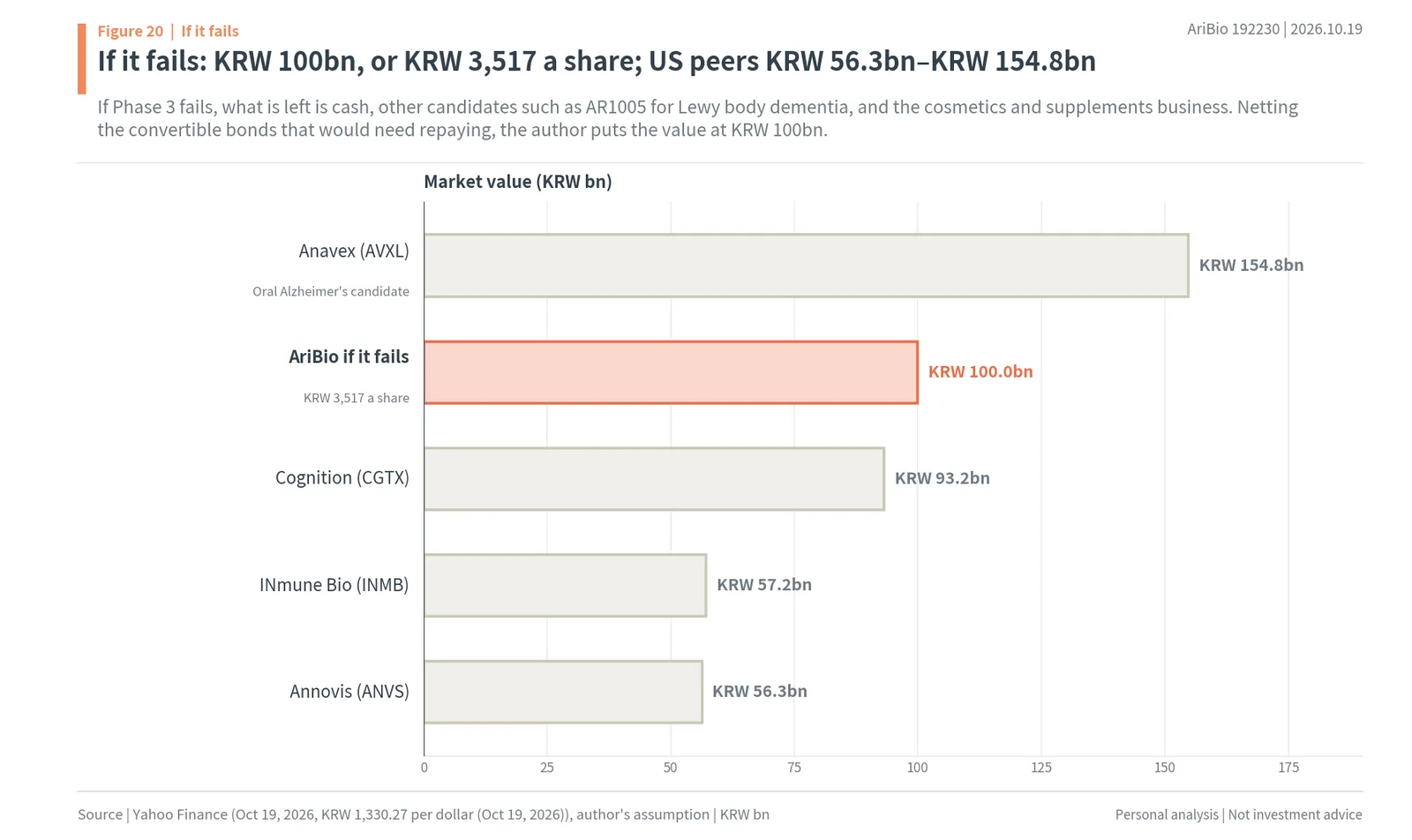
The comparison: on October 19 (at KRW 1,330.27 per dollar), Anavex was worth KRW 154.8bn, Cognition KRW 93.2bn, INmune Bio KRW 57.2bn and Annovis KRW 56.3bn. All are small companies with Alzheimer’s candidates, and candidates that have not yet proven themselves get values like these. AriBio’s KRW 100bn failure case sits in the middle of that range.
13. If it works: KRW 2.49tn, or KRW 73,160 a share
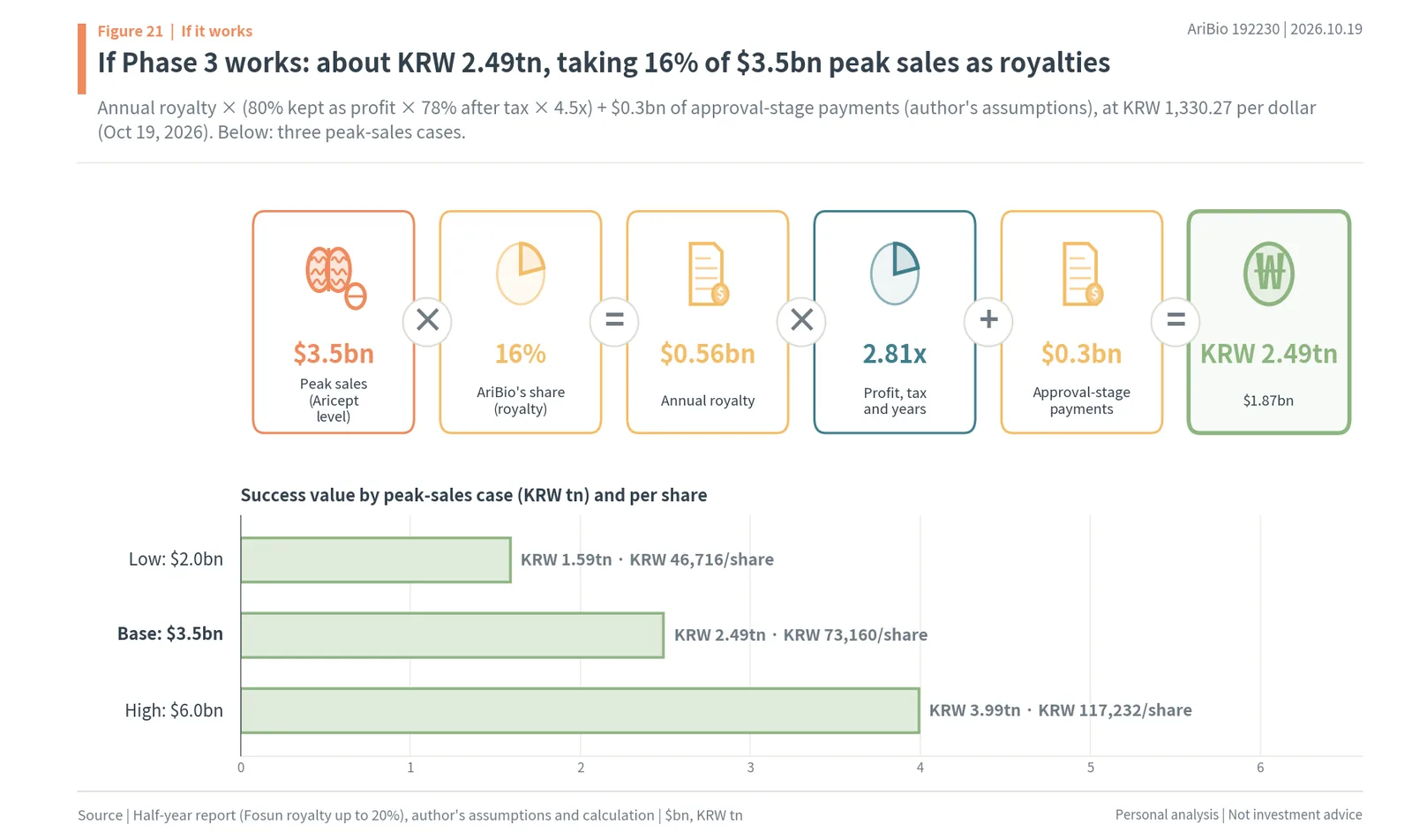
The short version: if AR1001 succeeds in Phase 3, the author values AriBio at about KRW 2.49tn (about $1.87bn), or KRW 73,160 (about $55) a share (author’s calculation). The number comes from assuming AriBio collects 16% of $3.5bn in peak sales as royalties.
Valuing the royalties
AriBio does not sell AR1001 itself; it has licensed it out. So on success it collects royalties and stage payments, not total sales. Fosun’s deal sets royalties at up to 20% of sales; the other regions’ royalty terms are not disclosed. The author puts AriBio’s blended share at 16% of sales, below Fosun’s “up to 20%” because that ceiling suggests rates that vary by sales tier, and because the Middle East and Latin America deals mix in supply contracts rather than pure royalties. The arithmetic: $3.5bn peak sales × 16% = $0.56bn of annual royalties. Multiply by the 80% AriBio keeps as profit, by 78% after corporate tax, and by 4.5x for the remaining patent life and the time value of money; together that is 2.81x. The US patent on AR1001’s mechanism runs to 2040, extendable to 2043, so royalties could flow for more than ten years after approval, which the 4.5x is meant to capture. Royalty value of $1.57bn plus $0.3bn for the present value of approval-stage payments gives $1.87bn, or KRW 2.49tn at KRW 1,330.27 per dollar.
Low KRW 1.59tn, high KRW 3.99tn
With $2bn of peak sales the same formula gives KRW 1.59tn (KRW 46,716 a share); with $6bn, KRW 3.99tn (KRW 117,232 a share). Per-share values use the fully diluted 34.04 million shares, because success would push the price far above conversion prices and every bond would convert. Korean biotech stocks often trade above this kind of calculation after a big trial win; plugging in a KRW 5tn market value gives KRW 146,907 a share. That reflects “fervor,” so the base case does not use it. It is also worth knowing how much each assumption moves the result. Raising AriBio’s share from 16% to 20% lifts the royalty value by a quarter; raising the multiple from 4.5x to 6x lifts it by a third. Peak sales move it most: from $3.5bn to $6bn, the value goes from KRW 2.49tn to KRW 3.99tn. The $0.3bn of approval-stage payments is the author’s discounted, probability-weighted value of Fosun’s $80mn upfront on exercise and US and European approval milestones.
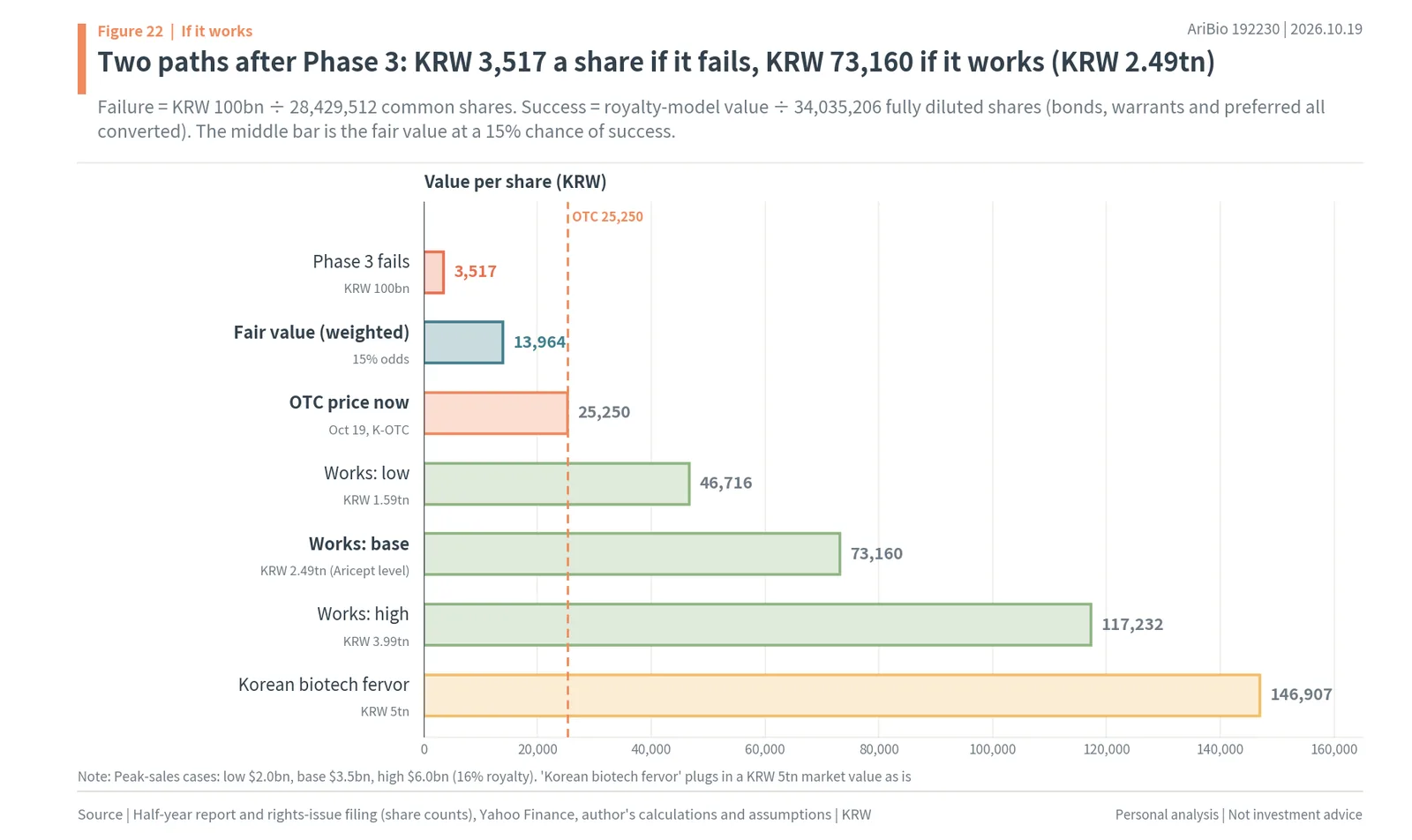
As the chart shows, AriBio’s value splits two ways after Phase 3: KRW 3,517 a share on failure and KRW 73,160 in the base success case, more than 20 times apart. An asset with an outcome this binary cannot be valued at a single middle number; you weight the two paths by their probabilities and add them up.
13-1. If it works, the order in which money arrives
The short version: even with a Phase 3 win, royalties arrive years later; what bridges the gap is the partner’s upfront and approval-stage payments. So right after success, the company would be valued on cash that is scheduled to arrive, not cash already in hand.
Upfront, then approval milestones, then royalties
The first money is Fosun’s $80mn upfront if it exercises its option, which the contract sets up to be decided after the Phase 3 result. The second is approval-stage payments: if the company files for and wins FDA approval in 2027 and 2028 as planned, milestones follow in the US, Europe, China and other regions. The third is royalties on sales after launch, up to 20% in Fosun’s territory, with sales milestones as revenue grows. Most of the KRW 2.49tn success value is the present value of that third stream; the first two are added separately as $0.3bn.
Bonds become shares, and the books grow again
The balance sheet changes on success too. With the price above KRW 8,000 to 27,000 conversion prices, bondholders take shares instead of cash: financial liabilities shrink and equity grows, while the share count rises toward 34.04 million. The KRW 183.31bn of capitalized development costs stays on the books as the cost of a product to sell. As upfront and milestone payments come in, there will again be years with large reported sales, as in 2024, when upfront fees produced KRW 35.23bn of sales and an operating profit.
14. Fair value: KRW 13,964, about KRW 14,000
The short version: at a 15% chance of success, AriBio’s fair value is KRW 13,964 (about $10.50), or roughly KRW 14,000 a share (author’s calculation). The fully diluted fair market value is about KRW 480bn (about $361mn), 44.7% below the fully diluted value at the OTC price, KRW 859.4bn.
Odds × success value + (1 − odds) × failure value
Fair value is the two paths weighted by their probabilities: 15% × KRW 73,160 + 85% × KRW 3,517 = KRW 13,964. The success value is divided by the diluted share count and the failure value by common shares, since on failure the bonds would not convert but stay as debt. For the same reason, the OTC market value is compared on a diluted basis: KRW 25,250 × 28.43 million common shares is KRW 717.8bn, but on success the bonds convert, so the relevant OTC value is KRW 25,250 × 34.04 million diluted shares, KRW 859.4bn. This number stops being useful after November 16. Once results are out, the price will head toward KRW 3,517 or above KRW 70,000, and it is unlikely to sit near KRW 13,964. Fair value is what you can fairly pay now, while holding both paths before the result. With the result four weeks away, no time discount is applied for the wait; discounting matters inside the success value, over the years before royalties arrive, and that is already in the 4.5x multiple of Chapter 13.
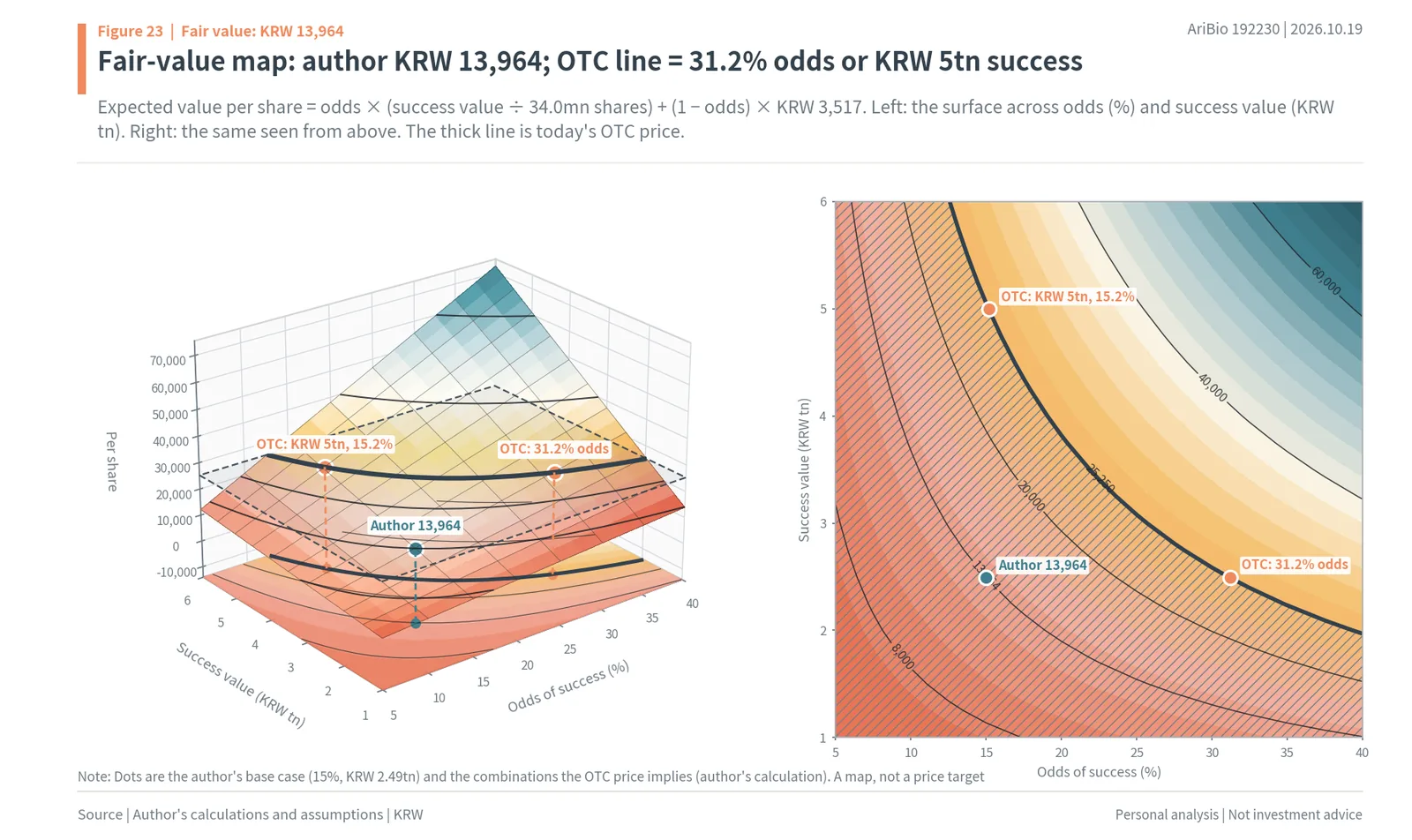
Widening the assumptions: KRW 7,800 to 26,300
The surface shows how fair value moves as the odds of success (across) and the success value (in depth) change: it rises with either. The thick line is today’s OTC price of KRW 25,250. The author’s base point (15%, KRW 2.49tn) sits well below it. The two dots on the line are the combinations the OTC price implies: 31.2% odds at a KRW 2.49tn success value, or 15.2% at KRW 5tn. Widening the odds to 10% to 20% and the success value to KRW 1.59tn to 3.99tn keeps fair value between KRW 7,800 and KRW 26,300. In table form: at 10% odds, KRW 7,800 to 14,900 depending on the success value; at 15%, KRW 10,000 to 20,600; at 20%, KRW 12,200 to 26,300; at 25%, KRW 14,300 to 31,900; at 30%, KRW 16,500 to 37,600 (success values of KRW 1.59tn to 3.99tn). To reach KRW 25,250 you need roughly 20% odds with a success value near KRW 3.99tn, or about 25% odds at KRW 2.49tn.
15. The odds the OTC price implies: 31.2% at KRW 2.49tn, 15.2% at KRW 5tn
The short version: the OTC price of KRW 25,250 rests on more optimistic assumptions than the author’s. With the author’s base success value of KRW 2.49tn, the implied chance of success is 31.2%, more than twice the author’s 15%. With a bigger success value of KRW 5tn, it falls to 15.2%, close to the author’s.
Backing the odds out of the OTC price
Setting OTC price = odds × success value per share + (1 − odds) × failure value per share and solving for the odds shows what the price assumes. At a KRW 1.59tn success value the implied odds are 50.3%; at KRW 2.49tn, 31.2%; at KRW 3.99tn, 19.1%; at KRW 5tn, 15.2% (author’s calculation). The bigger the success value, the lower the odds needed.
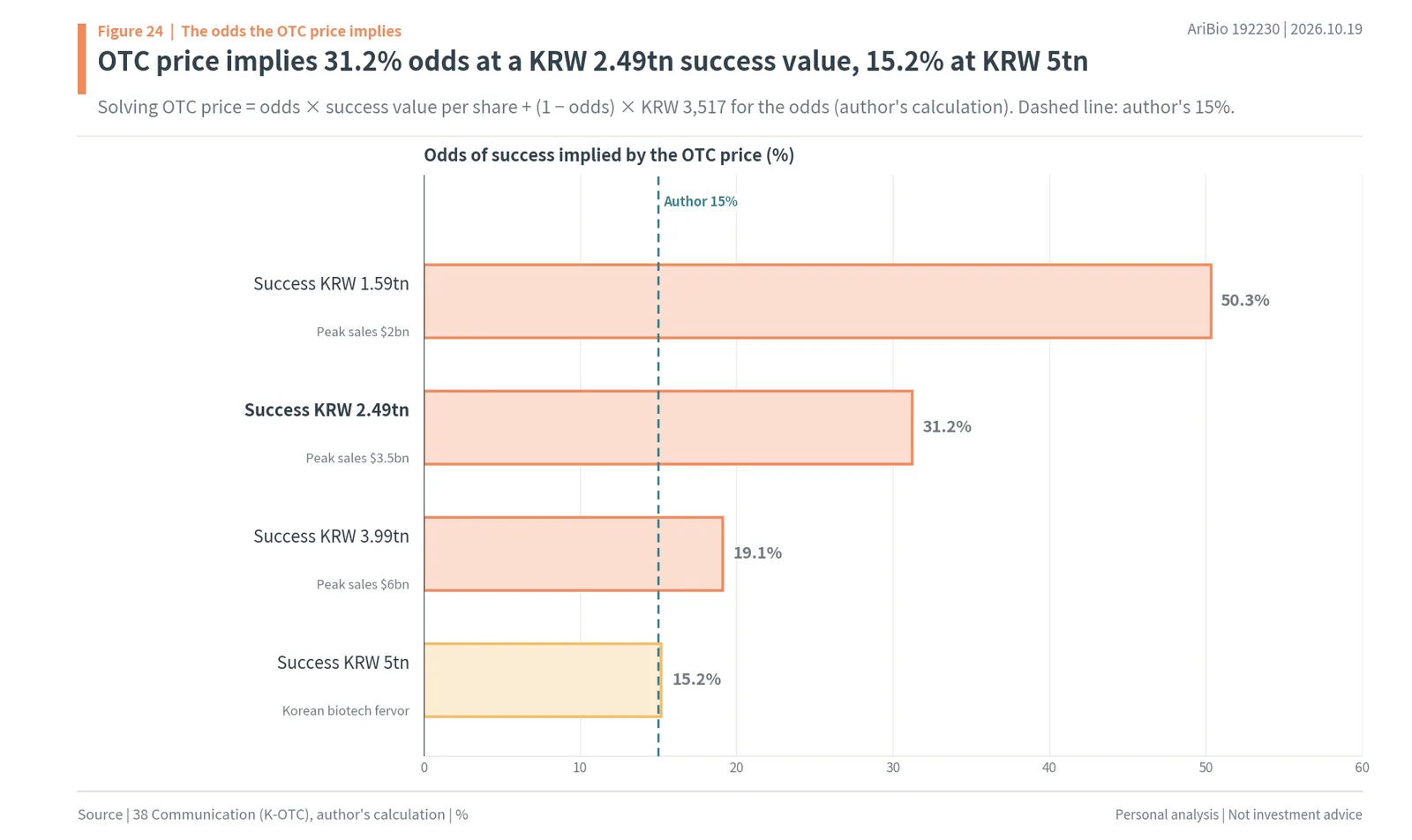
That leaves two readings. Either OTC investors see better than a three-in-ten chance of success, or they expect Korean biotech fervor to put a market value of around KRW 5tn on success. New investors buying bonds and preferred at KRW 27,000 from April to October 2026 signal the same expectation. Set against a 2% historical Phase 3 pass rate and a Phase 2 that missed its primary endpoints, 31.2% is a high probability. So the author judges that today’s OTC price rates the chance of Phase 3 success quite highly.
The two paths seen from the OTC price
From the OTC price of KRW 25,250, the spread is starker. Falling to KRW 3,517 on failure is -86.1%; rising to the base success value of KRW 73,160 is +189.7%; a KRW 5tn fervor value would be +481.8% (author’s calculation). Most of the money can be lost on the downside, while the upside nearly triples it. With a payoff this lopsided, a slightly more optimistic probability lifts the expected value a lot: at 15% odds the expected value is KRW 13,964, 44.7% below the OTC price, but at 31.2% it equals the OTC price. What justifies today’s OTC price, in the end, is the belief that the trial succeeds three times in ten.
16. What a listing would be worth, and dates to watch
The short version: the Phase 3 result on November 16 decides when AriBio can list and at what value. Success gives it grounds for a direct listing and opens a market-value range of KRW 2tn to 5tn, or KRW 58,763 to KRW 146,907 a share. Failure brings bond puts that are already open, and the June 2028 deadline for the preferred, before any listing.
If it works: grounds for a direct listing, KRW 2tn to 5tn
With the merger off, the company says it is reviewing several options including a direct IPO and has not decided. A Korean outlet reported that president Kim Hoe-cheon, who has securities and legal experience, is in charge of the direct-listing strategy, and Choung has said he will compare the pros and cons of each route without ruling any out. A Phase 3 win would give a listing review something to stand on: a large positive trial and license deals turning into cash (Fosun’s $80mn upfront, approval milestones). A market value of KRW 2tn would be KRW 58,763 a share, KRW 3tn KRW 88,144 and KRW 5tn KRW 146,907 (on 34.04 million diluted shares, author’s calculation). For OTC holders, a listing would be the moment the success value gets tested in a real market.
If it fails: repayment claims before a listing
A failed Phase 3 removes the core of any listing case. Instead, bond put dates come around every three months (the next is November 7), and if there is no qualified listing by June 30, 2028, the October preferred holders can ask for redemption too. The company’s reasons to hurry a listing grow while its grounds to list shrink. The preferred also carries 12% annual late-payment damages if AriBio has distributable profits but delays redemption; redemption is only possible out of such profits, so with a large accumulated deficit a claim does not immediately drain cash, but it weighs on any negotiation with new investors.
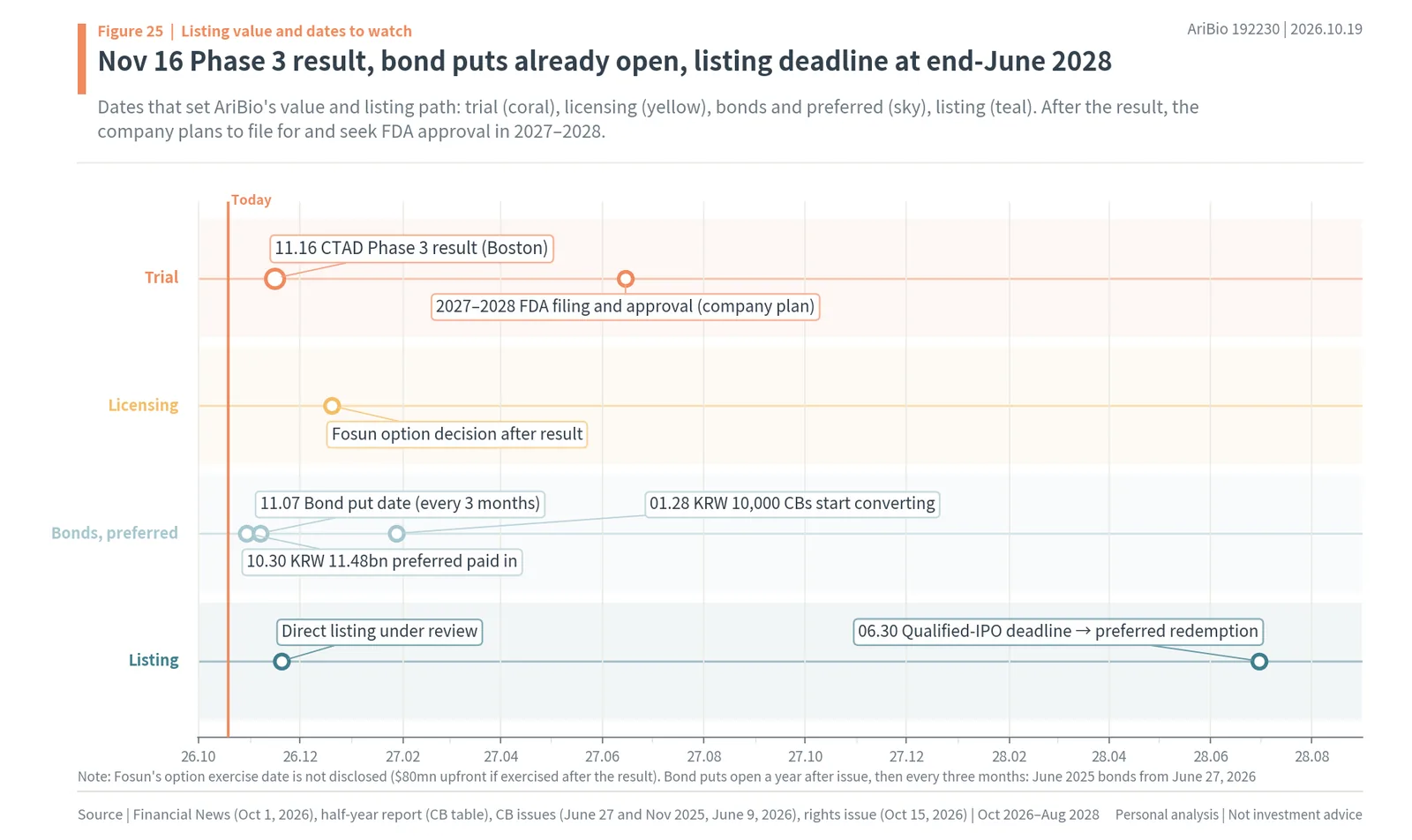
Dates to watch
First, November 7 is the first put date for bonds issued in November 2025. Second, Phase 3 topline results come on November 16 at CTAD in Boston; the key question is whether CDR-SB worsened less than placebo in both the overall and monotherapy populations. Third, whether Fosun exercises its option after the result, which would bring an $80mn upfront. Fourth, from January 28, 2027 the KRW 10,000 convertible bonds can turn into shares. Fifth, June 30, 2028 is the qualified-listing deadline for the preferred. In between, if the company’s plan holds, it will file for and seek FDA approval in 2027 and 2028.

16-1. Number conventions: what came from where
The short version: the OTC price is 38 Communication’s K-OTC close, listed affiliates’ prices are official KRX closes, company numbers are from AriBio’s separate (parent) financial statements on DART, and share counts are from the June half-year report and the October rights-issue filing. The same label can carry different numbers from different sources, so the conventions are gathered here.
Prices
AriBio’s reference price of KRW 25,250 is its October 19, 2026 K-OTC close from 38 Communication’s quote table; on days with no trades (September 30), the previous price carries over. AriBio Holdings’ prices are official KRX regular-session closes; prices that include after-hours trading on the Nextrade platform can differ and were not used. Holdings’ September 29 close of KRW 2,970 (-25.5%) and September 28 close of KRW 3,985 are KRX figures. The 38 Communication table shows only the last 20 trading days, so the OTC chart starts on September 21. The history of merger prices and ratios follows the amended merger filings and DealSite TV’s August 2025 summary; the outside valuation follows FETV’s October 2026 report.
Trial figures
Some news summaries put Leqembi’s ARIA-E rate at 12.5%; this report uses the 12.6% that AriBio’s half-year report takes from the trial paper. AR1001’s enrollment, completion and dropout figures follow the company’s announcements (Financial News); regional enrollment and adverse events follow NeurologyLive.
Financials and share counts
AriBio’s 2026 half-year report contains only separate financial statements, so the separate basis is used. First-half sales of KRW 6.48bn and the KRW 4.71bn operating loss are half-year cumulative. The 26,374,637 shares at end-June come from the half-year report, and the 28,429,512 common shares from the “shares outstanding before the issue” line of the October 15 rights-issue filing. The diluted count of 34,035,206 is the author’s calculation: shares convertible from bonds and warrants outstanding at end-June, minus the common shares added from July to October, plus series 32 bonds and the October preferred.
Exchange rates and foreign companies
Dollar conversions use Yahoo Finance’s KRW 1,330.27 per dollar on October 19, 2026. The company’s own won conversions (Fosun’s $4.74bn = about KRW 7.11tn) use the rate at signing, so they differ from this report’s. The KRW 9.7tn headline deal value adds the won figures as disclosed. Veradermics’ market value is an intraday US figure on October 19.
All the author’s assumptions in one place
Seven assumptions drive the conclusions: a 15% chance of Phase 3 success; peak sales on success of $3.5bn (low $2bn, high $6bn); AriBio’s 16% share; 80% kept as profit; 78% after tax; a 4.5x multiple for remaining years and time value; $0.3bn for the present value of approval-stage payments; and a KRW 100bn market value on failure. These are the author’s numbers, not company guidance or broker estimates, and the surface in Chapter 14 and the bars in Chapter 15 show how the results move when they change.
Maochaedung’s take
Maochaedung’s take. AriBio sells a little cosmetics, supplements and dermal filler, but 66.6% of its first-half 2026 sales were license fees for one drug, the oral Alzheimer’s pill AR1001. Phase 3 costs were capitalized as development costs, so intangibles stand at KRW 183.31bn, 71.7% of total assets. The books, the license deals and the listing path are all tied to that one drug.
So what sets the value is the November 16 Alzheimer’s Phase 3. AR1001, an oral dementia drug made from the erectile-dysfunction molecule mirodenafil, has finished a 52-week trial of 1,535 patients in 13 countries. License deals total KRW 9.7tn, but only KRW 108.7bn (1.1%) has arrived in cash; the rest comes only with approvals and sales. So the Phase 3 result decides whether the headline deals turn into cash. On failure, AriBio is worth about KRW 100bn, or KRW 3,517 a share; on success, assuming it collects 16% of $3.5bn peak sales as royalties, KRW 2.49tn, or KRW 73,160 a share.
At a 15% chance of success, fair value is KRW 13,964, about KRW 14,000 (about $10.50), and the fully diluted fair market value is about KRW 480bn. The OTC price of KRW 25,250 assumes either a 31.2% chance of success or a KRW 5tn value on success. The listing path splits on the same day: success creates grounds for a direct listing, while failure brings the already-open bond puts and the June 2028 preferred redemption deadline first.
AriBio and the AR1001 readout: quick answers
Q. What does AriBio sell?
In the first half of 2026, 66.6% of AriBio’s KRW 6.48bn in sales were license fees for AR1001, its oral Alzheimer’s drug; cosmetics were 9.34%, with supplements and dermal filler making up most of the rest. Phase 3 costs were capitalized, so intangible assets were KRW 183.31bn, 71.7% of total assets, at the end of June 2026.
Q. What decides AriBio’s value?
The Phase 3 trial of AR1001, an oral Alzheimer’s drug based on mirodenafil. The trial enrolled 1,535 patients in 13 countries and 1,348 finished 52 weeks; the primary endpoint is CDR-SB in both the overall and monotherapy populations. Topline results are due at CTAD 2026 in Boston on November 16.
Q. What would AriBio be worth after the readout?
The author puts it at about KRW 100bn, or KRW 3,517 a share, if Phase 3 fails, and about KRW 2.49tn, or KRW 73,160 a share on 34.04 million diluted shares, if it succeeds, assuming AriBio collects 16% of $3.5bn in peak sales as royalties.
Q. What is a fair price today?
At a 15% chance of success, KRW 13,964 a share (about $10.50), or a fully diluted market value of about KRW 480bn. The K-OTC price of KRW 25,250 implies a 31.2% chance of success at a KRW 2.49tn success value, or 15.2% if success is worth KRW 5tn.
Q. How much of the license deals has been paid?
Five AR1001 license deals total KRW 9.7tn, but only KRW 108.7bn (1.1%) had arrived in cash through July 2026: Fosun’s $60mn option fee (about KRW 90bn), Samjin Pharm’s KRW 10bn upfront and about KRW 8.74bn from Neuco after offsets. If Fosun exercises its option after the Phase 3 result, it pays an $80mn upfront.
Q. Why did the merger with AriBio Holdings collapse?
AriBio Holdings, formerly Solux, traded at KRW 3,985 on September 28, 2026, far below the KRW 10,719 it would have had to pay shareholders opposing the merger, so mass buyback claims were expected. The merger was called off on September 29; Holdings fell 25.5% that day while AriBio rose 18.6% over the counter.
Sources
- AriBio, half-year report (June 2026), DART (link), Aug 14, 2026
- AriBio, annual report (Dec 2025), DART (link), Mar 31, 2026
- AriBio, rights-issue decision (amended), DART (link), Oct 15, 2026
- AriBio, convertible bond issue decisions, DART (link), June 9, 2026; (link), June 27, 2025; (link), Jan 30, 2026; (link), Feb 12, 2026
- AriBio Holdings, merger withdrawal (link) and amended merger report (link), Sept 29, 2026
- Cummings et al., Alzheimer’s disease drug-development pipeline: few candidates, frequent failures, Alzheimer’s Research & Therapy (link), July 3, 2014
- van Dyck et al., Lecanemab in Early Alzheimer’s Disease, NEJM (link), 2023
- pharmaphorum, Eisai’s full lecanemab phase 3 trial results presented at CTAD (link), Nov 2022
- Financial News, AriBio Group 2026 vision event (link), Oct 1, 2026
- Financial News, last patient dosed in AR1001 Phase 3 (link), June 29, 2026
- NeurologyLive, POLARIS-AD Phase 3 trial of PDE5 inhibitor AR1001 (link), July 16, 2026
- ClinicalTrials.gov, NCT05531526 (link)
- MTN, two months before topline (link), Sept 17, 2026
- DealSite, AR1001 mechanism patent in the US (link), Dec 19, 2025
- Medical Times, SK Chemicals’ Mvix approved as Korea’s 13th new drug (link), July 2007
- Asia Economy, AriBio and SK Chemicals partner on AR1001 (link), Oct 23, 2025
- Alzheimer’s Association, Viagra May Significantly Cut Alzheimer’s Risk (link), 2021
- Hankyung, AriBio receives full $60mn option fee from Fosun (link), July 13, 2026
- Edaily, AriBio’s two-year merger with former Solux collapses (link), Sept 29, 2026
- FETV, AriBio’s direct-listing strategy (link), Oct 14, 2026
- DealSite TV, Solux-AriBio merger ratio (link), Aug 14, 2025
- Fierce Pharma, Eisai’s Leqembi sales forecast (link), May 2026
- The Pharma Letter, Eisai nine-month 2009 sales (link)
- Fierce Biotech, Can Eisai’s new Alzheimer’s drug fill blockbuster shoes? (link)
- 38 Communication, AriBio K-OTC quotes (link), accessed Oct 19, 2026
- KRX, AriBio Holdings (290690) daily prices, accessed Oct 19, 2026
- Yahoo Finance and Naver Finance, peer market values, accessed Oct 19, 2026
- Photos: Cygnusloop99 (CC BY-SA 3.0), Imtotallykorean (CC BY-SA 4.0), Gannu03 (CC BY-SA 4.0), Janusz Sobolewski (CC BY 2.0), DvTor8303 (CC0), Narubaru7 (CC BY 4.0), ajay_suresh (CC BY 4.0), King of Hearts (CC BY-SA 4.0), via Wikimedia Commons
Disclaimer
Was this note useful?
Thanks. Your answer helps decide what to cover next.
Korea market snapshot · Oct 23, 2026
New to Korean stocks? Start here for the basics.
Most read
1France Protests 2026: Why Students Are Blocking Schools and Which Stocks Benefit (Munich Re, SCOR)
Get the Saturday note on Korean stocks
One email every Saturday with the week’s new research on Korean listed companies and links to the updated data pages. Built from DART filings and KRX data. Free; unsubscribe in one click. See past issues