
Musk Calls Memory Prices ‘Extortionate’: Why China’s 2028 Push Won’t Break the Pricing Power of Samsung Electronics (005930.KS) and SK hynix (000660.KS)
On May 26, 2010, Warren Buffett sat down with staff of the US Financial Crisis Inquiry Commission. Asked why he had invested in the credit-rating agency Moody’s, he answered by describing what he looks for in any company. The transcript records him saying that “the single most important decision in evaluating a business is pricing power. You’ve got the power to raise prices without losing business to a competitor, and you’ve got a very good business. And if you have to have a prayer session before raising the price by a tenth of a cent (laughs), then you got a terrible business.” He added that he had owned both kinds and knew the difference.
Sixteen years later, in October 2026, Korea’s two largest companies are having exactly this tested. Elon Musk, a customer of Samsung Electronics and SK hynix, wrote on X on October 13 that Micron had been reasonable on memory prices while “others have been extortionate, which is something today’s customers won’t forget.” Two days later he said China would make an enormous amount of memory in 2028. The same day, Apple’s new CEO John Ternus told TIME that memory constraints are “absolutely a crisis” and that “all options should be on the table.” After memory prices rose more than fifteenfold in a year and a half, the buyers have started to push back in public.
So can the customers walk this time? When Chinese memory floods in by 2028, will Samsung Electronics and SK hynix become companies that need a prayer session before raising prices? This report answers with numbers. Won amounts are converted at KRW 1,329.74 per dollar, the October 19, 2026 close (Yahoo Finance).
As of: October 19, 2026. Korean share prices are KRX closing prices on October 19, 2026 (KRX is the Korea Exchange; the KOSPI is its main board index, where both companies are listed).
Reference data: statements are from the Korea Economic Daily (October 19), 247 Wall St., Dealsite and Money Today (October 14) and TIME (October 15); memory prices are DRAMeXchange fixed contract prices (as reported in the Korean press) and TrendForce quarterly contract price estimates; market shares are from TrendForce and Counterpoint; Chinese capacity is from Nomura (as summarized by 404K Research) and SemiAnalysis (as summarized by Xenospectrum); CXMT results are post-listing disclosures (The Standard HK); consensus is from WiseReport, a Korean consensus provider. Numbers the author calculated are marked as such.
Summary: Musk’s words are a negotiating tactic, and China in 2028 can lower prices but not break pricing power
The author’s answer is this. What Musk and Apple are saying is pressure in the negotiation over long-term contract prices. CXMT’s expansion to 2028 can bring the level of memory prices down, but it is unlikely to break Samsung Electronics’ and SK hynix’s power to set prices without losing customers. There are four reasons.
First, memory is still short in 2028. The JPMorgan outlook Musk replied to puts the world memory supply shortage at 20% in 2026, 19% in 2027 and 15% in 2028. Micron’s management also says supply will be tight in both 2027 and 2028. For customers to leave, they need somewhere to go, and there is not enough of it.
Second, China’s expansion is smaller than it looks. Nomura sees CXMT’s monthly wafer capacity going from 350,000 at the end of 2026 to 550,000 at the end of 2028, but effective output after yields and utilization rises only from 250,000 to 400,000, an increase of 150,000. That is 7.3% of the 2.05 million wafers a month the big four DRAM makers had in 2026, and 48.7% of the 15% shortage in 2028 (author’s calculation). Even if every added Chinese wafer were new supply, it would not fill half the gap.
Third, China cannot make the most expensive memory today. In Q1 HBM market share, CXMT was left out as “negligible.” Estimates of the DRAM process gap between Samsung Electronics and CXMT range from 3–4 years to 5–7 years. SemiAnalysis puts CXMT’s DDR5 cost per bit more than 30% above the big three.
Fourth, China sells high too. CXMT’s Q1 average DRAM selling price was only 5–10% below the big three, and its first-half 2026 gross margin was 84.74%. When supply is short, even a newcomer sells close to the market price. Chinese chips arriving does not mean prices halve.
Something does change. Counterpoint says DRAM prices in 2028 could be about 23% below 2027, which would still be about 230% above 2025. Prices come down; they do not collapse. For shareholders, the question is therefore less “is China coming?” than “how much of each company’s revenue is conventional DRAM, where are the floor prices in its long-term contracts, and how big is HBM?”
1. Key terms: Korea’s two companies hold 64.3% of DRAM revenue
Five terms recur in this report: DRAM, conventional DRAM, HBM, fixed contract price and long-term agreement (LTA). All five matter for the question of who sets the price.
DRAM and conventional DRAM
DRAM is the memory a computer uses to hold data while it works; the contents disappear when the power goes off. It is in every phone, PC and server. NAND is storage memory that keeps data without power, used in SSDs and memory cards. Conventional DRAM means standardized parts such as DDR4 and DDR5 for PCs and LPDDR for phones, where one maker’s chip can replace another’s. Interchangeable products tend to compete on price alone, and this is where China’s CXMT enters first.
HBM
HBM (high-bandwidth memory) stacks DRAM dies and links them through thousands of vertical connections so that large amounts of data move at once. It sits right next to AI accelerators from companies such as Nvidia. Stacking, heat removal and customer qualification are all hard, so only three companies make it: SK hynix, Samsung Electronics and Micron. Musk himself wrote on October 13 that heat-tolerant stacked designs like HBM would not be easy for China to make (as reported by Money Today).
Fixed contract prices and long-term agreements
The fixed contract price is what memory makers charge PC, server and phone makers under business-to-business contracts. DRAMeXchange, a market research firm, publishes the average at the end of each month; it differs from the spot price paid in stores. A long-term agreement (LTA) locks that price in over several years. According to TrendForce, Samsung Electronics and SK hynix dropped one-year contracts with big tech this year and moved to three- to five-year LTAs. SK hynix said on its Q2 call that it had signed LTAs with about ten customers, including key ones. When Musk wrote that customers “won’t forget,” these contract prices are what he meant.
Pricing power
Pricing power is the ability to raise prices without losing customers: in Buffett’s terms, a company that does not need a prayer session before a price increase. For memory makers it depends on three things. Can the customer buy elsewhere (supply)? Is the alternative the same product (technology)? Is the alternative cheaper (price)? Chapters 5 to 7 take these in turn.
Figure 1 shows who sells DRAM today. In TrendForce’s count, Q2 2026 world DRAM revenue shares were Samsung Electronics 39.4%, SK hynix 24.9%, Micron 23.3% and CXMT 9.5%. The two Korean companies together hold 64.3%. Counterpoint puts CXMT at 7% for the same quarter, so estimates differ by 1–3 points. The right panel is HBM: in Q1 2026, SK hynix had 58%, Samsung Electronics 21% and Micron 21%, and CXMT was left out as negligible.
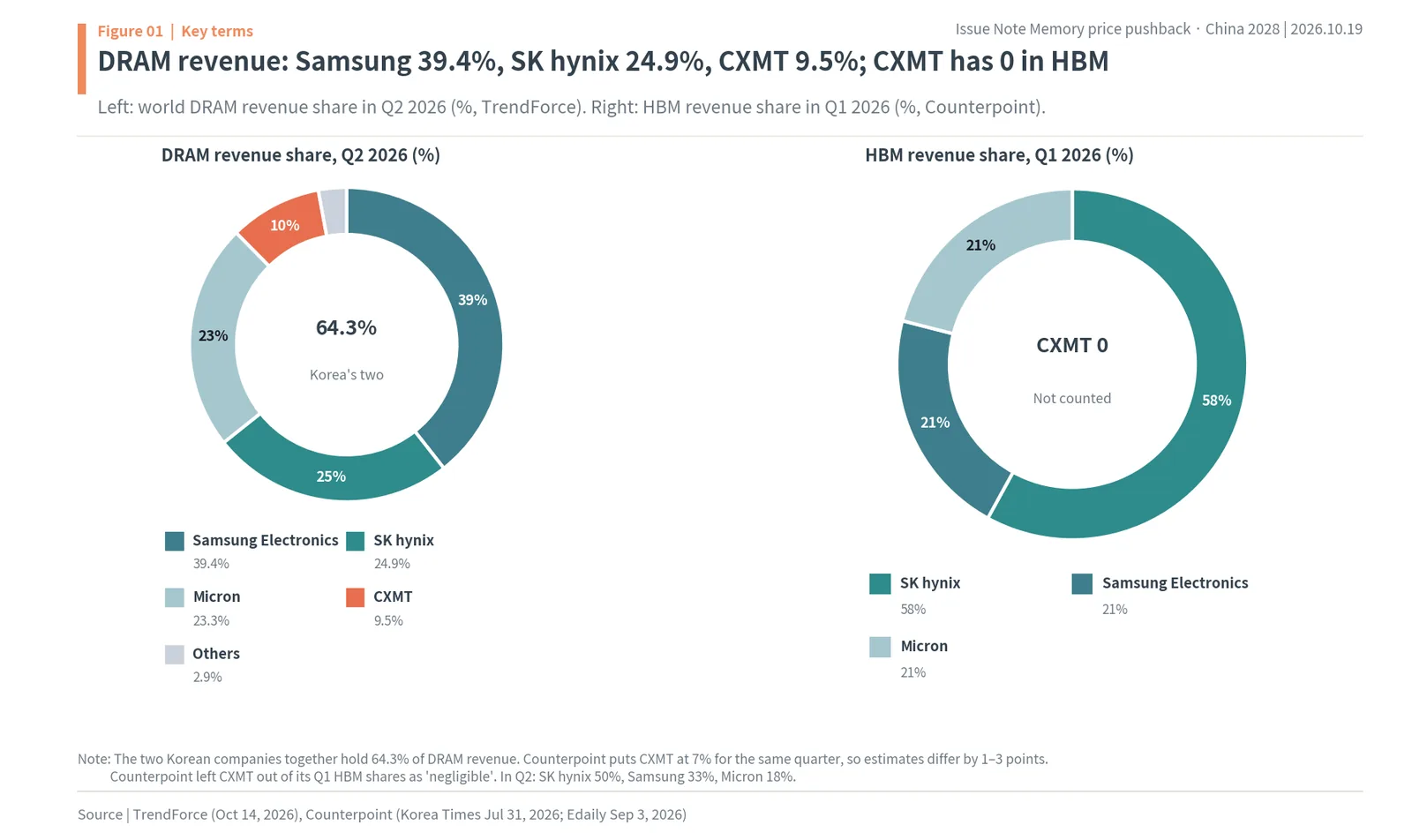
The figure says one thing. In conventional DRAM, China now sells about one chip in ten. In HBM, the most expensive memory, it does not yet sell any.
2. A hypothetical example: a 10% price cut trims profit 13.3% at a 75% margin and 50.0% at a 20% margin
Why does pricing power matter so much for the share price? Take two companies with revenue of 100. One is like a memory maker: costs of 25 and operating profit of 75 (a 75% margin). The other is like an ordinary manufacturer: costs of 80 and profit of 20 (a 20% margin). Hold volume and costs steady and cut prices 10%. Revenue becomes 90, costs do not move, and the whole 10 comes out of profit. The memory maker’s profit falls from 75 to 65, down 13.3%; the ordinary manufacturer’s falls from 20 to 10, down 50.0% (author’s calculation, hypothetical).
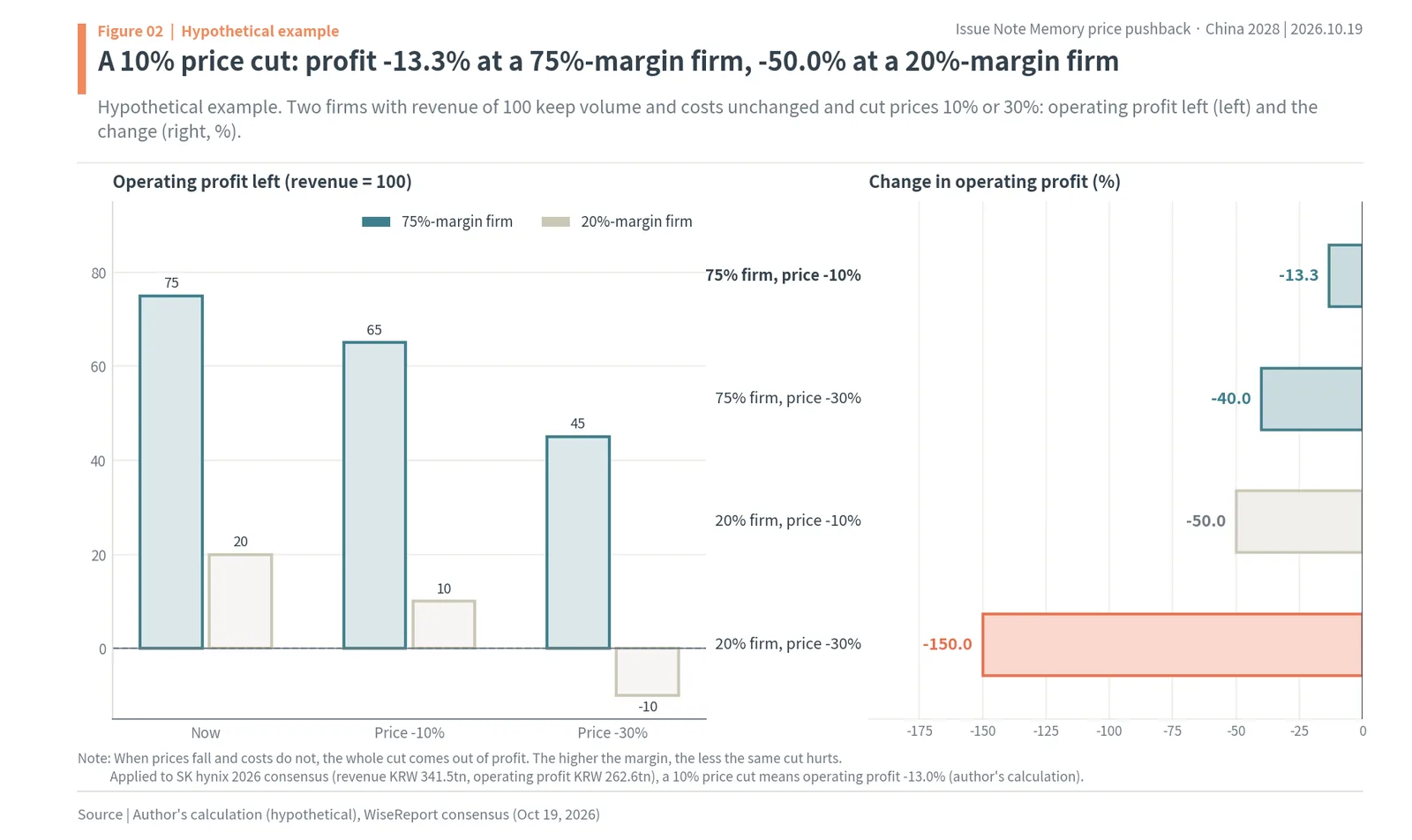
At a 30% cut the gap widens. The memory maker’s profit falls 40.0% to 45 but survives. The ordinary manufacturer goes to a loss of 10, a change of -150.0%. The higher the margin, the less the same price cut hurts, and memory makers are now standing on the 75% side.
Apply this to SK hynix. WiseReport consensus has SK hynix’s 2026 revenue at KRW 341.5 trillion (about $256.8 billion) and operating profit at KRW 262.6 trillion (about $197.5 billion). Cut prices 10% with volume and costs unchanged, and revenue falls by KRW 34.1 trillion (about $25.7 billion), all of it from operating profit, a 13.0% drop (author’s calculation). A 10% price cut does not cut profit to a third; it leaves seven-eighths.
Put the other way around: memory makers can absorb a 10% discount, which is exactly why buyers who want one have to talk tough. Musk’s choice of the word “extortionate” fits that structure.
3. What happened: Musk four times in ten days, and Apple’s CEO says “absolutely a crisis”
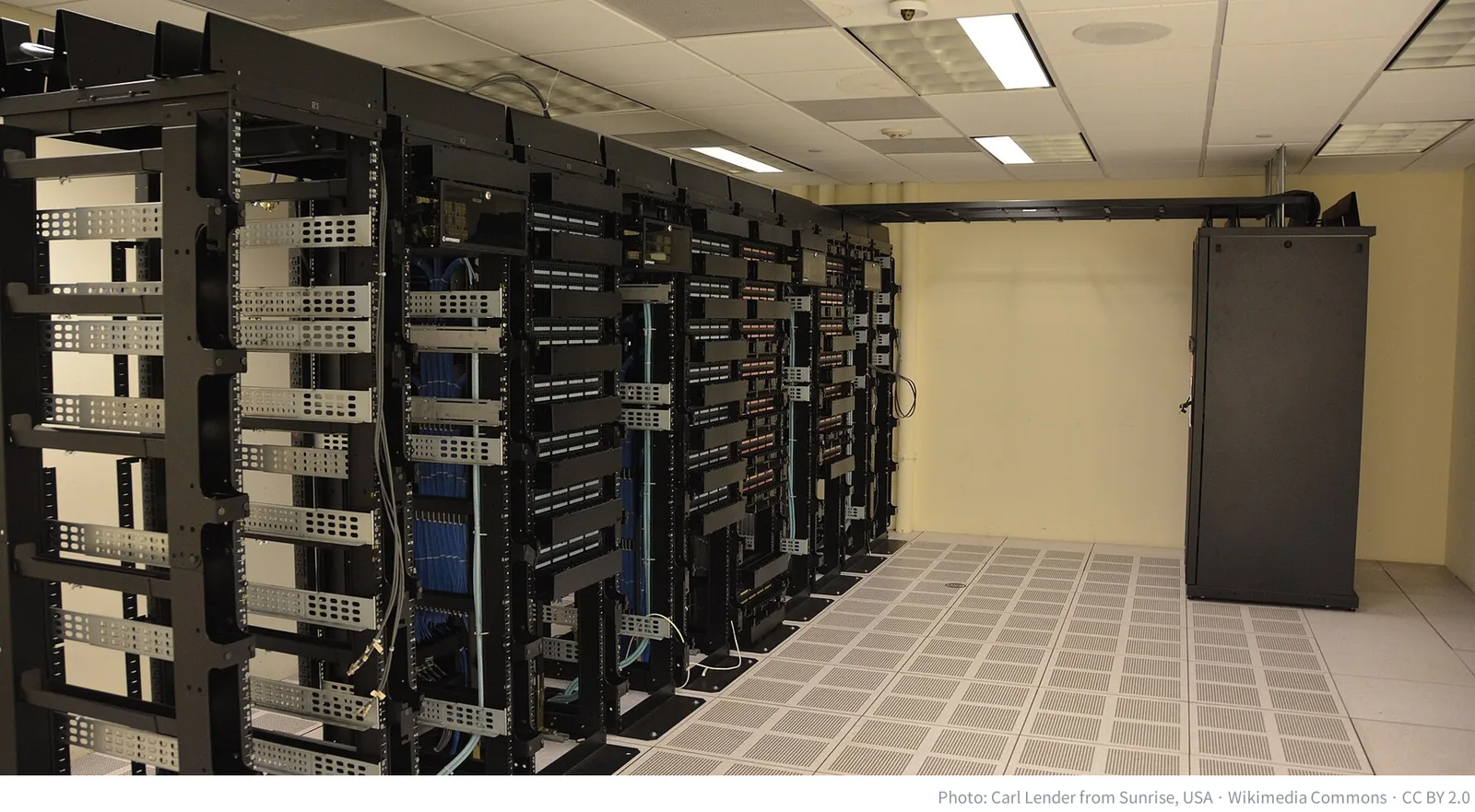
This was not the first time Musk raised memory. On SpaceX’s Q2 call on August 4 he said memory output grows about 20% a year while demand grows more than 200% (Money Today, August 6). On Tesla’s July 22 call he thanked Micron for allocating Tesla’s share over several years on reasonable terms. Tesla’s self-driving computers and the AI data centers of SpaceX and xAI all consume large amounts of memory.
In October the comments came faster. According to the Korea Economic Daily, Musk wrote on October 11 that “the problem is RAM supply,” and on the 12th posted that China could mass-produce once it had the manufacturing know-how. On the 13th (US time) he replied to a post sharing JPMorgan’s memory outlook: Micron “has been reasonable regarding future memory prices, others have been extortionate, which is something today’s customers won’t forget.” The Korean press translated “extortionate” as “absurdly high prices.” He named no company, but it was read as aimed at Samsung Electronics and SK hynix, the world’s top two DRAM makers. On the 15th he wrote that China would make an enormous amount of memory in 2028.
Also on the 15th, TIME ran an interview with Apple CEO John Ternus, who took over on September 1. Ternus called the memory constraints “absolutely a crisis” and said “all options should be on the table.” The part of the TIME article about Chinese memory cites an FT report, and Bloomberg had earlier reported that Apple was testing CXMT DRAM in devices sold in China. The US government stands on the other side. Commerce Secretary Lutnick said on August 14 that he was “not in favor” of Apple buying memory from CXMT or YMTC (citing a WSJ report). CXMT is not on the Commerce Department’s Entity List, but it is on the Defense Department’s list of Chinese military companies.
Figure 4 lays out statements and events from late July to October 19 in four lanes: Musk, Apple and the US government, China, and markets. CXMT listed in Shanghai on July 27; the next day SK hynix fell 14.6% and Samsung Electronics 13.4% (KRX closes, author’s calculation). On October 8 Samsung reported preliminary Q3 operating profit of KRW 107.4 trillion (about $80.8 billion), and on October 15 the KOSPI fell 7.57%, triggering a circuit breaker. Musk raised memory four times in ten days.
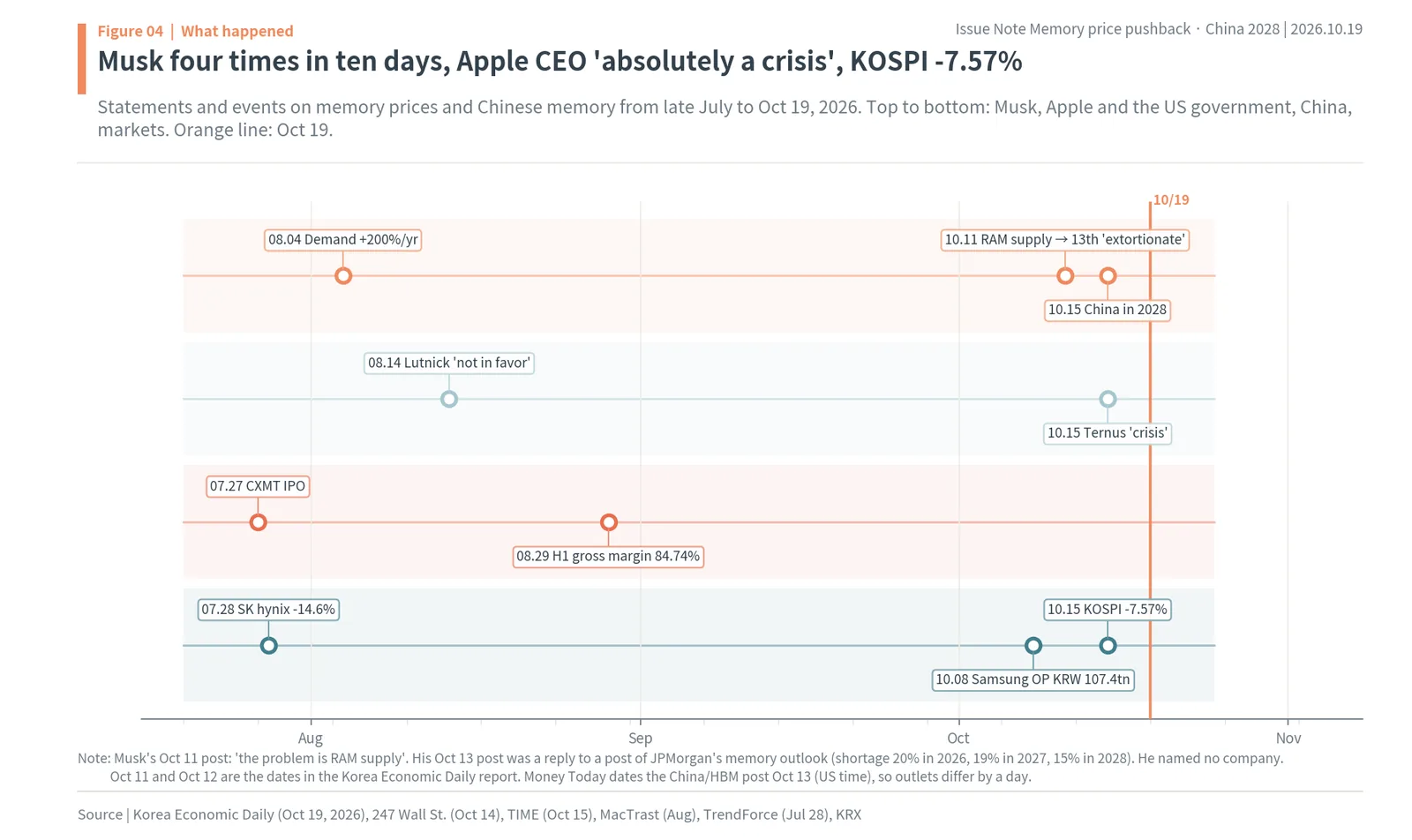
What matters in the figure is the order. The Chinese listing (July) and the US government’s pushback (August) came first, and the buyers’ comments poured out in October. It cannot be said that shares fell because of these comments: over the same period there were US AI credit worries, foreign selling and an eight-day losing streak in chip stocks. But the buyers have now played the “China” card in public.
Korean industry reads it one way. An industry source quoted by the Korea Economic Daily said Musk’s talk of Chinese output is more pressure to gain the upper hand in price talks than a plan to change suppliers: conventional DRAM can be partly replaced with Chinese parts, but high-end memory for AI servers must meet yield, power efficiency and customer qualification requirements, so suppliers cannot be switched quickly.
China reads it the other way. The state-run Global Times quoted Musk on October 15 to promote CXMT and argued that Korean chips faced oversupply (as reported by Global Economic on October 17). Jim Handy of Objective Analysis, quoted by the Korea Times, said “memory makers do not set their parts’ pricing — the market determines the pricing,” and expects demand to outrun supply until 2029. One side reads the same words as negotiating pressure, the other as a warning of oversupply. Chapters 5 to 9 check which reading fits the numbers.
4. How far prices rose: DRAM DDR4 8Gb from $1.65 to $26, 15.8 times
Prices explain why buyers are angry. The left of Figure 5 is the monthly average fixed contract price of PC DRAM DDR4 8Gb (DRAMeXchange). It was $1.35 in March 2025 and $1.65 in April, then $7.00 in October 2025, $11.50 in January 2026, $16 in April and $21 in June, reaching $26 in September: 15.8 times April 2025 (author’s calculation) and 312.7% above a year earlier ($6.30 in September 2025). On the right, the fixed contract price of NAND MLC 128Gb went from $2.08 in December 2024 to $30.5 in August 2026, 14.7 times.
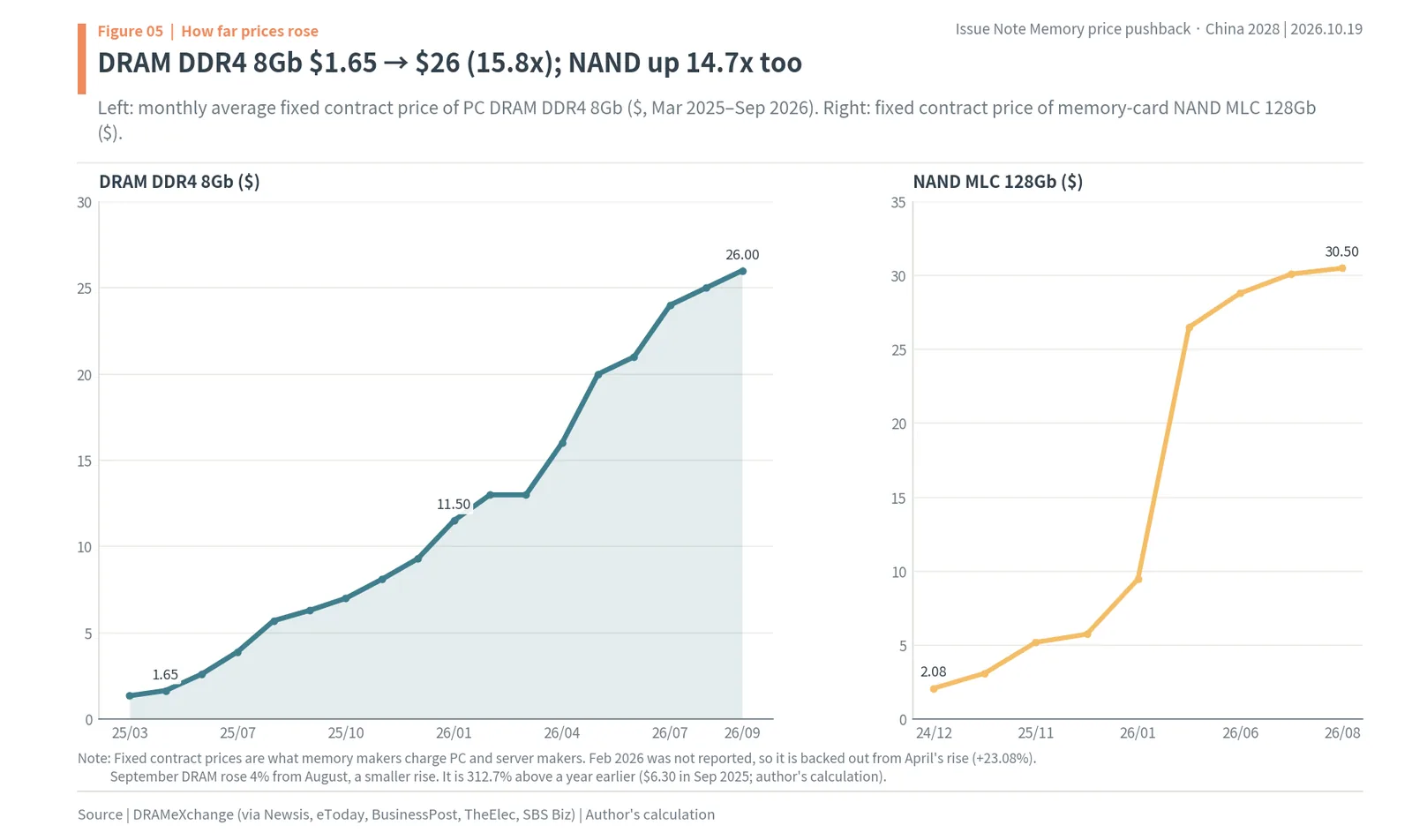
The rises are getting smaller, though. September DRAM was up 4% from August, far less than January (+23.66%) or May (+25%). February 2026 was not reported, so the chart uses $13, backed out from April’s rise of 23.08%.
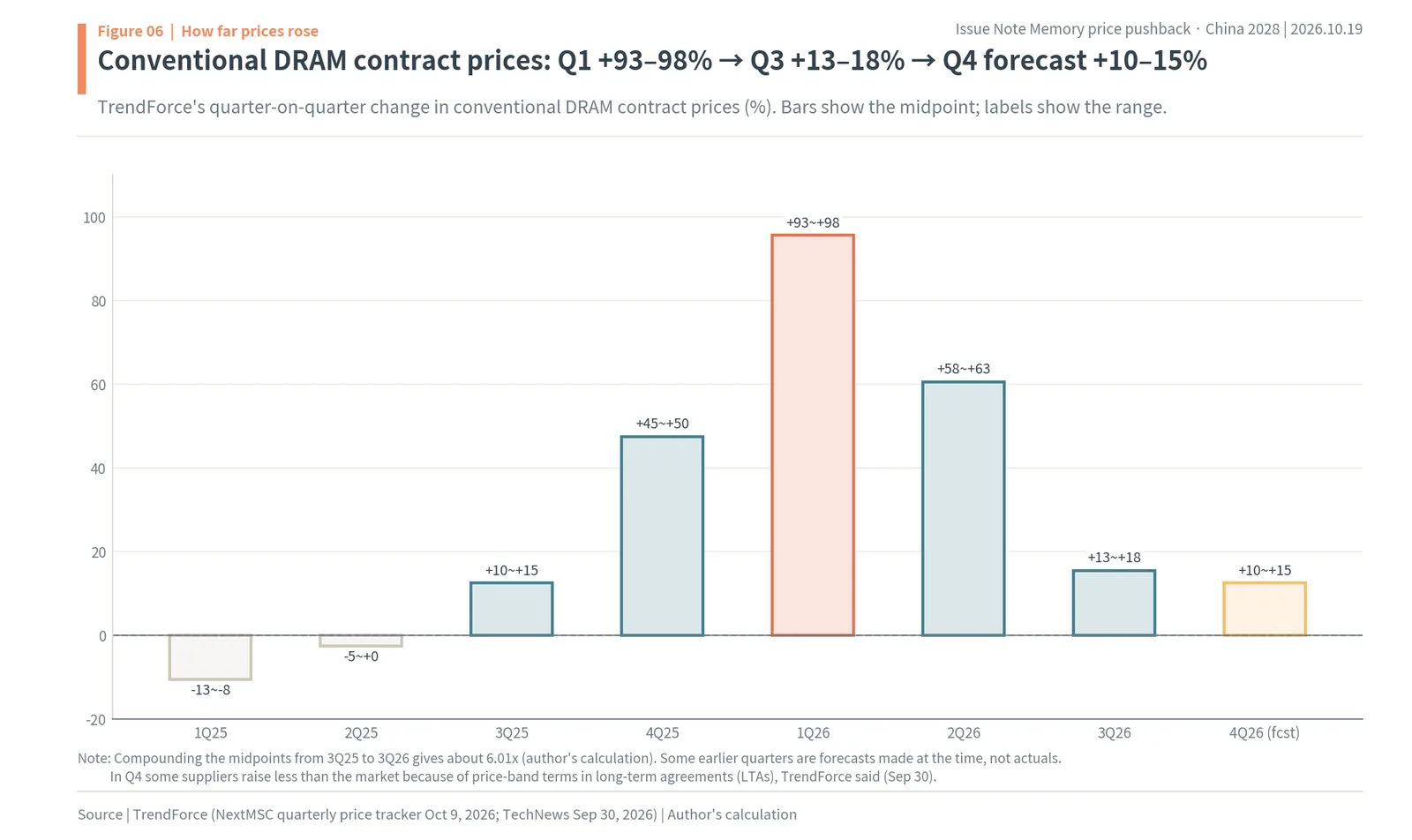
Figure 6 shows TrendForce’s quarter-on-quarter change in conventional DRAM contract prices. Prices fell 8–13% in Q1 2025 and 0–5% in Q2, turned up 10–15% in Q3, then rose 45–50% in Q4 and 93–98% in Q1 2026. Since then the increases have narrowed to 58–63% in Q2 and 13–18% in Q3, with 10–15% forecast for Q4. Compounding the midpoints from 3Q25 to 3Q26 gives about 6.01 times (author’s calculation). TrendForce said on September 30 that some suppliers are raising Q4 prices less than the market because of price-band clauses in their long-term agreements. LTAs are putting a lid on the upside as well.
As prices rose, margins went through the roof. The left of Figure 8 shows memory makers’ latest quarterly margins: Samsung Electronics’ Q3 operating margin of 55.1% (whole company), SK hynix’s Q2 operating margin of 76.3%, Micron’s fiscal Q4 gross margin of 86.8% and CXMT’s first-half gross margin of 84.74%. Gross margin is before selling and administrative costs, so it runs above operating margin. Samsung’s preliminary Q3 operating profit of KRW 107.4 trillion is 782.5% above a year earlier.
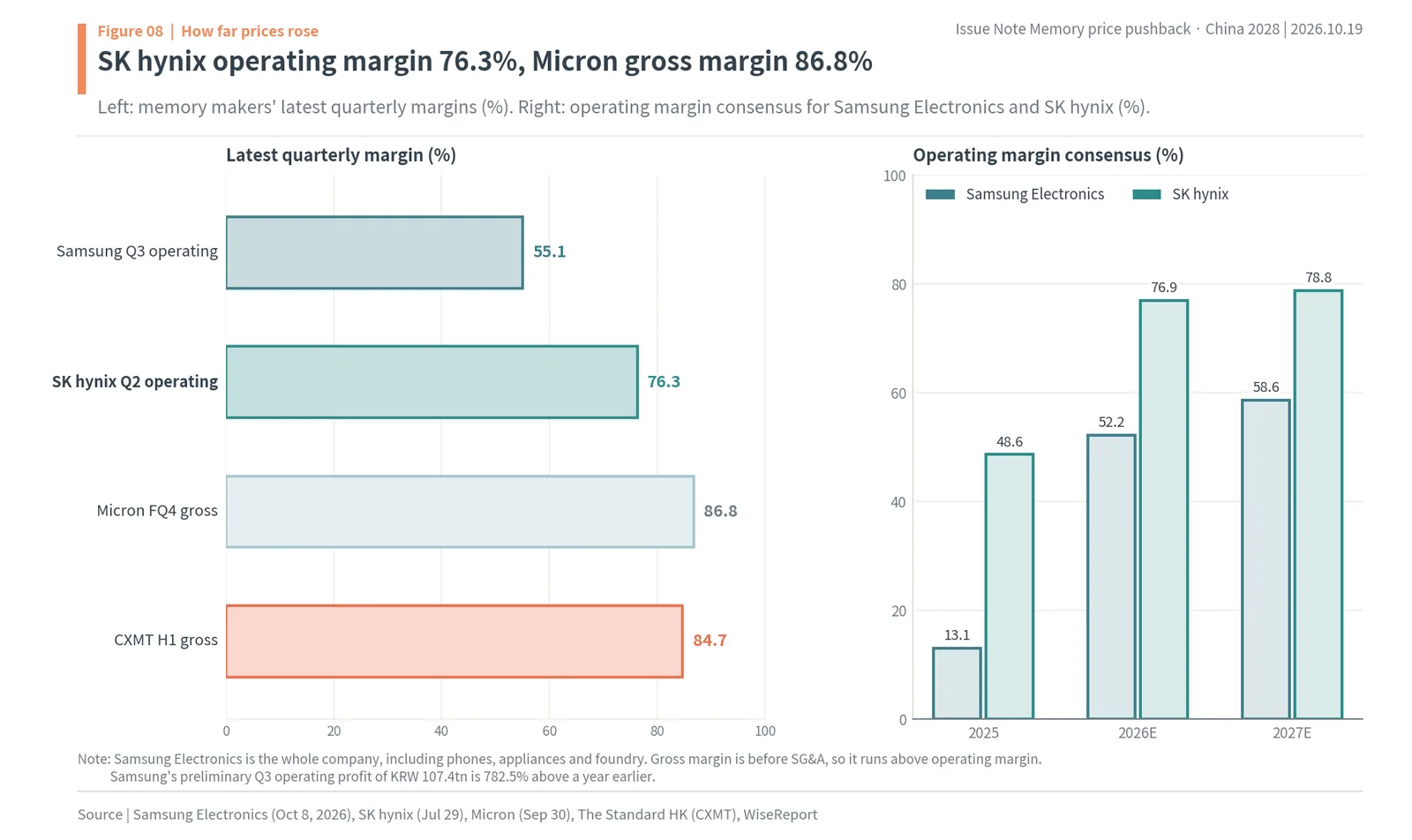
The right panel is operating margin consensus. Samsung Electronics goes from 13.07% in 2025 to 52.2% in 2026 and 58.59% in 2027; SK hynix from 48.59% to 76.89% and 78.75%. The market expects high margins to last into next year. These are the numbers Musk called “extortionate.” Micron’s management said newly negotiated contracts were “negotiated with higher pricing” and that even at floor prices margins would be far above the peak of any earlier cycle.
5. The buyers’ side: memory went from 10% to 34% of iPhone parts cost, and it is still short through 2028
The buyers’ numbers are urgent too. TrendForce estimates that a 256GB iPhone 18 Pro costs about 38% more in parts than the 17 Pro, and that memory’s share of the parts bill went from about 10% a year ago to about 34% in Q3 2026. Gartner sees memory’s share of PC cost rising from 16% to 23%, and memory and storage went from 15–18% to about 35% of HP’s PC parts cost (DigiTimes). DRAM and NAND are expected to rise from 47% of cloud companies’ capex this year to 68% next year (TrendForce).
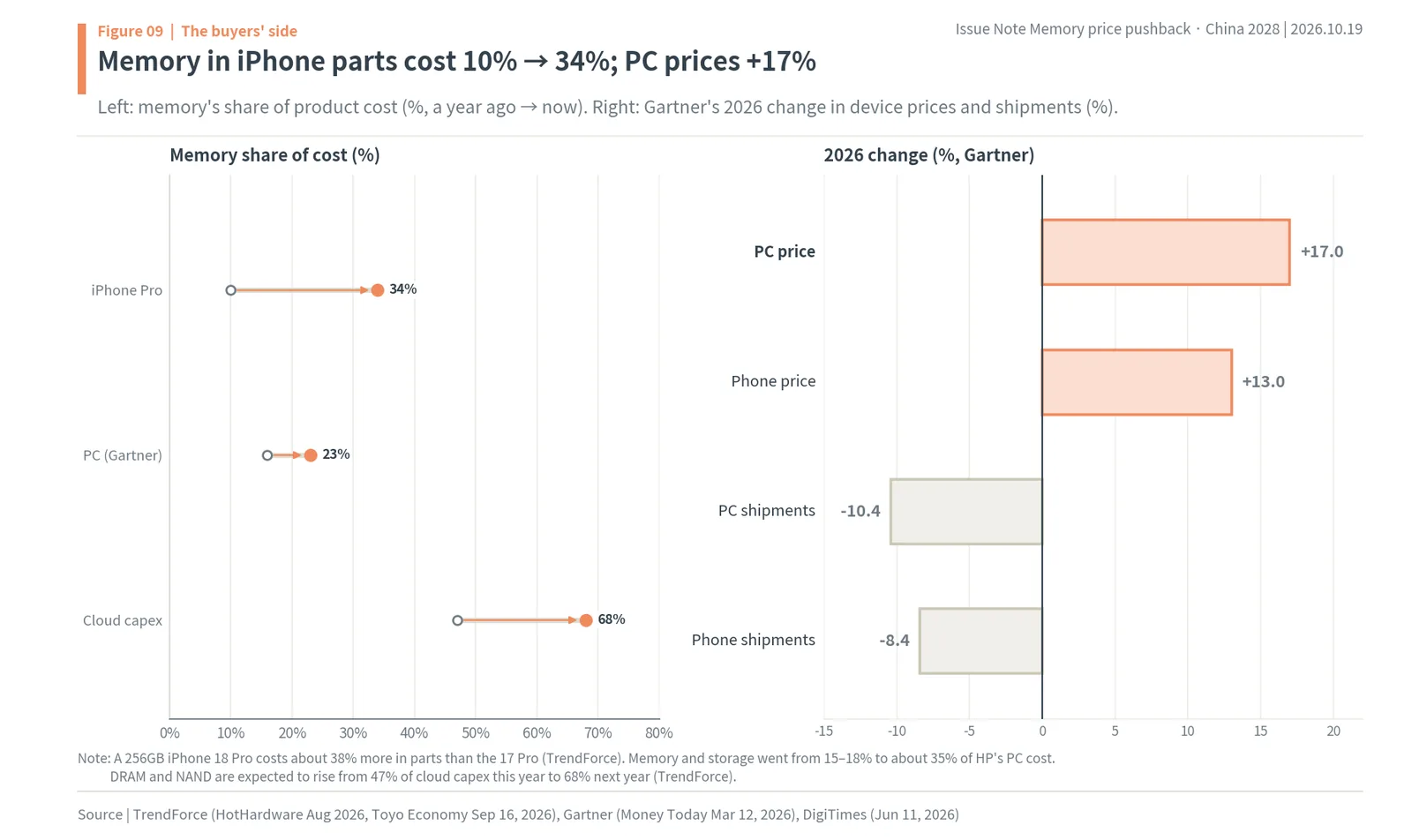
The right panel is Gartner’s view of device prices and shipments in 2026: PC prices up 17%, smartphone prices up 13%, PC shipments down 10.4% and smartphone shipments down 8.4%. Raise prices and fewer units sell. Device makers are passing memory costs to consumers, but the more they pass on, the less they sell. Ternus’s “absolutely a crisis” is not an exaggeration.

But however much the buyers hurt, they need somewhere to go. The left of Figure 11 is the JPMorgan outlook in the post Musk replied to on October 13: a world memory supply shortage of 20% in 2026, 19% in 2027 and 15% in 2028. The shortage shrinks, but in 2028 15% of demand still goes unmet. In the same note, JPMorgan wrote that Micron had locked up more than 35% of revenue through 2030 with 26 LTAs and that more than 75% of next year’s output was already sold.
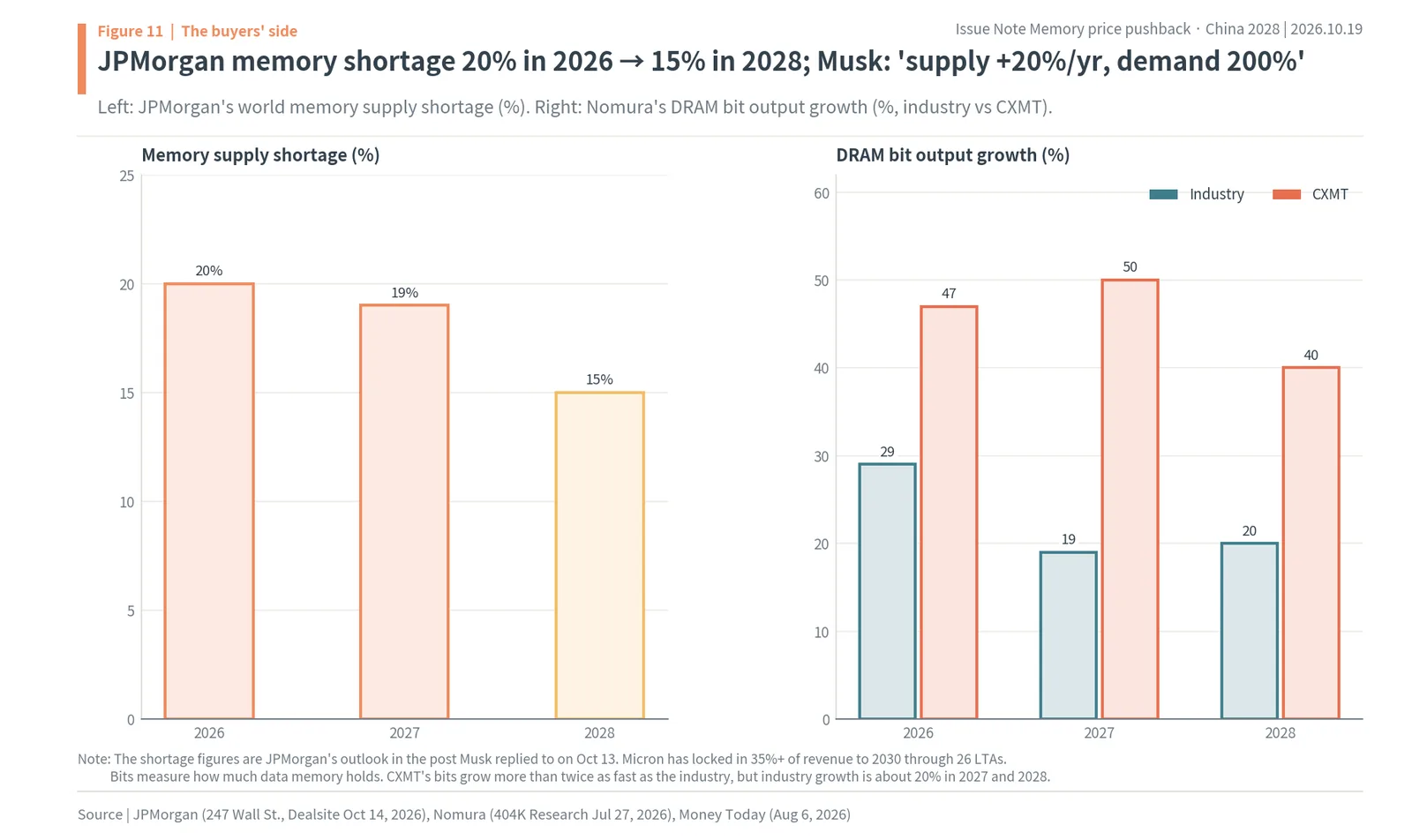
The right panel is Nomura’s DRAM bit output growth. Bits measure how much data memory holds. The industry grows 29% in 2026, 19% in 2027 and 20% in 2028; CXMT grows 47%, 50% and 40%. CXMT grows more than twice as fast, but industry-wide growth in 2027 and 2028 is around 20%, in line with Musk’s “supply 20% a year, demand 200% a year.” Micron’s management also expects DRAM bit shipments to grow in the low 20s percent in 2027 and 2028, with supply short in both years.
The conclusion of this chapter is simple. Buyers are hurting, but there is not enough supply elsewhere to buy from through 2028. The structure keeps customers from leaving.
5-1. Each buyer is different: Tesla, Apple, PCs and the cloud
Treating buyers as one group misses something. Each buys memory for different reasons and has different power to pass costs on.
Tesla and Musk’s other companies are adding memory fastest. Musk said on SpaceX’s August call that memory demand grows more than 200% a year. Self-driving computers, humanoid robots and xAI data centers all consume memory. Yet Tesla says it has secured multi-year supply from Micron. A company that already has its volume publicly complaining about price is most likely trying to lower the price in its next contract.
Apple has the most power to pass costs on to consumers. Even so, once memory reached about 34% of the iPhone 18 Pro’s parts bill, it raised prices: the Pro launched in Australia at AUD 100 more. Samsung’s Galaxy S26 went to $899 (+4.7%) for the base model and $1,099 (+10%) for the S26+ in the US, and the Korean base model rose 8.6% (TrendForce summary). Phone makers are also cutting memory configurations or changing launch plans.
PC makers are worst off. Dell raised prices 15–20% from December 2025, and Lenovo raised prices in March and again in July. Memory and storage went from 15–18% to about 35% of HP’s PC parts cost. Raise prices and sales fall; don’t, and profit disappears. Gartner’s -10.4% for PC shipments is the result. That is also why HP and Acer have started putting CXMT memory into products sold outside the US.
Cloud companies buy the most memory but haggle the least. Even as memory takes a bigger share of an AI server’s cost, falling behind in AI by deploying servers late costs more. With memory rising from 47% to 68% of cloud capex, they locked in volume first with LTAs and prepayments. BNK Securities thought AI servers could cut HBM content, but KB Securities saw no sign of reduced HBM orders and estimated suppliers are meeting only about 60% of demand (Toyo Economy, September 16).
Broken down this way, Chinese memory goes first into PCs, budget phones and devices sold in China. Cloud and AI servers, where memory makers charge the most, come last. That order is one reason profits can hold up even as the price level comes down.
6. China’s 2028: CXMT from 350,000 to 550,000 wafers a month, but 400,000 effective
What does the 2028 China that Musk mentioned look like? CXMT (ChangXin Memory Technologies) is China’s largest DRAM maker, based in Hefei. It does not disclose capacity, so all figures are broker and research estimates.
Figure 12 overlays three estimates. Nomura puts CXMT’s monthly 12-inch wafer capacity at 280,000 at the end of 2025, 350,000 at the end of 2026, about 450,000 at the end of 2027 and 550,000 at the end of 2028. SemiAnalysis has 265,000, 350,000, 420,000 and 500,000. A Korean industry estimate (Digital Today) is 500,000–600,000 in Q4 2028. These are the numbers behind the Korea Economic Daily’s description of CXMT as “among the world’s top three.”
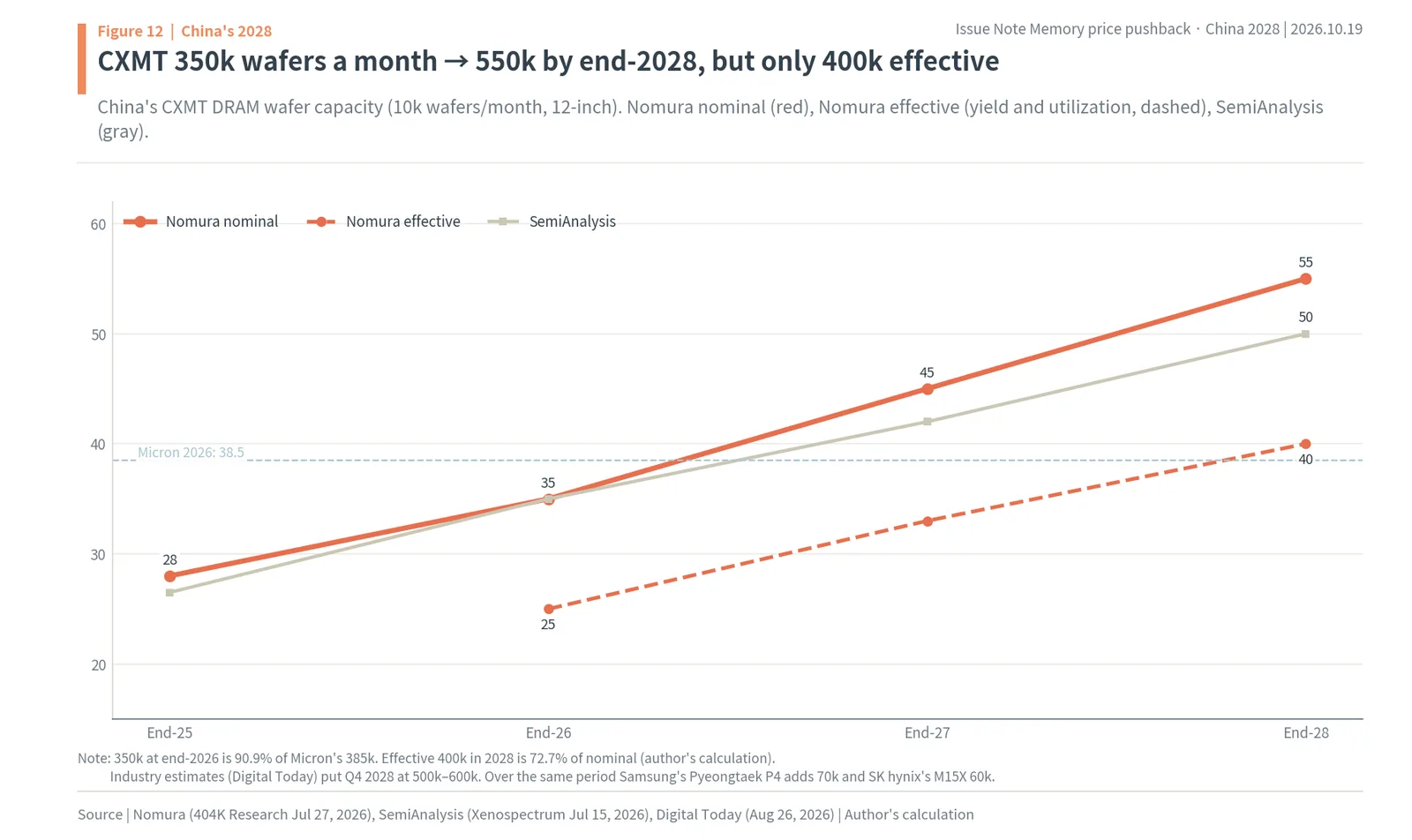
The dashed line is what matters. Nomura puts effective output after yields and utilization at about 250,000 in 2026, 330,000 in 2027 and 400,000 in 2028. Effective 400,000 in 2028 is 72.7% of nominal 550,000 (author’s calculation). Building a fab is not the same as getting usable chips out of it. The 350,000 at the end of 2026 is already 90.9% of Micron’s 385,000. Over the same period Samsung’s Pyeongtaek P4 adds 70,000 and SK hynix’s M15X adds 60,000.
How big is that globally? The left of Figure 14 is SemiAnalysis’s 2026 DRAM wafer capacity: Samsung Electronics 720,000, SK hynix 595,000, Micron 385,000 and CXMT 350,000. The four total 2.05 million wafers a month, of which CXMT is 17.1% (author’s calculation). But wafer share overstates CXMT’s real share. Nomura estimates CXMT gets a few hundred chips from a wafer while the leaders get more than 1,000. The same wafer holds different numbers of bits.
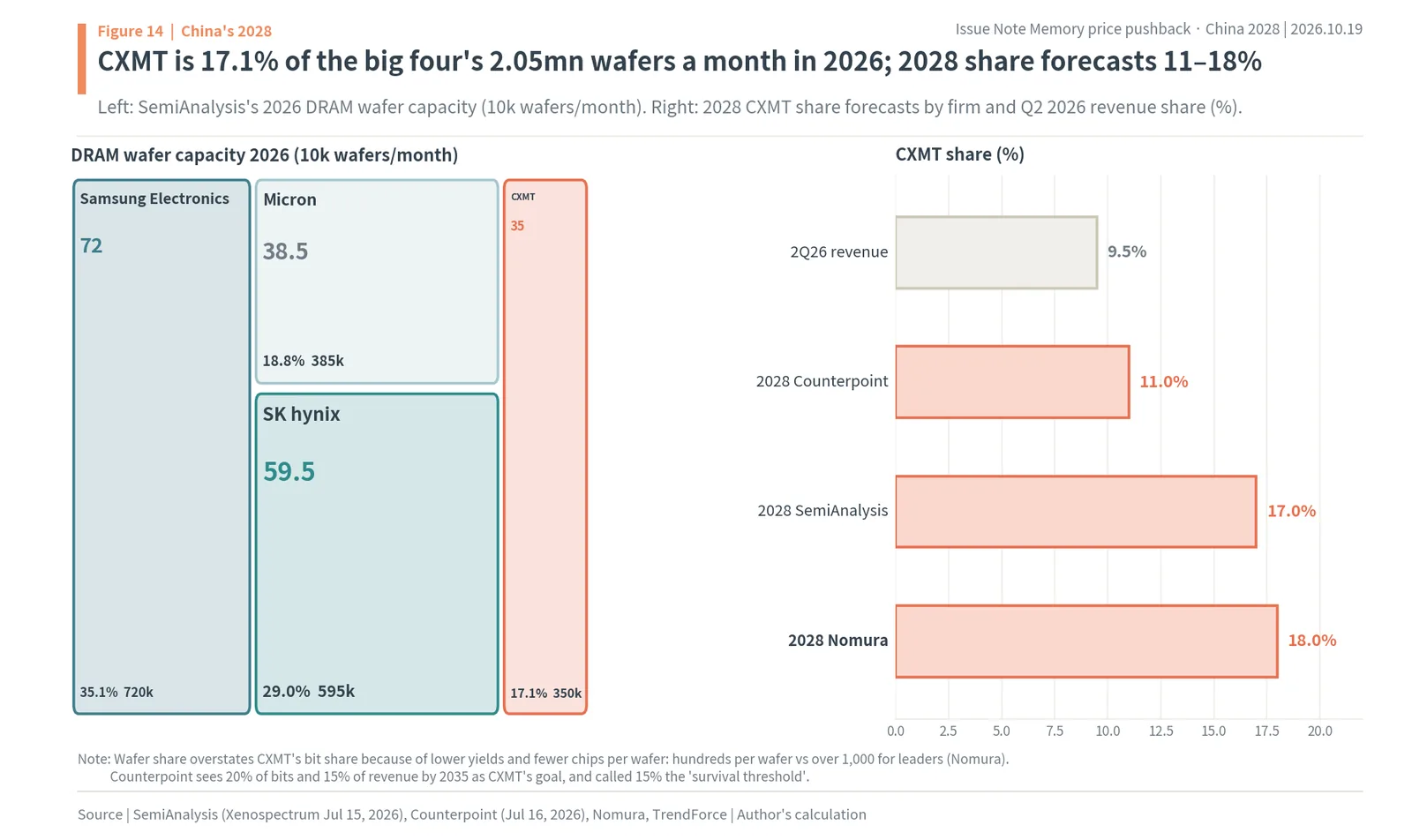
The right panel shows 2028 CXMT share forecasts. From a 9.5% revenue share in Q2 2026 (TrendForce), Counterpoint expects about 11% of bits in 2028, SemiAnalysis 17% and Nomura about 18% of bits. CXMT’s 2028 share lands somewhere between 11% and 18%. Counterpoint sees 20% of bits and 15% of revenue by 2035 as CXMT’s goal and called 15% the “survival threshold.” The picture is not of China swamping the market in 2028 but of China only just reaching that threshold.
7. What China can’t make: a 3–7 year technology gap with Samsung, and zero HBM share
What a company can make matters as much as capacity. The left of Figure 15 shows estimates of the DRAM process gap between Samsung Electronics and CXMT. An industry source quoted by the Korea Times says 3–4 years; Nomura about 5 years (CXMT is at 16–17nm and moving to 14–15nm); and Kim Dong-won, head of research at KB Securities, 5–7 years on a mass-production basis. Kim said Samsung is raising its technology around next-generation fabs and HBM, and market worries about China catching up are excessive.
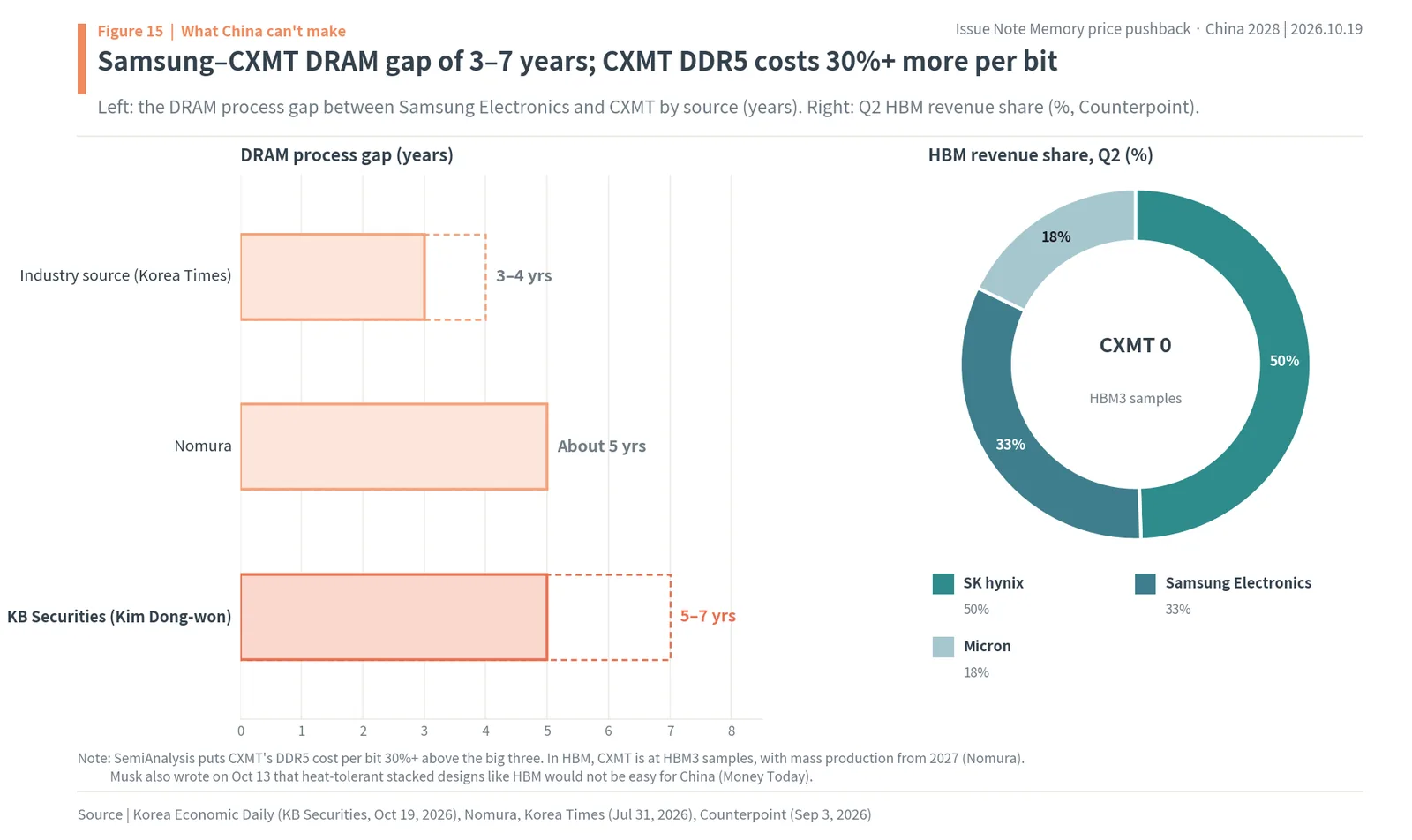
The gap shows up in cost. SemiAnalysis puts CXMT’s DDR5 cost per bit more than 30% above the big three. Since October 2022 the US has restricted exports of tools for making DRAM at 18nm and below, so CXMT has to shrink its process without the latest lithography tools. Fewer chips per wafer means each chip costs more.
The right panel is Q2 2026 HBM revenue share (Counterpoint): SK hynix 50%, Samsung Electronics 33% and Micron 18%, with Samsung gaining on Q1 (58%, 21%, 21%). CXMT is still absent. Nomura says CXMT has supplied HBM3 samples to Chinese ICT companies and expects mass production from 2027. Its IPO prospectus contained no HBM project (Tom’s Hardware). Meanwhile Samsung and SK hynix are selling HBM4 and have sampled HBM4E.
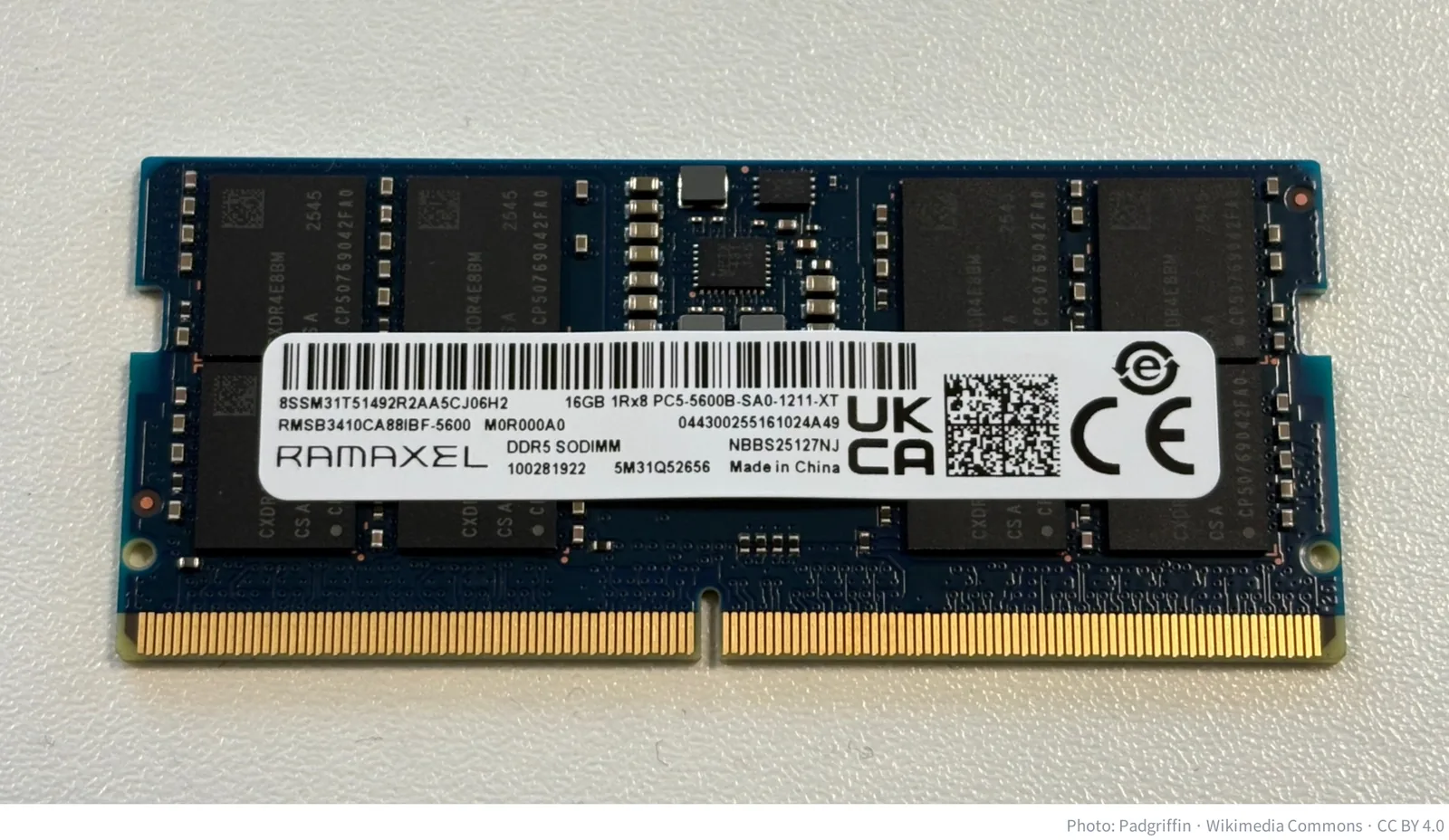
Why does this matter? Because the center of gravity of the memory price fight has moved to HBM and server memory. HBM4 for Nvidia is reported to cost in the mid-$500s per unit in 2026, more than 50% above 12-high HBM3E. Most of the rise in memory’s share of cloud capex from 47% to 68% comes from AI servers. Even if China makes plenty of conventional DRAM, HBM, the most expensive and scarcest memory, is effectively sold by three companies through 2028. The Korea Institute for Industrial Economics and Trade also expects Chinese memory to enter first in budget phones, laptops and PCs (as reported by SBS).
China is not standing still. On October 10, CXMT president Cao Kanyu presented a DRAM with a 4F² cell layout, which packs cells more densely, and said CXMT would ship server DDR5 modules on that structure by the end of 2026 (TrendForce, October 14). Cell area is about 33% smaller than the existing 6F² layout, a way to get more chips per wafer without the latest lithography. SBS reported that CXMT began mass production last month on a new process that raises chips per wafer by more than 50%. SK hynix unveiled a 4F² roadmap in 2025, and Samsung is reported to target sub-10nm 4F² production in 2028. Whether the new structure works could narrow the estimated 3–7 year gap, which is why the gauges at the end track both CXMT’s capacity and its HBM stage.
8. China sells high too: CXMT’s gross margin went from 13.0% to 84.74%
The idea that Chinese entry will halve prices misses one fact: when supply is short, even a newcomer sells near the market price. CXMT is a case in point.
The left of Figure 17 shows CXMT’s revenue and net income attributable to owners, in billions of yuan. Revenue went from CNY 9.09 billion in 2023 to CNY 24.18 billion in 2024 and CNY 61.80 billion in 2025, then CNY 150.31 billion in the first half of 2026 alone. First-half revenue was 2.43 times all of 2025 (author’s calculation). Net income moved from losses of CNY 16.34 billion in 2023 and CNY 7.15 billion in 2024 to a CNY 1.88 billion profit in 2025, and CNY 77.61 billion in the first half of 2026. The first-half figures are unaudited.
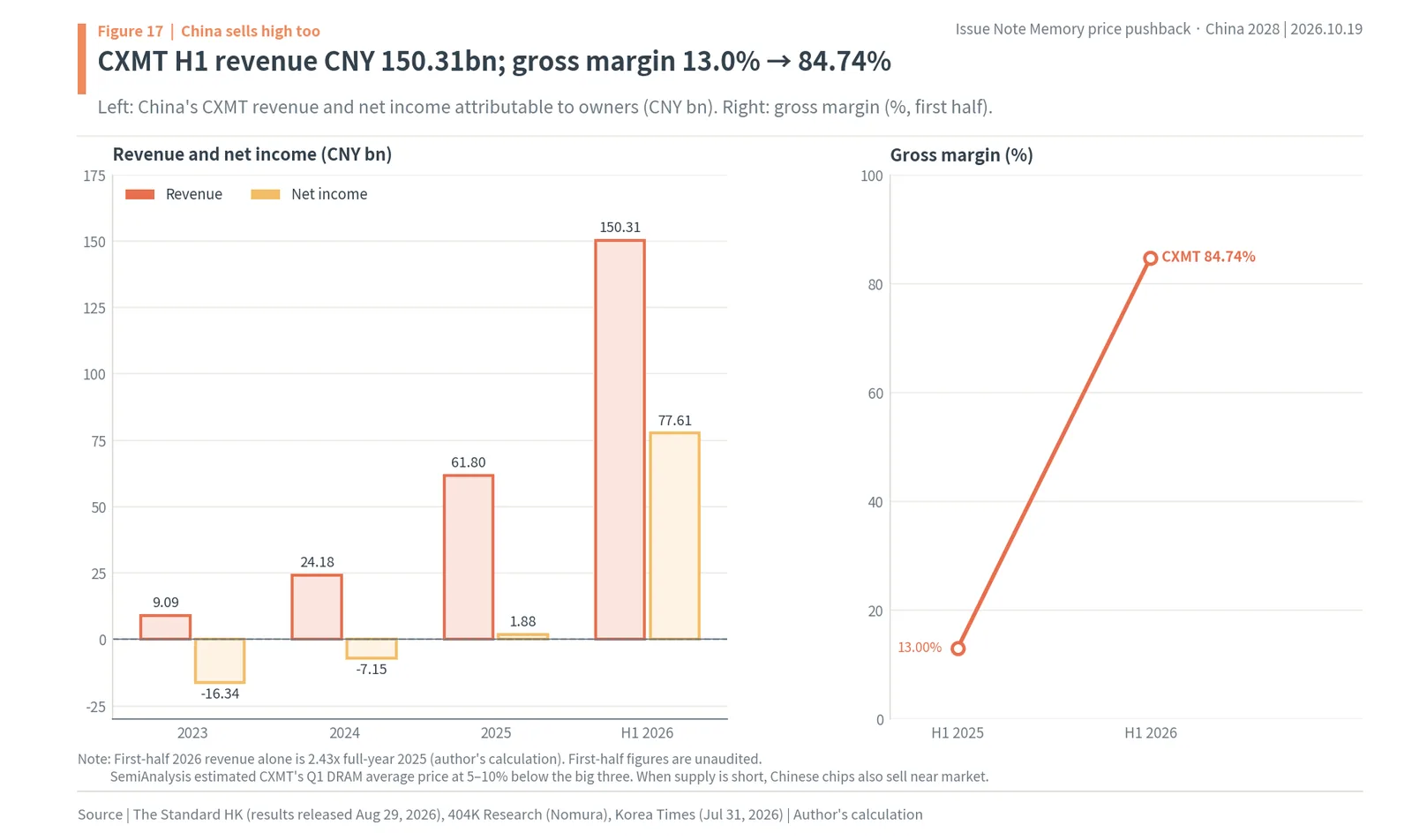
The right panel is gross margin: 13.0% in the first half of 2025 and 84.74% in the first half of 2026, level with Samsung Electronics, SK hynix and Micron. SemiAnalysis estimates CXMT’s Q1 average DRAM selling price was 5–10% below the big three. Reuters reported in July that CXMT priced a 64GB DDR5 server module above a comparable Samsung product. Chinese memory sells slightly cheaper; it does not sell by breaking prices.
The reason is simple. When supply is short, no seller has a reason to cut prices. As Jim Handy put it, memory makers do not set their prices; the market does. CXMT also listed on Shanghai’s STAR Market on July 27, raising about CNY 57.92 billion at an IPO price of CNY 8.66; its first-day opening price of CNY 49.50 was 471.6% above the offer (author’s calculation). A company that just raised that much from shareholders has to show profits. As long as a shortage remains, even with more capacity in 2028, it has every reason to sell its extra output near market prices.
9. It happened once, in 2018: after a Chinese probe, DRAM module prices fell 10.29%
This is not the first time buyers have pushed back on memory prices. In 2017, after average DRAM prices rose more than 40%, Chinese phone makers complained about parts costs, and China’s National Development and Reform Commission (NDRC) summoned Samsung officials on December 22, 2017 to voice concern about rising prices (TrendForce). On May 15, 2018, China’s State Administration for Market Regulation (SAMR) notified Micron of an antitrust investigation, and on May 31 it made unannounced visits to the Beijing, Shanghai and Shenzhen offices of Samsung, SK hynix and Micron (Micron 10-Q, CNBC).
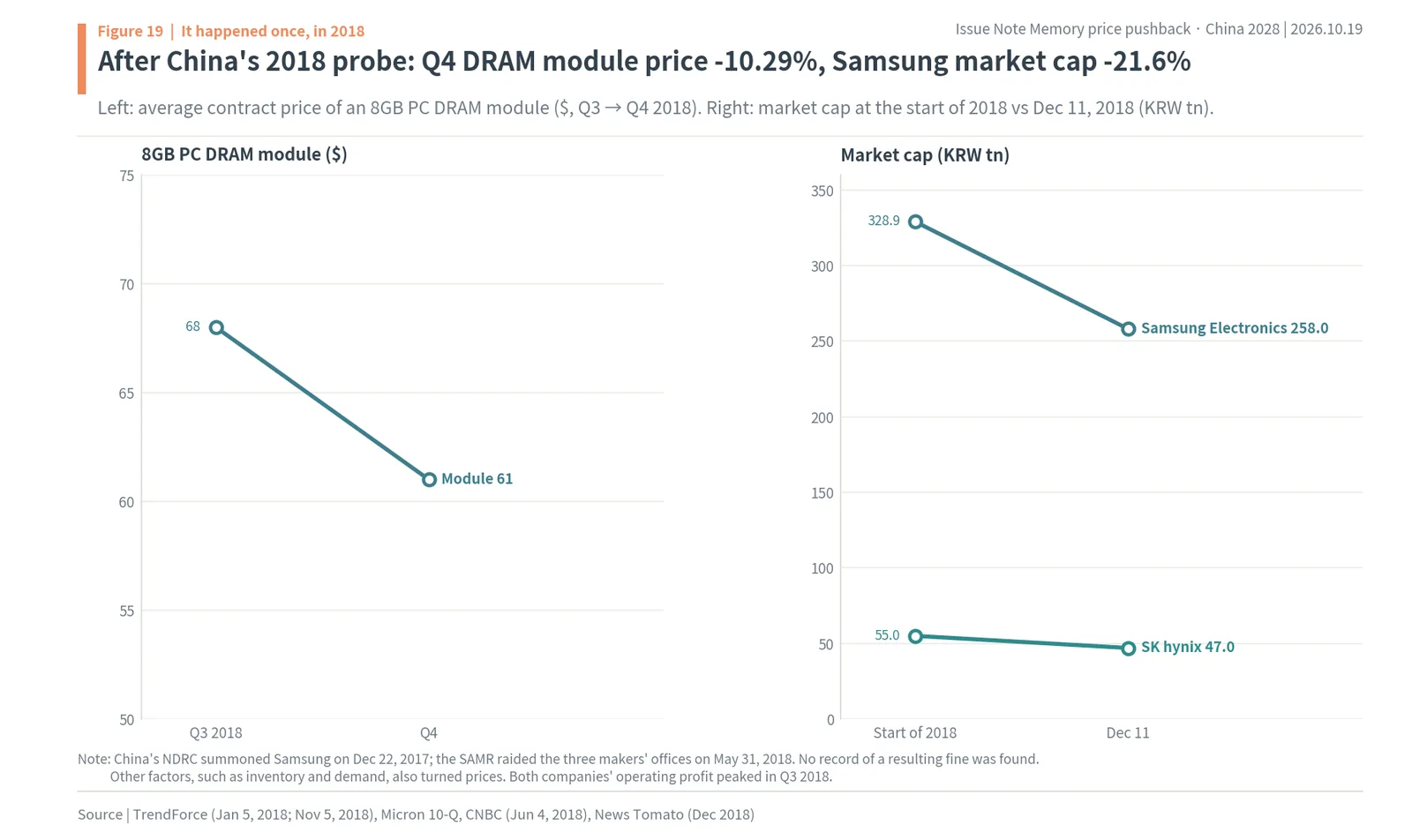
Prices then turned. TrendForce said the average contract price of an 8GB PC DRAM module fell 10.29% in Q4 2018, from $68 in Q3 to $61, ending nine straight quarters of increases. One tally has DRAM prices falling more than 50% cumulatively in 2019. Shares moved first. On December 11, 2018, Samsung Electronics’ market cap was KRW 258 trillion, down 21.6% from KRW 328.9429 trillion at the start of the year, and SK hynix’s was KRW 47 trillion, down 14.5% from KRW 55 trillion (News Tomato, author’s calculation). Both companies’ operating profits peaked in Q3 2018.
But 2018 and now differ in two ways. First, what turned prices in 2018 was inventory build-up and cooling demand, more than the regulators: no record was found of the probe ending in a fine. Second, in 2018 long-term contracts were rare and prices moved every quarter; now three- to five-year LTAs and prepayments tie prices down. SK hynix’s contracts with Microsoft and Google are reported to include prepayments of about 10–30% of the total and floor prices. The lesson of 2018 is not “buyer pressure breaks prices” but “when demand cools, prices break, and share prices break first.”
9-1. What long-term contracts changed: prices can come down, but there is a floor
The biggest difference in this cycle is contract length. Memory prices used to be reset every quarter, sometimes every month. Buyers delayed orders when they expected prices to fall, and sellers discounted when inventory piled up. So memory prices rose fast and fell even faster.
In 2026 that structure changed. TrendForce reported in April that Samsung Electronics and SK hynix had dropped one-year contracts with big tech in favor of three- to five-year LTAs only. Samsung applies terms of three years or more to all new contracts this year. Prepayments used to be no more than 5% of contract value, but SK hynix’s contracts with Microsoft and Google are reported to include prepayments of about 10–30% and floor prices. According to the JPMorgan note, Micron has locked up more than 35% of revenue through 2030 with 26 LTAs, and more than 75% of next year’s output is sold.
This means two things for pricing power. The upside is capped: TrendForce’s note that some suppliers raised Q4 prices less than the market because of LTA price bands is an example. The downside is also capped: under a contract with a floor price, prices cannot fall below that floor until the contract ends, even if Chinese memory floods in by 2028. That is why Micron’s management said margins at floor prices would be far above any earlier cycle’s peak.
Seen through this structure, Musk’s words become clear. Micron allocated multi-year supply to Tesla on reasonable terms, and Musk praised it. To the others he said customers “won’t forget.” That is notice that he will push for lower prices in the next LTA negotiation. Public statements are leverage used outside the negotiating table. If customers cannot leave when you raise prices, that is pricing power; what customers can do is pretend to leave.
The tug-of-war already played out in public over the summer. In June, when Tim Cook (then Apple CEO) said price increases were unavoidable, Micron’s side shot back that some customers had squeezed prices during the downturn, cutting industry investment and causing today’s shortage (Money Today, June 29). In the US, 14 consumers and three PC companies filed a price-fixing class action against Samsung, SK hynix and Micron (Korea Economic Daily, June 29). Buyers are pulling three levers in turn: words, lawsuits and China.
9-2. Memory’s history: prices have collapsed before, but the trigger was always demand
Memory prices have collapsed before. The most recent case is 2022–2023. TrendForce counted average DRAM prices falling 18–23% quarter on quarter in Q4 2022, with server DDR4 down 23–28% and DDR5 down 30–35%. Industry DRAM revenue fell 32.5% in Q4 2022 from Q3. On April 7, 2023, Samsung Electronics reported preliminary Q1 operating profit of KRW 600 billion and formally cut memory output. DDR4 8Gb contract prices were then around $1.8, less than half the peak of about $4 a year earlier (KED Global). PC and phone inventory built up during Covid and rising interest rates crushed demand at once.
Further back, memory was an industry where companies disappeared. Intel left DRAM in 1985, unable to withstand Japanese price competition. Samsung was more than four years behind Japan when it made 64Kb DRAM but became the world’s No. 1 DRAM maker in 1992. Germany’s Qimonda went bankrupt in 2009, and Japan’s Elpida filed for bankruptcy in February 2012 with ¥448 billion of debt. Elpida’s market share in Q4 2011 was 15.4% (DRAMeXchange): a company with about 15% share went under. That history is why Counterpoint picked 15% as CXMT’s “survival threshold.”
Two lessons follow. First, when memory prices collapse, the trigger has always been demand: data center inventory in 2018–2019, Covid inventory and interest rates in 2022–2023. The only case of a new entrant collapsing prices is Japan in the 1980s, and Japanese companies then led in technology too. CXMT today is 3–7 years behind. Second, when prices do collapse, low-margin companies fall first. CXMT’s DDR5 cost per bit being more than 30% above the big three means that if prices ever truly collapse, China would be the first to hurt.
9-3. The US factor: there are few places Chinese memory can go
However much Chinese memory grows, its effect on prices is limited if there are few places to use it. In October 2022 the US required licenses for exporting tools and technology for 18nm-and-below DRAM to China, and in December 2024 it imposed country-wide controls on HBM. CXMT was left off the Entity List then, but it is on the Defense Department’s Chinese military companies list (1260H), and a ban on federal agencies buying products containing CXMT parts is due to take effect in December 2027. In July 2026 the House Select Committee on China urged adding CXMT to the Entity List, and senators asked Apple to commit to not using CXMT or YMTC parts.
So for US big tech, Chinese memory can go mainly into devices sold in China. Reports that Apple chairman Tim Cook proposed using Chinese memory only in devices for the Chinese market fit this. HP and Acer have put CXMT memory into products sold outside the US. China accounts for about 25% of world DRAM consumption and is about 30% self-sufficient (Nomura). Chinese memory will first fill demand inside China, which could cut the big three’s China sales. But server memory for US AI data centers, the most expensive and scarcest segment, is likely to remain the big three’s market in 2028.
9-4. HBM: the real price fight is over 2027 contracts
There is a reason Musk and Apple are speaking up now: negotiations over 2027 volumes and prices are under way. According to early-October reports, Samsung Electronics is in the final stage of 2027 HBM4 price talks with Nvidia and Broadcom and wants more than double the current price. KB Securities expects Samsung’s HBM prices to more than double next year, and TrendForce expects average HBM prices to rise 121% in 2027. HBM4 already costs more than 50% above 12-high HBM3E in 2026. The more wafers go to HBM, the fewer are left for conventional DRAM. Samsung vice president Kim Tae-woo said HBM uses about 20% of industry DRAM wafer capacity and will use about 30% in 2027 (TrendForce, September 29).
Here the buyers’ logic shows. Tesla, xAI and Apple are not big direct buyers of HBM. They buy server DDR5, phone LPDDR and memory for self-driving computers, products closer to conventional DRAM. As memory makers shifted wafers to HBM, these products became scarce and expensive. Buyers raise China because China happens to be able to make these products. Musk himself wrote that HBM is hard for China while still talking about “China in 2028,” which suggests he understands the distinction.
So the 2028 picture splits in two. In HBM and server memory, the three companies keep their pricing power; in conventional and budget mobile DRAM, Chinese memory comes in and the price level comes down. Of the two Korean companies, SK hynix, with its larger HBM share, is less directly exposed to China, and Samsung Electronics, with more conventional DRAM, more exposed. Samsung is narrowing the difference, though, lifting its HBM share from 21% in Q1 to 33% in Q2.
10. The case for and against: “China will collapse prices” vs “it’s just negotiating pressure”
Here are both sides with their evidence.
China will collapse prices in 2028
First, in industries it commits to, China has built output larger than the rest of the world combined; Musk’s October 13 examples were lithium batteries and solar. Second, CXMT’s bit output grows 40–50% a year in 2026–2028, more than twice the industry’s 19–29% (Nomura). Third, 2028 is the year Samsung’s Pyeongtaek P4, SK hynix’s M15X and Yongin fab 1, and Micron’s Idaho and Hiroshima fabs all start running. TrendForce sees new capacity growing meaningfully from the second half of 2027 and contributing fully in 2028. Fourth, Counterpoint says DRAM prices in 2028 could be about 23% below 2027. Fifth, in 2024–2025 CXMT sold DDR4 at half price, and the big three considered ending DDR4 (Tom’s Hardware), evidence that China can push down prices in commodity products.
It’s just negotiating pressure
First, a 15% shortage remains in 2028 (JPMorgan), and Micron also expects shortages in both 2027 and 2028. Second, CXMT cannot make HBM, has a 3–7 year process gap, and its DDR5 costs more than 30% more per bit. Third, CXMT also sells near market prices, with an 84.74% gross margin. Fourth, the US government opposes Apple buying Chinese memory, and a federal procurement ban is due from December 2027, so US big tech can use Chinese memory mainly in devices sold in China. Fifth, Samsung Electronics and SK hynix have already locked in prices and volumes with three- to five-year LTAs and prepayments. Musk’s “won’t forget” is aimed at the next LTA negotiation.
Where they really differ
The two sides really differ on one point: not whether prices “come down” in 2028 but whether they “collapse.” Neither side disputes much that prices will come down in 2028. The question is whether the decline turns a 75% margin into 25% or into 60%. As the hypothetical example showed, a high-margin company loses 40% of profit when prices fall 30%, but does not go into the red.
11. The author’s view: Musk is negotiating, and China in 2028 only lowers the price level
The author sees Musk’s comments as pressure in long-term contract negotiations, and thinks China’s expansion to 2028 is unlikely to break the pricing power of Samsung Electronics and SK hynix. Figure 20 reduces the evidence to one number.
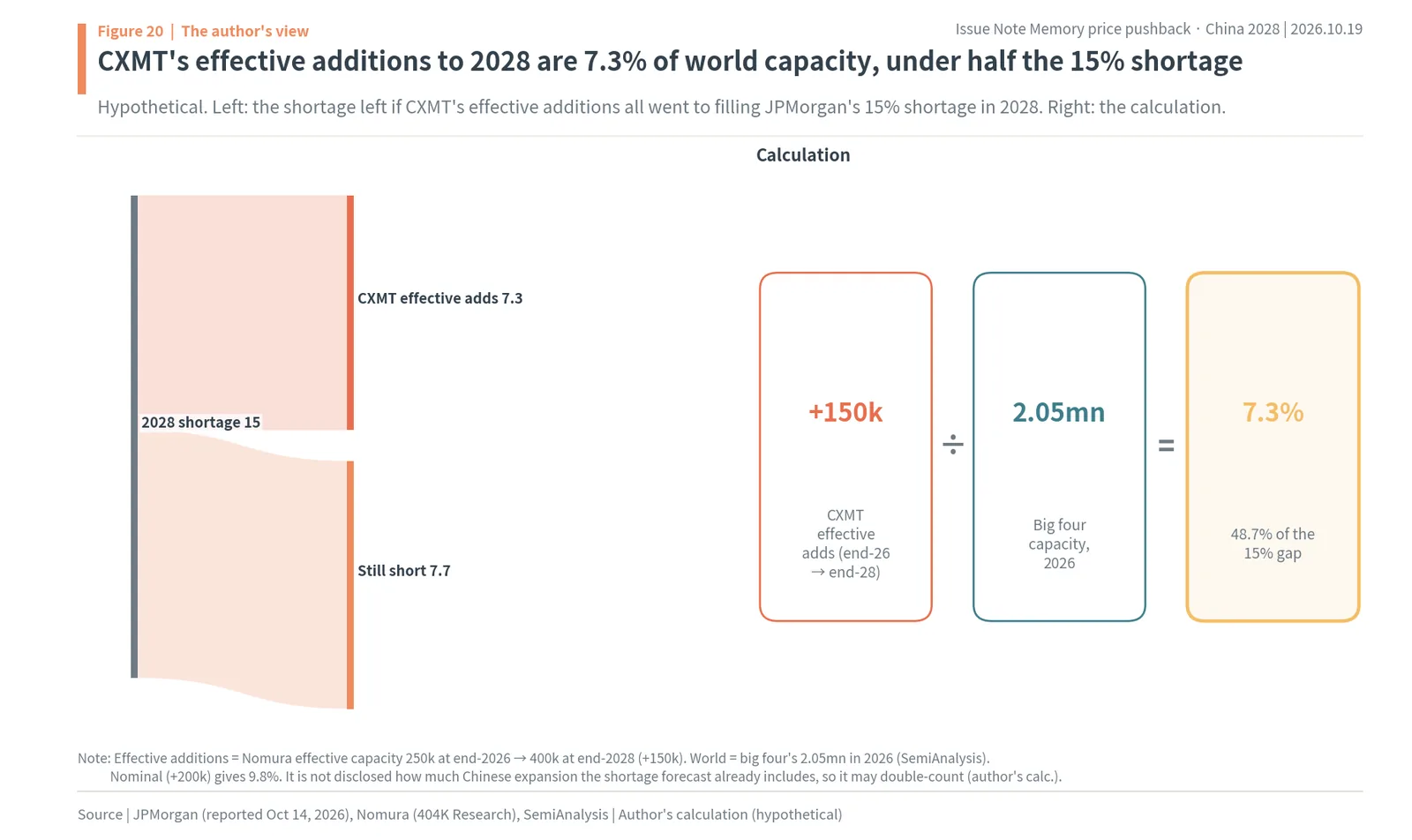
CXMT’s effective output rises by 150,000 wafers a month from the end of 2026 to the end of 2028 (Nomura, 250,000 to 400,000). Divided by the big four’s 2026 capacity of 2.05 million, that is 7.3%. Against a 15% shortage in 2028, it is 48.7%: even counting all Chinese additions as new supply, they fill less than half the gap and leave 7.7% (author’s calculation, hypothetical). Counting nominal additions (+200,000) gives 9.8%. The calculation has limits. It is not disclosed how much Chinese expansion JPMorgan’s shortage estimate already includes, so it may double-count, and capacity and demand are not measured in exactly the same units. Still, the size is clear: Chinese expansion reduces the shortage but does not end it.
Product and price come on top of that. What China adds is conventional DRAM, and even there it sells only 5–10% below the market. HBM, the most expensive memory, is sold by three companies through 2028. So what changes in 2028 is the price level. Even if prices fall about 23% from 2027, as Counterpoint expects, they would still be about 230% above 2025. Pricing power does not mean prices rise forever; it means keeping customers and protecting profits even as prices come down. The two companies are defending it with LTA floor prices and HBM.
The conditions under which this view would be wrong are also clear. There are three ways the evidence above could break: AI investment turns down and shortage forecasts drop below zero; CXMT succeeds with HBM mass production and customer qualification in 2027; or the US stops blocking Chinese memory and companies like Apple start using it in products worldwide. These three are tracked separately in the gauges in chapter 12.
One line on policy. Korean President Lee Jae-myung said of the October 19 market slide that “everything will return to its place.” The author thinks the government’s job in the memory price fight is less to soothe the market than to negotiate so that US export controls on China and allied procurement rules do not turn against Korean memory. US rules that block Chinese memory are currently one of the pillars holding up Korean memory’s pricing power.
12. Stocks and dates: from their peaks, SK hynix -56.3% and Samsung Electronics -39.9%
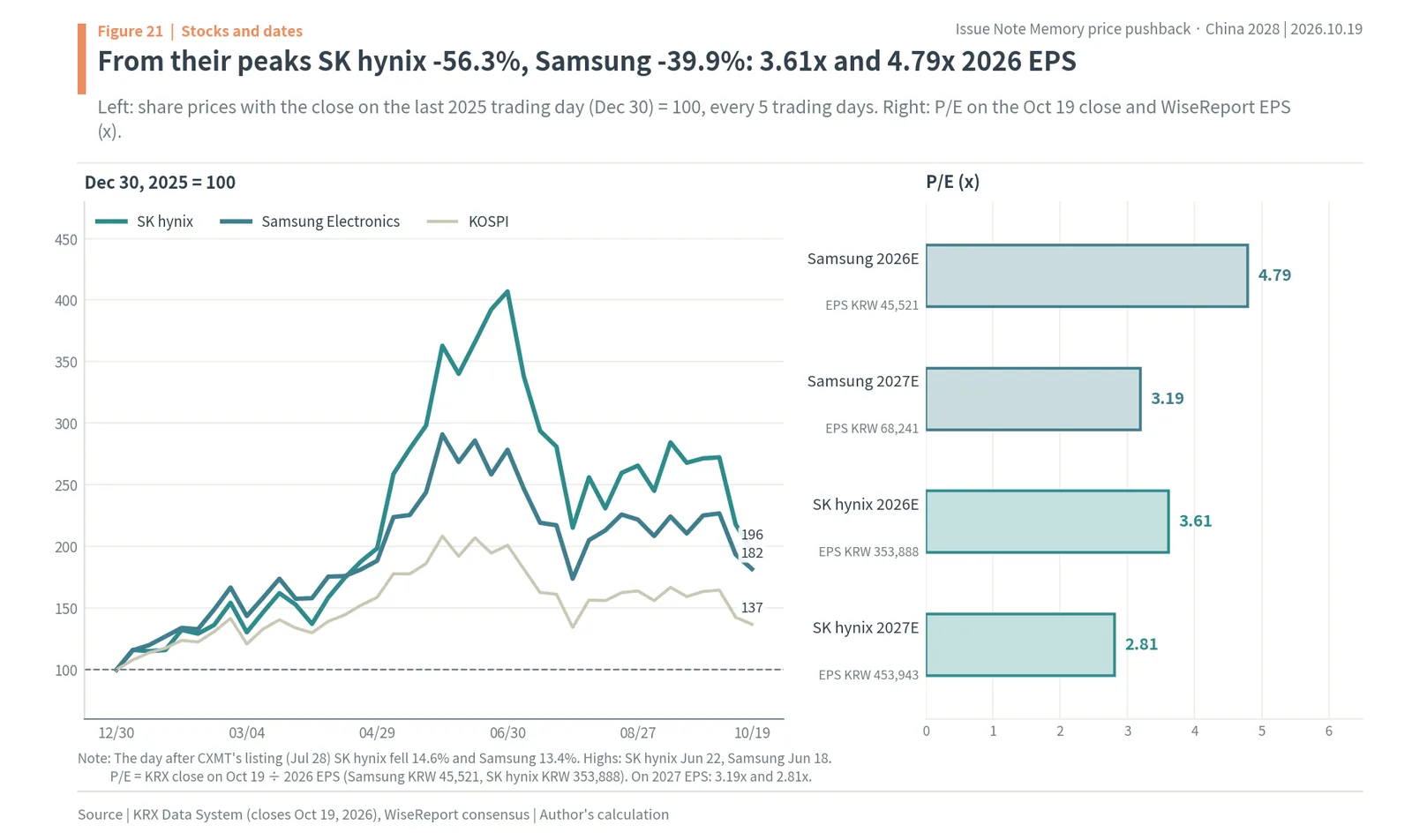
Share prices already carry a lot of worry. The left of Figure 21 indexes share prices to the close on December 30, 2025, the last trading day of 2025. SK hynix (000660.KS) peaked at KRW 2,919,000 (about $2,195) on June 22 and closed at KRW 1,277,000 (about $960.34) on October 19, down 56.3%. Samsung Electronics (005930.KS) fell 39.9% from KRW 362,500 (about $272.6) on June 18 to KRW 218,000 (about $163.94). Year to date they are still up: SK hynix +96.2%, Samsung Electronics +81.8%, KOSPI +36.9% (196, 182 and 137 on the index at the October 19 close). The day after CXMT listed (July 28), SK hynix fell 14.6% and Samsung Electronics 13.4%. This is not the first China scare.
The right panel shows P/E on WiseReport consensus EPS. Dividing the October 19 close by 2026 EPS (Samsung KRW 45,521, about $34.2; SK hynix KRW 353,888, about $266.1) gives 4.79 times for Samsung Electronics and 3.61 times for SK hynix; on 2027 EPS (KRW 68,241 and KRW 453,943) it is 3.19 times and 2.81 times (author’s calculation). The market assumes today’s profits will not last. These low P/Es are also the market’s answer to this report’s question of whether prices collapse in 2028. If, as the author thinks, prices only come down rather than collapse, today’s share prices under-reflect that difference.
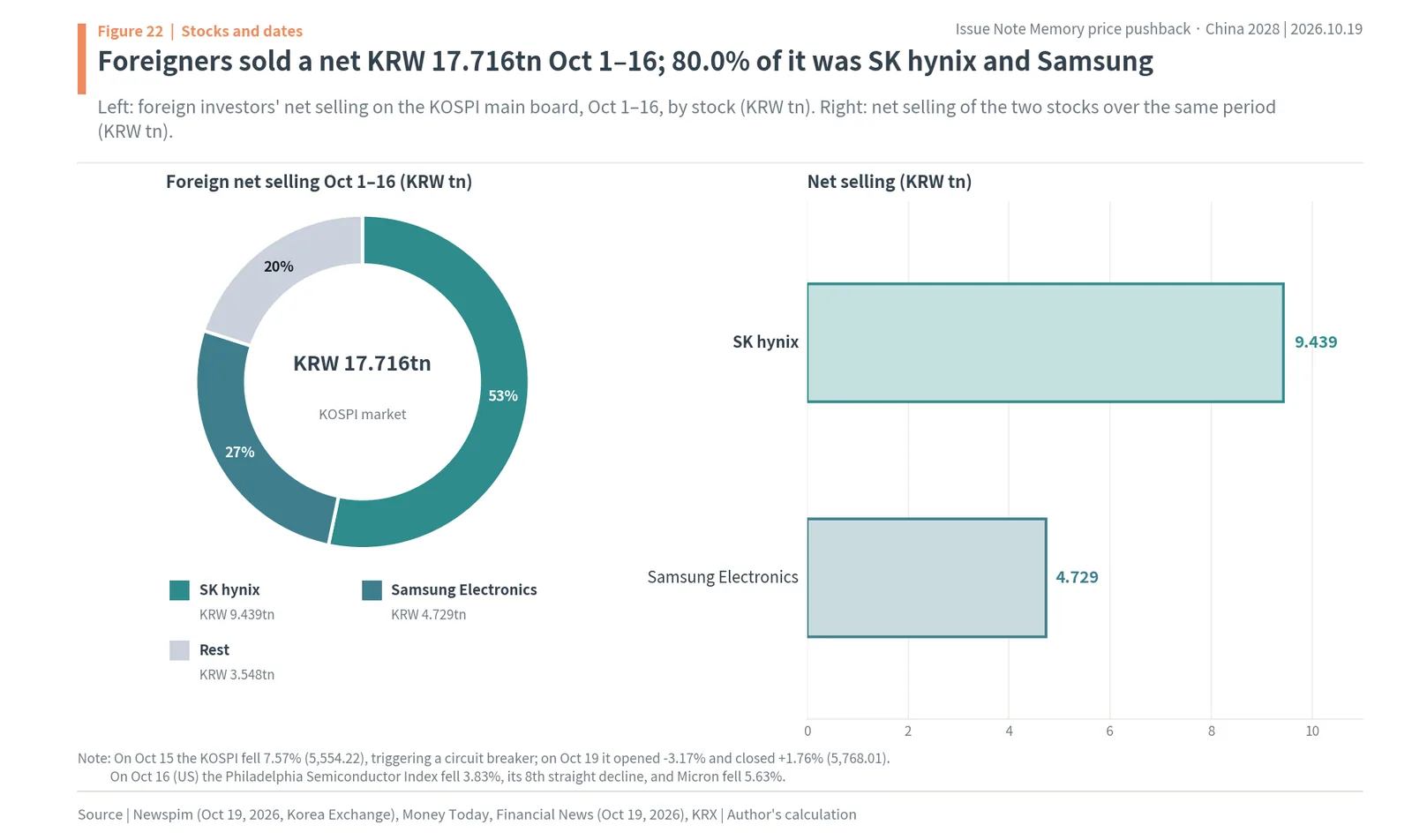
Flows point the same way. Korea publishes daily trading by investor type, and from October 1 to 16 foreign investors sold a net KRW 17.716 trillion (about $13.3 billion) on the KOSPI main board, of which SK hynix was KRW 9.4391 trillion (about $7.1 billion) and Samsung Electronics KRW 4.7286 trillion (about $3.56 billion), 80.0% between them (Newspim, author’s calculation). On October 15 the KOSPI fell 7.57% to 5,554.22, triggering a circuit breaker; on October 19 it opened down 3.17% and closed up 1.76% at 5,768.01. In the US, the Philadelphia Semiconductor Index fell 3.83% on October 16, its eighth straight decline, and Micron fell 5.63%.
Compared with Micron, which Musk praised, the two Korean companies have been punished more. According to a CNBC report cited by Digital Today, over the five trading days to October 15 SK hynix fell 26% and Samsung Electronics 22%, while Micron fell about 11%. Micron’s share price of $953.19 on October 13 is below its high of $1,255, but its market cap is $1.08 trillion (247 Wall St.). They sell the same memory with similar margins, but the remark about falling out of favor with buyers, and Korea’s position as “the country closest to China,” cut the Korean pair’s valuations more. The author sees this as a difference in narrative rather than results, and narrative gaps can narrow once long-term contract figures come out in earnings reports.
Here is how the issue reaches each stock. Samsung Electronics is No. 1 in DRAM revenue and has a large conventional DRAM share, so it is most exposed to Chinese expansion, but it raised its HBM share from 21% in Q1 to 33% in Q2 and is negotiating 2027 HBM4 prices. SK hynix is No. 1 in HBM (50% in Q2), so China’s direct impact is small, but its profit relative to market cap is the most sensitive to memory prices. SK Square, which owns about 20% of SK hynix, tracks SK hynix shares. Equipment makers (Hanmi Semiconductor, Wonik IPS, Jusung Engineering, PSK and others) are more sensitive to the pace of expansion than to prices, so they would be affected if falling prices led memory makers to slow investment. That link is the author’s inference and was not confirmed against October broker views. On the other side, memory buyers (PC and phone makers) get relief on costs when prices come down.
Eight signals the author watches
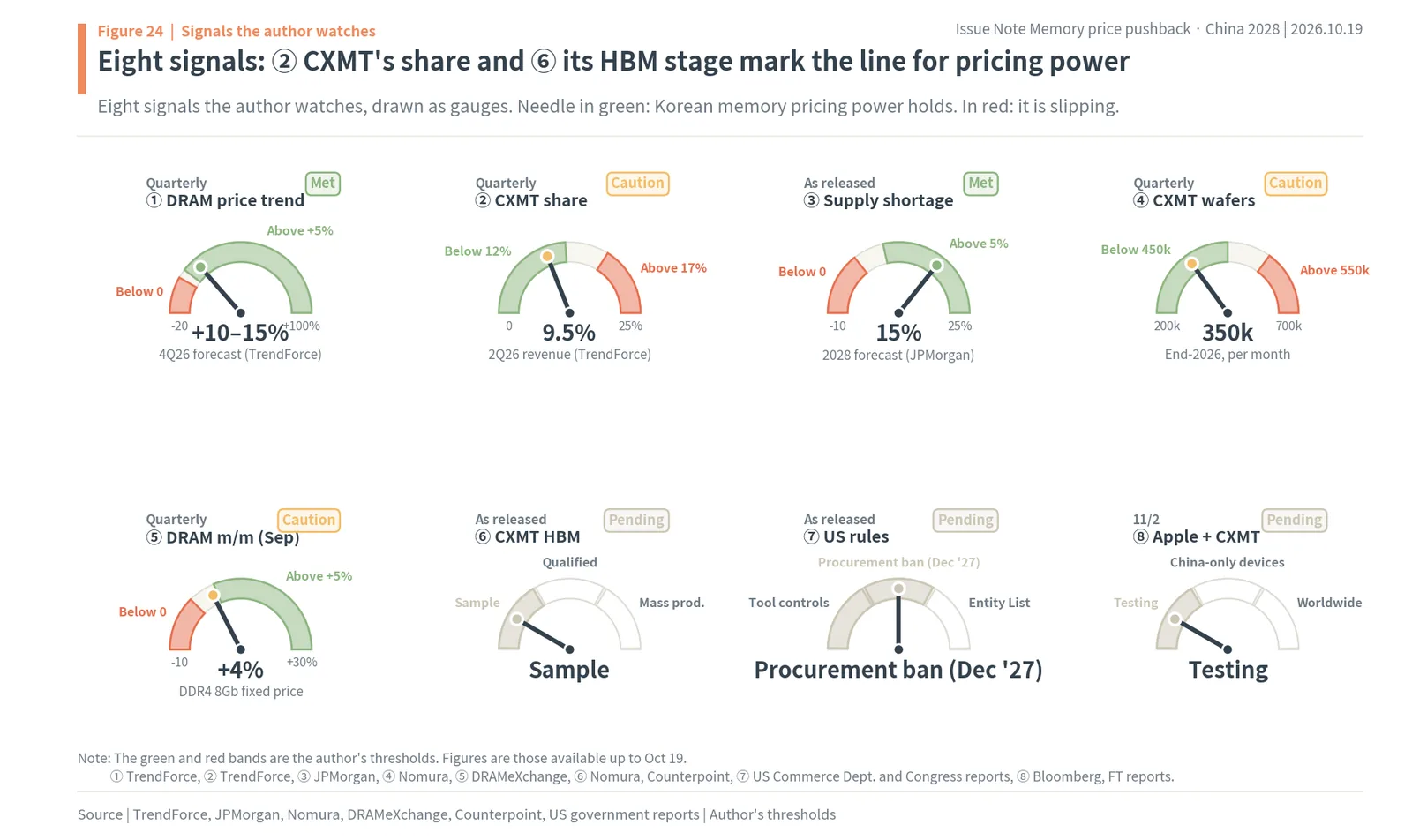
Figure 24 draws the signals as gauges. ① Conventional DRAM contract price growth (Q4 forecast +10–15%) is still rising. ② CXMT’s DRAM revenue share (9.5% in Q2) is a caution above 12% and a warning above 17% on the author’s thresholds. ③ If a forecast shows the supply shortage (15% in 2028) falling below zero, the first pillar of the author’s view breaks. ④ Watch whether CXMT capacity (350,000 at the end of 2026) passes 550,000 early. ⑤ Monthly DRAM growth slowed to +4% in September. ⑥ CXMT’s HBM is at the sample stage; whether it moves to qualification and mass production is the line for pricing power. ⑦ US rules go beyond tool controls, with a federal procurement ban due in December 2027. ⑧ Watch whether Apple widens Chinese memory from China-only devices to products worldwide.
Dates to check
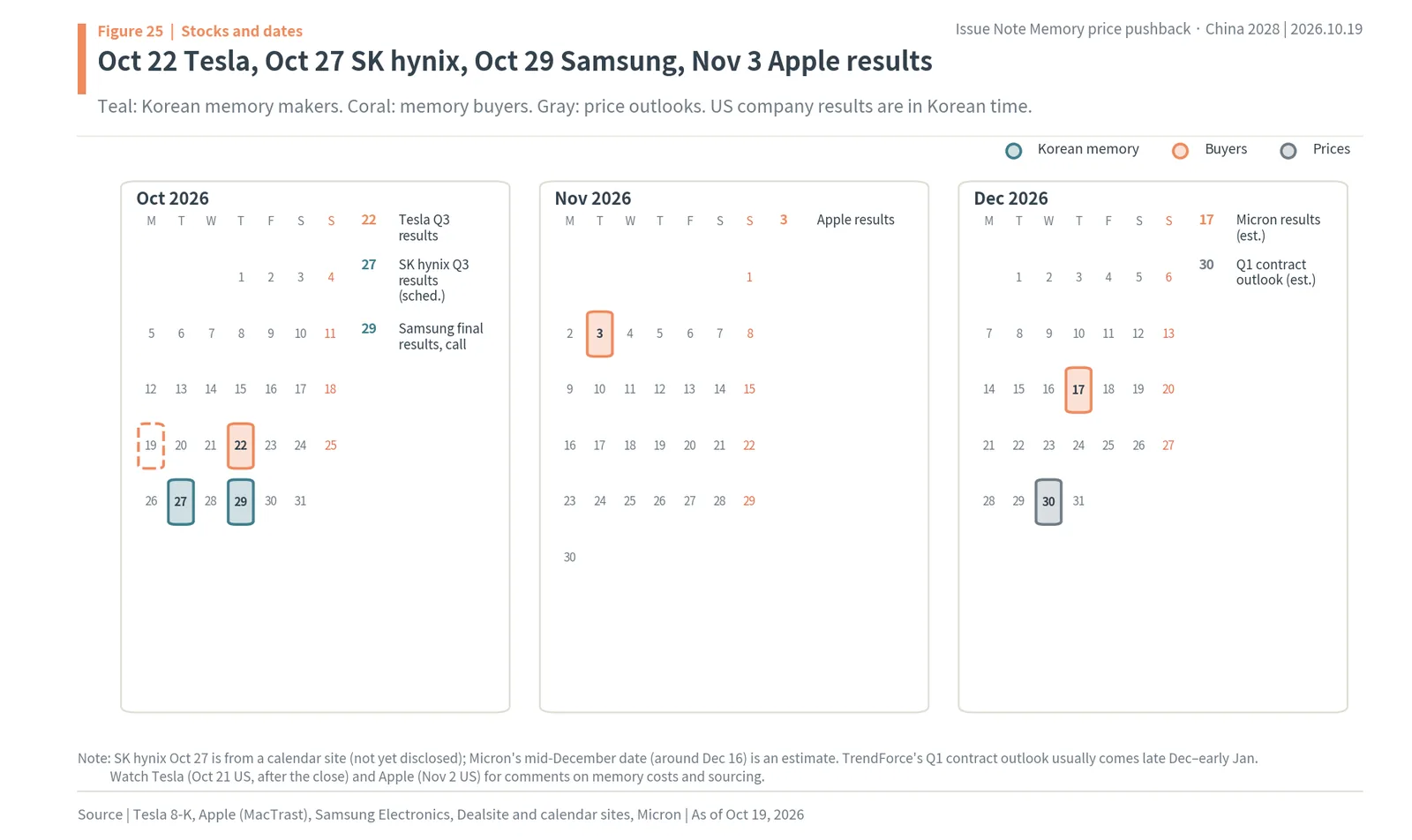
The first check is Tesla’s Q3 results on October 21 (US time; October 22 morning in Korea), and how Musk talks about memory costs and sourcing. SK hynix’s Q3 results on October 27 (scheduled; operating profit consensus KRW 77.2 trillion, about $58.1 billion) and Samsung Electronics’ final results and conference call on October 29 may explain LTA share and 2027 pricing. Apple’s results on November 2 (US time; November 3 morning in Korea) are Ternus’s first as CEO and the place to ask about memory costs and Chinese sourcing. Then come Micron’s results in mid-December (around December 16, an estimate) and TrendForce’s Q1 2027 contract price outlook in late December or early January.
12-1. Three numbers for investors: conventional DRAM share, floor prices and HBM share
In investor terms, what matters is less whether China comes in 2028 than where the two companies stand when it does. Three numbers show that.
The first is the share of conventional DRAM. That is where Chinese expansion lands. Watch how far the companies break down bit shipments and prices by server, mobile and PC on their earnings calls, and for how many quarters in a row conventional DRAM prices keep rising. DDR4 8Gb fixed contract prices rose 4% in September. The month that number turns negative is when the price level starts coming down.
The second is the floor price in long-term contracts. The two companies do not disclose LTA prices, but on earnings calls they sometimes give the number of LTA customers (about ten for SK hynix), contract length, prepayment size and how much of 2027–2028 volume is already committed. If a Korean company produces a number like Micron’s “75% of next year’s output is sold,” investors can judge where the earnings floor sits even if 2028 prices come down.
The third is HBM’s share. HBM is a market China effectively cannot enter before 2028. The bigger HBM’s share of the two companies’ DRAM revenue, the smaller the shock from Chinese expansion. If the October 27 SK hynix and October 29 Samsung Electronics results show whether 2027 HBM volume talks are finished and how much HBM4 prices rose, the third number gets filled in.
If all three come out well, today’s P/E of 3–5 times weighs the 2028 price decline too heavily. If conventional DRAM prices turn down, LTA volumes prove smaller than expected and HBM talks drag on, the market’s worry starts to look right. The author leans toward the first case but will keep revising the view with these three numbers. In the end the question is the same as at the start. If customers cannot leave when you raise prices, that is pricing power. Whether customers have somewhere to go in 2028, and whether that place can supply the same product at the same price, will decide the next two years for these two stocks.
These three numbers are not a one-time check. Each quarter, fill the same boxes with the new results and note which way they moved from the last quarter. The answer will show up in these boxes before 2028 arrives, and the author plans to refill them each earnings season and revise this view.
13. Basis of calculation: where the numbers come from and what was left out
This chapter sets out the assumptions behind the author’s calculations.
Memory prices
DRAM prices are DRAMeXchange’s monthly average fixed contract price for PC DDR4 8Gb (1Gx8), collected from month-end Korean press reports (Newsis, Kookmin Ilbo, Financial News, eToday, BusinessPost, TheElec, SBS Biz). The February 2026 price ($13) was not reported, so the March price of $13, backed out from April’s $16 and its 23.08% rise, is also used for February. The 15.8 times is September’s $26 divided by April 2025’s $1.65. TrendForce quarterly changes use the midpoint of each range (e.g., +93–98% is 95.5%), and some earlier quarters are forecasts made at the time, not actuals. The 6.01 times compounds the midpoints of the five quarters from 3Q25 to 3Q26.
Hypothetical example and sensitivity
The hypothetical example assumes revenue of 100 with fixed costs. In reality volume may rise when prices fall, and while costs like depreciation are fixed, materials vary with volume. The SK hynix sensitivity (10% price cut → operating profit -13.0%) is a simple calculation subtracting 10% of revenue (KRW 34.1 trillion) from operating profit, using WiseReport 2026 consensus revenue of KRW 341.497 trillion and operating profit of KRW 262.569 trillion.
Chinese capacity and the gap calculation
CXMT does not disclose capacity, so Nomura (summarized by 404K Research, July 27, 2026) and SemiAnalysis (summarized by Xenospectrum, July 15) estimates are used as given. The effective addition of 150,000 is the difference in Nomura’s yield- and utilization-adjusted figures (about 250,000 in 2026 to 400,000 in 2028). The world figure of 2.05 million is SemiAnalysis’s 2026 total for four companies (Samsung 720,000, SK hynix 595,000, Micron 385,000, CXMT 350,000), excluding smaller makers such as Nanya and Winbond. Comparing 7.3% with a 15% shortage treats a capacity ratio and a demand-shortfall ratio as the same unit. Bits per wafer differ by company, and the shortage forecast may already include Chinese expansion, so the figure is only for gauging size.
Share prices and P/E
Share prices and indexes are KRX Data System closing prices (adjusted for corporate actions), with peaks based on 2026 closes. P/E divides the October 19 close by WiseReport consensus EPS (downloaded October 19). The moves the day after CXMT’s listing use KRX closes on July 27 and 28 (SK hynix KRW 1,816,000 to KRW 1,550,000; Samsung Electronics KRW 254,000 to KRW 220,000). The 80.0% share of foreign net selling is the two-stock total in the Newspim report (KRW 14.1677 trillion) divided by the total (KRW 17.716 trillion).
The 2018 case
2018 market caps are from a News Tomato report as of December 11, not year-end changes. Exact 2018 high and low prices for DDR4 8Gb could not be sourced and are not used.
FX and units
Won is converted to dollars at Yahoo Finance’s October 19 USD/KRW close of KRW 1,329.74. At that rate, Samsung Electronics’ close of KRW 218,000 is about $163.94 and SK hynix’s KRW 1,277,000 about $960.34. CXMT results are left in yuan as reported (in the Korean edition they are in units of CNY 100 million; here they are converted to CNY billion). Wafer capacity is counted in 12-inch (300mm) wafer starts per month. Market shares mix revenue and bit bases, and the basis is stated in the text.
Conclusion
Buffett said a good business can raise prices without losing customers. When Musk and Apple talk of “extortionate” prices and “absolutely a crisis” and raise China in 2028, they are signaling that customers could leave. But memory is still 15% short in 2028; China’s effective additions are 7.3% of world capacity, less than half of that shortage; China cannot make HBM; and even in conventional DRAM it sells near market prices with an 84.74% gross margin. The author’s view is that what comes down in 2028 is the level of memory prices, and that nothing collapses. Shareholders should watch the two companies’ conventional DRAM share, long-term contract floor prices and HBM share, more than whether China is coming.
Memory prices, China and Korean chipmakers: quick answers
Q. What did Elon Musk say about memory prices?
On October 13, 2026, replying to a post of JPMorgan’s memory outlook, Musk wrote that Micron had been reasonable on future memory prices while others had been ‘extortionate, which is something today’s customers won’t forget.’ He named no company. On October 15 he said China would make an enormous amount of memory in 2028.
Q. How much have DRAM prices risen?
The DRAMeXchange fixed contract price of PC DRAM DDR4 8Gb went from $1.65 in April 2025 to $26 in September 2026, 15.8 times, though September’s rise was only 4%. TrendForce expects conventional DRAM contract prices to rise 10-15% in Q4 2026, after 93-98% in Q1.
Q. Can China’s CXMT break Samsung and SK hynix pricing power by 2028?
The author thinks not. Nomura sees CXMT’s effective capacity rising by 150,000 wafers a month by end-2028, 7.3% of the big four’s 2026 capacity and less than half of JPMorgan’s 15% shortage for 2028. CXMT has no HBM share and sold DRAM at an 84.74% gross margin in the first half of 2026.
Q. How are Samsung Electronics and SK hynix shares valued now?
At the October 19, 2026 close, Samsung Electronics (KRW 218,000, about $164) trades at 4.79 times 2026 consensus EPS and SK hynix (KRW 1,277,000, about $960) at 3.61 times. From their June highs they are down 39.9% and 56.3%.
Sources
- Korea Economic Daily, Musk targets Samsung and SK hynix (link), Oct 19, 2026
- 247 Wall St., Musk says Micron is being fair on memory prices (link), Oct 14, 2026
- Dealsite, Musk on memory prices and JPMorgan outlook (link), Oct 14, 2026; SK hynix Q3 consensus (link)
- Money Today, Musk: HBM mass production “not easy” (link), Oct 14, 2026; SpaceX call (link), Aug 6, 2026; Gartner PC and smartphone outlook (link), Mar 12, 2026
- TIME, Apple iPhone Duo and John Ternus interview (link), Oct 15, 2026; Herald Business (link), Oct 16, 2026
- MacTrast, Lutnick urges Apple to drop Chinese memory plans (link), Aug 2026
- Korea Times, Musk’s criticism runs counter to market logic (link), Oct 18, 2026; Is CXMT a real threat? (link), Jul 31, 2026
- TrendForce, 2Q26 DRAM revenue ranking (link); 4Q26 contract price outlook (link), Sep 30, 2026; move to 3–5 year LTAs (link), Apr 9, 2026; CXMT 4F² DRAM (link), Oct 14, 2026
- NextMSC, DRAM and NAND quarterly price tracker (link), Oct 9, 2026
- BusinessPost, January DRAM fixed price (link), Jan 30, 2026; TheElec, April fixed price (link), Apr 30, 2026; SBS Biz, August fixed price (link), Sep 1, 2026
- 404K Research, CXMT deep dive (Nomura summary) (link), Jul 27, 2026
- Xenospectrum, CXMT 2026 DRAM capacity (SemiAnalysis summary) (link), Jul 15, 2026
- Counterpoint, CXMT and the big three (link), Jul 16, 2026; Q2 2026 HBM share (link), Sep 3, 2026
- Digital Today, CXMT and YMTC supply push (link), Aug 26, 2026; Counterpoint 2028 DRAM prices (link), Oct 16, 2026
- The Standard HK, CXMT first-half results (link), Aug 2026
- TrendForce, CXMT listing (link), Jul 28, 2026; Tom’s Hardware, CXMT prospectus (link)
- Pulse2, Micron fiscal Q4 2026 results (link), Sep 30, 2026; SK hynix Q2 results (link)
- Samsung Newsroom, Q3 2026 earnings guidance (link), Oct 8, 2026
- HotHardware, iPhone 18 Pro component costs (link), Aug 2026; DigiTimes (link), Jun 11, 2026; Toyo Economy, memory in cloud capex (link), Sep 16, 2026
- Newspim, October foreign net selling (link), Oct 19, 2026; Financial News (link), Oct 19, 2026; Dailian, President Lee’s remarks (link), Oct 19, 2026
- TrendForce, memory prices and the NDRC (link), Jan 5, 2018; Q4 2018 DRAM module prices (link), Nov 5, 2018; CNBC (link), Jun 4, 2018; Micron 10-Q (link); News Tomato (link), Dec 2018
- Warren Buffett, FCIC interview transcript (link), May 26, 2010
- KRX Data System (closing prices and indexes, Oct 19, 2026), WiseReport (consensus), Yahoo Finance (USD/KRW)
- Photos: JonClee86 (CC BY-SA 3.0), Carl Lender (CC BY 2.0), Aileen Devlin/Jefferson Lab (public domain), Daniel L. Lu (CC BY-SA 4.0), 钉钉 (CC BY-SA 4.0), Padgriffin (CC BY 4.0), Sangitiana Fararano (CC BY-SA 2.0), 4300streetcar (CC BY 4.0), via Wikimedia Commons
Was this note useful?
Thanks. Your answer helps decide what to cover next.
Korea market snapshot · Oct 23, 2026
New to Korean stocks? Start here for the basics.
Most read
1France Protests 2026: Why Students Are Blocking Schools and Which Stocks Benefit (Munich Re, SCOR)
Get the Saturday note on Korean stocks
One email every Saturday with the week’s new research on Korean listed companies and links to the updated data pages. Built from DART filings and KRX data. Free; unsubscribe in one click. See past issues