Adobe (ADBE) Stock: AI Cloned Photoshop and Six Other Apps. Why Didn’t the Shares Fall, and Will They Hold?
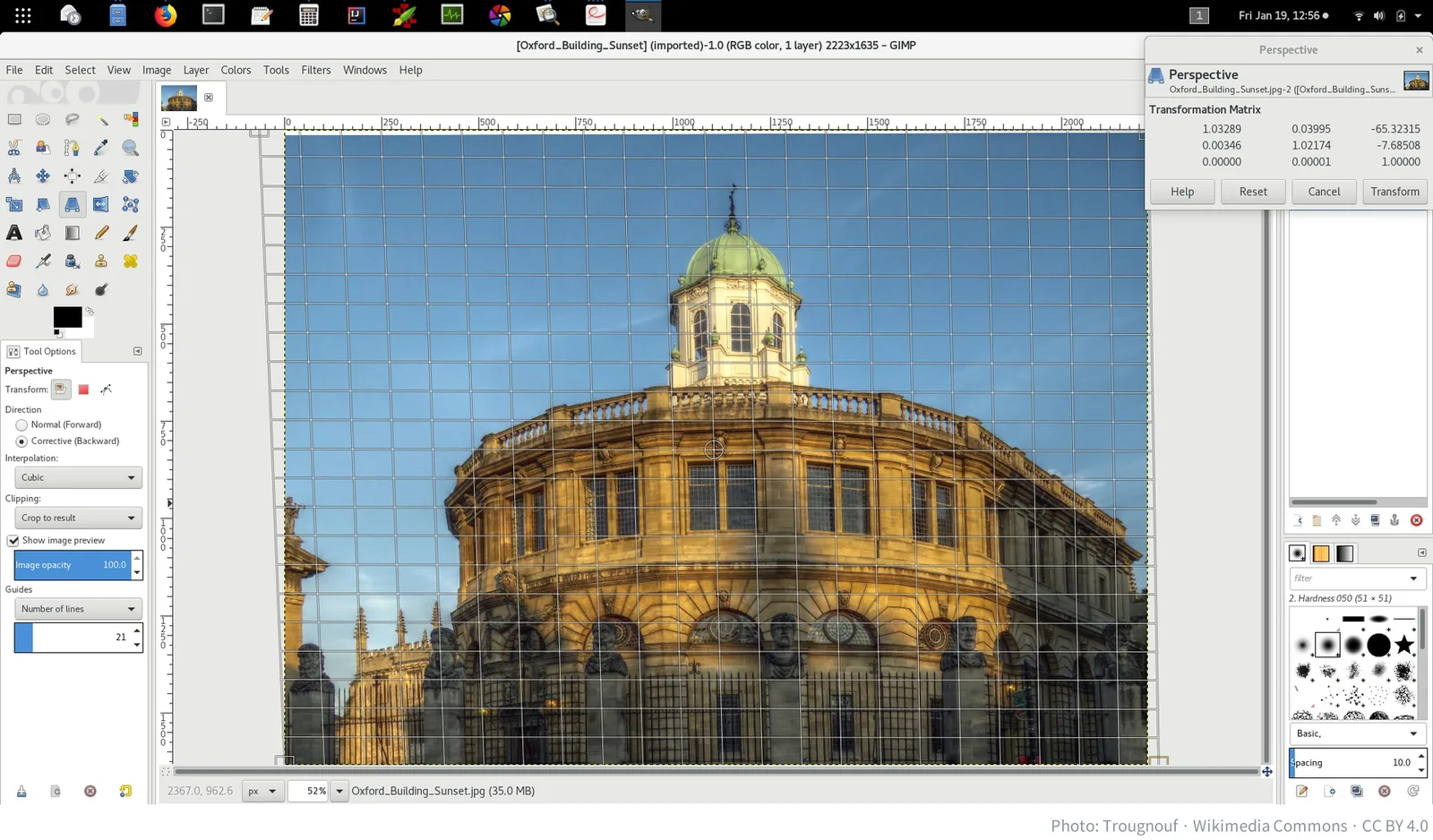
On July 29, 1995, a UC Berkeley student named Peter Mattis posted a short question to a Usenet group: suppose someone decided to write an image manipulation program “akin to photoshop”? Four months later, on November 21, he and his classmate Spencer Kimball announced GIMP, a free image editor. For the next 30 years, a free alternative to Photoshop never went away. Over the same 30 years, Adobe’s revenue grew from $762.3 million in fiscal 1995 to $23.77 billion in fiscal 2025, about 31 times larger.
In October 2026, a free Photoshop showed up again. This time the code was written not by students but by AI. A developer in Atlanta had Anthropic’s newest model rebuild seven Adobe apps, including Photoshop, Lightroom, Premiere Pro, Illustrator and Acrobat, and released them as free open source. “Anyone can now clone a software tool with AI” suddenly sounded true. Yet Adobe’s stock rose 3.2% over the next two weeks, while the Nasdaq fell 3.9%.
So is it different this time? Why didn’t the stock fall, and can it hold? This report answers those three questions in order.
As of: October 18, 2026. Prices are Nasdaq regular-session closes on October 16, 2026 (Adobe closed at $245.20).
Topics covered: the AI clone story and the market reaction, how far “vibe coding” has come, what the clones can and cannot copy, what Adobe actually sells and its freemium shift, a price that had already fallen, the growth today’s price assumes, buybacks, a comparison with other software companies, net new ARR as the condition to watch, price ranges by date, and dates to watch.
Reference data: prices, indexes and consensus are from Yahoo Finance; company numbers are from Adobe’s SEC filings (8-K, 10-Q, 10-K), earnings-call transcripts and IR datasheet; clone numbers are from the projects’ GitHub repositories and documents (accessed October 18); events are from dated news reports. Numbers the author calculated are marked as the author’s calculations. This is the author’s personal analysis, not investment advice.
1. What happened: seven free Adobe look-alikes, released four days after the first code
The short version: one person with AI agents rebuilt the look and basic features of seven Adobe apps in a matter of days, and the market did not read it as a sign that Adobe’s revenue will shrink.
September 30 repositories, October 4 launch, October 7 headlines
GitHub records show the order. Under an account called “storytold,” the PhotoCraft, PdfCraft, FilmCraft, VectorCraft and LightCraft repositories were created on September 30, and DesignCraft and EffectCraft on October 1. That was eight days after Anthropic released Claude Opus 5.5 on September 22. On October 4, a post titled “ArtCraft Apps: open-source Adobe compatible suite written in Rust” appeared on Hacker News, and from October 7 Gizmodo, AfterDawn and PetaPixel spread the story.
The developer is Brandon Thomas of Atlanta, reported to have run the AI startup Storyteller for three years after 15 years in software. He wrote on Reddit that the apps would fully match Adobe within a month, then on Hacker News called them “still super early alpha” and said 99% parity would be “measured in months and not years.” He also explained his motive: Adobe “charged me the ‘cancellation fee’ on multiple occasions.” Adobe settled a US Justice Department and FTC lawsuit over exactly those early-termination fees on March 12, 2026, with $75 million in cash and $75 million in free services for customers, while denying wrongdoing.
Seven apps, free, 66,671 GitHub stars
Each app targets one Adobe product: PhotoCraft (Photoshop), LightCraft (Lightroom), FilmCraft (Premiere Pro), VectorCraft (Illustrator), EffectCraft (After Effects), PdfCraft (Acrobat) and DesignCraft (InDesign). The app first reported as “PrintCraft” is now PdfCraft. All are written in Rust and released as open source. ArtCraft charges only for optional AI-generation credits (from $8 a month); the apps work without a subscription.
Interest was huge. By October 18, PhotoCraft had 66,671 GitHub stars and 11,686 forks, followed by PdfCraft (15,592), FilmCraft (14,636) and LightCraft (13,529). Thomas has since added repositories aimed at Word, Excel, PowerPoint, AutoCAD, Pro Tools and Figma.
Early users were split. The first Hacker News post drew 180 points and 246 comments. Tedium found the apps light (tens of megabytes) but rough around color pickers and secondary menus; VICE summed them up as ambitious, familiar and buggy. The Office clones followed the same pattern: Trending Topics reported WordCraft covers about 62% of Word’s features and GridCraft 93% of Excel’s formulas. Rule-based features catch up fast; the parts that depend on feel and fidelity lag.
Analysts cut their calls, and the stock still rose
Analysts moved quickly. On October 12, Wells Fargo cut Adobe to Underweight and its price target from $270 to $225, citing a more-than-40% drop in organic net new ARR in the third quarter, not the clones. On October 13, HSBC cut Adobe from Buy to Hold and its target from $310 to $267, naming ArtCraft directly and trimming its adjusted EPS estimates by 1-2% to reflect the risk that casual users drift to free alternatives (Edaily). HSBC had upgraded Adobe to Buy only on July 2, calling AI worries overdone.
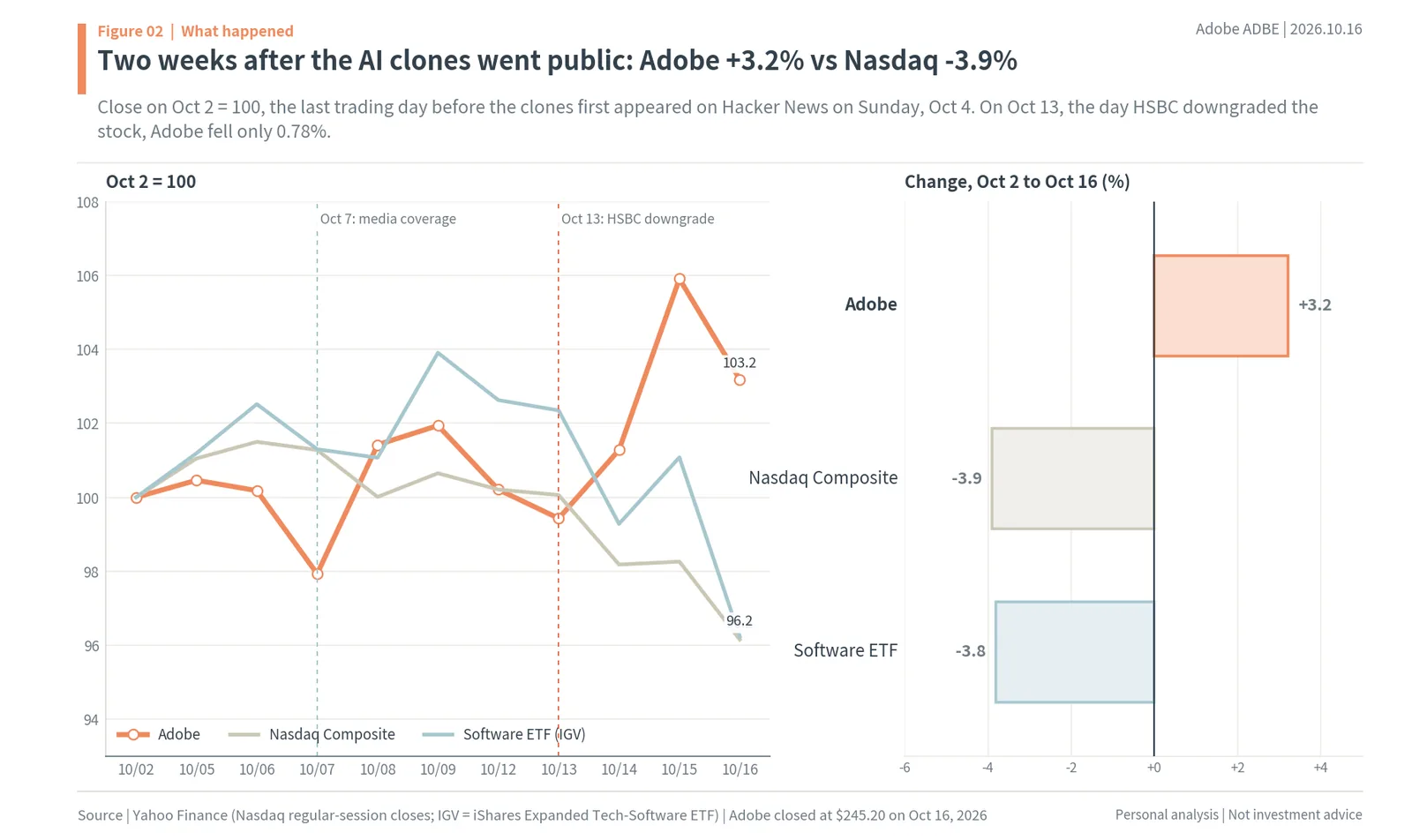
The stock moved the other way. Figure 2 indexes prices to the October 2 close, the last trading day before the Hacker News launch. Through October 16, Adobe rose 3.2%, the Nasdaq Composite fell 3.9% and the iShares software ETF (IGV) fell 3.8%. On October 7, when the story spread, Adobe fell 2.25%, then rose 3.56% the next day. On HSBC’s downgrade day it fell just 0.78%; on 174 days of the past year Adobe moved more than that. On October 15 it jumped 4.57% as Adobe expanded its partnership with NVIDIA and money rotated back into software.
2. How far vibe coding has come: 20 months of building software by talking to it
“Anyone can clone a tool with AI” is not an exaggeration, as long as “clone” means the look and the basic features.
AI researcher Andrej Karpathy coined “vibe coding” in an X post on February 2, 2025, describing a new kind of coding “where you fully give in to the vibes, embrace exponentials, and forget that the code even exists.” Instead of writing code line by line, you describe what you want, run what the AI writes, and ask for fixes. Collins Dictionary named it word of the year on November 6, 2025.
In 2026 the projects got bigger. On February 5, Anthropic said 16 copies of its model, working for about two weeks across roughly 2,000 sessions and just under $20,000 in API costs, built a C compiler of about 100,000 lines of Rust that could build Linux, while noting it was “not yet a drop-in replacement for a real compiler.” On February 24, Cloudflare said one engineer and an AI model rebuilt the Next.js web framework in a week for about $1,100 in tokens, covering 94% of its API.
Markets reacted first. After Anthropic added legal, sales, marketing and data-analysis plug-ins to its Cowork assistant on January 30, software and information-services stocks collapsed on February 3: Thomson Reuters fell about 18% and LegalZoom 19.7% in what traders called the “SaaSpocalypse.” Adobe fell 7.31% that day.
Then came full commercial apps. Anthropic introduced Claude Opus 5.5 on September 22 as “particularly good at long and sprawling jobs like codebase-wide migrations.” Eight days later the ArtCraft repositories appeared. The ArtCraft site now lists 13 apps, all marked “Early alpha” or “In development,” and Thomas says he will take on Microsoft Office, AutoCAD and SolidWorks too. He stresses the apps are “clean-room” rebuilds from public specs and observed behavior; Andres Guadamuz, an intellectual property scholar at the University of Sussex, told Al Jazeera “we also do not know whether the claimed ‘clean-room process’ stands up to scrutiny.” PhotoCraft alone had 2,530 commits by October 18.
The cost of building software features is heading toward zero. As PhotoWorkout put it, “the thing that made these tools expensive to build just got cheap.” So the real question is whether Adobe was ever paid for features.
3. What the clones copy and what they don’t: the screen, not the way people work
The clones copied screens, menus and basic features quickly. They have not copied what professionals pay for: file compatibility, plug-ins, speed, generative AI and enterprise contracts. That conclusion comes from the projects’ own numbers.
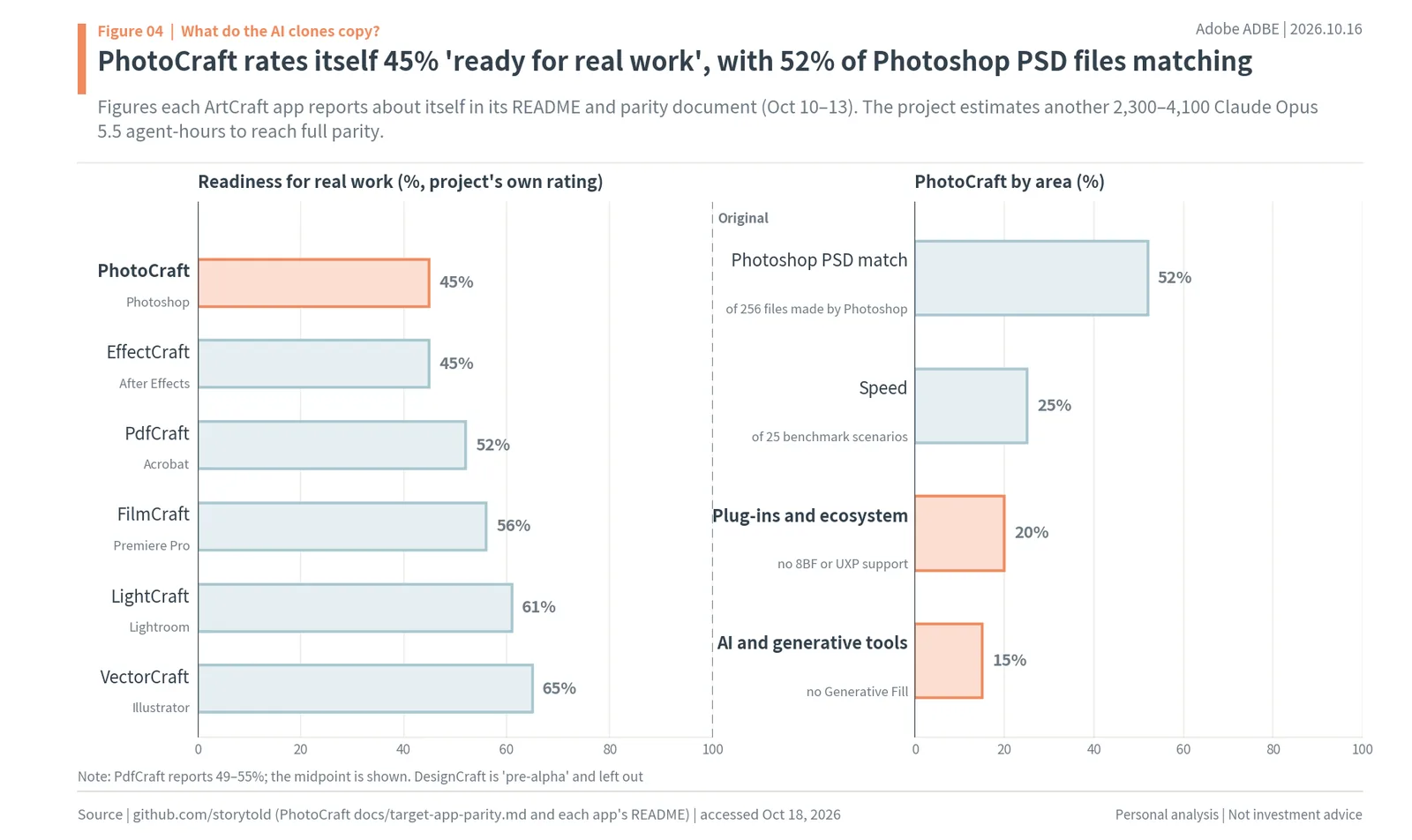
PhotoCraft’s README says it is “not yet a Photoshop replacement for daily professional work.” Its parity document, last updated October 13, puts feature breadth at about 76% but readiness for real work at about 45%. The other apps rate themselves between roughly 45% (EffectCraft) and 65% (VectorCraft); PdfCraft says 49-55%, and DesignCraft is pre-alpha. The project once wrote it was “82% of the way” (October 3) before withdrawing that figure, and about 1,230 issues were filed within ten days of launch. Gizmodo’s tester called it “glitchy, but real, Photoshop.”
The right side of Figure 4 shows where PhotoCraft falls short. Only 133 of 256 PSD files made by Photoshop render the same (52%). Plug-ins and ecosystem score about 20%, with no support for Photoshop’s 8BF or UXP plug-in formats. It passes 3 of 25 speed scenarios. AI and generative features such as Generative Fill sit at about 15%. LightCraft cannot cleanly import a Lightroom catalog, FilmCraft cannot open Premiere project files and EffectCraft cannot open After Effects files. For a professional, switching programs means moving years of files, presets, shortcuts and client hand-offs, not just installing an app.
The project also estimated what it would take to close the gap: 1,100-1,800 Opus 5.5 agent-hours to reach beta (about 75% ready) and 2,300-4,100 agent-hours for full parity. Agent hours are far cheaper than human hours, but this is a long way from “within a month,” and it assumes Adobe stands still. Adobe is one of eight launch partners in Anthropic’s creative-tools connectors announced on April 28, which lets Claude call more than 50 Creative Cloud tools.
The law is not a big wall either. Plagiarism Today argued the clones stand on “decent footing” because copyright protects code, not functionality, and pointed to Google v. Oracle on interoperability and to the possibility that AI-written code is not copyrightable at all. The bigger risks are Adobe’s terms of use, its thousands of patents and trademark confusion, and the outlet expects Adobe to be in no rush to sue. It also noted that Affinity and GIMP existed for decades without ending Adobe’s dominance. As of October 18, Adobe had made no public statement.
AI has made it nearly free to build “a program that looks like Photoshop.” It is still expensive to build “a program people who earn money with Photoshop can move to,” and that is where most of Adobe’s revenue comes from.
4. What Adobe sells: the money comes from professionals, and Adobe gave the free tier away first
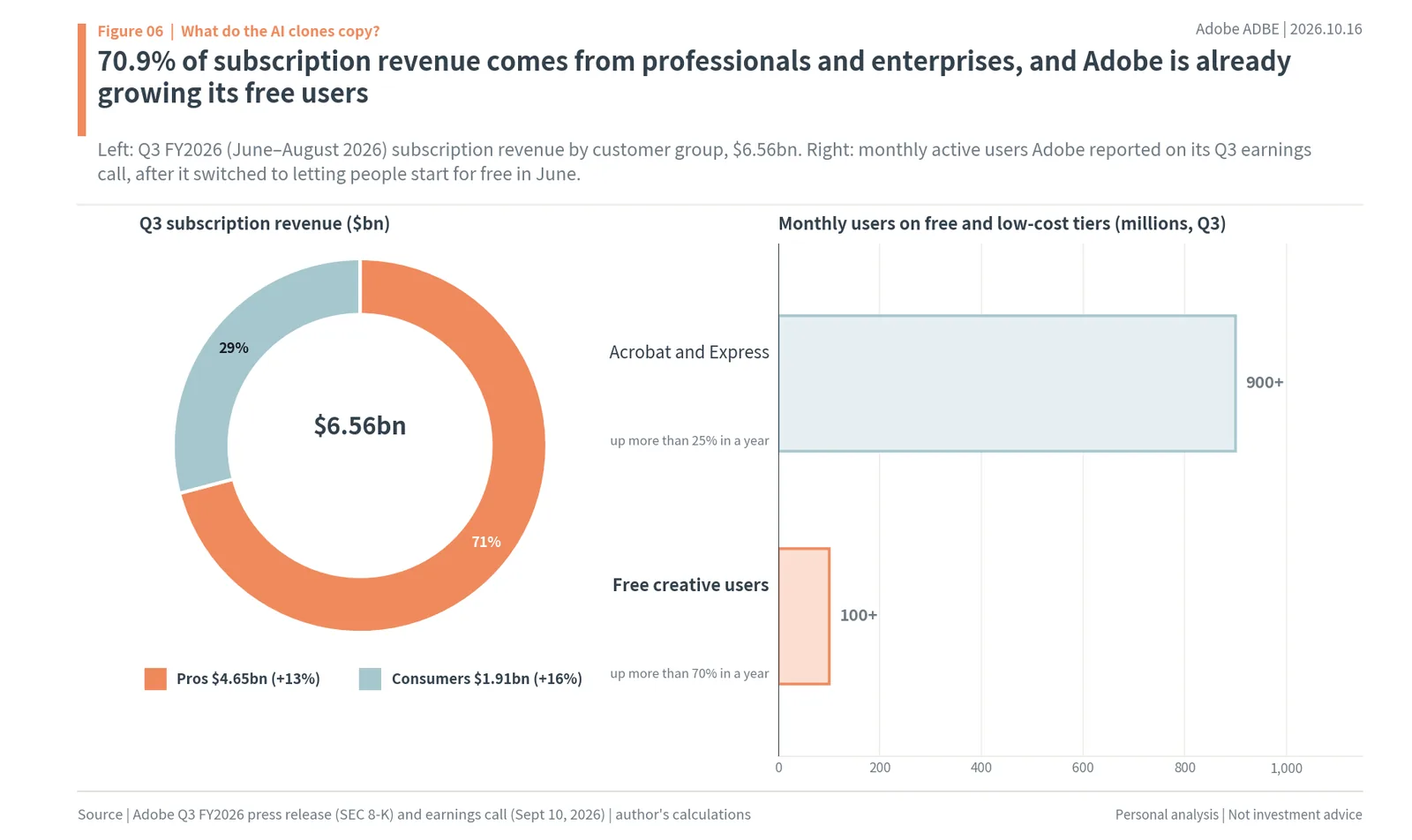
Since fiscal 2026 Adobe reports subscription revenue by two customer groups. Creative & Marketing Professionals covers the Creative Cloud flagship apps (Photoshop, Illustrator, Premiere and others) and the Experience Cloud marketing software; Business Professionals & Consumers covers Acrobat and Express. In the third quarter (June-August 2026), subscription revenue was $6.56 billion: $4.65 billion (+13%) from professionals and $1.91 billion (+16%) from business users and consumers, a 70.9% to 29.1% split. By the older segments, Digital Media (Creative Cloud plus Acrobat and Express) was $4.89 billion and enterprise marketing (Digital Experience) $1.67 billion. Adobe has more than 20,000 enterprise customers and reported continued strength in enterprise retention.
Four months before the clones, Adobe answered free competition itself. On its June 11 earnings call, CEO Shantanu Narayen said Adobe would “defer previously planned Creative Cloud second half line optimizations,” and route new users from search and AI chats into free experiences (web and mobile Photoshop, Firefly, Express, Acrobat Reader) before asking them to pay. He said “maybe half” of the ARR impact comes from the deferred price changes and half from the freemium push. Creative business head David Wadhwani said “this shift will come at the cost of short-term ARR.” The stock fell 6.76% the next day. In April, SemiAnalysis CEO Dylan Patel had said “the average user does no longer need Adobe subscriptions”; Adobe’s answer is to keep that user for free and charge when the work gets serious.
By the third quarter, Adobe reported more than 1 billion monthly active users, free creative users above 100 million (up more than 70%) and Acrobat and Express users above 900 million (up more than 25%). Interim CFO Steve Day said Adobe is “expanding our user base through a freemium strategy.” HSBC, too, saw the risk mainly among individual and prosumer users and less among enterprise professionals. The free users the clones would chase first are the users Adobe already gives tools to for free.
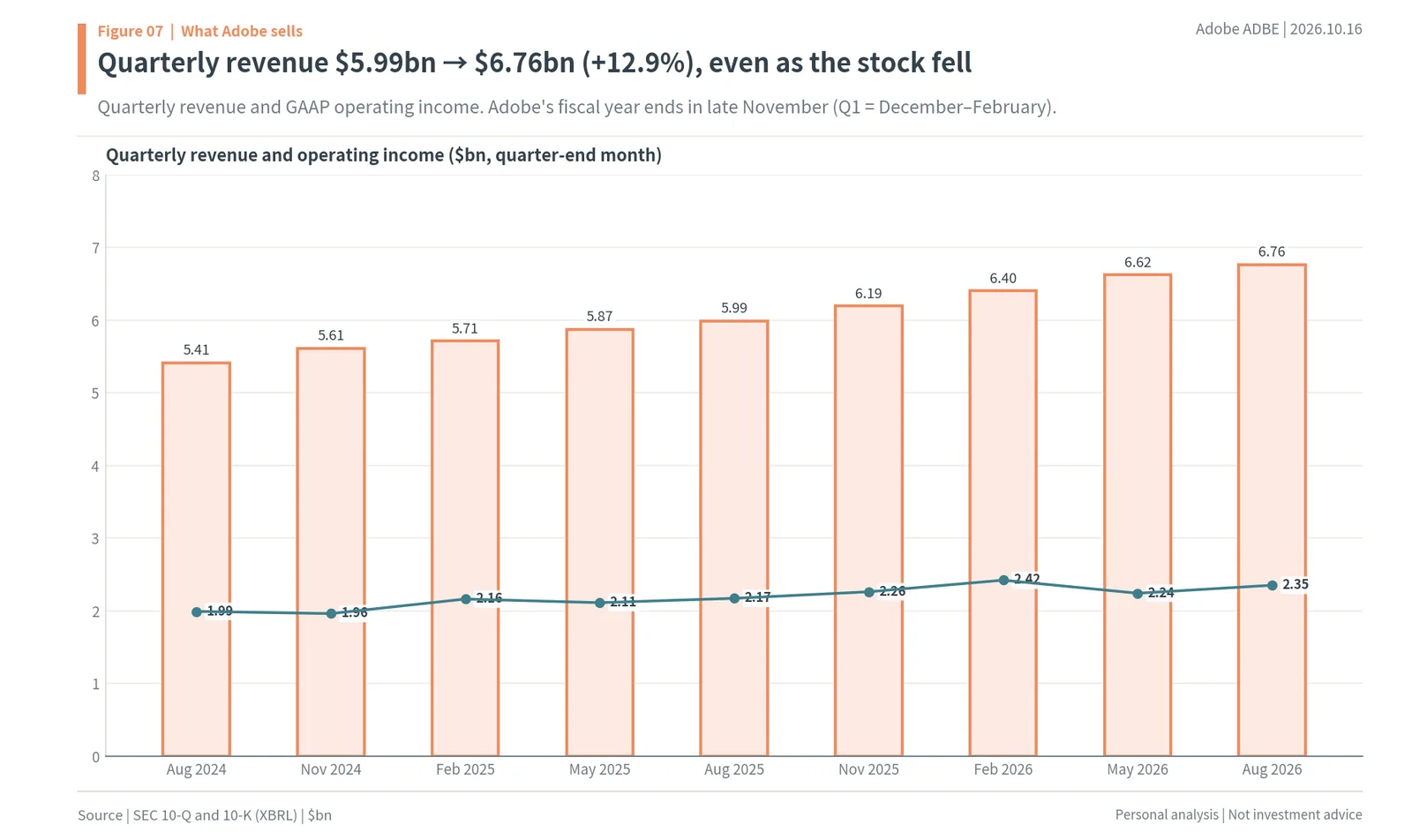
Revenue kept growing while the stock fell. Quarterly revenue rose 12.9% from $5.99 billion (August 2025 quarter) to $6.76 billion (August 2026 quarter). Third-quarter non-GAAP EPS was $6.13, operating cash flow a record $2.52 billion for a third quarter, and Adobe raised its fiscal 2026 targets to revenue of $26.576-26.626 billion and non-GAAP EPS of $24.45-24.50. AI-first ARR passed $650 million, up more than 150%, only 2.4% of total ARR of $27.5 billion but growing exactly where the clones are weakest. Firefly ARR neared $300 million at the end of the second quarter and grew 40% quarter on quarter in the third. Adobe also bought Semrush for $1.87 billion in April (about $0.48 billion of ARR) and agreed to buy Topaz Labs.

Over the longer run, revenue rose from $4.4 billion in fiscal 2012 to $23.8 billion in fiscal 2025 after Adobe moved from boxed software to subscriptions in 2013. Narayen said on the third-quarter call that annual revenue grew “from less than $1 billion to over $26 billion” during his tenure, all while GIMP was free.
5. Why it didn’t fall ①: the price had already fallen
Before the clone news, Adobe was already priced at its cheapest level since 2014. Few investors sell the same fear twice.
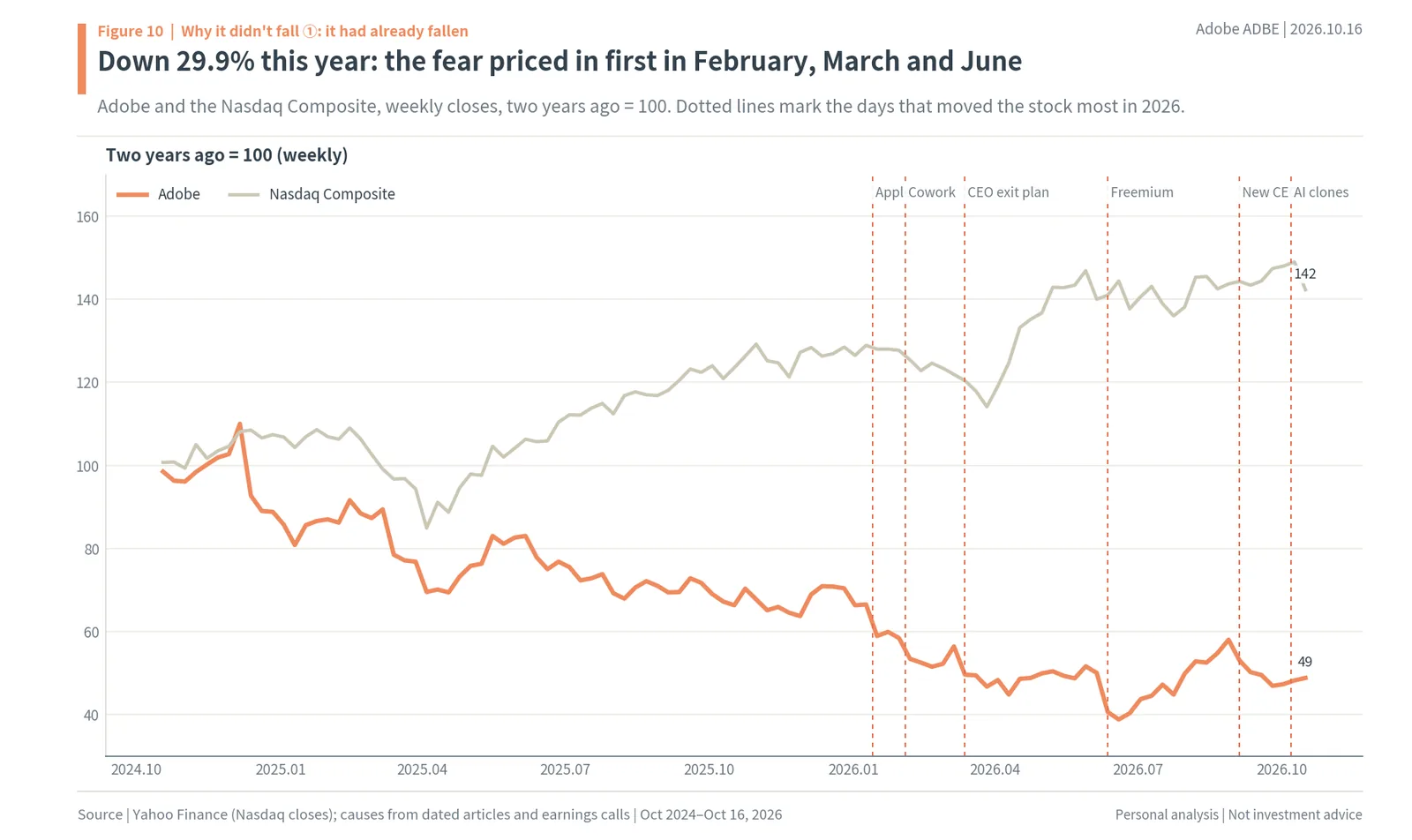
Adobe fell from $349.99 at the end of 2025 to $245.20 on October 16, down 29.9% this year, while the Nasdaq rose 12.5% and the software ETF fell only 1.3%. Over one year Adobe is down 25.5% against a 15.9% gain for the Nasdaq. It is 64.4% below its November 19, 2021 record of $688.37, and 26.8% above this year’s closing low of $193.41 on June 25.
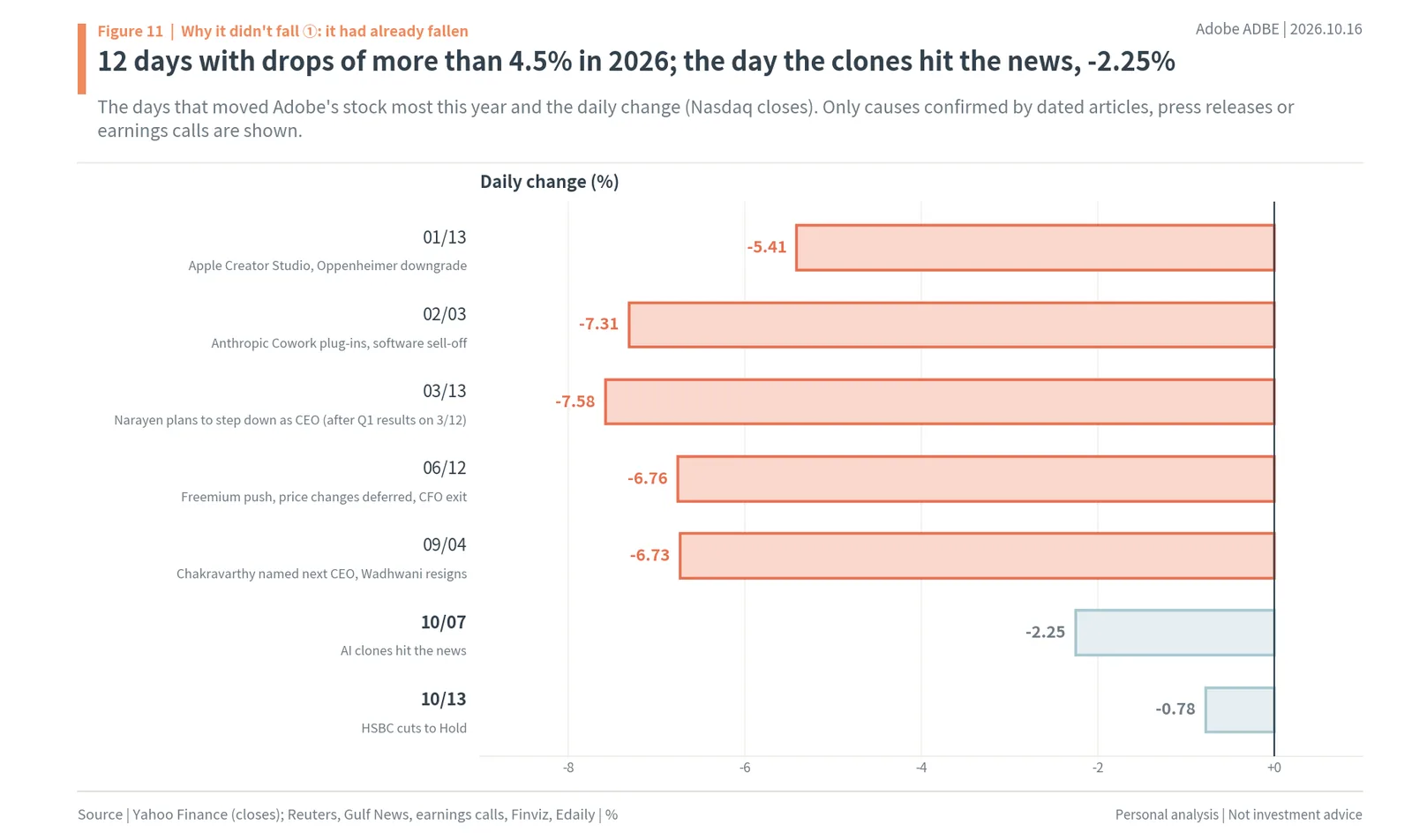
The fear came in five waves. January 13 (-5.41%): Apple announced a Creator Studio bundle of Final Cut Pro, Logic Pro and Pixelmator Pro for $12.99 a month, and Oppenheimer downgraded the stock. February 3 (-7.31%): the Cowork plug-in sell-off. March 13 (-7.58%): with first-quarter results on March 12, Narayen said he would step down as CEO once a successor was named. June 12 (-6.76%): the freemium push, deferred price changes and CFO Dan Durn leaving for Marvell. September 4 (-6.73%): Anil Chakravarthy, who ran the enterprise marketing business, was named the next CEO, and Wadhwani decided to leave. Against those, the clone news day (-2.25%) and HSBC’s downgrade day (-0.78%) are the shortest bars on the chart. There were 12 days with drops of more than 4.5% in 2026.
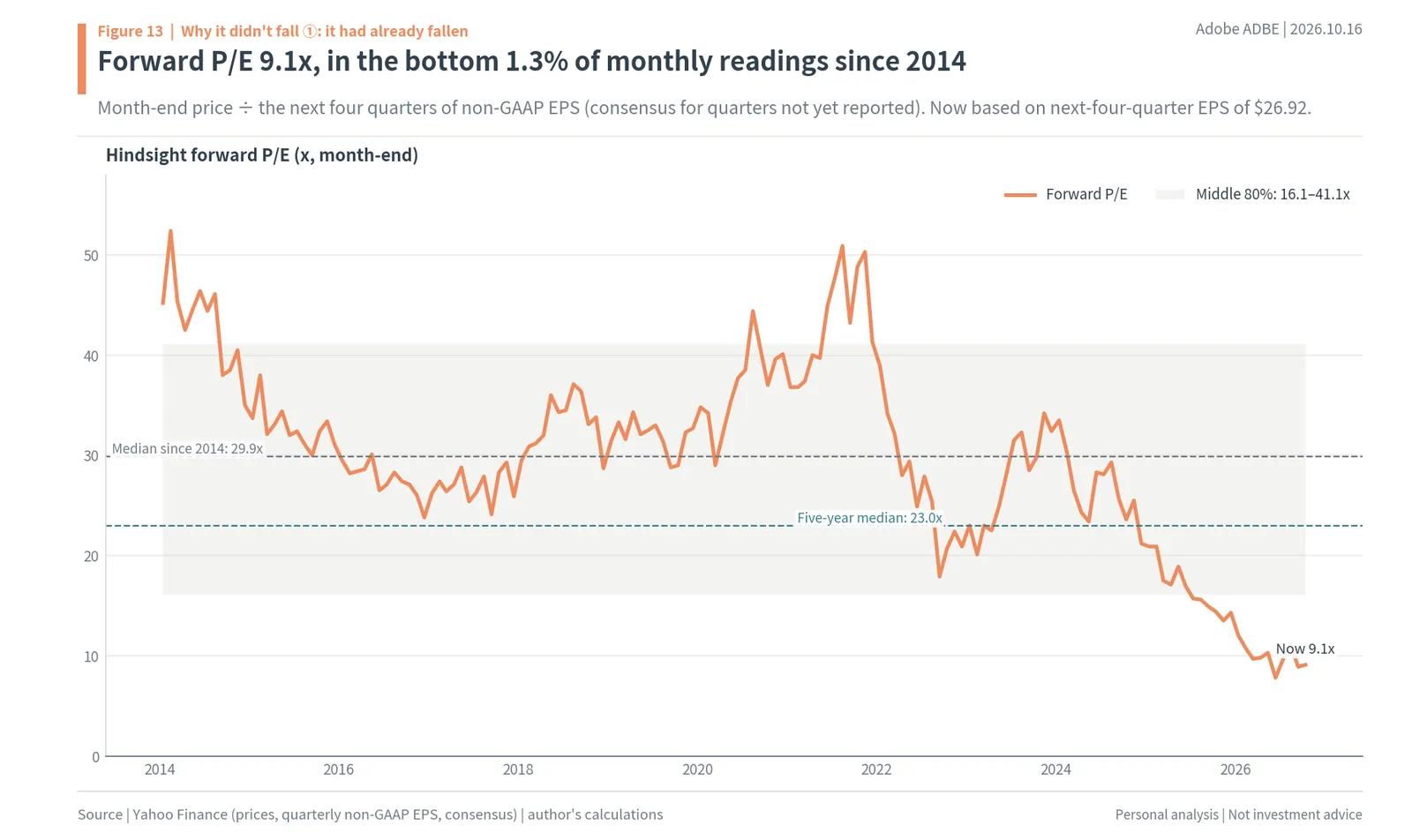
Figure 13 is the author’s hindsight forward P/E: each month-end price divided by the non-GAAP EPS Adobe actually reported over the following four quarters, with consensus for quarters not yet reported. Today it is 9.1 times next-four-quarter EPS of $26.92. Since 2014 the median is 29.9 times, the middle 80% 16.1-41.1 times, and the five-year median 23.0 times; it peaked at 50.3 times in November 2021. Only June 2026 (7.8 times) was lower, so today sits in the bottom 1.3% of monthly readings. The multiple went from 14.3 times in December 2025 to 10.7 in February, 7.8 in June, 11.2 in August and 9.1 now. Profit did not shrink. The market doubted whether it could keep growing, and that doubt was in the price before the clones appeared. On consensus, the stock trades at 8.9 times fiscal 2027 EPS of $27.51 and 10.0 times fiscal 2026 EPS of $24.48.
6. Why it didn’t fall ②: the price already assumes zero growth
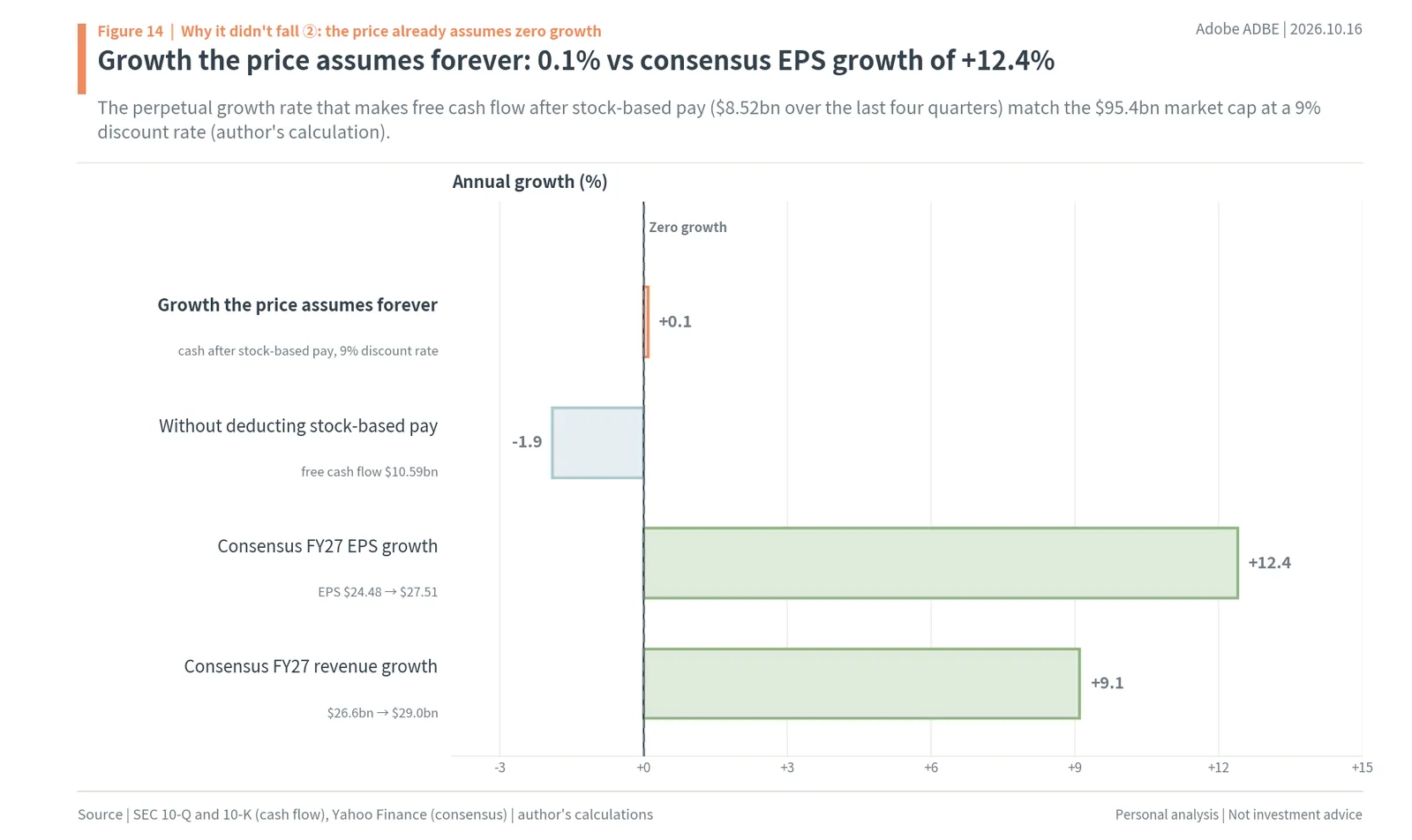
If a company earns cash that grows at a steady rate forever, its value is next year’s cash divided by (discount rate minus growth rate). Solving that backwards gives the growth rate today’s price assumes. Over the last four quarters (September 2025-August 2026), operating cash flow was $10.81 billion and capital spending $0.21 billion, so free cash flow was $10.59 billion. Stock-based pay was $2.07 billion; it costs shareholders even though no cash leaves, so the author deducts it, leaving $8.52 billion.
At a 9% discount rate, matching $8.52 billion to the $95.4 billion market cap implies perpetual growth of 0.1% (the author’s calculation): -0.9% at 8% and +1.0% at 10%. Without deducting stock-based pay, it is -1.9% at 9%. Either way, today’s price is roughly what you would pay if Adobe never grew again. Analysts, meanwhile, expect fiscal 2027 EPS of $27.51 (+12.4%) and revenue of $29.0 billion (+9.1%). A price that already assumes no growth barely reacts to news that growth might stop. To fall further, it needs evidence that things are worse than zero growth, meaning paying customers actually leave.
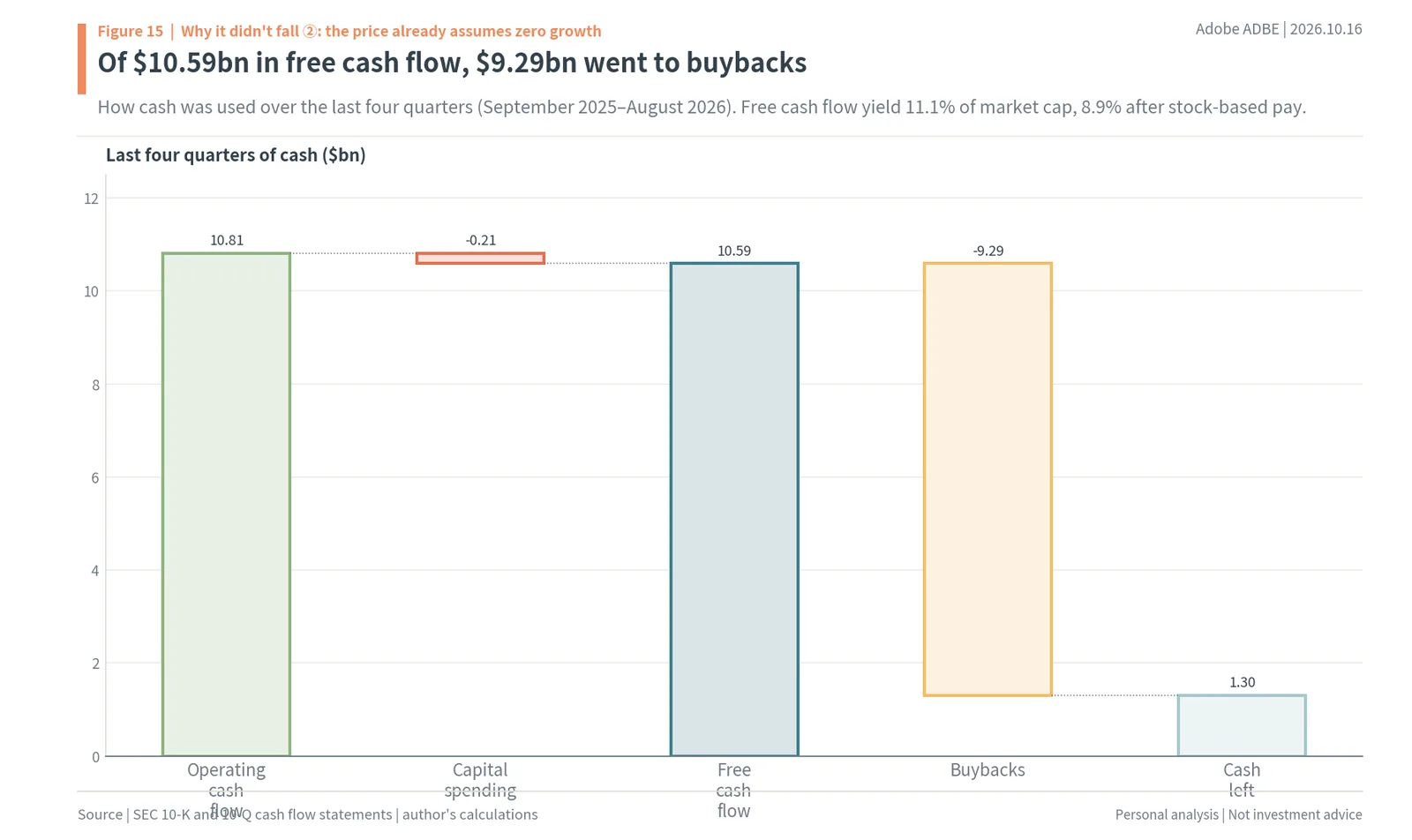
Of the $10.59 billion of free cash flow, $9.29 billion went to buybacks. The free cash flow yield is 11.1% of market cap, or 8.9% after stock-based pay.
7. Why it didn’t fall ③: Adobe buys back a tenth of itself every year
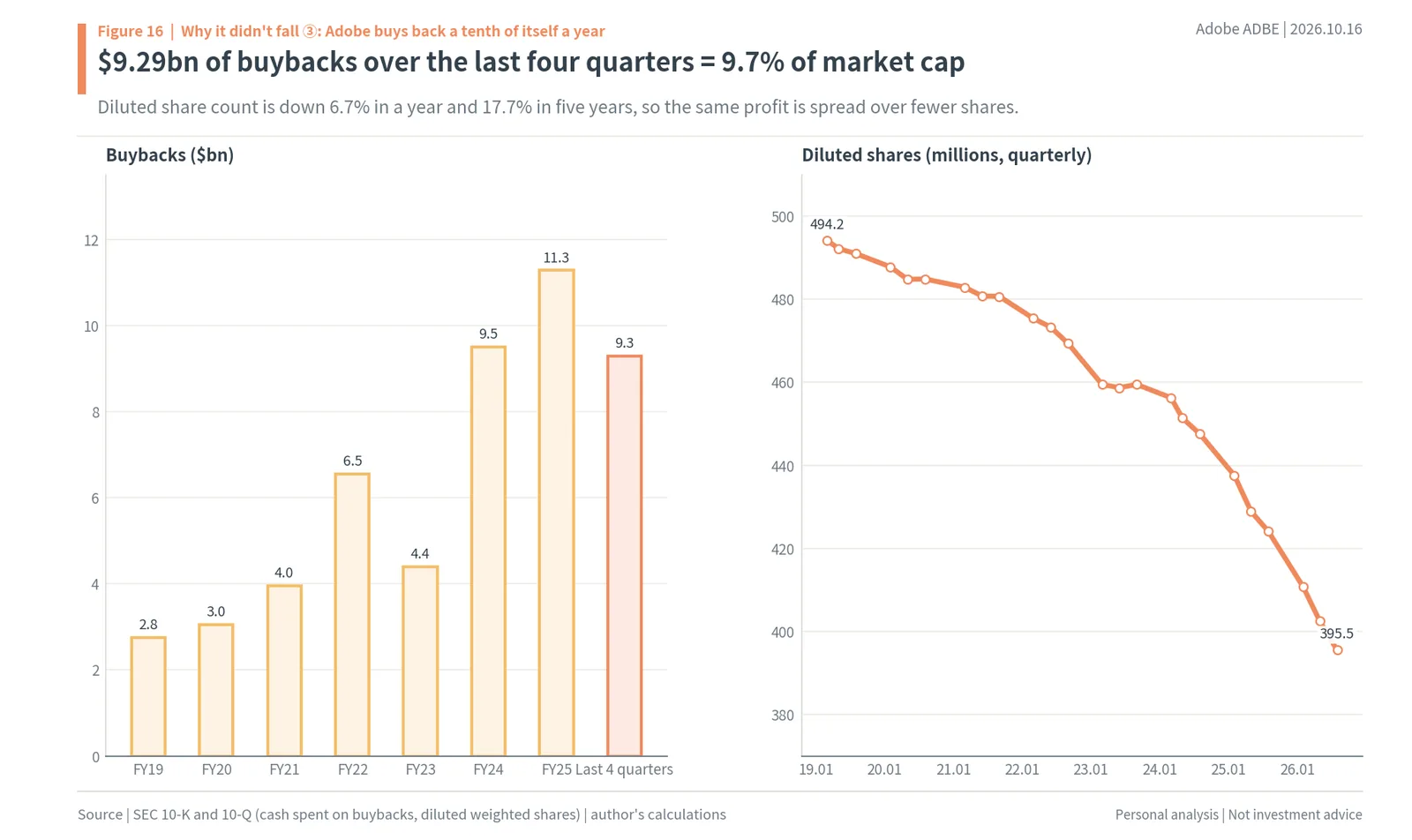
The biggest buyer when the stock falls is Adobe itself. Buybacks over the last four quarters totaled $9.29 billion, 9.7% of the market cap. Annual buybacks grew from $2.8 billion in fiscal 2019 to $9.5 billion in fiscal 2024 and $11.3 billion in fiscal 2025, more than the year’s $10.03 billion of operating cash flow. Diluted shares fell from 480.7 million (September 2021 quarter) to 424.1 million a year ago and 395.5 million in the August 2026 quarter, down 6.7% in a year and 17.7% in five years. Adobe used up a $25 billion authorization in a little over 11 quarters, opened a new $25 billion program on April 21 (through April 30, 2030), and had $24.55 billion left on August 28. Adobe pays no dividend; nearly all its cash goes to buybacks, and a lower price buys more shares.

8. Compared with other software companies: about half the multiple
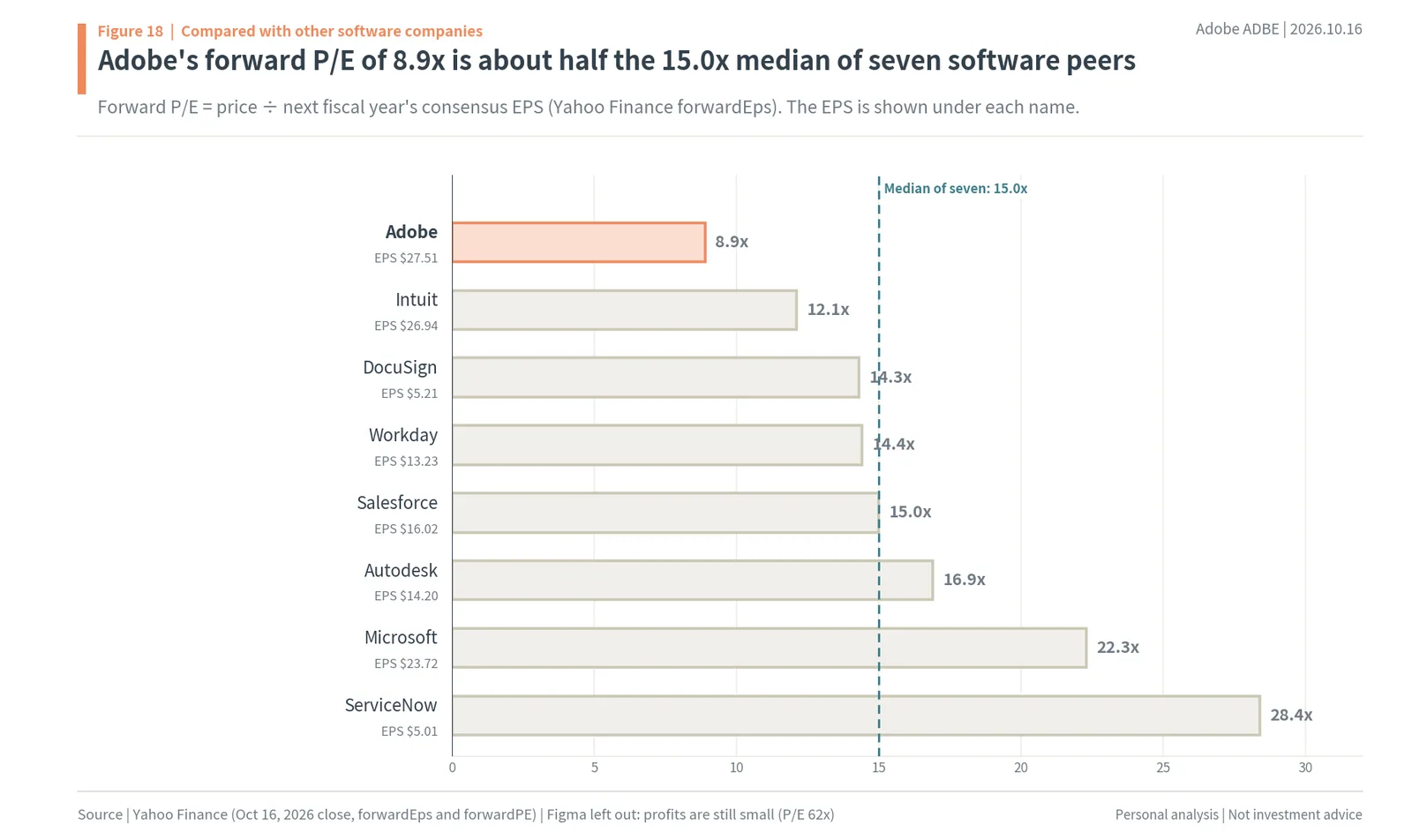
At 8.9 times fiscal 2027 EPS of $27.51, Adobe trades at about half the 15.0 times median of seven profitable US software peers: Intuit (12.1 times EPS of $26.94), DocuSign (14.3 times $5.21), Workday (14.4 times $13.23), Salesforce (15.0 times $16.02), Autodesk (16.9 times $14.20), Microsoft (22.3 times $23.72) and ServiceNow (28.4 times $5.01). Figma, at 62 times, is left out. Over one year, Adobe’s -25.5% is the third worst of nine after Figma (-62.8%) and Intuit (-49.0%), yet its multiple is the lowest. The market’s discount on Adobe is less about being software and more about being a creative tool that collides head-on with generative AI.
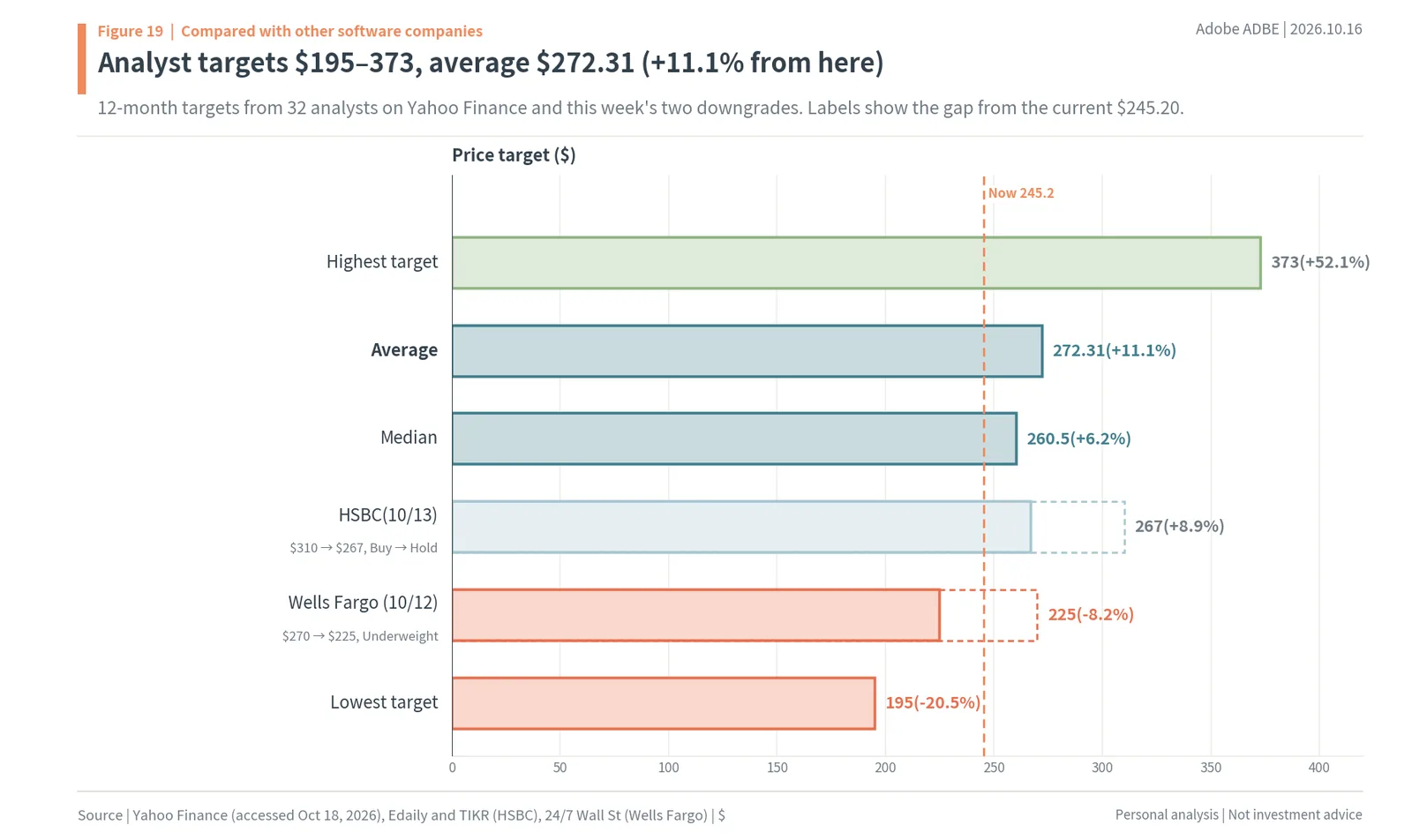
The 32 analysts on Yahoo Finance have 12-month targets from $195 (-20.5%) to $373 (+52.1%), with an average of $272.31 (+11.1%) and a median of $260.5 (+6.2%); the average rating is Hold. The two downgrades this week saw different risks. Wells Fargo pointed to falling net new ARR; HSBC pointed to the clones but saw the risk mainly among individual users. The author thinks the Wells Fargo number matters more for the stock from here.
Where does the moat move when features become cheap? Four places, and Adobe stands in all of them. Files: PSD, AI, Premiere projects and PDF are the shared language of creative work, and people open more than 400 billion PDFs in Acrobat every year. Contracts: enterprises buy security reviews, admin tools, IP assurances and hundreds of seats at once, and HSBC itself warned about the security and legal risks of lightly reviewed AI code. Data and commercial safety: Adobe’s 10-Q describes an AI platform offering “brand safety, compliance, intellectual property protection,” and Firefly Enterprise builds brand-safe custom models. Distribution: Adobe has put its creative agent inside ChatGPT and Claude to catch users where they start. Moving the moat costs money, and part of that cost is the ARR Adobe gave up in June.
9. Will it hold? One condition: do free users turn into paying ones
From here, news is unlikely to push the stock much lower. Numbers can, and the number is net new ARR.
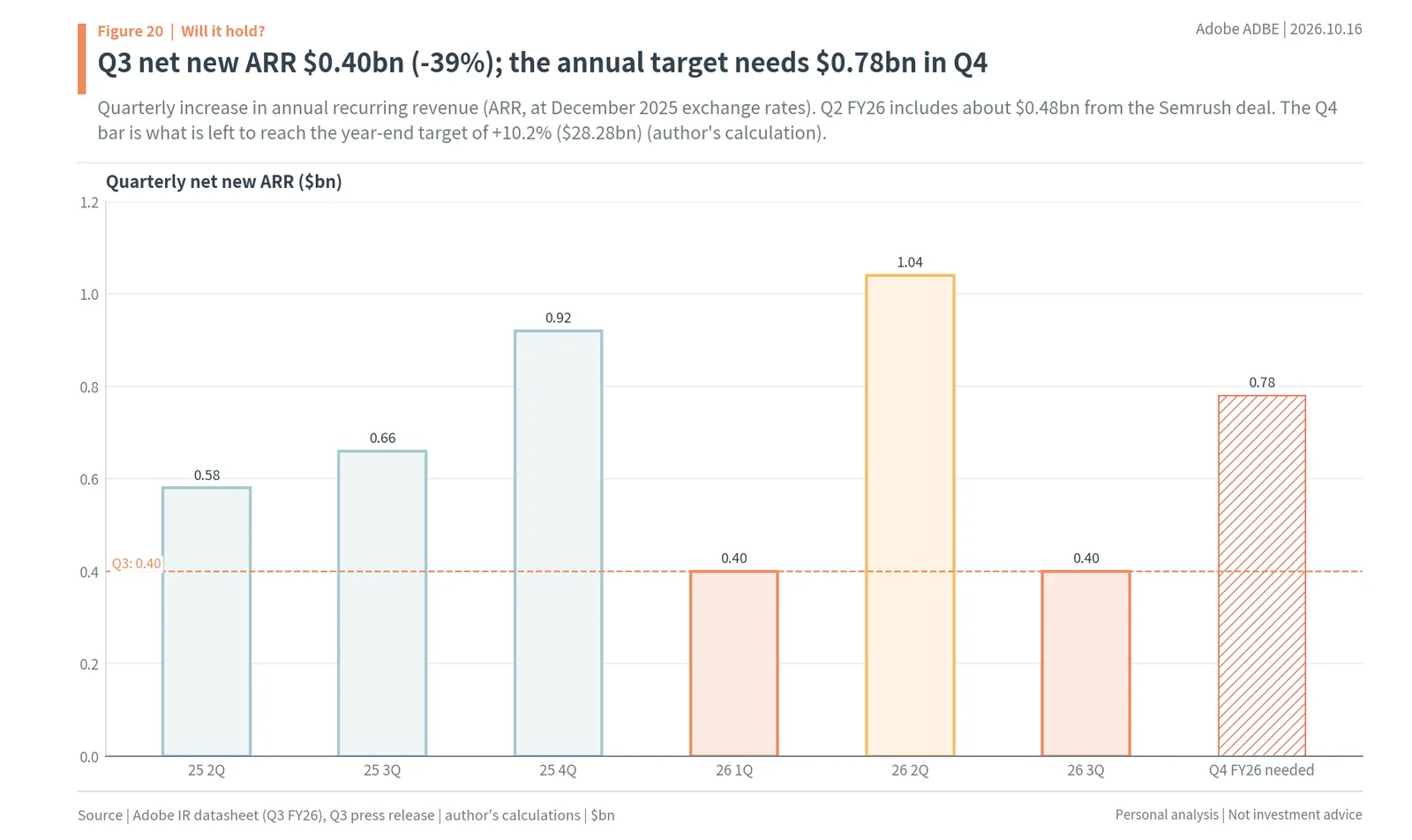
ARR is subscription revenue annualized; net new ARR is how much it grew in a quarter, combining more customers (volume) and higher prices (price). Using Adobe’s IR datasheet at December 2025 exchange rates, third-quarter net new ARR was $0.40 billion ($27.50 billion minus $27.10 billion), 39% less than a year earlier (author’s calculation). An analyst on the call cited a 36-37% drop, and Wells Fargo an organic drop of more than 40%. The second quarter’s $1.04 billion included about $0.48 billion from Semrush. Adobe’s explanation is the June decisions: half deferred pricing, half freemium. Chakravarthy said Adobe will “calibrate when we convert them into ARR.” In other words, the company says it is collecting later, not losing customers.
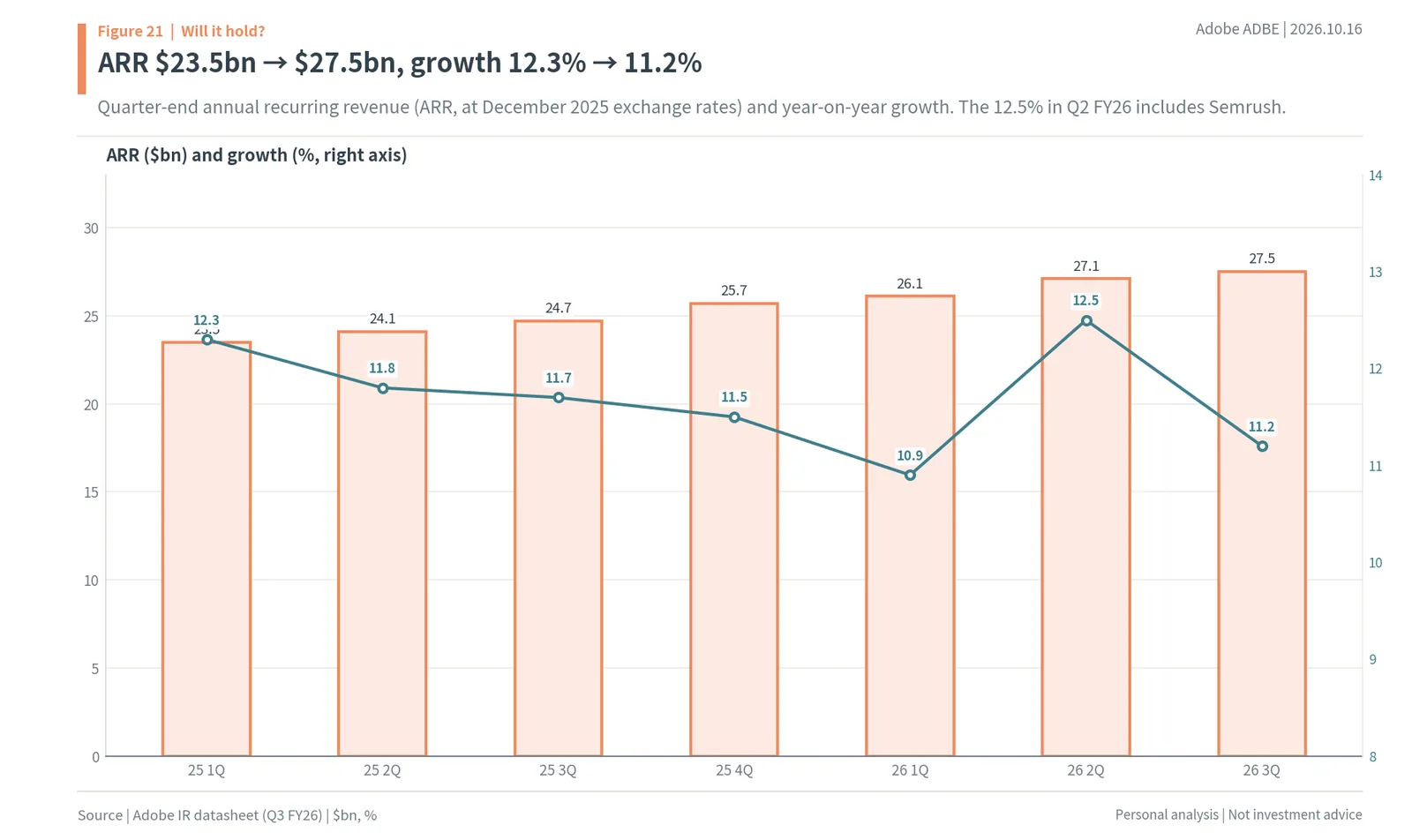
ARR itself kept rising, from $23.5 billion in the first quarter of fiscal 2025 to $27.5 billion, but growth slowed from 12.3% to 11.2% (the 12.5% in Q2 includes Semrush), after 13.8-13.0% in fiscal 2024. Remaining performance obligations grew 8%, the first single-digit pace since early fiscal 2023. By customer group, business and consumer subscriptions (+16%) grew faster than professional ones (+13%), a sign that “free first, paid later” is working at least for documents.
Adobe kept its target of 10.2% ARR growth for fiscal 2026. That implies year-end ARR of about $28.28 billion, so the fourth quarter needs about $0.78 billion of net new ARR, roughly 1.9 times the third quarter (author’s calculation), though less than the $0.92 billion of a year earlier. Day said the fourth quarter is seasonally strong and enterprise-heavy and that net new ARR would be larger than in the third quarter. Wells Fargo doubts it. On December 9, three numbers will tell: whether net new ARR reaches $0.78 billion, whether professional subscription growth holds near 13%, and whether fiscal 2027 targets land near consensus EPS of $27.51 and price changes resume.
Warren Buffett wrote in his 2007 letter that “a moat that must be continuously rebuilt will eventually be no moat at all.” Adobe’s feature moat got shallower in front of AI. But the money comes from files, plug-ins, contracts and habits, and Adobe is trying to capture the next generation’s habits by giving the entry tier away. Net new ARR is where that strategy shows up.
10. Price ranges by date: December holds, a year out rises with EPS
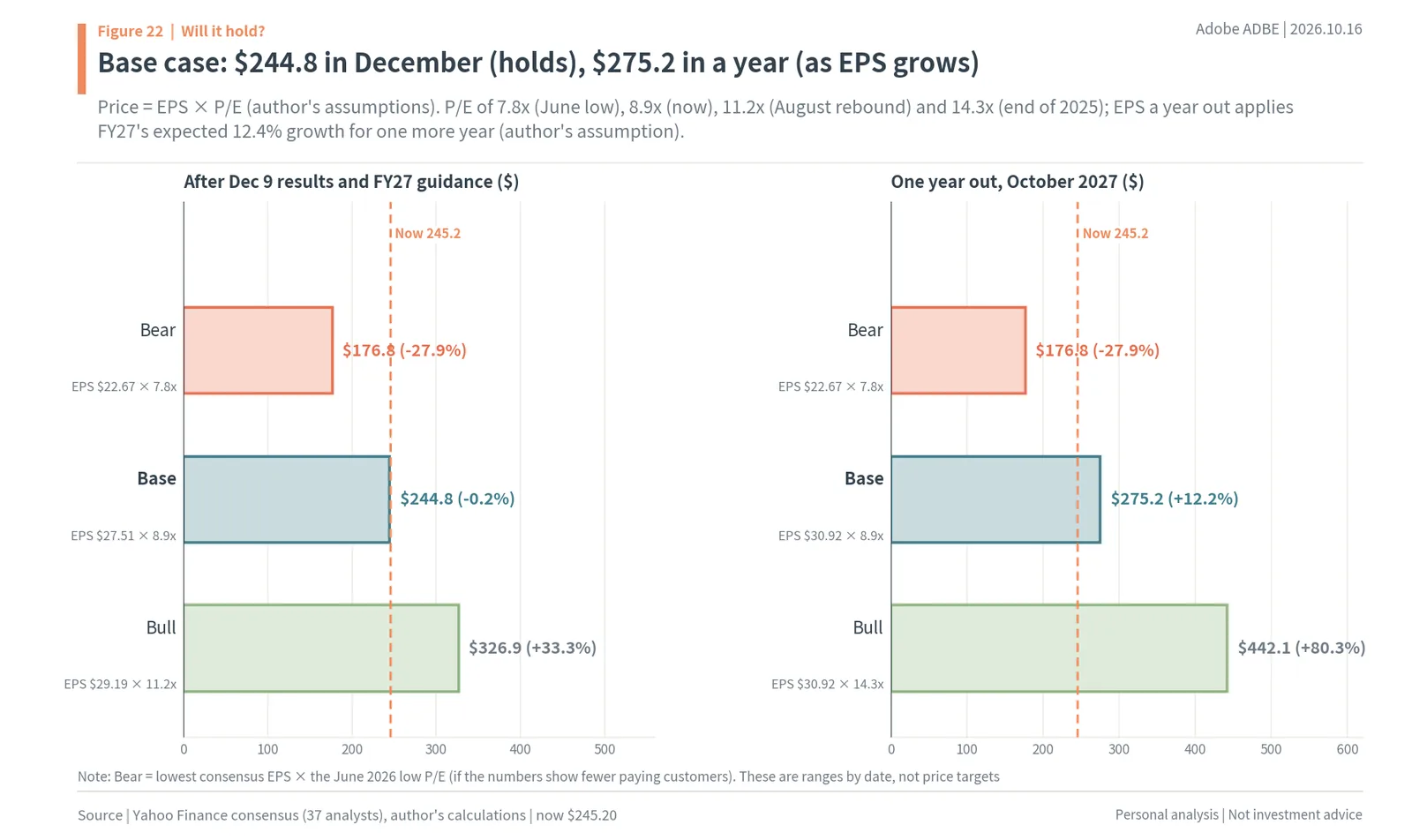
Price equals EPS times P/E. The author used three multiples: 7.8 times (the June 2026 low on hindsight forward P/E), 8.9 times (today on fiscal 2027 consensus) and 11.2 times (the August rebound), plus 14.3 times (December 2025) for a year out. These are ranges, not price targets.
After December 9: the base case is $27.51 × 8.9 = $244.8, roughly where the stock is, if net new ARR meets the target and fiscal 2027 targets land near consensus. The bear case is $22.67 (the lowest consensus EPS) × 7.8 = $176.8 (-27.9%), if paying customers shrink. The bull case is $29.19 (the highest consensus EPS) × 11.2 = $326.9 (+33.3%). One year out, the author assumes fiscal 2028 EPS of $30.92 (fiscal 2027 consensus grown another 12.4%). The base case is $30.92 × 8.9 = $275.2 (+12.2%): even with no change in the multiple, the stock rises with EPS. The bull case is $442.1 at 14.3 times, and the bear case stays at $176.8.
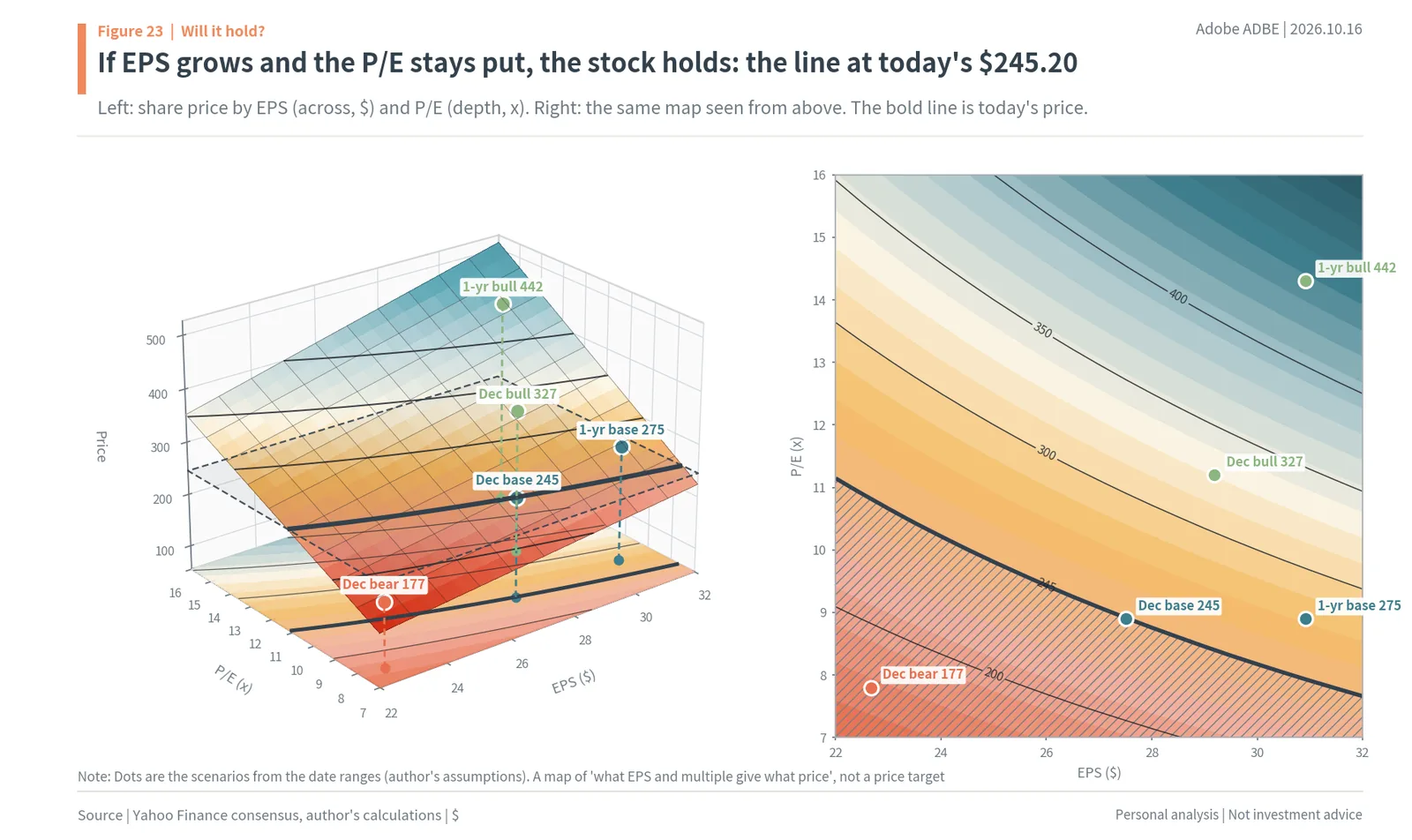
Figure 23 draws this as a surface: EPS across, P/E in depth, price as height, with a bold line at today’s $245.20. Because today’s price assumes zero growth, any path where EPS keeps growing ends at or above the line even if the multiple stays put. The only way below is EPS itself falling. If only the multiple returned to the June low, next-four-quarter EPS of $26.92 × 7.8 would give $210.0, 14.4% lower. The two things that decide which case plays out are Adobe’s fiscal 2027 targets and net new ARR, not how many more clones appear.
11. Dates to watch: MAX in November, a new CEO on December 1, results on December 9
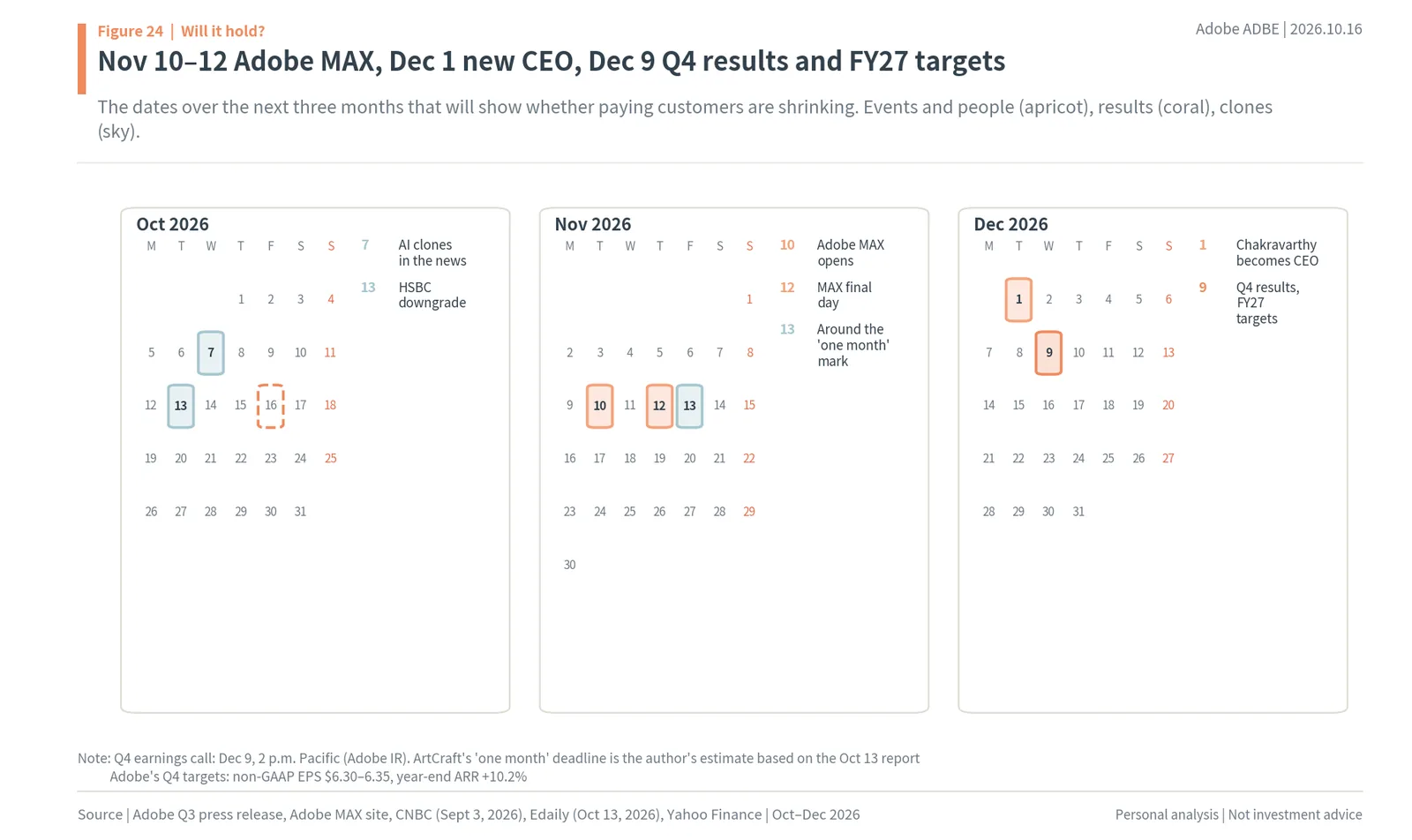
First, Adobe MAX in Miami Beach on November 10-12. On October 15 Adobe said it is optimizing Photoshop, Premiere and Substance 3D for NVIDIA RTX hardware, with more to come at MAX; watch how Adobe widens its lead in AI and speed, where the clones score 15% and 25%. Second, mid-November, when Thomas’s “within a month” would come due; the project’s own estimate says it will take far longer. Third, December 1, when Anil Chakravarthy becomes CEO and Narayen becomes executive chair. Chakravarthy, a former Informatica CEO who joined Adobe in January 2020, said every SaaS company will go through “the transformation to agentic software.” Fourth, December 9 (2 p.m. Pacific), fourth-quarter results and fiscal 2027 targets. Adobe’s fourth-quarter targets are revenue of $6.80-6.85 billion and non-GAAP EPS of $6.30-6.35; consensus EPS is $6.33.
After the third-quarter report on September 10, the stock fell 2.37% that day and rose 1.37% the next; Jefferies called the results “uneventful.” Without confirmation, good numbers alone did not lift the stock. December 9 is the day that can confirm or reject the zero-growth price.
Conclusion
A free Photoshop existed 30 years ago, and Adobe’s revenue grew about 31 times since. The 2026 AI clones showed that one person with AI agents can rebuild the look of seven apps in days, but by their own count PhotoCraft is 45% ready for real work, with 52% PSD fidelity, 20% for plug-ins and 15% for AI. They copied the screen, not the way professionals work.
The stock didn’t fall for three connected reasons. It had already fallen 29.9% this year to a hindsight forward P/E of 9.1 times, the bottom 1.3% since 2014, a price that already assumes zero growth. The free users the clones chase are users Adobe started giving tools to in June, while 70.9% of subscription revenue comes from professionals and enterprises. And Adobe buys back 9.7% of its market cap a year, with $24.55 billion of authorization left.
The author’s view: clone news alone leaves little room for further downside. What can push the stock lower is evidence that paying customers are shrinking, and the first test is fourth-quarter net new ARR of about $0.78 billion on December 9. If it is met, the December base case is around today’s price ($244.8), and a year out the base case is $275.2 as EPS grows.
Adobe and the AI clones: quick answers
Q. What are the AI clones of Adobe’s apps?
In early October 2026, Atlanta developer Brandon Thomas used Anthropic’s Claude Opus 5.5 to rebuild seven Adobe apps in Rust as free open source under the ArtCraft name: PhotoCraft (Photoshop), LightCraft (Lightroom), FilmCraft (Premiere Pro), VectorCraft (Illustrator), EffectCraft (After Effects), PdfCraft (Acrobat) and DesignCraft (InDesign). The repositories were created on September 30 and October 1 and posted on Hacker News on October 4.
Q. Why didn’t Adobe stock fall on the news?
From October 2 to October 16, Adobe rose 3.2% while the Nasdaq fell 3.9%. The stock was already down 29.9% this year at a hindsight forward P/E of 9.1x, the bottom 1.3% of monthly readings since 2014, a price that already assumes about 0.1% perpetual growth. Adobe had also moved its entry tier to free in June, and it bought back 9.7% of its market cap over the last four quarters.
Q. How good are the clones?
By the project’s own parity document, PhotoCraft is about 45% ready for real work. It matches 52% of Photoshop PSD files, scores about 20% on plug-ins and ecosystem and about 15% on AI features, and the project estimates 2,300-4,100 Claude Opus 5.5 agent-hours to reach full parity.
Q. What would make Adobe stock fall again?
Evidence that paying customers are shrinking. Third-quarter net new ARR was $0.40bn, 39% less than a year earlier (author’s calculation). To meet its 10.2% ARR growth target, Adobe needs about $0.78bn in the fourth quarter, reported on December 9, 2026.
Q. What are the key dates?
Adobe MAX on November 10-12, 2026 in Miami Beach; Anil Chakravarthy becomes CEO on December 1; fourth-quarter results and fiscal 2027 targets on December 9, 2026.
Sources
- Adobe, Q3 FY2026 results press release (link), Sept 10, 2026
- Adobe, Q3 FY2026 earnings call transcript (link), Sept 10, 2026
- Adobe, Q3 FY2026 investor datasheet (link), Sept 10, 2026
- Adobe, Q3 FY2026 10-Q (link), Sept 22, 2026
- Adobe, Q2 FY2026 earnings call transcript (link), June 11, 2026
- Adobe, $25 billion stock repurchase program (link), April 21, 2026
- Adobe, CEO succession 8-K (link), Sept 8, 2026
- Adobe, FY1995 10-K (link), 1996
- GIMP, How It All Started (link)
- Andrej Karpathy, X post on vibe coding (link), Feb 2, 2025
- Anthropic, Building a C compiler (link), Feb 5, 2026
- Cloudflare, How we rebuilt Next.js with AI in one week (link), Feb 24, 2026
- Anthropic, Claude Opus 5.5 (link), Sept 22, 2026
- GitHub, storytold (ArtCraft) repositories and parity documents (link), accessed Oct 18, 2026
- AfterDawn, Vibe coded clones appear for Adobe Photoshop, Lightroom and more (link), Oct 7, 2026
- Gizmodo, Someone Vibe Coded a Free Knockoff of Adobe Creative Suite (link), Oct 7, 2026
- Amateur Photographer, This home coder got so sick of Adobe (link), Oct 8, 2026
- PhotoWorkout, Someone ‘Vibe-Coded’ Free Photoshop and Lightroom Clones (link), Oct 8, 2026
- Plagiarism Today, Copyright and the Vibe-Coded Adobe Clones (link), Oct 14, 2026
- Al Jazeera, How AI apps are offering free substitutes for Big Tech software (link), Oct 14, 2026
- Edaily, Adobe weak as ArtCraft appears and rating cut (link), Oct 13, 2026
- TIKR, HSBC Downgrades Adobe Stock Over Growing AI Software Disruption Risks (link), Oct 14, 2026
- 24/7 Wall St, Adobe falls 4% as Wells Fargo cuts to Underweight (link), Oct 12, 2026
- Reuters via Yahoo Finance, Anthropic’s new AI tools deepen selloff in data analytics and software stocks (link), Feb 3, 2026
- Gulf News, Adobe CEO Shantanu Narayen to step down after successor is appointed (link), March 13, 2026
- Adobe Newsroom, Adobe and NVIDIA Expand Collaboration (link), Oct 15, 2026
- PYMNTS, Adobe ends federal subscription lawsuit (link), March 13, 2026
- Berkshire Hathaway, 2007 shareholder letter (link), Feb 2008
- Yahoo Finance, Adobe prices, quarterly EPS, consensus and peer data (link), accessed Oct 18, 2026
- Photos: Aos.1905 (CC BY-SA 4.0), Shixart1985 (CC BY 2.0), Trougnouf (CC BY 4.0), Colin (CC BY-SA 4.0), FASTILY (CC BY-SA 4.0), Eugene Zelenko (CC BY-SA 4.0), KenwoodSF (CC BY-SA 3.0), via Wikimedia Commons
Disclaimer
Was this note useful?
Thanks. Your answer helps decide what to cover next.
Korea market snapshot · Oct 23, 2026
New to Korean stocks? Start here for the basics.
Most read
1France Protests 2026: Why Students Are Blocking Schools and Which Stocks Benefit (Munich Re, SCOR)
Get the Saturday note on Korean stocks
One email every Saturday with the week’s new research on Korean listed companies and links to the updated data pages. Built from DART filings and KRX data. Free; unsubscribe in one click. See past issues