Coupang (CPNG) Stock Forecast 2026: Customers Are Back After the Data Breach — 4 Reasons It Could Rise and a $17.3 Price Target
Coupang (CPNG) stock forecast: after the November 2025 data breach the stock trades at $13.78, 51% below its pre-breach close. This report checks what actually broke and what came back, using 10 quarters of company filings, and builds the author’s own 2026–2028 earnings model. Data as of October 2, 2026.
- Active customers are back at the pre-breach record of 24.7M; WOW membership is at an all-time high (management, Q2 2026).
- One-off costs are over: ₩1.685T in vouchers ended in mid-April, and the $410M PIPC fine was booked in Q2.
- The won strengthened 11.7% vs the Q2 average and buybacks cut the share count 1.7% since February.
- Author’s base: EPS $0.27 (2027E) → $0.82 (2028E); today’s price implies only a return to the pre-breach margin (8.6%).
- Probability-weighted target $17.3 (+25.5%); Monte Carlo median +7.3%. Next check: Q3 results in early November.
Key takeaways
- Active customers are back at the pre-breach record of 24.7 million, and one-off costs such as ₩1.685 trillion in purchase vouchers and a $410M fine were finished in the first half.
- The author’s base case puts EPS at $0.27 for 2027 and $0.82 for 2028, and today’s share price only prices in a 2028 Korean shopping margin of 8.7% (8.6% before the breach).
- Multiplying 12-month forward EPS of $0.68 by a 24x P/E gives a base value of $16.37, and the probability-weighted price target is $17.3 (+25.5%).
As of: October 4, 2026
Ticker: Coupang (CPNG, NYSE)
Reference close: $13.78 (NYSE close, October 2, 2026)
This is the author’s personal analysis and opinion.
The author’s calculations and estimates are not confirmed facts.
The author does not own Coupang shares.
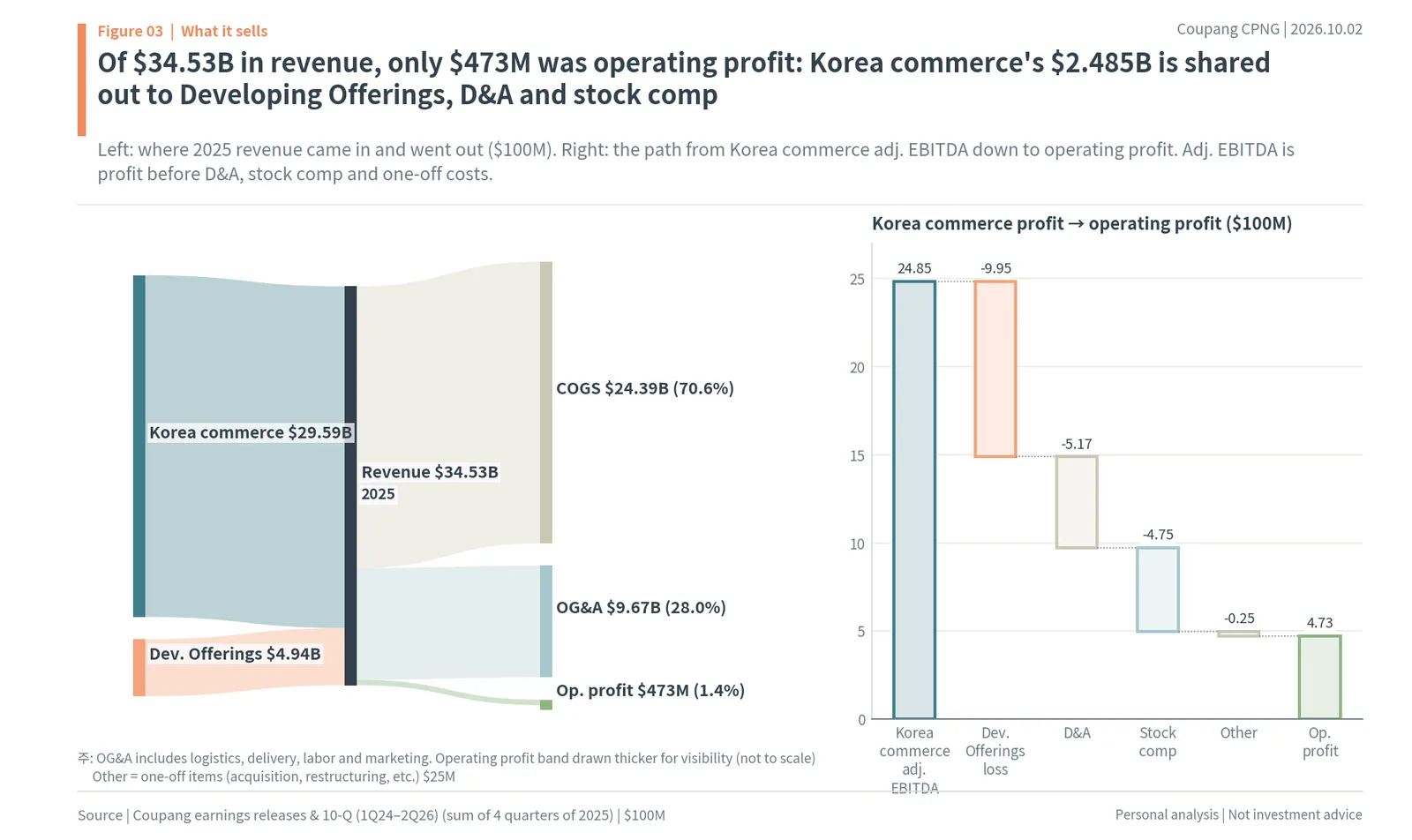
1. This report is the detailed English version of the author’s Korean Naver blog post “Coupang stock outlook: the breach costs are behind it and customers are back — four reasons Coupang at $13 can rise again.”
2. Coupang does business in Korea but is listed on the New York Stock Exchange and reports its results in US dollars.
3. We start with the Korean online shopping market and what Coupang actually sells.
4. Then we answer three questions in order: why it is in the spotlight, why it can rise now, and why its P/E is justified.
5. Earnings are estimated directly from whether customers buy more (active customer count) or spend more (revenue per customer) at Coupang, and how much it keeps from the same revenue (margin).
6. The conclusion first: most of the breach’s cost has passed, and today’s price only assumes margins return to pre-breach levels, so anything above that is upside.
1. Korean Online Shopping and Coupang’s Place in It
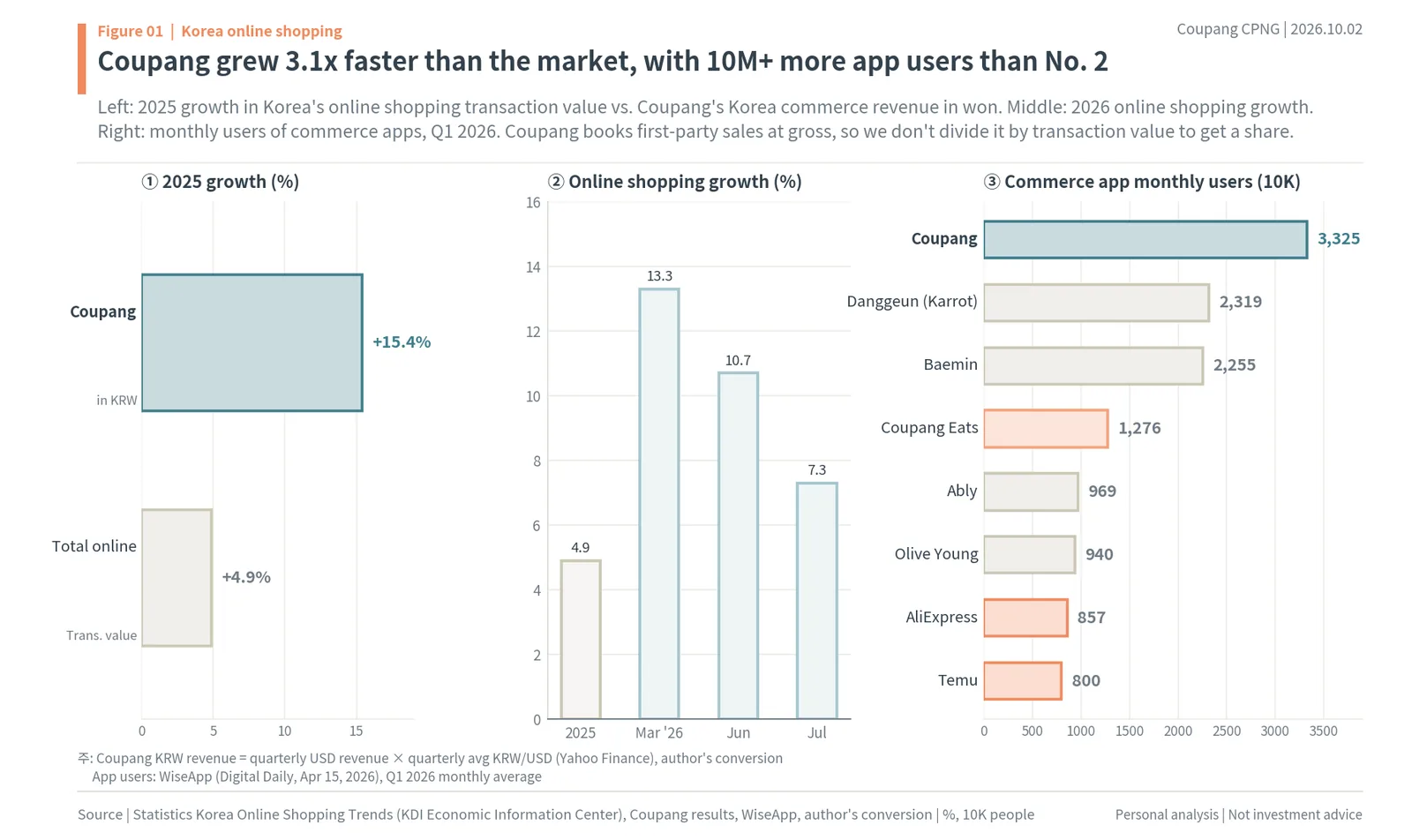
7. Korea’s online shopping transaction value was ₩272.0398 trillion in 2025, up 4.9% from a year earlier (Korea’s national statistics office).
8. It kept growing in 2026: +13.3% in March, +10.7% in June and +7.3% in July.
9. Converted to won over the same period, Coupang’s Korean shopping revenue grew 15.4% from ₩36.4 trillion in 2024 to ₩42.0 trillion in 2025, 3.1x faster than the market (author’s conversion).
10. However, Coupang books its first-party Rocket Delivery sales (goods it buys and resells) at gross value while the transaction statistics use a different basis, so we do not divide one by the other to make a market share.
11. By app users, Coupang was Korea’s No. 1 commerce app in Q1 2026 with 33.25 million users (WiseApp, Digital Daily, April 15).
12. It leads the No. 2 app, Danggeun (Karrot, 23.19 million), by more than 10 million users.
13. Chinese players AliExpress (8.57 million) and Temu (8 million) are still only a little over a quarter of Coupang.
14. The chair of the Korea Fair Trade Commission (KFTC) put Coupang’s share at about 39%, but we could not confirm which market that refers to.
15. Coupang is the market leader growing faster than the market, and the breach did not change that position.
2. What Coupang Sells
16. Coupang reports two segments: Product Commerce and Developing Offerings.
17. Product Commerce covers Rocket Delivery (first-party), Marketplace (third-party sellers), advertising and the WOW membership (Coupang’s paid membership), with 2025 revenue of $29.59B, 85.7% of the total.
18. Developing Offerings include Coupang Eats (food delivery), Rocket Delivery in Taiwan, Farfetch (luxury) and Coupang Play (streaming/OTT), with 2025 revenue of $4.94B.
19. The profit comes from Product Commerce, which earned $2.485B of adjusted EBITDA in 2025 (8.4% margin).
20. Developing Offerings lost $995M that year, so company-wide adjusted EBITDA was $1.490B.
21. After subtracting items such as $517M of depreciation and $475M of stock-based compensation, 2025 operating income was $473M, or 1.4% of revenue.
22. Of $34.53B in revenue, 70.6% went to cost of sales such as merchandise costs and 28.0% to operating, general and administrative expenses such as logistics and labor.
23. WOW subscription revenue was $280M in Q2 2026, up 6.9% from $262M a year earlier (10-Q notes).
24. Third-party seller services revenue, such as seller fees, advertising and delivery fees, was $7.113B in 2025, up 27.5% from $5.580B in 2024.
25. Coupang uses the money earned in Korean shopping to invest in Eats, Taiwan and luxury, and the core of its enterprise value is the Korean shopping margin.

3. Why It Is in the Spotlight: The Breach and the Share Price
26. On November 18, 2025, Coupang learned that a former employee had extracted customer account information, and on November 29 it disclosed that about 33.7 million accounts had been exposed.
27. The leaked data were names, phone numbers, shipping addresses and email addresses, not payment or login information (company 8-K).
28. The head of the Korean entity stepped down on December 10, and in February 2026 a joint government investigation concluded that 33.67 million names and emails had leaked and shipping-address pages had been viewed about 148 million times (Newsis).
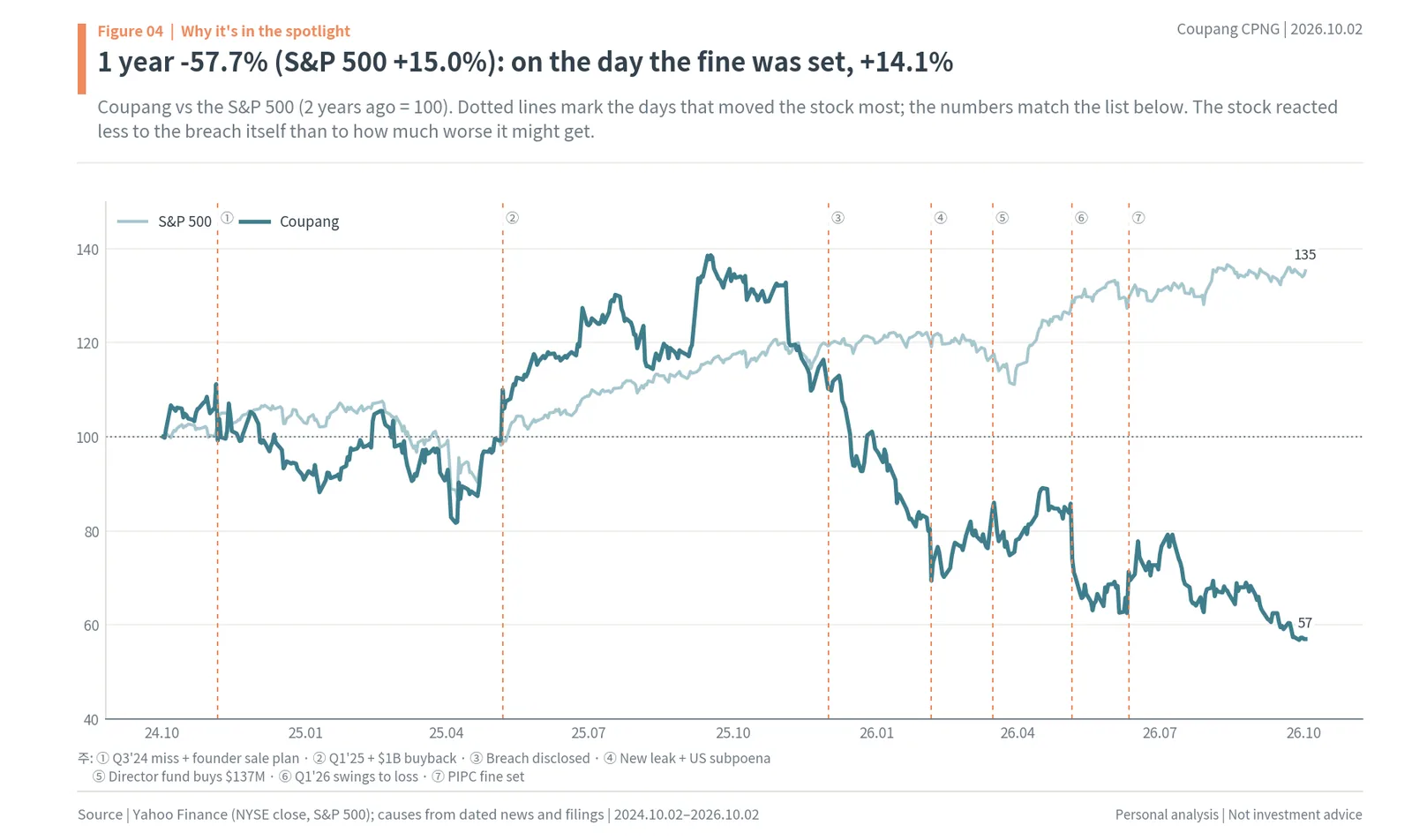
29. The stock fell 16.2%, from $28.16 on November 28, just before the breach became public, to $23.59 at the end of December.
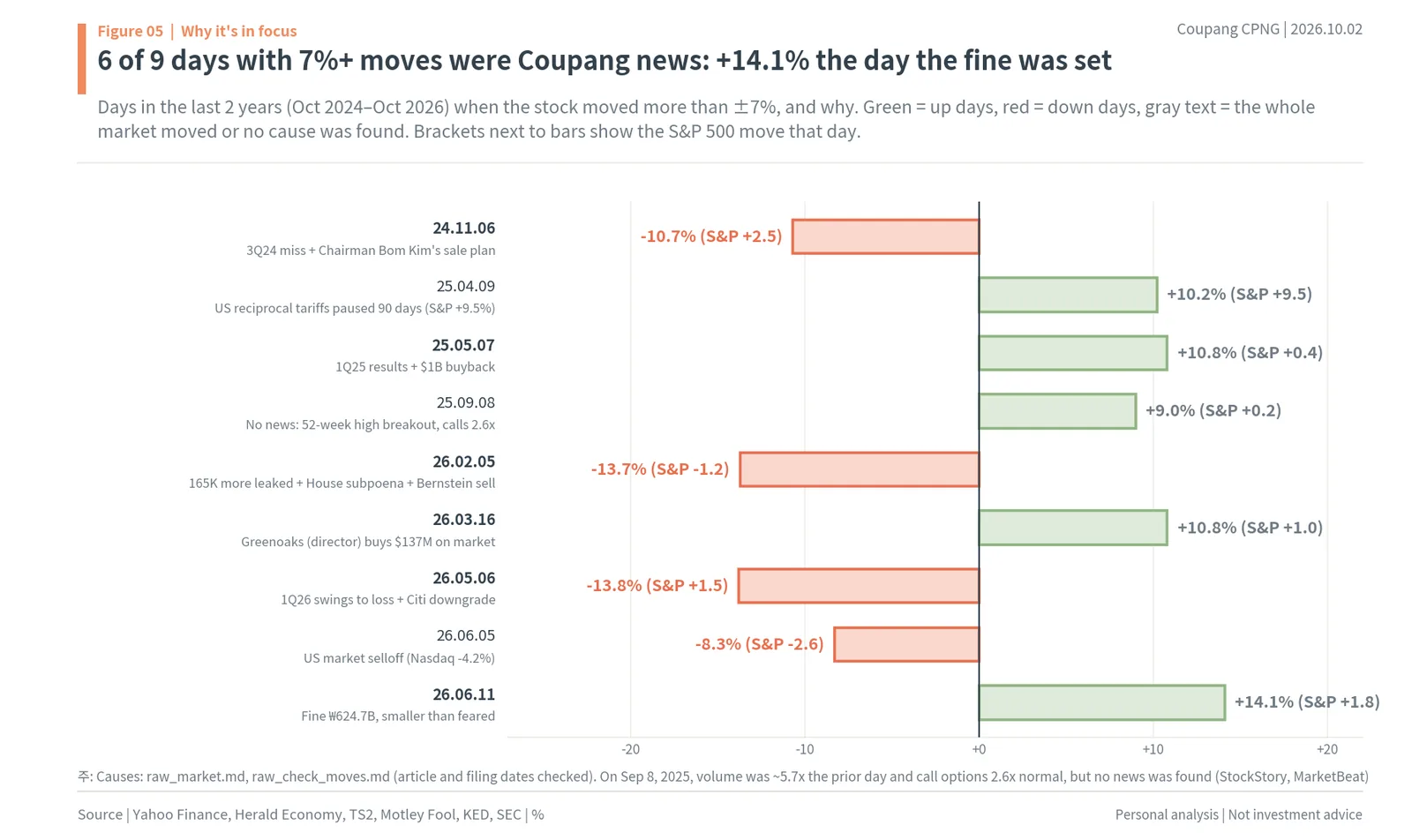
30. On February 5, 2026, an additional leak affecting 165,000 people, a subpoena from the US House Judiciary Committee and a Sell rating from Bernstein came at once, and the stock lost 13.7% in a day.
31. On May 6 it fell another 13.8% on a swing to a Q1 loss and a downgrade from Citi.
32. In the other direction, on March 16 it rose 10.8% after it emerged that Greenoaks, the fund of board member Neil Mehta, had bought 7.35 million shares (about $137M) on the open market.
33. On June 11, when the fine from the Personal Information Protection Commission (PIPC) was set at ₩624.7B, a market that had feared more than ₩1 trillion was relieved and the stock rose 14.1%.
34. Of the nine days in the past two years when the stock moved more than 7%, six were driven by Coupang news and two by the overall market.
35. The remaining day, September 8, 2025 (+9.0%), had no news; the stock broke above its 52-week high and call option volume was 2.6x normal, and we could not find an article explaining it (StockStory, MarketBeat).
36. In September the stock slid 13.6% over the month without a single day down more than 3.2%, and there were no broker rating changes.
37. Instead, $100 oil, the highest US 10-year yield since 2007 (September 15) and a policy rate hike (September 16) piled up.
38. At home, a law cutting the payment deadline for first-party purchases from 60 days to 35 days passed the National Assembly on September 17 (Coupang’s average is 52.3 days, Maeil Ilbo).
39. On September 23, Coupang’s request for an injunction to stop a KFTC on-site inspection was rejected.
40. Short interest was 79.2 million shares (6.16% of the float) on September 15, and we could not identify a single cause.
41. The stock fell 57.7% over the year (S&P 500 +15.0% over the same period) and has lost about $25.8B in market value since before the breach, so it has already paid a large price.
4. What the Breach Left in the Numbers
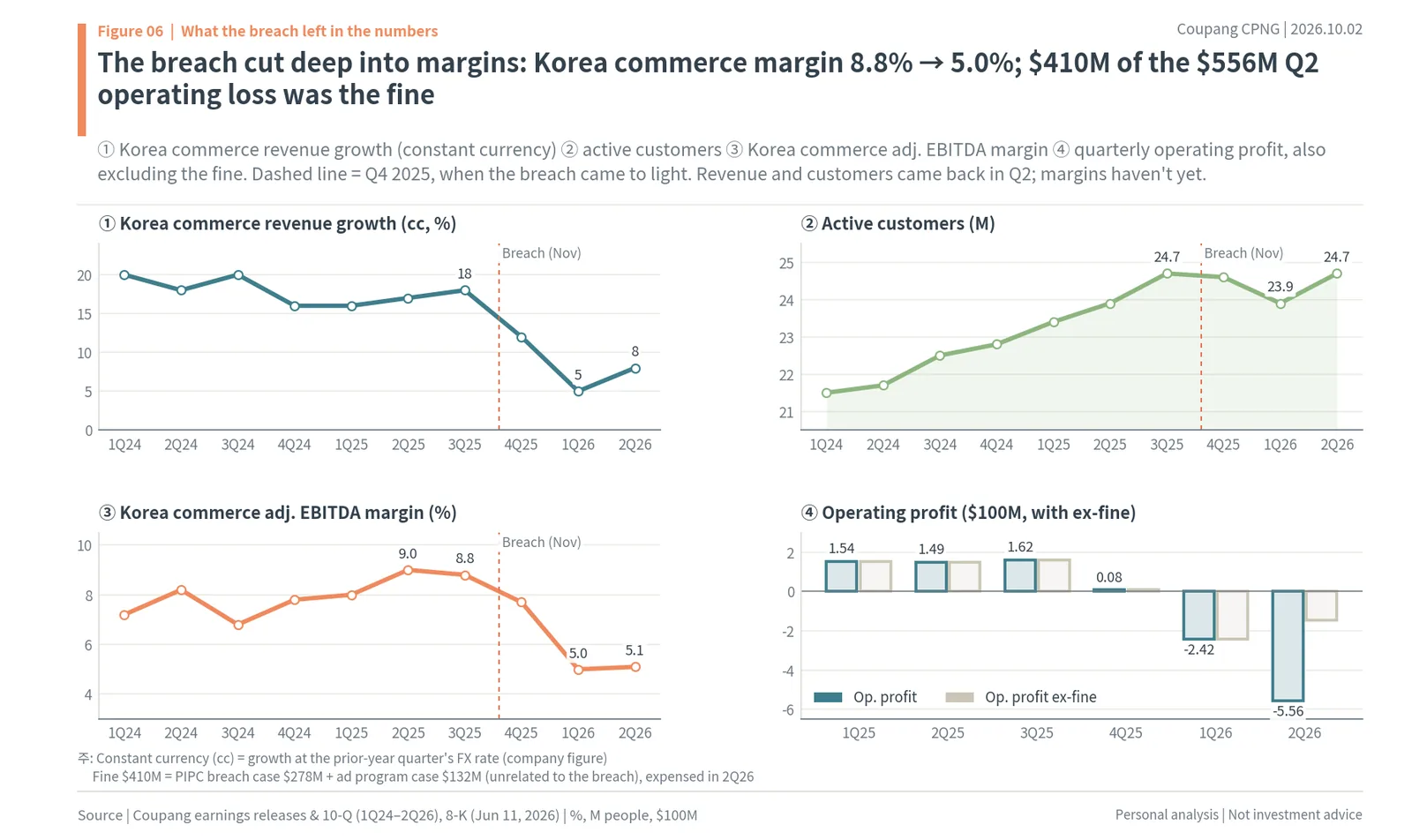
42. In Q3 2025, the last quarter before the breach, Product Commerce grew 18% in constant currency with an 8.8% margin.
43. In Q4, December sales turned down and growth slowed to 12%, then to 5% in Q1 2026.
44. In Q1, ₩1.685 trillion of purchase vouchers were deducted from revenue as they were used, and fixed logistics and staffing costs sized for pre-breach demand remained, so the margin fell to 5.0%.
45. In Q2, the $410M fine was booked as an expense and the operating loss widened to $556M.
46. The company said $278M of the fine relates to the breach and $132M to an advertising program unrelated to the breach.
47. It attributed the Q2 margin decline to three things: supply chain disruption (missed volume discounts), marketing to win customers back, and fixed costs sized for pre-breach demand.
48. Q2 Product Commerce revenue grew 8% in constant currency, but with the won at its weakest in 15 years, dollar growth was only 1%.
49. Taxes were also heavy: losses in Taiwan and luxury cannot be offset against Korean profits, so the 2025 effective tax rate was 64% and the company expects 75–80% for 2026.
50. The breach hurt margins more deeply than revenue, and most of what cut those margins will not recur.
5. More Customers: Active Customers
51. Active customers (anyone who bought at least once in the quarter) fell by 800,000, from 24.7 million in Q3 2025 to 23.9 million in Q1 2026.
52. In Q2 they were back at 24.7 million, the pre-breach record.
53. Of the ₩1.71 trillion increase in won revenue in the year before the breach (Q3 2024 → Q3 2025), ₩0.91 trillion came from more customers and ₩0.80 trillion from higher revenue per customer (author’s breakdown).
54. In the year after the breach (Q2 2025 → Q2 2026), of a ₩0.88 trillion increase, ₩0.34 trillion came from customers and ₩0.54 trillion from revenue per customer.
55. Most of the slowdown came from customer growth dropping from 9.8% to 3.3%, while growth in won revenue per customer fell less, from 7.8% to 5.1%.
56. Management said that among customers who never left or came back, spending was up about 16% from a year earlier.
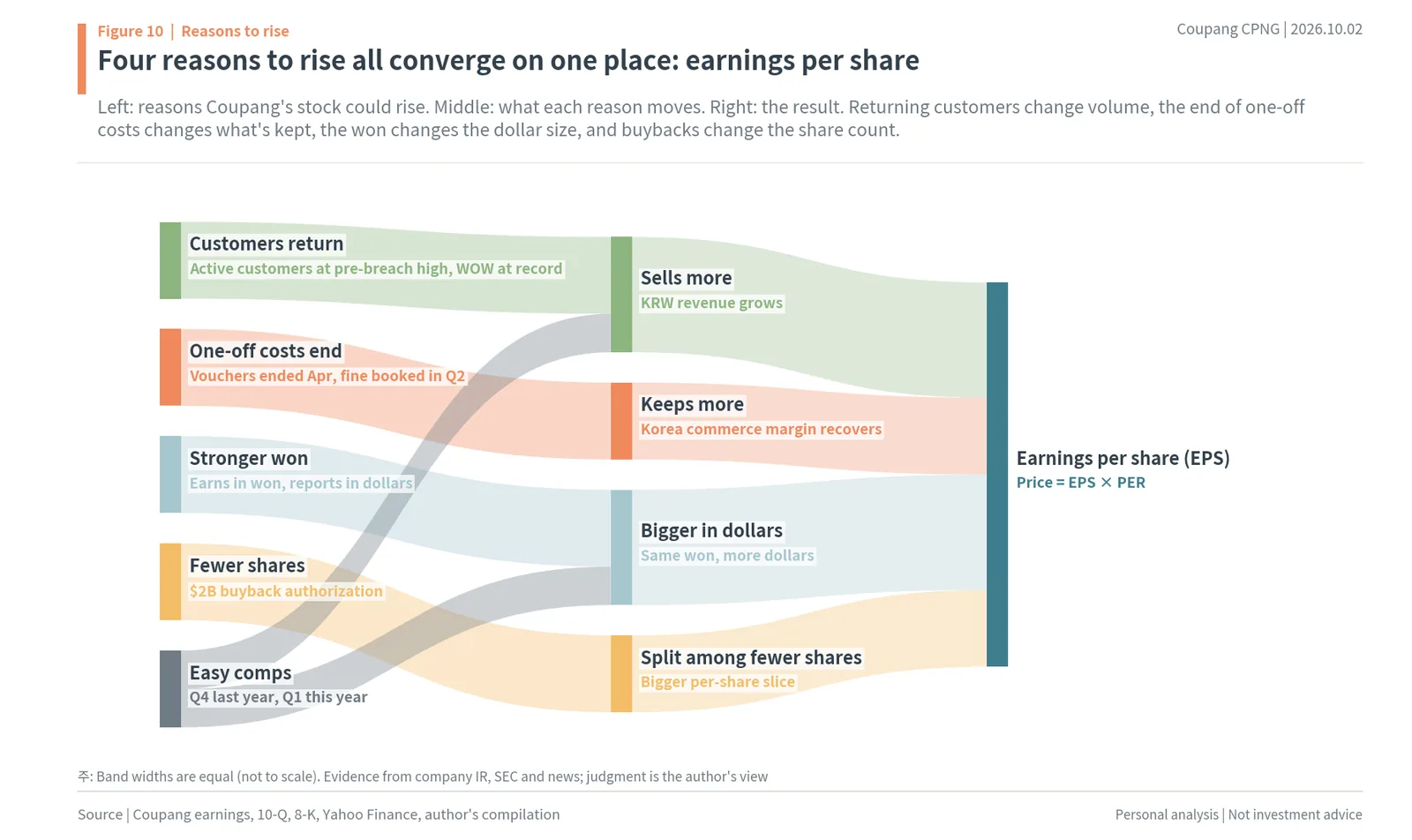
57. It also explained that growth could rise on its own from Q2 2027, when customers who did not return drop out of the comparison base.
58. “More customers” has already come back in the numbers, and customer growth has room to pick up again around Q2 2027, a full year after the breach.

6. Spending More: Revenue per Customer and WOW
59. Won revenue per active customer rose from ₩401,000 in Q1 2024 to ₩452,000 in Q2 2026 (author’s conversion).
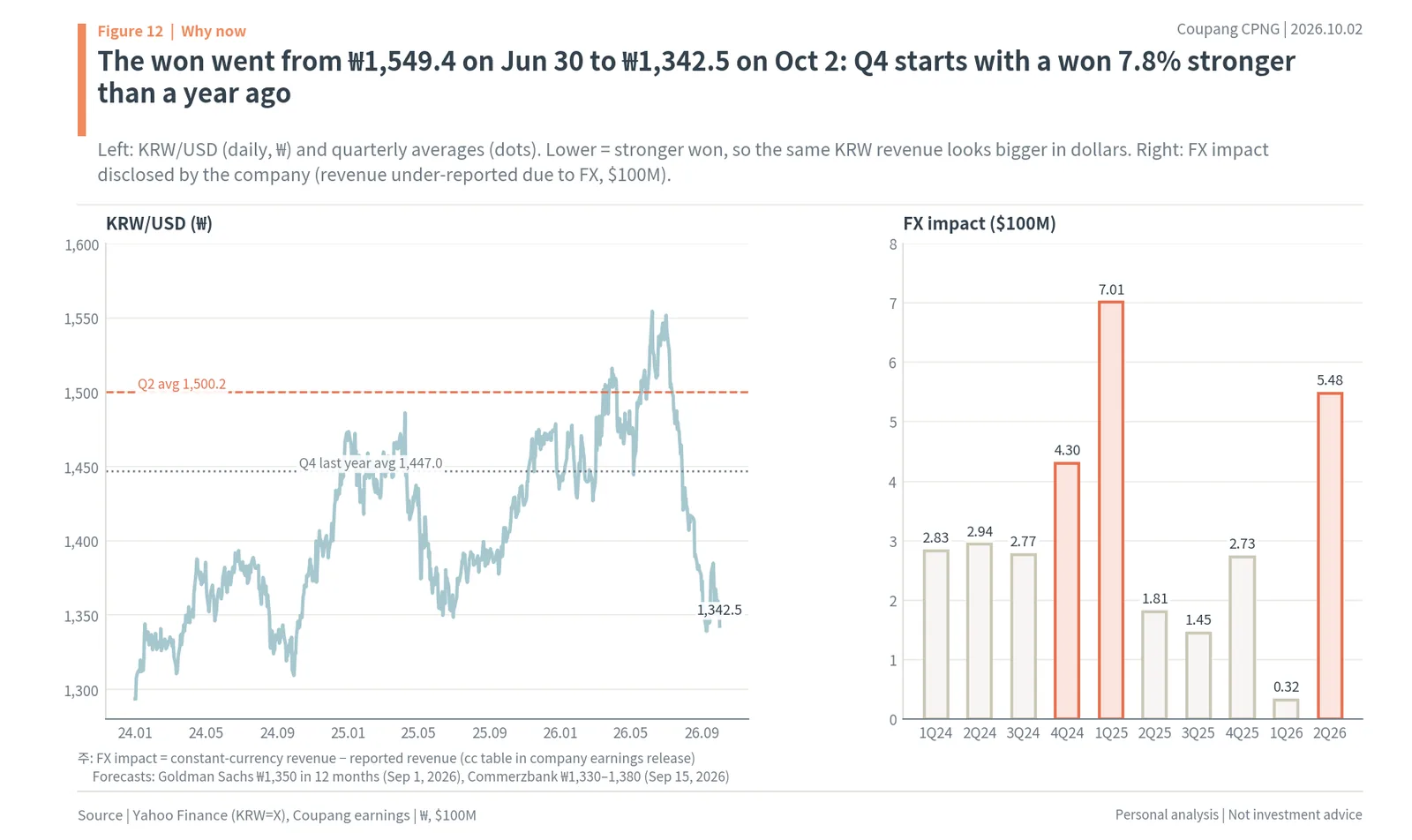
60. The company’s constant-currency growth rate was 5% in Q2, only slightly below pre-breach levels (6–8%), and still rising.
61. WOW membership fell in December right after the breach, but by the end of April it had regained about 80% of the members it lost, and in Q2 it reached an all-time high (management).
62. The company stopped disclosing member counts after 14 million at the end of 2023 (11 million at the end of 2022, company earnings release).
63. Instead, the WOW subscription revenue seen earlier grew 6.9% over the year, confirming the trend.
64. Estimated card spending hit a new monthly record, rising from ₩5.11 trillion in February 2026 to ₩6.11 trillion in July (WiseApp).
65. Coupang app users also rose from 33.64 million in February to 35.95 million in August (Mobile Index).
66. The two surveys use different samples, so we only compare trends, not the size of the numbers.
67. Advertising and seller services are high-margin businesses, and the company says they are still at an early scale.
68. “Spending more” has not broken, and if revenue per customer keeps rising after customers return, won revenue growth can get back to double digits.

7. Developing Offerings: Eats, Taiwan, Farfetch and Play
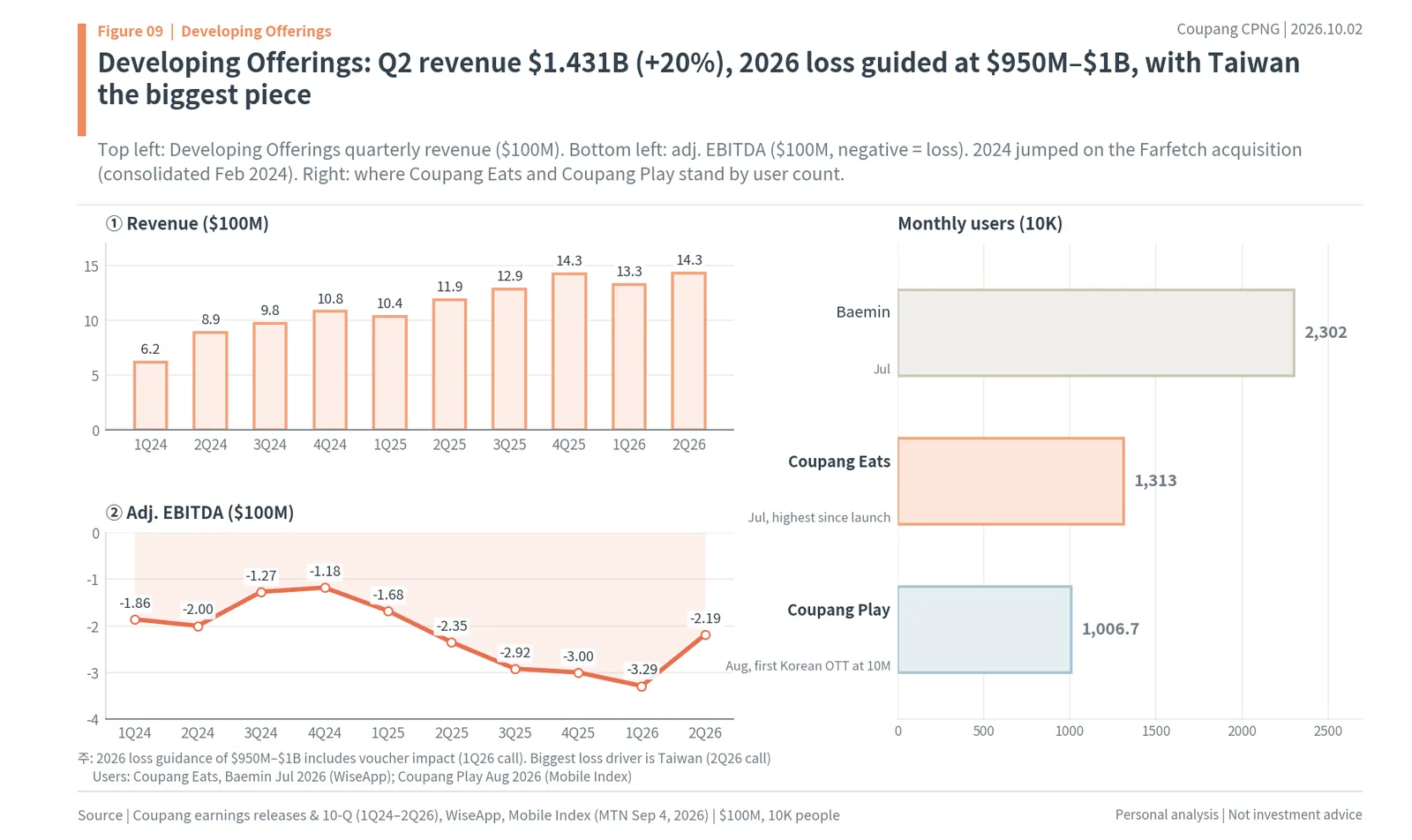
69. Developing Offerings revenue was $1.431B in Q2, up 20% from a year earlier (24% in constant currency).
70. Losses also grew, and the company guided to a 2026 Developing Offerings adjusted EBITDA loss of $950M–$1B (including the voucher impact).
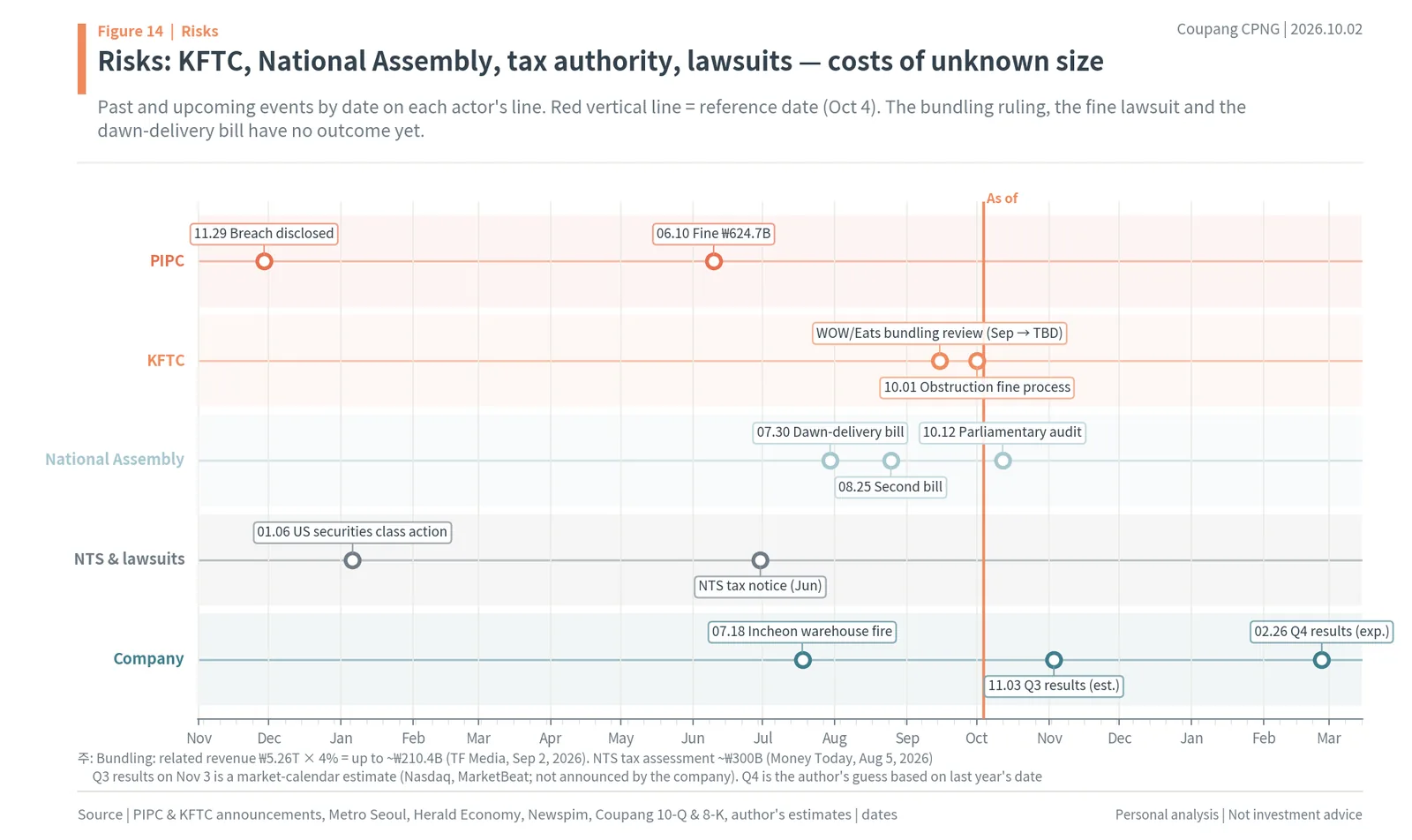
71. Taiwan is the biggest source of the loss; most Taiwan orders are delivered next day, seven days a week, and it began dawn delivery one year after launch (management; it took four years in Korea).
72. On March 26, Taiwan’s fourth fulfillment center opened, covering about 70% of the island (Digital Daily).
73. Coupang Eats had 13.13 million users in July, the most since launch, and estimated payments of ₩1.18 trillion, up 21% from a year earlier (WiseApp).
74. The company said Korean Eats and Japan’s Rocket Now combined are at the stage of paying for themselves.
75. Farfetch grew revenue and turned a profit in Q4 2025 for the first time since the acquisition.
76. Coupang Play had 10.06 million users in August, the first Korean OTT service to pass 10 million (Mobile Index, MTN).
77. Developing Offerings still consume cash, but Taiwan, the bulk of the loss, is following the same path as early Korea, so the author’s base case assumes losses shrink in 2027–2028.
8. Why Now: Four Reasons It Can Rise
78. The four reasons are returning customers, the end of one-off costs, a stronger won and a falling share count, and all of them feed into earnings per share.
First, customers are back
79. Active customers have regained the pre-breach record of 24.7 million, and management said WOW membership is at an all-time high.
Second, one-off costs are over
80. Voucher use ended in mid-April, and the fine was already expensed in Q2.
81. The company said the Korean shopping margin will return close to pre-breach levels by mid-2027, and that win-back marketing will also be scaled down in 2027.

Third, the won has strengthened
82. The won/dollar rate went from ₩1,549.4 on June 30 (the weakest won since 2009) to ₩1,342.5 on October 2.
83. In July alone the won gained 8.8%, its biggest monthly rise since 2009, with semiconductor export proceeds and Bank of Korea rate hikes cited as drivers (The Korea Times).
84. The Q3 average of ₩1,419.9 was still weaker than a year earlier (₩1,385.0), but if Q4 runs at today’s rate, the won would be 7.8% stronger than in Q4 last year (₩1,447.0).
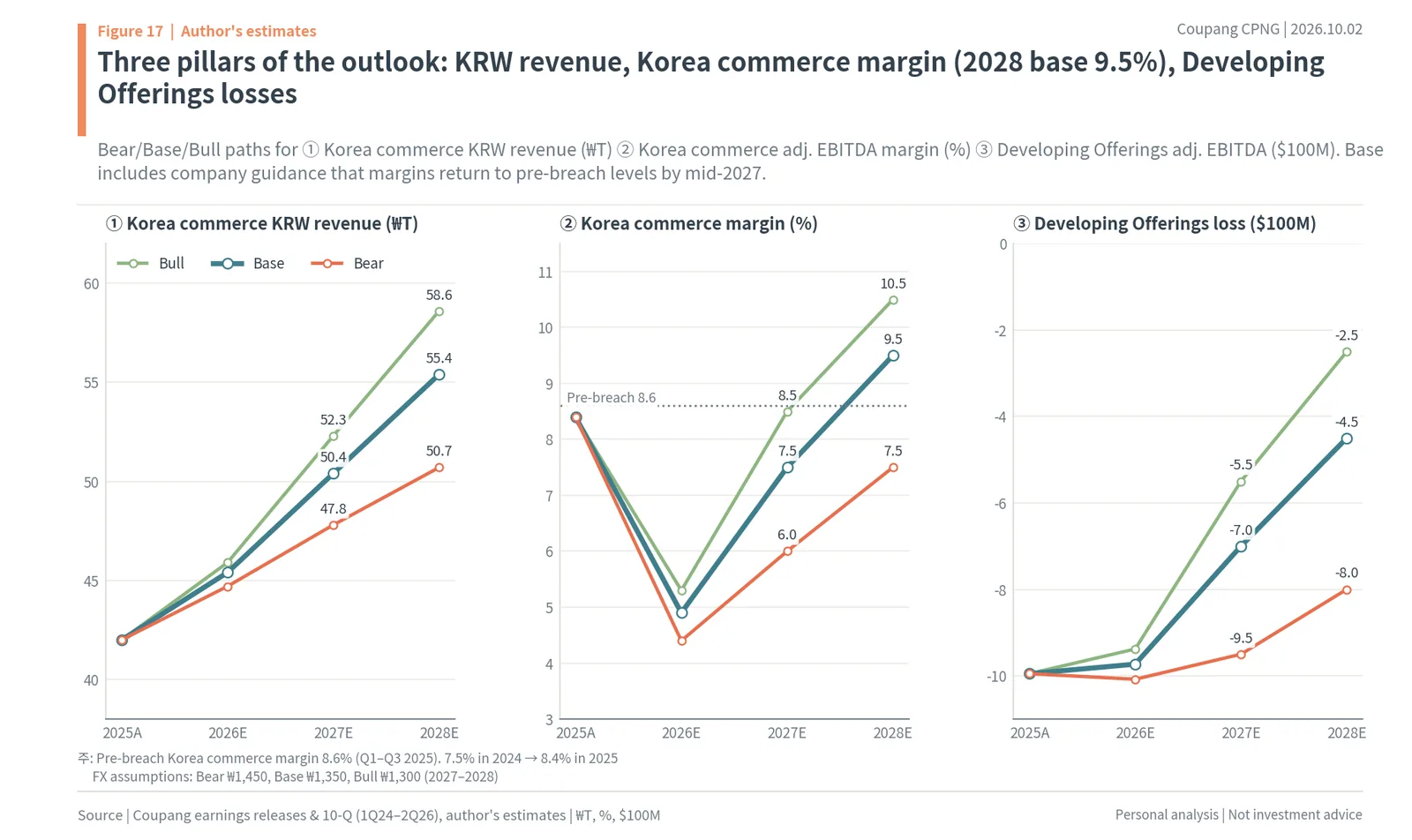
85. According to company filings, a 10% move in the average exchange rate changes quarterly revenue by about $768M.
86. Because of the weak won, Q2 revenue was reported $548M lower than it would have been at the prior-year exchange rate (FX effect in company results).
87. Goldman Sachs expects ₩1,350 in 12 months, and Commerzbank expects ₩1,330–₩1,380.
Fourth, the share count is falling
88. Shares outstanding fell 1.7%, from 1.828 billion (Class A and B combined) in February 2026 to 1.798 billion at the end of July.
89. In the first half alone the company bought 43.7 million shares for $850M, and using the remaining $907M authorization from the end of June at today’s price would retire another 65.8 million shares (3.7%).
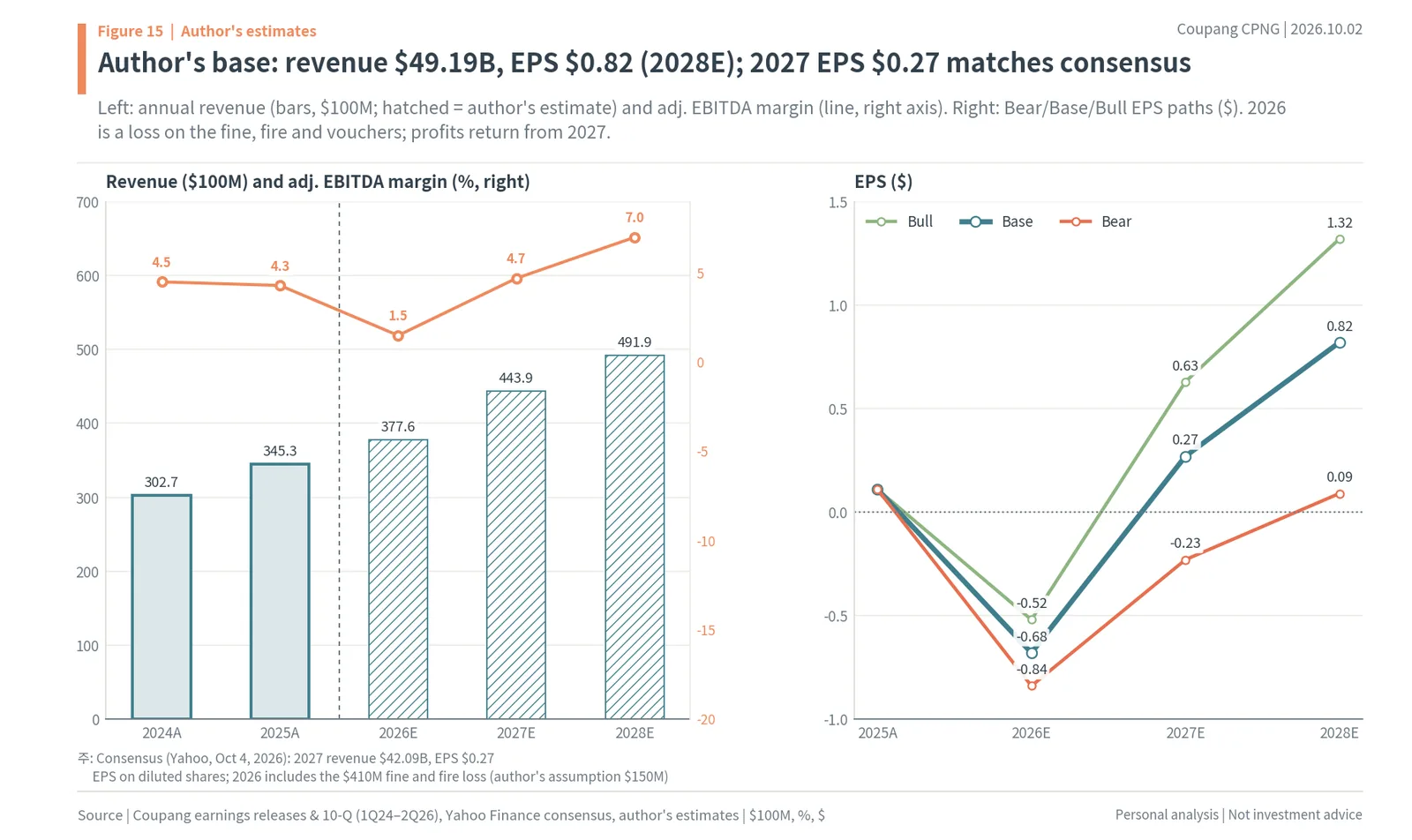
90. Because employee stock compensation issues new shares every quarter, the author’s model adds 8 million new shares per quarter and assumes the remaining authorization is used within a year.

In addition, the comparison base is low
91. Last year’s Q4 saw December sales turn down and this year’s Q1 had vouchers deducted from revenue, so year-ago numbers for Q4 and the first half of next year are low.
92. In the author’s base case, Q4 revenue is $10.53B, which could look 19.2% higher than a year earlier (won revenue +11%, assuming ₩1,345 per dollar).
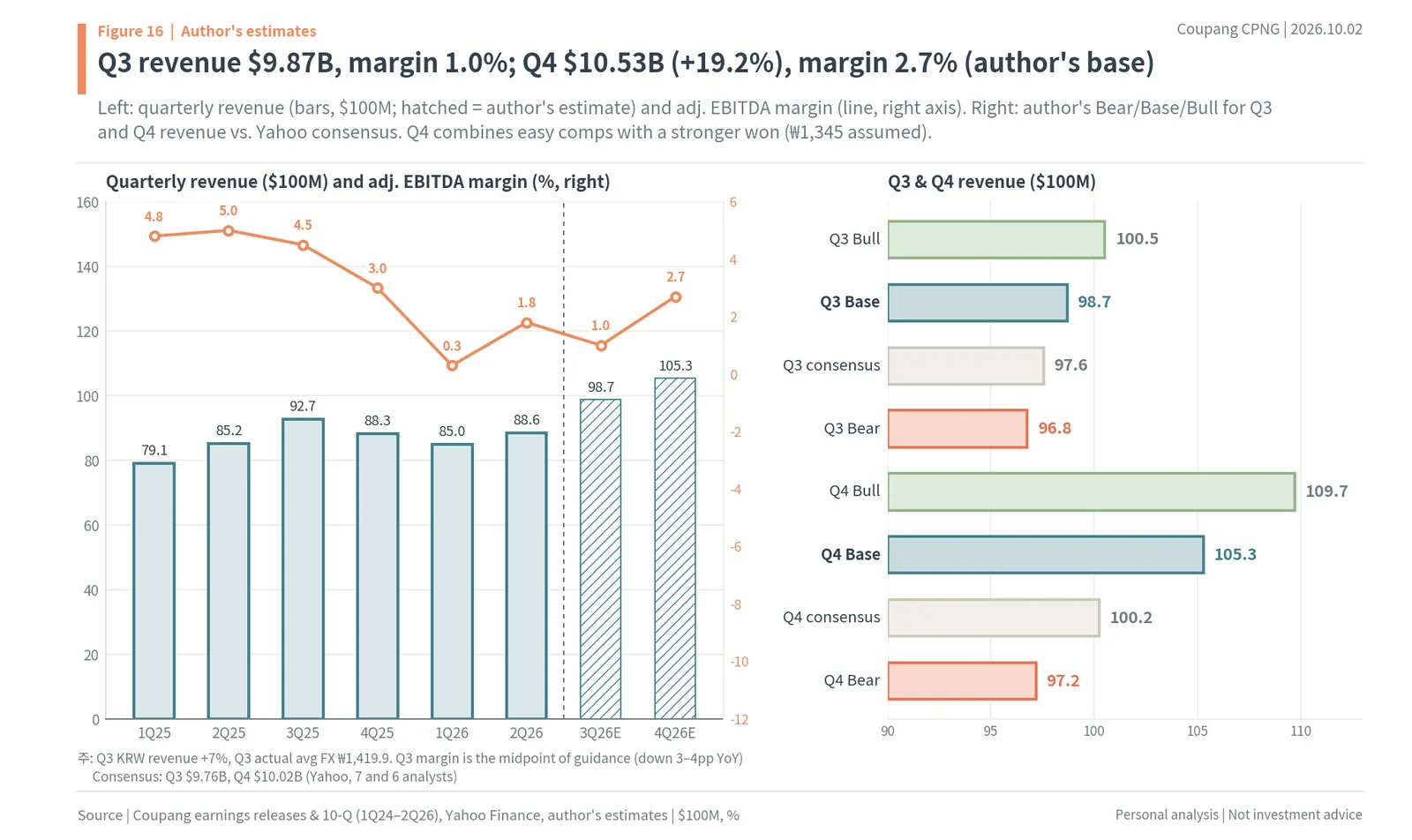
93. The first place the four reasons start to show in the numbers is Q3 results in early November, and the place they look biggest is Q4 results in February.
9. What Could Go Wrong
94. The KFTC plans to review the bundling of Coupang Eats with WOW, and a press report says applying 4% to related revenue of ₩5.26 trillion could produce a penalty of up to about ₩210.4B (Tax & Finance News).
95. The company expected a September hearing in its 10-Q, but the item was not on the KFTC’s published September plenary agenda, and we could not confirm a new date.
96. Legal fights continue over Coupang’s refusal of a KFTC on-site inspection, and on October 1 the KFTC began proceedings for an administrative fine for obstructing the inspection.
97. Korea’s National Tax Service is seeking to collect about ₩300B over transfer pricing with logistics subsidiaries in 2021–2025, and Coupang plans to appeal.
98. Bills in the National Assembly, such as one limiting dawn delivery to 48 hours a week and 12 night shifts a month, remain in committee.
99. A Coupang vice president will testify at the National Assembly’s annual audit of government affairs on October 12.
100. In Korea, hundreds of thousands of people are reported to have joined lawsuits seeking ₩100,000–₩500,000 each, and securities and consumer class actions are also under way in the US.
101. The company has not booked a reserve for the US lawsuits, saying it cannot estimate the loss.
102. Coupang received the written PIPC fine decision in the second week of September, the deadline for an administrative lawsuit is early to mid-December, and as of October 4 there were no reports of a lawsuit or payment (Chosun Biz, September 17).
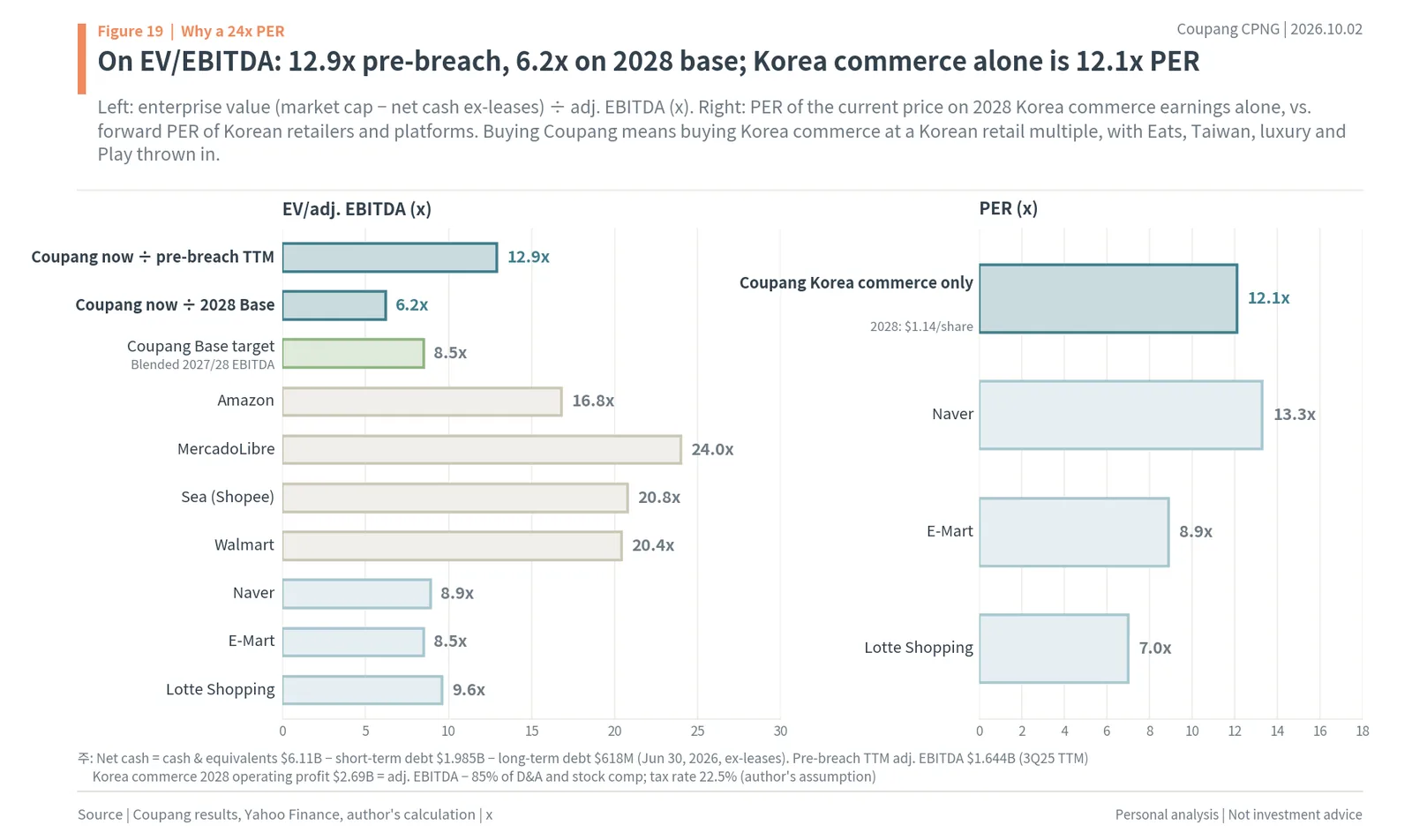
103. On September 11 it rejected the Korea Consumer Agency’s collective dispute mediation proposal (₩100,000 per person) (same article).
104. A July fire at an Incheon fulfillment center put about $246M of inventory and assets at stake, with losses recognized from Q3 and an insurance claim filed.
105. Management also said competition has intensified, and Naver Plus Store users grew from 7.09 million in January to 8.69 million in May.
106. Buybacks in the first half pushed short-term borrowings from $960M to $1.99B, and trailing 12-month free cash flow fell to $105M.
107. Under the law passed on September 17, first-party purchases must be paid within 35 days, so Coupang, which averaged 52.3 days, will pay suppliers faster and tie up that much more cash (Asia Economy, Maeil Ilbo).
108. Under a dual-class structure, founder and chairman Bom Kim holds 74.3% of the voting power, so other shareholders have little say.
109. What these risks have in common is “costs of unknown size,” and the stock has actually risen when such costs were pinned down in numbers.
10. The Author’s Earnings Estimates
110. Consensus 2027 EPS is $0.27 (7 analysts), but each broker uses a different basis, so the author built a model directly.
111. The model has five blocks: Korean shopping won revenue × margin, Developing Offerings revenue and losses, depreciation and stock compensation, taxes, and share count.
112. Won revenue growth is set at 7% for Q3, 11% for Q4 (low base), 11% for 2027 and 10% for 2028.
113. The Korean shopping margin is set at 3.8% for Q3 (the overall margin 3.5pp lower than a year earlier, per company guidance), 5.5% for Q4, 7.5% for 2027 and 9.5% for 2028.
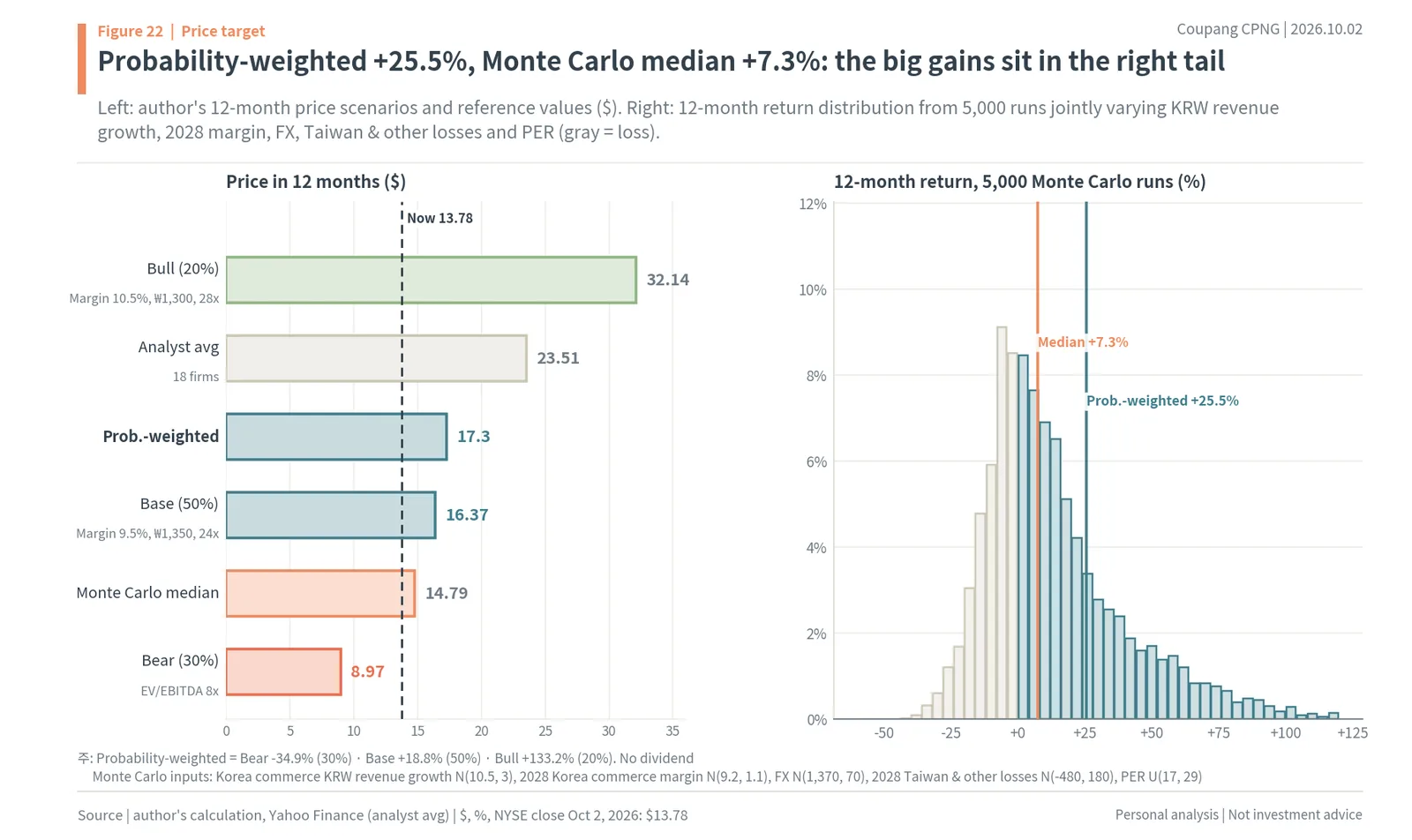
114. The 2028 figure of 9.5% is above the pre-breach 8.6%, but it extends the trend of the year before the breach, when margins rose from 7.5% to 8.4%.
115. Developing Offerings losses are assumed to shrink from $973M in 2026 to $700M in 2027 and $450M in 2028.
116. Exchange rates are held near today’s level: ₩1,345 for Q4 and ₩1,350 for 2027–2028.
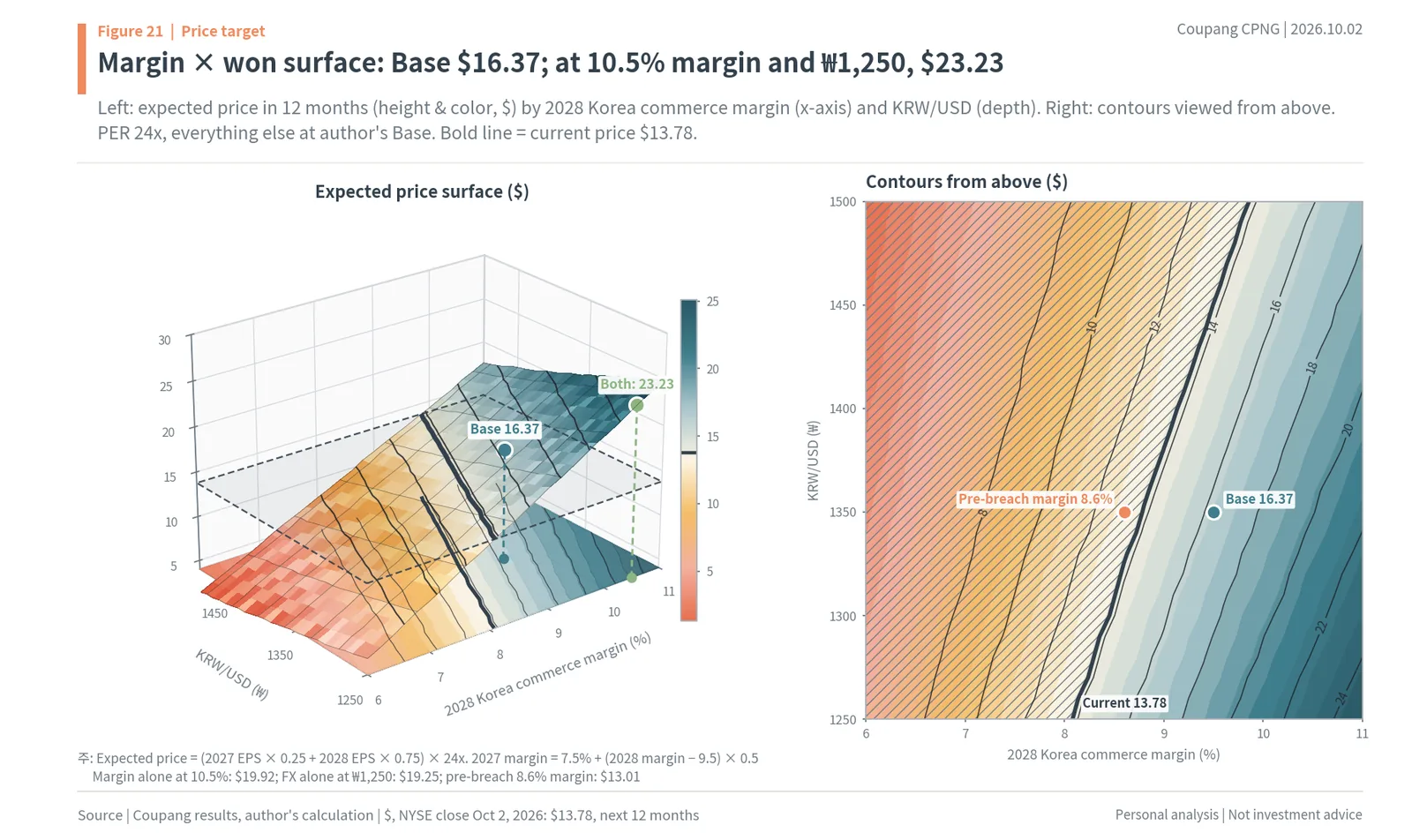
117. Taxes are calculated at 22.5% of Korean shopping profit, which reproduces the actual 2025 rate of 64%.
118. On this basis, base-case revenue is $37.76B in 2026, $44.39B in 2027 and $49.19B in 2028.
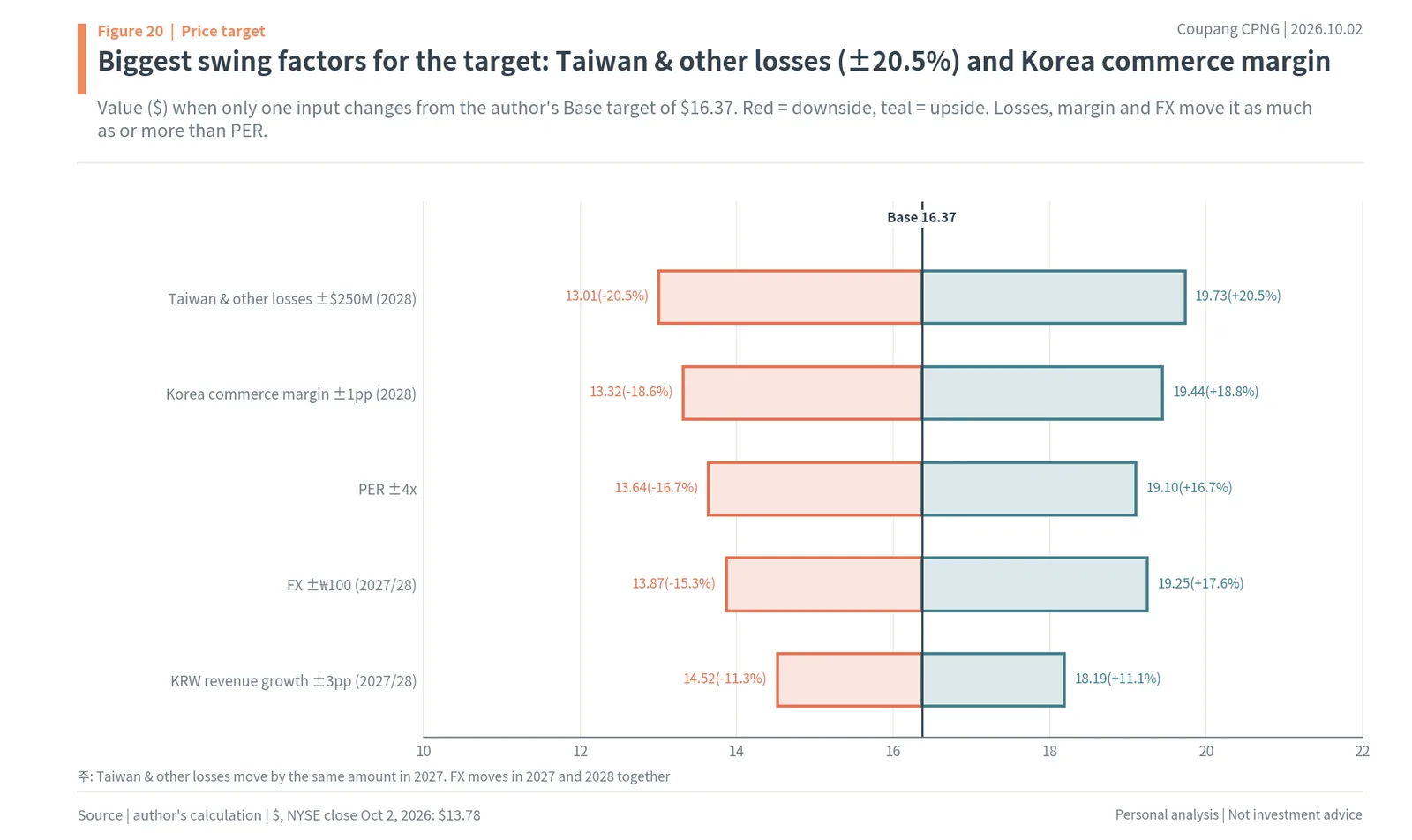
119. Adjusted EBITDA is $570M in 2026, $2.10B in 2027 and $3.45B in 2028.
120. Operating income turns positive at $780M in 2027 and $2.03B in 2028.
121. EPS is -$0.68 in 2026 (including the fine and fire), $0.27 in 2027 and $0.82 in 2028.
122. Q3 is estimated at $9.87B in revenue (+6.5%) with a 1.0% adjusted EBITDA margin, and Q4 at $10.53B (+19.2%) with a 2.7% margin.
123. Versus Yahoo consensus, revenue is 1.2% higher for Q3, 5.1% for Q4 and 5.5% for 2027, while 2027 EPS is the same.
124. Most of the revenue gap is currency: converting 2027 won revenue at the 2026 average rate (₩1,428.8) gives $42.34B, almost the same as consensus ($42.09B).
125. The bear case is a path where customers return slowly (won revenue +7% and +6%), margins are 6.0% and 7.5%, and the won is at ₩1,450, giving 2028 EPS of $0.09.
126. The bull case is won revenue +14% and +12%, margins of 8.5% and 10.5%, ₩1,300 per dollar and an extra $1B buyback, giving 2028 EPS of $1.32.
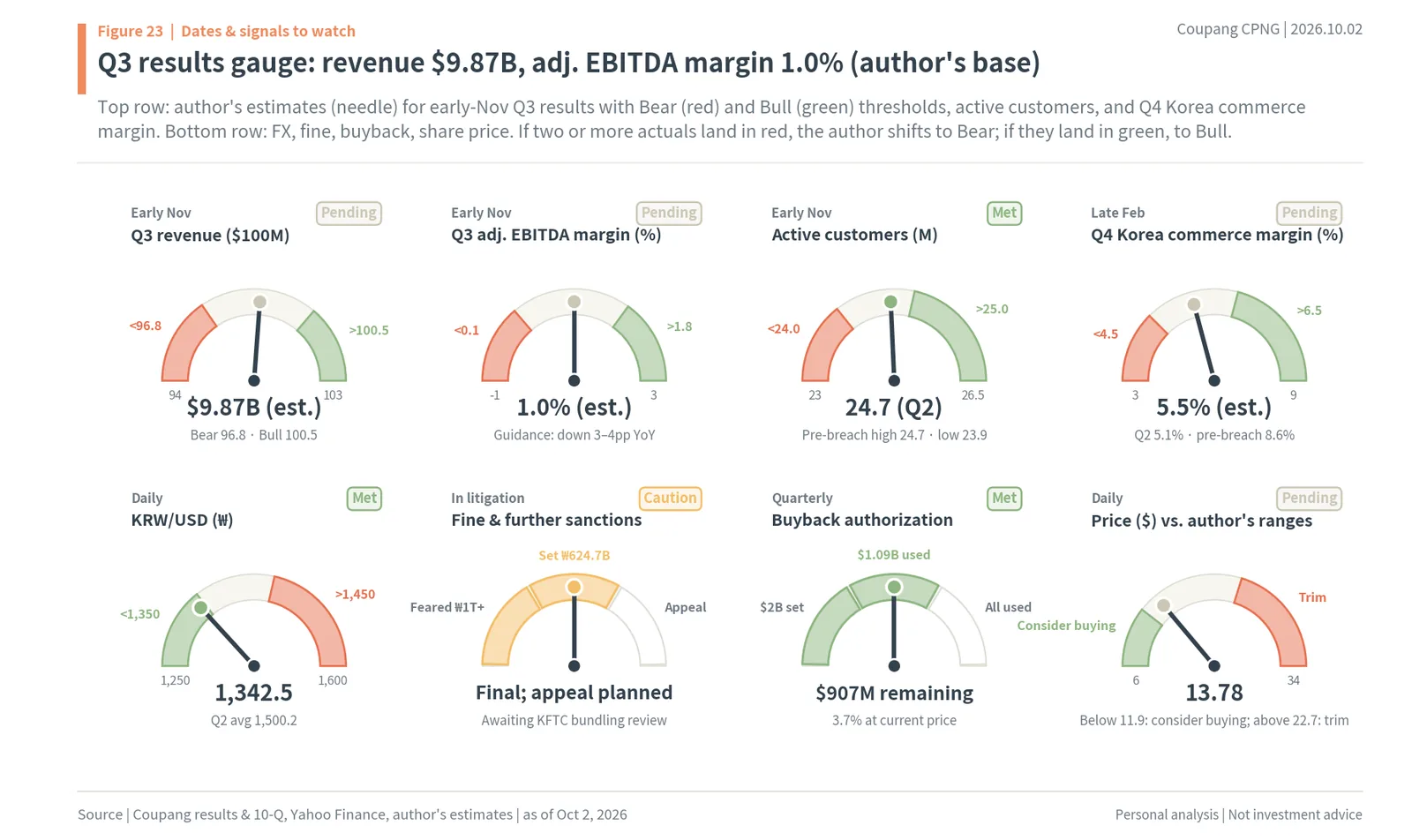
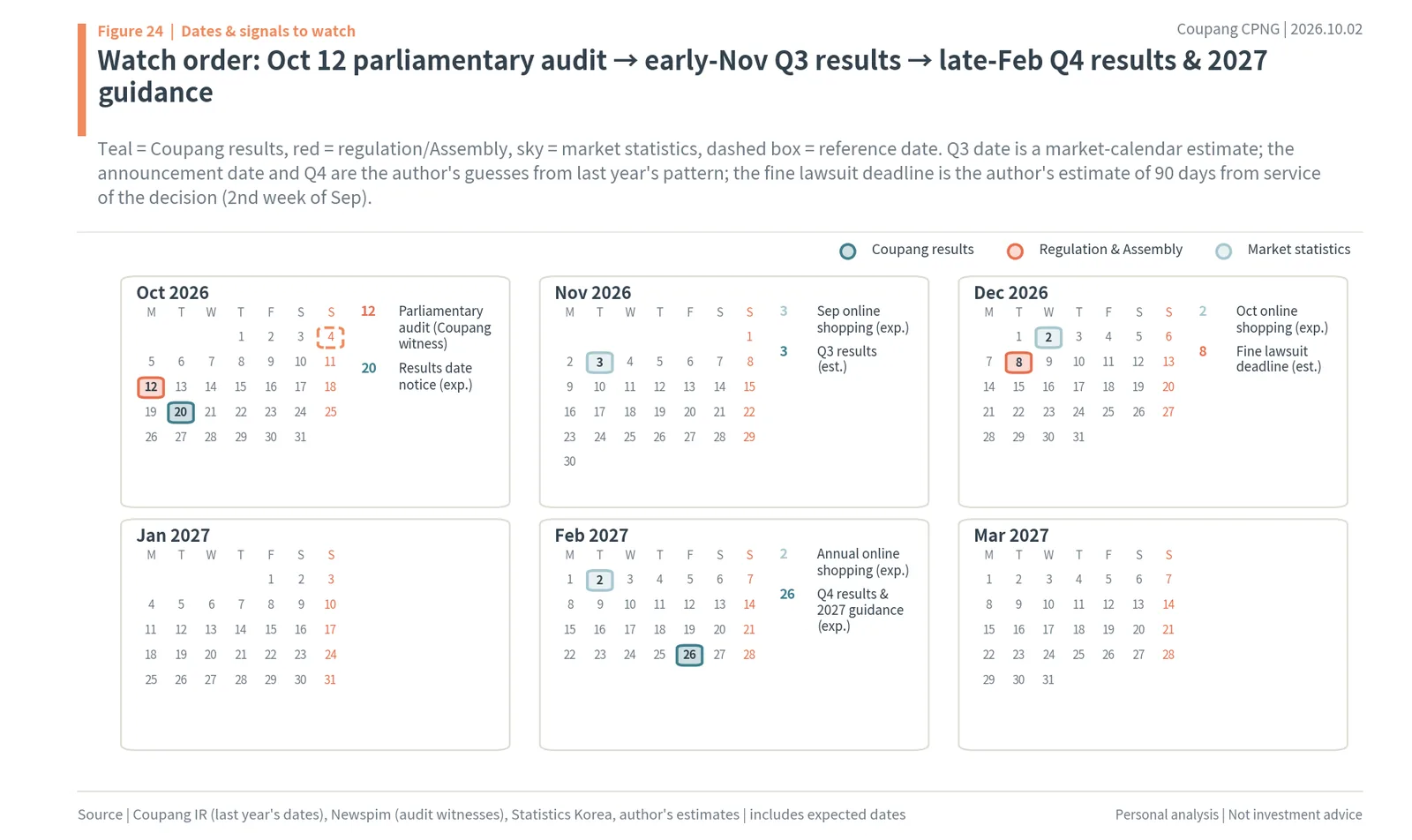
127. The author’s base case has 2027 EPS at $0.27, the same as consensus, and then tripling to $0.82 in 2028.
11. Why a 24x P/E Is Justified
128. Coupang’s 2025 EPS was only $0.11, so a P/E on past earnings is meaningless and it should be valued on 2027–2028 earnings.
129. The 12-month forward EPS the market will look at in October 2027 is $0.68 (author’s base case), blending one quarter of 2027 with three quarters of 2028.
130. The first yardstick is US e-commerce and retail: Amazon trades at 24.0x forward EPS of $10.48, and MercadoLibre at 29.9x forward EPS of $56.65.
131. Walmart is at 32.3x on $3.23, DoorDash at 22.9x on $8.25 and Sea at 18.4x on $5.18, and the median of the five is 24.0x.
132. The second yardstick is Chinese e-commerce, which is much lower: Alibaba at 11.5x and JD.com and PDD at 6.1x.
133. The third yardstick is Korean retail and platforms: Naver at 13.3x, E-Mart at 8.9x and Lotte Shopping at 7.0x.
134. Coupang is a Korean company, but its business model (first-party sales, sellers, advertising, membership) is the same as Amazon’s, and its growth is far higher than Korean retail.
135. Fourth, dividing the average broker price target of $23.51 by the author’s forward EPS gives 34.5x, so brokers are applying a higher multiple than the author.
136. Fifth, the current share price is 20.2x the author’s forward EPS and 16.8x 2028 EPS.
137. Instead of the low multiples of Chinese and Korean retail, the author uses 24x, the same as Amazon, for the base case, and 28x, close to MercadoLibre, for the bull case.
138. In the bear case there is almost no profit, so P/E cannot be used, and the floor is set at 8x EV/EBITDA, the same as Korean retail.

139. On EV/EBITDA, today’s enterprise value of $21.3B (after subtracting $3.51B of net cash excluding leases) is 12.9x pre-breach 12-month adjusted EBITDA ($1.644B).
140. On the author’s base-case 2028 adjusted EBITDA it is 6.2x, below not only the US e-commerce median (20.8x) but also Korean retail (8.9x).
141. Even the base-case target of $16.37 is only 8.5x blended 2027–2028 adjusted EBITDA, so it is not expensive.
142. Taking Korean shopping on its own, 2028 Korean shopping operating income of $2.69B is $1.14 per share after tax, and today’s price is 12.1x that.
143. Buying Coupang at today’s price means buying Korean shopping at a Korean retail multiple and getting Eats, Taiwan, luxury and Play thrown in for free.
144. A 24x P/E is the same multiple as Amazon, and on EV/EBITDA the base-case target is only 8.5x, so the author does not see it as excessive.
12. Price Target and Expected Return
145. The bear case is $8.97 (-34.9%), the base case $16.37 (+18.8%) and the bull case $32.14 (+133.2%).
146. Weighting bear 30%, base 50% and bull 20% gives a price target of $17.3 (+25.5%).
147. Solving backward from today’s price, it equals a 2028 Korean shopping margin of 8.7% under base-case assumptions.
148. If the margin only returns to the pre-breach 8.6%, the value is $13.01, almost the same as today.
149. Holding the other blocks at base and solving for one at a time, 2027 won revenue growth of 3.4% or an exchange rate of ₩1,451 also matches today’s price.
150. In sensitivity terms, ±$250M in 2028 losses from Taiwan and other Developing Offerings has the biggest impact at ±20.5%, followed by ±1pp in the Korean shopping margin (-18.6% to +18.8%).
151. ±₩100 in the exchange rate moves the value -15.3% to +17.6%, ±4x in P/E ±16.7%, and ±3pp in won revenue growth -11.3% to +11.1%.
152. A margin rising to 10.5% gives $19.92, an exchange rate of ₩1,250 gives $19.25, and both together give $23.23.
153. In 5,000 simulations shaking all five blocks together, the median is $14.79 (+7.3%), and eight times out of ten the result falls between -13.3% and +51.9%.
154. The probability of a loss is 35.2%, of losing more than 20% is 4.0%, and of gaining more than 50% is 10.8%.
155. The simulation median (+7.3%) is lower than the probability-weighted return (+25.5%) because the bull-side tail is long.
156. The author’s ranges are to consider buying below $11.9 and to reduce the position above $22.7.
157. The expected return is +25.5% probability-weighted and +7.3% at the simulation median, an asymmetric setup where big gains come when margins and the won improve together.
13. Dates to Watch and Signals of Being Wrong
158. The first check is Q3 results in early November, and the company has not yet announced the date (market calendars estimate November 3; last year results came out November 4 and were announced October 21).
159. The author’s base case is revenue of $9.87B and an adjusted EBITDA margin of 1.0%, with the bear boundary at $9.68B and 0.1% and the bull at $10.05B and 1.8%.
160. If active customers start growing beyond 24.7 million, “customers are back” becomes firm.
161. A low Q3 margin is fine as the company guided, and the real confirmation is whether the Korean shopping margin rises above Q2’s 5.1% in Q4.
162. The company said it will give detailed 2027 guidance around year-end.
163. Beyond that, we watch the October 12 National Assembly audit, the KFTC WOW–Eats review, the lawsuit over the fine, the dawn delivery bills and the won/dollar rate.
164. If active customers fall back below 24 million, the Q4 margin is lower than Q3, or a new fine on the scale of trillions of won comes out, the author moves from the base case to the bear case as the reference.
165. Conversely, if Q4 revenue is close to $11B and the Korean shopping margin tops 6.5%, the author moves toward the bull case.
166. The order in which the reasons to rise become fact is customer count (already confirmed) → margin (Q3 and Q4) → the won (daily) → share count (quarterly).
14. Summary
167. Coupang’s stock fell 57.7% in the year after the data breach, so it has already paid much of the breach’s cost.
168. The post-breach numbers show customers back at the pre-breach record, and the vouchers and fine were money spent once and done.
169. A stronger won and share buybacks have turned to making earnings per share larger from the same business.
170. The author’s base case is 2027 EPS of $0.27 and 2028 EPS of $0.82, with a probability-weighted price target of $17.3 (+25.5%).
171. Today’s price assumes the 2028 Korean shopping margin only returns to the pre-breach level (8.6%), so anything above that is upside.
172. One breach, customers are back, and the remaining question is whether Coupang can keep more from those returning customers than it did before the breach.
Maochaedung’s take
Coupang’s stock has fallen to less than half its level since the data breach, but the post-breach numbers show exactly what “one breach, customers are back” means: customers have regained the pre-breach record, and one-off costs such as vouchers and the fine ended in the first half. On top of that, a stronger won and share buybacks have turned to pushing earnings per share higher. Today’s price assumes the 2028 Korean shopping margin only matches its pre-breach level, so if margins rise above that as the company says, the author sees room for a re-rating. However, margins stay low through Q3 and more regulatory costs could come, so the first check is whether customer count and the Korean shopping margin rise together in Q3 results in early November.
Coupang Stock FAQ
Q. Why did Coupang stock fall so much?
After the November 2025 data breach (about 33.7M accounts), the stock fell from $28.16 to $13.78 (−51.1%) on vouchers, a $410M fine, a swing to losses and a weaker won.
Q. Have Coupang customers come back after the breach?
Yes. Active customers fell to 23.9M in Q1 2026 and returned to 24.7M in Q2, matching the pre-breach record; management says WOW membership is at an all-time high.
Q. What is the author’s Coupang price target?
A probability-weighted $17.3 (+25.5%): Bear $8.97, Base $16.37 (12-month forward EPS $0.68 × 24x), Bull $32.14. The Monte Carlo median is +7.3%.
Q. How does the Korean won affect Coupang?
Coupang earns mostly in won but reports in dollars. KRW/USD moved from a Q2 average of 1,500.2 to 1,342.5 on Oct 2, so the same won revenue converts to 11.7% more dollars.
Q. When are Coupang’s Q3 2026 results?
Not yet announced by the company as of Oct 4, 2026; market calendars estimate November 3.
Sources
- Coupang IR, 2024–2026 quarterly earnings releases, presentations and earnings calls (link), 2024.05–2026.08
- Coupang, Q2 2026 earnings release (link), 2026.08.04
- Coupang, Q2 2026 earnings call script (link), 2026.08.04
- US SEC, Coupang Q2 2026 10-Q (link), 2026.08.04
- US SEC, Coupang 8-K on the cybersecurity incident (link), 2025.12.16
- US SEC, Coupang 8-K on the PIPC fine (link), 2026.06.11
- Kyunghyang Shinmun, Coupang compensation plan of ₩1.685 trillion (link), 2025.12.29
- Kyunghyang Shinmun, Coupang estimated card spending hits July record (link), 2026.08.06
- Herald Business, “Worst avoided”: Coupang US shares jump 14% (link), 2026.06.12
- Herald Business, Greenoaks buys an additional $136.5M (link), 2026.03.13
- KEIA, The Coupang Data Breach: A Timeline (link), 2026.02.22
- TS2, Coupang stock sinks as fresh data leak, U.S. subpoena rattle (link), 2026.02.05
- Metro Seoul, bill restricting dawn delivery (link), 2026.09.09
- Herald Business, KFTC begins administrative fine proceedings for Coupang’s obstruction of inspection (link), 2026.10.01
- US SEC, Coupang 2025 10-K (link), 2026.02.26
- US SEC, Coupang 8-K/A on the compensation plan (link), 2025.12.29
- US SEC, Coupang 2026 proxy statement DEF 14A (link), 2026.04.27
- KDI Economic Information Center, July 2026 online shopping trends (link), 2026.09.01
- Digital Daily, Q1 2026 commerce app users (link), 2026.04.15
- MTN, Coupang Play passes 10 million users (link), 2026.09.04
- Money Today, Coupang estimated card spending (link), 2026.08.06
- Tax & Finance News, KFTC review of Coupang bundling (link), 2026.09.02
- The Korea Times, won posts strongest monthly gain since 2009 (link), 2026.08.02
- FXStreet, Commerzbank outlook on the Korean won (link), 2026.09.15
- Newsis, results of the joint government investigation (link), 2026.02.10
- Chosun Biz, Coupang receives fine decision and rejects collective dispute mediation proposal (link), 2026.09.17
- Asia Economy, 35-day payment deadline under the Large-Scale Retail Business Act passes the National Assembly (link), 2026.09.17
- Newspim, Coupang’s injunction against KFTC on-site inspection rejected (link), 2026.09.23
- Maeil Ilbo, Coupang’s average payment period for first-party purchases is 52.3 days (link), 2026.09.20
- US SEC, Coupang Q4 2023 earnings release (14 million WOW members) (link), 2024.02.27
- Korea Fair Trade Commission, list of plenary decision agenda items (link), checked 2026.10.04
- StockStory (Finviz), Coupang stock trades up (link), 2025.09.08
- Yahoo Finance, Coupang and S&P 500 prices, won/dollar rate, analyst estimates and price targets, peer forward P/E (link), accessed 2026.10.04
Disclaimer
This post records the author’s personal analysis and views based on publicly available information and does not recommend choosing any particular product or company. It does not recommend buying or selling any financial investment product and is not a service provided as investment advisory or quasi-investment advisory business.
Figures in this post are values published as of the time of writing. Coupang reports results in US dollars; won revenue and quarterly average exchange rates were converted by the author using Yahoo Finance exchange rates and may differ from company figures. The 2026–2028 earnings and EPS and the Q3 and Q4 results in this post are estimates from the author’s own model, not company guidance or broker consensus. Accuracy and completeness are not guaranteed.
The conclusion ranges and scenarios are estimates based on the assumptions stated in the text, and results will differ if those assumptions do not hold. Items marked ‘author’s calculation’ or ‘author’s estimate’ are the author’s calculations and assumptions, not confirmed facts.
The price targets and buy/sell ranges in this post are the author’s personal views and calculations; they do not recommend trading at any particular time or promise any return. For overseas stocks, gains and losses in your home currency change with exchange rates.
Author’s position: does not own shares
Responsibility for decisions and their outcomes lies with the reader.
As of: October 4, 2026