Korea Mortgage Rate Reset: KRW 165tn of Loans Repricing in Q4 2026, Payment Math, DSR Refinancing Trap and the UK Mortgage Charter
KRW 165tn of Korean mortgages are being repriced at today’s rates in Q4 2026. How much do monthly payments rise, why does it repeat every year, and why can’t borrowers simply switch banks? Numbers as of October 9, 2026.
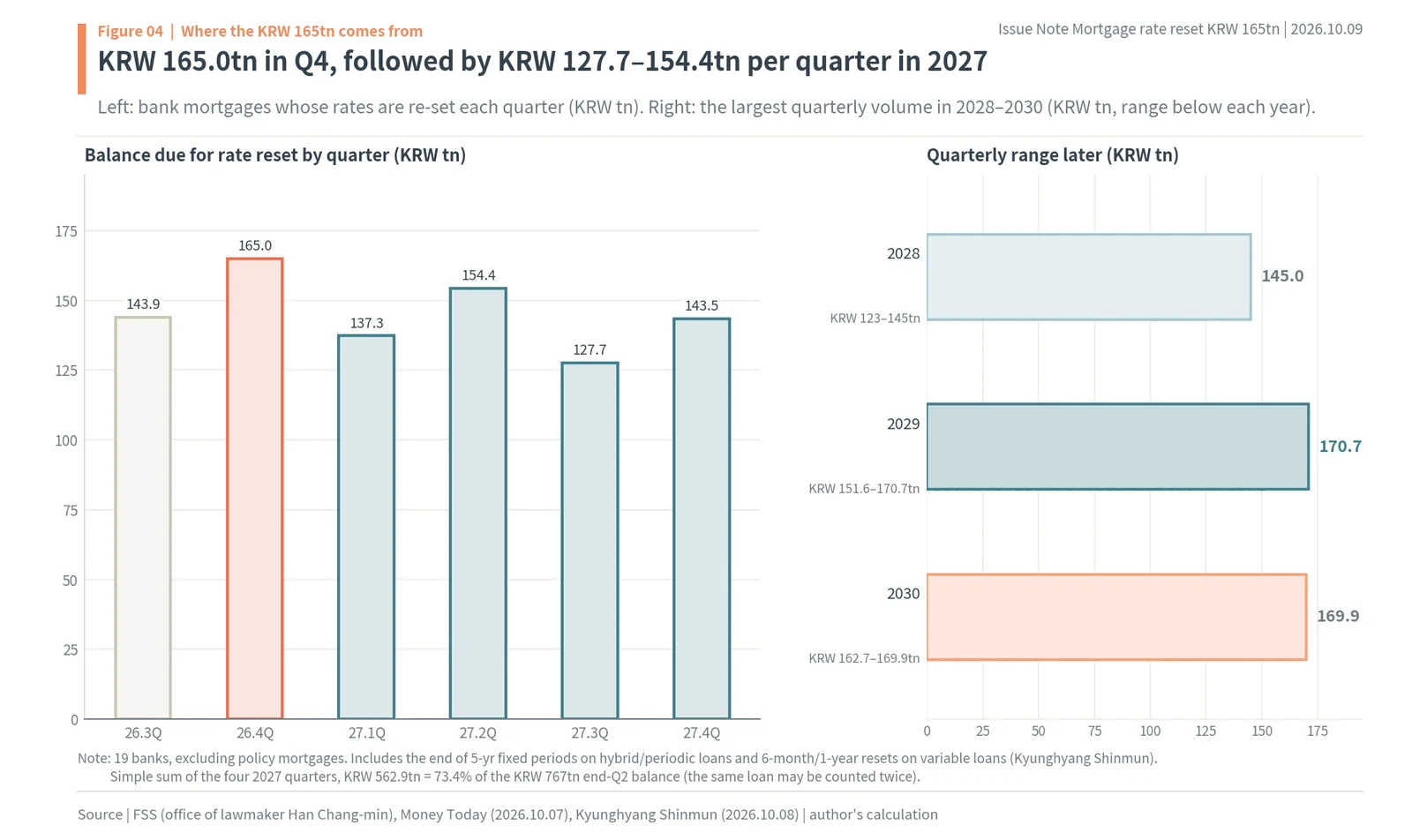
- KRW 165tn of Korean bank mortgages reprice in Q4 2026, the largest quarter in the next five years, and every quarter of 2027 brings KRW 127.7–154.4tn more (FSS data via lawmaker Han Chang-min).
- A hypothetical KRW 300mn loan at 2.98% from 2021 goes from KRW 1.262mn to KRW 1.506–1.830mn a month after the reset (author’s calculation).
- Since April, fixed rates cost more than variable ones, so the fixed share of new mortgages fell from 90.2% to 31.9% — and those variable loans become the next reset.
- Repricing at the same bank needs no new DSR test, but moving to another bank recalculates DSR at a stress rate: 43.0% in the example, over the 40% cap.
- The author’s view: rather than blanket interest relief, waive the new DSR test for borrowers with no arrears who switch or extend, and fund long-term fixed rates through covered bonds.
Key takeaways
- KRW 165tn of Korean bank mortgages have their rates re-set in Q4 2026, the largest quarter in the next five years, and every quarter of 2027 brings another KRW 127.7–154.4tn (FSS data via lawmaker Han Chang-min).
- A hypothetical borrower who took KRW 300mn at 2.98% in 2021 sees the monthly payment go from KRW 1.262mn to KRW 1.506–1.830mn, and moving to another bank pushes the debt service ratio to 43.0%, over the 40% cap (author’s calculation).
- The author’s view: before handing out blanket interest relief, open the door for borrowers with no arrears to switch banks or extend maturities without a new DSR test, and give banks long-term fixed-rate funding.
Written: October 9, 2026 (stock prices are October 8 closes; Korean markets were closed on October 9 for Hangul Day)
Topics covered: KRW 165tn of mortgages repricing in Q4 (Money Today, Oct 7), the end of 2021 five-year fixed periods, fixed vs variable rates, stress DSR and refinancing, Safe Conversion Loans, Canada, Australia, the UK Mortgage Charter and Denmark, bank and construction stocks
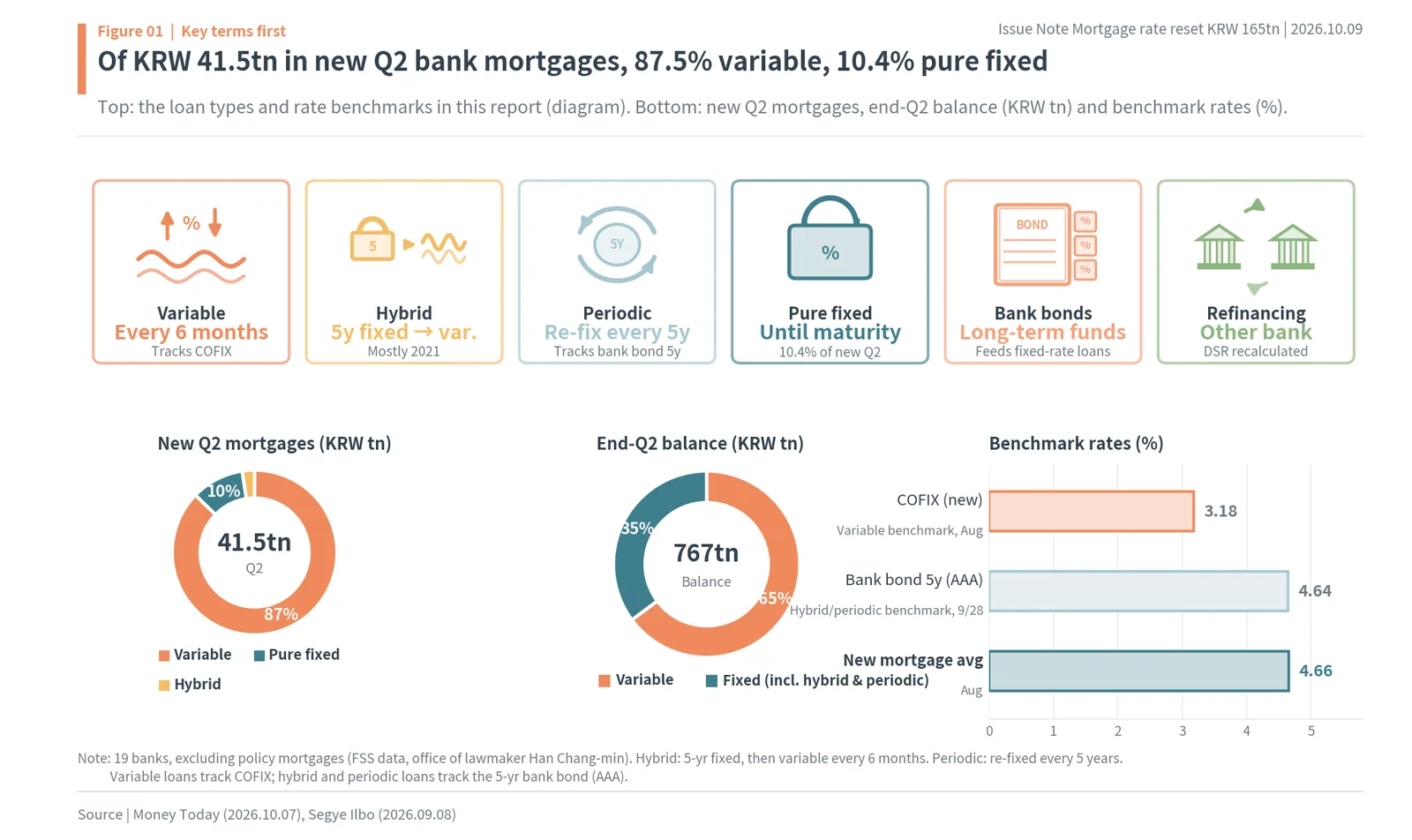
Data: rates from Bank of Korea ECOS (through August 2026), bank rate ranges as reported on Oct 6, stock prices as of the Oct 8, 2026 close
1. This post looks at the KRW 165tn of Korean bank mortgages whose rates are re-set in Q4 2026.
2. On October 7, Money Today reported that bank mortgages with a rate change due in Q4 total KRW 165tn (FSS data obtained by lawmaker Han Chang-min).
3. The figure covers 19 banks excluding policy mortgages and is KRW 21.1tn larger than Q3’s KRW 143.9tn.
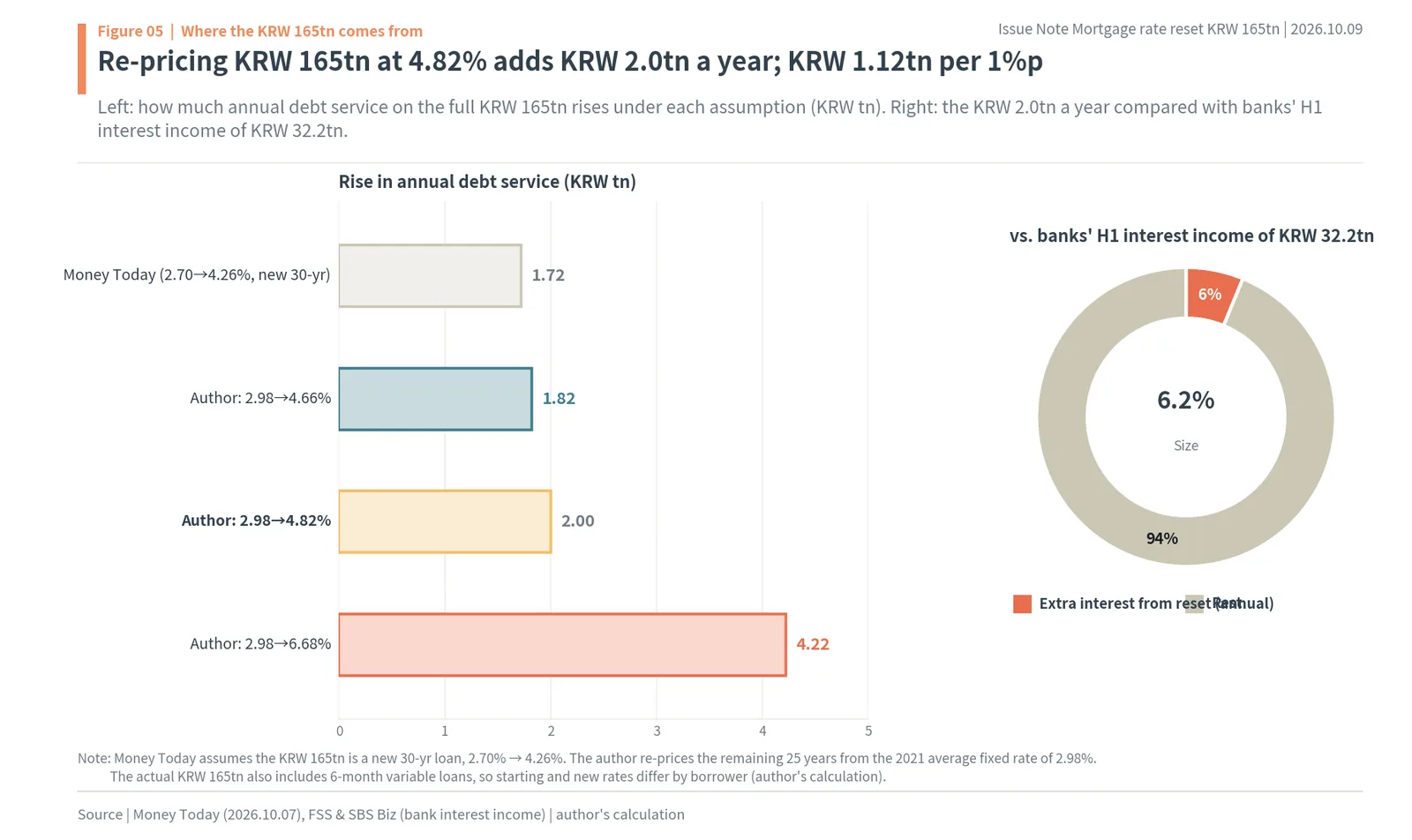
4. The same article estimated that if all KRW 165tn were 2021 five-year loans, repayments would rise by KRW 143.4bn a month, or KRW 1.7212tn a year.
5. This post works through where that volume comes from, what it means for one borrower, why it repeats every year and what should be fixed.
6. In short, the reset comes from low-rate five-year fixed loans from 2021 ending, plus this spring’s variable loans hitting their first repricing.
7. When rates rise, fixed loans get more expensive than variable ones, borrowers crowd into variable loans, and those loans become the next reset.
8. Moving to another bank means recalculating DSR, which blocks competition, so borrowers accept whatever rate their current bank sets.
9. So the core fix is not money to cut rates, but a door borrowers can actually walk through.
10. The author thinks the first step is to waive the new DSR test for borrowers with no arrears who refinance the same amount or extend maturities at reset, and to give banks fixed-rate funding beyond five years through covered bonds.
11. In one line: open the door to switch before paying the interest for them.
1. Key terms: variable, hybrid, periodic mortgages, COFIX, DSR
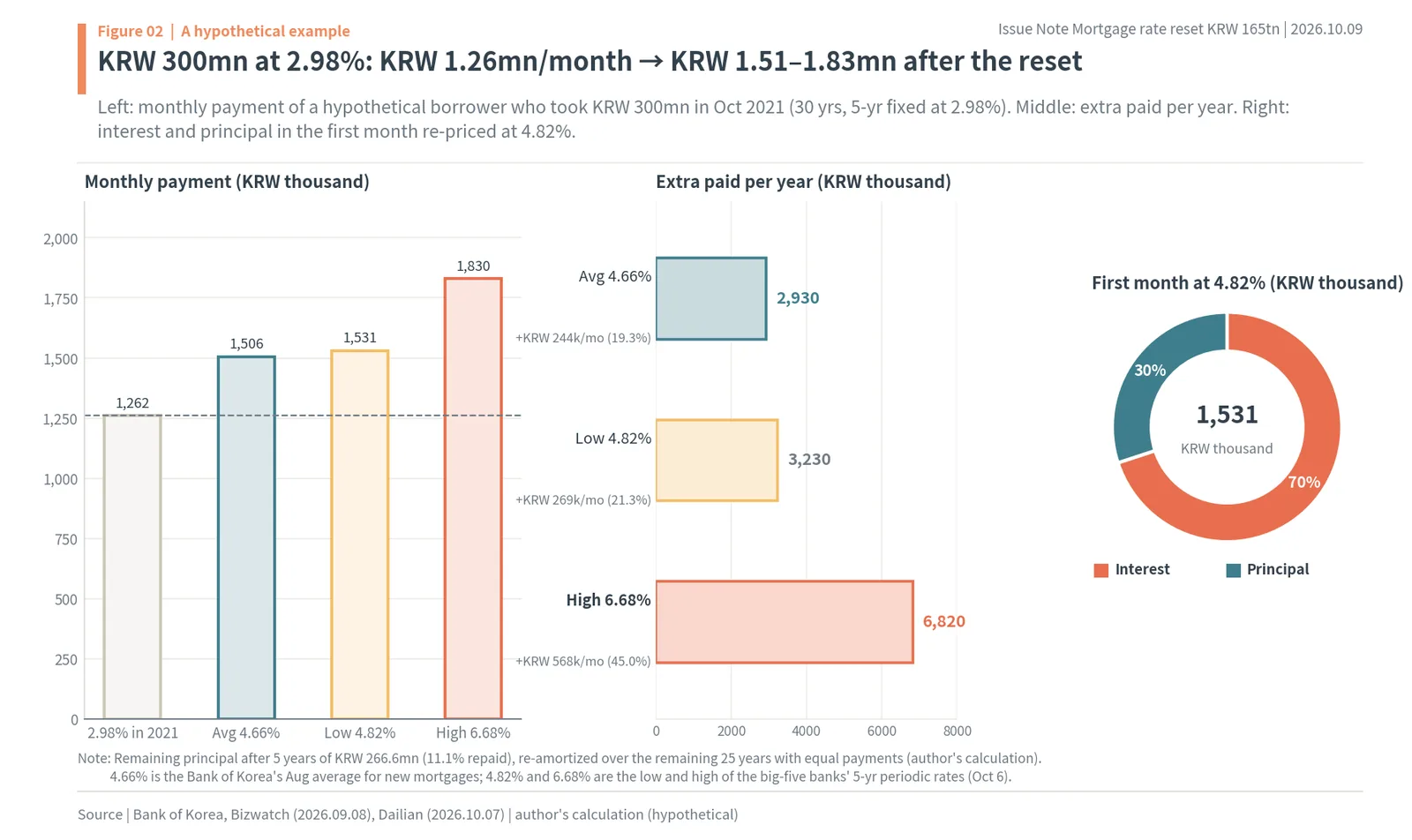
12. A few terms come up throughout.
13. A variable-rate mortgage resets every six months in line with a benchmark such as COFIX.
14. A hybrid mortgage fixes the rate for the first five years, then resets every six months (FSC example).
15. A periodic mortgage re-fixes the rate every five years for the next five years.
16. A pure fixed-rate mortgage never changes until maturity; of KRW 41.5tn of new bank mortgages in Q2, 87.5% were variable and only 10.4% pure fixed (FSS).
17. COFIX is an index of banks’ funding costs from deposits and similar sources and is the benchmark for variable loans.
18. The five-year bank bond yield is what a bank pays to borrow for five years, and it is the benchmark for hybrid and periodic loans.
19. DSR (debt service ratio) is annual principal and interest as a share of income; bank loans are capped at 40%.
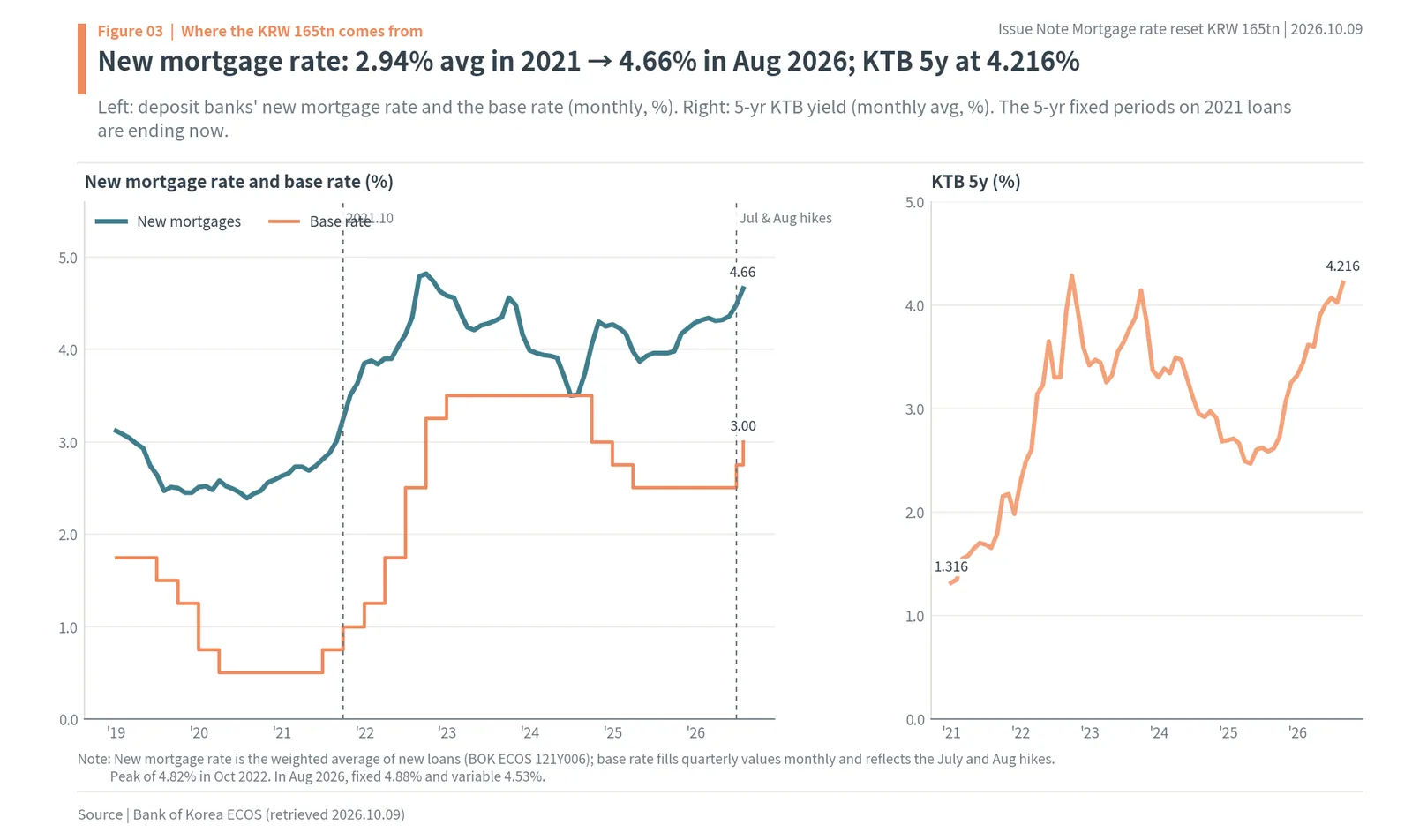
20. Stress DSR adds a buffer for future rate rises to the rate used when calculating DSR.
21. In this post, a reset means repricing a loan at today’s rate when its fixed period ends or its variable period rolls over.
22. This is about rates locked in cheaply five years ago being repriced at today’s level.
2. Mortgage payment example: KRW 300mn at 2.98% repriced at 4.66–6.68%
23. Take a single borrower (hypothetical, author’s calculation).
24. In October 2021, Mr. Kim borrowed KRW 300mn over 30 years with equal monthly payments, fixed at 2.98% for five years.
25. 2.98% was the average rate on new fixed-rate bank mortgages in 2021 (Bizwatch).
26. His monthly payment was KRW 1.262mn, and after five years of payments KRW 266.62mn is left.
27. In October 2026 the fixed period ends and the remaining 25 years are repriced.
28. At August’s average new mortgage rate of 4.66%, the payment becomes KRW 1.506mn, up KRW 244k (19.3%).
29. At 4.82%, the bottom of the big five banks’ five-year periodic range, it is KRW 1.531mn, up KRW 269k (21.3%) (as of Oct 6).
30. At the top of the range, 6.68%, it is KRW 1.830mn, up KRW 568k (45.0%).
31. Over a year he pays KRW 2.93mn–6.82mn more.
32. Of the first payment of KRW 1.531mn at 4.82%, KRW 1.071mn is interest and only KRW 460k is principal.
33. He has repaid 11.1% of the principal in five years, yet his monthly payment rises 19.3–45.0%.
3. Where Korea’s KRW 165tn mortgage reset comes from
34. New bank mortgages in Korea averaged 2.94% in 2021 and dipped to 2.69% in May (Bank of Korea ECOS).
35. That year 55.5% of new mortgages were fixed-rate, at 2.57–3.58%, 2.98% on average (Bizwatch).
36. New fixed-rate lending that year is estimated at KRW 25.3tn or more, KRW 12.2tn of it after August.
37. Hybrid and periodic loans fix the rate for only five years, so loans from Q4 2021 come off their fixed period in Q4 2026.
38. The Q4 volume also includes the first repricing of six-month variable loans taken this spring, in deals rushed before the May reinstatement of heavier capital gains tax on multi-home owners (Kyunghyang Shinmun).
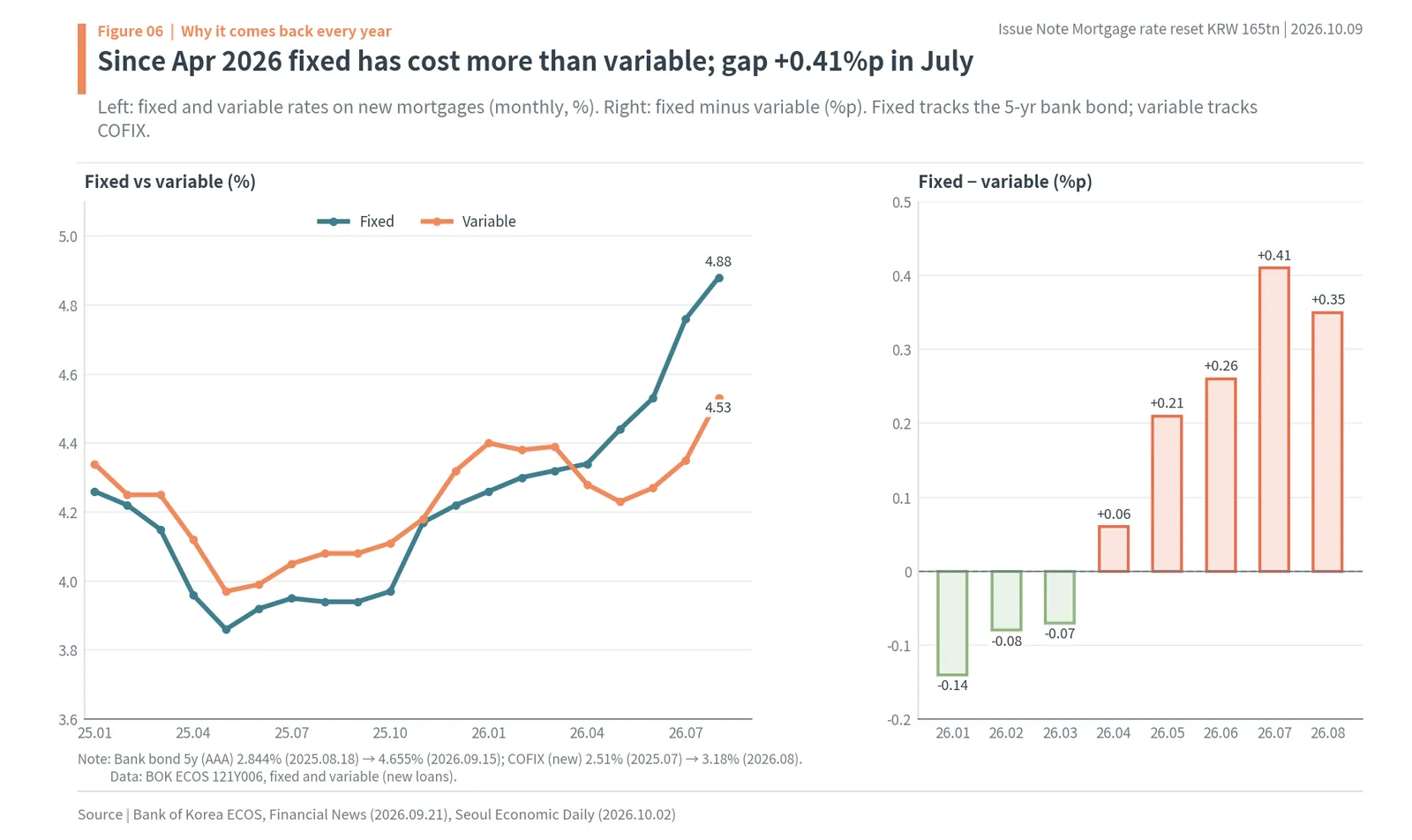
39. Meanwhile the Bank of Korea raised its base rate to 2.75% on July 16 and to 3.00% on August 27.
40. The average new mortgage rate in August was 4.66%, the fourth straight monthly rise and the highest since November 2022’s 4.74%.
41. The five-year government bond yield went from 1.316% in January 2021 to 4.216% in September 2026.
42. Rates locked in at around 2% are coming back to a market in the high 4% range.
43. Q4’s KRW 165tn is the largest quarter in the next five years (Money Today).
44. In 2027, KRW 137.3tn reprices in Q1, KRW 154.4tn in Q2, KRW 127.7tn in Q3 and KRW 143.5tn in Q4.
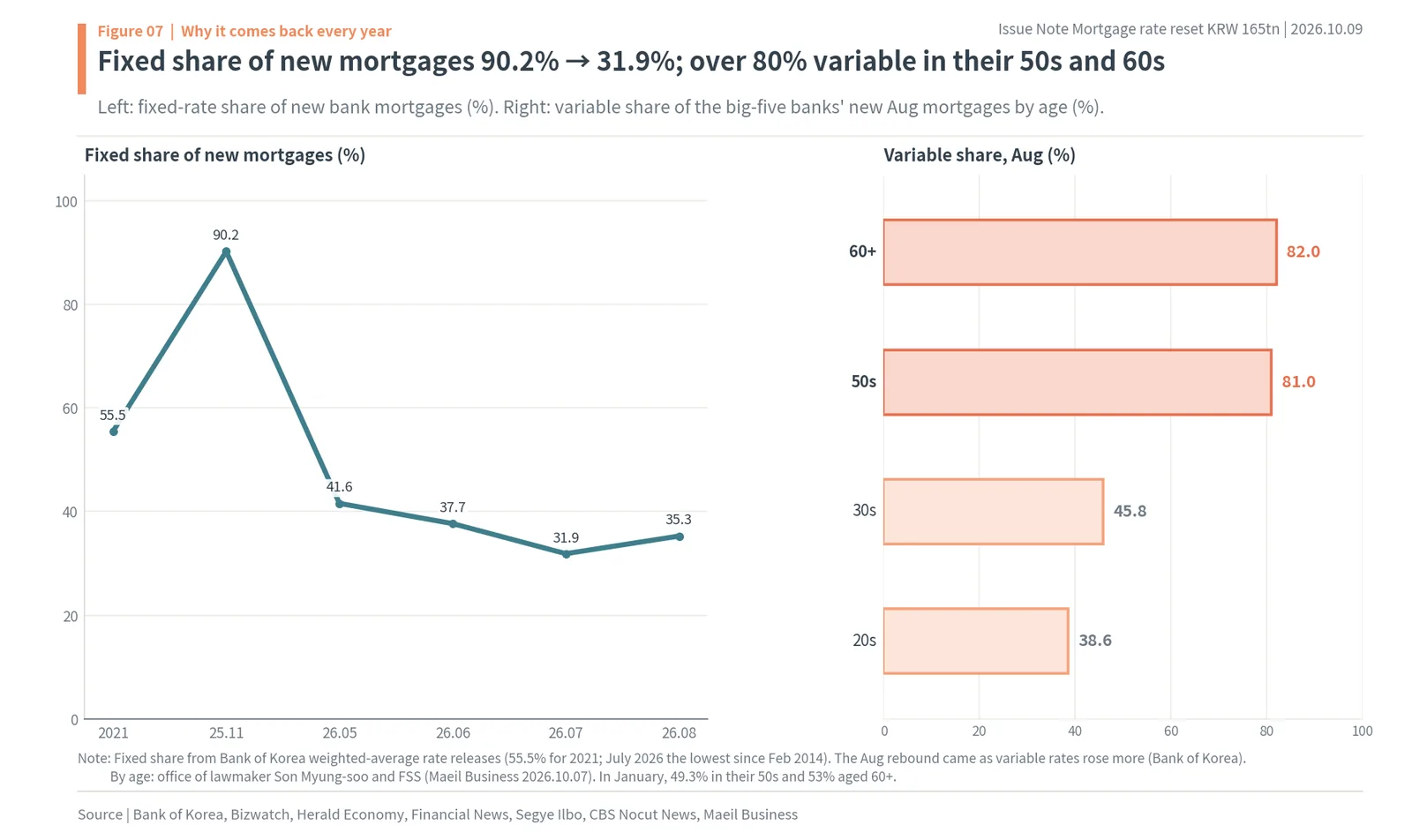
45. The four quarters of 2027 add up to KRW 562.9tn, 73.4% of the KRW 767tn outstanding at the end of Q2 (a simple sum that counts six-month variable loans twice, author’s calculation).
46. In 2029 the quarterly volume grows to KRW 151.6–170.7tn, and in 2030 it is KRW 162.7–169.9tn.
47. The reset is not a one-off shock but a schedule that returns with more than KRW 120tn every quarter.
48. Three ways to estimate the extra burden on all KRW 165tn (author’s calculation).
49. Money Today’s assumption (2.70% → 4.26%, new 30-year loans) adds KRW 1.72tn a year.
50. Repricing the remaining 25 years from 2021’s average fixed rate of 2.98% to 4.66% adds KRW 1.82tn a year.
51. At the periodic-loan floor of 4.82% it is KRW 2.0tn a year, and at the 6.68% ceiling KRW 4.22tn.
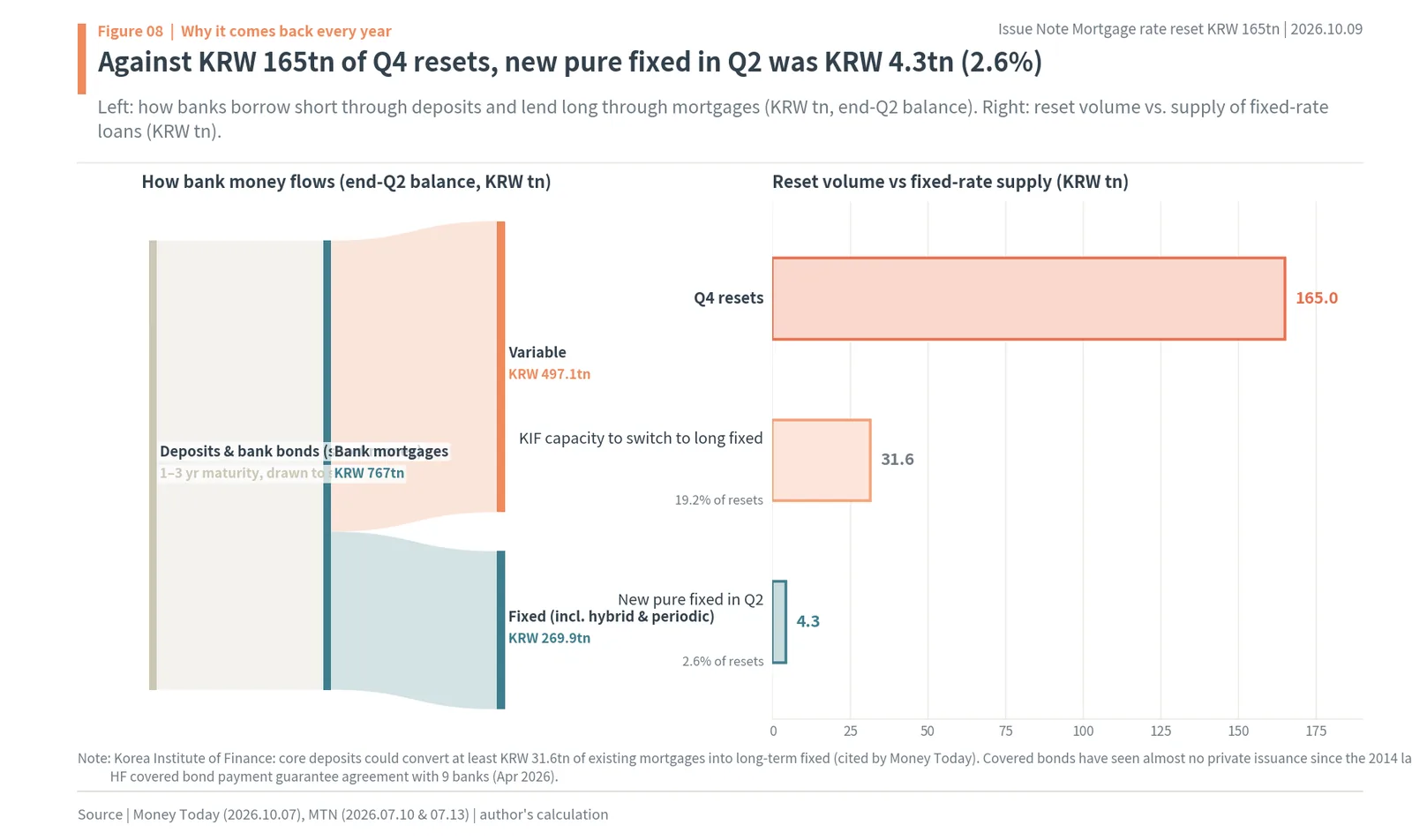
52. Each further 1%p rise adds about KRW 1.12tn a year in repayments on the KRW 165tn.
53. KRW 2.0tn a year equals 6.2% of banks’ first-half interest income of KRW 32.2tn.
54. One quarter’s reset alone adds roughly KRW 2tn a year to borrowers’ burden.
4. Why it repeats: fixed rates now cost more than variable
55. Fixed-rate loans are priced off the five-year bank bond yield; variable loans are priced off COFIX.
56. The five-year AAA bank bond yield rose from 2.844% on Aug 18, 2025 to 4.655% on Sep 15, 2026 (Financial News, Seoul Economic Daily).
57. COFIX follows deposit rates with a lag, rising from 2.51% (July 2025) to 3.18% (August 2026) over the same period.
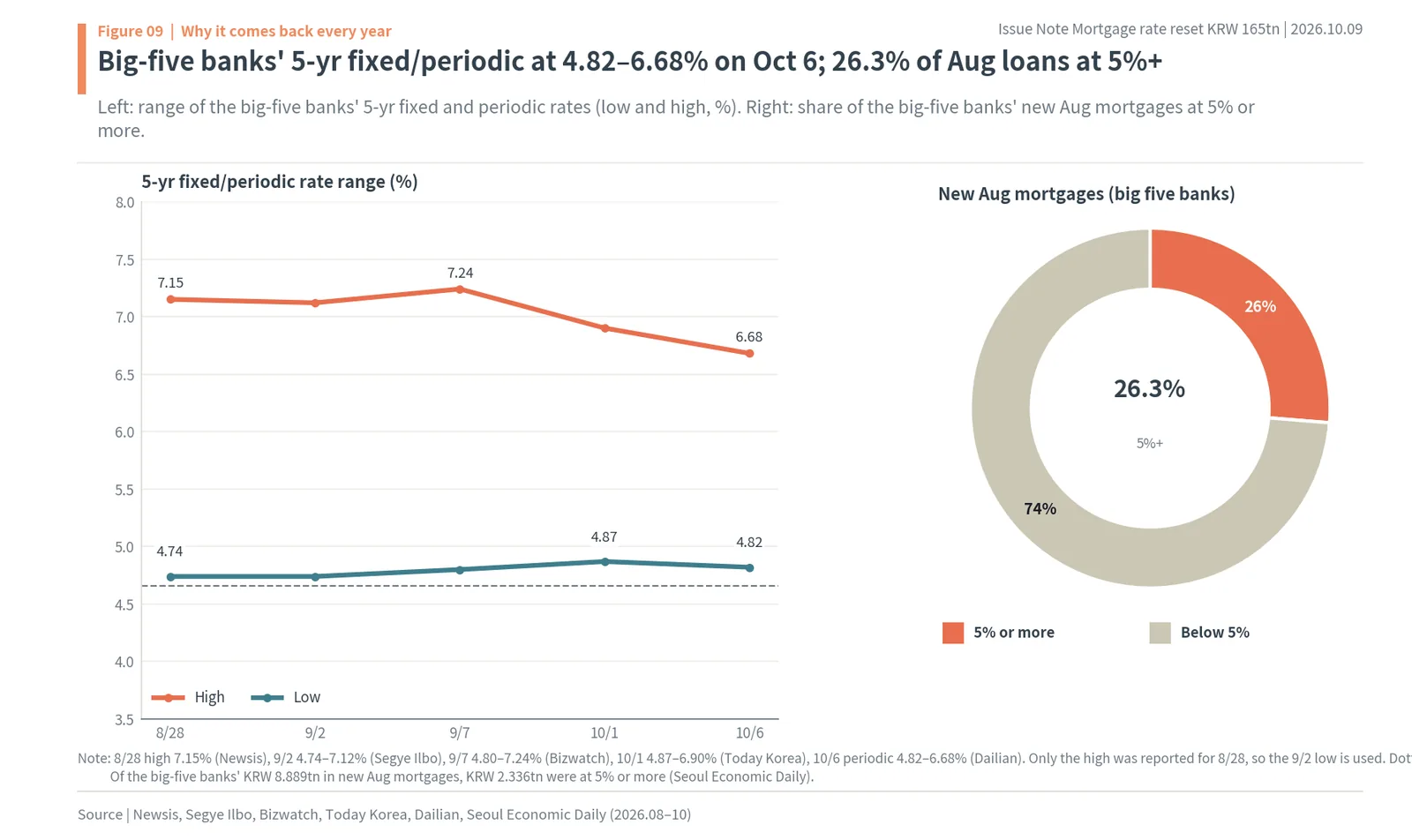
58. In 2025 fixed loans were 0.01–0.16%p cheaper than variable ones, but from April 2026 that flipped (Bank of Korea ECOS).
59. In July, fixed was 4.76% and variable 4.35%, so fixed cost 0.41%p more.
60. The faster rates rise, the cheaper today’s variable rate looks next to a fixed one.
61. Borrowers followed that gap.
62. The fixed share of new mortgages fell 58.3%p, from 90.2% in November 2025 to 31.9% in July 2026, the lowest since February 2014.
63. It edged up to 35.3% in August, which the Bank of Korea attributed to variable rates rising more (CBS Nocut News).
64. By the FSS count, 87.5% of the KRW 41.5tn of new bank mortgages in Q2, or KRW 36.3tn, were variable.
65. In August, 81% of borrowers in their 50s and 82% of those 60 and over chose variable loans at the big five banks (Maeil Business).
66. That is nearly double the 45.8% for borrowers in their 30s and 38.6% for those in their 20s.
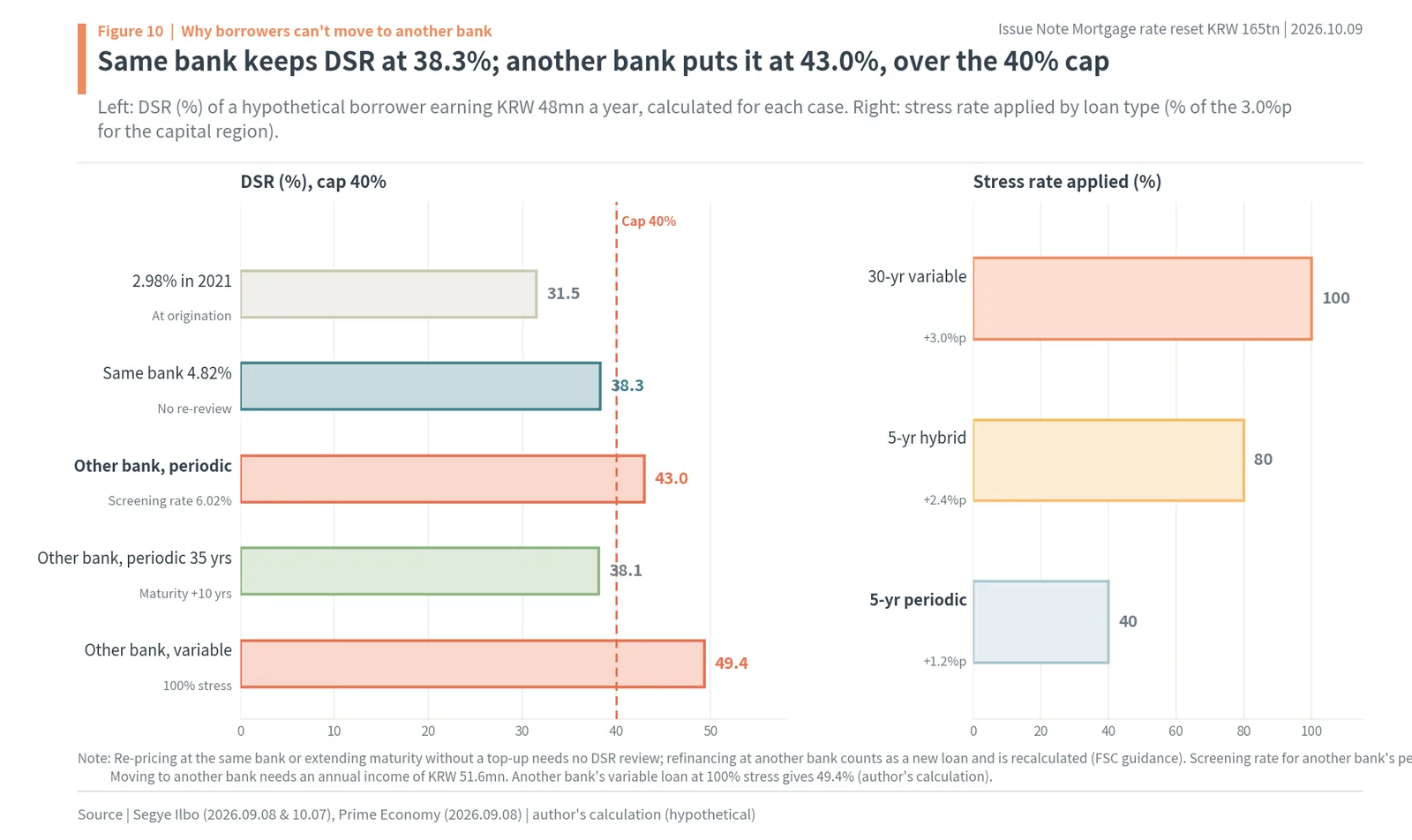
67. The closer borrowers are to the age when income falls, the more rate risk they have taken on.
68. Banks cannot offer cheap fixed loans because they borrow short and lend long (FSC official).
69. Deposits mature in one to three years while mortgages run 30 years, so locking a rate for long leaves the bank carrying the rate risk.
70. The way to pass that risk on is mortgage-backed securities (MBS) and covered bonds (bank bonds backed by loans).
71. Korea has had a covered bond law since 2014, but private banks have barely issued, and banks said in July that “long-dated covered bond issuance has effectively stopped” (MTN).
72. In July the FSC paused talks with banks on a 30-year fixed mortgage, and it told the lawmaker’s office its long-term fixed-rate task force is “not in operation”.
73. Q2’s KRW 4.3tn of new pure fixed loans is 2.6% of Q4’s KRW 165tn reset, and even the Korea Institute of Finance’s estimate of KRW 31.6tn of capacity to switch to long-term fixed is 19.2% (author’s calculation).
74. Even if borrowers want to move to fixed rates, the long-term money to fund them is not there.
75. Actual bank rate ranges show what reset borrowers will be offered.
76. The top of the big five banks’ five-year fixed range reached 7.15% on Aug 28 (Newsis).
77. On Sep 7, fixed loans ranged 4.80–7.24% and variable 4.28–6.65% (Bizwatch).
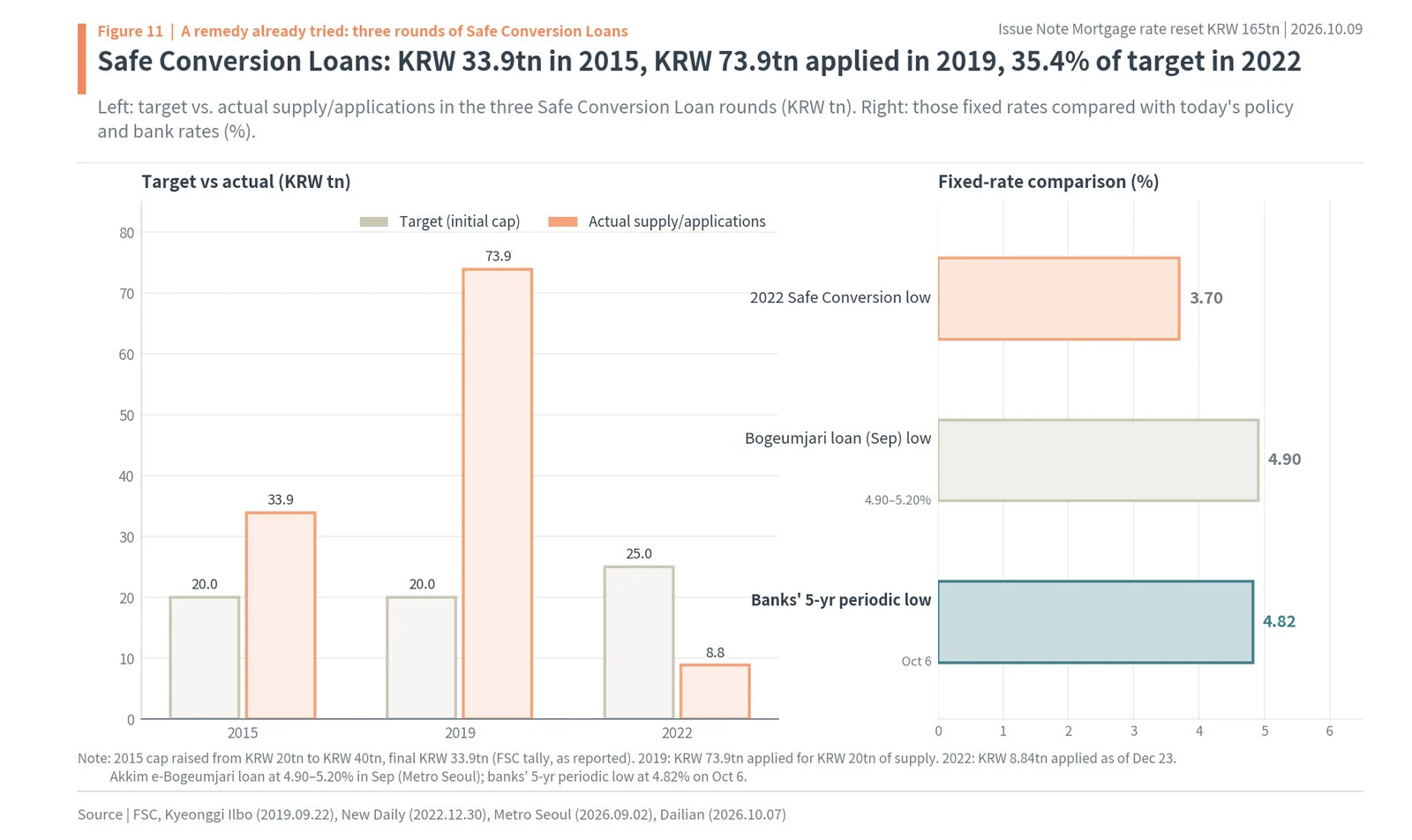
78. On Oct 1, five-year fixed was 4.87–6.90%, and on Oct 6, five-year periodic was 4.82–6.68%.
79. Of the big five banks’ KRW 8.889tn of new mortgages in August, 26.3% carried rates of 5% or more (Seoul Economic Daily).
80. “7%” describes the top of the range, but a quarter of new borrowers already pay over 5%.
5. The refinancing trap: DSR 38.3% at the same bank vs 43.0% elsewhere
81. At reset a borrower can take the current bank’s new rate or move to a cheaper bank.
82. Repricing at the same bank, or extending maturity without adding to the loan, does not trigger a new DSR test (FSC guidance, Segye Ilbo).
83. Moving to another bank counts as a new loan, so DSR is recalculated.
84. In the Seoul area, the stress buffer is 3.0%p, of which 40% applies to five-year periodic loans and 80% to five-year hybrids, while 30-year variable loans take the full 3.0%p (Prime Economy).
85. Korea’s online mortgage switching platform (launched January 2024) has no DSR exemption either (Newsis).
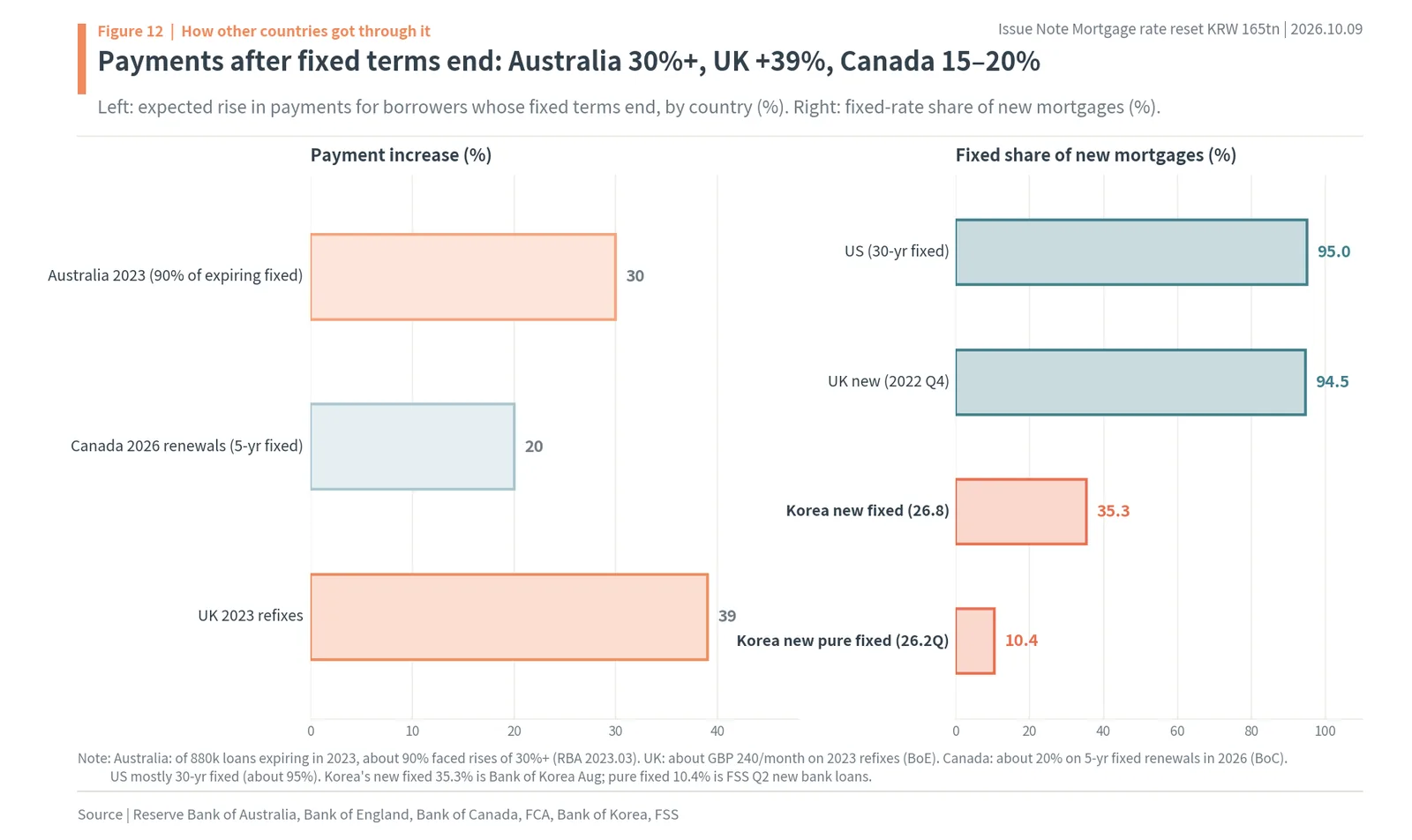
86. Early repayment fees apply only within three years of borrowing, so 2021 loans can already move without a fee (FSC).
87. If Mr. Kim earns KRW 48mn a year, his DSR in 2021 was 31.5% (author’s calculation).
88. Repriced at his own bank on a 4.82% periodic loan, it is 38.3% and carries on with no new test.
89. Trying to move to another bank’s 4.82% periodic loan, DSR is calculated at a stress rate of 6.02% and comes to 43.0%, over the 40% cap.
90. Moving to another bank’s variable loan adds the full 3.0%p buffer, for 49.4%.
91. To move to another bank he would need an income of KRW 51.63mn.
92. Extending the maturity to 35 years on the same terms brings the other bank’s DSR to 38.1%, inside the cap.
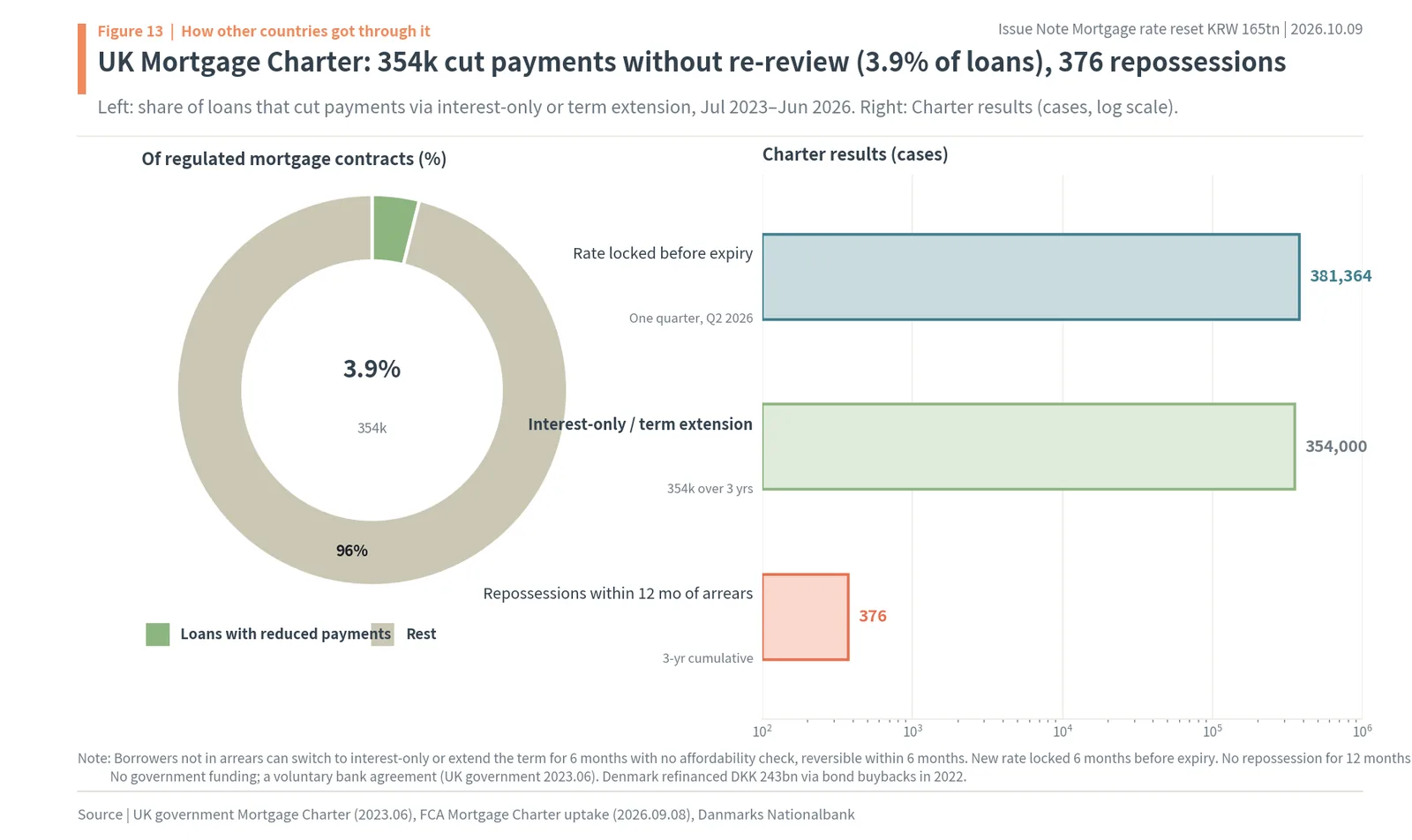
93. The barrier is not the fee but the DSR recalculation, and it blocks rate competition between banks.
6. Safe Conversion Loans in 2015, 2019 and 2022
94. Whenever rate burdens rose, the government swapped variable loans into cheap fixed ones through Safe Conversion Loans.
95. In 2015 the rate was fixed at 2.63–2.65%; the KRW 20tn limit filled in four days, was raised to KRW 40tn, and KRW 33.9tn was lent in the end (FSC tally as reported).
96. Critics said the benefit went to middle-class households already able to repay principal and interest (Kyunghyang Shinmun).
97. After the base rate was cut in 2016 the gap with market rates disappeared, and KRW 1.4tn was repaid early within a year (Seoul Shinmun).
98. In 2019, KRW 73.9tn of applications chased KRW 20tn, 3.7 times the supply, and the cutoff fell at homes worth about KRW 270–280mn (Kyeonggi Ilbo).
99. In 2022 the target was KRW 25tn at 3.7–4.0%, but applications by Dec 23 came to only KRW 8.84tn, 35.4% of target (New Daily).
100. Analysts said the fixed rate was higher than variable rates at the time, so it was unattractive.
101. Today’s policy fixed-rate loan, the Bogeumjari loan, was 4.90–5.20% in September, above the banks’ periodic-loan floor of 4.82% (Metro Seoul).
102. Setting the rate from above fails both ways: too cheap and it is swamped, pricier than the market and it sits empty.
7. Canada, Australia, the UK Mortgage Charter and Denmark
103. Other countries have also lived through fixed periods ending and loans repricing.
104. Canada’s central bank expects about 60% of all mortgages to renew in 2025–2026, with payments for five-year fixed borrowers rising 15–20% (Bank of Canada).
105. Australia’s central bank expected about 90% of the 880,000 fixed-rate loans expiring in 2023 to see payments rise by 30% or more (RBA).
106. The Bank of England expected monthly interest for UK borrowers refixing in 2023 to rise by about £240 (+39%).
107. None of the three governments lowered rates on borrowers’ behalf.
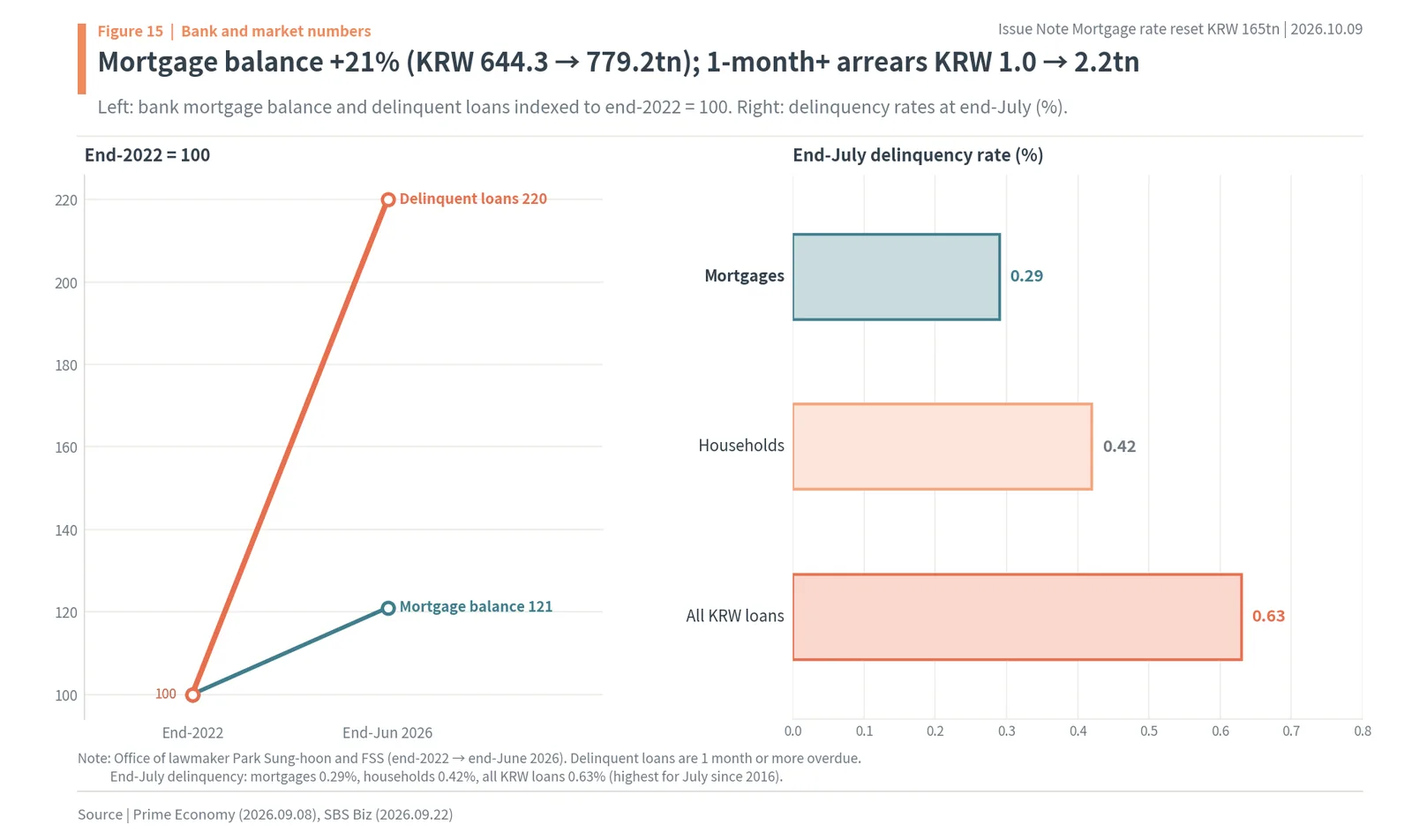
108. Instead, in June 2023 the UK government and lenders signed the Mortgage Charter (UK government).
109. Borrowers with no arrears can switch to interest-only for six months or extend their term without a new affordability check, and can switch back within six months.
110. They can lock in a new rate up to six months before their deal ends, and lenders do not repossess within 12 months of the first missed payment.
111. From July 2023 to June 2026, about 354,000 mortgages cut payments this way, 3.9% of regulated mortgage contracts (FCA).
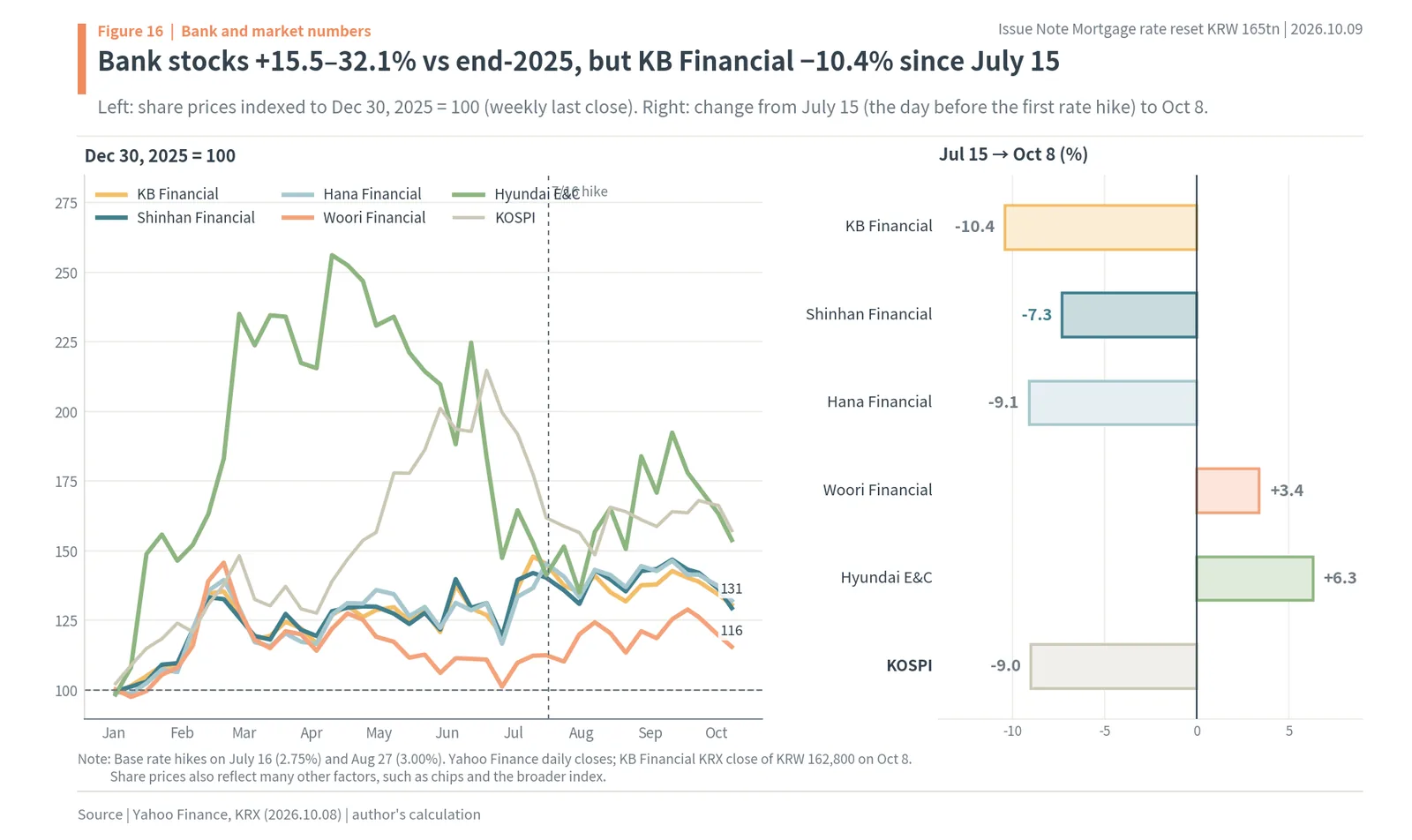
112. In Q2 2026 alone, 381,364 borrowers locked in a new rate before their deal ended.
113. Repossessions within 12 months of a first missed payment totaled just 376.
114. The UK did not pay anyone’s interest; it lowered the barrier to switching and spread the shock.
115. Who carries the rate risk also differs by country.
116. Most US mortgages (about 95%) are 30-year fixed, and the rate risk sits with MBS investors (lawmaker Han Chang-min, US data).
117. In the UK, 94.5% of new mortgages were fixed in Q4 2022 (FCA).
118. Denmark funds fixed loans one-for-one with matching bonds, so when rates rose in 2022 borrowers bought back cheaper bonds and refinanced DKK 243bn (Danmarks Nationalbank).
119. In Korea, the fixed share of new mortgages was 35.3% in August, and pure fixed was 10.4% of new bank loans in Q2.
120. Countries with high fixed shares have long-term bond markets that take the rate risk off the banks.
8. Bank interest income, delinquency and bank stocks
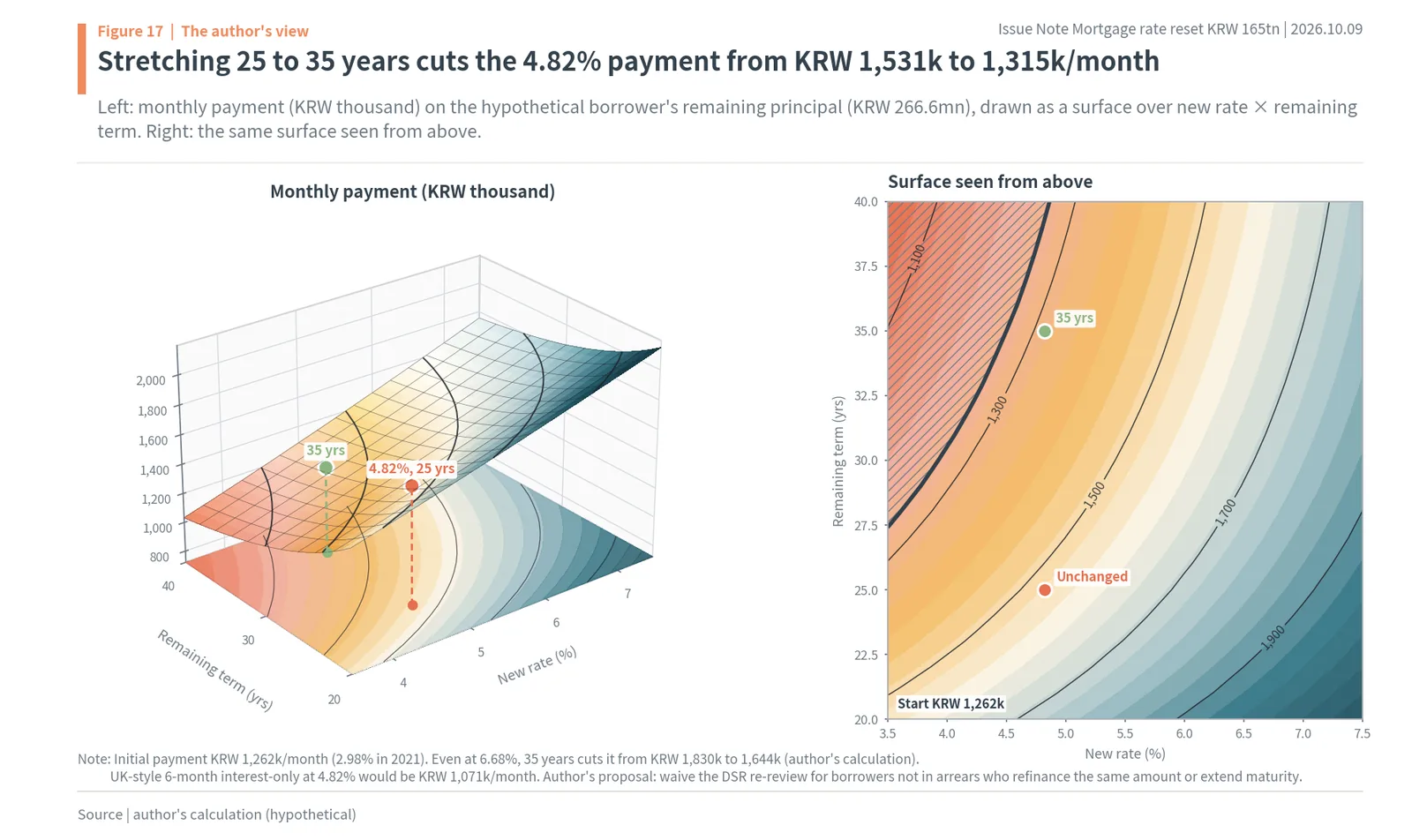
121. Banks earned more interest while rates rose.
122. Korean banks’ interest income in the first half of 2026 was KRW 32.2tn, up KRW 2.5tn from KRW 29.7tn a year earlier and a half-year record (FSS, SBS Biz).
123. Net interest margin (NIM) rose from 1.52% to 1.56%.
124. The four major financial groups earned KRW 11.3392tn in the first half: KB KRW 3.8846tn, Shinhan KRW 3.4427tn, Hana KRW 2.4029tn and Woori KRW 1.609tn.
125. Brokers expect the four to earn KRW 5.6485tn in Q3, with NIM slipping 0.01–0.05%p as funding costs rise (FnGuide).
126. The extra KRW 2.0tn a year from the reset is 6.2% of banks’ half-year interest income of KRW 32.2tn.

127. Delinquency is still low but rising.
128. Bank mortgage balances grew 21%, from KRW 644.3tn at end-2022 to KRW 779.2tn at end-June 2026 (lawmaker Park Sung-hoon, FSS).
129. Over the same period, loans more than a month overdue more than doubled from KRW 1.0tn to KRW 2.2tn.
130. At the end of July the bank mortgage delinquency rate was 0.29%, household loans 0.42% and all won loans 0.63% (FSS).
131. Delinquency rates are low, but overdue amounts are growing faster than balances, which is why reset borrowers should be able to switch before they fall behind.
132. Bank stocks rallied strongly this year, then fell after the first rate hike.
133. From end-2025 to Oct 8, KB Financial rose 30.6%, Shinhan Financial 29.4%, Hana Financial 32.1% and Woori Financial 15.5% (closing prices).
134. Over the same period, KOSPI rose 57.2% and Hyundai E&C 53.8%.
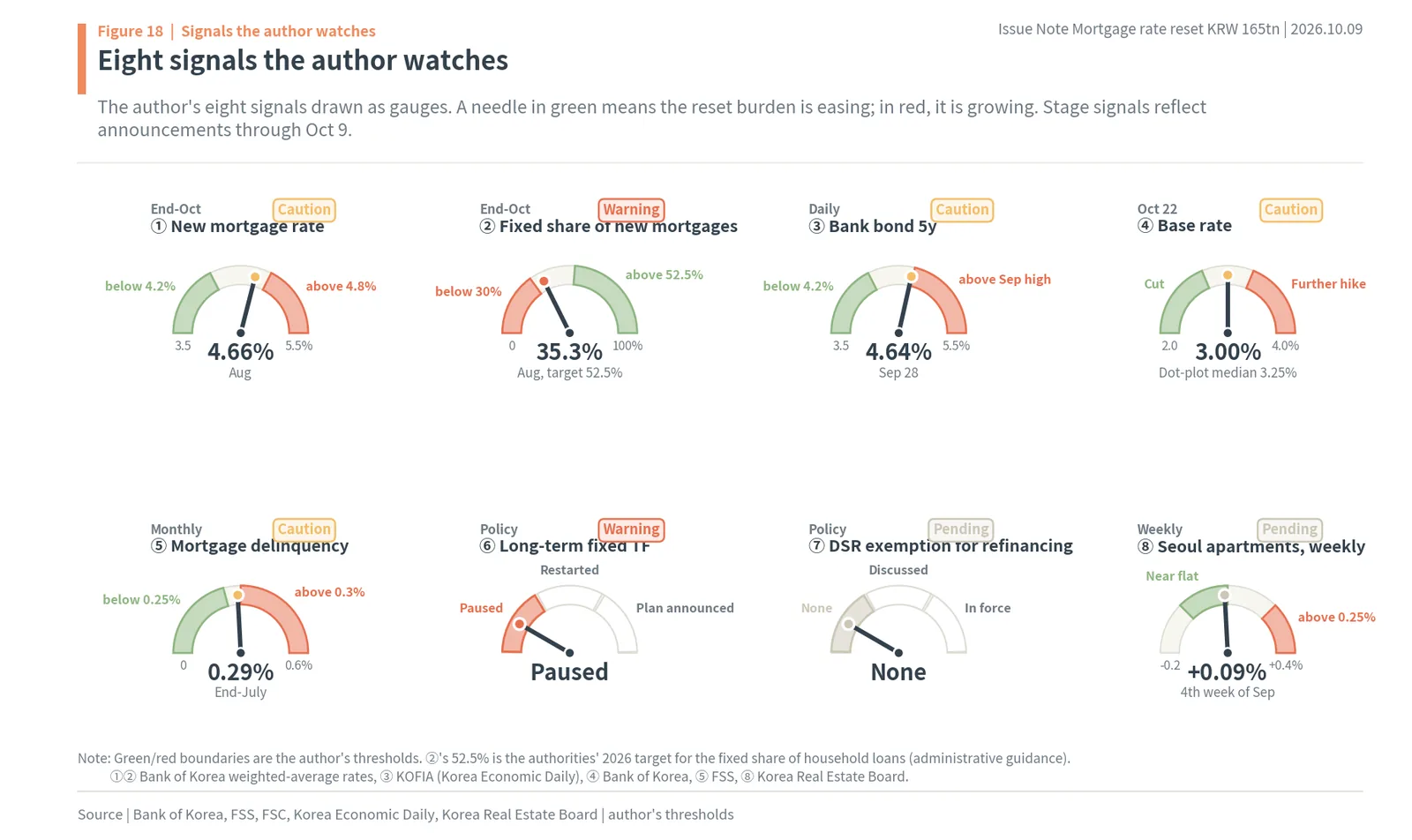
135. Against July 15, the day before the first hike, KB Financial was down 10.4%, Hana Financial 9.1%, Shinhan Financial 7.3% and KOSPI 9.0%.
136. Woori Financial was up 3.4% and Hyundai E&C up 6.3%.
137. Bank stocks rose less than KOSPI this year and have fallen about as much as KOSPI since July.
9. The author’s view: open the door to switch first
138. The reset shock starts with higher rates, but it grows because borrowers have nowhere to go.
139. The current bank reprices without a new DSR test while other banks recalculate DSR, which weakens competition between banks.
140. Setting the rate from above, as Safe Conversion Loans do, drew only 35.4% of target in 2022, and today’s policy fixed rate is 4.90–5.20%.
141. The UK cut payments on 354,000 mortgages in three years through term extensions and interest-only switches without new checks, at no cost to the government.
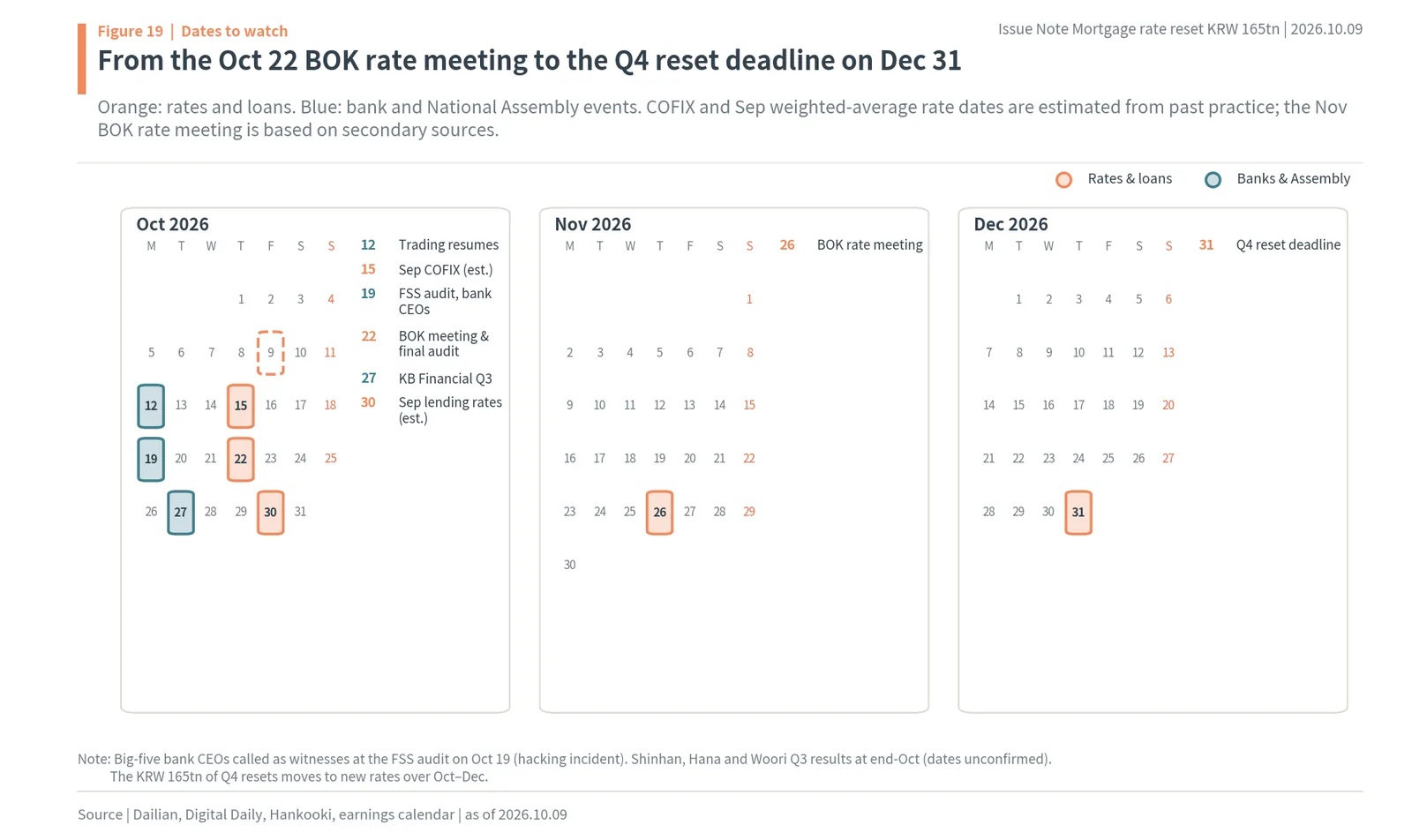
142. The author thinks the first step is to waive the new DSR test when borrowers with no arrears refinance the same amount at another bank or extend their maturity at reset.
143. If Mr. Kim extends his remaining term from 25 to 35 years at 4.82%, his monthly payment falls from KRW 1.531mn to KRW 1.315mn, KRW 216k less.
144. Even at the 6.68% ceiling it drops from KRW 1.830mn to KRW 1.644mn, KRW 186k less.
145. Paying interest only for six months, as in the UK, would mean KRW 1.071mn a month at 4.82% for breathing room (payments rise again afterwards).
146. If another bank offers a lower rate on the same amount, the current bank has to match it, which gives rates at the 6% top end a path down.
147. Next, covered bonds and MBS should come with loan-to-deposit and lending-cap incentives so banks have long-term money to fix rates beyond five years.
148. Q2’s KRW 4.3tn of new pure fixed loans is 2.6% of Q4’s KRW 165tn reset, so opening the door alone leaves too little fixed-rate room on the other side.
149. Open the door to switch before paying the interest for them, and fill the other side of that door with fixed-rate funding.
10. Sectors affected: banks, builders and REITs
150. For banks (KB Financial, Shinhan Financial, Hana Financial, Woori Financial, IBK Industrial Bank, KakaoBank), higher reset rates lift interest income, but funding costs rise too.
151. If the switching door opens, banks compete on rates and the spreads on reset loans move lower.
152. More covered bond issuance would bring long-term funding costs below bank bond yields (5–21bp lower expected with HF guarantees), creating room for fixed-rate products.
153. For builders (Hyundai E&C, GS E&C, DL E&C), mortgage rates set what homebuyers repay, so pre-sale and balance loan rates feed into earnings.
154. For REITs (SK REIT and others), long-term rates are the benchmark for dividend yields, so the five-year government bond yield of 4.216% matters too.
155. For bank stocks, the next variable is less the interest income itself than how reset competition and long-term funding get decided.
11. Eight signals to watch
156. Whether the new mortgage rate of 4.66% in August rises again in September (the Bank of Korea said it likely will).
157. Whether the fixed share of new mortgages, 35.3%, falls again.
158. Whether the five-year bank bond yield of 4.64% breaks September’s high of 4.655%.
159. Whether the Oct 22 rate meeting raises the base rate above 3.00% (the August dot-plot median was 3.25%).
160. Whether the bank mortgage delinquency rate of 0.29% moves above 0.3%.
161. The biggest signal: whether the FSC restarts its long-term fixed-rate task force and offers a DSR exemption for reset borrowers who switch.
162. Whether banks beyond the nine with covered bond agreements actually issue long-dated bonds.
163. Whether weekly Seoul apartment price gains of 0.09% keep shrinking (fourth week of September).
12. Dates to watch: Oct 22 rate meeting to Dec 31
164. Oct 12: trading resumes after the Hangul Day holiday.
165. Around Oct 15: September COFIX is published, feeding into variable rates the next day (usual timing).
166. Oct 19: the heads of the big five banks testify at the FSS parliamentary audit (over hacking incidents).
167. Oct 22: the Bank of Korea rate meeting and the National Policy Committee’s final audit fall on the same day.
168. Oct 27: KB Financial reports Q3 results; Shinhan, Hana and Woori report at the end of October.
169. End of October: the Bank of Korea publishes September lending rates, including the new mortgage rate and fixed share (usual timing).
170. Nov 26: the last rate decision of the year (per secondary sources).
171. Dec 31: all KRW 165tn of Q4 resets will have moved to new rates.
Maochaedung’s take
The KRW 165tn of Korean bank mortgages repricing in Q4 is 2021’s five-year fixed loans at around 2% and this spring’s six-month variable loans moving to today’s rates, and every quarter of 2027 brings another KRW 127.7–154.4tn. The hypothetical borrower’s monthly payment rises from KRW 1.262mn to KRW 1.506–1.830mn, and across the KRW 165tn the burden grows by about KRW 2.0tn a year. As rates rise, fixed loans get pricier, borrowers crowd into variable loans, and those loans become the next reset. Moving to another bank means a new DSR test that can push borrowers over the cap, as with 43.0% here, so they accept their current bank’s rate. The author’s view: rather than blanket interest relief, waive the new DSR test for borrowers with no arrears who switch or extend, and give banks long-term fixed-rate funding through covered bonds.
Korea mortgage rate reset FAQ
Q. What is Korea’s KRW 165tn mortgage rate reset?
FSS data show KRW 165tn of mortgages at 19 Korean banks (excluding policy mortgages) have their rates changed in Q4 2026. It mixes hybrid loans from Q4 2021 whose five-year fixed period ends and six-month variable loans from this spring being repriced.
Q. How much does the monthly payment rise?
For a KRW 300mn, 30-year loan fixed at 2.98% in 2021, the payment was KRW 1.262mn. Repricing the remaining KRW 266.62mn over 25 years gives KRW 1.506mn at 4.66%, KRW 1.531mn at 4.82% and KRW 1.830mn at 6.68% (author’s calculation).
Q. Why not just refinance at another bank?
Repricing at the same bank needs no new DSR test, but another bank treats it as a new loan and recalculates DSR with a stress rate. With a KRW 48mn income, the example borrower’s DSR would be 43.0%, over the 40% cap.
Sources
- Money Today, KRW 165tn of mortgages to reset by year-end (link), 2026.10.07
- Money Today, Bought at 2%, now facing 7% (link), 2026.10.09
- Kyunghyang Shinmun, Composition of Q4 mortgage repricing (link), 2026.10.08
- Bank of Korea ECOS, deposit bank weighted average lending rates (new loans), base rate, 5-year government bond (link), retrieved 2026.10.09
- SBS Biz, August mortgage rate 4.66% (link), 2026.09.30
- CBS Nocut News, August fixed-rate share 35.3% (link), 2026.09.30
- Bizwatch, 2021 fixed-rate mortgages resetting (link), 2026.09.08
- Segye Ilbo, Hybrid and periodic loans and refinancing DSR (link), 2026.09.08
- Dailian, Big five banks’ 5-year periodic 4.82–6.68% (link), 2026.10.07
- Korea Economic Daily, Bank bond 5-year 4.64% (link), 2026.09.29
- Seoul Economic Daily, 26.3% of August mortgages at 5% or more (link), 2026.10.02
- Maeil Business, Variable-rate share by age (link), 2026.10.07
- Prime Economy, Stress DSR weights and mortgage arrears (link), 2026.09.08
- MTN, 30-year fixed mortgage talks paused (link), 2026.07.10
- New Daily, 2022 Safe Conversion Loan applications KRW 8.8tn (link), 2022.12.30
- Bank of Canada, Staff Analytical Note 2025-21 (link), 2025.07
- Reserve Bank of Australia, Fixed-rate Housing Loans (link), 2023.03
- UK Government, Mortgage Charter (link), 2023.06
- FCA, Mortgage Charter uptake (link), 2026.09.08
- Danmarks Nationalbank, Homeowners refinanced loans for DKK 243 billion (link), 2023.03.28
- SBS Biz, Banks’ first-half interest income KRW 32.2tn (link), 2026.08
- Financial News, Q3 outlook for the four financial groups (link), 2026.10.07
- SBS Biz, End-July delinquency rates (link), 2026.09.22
- KRX prices (stockkit fetch), Yahoo Finance daily closes, 2026.10.08