SpaceX Builds Its Own 5G Base Stations: 5 Korean Telecom Equipment Stocks Ranked (LIG Acuver 073490.KQ, SOLiD, OE Solutions, RFHIC, KMW)
On November 4, 2026, Qualcomm announced a multi-year deal to supply SpaceX with chips for a nationwide network of 5G base stations in the United States. Explaining the deal that day, Qualcomm executive vice president Durga Malladi said what it did not cover: “We don’t build the boxes. They have to build the boxes.” Qualcomm supplies the radio and signal-processing chips and the lowest layer of software, and SpaceX designs and builds the base-station equipment, the box those chips go into. Around the same time, Hana Securities analyst Kim Hong-sik told clients that Korean telecom equipment makers had a fair chance of reaching SpaceX through Samsung Electronics or Ericsson, and recommended five Korean stocks to buy first.
If SpaceX builds the box itself, is there still room inside it for parts from Korean companies, and which company would get the first orders? This report follows that question through what SpaceX has done so far, the people who hold the decisions and how they have decided before, the parts that go into a base station, how far the US has gone in pushing Chinese components out, how much the same order would weigh on each company, and how much of the hope the share prices have already run ahead of.
This report is the English edition of the author’s Korean note on SpaceX’s US terrestrial network and Korean telecom equipment stocks.
As of: November 20, 2026. Share prices and market capitalizations are Korea Exchange (KRX) closes on Friday, November 20. Earnings forecasts are WISEfn consensus figures from Naver Finance. Event studies use Naver Finance adjusted daily closes. Dollar conversions use KRW 1,337.56 per dollar, the November 20, 2026 rate (Yahoo Finance). Company figures come from third-quarter reports filed with DART, Korea’s electronic disclosure system, in November 2026. SpaceX, Qualcomm and FCC facts come from company releases, FCC documents and dated press reports listed under Sources.
Stocks covered, with November 20 closes: LIG Acuver (073490.KQ, formerly Innowireless) at KRW 32,750 (about $24.5), market cap KRW 249.0bn (about $186mn); SOLiD (050890.KQ) at KRW 7,700 (about $5.8), KRW 467.8bn ($350mn); OE Solutions (138080.KQ) at KRW 21,200 (about $15.9), KRW 262.4bn ($196mn); RFHIC (218410.KQ) at KRW 52,200 (about $39.0), KRW 1,387.4bn ($1.04bn); and KMW (032500.KQ) at KRW 19,100 (about $14.3), KRW 805.9bn ($603mn).
Some Korea-specific background. The KOSPI is the main board of the Korea Exchange and the KOSDAQ is its growth-company board; tickers ending in .KQ trade on the KOSDAQ, and all five stocks here do. Korean amounts are written as KRW bn (one Korean unit of 억원 is KRW 100mn). The daily price limit on Korean stocks is 30% in either direction. Korean listed companies with a controlling family are usually run by an owner-chairman, and their shareholdings appear in DART filings.
Author’s interests: not disclosed.
Topics covered: what SpaceX has done so far; the people who hold the decisions; the habits of Elon Musk and FCC Chairman Brendan Carr; where Korean parts could sit inside a SpaceX box; how far the push against Chinese components has gone; how much the same order would weigh on each company; where the share prices ran first; what the habits point to next; signals that would change this view; calculation notes.
1. What SpaceX has done so far: spectrum, sites and chips, with the box maker still blank
SpaceX earns most of its operating profit from Starlink, its satellite internet service; Starlink made up 36% of SpaceX’s third-quarter revenue and 85% of its operating profit. Satellites alone, however, cannot carry the traffic of crowded city centers, so SpaceX has set out to build a ground network of base stations as well. In the last 14 months it has bought the spectrum, gone looking for tower sites and signed for the chips. The one decision still open is who will build the box.
Turned down by the carriers, SpaceX bought its own spectrum
SpaceX first asked Verizon, AT&T and T-Mobile to let it use their networks, and all three said no. Verizon CEO Dan Schulman said there were “no back doors” in its wholesale agreements, and AT&T CEO John Stankey called a SpaceX network “a problem I don’t have” in July 2026.

So SpaceX bought spectrum. On September 8, 2025 it agreed to buy EchoStar’s AWS-4 and H-block licenses, 50MHz in all, for about $17bn (up to $8.5bn in cash and up to $8.5bn in SpaceX stock). On November 6, 2025 it added EchoStar’s AWS-3 uplink licenses for about $2.6bn in stock. On October 8, 2026 it agreed to buy up to 14MHz of 800MHz low-band spectrum from Grain Management; the price was not disclosed, but The Wall Street Journal reported $8bn in cash. Adding the reported price, SpaceX has committed $27.6bn to spectrum since September 2025 (author’s sum), for about 80MHz in total. SpaceX’s blog said the Grain deal would pave the way for Starlink Mobile to become a major mobile carrier in the US, and Musk called it “the last critical piece of the spectrum puzzle” on X. The next day AT&T fell 6.44%, Verizon 5.7% and T-Mobile about 10%, while tower owner Crown Castle rose 14.76%.
Then sites, then Qualcomm chips
On October 22, 2026 Bloomberg reported that SpaceX was negotiating with Crown Castle and other tower companies to use at least 80,000 sites. SpaceX has not confirmed the report. On November 10, the FCC accepted the Grain license transfer application for filing; comments are due December 1 and petitions to deny on December 8.
On November 4, Qualcomm announced the multi-year deal. SpaceX will use Qualcomm’s Dragonwing QRU100 radio-unit chip and QDU100 baseband chip with Qualcomm’s layer-1 software, and deploy them at tens of thousands of US sites starting in 2027. The price was not disclosed. Starlink senior vice president Michael Nicolls said the deal would accelerate SpaceX’s timeline “to develop our base station end-to-end architecture,” meaning SpaceX designs the base station and the upper software itself.

The equipment SpaceX will design is a massive MIMO radio: a large antenna unit with 64 transmit and 64 receive paths (64T64R). Malladi described the deal as “tens of thousands of sites,” not a handful, and said the radios would cover lower bands “all the way down to 2GHz.” Qualcomm CEO Cristiano Amon said deployment begins in 2027 but that revenue would come “more of a fiscal ’28,” which for Qualcomm runs from October 2027 to September 2028. Since the chips and the other parts go into the same boxes, component orders are likely to pile up from the second half of 2027 rather than next spring.
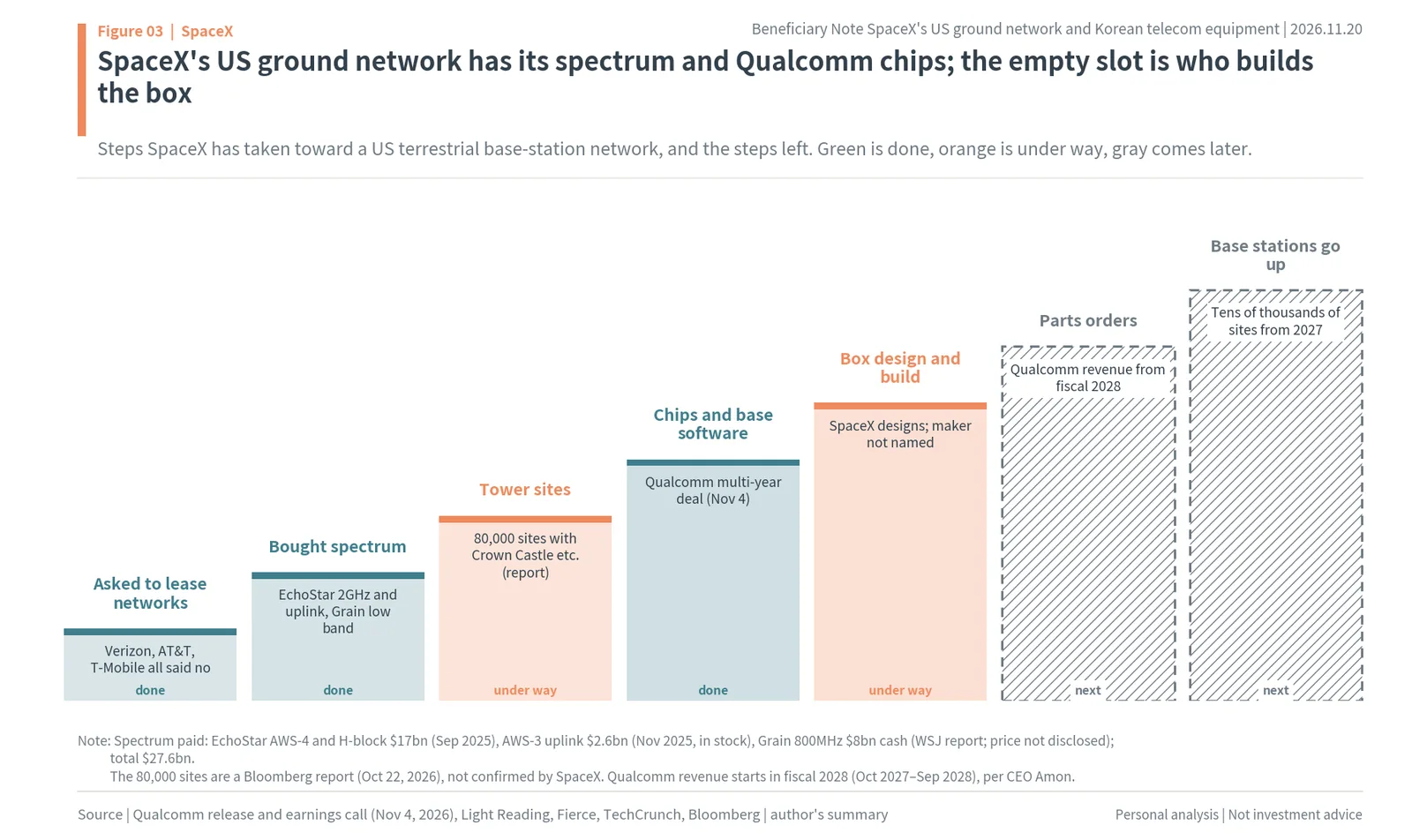
The spectrum and the chips are settled. The empty slot is who builds the box that holds Qualcomm’s chips, so the next question is who makes that decision.
2. The people who hold the decisions
The decision on the box sits with SpaceX’s founder, the decision on which parts may enter the US sits with the FCC, and both depend on spectrum and towers held by others. The five Korean companies are all controlled by founders or a business group.
SpaceX, the spectrum seller, the regulator and the carriers
At the center is Elon Musk, SpaceX’s CEO and controlling shareholder with about 42% (Financial Times report). President Gwynne Shotwell and Michael Nicolls, who runs Starlink, handle the work; on SpaceX’s first earnings call on August 4, 2026, Shotwell said the company “definitely” intends to build out the terrestrial part of the network.
The seller of the spectrum was EchoStar chairman Charlie Ergen. The DISH 5G network that EchoStar built and later switched off had Samsung Electronics and Fujitsu radios on its towers. The FCC, led by Chairman Brendan Carr, decides which equipment may be sold in the US. Qualcomm holds the chips, and Crown Castle and American Tower hold the towers. Samsung’s network business, run by president Kim Woo-joon, counts Verizon as its key US customer and had about 5% of the world market in 2025 (Omdia).
The five Korean companies and their owners
All five Korean companies have an owner. KMW is run by its founder, Chairman Kim Duk-yong, who owns 26.24%. RFHIC was founded by Chairman Cho Sam-yeol, and his younger brother, CEO Cho Deok-su, is the largest shareholder with 15.37% (Cho Sam-yeol holds 11.10%). SOLiD’s chairman is Chung Joon (8.37%). OE Solutions is led by Vice Chairman Park Chan (16.51%) and CEO Park Yong-kwan (6.02%). LIG Acuver, which changed its name from Innowireless in March 2026, is 30.00% owned by LIG Corp., whose largest shareholder is Chairman Koo Bon-sang with 56.2%; LIG Corp. is also the largest shareholder of the defense company LIG D&A, formerly LIG Nex1. All shareholdings are as of September 30, 2026 in the third-quarter reports.

They sell different things. KMW makes filters and antennas, RFHIC makes gallium nitride (GaN) power amplifiers, SOLiD makes in-building repeaters (distributed antenna systems), OE Solutions makes optical transceivers, and LIG Acuver makes network test equipment and small base stations. In the third quarter LIG Acuver earned operating profit of KRW 9.3bn on revenue of KRW 77.4bn, though nearly half of its revenue comes from distributing automotive chips. RFHIC earned KRW 21.7bn on KRW 71.1bn, of which defense was KRW 50.8bn and telecom KRW 17.7bn (Eugene Investment & Securities). OE Solutions returned to profit for the first time in 23 quarters with KRW 0.14bn on KRW 21.7bn, and it makes its own laser chips. KMW lost KRW 5.2bn on revenue of KRW 20.7bn; from January to September, Samsung accounted for 45.5% of its sales and China’s ZTE for 15.9%. SOLiD sold 35.1% of its products in the US over the same nine months.

Musk decides what the box looks like, and Carr decides which parts can go into it. How the two have decided in the past says more about the next step than any forecast.
3. The habits of Musk and Chairman Carr
Both men have a long public record. The author groups that record into habits and counts how often each habit held.
Musk designs the system and buys the chips
Musk has repeatedly designed the system himself while buying chips and factory capacity from others. SpaceX designs Starlink’s user terminals and dishes but buys their chips from STMicroelectronics. Tesla designs its own self-driving chips and in July 2025 signed a $16.5bn contract for Samsung to manufacture the AI6. For the ground network, SpaceX buys chips and base software from Qualcomm and builds the box and the upper software itself. That is three cases out of three.

Roger Entner of Recon Analytics put it this way to Fierce Network: “He’s a builder. He’s not a buyer,” adding that the only things Musk does not make himself are the tires. When a route through others has closed, Musk has bought the asset himself. In August 2022 SpaceX partnered with T-Mobile to use its spectrum for direct-to-cell service; from 2025 it bought its own spectrum, and after the three carriers refused to lease their networks, it bought more from Grain.
Carr’s FCC has only widened its curbs on Chinese equipment
From May 2025 to October 2026, the FCC under Chairman Carr created or widened restrictions on Chinese equipment and companies 15 times. It added drones (December 22, 2025), consumer routers (March 23, 2026), and robots and inverters (July 28, 2026) to the Covered List, the list of equipment that cannot get FCC authorization, and it has not withdrawn any of them. It also made five partial exceptions, but every one opened a path for products made in the US or allied countries, or for companies pledging to make them in the US. None reopened the door to a Chinese company.

In a statement attached to the FCC’s July 22, 2026 order, Carr said the agency would now prohibit devices containing any Huawei-made logic-bearing hardware component, “basically any ‘smart’ component.” That rule took effect on October 13, 2026.

The seller has a habit too. Ergen spent about 15 years collecting spectrum and has sold it at a premium: AT&T paid $23bn in cash in 2025 for spectrum that LightShed Partners estimated had cost EchoStar about $13.5bn. After the SpaceX deal, Ergen said that if he could make one investment other than in EchoStar it would be SpaceX, and that SpaceX would earn far more from the spectrum than the $17bn it paid.
Musk builds the box and buys the parts; Carr fills the space left by China with US and allied products. The next question is who would supply the parts in a SpaceX box.
4. Where Korean parts could sit inside a SpaceX box
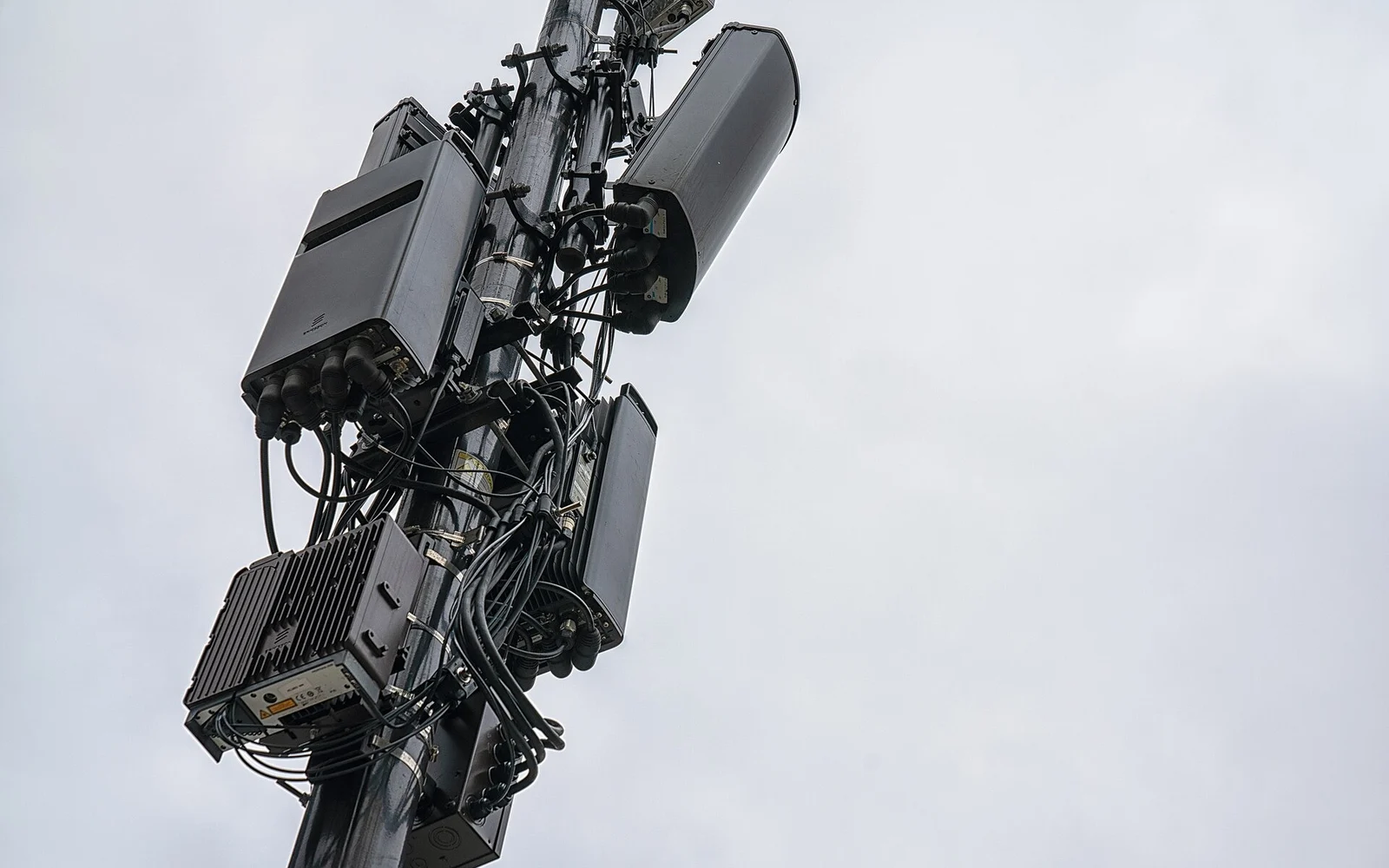
A base-station radio contains power amplifiers that strengthen the signal, filters that pass only the wanted frequencies, antennas that send the signal out, and optical modules that connect the radio to the signal-processing equipment. A 64T64R massive MIMO radio has a power amplifier and a filter on each of its 64 paths, 16 times as many paths as a common 4T4R radio (author’s comparison), so it holds more than ten times the parts.
Analysts expect SpaceX to skip the big equipment vendors
On November 11, Fierce Network gathered analysts’ views and reported that Musk is likely to skip Nokia, Ericsson and Samsung and have the boxes built by a contract manufacturer (ODM). Light Reading had already observed on November 4 that SpaceX appeared to be using none of them. Earl Lum of EJL Wireless Research said SpaceX could simply buy components from the suppliers that already serve Ericsson and others. That is where Korean companies could fit.
RFHIC is registered as a vendor with Samsung (December 2008), Nokia (June 2014) and Ericsson (August 2014). KMW sells nearly half of its output to Samsung and also sells filters to ZTE.
The route Hana Securities described, through Samsung, has narrowed. DISH’s 5G network was shut down after EchoStar sold its spectrum, Boost Mobile’s roughly 7.2 million subscribers now ride on AT&T’s network as a hybrid virtual operator, and the Samsung radios left on the towers belong to the tower companies. American Tower CEO Steven Vondran said in October that the company could offer those radios to any interested party, which would reuse existing radios rather than create a new Samsung order.
Test equipment and in-building coverage
Whoever builds the box, SpaceX will need equipment to measure its network. In a November 16 report, Mirae Asset Securities wrote that LIG Acuver has a record of delivering test equipment optimized for SpaceX directly to SpaceX and is in talks on that basis. The company has not disclosed this.
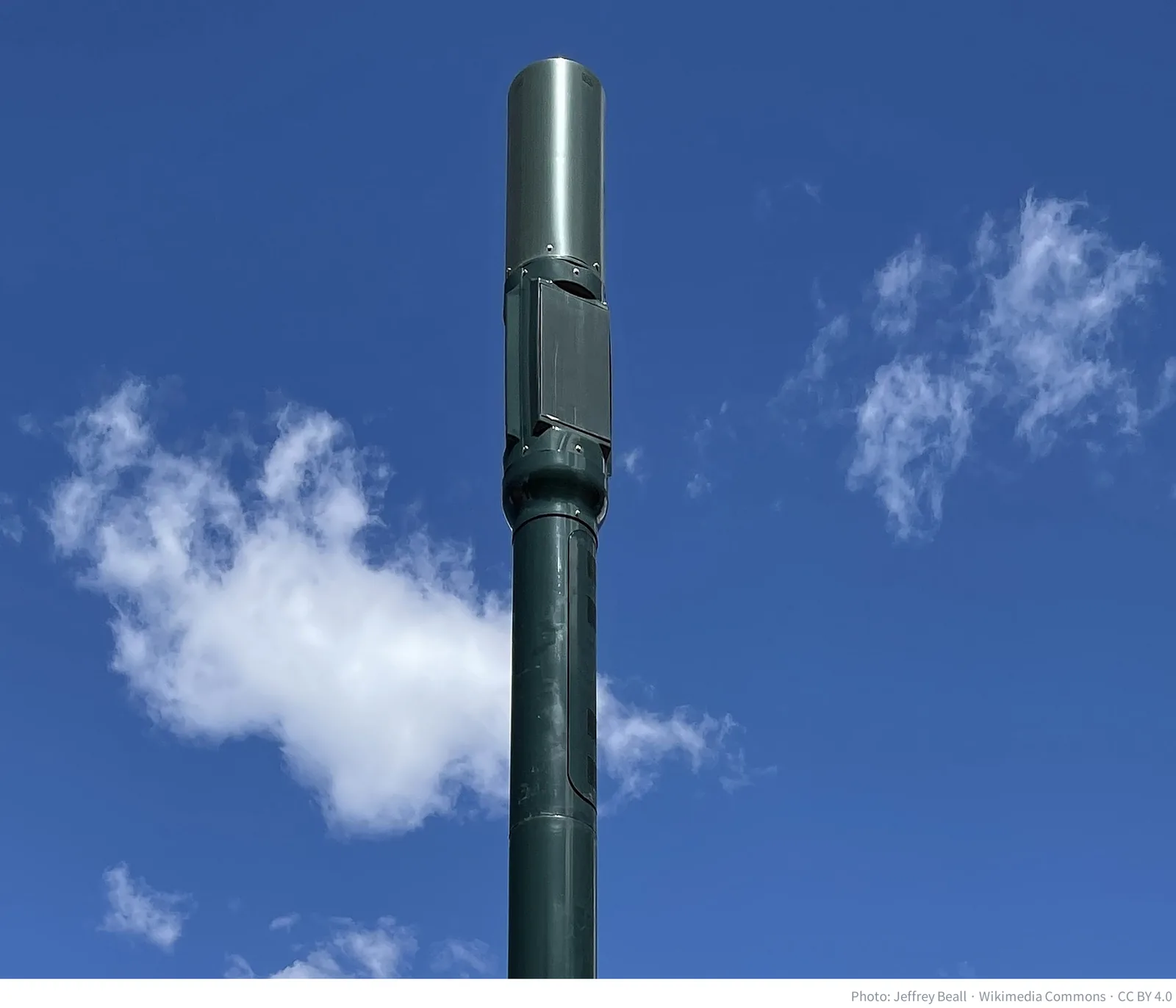
LIG Acuver also makes small cells, the small base stations mounted on street poles and buildings, and in March 2021 Electronic Times reported that it was developing 5G small cells with Qualcomm.
For coverage inside buildings, IBK Investment & Securities wrote on October 30 that SpaceX is more likely to rent capacity from neutral-host operators, which install shared systems in buildings and lease them to carriers, than to install them itself. SOLiD is the world’s third-largest maker of in-building systems outside China with a 15% share, and one third of its sales (35.1%) come from the US; one US customer alone accounted for KRW 23.3bn, or 11.6%, of its January to September sales.

On public evidence, the Korean company closest to SpaceX is LIG Acuver, whose delivery record comes from a broker report. Next come SOLiD, with the largest US sales, and RFHIC, with vendor registrations at the big equipment makers. OE Solutions and KMW have no recorded link to SpaceX. Whether these parts gain from the push against Chinese components depends on how far that push reaches.
5. How far the push against Chinese components has gone
The push started with optical transceivers in data centers. Wireless parts are still at the proposal stage.
Optical transceivers first
On November 17, Reuters reported that the Trump administration was pressing ahead with plans to block imports of new models of Chinese optical transceivers despite objections from Amazon, Google, Meta, CoreWeave, Cisco and Microsoft.

Chinese companies make about two-thirds of the world’s optical transceivers (Counterpoint, cited by Reuters). The largest, Innolight, earned 62% of its first-quarter 2026 revenue in the US, and in LightCounting’s 2025 ranking it led with $5.33bn of module sales, ahead of Eoptolink at $3.5bn; seven of the top ten were Chinese. If the imports are blocked, that share goes to US and allied makers.
There is no FCC document yet. When Reuters first reported the plan on August 4, Lumentum rose 7% and Coherent 11% intraday, and Applied Optoelectronics 18%. On November 17, the second report, Coherent closed up 3.65% and Lumentum up 2.56%, a much smaller reaction.

The first beneficiaries would be Lumentum and Coherent, which make data-center optics. In Korea, RFHIC’s subsidiary RF Materials sells laser packages to Lumentum (Shinhan Investment), and OE Solutions makes optical transceivers.
Wireless parts are not covered yet
The FCC’s component rule that took effect in October blocks only “smart” components from companies on the Covered List, such as Huawei. Paragraph 28 of the July order excludes fixed, non-digital, non-programmable passive parts. The order does not name filters or antennas, but the author reads them as falling outside it.
Chinese filter and antenna makers that are not on the Covered List, such as Comba, Tongyu and Wuhan Fingu, can still supply Ericsson and Nokia; Fingu’s 2025 annual report lists Huawei, Ericsson and Nokia among its main customers. So KMW’s filters do not automatically take over Chinese makers’ share.
Still, in July the FCC proposed banning every component from Covered List companies and took comments until September 8, 2026, and the order states that the FCC reserves the right to act on that proposal in a future order.
If a transceiver ban does come, the law firm Arnold & Porter wrote on September 2 that it would most likely go through the Covered List, as with drones and routers, and would reach foreign-produced transceivers “regardless of the manufacturer’s nationality,” with conditional approval for products that meet requirements.
In that case where a product is made matters more than the nationality of the company that makes it. The five Korean companies have their head offices and plants in Pangyo, Anyang, Gwacheon, Hwaseong and Gwangju, and only KMW also has plants abroad, in Xi’an, China, and in Ha Nam, Vietnam. LIG Acuver has one plant in Pangyo. SOLiD’s head office is in Pangyo and its production is outsourced around its Anyang site. RFHIC’s head office is in Gwacheon, with a US manufacturing subsidiary. OE Solutions is based in Gwangju. KMW makes products in Hwaseong and Anseong, and through Huatian Telecom in Xi’an and KMW VIETNAM in Ha Nam.
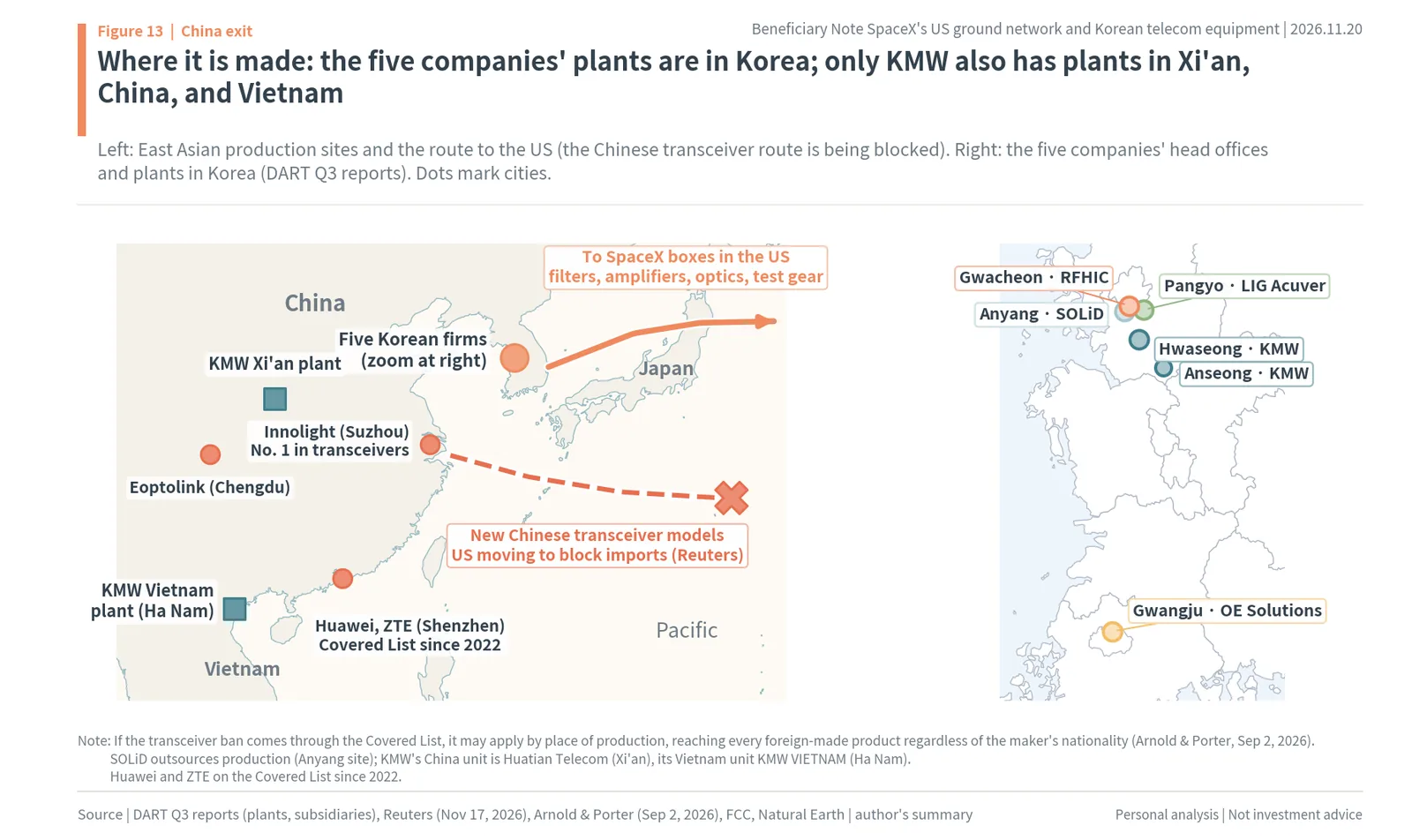
The China exit started with optical modules, and for wireless parts it is still a proposal. What can be measured today is how much an order would weigh on each company if it comes.
6. The same order weighs very differently on each company
The closest precedent is DISH. Its network carried more than 144,000 radios on about 24,000 towers, according to its May 2026 bankruptcy filing, or about six radios per site. The AWS-4 spectrum SpaceX bought from EchoStar is the spectrum DISH’s network used.
How many radios, and how much one order is worth
If SpaceX installs radios on 50,000 sites, a little more than half of the 80,000 it is reported to be negotiating for, it would need about 300,000 radios at DISH’s ratio, about 2.1 times DISH’s count (author’s calculation; 120,000 at 20,000 sites, 480,000 at 80,000 sites). Samsung’s radio and vRAN contract with DISH in 2022 was worth more than $1bn, and Omdia estimated radios at 45% to 75% of the cost of a DISH site. SpaceX radio work could therefore run to billions of dollars.
Suppose one company wins KRW 100bn (about $74.8mn) of that work (author’s assumption), and apply the same 20% operating margin, 22% tax rate and 10 times earnings to all five. The added value is KRW 156bn. For the two smallest companies that is more than half of today’s market cap: 63% (62.7%) for LIG Acuver and 60% (59.5%) for OE Solutions. It is 33% for SOLiD, 19% for KMW and only about 10% (11.2%) for RFHIC, the largest of the five.
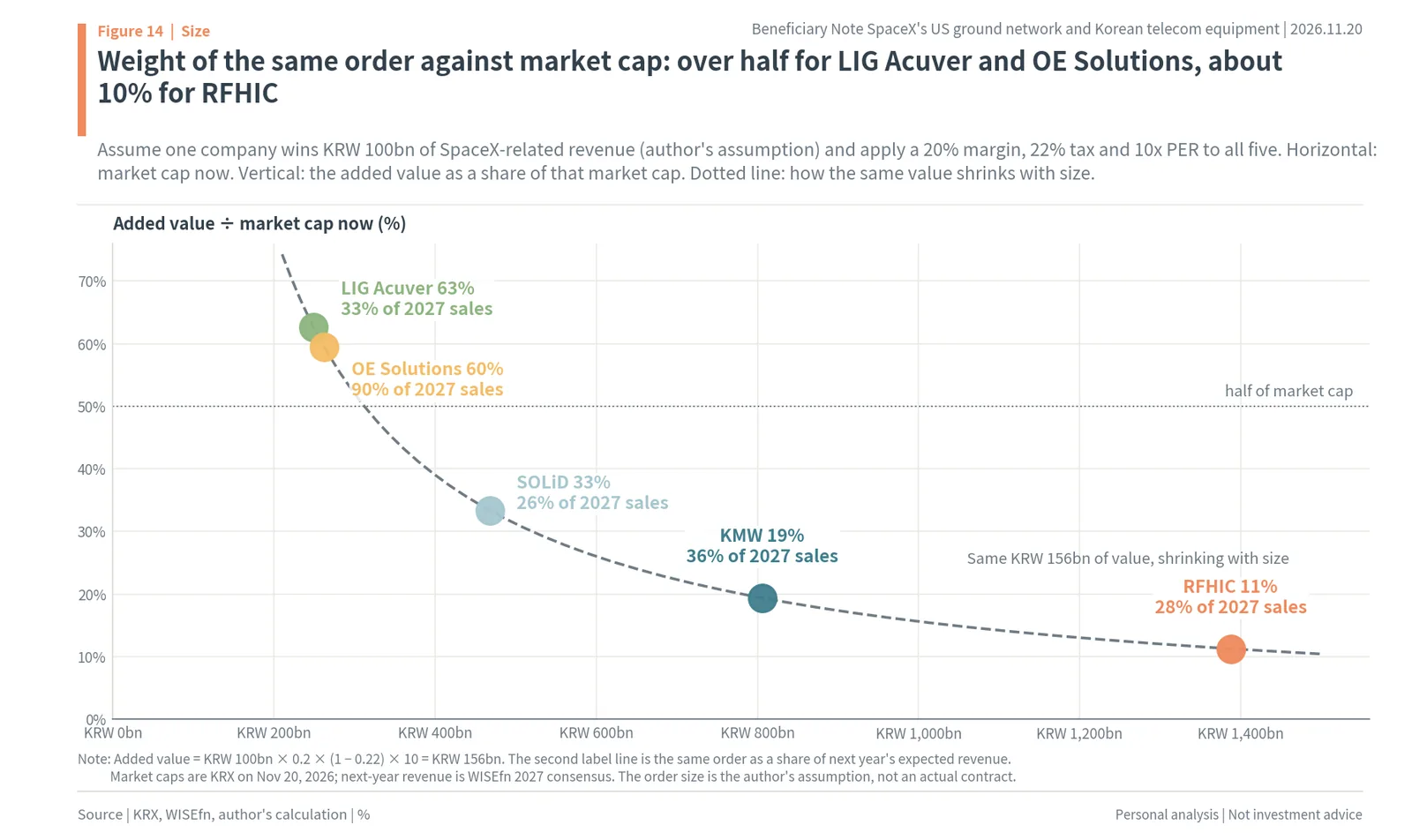
The same order would also equal 90% of OE Solutions’ expected 2027 revenue, against 26% to 36% for the others.
Two companies where the order matters less
KMW’s 2027 consensus already assumes revenue of KRW 274.4bn, 2.7 times the KRW 102.6bn expected for 2026. That is a pace of KRW 68.6bn a quarter, against KRW 20.7bn in the third quarter. A new SpaceX order would help the share price only if it took revenue beyond that expectation.
RFHIC’s profit today comes from defense amplifiers sold to Raytheon and from optical parts sold to Lumentum, and Eugene and Shinhan Investment both wrote that its base-station GaN business has not yet recovered.
By market-cap weight, the same order matters most for LIG Acuver, OE Solutions and SOLiD. KMW already carries a large expectation, and RFHIC’s profit is driven by other businesses. The next question is how far the share prices have already run on this hope.
7. The share prices ran first, and gave it back
Listing talk, then the IPO
On March 11, 2026, after Reuters and CNBC reported that SpaceX was considering a Nasdaq listing, all five stocks jumped: KMW 29.8% and SOLiD 30.0%, close to the daily limit, and RFHIC, LIG Acuver and OE Solutions by about 20%. By early May an equal-weight basket of the five was nearly three times its end-2025 level, peaking at 288.3 on May 7 (end-2025 = 100).
SpaceX listed in June, raising $86bn at $135 a share and topping $225 in mid-June, but on July 15 the stock traded below its offer price for the first time (FT, cited by Global Economic). From their spring highs to their later lows the five fell by two-thirds on average (66.6%).
This autumn
From October 7 to November 6, the month after SpaceX bought low-band spectrum, the five fell another 19.8% to 36.8%; the KOSDAQ fell 28.3% over the same weeks. They rebounded much more than the market only in the second week of November, after the Qualcomm deal and third-quarter results: from November 6 to 13 they rose 13.7% to 43.9%, against 8.6% for the KOSDAQ.
The precedent looks similar. On September 7, 2020, the day Samsung Electronics disclosed a network equipment contract with Verizon worth about KRW 8tn, KMW closed at a record KRW 86,600. On November 18, 2021 it was at KRW 35,300, 59.2% lower.

Hana Securities itself noted in a June 2, 2026 report on KMW that despite the roughly KRW 8tn agreement in 2020, Samsung’s actual early 5G deliveries were not large.
Today the five are on average about half (53.3%) below their spring highs, but the basket stands at 138.7 against 69.8 for the KOSDAQ, still well ahead of a market that has fallen hard this year.
November 20 was another “Black Friday” in Seoul. Doubts about the profitability of AI spending and worries about new US chip curbs on China hit Asian markets, the KOSPI fell 5.2% and the KOSDAQ 5.7%, and sell sidecars were triggered on both. The five fell with the market, by 4.0% (LIG Acuver) to 8.0% (OE Solutions).
These stocks have peaked on news such as listing talk or a contract filing and given it back when deliveries came late. So the author uses the habits of the people involved to sketch the order in which things are likely to happen.
8. What the habits point to next
SpaceX and EchoStar
Following his habit, Musk is likely to design the box in-house and have a contract manufacturer build it. If so, news of a SpaceX base-station prototype or of the company that will build it should come first, probably within the first half of 2027.
Component orders are likely to cluster in the second half of 2027, when Qualcomm starts booking revenue, so the earliest time they would show up in Korean suppliers’ results is late 2027.
Following his habit of buying when blocked, Musk could also buy EchoStar’s remaining business, including Boost Mobile, for stock. Ergen, who named SpaceX as the one company he would most like to invest in, would likely welcome being paid in shares. In that case LightShed analysts have suggested that SpaceX use the DISH Samsung and Fujitsu radios still on the towers as its first network, which would be a small plus for KMW, a long-time parts supplier to Samsung and Fujitsu.
The FCC
Carr has only widened restrictions so far, so a transceiver ban is likely to arrive within 2027 through the Covered List, with exceptions for products made in the US and allied countries.
The proposal to ban passive wireless parts is still at the comment stage. Until it is adopted, KMW’s share of any “replace China” demand remains an expectation.
The FCC’s upper C-band auction starts on April 27, 2027. If SpaceX applies to bid, it would need another round of massive MIMO radios, and the parts opportunity would grow.
The author’s order of interest
The author’s order of interest is LIG Acuver, SOLiD, OE Solutions, RFHIC and KMW.
LIG Acuver is the only one of the five with a known record of delivering to SpaceX, it is already profitable, and it is small, trading at 8.3 times 2027 consensus earnings (2027 forward EPS of KRW 3,937). SOLiD has the largest US share of sales in public data and trades at 9.9 times 2027 earnings (forward EPS of KRW 777).
OE Solutions has two possible catalysts, the transceiver curb and Korea’s own spectrum auction, but it has only just returned to profit and trades at 28.7 times 2027 earnings (forward EPS of KRW 739). RFHIC is a good company, but the SpaceX opportunity is small relative to its size, at 21.2 times 2027 earnings (forward EPS of KRW 2,462).
KMW is Hana Securities’ top short-term pick, but the Samsung route has narrowed, the company is still losing money and it is funding itself with convertible bonds (a KRW 35bn private placement paid in on October 26, 2026, convertible at KRW 18,140). At 15.9 times 2027 earnings (forward EPS of KRW 1,200), the author places it last until a SpaceX order is confirmed (author’s view).
If Musk follows his habits, money flows first to the parts inside the box and to network testing, and the timing starts in the second half of 2027.
9. Signals that would change this view
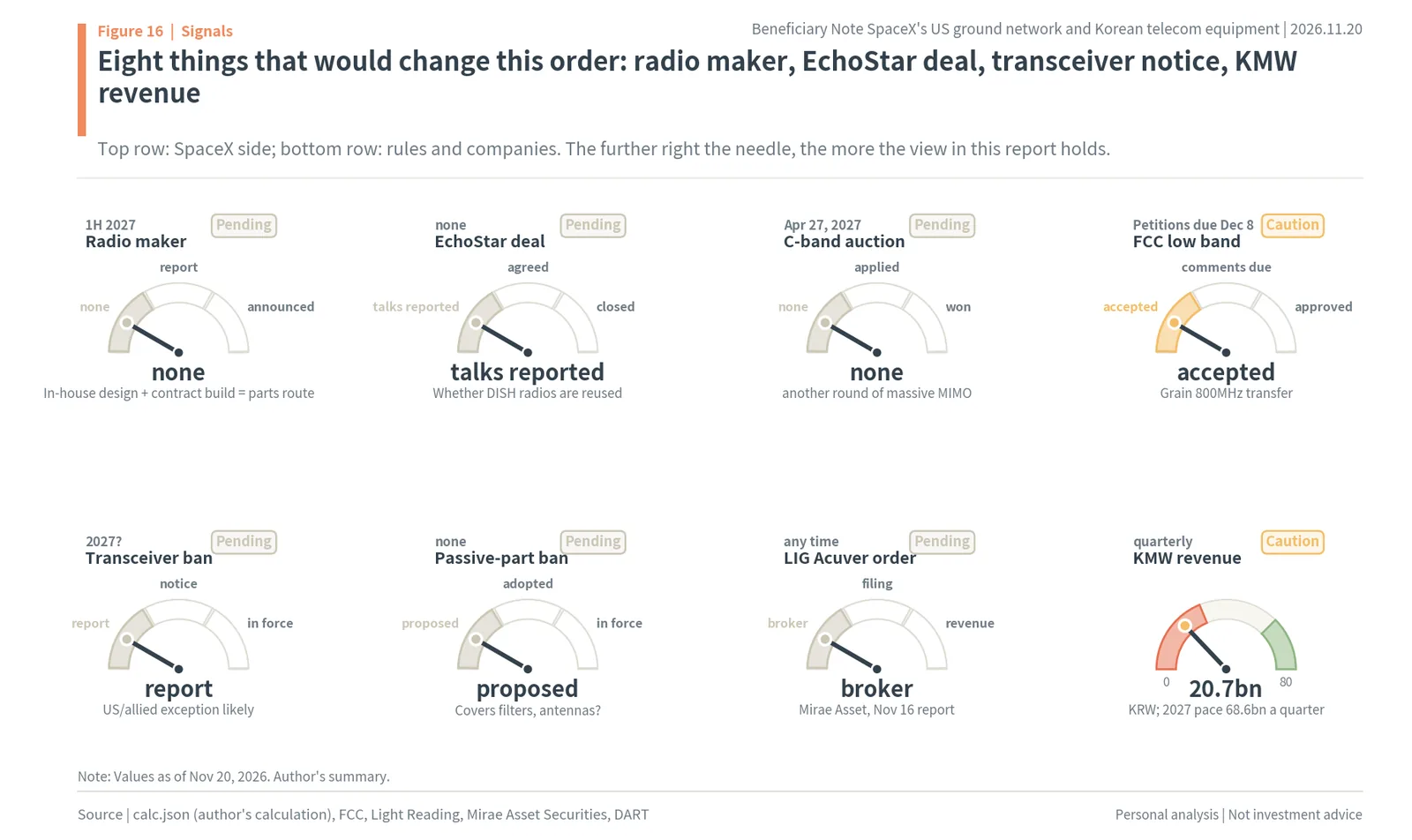
Eight signals would show whether this order holds.
On the SpaceX side: an announcement of the company that will build the radios; a deal between SpaceX and EchoStar or Boost Mobile; a SpaceX application to bid in the upper C-band auction; and final FCC approval of the Grain low-band transfer, with petitions to deny due December 8.
On the rules side: an FCC notice adding optical transceivers to the Covered List, and whether the FCC adopts the proposal to ban passive parts from Covered List companies.
On the company side: an LIG Acuver disclosure of a SpaceX order, and whether KMW’s quarterly revenue approaches the KRW 68.6bn pace that the 2027 consensus implies.
10. Calculation notes
Spectrum total: $17bn (AWS-4 and H-block) + $2.6bn (AWS-3 uplink) + $8bn (Grain, WSJ-reported cash price) = $27.6bn. Radios: sites × 6 radios per site, the DISH ratio from its May 2026 bankruptcy filing (144,000 radios on about 24,000 towers); 20,000, 50,000 and 80,000 sites give 120,000, 300,000 and 480,000 radios. The 64T64R comparison divides 64 paths by the 4 paths of a common 4T4R radio.
Order weight: added value = KRW 100bn × 20% operating margin × (1 − 22% tax) × 10 times earnings = KRW 156bn, divided by each company’s KRX market cap on November 20, 2026. The same margin, tax rate and multiple are applied to all five so that only size differs; they are assumptions, not company figures. The order size is an assumption, not a contract.
2027 PER = KRX close on November 20, 2026 ÷ WISEfn 2027 consensus EPS. Basket = equal-weight average of the five stocks’ adjusted closes, each indexed to 100 at the end of 2025. Event-day moves use Naver Finance adjusted closes; Naver closes after September 14, 2025 may include Nextrade trades, so November 20 moves use KRX closes on November 19 and 20.
SpaceX’s 5G network and Korean telecom equipment stocks: quick answers
Q. Will SpaceX buy base stations from Samsung, Ericsson or Nokia?
Probably not. Qualcomm, which signed a multi-year chip deal with SpaceX on November 4, 2026, said it does not build the boxes and that SpaceX will build them. Analysts quoted by Fierce Network expect Musk to skip Nokia, Ericsson and Samsung and have a contract manufacturer build SpaceX’s own design, buying components from suppliers that already serve the big vendors.
Q. When could Korean suppliers see SpaceX orders?
Qualcomm said deployment begins in 2027 and its revenue comes mainly in its fiscal 2028, which runs from October 2027 to September 2028. The author therefore expects component orders to cluster in the second half of 2027 and to show up in Korean suppliers’ results from late 2027.
Q. Which Korean company is closest to SpaceX?
LIG Acuver (073490.KQ). A Mirae Asset Securities report of November 16, 2026 said it has delivered test equipment directly to SpaceX and is in talks; the company has not disclosed this. SOLiD, with 35.1% of January to September sales in the US, and RFHIC, a registered vendor to Samsung, Nokia and Ericsson, come next.
Q. Do the FCC’s rules on Chinese parts help KMW’s filters?
Not yet. The FCC rule in force since October 13, 2026 bans only ‘smart’ components from Covered List companies such as Huawei and excludes fixed passive parts, which the author reads as leaving filters and antennas outside it. A proposal to ban all components from Covered List companies is still at the comment stage.
Q. How much would a SpaceX order be worth to each company?
On the author’s assumption of a KRW 100bn order at a 20% margin, 22% tax and 10 times earnings, the added value of KRW 156bn equals 63% of LIG Acuver’s market cap, 60% of OE Solutions’, 33% of SOLiD’s, 19% of KMW’s and about 11% of RFHIC’s, using KRX market caps on November 20, 2026.
Sources
- Hana Securities, Kim Hong-sik, “If it was the BEAD program three years ago, look at OBBBA now” (link), Nov 19, 2026; “Telecom services/equipment weekly: more good news” (link), Nov 12, 2026; company reports on KMW (Jun 2 and Nov 18, 2026), OE Solutions and LIG Acuver (Nov 17, 2026)
- iM Securities, Shin Hee-cheol, “SpaceX’s US terrestrial network plan takes shape” (link), Nov 16, 2026; Mirae Asset Securities on LIG Acuver, Nov 16, 2026; IBK Investment & Securities on SOLiD, Oct 30, 2026; Eugene Investment & Securities and Shinhan Investment on RFHIC, Oct 28, 2026
- Qualcomm, “SpaceX selects Qualcomm” (link), Nov 4, 2026; Qualcomm fiscal fourth-quarter earnings call transcript (LSEG), Nov 4, 2026; Light Reading (link), Nov 4, 2026; Fierce Network (link), Nov 4, 2026; Fierce Network (link), Nov 11, 2026
- SpaceX spectrum and sites: TechCrunch (EchoStar AWS-4 and H-block), Sep 8, 2025; Fierce (AWS-3), Nov 6, 2025; Light Reading on Grain’s 800MHz spectrum (link), Oct 9, 2026; Bloomberg on 80,000 sites, Oct 22, 2026; Light Reading on tower companies owning DISH radios (link), Oct 28, 2026; The Washington Post on Boost Mobile, Nov 2, 2026; The Scoop (link); Digital Today (link), Nov 5, 2026
- Carriers and executives: Light Reading on Verizon’s Schulman and AT&T’s Stankey, Jul 23 and Nov 2, 2026; Space Intel Report on Charlie Ergen, Sep 15, 2025; STMicroelectronics press release, Dec 15, 2025; TechCrunch on Tesla and Samsung AI6, Jul 28, 2025
- DISH network: Samsung Newsroom (DISH selection May 3, 2022; first commercial service Feb 22, 2023); Light Reading on the bankruptcy filing (144,000 radios, about 24,000 towers), Jul 1, 2026; KED Global on the Samsung-DISH contract, May 3, 2022
- FCC: Third Report and Order FCC 26-50 (link), Jul 22, 2026; Second Report and Order FCC 25-71, Oct 28, 2025; Covered List notices (drones DA 25-1086, routers DA 26-278, robots and inverters DA 26-786); Reuters on optical transceivers (via GV Wire and Finviz), Aug 4 and Nov 17, 2026; LightCounting 2025 optical module ranking (C114), May 28, 2026; Arnold & Porter (link), Sep 2, 2026
- DART: third-quarter 2026 reports of KMW, RFHIC, LIG Acuver, SOLiD and OE Solutions (Nov 2026, including plant and subsidiary locations) and 2025 annual reports; Edaily on KMW Chairman Kim Duk-yong, Feb 18, 2020; Electronic Times on Innowireless and Qualcomm small cells, Mar 18, 2021; Choice Economy on the March 11 listing talk, Mar 11, 2026; Global Economic (citing FT) on SpaceX trading below its IPO price, Jul 17, 2026
- November 20 market: Seoul Economic Daily (link) and JoongAng Ilbo (link), Nov 20, 2026
- Maps: Natural Earth (public domain); Korean province boundaries
- Prices: KRX Data System (Nov 20, 2026 closes and market caps); Naver Finance adjusted prices (basket and KOSDAQ); Yahoo Finance (Lumentum, Coherent, KRW=X); WISEfn consensus; author’s calculations (research/calc.py)
- Photos: Tony Webster (CC BY 2.0), Steve Jurvetson (CC BY 2.0), Kim Shiflett/NASA (Elon Musk at a 2016 press conference, public domain), FCC (official portrait of Brendan Carr, public domain), Jeffrey Beall (CC BY 4.0), ITEagle Europe – Sebastiaan Broekhoven (CC BY-SA 4.0), via Wikimedia Commons; logos: SpaceX and Qualcomm (public domain, Wikimedia Commons)
Disclaimer
This report records the author’s personal analysis and views based on public information and does not recommend any particular product or company. It does not recommend buying or selling any financial investment product and is not an investment advisory or quasi-investment advisory service.
A person’s “habits” in this report are the author’s grouping of that person’s public statements and recorded decisions; they do not claim to know anyone’s intentions. SpaceX’s site count, radio count and order size are the author’s assumptions, not company figures. LIG Acuver’s deliveries to SpaceX come from a broker report and have not been confirmed by a company filing. Accuracy and completeness are not guaranteed.
Items marked “author’s calculation” or “author’s estimate” are assumptions, not confirmed facts.
Author’s interests: not disclosed
Responsibility for decisions and their outcomes lies with the reader.
As of: November 20, 2026
Was this note useful?
Thanks. Your answer helps decide what to cover next.
Korea market snapshot · Nov 27, 2026
New to Korean stocks? Start here for the basics.
Most read this week
5Bank of Korea Holds Rate at 3.00%: Why a 0.12pp Real Rate Points to a November Hike (2026)
Get the Saturday note on Korean stocks
One email every Saturday with the week’s new research on Korean listed companies and links to the updated data pages. Built from DART filings and KRX data. Free; unsubscribe in one click. See past issues