S-Oil (010950.KS) Q3 2026 Results and Stock Forecast: A KRW 1.4 Trillion Quarter, a Peak That Came First, and the Diesel Margin Behind KRW 130,000

When Russia invaded Ukraine on February 24, 2022, diesel prices soared. S-Oil’s share price rose from KRW 81,400 just before the invasion to KRW 121,500 on June 10. On July 28 that year the company reported second-quarter operating profit of KRW 1,722.0bn, which the press called a quarterly record. But on that day the stock closed at KRW 91,300, already 24.9% below its peak. Profit shrank to 30% of that level the next quarter, and the fourth quarter brought an operating loss of KRW 160.4bn. The market spotted the peak in profit before the profit itself did.
On February 28, 2026, a war in the Middle East sent diesel prices up again. S-Oil’s share price rose from KRW 110,000 just before the war to KRW 170,600 on October 7, passing the April 2011 peak of KRW 167,000 for the first time in 15 years. Then, on November 2, the company reported third-quarter operating profit of KRW 1,406.7bn. It was 18% more than consensus, yet the closing price that day, KRW 130,000 (about $97), was 23.8% below the new high.
The question of this report is this. Did the peak come before the results again? If so, what does KRW 130,000 rest on, and what would it take to set a new high? After the third-quarter results Hana Securities cut its target price from KRW 220,000 to KRW 180,000 and named two conditions for a new high: “the company’s aggressive will to raise the dividend payout ratio and securing profitability at the Shaheen project.” The author splits third-quarter profit by segment and per barrel to see which profit lasts and for how long, then splits the share price into “the value of normal earnings” and “the extra money earned during the war” to measure those conditions again in numbers.

English edition of the author’s Korean note on S-Oil’s third-quarter 2026 results.
As of: November 2, 2026
Stocks covered: S-Oil Corporation (010950.KS, KOSPI). Its largest shareholder is the Saudi Aramco group (Aramco Downstream Asia and related parties, 63.43% of common shares). Comparison material: Hana Securities (Yoon Jae-sung) company report and weekly refining report (November 2, 2026), and the WISEreport consensus.
Topics: the business and Shaheen, two years of share prices, third-quarter results by segment and inventory effects, refinery utilization and spreads, long-run spreads, refining profit per barrel and the price cap and freight, base-oil profit per barrel, share prices and quarterly profit in 2022 and 2026, the causes of each October fall and the trading by investor type, diesel exports from Russia, China and Korea and the Saudi OSP, loss compensation, Middle East base-oil plants, the author’s estimates from Q4 2026 to 2028, the normal margin the share price assumes, three scenarios and a simulation, dividends and Shaheen, and the dates and signals to watch.
Data: share prices, KOSPI and trading by investor type come from the KRX Data System (November 2, 2026 regular session); long-run prices from Naver Finance adjusted prices; company figures from DART preliminary results and the half-year report and from S-Oil’s results presentations for Q3 2025 to Q3 2026; the consensus from WISEreport (October 30); and KRW per USD from Yahoo Finance (KRW 1,342 on November 2). Numbers the author calculated are marked “author’s calculation.”
Some Korea-specific background. The KOSPI is the Korea Exchange’s main board, and tickers ending in .KS trade there. The Korea Exchange (KRX) publishes each day’s net buying and selling by investor type (foreigners, individuals and institutions, with institutions split into pension funds, investment trusts, financial investment firms and others), which is why this report can say who bought and who sold. DART is the Financial Supervisory Service’s electronic disclosure system, where Korean companies file their reports. Korea’s fuel price cap (석유 최고가격제), introduced on March 13, 2026, sets a ceiling on the prices refiners charge gas stations for gasoline, diesel and kerosene. The OSP is the official selling price Saudi Aramco sets each month for its crude, quoted as a premium or discount to a benchmark. Korea counts large sums in units of 100 million won (eok); this report converts them to KRW bn, and trillions of won to KRW tn. Dollar figures in parentheses are converted at KRW 1,342 per dollar, the November 2, 2026 rate (Yahoo Finance KRW=X). At that rate the market value of the common shares, KRW 14.64tn, is about $10.9bn.
The conclusions first. First, third-quarter operating profit was KRW 1,436.1bn excluding inventory effects (KRW -29.4bn), and 52.8% of it came from base oil, which is only 12.9% of sales. Refinery utilization was 81%, lower than a year earlier, while the diesel spread rose 3.5 times and the base-oil spread 3.3 times. It was a quarter of making less and selling it for far more. Second, when the diesel spread rose $47.1 over the year, refining profit per barrel rose $8.7 (18%). The price cap, crude costs and freight, and maintenance took the rest. So when the war premium fades, refining profit falls less, while base oil, whose spread turned almost entirely into profit, falls in full. Third, as in 2022, the share price peaked before the largest profit, and of the 28.3% October fall, KOSPI accounted for 12.7%. Fourth, the author’s base estimate of 2027 operating profit is KRW 2,863.7bn, 20.4% below consensus. Fifth, splitting the share price into the value of normal earnings and the extra money earned during the war, KRW 130,000 is the price of a post-war diesel spread that settles at $19.3. The probability-weighted value of three scenarios is also KRW 130,000. Sixth, the high of KRW 170,600 needs a normal diesel spread of $23.6, or the 2021-2025 average ($21.3) plus Shaheen earning around KRW 320bn a year. Dividends move money already earned into shareholders’ hands, so they move the value little. In one line: after the peak, normal margins.
1. What S-Oil sells: one barrel of crude into diesel, jet fuel and base oil
The conclusion first: S-Oil buys crude oil, refines it and sells the products, and its profit depends on how much more it can charge for the products than it pays for the crude. Refining brings in 80% of sales and lubricants and petrochemicals about 10% each, but each segment’s share of profit swings widely with spreads. In early 2027 the petrochemical complex Shaheen, built in Ulsan, will start up and change the shape of the company once more.
Refining: 669,000 barrels a day
S-Oil’s Ulsan refinery can process 669,000 barrels of crude a day (DART half-year report). Crude is split by boiling point into diesel, gasoline, jet fuel, kerosene and naphtha, and the heavy oil left over is cracked again to pull out more gasoline and diesel or used as feedstock for base oil. Of first-half 2026 sales of KRW 20.29tn, diesel made up 31.6%, gasoline 15.2%, jet fuel 14.7% and naphtha 5.0%. Within refining sales, exports accounted for 41.2 percentage points of total sales and domestic sales 38.3 points, almost half and half, and 91% of first-half jet fuel sales were exports. The average selling price of diesel rose 42%, from KRW 130,479 a barrel in 2025 to KRW 185,354 in the first half of 2026.
S-Oil buys most of its crude from its largest shareholder, Saudi Aramco, whose group holds 63.43% of the common shares. On October 1 this stake moved from Aramco’s Dutch subsidiary (AOCBV) to its Singapore subsidiary (Aramco Downstream Asia). The filing called it a restructuring of shareholdings among affiliates and stated that there was no change in the number of shares or the stake held by the largest shareholder and related parties (DART, change of largest shareholder). The transfer was paid for with a promissory note issued by Aramco’s parent company.
Lubricants, petrochemicals and Shaheen
The lubricants segment makes 44,700 barrels a day of base oil and exports most of it. The petrochemical segment makes aromatics such as PX and benzene (105,000 barrels a day) and olefin downstream products such as PP and PO (765,000 tonnes a year) (DART half-year report). Petrochemicals lost money in six of the seven quarters from 2025 to the third quarter of 2026 (company results). Profit shares move differently from sales shares. In the third quarter of 2026, lubricants, 12.9% of sales, earned 52.8% of operating profit; refining, 75.7% of sales, earned 49.1%; and petrochemicals, 11.4% of sales, contributed -1.9%.
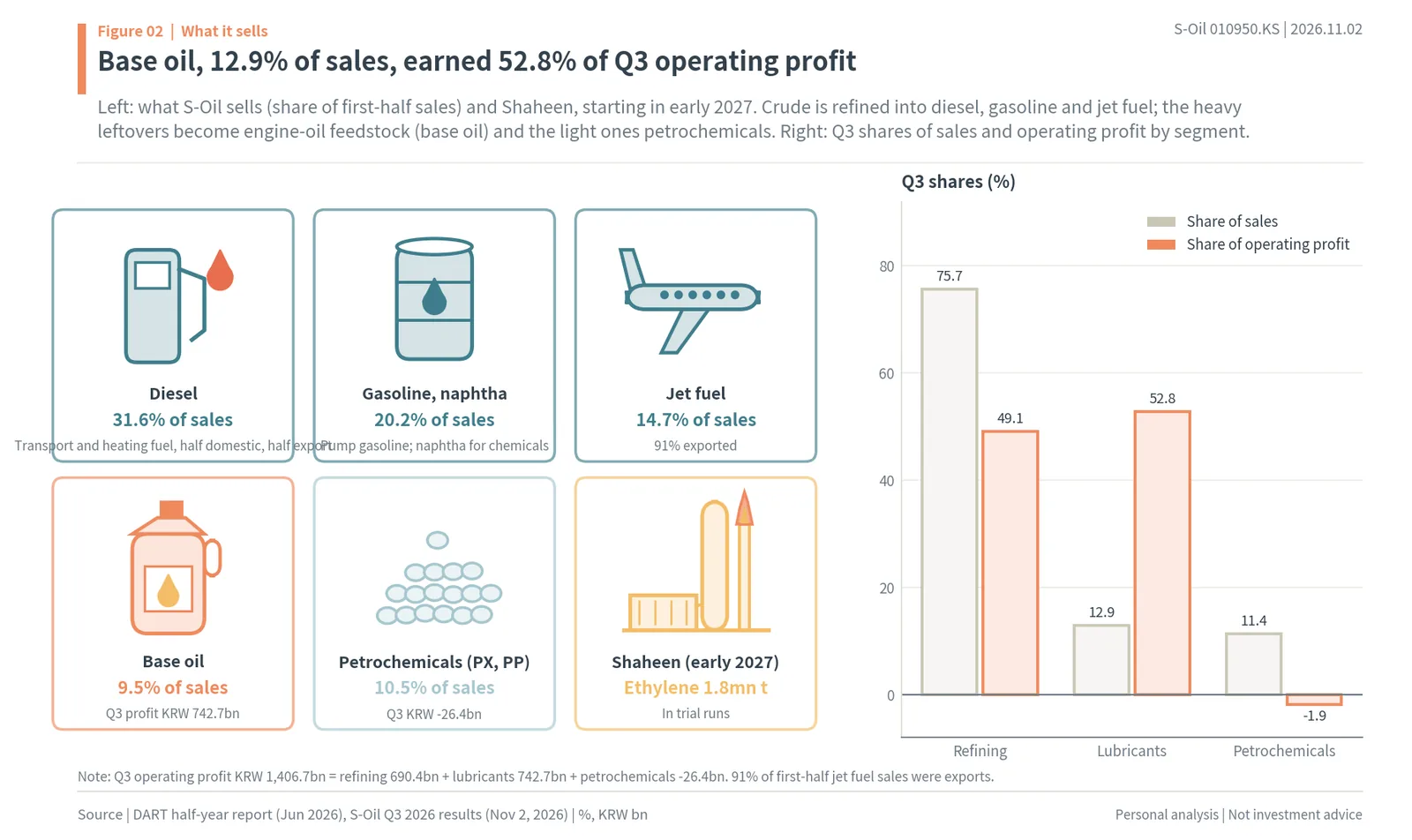
The Shaheen project combines TC2C, a technology that turns crude directly into chemical feedstock, with a steam cracker able to make 1.8 million tonnes of ethylene a year. Annual capacity is 880,000 tonnes of linear low-density polyethylene, 440,000 tonnes of high-density polyethylene, 770,000 tonnes of propylene, 580,000 tonnes of ethylene, 200,000 tonnes of butadiene and 280,000 tonnes of benzene. It takes 83% of its feedstock from the existing refinery, and the company says its investment and operating costs are 30-40% lower than conventional processes and that its cost competitiveness ranks in the top quarter in Northeast Asia (company results). After the investment decision in November 2022 the company spent KRW 3,356.0bn in 2025 alone, and the 2026 plan is KRW 1,562.0bn. The plant is in trial runs now, with commercial operation targeted for early 2027.
Two years of S-Oil stock: a big rise after the war, a big fall after the high
S-Oil’s share price fell to the KRW 50,400 range in April 2025 (Naver adjusted price), then stood at KRW 110,000 just before the Middle East war began on February 28, 2026, and reached KRW 170,600 (about $127) on October 7. That is 55.1% above the pre-war price and a closing high that beat the April 28, 2011 peak of KRW 167,000 for the first time in 15 years. It then fell 28.3% to KRW 122,300 on October 29 (KOSPI -12.7% over the same days) and, on November 2, the day of the third-quarter results, rose 5.69% to close at KRW 130,000. The one-year return is +79.8%, 41.0 percentage points better than KOSPI (+38.8%).
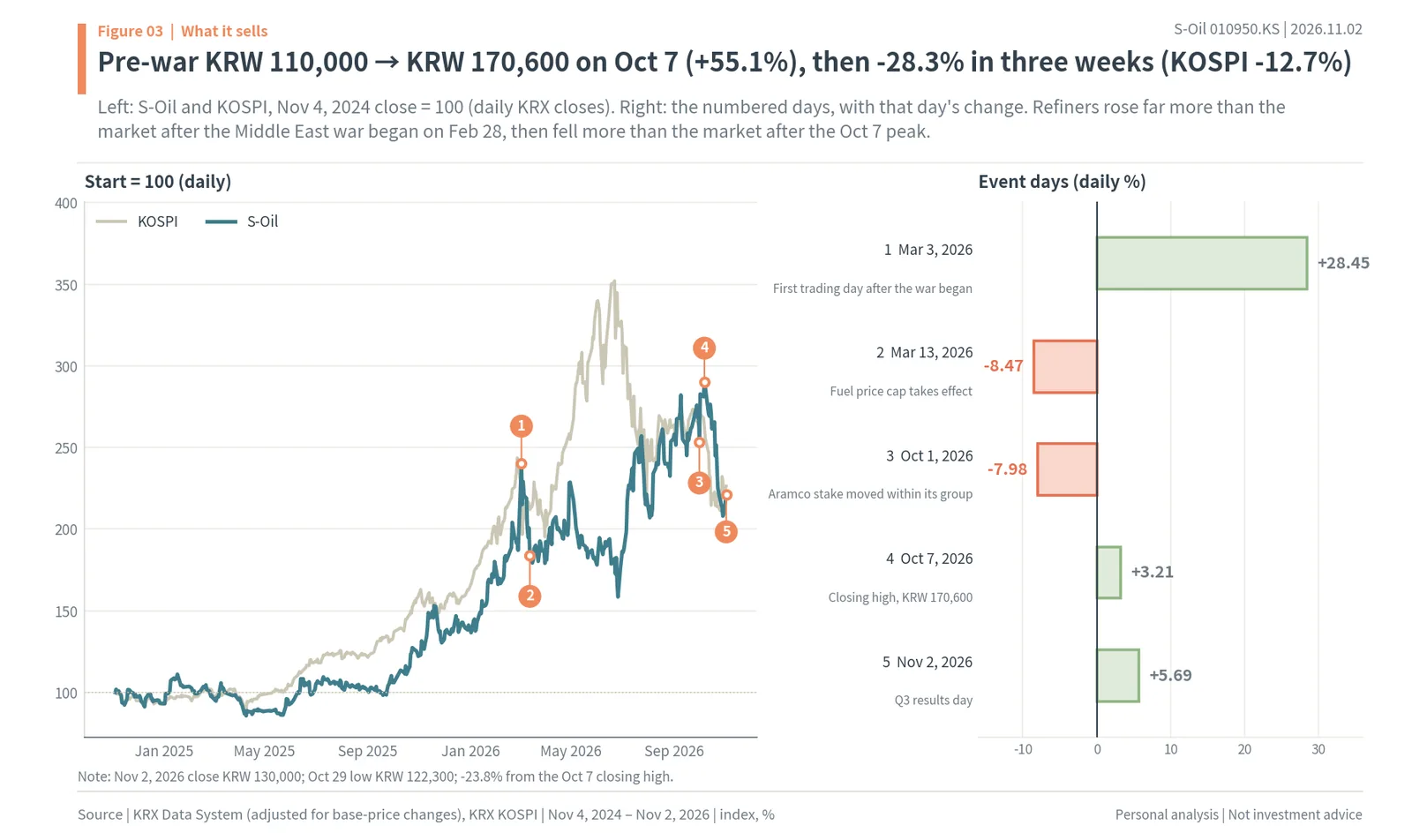
This path is the rise and fall of the expectation that the market would pay “more” for what the company sells. The shares jumped 28.5% on March 3, the first trading day after the war began, and in 2026 alone there were seventeen days with moves of more than 7% (KRX). The next chapter looks at how much of this expectation third-quarter results actually filled.
2. S-Oil’s Q3 2026 results: KRW 1.4 trillion earned by selling, not by oil prices
The conclusion first: third-quarter profit was not a book gain from rising oil prices but profit made by selling products. The inventory-related effect the company disclosed was actually a loss of KRW 29.4bn, and excluding it, operating profit was KRW 1,436.1bn, the largest of the last five quarters. Operating profit for the first three quarters has already passed the full-year record set in 2022.
Operating profit of KRW 1,406.7bn, 18.1% above consensus
Consolidated preliminary results filed on November 2 showed third-quarter sales of KRW 11,968.7bn, operating profit of KRW 1,406.7bn (about $1.05bn) and net profit of KRW 1,435.6bn (DART preliminary results). Against the second quarter, sales rose 5.5% and operating profit 45.8%; against the third quarter of 2025 (operating profit KRW 229.2bn), operating profit rose 513.7%. It was 18.1% above the WISEreport consensus of KRW 1,191.0bn (as of October 30), the same margin as against the KRW 1,190bn consensus Hana Securities cited. The operating margin was 11.8%, up 3.2 percentage points from 8.5% in the second quarter.
Net profit exceeded operating profit because of the currency. By the company’s measure the won strengthened by KRW 183.1 per dollar during the third quarter (Yahoo Finance quarter-end rates: KRW 1,541.7 at the end of June, KRW 1,350.5 at the end of September), shrinking the won value of crude payables and debt owed in dollars. That produced a foreign-exchange gain of KRW 609.7bn outside operations (net FX gains, including currency-hedging derivatives; company results). Pretax profit was KRW 1,971.7bn. This gain turns into a loss when the won weakens again, so this report’s profit estimates use operating profit and set FX gains to zero.
Excluding inventory effects, KRW 1,436.1bn, the largest of the last five quarters
The first thing to remove when reading a refiner’s profit is the inventory-related effect. A refiner takes a month or two to buy crude, ship it, refine it and sell it. If oil prices rise in between, crude and products bought cheaply are sold at higher prices and a book gain appears; if prices fall, a loss appears. That part comes from the direction of oil prices, not from the refiner doing business well.
The inventory-related effects S-Oil reported in its results presentations were KRW -4.8bn in Q3 2025, KRW -87.4bn in Q4 2025, KRW +643.4bn in Q1 2026, KRW +113.7bn in Q2 2026 and KRW -29.4bn in Q3 2026. In other words, more than half of first-quarter operating profit of KRW 1,231.1bn was an inventory gain from the March oil spike. Removing these effects, “business profit” grew every quarter: KRW 234.0bn, 459.3bn, 587.7bn, 851.3bn and 1,436.1bn (author’s calculation). The third quarter is the largest even without inventory effects, and this time the inventory effect actually trimmed profit a little.
Hana Securities attributed the third-quarter surprise to a positive lagging effect as oil and all product prices rose together. The lagging effect is the gain from a timing gap: the crude price is set at the month of loading, while products are sold about a month later at the prices of that time. It moves separately from the inventory-related effect in the company’s figures. Dubai crude rose from a June average of $79.5 to a September average of $113.7 (company results, average of the last month of each quarter). In its first-quarter materials the company also noted separately that refining profit improved because of the time lag in reflecting the loading-month oil price. Third-quarter refining profit therefore includes some lag gain from rising oil prices, and in a quarter when oil prices fall this part works in reverse.

By segment: refining KRW 690.4bn, lubricants KRW 742.7bn, petrochemicals KRW -26.4bn
Operating profit by segment was KRW 690.4bn in refining (KRW 532.4bn in the second quarter), KRW 742.7bn in lubricants (KRW 477.4bn) and KRW -26.4bn in petrochemicals (KRW -44.8bn) (company results). Lubricants earned an operating margin of 48.1% on sales of KRW 1,542.4bn, in the company’s words a record quarterly operating profit. Lubricants made up 12.9% of third-quarter sales but 52.8% of operating profit. Refining was 75.7% of sales and 49.1% of operating profit. Petrochemicals, 11.4% of sales, narrowed the loss but still lost money.
For the first three quarters, operating profit was KRW 3,602.7bn and net profit KRW 2,671.2bn. S-Oil has already earned 106% of its record 2022 full-year operating profit of KRW 3,405.2bn (DART annual report). Quarter by quarter, though, the second quarter of 2022 at KRW 1,722.0bn is still larger. That quarter included a large inventory gain from the oil price rise after Russia’s invasion.
In short, the third-quarter numbers say two things. First, this profit came from the margin between product and feedstock prices (the spread), not from the direction of oil prices. Second, more than half of it came from base oil, one tenth of sales. The next chapter looks at where this “more expensive” came from, and at the volume that shrank on the other side.
3. Selling less at higher prices: 81% utilization, spreads four times normal
The conclusion first: the third quarter was a quarter of lower volume and much higher prices. Crude distillation utilization fell from 97% a year earlier to 81%, while the diesel spread rose 3.5 times and the base-oil spread 3.3 times. The market did not buy “more” of what S-Oil sells; it paid “far more” for it.
What base oil is and why it became so expensive
Base oil is the oil used to make car engine oil and industrial lubricants. It is made by treating the heavy oil left after refining crude (vacuum gas oil, VGO) again with hydrogen, and blending additives into it makes engine oil. S-Oil’s base-oil units can make 44,700 barrels a day (DART half-year report), and base oil was 9.5% of first-half sales. High-grade Group III base oil goes into premium engine oils, and the plants that make a lot of this grade are concentrated in the Middle East.

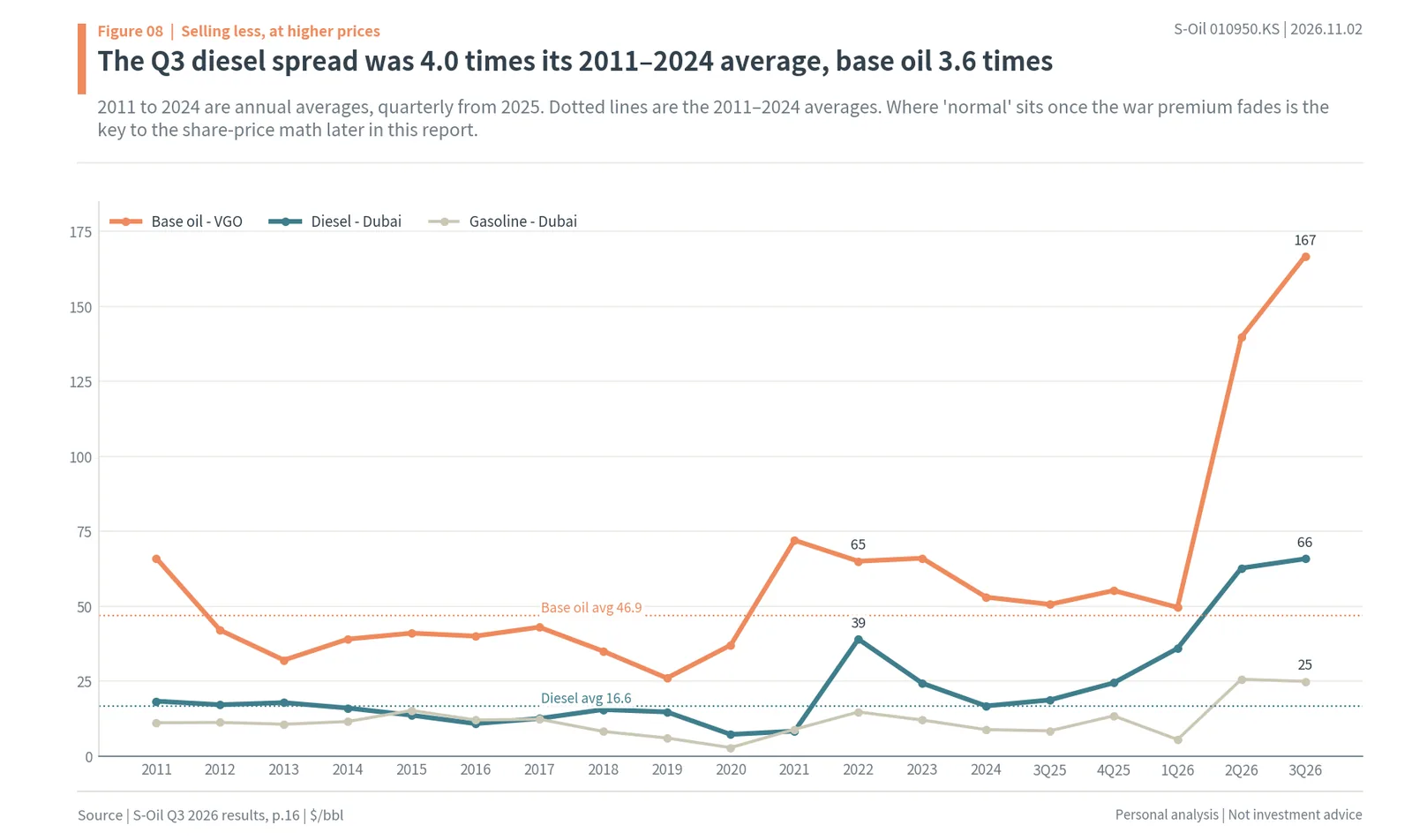
The company described the third-quarter base-oil market as one where production disruptions and logistics constraints in the Middle East dragged on, and prices kept rising in major markets, led by Group III. The base-oil spread, the composite base-oil price minus the price of the VGO feedstock, went from $50.6 a barrel in Q3 2025 to $139.7 in Q2 2026 and $166.8 in Q3 2026 (company results). That is 3.6 times the 2011-2024 annual average of $46.9. In its fourth-quarter outlook the company expects tight Group III supply to continue and names “whether Middle East supply normalizes” as the key variable.
Refinery utilization fell from 97% to 81%
On the other side, volume fell. S-Oil can process 669,000 barrels of crude a day (DART half-year report). The utilization of its crude distillation units (CDU) that the company reports went from 97% in Q3 2025 and 95% in Q4 2025 to 85% in Q1 2026, 76% in Q2 and 81% in Q3 (company results). Scheduled maintenance of the No. 2 CDU and No. 2 RFCC overlapped in the first half, and there was no maintenance in the second half, yet third-quarter utilization reached only 81%. Third-quarter throughput calculated from this capacity and utilization was 49.9 million barrels, 16.4% less than 59.7 million barrels a year earlier (author’s calculation).
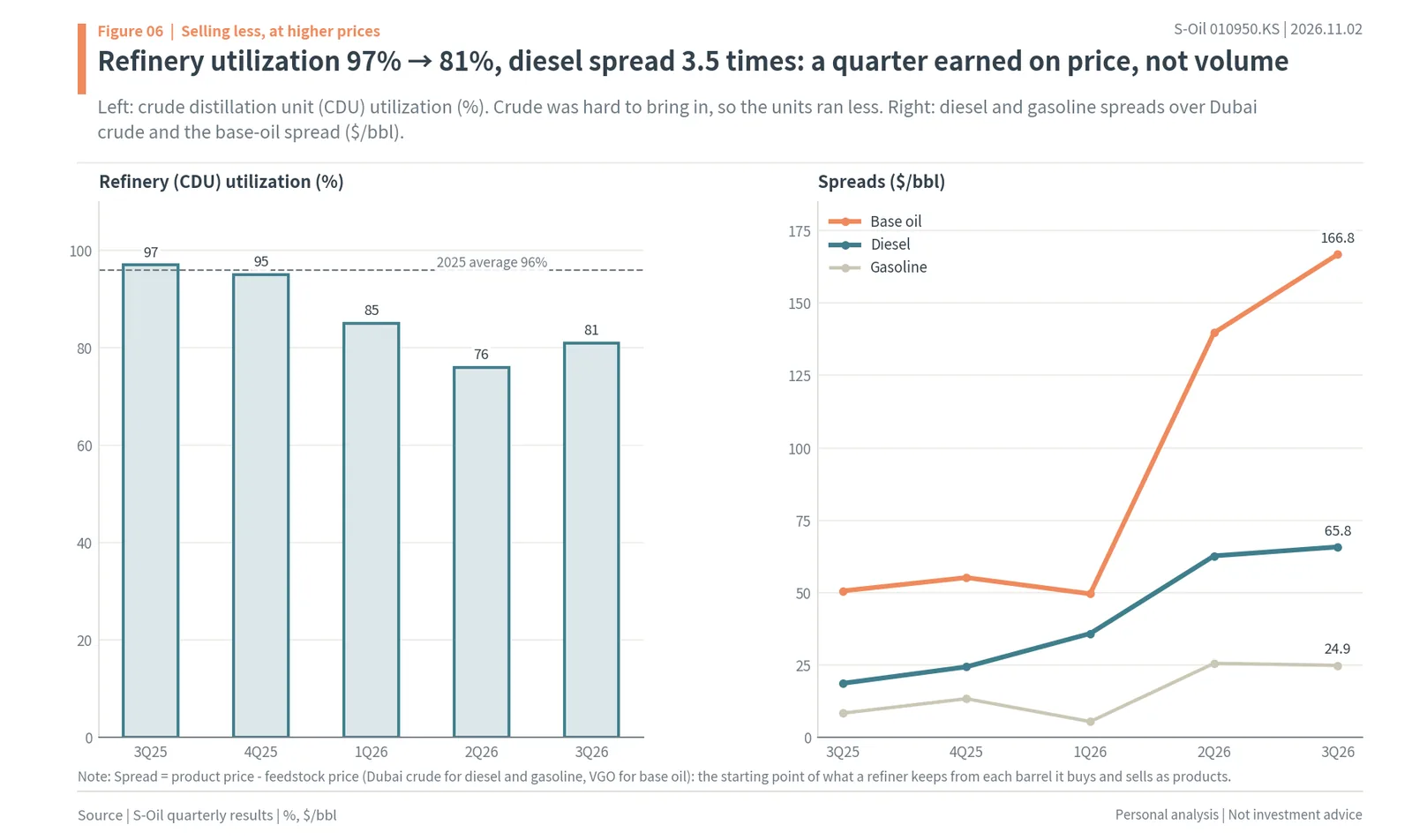
Utilization was low because bringing in crude became difficult. The company said that, with crude supply and shipping still disrupted by conflict in the Middle East, it secured crude by buying spot and alternative grades on top of its long-term contract volumes, borrowing from government strategic reserves (swap leases), using several shipping routes and ship-to-ship (STS) transfers. With different crude coming in, it also had to change how it ran its units. The average cost of imported crude rose from $70.38 a barrel in 2025 to $97.8 in the first half of 2026 (DART half-year report).
The diesel spread at four times its 2011-2024 average
The diesel and gasoline spreads show, in dollars per barrel, how much more the products sell for than Dubai crude. In the company’s figures the diesel spread was $18.7 in Q3 2025, $24.4 in Q4 2025, $35.9 in Q1 2026, $62.7 in Q2 and $65.8 in Q3. Gasoline went from $8.4 to $24.9, and kerosene and jet fuel from $16.1 to $59.4. The 2011-2024 annual average diesel spread is $16.6, and even the 2022 average, the year of the Russian war, was $39.0. The third-quarter diesel spread was 4.0 times the long-run average and 1.7 times the 2022 average.
The company gave two reasons for high refining margins: global product inventories that remain low, and supply constraints that worsened as disruptions at refineries around the world continued. With Middle East plants down and shipping lanes blocked, less diesel reached the world market, and Asian refiners also struggled to get crude and could not make much. In short, third-quarter profit was profit from prices rising because supply was blocked. When supply returns, prices fall and volume rises instead. Future profit depends on how fast these two forces change, and for S-Oil they do not weigh the same. The next chapter looks at how much S-Oil actually earned as diesel prices rose.
4. One fifth of the diesel margin: refining profit has a cushion
The conclusion first: when the diesel spread rose $47.1 a barrel over the year, the refining profit S-Oil kept from each barrel of crude it processed rose $8.7 (author’s calculation). That is 18% of the increase, roughly one fifth. Korea’s fuel price cap, costlier crude and freight, and scheduled maintenance took the rest. Because of this structure, refining profit will not fall as much as the spread when the war premium fades.
Refining profit per barrel rose from $1.45 to $10.17
Taking refining operating profit minus the inventory-related effect and dividing it by throughput (capacity × utilization × days) and the quarterly average KRW per dollar gives the refining profit kept from each barrel of crude processed, in dollars. The company reports the inventory effect only for the whole company, so all of it is assigned to refining. Calculated this way, the figure was $1.45 in Q3 2025, $3.25 in Q4 2025, $5.29 in Q1 2026, $6.03 in Q2 and $10.17 in Q3 (author’s calculation). Over the same period the diesel spread went from $18.7 to $65.8. When the spread rose $47.1, refining profit per barrel rose $8.7, or 18%.
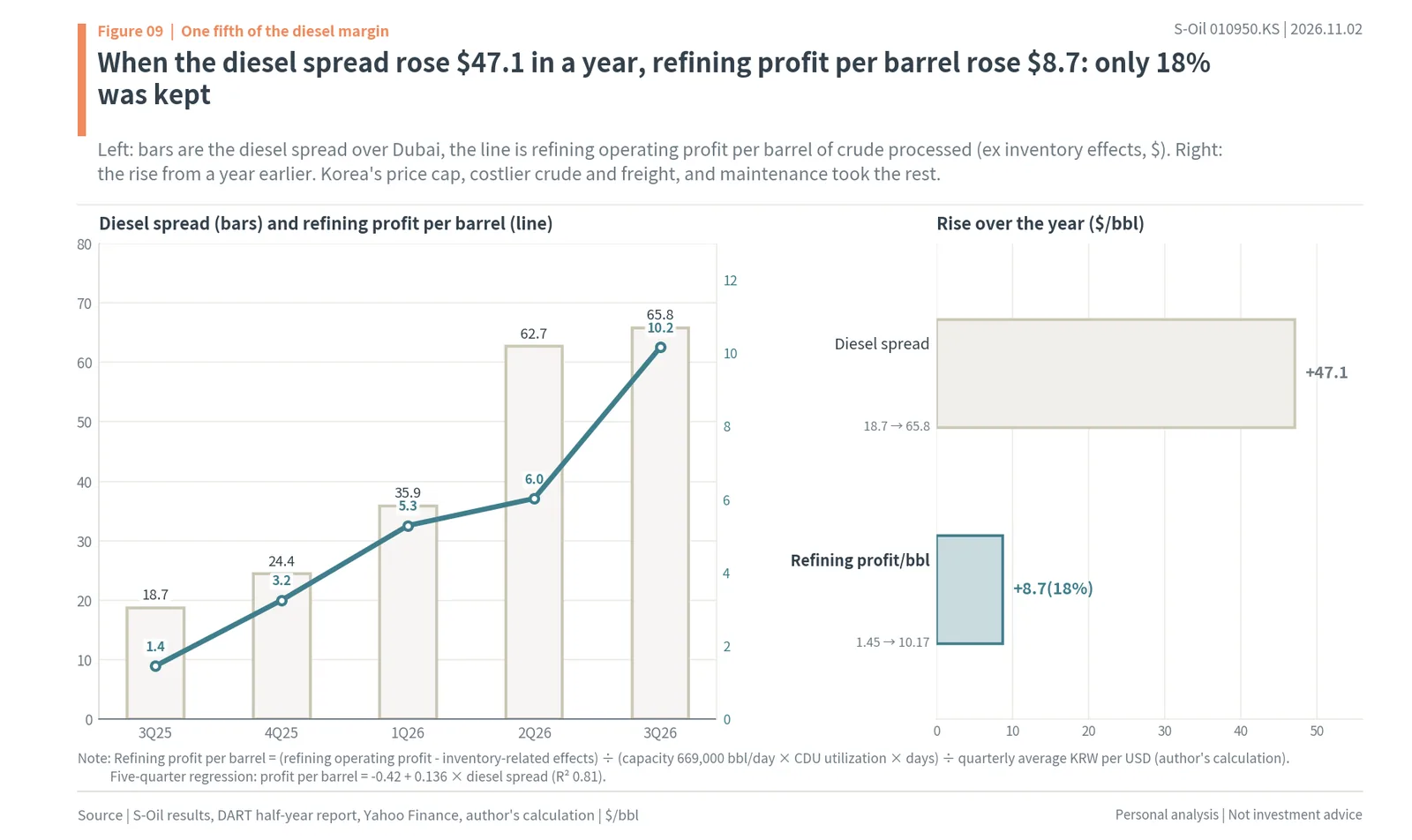
A straight line through the five quarters gives refining profit per barrel = -0.42 + 0.136 × diesel spread, with an R-squared of 0.81 (author’s calculation). Each $1 rise in the diesel spread lifts refining profit per barrel by a little over $0.14. From Q3 to Q4 2025, before the price cap existed, the same slope was about 0.3, and it has been lower since the cap began.
Where did the other four fifths go
The first is the fuel price cap. From March 13 the government set ceilings on the prices refiners charge gas stations for gasoline, diesel and kerosene (Ministry of Trade and Industry). The first caps were KRW 1,724 a liter for gasoline, KRW 1,713 for diesel and KRW 1,320 for kerosene; they were raised by KRW 210 on March 27, cut by KRW 150 on June 27, and then frozen through the 11th round that applies from October 17. Alongside the cap, the government limited exports of gasoline, diesel and kerosene to the volume of the same month a year earlier and required domestic supply to stay at 90% or more. The cap applies to the supply price refiners charge gas stations, not to the pump price. In the first half, domestic refining sales were 38.3% of S-Oil’s sales and refining exports 41.2% (DART half-year report). Diesel and gasoline sold in Korea could not fetch world prices, and the refiners could not sell more abroad either. The company itself wrote in its first-quarter materials that strong refining margins were partly offset by scheduled maintenance and the fuel price cap.
The second is the cost of bringing in crude. Middle East crude is priced off the official selling price (OSP), and Hana Securities said that, along with the domestic price cap, spikes in the OSP and freight cut profit. Tanker freight for bringing in crude rose sharply, and with spot and alternative crude purchases, the crude actually bought cost more than the Dubai price used to calculate spreads. The third is maintenance and low utilization. For the second quarter the company said the opportunity cost of maintenance offset part of the strong refining margins.
So when the premium fades, refining profit falls less
This structure also works in reverse. When the diesel spread falls, refining profit falls by only about one fifth as much. And when spreads fall, the things that held down refining profit are likely to ease together. Once international product prices fall below the cap, the price cap stops cutting profit, and when supply recovers, tanker freight and crude premiums come down. Hana Securities expects the OSP to stay in negative territory and lower the cost burden. If utilization returns from 81% to around 95%, the same margin is multiplied by more barrels.
The author’s estimating model (chapter 8) uses this line as it is and cuts refining profit at the same ratio on the way down as well. It adds nothing for the support that the end of the price cap and lower freight would give, so this is left as room for results to beat the base estimate. Base oil, on the other hand, has no such cushion. The next chapter looks at base oil.
5. Base oil kept the whole spread, so it will lose the whole spread
The conclusion first: in base oil, the rise in the spread turned into profit almost one for one. Operating profit per barrel of base oil went from $23.9 to $131.1 in a year, and the gap between the spread and profit (cost per barrel) moved between $20 and $57 a quarter (author’s calculation). When the Middle East Group III plants come back, this profit will fall faster than refining profit, by almost the same amount as the spread.
Profit per barrel is the spread minus costs
Dividing lubricants operating profit by base-oil output (capacity of 44,700 barrels a day × utilization × days) and the KRW per dollar rate gives profit per barrel: $23.9 in Q3 2025, $34.2 in Q4 2025, $29.2 in Q1 2026, $83.2 in Q2 and $131.1 in Q3 (author’s calculation). Subtracting these from the spread in the same quarters (composite base-oil price minus VGO) gives costs per barrel of $26.7, $21.0, $20.4, $56.5 and $35.7. Costs ran high in the second and third quarters because selling prices follow feedstock costs with a lag. In the first quarter, too, the company explained that lubricants profit fell from the previous quarter because of the lag in product prices. The median cost over the five quarters is $26.7.

Base oil differs from refining in two ways. It is not covered by the price cap, and there are no export limits. Of first-half lubricants sales, exports were 8.2 percentage points and domestic sales 1.8 points of total sales, so most of it is exported (DART half-year report). The rise in the international spread therefore stayed almost entirely in S-Oil’s hands. The lubricants operating margin went from 19.0% in Q3 2025 to 36.7% in Q2 2026 and 48.1% in Q3 (company results).
At normal spreads, about KRW 100bn a quarter
Working backwards the same way, if the base-oil spread returns to the 2011-2024 average of $46.9, profit per barrel is $20.2 and quarterly operating profit about KRW 107bn (at KRW 1,342 per dollar, author’s calculation). That is one seventh of the third quarter’s KRW 742.7bn, and similar to quarterly lubricants operating profit of KRW 110.0bn to 203.3bn in 2025 (company results).
So base oil, which made half of third-quarter profit, is the segment that shrinks most when the war premium disappears. When that happens depends on the restart of Middle East plants and the return of normal logistics. That is why the company wrote “whether Middle East supply normalizes” as the key variable in its fourth-quarter outlook. Refining has a cushion and base oil does not: this is the first structure to set down when carrying third-quarter numbers into the future. The next chapter compares how the market read this structure in the share price ahead of time in 2022 and now.
6. 2022 and 2026: both times S-Oil stock peaked before the profit
The conclusion first: in both wars S-Oil’s share price moved in the same order. When war sent diesel prices up, the stock rose first and peaked before the largest quarterly profit was announced. On the day of the second-quarter 2022 results the stock was 24.9% below its peak, and today, the day of the third-quarter 2026 results, it is 23.8% below. Nearly half of the October fall was the market falling, and the rest was news that blocked supply was starting to flow again.
2022: a June peak, record profit at the end of July, a fourth-quarter loss
Russia invaded Ukraine on February 24, 2022. S-Oil closed at KRW 81,400 just before the invasion (Naver adjusted price). The stock rose 49.3% to KRW 121,500 on June 10, that year’s peak. The company said the average diesel margin in June was $63 a barrel (Dailian, July 28, 2022). On July 28 it reported second-quarter operating profit of KRW 1,722.0bn, which Dailian reported as record quarterly sales and operating profit. The stock closed that day at KRW 91,300, 24.9% below the peak, 48 days after the peak.
Profit then shrank fast. Third-quarter operating profit was KRW 511.7bn, 30% of the second quarter, and the fourth quarter brought an operating loss of KRW 160.4bn (DART, full year minus the first three quarters). iNews24 put the fourth-quarter loss down to one-off factors such as inventory losses from falling oil prices. The stock fell to KRW 77,900 on September 28, below the pre-war price. It was the year of record annual profit, but the stretch in which shareholders made money was February to June.
2026: an October peak, third-quarter results on November 2
A war in the Middle East began with the US attack on Iran on February 28, 2026. S-Oil closed at KRW 110,000 on February 27, the last trading day before the war. The stock rose 55.1% to KRW 170,600 on October 7. That closing high beat the April 28, 2011 peak of KRW 167,000; in Hana Securities’ words it was an all-time closing high for the first time in 15 years. Today, the day third-quarter operating profit of KRW 1,406.7bn was announced, the close of KRW 130,000 is 23.8% below the peak, 26 days after it. The order and the size are almost the same as in 2022.
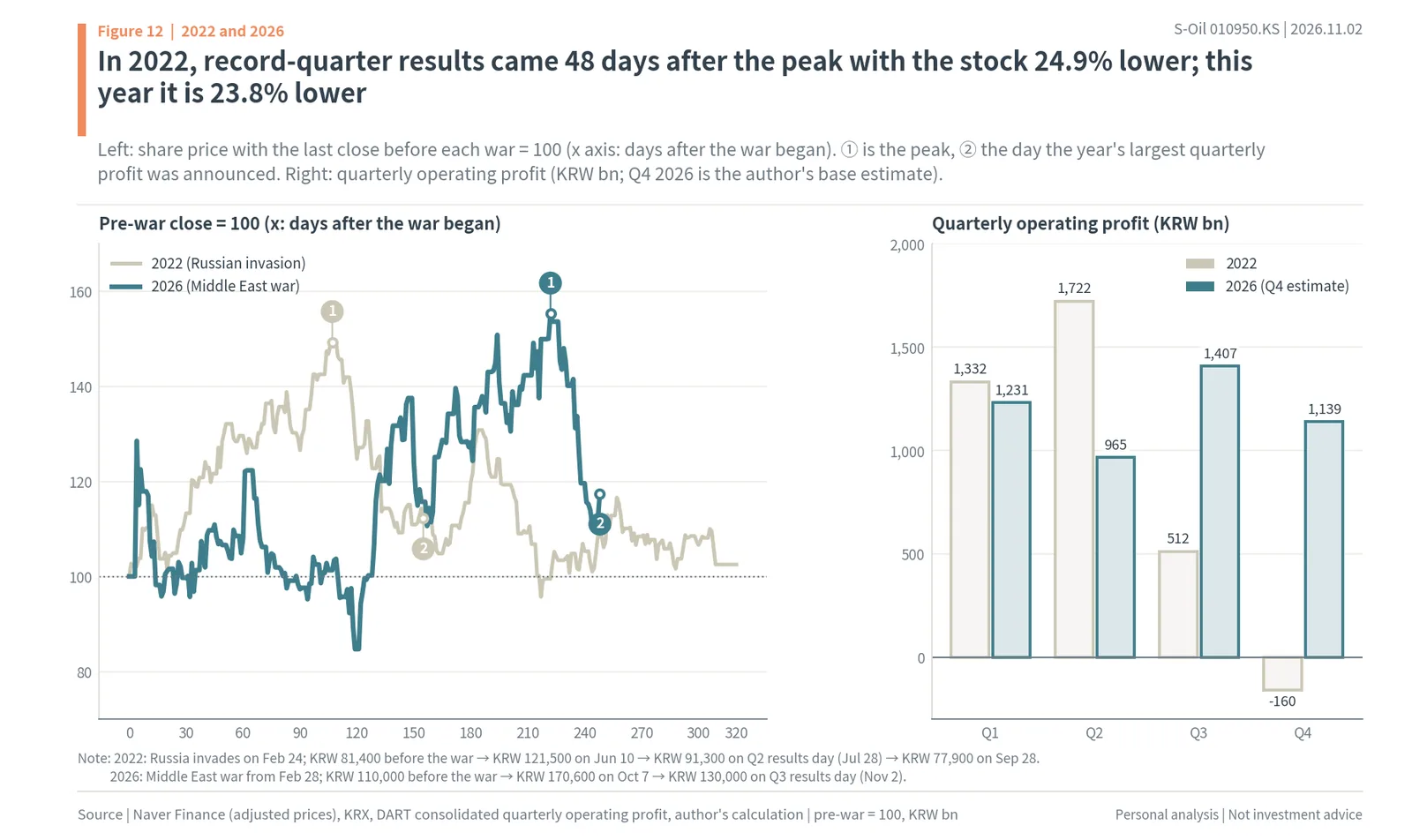
Where there are similarities there are also differences. In 2022 the second quarter was the peak in profit, and third-quarter profit fell 70%. In 2026 third-quarter profit was 45.8% higher than the second quarter, and on the conference call the company said tight supply could continue into next year even if the geopolitical conflict eases (Dnews). As grounds it cited global gasoline and diesel inventories at their lowest in five years and said that, as of September, disruption to global refining capacity was the largest in ten years, excluding the COVID-19 period (Asia Today). The share price turned first in the same order, but the company’s case is that profit may turn down more slowly than in 2022.
October 7 to 29: nearly half was the market
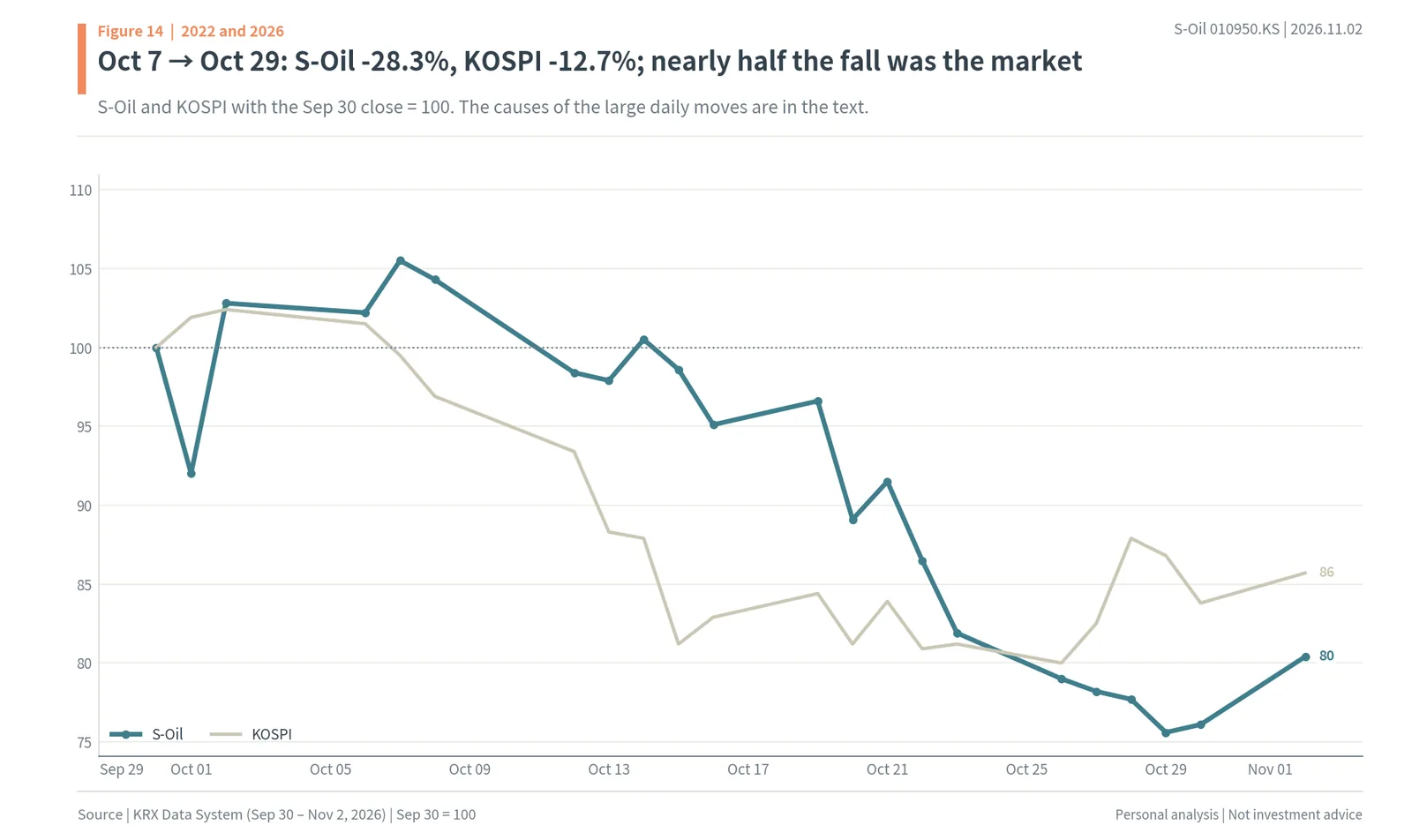
From KRW 170,600 on October 7 to KRW 122,300 on October 29, S-Oil fell 28.3%. Over the same days KOSPI fell 12.7%, from 6,803.90 to 5,937.66 (KRX). Counting KOSPI’s fall as the market’s part, the market accounts for 45% of the decline and the remaining 15.6 percentage points are S-Oil’s own (author’s calculation).

The causes confirmed day by day are as follows. On October 2 the stock rose 11.69% on news that China had halted October exports of gasoline, diesel and jet fuel to everywhere except Hong Kong and Macau, together with a 4.37% rise in Brent (Seoul Economic Daily). On October 12 it fell 5.69%, which Money Today attributed to US President Donald Trump’s announcement that Russia and Ukraine had agreed an “energy ceasefire,” which weakened expectations of further oil price rises. During the Hangul Day holiday came China’s resumption of October fuel exports (Reuters, October 9) and a US-Russia diesel deal (CNBC). October 20 (-7.81%) and October 22 (-5.48%) were days when KOSPI fell 3.73% and 3.52%. Around then the press also reported that tanker freight of $20-40 a barrel, more than ten times normal, had squeezed Asian refiners’ margins (Global Economic, October 20). October 1 (-7.98%), October 16 (-3.58%) and October 23 (-5.29%) were days when KOSPI rose, and the author found no article giving a reason specific to refiners. On October 22 Brent touched $112.50 intraday, a five-month high, yet the stock fell.
Who bought and who sold: pension funds bought the rise and sold the fall
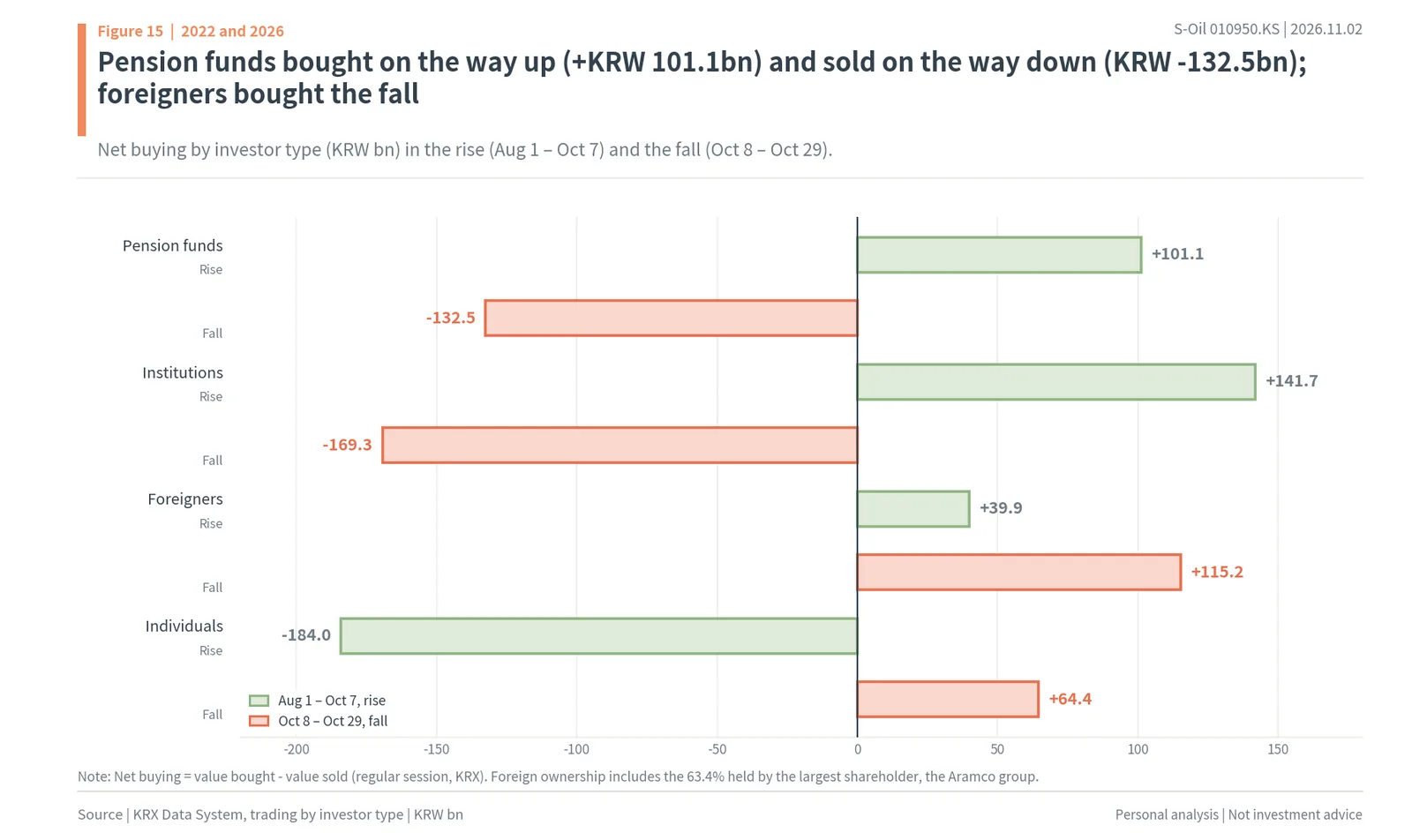
In the rise from August 1 to October 7, pension funds bought a net KRW 101.1bn and institutions as a whole KRW 141.7bn, while individuals sold a net KRW 184.0bn. In the fall from October 8 to 29, pension funds sold a net KRW 132.5bn and institutions as a whole KRW 169.3bn, while foreigners bought KRW 115.2bn and individuals KRW 64.4bn (KRX, regular session). Foreign ownership is 80.67%, which includes the 63.43% held by the largest shareholder, the Aramco group. On November 2, the results day, net buying by every investor type was small, within KRW 10bn.
In short, the market had already priced in the lesson of 2022. The peak came before the results, and on the day of the third-quarter surprise the stock was nearly a quarter below that peak. What remains is how fast supply returns and where margins stop after it does. The next chapter looks at those signals.
7. Signs the war premium is fading: more diesel, cheaper crude
The conclusion first: since late October, news that adds diesel supply and news that lowers the cost of bringing in crude have been arriving together. The first lowers the diesel spread; the second supports the share a refiner actually keeps. That is why Hana Securities wrote that, in the short term, refiners’ share prices face a mix of positive and negative factors. Base oil, which made half of third-quarter profit, depends on something else: the restart of Middle East plants.
More diesel: Russia, China and Korea
Russia will extend its diesel export ban to the end of the year but raise its export quota fourfold, from 500,000 tonnes in October to 2 million tonnes in November, to meet a supply deal with the United States (Reuters, October 29). Hana Securities calculated that the added volume (1.5 million tonnes a month, about 420,000 barrels a day) is 1.3% of global diesel demand and about 8% of global seaborne diesel trade in January to September 2026 (4.7 million barrels a day). Behind it is the recovery of Russian refineries. According to Hana Securities, Russian refinery runs rose 25%, from 4 million barrels a day in early October to 5 million at the end of October. Ukraine stopped attacking Russian refineries from mid-October under US pressure (Newspim, citing the WSJ), then hit three refineries again from October 30 (investingLive).
China reopened product exports, briefly halted in early October, after its National Day holiday (Reuters, October 9, about 3.7 million tonnes approved), and on October 28 issued a fourth export quota of about 3.7 million tonnes. The Korean government also decided on October 29 to allow diesel exports of up to 110% of the same month a year earlier (Financial News). It applies only to refiners that meet domestic supply obligations and hold enough stock, and the limit goes back immediately if supply worsens. Hana Securities expects this easing to add 50,000-60,000 barrels a day of export capacity (about 1% of seaborne diesel trade). As a result, Reuters’ Singapore diesel crack (against Dubai) fell to a little over $54 a barrel on October 30, a three-month low (cited by Energy News Beat). That is far below the record $85.63 of March 30, but still more than twice the pre-war $21.90 of February 27.
Cheaper crude: Saudi OSP cuts and freight
On the other side is news that lowers costs. Saudi Aramco set its November Arab Light OSP for Asia at $5 a barrel below the Oman/Dubai average, the lowest in six years. In a Reuters survey, Asian refiners expected the December OSP to stay the same or fall another $1-2 (Maaal, October 29). Hana Securities explains that Saudi Arabia is cutting prices to keep its market share as high tanker freight raises Asian customers’ costs. S-Oil buys most of its crude from Aramco, so an OSP cut is a direct cut in its crude cost per barrel.
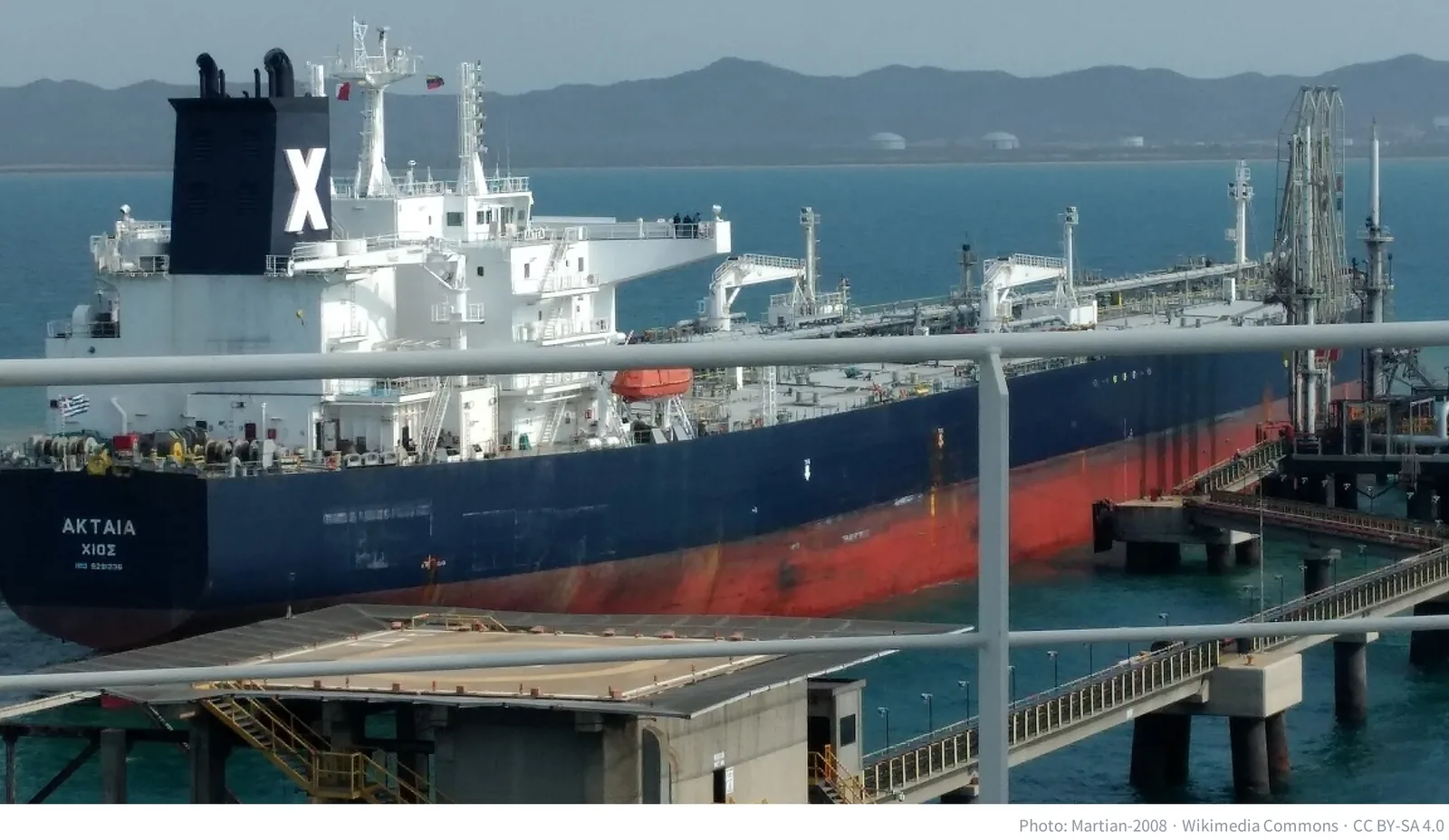
Tanker freight itself also shows signs of having passed its peak. The rate for very large crude carriers from the Middle East to China (TD3C) started falling the day after it set a record on October 15 (ShipUniverse, October 16). The same article, however, wrote: “The reversal is real, but it is not yet a normalization.” For freight to return to the normal $2-4 a barrel, traffic through the Strait of Hormuz has to normalize. On the morning of November 2, Brent traded 1.42% lower at $111.82 on hopes for US-Iran talks to end the war (Aju Business Daily).
The price cap and loss compensation
Korea’s fuel price cap was frozen through the 11th round, which applies for four weeks from October 17, at KRW 1,784 a liter for gasoline, KRW 1,773 for diesel and KRW 1,380 for kerosene (Segye Ilbo, October 16). The next, 12th round applies from November 14, four weeks later (author’s calculation). In May, Minister of Trade and Industry Kim Jung-kwan said the government could consider ending the system once the war ends, the Strait of Hormuz returns to normal and oil prices reach an appropriate level of around $90 (Herald Economy). Oil prices are now more than $20 above that level.
The government’s compensation for refiners’ losses under the cap is under way for the first period (March 13 to June 30). The four refiners submitted their data by September 30, and the government plans to set settlement prices by the end of November and pay within the year (Dnews, October 25). The industry estimates its losses at KRW 7tn to 8tn, but the government settles on a cost basis. On the conference call S-Oil said it could not comment on the specific size and timing of compensation. The payment raises profit once, in the quarter it arrives, and the author’s estimates leave it out.
Base oil depends on Middle East plants
What pushed the base-oil spread up was the disruption at Middle East Group III plants. Shell and QatarEnergy’s Pearl GTL in Qatar was hard to run after an Iranian attack in March, taking about 22,000 barrels a day of Group III off the market (Maeil Ilbo, September 25), and Argus reported in April that repairs would take more than a year. Facilities at the UAE’s ADNOC and Bahrain’s Bapco also had problems. EBN wrote that the three Middle East producers supply about 30% of the world’s Group III base oil. Maeil Ilbo noted that Group III base oil must pass customers’ quality approvals and that production capacity is limited, so other producers cannot replace the volume quickly.
In short, the diesel premium has already started to shrink and the cost burden is falling with it. Refining profit has entered a stretch where the two offset each other. The base-oil premium is likely to last until Middle East units such as Pearl GTL come back, and that will be the day half of third-quarter profit starts to shrink. This is why this report’s base case runs the premium down over six quarters, to early 2028.
A WSJ report that the United States is pushing to resume Russian gas supplies to Europe through the pipeline across Ukraine (Bloomberg, November 2) belongs to the same trend. European gas prices are at a four-year high, with about a fifth of the world’s LNG exports blocked by the Middle East conflict. The wider the road back to market for Russian energy, the faster the war premium shrinks.
8. Author’s estimates: KRW 1.1 trillion in Q4, KRW 2.9 trillion in 2027, back to normal in 2028
The conclusion first: the author’s base estimates of operating profit are KRW 1,139.0bn for the fourth quarter, KRW 4,741.7bn for 2026, KRW 2,863.7bn for 2027 and KRW 1,167.4bn for 2028. The 2027 figure is 20.4% below the WISEreport consensus of KRW 3,595.6bn. Almost all of the difference comes from assumptions about how long the war premium lasts and where “normal” is once it has gone.
The model: once spreads are set, profit is set
The author’s model uses the structure from the previous chapters as it is. Refining operating profit is throughput × (-0.42 + 0.136 × diesel spread) × KRW per dollar, with throughput equal to 669,000 barrels a day times utilization. Lubricants operating profit is base-oil output × (base-oil spread – $26.7) × KRW per dollar, with output equal to 44,700 barrels a day times 97% utilization. Existing petrochemicals are fixed at KRW -20bn a quarter, net interest at KRW -60bn a quarter, the tax rate at 24% and the exchange rate at KRW 1,342 per dollar (November 2). FX gains are set to zero.
The path of spreads is kept simple. The diesel and base-oil spreads fall at a steady pace from their third-quarter levels ($65.8 and $166.8) to “post-war normal” levels, and refinery utilization returns from 81% to 95% over the same period, because when supply returns prices fall and volume rises. The normal base-oil spread is set at 2.8 times the diesel spread, the ratio of their 2011-2024 averages. Shaheen is assumed to contribute 25%, 50% and 75% of its normal profit from the second quarter of 2027 and all of it in 2028.
The scenarios differ in three assumptions. The post-war normal diesel spread is $16 in the bear case, $18 in the base case and $22 in the bull case, placing the 2011-2024 average of $16.6 and the 2021-2025 average of $21.3 (2025 as a quarterly average) near the two ends. The time the premium takes to disappear is three quarters in the bear case (to Q2 2027), six in the base case (Q1 2028) and ten in the bull case (Q1 2029). Shaheen’s normal operating profit is zero in the bear case, KRW 100bn a year in the base case and KRW 400bn a year in the bull case.
Base case: Q4 KRW 1,139.0bn, 2027 KRW 2,863.7bn
In the base case the fourth-quarter diesel spread is $57.8, the base-oil spread $147.5 and utilization 83.3%, and operating profit is KRW 1,139.0bn, refining KRW 512.5bn plus lubricants KRW 646.5bn (author’s calculation). That is close to the WISEreport quarterly consensus of KRW 1,151.4bn and below Hana Securities’ estimate of KRW 1,290bn. Hana Securities estimates fourth-quarter refining at KRW 630bn and base oil at KRW 660bn.
In 2027 quarterly operating profit falls to KRW 951.7bn, 800.6bn, 641.7bn and 469.7bn, for a full year of KRW 2,863.7bn. Net profit is KRW 1,994.0bn and earnings per share (EPS) KRW 17,101 (about $12.74), dividing by the 116.6 million common and preferred shares. The current price of KRW 130,000 is 7.6 times the author’s 2027 forward EPS of KRW 17,101 and 5.8 times the consensus 2027 forward EPS of KRW 22,357 (about $16.66). Base-case operating profit for 2028 is KRW 1,167.4bn, a little above the 2015-2025 average of KRW 1,029.7bn.

Bear and bull
The bear case is one where the premium is gone by the second quarter of 2027 and the normal diesel spread stays at $16. Operating profit for 2027 is KRW 1,230.2bn and EPS KRW 6,453. The bull case is one where the premium fades slowly until early 2029, the normal diesel spread holds high at $22 and Shaheen earns KRW 400bn a year, giving 2027 operating profit of KRW 4,074.6bn and EPS of KRW 24,993. The consensus for 2027 operating profit, KRW 3,595.6bn, sits between the author’s base and bull cases, closer to bull. The consensus for 2028, KRW 3,131.2bn, is above even the author’s bull case of KRW 2,847.7bn. In other words, brokers expect high margins to last well into 2028.
In short, the gap between the author and the consensus comes less from how profit is calculated than from where “normal” sits. This report does not fix that position with a single assumption; it sets a range and then, in the next chapter, works backwards to find where in that range the current share price sits.
9. What S-Oil’s share price assumes: KRW 130,000 is a normal margin slightly above the old normal
The conclusion first: the current price of KRW 130,000 is the price of a post-war diesel spread that settles at around $19.3 a barrel (author’s calculation, other assumptions at base). That is above the 2011-2024 average of $16.6 and below the 2021-2025 average of $21.3. Mixing the bear, base and bull cases at 25%, 50% and 25% gives KRW 130,000, the same as the current price, and the median of 20,000 simulation runs is also KRW 130,000.
Value per share = value of normal earnings + extra money earned during the war
If you value a refiner by multiplying one year’s profit by a multiple, the multiple looks low in a boom and high in a slump. The P/E of only 4.9 times on 2026 consensus EPS is a sign that the market does not see this profit as lasting. So the author splits value per share into two pieces. The first is “normal earnings” after the war premium has gone, multiplied by the multiple the market has usually paid. The second is the money earned during the war above normal.
Normal earnings come from putting normal spreads and 95% utilization into the model of chapter 8. In the base case (normal diesel spread $18), normal operating profit of the existing business is KRW 1,064.4bn a year; adding KRW 100bn from Shaheen gives KRW 1,164.4bn, or EPS of KRW 6,025. The multiple is 15.3 times, the 2015-2025 average share price of KRW 83,700 divided by the average EPS of KRW 5,477 over the same years. Those years include two booms (2016-2017 and 2021-2022), a loss in 2020 and the slump of 2024-2025.
The extra money is the sum of actual net profit for the first three quarters of 2026 and estimated net profit from the fourth quarter on, minus normal net profit over the same period (excluding Shaheen). In the base case it is KRW 36,071 a share. This money goes two ways. The part paid to shareholders as dividends counts in full, and the part kept by the company counts at only 60% (author’s assumption). Seeing how quickly boom profit drained out of the share price in 2022, the market does not give full credit for boom profit that piles up inside the company. With a 25% payout ratio (the midpoint of Hana Securities’ 20-30% assumption), base-case value per share is normal earnings KRW 82,207 + Shaheen KRW 9,972 + extra money KRW 25,250 = KRW 117,000 (about $87).
The biggest variable is where “normal” sits
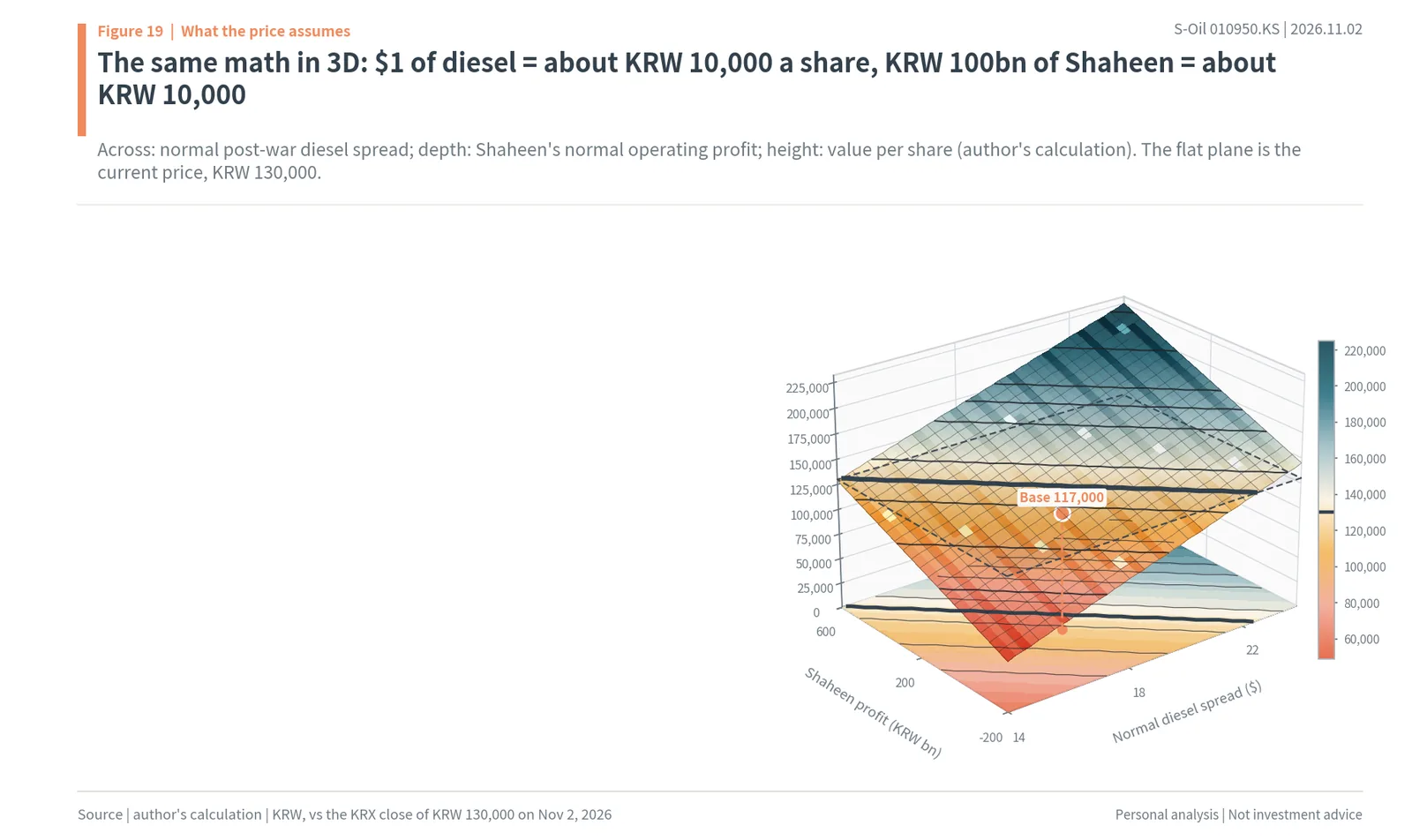
Moving each of the six assumptions alone across its bear-to-bull range, the swing in value per share is largest for the normal diesel spread ($16-22) at KRW 58,000, then Shaheen’s normal operating profit (KRW -50bn to 400bn) at KRW 45,000, the time for the premium to disappear (3-10 quarters) at KRW 17,000, the normal multiple (14-16.5 times) at KRW 15,000, the credit given to cash kept in the company at KRW 6,000 and the payout ratio (20-40%) at KRW 3,000 (author’s calculation). Each $1 of normal diesel spread is worth about KRW 10,000 a share, KRW 100bn of Shaheen’s normal profit also about KRW 10,000, and one more quarter of premium about KRW 3,000. On the same basis, matching the KRW 170,600 high needs a normal diesel spread of $23.6, or Shaheen earning a little over KRW 630bn every year.
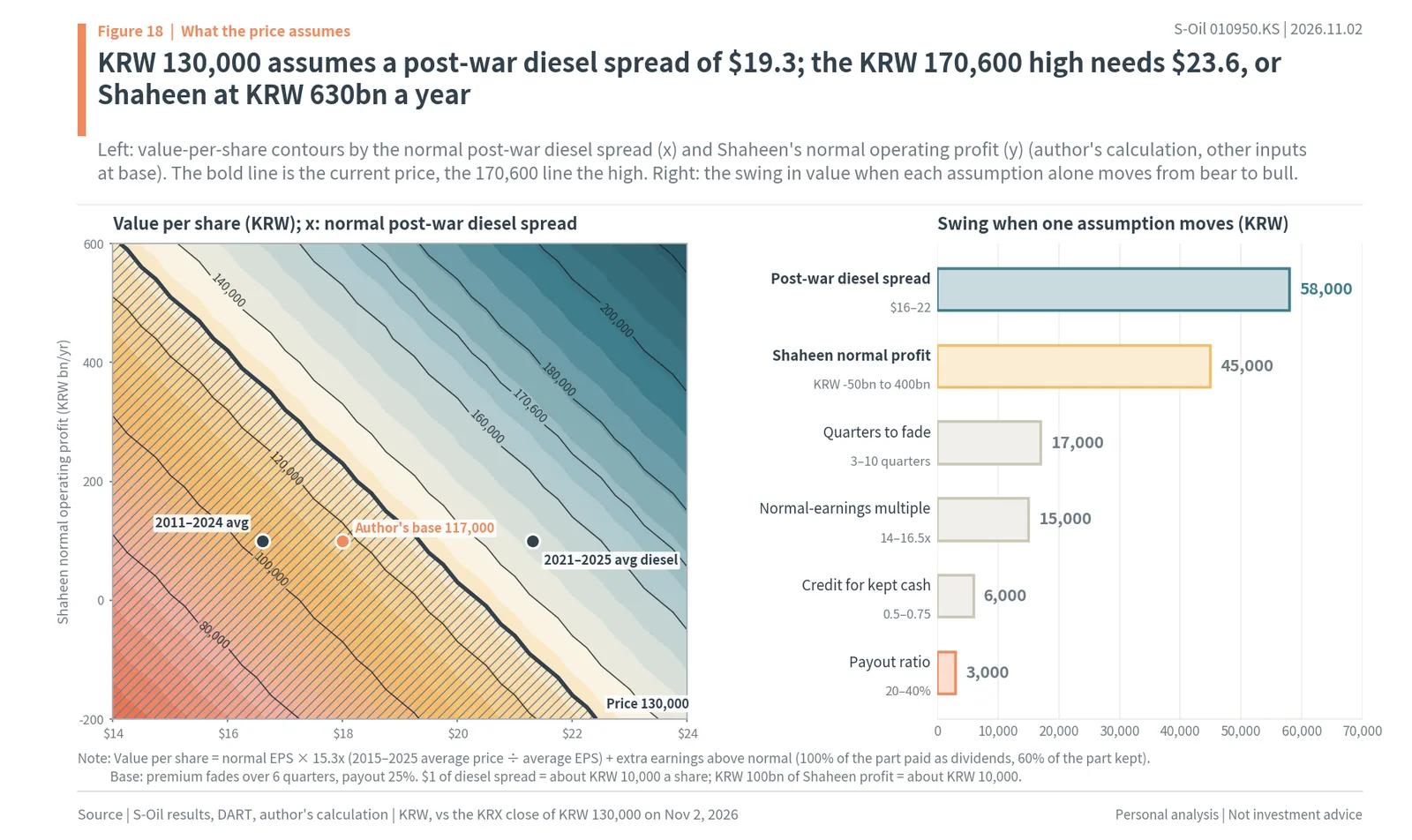
Holding the other assumptions at base and moving only one to match the current price of KRW 130,000 gives a normal diesel spread of $19.3, or Shaheen normal operating profit of KRW 221.8bn a year, or a premium that lasts more than 11 quarters (author’s calculation). There is no way to know which assumption the market actually holds, but since the normal margin is the one that needs to move least of the three, the natural reading is that KRW 130,000 assumes margins will stay a little higher than before even after the war. The 2022-2024 average diesel spread of $26.7, after refinery closures and low product inventories, fits this reading.
Probability-weighted KRW 130,000, simulation median KRW 130,000
The three scenarios give value per share of KRW 73,000 (about $54, -43.8%) in the bear case, KRW 117,000 (-10.0%) in the base case and KRW 214,000 (about $159, +64.6%) in the bull case. The bear case is one where the premium ends in the second quarter of 2027, normal margins stay below the long-run average and Shaheen earns nothing; the bull case is one where the premium fades slowly until early 2029, normal margins exceed the 2021-2025 average and Shaheen earns KRW 400bn a year. Weighted at 25%, 50% and 25%, the value is KRW 130,000.
Drawing all six assumptions together from triangular distributions, with the bear, base and bull values as minimum, mode and maximum, and running the calculation 20,000 times gives a median of KRW 130,000, with eight runs in ten between KRW 110,000 and 151,000. In 47.8% of runs the value ends above the current price, and in 0.8% above the KRW 170,600 high (author’s calculation). The average target price of 13 brokers, KRW 193,200 (about $144; last 92 days, WISEreport), and Hana Securities’ new target of KRW 180,000 (about $134) lie beyond the right end of this distribution. Matching Hana Securities’ target with this model needs a normal diesel spread of $24.5.
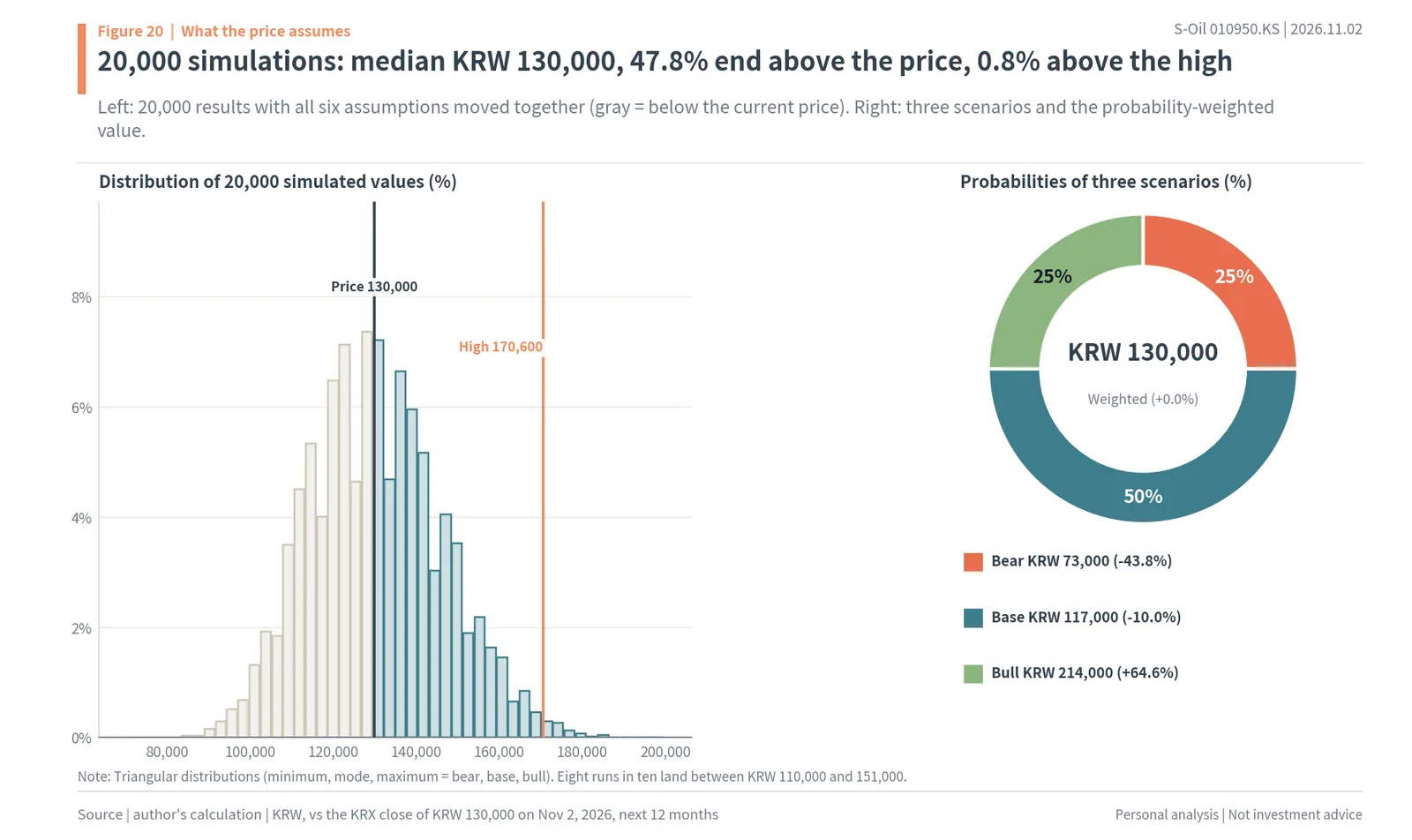
In short, in the author’s model S-Oil stock is neither a place with much further to fall nor one with much room to rise. It is the same conclusion as Hana Securities’ “range-bound market with limited downside and upside.” What it takes to break out of the range on the upside is the subject of the next chapter.
10. Conditions for a new high: dividends hand over cash, Shaheen raises normal earnings
The conclusion first: of the two conditions Hana Securities named, Shaheen moves the share price more. Dividends move money already earned during the war from the company into shareholders’ hands, so in the author’s model raising the payout ratio from 20% to 40% adds only KRW 3,000 a share. Shaheen raises normal earnings themselves after the war premium has gone, and every KRW 100bn of normal operating profit is worth about KRW 10,000 a share. If the normal diesel margin stays at the base level ($18), a new high of KRW 170,600 needs Shaheen to earn a little over KRW 630bn every year; at the 2021-2025 average ($21.3), a little over KRW 320bn is enough.
Hana Securities’ conditions
After the third-quarter results Hana Securities cut its target price from KRW 220,000 to KRW 180,000 and lowered its 2027 operating profit estimate by 18%, saying it reflected refining margins and Shaheen’s profitability from a conservative standpoint. It also wrote that its view of a robust refining cycle continuing in 2027 was unchanged. The question is the top side of the share price. Hana Securities said a new all-time high needs “the company’s aggressive will to raise the dividend payout ratio and securing profitability at the Shaheen project,” and until those are confirmed it expects a range-bound market with limited downside and upside. It calculated dividend yields of 4.5% for 2026 (assuming a 20% payout) and 6.7% for 2027 (assuming 30%).
Dividends: before Shaheen, S-Oil paid out more than half of profit
S-Oil’s payout ratio changed sharply around the Shaheen investment. By DART annual reports, the dividend per common share and the consolidated payout ratio were KRW 2,400 (44.3%) for 2015, KRW 6,200 (59.9%) for 2016, KRW 5,900 (55.1%) for 2017, KRW 750 (33.9%) for 2018 and KRW 200 (35.7%) for 2019. There was no common dividend for 2020 because of the loss, then KRW 3,800 (32.1%) for 2021, KRW 5,500 (30.4%) for 2022, KRW 1,700 (20.9%) for 2023, KRW 125 for 2024 and KRW 330 (21.8%) for 2025. Since the Shaheen investment decision in November 2022, the payout ratio has stayed just over 20%. For 2026 the company declared an interim dividend of KRW 800 a share on August 10 and paid it on September 15 (DART). On the November 2 conference call the company said it would keep its guideline of paying out at least 20% of net income for the 2026 fiscal year, counting the KRW 800 interim dividend toward the annual total (Asia Today). It added that even at the minimum 20% payout, the dividend per share could rise sharply (ZDNet Korea). It gave no payout figure for 2027 or later; Hana Securities’ 30% for 2027 is the broker’s own assumption.
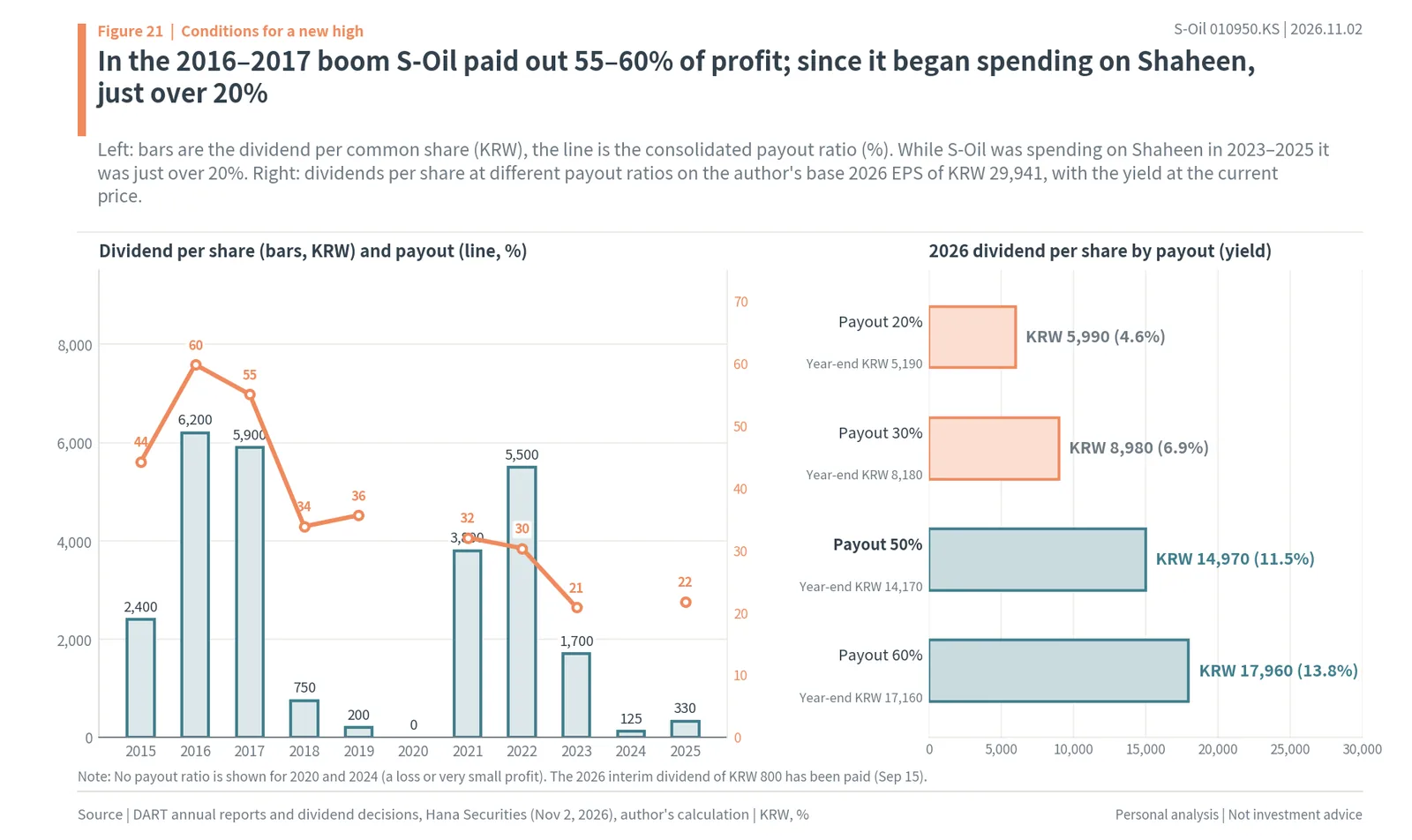
Spending on Shaheen falls from KRW 2,607.0bn in 2024 and KRW 3,356.0bn in 2025 to a planned KRW 1,562.0bn in 2026, of which KRW 924.0bn had been spent by the third quarter (company results). The WISEreport consensus puts 2027 capital spending at KRW 876.6bn. War profit has arrived in the year the investment ends, so there is plenty of room to raise dividends. On the author’s base 2026 EPS of KRW 29,941, a 20% payout gives KRW 5,990 a share (a 4.6% yield at the current price), 30% gives KRW 8,980 (6.9%), and 50-60% as in 2016 gives KRW 14,970-17,960 (11.5-13.8%). After the KRW 800 interim dividend, the year-end dividend would be KRW 5,190, 8,180, 14,170 and 17,160 respectively (author’s calculation).
But this is money the company has already earned. The author’s model values money paid out as dividends in full and money kept by the company at only 60%, so raising the payout ratio lifts value per share only by the part that would otherwise sit discounted inside the company. With the extra money earned during the war at KRW 36,071 a share (base case), even paying all of it out adds at most 30% of that money, KRW 10,821. That is why matching a new high with dividends alone would take a payout ratio of 95%. Dividends raise the cash shareholders actually receive and ease the worry that earnings will leak away, but on their own they cannot fill the KRW 40,000 gap between KRW 130,000 and KRW 170,000.
Shaheen: the only way to raise normal earnings
Shaheen is different. It is profit that remains after the war premium is gone, and normal earnings get a 15.3-times multiple. If Shaheen’s normal operating profit (after depreciation and interest) is zero, value per share is KRW 107,000; at KRW 100bn it is KRW 117,000; at KRW 300bn, KRW 137,000; and at KRW 600bn, KRW 167,000 (author’s calculation, other inputs at base). Matching the current KRW 130,000 with Shaheen alone needs KRW 221.8bn a year.

Nobody has yet seen Shaheen’s profit in numbers. The strengths the company claims are that it takes 83% of its feedstock from the existing refinery, raises the chemical yield to 70% with TC2C, and cuts investment and operating costs by 30-40% against conventional processes. On the other hand, today’s petrochemical market is weak. The third-quarter PP spread (against propylene) was -$23 a tonne, and for the fourth quarter the company said improvement in the PP and PO markets would be limited by rising regional supply from new plants, despite a recovery in year-end peak-season demand. Shaheen will start unit by unit from January 2027 and take two to three months to reach normal operation (conference call, Dnews). Its first quarterly numbers are most likely to appear in the second-quarter 2027 results.
In short, the order of breaking out of the range is this. First, around February 2027, the year-end dividend will confirm the payout ratio and fix what shareholders receive. Next, Shaheen’s first numbers in the first half of 2027 will show how much it lifts “normal.” And in between, the speed at which the war premium fades will show where normal margins sit. The author’s calculation concludes that all three need to go well together for a new high.
11. Dates and signals to watch
The conclusion first: over the next four months there are two lines to watch. One is the signals that show how fast the war premium is fading (the diesel crack, the Saudi OSP, the price cap, Russian exports); the other is the signals that show whether the conditions for a new high are being met (the year-end dividend, the Shaheen start-up). For base oil, which made half of third-quarter profit, news of Middle East Group III plants restarting is the most important signal.
Dates
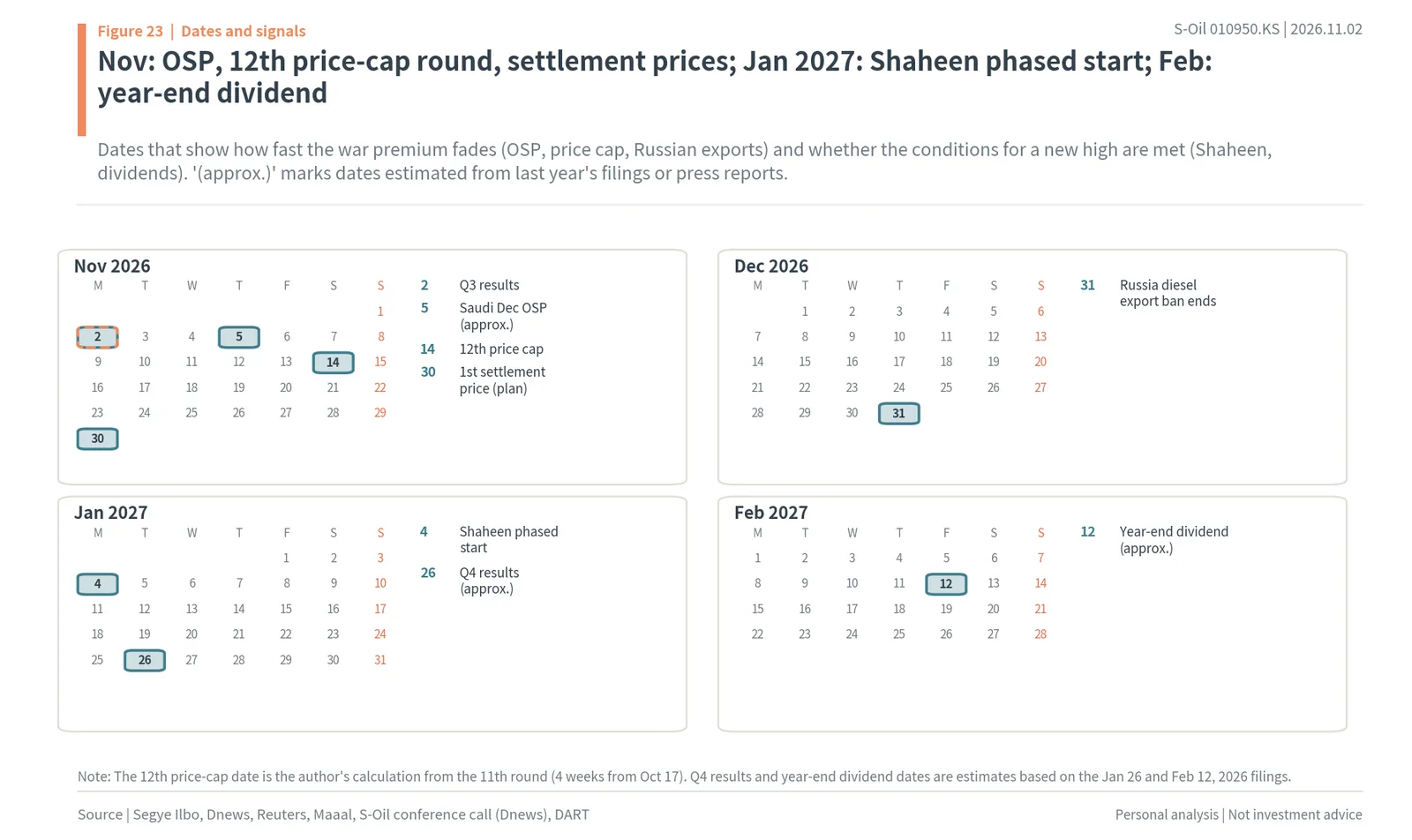
In early November Saudi Aramco will announce its December OSP for Asia. Asian refiners expect it to stay at -$5, as in November, or fall another $1-2 (Reuters survey). The 12th round of the fuel price cap applies from November 14 (four weeks after the 11th round, author’s calculation). At the end of November the government plans to set settlement prices for the first period of loss compensation and pay within the year (Dnews). Russia’s diesel export ban has been extended to the end of the year, with exports rising through quotas in the meantime.
In January 2027 Shaheen starts up unit by unit (conference call). Based on the January 26, 2026 filing, fourth-quarter results should come at the end of January, and based on the February 12, 2026 board meeting, the year-end dividend decision should come in mid-February. The year-end dividend is the day the first condition for a new high in this report shows up in numbers.
Eight signals
First, the Singapore diesel crack was a little over $54 a barrel on October 30, a three-month low. The author’s base case puts the fourth-quarter average diesel spread at $57.8, so a crack that keeps falling below $50 means a faster path than the base case. Second, the base-oil spread was $166.8 in the third quarter and is still rising. When news comes of Pearl GTL and the ADNOC and Bapco units restarting, this number will begin to turn down. Third, refinery utilization was 81% in the third quarter. Once crude sourcing eases it will return to around 95%, and the same margin will apply to more barrels.
Fourth, the Saudi OSP for November is -$5, a six-year low. Further cuts lower crude costs and support refining profit. Fifth, the price cap has been frozen through the 11th round. The conditions the government gave for ending it are the end of the war, normal traffic through Hormuz and oil prices around $90. Sixth, the settlement price and payment date for the first period of loss compensation; the company said it cannot yet comment on size or timing. Seventh, Shaheen’s phased start-up and first quarterly numbers. Eighth, the year-end dividend and the payout ratio; Hana Securities assumes 20% for 2026. Of these eight signals, the top four show how fast the war premium fades and the bottom four show whether the conditions for a new high are met.

The author also sets out what would change this view. If the diesel crack rises back above $70 and the base-oil spread stays above $150 into the first half of 2027, the premium is lasting longer than the base case (six quarters) and the view moves toward the bull case. If Shaheen is profitable in its first two quarters and the year-end payout ratio exceeds 30%, the stock moves a step closer to the conditions for a new high. On the other hand, if Pearl GTL restarts, Hormuz normalizes and the diesel crack falls below $30, the path is the bear case.
12. Frequently asked questions about S-Oil
Q3 profit beat consensus by 18%, so why was the target price cut?
Hana Securities acknowledged the third-quarter surprise but cut its 2027 operating profit estimate by 18% and its target price from KRW 220,000 to KRW 180,000, to reflect refining margins and Shaheen’s profitability conservatively. It means future profit matters more to the share price than last quarter’s profit, the same direction as this report’s conclusion.
Wasn’t Q3 profit just an inventory gain from higher oil prices?
No. The inventory-related effect the company reported for the third quarter was KRW -29.4bn. Excluding it, operating profit was KRW 1,436.1bn, slightly higher. There was, however, a lag gain from the timing gap between crude priced in the month of loading and products sold about a month later, earned while Dubai crude rose from $79.5 in June to $113.7 in September.
Why did base oil earn so much?
Because Middle East Group III base-oil plants were knocked out by the war. Qatar’s Pearl GTL alone took about 22,000 barrels a day off the market, and the three Middle East producers supplied about 30% of the world’s Group III. Customer quality approvals are needed, so other producers cannot step in quickly. The third-quarter base-oil spread was $166.8, 3.6 times its 2011-2024 average, and the lubricants operating margin was 48.1%.
Is the end of Korea’s price cap good for S-Oil?
It is good for refining profit. In the third quarter only 18% of the rise in the diesel spread stayed as refining profit per barrel, and the price cap was one of the things that took the rest. But when the conditions the government gave for ending it arrive (the end of the war, a normal Hormuz, oil around $90), the spread itself is likely to be lower too. The end of the cap works to soften the blow of falling spreads.
Isn’t a P/E of 4.9 times cheap?
The P/E on 2026 consensus EPS of KRW 26,573 is 4.9 times. But that profit is heavily mixed with war profit. In Beating the Street (1993), Peter Lynch wrote that a very low P/E for a cyclical company is usually a sign that the good times are ending. Instead of a P/E, the author splits the share price into the value of normal earnings and the extra money earned during the war, and on that basis KRW 130,000 is the price of a post-war diesel margin that stops at $19.3. On the author’s 2027 forward EPS of KRW 17,101, the P/E is 7.6 times.
Should I buy S-Oil now?
This report does not recommend buying or selling. In the author’s calculation, both the probability-weighted value and the simulation median equal the current price. The year-end dividend, Shaheen’s first numbers and the speed at which the war premium fades are the signals that will move this value up or down.
What does the Aramco stake transfer mean?
On October 1, 63.41% of S-Oil (71,387,560 common shares) moved within the Aramco group from its Dutch subsidiary (AOCBV) to its Singapore subsidiary (Aramco Downstream Asia). The filing called it a restructuring of shareholdings among affiliates, with no change in the stake, and said plans for appointing executives were unchanged. The stock fell 7.98% that day, but the author found no article linking that day’s fall to this filing or to other news.
13. Basis of calculations
Share prices and flows
Share prices and KOSPI are KRX regular-session closes. Prices in 2011 and 2022 and the pre-war prices use Naver Finance long-run prices (adjusted). The October 7, 2026 close is KRW 170,600 on the KRX basis (KRW 170,800 as shown by Naver). Net buying by investor type is KRX trading by investor (regular session) and does not include trades on Nextrade, Korea’s alternative trading venue. Daily causes of price moves include only those confirmed by articles or filings dated that day.
Results and profit per barrel
Third-quarter results are the figures in the DART consolidated preliminary results and the company’s results presentation (before external audit). Operating profit excluding inventory effects is operating profit minus the inventory-related effects the company disclosed (KRW -4.8bn in Q3 2025, KRW -87.4bn in Q4 2025, KRW +643.4bn in Q1 2026, KRW +113.7bn in Q2 2026 and KRW -29.4bn in Q3 2026). Refining profit per barrel = (refining operating profit – inventory-related effect) ÷ (669,000 barrels × CDU utilization × days in the quarter) ÷ quarterly average KRW per dollar. The inventory effect is a company-wide figure and is assigned entirely to refining. Lubricants profit per barrel = lubricants operating profit ÷ (44,700 barrels × base-oil unit utilization × days) ÷ KRW per dollar. Quarterly average KRW per dollar is from Yahoo Finance (KRW=X): KRW 1,385.0 in Q3 2025, 1,447.0 in Q4 2025, 1,462.3 in Q1 2026, 1,500.2 in Q2 2026 and 1,419.9 in Q3 2026. Refining and lubricants capacity is the standard production capacity in the DART half-year report. Actual sales volumes may differ from output.
Estimating model
Quarterly operating profit = refining + lubricants + existing petrochemicals (KRW -20bn) + Shaheen. Refining = throughput × (-0.42 + 0.136 × diesel spread) × KRW 1,342, with throughput = 669,000 barrels × utilization × days. Lubricants = 44,700 barrels × 97% × days × (base-oil spread – $26.7) × KRW 1,342. Spreads fall evenly from their third-quarter values to normal over n quarters, and utilization rises from 81% to 95% over the same n quarters. Normal base-oil spread = normal diesel spread × 2.8 (2011-2024 averages, 46.9 ÷ 16.6). Shaheen contributes 25% in Q2 2027, 50% in Q3, 75% in Q4 and all of it from 2028. Net profit = (operating profit – quarterly net interest of KRW 60bn) × (1 – 24%). EPS divides by 116,604,719 shares, the sum of 112,582,792 common and 4,021,927 preferred shares (preferred shares receive the same dividend). FX gains and inventory effects are set to zero.
Value per share
Value per share = normal EPS × normal multiple + extra money earned × (payout ratio + (1 – payout ratio) × credit ratio). Normal EPS is annual EPS from normal spreads, 95% utilization and Shaheen’s normal profit. The normal multiple of 15.3 times is the 2015-2025 average close of KRW 83,700 ÷ average EPS of KRW 5,477 over the same years (average consolidated net profit of KRW 638.7bn ÷ 116.6 million shares). The extra money earned is the sum of net profit for the first three quarters of 2026 (KRW 2,671.2bn) and estimated net profit from the fourth quarter on, minus normal net profit for the same period (existing business). The 60% credit ratio is the author’s assumption that the market does not give full credit for boom profit kept inside the company.
The three scenarios are weighted 25%, 50% and 25%. The simulation draws six assumptions together (normal diesel spread $16-22, fade period 3-10 quarters, Shaheen KRW -50bn to 400bn, multiple 14-16.5 times, payout ratio 20-40%, credit ratio 0.5-0.75) from triangular distributions with the base value as the mode and runs 20,000 times (random seed 11). All values assume that the direction of the war premium and Shaheen’s first numbers become clear within the next year; they are not forecasts of the future share price. Dollar figures in parentheses are the author’s conversions at KRW 1,342 per dollar (Yahoo Finance KRW=X, November 2, 2026).
S-Oil Q3 2026 results and stock: quick answers
Q. Why did S-Oil stock fall even though Q3 2026 profit beat consensus?
Q3 operating profit of KRW 1,406.7bn was 18.1% above consensus, but the stock had already peaked at KRW 170,600 on October 7 and closed at KRW 130,000 on results day, 23.8% below the high. The same order played out in 2022, when the stock was 24.9% below its peak on the day of the record second-quarter results. Of the 28.3% fall from October 7 to 29, KOSPI’s own 12.7% fall explains about 45%; the rest came with news that diesel supply from Russia and China was returning.
Q. Was S-Oil’s Q3 2026 profit just an inventory gain from higher oil prices?
No. The inventory-related effect S-Oil reported for Q3 was a loss of KRW 29.4bn, so operating profit excluding it was KRW 1,436.1bn, the largest of the last five quarters. There was some lag gain while Dubai crude rose from $79.5 in June to $113.7 in September, and that part works in reverse when oil prices fall.
Q. Why did base oil earn more than half of S-Oil’s Q3 profit?
Middle East Group III base-oil plants were knocked out by the war; Qatar’s Pearl GTL alone took about 22,000 barrels a day off the market. The base-oil spread reached $166.8 a barrel, 3.6 times its 2011-2024 average, and lubricants earned KRW 742.7bn at a 48.1% margin, 52.8% of operating profit on 12.9% of sales. Base oil has no price cap or export limit, so it kept almost all of the spread and will lose almost all of it when those plants return.
Q. How much of the higher diesel margin did S-Oil keep?
About one fifth. From Q3 2025 to Q3 2026 the diesel spread rose $47.1 a barrel while S-Oil’s refining profit per barrel of crude processed rose $8.7, or 18% (author’s calculation). Korea’s fuel price cap, costlier crude and freight, and scheduled maintenance took the rest, which also means refining profit should fall less than the spread when the war premium fades.
Q. What does S-Oil’s share price of KRW 130,000 assume?
In the author’s model, KRW 130,000 is the value if the post-war diesel spread settles at about $19.3 a barrel, between the 2011-2024 average of $16.6 and the 2021-2025 average of $21.3. The base case is KRW 117,000, the bear and bull cases KRW 73,000 and KRW 214,000, and the 25-50-25 probability-weighted value is KRW 130,000. In 20,000 simulations the median is KRW 130,000 and 0.8% of runs end above the KRW 170,600 high.
Q. Can higher dividends take S-Oil stock to a new high?
Not on their own. On the author’s base 2026 EPS of KRW 29,941, a 20% payout means KRW 5,990 a share (4.6% yield) and 30% means KRW 8,980 (6.9%). But dividends hand over money already earned, so raising the payout from 20% to 40% adds only about KRW 3,000 to value per share. Shaheen matters more: each KRW 100bn of normal profit is worth about KRW 10,000 a share, and a new high needs about KRW 630bn a year at an $18 normal diesel spread, or about KRW 320bn at $21.3.
Sources
- Asia Today (link), Nov 2, 2026 / ZDNet Korea (link), Nov 2, 2026 / Dailian (link), Nov 2, 2026
- DART, S-Oil consolidated preliminary operating results (link), Nov 2, 2026; change of largest shareholder (rcpNo=20261001800285), Oct 1, 2026; half-year report (rcpNo=20260814000827), Aug 14, 2026; cash dividend decision (rcpNo=20260810800458), Aug 10, 2026; annual reports (2015-2025 consolidated operating and net profit)
- S-Oil, Q3 2026 results presentation (attached to the DART filing), Nov 2, 2026; Q3 2025 to Q2 2026 results presentations (attached to DART filings)
- Hana Securities (Yoon Jae-sung), S-Oil company report on the conditions for a new all-time high, dividends and Shaheen (link), and Weekly Monitor on Russian and Korean diesel exports and further OSP cuts (link), Nov 2, 2026
- Dnews (link), Nov 2, 2026; Asia Today (link), Nov 2, 2026; Money Today (link), Oct 12, 2026; Seoul Economic Daily (link), Oct 3, 2026; Financial News (link), Oct 29, 2026; Segye Ilbo (link), Oct 16, 2026; Dailian (link), Jul 28, 2022
- Reuters (Russian diesel export quota, republished by The Moscow Times, https://www.themoscowtimes.com/2026/10/29/russia-to-extend-diesel-export-ban-use-quotas-to-fulfill-us-deal-sources-say-a94128), Oct 29, 2026; Reuters (China resumes October fuel exports), Oct 9, 2026; Maaal (survey on Saudi December OSP, https://maaal.com/en/news/details/saudi-oil-prices-for-asia/), Oct 29, 2026; Bloomberg (citing the WSJ, Russian gas), Nov 2, 2026
- KRX Data System share prices, KOSPI and trading by investor type (Nov 2024 to Nov 2, 2026), Naver Finance long-run prices (adjusted), WISEreport consensus (Oct 30, 2026), Yahoo Finance (KRW per USD), author’s calculations (profit excluding inventory effects, profit per barrel, Q4 2026 to 2028 estimates, value-per-share model, simulation)
- Newspim (link), Oct 30, 2026; investingLive (Ukraine resumes strikes on refineries), Nov 1, 2026; Energy News Beat (citing Reuters’ Oct 30 diesel crack, https://energynewsbeat.co/crude-oil/the-atlantic-distillate-trap/), Nov 1, 2026; Global Economic (tanker freight, https://www.g-enews.com/article/Global-Biz/2026/10/2026102008231711740c8c1c064d_1), Oct 20, 2026; ShipUniverse (VLCC rates), Oct 16, 2026; Aju Business Daily (link), Nov 2, 2026; Dnews (loss compensation, https://www.dnews.co.kr/uhtml/view.jsp?idxno=202610221516560810760), Oct 25, 2026; Herald Economy (link), May 28, 2026; CNBC (US-Russia diesel deal), Oct 12, 2026; Maeil Ilbo (link), Sep 25, 2026; Argus (Group III, https://www.argusmedia.com/en/news-and-insights/latest-market-news/2810258-asian-group-iii-base-oil-prices-hit-record-highs), Apr 6, 2026; EBN (base oil), Oct 28, 2026; iNews24 (2022 results, https://www.inews24.com/view/1562843), Feb 1, 2023; Peter Lynch, Beating the Street (1993)
- Photos: 95016maphack (CC0), Santeri Viinamäki (CC BY-SA 4.0), self made (CC BY-SA 3.0), 슈트레인저 (CC BY 3.0), Narubaru7 (CC BY 4.0), Martian-2008 (CC BY-SA 4.0), via Wikimedia Commons
Disclaimer
This report records the author’s personal analysis and views based on public information and does not recommend any particular product or company. It does not recommend buying or selling any financial investment product and is not an investment advisory or quasi-investment advisory service.
The figures in this report are those public at the time of writing. The daily causes of share price moves in the figures and text include only those confirmed by dated articles. Third-quarter results are preliminary figures before external audit, and refining margins and spreads follow the company’s results presentations. Accuracy and completeness are not guaranteed.
Profit per barrel, the Q4 2026 to 2028 profit estimates, the normal margin the share price assumes, and the scenarios and simulation are the author’s calculations based on the assumptions stated in the text. Items marked “author’s calculation” or “author’s judgment” are the author’s calculations and assumptions, not confirmed facts.
The judgments in the text are the author’s personal views and do not recommend trading at any particular time or promise any return.
Author’s interests: not disclosed
Responsibility for decisions and their outcomes lies with the reader.
As of: November 2, 2026
Was this note useful?
Thanks. Your answer helps decide what to cover next.
Korea market snapshot · Nov 27, 2026
New to Korean stocks? Start here for the basics.
Most read this week
5Bank of Korea Holds Rate at 3.00%: Why a 0.12pp Real Rate Points to a November Hike (2026)
Get the Saturday note on Korean stocks
One email every Saturday with the week’s new research on Korean listed companies and links to the updated data pages. Built from DART filings and KRX data. Free; unsubscribe in one click. See past issues