Seoul Rent Surge 2026: Record-Pace Monthly Rents, Jeonse Rising Too, Fewer Landlords and the Live-In Rule Exception
Seoul apartment rents are rising at the fastest pace on record. April to August 2026 were the five fastest months for Seoul-area monthly rents since the data began, and jeonse deposits are rising almost as fast. This report traces the turn to October 2025, when Seoul became a Land Transaction Permit Zone with a two-year live-in duty and the number of people letting homes shrank, and argues for exempting buy-to-let purchases before the zones expire on December 31. Numbers as of October 11, 2026.
- Seoul-area apartment wolse rose +0.77% in July 2026, the fastest month since 2015, and April–August took the top five places; Seoul rose 9.1% in a year and the average Seoul apartment rent hit KRW 1.641mn a month.
- Jeonse is rising almost as fast: Seoul jeonse rose 1.07 times as fast as wolse in the past year, against 3.3 times in 2020–21, so tenants have nowhere to switch to and the rental stock itself is short.
- The turn came in October 2025: Seoul-area wolse growth went from 0.14% to 0.55% a month after the October 15 measures, and Seoul jeonse listings fell 15.7% (Dongdaemun -71.5%).
- Fewer people let homes: purchases by would-be landlords fell from 37.4% to 17.7%, the multi-ownership index fell below 16% for the first time in eight years, and registered rentals lost 160,000 homes in three years.
- The author argues for exempting buy-to-let purchases from the two-year live-in duty when the permit zones expire on December 31, and for keeping tax breaks for registered rentals that cap rents at 5%.
Key takeaways
- Apartment monthly rents (wolse) in the Seoul metropolitan area rose faster from April to August 2026 than in any month since the data began in June 2015, five months in a row. July’s +0.77% is the record, Seoul rose +9.10% in a year, and the average Seoul apartment rent reached KRW 1.641mn a month (Korea Real Estate Board).
- Jeonse deposits are rising with it. Under the 2020–21 tenant protection laws, Seoul jeonse rose 3.3 times as fast as wolse; today the ratio is 1.07. Tenants have nowhere to move, and the turn began in October 2025, the month of the October 15 measures.
- The author sees the trigger in a shrinking number of landlords. Purchases by buyers who let the home out fell from 37.4% to 17.7%, and the share of people owning two or more units fell below 16% for the first time in eight years. The first fix is to exempt “buy-to-let” purchases from the live-in duty of the Land Transaction Permit Zones, which expire on December 31.
As of: October 11, 2026
Topics covered: apartment wolse and jeonse prices in the Seoul metropolitan area, the wolse share of leases, Seoul jeonse listings, the multi-ownership index and multi-home owners, registered rental housing, the live-in duty in Land Transaction Permit Zones, interest rates and the deposit-to-rent conversion rate, new completions, Berlin, San Francisco, St. Paul and the UK, and residential REIT, builder and bank stocks
Data: price indices are the Korea Real Estate Board’s monthly housing price survey for August (R-ONE open data, June 2026 = 100), jeonse listings are from Asil as of September 23, the multi-ownership index is from the court Registry Data Plaza for September, and stock prices are Naver closes on October 8, 2026 (Korean markets were closed on October 9 for Hangul Day). The wolse index is the “integrated wolse price index”, which combines wolse, semi-wolse and semi-jeonse.
Summary: Seoul rents are rising because fewer landlords let homes
This report looks at the record-pace rise in Seoul-area apartment rents in 2026 and the shrinking number of landlords behind it, based on public data and the author’s calculations. It asks one question. Apartment wolse in the Seoul metropolitan area is rising faster than at any time since the statistics began, so why now, and what needs fixing to stop it? The conclusion is that fewer people are putting homes up for rent. People who own several homes and people who buy a home with a tenant already in it are the ones who supply rental homes, and that path narrowed after the October 2025 measures. From that very month, wolse and jeonse sped up together. Korea counts large sums in units of 10,000 won (man) and 100 million won (eok); this report converts them to KRW thousand, mn and bn, and dollar figures are converted at KRW 1,339 per dollar, the Oct 8, 2026 rate.
How it works in Korea: jeonse and wolse. Korea has two main ways to rent a home. Under jeonse, the tenant hands the landlord a large lump-sum deposit, often half or more of the home’s price, pays no monthly rent, and gets the whole deposit back at the end of the lease; the landlord earns by investing the money or using it toward buying the home. Under wolse, the tenant pays a smaller deposit plus monthly rent, much like renting elsewhere. Many buyers have historically bought a home with a jeonse tenant already in place, using the tenant’s deposit to cover part of the price (“gap investment”), and those homes stay on the rental market. That is why rules on who may buy a home feed directly into how many rental homes exist.
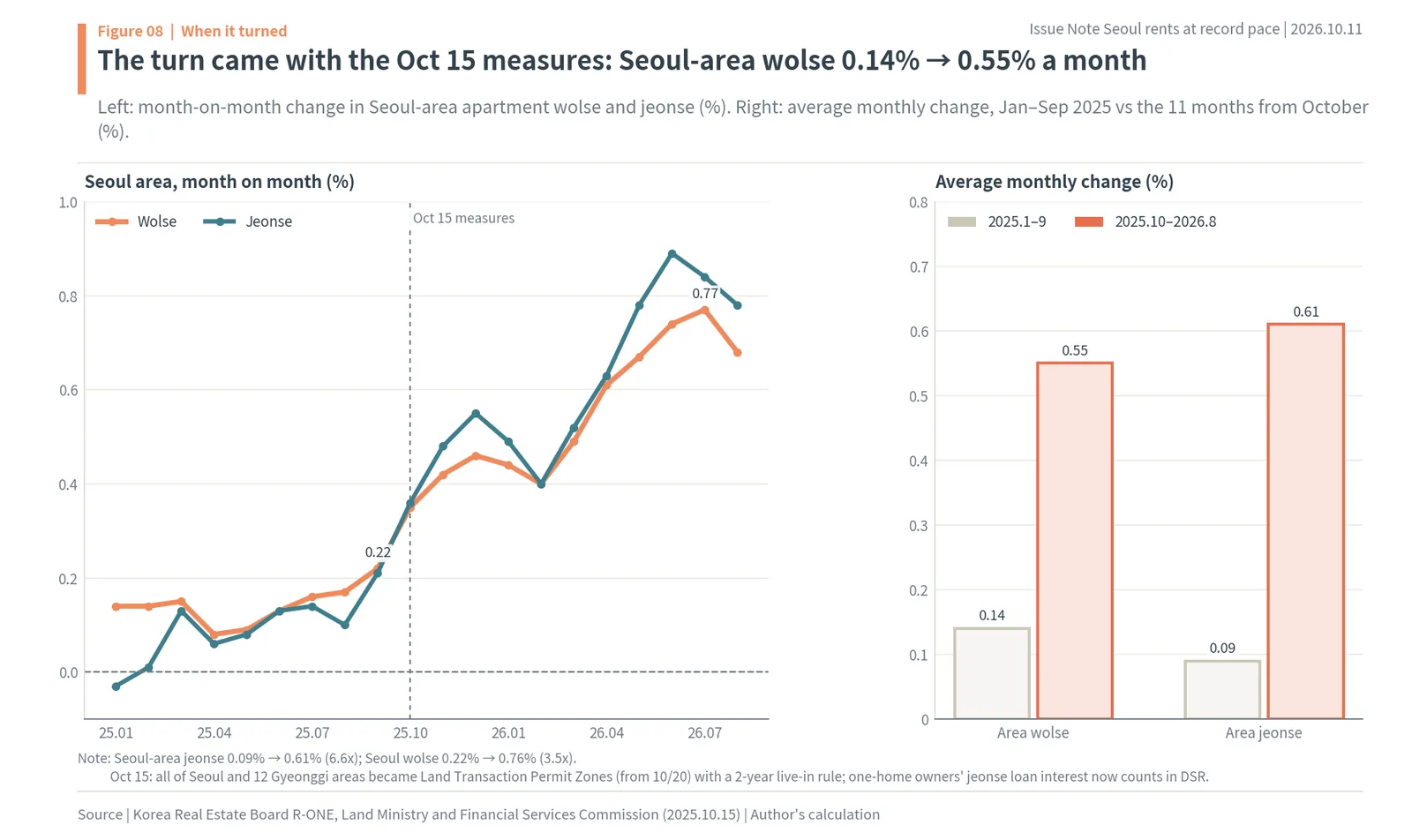
The numbers link up as follows. On the Korea Real Estate Board’s apartment wolse index, Seoul-area wolse rose an average of 0.14% a month from January to September 2025. From October, when the October 15 measures came out, to August 2026, the average was 0.55% a month, 3.9 times faster. Over the same periods jeonse jumped from 0.09% to 0.61%. Seoul apartment jeonse listings fell from 24,369 on the day of the measures to 20,542 on September 23, down 15.7%, and in Dongdaemun-gu they fell 71.5%. With fewer new rentals coming onto the market, sitting tenants stayed put by renewing. Renewals were 58.9% of Seoul jeonse leases in August, 15.2 percentage points above 43.7% a year earlier.
Rental homes are scarcer because fewer people are letting homes out. On October 15, 2025 all of Seoul and 12 areas of Gyeonggi Province became Land Transaction Permit Zones, where anyone who buys a home must live in it for two years. Buying a home with a jeonse tenant in place and letting it out was blocked. Funding plans filed for Seoul home purchases, compiled by the civic group People’s Solidarity for Participatory Democracy (PSPD), show the owner-occupier share rising from 62.6% in October 2025 to 82.3% in April 2026. The rest, that is purchases to let out or not to live in, halved from 37.4% to 17.7%. The share of people owning two or more units in multi-unit buildings (the multi-ownership index) fell to 15.980% in September, below 16% for the first time since October 2018.
Interest rates came on top. The Bank of Korea raised its base rate in both July and August to 3.00%, and the big five banks’ average jeonse loan rates are 4.32–4.89%. Landlords want monthly rent rather than deposits, and tenants find loan interest burdensome, so even the remaining jeonse homes are turning into wolse. Wolse was 52.0% of Seoul apartment leases in the first half of 2026, up from 43.9% a year earlier and over half for the first time.
The government and the ruling Democratic Party of Korea blame three years of short supply and a long-term decline in jeonse (more one-person households, jeonse fraud). It is true that Seoul apartment completions fell 26.8%, from 37,103 homes in 2025 to 27,158 in 2026, and this report takes that as the backdrop. But the drop in completions runs through all of 2026, while wolse growth turned upward in October 2025. On top of the backdrop, what pulled the trigger was the fall in the number of people letting homes. Cities abroad that squeezed landlords went down the same road. Berlin’s rental listings fell by up to 60% after it froze rents, and in San Francisco landlords covered by expanded rent control cut rental supply by 15%.
So the author thinks two things need fixing first. First, even if the Land Transaction Permit Zones that expire on December 31 are extended, the two-year live-in duty should exempt “purchases made to let”, on condition that the buyer registers as a rental business, caps rent rises at 5% and lets the home for at least four years. Second, the repeal of the capital gains tax surcharge exemption for buy-to-let apartments in the August 3 tax plan should be halted, keeping tax breaks for registered rentals that meet the same conditions. Private landlords supply 86.7% of rental homes and public rentals are only 8.5%, so replacing 1% of private rentals would take a 10.2% increase in public rentals. This report walks through the chain that leads to this conclusion in order: prices, shape, timing, causes, rates and completions, other countries, both sides’ arguments, the author’s view, and stocks and dates.
1. Key terms: jeonse, wolse, landlords, the conversion rate and permit zones
Terms used in this report
First, the terms that come up often. Jeonse is a lease in which the tenant deposits a large sum and pays no monthly rent; wolse is a lease with a small deposit and monthly rent. In between are semi-jeonse, with a large deposit, and semi-wolse, with a smaller one. The Korea Real Estate Board’s integrated wolse price index bundles wolse, semi-wolse and semi-jeonse together, and every “wolse growth” figure in this report is this index for apartments. The index sets June 2026 at 100 and measures the change each month.
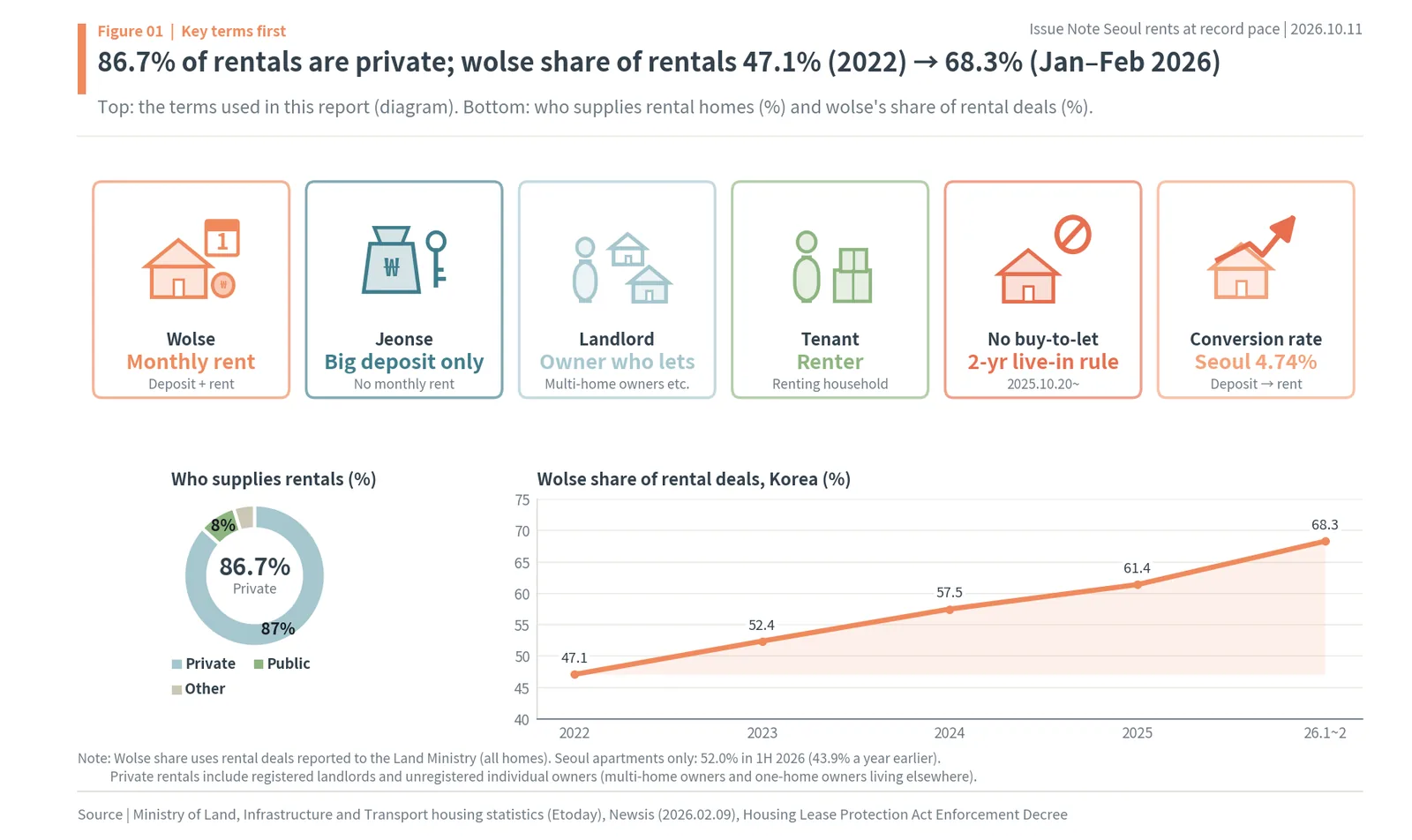
The landlord (lessor) is the owner who lets the home, and the tenant (lessee) is the person who rents it. In Korea most rental homes are supplied privately. Ministry of Land, Infrastructure and Transport (Land Ministry) data compiled by Newsis in February 2026 put private rentals at 86.7% of rental homes and the public rental stock at 8.5%. Private rentals include homes held by registered rental businesses and homes of unregistered individual landlords. Individual landlords are usually multi-home owners with two or more homes, or one-home owners who do not live in the home they own. Professor Lee Chang-moo of Hanyang University estimates that 10–20% of renting households live in homes owned by such non-resident one-home owners.
The deposit-to-rent conversion rate is the annual rate used to turn a jeonse deposit into monthly rent. For Seoul apartments it was 4.74% in July 2026, meaning that converting a KRW 100mn deposit into rent yields KRW 4.74mn a year, about KRW 395k a month. The law caps the rate used for renewals and similar cases at the base rate plus 2 percentage points; with the base rate at 3.00%, the cap is 5.0%. A Land Transaction Permit Zone is an area where buying a home requires a permit from the district office. Since October 20, 2025, all 25 districts of Seoul and 12 areas of Gyeonggi have been permit zones, and anyone who buys a home there must live in it for two years. It is a device to block “gap investment”, buying a home with a jeonse tenant in place.
The right to request lease renewal is one of the three tenant protection laws that took effect on July 31, 2020; it lets a tenant demand one more two-year term. The first two years plus a two-year renewal are called “2+2”. At renewal the rent can rise by no more than 5%. The cap applies only to renewals, not to new leases with a new tenant, so tenants looking for a new home face market prices in full, and a price gap opens between renewing tenants and newcomers. In this report the “renewal share” is the share of jeonse leases renewed under this right or by agreement.
The top of Figure 1 turns these terms into pictures. The bottom left shows who supplies rental homes, and the bottom right shows wolse’s share of rental deals reported to the Land Ministry. Across all homes nationwide, the wolse share rose from 47.1% in 2022 to 52.4% in 2023, 57.5% in 2024 and 61.4% in 2025, and reached 68.3% in January–February 2026. Wolse is already the norm for officetels and villas, and now apartments are going the same way.
A hypothetical example: what tenant Mr. Kim pays
Put the numbers on one person. A hypothetical tenant, Mr. Kim, rents a Seoul apartment at the average rent. The Korea Real Estate Board’s average monthly rent was KRW 1.435mn in August 2025 and KRW 1.641mn (about $1,226) in August 2026. For the same average home, Mr. Kim pays KRW 206k more a month and KRW 2.47mn more a year. The average deposit barely moved over the same period, from KRW 194mn to KRW 196mn (about $145,000 to $146,000). What rose was only the monthly payment, not the deposit, and that is the shape of this rise.
If Mr. Kim renews every year from here, his burden depends on the pace. Seoul apartment wolse is now rising 9.1% a year. If that continues, rent of KRW 1.641mn becomes KRW 1.790mn in a year, KRW 1.953mn in two and KRW 2.325mn in four. In the year after the tenant laws took effect in July 2020, Seoul wolse rose 2.21%. At that pace, rent would still be KRW 1.791mn after four years. Using the renewal right puts a 5% cap on renewals, but tenants looking for a new home face market prices in full (author’s calculation, assumption).
The right side compares other options. If a KRW 400mn (about $298,700) jeonse home comes back as wolse with a KRW 100mn deposit, applying Seoul’s 4.74% conversion rate to the remaining KRW 300mn gives rent of KRW 1.184mn a month. Borrowing the same KRW 300mn as a jeonse loan at the big five banks’ 4.60% average rate, as disclosed by the Korea Housing Finance Corporation, costs KRW 1.150mn a month in interest. When rent and loan interest are almost the same, tenants have less reason to insist on jeonse, and the higher rates go, the more landlords want wolse. This is the mechanism by which rate rises turn the remaining jeonse homes into wolse.
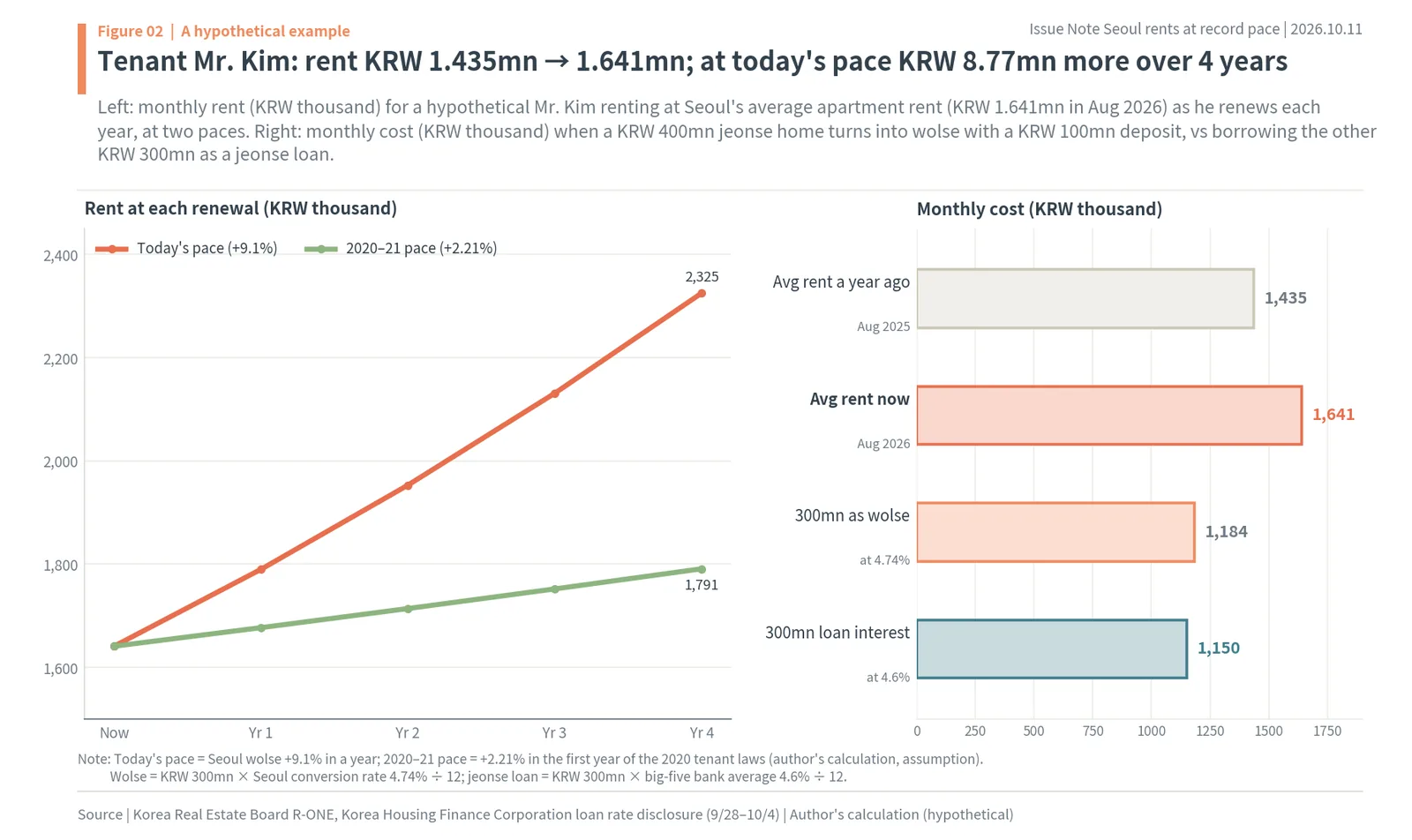
So the question of this report is the same as Mr. Kim’s. If wolse keeps rising at this pace, Mr. Kim will pay KRW 8.77mn (about $6,550) more over a four-year 2+2 lease. Only by finding what created this pace can we see what to fix.
2. Record pace: Seoul-area wolse +0.77% in July, Seoul average rent KRW 1.641mn
April to August are the five fastest months on record
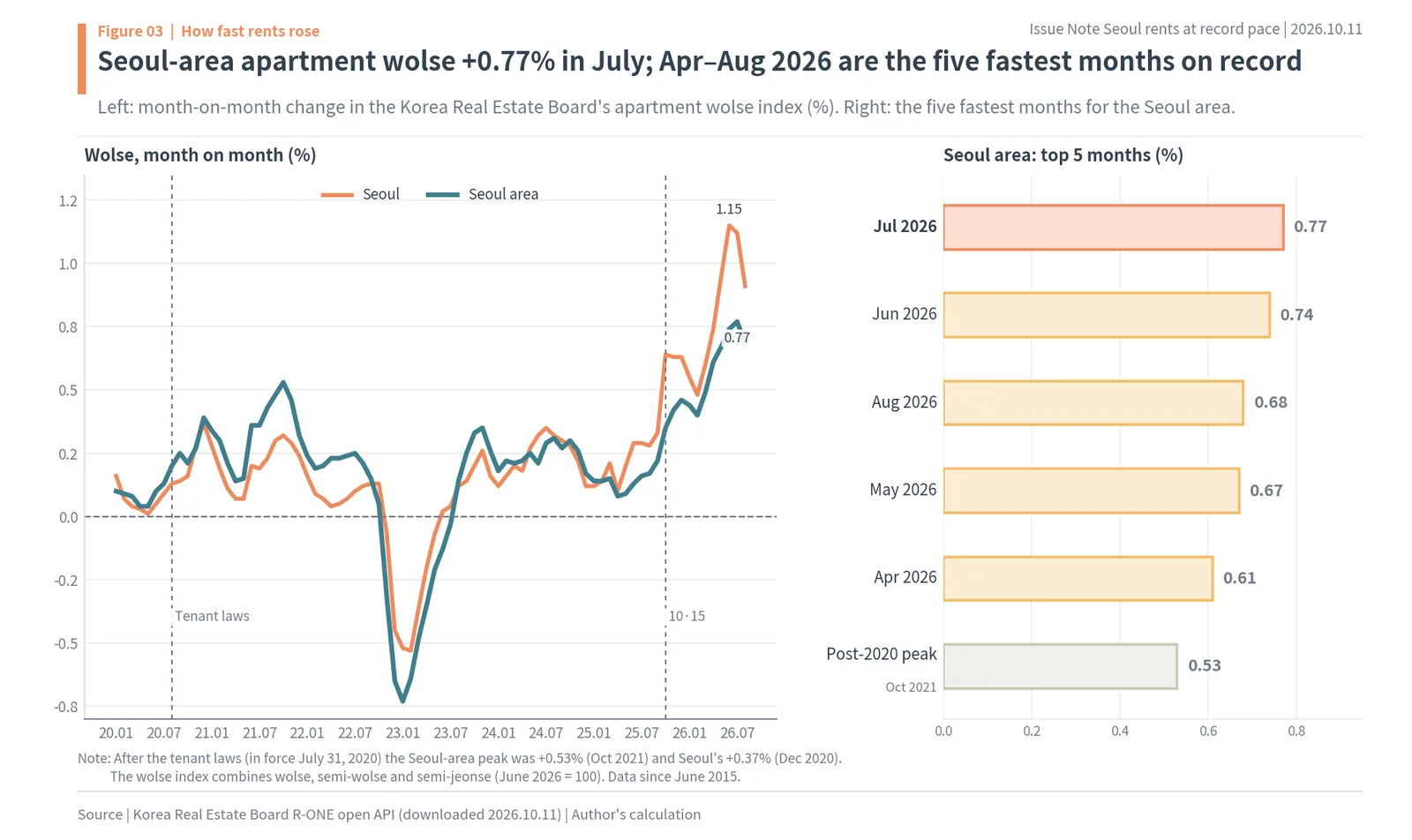
To start with the conclusion, Seoul-area apartment wolse in 2026 is rising faster than at any time since the Korea Real Estate Board’s statistics began in June 2015. Month-on-month growth in the integrated wolse index was +0.77% in July, the record, with June’s +0.74% second, August’s +0.68% third, May’s +0.67% fourth and April’s +0.61% fifth. Five consecutive months took the top five places. In the two years after the tenant laws took effect (July 31, 2020), the fastest month for Seoul-area wolse was October 2021 at +0.53%; now five months in a row have beaten it.
Seoul is steeper still. Seoul apartment wolse rose +1.15% in June, +1.12% in July and +0.91% in August. Seoul’s fastest month in the tenant-law period was December 2020 at +0.37%, so one month now equals three months then. Over a year (August 2025 → August 2026), wolse rose +9.1% in Seoul, +6.43% in the Seoul area, +5.60% in Gyeonggi and +4.05% in Incheon. Compared with August 2024, two years earlier, Seoul is up +11.91%.
The left side of Figure 3 shows monthly wolse growth for Seoul and Seoul-area apartments from January 2020 to August 2026. The two dotted lines mark the tenant laws and the October 15 measures. From late 2022 to early 2023, rapid rate rises pulled down both home prices and jeonse, and the wolse index even dipped below zero for a while. After that the line moved in the 0.1–0.3% range, turned upward in October 2025 and turned up once more from spring 2026. The right side shows the five fastest months for the Seoul area and the peak after the tenant laws.
Eight months of 2026 are double all of 2025
Bundled by year, the difference in speed looks even bigger. Over all of 2025 (December 2024 → December 2025), Seoul-area apartment wolse rose +2.54% and Seoul +3.94%. In 2026 it took just eight months (December 2025 → August 2026) for the Seoul area to rise +4.90% and Seoul +6.69%. Eight months’ growth is close to double the whole of last year. Jeonse is the same: Seoul-area jeonse rose +2.25% in 2025 and +5.45% in the first eight months of 2026, and Seoul jeonse went from +3.77% to +7.35%.
Month by month, Seoul wolse went like this. Growth of +0.33% in September 2025 doubled to +0.64% in October and held at +0.63% in November and December. It eased in the winter off-season to +0.55% in January 2026 and +0.48% in February, then rose again: +0.60% in March, +0.74% in April, +0.95% in May, +1.15% in June, +1.12% in July and +0.91% in August. Rents usually rise in spring and autumn, when moves cluster, and rest in summer and winter, but this year they rose fastest in June and July. Seasons do not explain it.
Half-year figures point the same way. On Korea Real Estate Board data compiled by Newsis on July 31, Seoul’s apartment wolse index rose from 99.31 in December 2025 to 103.90 in June 2026, up 4.62% in the first half. That is the highest of the 22 half-years since the statistics began in the second half of 2015. In the same half, the Seoul area rose 3.35%, Gyeonggi 3.00% and Incheon 1.99%.
Average Seoul rent has reached KRW 1.641mn
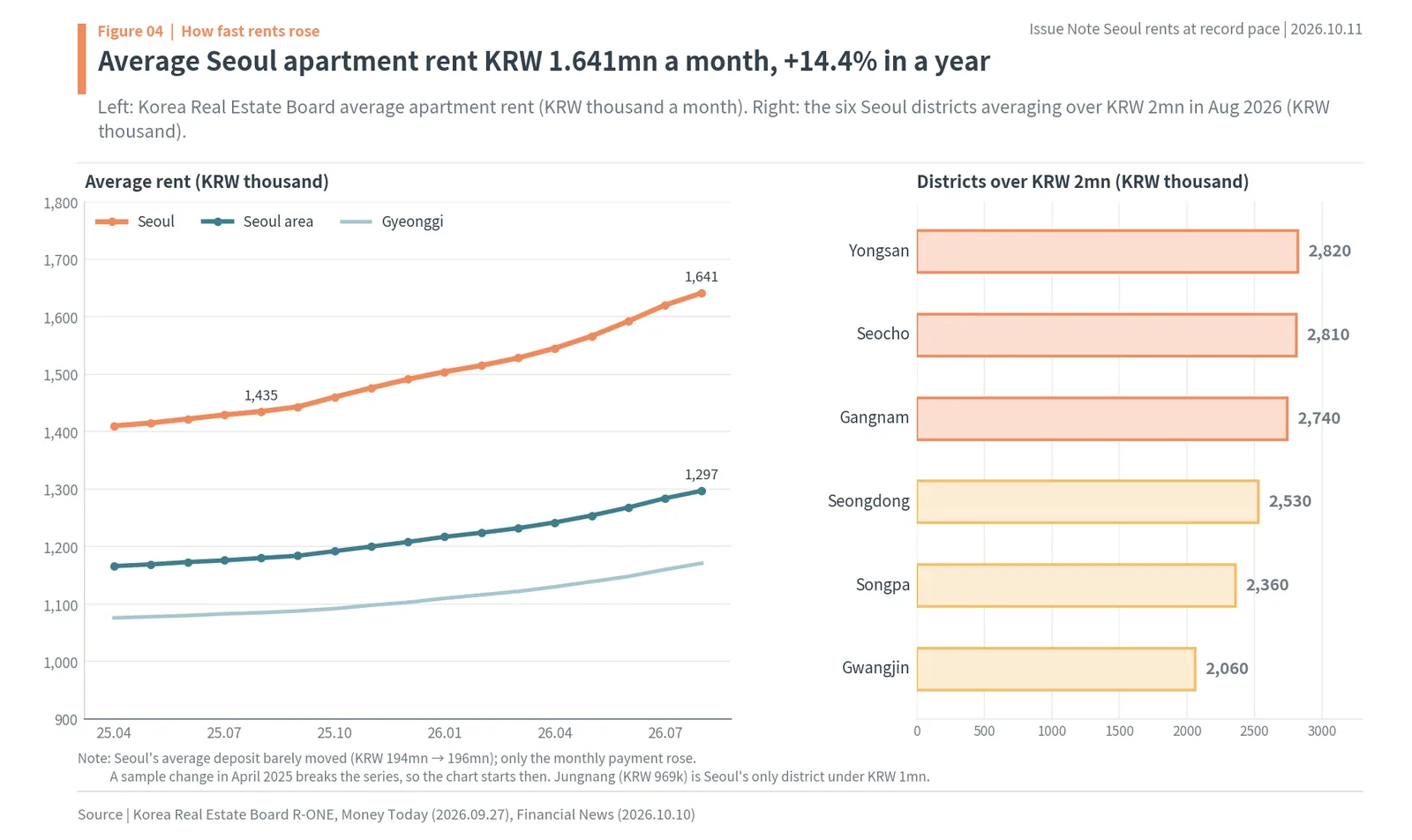
In money rather than index points: the Korea Real Estate Board’s average Seoul apartment rent was KRW 1.641mn a month in August 2026, 14.4% more than KRW 1.435mn a year earlier. The Seoul-area average is KRW 1.297mn, 9.9% more than KRW 1.180mn a year earlier. The average rent series breaks once with a sample change in April 2025, so the periods before and after cannot be joined, and Figure 4 starts in April 2025. Since the break, the line has risen without a single dip.
August average rents by district, compiled by Money Today, show six districts above KRW 2mn a month: Yongsan KRW 2.82mn, Seocho KRW 2.81mn, Gangnam KRW 2.74mn, Seongdong KRW 2.53mn, Songpa KRW 2.36mn and Gwangjin KRW 2.06mn. Of Seoul’s 25 districts, only Jungnang (KRW 969k) averages under KRW 1mn, and even Nowon and Dobong, where rents used to be cheap, have topped KRW 1mn since June. Land Ministry data show 7,344 new Seoul wolse leases at KRW 2mn a month or more in the first half, 21.2% of the total, up from 6,177 (17.9%) a year earlier.
Outer Seoul and Gyeonggi job hubs rose first
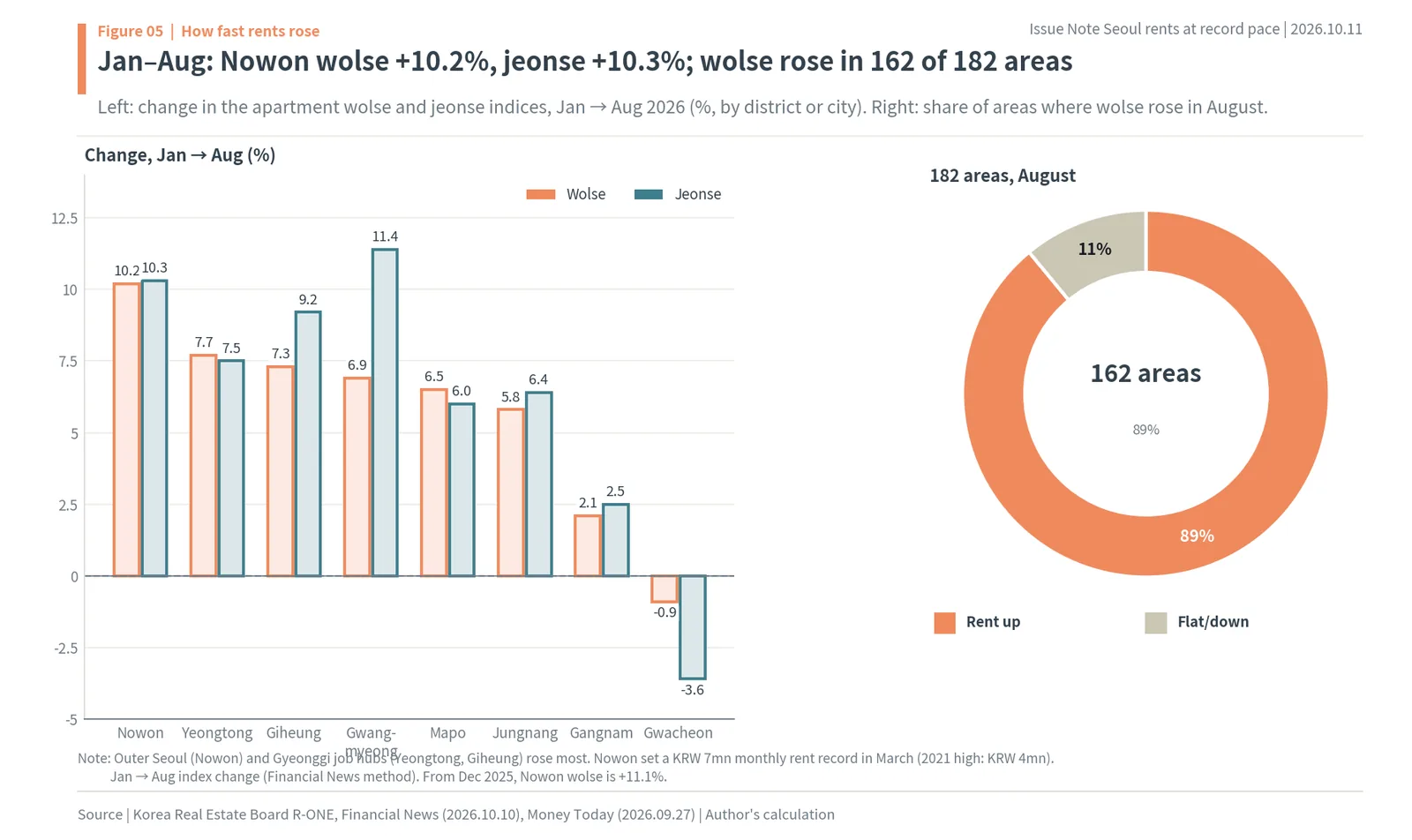
Where rents rose most makes the cause clearer. In Korea Real Estate Board index changes from January to August 2026, compiled by Financial News on October 10, Nowon-gu ranked first in the Seoul area for wolse at +10.2%, with jeonse at +10.3%. The author ran the same calculation on raw R-ONE data and matched it to the first decimal place. In Gyeonggi, Hwaseong’s Dongtan district rose +9.8%, Suwon’s Yeongtong-gu +7.7%, Yongin’s Giheung-gu +7.3% and Gwangmyeong +6.9%, while Seoul’s Mapo-gu rose +6.5%. Only two places saw wolse fall from January to August: Icheon (−0.9%) and Gwacheon (−0.9%).
Outer Seoul (Nowon, Dobong, Seongbuk, Gangbuk and Jungnang) is relatively cheap and used to attract many buyers who bought with a jeonse tenant in place. Yeongtong, Giheung and Dongtan in Gyeonggi are job hubs close to semiconductor plants. Wolse jumped first where buying with a tenant was blocked and where tenants crowd in for work. In Nowon a lease at KRW 7mn a month was signed in March, beating the 2021 record (KRW 4mn), and an 84 sq m apartment in Gireum-dong, Seongbuk-gu, was let in May at KRW 3.7mn a month.
Setting districts and cities side by side shows that the places newly regulated by the October 15 measures rose more. Gangnam, Seocho, Songpa and Yongsan were already regulated before October 15; the places newly regulated were the other 21 Seoul districts and 12 areas of Gyeonggi. January–August wolse growth was +2.1% in Gangnam-gu and +5.1% in Seocho-gu, one-fifth to one-half of Nowon’s (+10.2%). Jeonse rose +2.5% in Gangnam-gu and +3.6% in Seocho-gu, far below Nowon (+10.3%). By contrast, newly regulated Gwangmyeong saw jeonse jump +11.4%, more than wolse (+6.9%), and Giheung-gu saw jeonse +9.2% and wolse +7.3%. Gwacheon in Gyeonggi was a rare decline, with wolse −0.9% and jeonse −3.6%.
Measured from the start of the year (December 2025), the gaps widen a little. Wolse rose +11.1% in Nowon, +9.0% in Yeongtong, +8.0% in Giheung, +7.2% in Gwangmyeong, +6.9% in Mapo, +6.0% in Seocho and Jungnang, +2.4% in Gangnam, and −1.1% in Gwacheon. The picture is that rental homes dried up first not in Gangnam, already regulated, but in the outskirts and Gyeonggi job hubs, where buying with a tenant was blocked this time.
The left side of Figure 5 shows January–August wolse and jeonse growth by district and city, and the right side shows the share of areas where wolse rose in August among 182 areas nationwide. Wolse rose in 162 of them (89%). This is not about one complex or one district; it is a trend that has spread across the Seoul area and beyond, to the whole country.
So today’s wolse rise is the largest since the statistics began, in speed, in money and in breadth.
3. Jeonse and wolse rising together: 1.07x now vs 3.3x in 2020–21
In 2020–21 only jeonse jumped
What sets this rise apart is its shape. Korea’s rental market used to follow a rule: when jeonse rises, wolse stays stable. When jeonse jumped, tenants who could not raise a bigger lump sum moved to wolse, and landlords also switched jeonse to wolse, increasing wolse supply and slowing wolse growth. Conversely, when wolse got expensive, tenants borrowed and moved to jeonse. Jeonse and wolse were two rooms that absorbed each other’s overflow.
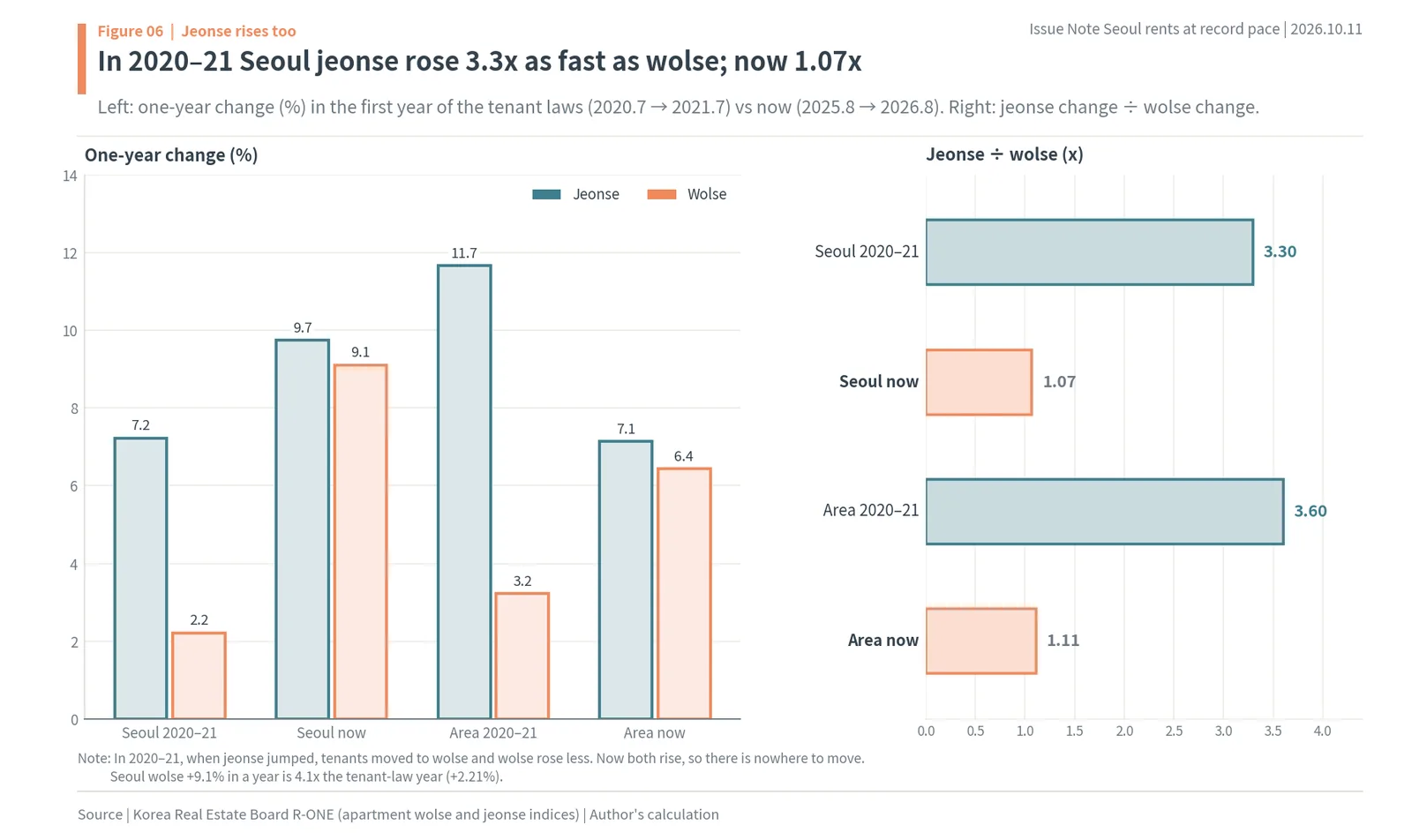
The first year of the tenant laws (July 2020 → July 2021) shows that shape well. On the Korea Real Estate Board’s apartment indices, Seoul-area jeonse rose +11.66% but wolse only +3.22%. In Seoul, jeonse rose +7.23% and wolse +2.21%. Jeonse rose 3.6 times as fast as wolse in the Seoul area and 3.3 times as fast in Seoul. Once the renewal right and the 5% cap arrived, landlords raised jeonse sharply on new leases, and some tenants moved to wolse.
Now both rise at the same speed
Now (August 2025 → August 2026) it is different. Seoul jeonse rose +9.74% and wolse +9.1%, so jeonse is rising just 1.07 times as fast as wolse. In the Seoul area, jeonse rose +7.14% and wolse +6.43%, 1.11 times. Whether tenants move from jeonse to wolse or from wolse to jeonse, prices have risen about the same. Seoul’s 9.1% yearly wolse growth is 4.1 times the 2.21% of the tenant-law year. This is the shape Financial News called “unprecedented”.
Gyeonggi and Incheon look the same. In the tenant-law year, Gyeonggi jeonse rose +13.0% and wolse +3.54%, and Incheon jeonse +17.36% and wolse +4.34%: jeonse at 3.7 and 4.0 times wolse. In the latest year Gyeonggi jeonse rose +6.44% and wolse +5.60%, 1.15 times, and Incheon jeonse +4.37% and wolse +4.05%, 1.08 times. The size of the rise differs by region, but the gap between jeonse and wolse has almost disappeared everywhere in the Seoul area.
Both rooms getting more expensive at once means there are fewer rooms. If only demand had grown, people would move from the side that rose more to the side that rose less, and one side would get relief. If supply has shrunk, there is no empty room whichever way you go, so both rise. That is why the author reads this wolse rise as a “rental supply problem” rather than a “rental demand problem”. Whether jeonse or wolse, a rental home exists only if someone buys a home and puts it up for rent.
The left side of Figure 6 compares one-year growth in the two periods for Seoul and the Seoul area. The right side divides jeonse growth by wolse growth: bars that were over 3 times have sunk to around 1.
Remaining jeonse homes turn into wolse
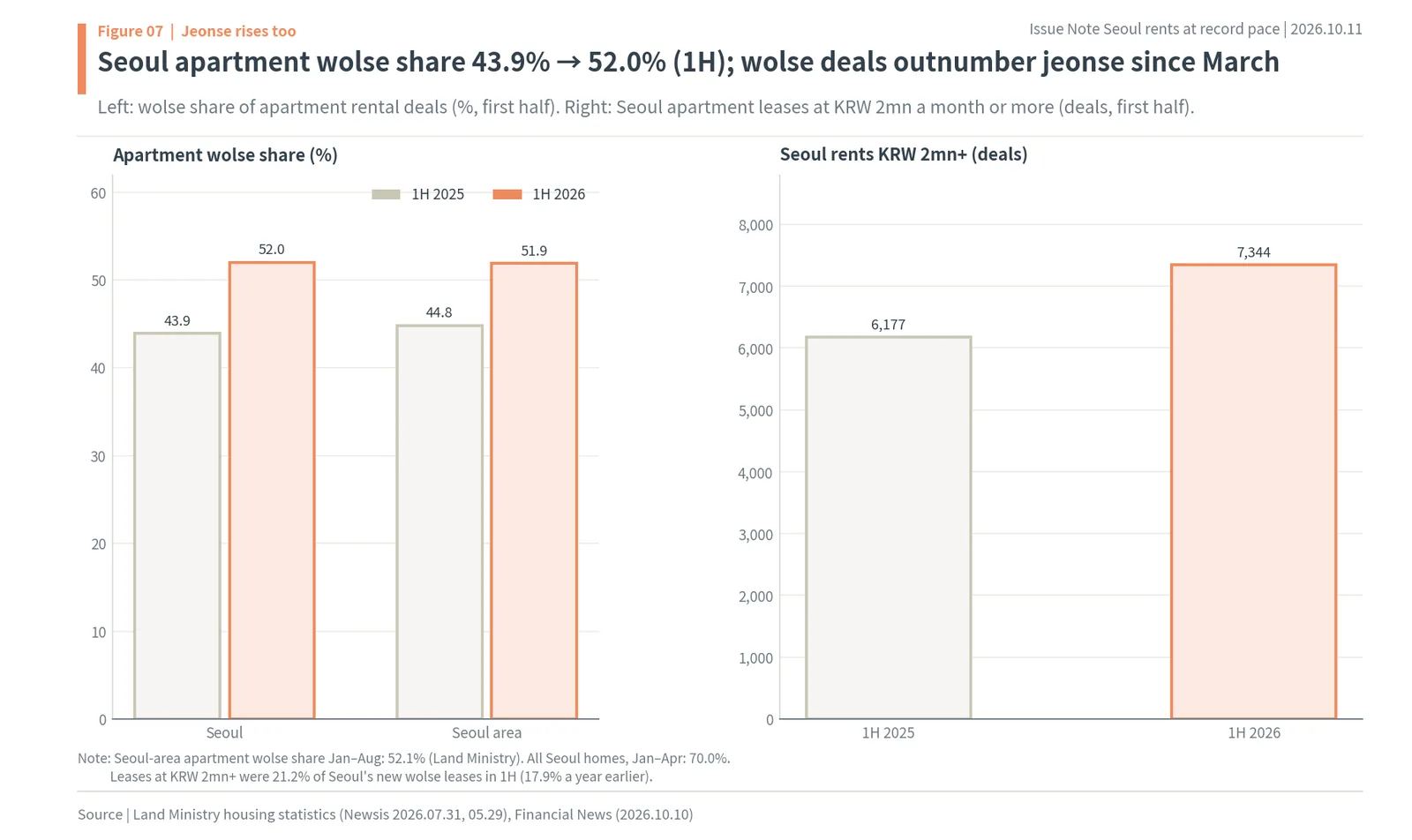
On top of the smaller rental stock, jeonse itself is turning into wolse. On Land Ministry deal reports, wolse was 52.0% of Seoul apartment leases in the first half of 2026, 8.1 percentage points above 43.9% a year earlier. For Seoul-area apartments it was 51.9% (44.8% a year earlier) and for apartments nationwide 52.4% (46.1%). Since March, wolse deals have outnumbered jeonse deals for Seoul apartments every month, and the Seoul-area apartment wolse share for January–August is 52.1%. Across all Seoul homes, wolse already made up 70.0% in January–April.
Jeonse is turning into wolse for reasons on both sides. Landlords want steady monthly cash rather than a lump-sum deposit as rates rise and holding taxes grow. Tenants borrow less because jeonse loan rates have risen and the interest on jeonse loans for one-home owners now counts toward the debt service ratio (DSR, the cap on total loan repayments as a share of income). The left side of Figure 7 shows the first-half wolse share for Seoul and Seoul-area apartments, and the right side shows the number of Seoul leases at KRW 2mn a month or more.
So with jeonse and wolse rising at the same speed, what is missing is not a room for tenants to move to but rental homes themselves.
4. When it turned: October 2025 and Seoul jeonse listings down 15.7%
Monthly growth was 3.9 times faster after the measures
The simplest way to find a cause is to see when the line turned. Monthly growth in Seoul-area apartment wolse stayed at 0.08–0.22% from January to September 2025. It jumped from +0.22% in September to +0.35% in October, then +0.42% in November and +0.46% in December. After pausing at +0.40% in February 2026, it stepped up again to 0.6–0.8% from April. The January–September 2025 average was 0.14% a month, and the 11-month average from October 2025 to August 2026 was 0.55%, 3.9 times higher (author’s calculation).
Jeonse turned even harder. Seoul-area apartment jeonse went from an average of 0.09% a month in January–September 2025 to 0.61% after October, 6.6 times. Seoul wolse went from 0.22% to 0.76% (3.5 times), and Seoul jeonse from 0.21% to 0.81% (3.9 times). The turning month is the same for Seoul and the Seoul area, for wolse and jeonse. On October 15, 2025, the government designated all 25 districts of Seoul and 12 areas of Gyeonggi at once as adjustment target areas, speculative overheated districts and Land Transaction Permit Zones. The permit zones took effect on October 20, and anyone who buys a home must live in it for two years. Under the same measures, a rule counting one-home owners’ jeonse loan interest in the DSR took effect on October 29.
The left side of Figure 8 shows monthly growth in Seoul-area apartment wolse and jeonse since January 2025, with a dotted line at the October 15 measures. The right side shows average monthly growth for the nine months before and the 11 months after. Before the measures, wolse rose slightly faster than jeonse; afterwards both sped up and jeonse overtook wolse. Once buying with a tenant was blocked, new jeonse dried up first, and the gap spread to wolse.
Seoul jeonse listings fell 15.7%
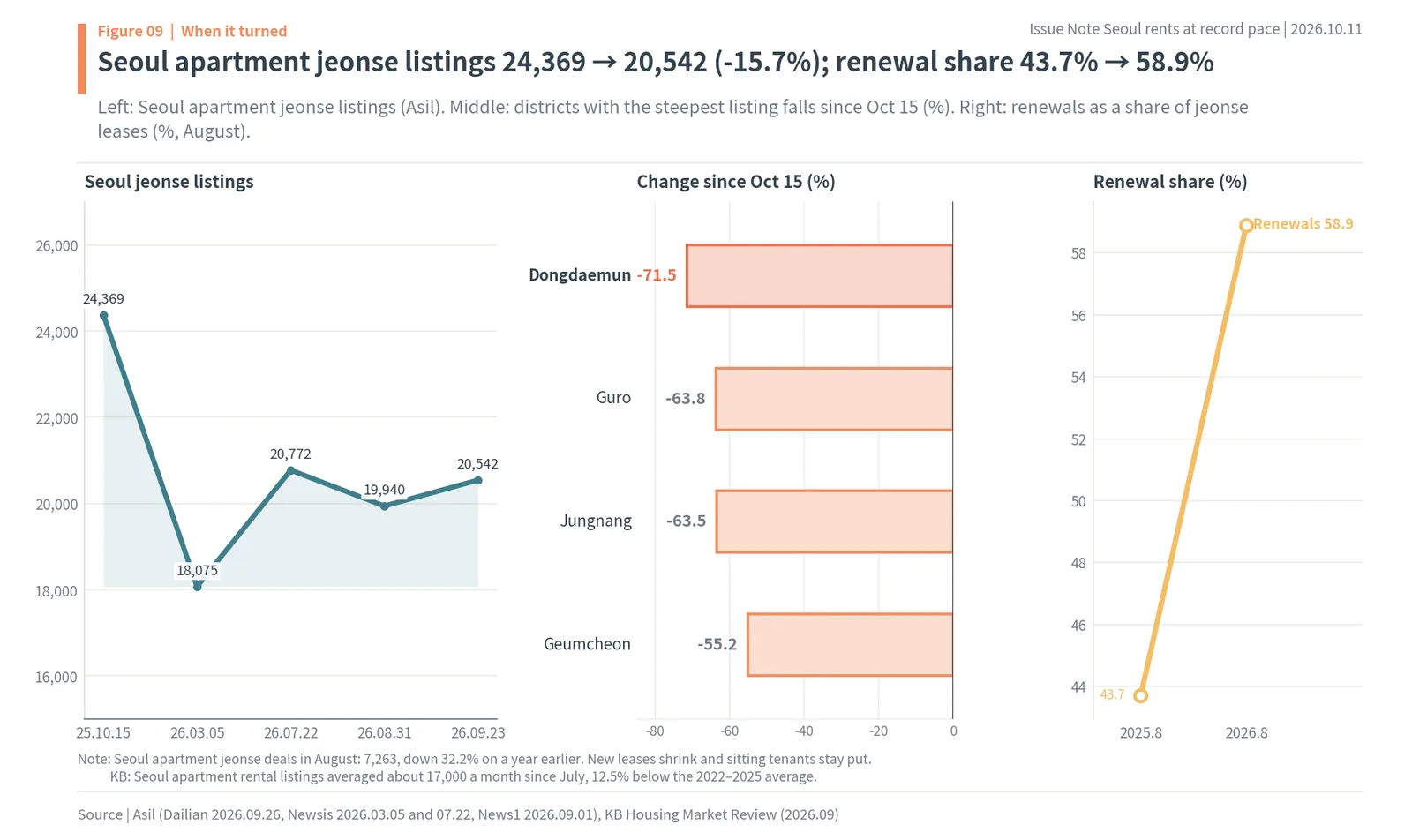
After prices, the next thing to look at is the number of homes on offer. According to Asil, a real estate big-data firm, Seoul apartment jeonse listings were 24,369 on October 15, 2025, the day of the measures. On March 5, 2026 they were 18,075, the fewest since January 2021, then 20,772 on July 22, 19,940 on August 31 and 20,542 on September 23. That is 15.7% fewer than on the day of the measures. Even in the autumn moving season, listings did not return to pre-measure levels.
By district the falls are bigger. Declines since October 15, compiled by Dailian from Asil data, were −71.5% in Dongdaemun-gu, −63.8% in Guro-gu, −63.5% in Jungnang-gu and −55.2% in Geumcheon-gu. All are districts where homes are relatively cheap by Seoul standards and many buyers used to buy with a jeonse tenant in place. KB Kookmin Bank’s housing market review also counted Seoul apartment rental listings at about 17,000 a month on average since July, 12.5% below the 2022–2025 average.
When fewer new rentals come out, sitting tenants stay put instead of moving. Seoul apartment jeonse deals in August totalled 7,263, down 32.2% on a year earlier, and renewals made up 58.9% of them, 15.2 percentage points above 43.7% a year earlier. A renewal carries the 5% cap under the renewal right, but someone looking for a new home faces market prices in full. The wider the gap between new and renewed leases, the less tenants move and the fewer homes reach the market.
Seoul’s jeonse listings hovering around 20,000 even in moving season stands out more against a year earlier. At the end of August 2025, Seoul had 22,966 apartment jeonse listings; on August 31, 2026 it had 19,940, 13.2% fewer in a year. On the sales side, multi-home owners rushed to sell before the capital gains tax surcharge returned on May 10, but those homes were mostly sold to people who would live in them, so they left the rental stock.
Supply-demand gauges tell the same story. The Korea Real Estate Board’s wolse supply-demand index means more people are looking for rentals than offering them when it is above 100; the Seoul area read 109.5 in August, above July (109.4). Outside the capital region it was 101.0. KB Kookmin Bank’s Seoul apartment jeonse supply-demand index hit 182.7 in May 2026, topping 180 for the first time in 65 months, since December 2020 (187.4). This index runs from 0 to 200, and the further above 100, the harder it is to find jeonse. Finding a rental has become as hard as at the end of 2020, right after the tenant laws.
The left side of Figure 9 shows Seoul apartment jeonse listings, the middle shows the four districts with the biggest falls, and the right side shows the renewal share of jeonse leases.
So both the turn in wolse growth and the drop in jeonse listings date to October 2025, the month of the October 15 measures.
5. Why: multi-home owners, registered rentals and buy-to-let purchases shrank
Multi-unit owners are the fewest in eight years
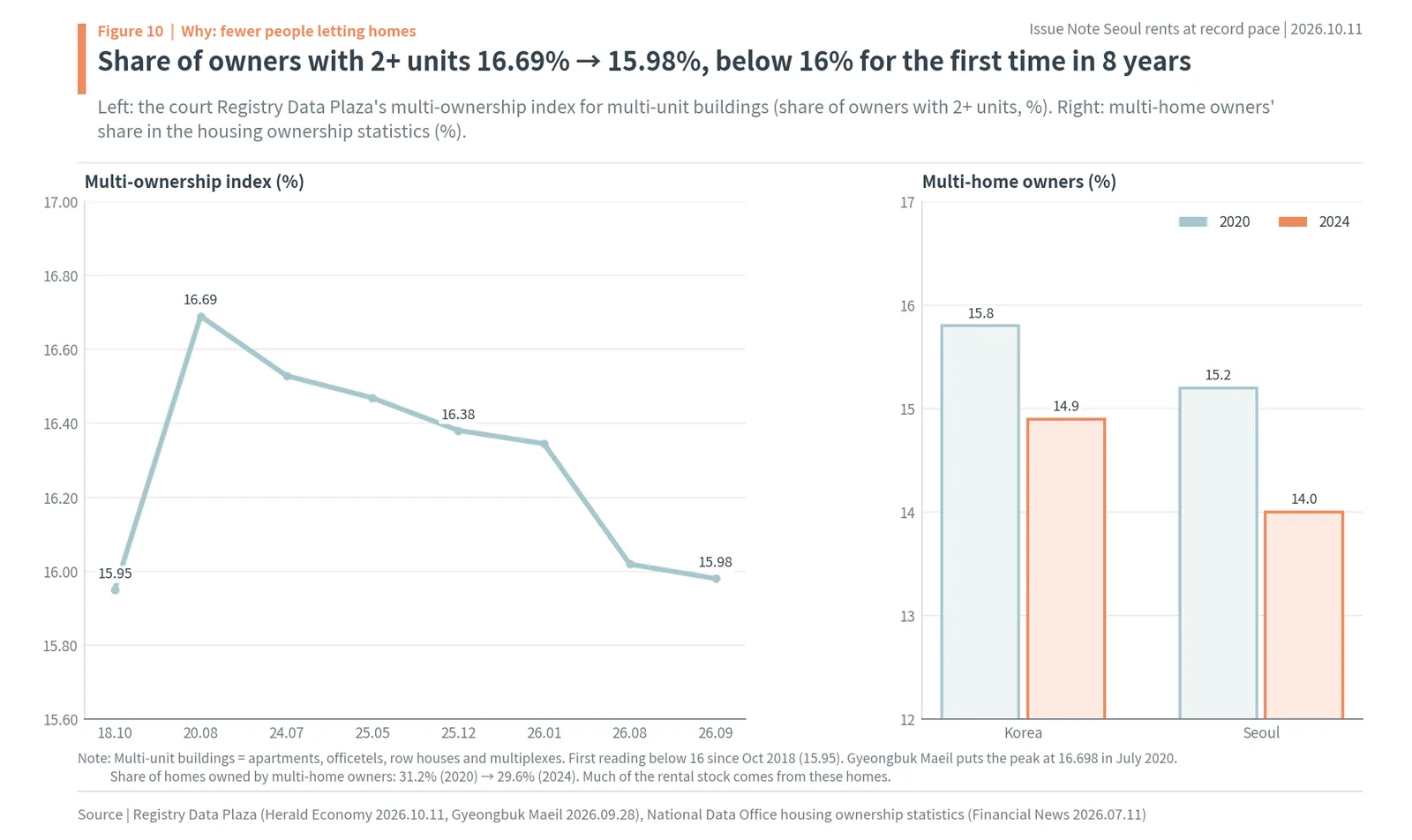
A rental home exists only if someone owns a home they will not live in. That “someone” is disappearing. The multi-ownership index from the court Registry Data Plaza is the share of owners of multi-unit buildings, such as apartments, officetels, row houses and multiplexes, who own two or more units. On figures compiled by Herald Economy on October 11, the index peaked at 16.69% in August 2020, then fell to 16.381% in December 2025 and 15.980% in September 2026. It is the first reading below 16% since October 2018 (15.95%). The index for owners of exactly two units has also fallen to 11.057%.
The same index as compiled by Gyeongbuk Maeil on September 28 peaks at 16.698% in July 2020, then reads 16.529% in July 2024, 16.469% in May 2025, 16.345% in January 2026 and 16.019% in August 2026. The two articles’ peak months differ by one month, but the trend is the same. The index fell by just over 0.1 percentage point from 2024 to 2025, then dropped 0.365 points in the eight months from January to September 2026. That is the period when the capital gains tax surcharge on multi-home owners returned on May 10, 2026 (+20 percentage points for two homes, +30 for three) and more people cut the number of homes they own.
The national housing ownership statistics from the National Data Office point the same way. The share of individual owners with two or more homes fell from 15.8% in 2020 to 14.9% in 2024 nationwide, and from 15.2% to 14.0% in Seoul. Multi-home owners’ share of all homes also fell from 31.2% to 29.6%. In the Korea Housing Institute’s analysis, 45.7% of homes held by multi-home owners (2.31 million) are not apartments, and people owning just two Seoul apartments are only 3.78% of two-home owners. Multi-home owners are closer to people who own villas and homes outside Seoul, and let them out, than to people collecting Seoul apartments.
In Seoul alone the pattern is stronger. Of the 850,000 homes held by Seoul’s multi-home owners, 54.8% are not apartments, and among the 300,000 homes of people owning four or more, 80.2% are not apartments. Much of the rental stock of villas and officetels belongs to multi-home owners. Kim Deok-rye, a director at the Korea Housing Institute, has said multi-home owners hold more homes outside Seoul or outside apartments than Seoul apartments, and that regulating uniformly by the number of homes is wrong.
The left side of Figure 10 shows the multi-ownership index, and the right side shows the multi-home owner share from the housing ownership statistics.
Registered rentals, which traded tax breaks for capped rents, are shrinking too
Multi-home owners who register as rental businesses must cap rent rises at 5% and let the home for four or ten years, and in return they are exempt from the capital gains tax surcharge and from aggregation under the comprehensive real estate holding tax. These are the most stable rental homes. The government encouraged registration in 2017, but the July 10, 2020 measures ended new buy-to-let apartment registrations, and the remaining registered rental apartments are deregistered automatically when their terms end, all of them by 2028.
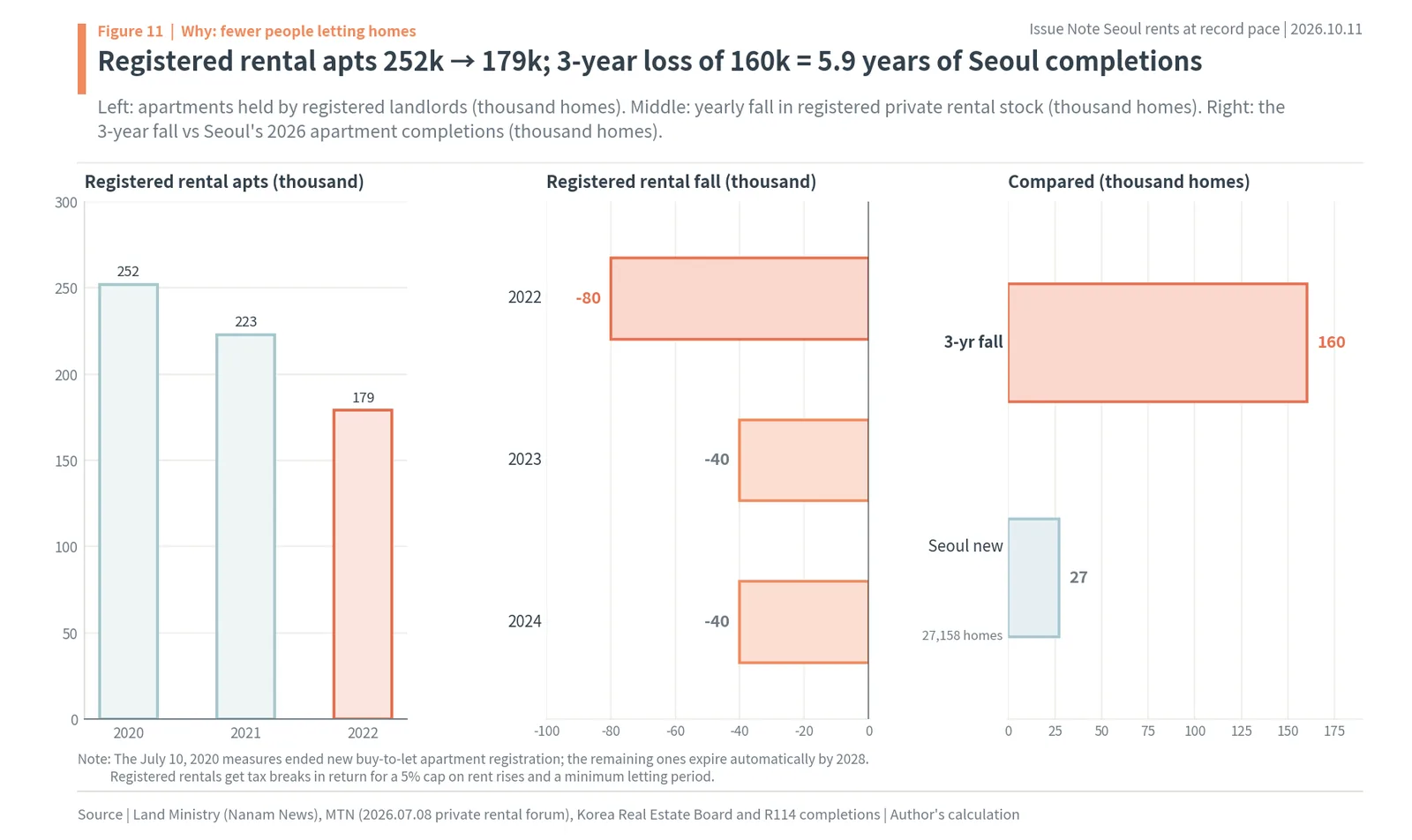
On Land Ministry data, apartments held by registered rental businesses fell from 252,000 in 2020 to 223,000 in 2021 and 179,000 in 2022. Data presented at a private rental forum on July 8, 2026, co-hosted by Democratic Party lawmakers Bok Ki-wang and Kim Nam-geun, show the registered private rental stock falling by 80,000 homes in 2022 and by 40,000 in each of 2023 and 2024, 160,000 over three years. With Seoul apartment completions at 27,158 homes in 2026, the registered rentals lost in three years equal 5.9 years of new Seoul apartment completions (author’s calculation). On top of that, the August 3 tax plan said it would phase out the capital gains tax surcharge exemption and the extra long-term holding deduction for buy-to-let apartments in adjustment target areas.
The decline in registered rentals follows the order of the policy changes. In 2017 the government urged registration with tax breaks, and registered rental homes rose sharply. The September 13, 2018 measures cut registration benefits for newly bought homes, and the July 10, 2020 measures ended buy-to-let apartment and four-year short-term registrations, putting the remaining apartment rentals on a path to deregistration as their terms ended. In 2025 short-term registration returned, but only for non-apartments. A deregistered home becomes an ordinary multi-home owner’s home subject to surcharges, and the owner chooses to sell, gift it or move in. Either way, one rental home with capped rent disappears.
Loans and holding taxes squeezed landlords too. After the June 27 measures, the loan-to-value ratio (LTV) for rental businesses in regulated areas became 0%, closing the door to buying homes to let with business loans. The October 15 measures removed private buy-to-let homes in adjustment target areas from the holding-tax aggregation exemption, so keeping a registration no longer brings a holding-tax benefit. With the money to buy a home to let, the tax while holding it and the tax when selling it all now the same as for any multi-home owner, there is no reason left to stay a registered landlord.
The left side of Figure 11 shows registered rental apartments, the middle shows the yearly fall in the registered private rental stock, and the right side compares the three-year fall with Seoul completions.
Purchases with a tenant in place halved
Multi-home owners are not the only ones who create rental homes. So do people who buy a home and let it for a few years before moving in, and people who live elsewhere for work and let their own home. Such buyers usually buy with the existing tenant in place. The two-year live-in duty in the Land Transaction Permit Zones blocked this path. The June 27, 2025 measures also required mortgage borrowers to move in within six months and blocked “ownership-transfer-conditional jeonse loans”, where a buyer pays the balance with the tenant’s jeonse loan.
The result showed up in the numbers. On Seoul funding-plan data compiled by PSPD on July 15, the owner-occupier share of purchases rose from 62.6% in October 2025 to 82.3% in April 2026. PSPD presented this as evidence that speculative demand had left, but read the other way, the same numbers mean purchases by would-be landlords fell from 37.4% to 17.7%. That share fell 52.7% (author’s calculation). By Dailian’s count, “deferred move-in” requests, in which buyers of tenant-occupied homes ask to postpone moving in, were only 4.5% of permit applications in August. More than 95% of newly bought homes become homes their owners live in, so the rentals those homes used to provide leave the market.
Public rentals can hardly fill the gap. With private rentals at 86.7% and public rentals at 8.5% of rental homes, losing 1% of private rentals takes a 10.2% increase in public rentals to match (author’s calculation). The universal public rental housing and youth jeonse rental programs the government announced on August 13 point in the right direction, but their scale cannot keep up with this ratio. Lee Eun-hyung, a research fellow at the Korea Research Institute for Construction Policy, has also said the public sector cannot replace the private rental market.
The left side of Figure 12 shows the purpose of purchases in funding plans, the middle shows how much public rental housing it takes to replace 1% of private rentals, and the right side shows the deferred move-in share of permit applications.
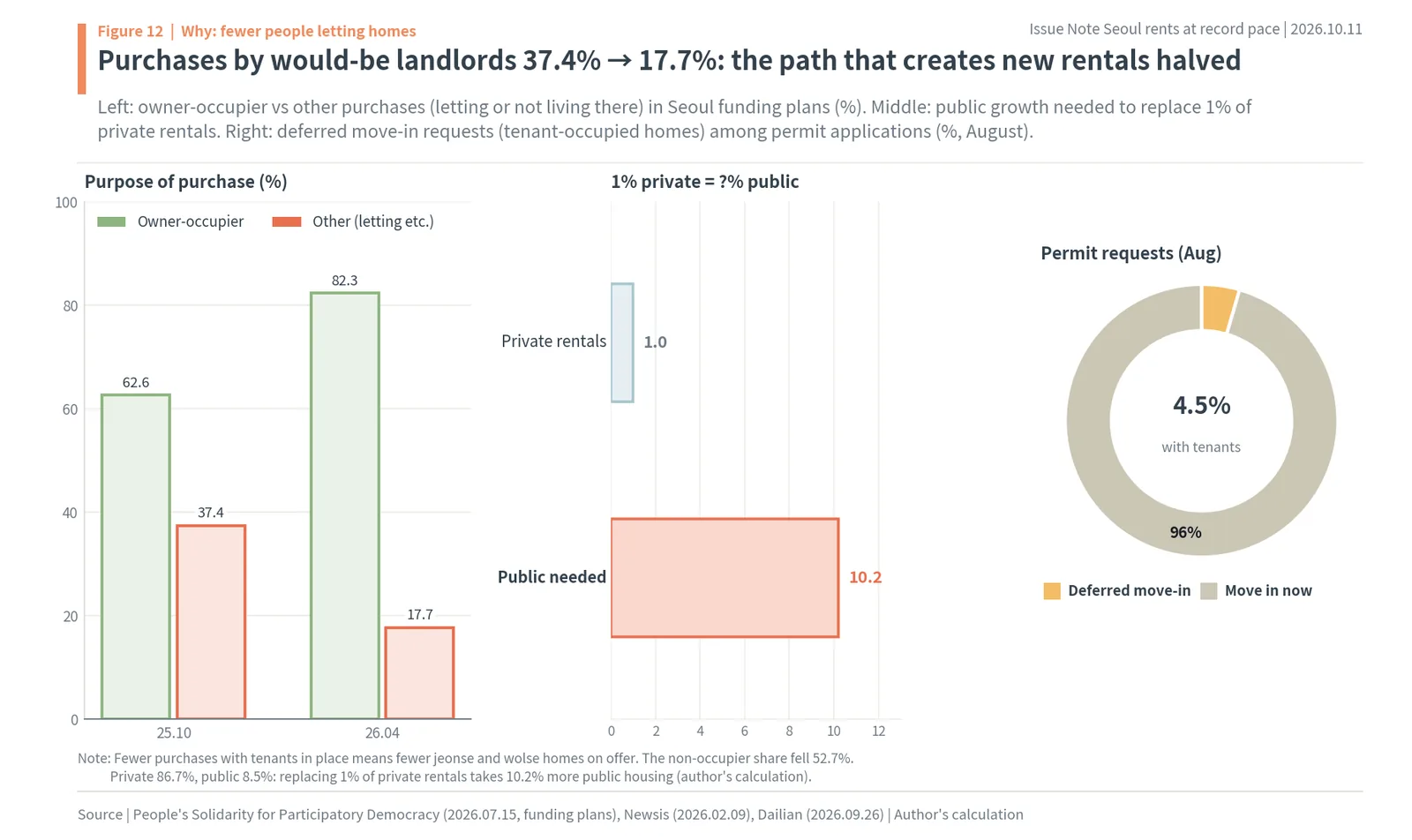
So rental homes are scarcer because the multi-home owners, registered landlords and buyers with tenants in place who used to supply them all shrank at once.
6. A 3.00% base rate and 26.8% fewer Seoul completions
A 3.00% base rate and the conversion rate
On top of the smaller rental stock, rates went up. The Bank of Korea raised its base rate from 2.50% to 2.75% on July 16, 2026 and again to 3.00% on August 27, its first back-to-back hikes in three years and seven months. Average jeonse loan rates at the big five banks (Korea Housing Finance Corporation disclosure, loans made September 28 to October 4) are 4.89% at Shinhan, 4.74% at NongHyup, 4.64% at Hana, 4.40% at KB Kookmin and 4.32% at Woori. The same disclosure in early July showed 3.89–4.31%, so after two hikes they are up about 0.4–0.6 percentage points.
When rates rise, landlords and tenants move in the same direction. Landlords decide monthly rent beats the interest from putting the deposit in a bank, and tenants choose wolse once jeonse loan interest approaches the rent. The Korea Real Estate Board’s apartment deposit-to-rent conversion rate was 4.74% in Seoul and 5.20% in the Seoul area in July 2026. The legal cap is the base rate plus 2 percentage points, 5.0%. The Seoul-area market rate is already above the legal cap. In July 2020, Seoul’s conversion rate was 3.96%.
Lending rules moved the same way. Under the October 15 measures, from October 29, 2025, the interest on a jeonse loan taken by someone who owns one home counts toward the DSR. In the Financial Services Commission’s example, a one-home borrower earning KRW 50mn a year who takes a KRW 200mn jeonse loan sees the DSR rise by up to 14.8 percentage points. People who own a home but rent on jeonse elsewhere for work get smaller loan limits and choose wolse accordingly. The June 27 measures also cut the guarantee ratio on jeonse loans in the Seoul area from 90% to 80%.
The left side of Figure 13 shows the Seoul and Seoul-area conversion rates and the base rate since January 2020. During the rapid rate rises of 2022–2023, the Seoul-area conversion rate topped 5%, and even when rates were cut in 2024–2025 it barely came down. As rates rose again in 2026, the Seoul-area rate climbed to 5.20%. The right side shows the big five banks’ jeonse loan rates.
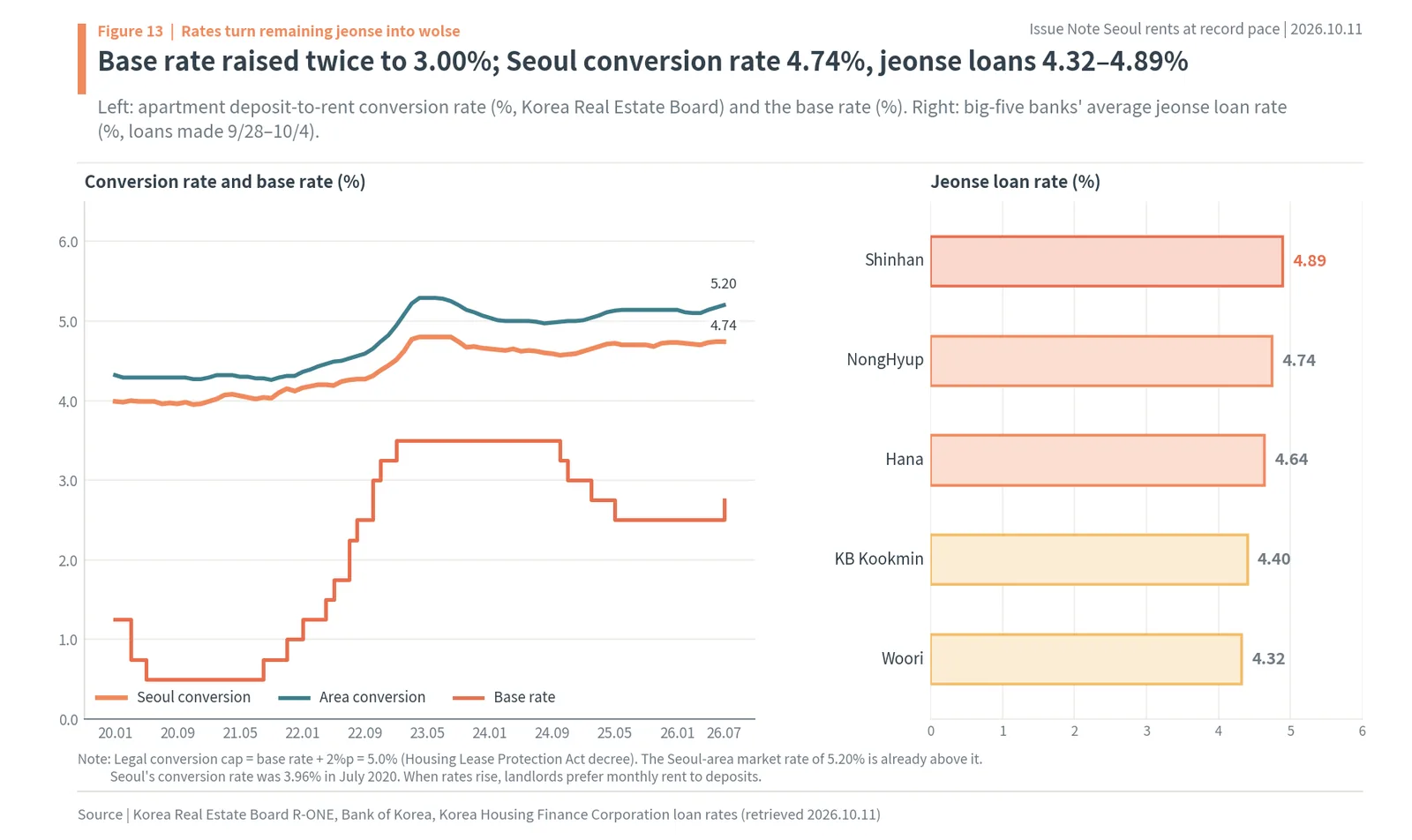
Seoul completions fell 26.8%
New completions are the base of the rental stock. When a new apartment complex opens, some buyers put their units up for jeonse to fund the final payment, and these units arrive at once and hold down nearby jeonse prices. On Korea Real Estate Board and R114 estimates, Seoul apartment completions fell 26.8% from 37,103 homes in 2025 to 27,158 in 2026, and 2027 will see 22,428. Seoul apartment completions in January–July were 17,603 homes, 48.7% fewer than a year earlier.
Fewer completions mean fewer new rentals. This is what the government means by “three years of short supply”, and this report accepts the drop in completions as the backdrop. But the drop is a trend running through all of 2026, while wolse growth turned upward in October 2025. Wolse turned up in autumn 2025, when Seoul completions were still running at about 37,000 a year, which means the trigger was pulled before the backdrop thinned. With the trigger pulled on a thinning base, growth jumped again from spring 2026.
Regional conversion rates and jeonse ratios point the same way. In July 2026, the apartment conversion rate was 5.47% in Gyeonggi and 5.40% in Incheon, above Seoul (4.74%). Converting a KRW 100mn deposit to rent yields KRW 5.47mn a year in Gyeonggi and KRW 4.74mn in Seoul. The average jeonse ratio (jeonse as a share of the sale price) in August was 62.9% in the Seoul area, 66.9% in Gyeonggi and 69.9% in Incheon, all above Seoul. In Seoul high sale prices make buying with a jeonse tenant hard, and in Gyeonggi and Incheon high conversion rates make landlords prefer wolse. Either way, fewer homes stay on jeonse.
Seoul’s jeonse ratio (average jeonse as a share of the average sale price) fell from 54.3% in August 2024 to 52.3% in August 2026, because Seoul apartment prices, up 86 weeks in a row through the fourth week of September, rose faster than jeonse. A low jeonse ratio means buying with a tenant in place takes more cash. The more sale prices rise, the harder it gets to buy with a tenant, and the narrower the source of rental homes.
The left side of Figure 14 shows Seoul apartment completions, and the right side the Seoul jeonse ratio.
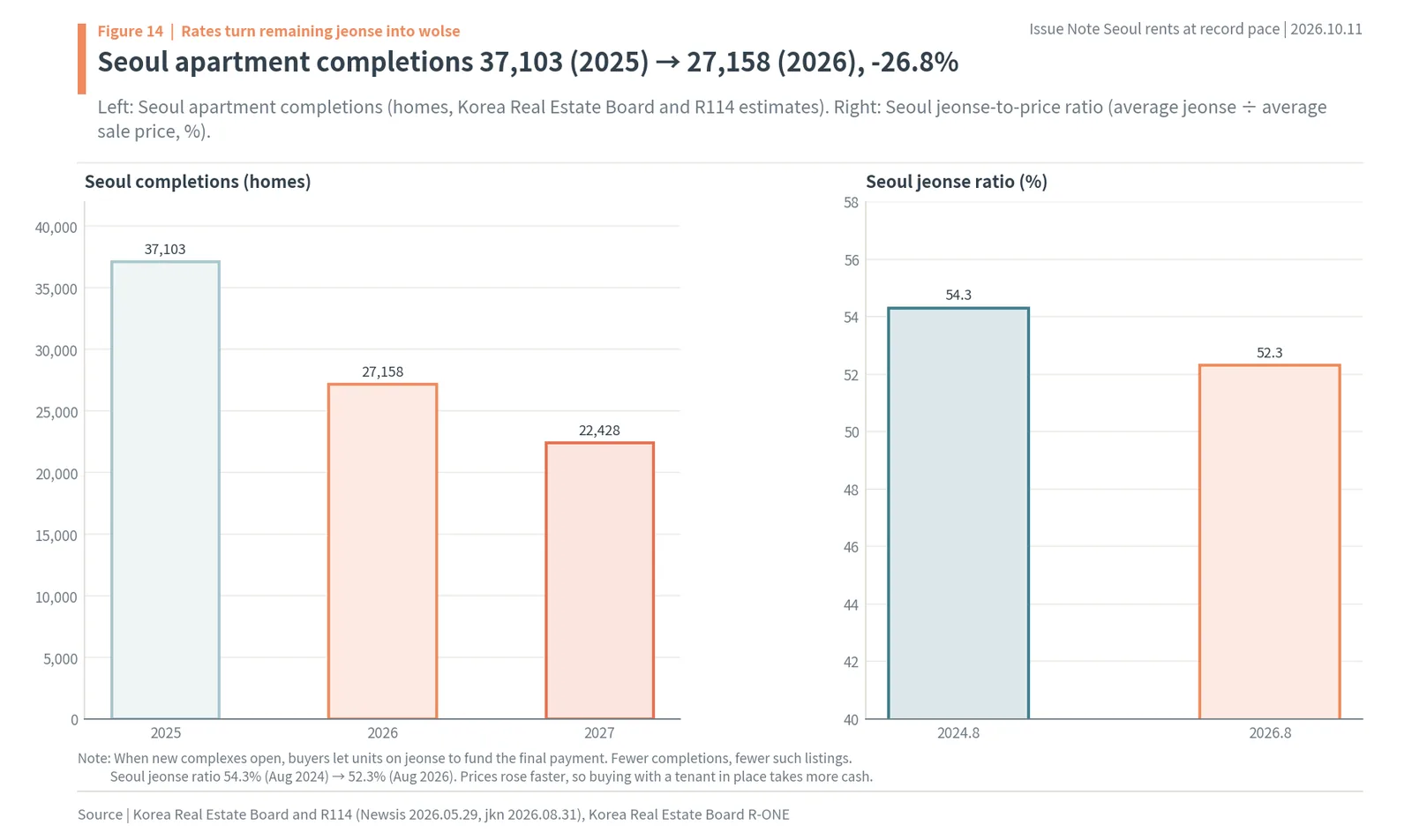
So on top of fewer landlords, rate rises and fewer completions are turning even the remaining jeonse homes into wolse.
7. Berlin, San Francisco, St. Paul and the UK: squeezing landlords shrinks rentals
Berlin: freezing rents cut listings by up to 60%
Policies that squeezed landlords have shrunk the rental stock elsewhere too, and it has been measured many times. The clearest case is Berlin, Germany. The state of Berlin put a rent freeze law (Mietendeckel) into force on February 23, 2020. It froze rents on homes built before 2014 at June 2019 levels and, from November 2020, required rents more than 20% above the cap to be cut. On March 25, 2021 the Federal Constitutional Court ruled that states had no power to make such a law and voided it entirely, publishing the ruling on April 15.
In that year or so, rental homes vanished. Germany’s ifo Institute found that Berlin’s rental listings fell by up to 60% and did not recover much even after the law was voided. The German Economic Institute (IW) in Cologne counted a drop of about 52% in rental ads. Rents on homes built after 2014, which were exempt from the freeze, rose faster than in other big cities. Owners of frozen homes sold them or left them empty instead of letting them, and tenants looking for what remained crowded into homes that were not frozen.
San Francisco and St. Paul: landlords left or stopped building
San Francisco extended rent control in a 1994 ballot measure to small multi-family buildings built before 1980. A Stanford team led by Professor Rebecca Diamond found that landlords brought under control cut their rental supply by 15% (American Economic Review, 2019). Landlords moved tenants out and converted units to condos, moved in themselves or redeveloped. The 2018 working paper version of the same study (NBER w24181) estimated that this supply drop pushed up rents citywide by 5.1%. Protected tenants gained, but the cost was paid by the next tenants looking for a home.
St. Paul, Minnesota, capped rent rises on all rental homes, including new ones, at 3% a year in a November 2021 ballot measure. In the six months after the law passed, residential permits fell to 352 units, 84% fewer than 2,180 in the same period a year earlier (Reason, citing US Department of Housing and Urban Development data). Kenneth Ahern and Marco Giacoletti estimated that the law cut St. Paul property values by 6–7%, $1.6bn in total (NBER w30083). In September 2022 the city council amended the law to give new construction a 20-year exemption.
The UK: higher taxes on individual landlords, then a push for Build to Rent
From 2017 to 2020 the UK phased out the deduction that let individual landlords subtract mortgage interest from rental income (Section 24). The estate agent Hamptons found that afterwards more landlords sold than bought, so the rental stock shrank, and rents rose fast in the meantime. What the UK grew to fill the gap was Build to Rent (BTR): apartments that institutional investors build and run for rent from the start. By Savills’ count, 18,000 BTR homes were completed in 2024, 8% of new homes in England and Wales (5% in 2019); the stock reached 146,700 homes in the fourth quarter of 2025, and 2025 investment hit a record £5.3bn.
The four cases share a sequence. First, the policy started from a wish to protect tenants. Second, with less reason to let, landlords sold, used the homes themselves or stopped building. Third, protected tenants gained, but with fewer rental homes the next tenants paid more. Fourth, the cities later amended the rules to bring back the people who supply rentals, with new-build exemptions (St. Paul) or support for institutional rentals (the UK). Korea is now between the second and third stages.
The left side of Figure 15 shows the measured change in rental supply or permits in cities that squeezed landlords, and the right side shows BTR’s share of new completions in the UK. The four cities’ policies capped rents directly, while Korea’s October 15 measures imposed a live-in duty on buyers, so the tools differ. But in both cases the people who supply rentals lost their reason to do so, and the results went the same way.
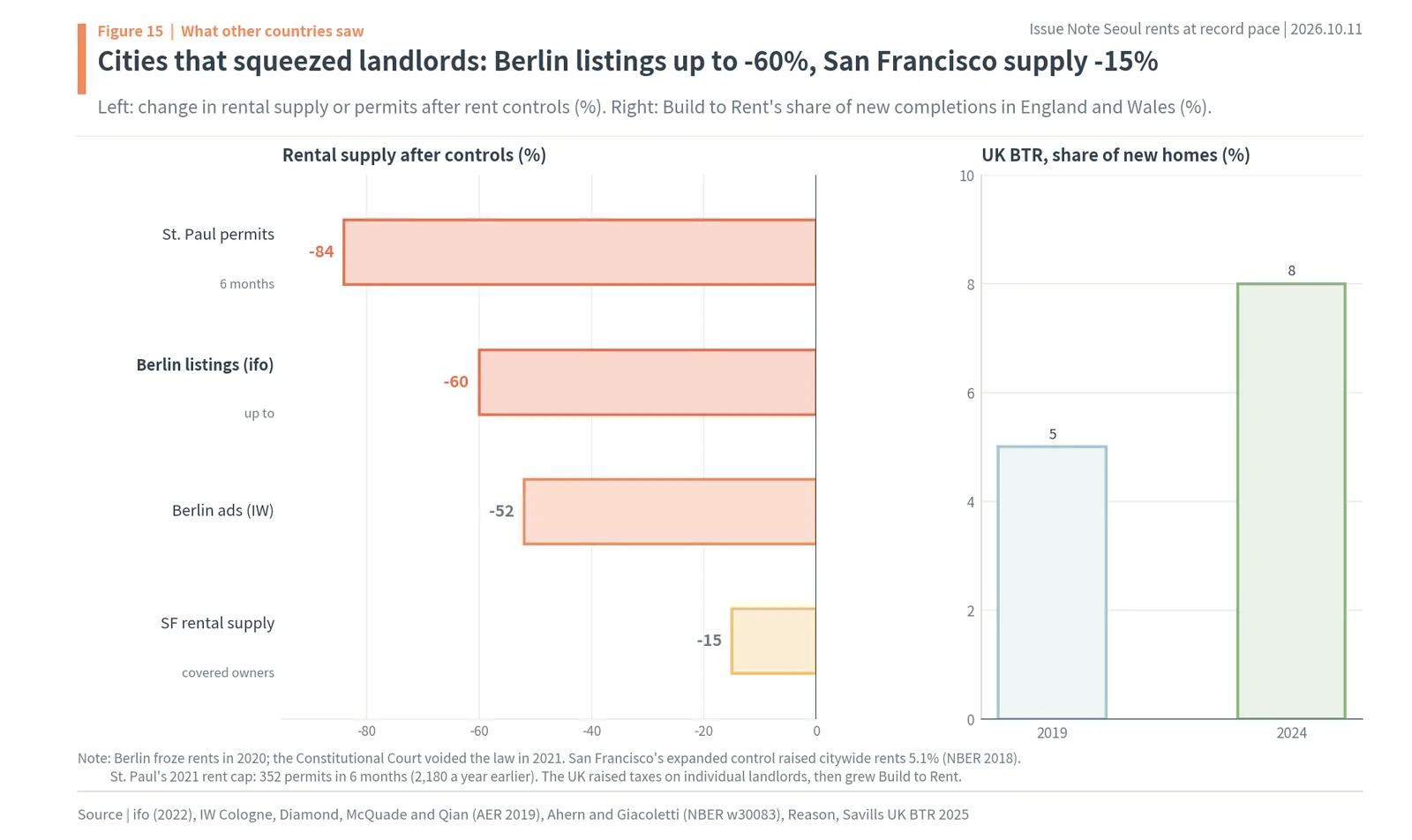
So abroad, too, squeezing landlords shrank the rental stock and raised rents on what remained, and the gap was filled by bringing in new suppliers such as institutional landlords.
8. Government vs opposition: short supply or fewer landlords
The government and ruling party point to short supply and a long-term decline in jeonse
On this issue the government and the ruling Democratic Party of Korea have a clear explanation. President Lee Jae-myung wrote in February 2026, in effect, that “if there are fewer multi-home owners, home prices and rents will stabilize”, and on February 8 he questioned a structure in which anyone registered as a rental business can collect any number of homes, asking for views on whether to keep allowing buy-to-let registration. Hong Ji-sun, who took office as Minister of Land, Infrastructure and Transport on September 23, told the parliamentary audit on October 7 that rising home prices stem from “short supply that has continued for three years”, and described the decline of jeonse as a “megatrend” driven by more one-person households and jeonse fraud. She disagreed that government policy is killing jeonse.
PSPD’s July 15 report offered evidence on the same side: Seoul apartment jeonse deals in the first quarter of 2026 numbered 32,000, more than 31,000 in the first quarter of 2021; the drop in non-apartment jeonse is an aftermath of jeonse fraud; and the rise in the owner-occupier share of purchases from 62.6% to 82.3% shows speculative demand has left. The government’s remedies follow this explanation: announcing new housing sites for at least 73,000 homes in the Seoul area within the year, the universal public rental housing and youth jeonse rentals in the August 13 measures, and the September 17 fix extending by a year, to the end of 2027, the deadline for buyers of tenant-occupied homes to request a deferred move-in.
The People Power Party and some academics say regulation shrank the rental stock
The other side’s explanation is just as clear. At the October 7 parliamentary audit, the opposition People Power Party blamed owner-occupancy-centered policy and pointed to a “triple rise” in sale prices, jeonse and wolse (Rep. Kim Jung-jae). Chief spokesman Park Sung-hoon said in February that if regulating multi-home owners shrank rental supply and rent instability returned, the president would be responsible, and floor leader Chung Jeom-sik said on August 4 that the burden of holding and capital gains taxes would be passed on to tenants.
Among academics, Professor Lee Chang-moo of Hanyang University (Seoul’s chief architect) said at the Seoul Housing Forum on October 7 that pressure on multi-home owners and non-resident one-home owners to sell, together with the permit zones, caused the sharp drop in rental listings and the rise in rents. There are similar voices inside the ruling party. At the private rental forum co-hosted by Reps. Bok Ki-wang and Kim Nam-geun on July 8, Kim Deok-rye of the Korea Housing Institute said registered private rentals and public rentals complement each other and proposed restoring the system, and Professor Jin Jang-ik of Chung-Ang University said it should be reconsidered whether rental suppliers are regulated in the same category as multi-home owners. The Land Ministry’s housing welfare policy director also spoke of “two pillars, public and private rentals”.
Four reasons the author sees fewer suppliers as the trigger
The author weighed the two explanations with numbers. The first is timing. Short supply is a trend running through all of 2026 as completions fell, but wolse and jeonse growth turned at the same time, in October 2025. All four lines, Seoul and the Seoul area, wolse and jeonse, turned in the same month. What began that month was the permit zone designation and the two-year live-in duty.
The second is shape. If demand were rising or jeonse were fading in a long-term trend, people would move from jeonse to wolse and one side would rise less. That is what happened in 2020–21. Now Seoul jeonse and wolse rise together, with jeonse at 1.07 times wolse. That is the shape that appears when the rental stock itself is short.
The third is the count of suppliers. The rising owner-occupier share that PSPD cited as evidence that speculation had left means, read the other way, that purchases by would-be landlords fell from 37.4% to 17.7%. Deferred move-in requests are only 4.5% of permit applications. The multi-ownership index has fallen below 16% for the first time in eight years, and registered private rentals fell by 160,000 homes in three years. All three sources of rental homes moved in the same direction.
Fourth, the long-term decline in jeonse that the government describes is real, but it was gradual. Calculations by The Economist (a Korean weekly) from the Korea Housing Survey microdata put wolse households at 28.8% of Seoul apartment renters in 2020, jumping to 38.4% in 2021, then 37.2% in 2022, 35.6% in 2023 and 38.1% in 2024, staying around 38% for three years. Across all households, the long-term trend had nearly stopped for four years. Yet among new leases, the Seoul apartment wolse share jumped 8.1 percentage points in a single year, from 43.9% in the first half of 2025 to 52.0% in the first half of 2026. When a slow stream suddenly speeds up in one year, the first place to look is what happened in that year.
These four point to the same place. So the author thinks that, on a backdrop of fewer completions, regulation that reduced the number of people letting homes pulled the trigger. Even if there is a long-term decline in jeonse, the current speed and shape cannot be explained by that trend alone.
9. The author’s view: a buy-to-let exception to the live-in rule
Remedy one: exempt buy-to-let purchases from the live-in duty
The Land Transaction Permit Zones covering all of Seoul and 12 areas of Gyeonggi expire on December 31, 2026, and whether they will be extended has not been decided. Minister Hong gave no answer on extension at the October 7 parliamentary audit. The author thinks that even if they are extended, the first step is to give the two-year live-in duty an exception for “purchases made to let”. There are three conditions: register the purchased home as a rental business, cap each rent rise at 5%, and let it for at least four years. Under these conditions, purchases made only to bet on prices and leave homes empty are filtered out, and only purchases that put rentals on the market come back.
The government already knows the direction. On September 17 the Land Ministry extended the deadline for buyers of tenant-occupied homes to request a deferred move-in from the end of 2026 to the end of 2027. But a deferral only postpones the move-in until the existing tenant’s lease ends, so it creates no new rental homes. That is also why deferred move-in requests are only 4.5% of permit applications. Only an exception for people who want to let will move the share of purchases with a tenant in place from 17.7% back toward the pre-measure 37.4%, putting that many more rentals on the market.
Remedy two: keep tax breaks for registered rentals that cap rents
The August 3 tax plan said it would phase out the capital gains tax surcharge exemption and the extra long-term holding deduction for buy-to-let apartments in adjustment target areas. It is a government proposal awaiting review by the National Assembly’s tax subcommittee. The author thinks this part should be halted, and registered rentals that keep the 5% rent cap and the minimum letting period should keep the surcharge exemption and the holding-tax aggregation exemption. From the tenant’s side, registered rentals are the homes whose rents rise least. Taxing the people who offer them like any other multi-home owner sends those homes onto the sales market or turns them into owner-occupied homes, and one rental home disappears.
Public rentals and more supply must go along with these remedies. But public rentals alone can hardly keep up with the loss of private rentals. Private landlords supply 86.7% of rental homes, so losing 1% of private rentals takes a 10.2% increase in public rentals. Just as the UK grew Build to Rent to 8% of new homes in 2024 after raising taxes on individual landlords, the gap will not open only if the people who supply rentals are replaced or kept rather than removed.
What the remedies should block and what they should keep
These remedies do not mean increasing multi-home ownership again. What should be blocked is multi-home ownership that supplies no rentals, that is, purchases made only for price gains and left empty or flipped short-term. What should be kept is multi-home ownership that supplies rentals, that is, landlords who take in tenants and cap rents. Today’s live-in duty and surcharges do not tell the two apart and squeeze both at once. That is why every exception the author proposes comes with the condition of supplying a rental. No registration, no exception; and anyone who raises rent by more than 5% or moves the tenant out within four years should have to repay the tax relief.
This approach overlaps with voices inside the ruling party. At the private rental forum held by Democratic Party lawmakers on July 8, Professor Jin Jang-ik said it should be reconsidered whether rental suppliers are regulated in the same category as multi-home owners, and Kim Sung-hwan, a research fellow at the Construction & Economy Research Institute of Korea, proposed tying post-deregistration holding-tax benefits to public obligations. The idea is to give benefits only to landlords who take on public obligations. The author’s remedy extends this idea to the live-in duty in the permit zones.
Two paths
The path forks depending on how the permit zones are handled on December 31. With a buy-to-let exception to the live-in duty, purchases with a tenant in place return, and jeonse homes reappear first in districts such as Dongdaemun, Guro and Jungnang, where listings fell 60–70%. As the renewal share falls and new leases increase, the gap between new and renewed lease prices narrows and growth comes down. If the zones are simply extended as they are, the path for supplying rentals stays as narrow as it is now. Seoul completions fall again, to 22,428 homes in 2027, and the remaining registered rental apartments are deregistered automatically in 2028, so the base of the rental stock thins further. If rates rise once more, the remaining jeonse will turn into wolse even faster.
Rent is passing 20% of income
Seen from the tenant’s side, it is clear why the remedies are urgent. In the Land Ministry’s Korea Housing Survey (2024, released in November 2025), the rent-to-income ratio (RIR) for renting households in the Seoul area is 18.4%. Since then, the average Seoul-area apartment rent has risen 9.9% in a year, so if incomes stayed the same, the same households’ ratio would be 20.2% (author’s calculation, assumption). One-fifth of income goes to rent. For Seoul apartments, average rent rose 14.4%, so the burden is growing faster still.
What the remedies mean for tenants
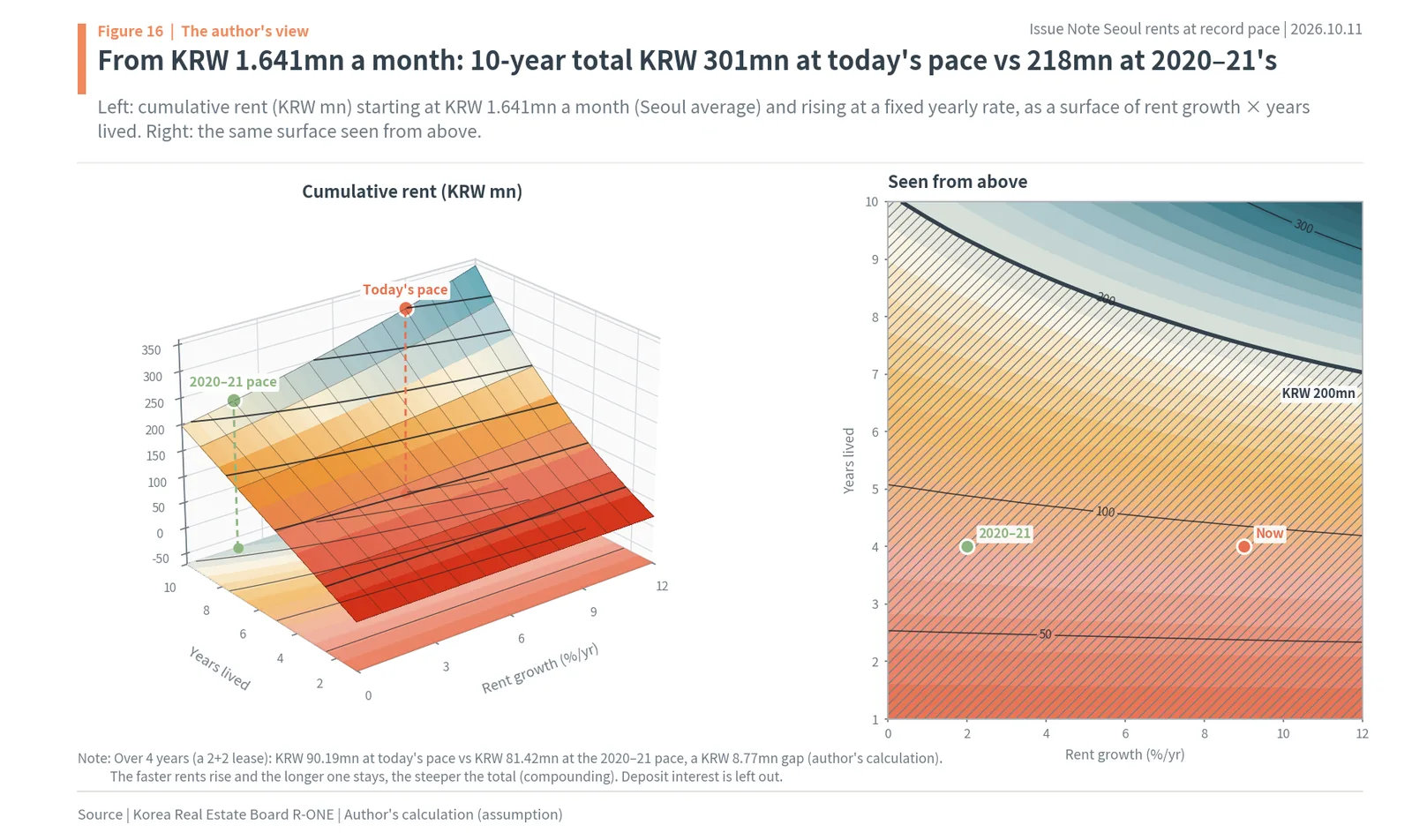
The value of the remedies shows in tenant Mr. Kim’s numbers. Starting from first-year rent of KRW 1.641mn a month and raising it at the same rate every year, Mr. Kim pays KRW 301mn (about $224,800) in rent over ten years at Seoul’s current pace (+9.1%). At the tenant-law year’s pace (+2.21%) he would pay KRW 218mn (about $162,800). Over just four years (a 2+2 lease), today’s pace costs KRW 90.19mn and the 2020–21 pace KRW 81.42mn, a KRW 8.77mn gap (author’s calculation, excluding deposit interest). The higher the growth rate and the longer one stays, the more the cumulative burden compounds.
The left side of Figure 16 draws this cumulative rent as a surface over rent growth and years lived, and the right side shows the same surface from above. The surface bends more steeply along the growth axis. If rentals increase again and growth comes down by just a few percentage points, the ten-year burden falls by tens of millions of won.
The order of the remedies also matters. The permit zones expire on December 31, so that is the first decision, and the live-in duty exception can be changed by enforcement decree, like the September 17 deferral extension, without waiting for the National Assembly. The tax breaks for buy-to-let rentals can be fixed when the regular session’s tax subcommittee reviews the August 3 tax plan. Public rentals and new housing sites take years, so the first two remedies must bridge the time in between. Building rental homes takes years, but getting existing homes onto the rental market takes just one rule.
The author thinks exempting buy-to-let purchases from the live-in duty and keeping tax breaks for registered rentals that cap rents is the fastest way to stop rents rising. A policy to reduce the number of people owning several homes and a policy to protect tenants are not the same policy. Rental homes come from landlords.
10. Residential REIT, builder and bank stocks: IGIS Residence REIT, Hyundai E&C, KB Financial
Each sector is exposed in a different place
As rents rise and rentals shrink, each sector is exposed in a different place. Residential REITs are on the side that collects rent. Among Korea’s listed REITs (real estate investment trusts traded on the stock exchange), the only one investing in housing is IGIS Residence REIT (350520.KS), whose core asset is The Sharp rental housing in Bupyeong, Incheon. Higher rents raise the rent it can charge at renewal, but higher rates push up both borrowing costs and discount rates, so the share price is more exposed to rates. The REIT has guided to a dividend of KRW 300 a share a year for 2024–2026; divided by the October 8 close of KRW 3,215 (about $2.40), that is 9.3% (author’s calculation, assuming the dividend holds). Among listed companies running institutional rentals, SK D&D operates about 7,000 homes under the “Episode” brand.
Among listed REITs, Lotte REIT (330590.KS) and SK REIT (395400.KS) center on commercial assets such as department stores, gas stations and offices, so they are not directly tied to residential rents. The listed stocks that capture rising residential rents are few: IGIS Residence REIT and SK D&D, which own or run rental housing directly. Average occupancy at SK D&D’s six Episode branches (about 4,000 homes) is around 90%. For institutional rentals to grow in Korea, tax breaks for those who let must stay, so these stocks may move with whether the author’s remedies are adopted.
Builders are on the supply side. The government has said it will announce new Seoul-area housing sites for at least 73,000 homes within the year and bring forward construction on public sites, so orders are at stake, and if institutional rentals grow, construction of rental apartments rises too. Banks are exposed through their jeonse loan and mortgage balances. As jeonse turns into wolse, jeonse loans shrink, and since one-home owners’ jeonse loan interest started counting toward the DSR, jeonse loan growth has slowed further.
On the rate side, banks sit where tenants’ and landlords’ costs land. The big five banks’ five-year fixed mortgage rates were 4.77–6.78% a year on October 8, with the low end up 0.70 percentage points from 4.07–6.67% at the end of January. Average jeonse loan rates are also 4.32–4.89%. Even if loan balances grow more slowly, high rates hold up interest income. The shift from jeonse to wolse shrinks banks’ jeonse loan balances and increases tenants’ monthly cash outflow.
Since October 15, builders and banks rose with the index while the residential REIT fell
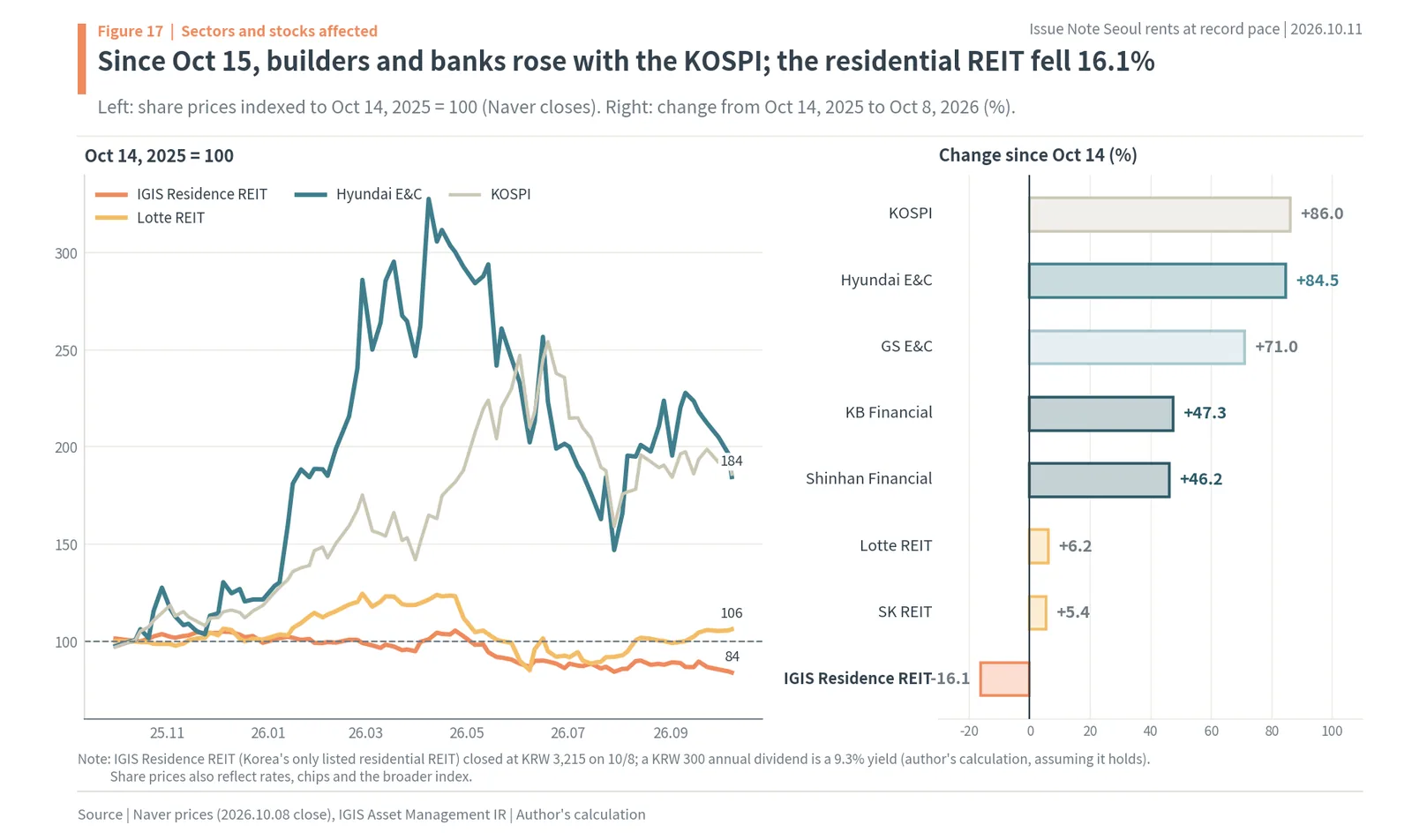
From October 14, 2025 (the day before the October 15 measures) to October 8, 2026, on Naver closing prices, the KOSPI (Korea’s main stock index) rose +86.0%, Hyundai E&C (000720.KS) +84.5%, GS E&C (006360.KS) +71.0%, KB Financial (105560.KS) +47.3%, Shinhan Financial (055550.KS) +46.2%, Lotte REIT +6.2% and SK REIT +5.4%, while IGIS Residence REIT fell −16.1%. October 8 closes were KRW 106,300 for Hyundai E&C, KRW 31,800 for GS E&C, KRW 68,000 for DL E&C (375500.KS), KRW 163,400 for KB Financial, KRW 100,000 for Shinhan Financial, KRW 4,135 for Lotte REIT and KRW 5,280 for SK REIT. Since September 1, Hyundai E&C is down −11.9% and Shinhan Financial −10.0%, correcting after big gains.
The left side of Figure 17 shows share prices indexed to October 14, 2025 = 100, and the right side shows the change over the same period. Share prices reflect many factors, such as rates, semiconductors and the overall index, so this figure is for picking sectors that may move with the rental market. The author sees one link: if the live-in duty gets an exception and registered rental benefits stay, those who build and run rental homes (builders and institutional rentals) get more work; if the zones are simply extended, only those who collect rent and those who collect interest are left.
11. Eight signals to watch
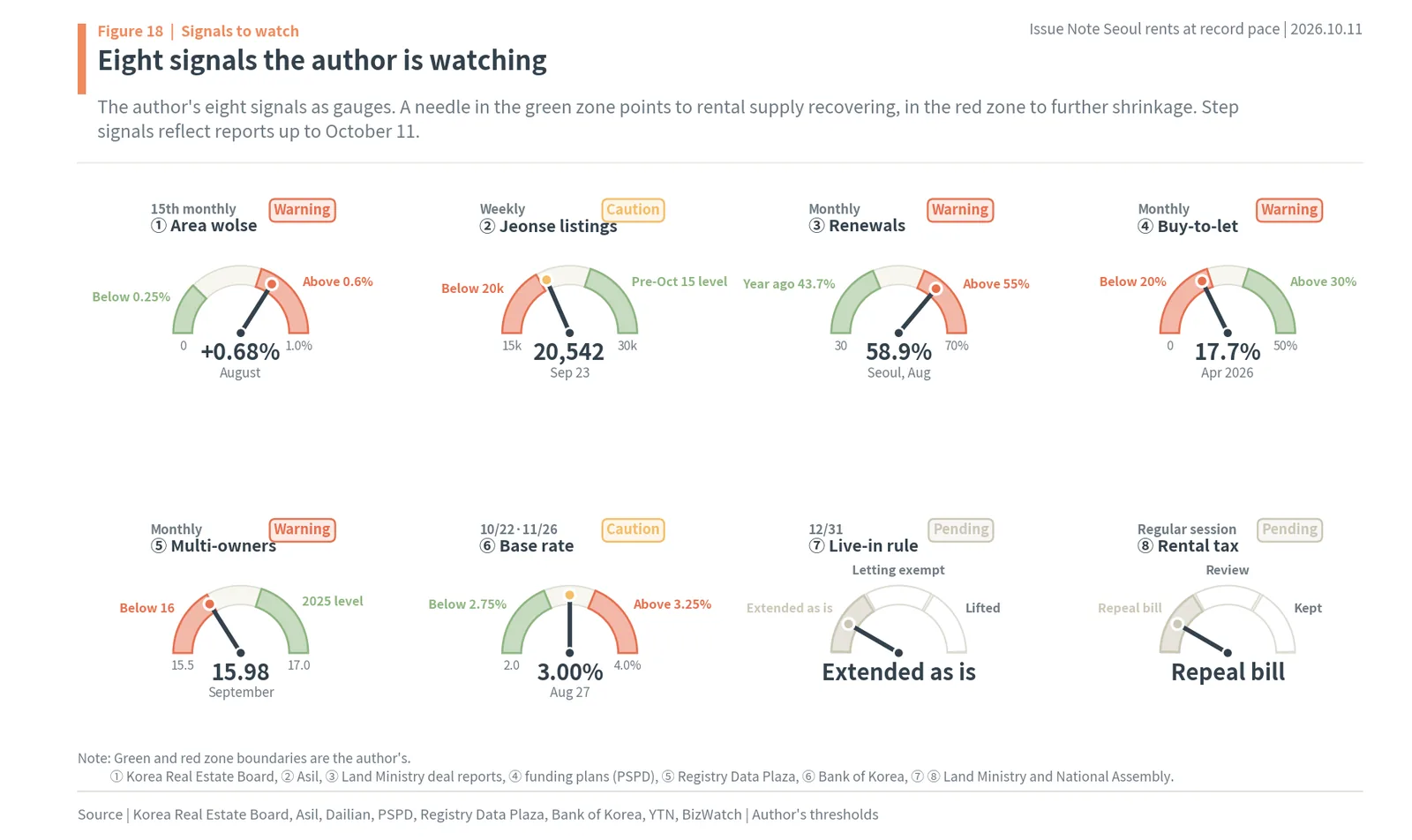
The author watches eight signals. First, monthly growth in Seoul-area apartment wolse, +0.68% in August. Second, Seoul apartment jeonse listings, 20,542 on September 23. Third, the renewal share of Seoul jeonse leases, 58.9% in August. Fourth, the share of purchases by would-be landlords in funding plans, 17.7% in April. Fifth, the multi-ownership index, 15.980% in September. Sixth, the base rate, 3.00% since August 27. The seventh and eighth are policy signals: whether a buy-to-let exception to the live-in duty is introduced when the permit zones are dealt with on December 31, and whether the National Assembly passes the repeal of the buy-to-let surcharge exemption as is.
Here is how to read them. If jeonse listings rise and the renewal share falls, new rentals are coming back. If the buy-to-let share and the multi-ownership index bottom out together, the number of people supplying rentals has stopped shrinking. If the base rate rises to 3.25%, the remaining jeonse will turn into wolse faster. Figure 18 draws the eight signals as gauges; the boundaries of the green and red zones are the author’s.
The gauge zones are set as follows (author’s criteria). Monthly Seoul-area wolse growth is green below 0.25% and red above 0.6%. Seoul jeonse listings are green above 24,000, the pre-October 15 level, and red below 20,000. The renewal share is green below 45%, near the year-earlier 43.7%, and red above 55%. The buy-to-let share is green above 30% and red below 20%. The multi-ownership index is green above 16.4%, the 2025 level, and red below 16%. The base rate is green below 2.75% and red above 3.25%.
12. Dates to watch: Oct 15 price data to the Dec 31 permit zone expiry
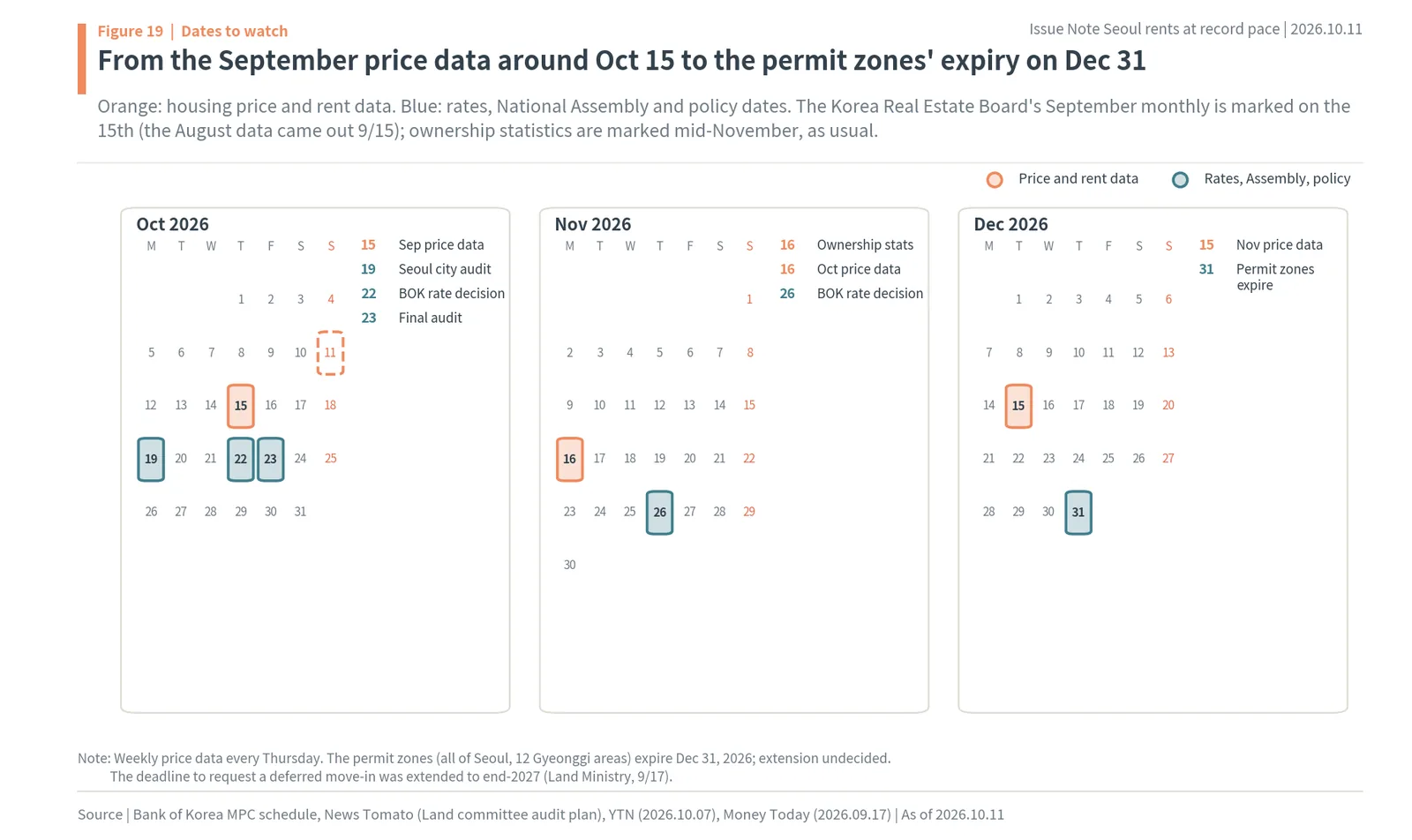
The nearest date is around October 15, when the Korea Real Estate Board’s September monthly housing price survey comes out; the August data came out on September 15, so the same day is marked. The first signal is whether Seoul-area wolse, which ranked among the all-time top five months from April to August, tops 0.6% again in September. On October 19 the National Assembly’s Land, Infrastructure and Transport Committee audits the Seoul city government, and the final audit is on October 23 (according to the audit plan reported by News Tomato). These are where the extension of the permit zones and a live-in duty exception will be raised.
On October 22 and November 26, the Bank of Korea’s Monetary Policy Board sets the base rate. A third hike would push up both the conversion rate and jeonse loan rates. In mid-November the National Data Office’s housing ownership statistics (for 2025) come out as usual, showing how much further the multi-home owner share fell. The regular session’s tax subcommittee reviews the buy-to-let provisions of the August 3 tax plan, and the permit zones expire on December 31. Beyond these, the Korea Real Estate Board’s weekly apartment price survey comes out every Thursday and shows jeonse trends first, and the deadline for buyers of tenant-occupied homes to request a deferred move-in has been extended to the end of 2027 by the September 17 fix. Figure 19 marks these dates on a calendar.
13. Methodology: rent indices, multi-ownership data and the author’s calculations
Indices and periods
All wolse and jeonse growth rates in this report are apartment indices from the Korea Real Estate Board’s monthly housing price survey. Wolse is the integrated wolse price index, combining wolse, semi-wolse and semi-jeonse, and jeonse is the jeonse price index; both were downloaded from R-ONE open data on October 11, 2026 for December 2019 to August 2026. The indices are based at June 2026 = 100. Because of base-period changes and sample adjustments, values may differ in the second decimal place from those reported in past articles. For example, June’s Seoul wolse growth was +1.11% in a Newsis article on July 31 and is +1.15% on current R-ONE values.
Monthly growth is each month’s index divided by the previous month’s. One-year growth is the change from the August 2025 index to the August 2026 index, and the tenant-law year is the change from July 2020 to July 2021. District and city “January–August” growth is the change from the January 2026 index to the August index, the same method as the Financial News article; measured from the start of the year (December 2025), the values are a little larger (Seoul wolse 6.69%, Nowon 11.1%). The before-and-after comparison around the October 15 measures is a simple average of monthly growth for the nine months of January–September 2025 and the 11 months from October 2025 to August 2026.
The monthly growth of Seoul-area apartment wolse used in the calculations, starting in January 2025, is: January +0.14%, February +0.14%, March +0.15%, April +0.08%, May +0.09%, June +0.13%, July +0.16%, August +0.17%, September +0.22%, October +0.35%, November +0.42%, December +0.46%, January +0.44%, February +0.40%, March +0.49%, April +0.61%, May +0.67%, June +0.74%, July +0.77% and August +0.68% (the first twelve are 2025 and the last eight 2026). Over the same period Seoul-area jeonse was: January −0.03%, February +0.01%, March +0.13%, April +0.06%, May +0.08%, June +0.13%, July +0.14%, August +0.10%, September +0.21%, October +0.36%, November +0.48%, December +0.55%, January +0.49%, February +0.40%, March +0.52%, April +0.63%, May +0.78%, June +0.89%, July +0.84% and August +0.78%. Rather than turning a table into a figure, they are written out here so the lines in Figures 3 and 8 can be retraced in numbers.
Average rent is the Korea Real Estate Board’s “average monthly rent (apartments)”, published in thousands of won and divided by 10 to give units of 10,000 won in the Korean original. The sample changed in April 2025, creating a break in which the Seoul average jumps KRW 58.5k between March and April, so the figure starts in April, and the one-year comparison (August 2025 → August 2026) falls after the break.
The multi-ownership index and purchase purpose
The multi-ownership index, published by the court Registry Data Plaza, is the share of owners of multi-unit buildings (apartments, officetels, row houses and multiplexes) who own two or more units. Detached houses are excluded. The values 16.69 for August 2020, 16.381 for December 2025 and 15.980 for September 2026 are as reported by Herald Economy (October 11), and 16.698 for July 2020, 16.529 for July 2024, 16.469 for May 2025, 16.345 for January 2026 and 16.019 for August 2026 as reported by Gyeongbuk Maeil (September 28). Both articles cite the Registry Data Plaza, and their peak months differ by one month.
The share of purchases by would-be landlords is 100 minus the owner-occupier share in the Seoul funding-plan data compiled by PSPD on July 15 (62.6% in October 2025, 82.3% in April 2026). Non-owner-occupier purchases include both purchases to let and purchases not to live in, so the author reads this share as an upper bound on “purchases that could be let”.
The author’s calculations
Hypothetical tenant Mr. Kim’s renewal path starts from Seoul’s average rent of KRW 1.641mn in August 2026 and multiplies it each year by Seoul’s one-year wolse growth (+9.1%) or the tenant-law year’s growth (+2.21%). The four-year total adds 12 months of rent for each of the first to fourth years (KRW 90.19mn and KRW 81.42mn). The surface computes cumulative rent the same way on a grid of annual growth from 0% to 12% (in 0.5-point steps) and years lived from 1 to 10. Deposit interest and the 5% renewal cap are not included.
The conversion comparison is a KRW 400mn jeonse home converted to wolse with a KRW 100mn deposit. Multiplying the remaining KRW 300mn by Seoul’s July 2026 apartment conversion rate of 4.74% and dividing by 12 gives KRW 1.184mn a month. Jeonse loan interest is KRW 300mn times the big five banks’ average rate (the average of 4.40, 4.32, 4.64, 4.74 and 4.89%, 4.60%) divided by 12, KRW 1.150mn. The multiple needed to replace 1% of private rentals with public ones is 86.7 ÷ 8.5 = 10.2. The 160,000-home three-year fall in registered private rentals ÷ Seoul’s 27,158 completions in 2026 = 5.9 years.
Share prices compare Naver daily closes on October 14, 2025 (the day before the October 15 measures) and October 8, 2026. The 9.3% dividend yield is IGIS Residence REIT’s guided KRW 300 a year divided by the October 8 close of KRW 3,215, assuming the dividend holds.
Maochaedung’s take. Seoul-area apartment wolse rose faster from April to August 2026 than at any time since 2015, and jeonse is rising at almost the same pace, which means the rental stock itself has shrunk. The turn came in October 2025, when the permit zones and the two-year live-in duty blocked buying with a tenant in place, purchases by would-be landlords halved, multi-unit owners fell to an eight-year low and registered rentals kept disappearing; rate hikes and fewer completions came on top. The author thinks the fastest fix is to exempt buy-to-let purchases from the live-in duty when the permit zones expire on December 31 and to keep tax breaks for registered rentals that cap rents, because rental homes come from landlords.
Seoul rent surge FAQ
Q. What is the difference between jeonse and wolse in Korea?
Under jeonse, the tenant pays a large lump-sum deposit, pays no monthly rent and gets the deposit back at the end of the lease. Under wolse, the tenant pays a smaller deposit plus monthly rent. Wolse was 52.0% of Seoul apartment leases in the first half of 2026, over half for the first time.
Q. How fast are Seoul rents rising in 2026?
On the Korea Real Estate Board’s apartment wolse index, Seoul-area rents rose +0.77% in July 2026, the fastest month since the data began in 2015, and April to August were the five fastest months. Seoul rose 9.1% in a year, and the average Seoul apartment rent reached KRW 1.641mn a month in August.
Q. Why are Seoul rents rising so fast?
Both jeonse and wolse are rising together, which points to a shortage of rental homes. The turn came in October 2025, when all of Seoul became a Land Transaction Permit Zone with a two-year live-in duty, blocking purchases with a tenant in place; such purchases fell from 37.4% to 17.7%. Rate hikes and fewer new completions added to it.
Sources
- Korea Real Estate Board, R-ONE open API: apartment integrated wolse and jeonse price indices, average rent and deposit, jeonse ratio, conversion rate (link), retrieved 2026.10.11
- Financial News, Jeonse and wolse both jump, an unprecedented rental market (link), 2026.10.10
- Herald Economy, Owners of two or more homes at an eight-year low (link), 2026.10.11
- Gyeongbuk Maeil, Multi-ownership index for multi-unit buildings (link), 2026.09.28
- Money Today, Average Seoul apartment rent KRW 1.64mn (link), 2026.09.27
- Newsis, Wolse share of Seoul apartment leases in the first half (link), 2026.07.31
- Newsis, Wolse share in April housing statistics (link), 2026.05.29
- Etoday, Land Ministry wolse share trend (link), 2026
- Dailian, Seoul apartment jeonse listings and renewal share (link), 2026.09.26
- News1 (republished by twig24), Seoul jeonse listings at 19,940 (link), 2026.09.01
- KB Kookmin Bank, KB Housing Market Review, September 2026 (link), 2026.09.16
- jkn, Korea Real Estate Board and R114 completion estimates (link), 2026.08.31
- Korea Housing Finance Corporation, Jeonse loan guarantee rate disclosure (link), retrieved 2026.10.11
- Bank of Korea, Monetary Policy Board meeting schedule (link), retrieved 2026.10.11
- Financial News, The 7% mortgage era (link), 2026.10.11
- Financial News, Korea Housing Institute study of multi-home owners (link), 2026.07.11
- Segye Ilbo, 45.7% of multi-owned homes are not apartments (link), 2026.07.13
- MTN, Forum on expanding private rental supply (link), 2026.07.08
- Newsis, Buy-to-let review and private rentals at 86.7% (link), 2026.02.09
- Newsis, End of the multi-home capital gains surcharge deferral (link), 2026.02.12
- Money Today, Deferred move-in deadline extended in permit zones (link), 2026.09.17
- YTN, Minister Hong Ji-sun at the parliamentary audit (link), 2026.10.07
- MTN, Land Ministry parliamentary audit (link), 2026.10.07
- BizWatch, Professor Lee Chang-moo at the Seoul Housing Forum (link), 2026.10.07
- Herald Economy, The president’s remarks on multi-home owners and the People Power Party’s response (link), 2026.02.21
- MTN, Ruling and opposition reactions to the tax plan (link), 2026.08.04
- People’s Solidarity for Participatory Democracy, Diagnosis of the rental market (link), 2026.07.15
- Dealsite, Land Ministry answers at the parliamentary audit (link), 2026.10.07
- Financial News English, August 13 public rental measures (link), 2026.08.25
- News Tomato, Land committee audit plan (link), 2026.09.26
- ifo and others, Berlin rent freeze and listings (link), 2022
- IW Cologne, Supply side effects of the Berlin rent freeze (link)
- Diamond, McQuade and Qian, The Effects of Rent Control Expansion (link), AER 2019
- Ahern and Giacoletti, Robbing Peter to Pay Paul? (link), NBER w30083
- Reason, St. Paul permits (link), 2022.06.23
- Savills, UK Build to Rent market update (link), 2025
- Naver Finance, daily prices (link), 2026.10.08 close
- Yahoo Finance, KRW/USD rate (link), 2026.10.08 close