
France Protests 2026: Why Students Are Blocking Schools and Which Stocks Benefit (Munich Re, SCOR)
The bill for France’s protests lands on insurers, and reinsurers turn it into a price. A school blockade in Créteil grew into a nationwide movement of 256,000 marchers on October 6, 2026, rooted in a 4.87% bond yield and EUR 54bn of austerity. This report traces why France is protesting, who loses (AXA, Vinci, retailers, airlines) and why the author ranks reinsurers Munich Re and SCOR on the benefiting side. Numbers as of October 11, 2026.
- France’s 2026 school blockades began in Créteil on September 17–21 and grew to 256,000 marchers on October 6 (Interior Ministry), with classes halted at 891 of 3,700 lycées and 6,629 arrests by October 7.
- The root is debt: the French 10-year yield hit 4.87% on September 30 (spread over Germany 124bp), and the 2027 draft budget saves EUR 54bn; extra interest on EUR 340bn of new bonds is about EUR 4.32bn a year, 2.2x the EUR 2bn pay-freeze saving (author’s calculation).
- In all five protest waves since 2018, AXA and Vinci lagged the CAC 40; AXA’s average was -3.8 points, and since September 18 it is down 7.2% vs the CAC 40’s -3.2%.
- Insured riot losses grew from about EUR 198mn (2005) to EUR 217mn (yellow vests) and EUR 793mn (Nahel 2023); repeated losses push up premiums and January reinsurance rates.
- The author’s watch order is Munich Re → SCOR: Munich Re beat the DAX in 4 of 5 first-five-day windows and trades at 10.1x forward EPS of EUR 51.62; SCOR is at 7.0x with a 5.95% yield. No Korean stock benefits directly.
Key takeaways
- A school blockade that began at a high school in Créteil in September 2026 grew into a nationwide protest of 256,000 people on October 6 (Interior Ministry count) and 6,629 arrests in total. The root is public debt. With the 10-year government bond yield at 4.87%, the government proposed EUR 54bn of savings for 2027, and the knife reached teaching posts and civil-service pay.
- Primary insurers and street-facing businesses take the losses first. In each of the last five protest waves, AXA (CS.PA) and Vinci (DG.PA) did worse than the CAC 40, and this time too AXA fell 7.2% after September 18, more than the CAC 40 (-3.2%).
- The author sees reinsurers, which raise prices as losses pile up, on the benefiting side. Munich Re (MUV2.DE) beat its index in four of five protest waves over the first five trading days and trades at 10.1 times forward EPS of EUR 51.62. The author’s watch order is Munich Re → SCOR (SCR.PA), and no Korean stock benefits directly from the French protests.
As of: October 11, 2026
Stocks covered: Munich Re (MUV2.DE), SCOR (SCR.PA), AXA (CS.PA), Vinci (DG.PA), Fnac Darty (FNAC.PA), Carrefour (CA.PA), Meliá (MEL.MC) and other European listed companies, plus Korean travel and airline stocks
Reference closes: European stocks at the October 9, 2026 close (Yahoo Finance); Korean stocks at the October 8 close (Naver Finance; Korean markets were closed on October 9 for Hangul Day). Currency conversions use EUR 1 = KRW 1,500.2 and EUR 1 = $1.12 (1.1206), the October 9, 2026 rates.
This is the author’s personal analysis and view.
The author’s calculations and estimates are not confirmed facts.
Summary: the bill for France’s protests lands on insurers, and reinsurers set the price
This report looks at why France is protesting in 2026 and which stocks gain or lose from it, based on public data, market prices and the author’s calculations. It asks two questions. Why are French streets loud again right now? And who pays for the disorder, and who turns that cost into a price they can charge?
The answer to the first question is debt. France’s public debt stood at 115.6% of GDP at the end of 2025 (EUR 3.46 trillion), and in autumn 2025 Fitch and S&P cut the country’s rating from AA- to A+. On September 30, 2026 the French 10-year government bond (OAT) yield was 4.87%, up 1.13 percentage points in a single quarter, and the spread over Germany was 124 basis points, the widest since 2012. On October 1 the government’s 2027 draft budget proposed EUR 54bn (about $60.5bn) of savings, and the prime minister himself said interest costs would rise by EUR 10bn. By the author’s simple calculation, if the EUR 340bn of new bonds France issues in 2027 are sold at 4.87% instead of the year-earlier rate (about 3.6%), interest costs rise by about EUR 4.32bn every year. The government saves about EUR 2bn by freezing civil-service base pay again in 2027, so the extra interest on new debt alone is 2.2 times that saving.
The knife of austerity reached classrooms and pay packets. The 2026 budget cut 4,000 teaching posts, and the 2027 draft cuts 1,588 more. The point d’indice, the base value used to calculate civil-service pay, has been frozen at EUR 4.92 since July 2023. On top of that, diesel prices rose more than 31% after the war between the US and Israel and Iran began in February 2026, to EUR 2.347 a liter, and unemployment among 15- to 24-year-olds is 21.6%. From September 17 to 21, a solidarity strike against unfilled teaching posts at Saint-Exupéry high school in Créteil hardened into a blockade, and by October 1 the protests were rough enough for 1,948 arrests in a single day. On October 6, classes stopped at 891 of France’s 3,700 lycées (high schools), and five unions announced a strike for November 5 that would halt the public and private sectors together.
The answer to the second question is insurance. When protests turn violent, the losses from burned cars, smashed shops and blocked roads land first on primary insurers. Insured losses were EUR 217mn during the 2018–2019 yellow-vest (gilets jaunes) protests and EUR 793mn during the 2023 Nahel riots, four times the 2005 riots. Stock prices point the same way. Across all five waves, the yellow vests, the 2023 pension strikes and Nahel riots, the September 2025 “Block Everything” (Bloquons tout) movement and the current wave, AXA and Vinci (motorways and construction) did worse than the CAC 40, the benchmark index of 40 large Paris-listed companies. AXA’s five-wave average is -3.8 percentage points.
When losses repeat, premiums rise. After the yellow vests, plans emerged to raise shop insurance premiums in big cities by 100–150%, and after the 2023 and 2024 riots Allianz and Groupama cut riot cover in France’s overseas territories. Large losses that primary insurers cannot carry alone pass to reinsurance, and reinsurers raise rates at the next renewal. So the author’s view is that primary insurers receive the bill for the protests, and reinsurers turn that bill into a price. Munich Re beat the DAX in four of the first five trading days of the five protest waves (average +1.5 percentage points), and in the current wave it is up 3.6% since September 18, a 10.8-point gap over AXA (-7.2%). Its P/E on forward EPS of EUR 51.62 is 10.1 times, and its dividend yield is 4.65%.
No Korean stock benefits directly from the French protests. Korean travel stocks (Modetour, Yellow Balloon, Very Good Tour) trailed their index by 13 to 20 percentage points, but the drop came on September 18, before the protests grew, and the author found no evidence that Hanwha Vision has won a French public-security contract. This report goes through the causes of the protests, their size, the companies that lose, insurance and reinsurance, customers moving to competitors, valuations, Korean stocks, and signals and dates, in that order.
1. Key terms: blocus, point d’indice, primary insurance and reinsurance
Blocus, point d’indice, primary insurance and reinsurance
First, the terms that come up often in this report. A blocus (blockade) is the French form of high-school protest in which students block the school gates with bins and metal barriers to stop classes. This wave began from September 17 to 21 at Saint-Exupéry high school in Créteil, southeast of Paris, where a solidarity strike against unfilled teaching posts hardened into a blockade. There was no single trigger such as a police shooting, and no deaths had been reported as of October 11.
The point d’indice is the base amount used to calculate French civil servants’ monthly pay. It rose 1.5% in July 2023 and has been frozen at EUR 4.92 since then; Prime Minister Sébastien Lecornu said on September 17 that it will stay frozen in 2027. The freeze saves about EUR 2bn. With September inflation at 3%, the freeze means real pay is cut every year.
A primary insurer is a company that directly covers losses on homes, shops and cars. France’s AXA and Germany’s Allianz are the leading examples. A reinsurer is a company that takes a share of the large losses primary insurers cannot carry alone; Germany’s Munich Re, Hannover Re, Switzerland’s Swiss Re and France’s SCOR are in this group. A primary insurer pays part of its premiums to reinsurers and gets part of its losses back when a big event happens. Most reinsurance contracts renew on January 1 each year, and if that year’s losses were large, the next year’s rates go up.
An event study measures how much a stock rose or fell relative to the market around an event. This report calculated, for each of five protest waves, the stock’s return minus its home index’s return (excess return, in percentage points). French stocks are compared with the CAC 40, German stocks with the DAX, Spanish stocks with the IBEX 35, and US stocks with the S&P 500.
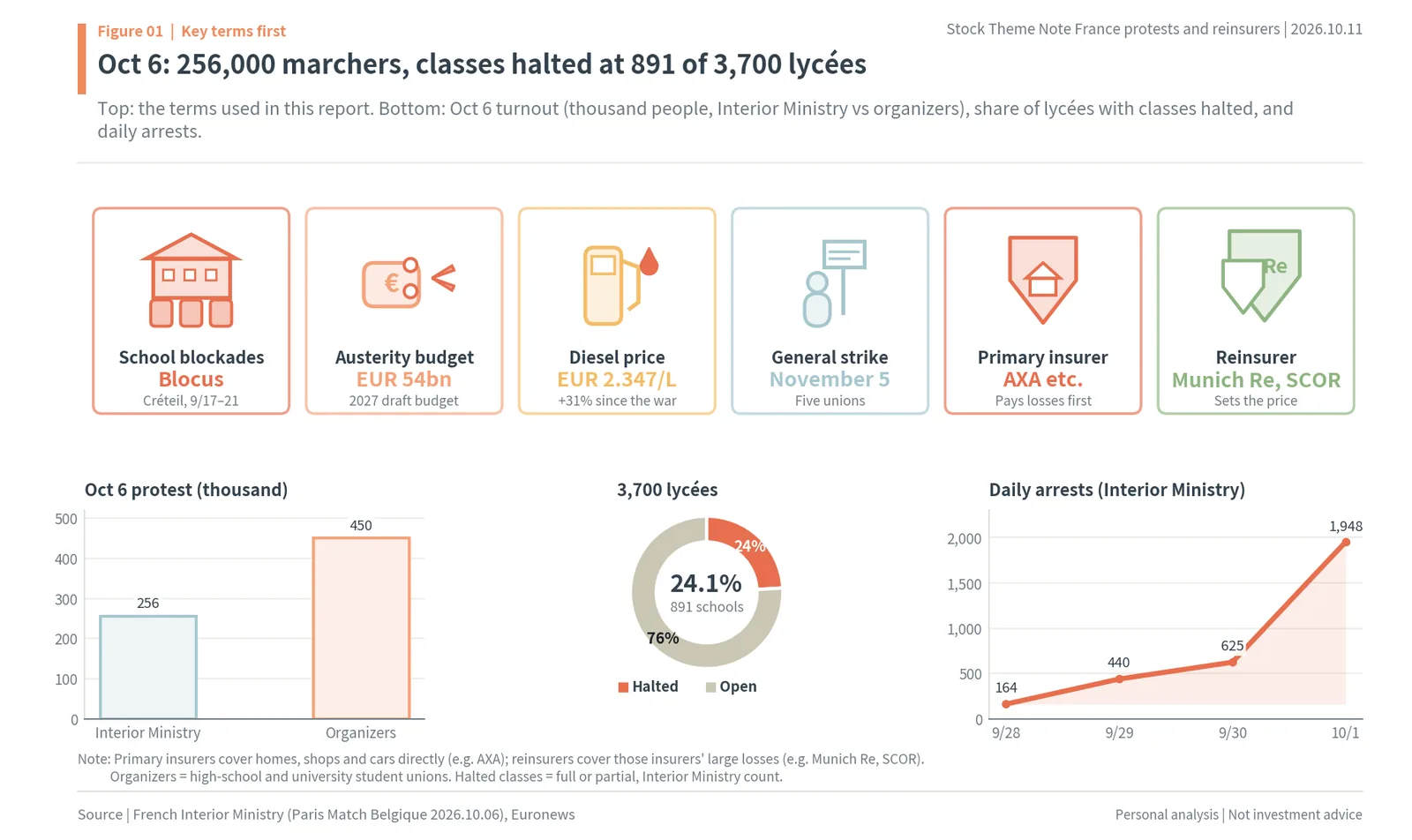
The top of Figure 1 puts these terms into pictures. Bottom left is the October 6 turnout: 256,000 by the Interior Ministry’s count and 450,000 by the organizers, the high-school and university student unions. The middle shows the share of lycées where classes stopped in full or in part that day: 891 of 3,700 (24.1%). On the right are the Interior Ministry’s daily arrests, which climbed fast from 164 on September 28 to 440 on September 29, 625 on September 30 and 1,948 on October 1.
A hypothetical example: a phone shop in Lyon
Here are the numbers applied to a single shop. Mr. Dupont, the owner of a hypothetical phone shop in Lyon, has a comprehensive shop policy with AXA. If his window is smashed and his stock disappears on a night of protest, he files a claim with AXA. When hundreds of such claims arrive from the same city on the same day, AXA’s losses swell all at once, and under the reinsurance treaties it arranged in advance, AXA claims the part above a set limit from Munich Re or SCOR.
Things change at the January renewal. A reinsurer that took losses raises its rates for French urban shop risk, and AXA passes that cost on in Mr. Dupont’s premium. After the yellow vests, plans to raise big-city shop premiums by 100–150% actually emerged. Primary insurers take the loss first, and reinsurers raise the price first. This report’s call on who benefits comes from that sequence.
2. Why France is protesting: a 4.87% bond yield and EUR 54bn of austerity
A 4.87% bond yield, up 1.13 points in a quarter
The root of this protest wave lies not in the classroom but in the bond market. France’s public debt was 115.6% of GDP, EUR 3.46 trillion, at the end of 2025. The French Economic Observatory (OFCE) expects it to rise further to 119.8% in 2027. Fitch on September 12, 2025 and S&P on October 17, 2025 cut France’s rating from AA- to A+, and Scope cut it to the same grade on September 18, 2026. Moody’s keeps Aa3 but with an outlook that allows a future cut.
As the rating fell, the cost of borrowing rose. On September 30, 2026 the French 10-year yield was 4.87%, up 1.13 percentage points over the third quarter, the biggest quarterly rise since 1987 (Reuters). The same day, the spread over the German 10-year was 124bp, the widest since the 2012 European debt crisis. A year earlier, in early October 2025, the French 10-year was about 3.6% and the spread around 86bp. A wider spread means France pays more to borrow than Germany, even though both use the same euro.
Extra interest on new debt is 2.2 times the pay-freeze saving
On October 1 the government presented its 2027 draft budget to the Council of Ministers. It saves EUR 54bn in total in 2027, of which EUR 43bn comes from new measures and EUR 12bn from the effect of 2026 measures, about 2% of GDP. The goal is to cut the budget deficit from 5.4% of GDP at the end of 2026 to 5.0% in 2027. The prime minister said that without any action the deficit would reach 6.5%, because social spending would rise by EUR 22bn, interest by EUR 10bn and local running costs by EUR 7bn.
The growth outlook is not generous either. The government assumes 1.0% growth in 2027 (0.5% in 2026), but the Banque de France sees 0.9% and OFCE 0.7%. The deficit fell from 5.8% of GDP in 2024 to 5.1% in 2025 and is expected to rise again to 5.4% in 2026. According to Reuters, interest costs will be EUR 5bn higher in 2026 and EUR 7bn higher in 2027 than forecast a year ago. Slow growth means less tax revenue and higher rates mean more interest, so meeting the same deficit target requires deeper spending cuts.
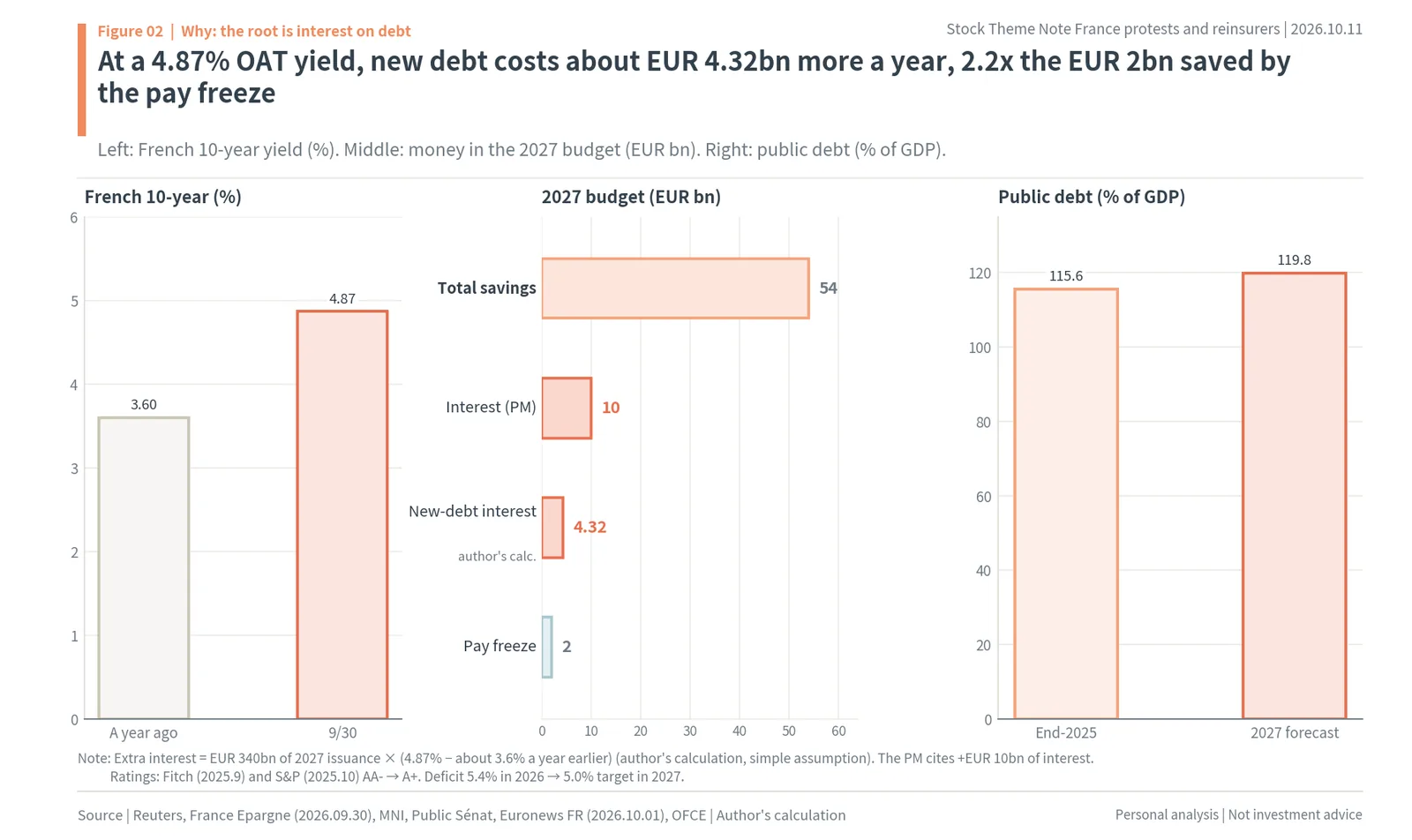
The author ran the interest numbers a second way. France’s debt agency (Agence France Trésor) plans to issue a record EUR 340bn of bonds in 2027. Borrowing that money at today’s 4.87% instead of the year-earlier rate of about 3.6% adds EUR 340bn × 1.27 percentage points, about EUR 4.32bn, in interest every year (author’s calculation, on the simple assumption that all new bonds are issued at the 10-year rate). The government saves about EUR 2bn by freezing the point d’indice again in 2027, so the extra interest on new debt alone is 2.2 times the pay-freeze saving. Whatever the debt’s interest adds has to be cut elsewhere, and that elsewhere was teachers and civil servants.
Figure 2 shows, on the left, the French 10-year yield a year ago and on September 30; in the middle, the money in the 2027 budget (total savings, the extra interest the prime minister cited, the author’s calculated extra interest on new debt, and the pay-freeze saving); and on the right, public debt as a share of GDP. The middle bars show at a glance that the extra interest is far larger than what the pay freeze saves.
Why cutting the debt led to the streets
In numbers, austerity is 2% of GDP, but for people it is concrete. The education budget rises by EUR 1.2bn to EUR 64bn in 2027, yet teaching posts are cut, citing falling pupil numbers. Education Ministry figures show 3,644 posts withdrawn for falling enrollment and 2,056 added back through school allocations, a net cut of 1,588 (1,250 in public schools). Had the drop in pupils been passed through in full, more than 9,600 posts would have gone. But the 2026 budget had already cut 4,000, so vacancies were going unfilled on the ground, and students in Créteil said that “some students sit the baccalauréat without a form teacher” (quoted by AFP).
Retirees bear a share of the austerity too. The 2027 draft includes EUR 5.5bn of extra charges on retirees and a slower pace of pension increases. On the other hand, the special contribution from large companies was cut from about EUR 8bn a year to EUR 5bn. That is the background to the unions’ demand, when announcing the November 5 strike, that “EUR 211bn of aid to companies be redistributed”. So this wave began with a shortage of teachers but has spread into a fight over who pays the interest on the debt.
So the root of the protests is interest on the national debt, and the austerity meant to cover that interest touched classrooms and pay packets.
3. Diesel at EUR 2.347, youth unemployment at 21.6%, 4,000 teaching posts cut
Diesel at EUR 2.347, up more than 31% since the war
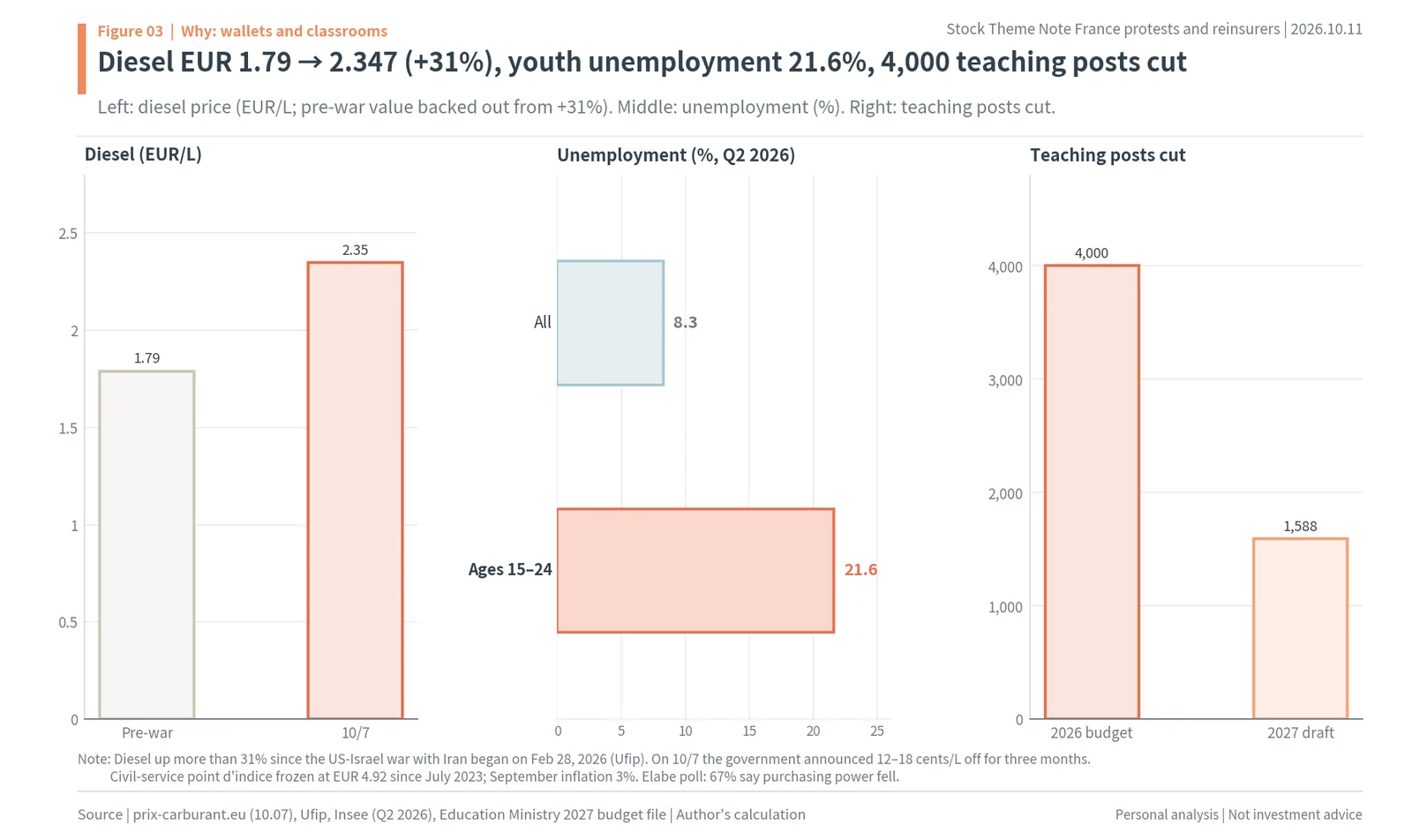
Austerity arrived just when the cost of living was heaviest. After the war between the US and Israel and Iran began on February 28, 2026 and shipping through the Strait of Hormuz was disrupted, French diesel prices rose more than 31% (French petroleum industry association Ufip). On October 7 the average diesel price was EUR 2.347 a liter and unleaded petrol (SP95-E10) EUR 2.140. If a 31% rise ended at EUR 2.347, the pre-war price works out to about EUR 1.79 (author’s calculation). France imports about half its diesel, and damage to Gulf refineries sent refining margins sharply higher too.
On October 7 the government announced three months of support cutting diesel by 12–18 cents a liter, but it was a patch issued in the same week it was drafting an austerity budget. In a poll by Elabe, 67% of French people said their purchasing power had fallen recently. The CGT (General Confederation of Labour) says civil servants have lost more than 16% of purchasing power since 2017. With September inflation at 3% and the point d’indice frozen for a third year, civil servants’ real pay is being cut every year.
Youth unemployment at 21.6%, and teaching posts cut two years running
The fact that high-school and university students are at the front of the protests can also be explained with numbers. According to the national statistics office Insee, unemployment was 8.3% in the second quarter of 2026, up 0.7 percentage points on a year earlier, and unemployment among 15- to 24-year-olds jumped 2.5 points to 21.6%. Among 15- to 29-year-olds, 13.1% are neither in work nor in education (NEET). Students about to graduate face fewer jobs, and the schools they attend are short of teachers. Their demands are filling teacher vacancies, smaller classes, better timetables than the long days they have now, repairs to old and unsafe buildings, more nurses and social workers, and an overhaul of the university admissions platform Parcoursup (as summarized by Amnesty France).
Teaching posts are cut by 4,000 in the 2026 budget and by 1,588 in the 2027 draft. There was already an education strike against the 4,000 cuts on March 31, so the September blockades did not come from nowhere; half a year of accumulated grievances burst. Figure 3 shows the diesel price on the left, overall and youth unemployment in the middle, and the two years of teaching-post cuts on the right.
The political calendar also makes the protests longer
France’s presidential election is in April–May 2027. President Macron cannot run again, and the government must pass a budget without a majority in parliament. On the October 1 clashes, the prime minister’s office cited intelligence assessments to claim “an organized operation by La France Insoumise (LFI, France Unbowed) and the ultra-left”, and Marine Le Pen of the Rassemblement National (RN, National Rally) called it “a riot organized by professionals and led by LFI deputies”. LFI’s Jean-Luc Mélenchon wrote after the October 8 Bastille rally that “the Bastille has been retaken”.
The government has begun to back down. On October 8, Education Minister Édouard Geffray said 3,000 substitute teachers would be deployed and that high-school teaching posts would not be cut in 2027. The cost is “tens of millions of euros”. The student unions countered that they “won’t stop until EUR 10bn is on the table”. Concessions widen the deficit, and a wider deficit pushes bond yields up again. Three thousand teachers fall short of the students’ demands, while granting EUR 10bn would make the austerity incoherent. So the author thinks this wave is more likely to run on to the November 5 general strike and parliament’s review of the 2027 budget than to end in a week or two.
So teacher cuts lit the fire on top of debt interest, fuel prices and youth unemployment arriving at once, and the political calendar is dragging that fire out.
3-1. Timeline: from Créteil to the Bastille in three weeks
From a solidarity strike in Créteil to the Bastille
Following this wave date by date shows how fast it grew. On September 17–18 at Saint-Exupéry high school in Créteil, students refused classes alongside teachers protesting unfilled posts, and by around September 21 this had hardened into a blockade of the school gates. On September 25, about ten new blockades appeared within the Créteil education authority alone. One student said “it has been getting worse for three years” (quoted by AFP).
September 29 was the first national day of action. The same day, civil-service unions struck against the pay freeze, rallies were held in more than 170 places nationwide, and the Interior Ministry counted 206,000 participants. There were 410 actions outside high schools (Amnesty). On September 30, blockades and attempted blockades spread to 356 lycées, and in Tours a 16-year-old lost the sight of one eye to a rubber bullet. The same day, the French 10-year yield hit 4.87%, its biggest quarterly rise since 1987.
On October 1, university students joined and the protests turned violent. By the police count there were 340 actions and 169 blockades outside high schools in the morning alone; more than 200 sites in Île-de-France (the Paris region) were disrupted, with violence and damage at about 50. About 30 universities were also blockaded. Daily arrests reached 1,948. Prime Minister Lecornu convened an interministerial crisis unit at the Interior Ministry, and Justice Minister Gérald Darmanin summoned 36 chief prosecutors and ordered “a firm criminal response”. The same day, the government presented the 2027 draft budget to the Council of Ministers.
On October 2, 564 schools were directly affected, and arrests from September 21 to that day passed 5,000. The Korean Embassy in France issued a safety notice that day. On October 5, a 15-year-old in Lens lost a hand to a stun grenade, and the same day five unions, the CFDT, CGT, FO, Unsa and FSU, announced an all-sector strike for November 5. On October 6, the third national day, 256,000 people by the Interior Ministry’s count (56,000 in Paris) and 450,000 by the organizers’ count took to the streets, and classes stopped at 891 of 3,700 lycées. President Macron summoned ministers to the Élysée that evening.
On October 7, the government had every school spend half a day without classes to review its own situation, and opened an online channel for student complaints that received more than 40,000 submissions. The same day, Interior Minister Laurent Nuñez told parliament there had been 6,629 arrests in total and announced a halt to the use of stun grenades, and the government also released its diesel price support. On October 8, 71,500 people nationwide gathered for the Bastille rally, and about 20 black-bloc protesters clashed with police. That night the education minister announced the deployment of 3,000 substitute teachers.
The 1990 high-school protests ended with money
French high-school protests have a precedent. The October–November 1990 high-school protests peaked on November 5 at 150,000–200,000 people and ended when the government put out an emergency plan of 4.5 billion francs (Public Sénat). Student protests usually subside when the government puts money on the table. This time, too, the government made a first concession with 3,000 teachers and no high-school post cuts in 2027. The difference is that, unlike then, the money now has to be borrowed, and the interest rate on that debt has risen 1.27 percentage points in a year.
The government’s hands are tied. The Lecornu government resigned once on October 6, 2025 and was reappointed, and it finished the 2026 budget on January 30 only after using Article 49.3 of the Constitution, which lets a government pass a bill without a parliamentary vote, three times. The left’s censure motion then fell 19 votes short. The 2023 pension reform (raising the retirement age from 62 to 64) was already suspended by law at the end of 2025, freezing the retirement age at 62 years and 9 months until January 2028, at a cost of EUR 400mn in 2026 and EUR 1.8bn in 2027. If a government that has already retreated on pensions retreats again on education and civil-service pay, the 2027 deficit target of 5.0% becomes hard to meet.
So in three weeks this wave spread from schools to the public sector and then to an all-sector strike, and the government has far less room than in 1990 to end it with money.
4. How big: 256,000 marchers, 6,629 arrests and a French market discount
6,629 arrests, 85% of them minors
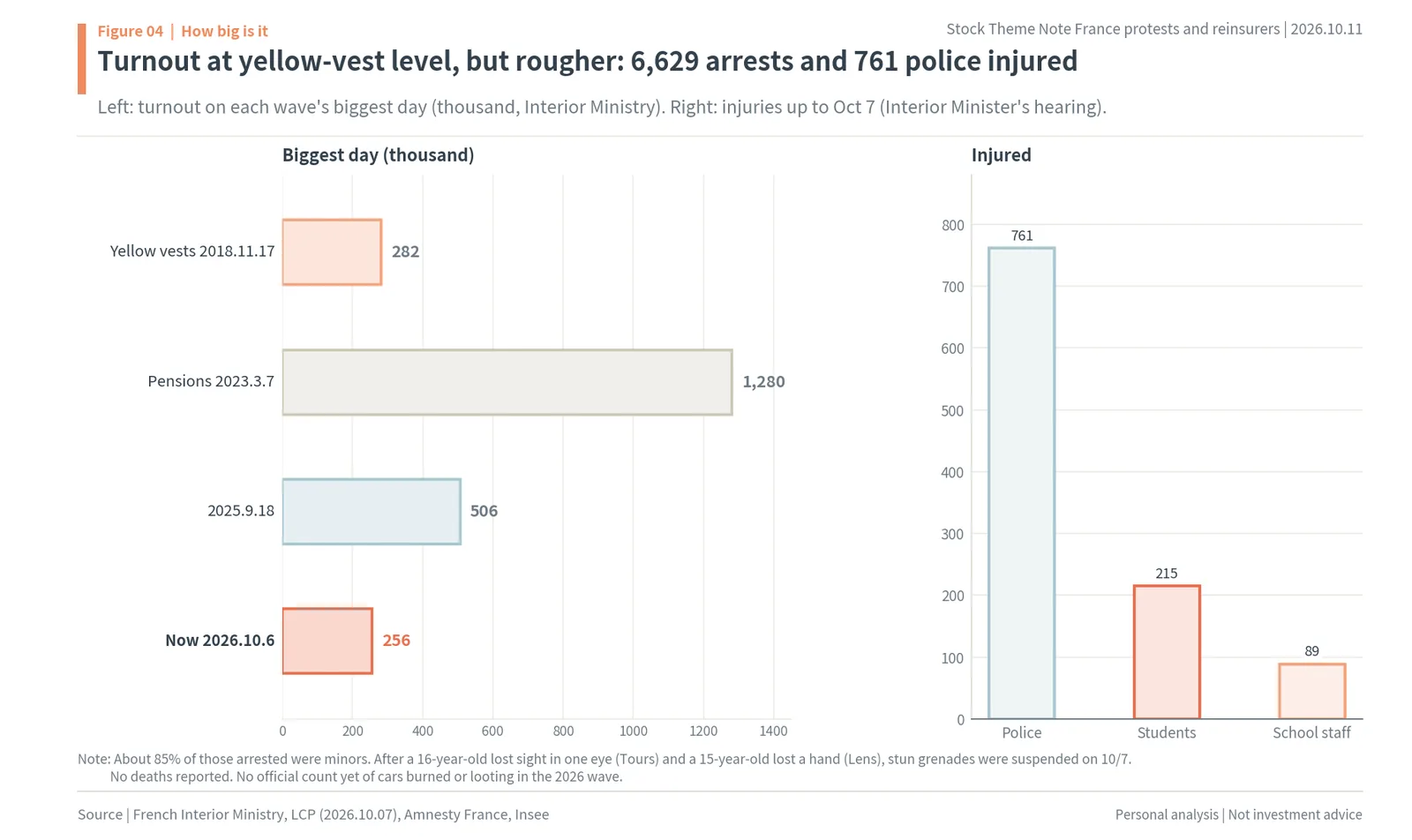
Here is this wave’s size against others. By the Interior Ministry’s count, the biggest days were about 282,000 on November 17, 2018, the first day of the yellow vests; 1,280,000 on March 7, 2023, the peak of the pension-reform protests; and 506,000 on September 18, 2025, a union day of action. This wave’s 256,000 on October 6 is similar to the first day of the yellow vests. On September 29, the civil-service strike day, 206,000 people marched by the Interior Ministry’s count, and the October 8 Bastille rally drew 71,500 nationwide and 24,500 in Paris.
What stands out more than turnout is the violence. From September 21 to October 2, arrests passed 5,000, about 85% of them minors (Interior Ministry). On October 7, Interior Minister Laurent Nuñez told a parliamentary hearing there had been 6,629 arrests in total, with 761 police and gendarmes, 215 students and 89 school staff injured. In Tours a 16-year-old lost the sight of one eye, and in Lens a 15-year-old lost a hand to a stun grenade. The government suspended stun grenades on October 7.
On October 1, clashes and arson spread across Lille, Nantes, Marseille and Aubervilliers on the edge of Paris. The lobby of a high school in Nantes was set on fire, and in Marseille petrol was thrown on a school employee. The authorities then closed about 400 lycées and moved them to remote classes. Figure 4 shows each wave’s biggest-day turnout on the left and injuries through October 7 on the right. No official count of cars burned or looting in the 2026 wave has been published yet.
Compared with the 2023 Nahel riots, the shape is different. The Nahel riots followed the police shooting of a 17-year-old on June 27 and saw cars and buildings burned night after night for a little over ten days; 12,031 vehicles and 2,508 buildings were damaged. This wave centers on daytime school blockades and street marches, with clashes and arson as only part of it. In exchange, it lasts longer and is tied to union strikes. Short, violent riots cause large insured losses, while long, broad protests cause large losses in store sales and transport. If this wave lasts into November, both kinds of loss may pile up together.
The stock market marked France down more than Germany
The market priced this disorder as a French discount. From September 18 to October 9 the CAC 40 fell 3.2% while Germany’s DAX fell 0.9% (Yahoo closes, author’s calculation). The euro weakened 2.4% against the dollar. Many factors are mixed into stock prices, such as public finances, the Middle East and interest rates, but the fact that France fell 2.3 percentage points more than Germany within the same euro area means a France-specific risk was priced in.
The gaps between stocks were wider. Over the same period AXA fell 7.2%, 4.0 percentage points more than the CAC 40, while Vinci fell 3.4% and Carrefour 2.8%. Reinsurers moved the other way. Munich Re rose 3.6%, 4.5 points stronger than the DAX, and SCOR fell 1.4%, 1.8 points less than the CAC 40. Figure 5 shows, on the left, prices rebased to September 18 = 100 and, on the right, the change over the same period. The AXA and Munich Re lines visibly split from late September, when the protests turned violent.
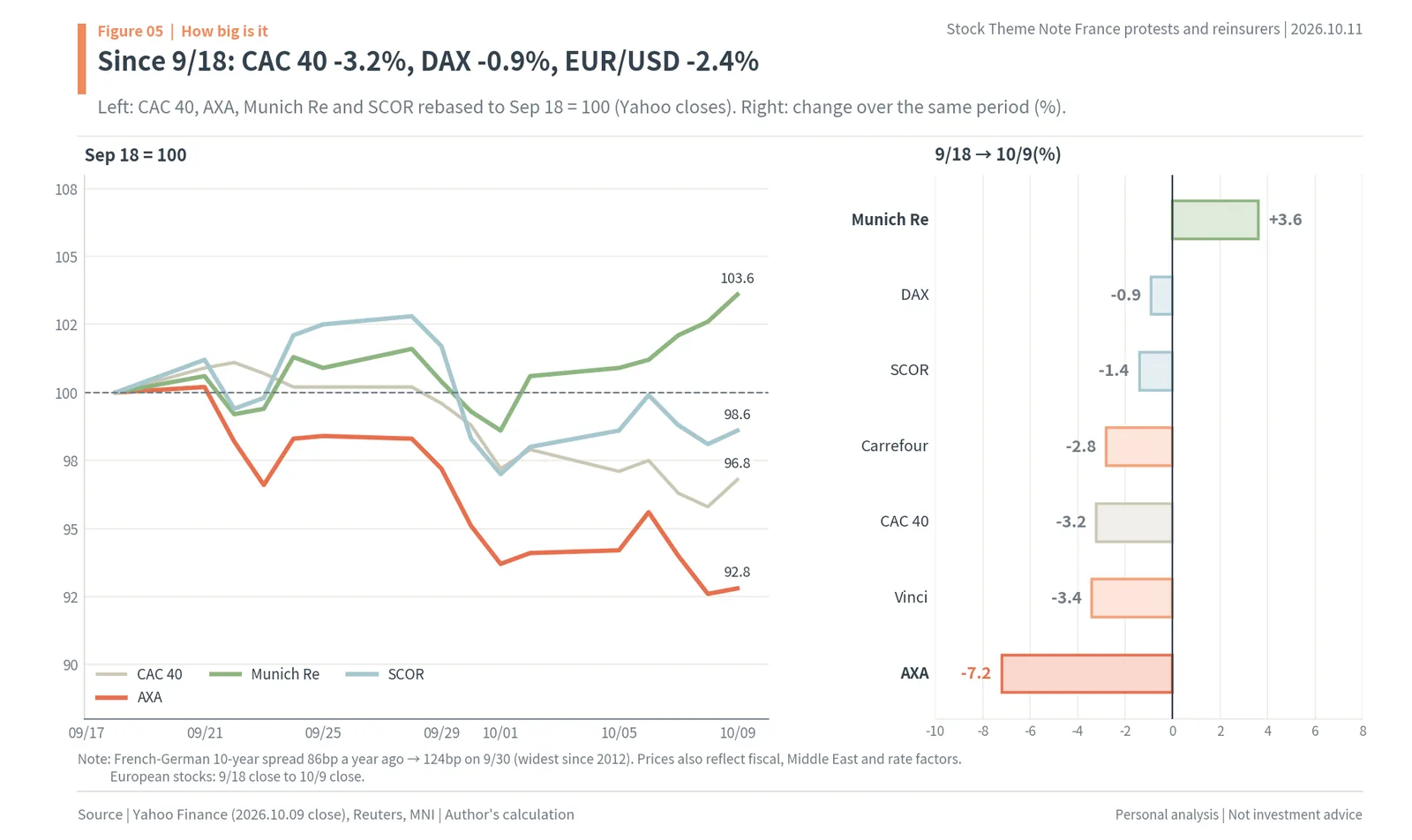
So by turnout this wave is at yellow-vest level, but by arrests and injuries it is rougher, and within France the market marked down primary insurers more.
5. Who loses: AXA, Vinci, retailers and airlines across five protest waves
Five waves, two stocks that lagged all five times
One wave alone could be coincidence, so five are set side by side: the yellow vests (November 16 to December 31, 2018), the pension-reform strikes (January 18 to April 14, 2023), the Nahel riots (June 26 to July 7, 2023), “Block Everything” and the union day of action (September 9 to 19, 2025), and now (September 18 to October 9, 2026). For each window, excess return is the stock’s return minus its home index’s return, measured from the close on the day before the window starts, without dividends.
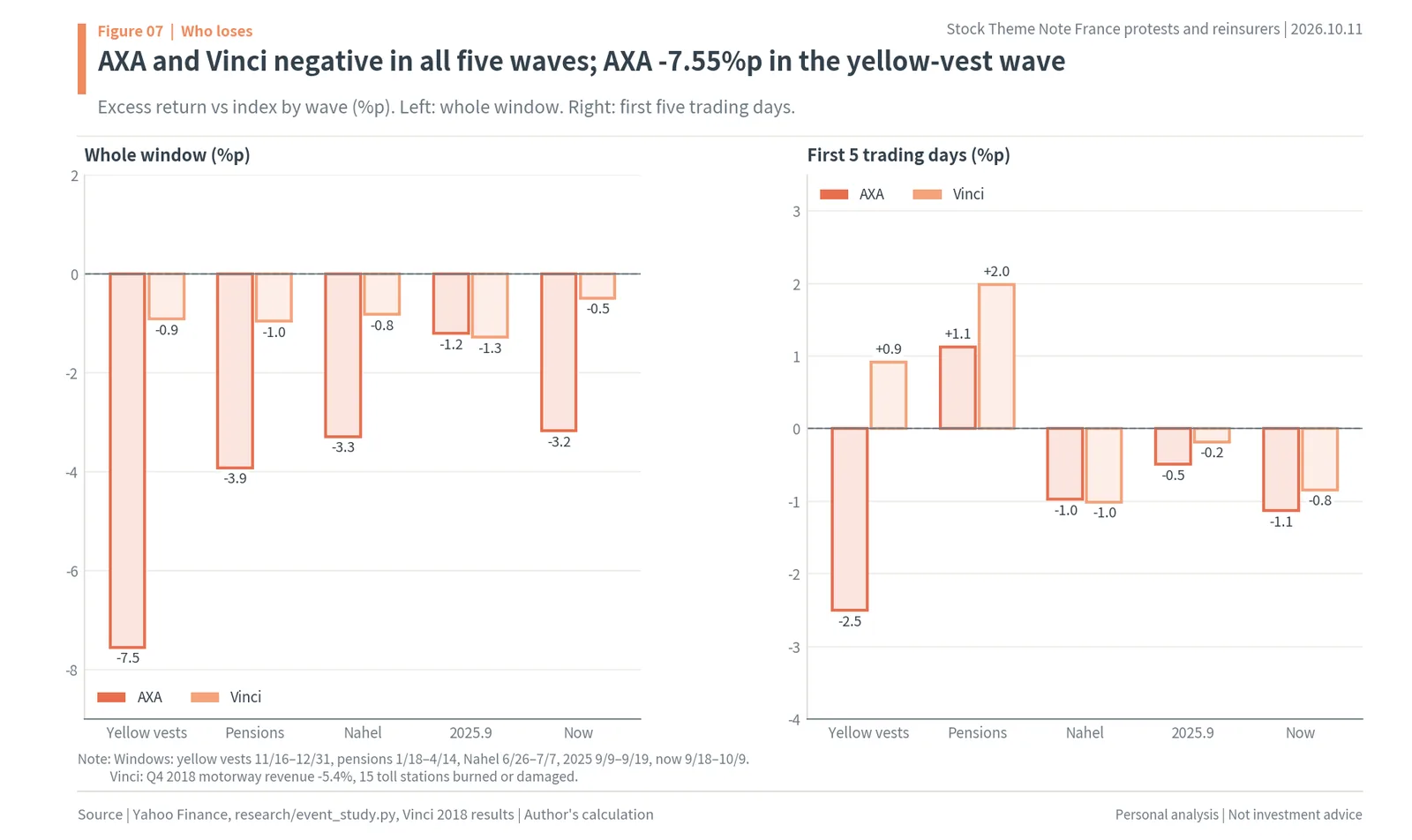
Two stocks lagged the index in all five. AXA was -7.55 percentage points in the yellow vests, -3.92 in the pension strikes, -3.29 in the Nahel riots, -1.21 in September 2025 and -3.17 now, a five-wave average of -3.8 points. Vinci was -0.91, -0.96, -0.82, -1.28 and -0.49 points: small, but negative all five times. Saint-Gobain (SGO.PA) lagged in four of five, Carrefour and Air France-KLM (AF.PA) in three. By contrast Accor (AC.PA, hotels) lagged only once in five, and the three luxury houses (LVMH, MC.PA; Kering, KER.PA; Hermès, RMS.PA) averaged +1.5 to +3.4 points, actually beating the index.
The left of Figure 6 lists the five-wave average excess returns in order, and the right counts how often each stock lagged the index. Zalando (ZAL.DE, -5.4 points) and Air France-KLM (-4.4 points) have lower averages than AXA, but Zalando’s was dragged down by its own profit warning during the yellow vests (-18.4 points) and Air France’s by the government collapse in September 2025 (-11.6 points). Only AXA and Vinci went the same way all five times.
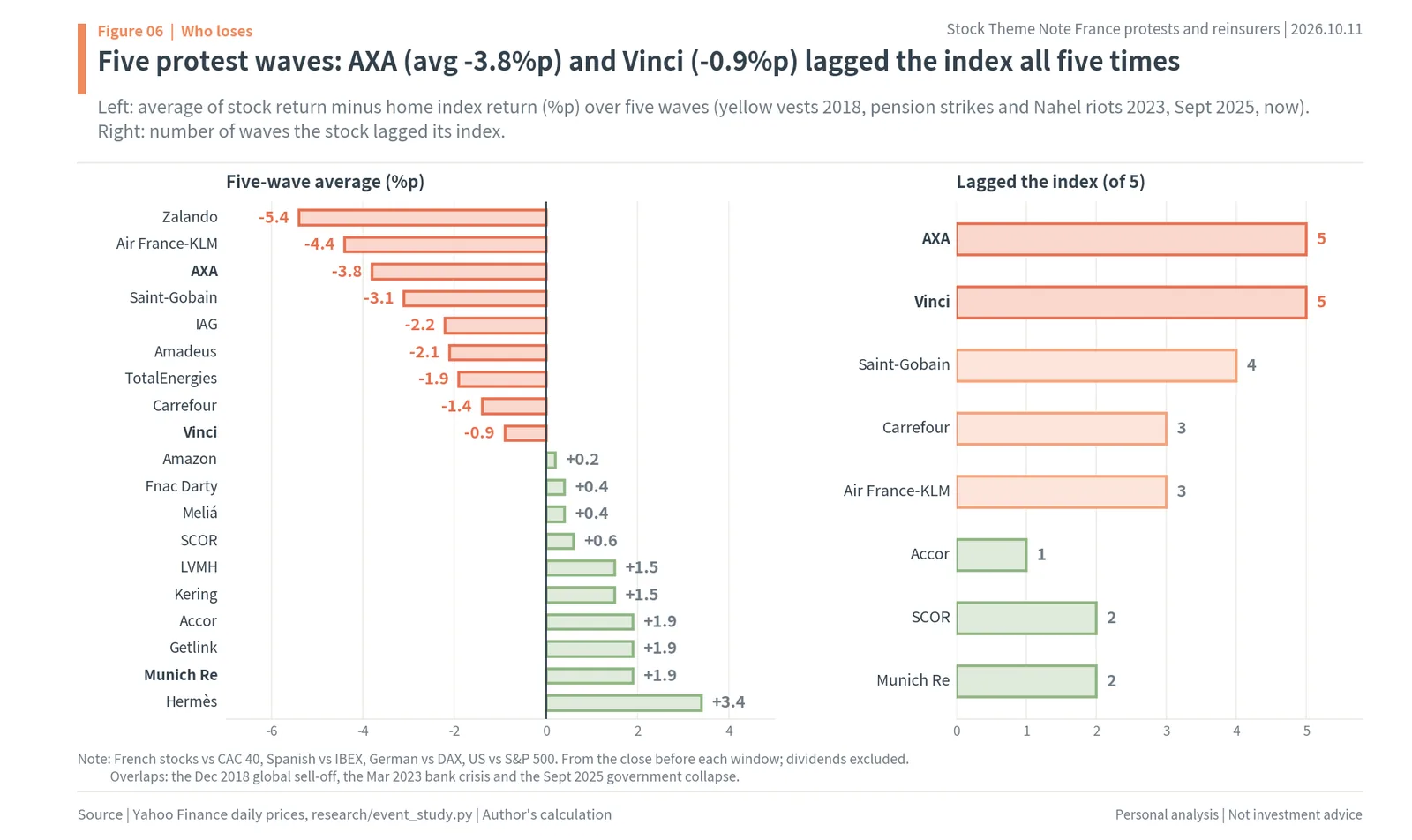
Other events overlap the same windows. Global stocks fell sharply in December 2018, the US regional bank and Credit Suisse crisis hit in March 2023, and Prime Minister François Bayrou lost a confidence vote and resigned on September 8, 2025. So the author weighs the direction across five waves more heavily than the size of any one. Figure 7 shows AXA’s and Vinci’s values by wave, split into the whole window and the first five trading days. In the first five trading days, AXA lagged in four of five waves, and in the first week of the yellow vests it was -2.5 points.
Damage the companies disclosed themselves
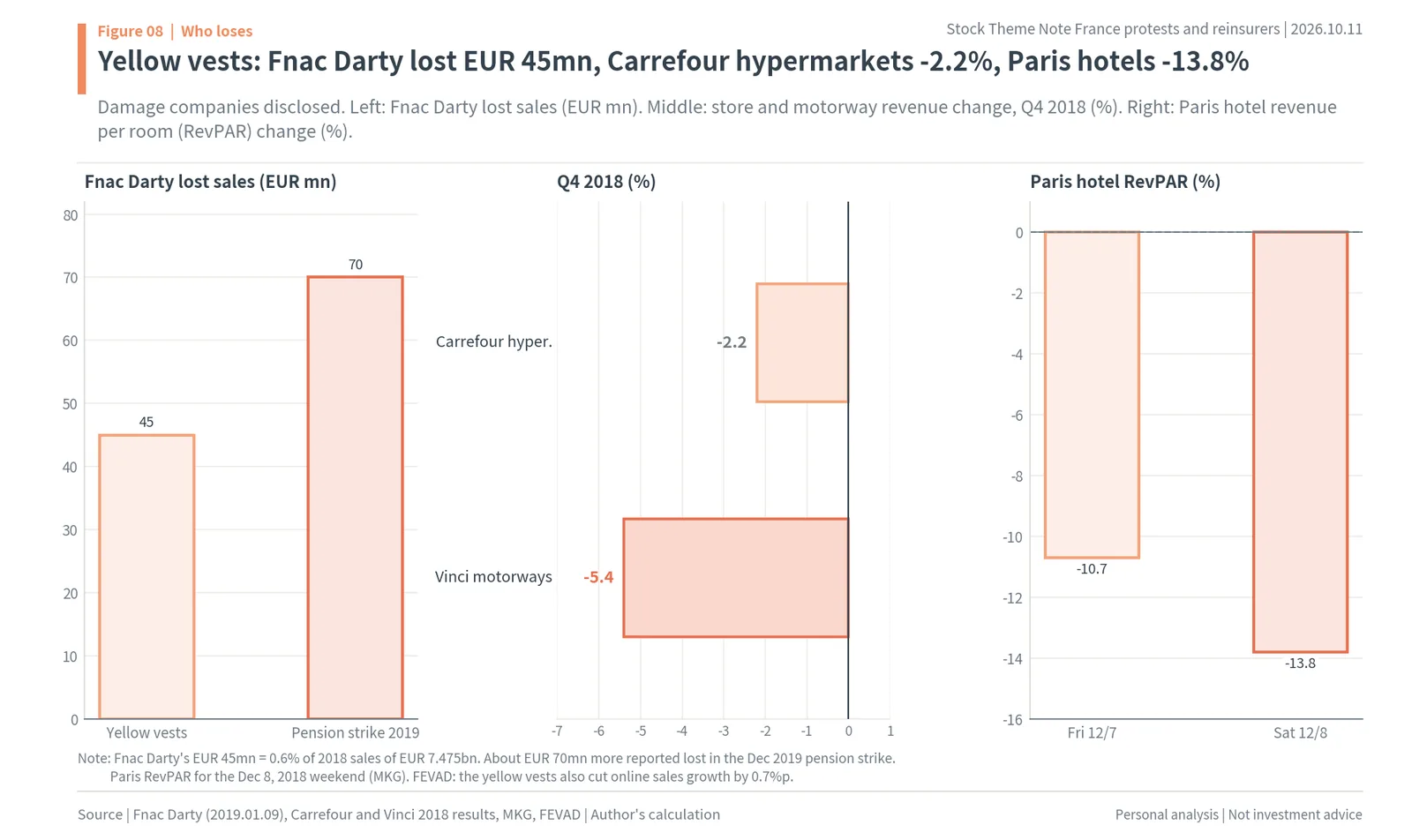
Beyond stock prices, companies disclosed damage in their results. Electronics and book retailer Fnac Darty said on January 9, 2019 that the yellow vests cut its year-end sales by about EUR 45mn, 0.6% of its 2018 revenue of EUR 7.475bn. It was reported to have lost about EUR 70mn more during the December 2019 pension strike. Carrefour’s French hypermarket like-for-like sales fell 2.2% in the fourth quarter of 2018, with non-food falling most.
Vinci operates French motorways. Its motorway revenue fell 5.4% in the fourth quarter of 2018, and 15 toll stations and 6 buildings were burned or damaged, because yellow vests occupied toll plazas and let vehicles through for free. Paris hotels also lost guests. On the weekend of December 8, 2018, revenue per available room (RevPAR) at Paris hotels fell 10.7% on Friday and 13.8% on Saturday (MKG), and foreign hotel stays in Paris fell 4.8% in the first quarter of 2019. Figure 8 brings these three strands of damage together.
During the yellow vests, the damage to street shops was even larger. The French retail federation (FCD) put retail losses over roughly a month of protests at about EUR 1bn, and the finance ministry said sales on the first weekend were 35% lower than a year earlier. A Senate working group and chamber of commerce surveys found affected shops lost 20–30% of sales on average, and two-thirds of retailers called it “a loss that cannot be recovered”. Because protests were held every Saturday, the best trading day of the week vanished entirely. By Kantar Worldpanel’s count, the hypermarket channel’s share fell 0.62 points from October 29 to November 25, twice the average annual decline.
The 2023 Nahel riots centered on looting. By chamber of commerce counts, 2,500 shops were damaged, 200 large retail stores were looted and 15 of those burned down. About 250 tobacconists and about 250 bank and insurance branches were also hit. Damage estimates were EUR 300–400mn from the chambers of commerce and about EUR 1bn from the employers’ federation Medef. A company’s store losses ultimately become losses for the primary insurer that covers those stores.
E-commerce did not benefit. The French e-commerce federation FEVAD said the yellow vests cut online sales growth by 0.7 points and that “the internet did not benefit from the protests”, because deliveries were blocked and consumer sentiment froze along with them. In the event study, Amazon (AMZN) lagged the S&P 500 in all five first-five-day windows. The idea that customers go online when stores close is not borne out by the numbers.
Air routes and rail lines are blocked too
For hotels, losses tended to get lost in the annual results. According to broker ODDO BHF, about 22% of Accor’s operating profit comes from France, two-thirds of that from Paris. Paris hotel RevPAR rose 11.0% over 2018, but social unrest knocked 1.5 points off, and cancellations prompted by videos of rioting on the Champs-Élysées and around the Opéra cost about EUR 18mn (MKG). Accor said in its first-quarter 2023 results that the March strikes had “no significant impact”, and Paris hotel RevPAR hit a record that year. That is also why Accor lagged in only one of five waves in the event study.
When protests turn into strikes, transport stops first. Air France-KLM averaged -4.4 points over the five waves, IAG, the parent of British Airways and Iberia (IAG.MC), -2.2 points, and airline booking-system company Amadeus (AMS.MC) -2.1 points. Amadeus lagged in four of five. During the January–March 2023 strikes, Paris airports (ADP) lost about 470,000 passengers, and Ryanair cancelled about 300 flights in the first half of 2023 due to French air traffic control strikes. Because flights from other countries that cross French airspace are also blocked, competitors like IAG share the cost.
The size of the cost differs by company. Air France-KLM lost EUR 335mn to 15 days of its own pay strikes from February to June 2018, but its CEO said the 2023 air traffic controllers’ pension strikes cost less than EUR 20mn. Unlisted state railway SNCF lost EUR 790mn of operating margin over 37 days of strikes against the 2018 rail reform and posted an operating loss of EUR 614mn in the December 2019 pension strike. During 14 days of French air traffic control strikes in early 2023, more than 1 million European passengers were disrupted and more than 8,000 flights delayed. On days like November 5, when the public and private sectors stop together, these costs come back.
Vinci’s motorway damage is worth another look. During the yellow vests, about 250 toll plazas and interchanges a day were occupied, and 6 operations buildings and 33 vehicles were burned. Vinci tried to bill drivers who passed through for free but dropped the idea, and the government said “the state will bear a large part”. Even so, the group’s revenue that year rose 8.1% to EUR 43.5bn thanks to its airports business. The damage does not shake the whole company, but the pattern of the stock trailing the index a little during each protest repeated five times.
Refining is also hit by strikes. In autumn 2022, when TotalEnergies’ refinery unions struck for higher pay, the Gonfreville (240,000 barrels a day), Feyzin and Donges refineries stopped, about a third of filling stations nationwide had supply problems, and the government released strategic reserves. TotalEnergies (TTE.PA) lagged the CAC 40 in four of five protest waves (average -1.9 points). In this wave it was +3.3 points because the Middle East war has kept oil prices high. If refinery unions join the November 5 all-sector strike, fuel prices rise again, and that burden becomes fuel for more protests.
Getlink (GET.PA), which runs the Channel Tunnel, went the other way. Its five-wave average was +1.9 points, better than the index. In 2019 French strikes and Brexit turmoil cut its revenue by about EUR 18mn, yet Eurostar passengers set a record, because some travelers switch to the train when flights are blocked. Figure 9 shows the five-wave averages of four airline, travel and transport stocks on the left and how often each lagged the index on the right.
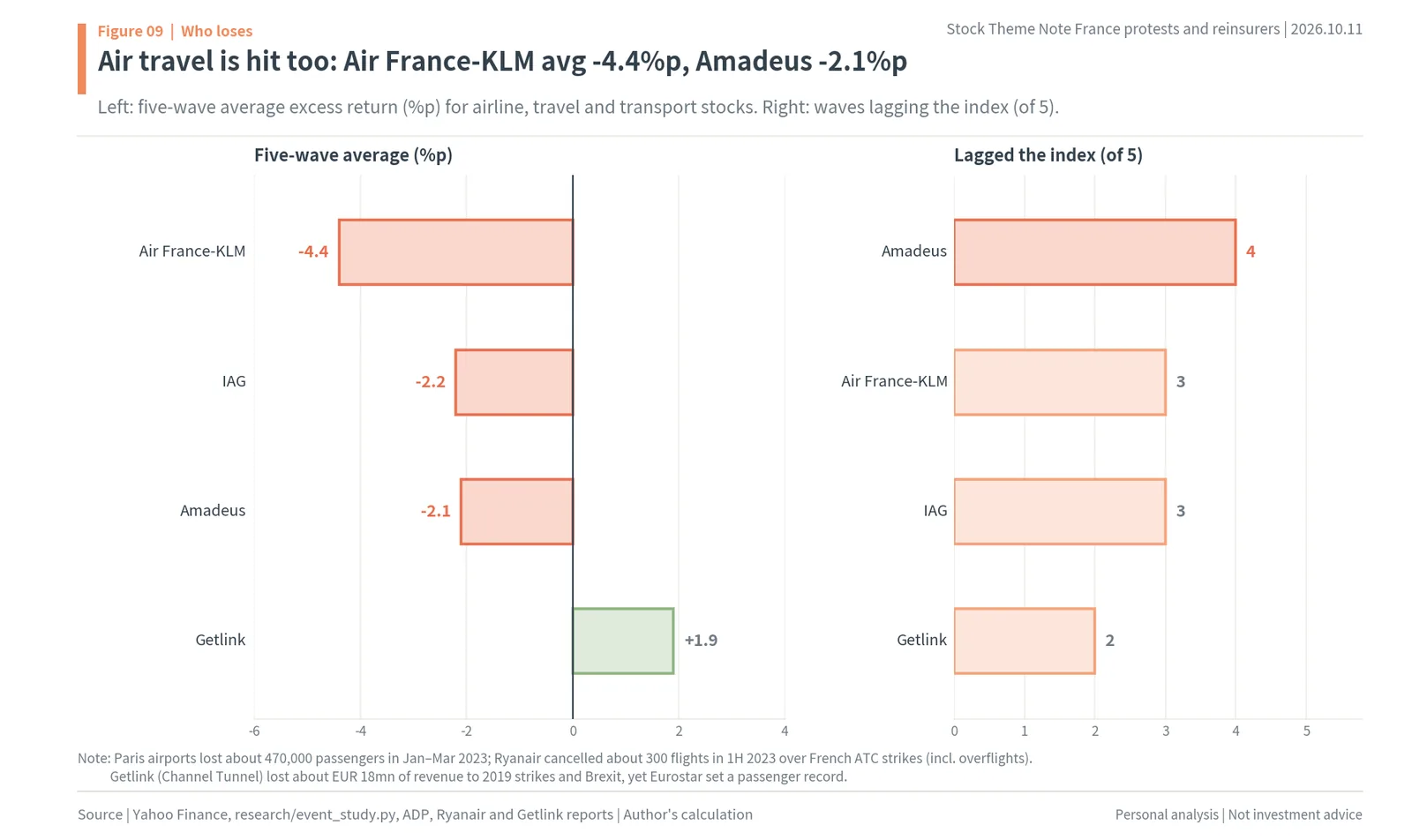
So protest losses land first on primary insurers (AXA), roads (Vinci), stores (Fnac Darty, Carrefour) and air routes (Air France-KLM, Amadeus), and among them only AXA and Vinci went the same way all five times.
5-1. The companies: AXA, Vinci, Fnac Darty, Carrefour, Allianz, Munich Re, SCOR
The side that pays the losses
AXA is one of Europe’s largest insurers, headquartered in Paris. It runs property and casualty insurance, life insurance and asset management, and in France it is a primary insurer directly covering losses on homes, shops and cars. Its market value is about EUR 86.8bn, and its share price on October 9 was EUR 41.52 (about KRW 62,300, or $46.5). When shops and cars are wrecked by riots or protests in French cities, it is the first place the bill arrives.
Vinci is France’s largest construction and infrastructure company. Besides construction and energy installation work, it holds concessions for French motorways (Vinci Autoroutes) and for airports around the world. Motorways earn money from tolls, so when protesters block toll stations or wave cars through for free, revenue drops and facilities are damaged. Its share price on October 9 was EUR 107.05, 10.6 times forward EPS of EUR 10.06.
Fnac Darty is a retail chain selling books, music and electronics, and Carrefour is France’s largest hypermarket chain. Both have many stores in city centers and suburbs, so customers thin out when Saturday protests continue, and their stores become looting targets in riots. Fnac Darty trades at 11.0 times forward EPS of EUR 3.14 and Carrefour at 8.5 times EUR 1.87.
Allianz (ALV.DE) is Europe’s largest insurer, headquartered in Munich, Germany, with a market value of about EUR 158.2bn. It also has a large property and casualty business in France, and after the 2023 and 2024 riots it cut riot cover in the overseas territories along with Groupama. That is an example of how primary insurers reduce losses not only by raising premiums but by removing cover altogether. When cover is removed, that risk passes to shop owners and local governments. It trades at 12.5 times forward EPS of EUR 33.40.
The side that sets the rates
Munich Re is one of the world’s largest reinsurers, headquartered in Munich, Germany. It takes a share of large losses from primary insurers worldwide and also writes primary insurance in Germany through subsidiaries. It covers both natural catastrophes such as earthquakes and typhoons and man-made events such as riots, and after a year of big losses it is on the side that raises rates. Its market value is about EUR 65.9bn, and its share price on October 9 was EUR 523.8.
SCOR is a reinsurer headquartered in Paris with a market value of about EUR 5.7bn, less than a tenth of Munich Re. It writes both property and casualty reinsurance and life reinsurance. As a French company it has a large share of the reinsurance contracts of French primary insurers, and it is correspondingly sensitive to French losses and French rates. Its share price on October 9 was EUR 31.92, 7.0 times forward EPS of EUR 4.54. Hannover Re (HNR1.DE) and Swiss Re (SREN.SW) are included as comparison reinsurers, at forward P/Es of 11.1 and 11.0 times.
So even within the same insurance industry, AXA, which pays the losses directly, and Munich Re and SCOR, which share large losses and set next year’s rates, stand in different places in front of the protests.
6. Riot insurance losses up 4x, and reinsurers raise the rates
Riot insurance losses grew fourfold
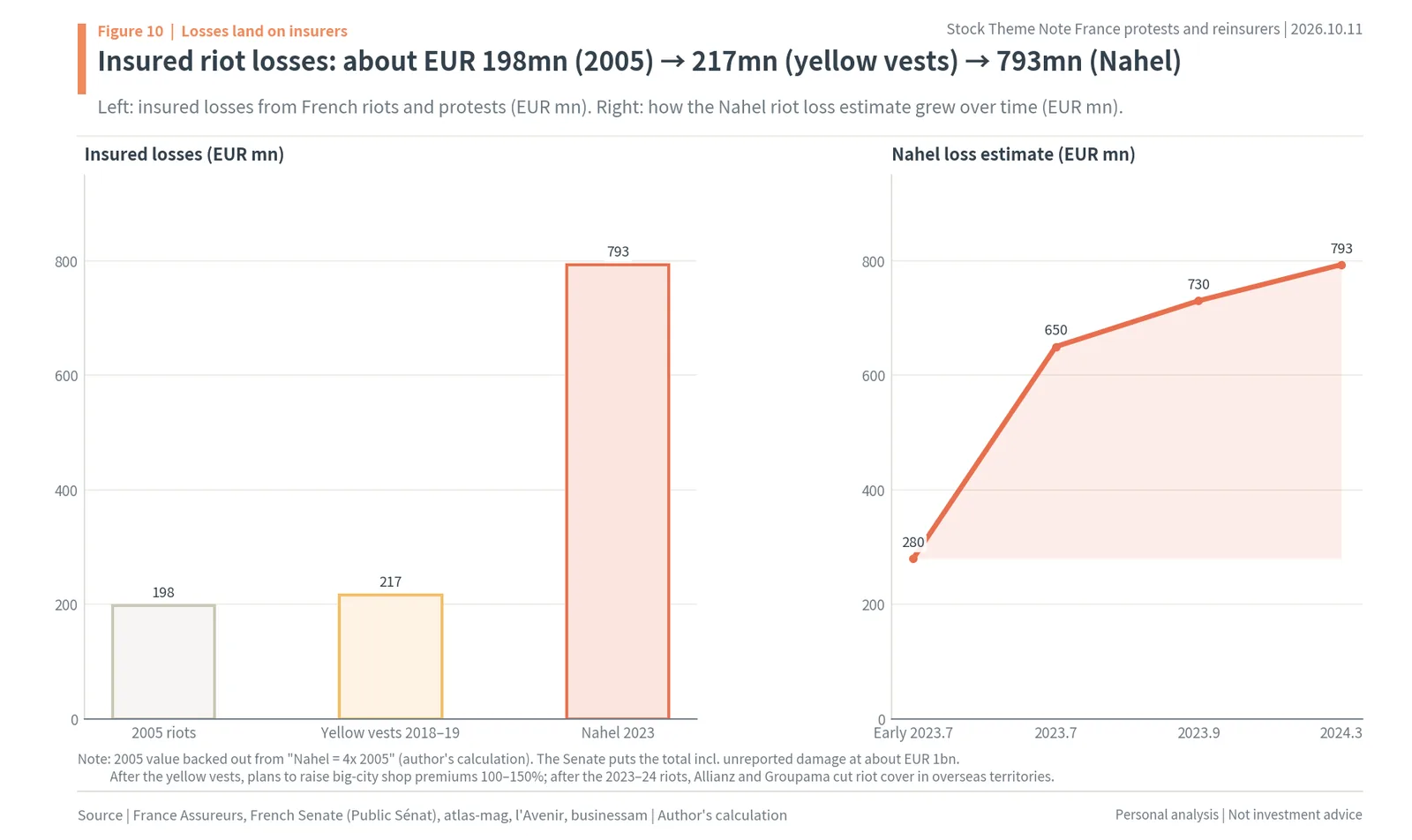
Insured losses from French riots grow each time they come. According to the French insurers’ federation (France Assureurs) and a Senate report, insured losses from the 2023 Nahel riots were EUR 793mn (as of March 27, 2024, 16,400 claims), four times the 2005 suburban riots. Working backwards from that ratio gives about EUR 198mn for 2005 (author’s calculation). The yellow vests’ (2018–2019) insured losses were counted at EUR 200mn by mid-March 2019 and EUR 217mn by the end of May. The Nahel riots were 3.7 times the yellow vests. The Senate puts the total at about EUR 1bn including unreported damage.
Loss estimates swelled over time. The first estimate right after the Nahel riots was EUR 280mn, but it went to EUR 650mn in July and EUR 730mn in September, reaching EUR 793mn the following March. A total of 12,031 vehicles were burned and 2,508 buildings damaged. According to the Senate report, of the 2,508 buildings, 273 were police facilities, 105 town halls and 243 schools, and 436 tobacconists and 370 bank branches were also damaged. Local governments accounted for 27% of compensation, and Île-de-France for 42.5% of the total cost. Because claims come in over months, losses from large riots end up larger than first announced. There is no count yet for this wave’s losses, but given the arrests and arson cases, it is hard to call them smaller than the yellow vests’.
Figure 10 shows the insured losses of three riots and protests on the left and how the Nahel loss estimate grew over time on the right.
Repeated losses change premiums and cover
When the same losses keep recurring, insurers change their prices and terms. After the yellow vests, plans emerged to raise big-city shop premiums by 100–150%. After the 2023 Nahel riots (more than EUR 700mn) and the 2024 New Caledonia riots, Allianz and Groupama reduced riot cover in overseas territories such as Martinique and Guadeloupe. The government wants to make those who cause damage, and their parents, pay the costs through a “casseur-payeur” (rioter pays) bill, which the Senate will review at the end of October.
In this flow, primary insurers and reinsurers sit in different places. Primary insurers pay the losses first, and even when they raise premiums, competition makes it hard to raise them all at once. Reinsurers take primary insurers’ large losses in return for repricing once a year when contracts renew. When big losses repeat, primary insurers have to buy more reinsurance, and reinsurers raise the price. So the same riot is a cost for a primary insurer and a reason for a reinsurer to raise next year’s price.
The reinsurance calendar widens this gap. Primary insurers have to pay claims as they come in through the year, but the terms of their reinsurance contracts mostly change once a year, on January 1. When a big riot happens in September to November, the primary insurer goes into renewal talks a few months later still carrying that year’s losses, while the reinsurer sets next year’s price on the strength of the losses that just happened. If this wave, which began in late September, lasts until the November 5 strike, its loss tally will come out just before the January 2027 renewal talks. On timing alone, losses are piling up at the moment most favorable to reinsurers.
In the first five trading days, reinsurers were strong
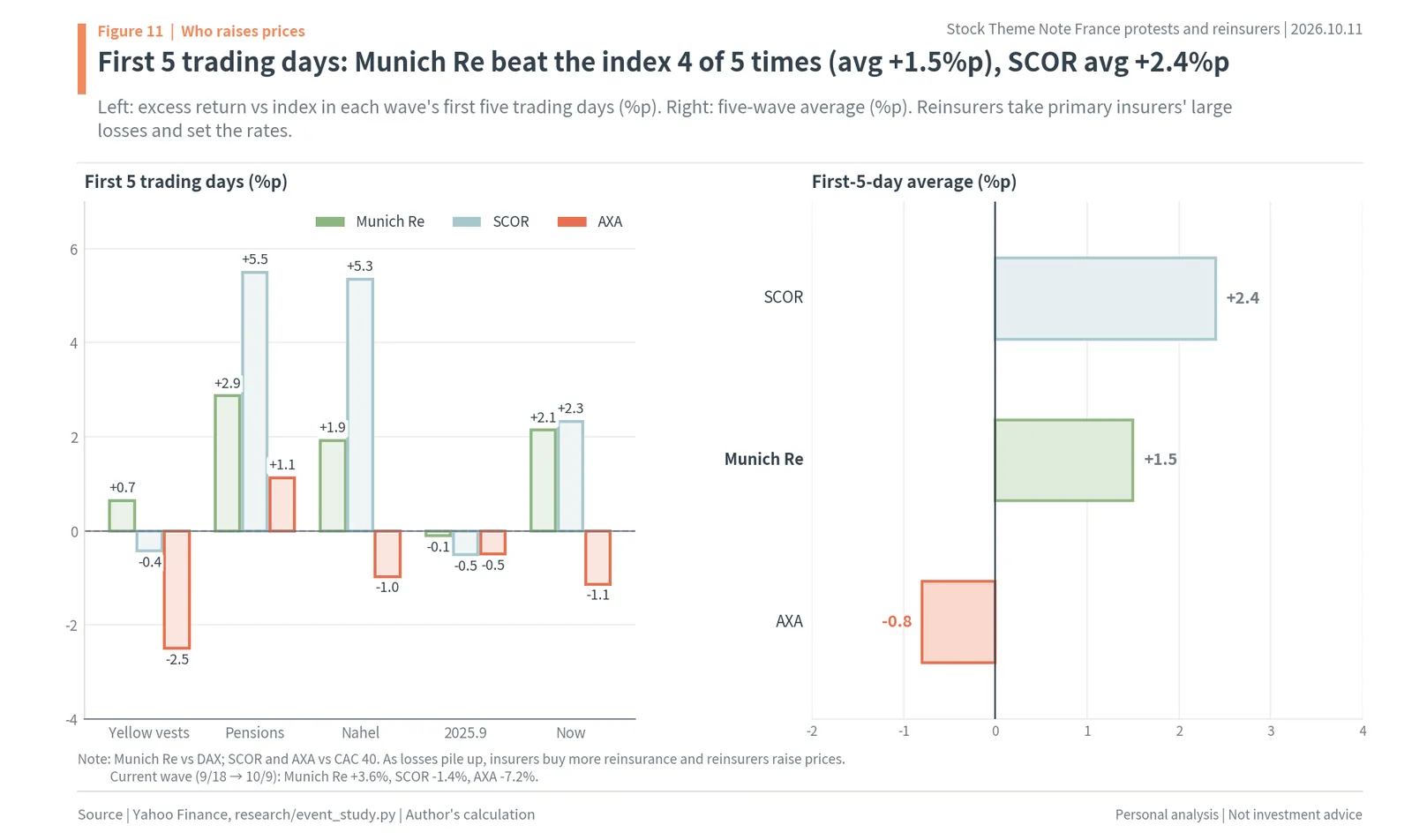
Stock prices show this difference too. In the first five trading days after each of the five protest waves began, Munich Re was +0.65 points in the yellow vests, +2.87 in the pension strikes, +1.92 in the Nahel riots, -0.10 in September 2025 and +2.14 now, beating the DAX in four of five. The average is +1.5 points. SCOR’s first-five-day average was +2.4 points, with +5.5 and +5.35 points in the pension strikes and the Nahel riots. Over the same first five trading days, AXA averaged -0.8 points. Figure 11 shows the first-five-day values by wave on the left and the five-wave averages on the right.
Stretched over seven years, Munich Re went furthest
Over the long run the difference is clearer. Setting November 15, 2018, the day before the yellow vests, to 100, Munich Re stands at 273, AXA at 190 and the CAC 40 at 155 on the latest close of October 2026. AXA rose much more than the index, too, because higher rates increased the interest on the bonds insurers invest in. But Munich Re, whose reinsurance rates rose over the same period, went much further than AXA. SCOR actually fell, to 75. Even among reinsurers, company-specific factors decided the seven-year record.
Figure 12 shows the four month-end closes rebased to November 2018 = 100, with dashed lines marking the months protest waves began. A protest alone did not create this gap. Other events such as COVID in 2020 and the 2022 surge in interest rates are also in it. The author reads one thing from this chart: in a period of repeated losses, the side that sets prices beat the side that pays the losses over the long run.
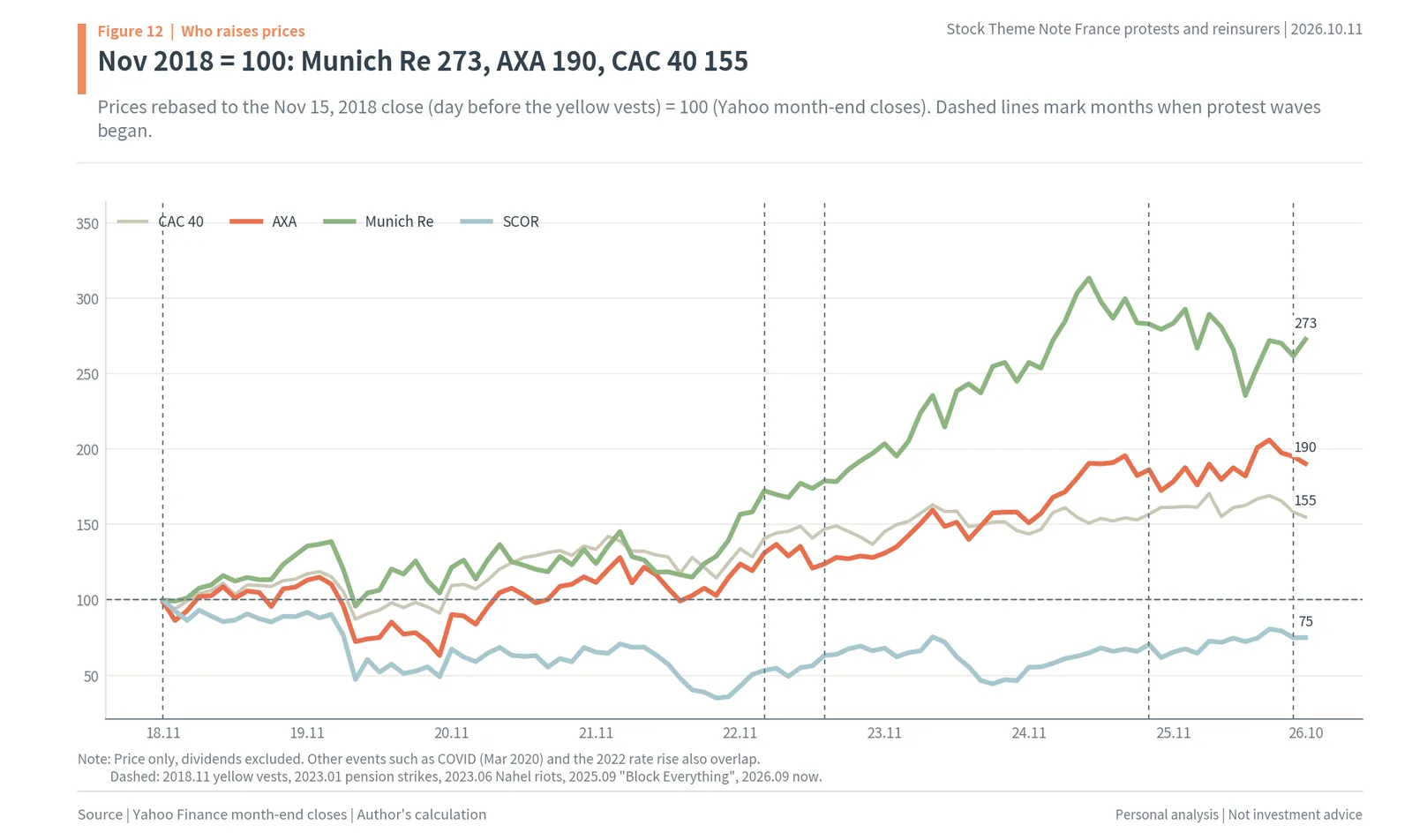
So French protest losses pile up at primary insurers, but where those losses turn into next year’s rates, the reinsurers are standing.
6-1. Nahel losses were 0.91% of AXA’s value but 13.9% of SCOR’s
Nahel riot losses were 0.91% of AXA’s market value
Putting protest losses against company size shows why stocks do not collapse yet steadily trail the index. On Yahoo Finance, AXA’s market value is about EUR 86.8bn, Munich Re’s about EUR 65.9bn, Allianz’s about EUR 158.2bn and SCOR’s about EUR 5.7bn. The entire industry’s EUR 793mn of insured losses from the 2023 Nahel riots is 0.91% of AXA’s market value (author’s calculation). AXA did not carry those losses alone either, so one riot does not change AXA’s enterprise value much.
Yet the stock trailed the index by 3.8 points on average across five waves. The stock reaction is bigger than the loss amount. The author reads this as a reaction less to the losses themselves than to “the signal that losses repeat”. One riot is a one-off cost, but as they continue through 2005, 2018, 2023 and 2026, investors conclude that the loss ratio on French urban property insurance has risen structurally. Until primary insurers pass that loss ratio fully into premiums, their margins are squeezed.
SCOR is different. The same EUR 793mn equals 13.9% of SCOR’s market value (author’s calculation). Of course a reinsurer only takes the part above the limits primary insurers set, and SCOR shares those losses with other reinsurers. Even so, SCOR’s small size makes it more sensitive to both French losses and French rates. That SCOR reacted more than Munich Re in the first five trading days of the protests (average +2.4 points vs +1.5) and that its seven-year share price swung more on company-specific factors both stem from the same difference in size.
Where are earnings forecasts heading?
The direction of analyst consensus can also be checked. Comparing trailing 12-month EPS with forward 12-month EPS on Yahoo Finance, AXA is expected to grow from EUR 3.71 to EUR 4.48. Munich Re dips slightly from EUR 53.53 to EUR 51.62, and SCOR is almost flat, from EUR 4.52 to EUR 4.54. Primary insurers’ earnings are in a phase of improvement as higher rates lift the interest on the bonds they hold, while reinsurers’ earnings are already high and waiting on the rate cycle.
So this report puts reinsurers on the benefiting side not because their earnings are about to jump. It is because the more protest losses pile up, the more grounds there are to raise prices at the next renewal, and in the first five trading days of five waves, those grounds showed up in share prices first. Primary insurers, on the other hand, see the loss ratio eat into their improvement if protests drag on, even in a phase of better earnings forecasts.
So protest losses are small next to company value, but as a signal of repetition they weigh on primary insurers’ shares, and that same signal gives reinsurers grounds to raise prices.
7. Customers moving to competitors: Spanish hotels and Meliá
Spanish hotels instead of Paris hotels
When protests drag on, tourists change destinations. On the roughest yellow-vest weekend in December 2018, Paris hotel RevPAR fell 10–14%, and foreign hotel stays in Paris fell 4.8% in the first quarter of 2019. The Korean Embassy in France also advised in its October 2 safety notice to “avoid visiting areas near protest sites”. The customers who avoid Paris go to other European cities.
Tourists switching destinations was already visible in 2023. The hotel analysis outlet Hospitality ON reported that Europeans planning weekend trips to Paris during the pension strikes switched to other cities. During the Nahel riots, the hotel trade body UMIH expected cancellations of up to 30% at Marseille hotels and half the customers gone from Paris bars and restaurants, but the government called these “pessimistic and wrong figures”. Paris hotel occupancy fell from 75.2% in 2017 to 71.2% in 2019, after the yellow vests (MKG).
In this wave, Spanish hotel chain Meliá is up 5.7% since September 18, while Paris-based Accor is down 0.4%. Meliá has beaten the IBEX by 8.0 points over the whole current window. Over the past five waves the averages were +0.4 points for Meliá and +1.9 points for Accor, so the direction has not been consistent. There is no official count yet of customers moving to Spain or Italy, and tourist shifts only show up in numbers when protests last for more than a few weeks. Figure 13 shows Meliá’s and Accor’s excess returns by wave on the left and the current wave’s price changes on the right.
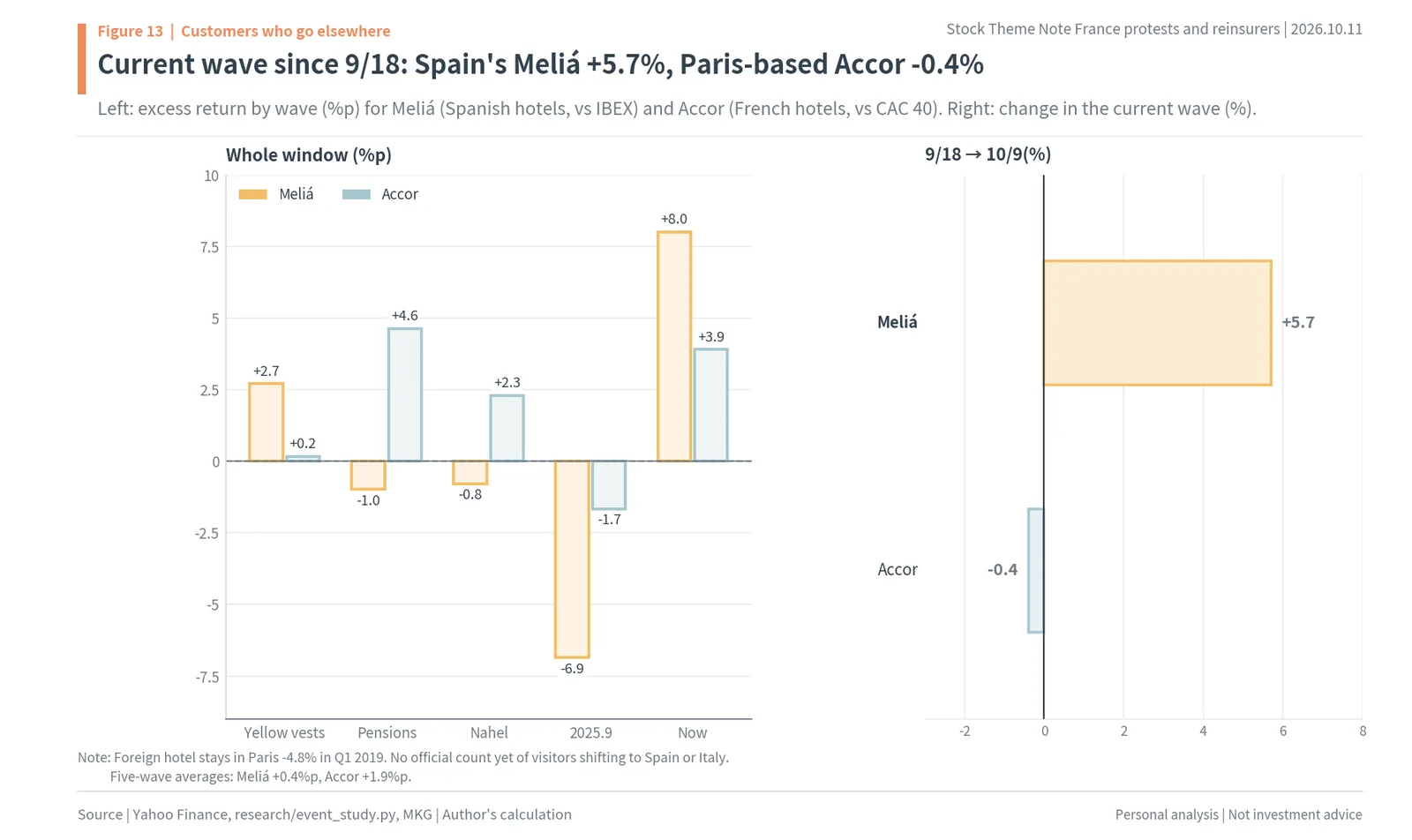
Riot gear and surveillance cameras
Some think that rougher protests will lift demand for riot gear and surveillance cameras. France’s tear gas and stun grenade makers (Alsetex, Etienne Lacroix) are unlisted. In this wave the government actually stopped using stun grenades on October 7. Camera installations continue with local-government subsidies, but the author found no numbers showing demand rose after the protests. So this report does not put equipment or cameras on the benefiting side.
What remains on the benefiting side are companies that can set prices. When primary insurers’ losses repeat, reinsurance rates rise; when tourists move, hotel room rates in other countries rise. Of the two, the one whose direction is confirmed by numbers is reinsurance. Reinsurers consistently beat the index in the first five trading days of five waves, and their long-term share prices also outpaced primary insurers.
So among competitors, the one whose gain from the protests can be confirmed in numbers is the reinsurer that sets rates, while Spanish hotels that take in tourists reacted first in this wave.
8. Valuation: Munich Re 10.1x, SCOR 7.0x, and the watch order
Munich Re at 10.1 times, SCOR at 7.0 times
Reinsurer valuations are not expensive. Forward P/Es calculated with analyst consensus on Yahoo Finance (forwardEps, retrieved October 11) are 10.1 times for Munich Re on EPS of EUR 51.62 (share price EUR 523.8, about KRW 786,000 or $587) and 7.0 times for SCOR on EPS of EUR 4.54 (EUR 31.92, about KRW 47,900 or $35.8). Fellow reinsurers Swiss Re trades at 11.0 times on EPS of CHF 13.04 and Hannover Re at 11.1 times on EPS of EUR 23.62. Primary insurer AXA is at 9.3 times on EPS of EUR 4.48 and Allianz at 12.5 times on EPS of EUR 33.40.
Dividends are large too. Dividend yields are 5.95% for SCOR, 5.59% for AXA, 4.65% for Munich Re, 4.77% for Hannover Re, 4.34% for Swiss Re and 4.10% for Allianz. Figure 14 shows forward P/E on the left and dividend yield on the right. Won conversions use KRW 1,500.2 per euro on October 9, and dollar conversions $1.12 per euro (1.1206) on the same day.
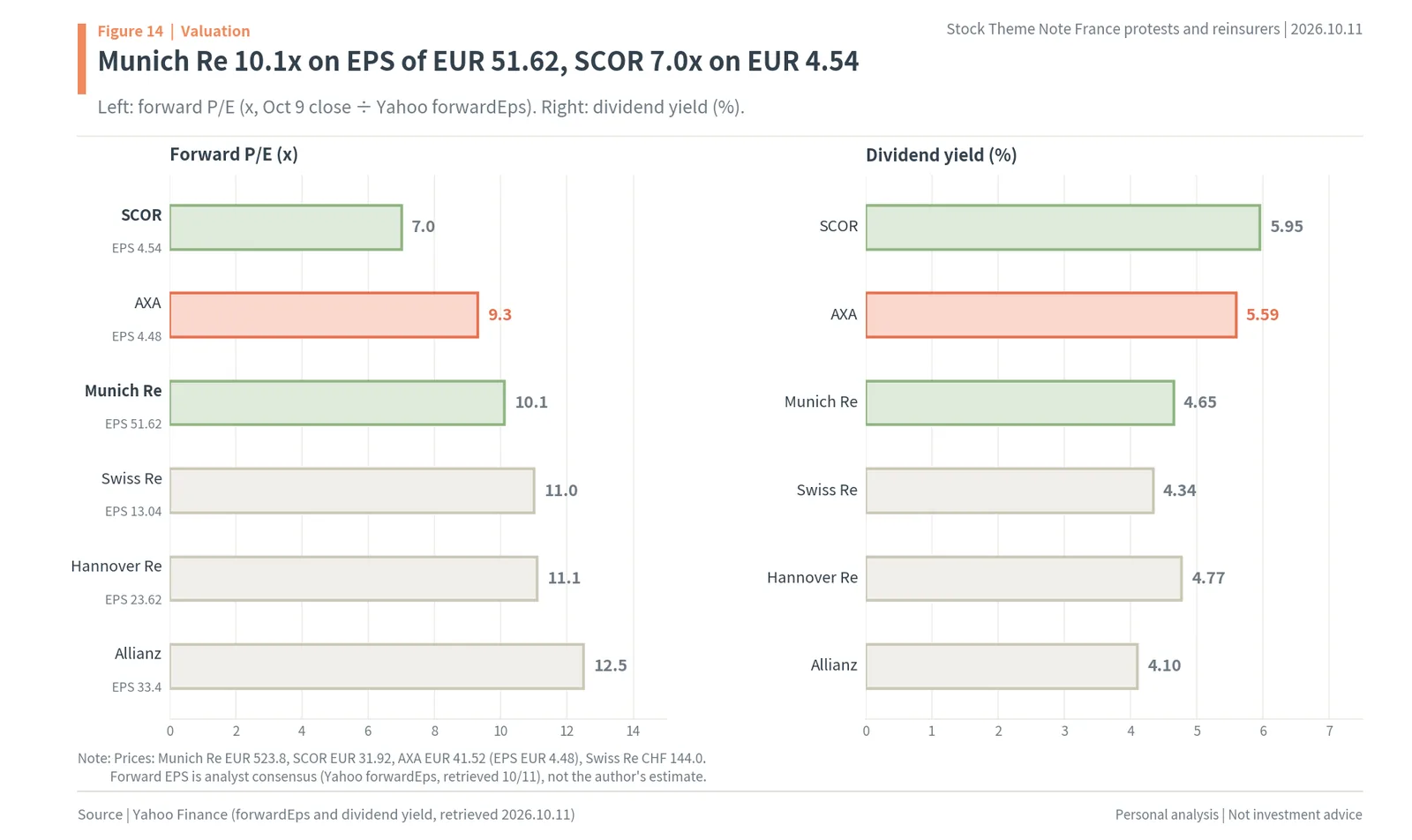
The author’s watch order
The author looks first at Munich Re. It beat its index in four of the first five trading days of five protest waves, went further than AXA and the CAC 40 over the seven years since November 2018, and in this wave is up 3.6% since September 18, 4.5 points stronger than the DAX. Its valuation of 10.1 times is around the reinsurer average, and as one of the world’s largest reinsurers, French protest losses are not big enough to shake its earnings, while it still rides the direction of rate increases.
Second is SCOR. As a French company it is closest to French reinsurance renewals, and its first-five-day average of +2.4 points was larger than Munich Re’s or AXA’s. At 7.0 times earnings and a 5.95% dividend yield, it is the cheapest. Its seven-year share price was weak at 75, but on the first-week average of the protests it reacted most strongly, and its valuation is correspondingly low.
On the losing side are AXA and Vinci. They lagged the index all five times, and in this wave AXA fell 4.0 points more than the CAC 40. In a phase where protests drag on, like the November 5 general strike, these two are pressed first. While the French protests continue up to the November 5 general strike, the author ranks Munich Re → SCOR, which raise rates, ahead of AXA and Vinci, which pay the losses.
The author also sets signals that would change the watch order. If rates for French shop and riot cover do not rise at the January reinsurance renewal, the case for reinsurers weakens. Conversely, if after the November 5 strike the insurers’ federation counts this wave’s losses above the yellow vests (EUR 217mn), the grounds for rate increases grow. Primary insurer AXA becomes interesting again after losses have passed into premiums, in other words after renewal rates have risen.
So the author’s watch order is Munich Re → SCOR, and the losing side is AXA and Vinci.
8-1. Two paths: the government retreats or holds firm
The path where the government retreats further
Two paths lie ahead of the government. The first is to retreat further. The education minister has already offered 3,000 substitute teachers and no cuts to high-school posts in 2027, and said the education budget could rise by more than the planned EUR 1.2bn. If the EUR 10bn the students demand and the pay rises the unions demand are granted, the protests will subside. But the 2027 deficit target of 5.0% becomes hard to meet, and the rating agencies and bond market will collect the difference through interest rates. If the 10-year, at 4.87% on September 30, goes above 5%, more interest is added to the same EUR 340bn of new debt, and the next year’s austerity gets bigger.
On this path, the stock market marks down French government bonds and banks first. For insurers, higher rates lift the interest on newly bought bonds, which helps earnings, but lower the value of bonds they already hold. It is a path where street losses shrink and the burden on the bond side grows.
The path where the government holds firm
The second is to hold firm. Keeping the austerity steadies the bond market but prolongs the protests. The October 13 student and teachers’ union strike, the October 17 yellow-vest call and the November 5 five-union all-sector strike come one after another. If student-led blockades merge with union strikes and cost-of-living protests, the 2018 yellow-vest pattern of street shops closing and motorway toll stations blocked every Saturday could repeat. On this path, losses pile up at stores, roads, air routes and the primary insurers that cover them.
The demands of the November 5 strike also lengthen the second path. The five unions oppose the EUR 54bn of austerity in the 2027 budget and demand pay rises, tax reform and the redistribution of EUR 211bn in aid to companies. They called on not only public- and private-sector workers but also retirees and young people. Because the demands have widened from teaching posts to the whole budget, concessions from the Education Ministry alone are unlikely to avert this date.
Either way, the reinsurers’ position is the same. On the first path, higher rates raise the interest on the money reinsurers invest; on the second, losses pile up and give grounds for next year’s rate increases. Primary insurers, by contrast, are burdened by bond valuations on the first path and by loss ratios on the second. That is why the author puts primary insurers and reinsurers on opposite sides.
Seven months to the presidential election
The last variable is the political calendar. The French presidential election is in April–May 2027, a little over seven months away. A government heading into an election cannot let street discontent drag on for long, and the opposition uses the protests as material to attack the government. LFI supports the protests most strongly, the Socialist Party has sided with the students, and the National Rally attacks less the protests themselves than “a riot organized by LFI”. The 2027 budget has to go through parliament by year-end, and the government has no majority. So the author sees a high chance that the protests flare up repeatedly in step with the budget review and the election calendar rather than ending in one go.
So whether the government retreats or holds firm, the burden stays with primary insurers and the grounds for raising prices stay with reinsurers.
9. Korean stocks: travel names fell before the protests grew
The fall in travel stocks began before the protests
The first places Korean investors think of are travel and airlines. About 267,000 Korean tourists visit the Paris region each year, and T’way Air (KRX: 091810) opened an Incheon–Paris route in August 2024. From September 18 to October 8, excess returns over the index were -20.4 points for Modetour (080160.KQ), -13.2 points for Yellow Balloon (KRX: 104620) and -13.2 points for Very Good Tour (KRX: 094850), so travel stocks did badly. By contrast, Hanatour (039130.KS) was +0.8 points, T’way Air +3.1 points and Korean Air (003490.KS) +8.5 points. Korea’s two main indices are the KOSPI (large caps) and the KOSDAQ (growth and smaller companies).
Koreans visiting Paris spend about EUR 286mn a year. T’way Air’s Incheon–Paris route ran five times a week in the 2025 winter schedule and carried about 200,000 passengers in total through August 2026. But the fall in travel stocks came before the French protests grew. Modetour fell 6.8% and Hanatour 3.8% on September 18 alone. Around then, Korean data showed 88% of package bookings for the Chuseok holiday (Korea’s autumn harvest festival) going to nearby countries, and weak results continued, such as Hanatour’s KRW 5.4bn operating profit in the second quarter and Modetour’s 64% drop in first-quarter operating profit. In the event study, Hanatour and Modetour were consistently weaker than the index, including windows with no French protests. The author found no broker report or article linking the French protests to Korean travel stocks. Korean travel stocks are reacting to domestic holiday demand and each company’s results before anything happening on French streets.
Companies with large European sales, and companies going to Paris
Among Korean stocks with large European sales is K-beauty distributor Silicon2 (KRX: 257720). Its European sales in the first quarter of 2026 were KRW 161.8bn, about 46.7% of the total, and European sales in the second quarter rose 62% from a year earlier. Growth was led by Boots, the UK drugstore chain, and France’s share on its own is not disclosed. Hanwha Vision (489790.KS) supplies cameras to European airports and ports, but no French public-security contract has been confirmed.
Hyundai and Kia have overlapping dates. The Paris Motor Show runs from October 12 to 18; Hyundai is taking part for the first time since 2018 with the IONIQ 3 and a new Tucson, and Kia is showing 14 models on a 1,000 m² stand. October 13, the first public day, is the day of the student and teachers’ union strike. Figure 15 shows the excess returns of Korean stocks over their index on the left and Silicon2’s European share of sales on the right.
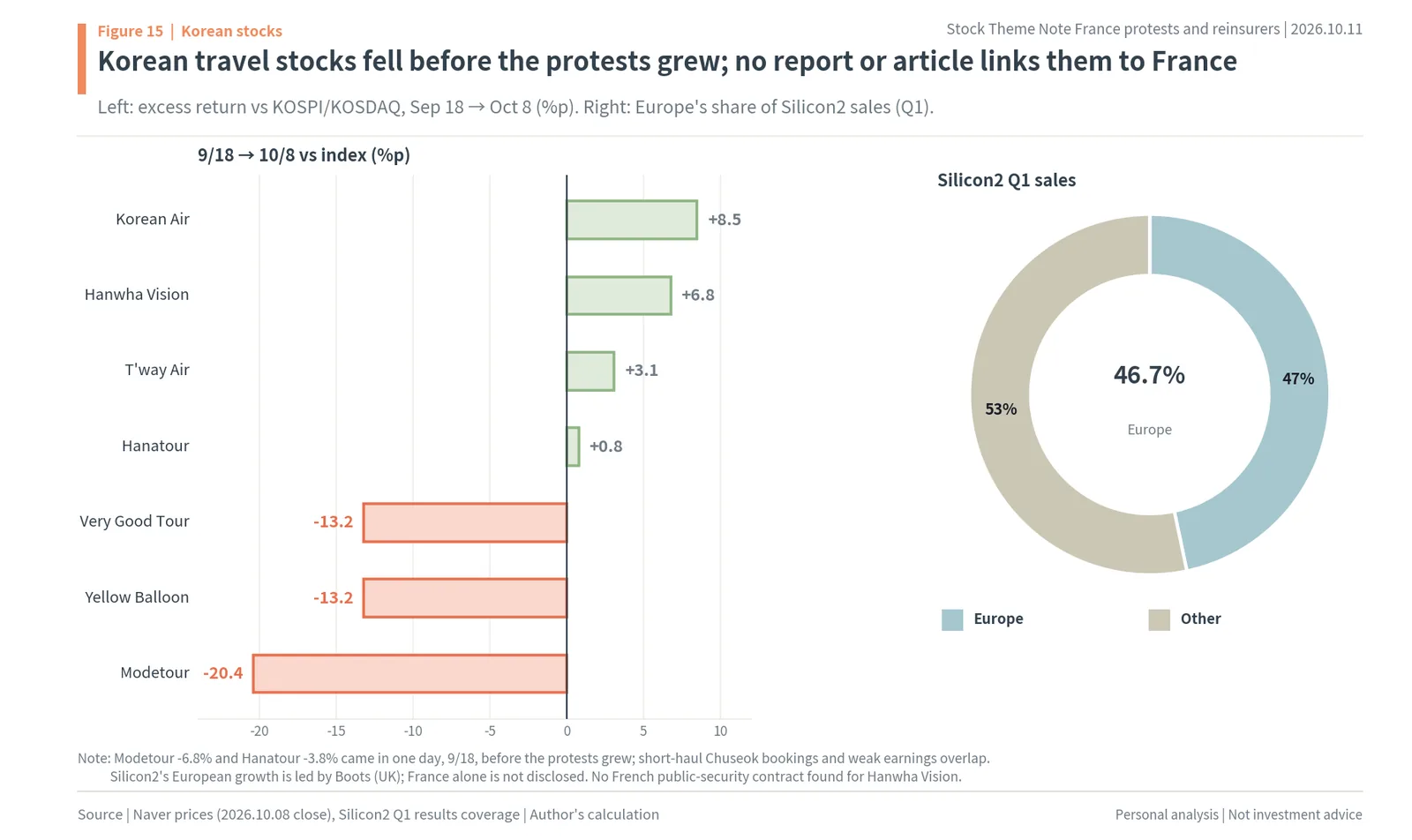
What Korean investors should watch
Korean investors interested in reinsurers should watch two things together. One is the exchange rate. On October 9 one euro was KRW 1,500.2, and the euro has weakened 2.4% against the dollar since September 18. If rising French risk weakens the euro, a share price that rises in euros rises less in won. One Munich Re share is EUR 523.8, about KRW 786,000, and one SCOR share is EUR 31.92, about KRW 47,900. The other is trading hours. Munich Re is listed on the German exchange and SCOR and AXA on Euronext Paris, which trade from evening into the night Korean time. French protest news usually breaks during the Korean night and early morning, so rather than looking for stocks that react in the Korean session, it makes more sense to check the European market’s reaction the next day.
So no Korean stock benefits directly from the French protests, and anyone looking for beneficiaries is better off looking at European-listed reinsurers.
10. Eight signals to watch
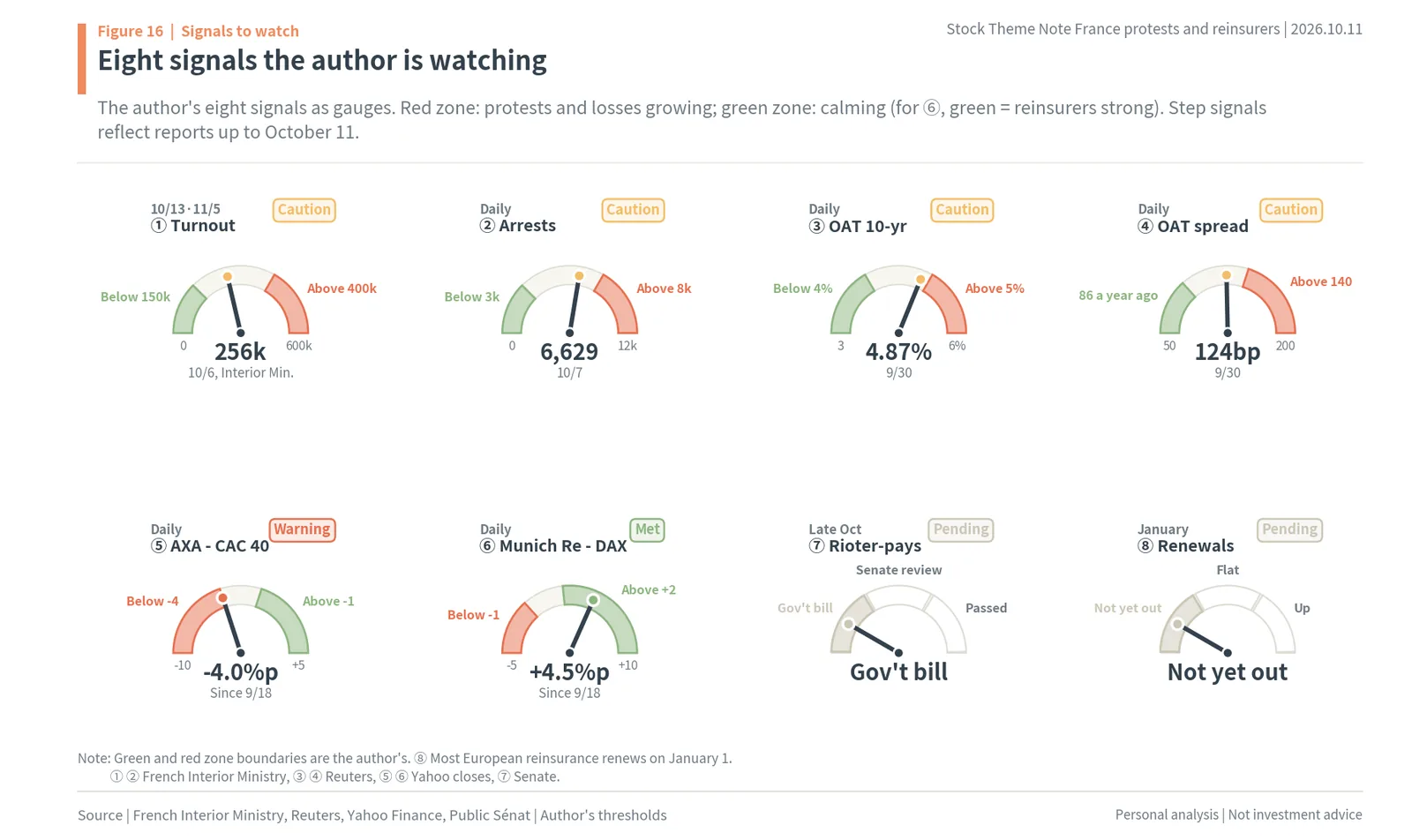
The author watches eight signals. The first is strike turnout: 256,000 on October 6 by the Interior Ministry’s count. The second is total arrests: 6,629 as of October 7. The third and fourth are the bond market: the French 10-year at 4.87% and the spread over Germany at 124bp on September 30. The fifth and sixth are share prices: since September 18, AXA is 4.0 points weaker than the CAC 40 and Munich Re 4.5 points stronger than the DAX. The seventh is the Senate’s review of the casseur-payeur bill, and the eighth is January reinsurance renewal rates.
Here is how to read them. If strike turnout tops 400,000 and arrests top 8,000, losses are growing. If the French 10-year tops 5% or the spread tops 140bp, austerity tightens and the protests lengthen. Conversely, if the government gives back more teaching posts and yields fall below 4%, the protests subside. For reinsurance, the most direct confirmation is whether rates on French shop and riot cover rise at the January renewal. Figure 16 draws the eight signals as gauges, and the green and red zone boundaries are the author’s.
The gauge zones are set as follows (author’s thresholds). Strike turnout is green below 150,000 and red above 400,000. The 150,000 mark is a little over twice the October 8 Bastille rally (71,500), and 400,000 approaches the September 18, 2025 union day of action (506,000). Total arrests are green below 3,000 and red above 8,000. The French 10-year is green below 4% and red above 5%, and the spread over Germany is green below 90bp, near last year’s 86bp, and red above 140bp.
The share-price signals point the other way. AXA is green above -1 point against the CAC 40 since September 18 and red below -4 points, and at -4.0 points it is now on the edge of red. Munich Re is green (reinsurers strong) above +2 points against the DAX and red below -1 point, and it is now at +4.5 points. The casseur-payeur bill changes stage on whether it passes the Senate, and the reinsurance renewal rate when the January 1 renewal results come out.
11. Dates to watch: Oct 13, Oct 17, Nov 5 and the Jan 1 renewal
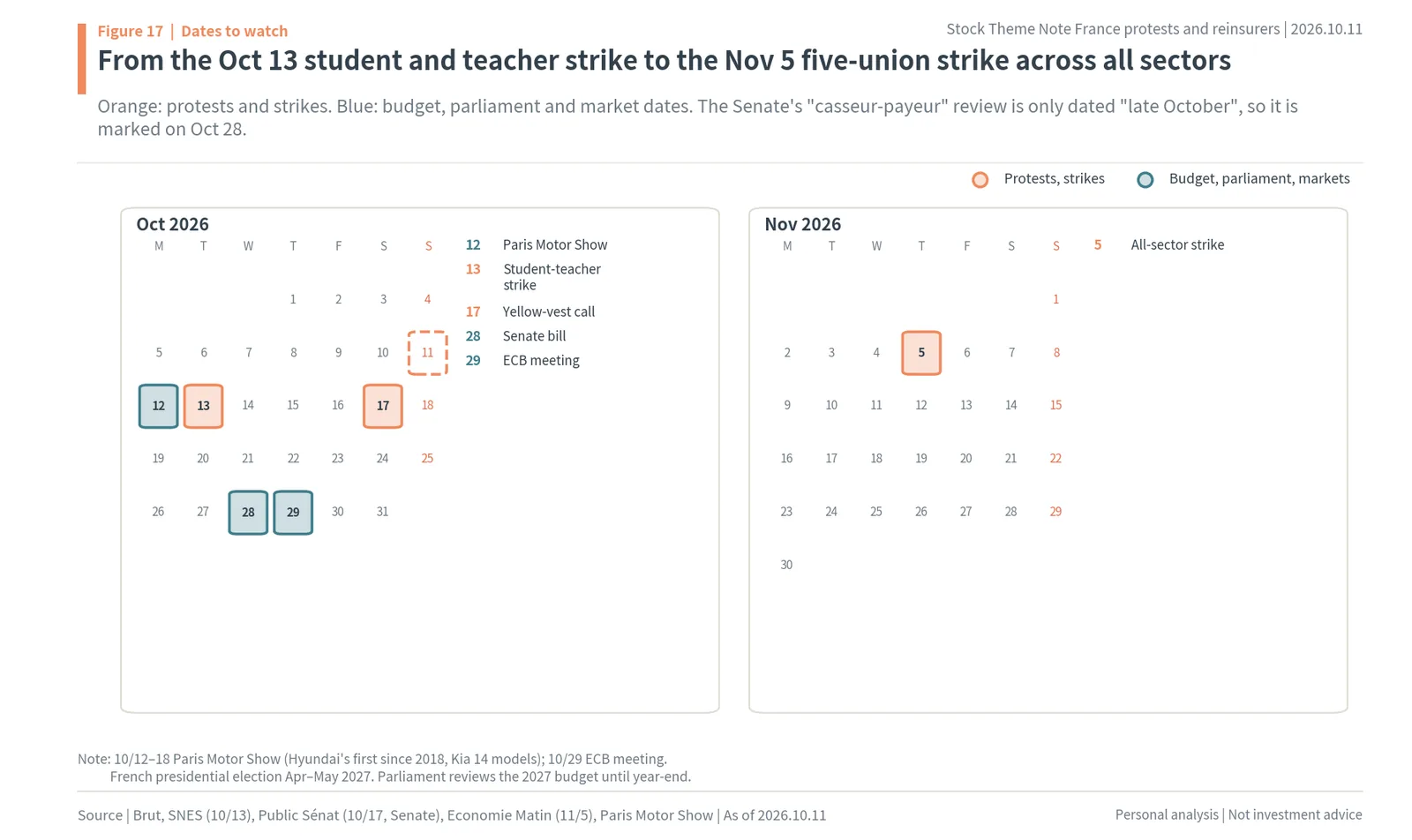
The nearest date is October 13, when student groups and teachers’ unions strike and protest together. The Education Ministry said about 96% of schools would open normally, while the high-school students’ union countered that 2,000 lycées would stop. The Paris Motor Show opens to the public the same day. For October 17, calls to revive the yellow vests are circulating on social media. The date imitates November 17, 2018, and the main unions are not taking part, but 67% of people say their purchasing power has fallen.
At the end of October the Senate reviews the casseur-payeur bill, and on October 29 the European Central Bank sets rates. On November 5 the five unions, the CFDT, CGT, FO, Unsa and FSU, hold a strike that brings the public and private sectors, retirees and young people out together. The 2027 budget is reviewed in parliament through year-end, and the presidential election is in April–May 2027. Figure 17 marks the October and November dates on a calendar.
12. Methodology: event study, prices, valuations and the author’s calculations
Event study
Excess return in the event study is the stock’s return minus its home index’s return (percentage points). The benchmark index is the CAC 40 for French stocks, the IBEX 35 for Spanish stocks (Meliá, IAG, Amadeus), the DAX for German stocks (Munich Re, Zalando), the S&P 500 for the US stock (Amazon), and the KOSPI for Korean stocks (the KOSDAQ for Modetour). The starting price is the close on the day before each window starts, closes are Yahoo Finance daily bars, and dividends are not included. The windows are the yellow vests from November 16 to December 31, 2018, the pension strikes from January 18 to April 14, 2023, the Nahel riots from June 26 to July 7, 2023, September 9 to 19, 2025, and now, from September 18 to October 9, 2026. The first five trading days run from the same starting price to the close of the fifth trading day.
Large events overlapping the same windows are the December 2018 global sell-off, the March 2023 US regional bank and Credit Suisse crisis, and the collapse of the Bayrou government on September 8, 2025 together with Fitch’s downgrade on September 12. Much of Zalando’s -18.4 points in the yellow-vest window came from its own profit warning on December 11. So the author based the judgment on the direction across five waves (how often a stock lagged the index) rather than the size of any one. For Korean travel stocks, excess returns came out sharply negative in the 2023 pension-strike window because the KOSDAQ surged on secondary-battery stocks.
Stocks in the event study and their Yahoo tickers are as follows. France: AXA (CS.PA), Vinci (DG.PA), Carrefour (CA.PA), Fnac Darty (FNAC.PA), Air France-KLM (AF.PA), Accor (AC.PA), LVMH (MC.PA), Kering (KER.PA), Hermès (RMS.PA), Saint-Gobain (SGO.PA), Getlink (GET.PA), TotalEnergies (TTE.PA), SCOR (SCR.PA). Germany: Munich Re (MUV2.DE), Zalando (ZAL.DE). Spain: Meliá (MEL.MC), IAG (IAG.MC), Amadeus (AMS.MC). US: Amazon (AMZN). Korea: Hanwha Vision (489790.KS), Hanatour (039130.KS), Modetour (080160.KQ), Korean Air (003490.KS). Hanwha Vision listed in September 2024, so it appears only in 2025 and 2026.
Prices and valuations
Price changes since September 18 run from the September 18 close to the October 9 close (October 8 for Korea, which was closed on October 9 for Hangul Day). The long-term chart uses month-end closes rebased to the November 15, 2018 close = 100. Forward P/E is the October 9 close divided by Yahoo Finance forwardEps (retrieved October 11); this EPS is analyst consensus, not the author’s estimate. Won conversions use EUR/KRW 1,500.2 on October 9, and dollar conversions EUR/USD 1.1206 on the same day.
The author’s calculations
The extra interest on new debt of about EUR 4.32bn is the planned 2027 bond issuance of EUR 340bn multiplied by 1.27 percentage points, the difference between the 10-year yield of 4.87% on September 30 and about 3.6% a year earlier. It is a simple assumption that all new bonds are issued at the 10-year rate, so differences across maturities are not included. The 2.2 times compared with the pay-freeze saving of about EUR 2bn is 4.32 divided by 2. The pre-war diesel price of about EUR 1.79 is the October 7 price of EUR 2.347 divided by 1.31.
The 2005 riot insured loss of about EUR 198mn works backwards from the insurers’ statement that “the Nahel riots’ EUR 793mn was four times 2005”. That the Nahel riots were 3.7 times the yellow vests is 793 divided by 217. Fnac Darty’s 0.6% loss share is EUR 45mn divided by 2018 revenue of EUR 7.475bn. The 24.1% share of lycées with classes halted is 891 divided by 3,700.
All protest turnout figures are Interior Ministry counts. Organizer counts are usually larger than the Interior Ministry’s; on October 6 it was 450,000. Sources give the start date as September 17, 18 or 21, so it is written as September 17–21. The spread over Germany uses Reuters’ 124bp on September 30. An Italian outlet’s 140bp for October 6 was not used because its German benchmark differs.
13. Wrap-up: debt → austerity → streets → insurance → reinsurance
Here is this report’s chain once more in a line. France carries debt of 115.6% of GDP, and as its rating fell, the 10-year bond yield rose to 4.87%. To cover the rising interest, the government proposed EUR 54bn of savings for 2027, and that knife reached teaching posts (4,000 in 2026, 1,588 in 2027) and civil-service pay (the point d’indice frozen for a third year). With diesel up more than 31% because of the war and youth unemployment at 21.6%, a blockade that started at one high school in Créteil spread in three weeks to halt classes at 891 lycées nationwide and lead to 6,629 arrests.
Street losses pile up at primary insurers and street-facing businesses. Across five protest waves, AXA and Vinci lagged the index all five times, and Fnac Darty, Carrefour, Paris hotels and airlines disclosed damage in their results. Insured riot losses grew from about EUR 198mn in 2005 to EUR 793mn in 2023, and insurers responded by raising premiums and cutting cover. When losses repeat, primary insurers have to buy more reinsurance, and reinsurers raise rates at the next renewal.
So the author looks for the beneficiaries of the French protests among reinsurers. Munich Re beat its index in four of the first five trading days of five waves, went further than AXA and the CAC 40 over seven years, and trades at 10.1 times forward EPS of EUR 51.62. SCOR reacted most, with a first-five-day average of +2.4 points, and is cheapest at 7.0 times. No Korean stock benefits directly from the French protests. The dates to watch are the October 13 student and teachers’ union strike, the October 17 yellow-vest call, the November 5 five-union all-sector strike, and the January 1 reinsurance renewal.
Maochaedung’s take. The root of the French protests is not the classroom but interest on the national debt. The austerity meant to cover that interest touched teachers’ and civil servants’ pay, and primary insurers take the street losses first. The more the losses repeat, the more pricing power builds up at reinsurers. Insurers receive the bill for the protests, and reinsurers turn that bill into a price. The author’s watch order is Munich Re → SCOR, and the losing side is AXA and Vinci.
France protests and stocks FAQ
Q. Why are students protesting in France in 2026?
The blockades began at a high school in Créteil in September 2026 over unfilled teaching posts. Behind them is austerity: with the French 10-year bond yield at 4.87%, the 2027 draft budget saves EUR 54bn, cuts 1,588 more teaching posts after 4,000 in 2026 and keeps civil-service pay frozen, while diesel is up more than 31% and youth unemployment is 21.6%.
Q. Which stocks lose during French protests?
In all five protest waves since 2018 (yellow vests, 2023 pension strikes, Nahel riots, September 2025 and now), AXA and Vinci did worse than the CAC 40. Retailers such as Fnac Darty and Carrefour, Paris hotels and airlines such as Air France-KLM also disclosed losses.
Q. Why could reinsurers like Munich Re and SCOR benefit?
Primary insurers pay protest and riot claims first, but repeated large losses make them buy more reinsurance, and reinsurers raise rates at the January 1 renewal. Munich Re beat the DAX in four of the first five trading days of five protest waves and trades at 10.1 times forward EPS of EUR 51.62; SCOR trades at 7.0 times.
Sources
- Financial News and Paris Match Belgique, French high-school protests top 250,000 (link), 2026.10.06
- Amnesty France, State of the high-school blockades (link), 2026.10
- Euronews, Mélenchon declares Bastille retaken (link), 2026.10.08
- Euronews FR, School blockades, clashes and Prime Minister Lecornu (link), 2026.10.01
- Euronews FR, 2027 budget of EUR 54bn (link), 2026.10.01
- LCP, Interior Minister Nuñez’s parliamentary hearing (link), 2026.10.07
- Public Sénat, School blockades, unions and yellow vests (link), 2026.10
- Public Sénat, The October 17 yellow-vest call (link), 2026.10
- Economie Matin, Five-union strike on November 5 (link), 2026.10.05
- presse-citron, Education minister’s announcements on TF1 (link), 2026.10.09
- French Education Ministry, 2027 budget press kit (link), 2026.10
- France Epargne (citing Reuters), OAT–Bund spread of 124bp (link), 2026.09.30
- MNI, OAT/Bund spread 86bp (link), 2025.10.06
- prix-carburant.eu, Fuel prices on October 7 (link), 2026.10.07
- Kelwatt, Diesel prices and Ufip (link), 2026.10
- Insee, Unemployment in Q2 2026 (link), 2026.08
- l’Avenir, Yellow-vest insured losses of EUR 200mn (link), 2019.03.26
- atlas-mag, Yellow-vest insured losses (link), 2019
- Public Sénat, 2023 riots cost EUR 1bn (link), 2024
- atlas-mag, Nahel riot loss estimates (link), 2023–2024
- atlas-mag, Allianz and Groupama cut riot cover in overseas territories (link), 2024
- Fnac Darty, 2018 sales release (yellow-vest impact), 2019.01.09
- Banque de France and Insee, Q4 2018 growth impact (link), 2018.12
- Embassy of the Republic of Korea in France, Safety notice (link), 2026.10.02
- Yahoo Finance, daily prices, forwardEps, dividend yields, EUR/KRW and EUR/USD (2026.10.09 close, retrieved 2026.10.11); Naver Finance daily prices (2026.10.08)
Disclaimer
This post records the author’s personal analysis and views based on publicly available information and does not recommend any particular product or company. It does not recommend buying or selling any financial investment product and is not an investment advisory service.
Figures are as published at the time of writing. The extra interest on new government bonds, the 2005 riot losses, the excess returns and averages by protest wave, and the won and dollar conversions were calculated by the author from public data and market prices and are not confirmed forecasts. Accuracy and completeness are not guaranteed.
The watch order is a view based on the grounds stated in the text (the event study, the trend in insured losses and forward P/E); if those grounds change, the results will differ. “Author’s calculation” and “author’s view” mark the author’s own calculations and assumptions, not confirmed facts.
Forward EPS and P/E figures are analyst consensus from Yahoo Finance, not the author’s estimates. Foreign stocks are exposed to currency movements. This post does not recommend trading at any particular time or promise any return.
Author’s interests: not disclosed
Responsibility for decisions and their outcomes lies with the reader.
As of: October 11, 2026