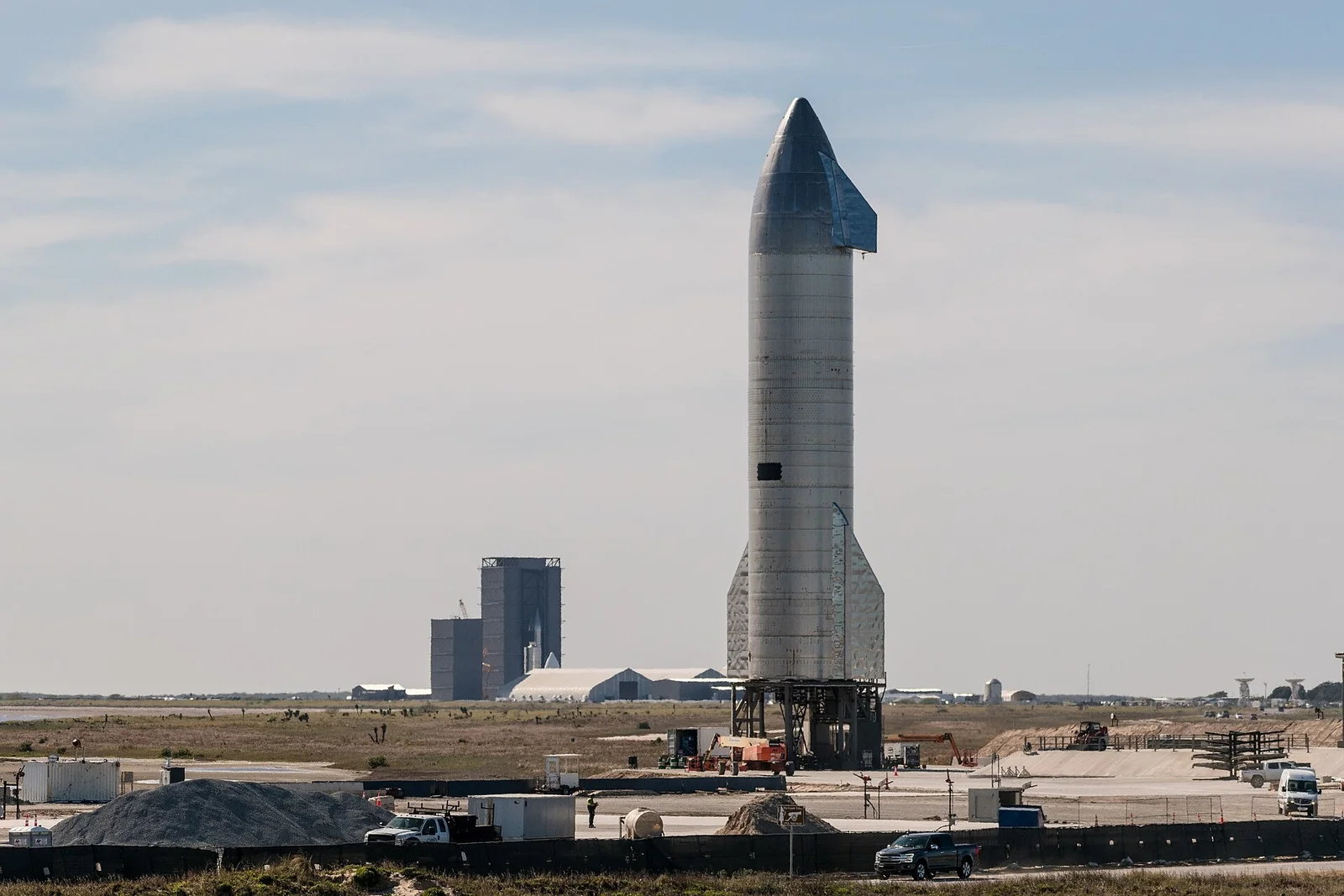
SpaceX (SPCX) Stock Forecast: Q3 Results, the Real Reason Musk Wants to Merge SpaceX and Tesla, and a $3.48 Trillion Combined Company
On January 15, 2024, Elon Musk wrote on X: “I am uncomfortable growing Tesla to be a leader in AI & robotics without having ~25% voting control. Enough to be influential, but not so much that I can’t be overturned. Unless that is the case, I would prefer to build products outside of Tesla.” At the time he owned about 13% of Tesla (Fortune).
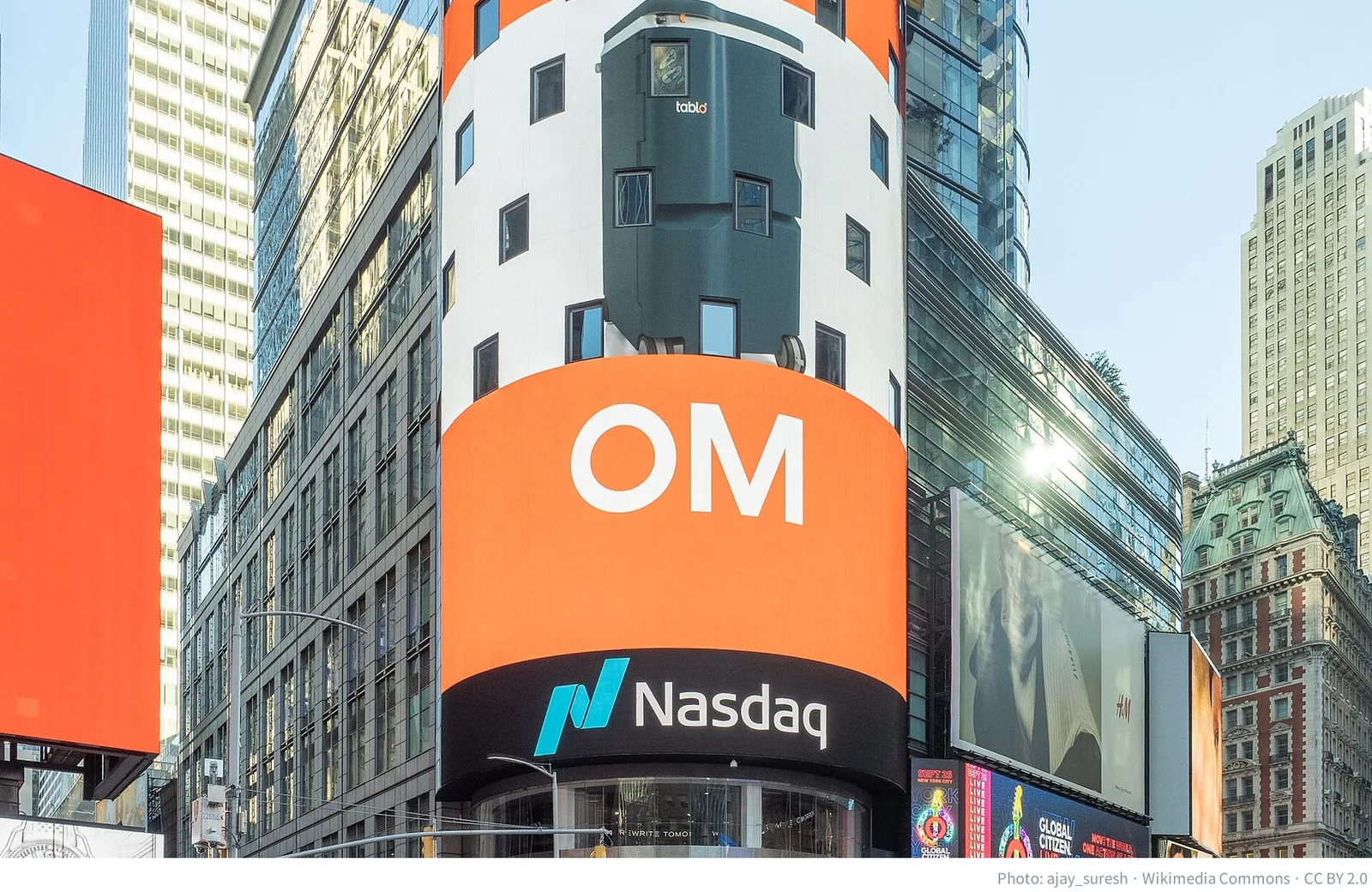
What followed went the way he said it would. AI grew outside Tesla, at xAI, and on February 2, 2026 xAI was folded into SpaceX. SpaceX listed on the Nasdaq on June 12, and on October 20, on its third-quarter earnings call, Musk said the boards of SpaceX and Tesla had each formed a special committee to weigh a merger of the two companies. In the results released the same day, AI revenue passed Starlink revenue for the first time.
So what is the real reason to combine the two companies? And what kind of company would the combination be? This report starts from SpaceX’s third-quarter results and follows, in order, how its AI business grows, how much that growth costs, and where the ingredients for it sit, to answer those two questions.
As of: October 21, 2026. The reference price is SpaceX’s Nasdaq regular-session close of $147.79 on October 20, 2026, before the third-quarter report. Also covered: Tesla (Nasdaq: TSLA), which closed at $373.71 the same day.
Topics covered: third-quarter results and profit by business, first-quarter 2027 guidance, volume and price at Starlink and AI, what one gigawatt (GW) of compute costs, a 2027-2028 forecast model, why the AI ingredients sit at Tesla, deals and votes between the two companies, Musk’s voting power, the 2016 SolarCity precedent, the combined company’s revenue mix and shareholder split, exchange-ratio math, what today’s price assumes and a one-year range, and dates to watch.
Reference data: SpaceX numbers are from its SEC filings (third- and second-quarter earnings releases on Form 8-K, the second-quarter 10-Q and the 424B4 IPO prospectus) and the third-quarter earnings-call transcript (The Motley Fool); Tesla numbers are from its 2026 annual-meeting proxy statement and second-quarter 10-Q; prices and consensus are from Yahoo Finance (October 20 closes, accessed October 21); events are from dated news reports. The third-quarter 10-Q had not been filed yet. Numbers the author calculated or estimated are marked as the author’s calculation or estimate. This is the author’s personal analysis, not investment advice.
1. Third-quarter results: the first quarter AI beat Starlink
The short version: the third quarter of 2026 is when SpaceX turned from a rocket and satellite-internet company into an AI company. More than half of revenue and more than half of profit came from AI, and AI also lifted the revenue range the company gave for the first quarter of next year.
Revenue of $14.58 billion, 2.6 times a year earlier
SpaceX reported third-quarter results after the US market close on October 20. Revenue was $14.58 billion, up 161.4% from $5.58 billion a year earlier and up 86.5% from $7.81 billion in the second quarter. Operating income was $2.79 billion, its first operating profit as a public company, and net income was $4.40 billion, swinging from a $1.05 billion loss a year earlier. Diluted earnings per share (EPS) were $0.35, more than double the $0.16 that analysts on Yahoo Finance expected before the report. Net income also included $873 million of interest income and $1.025 billion of other income, such as gains on investments in affiliates.
The company reports three businesses. AI, renamed SI (Super Intelligence) from the third quarter, covers xAI’s Grok and X advertising, data-center compute leasing and Cursor, the AI coding tool it bought in August. Connectivity is the Starlink satellite-internet business. Space is Falcon and Starship launches and development contracts. Third-quarter revenue was $7.56 billion from AI, $5.25 billion from Starlink and $1.77 billion from launch. AI revenue was 9.3 times the $813 million of a year earlier, Starlink grew 69.5% and launch 6.1%. AI made up 51.9% of total revenue, passing Starlink for the first time.
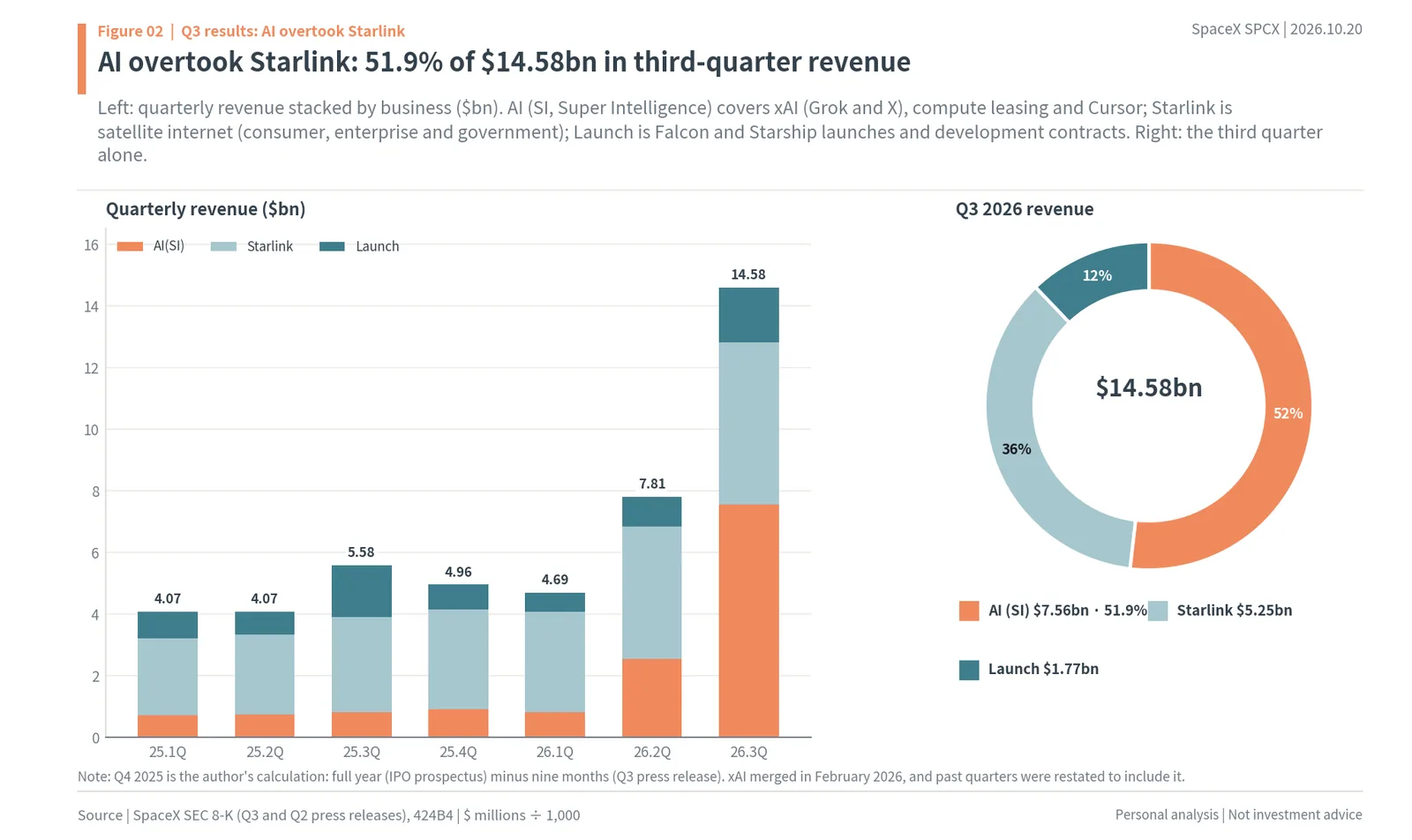
Over the first nine months of the year, revenue was $27.08 billion, about double the $13.71 billion of a year earlier, and the net loss narrowed to $413 million from $2.59 billion. The large first-quarter loss ($4.276 billion) included a $1.526 billion loss on repaying xAI debt early. A single profitable third quarter almost erased the nine-month loss.
Figure 2 shows how sudden the change was. For the five quarters from the first quarter of 2025 to the first quarter of 2026, quarterly revenue stayed between $4.0 billion and $5.6 billion, most of it Starlink. AI jumped to $2.561 billion in the second quarter and tripled again in the third. Cursor contributed $608 million of AI revenue in the month and a half after the acquisition. SpaceX bought Cursor on August 14 for $60 billion of its own stock (389.29 million Class A shares); the accounting purchase price was $42.5 billion.
Costs grew too. Third-quarter cost of revenue was $5.478 billion, double the $2.705 billion of a year earlier; R&D rose from $2.291 billion to $4.596 billion and SG&A from $575 million to $1.707 billion. Revenue grew faster, so the gross margin rose from 51.5% to 62.4% (author’s calculation). Leasing compute has little extra cost once the equipment is installed.
More than half of profit also came from AI
The profit mix moved the same way. Adjusted EBITDA, profit before depreciation and stock compensation, was $8.81 billion, or 60.4% of revenue, and AI contributed $4.953 billion of it, 56.2%. A year earlier AI adjusted EBITDA was a $428 million loss. Starlink adjusted EBITDA was $3.499 billion and launch $357 million.
Two big customers and a growing pile of prepayments
Big customers explain much of the speed. According to the second-quarter 10-Q, one customer (Customer A) accounted for 18.3% of second-quarter revenue across all three businesses, and another (Customer B) for 19.5%, in AI alone. The company did not name them. Prepayments are building up as well. Deferred revenue (cash received but not yet booked as revenue) was $17.52 billion at the end of September: $10.784 billion current and $6.736 billion non-current. The second-quarter release said the company had signed $14.1 billion of contracted sales for cloud services. Compute contracts with big customers are paid in advance and turn into revenue over several quarters.
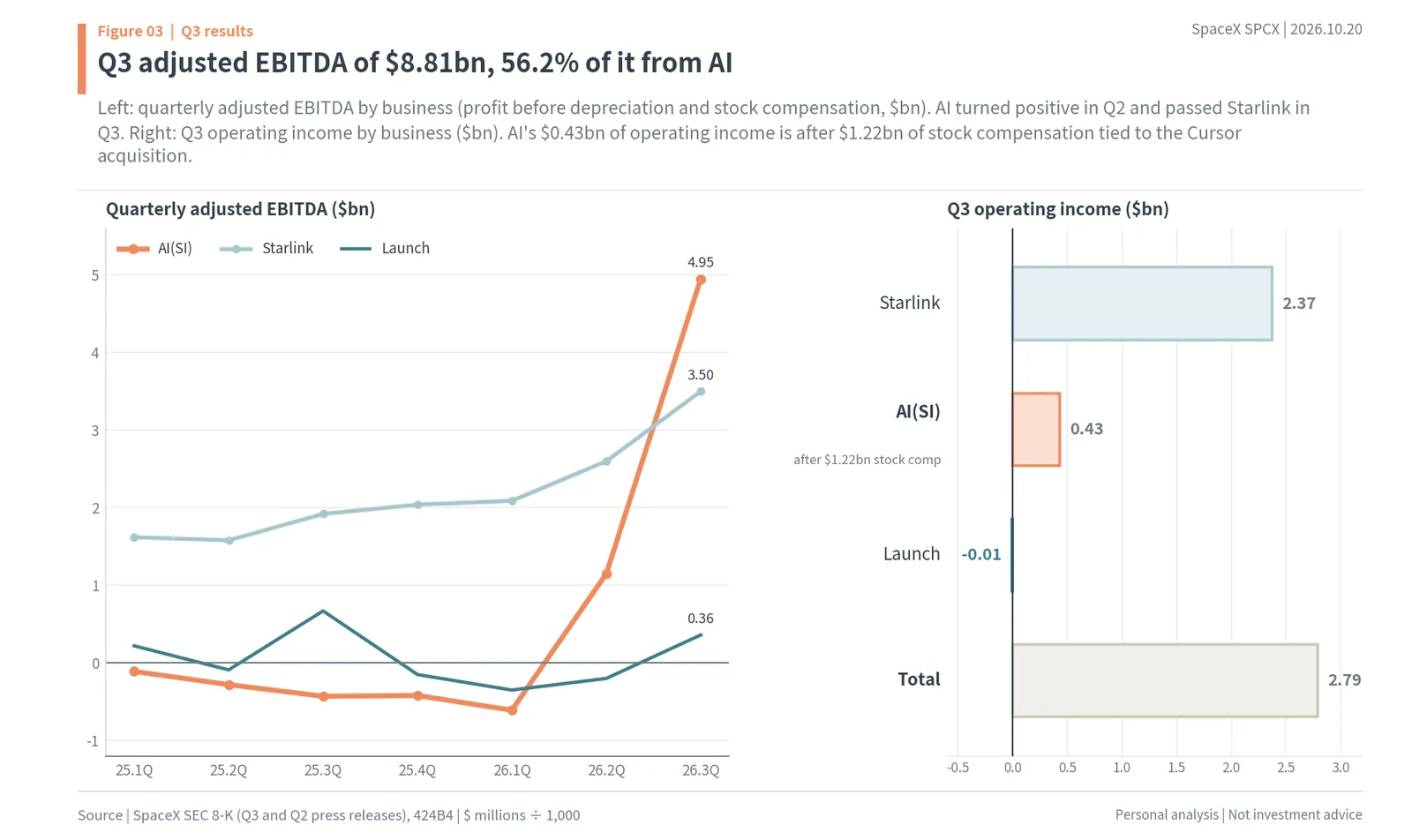
On operating income, Starlink was the largest at $2.367 billion, AI made $431 million, and launch lost $7 million. AI operating income is far below its EBITDA for two reasons. Depreciation on data-center equipment was $2.473 billion in the third quarter alone, and $1.217 billion of stock compensation went to retaining key Cursor staff. The company said about $23 billion of the $60 billion Cursor price is this kind of retention value, expensed over roughly three years. Excluding the Cursor stock compensation, AI operating income was about $1.6 billion.
Starlink and launch also got bigger
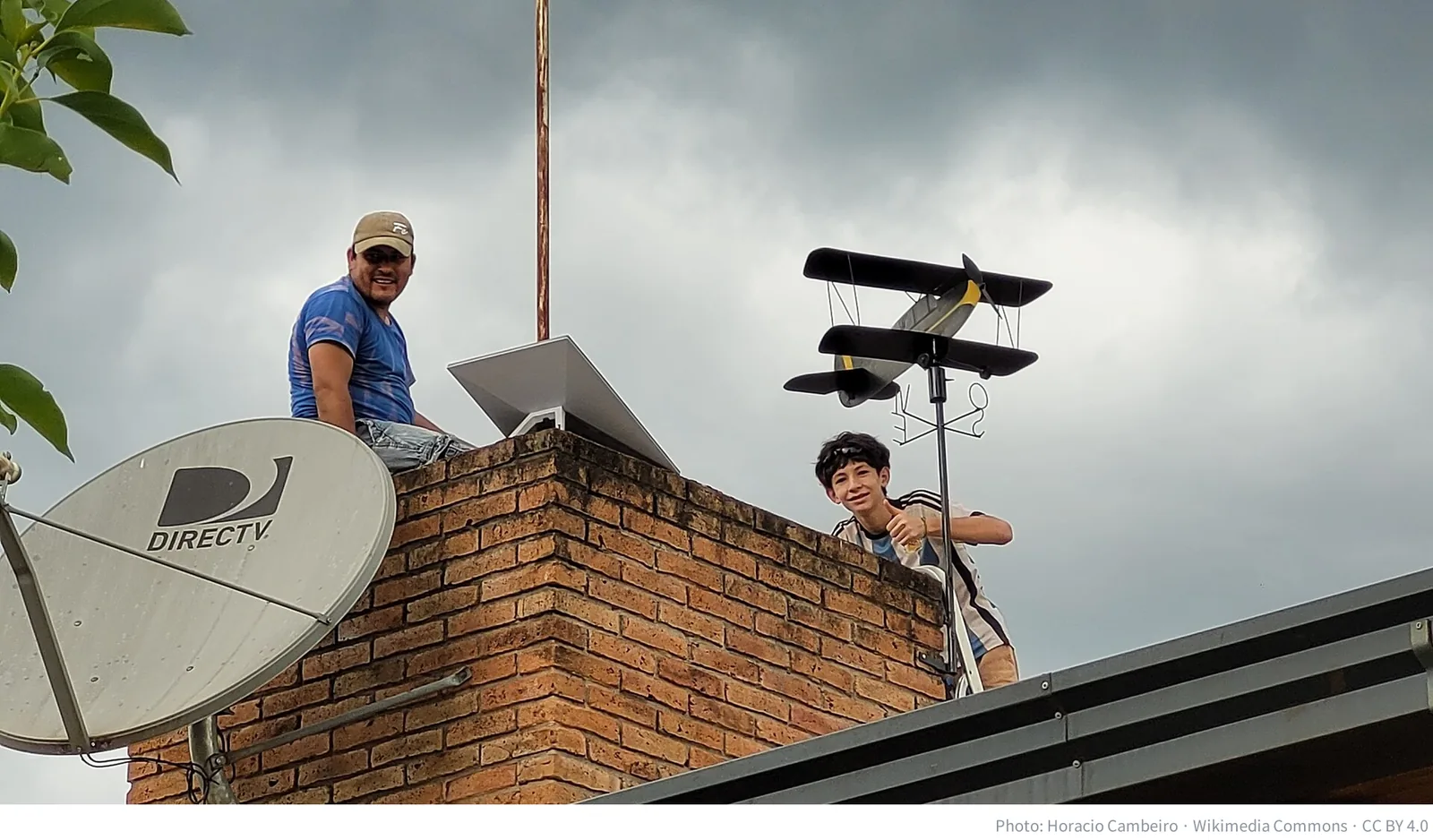
Starlink had 13.6 million consumer subscribers at the end of September, up 1.6 million in the quarter and close to double the 7.2 million of a year earlier. Consumer revenue was $3.121 billion and enterprise and government revenue $2.127 billion. More than 3,800 aircraft now carry Starlink, and SpaceX President Gwynne Shotwell said on the call that Korean Air and Asiana had flown their first Starlink-equipped planes. Starlink Mobile, which connects phones directly to satellites, passed 22 million monthly users.
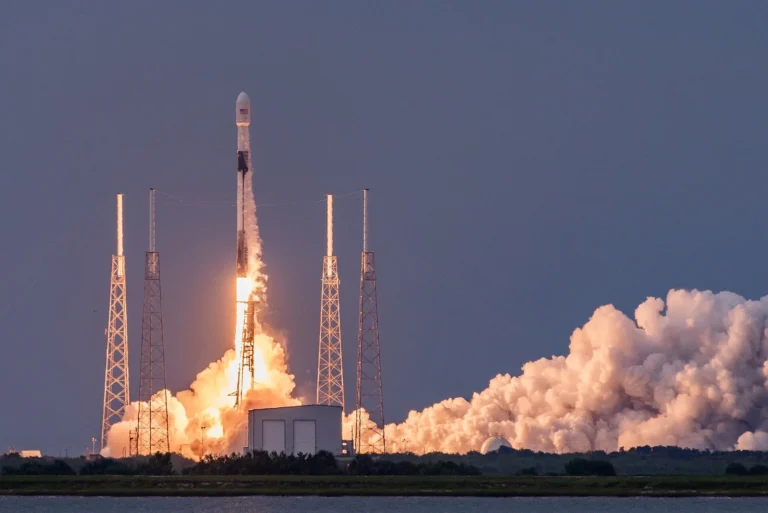
There were 35 launches in the quarter (12 for customers, 23 for SpaceX itself), putting 476 tonnes into orbit. On its 14th flight, the Starship heavy rocket reached orbit for the first time, carrying 26 Starlink V3 satellites. The company said one such launch adds about 10 times the network capacity of a Falcon 9 Starlink launch. Musk said Flight 15, next month, will try to catch both the booster and the ship with the launch tower.
Launch revenue was $1.77 billion, up 6.1% from a year earlier, but the business lost $7 million at the operating line because R&D, including Starship development, rose to $1.225 billion from $849 million. Orders kept coming: three more NASA crewed flights to the International Space Station, 18 US national-security launches and one Starship lunar cargo contract. Musk said SpaceX launched about 90% of all mass put into orbit worldwide in the quarter.
2. First-quarter 2027 guidance: more than double the third quarter
What moved the market more than the quarter itself was the next number the company gave on the call. SpaceX expects first-quarter 2027 revenue to be more than double today’s level.
$33 billion to $37 billion, against a pre-results estimate of $22.2 billion
CFO Bret Johnsen said on the call that SpaceX expects first-quarter 2027 revenue of $33 billion to $37 billion. That is 2.26 to 2.54 times third-quarter revenue, or $132 billion to $148 billion annualized. Money Today, a Korean business daily, reported a pre-results market estimate of $22.2 billion. Johnsen pointed to better visibility into compute contracts over the next six months. The company gave no fourth-quarter revenue range and kept its target of $100 billion in annual recurring revenue (ARR), defined as December revenue times 12.
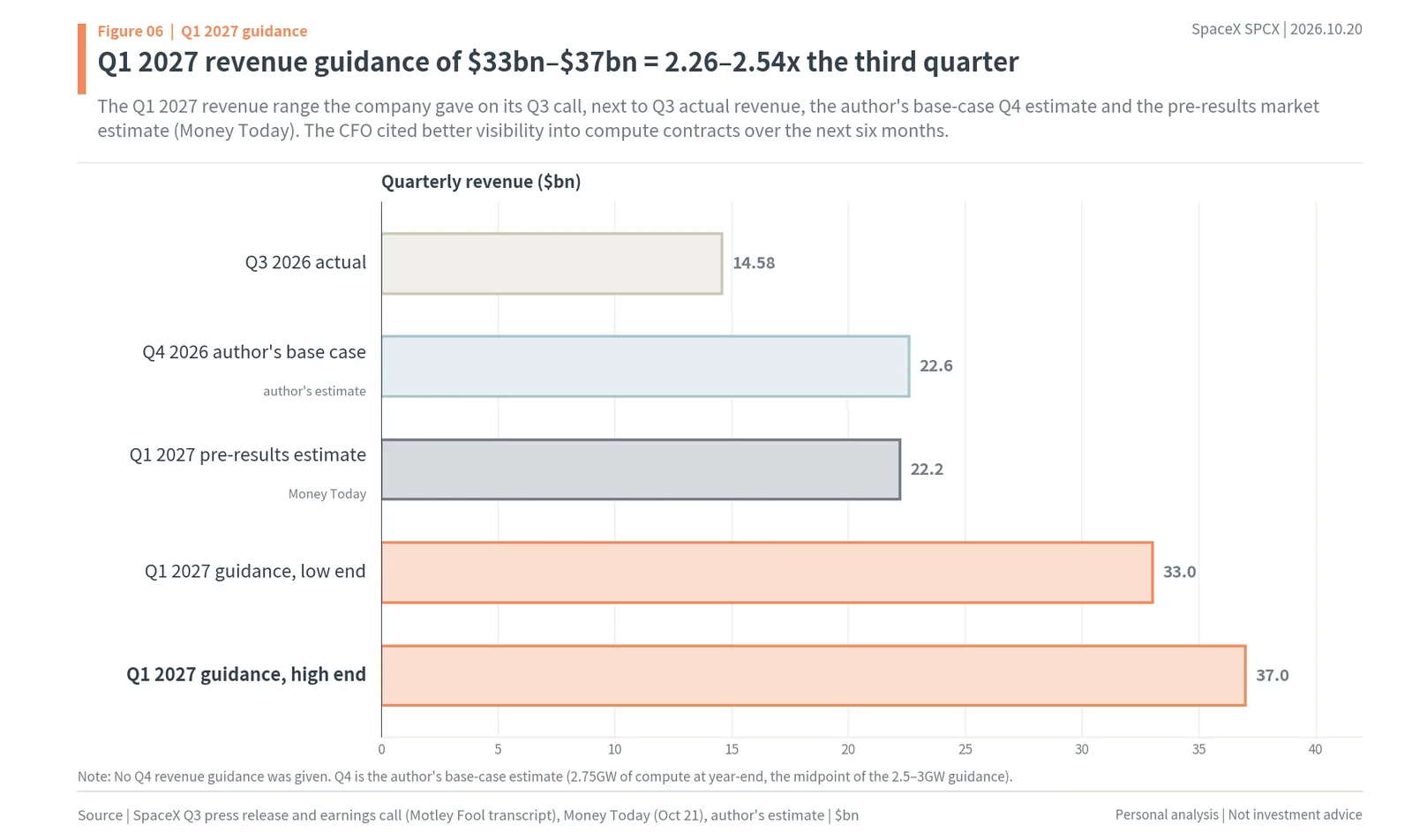
Working backward, $100 billion of year-end ARR means December revenue of about $8.33 billion (author’s calculation), 1.7 times the third quarter’s monthly average of $4.86 billion. The first-quarter 2027 guidance of $33 billion to $37 billion is $11.0 billion to $12.3 billion a month, so monthly revenue would rise another 32-48% in the three months after December (author’s calculation). The company added that fourth-quarter gross margin for the whole company would fall back toward the second-quarter level because of one-time gains and customer mix in the third quarter.
What supports the number: a $63 billion backlog and compute capacity
Two numbers support the guidance. One is backlog, contracted revenue not yet recognized. The company said backlog was $63 billion at the end of September, about $42 billion of which will become revenue within 12 months. The backlog disclosed at the end of June was $47.461 billion, so it grew by about $15.5 billion in one quarter. The other is compute capacity. Data-center nameplate power capacity was 1.7GW at the end of September, and the company expects about 2.2GW at the end of October and 2.5-3GW at year-end. In the first quarter of 2027, all of that added capacity earns money for a full quarter. The fourth-quarter figure of $22.6 billion in Figure 6 is the author’s estimate, with year-end capacity at 2.75GW, the midpoint of the guidance.
3. More, and pricier: Starlink and AI grow in different ways
Split growth into selling more (volume) and selling at higher prices (price), and the two big businesses part ways. Starlink sells more while cutting prices; AI sells more and its price has gone up too. And it is AI that will decide future results.
Starlink: subscribers +88.9%, ARPU -16.9%
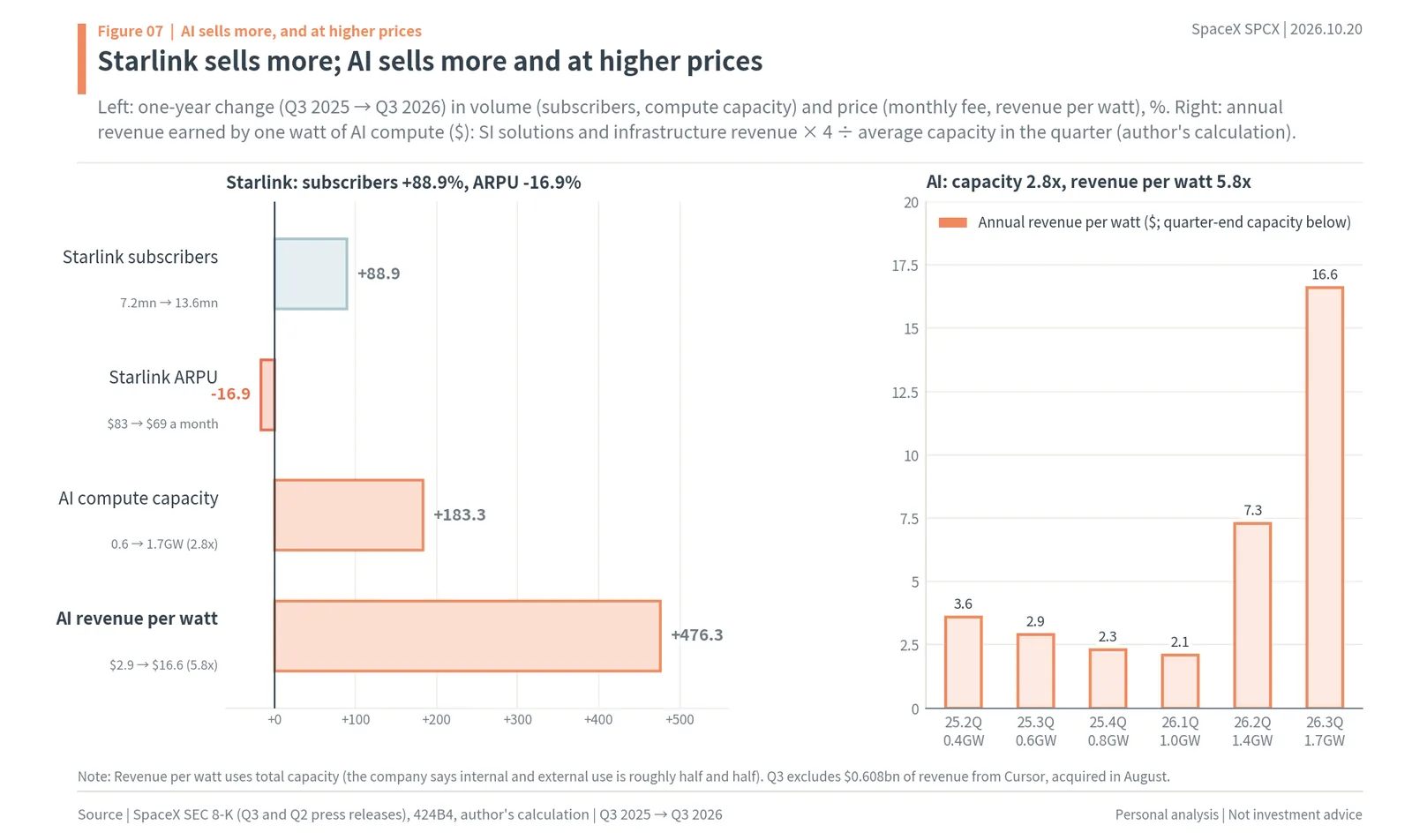
Starlink consumer subscribers grew 88.9% in a year, from 7.2 million to 13.6 million. Average monthly revenue per subscriber (ARPU) fell 16.9%, from $83 to $69. This is growth by volume, expanding into cheaper countries and cheaper plans to reach more people. Third-quarter ARPU rose 5% from $66 in the second quarter, so the decline has stopped, and consumer revenue grew 57.2% in a year. The company said third-quarter connectivity gross margin was 55%, including about 3 percentage points of one-time items such as tariff refunds.
Starlink has plenty of room to keep selling more. Shotwell said SpaceX has contracts for about 12,000 aircraft (about a quarter of the available fleet) and that three of the four largest US airlines are customers. In the second quarter SpaceX took over EchoStar’s spectrum for about $19.6 billion (about $11.1 billion in stock plus up to $8.5 billion of debt repayment), and on October 8 it agreed to buy 800MHz low-band spectrum. The goal is to build Starlink Mobile, the direct-to-phone service, to the scale of a major US mobile carrier. Musk said there is a path to raise Starlink bandwidth about 100-fold within three years (about 100,000 satellites) and grow connectivity revenue to “several hundred billion dollars” a year.
Within Starlink, enterprise and government is growing faster. Third-quarter enterprise and government revenue was $2.127 billion, up 91% from a year earlier, outpacing consumer revenue growth of 57.2%. In the second quarter the company said it had signed multi-year Starshield (military satellite network) contracts with the US government worth more than $6 billion. Where a single customer pays a lot, as with governments, airlines and ships, Starlink sells both more and at higher prices.
AI: capacity 2.8x, revenue per watt 5.8x
AI is different. Data-center compute capacity rose 2.8 times in a year, from 0.6GW to 1.7GW. On top of that, what the same capacity earns rose sharply. The author divided “SI solutions and infrastructure” revenue (compute leasing, Grok enterprise sales and so on, excluding advertising) by average capacity in the quarter to get the annual revenue one watt earns. That figure was $2.9 in the third quarter of 2025 and $16.6 in the third quarter of 2026, 5.8 times higher (excluding Cursor revenue). It stayed around $2 in the fourth quarter of 2025 and the first quarter of 2026, then jumped to $7.3 in the second quarter, when the company started leasing compute to outside customers, and to $16.6 in the third. The second-quarter release said SpaceX had signed $14.1 billion of contracted sales for cloud services.
AI’s volume growth also shows in user numbers. Shotwell said paid weekly users of Grok Bot, an always-on AI assistant launched in August, reached 800,000 in early October, more than doubling in a month, and that the number of Grok enterprise customers spending over $1 million a year grew 50% in a quarter. The company bundled Grok, Grok Bot, Cursor and X Premium into one plan. Musk expects Grok Bot could eventually use most of the AI compute. That means the half of compute used internally also earns money through Grok subscriptions, which is why Musk’s ARR math multiplies total capacity by a price per watt.
The company itself said how high that price can go. Johnsen said compute pricing is slightly above the top of the $30-50 per watt range it gave last quarter, and that new equipment pays back its cost within a year. Musk said internal and external use is roughly half and half, so dividing by leased capacity alone gives third-quarter revenue of $33.1 per watt (author’s calculation), in line with the company’s range.
Musk’s $500 billion to $1 trillion is GW times price per watt
On the call, Musk said ARR by the end of 2027 would be “somewhere between $500 billion and $1 trillion.” That number breaks down into compute capacity times price per watt. Turning 13GW into revenue at $40 a watt gives $520 billion; 20GW at $50 a watt gives $1 trillion (author’s calculation). Musk said he is “fairly confident” of adding 10GW of compute in 2027 and would be surprised to end the year below 13GW, and he gave a target of adding 20GW of power and cooling. To hit the $35 billion midpoint of first-quarter 2027 guidance, revenue per watt on total capacity would need to reach $32.4 a year (author’s estimate), about double the third quarter’s $16.6.
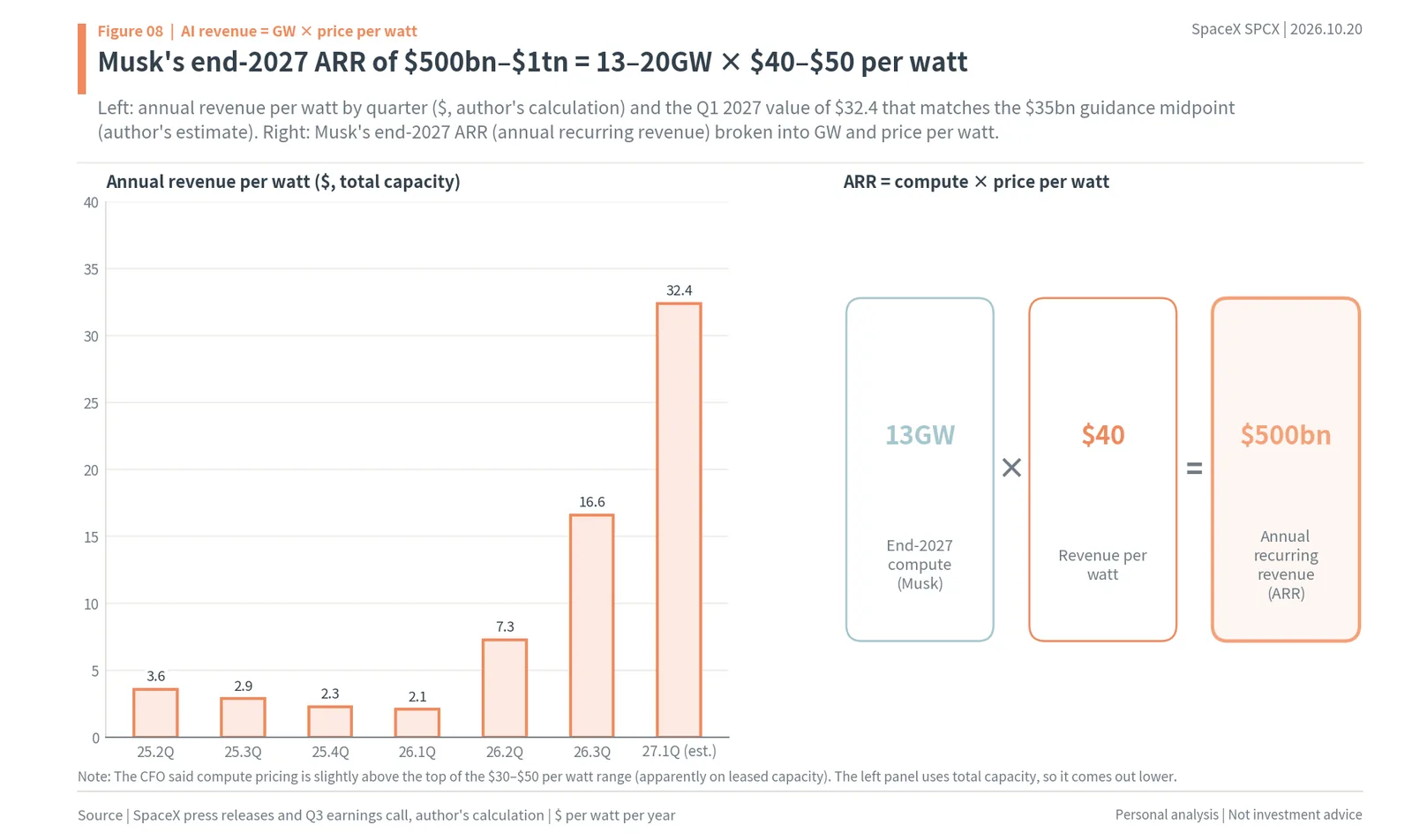
In short, SpaceX’s AI revenue is how many GW it builds times what it charges for one watt. The price per watt is already inside the range the company gave, so future results depend mainly on how fast it adds GW. The next chapter is about what those GW cost.
4. So it takes a lot of money: about $35.4 billion per GW
Adding GW costs far more than launching rockets. This year SpaceX is spending several times what it earns on data centers, and in the fourth quarter it doubles the pace again.
83.9% of capital spending goes to AI
SpaceX made its name by driving down launch costs with reusable Falcon 9 rockets. Yet of its $19.593 billion in third-quarter capital spending, 83.9%, or $16.444 billion, went to AI (data centers). Launch took $1.606 billion and Starlink $1.543 billion.
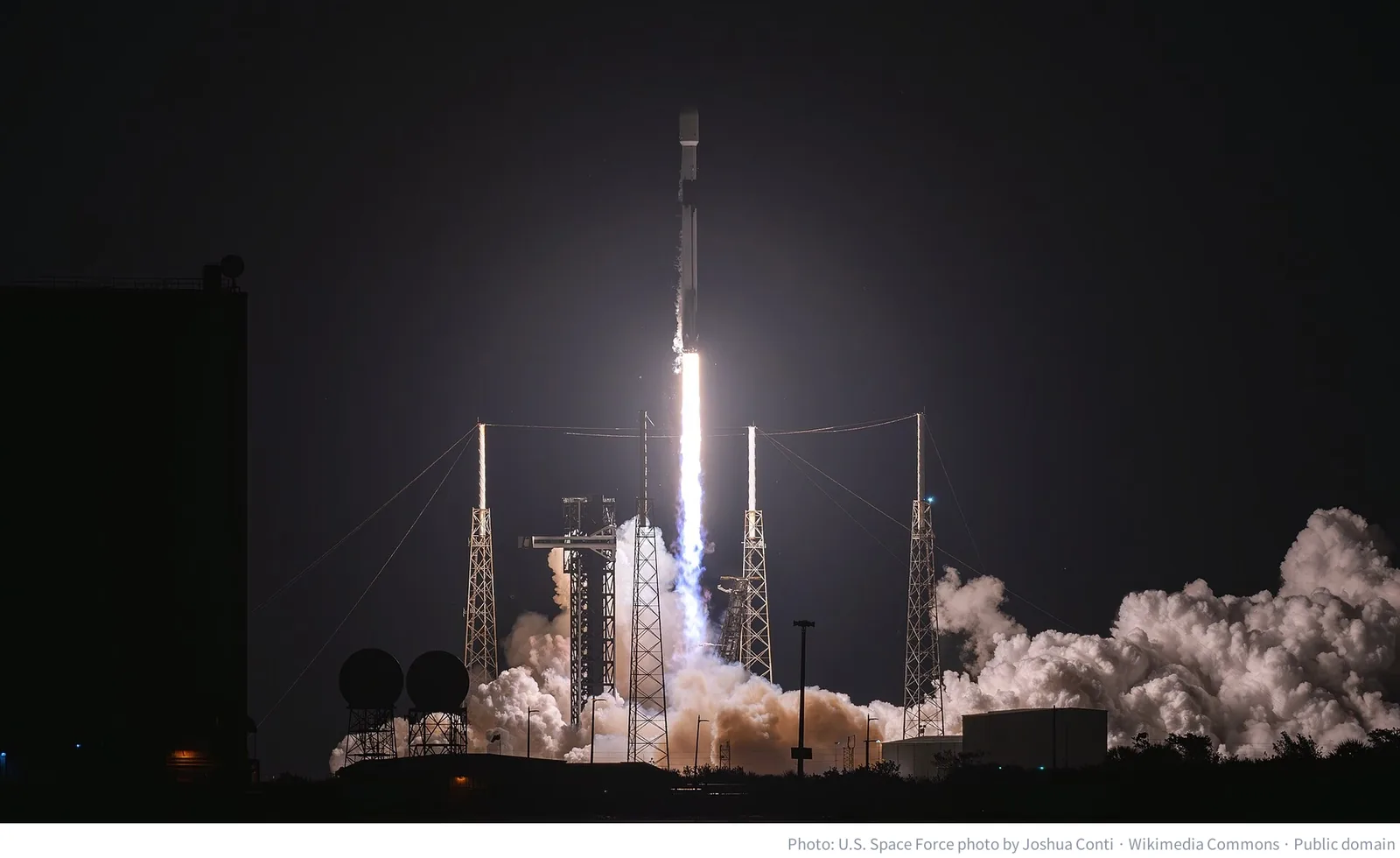
In the first nine months of the year SpaceX generated $13.097 billion of operating cash flow and spent $48.069 billion on capital projects, for free cash flow (FCF) of -$34.972 billion. Johnsen put fourth-quarter capital spending at $35 billion to $40 billion, 1.8 to 2.0 times the third quarter, the result of pulling forward compute expansion in Memphis and Southaven. For the full year that comes to $83 billion to $88 billion (author’s calculation).
The IPO paid for it. The June offering raised net proceeds of $85.675 billion, and the same month SpaceX sold $25 billion of investment-grade bonds at an average coupon of 5.855%. At the end of September it had $89.855 billion of cash and marketable securities ($51.294 billion of cash plus $38.561 billion of securities) and $38.844 billion of borrowings and leases. At the $37.5 billion midpoint of fourth-quarter spending, that is enough for a little over two quarters (author’s calculation).
The bonds are long-dated. The $25 billion sold in June is split into $7 billion due 2031 (5.350%), $6 billion due 2033 (5.650%), $6 billion due 2036 (5.875%), $2.5 billion due 2046 (6.600%) and $3.5 billion due 2056 (6.650%). The first principal comes due in 2031, so little debt must be repaid soon. Separately, SpaceX sold AI equipment to Valor, the firm of director Antonio Gracias, and leased it back; that lease liability was $12.897 billion at the end of September, with interest of more than $300 million a quarter. SpaceX is choosing to install data-center equipment fast, even on lease.
As urgent as money: power
A data center does not run on chips alone. It needs electricity. On the third-quarter call, Musk said SpaceX uses the casting technology from its rocket engines to make turbine blades for power generation itself, securing power 12 to 18 months faster than competitors. He gave targets of adding 20GW of power and cooling in 2027 and building a training cluster with 440,000 of NVIDIA’s next-generation Vera Rubin chips by the end of the second quarter of 2027. SpaceX leases compute on short terms close to spot pricing rather than long contracts, and charges more per watt at renewal. He said payback on new equipment could shorten to six months in 2027.
10GW would cost 3.9 times today’s cash
The author divided AI capital spending from the fourth quarter of 2025 through the fourth quarter of 2026 (guidance midpoint, with AI’s share set at the third-quarter level) by the compute added over that time (0.6 to 2.75GW), and got about $35.4 billion of investment per GW. Adding 10GW in 2027, as Musk said, would take about $354 billion, 3.9 times today’s cash.
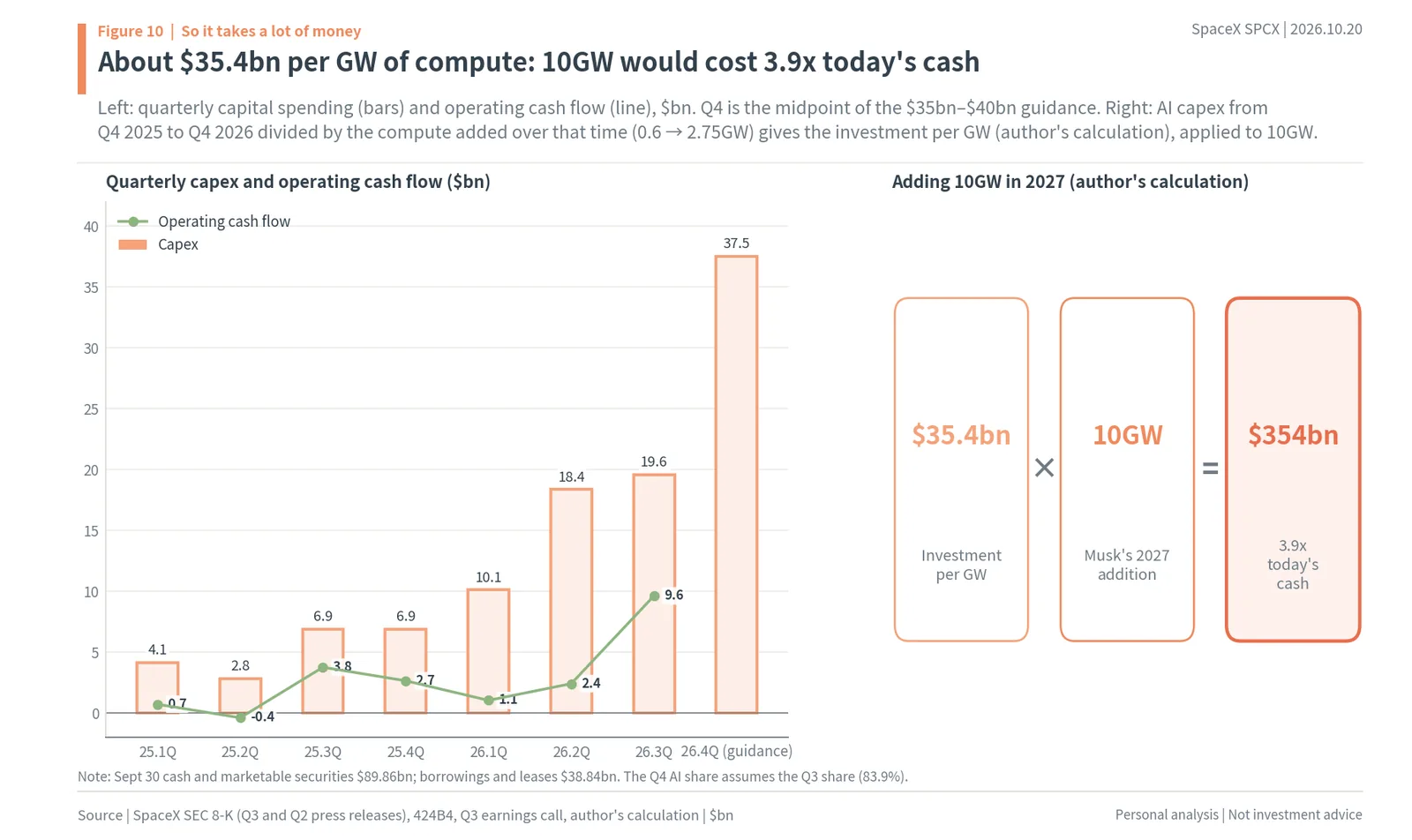
The point of this math is simple. To get close to Musk’s targets, SpaceX cannot rely on what it earns and the cash it holds; it needs outside money, debt or new shares, along with more chips and power. The company also said it would keep its investment-grade rating while using both the bond market and supply-chain partners.
5. Forecast model: 2027 base-case revenue of $196.5 billion
Put the last two chapters into a model and you can draw bear, base and bull cases for 2027-2028. In the author’s base case, SpaceX’s 2027 revenue is $196.5 billion and EPS is $4.52, and what sets those numbers is how fast compute grows.
How the model works: compute times price per watt, plus Starlink and launch
The model adds three revenue streams each quarter. AI compute revenue is average capacity in the quarter times annual revenue per watt, divided by 4, plus Cursor and advertising revenue. Starlink is subscribers times ARPU for consumer revenue, plus enterprise and government revenue. Launch is set at $1.1 billion to $1.5 billion a quarter. Costs start from adjusted EBITDA margins by business (base case: AI 62%, Starlink 66%; third-quarter actuals were 65.5% and 66.7%), then subtract depreciation (about $1.6 billion per GW per quarter, backed out of the third-quarter actual) and stock compensation (including $1.9 billion a quarter for Cursor). Capital spending is about $35.4 billion per GW, and any shortfall is assumed to be borrowed, with interest charged.
The three cases differ in two assumptions. Through the first quarter of 2027, capacity is the same in all three cases because fourth-quarter spending already installs it, and the base-case price per watt starts at $32.4, the level that hits the $35 billion first-quarter guidance midpoint. After that, compute grows each quarter by 0.6GW in the bear case (this year’s pace), 1.5GW in the base case (about three times this year’s pace) and 3.0GW in the bull case (Musk’s target, about 13GW by end-2027), while price per watt falls each quarter by 8%, 4% and 1%. End-2027 capacity is 5.05GW, 8.0GW and 12.75GW.
The next two quarters: $22.6 billion in Q4, $35 billion in Q1
Starting with the next two quarters, the model’s fourth-quarter 2026 revenue is $21.3 billion in the bear case, $22.6 billion in the base case and $23.9 billion in the bull case. The difference comes from year-end compute of 2.5GW, 2.75GW and 3.0GW. For the first quarter of 2027, the base case is the guidance midpoint of $35.0 billion, with the bear case at $32.2 billion and the bull case at $37.8 billion, just outside the guidance range ($33 billion to $37 billion). Fourth-quarter price per watt is set at $24.5, halfway between the third quarter’s $16.6 and the first quarter’s $32.4. On share count, 1.3 billion performance-based restricted Class B shares held by Musk are excluded from basic EPS out of 13.579 billion shares outstanding at the end of September (third-quarter basic weighted shares were 11.942 billion), so diluted shares are set at 12.75 billion for 2027 and 12.95 billion for 2028. Tax rates are 15% in 2027 and 18% in 2028, reflecting loss carryforwards.
Starlink is the steadiest part of the model. Adding 1.3 million, 1.6 million (the third-quarter actual) and 2.0 million subscribers a quarter, with ARPU of $66, $69 and $72, gives end-2027 consumer subscribers of 20.1 million, 21.6 million and 23.6 million, and 2027 Starlink revenue of $26.1 billion, $29.1 billion and $32.7 billion. The spread across cases is only $6.6 billion. Almost all of the $125.3 billion gap in 2027 total revenue between the bear and bull cases comes from AI compute.
2027 revenue of $146.7 billion, $196.5 billion and $272.0 billion
Figure 11 shows the result. 2027 revenue is $146.7 billion in the bear case, $196.5 billion in the base case and $272.0 billion in the bull case, and EPS is $2.56, $4.52 and $7.49. In 2028 the base case grows to revenue of $339.5 billion and EPS of $7.11. In the bear case, price per watt falls faster than capacity grows, so 2028 EPS shrinks to $2.26. The average 2027 estimate of the 23 analysts on Yahoo Finance is EPS of $2.25 and revenue of $119.02 billion, close to the author’s bear case. Most of those estimates predate the first-quarter guidance.
The market estimate is rising fast. The average 2027 EPS estimate on Yahoo Finance went from $0.65 90 days ago to $1.78 60 days ago, $1.86 30 days ago, $2.08 seven days ago and $2.25 now. As estimates that reflect the first-quarter guidance come in, this number is likely to move toward the author’s base case.
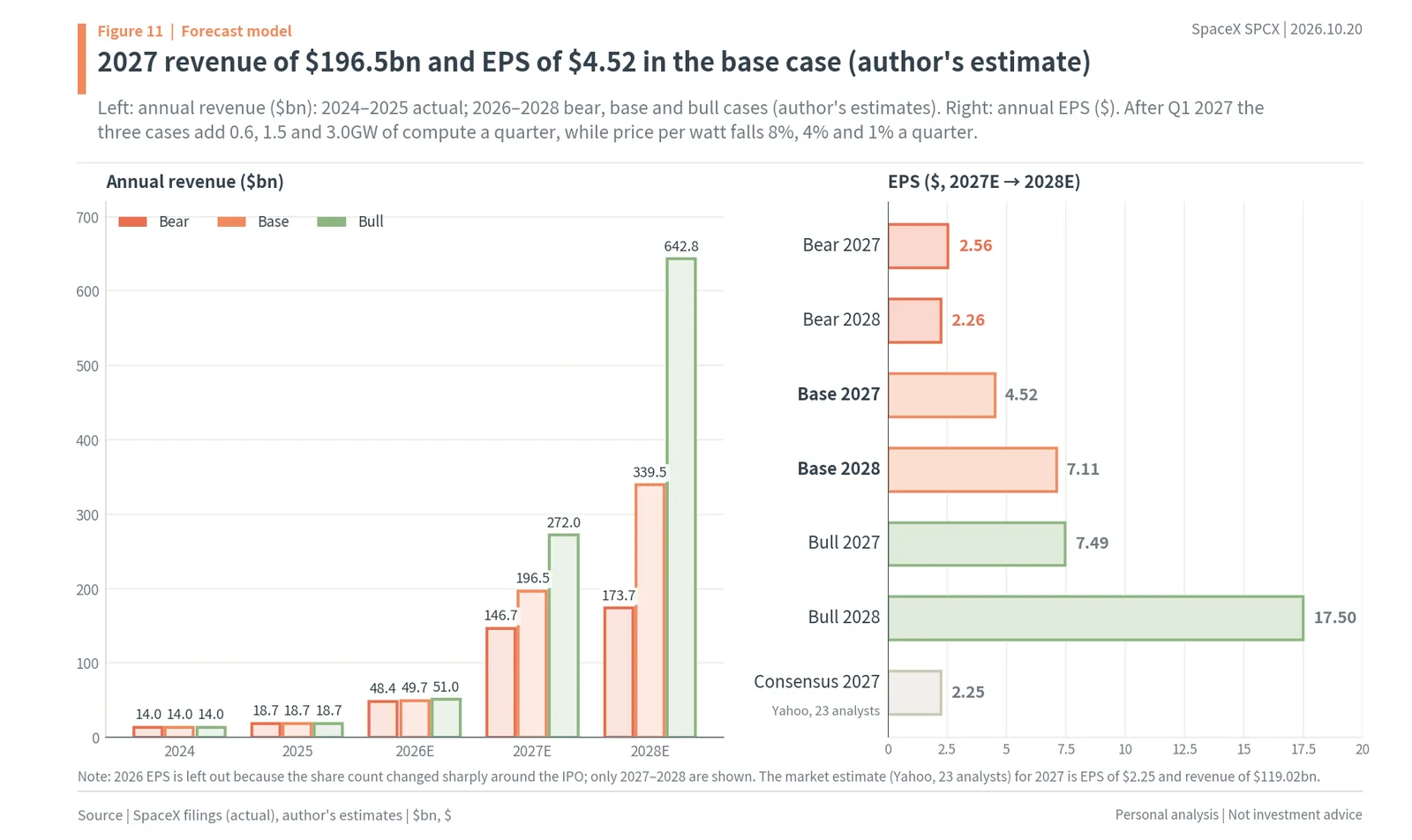
On margins, base-case 2027 adjusted EBITDA is $120.5 billion and operating income $69.1 billion. About 61% of revenue is left as EBITDA, but after data-center depreciation and stock compensation the operating margin falls to about 35%. Operating income is $37.7 billion in the bear case and $117.5 billion in the bull case. Compute equipment has to be replaced within a few years, so this company’s profit should be read at the operating line, after depreciation, rather than at EBITDA.
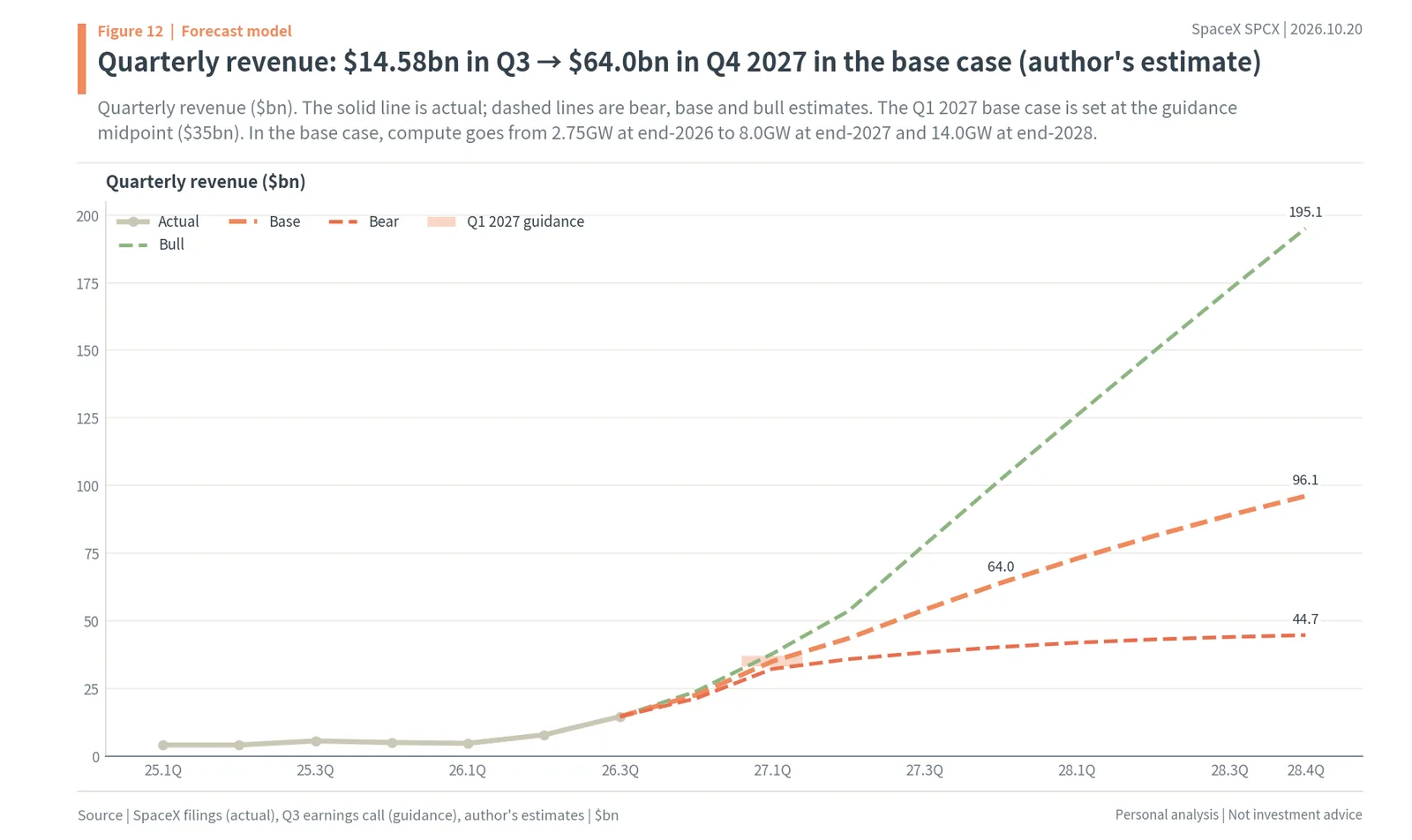
By quarter, base-case revenue goes from $14.58 billion in the third quarter to $22.6 billion in the fourth, $35.0 billion in the first quarter of 2027 and $64.0 billion in the fourth quarter of 2027. That is roughly $9 billion to $10 billion more each quarter, and most of the increase comes from newly installed compute.
Even the base case ends 2027 with net cash of -$75 billion
Cash moves the opposite way from earnings. Base-case 2027 adjusted EBITDA is $120.5 billion, but capital spending is $225.2 billion, so free cash flow is -$104.7 billion. Net cash (cash and marketable securities minus borrowings and leases), $51.0 billion at the end of September, falls to about -$75 billion at the end of 2027. Quarterly cash flow only turns positive in the fourth quarter of 2028. In the bull case, net cash falls to about -$224 billion at the end of 2027.
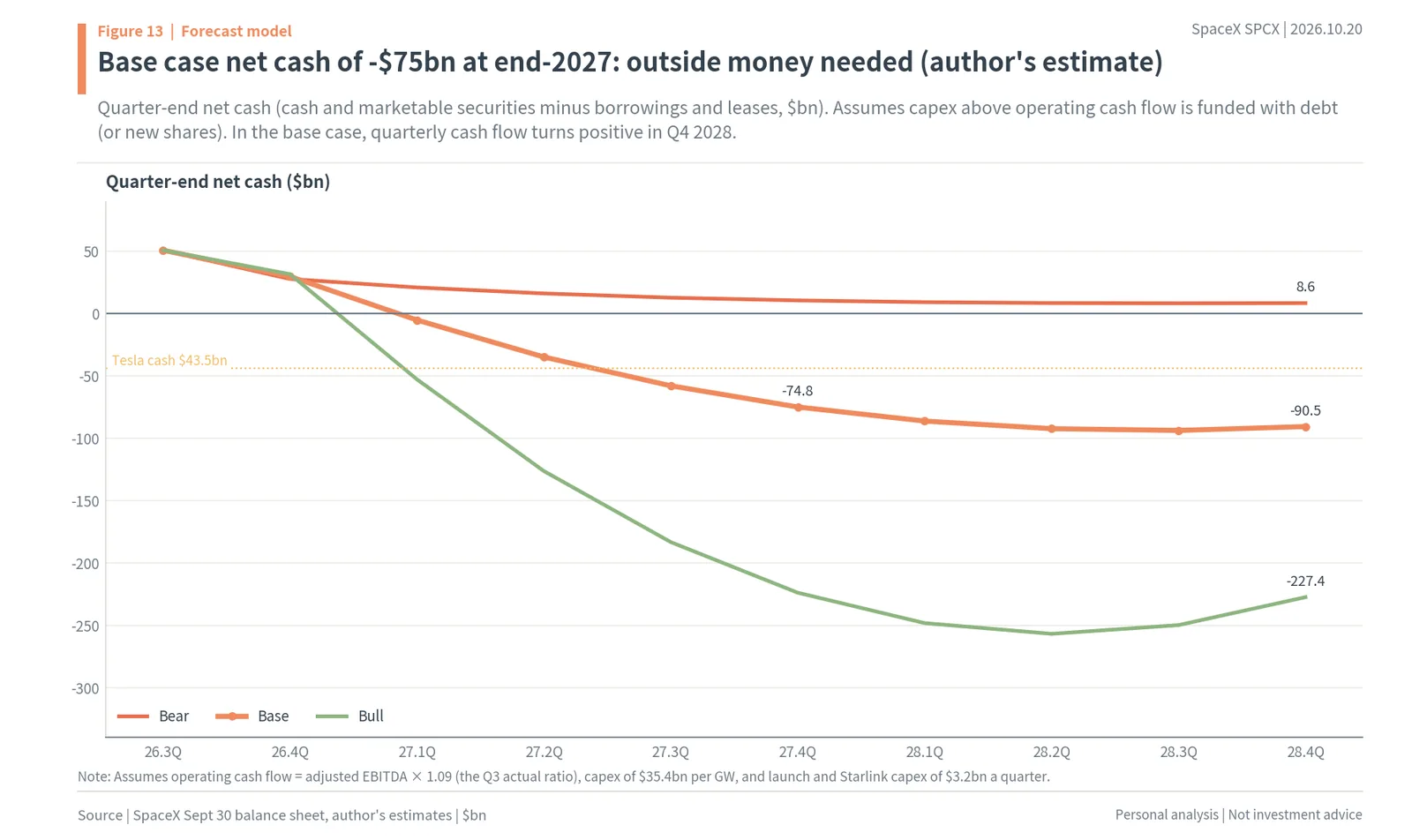
The dotted line in Figure 13 is the $43.5 billion of cash and short-term investments Tesla held at the end of June, 41.6% of the base-case 2027 free cash flow deficit of $104.7 billion (author’s calculation). Money is not the only thing SpaceX needs to grow AI. It needs chips and power, and cars and robots for AI to work in, and much of that sits at Tesla.
6. The real reason ①: the ingredients for AI sit at Tesla
Go through what SpaceX needs to add GW one by one, and much of it is at Tesla or being built together with Tesla. This is the first link in the merger story.
Chips: Terafab, $16.8 billion for the first phase alone
Chips are the most expensive and hardest-to-get part of an AI data center. The two companies are building a chip plant called Terafab together in Grimes County, Texas, and on August 6, 2026 they announced a first-phase investment of $16.8 billion (TechCrunch). The split between them has not been disclosed. The plant is meant to make inference chips for Tesla’s Optimus humanoid robot and Cybercab robotaxi, and chips for SpaceX’s space-based data centers. On the third-quarter call, Musk said the goal is a first working test chip in “approximately May or June of next year” and volume production “around Q3 of ’28 at Terafab at Gibbons Creek,” and that “Terafab will ultimately do what the name suggests, which is to make a terawatt of super intelligence chips per year.” SpaceX’s prospectus says it has agreed only a framework with Tesla on Terafab and has not set financial terms for individual projects.
Chips are not the only joint project. The prospectus says SpaceX is co-developing an agentic AI platform called Macrohard with Tesla, software that runs on both SpaceX’s latest processors and Tesla’s next-generation processors. In the prospectus, SpaceX put its addressable market at $28.5 trillion, of which $26.5 trillion is AI. Space ($370 billion) and connectivity ($1.6 trillion) are small beside it. The company itself puts AI at the center.
Power: Megapack
Data centers eat electricity. Tesla’s Megapack grid batteries are already going into xAI and SpaceX data centers. Tesla sold about $430.1 million of products to xAI in 2025 (mainly Megapacks) and $405 million of Megapacks to SpaceX in the first half of 2026 (Tesla proxy statement and second-quarter 10-Q). SpaceX’s own filing shows it bought $329 million of Megapacks from Tesla in the first half and booked them as equipment.
Bodies and money: robotaxis, Optimus and $43.5 billion of cash
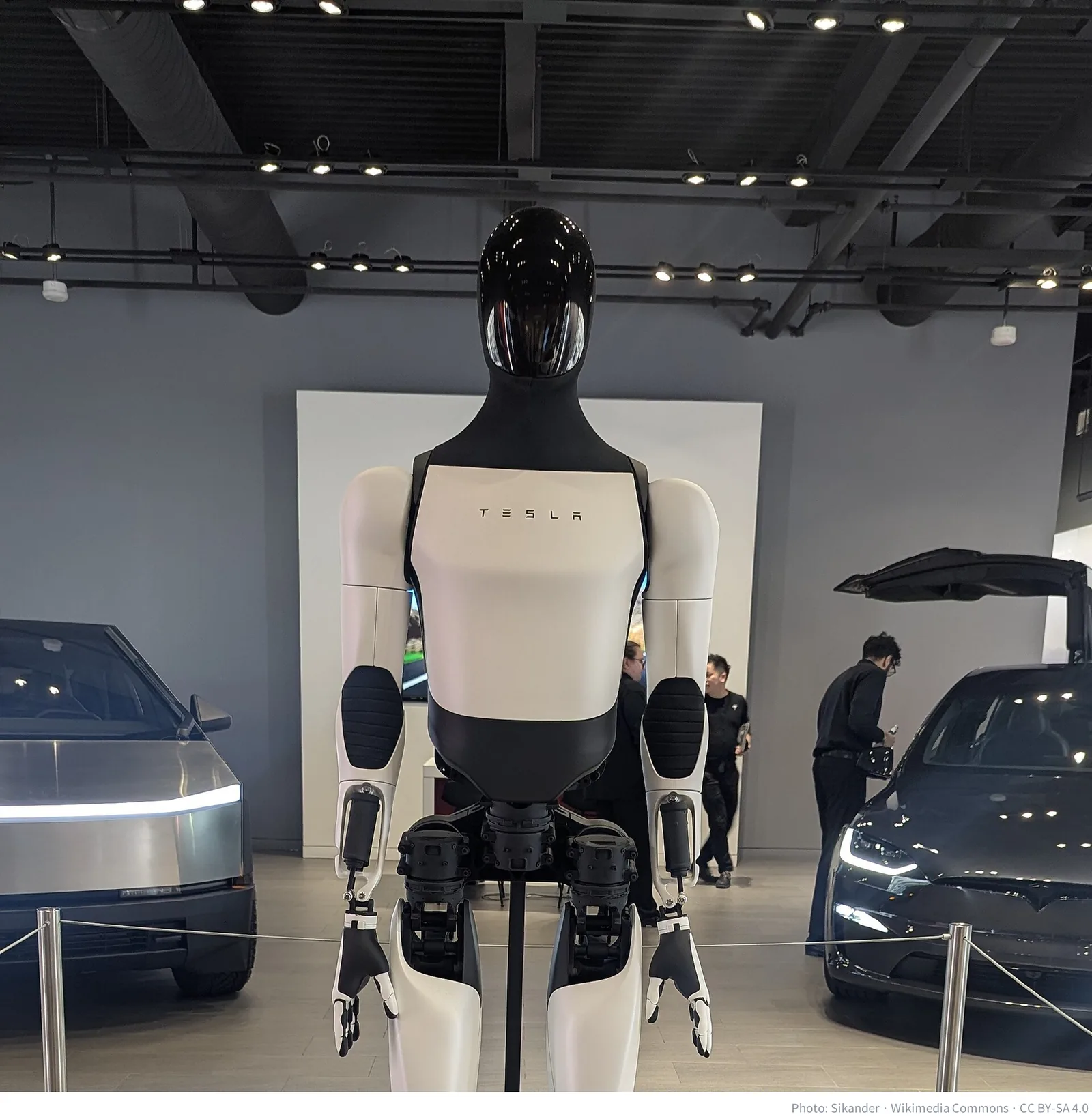
For AI to work off the screen, it needs a body. Tesla started carrying public passengers in Cybercab, its purpose-built driverless car, in Austin on September 3, and announced the first Optimus humanoid robot production line in its shareholder letter. Tesla also held $43.524 billion of cash and short-term investments at the end of June. Its second-quarter revenue was $28.236 billion and operating income $398 million (a 1.4% margin), and operating cash flow over the last four quarters was $18.69 billion (sum of quarters on Yahoo Finance, author’s calculation).
A further ingredient: data centers in space
The AI factory Musk has in mind does not end on the ground. Soon after the xAI merger he told The Wall Street Journal, “The lowest-cost place to put AI will be space,” adding, “That will be true within two years, maybe three.” SpaceX’s prospectus also describes a satellite constellation for orbital data centers, and one of the two chip types planned for Terafab is designed for the space environment. Launching data centers that get power from sunlight and shed heat into space requires mass launches by Starship, space-grade chips, and Starlink to link the satellites to the ground. In that chain, half of the chips come from Terafab, the plant SpaceX is building with Tesla.
$2.835 billion has already moved between the two
Money already flows between the two companies. On January 16, 2026, Tesla agreed to invest about $2 billion in xAI preferred stock; when xAI merged into SpaceX in February, that right turned into SpaceX stock, and on March 12 Tesla received 18,990,195 Class A shares. Add the two Megapack sales and $2.835 billion has gone from Tesla to xAI and SpaceX (author’s calculation). The $16.8 billion for Terafab is funded by both companies together.
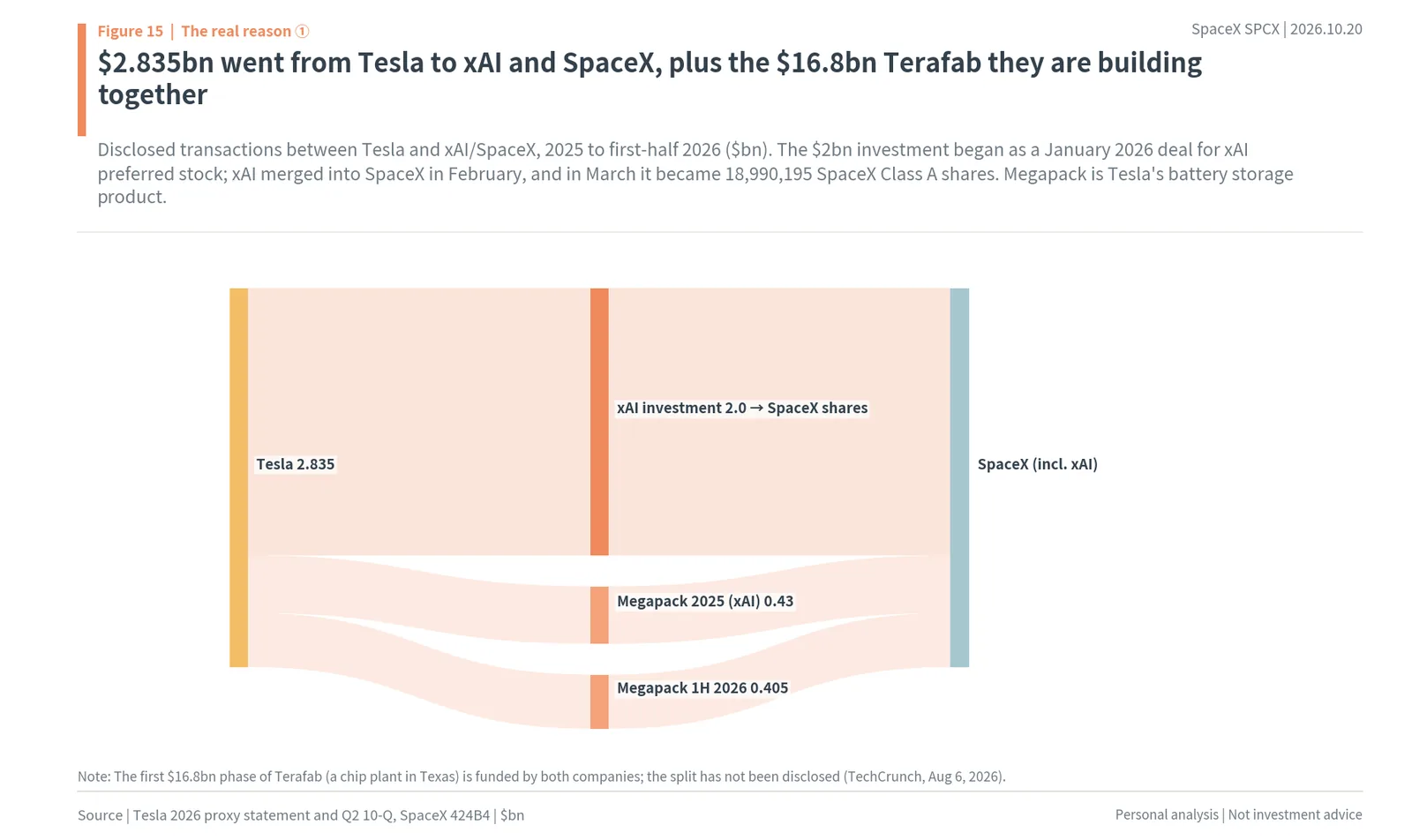
Musk said as much on Tesla’s second-quarter call on July 22, 2026: “Well I mean as you can tell from all the many collaborations on so many fronts with SpaceX, there’s more and more overlap,” and “Especially with Terafab, that’s really going to be a gigantic project.” On the third-quarter SpaceX call, he said the two companies would gain a lot by building “super intelligent software, chip design, the Terafab” and robots together. Barclays analyst Dan Levy wrote in an October 14 note that “the true value would be in vertical integration,” not financial synergies, with Terafab as a key driver.
7. The real reason ②: every deal between the two goes through a separate process
Ingredients split between two companies are not, by themselves, a reason to merge. The problem is that the two companies have different shareholders. Tesla is a public company in which Musk owns 19.8%; at SpaceX, Musk holds about 82.4% of the votes. So every transaction between them is a related-party transaction that needs separate review, and large ones go to a shareholder vote.
November 2025: 38% for the xAI investment proposal
Tesla’s investment in xAI is the clearest example. At Tesla’s annual meeting on November 6, 2025, a shareholder proposal recommending an investment in xAI got 38% for, 33% against and 17% abstaining (Sherwood News). Tesla counts abstentions as votes against, so the proposal did not pass. Chair Robyn Denholm said at the time that the board had not reviewed xAI’s financials or done the due diligence an investment would need. Two months later, on January 16, 2026, Tesla put $2 billion into xAI by board decision. Had the two been one company, it would have been an internal allocation of capital.
From January 2024 to October 2026
Figure 16 traces how Musk’s companies moved closer: the January 2024 “~25% voting control” post, Tesla’s move to Texas in June 2024, the xAI investment proposal in November 2025, Tesla’s xAI investment in January 2026, SpaceX’s merger with xAI in February, the SpaceX IPO in June, the $16.8 billion Terafab and the Cursor acquisition in August, and the special committees in October. On IPO day, Gwynne Shotwell told CNBC that a merger “might make Elon’s life a little easier.”
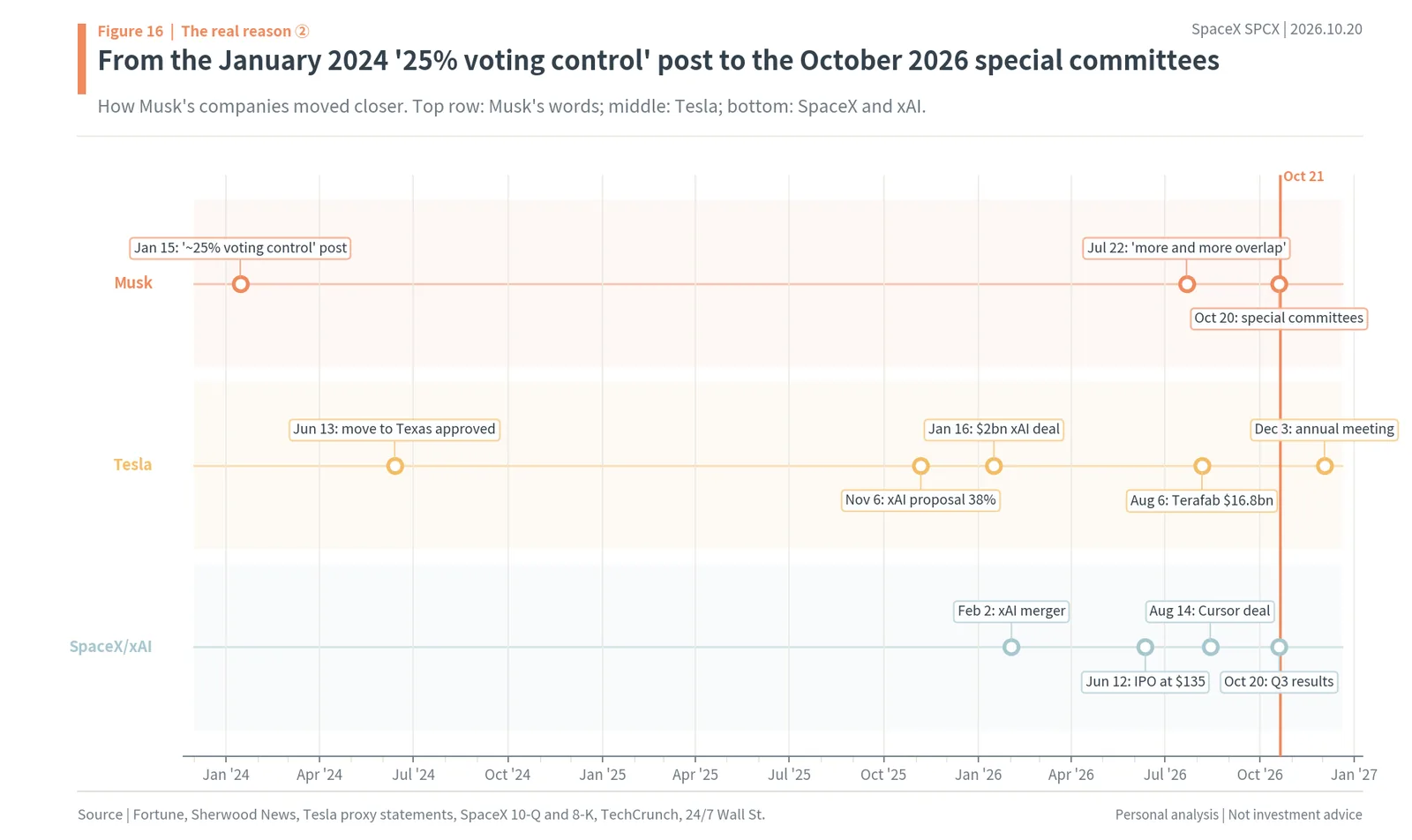
Musk himself has said several times that dealings between the two companies are bound by process. On Tesla’s July call he said, “Obviously we can’t talk about combining companies and that kind of thing on a call,” and “It’s got to be done with the appropriate process.” On the October 20 SpaceX call he said that “because I’m a conflicted party, I can’t actually be in the discussions of the special committees,” adding, “I feel like I’m tap dancing through a minefield” (Fortune). If the two become one company, splitting the cost of a chip plant, buying Megapacks and pairing AI models with robots stop being related-party deals and become decisions inside one company.
8. The real reason ③: voting power from 19.8% to about 56%
The two links so far, ingredients split between two companies and a separate process for every deal, come together in one number: how much of the whole AI chain Musk can control and decide on, in other words his voting power. The author sees this as the deepest reason for the merger talks.
Tesla 19.8%, SpaceX about 82.4%
According to Tesla’s 2026 proxy statement, Musk owns 699.58 million shares of Tesla common stock, or 19.8%. The 423.74 million restricted shares granted under the 2025 pay package are not counted. That is below the roughly 25% he said he wanted in January 2024. SpaceX is different. It has Class A shares with one vote each and Class B shares with 10 votes each, and Musk holds most of the Class B. Per the IPO prospectus, Musk had about 82.4% of the votes. His economic stake, prospectus holdings divided by shares outstanding at the end of September, is about 44.7% (author’s calculation). The xAI proposal getting only 38% at Tesla’s 2025 meeting also came down to Musk having only 19.8% of the votes at Tesla.
Musk’s 699.58 million Tesla shares consist of 413.15 million held in a trust and 286.43 million from his 2018 pay package, and 207.5 million of them are pledged as collateral. The 2025 package has 12 tranches of 35.31 million shares each, but those shares are earned only by meeting targets. The votes Musk can use at Tesla today are 19.8%.
About 56% after a merger
Barclays calculated that if SpaceX bought Tesla with stock at current values, Musk would own about 37% of the combined company’s economic interest and about 56% of its votes (cited by 24/7 Wall St. and The Elec, a Korean tech outlet). REX Financial put the figure at about 57% (Reuters). Either way it is a majority, far above the 25% Musk named in 2024. The author’s simple calculation, treating the shares Tesla holders receive as one-vote Class A and leaving Musk’s 10-vote Class B as is, gives 76.5%. The numbers differ with how Class B is treated, but the conclusion is the same: Musk would lead the combined company with a majority of the votes.
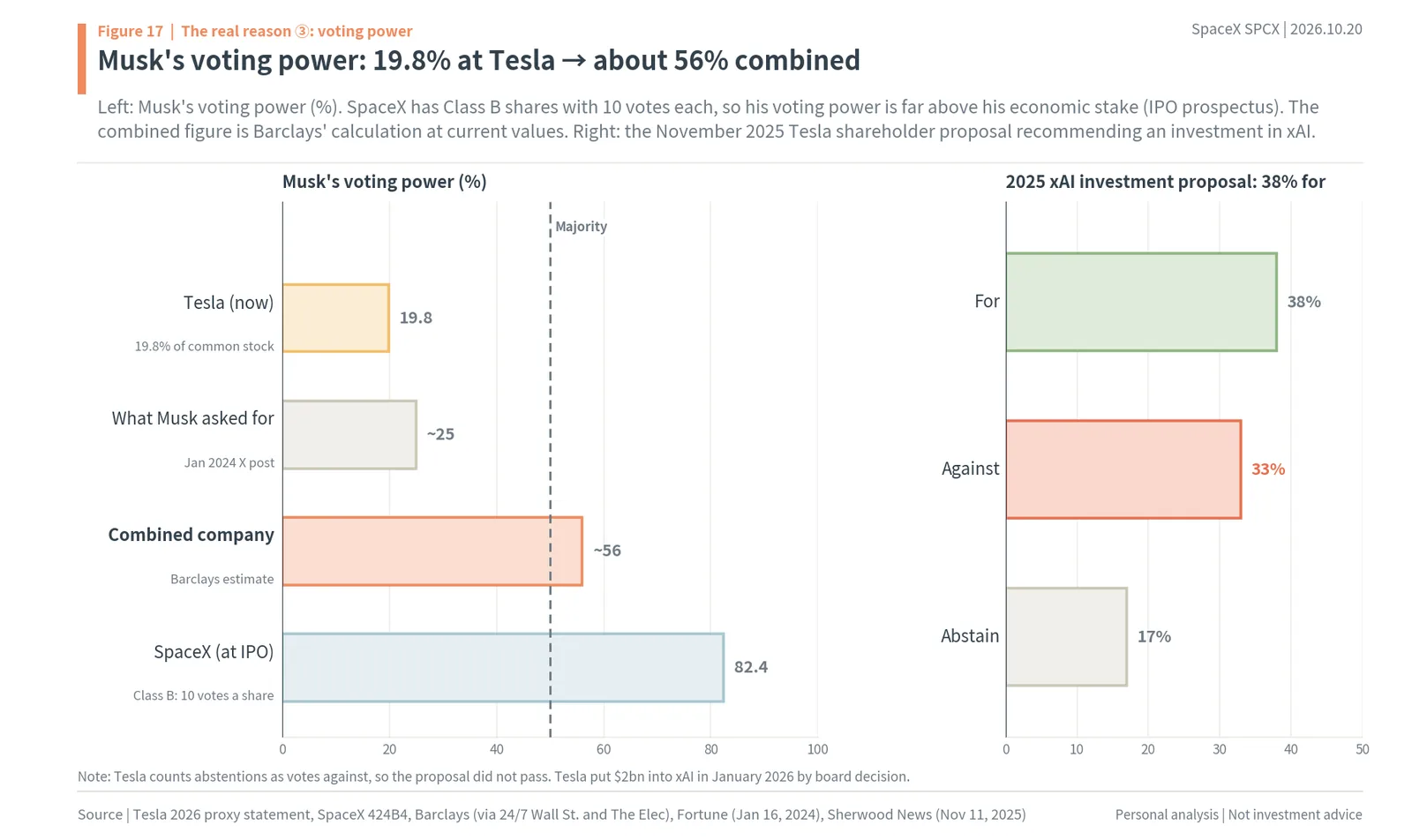
Here is what the number means. Today Musk takes part in decisions on Tesla’s AI and robotics with 19.8% of the votes, and in SpaceX’s compute and chip decisions with more than 80%. Combined, the whole AI chain, from the chip plant to data centers, AI models, robots and cars, would be decided by one company led by one person with a majority of the votes. The condition Musk set in his 2024 post, enough voting power to grow AI and robotics, would be met by this structure.
Musk’s pay at SpaceX is also tied to market value. On January 13, 2026, SpaceX granted him 1 billion performance-based restricted Class B shares. He earns them only by passing 15 market-cap milestones from $500 billion to $7.5 trillion and also establishing a permanent settlement of 1 million people on Mars (prospectus). The last milestone in Tesla’s pay package is $8.5 trillion; the last in SpaceX’s is $7.5 trillion. Both packages set targets more than double the two companies’ current combined value of $3.48 trillion.
The pay package’s change-in-control clause also connects to a merger
Tesla’s 2025 CEO pay package has a clause that links to a merger, too. The proxy statement says: “In a change in control of the Company, Unearned Shares may become Earned Shares based solely on market capitalization milestones,” and earned shares vest at that point. The package requires 12 market-cap milestones from $2 trillion to $8.5 trillion together with operating targets such as 20 million vehicles and 1 million robots; in a change in control, only market cap counts, not the operating targets. In August, The Wall Street Journal reported this clause as “an escape clause that could pay off for Elon Musk in several ways if he folds the automaker into his SpaceX empire” (as quoted by Kalshi News and 24/7 Wall St.).
9. Precedent: SolarCity in 2016, and committees first this time
This is not the first time Musk has combined companies on both sides of which he sits. Ten years ago, Tesla bought SolarCity, a solar company where Musk was the largest shareholder and chairman. The lessons from that deal shaped this process.
“Largely an accident of history”
On July 20, 2016, Musk published “Master Plan, Part Deux” on Tesla’s blog. Arguing that solar roofs and batteries should be sold as one order, one installation and one app, he wrote: “We can’t do this well if Tesla and SolarCity are different companies, which is why we need to combine and break down the barriers inherent to being separate companies. That they are separate at all … is largely an accident of history.” Eleven days later, on July 31, Tesla signed a deal to give 0.110 Tesla shares for each SolarCity share (equity value of about $2.6 billion), and on November 17 shareholders approved it with more than 85% of the votes cast by holders other than Musk and his affiliates.
The court: fair, but a committee is best practice
Tesla shareholders later sued, claiming Musk had pushed the board into overpaying. On April 27, 2022, the Delaware Court of Chancery ruled for Musk, finding the price and process fair even under the strictest “entire fairness” standard, and the Delaware Supreme Court affirmed on June 6, 2023. Tesla’s board had not formed a separate negotiating committee of disinterested directors at the time, and the court pointed to an independent special committee as best practice (Potter Anderson case summary).
This time the order is different.
Timing: before the December meeting, or a separate vote
Barclays said a merger could be announced before Tesla’s annual meeting, which must be held by December 6. If it came at the end of October or early November, approval at that meeting would be hard, and it could become a separate transaction voted on within 6 to 12 months. In fact, the agenda for the December 3 meeting in the proxy statement released in October (director elections, an advisory vote on pay, auditor ratification) does not include a merger. Approval by both boards and both sets of shareholders, plus antitrust and national-security reviews, would be needed. Reuters reported that Wall Street expects a deal by the end of next year. Tesla and SpaceX formed special committees of disinterested directors before any proposal existed, and Musk stepped out of the committees’ discussions. He said the committees were formed “at the request of shareholders.” Once the committees agree on terms, the deal goes to a shareholder vote. Musk said that on the Tesla side “we will need a 50% vote of all shares, not just those who vote.” Tesla became a Texas corporation with shareholder approval in June 2024, and SpaceX is also a Texas corporation.
10. What the combined company looks like: $3.48 trillion in market value, half its revenue from AI
Assume the two merge and add up the numbers, and the combined company is an AI company, not a car company. Who gets how much depends on the exchange ratio: how many SpaceX shares one Tesla share is worth.
Market value of $3.48 trillion, 42.4% for Tesla holders
At October 20 closes, SpaceX was worth $2.01 trillion (8.24 billion Class A plus 5.339 billion Class B shares at the end of September, times $147.79) and Tesla $1.48 trillion (3.95265 billion shares times $373.71). Together that is $3.48 trillion, or about KRW 4,618 trillion at that day’s rate of KRW 1,325.5 per dollar. The market expects SpaceX, the larger company by value, to buy Tesla entirely with stock (Barclays). At market prices, one Tesla share would get 2.53 SpaceX shares, and SpaceX holders would own 57.6% of the combined company and Tesla holders 42.4% (author’s calculation). Musk’s economic stake would be about 33.2%. Fortune also put his share at “about a third.”
What is Tesla today? Third-quarter deliveries were 486,532 vehicles, slightly below 497,099 a year earlier, and energy storage deployments were 13.7GWh. Second-quarter revenue was $28.236 billion with a 1.4% operating margin. Cars are not selling much, yet the stock trades at 172.3 times 2027 estimated EPS. The market prices Tesla as an AI and robotics company more than a car company. Full Self-Driving (FSD) subscriptions reached 1.48 million in the second quarter, up 56% in a year. Cash flows run the opposite way from SpaceX: the Bloomberg consensus cited by Barclays puts 2030 free cash flow at +$12 billion for Tesla and -$17 billion for SpaceX. The picture is one company that earns cash merging with one that spends it. The 18,990,195 SpaceX shares Tesla holds (about $2.81 billion at the October 20 close, author’s calculation) would become shares held inside the combined company.
2027 revenue of about $318 billion, 51.0% of it AI
Draw the combined company on 2027 revenue: the author’s base-case SpaceX estimate of $196.5 billion plus the market estimate for Tesla (31 analysts on Yahoo Finance) of $121.68 billion comes to about $318 billion. Splitting Tesla’s revenue by its second-quarter mix (automotive 72.7%, energy 11.1%, services 16.2%) gives AI $162.1 billion, Tesla automotive $88.4 billion, Starlink $29.1 billion, Tesla services $19.7 billion, energy $13.5 billion and launch $5.3 billion. AI is 51.0% (author’s calculation).
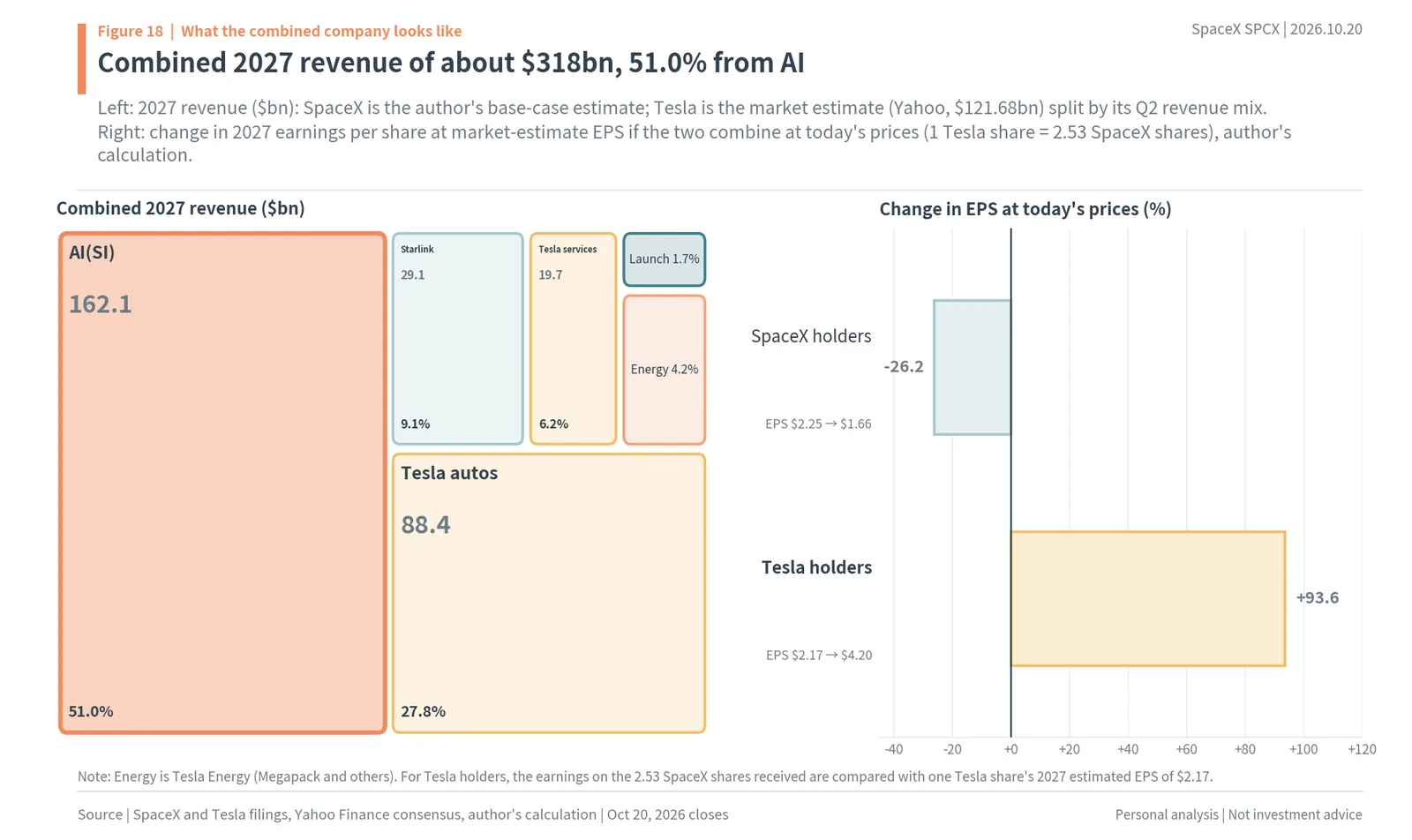
Seen as a business chain, the combined company would run in one line: chips (Terafab) → power (Megapack) → compute and AI models (Colossus, Grok, Cursor) → bodies for AI to work in (robotaxis, Optimus) → connectivity (Starlink). Today that line breaks twice at the border between the two companies, and each break goes through the process described in the last chapter.
Compared with today, the shift is sharper. On revenue over the last four quarters, SpaceX’s $32.0 billion (fourth quarter of 2025 to third quarter of 2026) plus Tesla’s $103.6 billion (third quarter of 2025 to second quarter of 2026) is about $135.6 billion, 76.4% of it Tesla (author’s calculation). Combined today, three-quarters of revenue would come from cars, but if SpaceX grows in line with its first-quarter guidance, it becomes a company with half its revenue from AI in little more than a year. That is also why the deal is discussed as SpaceX buying Tesla, not the other way around: SpaceX is larger in both market value and future revenue.
On earnings, the math splits
On earnings rather than revenue, the two sets of shareholders come out differently. Average 2027 EPS estimates on Yahoo Finance are $2.25 for SpaceX and $2.17 for Tesla. At current prices, 2027 P/E is 65.6 times for SpaceX, 172.3 times for Tesla and 89.0 times for the combined company. If SpaceX buys the higher-P/E Tesla with stock at market prices, SpaceX holders’ 2027 earnings per share fall from $2.25 to $1.66, or 26.2% (author’s calculation). By the same math, Tesla holders’ earnings on the 2.53 SpaceX shares they receive become $4.20, 93.6% more than the estimated earnings on one Tesla share today. From SpaceX’s side, it is a deal to buy not current earnings but the ingredients described above (chips, power, robots, cash) and voting power.
11. Exchange ratio: the bigger the premium, the bigger Tesla holders’ share
The most important number in the merger terms is the exchange ratio, and setting it is the job of the two special committees. The author calculated three cases: market prices (1 Tesla share = 2.53 SpaceX shares), a 20% premium for Tesla (3.03 shares), and the case reported from Dan Ives, who said Tesla would need to be valued at about $550 a share for a deal to get done (3.72 shares) (TipRanks).
The bigger the premium, the more of the combined company Tesla holders own: 42.4%, then 46.9%, then 52.0%. The change in SpaceX holders’ 2027 earnings per share widens from -26.2% to -32.0% and -38.5%. Tesla holders’ earnings per share rise from +93.6% to +114.2% and +137.5%. Musk’s economic stake slips from 33.2% to 32.0% and 30.7%, but because of the 10-vote Class B, his voting power is a majority in every case (72.9-76.5% in the author’s simple calculation).
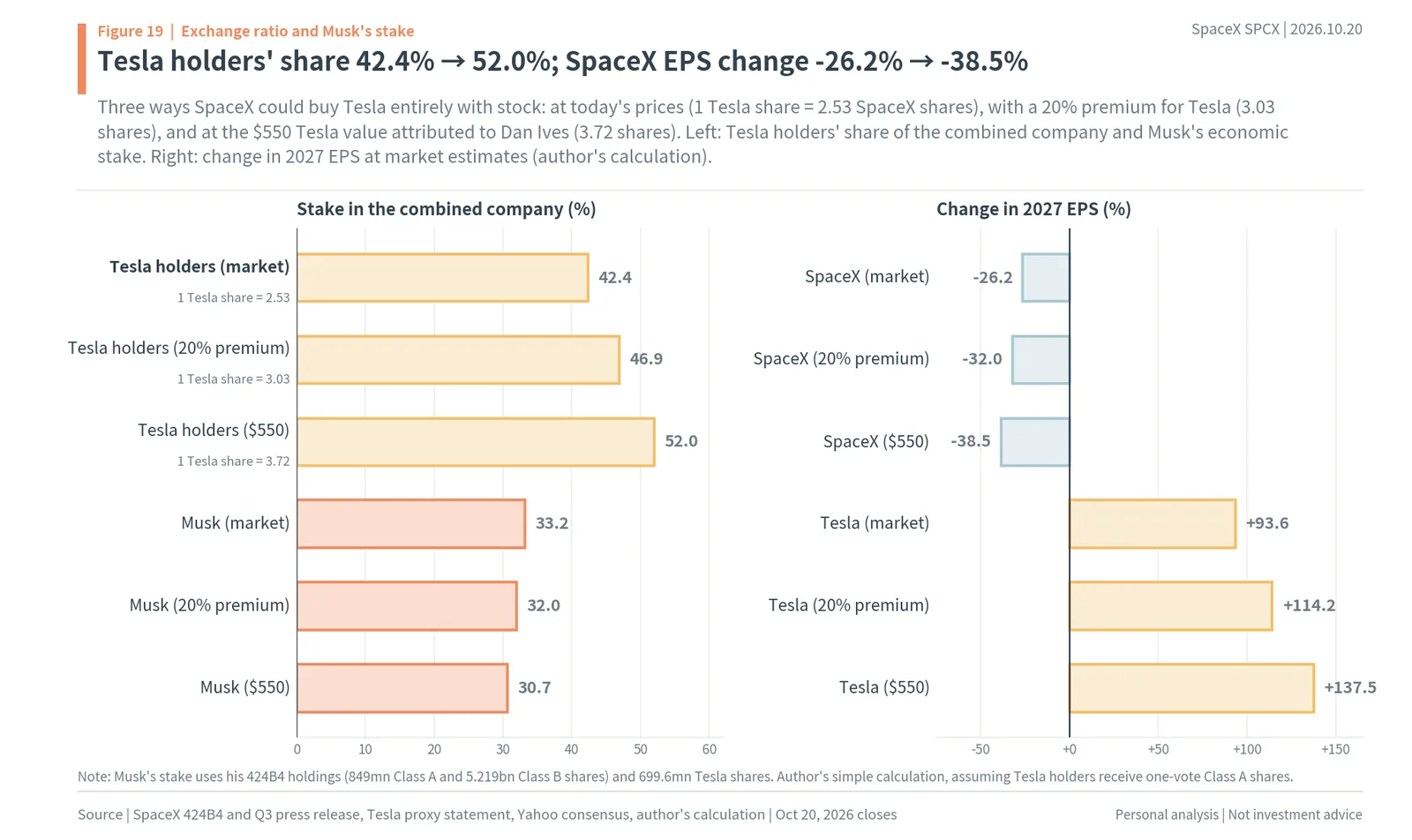
Barclays used “0.7 of one SpaceX share” as an example, but on share prices one Tesla share equals 2.53 SpaceX shares, so 0.7 does not work as a per-share ratio. At the time of the Barclays note, the ratio of the two companies’ market values (Tesla $1.45 trillion ÷ SpaceX $2.07 trillion) was 0.70, so the number looks better read as a value ratio than a per-share ratio. Each special committee is there to protect its own shareholders, so the negotiation will have SpaceX’s side pushing the ratio down and Tesla’s side pushing it up. Where the result lands among the three cases in Figure 19 decides the math for both sets of shareholders.
12. The stock: what today’s price assumes, and a year out
Finally, the stock. Today’s SpaceX price assumes revenue continues at roughly the level of first-quarter 2027 guidance, and how much more compute gets built will decide where it goes next. The author’s base case for one year out is $216.
Four months since the IPO: $135 → $211.39 → $108.27 → $147.79
SpaceX priced its IPO at $135 on June 11 and listed on the Nasdaq on June 12. It sold 638.89 million shares (including the over-allotment) for net proceeds of $85.675 billion. The first-day close was $160.95, and the closing high was $211.39 on June 16. From there it fell, including a 16.43% drop on June 22, to a closing low of $108.27 on August 5. In between, the stock closed up 9.43% on August 4; in the second-quarter results released after that close, capital spending was $18.369 billion, far above $2.825 billion a year earlier, and the stock fell 13.61% the next day. It rebounded 15.83% on August 7 and closed at $147.79 on October 20. After the third-quarter results and the committee news, it rose 8.06% after hours to $159.70, 9.5% above the IPO price and 30.1% below the high.
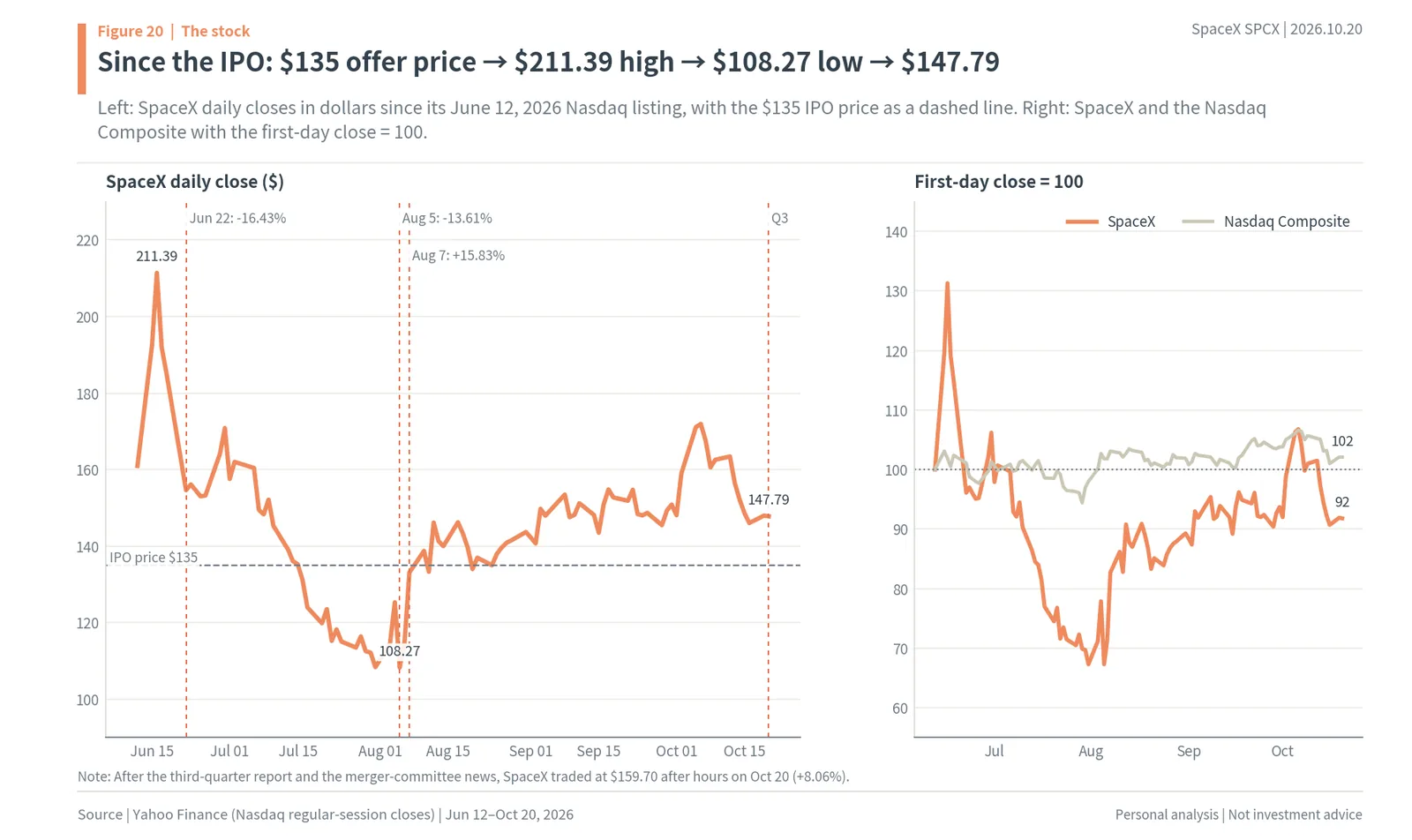
Before the open on October 21, the day after the report, SpaceX traded as high as $162.07, about 9.7% above the previous close, and Tesla touched $383 (TradingKey). Reuters reported SpaceX up 8.4% and Tesla up 1.5% before the open. Tesla had also closed up 1.54% at $373.71 in regular trading on October 20 and traded at $380.29 after hours. For SpaceX, the merger news came on the same day as the third-quarter results and the first-quarter 2027 guidance. The reference price in this report is the pre-results close of $147.79.
Today’s price assumes about $40.6 billion of quarterly revenue
Work backward from what today’s price assumes. At $147.79, market value is $2.01 trillion; subtracting $51.0 billion of net cash gives enterprise value (EV) of about $1.96 trillion. Seven big tech and AI infrastructure companies (NVIDIA 25.8x, Alphabet 23.4x, CoreWeave 21.2x, Microsoft 20.6x, Amazon 17.5x, Meta 16.3x, Oracle 15.5x) average 20.1 times EV/EBITDA. $1.96 trillion divided by 20.1 means about $98 billion of EBITDA, and dividing by 60%, close to the third quarter’s adjusted EBITDA margin of 60.4%, gives annual revenue of about $163 billion, or about $40.6 billion a quarter (author’s calculation). That is a little above the first-quarter 2027 guidance of $33 billion to $37 billion. Today’s price does not yet assume the big build-out beyond the guidance.
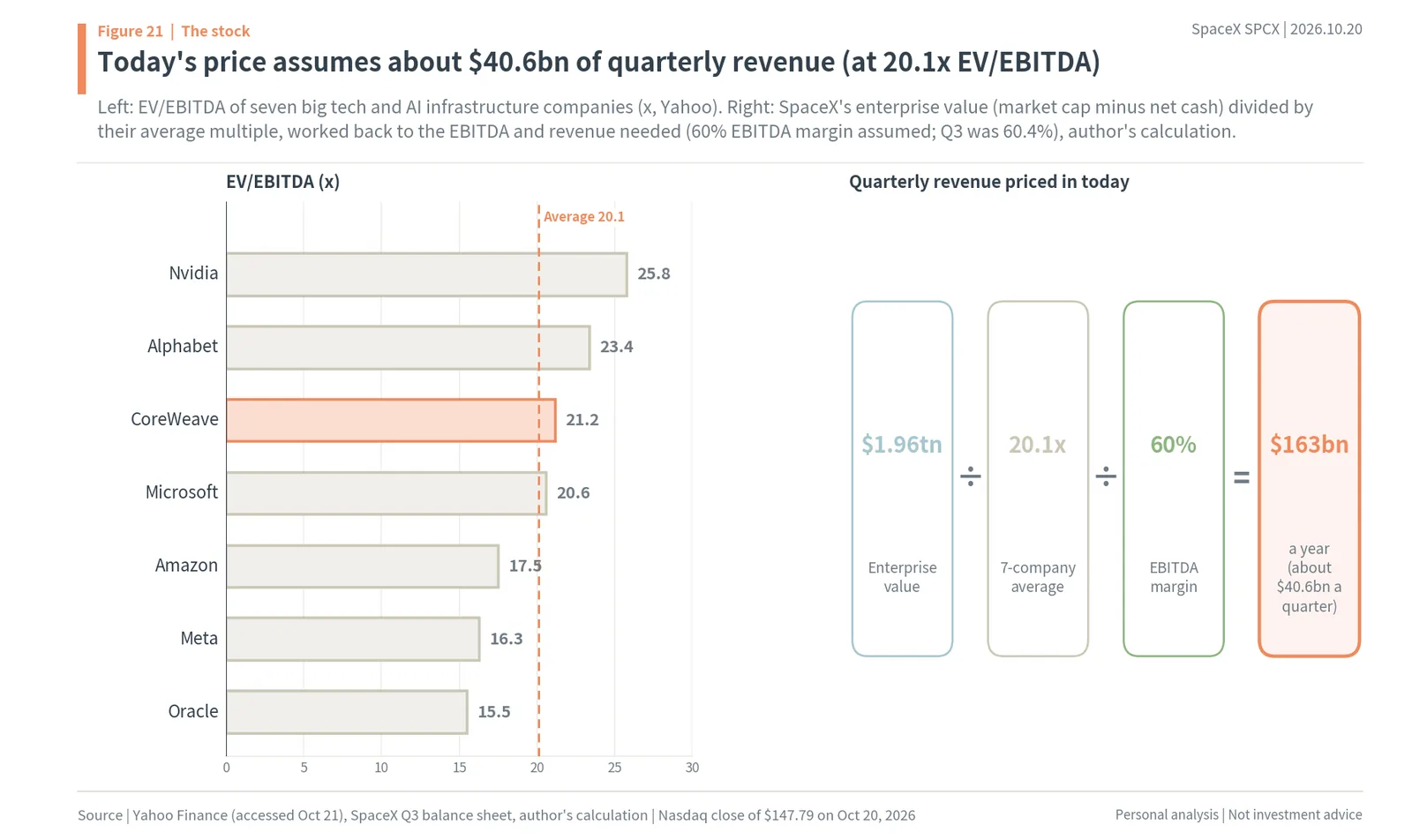
P/E tells the same story. Today’s price is 65.6 times the market’s 2027 EPS estimate of $2.25, far above the 19.2-times average forward P/E of six big tech companies (NVIDIA 13.6x, Microsoft 22.4x, Alphabet 22.2x, Meta 20.0x, Oracle 11.9x, Amazon 25.1x). But on the author’s base-case EPS of $4.52, it is 32.7 times. How expensive the stock looks depends on how quickly the first-quarter guidance works its way into estimates.
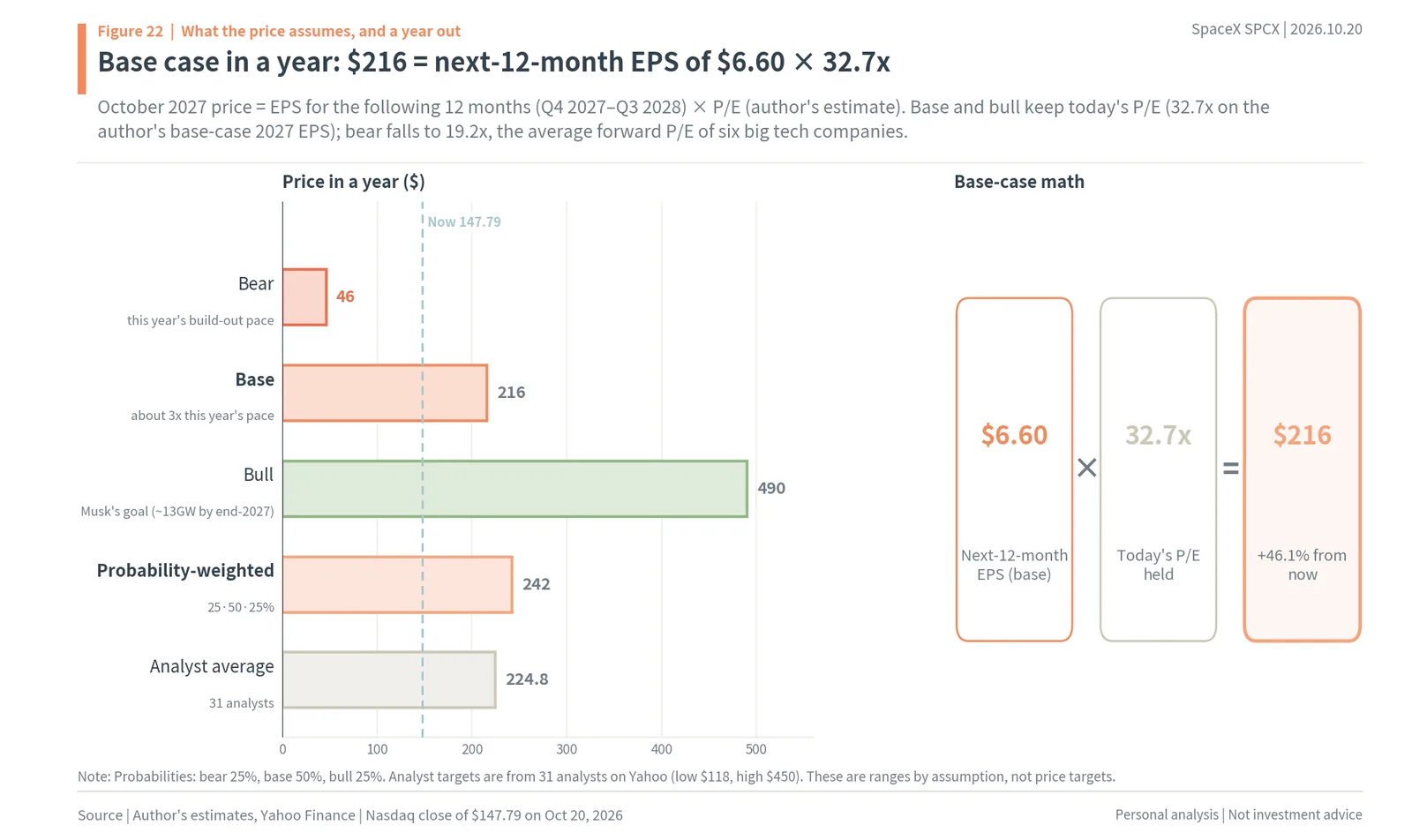
Base case a year out: $216 = next-12-month EPS of $6.60 × 32.7x
Let us estimate the price a year from now, in October 2027, as EPS times P/E. The author’s model puts EPS for the following 12 months (fourth quarter of 2027 to third quarter of 2028) at $2.42 in the bear case, $6.60 in the base case and $14.99 in the bull case. Today’s price is 32.7 times the author’s base-case 2027 EPS of $4.52, and 65.6 times the market estimate of $2.25. Holding P/E at 32.7 times a year from now gives $216 in the base case (+46.1%) and $490 in the bull case (+231.6%). The bear case assumes build-out stays at this year’s pace and price per watt falls fast, so the growth premium disappears; applying the 19.2-times average forward P/E of six big tech companies (NVIDIA, Microsoft, Alphabet, Meta, Oracle, Amazon) gives $46. Weighting the bear, base and bull cases at 25%, 50% and 25% gives $242 (+63.7%), close to the $224.8 average target of the 31 analysts on Yahoo Finance (author’s calculation). The target range is $118 to $450.
Brokers raised targets around the third quarter. Cantor Fitzgerald raised its target from $246 to $345 on October 21, and Evercore ISI from $230 to $275 on October 16. Barclays started coverage on October 9 with a $254 target, and Needham and Macquarie kept $250. MoffettNathanson rates the stock Neutral with a $142 target, and HSBC started coverage in July at Hold with a $115 target (Yahoo Finance). The author’s base case of $216 sits near the middle of that range.
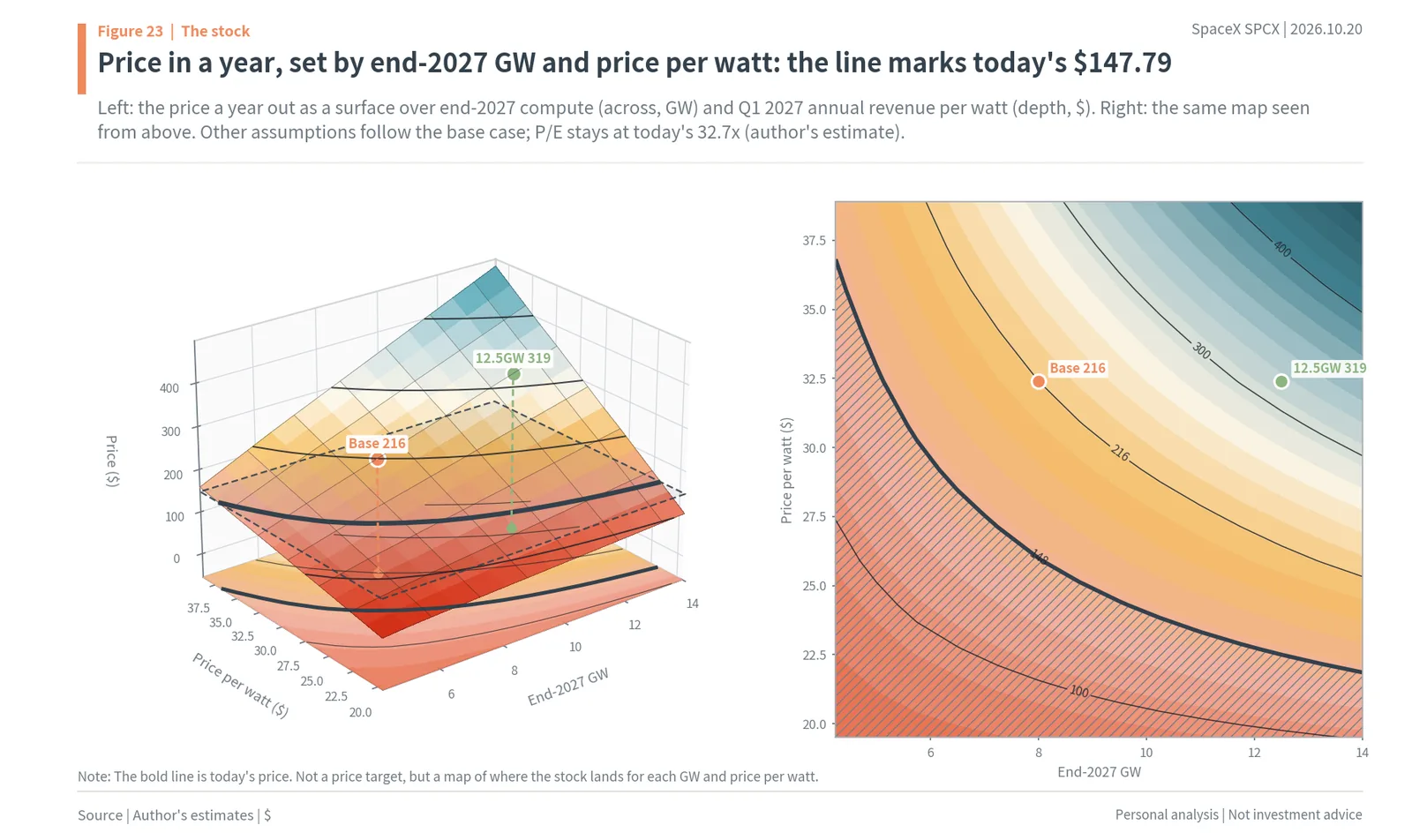
Figure 23 spreads this math out as a surface. Across is end-2027 compute (GW), depth is first-quarter 2027 annual revenue per watt, and height is the price a year out (with P/E held at 32.7 times). The bold line is at today’s price of $147.79. The base-case point (8.0GW, $32.4) sits at $216, and at the same price per watt, 12.5GW, close to Musk’s target, gives $319. If price per watt is 20% lower at $25.9, 8.0GW gives $147, about today’s price, and 12.5GW gives $207 (author’s estimate). The slope of the surface shows that GW is the axis that moves the stock.
13. Dates to watch: starting October 21
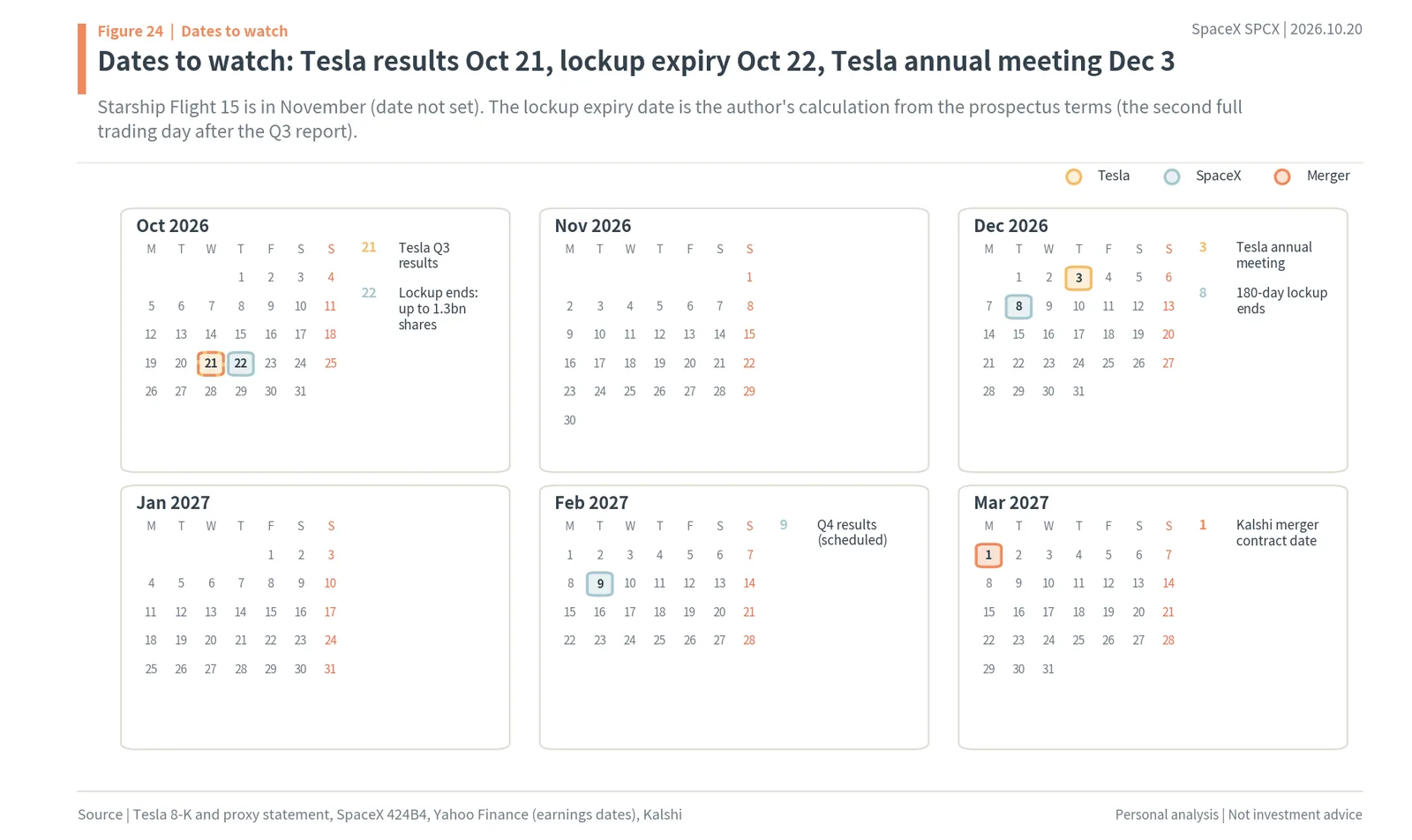
The first date to watch is right away. Tesla reports third-quarter results after the US market close on October 21. Third-quarter deliveries were 486,532, and the market expects revenue of about $28 billion and adjusted EPS of $0.45 (Electrek). What is said on that call about a SpaceX merger, Terafab and Optimus is the first check.
On October 22, the lockup on up to 1.3 billion SpaceX shares held since the IPO ends. The prospectus sets the release on the second full trading day after the third-quarter report, which the author calculates as October 22. That is 9.6% of shares outstanding at the end of September, worth about $208 billion at the after-hours price of $159.70. The remaining 180-day lockup ends on December 8, and Musk’s shares are locked up until June 12, 2027.
After that come Starship Flight 15 in November (an attempt to catch both the booster and the ship with the tower), Tesla’s annual meeting on December 3, and SpaceX’s fourth-quarter results, scheduled for February 9, 2027. The fourth-quarter report will show whether year-end ARR of $100 billion and compute of 2.5-3GW were hit and whether first-quarter 2027 guidance still stands. Barclays thinks a merger could be announced before Tesla’s December meeting, and on the prediction market Kalshi, the probability of a merger announcement before March 1, 2027 was 42% just before the call, and before May 1, 56%.
Each date comes with numbers to watch. On Tesla’s third-quarter call, watch what Musk and management say about a merger, the Terafab cost split, Optimus production and robotaxi markets. On Starship Flight 15, watch whether both the booster and the ship can be caught and reused. A reusable Starship is the way to put up Starlink V3 satellites cheaply and in large numbers, which supports connectivity’s volume growth. In the February 2027 fourth-quarter report, watch whether December revenue times 12 reached $100 billion of ARR, whether compute reached 2.5-3GW, and whether the first-quarter 2027 guidance of $33 billion to $37 billion holds. On the merger, the biggest day is when the two special committees release an agreement with an exchange ratio.
Interest from Korea is high too. Korean retail investors in US stocks, known locally as “Seohak ants,” bought a net $1.893 billion of SpaceX in June, its first month of trading, and held $2.27 billion as of September 2. Their Tesla holdings were $17.9 billion as of July 28, making it the foreign stock Korean investors own most. Both stocks are listed on the Nasdaq, so any merger terms flow straight through to Korean accounts as well.
Conclusion
The third quarter of 2026 was the first in which AI passed Starlink at SpaceX, making up 51.9% of revenue and 56.2% of adjusted EBITDA, and first-quarter 2027 guidance of $33 billion to $37 billion is more than double the third quarter. AI revenue is compute GW times price per watt, and the price per watt is already inside the range the company gave, so future results depend on how fast SpaceX builds GW. One GW costs about $35.4 billion, and even in the base case net cash falls to -$75 billion by the end of 2027.
The chips (Terafab), power (Megapack), cash, and cars and robots for AI to work in that those GW need are split with Tesla, and because the two companies have different shareholders, every deal between them goes through a separate process. So the author reads the real reason for the merger as putting this whole AI chain under one roof, in one company led by Musk with a majority of the votes (about 56% by Barclays’ math).
Combined, it would be a company with about $318 billion of 2027 revenue, 51.0% of it AI, and the exchange ratio decides who gets how much. At market prices, Tesla holders would own 42.4% and SpaceX holders’ 2027 earnings per share would fall 26.2%. The author’s base case a year out is $216 (next-12-month EPS of $6.60 × 32.7 times), and the first checks are Tesla’s results on October 21 and the lockup expiry on October 22.
SpaceX, Tesla and the merger: quick answers
Q. Why does Musk want to merge SpaceX and Tesla?
SpaceX’s AI revenue is compute GW times price per watt, so growth depends on building GW, and the chips (the $16.8 billion first phase of Terafab), power (Megapack), cash (Tesla held $43.5 billion at the end of June) and robot bodies (Optimus, Cybercab) it needs sit partly at Tesla. The two have different shareholders, so every deal between them is a related-party transaction with its own review, and large ones go to a shareholder vote. A merger would put the whole AI chain in one company and take Musk’s voting power from 19.8% at Tesla to about 56% (Barclays).
Q. What did SpaceX report for the third quarter of 2026?
Revenue was $14.58 billion, up 161.4% from a year earlier. AI revenue was $7.56 billion, 51.9% of the total, passing Starlink ($5.25 billion) for the first time. Adjusted EBITDA was $8.81 billion, net income $4.40 billion and diluted EPS $0.35. The company guided first-quarter 2027 revenue to $33 billion to $37 billion, 2.26 to 2.54 times the third quarter.
Q. What would a combined SpaceX and Tesla look like?
At October 20 closes, SpaceX was worth $2.01 trillion and Tesla $1.48 trillion, $3.48 trillion together. At market prices, one Tesla share would get 2.53 SpaceX shares, and Tesla holders would own 42.4% of the combined company. On the author’s base case for SpaceX and the market estimate for Tesla, 2027 revenue would be about $318 billion, 51.0% of it from AI (author’s calculation).
Q. How does the exchange ratio change the math for shareholders?
At market prices (2.53 SpaceX shares per Tesla share), SpaceX holders’ 2027 earnings per share fall 26.2% and Tesla holders own 42.4%. With a 20% premium for Tesla (3.03 shares), those become -32.0% and 46.9%; at a $550 Tesla value (3.72 shares), -38.5% and 52.0% (author’s calculation at market-estimate EPS).
Q. What could SpaceX stock be worth in a year?
In the author’s base case, $216: next-12-month EPS of $6.60 times today’s 32.7x P/E on base-case 2027 EPS. The bear case is $46 and the bull case $490; weighting them 25%, 50% and 25% gives $242, close to the $224.8 average target of 31 analysts on Yahoo Finance. These are ranges under assumptions, not price targets.
Q. What are the key dates?
Tesla’s third-quarter results on October 21, 2026; the lockup on up to 1.3 billion SpaceX shares ends October 22; Starship Flight 15 in November; Tesla’s annual meeting on December 3; the remaining 180-day lockup ends December 8; and SpaceX’s fourth-quarter results, scheduled for February 9, 2027.
Sources
- SpaceX, Q3 2026 earnings release (8-K Ex. 99.1) (link), Oct 20, 2026
- SpaceX, Q2 2026 earnings release (link), Aug 4, 2026
- SpaceX, Q2 2026 10-Q (link), Aug 4, 2026
- SpaceX, final prospectus 424B4 (link), June 12, 2026
- The Motley Fool, SpaceX (SPCX) Q3 2026 Earnings Call Transcript (link), Oct 20, 2026
- Tesla, 2026 annual meeting proxy statement (link), Oct 2026
- Tesla, Q2 2026 10-Q (link), July 2026
- Fortune, Elon Musk says Tesla and SpaceX are weighing a $3.5 trillion merger (link), Oct 20, 2026
- TechCrunch, SpaceX and Tesla boards form special committees to review merger (link), Oct 20, 2026
- 24/7 Wall St., Barclays Says a Tesla-SpaceX Merger Could Be Announced Before December (link), Oct 15, 2026
- 24/7 Wall St., Tesla and SpaceX Just Formed Special Committees to Weigh a Merger (link), Oct 21, 2026
- TechCrunch, Tesla and SpaceX will invest $16.8B to start building ‘Terafab’ (link), Aug 6, 2026
- Sherwood News, Tesla shareholders support Musk much more than Musk’s xAI (link), Nov 11, 2025
- Fortune, Elon Musk wants 25% voting control of Tesla (link), Jan 16, 2024
- FinanceFeeds, Tesla SpaceX Merger Odds Hit 56% by May 2027 on Kalshi (link), Oct 20, 2026
- Money Today, SpaceX’s surprise results and merger talks with Tesla (link), Oct 21, 2026
- Electrek, Tesla (TSLA) Q3 2026 earnings preview (link), Oct 20, 2026
- Electrek, Elon Musk hints at Tesla-SpaceX merger on earnings call (link), July 22, 2026
- TechCrunch, SpaceX president Gwynne Shotwell just gave another hint at a Tesla merger (link), June 12, 2026
- Reuters via Investing.com, Wall St says Tesla-SpaceX deal inevitable but Musk says it’s not certain (link), Oct 21, 2026
- TipRanks, Dan Ives Calls SpaceX Merger a ‘No-Brainer’ (link), Oct 21, 2026
- Kalshi News, Tesla-SpaceX merger odds climb after WSJ reports on Musk pay clause (link), Aug 14, 2026
- Tesla, Q3 production and deliveries 8-K (link), Oct 2, 2026
- Tesla, Master Plan, Part Deux (link), July 20, 2016
- Tesla, SolarCity acquisition shareholder approval 8-K (link), Nov 17, 2016
- Potter Anderson, In re Tesla Motors, Inc. Stockholder Litigation (link), June 2023
- The Elec, SpaceX-Tesla merger could be announced in early December (link), Oct 15, 2026
- Sisa Journal, Korean retail investors return to US stocks, SpaceX tops net buying (link), July 1, 2026
- Herald Economy, Korean retail investors pile into SpaceX after its fall to the IPO price (link), Sept 4, 2026
- Financial News, Korean retail investors’ overseas holdings (link), July 30, 2026
- Yahoo Finance, SpaceX and Tesla prices, consensus and peer data (link), accessed Oct 21, 2026
- Photos: Larry D. Moore (CC BY 4.0), Horacio Cambeiro (CC BY 4.0), Jared Krahn (CC BY-SA 4.0), U.S. Space Force photo by Joshua Conti (public domain), Sikander (CC BY-SA 4.0), ajay_suresh (CC BY 2.0), via Wikimedia Commons
Disclaimer
Was this note useful?
Thanks. Your answer helps decide what to cover next.
Korea market snapshot · Oct 23, 2026
New to Korean stocks? Start here for the basics.
Most read
1France Protests 2026: Why Students Are Blocking Schools and Which Stocks Benefit (Munich Re, SCOR)
Get the Saturday note on Korean stocks
One email every Saturday with the week’s new research on Korean listed companies and links to the updated data pages. Built from DART filings and KRX data. Free; unsubscribe in one click. See past issues