
AI Agent Payments and Crypto: Agents Pay in USDC, So What Drove NEAR’s 5x Rise, and Who Earns? (Circle, Coinbase, Kakao Pay)
English edition of the author’s Korean note on AI-agent payments and crypto.
In January 1997 the IETF published HTTP/1.1, the common rulebook of the web (RFC 2068). It included a status code, “402 Payment Required”, with a one-line description: “This code is reserved for future use.” The web had rules for exchanging pages and data, but no standard way to pay on the spot. The same sentence survived into RFC 2616 (1999), RFC 7231 (2014) and today’s RFC 9110 (June 2022).
On May 6, 2025 Coinbase published the whitepaper for x402, a payment standard that finally uses that empty slot. When a server answers 402 with a price and a wallet address, the agent sends coins from its wallet and gets the data. The whitepaper says it uses “the long-reserved HTTP 402 Payment Required status code” so that no API keys or subscriptions are needed. A year and a half later x402 sits in a Linux Foundation project with more than 50 members, and AI agents use it to pay for data and APIs on their own.
So which coin do AI agents pay with, and who earns from it? A popular idea among crypto investors is that NEAR and Worldcoin (WLD), both tied to famous AI figures, will become the coins agents pay with. This report tests that idea with numbers: how big agent payments are and what money they use, where that money accumulates among chains, issuers and exchanges, what NEAR’s five-fold rise from its low actually priced in, and which stocks (Circle, Coinbase and Korea’s Kakao Pay) sit on the path.
As of: October 30, 2026. Coin prices are Upbit Korean-won closes and Yahoo Finance dollar closes on October 29, 2026 (NEAR KRW 6,170, about $4.61; Bitcoin KRW 109.27 million, about $81,605). Stocks are October 29 closes (Circle $80.60, Coinbase $160.93, Kakao Pay KRW 34,000). The won traded at KRW 1,338.7 per dollar on October 29.
Reference data: payment data from x402scan (September 29 to October 29), Chainalysis and a16z; company numbers from Circle and Coinbase SEC filings (Q2 2026 is the latest; Circle reports Q3 on November 4 and Coinbase’s Q3 release, due October 29, could not be confirmed at the time of writing); chain fees, NEAR buybacks and stablecoin supply from DefiLlama; market caps and supply from CoinGecko. Numbers the author calculated are marked “author’s calculation”. This is the author’s personal analysis, not investment advice.
1. Over the past year, coins fell and only NEAR rose
From September 24, 2025 to October 29, 2026, on Upbit’s Korean-won market, every major coin fell except one. Bitcoin went from KRW 160.7 million to KRW 109.27 million, Ether from KRW 5.89 million to KRW 3.17 million, Solana from KRW 300,300 to KRW 137,000 and Worldcoin from KRW 1,920 to KRW 579. Only NEAR rose, from KRW 4,308 to KRW 6,170. A year of headlines about crypto entering the financial mainstream did not lift coin prices.
NEAR was the only riser
In returns: NEAR +43.2%, Bitcoin -32.0%, Ether -46.3%, Solana -54.4%, Worldcoin -69.8%. Bitcoin peaked at KRW 178 million on October 8, 2025, fell to KRW 89.1 million on August 14, 2026 and is still 38.6% below its peak. In dollars the picture is the same: Bitcoin fell 28.0% from $113,329 to $81,605, while NEAR rose 52.3% from $3.02 to $4.61. Korea’s KOSPI, by contrast, rose 72.3% over the same year. The left panel below shows weekly closes with the first day = 100; the right panel shows how many times each coin rose from its low in the period to its later high (times).

The right panel is what sets NEAR apart. It fell to KRW 1,414 on February 12, 2026 and reached KRW 7,975 on October 11, 5.64 times its low, and it still trades at 4.36 times that low. The others bounced far less: Worldcoin 2.92x from May 1 to June 16 before sliding again, Solana 1.75x, Ether 1.58x, Bitcoin 1.31x.
Two “AI coins”, opposite results
NEAR and Worldcoin are often grouped as coins made by AI pioneers. NEAR co-founder Illia Polosukhin is one of the eight authors of “Attention Is All You Need” (2017), the paper that introduced the transformer behind today’s generative AI. He left Google that year and started NEAR with Alexander Skidanov; NEAR is a proof-of-stake smart-contract blockchain whose mainnet launched in 2020. Worldcoin comes from Tools for Humanity, founded in 2019 by Sam Altman, Alex Blania and others; its Orb scans a person’s iris to issue a World ID that proves a unique human. Two coins with the same story went opposite ways, so the “AI” label alone did not set prices. And NEAR’s rise is often explained as “agents have started paying in NEAR”. To test that, we first need to see what agents actually pay with.
2. AI agent payments are already running
Agents paying for things on their own is not a future scenario. There is a standard (x402), a foundation that runs it, and card networks, Big Tech and exchanges each laying their own rails. In Korea, Kakao Pay joined the x402 Foundation as a founding participant.
How x402 works
The flow is simple. An agent calls a paid API; instead of data, the server replies “402 Payment Required” with a price, a wallet address and the coin it accepts. The agent signs a payment and retries, a facilitator checks the signature and moves the money on-chain, and the server returns the data. Sign-ups, card numbers and subscriptions disappear. The whitepaper compared card fees of $0.30 + 2.9% with x402 on Base at “free” (nominal gas under $0.0001) and 200-millisecond settlement. For the first time in almost 30 years, the web’s Payment Required slot has a use.

Facilitators are concentrated. Of 154,454 payments on x402scan in the day to October 29, Coinbase handled 69.1%, PayAI 19.2% and Fluxa 10.1%; that day’s value was $24,991. Cumulatively, x402scan counted 197.48 million payments and $52.51 million by late July. Chainalysis noted in June that much of the early spike came from test-like activity such as the PING meme coin minted by paying 1 USDC, and that payments of $1 or more now make up 95% of value. Fast growth in counts and growth in useful payments are not the same thing.
The foundation and the card and Big Tech rails
x402 is moving from a Coinbase experiment to an industry standard. Cloudflare and Coinbase announced plans for an x402 Foundation on September 23, 2025. On April 2, 2026 the Linux Foundation announced its launch and took over the protocol; the 22 organizations that signed on included Google, AWS, Visa, Mastercard, Stripe, Circle, Microsoft, Shopify, the Solana Foundation and Kakao Pay, which announced on April 6 that it was the only Korean founding participant. The foundation began operating with 40 members on July 14 and passed 50 active members on October 1.
Card networks and Big Tech laid rails at the same time. Mastercard launched Agent Pay on April 29, 2025 and Visa launched Intelligent Commerce the next day. Google released AP2 (Agent Payments Protocol) with more than 60 partners on September 17, along with an x402 extension. Stripe and OpenAI released in-ChatGPT checkout on September 29, and Visa released its Trusted Agent Protocol on October 14. In 2026 AWS opened agent payments over x402 as a preview on May 7 and made them generally available on August 18; Ant International, Visa and Mastercard agreed on September 10 to align on agent identity standards, a framework that includes the Kakao Pay and Toss wallets; and Circle launched its own Arc chain, where gas is paid in USDC, on September 16. The figure puts these dated announcements on three lanes.

Card networks let agents pay over card rails; x402 lets them pay in USDC through the web’s 402 code. The big players keep both doors open, as Google did by shipping AP2 with an x402 extension. Agent payments are real. The next questions are how big they are and what money they use.
3. Why now: the rules, the rails and the customers arrived together
Agent payments grew over the past year because three things arrived at once: US law set the rules for dollar coins, chains and wallets for moving them were built, and a new customer that pays instead of people, the AI agent, appeared.
The US President signed the GENIUS Act on July 18, 2025. It sets who may issue dollar stablecoins and what reserves must back them, and bars issuers from paying interest or yield to holders. Regulators missed the one-year rule deadline, but the OCC issued its final rule on October 21, 2026 and the law takes effect on January 18, 2027. By contrast the CLARITY Act, the market-structure bill for the rest of crypto, stalled in a 49-50 Senate procedural vote on September 15, 2026. The rules for dollar coins are set; the rules for other coins are not, which matches a year in which USDC found new uses while other coins fell.
Meanwhile the amount of dollar coins moving grew far faster than the amount outstanding. Circle reported $14.8 trillion of on-chain USDC transactions in Q2 2026, up 151%, and its average USDC in circulation doubled from $33.34 billion in 2024 to $64.87 billion in 2025. Circle launched Agent Stack in May 2026, a bundle of agent wallets, a marketplace and nanopayments that its 10-Q describes as down to $0.000001 without gas fees, and opened the Arc chain on September 16 with BlackRock, DTCC, ICE, Mastercard and Visa among its validators. On its July 30 earnings call Coinbase said agents will soon outnumber people and cannot open bank accounts, so they need new financial infrastructure. Agents have no ID or card but can hold a wallet, and what they buy usually costs a few cents, which a card’s fixed fee cannot serve.
4. Agent payments are still small, and 99% of the money is USDC
Agent payments are running, but they are small: about $1.5 million a month, and the average payment is under 50 cents. Almost all of that money is USDC, a coin pegged to the dollar. Agents do pay in a coin, but not in one whose price can rise.
3.26 million payments, $1.58 million a month
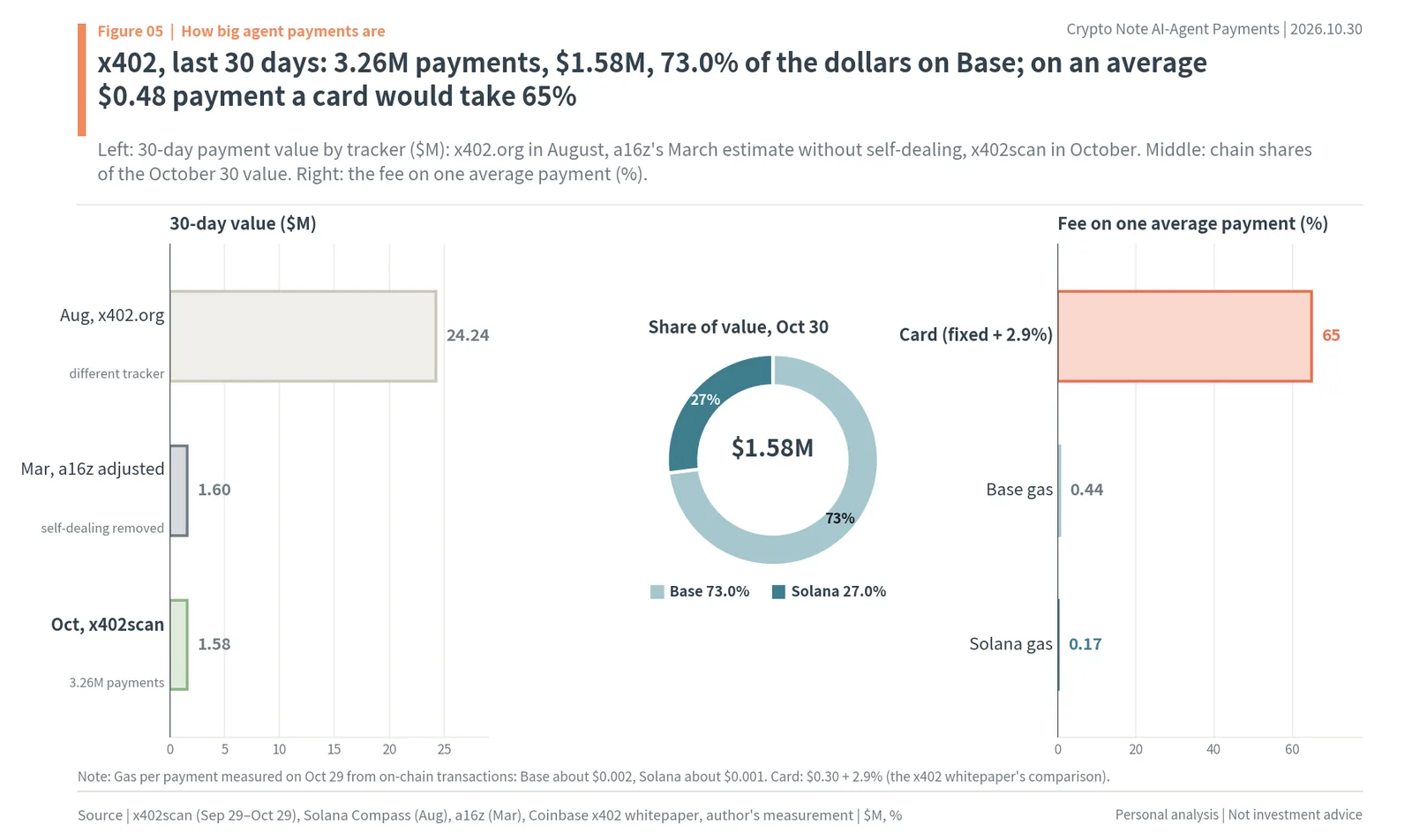
x402scan’s last 30 days (September 29 to October 29) show 3,262,774 payments worth 1,581,458 USDC, about $1.58 million, from 33,130 buying wallets to 13,227 sellers. The average payment was $0.48. Base carried 2,525,011 payments and $1.15 million, 73.0% of the value; Solana carried 737,763 payments and $0.43 million. Solana briefly passed Base in daily counts in late August, but on the 30-day count as of October 30 Base leads again.
Trackers disagree widely. In August, reports citing the official x402.org dashboard gave 75.41 million payments and $24.24 million over 30 days. In March a16z re-measured Bloomberg’s “$24 million in 30 days” on-chain at about $3 million, and at $1.6 million after removing wallets trading with themselves. Chainalysis counted more than 138 million x402 payments on Base, over 87% of them between $0.0001 and $0.10 (October 14). Counts are filled by tiny payments, value by a few large ones, so the right measure is value, compared month to month within one tracker. That is why this report uses the October x402scan figure and does not compare it directly with August’s other tracker.
The tiny size decides the payment method. On a $0.48 payment a card’s $0.30 + 2.9% fee comes to about $0.31, or 65% of the payment. On Base the gas is about $0.0020, or 0.44%, and on Solana about $0.0010, or 0.17% (measured by the author from on-chain transactions on October 29). The figure shows 30-day value by tracker ($M), chain shares of the value on October 30, and the fee on one average payment (%).
99.3% USDC
In its Q2 2026 results on August 5, Circle said “99.3% of x402 agent-payment volume” settled in USDC. In March a Circle executive put it at 98.6% of 140 million agent payments worth $43 million over nine months, and on July 30 Coinbase said “the vast majority of onchain agentic commerce is using USDC, and it’s using Base, and it’s using x402.” Agents need money whose value does not move: a data call priced at $1 today must cost $1 tomorrow for budgets and books to work. So the idea that agents will pay in AI coins and push their prices up is only half right. Agents do pay in a coin, but it is a dollar coin. More payments mean more use of USDC, not a higher coin price.
Stablecoin supply barely moved
Have agent payments grown the dollar-coin pool? Not yet. On DefiLlama, total stablecoin supply rose 3.0% from $291.7 billion on September 24, 2025 to $300.3 billion on October 29, 2026, while USDC fell 3.0% from $73.6 billion to $71.4 billion (-3.0%). Tether (USDT) stands at $181.0 billion. Annualizing x402’s last 30 days gives about $19.2 million, 0.027% of USDC supply (author’s calculation). By chain, $141.2 billion of stablecoins sit on Ethereum and $93.6 billion on Tron, against $15.4 billion on Solana and $5.1 billion on Base, where agent payments happen. The figure shows USDC month-end supply ($bn) and stablecoins by chain ($bn).

5. The money piles up in USDC balances, not in tolls
Think of agent payments as a highway. USDC is the fuel, chains such as Base and Solana are the road, gas is the toll, and Circle, the issuer that holds the fuel, is the filling station. More payments raise tolls a little, but the money really piles up at the filling station, because while people hold USDC, Circle keeps the matching dollars in Treasury bills and cash and earns the interest.
The toll: about $5,800 a month
At about $0.0020 per x402 payment on Base and $0.0010 on Solana, the last 30 days (2,525,011 payments on Base, 737,763 on Solana) earned the chains about $5,788 from agent payments, or about $70,000 a year (author’s calculation). That is 0.21% of the $2.42 million in fees Base collected over the same 30 days. Facilitators earn little too: Coinbase’s facilitator is free for the first 1,000 transactions a month and $0.001 after that, so even if every payment paid, the total would be about $3,300 a month.
Against what chains earn in total, agent payments are a rounding error. Over the past year DefiLlama shows fees of $235.3M on Solana, $174.3M on Ethereum, $49.5M on Base, $1.21M on NEAR and $0.21M on World Chain (Worldcoin’s chain); Tron was the largest at $335.2M. The figure shows monthly fees by chain ($M, log scale).

Two things stand out. Agent-payment tolls are tiny next to total chain fees, and NEAR’s chain fees ($1.21M a year) are about one two-hundredth of Solana’s. NEAR’s price did not rise on tolls. NEAR has another source of money, covered in section 6.
The filling station: Circle earns balance × rate
Circle’s Q2 2026 results (August 5, SEC 8-K) show the structure plainly. It earned $668M of reserve income on $76.5bn average USDC at 3.5% a year, plus $34M of other revenue, for $701M in total. Average USDC rose 25% from a year earlier, but the reserve return rate fell 66 basis points, so reserve income rose only 5%. Distribution and transaction costs paid to partners such as Coinbase took $410M, or 61.5%; after $254M of operating expenses, operating income was $34M and net income $48M. The figure shows the Q2 money flow ($M).

Most of the income is shared because of Circle’s agreement with Coinbase. Circle’s 2025 10-K says each day’s net reserve income is allocated so that Circle first takes an issuer share, each side takes income on USDC held on its own platform, and Coinbase receives half of the remaining amount. In 2025 Circle paid Coinbase $1.4bn in distribution costs, about half of its $2.7bn total revenue (author’s calculation). Coinbase said in its Q2 materials that it has “captured ~50% of all USDC economics” over the past year.
For Coinbase, USDC pays through balances, not fees. Average USDC held in Coinbase products hit a record $20bn in Q2, and more than 30% of USDC in circulation sat in Coinbase products at quarter-end. Q2 stablecoin revenue was $292M. Coinbase also collects Base’s tolls but does not disclose Base revenue; it only said other transaction revenue of $47M fell 11% partly on lower Base revenue.
Even on the most generous assumption, agent payments add little to the filling station today. If a full year of x402 payments ($19.2M) sat in wallets as USDC all year, the interest at the current 3-month Treasury bill rate of 4.11% would be about $0.79M a year, 0.03% of Circle’s annualized Q2 reserve income (author’s calculation). The direction is right; the size does not show up yet. Section 8 measures how big agent payments would have to get.
6. NEAR’s five-fold rise bought a buyback machine and expectations, not payment fees
NEAR’s rise from its low lines up with clearly dated events. Eleven days after its low, NEAR Intents, its cross-chain trading service, started using its fees to buy NEAR on the open market; in September, confidential perpetuals, the first US spot NEAR ETF and a rally across AI tokens arrived together. x402 agent payments settling on the NEAR chain could not be confirmed. And the money returning to NEAR has grown nearly eightfold since April, yet still covers less than a fifth of new issuance.

What happened when NEAR rose
On October 21, 2025 NEAR announced an upgrade halving maximum annual inflation from 5% to 2.5% (voting began October 28). On February 4, 2026 it launched Agent Market, where AI agents bid for tasks and are paid in NEAR. NEAR’s dollar low came on February 11, and from February 23 NEAR Intents used all of its protocol fees to buy NEAR on the open market; the NEAR bought is held, not burned. On May 22 BitMEX co-founder Arthur Hayes called HYPE, NEAR and ZEC a “holy trinity”, and NEAR rose 71.3% in the week of May 18-25; it fell 17.8% in a day after he said on June 4 that he had sold. On July 6 a proposal (HSP-027) ended the 30% gas rebate to developers so that all gas is burned, and on July 14 the NEAR Foundation joined the x402 Foundation. On September 17 perpetual futures on NEAR’s trading front end became confidential by default, and confidential Intents deposits passed $70 million the same day; NEAR rose 88.4% in the week of September 15-22. Bitwise’s spot NEAR ETF registration became effective on September 24 and the fund began trading on September 29 as the first US spot NEAR ETF. NEAR rose +178.5% in September, and Grayscale counted its AI crypto sector up 54% (the whole market 24%) and NEAR up 183% (October 2). On October 1 a bug in NEAR Intents’ deposit layer let about $3.8 million drain out, with full compensation promised. From October 19 to November 2, holders are voting on HSP-029 to cut maximum issuance from 2.5% to 1.6%.

Of these, only Agent Market and the x402 Foundation membership touch agent payments directly. Agent Market’s volume is not disclosed, and direct x402 settlement on the NEAR chain could not be confirmed. The flow of money that can be confirmed in numbers is NEAR Intents.
Money returning to NEAR: buybacks with Intents fees
NEAR Intents swaps coins across chains. On DefiLlama its volume was $32.6bn over the past year and $3.75bn in the last 30 days. Fees were $53.7M over the year, mostly kept by solvers and distribution partners; the protocol share used to buy NEAR was $7.3M over the year and $2.07M in the last 30 days, or 5.53 basis points of volume. Monthly buybacks rose from $197k in February and $259k in April to $1,840k in September and $1,969k in October, as September volume jumped to $4.8bn. Cumulative Intents volume passed $10bn on January 16, $20bn on June 3 and $32bn by September 29 (Bitwise: “under $1 billion a year ago”).
But NEAR is issued every year. Circulating supply of 1.31 billion NEAR × maximum issuance of 2.5% × the October 29 price of $4.62 (CoinGecko) is about $151M of new NEAR a year. Annualizing the last 30 days of buybacks ($25.2M a year) and burned gas ($2.42M a year) gives $27.6M of money returning, 18.3% of new issuance; over the past year the actual figure was $8.5M (author’s calculation). The figure shows NEAR bought with Intents fees ($k) and, over a year, new issuance versus the money returning ($M).

The size of the bet: buybacks must grow 5.5x
For buybacks to absorb new issuance, the money returning must grow 5.5x from its current pace, or 3.5x if issuance falls to 1.6% under the proposal (author’s calculation). HSP-029 would phase the cut in over 24 months; its author estimates about 66 million fewer NEAR over six years, and staking yield would drop from about 5.27% to 3.37% at 42.71% participation. NEAR’s five-fold rise priced in the expectation that this gap closes.
Can agent payments close it? Take the most generous case: all $1.58M of x402 payments in the last 30 days go through NEAR Intents and become buybacks at the same 5.53 basis points. That adds $874 a month, 0.04% of the $2.07M actually bought in the last 30 days (author’s calculation). The figure shows how many times buybacks must grow and 30-day NEAR buybacks ($, log scale).

NEAR’s five-fold rise bought a buyback machine funded by Intents fees, September’s confidential perps and first US spot ETF, and the AI-token rally, not agent-payment fees. For the price to hold, buybacks need to grow more than fivefold, and for now that money has to come from Intents trading. For agent payments to become NEAR’s, they first have to happen on NEAR.
7. Worldcoin: supply weighed on the price
Worldcoin shares NEAR’s “AI pioneer” story, but its price fell to under a third over the year. The business did not stop; it even added a “real human” check for agent payments. What weighed on the price was the amount of new supply. A coin’s price is market cap divided by circulating supply, so if supply grows fast, the price falls even when market cap holds up.
World’s Orb scans an iris to confirm a unique human and issue a World ID. It launched in July 2023, came to the US in May 2025 and had scanned about 18 million people by May 2026. On March 17, 2026 it released AgentKit, which lets websites check that a real person stands behind an AI agent’s purchase and works with x402. On April 17 it launched Concert Kit to reserve tickets for World ID holders.

Proving that a human stands behind a request has a clear use in the agent era, but the path from that use back to the WLD price is still narrow: World Chain collected $0.21M of fees over the past year, about 1/7,500 of WLD’s $1.61bn market cap (author’s calculation).
Worldcoin’s total supply is 10 billion tokens, and team and investor tokens unlock daily. In July 2024 Tools for Humanity stretched the unlock of 80% of those tokens from three to five years, and daily unlocks fell from about 5.1 million to 2.9 million on July 24, 2026. On CoinGecko, circulating supply rose +65.0% from 2.26 billion on October 30, 2025 to 3.73 billion on October 29, 2026. Market cap moved -17.1%, from $1.94bn to $1.61bn, so the price per coin fell -49.8%. NEAR’s supply rose only +2.5% over the same year while its market cap rose 107.8%, so its price rose +102.6%. The figure shows the one-year change (%).

Worldcoin also had sharp moves: up 91% in the week of May 28-June 4, around a June 3 call by a researcher at Hayes’s fund for $5 by August, before Hayes said on June 6 he had sold; on June 15 listed company Eightco disclosed holding about 8.4% of circulating supply; Grayscale filed for a spot WLD ETF on July 20; and WLD rose 47% in September (Grayscale). Each time, new supply weighed the gains down. Side by side, the two coins show that the same AI story is priced by two things: whether earned money flows back to the coin (NEAR’s buybacks) and how much new supply arrives (Worldcoin’s unlocks).
8. Circle: where the money piles up first if agent payments grow
If agent payments really grow, the first place the money piles up is Circle. Its profit is almost entirely USDC balance × interest rate × the share it keeps after distribution, so its stock reacts to USDC supply and US rates before it reacts to agent payments. To move Circle today, agent payments would have to grow thousands of times.
Circle priced its IPO at $31 on June 4, 2025 and began trading on the New York Stock Exchange on June 5, closing its first day at $83.29. The stock peaked at $263.45 on June 23, 2025 and closed at $80.60 on October 29, 2026, down 38.7% over the past year (from $131.58). With about 253.88 million shares, its market cap is about $20.5bn (author’s calculation).

Quarterly reserve income rose from $558M in Q1 2025 to $733M in Q4 2025, then $653M in Q1 2026 and $668M in Q2 2026, because rates fell even as balances grew: the return rate went from 4.1% in 2025 to 3.5% in Q2 2026. Q2 net income was $48M; Q2 2025 showed a loss of $482M from IPO stock compensation. The two numbers behind Q2 interest were average USDC of $76.5bn (+25% y/y) and the 3.5% return; quarter-end USDC was $73.3bn and $71.4bn on October 29. In 2025 total revenue rose 64% to $2.7bn, 96.0% of it reserve income, while average USDC nearly doubled and the return fell from 5.0% to 4.1%. The figure shows quarterly reserve income and net income ($M) and what drove Q2 interest.

Two numbers are enough to map Circle’s profit. Every $10bn more USDC adds $411M a year of interest at today’s 3-month Treasury bill rate of 4.11% (October 28), and $158M of it is Circle’s after Q2’s 61.5% sharing; a 0.25-point rate cut takes away $178M a year on today’s $71.4bn of USDC (author’s calculation). The figure plots Circle’s yearly interest after distribution ($bn) against USDC supply ($bn) and the return rate (%), with today marked.

September was a tailwind on this map. The Federal Reserve raised its target range by a quarter point to 3.75-4.00% on September 16, 2026 and held on October 28, while Circle’s Q2 return of 3.5% reflected pre-hike rates; Circle’s Q3 results on November 4 are the first check. The GENIUS Act bars issuers from paying holders interest, which keeps that spread with the issuer, and the OCC’s final rule judges exchange rewards case by case, leaving room for Coinbase’s USDC rewards.
To show up in Circle’s results, agent money has to sit in wallets. If agents keep a month of spending in USDC, adding $10bn of USDC takes $121.7bn of agent payments a year, 6,329 times the current annualized x402 value of $19.2M (author’s calculation). Circle CEO Jeremy Allaire said at Davos in January 2026 that “there will be billions, literally billions of AI agents conducting economic activity” within three to five years, and Ant International cited forecasts of $3 trillion to $5 trillion of agent-driven consumer spending by 2030. If that direction is right, Circle is first in line. Today, though, Circle’s stock moves with the USDC people and exchanges hold and with interest rates.
9. Coinbase and Kakao Pay: rails laid, numbers not yet
Over the past year, with September 24, 2025 = 100, the KOSPI ended at 172 (+72.3%) and the Nasdaq at 117 (+16.7%), while Circle fell -38.7%, Coinbase -50.0%, Kakao Pay -37.7% and Kakao -53.3%. As coins fell, the stocks tied to them went the opposite way from the market. The figure shows weekly closes with the first day = 100.

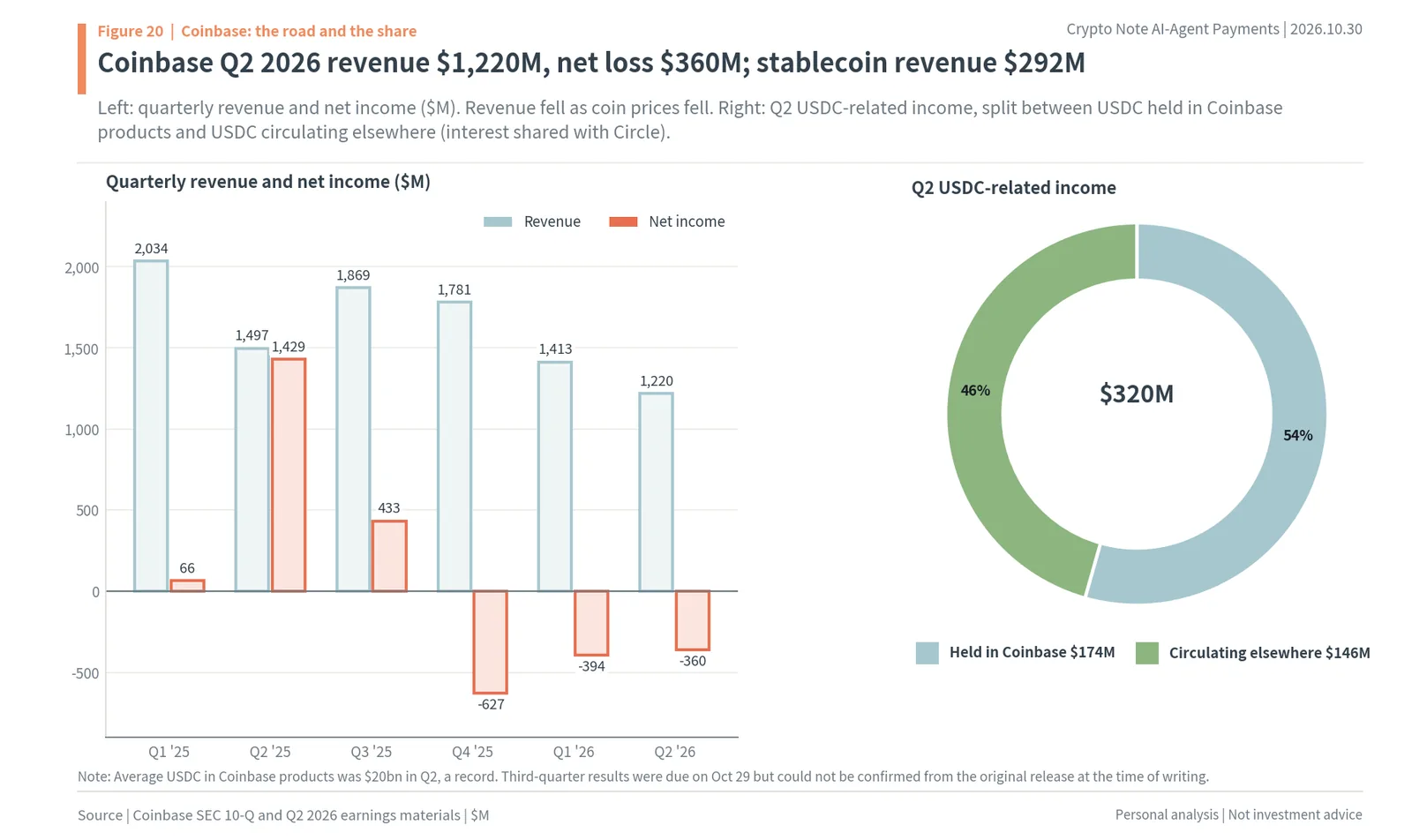
Coinbase’s Q2 2026 revenue was $1,220M, down 19% from a year earlier, with a net loss of $360M, its third straight loss since Q4 2025 as revenue fell with coin prices. Stablecoin revenue held at $292M (versus $309M a year earlier). USDC-related income of $320M split into $174M on USDC held in Coinbase products and $146M on USDC circulating elsewhere, shared with Circle. Coinbase says more than 99% of agentic stablecoin payment value runs on Base, more than 90% of on-chain agent transactions use x402 and more than 97% use USDC; x402scan’s October data also put 73.0% of value on Base. The figure shows quarterly revenue and net income ($M) and Q2 USDC-related income.
Kakao Pay laid its rails early: it announced its x402 Foundation participation on April 6, signed an MOU with Circle alongside Kakao and KakaoBank on July 23 (Toss signed separately), signed with Fireblocks on September 22, and on October 14 Kakao outlined plans to add stablecoin payments to webtoons, music, performances and Kakao T. Kakao Pay calls stablecoins a stage of “designing and testing” issuance infrastructure and distribution; it posted record Q2 revenue of KRW 335.1bn and operating profit of KRW 58.6bn, with no stablecoin revenue yet. The blocker is the law. Korea’s government digital-asset bill, which would cover won stablecoins, had not reached parliament by late October; the financial regulator’s chair said on October 22 it was in “final consultations”. The issue is who may issue: a bank-majority consortium first, or fintechs and IT firms too. A two-year delay of crypto taxation to 2029 was reported on October 25 as a direction, not a decision, and the token-securities law takes effect on February 4, 2027. Kakao Pay hit KRW 70,900 on January 26 and closed at KRW 34,000 on October 29, down 37.7% over the year while the KOSPI rose 72.3%. The figure shows Kakao Pay’s close (KRW) with dated announcements.

Kakao (035720) holders face one more change: Kakao splits into Kakao AI and Kakao X on January 1, 2027, and fintech and crypto go with Kakao X. In Korea the agent-payment story turns into numbers when the law is settled, not when companies make announcements.
10. When to buy, wait or avoid, and dates to watch
Six numbers show whether the agent-payment story is turning into money. NEAR’s money returning covers 18.3% of new issuance; at parity, supply stops growing. x402’s last-30-day value is $1.58M, best tracked month to month on the same tracker rather than against August’s other tracker. USDC supply fell 3.0% over the year (-3.0%). The 3-month Treasury bill at 4.11% sits above Circle’s Q2 return of 3.5%, a tailwind for Q3 interest. Worldcoin’s supply rose 65% in a year and still unlocks 2.9 million tokens a day. Korea’s digital-asset law is still a draft. The figure puts the six on gauges; the closer the needle is to green, the closer to a time to buy (author’s thresholds).

A time to buy is when the story shows up in numbers: Circle’s average USDC grows again, agent payment value rises for several months in a row on one tracker, and NEAR’s buybacks close in on new issuance. Circle publishes average USDC and its return rate every quarter (Q2: $76.5bn and 3.5%), x402scan shows the latest 30-day value (now $1.58M), and DefiLlama shows NEAR Intents buybacks by month ($1.97M in October, against about $12.4M a month of new issuance).
A time to wait is when a date that changes the numbers is close: the NEAR issuance vote closes on November 2, Circle reports Q3 on November 4, the Fed decides on December 9, the US stablecoin law takes effect on January 18, 2027, Kakao splits on January 1, 2027 and Korea’s token-securities law takes effect on February 4, 2027. The NAVER Financial-Dunamu share swap has been pushed to March 31, 2027.

What to avoid: coins with only an “AI” label and no path for earned money to flow back, coins with heavy new supply, and theme stocks that talk about agent payments without payment numbers. Worldcoin’s year shows that supply can outweigh a good story, and NEAR’s shows that what holds a price up is money that actually comes back.
Maochaedung’s take. The 402 slot the web left empty in 1997 was filled by x402 in 2025, and AI agents now pay for data and APIs through it. But more than 99% of what they pay is USDC, so the idea that agents paying in coins will lift coin prices is only half right; today’s agent payments are about $1.5M a month of small change, and the chains earn under $6,000 a month in tolls from them. NEAR’s five-fold rise bought a buyback machine funded by Intents fees, September’s confidential perps and first US spot ETF, and the AI-token rally; the money returning covers 18.3% of new issuance and must grow 5.5x. If agent payments really grow, the money piles up first in USDC balances, shared between Circle and Coinbase, but adding $10bn of USDC would take 6,329 times today’s agent payments. So watch Circle’s average USDC, agent payment value and NEAR’s buybacks against issuance before the coin prices. The first checks are NEAR’s issuance vote on November 2 and Circle’s Q3 results on November 4.
AI agent payments and crypto: quick answers
Q. What are AI agent payments?
AI programs (agents) paying for data, APIs and services on their own. The leading standard, x402, uses the web’s 402 Payment Required code: the server names a price and the agent sends coins from its wallet. On x402scan, the 30 days from September 29 to October 29, 2026 saw 3.26 million payments worth $1.58 million.
Q. Which coin do AI agents pay with?
Almost entirely USDC. Circle said 99.3% of x402 agent-payment value settled in USDC in its Q2 2026 results. With an average payment of $0.48, a card’s $0.30 + 2.9% fee would take 65%, while chain gas is under 1%.
Q. Why did NEAR rise five-fold?
NEAR rose 5.64 times from its February 12 low to October 11. From February 23 NEAR Intents used its protocol fees to buy NEAR, and in September confidential perps, the first US spot NEAR ETF (trading from September 29) and an AI-token rally lifted it 178.5% in a month. x402 settlement on the NEAR chain could not be confirmed.
Q. What does NEAR need for the price to hold?
The money returning to NEAR (Intents buybacks plus burned gas, $27.6M a year at the last-30-day pace) covers 18.3% of new NEAR issued at 2.5% a year (about $151M). It must grow 5.5 times, or 3.5 times if issuance is cut to 1.6% (author’s calculation).
Q. Who earns if agent payments grow?
Tolls are small: about $0.0020 per payment on Base and $0.0010 on Solana. The money piles up in USDC balances; Circle earns interest and shares most of it with partners such as Coinbase. Every $10bn more USDC adds $411M of yearly interest at 4.11%, $158M of it Circle’s (author’s calculation).
Sources
- IETF, RFC 2068 HTTP/1.1 §10.4.3 (link), Jan 1997; RFC 9110 §15.5.3 (link), June 2022
- Coinbase Developer Platform, x402 whitepaper (link), May 6, 2025; facilitator pricing (link), accessed Oct 30, 2026
- Linux Foundation, x402 Foundation launch (link), Apr 2, 2026; operational launch (link), July 14, 2026
- x402scan, last 30 days (link), accessed Oct 30, 2026; Chainalysis (link), June 3, 2026 and (link), Oct 14, 2026; a16z, AI agent payments: the honest number (link), Mar 11, 2026
- Google Cloud, AP2 (link), Sept 2025; Visa, Trusted Agent Protocol (link), Oct 14, 2025; AWS, AgentCore payments GA (link), Aug 18, 2026
- Circle, Q2 2026 results (link) and SEC 8-K (link), Aug 5, 2026; 2025 10-K (link), Mar 9, 2026
- Coinbase, Q2 2026 10-Q (link) and earnings transcript (link), July 30, 2026
- arXiv, Attention Is All You Need (link), 2017; ChainCatcher, NEAR Intents fee switch (link), Sept 7, 2026; Incrypted, HSP-029 (link), Oct 2, 2026; The Block, Arthur Hayes sells HYPE and NEAR (link), June 2026
- Crypto Briefing, NEAR confidential perps (link), Sept 18, 2026; Bitwise spot NEAR ETF (link), Sept 29, 2026; Grayscale AI sector in September (link), Oct 2, 2026; Decrypt, NEAR Intents hack (link), Oct 1, 2026
- TechCrunch, World AgentKit (link), Mar 17, 2026; crypto.news, WLD unlock rate cut (link), Apr 10, 2026; Cointelegraph, Allaire at Davos (link), Jan 23, 2026
- Federal Reserve, FOMC statement (link), Oct 28, 2026; FOMC calendar (link); OCC GENIUS Act final rule (link), Oct 21, 2026; DLA Piper on the CLARITY Act vote (link), Sept 22, 2026
- Blockmedia, Korea’s digital asset basic law (link), Oct 27, 2026; Asia Economy, Kakao and Toss MOUs with Circle (link), July 23, 2026; Electronic Times, Kakao stablecoin payments (link), Oct 14, 2026; Kyunghyang, crypto tax delay (link), Oct 25, 2026; Digital Daily, Kakao Pay Q2 (link), Aug 5, 2026
- Upbit KRW daily closes, Yahoo Finance (coins, CRCL, COIN, Nasdaq, USD/KRW), DefiLlama (chain fees, stablecoin supply, NEAR Intents buybacks and volume), CoinGecko (market cap and supply), KRX (Kakao Pay, Kakao, KOSPI), through Oct 29, 2026; author’s calculations
- Photos: Coolcaesar (CC BY-SA 3.0), FlippyFlink (CC0), TechCrunch (CC BY 2.0), Arild Vågen (CC BY-SA 4.0), Coinbase, USDC and NEAR logos (public domain, CC0), via Wikimedia Commons
Disclaimer
Was this note useful?
Thanks. Your answer helps decide what to cover next.
Korea market snapshot · Nov 27, 2026
New to Korean stocks? Start here for the basics.
Most read this week
5Bank of Korea Holds Rate at 3.00%: Why a 0.12pp Real Rate Points to a November Hike (2026)
Get the Saturday note on Korean stocks
One email every Saturday with the week’s new research on Korean listed companies and links to the updated data pages. Built from DART filings and KRX data. Free; unsubscribe in one click. See past issues