
Hanwha Vision (489790) Stock Forecast: Only the Cameras Are Priced In, a KRW 72,300 Target and How RSUs and the PRS Swing Net Income
Hanwha Vision (489790) stock forecast, worked out segment by segment. Hanwha Vision sells video security cameras and owns Hanwha Semitech, which supplies HBM TC bonders to SK hynix. This post covers why the stock fell 64.0% from its March peak, why cameras now sell 12.8% dearer, when TC bonder revenue comes back, how the RSU liability tied to Hanwha Aerospace and the June PRS move net income, and the author’s KRW 72,300 target price. Data as of October 10, 2026 (KRX close of October 8).
- Hanwha Vision fell 64.0% from KRW 92,700 (March 25) to KRW 33,350 (July 29): first 29.1% on delayed SK hynix TC bonder orders while the KOSPI rose 61.5%, then 49.2% in the chip-stock sell-off.
- Cameras sold the same volume dearer: 1H export units +0.4% at a 12.8% higher average price, with AI cameras at 59% of camera revenue and domestic prices up 5–10% from October.
- The US tariff on Vietnamese goods fell from 20% to 12.5% and IEEPA tariffs are being refunded, lifting the Security margin from 5.2% to 13.1%.
- TC bonders: Hanmi holds 71.2% of the global market against Hanwha Semitech’s 3.2%, but at SK hynix Semitech’s 2025 contracts were KRW 80.5bn vs Hanmi’s KRW 55.2bn, and Semitech posted a record KRW 14.0bn Q2 operating profit.
- The RSU liability is 193,630 shares × Hanwha Aerospace’s price, so KRW 10,000 on Aerospace moves pre-tax profit by KRW 1.94bn; with the June PRS, the Q3 impact is KRW 2.32bn or less, against a KRW 52.63bn loss a year earlier.
- Today’s price gives Semitech only 5.0x its 2027 net income; the author’s 1-year target is KRW 72,300 (+47.3%), with the stock at 12.0x 2027 EPS of KRW 4,082.
Key takeaways
- Hanwha Vision’s share price, down 64.0% from KRW 92,700 in March, is explained by the Security (camera) business alone, and Semitech (TC bonders) is left with only 5.0 times its 2027 net income.
- Cameras are selling the same volume 12.8% dearer while tariff refunds bring the margin back, and TC bonders are heading into a year in which HBM4 equipment revenue comes back. The author’s 1-year target price is KRW 72,300 (+47.3%).
- The RSU liability is 193,630 Hanwha Aerospace shares × Aerospace’s share price, so every KRW 10,000 move in Aerospace swung net income by KRW 1.94bn; with the June PRS the two cancel out from Q3, and what is left is the settlement cash at maturity.
As of: October 10, 2026
Ticker: Hanwha Vision (489790, KOSPI)
Reference close: KRW 49,050 (KRX close on October 8, 2026; the market was closed on October 9 for Hangeul Day)
This is the author’s personal analysis and opinion. The author’s calculations and estimates in the text are not confirmed facts.
Hanwha Vision Stock in Brief: The Price Is the Cameras, TC Bonders Are a Bonus
This report looks at Hanwha Vision (489790) segment by segment, based on the author’s estimates. It asks two questions. The first is whether a share price that has fallen sharply from its March peak has a path back up. The second is how the employee RSUs tied to Hanwha Aerospace’s share price and the PRS contract signed in June move Hanwha Vision’s earnings and share price. The conclusion first: the price is the cameras and TC bonders are a bonus, and from Q3 the RSU and PRS swing net income far less.
The answer to the first question comes from what the price is pricing in. Today’s market cap of KRW 2,476.5bn plus the RSU liability of KRW 172.5bn comes to KRW 2,649.0bn. That is almost the same as KRW 2,391.6bn, the author’s base-case 2027 Security net income multiplied by 15.5x, the PER of Hikvision, the middle value among video security peers. Only KRW 257.4bn is left for Semitech, or 5.0 times its 2027 net income. Set against bonder equipment peers trading at 27.6x, today’s price gives the HBM equipment business almost no value.
On top of that there are two paths up. Cameras are the “pricier” path. In the first half, surveillance camera export units were the same as a year earlier, but the average selling price per unit rose 12.8% and revenue rose 13.2%, and the Security margin, which tariffs had pushed down to 5.2%, came back to 13.1% in Q2. TC bonders are the “more volume” path. As SK hynix started buying HBM4 equipment again, Semitech posted its largest operating profit since listing, KRW 14.0bn, in Q2, and the market for the next machine, the hybrid bonder, is forecast to grow 2.4 times in the single year of 2027.
The answer to the second question comes down to numbers. The RSU liability matches 193,630 Hanwha Aerospace shares multiplied by Aerospace’s share price to within 0.3% of the reported figures, so KRW 10,000 on Aerospace’s share price is KRW 1.94bn of Hanwha Vision’s pre-tax profit. In 2025 this valuation loss was KRW 120.06bn, 74.0% of operating profit. The PRS signed in June pays Hanwha Vision the difference when Aerospace rises and costs it the difference when Aerospace falls, so it moves against the RSU. In Q3 Aerospace ended close to its end-June level, so the RSU impact shrank to KRW 2.32bn or less, and what is left is the settlement cash that will change hands between the end of this year and June next year.
The author’s 1-year target price is KRW 72,300, 47.3% above today. It multiplies 2027 Security net income by 15.5x and Semitech net income by 27.6x, then subtracts the RSU liability. The first check is Q3 results in late October, and the numbers to watch then are the Security margin, Semitech equipment revenue and net income without the Aerospace effect.
1. What Hanwha Vision Sells: Video Security Cameras, 72.8% of Q2 Revenue
Recording, storing and watching, sold as one bundle
Video security is the business of selling, as one bundle, cameras that record, recorders (NVR) that store and video management software (VMS) that lets people watch. What the customer buys is not a single camera but a system that watches over a whole site, so the cameras, recorders and software have to work together. Sales go through local distributors and system integrators (SI). Hanwha Vision wrote in its DART filings that all of its exports go through distributors, and that it also markets directly to SI firms and end users ahead of sales.
Hanwha Vision was split off from Hanwha Aerospace in a spin-off on September 1, 2024 and relisted on September 27. Today it is an operating holding company that runs the Security business directly and owns all of Hanwha Semitech, which makes chip mounters and semiconductor equipment. Its largest shareholder at the end of the first half was Hanwha Corporation (33.95%), and a filing on August 3 said the largest shareholder had changed to Hanwha Machinery & Services Holdings (Hanwha M&S), launched on August 1 through Hanwha Corporation’s own spin-off.
72.8% of Q2 revenue comes from cameras
Of Q2 consolidated revenue of KRW 542.3bn, KRW 394.6bn, or 72.8%, was Security revenue. Of that, 90.9%, KRW 358.8bn, was exports, and domestic sales were only KRW 35.7bn. The cameras are made at the Bac Ninh plant in Vietnam, which ran at 94.92% of capacity in the first half, up from 91.49% in 2025. The remaining KRW 147.7bn was Semitech revenue: KRW 93.6bn from chip mounters (SMT), which place components on circuit boards, and KRW 54.0bn from semiconductor equipment such as TC bonders and PLP tools, plus machine tools.
By product for the first half, the picture is even clearer. Revenue after consolidation adjustments in the DART half-year report was KRW 566.7bn for surveillance cameras, KRW 75.8bn for storage, KRW 93.5bn for peripherals, KRW 158.8bn for chip mounters, KRW 42.1bn for semiconductor equipment and KRW 29.9bn for machine tools. Surveillance cameras alone were 57.6% of first-half revenue of KRW 983.7bn. What decides this company’s profit, in the end, is how many cameras it sells and at what price, which is why this report looks at “pricier” and “more volume” separately.
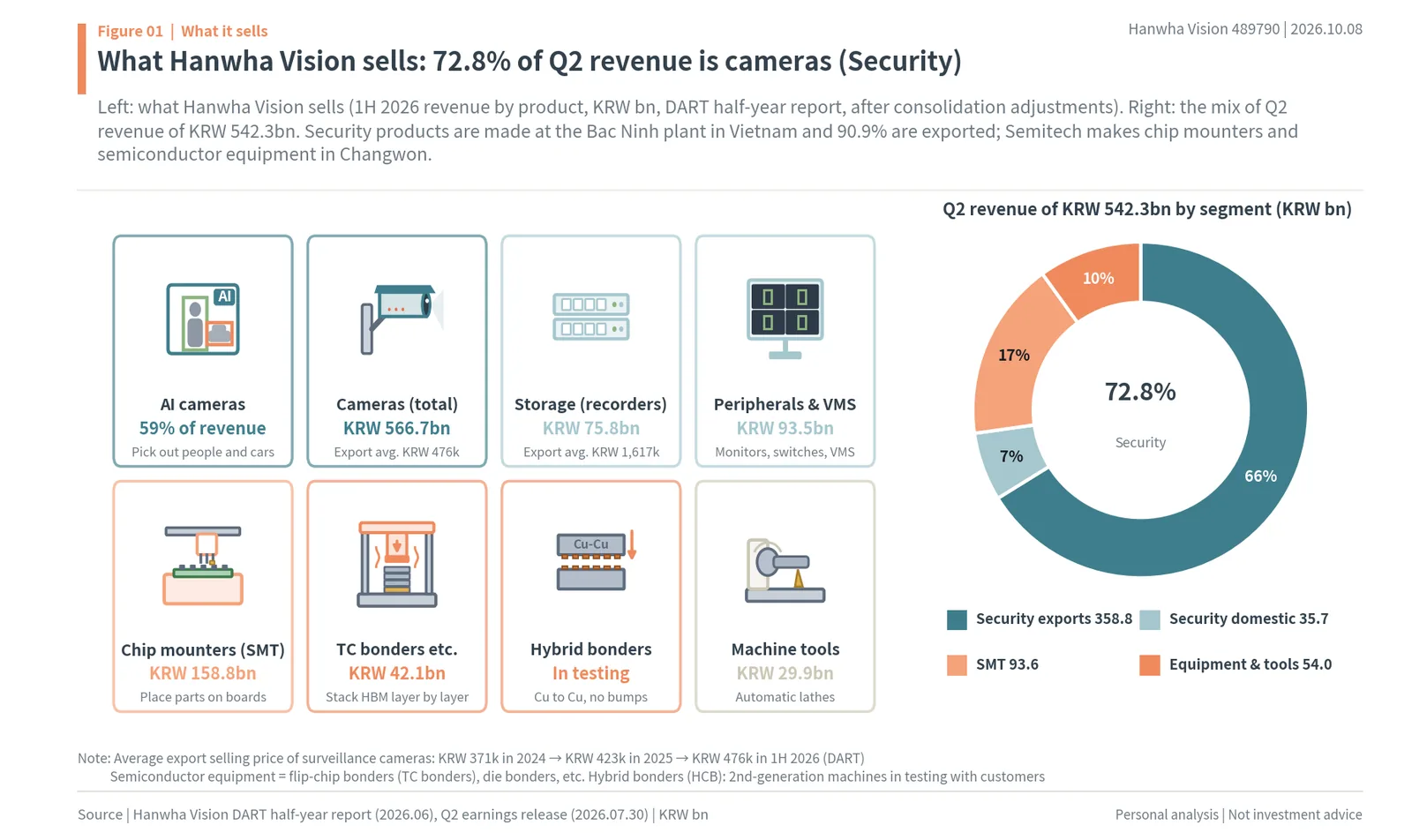
Figure 01 turns what Hanwha Vision sells into icons. It puts on one page that AI cameras make up 59% of surveillance camera revenue, that the average export price of a recorder is KRW 1,617,000 per unit, far above a camera, and that Semitech’s TC bonder is the machine that stacks HBM one layer at a time. The donut on the right is the Q2 revenue mix, with Security exports making up two-thirds.
The market grows 9.4% a year, and software grows fastest
According to Omdia data included in the company’s IR appendix, the global video security market excluding China grows 9.4% a year, from $18.5bn in 2025 to $25.5bn in 2029. Cameras grow from $9.8bn to $13.1bn, back-end equipment such as recorders from $5.6bn to $7.3bn, and software from $3.1bn to $5.1bn. Of the three, software grows fastest, and that direction suits this company. In Q1 this year Hanwha Vision launched ‘Blaze’, a new AI video management software, and it is quickly raising the share of AI cameras, which carry a video analytics chip and pick out people and cars on their own.
Hanwha Vision’s 2025 market share was 6% of the world excluding China, 8% in the Americas and 9% in the UK. Add SK Securities’ note that 55% of Security revenue comes from the Americas, and this company’s results lean heavily on US demand and on US government tariffs and regulation. Since 2019 the US has barred Hikvision and Dahua equipment from federal procurement under Section 889 of the National Defense Authorization Act (NDAA), and from July 16, 2026 the Federal Communications Commission (FCC) also blocked imports and sales of already-authorized equipment from companies on its prohibited list. Who fills the space that Chinese products leave in the US will decide the next market share number.
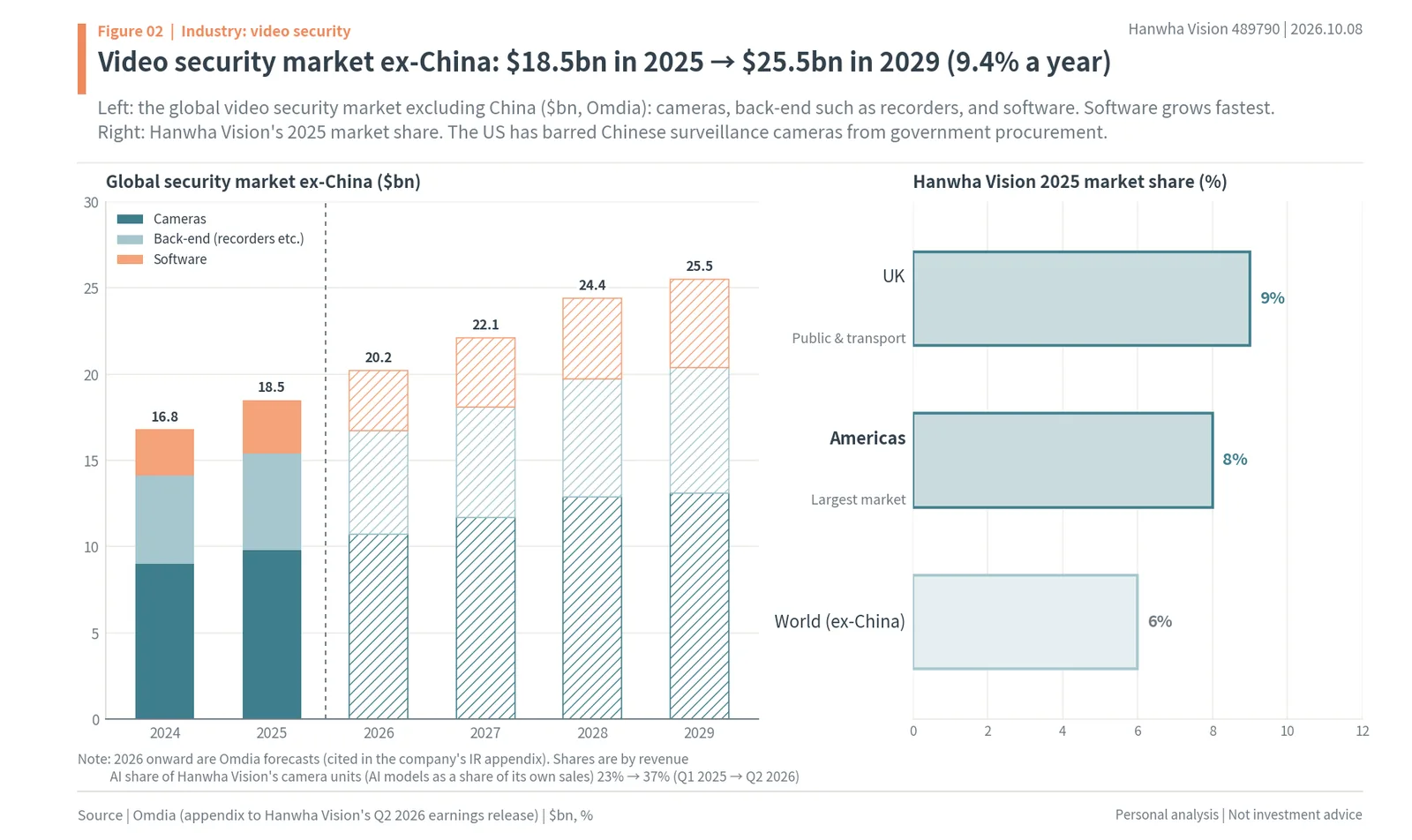
The fastest-growing parts of the market are software and AI, and Hanwha Vision stands where it can raise prices with AI cameras and management software.
2. HBM TC Bonders and Hybrid Bonders: The Market, the Machines and the Hanmi Semiconductor Rivalry
The way chips are stacked decides the machine
HBM (high-bandwidth memory) is memory made by stacking 8–16 DRAM dies on top of each other and placing the stack right next to an AI accelerator. The dies are stacked to make the path data travels short and wide. Stacking them means lining up and joining thousands of tiny bumps on every layer, and the machine that does this is the TC bonder. A TC bonder picks up a die, places it precisely on the die below and melts the bumps together with heat and pressure. Making one HBM stack means repeating this once for every layer, so as HBM output rises, demand for TC bonders rises with it.
The hybrid bonder (HCB) is the machine that comes next. It joins the copper faces of the dies directly with no bumps, so more layers can be stacked, more thinly, within the same height. Kiwoom Securities expects HCB technology to reach mass production in 2028, and KB Securities sees the shift to hybrid bonding as unavoidable from HBM5. Hanwha Semitech finished developing its 2nd-generation hybrid bonder ‘SHB2 Nano’ in February this year and said it would deliver it to a customer in the first half (iNews24), and Korea Investment & Securities wrote that it is the only machine from a Korean equipment maker in qualification at SK hynix.
The HCB market grows 2.4 times in 2027 alone
Omdia’s forecast in the company’s IR appendix has the HCB (Advanced Die Placement) equipment market growing 42% a year, from $133mn in 2025 to $1,143mn in 2031. In particular, it grows 2.4 times in a single year, from $197mn in 2026 to $471mn in 2027. After that it continues to $645mn in 2028 and $867mn in 2030.
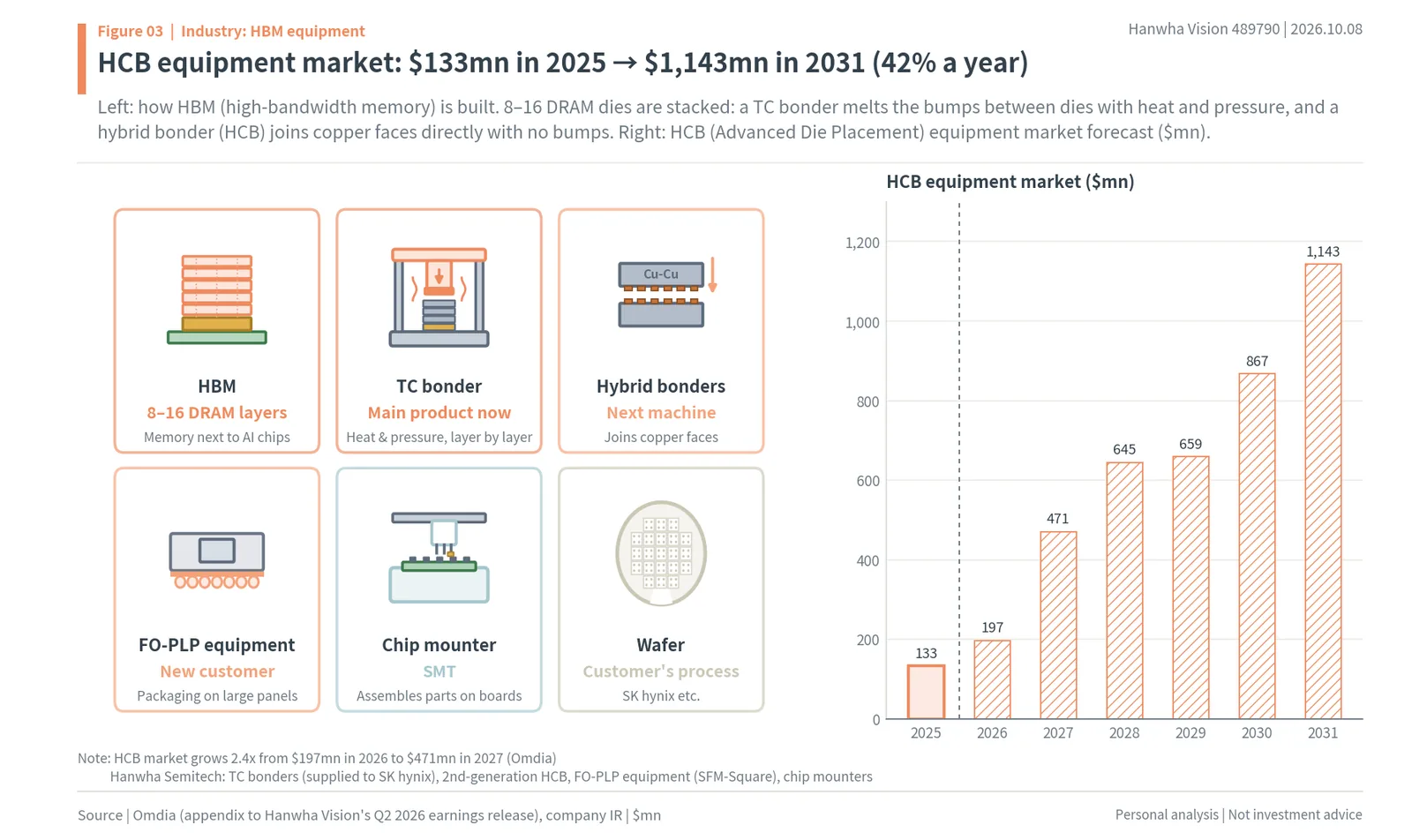
The equipment Hanwha Semitech sells
Hanwha Semitech’s semiconductor equipment spans back-end TC bonders, hybrid bonders and flip-chip bonders, as well as front-end deposition tools (PECVD, ALD) (half-year report). At SEMICON Taiwan 2026 in early September it showed four machines (Digital Daily): ‘SFM5 Square’, an FO-PLP tool that packages chips on 600×600mm panels; ‘SFM5 Expert’, a 3D TC bonder for HBM; ‘SFM5 TnR’, a 2.5D chip-on-wafer bonder; and ‘SHB2 Nano’, a hybrid bonder for next-generation HBM. Its long-standing main product, the chip mounter (SMT), places electronic components on circuit boards. The average selling price of its high-speed models rose from KRW 250mn to KRW 270mn per unit in the first half of this year, and that of mid-speed models from KRW 120mn to KRW 180mn.
The competition: small worldwide, big inside SK hynix
The most recent company-by-company market share for TC bonders is TechInsights’ figure based on cumulative revenue for Q1–Q3 2025: Hanmi Semiconductor 71.2%, SEMES 13.1%, ASMPT 5.6%, Yamaha Robotics 5.6% and Hanwha Semitech 3.2% (cited by Economic Review on August 4). Shares for 2026 have not come out yet, so articles this year still quote these numbers. Hanwha Semitech’s global share is small because its only TC bonder customer so far is SK hynix (Chosun Biz, August 12). Hanmi Semiconductor has both SK hynix and Micron, and CLSA put Hanmi’s share of TC bonders for Micron’s HBM at over 90% (Bloter, September 14).
Inside SK hynix the numbers look different. In 2025, Hanwha Semitech’s TC bonder supply contracts with SK hynix came to KRW 80.5bn against Hanmi Semiconductor’s KRW 55.2bn, so Hanwha Semitech’s were larger (Sisa Journal-e, September 10). On that basis brokers estimated Hanwha Semitech’s share within this customer at over 50% (Bloter, May 4), and Kiwoom Securities also put Hanwha Vision’s share of SK hynix’s HBM TC bonders at around 50% on August 4. For this year, there is also a view that Hanmi Semiconductor’s share at SK hynix will rise from 50% in 2025 to around 60% (Chosun Biz). Hanwha Semitech was understood to have taken part in SK hynix’s additional order for HBM4 TC bonders in June (Bloter, September 14), and in early September it was reported to be preparing to bid for HBM4 equipment at Taiwanese back-end companies (Newsfreezone). ASMPT said it had already won orders for TC bonders for 12-high HBM4 from several customers, and has set a target of a 35–40% share of the TC bonder market in 2028.
In hybrid bonders, the field is still being drawn up. Samsung Electronics is preparing to bring in 50 hybrid bonding machines with BESI as its preferred partner and is also considering Hanwha Semitech as a partner, while Hanwha Semitech supplied an evaluation machine to SK hynix in April (TheElec, July 21). On July 22, SK hynix moved up the cleanroom opening of its P&T7 plant in Cheongju by three months.
So Semitech has two ways to sell “more volume”: following SK hynix’s HBM4 and P&T7 investment, and adding new customers such as Taiwanese OSATs and a satellite operator.
3. Why Hanwha Vision Stock Fell 64.0%: The TC Bonder Order Gap and the Chip Sell-Off
Volume hopes lifted the share price
After relisting in September 2024, Hanwha Vision hit its low of KRW 28,700 (KRX adjusted price) on December 20 that year. The big moves in the second half of 2025 followed the chip cycle. The +10.3% on November 11 came on a day when HBM-related stocks rose together after the Philadelphia Semiconductor Index gained more than 3% the night before, and foreign investors bought a net KRW 12.1bn (SBS Biz, Pinpoint News). The +10.3% on December 24 came on a day with no company filing or broker report; one featured-stock article put it down to buying on news of Samsung Electronics (Harman) acquiring an ADAS business, and institutions topped the net-buying list. What lifted the share price was Semitech’s HBM equipment. In 2025 Semitech supplied HBM TC bonders to SK hynix for the first time, with orders that year of about KRW 80.5bn, including KRW 21.0bn on March 14, KRW 21.0bn on March 26 and KRW 38.5bn on May 16 (SK Securities). From then on, the market began to group Hanwha Vision with “HBM equipment stocks” rather than camera companies.
This year the hopes grew. Kiwoom Securities started coverage at the end of January, saying SK hynix’s HBM4 supply to Nvidia was coming into view, and on March 6 it raised its target price to KRW 120,000. On February 10 the stock fell 12.7% in a day on worries that SK hynix’s TC bonder spending would fall short of market expectations (Asia Economy). The next day Kiwoom Securities pushed back, calling the fall excessive and putting SK hynix’s capital spending at KRW 40trn and its HBM4 TC bonder purchases at 105–120 units. On February 24, together with news that Samsung Electronics would not use Hanmi Semiconductor’s TC bonders, that forecast came back into focus and the stock hit the daily limit (+29.9%) (Etoday). The same report carried a forecast that this year’s TC bonder orders could triple 2025’s KRW 80bn.
At its annual general meeting on March 24, the company said it expected Hanwha Semitech’s revenue this year to grow more than 20% from a year earlier and that HBM demand was solid (The Bell). That evening TheElec reported exclusively that Semitech’s 2nd-generation hybrid bonder ‘SHB2 Nano’ would be supplied to SK hynix for quality testing as early as the next month, and that the Korean machine would be priced at around KRW 4bn a unit. The next day, March 25, the stock rose 11.7% to close at KRW 92,700, and Gukje News named the AGM remarks as the reason for the jump. It was the highest close since listing. What lifted the price was a volume hope: that SK hynix would buy more HBM equipment.
Stage 1: March 25 – June 22, the market rose and only Hanwha Vision fell
The fall after the peak has to be split into two stages to see its causes. The first stage runs from March 25 to June 22. Over those three months the KOSPI rose 61.5%, from 5,642 to 9,115, while Hanwha Vision fell 29.1%, from KRW 92,700 to KRW 65,700. This is the stretch in which this company fell on its own while the whole market rose.
In an April 20 report, Kiwoom Securities put the cause down to fatigue after the surge since year-end and to delays in SK hynix’s TC bonder orders. The order gap showed up directly in the results. With all of the TC bonder revenue from orders won in the first half of 2025 already recognized within last year, Semitech’s semiconductor equipment revenue fell to KRW 6.6bn in Q1 this year and Semitech posted an operating loss of KRW 13.7bn. In the same quarter Aerospace’s share price rose, adding an RSU valuation loss of KRW 60.0bn, and the consolidated net loss was KRW 14.0bn. Hybrid bonders did not turn into revenue right away either. SK hynix’s first order for mass-production hybrid bonding equipment went to Applied Materials and BESI (TheElec, March 31), while Semitech’s machine was at the quality-test stage.
There were days that lifted the price in this stretch too. On June 4 the stock rose 17.4% in a day, as a report that Semitech would supply SFM back-end chip equipment to SpaceX from the second half (Korea Economic Daily, June 1 exclusive) came together with hopes for a SpaceX listing. On June 8 Hanmi Semiconductor disclosed a KRW 44.2bn HBM4 TC bonder contract with SK hynix, and two days later Hanwha Semitech was reported to have won an order of similar size (ZDNet Korea).
The −9.7% on May 15 came on a day when the KOSPI fell 6.12%; the day before, Hanwha Corporation had filed to postpone its spin-off to August 1, and intraday articles cited the burden of the recent surge and weakness in defense stocks.
Stage 2: June 23 – July 29, it fell with the chip-stock crash
The second stage runs from June 23 to July 29. This time the whole market fell. The KOSPI fell 9.99% on June 23 alone (an unwinding of crowded chip positions), 7.89% on July 2, 5.35% on July 8 and 10.84% on July 28, and circuit breakers were triggered two days running on July 28–29 (YTN, SBS Biz, Newsis). While the KOSPI fell 37.9% over this period, Hanwha Vision fell 49.2% to KRW 33,350 on July 29. No article in this stretch reported bad news specific to the company. The +14.4% on July 15 came on a day when Hanmi Semiconductor hit the daily limit after its Q2 results and back-end equipment stocks rose together, and after the close on July 28 a report said a development access token had been exposed in security camera firmware, but the company said it blocked the token at once and nothing leaked (IT Chosun). There were no reports of block deals or large trades in this period. That is a 64.0% fall from the peak. Comparing only March 25 with July 29, the KOSPI was up 0.4%, so the part lost to the order gap was cut once more by the market crash.
After the low: results and the market rebound
Q2 results came out on July 30. Revenue was KRW 542.3bn and operating profit KRW 65.6bn, and SK Securities wrote that they beat market consensus by 8.2% on revenue and 34.7% on operating profit. The next day, July 31, when the KOSPI rose 17.91%, Hanwha Vision rose 20.0% in a day. The market rebound and the results landed on the same day. On August 5 it rose 9.6% on a Korea Investment & Securities report that the 6 TC bonders ordered in January had been delivered in Q2. Since then the stock has risen 47.1% to KRW 49,050 today.
The share price fell once on the order gap and again on the market crash, and in between the company’s profit came back in Q2.
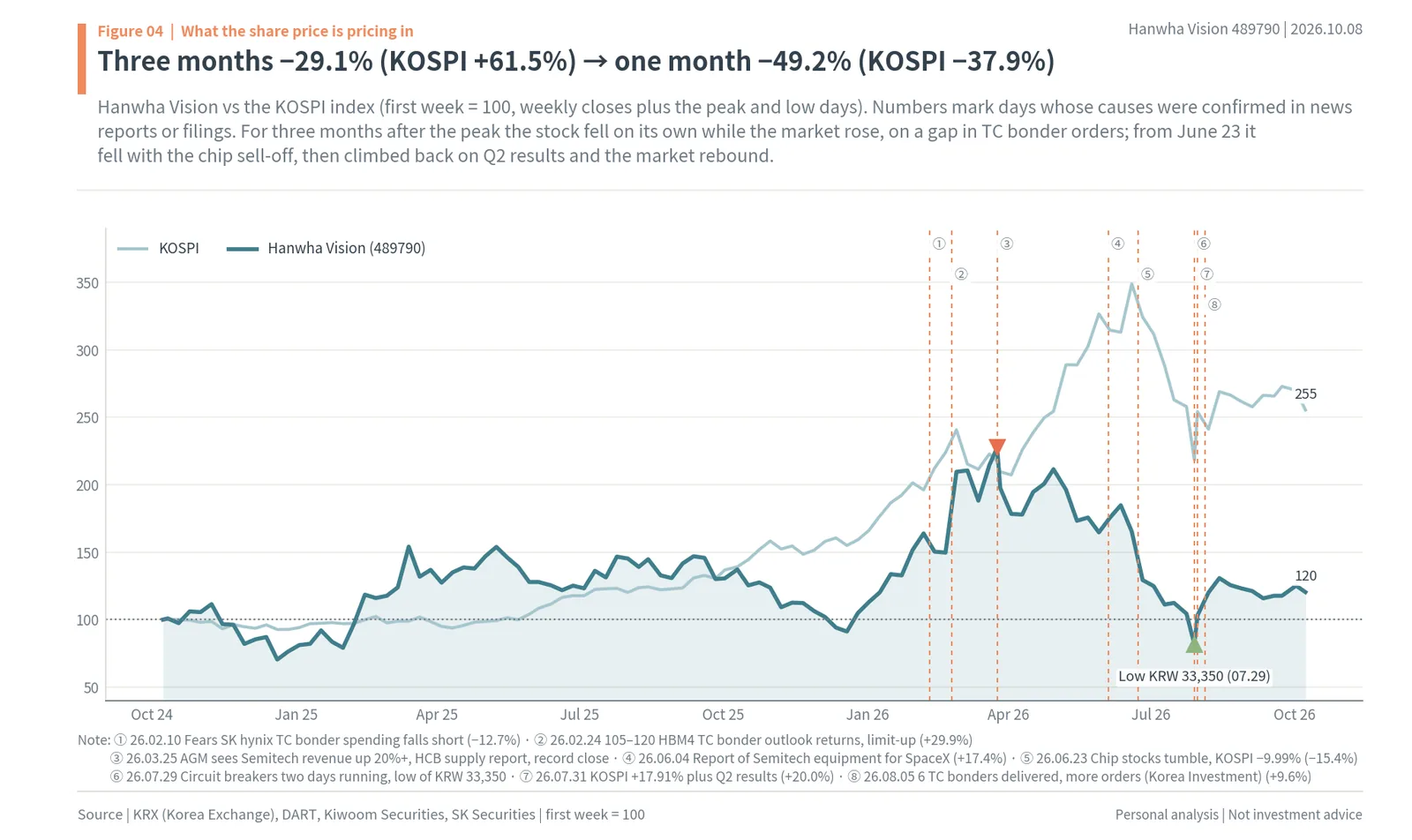
Figure 04 draws the two-year share price together with the KOSPI, with the first week (October 8, 2024) = 100. The numbers mark days whose causes were confirmed in news reports or filings. For three months after the March peak the two lines pull apart, with Hanwha Vision falling while the KOSPI rises, and after late June the two lines fall together.
Flows: domestic institutions sold, foreigners bought
From the peak to the low, institutions sold a net KRW 138.6bn: pension funds KRW 49.7bn, investment trusts KRW 40.8bn and private equity funds KRW 34.1bn (KRX net buying by investor type). The National Pension Service reported on October 2 that its holding fell from 4,876,833 shares (9.66%) to 4,289,970 shares (8.50%) as of July 8. Over the same period foreign investors bought a net KRW 119.7bn, and their stake rose from 19.8% to 23.1%. Since the low, foreign investors have bought another KRW 21.0bn, taking their stake to 24.1%, while retail investors sold KRW 15.5bn.
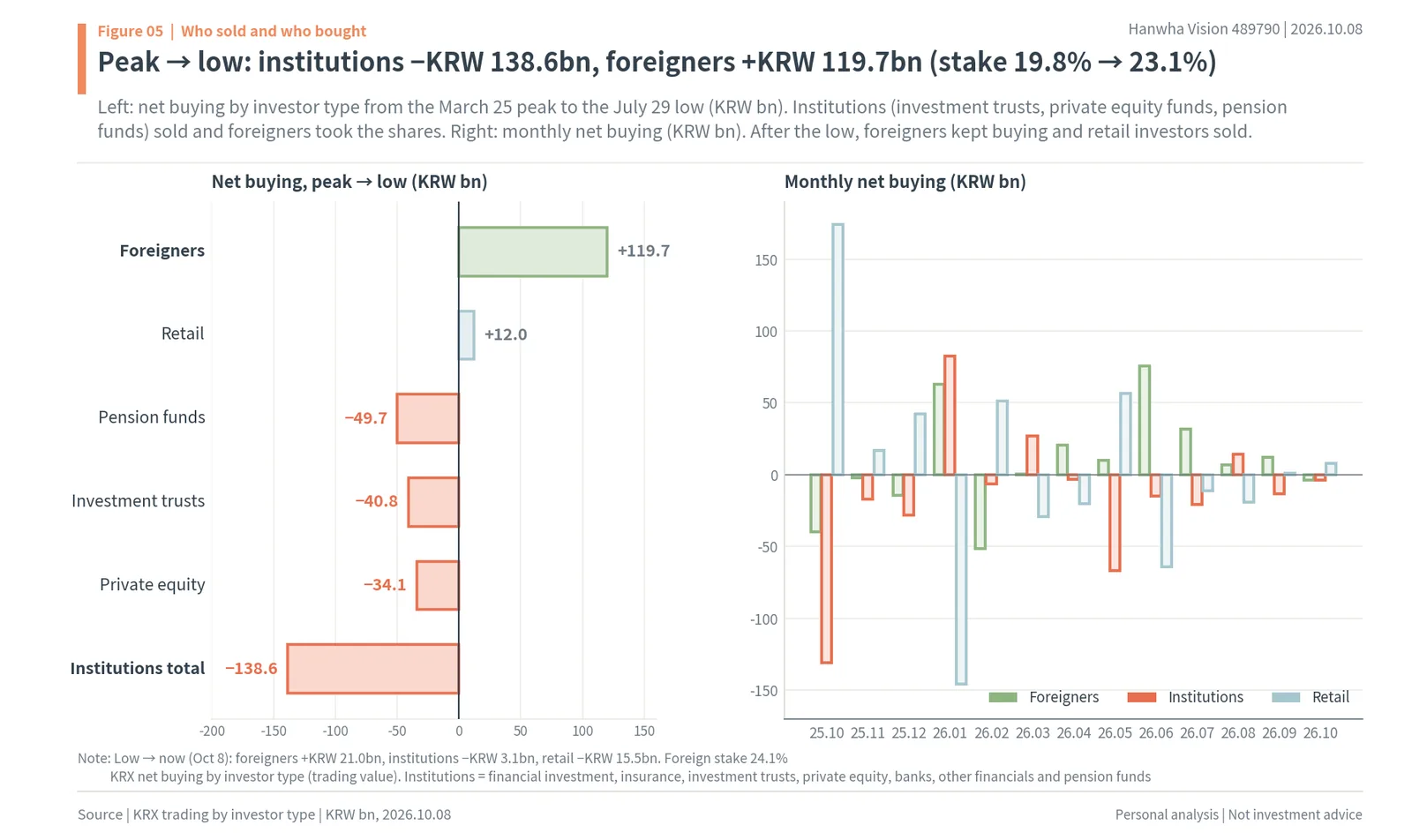
While the hopes drained out, foreign investors collected the shares that domestic institutions sold.
4. Cameras Sold 12.8% Dearer: AI Cameras, Price Hikes and Tariff Refunds Lift the Security Margin to 13.1%
Units flat, revenue up 13.2%
DART quarterly and half-year reports give cumulative surveillance camera export revenue and the average selling price per unit. Dividing revenue by the average selling price gives units sold, and the difference between cumulative figures gives quarterly units (author’s calculation). Worked out this way, surveillance camera exports in the first half of this year were 1,112,000 units, 0.4% more than the 1,107,000 units in the first half of last year. The company sold almost the same number of cameras.
Yet over the same period the average selling price per unit rose 12.8%, from KRW 422,000 to KRW 476,000. So first-half camera export revenue rose 13.2%, from KRW 467.2bn to KRW 529.07bn. Splitting the KRW 61.88bn increase, the part from more units was KRW 1.86bn and the part from higher prices was KRW 60.02bn (author’s calculation). Almost all of the first-half growth in camera revenue came from selling dearer.
By quarter the trend is even clearer. In Q2, units rose 19.1% and the price 7.3% from a year earlier, lifting export revenue 27.9%. It was a quarter in which the company sold more cameras even at higher prices. By year, the average selling price was KRW 371,000 in 2024, KRW 423,000 in 2025 and KRW 476,000 in the first half of this year, up 28.3% in two years. The average export selling price of recorders (storage) also rose, from KRW 1,181,000 to KRW 1,617,000.
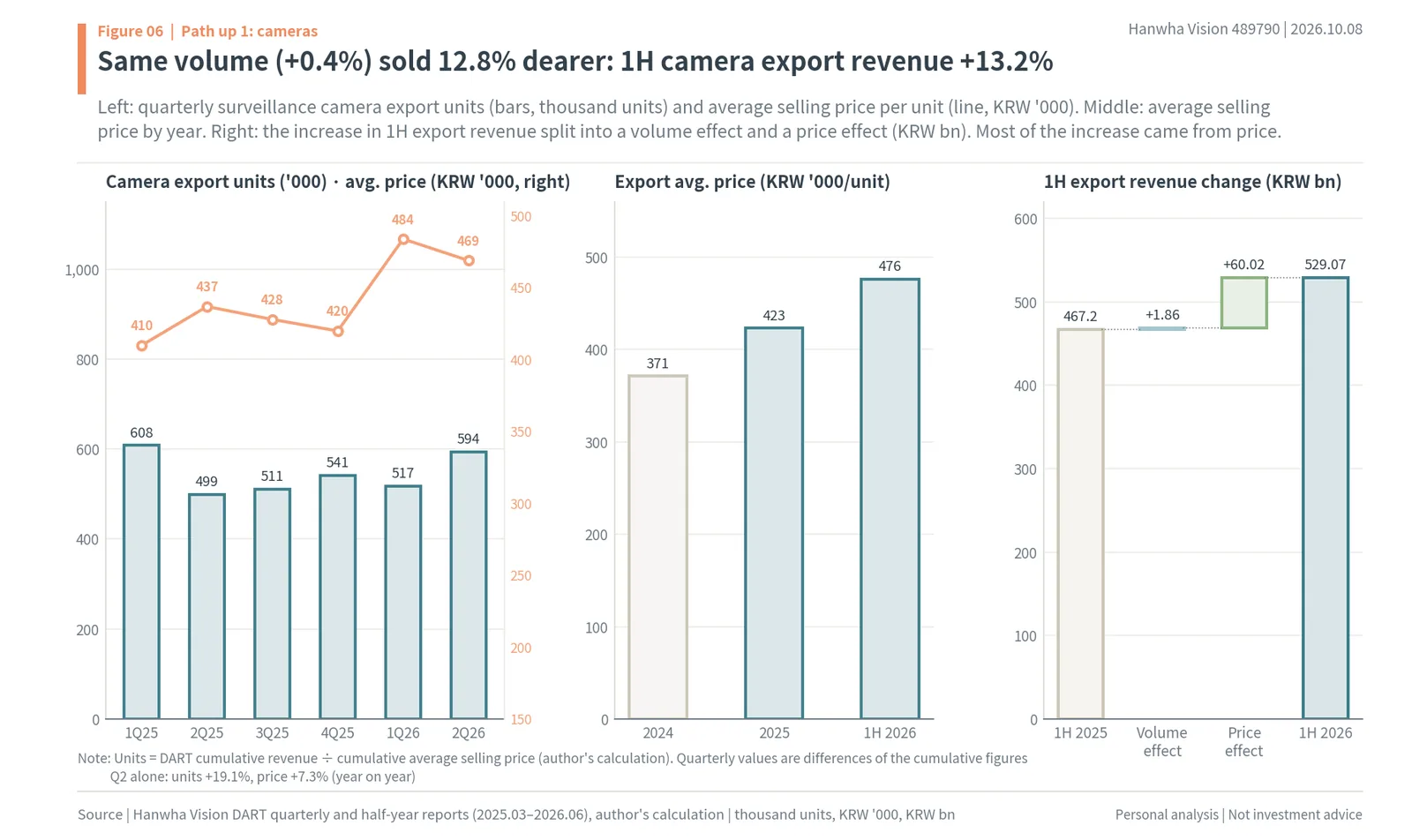
AI cameras raised the price
An AI camera carries a video analytics chip and picks out people and cars on screen by itself. The company’s IR appendix shows AI cameras’ share of units sold rising from 23% in Q1 2025 to 37% in Q2 2026, and their share of revenue rising from 41% to 59% over the same period. A revenue share far above the unit share means one AI camera sells for more than a standard camera. As the share of pricier products grows, the average selling price rises.
The company also wrote in its Q2 review that revenue and margins rose on solid demand and price increases for its main products. Korea Investment & Securities said the company raised prices across its CCTV lineup on June 1, and that customers from new industries grew from Q2, putting the order backlog at a record high. Prices go up once more in October. Hanwha Vision told its domestic distributors and partners that from October it would raise prices on all products, mostly by 5–10%, with larger increases for some recorders with a high share of memory and storage (SBS Biz, October 8). The reason the company gave was higher manufacturing costs from shortages of memory such as LPDDR4. SK Securities wrote that demand for AI-based cameras is spreading, centered on the Americas and Europe, that higher raw material costs such as memory were passed on in prices from Q2, and that demand held up despite the price increases. Kiwoom Securities also cited “a higher blended ASP from expanding new product sales” as the basis for its Q3 Security estimate.
Tariffs: from 20% to 12.5%, and refunds
The Security margin was 19.0% in Q1 2025 and 17.9% in Q2, then fell to 11.6% in Q3 and 5.2% in Q4. The cause was US tariffs. From August 7, 2025, a 20% US reciprocal tariff applied to Vietnamese goods, and in its Q2 IR the company said it would build up inventory at its Americas subsidiary in advance to reduce the tariff burden in the second half. Even so, its Q3 IR said the tariff effect had grown, and the Q4 margin came to 5.2%. Memory prices rose at the same time, squeezing costs from two sides.
The trend turned this year. On February 20, 2026, the US Supreme Court ruled 6–3 that the IEEPA (International Emergency Economic Powers Act) does not give the president the power to impose tariffs, and collection of IEEPA tariffs stopped on February 24. In their place, a global 10% tariff under Section 122 of the Trade Act applied from February 24 to July 24, and from July 24 an additional Section 301 tariff of 12.5% has applied to Vietnamese goods. That is lower than last year’s 20%. US Customs began accepting refund claims for IEEPA tariffs already paid on April 20, and payment takes 60–90 days after a claim.
The Security margin came back to 10.0% in Q1 this year and 13.1% in Q2. In its Q2 review the company wrote that partial tariff refunds had begun and contributed to the margin improvement, and its Q3 outlook said it expects stable earnings to continue as the price increase effect persists and further tariff refunds come in. Korea Investment & Securities expects the Security margin to clear the low-10% range comfortably in the second half, as price increases are fully reflected and tariff refunds grow. Neither the company nor brokers have put a number on the refunds to be received, so the author’s estimates do not add refunds separately and keep them inside the Security margin assumption. Prices go up, the tariff rate comes down and tariffs already paid come back. All three point toward a higher margin.
US rules clear the space held by Chinese products
Since August 2019 the US has barred Hikvision and Dahua video surveillance equipment from federal procurement under Section 889 of the NDAA. On June 26, 2026, the FCC issued a notice blocking imports and sales even of already-authorized communications and video surveillance equipment from companies placed on its prohibited list (the Covered List) in 2024 or earlier, and the measure took effect on July 16. Hikvision and Dahua were added to that list in November 2022. The Americas are 55% of Security revenue, and first-half revenue at the US sales subsidiary rose to KRW 431.0bn from KRW 402.6bn a year earlier. The author expects this measure to free up the space held by Chinese products in the US private market as well, with AI cameras filling it at high prices.
The margin moves the share price most
How much weight the Security margin carries in the share price is covered again in the sensitivity calculation in Chapter 10. To give only the conclusion here: each percentage point of the 2027 Security margin is worth KRW 3,848 on the author’s target price, and a return to the pre-tariff 17.9% works out to a target price of KRW 91,100.
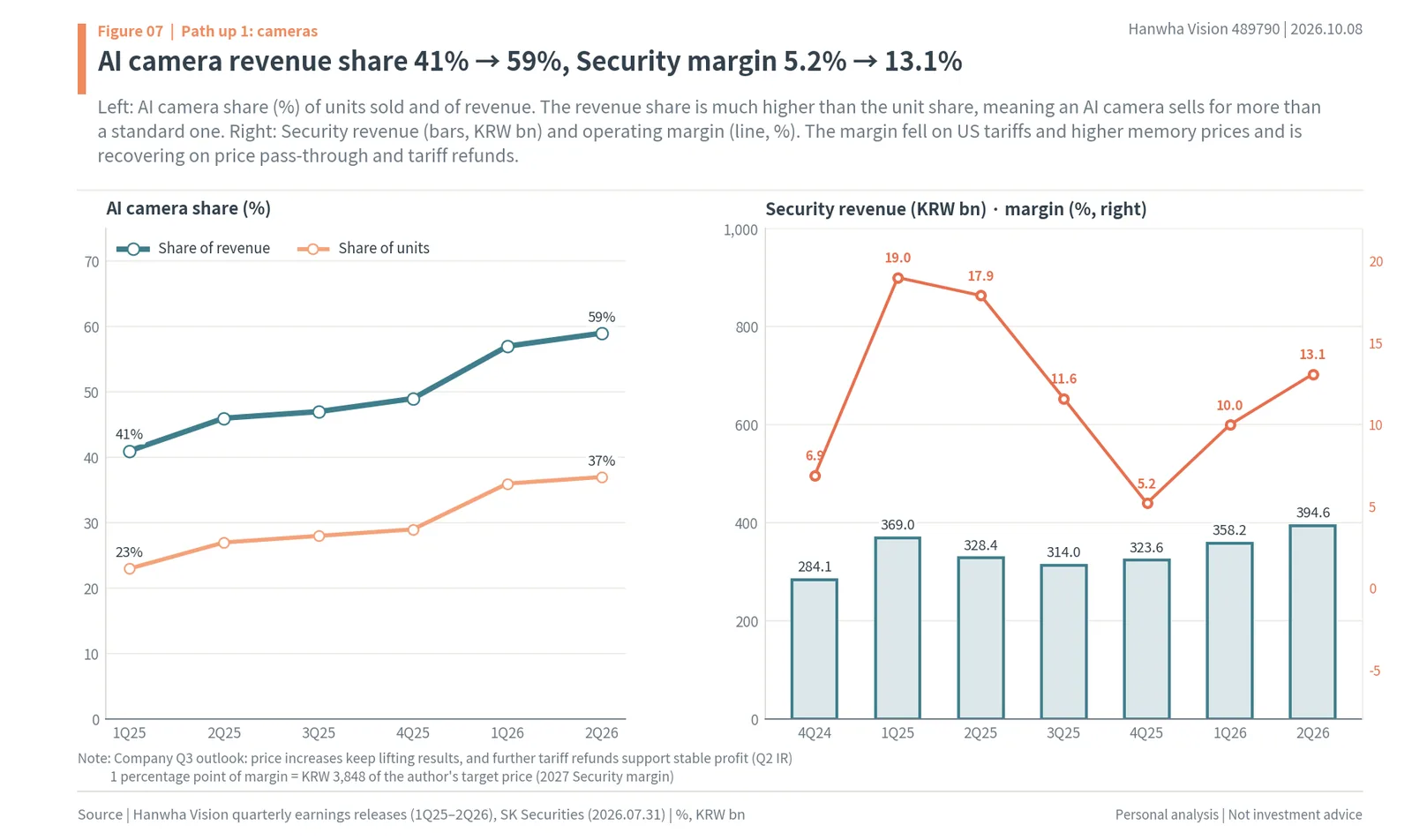
So Security is selling the same volume dearer, while tariff refunds bring the margin back toward its pre-tariff level.
5. Hanwha Semitech TC Bonders: Record Q2 Profit and the SK hynix HBM4 Order Outlook
Equipment revenue lands all at once when orders come in
Semitech’s semiconductor equipment revenue (flip-chip bonders, die bonders, etc.) was KRW 110.29bn in 2025 (DART). Of this, 95.6% was domestic, and the Q3 report lists SK hynix among the main customers for industrial equipment. By quarter, it was KRW 4.4bn in Q1 2025, KRW 25.3bn in Q2, KRW 39.4bn in Q3 and KRW 41.2bn in Q4. Orders won in the first half were booked as revenue through the second half.
In Q1 this year, with all of last year’s orders already booked, equipment revenue fell to KRW 6.6bn. In its Q1 IR the company wrote that it had resumed and secured TC bonder orders from its main customer, and that it had also won orders for FO-PLP equipment from a new customer. In Q2, revenue from the TC bonders ordered early this year was recognized and equipment revenue came back to KRW 35.5bn, while SMT also grew 17.3% to KRW 93.6bn, taking Semitech’s operating profit to KRW 14.0bn. As the company noted, these were its largest quarterly revenue and operating profit since listing.
Equipment revenue is booked all at once when a machine is delivered and the customer accepts it. So Semitech’s quarterly profit swings widely depending on whether orders keep coming. The KRW 27.7bn turn in a single quarter, from −KRW 13.7bn in Q1 to +KRW 14.0bn in Q2, is an example.
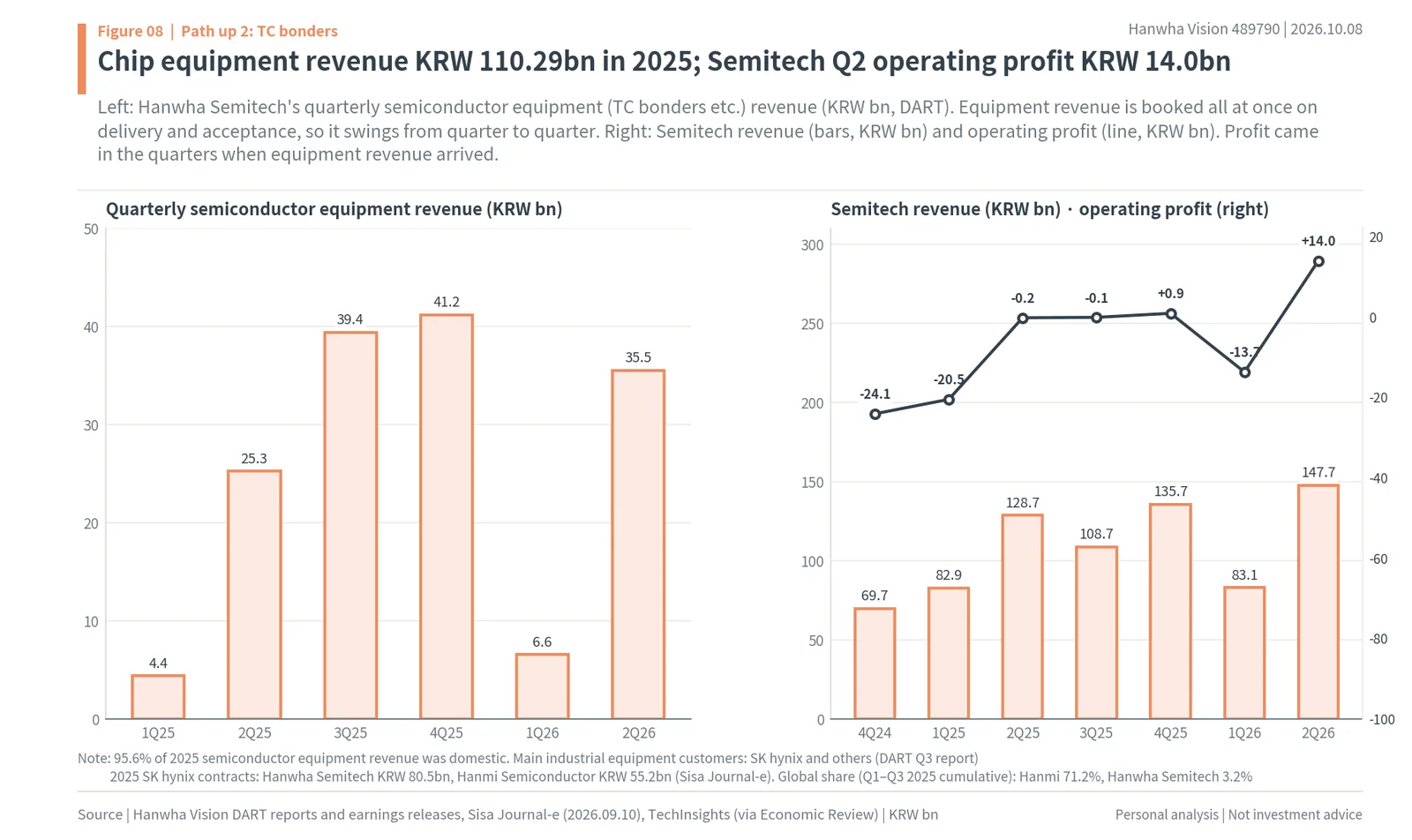
SK hynix’s HBM4 orders and Semitech’s share
In 2025 Semitech disclosed three TC bonder contracts with SK hynix (KRW 21.0bn on March 14, KRW 21.0bn on March 26 and KRW 38.5bn on May 16), and SK Securities put that year’s orders at about KRW 80.5bn. In January this year it again won orders for TC bonders that can handle HBM4 with its existing model. Korea Investment & Securities wrote that the 6 TC bonders ordered in January were delivered in Q2 (August 5). In its July 20 preview it expected 10–20 more units to be ordered by the main customer in the second half, and TC bonder orders in 2027 to be larger than this year’s once SK hynix’s new back-end plant (P&T7) is completed. On May 12 it wrote that TC bonder orders were being pushed back as SK hynix’s HBM4 response ran late, but that the order volume of about 70 units expected at the start of the year would hold because HBM4 mass production takes place in the second half. SK Securities also expects this customer to buy around 70 TC bonders this year, a big increase from a year earlier.
On June 8 Hanmi Semiconductor disclosed a KRW 44.2bn HBM4 TC bonder contract with SK hynix, which the industry estimated at around 15 units at about KRW 3bn each (Dnews). Hanwha Semitech was reported to have won an order of similar size (ZDNet Korea, June 10). Bloter understood that Hanwha Semitech had TC bonder revenue of over KRW 90bn in 2025, signed supply contracts in January and February this year, and took part in the additional HBM4 order in June. In its August 4 report, Kiwoom Securities wrote that it understood additional SK hynix TC bonder orders had been placed. Hanmi Semiconductor stopped voluntary disclosure of orders from January 30 at its customer’s request, and Hanwha Semitech has no duty to disclose, so unit counts and amounts by company since July cannot be confirmed from filings. Korea Investment & Securities described P&T7 as an advanced packaging plant larger than the existing P&T6, with a site of 70,000 pyeong and a cleanroom of 46,000 pyeong (1 pyeong is about 3.3 square meters), and expects equipment orders in 2027, with business plans taking shape from Q4 this year.
The next machines: PLP, SpaceX and hybrid bonders
Customers are growing outside TC bonders too. FO-PLP is a process that packages many chips at once on a wide rectangular panel. In a May report, Korea Investment & Securities said Semitech had won about KRW 60bn of FO-PLP equipment orders from an overseas OSAT (outsourced back-end company), that the end customer is a global low-earth-orbit satellite operator, and that Semitech’s share at this customer had likely reached about 80–90%, replacing the ASMPT machines it had used. Revenue is booked from Q3, and it expects more orders in 2027. SK Securities also expects FO-PLP equipment to go into an Asian OSAT with a US customer as the end user and to contribute in earnest from the second half at around 10% of Semitech revenue, and Kiwoom Securities expects PLP equipment for an overseas OSAT to be recognized in Semitech’s Q3 revenue. In June a report said Semitech would supply SpaceX with back-end equipment (SFM) for packaging Starlink satellite communication chips from the second half (Korea Economic Daily, June 1). In hybrid bonders, the 2nd-generation machine was delivered in April and is in qualification at the customer (Korea Investment & Securities). Kiwoom Securities named three growth drivers for Semitech: TC bonder supply to SK hynix, customer diversification into Taiwan and China, and HCB equipment supply to SK hynix. On April 29 Hanwha Vision invested KRW 49.999bn in Semitech, for the purpose of expanding the semiconductor equipment business (DART).
Equipment revenue has started coming back in, and customers and machine types are growing together.
Author’s base case: 2027 equipment revenue +50%, Semitech margin 11%
The author’s base case is semiconductor equipment and machine tool revenue +50% in 2027 and +25% in 2028. There are three grounds. 2027 is the year the HCB market grows 2.4 times, and Korea Investment & Securities expects TC bonder orders in 2027 to be larger than this year’s as P&T7 is completed. On top of that come new customers, such as FO-PLP equipment for a low-earth-orbit satellite operator and Taiwanese OSATs. As the KRW 80.5bn of SK hynix contracts in 2025 shows, Semitech grows when this customer’s investment grows. On these assumptions, equipment etc. revenue in 2027 is KRW 333.4bn, total Semitech revenue including SMT is KRW 661.5bn, and the Semitech margin is 11.0%. The bear case is flat 2027 equipment revenue with a 4% margin, and the bull case is equipment revenue doubling with a 14% margin.
For Q3, Kiwoom Securities expects Semitech operating profit of KRW 2.0bn because of one-off costs, and KRW 12.5bn in Q4 as SK hynix TC bonder revenue is recognized and the one-off costs fall away. The author’s base case is KRW 4.1bn in Q3 and KRW 13.4bn in Q4.

So Semitech’s profit grows again from Q4, when HBM4 equipment comes into revenue, and builds up in earnest in 2027.
6. Hanwha Vision RSU: KRW 1.94bn of Pre-Tax Profit per KRW 10,000 on Hanwha Aerospace
Why Hanwha Vision’s employee pay is tied to Aerospace’s share price
An RSU (restricted stock unit) is pay that promises employees the value of a set number of shares some years later. Hanwha Vision grants RSUs every year based on Hanwha Aerospace common shares, and when the set period ends it pays the value of those shares in cash. The reference price is the average closing price for the December before the year of the grant. The answer to why Hanwha Vision employees are paid in another company’s shares lies in the spin-off history. The old Hanwha Vision was a wholly owned subsidiary of Hanwha Aerospace, and at that time it granted RSUs in the parent’s share value. When today’s Hanwha Vision merged the old Hanwha Vision in January 2025, it took over the plan as it was (half-year report).
Payment takes 10 years for the CEO, 5–10 years for other executives and 3–5 years for employees, and Dealsite put the weighted average remaining period at 5 years. Since the merger, employees who wish to can switch to RSUs based on Hanwha Vision shares, but the choice is up to each person. RSUs newly granted in 2025 were 146,506 shares based on Hanwha Vision stock (KRW 4.63bn), and it is the units still based on Aerospace shares that swing the P&L.
The liability is reproduced exactly as “193,630 shares × Aerospace price”
Dealsite put the reference shares of Hanwha Vision’s RSUs at 193,630 Hanwha Aerospace common shares, and the amount first granted at KRW 10.9bn. Until payment, the company books this share count times Aerospace’s share price as a liability, and records each quarter’s increase or decrease as a valuation gain or loss on other financial liabilities. Indeed, multiplying Aerospace’s quarter-end close by 193,630 shares gives KRW 182.21bn at the end of 2025, KRW 241.84bn at the end of March 2026 and KRW 192.66bn at the end of June. The reported liabilities were KRW 182.6bn, KRW 242.5bn and KRW 193.2bn, a match within 0.3% at all three dates (author’s calculation).
The quarterly P&L matches the same way. The valuation loss on other financial liabilities in the DART finance cost notes was a loss of KRW 57.56bn in Q1 2025, KRW 42.09bn in Q2 and KRW 52.63bn in Q3, a gain of KRW 32.22bn in Q4, a loss of KRW 60.00bn in Q1 2026 and a gain of KRW 49.33bn in Q2. The values calculated as share count times the quarterly price change are KRW 58.19bn, KRW 42.79bn, KRW 50.15bn, a KRW 32.14bn gain, KRW 59.64bn and a KRW 49.18bn gain: the same direction and a similar size.
So when Aerospace’s share price rises KRW 10,000, Hanwha Vision’s pre-tax profit falls KRW 1.94bn, and when it falls KRW 10,000, profit rises by the same amount.
A 10% move from Aerospace’s current KRW 891,000 moves Hanwha Vision’s pre-tax profit by KRW 17.25bn. Operating profit over the last six quarters ranged from KRW 17.9bn to KRW 65.6bn, an average of KRW 41.67bn, so a 10% move in Aerospace moves 41.4% of an average quarter’s operating profit. Had Aerospace stayed at its April 7 peak of KRW 1,537,000, the RSU liability would have grown to KRW 297.61bn. The liability of KRW 172.5bn at today’s price is 7.0% of market cap, or KRW 3,417 a share, and the target price calculation in this report treats this amount as money to be paid out and subtracts it.
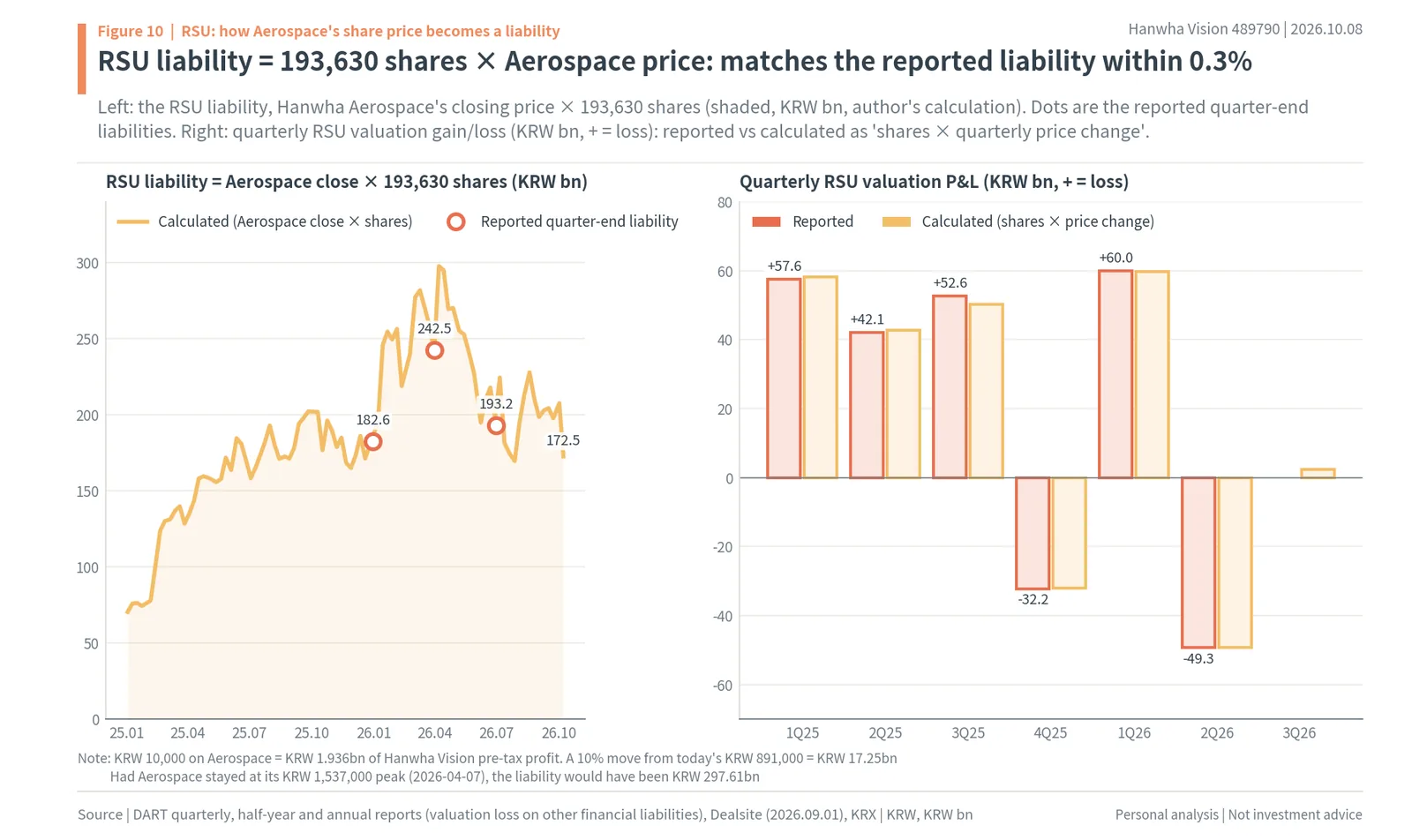
How much it swung net income: 74.0% of operating profit
The 2025 RSU valuation loss was KRW 120.06bn, 74.0% of that year’s operating profit of KRW 162.3bn. As a result, quarterly net income swung from −KRW 3.3bn in Q1 2025, −KRW 10.2bn in Q2 and −KRW 6.8bn in Q3 to KRW 62.9bn in Q4, −KRW 14.0bn in Q1 2026 and KRW 75.3bn in Q2. The business ran evenly, and only the net income on display swung.
Reversing the RSU and PRS valuation gains and losses at Q2’s effective tax rate of 25.8%, quarterly net income becomes KRW 39.4bn, KRW 21.0bn, KRW 32.2bn, KRW 39.0bn, KRW 30.5bn and KRW 47.0bn (author’s calculation). The lowest quarter is KRW 21.0bn and the highest KRW 47.0bn: this is a company that earns a steady KRW 30bn–40bn-range net income a quarter. Trailing PERs that looked expensive, such as 49.7x on 2025 EPS of KRW 903, were also the result of these valuation losses (WISEreport).

Hanwha Vision’s business ran evenly, and Aerospace’s share price swung the net income on display and the trailing PER.
7. Hanwha Vision PRS: How the Price Return Swap Offsets the RSU from Q3
How the contract works: the two sides exchange the gap between a reference price and the actual price
A PRS (price return swap) is a contract in which the two parties exchange the difference between a set reference price and the actual share price. In its half-year report, Hanwha Vision wrote that it entered into a PRS with a buyer “to hedge the risk from changes in the share price of the granted shares (Hanwha Aerospace common shares) under the RSU plan”. If Aerospace’s share price rises above the reference price, Hanwha Vision receives the difference; if it falls below, Hanwha Vision pays. The RSU liability grows and produces a loss when Aerospace rises, and at the same time the PRS produces a gain, so the two numbers cancel out. A company official also explained to Dealsite that the contract is meant to avoid share price risk.
What Hanwha Vision trades in this contract is the price difference of Hanwha Aerospace shares; Hanwha Vision’s own shares are not in the contract. So the PRS creates no buying or selling of Hanwha Vision shares. The only two ways it reaches the share price are the income statement and cash.
End-June numbers: RSU gain KRW 49.33bn, PRS loss KRW 11.24bn
The PRS was first signed in Q2. In the end-June half-year report, the price return swap was booked as a KRW 11.24bn liability and a KRW 11.24bn valuation loss. In the same quarter Aerospace’s share price fell from KRW 1,249,000 at the end of March to KRW 995,000 at the end of June, producing a KRW 49.33bn valuation gain on the RSU. Aerospace fell after the contract was signed, so the PRS side made a loss, and the net Q2 effect of the two numbers together was a gain.
The contract’s notional share count and reference price have not been disclosed. So the author worked backward from the KRW 11.24bn loss at the end of June. If the PRS covers all 193,630 RSU shares, a KRW 11.24bn loss at Aerospace’s end-June close of KRW 995,000 requires a reference price of about KRW 1,050,000. That is within Aerospace’s June closing range of KRW 995,000–1,224,000. With a 75% hedge ratio the reference price works out to about KRW 1,070,000, and with 50% about KRW 1,110,000.
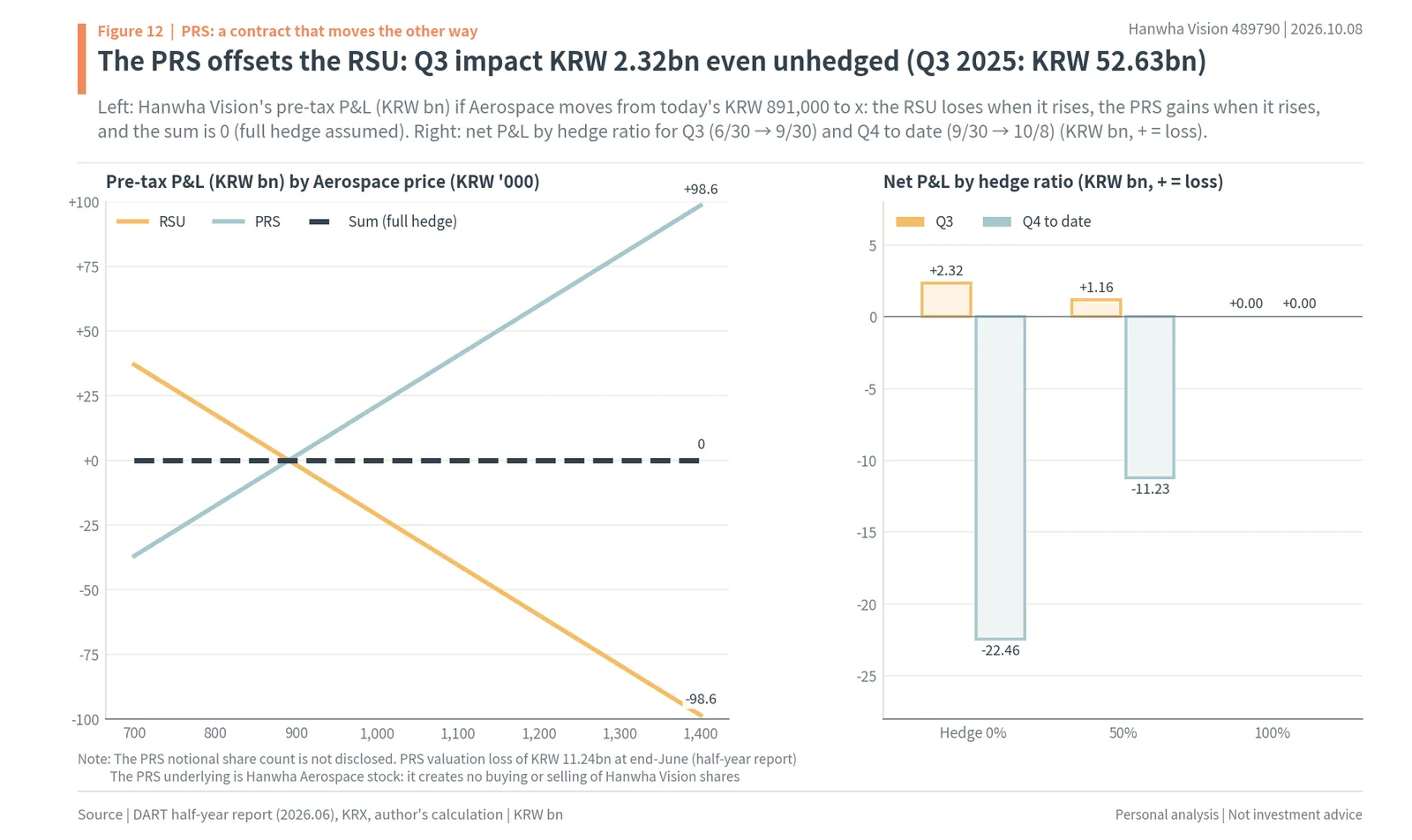
Q3 is the first quarter with almost no Aerospace effect
During Q3, Aerospace’s share price moved 1.2%, from KRW 995,000 at the end of June to KRW 1,007,000 at the end of September. So even with no PRS at all, the Q3 RSU loss is KRW 2.32bn, and with a full hedge it is close to 0 (author’s calculation). The Q3 RSU loss last year was KRW 52.63bn. That means that for the same operating profit, pre-tax profit is cut by KRW 50.31bn less than a year earlier.
The Q3 RSU loss last year was KRW 52.63bn, so this Q3’s net income, with the Aerospace effect almost gone, is set to look much higher than a year earlier.
Moving into Q4, Aerospace fell 11.5% from the end of September to October 8, building up a KRW 22.46bn gain on the RSU side. With a 50% hedge ratio, KRW 11.23bn of this is canceled out by the PRS, and with a full hedge all of it is. Either way, while the PRS is in place, Hanwha Vision’s quarterly net income moves more with the company’s own business than with Aerospace’s share price.
Settlement at maturity: cash changes hands between the end of this year and June next year
In the maturity analysis of derivative liabilities in the half-year report’s financial risk management note, the KRW 11.24bn PRS sits in the “over 6 months to 1 year” column. More than six months and less than one year from the end of June puts maturity between the end of 2026 and June 2027. At maturity, the difference between Aerospace’s share price and the reference price is settled in cash.
Assuming a full hedge and a reference price of about KRW 1,050,000, the settlement cash depends on Aerospace’s share price as follows. At Aerospace’s current KRW 891,000, Hanwha Vision pays KRW 31.37bn, or KRW 621 a share. At KRW 1,000,000 it pays KRW 10.26bn, at KRW 1,100,000 it receives KRW 9.10bn, and at KRW 1,200,000 it receives KRW 28.46bn. If Aerospace falls to KRW 800,000, it pays KRW 48.99bn.
This cash is not a loss as such. Whatever is paid on the PRS is matched by a fall of the same size in the RSU liability. While the hedge is in place, the RSU amount the company will pay in future is locked at about KRW 203.89bn (193,630 shares × reference price), and the settlement squares this locked value in cash ahead of time. RSUs are paid years later while the PRS settles within a year, so if Aerospace’s share price reaches maturity below the reference price, the cash goes out before the RSU payments.
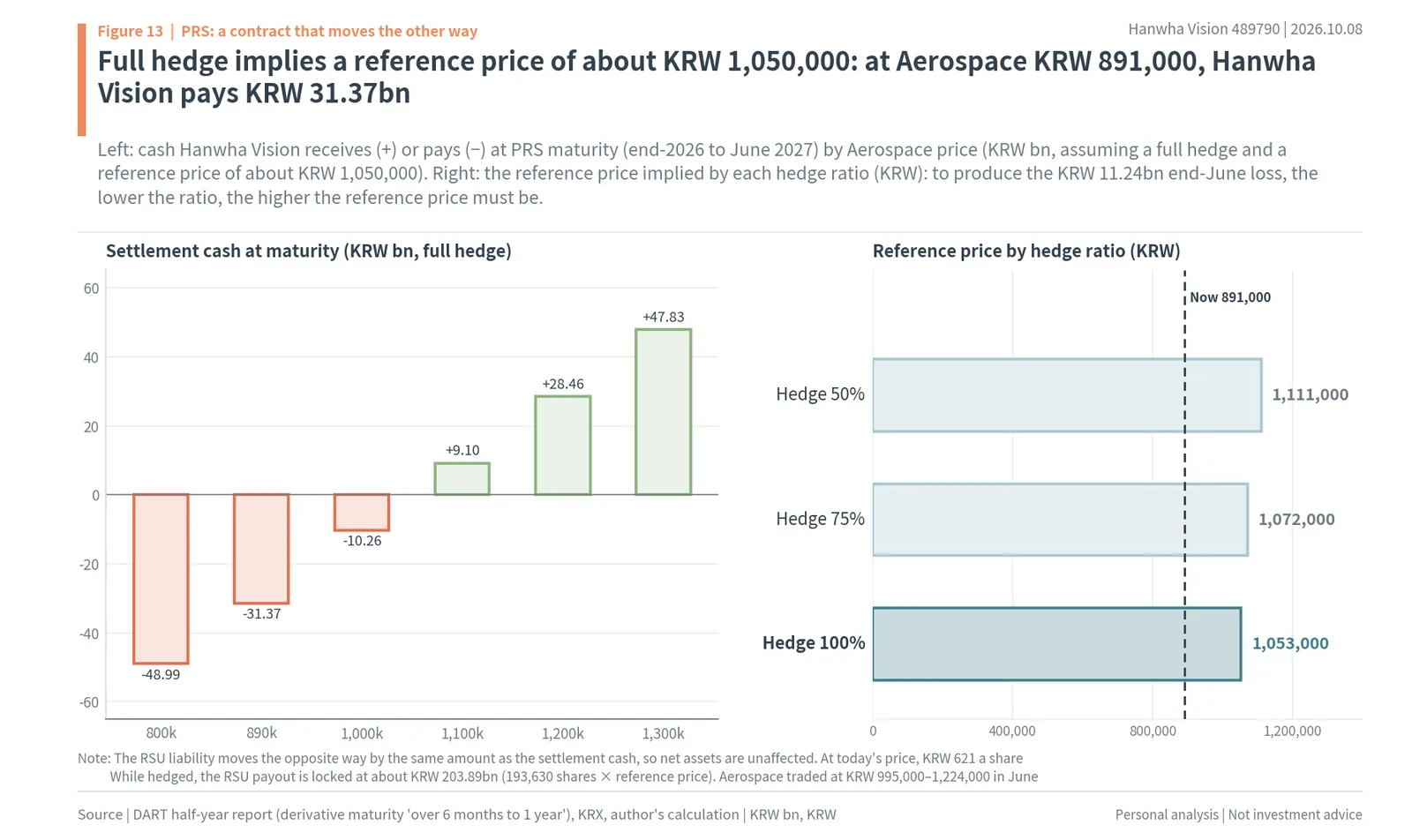
So the PRS reaches Hanwha Vision’s share price in two ways, cleaner net income from Q3 and the settlement cash at maturity, and neither has anything to do with operating profit.
8. Hanwha Vision Earnings Forecast: 2027 Operating Profit KRW 287.1bn, EPS KRW 4,082
How the estimates are built
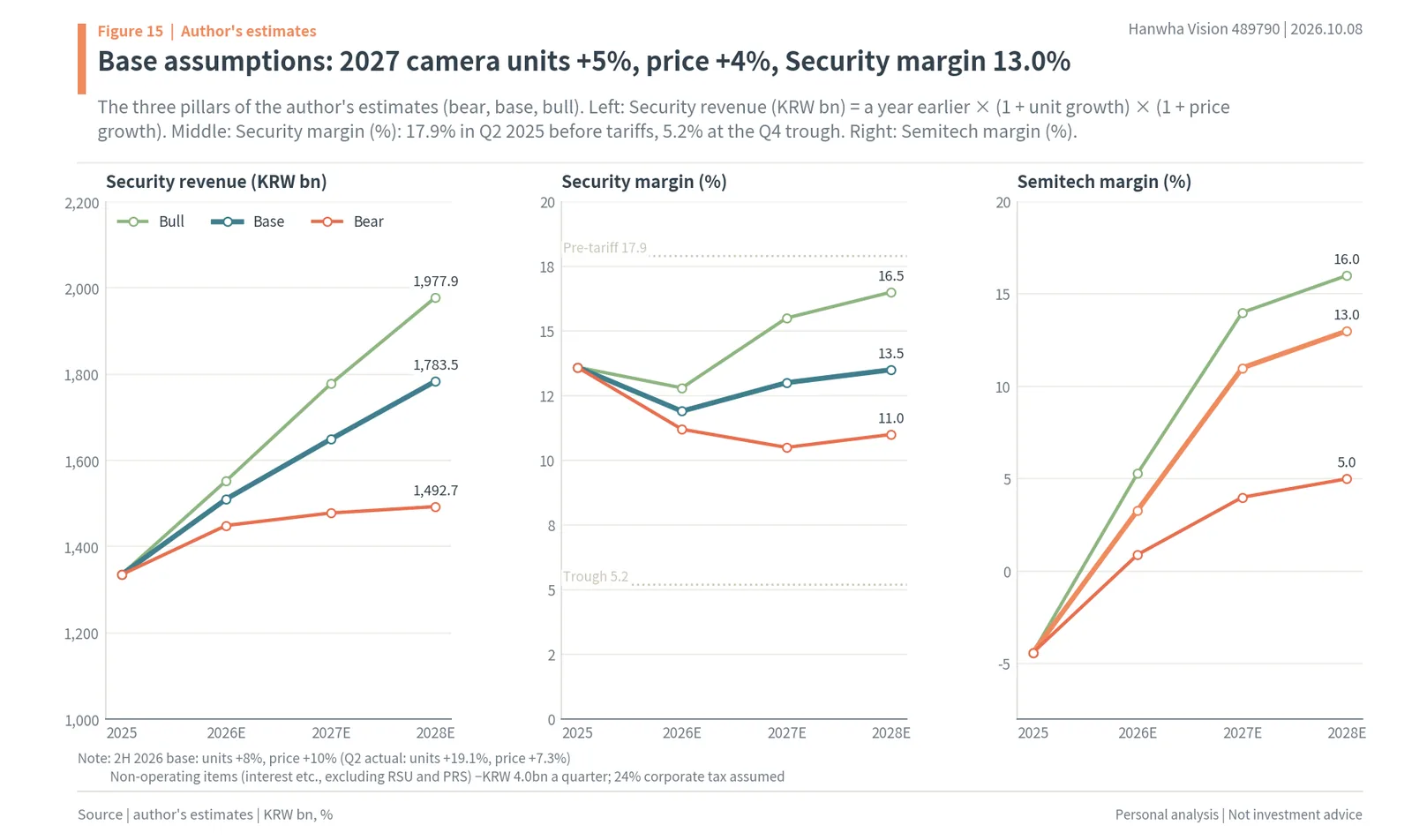
The author’s estimates carry this report’s main thread, volume and price, straight into the formulas. Security revenue is revenue in the same period a year earlier multiplied by (1 + unit growth) and (1 + price growth). The base case for the second half of 2026 is units +8% and price +10%. Actual Q2 was units +19.1% and price +7.3%, and the first half as a whole was units +0.4% and price +12.8%, so the assumptions sit between the two. For 2027 they are units +5% and price +4%, and for 2028 units +5% and price +3%. Multiplied together, the two 2027 assumptions give Security revenue growth of 9.2%, close to the 9.4% market growth Omdia expects.
Semitech is split into chip mounters (SMT) and semiconductor equipment and machine tools. SMT grows +15% in the second half of 2026 (actual Q2: +17.3%) and +5% in 2027 and 2028. Semiconductor equipment and machine tools are set at KRW 75.0bn in each of Q3 and Q4, then grow +50% in 2027 and +25% in 2028. Margins are 12.5% for Security in Q3, 12.0% in Q4, 13.0% in 2027 and 13.5% in 2028, and for Semitech 3% in Q3 (the one-off costs Kiwoom Securities flagged), 8% in Q4, 11% in 2027 and 13% in 2028. Non-operating items such as interest costs, excluding the RSU and PRS, are set at −KRW 4.0bn a quarter, and the corporate tax rate at 24%. The Aerospace share price effect cannot be forecast, so it is left out of estimated EPS.
One note on the 2025 quarterly figures. The 2025 quarterly results in this report are the IR figures the company restated after reclassifying its chip design unit as a discontinued operation. Operating profit in the quarterly reports first filed on DART was KRW 44.30bn in Q1 2025, KRW 56.27bn in Q2 and KRW 31.16bn in Q3, and the restated figures are KRW 49.4bn, KRW 58.8bn and KRW 36.2bn. Full-year operating profit of KRW 162.3bn and the 2026 figures are the same in both sources.
Q3 and Q4: operating profit of KRW 50.7bn and KRW 59.6bn
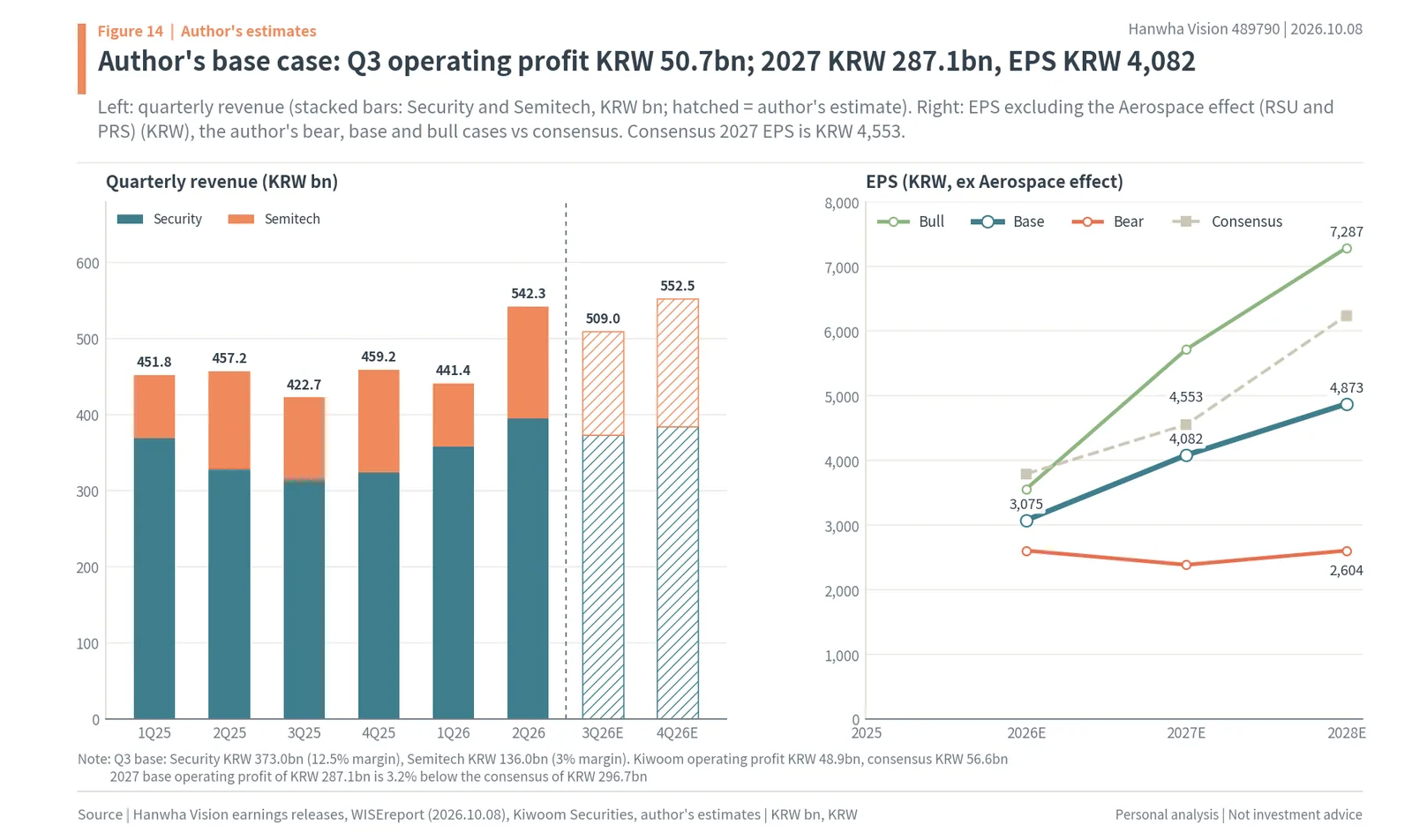
In the author’s base case, Q3 revenue is KRW 509.0bn and operating profit KRW 50.7bn. Security earns KRW 46.6bn on revenue of KRW 373.0bn at a 12.5% margin, and Semitech adds KRW 4.1bn on revenue of KRW 136.0bn at a 3% margin. For the same quarter, Kiwoom Securities expects revenue of KRW 539.0bn and operating profit of KRW 48.9bn (Security KRW 46.9bn, Semitech KRW 2.0bn), and SK Securities operating profit of KRW 62.0bn. The WISEreport consensus (3 brokers) is revenue of KRW 527.4bn, operating profit of KRW 56.6bn and net income of KRW 47.8bn, unchanged from a month ago; three months ago it was revenue of KRW 506.5bn and operating profit of KRW 57.6bn. Q3 net income excluding the Aerospace effect is KRW 35.5bn, and EPS KRW 703.
For Q4 the base case is revenue of KRW 552.5bn and operating profit of KRW 59.6bn. The difference is that SK hynix TC bonder revenue is booked again, lifting Semitech’s operating profit to KRW 13.4bn. Kiwoom Securities also expects Q4 Semitech operating profit of KRW 12.5bn.
2026–2028: 2027 operating profit KRW 287.1bn, EPS KRW 4,082
The 2026 base case is revenue of KRW 2,044.9bn and operating profit of KRW 197.9bn, 2.7% below the consensus operating profit of KRW 203.4bn. Adding second-half estimates to actual first-half net income excluding the Aerospace effect of KRW 77.56bn gives net income of KRW 155.3bn and EPS of KRW 3,075. Most of the gap with consensus EPS of KRW 3,790 comes from whether first-half RSU and PRS valuation gains and losses are included or excluded.
Broker estimates for 2026 are operating profit of KRW 190.5bn at Kiwoom Securities, KRW 214.0bn at SK Securities and KRW 204.9bn at Korea Investment & Securities (net income KRW 156.6bn, EPS KRW 3,110).
The 2027 base case is revenue of KRW 2,310.6bn, operating profit of KRW 287.1bn, net income of KRW 206.1bn and EPS of KRW 4,082. That is 3.2% below the consensus operating profit of KRW 296.7bn, and consensus EPS is KRW 4,553. Of the operating profit, Security contributes KRW 214.4bn and Semitech KRW 72.8bn. For 2028 the author expects revenue of KRW 2,544.8bn, operating profit of KRW 339.7bn and EPS of KRW 4,873.
Today’s price of KRW 49,050 is 12.0 times 2027 forward EPS of KRW 4,082, and 10.8 times consensus EPS of KRW 4,553.
The three pillars of the estimates, and the bear and bull cases
The weight of the estimates rests on three pillars: 2027 camera units +5% and price +4%, a Security margin of 13.0% and a Semitech margin of 11.0%. The 13.0% Security margin is close to this year’s Q2 margin of 13.1% and set below the 17.9% of Q2 2025, before tariffs applied. If tariff refunds continue, this is the pillar that rises first.
The Semitech margin assumption is close to Korea Investment & Securities’ forecast. In a May report Korea Investment & Securities put Semitech’s operating margin at 5.5% in 2026, 11.8% in 2027 and 13.9% in 2028, while the author’s base case is 3.3%, 11.0% and 13.0%.
The bear case is flat 2027 camera units, price +2%, a Security margin of 10.5%, flat equipment revenue and a Semitech margin of 4%. In that case 2027 operating profit is KRW 174.4bn and EPS KRW 2,385. The bull case is units +8%, price +6%, a Security margin of 15.5%, equipment revenue doubling and a Semitech margin of 14%, for 2027 operating profit of KRW 395.8bn and EPS of KRW 5,717.
Financial position: inventories and receivables grew with revenue
At the end of June, consolidated liabilities were KRW 1,297.68bn and equity KRW 948.31bn, a debt-to-equity ratio of 136.8%. In December 2025 the company disclosed a memorandum of understanding to buy the Humax Village building in Bundang for KRW 280bn (17.6% of total assets) (DART), and non-current assets rose from KRW 677.6bn to KRW 1,014.0bn in Q1. Borrowings and bonds are KRW 678.78bn, and subtracting cash of KRW 98.37bn and other current financial assets of KRW 69.30bn gives net debt of KRW 511.11bn, 53.9% of equity (half-year report). The RSU liability is booked separately from these borrowings.
In Q2, as the company posted its largest quarterly revenue ever, working capital grew with it. Inventories rose KRW 72.8bn, from KRW 330.2bn at the end of Q1 to KRW 403.0bn, and trade and other receivables rose KRW 107.1bn, from KRW 548.0bn to KRW 655.1bn. As a result, operating cash flow for the first half went from a KRW 75.92bn inflow in Q1 to a KRW 102.74bn outflow in Q2, for a cumulative outflow of KRW 26.82bn. First-half capital spending (purchases of property, plant and equipment) was KRW 30.81bn. Receivables swelled in step with Q2 revenue, which was KRW 100.9bn higher than in Q1, and the KRW 49.999bn invested in Semitech in April moved within the consolidated group.
The center of gravity of the author’s estimates is the Security margin, and Semitech adds profit from 2027.
9. Why This PER: Today’s Price Gives Semitech Only 5.0x 2027 Net Income
A camera company and an equipment company are not measured with one multiple
Hanwha Vision holds a video security company and a semiconductor equipment company in one body. The two businesses grow at different speeds and the market prices them differently. So rather than putting one PER on the whole company, the author split 2027 net income by segment and used a separate PER from comparable companies for each. Non-operating items were split by revenue share. The author’s base-case 2027 net income of KRW 206.1bn splits into KRW 154.3bn for Security and KRW 51.8bn for Semitech.
The 2027 forward PERs of video security peers on Yahoo Finance are 23.0x for Motorola Solutions (2027 EPS $19.43), 15.5x for Hikvision (EPS CNY 2.13) and 11.1x for Dahua (EPS CNY 1.39). For Security the author used Hikvision’s 15.5x, the middle of the three. Using a Chinese company barred from the US public market as the yardstick is a conservative choice for Hanwha Vision. The author sees little reason for Hanwha Vision, which is not blocked from US procurement, to trade below the Chinese companies, but this report sticks to the middle value.
Bonder equipment peers are Hanmi Semiconductor at 53.4x (2027 EPS KRW 4,999), BESI at 27.3x (EPS EUR 6.56) and ASMPT at 27.6x (EPS HKD 5.84). For Semitech the author used ASMPT’s 27.6x, the middle of the three. For the same reason, the author did not use the multiple of Hanmi Semiconductor, the company most often compared in Korea. SK Securities used the same method in its July 31 report, putting 16x on 2027 Security net income of KRW 129.0bn and 35x on Semitech net income of KRW 55.0bn for a target price of KRW 80,000. Korea Investment & Securities multiplied segment EBITDA by peer EV/EBITDA multiples for a target price of KRW 108,000, and put Hanwha Vision’s 12-month forward EV/EBITDA at 7.6x as of July 20, at the bottom of its band. Kiwoom Securities calculated a per-share value of KRW 97,180 with a residual income model (cost of equity 8.1%, perpetual growth 3%) for a target price of KRW 100,000. The three yardsticks differ, but all three target prices are 63.1–120.2% above today’s price.
What today’s price is pricing in: 5.0x net income for Semitech
Today’s market cap is KRW 2,476.5bn, and adding the RSU liability of KRW 172.5bn that has to be paid out gives KRW 2,649.0bn. Security, valued at 15.5x the author’s base-case 2027 Security net income, is worth KRW 2,391.6bn. Taking that away leaves KRW 257.4bn for Semitech. That is 5.0 times Semitech’s 2027 net income of KRW 51.8bn, less than a fifth of the bonder peer middle value of 27.6x.
Asking the question the other way gives the same answer. To explain today’s market cap and RSU liability with Security alone, giving Semitech no value at all, Security would need 17.2x. That is between Hikvision’s 15.5x and Motorola Solutions’ 23.0x. Today’s price values the camera business within the peer range and puts almost no price on the TC bonder business.
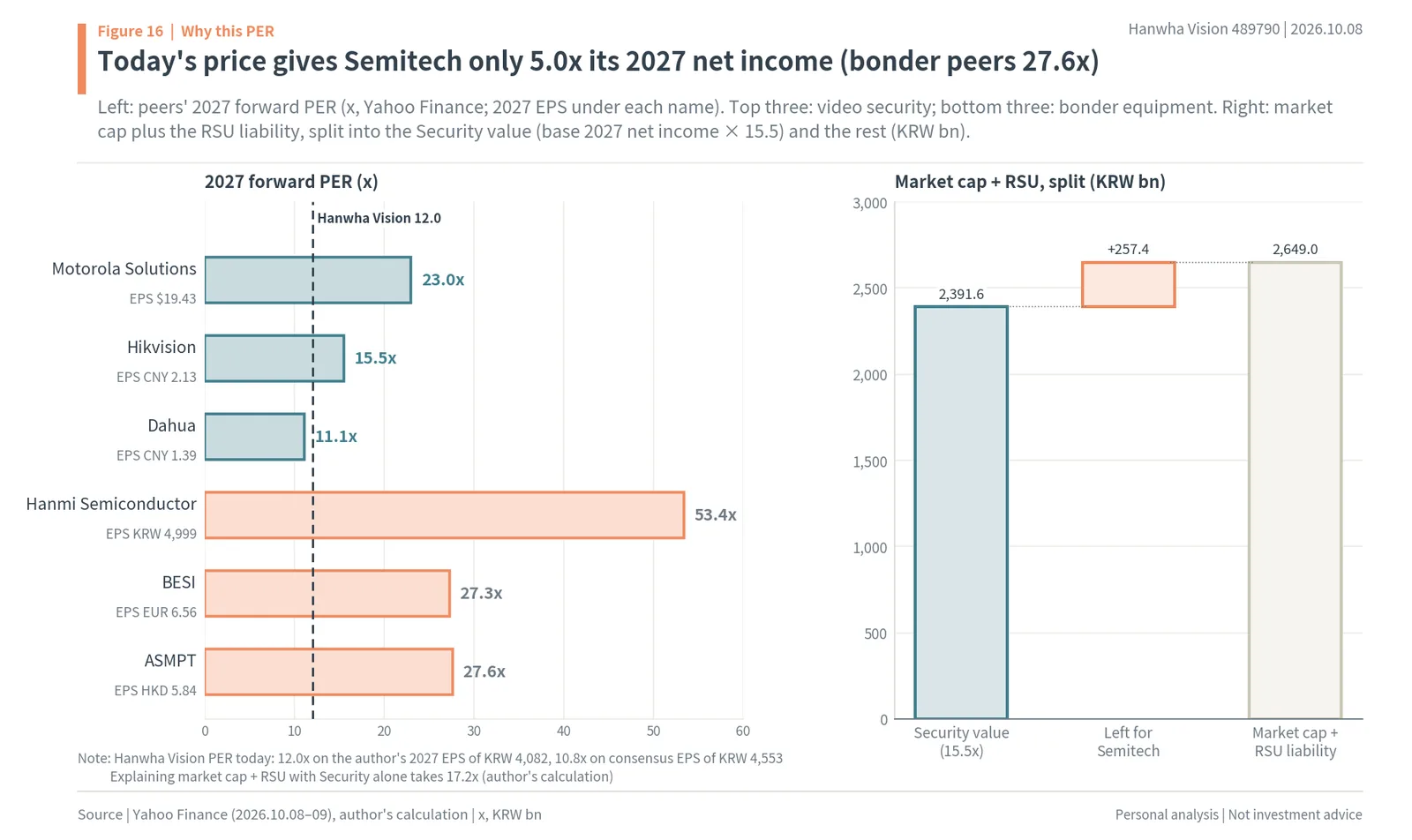
Today’s price gives Semitech (TC bonders) only 5.0 times its 2027 net income, so in effect it prices in only the cameras.
Restated as a margin: a 2027 Security margin of 7.0%
Putting the same question in terms of margin is more intuitive. If Semitech’s equipment revenue grows +50% in 2027 as in the base case and both segments get the base PERs, today’s price of KRW 49,050 is justified by a 2027 Security margin of 7.0%. Even with flat equipment revenue it is 8.3%. The Security margin was 5.2% in Q4 2025, when tariffs weighed most, then 10.0% in Q1 this year and 13.1% in Q2. Today’s price assumes that a margin somewhere between the tariff bottom and this year’s Q1 lasts throughout 2027.
10. Hanwha Vision Target Price: KRW 72,300 (Author’s Estimate)
Sum of the parts: Security KRW 47,400 + Semitech KRW 28,300 − RSU KRW 3,417
The author’s 1-year target price splits base-case 2027 net income by segment, multiplies each part by its PER and subtracts the RSU liability that has to be paid out. Security net income of KRW 154.3bn × 15.5 is KRW 2,391.6bn, or KRW 47,400 a share. Semitech net income of KRW 51.8bn × 27.6 is KRW 1,429.7bn, or KRW 28,300 a share. Adding the two and subtracting the RSU liability at today’s price of KRW 172.5bn (KRW 3,417 a share) gives KRW 3,648.8bn, or KRW 72,300 a share.
The author’s 1-year target price is KRW 72,300, 47.3% above today.
The bear case puts 12x on Security and 20x on Semitech, applied to bear-case 2027 net income, for KRW 27,000. That is the case in which the Security multiple falls to near Dahua’s 11.1x and equipment revenue stays flat. The bull case puts 18x and 35x on bull-case net income for KRW 129,000. That is the case in which the Security margin returns toward its pre-tariff level at 15.5% and equipment revenue doubles. Weighting bear 25%, base 50% and bull 25% gives KRW 75,200. Broker target prices are KRW 100,000 at Kiwoom Securities (August 4), KRW 108,000 at Korea Investment & Securities (August 5) and KRW 80,000 at SK Securities (July 31), an average of KRW 96,000.
The variable that moves the price most is the Security margin
Shaking the target price along two variables shows where the weight sits. For every 1 percentage point rise in the 2027 Security margin, the target price rises KRW 3,848. If the margin returns to the pre-tariff 17.9%, it is KRW 91,100, and at 10% it is KRW 60,700. By contrast, 10 percentage points of 2027 equipment revenue growth are worth KRW 996. Flat equipment revenue gives KRW 67,300, and doubling gives KRW 77,300. The camera margin is the handle that decides the share price, and TC bonder revenue is the part that sits on top.
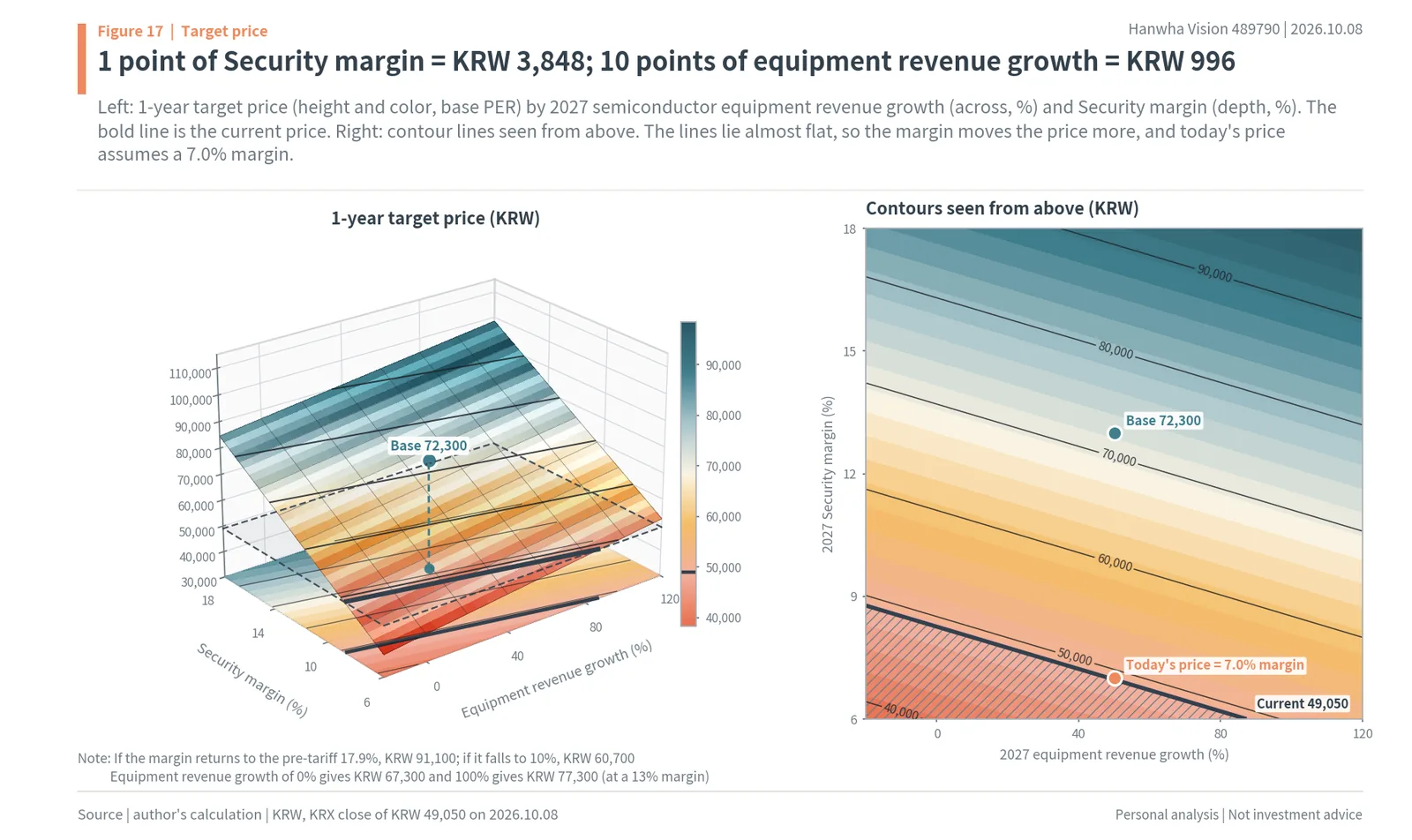
In the left-hand surface of Figure 17, the width is equipment revenue growth, the depth is the Security margin, and the height and color are the target price. The contours on the right lie almost flat. That means moving equipment revenue a long way sideways moves the price a little, while moving the margin up or down a little moves the price a lot. The thick line is the current price, and today’s price is drawn near a margin of 7.0%.
Simulation: median KRW 69,100, 25.0% below the current price
The author also calculated what happens when many variables move together. Camera units and price, the Security margin, SMT and equipment revenue, the Semitech margin and the PERs of both segments were drawn 20,000 times within their bear-to-bull ranges. A common factor was added so that several variables improve together when the industry is strong. The median result is KRW 69,100 (+40.8%), and 8 in 10 runs fall between KRW 33,900 and KRW 110,300. 25.0% of runs end below the current price one year out.
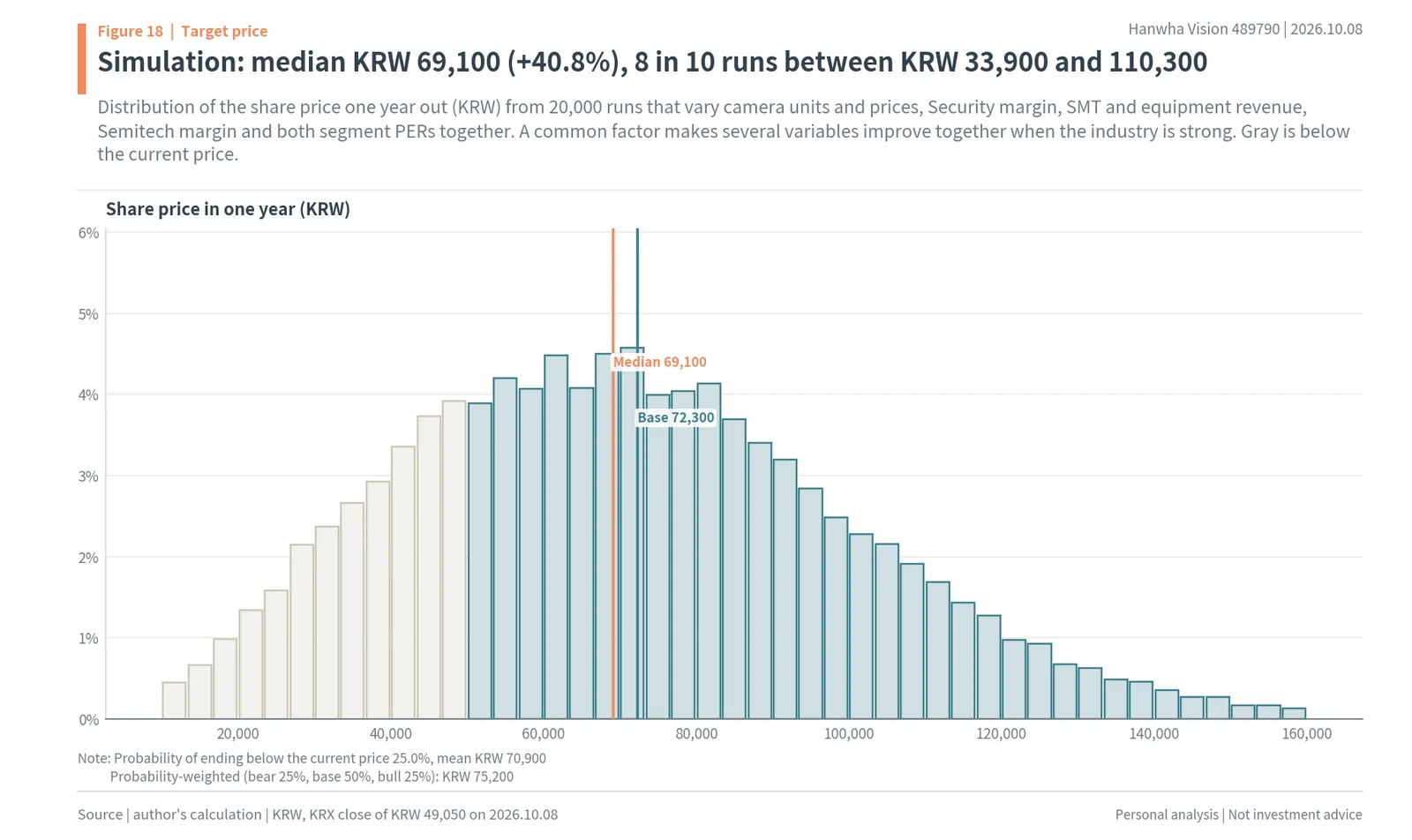
So today’s price is a level from which the stock can rise if the camera margin merely holds at Q2’s 13.1%, and TC bonder revenue is the part that sits on top.
11. Dates to Watch: Q3 Results, the Patent Hearing and PRS Maturity
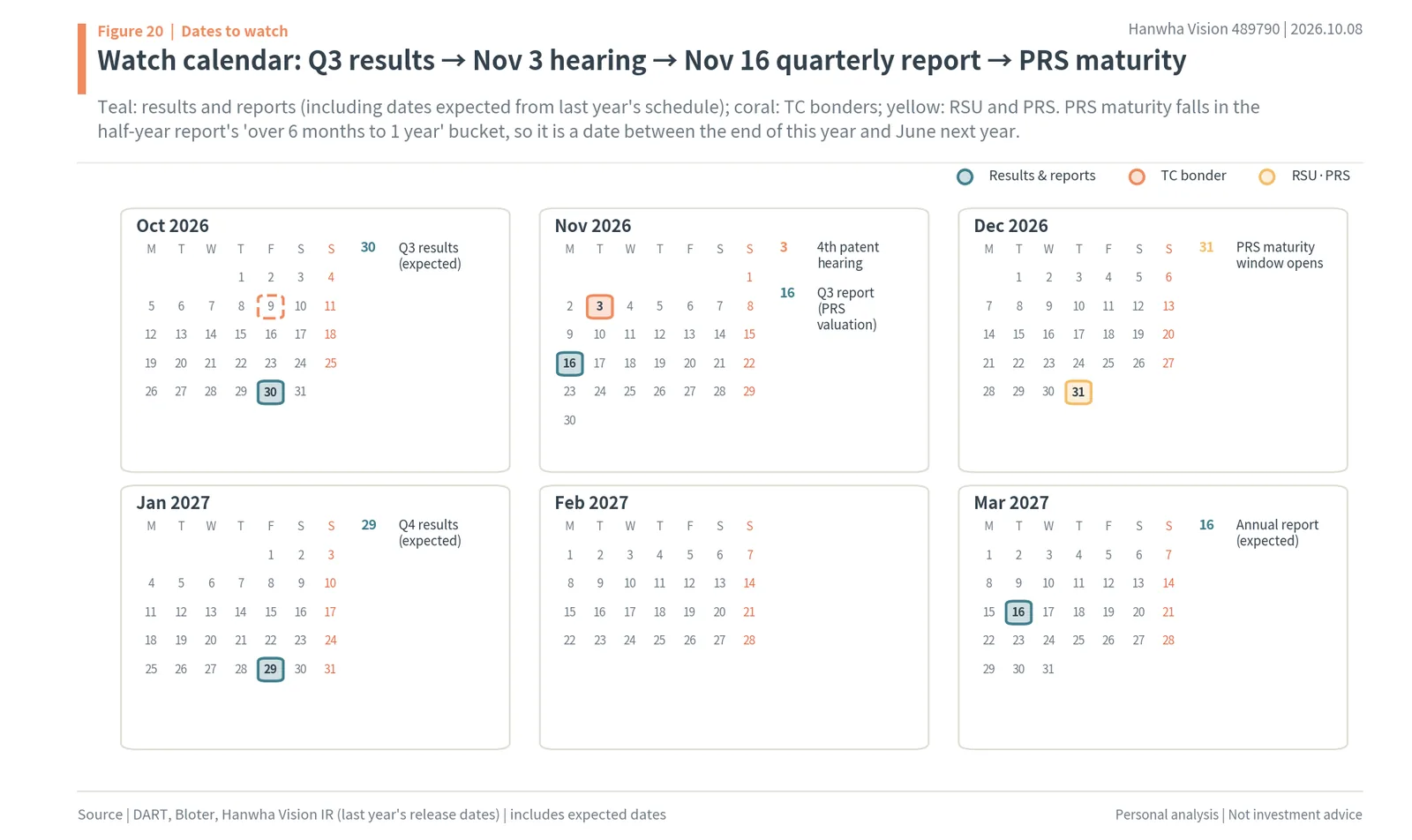
Late October: Q3 results
The first check is Q3 results in late October. Last year’s Q3 results came out on October 31. There are three numbers to watch. The first is the Security margin. The author’s base case is 12.5%, and if tariff refunds and the price effect continue, it can hold at Q2’s 13.1%. The second is Semitech’s semiconductor equipment and machine tool revenue. The author’s base case is KRW 75.0bn, against KRW 54.0bn in Q2 and KRW 18.3bn in Q1. The third is net income without the Aerospace effect. Aerospace’s share price moved only 1.2% in Q3, so the RSU and PRS impact is KRW 2.32bn or less, and net income should look much higher by the amount of last year’s KRW 52.63bn Q3 RSU loss that is no longer there.
November 3 and November 16
On November 3 the 4th hearing in the TC bonder patent suit between Hanmi Semiconductor and Hanwha Semitech takes place (Bloter). By November 16 the Q3 quarterly report comes out. If the end-September PRS valuation appears in this report’s derivatives note, the size of the hedge (the notional share count) can be backed out against the change in Aerospace’s share price during Q3. With a full hedge, the end-September PRS valuation loss should be KRW 2.32bn smaller than at the end of June.
End of this year to June next year: PRS maturity
The PRS matures between the end of this year and June next year. At that point the difference between Aerospace’s share price and the reference price changes hands in cash. The numbers to watch every day are the distance between Aerospace’s share price and the reference price of about KRW 1,050,000 under the full-hedge assumption, and the foreign stake (24.1% today).
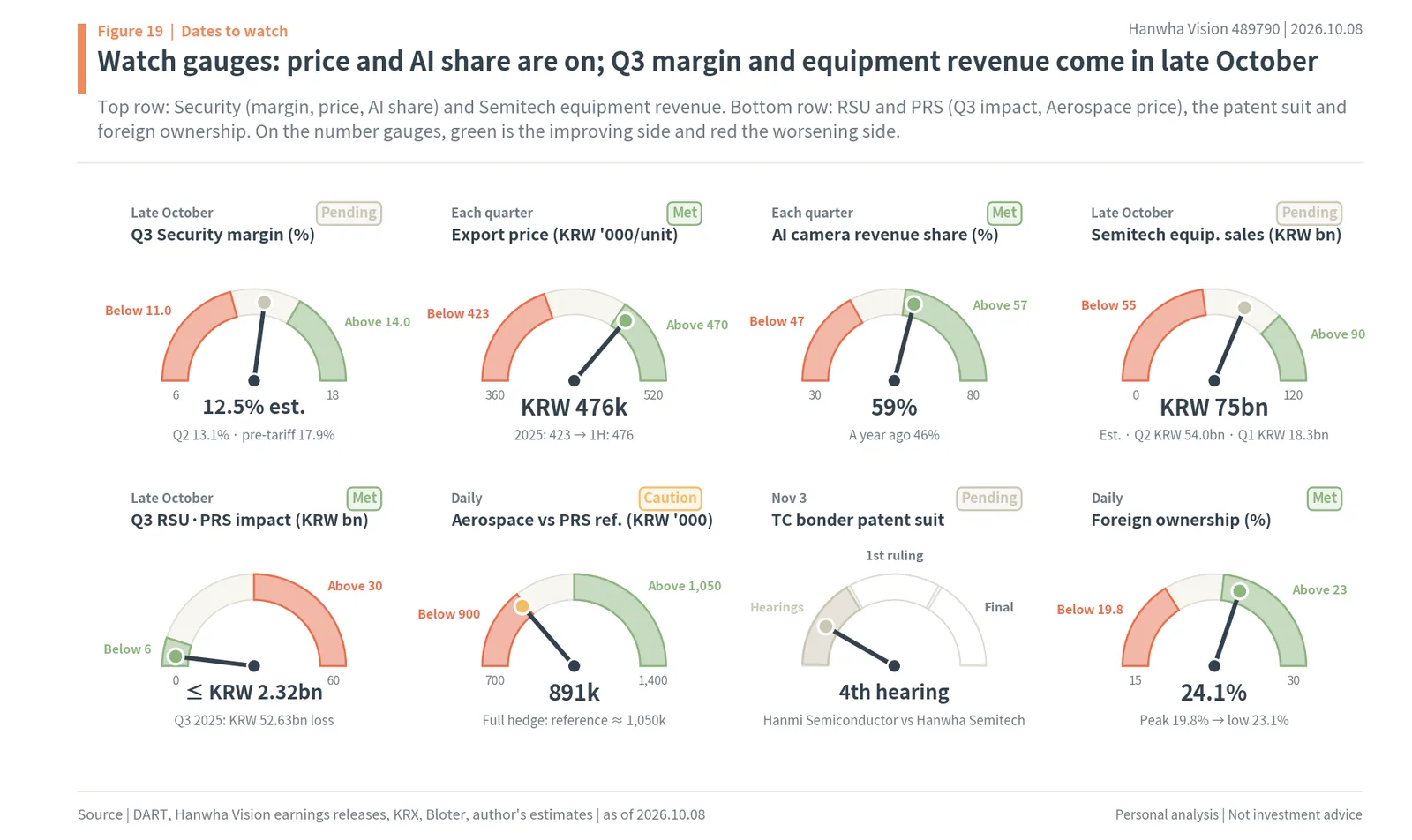
The eight gauges in Figure 19 show Security (margin, price, AI share) and Semitech equipment revenue in the top row, and the RSU and PRS (Q3 impact, Aerospace share price), the patent suit and the foreign stake in the bottom row. Camera prices and the AI share are already in the green, and the needles for the Q3 margin and equipment revenue will be set in late October.
12. Conclusion
Hanwha Vision’s share price fell 29.1% on its own, apart from the market, for three months after the March peak on delayed TC bonder orders, then fell another 49.2% in the chip sell-off from late June, bottoming 64.0% below the peak. Today’s KRW 49,050 is 47.1% above that low, but valuing Security at Hikvision’s PER leaves Semitech only 5.0 times its 2027 net income. That is the conclusion this report reaches by separating the value of the cameras from the TC bonders.
The first path up is cameras. First-half camera export units were the same as a year earlier, but the price per unit rose 12.8% and revenue rose 13.2%, and behind that are AI cameras, now 59% of revenue. The tariff on Vietnamese goods has come down from 20% to 12.5%, tariffs already paid are being refunded, and the US has blocked even imports of Chinese surveillance equipment. The Security margin has come back from 5.2% to 13.1%, and each percentage point of that margin is worth KRW 3,848 on the target price.
The second path is TC bonders. As SK hynix started buying HBM4 equipment again, Semitech posted its largest operating profit since listing, KRW 14.0bn, in Q2, and the hybrid bonder market is forecast to grow 2.4 times in the single year of 2027. The author’s base case is 2027 equipment revenue +50%, at which Semitech is worth KRW 28,300 a share at the peer PER of 27.6x.
The RSU is a liability of 193,630 Hanwha Aerospace shares × Aerospace’s share price, so every KRW 10,000 move in Aerospace moved Hanwha Vision’s pre-tax profit by KRW 1.94bn, and in 2025 the loss came to 74.0% of operating profit. With the June PRS canceling that movement out, the Aerospace effect in Q3 shrank to KRW 2.32bn or less, and what is left is the settlement cash that will change hands between the end of this year and June next year. Assuming a full hedge and a reference price of about KRW 1,050,000, that cash at today’s Aerospace price is KRW 31.37bn, or KRW 621 a share.
Maochaedung’s take. Delayed TC bonder orders and the chip sell-off have taken all of the HBM equipment hope out of Hanwha Vision’s share price and left only the value of the cameras: the price is the cameras, and TC bonders are a bonus. Cameras are selling the same volume dearer with AI products while tariff refunds bring the margin back, and TC bonders will lift Semitech’s profit again from Q4, when HBM4 equipment revenue comes in, for the author’s 1-year target price of KRW 72,300. The RSU swung net income hard with Aerospace’s share price, but with the June PRS the two cancel out from Q3, so this Q3 is the first quarter to show the company’s own performance without the Aerospace effect, and the variable left is the settlement cash through the first half of next year.
Hanwha Vision Stock FAQ
Q. Why did Hanwha Vision stock fall so much in 2026?
From its March 25 record close of KRW 92,700, it fell 29.1% to June 22 while the KOSPI rose 61.5%, as SK hynix TC bonder orders were delayed and Semitech’s Q1 equipment revenue fell to KRW 6.6bn. From June 23 to July 29 it fell another 49.2% to KRW 33,350 in a chip-stock sell-off that pulled the KOSPI down 37.9%, a total fall of 64.0%.
Q. How does Hanwha Semitech compare with Hanmi Semiconductor in TC bonders?
Worldwide, Hanmi Semiconductor held 71.2% of TC bonder revenue in Q1–Q3 2025 and Hanwha Semitech 3.2%, because Semitech’s only TC bonder customer so far is SK hynix. Inside SK hynix, Hanwha Semitech’s 2025 contracts were KRW 80.5bn against Hanmi’s KRW 55.2bn.
Q. How do RSUs tied to Hanwha Aerospace affect Hanwha Vision’s earnings?
Hanwha Vision books 193,630 shares × Hanwha Aerospace’s share price as an RSU liability, so every KRW 10,000 rise in Aerospace cuts its pre-tax profit by KRW 1.94bn. The 2025 RSU valuation loss was KRW 120.06bn, 74.0% of that year’s operating profit of KRW 162.3bn.
Q. What is Hanwha Vision’s PRS, and does it affect the share price?
The PRS (price return swap) signed in Q2 pays Hanwha Vision when Aerospace rises above the reference price and costs it when Aerospace falls, offsetting the RSU, so the Q3 impact is KRW 2.32bn or less. It matures between the end of 2026 and June 2027; with a full hedge and a reference price of about KRW 1,050,000, Hanwha Vision would pay KRW 31.37bn (KRW 621 a share) at Aerospace KRW 891,000. Hanwha Vision’s own shares are not in the contract, so it creates no buying or selling of them.
Q. Is Hanwha Semitech’s TC bonder business priced into Hanwha Vision stock?
Market cap of KRW 2,476.5bn plus the RSU liability of KRW 172.5bn is KRW 2,649.0bn. Valuing Security at 15.5x base-case 2027 net income gives KRW 2,391.6bn, leaving KRW 257.4bn for Semitech, or 5.0x its 2027 net income, against 27.6x for the bonder peer ASMPT.
Q. What is the target price for Hanwha Vision stock?
The author’s 1-year target price is KRW 72,300, 47.3% above KRW 49,050: Security at KRW 47,400 a share plus Semitech at KRW 28,300, minus the RSU liability of KRW 3,417 a share. The bear case is KRW 27,000 and the bull case KRW 129,000, and broker targets average KRW 96,000.
Sources
- Financial Supervisory Service DART, Hanwha Vision half-year report 2026.06 (link), 2026.08.13
- Financial Supervisory Service DART, Hanwha Vision quarterly report 2026.03 (link), 2026.05.13
- Financial Supervisory Service DART, Hanwha Vision annual report 2025.12 (link), 2026.03.16
- Financial Supervisory Service DART, Hanwha Vision quarterly report 2025.09 (link), 2025.11.13
- Financial Supervisory Service DART, Hanwha Vision half-year report 2025.06 (link), 2025.08.13
- Financial Supervisory Service DART, Hanwha Vision quarterly report 2025.03 (link), 2025.05.14
- Hanwha Vision, Q2 2026 earnings release (link), 2026.07.30
- Hanwha Vision, Q1 2026, Q4 2025 and Q3 2025 earnings releases (link), 2025.10–2026.04
- Dealsite, [Inside Hanwha Vision] Hanwha Aerospace’s share price drives net income, and profitability swings (link), 2026.09.01
- Korea Financial Newspaper, Hanwha Vision: profit grows but CCTV tariff effects linger, new businesses reorganized (link), 2026.08.21
- Kiwoom Securities, Hanwha Vision: time to refocus on HBM growth (link), 2026.08.04
- SK Securities, Hanwha Vision: Security as reliable as ever (link), 2026.07.31
- SK Securities, Hanwha Vision: Security protects the downside (link), 2026.05.19
- SK Securities, Hanwha Vision: smooth sailing again this year (initiation of coverage), 2026.02.27
- Etoday, Korea Investment & Securities: “Hanwha Vision’s chip equipment growth takes off, target KRW 108,000” (link), 2026.08.05
- Economic Review, Hanwha Vision and Hanwha Semitech post record Q2 revenue (link), 2026.07.30
- Jones Day, United States Supreme Court Invalidates IEEPA Tariffs (link), 2026.02
- Modern Distribution Management, CBP Sets April 20 Start for IEEPA Tariff Refunds (link), 2026.04.14
- Vietnam Briefing, US Supreme Court Blocks Trump’s Tariffs: Implications for Vietnam (link), 2026.02.27
- Cozen O’Connor, Supreme Court Rules President Lacks IEEPA Tariff Authority; President Imposes Section 122 Tariffs (link), 2026
- Global Trade Alert, FCC prohibits importation and marketing of previously authorised covered equipment (link), 2026.06.26
- Etoday, [Featured stock] Hanwha Vision jumps on hopes of more TC bonder supply for HBM (link), 2026.02.24
- Asia Economy, [Click e-stock] “Hanwha Vision down 12%: a chance to buy low” (link), 2026.02.11
- TheElec, Hanwha Semitech hybrid bonder to be supplied to SK hynix (link), 2026.03.24
- Korea Economic Daily, Hanwha Semitech to supply chip back-end equipment to SpaceX (link), 2026.06.01
- ZDNet Korea, Hanwha Semitech wins HBM4 TC bonder orders from SK hynix (link), 2026.06.10
- YTN, ‘Black Tuesday’: KOSPI falls close to 10% (link), 2026.06.23
- SBS Biz, KOSPI closes 10.84% lower at 6,023 (link), 2026.07.28
- Newsis, Unprecedented circuit breakers two days running (link), 2026.07.29
- Kiwoom Securities, Hanwha Vision: earnings surprise expected (link), 2026.04.20
- Financial Supervisory Service DART, National Pension Service report on large holdings of Hanwha Vision shares (short form) (link), 2026.10.02
- TheElec, SK hynix places HBM TC bonder orders (Hanmi Semiconductor, Hanwha Semitech) (link), 2026.01.14
- TheElec, SK hynix places first hybrid bonding equipment orders with Applied Materials and BESI (link), 2026.03.31
- iNews24, Hanwha Semitech develops 2nd-generation hybrid bonder, delivery to a customer in the first half (link), 2026.02.25
- Digital Daily, Hanwha Semitech shows its equipment at SEMICON Taiwan 2026 (link), 2026.09.02
- Sisa Journal-e, Hanmi and Hanwha file counter patent suits over HBM TC bonders (link), 2026.09.10
- Economic Review, TechInsights HBM TC bonder market share (Q1–Q3 2025 cumulative), cited, 2026.08.04
- SBS Biz, Old chips run short as makers churn out HBM: ‘No. 1 in CCTV’ Hanwha Vision raises prices on all products (link), 2026.10.08
- Korea Investment & Securities, Hanwha Vision: new momentum on top of a solid core business (link), 2026.05.12
- Korea Investment & Securities, Hanwha Vision 2Q26 Preview: Vision and Semitech both on course (link), 2026.07.20
- Korea Investment & Securities, Hanwha Vision NDR takeaways: TC bonders were only the start (link), 2026.08.05
- Chosun Biz, Mixed fortunes for TC bonder ‘arch-rivals’ (link), 2026.08.12
- Bloter, [AI transition leading strategy] Hanwha Semitech takes on AI chip packaging equipment (link), 2026.09.14
- Bloter, [Materials, parts and equipment radar] Hanwha Semitech’s lean first quarter (link), 2026.05.04
- Bloter, Hanmi Semiconductor’s ‘SK hynix exclusivity’ is over (citing CLSA) (link), 2026.09.14
- Dnews (Daehan Economy), Hanmi Semiconductor wins KRW 44.2bn HBM4 TC bonder order from SK hynix (link), 2026.06.08
- Newsfreezone, Hanwha Semitech takes on ‘original No. 1’ Hanmi Semiconductor on its home turf (link), 2026.09.03
- iNews24, ASMPT won multiple HBM4 TC bonder orders last year (link), 2026.04.19
- TheElec, Samsung plans a hybrid bonding mass-production line of about 50 machines in Pyeongtaek (link), 2026.07.21
- TheElec, SK hynix moves up the Cheongju P&T7 cleanroom opening by three months (link), 2026.07.23
- The Bell, [AGM close-up] Hanwha Vision expects subsidiary Semitech’s revenue to grow 20% this year (link), 2026.03.24
- Gukje News, Hanwha Vision jumps 14%, standing out as a chip equipment stock (link), 2026.03.25
- SBS Biz, [Market now] “AI data center surge” (link), 2025.11.11
- Wide Daily, [Featured stock] Hanwha Vision: “Samsung grows its future car business” with a KRW 2.6trn acquisition, AI video security in focus (link), 2025.12.24
- IT Chosun, GitHub access token exposed in Hanwha Vision security camera firmware, 2026.07.28
- Financial Supervisory Service DART, Hanwha Vision decision on key management matters for investors (MOU to buy the Humax Village building) (link), 2025.12.04
- Bloter, [TC bonder patent war] Hanmi–Hanwha lawsuit drags on; round 4 is a ‘technical presentation’ (link), 2026
- Asia Economy, Hanwha Machinery & Services Holdings launched (link), 2026.08.03
- Omdia, global security market and Advanced Die Placement (HCB) market forecasts (cited in the appendix to Hanwha Vision’s Q2 2026 earnings release), 2026
- Yahoo Finance, 2027 EPS estimates for Motorola Solutions, Hikvision, Dahua, Hanmi Semiconductor, BESI and ASMPT, accessed 2026.10.08–09
- Korea Exchange (KRX), Hanwha Vision and Hanwha Aerospace share prices, KOSPI index, trading by investor type, 2026.10.08
- WISEreport and Naver Finance, Hanwha Vision consensus and broker target prices, accessed 2026.10.08
Disclaimer
This post records the author’s personal analysis and views based on publicly available information and does not recommend choosing any particular product or company. It does not recommend buying or selling any financial investment product and is not a service provided as investment advisory or quasi-investment advisory business.
Figures in this post are values published as of the time of writing. Camera unit volumes (revenue ÷ average selling price), the RSU liability and P&L reconstruction, the PRS reference price and settlement amounts, and the 2026–2028 earnings and EPS are estimates from calculations and models the author built, not company guidance or broker consensus. The PRS notional share count and reference price have not been disclosed; the reference price of about KRW 1,050,000 and the settlement amounts in the text come from the author’s assumption that the PRS covers all 193,630 RSU shares. Accuracy and completeness are not guaranteed.
The target price, scenarios and simulation are estimates based on the assumptions stated in the text (segment PERs, margins, equipment revenue growth), and results will differ if those assumptions do not hold. Items marked ‘author’s calculation’ or ‘author’s estimate’ are the author’s calculations and assumptions, not confirmed facts.
Hanwha Vision is listed in Korea and trades in Korean won, so for overseas investors, gains and losses in your home currency change with exchange rates.
Author’s interest: not disclosed
Responsibility for decisions and their outcomes lies with the reader.
As of: October 10, 2026


.jpg)