
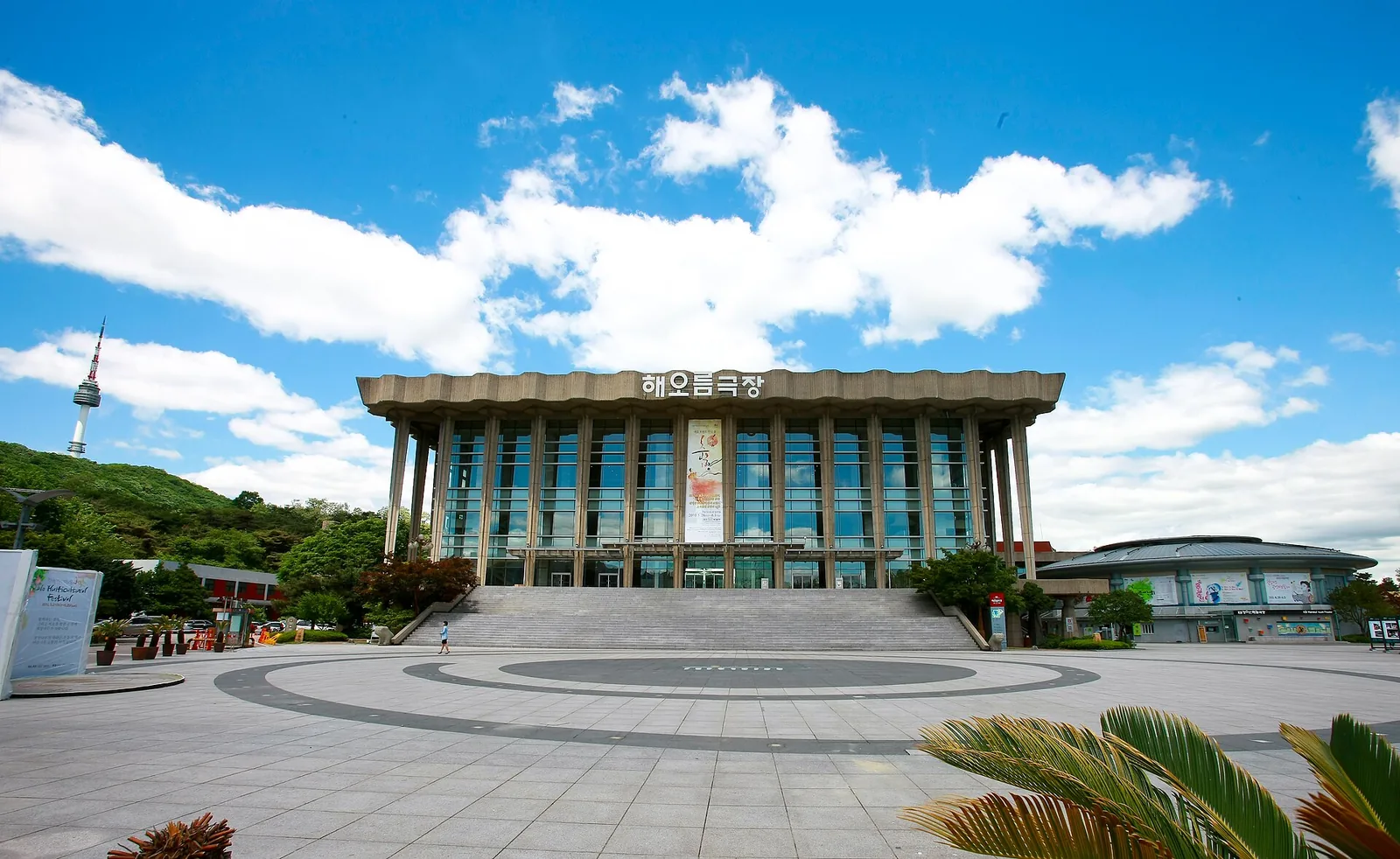
The Assassin(s) (2026) Review: The Real Distortion Is the Police, Not the KCIA — and Korean Film Money Follows the Government
The Assassin(s) (암살자(들)) review, and the money behind it. Hur Jin-ho’s film about the 1974 Liberation Day shooting that killed First Lady Yuk Young-soo opened on September 23, 2026 and was in a political fight within days. This report separates confirmed facts from claims: what the film really distorts, who paid for it, whether Chinese money is involved, how both parties apply double standards, how film money shifts with each administration, and how eight Korean film and content stocks actually moved. Data as of October 5, 2026 (stock prices as of October 2).
- The author’s take: imagining a KCIA mastermind is fair game for fiction; the real distortion is putting the police of that era on the side of justice, released in the week the Prosecutors’ Office was abolished (Oct 2, 2026).
- State-bank-linked money totals KRW 30.65 billion (IBK and KDB), 92.2% of it into producer Hive Media Corp (unrelated to HYBE); Mother Fund sub-funds put KRW 7.8 billion into the film.
- The Chinese-capital rumor rests only on 2023 reports of negotiations; no shared producer, fund or state-bank money was found with Joseon Exorcist, Mr. Queen or Snowdrop.
- Government money in the Mother Fund’s film account was cut 71.4% in the Yoon government’s first budget and raised 40.0% in the Lee Jae-myung government’s first; both parties judge films by whom they help.
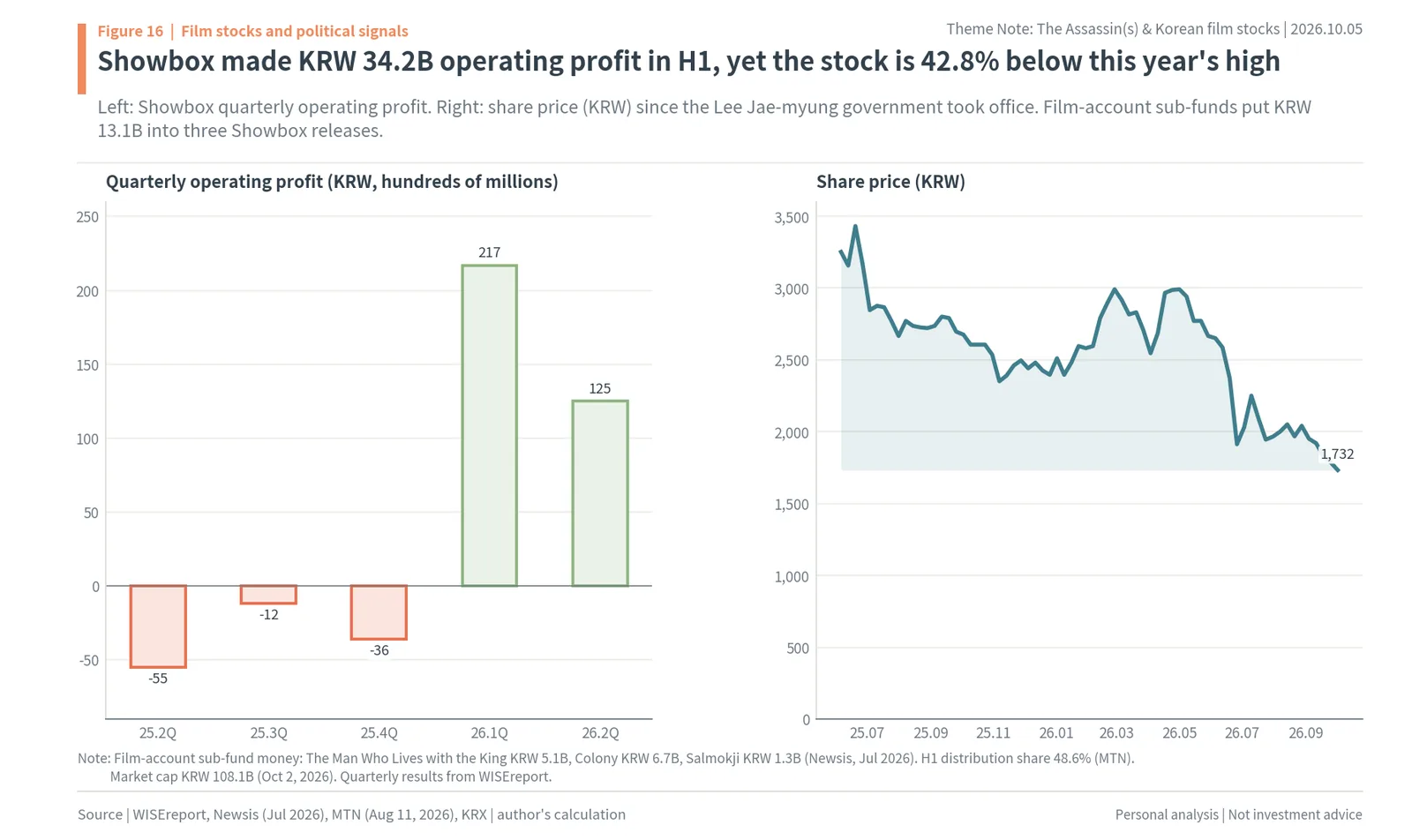
- Stocks: film stocks beat the index only 16 times out of 47 after progressive-side signals; Showbox earned KRW 34.2 billion in H1 operating profit yet trades 42.8% below this year’s high.
Key takeaways
- The author sees the real distortion not in imagining the KCIA as the mastermind but in putting the police of that era on the side of justice, and the Prosecutors’ Office was abolished 9 days after the film came out.
- The film received KRW 7.8 billion from government Mother Fund sub-funds and KRW 2.0 billion from IBK (Industrial Bank of Korea); film support rose 40.0% in a progressive government’s first year and fell 71.4% in a conservative government’s first year, so the author sees a structure that makes it easier for the film industry to shoot stories favoring the progressive side.
- However, film stocks beat the index only 16 times out of 47 after political signals, so for stocks the author looks first at Showbox, where policy money has shown up in earnings, rather than at the political theme.
As of: October 5, 2026
Ticker: Showbox (086980) and 7 other stocks
Reference close: KRX close on October 2, 2026
This is the author’s personal review and analysis.
The author’s calculations and estimates are not confirmed facts.
1. This is the detailed English edition of the author’s Korean report on The Assassin(s) (암살자(들)) and the government money behind Korean films.
2. The first set of questions is what in the film is a distortion, who paid for it, and whether its money overlaps with the Chinese money behind period dramas accused of distorting history.
3. The second set is what yardsticks politicians and the press used, and how film money and film stocks moved under each administration.
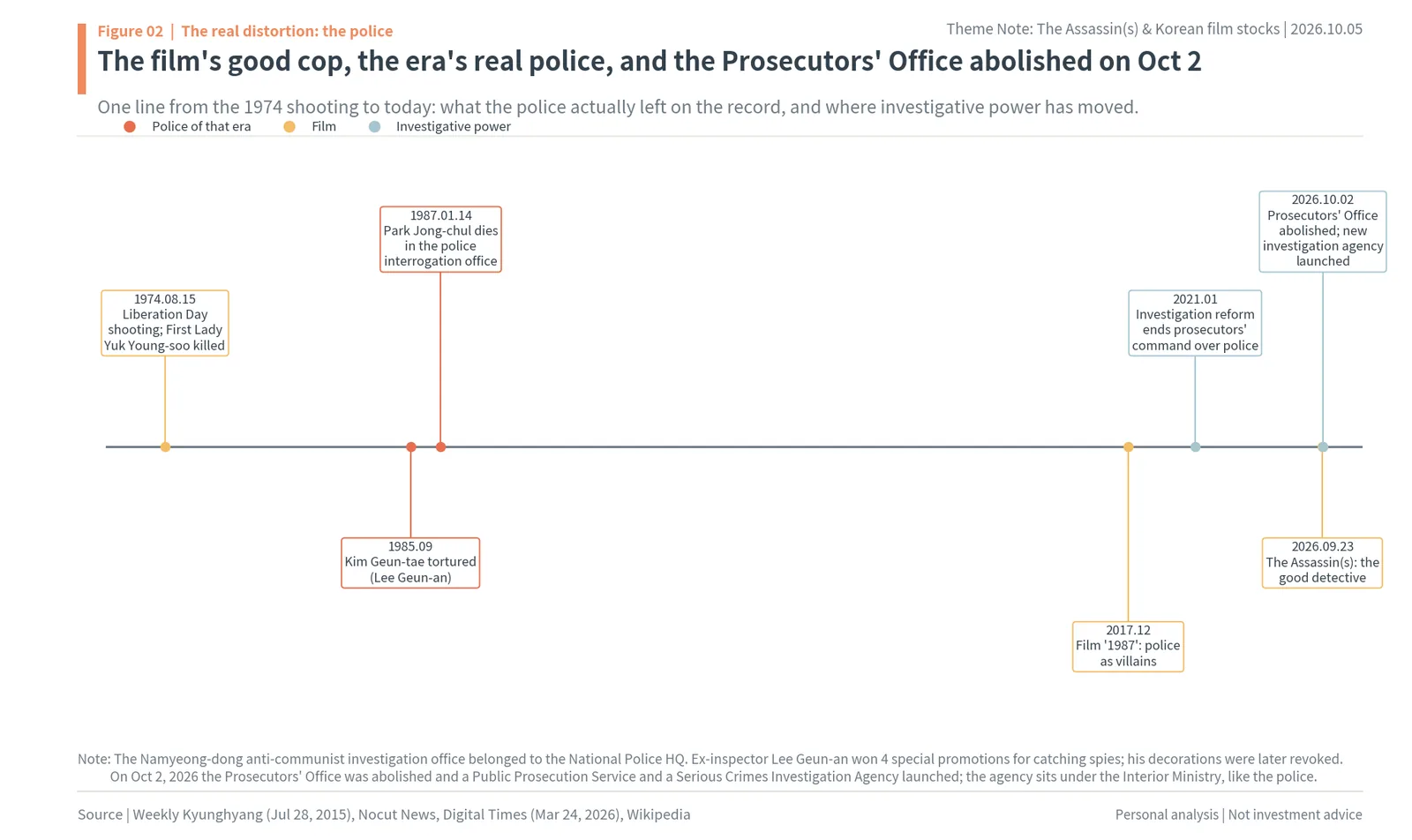
4. For the first four topics, facts confirmed by articles, court rulings and official investigations are written separately from one-sided claims.
5. The last part was calculated directly from the prices of 8 stocks from 2016 to October 2, 2026 (author’s calculation).
6. The political leanings of companies and people are reported only as far as their reported careers, and the author’s opinions are marked separately as judgments.
What Happened
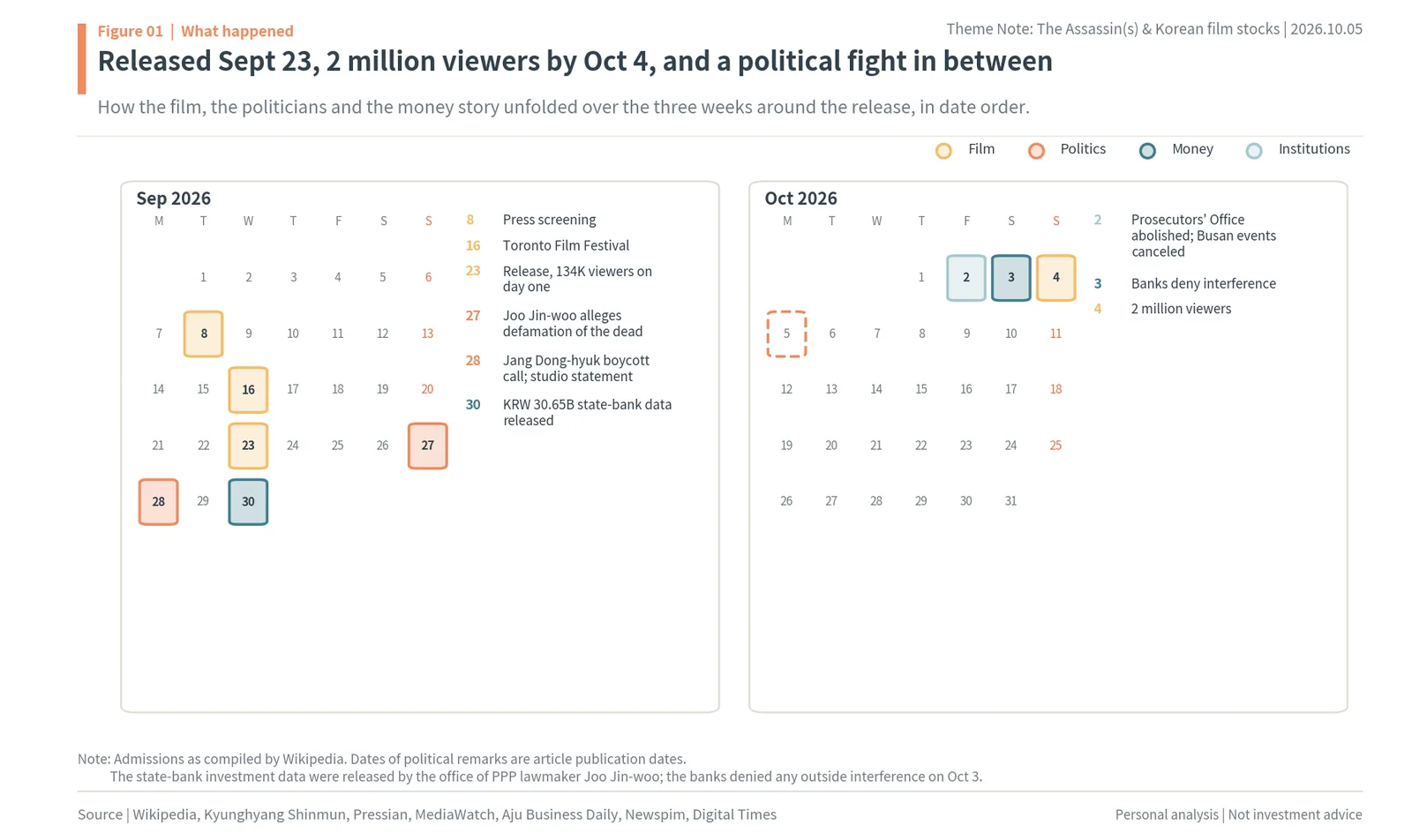
7. Director Hur Jin-ho’s The Assassin(s) (암살자(들)) opened on September 23, 2026 (Wikipedia).
8. It is the first Korean film about the shooting at the Liberation Day ceremony on August 15, 1974, in which First Lady Yuk Young-soo was killed.
9. Yoo Hai-jin plays Park Cheol-gu, a detective at the Jungbu Police Station, Park Hae-il plays a newspaper’s city desk chief, and Lee Min-ho plays a rookie reporter.
10. The three chase the parts that do not match the official record and come to suspect where the bullets came from and the upper ranks of the Korean Central Intelligence Agency (KCIA, 중앙정보부).
11. About 134,000 people saw it on opening day, it passed 1 million on day four, and it passed 2 million on October 4.
12. On September 27, Joo Jin-woo, a lawmaker of the conservative People Power Party (PPP), claimed the film defamed the dead, and the next day party leader Jang Dong-hyuk talked of a boycott (Pressian).
13. The same day, the filmmakers issued a statement saying “we do not define any particular person as the one behind the incident” (Kyunghyang Shinmun).
14. On September 30, data on investments by state-run banks were made public, and on October 2 the Busan International Film Festival opening-ceremony and stage-greeting events were canceled for “safety” reasons (Newspim).
15. The author does not take issue with imagining the KCIA as the mastermind, because it is material for a fiction film and audiences go in knowing that.
The Real Distortion, as the Author Sees It: The Police
16. What made the author uncomfortable is that Yoo Hai-jin’s detective stands on the side of justice from beginning to end.
17. The police of that era, as the author knows them, arrested and interrogated student activists in anti-communist investigations and simply followed the intelligence agency’s orders in political cases.
18. The Namyeong-dong anti-communist investigation office belonged to the National Police Headquarters (치안본부), in other words to the police (Weekly Kyunghyang).
19. On January 13, 1987, Seoul National University student Park Jong-chul was taken there, and he died the next day.
20. The police announced that “when we slammed the desk, he gasped and died,” but the medical examiner concluded he had suffocated from water torture.
21. Police inspector Lee Geun-an, who tortured Kim Geun-tae in 1985, received special promotions 4 times for catching spies (Seoul Shinmun).
22. The government later revoked 198 government decorations given to 167 people involved in state violence, including Lee Geun-an and Park Cheo-won (Nocut News).
23. That is why the police of this era were usually the villains in films such as 1987: When the Day Comes (1987) and National Security (남영동1985).
24. On October 2, nine days after this film came out, the 78-year-old Prosecutors’ Office (검찰청, headed by the Supreme Prosecutors’ Office) was abolished, and a Public Prosecution Service (공소청) and a Serious Crimes Investigation Agency (중수청) were launched (Digital Times).
25. The prosecution’s power to direct and supervise the police was abolished entirely, and the Serious Crimes Investigation Agency belongs to the Ministry of the Interior and Safety, the same ministry as the police.
26. The author believes the film’s real distortion is that it hung up, in large letters, the picture that ‘there were good detectives even back then’ in the very week investigative power moved from the prosecution toward the Interior Ministry.
27. Imagining who was behind it is the film’s freedom, but turning the organization that actually carried out torture into the side of justice is changing memory.
28. However, there is no evidence that anyone arranged for the release date and the abolition of the Prosecutors’ Office to line up, and this part is the author’s interpretation.
Who Paid for It
29. Hive Media Corp produced, presented and distributed the film all by itself.
30. Hive Media Corp is an unlisted company founded in April 2014 and has nothing to do with HYBE, the agency of BTS.
31. The government and public money that went into the film came through three main channels.
32. The first is money that state-run banks put in directly, the second is money that went through funds the state-run banks invested in, and the third is money from sub-funds of the film account of the government’s Mother Fund (모태펀드, a fund-of-funds run by Korea Venture Investment Corp).
KRW 30.65 Billion Linked to State-Run Banks
33. According to data released on September 30 by lawmaker Joo Jin-woo, the state-run Industrial Bank of Korea (IBK) put KRW 2.0 billion directly into the film on January 29 (Weekly Hankook).
34. A fund that the state-run Korea Development Bank (KDB) invested in also put KRW 0.4 billion into the film (MediaWatch).
35. On July 1, a fund with IBK participation put KRW 14.25 billion into the production company, and a fund with KDB participation put in KRW 14.0 billion.
36. The money that went to the film is KRW 2.4 billion, and the money that went to the production company is KRW 28.25 billion (author’s calculation).
37. In total that is KRW 30.65 billion, and 92.2% of it went into the company, not the film (author’s calculation).
38. By bank, the IBK side accounts for KRW 16.25 billion and the KDB side for KRW 14.4 billion (author’s calculation).
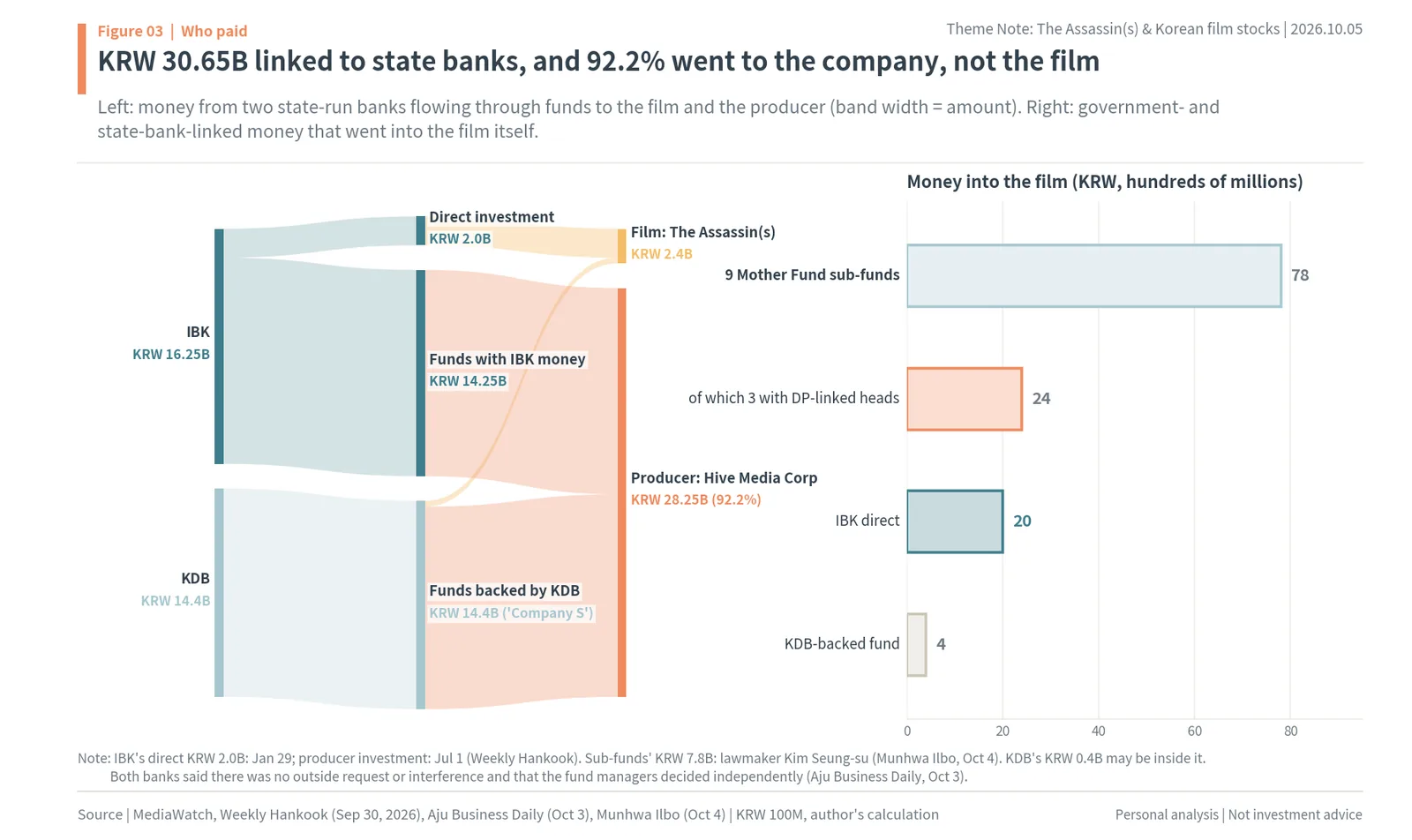
39. IBK said the investment went through “investment review by the dedicated department, the same as the existing procedure” (Aju Business Daily).
40. KDB said it was not a direct investment but a commitment to a fund, and that the fund manager, disclosed only as “Company S,” decided independently.
41. Joo is questioning how the investments were made in the parliamentary audit, pointing out that the KRW 2.0 billion was executed six days after the IBK CEO took office and that the KDB chairman and the president were college classmates (Pressian, MediaWatch).
42. Joo also claimed the investment was used to build a building near Hongik University, and the production company said this was untrue because “the investment came in July” (Herald Economy).
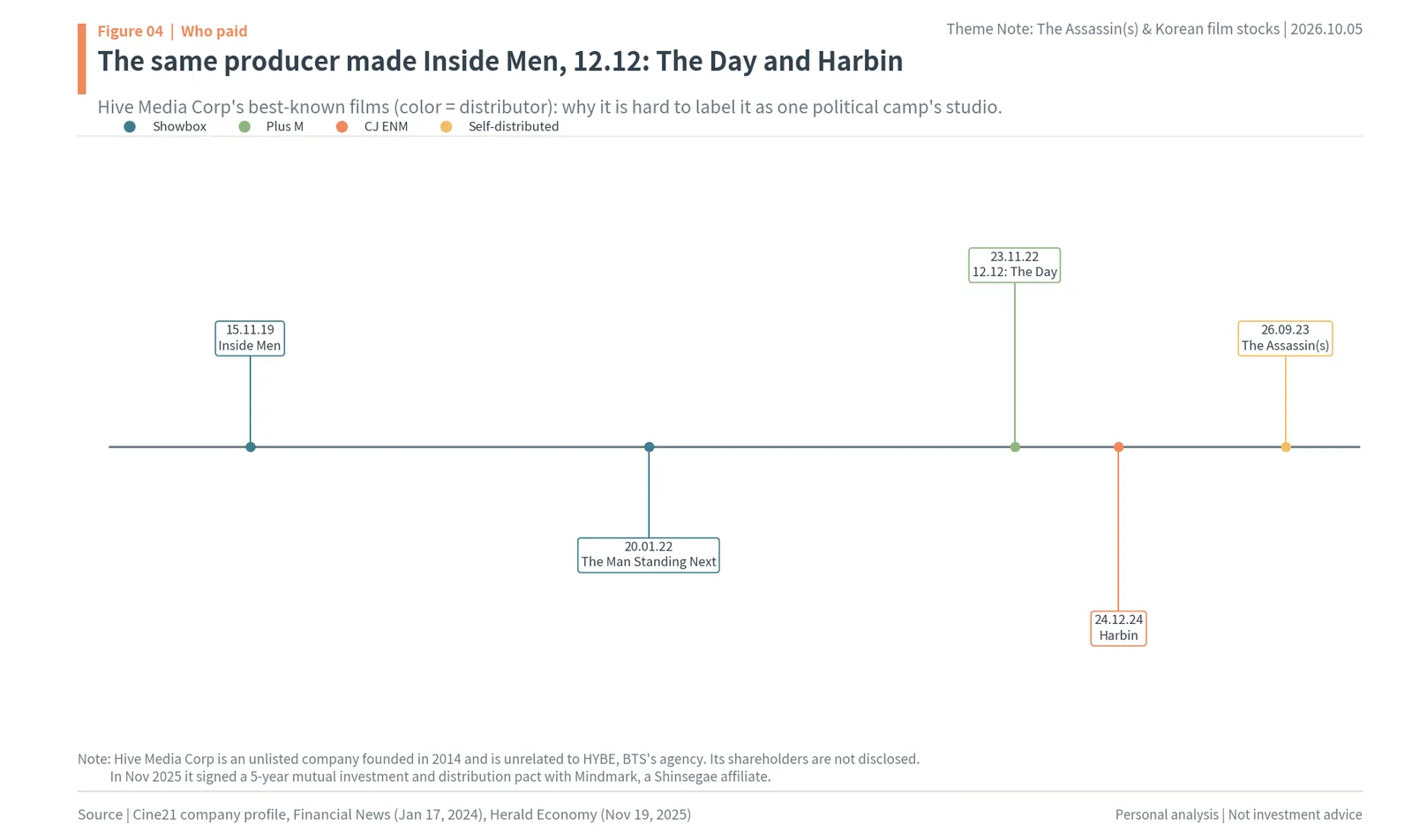
KRW 7.8 Billion from Mother Fund Film-Account Sub-Funds
43. According to data that PPP lawmaker Kim Seung-su obtained from Korea Venture Investment Corp, 9 sub-funds of the Mother Fund’s film account invested in the film (Munhwa Ilbo).
44. The investments were made from November 2025 to August 2026, totaling KRW 7.8 billion, at KRW 0.4 billion to 1.9 billion per deal.
45. The Mother Fund works by having the government put in money first and attaching private money to form funds, and its film account is filled from the budgets of the Ministry of Culture, Sports and Tourism and the Korean Film Council (KOFIC).
46. The government’s share in film-account sub-funds varies by year: 70% for the No. 1 fund in 2020 and 60% in 2026 (Hanmi Ilbo, Herald Economy).
47. Among the funds that invested in The Assassin(s), the one whose name is confirmed, Michigan Korean Film Main Investment Fund No. 2, has KRW 56.7 billion, of which KRW 34.0 billion is the government’s share (Dealsite).
48. This fund was formed in the first half of 2026, and its investment period runs to July 2031.
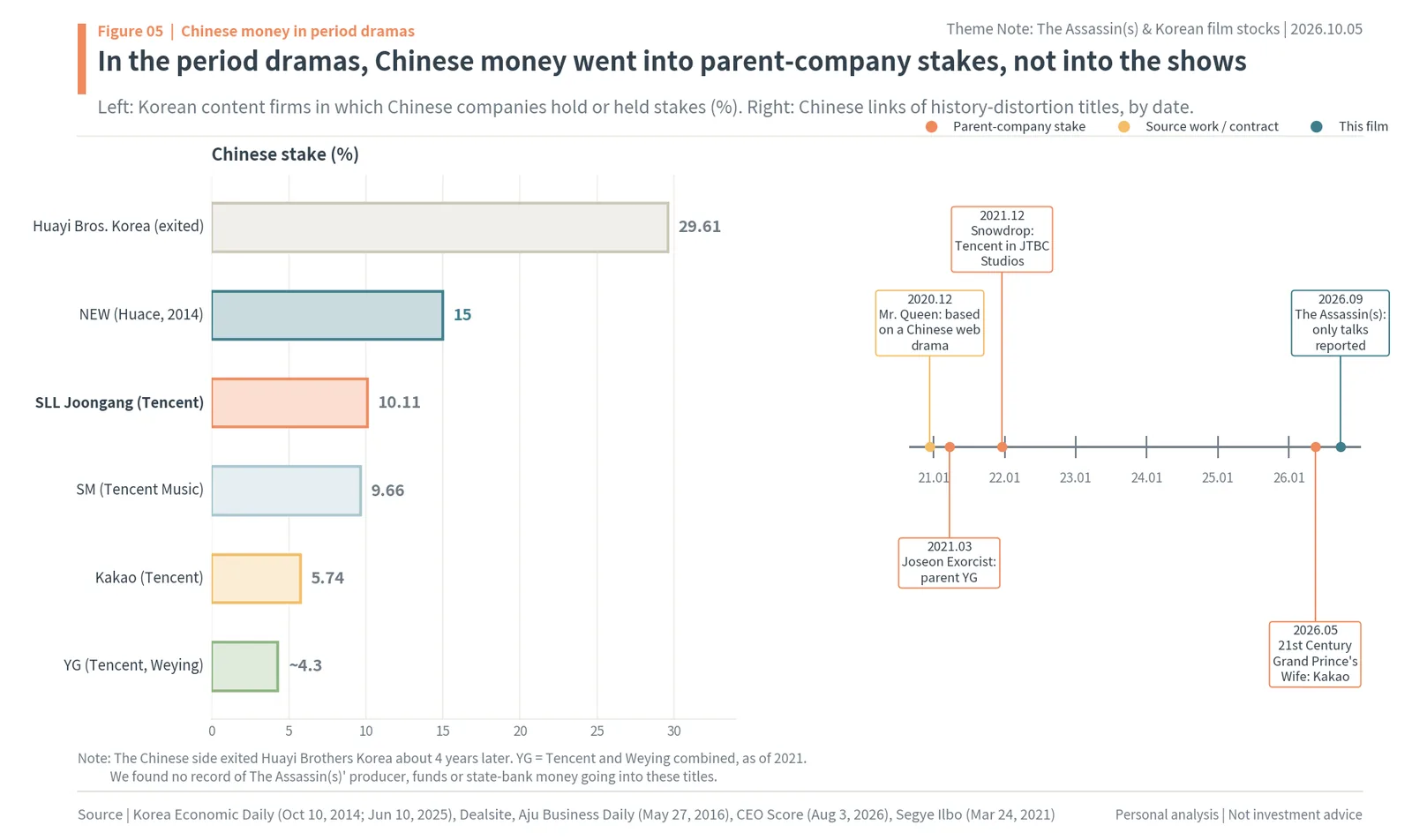
49. Who put in the remaining KRW 22.7 billion beyond the government’s share has not been disclosed (Hanmi Ilbo, author’s calculation).
50. Munhwa Ilbo reported that the heads of the three sub-funds that put in KRW 2.4 billion of the KRW 7.8 billion are “pro-Democratic Party figures,” referring to the ruling Democratic Party (DP).
51. The CEO of Ilshin Investment served on the Democratic Party’s Special Committee on New Growth.
52. The CEO of KC Ventures is a member of the investment subcommittee of the Popular Culture Exchange Committee, an advisory body under the president.
53. At Saltlux Ventures, the CEO of its parent company Saltlux served as vice chair of the Democratic Party’s AI Powerhouse Committee.
54. KRW 2.4 billion is 30.8% of KRW 7.8 billion, and the amounts by company were not disclosed (author’s calculation).
55. Korea Venture Investment said that “selecting individual investment targets and deciding whether to invest is the exclusive authority of the general partner.”
56. It has not been confirmed whether the KDB-backed fund’s KRW 0.4 billion is included in this KRW 7.8 billion, so the two figures were not added together.
57. Instead, leaving out the KRW 0.4 billion that may overlap, the government- and state-bank-related money that went into the film itself is at least KRW 9.8 billion (author’s calculation).
The Chinese-Capital Rumor and the Producer
58. The basis of the Chinese-capital rumor is a report that in October 2023 a consortium of Mirae Asset Securities PE and CLSA Capital negotiated an investment of about KRW 40 billion (The Bell).
59. CLSA is an affiliate of China’s CITIC Group, so this report became the starting point of the suspicion (Wikitree).
60. No record of an actual contract or of money coming in has been confirmed, and the production company said “there has been absolutely no inflow of Chinese capital” (New Daily).
61. Hive Media Corp’s shareholders are not disclosed, so this cannot be examined further with the data available now.
62. Hive Media Corp’s best-known films are Inside Men (내부자들), The Man Standing Next (남산의 부장들), 12.12: The Day (서울의 봄) and Harbin (하얼빈).
63. Inside Men and The Man Standing Next were distributed by Showbox, 12.12: The Day by Plus M, and Harbin by CJ ENM.
64. The same production company made both 12.12: The Day, which criticized the December 12, 1979 military coup, and Harbin, which portrays independence fighter Ahn Jung-geun.
65. So the grounds for pinning the company down as one camp’s studio are weak, and the author looks at the direction the money flows rather than at the company.
66. In November 2025 it also signed a five-year mutual investment and distribution agreement with Mindmark, a Shinsegae affiliate (Herald Economy).
Compared with the Chinese Money behind Period Dramas Accused of Distorting History
67. Period dramas that caused an uproar over distorting history were always followed by talk of Chinese money.
68. First, here is what the Chinese link was for each title.
The Chinese Link, Title by Title
69. Mr. Queen (철인왕후, tvN, December 2020) was made by Crave Works and YG Studioplex, and its original was the Chinese web drama Go Princess Go (태자비승직기).
70. When the original novelist’s anti-Korean remarks became known, the production team apologized, saying they “did not know,” but no evidence was found that Chinese money had been invested (Sports Kyunghyang).
71. Joseon Exorcist (조선구마사, SBS, March 2021) was a KRW 32 billion drama made by YG Studioplex, Crave Works and Lotte Cultureworks (Segye Ilbo).
72. After controversy over Chinese-style props and China’s Northeast Project (a Chinese state history project that claims ancient Korean kingdoms as Chinese regional history), advertisers pulled out and it was canceled after two episodes.
73. SBS said it was “domestic capital,” but Tencent and Weying had entered YG, the parent of the production company, in 2016 and held about 4.3% as of 2021 (Aju Business Daily).
74. The writer had signed a writing contract with China’s Hangzhou Jiaping Pictures just before the broadcast, which became controversial (TenAsia).
75. Lotte Cultureworks is a subsidiary of Lotte Shopping, so among the stocks in this report, Lotte Shopping shares a roof with a co-producer of Joseon Exorcist.
76. Snowdrop (설강화, JTBC, December 2021) was made by JTBC Studios and Drama House.
77. Tencent put KRW 100 billion into JTBC Studios in December 2020, and that remains today as a 10.11% stake in SLL Joongang (Korea Economic Daily).
78. JTBC said Tencent’s investment came after filming started and that Tencent did not interfere in the direction of the production.
79. 21st Century Grand Prince’s Wife (21세기 대군부인, MBC, 2026) drew controversy for giving the Northeast Project a pretext with a nine-tassel crown and a “cheonse” salute, both read as marks of a vassal king, and the production team apologized on May 16 (Sports Kyunghyang).
80. Kakao, on the co-producer’s side, has a 5.74% stake held by Tencent (CEO Score).
81. Going further back, NEW sold a 15% stake to China’s Huace Media for KRW 53.5 billion in October 2014 (Korea Economic Daily).
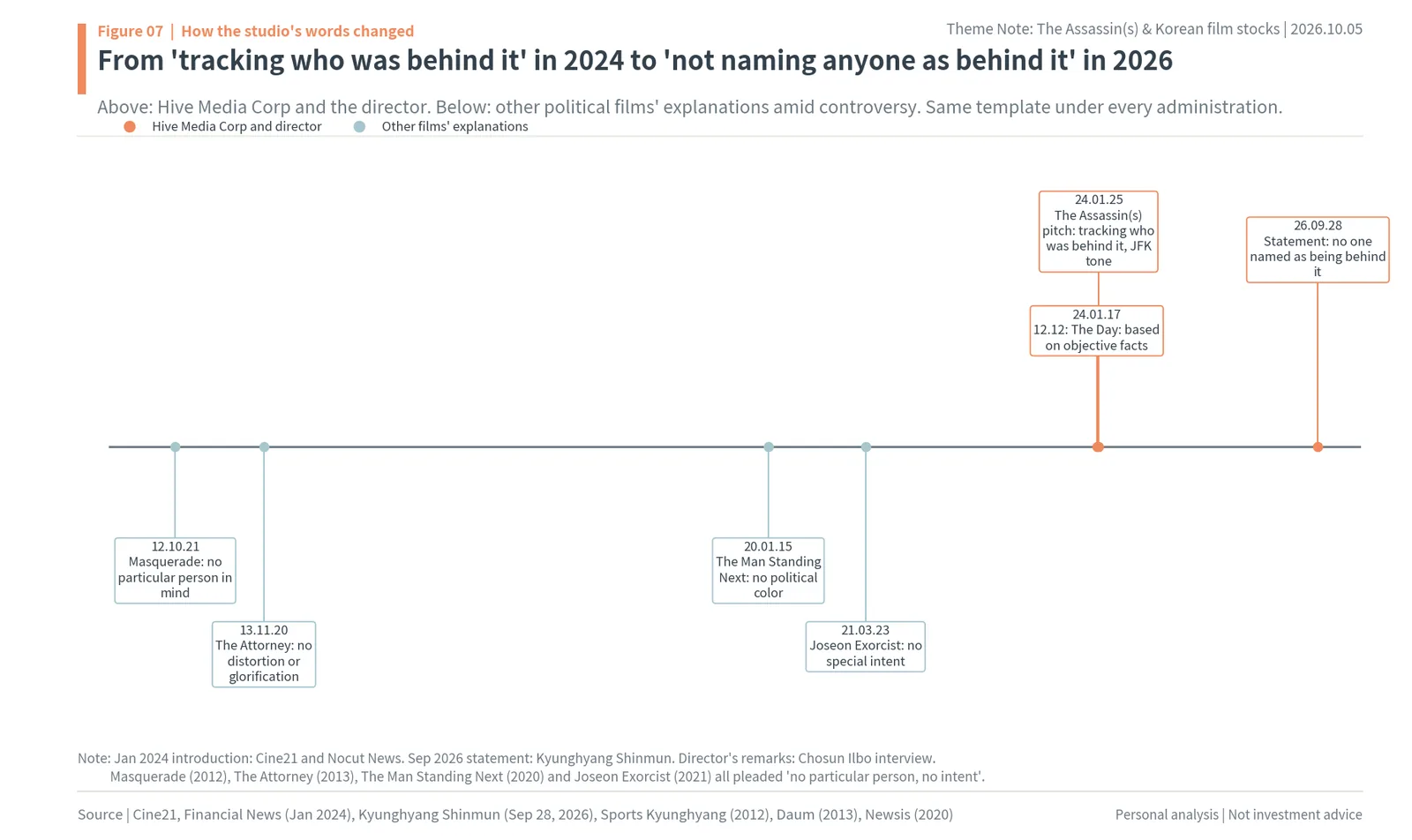
82. NEW distributed The Attorney (변호인) in December 2013, so the Huace money came in 10 months after The Attorney opened (Wikipedia, Korea Economic Daily).
83. At Huayi Brothers Korea, the Chinese Huayi side bought 29.61% in 2016 and pulled out about four years later (Dealsite).
84. In short, the Chinese money around these dramas mostly came in as stakes in the production companies’ parent companies, not directly into the works.
Do the Funding Sources Overlap with The Assassin(s)?
85. Next, the author checked on five points whether the funding sources of The Assassin(s) overlap with those of these dramas.
86. The points are the same production company, the same fund or manager, state-bank money, Mother Fund money, and what the Chinese link is.
87. The production companies did not overlap.
88. Hive Media Corp made none of these dramas, and none of the drama producers took part in The Assassin(s).
89. The funds could not overlap because of timing.
90. Among the funds in The Assassin(s), the one with a confirmed name, Michigan Korean Film Main Investment Fund No. 2, was formed in the first half of 2026, so it could not have gone into the 2020 and 2021 dramas (Dealsite).
91. Of the nine Mother Fund sub-funds, only Ilshin Investment, KC Ventures and Saltlux Ventures have been named in reports, and the other six have not been disclosed (Munhwa Ilbo).
92. The manager of the KDB-side fund has been disclosed only as “Company S,” so it was not possible to know whether this fund invested in other works.
93. No record was found of state-run banks or the Mother Fund investing in Joseon Exorcist, Mr. Queen or Snowdrop.
94. These dramas were often financed through broadcaster and OTT rights and sponsorship, so the author thinks this is partly why they left no investment-fund records the way films do.

95. So no record was found of the same production company, the same fund or the same state-bank money overlapping with these dramas.
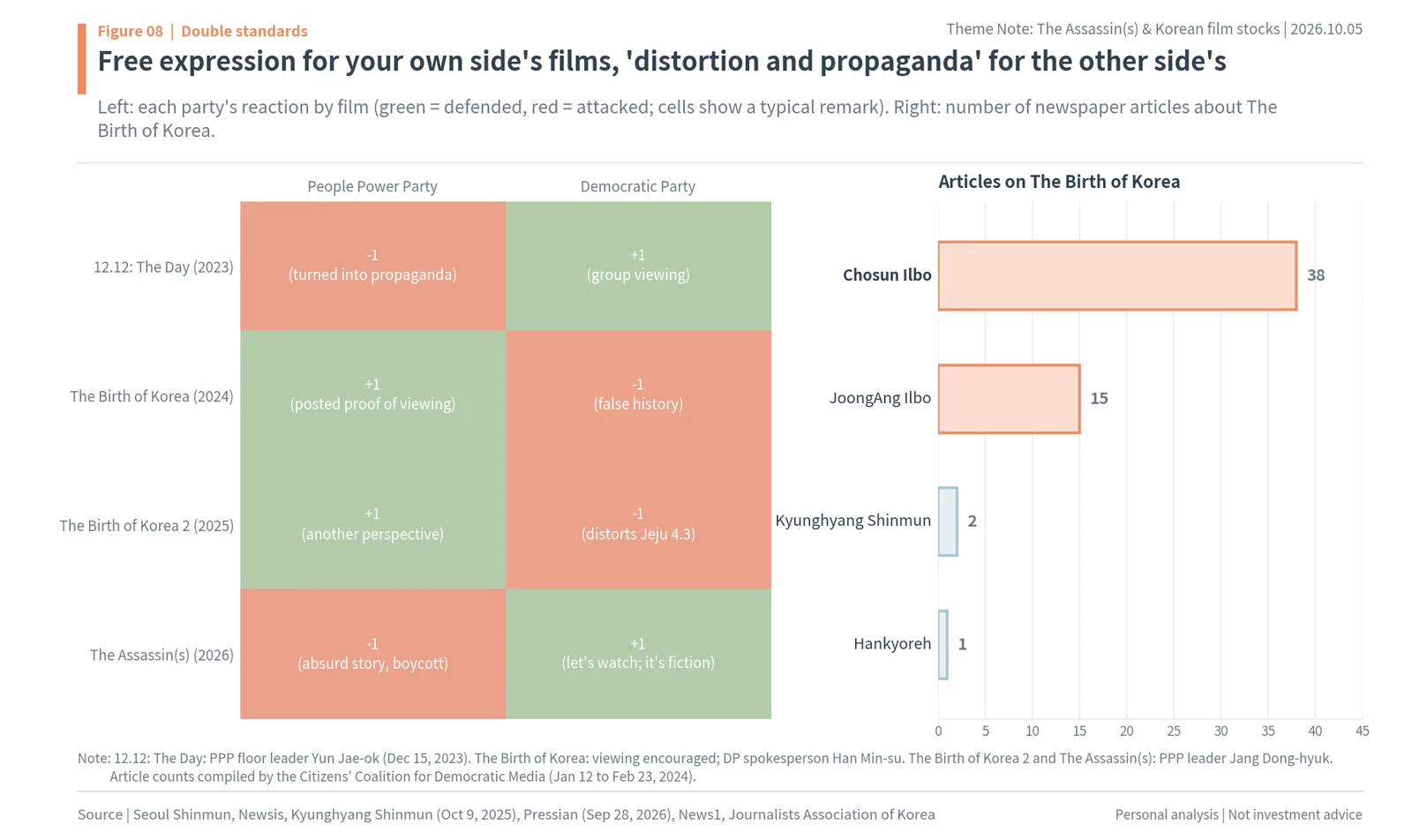
A Link One Step Removed
96. There is, however, a link one step removed.
97. JTBC Studios, which made Snowdrop, is today’s SLL Joongang, and Tencent is a shareholder with 10.11%.
98. SLL Joongang is making a prequel to Inside Men together with Hive Media Corp (Dealsite).
99. IBK, KC Ventures, Daekyo Investment, Michigan Venture Capital and TS Investment put a sum in the KRW 30 billion range into this prequel, and the amounts by company were not disclosed.
100. Of these, IBK, Michigan Venture Capital and KC Ventures are names that also appear among the funders of The Assassin(s).
101. In short, there is a business chain running “SLL Joongang, with Tencent as a shareholder – Hive Media Corp – IBK, Michigan and KC Ventures.”
102. But this is a relationship of making other works together, not evidence that Tencent money went into The Assassin(s).
103. What the author finds more noteworthy than Chinese money is that the same bank and the same managers repeatedly put money into several works by the same production company.
104. Michigan Venture Capital’s No. 1 fund put KRW 1.5 billion into 12.12: The Day, and the same company’s No. 2 fund went into The Assassin(s) (Hanmi Ilbo).
How the Studio’s Words Changed
105. In January 2024, Hive Media Corp introduced this film as one about “the process of tracking who was behind Mun Se-gwang, a second-generation Korean resident of Japan,” the gunman (Cine21).
106. In the same article, the company said the tone was “similar to Oliver Stone’s JFK,” a film about conspiracy theories around the Kennedy assassination.
107. The same month, CEO Kim Won-kuk said of 12.12: The Day that “our films are drawn based on objective facts” (Financial News).
108. When the controversy grew in September 2026, the filmmakers called it “a fiction film reconstructed with added cinematic imagination” (Kyunghyang Shinmun).
109. Director Hur Jin-ho said, “Looking back now, I wonder whether I should have made it clearer” (Chosun Ilbo interview).
110. Looking only at the framing of the explanations, it was always the same regardless of the administration.
111. In 2012, the director of Masquerade (광해) said “we did not have any particular person or issue in mind” (Sports Kyunghyang).
112. In 2013, the director of The Attorney said “there was no distortion or glorification of historical facts.”
113. In 2020, the director of The Man Standing Next said “it did not carry any political color” (Newsis).
114. In 2021, the makers of Joseon Exorcist also said “there was no special intention at all.”
115. The author thinks the studio did not change its words with the administration; rather, “tracking who was behind it” at the planning stage was toned down to “not naming anyone as behind it” after the controversy.
Double Standards in Politics and the Press
116. In politics, the same words were used in opposite ways depending on whose film it was.
117. Over Diving Bell (다이빙벨) in 2014, Busan Mayor Suh Byung-soo of the Saenuri Party (a predecessor of the PPP) demanded the screening be stopped, calling it “a work that could undermine political neutrality.”
118. The same year, President Park Geun-hye mentioned the flag-salute scene in Ode to My Father (국제시장) and talked about “love of country” (Dailian).
119. When the president watched 1987: When the Day Comes in 2018, Kim Seong-tae, floor leader of the Liberty Korea Party (another PPP predecessor), said “the media play has gone too far” (Insight).
120. Over 12.12: The Day in 2023, PPP floor leader Yun Jae-ok said the Democratic Party’s group viewings were “turning a popular film into a political propaganda film” (Seoul Shinmun).
121. Two months later, in 2024, the president recommended The Birth of Korea (건국전쟁) to his aides, and figures from the then-ruling party kept posting proof that they had seen it (Newsis).
122. At the time, the Democratic Party said “false history cannot become truth just because the president praises it.”
123. PPP leader Jang Dong-hyuk called The Birth of Korea 2 “another perspective on historical events” in October 2025 (Kyunghyang Shinmun).
124. In September 2026 the same Jang called The Assassin(s) “an absurd story” and talked of a boycott (Pressian).
125. This time the Democratic Party put freedom of expression first, with Park Jie-won saying “let’s go see it, it will be a huge hit” and Choi Min-hee saying “it’s fiction” (News1).
126. The press was similar: articles on The Birth of Korea numbered 38 in Chosun Ilbo, 15 in JoongAng Ilbo, 2 in Kyunghyang Shinmun and 1 in Hankyoreh (count by the Citizens’ Coalition for Democratic Media).
127. In the author’s view, both parties have judged films by ‘whom does it help’ rather than by their factual accuracy, and this time only the sides have switched.
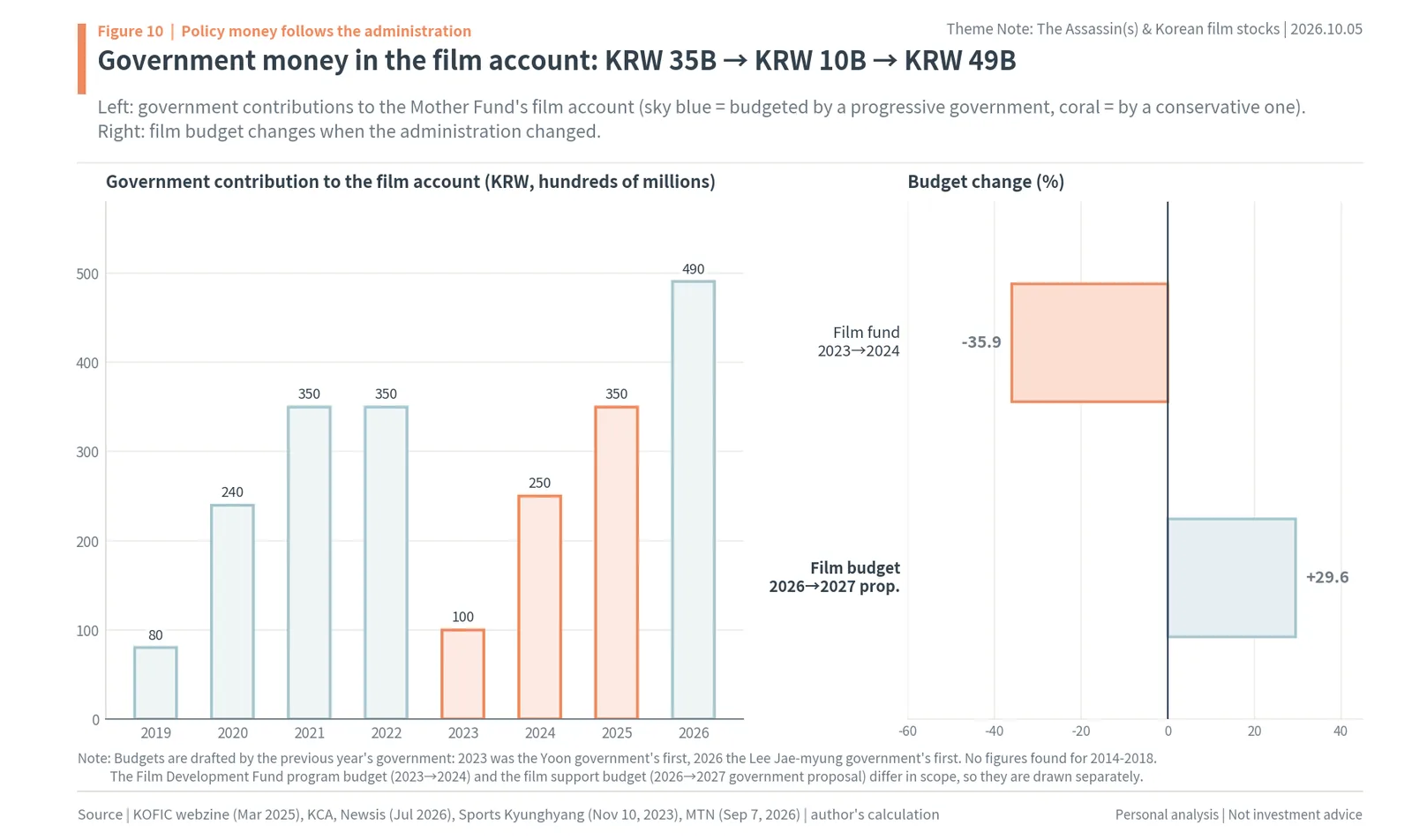
128. The only confirmed case of the same person using opposite yardsticks is Jang Dong-hyuk, and the rest is a party-level pattern.
129. The remark by Lee Ki-in of the Reform Party that “criticizing confirmed wrongdoing and pinning unconfirmed crimes on someone are different things” came closest to a standard.
CJ Was Not the Only One Pressured
130. The best-known case of an administration pressuring the film industry is the Park Geun-hye government’s pressure on CJ.
131. In July 2013, senior presidential secretary for economic affairs Cho Won-dong demanded that CJ Vice Chair Miky Lee step down, and he was found guilty at the first trial (Newsis).
132. In November 2014, President Park Geun-hye told CJ Chairman Sohn Kyung-shik that “CJ shows left-wing leanings” (Bizhankook).
133. CJ’s distribution of Masquerade and its review of an investment in The Attorney were cited as the background.
134. Those cases were simply buried under this big one, but similar things happened under other administrations.
135. The Roh Moo-hyun government cut the screen quota (the number of days a year cinemas must show Korean films) from 146 days to 73 ahead of the Korea-US FTA (VOA).
136. Under the Lee Myung-bak government, the National Intelligence Service (NIS) drew up a blacklist of 82 people in culture and the arts, including 52 film directors (Kyunghyang Shinmun).
137. In October 2025, the Seoul High Court recognized state liability for this blacklist, and the NIS gave up its appeal.
138. The Park Geun-hye government’s blacklist covered 9,473 people, and sentences of 2 years in prison for former chief of staff Kim Ki-choon and 1 year and 2 months for former culture minister Cho Yoon-sun were finalized (Seoul Shinmun, Newsis).
139. Support for the Busan International Film Festival, which screened Diving Bell, was cut from KRW 1.46 billion to KRW 0.8 billion (Pressian).
140. The same government also ran a whitelist that channeled KRW 6.8 billion to conservative groups through the Federation of Korean Industries (Dailian).
141. Under the Moon Jae-in government, the dismissal of KBS president Ko Dae-young was finalized as unlawful by the Supreme Court in 2023 (Journalists Association of Korea).
142. Former environment minister Kim Eun-kyung’s 2-year prison sentence was finalized over a blacklist used to force out heads of agencies under the environment ministry.
143. There were claims that the Moon government favored one side in the cultural sector or excluded conservative content, but nothing confirmed by a court ruling or official investigation was found.
144. In its 2024 budget proposal, the Yoon Suk Yeol government cut the Film Development Fund program budget from KRW 72.9 billion to KRW 46.7 billion, down 35.9% (Sports Kyunghyang, author’s calculation).
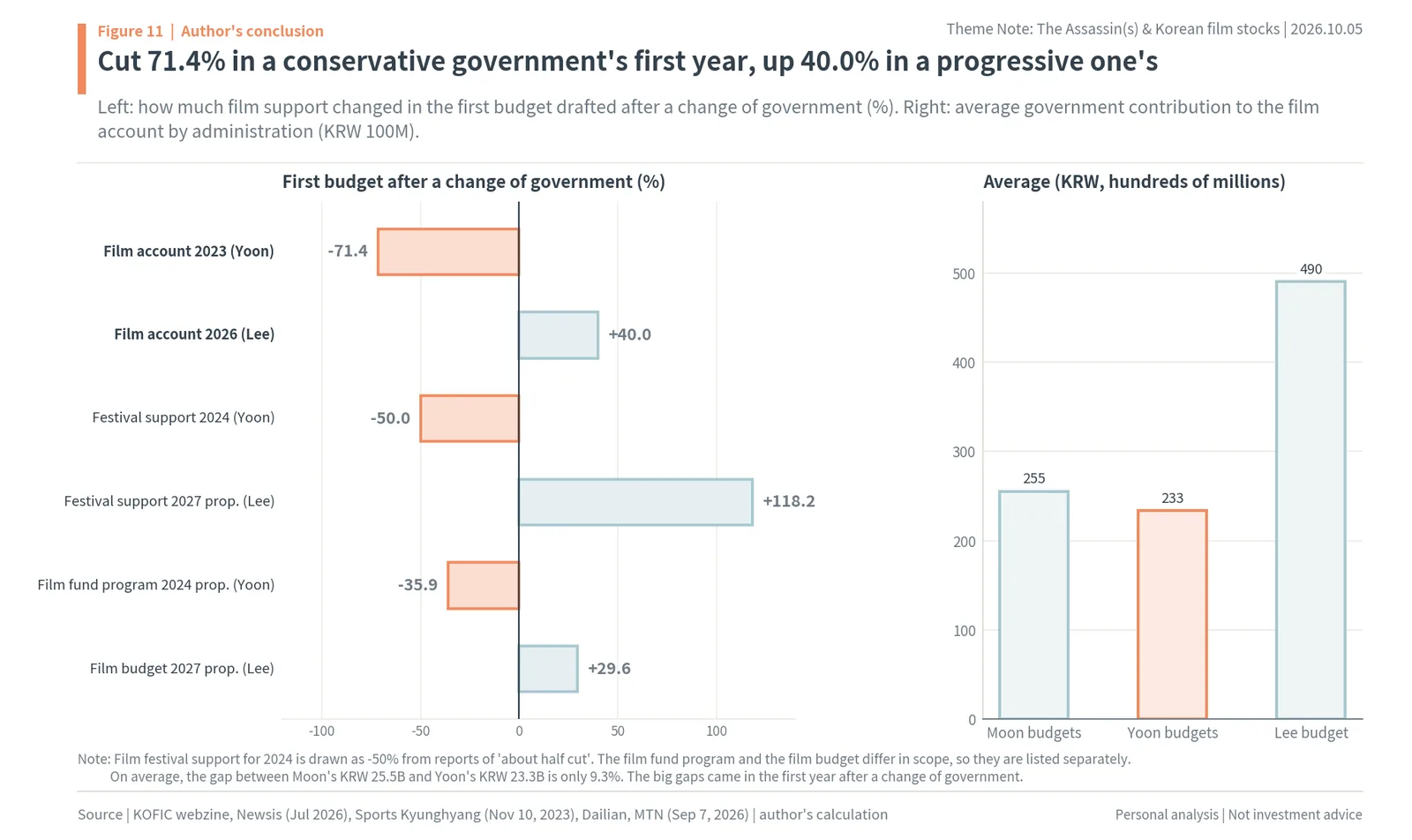
145. Film festival support was cut in half, independent film production support by 40%, and KRW 0.8 billion in regional film support went to zero.
146. The same government’s dismissal of KBS president Kim Eui-cheol was also overturned by a court in January 2025 (Journalists Association of Korea).
147. There were claims of a “blacklist revival,” but they were not confirmed by an official investigation.
148. The Lee Jae-myung government, by contrast, raised the 2027 film budget proposal from KRW 133.2 billion to KRW 172.6 billion, up 29.6% (MTN).
149. The ruling party amended the three broadcasting laws to increase KBS board members from 11 to 15, and conservatives claim the aim is to replace the KBS president (Newsis).
150. The current allegations about state-bank investment are still at the stage of claims by a lawmaker’s office.

151. Pressure on the cultural sector confirmed by court rulings or official investigations is concentrated in the Lee Myung-bak and Park Geun-hye governments, and dismissals of public broadcaster presidents were ruled unlawful under both the Moon Jae-in and Yoon Suk Yeol governments.
152. The case counts in the figure are the author’s count of selected representative cases, not a full survey.
Policy Money Changes Direction with the Administration
153. The main stream of Korean film investment is the Mother Fund’s film account, funded by the Ministry of Culture, Sports and Tourism.
154. When the government puts in money, private money is attached to form a fund, and that fund invests in films by the main investor-distributors.
155. Budgets are drafted by the previous year’s government, so 2023 was the Yoon Suk Yeol government’s first budget and 2026 the Lee Jae-myung government’s first.
156. The government contribution fell 71.4%, from KRW 35 billion in 2022 to KRW 10 billion in 2023 (KOFIC, author’s calculation).
157. It recovered to KRW 25 billion in 2024 and KRW 35 billion in 2025, and rose to KRW 49 billion in 2026 (Newsis).
158. By administration, the average is KRW 25.5 billion for budgets drafted by the Moon Jae-in government, KRW 23.3 billion for the Yoon Suk Yeol government and KRW 49 billion for the Lee Jae-myung government (author’s calculation).
159. Figures for 2014 to 2018 could not be found, so they were left out of the figure.
160. In 2026 the government’s share of contributions also rose from 50% to 60% (Herald Economy).
161. The KRW 49 billion in 2026 is split into KRW 34 billion for main investment in Korean films, KRW 8 billion for low- and mid-budget films and KRW 7 billion for animation (Dealsite).
162. This year, film-account sub-funds put KRW 5.1 billion into The Man Who Lives with the King (왕과 사는 남자), KRW 6.7 billion into Colony (군체) and KRW 1.3 billion into Salmokji (살목지), all distributed by Showbox (Newsis).
163. Cinema discount coupons were released twice, in May and July, for a total of 4.3 million (Herald Economy, author’s calculation).
164. Box-office revenue in the week after the first release rose 47.9% (MTN).
165. IBK’s cultural content investment also grew from KRW 31.2 billion in 2023 to KRW 54.9 billion in 2025 (The Fact).
166. Conservative governments’ support took a different route.
167. With the 2023 tax law revision, the tax credit for video content production costs rose from 3% to 5% for large companies (Newsis).
168. It rose from 7% to 10% for mid-sized companies and from 10% to 15% for small and medium-sized companies.
169. The K-Content and Media Strategic Fund started with KRW 600 billion in 2024 and targets KRW 1.02 trillion by 2028 (Aju Business Daily).
170. In short, progressive governments put their weight on cinemas and on investment and distribution of Korean films, while conservative governments put theirs on tax credits and OTT and IP funds.
The Author’s Conclusion: When the Money Tilts, the Stories Tilt
171. The author regroups the film money confirmed in this report by administration.
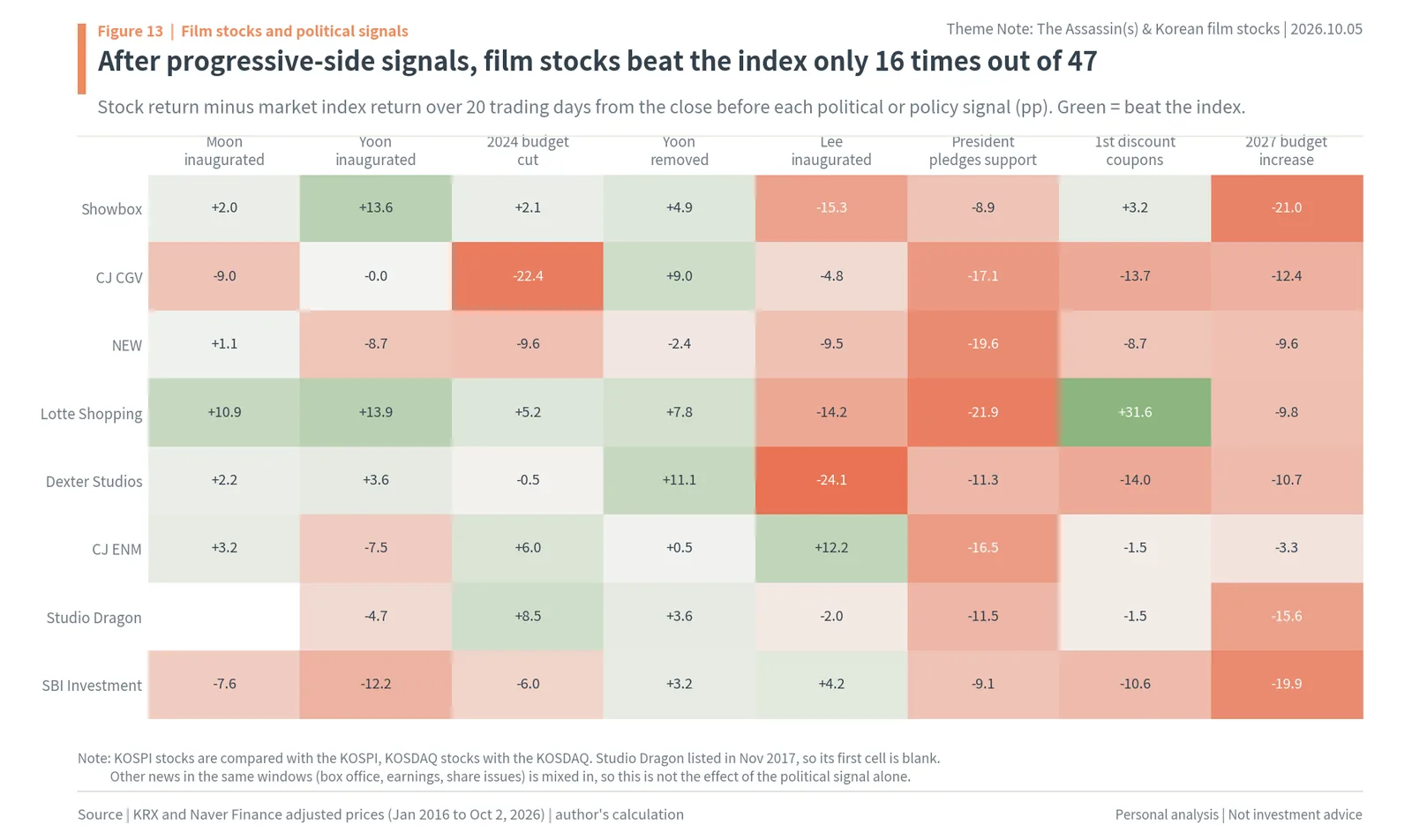
172. The difference is clearest in the first year after a change of government.
173. In the Yoon Suk Yeol government’s first budget (2023), the government contribution to the film account fell 71.4%, from KRW 35 billion to KRW 10 billion (author’s calculation).
174. In the Lee Jae-myung government’s first budget (2026), it rose 40.0%, from KRW 35 billion to KRW 49 billion (author’s calculation).
175. Film festival support was cut by about half in 2024, and in the 2027 budget proposal it rose 118.2%, from KRW 4.4 billion to KRW 9.6 billion (Dailian, MTN, author’s calculation).
176. The Film Development Fund program was cut 35.9% in the 2024 budget proposal, and the film budget rose 29.6% in the 2027 budget proposal (Sports Kyunghyang, MTN).
177. By administration averages, the gap between KRW 25.5 billion in Moon-government budgets and KRW 23.3 billion in Yoon-government budgets is 9.3%, smaller than one might think (author’s calculation).
178. The difference opened up in the first budget right after a change of government, and the author sees this as the clearest signal an administration sends to the film industry.
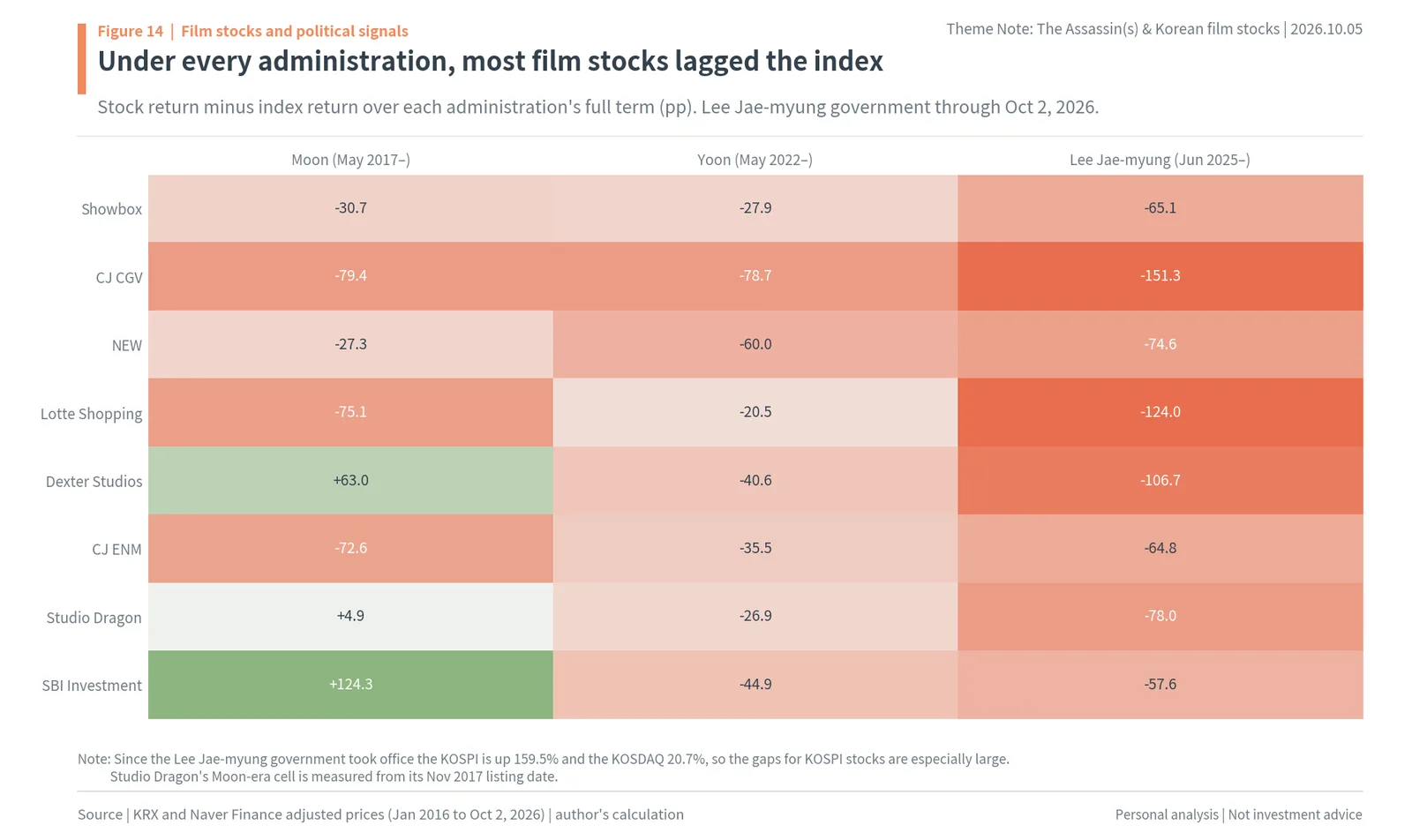
179. The timeline of the money behind The Assassin(s) looks the same.
180. The October 2023 report of investment talks with the CLSA consortium and the January 2024 unveiling of the project came under the Yoon Suk Yeol government (The Bell, Cine21).
181. Government and state-bank money began to come in from November 2025, five months after the Lee Jae-myung government took office (Munhwa Ilbo).
182. IBK’s KRW 2.0 billion came in on January 29, 2026, the funds’ KRW 28.25 billion on July 1, and the Mother Fund sub-funds’ KRW 7.8 billion in installments through August (Weekly Hankook, Munhwa Ilbo).

183. For the same producer’s 12.12: The Day, Michigan’s No. 1 fund, set up in 2020 under the Moon Jae-in government with a 70% government share, put in KRW 1.5 billion (Hanmi Ilbo).
184. 12.12: The Day opened in November 2023, after the change of government, and drew 13.12 million viewers (MTN).
185. That film also took 32 months from the unveiling of the project to its release (author’s calculation).
186. Since a film takes years from planning to release, the author thinks producers have little choice but to pick stories with an eye on the administration that will be in power when the money comes in, and on the money likely to be available then.
187. So the author believes progressive governments release more money to the film industry, and the industry ends up making more of the stories that attract that money, that is, stories favorable to progressive governments.
188. To the author, the fact that this film, which portrays the police kindly, came out in the week investigative power changed hands also looks like part of the same flow.
189. It also fits this flow that, among the sub-funds holding government money, those whose heads have served on Democratic Party committees or a presidential advisory body put in KRW 2.4 billion (Munhwa Ilbo).
190. Conservative governments bear responsibility too.
191. The Lee Myung-bak and Park Geun-hye governments’ blacklists are confirmed by court rulings, and the author thinks the wariness toward conservative governments among the filmmakers who went through them is another reason the film industry has tilted to one side.
192. Evidence to the contrary is noted here as well.
193. The same production company made Harbin, and Ode to My Father, which conservatives welcomed, was distributed by CJ (Wikipedia).
194. Korea Venture Investment has explained that investment decisions are the exclusive authority of the fund managers, and no evidence has yet emerged that the heads’ political careers drove the investment decisions.
195. So the author thinks it is right to say “when the money tilts, the stories tilt,” not “the administration decides what films say.”
196. In the author’s view, if the administration changes again, the direction of this money is likely to change again too, and the first to be shaken would be the distributors that rely on film-account money.
197. How those distributors actually moved in the stock market is checked in the next chapter.
How Film Stocks Moved on Political Signals
198. The author checked prices from January 2016 to October 2, 2026 to see whether film stocks followed when policy money changed.
199. The eight stocks are Showbox, CJ CGV, NEW, Lotte Shopping (Lotte Cultureworks), Dexter Studios, CJ ENM, Studio Dragon and SBI Investment.
200. SBI Investment was included because it is a listed venture capital firm that received KRW 20 billion as a co-manager for the Mother Fund’s culture technology field in 2026 (Dealsite).
201. Film-account managers such as Michigan Venture Capital are all unlisted, so they could not be included.
202. There are eight signals: Moon Jae-in’s inauguration, Yoon Suk Yeol’s inauguration, the 2024 budget cut proposal, President Yoon’s removal from office, Lee Jae-myung’s inauguration, the president’s remarks pledging support, the first discount coupons and the 2027 budget increase proposal.
203. For each signal, the index return was subtracted from the stock return over the 20 trading days from the previous day’s close (author’s calculation).
204. The pp (percentage point) figures below are that difference, so a plus means the stock rose more than the index, and KOSPI stocks were compared with the KOSPI and KOSDAQ stocks with the KOSDAQ.
205. After the six signals pointing to more money for the progressive side, film stocks beat the index only 16 times out of 47 (author’s calculation).
206. In the 20 trading days after Yoon Suk Yeol’s inauguration, Showbox actually beat the index by 13.6pp and Lotte Shopping by 13.9pp (author’s calculation).
207. After Lee Jae-myung’s inauguration, Dexter lagged the index by 24.1pp and Showbox by 15.3pp (author’s calculation).
208. After the 2027 budget increase proposal came out on September 7, Showbox lagged the index by 21.0pp (author’s calculation).
209. Looking at each administration’s whole term rather than single signal days, the results were similar.
210. Most of the eight stocks underperformed the index under all three governments, Moon Jae-in, Yoon Suk Yeol and Lee Jae-myung (author’s calculation).
211. The exceptions were Dexter, SBI Investment and Studio Dragon under the Moon government.
212. Since June 2, 2025, just before the Lee Jae-myung government took office, the KOSPI has risen 159.5% and the KOSDAQ 20.7% (author’s calculation).
213. Over the same period, all 8 film stocks lagged far behind their respective market indexes (author’s calculation).
214. On average after progressive-side signals, only Lotte Shopping beat the index, by 0.7pp, and all the rest lagged (author’s calculation).
215. The author thinks the media business cycle weighed on the stocks far more than the administration did.
216. Broadcast advertising revenue fell 12.3% in 2025, and CJ ENM’s Q2 TV advertising fell 19.2% (Nate News).
217. Studio Dragon also plunged on news of a block sale of its shares by CJ ENM (Edaily).
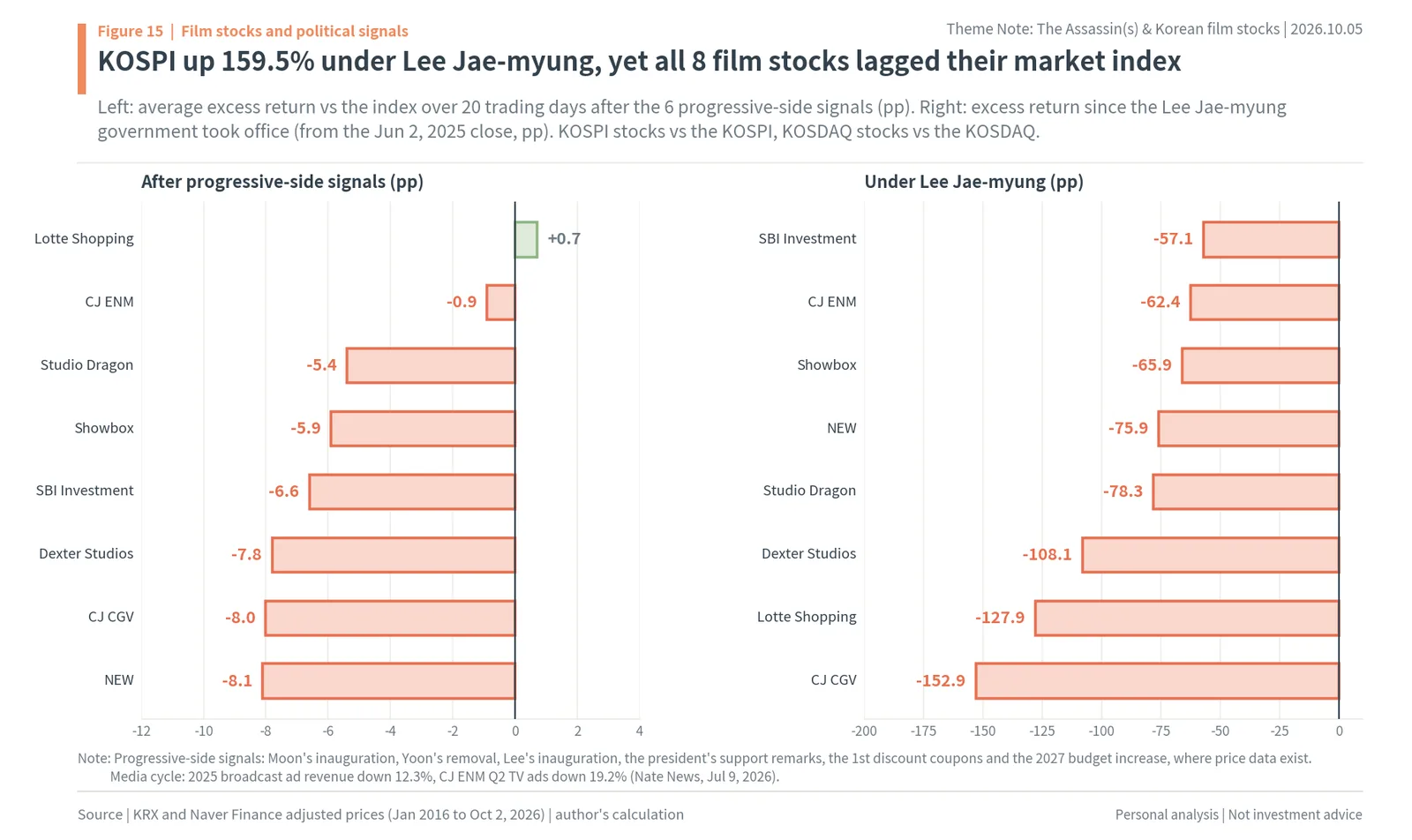
218. The conclusion is that even if more money from progressive governments goes into the film industry, the label “film stocks that benefit from the administration” is not borne out by share prices.
219. So rather than buying on a political theme, the author looks first at where policy money has actually shown up in earnings.
220. At Showbox, KRW 13.1 billion of film-account sub-fund money went into three of its releases (Newsis, author’s calculation).
221. Its quarterly operating profit turned from KRW -5.5 billion in Q2 2025 to KRW 21.7 billion in Q1 2026 and KRW 12.5 billion in Q2 (WISEreport).
222. First-half operating profit was KRW 34.2 billion, well above last year’s full-year loss of KRW 11.7 billion (author’s calculation).
223. Its first-half distribution market share was 48.6% (MTN).
224. Yet the share price of KRW 1,732 is 42.8% below this year’s high of KRW 3,030, and the market cap is KRW 108.1 billion (author’s calculation).
225. CJ CGV posted operating profit of KRW 11.5 billion in Q2, when the discount coupons were released (WISEreport).
226. Even so, the broker consensus sees net losses continuing, with EPS of KRW -194 this year and KRW -135 next year (WISEreport).
227. The policy benefit has reached operating profit but not yet net income.
228. The forward P/E shows how many times this year’s expected earnings the share price is.
229. CJ ENM, which the author sees as less likely to be hurt by a change of government, trades at a 2026 forward P/E of 15.9x on EPS of KRW 2,212 (WISEreport, author’s calculation).
230. Studio Dragon is at 17.2x on EPS of KRW 1,187 (WISEreport, author’s calculation).
231. Lotte Shopping is at 8.5x on EPS of KRW 12,003, but cinemas are a small part of it, so its core retail business drives the share price.

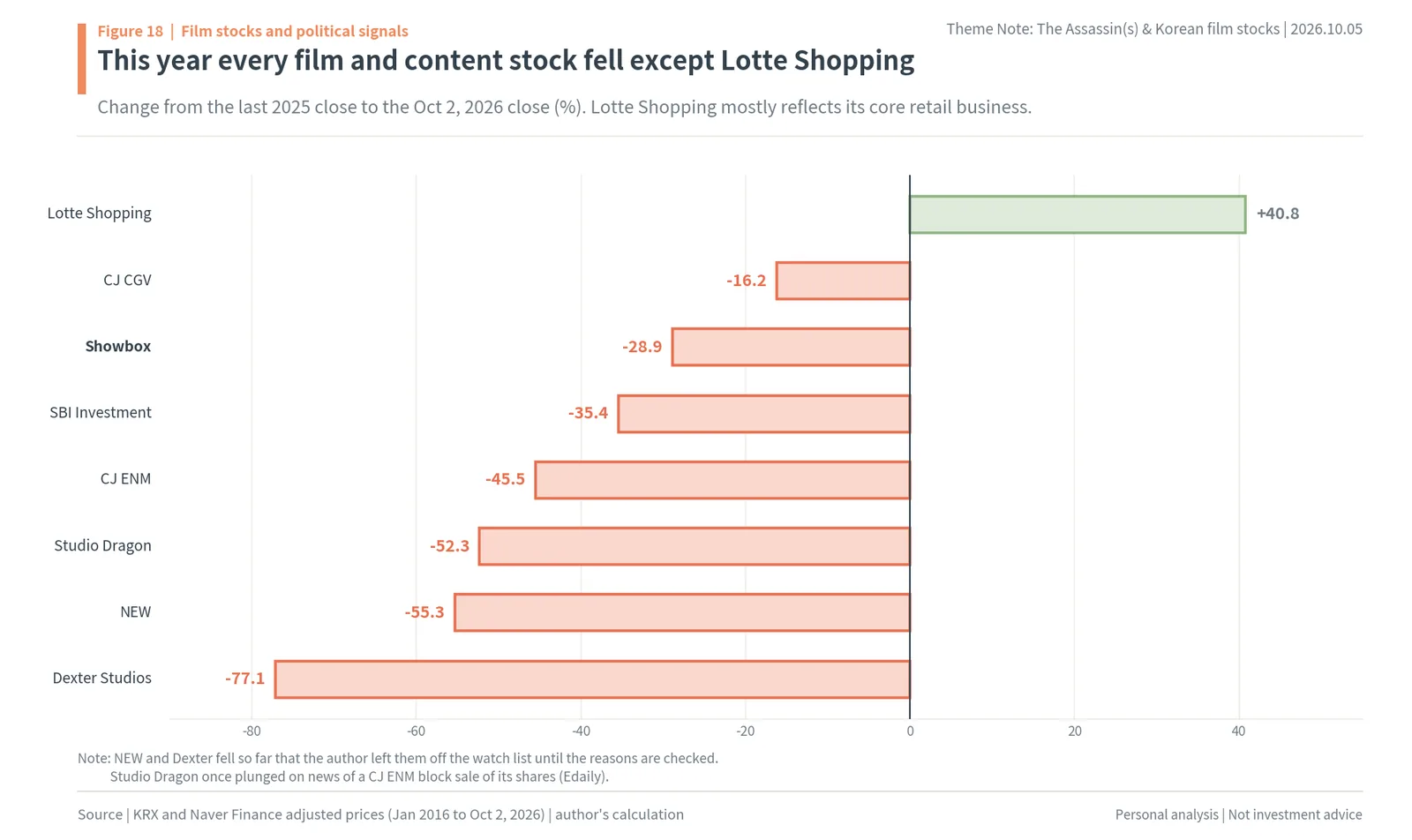
232. This year only Lotte Shopping rose, by 40.8%, and the other seven all fell (author’s calculation).
233. NEW fell 55.3% and Dexter 77.1%, and since the author could not confirm all the reasons this time, they were left off the author’s list.
The Author’s Watch Order
234. The author scored the stocks on four criteria.
235. The criteria are whether policy money goes in directly, whether earnings have turned around, whether the share price has yet to reflect it, and whether the stock holds up when the government changes.
236. Showbox scores highest on the first three, but if the government shifts back to the conservatives, it could be hurt first because it relies on film-account money.
237. The 71.4% cut in the government contribution to the film account in 2023, from KRW 35 billion to KRW 10 billion, is an example (author’s calculation).
238. CJ CGV gets a middle score, since it benefits from the discount coupons but net losses are still expected.
239. CJ ENM and Studio Dragon are far from film policy money, but they sit on the side of conservative governments’ tax credits and OTT support, so they have more staying power when the government changes.

240. The author’s watch order under the current government is Showbox, then CJ CGV, with CJ ENM and Studio Dragon watched alongside in case the government changes.
241. This judgment would be wrong if the parliamentary audit confirms outside pressure behind the state-bank investments, if the National Assembly cuts the 2027 film budget sharply, or if the box office of Showbox’s second-half releases falters.
242. Things to check are the parliamentary audit’s questioning on how the state-bank and Mother Fund investments were made, the National Assembly’s year-end finalization of the 2027 film budget, the first 2027 film-account contribution announcement, and Showbox’s and CGV’s quarterly results.
Maochaedung’s take
What caught the author in The Assassin(s) was not the setup of the KCIA as the mastermind but the scenes that put the police of that era on the side of justice, and even if it was a coincidence, it bothered the author that this picture went up in large letters in the very week the Prosecutors’ Office closed its doors. Following the money, the film received KRW 7.8 billion from Mother Fund sub-funds and KRW 2.0 billion from IBK, and film support rose in a progressive government’s first year and was cut in a conservative government’s first year. In the author’s view, the structure is that money flows more freely under progressive governments, so the film industry ends up making more stories favorable to that side. However, no funding source directly overlapped with the Chinese money behind the period dramas, both parties have shielded only their own side’s films, and film stocks moved on the business cycle and the box office rather than on political signals, so for stocks it makes sense to start with the companies where policy money has shown up in earnings.
The Assassin(s) FAQ
Q. What is The Assassin(s) (암살자(들)) about?
Hur Jin-ho’s film, released on September 23, 2026, is the first Korean film about the August 15, 1974 Liberation Day shooting in which First Lady Yuk Young-soo was killed. A detective (Yoo Hai-jin) and two journalists (Park Hae-il, Lee Min-ho) chase gaps in the official record and come to suspect the upper ranks of the KCIA. It passed 2 million viewers on October 4.
Q. Why does the author say the real distortion is the police, not the KCIA?
Imagining a KCIA mastermind is a fiction film’s freedom, but the film keeps a detective of that era on the side of justice, while the real police of the time ran anti-communist interrogations, including the 1987 torture death of Park Jong-chul at a police office. The film came out in the week the Prosecutors’ Office was abolished (October 2, 2026); the author says linking the two is the author’s own interpretation.
Q. How much government money went into The Assassin(s)?
Data released by People Power Party lawmakers show KRW 30.65 billion linked to state-run banks IBK and KDB, 92.2% of which went to the producer Hive Media Corp rather than the film, plus KRW 7.8 billion from nine Mother Fund film-account sub-funds. Money into the film itself was at least KRW 9.8 billion. The banks denied outside interference, and Korea Venture Investment said fund managers make investment decisions.
Q. Is there Chinese money in The Assassin(s)?
Not confirmed. The rumor comes from a 2023 report that a consortium of Mirae Asset Securities PE and CLSA Capital (a CITIC Group affiliate) negotiated a KRW 40 billion investment, but no contract or payment has been confirmed and the producer denies it. The only link found is one step removed: Tencent-backed SLL Joongang is making an Inside Men prequel with Hive Media Corp.
Q. Is Hive Media Corp related to HYBE (BTS)?
No. Hive Media Corp is an unlisted film company founded in April 2014 and has nothing to do with HYBE. It also made Inside Men, The Man Standing Next, 12.12: The Day and Harbin.
Q. Do Korean film stocks rise under progressive governments?
Not by the author’s calculation. After six progressive-side signals, film stocks beat their index only 16 times out of 47 over 20 trading days, and all eight lagged their index since June 2, 2025 while the KOSPI rose 159.5%. The author’s watch order is Showbox and CJ CGV under the current government, with CJ ENM and Studio Dragon in case the government changes. This is not investment advice.
Sources
- Wikipedia (Korean), The Assassin(s) (link), checked 2026.10.04
- Kyunghyang Shinmun, statement by the makers of The Assassin(s) (link), 2026.09.28
- Chosun Ilbo (via Daum), interview with director Hur Jin-ho (link), 2026.09.28
- Cine21, Hive Media Corp line-up (link), 2024.01.25
- Financial News, interview with Hive Media Corp CEO Kim Won-kuk (link), 2024.01.17
- Weekly Kyunghyang, from the Namyeong-dong anti-communist office to Yonsei University (link), 2015.07.28
- Nocut News, government decorations of Lee Geun-an, Park Cheo-won and others revoked (link), 2020
- Digital Times (via Daum), Prosecutors’ Office to be abolished on Oct 2 as the Public Prosecution Service and Serious Crimes Investigation Agency acts pass the Cabinet (link), 2026.03.24
- MediaWatch, Joo Jin-woo: “KRW 30.6 billion linked to state banks in The Assassin(s) and its producer” (link), 2026.09.30
- Weekly Hankook, IBK and KDB invest tens of billions of won in The Assassin(s) and its producer (link), 2026.09.30
- Aju Business Daily, KDB and IBK: “no outside request or interference” (link), 2026.10.03
- The Bell, Hive Media Corp in preferred negotiations for investment (link), 2023.10.19
- New Daily, producer of The Assassin(s) denies Chinese-capital rumor (link), 2026.09.29
- Dealsite, investment in the Inside Men prequel (link), 2026.09.23
- Segye Ilbo, Joseon Exorcist controversy (link), 2021.03.24
- Korea Economic Daily, Tencent’s stake in SLL Joongang (link), 2025.06.10
- Korea Economic Daily, Huace Media’s investment in NEW (link), 2014.10.10
- Seoul Shinmun, Yun Jae-ok: “12.12: The Day turned into a propaganda film” (link), 2023.12.15
- Newsis, viewing of The Birth of Korea encouraged (link), 2024.02.14
- Journalists Association of Korea, CCDM count of reports on The Birth of Korea (link), 2024
- Kyunghyang Shinmun, Jang Dong-hyuk watches The Birth of Korea 2 (link), 2025.10.09
- Pressian, Jang Dong-hyuk criticizes The Assassin(s) (link), 2026.09.28
- News1, Democratic Party reactions to The Assassin(s) (link), 2026.09.29
- Bizhankook, how the Blue House pressured CJ (link), 2017
- Newsis, first-trial ruling on Cho Won-dong (link), 2018.04.06
- Kyunghyang Shinmun, NIS blacklist of 82 people (link), 2017.09.12 / state liability recognized (link), 2025.11.07
- Seoul Shinmun, blacklist of 9,473 people (link), 2018.04.11
- Pressian, cut in support for the Busan International Film Festival (link)
- Journalists Association of Korea, dismissal of KBS president Ko Dae-young finalized as unlawful (link), 2023
- Sports Kyunghyang, 2024 Film Development Fund budget cut (link), 2023.11.10
- MTN, 2027 film budget proposal (link), 2026.09.07
- KOFIC webzine, the Mother Fund film account (link), 2025.03
- Newsis, 2026 film-account contributions and investments (link), 2026.07
- Herald Economy, cinema discount coupons released (link), 2026.05.07
- MTN, Showbox first-half distribution share (link), 2026.08.11
- Money Today, CJ CGV Q2 results (link), 2026.08.07
- Nate News, fewer TV ads and dramas: a double blow for media stocks (link), 2026.07.09
- Newsis, expanded tax credit for video content production (link), 2023.07.04
- Munhwa Ilbo, [Exclusive] government Mother Fund invested KRW 7.8 billion in The Assassin(s) (link), 2026.10.04
- Hanmi Ilbo, funds holding government money from 12.12: The Day to The Assassin(s) (link), 2026.09.28
- Dealsite, Michigan Korean Film Main Investment Fund No. 2 formed (link), 2026.07.22 / 2026 first film-account managers (link)
- Issue Valley, in-depth report on the Chinese-capital rumor around The Assassin(s) (link), 2026.09.30
- TenAsia, Joseon Exorcist writer’s contract in China (link), 2021.03.25
- Herald Economy, 2026 content policy funds and the film account’s government share (link), 2026.01.22
- MTN, 12.12: The Day ends with 13.12 million viewers (link), 2024.04.19
- Seoul Shinmun, torturer Lee Geun-an (link), 2018.01.09
- Herald Economy, allegation about the producer’s new office building (link), 2026.10.03
- Aju Business Daily, Tencent and Weying invest in YG (link), 2016.05.27
- CEO Score Daily, Tencent’s stakes in Korean entertainment (link), 2026.08.03
- Dealsite, Huayi Brothers Korea (link) / SBI Investment as culture technology co-manager (link)
- Sports Kyunghyang, interview with the director of Masquerade (link), 2012.10.21
- Daum News, The Attorney production briefing (link), 2013.11.20
- Newsis, press screening of The Man Standing Next (link), 2020.01.15
- Wikitree, statement by the makers of Joseon Exorcist (link), 2021.03.23
- Sports Kyunghyang, demand to stop screening Diving Bell (link), 2014.09.29
- Dailian, the president’s remarks on Ode to My Father (link), 2014.12
- Insight, Kim Seong-tae criticizes the president’s viewing of 1987 (link), 2018.01
- VOA Korea, screen quota cut (link), 2006.01.26
- Dailian, KRW 6.8 billion whitelist (link)
- Journalists Association of Korea, dismissal of KBS president Kim Eui-cheol overturned (link), 2025
- Newsis, revision of the three broadcasting laws (link), 2025.08.22
- The Fact, IBK’s cultural content investment (link), 2026
- Aju Business Daily, K-Content and Media Strategic Fund (link), 2024.10.02
- Edaily, Studio Dragon plunges on block sale (link)
- MTN, cinema revenue after the coupon release (link), 2026.07.22
- Dailian, 2024 film festival support cut (link)
- Korea Exchange (KRX) and Naver Finance, adjusted prices of the 8 stocks and the KOSPI and KOSDAQ, 2016.01 to 2026.10.02
- WISEreport, quarterly results and 2026 to 2028 EPS consensus, 2026.10.02
Disclaimer
This post records the author’s personal impressions, analysis and views after watching the film, based on publicly available information, and does not recommend choosing any particular product or company. It does not recommend buying or selling any financial investment product and is not a service provided as investment advisory or quasi-investment advisory business.
The interpretation linking the film’s portrayal of the police to the restructuring of investigative powers, the judgment that film support under each administration influences film content, and the assessment of both parties’ double standards are the author’s opinions. The state-bank and Mother Fund investment amounts are figures reported by the press from data released by a lawmaker’s office, and the banks and Korea Venture Investment denied outside interference or said investment decisions are the fund managers’ authority. The political careers of sub-fund heads are as reported. The Chinese-capital rumor is confirmed only as far as reports of investment negotiations, and no actual payment has been confirmed. The author does not define the political leaning of any particular company or person.
Excess returns after event dates were calculated by the author by subtracting index returns from stock returns, and other news in the same periods may be mixed in. Accuracy and completeness are not guaranteed. Items marked ‘author’s calculation’ or ‘author’s judgment’ are the author’s calculations and assumptions, not confirmed facts.
EPS and P/E figures in this post are broker consensus, not the author’s estimates. This post does not recommend trading at any particular time or promise any return.
Author’s interests: not disclosed
Responsibility for decisions and their outcomes lies with the reader.
As of: October 5, 2026



.jpg)