Korea’s 15% Margin Loan Cap Starts Oct 19 After the KOSPI Crash: Will It Stop Forced Selling?
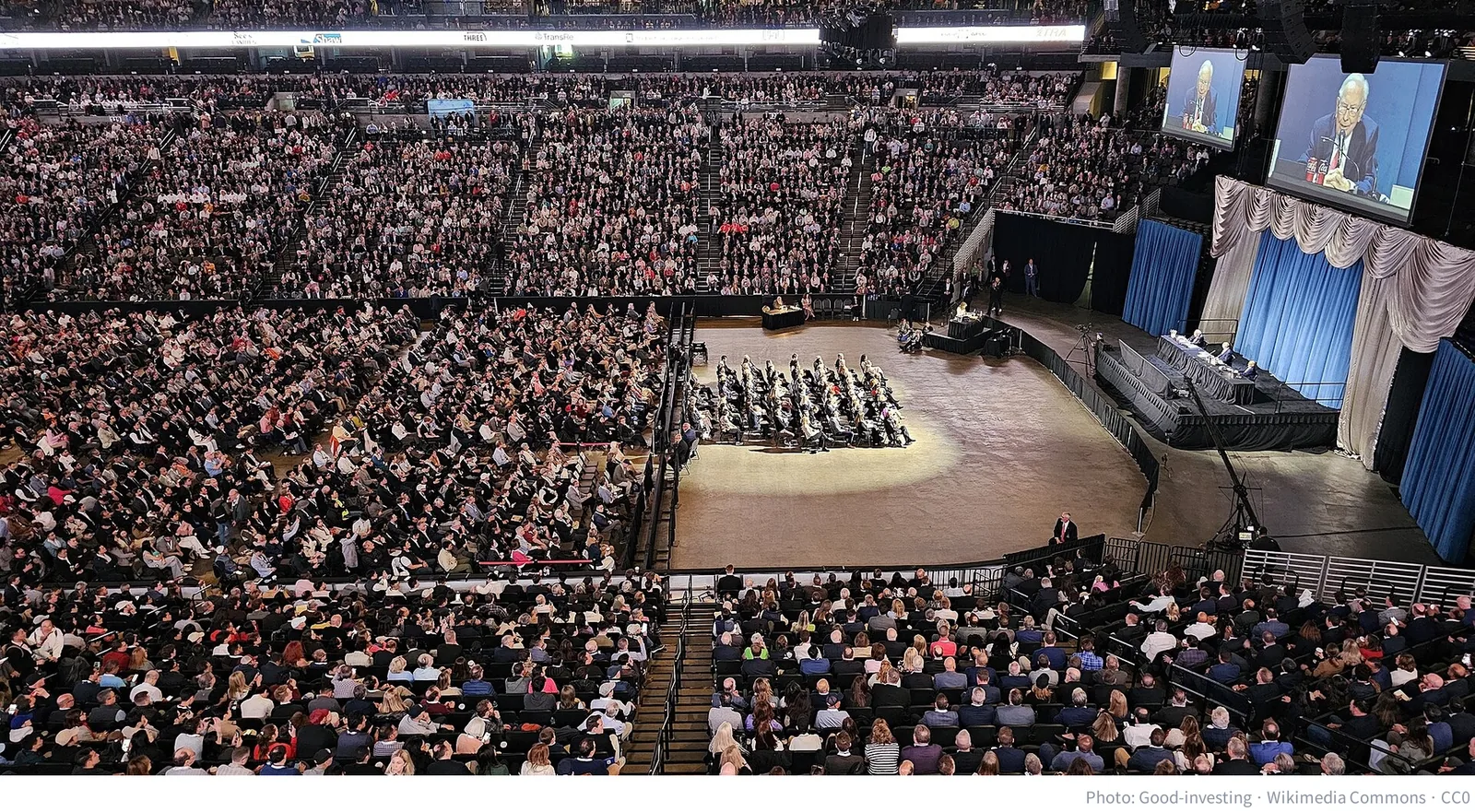
In February 2018, Warren Buffett put a small table in his letter to Berkshire Hathaway shareholders. Over 53 years, Berkshire had built value year after year, yet its shares had suffered four major dips: 59.1% from March 1973 to January 1975, 37.1% in three and a half weeks of October 1987, 48.9% from June 1998 to March 2000, and 50.7% from September 2008 to March 2009.
Under the table he wrote that it offered “the strongest argument I can muster against ever using borrowed money to own stocks,” because there is simply no telling how far stocks can fall in a short period. Then he added one more line: the light can go from green to red without pausing at yellow.
Korea’s stock market saw that light change more than once in 2026. SK hynix (000660.KS) fell 56.77% from its June 22 closing high of KRW 2,919,000 to KRW 1,262,000 on October 15, and Samsung Electronics (005930.KS) fell 42.07% from KRW 362,500 on June 18 to KRW 210,000. Margin loans, the money brokers lend retail investors to buy stocks, peaked at KRW 38.63tn (about $28.8bn) on June 24 and stood at KRW 32.75tn on October 15. On October 14 alone, KRW 89.3bn of stock was force-sold because investors could not pay for purchases.
So what about this time? From October 19, Korea’s 10 largest brokers must keep margin lending on any single stock within 15% of their total margin book. Will that reduce forced selling? This report follows that one question.
As of: October 18, 2026. Korean won figures are converted at KRW 1,341 per dollar, the Oct 16, 2026 Yahoo Finance rate. Margin and forced-sale data are from the Korea Financial Investment Association (KOFIA), which publishes daily with a one-day lag (data through October 15). Stock prices are Korea Exchange (KRX) closes. Numbers the author calculated are marked as the author’s calculations.
How it works in Korea: Korea has two main stock markets, the KOSPI (large caps) and the KOSDAQ (growth stocks). Retail investors can buy on margin through a “credit loan” from their broker, putting up a down payment (usually 40–50%) and keeping the account above a maintenance ratio (usually 140% of the loan). They can also buy before paying, settling two days later; if they do not pay, the broker sells the next morning. Both kinds of forced sale are called “bandae maemae” (counter-trading) in Korean.
1. What happened: KRW 256bn of forced sales in four days
The KOSPI closed down 7.57% at 5,554.22 on October 15, 2026, triggering a circuit breaker (a 20-minute trading halt after an 8% fall). It was 39.06% below its June 22 closing high of 9,114.55. Samsung Electronics fell 9.48% and SK hynix 11.06% that day. The cause of a market fall cannot be pinned to one thing, but what the fall did to borrowed money can be measured.
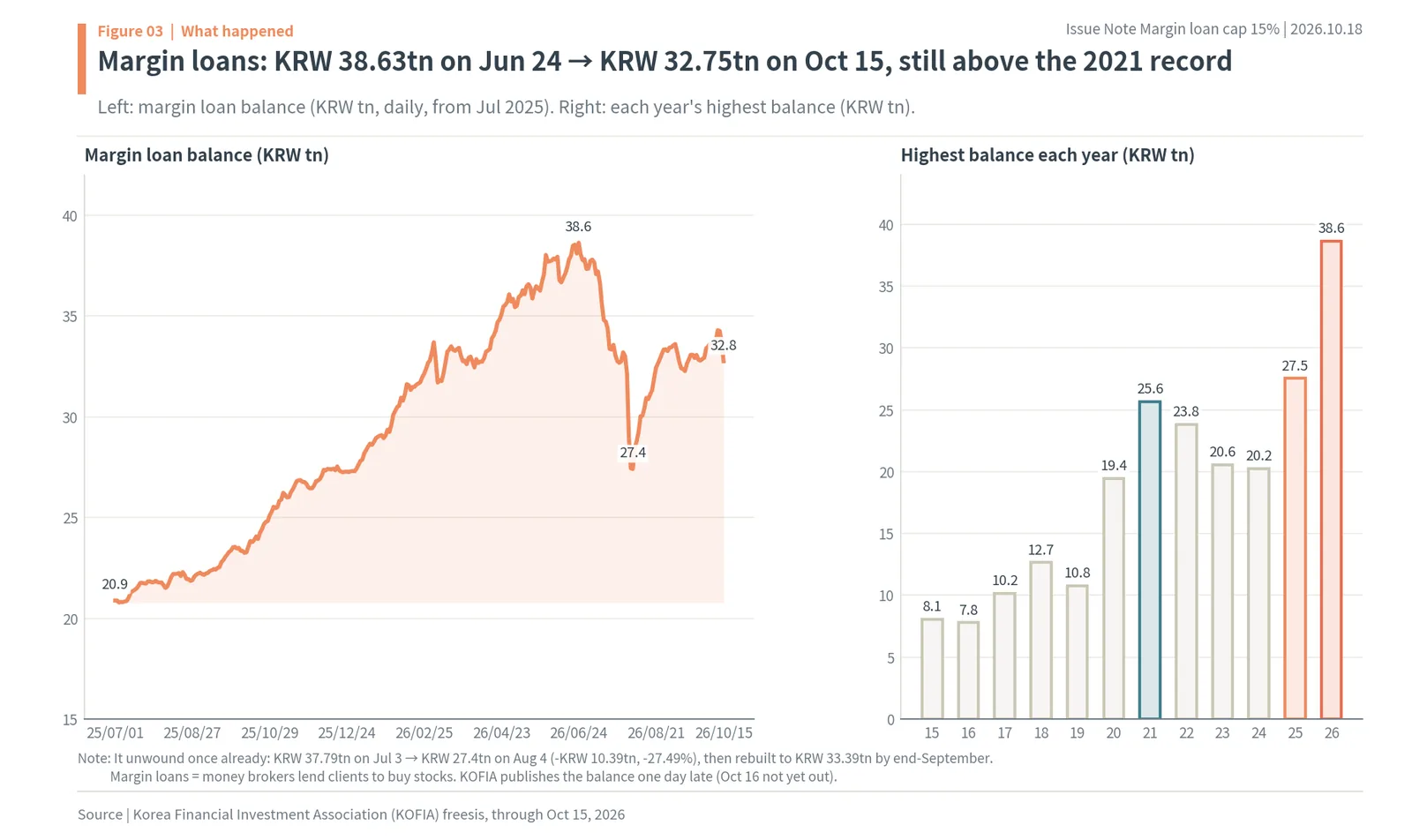
Figure 3 shows margin loans since July 2025. The balance climbed all through the first half of 2026, hit KRW 38.63tn on June 24, 1.5 times the 2021 record of KRW 25.65tn, then fell to KRW 27.4tn on August 4 before rebuilding to KRW 33.39tn by end-September. On October 15 it was KRW 32.75tn, down KRW 5.88tn (15.23%) from the peak but still above the 2021 record. KRW 1.5tn of that drop came in just two days, October 13 to 15.
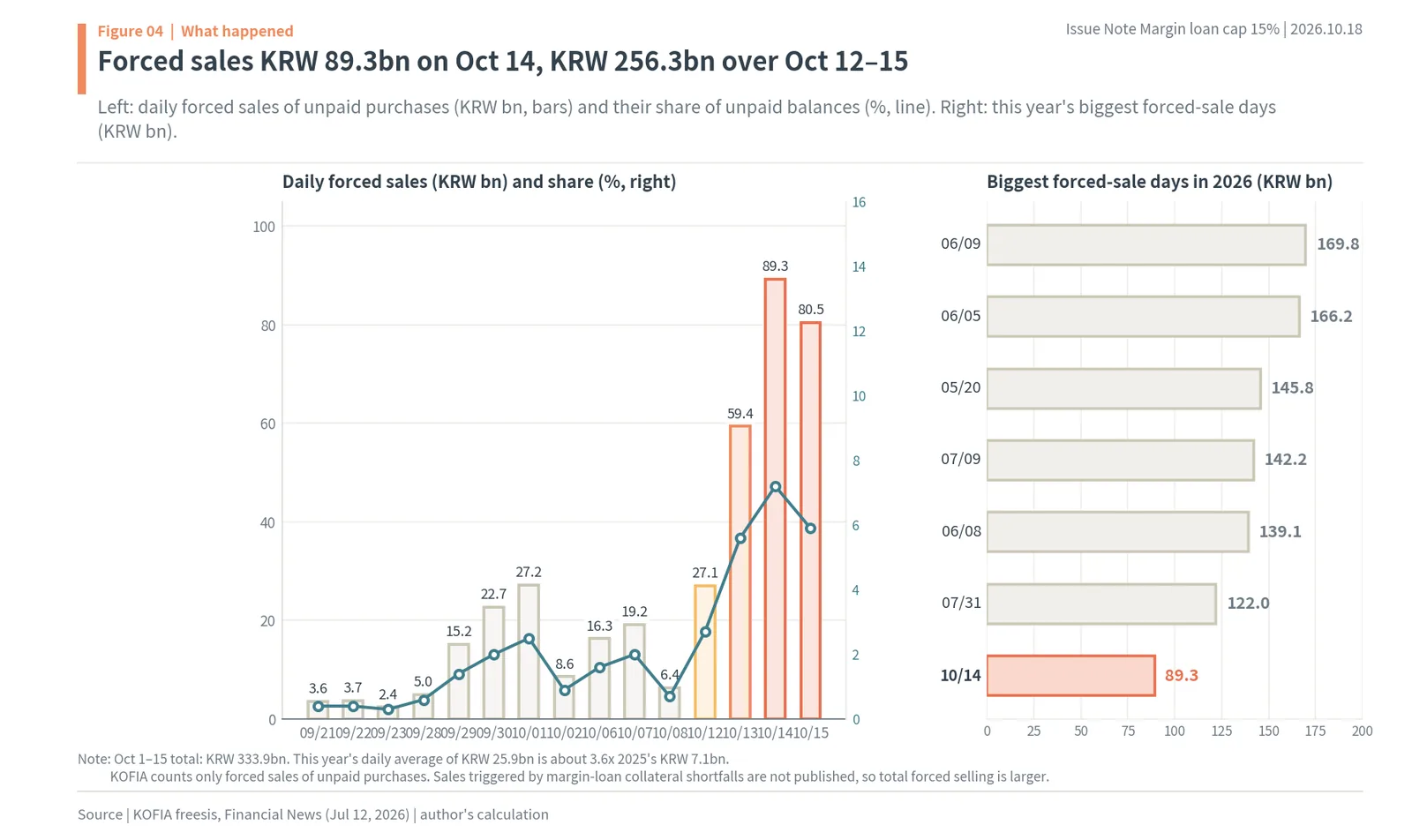
KOFIA’s daily forced-sale figure covers only unpaid purchases; sales triggered by margin-loan collateral shortfalls are not published, so the true total is larger. Even this partial number jumped: KRW 6.4bn on October 8, KRW 27.1bn on the 12th, KRW 59.4bn on the 13th, KRW 89.3bn on the 14th and KRW 80.5bn on the 15th. That is KRW 256.3bn over October 12–15 and KRW 333.9bn for October 1–15 (author’s calculation). A Korean TV headline on October 17, “Borrowed to buy stocks, KRW 300bn force-liquidated”, referred to KRW 298.1bn over October 6–15; it was the second most-read economy story on the Nate portal that day. This year’s daily average of KRW 25.9bn is about 3.6 times 2025’s KRW 7.1bn.
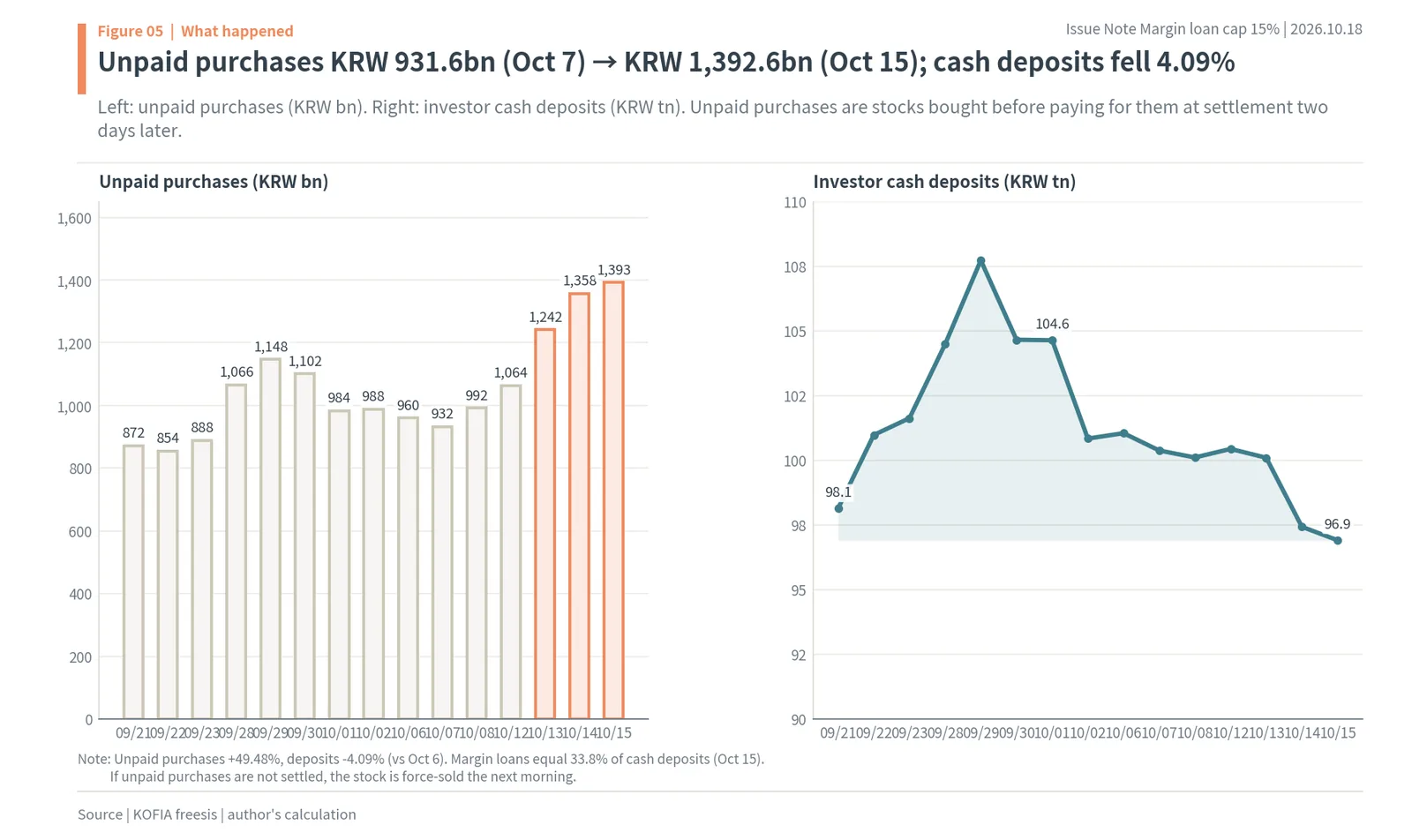
Unpaid purchases rose 49.48% from KRW 931.6bn on October 7 to KRW 1,392.6bn on October 15, while investor cash deposits fell 4.09% from KRW 101.05tn to KRW 96.91tn. When more stock is bought on two-day credit while cash shrinks, the next morning’s opening auction carries more forced selling. That selling pushes prices down, and lower prices push other accounts below their collateral line. Breaking that chain is the purpose of the new rule. So where exactly does the chain start?
2. Key terms: a 45% down payment means a margin call at a 23% drop
Four terms matter. The down payment (보증금률) is the share of a margin purchase paid with your own money; at 45%, buying KRW 100mn of stock takes KRW 45mn of your money and KRW 55mn of loan. The maintenance ratio (담보유지비율) is account value divided by the loan, which must stay above a line, usually 140%. Forced selling is the broker selling your shares when you cannot meet a shortfall. The 15% rule is the self-regulation that starts October 19: if one stock exceeds 15% of a broker’s margin book, the broker cuts new lending on it.
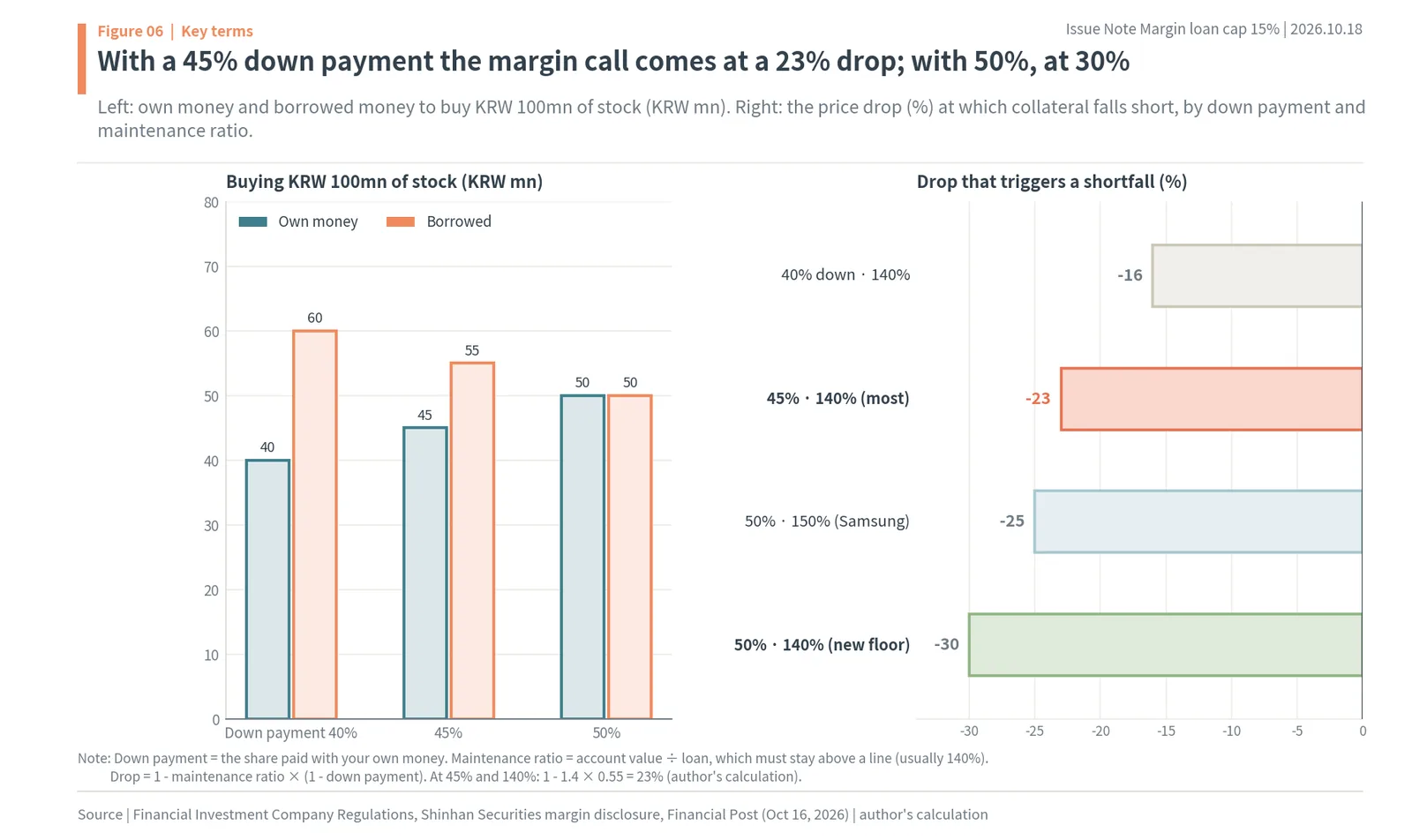
The drop that triggers a shortfall is 1 – maintenance ratio × (1 – down payment). At 45% and 140%, it is 1 – 1.4 × 0.55 = 23%. At 50%, it is 30%. At 40%, only 16%. Samsung Securities’ new 50% down payment with a 150% maintenance ratio gives 25% (author’s calculation). Five points of down payment push the margin-call line seven points further away. Since end-September, SK hynix has fallen 28.94% and Samsung Electronics 21.79%, so an account that bought SK hynix on margin at 45% in late September is already past its line, while one at 50% is right at the edge.
3. A KRW 100mn account: a KRW 7mn shortfall, up to KRW 70mn sold
Take a hypothetical account: KRW 45mn of your own money plus KRW 55mn borrowed buys KRW 100mn of one stock, which then falls 30%. The account is worth KRW 70mn against a KRW 55mn loan, a collateral ratio of 127.3%. Reaching 140% needs KRW 77mn, so the account is KRW 7mn short.
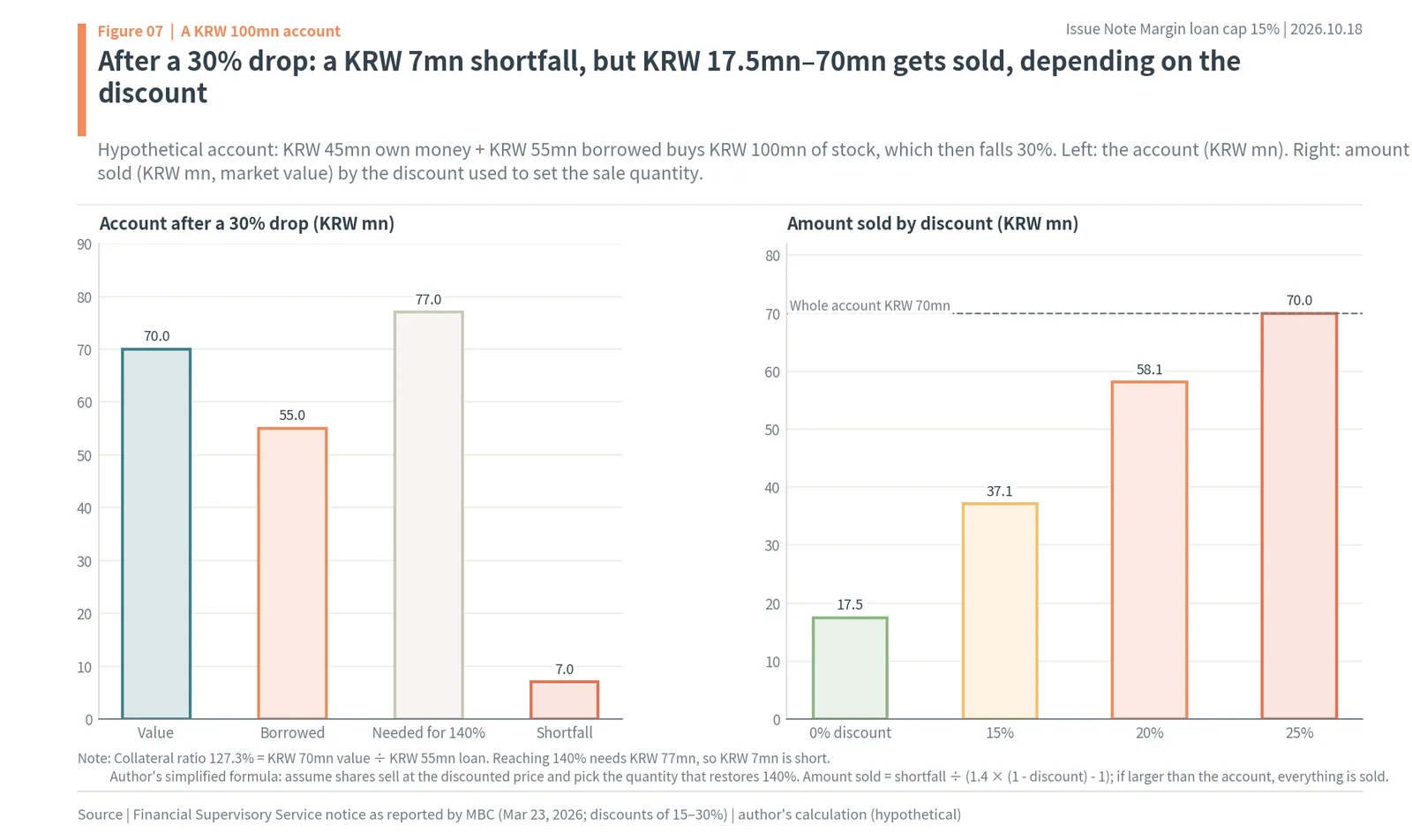
The broker does not sell KRW 7mn. Selling shares repays the loan and shrinks the collateral at the same time, so restoring 140% takes far more. Even at market price the answer is KRW 17.5mn, 2.5 times the shortfall. But Korea’s Financial Supervisory Service (FSS) has warned that brokers set the sale quantity using a price discounted 15–30% from the reference price, a cushion against the stock opening limit-down (-30%) the next morning. Putting that into a simplified formula, amount sold = shortfall ÷ (1.4 × (1 – discount) – 1), gives KRW 37.1mn at a 15% discount, KRW 58.1mn at 20%, and the whole KRW 70mn account at 25% (author’s calculation). If the whole account is sold, KRW 55mn repays the loan and KRW 15mn is left: the investor’s KRW 45mn has lost two-thirds after a 30% fall, and no shares remain to recover.
4. Where “15 times” comes from
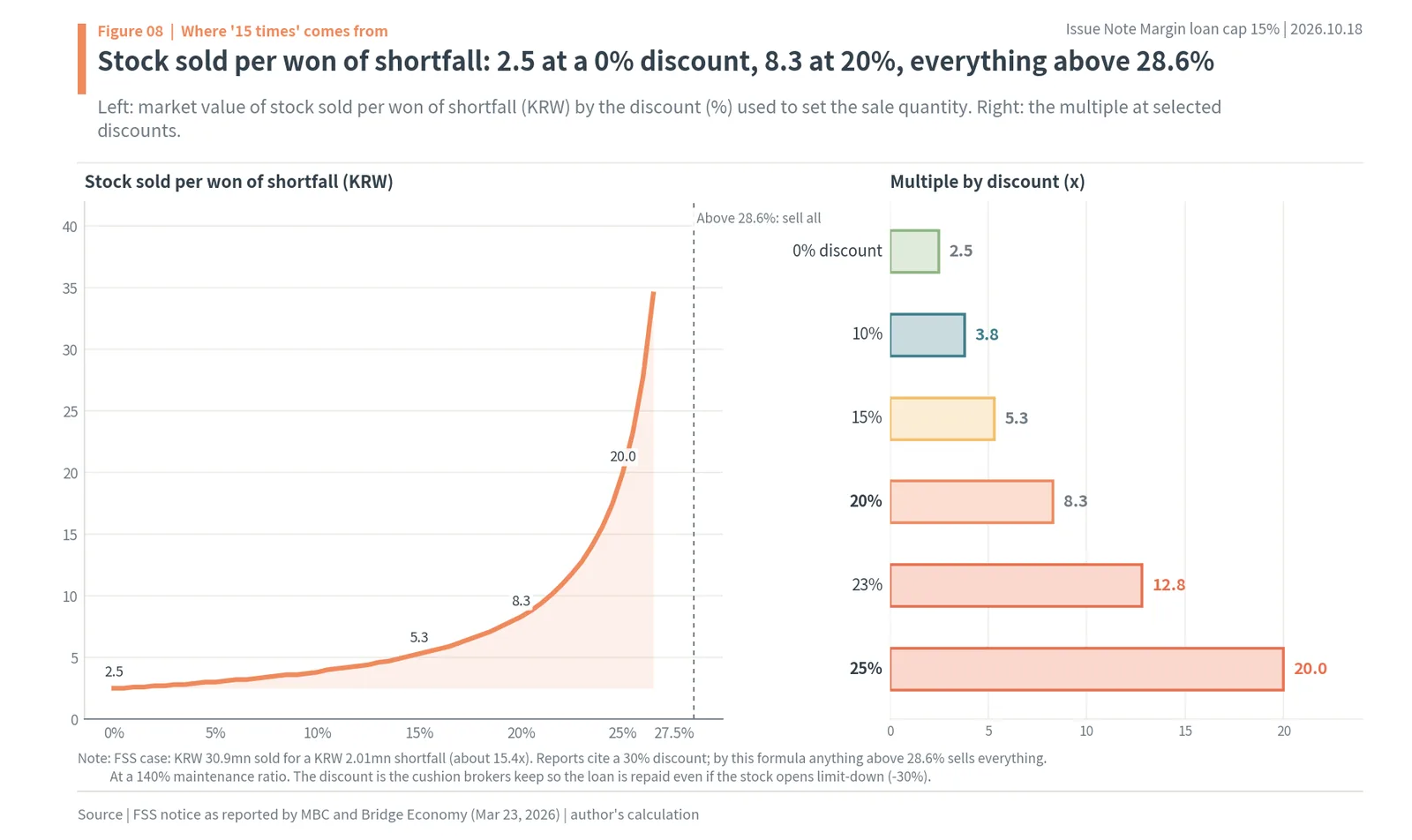
In March the FSS described a case where a KRW 2.01mn shortfall led to KRW 30.9mn of stock being sold, about 15.4 times, with the whole position sold; reports said a 30% discount was used. The formula explains it. At a 140% maintenance ratio, once the discount passes 28.6%, no partial sale can restore 140%, so everything goes. Figure 8 shows the multiple: 2.5 at a 0% discount, 3.8 at 10%, 5.3 at 15%, 8.3 at 20%, 12.8 at 23% and 20 at 25%. The amount sold is more sensitive to the discount than to the shortfall itself.
The discount exists for a reason. When the paper maker Youngpoong Paper hit limit-down and was suspended in October 2023, Kiwoom Securities was left with KRW 494.3bn of unrecovered client debt. But each broker sets its own discount, mostly out of clients’ sight, and the October 19 rule does not touch it.
5. What changes on October 19: the door for new loans
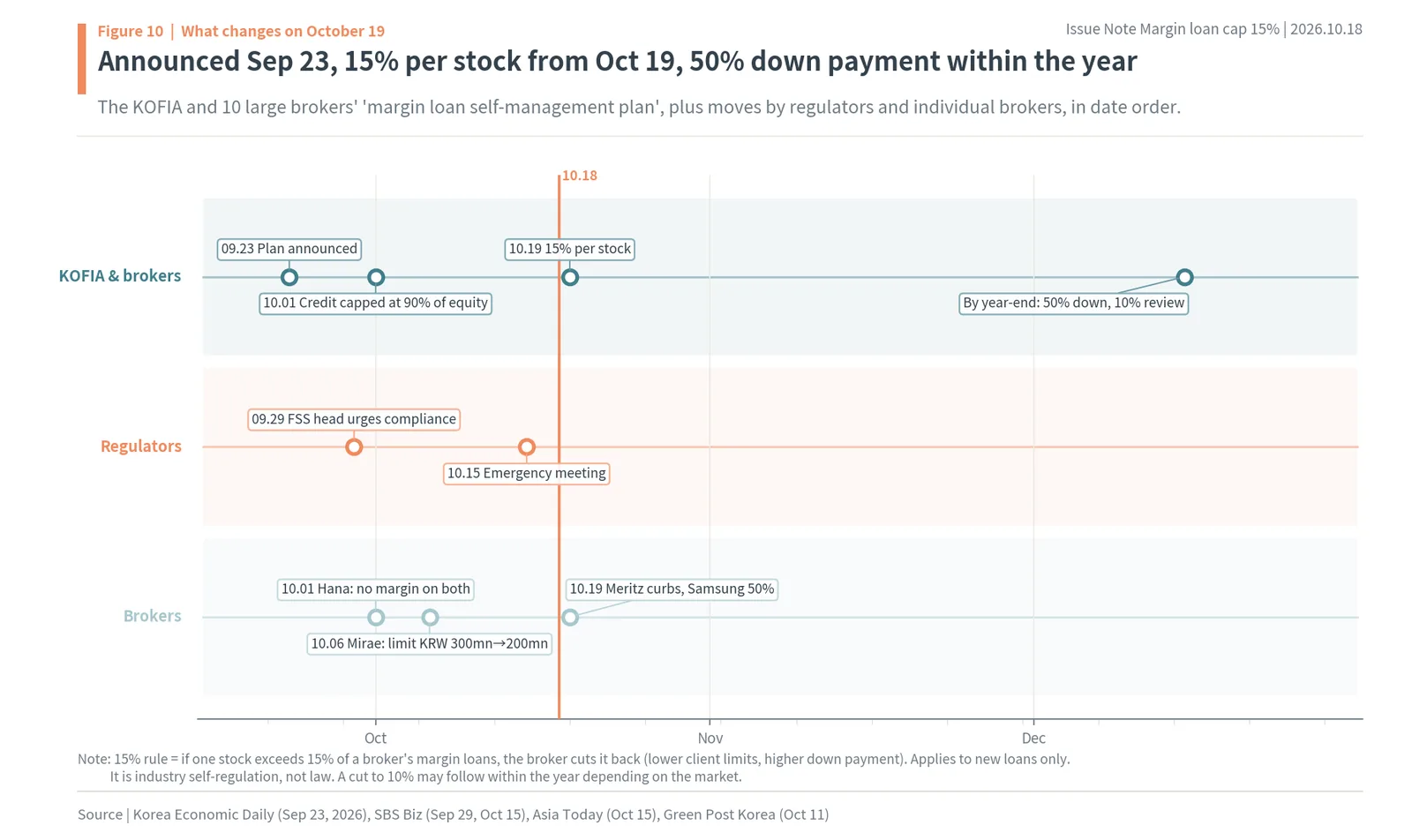
The 15% rule is not a government regulation. KOFIA and the 10 large brokers announced a “margin loan self-management plan” on September 23 with three parts: from October 1, broker credit capped at 90% of equity (the legal cap is 100% of equity); from October 19, the 15% per-stock limit, possibly lowered to 10% later this year; and a minimum down payment raised from 45% to 50%, with the start date to be agreed “within the year.” On September 29 the FSS governor told 23 brokerage CEOs to follow it strictly, and on October 15 the chairman of the Financial Services Commission warned that investing on excessive debt and credit is risky, without announcing new market support.
The most important line is that the rule applies only to new loans. Existing loans keep their old terms, so their forced-sale risk is unchanged; forcing them down would itself create selling in a falling market.
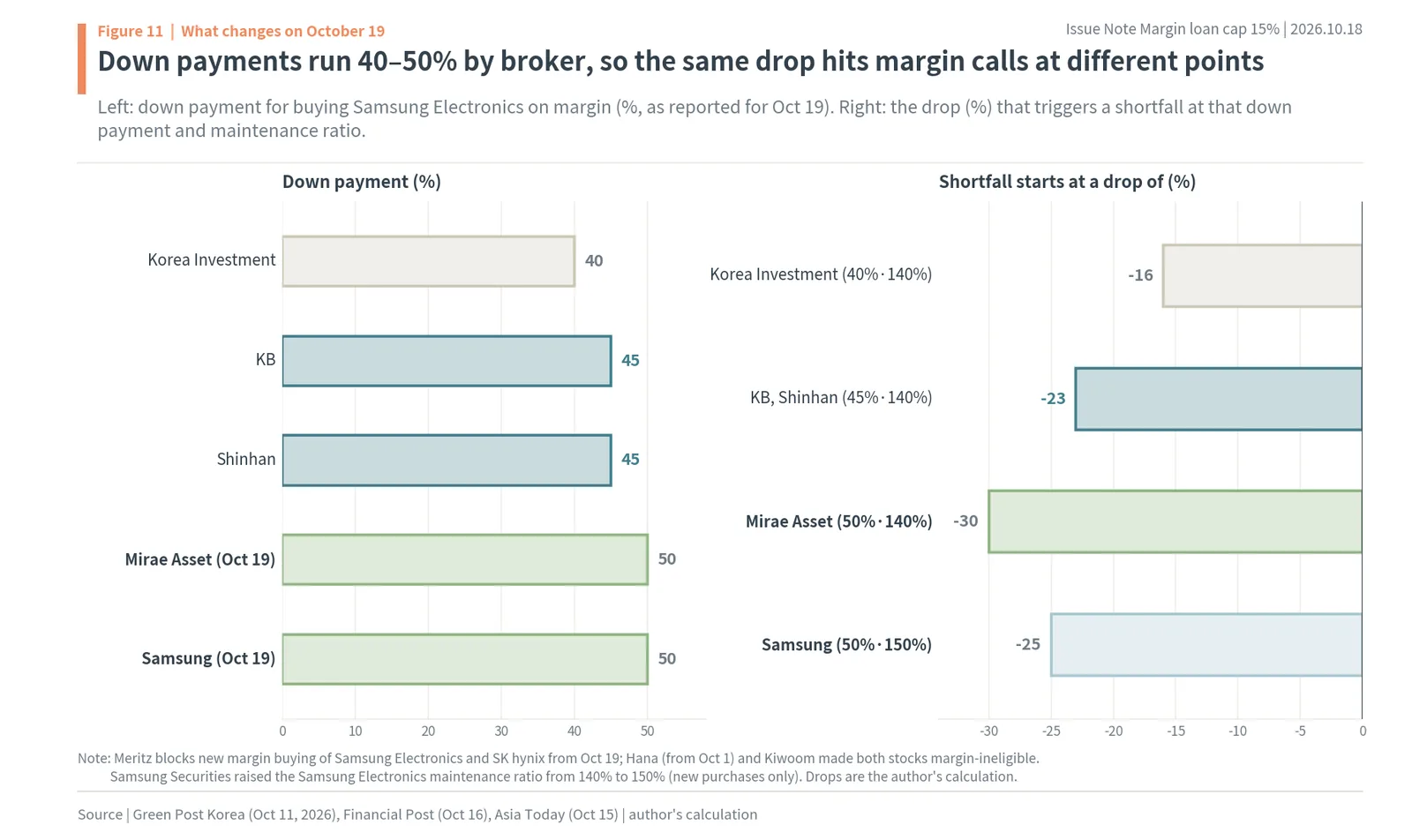
Brokers are responding differently. Meritz Securities blocks new margin buying of Samsung Electronics and SK hynix from October 19 until each is back under 15%. Hana Securities made both stocks margin-ineligible from October 1, and Kiwoom did the same. Mirae Asset raises the down payment on Samsung Electronics and others to 50% from October 19, and Samsung Securities moves Samsung Electronics to 50% with a 150% maintenance ratio. Korea Investment reportedly uses 40%, KB and Shinhan 45%. The same Samsung shares bought the same day can hit a margin call at a 16%, 23%, 25% or 30% drop depending on the broker.
6. The two-stock concentration is already inside the limit
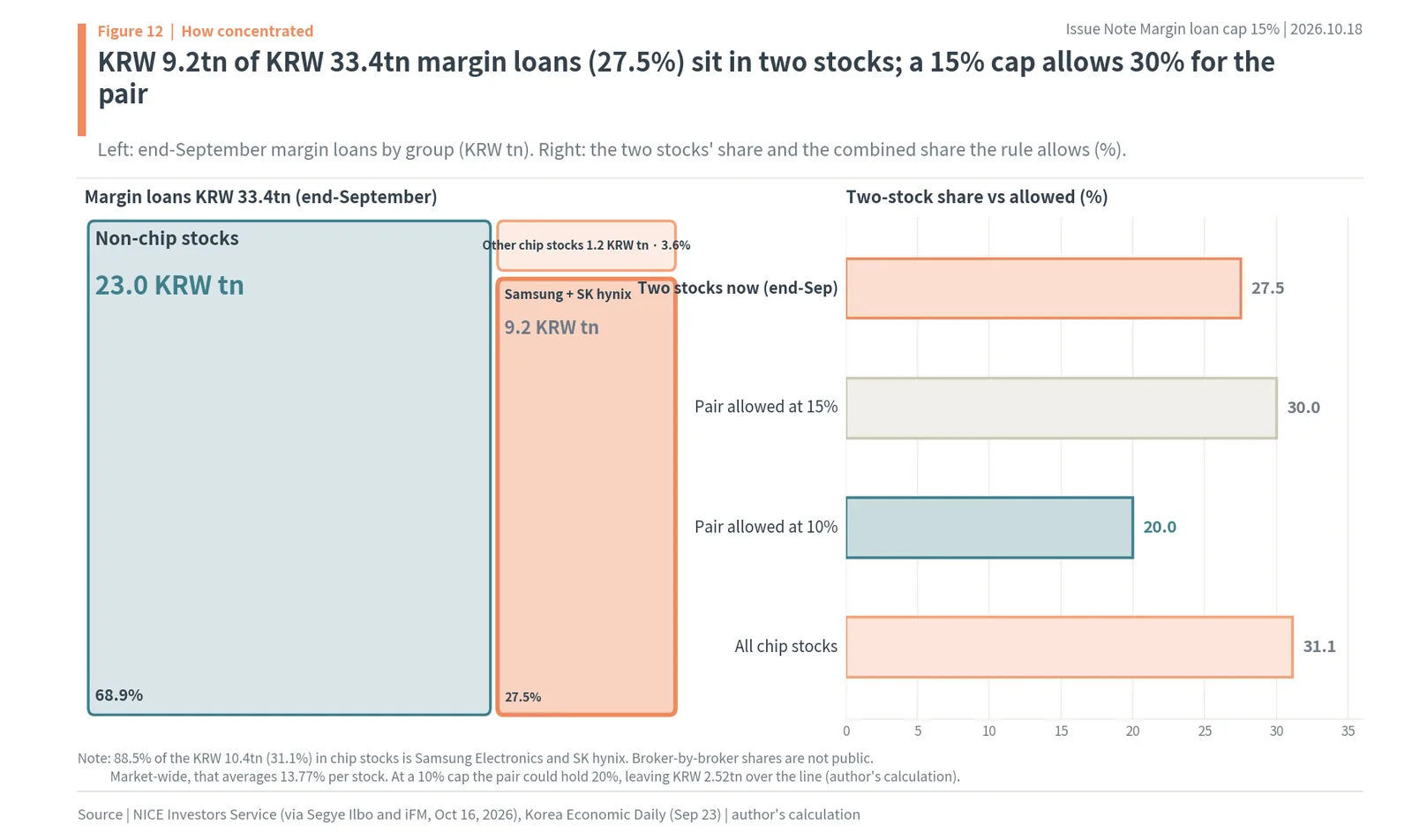
NICE Investors Service counted KRW 33.4tn of margin loans at end-September, of which KRW 10.4tn (31.1%) was in chip stocks and KRW 9.2tn (27.5%) in Samsung Electronics and SK hynix alone. Broker-by-broker figures are not public. But a 15% cap per stock allows the pair 30% together, and the market-wide 27.5% is below that, about 13.77% each on average (author’s calculation). Some brokers may be over the line for one stock, which is why Meritz acted, but market-wide the rule does not shrink the concentration that drove this month’s forced selling. A 10% cap would: the pair could hold 20%, leaving KRW 2.52tn over the line, though again only new loans would be affected.
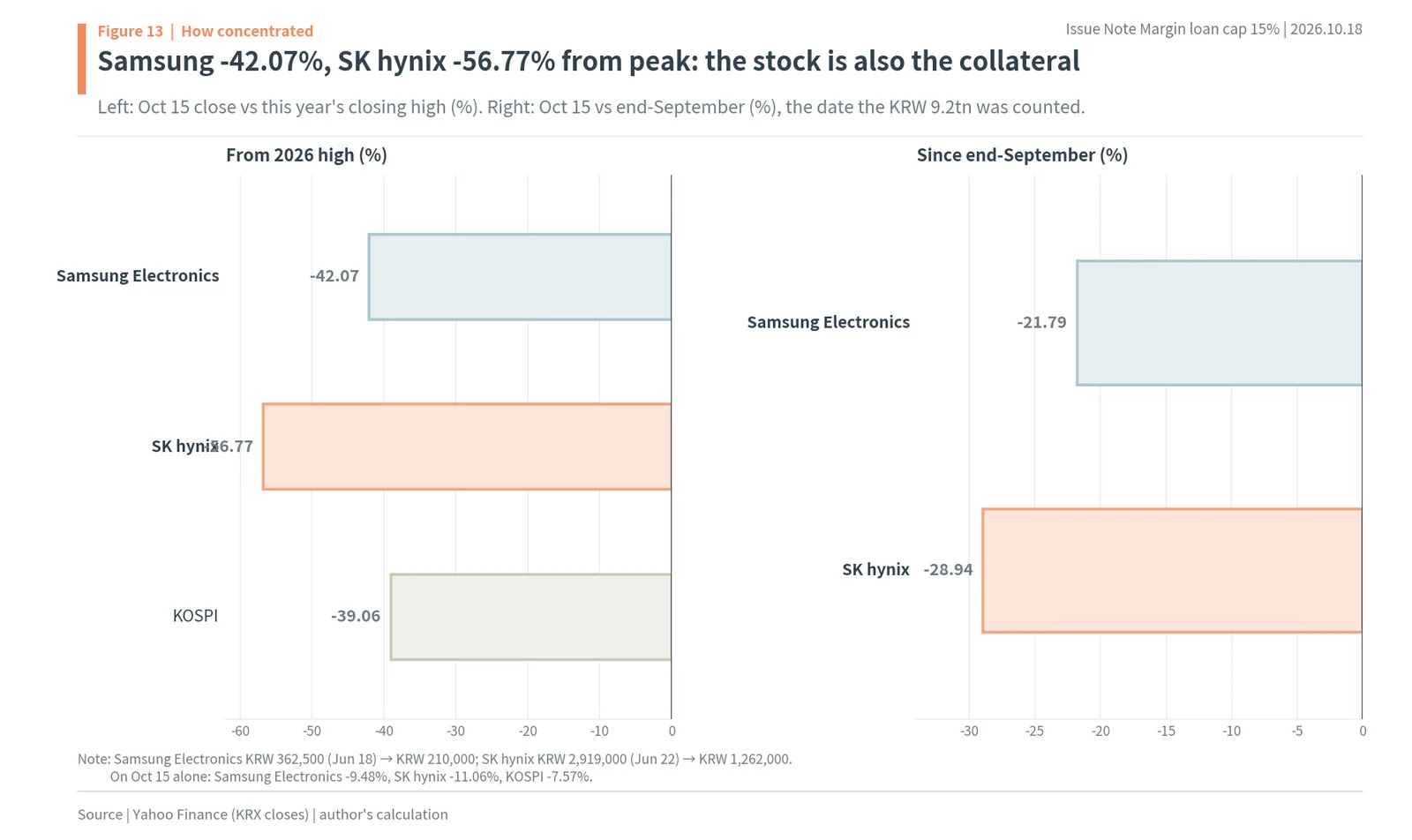
Concentration is dangerous because the stock is also the collateral. When the two stocks fall together, thousands of accounts lose collateral on the same day. Since end-September, when the KRW 9.2tn was counted, Samsung Electronics has fallen 21.79% and SK hynix 28.94%.
7. July: KRW 10tn unwound, then rebuilt with no brake
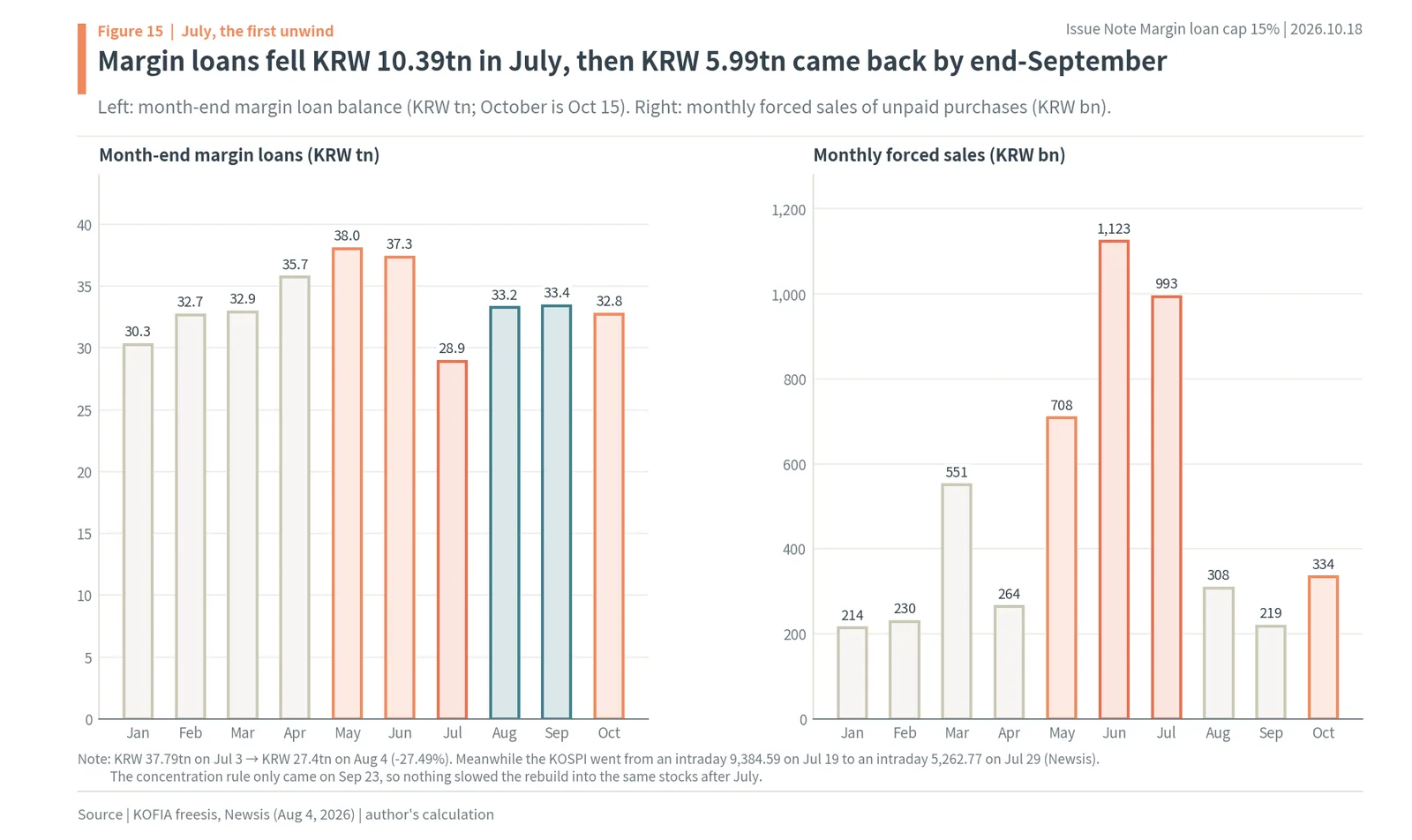
This was not the first unwind. In July the KOSPI went from an intraday 9,384.59 on July 19 to 5,262.77 on July 29. Margin loans fell KRW 10.39tn (27.49%) from KRW 37.79tn on July 3 to KRW 27.4tn on August 4, and July’s forced sales of unpaid purchases totaled KRW 992.8bn. Then KRW 5.99tn came back by September 30, and at end-September 27.5% of the balance sat in the same two stocks again. The concentration rule only arrived on September 23, after the rebuild and just before the second crash.
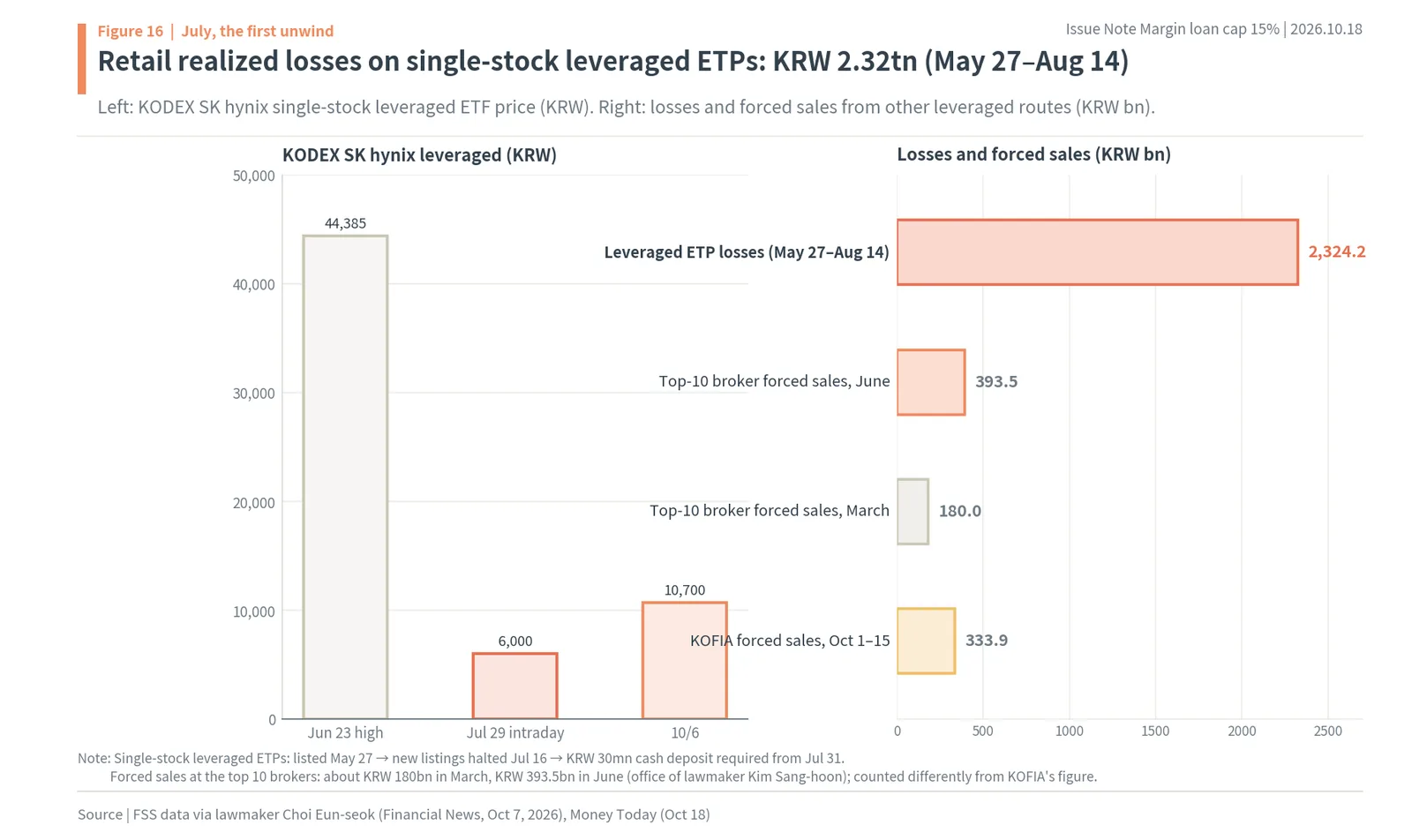
Margin loans were not the only leverage. Retail investors realized KRW 2.32tn of losses on single-stock leveraged ETPs between their May 27 listing and August 14, according to FSS data released by a lawmaker. The KODEX SK hynix single-stock leveraged ETF fell from KRW 44,385 on June 23 to KRW 6,000 intraday on July 29. Regulators halted new listings on July 16 and required a KRW 30mn cash deposit from July 31. In October, retail money also flowed abroad: over one week investors bought more than $2.6bn of SOXL, a 3x US semiconductor ETF. Demand for leverage moves to wherever the door is open, and the 15% rule covers only domestic margin loans.
8. Abroad: Japan sets the bar by the whole market, China tightened into a fall

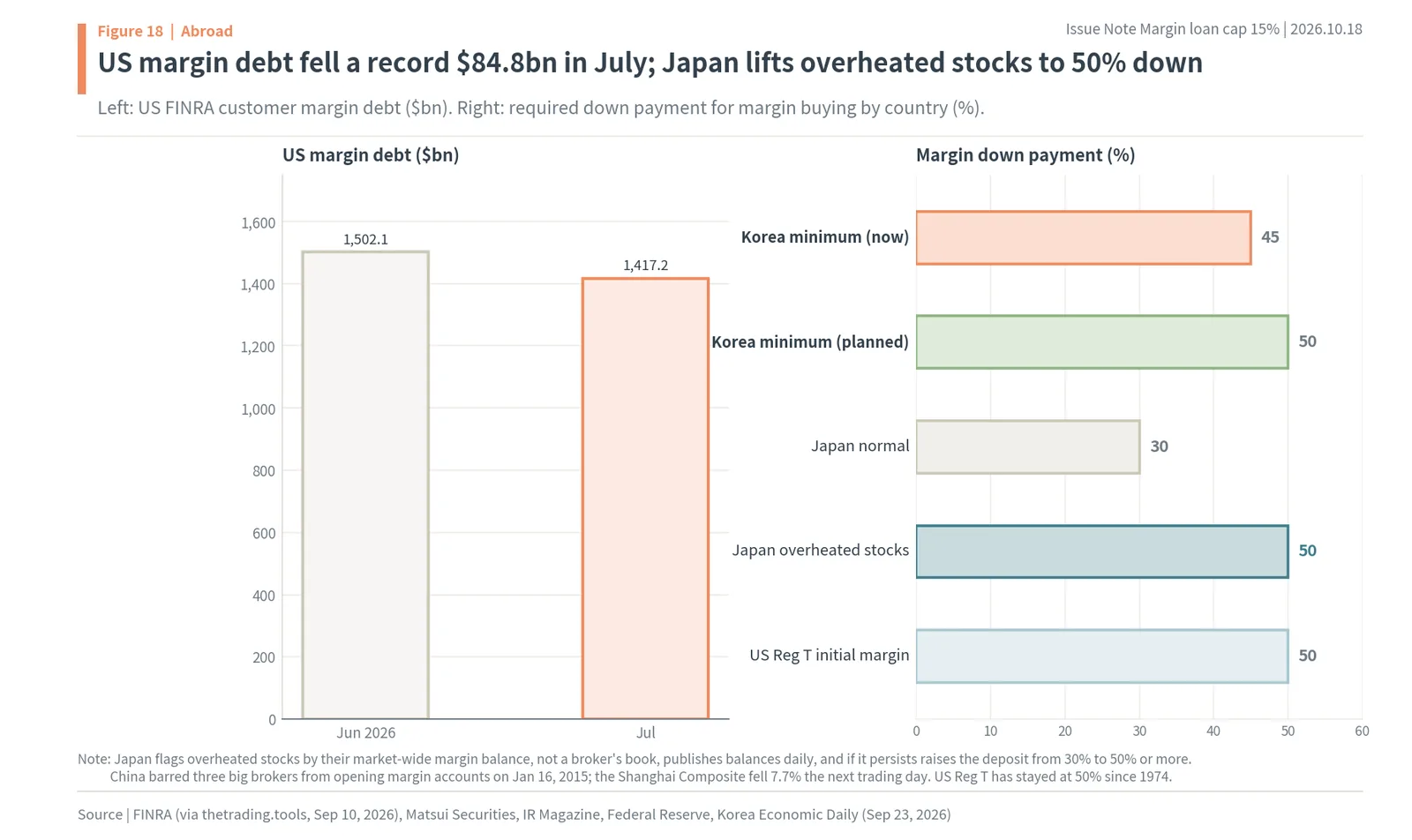
US FINRA customer margin debt hit a record $1,502.1bn in June 2026 and fell $84.8bn to $1,417.2bn in July, the largest monthly drop since records began in 1997. The US sets initial margin (Regulation T) at 50%, unchanged since January 1974; a Federal Reserve review by Paul Kupiec found no undisputed evidence that changing margin requirements controls volatility.
Japan has something like Korea’s rule, but measured differently. Exchanges flag stocks with overheated margin balances market-wide, publish their balances daily, and if the heat persists, raise the deposit for that stock from 30% to 50% or more. The test is the stock’s market-wide balance, not one broker’s book, and the response is a thicker buffer, not a closed door.
China shows the other side. On January 16, 2015, regulators barred three large brokers from opening new margin accounts for three months, and the Shanghai Composite fell 7.7% the next trading day. In June 2015, draft curbs on off-exchange margin lending were followed by a surge of selling from those accounts and a fall of about 30% in a month (NBER research by Bian, He, Shue and Zhou). Taiwan, another chip-heavy market, saw brokers trim single-stock limits on TSMC and raise down payments from 40% to 50% in May 2026, during a rising market.
9. Three fixes on one account: only the 15% rule leaves the number unchanged
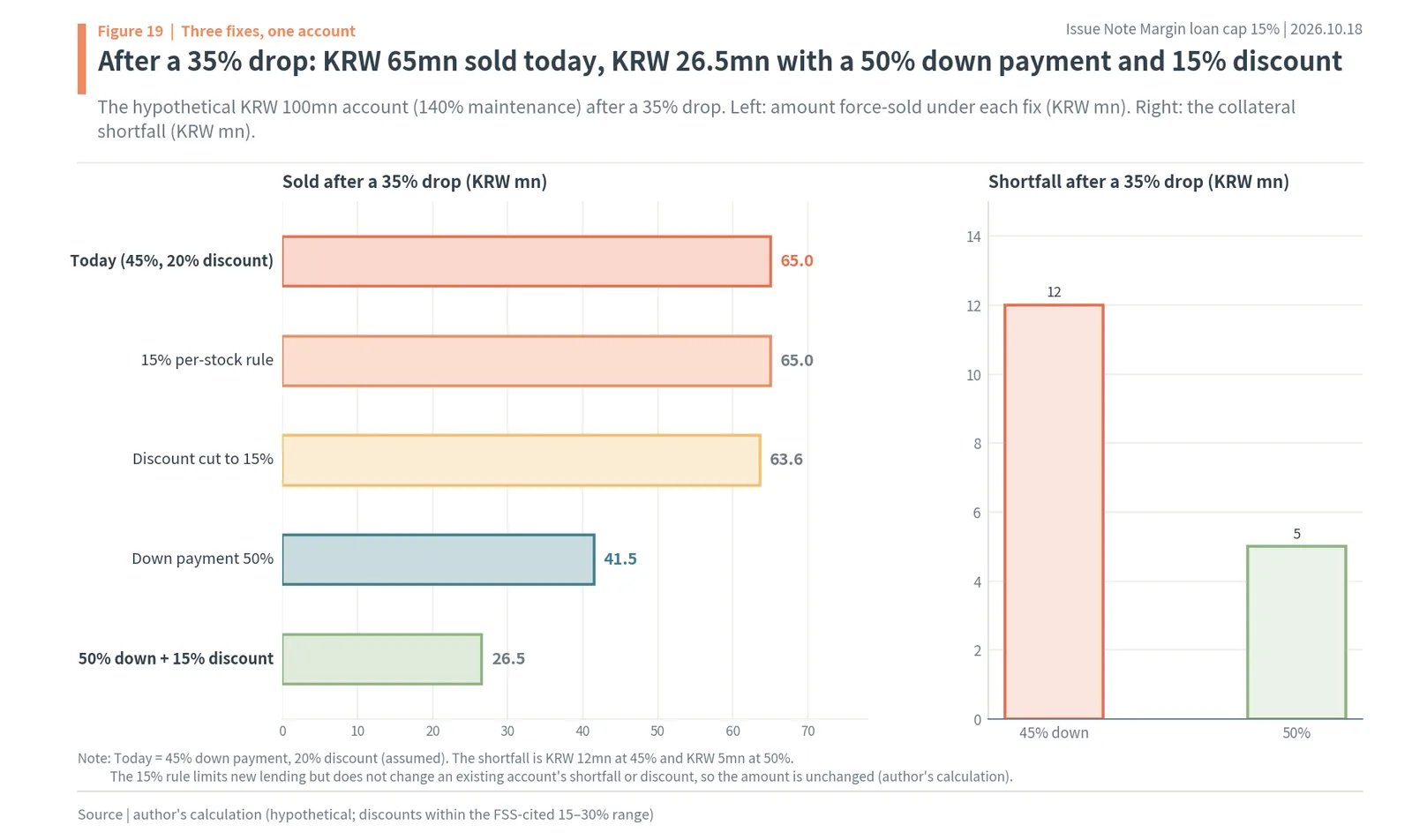
Back to the hypothetical account, now after a 35% drop, with today’s terms assumed at a 45% down payment and 20% discount. The shortfall is KRW 12mn and the whole KRW 65mn is sold. The 15% rule does not change that: it limits new lending, not an existing account’s terms. Cutting the discount to 15% alone leaves KRW 63.6mn sold, because the shortfall is large. A 50% down payment alone cuts the shortfall to KRW 5mn and the sale to KRW 41.5mn. Both together bring it to KRW 26.5mn (author’s calculation). After a 30% drop the gap is starker still: at 45% the account loses KRW 58.1mn to forced selling; at 50% it sits exactly at 140% and nothing is sold.
What the 15% rule can do is reduce how many accounts hit their margin call on the same day in the same stock, and only for new loans. The calculation is hypothetical, since brokers choose which stocks to sell and how to set discounts, but the direction holds: buffers and discounts decide how much an account loses; concentration limits decide how big the next build-up gets.
10. The author’s view: keep the cap, but fix buffers and discounts first
Supporters have a real case. Concentration is risky, it rebuilt within two months of July, and broker credit was 60.4% of equity at end-June, more than their real-estate exposure, according to NICE. The arguments against came mostly from anonymous industry sources: that stacked rules slow a recovery, that existing loans stay exposed, and that tightening collateral can feed a selling loop. Politically, the ruling Democratic Party had no official comment on the October crash that this report could find; the opposition People Power Party called it the “expensive bill” for forced market boosting.
Waiving the maintenance ratio, as regulators did in March 2020 and July 2022, is not the answer. It switches off the alarm without adding a buffer, so the sale happens later at a lower price.
The author’s view is that the 15% rule alone is unlikely to reduce forced selling, for three reasons: market-wide the two-stock share (27.5%) is already inside the 30% the rule allows for the pair; the rule leaves the KRW 9.2tn already lent untouched; and in the account calculation, the amount sold depends on the down payment and the discount, which the rule does not address. The order should change. First, bring the 50% minimum down payment forward to now rather than “within the year”; Mirae Asset and Samsung Securities already apply it to Samsung Electronics from October 19. Second, require brokers to disclose the discount used in forced sales and cap it within the daily price limit. Third, keep the concentration rule, but base it, as Japan does, on a stock’s market-wide margin balance and raise that stock’s down payment, so every broker charges the same buffer.
That view would change if broker-level data showed several large brokers far above 15% on one stock, if the next sell-off produced clearly smaller forced sales in the two stocks, or if brokers adopted the 50% floor and disclosed discounts on their own.
11. Stocks affected and dates to watch
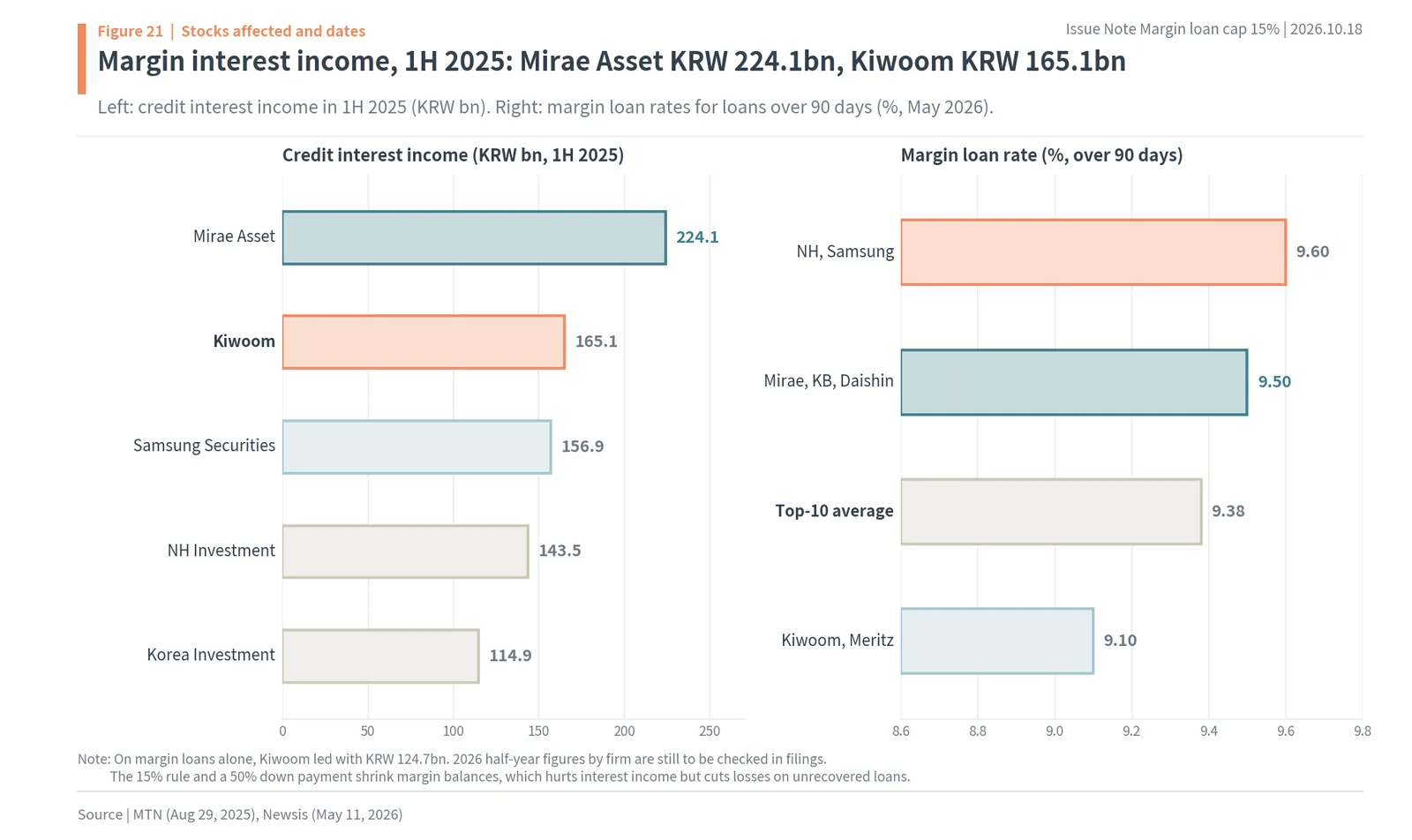
Brokers feel the rule in interest income. In the first half of 2025, credit interest income was KRW 224.1bn at Mirae Asset, KRW 165.1bn at Kiwoom, KRW 156.9bn at Samsung Securities, KRW 143.5bn at NH Investment and KRW 114.9bn at Korea Investment; on margin loans alone Kiwoom led with KRW 124.7bn. Margin loan rates for loans over 90 days ranged from 9.10% (Kiwoom, Meritz) to 9.60% (NH, Samsung) in May 2026. Lower balances hurt that income but also cut losses on unrecovered loans; Kiwoom, with the largest retail margin business, is the most sensitive both ways. For Samsung Electronics and SK hynix, the door to new margin buying narrows from October 19.
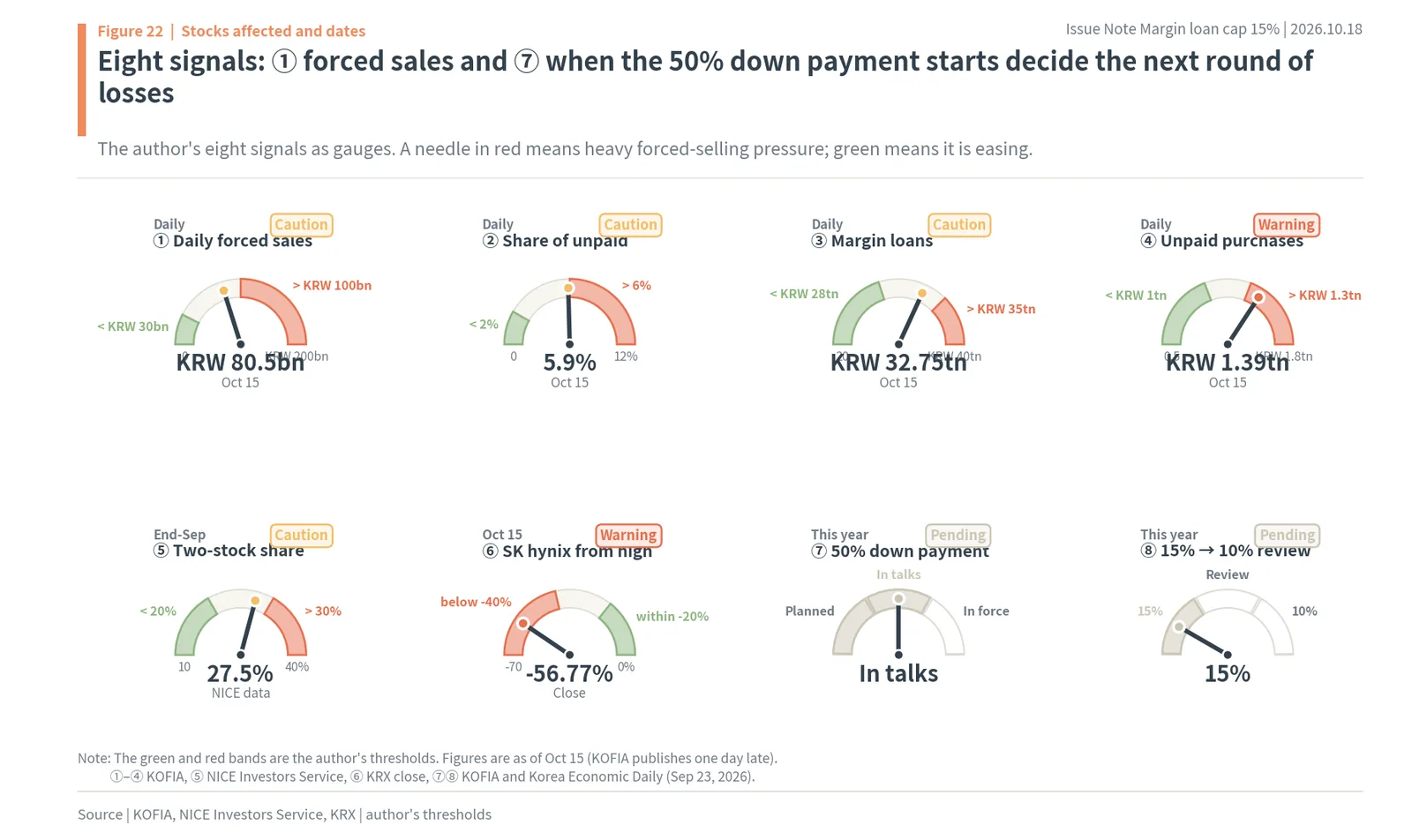
Figure 22 gathers eight signals: daily forced sales (KRW 80.5bn on October 15), their share of unpaid purchases (5.9%), margin loans (KRW 32.75tn), unpaid purchases (KRW 1.39tn), the two-stock share (27.5%), SK hynix from its high (-56.77%), and two policy steps, the 50% down payment and the 15% → 10% review. Forced sales and the start date of the 50% floor matter most. Daily forced sales back under KRW 30bn with unpaid purchases under KRW 1tn would suggest the chain has eased.
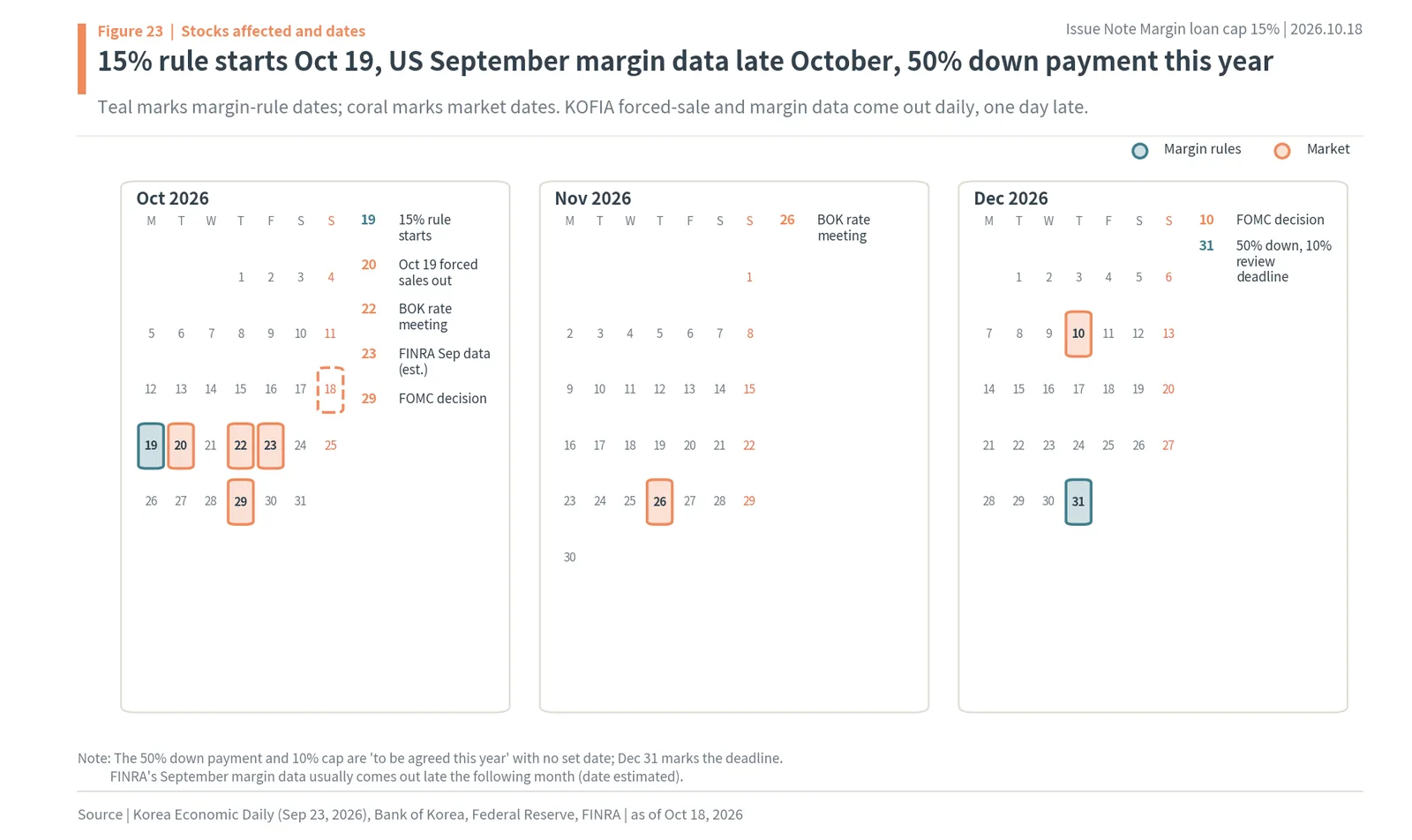
Dates: the 15% rule starts October 19, with the first results in KOFIA data on October 20; the Bank of Korea meets on October 22; FINRA’s September margin data is due in late October (estimated); the FOMC decides on October 29; the Bank of Korea meets again on November 26 and the FOMC on December 10; the 50% down payment and the 10% review are due “within the year.”
12. How the numbers were counted
Margin loans, deposits, unpaid purchases and forced sales are KOFIA freesis daily data from 1998 through October 15, 2026. Forced-sale totals differ across articles (KRW 253.4bn, 268.3bn, 298.1bn) because of different date ranges; this report adds KOFIA’s daily figures itself. The two-stock share is NICE Investors Service’s end-September figure as reported by Segye Ilbo and iFM on October 16. Margin-call drops use 1 – maintenance ratio × (1 – down payment). The amount sold uses the author’s simplified formula, shortfall ÷ (maintenance ratio × (1 – discount) – 1), selling everything when the denominator is zero or below; real broker methods vary by contract. The 20% “today” discount is one value within the 15–30% range the FSS cited, not any broker’s actual rate. US margin figures come from a secondary summary of FINRA data.
Maochaedung’s summary. Korea’s 15% per-stock margin cap, starting October 19, is a brake on the next build-up of concentrated borrowing. But at end-September the two biggest chip stocks held 27.5% of margin loans, already inside the 30% the rule allows for the pair, and the rule leaves the KRW 9.2tn already lent untouched. On the same KRW 100mn account, what cuts forced selling after a 35% fall from KRW 65mn to KRW 26.5mn is a 50% down payment plus a 15% discount (author’s calculation). The author’s view: keep the cap, but bring the 50% floor forward now and make brokers disclose and cap their forced-sale discounts.
Korea’s margin loan cap: quick answers
Q. What is Korea’s 15% margin loan rule?
From October 19, 2026, Korea’s 10 large brokerages must keep margin lending on any single stock within 15% of their total margin book. It is self-regulation announced by the Korea Financial Investment Association on September 23, 2026, applies only to new loans, and may be lowered to 10% later in the year.
Q. How big was forced selling after the October 15 KOSPI crash?
KOFIA data show forced sales of unpaid purchases of KRW 89.3bn on October 14 and KRW 80.5bn on October 15, KRW 256.3bn over October 12-15 (author’s calculation). Sales triggered by margin-loan collateral shortfalls are not published, so the true total is larger.
Q. Why can a margin call sell far more than the shortfall?
Selling shares repays the loan and reduces collateral at the same time, so even at market price restoring a 140% ratio takes 2.5 times the shortfall. Korean brokers also set the quantity using a price discounted 15-30%; at a 20% discount about 8.3 times the shortfall is sold, and above 28.6% the whole position goes (author’s simplified formula). The FSS cited a case of KRW 30.9mn sold for a KRW 2.01mn shortfall.
Q. Will the 15% cap reduce forced selling?
The author thinks not by itself. At end-September Samsung Electronics and SK hynix held 27.5% of margin loans market-wide, inside the 30% the rule allows for the pair, and existing loans are untouched. Raising the minimum down payment to 50% now and capping forced-sale discounts does more for each account.
Q. What dates should investors watch?
October 19 (15% rule starts), October 20 (first KOFIA data after it), October 22 (Bank of Korea), late October (FINRA September margin data, estimated), October 29 (FOMC), and the year-end deadline for the 50% down payment and the 10% review.
Sources
- Berkshire Hathaway, 2017 Shareholder Letter (link), Feb 24, 2018
- Korea Financial Investment Association (KOFIA) freesis, margin and market-funds statistics (link), through Oct 15, 2026
- Korea Economic Daily, KOFIA and 10 brokers’ margin loan self-management plan (link), Sep 23, 2026
- SBS Biz, Meritz, Samsung and Hana margin measures (link), Oct 15, 2026
- SBS Biz, emergency market meeting (link), Oct 15, 2026
- Financial Post (Korea), Mirae Asset and Samsung Securities down payments (link), Oct 16, 2026
- Segye Ilbo, NICE Investors Service review of retail credit risk (link), Oct 16, 2026
- Newsway, forced sales of KRW 298.1bn, Oct 6–15 (link), Oct 17, 2026
- Money Today, new-loan-only rule and existing loans (link), Oct 18, 2026
- MBC, “15 times” forced sale case (link), Mar 23, 2026
- Financial News, single-stock leveraged ETP losses (link), Oct 7, 2026
- Newsis, July crash and forced sales (link), Aug 4, 2026
- thetrading.tools, FINRA margin debt record drop (link), Sep 10, 2026
- Federal Reserve, Regulation T margin history (link)
- Kupiec, Margin Requirements, Volatility, and Market Integrity (link), 1997
- Matsui Securities, margin regulation notice (link)
- IR Magazine, China margin crackdown (link), Jan 2015
- NBER Digest, Leverage, Fire Sales, and the 2015 Chinese Stock Market Crash (link), Nov 2018
- Economic Daily News (Taiwan), margin balances and broker limits (link), May 7, 2026
- MTN, broker credit interest income (link), Aug 29, 2025
- Photos: Good-investing (CC0), Willem van Valkenburg (CC BY 2.0), Seoul Institute (CC BY 4.0), 4300streetcar (CC BY 4.0), DXR (CC BY-SA 4.0), Thomas J. O’Halloran (public domain), Ox1997cow (CC BY-SA 3.0), Wikimedia Commons
Was this note useful?
Thanks. Your answer helps decide what to cover next.
Korea market snapshot · Oct 23, 2026
New to Korean stocks? Start here for the basics.
Most read
1France Protests 2026: Why Students Are Blocking Schools and Which Stocks Benefit (Munich Re, SCOR)
Get the Saturday note on Korean stocks
One email every Saturday with the week’s new research on Korean listed companies and links to the updated data pages. Built from DART filings and KRX data. Free; unsubscribe in one click. See past issues