Oracle (ORCL) Stock Forecast: Expectations at a Floor, Why a Low Share Price Costs Oracle, and What Oracle AI World’s October 28 Investor Day Could Bring
Oracle (ORCL) stock forecast, worked out through expectations, dilution and the October 28 Investor Day. Oracle’s P/E has fallen to 15.1x, its 10-year median, on worries about power for its data centers, OpenAI’s ability to pay and how it funds $90–95bn of capex. This post asks whether expectations are at a floor, why a low share price is a cost to Oracle, and what Oracle AI World 2026 and its Investor Day could bring. Data as of October 9, 2026 (NYSE close of October 8).
- Oracle’s P/E is 15.1x next-four-quarter EPS of $8.97, the same as its 10-year median (15.0x). The pre-AI median (2016–2022) was 14.1x, and the peak was 45.1x on September 10, 2025.
- Consensus EPS growth (23.2% for the next four quarters) is about twice the pre-AI median (11.2%), so PEG is 0.65x, lower than on all but 5.4% of days in 10 years, all of them in June–December 2020.
- RPO is $664bn, but only 13% becomes revenue within a year. Q1 capex of $28.50bn exceeded operating cash flow of $23.10bn, and ATM stock sales equaled 70% of capex.
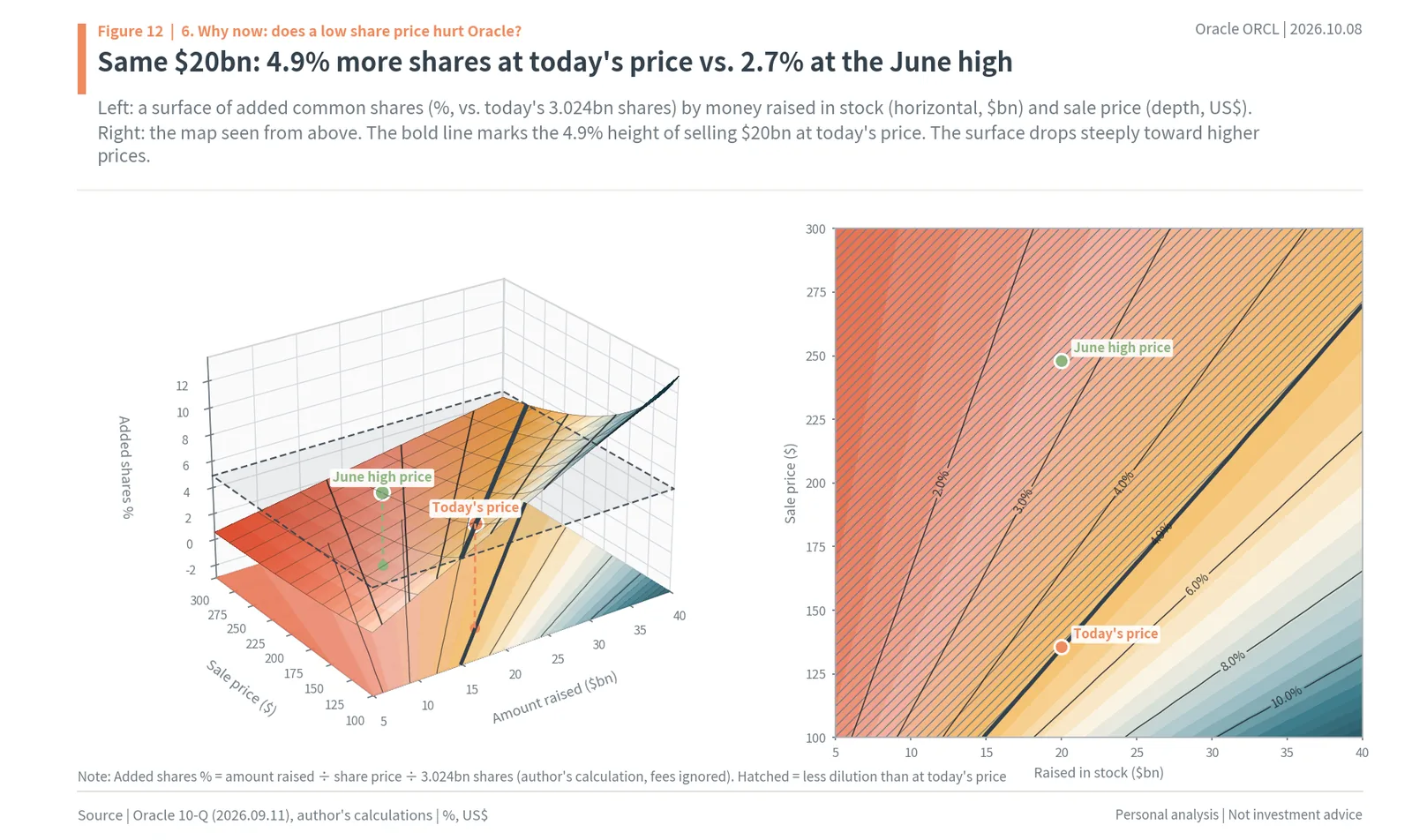
- About $20bn of FY27 funding is left: 147mn shares (4.9%) at $135.69 vs 81mn (2.7%) at the June high of $248.15, a gap of 66.8mn shares, or $0.51 vs $0.29 off FY28 EPS of $11.00.
- Oracle AI World runs October 25–28 in Las Vegas with an Investor Day on October 28. The 2022 meeting, at 12.3x, brought +9.43% over two days; 2025, at 40.8x, brought -3.84%.
- At 12.3x FY28 EPS, Oracle is 45% below the 22.6x big-four tech average. A return to the 2023 median P/E (18.4x) would put the stock at $164.8 (+21.5%).
Key takeaways
- Oracle’s P/E is 15.1x next-four-quarter EPS of $8.97, the same as the past 10-year median (15.0x), and its price relative to earnings growth (PEG 0.65x) is at a floor, the lowest in the past 10 years apart from 2020, right after COVID.
- If the remaining roughly $20bn of funding is raised with stock, it takes 147mn shares at today’s price but 81mn at the June high, so a low share price is a direct dilution cost for Oracle, and S&P also expects share issuance if credit metrics weaken.
- If the October 28 Investor Day puts numbers on a way to raise money without stock, customers beyond OpenAI and the power timeline, it is a setup that could pull the stock up, like the 2022 meeting held when expectations were low (+9.43% over two days).
As of: October 9, 2026
Ticker: Oracle (ORCL, NYSE)
Reference close: $135.69 (NYSE close, October 8, 2026)
This is the author’s personal analysis and opinion.
The author’s calculations and estimates are not confirmed facts.
1. This report looks at whether expectations for Oracle are at a floor, why a low share price is a cost to Oracle, and what the October 28 Investor Day could bring, based on the author’s calculations.
2. It asks three questions: whether this is the point of lowest expectations, whether a low share price hurts Oracle, and whether the upcoming AI World will bring news that can pull the stock up.
3. The order is: the cloud leasing business → what Oracle sells → the stock’s path → three doubts → expectations at a floor (why watch it) → the cost of a low share price (why now) → AI World and the Investor Day → news that could lift the stock → why this multiple → the size of expectations → dates to watch and when to sell.
4. The conclusion first: expectations are at a floor, and for Oracle, which sells stock to build data centers, a low share price is a direct cost, so it has the strongest reason to answer the three doubts at the October 28 Investor Day.
1. How Oracle’s Cloud Leasing Business Makes Money: $664bn RPO, 13% Within a Year
5. AI companies need GPUs to train and run their models, but instead of building data centers themselves, they rent them from cloud companies for years at a time.
6. Cloud companies sign multi-year contracts with customers and use that money to secure land, power, buildings and GPUs and build data centers.
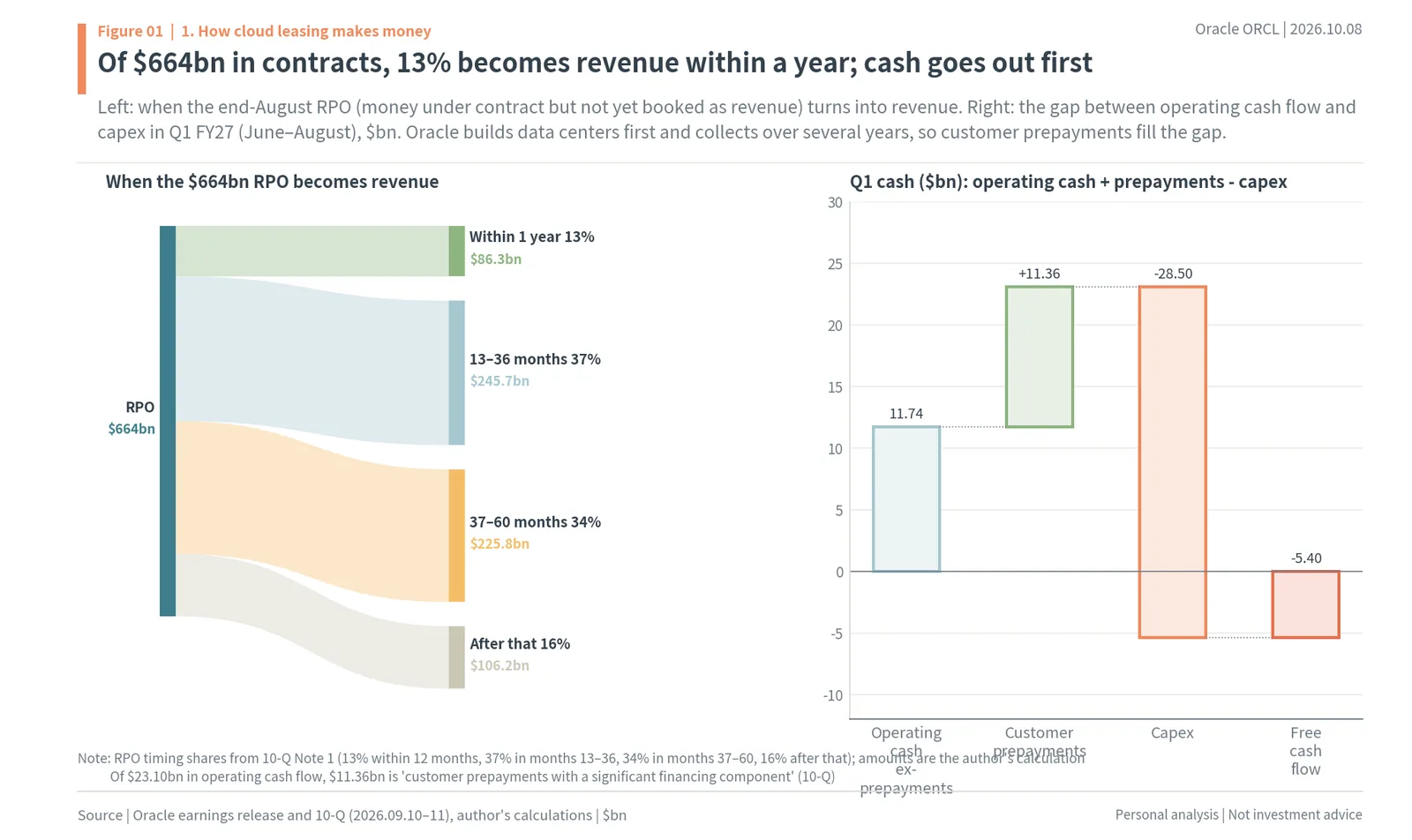
7. Money under contract that has not yet become revenue is RPO (remaining performance obligations), and Oracle’s RPO was $664bn at the end of August.
8. RPO does not become revenue all at once: Oracle said 13% (about $86.3bn) will be recognized within a year, 37% in months 13–36 and 34% in months 37–60.
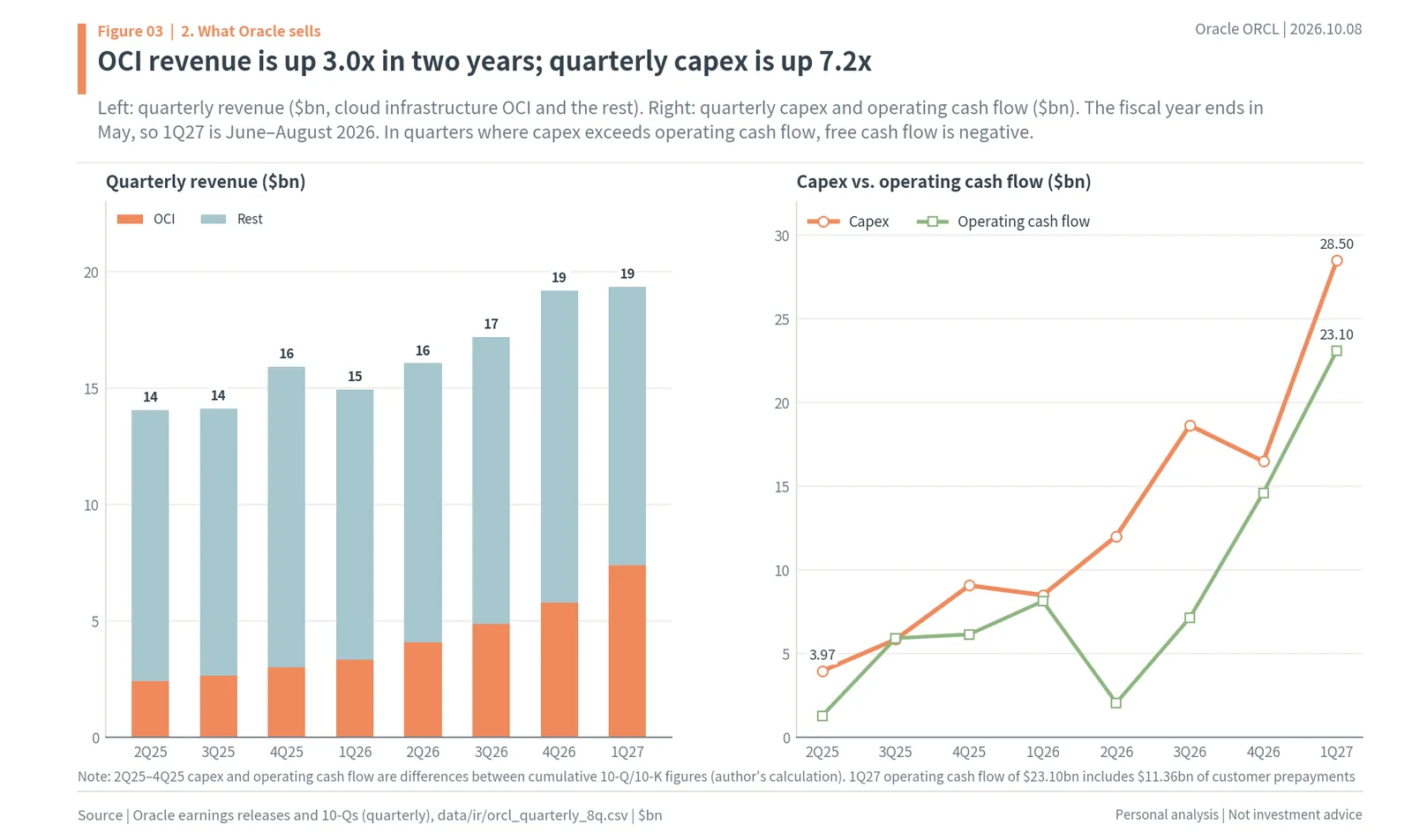
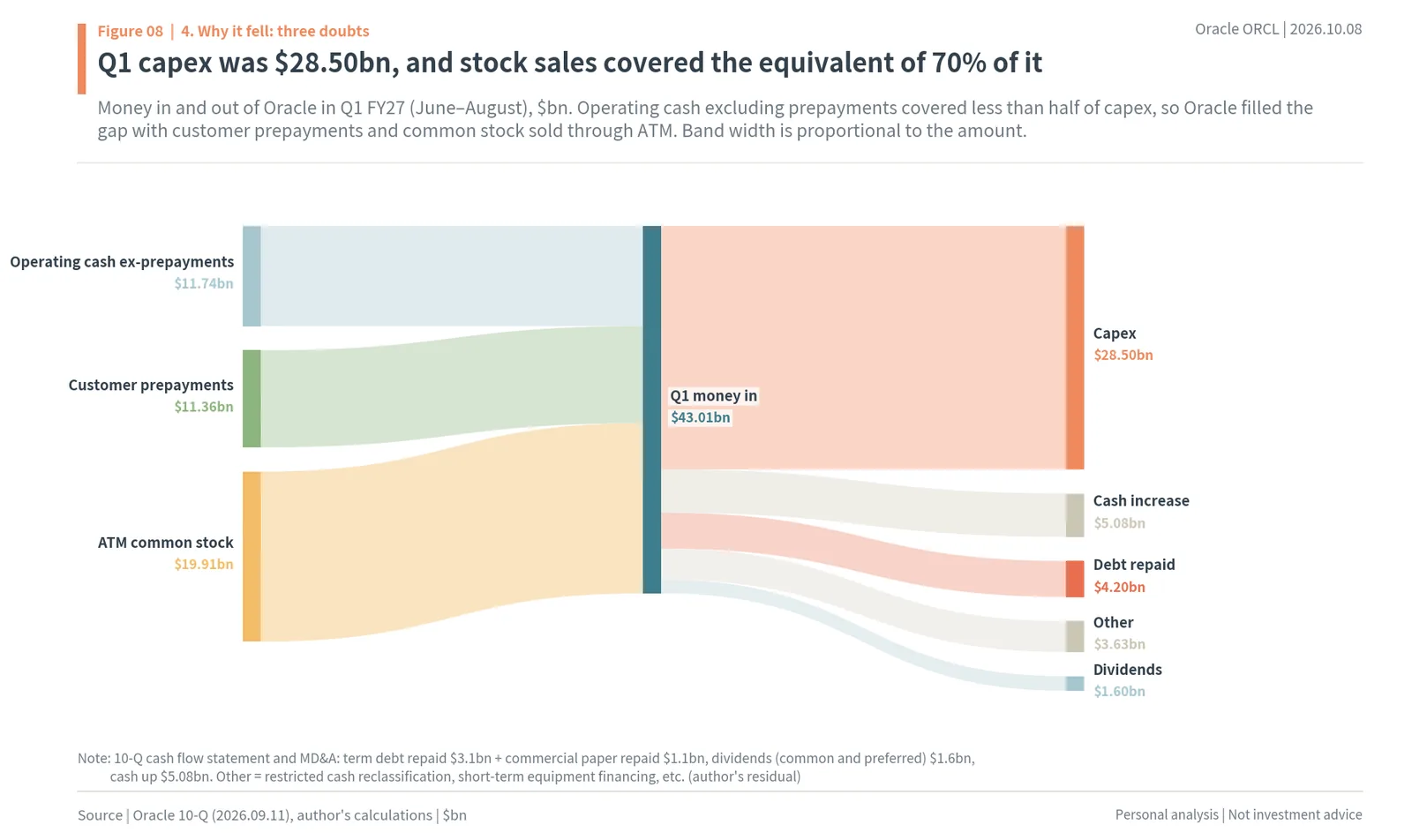
9. So in this business the money goes out first and revenue comes in later: capex in Q1 FY27 (June–August 2026) was $28.50bn, more than operating cash flow of $23.10bn.
10. To narrow this gap, Oracle has signed more contracts in which customers pay in advance (prepayments) or buy and bring their own GPUs (customer hardware), and these add up to $75bn so far.
11. The share price of a cloud leasing business moves less on the size of its contracts than on whether the power to build, customers who pay and the money to build all line up.
2. What Oracle Sells: AI Data Center Leasing Is 38.2% of Revenue
12. Oracle started with databases and has been a seller of enterprise business software (ERP, HR and finance).
13. It now sells four things: cloud infrastructure (OCI), cloud applications (Fusion, NetSuite and Health), software licenses and support (maintenance), and hardware and services.
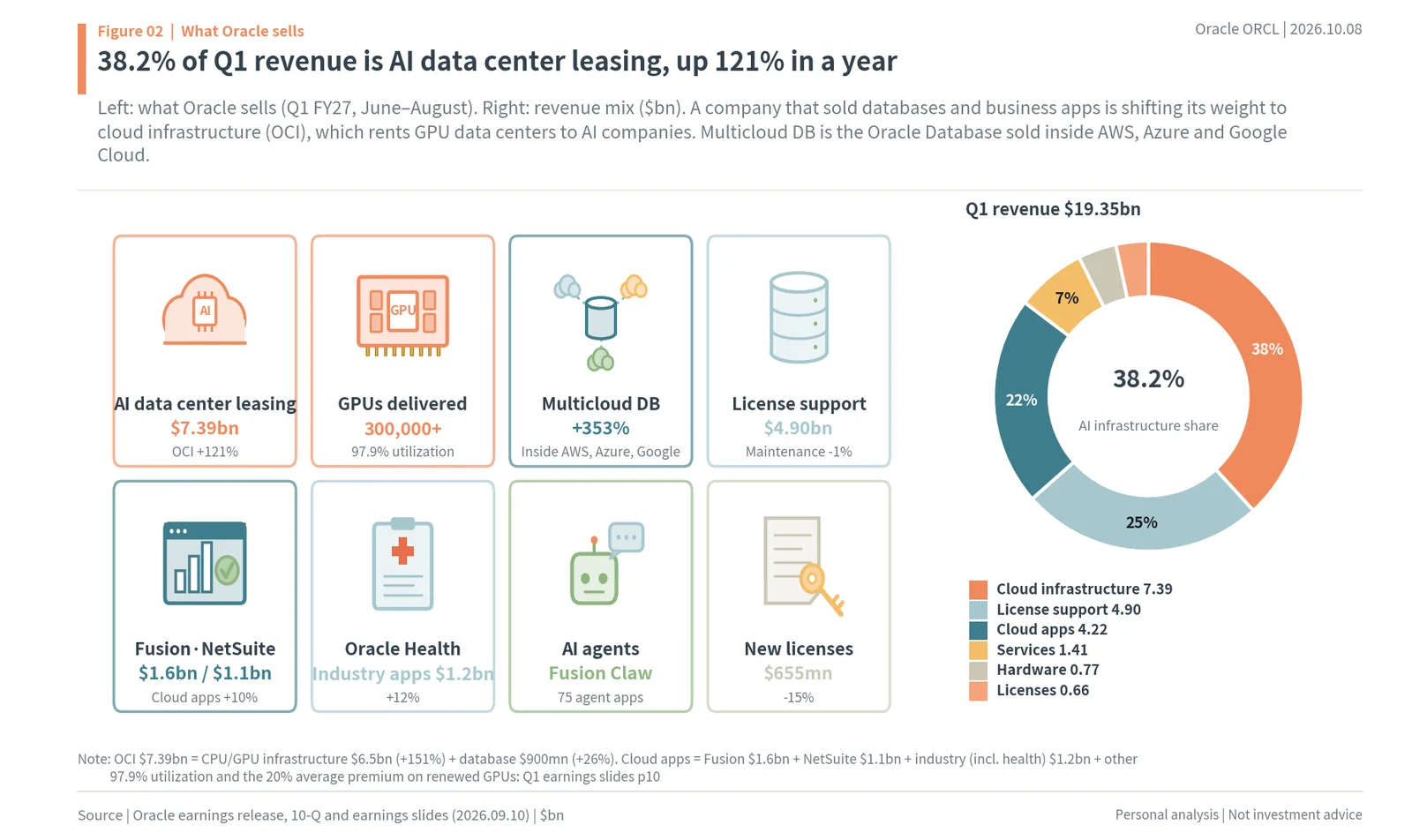
14. Of Q1 revenue of $19.35bn, cloud infrastructure was $7.39bn (38.2%, up 121% in a year), license support $4.90bn (25.3%) and cloud applications $4.22bn.
15. Within cloud infrastructure, CPU and GPU rental was $6.5bn (+151%) and database $900mn (+26%), and within database, the multicloud database sold inside other companies’ clouds grew 353%.
16. AI infrastructure utilization was 97.9% in Q1, and GPUs on renewed contracts were rented out again at prices 20% higher on average.
17. Revenue outside cloud infrastructure was $11.96bn, up 3.3% from a year earlier, so almost all of the growth comes from AI data centers.
18. Cloud infrastructure revenue grew 3.0 times in two years, from $2.43bn (the November 2024 quarter) to $7.39bn.
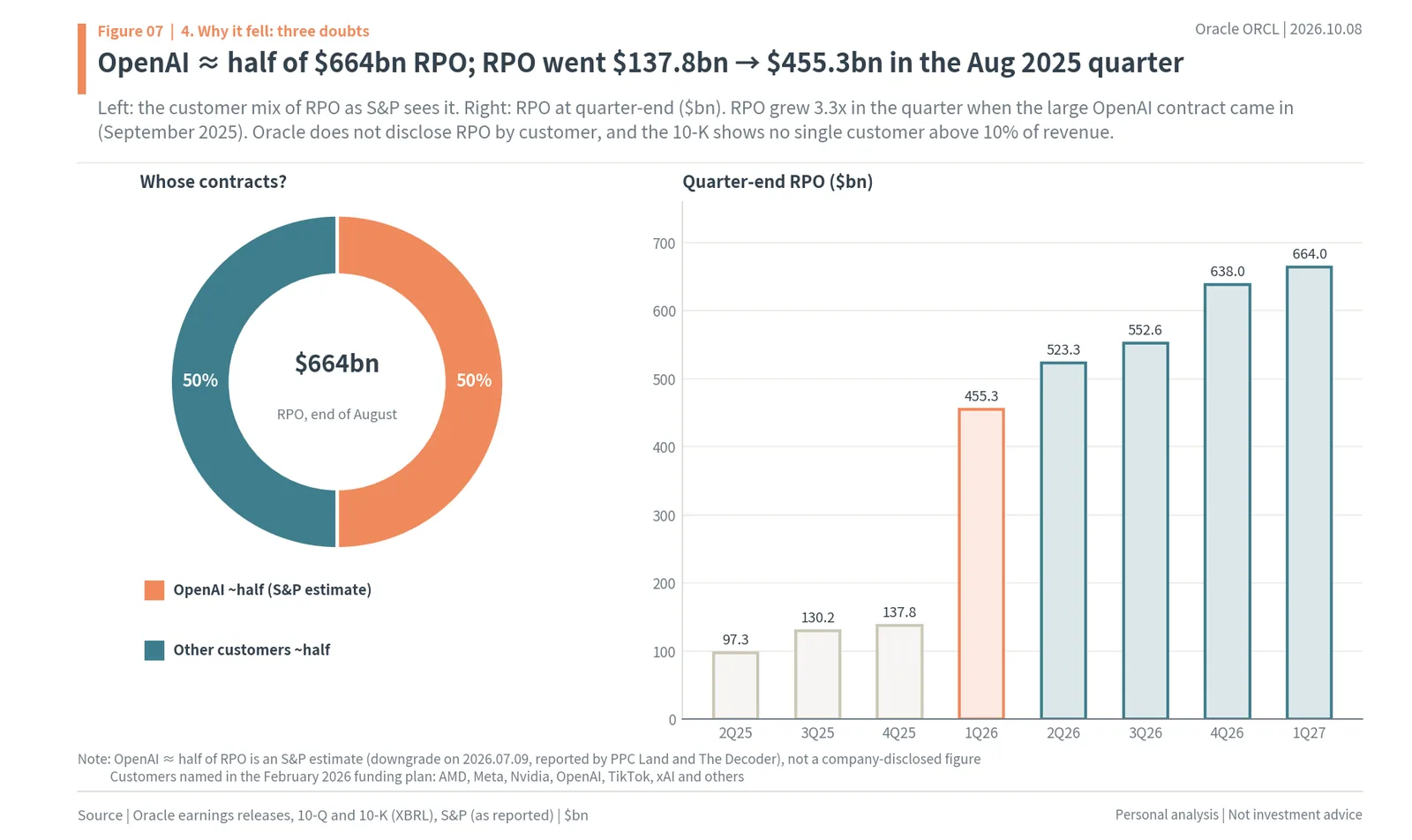
19. Over the same period, quarterly capex grew 7.2 times, from $3.97bn to $28.50bn.
20. Company guidance for this fiscal year is revenue of more than $90bn and non-GAAP EPS of $8.10, with capex of $90–95bn and net cash capex of $70bn or less.
21. Capex is growing more than twice as fast as revenue, so Oracle is now in a phase of spending money first for future revenue.
3. Oracle Share Price: From the $328.33 Record to $135.69
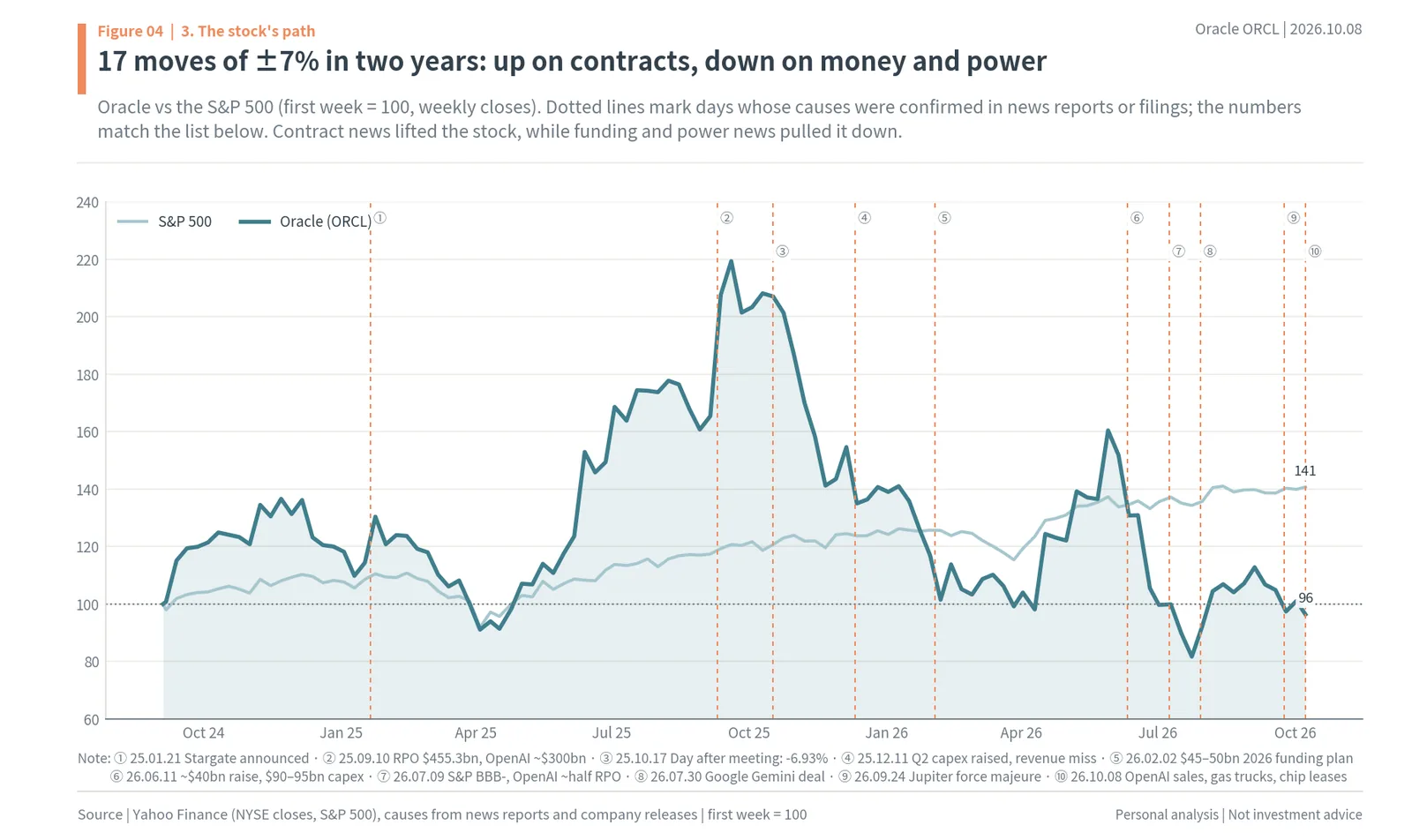
22. On September 10, 2025, the day after Oracle announced RPO of $455.3bn (including an OpenAI contract of about $300bn), the stock rose 35.95% in a single day to a record close of $328.33.
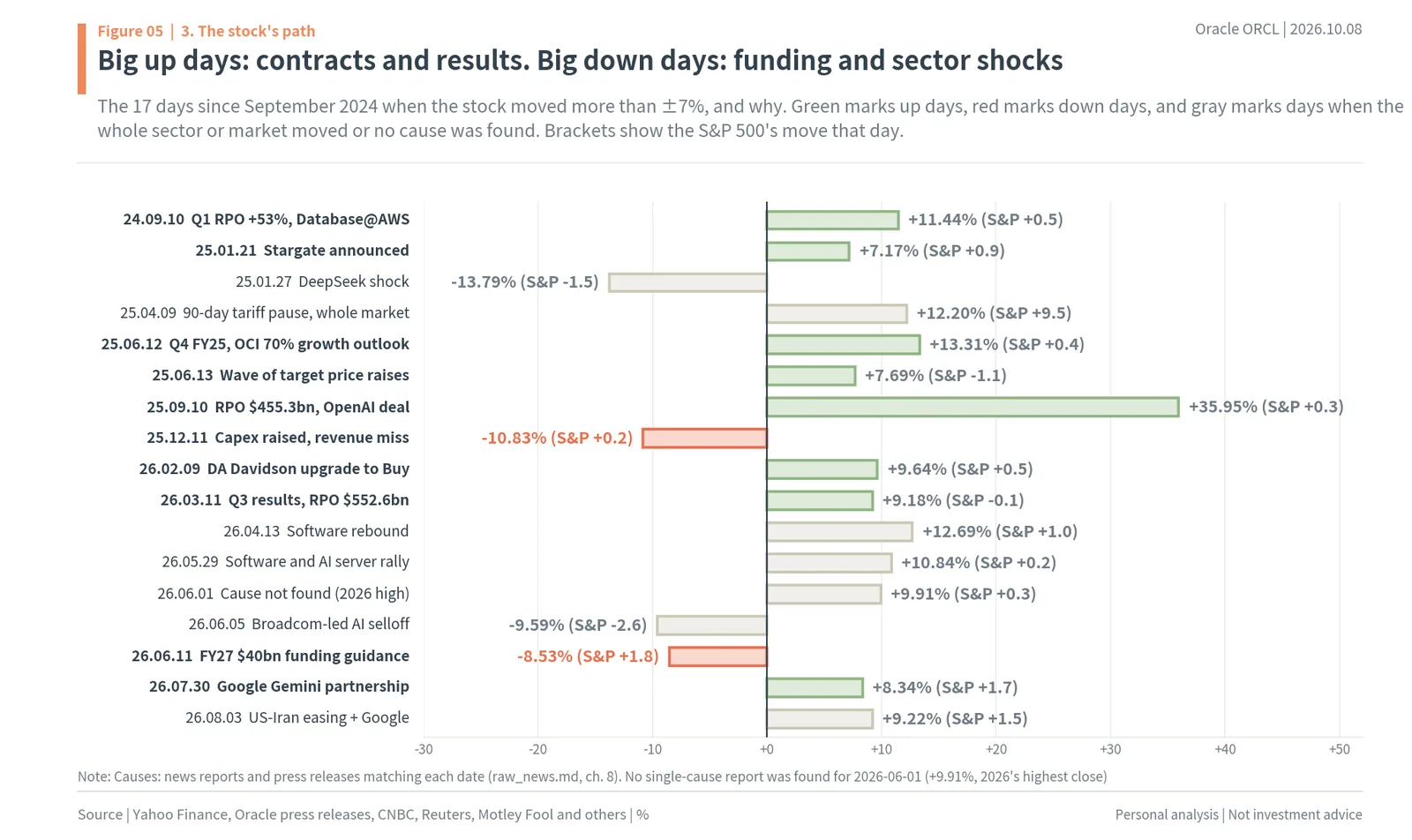
23. Over the past two years, the stock moved more than ±7% in a day on 17 days: big up days came on contracts, earnings and partnerships, and big down days on funding, capex and sector shocks.
24. It fell 10.83% on December 11, 2025, when Q2 capex was raised (FY26 from $35bn to $50bn), and 8.53% on June 11, 2026, on guidance for about $40bn of FY27 funding.
25. This year’s high was $248.15 on June 1, and after a 19.40% drop in the last week of June, S&P’s cut to BBB- on July 9 and Apple’s lawsuit against OpenAI on July 13 (-6.47%), the stock fell 53.7% to $114.99 on July 24.
26. A Google Gemini partnership on July 30 (+8.34%) and easing US-Iran tensions on August 3 (+9.22%) brought a 35.9% rebound through August 13.
27. After Q1 results on September 10, the Jupiter force majeure notice and three reports on October 8 (OpenAI’s revenue, trucked gas and a chip-leasing vehicle) pushed it down 16.05% again to $135.69.
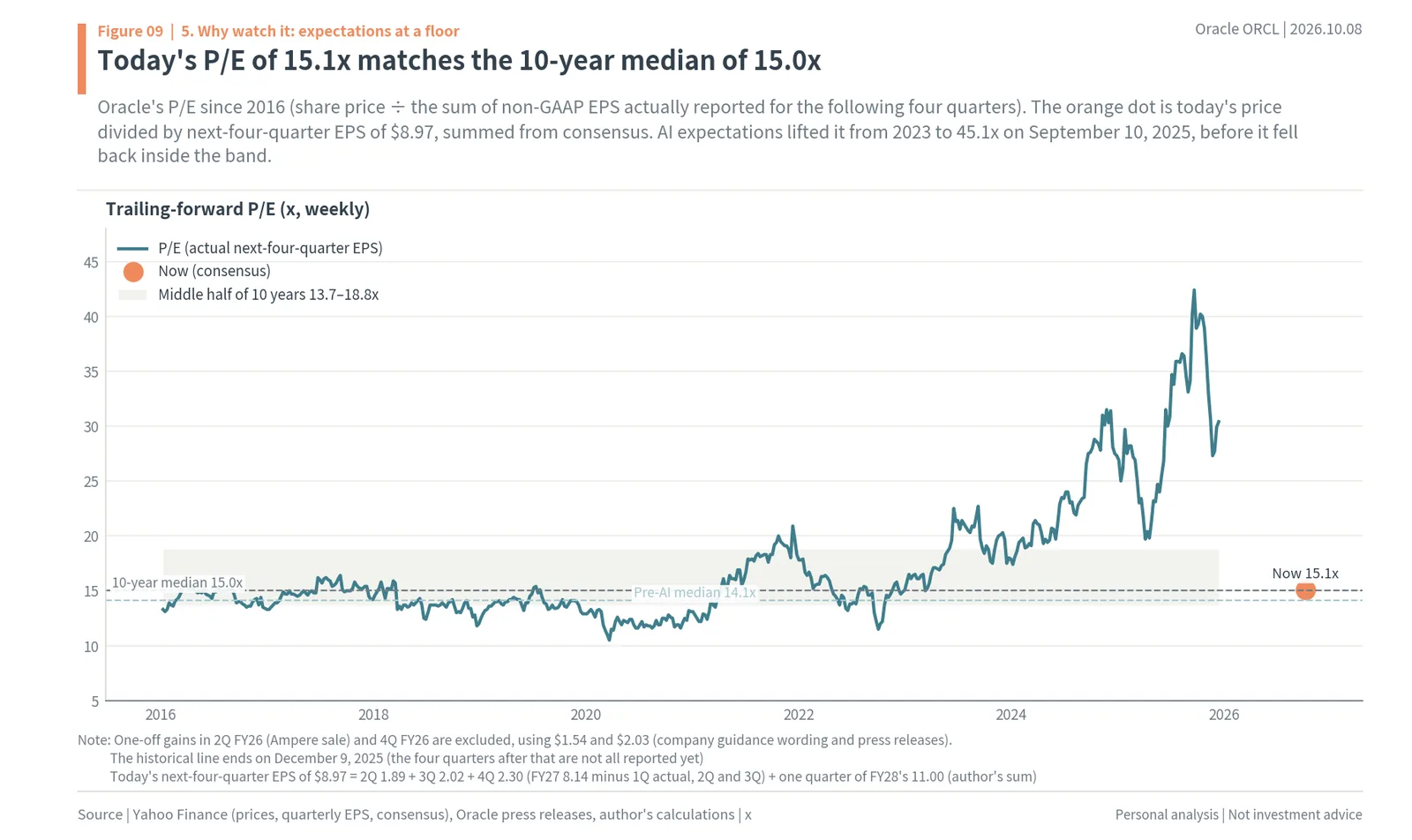
28. The catalysts on big up days were Stargate (+7.17% on January 21, 2025), earnings and RPO (+35.95% on September 10, 2025 and +9.18% on March 11, 2026) and the Google partnership (+8.34%).
29. The catalysts on big down days were the DeepSeek shock (-13.79% on January 27, 2025), the capex increase (-10.83%), the funding plan (-8.53%) and the Broadcom-led AI selloff (-9.59% on June 5, 2026).
30. Up days were about “bigger contracts” and down days about “the money and power to build those contracts,” and today’s share price carries more of the second worry.
4. Why Oracle Stock Fell: Power, Customers and Money
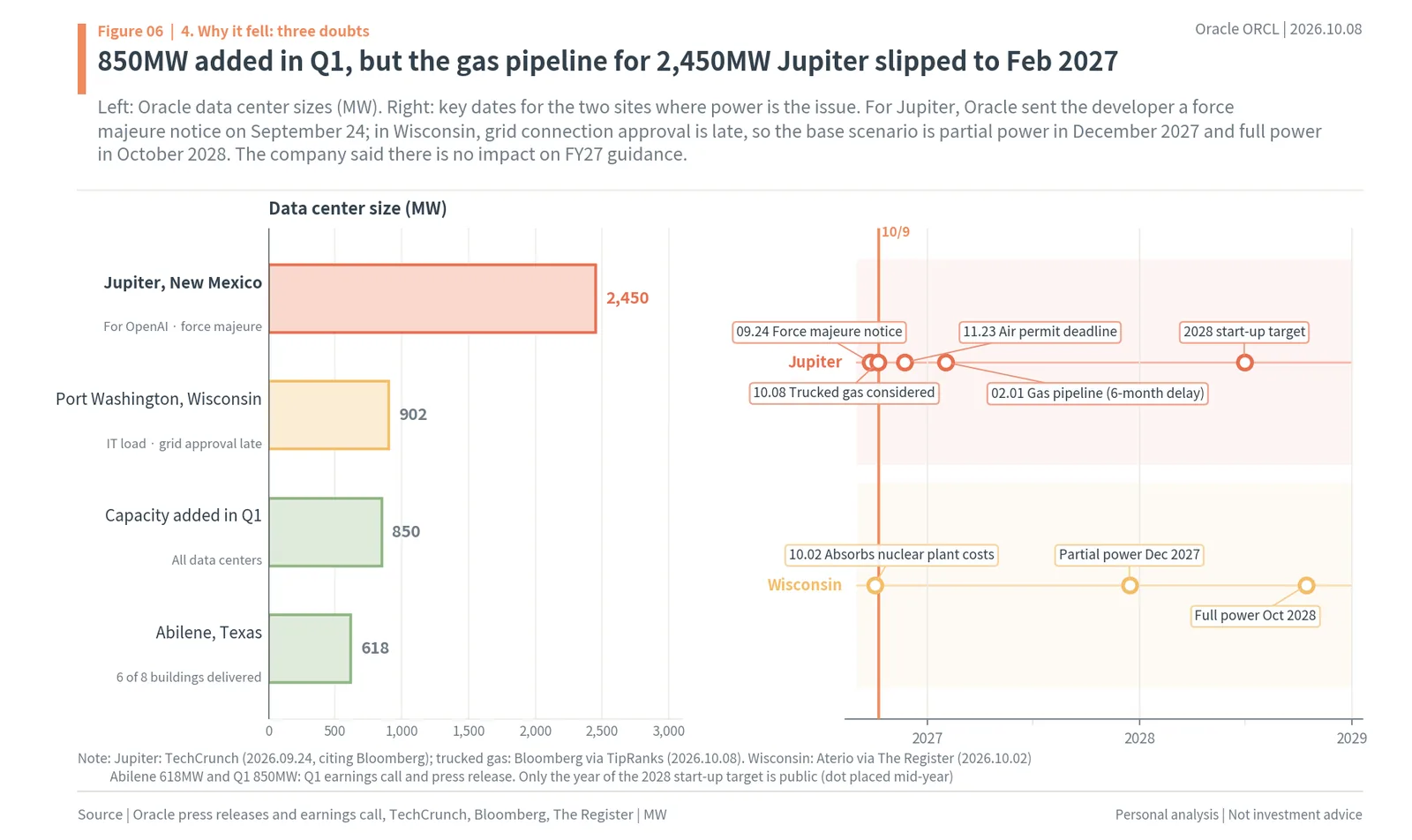
31. The first is power and construction: Oracle added 850MW of data center capacity and delivered more than 300,000 GPUs in Q1, and in Abilene, Texas, it has handed over 6 of 8 buildings (618MW).
32. But on September 24 it sent a force majeure notice to the developer of Project Jupiter in New Mexico (2.45GW = 2,450MW, for OpenAI), a move reported as letting it defer payments if the 2028 start-up date is missed.
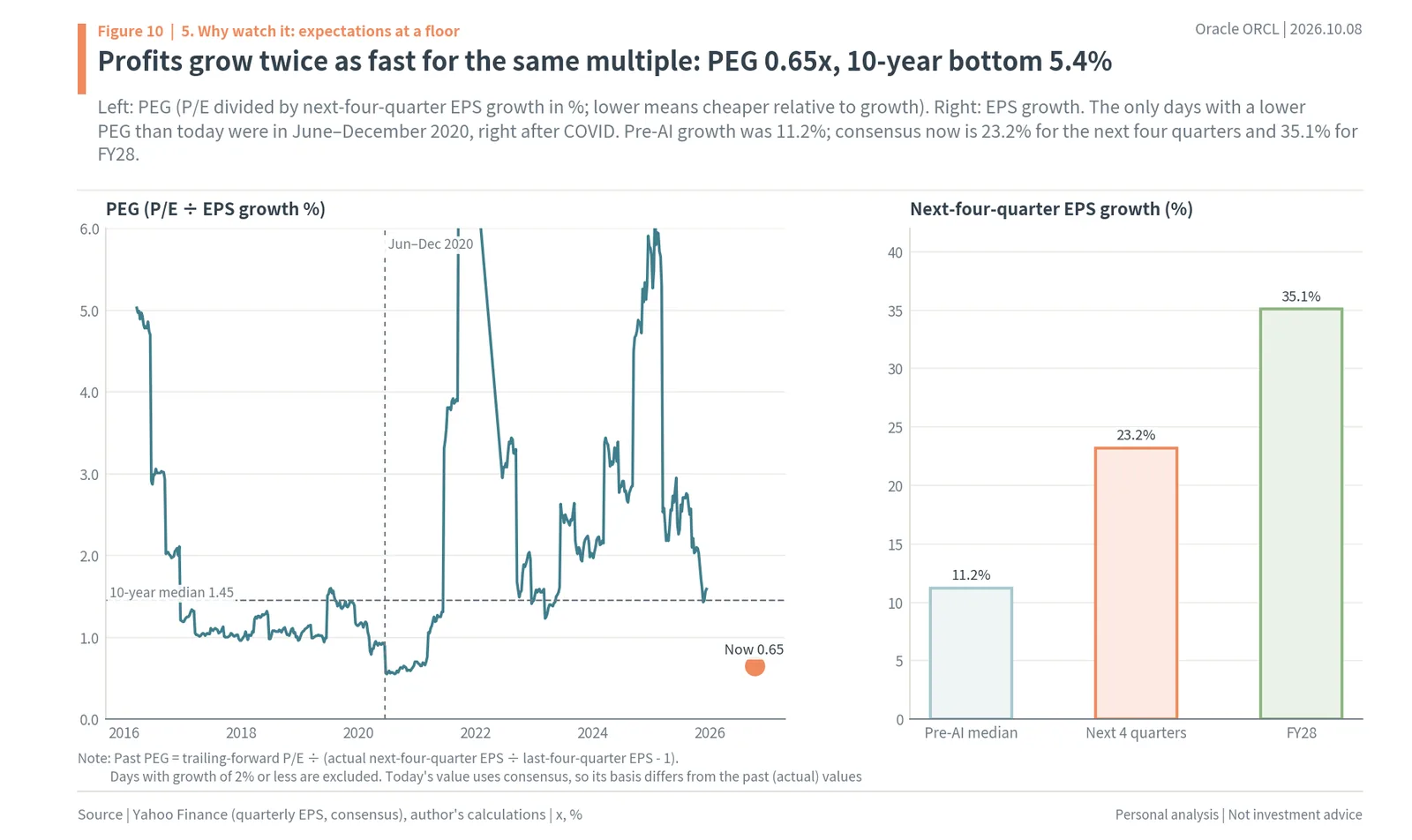
33. The gas pipeline has slipped about six months to February 1, 2027, and the deadline for the air permit decision on the fuel cell microgrid is November 23.
34. On October 8, a report that Oracle was considering trucking in gas (about four times the cost of a pipeline) sent the stock down 5.48%.
35. In Port Washington, Wisconsin (902MW of IT load), grid connection approval is also late, and the reported base scenario is partial power in December 2027 and full power in October 2028.
36. The company said neither site affects its FY27 revenue or earnings guidance.
37. The second is customers: RPO jumped from $137.8bn at the end of May 2025 to $455.3bn at the end of August, and it is now $664bn.
38. S&P sees about half of RPO as OpenAI’s and named OpenAI a “key credit risk.”
39. On October 8, a report that OpenAI’s annualized revenue was about $20bn below expectations sent AI stocks down together.
40. The customers named in the February 2026 funding plan include AMD, Meta, Nvidia, OpenAI, TikTok and xAI, and Oracle won more than $30bn of new AI contracts in Q1 as well.
41. The third is money: of Q1 capex of $28.50bn, operating cash excluding prepayments covered $11.74bn, and the rest came from customer prepayments of $11.36bn and ATM stock sales of $19.91bn.
42. The money raised by selling stock was equal to 70% of Q1 capex.
43. Borrowings are $125.34bn, and off the balance sheet there are $288bn of data center lease commitments.
44. FY27 capex guidance is $90–95bn, with net cash capex of $70bn or less.
45. So the market worried that power, customers or money would get stuck before the contracts turn into profit, and it cut the P/E by as much as that worry.
5. Oracle P/E at 15.1x and PEG at 0.65x: Expectations at a Floor
46. The expectations built into a share price are measured with the P/E: how many years of earnings investors are willing to pay for.
47. The past P/E divides by the non-GAAP EPS actually reported over the following four quarters (trailing-forward), and today’s uses next-four-quarter EPS of $8.97 summed from consensus (2Q 1.89 + 3Q 2.02 + 4Q 2.30 + one quarter of FY28).
48. One-off gains in 2Q FY26 (sale of the Ampere stake) and 4Q FY26 were taken out, so those quarters were entered at $1.54 and $2.03, and FY26 EPS is $6.83.
49. Today’s P/E is 15.1x, the same as the 10-year median since 2016 of 15.0x, with the lower quartile at 13.7x and the upper quartile at 18.8x.
50. The median for 2016–2022, before AI expectations, was 14.1x, and the yearly median rose to 18.4x in 2023, 22.9x in 2024 and 29.4x in 2025 before coming back down.
51. The highest reading was 45.1x on September 10, 2025 (the day after the OpenAI contract).
52. Even at the same multiple, expectations differ if profits grow at different speeds.
53. The median next-four-quarter EPS growth in 2016–2022 was 11.2%, while consensus now is 23.2% for the next four quarters and 35.1% for FY28 over FY27.
54. PEG, the P/E divided by growth, is now 0.65x, less than half the 10-year median of 1.45x.
55. On only 5.4% of days in the past 10 years was PEG lower than this, all of them in June–December 2020, right after COVID.
56. Expectations were lowest on July 24 ($114.99), when the P/E was about 14.4x using the Q1 EPS estimate of $1.74 at the time.
57. Earnings are growing twice as fast as before AI at the same multiple, so the author sees today as a floor, with expectations for the AI portion almost entirely taken out.
6. Why a Low Share Price Costs Oracle: Dilution From the Remaining $20bn
58. On February 1, 2026, Oracle said it would raise $45–50bn during calendar 2026 and fill half of it with equity and equity-linked securities.
59. Under that plan, in February it issued $25bn of bonds (eight maturities, coupons of 4.55–6.85%) and $5bn of mandatory convertible preferred.
60. The $20bn of at-the-market (ATM) share sales had sold zero shares through March, then was used up in Q1 (June–August), with about 141mn shares sold at an average of about $141.
61. Over that time, common shares rose 4.97%, from 2.880bn on June 12 to 3.024bn on September 7.
62. The funding target for this fiscal year is about $40bn, and after the $20bn ATM, about $20bn remains; the company has not yet said how or when it will raise it.
63. It said three times, in February, March and June, that it would not issue more bonds in calendar 2026.

64. Credit rating agencies want equity rather than debt: when S&P cut Oracle to BBB- on July 9, it projected FY27 free cash flow of about -$42bn and said it expects share issuance even after 2026 if credit metrics weaken.
65. S&P’s downgrade trigger is leverage staying above 4.5x, and Moody’s said leverage could temporarily approach 5x.
66. The 5-year CDS (the cost of insuring against default) hit a record 227.15bp on September 25, more than four times the investment-grade index (about 55bp).
67. So if the remaining money is raised with stock, the lower the share price, the more shares Oracle has to give up for the same money.
68. Selling $20bn at today’s price takes 147mn shares (4.9%), at the consensus average target of $237.97 it takes 84mn shares (2.8%), and at the June high of $248.15 it takes 81mn shares (2.7%).
69. Today’s price means giving up 66.8mn more shares than at the June high, which takes $0.51 a share off FY28 EPS of $11.00 ($0.29 at the high) (author’s calculation).
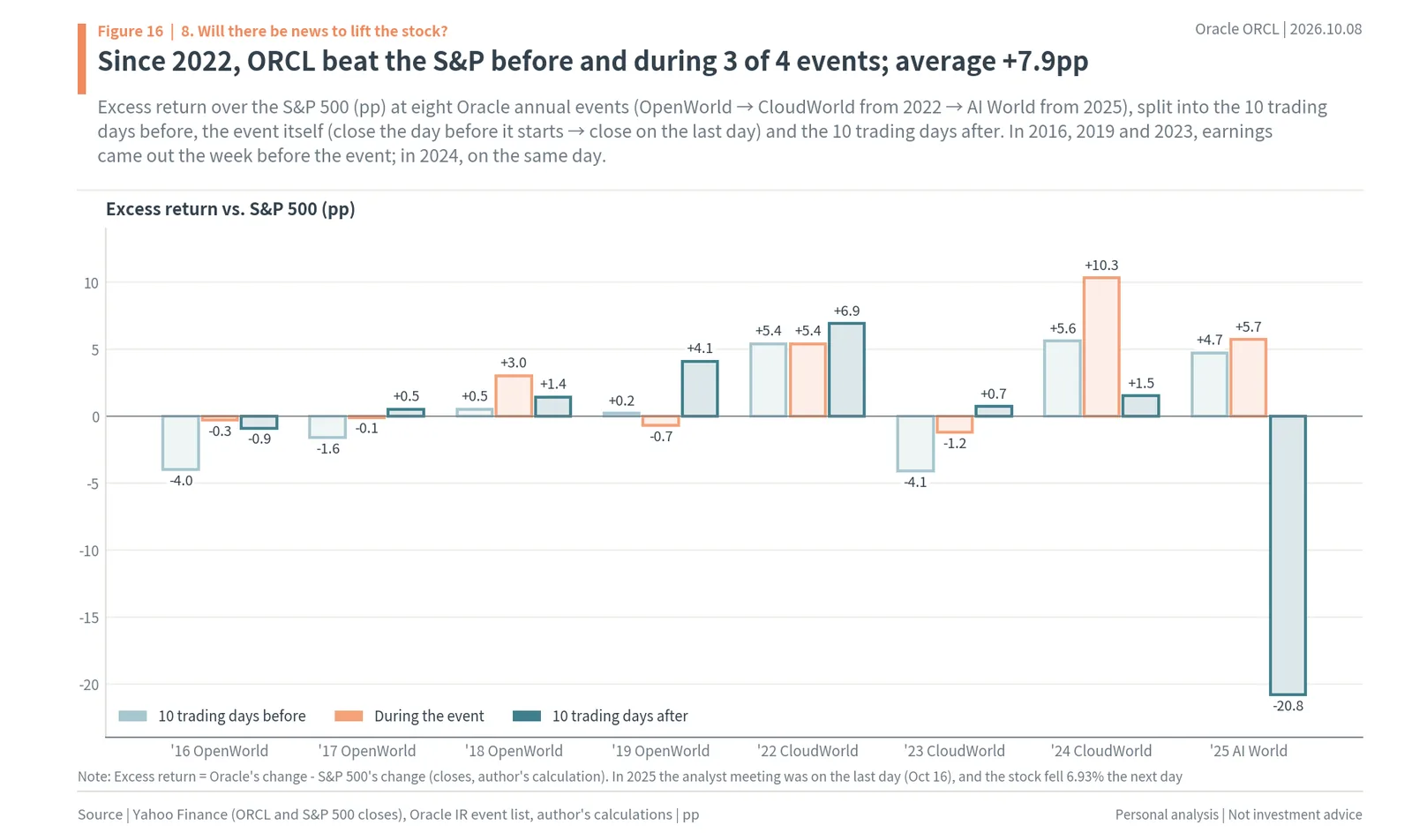
70. Keeping the rating takes equity, and selling equity takes a high share price, so Oracle is the company with the strongest reason to lift its share price.
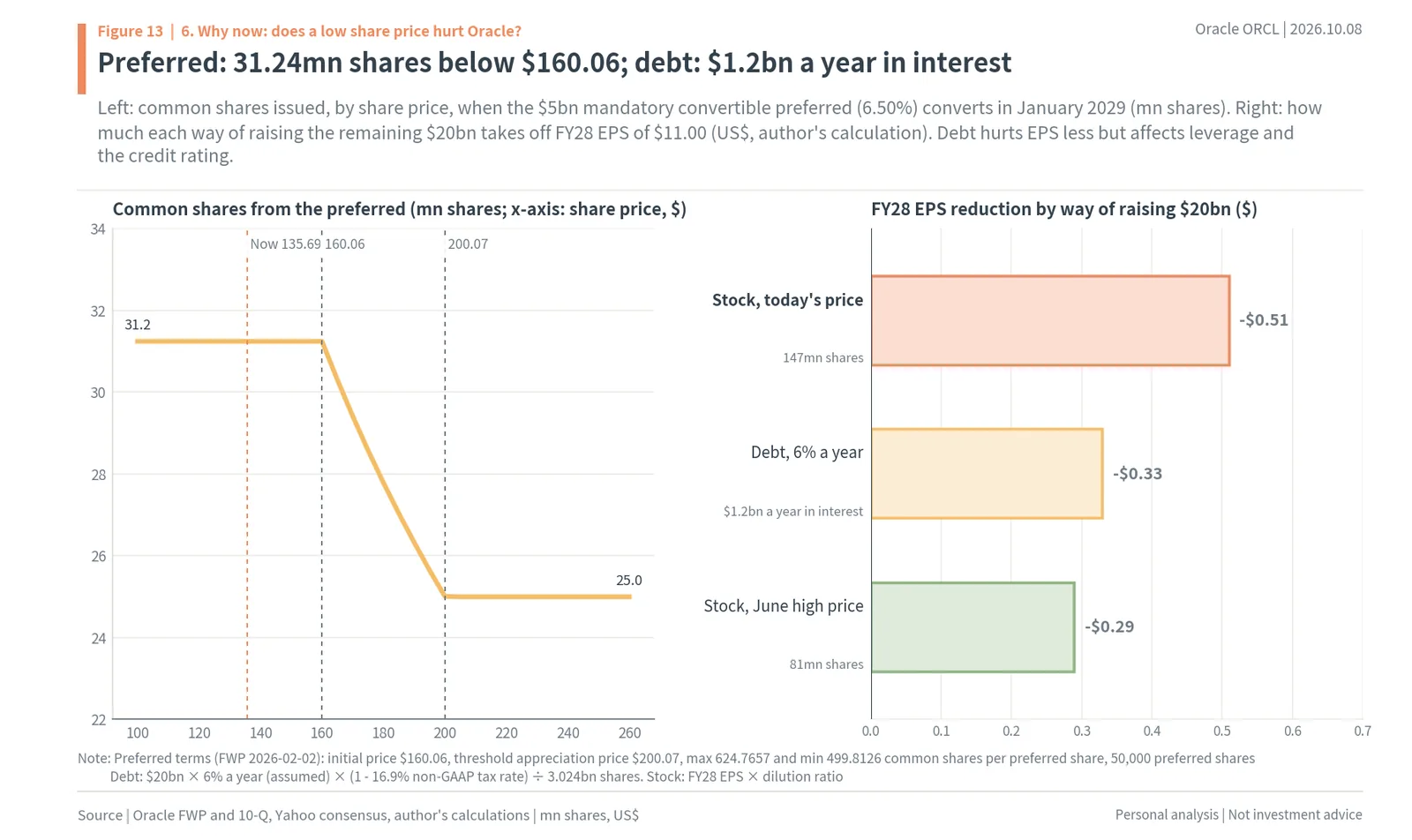
71. The $5bn of mandatory convertible preferred (6.50%) converts into common stock in January 2029: into 31.24mn shares if the price is below $160.06 and 24.99mn shares if it is above $200.07.
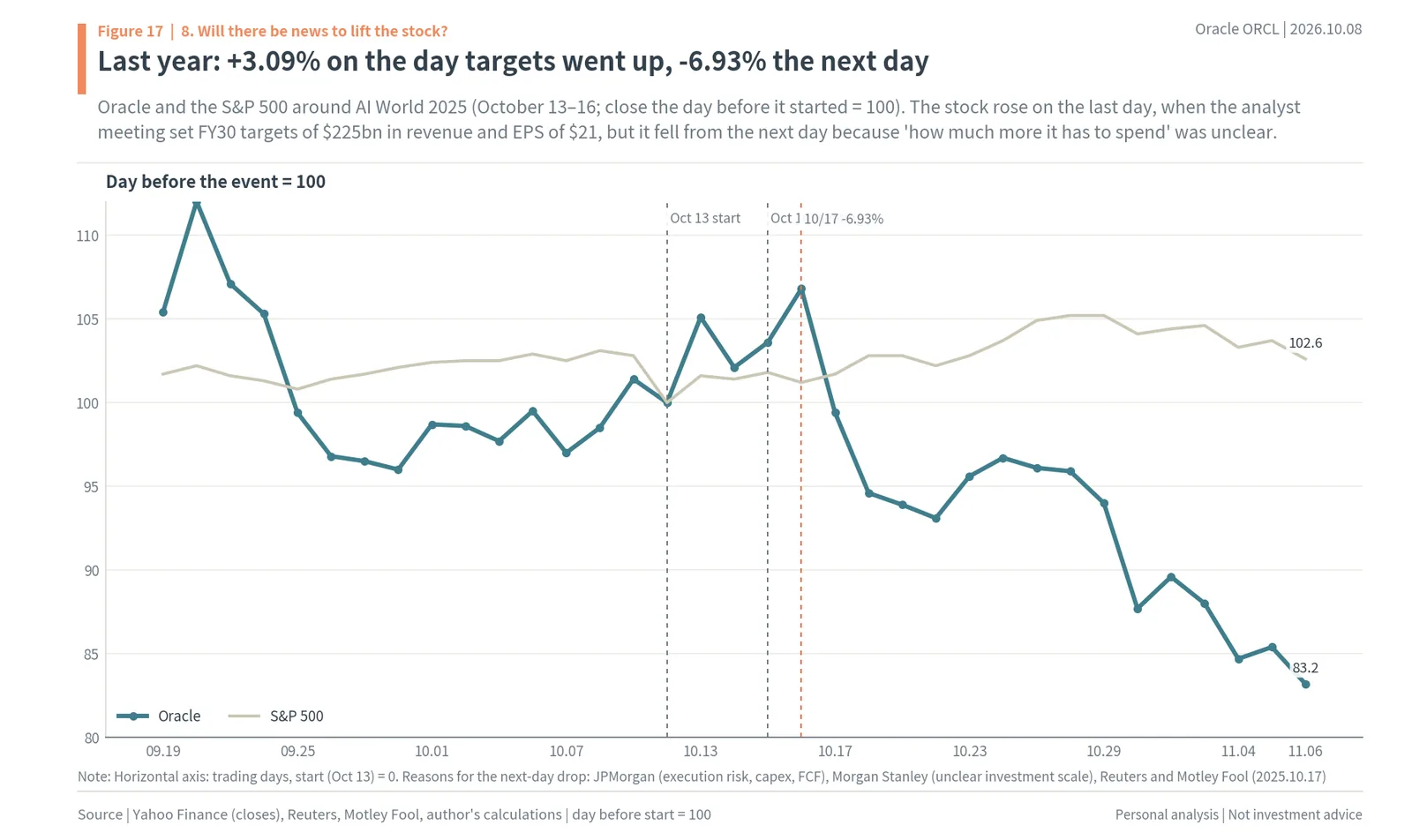
72. At today’s price it is the maximum of 31.24mn shares, and above $200.07 that falls by 6.25mn shares.
73. Raising the same $20bn with debt (assuming 6% a year) adds $1.2bn a year in interest, or $0.33 a share after tax, 3.0% of FY28 EPS (author’s calculation).
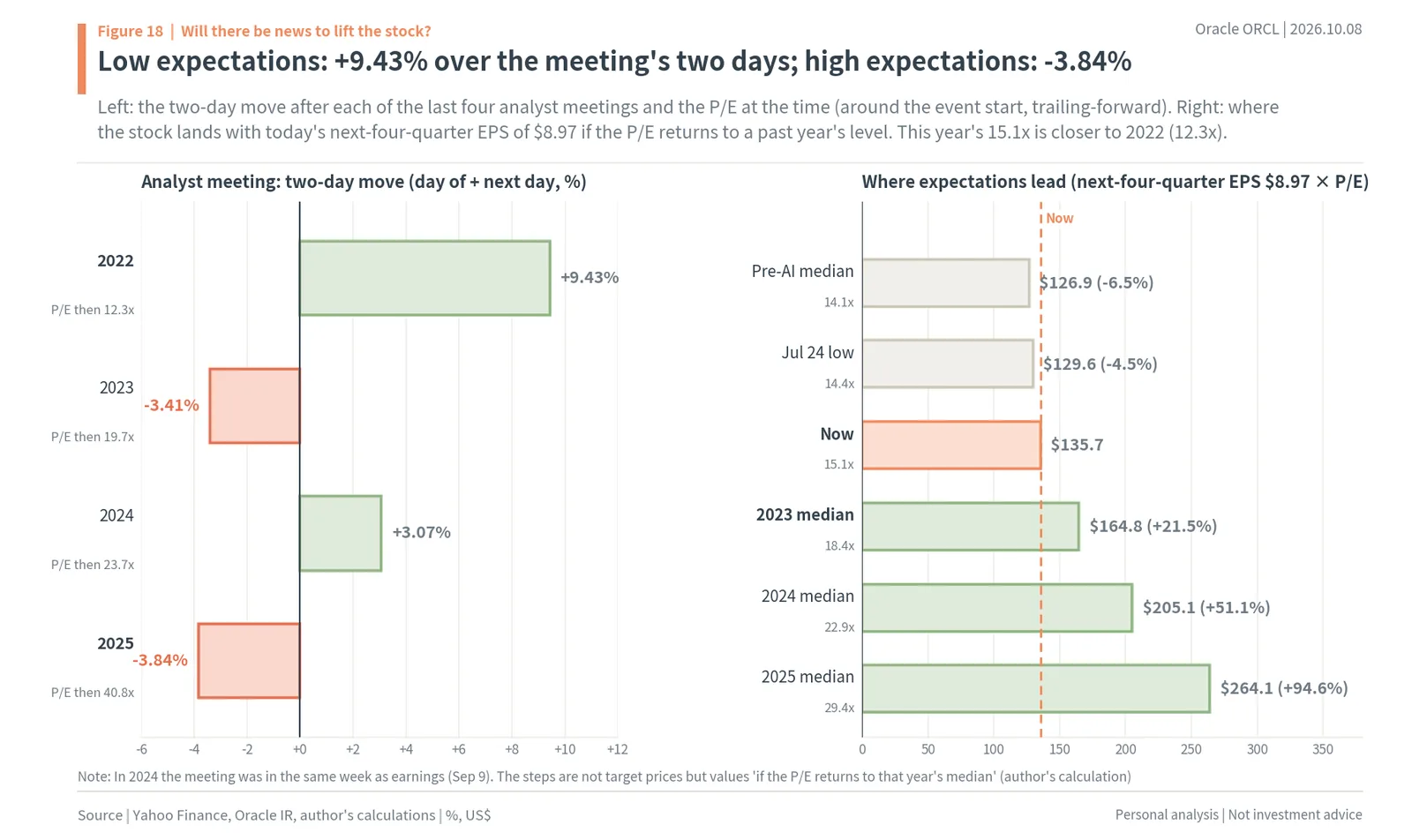
74. Debt raises leverage and puts pressure on the rating and interest costs again, and off the balance sheet there are also $288bn of data center lease commitments that have not yet started.
75. Partners’ funding costs also follow Oracle’s credit: about $18bn of Jupiter bank loans was quoted at 89–91 cents on the dollar in mid-September (FT).
76. Employee pay is tied to the share price too: the FY26 stock options of Larry Ellison and the co-CEOs had no intrinsic value as of the end of May, and Q1 stock-based compensation was $1.13bn.
77. Chairman Larry Ellison’s pledged shares rose by about 67mn in a year to about 413mn, and on September 12 he canceled a plan to sell up to 50mn shares and said he had “no other plans to sell.”
78. Whether it uses stock or debt, the share price sets the cost of the remaining money, so Oracle needs to lift its share price before its next raise.
7. Oracle AI World 2026 and the October 28 Investor Day: What to Expect
79. Oracle AI World 2026 runs October 25–28 at The Venetian in Las Vegas.
80. Oracle put “Investor Day, October 28” on page 13 of its Q1 earnings slides, and in 2022–2025 it also held an analyst meeting on the last day of the event and announced it two to three days ahead.
81. At 9:30 on October 26, co-CEOs Mike Sicilia and Clay Magouyrk present “Oracle: where AI means business,” showing AI inside business apps and customer cases.
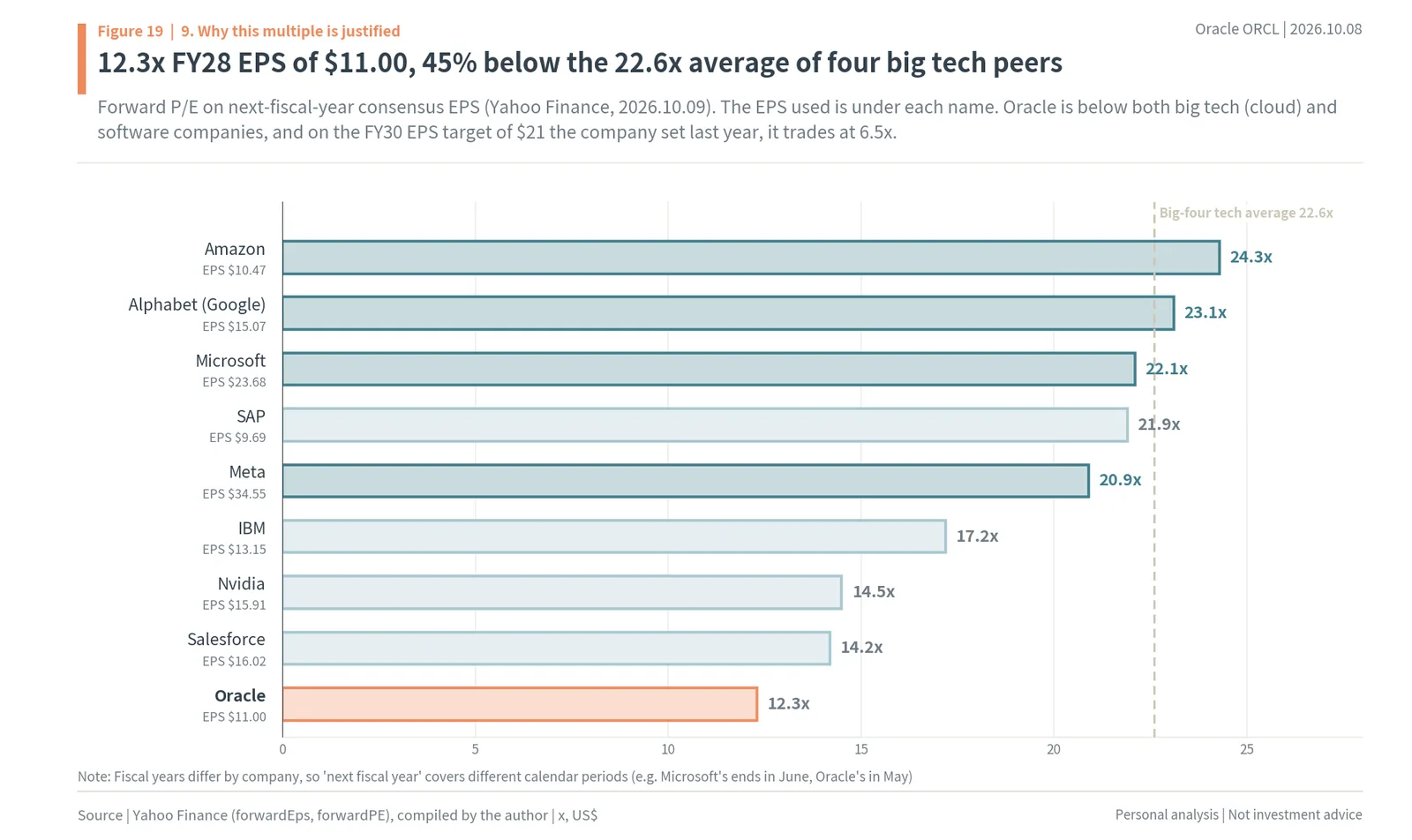
82. At 9:00 on October 27, Magouyrk covers development, data, security and infrastructure in “Now that AI works, what are we going to do with it?”
83. The speaker for “Oracle Vision and Strategy” at 15:30 on October 27 is listed only as “Special Guest,” and the title is the same as Larry Ellison’s keynotes in 2024 and 2025.
84. October 28 brings a Codex and Oracle hackathon with OpenAI, and the Investor Day.
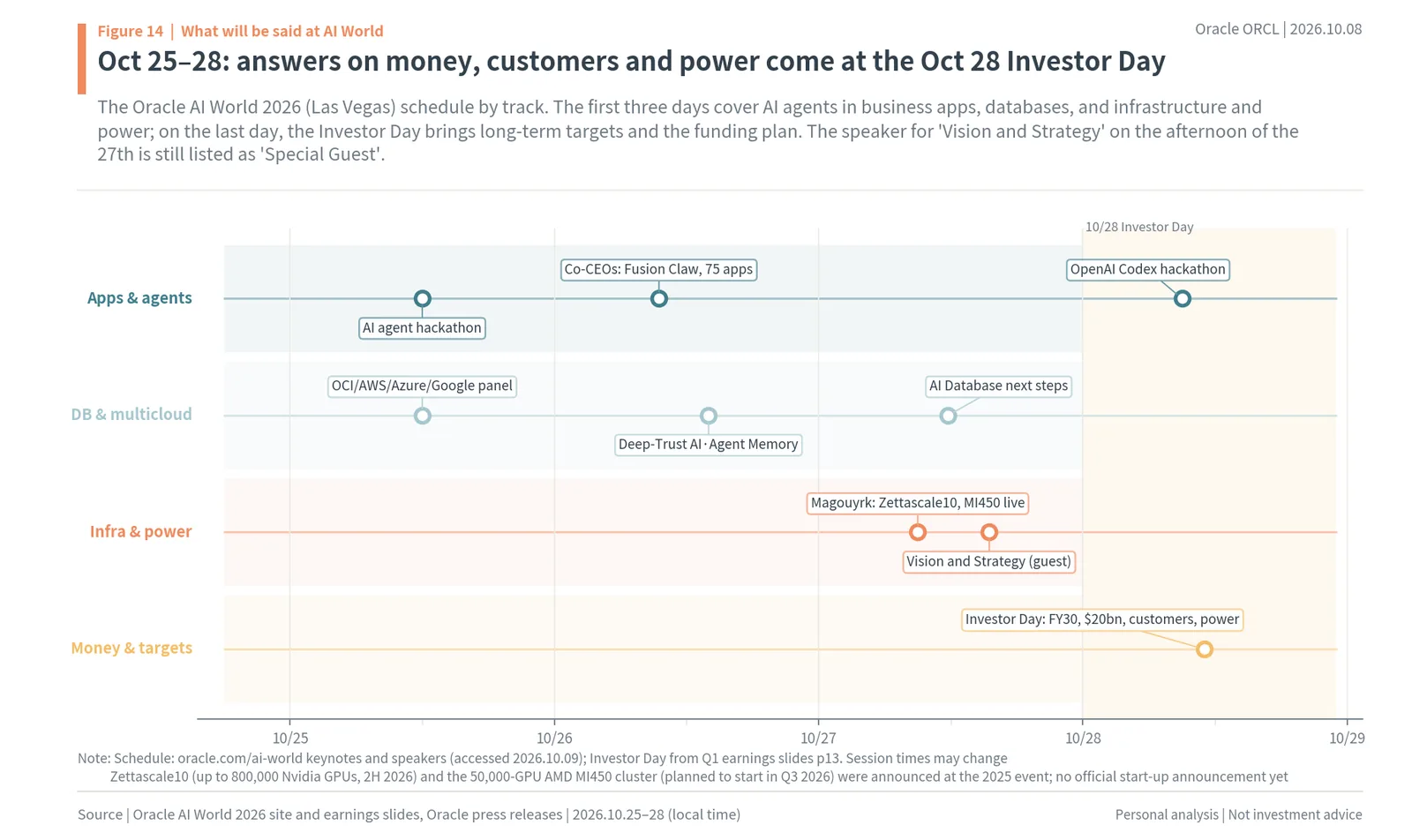
85. Apps: Fusion Claw, the framework for running agents launched on September 29 (25 apps, 75 agentic apps in all), and AI Registry and Agent Hub (agent management) take the stage.
86. Database: sessions are scheduled on Deep-Trust AI Architecture, Agent Memory, vector search accelerated with Nvidia GPUs, and Autonomous AI Lakehouse.
87. Multicloud: Q1 revenue grew 353%, and leaders from OCI, AWS, Azure and Google Cloud share one stage on October 25.
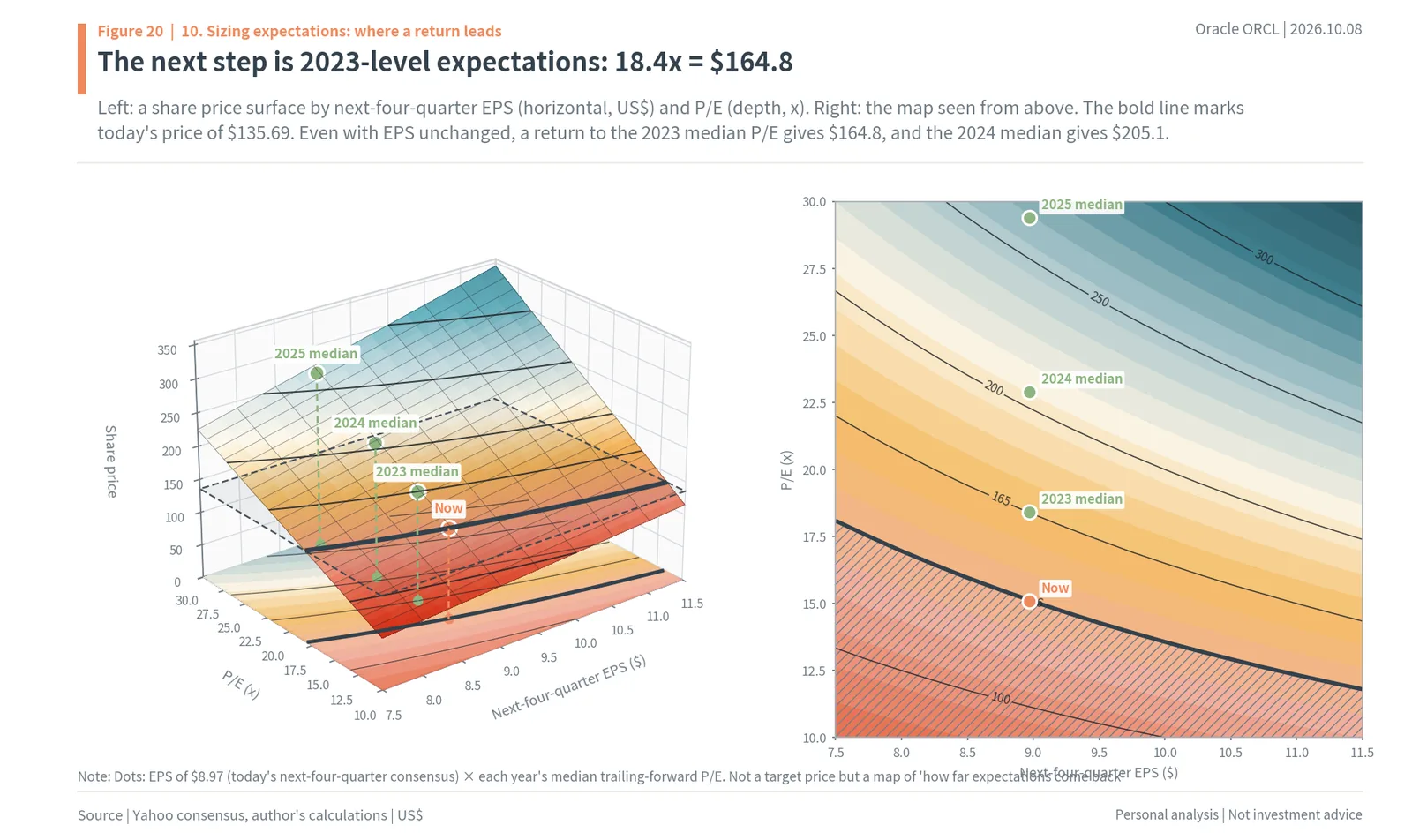
88. Infrastructure: start-up announcements are still to come for Zettascale10 (up to 800,000 Nvidia GPUs, available in 2H 2026), previewed last year, and the 50,000-GPU AMD MI450 cluster (planned to start in Q3 2026).
89. Power: up to 2.8GW of Bloom fuel cells (1.2GW committed), 2.3GW of VoltaGrid gas generation and, on October 2, absorbing about $300mn of costs at the Point Beach nuclear plant in Wisconsin have come one after another.
90. Money: the cumulative $75bn of prepayments and customer hardware, Q1 customer prepayments of $11.36bn and reports of talks with Apollo and Goldman Sachs on a chip-leasing vehicle (WSJ) are material for the Investor Day.
91. The first three days lay out the apps, infrastructure and power stories, and the October 28 Investor Day brings long-term targets and the answers on money, customers and power together in one place.
8. Can Oracle’s Investor Day Lift the Stock? Past Meetings From 2022 to 2025
92. At the last four events (2022–2025), Oracle beat the S&P 500 in three of them over the 10 trading days before and during the event, by 7.9 percentage points on average.
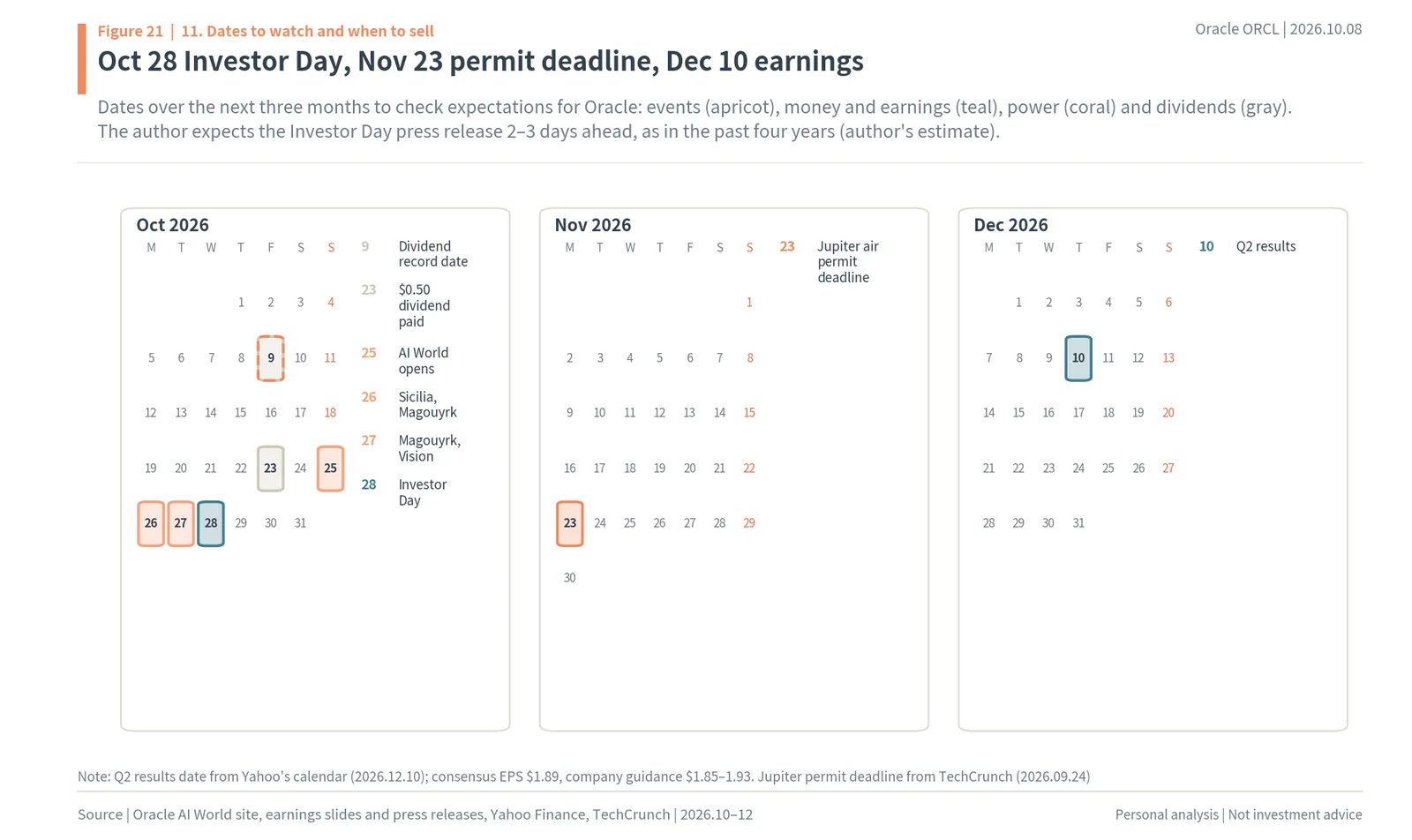
93. Across all eight, including the OpenWorld years (2016–2019), the average was +0.8 percentage points before the event and +2.8 percentage points during it.
94. Last year the stock had already risen sharply right before the event: on October 16, the day the meeting set FY30 targets of $225bn in revenue (market expectations $198.4bn) and EPS of $21, it rose 3.09%, but the next day it was -6.93%.
95. The reasons were “how much more it has to spend to earn that” and unclear free cash flow (J.P. Morgan, Morgan Stanley), and in the 10 trading days after the event it lagged the S&P by 20.8 percentage points.
96. The two-day reaction to each meeting followed the size of expectations at the time.
97. The 2022 meeting, at a P/E of 12.3x (bottom 11% of the 10-year band), brought +9.43% over two days, while 2023 at 19.7x brought -3.41%, 2024 at 23.7x +3.07% and 2025 at 40.8x -3.84%.
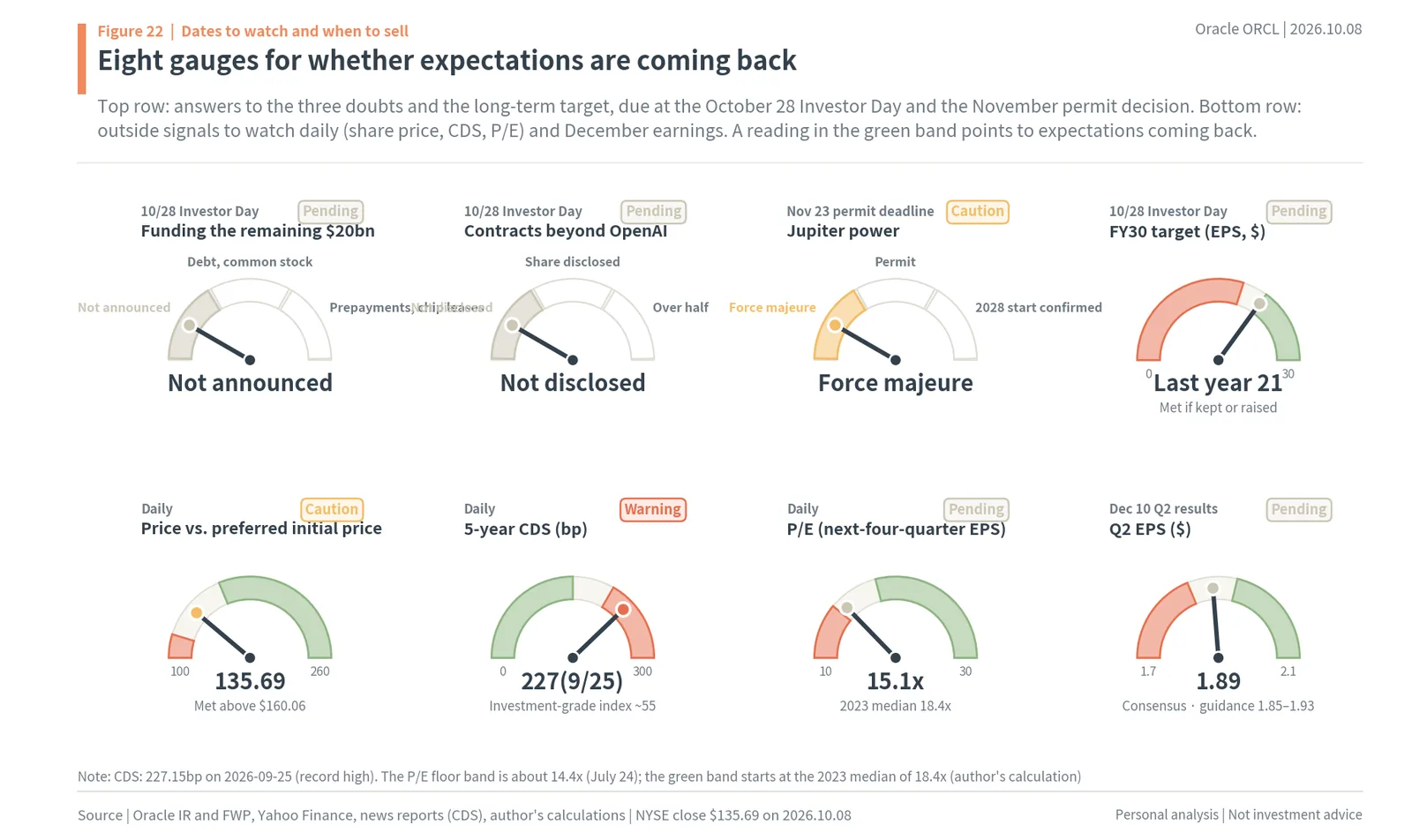
98. This year, at 15.1x next-four-quarter EPS of $8.97, is closer to 2022, a setup where the stock could react more strongly to an equally good answer.
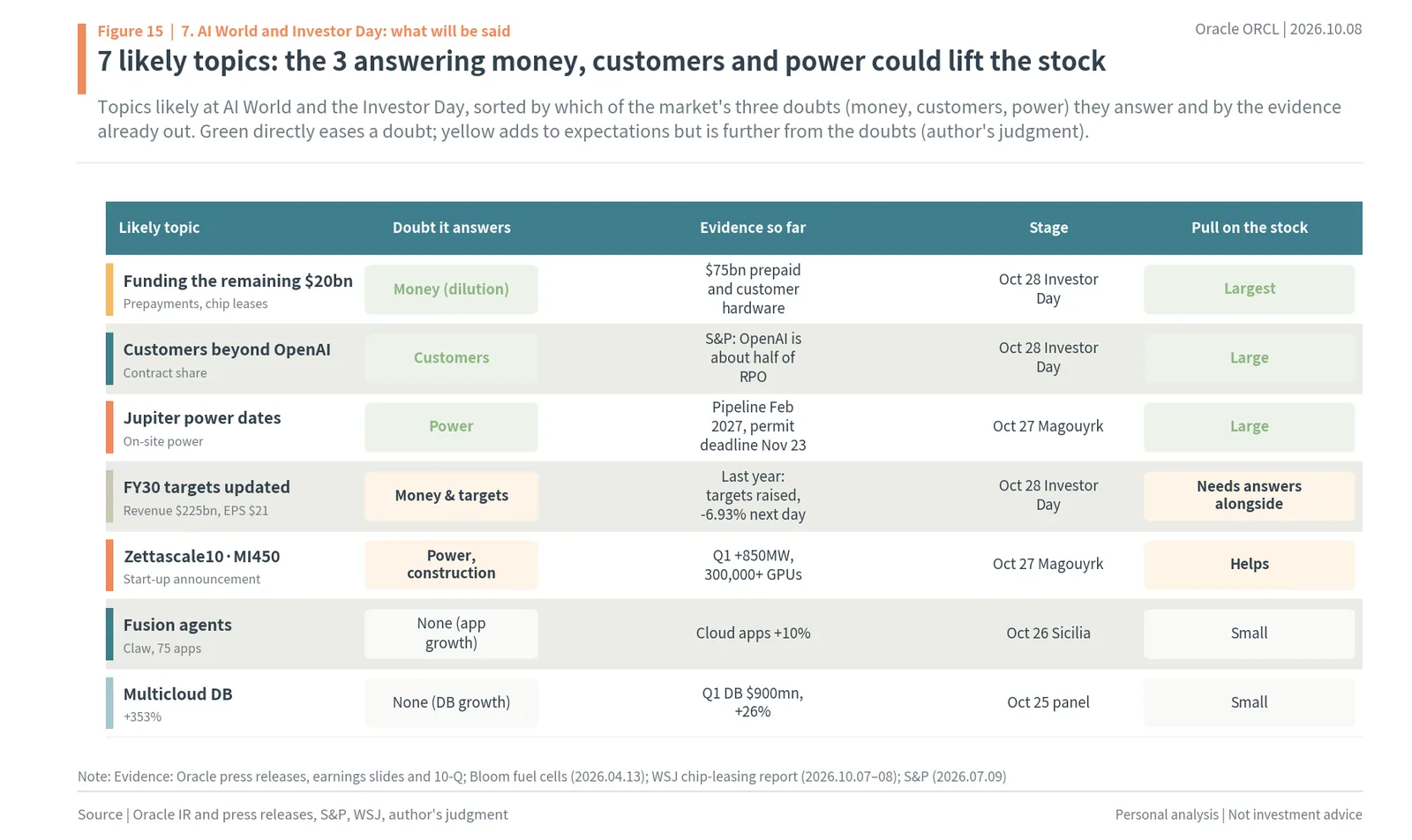
99. So the news that can lift the stock is not bigger targets but numbers that answer the three doubts.
100. First, money: if Oracle says it will fill the remaining roughly $20bn with prepayments, customer hardware and chip leasing rather than common stock, the dilution worry goes away.
101. Oracle has already said most new Q1 contracts were prepaid or customer hardware, so there is no additional effect on its funding plan.
102. Second, customers: that means putting numbers on the share of contracts outside OpenAI (S&P puts OpenAI at about half of RPO) and on the shares of customers named in the February 2026 plan, such as AMD, Meta, Nvidia, TikTok and xAI.
103. Third, power: with Jupiter’s gas pipeline pushed to February 2027 and the air permit decision due by November 23, that means giving dates for keeping the 2028 start-up on track with fuel cells and on-site generation.
104. With expectations low, if Oracle answers “how much more will it spend and where will the money come from” with numbers, the author thinks the meeting can lift the stock, as in 2022.
9. Oracle Valuation vs Big Tech: 12.3x FY28 EPS vs a 22.6x Average
105. Oracle trades at 12.3x FY28 EPS of $11.00, 45% below the 22.6x average of four big tech companies (Microsoft, Amazon, Alphabet and Meta).
106. Microsoft trades at 22.1x EPS of $23.68, Amazon at 24.3x on $10.47, Alphabet at 23.1x on $15.07 and Meta at 20.9x on $34.55.
107. On the software side, SAP at 21.9x EPS of $9.69 and IBM at 17.2x on $13.15 are also higher than Oracle.
108. No company is lower than Oracle, and the closest are Salesforce at 14.2x (EPS of $16.02) and Nvidia at 14.5x ($15.91).
109. On the FY30 EPS target of $21 the company set last year, it trades at 6.5x, a price that barely believes that target.
110. It is discounted by as much as the debt and dilution worries, so if those worries ease, the multiple has plenty of room to move back toward big tech.
10. Where Oracle Stock Lands If Expectations Return: $164.8 at 2023 Levels
111. Instead of a target price, the author used next-four-quarter EPS of $8.97 to work out where the share price lands if expectations return to the level of a past year.
112. A return to the 2023 median P/E of 18.4x gives $164.8 (+21.5%).
113. The 2024 median of 22.9x gives $205.1 (+51.1%), and the 2025 median of 29.4x gives $264.1 (+94.6%).
114. A further drop to the pre-AI median of 14.1x gives $126.9, and the July 24 floor multiple of 14.4x gives $129.6.
115. The consensus average target of $237.97 (41 analysts, range $110–400) is 26.5x today’s EPS, so analysts have left expectations where they were between 2024 and 2025.
116. The next step up from today’s price is 2023-level expectations ($164.8), and the answers at the October 28 meeting are what could carry the stock up that step.
11. Oracle Stock Calendar: Investor Day, Jupiter Permit Deadline and Q2 Results
117. After the October 9 dividend record date (quarterly $0.50, paid on the 23rd), the next event is AI World on October 25–28.
118. The author expects the Investor Day press release two to three days ahead (around October 25–26), as in the past four years (author’s estimate).
119. November 23 is the deadline for the air permit decision on Jupiter’s fuel cell microgrid, and December 10 brings Q2 FY27 results (consensus EPS of $1.89, company guidance $1.85–1.93).
120. On the day of the analyst meeting, the stock beat the S&P in three of the last four years, and on the next day it was weaker in three of four.
121. For investors who sell when earnings become the talking point, the author sees the first selling window as the day of the October 28 Investor Day.
122. What to watch on the 28th: the instrument for the remaining $20bn, contracts outside OpenAI, Jupiter power dates, FY30 targets, the $70bn cap on net cash capex and whether Q2 guidance is kept.
123. As outside signals, watch whether the share price rises above $160.06, the initial price of the mandatory convertible preferred, and whether CDS comes down from 227bp.
12. Summary
124. With the three doubts (power, customers and money) piling up, Oracle’s P/E has fallen to 15.1x, the same as its 10-year median, and its price relative to growth is in the bottom 5.4% of 10 years, so expectations are at a floor.
125. If the remaining roughly $20bn is raised with stock, today’s price means giving up 66.8mn more shares than at the June high, so a low share price is a cost to Oracle.
126. The 2022 meeting, held when expectations were low, brought +9.43% over two days, and this year’s October 28 Investor Day could set up the same situation.
Maochaedung’s take
In short: expectations are at a floor, and the answer comes on October 28. Weighed down by three doubts (construction and power delays, OpenAI’s ability to pay, and funding through debt and stock), Oracle’s P/E has fallen to 15.1x, its 10-year median, and its price relative to earnings growth is in the bottom 5.4% of 10 years, so expectations are at a floor. Keeping its rating takes equity and selling equity takes a high share price, so with about $20bn still to raise, Oracle is the company with the strongest reason to lift its share price. If, rather than bigger targets, the October 28 Investor Day puts numbers on “a way to raise money without stock, customers beyond OpenAI and power dates,” it could lift the stock like the 2022 meeting held when expectations were low, and the next step is $164.8, the 2023 level of expectations. For investors who sell on the earnings story, the last four meetings were strong on the day and weak the next day, so the day of the 28th is the first window.
Oracle (ORCL) Stock FAQ
Q. Is Oracle stock cheap now?
Oracle trades at 15.1x next-four-quarter EPS of $8.97, the same as its 10-year median of 15.0x. Relative to growth, its PEG of 0.65x is lower than on all but 5.4% of days in the past 10 years, all of which were in June–December 2020.
Q. Why did Oracle stock fall?
Oracle fell 53.7% from its June 1 high of $248.15 to $114.99 on July 24, and after a rebound it fell another 16.05% after Q1 results to $135.69. The worries come down to three doubts: power and construction (the Jupiter force majeure notice and gas pipeline delay), customers (S&P sees about half of RPO as OpenAI’s) and money (Q1 capex of $28.50bn exceeded operating cash flow of $23.10bn).
Q. Why does a low share price hurt Oracle?
Oracle has about $20bn of FY27 funding left to raise. In stock, that takes 147mn shares (4.9%) at $135.69 but 81mn shares (2.7%) at the June high of $248.15. S&P, which cut Oracle to BBB- on July 9, said it expects share issuance even after 2026 if credit metrics weaken.
Q. When are Oracle AI World 2026 and the Investor Day?
Oracle AI World 2026 runs October 25–28 at The Venetian in Las Vegas, and Oracle listed an Investor Day on October 28 on page 13 of its Q1 earnings slides.
Q. How did Oracle stock react to past analyst meetings?
The two-day move followed expectations: +9.43% in 2022 at a P/E of 12.3x, -3.41% in 2023 at 19.7x, +3.07% in 2024 at 23.7x and -3.84% in 2025 at 40.8x. In 2025 the stock rose 3.09% on the meeting day and fell 6.93% the next day.
Q. Where could Oracle stock go if expectations recover?
Using next-four-quarter EPS of $8.97, a return to the 2023 median P/E of 18.4x gives $164.8 (+21.5%), the 2024 median of 22.9x gives $205.1 and the 2025 median of 29.4x gives $264.1. These are not target prices.
Sources
- Oracle, Q1 fiscal 2027 earnings press release (link), 2026.09.10
- Oracle, Q1 10-Q (link), 2026.09.11
- Oracle, Q1 earnings slides (link), 2026.09.10
- Oracle, Q4 fiscal 2026 earnings press release (link), 2026.06.10
- Oracle, 2026 financing plan (link), 2026.02.01
- Oracle, Mandatory convertible preferred pricing terms (link), 2026.02.02
- Oracle, Larry Ellison’s sale plan canceled (link), 2026.09.12
- Oracle, Oracle AI World 2026 keynotes and schedule (link), accessed 2026.10.09
- Oracle, Fusion Claw announcement (link), 2026.09.29
- Oracle, Commitment to absorb Point Beach energy costs (link), 2026.10.02
- Oracle, Zettascale10 and AMD MI450 announcement (link), 2025.10.14
- Reuters, Oracle expects cloud sales of $166 billion by 2030 (link), 2025.10.16
- Motley Fool, Why Oracle Fell Hard Today (link), 2025.10.17
- PPC Land, S&P cuts Oracle to BBB- (link), 2026.07.18
- TechCrunch, Oracle sends force majeure notice on its New Mexico Stargate data center (link), 2026.09.24
- TipRanks, Why Oracle stock is sinking today (link), 2026.10.08
- SiliconANGLE, AI stocks crumble on report that OpenAI’s annualized revenue is lower (link), 2026.10.08
- Yahoo Finance, Oracle stock falls on more debt to fund AI chip buying (link), 2026.10.08
- CNBC, Oracle stock ends worst week since 2001 (link), 2026.06.26
- The Register (Aterio), Wisconsin data center delay risk (link), 2026.10.02
- Yahoo Finance, Oracle prices, quarterly EPS, consensus and peer data (link), 2026.10.09
Disclaimer
This post records the author’s personal analysis and views based on publicly available information and does not recommend choosing any particular product or company. It does not recommend buying or selling any financial investment product and is not a service provided as investment advisory or quasi-investment advisory business.
Figures in this post are values published as of the time of writing. The 10-year P/E band (trailing-forward), PEG, dilution from the remaining funding, shares from the mandatory convertible preferred conversion, excess returns around events and “where the stock lands if expectations return” are values the author calculated from company filings and Yahoo Finance data, not company guidance or broker consensus. Accuracy and completeness are not guaranteed.
The remaining roughly $20bn is the company’s stated FY27 funding of about $40bn minus the $20bn ATM, and the company has not announced how it will be raised. Items marked ‘author’s calculation’ or ‘author’s judgment’ are the author’s calculations and assumptions, not confirmed facts. This post does not give a target price.
The judgments in this post are the author’s personal views; they do not recommend trading at any particular time or promise any return. Oracle reports its results in US dollars, and for investors in Korea, gains and losses in won change with the exchange rate.
Author’s interest: not disclosed
Responsibility for decisions and their outcomes lies with the reader.
As of: October 9, 2026