AhnLab (053800) Stock Forecast 2026: After AI Hacking, Is Quantum Security Next? PQC Readiness and Price Ranges by Deadline (1-Year KRW 104,300)
AhnLab (053800) stock forecast, split by deadline: on October 6 AhnLab rose 15.6% in a single day after AI-automated hacks hit Korean financial firms. This report asks whether AhnLab can actually do quantum security, the next expectation after AI security, and if so when and how much it could be worth, using validation records, the government schedule and the author’s own earnings estimates. Data as of October 6, 2026.
- AhnLab rose 15.6% in one day on October 6 after AI-automated hacks led to data leaks at 7 Korean financial firms, and is up 55.9% since September 10.
- In quantum security AhnLab is able, but not a leader: it was first in Korea to get KCMVP for a quantum random number module in 2021, but it is not among the 3 PQC-validated companies or the 2026 pilot leads.
- The deadlines are the November 20 quantum act → January 2027 validation targets → the January 2029 public-sector key-exchange mandate.
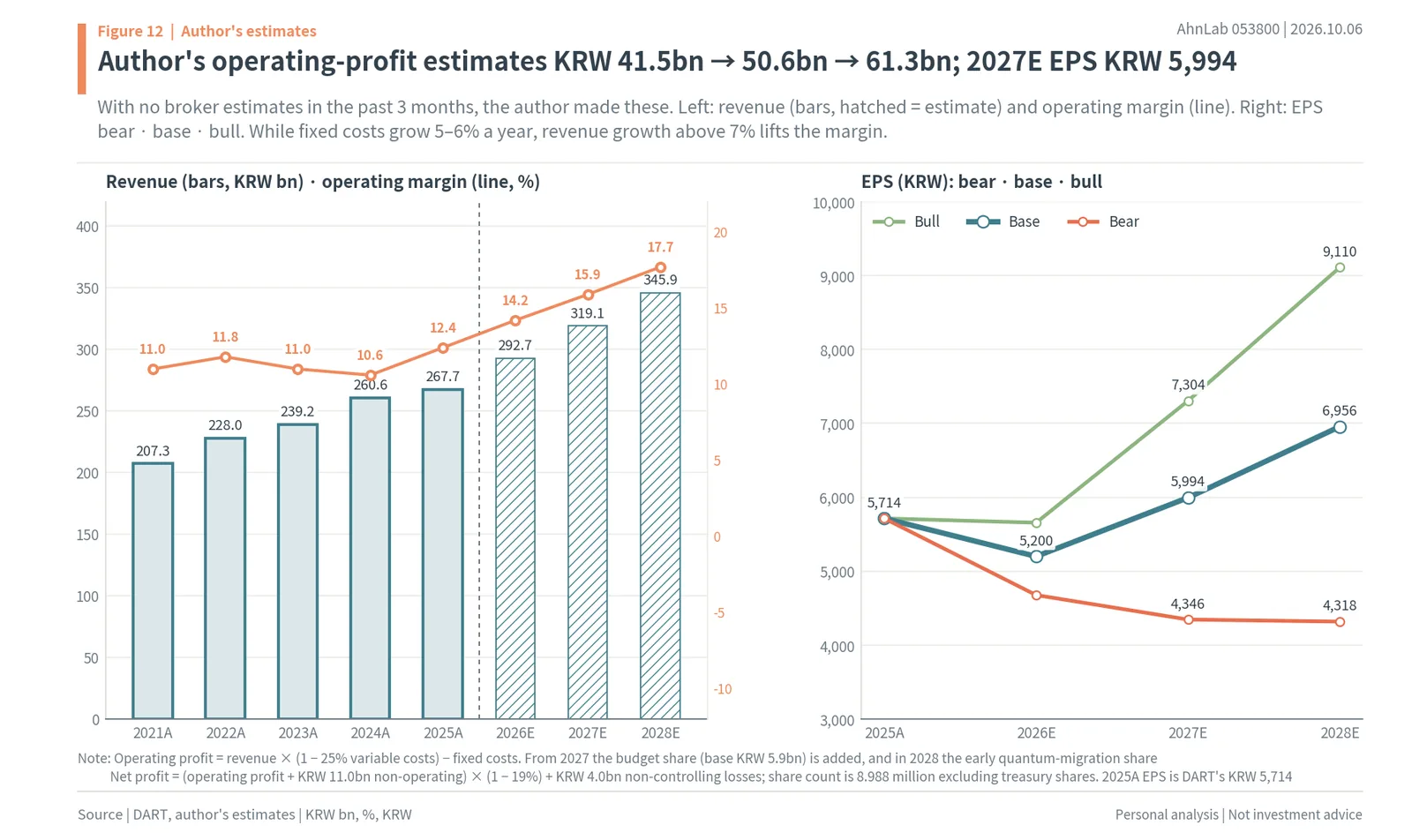
- The author estimates operating profit of KRW 41.5bn in 2026 → KRW 50.6bn in 2027 → KRW 61.3bn in 2028, with 2027 EPS of KRW 5,994.
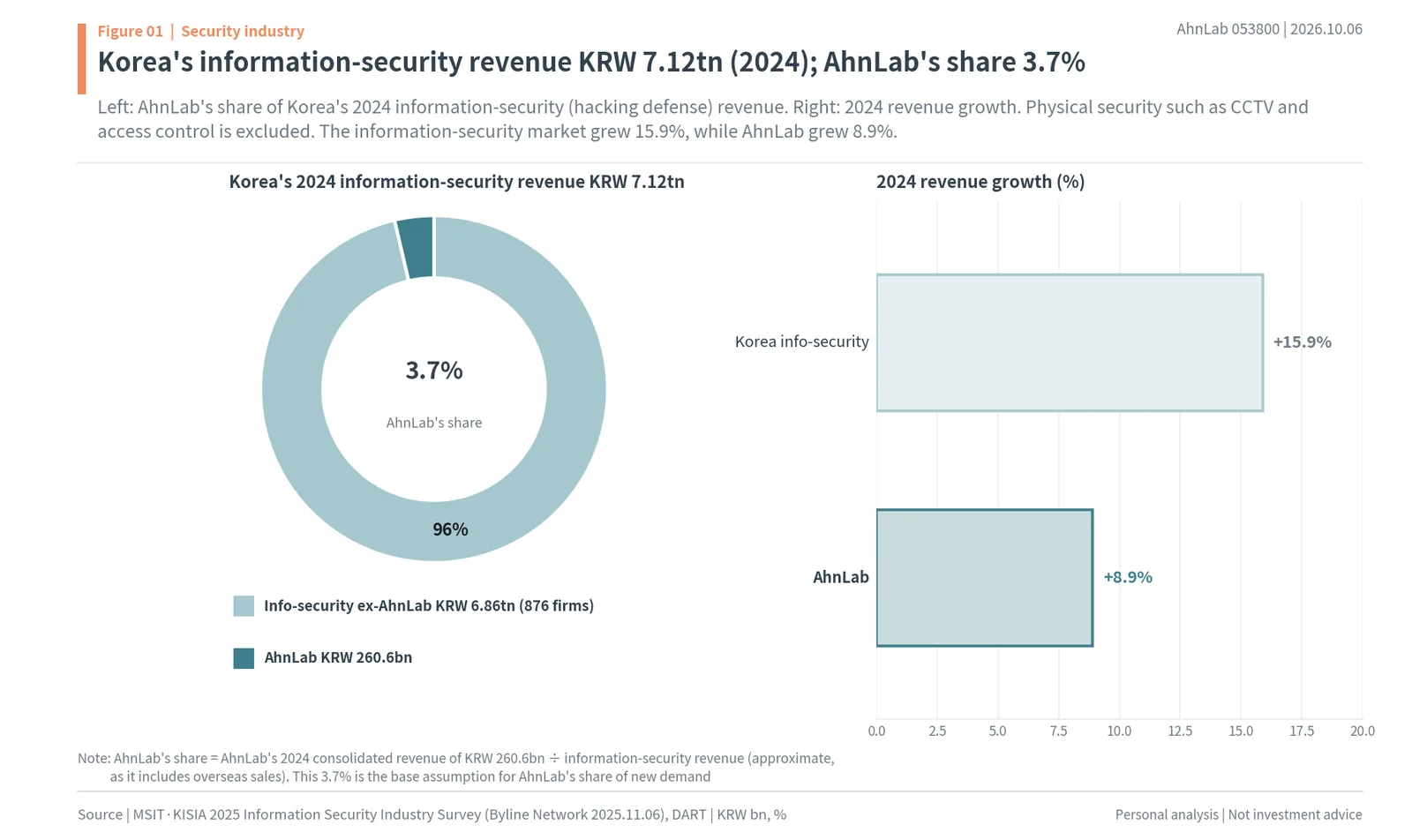
- The author’s base share prices by deadline are KRW 76,500 at 1 month, KRW 89,900 at Q4 results, KRW 104,300 at 1 year and KRW 124,600 in 2030 (assuming PQC validation).
Key takeaways
- AhnLab rose 15.6% in a single day on a chain of AI-driven hacks at Korean financial firms, and the author estimates operating profit of KRW 41.5bn (2026E) → KRW 50.6bn → KRW 61.3bn and EPS of KRW 5,200 → 5,994 → 6,956.
- In quantum security, AhnLab got as far as a KCMVP validation for quantum random numbers in 2021, but it has no PQC validation and led none of the 2026 pilot projects, so it needs validation first, before the January 2029 public-sector key-exchange mandate.
- The author’s base share prices by deadline: KRW 76,500 at 1 month, KRW 89,900 at Q4 results, KRW 104,300 at 1 year (probability-weighted +12.9%), and KRW 124,600 in 2030.
As of: October 6, 2026
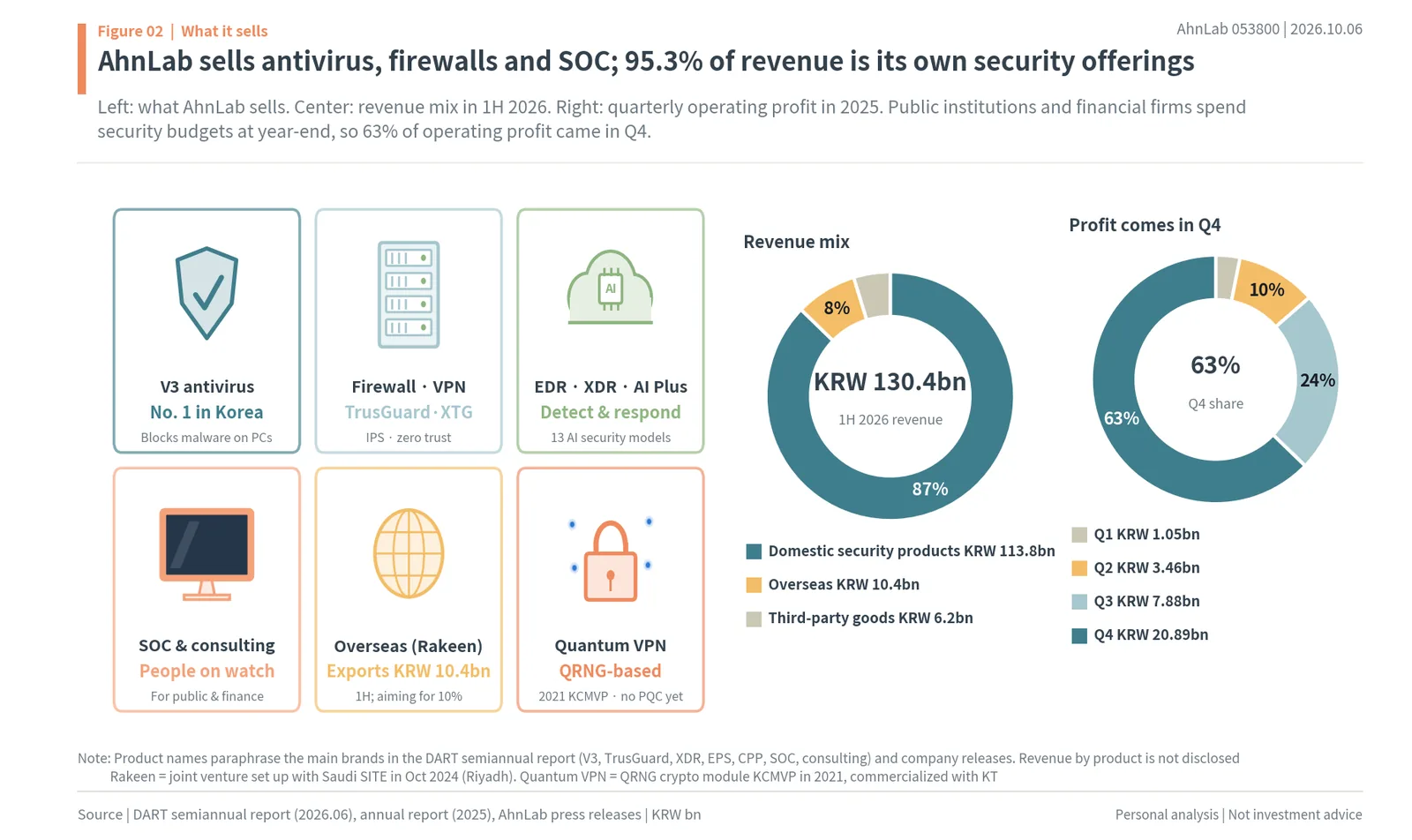
Ticker: AhnLab (053800, KOSDAQ)
Reference close: KRW 89,000 (KRX close, October 6, 2026)
This is the author’s personal analysis and opinion.
The author’s calculations and estimates are not confirmed facts.
1. This report lays out AhnLab’s quantum security prospects and its share price ranges by deadline, based on the author’s estimates.
2. It asks two questions: can AhnLab make it into quantum security, and if it can, when and how much will that be worth.
3. No brokerage has published an estimate for AhnLab in the last three months, so the author built estimates from 10 quarters of results filed with DART (Korea’s electronic disclosure system).
4. The order is: the industry → what AhnLab sells → why the stock rose → AI expectations → the quantum threat and AhnLab’s capability → deadlines → earnings estimates → share price by deadline → what to watch.
5. The conclusion first: AI now, quantum in 2029, and the base value through Q4 results is almost the same as today’s share price.
1. The Security Industry: KRW 7.12tn Korean Market, AhnLab’s 3.7% Share
6. The information protection industry splits into information security, which stops hacking, and physical security such as CCTV and access control.
7. Korea’s information security revenue in 2024 was KRW 7.12tn, up 15.9% in a year (survey by KISIA, the Korea Information Security Industry Association).
8. There are 876 information security companies (KISIA), and AhnLab itself describes the market as one with many small players and a steady stream of foreign entrants (DART half-year report).
9. AhnLab’s revenue that year was KRW 260.6bn, 3.7% of the information security market, and its growth of 8.9% was slower than the market’s.
10. This 3.7% is used later as the base assumption for AhnLab’s share of new demand (author’s assumption).
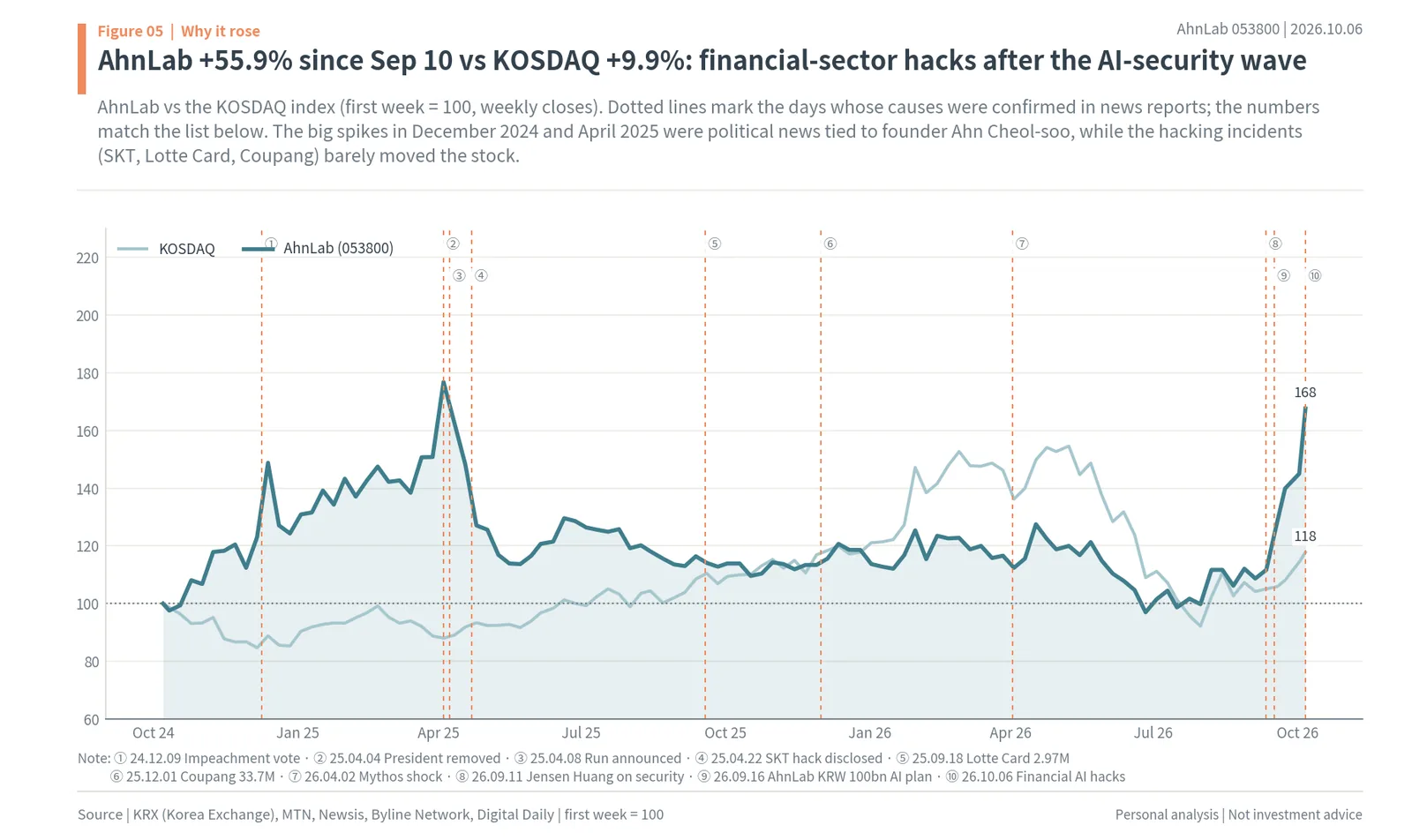
11. In security, budgets grow after incidents and are spent at year-end, so incidents and seasons have to be watched together.
2. What AhnLab Sells: V3, Firewalls, EDR, Monitoring and a Quantum VPN
12. AhnLab released Korea’s first antivirus in 1995, and V3 is still No. 1 in Korea’s antivirus market (company filing).
13. Today it also sells firewalls and VPNs (TrusGuard, XTG), threat detection and response (EDR, XDR), and security monitoring and consulting.
14. In H1 2026, 95.3% of revenue came from these in-house security products and services, and 4.7% from third-party products.
15. Exports were KRW 10.4bn in H1, still small, but the company expects the overseas share to rise from 8.5% in 2025 to over 10% this year (company announcement).
16. The center of its overseas business is Rakeen, a joint venture set up in October 2024 with Saudi Arabia’s SITE.
17. On the quantum side, in 2021 it obtained KCMVP (Korea’s government validation for crypto modules, run by the National Intelligence Service (NIS)) for a module using quantum random numbers (QRNG), and it commercialized a quantum VPN with KT.
18. Of 2025 revenue of KRW 267.7bn, operating profit after operating costs was KRW 33.3bn.
19. Adding KRW 27.6bn of non-operating income such as interest and gains on financial assets, net income attributable to owners was KRW 54.3bn.
20. In 2025, financial income was unusually large at KRW 32.3bn, so net income was larger than operating profit.
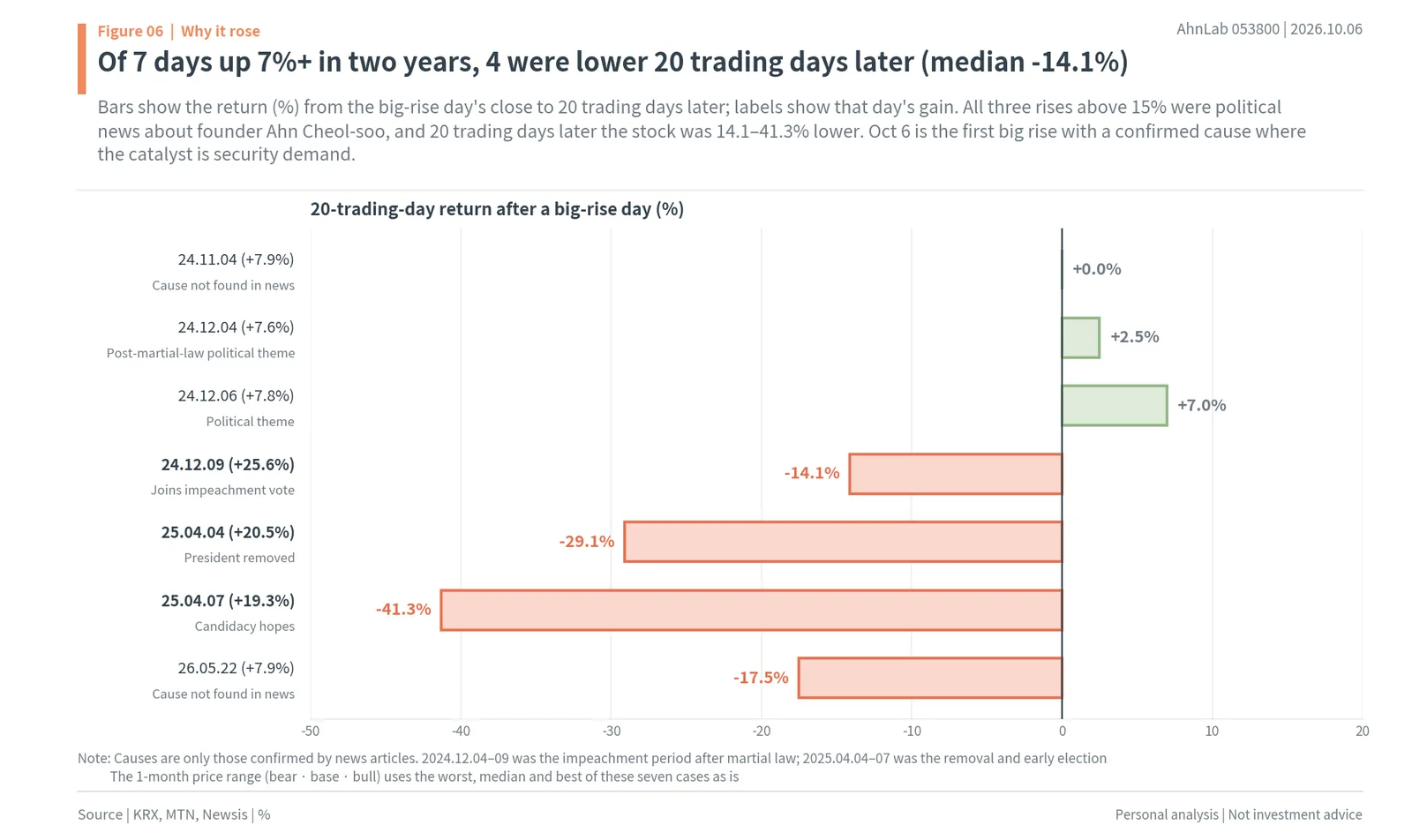
21. The dividend was KRW 1,400 per share, KRW 12.6bn in total, and the rest stayed in the company.

3. The Earnings Calendar: Profit Comes in Q4
22. Many of AhnLab’s customers are public institutions and financial firms, so revenue piles up at year-end.
23. Fixed costs are similar every quarter, so profit piles up in Q4, when revenue is largest.
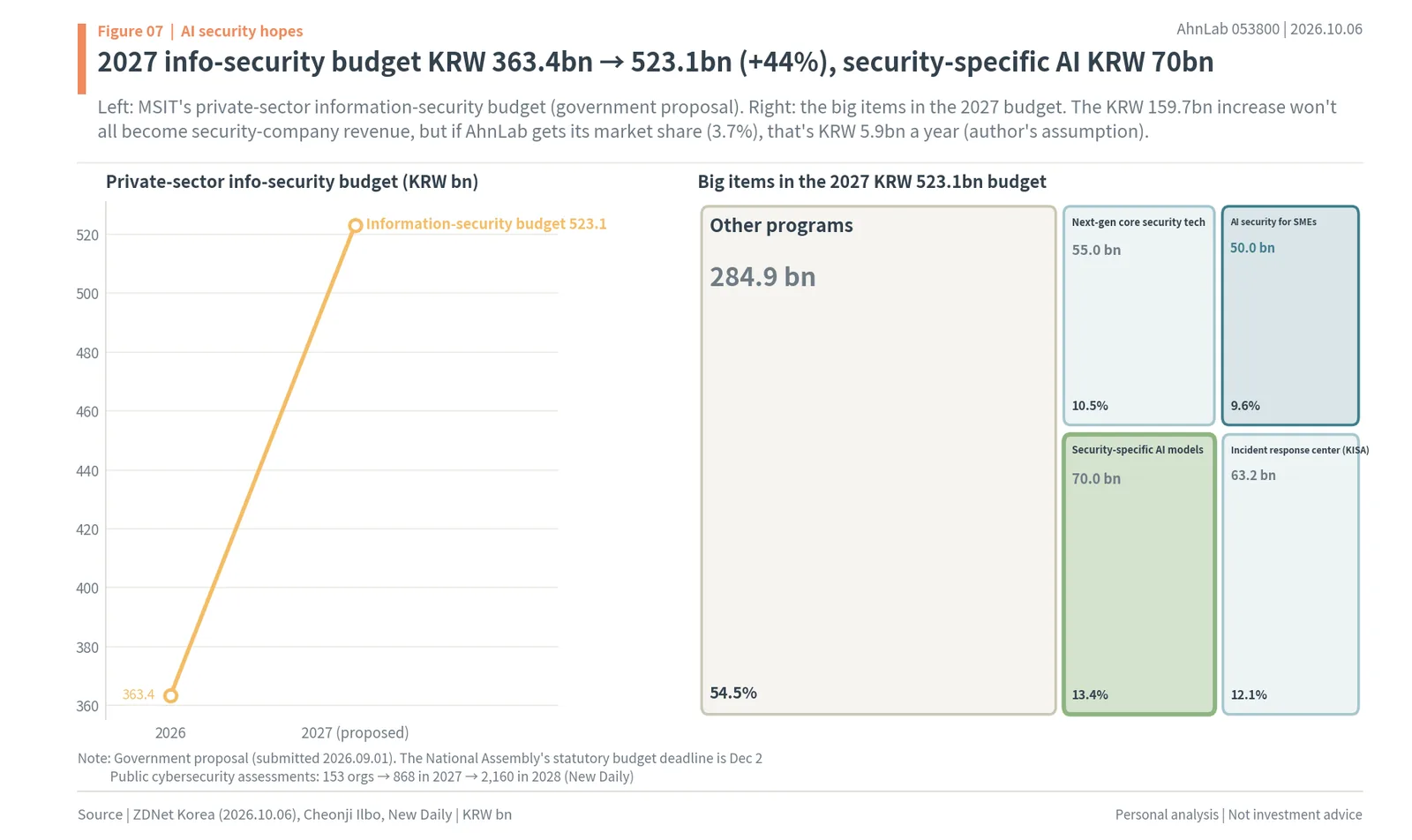
24. Q4 2025 operating profit was KRW 20.9bn, 63% of the full year, and the figure was 56% in 2024 as well.
25. In H1 this year, revenue rose 9.1% and operating profit 62.3%, and sales of EDR, N²SF (Korea’s new national network security framework) and zero-trust products grew by triple digits (company announcement).
26. So hacking incidents ahead of year-end are well timed, and the numbers will confirm it in Q4 results next February.

4. Why AhnLab Stock Rose: AI Security Tailwinds and AI Hacking at Korean Banks
27. From September 10 to October 6, AhnLab rose 55.9%, while KOSDAQ (Korea’s tech-heavy secondary market) rose 9.9% over the same period.
28. The first tailwind was AI: on September 10 Jensen Huang named cybersecurity as AI’s next big market, and Korean security stocks jumped the next day (Etoday).
29. On September 12 Dario Amodei warned that AI agents could build botnets within 6–12 months, and US security stocks rose 14–17% in a day (Edaily).
30. On September 16 AhnLab said it would spend KRW 100bn on AI over three years and reach KRW 1tn in revenue by 2035.
31. Meanwhile, data leaks at 29CM, Gangnam Unni and Weverse followed one after another, and fines of up to 10% of revenue took effect on September 11.
32. The second tailwind was hacking in the financial sector: unusual access was detected on September 29, and on October 1 a leak affecting about 25,000 Shinhan Bank customers was made public.
33. By October 6, leaks had been confirmed at 7 banks, savings banks and capital companies, and automated attacks using AI tools came from the same attacker IP.
34. The string “AI autonomous penetration test console” was found on the attack server (Money Today).
35. AhnLab, already up 34.9% from September 10 as of October 2, rose another 15.6% on October 6 alone.
36. Trading volume that day was 8.9 times the 20-day average.
37. However, AhnLab’s big rallies have often not lasted.
38. Of the 7 days in two years when it rose more than 7%, the stock was lower 20 trading days later in 4 cases, with a median of -14.1%.
39. All three rises of over 15% came on political news about chairman Ahn Cheol-soo (the founder, who is also a politician), and 20 trading days later the stock was 14.1–41.3% lower.
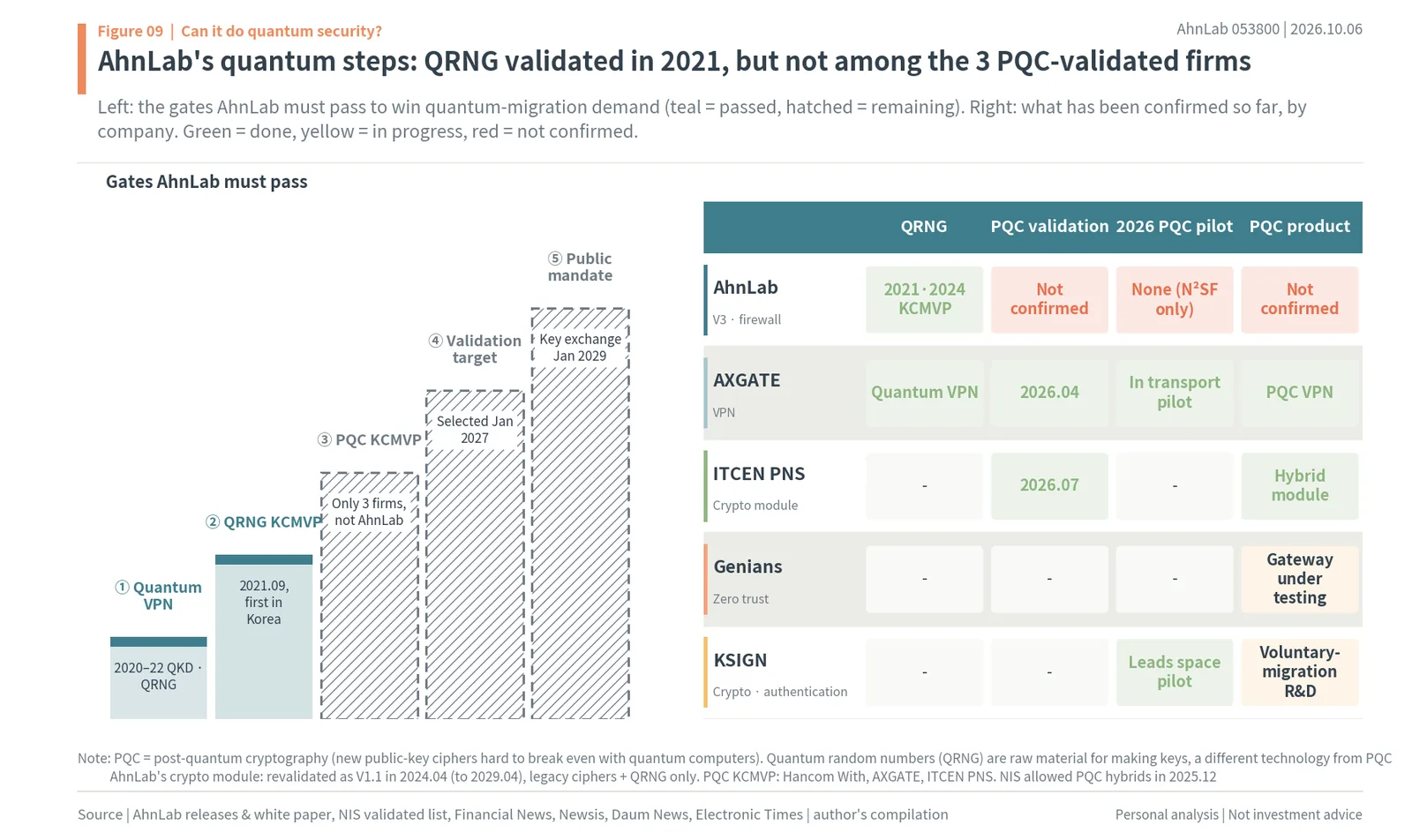
40. During the SKT hack (April 2025), the Lotte Card hack (September) and the Coupang leak (December), AhnLab barely moved.
41. October 6 differs in that, among big rallies with an identified cause, it is the first driven by security demand rather than politics, but the 1-month base case still assumes it cools off as in the past.
5. AI Security Expectations: Budgets and Products
42. The government proposed raising the 2027 private-sector information protection budget from KRW 363.4bn to KRW 523.1bn, up 44% (ZDNet).
43. Of that, KRW 70bn is for security-specialized AI models and KRW 50bn for AI security support for small and mid-sized companies.
44. The number of public bodies subject to cybersecurity assessments also grows from 153 this year to 868 in 2027 and 2,160 in 2028 (New Daily).
45. The financial sector is different: the old rule requiring information protection budgets of at least 7% of IT budgets was scrapped in February 2025, and the current supervisory regulation only asks for a “sufficient budget” (Korea Law Information Center).
46. Even the hacked Shinhan, KB Kookmin and Hana banks spend 8.00–9.02% of their IT budgets on information protection, already above the old 7% bar (NBN TV).
47. So new financial-sector demand depends less on ratio rules than on whether a bill for fines of 3% of revenue (an amendment to the Electronic Financial Transactions Act), pending in the National Assembly for 10 months, passes.
48. If AhnLab takes its market share of the KRW 159.7bn increase, that is KRW 5.9bn a year, which goes into the 2027 base estimate (author’s assumption).
49. AhnLab has 13 AI security models and plans to launch an AI security operations platform, “AhnLab AI PLUS SecOps,” in December (company announcement).
50. One catch: NH Investment & Securities said replacing a security platform takes 1–3 years, so revenue shows up with a lag (Newspim).
51. Another is the worry that AI could replace security companies: in April, news of Anthropic’s Mythos sent a global security ETF down 4.5% (Boan News).
6. The Quantum Threat: Why Deadlines Exist Now
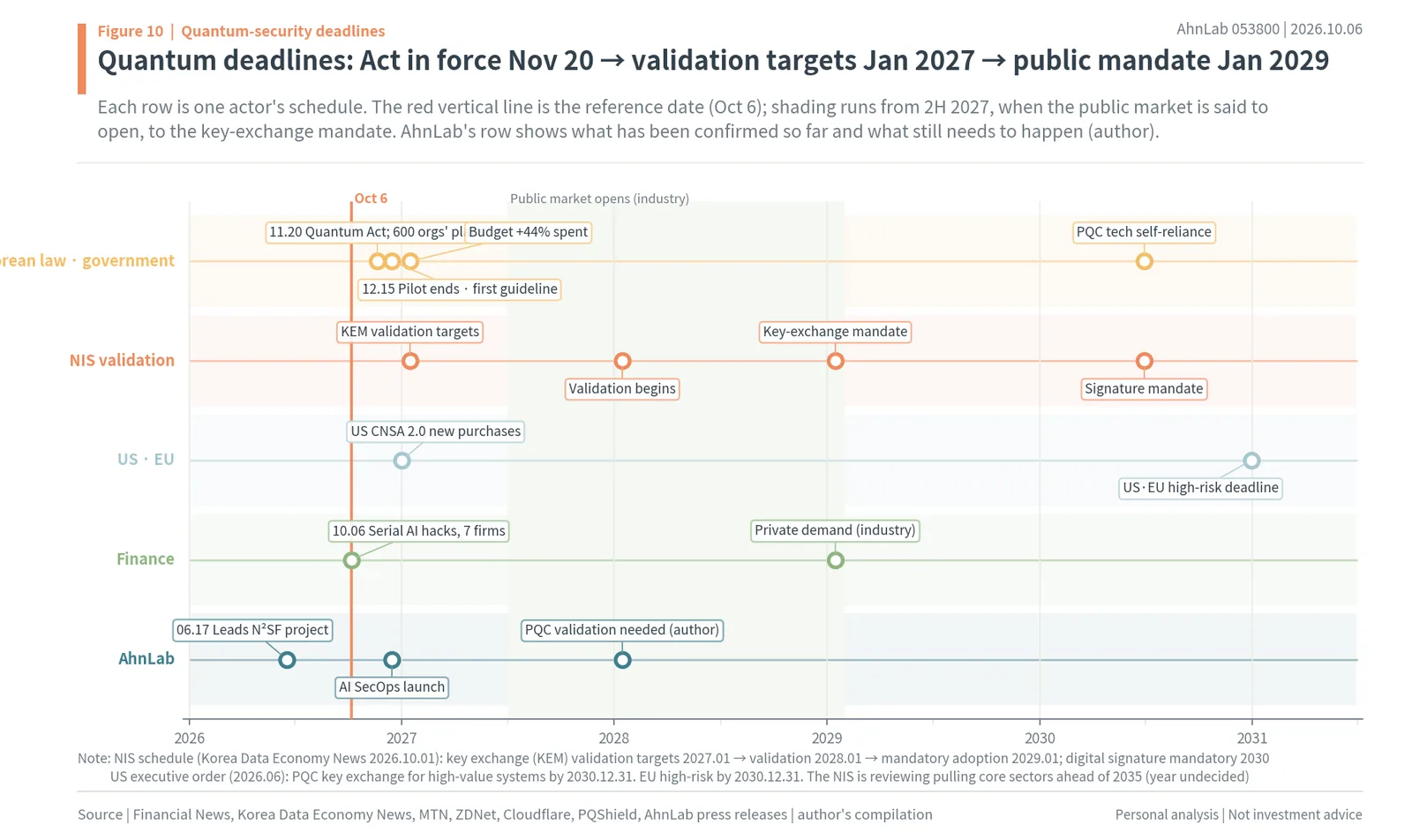
52. RSA-2048, the public-key encryption used by banks and the internet, relies on how hard it is to factor large numbers into primes.
53. Quantum computers can do this calculation quickly, so once they are big enough, today’s encryption breaks.
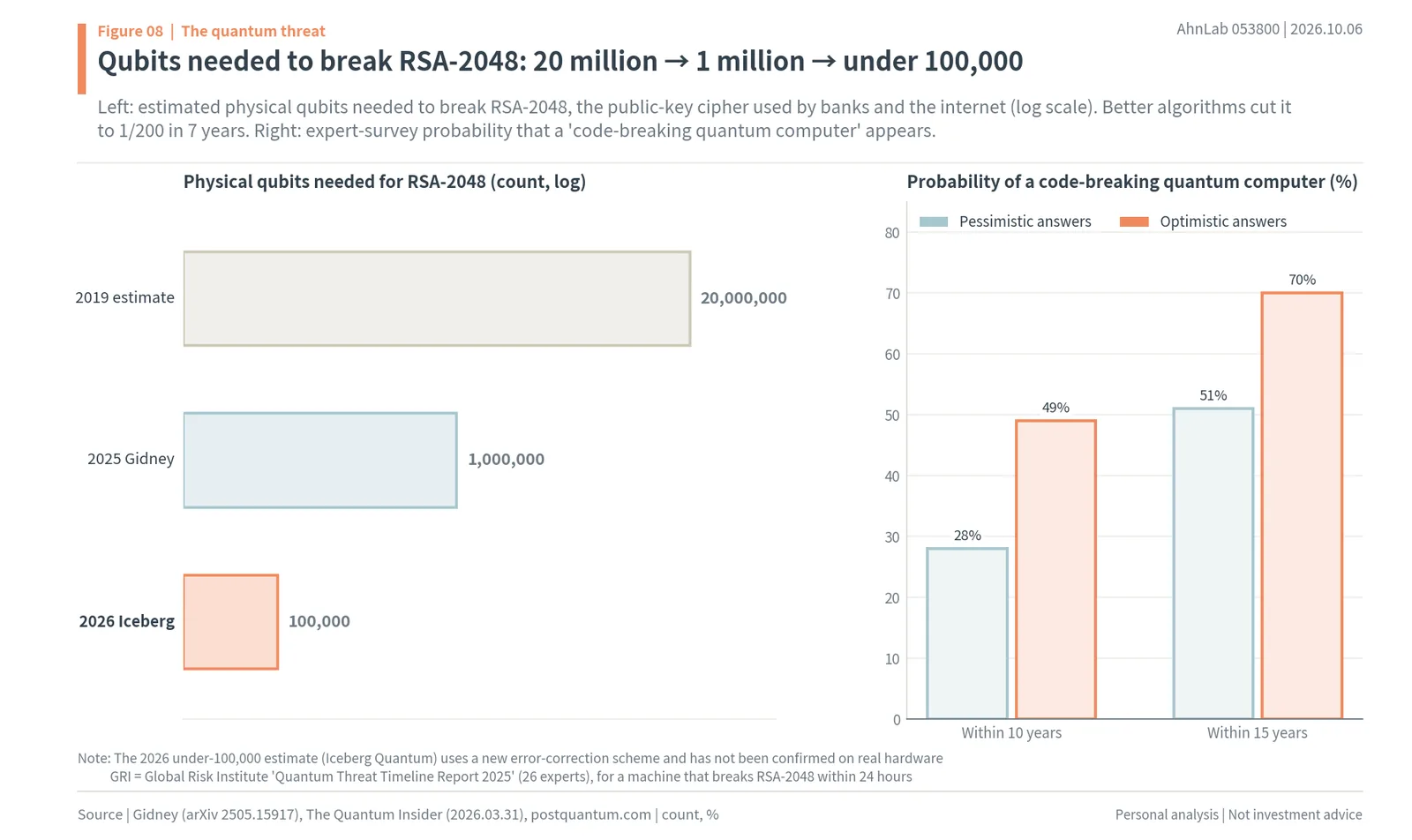
54. Estimates of the qubits needed have fallen from 20 million in 2019 to 1 million in 2025 and under 100,000 in 2026 (Gidney, Iceberg Quantum).
55. An expert survey put the chance of such a machine appearing within 10 years at 28–49%, and within 15 years at 51–70% (GRI).
56. There are also “steal now, decrypt later” attacks, so information that is kept for a long time has to be switched early.
57. That is why countries are setting deadlines to move to post-quantum cryptography (PQC).
7. Can AhnLab Do Post-Quantum Cryptography (PQC)? Able, but Not a Leader
58. In 2020, under Korea’s Digital New Deal program, AhnLab built a quantum key distribution (QKD) VPN for Hyundai Heavy Industries with KT and KIST (company white paper).
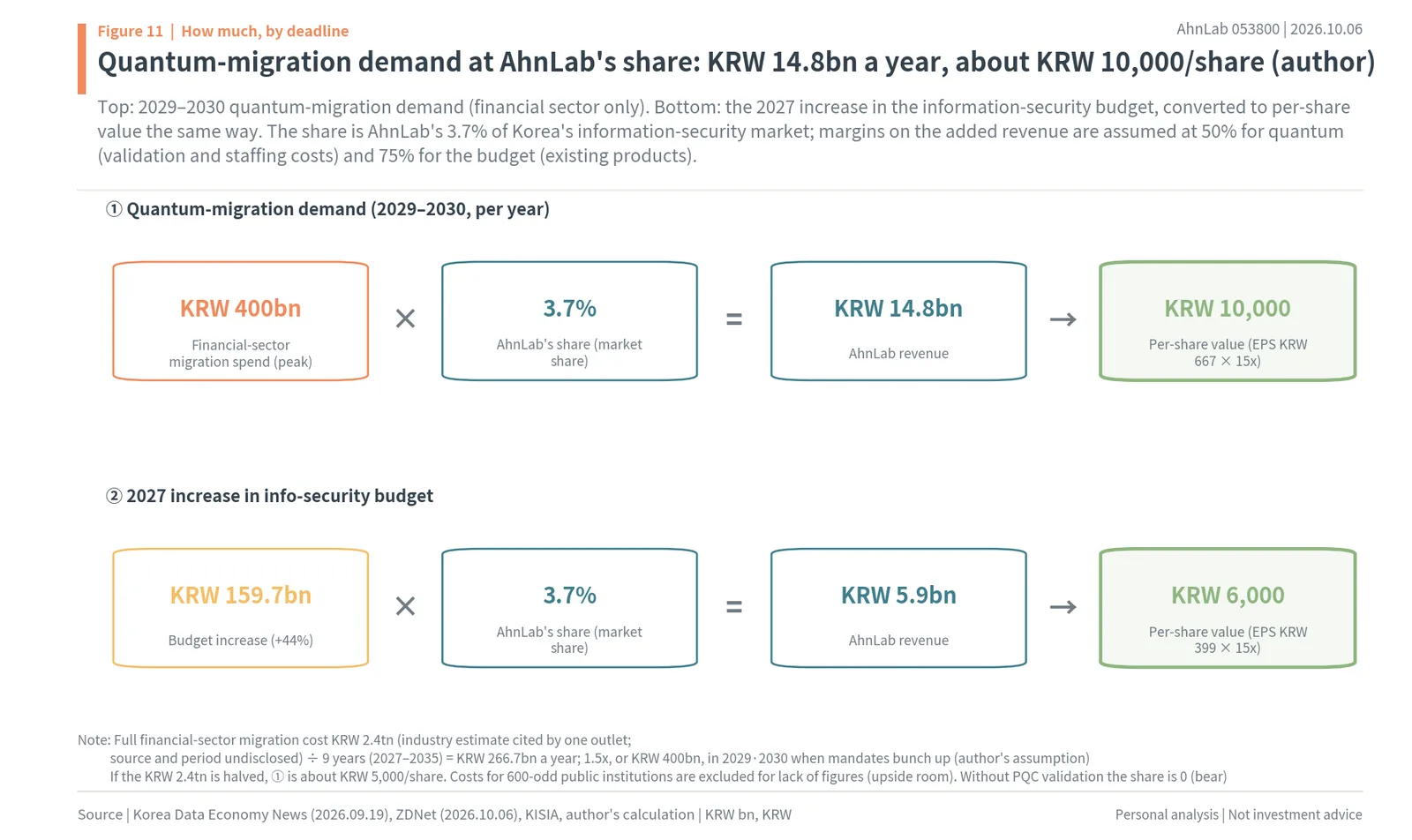
59. In September 2021, it became the first in Korea to obtain KCMVP for a crypto module with quantum random numbers (company press release).
60. This validation was renewed as V1.1 in April 2024 and is valid until April 2029 (NIS list of validated modules).
61. But the module’s security policy lists only existing algorithms such as SEED, ARIA, SHA-2 and RSA-2048, plus quantum random numbers, as validated.
62. Quantum random numbers are an ingredient for making keys, a different technology from PQC, which even quantum computers find hard to break.
63. The author found no PQC press releases, products, validations or pilot projects under AhnLab’s name in 2023–2026, and neither the September AI vision announcement nor the half-year report mentioned quantum.
64. Full-text searches of the 2025 annual report, the 2026 half-year report and the company website also returned 0 hits for PQC.
65. R&D spending is KRW 72.1bn (26.9% of revenue), but PQC does not appear in its list of projects for the last five years either (DART).
66. The “AI post-quantum encryption” patent held by subsidiary AhnLab CloudMate is an old Spiceware patent, not a standard PQC algorithm, and has nothing to do with the public-sector transition (Google Patents).
67. Only three companies have crypto modules with PQC KCMVP so far: Hancom With, AXGATE and ITCEN PNS (Financial News).
68. The five 2026 PQC pilot transition areas were led by DreamSecurity, KSmartech, Mobilewithus, Daeyoung STech and KSIGN (Newsis, Electronic Times).
69. A late entry is still possible: in December 2025 the NIS allowed hybrids that add PQC to existing crypto modules, and AXGATE was validated four months later, in April 2026.
70. The government project AhnLab did lead was not PQC but N²SF adoption support, a framework that replaces Korea’s strict network separation rules.
71. So the author’s verdict is “able, but not a leader,” based on AhnLab’s experience with crypto-module validation and its firewall, VPN and antivirus customer base.
72. Replacement demand ultimately means putting PQC into the VPNs, firewalls and antivirus software customers already use, so a company with customers still has a chance even if it is late.
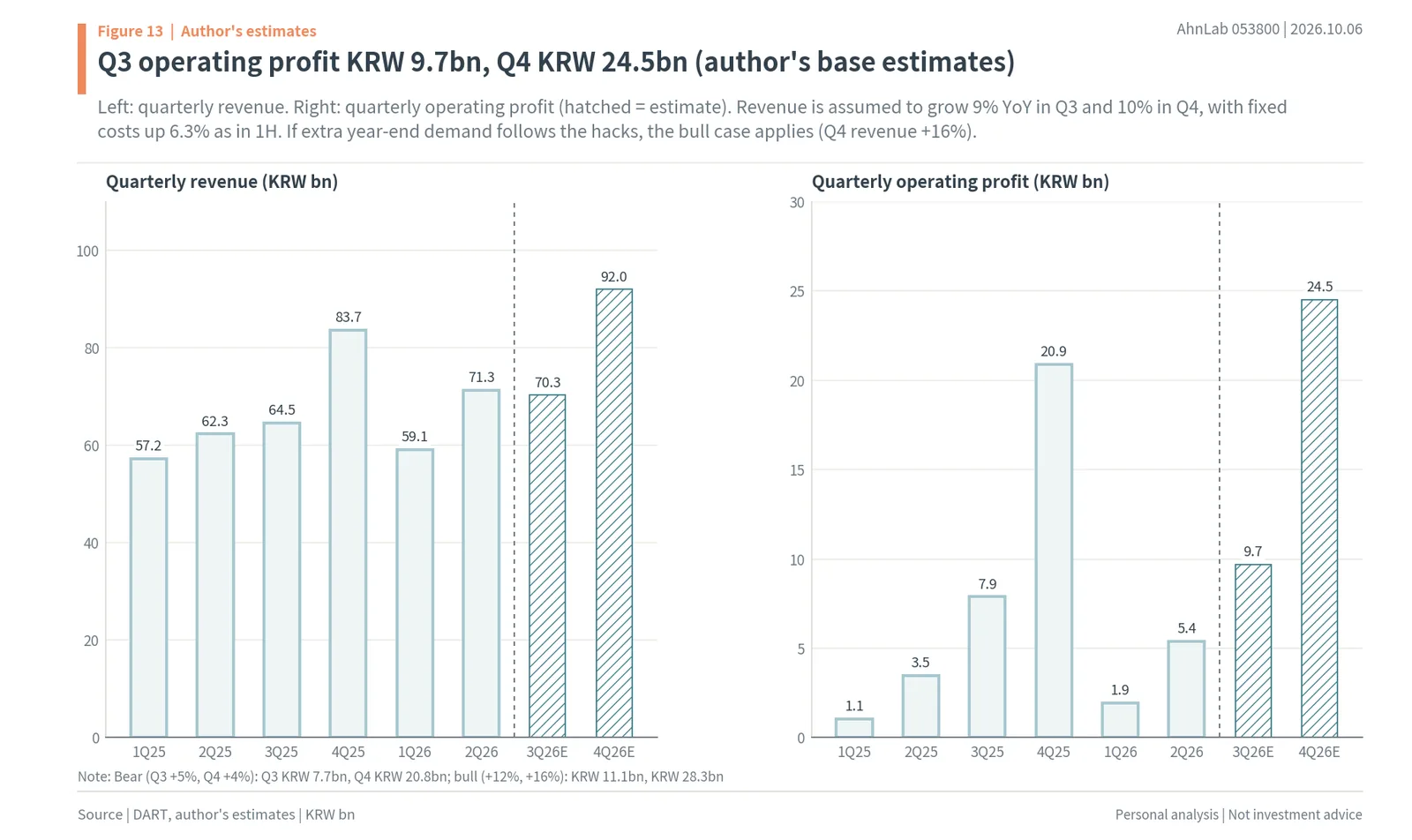
8. PQC Transition Deadlines: January 2027, January 2029 and 2030
73. On November 20 the amended Quantum Technology Industry Act takes effect, and more than 600 government bodies, local governments and public institutions must draw up quantum security plans.
74. For key exchange (KEM), the NIS set selection of validation targets for January 2027, the start of validation for January 2028 and mandatory deployment for January 2029.
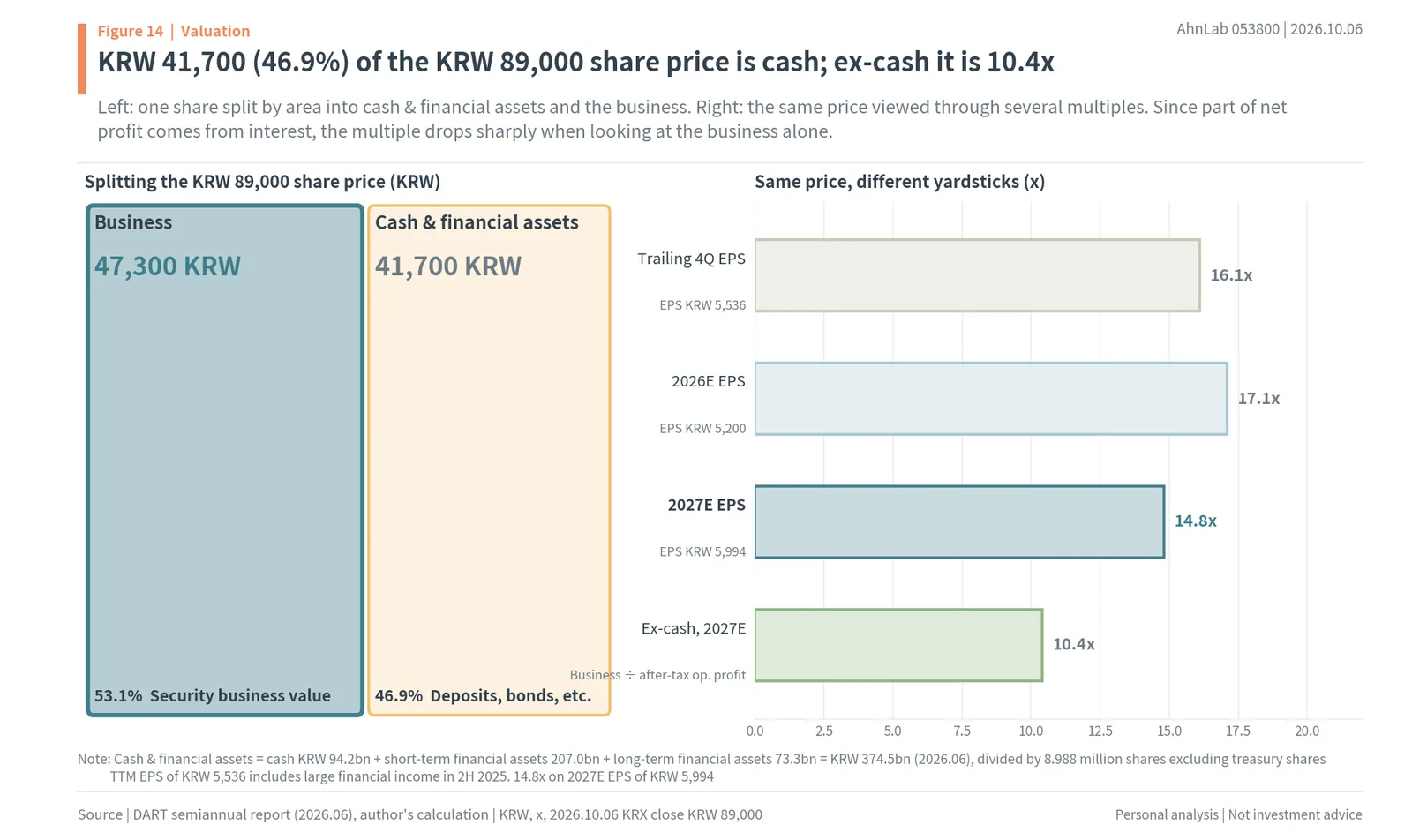
75. The schedule was announced at a cybersecurity event on September 17, and exact January dates and the names of the official notices have not been set yet.
76. Digital signatures become mandatory from 2030, and from 2027 PQC transition is included in public-sector cybersecurity assessments.
77. The US requires key exchange in high-value systems to switch by the end of 2030, and the EU requires high-risk areas to switch by the end of 2030.
78. The NIS is considering moving core areas ahead of 2035 but has not set a year.
79. The industry expects the public market to open in earnest in H2 2027 and the private market from 2029 (MTN).
80. Turning these deadlines into money takes three things: market size, AhnLab’s share and margin.
81. The cost of a full financial-sector transition is KRW 2.4tn, an industry estimate cited by one news outlet (the estimating body and period were not disclosed), and spreading it over the 9 years from 2027 to 2035 gives KRW 266.7bn a year.
82. For 2029 and 2030, when the mandates cluster, the author uses 1.5 times the average, KRW 400bn a year (author’s assumption).
83. Multiplying by AhnLab’s 3.7% share gives KRW 14.8bn a year; after a 50% margin and taxes that is KRW 667 per share, or about KRW 10,000 per share at 15x.
84. Because KRW 2.4tn is an unconfirmed number, the author also notes that at half that (KRW 1.2tn) the value shrinks to about KRW 5,000 per share.
85. The 2027 budget increase, calculated the same way, is worth about KRW 6,000 per share.
86. Transition costs for the 600-odd public institutions are left out for lack of numbers, and that is the upside.
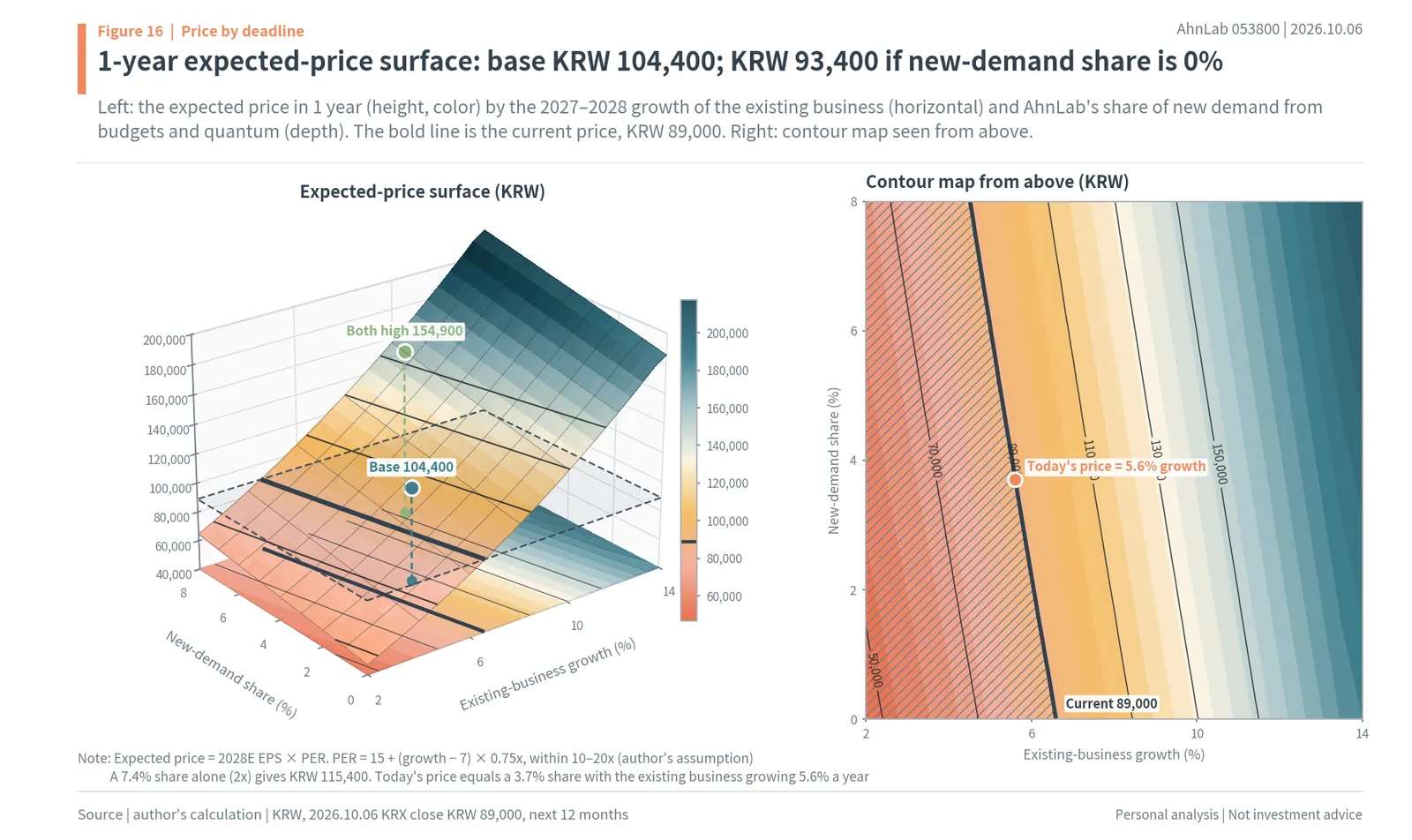
87. Conversely, if AhnLab fails to get PQC validation, its quantum share is zero, and that is the 2030 bear case.
9. AhnLab Earnings Estimates: 2027 Operating Profit KRW 50.6bn, EPS KRW 5,994 (Author’s Model)
88. The formula is revenue × (1 − 25% variable costs) − fixed costs = operating profit, with fixed costs growing 6.3% as in H1.
89. Net income adds KRW 11bn a year of non-operating income to operating profit, subtracts 19% tax, then adds back KRW 4bn of non-controlling losses.
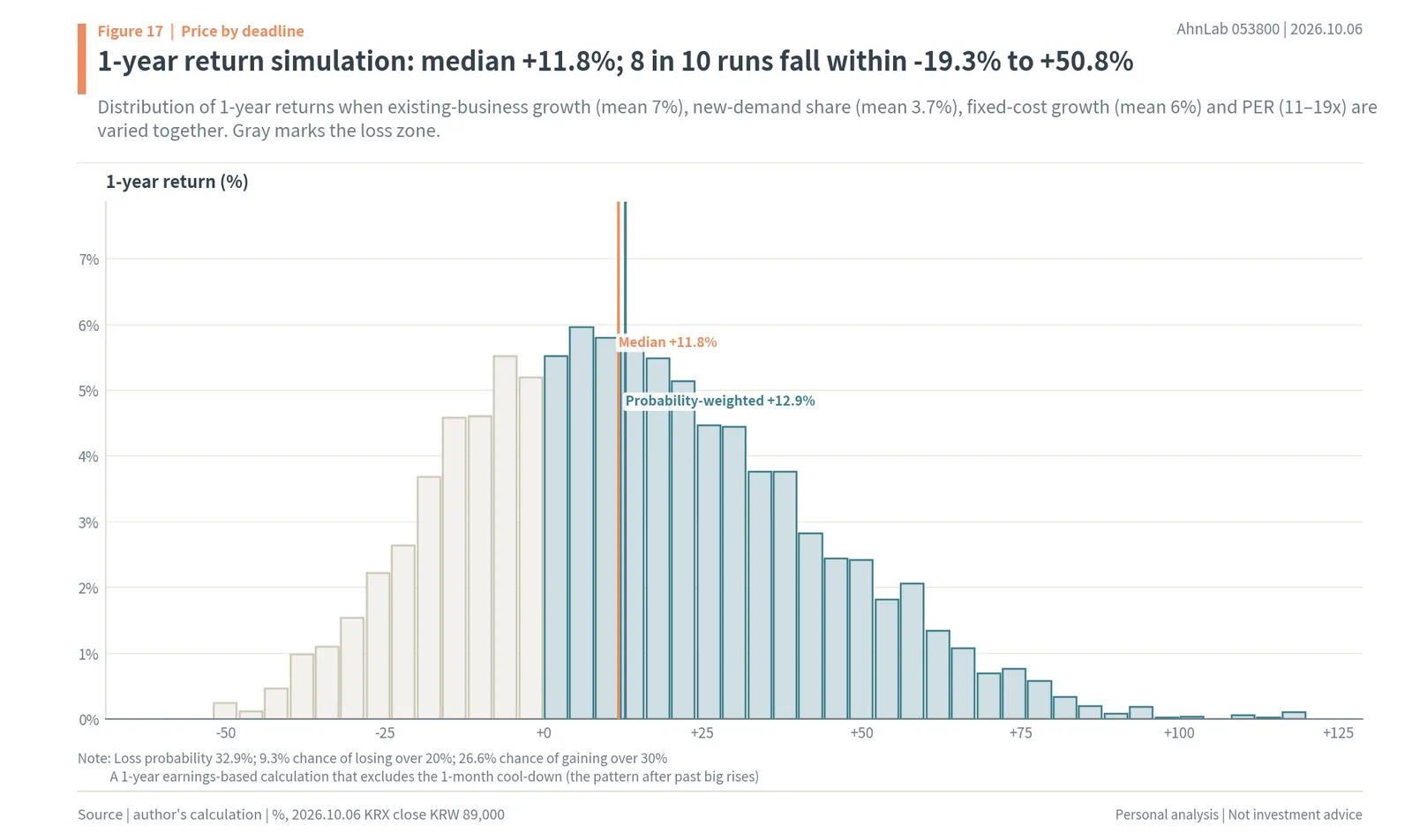
90. The share count is 8,988,347 shares, excluding 2,138,159 treasury shares.
91. Base operating profit is KRW 41.5bn in 2026, KRW 50.6bn in 2027 and KRW 61.3bn in 2028.
92. Base EPS is KRW 5,200 in 2026, KRW 5,994 in 2027 and KRW 6,956 in 2028.
93. 2026 EPS is lower than 2025’s KRW 5,714 because 2025 financial income was unusually large at KRW 32.3bn; operating profit is expected to rise 24.6%.
94. The bear case (5% growth, 8% fixed-cost growth, no new demand) gives 2027 EPS of KRW 4,346, and the bull case (9% growth, twice the share) KRW 7,304.
95. For Q3, due at the end of October, the author expects revenue of KRW 70.3bn and operating profit of KRW 9.7bn, with revenue up 9% year on year.
96. Q4 is KRW 92bn of revenue and KRW 24.5bn of operating profit, above last year’s Q4 figure of KRW 20.9bn.
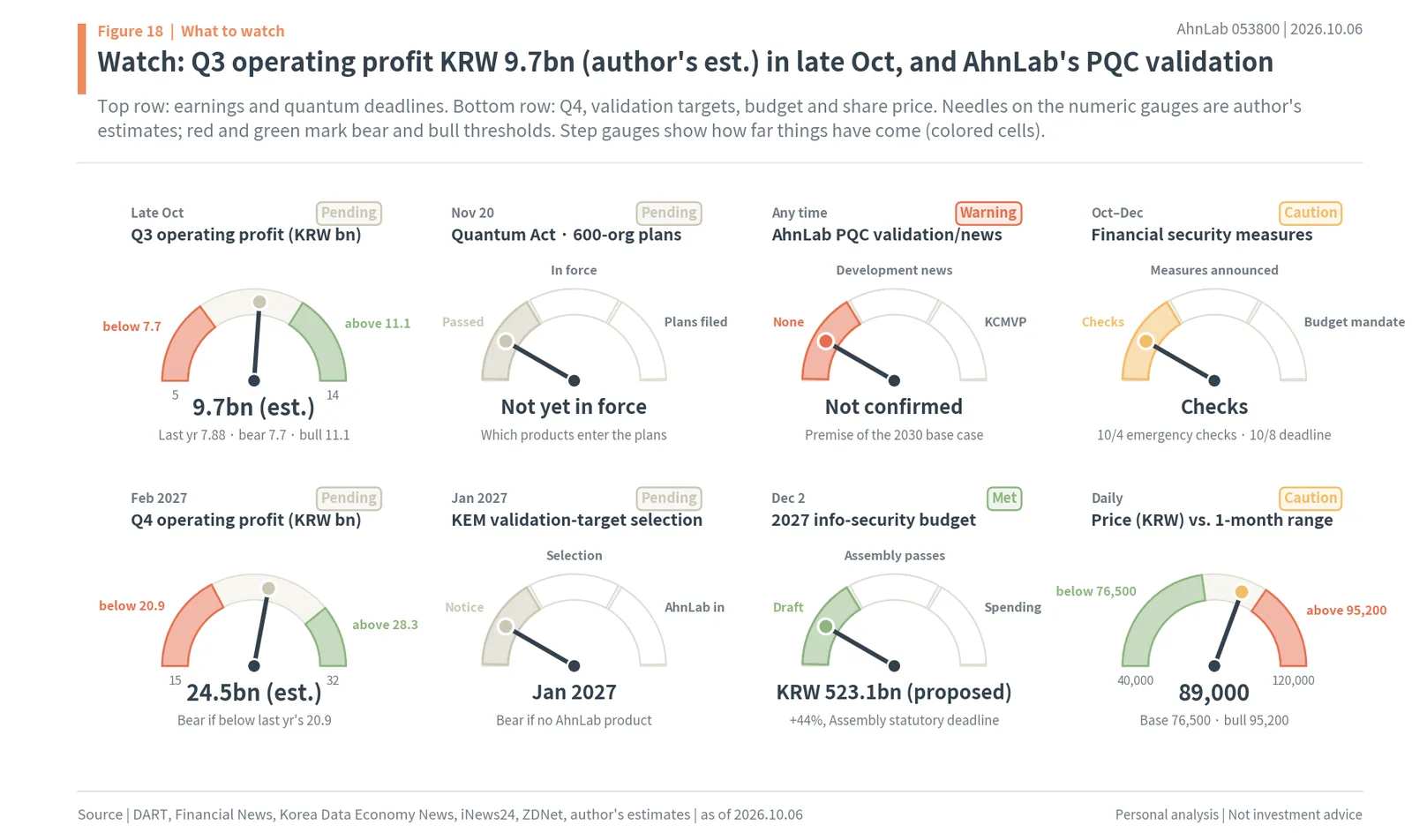
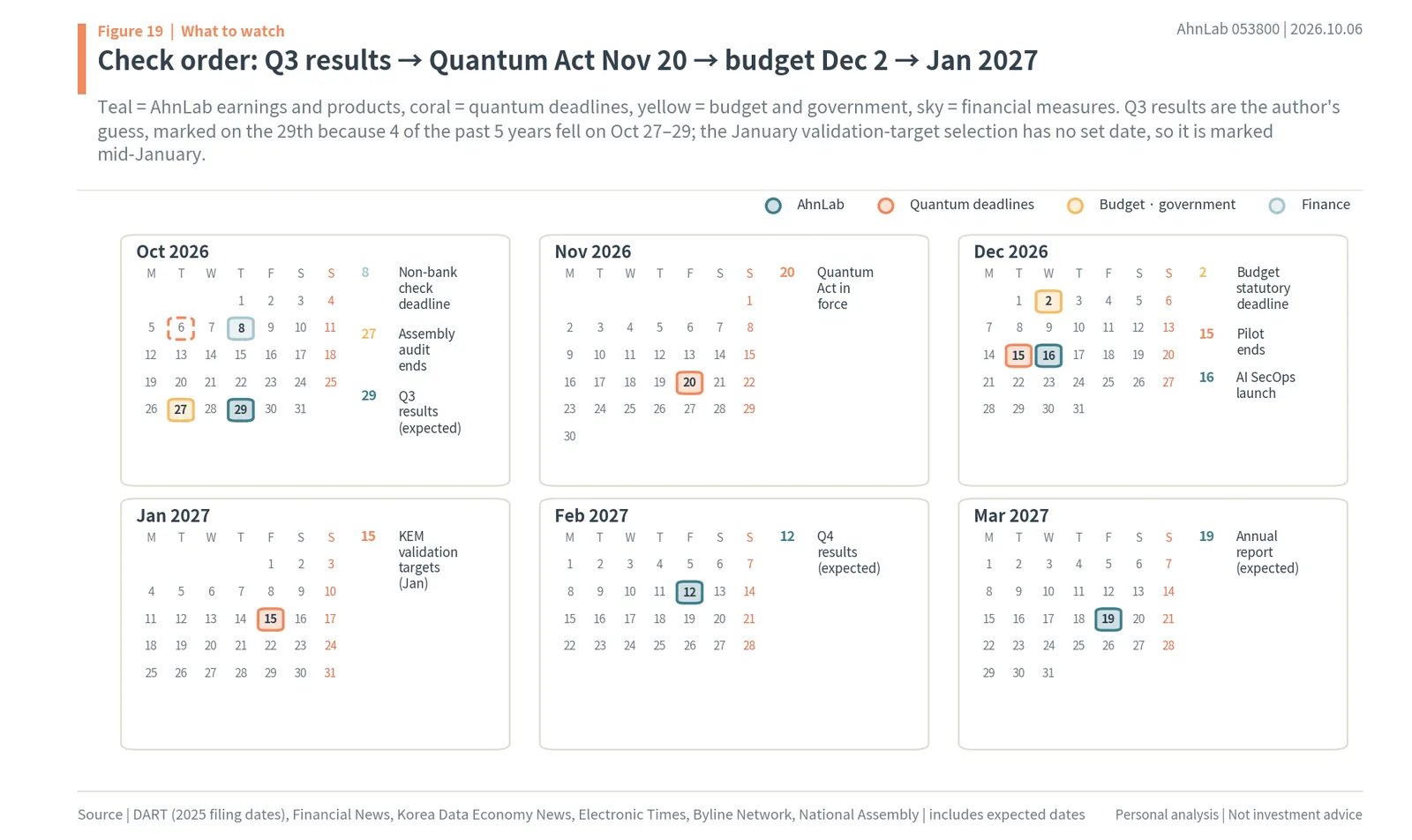
97. The bear case is KRW 7.7bn in Q3 and KRW 20.8bn in Q4; the bull case is KRW 11.1bn in Q3 and KRW 28.3bn in Q4.
10. Valuation: Half the Share Price Is Cash
98. AhnLab had KRW 374.5bn of cash and financial assets at the end of June, or KRW 41,700 per share excluding treasury shares.
99. That means 46.9% of the KRW 89,000 share price is cash and financial assets.
100. The P/E is 16.1x on trailing four-quarter EPS of KRW 5,536, and 14.8x on 2027 forward EPS of KRW 5,994.
101. Excluding cash and dividing the business alone by 2027 after-tax operating profit gives 10.4x, a much lower multiple.
102. Working backward, today’s price at 15x implies the existing business growing 6.7% in 2027, versus H1 revenue growth of 9.1%.
103. The pre-hack October 2 close of KRW 77,000 was 12.8x 2027 EPS.
11. AhnLab Share Price Ranges by Deadline: 1 Month, Q4, 1 Year and 2030
104. For 1 month (early November), applying the 20-trading-day returns after the past 7 big rallies gives bear KRW 52,200, base KRW 76,500 and bull KRW 95,200.
105. At Q4 results (February 2027), 2027 EPS × 12x, 15x and 18x gives a base of KRW 89,900, almost the same as today’s price.
106. At 1 year (October 2027), 2028 EPS × P/E gives bear KRW 51,800, base KRW 104,300 and bull KRW 164,000.
107. Weighting bear 30%, base 50% and bull 20% gives KRW 100,500 at 1 year, 12.9% above today.
108. For 2030, 2030 EPS of KRW 8,306 including PQC replacement revenue × 15x gives a base of KRW 124,600, and the bear case without validation is KRW 56,600.
109. Even the bear values are above cash per share of KRW 41,700, so cash props up the floor.

110. Spreading the 1-year value over two axes, the horizontal axis is growth of the existing business and the depth axis is AhnLab’s share of new demand.
111. The base case of 7% growth and a 3.7% share is KRW 104,400, and with a 0% share of new demand it is KRW 93,400.
112. Twice the share gives KRW 115,400, and 10% growth together with twice the share gives KRW 154,900.
113. Today’s share price equals the existing business growing 5.6% a year at a 3.7% share.
114. In 5,000 runs shaking all four assumptions together, the median 1-year return was +11.8%.
115. Eight times out of 10 it fell between -19.3% and +50.8%, and the probability of a loss was 32.9%.
116. This calculation is earnings-based and does not include the 1-month cooling-off pattern, so short-term swings can be larger.
12. Trading Flows and Shareholders
117. Over one year, foreigners were net sellers of KRW 33.4bn and institutions net buyers of KRW 26.8bn, and in the last 30 days institutions bought KRW 13.7bn (KRX).
118. Chairman Ahn Cheol-soo bought 78,000 shares (about KRW 4.1bn) in June–July at KRW 51,000–54,000 per share, lifting his stake to 17.42%.
119. Including related parties the stake is 36.15%, and Saudi Arabia’s SITE also holds 10.00%.
120. Treasury shares are large at 19.2%, so cancelling them would enlarge the remaining shareholders’ slice (no cancellation plan confirmed).
13. What to Watch and When
121. In Q3 results (October 27–29 in 4 of the last 5 years, November 5 only in 2024), watch whether operating profit beats the author’s base of KRW 9.7bn.
122. After the quantum act takes effect on November 20, watch which products go into the plans of the 600-plus public bodies.
123. An AhnLab announcement of PQC validation or development is the premise of the 2030 base value, so it is the most important signal.
124. At the National Assembly’s December 2 statutory budget deadline, watch whether the KRW 523.1bn information protection budget holds.
125. If no AhnLab product is among the KEM validation targets in January 2027, the author shifts toward the bear side.
126. Q4 operating profit in February below last year’s KRW 20.9bn also points to the bear side.
14. What Could Go Wrong
127. The first is the worry that AI could take over security companies’ work: US security stocks fell sharply on the Mythos news in April.
128. Korean security stocks actually rose at the time, and AhnLab fell only 1.7% that day.
129. The second is cost: if the KRW 100bn AI investment over three years raises fixed costs by more than 8%, 2027 operating profit could fall, as in the bear estimate.
130. The third is competition: AXGATE and ITCEN PNS, which got PQC validation first, and Genians, whose gateway is under validation, could take the first public-sector orders.
131. The fourth is the stock’s character: most of AhnLab’s big rallies over two years came from political news, and each time it fell sharply within a month.
132. The fifth is overseas: H1 non-controlling losses were KRW 2.16bn, so subsidiaries such as the Saudi joint venture still appear to be loss-making.
15. Summary
133. AI security expectations are backed by a 44% budget increase and the year-end peak season, but much of that is already in the share price.
134. Quantum security has a starting point (the 2021 quantum random number validation) but no PQC validation, so AhnLab has to get its ticket before two deadlines, January 2027 and January 2029: AI now, quantum in 2029.
135. Nearly half the share price is cash, so even the bear values are above cash, and the 1-year base is KRW 104,300.
Maochaedung’s take
AhnLab’s expectations come in two layers. The lower layer is AI-automated hacking and the 44% increase in the 2027 information protection budget landing in the year-end peak season, which Q4 results will confirm directly. The upper layer is quantum replacement demand that starts with the January 2029 public-sector key-exchange mandate, and AhnLab has not bought its ticket yet, with no PQC validation since its 2021 quantum random number validation. In short, AI now, quantum in 2029. Past big rallies have often cooled within a month, so the author puts the 1-month base at KRW 76,500, but the 1-year base is KRW 104,300, and if AhnLab obtains PQC validation, the 2030 base is KRW 124,600.
AhnLab (053800) Stock FAQ
Q. Why did AhnLab stock jump on October 6?
Starting with a leak affecting about 25,000 Shinhan Bank customers made public on October 1, 7 banks, savings banks and capital companies lost customer data in the same AI-automated attacks. On hopes for security demand, AhnLab rose 15.6% in one day to close at KRW 89,000, on volume 8.9 times the 20-day average.
Q. Can AhnLab do post-quantum cryptography (PQC)?
The author’s verdict is “able, but not a leader.” AhnLab was the first in Korea to obtain KCMVP for a quantum random number crypto module in 2021, but the author found no PQC products, validations or pilot projects in 2023–2026. Only three companies hold PQC KCMVP: Hancom With, AXGATE and ITCEN PNS.
Q. When are Korea’s PQC transition deadlines?
With the amended Quantum Technology Industry Act taking effect on November 20, more than 600 public bodies must draw up plans. For key exchange, the NIS set validation targets for January 2027, the start of validation for January 2028 and mandatory deployment for January 2029. Digital signatures become mandatory from 2030.
Q. What is the AhnLab share price outlook by deadline?
The author’s base values are KRW 76,500 at 1 month, KRW 89,900 at Q4 results (2027 EPS of KRW 5,994 × 15x), KRW 104,300 at 1 year (2028 EPS of KRW 6,956 × 15x) and KRW 124,600 in 2030. The 2030 value assumes AhnLab obtains PQC validation; without it the bear case is KRW 56,600.
Q. What supports the floor under AhnLab’s share price?
Cash and financial assets of KRW 374.5bn at the end of June, divided by shares excluding treasury shares, come to KRW 41,700 per share, 46.9% of the share price. Excluding cash, the stock trades at 10.4x 2027 after-tax operating profit.
Sources
- Financial Supervisory Service DART, AhnLab half-year report (link), 2026.08.13
- Financial Supervisory Service DART, AhnLab annual report (2025), 2026.03.20
- Byline Network, AhnLab H1 results (link), 2026.07.29
- Byline Network, AhnLab’s AI vision (link), 2026.09.16
- AhnLab press release, KCMVP for a quantum random number crypto module (link), 2021.09.08
- Financial News, Quantum security mandate takes effect November 20 (link), 2026.09.15
- Korea Data Economy News, NIS PQC validation and deployment schedule (link), 2026.10.01
- Korea Data Economy News, Cost of the financial sector’s PQC transition (link), 2026.09.19
- Newsis, Lead organizations for the 2026 PQC pilot transition (link), 2026.05.06
- MTN, Quantum security market outlook (link), 2026.05.13
- Cloudflare blog, US executive order on PQC (link), 2026.06
- ZDNet Korea, 2027 information protection budget (link), 2026.10.06
- Byline Network, 2025 information security industry survey (link), 2025.11.06
- Digital Daily, Financial-sector hacking and security stocks (link), 2026.10.06
- Money Today, Timeline of the financial-sector hacking (link), 2026.10.02
- New Daily, FSS emergency inspection (link), 2026.10.06
- Newspim, Security stocks’ three-month rally (link), 2026.09.28
- Etoday, Security stocks after Jensen Huang’s remarks (link), 2026.09.11
- Newsis, AhnLab plunges on the day of a presidential bid announcement (link), 2025.04.08
- Gidney, How to factor 2048 bit RSA integers with less than a million noisy qubits (link), 2025.05
- The Quantum Insider, Q-day just got closer (link), 2026.03.31
- Boan News, The Mythos shock and global security stocks (link), 2026.04.02
- Edaily, US cybersecurity stocks surge (link), 2026.09.15
- Electronic Times, PQC pilot transition in the financial sector (link), 2026.07.29
- Digital Daily, N²SF adoption support project (link), 2026.06.17
- The Bell, Etoday and Wikitree, Ahn Cheol-soo’s on-market share purchases, 2026.07–08
- National Cyber Security Center, List of validated crypto modules and AhnLab Cryptographic Module V1.1 security policy (link), accessed 2026.10.07
- Korea Law Information Center, Regulation on Supervision of Electronic Financial Transactions (FSC Notice No. 2026-29, https://www.law.go.kr/LSW/admRulInfoP.do?admRulSeq=2100000282622), 2026.07.15
- NBN TV, Information protection budget ratios at the hacked banks (link), 2026.10.03
- Financial News, Electronic Financial Transactions Act amendment still pending (link), 2026.10.06
- ZDNet Korea, NIS PQC transition schedule and 7 validation candidates (link), 2026.09.20
- Newsworks, KCMVP allows hybrid PQC (link), 2025.12
- Korea Data Economy News, Industry estimate of the financial sector’s PQC transition cost (link), 2026.04.20
- Korea Exchange (KRX), AhnLab share price, KOSDAQ index and trading by investor type, 2026.10.06
Disclaimer
This post records the author’s personal analysis and views based on publicly available information and does not recommend choosing any particular product or company. It does not recommend buying or selling any financial investment product and is not a service provided as investment advisory or quasi-investment advisory business.
Figures in this post are values published as of the time of writing. Because there have been no brokerage estimates in the last three months, the 2026–2028 and 2030 earnings and EPS and the Q3 and Q4 results are estimates from a model the author built, not company guidance or broker consensus. Post-quantum cryptography replacement demand and AhnLab’s share of it are the author’s assumptions, based on an industry estimate cited by one news outlet (KRW 2.4tn for the financial sector; the estimating body and period were not disclosed) and on market share. Accuracy and completeness are not guaranteed.
The share price ranges by deadline and the scenarios are estimates based on the assumptions stated in the text, and results will differ if those assumptions do not hold. Items marked ‘author’s calculation’ or ‘author’s estimate’ are the author’s calculations and assumptions, not confirmed facts.
The share price ranges in this post are the author’s personal views and calculations; they do not recommend trading at any particular time or promise any return. AhnLab is listed in Korea and trades in Korean won, so for overseas investors, gains and losses in your home currency change with exchange rates.
Author’s interest: not disclosed
Responsibility for decisions and their outcomes lies with the reader.
As of: October 6, 2026