IonQ and NVIDIA: First Quantum Computer at NVIDIA’s Research Center (NVAQC) – What It Means for IONQ Stock and How Big the Upside Could Be
What IonQ is actually doing with NVIDIA, why NVIDIA’s words move IONQ stock, and how much the quantum-supercomputer road could be worth. On September 23, 2026, IonQ said its Superion 256 will be the first quantum processor installed at NVIDIA’s Boston research center (NVAQC). The stock opened 12.5% higher and closed up 4.4%: the market has not decided what the news is worth. This report lays out the facts, three upside points, a three-step sizing of the opportunity, and what today’s price already assumes. Data as of October 5, 2026 (prices as of the October 2 close).
- IonQ’s Superion 256 (256 qubits) will be installed in 2027 as the first on-premises quantum computer at the NVIDIA Accelerated Quantum Research Center, linked to a GB200 NVL72 via NVQLink and run through CUDA-Q. No dollar amount was disclosed; filings call it IonQ’s tenancy, not a sale.
- NVIDIA’s words have moved IONQ: -39.0% after Jensen Huang’s ’15 to 30 years’ remark (Jan 2025), +17.3% after the research center was announced, and +20.2%/+20.9% on NVIDIA’s quantum AI models (Apr 2026). 4 of the 21 days with moves above 15% in two years were NVIDIA news.
- Three upside points: more machines next to GPU supercomputers, orders that confirm it (3 Superion 256 sales plus the NVIDIA installation; RPO up 6.7x to $485M), and a pricier fault-tolerant generation (Superion 10K demo in 2027, commercial in 2028).
- Base case: 10% of 276 accelerated supercomputers add a quantum computer each year, IonQ wins 30% at $36.7M each = about $305M a year, roughly IonQ’s standalone 2026 revenue (author’s calculation).
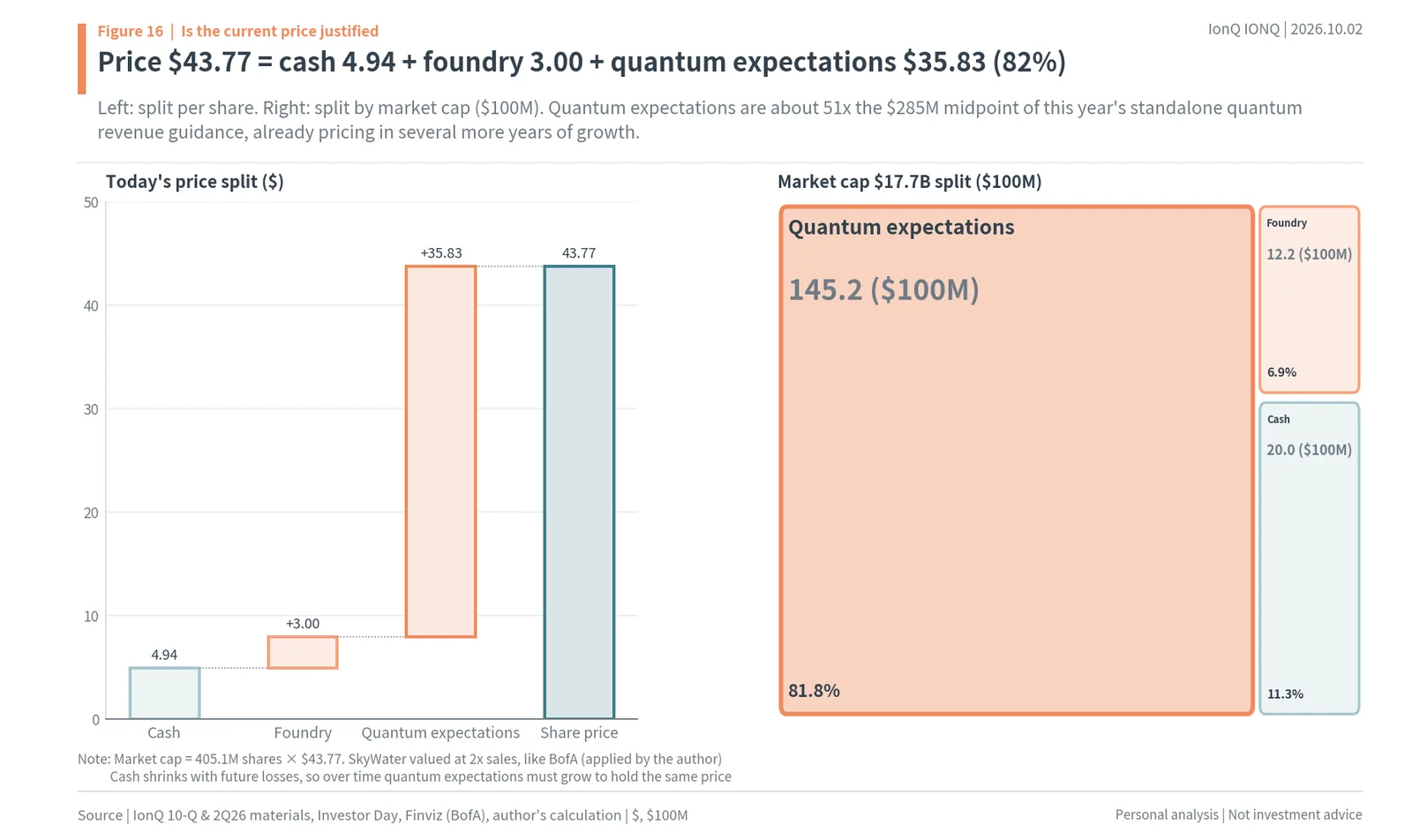
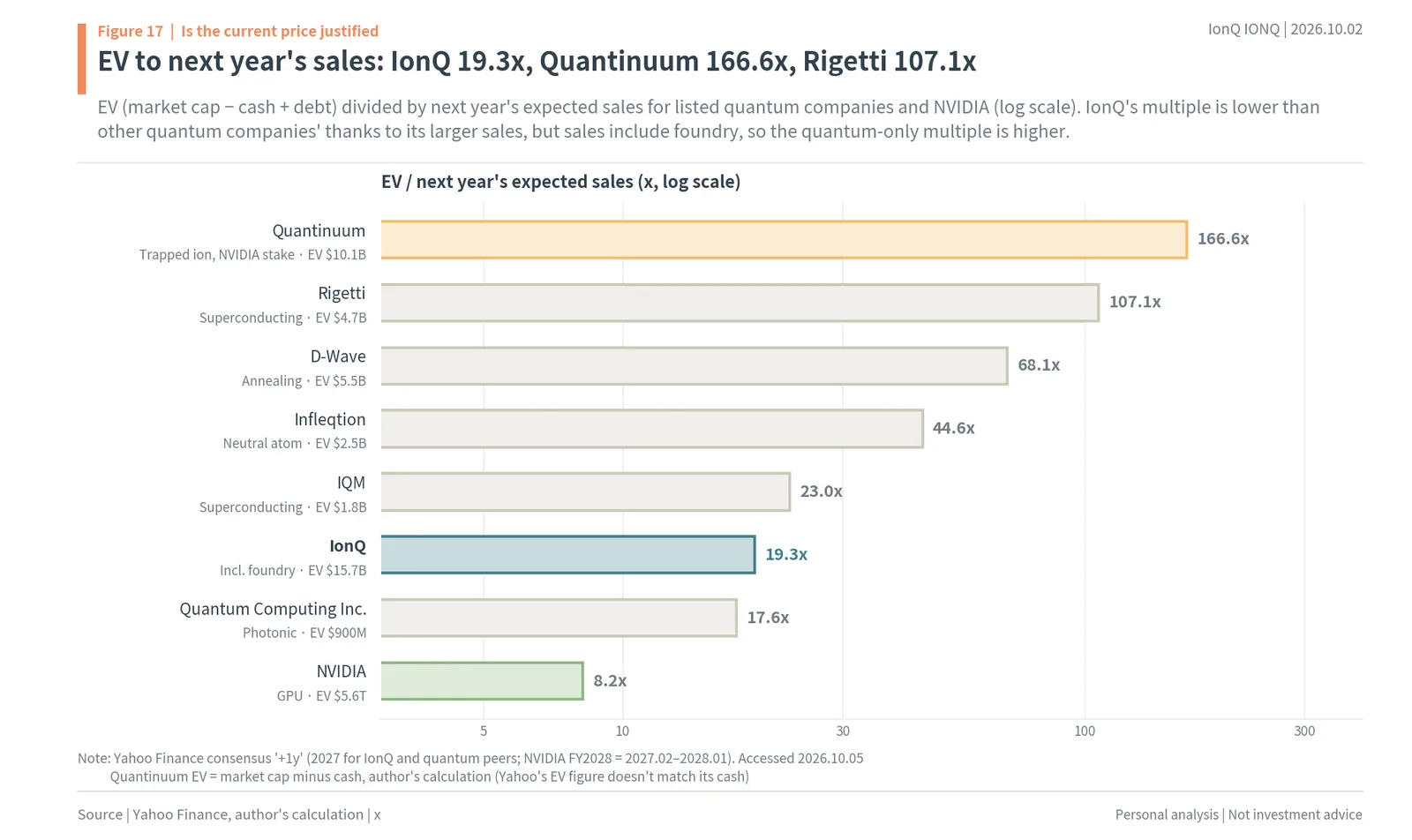
- The $43.77 share price is $4.94 cash + $3.00 foundry + $35.83 quantum expectations (82%), which at 10x sales needs about 27% of the 2030 quantum computing market. IonQ trades at 19.3x next year’s sales vs Quantinuum’s 166.6x.
Key takeaways
- IonQ’s Superion 256 will be the first on-premises quantum computer at the NVIDIA Accelerated Quantum Research Center (NVAQC), installed next to a GB200 NVL72 in 2027, but it is a joint research tenancy, not a sale, and no dollar amount was disclosed.
- If 10% of the 276 accelerated supercomputers add a quantum computer each year and IonQ wins 30% of them at $36.7M each, that is about $305M a year, roughly IonQ’s standalone 2026 revenue (author’s calculation).
- The $43.77 share price splits into $4.94 of cash, $3.00 of foundry and $35.83 of quantum expectations; filling those expectations at 10x sales needs about 27% of the 2030 quantum computing market.
As of: October 5, 2026
Ticker: IonQ (IONQ, NYSE)
Reference close: $43.77 (NYSE close on October 2, 2026)
This is the author’s personal analysis and view.
The author’s calculations and estimates are not confirmed facts.
1. This is the detailed English edition of the author’s report on IonQ and NVIDIA.
2. It first explains what a quantum computer is and what IonQ sells.
3. It then looks at what IonQ is actually doing with NVIDIA, and why NVIDIA’s words have moved IonQ’s stock so much.
4. The three questions are: why is IonQ in the spotlight, why could it rise now, and is today’s price justified.
5. There is no price target; instead the report sizes the expectation two ways: “how much if it works” and “what today’s price already assumes”.
6. The bottom line: the NVIDIA deal is a first seat, not revenue; if that road opens it could add about a year’s worth of today’s revenue every year, but the stock already prices in more than that.
1. What is a quantum computer, and who builds them?
7. A normal computer bit is 0 or 1; a quantum computer’s qubit computes in a superposition of 0 and 1.
8. Entangled qubits can handle many possibilities at once, which is why they may beat normal computers at molecular simulation, optimization and cryptography.
9. The catch is errors: qubits lose their state at the slightest disturbance, so error correction (fault tolerance) is the gate to commercial use.
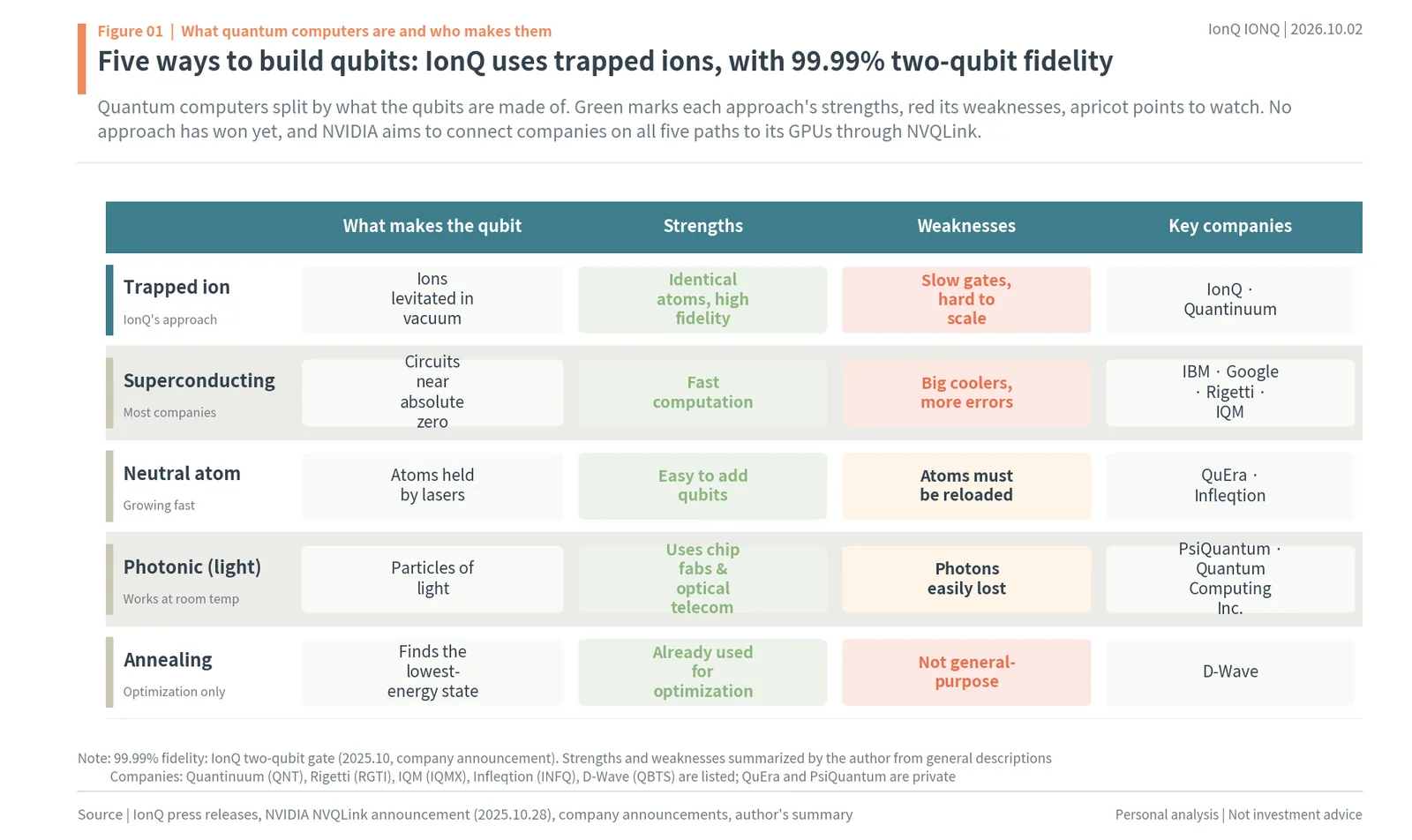
10. There are several ways to build a qubit, and each company has picked its own road.
11. IonQ and Quantinuum use trapped ions, single charged atoms held in a vacuum and controlled with lasers and electromagnetic fields.
12. IBM, Google, Rigetti and IQM use superconducting circuits cooled close to absolute zero; QuEra and Infleqtion use neutral atoms, PsiQuantum uses light (photons), and D-Wave uses annealing.
13. Ions are identical atoms, so they are accurate and stable, but they have been slower and harder to scale.
14. IonQ said it set a world record of 99.99% two-qubit gate fidelity in October 2025.
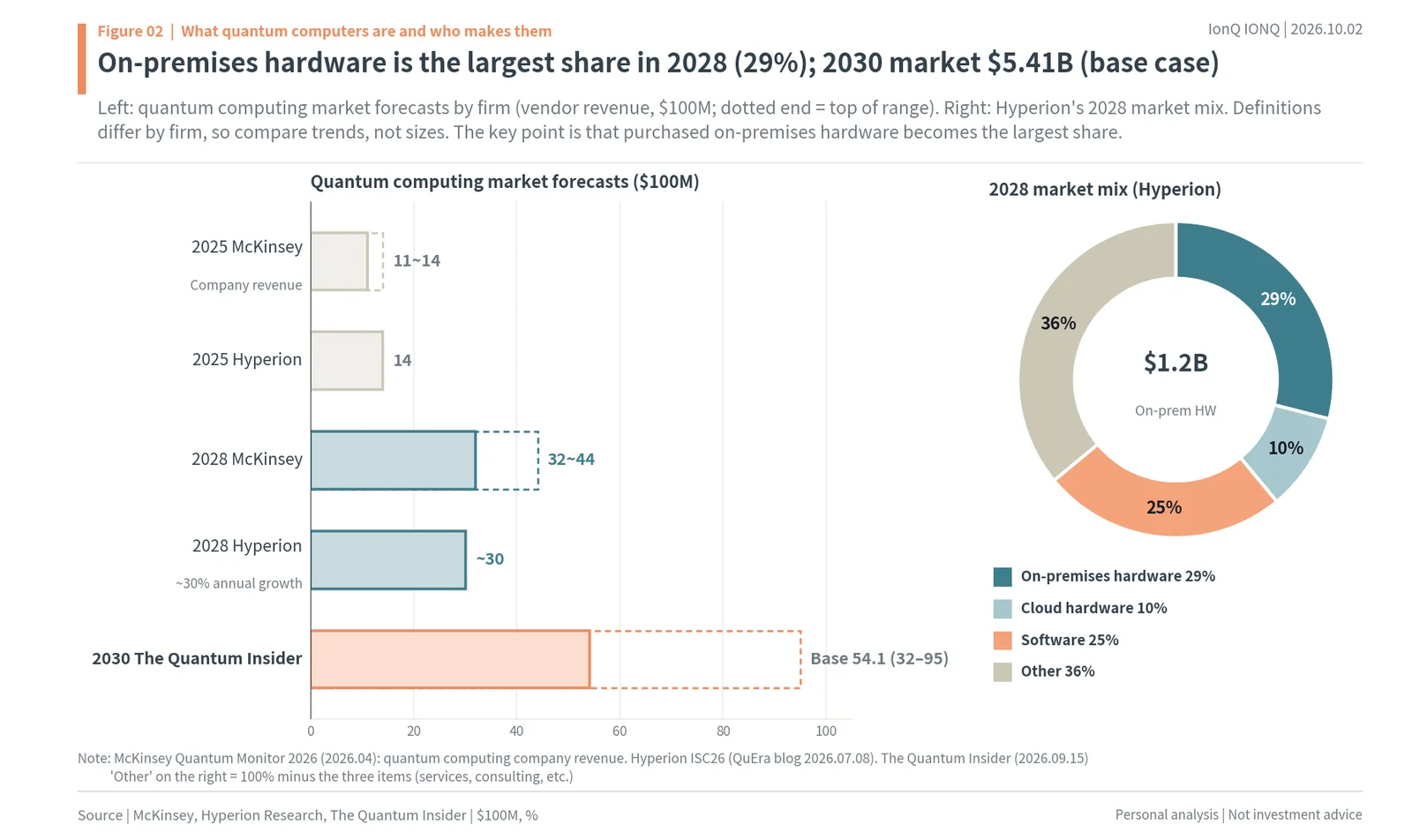
15. The market is still small: Hyperion Research puts the quantum computing market at $1.4B in 2025 and about $3B in 2028.
16. McKinsey puts quantum computing company revenue at $1.1B to $1.4B in 2025 and $3.2B to $4.4B in 2028 (April 2026).
17. The Quantum Insider puts 2030 vendor revenue at a base case of $5.41B (range $3.2B to $9.5B).
18. Hyperion expects on-premises hardware, machines that labs and companies buy and install themselves, to be the largest segment in 2028 (29%, $1.2B).
19. The shift under way: quantum computers that used to be rented over the cloud are starting to be bought and placed next to supercomputers.
2. What does IonQ sell?
20. IonQ’s core business is building trapped-ion quantum computers and selling them (hardware) or renting them over the cloud (services).
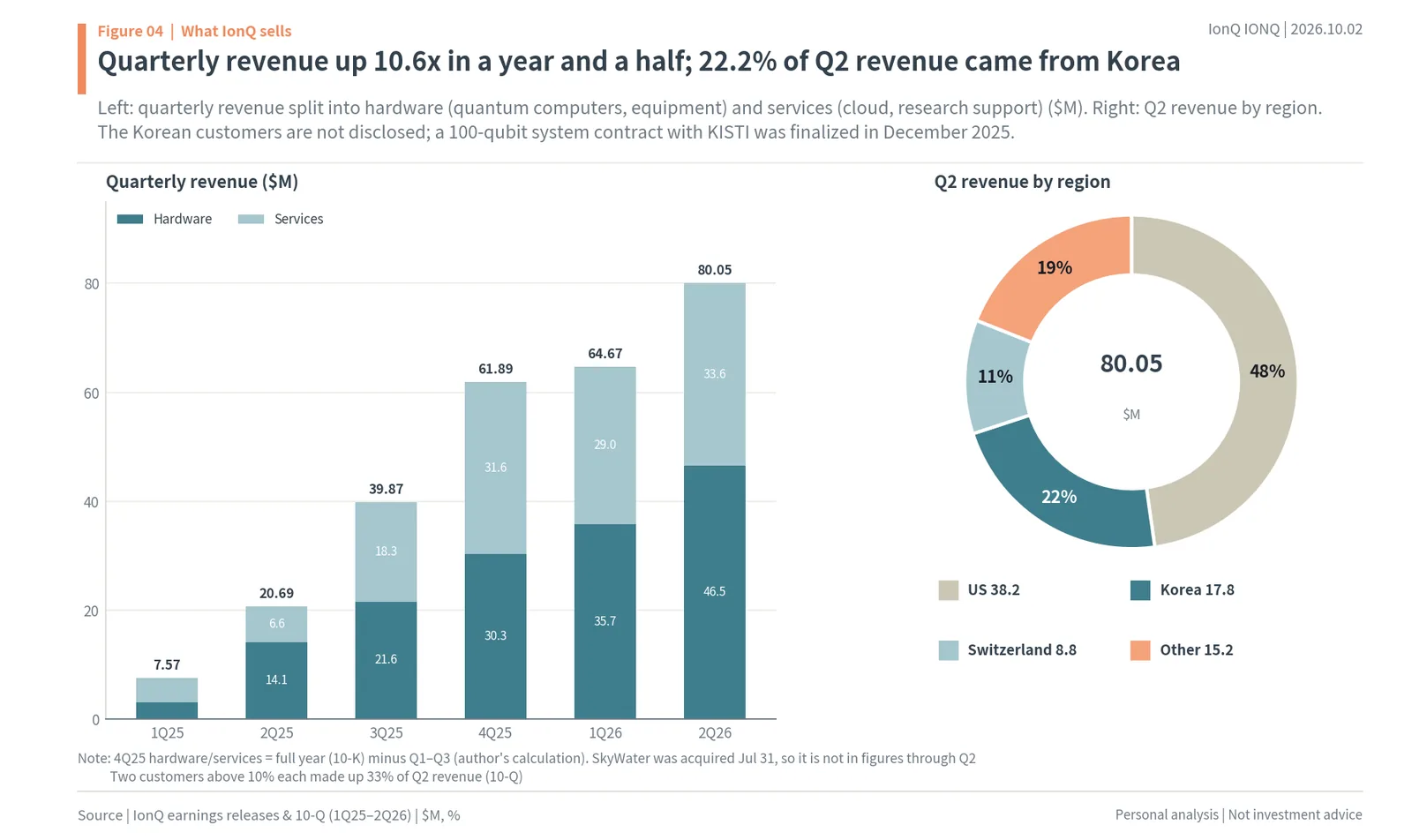
21. Of Q2 2026 revenue of $80.05M, hardware was $46.47M and services $33.58M (10-Q).
22. Quarterly revenue grew 10.6x from $7.57M in Q1 2025 to Q2 2026.
23. 22.2% of Q2 revenue ($17.77M) came from South Korea; the company does not name the customer (its 100-qubit KISTI system contract was finalized in December 2025).
24. Two customers above 10% made up 33% of Q2 revenue, so a few large contracts swing the quarter.
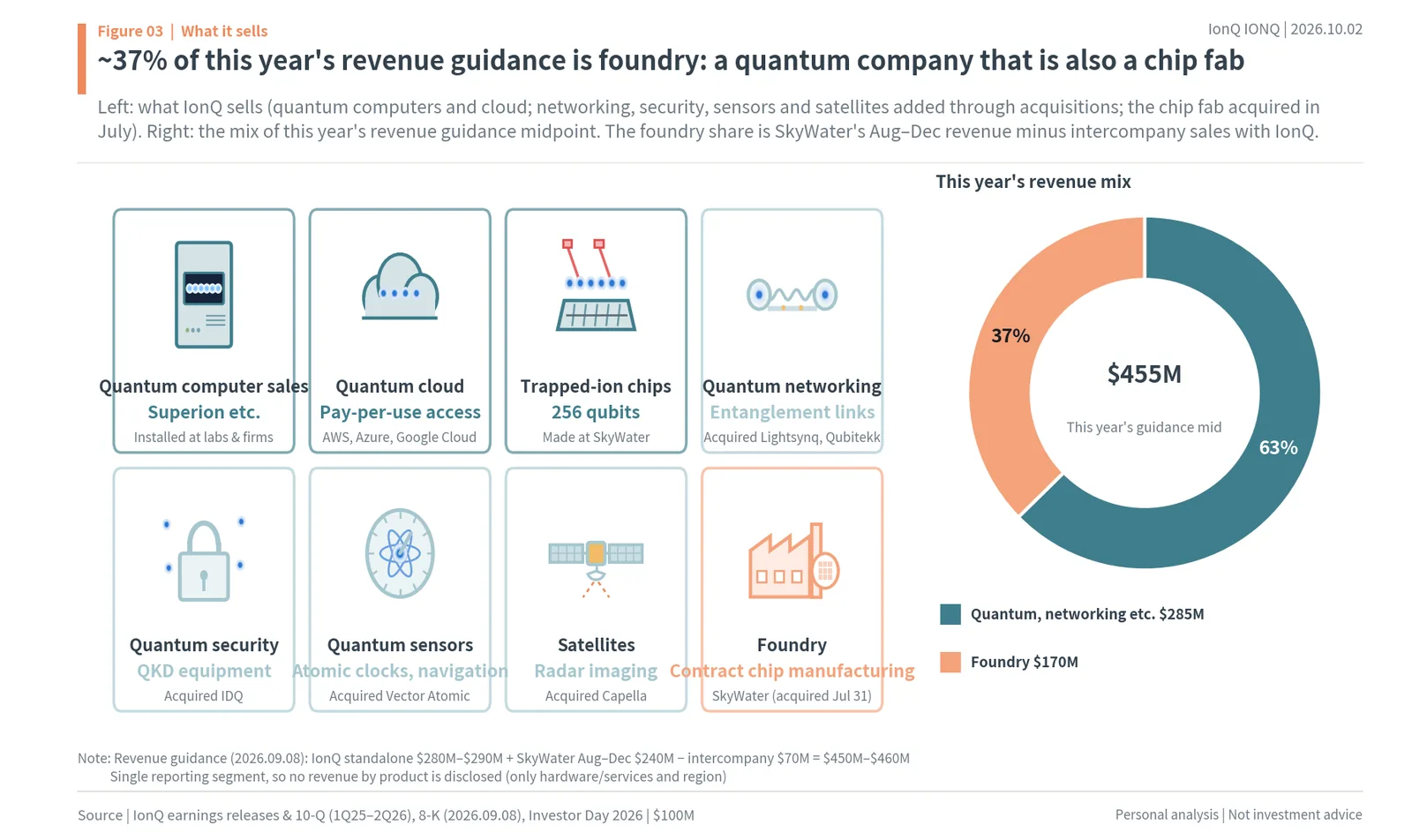
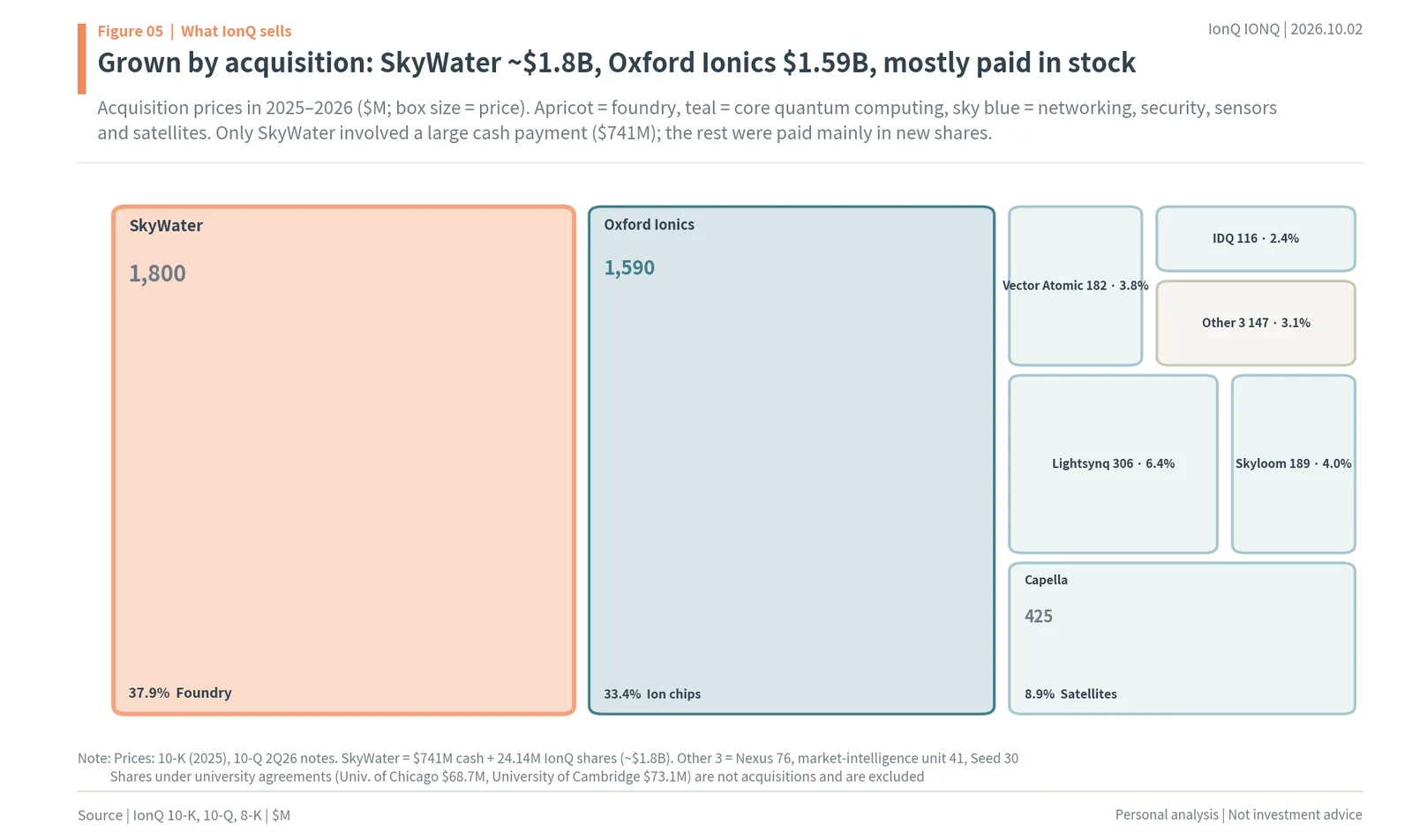
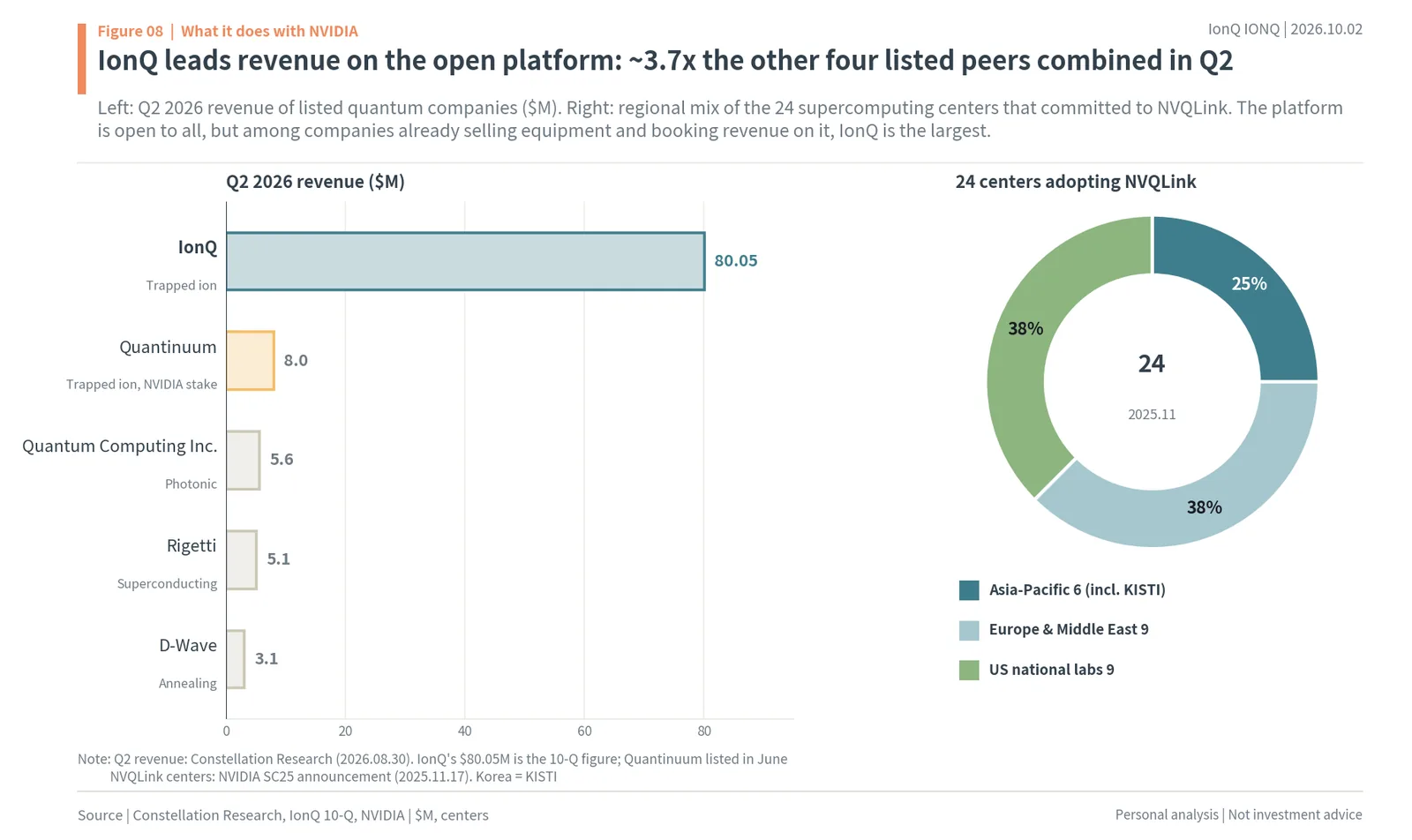
25. Since 2025 IonQ has grown by acquisition: IDQ (quantum security), Lightsynq (quantum networking), Capella (satellites), Oxford Ionics (ion chips, $1.59B) and Vector Atomic (quantum sensing), among others.
26. The largest is chip foundry SkyWater, closed on July 31 (about $1.8B: $741M in cash plus 24.14M IonQ shares).
27. Most deals were paid in stock, which is why the share count rose fast (section 8).
28. SkyWater makes IonQ’s chips and keeps making chips for other customers; its standalone revenue was $442M in 2025.
29. About $170M (37%) of the $450M–$460M 2026 revenue guidance is foundry, so IonQ is now both a quantum computer company and a chip foundry.
3. What is IonQ doing with NVIDIA?
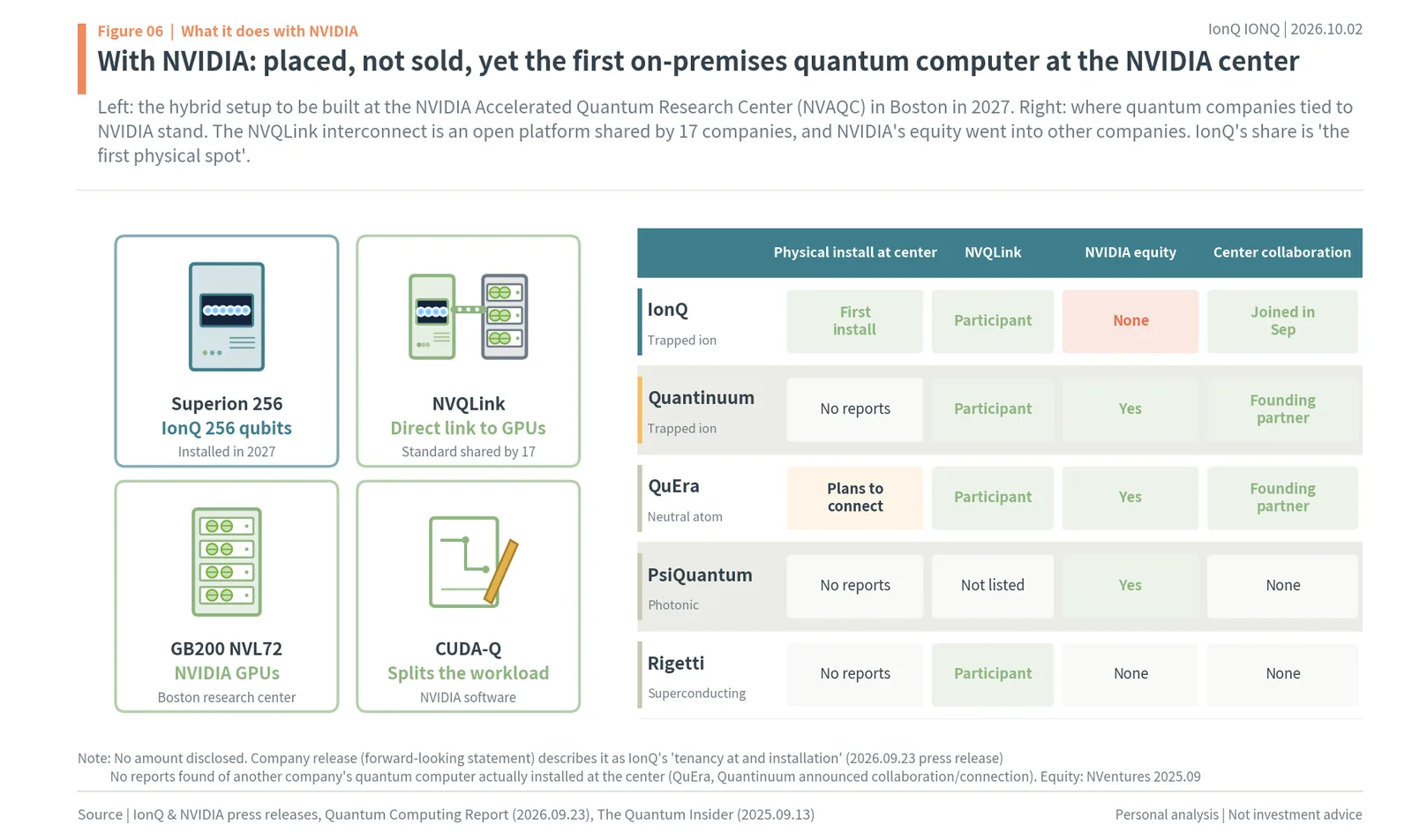
30. The September 23 announcement: one Superion 256 (256 qubits) will be installed in 2027 as the first quantum processor at NVIDIA’s Boston research center (NVAQC).
31. It connects directly to NVIDIA’s GB200 NVL72 GPU supercomputer over NVQLink, with work orchestrated by NVIDIA’s CUDA-Q.
32. Put simply, the GPUs run the big computation and hand off only the parts a quantum computer is good at: a “hybrid” setup.
33. Joint research covers hybrid software, portfolio optimization and risk models, materials, and drug-discovery chemistry.
34. NVIDIA’s head of quantum said “Every supercomputer will become a quantum supercomputer.”
35. But there is no money in it: no amount was disclosed, and the company’s filing language calls it IonQ’s “tenancy at and installation”.
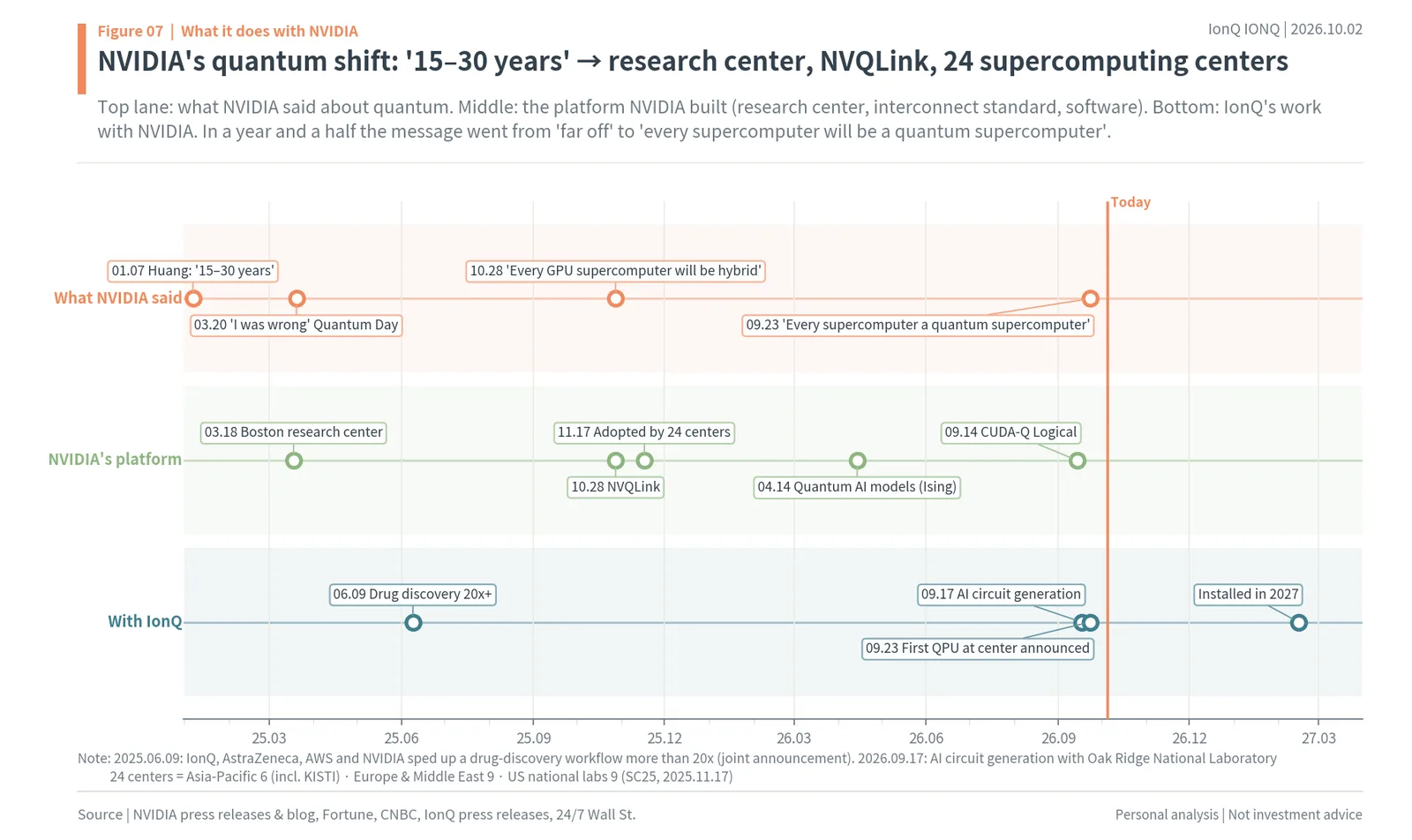
36. NVIDIA’s quantum stance changed fast, starting from Jensen Huang’s “15 to 30 years” remark in January 2025.
37. In March 2025 NVIDIA announced the Boston research center, and in October it launched NVQLink, an open standard linking quantum computers and GPUs.
38. In November, 24 supercomputing centers worldwide, including Korea’s KISTI, said they would adopt NVQLink.
39. With the Ising quantum AI models in April 2026 and CUDA-Q Logical for fault tolerance in September, NVIDIA is building a platform that pairs quantum computers with GPUs.
40. The platform is open: 17 quantum builders use NVQLink, including IonQ, Quantinuum, QuEra, Rigetti, IQM and Infleqtion.
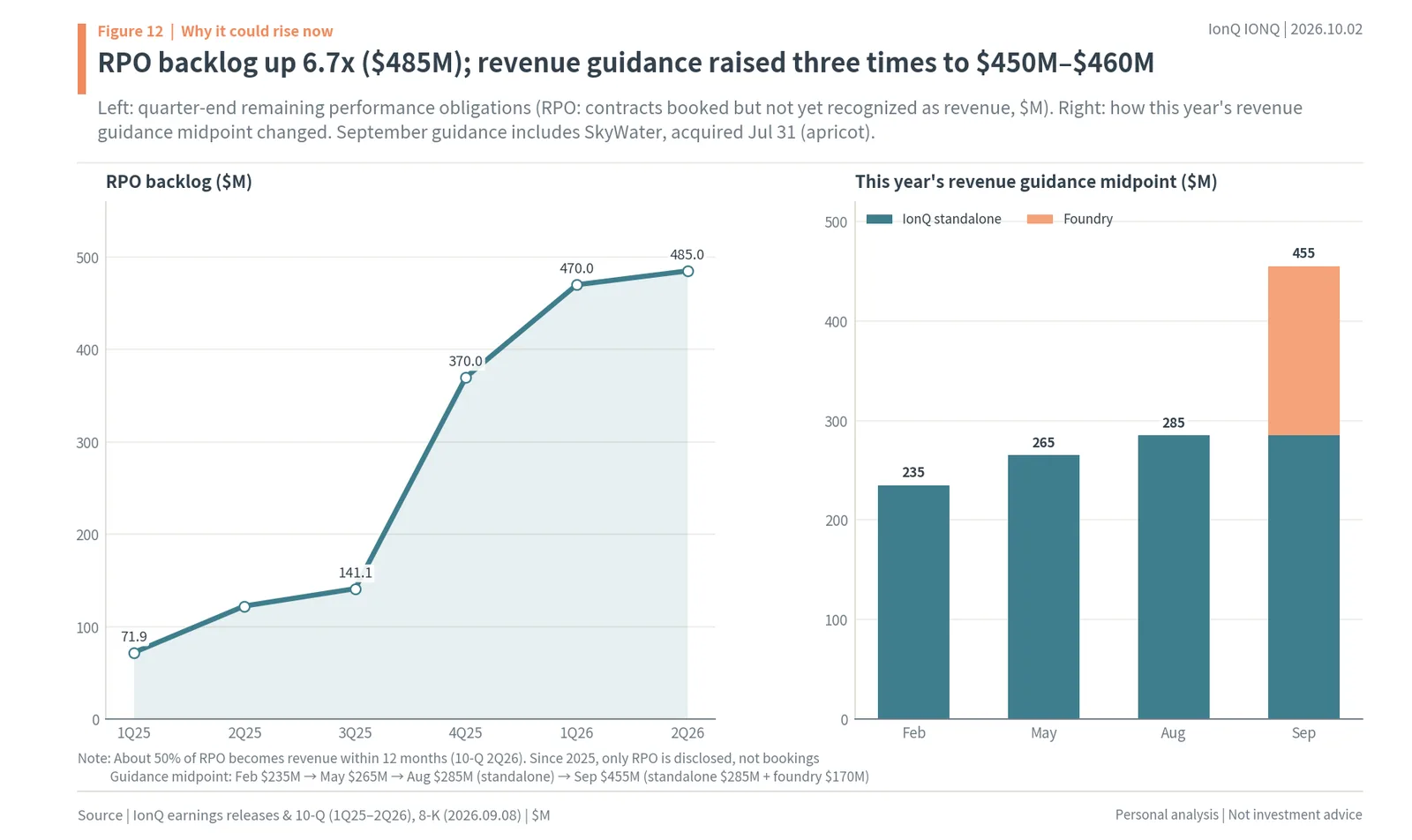
41. NVIDIA’s venture arm invested in Quantinuum, QuEra and PsiQuantum; no report of an IonQ stake was found.
42. Among the listed quantum companies on this platform, IonQ has by far the most revenue: its Q2 $80.05M was about 3.7x the combined revenue of Quantinuum, Quantum Computing Inc., Rigetti and D-Wave.
43. Quantinuum and QuEra were founding collaborators of the center, but no report was found of another company’s quantum computer physically installed there.
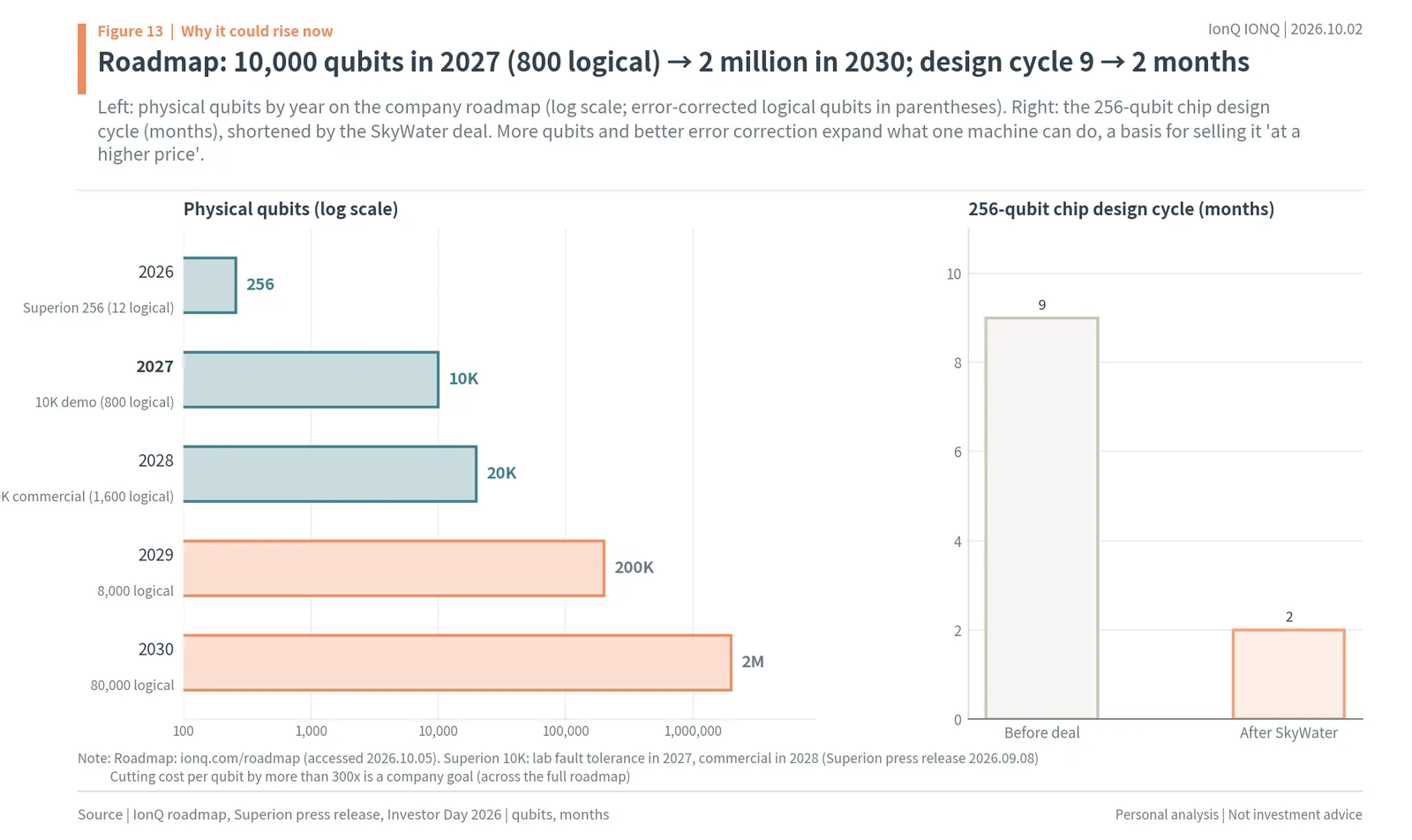
44. So IonQ’s edge is not exclusivity but being the first machine physically inside, and that difference may sway other supercomputing centers.
4. Why is IonQ in the spotlight? NVIDIA’s words and the stock
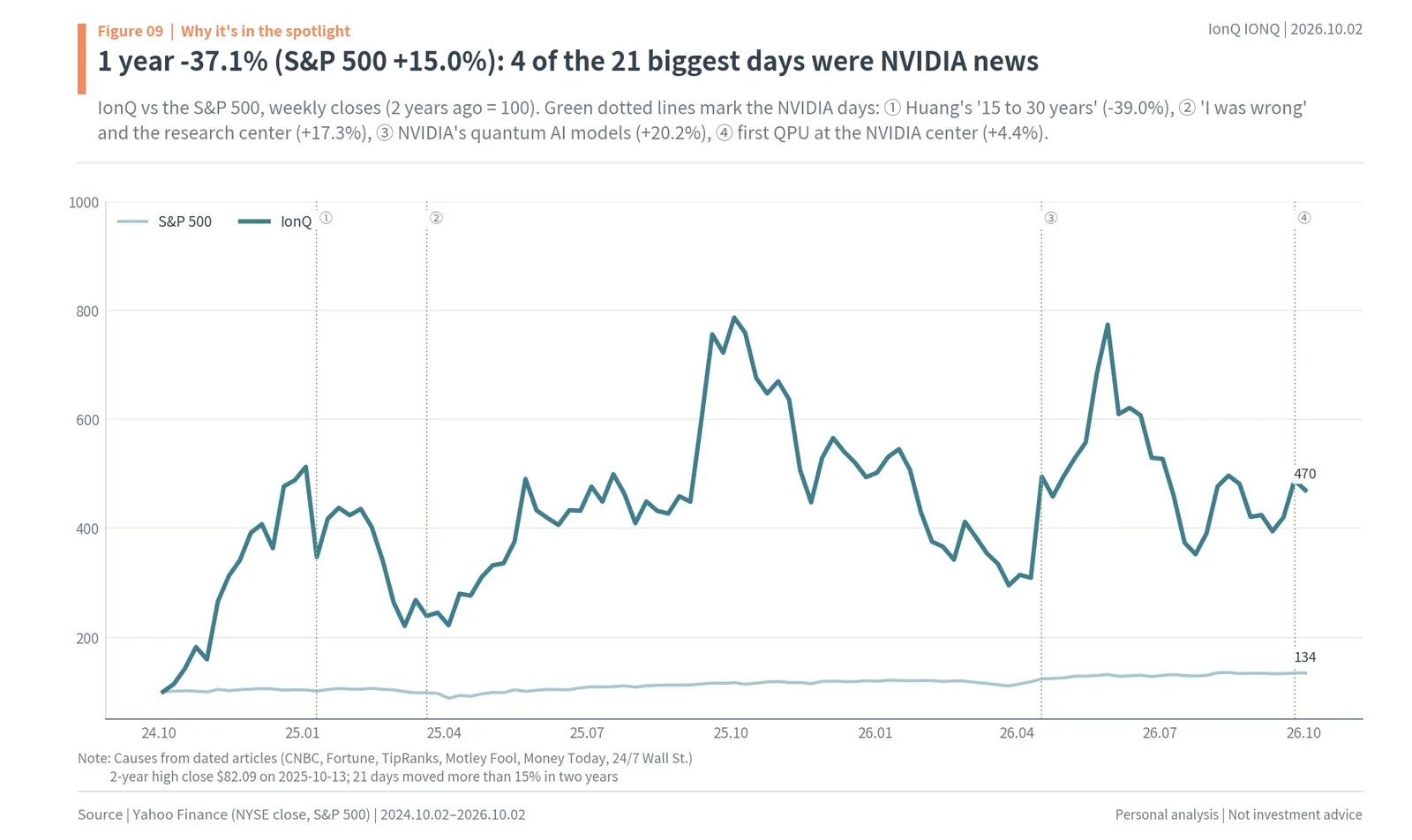
45. IonQ is 375.8% above where it was two years ago, but 37.1% below a year ago and 46.7% below its October 2025 closing high of $82.09.
46. Over the same year, the S&P 500 rose 15.0% and the Nasdaq 19.0%.
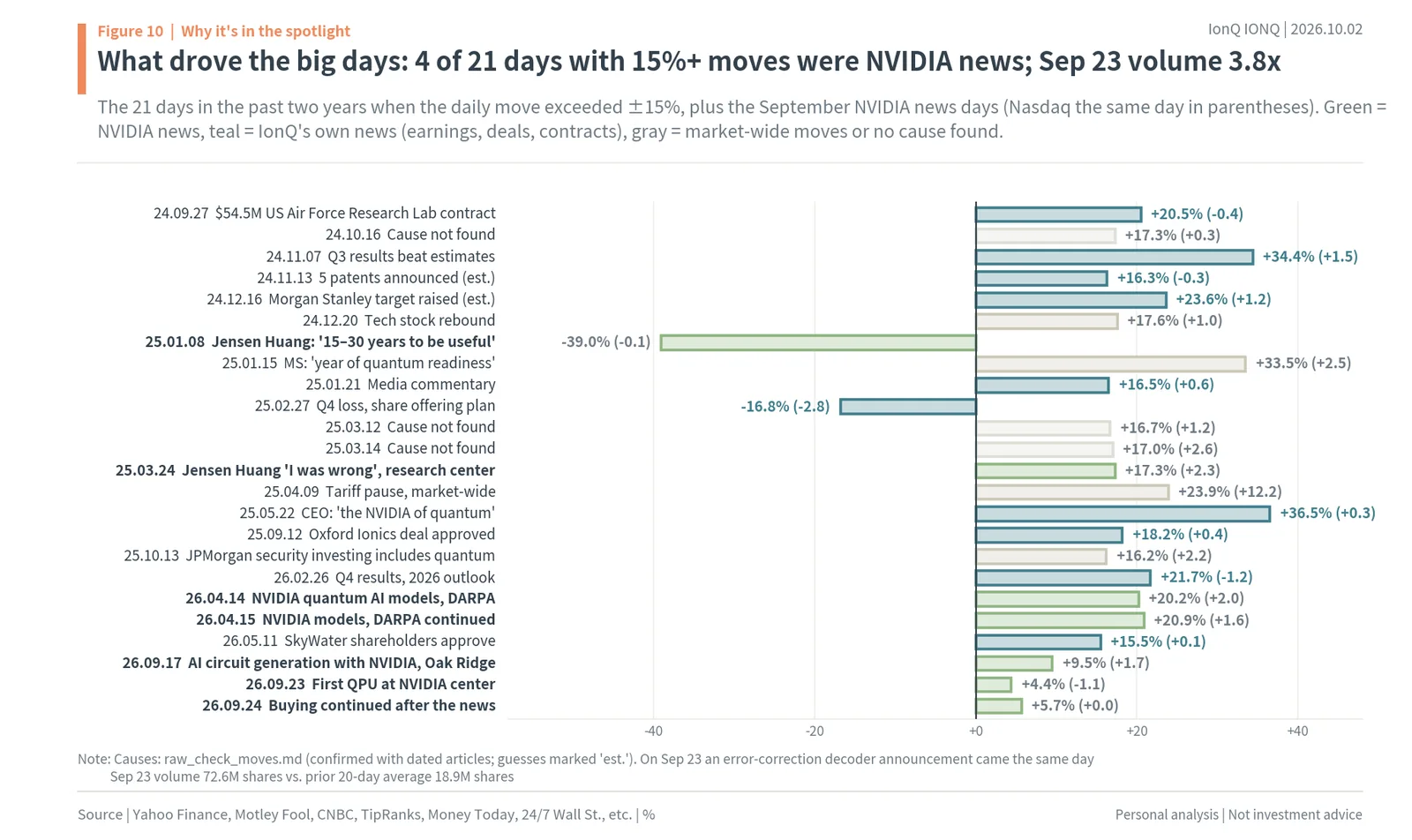
47. In two years the stock moved more than 15% in a day 21 times and more than 7% 117 times: it trades on expectations.
48. It fell 39.0% on January 8, 2025 after Huang’s “15 to 30 years” remark, and rose 17.3% on March 24 after the research center was announced.
49. It rose 20.2% and 20.9% on April 14 and 15, 2026 when NVIDIA released its quantum AI models.
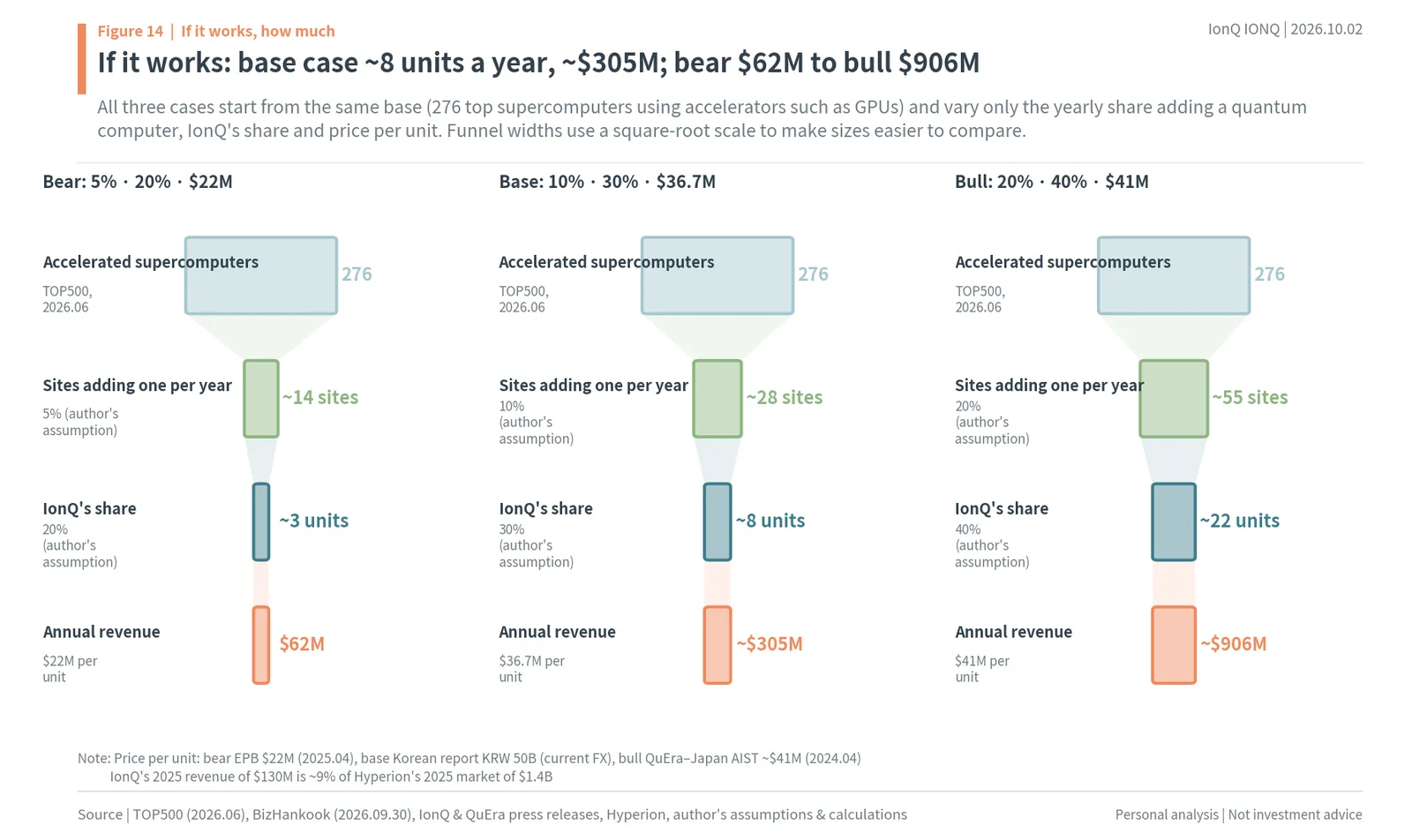
50. Of the 21 days with moves above 15%, 4 were NVIDIA news; the rest were earnings, deals, contracts and market-wide moves.
51. NVIDIA news kept coming in September: on the 17th, AI-generated quantum circuits with NVIDIA and Oak Ridge lifted the stock 9.5%.
52. On the 23rd, the research center news opened the stock 12.5% higher; it closed up 4.4% on 72.6M shares, 3.8x normal volume.
53. With +5.7% the next day, it gained 10.4% over two days, and the October 2 close was 7.4% above the day before the announcement.
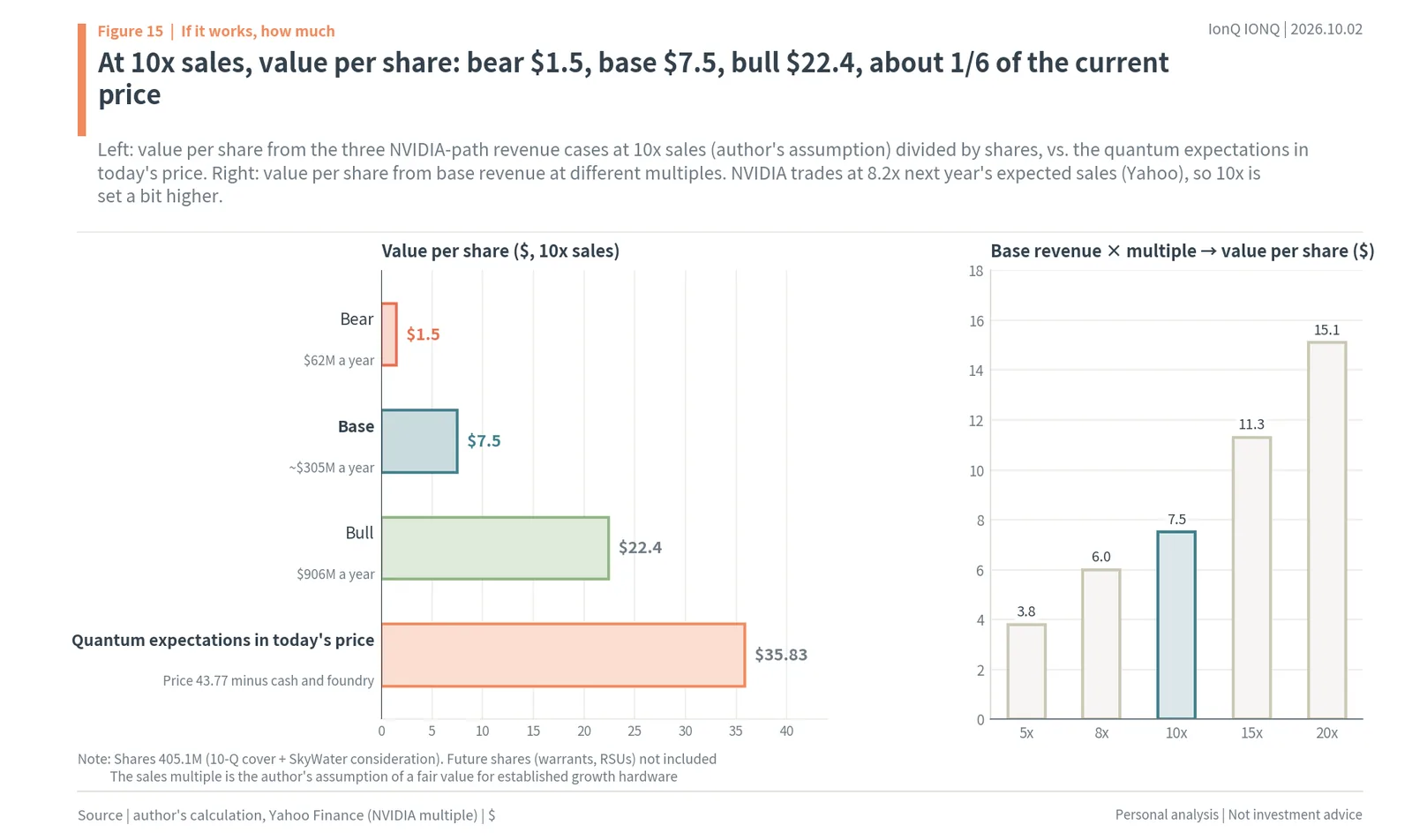
54. NVIDIA’s words move the whole sector’s expectations, and IonQ is the listed quantum company that catches them first: that is why it is in the spotlight.
5. Why could it rise now? Orders and the next generation
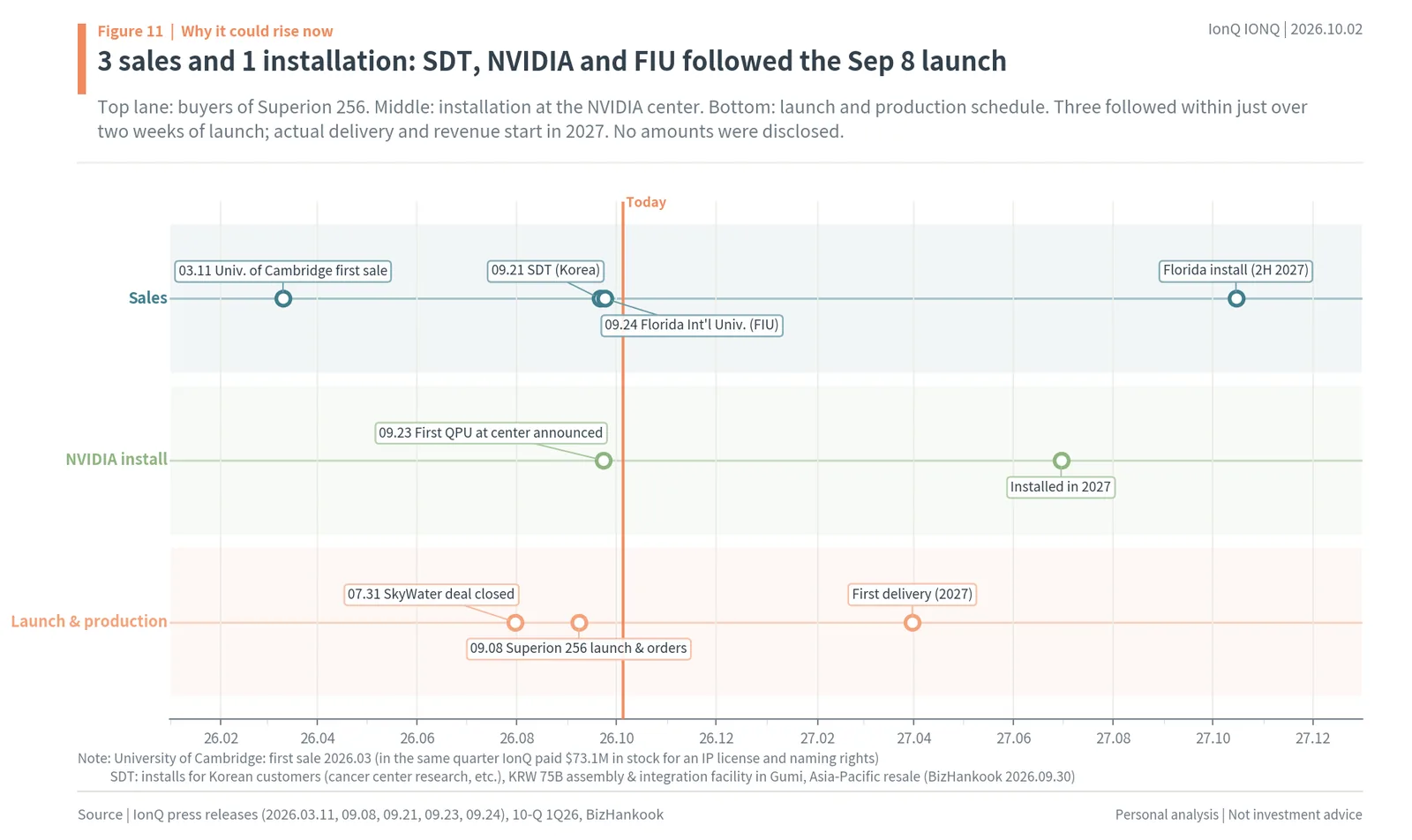
55. Superion 256 launched at the September 8 Investor Day; orders are open and deliveries start in 2027.
56. The University of Cambridge was the first buyer in March, followed by SDT (Korea) on September 21, the NVIDIA installation on the 23rd and Florida International University on the 24th.
57. SDT buys a machine for a Korean customer (including cancer-center research), is building a KRW 75B assembly and integration site in Gumi, and becomes an Asia-Pacific reseller.
58. None of the three sales or the installation came with a disclosed price.
59. Remaining performance obligations (RPO, signed but not yet booked revenue) grew 6.7x from $71.9M in Q1 2025 to $485M in Q2 2026, and about half turns into revenue within a year.
60. 2026 revenue guidance started at $225M–$245M in February, was raised in May and August, and became $450M–$460M in September including SkyWater.
61. Consensus (13 analysts on Yahoo Finance) expects 2027 revenue of $814M (range $642M to $1.01B).
62. The next generation is the case for “pricier”: the roadmap shows 10,000 physical qubits (800 error-corrected logical qubits) in 2027 and 2 million (80,000 logical) in 2030.
63. Superion 10K is planned to show full fault tolerance in IonQ’s lab in 2027 and to ship as a manufacturable commercial product in 2028.
64. SkyWater cut the 256-qubit chip design cycle from 9 months to 2, and IonQ targets more than a 300x drop in cost per qubit across the roadmap.
65. The answer to “why now” is that the NVIDIA seat, real orders and the fault-tolerant generation could be confirmed one after another within one to two years (author’s view).
6. How much if it works? Quantum computers next to GPU supercomputers
66. If, as NVIDIA says, a quantum computer is attached to every GPU supercomputer, how much could IonQ earn? Three steps.
67. Step 1, the seats: 276 of the world’s top 500 supercomputers use accelerators, and 24 centers have said they will use NVQLink.
68. Step 2 is the share of them adding a quantum computer each year and IonQ’s share; step 3 is the price per machine.
69. Prices are borrowed from disclosed deals: bear $22M (EPB contract), base $36.7M (a Korean report that IonQ’s flagship costs “close to KRW 50B”, at today’s exchange rate), bull about $41M (QuEra’s contract with Japan’s AIST).
70. In the base case, 10% of the 276 (about 28 sites) add one each year and IonQ wins 30%: about 8 machines and about $305M a year (author’s calculation).
71. The bear case (5%, 20%) gives about 3 machines and $62M a year; the bull case (20%, 40%) about 22 machines and $906M.
72. The base-case market (about $1B a year) is 84% of Hyperion’s $1.2B forecast for on-premises hardware in 2028, so it is not a far-fetched assumption.
73. At 10x sales (author’s assumption for established growth hardware), the value per share is $1.5 bear, $7.5 base and $22.4 bull.
74. 10x is a little above NVIDIA’s 8.2x EV to next year’s expected revenue; at 5x the base case is $3.8, at 20x $15.1.
75. IonQ’s 2025 revenue of $130M was about 9% of Hyperion’s $1.4B 2025 market; the base case’s 30% is higher, reflecting the first-seat effect.
76. If the NVIDIA road opens, it adds about a year’s worth of today’s revenue every year, which is roughly one sixth of today’s share price (author’s view).
7. Is today’s price justified?
77. Today’s market cap of $17.7B (405M shares x $43.77) splits into three parts.
78. Cash after the acquisition is about $2.0B, or $4.94 per share.
79. SkyWater at 2x sales, as BofA values it, is $608M expected 2026 revenue x 2 = about $1.22B, or $3.00 per share.
80. The remaining $14.5B, $35.83 per share (82%), is what the market assigns to the quantum business (author’s calculation).
81. That is about 51x the $285M midpoint of IonQ’s standalone 2026 revenue guidance.
82. Against other listed quantum companies, IonQ is actually cheaper.
83. EV to next year’s expected revenue is 19.3x for IonQ, 166.6x for Quantinuum, 107.1x for Rigetti, 68.1x for D-Wave, 44.6x for Infleqtion, 23.0x for IQM and 17.6x for Quantum Computing Inc. (Yahoo Finance).
84. IonQ’s Q2 revenue was about 3.7x the combined revenue of the other four listed quantum companies.
85. But IonQ’s revenue includes the foundry, so the multiple on quantum alone is higher.
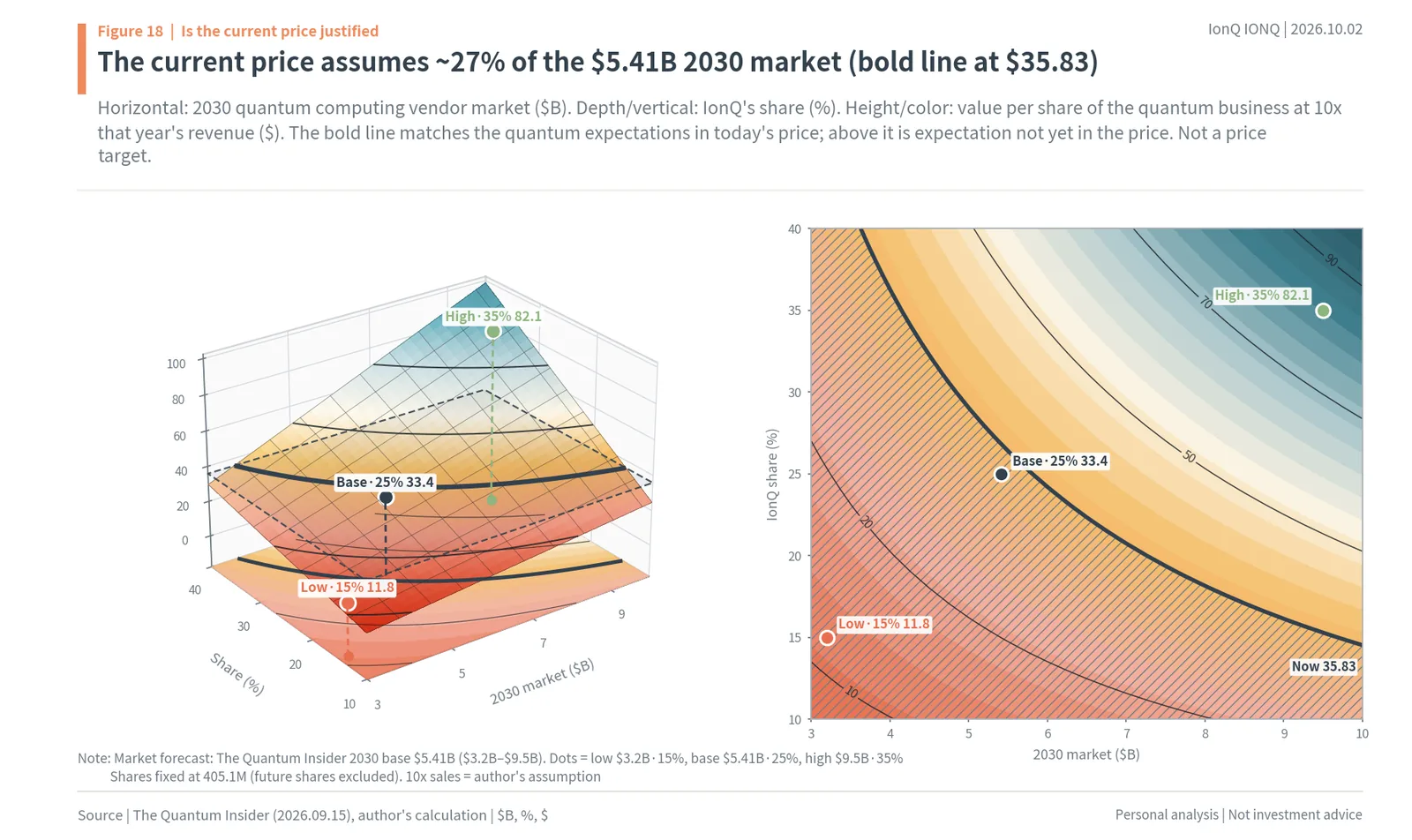
86. Filling $14.5B of quantum expectations at 10x sales needs $1.45B of quantum revenue, 5.1x this year’s and 11.2x 2025’s.
87. That is about 27% of the $5.41B 2030 market forecast, 45% of the low $3.2B case or 15% of the high $9.5B case.
88. The surface below shows how the quantum business’s value per share changes with the 2030 market size and IonQ’s share; the bold line is the $35.83 priced in today.
89. A $5.41B market at 25% share gives $33.4, close to today; $9.5B at 35% gives $82.1, and $3.2B at 15% gives $11.8.
90. Broker targets (14 analysts, average $66.63, range $41.85 to $100) are noted for reference only.
91. Today’s price already assumes IonQ takes a quarter of the 2030 market; the upside comes from the market growing beyond forecasts (an NVIDIA standard) or IonQ’s share growing further (author’s view).
8. What could go wrong
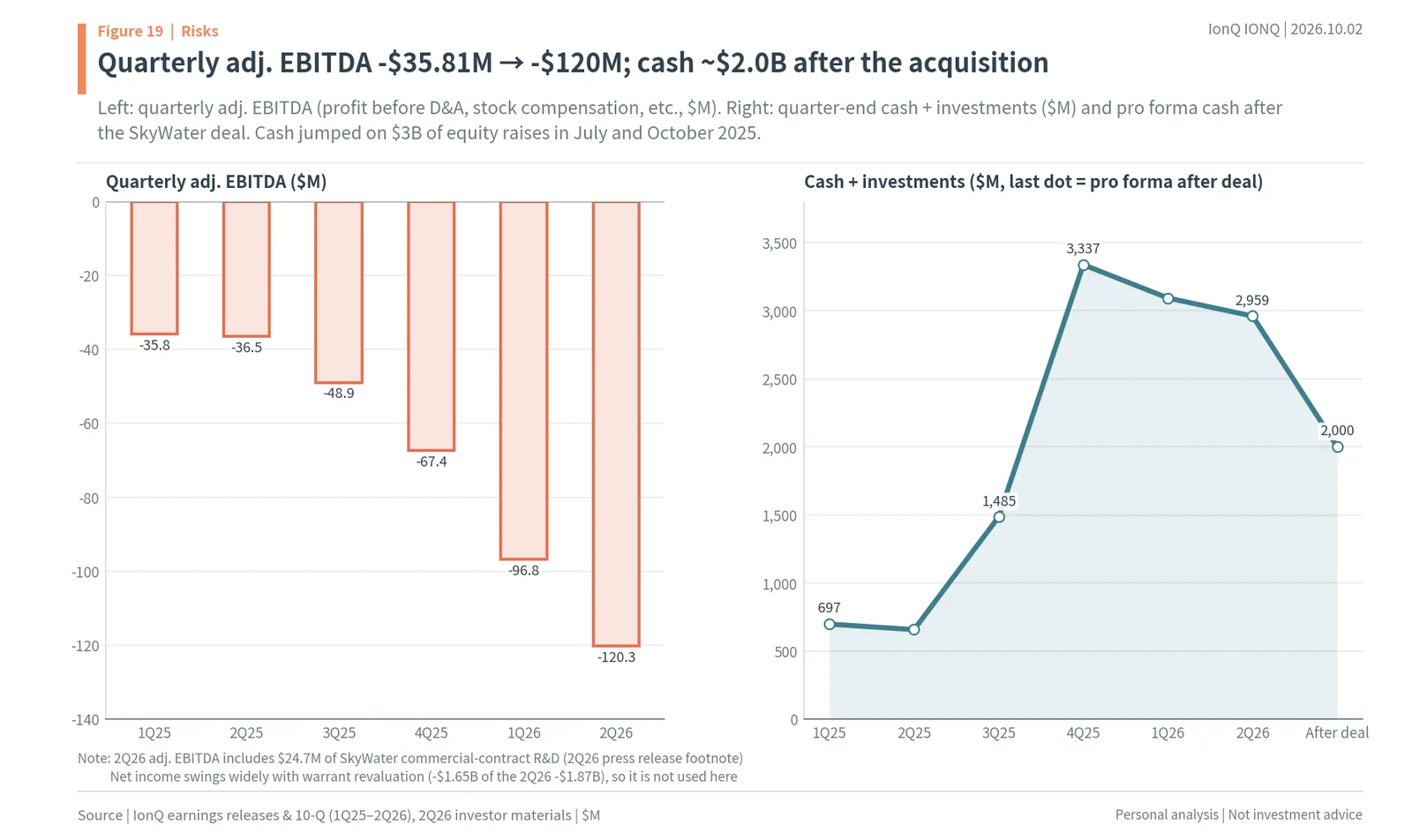
92. First, losses: adj. EBITDA widened from -$35.81M in Q1 2025 to -$120M in Q2 2026.
93. The 2026 adj. EBITDA guidance (-$330M to -$310M), given in February and reaffirmed in May, was not reaffirmed in August, and there is no guidance including SkyWater.
94. Cash after the acquisition is about $2.0B with no debt, so it is not urgent, but the pace of losses matters.
95. Net income swings with warrant revaluations each quarter (-$1.65B of Q2’s -$1.87B was warrants), so earnings should be read through revenue and adj. EBITDA.
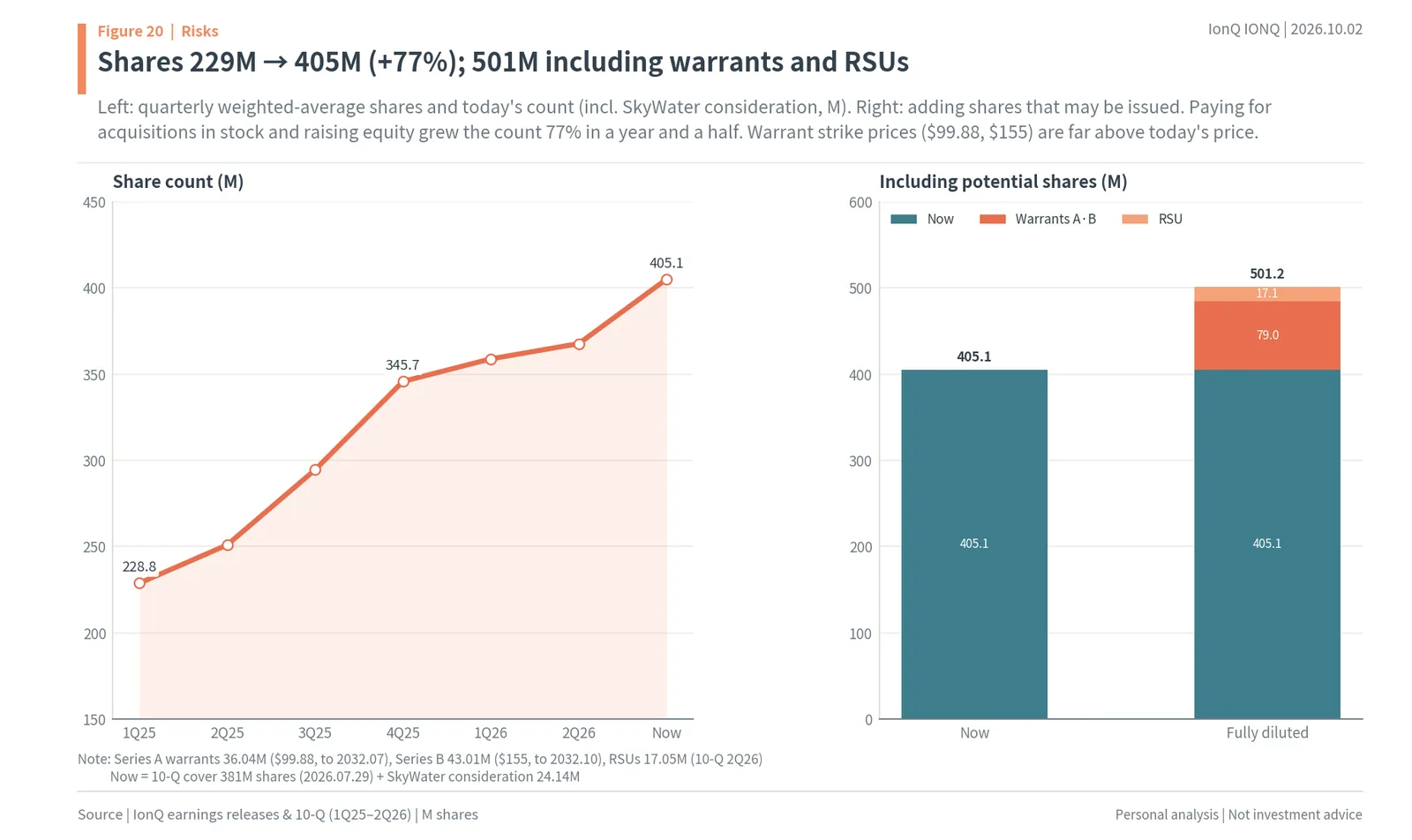
96. Second, share count: the weighted average of 229M in Q1 2025 is now 405M, up 77%.
97. Adding 79.05M warrants (strikes $99.88 and $155) and 17.05M RSUs would take it to about 501M, 24% more.
98. Third, the quality of sales: in the same quarter it announced Cambridge as the first buyer, IonQ gave Cambridge $73.1M of stock for IP licensing and naming rights, and gave the University of Chicago $68.7M on similar terms.
99. The company has not disclosed how these relate to system sales.
100. Fourth, competition: Quantinuum listed in June and has NVIDIA as an investor, and IBM targets Starling with 200 logical qubits in 2029.
101. Widening losses, a growing share count and sales announced without prices are what could erode the expectations.
9. The numbers to check next
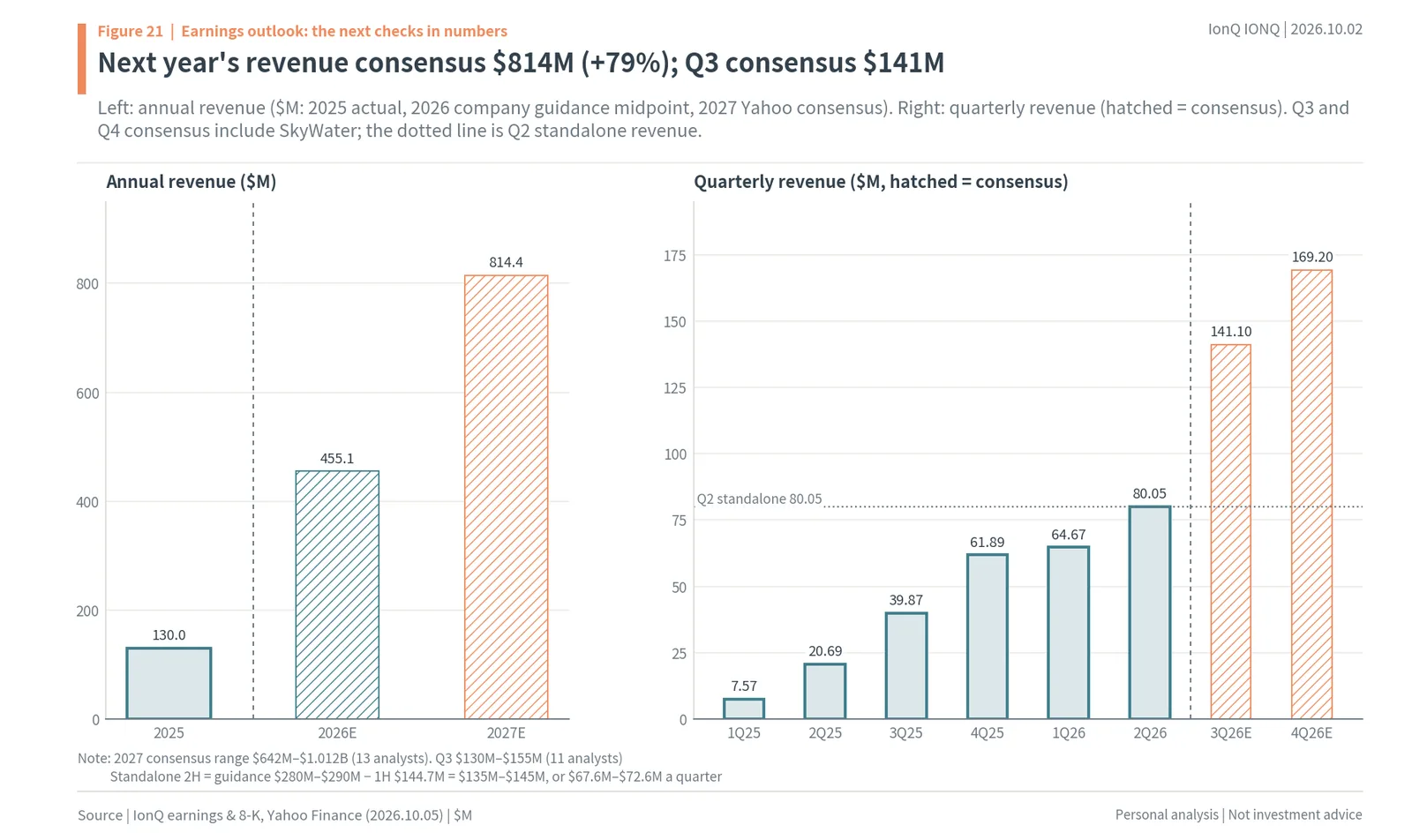
102. 2025 revenue was $130M; 2026 guidance is $450M–$460M (consensus $455M), and 2027 consensus is $814M, 79% higher.
103. Q3 revenue consensus is $141M (11 analysts, $130M to $155M) and Q4 $169M; both include SkyWater.
104. Subtracting the first half from IonQ’s standalone guidance of $280M–$290M leaves $135M–$145M for the second half, or $67.6M–$72.6M a quarter.
105. That is below the standalone Q2 of $80.05M, though management said it does not plan a decline (Q2 call).
106. So if standalone Q3 revenue tops Q2, guidance may rise again; if it falls short, expectations may crack.
10. Dates and signals to watch
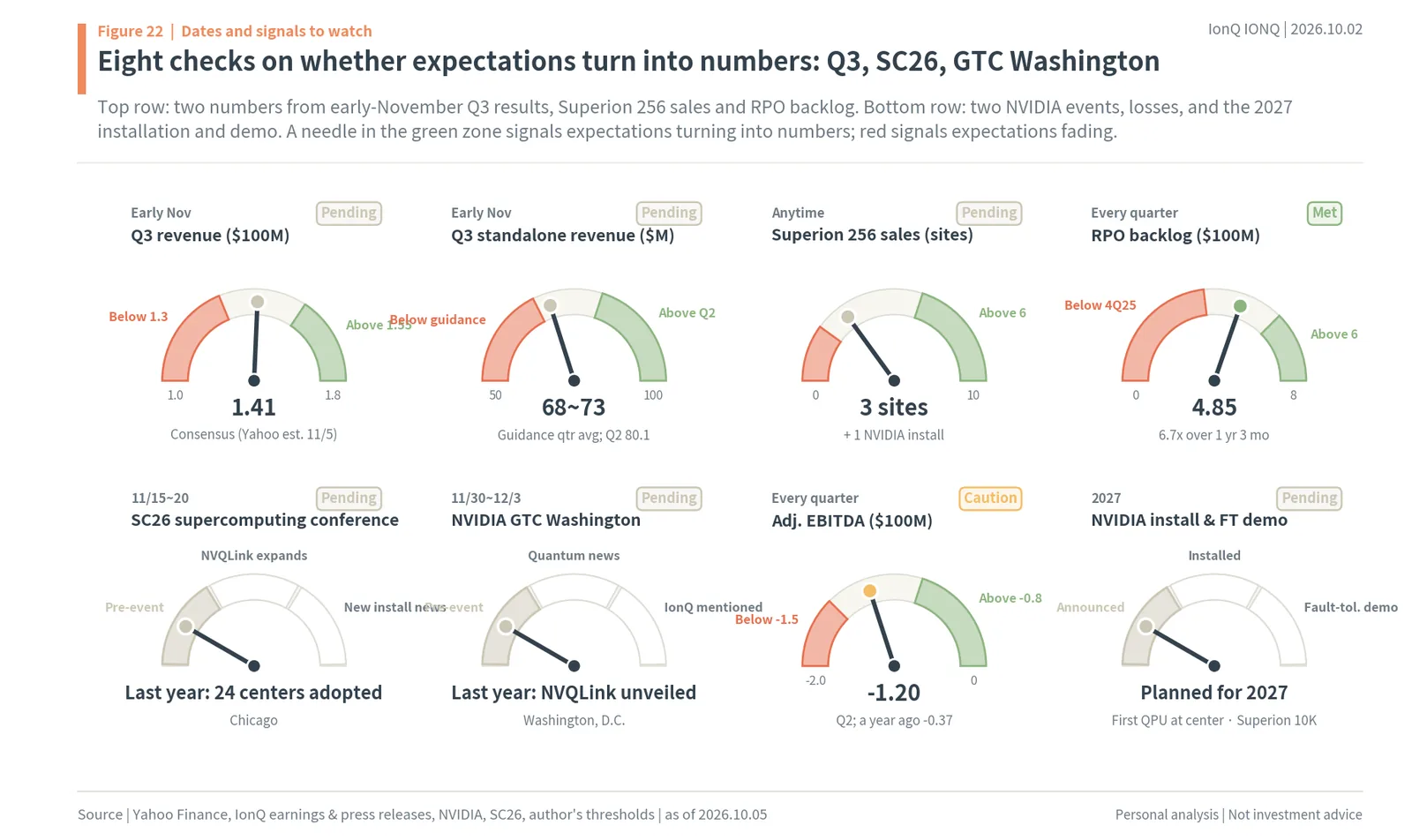
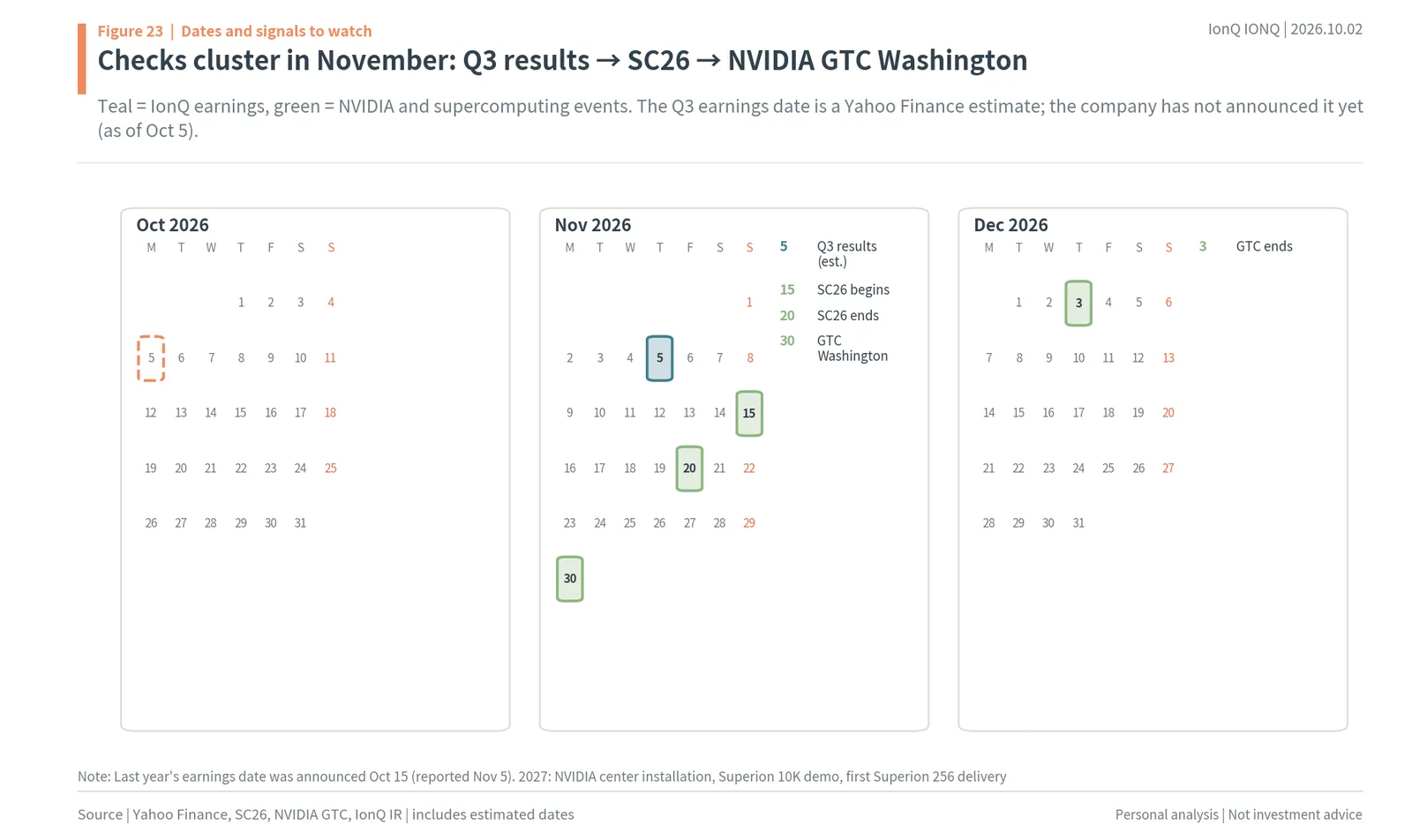
107. Early November, Q3 results: Yahoo Finance expects November 5, but the company has not announced a date (as of October 5).
108. November 15–20, SC26 in Chicago: at last year’s conference, 24 supercomputing centers announced NVQLink adoption.
109. November 30 – December 3, NVIDIA GTC Washington, D.C.: NVQLink was launched at last year’s event.
110. Numbers to watch: Superion 256 sales (3 so far), RPO ($485M), adj. EBITDA (-$120M) and cash (about $2.0B).
111. In 2027, whether the NVIDIA installation and the Superion 10K fault-tolerance demo happen on schedule.
112. With results and two NVIDIA-related events packed into November, it is the fastest way to see whether expectations turn into order numbers (author’s view).
11. Summary
113. Why the spotlight: NVIDIA is building toward “every supercomputer becomes a quantum supercomputer”, and the first quantum computer physically inside its research center is IonQ’s.
114. Why now: Superion 256 orders followed within three weeks of launch, RPO grew 6.7x, and the 2027–2028 fault-tolerant generation is scheduled.
115. How much if it works: the base case for quantum computers next to GPU supercomputers is about $305M a year, roughly IonQ’s standalone 2026 revenue.
116. Today’s price: 82% is already quantum expectations, priced for about 27% of the 2030 market, yet IonQ is cheaper than peers relative to revenue.
117. Risks: widening losses, a rising share count and sales announced without prices.
Maochaedung’s summary. IonQ’s NVIDIA deal is not a sales contract but the first quantum computer physically inside NVIDIA’s research center. Its value is that IonQ got in line first on the quantum-supercomputer platform NVIDIA is building, and if that platform opens, the base case adds about a year’s worth of IonQ’s standalone 2026 revenue every year. But today’s price already assumes IonQ takes a quarter of the 2030 market, so the author thinks the right approach is to grow expectations only as Superion 256 orders show up in the numbers at the November Q3 results and NVIDIA events.
IonQ and NVIDIA FAQ
Q. What is IonQ doing with NVIDIA?
On September 23, 2026, IonQ said a Superion 256 (256 qubits) will be installed in 2027 as the first on-premises quantum computer at the NVIDIA Accelerated Quantum Research Center (NVAQC) in Boston. It connects to NVIDIA’s GB200 NVL72 over NVQLink and runs through CUDA-Q, for joint research on hybrid software, financial optimization, materials and drug-discovery chemistry.
Q. Is NVIDIA buying a quantum computer from IonQ?
No dollar amount was disclosed and it is not described as a purchase. IonQ’s filing language calls it IonQ’s tenancy and installation at the center, and no report of an NVIDIA stake in IonQ was found. NVIDIA’s venture arm invested in Quantinuum, QuEra and PsiQuantum instead.
Q. Is IonQ’s NVIDIA partnership exclusive?
No. NVQLink is an open standard used by 17 quantum builders, including Quantinuum, QuEra, Rigetti, IQM and Infleqtion. IonQ’s edge is being the first quantum computer physically installed at NVIDIA’s research center; no report was found of another company’s machine installed there.
Q. How much could the NVIDIA road be worth to IonQ?
In the author’s base case, 10% of the 276 accelerated supercomputers in the TOP500 add a quantum computer each year and IonQ wins 30% at $36.7M each, about $305M a year, roughly IonQ’s standalone 2026 revenue. The bear case is $62M and the bull case $906M a year. At 10x sales that is $1.5, $7.5 or $22.4 per share.
Q. How much expectation is already in IONQ’s share price?
The $43.77 close splits into about $4.94 of cash, $3.00 for the SkyWater foundry at 2x sales and $35.83 (82%) for the quantum business. Filling that at 10x sales needs $1.45B of quantum revenue, about 27% of The Quantum Insider’s $5.41B 2030 market forecast.
Q. What should IonQ investors watch next?
Q3 results in early November (Yahoo Finance expects November 5; the company has not announced the date), SC26 on November 15-20 and NVIDIA GTC Washington on November 30 – December 3. Key numbers: whether standalone Q3 revenue tops Q2’s $80.05M, new Superion 256 sales, RPO ($485M), adj. EBITDA (-$120M) and cash (about $2.0B).
Sources
- IonQ, IonQ to Advance Quantum Supercomputing by Bringing First QPU to NVIDIA Accelerated Quantum Research Center (link), 2026.09.23
- IonQ, Superion launch, SDT partnership and FIU contract press releases (link), 2026.09.08–09.24
- IonQ, quarterly earnings releases, 10-Q, 10-K and 8-K filings (link), 2025.05–2026.09
- IonQ, Investor Day 2026 presentation (link), 2026.09.08
- IonQ, technology roadmap (link), accessed 2026.10.05
- NVIDIA, NVIDIA to Build Accelerated Quantum Computing Research Center (link), 2025.03.18
- NVIDIA, NVIDIA NVQLink (link), 2025.10.28
- NVIDIA, supercomputing centers adopt NVQLink (link), 2025.11.17
- Quantum Computing Report, IonQ Selected as First On-Premise QPU Deployment at NVIDIA’s NVAQC (link), 2026.09.23
- 24/7 Wall St. (Yahoo Finance), IonQ Surges 11% as NVIDIA Research Center Deal Follows Error-Decoder Breakthrough (link), 2026.09.23
- The Quantum Insider, NVentures quantum investments (link), 2025.09.13
- Fortune, Nvidia CEO Jensen Huang tanks quantum computing stocks (link), 2025.01.09
- TipRanks, IonQ Stock Jumps as Investors Pile Back into the Quantum Computing Trade (link), 2025.03.24
- Money Today, quantum stocks surge on World Quantum Day (link), 2026.04.15
- TOP500, June 2026 List Highlights (link), 2026.06
- Hyperion Research ISC26 outlook (QuEra blog, https://www.quera.com/blog-posts/what-hyperions-isc26-update-signals-for-neutral-atom-quantum-computing), 2026.07.08
- The Quantum Insider, quantum computing vendor revenue outlook (link), 2026.09.15
- BizHankook, SDT and IonQ partnership interview (link), 2026.09.30
- Finviz (Schaeffer’s), Quantum Stock Surging on Revised Full-Year Outlook (link), 2026.09.08
- NVIDIA GTC Washington, D.C. (link), SC26 (link), accessed 2026.10.05
- Yahoo Finance, IonQ and peer prices and analyst estimates (link), 2026.10.05
Disclaimer
This post records the author’s personal analysis and views based on publicly available information and does not recommend any particular product or company. It does not recommend buying or selling any financial investment product and is not an investment advisory service.
Figures are as published at the time of writing. No dollar amounts were disclosed for the NVIDIA research center installation or the Superion 256 sales. The installation counts, shares, prices per machine and per-share values in “How much if it works”, and the price breakdown into cash, foundry and quantum expectations, are the author’s assumptions and calculations based on public data, not company forecasts or order expectations. Next year’s revenue consensus and peer multiples are Yahoo Finance figures. Accuracy and completeness are not guaranteed.
Conclusions and scenarios are estimates based on the assumptions stated in the text; if those assumptions fail, results will differ. “Author’s calculation” and “author’s view” mark the author’s own calculations and assumptions, not confirmed facts.
The author’s judgments are personal views and do not recommend trading at any particular time or promise any return. For investors outside the US, returns in local currency also depend on exchange rates.
Author’s interests: does not hold the stock
Responsibility for decisions and their outcomes lies with the reader.
As of: October 5, 2026